
Not Boring by Packy McCormick
83 episodes — Page 1 of 2

America, the Beautiful
Hi friends 👋 ,Happy Thursday! Three years ago, Mackenzie Burnett, the founder and CEO of Not Boring Capital portfolio company, Ambrook, wrote the first in a short-lived series we called The Founder’s Letter. At the time, it was basically a dream. Today, Ambrook is a real business with more than 2,500 customers across the country, helping them realize their American Dream.And on Tuesday, Ambrook announced that it’s raised $29 million, including a $26.1 million Series A co-led by Thrive Capital and Dylan Field at Field Ventures. When Mackenzie reached out to talk about how she should start to tell her story more publicly, we decided to have a conversation about what Ambrook is doing, how, and why, and to publish a follow-up to the Founder’s Letter, which we’re re-posting from Ambrook. She called it, “America, the Beautiful.” There’s no better story to publish heading into Fourth of July weekend. As Mackenzie said in our conversation, “The American experiment is many different experiments actually.” We talk about many of the companies building Vertically Integrated companies to make America stronger; Ambrook is an example of grassroots American Dynamism, making the hundreds of thousands of small businesses who make America strong and resilient stronger. You can find our full conversation on YouTube, Spotify, or wherever you listen.God Bless America. America, the BeautifulMackenzie Burnett, AmbrookOn Tuesday, Ambrook announced $29M in funding raised, including a $26.1M Series A led by Thrive Capital and Dylan Field at Field Ventures, with continued support from Homebrew Capital and participation from Designer Fund, BoxGroup, Mischief, Not Boring, and others.When I wrote our first Founder’s Letter, it was mostly about what we hoped to do. Three years later, this one’s about what we’ve actually done. Thousands of producers are using Ambrook to make better financial decisions, grow their operations, and invest more confidently in their land. And I feel more sure than ever that we’re on the right path.Ambrook is building the financial infrastructure for American industry – starting with agriculture – and the opportunity in front of us is massive. We’re still early, but the impact is already visible. Now it’s time to grow.Part ILet me tell you a story.Imagine you grew up on a ranch in the Mountain West. Went to school, hoping maybe you can come back one day. To help out, and eventually continue the family legacy.But then, a family emergency. You have to take over the books from your dad all of a sudden, to keep the operation running. Not to mention run the operation itself.This is the real story of our customer, Chase. His family runs cattle across 30,000 acres in Utah and Wyoming.His first year, he had to wrangle the operation’s legacy accounting software. It had worked for the family business up to this point, but it still took up too much time and left him without a clear view of his numbers day to day.Until he found Ambrook.Chase’s dad is recovered now. And has come back to a family operation more resilient, not just financially, but intergenerationally too.Since I wrote my last letter, over 2,500 operations in all 50 states have now used Ambrook to double their business, cut bookkeeping time in half, get better loan terms, and make land management decisions with confidence. Those customers have spent and managed $1.6B with Ambrook and saved an estimated 75,000 hours in the process.Our customers have told us they feel less anxious and more optimistic about their future. That they feel empowered in ways they hadn’t before. (We had one couple who even told us they decided to get married because of a conversation with the Ambrook team about their finances.)Because instead of feeling behind on their books, many of our customers can now focus on answering the questions that matter: How much have I spent so far on this herd? What will it cost to finish? Will this actually pencil out? And can my operation and my family thrive?There are so many stories I want to tell. Stories of our customers, of our team. What we build and how we build it.But first, let me zoom out.For the first time in generations, most Americans believe their children will be worse off than they are. That type of pessimism is corrosive.Starting a small business used to be the way to build a better future for your family. Owning your time, owning your labor, owning that identity and tradition over generations. Staying independent.It was never easy, but it was straightforward enough.Small businesses are not simple anymore. Especially in agriculture – the first industry we’re building for – survival has meant diversification. A cattle ranch that traditionally sold its commercial herd at the stockyard, might now also run a direct-to-consumer meat program, a seasonal event business, and a trucking arm. These operations are balance sheet-heavy, multi-P&L, and deeply local.Most financial software was built for simpler business models than that: a single en

Wander: Deeper Dive
Welcome to the 1,000 newly Not Boring people who have joined us since our last essay! Join 244,199 smart, curious folks by subscribing here:Hi friends 👋,Happy Wednesday! Sending this one a little later than usual because we’re timing it with an announcement about a portfolio company and previous Deep Dive subject: Wander raised $50+ million in a Series B led QED and Fifth WallThe fun part is, Wander did it by throwing out a lot of what we discussed in the first Wander Deep Dive — which, at the time, I said was the absolute right way to do things — and growing insanely fast while maintaining its high quality bar. I started doing these Deeper Dives, following up on companies I’d written Deep Dives on in the past to understand what I got right, what I got wrong, and what we could learn from both, in March, with a Deeper Dive on Primer. I gotta admit, I was a little smug: Primer was doing great, in large part because it had gone more vertically integrated, which is exactly my thesis on how these things should be built. “And if you want to fix K-12 education,” I wrote, “you need to build schools.”Welp… over the past two years, Wander shut down the REIT I praised, went asset-light, grew from 13 to more than 1,000 locations, grew GMV 6x over the past 18 months, and is onboarding over $1 billion worth of real estate monthly. And while growing, its NPS has actually ticked up to 85. Being wrong and learning is why I do the Deeper Dives! If companies could be built as cleanly as I can write an essay, I’d be a billionaire. You’ve got to play the game; the lessons emerge from the messiness, and from following the best companies as they evolve. Read the essay below, watch on YouTube, listen on Spotify, and read the transcript.Let’s get to it. Today’s Not Boring is brought to you by… VantaAccelerate Your Company's Growth: Get the Compliance for Startups BundleTo scale your company, you need compliance. And by investing in compliance early, you protect sensitive data and simplify the process of meeting industry standards—ensuring long-term trust and security.Vanta helps growing companies achieve compliance quickly and painlessly by automating 35+ frameworks, including SOC 2, ISO 27001, HIPAA, and more.Start with Vanta’s Compliance for Startups Bundle, with key resources to accelerate your journey.* Step-by-step compliance checklists* Case studies from fast-growing startups* On-demand videos with industry leadersWander: Deeper DiveI first wrote about Wander over two years ago, in January 2023. The theme of the piece was that Wander was the fulfillment of a couple of ideas I’ve had over the years: Natively Integrated Companies, which I wrote about in June 2019, and Zillbnb (combining short-term rentals and iBuying), which I wrote about in June 2020.Wander had brought the dream to life and cleverly cheated the laws of marketplace physics. By launching a REIT, Wander Atlas, it had engineered a business that had the product control of a vertically integrated company without the balance sheet intensity. I wrote, “Simply put, Atlas gives Wander a vehicle through which to scale its portfolio in a capital efficient manner while retaining the full control of the experience it believes is required to generate hospitality yields.”This, I argued, is how a startup should compete with a giant marketplace like Airbnb: vertically integrate to create a more consistent product experience and to capture more of the dollars in each transaction. Ownership, I believed, was a necessary precondition of consistent quality.John Andrew Entwistle , Wander’s founder and CEO, believed that too. In our conversation, he admitted, “To be clear, that was also my thesis. My thesis was that the actual ownership was totally critical.”And it might have been! The product was delightful. I invested in the REIT and got a 22% return over a couple of years. There was something magical about owning a piece of the vacation properties you stay in.“I think that's something I'm really proud of—that the thesis was correct,” John Andrew told me, reflecting on what turned out to be an experiment. “The institutionalization of vacation rentals as an asset class, the idea of guests owning a piece of the portfolio, it was all correct. It was just a question of how quickly it could scale in a really turbulent macro.”See, when John Andrew and the team conceived of the REIT, interest rates were still near historic lows.That meant two things: the REIT’s mortgage payments were lower, and the 8% yield it aimed for was more attractive. By the time the REIT launched in October 2022, the 10-year US Treasury yield had jumped up to about 4%. When I wrote the piece in January 2023, it had come back down to 3.5%. Over the next nine months, it marched all the way up to a high right under 5%. Mortgage rates are some spread over treasuries, and investors in a REIT expect some yield over treasuries for the risk they were taking, and so, Wander was squeezed on each side.As markets crumbled in e

Hyperlegible 008: Golden Age with Mike Solana
Welcome to Episode 008 of Hyperlegible, a Not Boring Radio production.To find all of the excellent essays we’ve discussed on Hyperlegible, head to Readwise.Golden Age with Mike Solana is live at: YouTube | Spotify | Apple PodcastsThe guest selection process for Hyperlegible is three parts art, half part science, and four parts serendipity. It boils down to: if someone writes an essay I love, I want to talk to them about it. Sometimes, I’ve never heard of someone, then they write something amazing and I want to meet them and learn about them. Others, I read everything a person has written, so I have to wait for something that resonates extra, and that encapsulates how I think of them perfectly.Mike Solana, the Founder and Editor-in-Chief of Pirate Wires, is in the latter camp. I read Pirate Wires every morning when I wake up; its Three Morning Takes is the best-written way to load three things that have happened in the world into my brain. Pirate Wires’ staff is envy-inducingly talented, each with their own voice that all fit the Pirate Wires voice. Every so often, though, the EIC comes down from his EIC chair, whips out a keyboard, and writes essays of his own. I get an extra little dopamine hit when I see those. Last week, Solana wrote a piece called Golden Age that sits in the bullseye of the Venn Diagram between things I’m interested in — building new cities, cutting red tape, and painting an optimistic vision for America — and what I love about Solana’s writing — “I took a few days off from the internet last week to spend some time with my family at Disney World, and I found the place, as I have found it since my early childhood trips to Fort Wilderness, almost overwhelmingly inspiring” — that I had to talk to him about it. In our first LIVE Hyperlegible conversation (thanks to Matt Marlinski at The Manhattan Lab for hosting!), we discuss: * Solana summarizes Golden Age* Disney World as a blueprint for charter cities * America’s building paralysis vs. China’s ability to build Disney’s vision in Shenzen* Why Disney is the guy for Solana, the one he wants his career to look like* Rare earths, chips, and regulatory free zones * Scaling Pirate Wires like Disney scaled Disney * Why past charter city efforts have failed * What life in Golden City could look like * Special development zones vs. regulation gridlock * Culture change through media and narrative * Who could be the next Walt Disney? * Solana on “Moral Inversion” and cultural decay * Final takeaway: “Where there is no vision, the people perish”I hope you enjoy my conversation with Mike Solana. Links to a transcript, YouTube, Spotify, and Apple Podcasts are right down below so you can listen early and often.Thank you to our partners for supporting Not Boring:Ramp: the official Business Card of Not Boring.Rox: AI agents to help your best sellers sell better. Vanta: easy compliance for startups who want to grow their revenue.Readwise: the best software for smart, curious readers. There Are Many Ways to HyperlegibleIf you’re the reading type, I used Claude to turn the messy YouTube transcript into something well-formatted and clean.Hyperlegible 008 - Mike Solana - TranscriptAs always, you can find the full conversation wherever you like by subscribing to Not Boring Radio:YouTube:Spotify:Apple Podcasts:While you’re there, give us a like, comment, and subscribe so we can bring great essays to more people. You can also find links to all of the essays and conversations at readwise.io/hyperlegible. Thanks to our friends and sponsors at Readwise, you can head there for a free trial and get all Hyperlegible articles automatically added to your account.If you want more to read, here are two of Solana’s reading recommendations, one of his and one by QNTM. Save them to Readwise and come back to them:Solana’s favorite essay he’s written:Moral InversionOne book Solana thinks everyone should read:There is No Antimemetics DivisionBig thanks to Solana for joining me, and to Jim Portela for editing!Thanks for listening,Packy Get full access to Not Boring by Packy McCormick at www.notboring.co/subscribe
Hyperlegible 007: 50 Things Brian Potter Has Learned Writing Construction Physics
Nobody on the internet writes about all of the complexity involved in actually building things -- from homes to jet engines -- better than Brian Potter, the author of Construction Physics.I am a huge fan of Brian's writing. I use it as a reference for a lot of my pieces. I once tweeted, "Construction Physics is a national treasure and the president should give Brian Potter a medal or czar job or something." So I was thrilled to get the excuse to talk to him about a bunch of his essays by talking to him about this one specific one, 50 Things I've Learned Writing Construction Physics.Here's the one overarching theme he's discovered writing over 600,000 words in Construction Physics: "Things are always more complicated than they seem. Simple explanations very rarely exist." We discuss that and other lessons by digging into pre-fabbed and manufactured homes, jet engines, gas turbines, windmills, nuclear reactors, batteries, Nobel Prizes, skyscrapers, and even Titanium. Just reading that list, you can probably tell why I like Brian's writing so much. He writes in-depth about all of the topics I love, and I learn so much from him each time.What impressed me most is just how humble Brian is. He knows 1000x more about this stuff than I do, but when he's not entirely certain of an answer, he says so. That's probably in part due to his background as a structural engineer, and in part a response to the lesson that everything is more complicated than it seems. I hope you learn as much from our conversation as I did, and that you go back and read everything he's written. To get you started, here are some of the essays we discuss and that Brian recommends, both his stuff and others'.Potter Essays - How to Build 3,000 Airplanes in Five Years- Why It's So Hard to Build a Jet Engine - What Learning by Doing Looks Like - How California Turned Against Growth - Another Day in Katerradise - The Birth of the GridRecommended and Discussed Essays - Reality Has a Surprising Amount of Detail - John Salvatier - Timing Technology: Lessons From The Media Lab - Gwern - 100 Tallest Completed Buildings - Boom: Bubbles and the End of Stagnation - Byrne Hobart & Tobias HuberYou can find this and all of the articles we discuss on Hyperlegible in one place thanks to our sponsor, Readwise - Visit readwise.io/hyperlegible for a free trial and get all Hyperlegible articles automatically added to your account. Big thanks to Jim Portela for editing! Get full access to Not Boring by Packy McCormick at www.notboring.co/subscribe
Hyperlegible 006: Forsaking Industrialism
In this timely conversation, Conrad Bastable (https://x.com/ConradBastable) breaks down his epic essay "Forsaking Industrialism" and explores why the West has abandoned manufacturing while China built a world-beating industrial platform over decades. Read it here: https://www.conradbastable.com/essays/forsaking-industrialism-the-most-expensive-thing-you-didnt-buy We dive into how EU regulations inadvertently benefited Chinese manufacturing, why tariffs alone can't solve America's industrial challenges, and what it would take to rebuild America's manufacturing capabilities. Conrad explains the concept of "platform economies" that China has mastered, why capital markets naturally push against long-term industrial investments, and the uncomfortable trade-offs between principles and prosperity that nations must navigate. From electric dirt bikes to BMW's battery dilemma, this wide-ranging discussion offers a fresh perspective on the most urgent debate in America. Conrad's reading recommendations: - Alexander Hamilton's "Report on Manufactures" https://founders.archives.gov/documents/Hamilton/01-10-02-0001-0007 Conrad's other essays: - "Full Stack of Society" https://www.conradbastable.com/essays/the-full-stack-of-society-can-you-make-a-whole-society-wealthier-full-version - "Escalation Theory" https://www.conradbastable.com/essays/escalation-theory-compliance-violence-and-overachievement-in-society - "Monetization & Monopolies" https://www.conradbastable.com/essays/monetization-amp-monopolies-how-the-internet-you-loved-died Sponsored by Readwise - Visit readwise.io/hyperlegible for a free trial and get all Hyperlegible articles automatically added to your account: https://readwise.io/reader/view/hyperlegible Big thanks to Jim Portela for editing! Get full access to Not Boring by Packy McCormick at www.notboring.co/subscribe
Hyperlegible 005: Parakeet
Pseudonymous writer Parakeet joins me to discuss her viral essay "Skittle Factory Dementia Monkey Titty Monetization."I first heard about Parakeet a couple weeks ago when I saw half of my Twitter feed and half of my Substack Notes feed sharing her essay, including a bunch of people I wouldn't expect to share an essay with "Monkey Titty" in the title. I read it immediately, and saw why. Parakeet describes universally applicable ideas with the color turned up to 11 so they stick.We explore the "dementia personality" - how our core thought loops shape who we are and might one day define us. Parakeet shares insights from working at a dementia facility, explains her Skittle Factory metaphor for personality (and researching Skittle Factories), and reveals her unconventional productivity hack that's transformed her writing output. We talk about her writing process, gifs, why more people should read George Orwell's Politics and the English Language, and what she learned from her once-half-paralyzed dance teacher. Plus, hear the bizarre true story behind the "Monkey Titty" portion of the essay title and why Parakeet believes everyone should re-read Atlas Shrugged as an adult.Key moments:(5:35) Origins of the dementia personality concept(10:30) Can we change our core mental loops? (15:18) Skittle Factory Mass Extinction Events(21:50) Rewiring your brain through Luigi Jazz(30:05) Why this essay got shared by so many smart people(31:50) Using gifs(40:31) Parakeet's productivity hackReading Recs from Parakeet:Parakeet: YOUR EYES ARE LEAKING CORPORATE CUM™Parakeet: ALGORITHMIC GROOMING OF YOUR INNER CHILD™George Orwell: Politics and the English LanguageAyn Rand: Atlas ShruggedHyperlegible is sponsored by my friends at Readwise, who build software that helps you get the most out of your reading. If you want to give it a try, go to readwise.io/hyperlegible where you start a free trial and get all the articles discussed here on Hyperlegible automatically added to your account.Thanks to Jim Portela for editing and getting the parakeet animation to work! Get full access to Not Boring by Packy McCormick at www.notboring.co/subscribe
Hyperlegible 003: Julian Lehr
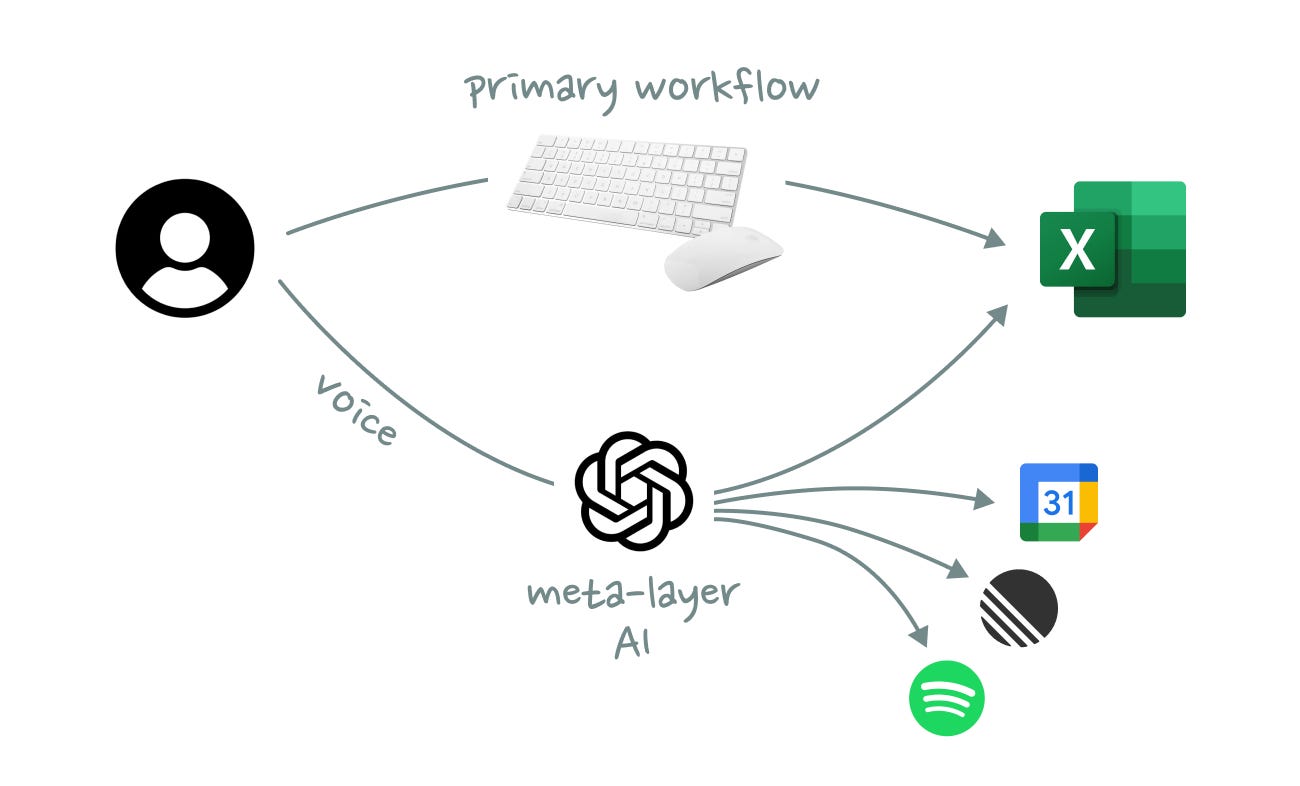
Hi friends 👋, Happy Wednesday! After almost two years, Julian Lehr is BACK to writing.He wrote a piece called The case against conversational interfaces, arguing that we're not going to be talking to our computers instead of using graphical user interfaces. GUIs work pretty well!Instead, he thinks that conversational interfaces are going to be a complement to existing workflows. We'll talk to our AI while doing what we do now, to do things like tell other apps to start doing things while we stay in flow.Julian shares his writing process -- chat through a draft with AI, write ~60% of it by hand, and then pull it together in Figma, or sometimes, Google Docs. He said that like some people need a change of scenery to write, he needs a change of tools.So why did he come back after two years in the wilderness? Simply: too many people were too consistently wrong on the internet. After seeing one too many "we're all going to be chatting with our computers" takes, he had to write the other side. And he delivered.We cover a lot, from why he keeps coming back to Kevin Kwok’s Arc of Collaboration to how he uses his "thanks to" section to status signal. For this essay, he thanked Blake Robbins, Chris Paik, Jackson Dahl, Johannes Shickling, Jordan Singer, and Signulll -- an absurdly high signal roster.Conversations like this one - where I get to nerd out with the people I've read for so long - is exactly why I'm doing Hyperlegible. I hope you enjoy it as much as I did.You can find this and all Hyperlegible episodes wherever you watch and listen: YouTubeSpotifyApple PodcastsHyperlegible is now sponsored by our friends at Readwise, which builds software that helps you get the most out of your reading. When you go to readwise.io/hyperlegible, you can find all of the essays that we discuss on Hyperlegible in one place. I want this to be the best place to go whenever you’re looking for something fresh and high-quality to read (and listen to). We’re getting serious over here. I’ve started working with an editor, Jim Portela, so if you notice that this episode is higher quality, that’s why. As always, I hope you enjoy, and please keep sending me your favorite essays!We’ll be back in your inbox on Friday with a Weekly Dose, and I will be back with a fresh Deep Dive next week. Thanks for listening,Packy Get full access to Not Boring by Packy McCormick at www.notboring.co/subscribe
S1 Ep 2Hyperlegible 002: Utsav Mamoria
Hi friends 👋, Happy Monday! Kicking off the week by sharing Episode 002 of Hyperlegible.This is a conversation with Utsav Mamoria on his excellent essay, How to live an intellectually rich life, which broke out of containment in India and raced across the globe to the tune of 1,100 likes at the time of recording. For good reason: Utsav combines philosophy, mathematics, biographies, personal experience, and hand-drawn sketches to create a map – quite literally – for living an intellectually rich life. He takes us on a journey through Moradoom, Igamor, and Evermore, before arriving at Luminspere, the Mountains of Knowledge with tools like the Axe of Satisfaction, Torch of Curiosity, and Oars of Consistency. Utsav weaves together so many ideas so beautifully that you just need to read it, and then listen. Or listen, and then read it. His one sentence takeaway: Consistency trumps everything.But there were a lot of good sentences. Here are a few of my favorites: "The way to live an intellectually rich life is to focus on two things: Put ideas above sensations, and try to have more diverse ideas than the ones you already have."On Epistemic Anxiety: "Accept that you don't know everything about everything and you don't need to have a point of view on everything... develop expertise in a few fields while trying to read as broadly as you can.""Building worlds in fiction is a given, but building worlds in non-fiction is done a lot less.""Write something which has meaning beyond the current moment. It has to go beyond the zeitgeist.""All learning requires us to suffer an injury to our self-esteem."You can find Utsav on X at @utsavmamoria and subscribe to Tumse Na Ho Paayega here.Going forward, I plan on releasing a few of these per week. This week, I have three killer interviews lined up, and just brought on an editor so we can increase both the quality and the cadence. North Star: when there’s something really great written on the internet, you can expect to find its author in the Hyperlegible feed within a few days. I likely won’t send you an email every time (still playing with that), but you can subscribe on YouTube, Spotify, or Apple Podcasts, and I may send a weekly roundup on Sundays with all of the conversations in one place. Subscribing helps you curate the internet, and helps us grow this thing to bring the good words to as many people as we can. Hyperlegible is now sponsored by our friends at Readwise, which builds software that helps you get the most out of your reading. I’ve been using Readwise for years to support my newsletter, my curiosity, and now, this podcast. I wanted to partner with Readwise specifically for a few reasons. One: I use it every day, multiple times a day. When I find an essay I love, I save it to Readwise, where I can highlight and annotate it to prep for either inclusion in essays or conversations on Hyperlegible. Two: I’m an investor in Readwise. Three: they partner with my favorite written-word-related podcasts, Founders and How I Write. And Four (and most importantly): when you go to readwise.io/hyperlegible, you can find all of the essays that we discuss on Hyperlegible in one place. I want this to be the best place to go whenever you’re looking for something fresh and high-quality to read. I am having a blast doing this podcast. It’s an excuse to talk to my favorite writers, and to share the fruits of their hours and hours wrestling with ideas with you. As always, I hope you enjoy, and please keep sending me your favorite essays! Thanks for listening, Packy Get full access to Not Boring by Packy McCormick at www.notboring.co/subscribe

S1 Ep 1Hyperlegible 001: Tina He
For the first episode of Hyperlegible, I talked to my friend Tina He (@fkpxls on twitter) who writes the excellent Fakepixels, which she recently brought back to life after a four year hibernation and on which she’s dropped gems each week since. Last week, Tina wrote an essay called Jevons Paradox: A personal perspective about something surprising she’s noticed: AI is causing a lot of people to work more, not less. Since you can now do more with each hour, the opportunity cost of each hour not worked is higher! The treadmill spins faster and faster. Read it, and subscribe to Fakepixels while you’re there: https://fakepixels.substack.com/p/jevons-paradox-a-personal-perspective If you're wondering how (or whether) to compete in the age of AI, Tina's personal perspective will help. Please let us know what you think and share your favorite essays with me @packym on twitter. Get full access to Not Boring by Packy McCormick at www.notboring.co/subscribe

Primer: From Software to Schools
In April 2022, Packy wrote a Deep Dive on Primer:https://www.notboring.co/p/primer-the-ambitious-home-for-ambitiousThree years later, a lot has changed. Primer is building schools. The opportunity is both bigger and more challenging than it was then. In this conversation, Packy and Primer CEO Ryan Delk discuss the need to fix in K-12 education. Ryan shares insights on Primer's transition from a software-focused company to a vertically integrated Microschool model. He also addresses regulatory hurdles, the market potential for innovative educational solutions, and the vision for making quality education accessible to all families.If you want to build a vertically integrated company to solve a really big, important problem, you need to listen to this. TakeawaysK-12 education reform is a civilizationally important issue.Primer aims to tackle the hardest problems in education.The transition to microschools was driven by the need for a more effective educational model.Regulatory challenges are significant but can be overcome with strategic action.The market for education is vast, with opportunities for innovation.Primer's microschool model aims to provide quality education at a lower cost.The importance of community involvement in launching new schools.AI and software can significantly improve educational outcomes.The future of education will involve diverse options for families.Investors are increasingly supportive of innovative education solutions.Chapters00:00The Importance of K-12 Education Reform02:18The Shift from Software to Microschools04:04The Pivot to Microschools06:28Building a New Education Model09:03Scaling and Integrating Education Solutions11:43Balancing Control and Innovation in Education14:18The Role of Software in Education17:15Future of Education and Personalization21:56The Future of Education Funding24:14AI Tutors and Their Limitations26:12The Shift in Educational Structures Post-COVID28:59Addressing Concerns About School Choice31:19Breaking the Narrative of Private Schools33:58The Vision for Free Education36:49Navigating the Incumbent Education System39:15Market Opportunities in Education41:19The Future Landscape of Education43:09Growth Projections for Primer Get full access to Not Boring by Packy McCormick at www.notboring.co/subscribe
Not Boring Founders Podcast: Amjad Masad, Replit
Welcome to the 596 newly Not Boring people who have joined us since Monday! If you haven’t subscribed, join 125,666 smart, curious folks by subscribing here:Hi friends 👋 , Happy Thursday! This really will be the shortest Not Boring in history. You have a Memorial Day Weekend to get to. But since odds are you’ll be in a car for a couple hours at some point in the next few days, I thought it would be the perfect time to listen to my favorite episode of Not Boring Founders yet. Not Boring Founders is a twice-weekly podcast on which I talk to founders — often Not Boring Capital portfolio founders — about what the world looks like if they’re wildly successful, and how they’re making that version of the world a reality. Normally, the episodes are about 30 minutes. For this one, with Replit co-founder and CEO Amjad Masad, we went a full 1 hour 41 minutes, covering a wide range of topics:* Decentralized software creation* How the internet could have been built differently * The history and future of coding (aka when Wordcels rule the code)* Amjad’s story: from Jordan to Codecademy, Facebook, and Replit* Authenticity Alpha * Balancing theory and just doing things * Replit’s hiring spree and talent density* The software economy being built on Replit* Aggressiveness vs. caution in the current marketI hate listening to myself talk, and I listened to this one all the way through. Amjad has quickly become one of my favorite people in tech, and is someone who I genuinely believe will play a big role in shaping the future. I believed that when I wrote about Replit in December, and I believe it even more strongly after this conversation. You can listen to this episode right in this post — just press play above — or wherever you like to listen. All Not Boring Founders episodes are available on Spotify… Apple Podcasts… …or on the podcast player of your choice. If you liked this conversation, we’d really appreciate it if you subscribed and rated.Big thanks our friends at FTX US for sponsoring all of Season 2.For more Not Boring Founders — including links to all Season 2 Episodes with show notes and links — check out this fancy Notion page we made.That’s it! Told you, short and sweet. Not Boring will be off for Memorial Day. Have a great long weekend! Thanks for listening,Packy Get full access to Not Boring by Packy McCormick at www.notboring.co/subscribe

Prescription Drug Commercials: Why Are You the Way You Are?
Welcome to the 1,912 newly Not Boring people who have joined us since last Thursday! Join 48,356 smart, curious folks by subscribing here:🎧 To get this essay straight in your ears: listen on Spotify or Apple PodcastsToday’s Not Boring is brought to you by … SecureframeSecureframe helps companies get enterprise ready by streamlining SOC 2 and ISO 27001 compliance. Secureframe allows companies to get compliant within weeks, rather than months and monitors 40+ services, including AWS, GCP, and Azure.Whether you’re an enterprise or a small startup, if you want to sell into enterprises, you’re going to need to be compliant. Secureframe makes the process faster and easier, saving their customers an average of 50% on audit costs and hundreds of hours of time.Secureframe’s team of compliance experts and auditors are happy to help answer any questions and give you an overview of SOC 2 or ISO 27001, even if you don't need it today. Schedule a demo and learn how:Hi friends 👋 ,Happy Thursday!There are a lot of things that confuse me, but maybe none more than prescription drug commercials. People eating ice cream while a voiceover talks about herpes. The Cialis couple in the bathtubs in a field (backstory revealed below). The long list of side effects that seem much worse than whatever disease the advertised drug claims to cure. I’ve been curious about why prescription drug commercials are the way they are forever; challenge was, I don’t know very much about healthcare. I haven’t been to the doctor in years. I’m not the guy to solve this mystery. But I know the guy. Nikhil Krishnan’s twitter profile says it all: “Thinkboi. Making healthcare understandable through memes, shitposts, and novelty products.” He writes the funniest healthcare newsletter out there, approachable for newbies (like me) and deep enough to be valuable to industry professionals. You should subscribe: He’s the perfect guy to explain something as simultaneously ludicrous and technical as prescription drug commercials. Mystery solved. Let’s get to it. Prescription Drug CommercialsA guest post by Nikhil KrishnanAs the Meghan/Harry + Oprah interview aired in March, Americans were shocked. How could the British Royal Family treat them that way?Meanwhile, people in the UK watching the interview were also shocked. At the fact that pharmaceutical companies were advertising during the interview. There are only two countries in the world that allow for direct-to-consumer pharmaceutical advertising: the US and New Zealand. The only other thing these two countries share are people buying a lot of property in New Zealand. But why exactly do pharmaceutical companies advertise to us? Does it work or affect care? What’s the deal with the million side effects they list at the end? I’m here to talk to you about the world of pharma marketing and how it works. But I actually want to get into how pharma marketing is evolving with technology, look at whether consumer advertising is definitively bad, and suggest that we should actually be focusing our scrutiny on physician marketing.Why Do Pharma Companies Market to Consumers?The first question is an obvious one. It’s the one the Brits had. Why do pharma companies market to the consumers when the consumers need to go to the doctor, and the doctor’s going to decide anyway?Pharma advertising has largely two main goals. First is for undiagnosed patients. Increasing general awareness about a disease is going to make you more likely to see a doctor in the first place, which increases the chance of you getting the drug prescribed. For example if you hear a commercial that says, “If you suffer from insomnia, hot sweats, or are having nightmares that you have no idea where your social security card is,” you might suddenly realize that you have those issues and there might be something to fix them. You’ll especially see that for disease areas which are lifestyle hampering or easily self-diagnosed (sexual issues, skin and hair issues, pain, mental health, sleep issues, weight issues, stomach problems, and more). Below is some data on advertising spend by disease area.Fun fact, Claritin was really one of the first significant direct-to-consumer pharma campaigns with their “blue skies” campaign in the mid 1990s. Now allergy meds are all over-the-counter, so the spend has dropped like crazy.For already diagnosed patients, these ads are helpful for patients who are especially active in looking for different treatments for their diseases. This happens a lot in diseases for which there’s high variance in physician recommendations. Areas like cancer or rare diseases want to arm you with information about a drug so you actually ask your doctor if the drug might make sense for your cancer type. As personalized advertising gets more targeted and the therapies themselves target smaller and smaller patient segments, ads for these drugs become a better investment. They have exploded accordingly. What Are the Rules Around Marketing to Consumers

The Great Online Game (Audio)
Welcome to the 1,265 newly Not Boring people who have joined us since last Monday! Join 47,388 smart, curious folks by subscribing here:Today’s Not Boring is brought to you by… RowsIn March, I wrote that Excel Never Dies. I may have spoken too soon. Rows very much wants Excel to die. It has a shot: Rows is one of the most “Holy shit 🤯” new product experiences I’ve had in a long time.Rows is a spreadsheet powered by APIs, with built-in integrations that let you enrich mailing lists, learn what’s in a company’s tech stack, find company data via Crunchbase, and much more, right in the spreadsheet. They even made me a template to monitor trending tweets on topics I’m writing about. Plus, the spreadsheets are always ready to share: beyond just collaborating with others, anyone can transform their spreadsheets into interactive web apps in one-click. Anyone can build forms, models, and internal tools out of a spreadsheet without having to code.Everything in Rows is formula-based. It’s kind of like if Excel, Airtable, and Zapier had a baby, plus access to databases that normally live behind paywalls.It’s really incredible already, and it’s still in beta. Rows wants Not Boring readers -- people who love finance & tech -- to be among the early adopters. You should just try it for yourself, on me:Hi friends 👋 ,Happy belated Mother’s Day to all the not boring moms! Most of the time at Not Boring, I write about companies, with facts and figures and histories and graphs. Occasionally, I’ll write about concepts and business models, like the Metaverse, DAOs, or APIs. Sometimes, I’ll let you into my brain to see what’s going on in there before an idea is fully baked, when its just a bunch of wisps starting to form a braid. Today is one of those pieces. It’s shorter. It’s meant to be interactive. Most of the fun will happen when you take the idea and try to apply it to your own work or life. To be clear, much of today’s essay is based on my own personal experience. I fully understand that not everyone has the luxury of having a roof over their head, food on the table, and an internet connection. Many people can’t afford the time to play the game. But if you take the hours it takes to read Not Boring, you’re probably already playing the Great Online Game to some degree. You read this because you want to know how the online economy works, and how you can play it better. But you can’t play to win unless you know you’re playing.Let’s get to it. The Great Online Game(Click this if you just want to jump to reading online)This didn’t start as a piece about games. I set out to answer this question: why are tech growth stocks sagging while crypto moons and value roars back? But I figured out how to explain that out in way fewer words: Crypto is just more fun. But crypto itself is not the game. It’s just the in-game currency for a much bigger game, played across the internet, that involves CEOs, influencers, artists, researchers, investors, and regular people, like you and me. That’s a much more fun topic to explore than which asset class is outperforming which. This is bigger, more permanent than day-to-day market fluctuations.We’re all playing a Great Online Game. How well we play determines the rewards we get, online and offline.The Great Online Game is played concurrently by billions of people, online, as themselves, with real-world consequences. Your financial and psychological wellbeing is at stake, but the downside is limited. The upside, on the other hand, is infinite.Social media is the clearest manifestation of this meta-game. Beginner-level Twitter feels weird, like a bunch of people exposing their personal thoughts to the world. Medium-level Twitter is Threads and engagement hacks. Twitter Mastery is indistinguishable from an ongoing game. This is also true for Reddit, Discord, Instagram, TikTok, Facebook, and other social networks. But social media is just one piece of an interconnected game that spans online and offline spaces. The way you play in one area unlocks opportunities in others. Sharing ideas on Twitter might get you invited to a Discord, your participation in that Discord might get you invited to work on a new project, and that new project might make you rich. Or it might bring you more followers on Twitter and more Discord invites and more project opportunities and new ideas that you want to explore which might kick off any number of new paths. We now live in a world in which, by typing things into your phone or your keyboard, or saying things into a microphone, or snapping pictures or videos, you can marshall resources, support, and opportunities. Crypto has the potential to take it up a notch by baking game mechanics -- points, rewards, skins, teams, and more -- right into the whole internet. The Great Online Game is free to play, and it starts simply: by realizing that you’re playing a game. Every tweet is a free lottery ticket. That’s a big unlock.Anyone can play. You can choose how to play given your r
Truework: A True Strategy Masterclass (Audio)
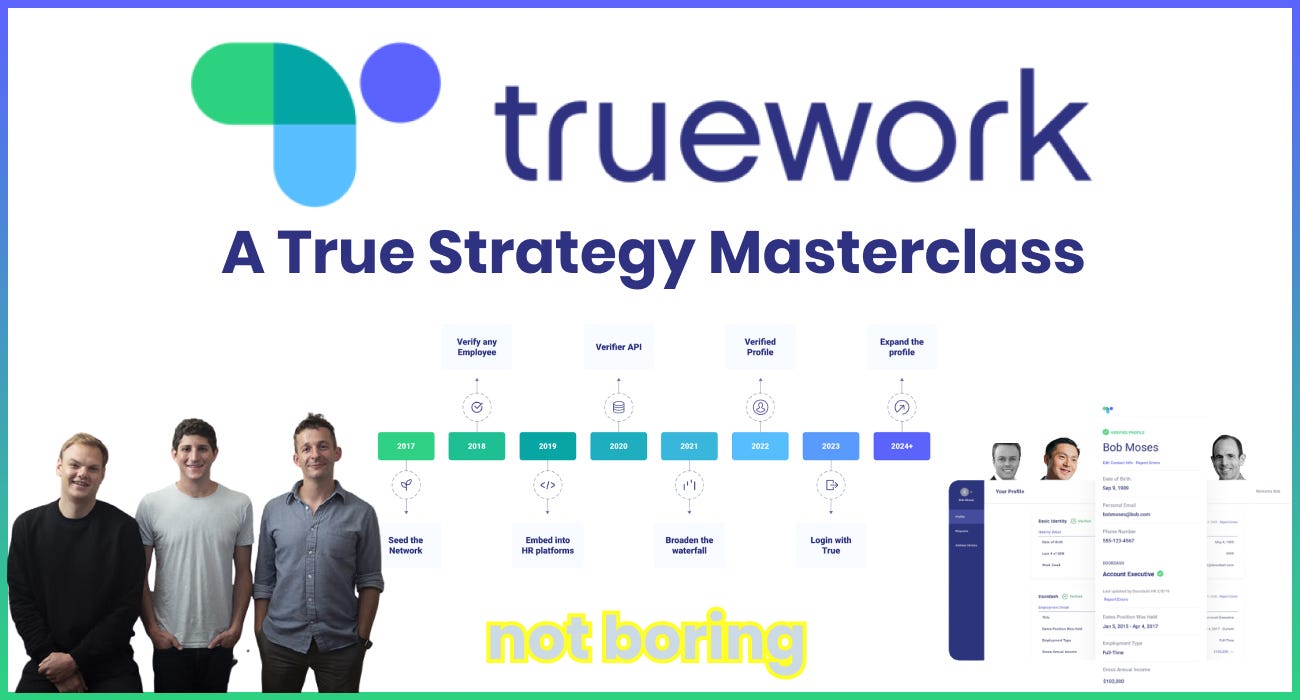
Welcome to the 225 newly Not Boring people who have joined us since last Thursday (Substack confirmed they dropped some)! Join 46,444 smart, curious folks by subscribing here:Today’s Not Boring, the whole thing, is brought to you by … TrueworkRead on to learn how Truework is building the verified identity layer of the internet.Hi friends 👋 ,Happy Thursday!I met Ryan Sandler, Truework’s CEO, via an introduction from Ramp co-founder and CTO Karim Atiyeh. Aside from running NYC’s fastest ever unicorn, Karim is also a top angel investor. One mutual friend told me that no one is better at identifying strong engineering teams than Karim. So when he told me I needed to look into Truework, my ears perked up. Karim was right. Truework reminds me a lot of Ramp, a Not Boring favorite: Rabois-backed, fintech, Harvard founders, going after an absolutely enormous market led by a too-comfortable incumbent, strong technology chops, and a long-term, worldbuilding strategy starting with a smart wedge.It’s different than Ramp, too. First, it’s not starting with a product that the end-user touches. It built a platform and API used mostly by employers and verifiers. It’s intentionally unsexy. Second, it has a different ambition, which required it to act differently, more quietly, in the beginning. (Until now. That’s why we’re here.) And third, Truework is a privacy-first company. Truework’s story has lessons for founders, investors, anyone who works in regulated industries, and even incumbents. It’s a masterclass in Worldbuilding.This essay is a Sponsored Deep Dive on Truework. For those who are new around here, that means that Truework is paying me to write about their business, but that I would have written about it anyway. You can read more about how I pick and work with partners here.Let’s get to it. Truework: A True Strategy MasterclassThis is a story about strategy. It’s also about privacy, identity, income verification, credit bureaus, breaches, regulations, and owning your data. It’s about worldbuilding and unsexiness. It’s about the ability to fill out a mortgage application simply by clicking “login.” But mostly, it’s about strategy. Truework launched in late 2017 with a vision: empower people to own and control their personal information. That’s one of those “much easier said than done” visions. Others have tried and failed. To succeed, you need a strong wedge, and a master plan. Truework has both, and is executing on one of the most patient and ambitious worldbuilding strategies I’ve seen, backed by Keith Rabois at Founders Fund, Alfred Lin at Sequoia, and Steve Sarracino at Activant. You don’t assemble that board if you’re fucking around. Its master plan starts with employment and income verification, a process that touches all of us. If you want a house, a job, or a car, your lender or employer needs to confirm where you work and what you make. It’s a $5+ billion market with one dominant incumbent, a bunch of small players, and a lot of pen, paper, emails, and faxes. It’s broken, unsecure, and slow. But employment and income verification is a wedge into a much bigger opportunity: to become the verified identity layer for the internet, giving people control of which data they share, and where, and speeding up transactions that require trust. Truework’s journey thus far, and it’s plan for the next half-decade, is a case study on how tech startups can win huge markets controlled by dominant incumbents without using low-end disruption. Let’s study: * Meet Truework* How to Win a Legacy Industry * Regulatory Counter-Positioning* The Verified Identity LayerMeet Truework In 2017, after product managing LinkedIn Salary (a Glassdoor competitor) to launch, Ryan Sandler left LinkedIn and linked up with his Harvard roommate, Ethan Winchell, and fellow LinkedIn-er, engineer Victor Kabdebon, to explore ideas for their own thing. Having gotten interested in data ethics in college, Sandler knew that he wanted to start a company in the data privacy space, but he didn’t know exactly what the idea was. He did know which boxes it needed to check: * Unsexy * Overlooked by Silicon Valley * Lots of data* Large marketOnce they identified spaces that met their criteria, they cold emailed companies to pick their brains, narrowed the list down, and started talking to customers to validate the top ideas. After speaking with mortgage lenders, they chose employment and income verification. Sandler told The Venture Brief they chose the category because of: How overlooked it was, yet such a big market, and so important in the economy. Every time someone gets a loan, apartment, a new job, there’s sensitive information that needs to be verified about them. Most prominently, their income, employment, assets, credit, other pieces of their identity. And consumers have no idea that this information is being verified and being shared with a ton of third parties.Employment and income verification checks all the boxes. * Privacy has been a huge issue, de
Transforming Tata
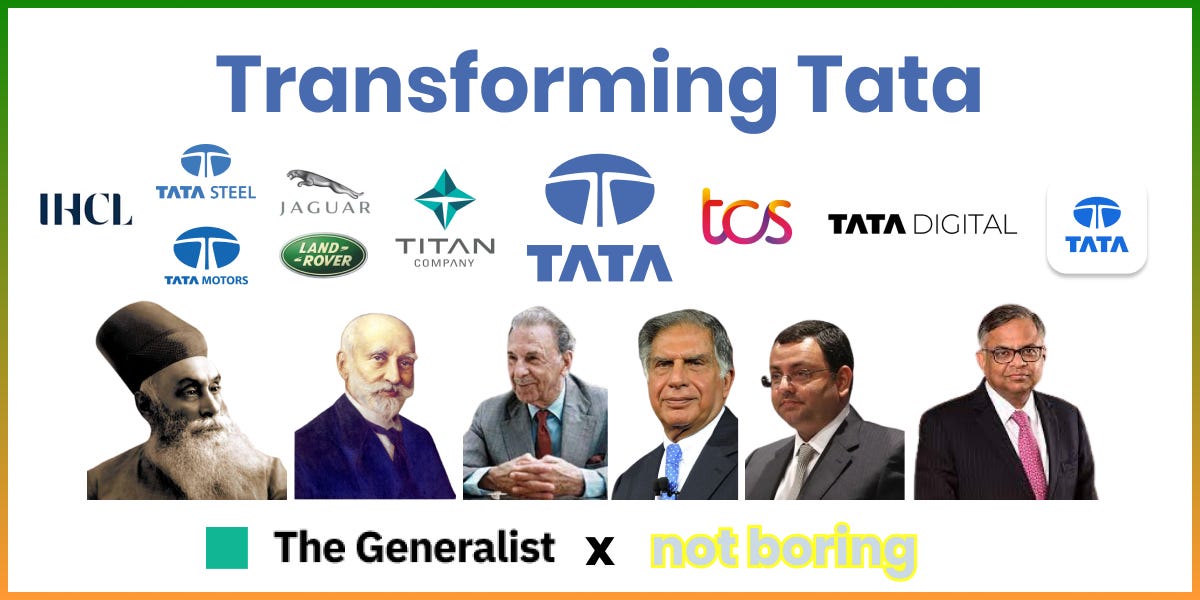
Welcome to the ??? newly Not Boring people who have joined us since last Monday - on Thursday, Substack suddenly cut my subscriber count by ~1,200 and I’m not sure why. But onwards: join 46,123 smart, curious folks by subscribing here:🎧 To get this essay straight in your ears: listen on Spotifyor Apple PodcastsToday’s Not Boring is presented by… MasterworksIn January I wrote about Masterworks. As a refresher, Masterworks is the first and only platform that lets regular folks (like me) invest in blue-chip artworks at a fraction of the entry price. At the time I had invested in three Masterworks offerings. Since then I have added three more pieces to my portfolio: a Haring, a Bradford, and another Basquiat. Fancy. Not only do I think it’s prudent to have real asset exposure to hedge against inflation (thanks J Pow 😉 ), but I also love learning about these artists and their markets, and Masterworks brings some intense data analysis to the table.Art can make sense in everyone’s portfolio. Contemporary art returned 13.6% from 1995-2020 with a low loss rate and virtually no correlation to equities. Plus, unlike other collectables or even BTC, supply is constantly decreasing. It’s kind of like ETH … ultrasound art 🦇🔊I teamed up with Masterworks to let you skip their 11,500 person waitlist. Try it.**See important infoHi friends 👋 ,Happy Monday! Mario Gabriele is one of my favorite writers. Read the opening paragraphs in this essay and you’ll understand why. He somehow makes business writing beautiful. Between his briefings, Startup Ideas, and The S-1 Club, Mario’s The Generalist is can’t miss content. If you like Not Boring, you’ll like The Generalist. Aside from a general business nerdiness, Mario and I share a few things in common:* A fascination with conglomerates. * Large Indian readerships. This week, with India’s COVID crisis continuing to escalate to frightening heights, we decided to team up to explore the past, present, and future of one of India’s most beloved companies, and one of the leaders in the fight against COVID: Tata Group.In addition to bringing awareness, Mario and I have both made donations to organizations aiding India's fight against the coronavirus. We'd encourage those of you that can to do the same. Both New York Magazine and the New York Times have lists of reputable NGOs putting funds to good use. If you’re in India, my friends at Pesto put together a website with resources including ICU beds and oxygen supplies.Let’s get to it. Transforming TataA message to all the tycoons out there: beware of your grandchild. Though the Bible advances the parable of the prodigal son — the wasteful offspring that fritters a father’s money — statistically, it is the third generation that marks the end of a family fortune. One American study indicated that 90% of wealth evaporates by that point, the casualty of frivolous investments, generational dilution, and dwindling determination. Even the colossal wealth of Cornelius Vanderbilt — worth $227 billion when adjusted for inflation, giving him a cool $96 billion edge over Bezos — dissolved in his expanding gene pool. All of which is to say: that Tata is here at all is remarkable. Four generations and more than 150 years after its founding, Tata is not only still standing but essential. Just this week, the company aided in India’s coronavirus response, agreeing to contribute 800 tonnes of oxygen per day to health facilities in need. Far from an isolated example, such civic-mindedness is at the heart of Tata’s history, no doubt part of the reason one Twitter commentator referred to it as India’s “parallel government.” Over a century and a half, the conglomerate has supported (and commercialized) Indian life, unlike any other company. In the process, Tata has constructed a dizzying tessellate of over 100 businesses, from automobiles to apparel, steel production to tea. And yet, there’s the sense that despite its durability, Tata’s may be in decline. With infighting beleaguering the founding families and legacy businesses struggling to adapt to a digital world, Tata will need to work hard to ensure it remains a potent force. To do so, the company will need to shed legacy baggage, embrace the opportunities the tech sector presents, and lean into the essence of what makes Tata an enduring brand. In today’s piece, we’ll explore: * Tata’s rich history, beginning with the opium trade* The complexion of a messy conglomerate* The necessary moves to perpetuate the dynastyHistoryThe story of Tata Group is the story of modern India. The conglomerate’s creation and ascent both influenced and responded to seismic changes in the country beginning under colonialist rule, adapting under socialist independence, and flourishing in an open economy. It all begins in 1822 in a city on India’s Western Coast. Nusserwanji: Zoroastrianism and family businessEvery company is defined by its culture. On that count, Tata can lay claim to an especially ancient heritage: the religion
Startup Stock Options Options with Secfi
Welcome to the 867 newly Not Boring people who have joined us since last Thursday! If you aren’t subscribed, join 45,133 smart, curious folks by subscribing here:🎧 To get this essay straight in your ears: listen on Spotify or Apple PodcastsHi friends 👋 ,Happy Thursday!Startup stock options are one of those things that startup employees should know a ton about but just don’t. There’s a never-ending debate in tech around whether stock options make sense for employees, or whether they’re just a way for companies to pay less cash. Even when things seemingly go really well for a company, employees’ situations are often murkier than it seems. That’s why I was so pumped when Shanna Leonard, who runs marketing at Secfi, reached out about working together. I’ve been wanting to write about this forever. This essay is a Sponsored Deep Dive on Secfi. For those who are new around here, that means that Secfi is paying me to write about their business. You can read more about how I pick and work with partners here.This one is a little bit different though. The Secfi team really just wants more startup employees to know what their options are, make a plan, and not leave millions of dollars on the table. Each person I’ve spoken to there has their own personal startup equity horror story, and they want to make sure that you don’t go through the same thing. I, too, gave up cash for equity, and it was a terrible financial decision. This one is personal.Obviously, if Secfi can help you make smarter decisions, that’s a win-win, but more thoughtfulness around employee equity is a win in itself. So we’re going to go deep on how equity works, why people don’t exercise, and what happens when they don’t. (One note: I wanted to call this post ESOP’s Fables, but ESOPs are a public company thing more than a private company thing. But I thought it was clever, so I couldn’t not share.)Let’s get to it. Startup Stock Options Options with SecfiIn 2020, startup employees left $4.9 billion on the table by not exercising their pre-IPO options. Not exercising pre-IPO means employees missed out in two major ways:* They let the typical 90 day window pass after leaving and forfeited unexercised options, either all of their options or a portion. * They stayed at the company through IPO, but didn’t exercise before the IPO and had to pay short-term capital gains or ordinary income instead of long-term capital gains because of “cashless exercising.” Costs can soar post-IPO.That combination cost employees four point nine billion dollars. $4,900,000,000. 4,900 million. At Snowflake alone, ex-employees left 72 million options worth $1.27 billion unexercised. Ouch. Those numbers are so big as to feel kind of meaningless, but they represent years of blood, sweat, tears, uncertainty, and financial trade-offs down the drain. Most people who work for early stage startups take less cash compensation than they’d be able to get at a more mature company in exchange for a few things: a more fun work environment, the chance to change the world, more responsibility than they’d get elsewhere, and a host of soft benefits, but mainly, they do it for the employee stock options. Employee stock options are the lifeblood of a startup. Options are the main way startups compete on comp with big companies like Google and Goldman that can afford to pay infinity times more cash. They offer the promise of millions and millions of dollars if things go really, really well. When I left Bank of America Merrill Lynch and went to Breather, I took a 70% pay cut on the cash side, but I got options worth 1% of the company in exchange. Even coming from finance, I didn’t fully understand my options. I just did some hyperoptimistic expected value math (1% * $1 billion = $10 million!) and that was good enough for me. I’m certainly not alone. Most startup employees don’t understand their options. Some don’t even know they need to exercise them or put out money at all. Because options feel like lottery tickets at the early stage, employees don’t think all that much about things like the tax implications of when they exercise, what happens if they leave the company, and all of the little details that can mean hundreds of thousands or even millions of dollars. Which is crazy, because those options can often represent, on paper, a huge percentage of their net worth. For a group of ostensibly intelligent people, startup employees put surprisingly little thought into managing their options. These are builders. They get so immersed in their day-to-day and building great things that they lose sight of their own personal gain at times. Plus, it’s kind of taboo to talk about maximizing the value of your options when there’s real work to be done. And most companies don’t do much to help. It’s (generally) not because they don’t want to, but because this stuff is really complicated, and so far in the future, and startups have dozens of more pressing fires to put out at any given time. In the Eisenhower D
Bull & Bear: Agora, the API Powering Clubhouse
Welcome to the 974 newly Not Boring people who have joined us since last Monday! If you aren’t subscribed, join 44,858 smart, curious folks by subscribing here:🎧 To get this essay straight in your ears: listen on Spotify or Apple Podcasts (in ~30 mins)Hi friends 👋 ,Happy Monday! We have a special one for you today. Back in January, I wrote a piece about Alibaba. Lillian Li, whose writing on Chinese tech I’d read and respected, but who I’d never met, DUNKED on it on Twitter. She said that “the piece missed local context.” Which, fair. She also wrote a more complete response on her Substack, Alibaba: from growth to value.I loved getting Lillian’s perspective -- one of the reasons I write is so people who are smarter on a particular topic share their knowledge. And when it comes to China tech, Lillian, who worked as a VC in Europe but is now based in China, is as smart as it gets. She writes a great newsletter called Chinese Characteristics. You should subscribe if you’re interested in China tech, and you should be interested in China tech: Lillian and I got to know each other after that exchange. We decided to team up. Reprise the ol’ bull and bear schtick, but together this time. In other words, we shifted our debate method to Real-Time Engagement (I promise, this will make sense /maybe be funny in a minute).Let’s get to it. Today's Not Boring is brought to you by PublicAs you read above, the fastest way to get smarter about investing is to put your ideas out there and get dunked on by … errr... have a conversation with other smart investors. That's why I use Public. Public is an investing app AND a social network for talking about business trends, and the social features make it fun and easy to share ideas. I'll be discussing today's piece on Public. Hit the link below and follow me @packym to join the conversation. Btw, if you’re looking to transfer your account from somewhere else, they’ll even cover the fees.*Valid for U.S. residents 18+ and subject to account approval. Transfer fees covered for portfolios valued at or over $150. See Public.com/disclosures/Agora: Bull & BearIn 1997, two Chinese engineers joined the founding team at early video conferencing startup WebEx. A decade and a half later, each started his own company.One, Eric Yuan, founded a company you’re all too familiar with: Zoom. The other, Bin “Tony” Zhao, founded Agora. If you’ve joined a conversation on Clubhouse , attended a virtual event on RunTheWorld, or binged livestreams on Bilibili you’ve experienced Agora. It’s been sitting there, in the background, making sure the audio and video come through clearly. Agora builds real-time audio and video capabilities and delivers them as a Software Development Kit (SDK) and Application Programming Interface (API) for app developers. It’s an API-first company that makes it easy for developers to add real-time video and audio into their product. Stripe for Real-Time Voice and Video Engagement, if you will. The company is so API that its ticker is API. Agora is also a great excuse to cover a few different relevant topics:* API-first businesses and business models* Live video streaming and all of its use cases, like telemedicine and education * The audio chat warsBecause Agora sits in the background -- it’s a “picks and shovels” company -- it doesn’t care who wins as long as more people communicate, learn, heal, play, and “live real life online,” in real time. Agora, dual-headquartered out of Shanghai and Santa Clara, went public in June last year. It was relatively quiet for its first six months as a public company, bouncing around the $3-6 billion market cap range, until investors picked up on the Clubhouse connection in January and sent shares soaring. In February, the company topped out over $12 billion before crashing after providing conservative 2021 guidance on its last earnings call. Source: Atom FinanceToday, the company is trading at a $6.5 billion valuation on projected 2021 revenue of $182 million. It’s cheaper, but it’s not cheap. As Packy was browsing atom for its numbers, he was confused when he saw that FY21 consensus Enterprise Value (EV) / EBITDA was 4.06x. Seemed like a steal. Then he looked more closely: that’s 4.06 thousand times EBITDA. It’s less than eight years old and still growing quickly (74% YoY revenue growth) and most of its revenue still comes from China (~80%). It’s young and fast-growing enough that whether you’re bullish or bearish on the company depends less on today’s metrics, and more on how you think about its growth potential and defensibility going forward. There’s a good case to be made on both sides, and we’re going to do just that. Packy’s going to take the bull case, and Lillian’s going to take the bear case. Then we’ll fight it out and let you know where we end up. To get there, we’ll cover: * Agora’s History* $API’s API* China’s Livestreaming Boom* What Agora Looks Like Today* The Bull Case for Agora* The Bear Case Against Agora* Bull or Bear? To ki
Is BlockFi the Future of Finance? (Audio)
Welcome to the 1,091 newly Not Boring people who have joined us since last Thursday! If you aren’t subscribed, join 44,266 smart, curious folks by subscribing here:🎧 To get this essay straight in your ears: listen on Spotify or Apple PodcastsToday’s Not Boring is brought to you by… BlockFiBlockFi is a new kind of financial institution. With BlockFi, you can use cryptocurrency to earn interest up to 8.6% APY (I’ll explain how below), borrow cash against your crypto holdings, and buy or sell crypto. No minimum balances or hidden fees. Tip: signup is smoother in the mobile app. Set up your BlockFi account today, and get up to $250 in free bitcoin:Hi friends 👋 ,Happy Thursday / Tax Day! Today’s post couldn’t have been timed any better. I’ve been talking to the BlockFi team for a couple of months, and we picked April 15th about a month ago. We didn’t know that Coinbase would be IPO’ing yesterday, or that I’d be so deep down the crypto rabbit hole at this point. It’s fate. This is a Sponsored Deep Dive on a company I’ve been wanting to dig into for a long time. BlockFi offers up to 8.6% APY on deposits, which is obviously tempting and also confounding. I’ve had so many text conversations with friends that go something like, “I want to do this, but it has to be bullshit, right? How does that even work? We need you to do a Not Boring on this.” I’m happy to report that it is not bullshit, and I have the receipts to prove it.Let’s get to it.Is BlockFi the Future of Finance?Coinbase IPO’d yesterday to wild success. After touching $420.69 and going as high as $429.54, it closed at $328.28, up 31% from its reference price of $250. It peaked at a market cap of over $100 billion, and closed at $86 billion. I’m more excited about BlockFi, though, and not because they’re sponsoring this post. It’s a more selfish reason, one that makes the sponsorship money seem like peanuts. See, if BlockFi existed in 2013 instead of Coinbase, I probably wouldn’t even be writing this newsletter. On May 16, 2013, when Coinbase was less than a year old, I set up an account and bought my first bitcoin. I forget why, but I just looked up when Union Square Ventures first invested, and that must have been it: That was good enough for me. I bought 10 BTC on May 16th, another 15 on June 14th, and another 13 on July 12th. That September, after quitting my job in finance, I flew my unemployed ass to Oktoberfest for a fun weekend with a few friends. On September 24th, after ten too many steins, I woke up in my Munich hotel room a little hungover and feeling dumb for spending so much on the trip and the night out... and made the stupidest financial decision of my life. I just sold some of those silly bitcoin I’d bought, and bingo, free Oktoberfest. It felt like such an obviously responsible thing to do that three days later, I sold ten more, then I sold eight in October, five in November, and the last five in May (for a nice little 4x, I might add!). I sold all 38 bitcoins for a total of $7,232. At current prices, those 38 bitcoins are worth $2,450,050. Gulp. If BlockFi had been around at the time, I could have taken out a USD loan against some of those bitcoin and earned interest on the rest while they sat safely in my account. If BlockFi paid interest on bitcoin that whole time, like they do today, I’d have more than 40 bitcoin today, or over $2.6 million. Double gulp. I’ve told you before that I’m an idiot, and I wasn’t kidding. But that’s enough self-chastising for one day. We’re here to talk about BlockFi.Is BlockFi Legit?BlockFi, which just announced a $350 million Series D led by Bain Capital Ventures, Pomp Investments, Tiger Global, and partners of DST Global, is building a full-fledged financial institution for crypto investors. BlockFi offers four products to retail investors: * BlockFi Interest Account (at rates up to 8.6% APY)* Trading Accounts* Crypto-Backed Loans* Credit CardIt also acts as a prime broker for institutional clients, with custody, financing, execution, and margin. BlockFi is building SoFi plus JP Morgan’s prime broker desk, for crypto. There’s a race going on among everyone in the financial services space -- centralized crypto companies like BlockFi and Coinbase, neobanks like Chime and Monzo, public fintech companies like Square and PayPal/Venmo, and large brokerages and banks -- to become the financial super-app, the place that customers go for loans, credit cards, trading, insurance, cash management, and more. BlockFi has a unique wedge: a growing suite of products that earn clients high interest rates and free crypto.The first question anyone has when they hear about BlockFi is: “What’s the catch? 8.6% APY sounds too good to be true. That can’t be legit.” I went DEEP to understand how they do it, and it’s legit. Essentially, BlockFi arbitrages the fact that traditional finance and crypto don’t like to deal with each other. To understand how it works, we’re going back down the crypto rabbit hole. We’ll cover topics lik
A Not Boring Adventure, One Year In (Audio)
Welcome to the 537 newly Not Boring people who have joined us since last Monday! If you aren’t subscribed, join 42,205 smart, curious folks by subscribing here:🎧 To get this essay straight in your ears: listen on Spotify or Apple PodcastsHi friends 👋 , Happy Monday! This is a big one for me: Not Boring’s first birthday. Instead of writing about a very big company, which I normally do on Monday, I’m writing about a very small one: Not Boring. It’s been a crazy year, I’ve learned a ton, and it’s just going to get better from here. But it was not at all obvious that this was going to work out a year ago. Before we get to it, I just want to say a big thank you. Nothing in this story would have happened without you reading, commenting, conversing, and sharing. I feel very lucky that you’re willing to take time out of your day to read what I write. If you want to bring some smart, curious friends along for year two: Today's Not Boring is brought to you a Not Boring Day One-erFun Fact: Public was the first company ever to sponsor multiple Not Boring newsletters. They sponsored Knock Knock. Who's There? Opendoor. and have been with us ever since.Public and Not Boring are a perfect match: like Not Boring, Public makes the investing conversation fun. Public is an investing app AND a social network for talking about business trends, and the social features make it easy to share ideas.Thank Public for making Not Boring possible by hitting the link below and joining me over there. If you want to transfer your account from somewhere else, they’ll even cover the fees.*Valid for U.S. residents 18+ and subject to account approval. Transfer fees covered for portfolios valued at or over $150. See Public.com/disclosures/.A Not Boring Adventure, One Year InThis has been the wildest and most rewarding year of my life, both personally and professionally: our son, Dev, turned 6 months old yesterday, and Not Boring turned one on Friday. A year ago, we knew that Dev was coming, but I had no idea what I was going to do. I had quit my job, launched an in-person company that got crushed by lockdowns (and was probably a bad idea anyway), and to top it off, I caught COVID the week I decided to start writing Not Boring. I was lost. Somehow, since then, with all of your help, I’ve built my dream job. Over the past 365 days, I’ve:* Written and sent 417k words. That’s more than all seven Chronicles of Narnia. * Grown from under 500 subscribers to over 42,000.* Run a syndicate which has invested nearly $2 million in fourteen companies. * Generated more revenue than I’ve ever made in a full-time job. I legitimately didn’t believe this was possible. I would see people with big followings on Twitter or big subscriber lists and think that they had some special je ne sais quoi. I still think that it could end at any moment. Today, I want to share the Not Boring story as honestly as possible -- it often looks way easier from the outside -- with lessons I’ve learned on writing, growth, business models, investing, and creator psychology sprinkled in. We’ll cover:* Getting Here: Per My Last Email → Not Boring Club → Not Boring* Growth: Luck, Shares, Ups, Downs and Tommy* The Writing Process and Psychology* Business Model: Optimize for Growth and Opportunity* The Not Boring Syndicate* The Present and Future of Not BoringIf anything in this story seems planned, premeditated, or in any way clean, that’s just my brain going back, filling in gaps, and connecting dots. As much as I write about strategy, this story is about working hard even when it seems silly and following serendipity. My biggest lesson so far: this is neither as impossible nor easy as it looks.The Winding and Uncertain Road to Not BoringPer My Last EmailI’m cheating a little when I say that it’s Not Boring’s one year birthday. I wrote a different newsletter -- Per My Last Email -- for almost a year before. In early 2019, the board at Breather, where I worked, had just brought in a new CEO, who himself was in the middle of bringing in a new, experienced executive team. A couple weeks into the new regime, Ben Rollert (then VP, Product at Breather, now CEO at Composer) and I presented at an exec team offsite about the need to differentiate and dig moats in an increasingly crowded and bubbly flex office market. We got cut off halfway through with something to the effect of: “Moats? This is a big market, we don’t need to worry about moats. We have a brand. That’s what Apple has.” I realized that my brain was going to shrivel up and rot if I didn’t do something. Ben’s always been smarter than me. He saw the writing on the wall and quit. I couldn’t quit right then -- I managed a 150 person team and didn’t want to abandon them -- so instead, I used my annual learning & development budget to take David Perell’s Write of Passage course. That was one of the best decisions I’ve ever made. One of the assignments for the course was to launch a Substack and get twenty people to subscribe. I reserved p
Secureframe Saves the World (Audio)
Welcome to the 873 newly Not Boring people who have joined us since last Thursday! If you aren’t subscribed, join 41,936 smart, curious folks by subscribing here:🎧 To get this deep dive straight in your ears: listen on Spotifyor Apple PodcastsToday’s Not Boring - the whole thing! - is brought to you by… SecureframeSecureframe helps companies get enterprise ready by streamlining SOC 2 and ISO 27001 compliance. If you don’t know what that means, I’ll explain. If you do, talk to them:Hi friends 👋 ,Happy Thursday! It’s been a wild week for Not Boring Deep Dive sponsors. Following up on MainStreet’s $60 million Series A a few weeks ago, news came out about two more Deep Divers this week:* Ramp: On Monday, The Information reported that Ramp raised $65 million from D1 and others at a $1.1 billion valuation, followed immediately by $50 million from Stripe at a $1.6 billion valuation. When we did the Ramp Deep Dive in December, they had just raised $30 million.* Pipe: Yesterday, TechCrunch reported that Pipe raised a fresh round of $150 million funding at a $2 billion valuation. When we talked about Pipe in October, they had raised $66 million total. The bar I use for whether I write a Sponsored Deep Dive on a company is whether I would invest my own money in the company if given the chance (disclosure: I invested a small amount in Ramp, MainStreet, and Pipe after writing about them). You can read more about the Deep Dive selection process here.Today’s Deep Dive Sponsor, Secureframe is fresh off an $18 million Series A itself. I think that’s just the beginning. They make companies more secure, and security has never been more critical. (I always tell you how I’m paid for Deep Dives — CPA, CPM, or equity. Today is CPM).Let’s get to it. This is How They Tell Me Secureframe Saves the WorldLet’s start with a riddle. What do Ukrainian accounting software, Southwest Airlines, and Secureframe have to do with each other? Any guesses? No? I’ll give you a clue. Secureframe is security compliance software that companies, from 3-person startups to enterprises, use to automate SOC 2 and ISO 27001 compliance, complete audits, and continuously monitor their security. It’s how modern software companies stay safe and compliant with less time, effort, or cost, so they can unlock sales and focus on growing their business. But what does that have to do with Southwest and Ukraine? Read on to find out.This is How They Tell Me the World EndsRemember the old Southwest Airlines commercial in which a bored employee clicks on an email titled “Sick of your job??” and infects her whole office? Wanna get away? It actually sums up why cybersecurity is so petrifying: all it takes to take down a system is finding and exploiting the weakest link. One employee opening the wrong file can infect an entire company’s network; even worse, in an interconnected world in which every company runs on top of a stack of other companies’ software, one employee ignoring a software update can bring down major companies all around the world. In This is How They Tell Me the World Ends, New York Times cybersecurity reporter Nicole Perlroth recounts the story of the most damaging cyber attack to date: NotPetya. (Wired tells it here if you don’t want to read the whole book). On Wednesday June 27, 2017, the day before Ukraine’s Constitution Day, hospitals, banks, ATMs, power plants, the government, and practically all businesses in the country were hit, seemingly simultaneously, with what appeared to be ransomware. It locked computers, deleted files, and spread at breakneck speed from computer to computer, and company to company. Messing with Ukraine on its Constitution Day had become a Russian hacker pastime -- Ukraine’s neighbor routinely shut off the power or deleted files -- but this was different, more vicious. It was also harder to contain. NotPetya spread via “two exploits working in tandem”: EternalBlue and Mimikatz (technically, Mimikatz is not an exploit but an application used to take advantage of the EternalBlue exploit). EternalBlue was a backdoor into any unpatched Windows computer, and Mimikatz used those computers to steal passwords and break into others. Together, they preyed on the weakest links. The virus was so hard to contain that it jumped from Ukrainian companies into any company that had an office or even an employee in Ukraine. NotPetya took down systems at: Danish shipping giant Maersk, American pharmaceutical behemoth Merck, FedEx’s European subsidiary TNT Express, and even boomeranged back on Russian state oil company Rosneft. Once the virus was unleashed, there was no stopping it. And it started by finding a weak link, or more precisely, a weak Linkos. Linkos Group is a small, family-run Ukrainian software business that makes M.E.Doc, a tax product that’s like a Ukrainian TurboTax or Quicken. Practically anyone who does business in Ukraine uses M.E.Doc. That’s how the Russians got in. According to Wired: In the spring of 2017, unbeknownst t
We Good Now? (Audio)
Welcome to the 997 newly Not Boring people who have joined us since last Monday! If you aren’t subscribed, join 41,668 smart, curious folks by subscribing here:🎧 To get this essay straight in your ears: listen on Spotify or Apple PodcastsToday’s Not Boring is brought to you by… MasterworksLast week, you might have heard that the art market went—as they say in b-school—absolutely bonkers, setting a nice new record of $69 million for a nifty digital artwork. The takeaway? Art investing has hit the mainstream. But perhaps putting your money in physical art by the blue-chips makes more sense for you. Me, I own 5 paintings on Masterworks 👨🎨Contemporary art has outperformed the S&P by 172% from 2000–2020, according to data from Masterworks. They were the first platform to let you invest in paintings by the likes of Basquiat, Kaws, and Haring. But what about returns? They’ve got that too: They sold their first Banksy work for a cool 32% annualized return to investors.With results like that, it’s no wonder there are over 17,000 people on the waitlist. To skip the line, just use my special link, tell them the Packy sent you, and you’ll be good to go.P.S. Here's some important legal info from MasterworksHi friends 👋 ,Happy Monday! Today’s essay is one that I’ve been waiting a long time to write: WeWork is going public. I’m bringing in the big guns for this one: Dror Poleg. Dror literally wrote the book on the future of real estate -- Rethinking Real Estate. Dror’s writing combines history and future, and is brilliant, nuanced, and balanced, words that don’t often describe WeWork coverage. We’ve waited years for this. We can’t wait any longer.Let’s get to it. We Good Now?by Dror Poleg and Packy McCormickIf I told you about a company doing $3 billion in revenue, leading a multi-hundred-billion-dollar market, that offers the easiest way for Fortune 500 companies to do flexible work, counts Amazon, Microsoft, Walmart, Goldman Sachs, Spotify, Netflix, IBM, and Airbnb as customers, and is going public at a $9 billion enterprise value (EV), would you buy it? What if I told you it’s burning $3.2 billion per year, has historically failed to meet nearly every target it set, and has to do construction every time it wants to increase its inventory? And that it had to pull a planned 2019 IPO due to investor disgust at the founder and CEO’s antics. Would you buy it then? This is the WeWork enigma. It has done some truly mind-blowingly impressive things while burning mountains of Masa’s money. If it weren’t for some huge unforced errors, it would have gone public at a valuation near $50 billion way back in 2019, before COVID supersized remote work valuations. It rode a positive narrative to the moon, and came crashing down when the narrative flipped. We all know We. The company’s story was everywhere in the fall of 2019. WeWork’s failed IPO was a car crash of epic proportions, and we all rubber necked. As someone who worked for a WeWork competitor, Breather, I watched it all with particular schadenfreude (this is Packy, speaking for myself). But since its public failure, it installed new management, flew under the radar, and refocused on its core business. It’s less exciting, but more solid. Its business model is neither inherently terrible nor is it as high-margin, high-growth as a pure software business. When WeWork was private, figuring out WeWork was SoftBank’s problem. We could afford to laugh at the company’s story without thinking too much about the actual business. But now that BowX SPAC’d it at a seemingly reasonable $9 billion valuation on $3 billion in revenue (in this economy?!), it’s worth taking a closer look. Today, we’ll do that: * The Royal We. Adam Neumann was narcissistic and brash… exactly what was needed to shake up office real estate. * WeStory. From 3,000 sq ft in Soho to millions across the world, fueled by an epic hype flywheel.* From WeWork to We. Neumann pushed the company outside of office and into a little bit of everything. * IPOh No! WeWork’s attempted 2019 IPO failed spectacularly thanks to unforced errors, and the company brought in new management, refocused, and trimmed down.* WeSPAC. On Friday,Vivek Ranadivé’s BowX SPAC announced that it’s taking WeWork public at a $9 billion valuation.* Side Note: Masa is a Genius Again. Masa is on a tear. WeWork breaking even would be the icing on his comeback cake. * WeWork by the Numbers. The refocused WeWork is a straightforward business. * The WeWork Bear Case. This time, maybe it’s the market’s fault. * The WeWork Bull Case. WeWork survived, erased its mistakes, and is perfectly positioned to capture value in a more flexible world.* Back to the Future. You know who would have been a perfect CEO for this market?Look, no one expected us to be publicly defending Adam Neumann less than we, but here we are.The Royal WeMaybe Adam Neumann really was the savior Adam Neumann thought Adam Neumann was. For the first eight years of WeWork’s life, the We Story was
What's On Deck for On Deck? (Audio)
Welcome to the 404 newly Not Boring people who have joined us since Monday! If you aren’t subscribed, join 41,075 smart, curious folks by subscribing here:🎧 To get this memo straight in your ears: listen on Spotifyor Apple PodcastsToday’s Not Boring is brought to you by… Important, Not ImportantThe world is changing, and the issues we face are not only connected, but enormously complex. Climate, infectious disease, pollution. To stay smart and do our part, we need to seek out the most reputable news sources and identify the most effective ways to take action.That’s where Important, Not Important comes in.Important, Not Important is a free weekly newsletter that curates the most vital science news of the week, providing a generalist analysis you can use to better understand what’s happening, and data-driven Action Steps to tell you what the hell to do about it, all in 10 minutes or less.In short, Important, Not Important exists to make you feel less fucking terrified and more in control. Selfishly, I read it because today’s biggest challenges are also some of the best investment opportunities. Want to go deeper? They have a podcast, too, featuring conversations with some of the smartest humans on the planet. Hi friends 👋 , Today, On Deck is announcing that it’s raising a $20 million Series A led by Keith Rabois at Founders Fund with participation from Learn Capital, Chamath Palihapitiya, Slack Fund, Village Global, Eric Yuan, Fred Ehrsam, Allison Picken’s The New Normal Fund, Charles Hudson at Precursor Ventures, Adam D’Angelo, Jen Rubio, Elad Gill, Julia DeWahl, Henry Ward, Afton Vechery, Jules Walter, Eric Su, Julia Lipton, Scott Belsky, Anthony Pompliano, Bloomberg Beta, Dylan Field, Aarti Ramamurthy, and many, many more members of the On Deck community. I’m thrilled that Not Boring is able to invest alongside that crew to help support the creation of a modern educational institution for the future of work.I’m particularly excited about this one as an On Deck alum and someone who once tried (and failed) to do a fraction of what On Deck is doing.Let’s get to it.What’s On Deck for On Deck?A Not Boring Investment Memo: A $20 million Series A to Rebuild EducationWhen Not Boring Was Not Boring Club "Find ways of staying curious and learning new things, because it's super sad to think your last day of college is the last day you are taught something new." — Kevin Systrom, Founder, InstagramBefore Not Boring was a newsletter, it was Not Boring Club, an idea I had for a mashup of social club and continuing education, Soho House meets college extracurriculars for busy and ambitious people. My thesis was that people wanted a combination of lifelong learning and community that was more interactive than online education and much, much less expensive than an MBA, within the flow of their daily lives. I hated that the end of college meant the end of learning with friends.To validate the opportunity, I did what I do to think through something: write. In July 2019, I wrote Why There Isn’t a Dominant Aggregator in Online Education. The numbers backed up the need for new (continuing) education models: * Education is one of only two of the top 10 consumer spending categories (at 2% of total consumer spend) not owned by an Aggregator. * In 2015, the US government spent $649 billion on K-12 education, US colleges spent $559 billion to educate and support their students. That spend accounted for ~7% of US GDP. * In 2018, student loan debt passed $1.5 trillion, and is continuing to grow. * $107 billion is spent on online education globally (and that was before COVID).Good enough for me. When it was time to leave Breather and really go for it, I decided to do what an increasing number of founders do: apply to On Deck. I got in, and joined ODF2 in New York. I remember getting into the Slack, joining the #intros channel, and thinking that I was so far out of my depth. On Deck put together one of the most talented groups of people I’ve ever been a part of.Turns out, On Deck was a lot of the things I was looking to build: education, community, network, friendships, and career opportunities. I made friends and connections in On Deck that I still talk to daily.Then the pandemic hit. After briefly trying to bring the Not Boring Club online, I threw in the towel. On Deck, which had previously been entirely in-person, went the other way and stepped on the gas. It quickly moved online, welcomed global applicants, and scaled up at breakneck speed. Over the past year, On Deck has done something insanely hard: scaled community and education, online, profitably, while growing revenue 10x and building out a platform on top of which it can launch new products and integrate acquired ones such that each is a desirable standalone offering that connects to and strengthens at least one other part of the ecosystem. If that’s a lot in one sentence, that’s because On Deck has done a lot.While it’s so hard to avoid On Deck on Twitter that joining and/
The Dao of DAOs
Welcome to the 675 newly Not Boring people who have joined us since last Monday! If you aren’t subscribed, join 40,671 smart, curious folks by subscribing here:🎧 To get this essay straight in your ears: listen on Spotify or Apple PodcastsToday’s Not Boring sponsor asks: Looking for a new investing app?Unclear what J.R. Smith is looking for here. Perhaps a new investing app, in which case he may want to check out Public.com, the investing social network I’ve written about before.Much like J.R. Smith’s jumper, the stock market can be unpredictable. Sometimes you just don’t want to be alone with your charts and numbers and that’s where Public comes in.Public is an investing app AND a social network for talking about business trends, and the social features make it easy to share ideas in a fun way. Join me there by hitting the link below. Btw, if you’re looking to transfer your account from somewhere else, they’ll even cover the fees. *Valid for U.S. residents 18+ and subject to account approval. Transfer fees covered for portfolios valued at or over $150. See Public.com/disclosures/. J.R. Smith is in no way affiliated with Not Boring or Public.com. Hi friends 👋 , The fun part about working for myself is that I don’t have a job description, but if I did, one bullet might go something like this: “Hang out on the internet and translate the most interesting things you find.” A few months ago, I started seeing tweets about NFTs. I had no idea what they were then, but the people working on the edges did, so I read and talked and thunk and wrote. I wrote to learn as much as anything. Now, NFTs are everywhere. Beeple’s Everydays sold at Christie’s for $69 million. Your grandmother probably owns some NFTs. It’s moving fast out there.Now, all of those people who were tweeting and Clubhousing about NFTs are on to the next: DAOs. DAOs, or Decentralized Autonomous Organizations, are, apparently, what comes next.Each new depth I plumb in the world of Web3, the more out of my depth I feel. When I told Jess Sloss, who runs Seed Club, that I was exploring DAOs, he wrote: “🐇 meet 🕳”. I’m at the very top of the hole, and exploring out loud. I won’t have all the answers, but hopefully, we’ll learn something together. Let’s get to it. The Dao of DAOs(You can click on ☝️ to go straight to the full post online)The Ether (ETH) that hackers stole from The DAO on June 17, 2016 would be worth $6.6 billion today if it weren’t for the fork. Launched on April 30, 2016, The DAO was an early Decentralized Autonomous Organization (DAO) and venture capital fund. 11,000 people invested 11.5 million ETH, 14% of the total supply at the time, worth roughly $150 million, which they planned to collectively invest in crypto projects. Unlike a traditional fund, in which institutions and high net worth individuals (Limited Partners or LPs) invest money into a fund that other people (General Partners or GPs) invest into companies, investors in The DAO would be able to vote on proposals based on pre-set rules, established in smart contracts. Each person’s vote was weighted by the number of tokens they held, which was based on how much they had invested. If a proposed project received enough votes, the smart contract automatically triggered the investment of The DAO’s funds into the project’s ETH wallet. Two weeks into The DAO’s crowdfunding campaign, TechCrunch wrote, “The DAO is a paradigm shift in the very idea of economic organization. It offers complete transparency, total shareholder control, unprecedented flexibility and autonomous governance.”Then, less than two months in, on June 17th, hackers hit The DAO and took out 3.6 million ETH. At the time, that amounted to around $50 million. Today, with ETH trading at $1,851, the stolen ETH would be worth $6.6 billion, placing it among the most expensive hacks of all time. The hackers aren’t billionaires today, though. The funds were put on a 28-day hold based on the terms of the smart contract, which gave The DAO and the broader Ethereum community nearly a month to figure out what to do. After a contentious debate, the Ethereum core team, led by Vitalik Buterin, released a hard fork of the Ethereum blockchain. It was essentially a new version in which everything was the same, except in the forked version, the heist never happened. The Ethereum core team couldn’t force people to move over; people voted with their feet, answering this question: does the benefit of erasing the hack outweigh the cost of human interference on trust in Ethereum? To most, it did. While some people continued to use the Ethereum blockchain on which the heist had occurred, renamed Ethereum Classic, the Ethereum we all know and love is the forked version. If you look at the Ethereum blockchain today, you won’t find any trace of the heist. No harm, no foul. From NFTs to DAOsOff-chain, there was some harm though: namely the death of DAOs’ early momentum. While you’re probably at least familiar with the terms Bitcoin, Ethereum, D

Soundtrack the World (Audio)
Welcome to the 2,104 newly Not Boring people who have joined us since last Monday!If you aren’t subscribed, join 39,996 (so close!) smart, curious folks by subscribing here:🎧 To get this essay straight in your ears: listen here or on Spotify (in ~30 minutes)Today’s Not Boring is brought to you by… SecureframeSecureframe helps companies get enterprise ready by streamlining SOC 2 and ISO 27001 compliance. Secureframe allows companies to get compliant within weeks, rather than months and monitors 40+ services, including AWS, GCP, and Azure.Whether you’re an enterprise or a small startup, if you want to sell into enterprises, you’re going to need to be compliant. Secureframe makes the process faster and easier, saving their customers an average of 50% on audit costs and hundreds of hours of time.Secureframe’s team of compliance experts and auditors are happy to help answer any questions and give you an overview of SOC 2 or ISO 27001, even if you don't need it today. Schedule a demo and learn how: Hi friends 👋 ,Happy Monday! Today’s post is one that I’ve been wanting to write for a while, made timely by some big funding news last week. It’s Fantasy M&A time.Let’s get to it. Soundtrack the World(You can click on ☝️ to go straight to the full post online)Back in April 2019, a recruiter reached out to me about a role I might be interested in: Managing Director, North America at Epidemic Sound. I’d never heard about Epidemic before. It was a fast-growing Swedish music company, but not that fast-growing Swedish music company. But I was itching to leave Breather and I decided to take the interview. After an hour in the office, I was sold. Epidemic Sound’s mission is to “soundtrack the world.” It commissions artists to make music, which it licenses royalty-free to content creators who want to avoid dealing with all of the messiness of music labels and Performing Rights Organizations (PROs). The team was sharp, passionate, strategically savvy, well-read, and Swedish. The company had patiently grown for ten years and was beginning to bring its two ecosystems -- creators and musicians -- together in powerful ways. It was a dream job. I didn’t get it. Epidemic went with Spotify’s former Australia Head, Kate Vale. Told you they were smart; that was very obviously the right call.In July 2019, Epidemic raised $20 million at a $370 million valuation. Last week, Epidemic announced a massive $450 million raise at a $1.4 billion valuation from Blackstone and EQT, a solid 12x increase from the reported €100 million valuation at the time of my interview.After I left the first day of interviews, my first thought was, “Spotify needs to buy this company.” The time wasn’t right then, though. Now, even at a 12x higher price tag, I think it is. Spotify is coming off of a phenomenal year. It’s stock price has more than doubled year-over-year. It’s rolling out new features and products at a rapid clip. Its podcast Streaming Ad Insertion is showing early signs of working. And it’s charging labels to get their artists’ songs heard by more listeners. At 40% music streaming market share, the labels need to play ball with Spotify. In late February, it hosted its “Stream On” event and Analyst Q&A. Without explicitly saying it, Spotify is slowly increasing its power over the record labels to whom it pays out the majority of its revenue. Things are going well for Spotify, but that arrangement is a thorn in Spotify’s side. It depresses margins. Spotify backward integrated into supply via podcasts, and it should do it again in the core of its business, music streaming, by acquiring Epidemic Sound. That’s right, it’s Fantasy M&A time. I’ll tell you a little about Spotify, a little about Epidemic, and then walk through the rationale of a merger. * Spotify’s Problem with Labels* Spotify Streams On* Enter Epidemic Sound* Spotify x EpidemicThe logic for the deal starts with Spotify’s long-standing problem with labels. Spotify’s Problem with Labels Spotify changed the music industry by working with the music industry. In 2001, Napster let people download songs for free, which predictably crushed sales. From a 1999 peak of $14.6 billion, the US music industry shrank to $11.8 billion by the time Daniel Ek founded Spotify in 2006, and another $3 billion to $8.8 billion by the time it launched in Sweden in 2008. The music industry sued Napster into oblivion, but the genie was out of the bottle. Spotify wrangled the entropy Napster created, and more broadly that a new form of digital distribution made inevitable. Spotify worked with the labels, and listeners could pay one monthly subscription fee (or listen to some ads) to access most of the world’s music in one easy-to-use interface. That came with a cost for Spotify -- they had to pay the labels the majority of the revenue they brought in through subscriptions and ads. Music labels, the biggest of which are Universal Music Group, Sony Music Entertainment, and Warner Music Group, do a few important things f
UserLeap & Differentiating Insights (Audio)
Welcome to the 1,747 newly Not Boring people who have joined us since Sunday!If you aren’t subscribed, join 39,474 smart, curious folks by subscribing here:This week’s Not Boring is brought to you by… UserLeapHi friends 👋 ,Happy Thursday! Our little Not Boring family is growing — nearly 7,000 of you joined the party in the past month alone. That’s wild. I continue to be amazed that this is my job. One of my favorite parts of the job is writing Sponsored Deep Dives. (More on how I pick sponsors here). I love getting to tell you about the next big companies before they take off. The first two companies I did Sponsored Deep Dives on — MainStreet and Pipe — announced $60 million and $50 million fundraises this week, respectively. Today’s sponsor, UserLeap, is already taking off. Public companies like Square, Opendoor, Adobe, and Dropbox use it to collect and categorize real-time customer feedback, and the company has raised $20 million from First Round and Accel.You’ll be hearing about UserLeap a lot more, and interacting with it to share your insights on your favorite products across the internet. You heard it here first. As always, I’ll tell you how I’m getting paid: today is a mix of CPM and CPA.Let’s get to it.UserLeap & Differentiating InsightsActing On Continuous Research If you’ve made it to the bottom of these essays over the past few weeks, you’ve probably noticed something new: That’s a microsurvey I set up in five minutes working with today’s sponsor, UserLeap. UserLeap, which is backed by Accel and FirstRound, helps product teams continuously discover customer needs and evaluate the user experience via short, highly targeted surveys (microsurveys) displayed contextually within the product. The magic of UserLeap is that it quantifies qualitative feedback by collecting rich, written responses, in real-time, and using machine learning to analyze and categorize the responses to pull out themes. An example would help, and I’m an open book, so I’ll share what you’ve told me: I’m proud that 92% of responses are good and above, and it’s awesome to see that people generally love these Sponsored Deep Dives, but the point of continuous research is to adjust and improve in real-time. To whit, the most common negative feedback is that sponsored posts, “Feel like ads with no analysis.” Ouch. That’s only four people out of the 631 responses you’ve left, but UserLeap recommends that I take action, so let’s do it. This is going to be a meta-post: I’m using today’s sponsor’s product to make my Sponsored Deep Dives even better. I’m taking your input to heart and beefing up the analysis in this one. UserLeap’s working already. To that end, today, we’re going to cover: * The Need for Speed* The Modern PM Tech Stack vs. User Research Tools* Meet UserLeap* Building Moats in a Competitive Market* UserLeap’s Vision: The Two KPIsUserLeap is free for up to 10,000 monthly tracked users (more on why later), and if you or your company builds something online, you should go sign up for it now: The Need for SpeedUserLeap founder and CEO Ryan Glasgow joined his first startup as founding PM in college. The company, ExtraBux, was acquired by eBates in 2010, but that’s not the important part of the story. The important part is that to build a relatively straightforward company, Ryan and team had to set up their own servers, build out their own infrastructure, and run their own PHP. That was a familiar experience for anyone starting a company a decade ago, or even five years ago. It will always be difficult to start, run, and grow a company, but just a few years ago, it was hard to just start one. Today, starting a company is much, much easier, because many of the startups launched over the past couple of decades were built specifically to make starting and scaling a company easier. Just last night, Lattice CEO and UserLeap investor Jack Altman tweeted:This is an ever-present theme in Not Boring, so excuse me while I do the Ben Thompson self-referential thing for a minute. Just this Monday, Ben Rollert and I wrote about a wave of no-code and low-code startups Inspired by Excel that “aim to create powerful general purpose, highly flexible software targeted at a broad audience, including non-technical users.” With the rise of Inspired by Excel products, the universe of people who can create software products ballooned from the 25 million or so software developers in the world to everyone with a computer. Two weeks ago, in Power to the Person, I wrote about the idea that, “Thanks to new tools and technologies, we are nearing the point at which the costs of carrying out a transaction through the market are getting so low that firms are less necessary.” More powerful tools mean that one person is able to build a bigger business than multi-thousand-person companies could a few decades ago. One of the reasons for that is the explosion of API-first companies, about which I wrote:When a company chooses to plug in a third-party API, it’s essent

Excel Never Dies (Audio)
Welcome to the 1,359 newly Not Boring people who have joined us since last Monday! 🤯 If you aren’t subscribed, join 37,881 smart, curious folks by subscribing here:This week’s Not Boring is brought to you by … Michael Bolton(Okay, not actually Michael Bolton. But he does star in this sponsor’s latest ad campaign, so ... close enough.)I’ve talked (and written) about Public.com before, so you know the deal. One part investing app, one part community where you can discuss business trends and companies you believe in. Some of you might be looking for a new brokerage these days, so you should know that Public is making the process of transferring your portfolio over ridiculously easy. They’re even covering the transfer fees from your old brokerage.For this week only, download the app with my link and you’ll start with $20 in free stock.You can even follow me and Michael Bolton there (@packym and @michaelbolton, respectively). Our music video drops soon 🔥*The fine print: This offer is valid for U.S. residents 18+ and is subject to account approval. Free stock offer valid for new accounts only. See Public.com/disclosures/Hi friends 👋 ,Happy Monday! One of the places I learn the most is a group chat I have with my friends Dror Poleg and Ben Rollert. Dror, who writes about the history and future of work, cities, and finance, and Ben, who is the founder and CEO of Composer, are two of the smartest people I know. Ben, the most technical of the trio (followed by Dror, then me), also happens to be an excellent writer. In late February, he released The Composer Manifesto, to make the case for investing as a creative endeavor. It’s tailor made for the two types of people who read Not Boring -- investors and tech people -- and you should read it: So when Ben texted us about how underrated Excel’s power is, I asked him to write about it with me. He opened my eyes to so much depth I didn’t know existed in the product in which I spent every waking hour for the formative years of my career. We’ll try to do the same for you. Let’s get to it. Excel Never DiesIn the popular marketing book Alchemy, Rory Sutherland writes, “A spreadsheet leaves no room for miracles.” We could not disagree more strongly.Most software we use at work exists in one of two categories: * It’s new and we love it for now. * It’s old but we have to use it and we hate it. But there’s one software product born in 1985, before many of us were even a twinkle in our parents’ eye, that inhabits its own category: it’s old, but we love it, we always will, and you’ll have to pry it from our cold, dead, fingers. That product, of course, is Microsoft Excel. Anyone who has worked in finance or consulting grew up on it, learned to love it over thousands of hours of practice and improvement. Whether they realized it or not, they were becoming programmers, or at least no-code practitioners before the no-code movement took off. “Proficient in the Microsoft Office Suite” is so meaningless that it’s become a meme, but the ability to bend one specific Office program, Excel, to one’s will is a badge of honor. But the enduring, passionate user fervor for the product isn’t even its most unique attribute. Excel’s most lasting impact extends beyond the spreadsheet itself.Excel may be the most influential software ever built. It is a canonical example of Steve Job’s bicycle of the mind, endowing its users with computational superpowers normally reserved for professional software engineers. Armed with those superpowers, users can create fully functional software programs in the form of a humble spreadsheet to solve problems in a seemingly limitless number of domains. These programs often serve as high-fidelity prototypes of domain specific applications just begging to be brought to market in a more polished form. If you want to see the future of B2B software, look at what Excel users are hacking together in spreadsheets today. Excel’s success has inspired the creation of software whose combined enterprise value dwarfs that of Excel alone. There are two main ways Excel has set the broad roadmap for the B2B software industry for decades, and will continue to for years to come:* The Unbundling of Excel. Hundreds of B2B startups have been built by taking a job currently being done in Excel and trying to accomplish the job in more optimized, purpose-built B2B software. Every time you hear an entrepreneur say, “We’re replacing siloed spreadsheets and outdated processes with purpose-built software,” you’re hearing the Unbundling of Excel in real time. Many popular SaaS applications fall in this category. And yet, despite being “unbundled,” Excel keeps getting stronger. * Inspired by Excel. That resiliency has inspired entrepreneurs to look more deeply at what makes Excel tick, and why. Adventurous builders are creating new software that doesn’t unbundle Excel, but is Inspired by Excel. Excel’s balance of usability and flexibility can be found in popular no-code and low-code products cre
Jack of Two Trades (Audio)
Welcome to the 2,105 newly Not Boring people who have joined us since last Monday! 🤯 If you aren’t subscribed, join 36,522 smart, curious folks by subscribing here:🎧 To get this essay straight in your ears: listen here or on Spotify.This week’s Not Boring is brought to you by… FutureFuture is the 1-on-1 remote personal training app I use to stay in shape despite my sedentary profession. I’ve been working with my coach, Alex, for over three months now. I missed a workout in that first month, but thanks to the accountability he provides, plus the fact that I have to share my stats with all of you, I haven’t missed one in the last two months! That said… I did lose the 2021 Challenge to Mario and Rishi. I owe them each a share of Roblox, but I’m actually cool with it. Future has kept me consistent with a baby and an unstructured schedule. Four expertly-designed workouts a week, every week. If you want to build a consistent, high-quality workout routine, or amp it up and get in the best shape of your life, get yourself a Future account and your very own professional Coach. Hi friends 👋 ,Happy Monday!One of my favorite parts about writing this newsletter is getting to meet incredibly smart people who are so much more knowledgable about their focus area than I could ever be. If I’m really lucky, those people happen to be writers, too, and I get to team up with them. Today, I’m lucky. Marc Rubinstein is a former financial sector-focused hedge fund manager who writes one of the best financial sector newsletters there is: Net Interest. Marc has written about everything from newer players like Ant Financial and Facebook’s Diem, to huge banks like Citi, to explainers on things that only industry insiders would know. You should subscribe now if you’re interested in … money. I’ve wanted to write about today’s topic for a long time, and Marc was the missing piece in my Jack Dorsey mental puzzle.Let’s get to it.Jack of Two TradesYou Don’t Know JackWhy is Jack Dorsey so much worse at being the CEO of Twitter than he is at being the CEO of Square? That was the question that kicked this whole thing off. After Marc Rubinstein wrote Hip to Be Square in December, I emailed him with that question. Marc is a former hedge fund manager who writes the brilliant newsletter Net Interest about all things finance and fintech. His fund participated in the Square IPO back in 2015. I understand Twitter, Marc understands Square. Together, we could crack this. The companies’ relative product velocity and stock prices make the contrast stark. Since its initial public market struggles, Square has been an absolute rocketship. If you had bought $SQ at the November 19, 2015 IPO price of $9, you would have been up 25x by the time that Marc wrote about the company on December 18, 2020. $TWTR, meanwhile, was up only 24% between its November 7, 2013 IPO and December 18. Jack’s Square had performed 100x better than Jack’s Twitter, despite two years less time in the public markets. The question was so obvious -- Jack was clearly a terrible CEO at Twitter and a great CEO at Square -- and we certainly weren’t the first people to ask it. Elliott Management launched an activist campaign in February 2020 that rested on “Jack is the CEO of two companies and he’s doing a bad job at this one” as one of its core tenets. But despite the obviousness of the question, it didn’t have an obvious answer. So we decided to team up, Marc contributing his knowledge on Square, me adding my perspective on Twitter, to see if there was some way to … square … the apparent contradiction. We agreed to publish after Square announced Q4 earnings in February. And then… Twitter got its groove back. It acquired Substack competitor Revue, launched Clubhouse competitor Spaces, reported strong earnings, and blew expectations out of the water with an ambitious and aggressive Analyst Day last week. Jack even acknowledged that the company has moved way too slowly, and set a goal to double the product cadence while doubling revenue by 2023. Since Marc and I first spoke on December 18th, Twitter is up 37%. The obvious question -- why is Jack such a great Square CEO and such a bad Twitter CEO -- became a lot less obvious. Some new, more illuminating ones emerged in its place, such as: “Assuming Jack runs the companies in largely the same way, why might they perform so differently?” The answer to that explains why it’s so much harder to actually run companies than it is to write about them and come up with fun product ideas. The differences in the way Jack runs his two companies have been (literally) litigated into the ground, but exploring the similarities, and what they say about both companies’ futures, is a more fascinating endeavor. Zooming out and looking ahead, Square and Twitter have a lot more in common than meets the eye. Today, we’ll unpack that, by covering:* Jackground* Back to Square One* Putting the Network Into Square* Old Twitter* Twitter’s New Groove* Back to the Original Q
Power to the Person (Audio)
Welcome to the 1,125 newly Not Boring people who have joined us since last Monday! If you aren’t subscribed, join 34,427 smart, curious folks by subscribing here:🎧 To get this essay straight in your ears: listen here or on Spotify.Today’s Not Boring is brought to you by… MasterworksWhat’s the one thing in every hedge fund titan’s portfolio that you’re probably not investing in?A-R-T. In fact, 84% of ultra-high-net-worth individuals collect art according to a 2019 Deloitte survey. It makes sense—contemporary art returned 13.6% per year over the last 25 years vs. 8.9% for the S&P 500. And with the total art market expected to balloon from $1.7T to $2.6T by 2026, it’s no wonder that the price of paintings have skyrocketed. One New York startup is at the center of it all: Masterworks. They’ve fractionalized multimillion-dollar masterpieces by KAWS, Basquiat, Banksy, and more—and you can be a part of it. If you're tired of meme stocks and are looking for an elite, non-correlated asset class, check out Masterworks today. I went deep on Masterworks in January, have invested in four of their paintings, and am looking to add more. The best part? I've partnered with Masterworks to let Not Boring subscribers skip their 27,000 person waitlist. So do yourself a favor and sign up today.*See important informationHi friends 👋 ,Happy Monday! Hope everyone’s thawing out after last week’s winter weather. In late January, I wrote about NFTs in my essay on The Value Chain of the Open Metaverse. I told you about projects like NBA TopShot and $WHALE. Since then, both of those have exploded. $WHALE has more than doubled. But as I’ve mentioned before, I’m kind of an idiot, so of course, I didn’t buy either. I missed the run. I’ve followed with interest, though, and while certain asset prices are clearly inflated, we’re nowhere close to reaching NFTs’ true potential. Art is a start, but NFTs may be one of the most powerful primitives created in a long time. Today’s post is an exploration of the long-term potential of the short-term explosion of interest in NFTs, and in the Passion Economy. And there’s good news for all of us (assuming you’re a human): it’s a great time to be a person. Let’s get to it. Power to the PersonIf you’ve spent much time on the internet recently you might have noticed something: it’s gotten really fast-paced and really fun. It just keeps getting faster and funner. Bitcoin, Clubhouse, NFTs, unicorn startups galore, the Creator Economy. Each feels simultaneously like a potential fad and a nascent revolution.From the eye of the storm, it’s hard to tell exactly what it means. Will digital artists continue to mint millions from NFTs? Will Creator Economy startups continue to raise early stage rounds at dizzying valuations? Will consumer social apps need top-tier influencer founders to cut through the noise? I have no idea, and instead of singling out any company or NFT, a thought exercise seems more appropriate, based on three ideas that keep coming to mind: * A main Not Boring theme that Genies don’t go quietly back into bottles.* Chris Dixon’s famous line that “the next big thing will start out looking like a toy.”* Ben Thompson’s idea that media businesses are the first to adapt to new paradigms because of their relative simplicity, and others follow later.Taken together, what I see happening is this: The Creator Economy and NFTs are massive human potential unlocks. Even if certain assets are in a short-term bubble, we are on an inexorable march towards individuals mattering more than institutions. We’re on the precipice of a creative explosion, fueled by putting power, and the ability to generate wealth, in the hands of the people. Armed with powerful technical and financial tools, individuals will be able to launch and scale increasingly complex projects and businesses. Within two decades, we will have multiple trillion-plus dollar publicly traded entities with just one full-time employee, the founder. That sounds bold, but it’s kind of already happened: as of last week, Bitcoin, which has no employees, crossed the $1 trillion mark.I think that the Passion Economy broadly will continue to expand beyond media and entertainment and that we’ll see more and more companies -- some small, some big; some permanent, some temporary -- that do all of the things that companies do today, with one person. That doesn’t mean we’ll all be sitting in our basements, alone, growing rich and unhappy; to the contrary, I think we’ll see the continued rise of collectives and communities, some lifelong and some project-specific and fleeting. Some of us might even choose to work together. Why does it matter that one person will be able to launch companies that rival corporations in scope, scale, and innovation? Because currently, Passion Economy businesses are tied to the creator. Creators, even well-paid ones, are still more labor than capital. If I get hit by a bus tomorrow, the content stops, and Not Boring stops making money.
AltoIRA: Interview with CEO Eric Satz
Welcome to the 898 newly Not Boring people who have joined us since last Thursday! If you aren’t subscribed, join 33,771 smart, curious folks by subscribing here:Hi friends 👋 ,Happy Thursday! Today, we’re doing a Sponsored Deep Dive on a company that I’ve been waiting for all my investing life without knowing it: AltoIRA.Instead of me reading the essay, we’re going to hear the Alto story straight from the mouth of its founder and CEO, Eric Satz. Listen by hitting play above, or on Spotify or Apple Podcasts. NBD but Sponsored Deep Dives are kinda famous now, after Ben Thompson said on his Dithering podcast yesterday:There’s another guy that has a newsletter, the name escapes me [ed note: it me], and he will write about the startups and he’s actually paid by the startups to do a big profile of them, and they give him access to what their business is doing and their plans and things like that. But he’s very upfront about it, he’s clear that he’s getting paid to do it. And I think that’s fine, as long as he’s super transparent about the fact that money’s changing hands here, but in exchange, he does get lots of interesting information in the way the company thinks about the business and their opportunity that I don’t get because I’m just someone sitting on the outside relying on earnings calls. That’s a highlight of my professional life, despite my name escaping him. Ben Thompson is, of course, one of my business analysis idols, and the quote shows why. He captured exactly what I’m going for with these Sponsored Deep Dives: the win-win-win. * I get to write about companies that fascinate me with more access than I’d get as a full outsider or even a journalist, and make money so I can keep doing this.* The sponsor gets an outside perspective on their business, and the chance to share their story with the smartest group of people on the internet.* You get a behind-the scenes look at startups that are shaking things up, and a new product that can be useful (and typically help you make money).If you want to learn more about the process behind the deep dives: read here. I will always tell you how I’m getting paid - CPM or CPA; today is a combination of the two. Today’s sponsor, Alto, is one of those “I can’t believe they’re actually paying me to write this” companies, because not only am I personally fascinated by the space they play in, I also got smarter about my retirement savings in this research process than in the entire rest of my life combined. Plus, Alto’s CRO Tara Fung is an actual, long-time Not Boring reader! IRAs aren’t as boring as I thought. Let’s get to it. AltoIRA: The World’s Least Boring IRAIRAs, But Not BoringLet me get a confession out of the way upfront: for most of my adult life, I thought that retirement accounts were so boring. Individual Retirement Accounts (IRAs), 401ks, pensions… I knew I had to max my contribution every year, and it hurt, because I assumed that the only option was to have the money sit in a mutual fund and earn average returns. I have friends (and a wife) who get real joy from figuring out whether a traditional IRA makes more sense for them than a Roth, but honestly, I zoned out whenever those conversations started. My apologies to 59-and-a-half year old Packy. But in November, my friend Nikhil tweeted a screenshot memo about his investment in AltoIRA, and I took note. AltoIRA is a self-directed IRA for alternative investments. Instead of blindly putting money into index funds and letting it sit there until you retire (or, uhhh, die), AltoIRA lets you invest your retirement savings in startups, art, crypto, real estate, and more, as easily as you’d expect from a modern technology company. It gives regular investors access to the type of diversification that the pros use to construct their portfolios, with the compounding benefits of deferred taxation. It’s a product I didn’t even know was possible, but have been waiting for all my life. Alternative asset investment startups like Masterworks, Fundrise, Pipe, Rally Rd., AngelList, and Republic are among my favorite subjects to write about. The fact that regulation and technology are working hand-in-hand to let anyone build the types of portfolios wealthier, more sophisticated investors long have is an incredible thing. AltoIRA gives people access to a meta-trick the ultra-wealthy use: investing in alternatives from your retirement account, with the same tax advantages as the passive IRA you’re used to. Accredited investors can even invest in Not Boring Syndicate deals in their IRA, through a direct partnership between Alto and AngelList. If you think I’m going to keep my entire IRA generating average returns in Wealthfront when AltoIRA exists, you haven’t been reading Not Boring very closely. I’m in the middle of transferring 20% of my IRA into Alto as we speak. Today, I’ll tell you why: * Retirement Accounts, Taxes, and Alternative Assets. I’ll try to convince you that I was wrong, and retirement accounts actually aren’t
Dreams All the Way Up (Audio)
Welcome to the 744 newly Not Boring people who have joined us since last Monday! If you aren’t subscribed, join 33,302 smart, curious folks by subscribing here:Hi friends 👋 ,Happy Monday! If you’re in the US, I hope you’re enjoying some time off for President’s Day. I like mixing it up ever so slightly on holidays. On our last US holiday, MLK Day, I wrote a longer-than-usual Not Boring Investment Memo on Antara. Today, I’m going to go the opposite way, and try to write the shortest post I’ve written in a long time.Specifically, here’s the challenge I set for myself: explain what’s happening in the private and public tech markets in a novel way in only the space Substack gives me (no “Continue Reading” button).As you know if you’ve been reading this, it’s a lot easier for me to write long than write short, so this was a fun exercise. I’d love to hear your feedback on the format: text my OpenPhone number at 1-917-818-0620.But first, a word from our sponsor… Today’s Not Boring is brought to you by… FutureFuture is the 1-on-1 remote personal training app I’m relying on to get and stay in shape. I’ve been using Future since December, and I’m hooked. My coach, Alex, and I talk every day about the workouts, adjustments, how my creaky knee feels, and how I can improve my diet. A couple of weeks ago, Future introduced Challenges, a competition to see who can complete the most workouts in 45 days. I’m battling Future CEO Rishi Mandal and fellow newsletterer Mario Gabriele, and I’m currently in last (see above, though I snuck one in this AM and am at 15). Losers owe the winner a share of Roblox, and I don’t like losing; time to pick up the pace.If you’ve been looking to get healthier, shed a couple pounds, or get in the best shape of your life, join us on Future and get your own expert coach to guide and push you. Use the link below to Challenge me and get your first $45 days free:Let’s get to it. Dreams All The Way UpIt Feels Like a Bubble, But It’s NotTech is not in a bubble, even if it feels like it is. Compared to the biggest tech companies, the best startups and smaller public companies may actually be undervalued despite record high valuations. In his classic A Random Walk Down Wall Street, Burton Malkiel wrote, “A blindfolded monkey throwing darts at a newspaper’s financial pages could select a portfolio that would do just as well as one carefully selected by experts.” Were the Princeton economist writing an updated version today, he might say, “A blindfolded monkey throwing darts at Robinhood could select a tech stock that would have doubled over the past year.”And it’s not just public tech stocks. Private market tech company valuations have soared too, with companies raising seed rounds at $20 million pre-revenue, Series A’s at valuations in the hundreds of millions, and Series B’s worth a billion. Robinhood faced an existential crisis two weeks ago, and then raised $3.4 billion in less time than it takes me to invoice a sponsor with bill.com. It’s as if every venture capitalist has become Masayoshi Son. It feels like frothiness that would make a barista jealous. But what if I told you that startups aren’t overvalued today? They’ve actually been undervalued for the past decade and are just catching up. Let’s turn it over to Sir Roger Bannister to explain. The Four-Minute Mile and the Market In the late 1860’s, when the mile record stood at 4:36, runners around the world started seriously attempting to break the four minute barrier. Three different Walters in a row traded the record, bringing it down below 4:20 by the mid 1880’s. Between 1942 - 1945, two Swedes, Gundar Hägg and Arne Andersson, traded the record four times, driving it down from 4:06.2 to 4:01.4, a nearly 5-second improvement in just three years. And then, nothing. The record stood, unimproved, for the next nine years, until Roger Bannister stepped up to the starting line at Iffley Road sports ground in Oxford. Bannister took two seconds off the record, completing his mile in 3:59.4 and becoming the first person in history to break the four-minute mile. His record stood for 46 days. John Landy smashed it with a 3:58.0. A year later, three runners broke the 4-minute mile in the same race, and today, over 1,500 people have run a competitive mile in under four minutes. Hicham El Guerrouj holds the world record with a 3:43.13 that he ran in 1999.The moral of the story here is that there wasn’t necessarily anything physical keeping humans from breaking four minutes; it was mental. When people saw it could be done, they just kind of … did it. Bannister, through extraordinary performance, eliminated a mental barrier, and afterwards, other great but not all-time exceptional runners followed his lead. In the public markets in the 2010s, the $1 trillion market cap was the four-minute mile. As someone who owned Apple stock and options earlier in the decade, I can tell you how frustrating it was that the stock seemed to trade at a discount (sub-10x P/E rat
The Beginning of the End (Audio)
Welcome to the 574 newly Not Boring people who have joined us since last Thursday! If you aren’t subscribed, join 32,866 smart, curious folks by subscribing here:Hi friends 👋 ,Happy Thursday! Today, we’re bringing back a format I love that we haven’t done for a while: the Not Boring guest post! The point of guest posts is to bring you insights and perspectives from people who know a lot more about a certain space, or have different or more nuanced takes, than I do.Today’s guest writer, Dan Teran, fits the bill perfectly. Dan and I first met in 2014, during his time as CEO of office management platform Managed by Q, which he co-founded in 2014 and sold to WeWork in 2019. MBQ was at the forefront of applying the Good Jobs Strategy in a fast-growing marketplace startup. Harvard Business Review wrote about MBQ in 2017, saying: Teran has focused on four things: pay, scheduling, benefits, and advancement. Employees start at $12.50 an hour. Full-time workers average 120 hours a month, and they are offered health insurance and a 401(k) plan. Employees are part owners of the company, and they get stock options.So when Dan approached me about an essay he was writing on how food delivery platforms’ disregard for the little guy leaves them open to attack from new entrants and regulators alike, I got excited: he’s exactly the person who should be writing exactly this piece. (Pair with: Jeremy Diamond’s excellent April piece on food delivery strategy, Feeding the Rebels.)Dan delivered. This piece covers restaurant economics, disruption theory, the conservation of attractive profits, and the cycle of bundling and unbundling to argue that companies like DoorDash and Uber Eats are bad for restaurants, which will ultimately be bad for their own business. Give it a read below, and check out the rest of Dan’s work on Medium.But first, a word from our sponsor.Today’s Not Boring is brought to you by… OpenPhoneOpenPhone is the easiest way to set up a business phone number. It’s so easy that Not Boring got a phone number before getting its own, non-Substack domain. I use OpenPhone when I have good-old-fashioned voice calls with experts and sponsors, and most importantly, to text with all of you. Last time OpenPhone sponsored Not Boring, I asked you to text me, and kicked off dozens of great conversations. Let’s do it again. I’d love to hear what you think of the guest post format, what other guests you’d love to see, and what topics I should cover next.So shoot me a text: 1-917-818-0620.Plus, OpenPhone is even better for teams than for my 1-man operation. Companies big and small use it to replace Google Voice with modern software, give everyone on the team their very own business number, build custom, automated workflows, record conversations, and keep in touch with customers. Get your team set up with a powerful and delightful business phone today: Let’s get to it. The Beginning of the EndBy Dan TeranThe impact of the COVID-19 pandemic on third party food delivery is a Rorschach test. What you see depends on what you believe.Some view third party food delivery operators, such as DoorDash, UberEats, and Grubhub, as heroes of the pandemic, a lifeline to restaurants, creators of employment for masses of essential workers that are responsible for slowing the spread of the virus by keeping diners safely in their homes.Others view these firms as unscrupulous predators, draining profits from independent restaurants while undercompensating and mistreating delivery workers, all to satisfy the appetites of venture capital investors who have gambled billions of dollars on a business model that may never generate more cash than it has consumed.Public markets have made their view known. Uber has been catapulted to all time highs, trading at over $100B market capitalization, gobbling up competitor Postmates and adjacent Drizly in alcohol delivery, while the rides business lags. DoorDash is not far behind, with a market capitalization around $60B following a successful mid-pandemic IPO, earlier this week they bought a salad robot.All of this comes just one year after Grubhub’s CEO penned a letter to shareholders that read like a death knell for the industry, citing rising costs and “promiscuous” diners. Have the markets lost their mind, or is something fundamentally different in a post-pandemic world?While the pandemic has driven unprecedented demand and introduced new narratives, the facts remain largely unchanged – the third party delivery industry is bad for independent restaurants, bad for delivery workers, and serves customers who are indifferent so long as their food arrives. The pandemic has brought these harsh truths irreversibly into the light, and it is for this reason that we will look back on this year not as one of good fortune for third party delivery, but as the beginning of the end.How did we get here?The history of business is in many ways the story of the integration and disintegration of value chains. Netscape founder Jim Ba
How Twitter Got Its Groove Back (Audio)
Welcome to the 685 newly Not Boring people who have joined us since last Monday! If you aren’t subscribed, join 32,558 smart, curious folks by subscribing here:🎧 To get new Not Boring pods right when they come out, subscribe on Spotify or iTunes.This week’s Not Boring is brought to you by… MercuryMercury is banking built for startups. I first heard about the company on Twitter early last year. At the time, Not Boring had about 1,000 readers and $0 revenue, so I stored a mental note away, for a time, one day, maybe, when this thing would start making money. Then, lo and behold, it did! So I went to Stripe Atlas to set up an LLC, and who did Stripe recommend first for banking? You guessed it… Mercury. You know how I feel about Stripe. I took their word for it and signed up. I’m glad I did. Mercury offers FDIC-insured bank accounts, virtual and physical debit cards, and 3-click payment flows. It’s designed to be fast and simple. My favorite feature is being able to click to copy my account number, routing number, and bank address, right on the main page. Simple but wonderful. Mercury doesn’t just help companies manage their money, though, it helps them raise it. Mercury Raise connects startups with 170+ top angel investors to pitch their business and, hopefully, but more money in the bank. Plus, it offers a Treasury product and an API that lets you automate your workflows. See for yourself. Mercury is offering $500 to any new user who signs up with the Not Boring link when they deposit $250k. Join me in banking with Mercury: Hi friends 👋 ,Happy Monday! This is the freshest I’ve ever felt the morning after the Super Bowl. No Super Bowl parties was a new twist, but some things never change: I half-watched the game and half-scrolled Twitter to join the conversation around it.10% game commentary, 80% that Weeknd gif, 10% Tom Brady appreciation. I’m an unabashed Twitter fan. It’s the main tool in the Not Boring toolkit, and my little corner of it has become my main online community. Twitter is an infinite game, and once you start figuring out, it becomes magical. The stock price, however, doesn’t reflect the value it creates, because until now, Twitter hasn’t captured much of it. I think that’s changing.One thing before we get to Twitter: you should listen to the conversation I had last week with my friend Brett Beller. Brett was the first employee at Drizly, which sold to Uber for $1.1 billion last week. He tells the most honest story you’ll hear about what it was actually like starting a $1 billion company, and how it felt hearing the acquisition news after selling most of his shares a couple of years ago. Now let’s get to it. How Twitter Got Its Groove BackThe Dumb But Plausible Bull Case for TwitterIf we’ve learned anything over the past couple of weeks, it’s that markets can be dumb. So here’s a dumb bull case for Twitter: it has the lowest market cap of any public tech company that you use every day -- at $45 billion, Twitter’s market cap is just 2% of Apple’s and 5.9% of Facebook’s -- and that will change once the narrative around the company does. I know, I know. This isn’t how this is supposed to work. I used a similar argument to highlight Snap’s potential upside in Oh Snap!, though, and it is kind of working. SNAP shares are trading up 215% since I wrote that piece in June. Snap has performed well, but they didn’t triple revenue. They’re not even profitable yet. So what happened? The narrative around Snap changed. This isn’t a struggling dick pic company that can’t acquire older users and is getting its lunch eaten by Instagram Stories anymore. This is a company that has huge engagement numbers with Millennials and Gen Z, increased interest from advertisers, credible international expansion plans, increasing ARPU, and a call option on becoming the Augmented Reality platform of the future, Mirrorworld.When you look at it that way, you stop focusing on things like EV/EBITDA, or EV/Revenue, and focus on growth. You don’t worry about whether the floor will drop out; you dream about just how high the ceiling might be. Of course, it helps that Snap figured its shit out right when the market got downright ravenous for growth. Interest rates are so low that investors are acting like something that could possibly happen in the future has already happened. Investors want to believe; it’s the company’s job to make them believe. That’s why I’ve come to love narrative investing. Narrative investing isn’t about finding the company with the best story; it takes advantage of the collective narrative bias of the market, the tendency of investors to view investments through the lens of a narrative, forming a simple story and ignoring data that doesn’t fit the story. In Slack: The Bulls are typing…, I illustrated the idea by saying that the market looks at anything Slack does through shit-colored glasses. It’s largely looked at Twitter the same way. In this market, value is dead (jk sorry value folks!), obvious growth is

Supersapiens: Not Boring Memo (Audio)
Welcome to the 658 newly Not Boring people who have joined us since last Thursday! If you aren’t subscribed, join 32,292 smart, curious folks by subscribing here:🎧 I’m starting doing interviews on the Not Boring pod. To get all of the interviews when they come out, and to listen to me read this essay, go follow the Not Boring Podcast on Spotify.Today’s Not Boring is brought to you by…Stacker StudioBack in November, Tommy first told all of you about Stacker Studio, a turn-key content marketing and SEO service for startups. Since then, he’s met and advised over 30 companies in the Not Boring community, and today he’s back to help any brand frustrated with content SEO and looking to drive organic growth. (I would imagine that’s most of you!)Stacker Studio develops newsworthy stories on your behalf and then promotes them to newsrooms at hundreds of top tier media outlets, including SFGate, Chicago Tribune, NY Daily News, and Newsweek. The result is your branded story getting hundreds of high quality/SEO-friendly pickups, valuable reach into new audiences, and that sweet, recurring organic traffic.Stacker Studio is extending 20% off the first campaign and guaranteeing a minimum of 50 pickups for each produced story. Schedule time with Tommy to learn how their team can help supercharge your growth.Hi friends 👋 ,Happy Monday! Ankur Nagpal, the founder of Teachable, is one of the founders / early stage investors I respect the most. We’re co-investors in Composer and Antara, and he’s nice enough to send me the updates for his fund, A$AP Capital. Each one is full of more impressive companies than the last. So when Ankur told me he had the perfect deal to do together, my ears perked up. He sent me the deck for Supersapiens and introduced me to the company’s founder and CEO, Phil Southerland. Once we spoke, it was an easy yes. Supersapiens is a product I’ve been waiting for for a decade. We’re excited to bring you this deal, and an experiment on a new way for accredited investors to participate in the deal (hint: it involves no carry).Let’s get to it.Supersapiens: Not Boring MemoThe Supersapiens Investment ThesisI try to be healthy. I wear an Apple Watch, workout with Future, track my steps (around the house), and monitor my sleep. And then I eat chips. If what gets measured gets managed, carbs have gotten a free pass. Well, until Supersapiens showed up. Supersapiens gives athletes continuous insight into their energy levels through a biosensor and app that provide the most accurate continuous glucose monitoring on the market. Top European endurance athletes including Ironman winners, champion cyclists, and record-holding runners trust the product, and the company is preparing to launch in the US, and to at-home athletes like me, with a large research trial rolling out this year with up to 10,000 participants. It’s entering the market at the right time. Premium wearable health and fitness tech is gaining widespread adoption, with WHOOP’s recent $1.2 billion valuation as the most recent example. What WHOOP is to heart rate variability (HRV) monitoring, Supersapiens plans to be for continuous glucose monitoring (CGM). It faces competition in the space, most notably Levels, but brings a differentiated product and a cornered resource to bear. Like WHOOP, Supersapiens has the best tech on the market, in this case through an non-exclusive partnership with Abbott. Abbott is the leader in the CGM space, having sold over $5 billion of its Freestyle Libre CGM for Type 1 Diabetes in the past three years. It launched the Libre Sense in partnership with Supersapiens in December 2020 to bring CGM to non-diabetic athletes. Everyone knows that diet has a massive impact on health, fitness, and performance, but CGM is the first product that gives people real-time insights into how both exercise and food impact their body. CGM will be the next big trend in wearables, and Supersapiens is the patron of the CGM peloton. Ankur and I are thrilled to invest in Supersapiens, and we’ll explain why by covering: * Wearables and CGM* Supersapiens Story and Product* The Abbott Agreement* Targeting Athletes (and Everyone is an Athlete)* The Supersapiens Team* Business Model and Early Traction * Risks* OpportunityThe world in which Supersapiens is successful at bringing its product to a broad swath of the population is a world in which people are aware of the specific impacts that food and exercise have on their body, more energized, and healthier. Wearables and CGMThe fitness tech market is on fire. In the past year alone: * Google / Fitbit. In late 2019, Google announced that it was acquiring Fitbit for $2.1 billion. The deal just closed in January.* Apple. Apple generated more than 50% of global smart watch revenue in the first half of 2020 for the first time. * Mirror. In July, Lululemon acquired connected-fitness startup Mirror for $500 million.* WHOOP. In October, WHOOP raised a $100 million round at a $1.2 billion valuation. * Future. That sa
Robinhood (Audio)
Welcome to the 517 newly Not Boring people who have joined us since last Monday! If you aren’t subscribed, join 31,873 smart, curious folks by subscribing here:🎧 To get this essay straight in your ears: listen on Spotify (in about 45 minutes).This week’s Not Boring is brought to you by… FutureTwo weeks ago, I told you about Future, the 1-on-1 remote personal training app I’m using to fight off the dad bod. I shared my workout stats publicly to give myself some extra accountability, and it worked: I haven’t missed a workout since that email. Lest I get too comfortable, last week, Future upped the intensity by introducing Challenges, a global competition to hit 21 workouts with your friends. I have a bet going with Future’s CEO Rishi and friend of Not Boring Mario - whoever gets there first gets a share of $RBLX from the losers.Join in on the Challenge and get your first 45 days of Future coaching free bysigning up with my personal Challenge link:Hi friends 👋 ,Happy Monday! Last week was not normal. Your mom is asking you to explain Reddit and Gamma Squeezes in the same sentence. The markets feel unstable in the most internet-y way possible. So this won’t be a normal newsletter. If you write a newsletter that covers tech and finance, you kinda have to write about Gamestop / WSB / Robinhood. That means that plenty of really smart people have written great analyses. See: Jill Carlson, Matt Levine, and Alex Danco for some thorough and thoughtful takes. But I haven’t yet seen the take that I want to read: that this was inevitable. Given how Robinhood built and incentivized itself, it would have taken a black swan event for the company not to end up in this situation at some point. And it’s only going to get crazier. Let me get this out of the way upfront: I am clearly conflicted here, on both sides. Public has sponsored Not Boring, the Not Boring Syndicate invested in Composer, I know people who I like and respect who have invested in Robinhood, and I trade some of my money in Robinhood.None of those facts change the way that I think about this situation. I have the paper trail to prove it. I’ve been expecting this for years! The Robinhood story is a story about risk and chaos. If you introduce more chaos into the system than you’re ready to handle, the chaos is gonna getcha. Let’s get to it. Robinhood Robinhooded RobinhoodDo not be deceived: God is not mocked, for whatever one sows, that will he also reap.Galatians 6:7.Financial Chaos is a LadderFinance isn’t about good or evil. It’s about risk management. Hedge funds aren’t evil, Wall Street banks aren’t evil, regulators aren’t evil, retail investors aren’t evil. That’s one of the beautiful things about finance. It’s not about value judgments. It’s about numbers.Robinhood isn’t evil, either, it just made a risky bet with tremendous upside potential, kind of like the bets that many Robinhood traders make every day. Robinhood bet that it could introduce tremendous amounts of risk into the financial system, push all of it onto its users and the market at large, and insulate itself from the consequences. And it would have gotten away with it too, if it weren’t for those meddling kids! In the good old days, circa a week ago, when Robinhood was still Robin Hood and st0nks only went up, there was a meme that circulated every so often about what would happen to the market when Robinhood went public and Robinhood traders could trade Robinhood shares on Robinhood. Woah. It reminded me of that scene in Being John Malkovich, the one in which John Malkovich goes through his own portal and ends up surrounded by other John Malkoviches who can only say, “Malkovich.”Robinhood Robinhood Robinhood. There was also a meme, less cartoon and more condescension, among more serious markets types about what would happen to Robinhood traders when they got too long on margin and the market finally turned against them. They’d Robinhood themselves into financial ruin. Robinhood, this idea went, made it too easy for unsophisticated investors to trade on margin (borrow money to buy stocks or options). That works really well when stocks go up, and really poorly when they go down. If you own a bunch of stocks on margin, and the price of those stocks drops, you get hit with a margin call, and need to put up more cash, or sell the stock. Margin calls can be a killer, forcing traders to unwind at exactly the wrong time and lose a ton of money.Robinhood knew that the people who traded on its platforms (I hesitate to call them customers, because “if you’re not paying, you’re the product”) might get hit with margin calls, or might wipe themselves out by trading options without fully understanding them, or do any number of things that could lead to huge losses. And they did. The most infamous and tragic example occurred in June, when 20-year-old Alex Kearns committed suicide after mistakenly thinking he owed over $730k due to margin trading. But Robinhood, and I hope you’ll pardon my French here, di

Interview with Entrepreneur & Product Leader Doug Imbruce on Co-founding Podz, Acquired by Spotify
Welcome to the 520 newly Not Boring people who have joined us since Monday! If you aren’t subscribed, join 31,634 smart, curious folks by subscribing here:🎧 Listen to my interview with Podz CEO Doug Imbruce on PodzHi friends 👋 ,Happy Thursday! Every week, I record an audio edition of Not Boring. Typically the morning of the newsletter, I wake up at 5:30am, head to the basement, record, edit, pick music for, and publish a version of the essay that I read out loud. I have a face for radio and a voice for Twitter, but I like doing the audio version because it lets me give you another way to consume these essays that I spend so much time on. Thing is, while anywhere between 30k - 100k people read each essay (thanks for sharing!), about 1,500 max listen to the audio version, despite the relative ease of consumption. A big part of the reason for the delta? Podcast discovery sucks. Today, I’m writing about Podz, a company whose product I believe has the potential to change that. This is the first time I’ve written a deep dive about a consumer social product - all of the rest have been fintech or investing-adjacent - because I assume that if you’re the kind of person who takes the time to read Not Boring once or twice a week, you want to learn new things. I think Podz is going to make it a lot easier to find new audio content on the subjects you want to learn about, and make it easier for the people who, like me, spend hours behind a microphone recording. Podz only ask out of this is that you try the Podz Beta:And fill out this survey with your feedback: To encourage you to give feedback, Doug has generously offered to donate $10 to the charity of my choice for every Not Boring reader who fills it out. I chose Alzheimer’s Foundation of America, because my grandmother suffered from Alzheimer’s, and to me, one of the best parts of audio is that it captures and preserves memory. I’m excited about this one. Let’s get to it. Podz & The Future of AudioGetting on Audio’s WavelengthI have heard the future of audio, and no, this isn’t another Clubhouse piece. I’m talking about Podz. Its solution, ten years in the making, has a legitimate shot at solving audio’s biggest challenge.It’s bizarre that the social audio opportunity is still up for grabs. Talking is the oldest form of communication, but while text-, photo-, and video-based consumer social each have both casual and quality winners, audio just joined the party in 2020. Clubhouse has taken the lead in casual social audio, but Podz is going after what I think may be the bigger prize: building the quality social audio feed that surfaces the best content we humans create with our voices.In April, I wrote one of my first Not Boring essays, Wackos and ZoomGlüts, in which I used an old episode of Hey Arnold to explain why, at the same time:* It was so hard for podcasts and virtual events to stand out, and * The buzziest startup around was one that combined podcasts and virtual events. I was talking, of course, about Clubhouse, the drop-in audio chat app that launched in March.It seemed crazy then. At the beginning of the quarantine, any brand, community, or family with a Zoom connection was hosting free events. Zoom fatigue set in fast and hard. Meanwhile, I wrote, “At a time when podcast listening is down by 25%, Amazon sold out of podcast mics. Production is increasing even while demand plummets.”No commute meant less time to listen to podcasts, but more time stuck inside and more uncertainty about job prospects meant more people wanted to try their hand at making podcasts, hence a podcast supply glut. Our earholes weren’t wide enough to let everything in. Clubhouse cut through the noise. By limiting invitations to a small group of tech Twitter illuminati, it manufactured exclusivity at a time when every other organization on earth was begging people to come to their free online event/happy hour/conversation/panel. “While everyone else is begging ‘please!,’” I wrote, “Clubhouse is telling them ‘no.’ It’s the one velvet rope in a world of two-for-one happy hours hawked by overeager promoters.”It worked. In May, Clubhouse announced a $12 million, a16z-led Series A that valued the company at $100 million. The company was still in beta, had a couple thousand users, and no revenue. Thinkpeople were flummoxed. But here we are, nine months and eight decades’ worth of quarantine later, and Clubhouse just raised a fresh $100 million Series B, once again led by a16z, this time valuing the business at $1 billion. This time, out of beta, with 2 million users, and plans for creator-focused revenue generation, people get it.Clubhouse’s success is remarkable, but it isn’t unique in the world of audio. In fact, after an early-pandemic dip, podcasts have come roaring back. Listening is up dramatically, all of the usual suspects are spending hundreds of millions on content, and more people are recording themselves talking than ever before. Despite that, spoken-word audio is in the early
The Value Chain of the Open Metaverse (Audio)
Welcome to the 439 newly Not Boring people who have joined us since last Monday! If you aren’t subscribed, join 31,356 smart, curious folks by subscribing here:Today’s Not Boring is brought to you by… I first heard of OpenPhone when I asked Twitter for their favorite work software. OpenPhone was in a small group that received multiple mentions. So I dug and learned that OpenPhone is the easiest way to have a business phone number. It’s a YC grad, just raised a $14 million Series A, and is used by companies from Deloitte to Not Boring Favorite, Ramp.I decided to give it a try, and now I have my very own Not Boring number that I can use to text with all of you. Try it out. Text me at 1-917-818-0620.OpenPhone is even better for teams, so I spoke to someone who runs one, Jonathon Barkl, the CEO at AirGarage. He told me that his team uses OpenPhone to replace Google Voice, give everyone a business phone number, and automate workflows. Actually, you know what, I recorded the call in one click with OpenPhone, so you can listen to Jonathon tell you in his own words:Listen to Jonathon Barkl explain how AirGarage uses OpenPhoneTo get your team set up with a powerful and delightful business phone in an app, sign up here: (P.S. This is OpenPhone’s first paid marketing EVER. Show them some love!) Happy Monday! Today is an essay that I’m both excited and nervous about. Excited because some of the most fascinating work in tech is being done rebuilding the underlying structure of the internet and the economy, and I’ve wanted an excuse to dive in. We’re going deep on Web3, NFTs, and the Metaverse. It’s all more mind-blowing and more legit than I expected coming into this piece. Nervous because, like APIs All the Way Down, I am airdropping into a couple of different worlds in which thousands of people smarter than me have spent years building, investing, and exploring. I’m trying to explain topics that are so much deeper than I could cover in even a year. In doing so, I am definitely going to get some things wrong, or explain in the most surface-y way something that hides tons of complexity, but I hope that in getting those things wrong, it will help people building and evangelizing Web3 to understand where the holes in the communication are. This is a risk - I’m fully ready and willing to get dunked on (read Building in DeFi Sucks). In fact, if you’re building in this space, I’d love for you to give feedback or poke holes publicly, like Lillian Li did when I wrote about Alibaba.Here’s the tweet about this essay, do your thing: [INSERT LINK TO TWEET]I’ve been a Metaverse bull for a while, and I’m now finally understanding the huge potential of decentralization. My goal today is to translate to a broader audience, and flesh out some of the business models and value chains underlying the future. Let’s get to it. The Value Chain of the Open MetaverseThis Metaverse is going to be far more pervasive and powerful than anything else. If one central company gains control of this, they will become more powerful than any government and be a god on Earth.Tim Sweeney, CEO, Epic GamesBeeple’s MillionsBetween December 11th and December 13th, an artist named Mike Winkelmann, who goes by Beeple, sold his works directly to collectors via online auction house Nifty Gateway. The welcome bidders received upon entering the site was the first sign that this wasn’t going to be like something Sotheby’s or Christie’s would put on: hahahah, ok so we're going balls deep on this motherfucker.Then, there was the structure: * Three works were priced at $969 each and left open for five minutes. Anyone who wanted to purchase one or more, could. * One work priced at $1 each, and only 100 were made available. They sold out within seconds. * Twenty-one works were sold one at a time, normal auction rules, highest bidder wins. * At the end, the artist auctioned off “THE COMPLETE MF COLLECTION,” including all twenty-five works sold prior. Finally, and most notably, there was the art itself. Beeple’s Everydays collection was composed of digital art backed by non-fungible tokens (NFTs) used to prove the validity, ownership, and scarcity of digital items or experiences. Oh, and over the course of those three days, Beeple earned $3.5 million. Where Web3 Meets the MetaverseBeeple’s auction is one of many wisps that have started to come together recently that have piqued my interest in Web3, NFTs, DeFi, and whether and how they’ll interact with the Metaverse. I have been excited about the potential of the Metaverse for a while. I’ve written about it here, and here, and here. I think that Web3, a decentralized evolution of the internet. might hold the key, and that NFTs are a bridge between Web3 and the virtual economy of the Metaverse. I know some of this sounds out there. I’m more bullish on the Metaverse and the blockchain conceptually than most non-crypto startup people. Relative to the more finance-y folks here, my views are downright techno-utopian. And yet, when
Masterworks (Audio)
Welcome to the 665 newly Not Boring people who have joined us since Monday! If you aren’t subscribed, join 31,114 smart, curious folks by subscribing here:Hi friends 👋 ,Happy Thursday! It’s been a good week. Let’s keep that momentum going! Sponsored deep dives have become one of my favorite parts of writing Not Boring, and not just because they mean that this newsletter is a financially viable way to make a living (although that part is great!). What I enjoy most is that they give me access to the people building companies that are re-shaping the industries that you and I are interested in. I’m able to write in more depth on these topics with their guidance than I can alone. I know I seem very fancy and cultured, but I didn’t know nearly as much about the art market as you might expect. Obviously, being paid to write something means that there’s a potential conflict of interest. Earning and keeping your trust is the only thing that keeps this newsletter going and growing, and I’m confident I haven’t written a single thing in a sponsored post that I wouldn’t have written anyway, but I want to give you a peek into my process. You can read how I think about it here:I told you that I’d let you know how I’m being paid for each sponsored deep dive — CPM (paid a certain rate no matter what) or CPA (paid for each person who signs up for the product). Since I’m writing about an investment product, and this isn’t advice, I’m being paid on CPM. Today, I’m writing about a company that I’ve written about before. It’s a leader in one of the spaces that fascinates me most: alternative investing. Software is eating the markets, and democratizing previously opaque and inaccessible markets. Maybe no asset class fits the bill better than blue-chip art. Let’s get to it. Masterworks: Demystifying & Democratizing ArtThe Case of The Missing $450 Million MundiIn November 2017, Leonardo da Vinci’s Salvator Mundi became the most expensive piece of art ever when it sold at Christie’s for $450 million. The buyer, at first anonymous, turned out to be Saudi Prince Bader bin Abdullah bin Mohammed bin Farhan al-Saud, who was, in turn, allegedly serving as a proxy for Saudi Crown Prince Mohammed bin Salman (MBS). When the painting’s planned exhibit at the Louvre Abu Dhabi was delayed indefinitely, it set off wild conspiracy theories involving the Saudis, Russians, and the Trump campaign. According to Vox: Narativ published a theory that placed Salvator Mundi at the center of an international money laundering scheme implicating the royal families of Saudi Arabia and Abu Dhabi, along with Donald Trump’s 2016 presidential campaign staff, the Israeli intelligence firm Psy-Group, and the Russian potash fertilizer magnate Dmitry Rybolovlev, the painting’s previous owner.Rybolovlev, the Narativ post claimed, put the painting up for auction knowing that the Saudis and the Emiratis would bid for it, artificially inflating its value. Narativ posits the funds from the sale were then funneled to Psy-Group, which, according to a report by the Daily Beast, had ties to the Trump campaign.That theory has been debunked -- if you’re going to launder money, why do it via the highest-profile art sale in history? -- but it highlights how blue-chip, or investment grade, art has historically been: * Limited to the wealthiest of the wealthy * Shrouded in opacity bordering on mysteryThree years later, half a world away from the United Arab Emirates, another art transaction proved just how much those two things have changed. I hate to brag, and it feels a bit gauche to talk about this publicly, but we’re all friends here so I’ll tell you: I, like MBS, am kind of an art collector. I own Agnes Martin’s Untitled #1, Lucio Fontana’s Concetto Spaziale, and, yes, a Basquiat, Loin, which the artist painted in his pivotal year, 1982. Well, I own a small piece of each, at least, which I bought via the subject and sponsor of today’s essay: Masterworks. Meet MasterworksMasterworks, founded in 2017, is the first company to make it possible for everyone to invest in blue-chip art, from Monet to Warhol. It’s a part of the class of startups taking advantage of regulatory and technological advances to bring investing in alternative asset classes to the masses. There’s Fundrise for real estate, and Rally Rd. for collectibles, AngelList for venture capital, and Republic for equity crowdfunding. I wrote about this group in Software is Eating the Markets, saying of Masterworks: Masterworks takes art collecting digital and makes it accessible to regular investors. Investors can buy shares in works by Andy Warhol, Jean-Michel Basquiat, Keith Haring, Picasso, Banksy, and Monet. Even a digital portfolio of blue-chip art is more tangible than a bond, is something buyers can brag about to friends, and provides an excuse to learn art history, and returns from blue-chip art have doubled the S&P 500’s over the past twenty years.Art is the archetypal alternative asset class in a world in which
Teamflow (Audio)
Welcome to the 611 newly Not Boring people who have joined us since Monday! If you aren’t subscribed, join 30,449 smart, curious folks by subscribing here:🎧 To get the audio edition of Not Boring as soon as it hits your ear, subscribe on Spotify.🎧 Listen to my interview with Teamflow founder, Florent Crivello, here.This week’s Not Boring is brought to you by…Four Sigmatic is a wellness company that is well-known for its incredibly delicious Mushroom Coffee. Try starting your day with their Ground Mushroom Coffee with Lion’s Mane instead of regular coffee. They make real, organic, Fair-Trade, single-origin coffee, with Lion’s Mane mushroom for productivity, and Chaga for immune support. If you’ve been reading Not Boring for a couple of months, you know I’m a big believer in the magic of mushrooms. I first tried Four Sigmatic when I heard them on the Tim Ferriss Podcast a few years ago, and can confirm that the Mushroom Coffee doesn’t give me jitters or a mid-day crash. Try it with a 10% discount using code “Not Boring” or just by clicking this link:Hi friends 👋 ,Happy Wednesday! In November, I wrote that We’re Never Going Backto the office 9-5, Monday-Friday. After I wrote the article, Dan Doyon introduced me to Flo Crivello, long one of my favorite tech and strategy writers and now the CEO of Teamflow.Flo responded to the email with two pages about why, while he liked the piece, I wasn’t nearly optimistic enough. I rarely get that feedback; if anything, I get too excited about the topics and companies I write about. But Flo has a vision for what the world will look like when remote work is even better than working in-person, and he built Teamflow to make that vision a reality.When Flo and I spoke, I knew I wanted to invest — the company hits so many of the themes I write about — and he agreed to open up some room in his 3x oversubscribed seed round for the Not Boring Syndicate. We decided that, since Teamflow (then called Huddle) was in stealth, we’d raise the round quietly within the syndicate, and then send the memo explaining why we invested once the product was ready for showtime.That day has come. Actually, it came last week, and we were ready to hit send on Thursday until the events at the Capitol captured everyone’s attention and delayed the Product Hunt Launch. Help make this launch day better than the first by supporting Teamflow on PH:So today, I’m excited to share why I’m so bullish on the Virtual HQ product Flo and team are building. Plus, you can hear for yourself. In a Not Boring first, I interviewed Flo for the Not Boring Podcast to talk about why he built Teamflow, his hiring process, and how he combines strategy and execution. I believe Teamflow has the potential to be a generational company, and one that in five years, is synonymous with productive, collaborative, and happy remote work. Or as we’ll call it then: work.Let’s get to it. Teamflow: Not Boring MemoWhen Salesforce acquired Slack, I got really happy at first, and then a little sad. I was happy for the vindication but needed to find a new favorite that checked as many boxes as Slack did for me. Enter Teamflow, a Virtual Workplace startup for hybrid and remote teams that just came out of stealth last Wednesday. I’m not the only one who’s excited about Teamflow: in December, the Not Boring Syndicate filled a $250,000 allocation in a matter of hours (new record) and the company raised a 3x oversubscribed $3.9 million seed round from a roster of top early stage investors including Menlo Ventures, Elad Gil, Ron Conway’s SV Angel, Balaji Srinivasan and others. It’s no surprise that investors are so bullish. The founder, Florent Crivello is one of my favorite business writers, a former early engineer and PM for Uber, and a founder I’d bet on eight days a week. If you’ve been reading Not Boring for a while, you should recognize the name. Plus, he’s attacking a trillion dollar market with which I am all too familiar: the office workplace. As I wrote about in We’re Never Going Back, remote work will unlock the enormous potential previously constrained by geography, give employees more choice and leverage, and bring about second-and-third-order effects that will reshape the world. But it’s not inevitable. To unlock the full potential of remote work will take relentless effort from talented and passionate entrepreneurs like Flo and buy-in from early adopters like us. Today, Readwise founder and Teamflow co-investor Dan Doyon and I are going to make the case for remote work, and for Teamflow as both the product and the business that will make working online better than working in an office. We’ll cover:* Meet Teamflow. The product offers a glimpse at what remote work should feel like, and a potential meta-layer for work and collaboration tools. And it’s still just in beta.* We Might Be Going Back. A remote-first world is now more likely than ever, but it’s not as inevitable as we very online folk might think. It’s up to early adopters like u

BABA Black Sheep (Audio)
Welcome to the 551 newly Not Boring people who have joined us since last Monday! If you aren’t subscribed, join 29,828 smart, curious folks by subscribing here:This week’s Not Boring is brought to you by…ExitUp is a weekly newsletter that delivers a curated list of fresh job openings across PE, VC, strategy/biz ops, finance, marketing, and product management right to your inbox. You'll also get useful insights to help you navigate your job search so that when the time comes, you'll be ready to nail the interview. Just this week, ExitUp featured dream jobs at WorkLife Ventures, Twitter, Niantic, Impossible Foods, and more. Go put what you read about in Not Boring to work. Subscribe for free today, and find your exit opportunity with ExitUp.BABA Black SheepWe Don’t Know (Where) Jack (Is)I can’t stop buying Chinese tech conglomerates. After writing about Tencent in August (here and here), I’ve slowly built it into my second largest holding. Every time it drops on news that the US or Chinese government said or did something, I buy. Now, its main rival, Alibaba, is embroiled in a situation so wild that if it happened in the US, to Jeff Bezos or Elon Musk, it’s all we’d be talking about. Its stock is down 25% from October highs. My mouth is starting to water. In case you missed it, here’s what went down: On October 24th, days away from the IPO of his fintech giant Ant Group, Alibaba founder and ex-CEO and Chairman, Jack Ma told an audience of China’s financitariat: Banks today still hold a pawnshop mentality…. It is impossible for the pawnshop mentality to support the financial demand of global development over the next 30 years. We must leverage our technological capabilities today and build a credit system based on big data, to get rid of the pawnshop mentality.We can’t use yesterday’s methods to regulate the future.To western ears, those sound like the boastful and ultimately harmless words of a passionate entrepreneur. But in China, where the Chinese Communist Party (“CCP”) has long run the banking system and doesn’t take kindly to challenges, those were fighting words. And in China, the CCP doesn’t lose fights. Jack’s remarks set off a chain of events that derailed Ant Group’s planned November 5th $37 billion IPO, which would have valued the Alibaba spin-off, of which the company still owns 33%, north of $300 billion. * November 2nd: China’s central bank and securities regulators called Jack and two Ant Group executives to a meeting. * On the same day, regulators announced that they were considering regulating Ant’s lending arm, its main growth engine, more like a bank and less like a tech company.* November 3rd: the Shanghai and Hong Kong Stock Exchanges suspended the offerings at President Xi Jinping’s command.* December 23rd: Chinese regulators opened an antitrust probe into whether Alibaba had engaged in monopolistic practices. Alibaba’s stock (BABA) tumbled 13%. * December 27th: Regulators told Ant to return to its payments roots and come up with a plan to pare down its lending, insurance, and wealth management business.And as of today, 79 days after that explosive speech, no one has seen China’s third-richest man in public. Jack Ma is missing. Rumors have flown around the internet in recent days as to Jack’s whereabouts. For a minute, people feared he might be in jail or dead. Then sources close to Jack said he was just “laying low.” A video of a Jack doppelganger went viral, saying that he’d been found repairing an AC unit: Pardon my Mandarin, but this is fucking crazy. The founder and CEO of the world’s largest eCommerce business by Gross Merchandise Volume (GMV) and one of China’s Big Three just… disappeared. In China, Alibaba is like Amazon, Google, DoorDash, YouTube, Slack, Square, and Farfetch all rolled into one, plus some. Most people in the west still know Alibaba for its original and eponymous Alibaba.com, the B2B marketplace where wholesalers can find 1,000 ballpoint pens for $0.10 each. Chances are, when you buy something on Amazon, that product started on Alibaba, which has quietly powered the drop-shipping and third-party seller economy by letting anyone buy from foreign manufacturers and ship to the world. But the legacy business makes up less than 5% of the company’s total revenue today. Its main sites, domestic B2C marketplaces Taobao and Tmall, are so massive that on 2020’s Singles’ Day, China’s version Black Friday/Cyber Monday, it did 7x the GMV that Amazon did on Prime Day. If a western brand wants to sell to China’s 1 billion+ consumers, it needs to go through Tmall. Like Tencent, Alibaba has its hand in everything, often because if foreign businesses want to do business in China, they need to go through one of its two biggest companies. In recent years, Alibaba has expanded beyond eCommerce. It owns, among other things: * Youku: the Chinese version of YouTube and Hulu rolled into one. * Alibaba Pictures: a film production studio and investor that financed two Mission: Impossible
Bill-A-Bear (Audio)
Welcome to the 2,417 newly Not Boring people who have joined us since the last 2020 email! If you aren’t subscribed, join 29,252 smart, curious folks by subscribing here:This week’s Not Boring is brought to you by… Pipe is building an entirely new asset class based on recurring revenue contracts. It’s not equity and it’s not a loan. Pipe lets businesses raise money today by selling their monthly or quarterly subscription cash flows directly through its platform, without needing to raise more dilutive venture capital.Since I wrote about Pipe in October, the company has been busy. Now, you can sign up and run through a self-serve walkthrough to see what it’s like trading your subscription revenue. For any recurring revenue business, checking how much your recurring revenues are worth on Pipe is a no-brainer. Sign up and find out how much cash Pipe can send you today. Hi friends 👋 ,Happy Monday! I hope you all had a great holiday, and that it’s not too rough getting back into the flow of things this morning. Every year, on New Year’s Day, I take some time to reflect back on the previous year and set some goals for the year ahead. This time last year, I was in the middle of starting an in-person community business and writing this newsletter’s predecessor as a fun side thing. I set a goal to hit 1,000 subscribers by the end of 2020. Here we are on the first Monday of 2021, and there are more than 29,000 of us here, and all of my professional focus and goals are centered on this thing. One of the goals I wrote down is to keep improving the content, pushing myself, and trying new things. In that spirit, why not kick off the year with something I didn’t do at all last year: a bear case. Let’s get to it. Bill-A-BearIt was the fifth email in a long back-and-forth with a sponsor that changed me, made me bearish on a company not named “Quibi” for once. Here’s how it went down: a company sponsored Not Boring. They wanted to pay me, asked me to invoice them on bill.com. Wham, bam, thank you sir. But they kept trying to pay me and they kept getting notifications that it didn’t work. I kept trying to fix it on my end, even upgraded to a paid plan, kept telling them that it was fixed. “Should work now!” “Nope. Maybe you should contact customer support.” “OK got it, all squared away. Try again!” “It didn’t work.” Finally, on the fifth try, we got it, but not before a strange and unusual feeling set in: I was officially bearish on bill.com.It’s not in my nature to be bearish. When I set out to write a takedown of SoftBank, I came away kind of loving Masa. As I wrote last time, I’m a natural born optimist. I have a really hard time seeing the downside. But every time I have to log into bill.com, a little bear growls loudly on my right shoulder, drowning out the typically ever-present angel on my left. Finally, the growling got loud enough that I decided to look at the numbers. Surely, if I felt this way, others did too. That must be reflected in the stock price, right? Wrong. Bill’s stock price nearly quadrupled last year, and the numbers don’t support the move. Bill is a bottom-quartile BVP Emerging Cloud Index company trading like a top quartile one. Its revenue growth is slowing, its revenue multiple: dizzying, its free cash flow: negative. It faces competition from powerful incumbents, fintech darlings like Stripe and Square, and new startups like Settle. And did I mention its product? It feels like something a Salesforce Product Manager would dream up if Salesforce enacted Google-like 20% projects. (Ed. note: I learned, after writing this sentence, that indeed, bill.com’s first two engineers came from Salesforce and the company bought the domain from Marc Benioff. If it walks like a Salesforce and quacks like a Salesforce, or something.)Now look, I don’t want to pick on bill.com. The company’s 618 employees are trying their best, and they’ve built a company worth over $11 billion. I, as a reminder, write a free newsletter. It brings me no joy to pop the Bill bubble. But having a bad experience with bill.com was lucky. It forced me to sharpen my bear claws heading into a year during which sharp bear claws will come in handy. While 2020 was a year for unbridled tech optimism, I think 2021 is going to be a year for discerning tech optimism. There’s going to be a flight to quality within tech. Market leaders with strong growth, big margins, profitability, and best-in-class products will continue to earn strong multiples, but laggards with outdated products and relatively unattractive numbers will underperform, regardless of sub-sector or market cap. This whole bear thing is new to me, so we’ll take it one step at a time:* What is bill.com? A just-the-facts look at Bill’s product, business model, and distribution.* The Bill Bear Case. Bill.com touts the highest revenue multiple in the entire BVP Cloud Index, and it has neither the numbers nor the product to back it up. * The Love-Hate Relationship with Work Software. People
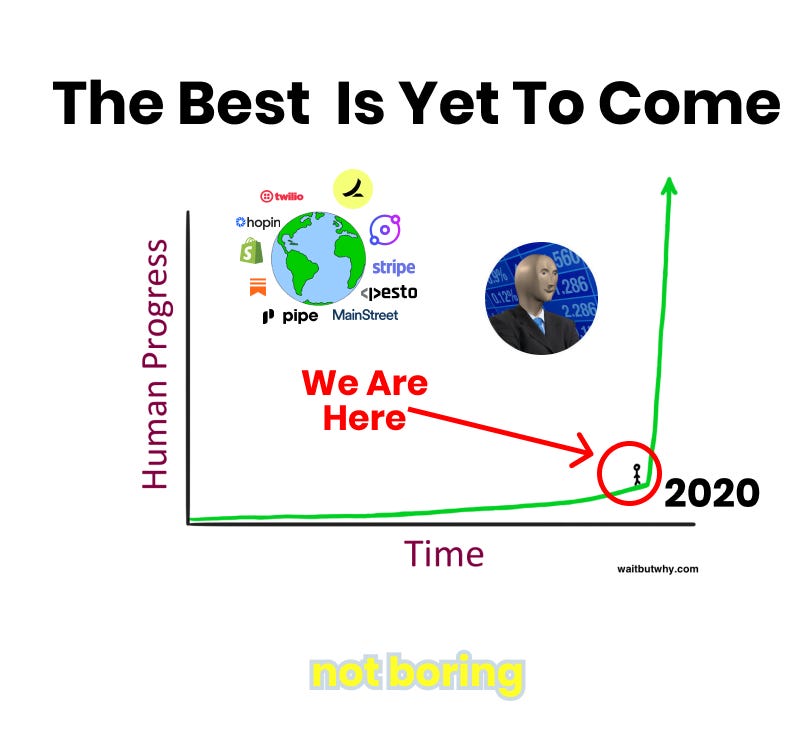
The Best Is Yet To Come
Welcome to the 1,383 newly Not Boring people who have joined us since last Monday! If you aren’t subscribed, join 26,835 smart, curious folks by subscribing here!This week’s Not Boring is brought to you by… FUSE in an inventory planning solution for the digital age. They help brands efficiently use their working capital by reducing inventory overspend by 70% and stock outs by 10%, freeing up millions of dollars to launch new products and grow their businesses.Their forecast accurately predicts your demand across all sales channels, marries it to your supply chain data, and tells you how much inventory to order. With FUSE, customers like Snowe Home and True Botanicals spend less time on manual data updates so they can spend more time on strategic initiatives. Inventory is like porridge. You won't want too much. You don't want too little. You want just the right amount. Don't burn your mouth with reckless inventory orders. Kiss your spreadsheets goodbye and start planning in the cloud. I’ve been a fan of FUSE for a while, because fun fact: FUSE was my brother and Not Boring editor Dan’s first job out of college. So I can happily say you should schedule a demo: Hi friends 👋 ,Happy Monday! This is the last Not Boring of 2020. It’s a look back on some of the things that have happened in tech and the markets this year, and a look ahead at what impact it all might have. Looking back at 2020 personally, I am so grateful that I get to write to all of you as my full-time job. In a normal year, it never would have happened. I can’t help but think the best is yet to come.Let’s get to it. The Best Is Yet To ComeI’ve always been an optimist. It’s how I’m wired. My brain has a very hard time visualizing the downsides, and a very easy time visualizing the upsides. So when COVID hit, and millions were losing their jobs, and I made the call to kill the company I had spent six months trying to start, I saw the potential bright spots. In April’s Schumpeter’s Gale, I wrote that the mass startup layoffs would: Unlock talent and be the best thing that could have happened to many of the people on those lists [of people laid off and looking for new jobs].Many people were stuck in “bullshit jobs” at bloated companies that they couldn’t or wouldn’t leave because of inertia or comfort or because too much of their identity was tied up in it. COVID was a reset. It made the decision for them, and freed them up to go start a company, do a job where they were truly valuable, or pursue a passion. It was hard, but ultimately good. In case that wasn’t sunny enough, in May’s Conjuring Scenius, I wrote: When it is all said and done, I believe that historians will look back at the Coronavirus pandemic as the greatest catalyst for progress and creativity in human history.I believed that COVID would unlock creativity and progress and unlock a global form of communal genius by: * Serving as a global catalyzing event for the internet generation, our WWII.* Uniting people around a common mission and shared experience. * Demanding new tools, processes, and social norms for online collaboration.That’s mostly come true. Eleven months after the first COVID case in the US, we have: * Multiple approved vaccines* Legitimate companies hiring people from around the globe* A generation used to learning online * Increased digital adoption and new channels for previously-offline businesses* New ways of collaborating that previously seemed impossibleWe’re more resilient, more anti-fragile than before. Many of the people on the April startup layoff lists have found new jobs at more future-proof companies or are working for themselves, building businesses, communities, and projects that no one can fire them from. Those who still have a day job now have the time to pursue that side thing they’ve been wanting to pursue, and appreciate the power of self-reliance more than ever before. And for the types of companies that we talk about here at Not Boring, tech companies large and small, things have never been better. Today, to close out the year, let’s look back at what’s happened and ahead to what it might mean for the future. It’s going to be a bit looser than a normal Not Boring, more letter than essay, but I want to cover three, interrelated themes that, together, make me bullish on tech, company creation, and work: * The Markets Are Eating Up Technology. More demand for tech stocks means more innovation, more quickly. SPACs may be a good thing and IPOs unleash investment in the next generation.* Cloud Companies. Entrepreneurs can build new types of highly-differentiated companies with global talent and increasingly useful software at their fingertips. * The Passion Economy Writ Large. As software does more grunt work and employment becomes more liquid, people will pursue their passions. That will make them even more resilient the next time a crisis hits. Despite a pandemic that has taken 1.7 million lives, an election that confirmed deep divisions in the United St

Ramp (Audio)
Welcome to the 1,497 newly Not Boring people who have joined us since last Thursday! If you aren’t subscribed, join 26,100 smart, curious folks by subscribing here!This week’s Not Boring is brought to you by… Ramp is the corporate card that actually saves your business money. Sign up and deploy in fifteen minutes, earn 1.5% cash back, let Ramp proactively find your business savings, and get everything that Expensify does… for free. Hi friends 👋 ,Happy Thursday! This is the last Thursday email I’m sending this year. Over the course of the year, I’ve found a nice rhythm: Mondays are for deep dives for big, public companies or pieces on general trends I’m noticing that I think are particularly impactful. Thursdays are for learning more about companies at a much earlier stage that are shaping and building into those trends. We do that in a couple of ways: * Not Boring Investment Memos. Public-facing investment memos on companies that the Not Boring Syndicate invests in, together, to demystify early stage fundraising.* Sponsored Deep Dives. Companies pay me to help tell their story (I got mouths to feed!). When I rolled out the Sponsored Deep Dive with MainStreet, I was a little trepidatious. Would people think I was a sellout or that my analysis is biased? But the response has been super positive. I think it’s because I’ll only ever write about companies whose products I believe in, that have interesting stories to tell and lessons to learn, and that I’d write about whether or not I was being paid (please don’t tell Ramp). I write too much as it is to waste time writing about boring companies. Sponsored deep dives actually give me, and Not Boring readers, direct access and a behind-the-scenes peek into the people and companies building the future. I couldn’t be more thrilled to close out the 2020 Thursdays -- which have become the startup-focused days -- on one of the most exciting startups out there: Ramp.When I started doing deep dives, I promised that I would tell you how I was being paid, right upfront. This one is a hybrid: Ramp is paying me an upfront fee, with upside if some of you sign up to make Ramp your company’s corporate card. (Which you totally should, btw.)Let’s get to it.Ramp: The Card-Sized Finance TeamMeet RampRamp makes a corporate card that wants to help companies spend less money. It’s playing in a crowded space, facing off against multi-billion dollar competitors, and actively trying to get customers to pay it less money. And somehow, it’s working. This morning, Ramp is announcing that it raised $30 million from D1 Capital, Coatue Management, and Founders Fund. It’s not surprising that investors are excited. Ramp is the fastest corporate card ever to $100 million in transaction volume.Employees love Ramp, too. Like previous deep dive subjects Pipe and MainStreet, Ramp made VC Guide’s Wishlist of companies for which 1,000+ surveyed founders would quit their jobs. A survey is one thing; the proof is in the hires. One of every three people on Ramp’s 60-person (and growing) team is a former founder. Ramp is a fintech and engineering all-star team aligned towards building the financial stack of the future and saving companies money. Turns out, companies like saving money. Ramp’s customer roster includes some of the fastest-growing companies in the world, because fast growth works both ways: the good things grow quickly, but the bad things do too. Ramp helps its customers eliminate wasteful spend that can get out of control, so they can focus on investing in growth.It’s how Ramp saves companies money, and its unintuitive product roadmap, that makes the company so fascinating. Ramp’s story is chock full of lessons for startups, investors, and casual business nerds alike. We’ll learn: * The Offer. Ramp is offering Not Boring companies $500 for signing up. We’ll cover that first so we can spend the rest of the essay analyzing. * Understanding Eric Glyman. Believing that a corporate card actually wants companies to spend less takes some mental gymnastics, unless you’ve met Ramp’s CEO. * Ramp’s Sweet Spot. It’s more tech than the corporate card companies, and more corporate card than the tech companies. * Corporate Card Counter-Positioning. Ramp’s early moat comes from counter-positioning against corporate cards designed to make companies spend more.* The Trojan Corporate Card. The corporate card isn’t the focus; it’s a necessary tool. * Killing Expensify and Concur. Today, Ramp released the expense management killer I’ve wanted to exist forever. * Ramp’s Vision. Ramp just wants to help companies build better businesses. The OfferLet’s start with the offer: Ramp is dead simple to set up and wants to give you money: * Deploy. Deploying Ramp at your company takes 15 minutes, and 98% of finance teams say it’s easy to set up. I’m worried about the other 2%, frankly. * Get Cash Back. Get 1.5% cashback on everything you buy, no complicated rewards. * Make $500. For being Not Boring, Ramp will give you $50
Everybody Hates Facebook
Welcome to the 2,121 newly Not Boring people who have joined us since last Monday! If you aren’t subscribed, join 25,452 smart, curious folks by subscribing here!🎧 To get this essay straight in your ears: listen on Spotify.This week's Not Boring is brought to you by… I’m excited to introduce you to OnJuno, which officially launched their new personal checking account with the best startup commercial I’ve seen in a long time (check it out on their site). Join now to get a 2.15% bonus rate on your deposits and 5% cashback on your favorite brands. After keeping my money with a traditional bank my entire adult life, OnJuno’s gorgeous UX and responsive customer support is refreshing. That’s not how I expected to describe a checking account. If you’re tired of hidden fees and low-interest rates on boring and unintuitive banking products, try OnJuno. * Create an FDIC insured checking account in under 5 minutes* Earn 2.15% Bonus Rate & 5% Cashback on Amazon, Walmart, Netflix, and more* Withdraw your money anytime, with no penalties or hidden feesJoin now, it’s free. (Limited Spots available)Hi friends 👋 ,Happy Monday! It’s an exciting one over here at Not Boring HQ. There are now more than 25,000 of us here! That’s wild. On New Year’s Day, when there were only 309 people reading a newsletter called Per My Last E-mail, I wrote out some goals for the year. Obviously, a lot has changed since then. The place-based company I wanted to start is no longer, and I get to write Not Boring full-time. If this is all I did for a living and only 1,000 people subscribed, I’d be in trouble. But it still absolutely blows my mind that 25k of you read what I write, that companies are willing to pay me to tell you about their products, and that this is my job. I’m incredibly thankful to all of you. To celebrate, I decided to up the difficulty level a little bit this week. Anyone can make Stripe or the Metaverse sound exciting, but what about a company that we all love to hate, run by one of the least charismatic leaders in human history? Let’s get to it.Everybody Hates FacebookThe Devil We KnowLook, I don’t want to be writing this. You hate Facebook. I hate Facebook. Regulators hate Facebook. The only person who likes Facebook is that guy you went to high school with who posts Q Anon content and still wishes you happy birthday every year. Just look at the product. It’s a Frankenstein built from years of multivariate testing instead of product vision. The reasons to hate Facebook are as numerous and fast-growing as their Daily Active Users. I’ve railed in this very newsletter about how wasteful it is that startups spend an estimated 30-40% of the money they raise on Facebook, Google, and Amazon ads. Zuck is not particularly lovable. The New Big Blue is where so much Fake News goes viral. Social media is addictive. Facebook just copies competitors’ best features. Facebook knows everything about us. The list goes on and on. But here we are, writing about the reasons to be bullish on Facebook, for the same reason that so many businesses turn to Facebook: we don’t have any other choice if we want to grow. After a euphoric 2020, anything that even smells like a growth stock is up dramatically. I just picked eight names off the top of my head: Peloton, Etsy, Shopify, Virgin Galactic, Tesla, Square, Spotify, Snap. The worst performing, Spotify, is up 128% YTD. Airbnb and DoorDash doubled their IPO price targets before they started trading. Even my beloved, beleaguered Slack got acquired. A lot of people invested in tech need to think about where to park their gains from the past year. Something safe, but with upside. Something that will benefit from the continued transfer from offline to online, but that likely won’t crash if multiples come back to earth. Something that will at least outpace inflation. Something with international exposure. Something that’s been held back by reasons only semi-related to the company’s performance. Something like… Facebook. Some of you might be thinking: “Duh yes, Facebook is one of the most valuable companies in the world. I watched The Social Network and The Social Dilemma, too. I know that Facebook is rolling into eCommerce. I’ve seen all of Mark Zuckerberg’s Congressional hearings. I come to Not Boring for new stuff, not boring companies like Facebook.” Aha! Because of that, I think that we might all be sleeping on Facebook a little bit. I know I have. So many of the things that we view as negative about Facebook are positives if you put on your investor hat and hold your nose. * Monopolistic. While most acquisitions fail, Zuck and Sheryl have been so good at acquiring companies that the government is stepping in post-hoc to try to undo them.* Tax on the Internet. That same “40% of all venture dollars raised” stat that’s rough for eCommerce businesses is great for Facebook. eCommerce needs Facebook to grow. * WhatsApp Unmonetized. WhatsApp is the most popular messaging app in the world, and Facebook has b

Outfit: Not Boring Memo (Audio)
Welcome to the 1,262 newly Not Boring people who have joined us since Monday! (Thanks, Patrick!) If you aren’t subscribed, join 24,603 smart, curious folks by subscribing here!This week’s Not Boring is brought to you by… MarketerHire connects you with experts who can catapult your business into the next phase of growth. Just look at some of their success stories. Outer was named the fastest growing DTC brand in the summer of 2020 – while working with a paid social marketer from MarketerHire. Stuart and Lau hired four marketers from them and saw a 2x increase in ROAS. Jillies tested product/market fit with a paid social marketer and received 100+ orders in less than three weeks. The fastest-growing companies all have one thing in common: great marketers. Conversely, this time of year, companies that skimped on their marketing teams are feeling the pain in the form of outlandish spend or missed holiday sales. You need a pro on your side. Simply put, MarketerHire built the best way to hire marketers you can trust – on your terms. Hire hourly, part-time, or full-time with no long-term commitment. To get started, click the link below.Hi friends 👋 , Happy Thursday! It’s my favorite kind of Thursday: a Not Boring Syndicate Thursday! Since I sent the SkillMagic Memo in late October, our little Not Boring family has grown a little bit and there are more than 6,000 new smart, curious people here, so I want to take a second and describe how and why we do the Syndicate. (If you’ve been here for a while and the anticipation is killing you, skip to the memo). I love telling companies’ stories, both the very, very big ones and the very, very small ones, the ones at the earliest stages of their lives. A few months ago, we decided to launch a Syndicate and write investment memos on early stage companies, for a few reasons: * Building a startup, particularly at the early stages, is a challenging, scary, exhilarating, lonely, fun, uncertain roller coaster. I want to tell the stories of some of the most exciting companies while they’re in that wild stage, before they get big and famous, and when a little extra exposure can go a long way. * The Syndicate is a way to let Not Boring readers (accredited ones, for now) invest in startups together, and get access to deals that few of us could get on our own.* Venture Capital and early stage investing have a mystique around them, and I know I felt like it was something reserved for other, smarter, better connected people. That’s not the case, and I hope these demystify the process a bit. * Anyone can write that Stripe is a fantastic company (that doesn’t stop me from doing it, of course); I want to put my money where my mouth is and bet on companies before it’s obvious. * Watching what brilliant people are building at the early stages is the easiest way to see the future. So far, we’ve invested in five phenomenal companies: Apt, Composer, OZE, Swaypay, and SkillMagic. Today, we’re partnering with Jonathan Wasserstrum to invest in Outfit Renovations and peek into the future of architecture. If you’re an accredited investor, you can apply to join the Not Boring Syndicate here to get more information, including a deck and deal terms and potentially invest with us.This is NOT investment advice and is intended for educational & informational purposes only. Let’s get to it. Outfit: Not Boring Investment MemoThe Outfit Investment ThesisA couple of weeks ago, Fed Novikov, the co-founder of another Not Boring portfolio company that’s using software to streamline the traditionally heavy real estate industry, Apt, told me about a company a friend of his was starting and asked if I wanted an intro. As a quick check, I showed the company’s website to Puja. She’s the skeptical and sensible one in our relationship. Her reaction: “Woah. That is incredible.” That’s a word that I typically use about startups, but not her.Outfit is incredible as a product because it puts the dream we all have of living in a space we’re proud to show off within reach. Outfit is incredible as a business because it uses software to scale a traditionally unscalable product in a massive market while maintaining high margins. I’m excited to bring Outfit to the Not Boring Syndicate for a few reasons: * Market. The DIY Home Improvement Market is way bigger than you’d think -- $46 billion, 38% of all home improvement projects are DIY -- and growing, particularly as COVID pushes more people to buy and improve homes. Young startups in the home renovation space have recently raised tens of millions from top investors. * Product. There’s no solution in the market that sits between traditional DIY and hiring contractors. Outfit uses software, processes, and buying power to build the first scalable architecture product. * Founder. Ian Janicki is a second-generation architect with software and design skills honed at top tech companies. He’s one of the most compelling founders I’ve met.* Customers. Outfit’s customers are middle-class,
APIs All the Way Down (Audio)
Welcome to the 1,367 newly Not Boring people who have joined us since last Monday! If you’re reading this but haven’t subscribed, join 23,341 smart, curious folks by subscribing here!Today’s Not Boring is brought to you by… In September, I wrote about MainStreet, a company that literally just gets your company free money from the government. Since then, Main Street has found Not Boring readers $1.1 million in sweet sweet free government money. $1.1 million! It’s simple, you plug in your payroll, MainStreet finds tax credits and incentives that apply to your business, then they send you the money. Like I said, free money. On average, MainStreet finds companies around $50k. That’s a lot of holiday bonuses. If you work for a company in the US that has engineers, go, right now, and get your money.Hi friends 👋 , Happy Monday! Most weeks, as I’m researching and writing and preparing to hit send, I feel like a total imposter. Sometimes, like when I’m writing about the future of the office or Slack, topics that I’ve spent years thinking about, working in, and using, I’m comfortable that I know what I’m talking about and am qualified to opine. But mostly, I’m dropping into new territory and writing thousands of words about industries and companies in which other people have spent most of their working lives. When the topic is technical, I feel it even more.This week’s topic - APIs - is among the most imposter syndrome-inducing yet. On the one hand, it feels like I’m stating the obvious: APIs are an increasingly important piece of how software is built. On the other, I feel like I have nowhere near the technical depth or hands-on experience to write about the topic with the nuance it deserves. But in these cases, I view my role as being the shameless kid in class who’s not afraid to raise his hand and ask the question that everyone else is thinking. If there’s something happening that I know is important, but don’t know nearly enough about, and I do this for a living, chances are there are many of you who want to understand it a little bit better, too. This, then, is the beginning of an exploration, and I look forward to your thoughts and feedback. Now let’s get to it. APIs All the Way DownSome ancient Asian cosmological views are close to the idea of an infinite regression of causes, as exemplified in the following apocryphal story: A Western traveler encountering an Oriental philosopher asks him to describe the nature of the world: “It is a great ball resting on the flat back of the world turtle.” “Ah yes, but what does the world turtle stand on?” “On the back of a still larger turtle.” “Yes, but what does he stand on?” “A very perceptive question. But it’s no use, mister; it’s turtles all the way down.”-- Carl Sagan, Gott and the TurtlesStripetecheryOn Thursday, the kind of thing that gets people like me very excited happened: Ben Thompson wrote about Stripe, which announced its new Stripe Treasury product, and interviewed its co-founder and President, John Collison. Stripe Treasury is “a banking-as-a-service API that lets you embed financial services in your marketplace or platform.” Simply, by writing a few lines of code, platforms can let their customers set up bank accounts at partner banks like Goldman Sachs and Evolve Bank & Trust. In the press release, Stripe highlighted its partnership with Shopify, which is using Treasury to build Shopify Balance. Now, when a merchant creates a Shopify account, they can set up a bank account at the same time, through the same platform. That’s incredibly cool in its own right, but it triggered bells in my head for another reason. When I was researching and writing Stripe: The Internet’s Most Undervalued Company, I asked people for the biggest knocks on Stripe. One answer I heard from multiple people was that they had too much customer concentration with Shopify -- by one estimate, even before the pandemic, Stripe was generating $350 million in revenue from Shopify alone -- and that Shopify would inevitably get sick of paying Stripe and build their own payments solutions. The Shopify Balance announcement means that the opposite is true. Instead of pulling its business, Shopify is integrating more deeply with Stripe. Many of its clients will keep their money in accounts managed by banks with which Stripe, not Shopify or the merchant, owns the relationship. Think of the switching costs if Shopify were to try to pull out of the relationship now. They’re practically married.Shopify is a really smart company. It wouldn’t tie its own hands for no good reason. Instead, it made a deliberate, strategic choice to focus on the things that it does best, and to plug in Stripe for all of the things that it does best. That’s what third-party APIs enable their customers to do. “API” is one of those acronyms you hear a lot. You might know that it means Application Programming Interface, and you might even know that APIs are the way software talks to other software, but if you’re like me, y
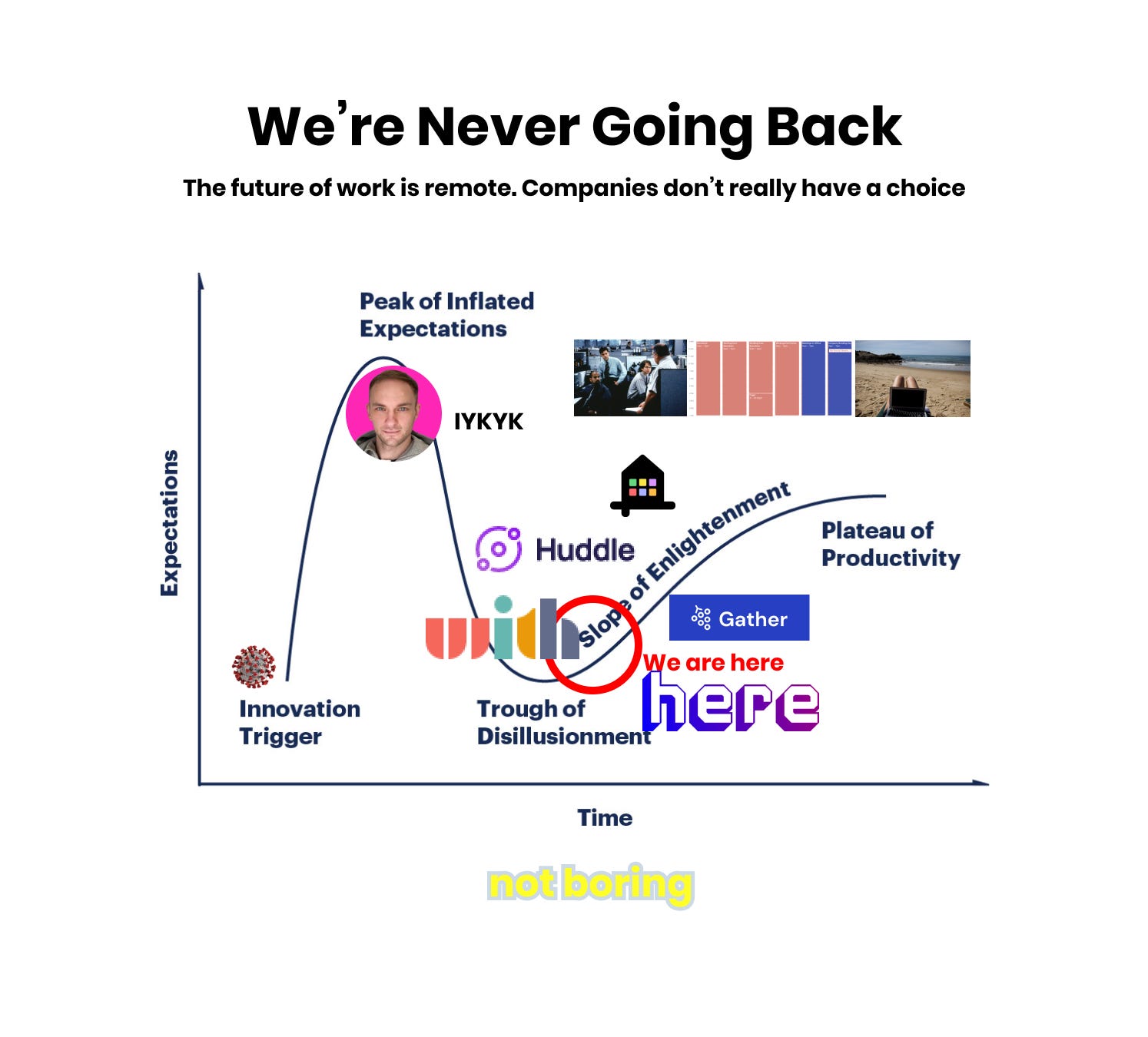
We're Never Going Back (Audio)
Welcome to the 759 newly Not Boring people who have joined us since the last email! If you’re reading this but haven’t subscribed, join 21,976 smart, curious folks by subscribing here:This Week’s Not Boring is brought to you by… MarketerHire.Hiring a full-time marketer can take months of legwork with no guarantee of success. That’s why MarketerHire built a network of expert marketing professionals, pre-vetted by top marketers from brands like Glossier, Allbirds, Headspace and more. In as little as 48 hours, MarketerHire's team matches you with a hand-picked expert marketer who is aligned to your business goals and can drive real results. Their network is filled with marketers who have deep expertise in email marketing, social media ads, growth marketing, SEO and more — and they're available on-demand in hourly, part-time and full-time engagements. No retainers. No long-term contracts. A couple of months ago, I was talking to my friend FJ about his eCommerce business, and he told me that he’d brought on a part-time marketer who was doing an amazing job. I asked if he used MarketerHire. He laughed, confused, and said yes. No joke, that’s a real story.The best part? There’s no risk. You don’t sign or pay anything unless you choose to work with someone. Plus, MarketerHire is offering a $500 credit for any Not Boring reader who signs a contract before 12/15/20. If you’re looking for marketing talent you can trust to deliver, click the link below to get started. Hi friends 👋 ,Happy Monday! On Mondays, I typically write deep dives on some of the most fascinating companies in the world. About once a month, though, I like to get a little wild, pick a trend, and work through its implications. Last month, I wrote that Software is Eating the Markets. Today, I’m exploring Remote Work, about which two things are true: * We talk about it a lot already.* Its potential impact is deeply underappreciated. Remote Work will change everything. Now let’s get to it. We’re Never Going BackAdmit it. When you first heard the news about the 90-95% effective vaccines, out loud you said:“Oh that’s wonderful! Think of all the lives saved!” While inside you were like: “Ah fuck.” That doesn’t make you a bad person. The selfish part of your brain has a faster reaction time than the good person part. And selfishly, for those lucky or privileged enough to have avoided losing loved ones to COVID and to be able to work from home, COVID has had some positives. The vaccine, for all its benefits, also means a few things you’re not going to be happy about if you’ve gotten used to the “new normal.” Bye bye ready-made excuse for any social event you didn’t really want to go to. Sweatpants are out, slacks are in. Hope you enjoyed spending time with your family, that’s done. Gas up the car for your morning commute! It’s time to go back to the office. Or is it? In month one, two, three, or even maybe four of the pandemic, it was a foregone conclusion that once this whole thing was over, we would go right back to the office. Then, after people moved around, spent more time with family, set up their home offices, became adept at matching sweatpants with a presentable top, and got used to their 15-second commutes, that conclusion seems less foregone. And as people learned new routines, companies adopted new ways of working together. It’s not perfect, but nothing ever is eight months in. Now, a debate rages among three camps: * Return. In this camp are the old school businesses and new school businesses led by more conservative leaders who want their teams to get back to the office so they can get back to real work. * Remote. The organizationally bleeding-edge companies were remote-first or remote-friendly even before COVID, and many tech companies have announced that they plan to let their employees work from anywhere even after a vaccine.* Hybrid. This camp agrees that things won’t be exactly the same, and their solutions range from “Maybe we’ll let people work from home on Fridays!” to much more creative combinations. “Hybrid” gets a bad rap because to date, it’s meant “most of us are in the office but some of you can be remote and Zoom in for meetings,” but I’ll be referring to a more intentional type of Hybrid that treats everyone as a combination of Remote and in-person. Missing from the debate is the fact that it’s not really up to the companies to choose. Employees will ultimately make the decision. The best employees have more options now than ever before, and they’re not going to work for companies that make them shave, get dressed, hop into a car or a crowded subway, and sit at a desk in an office five days a week with their headphones on trying to avoid distractions and get work done. Choosing to Return to the way things were is like choosing not to adopt software a decade or two ago. It’s an option, but one that will doom a company to mediocrity. The idea that Remote is coming and the role of the office is changing is not novel. Much ink has b

FEMSA (Audio)
Welcome to the 867 newly Not Boring people who have joined us since the last email! If you’re reading this but haven’t subscribed, join 21,217 smart, curious folks by subscribing here:💙 We’re the #11 free newsletter on Substack. Like this email to help break the top 10!Hi friends 👋 , Happy Monday! Short week, we got this. If you told me even a year ago what I do for work today, I wouldn’t have believed you. To whit:This week, I got to co-write an analysis of a Mexican beer, Coca-Cola bottling, and convenience store conglomerate with the brains behind a wildly popular pseudonymous Twitter account, Post Market, and send it out to over 21,000 people. And I’m getting paid for it… by a company I wrote about in my analysis on Slack (which may or may not have moved the market) whose Director of Content I coincidentally included a picture of holding a “Hinkie Died for Your Sins” sign in my essay on Sam Hinkie three weeks ago.And it all started with a tweet:The internet, ladies and gentlemen… Today’s Not Boring is brought to you by… Crossbeam. Crossbeam is the world's first and most powerful partner ecosystem platform. They act as a data escrow service that finds overlapping customers and prospects with your partners while keeping the rest of your data private and secure. Crossbeam believes that the ecosystem economy will drive the growth of SaaS businesses. If your company uses partnerships to grow, you should map your accounts with Crossbeam, for free (!), today. FEMSA: The Most Interesting Company in MexicoA Post Market x Not Boring CollaborationThe C-Store InternetIn Mexico, the road to the Metaverse goes through a convenience store. Fourteen million Mexican shoppers walk through OXXO’s doors each day to buy everything from a Coca-Cola to Fortnite V-Bucks. OXXO is the on-ramp for the digital economy in Mexico. Over 60% of Mexico’s population is unbanked, and the Mexican economy is still largely cash-based. Instead of entering a credit card online, millions of shoppers go to the nearest OXXO to pay cash for over 5,000 digital services, from V-Bucks to Amazon to Netflix to electricity bills. Mexican consumers trust OXXO more than they trust the banks, as evidenced by the fact that OXXO’s Saldazo debit card is already the most popular in the country. That puts OXXO in the prime position to build the digital wallet for Mexico. To a reader in a developed country, the idea that a convenience store (“c-store”) chain could become a fintech powerhouse sounds preposterous. It sounds even more loco when you learn that OXXO’s parent company, Fomento Económico Mexicano, S.A.B. de C.V. (FEMSA), is the 130-year-old descendent of a brewery, Cervecería Cuauhtémoc Moctezuma, founded by five families in Monterrey in 1890. But emerging markets afford opportunities for scope unrivaled in developed markets. When a country’s infrastructure is underdeveloped, the companies that build out the physical and digital logistics and distribution own unimpeachable channels through which they can push a wide range of products and services. Digitally, WeChat, Gojek, Grab, and other Super Apps are essentially the internet in their respective home countries. Because they own the digital infrastructure, they’re able to build their own services on top or extract rent from the companies that do. FEMSA falls into a related category of companies that, by owning the customer relationship and habits due to physical proximity, may be able to expand into ownership of their digital transactions as well. If it succeeds, FEMSA will be Mexico’s Super App. FEMSA is to Mexico as Reliance is to India. Both are old companies, run by descendants of the founders, with histories of vertical integration and unmatched capabilities in distribution in economies that lack strong infrastructure, and a proven ability to push a variety of products through those distribution channels. Where Reliance dominated polyester, petrochemicals, and refining in India, FEMSA built its empire on cerveza and Coca-Cola. When he took the reins of the family business, Reliance’s Mukesh Ambani’s first new venture was to launch Reliance Retail, which is now the largest retailer by stores in India. FEMSA’s Chairman and former CEO, Jose Antonio “Devil Fernández” Carbajal, took over his family company’s struggling OXXO subsidiary and grew it into the largest convenience store chain by number of stores in the Americas. And now, like Reliance did with Jio, FEMSA is using its legacy assets, and the cash flow they spit off, to build a digital growth engine that might transform the business, and the economy in its home country, yet again. Today, FEMSA’s value comes from three main businesses: a 47% stake in the world’s largest Coca-Cola bottler, a 15% stake in brewer Heineken, and FEMSA Comercio, which runs pharmacies, gas stations, and most importantly, OXXO convenience stores throughout Mexico and Latin America. Funds love c-stores. They’re the closest thing the physical world has to the internet.
Fairmint & the Democratization of Upside (Audio)
Welcome to the 937 newly Not Boring people who have joined us since last Thursday! If you’re reading this but haven’t subscribed, join 20,818 smart, curious folks by subscribing here!🎧 To get all not boring episodes when they come out, follow on Spotify.Hi friends 👋,Happy Thursday! Check my pulse. I’m excited. This is my first collaborative essay, and my collaborator is someone I’ve been a huge fan of for a while: Sari Azout. Sari is an early stage investor, strategist, and author of one of my favorite newsletters, Check your Pulse (go subscribe now and come back). Last week, she wrote an excellent piece on community-curated knowledge networks and is building a product in the space that I cannot wait to try.Not Boring is all about telling the stories of the very big companies that have an outsized impact on the world and the markets today, and the very small companies on the bleeding edge that will shape the future. Sometimes, those companies are so bleeding edge that to explain them well in context, I need to bring in someone who’s gone deep in the space. For social and programmable money, that person is Sari. The subject of today’s essay, Fairmint, has the potential to be massively impactful. Its total addressable market is “equity” and it has the potential to expand that multi-trillion-dollar TAM by including more stakeholders in upside, aligning incentives, and unlocking new business models. Let’s get to it. Today’s Not Boring is brought to you by… Free Agency is one of those ideas that should so obviously exist that I’m surprised it hasn’t until now. They provide Hollywood-style representation to top and emerging tech talent. You get a dedicated Talent Agent to guide your job search, make intros to hiring managers, VCs, recruiters, and founders in the Free Agency network, meet with you weekly, and handle all search activity and communications. You just need to interview. They even connect you with industry and company experts to prepare for your interviews and negotiations.Unlike recruiters, Free Agency works for the talent. Their incentives are aligned with your success -- when you find your dream job, they share in a small percentage of your new base salary for a year. They’ve represented hundreds of candidates at places likeLyft, Netflix, Amazon, Notion, Google, WaPo, Zoox, SpaceX, and more. If you’re smart enough to read Not Boring, you’re smart enough to get an Agent. Fairmint & the Democratization of UpsideRadical Compensation The history of financial innovation is the history of democratizing access to upside. As more stakeholders share in the wealth they create, they’re incentivized to collaborate, experiment, and innovate. There would be no Silicon Valley, for example, without the Employee Stock Ownership Plan (ESOP).When a group of engineers known as The Traitorous Eight left Shockley Semiconductor Laboratory to found Fairchild Semiconductor in 1957, investors rewarded their treachery with a new type of compensation: stock options. If Fairchild did well, they would do very well. Options seemed radical then; they’re commonplace now. Startups are risky, and they don’t have nearly as much money as their more established competitors. Options, which give employees a small chance at a life-changing payout, are how startups compensate for that risk, and they’ve been the pixie dust that has fueled Silicon Valley’s meteoric half-century rise.When the products startups made were things like microchips and database software, it made sense that the employees should share in that upside. But what happens when the boundaries between employment and work begin to blur? When people become the product.In just the past week, both Airbnb and DoorDash filed their S-1’s ahead of going public. Many employees and investors will become multi-millionaires. Some will officially become billionaires. Uber and Lyft have added more than $30 billion to their combined market caps over the past month, enriching investors and employees alike. That’s a beautiful thing. The American dream. But millions more who fall in a new gray area between “employee” and “product” -- the Dashers who deliver your food, the drivers behind the wheel of your Uber and Lyft, the influencers who create content on Instagram, and the Hosts who let you into their home -- don’t participate in that upside. The result is that the economic interests of the largest internet platforms are poorly aligned with their most valuable contributors, their users.User-Generated EverythingThe digital economy has radically changed the nature of the relationship between customers and corporations. Individuals have switched from being passive consumers to being an essential force in creating value, either through their actual work (Airbnb, DoorDash, Uber, Sofar artists, Wikipedia editors, Airbnb hosts) or their data (Facebook, Google, etc). Today, the user is not only the consumer. The user does the work. In the gig economy, users who contribute time and data are reward
Slack: The Bulls are typing... (Audio)
Welcome to the xxx newly Not Boring people who have joined us since the last email! If you’re reading this but haven’t subscribed, join 20,xxx smart, curious folks by subscribing here!Hi friends 👋,Happy Monday! There are over 20,000 of us here now — thank you for making that happen 🙌 If you’ve been here for a while, you know that Slack is my favorite investment. The market, thus far, has not agreed with me. You didn’t think I was going to go down without making my 6,900 word case, did you?But first, a word from our sponsor.Today’s Not Boring is brought to you by… BarrelBarrel is a creative and digital marketing agency run by my friend Peter Kang. The Barrel team has worked with clients like Barry’s, Dr.Jart+, Bare Snacks, ScottsMiracle-Gro, Rowing Blazers, Hu, and many more to build their Shopify Plus sites and marketing strategies across email, paid, and SEO.Please don’t waste your marketing dollars on poorly done ecommerce websites and paid social campaigns. Work with Peter and the Barrel team to create experiences that deepen your relationship with your customers.Now let’s get to it. Slack: The Bulls are typing…Imagine you haven’t read the title of this post and I told you about an unnamed public SaaS company that:* Builds an essential WFH software product,* Has the second highest gross margins of any of the 54 companies tracked in the BVP Nasdaq Emerging Cloud Index, * Is the eighth fastest-growing company in the index, which has outperformed the Nasdaq by nearly 3x YTD.Bet you’d say, “Sounds like an awesome company. I’d love to buy it, but it must be so expensive at this point. Damn, bummed I missed it.” And then I’d say, “Nope! You didn’t miss it. It’s actually deeply underperforming the Nasdaq this year.” “Ahh,” you’d reply, “Underperforming. Now I know what company you’re talking about. Slack!”From Day 1, I’ve known Slack was a long-term play. It acquires customers slowly, but is incredibly good at retaining and growing with them once they’re hooked. That takes time to pay off. I’ve owned shares in Slack since the day it IPO’d direct listed on June 20, 2019 at $38.50 based on that thesis.As it tanked, I bought more. It kept dropping, I kept buying. Over time, Slack became my biggest position (full disclosure etc...), all based on the thesis that it would just keep compounding and compounding until one day, everyone woke up to the fact that it was a juggernaut.When it became clear that we would all be working from home for a long time, I thought I was a genius. I was picturing early retirement and yachts and islands (or at least a trip to an island and a boat cruise). But then, as I wrote about in May, Zoom Zoomed, and Slack slacked. It was only a matter of time. Slack just had to pick up, right? Wrong. Other than one brief, glorious run leading up to Q1 earnings on June 3rd, it kept sinking. And I kept buying. Any time the market tanked, and I had my pick of “discounted” stocks, I chose Slack. It got so bad that my friend texted me this last week when I took advantage of the Vaccine-Induced Tech Selloff to, you guessed it, buy more Slack: The Not Boring Portfolio -- the fake portfolio I made to track the companies I write that I’m bullish on -- has done incredibly well, outperforming the S&P 500 by 2.6x and the NASDAQ by 1.8x, except for Slack. Like Carrie Mathison in Homeland, “I have never been so sure, and so. wrong.”But I’m not quitting on Slack. Partially because it’s underperformed SaaS so badly during COVID, I think it’s one of the best opportunities in tech. Wall Street hates it because of the threat from Microsoft Teams, but that’s our opportunity. Slack is the rare chance to be contrarian and right by betting on a fast-growing public SaaS company with extremely high gross margins. I’m openly and unabashedly bullish on Slack. But to keep myself honest, I’m going to lay out my bull case for Slack and would love to hear your counterarguments in the comments or over on Public. The Slack ThesisI’ve written about Slack twice before: * While Zoom Zoom, Slack Digs Moats* Acquisition in the Key of G SharpSlack co-starred in both essays, but I’ve never given it the solo performance it deserves. I’ve never laid out my bull thesis in toto. So here it is: Slack is already a top quartile SaaS company trading like a bottom quartile SaaS company because of that age-old worry that “Microsoft will just crush it.” It’s one of the fastest-growing public SaaS companies in the world with eye-popping gross margins. Slack is world-class at acquiring, retaining, and growing with the fastest-growing companies in the world. As they grow, Slack grows, and revenue compounds while costs stay relatively flat. Slack Connect will turbocharge that compounding by allowing non-Slack companies to try Slack in a lightweight way, and more seamless integrations weave Slack more deeply into the fabric of work. The narrative about Slack doesn’t even match today’s numbers, let alone its clear compounding potential. A misplaced na

The Magic of Mushrooms (Audio)
Welcome to the 505 newly Not Boring people who have joined us since the last email! If you’re reading this but haven’t subscribed, join 19,695 smart, curious folks by subscribing here!🎧 For a more auditory trip, listen here or on Spotify.Hi friends 👋,Happy Monday! Damn it feels good to be an American. Speaking of feeling good, today’s essay is on one of the least boring trends I’ve ever written about. Mental health disorders are an epidemic, and we have been fighting it with antiquated and suboptimal tools. The solution might come from an unexpected technology that we’ve had at our disposal for decades. Let me make an important caveat upfront: I am not a doctor or a registered adviser. This is not financial or medical advice. Don’t go out and take anything or buy anything without a prescription or doing your own research. But you should know about the growing research around psychedelics’ efficacy in treating mental health disorders and the companies bringing treatments to market. But first, a word from our sponsor. Not Boring’s very own growth guru Tommy Gamba has launched Stacker Labs, a turn-key content marketing and SEO service for startups....If you’re an avid reader, you know how much I hate Google and Facebook taking nearly 40% of every dollar raised in advertising and customer acquisition costs. Stacker Labs wants to fix that problem by helping companies win in organic search. Stacker develops newsworthy, data-driven stories on your behalf and then then syndicates them through partnerships with hundreds of top tier news outlets, including SFGate, Chicago Tribune, NY Daily News, and Newsweek. The result is your branded stories getting hundreds of high quality/SEO-friendly pickups, valuable reach into new audiences, and that sweet, recurring organic search traffic.For Not Boring readers, Stacker Labs is extending 20% off content campaigns in Q4 and guaranteeing a minimum of 50 pickups for each story. For those of you with SEO and/or content marketing on the roadmap, Stacker Labs is a no brainer to supercharge your growth.Now let’s get to it… The Magic of MushroomsLet’s Take a TripWhat do you think of when you think of psychedelics?Maybe you think of hippies in the 1960s. Maybe you think of Phish concerts. Maybe you think about that one time in college. Maybe you just think: those are drugs, they’re illegal, they’re dangerous, and they’re bad. Just Say No.To steal a phrase from Michael Pollan’s bestselling 2018 book on the benefits of psychedelics, I want you to Change Your Mind. By the end of this essay, you’ll understand why we underestimate psychedelics, the promise they hold in solving our biggest mental health challenges, and the business model behind the first public psychedelics company in the US, COMPASS Pathways.It’s easy to get excited about psychedelics. MDMA combined with therapy looks like it may cure PTSD in a large number of patients. Psilocybin with therapy is showing promise in fighting depression. And unlike traditional medication, psychedelics can cure while creating meaning. In a 2006 Johns Hopkins study, 67% of participants who took psilocybin rated the experience either the most meaningful or among the top five most meaningful in their lives! As Matthew Johnson, the Associate Director of the Johns Hopkins Center for Psychedelic and Consciousness Research wrote, “Psychedelics are psychoactive substances that historically have attracted exaggerations of benefits as well as alarmism.” So let’s try to avoid exaggerations, and instead take a trip together to soberly explore:* The Psychedelic Renaissance. After fifty years, psychedelics are going mainstream again.* The War On Drugs. Like the Food Pyramid, but Drugs. * Mushrooms’ Magic. Although there are many promising psychedelic compounds, we’ll focus mainly on psilocybin given its potential wide-ranging benefits. * COMPASS’ Pathway. The story behind the first public psychedelic company. * COMPASS’ Business Model. COMPASS is like a dating app -- it’s product may be so good that it’s bad for business. But analysts are bullish, and so am I. * Irrational Exuberance About Psychedelics’ Future. Can they make the world a more harmonious place? Can they unleash creativity? Can they cure everything? The Psychedelic RenaissanceBecause of long-held negative or recreational associations, most people are unaware that psychedelics are the most promising treatment for a wide range of mental health issues -- from depression to alcoholism to anorexia -- that we’ve ever seen. The psychedelic renaissance couldn’t have come at a better time. The world desperately needs innovative solutions to mental health disorders. The worldwide numbers are staggering. And those numbers are pre-COVID. According to a JAMA Network Survey, depressive symptoms have tripled during the pandemic.The total direct and indirect costs of the mental health epidemic are expected to reach $6 trillion by 2030, up from $2.5 trillion in 2010, according to the World Economic Forum. T