
Not Boring by Packy McCormick
Tech strategy, analysis, and philosophy, but not boring.
Packy McCormick
Show overview
Not Boring by Packy McCormick has been publishing since 2020, and across the 5 years since has built a catalogue of 83 episodes. That works out to roughly 45 hours of audio in total. Releases follow a monthly cadence.
Episodes typically run twenty to thirty-five minutes — most land between 22 min and 36 min — though episode length varies meaningfully from one episode to the next. None of the episodes are flagged explicit by the publisher. It is catalogued as a EN-language Business show.
The catalogue appears to be on hiatus or wound down — the most recent episode landed 1.3 years ago, with no new episodes in over a year. The busiest year was 2020, with 43 episodes published. Published by Packy McCormick.
From the publisher
Business strategy, but not boring, delivered to your ears and your inbox every Monday and Thursday morning. www.notboring.co
Latest Episodes
View all 83 episodes
America, the Beautiful
Hi friends 👋 ,Happy Thursday! Three years ago, Mackenzie Burnett, the founder and CEO of Not Boring Capital portfolio company, Ambrook, wrote the first in a short-lived series we called The Founder’s Letter. At the time, it was basically a dream. Today, Ambrook is a real business with more than 2,500 customers across the country, helping them realize their American Dream.And on Tuesday, Ambrook announced that it’s raised $29 million, including a $26.1 million Series A co-led by Thrive Capital and Dylan Field at Field Ventures. When Mackenzie reached out to talk about how she should start to tell her story more publicly, we decided to have a conversation about what Ambrook is doing, how, and why, and to publish a follow-up to the Founder’s Letter, which we’re re-posting from Ambrook. She called it, “America, the Beautiful.” There’s no better story to publish heading into Fourth of July weekend. As Mackenzie said in our conversation, “The American experiment is many different experiments actually.” We talk about many of the companies building Vertically Integrated companies to make America stronger; Ambrook is an example of grassroots American Dynamism, making the hundreds of thousands of small businesses who make America strong and resilient stronger. You can find our full conversation on YouTube, Spotify, or wherever you listen.God Bless America. America, the BeautifulMackenzie Burnett, AmbrookOn Tuesday, Ambrook announced $29M in funding raised, including a $26.1M Series A led by Thrive Capital and Dylan Field at Field Ventures, with continued support from Homebrew Capital and participation from Designer Fund, BoxGroup, Mischief, Not Boring, and others.When I wrote our first Founder’s Letter, it was mostly about what we hoped to do. Three years later, this one’s about what we’ve actually done. Thousands of producers are using Ambrook to make better financial decisions, grow their operations, and invest more confidently in their land. And I feel more sure than ever that we’re on the right path.Ambrook is building the financial infrastructure for American industry – starting with agriculture – and the opportunity in front of us is massive. We’re still early, but the impact is already visible. Now it’s time to grow.Part ILet me tell you a story.Imagine you grew up on a ranch in the Mountain West. Went to school, hoping maybe you can come back one day. To help out, and eventually continue the family legacy.But then, a family emergency. You have to take over the books from your dad all of a sudden, to keep the operation running. Not to mention run the operation itself.This is the real story of our customer, Chase. His family runs cattle across 30,000 acres in Utah and Wyoming.His first year, he had to wrangle the operation’s legacy accounting software. It had worked for the family business up to this point, but it still took up too much time and left him without a clear view of his numbers day to day.Until he found Ambrook.Chase’s dad is recovered now. And has come back to a family operation more resilient, not just financially, but intergenerationally too.Since I wrote my last letter, over 2,500 operations in all 50 states have now used Ambrook to double their business, cut bookkeeping time in half, get better loan terms, and make land management decisions with confidence. Those customers have spent and managed $1.6B with Ambrook and saved an estimated 75,000 hours in the process.Our customers have told us they feel less anxious and more optimistic about their future. That they feel empowered in ways they hadn’t before. (We had one couple who even told us they decided to get married because of a conversation with the Ambrook team about their finances.)Because instead of feeling behind on their books, many of our customers can now focus on answering the questions that matter: How much have I spent so far on this herd? What will it cost to finish? Will this actually pencil out? And can my operation and my family thrive?There are so many stories I want to tell. Stories of our customers, of our team. What we build and how we build it.But first, let me zoom out.For the first time in generations, most Americans believe their children will be worse off than they are. That type of pessimism is corrosive.Starting a small business used to be the way to build a better future for your family. Owning your time, owning your labor, owning that identity and tradition over generations. Staying independent.It was never easy, but it was straightforward enough.Small businesses are not simple anymore. Especially in agriculture – the first industry we’re building for – survival has meant diversification. A cattle ranch that traditionally sold its commercial herd at the stockyard, might now also run a direct-to-consumer meat program, a seasonal event business, and a trucking arm. These operations are balance sheet-heavy, multi-P&L, and deeply local.Most financial software was built for simpler business models than that: a single en

Wander: Deeper Dive
Welcome to the 1,000 newly Not Boring people who have joined us since our last essay! Join 244,199 smart, curious folks by subscribing here:Hi friends 👋,Happy Wednesday! Sending this one a little later than usual because we’re timing it with an announcement about a portfolio company and previous Deep Dive subject: Wander raised $50+ million in a Series B led QED and Fifth WallThe fun part is, Wander did it by throwing out a lot of what we discussed in the first Wander Deep Dive — which, at the time, I said was the absolute right way to do things — and growing insanely fast while maintaining its high quality bar. I started doing these Deeper Dives, following up on companies I’d written Deep Dives on in the past to understand what I got right, what I got wrong, and what we could learn from both, in March, with a Deeper Dive on Primer. I gotta admit, I was a little smug: Primer was doing great, in large part because it had gone more vertically integrated, which is exactly my thesis on how these things should be built. “And if you want to fix K-12 education,” I wrote, “you need to build schools.”Welp… over the past two years, Wander shut down the REIT I praised, went asset-light, grew from 13 to more than 1,000 locations, grew GMV 6x over the past 18 months, and is onboarding over $1 billion worth of real estate monthly. And while growing, its NPS has actually ticked up to 85. Being wrong and learning is why I do the Deeper Dives! If companies could be built as cleanly as I can write an essay, I’d be a billionaire. You’ve got to play the game; the lessons emerge from the messiness, and from following the best companies as they evolve. Read the essay below, watch on YouTube, listen on Spotify, and read the transcript.Let’s get to it. Today’s Not Boring is brought to you by… VantaAccelerate Your Company's Growth: Get the Compliance for Startups BundleTo scale your company, you need compliance. And by investing in compliance early, you protect sensitive data and simplify the process of meeting industry standards—ensuring long-term trust and security.Vanta helps growing companies achieve compliance quickly and painlessly by automating 35+ frameworks, including SOC 2, ISO 27001, HIPAA, and more.Start with Vanta’s Compliance for Startups Bundle, with key resources to accelerate your journey.* Step-by-step compliance checklists* Case studies from fast-growing startups* On-demand videos with industry leadersWander: Deeper DiveI first wrote about Wander over two years ago, in January 2023. The theme of the piece was that Wander was the fulfillment of a couple of ideas I’ve had over the years: Natively Integrated Companies, which I wrote about in June 2019, and Zillbnb (combining short-term rentals and iBuying), which I wrote about in June 2020.Wander had brought the dream to life and cleverly cheated the laws of marketplace physics. By launching a REIT, Wander Atlas, it had engineered a business that had the product control of a vertically integrated company without the balance sheet intensity. I wrote, “Simply put, Atlas gives Wander a vehicle through which to scale its portfolio in a capital efficient manner while retaining the full control of the experience it believes is required to generate hospitality yields.”This, I argued, is how a startup should compete with a giant marketplace like Airbnb: vertically integrate to create a more consistent product experience and to capture more of the dollars in each transaction. Ownership, I believed, was a necessary precondition of consistent quality.John Andrew Entwistle , Wander’s founder and CEO, believed that too. In our conversation, he admitted, “To be clear, that was also my thesis. My thesis was that the actual ownership was totally critical.”And it might have been! The product was delightful. I invested in the REIT and got a 22% return over a couple of years. There was something magical about owning a piece of the vacation properties you stay in.“I think that's something I'm really proud of—that the thesis was correct,” John Andrew told me, reflecting on what turned out to be an experiment. “The institutionalization of vacation rentals as an asset class, the idea of guests owning a piece of the portfolio, it was all correct. It was just a question of how quickly it could scale in a really turbulent macro.”See, when John Andrew and the team conceived of the REIT, interest rates were still near historic lows.That meant two things: the REIT’s mortgage payments were lower, and the 8% yield it aimed for was more attractive. By the time the REIT launched in October 2022, the 10-year US Treasury yield had jumped up to about 4%. When I wrote the piece in January 2023, it had come back down to 3.5%. Over the next nine months, it marched all the way up to a high right under 5%. Mortgage rates are some spread over treasuries, and investors in a REIT expect some yield over treasuries for the risk they were taking, and so, Wander was squeezed on each side.As markets crumbled in e

Hyperlegible 008: Golden Age with Mike Solana
Welcome to Episode 008 of Hyperlegible, a Not Boring Radio production.To find all of the excellent essays we’ve discussed on Hyperlegible, head to Readwise.Golden Age with Mike Solana is live at: YouTube | Spotify | Apple PodcastsThe guest selection process for Hyperlegible is three parts art, half part science, and four parts serendipity. It boils down to: if someone writes an essay I love, I want to talk to them about it. Sometimes, I’ve never heard of someone, then they write something amazing and I want to meet them and learn about them. Others, I read everything a person has written, so I have to wait for something that resonates extra, and that encapsulates how I think of them perfectly.Mike Solana, the Founder and Editor-in-Chief of Pirate Wires, is in the latter camp. I read Pirate Wires every morning when I wake up; its Three Morning Takes is the best-written way to load three things that have happened in the world into my brain. Pirate Wires’ staff is envy-inducingly talented, each with their own voice that all fit the Pirate Wires voice. Every so often, though, the EIC comes down from his EIC chair, whips out a keyboard, and writes essays of his own. I get an extra little dopamine hit when I see those. Last week, Solana wrote a piece called Golden Age that sits in the bullseye of the Venn Diagram between things I’m interested in — building new cities, cutting red tape, and painting an optimistic vision for America — and what I love about Solana’s writing — “I took a few days off from the internet last week to spend some time with my family at Disney World, and I found the place, as I have found it since my early childhood trips to Fort Wilderness, almost overwhelmingly inspiring” — that I had to talk to him about it. In our first LIVE Hyperlegible conversation (thanks to Matt Marlinski at The Manhattan Lab for hosting!), we discuss: * Solana summarizes Golden Age* Disney World as a blueprint for charter cities * America’s building paralysis vs. China’s ability to build Disney’s vision in Shenzen* Why Disney is the guy for Solana, the one he wants his career to look like* Rare earths, chips, and regulatory free zones * Scaling Pirate Wires like Disney scaled Disney * Why past charter city efforts have failed * What life in Golden City could look like * Special development zones vs. regulation gridlock * Culture change through media and narrative * Who could be the next Walt Disney? * Solana on “Moral Inversion” and cultural decay * Final takeaway: “Where there is no vision, the people perish”I hope you enjoy my conversation with Mike Solana. Links to a transcript, YouTube, Spotify, and Apple Podcasts are right down below so you can listen early and often.Thank you to our partners for supporting Not Boring:Ramp: the official Business Card of Not Boring.Rox: AI agents to help your best sellers sell better. Vanta: easy compliance for startups who want to grow their revenue.Readwise: the best software for smart, curious readers. There Are Many Ways to HyperlegibleIf you’re the reading type, I used Claude to turn the messy YouTube transcript into something well-formatted and clean.Hyperlegible 008 - Mike Solana - TranscriptAs always, you can find the full conversation wherever you like by subscribing to Not Boring Radio:YouTube:Spotify:Apple Podcasts:While you’re there, give us a like, comment, and subscribe so we can bring great essays to more people. You can also find links to all of the essays and conversations at readwise.io/hyperlegible. Thanks to our friends and sponsors at Readwise, you can head there for a free trial and get all Hyperlegible articles automatically added to your account.If you want more to read, here are two of Solana’s reading recommendations, one of his and one by QNTM. Save them to Readwise and come back to them:Solana’s favorite essay he’s written:Moral InversionOne book Solana thinks everyone should read:There is No Antimemetics DivisionBig thanks to Solana for joining me, and to Jim Portela for editing!Thanks for listening,Packy Get full access to Not Boring by Packy McCormick at www.notboring.co/subscribe
Hyperlegible 007: 50 Things Brian Potter Has Learned Writing Construction Physics
Nobody on the internet writes about all of the complexity involved in actually building things -- from homes to jet engines -- better than Brian Potter, the author of Construction Physics.I am a huge fan of Brian's writing. I use it as a reference for a lot of my pieces. I once tweeted, "Construction Physics is a national treasure and the president should give Brian Potter a medal or czar job or something." So I was thrilled to get the excuse to talk to him about a bunch of his essays by talking to him about this one specific one, 50 Things I've Learned Writing Construction Physics.Here's the one overarching theme he's discovered writing over 600,000 words in Construction Physics: "Things are always more complicated than they seem. Simple explanations very rarely exist." We discuss that and other lessons by digging into pre-fabbed and manufactured homes, jet engines, gas turbines, windmills, nuclear reactors, batteries, Nobel Prizes, skyscrapers, and even Titanium. Just reading that list, you can probably tell why I like Brian's writing so much. He writes in-depth about all of the topics I love, and I learn so much from him each time.What impressed me most is just how humble Brian is. He knows 1000x more about this stuff than I do, but when he's not entirely certain of an answer, he says so. That's probably in part due to his background as a structural engineer, and in part a response to the lesson that everything is more complicated than it seems. I hope you learn as much from our conversation as I did, and that you go back and read everything he's written. To get you started, here are some of the essays we discuss and that Brian recommends, both his stuff and others'.Potter Essays - How to Build 3,000 Airplanes in Five Years- Why It's So Hard to Build a Jet Engine - What Learning by Doing Looks Like - How California Turned Against Growth - Another Day in Katerradise - The Birth of the GridRecommended and Discussed Essays - Reality Has a Surprising Amount of Detail - John Salvatier - Timing Technology: Lessons From The Media Lab - Gwern - 100 Tallest Completed Buildings - Boom: Bubbles and the End of Stagnation - Byrne Hobart & Tobias HuberYou can find this and all of the articles we discuss on Hyperlegible in one place thanks to our sponsor, Readwise - Visit readwise.io/hyperlegible for a free trial and get all Hyperlegible articles automatically added to your account. Big thanks to Jim Portela for editing! Get full access to Not Boring by Packy McCormick at www.notboring.co/subscribe
Hyperlegible 006: Forsaking Industrialism
In this timely conversation, Conrad Bastable (https://x.com/ConradBastable) breaks down his epic essay "Forsaking Industrialism" and explores why the West has abandoned manufacturing while China built a world-beating industrial platform over decades. Read it here: https://www.conradbastable.com/essays/forsaking-industrialism-the-most-expensive-thing-you-didnt-buy We dive into how EU regulations inadvertently benefited Chinese manufacturing, why tariffs alone can't solve America's industrial challenges, and what it would take to rebuild America's manufacturing capabilities. Conrad explains the concept of "platform economies" that China has mastered, why capital markets naturally push against long-term industrial investments, and the uncomfortable trade-offs between principles and prosperity that nations must navigate. From electric dirt bikes to BMW's battery dilemma, this wide-ranging discussion offers a fresh perspective on the most urgent debate in America. Conrad's reading recommendations: - Alexander Hamilton's "Report on Manufactures" https://founders.archives.gov/documents/Hamilton/01-10-02-0001-0007 Conrad's other essays: - "Full Stack of Society" https://www.conradbastable.com/essays/the-full-stack-of-society-can-you-make-a-whole-society-wealthier-full-version - "Escalation Theory" https://www.conradbastable.com/essays/escalation-theory-compliance-violence-and-overachievement-in-society - "Monetization & Monopolies" https://www.conradbastable.com/essays/monetization-amp-monopolies-how-the-internet-you-loved-died Sponsored by Readwise - Visit readwise.io/hyperlegible for a free trial and get all Hyperlegible articles automatically added to your account: https://readwise.io/reader/view/hyperlegible Big thanks to Jim Portela for editing! Get full access to Not Boring by Packy McCormick at www.notboring.co/subscribe
Hyperlegible 005: Parakeet
Pseudonymous writer Parakeet joins me to discuss her viral essay "Skittle Factory Dementia Monkey Titty Monetization."I first heard about Parakeet a couple weeks ago when I saw half of my Twitter feed and half of my Substack Notes feed sharing her essay, including a bunch of people I wouldn't expect to share an essay with "Monkey Titty" in the title. I read it immediately, and saw why. Parakeet describes universally applicable ideas with the color turned up to 11 so they stick.We explore the "dementia personality" - how our core thought loops shape who we are and might one day define us. Parakeet shares insights from working at a dementia facility, explains her Skittle Factory metaphor for personality (and researching Skittle Factories), and reveals her unconventional productivity hack that's transformed her writing output. We talk about her writing process, gifs, why more people should read George Orwell's Politics and the English Language, and what she learned from her once-half-paralyzed dance teacher. Plus, hear the bizarre true story behind the "Monkey Titty" portion of the essay title and why Parakeet believes everyone should re-read Atlas Shrugged as an adult.Key moments:(5:35) Origins of the dementia personality concept(10:30) Can we change our core mental loops? (15:18) Skittle Factory Mass Extinction Events(21:50) Rewiring your brain through Luigi Jazz(30:05) Why this essay got shared by so many smart people(31:50) Using gifs(40:31) Parakeet's productivity hackReading Recs from Parakeet:Parakeet: YOUR EYES ARE LEAKING CORPORATE CUM™Parakeet: ALGORITHMIC GROOMING OF YOUR INNER CHILD™George Orwell: Politics and the English LanguageAyn Rand: Atlas ShruggedHyperlegible is sponsored by my friends at Readwise, who build software that helps you get the most out of your reading. If you want to give it a try, go to readwise.io/hyperlegible where you start a free trial and get all the articles discussed here on Hyperlegible automatically added to your account.Thanks to Jim Portela for editing and getting the parakeet animation to work! Get full access to Not Boring by Packy McCormick at www.notboring.co/subscribe
Hyperlegible 003: Julian Lehr
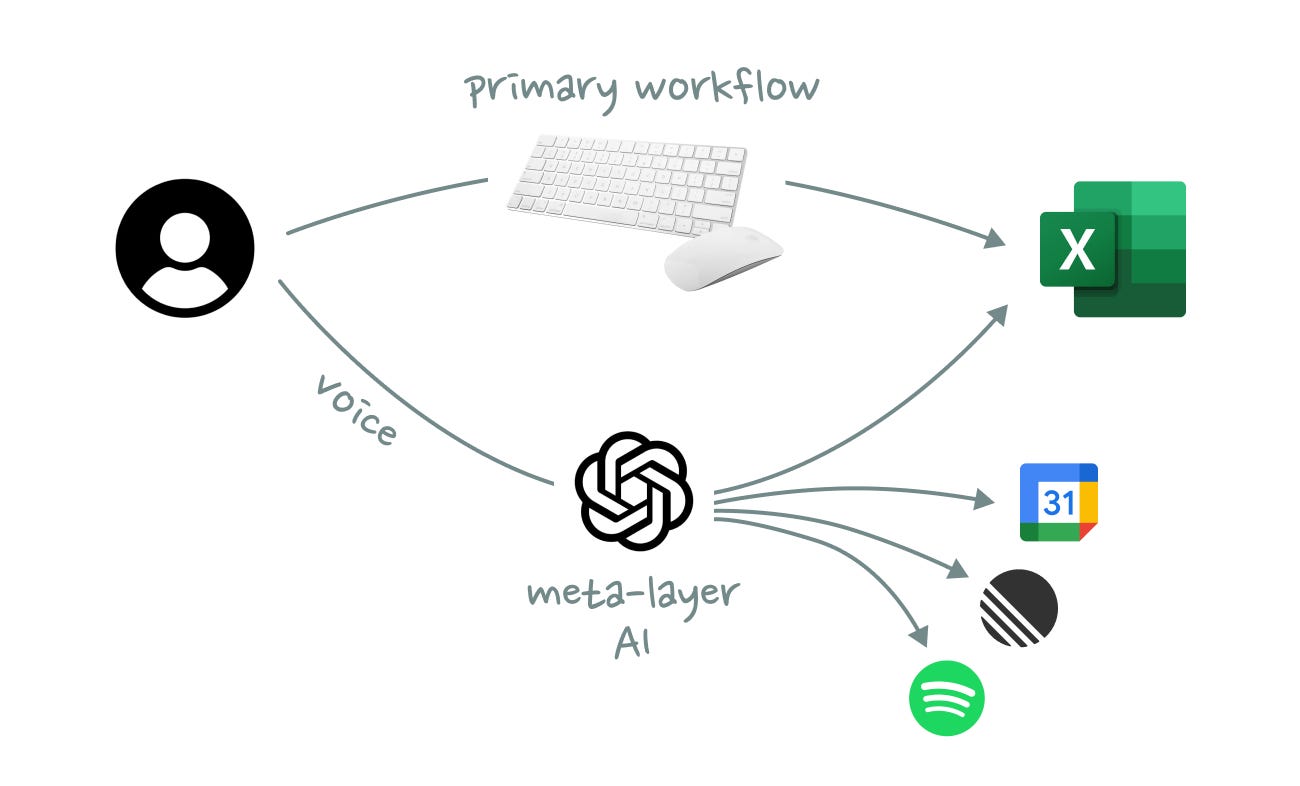
Hi friends 👋, Happy Wednesday! After almost two years, Julian Lehr is BACK to writing.He wrote a piece called The case against conversational interfaces, arguing that we're not going to be talking to our computers instead of using graphical user interfaces. GUIs work pretty well!Instead, he thinks that conversational interfaces are going to be a complement to existing workflows. We'll talk to our AI while doing what we do now, to do things like tell other apps to start doing things while we stay in flow.Julian shares his writing process -- chat through a draft with AI, write ~60% of it by hand, and then pull it together in Figma, or sometimes, Google Docs. He said that like some people need a change of scenery to write, he needs a change of tools.So why did he come back after two years in the wilderness? Simply: too many people were too consistently wrong on the internet. After seeing one too many "we're all going to be chatting with our computers" takes, he had to write the other side. And he delivered.We cover a lot, from why he keeps coming back to Kevin Kwok’s Arc of Collaboration to how he uses his "thanks to" section to status signal. For this essay, he thanked Blake Robbins, Chris Paik, Jackson Dahl, Johannes Shickling, Jordan Singer, and Signulll -- an absurdly high signal roster.Conversations like this one - where I get to nerd out with the people I've read for so long - is exactly why I'm doing Hyperlegible. I hope you enjoy it as much as I did.You can find this and all Hyperlegible episodes wherever you watch and listen: YouTubeSpotifyApple PodcastsHyperlegible is now sponsored by our friends at Readwise, which builds software that helps you get the most out of your reading. When you go to readwise.io/hyperlegible, you can find all of the essays that we discuss on Hyperlegible in one place. I want this to be the best place to go whenever you’re looking for something fresh and high-quality to read (and listen to). We’re getting serious over here. I’ve started working with an editor, Jim Portela, so if you notice that this episode is higher quality, that’s why. As always, I hope you enjoy, and please keep sending me your favorite essays!We’ll be back in your inbox on Friday with a Weekly Dose, and I will be back with a fresh Deep Dive next week. Thanks for listening,Packy Get full access to Not Boring by Packy McCormick at www.notboring.co/subscribe
S1 Ep 2Hyperlegible 002: Utsav Mamoria
Hi friends 👋, Happy Monday! Kicking off the week by sharing Episode 002 of Hyperlegible.This is a conversation with Utsav Mamoria on his excellent essay, How to live an intellectually rich life, which broke out of containment in India and raced across the globe to the tune of 1,100 likes at the time of recording. For good reason: Utsav combines philosophy, mathematics, biographies, personal experience, and hand-drawn sketches to create a map – quite literally – for living an intellectually rich life. He takes us on a journey through Moradoom, Igamor, and Evermore, before arriving at Luminspere, the Mountains of Knowledge with tools like the Axe of Satisfaction, Torch of Curiosity, and Oars of Consistency. Utsav weaves together so many ideas so beautifully that you just need to read it, and then listen. Or listen, and then read it. His one sentence takeaway: Consistency trumps everything.But there were a lot of good sentences. Here are a few of my favorites: "The way to live an intellectually rich life is to focus on two things: Put ideas above sensations, and try to have more diverse ideas than the ones you already have."On Epistemic Anxiety: "Accept that you don't know everything about everything and you don't need to have a point of view on everything... develop expertise in a few fields while trying to read as broadly as you can.""Building worlds in fiction is a given, but building worlds in non-fiction is done a lot less.""Write something which has meaning beyond the current moment. It has to go beyond the zeitgeist.""All learning requires us to suffer an injury to our self-esteem."You can find Utsav on X at @utsavmamoria and subscribe to Tumse Na Ho Paayega here.Going forward, I plan on releasing a few of these per week. This week, I have three killer interviews lined up, and just brought on an editor so we can increase both the quality and the cadence. North Star: when there’s something really great written on the internet, you can expect to find its author in the Hyperlegible feed within a few days. I likely won’t send you an email every time (still playing with that), but you can subscribe on YouTube, Spotify, or Apple Podcasts, and I may send a weekly roundup on Sundays with all of the conversations in one place. Subscribing helps you curate the internet, and helps us grow this thing to bring the good words to as many people as we can. Hyperlegible is now sponsored by our friends at Readwise, which builds software that helps you get the most out of your reading. I’ve been using Readwise for years to support my newsletter, my curiosity, and now, this podcast. I wanted to partner with Readwise specifically for a few reasons. One: I use it every day, multiple times a day. When I find an essay I love, I save it to Readwise, where I can highlight and annotate it to prep for either inclusion in essays or conversations on Hyperlegible. Two: I’m an investor in Readwise. Three: they partner with my favorite written-word-related podcasts, Founders and How I Write. And Four (and most importantly): when you go to readwise.io/hyperlegible, you can find all of the essays that we discuss on Hyperlegible in one place. I want this to be the best place to go whenever you’re looking for something fresh and high-quality to read. I am having a blast doing this podcast. It’s an excuse to talk to my favorite writers, and to share the fruits of their hours and hours wrestling with ideas with you. As always, I hope you enjoy, and please keep sending me your favorite essays! Thanks for listening, Packy Get full access to Not Boring by Packy McCormick at www.notboring.co/subscribe
S1 Ep 1Hyperlegible 001: Tina He
For the first episode of Hyperlegible, I talked to my friend Tina He (@fkpxls on twitter) who writes the excellent Fakepixels, which she recently brought back to life after a four year hibernation and on which she’s dropped gems each week since. Last week, Tina wrote an essay called Jevons Paradox: A personal perspective about something surprising she’s noticed: AI is causing a lot of people to work more, not less. Since you can now do more with each hour, the opportunity cost of each hour not worked is higher! The treadmill spins faster and faster. Read it, and subscribe to Fakepixels while you’re there: https://fakepixels.substack.com/p/jevons-paradox-a-personal-perspective If you're wondering how (or whether) to compete in the age of AI, Tina's personal perspective will help. Please let us know what you think and share your favorite essays with me @packym on twitter. Get full access to Not Boring by Packy McCormick at www.notboring.co/subscribe

Primer: From Software to Schools
In April 2022, Packy wrote a Deep Dive on Primer:https://www.notboring.co/p/primer-the-ambitious-home-for-ambitiousThree years later, a lot has changed. Primer is building schools. The opportunity is both bigger and more challenging than it was then. In this conversation, Packy and Primer CEO Ryan Delk discuss the need to fix in K-12 education. Ryan shares insights on Primer's transition from a software-focused company to a vertically integrated Microschool model. He also addresses regulatory hurdles, the market potential for innovative educational solutions, and the vision for making quality education accessible to all families.If you want to build a vertically integrated company to solve a really big, important problem, you need to listen to this. TakeawaysK-12 education reform is a civilizationally important issue.Primer aims to tackle the hardest problems in education.The transition to microschools was driven by the need for a more effective educational model.Regulatory challenges are significant but can be overcome with strategic action.The market for education is vast, with opportunities for innovation.Primer's microschool model aims to provide quality education at a lower cost.The importance of community involvement in launching new schools.AI and software can significantly improve educational outcomes.The future of education will involve diverse options for families.Investors are increasingly supportive of innovative education solutions.Chapters00:00The Importance of K-12 Education Reform02:18The Shift from Software to Microschools04:04The Pivot to Microschools06:28Building a New Education Model09:03Scaling and Integrating Education Solutions11:43Balancing Control and Innovation in Education14:18The Role of Software in Education17:15Future of Education and Personalization21:56The Future of Education Funding24:14AI Tutors and Their Limitations26:12The Shift in Educational Structures Post-COVID28:59Addressing Concerns About School Choice31:19Breaking the Narrative of Private Schools33:58The Vision for Free Education36:49Navigating the Incumbent Education System39:15Market Opportunities in Education41:19The Future Landscape of Education43:09Growth Projections for Primer Get full access to Not Boring by Packy McCormick at www.notboring.co/subscribe
Not Boring Founders Podcast: Amjad Masad, Replit
Welcome to the 596 newly Not Boring people who have joined us since Monday! If you haven’t subscribed, join 125,666 smart, curious folks by subscribing here:Hi friends 👋 , Happy Thursday! This really will be the shortest Not Boring in history. You have a Memorial Day Weekend to get to. But since odds are you’ll be in a car for a couple hours at some point in the next few days, I thought it would be the perfect time to listen to my favorite episode of Not Boring Founders yet. Not Boring Founders is a twice-weekly podcast on which I talk to founders — often Not Boring Capital portfolio founders — about what the world looks like if they’re wildly successful, and how they’re making that version of the world a reality. Normally, the episodes are about 30 minutes. For this one, with Replit co-founder and CEO Amjad Masad, we went a full 1 hour 41 minutes, covering a wide range of topics:* Decentralized software creation* How the internet could have been built differently * The history and future of coding (aka when Wordcels rule the code)* Amjad’s story: from Jordan to Codecademy, Facebook, and Replit* Authenticity Alpha * Balancing theory and just doing things * Replit’s hiring spree and talent density* The software economy being built on Replit* Aggressiveness vs. caution in the current marketI hate listening to myself talk, and I listened to this one all the way through. Amjad has quickly become one of my favorite people in tech, and is someone who I genuinely believe will play a big role in shaping the future. I believed that when I wrote about Replit in December, and I believe it even more strongly after this conversation. You can listen to this episode right in this post — just press play above — or wherever you like to listen. All Not Boring Founders episodes are available on Spotify… Apple Podcasts… …or on the podcast player of your choice. If you liked this conversation, we’d really appreciate it if you subscribed and rated.Big thanks our friends at FTX US for sponsoring all of Season 2.For more Not Boring Founders — including links to all Season 2 Episodes with show notes and links — check out this fancy Notion page we made.That’s it! Told you, short and sweet. Not Boring will be off for Memorial Day. Have a great long weekend! Thanks for listening,Packy Get full access to Not Boring by Packy McCormick at www.notboring.co/subscribe

Prescription Drug Commercials: Why Are You the Way You Are?
Welcome to the 1,912 newly Not Boring people who have joined us since last Thursday! Join 48,356 smart, curious folks by subscribing here:🎧 To get this essay straight in your ears: listen on Spotify or Apple PodcastsToday’s Not Boring is brought to you by … SecureframeSecureframe helps companies get enterprise ready by streamlining SOC 2 and ISO 27001 compliance. Secureframe allows companies to get compliant within weeks, rather than months and monitors 40+ services, including AWS, GCP, and Azure.Whether you’re an enterprise or a small startup, if you want to sell into enterprises, you’re going to need to be compliant. Secureframe makes the process faster and easier, saving their customers an average of 50% on audit costs and hundreds of hours of time.Secureframe’s team of compliance experts and auditors are happy to help answer any questions and give you an overview of SOC 2 or ISO 27001, even if you don't need it today. Schedule a demo and learn how:Hi friends 👋 ,Happy Thursday!There are a lot of things that confuse me, but maybe none more than prescription drug commercials. People eating ice cream while a voiceover talks about herpes. The Cialis couple in the bathtubs in a field (backstory revealed below). The long list of side effects that seem much worse than whatever disease the advertised drug claims to cure. I’ve been curious about why prescription drug commercials are the way they are forever; challenge was, I don’t know very much about healthcare. I haven’t been to the doctor in years. I’m not the guy to solve this mystery. But I know the guy. Nikhil Krishnan’s twitter profile says it all: “Thinkboi. Making healthcare understandable through memes, shitposts, and novelty products.” He writes the funniest healthcare newsletter out there, approachable for newbies (like me) and deep enough to be valuable to industry professionals. You should subscribe: He’s the perfect guy to explain something as simultaneously ludicrous and technical as prescription drug commercials. Mystery solved. Let’s get to it. Prescription Drug CommercialsA guest post by Nikhil KrishnanAs the Meghan/Harry + Oprah interview aired in March, Americans were shocked. How could the British Royal Family treat them that way?Meanwhile, people in the UK watching the interview were also shocked. At the fact that pharmaceutical companies were advertising during the interview. There are only two countries in the world that allow for direct-to-consumer pharmaceutical advertising: the US and New Zealand. The only other thing these two countries share are people buying a lot of property in New Zealand. But why exactly do pharmaceutical companies advertise to us? Does it work or affect care? What’s the deal with the million side effects they list at the end? I’m here to talk to you about the world of pharma marketing and how it works. But I actually want to get into how pharma marketing is evolving with technology, look at whether consumer advertising is definitively bad, and suggest that we should actually be focusing our scrutiny on physician marketing.Why Do Pharma Companies Market to Consumers?The first question is an obvious one. It’s the one the Brits had. Why do pharma companies market to the consumers when the consumers need to go to the doctor, and the doctor’s going to decide anyway?Pharma advertising has largely two main goals. First is for undiagnosed patients. Increasing general awareness about a disease is going to make you more likely to see a doctor in the first place, which increases the chance of you getting the drug prescribed. For example if you hear a commercial that says, “If you suffer from insomnia, hot sweats, or are having nightmares that you have no idea where your social security card is,” you might suddenly realize that you have those issues and there might be something to fix them. You’ll especially see that for disease areas which are lifestyle hampering or easily self-diagnosed (sexual issues, skin and hair issues, pain, mental health, sleep issues, weight issues, stomach problems, and more). Below is some data on advertising spend by disease area.Fun fact, Claritin was really one of the first significant direct-to-consumer pharma campaigns with their “blue skies” campaign in the mid 1990s. Now allergy meds are all over-the-counter, so the spend has dropped like crazy.For already diagnosed patients, these ads are helpful for patients who are especially active in looking for different treatments for their diseases. This happens a lot in diseases for which there’s high variance in physician recommendations. Areas like cancer or rare diseases want to arm you with information about a drug so you actually ask your doctor if the drug might make sense for your cancer type. As personalized advertising gets more targeted and the therapies themselves target smaller and smaller patient segments, ads for these drugs become a better investment. They have exploded accordingly. What Are the Rules Around Marketing to Consumers

The Great Online Game (Audio)
Welcome to the 1,265 newly Not Boring people who have joined us since last Monday! Join 47,388 smart, curious folks by subscribing here:Today’s Not Boring is brought to you by… RowsIn March, I wrote that Excel Never Dies. I may have spoken too soon. Rows very much wants Excel to die. It has a shot: Rows is one of the most “Holy shit 🤯” new product experiences I’ve had in a long time.Rows is a spreadsheet powered by APIs, with built-in integrations that let you enrich mailing lists, learn what’s in a company’s tech stack, find company data via Crunchbase, and much more, right in the spreadsheet. They even made me a template to monitor trending tweets on topics I’m writing about. Plus, the spreadsheets are always ready to share: beyond just collaborating with others, anyone can transform their spreadsheets into interactive web apps in one-click. Anyone can build forms, models, and internal tools out of a spreadsheet without having to code.Everything in Rows is formula-based. It’s kind of like if Excel, Airtable, and Zapier had a baby, plus access to databases that normally live behind paywalls.It’s really incredible already, and it’s still in beta. Rows wants Not Boring readers -- people who love finance & tech -- to be among the early adopters. You should just try it for yourself, on me:Hi friends 👋 ,Happy belated Mother’s Day to all the not boring moms! Most of the time at Not Boring, I write about companies, with facts and figures and histories and graphs. Occasionally, I’ll write about concepts and business models, like the Metaverse, DAOs, or APIs. Sometimes, I’ll let you into my brain to see what’s going on in there before an idea is fully baked, when its just a bunch of wisps starting to form a braid. Today is one of those pieces. It’s shorter. It’s meant to be interactive. Most of the fun will happen when you take the idea and try to apply it to your own work or life. To be clear, much of today’s essay is based on my own personal experience. I fully understand that not everyone has the luxury of having a roof over their head, food on the table, and an internet connection. Many people can’t afford the time to play the game. But if you take the hours it takes to read Not Boring, you’re probably already playing the Great Online Game to some degree. You read this because you want to know how the online economy works, and how you can play it better. But you can’t play to win unless you know you’re playing.Let’s get to it. The Great Online Game(Click this if you just want to jump to reading online)This didn’t start as a piece about games. I set out to answer this question: why are tech growth stocks sagging while crypto moons and value roars back? But I figured out how to explain that out in way fewer words: Crypto is just more fun. But crypto itself is not the game. It’s just the in-game currency for a much bigger game, played across the internet, that involves CEOs, influencers, artists, researchers, investors, and regular people, like you and me. That’s a much more fun topic to explore than which asset class is outperforming which. This is bigger, more permanent than day-to-day market fluctuations.We’re all playing a Great Online Game. How well we play determines the rewards we get, online and offline.The Great Online Game is played concurrently by billions of people, online, as themselves, with real-world consequences. Your financial and psychological wellbeing is at stake, but the downside is limited. The upside, on the other hand, is infinite.Social media is the clearest manifestation of this meta-game. Beginner-level Twitter feels weird, like a bunch of people exposing their personal thoughts to the world. Medium-level Twitter is Threads and engagement hacks. Twitter Mastery is indistinguishable from an ongoing game. This is also true for Reddit, Discord, Instagram, TikTok, Facebook, and other social networks. But social media is just one piece of an interconnected game that spans online and offline spaces. The way you play in one area unlocks opportunities in others. Sharing ideas on Twitter might get you invited to a Discord, your participation in that Discord might get you invited to work on a new project, and that new project might make you rich. Or it might bring you more followers on Twitter and more Discord invites and more project opportunities and new ideas that you want to explore which might kick off any number of new paths. We now live in a world in which, by typing things into your phone or your keyboard, or saying things into a microphone, or snapping pictures or videos, you can marshall resources, support, and opportunities. Crypto has the potential to take it up a notch by baking game mechanics -- points, rewards, skins, teams, and more -- right into the whole internet. The Great Online Game is free to play, and it starts simply: by realizing that you’re playing a game. Every tweet is a free lottery ticket. That’s a big unlock.Anyone can play. You can choose how to play given your r
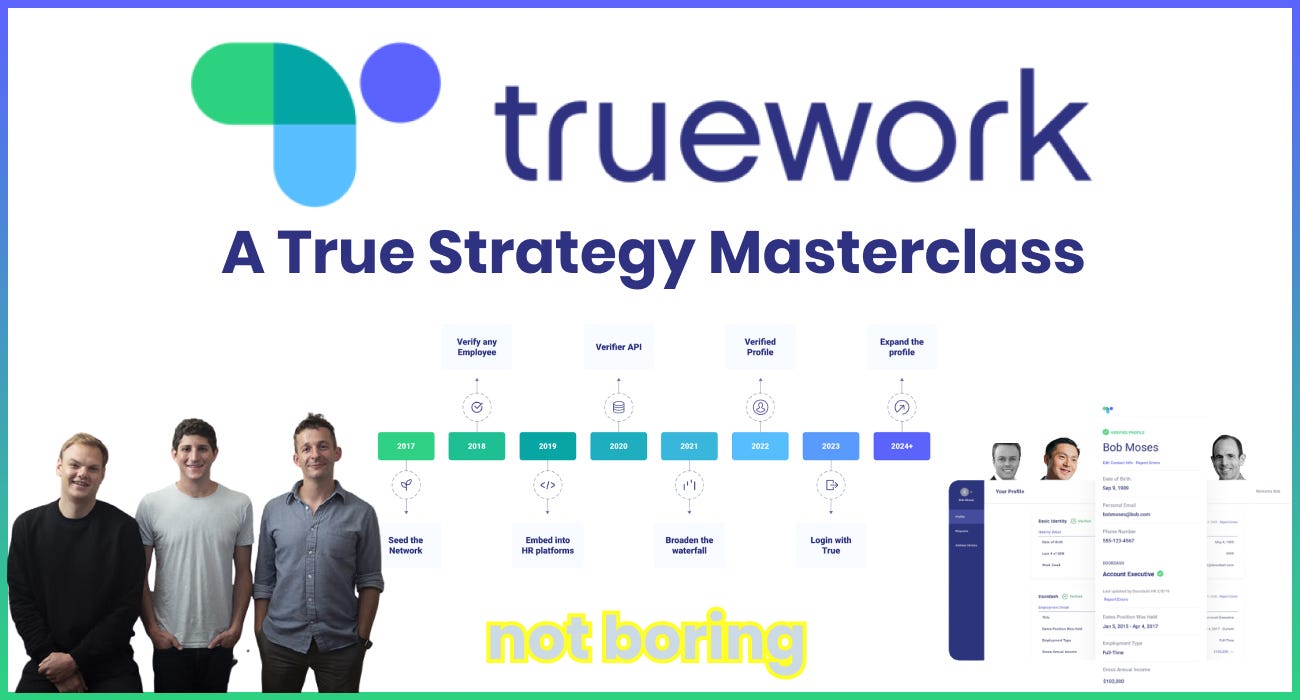
Truework: A True Strategy Masterclass (Audio)
Welcome to the 225 newly Not Boring people who have joined us since last Thursday (Substack confirmed they dropped some)! Join 46,444 smart, curious folks by subscribing here:Today’s Not Boring, the whole thing, is brought to you by … TrueworkRead on to learn how Truework is building the verified identity layer of the internet.Hi friends 👋 ,Happy Thursday!I met Ryan Sandler, Truework’s CEO, via an introduction from Ramp co-founder and CTO Karim Atiyeh. Aside from running NYC’s fastest ever unicorn, Karim is also a top angel investor. One mutual friend told me that no one is better at identifying strong engineering teams than Karim. So when he told me I needed to look into Truework, my ears perked up. Karim was right. Truework reminds me a lot of Ramp, a Not Boring favorite: Rabois-backed, fintech, Harvard founders, going after an absolutely enormous market led by a too-comfortable incumbent, strong technology chops, and a long-term, worldbuilding strategy starting with a smart wedge.It’s different than Ramp, too. First, it’s not starting with a product that the end-user touches. It built a platform and API used mostly by employers and verifiers. It’s intentionally unsexy. Second, it has a different ambition, which required it to act differently, more quietly, in the beginning. (Until now. That’s why we’re here.) And third, Truework is a privacy-first company. Truework’s story has lessons for founders, investors, anyone who works in regulated industries, and even incumbents. It’s a masterclass in Worldbuilding.This essay is a Sponsored Deep Dive on Truework. For those who are new around here, that means that Truework is paying me to write about their business, but that I would have written about it anyway. You can read more about how I pick and work with partners here.Let’s get to it. Truework: A True Strategy MasterclassThis is a story about strategy. It’s also about privacy, identity, income verification, credit bureaus, breaches, regulations, and owning your data. It’s about worldbuilding and unsexiness. It’s about the ability to fill out a mortgage application simply by clicking “login.” But mostly, it’s about strategy. Truework launched in late 2017 with a vision: empower people to own and control their personal information. That’s one of those “much easier said than done” visions. Others have tried and failed. To succeed, you need a strong wedge, and a master plan. Truework has both, and is executing on one of the most patient and ambitious worldbuilding strategies I’ve seen, backed by Keith Rabois at Founders Fund, Alfred Lin at Sequoia, and Steve Sarracino at Activant. You don’t assemble that board if you’re fucking around. Its master plan starts with employment and income verification, a process that touches all of us. If you want a house, a job, or a car, your lender or employer needs to confirm where you work and what you make. It’s a $5+ billion market with one dominant incumbent, a bunch of small players, and a lot of pen, paper, emails, and faxes. It’s broken, unsecure, and slow. But employment and income verification is a wedge into a much bigger opportunity: to become the verified identity layer for the internet, giving people control of which data they share, and where, and speeding up transactions that require trust. Truework’s journey thus far, and it’s plan for the next half-decade, is a case study on how tech startups can win huge markets controlled by dominant incumbents without using low-end disruption. Let’s study: * Meet Truework* How to Win a Legacy Industry * Regulatory Counter-Positioning* The Verified Identity LayerMeet Truework In 2017, after product managing LinkedIn Salary (a Glassdoor competitor) to launch, Ryan Sandler left LinkedIn and linked up with his Harvard roommate, Ethan Winchell, and fellow LinkedIn-er, engineer Victor Kabdebon, to explore ideas for their own thing. Having gotten interested in data ethics in college, Sandler knew that he wanted to start a company in the data privacy space, but he didn’t know exactly what the idea was. He did know which boxes it needed to check: * Unsexy * Overlooked by Silicon Valley * Lots of data* Large marketOnce they identified spaces that met their criteria, they cold emailed companies to pick their brains, narrowed the list down, and started talking to customers to validate the top ideas. After speaking with mortgage lenders, they chose employment and income verification. Sandler told The Venture Brief they chose the category because of: How overlooked it was, yet such a big market, and so important in the economy. Every time someone gets a loan, apartment, a new job, there’s sensitive information that needs to be verified about them. Most prominently, their income, employment, assets, credit, other pieces of their identity. And consumers have no idea that this information is being verified and being shared with a ton of third parties.Employment and income verification checks all the boxes. * Privacy has been a huge issue, de
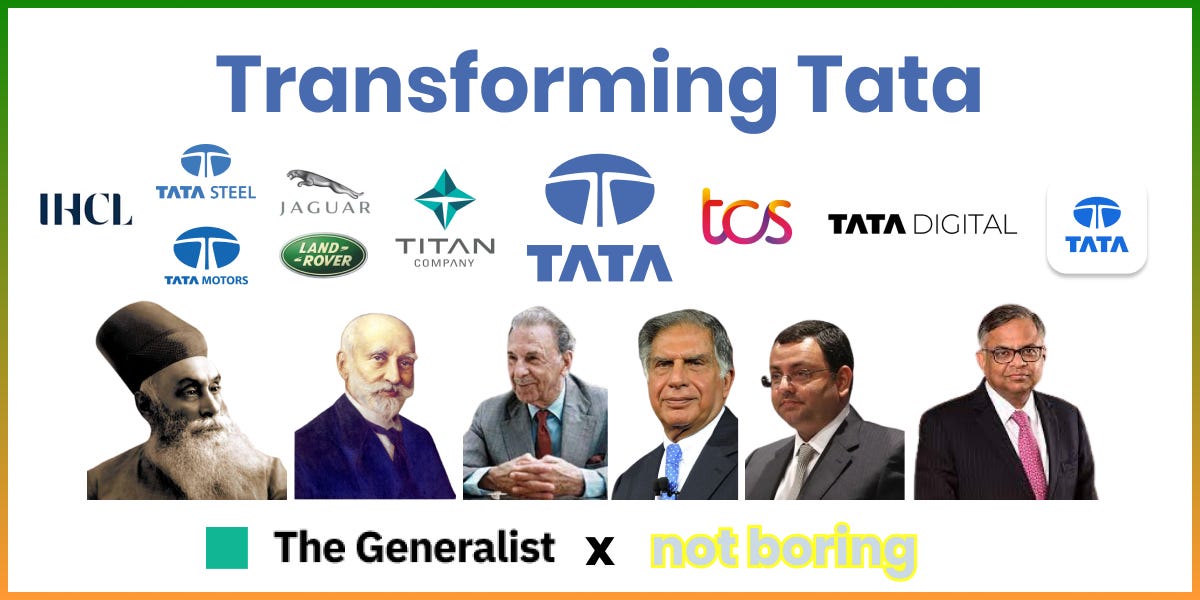
Transforming Tata
Welcome to the ??? newly Not Boring people who have joined us since last Monday - on Thursday, Substack suddenly cut my subscriber count by ~1,200 and I’m not sure why. But onwards: join 46,123 smart, curious folks by subscribing here:🎧 To get this essay straight in your ears: listen on Spotifyor Apple PodcastsToday’s Not Boring is presented by… MasterworksIn January I wrote about Masterworks. As a refresher, Masterworks is the first and only platform that lets regular folks (like me) invest in blue-chip artworks at a fraction of the entry price. At the time I had invested in three Masterworks offerings. Since then I have added three more pieces to my portfolio: a Haring, a Bradford, and another Basquiat. Fancy. Not only do I think it’s prudent to have real asset exposure to hedge against inflation (thanks J Pow 😉 ), but I also love learning about these artists and their markets, and Masterworks brings some intense data analysis to the table.Art can make sense in everyone’s portfolio. Contemporary art returned 13.6% from 1995-2020 with a low loss rate and virtually no correlation to equities. Plus, unlike other collectables or even BTC, supply is constantly decreasing. It’s kind of like ETH … ultrasound art 🦇🔊I teamed up with Masterworks to let you skip their 11,500 person waitlist. Try it.**See important infoHi friends 👋 ,Happy Monday! Mario Gabriele is one of my favorite writers. Read the opening paragraphs in this essay and you’ll understand why. He somehow makes business writing beautiful. Between his briefings, Startup Ideas, and The S-1 Club, Mario’s The Generalist is can’t miss content. If you like Not Boring, you’ll like The Generalist. Aside from a general business nerdiness, Mario and I share a few things in common:* A fascination with conglomerates. * Large Indian readerships. This week, with India’s COVID crisis continuing to escalate to frightening heights, we decided to team up to explore the past, present, and future of one of India’s most beloved companies, and one of the leaders in the fight against COVID: Tata Group.In addition to bringing awareness, Mario and I have both made donations to organizations aiding India's fight against the coronavirus. We'd encourage those of you that can to do the same. Both New York Magazine and the New York Times have lists of reputable NGOs putting funds to good use. If you’re in India, my friends at Pesto put together a website with resources including ICU beds and oxygen supplies.Let’s get to it. Transforming TataA message to all the tycoons out there: beware of your grandchild. Though the Bible advances the parable of the prodigal son — the wasteful offspring that fritters a father’s money — statistically, it is the third generation that marks the end of a family fortune. One American study indicated that 90% of wealth evaporates by that point, the casualty of frivolous investments, generational dilution, and dwindling determination. Even the colossal wealth of Cornelius Vanderbilt — worth $227 billion when adjusted for inflation, giving him a cool $96 billion edge over Bezos — dissolved in his expanding gene pool. All of which is to say: that Tata is here at all is remarkable. Four generations and more than 150 years after its founding, Tata is not only still standing but essential. Just this week, the company aided in India’s coronavirus response, agreeing to contribute 800 tonnes of oxygen per day to health facilities in need. Far from an isolated example, such civic-mindedness is at the heart of Tata’s history, no doubt part of the reason one Twitter commentator referred to it as India’s “parallel government.” Over a century and a half, the conglomerate has supported (and commercialized) Indian life, unlike any other company. In the process, Tata has constructed a dizzying tessellate of over 100 businesses, from automobiles to apparel, steel production to tea. And yet, there’s the sense that despite its durability, Tata’s may be in decline. With infighting beleaguering the founding families and legacy businesses struggling to adapt to a digital world, Tata will need to work hard to ensure it remains a potent force. To do so, the company will need to shed legacy baggage, embrace the opportunities the tech sector presents, and lean into the essence of what makes Tata an enduring brand. In today’s piece, we’ll explore: * Tata’s rich history, beginning with the opium trade* The complexion of a messy conglomerate* The necessary moves to perpetuate the dynastyHistoryThe story of Tata Group is the story of modern India. The conglomerate’s creation and ascent both influenced and responded to seismic changes in the country beginning under colonialist rule, adapting under socialist independence, and flourishing in an open economy. It all begins in 1822 in a city on India’s Western Coast. Nusserwanji: Zoroastrianism and family businessEvery company is defined by its culture. On that count, Tata can lay claim to an especially ancient heritage: the religion
Startup Stock Options Options with Secfi
Welcome to the 867 newly Not Boring people who have joined us since last Thursday! If you aren’t subscribed, join 45,133 smart, curious folks by subscribing here:🎧 To get this essay straight in your ears: listen on Spotify or Apple PodcastsHi friends 👋 ,Happy Thursday!Startup stock options are one of those things that startup employees should know a ton about but just don’t. There’s a never-ending debate in tech around whether stock options make sense for employees, or whether they’re just a way for companies to pay less cash. Even when things seemingly go really well for a company, employees’ situations are often murkier than it seems. That’s why I was so pumped when Shanna Leonard, who runs marketing at Secfi, reached out about working together. I’ve been wanting to write about this forever. This essay is a Sponsored Deep Dive on Secfi. For those who are new around here, that means that Secfi is paying me to write about their business. You can read more about how I pick and work with partners here.This one is a little bit different though. The Secfi team really just wants more startup employees to know what their options are, make a plan, and not leave millions of dollars on the table. Each person I’ve spoken to there has their own personal startup equity horror story, and they want to make sure that you don’t go through the same thing. I, too, gave up cash for equity, and it was a terrible financial decision. This one is personal.Obviously, if Secfi can help you make smarter decisions, that’s a win-win, but more thoughtfulness around employee equity is a win in itself. So we’re going to go deep on how equity works, why people don’t exercise, and what happens when they don’t. (One note: I wanted to call this post ESOP’s Fables, but ESOPs are a public company thing more than a private company thing. But I thought it was clever, so I couldn’t not share.)Let’s get to it. Startup Stock Options Options with SecfiIn 2020, startup employees left $4.9 billion on the table by not exercising their pre-IPO options. Not exercising pre-IPO means employees missed out in two major ways:* They let the typical 90 day window pass after leaving and forfeited unexercised options, either all of their options or a portion. * They stayed at the company through IPO, but didn’t exercise before the IPO and had to pay short-term capital gains or ordinary income instead of long-term capital gains because of “cashless exercising.” Costs can soar post-IPO.That combination cost employees four point nine billion dollars. $4,900,000,000. 4,900 million. At Snowflake alone, ex-employees left 72 million options worth $1.27 billion unexercised. Ouch. Those numbers are so big as to feel kind of meaningless, but they represent years of blood, sweat, tears, uncertainty, and financial trade-offs down the drain. Most people who work for early stage startups take less cash compensation than they’d be able to get at a more mature company in exchange for a few things: a more fun work environment, the chance to change the world, more responsibility than they’d get elsewhere, and a host of soft benefits, but mainly, they do it for the employee stock options. Employee stock options are the lifeblood of a startup. Options are the main way startups compete on comp with big companies like Google and Goldman that can afford to pay infinity times more cash. They offer the promise of millions and millions of dollars if things go really, really well. When I left Bank of America Merrill Lynch and went to Breather, I took a 70% pay cut on the cash side, but I got options worth 1% of the company in exchange. Even coming from finance, I didn’t fully understand my options. I just did some hyperoptimistic expected value math (1% * $1 billion = $10 million!) and that was good enough for me. I’m certainly not alone. Most startup employees don’t understand their options. Some don’t even know they need to exercise them or put out money at all. Because options feel like lottery tickets at the early stage, employees don’t think all that much about things like the tax implications of when they exercise, what happens if they leave the company, and all of the little details that can mean hundreds of thousands or even millions of dollars. Which is crazy, because those options can often represent, on paper, a huge percentage of their net worth. For a group of ostensibly intelligent people, startup employees put surprisingly little thought into managing their options. These are builders. They get so immersed in their day-to-day and building great things that they lose sight of their own personal gain at times. Plus, it’s kind of taboo to talk about maximizing the value of your options when there’s real work to be done. And most companies don’t do much to help. It’s (generally) not because they don’t want to, but because this stuff is really complicated, and so far in the future, and startups have dozens of more pressing fires to put out at any given time. In the Eisenhower D
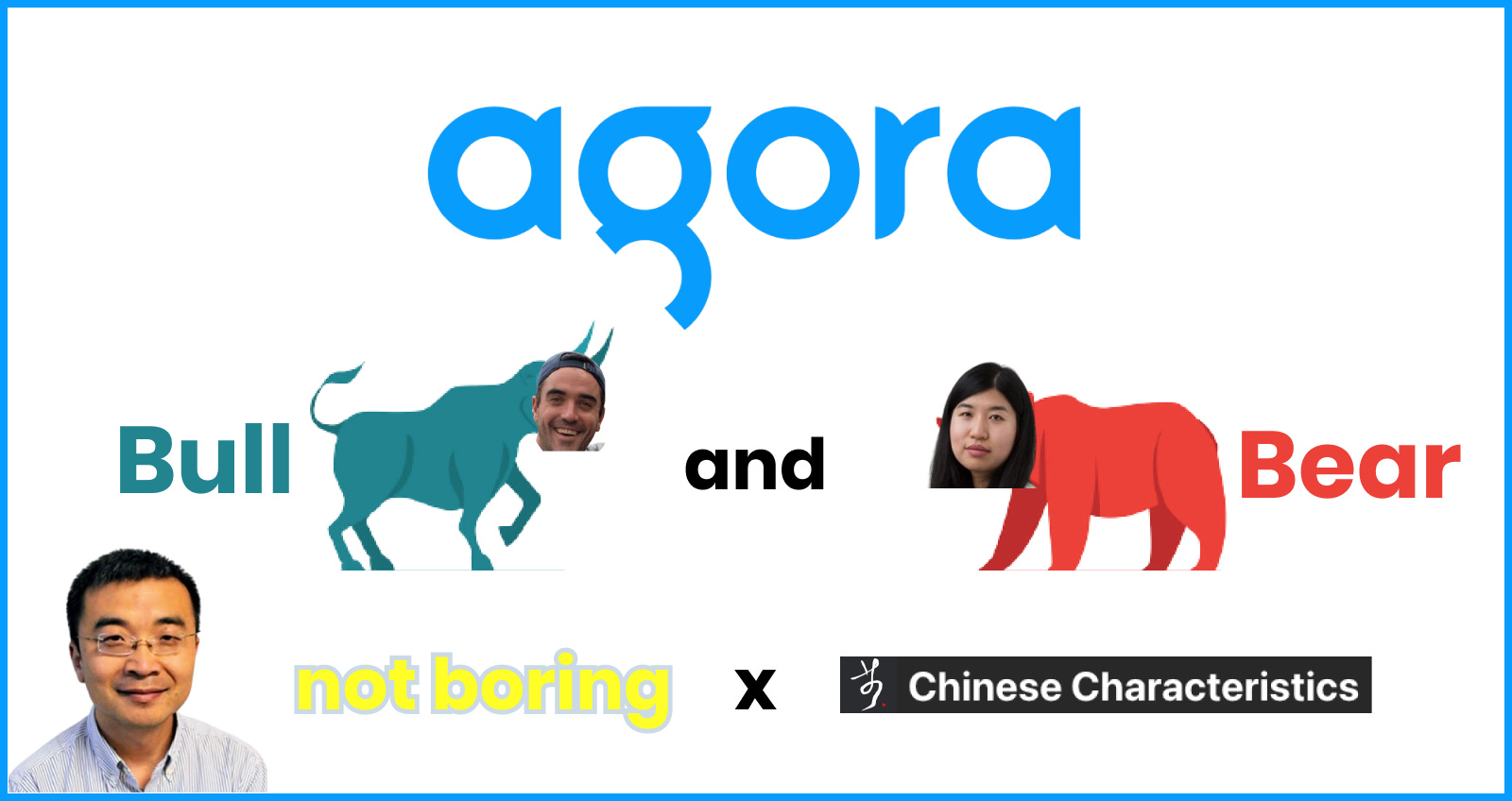
Bull & Bear: Agora, the API Powering Clubhouse
Welcome to the 974 newly Not Boring people who have joined us since last Monday! If you aren’t subscribed, join 44,858 smart, curious folks by subscribing here:🎧 To get this essay straight in your ears: listen on Spotify or Apple Podcasts (in ~30 mins)Hi friends 👋 ,Happy Monday! We have a special one for you today. Back in January, I wrote a piece about Alibaba. Lillian Li, whose writing on Chinese tech I’d read and respected, but who I’d never met, DUNKED on it on Twitter. She said that “the piece missed local context.” Which, fair. She also wrote a more complete response on her Substack, Alibaba: from growth to value.I loved getting Lillian’s perspective -- one of the reasons I write is so people who are smarter on a particular topic share their knowledge. And when it comes to China tech, Lillian, who worked as a VC in Europe but is now based in China, is as smart as it gets. She writes a great newsletter called Chinese Characteristics. You should subscribe if you’re interested in China tech, and you should be interested in China tech: Lillian and I got to know each other after that exchange. We decided to team up. Reprise the ol’ bull and bear schtick, but together this time. In other words, we shifted our debate method to Real-Time Engagement (I promise, this will make sense /maybe be funny in a minute).Let’s get to it. Today's Not Boring is brought to you by PublicAs you read above, the fastest way to get smarter about investing is to put your ideas out there and get dunked on by … errr... have a conversation with other smart investors. That's why I use Public. Public is an investing app AND a social network for talking about business trends, and the social features make it fun and easy to share ideas. I'll be discussing today's piece on Public. Hit the link below and follow me @packym to join the conversation. Btw, if you’re looking to transfer your account from somewhere else, they’ll even cover the fees.*Valid for U.S. residents 18+ and subject to account approval. Transfer fees covered for portfolios valued at or over $150. See Public.com/disclosures/Agora: Bull & BearIn 1997, two Chinese engineers joined the founding team at early video conferencing startup WebEx. A decade and a half later, each started his own company.One, Eric Yuan, founded a company you’re all too familiar with: Zoom. The other, Bin “Tony” Zhao, founded Agora. If you’ve joined a conversation on Clubhouse , attended a virtual event on RunTheWorld, or binged livestreams on Bilibili you’ve experienced Agora. It’s been sitting there, in the background, making sure the audio and video come through clearly. Agora builds real-time audio and video capabilities and delivers them as a Software Development Kit (SDK) and Application Programming Interface (API) for app developers. It’s an API-first company that makes it easy for developers to add real-time video and audio into their product. Stripe for Real-Time Voice and Video Engagement, if you will. The company is so API that its ticker is API. Agora is also a great excuse to cover a few different relevant topics:* API-first businesses and business models* Live video streaming and all of its use cases, like telemedicine and education * The audio chat warsBecause Agora sits in the background -- it’s a “picks and shovels” company -- it doesn’t care who wins as long as more people communicate, learn, heal, play, and “live real life online,” in real time. Agora, dual-headquartered out of Shanghai and Santa Clara, went public in June last year. It was relatively quiet for its first six months as a public company, bouncing around the $3-6 billion market cap range, until investors picked up on the Clubhouse connection in January and sent shares soaring. In February, the company topped out over $12 billion before crashing after providing conservative 2021 guidance on its last earnings call. Source: Atom FinanceToday, the company is trading at a $6.5 billion valuation on projected 2021 revenue of $182 million. It’s cheaper, but it’s not cheap. As Packy was browsing atom for its numbers, he was confused when he saw that FY21 consensus Enterprise Value (EV) / EBITDA was 4.06x. Seemed like a steal. Then he looked more closely: that’s 4.06 thousand times EBITDA. It’s less than eight years old and still growing quickly (74% YoY revenue growth) and most of its revenue still comes from China (~80%). It’s young and fast-growing enough that whether you’re bullish or bearish on the company depends less on today’s metrics, and more on how you think about its growth potential and defensibility going forward. There’s a good case to be made on both sides, and we’re going to do just that. Packy’s going to take the bull case, and Lillian’s going to take the bear case. Then we’ll fight it out and let you know where we end up. To get there, we’ll cover: * Agora’s History* $API’s API* China’s Livestreaming Boom* What Agora Looks Like Today* The Bull Case for Agora* The Bear Case Against Agora* Bull or Bear? To ki
Is BlockFi the Future of Finance? (Audio)
Welcome to the 1,091 newly Not Boring people who have joined us since last Thursday! If you aren’t subscribed, join 44,266 smart, curious folks by subscribing here:🎧 To get this essay straight in your ears: listen on Spotify or Apple PodcastsToday’s Not Boring is brought to you by… BlockFiBlockFi is a new kind of financial institution. With BlockFi, you can use cryptocurrency to earn interest up to 8.6% APY (I’ll explain how below), borrow cash against your crypto holdings, and buy or sell crypto. No minimum balances or hidden fees. Tip: signup is smoother in the mobile app. Set up your BlockFi account today, and get up to $250 in free bitcoin:Hi friends 👋 ,Happy Thursday / Tax Day! Today’s post couldn’t have been timed any better. I’ve been talking to the BlockFi team for a couple of months, and we picked April 15th about a month ago. We didn’t know that Coinbase would be IPO’ing yesterday, or that I’d be so deep down the crypto rabbit hole at this point. It’s fate. This is a Sponsored Deep Dive on a company I’ve been wanting to dig into for a long time. BlockFi offers up to 8.6% APY on deposits, which is obviously tempting and also confounding. I’ve had so many text conversations with friends that go something like, “I want to do this, but it has to be bullshit, right? How does that even work? We need you to do a Not Boring on this.” I’m happy to report that it is not bullshit, and I have the receipts to prove it.Let’s get to it.Is BlockFi the Future of Finance?Coinbase IPO’d yesterday to wild success. After touching $420.69 and going as high as $429.54, it closed at $328.28, up 31% from its reference price of $250. It peaked at a market cap of over $100 billion, and closed at $86 billion. I’m more excited about BlockFi, though, and not because they’re sponsoring this post. It’s a more selfish reason, one that makes the sponsorship money seem like peanuts. See, if BlockFi existed in 2013 instead of Coinbase, I probably wouldn’t even be writing this newsletter. On May 16, 2013, when Coinbase was less than a year old, I set up an account and bought my first bitcoin. I forget why, but I just looked up when Union Square Ventures first invested, and that must have been it: That was good enough for me. I bought 10 BTC on May 16th, another 15 on June 14th, and another 13 on July 12th. That September, after quitting my job in finance, I flew my unemployed ass to Oktoberfest for a fun weekend with a few friends. On September 24th, after ten too many steins, I woke up in my Munich hotel room a little hungover and feeling dumb for spending so much on the trip and the night out... and made the stupidest financial decision of my life. I just sold some of those silly bitcoin I’d bought, and bingo, free Oktoberfest. It felt like such an obviously responsible thing to do that three days later, I sold ten more, then I sold eight in October, five in November, and the last five in May (for a nice little 4x, I might add!). I sold all 38 bitcoins for a total of $7,232. At current prices, those 38 bitcoins are worth $2,450,050. Gulp. If BlockFi had been around at the time, I could have taken out a USD loan against some of those bitcoin and earned interest on the rest while they sat safely in my account. If BlockFi paid interest on bitcoin that whole time, like they do today, I’d have more than 40 bitcoin today, or over $2.6 million. Double gulp. I’ve told you before that I’m an idiot, and I wasn’t kidding. But that’s enough self-chastising for one day. We’re here to talk about BlockFi.Is BlockFi Legit?BlockFi, which just announced a $350 million Series D led by Bain Capital Ventures, Pomp Investments, Tiger Global, and partners of DST Global, is building a full-fledged financial institution for crypto investors. BlockFi offers four products to retail investors: * BlockFi Interest Account (at rates up to 8.6% APY)* Trading Accounts* Crypto-Backed Loans* Credit CardIt also acts as a prime broker for institutional clients, with custody, financing, execution, and margin. BlockFi is building SoFi plus JP Morgan’s prime broker desk, for crypto. There’s a race going on among everyone in the financial services space -- centralized crypto companies like BlockFi and Coinbase, neobanks like Chime and Monzo, public fintech companies like Square and PayPal/Venmo, and large brokerages and banks -- to become the financial super-app, the place that customers go for loans, credit cards, trading, insurance, cash management, and more. BlockFi has a unique wedge: a growing suite of products that earn clients high interest rates and free crypto.The first question anyone has when they hear about BlockFi is: “What’s the catch? 8.6% APY sounds too good to be true. That can’t be legit.” I went DEEP to understand how they do it, and it’s legit. Essentially, BlockFi arbitrages the fact that traditional finance and crypto don’t like to deal with each other. To understand how it works, we’re going back down the crypto rabbit hole. We’ll cover topics lik
A Not Boring Adventure, One Year In (Audio)
Welcome to the 537 newly Not Boring people who have joined us since last Monday! If you aren’t subscribed, join 42,205 smart, curious folks by subscribing here:🎧 To get this essay straight in your ears: listen on Spotify or Apple PodcastsHi friends 👋 , Happy Monday! This is a big one for me: Not Boring’s first birthday. Instead of writing about a very big company, which I normally do on Monday, I’m writing about a very small one: Not Boring. It’s been a crazy year, I’ve learned a ton, and it’s just going to get better from here. But it was not at all obvious that this was going to work out a year ago. Before we get to it, I just want to say a big thank you. Nothing in this story would have happened without you reading, commenting, conversing, and sharing. I feel very lucky that you’re willing to take time out of your day to read what I write. If you want to bring some smart, curious friends along for year two: Today's Not Boring is brought to you a Not Boring Day One-erFun Fact: Public was the first company ever to sponsor multiple Not Boring newsletters. They sponsored Knock Knock. Who's There? Opendoor. and have been with us ever since.Public and Not Boring are a perfect match: like Not Boring, Public makes the investing conversation fun. Public is an investing app AND a social network for talking about business trends, and the social features make it easy to share ideas.Thank Public for making Not Boring possible by hitting the link below and joining me over there. If you want to transfer your account from somewhere else, they’ll even cover the fees.*Valid for U.S. residents 18+ and subject to account approval. Transfer fees covered for portfolios valued at or over $150. See Public.com/disclosures/.A Not Boring Adventure, One Year InThis has been the wildest and most rewarding year of my life, both personally and professionally: our son, Dev, turned 6 months old yesterday, and Not Boring turned one on Friday. A year ago, we knew that Dev was coming, but I had no idea what I was going to do. I had quit my job, launched an in-person company that got crushed by lockdowns (and was probably a bad idea anyway), and to top it off, I caught COVID the week I decided to start writing Not Boring. I was lost. Somehow, since then, with all of your help, I’ve built my dream job. Over the past 365 days, I’ve:* Written and sent 417k words. That’s more than all seven Chronicles of Narnia. * Grown from under 500 subscribers to over 42,000.* Run a syndicate which has invested nearly $2 million in fourteen companies. * Generated more revenue than I’ve ever made in a full-time job. I legitimately didn’t believe this was possible. I would see people with big followings on Twitter or big subscriber lists and think that they had some special je ne sais quoi. I still think that it could end at any moment. Today, I want to share the Not Boring story as honestly as possible -- it often looks way easier from the outside -- with lessons I’ve learned on writing, growth, business models, investing, and creator psychology sprinkled in. We’ll cover:* Getting Here: Per My Last Email → Not Boring Club → Not Boring* Growth: Luck, Shares, Ups, Downs and Tommy* The Writing Process and Psychology* Business Model: Optimize for Growth and Opportunity* The Not Boring Syndicate* The Present and Future of Not BoringIf anything in this story seems planned, premeditated, or in any way clean, that’s just my brain going back, filling in gaps, and connecting dots. As much as I write about strategy, this story is about working hard even when it seems silly and following serendipity. My biggest lesson so far: this is neither as impossible nor easy as it looks.The Winding and Uncertain Road to Not BoringPer My Last EmailI’m cheating a little when I say that it’s Not Boring’s one year birthday. I wrote a different newsletter -- Per My Last Email -- for almost a year before. In early 2019, the board at Breather, where I worked, had just brought in a new CEO, who himself was in the middle of bringing in a new, experienced executive team. A couple weeks into the new regime, Ben Rollert (then VP, Product at Breather, now CEO at Composer) and I presented at an exec team offsite about the need to differentiate and dig moats in an increasingly crowded and bubbly flex office market. We got cut off halfway through with something to the effect of: “Moats? This is a big market, we don’t need to worry about moats. We have a brand. That’s what Apple has.” I realized that my brain was going to shrivel up and rot if I didn’t do something. Ben’s always been smarter than me. He saw the writing on the wall and quit. I couldn’t quit right then -- I managed a 150 person team and didn’t want to abandon them -- so instead, I used my annual learning & development budget to take David Perell’s Write of Passage course. That was one of the best decisions I’ve ever made. One of the assignments for the course was to launch a Substack and get twenty people to subscribe. I reserved p
Secureframe Saves the World (Audio)
Welcome to the 873 newly Not Boring people who have joined us since last Thursday! If you aren’t subscribed, join 41,936 smart, curious folks by subscribing here:🎧 To get this deep dive straight in your ears: listen on Spotifyor Apple PodcastsToday’s Not Boring - the whole thing! - is brought to you by… SecureframeSecureframe helps companies get enterprise ready by streamlining SOC 2 and ISO 27001 compliance. If you don’t know what that means, I’ll explain. If you do, talk to them:Hi friends 👋 ,Happy Thursday! It’s been a wild week for Not Boring Deep Dive sponsors. Following up on MainStreet’s $60 million Series A a few weeks ago, news came out about two more Deep Divers this week:* Ramp: On Monday, The Information reported that Ramp raised $65 million from D1 and others at a $1.1 billion valuation, followed immediately by $50 million from Stripe at a $1.6 billion valuation. When we did the Ramp Deep Dive in December, they had just raised $30 million.* Pipe: Yesterday, TechCrunch reported that Pipe raised a fresh round of $150 million funding at a $2 billion valuation. When we talked about Pipe in October, they had raised $66 million total. The bar I use for whether I write a Sponsored Deep Dive on a company is whether I would invest my own money in the company if given the chance (disclosure: I invested a small amount in Ramp, MainStreet, and Pipe after writing about them). You can read more about the Deep Dive selection process here.Today’s Deep Dive Sponsor, Secureframe is fresh off an $18 million Series A itself. I think that’s just the beginning. They make companies more secure, and security has never been more critical. (I always tell you how I’m paid for Deep Dives — CPA, CPM, or equity. Today is CPM).Let’s get to it. This is How They Tell Me Secureframe Saves the WorldLet’s start with a riddle. What do Ukrainian accounting software, Southwest Airlines, and Secureframe have to do with each other? Any guesses? No? I’ll give you a clue. Secureframe is security compliance software that companies, from 3-person startups to enterprises, use to automate SOC 2 and ISO 27001 compliance, complete audits, and continuously monitor their security. It’s how modern software companies stay safe and compliant with less time, effort, or cost, so they can unlock sales and focus on growing their business. But what does that have to do with Southwest and Ukraine? Read on to find out.This is How They Tell Me the World EndsRemember the old Southwest Airlines commercial in which a bored employee clicks on an email titled “Sick of your job??” and infects her whole office? Wanna get away? It actually sums up why cybersecurity is so petrifying: all it takes to take down a system is finding and exploiting the weakest link. One employee opening the wrong file can infect an entire company’s network; even worse, in an interconnected world in which every company runs on top of a stack of other companies’ software, one employee ignoring a software update can bring down major companies all around the world. In This is How They Tell Me the World Ends, New York Times cybersecurity reporter Nicole Perlroth recounts the story of the most damaging cyber attack to date: NotPetya. (Wired tells it here if you don’t want to read the whole book). On Wednesday June 27, 2017, the day before Ukraine’s Constitution Day, hospitals, banks, ATMs, power plants, the government, and practically all businesses in the country were hit, seemingly simultaneously, with what appeared to be ransomware. It locked computers, deleted files, and spread at breakneck speed from computer to computer, and company to company. Messing with Ukraine on its Constitution Day had become a Russian hacker pastime -- Ukraine’s neighbor routinely shut off the power or deleted files -- but this was different, more vicious. It was also harder to contain. NotPetya spread via “two exploits working in tandem”: EternalBlue and Mimikatz (technically, Mimikatz is not an exploit but an application used to take advantage of the EternalBlue exploit). EternalBlue was a backdoor into any unpatched Windows computer, and Mimikatz used those computers to steal passwords and break into others. Together, they preyed on the weakest links. The virus was so hard to contain that it jumped from Ukrainian companies into any company that had an office or even an employee in Ukraine. NotPetya took down systems at: Danish shipping giant Maersk, American pharmaceutical behemoth Merck, FedEx’s European subsidiary TNT Express, and even boomeranged back on Russian state oil company Rosneft. Once the virus was unleashed, there was no stopping it. And it started by finding a weak link, or more precisely, a weak Linkos. Linkos Group is a small, family-run Ukrainian software business that makes M.E.Doc, a tax product that’s like a Ukrainian TurboTax or Quicken. Practically anyone who does business in Ukraine uses M.E.Doc. That’s how the Russians got in. According to Wired: In the spring of 2017, unbeknownst t