Nature Podcast
931 episodes — Page 9 of 19
The Nature Podcast annual holiday spectacular
Games, seasonal science songs, and Nature’s 10.01:12 "Oh powered flight"In the first of our festive songs, We pay tribute to NASA's Ingenuity craft - which took the first powered flight on another planet earlier this year. Lyrics by Noah Baker and performed by The Simon Langton School choir, directed by Emily Renshaw-Kidd.Scroll to the bottom of the page for the lyrics.Video: Flying a helicopter on Mars: NASA's IngenuityNews: Lift off! First flight on Mars launches new way to explore worlds07:40 Communicating complex science with common wordsIn this year’s festive challenge, our competitors try to describe some of the biggest science stories of the year, using only the 1,000 most commonly used words in the English language. Find out how they get on…Test your skills communicating complex science with simple words with the Up-Goer Five Text Editor18:04 Alphafold oh AlphafoldOur second song brings some Hanukkah magic to Deep Mind's protein solving algorithm Alphafold. Lyrics by Kerri Smith and Noah Baker, arranged and performed by Phil Self.Scroll to the bottom of the page for the lyrics.News: ‘It will change everything’: DeepMind’s AI makes gigantic leap in solving protein structures21:01 Nature’s 10Every year, Nature’s 10 highlights some of the people who played key roles in science. We hear about a few of the people who made the 2021 list.News Feature: Nature's 10 — Ten people who helped shape science in 2021Oh Powered flightO fateful night!The stars are brightly shiningit is the night to look far beyond the Earth!Long was the way to get to the red planet,‘til he appear'd and the world felt his worth.The thrills and hope as he warmed up his motors.Delays cause stress until the glorious morn!Rise! To the skies.Above the Martian surface.Oh powered flight.Hearts are full, as history’s made.Oh joy, it flies!Mars-copter, for the first time.Led by a team, adept in aeronautics,they rethought all of their theories of flight.So led by da-ta, they crafted all the rotors,to create lift though the atmosphere was light.Viscosity is what would make is happen,but Reynold’s number drove the craft’s design.Rise! To the skies.Above the Martian surface.Oh powered flight.Hearts are full, as history’s made.Oh joy, it flies!Mars-copter, for the first time.Truly it showed, our exploration’s boundless,with caves and canyon’s now all within our grasp.Ingenuity will pave the way for others,to pair with rovers, or solo payload tasks.Sweet hymns of joy in grateful chorus raise we,Let all within us praise this great success.Rise! To the skies.Above the Martian surface.Oh powered flight.Hearts are full, as history’s made.Oh joy, it flies!Mars-copter, for the first time.Alphafold oh AlphafoldOh, Alphafold oh... Hosted on Acast. See acast.com/privacy for more information.
Coronapod: Omicron - your questions answered
Several weeks after the Omicron variant was first identified, it has quickly spread across the world. Early data are showing clear signals that the latest variant of concern is able to evade immunity and spread at a rate faster than any other variant to date. But many questions remain unanswered about the severity of infection, the protection afforded by natural and vaccine-derived immunity, and the impact Omicron could have on the global pandemic response. In this episode, we delve into the very latest studies to take stock of where we are so far and, in a Coronapod first, take on questions sent in by Coronapod listeners.News: How bad is Omicron? What scientists know so farNews: Omicron likely to weaken COVID vaccine protectionNews: Omicron-variant border bans ignore the evidence, say scientistsNews Feature: Beyond Omicron: what’s next for COVID’s viral evolution Subscribe to Nature Briefing, an unmissable daily round-up of science news, opinion and analysis free in your inbox every weekday. Hosted on Acast. See acast.com/privacy for more information.
Pluto's strange ice patterns explained by new theory
An explanation for giant ice structures on Pluto, and dismantling the mestizo myth in Latin American genetics.In this episode:00:46 The frozen root of Pluto’s polygonal patternsIn 2015, NASA’s New Horizons probe sent back some intriguing images of Pluto. Huge polygonal patterns could be seen on the surface of a nitrogen-ice ice filled basin known as Sputnik Planitia. This week, a team put forward a new theory to explain these perplexing patterns.Research article: Morison et al.06:15 Research HighlightsHow Pamplona’s bull-running defies the dynamics of crowd motion, and self-healing microbial bio-bricks.Research Highlight: Running of the bulls tramples the laws of crowd dynamicsResearch Highlight: It’s alive! Bio-bricks can signal to others of their kind09:06 How the mixed-race ‘mestizo’ myth has fostered discriminationThe term 'mestizo' emerged during the colonial period in Latin America to describe a blend of ethnicities – especially between Indigenous peoples and the Spanish colonizers. But this label is a social construct not a well-defined scientific category. Now researchers are challenging the mestizo myth, which they say is harmful and has a troubling influence on science.Feature: How the mixed-race mestizo myth warped science in Latin America17:22 Briefing ChatWe discuss some highlights from the Nature Briefing. This time, how interrupted sleep could be a route to creativity, and the development of vaccines to target respiratory syncytial virus.New Scientist: Interrupting sleep after a few minutes can boost creativityNature News: The race to make vaccines for a dangerous respiratory virusSubscribe to Nature Briefing, an unmissable daily round-up of science news, opinion and analysis free in your inbox every weekday. Hosted on Acast. See acast.com/privacy for more information.
Coronapod: vaccines and long COVID, how protected are you?
Vaccines significantly reduce the risk of developing COVID-19, but scientists are now asking what effect the vaccines might have on long COVID. Long COVID is a somewhat ill-defined, but common, syndrome that can arise from even mild cases of COVID19 - with symptoms ranging from chronic fatigue to breathing difficulties and even neurological deficiency. But little is known about what triggers long COVID, or how to prevent it. As public health experts consider protection measures, the role of vaccines in protecting against long COVID is poorly understood, and although numerous studies are seeking answers, they are turning up conflicting results.In this episode of Coronapod we pick through a selection of these studies, discuss the prevailing hypotheses on the causes of long COVID and ask how all of this might impact the pandemic.News Feature: Do vaccines protect against long COVID? What the data sayOmicronWe will be discussing Omicron in an upcoming Coronapod on 17 December. If you would like to ask any questions of our reporters about Omicron, please get in touch on Twitter: @naturepodcast or email: [email protected]: How bad is Omicron? What scientists know so farNews: Omicron likely to weaken COVID vaccine protectionNews: Omicron-variant border bans ignore the evidence, say scientistsNews Feature: Beyond Omicron: what’s next for COVID’s viral evolution Hosted on Acast. See acast.com/privacy for more information.
How 'megastudies' are changing behavioural science
Speeding up comparisons of behavioural interventions, and what to expect from the James Webb Space Telescope.In this episode:00:45 Identifying effective interventions with a 'megastudy'Comparing single behavioural interventions and identifying which is most effective can be difficult and time consuming, hampering policy-making decisions. This week, a team demonstrate a ‘megastudy’, which allows researchers to compare multiple interventions within the same group of people.Research article: Milkman et al.News and Views: Benefits of megastudies for testing behavioural interventions10:36 Research HighlightsThe feeding habits of a giant, extinct eagle, and the relatively undisturbed life of a group of exoplanets.Research Highlight: This enormous eagle could have killed you, probablyResearch Highlight: Famous space family has a surprisingly peaceful history 13:07 What to expect from the Webb TelescopeDecades in the making, NASA’s James Webb Space Telescope is finally due to launch later this month. We discuss the telescope’s mission and what it might reveal about the Universe.Feature: The $11-billion Webb telescope aims to probe the early UniverseNews: NASA won’t rename James Webb telescope — and astronomers are angry 20:27 Briefing ChatWe discuss some highlights from the Nature Briefing. This time, the supermassive black holes headed for impact (in 250 million years), and a new dinosaur with an unusual tail weapon.New Scientist: A pair of nearby supermassive black holes are heading for a collisionNew York Times: Spike-tailed ankylosaur was built like a tankSubscribe to Nature Briefing, an unmissable daily round-up of... Hosted on Acast. See acast.com/privacy for more information.
Coronapod: How has COVID impacted mental health?
Studying mental health in populations is not a simple task, but as the pandemic has continued, mounting concerns have mobilised researchers.Now, researchers have used data from helplines in 20 countries to assess the impacts that COVID, as well as associated political and public health measures like financial assistance programs and lockdowns, have had on mental health. Contrary to expectations, loneliness and concerns about the impacts of the pandemic drove most of the callers, rather than imminent threats such as suicidal thoughts or abuse.News: Millions of helpline calls reveal how COVID affected mental healthOmicronWe will be discussing Omicron in an upcoming Coronapod on 17 December. If you would like to ask any questions of our reporters about Omicron, please get in touch on Twitter: @naturepodcast or email: [email protected]: How bad is Omicron? What scientists know so farNews: Omicron is supercharging the COVID vaccine booster debateNews: Omicron-variant border bans ignore the evidence, say scientists Subscribe to Nature Briefing, an unmissable daily round-up of science news, opinion and analysis free in your inbox every weekday. Hosted on Acast. See acast.com/privacy for more information.
What’s the best diet for people and the planet?
Designing a nutritious and planet-friendly diet, and an AI that guides mathematicians.In this episode:00:46 Designing a healthy diet for the planetResearchers are trying to develop diets that help to reduce greenhouse gas emissions while at the same time providing nutrition. Some of these sustainable diets are now being tested to see if they work in local contexts without damaging livelihoods.Feature: What humanity should eat to stay healthy and save the planet08:24 Research HighlightsHow jellyfish get by without a centralised brain, and reading the runes within a medieval lead amulet.Research Highlight: How jellyfish control their livesResearch Highlight: Neutron beam sheds light on medieval faith and superstition10:32 The AI guiding mathematicians’ intuitionFinding relationships between two seemingly unrelated groups of objects is an important part of some branches of mathematics. To help speed up this process, a new AI has been developed, which points mathematicians towards potential relationships, allowing them to come up with new conjectures.Research article: Davies et al.News and Views: Artificial intelligence aids intuition in mathematical discovery11:23 Briefing ChatWe discuss some highlights from the Nature Briefing. This time, a pendant made from mammoth tusk, and developing lab-grown fish for food.Nature News: Is this mammoth-ivory pendant Eurasia’s oldest surviving jewellery?Nature Biotechnology: No bones, no scales, no eyeballs: appetite grows for cell-based seafoodSubscribe to Nature Briefing, an unmissable daily round-up of science news, opinion and analysis free in your inbox every weekday. Hosted on Acast. See acast.com/privacy for more information.
Audio long-read: The chase for fusion energy
A host of private companies are promising commercial fusion reactors in the next decade.After decades of promise, it finally seems that nuclear fusion is approaching commercial viability. Companies around the world are securing huge amounts of funding, and advances in materials research and computing are enabling technologies other than the standard designs to be pursued.This is an audio version of our feature: The chase for fusion energy Hosted on Acast. See acast.com/privacy for more information.
Coronapod: everything we know about the new COVID variant
In a quickly developing story a new variant, first detected in Botswana, is triggering rapid action among researchers. The variant - currently named B.1.1.529 has more than 30 changes to the spike protein - and the concern is that these mutations may result in increased transmissibility, severity of disease or even antibody evasion.In this episode of Coronapod, we discuss what we know so far, how scientists are searching for answers and what this could mean for the pandemic.News: Heavily mutated coronavirus variant puts scientists on alert Hosted on Acast. See acast.com/privacy for more information.
Researcher careers under the microscope: salary satisfaction and COVID impacts
The Nature salary and satisfaction survey reveals researchers' outlook, and NASA’s test of planetary defences. In this episode:00:45 Salary and satisfaction surveyLike all aspects of life, scientific careers have been impacted by the pandemic. To get an insight into how researchers are feeling, Nature has conducted a salary and satisfaction survey. We hear from some of the respondents.Careers Feature: Stagnating salaries present hurdles to career satisfaction09:07 Research HighlightsThe physics of a finger snap, and the surprisingly strong silk of jumping spiders.Research Highlight: It’s a snap: the friction-based physics behind a common gestureResearch Highlight: High-speed spinning yields some of the toughest spider silk ever found11:23 Briefing ChatWe discuss some highlights from the Nature Briefing. This time, the plans to smash a spacecraft into an asteroid, and how baby formula is changing to better resemble breast milk.Nature News: NASA spacecraft will slam into asteroid in first planetary-defence testChemistry World: The science of breast milk and baby formulaSubscribe to Nature Briefing, an unmissable daily round-up of science news, opinion and analysis free in your inbox every weekday. Hosted on Acast. See acast.com/privacy for more information.
Sea squirts teach new lessons in evolution
Spineless sea squirts shed light on vertebrate evolution, and an iodine-fuelled engine powering a satellite in space.In this episode:00:45 A story of sea squirts, ancient vertebrates and missing genesWhen a PhD student set out to study the developmental pathways of a strange sea creature, he hoped to shed light on the origins of vertebrate animals. Instead, researchers found themselves investigating a strange case of missing genes. We hear why gene loss could be a more significant factor in evolutionary processes than was previously thought.Research article: Ferrández-Roldán et al.08:17 Research HighlightsThe unusual crystal that gives a beetle its glittering green sheen, and the genetics of a fish’s 200 year lifespan.Research Highlight: Weird crystal makes beetle a living jewelResearch Highlight: Some of Earth’s longest-lived fish show how to reach extreme ages10:43 An iodine-fuelled engine for satellitesIn space, many satellites use xenon-fuelled ‘electric propulsion systems’ to maneuver. However, xenon is rare and requires high-pressure storage systems, so researchers have been working to develop alternative fuels. This week, a team publish details of the first in-space test of an iodine-powered electric propulsion system, which they say has many advantages over xenon systems.Research article: Rafalskyi et al16:37 Briefing ChatWe discuss some highlights from the Nature Briefing. This time, issues aboard the Hubble Space Telescope, and what the discovery of a theorised mineral reveals about processes deep within the Earth.Wired: NASA Tries to Save Hubble, AgainNature: Diamond delivers long-sought mineral from the deep EarthSubscribe to Nature Briefing, an unmissable daily round-up of science news, opinion and analysis free in your inbox every weekday. Hosted on Acast. See acast.com/privacy for more information.
Coronapod: new hope from COVID antiviral drugs
Two new anti-viral pills have been shown to be safe and effective against COVID in clinical trials, according to recent press releases. The drugs, molnupiravir, developed by Merck and Ridgeback Biotherapeutics, and Paxlovid, developed by Pfizer both appear to significantly reduce hospitalisation in people with early COVID. Some researchers are quietly hopeful that these new weapons in the anti-COVID arsenal could have a big impact, in particular in parts of the world where vaccines are still not widely available, but there are a number of caveats. In this episode of Coronapod, we open the pill boxes and pick through the contents - asking how the drugs work, what side effects we might see and how, if at all, they might change the course of the pandemic.News: COVID antiviral pills: what scientists still want to know Subscribe to Nature Briefing, an unmissable daily round-up of science news, opinion and analysis free in your inbox every weekday. Hosted on Acast. See acast.com/privacy for more information.
The past and future of the Earth's climate
Reassessing 24,000 years of global temperatures, and on the ground at COP26.In this episode:01:21 Reassessing Earth’s climate over the past 24,000 yearsThe ~20,000 year period from the Last Glacial Maximum to the pre-industrial era saw huge changes to the Earth’s climate. But characterising how temperatures changed during this time has been difficult, with different methods producing different results. Now, a team have combined two techniques, which they hope will provide new insights into the past, and future, of Earth’s climate.Research article: Osman et al.News and Views: Global temperature changes mapped across the past 24,000 years09:53 COP26 Briefing ChatThe United Nations’ climate change conference COP26 continues this week. In this special edition of the Briefing Chat, we head over to the conference to hear the latest on what’s been happening, and the measures being discussed to tackle future warming.Collection: COP26: Inside the scienceVideo: Your COP26 questions answered: carbon captureSubscribe to Nature Briefing, an unmissable daily round-up of science news, opinion and analysis free in your inbox every weekday. Hosted on Acast. See acast.com/privacy for more information.
Audio long-read: How dangerous is Africa’s explosive Lake Kivu?
Lake Kivu, nestled between the Democratic Republic of the Congo and Rwanda, is a geological anomaly that holds 300 cubic kilometres of dissolved carbon dioxide and 60 cubic kilometres of methane.The lake has the potential to explosively release these gases, which could fill the surrounding valley, potentially killing millions of people.Researchers are trying to establish the likelihood of such an event happening, and the best way to safely siphon the gases from the lake.This is an audio version of our feature: How dangerous is Africa’s explosive Lake Kivu? Hosted on Acast. See acast.com/privacy for more information.
Podcast special: onboard the climate train to COP26
Last weekend, hundreds of young people boarded a specially chartered train in Amsterdam to travel to Glasgow ahead of the United Nations COP26 climate summit.Among them were scientists, activists and policy makers. In a Nature Podcast special, we boarded the train to catch up with some of them - to talk about their science, their motivations and their message.News: All aboard the climate train! Scientists join activists for COP26 trip Subscribe to Nature Briefing, an unmissable daily round-up of science news, opinion and analysis free in your inbox every weekday. Hosted on Acast. See acast.com/privacy for more information.
China’s COVID vaccines have been crucial — now immunity is waning
More that 3 billions doses of China's CoronaVac and Sinopharm vaccines have been administered across the globe, playing an especially important role in Latin America and South East Asia, as well as China. These vaccines use inactivated virus particles to expose the immune system to Sars-CoV-2, but they do not appear to generate the same levels of neutralising antibodies as other vaccine platforms such as those based on mRNA. Now studies are suggesting that this protection may be waning more quickly than with other vaccines, which has sparked a conundrum - in many countries the only vaccines available are CoronaVac or Sinopharm. In this episode of Coronapod we ask how researchers are trying to get a handle on what is going on and how they might adapt to counteract waning immunity from these crucial vaccines.News: China’s COVID vaccines have been crucial — now immunity is waning Subscribe to Nature Briefing, an unmissable daily round-up of science news, opinion and analysis free in your inbox every weekday. Hosted on Acast. See acast.com/privacy for more information.
Genomics unwraps mystery of the Tarim mummies
The unexpected origins of a 4000-year-old people, protecting your ‘digital presence’ and what to expect from COP26.In this episode:00:48 The origins of the mysterious Tarim mummiesFor decades there has been debate about the origins of a group of 4000-year-old individuals known as the Tarim Basin mummies. Their distinct appearance and clothing has prompted scientists to hypothesise they had migrated from the North or West. Now, a team of researchers have used modern genomics to shed new light on this mystery and reveal that migration was not the mummies’ origin.Research article: Zhang et al.News and Views: The unexpected ancestry of Inner Asian mummies08:59 Research HighlightsMaking wood mouldable, and how ancient snakes diversified their diets.Research Highlight: Moulded or folded, this wood stays strongResearch Highlight: Finicky no more: ancient snakes ate their way to success11:09 How a regular ‘digital-hygiene’ check can protect your reputationAttaching a researcher’s name to a paper without them knowing is an unscrupulous practice that can have serious repercussions for the unwitting academic. To prevent this, computer scientist Guillaume Cabanac is advocating a once-a-month ‘digital-hygiene’ check, to identify incorrect acknowledgements, and help prevent research malpractice.World View: This digital-hygiene routine will protect your scholarship18:51 What to expect from COP26This week sees the start of the 26th UN Climate Change Conference (COP26), with an estimated 20,000 people — including world leaders, scientists and activists — expected to be in attendance. Jeff Tollefson, senior reporter at Nature, joins us to explain what’s on the agenda for the conference.News Explainer: COP26 climate summit: A scientists’ guide to a momentous meeting Subscribe to Nature Briefing, an unmissable daily round-up of science news, opinion and analysis free in your inbox every weekday. Hosted on Acast. See acast.com/privacy for more information.
Coronapod: can scientists harness COVID super-immunity?
People that have recovered from COVID are seeing stronger immune responses after vaccination than those that never contracted the virus. Researchers are now racing to unpick what is behind this powerful 'hybrid immunity'. In this episode of Coronapod, we discuss a series of studies which are offering up some possibile explanations, and ask how this might inform publish health policy in the future. News: COVID super-immunity: one of the pandemic’s great puzzlesSubscribe to Nature Briefing, an unmissable daily round-up of science news, opinion and analysis free in your inbox every weekday. Hosted on Acast. See acast.com/privacy for more information.
Viking presence in the Americas pinpointed by ancient solar storm
An ancient solar storm helps pinpoint when Vikings lived in the Americas, and using magnets to deftly move non-magnetic metals. In this episode:00:53 Pinpointing Viking presence in North AmericaIt’s well-understood that Vikings went to North America around a thousand years ago. However, working out a precise date has proven difficult. Now, thanks to an ancient solar storm, researchers have been able to identify an individual year when Vikings were definitely living on the continent.Research article: Kuitems et al.14:57 Research HighlightsHow shoulder muscles gave Pterosaurs an aerodynamic edge, and mysterious radio waves coming from near the centre of the Milky Way.Research Highlight: How ancient reptiles were streamlined for flightResearch Highlight: A mysterious radio signal object is beaming radio waves into the Milky Way17:45 Magnets move non-magnetic metalsScientists have created an array of magnets capable of moving non-metallic objects in 6 dimensions. They hope their new approach could one day be used to clean up debris in space.Research article: Pham et al.News and Views: Non-magnetic objects induced to move by electromagnets27:06 What Francis Collin’s retirement means for the US NIHAfter 12 years, Francis Collins announced plans to retire from his role as Director of the United States National Institutes of Health. We discuss his legacy and what this means for the world’s biggest public funder of biomedical research.Editorial: COVID, racism, China: three tests for the next NIH leaderNews: Francis Collins to step down at NIH: scientists assess his legacySubscribe to Nature Briefing, an unmissable daily round-up of science news, opinion and analysis free in your inbox every weekday. Hosted on Acast. See acast.com/privacy for more information.
Coronapod: the COVID scientists facing violent threats
Hundreds of scientists have responded to a survey asking about harassment and abuse during the pandemic. The results paint a picture which is as concerning as it is shocking. In this episode of Coronapod we discuss the kinds of abuse scientists are facing, try to pick apart where it is comes from and ask what can be done about it?News Feature: ‘I hope you die’: how the COVID pandemic unleashed attacks on scientistsCareers feature: Real-life stories of online harassment — and how scientists got through itSurvey data table Subscribe to Nature Briefing, an unmissable daily round-up of science news, opinion and analysis free in your inbox every weekday. Hosted on Acast. See acast.com/privacy for more information.
How electric acupuncture zaps inflammation in mice
The neurons behind acupuncture’s effect on inflammation, and how antibiotics affect gut bacteria.In this episode:00:54 The neuronal basis for acupuncture’s effect on inflammationIn mice, electroacupuncture has been shown to reduce inflammation, but only when certain points on the body are stimulated. Why this is has puzzled scientists, but now, researchers have identified the specific neurons that are involved. They hope that this knowledge could be used in future to help treat certain inflammatory-related diseases.Research article: Liu et al.News and Views: Electroacupuncture activates neurons to switch off inflammation07:28 Research HighlightsThe Aztec origins of an obsidian ‘spirit mirror’, and the damage done by a Soviet plutonium complex.Research Highlight: A ‘spirit mirror’ used in Elizabeth I’s court had Aztec rootsResearch Highlight: Cold-war spy pictures reveal a Soviet nuclear ‘cloud generator’10:18 Assessing antibiotics’ collateral damage.Antibiotics are known to cause damage to the communities of bacteria that live in our guts. To better understand why this happens, a team has mapped the effects that different antibiotics have on individual gut-bacteria species, which may offer new insights into preventing this collateral damage.Research article: Maier et al.17:32 Briefing ChatWe discuss some highlights from the Nature Briefing. This time, the latest species to be declared extinct in the US, and a potential planet that orbits three stars.New York Times: Protected Too Late: U.S. Officials Report More Than 20 ExtinctionsNew York Times: This May Be the First Planet Found Orbiting 3 Stars at OnceSubscribe to Nature Briefing, an unmissable daily round-up of science news, opinion and analysis free in your inbox every weekday. Hosted on Acast. See acast.com/privacy for more information.
Coronapod: new data affirms the benefits of air filters and masks
New data suggests that inexpensive, high-efficiency particulate air (HEPA) filters can effectively scrub SARS-CoV-2 particles from the air in hospital COVID wards. The result validates previous studies carried out in controlled conditions. Currently, HEPA filters are not routinely used in hospital settings, but researchers suggest they could could help mitigate the risk of tramission of airborne viruses.In addition a new study has demonstrated the effectiveness of mask wearing, with surgical masks proving more effective than those made of cloth. The trial, which involved 350,000 participants in Bangladesh, is the latest in a long line of studies demonstrating mask efficacy - but this is the first randomised control trial of its kind. We ask if this gold-standard trial will prove to be the final word on the effectiveness of masks.News: Real-world data show that filters clean COVID-causing virus from airNews: Face masks for COVID pass their largest test yetSubscribe to Nature Briefing, an unmissable daily round-up of science news, opinion and analysis free in your inbox every weekday. Hosted on Acast. See acast.com/privacy for more information.
The AI that accurately predicts the chances of rain
AI weather forecasters, mapping the human brain and the 2021 science Nobel prizes.In this episode:00:52 Improving the accuracy of weather forecasts with AIShort-term rain predictions are a significant challenge for meteorologists. Now, a team of researchers have come up with an artificial-intelligence based system that weather forecasters preferred to other prediction methods.Research article: Ravuri et al.08:02 Research HighlightsThe vaping robot that could help explain why some e-cigarettes damage lungs, and the sea-slugs that steal chloroplasts to boost egg production.Research Highlight: This robot vapes for scienceResearch Highlight: Solar-powered slugs have a bright reproductive future10:29 A map of the motor cortexA group of researchers are undertaking an enormous task: to make a cellular atlas of the entire brain. This week, they publish a suite of papers that has accomplished this feat for one part of the brain — the motor cortex.Research Article: BRAIN Initiative Cell Census NetworkNews and Views: A census of cell types in the brain’s motor cortexEditorial: Neuroscientists make strides towards deciphering the human brain17:58 Nobel NewsFlora Graham from the Nature Briefing joins us to talk about the winners of this year’s science Nobels.News: Medicine Nobel goes to scientists who discovered biology of sensesNews: Climate modellers and theorist of complex systems share physics NobelNews: ‘Elegant’ catalysts that tell left from right scoop chemistry Nobel Subscribe to Nature Briefing, an unmissable daily round-up of science news, opinion and analysis free in your inbox every weekday. Hosted on Acast. See acast.com/privacy for more information.
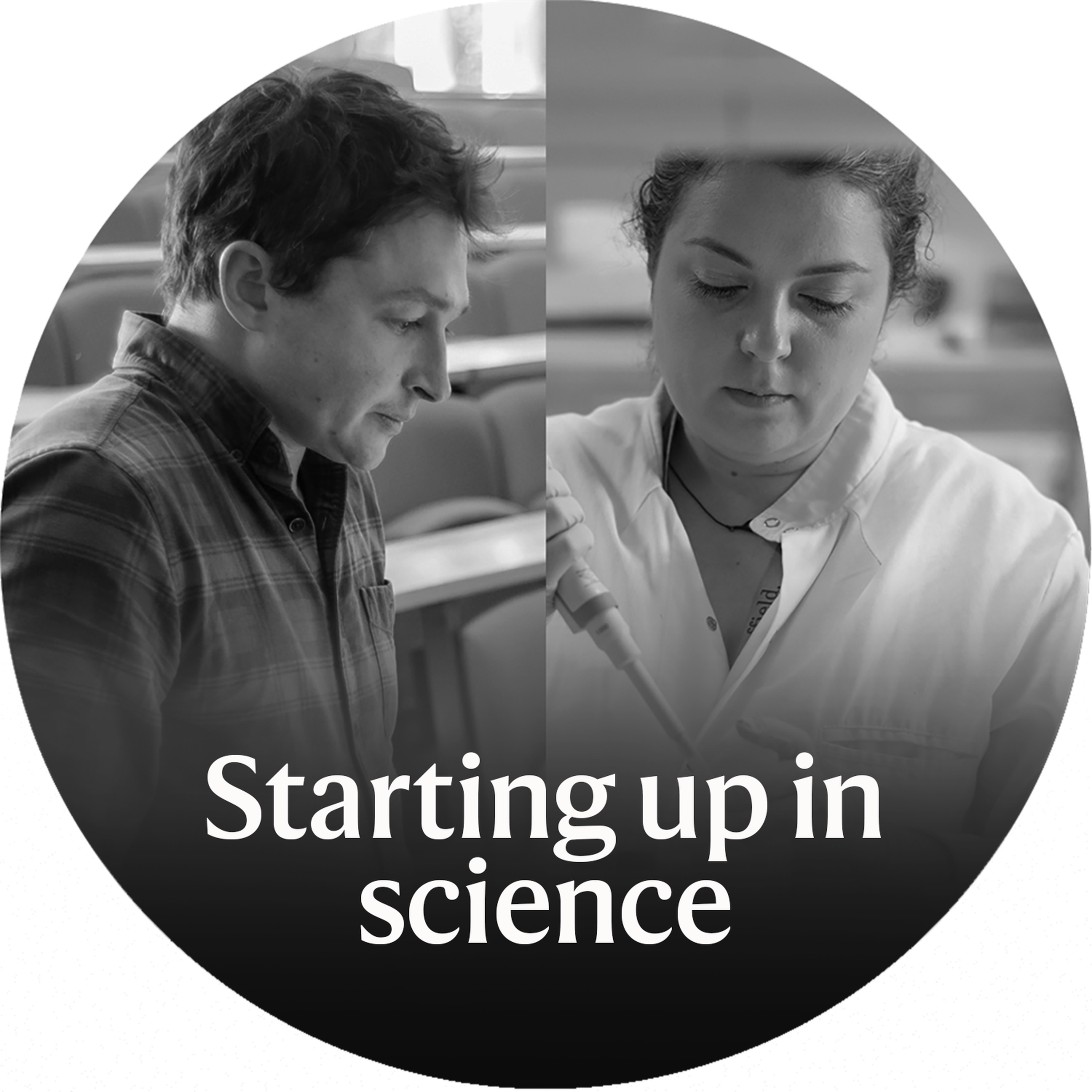
Starting up in science: behind the scenes
Starting up in science: behind the scenesIn this bonus episode, the four Nature reporters behind Starting up in science discuss how the project came about, what it was like to follow two scientists for three years, and what the series has achieved. Hosted on Acast. See acast.com/privacy for more information.
Starting up in science: Episode 4
Episode 4Ali interviews for a critical grant. While she is waiting for the result, the pandemic throws their labs into chaos. Then comes a personal crisis.Read a written version of Starting up in science Hosted on Acast. See acast.com/privacy for more information.
Starting up in science: Episode 3
Episode 3 As newly-minted principal investigators, Ali and Dan have grand plans for their research – but science is slow, especially when other demands loom large: hiring staff, mentoring and teaching students and, of course, the race to secure funding.Read a written version of Starting up in science Hosted on Acast. See acast.com/privacy for more information.
Starting up in science: Episode 2
Episode 2Ali and Dan have landed positions as the heads of their very own labs. But how did they get to the starting line? Every scientist’s journey is different, and in this episode we hear Ali and Dan’s, which covers years, thousands of miles, and some very difficult decisions.Read a written version of Starting up in science Hosted on Acast. See acast.com/privacy for more information.
Starting up in science: Episode 1
Every year, thousands of scientists struggle to launch their own labs. For three years, a reporting team from Nature documented the lives of married couple Alison Twelvetrees and Daniel Bose as they worked to get their fledgling research groups off the ground.Frustrations over funding, a global pandemic, and a personal trauma have made this journey anything but simple for Ali and Dan. Listen to their story in Starting up in science.Episode 1What does it take to start up in science? Meet two biologists fighting the odds to build their careers and break new ground. But their first priority is getting grants – without them, their labs might not stay afloat.Read a written version of Starting up in science Hosted on Acast. See acast.com/privacy for more information.
Audio long-read: Can artificially altered clouds save the Great Barrier Reef?
Australian scientists are developing new technologies to help protect coral from climate change.Earlier this year, a team of researchers used a mist-machine to artificially brighten clouds in order to block sunlight above Australia’s Great Barrier Reef. The project is the world’s first field trial of marine cloud brightening and is among a number of techniques and technologies being developed to save the country’s reefs from the worst effects of climate change.This is an audio version of our feature: Can artificially altered clouds save the Great Barrier Reef? Hosted on Acast. See acast.com/privacy for more information.
Coronapod: solving the COVID vaccine manufacturing problem
Less than 1% of those in low income countries are fully vaccinated, and that number only rises to 10% in low-middle income countries. Meanwhile more than half of the population in wealthier countries have received a double dose with several now rolling out third dosess.In this episode of Coronapod we look at the role of pharmaceutical manufacturers. Drug companies are facing increased pressure to partner with manufacturing firms in the global south but most are reluctant to relinquish control. We ask what needs to change to help address the global disparity in vaccine access.News: The fight to manufacture COVID vaccines in lower-income countries Hosted on Acast. See acast.com/privacy for more information.
The floating sensors inspired by seeds
How tiny seed-like sensors could monitor the environment, and the latest from the Nature Briefing.In this episode:00:45 Spinning seeds inspire floating electronicsResearchers have developed miniature electronic-chips with wings that fall like seeds, which could be a new way to monitor the environment.Research article: Kim et al.Video: Seed-inspired spinners ride the wind and monitor the atmosphere06:02 Research HighlightsHow humans can adjust to an energy-efficient walking pace almost without thinking, and the viral shell that excels at delivering genome-editing tools.Research Highlight: Humans walk efficiently even with their heads in the cloudsResearch Highlight: A CRISPR fix for muscles hatches from a viral shell08:34 Briefing ChatWe discuss some highlights from the Nature Briefing. This time, the mystery of the Sun’s super-hot corona, and the latest efforts to toilet-train cows.Physics World: The enduring mystery of the solar coronaThe Guardian: Cows ‘potty-trained’ in experiment to reduce greenhouse gas emissions Hosted on Acast. See acast.com/privacy for more information.
How to help feed the world with 'Blue Foods'
How aquatic foods could help tackle world hunger, and how Australian wildfires spurred phytoplankton growth in the Southern Ocean.In this episode:00:45 The role of aquatic food in tackling hungerAhead of the UN’s Food Systems Summit, Nature journals are publishing research from the Blue Food Assessment, looking at how aquatic foods could help feed the world's population in a healthy, sustainable and equitable way.We speak to Ismahane Elouafi, Chief Scientist at the Food and Agriculture Organization of the United Nations, who tells us about the role of blue foods in future food systems.Immersive feature: Blue FoodsNature's Blue Food collection12:27 Research HighlightsThe ingestible capsule that injects drugs straight into stomach tissue, and a soft material that changes colour when twisted.Research Highlight: An easily swallowed capsule injects drugs straight into the gutResearch Highlight: Flowing crystals for quick camouflage14:52 How Australian wildfires spurred phytoplankton bloomsThe devastating Australian wildfires of 2019-2020 released plumes of iron-rich aerosols that circled the globe, fertilizing oceans thousands of miles away. New research suggests that these aerosols ultimately triggered blooms of microscopic phytoplankton downwind of the fires, in the Southern Ocean.Research Article: Tang et al. Hosted on Acast. See acast.com/privacy for more information.
The billion years missing from Earth’s history
A new theory to explain missing geological time, the end of leaded petrol, and the ancient humans of Arabia.In this episode: 00:29 Unpicking the Great UnconformityFor more than 150 years, geologists have been aware of ‘missing’ layers of rock from the Earth’s geological record. Up to one billion years appear to have been erased in what’s known as the Great Unconformity. Many theories to explain this have been proposed, and now a new one suggests that the Great Unconformity may have in fact been a series of smaller events.BBC Future: The strange race to track down a missing billion years05:23 The era of leaded petrol is overIn July, Algeria became the final country to ban the sale of leaded petrol, meaning that the fuel is unavailable to buy legally anywhere on Earth. However despite this milestone, the toxic effects of lead petrol pollution will linger for many years to come.Chemistry World: Leaded petrol is finally phased out worldwide 08:26 The ancient humans who lived in a wetter ArabiaWhile much of modern day Arabia is covered by deserts, new research suggests that hundreds of thousands of years ago conditions were much wetter for periods on the peninsula. These lusher periods may have made the area a key migratory crossroads for ancient humans.Research Article: Groucutt et al.News and Views: Traces of a series of human dispersals through ArabiaSubscribe to Nature Briefing, an unmissable daily round-up of science news, opinion and analysis free in your inbox every weekday. Hosted on Acast. See acast.com/privacy for more information.
Dead trees play an under-appreciated role in climate change
How insects help release carbon stored in forests, and the upcoming biodiversity summit COP 15.In this episode:00:44 Fungi, insects, dead trees and the carbon cycleAcross the world forests play a huge role in the carbon cycle, removing huge amounts of carbon dioxide from the atmosphere. But when those trees die, some of that carbon goes back into the air. A new project studies how fast dead wood breaks down in different conditions, and the important role played by insects.Research Article: Seibold et al.09:37 Research HighlightsMassive stars make bigger planets, and melting ice moves continents.Research Highlight: Why gassy planets are bigger around more-massive starsResearch Highlight: So much ice is melting that Earth’s crust is moving12:04 The UN’s Convention on Biological DiversityAfter several delays, the fifteenth Conference of the Parties (COP 15) to the United Nations Convention on Biological Diversity, is now slated to take place next year. Even communicating the issues surrounding biodiversity loss has been a challenge, and reaching the targets due to be set at the upcoming meeting will be an even bigger one.Editorial: The scientific panel on biodiversity needs a bigger role 19:32 Briefing ChatWe discuss some highlights from the Nature Briefing. This time, cannibal cane toads and a pterosaur fossil rescued from smugglers.Nature News: Australia’s cane toads evolved as cannibals with frightening speedResearch Highlight: A plundered pterosaur reveals the extinct flyer’s extreme headgear National Geographic: Stunning fossil seized in police raid reveals prehistoric flying reptile's secretsSubscribe to Nature Briefing, an unmissable daily round-up of science news, opinion and analysis free in your inbox every weekday. Hosted on Acast. See acast.com/privacy for more information.
Audio long-read: why sports concussions are worse for women
As women’s soccer, rugby and other sports gain in popularity a growing body of evidence suggests that female athletes are at a greater risk of traumatic brain injury than men - what's more they tend to fare worse after a concussion and take longer to recover. Now researchers are racing to get to the bottom of why and ask how treatment might need to change.This is an audio version of our feature: Why sports concussions are worse for women Hosted on Acast. See acast.com/privacy for more information.
Coronapod: How Delta is changing the game
Delta has quickly become the dominant COVID variant in many countries across the world, in this episode we ask why. Over the past few weeks, a slew of studies have started to shed more light on how the Delta variant differs from its cousins and even the mechanisms behind its rampant spread. We dig into studies on the epidemiology and molecular biology of Delta to ask some key questions surrounding its transmissibility, lethality and what all this might mean for vaccine roll outs.News: The mutation that helps Delta spread like wildfireNews: COVID vaccines protect against Delta, but their effectiveness wanes News: How do vaccinated people spread Delta? What the science saysNews: Delta coronavirus variant: scientists brace for impactNews: Delta’s rise is fuelled by rampant spread from people who feel fine Subscribe to Nature Briefing, an unmissable daily round-up of science news, opinion and analysis free in your inbox every weekday. Hosted on Acast. See acast.com/privacy for more information.
What’s the isiZulu for dinosaur? How science neglected African languages
A team is creating bespoke words for scientific terms in African languages, and the sustainability of the electric car boom.00:46 Creating new words for scientific termsMany words that are common to science have never been written in some African languages, or speakers struggle to agree what the right term is. Now a new project aims to change that, by translating 180 research papers into six languages spoken by millions of people across the continent of Africa.News: African languages to get more bespoke scientific terms11:48 Research HighlightsA rainbow of biodegradable inks derived from brown seaweed, and the enormous centipede that preys on baby birds.Research Highlight: From drab to dazzling: seaweed yields sparkling coloured inksResearch Highlight: The giant centipede that devours fluffy baby seabirds13:58 How sustainable is the electric car boom?As electric cars become more ubiquitous, manufacturers will have to up the production of batteries needed to power them. But that begs the question - can they be mass produced in a sustainable way?News Feature: Electric cars and batteries: how will the world produce enough?24:06 Briefing chatWe discuss some highlights from the Nature Briefing. This time, how a tusk-based ‘chemical GPS’ revealed details of a mammoth’s enormous journeys , and why the Perseverance rover’s first efforts to collect a Mars rock sample didn’t go according to plan.Nature: Mammoth’s epic travels preserved in tuskNature: Why NASA’s Mars rover failed to collect its first rock coreSubscribe to Nature Briefing, an unmissable daily round-up of science news, opinion and analysis free in your inbox every weekday. Hosted on Acast. See acast.com/privacy for more information.
Coronapod: COVID boosters amidst global vaccine inequity
Several wealthy nations have announced plans to give third vaccine doses in a bid to help increase the protection of their most vulnerable citizens - but the science is not clear on whether this strategy will be effective or indeed necessary. Meanwhile with limited vaccine supplies - billions around the world still have no access to vaccines at all. In this episode of Coronapod we discuss the science of boosters, the stark reality of vaccine disparity and what this means for the future of the pandemic.News: COVID boosters for wealthy nations spark outrageNews feature: COVID vaccine boosters: the most important questionsCoronapod: the inequality at the heart of the pandemicCoronapod: the biomarker that could change COVID vaccines Subscribe to Nature Briefing, an unmissable daily round-up of science news, opinion and analysis free in your inbox every weekday. Hosted on Acast. See acast.com/privacy for more information.
The brain cells that help animals navigate in 3D
Researchers uncover how grid cells fire in a 3D space to help bats navigate, and a fabric that switches between being stiff and flexible.In this episode:00:47 Mapping a bat’s navigation neurons in 3DGrid cells are neurons that regularly fire as an animal moves through space, creating a pattern of activity that aids navigation. But much of our understanding of how grid cells work has involved rats moving in a 2D plane. To figure out how the system works in a 3D space, researchers have mapped the brain activity of bats flying freely around a room.Research Article: Ginosar et al.07:44 Research HighlightsHow a ‘toxin sponge’ may protect poison dart frogs from themselves, and the world’s oldest known coin foundry has been found.Research Highlight: An absorbing tale: poison dart frogs might have a ‘toxin sponge’Research Highlight: Found: the world’s oldest known mint and its jumbo product09:59 A flexible fabric that transforms from soft to rigid (and back again)Researchers have created a ‘tunable’ fabric, inspired by medieval chainmail, that when compressed changes from flexible to rigid. The stiffened structure can hold 30 times its own weight, and the team behind it suggest this material could be used to build temporary shelters or have medical applications.Research article: Wang et al.16:33 Stark warning from the IPCC’s latest reportThis week the UN’s Intergovernmental Panel on Climate Change released its long awaited report detailing compiling the latest climate science data. Nature’s Jeff Tollefson joins us to discuss the report and the warnings it contains for our warming world.News: IPCC climate report: Earth is warmer than it’s been in 125,000 yearsSubscribe to Nature Briefing, an unmissable daily round-up of science news, opinion and analysis free in your inbox every weekday. Hosted on Acast. See acast.com/privacy for more information.
Coronapod: Ivermectin, what the science says
Ivermectin is a cheap, widely available, anti-parasitic drug that has been proposed by many as a possible treatment for COVID-19. Dozens of trials have been started, but results have been far from clear, with inconsistent results further confused by high profile paper retractions. Nonetheless many countries have recommended the use of Ivermectin, despite WHO advice to the contrary.Now a group of researchers have found suspect data in another influential paper which claimed a Ivermectin caused a 90% reduction in fatality. The paper, published at the end of 2020, has since been withdrawn pending investigation. In this episode of Coronapod we ask what this might mean for Ivermectin, and what's next for the controversial drug.Correction: at 2:53 when discussing two discredited studies, we mistakenly say that the papers say "both drugs worked really well". In fact, this retracted study from the Lancet claimed that the drug hydroxychloroquine caused harm. We apologise for any confusion. More information on the scandal surrounding these papers can be found here.News:Flawed ivermectin preprint highlights challenges of COVID drug studiesNews: Latin America’s embrace of an unproven COVID treatment is hindering drug trialsCoronapod: The Surgisphere scandal that rocked coronavirus drug research Subscribe to Nature Briefing, an unmissable daily round-up of science news, opinion and analysis free in your inbox every weekday. Hosted on Acast. See acast.com/privacy for more information.
Flood risk rises as people surge into vulnerable regions
Satellite imaging has shown population increases are 10x higher in flood prone areas than previously thought, and a new way to introduce fairness into a democratic process.In this episode:00:47 Calculating how many people are at risk of floods.Researchers have used satellite imagery to estimate the number of people living in flood-prone regions. They suggest that the percentage of people exposed to floods has increased 10 times more than previously thought, and with climate change that number is only set to climb.Research Article: Tellman et al.News and Views: The fraction of the global population at risk of floods is growing09:41 Research HighlightsPeople are happy to be selfish towards a crowd, but generous to an individual; and how wildfire smoke affects clouds’ brightness.Research Highlight: ‘Robber’ experiment tests generosity — with sobering resultsResearch Highlight: Wildfire smoke creates brighter clouds — and weather changes12:01 Making democracy fairerCitizens’ assemblies are small groups of people invited to come together to help inform and affect policy decisions. But deciding who is in these groups is a mathematical challenge — the process needs to be random, but still reflect social demographics. This week, researchers describe a new algorithm that could offer a solution.Research article: Flanigan et al.News and Views: A bridge across the democracy–expertise divide20:04 Briefing ChatWe discuss some highlights from the Nature Briefing. This time, how ships could spread a deadly coral disease, and research shows that female scientists are less likely to be cited in elite medical journals.The Guardian: Deadly coral disease sweeping Caribbean linked to water from shipsNature News: Fewer citations for female authors of medical researchSubscribe to Nature Briefing, an unmissable daily round-up of science news, opinion and analysis free in your inbox every weekday. Hosted on Acast. See acast.com/privacy for more information.
Has the world’s oldest known animal been discovered?
Researchers debate whether an ancient fossil is the oldest animal yet discovered, and a new way to eavesdrop on glaciers. In this episode:01:04 Early spongeThis week in Nature, a researcher claims to have found a fossil sponge from 890-million-years-ago. If confirmed, this would be more than 300-million-years older than the earliest uncontested animal fossils but not all palaeontologists are convinced.Research Article: Turner10:13 Research HighlightsA caffeine buzz appears to improve bees’ memory, and reconstructing an Iron Age man’s final meal.Research Highlight: A caffeine buzz gives bees flower powerResearch Highlight: The guts of a ‘bog body’ reveal sacrificed man’s final meal12:34 Eavesdropping on a glacier’s baseWe hear about one researcher’s unorthodox attempt to listen in to the seismic-whisper at the foot of a Greenland glacier – a method that might reveal more about conditions under these enormous blocks of ice.Research Article: Podolskiy et al.Subscribe to Nature Briefing, an unmissable daily round-up of science news, opinion and analysis free in your inbox every weekday. Hosted on Acast. See acast.com/privacy for more information.
Audio long-read: How ancient people fell in love with bread, beer and other carbs
Archaeological evidence shows that ancient people ate carbs, long before domesticated crops. While the idea that early humans subsisted mainly on meat persists, archaeologists are increasingly understanding that ancient people have actually long been in love with carbs, even before the advent of agriculture.This is an audio version of our feature: How ancient people fell in love with bread, beer and other carbs Hosted on Acast. See acast.com/privacy for more information.
Coronapod: the latest on COVID and sporting events
Early in 2021 the United Kingdom, along with several other countries, allowed mass gatherings as part of a series of controlled studies aimed at better understanding the role events could play in the pandemic. The goal was to inform policy - however early results have provided limited data on viral transmission. As the Olympic games kick off in Tokyo, we delve into the research, asking what the limitations have been, if more data will become available and whether policy makers are likely to take the findings into account in the future.News: COVID and mass sport events: early studies yield limited insightsNews: Why England’s COVID ‘freedom day’ alarms researchersPodcast: Coronapod: does England's COVID strategy risk breeding deadly variants? Subscribe to Nature Briefing, an unmissable daily round-up of science news, opinion and analysis free in your inbox every weekday. Hosted on Acast. See acast.com/privacy for more information.
How the US is rebooting gun violence research
Funding for gun violence research in the US returns after a 20-year federal hiatus, and the glass sponges that can manipulate ocean currents.In this episode:00:45 Gun violence research is rebootedFor 20 years there has been no federally-funded research on gun violence in the US. In 2019, $25 million a year was allocated for this work. We speak to some of the researchers that are using these funds, and the questions they are trying to answer about gun violence.News Feature: Gun violence is surging — researchers finally have the money to ask why Podcast: Stick to the science09:21 Research HighlightsStrategic laziness and yak dung help pikas survive harsh winters, and how food gets wasted in China’s supply chains.Research Highlight: Pikas in high places have a winter-time treat: yak pooResearch Highlight: China wastes almost 30% of its food11:40 How a sea sponge controls ocean currentsVenus’ flower baskets are marine sponges that live at the bottom of the Pacific Ocean. These sponges have an unusual glass skeleton that helps them gather food, and even appears to control ocean currents.Research Article: Falcucci et al.News and Views: Fluid flow through a deep-sea sponge could inspire engineering designs18:55 Briefing ChatWe discuss some highlights from the Nature Briefing. This time, investment in non-human primate facilities, and the European Union's latest climate plan.Nature News: The US is boosting funding for research monkeys in the wake of COVIDBBC News: EU unveils sweeping climate change planSubscribe to Nature Briefing, an unmissable daily round-up of science news, opinion and analysis free in your inbox every weekday. Hosted on Acast. See acast.com/privacy for more information.
Coronapod: Does England's COVID strategy risk breeding deadly variants?
The UK government has announced that virtually all COVID restrictions will be removed in England on Monday 18th July. This will do away with social distancing requirements, allow businesses to re-open to full capacity and remove legal mask mandates. This decision comes, however, amidst soaring infections rates in the country, driven by the delta variant.Now scientists are questioning the wisdom of this policy and asking whether the combination of high transmission and a partially vaccinated population could provide the perfect breeding ground for vaccine-resistant variants - a possibility which could have devastating global consequences.News: Why England’s COVID ‘freedom day’ alarms researchers Hosted on Acast. See acast.com/privacy for more information.
How deadly heat waves expose historic racism
Why heat waves disproportionately impact minorities in US cities, and the researcher that critiqued his whole career on Twitter.In this episode:00:45 How heat waves kill unequallyResearchers are beginning to unpick how historic discrimination in city planning is making the recent heat waves in North America more deadly for some than others.News Feature: Racism is magnifying the deadly impact of rising city heat11:59 Research HighlightsA graphene layer can protect paintings from age, and a new and endangered species of ‘fairy lantern’.Research Highlight: A graphene cloak keeps artworks’ colours agelesResearch Highlight: Newfound ‘fairy lantern’ could soon be snuffed out forever14:25 Self-criticismWhen researcher Nick Holmes decided to criticise his past papers, in 57 tweets, he found the reflection enlightening. Now he’s encouraging other researchers to self-criticise, to help speed scientific progress.World View: I critiqued my past papers on social media — here’s what I learnt20:53 Briefing ChatWe discuss some highlights from the Nature Briefing. This time, Richard Branson’s commercial space flight, and the Maori perspective on Antarctic conservation.The Washington Post: Richard Branson and his Virgin Galactic crew are safely back from space, ushering in a new eraThe New York Times: The Maori Vision of Antarctica’s Future (intermittent paywall)Subscribe to Nature Briefing, an unmissable daily round-up of science news, opinion and analysis free in your inbox every weekday. Hosted on Acast. See acast.com/privacy for more information.
Coronapod: Will COVID become a disease of the young?
For much of the pandemic, the greatest burden of disease has been felt by older generations. But now, for the first time, vaccine roll outs are starting to skew the average age of those infections towards the young. This has led many researchers to ask what this might mean for the future of the pandemic. In this episode of Coronapod we discuss what we know and what we don't know about this change in the demographic profile of COVID infections. We ask how this might impact global vaccination efforts, disease transmission and the health and wellbeing of young people.News: Will COVID become a disease of the young?News: How kids’ immune systems can evade COVIDPodcast: Coronapod: counting the cost of long COVIDPodcast: Coronapod: Kids and COVID vaccines Subscribe to Nature Briefing, an unmissable daily round-up of science news, opinion and analysis free in your inbox every weekday. Hosted on Acast. See acast.com/privacy for more information.
Food shocks and how to avoid them
Addressing the problem of sudden food scarcity in US cities, and the up-and-coming field of computational social science. In this episode:00:45 Food shocksClimate change, the COVID-19 pandemic, and geopolitical crises can cause food shortages. To tackle this issue, Alfonso Mejia and colleagues have modelled how to best mitigate these food shocks in US cities. Alfonso tells us about the new analyses and what steps cities could take in the future.Research Article: Gomez et al.News and Views: How to buffer against an urban food shortage06:07 Research HighlightsA tiny lattice can withstand the impacts of projectiles at twice the speed of sound, and the neurons that allow humans to perceive time.Research Highlight: Supersonic strikes leave just a dent in this super-light materialResearch Highlight: The ‘time neurons’ that help the brain keep track08:25 Computational Social ScienceBig data is transforming research, and social science is no exception. This week, Nature is running a special issue on ‘computational social science’. We catch up with some of the editors involved to find out more about this up-and-coming field.Collections: Computational Social Science19:27 Briefing ChatWe discuss some highlights from the Nature Briefing. This time, discovering the dazzling diversity of viruses, and how China eradicated malaria.Nature News Feature: Beyond coronavirus: the virus discoveries transforming biologyScience: It’s official: China has eliminated malariaNature VideosDiabetes in sub-Saharan AfricaWhy leaky pipes can be better for moving waterThe artificial pancreas: a bridge to a cureSubscribe to Nature Briefing, an unmissable daily round-up of science news, opinion and analysis free in your inbox every weekday. Hosted on Acast. See acast.com/privacy for more information.
Coronapod: the biomarker that could change COVID vaccines
Since the beginning oft he pandemic, researchers have searched for a biomarker which indicates immune protection from COVID-19 known as a correlate of protection. Now, the team developing the Oxford–AstraZeneca COVID-19 vaccine have published the first results of their so-called 'breakthrough study' which indicated puts forwards thresholds of neutralising antibodies that they suggest correlate with protection. The hope is that, should these results be confirmed, such biomarkers could speed up the development of new vaccines, and provide better ways to monitor the efficacy of tweaked vaccine aimed at fighting variants.News: Scientists identify long-sought marker for COVID vaccine success Subscribe to Nature Briefing, an unmissable daily round-up of science news, opinion and analysis free in your inbox every weekday. Hosted on Acast. See acast.com/privacy for more information.