
Macro N Cheese
327 episodes — Page 1 of 7
Ep 400 - The Power of a United Africa with Fadhel Kaboub
Ep 399 - Resistance and Resilience with Pieter de Beer
Ep 398 - The National Debt and the $40 Trillion Nothingburger with James Fauntleroy
Ep 397 - Sectoral Balances: Predicting the Next Crises with Jim Byrne
Ep 396 - Recession by Design: Who Pays for the Business Cycle? with John T. Harvey
Ep 395 - The Red Scare That Stole Critical Thought with Andrew Hartman
Ep 394 - The Leviathan that Eats the World: AI's Hidden Hunger for Energy, Water & the Planet with Erald Kolasi
Ep 393 - Money Manager Capitalism: Ponzi Finance in the Shadows with Eric Tymoigne
Ep 392 - The People Are Not One: Socialist Strategy After Left Populism with Daniel Tutt & C. Derick Varn
Ep 391 - Towards Palestinian Liberation with Hamza Hamouchene
Ep 390 - China's Green Development is Both Anti-Imperialist & Socialist with Ashwin Shantha
Ep 389 - Voices of Political Economy & Struggle with William Thomson
Ep 34 - The Legal Nature of Money and the History of the Federal Reserve with Rohan Grey
Ep 388 - From Theory to Praxis: Lenin's Revolutionary Formula with Breht O'Shea
Ep 387 - Judgment of Gender with Allison Butler
Ep 386 - Who Do You Serve: Neoliberalism & Oligarchy Through an MMT Lens with Bill Mitchell
Ep 385 - MAGAcademy: The Hostile Takeover of Higher Ed with Nolan Higdon
Ep 384 - Metabolic Rifts: Capitalism's Assault on the Earth System with Ian Angus
Ep 383 - The Complicit Lens with Robin Andersen
Ep 382 - Yellow Vests & the Battle for Democracy: Beyond the Ballot Box with Ida Susser
Ep 381 - Disinformation Nation with Mickey Huff
Ep 380 - Struggle & Resistance: Retelling Vietnam with Luna Nguyen
Ep 379 - The Real Cost of War with L. Randall Wray
Ep 378 - Revisiting the Stalin Eras Part 2: Context Not Caricature with Jeremy of Proles Pod
Ep 377 - Revisiting the Stalin Eras Part 1: Understanding Democratic Centralism with Jeremy of ProlesPod
Ep 376 - Modern Monetary Theory & the Question of Democracy with Jim Byrne
Ep 375 - (R)evolutionary Struggle with Steve Grumbine
Ep 374Ep 374 - Escape From Capitalism with Clara Mattei
EJoin our community on Tuesday evening as we listen to and discuss this episode. April 7th at 8pm ET/5pm PT. Use this link to register: https://us06web.zoom.us/meeting/register/nkkVRy2JQbW2Eh4VDtcNHQClara Mattei and her first book, The Capital Order, were hugely important to Real Progressives as we began to expand our focus from Modern Monetary Theory and investigate the political economy of the capitalist system.Now she joins Steve to talk about her new book, Escape from Capitalism. They discuss how capitalism maintains itself through market dependence, exploitation, and austerity, and why escaping it requires building alternative institutions rather than relying on elections or reforms within the capitalist state.Steve and Clara are largely aligned in their critique of the system, but there are some disagreements. They debate aspects of MMT, including how interest rates, state spending, and monetary sovereignty function across different contexts. Their differences open up a deeper discussion about the limits of reform, the state's role, and what meaningful change would require.There is a reason elections cannot deliver emancipation. The capitalist state is structurally designed to insulate elites from popular control. Clara describes her practical organizing work with FREE (Forum for Real Economic Emancipation) in Tulsa, building horizontal assemblies, participatory budgeting campaigns, community land trusts, and mutual aid.Steve touches on the concept of de-commodifying basic needs (housing, healthcare, food), to break market dependence. But then, capitalism would be unworkable.Clara E. Mattei is Professor of Economics at The University of Tulsa and the Founding President of FREE: Forum for Real Economic Emancipation. She was previously associate professor at The New School for Social Research Economics Department and has been a fellow of the Institute for Advanced Studies, Princeton. Her research contributes to the analysis and history of capitalism, exploring the critical relation between economic ideas and technocratic policy making.Clara is author of The Capital Order: How Economists Invented Austerity and Paved the Way to Fascism (University of Chicago Press, 2022), and the recently published Escape from Capitalism (Allen Lane, Penguin Press, and Simon & Schuster, January 2026), which will soon be translated into multiple languages, including French, German, and Italian. Learn more @ freefreeforum.org, where she hosts the weekly FREE podcast.@claraemattei on X
Ep 373Ep 373 - Is There A Path To Fiat Socialism? with Carlos García Hernández
ECarlos García Hernández, author of Fiat Socialism: Achieving the Goals of Socialism Through Modern Monetary Theory, joins Steve to revisit their discussion of topics covered in his earlier visits to the podcast.Their dialogue wrestles with a deceptively simple question: if we already have the monetary capacity to guarantee jobs, housing, and public goods, why does capitalism still dominate? Through a sharp exchange, Steve and Carlos explore whether Modern Monetary Theory can be a pathway to socialism or whether deeper structural barriers rooted in class power and imperial dominance stand in the way.While there’s broad agreement on the failures of neoliberal capitalism and the need to subordinate economic power to political control, tensions emerge around strategy and theory. Carlos leans toward a vision of “fiat socialism” centered on access to goods and services and the transformative potential of monetary sovereignty, while Steve pushes harder on the limits of education alone, emphasizing class struggle, ideology, and the near-impossibility of reform within existing institutions.The result is less a blueprint and more an investigation that forces us to confront not just what’s possible, but why it isn’t happening.Carlos García Hernández is the founder and director of Lola Books, a publishing house that has introduced MMT to Spanish and German readers. He is the author of Fiat Socialism: Achieving the Goals of Socialism Through Modern Monetary Theory.@Carlos_G_H_ on X
Ep 372Ep 372 - Crisis of Hegemony & the Vassalization of Europe with Thomas Fazi
E** Tuesday evening, March 24, we’ll be listening to and discussing this episode in our online gathering, Macro ‘n Chill. Register here: https://us06web.zoom.us/meeting/register/DeGM2oAyRt2O-Xsj1nc4IQThomas Fazi joins Steve to dissect the geopolitical and ideological structures that have rendered Europe strategically subordinate to the United States. Thomas argues that NATO’s true purpose, from its inception, was not to defend Europe but to ensure its vassalization by keeping "the Americans in, the Russians out, and the Germans down." He contends that the war in Ukraine was a deliberately provoked conflict designed by US planners to sever Europe’s economic and energy ties with Russia, forcing the EU into deeper dependency on American energy and military infrastructure.The conversation goes into the weaponization of media narratives and the management of dissent through censorship and “acceptable” politics, connecting the cultural Cold War to today’s crisis of hegemony. Ukraine, Greenland, and Europe’s energy self-sabotage aren’t anomalies, they’re features of an imperial system that requires subordination abroad and confusion at home.Thomas Fazi is a “journalist/writer/translator/socialist.” who lives in Italy. He is the co-director of Standing Army (2010), an award-winning feature-length documentary on US military bases featuring Gore Vidal and Noam Chomsky; and the author of The Battle for Europe: How an Elite Hijacked a Continent – and How We Can Take It Back (2014) and Reclaiming the State: A Progressive Vision of Sovereignty for a Post-Neoliberal World (co-authored with Bill Mitchell, 2017). His articles have appeared in numerous online and printed publications.Find his work on Substack: thomasfazi.com@battleforeurope on X
Ep 371Ep 371 - You Can't Vote Away Colonialism with Fadhel Kaboub
E** Join our community-building online gathering where we listen to the episode together and discuss it in a relaxed, supportive atmosphere. Tuesday, March 17, at 8pm ET/5pm PT. https://us06web.zoom.us/meeting/register/o3miFIPmSAC2d46Vh14iBAOne of our favorite guests is back to talk about the central problem facing much of the Global South. It is not simply bad policy or weak leadership, but the persistence of colonial economic structures. He explains that many countries, especially in Africa, remain trapped in roles designed by empire: exporters of cheap raw materials, importers of finished goods, and sites for low-value production. Political independence did not end these structures, and debt, IMF intervention, and external pressure have only deepened the trap."Colonialism and its economic structures were not designed for development, they were not designed for democracy, they were not designed for justice, they were not designed to produce a just transition or human rights or any of these things. If anything, colonialism and its economic structures were hierarchical, abusive, violent, extractive."Fadhel was one of the economists we originally turned to for our education in MMT. In this conversation with Steve he makes the case that MMT is not a theory of everything. Issues of race, class, and colonialism require their own lenses. Whether the issue is climate change, migration, development, or reparations, the entry point has to be the lived material conditions. MMT becomes crucial when the question turns to how to mobilize resources, avoid debt traps, and finance transformation without inflationary collapse.Dr. Fadhel Kaboub is a Tunisian American economist. He is an Associate Professor of Economics at Denison University and president of the Global Institute for Sustainable Prosperity. He’s the author of Global South Perspectives on Substack. In 2025, Dr. Kaboub was recognized by the New Africa Magazine in the top 100 most influential Africans under the Thinkers and Opinion Shapers category. He currently serves a two-year term on the United Nations High Level Advisory Board on Economic and Social Affairs at UN DESA. Find his work at globalsouthperspectives.substack.com@FadhelKaboub on X

Ep 370Ep 370 - Empire & Exodus with Erald Kolasi
EErald Kolasi is back to attack the bourgeois narrative on immigration, which reduces it to a series of individual choices. He and Steve dig into the material roots of migration, showing how empire, land theft, war, labor exploitation, and capitalist crisis have shaped global migration flows for centuries.They ground the discussion in Wallerstein's world-systems theory, defining an empire not by its internal politics but by its extractive external relations, and trace the concrete historical processes of this extraction. The "migration boomerang" from US destabilization in Guatemala, Nicaragua, and El Salvador – driven by the needs of capital like the United Fruit Company – demonstrates the dialectic in action.The empire's domination creates the displaced peoples it then scapegoats to divide the working class. Erald connects this to the long arc of capitalist development, from the Atlantic slave system to the prison-industrial complex, showing how the ruling class has always used race and nationality to prevent united class consciousness.With the MMT lens, Steve explains that this is directly tied to how a Federal Job Guarantee would shatter this dynamic by eliminating the "reserve army of labor" and the power of capital to discipline workers.Erald Kolasi is a writer and researcher focusing on the nexus between energy, technology, economics, complex systems, and ecological dynamics. His book, The Physics of Capitalism, came out from Monthly Review Press in February 2025. He received his PhD in Physics from George Mason University in 2016. You can find out more about Erald and his work on his website, www.eraldkolasi.com. Subscribe to his Substack: https://substack.com/@technodynamics
Ep 369Ep 369 - Sarah Connor Warned Us with Peter Byrne
EWhile we’re being distracted by chatbots and AI gimmicks, Silicon Valley is quietly embedding its products into surveillance systems, border enforcement, battlefield logistics, and even nuclear command-and-control. The real money isn’t in selfies with AI. It’s in Pentagon contracts and permanent war footing.Investigative reporter Peter Byrne is back to talk with Steve about his 10-part Military AI Watch series at Project Censored. It’s a chilling and materialist analysis of the military-industrial-AI complex.Naming names and following the funding trails, Peter reveals how firms tied to Palantir, Google, and other tech giants are positioning AI as indispensable to “national security.” Meanwhile, the systems themselves remain prone to hallucination, data poisoning, and catastrophic error.War games escalate to nuclear exchange. (Does anyone remember War Games, the movie? Matthew Broderick and Ally Sheedy play a teenage nerd and a popular girl who save the world from the nuclear destruction they almost launched. Sigh... innocent times.) Civilian infrastructure becomes battlefield terrain. And the comforting promise of a “human in the loop” is a marketing slogan instead of a safeguard. 2001: A Space Odyssey eerily feels both prescient and naive by comparison. Hollywood likes to personalize everything. The villain is wacky or evil; it's never the economic system.As their conversation continues, Steve and Peter look at class power, media complicity, and the illusion that electoral politics alone can rein in a self-directing war machine.Peter Byrne is an award-winning investigative science reporter who has long uncovered corruption at the nexus of science and industry. Now, in partnership with Project Censored, Byrne has launched Military AI Watch, a groundbreaking ten-part series published on Project Censored’s website. https://www.projectcensored.org/military-ai-watch/Find all of Peter’s work here: https://www.peterbyrne.info/
Ep 368Ep 368 - Socialism Unmade: Confronting Five Centuries of Capital with Ali Kadri
E“...Some are dancing, some are drowning, but in the end everybody’s going to go under.”Dr. Ali Kadri (Sun Yat-sen University), author of the Unmaking of Arab Socialism, joins Steve to talk about imperialism, development, and why the Arab world keeps getting put through the capitalist meat grinder. Ali argues that capitalism isn’t just markets and greed. It’s a destructive social relationship. Once you look at it that way, many of the world’s mysteries stop being mysterious: war, austerity, pollution, and mass deaths aren’t accidents that occasionally happen to capitalism. They are outcomes to be monetized.The conversation moves to imperialism as capitalism in its concentrated, caffeinated, and brutal form, especially under finance-dominance. Ali describes genocide as both direct (bombs, occupation, ethnic cleansing) and structural (avoidable hunger, disease, debt-driven collapse). He frames the destruction of Arab socialist and anti-colonial projects as strategic for empire: control of oil, geography, and the political threat of regional solidarity.They talk about MMT’s explanation of currency and how the dollar functions as a lever. Ali sees the dollar as power, representing control over global resources and labor. Debt dependence becomes a kind of colonization by spreadsheet.“If the dollar stops for a minute or for a month or so, then we have people going hungry. And so this is a form of colonization, a form of death by the dollar.”They close by pulling democracy down from the clouds. Steve suggests bourgeois elections merely deliver a reshuffling of managers for the same system, and Ali produces a simple metaphor: a multiple-choice exam. The choices have been pre-loaded. And in elections, the result is still class rule.Dr. Ali Kadri is a Visiting Professor at Sun Yat-sen University. He has previously held senior roles at the National University of Singapore and the London School of Economics. His academic work focuses on the political economy of development, imperialism, and the Arab world. He is the author of several important books, including The Accumulation of Waste: A Political Economy of Systemic Destruction; China’s Path to Development: Against Neoliberalism; and The Unmaking of Arab Socialism.
Ep 367Ep 367 - MMT & Marxism: Finding Common Ground with Owen Bennett
ECan Marxists and MMTers find common ground, or are they doomed to be strategic enemies?Steve’s guest is Australian labor historian and organizer Owen Bennett, who founded the Australian Unemployed Workers’ Union in 2015, and more recently, Unionists for a Job Guarantee in 2024. He and Steve explore how to tackle the deep divide between Modern Monetary Theory and the Marxist left. Owen argues that the left's current dismissal of full-employment policy is a historic break from a time when communists and unionists successfully fought for – and won – some major concessions under capitalism. We should look to establish that kind of unity.If the state is a tool of the oligarchs, is fighting for a policy like the Job Guarantee a distraction from revolution, or is it a necessary front in the class war? Steve and Owen discuss austerity, strategy, and whether "socialism or bust" has left the working class with nothing at all.Owen Bennett is a unionist, university tutor, PhD graduate in labour history, activist, author, and researcher. He has published widely on the history of working class struggles against unemployment in Australia. His book on the struggle for full employment in post-war Australia is forthcoming.Owen founded the Australian Unemployed Workers Union in 2015 and, more recently, Unionists for a Job Guarantee in 2024.
Ep 366Ep 366 - Who Paid the Pipers of Western Marxism? with Gabriel Rockhill
EThis week Steve invited Gabriel Rockhill to talk about his new book Who Paid the Pipers of Western Marxism? Vol 1 of The Intellectual World War. The war on communism is about protecting imperial super-profits, keeping cheap labor and resources flowing from the Global South to the imperial core. It has never been about lofty values and freedom fries. So why does the empire care about books, grants, and academic careers?Gabriel’s investigation begins with a potent symbol: the legacy of Che Guevara. We know the CIA hunted and executed him. Less known is their parallel mission to assassinate the legacy of his thoughts. By seizing and editing his Bolivian diaries, US intelligence and its media assets would control the narrative of his struggle. It’s a microcosm of a vast, systemic project. It reveals that empires understand a fundamental truth: the pen can be mightier than the sword. That might sound trite but think about it: to control populations and maintain global dominance, you must control the realm of thought, the very imagination of what is possible.The true target of this intellectual war has never been abstract Marxist theory. It is actually existing socialism: the tangible, state-building projects that succeeded in breaking the chains of imperialism. From the Soviet Union and China to Cuba, Vietnam, and beyond, these movements achieved the unthinkable: they halted the imperial value flow. They stopped the hemorrhage of natural resources and cheap labor from the Global South to the capitalist core, claiming their right to self-determination and independent development. This was the existential threat: a model proving that escape from the imperialist world-system was achievable. The panic in the halls of power was not over esoteric debates about Hegelian dialectics, but over the loss of super-profits and the empowering example of successful liberation.Gabriel and Steve discuss why dialectical and historical materialism is more than just a lofty sounding term. It actually matters. It’s like the anti-virus software for propaganda. Instead of being knocked over every time a new headline drops, we have a framework for seeing patterns. Coups, destabilization, narrative management, the whole traveling circus? They all make sense. And they’re all connected. (In fact, you can’t listen to this episode without hearing the dialectical relationship between material control and the control of ideas.)Using the Marxist lens, Gabriel analyzes the socioeconomic base of the “theory industry” and a certain brand of Western or academic Marxism that turns class struggle into a grad-seminar aesthetic and cultural war hobby, safely disconnected from organizing, anti-imperialism, and actual movements. He argues the capitalist system naturally fosters and funds ideas that secure its survival, making knowledge production a commodity-driven system focused on exchange value (career advancement, book sales) rather than use value for liberation.Gabriel isn’t just naming names for sport. (And besides, in the US we already have a long and colorful tradition of naming names, so let’s not be clutching our pearls.) He’s pointing at a system that manufactures respectable “leftist” ideas that don’t threaten empire. As the imperial core becomes more openly brulat at home, we need to reconnect with the international, anti-imperialist thread of revolutionary Marxism if we’re serious about changing anything.Gabriel Rockhill is a philosopher, cultural critic, and activist. He is the Founding Director of the Critical Theory Workshop / Atelier de Théorie Critique, Professor of Philosophy and Global Interdisciplinary Studies at Villanova University, and Research Associate at the Laboratoire d’anthropologie politique – LAP (EHESS Paris). He is the author or editor of twelve books, including most recently Who Paid the Pipers of Western Marxism? (Monthly Review Press, 2025) and Requiem pour la French Theory with Aymeric Monville (Éditions Delga, 2024). He is one of the Editors-in-Chief of the World Marxist Review and a co-director of the AIM—Anti-Imperialist Marxism book series.
Ep 365Ep 365 - Funding White Supremacy with Robert B. Williams
EFunding white supremacy is a core, not incidental, function of the modern capitalist state in the U.S. It is also the title of economist Robert B. Williams’ 2025 book, Funding White Supremacy: Federal Wealth Policies and the Modern Racial Wealth Gap.Bob and Steve share the fundamental position that capitalism doesn’t just produce inequality by accident, it builds durable ladders for some and trapdoors for others. Wealth, not income, is the key instrument because it is power that reproduces itself across generations.Bob lays out the major policy mechanism of stealth wealth-building: how the federal government subsidizes asset accumulation through the tax code, especially via “tax expenditures” (deductions, exclusions, preferential treatment) that provide vast benefits to the wealthy.From an MMT perspective, the conversation underlines a crucial point: the state’s problem is not “finding the money,” it’s choosing who gets the public subsidy. A system that claims scarcity around public goods reliably mobilizes massive policy support for private asset appreciation and wealth compounding. In other words, benefits reward ownership and existing assets, not the people struggling to acquire them.Bob situates this historically, tracing the origins of the modern income and estate tax era to the early 20th century and argues that any progressive policy history coexisted with, and was intertwined with, overt white supremacist politics.Robert B. Williams is the Stedman Professor of Economics, Guilford College. Bob has taught economics and political economy for over 40 years. He has written three books, including Funding White Supremacy: Federal Wealth Policies and the Modern Racial Wealth Gap (Cambridge University Press, 2025).
Ep 364Ep 364 - State Money, Class Struggle with Anthony Anastasi
EWe’ve made the case before, but it bears repeating: MMT is a politically neutral, descriptive lens explaining the operational realities of a sovereign fiat currency system where the availability of real resources, not money, are the constraint. And Marxism is an analytical framework for understanding class relations and production. The two are not inherently opposed. It’s a mistake to dismiss MMT as capitalist apologetics.Steve’s guest is Dr. Anthony Anastasi, an economist teaching at the Sino-British College, University of Shanghai for Science and Technology. They talk about Anthony’s paper: Marxism and MMT: How Modern Monetary Theory Can Enrich the Debate Amongst Marxists.They dismantle the all-too-common Marxist critiques of MMT, which claim that the state can’t control money’s value, and that MMT lacks a theory of value. (However, the ubiquitous “taxpayer money” framing that feeds austerity myths, is not limited to Marxists.) The discussion reframes the state's monetary capacity as a tool for class struggle rather than a capitalist backstop.They look at the federal job guarantee with reference to Rosa Luxemburg’s concept of non-reformist reform, ie, a reform that can weaken capitalist logic and build working-class consciousness and power.Anthony also brings an on-the-ground perspective, sharing observations from China’s political economy, including local-vs-central financing, RMB-denominated debt, capital controls, and emerging debates that resemble MMT arguments even when not labeled as such.Dr. Anthony William Donald Anastasi is an economist and lecturer specializing in development economics and international political economy. He teaches at the Sino-British College, University of Shanghai for Science and Technology, and holds a Ph.D. from East China Normal University. His research examines how state–business relations, industrial policy, monetary sovereignty, and income distribution shape economic growth, trade patterns, and political power, with a particular focus on China and East Asia. Alongside publishing in SSCI-ranked journals, he regularly writes for the popular press on the Chinese and U.S. economies and global trade.@_AWDA_ on X
Ep 363Ep 363 - Venezuela's Unfinished Revolution with Ricardo Vaz
ESteve opens in a subdued mood brought on by the dizzying speed of ‘current events.’ For this episode he’s stepping back and looking at Venezuela. News reports are working hard to create confusion. On social media US citizens claim that kidnapping a sitting president is justified if you don’t like him. Or if he’s socialist.To understand a situation, it must be considered historically, materially, and as a connected process. With that in mind, Ricardo Vaz of Venezuelanalysis, joins Steve to talk about what the Bolivarian Revolution actually was – on the ground – beyond the familiar US media caricatures. Ricardo walks through key turning points in the Chávez era and the social gains that reshaped everyday life. But there’s a bigger question that haunts every revolutionary project. How do you build new forms of democratic power while the old state machinery, domestic elites, and hostile external forces push back?(Does this sound familiar? It will if you took part in RP Book Club’s study of State and Revolution)From there, the conversation follows the oil thread. It’s not a single-cause explanation, but it’s where sovereignty, development, and imperial pressure collide. Steve and Ricardo unpack how the hydrocarbons industry evolved, what “nationalization” really meant in practice, and why the fight over Venezuela’s resources can’t be separated from US strategy in the hemisphere.They then look into the Maduro years, sanctions, economic siege, and the constant tug-of-war inside Venezuela between survival policies and revolutionary horizons. This includes a clear-eyed look at opposition figures and the narratives that dominate US talking points. The episode closes with a grounded discussion of why Venezuela matters as a 21st-century political experiment, and what meaningful solidarity looks like when the headlines are designed to mislead and misdirect.Ricardo Vaz grew up in Mozambique with strong political leanings and a clear anti-imperialist outlook, which led him early on to closely follow the Bolivarian Revolution and Chavismo in Venezuela. After living in various countries and continents, he moved to Venezuela in early 2019. Although trained in theoretical physics, he gradually shifted into journalism and political analysis, joining the Venezuela Analysis staff as a writer and editor in 2018. His main interests include sanctions, popular power organizations, and corporate media coverage of Venezuela. He is also a member of grassroots media collectives including Tatuy TV and Utopix.venezuelanalysis.com@venanalysis on X
Ep 362Ep 362 - Debunking the Institutional Theory of Economic Development with Erald Kolasi
ESteve welcomes back Erald Kolasi, physicist-economist, author, and friend of the podcast. Erald is here to do a demolition job on “institutional” development fables like Acemoglu & Robinson’s Why Nations Fail. He argues that by treating good institutions as the master key (inclusive vs. extractive) they smuggle in a liberal moral scoreboard while dodging the real motors of history: power, class struggle, imperial systems, and material constraints like energy, trade dependence, war, and ecological shocks.To “steelman” Acemoglu and Robinson’s position, Erald uses their favorite showcase case – North vs. South Korea. He lays out their comparison of the “tyrannical dictatorship” vs the “open” society and presents their explanation for these differences.Erald then flips the script: the DPRK outperformed for decades, then crashed not because its “institutions got worse,” but because the USSR collapsed. Cheap, subsidized energy disappeared, wrecking agriculture and triggering famine.The pattern repeats across history. Using examples like China and Venezuela, the episode explores how wars, sanctions, resource access, and global power structures shape economic outcomes far more than abstract institutional rules. Development is a struggle rooted in material conditions and geopolitical realities, not a neutral competition between better or worse policy designs.Erald Kolasi is a writer and researcher focusing on the nexus between energy, technology, economics, complex systems, and ecological dynamics. His book, The Physics of Capitalism, came out from Monthly Review Press in February 2025. He received his PhD in Physics from George Mason University in 2016. You can find out more about Erald and his work at his website, www.eraldkolasi.com. Subscribe to his Substack: https://substack.com/@technodynamics
Ep 361Ep 361 - Discernment in the Age of Disinformation with Andy Lee Roth & Shealeigh Voitl
EShealeigh Voitl and Andy Lee Roth join Steve to talk about Project Censored’s State of the Free Press 2025. The book – an annual publication – compiles the year's most important yet underreported or misreported news stories, which they’ve identified through a student-led research process.Andy highlights the point that corporate news focuses on what went wrong today but ignores what goes wrong every day. “It's the difference between dramatic events and systemic problems.”The #1 underreported story is that of ICE soliciting private contractors to monitor social media for critics and assess their "proclivity to violence," a move toward normalized surveillance that received little corporate media attention.Steve and his guests also discuss broader themes, linking media patterns to cultural hegemony and manufacturing consent, where state and oligarchic interests align to shape public perception. Examples include coverage of Israel-Palestine, university crackdowns on pro-Palestinian speech, and the hiring of figures like Bari Weiss.Andy Lee Roth is editor-at-large for Project Censored and its publishing imprint, The Censored Press. He is co-editor of Project’s State of the Free Press yearbook series, and a coauthor of The Media and Me: A Guide to Critical Media Literacy for Young People.Shealeigh Voitl is Project Censored's associate director. She helped develop the State of the Free Press 2024 teaching guide, the Project’s Beyond Fact-Checking: A Teaching Guide to the Power of News Frames, and The Project Censored Show’s forthcoming segment Frame-Check.Find their work at https://www.projectcensored.org/@ProjectCensored on X
Ep 360Ep 360 - Care Theory of Value with Emma Holten
ELet’s face it, even “good” macro talk can fall into the trap of treating the economy like a tidy spreadsheet while real lives get crushed in the margins. To help us peer beneath the covers, Steve invited Emma Holten, a Copenhagen-based political economist to talk about her book Deficit: How Feminist Economics Can Change Our World. We often discuss deficits around here, but Emma is looking at a different kind. She reframes deficit as what societies rack up when they systematically undervalue care: the paid and unpaid labor (still disproportionately done by women) that keeps people healthy, capable, and alive.Emma and Steve discuss the way mainstream economics has long treated the home, the body, and the mind as a black box, as if workers spring fully formed from the soil and arrive at the labor market already fed, healed, soothed, socialized, and ready to produce.They talk about measurement and the way the GDP counts a $3,000 ambulance bill as added value instead of predatory extraction. They also look at power and social cohesion. Steve connects Emma’s thesis to MMT’s real-resources focus and the Job Guarantee as a way to fund socially necessary work that markets underprovide, while also admitting the hard question: even if policy is sound, capital and its political machinery never volunteer to be disarmed.Emma Holten is a feminist activist and gender policy consultant. Since 2018, she has worked with feminist economics. In 2024 she published her first book “DEFICIT - On the value of care” in Danish. It is available in English, Swedish, Norwegian, German, Dutch, and Italian - and forthcoming in 6 other languages. It has won the Politiken Literature Prize, The Library Reader’s Prize, The Sara Danius Prize, The Sprout Prize and was shortlisted for the Montana Literature Award.
Ep 359Ep 359 - Epstein: Power, Corruption & Media Complicity with Nolan Higdon
EFor a masterclass in true bipartisanship, look no further than the guest list of Jeffrey Epstein! We all love a good conspiracy story, but it’s often just business as usual for the class in power.Nolan Higdon – lecturer, media critic, and author of The Gaslight Gazette – is back for a deep analytical dive into the Epstein saga. Moving beyond true-crime sensationalism, Nolan and Steve frame the scandal as a stark case study in systemic class power, media complicity, and the mechanisms elite networks use to protect their own.The discussion hinges on several key points: evidence from released emails shows Epstein’s role as a trans-partisan power broker, connecting figures like Trump and Clinton to finance (Les Wexner) and tech (Bill Gates, Peter Thiel).The media’s failure to investigate is no accident. (Are we surprised?) It’s a function of class interests acting to manage public perception and manufacture consent. The episode goes on to connect Epstein’s documented interest in spyware and AI to a broader project of militarized surveillance for social control.Nolan Higdon is a founding member of the Critical Media Literacy Conference of the Americas, Project Censored National Judge, author, and lecturer at Merrill College and the Education Department at University of California, Santa Cruz. Higdon’s areas of concentration include podcasting, digital culture, news media history, propaganda, and critical media literacy. He is the author of The Anatomy of Fake News: A Critical News Literacy Education (2020); Let’s Agree to Disagree: A Critical Thinking Guide to Communication, Conflict Management, and Critical Media Literacy (2022); The Media And Me: A Guide To Critical Media Literacy For Young People (2022); and the forthcoming Surveillance Education: Navigating the conspicuous absence of privacy in schools (Routledge). Higdon is a regular source of expertise for CBS, NBC, The New York Times, and The San Francisco Chronicle.Find his work on Substack: nolanhigdon.substack.com@NolanHigdonCML on X
Ep 358Ep 358 - Now Is the Time of Monsters: Gramsci on Counterrevolution with Vijay Prashad
EHistorian and journalist Vijay Prashad talks with Steve about why Antonio Gramsci still matters. Listeners to this podcast know that we have a pretty good grasp of the monetary system. But we’re constantly working to expand our understanding of the systemic underpinnings of real power. How else will we be able to seize it? For help, we turn to Gramsci. According to Vijay, Gramsci was doing class forensics. His core puzzle was brutal and practical: why did big chunks of Italy’s working-class bail on their own unions and parties and drift into fascism? That’s the real origin story of “cultural hegemony,” “common sense,” and the whole Gramscian toolbox: figuring out how consent gets manufactured and how counterrevolution recruits. Vijay takes us through Gramsci’s political development and his imprisonment under Mussolini, where he wrote his seminal Prison Notebooks. Then they get into Gramsci’s key concepts: hegemony (borrowed from Lenin and, per Vijay, more than a “culture theory”), the necessity of a Leninist-type party as the modern Prince, and the need to build alliances to create working-class leadership over society. After taking a hard look at the left in the US, Steve and Vijay discuss the limits of electoral politics and the missing infrastructure for a serious battle of ideas. It’s a wide-ranging conversation about class power, organizing, and what it actually takes to change how people understand the world they’re living in. Vijay Prashad is the Executive Director of the Tricontinental Institute for Social Research. He is a historian, journalist, and author of forty books, including Washington Bullets: A History of the CIA, Coups, and Assassination; Red Star over the Third World; and The Darker Nations: A People’s History of the Third World. thetricontinental.org @vijayprashad on X
Ep 357Ep 357 - Socialism with Chinese Characteristics with Yan Liang
EIn today’s world, anyone serious about anti-imperialism, global development, and monetary sovereignty needs to break through the well-funded US propaganda machine and develop a fact-based, nuanced understanding of China. To this end, Steve asked Yan Liang to come back to the podcast to look at China through the MMT lens, analyzing its economic management, global role, and response to Western villainization. They discuss China’s development ethos and describe China as a state that actively uses its monetary and fiscal sovereignty to guide development towards internal goals (poverty alleviation, technological self-reliance, common prosperity) and external partnership (Win-win cooperation, Belt and Road Initiative). Illustrating the difference between state steering and the so-called “free market,” the conversation goes into China’s mobilization of real resources through strategic state guidance, like Five-Year Plans and state-owned enterprises in key sectors. Yan talks about the use of capital controls and a managed exchange rate. She details lessons from 2015 and the application of MMT principles to insulate domestic policy from volatile external forces. Without romanticizing China, Yan also walks through its real challenges. But from an MMT-aware lens, these are seen as problems of policy design and resource use (issues a sovereign, planning-oriented state can address!) rather than proof of an impending collapse. Yan Liang is Peter C and Bonnie S Kremer Chair Professor of Economics at Willamette University. She is also a Research Associate at the Levy Economics Institute, a Non-Resident Senior Fellow at the Global Development Policy Center (Boston University), and a Research Scholar of the Global Institute for Sustainable Prosperity. Yan specializes in the Modern Monetary Theory (MMT), the Political Economy of China, Economic Development, and International Economics. Yan’s current research focuses on China’s development finance and industrial transformation, and China’s role in the global financial architecture. https://www.linkedin.com/in/yan-liang-1355b91a2/ @YanLian31677392 on X
Ep 356Ep 356 - Scotland's Economic Suicide Pact? with Will Thomson
ESteve and his guest, Scottish political economist William Thomson, use the fight over Scotland’s independence to dissect how class power hides inside “neutral” economic rules. Will, founder of SCOTONOMICS, talks about his journey from neoclassical training to a heterodox, political-economy perspective grounded in MMT, ecological economics, and class analysis. He recently wrote a paper (with friend-of-the-podcast Dirk Ehnts) showing how the Scottish government’s plan to copy the EU’s Stability and Growth Pact and delay its own currency would lock an “independent” Scotland into permanent austerity and dependence on markets and foreign owners. Will explains that more foreign direct investment, supply-side reforms, and 3% deficit caps aren’t “responsible” policy – they are mechanisms to protect external and domestic elites at the expense of workers and communities. Steve and Will stress that MMT is just a lens without an explicit socialist or working-class political economy. The same monetary tools can be used for empire, war, and repression. They argue for an independence project built on monetary sovereignty, full employment, ecological limits, and economic resilience... not on appeasing markets and Brussels. William Thompson is a Scottish political economist and founder of SCOTONOMICS. He worked for almost a decade in the financial services sector in London. He has an MSc in the Green Economy and MEcon in the Economics of Sustainability. Based in Dunblane, Will writes regular blog posts and articles on economics in various publications including The National newspaper in Scotland and the Scottish Left Review. Support SCOTONOMICS: patreon.com/Scotonomics. @Williamgallus on X https://scotonomics.org/
Ep 355Ep 355 - Dialectics of Dominance with Aaron Good
E“We’re at an inflection point – a civilizational crisis. Western imperial dominance is ending, and its dying spasms are only accelerating the collapse.” Aaron Good Aaron Good, author of American Exception: Empire and the Deep State, is back to talk with Steve about the crisis of the US-led imperial order and the manufactured “common sense” that keeps people trapped inside a rigged system. Centuries of Western imperial dominance are unraveling, and the US responds with flailing, genocidal actions in Gaza and Ukraine. These aren't signs of strength; they're the death rattles of a corpse that doesn't know it's dead yet. “Realizing you’re not voting your way out of it might be the most terrifying ‘aha moment’ of them all.” Steve Grumbine At home the two major US parties are presented as alternatives, the ballot is a participation trophy in the “managed spectacle” of elections. Obama? Trump? Biden? Different brands, same oligarchy. Corporate media and algorithmic “alternative media” work together to keep people confused, divided, and clinging to the fantasy that if they just vote harder, donate more, and binge the right “left” YouTubers, they can reform a system designed to crush them. The empire’s to-do list (crush dissent, steal resources) remains the same. What are we to do? Maybe we can't break the system yet, but we can stop being dupes. See the Matrix. Aaron Good holds a doctorate in political science from Temple University. He is the author of American Exception: Empire and the Deep State. He is the host of American Exception podcast https://americanexception.com/podcast/ Follow Aaron’s work at americanexception.substack.com/ @Aaron_Good_ on X
Ep 354Ep 354 - The Fed As a Weapon of Class Power with L. Randall Wray
ERandy: “We’re supposed to believe the central bank manages inflation by using interest rates?" Steve: “It’s ridiculous.” L. Randall Wray, one of the original MMT economists, recently wrote a paper with Yeva Nersisyan entitled, No, the Fed is NOT Independent – It is a Creature of Congress. Steve invited Randy for a conversation about how the Federal Reserve is, and always has been, a "creature of Congress," and its supposed independence is a smokescreen that benefits the wealthy at the expense of the rest of us.The Fed has a dual mandate of full employment and price stability, yet it consistently prioritizes the stability of Wall Street over the well-being of Main Street, bailing out banks while leaving workers to face the fallout of manufactured recessions. Randy describes how raising interest rates – the Fed’s so-called tool – works to suppress wages by slowing the economy and killing job growth. Federal Reserve transcripts explicitly state that they fear “wage inflation” but see “profit inflation” as desirable.Randy wants Congress to take control of the central bank. (Some of us don’t see Congress as independent either.) But whatever our belief in the role of the state and who it serves, the episode contains valuable information on central bank operations, how interest rate hikes discipline labor, the truth about “fighting” inflation, and the difference between monetary and fiscal policy. We need to understand the mechanics of power if we’re going to build the future we deserve.L. Randall Wray is a Professor of Economics at the Levy Economics Institute of Bard College, and Emeritus Professor at University of Missouri-Kansas City. He is one of the developers of Modern Money Theory and his newest book on the topic is Understanding Modern Money Theory: Money and Credit in Capitalist Economies (Elgar, 2025).
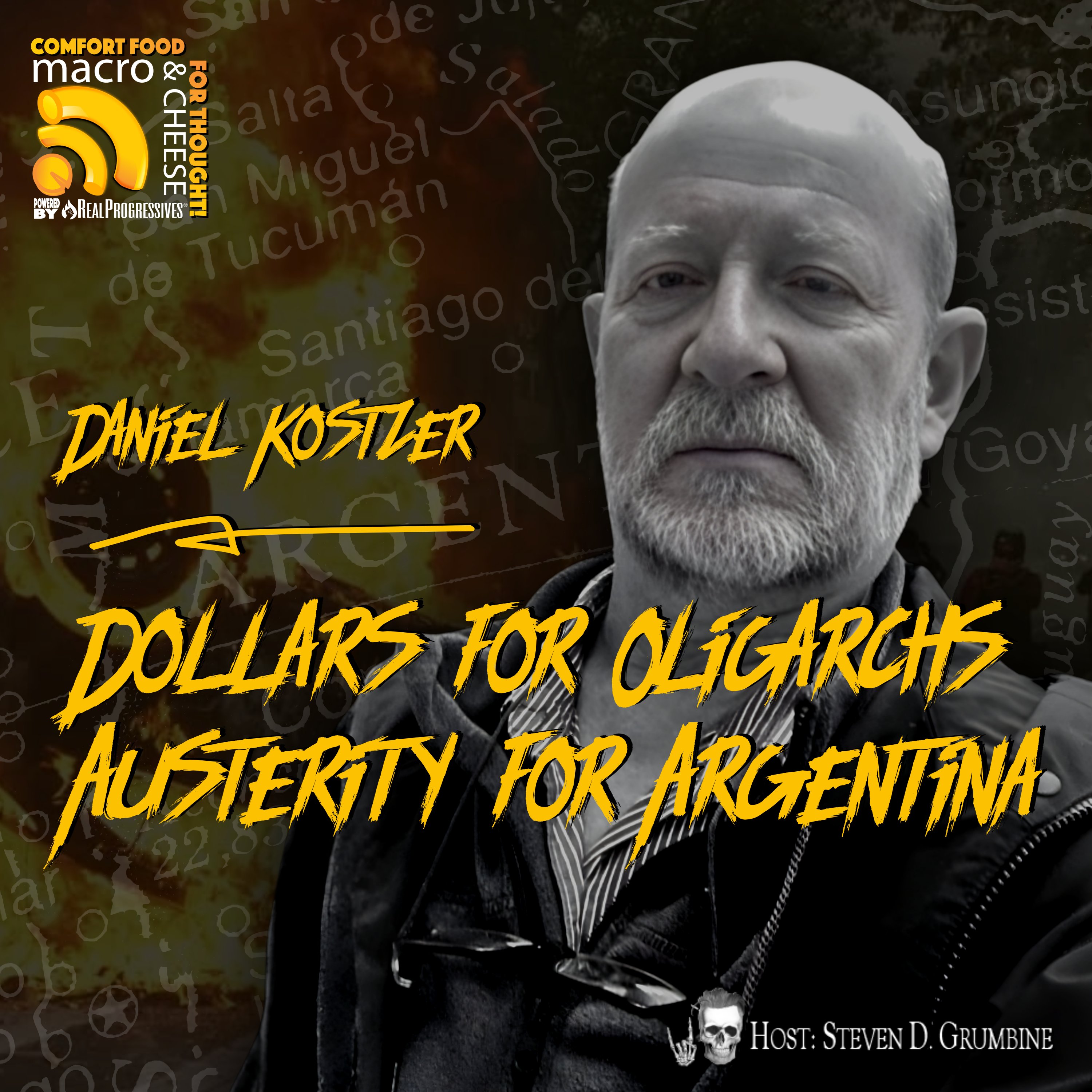
Ep 353Ep 353 - Dollars for Oligarchs, Austerity for Argentina with Daniel Kostzer
E** Want to take a deeper dive into this podcast? Join us on Tuesday evenings for Macro ‘n Chill, where we listen to the most recent episode together. Ask questions, share your insights, or just hang with us. 8pm ET/5pm PT. Find the registration link at realprogressives.org. And while you’re there, sign up for book club. It’s not too late – there are still two more sessions in our current series. ** Trump’s “$20B for Argentina” wasn’t aid – it was a heist. Economist Daniel Kostzer joins Steve to explain. Basically it’s just same ole same ole. Milei’s government crashed the value of Argentina’s currency and jacked up interest rates, drawing in big investors looking for fast profits. Then, under pressure from the IMF and the US, Argentina opened up its financial system, letting those hedge funds cash out in US dollars and leave the country, taking the money and leaving ordinary Argentines to deal with inflation, frozen pensions, and gutted public services. The media story about soybeans and China? Simply a cover for another bailout of the rich. Daniel describes Argentina’s inflation as a symptom of class struggle. He connects the dots between today’s crisis and a long history of U.S. financial “help” that only props up Wall Street. The conversation exposes how the global elites use debt, currency crises, and friendly politicians to extract wealth while selling it as economic stability. The episode is a deep dive into modern imperialism, media manipulation, and class politics. It’s also a reminder, as Gramsci said, to keep the pessimism of the intellect but the optimism of the will. Daniel Kostzer is Chief Economist at ITUC-CSI (International Trade Union Confederation-Confederacion Sindical Internacional). Much of his research is in labor economics, poverty reduction, and income distribution. Follow him: @dkostzer on X; https://www.linkedin.com/in/daniel-kostzer-884318165/

Ep 352Ep 352 - Nothing to Hide with Heidi Boghosian
EHeidi Boghosian is an attorney, author, and co-host of Law and Disorder podcast and radio show. She joins Steve to discuss how the US surveillance state is a tool of class discipline and repression. From the Federalist Society pipeline to post-9/11 “safety” theater, both parties helped build a digital police state that criminalizes poverty, protest, and anyone messing with profits. And let’s not forget the copaganda about “crime” and “illegals” to keep folks scared while manufactured austerity produces the very crises the state then punishes. Classic ruling class two-step. Silicon Valley’s tech bros are kind of like bouncers. Thiel, Apple, Google et al. snort up our data, rig information flows (algorithms, anyone?) then lobby to block regulation. The “nothing to hide” line is an ideological bait and switch. The killer is inside the house! There’s no easy fix. Heidi urges immediate digital self-defense – the OPSEC basics, privacy tools, scam awareness. Meanwhile the ruling class isn’t losing sleep over your “I voted” sticker. We should be thinking in terms of local organizing and building counter-hegemony. (Heidi references the Young Lords. Look ‘em up!) Heidi Boghosian is a New York-based attorney and activist. She's the author of "Spying on Democracy" (2013), "I Have Nothing To Hide" (2021), and "Cyber Citizens: Saving Democracy with Digital Literacy" (June 2025). Heidi is co-host of the radio show and podcast, Law and Disorder. Find her work at lawanddisorder.org and heidiboghosian.com