Let's Talk Risk! with Dr. Naveen Agarwal
179 episodes — Page 3 of 4
LTR 83: Road to market for AI devices in the EU just got more complex
This is a free preview of a paid episode. To hear more, visit naveenagarwalphd.substack.comSummary“Manufacturers that want to go to the European market, thinking about AI devices, it’s really important that you don’t look only at the MDR. You really have to look at the AI Act as well.” In this episode of the Let's Talk Risk Podcast, Florian Tolkmitt discusses the rapidly evolving regulatory landscape for medical devices in Europe, particularl…
LTR 81: 4 key themes in risk management and an upcoming conference
Summary“We are all at some point, either patients or loved ones of patients. So, one way or another, we are all touched by the medical technology we create ourselves. In this episode of the Let's Talk Risk Podcast, Bijan Elahi helps us appreciate the most important aspect of our work as risk practitioners, engineers and quality/regulatory affairs professionals in the medical device industry. That our work makes a direct impact on health and wellness of our loved ones and patients across the world. We focus on 4 big themes in risk management that will continue to demand our attention in 2025 and beyond - AI/ML, cybersecurity, post-market surveillance and usability engineering. QA/RA professionals will need to stay updated as they help their organizations navigate through challenges in these areas. We also talk about an upcoming Conference in April 2025 that will focus exclusively on safety risk management of medical devices. Register now - early bird discounted pricing available until 28 February 2025. Listen to the full 30-minute podcast or jump to a section of interest listed below. Chapters00:00 Introduction and Keynote Insights06:13 AI and Machine Learning in Medical Devices09:08 Cybersecurity Challenges in Medical Devices12:19 Post-Market Safety Surveillance16:07 Usability Engineering and Human Factors18:33 Upcoming Conference Details and TakeawaysSuggested links:* International conference on medical device safety risk management. * LTR: AI/ML in MedTech. * LTR: Medical device cybersecurity now more critical than ever. * LTR: Best practices for applying usability engineering to medical devices. Key Takeaways* We are all at some point either patients or loved ones.* The impact of biomedical engineers on MedTech safety is huge.* AI/ML devices evolve and their performance is not static.* Cybersecurity is increasingly critical for medical devices.* Post-market surveillance is essential for ongoing safety.* Usability engineering can prevent misuse of medical devices.* Collaboration across functions is vital for effective risk management.* The FDA emphasizes explainability in AI ML devices.* Learning from post-market data can improve future designs.* Conferences provide valuable opportunities for knowledge sharing.KeywordsRisk management, AI, machine learning, cybersecurity, medical devices, usability engineering, post-market surveillance, safety conference, safety, healthcareAbout Bijan ElahiBijan Elahi is the founder of MedTech Safety and a globally recognized expert on safety risk management of medical devices. Bijan is a technical fellow, and an affiliate professor at Drexel University, USA. Bijan is also a lecturer at Eindhoven University of Technology in the Netherlands, where he teaches risk management to doctoral students in engineering. He is a frequently invited speaker at international professional conferences, and is also a contributor to ISO 14971, the international standard on the application of risk management to medical devices. He has trained over 10,000 people worldwide and his book Safety Risk Management of Medical Devices, now in its second edition, is a bestseller.DisclaimerInformation and insights presented in this podcast are for educational purposes only. Views expressed by all speakers are their own and do not reflect those of their respective organizations.Let's Talk Risk! is a reader-supported publication. To receive new posts and support my work, consider becoming a free or paid subscriber. This is a public episode. If you'd like to discuss this with other subscribers or get access to bonus episodes, visit naveenagarwalphd.substack.com/subscribe
LTR 80: Building safety by design into medical devices
“There is a clear case to put the money into the design of the product, and control that, than relying on the human factor.”In this Let’s Talk Risk! conversation, Alex Saegert highlights the importance of focusing on risk reduction through safety by design, rather than relying on information for safety to users. He recommends risk practitioners to apply best practices from systems safety to build a clear understanding of system-level hazards that lead to harm in a hazardous situation through a sequence of events. Understanding the sequence of events can help create a more robust design to minimize the probability of occurrence of one or more elements involved. He reminds us that there are tools available that can be applied without significantly increasing complexity of the design. Additionally, he recommends linking hazard analysis to design controls (DFMEA) and process controls (PFMEA) to reduce and control probabilities of occurrence of the events that contribute to hazardous situations, while maintaining traceability between hazards and control actions.Listen to this Let’s Talk Risk! conversation with Alex Saegert, which also includes an open discussion with a live audience. Jump to a section of interest using these timestamps. 00:01:30 Introduction00:02:30 Connecting risk analysis with design requirements for a balloon catheter00:07:10 Estimating probability of occurrence for sequence of events00:10:03 Connecting design with process FMEA for improved reliability00:14:00 Applying functional safety to medical device design/development00:19:10 Improving cross-functional collaboration00:20:42 Open discussion and audience Q&A00:31:20 Closing comments and key takeawaysIf you enjoyed this podcast, consider subscribing to the Let’s Talk Risk! newsletter.Suggested links:LTR: Tips for integrating risk analysis with design controlsLTR: Design your medical device to be robust to use conditionsLTR: Overcoming challenges in linking risk management with design controlsAbout Alex SaegertAlex Saegert is currently the President of Saegert Solutions Inc., an engineering consultancy focused on new technology commercialization, ensuring safety, reliability and usability. His professional experience includes developing ISO14971 compliant risk management programs for manufacturers of advanced class III medical devices. With over 25 years' experience in reliability engineering, product development and failure analysis across a variety of industries, Alex is a professional engineer, an ASQ-Certified Reliability Engineer (CRE), and IEC61508 Functional Safety Engineer.Let’s Talk Risk! with Dr. Naveen Agarwal is a weekly live audio event on LinkedIn, where we talk about risk management related topics in a casual, informal way. Join us at 11:00 am EST every Friday on LinkedIn.DisclaimerInformation and insights presented in this podcast are for educational purposes only. Views expressed by all speakers are their own and do not reflect those of their respective organizations. This is a public episode. If you'd like to discuss this with other subscribers or get access to bonus episodes, visit naveenagarwalphd.substack.com/subscribe
LTR 79: Tips for SaMD development and success with FDA
“Overconfidence in the performance of AI models in the development phase is a common problem.”In this Let’s Talk Risk! conversation, David Giese highlights the growing need for a rigorous, disciplined development process with the goal of meeting regulatory requirements for marketing authorization. He shares how AI developers are often over-confident in the performance of their models, but disappointed when these models are subjected to rigorous scrutiny during the regulatory review. Software as a Medical Device (SaMD), including AI/ML devices, are growing exponentially in MedTech. Rapidly evolving technology offers an opportunity to develop innovative products, but it also presents new risks. Security and Cybersecurity concerns are on the rise, as well as, concerns about transparency and explainability of AI/ML models. David points to new guidance documents from the FDA and emerging standards. As an example, software developers should consider using IEC 81001-5-1 - Health software and health IT system safety, effectiveness and security - along with IEC 62304 - Medical device software - Software life cycle processes. Listen to this Let’s Talk Risk! conversation with David Giese, which also includes an open discussion with a live audience. Jump to a section of interest using these timestamps. 00:01:30 Introduction00:02:30 Current state of AI/ML applications in MedTech00:04:05 Different types of AI models - adaptive vs. generative AI00:06:25 Challenges in meeting regulatory expectations for AI in MedTech00:08:18 Use of synthetic data in AI model development00:09:30 Best practices for AI development and regulatory submissions00:12:02 Cybersecurity challenges for SaMD and AI/ML devices00:14:03 New skills risk practitioners need to develop 00:15:09 Open discussion and audience Q&A00:27:20 Closing comments and key takeawaysIf you enjoyed this podcast, consider subscribing to the Let’s Talk Risk! newsletter.Suggested links:LTR: EU vs. FDA - Aligned but different in approach to safety of AI/ML devicesLTR: A new paradigm for building connected medical devicesFDA: Cybersecurity in Medical Devices: Quality System Considerations and Content of Premarket Submissions, Issued September 2023. About J. David GieseJ. David Giese is currently President and Partner at Innolitics, a consulting firm specializing in development of new medical software and regulatory submissions to the FDA. His team has helped develop and receive FDA clearance for over 60 medical devices, both SaMD and SiMD, over the last 12 years. His expertise include application development, custom software development, engineering design, project management, user experience design, cybersecurity, software testing and technical writing. He holds Bachelors and Masters degrees in Biomedical Engineering. Let’s Talk Risk! with Dr. Naveen Agarwal is a weekly live audio event on LinkedIn, where we talk about risk management related topics in a casual, informal way. Join us at 11:00 am EST every Friday on LinkedIn.DisclaimerInformation and insights presented in this podcast are for educational purposes only. Views expressed by all speakers are their own and do not reflect those of their respective organizations. This is a public episode. If you'd like to discuss this with other subscribers or get access to bonus episodes, visit naveenagarwalphd.substack.com/subscribe
LTR 73: It's time to up our game on medical device cybersecurity
Summary“Medical devices are now increasingly connected in a hospital network. Or even if they are not, they are vulnerable to cyber attacks”. In this episode of the Let's Talk Risk Podcast, Eric Henry highlights the growing concern about security and cybersecurity of medical devices. As technology evolves and medical devices increasingly operate in an i… This is a public episode. If you'd like to discuss this with other subscribers or get access to bonus episodes, visit naveenagarwalphd.substack.com/subscribe
LTR 78: New challenges in managing risks of software in IVDs
“Software more than any other type of device, has integrations with other systems and devices. You have to consider a complex network of dependencies and infrastructure when analyzing risks.”In this Let’s Talk Risk! conversation, Megan Kane highlights the growing role of software, including artificial intelligence, in in-vitro diagnostic devices, including in next generation sequencing applications. We are now living at at time where technology is rapidly enabling precision medicine solutions for an individual patient. In this high-tech environment, increasingly driven by software, new risks are also emerging. Cybersecurity, patient data privacy, service availability are common concerns. But when it comes to IVDs, it becomes challenging to connect the dots to find a direct link to the patient. Inaccurate or delayed results are common risks related to IVDs, but their potential impact on a patient is difficult to figure out with sufficient confidence. It often results in underestimating the severity of potential harm as reflected by a recent FDA warning letter. Another key development in this area is the new FDA regulation for Lab Developed Tests (LDT), which is expected to add new requirements for pre-market reviews, risk management and quality system. Listen to this Let’s Talk Risk! conversation with Megan Kane, which also includes an open discussion with a live audience. Jump to a section of interest using these timestamps. 00:01:10 Introduction00:01:50 How software is increasingly driving IVD applications00:03:30 Emerging risks with software in IVDs00:06:15 Evolving regulatory approach to IVDs affecting LDTs00:09:13 Increasing focus on risk management for LDTs00:12:50 Risk considerations when software is a component of an IVD00:15:30 Open discussion and audience Q&A00:28:01 Closing comments and key takeawaysIf you enjoyed this podcast, consider subscribing to the Let’s Talk Risk! newsletter.Suggested links:LTR: 3 pillars for defining your IVD risk management strategyLTR: Focus on intended use for risk management of IVDsFDA: Laboratory developed testsAbout Megan KaneMegan Kane is currently Director of Regulatory Operations at Velsera, where she supports the mission of radically improving healthcare globally through multi-omics to fuel growth of precision medicine. She is primarily involved in developing advanced software, including AI applications for end-to-end Next Gen Sequencing analysis. Previously she held various roles in Quality and Regulatory functions at both large and small medical device and in-vitro diagnostic companies. She holds a Bachelor’s degree in Molecular and Cell Biology, and Internal Auditor certifications from BSI in ISO 13485:2016 and ISO 9001:2015. Let’s Talk Risk! with Dr. Naveen Agarwal is a weekly live audio event on LinkedIn, where we talk about risk management related topics in a casual, informal way. Join us at 11:00 am EST every Friday on LinkedIn.DisclaimerInformation and insights presented in this podcast are for educational purposes only. Views expressed by all speakers are their own and do not reflect those of their respective organizations. This is a public episode. If you'd like to discuss this with other subscribers or get access to bonus episodes, visit naveenagarwalphd.substack.com/subscribe
PCCP: Opportunity for risk practitioners to shine
Risk practitioners in MedTech now have a unique opportunity to help accelerate development and post-market improvement of AI/ML enabled medical devices while also reducing the regulatory burden.PCCP, or Pre-Determined Change Control Plan, is a novel regulatory approach that allows device manufacturers to include planned changes in their initial submission and avoid additional submissions in the post-market phase when these changes are implemented.This is even more important for AI/ML enabled medical devices, which are expected to learn from new data in real-world applications to improve both user experience and performance without compromising patient safety. As an example, Apple recently utilized a tailored PCCP approach in their regulatory submissions to receive advance clearance for their planned post-market changes. In case of the Hearing Aid Function, they focused on features to improve user experience. In the Sleep Apnea Notification function (SANF), on the other hand, they focused on improving the performance of the core AI model based on real-world data. In both cases, they proposed a rigorous verification and validation plan, and labeling updates. Risk managers can play a key role in planning these modifications using a risk-based approach. They can help develop testing and implementation protocols. Finally, they can help articulate the overall benefits and risks to convince the FDA that these planned changes would improve safety and effectiveness. Risk practitioners therefore have an opportunity to become more strategic and influential by playing a proactive role. They can collaborate with regulatory professionals, product developers and clinicians right from the start of product development. Listen to the 22-minute audio summary above that covers the following topics:* Key differences between FDA’s draft and final PCCP guidance* Lessons learned from Apple’s tailored approach to PCCP* Understanding benefits and risks of PCCPs* Opportunities for risk practitioners* Challenges in implementing PCCPsDisclaimerThis article was prepared with the help of Google NotebookLM, an artificial intelligence research assistant, using the following sources:* FDA Draft and Final Guidance: PCCP for AI/ML enabled devices.* Apple De Novo: Hearing Aid Feature, Decision Summary.* Apple 510k: Sleep Apnea Notification Feature (SANF). * Caption Health De Novo: Automated Ejection Fraction Software. * Notes created using Google NotebookLM in response to user prompts.All output(s), including the audio summary, were reviewed by a human for accuracy and relevance. This article is intended for educational purposes only and should not be considered as regulatory advice.If you liked this post, consider becoming a free or paid subscriber to Let’s Talk Risk!. This is a public episode. If you'd like to discuss this with other subscribers or get access to bonus episodes, visit naveenagarwalphd.substack.com/subscribe
LTR 77: How GenAI is transforming Quality in MedTech
This is a free preview of a paid episode. To hear more, visit naveenagarwalphd.substack.comSummary“You are not gong to lose your job to AI, but you may lose your job to someone who knows how to use AI better than you do”. In this episode of the Let's Talk Risk Podcast, we explore the benefits of applying Generative AI to improve consistency of quality system documentation in MedTech with Garth Conrad, VP of Quality at Flex Health Solutions. G…
EU vs. FDA: Aligned but different in their approach to safety of AI/ML devices
Applications of AI in medical devices are growing rapidly. The regulatory environment in both the US and the EU is also changing fast. In this dynamic environment, it is important to stay updated and practice a flexible approach to both risk management and your regulatory strategy. Listen to a brief audio summary above, about the emerging regulatory environment in these two major jurisdictions, and key takeaways for risk practitioners and regulatory professionals.Regulatory environment is changing rapidly but there is new guidanceThere is good news! A new guidance document in the form of a questionnaire was recently published by the Team-NB, the European Association of Medical devices Notified Bodies. The joint Team-NB/IG-NB Questionnaire on Artificial Intelligence in Medical Devices offers device manufacturers a process-oriented roadmap to demonstrate conformity to the EU-MDR (or EU-IVDR) requirements.The term risk(s) appears 50 times in this questionnaire, highlighting the significance of risk management as a critical factor in ensuring safety and effectiveness of AI devices throughout their lifecycle. Out of a total of 189 questions across 26 categories, 32 (17%) are explicitly related to risk management!FDA’s regulatory approach is considerably less prescriptive and more collaborative. The regulatory framework for the pre-market review is no different for AI-enabled devices compared to medical devices in general, including Software as a Medical Device (SaMD). A majority of nearly 1000 AI/ML enabled devices have been authorized as Class II devices, either through the De Novo, or the 510k pathway. The most important requirement is to demonstrate safety and effectiveness through valid scientific evidence that benefits of the intended use outweigh probable risks. Let us take a closer look at the emerging regulatory environment in the US and EUFirst, there is broad alignment at a high level between FDA and the EUAt a high level both FDA and notified bodies are generally aligned on the need to demonstrate safety and effectiveness of AI-enabled medical devices. Here are 3 specific areas of convergence in these two :1. Focus on safety and effectivenessBoth the FDA and the European approach, reflected by Team-NB, prioritize patient safety and the effectiveness of AI-enabled medical devices.2. Recognition of AI’s unique challengesBoth recognize that AI presents unique regulatory challenges due to its complexity, iterative nature, and reliance on data. 3. Importance of real-world monitoringBoth emphasize the need for ongoing monitoring of AI-enabled devices in real-world settings to ensure safety and performance.Second, the Team-NB approach focuses on certifiability using a process-oriented questionnaire1. Process-oriented approach for safetyThe European approach, as evidenced by the questionnaire, focuses on ensuring the safety of AI-based medical devices through a comprehensive evaluation of processes throughout the device lifecycle.2. Detailed requirements and documentationThe questionnaire outlines specific requirements for documentation, competence of development teams, risk management, data management, model development, and post-market surveillance.3. Emphasis on certifiabilityThe questionnaire highlights the challenges of certifying AI-based medical devices, particularly those with self-learning capabilities, and emphasizes the need for robust validation processes.4. Consideration of AI-specific security risksThe questionnaire addresses AI-specific cybersecurity risks like adversarial attacks and emphasizes the importance of security lifecycle management.Finally, FDA’s approach is more collaborative and adaptive1. Collaborative and adaptiveThe FDA emphasizes collaboration with stakeholders (developers, patients, academia, global regulators) and a commitment to adapt regulations to the rapidly evolving AI landscape.2. Focus on bias mitigation and health equityThe FDA prioritizes addressing bias in AI algorithms and promoting health equity by ensuring data representativeness.3. Emphasis on lifecycle managementThe FDA stresses the importance of managing AI applications throughout the medical product lifecycle, from design to deployment, monitoring, and maintenance.4. Commitment to guidance and regulatory scienceThe FDA is actively developing guidance documents and supporting research to address the unique challenges of evaluating and regulating AI in medical products.Key takeaways for risk practitioners and regulatory professionalsIn this rapidly changing environment, it is very important for risk practitioners and regulatory professionals to stay current with evolving regulatory approaches. Here are 3 key takeaways to keep in mind:1. Practice a flexible and adaptable approach to risk managementRisk practitioners and regulatory professionals need to stay informed of the latest developments and adjust their practices accordingly. They must also anticipate future changes and build flexibility into their risk ma
LTR 76: Challenges and opportunities of AI/ML in MedTech
“The classic thing with AI is that the hard stuff is easy and the easy stuff is hard. It can do math I cannot do, but it cannot do the reasoning I find easy.”In this Let’s Talk Risk! conversation, we discuss key challenges and opportunities for applying Artificial Intelligence/Machine Learning (AI/ML) in MedTech. This was an open conversation with a live audience as part of the weekly Let’s Talk Risk! conversation on LinkedIn.AI/ML applications in MedTech are growing rapidly. FDA has authorized nearly 1000 such applications, and this trend is only expected to grow. Our conversation included a variety of topics about this rapidly evolving field. This discussion involved comments from Emanuel Tkach, MD, Bijan Elahi, Edwin Bills, Rafael Pozos, Wag Hanna, Phil Deming, Andy David and Ritam Priya. Jump to a section of interest using these timestamps.00:03:30 Key factors related to AI/ML applications in MedTech00:05:30 Dynamic nature of AI/ML causing performance drift00:07:30 Upcoming ISO guidance on risk considerations for AI/ML applications00:09:00 Keeping the human in the loop 00:10:25 Data quality issues and best practices for AI/ML00:12:17 Cybersecurity considerations affecting safety 00:14:20 Lessons learned from clinical evaluation of conventional devices00:16:25 Is agile software development for AI/ML too slow?00:19:12 Treating AI/ML as a tool and a team member, and its limitations00:23:30 A few examples of AI/ML applications in MedTech00:21:35 Watch out for human over-reliance on AI/ML00:27:44 Experience with ChatGPT prompts00:32:22 Closing comments and key takeawaysIf you enjoyed this podcast, consider subscribing to the Let’s Talk Risk! newsletter.Suggested links:LTR: AI/ML in MedTech FDA: QA/RA aspects of AI/ML devicesDisclaimerInformation and insights presented in this podcast are for educational purposes only. Views expressed by all speakers are their own and do not reflect those of their respective organizations. This is a public episode. If you'd like to discuss this with other subscribers or get access to bonus episodes, visit naveenagarwalphd.substack.com/subscribe
LTR 70: Best practices for applying usability engineering to medical devices
Summary“Apply the usability engineering process diligently, and with the spirit of inquiry. You will learn things that you never thought. And these are the things that make your device possible”. Human factors engineering, or usability engineering, is often thought of as a check-the-box activity for the purpose of regulatory compliance. But it is a lot … This is a public episode. If you'd like to discuss this with other subscribers or get access to bonus episodes, visit naveenagarwalphd.substack.com/subscribe
LTR 74: AR/VR devices in MedTech
In this Let’s Talk Risk! conversation, Ritam Priya advises device manufacturers to engage early with the FDA through the Q-sub program. Applications of AR/VR in MedTech are growing rapidly, but the regulatory science is still evolving. There are many specific safety and performance concerns unique to AR/VR technologies used for medical purposes. Early engagement with the FDA can help in developing adequate plans for verification and validation of these devices. Image quality, cyber-sickness, rapidly changing hardware and software technologies used in AR/VR applications, for example, are some of the concerns that need careful planning throughout design and development and in the post-market phase. Listen to this Let’s Talk Risk! conversation with Ritam Priya, which also includes an open discussion with a live audience. Jump to a section of interest using these timestamps.00:02:05 Introduction00:01:30 Transitioning into a medical safety role from clinical practice00:02:31 Overview of AR/VR applications in MedTech00:06:15 Example of a recently cleared AR/VR based medical device00:08:27 Image quality is a major concern for FDA in AR/VR devices00:09:20 How FDA is advancing regulatory science for AR/VR technologies00:11:18 Special safety and performance considerations for AR/VR devices00:13:27 Audience Q&A and open discussion00:31:11 Closing comments and key takeawaysIf you enjoyed this podcast, consider subscribing to the Let’s Talk Risk! newsletter.Suggested links:LTR: A fast growing frontier: AR/VR driving innovation in MedTech. FDA: Augmented Reality and Virtual Reality in Medical Devices.About Ritam PriyaRitam Priya is currently the Founder & Principal at Novarum MDRQ Consulting where she provides regulatory consulting services to MedTech clients in both pre- and post-market phases. She has over 20 years of experience in the medical industry, including leadership experience at top organizations. Her expertise includes regulatory requirements for marketing authorization of medical devices in major global markets including US, EU, UK, Australia and Canada. She holds a Bachelor’s degree in Mathematics, Computer Science and Economics, and an MBA in Strategy. Let’s Talk Risk! with Dr. Naveen Agarwal is a weekly live audio event on LinkedIn, where we talk about risk management related topics in a casual, informal way. Join us at 11:00 am EST every Friday on LinkedIn.DisclaimerInformation and insights presented in this podcast are for educational purposes only. Views expressed by all speakers are their own and do not reflect those of their respective organizations. This is a public episode. If you'd like to discuss this with other subscribers or get access to bonus episodes, visit naveenagarwalphd.substack.com/subscribe
LTR 72: A clinician's insights on risk and collaboration in MedTech
“It comes down to collaboration. It comes down to intentional communication and ensuring there is trust and familiarity on both sides.”In this Let’s Talk Risk! conversation, Dr. Olaf Hedrich emphasizes the need for collaboration, building trust and familiarity between clinicians and engineers. We all have a mutual desire to do the right things for our patients, but sometimes our lens is a bit narrow. It is important to understand some of the technical side of our individual functions so we can learn to speak the same language and broaden the aperture on our collective view. Clinicians should learn some of the technical language and concepts of risk, and engineers should gain exposure to the practice of medicine relevant to their device. He shares a specific example of how clinicians can help uncover the true nature of risk and find innovative solutions to challenging problems. It is not unusual for harm to occur even when there is no device malfunction or defect. In these situations, clinicians can help understand the true nature of risk through peer-to-peer communication with other clinicians in the field directly involved with the device. Listen to this Let’s Talk Risk! conversation with Dr. Olaf Hedrich, which also includes an open discussion with a live audience. Jump to a section of interest using these timestamps.00:00:40 Introduction00:01:30 Transitioning into a medical safety role from clinical practice00:03:50 How clinicians can help understand the true nature of risk 00:06:25 Keeping the patient in the center of everything we do00:07:57 How intentional communication and trust drives collaboration00:08:50 Emerging challenges for MedTech in a rapidly changing environment00:11:25 Career advice to industry professionals for growth in this new environment00:14:27 Audience Q&A and open discussion00:32:10 Closing comments and key takeawaysIf you enjoyed this podcast, consider subscribing to the Let’s Talk Risk! newsletter.Suggested links:LTR: Tips for clinicians transitioning into a medical safety role in MedTech. LTR: Communicate to facilitate collaboration, not to impose opinions. About Dr. Olaf Hedrich, MDDr. Olaf Hedrich is currently the Chief Medical Safety Officer at Medtronic. Previously he was at Boston Scientific in a career spanning more than 10 years in various roles of increasing responsibility. He transitioned into MedTech from his clinical practice as a cardiac electrophysiologist. He also served as instructor of medicine and clinical fellow at Tufts-New England Medical Center, and as instructor of medicine and chief resident at Saint Louis University. He is a Fellow of the Heart Rhythm Society and a Fellow of the American College of Cardiology. Let’s Talk Risk! with Dr. Naveen Agarwal is a weekly live audio event on LinkedIn, where we talk about risk management related topics in a casual, informal way. Join us at 11:00 am EST every Friday on LinkedIn.DisclaimerInformation and insights presented in this podcast are for educational purposes only. Views expressed by all speakers are their own and do not reflect those of their respective organizations. This is a public episode. If you'd like to discuss this with other subscribers or get access to bonus episodes, visit naveenagarwalphd.substack.com/subscribe
LTR 64: Opportunities and challenges to leverage PCCP for speed to market
Summary“PCCP is a great tool for your regulatory strategy but it is not for every company or for every change”. PCCP (Predetermined Change Control Plan) is a new regulatory scheme that allows device manufacturers to implement post-market changes without requiring pre-market submission to the FDA. In this episode, Yu Zhao explains how the PCCP tool offer… This is a public episode. If you'd like to discuss this with other subscribers or get access to bonus episodes, visit naveenagarwalphd.substack.com/subscribe
LTR 71: Medical device cybersecurity now more critical than ever
“It is not just about protecting your data. It is also about protecting safety of a medical device.”In this Let’s Talk Risk! conversation, Nidhi Gani highlights the important difference between data security and cybersecurity, especially for a life-saving medical device such as a pacemaker. As medical devices become more inter-connected, they are also increasingly vulnerable to cyberattacks. Managing the risk of these vulnerabilities is a key party of cybersecurity risk management of medical devices and healthcare systems they are a part of. Although the regulatory environment is changing rapidly, Nidhi encourages risk practitioners to apply the same basic principles of medical device safety to cybersecurity. A best practice is to apply the secure product development framework (SPDF) across the entire lifecycle of a medical device. Listen to this Let’s Talk Risk! conversation with Nidhi Gani, which also includes an open discussion with a live audience. Jump to a section of interest using these timestamps.00:01:25 Introduction00:02:12 Why cybersecurity is important for medical devices 00:04:32 Medical devices today operate in a complex, connected environment00:05:22 The SPDF approach to medical device development for cybersecurity00:07:19 Current industry challenges in applying the SPDF approach00:09:28 Cybersecurity challenges in the post-market phase00:11:28 Exciting career opportunity for QA/RA professionals00:15:13 Audience Q&A and open discussion00:29:24 Closing comments and key takeawaysIf you enjoyed this podcast, consider subscribing to the Let’s Talk Risk! newsletter.Suggested links:AAMI TR57:2016: Principles for medical device security - Risk management, Revised 2023. FDA: Cybersecurity webpage, Current as of March 2024. LTR: Cybersecurity is the next frontier in medical device risk management. LTR: Security risk assessment and vulnerability monitoring. About Nidhi GaniNidhi Gani is currently a Cybersecurity regulatory affairs consultant at MCRA and an adjunct professor at Northeastern University. She holds a Bachelor’s degree in Biotechnology and Master’s degrees in Microbiology and Regulatory Affairs in Drugs, Biologics, and Medical Devices. She also has a certification in Cybersecurity from Harvard University. She applies her extensive technical and regulatory experience to help develop innovative solutions for medical device clients in this rapidly evolving space. Let’s Talk Risk! with Dr. Naveen Agarwal is a weekly live audio event on LinkedIn, where we talk about risk management related topics in a casual, informal way. Join us at 11:00 am EST every Friday on LinkedIn.DisclaimerInformation and insights presented in this podcast are for educational purposes only. Views expressed by all speakers are their own and do not reflect those of their respective organizations. This is a public episode. If you'd like to discuss this with other subscribers or get access to bonus episodes, visit naveenagarwalphd.substack.com/subscribe
LTR 69: A quick update on the 4th edition of IEC 60601
“Technology has changed, we need to move with the technology change.”In this Let’s Talk Risk! conversation, Leo Eisner shares a brief history of IEC 60601, the comprehensive global safety standard for active medical devices, and the work currently ongoing on the 4th edition. He is leading the group currently working on the user-interface aspects, which includes information provided by the manufacturer, usability, alarm system and also user interfaces aspects. There are a total of 12 working groups involved in various aspects of the standard, each focusing on a source of harm or hazardous situation. Leo encourages risk practitioners in the industry to stay current with safety standards and consider taking an active role in the standards development process. This is a good way to be recognized as an industry expert and have an opportunity to shape the future direction of best practices. Listen to this Let’s Talk Risk! conversation with Leo Eisner, the IEC 60601 Guy, which also includes an open discussion with a live audience. Jump to a section of interest using these timestamps.00:02:25 Introduction00:03:39 A brief overview and history of IEC 6060100:06:30 A quick update on the work currently ongoing on the 4th edition 00:10:30 Reference documents for the 4th edition project00:12:32 Why risk practitioners should get involved in standards development00:14:25 Audience Q&A and open discussion00:32:30 Closing comments and key takeawaysIf you enjoyed this podcast, consider subscribing to the Let’s Talk Risk! newsletter.Suggested links:IEC: Architectural specification for safety standards of medical electrical equipment, medical electrical systems, and software used in healthcare, v 3.0. IEC: Design specification for the 4th edition of IEC 60601-1About Leonard (Leo) EisnerLeonard Eisner the “60601 Guy” is the Founder and Principal compliance/regulatory consultant at Eisner Safety Consultants. He has worked at 3 notified bodies and in the medical device industry for over 30 years. His career has spanned over 35 years of product safety certification test lab experience. He worked at 2 internationally recognized labs for 11 years. As an an expert in the standards development process, Leo has been staying at the forefront of evolving medical device standards for over 20 years with standards such as the IEC 60601 series, ISO 15223, ISO 20417 and other Working Group (WG), Maintenance Teams, and committees. He is an expert member of the development teams on IEC 60601-1, edition 3.2, and currently leading one of the WGs, an expert member of an another WG, and on the editing team (AG50) involved in the 4th edition of the standard.Let’s Talk Risk! with Dr. Naveen Agarwal is a weekly live audio event on LinkedIn, where we talk about risk management related topics in a casual, informal way. Join us at 11:00 am EST every Friday on LinkedIn.DisclaimerInformation and insights presented in this podcast are for educational purposes only. Views expressed by all speakers are their own and do not reflect those of their respective organizations. This is a public episode. If you'd like to discuss this with other subscribers or get access to bonus episodes, visit naveenagarwalphd.substack.com/subscribe
LTR 68: Tips for making customer-focused decisions
“Before making a decision, we have to look at the issues end-to-end. We have to consider how our actions will impact the customer.”In this Let’s Talk Risk! conversation, Rajesh Kathuria emphasizes the need to consider the full impact of our actions on safety of customers and users and quality of performance. As an example, when working at the component level, we should consider the impact of any changes at the system level and how it could affect the safety of end user or the patient. Rajesh advises industry colleagues to take the emotions out, and rely on data as much as possible. If you don’t have good quality data, your first decision could be to take the time and gather more information, especially when the potential consequences of failure could be catastrophic. He also recommends to consider diverse viewpoints from a cross-functional experienced team as part of the decision making process. Listen to this Let’s Talk Risk! conversation with Rajesh Kathuria which also includes an open discussion with a live audience. Jump to a section of interest using these timestamps.00:02:10 Introduction00:05:42 Considering risks in decision making00:08:25 An example of missing long-term factors in decision making00:10:09 Taking a systems approach to finding solutions 00:12:13 An example of a difficult decision to delay a project to ensure safety00:14:30 Difficult decisions require courage to do the right thing 00:16:30 Leadership advice for QA/RA professionals00:17:50 Audience Q&A and open discussion00:35:50 Closing comments and key takeawaysIf you enjoyed this podcast, consider subscribing to the Let’s Talk Risk! newsletter.Suggested links:LTR podcast: Understanding risk-based thinkingLTR podcast: Getting comfortable with a probabilistic way of thinking about riskAbout Rajesh KathuriaRajesh Kathuria is a currently the Owner and Director at KMS Solutions, B.V, providing strategic consulting services in Quality and Regulatory for medical device companies. He is a seasoned leader with over 20 years of industry experience in senior leadership positions. He holds a Bachelors degree in Mechanical Engineering and Graduate degree in Management with specialization in International Marketing and Finance. He is also a certified ISO 13485 lead auditor and has extensive experience of auditing/working in various geographies and different global regulations. Let’s Talk Risk! with Dr. Naveen Agarwal is a weekly live audio event on LinkedIn, where we talk about risk management related topics in a casual, informal way. Join us at 11:00 am EST every Friday on LinkedIn.DisclaimerInformation and insights presented in this podcast are for educational purposes only. Views expressed by all speakers are their own and do not reflect those of their respective organizations. This is a public episode. If you'd like to discuss this with other subscribers or get access to bonus episodes, visit naveenagarwalphd.substack.com/subscribe
LTR 67: 3 pillars for defining your IVD risk management strategy
“There are 3 pillars I consider essential to defining a strategy for IVD risk management. What is the system definition, who are the user groups, and what is the level of novelty?”In this Let’s Talk Risk! conversation, Claudia Campbell-Matland highlights the broad range of in-vitro diagnostic devices (IVD), which requires a strategic approach to their development and risk management. Claudia advises IVD manufacturers to consider their risk management strategy and scope under 3 pillars - the system definition, the target user groups and the level of complexity. A simple, home-based IVD requires a very different approach than a highly complex analytical system used as a companion diagnostics for highly sophisticated immunotherapies. She recommends taking some time to develop a business strategy first before jumping into product development and risk management activities. Listen to this Let’s Talk Risk! conversation with Claudia Campbell-Matland, which also includes an open discussion with a live audience. Jump to a section of interest using these timestamps.00:01:33 Introduction00:03:03 Strategic questions to ask for IVD risk management00:05:10 3 pillars of IVD risk management strategy00:06:45 Example of a strategy for a simple point-of-care assay IVD00:08:31 Special considerations for home-based IVDs00:09:20 Leadership opportunity for QA/RA professionals in setting strategy00:10:15 Practical tips for assigning severity and probability for IVD risks00:12:51 Latest update on LDTs00:14:50 Audience Q&A and open discussion00:35:50 Closing comments and key takeawaysIf you enjoyed this podcast, consider subscribing to the Let’s Talk Risk! newsletter.Suggested links:LTR podcast: Focus on intended use in the clinical environment for IVD risk managementLTR podcast: Risk management of IVDs requires a different approachAbout Claudia Campbell-MatlandClaudia Campbell-Matland is a consultant and managing member at CNCM Consulting LLC providing services to medical device and IVD manufacturers in product development, risk management, project management and strategy development. She has nearly 30 years of experience in the clinical space at various global organizations. She holds a Masters degree in Microbiology and Bachelors in Biology, as well as multiple certifications in auditing and project management. Let’s Talk Risk! with Dr. Naveen Agarwal is a weekly live audio event on LinkedIn, where we talk about risk management related topics in a casual, informal way. Join us at 11:00 am EST every Friday on LinkedIn.DisclaimerInformation and insights presented in this podcast are for educational purposes only. Views expressed by all speakers are their own and do not reflect those of their respective organizations. This is a public episode. If you'd like to discuss this with other subscribers or get access to bonus episodes, visit naveenagarwalphd.substack.com/subscribe
LTR 66: Understanding human factors aspect of augmented reality applications in medical devices
“To be able to see a virtual image over the real world - that augmented reality is - is a mind blowing, very different experience.”In this Let’s Talk Risk! conversation, Phil Deming shares some of the unique human factors engineering challenges for an augmented reality (AR) technology for 3D visualization of human anatomy in real time during a medical procedure. Phil advises manufacturers to stay current with rapidly evolving new technologies, and talk to users in their intended environment to figure out how best to deploy a system so it does not interfere with their standard work flow. This is the essences of human factors engineering, which involves developing a solid understanding of how users interact with a system and minimizing risks at the user interface. He also shares some of the differences between usability engineering according to IEC 62366 and FDA guidance for human factors engineering. Listen to this Let’s Talk Risk! conversation with Phil Deming, which also includes an open discussion with a live audience. Jump to a section of interest using these timestamps.00:01:40 Introduction00:02:30 Human factors engineering in medical industry vs. consumer electronics00:05:15 Introducing AR technology to visualize human anatomy in 3D space00:07:15 Human factors considerations for AR technology00:08:42 Considering use-related risks associated with AR technology00:10:05 Tackling new challenges in human factors emerging with technology00:11:35 Audience Q&A and general discussion00:30:52 Closing comments and key takeawaysIf you enjoyed this podcast, consider subscribing to the Let’s Talk Risk! newsletter.Suggested links:Understanding risk-based thinkingMediView XR: OmnifyXR holographic display with real-time imaging and 3D anatomy visualization. FDA Guidance: Applying Human Factors and Usability Engineering to Medical Devices, issued February 2016. IEC 62366-1:2015: Application of usability engineering to medical devices, issued 2015. LTR podcast: Treat human factors as a driver of customer satisfaction, not a check-the-box activity, August 2024. About Phil DemingPhil Deming III is a human factors engineer at MediView XR, Inc., a digital health company that leverages augmented reality, remote connectivity and spatial computing data to create revolutionary surgical navigation and tele-procedure platforms. He has over 20 years of usability and human factors, first in the consumer electronics, later transitioning into medical devices. He holds a Bachelors degree in Business Management, Marketing and related support services, and a certification in Automotive Engineering Technology. Let’s Talk Risk! with Dr. Naveen Agarwal is a weekly live audio event on LinkedIn, where we talk about risk management related topics in a casual, informal way. Join us at 11:00 am EST every Friday on LinkedIn.DisclaimerInformation and insights presented in this podcast are for educational purposes only. Views expressed by all speakers are their own and do not reflect those of their respective organizations. This is a public episode. If you'd like to discuss this with other subscribers or get access to bonus episodes, visit naveenagarwalphd.substack.com/subscribe
LTR 65: Demystifying risk-based approach vs. risk management
“It’s too often confused with risk management itself. Part of the risk-based approach is just the mindset, the thinking about risk, and then deciding ‘so what should we do?’, the answer to which might be a formal risk management.”In this Let’s Talk Risk! conversation, Steve Gompertz clarifies a subtle difference between a risk-based approach and formal risk management according to standards such as ISO 14971. Risk-based approach is more about a mindset and a set of behaviors that lead to risk-based decisions, rather than application of specific risk management tools such as FMEAs. Steve advises manufacturers to consider adding a section in each procedure to describe a risk-based approach appropriate to that process. Another good practice is to create an alignment matrix to map differences in the risk-based approach to different processes of the quality system. Listen to this Let’s Talk Risk! conversation with Steve Gompertz, which also includes an open discussion with a live audience. Jump to a section of interest using these timestamps.00:01:40 Introduction00:03:38 What is risk-based approach and why it is not the same as risk management00:06:22 How to practice and demonstrate a risk-based approach00:08:15 A practical way to document risk-based approach00:11:23 How auditors assess the practice of risk-based approach 00:13:41 Striking the right balance between documentation and operating culture00:17:38 Audience Q&A and general discussion00:32:57 Closing comments and key takeawaysIf you enjoyed this podcast, consider subscribing to the Let’s Talk Risk! newsletter.Suggested links:Understanding risk-based thinkingRisk-based approach to building a QMS in a startupTips for applying a risk-based approach to auditing Quality SystemsAbout Steve GompertzSteve Gompertz is a Partner at QRx Partners, providing consulting services to medical device companies in quality system assessment, development and remediation, audit preparation, SOP and forms development, regulatory body response guidance and quality system education. He has over three decades of industry experience at many leading organizations including Medtronic, Boston Scientific and Canon. He is also a Senior Adjunct Instructor at St. Cloud University. Steve has a Bachelor’s degree in Mechanical Engineering, a mini-MBA certificate in Medical Technology, and multiple certifications including ASQ Manager of Quality/Organizational Excellence, Medical Device Auditor, EU-MDR auditor and MDSAP. Let’s Talk Risk! with Dr. Naveen Agarwal is a weekly live audio event on LinkedIn, where we talk about risk management related topics in a casual, informal way. Join us at 11:00 am EST every Friday on LinkedIn.DisclaimerInformation and insights presented in this podcast are for educational purposes only. Views expressed by all speakers are their own and do not reflect those of their respective organizations. This is a public episode. If you'd like to discuss this with other subscribers or get access to bonus episodes, visit naveenagarwalphd.substack.com/subscribe
LTR 63: A lawyer's perspective on the QMSR transition
“Don’t be comfortable saying, ‘Oh I follow the ISO (13485) to the letter’; it doesn’t matter. You have to comply with 21 CFR 820.”In this Let’s Talk Risk! conversation, Neil Di Spirito, helps us understand the full legal context behind the Quality Management System Regulation (QMSR), the amended version of 21 CFR 820 that will go into effect in February 2026. Although, the QMSR incorporates the International Standard ISO 13485:2016 by way of reference, there are points of differences and additional requirements for compliance to 21 CFR 820. That is why it is important to carefully consider gaps from the current QSR against the full scope of QMSR, not just ISO 13485 requirements. It is not simply a technical matter, but also a legal matter that manufacturers should consider evaluating with help from a legal expert. Neil advises manufacturers to consider operating two parallel processes right up to the exact date of QMSR enforcement, gain working experience to appropriately modify their approach for compliance. A good way to do this is through a Quality Plan. Listen to this Let’s Talk Risk! conversation with Neil Di Spirito, which also includes an open discussion with a live audience. Jump to a section of interest using these timestamps.00:02:45 Introduction00:06:45 The legal basis of 21 CFR 820 modification to QMSR00:11:20 QMSR lowers the compliance burden by harmonization with ISO 1348500:15:59 Recommendations for manufacturers to prepare a transition to QMSR00:18:50 Audience Q&A and general discussion00:32:28 Closing comments and key takeawaysIf you enjoyed this podcast, consider subscribing to the Let’s Talk Risk! newsletter.Suggested links:FDA: Frequently asked questions about QMSRLTR webinar: Getting ready for QMSRAbout Neil Di SpiritoNeil Di Spirito is the Principal at DiSpirito Law, PLLC, where he represents pharmaceutical, biologic and medical device companies in regulatory, commercial and FDA enforcement defense matters. He has 20+ years of industry experience in various roles including business management with P&L responsibility. He teaches introductory courses in pharmaceutical and medical device law to FDA new hires and industry legal professionals. He holds an MBA degree with specialization in Pharmaceutical Marketing and Management, and a Juris Doctor, Law degree. Let’s Talk Risk! with Dr. Naveen Agarwal is a weekly live audio event on LinkedIn, where we talk about risk management related topics in a casual, informal way. Join us at 11:00 am EST every Friday on LinkedIn.DisclaimerInformation and insights presented in this podcast are for educational purposes only. Views expressed by all speakers are their own and do not reflect those of their respective organizations. This is a public episode. If you'd like to discuss this with other subscribers or get access to bonus episodes, visit naveenagarwalphd.substack.com/subscribe
LTR 62: Overcoming barriers to cross-functional communication and collaboration
“There is a growing awareness that if you bring in Regulatory at the beginning of designing a product, you will end up with a more robust product. In this Let’s Talk Risk! conversation, Christine Zomorodian highlights some of the barriers that have traditionally hindered good communication and collaboration between QA/RA and Engineering functions in MedTech. However, she also points out that there is reason to be optimistic about the future.Gender roles are changing, with more women entering Engineering and an increasing number of men choosing the QA/RA profession due to availability of graduate level academic programs. Company cultures are also adapting to big advances in compliance infrastructure technologies and the rapidly changing regulatory landscape. Together, these really underscore the importance of open communication and cross-functional collaboration.A good tool to foster collaboration is a Quality Plan, which continues to be under-utilized in our industry. But a Quality Plan can help your entire team come together to figure out how you could efficiently achieve a desired goal, whether it is a remediation project or developing a suitable quality system in a startup environment. Listen to this Let’s Talk Risk! conversation with Christine Zomorodian, which also includes an open discussion with a live audience. Jump to a section of interest using these timestamps.00:01:59 Introduction00:05:06 An example of impact of poor cross-functional collaboration00:08:36 Traditional barriers to cross-functional collaboration in MedTech00:12:05 Optimistic trends helping to improve communication and collaboration00:14:00 Audience Q&A and general discussion00:29:00 Closing comments and key takeawaysIf you enjoyed this podcast, consider subscribing to the Let’s Talk Risk! newsletter.Suggested links:Tips for improving collaboration in risk managementCollaboration is the secret sauce for success in risk managementAbout Christine ZomorodianChristine Zomorodian is the Founder and Managing Consultant at Gish Consulting, LLC, advising MedTech companies in regulatory strategy, quality assurance, regulatory affairs and engineering process improvement. She also serves as a Person Responsible for Regulatory Compliance (PRRC) for EU-MDR compliance, and a guest lecturer at University of Washington. She has over 25 years of industry experience in various QA/RA roles at multiple global medical device companies. She holds a B.A. degree in International Affairs with concentration in Biology and Communication, and a M.S. degree in Biomedical Regulatory Affairs. Let’s Talk Risk! with Dr. Naveen Agarwal is a weekly live audio event on LinkedIn, where we talk about risk management related topics in a casual, informal way. Join us at 11:00 am EST every Friday on LinkedIn.DisclaimerInformation and insights presented in this podcast are for educational purposes only. Views expressed by all speakers are their own and do not reflect those of their respective organizations. This is a public episode. If you'd like to discuss this with other subscribers or get access to bonus episodes, visit naveenagarwalphd.substack.com/subscribe
LTR 61: Treat human factors as a driver of customer satisfaction, not a check-the-box activity
“There is a tendency for human factors to be very closely tied to regulatory requirements and nothing else, but human factors as a core discipline is about user-centered design.”In this Let’s Talk Risk! conversation, Korey Johnson highlights how the current practice of human factors engineering in the medical device industry is mainly driven by regulatory requirements, which often leads to a check-the-box approach and nothing more.But human factors is more about applying a user-centered design philosophy starting from early feasibility and throughout the product development process.“Are we designing the right thing, and how do we design the thing right to be able to used well by people, not just safe and effective, but does it drive satisfaction?” When viewed as a driver of customer/satisfaction, a user-centered design approach can deliver a sustainable competitive advantage. Listen to this Let’s Talk Risk! conversation with Korey Johnson, which also includes an open discussion with a live audience. Jump to a section of interest using these timestamps.00:01:47 Introduction00:04:25 Regulatory emphasis on human factors in medical devices00:06:45 Barriers to implementing user centered design philosophy 00:08:20 Connecting with risk management and design controls00:10:15 Assessing impact of changes in software, AI/ML enabled devices00:14:30 Why human factors must be integrated throughout product development00:16:50 Audience Q&A and general discussion00:37:30 Closing comments and key takeawaysIf you enjoyed this podcast, consider subscribing to the Let’s Talk Risk! newsletter.Suggested links:AI and UX: Why artificial intelligence needs user experience, Published 2020.FDA: Applying human factors and usability engineering to medical devices, Published February 2016.ISO: IEC 62366-1:2015; Application of usability engineering to medical devices, Published 2015. About Korey JohnsonKorey Johnson is the Managing Partner at Bold Insight, a leading research and consulting agency providing services in UX research, usability testing and human factors engineering. With over 25 years of industry experience, Korey is passionate about transforming the practice of human factors engineering in medical devices through empowerment, creativity and collaboration. He holds a B.S. degree in Psychology and an M.S. in Human Factors Psychology. Let’s Talk Risk! with Dr. Naveen Agarwal is a weekly live audio event on LinkedIn, where we talk about risk management related topics in a casual, informal way. Join us at 11:00 am EST every Friday on LinkedIn.DisclaimerInformation and insights presented in this podcast are for educational purposes only. Views expressed by all speakers are their own and do not reflect those of their respective organizations. This is a public episode. If you'd like to discuss this with other subscribers or get access to bonus episodes, visit naveenagarwalphd.substack.com/subscribe
LTR 60: Defining state of the art can be challenging; here are a few tips.
“There is a very strong push (in the EU) to look at threshold values and acceptance criteria in the clinical evaluation, and these acceptance criteria for benefit risk have to be based on the state of the art.”State of the art (SoTA) is a very important topic in the medical device industry, because it is directly connected to risk acceptability and benefit-risk evaluation, which in turn, is directly tied to safety and effectiveness for regulatory purposes. But what is SoTA and how do you define it for your medical device? In this Let’s Talk Risk! conversation, Chris Whelan helps us understand the nuances of SoTA and encourages us to consider both the engineering and clinical aspects of SoTA for our devices. Also, remember that it is an iterative process and you may have to review SoTA throughout the development process and even after product launch in the post-market process. Listen to this Let’s Talk Risk! conversation with Chris Whelan, which also includes an open discussion with a live audience. Jump to a section of interest using these timestamps.00:02:00 Introduction00:03:26 Definition of State of the art (SoTA)00:04:57 Understanding SoTA in the context of intended use and standards00:06:17 Two aspects of SoTA - engineering and clinical state of the art00:06:53 How to define the SoTA for your product00:10:20 When to start defining SoTA during product development00:11:51 Does clinical SoTA depend on standard of care in different markets?00:14:13 Audience Q&A and general discussion00:31:25 Closing comments and key takeawaysIf you enjoyed this podcast, consider subscribing to the Let’s Talk Risk! newsletter.Suggested links:LTR Podcast: Clinical evaluation is a lifecycle process, not a one-time activityFDA Guidance: Appropriate use of voluntary consensus standardsACHIEVE: Risk management fundamentals on-demand training which covers 25 key terms and basic concepts, including state of the art, for medical devices. About Chris WhelanChris Whelan is currently the New Product Development Manager at ITL BioMedical where he leads multiple global engineering teams. He has nearly 20 years of industry experience in medical device design, engineering and project management, as well as teaching experience at a university. Other areas of expertise include design controls, usability engineering and risk management. He holds a B.S. in Industrial Design from the University of Technology, Sydney, Australia. Let’s Talk Risk! with Dr. Naveen Agarwal is a weekly live audio event on LinkedIn, where we talk about risk management related topics in a casual, informal way. Join us at 11:00 am EST every Friday on LinkedIn.DisclaimerInformation and insights presented in this podcast are for educational purposes only. Views expressed by all speakers are their own and do not reflect those of their respective organizations. This is a public episode. If you'd like to discuss this with other subscribers or get access to bonus episodes, visit naveenagarwalphd.substack.com/subscribe
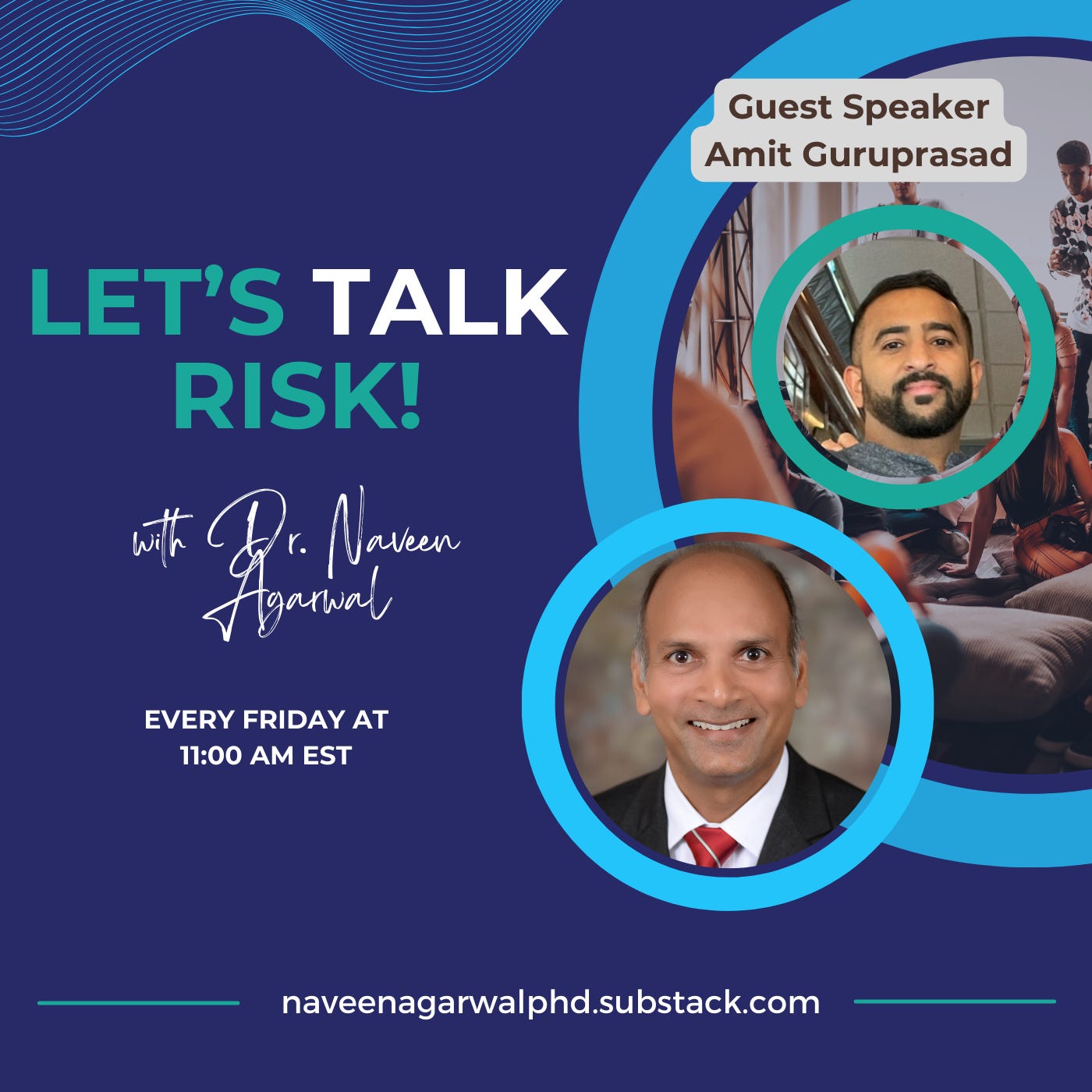
LTR 59: FDA's pre-sub program and how it can accelerate medical device innovation
“You can get a lot of valuable insights from the FDA on what your regulatory pathway is when it comes to risk, and how that impacts not only the risk of the product but how you set up your quality systems and what you need to implement in the long run. ”In this Let’s Talk Risk! conversation, Amit Guruprasad shares how small medical device manufacturers and startups can take advantage of the free pre-sub program to get early feedback from the FDA to inform their regulatory strategy and plans for collecting data to prove safety and effectiveness in their final regulatory submission. But it requires a strategic approach and preparation before you meet with the FDA. As an example, you should plan to get FDA feedback on your proposed approach and not seek yes/no answers. Listen to this Let’s Talk Risk! conversation with Amit Guruprasad, which also includes an open discussion with a live audience. Jump to a section of interest using these timestamps.00:02:12 Introduction00:04:20 FDA’s Q-Sub program, pre-submissions and risk determination00:07:11 How to prepare for a pre-sub meeting with the FDA00:10:05 Develop a strategic plan for pre-sub meetings with FDA00:12:05 Plan to get feedback on the approach and not answers to yes/no questions00:12:50 Lessons learned from a recent pre-sub meeting00:14:25 Audience Q&A and general discussion00:31:25 Closing comments and key takeawaysIf you enjoyed this podcast, consider subscribing to the Let’s Talk Risk! newsletter.Suggested links:The Q-Submission Program: FDA guidance for requesting a meeting for feedback on medical device submissions. DICE: FDA’s division of industry and consumer education.LTR webinar on post-market surveillanceAbout Amit GuruprasadAmit Guruprasad is the founder of Devan MedTech Solutions, where he provides quality and regulatory consulting services to medical device companies and startups. He has over 10 years of professional experience in R&D, quality and regulatory affairs at various medical device companies. He holds B.S. and M.S. in Biomedical Engineering. Let’s Talk Risk! with Dr. Naveen Agarwal is a weekly live audio event on LinkedIn, where we talk about risk management related topics in a casual, informal way. Join us at 11:00 am EST every Friday on LinkedIn.DisclaimerInformation and insights presented in this podcast are for educational purposes only. Views expressed by all speakers are their own and do not reflect those of their respective organizations. This is a public episode. If you'd like to discuss this with other subscribers or get access to bonus episodes, visit naveenagarwalphd.substack.com/subscribe
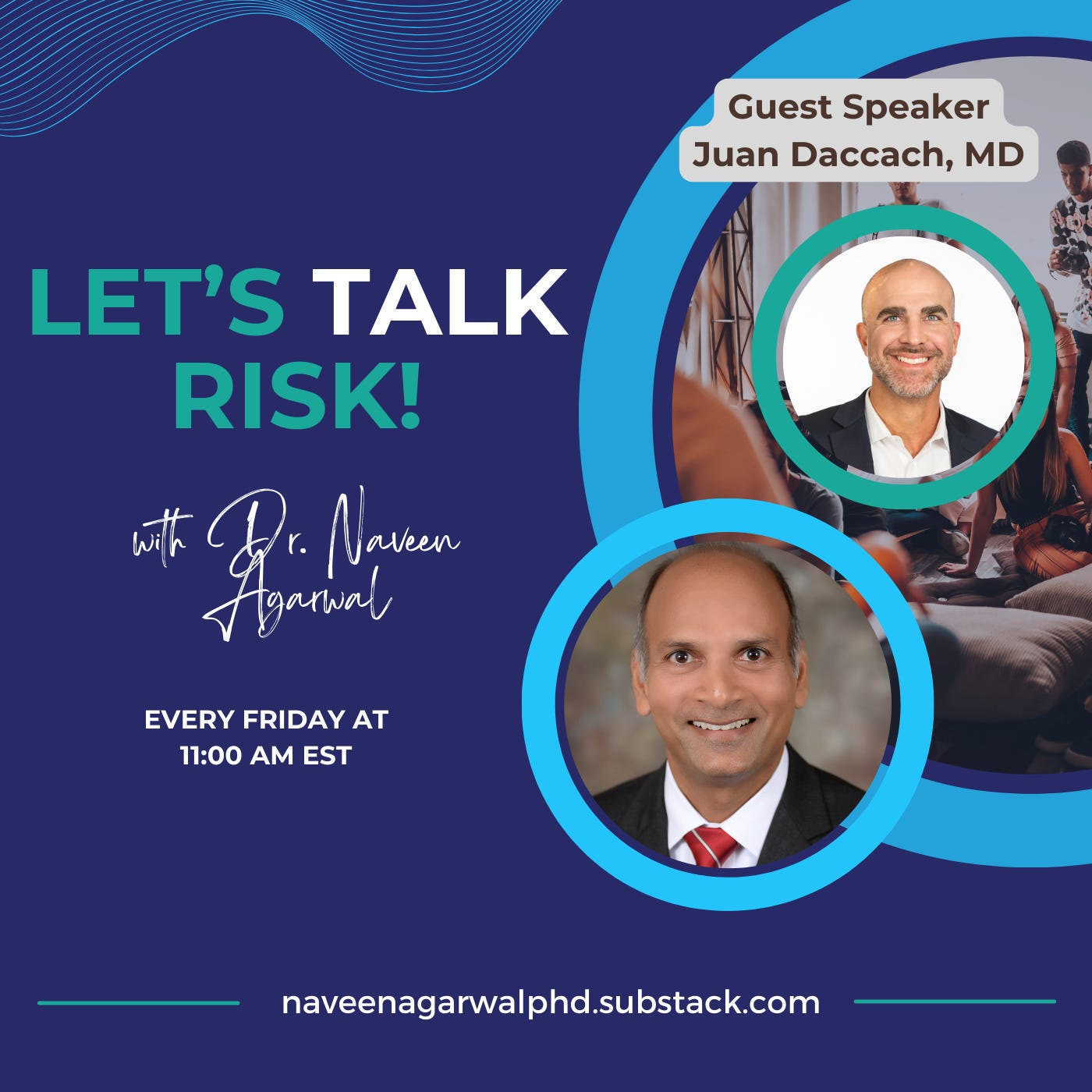
LTR 58: Tips for clinicians transitioning into a medical safety role in MedTech
“The reality is that, today, a lot of people are studying medicine to go into industry. But if your curriculum do not include areas like risk management, cross-functional collaboration, dFMEA and all of that, then transition for that position is going to be slower.”In this Let’s Talk Risk! conversation, Dr. Juan Daccach shares his personal journey of transitioning into a medical safety role in MedTech as a practicing orthopedic joint reconstruction surgeon. He advises clinicians aspiring to transition into a Medical Safety role to proactively bridge gaps in their medical training and experience for success.As an example, clinicians are trained to focus on the worst case and minimizing its impact on an individual patient. Managing risks of a medical device, on the other hand, is not just about the worst case scenario. It is about striking a positive balance between benefit and risk. There is no quality without safety, and there is no safety without quality. That is why broadening your view of a medical device, how it is developed and what it takes to bring it to market, is important for success. There is a need to include these topics into medical curriculum and continuing education. Listen to this Let’s Talk Risk! conversation with Dr. Juan Daccach, which also includes an open discussion with a live audience. Jump to a section of interest using these timestamps.00:02:11 Introduction00:08:32 Overcoming challenges when transitioning as a clinician into MedTech00:12:18 Learning to speak the language of Quality and Regulatory00:15:00 Challenges in integrating Medical Safety with QA/RA function00:18:11 Audience Q&A and general discussion00:31:25 Closing comments and key takeawaysIf you enjoyed this podcast, consider subscribing to the Let’s Talk Risk! newsletter.Suggested links:Fundamentals of Risk Management: An introductory on-demand course for medical device risk management on ACHIEVE. About Dr. Juan Daccach, MDJuan Dacach, MD is currently the Vice President of Product Safety at Metz Aesthetics. Previously he was in various leadership positions in Medical Safety and Medical Affairs at various leading MedTech companies. He specialized in Orthopedics and trauma during his medical training, residency and fellowship as an MD. As part of his continuing education in the industry, he also acquired certifications in quality, auditing, coaching and leadership communication. Let’s Talk Risk! with Dr. Naveen Agarwal is a weekly live audio event on LinkedIn, where we talk about risk management related topics in a casual, informal way. Join us at 11:00 am EST every Friday on LinkedIn.DisclaimerInformation and insights presented in this podcast are for educational purposes only. Views expressed by all speakers are their own and do not reflect those of their respective organizations. This is a public episode. If you'd like to discuss this with other subscribers or get access to bonus episodes, visit naveenagarwalphd.substack.com/subscribe
LTR 57: It's time to focus on supply chain resiliency not just supplier management
“Show me the indicators, show me the KPIs and I will show you the results.”Resiliency starts at the top. Misaligned incentives often lead to unintended and disastrous consequences. Recently, the Federal Aviation Administration (FAA) in the US grounded 171 Boeing 737-9 MAX planes following a mid-air incident where a cabin door blew open, exposing hundreds of passengers to a serious hazardous condition. The issue was traced to gaps in quality and inspection of components from suppliers. Similar to the aviation industry, supply chains in the medical device industry are also complex and fragmented. In this conversation, Marco Felsberger emphasizes the need for focusing on supply chain resiliency, and not just managing individual suppliers. He encourages us to consider a systems view to understand various interactions and constraints, and simulate scenarios to identify potential vulnerabilities. Listen to this Let’s Talk Risk! conversation with Marco Felsberger, which also includes an open discussion with a live audience. Jump to a section of interest using these timestamps.00:02:15 Introduction00:04:35 Why supply chain resiliency is critical in a complex world00:06:40 How misaligned incentives create supply chain vulnerabilities00:10:10 What we can learn from the automotive industry00:12:33 Applying systems thinking to improve supply chain resiliency00:17:01 Audience Q&A and general discussion00:31:25 Closing comments and key takeawaysIf you enjoyed this podcast, consider subscribing to the Let’s Talk Risk! newsletter.Suggested links:On the Edge of Resilience: Marco’s Substack publicationAbout Marco FelsbergerMarco Felsberger is a resilience and risk manager with over 20 years of experience across diverse industries including banking and consumer products. He is currently a Senior Advisor of Supply Chain Resilience at Prewave, specializing in risk and resilience management, business continuity strategies, crisis management protocols and security management. He holds a B.Sc. degree in Integrated Security & Safety Management. Let’s Talk Risk! with Dr. Naveen Agarwal is a weekly live audio event on LinkedIn, where we talk about risk management related topics in a casual, informal way. Join us at 11:00 am EST every Friday on LinkedIn.DisclaimerInformation and insights presented in this podcast are for educational purposes only. Views expressed by all speakers are their own and do not reflect those of their respective organizations. This is a public episode. If you'd like to discuss this with other subscribers or get access to bonus episodes, visit naveenagarwalphd.substack.com/subscribe
LTR 56: How to communicate effectively with senior management
“As professionals in these areas, we are so versed in regulations that we get so deep into the woods with management that 30 seconds after you start speaking, they are gone! They can’t even think about it anymore.”Know your audience, prepare your topic and respect your listener. Victor Mencarelli shares these 3 tips for effective communication in this Let’s Talk Risk! conversation. Remember, effective communication is about connecting and making sure your message is heard. It is not meant to be an information dump on your audience. That is why, it is important to carefully consider the perspectives and preferences of your target audience. To some, details are important. Others want you to be brief, be quick and be gone! Listen to this Let’s Talk Risk! conversation with Victor Mencarelli, which also includes an open discussion with a live audience. Jump to a section of interest using these timestamps.00:02:13 Introduction00:03:20 New regulation for personal care products as OTC products00:05:40 Challenges for QA/RA professionals in communicating with senior leaders00:07:15 An example of effective communication 00:08:35 An example of ineffective communication00:11:46 Can we learn to be good communicators?00:14:50 Audience Q&A and general discussion00:29:20 Closing comments and key takeawaysIf you enjoyed this podcast, consider subscribing to the Let’s Talk Risk! newsletter.Suggested links:Supercommunicators: How to unlock the secret language of connection, by Charles DuhiggAbout Victor MencarelliVictor Mencarelli is currently the Director of Regulatory Affairs at Orveon Global where he leads all aspects of international regulatory affairs including registration, documentation and formulation review for new startup venture capital backed businesses in the cosmetics and personal care industry. He has more than 25 years of industry experience specializing in microbiology, toxicology and regulatory affairs. He holds a B.S. degree in Biology and an M.S. in Biotechnology regulatory affairs. About Let’s Talk Risk! with Dr. Naveen AgarwalLet’s Talk Risk! with Dr. Naveen Agarwal is a weekly live audio event on LinkedIn, where we talk about risk management related topics in a casual, informal way. Join us at 11:00 am EST every Friday on LinkedIn.DisclaimerInformation and insights presented in this podcast are for educational purposes only. Views expressed by all speakers are their own and do not reflect those of their respective organizations. This is a public episode. If you'd like to discuss this with other subscribers or get access to bonus episodes, visit naveenagarwalphd.substack.com/subscribe
LTR 54: Start your risk analysis by first defining the intended use
“The first thing I do whenever I am starting design control or risk is that I make sure that the intended use and the indication of the device are as nailed down as they can be.”Yes, design control and risk management can be challenging, especially in a startup or a small medical device company. Generally, there is just one person, a “team of one”, responsible for setting up the entire quality system and the risk management process. That is why Becki Hiebert advises practitioners to focus on the intended use first. Get to know what your device is supposed to do, where, on whom, and who interacts with it, to set the framework for your quality system. She recommends following the steps outlined in ISO 14971 for risk analysis, and involving your medical/clinical subject matter experts as early in the design process as possible. Listen to this Let’s Talk Risk! conversation with Becki Hiebert, which also includes an open discussion with the audience. Jump to a section of interest using these timestamps.00:02:20 Introduction00:04:32 How to succeed as a “team of one” in a startup00:06:24 Getting started with design controls and risk management in a startup00:08:41 Best practices for following ISO 14971 steps in risk analysis00:12:31 Connecting risk analysis to design controls00:14:15 Lessons learned in managing cybersecurity risk00:17:05 Overcoming challenges in risk management documentation00:19:57 Audience Q&A and general discussion00:30:19 Closing comments and key takeawaysIf you enjoyed this podcast, consider subscribing to the Let’s Talk Risk! newsletter.About Becki HiebertBecki Hiebert is currently a consultant specializing in implementation and improvement of quality management systems in medical device industry in compliance with ISO 13485, 21 CFR 820 and MDSAP. In her 10+ years of professional experience across both pharmaceutical and medical device industries, she has developed a hands-on expertise in regulatory requirements for current good manufacturing practices. She has served in a variety of roles in quality planning, process improvement, internal audits, quality system training and supplier/purchasing programs.About Let’s Talk Risk! with Dr. Naveen AgarwalLet’s Talk Risk! with Dr. Naveen Agarwal is a weekly live audio event on LinkedIn, where we talk about risk management related topics in a casual, informal way. Join us at 11:00 am EST every Friday on LinkedIn.DisclaimerInformation and insights presented in this podcast are for educational purposes only. Views expressed by all speakers are their own and do not reflect those of their respective organizations. This is a public episode. If you'd like to discuss this with other subscribers or get access to bonus episodes, visit naveenagarwalphd.substack.com/subscribe
LTR 53: Three big trends to watch in MedTech
“The regulatory landscape is changing significantly and it is too hard to keep up.”That is why Jennifer Mascioli-Tudor advises risk practitioners to be “super proactive” in following these rapid changes, understand the impact, and take a leading role in preparing their organizations. In this Let’s Talk Risk! conversation, we focus on three big trends in MedTech - the shift from Quality System (QS) regulation to Quality Management System Regulation (QMSR), a new regulatory focus on cybersecurity in medical devices, and shifting regulations of lab developed tests (MDT). Listen to this Let’s Talk Risk! conversation with Jennifer Mascioli-Tudor, which also includes an open discussion with the audience. Jump to a section of interest using these timestamps.00:02:30 Introduction00:04:00 Trend 1: Shift from QSR to QMSR in the US00:07:40 Trend 2: Regulatory focus on cybersecurity in medical devices00:10:30 Trend 3: Regulating Lab Developed Tests (LDT) in the US00:13:10 General discussion: Learning opportunities at universities00:33:07 Closing comments and key takeawaysIf you enjoyed this podcast, consider subscribing to the Let’s Talk Risk! newsletter.Suggested links:* UC San Diego: Regulatory Affairs for Medical Devices* Pathway for patient health* Drexel University: Doctoral program in Biomedical EngineeringAbout Jennifer Mascioli-TudorJennifer Mascioli-Tudor is currently the Founder and Principal Consultant at JMT consulting offering advisory services to MedTech startups and small manufacturers in business, regulatory and quality management strategy. She is also an instructor at UC San Diego where she teaches regulatory fundamentals and design controls. Her industry experience includes leading roles at J&J, Boston Scientific, Medtronic and GE. She holds a B.S. degree in Physiology/Chemistry/French, and an MBA in Global Business Management.About Let’s Talk Risk! with Dr. Naveen AgarwalLet’s Talk Risk! with Dr. Naveen Agarwal is a weekly live audio event on LinkedIn, where we talk about risk management related topics in a casual, informal way. Join us at 11:00 am EST every Friday on LinkedIn.DisclaimerInformation and insights presented in this podcast are for educational purposes only. Views expressed by all speakers are their own and do not reflect those of their respective organizations. This is a public episode. If you'd like to discuss this with other subscribers or get access to bonus episodes, visit naveenagarwalphd.substack.com/subscribe
LTR 52: The key to success as a risk practitioner in the medical device industry.
“Risk management is inherent to all our roles, whether you are in Regulatory, Quality or R&D, but it is not something we spend a lot of time on”.Risk management in the medical device industry is often seen as a check-the-box activity for regulatory compliance. In this Let’s Talk Risk! conversation, Carolyn Blandford encourages us to not be satisfied with this status quo and help create a dedicated focus on risk management across all processes of the quality system. How can you be a better partner? How can you help build your product’s story from start to finish during development, and later during the post-market phase? This is a leadership opportunity for risk practitioners. It is not enough to build a deep technical knowledge of risk management, but also be mindful of how communication occurs within your organization. Combine your technical know-how with good communication skills to help your team make the best possible decision. This is the key to success in a risk management role. Listen to this Let’s Talk Risk! conversation with Devon Campbell, which also includes an open discussion with the audience. Jump to a section of interest using these timestamps.00:01:58 Introduction00:04:15 How risk management helps build and sustain the product story00:05:15 Transitioning into a risk management role 00:08:12 Why we need to create dedicated risk management roles00:10:35 How to lead change by starting small and showing impact00:12:50 Our role in shaping a culture of quality00:15:13 Audience Q&A, general discussion 00:32:30 Closing comments and key takeawaysIf you enjoyed this podcast, consider subscribing to the Let’s Talk Risk! newsletter.About Carolyn (Beres) BlandfordCarolyn (Beres) Blandford is currently a Senior Project Management Consultant at IPM Integrated Project Management Company. She has over 20 years of professional experience in the in-vitro diagnostic (IVD) industry, first in a scientific role, later moving into a Quality Management role. She developed a strong interest in risk management as a Quality Manager, where she also led the charge to create a dedicated focus on risk management in the organization. Using her strong research, communication and project management skills, she currently supports her clients in planning and implementing strategically critical initiatives. About Let’s Talk Risk! with Dr. Naveen AgarwalLet’s Talk Risk! with Dr. Naveen Agarwal is a weekly live audio event on LinkedIn, where we talk about risk management related topics in a casual, informal way. Join us at 11:00 am EST every Friday on LinkedIn.DisclaimerInformation and insights presented in this podcast are for educational purposes only. Views expressed by all speakers are their own and do not reflect those of their respective organizations. This is a public episode. If you'd like to discuss this with other subscribers or get access to bonus episodes, visit naveenagarwalphd.substack.com/subscribe
LTR 50: Humility is the key to startup success
“The teams I see really successful are the ones that realize where their gaps lie and stive to reach out to mentors and advisors to fill those gaps”.Developing a medical device and bringing it successfully to the market is a huge challenge, especially for early stage startups. Even for large, established manufacturers, it takes a significant amount of time to launch a new device. In this Let’s Talk Risk! conversation, Devon Campbell encourages us to honestly acknowledge gaps in available resources, knowledge and skills, and seek to fill those gaps by collaborating with both internal and external resources.It takes a lot of humility to admit that we can’t do it alone. It is true that early stage start up companies face a lot of challenges, but working in a fast-paced environment can be a lot of fun. It does requires a strategic approach to build out the required quality processes just in time to support the overall business strategy. Whether you want to go to market with your own product, or plan an exit through acquisition, it helps to keep the end in mind.Listen to this Let’s Talk Risk! conversation with Devon Campbell, which also includes an open discussion with the audience. Jump to a section of interest using these timestamps.00:01:50 Introduction00:04:23 How it feels to be in a startup environment00:06:25 Success factors for startups00:09:46 A short story of a successful startup exit00:14:00 Audience Q&A, general discussion 00:32:30 Closing comments and key takeawaysIf you enjoyed this podcast, consider subscribing to the Let’s Talk Risk! newsletter.About Devon CampbellDevon C. Campbell is the Founder and Managing Director at Prodct, where he and his team provides hands-on support and advisory services to early stage medical device, diagnostic, and therapeutic companies. He serves as a mentor, advisor, or board member for several startups. Additionally, he is the Chief Product Officer (CPO) and Senior Vice President of R&D/Quality at myBiometry, an early stage diagnostic company focused on asthma. He also supports the NIH RADx program as a content expert and was the lead author for Chapter 6 of the recent NIH book “Accelerating Diagnostics in a Time of Crisis” exploring quality, risk, and product developing during RADx. He has been active in the medical device industry for more than 25 years in various engineering and leadership roles. He holds BS and MS degrees in Mechanical Engineering.About Let’s Talk Risk! with Dr. Naveen AgarwalLet’s Talk Risk! with Dr. Naveen Agarwal is a weekly live audio event on LinkedIn, where we talk about risk management related topics in a casual, informal way. Join us at 11:00 am EST every Friday on LinkedIn.DisclaimerInformation and insights presented in this podcast are for educational purposes only. Views expressed by all speakers are their own and do not reflect those of their respective organizations. This is a public episode. If you'd like to discuss this with other subscribers or get access to bonus episodes, visit naveenagarwalphd.substack.com/subscribe
RM roundup #3: 10 noteworthy risk-related LinkedIn posts
Listen to my reading of a recent LinkedIn article I published to cover 10 noteworthy risk-related posts recently published on LinkedIn. Listen to the recording and follow links below to read the original posts and continue the conversation.🗞️A roundup of 10 noteworthy risk-related posts on LinkedIn! 1️⃣ Horst Simon advises risk practitioners to serve as advisors and facilitators instead of playing a traffic cop.2️⃣ Jijo James shares a new tool that significantly reduces device-related interruptions when used with the WHO's surgical safety checklist.3️⃣ Aaron Joseph recommends adopting a more flexible "re-entrant design controls" approach to manage frequent design changes and upgrades.4️⃣ Stefan Hunziker, PhD, CICP offers 6 tips for boosting your risk management expertise where leaning from failures is not an option.5️⃣ Wag Hanna shares how augmented intelligence tools can help support risk management while also enabling a culture of transparency.6️⃣ Vincent F. Cafiso seeks to clarify FDA's position on requirements for clinical studies in QMSR.7️⃣ George Zack invites a conversation to identify risks in real world activities such clearing snow from sidewalks and roads.8️⃣ Chuck Ventura offers tips for considering design controls at the drug/device interface in a combination product.9️⃣ Daniel Adler spotlights a new FDA draft guidance on cybersecurity to cover any device if it includes software and internet connectivity.🔟Marco Felsberger reminds us that we can't always reliably model extreme events and managing risk exposure might be more effective.Share in comments 👇your favorite risk-related post covered in this podcast. Let's Talk Risk! is a reader-supported publication. To receive new posts and support my work, consider becoming a free or paid subscriber. This is a public episode. If you'd like to discuss this with other subscribers or get access to bonus episodes, visit naveenagarwalphd.substack.com/subscribe
LTR 49: A clinician's view on AI/ML enabled medical devices
“The eyes can only see what the mind understands.”The world of medical devices is complex. There are many regulations, standards and guidance documents to read and understand, and apply them correctly during design, development and clinical investigations for regulatory success. In this Let’s Talk Risk! conversation, Dr. Emanuel Tkach encourages us to keep the big picture in mind. Engineers and Clinicians, who are not generally trained in regulatory affairs, also need to develop a good understanding of these requirements. As an example, we must clearly understand the intended use and indication for our device. It is in the context of the intended use that we have to plan and conduct our clinical investigations to generate evidence of safety and effectiveness. AI-enabled devices, including those used for detection and diagnosis, presents unique issues. Data privacy and security, including cybersecurity vulnerabilities need to be addressed. Risk of using open source data should carefully considered during development, testing and final use. Unless absolutely necessary, it is best not to use open source data. Another potential area of concern is physician over-reliance on AI/ML devices. Dr. Tkach reminds us to keep the following in mind:At the end of the day, an AI-enabled device is a tool to be used by the clinician and not as a substitute for clinical judgment. Listen to this Let’s Talk Risk! conversation with Dr. Emanuel Tkach, which also includes an open discussion with the audience. Jump to a section of interest using these timestamps.00:02:05 Introduction00:04:13 CADe and CADx: two types of computer aided detection and diagnosis00:05:23 Addressing physician over-reliance on technology in clinical trials00:07:14 Relevant ISO standards for AI, clinical investigations and quality00:10:14 Clinical perspective on designing AI-enabled devices and managing risk00:15:38 How non-regulatory professionals should approach regulations and standards00:17:20 Audience Q&A00:32:30 Closing comments and key takeawaysIf you enjoyed this podcast, consider subscribing to the Let’s Talk Risk! newsletter.About Emanuel Tkach, MDDr. Emanuel Tkach is currently the Medical Advisor at HeartPoint Global, where he leads the global clinical strategy and operations of clinical trials. He also provides advice on breakthrough device designation submissions, recruiting and strategizing with key opinion leaders (KOL) to accelerate medical device innovation. His medical specialty and clinical experience includes Gastroenterology, Cardiology and Primary Care. He holds a BS degree in Biology/Biological Sciences and an MD in Medicine. About Let’s Talk Risk! with Dr. Naveen AgarwalLet’s Talk Risk! with Dr. Naveen Agarwal is a weekly live audio event on LinkedIn, where we talk about risk management related topics in a casual, informal way. Join us at 11:00 am EST every Friday on LinkedIn.DisclaimerInformation and insights presented in this podcast are for educational purposes only. Views expressed by all speakers are their own and do not reflect those of their respective organizations. This is a public episode. If you'd like to discuss this with other subscribers or get access to bonus episodes, visit naveenagarwalphd.substack.com/subscribe
LTR 48: Integrating purchasing controls across product lifecycle
“Continuous lifecycle approach to risk management is still not broadly understood or applied in the industry”. In this Let’s Talk Risk! conversation, Kevin Posey highlights a gap in the industry practice of risk management, especially in the context of purchasing controls. Starting with the recent Boeing issue, where a cabin door in a 737 Max 9 blew open during flight, Kevin shares that there is often a disconnect between supplier risk management and product risk management in our own industry. Many of the safety critical functionalities of a medical device rely on adequate control of purchased product through supplier controls. Yet, Supplier Quality and Product Development functions tend to operate in silos. A siloed operating model leads to device malfunctions with serious consequences in the post-market phase, that have their origin in the quality of purchased products. One area of significant vulnerability is the use of off-the-shelf products, including software, where it is sometimes not feasible to identify and implement appropriate purchasing controls. There is a renewed focus on purchasing controls in the revised Quality Management System Regulation (QMSR), which is due to go into effect in early 2026. We have to start applying a risk-based approach to ensure compliance and manage risk to patients. Listen to this Let’s Talk Risk! conversation with Kevin Posey, which also includes an open discussion with the audience. Jump to a section of interest using these timestamps.00:02:05 Introduction00:03:26 Challenges in supplier quality controls in light of recent Boeing issue00:05:30 A renewed focus on supplier controls in QMSR00:06:48 Disconnect between supplier risk management and product risks00:09:50 An example highlighting challenges in supplier risk management00:13:49 Audience Q&A00:31:13 Closing comments and key takeawaysIf you enjoyed this podcast, consider subscribing to the Let’s Talk Risk! newsletter.About Kevin PoseyKevin Posey is currently the Director of Regulatory Affairs and Quality Assurance at Genesys Spine. He began his career in the Aerospace and Defense industry as a systems engineer. Later he moved to the medical device industry, where he advanced his career over a span of 25+ years in leading roles at multiple organizations covering a broad range of medical specialties. He holds a BS degree in Aerospace Engineering and MBA in International Business with additional Masters level studies in Systems Engineering and Biomedical Engineering.About Let’s Talk Risk! with Dr. Naveen AgarwalLet’s Talk Risk! with Dr. Naveen Agarwal is a weekly live audio event on LinkedIn, where we talk about risk management related topics in a casual, informal way. Join us at 11:00 am EST every Friday on LinkedIn.DisclaimerInformation and insights presented in this podcast are for educational purposes only. Views expressed by all speakers are their own and do not reflect those of their respective organizations. This is a public episode. If you'd like to discuss this with other subscribers or get access to bonus episodes, visit naveenagarwalphd.substack.com/subscribe
LTR 46: Tips to boost effectiveness of medical device post-market surveillance
“Risk management is often seen as a check the box activity”. Taylor Dieringer reminds us in this Let’s Talk Risk! conversation that risk management should be an ongoing, continuous process within your quality management system, that monitors, evaluates and controls risk throughout the product lifecycle, and not just in the pre-market phase. The post-market surveillance process serves as a link between real-world safety performance of a medical device and design and development of new products to achieve this objective. Listen to this Let’s Talk Risk! conversation with Taylor Dieringer, which also includes an open discussion with the audience. Jump to a section of interest using these timestamps.00:02:30 Introduction00:04:03 What is post-market surveillance and why it is needed00:06:51 Post-market surveillance process is a continual learning process00:08:05 Setting thresholds for action during post-market surveillance00:11:00 How to detect and evaluate safety signals00:13:40 Why we need a cross-functional team for post-market surveillance00:16:37 Audience Q&A00:30:05 Closing comments and key takeawaysIf you enjoyed this podcast, consider subscribing to the Let’s Talk Risk! newsletter.About Taylor DieringerTaylor Dieringer is currently a staff quality engineer at iRhythm Technologies, Inc. where he leads risk management activities throughout all phases of the product lifecycle, ranging from design to post-market surveillance. He is a biomedical engineer by training with prior experience in design and development, quality assurance and risk management at multiple medical device organizations. About Let’s Talk Risk! with Dr. Naveen AgarwalLet’s Talk Risk! with Dr. Naveen Agarwal is a weekly live audio event on LinkedIn, where we talk about risk management related topics in a casual, informal way. Join us at 11:00 am EST every Friday on LinkedIn.DisclaimerInformation and insights presented in this podcast are for educational purposes only. Views expressed by all speakers are their own and do not reflect those of their respective organizations. This is a public episode. If you'd like to discuss this with other subscribers or get access to bonus episodes, visit naveenagarwalphd.substack.com/subscribe

LTR Weekly Digest #31 - 6th April, 2024
Dear colleagues, hello! 👋A special welcome to the 40 new members who have joined our Let’s Talk Risk! community in the first week of April! Feel free to browse past articles in the archive section of the Let’s Talk Risk! website, and check out recordings of recent LTR conversations in the podcast section. Here are links to articles published this week.AnnouncementsSpecial offer - save 20% on annual subscriptionEnjoying the free content on Let’s Talk Risk!? Upgrade your subscription with this special offer to enjoy even more benefits:1️⃣ Premium articles: Case studies of FDA warning letters, recalls, ISO 14971 fundamentals, medical device news updates.2️⃣ Monthly LTR webinar: Build deeper knowledge of risk management and get your specific questions answered.3️⃣ 20% off training: You get automatic 20% off on training and coaching offers via ACHIEVE. 4️⃣ Exclusive monthly podcast: Gain insights from industry leading voices5️⃣ Ability to start a discussion thread on LTR Chat!Check out our Wall of Love to see what others are saying!LTR weekly conversation on LinkedIn: A physician’s view on AI in healthcareJoin me next Friday, April 12, 2024 at 11:00 AM EST, for another Let’s Talk Risk! conversation on LinkedIn. My guest this week is Dr. Niranjan Seshadri, who will share his perspectives as an interventional cardiologist on AI in healthcare.Ask a risk management questionGot a risk management question? Now you can submit your question and get answers through a new feature on Let’s Talk Risk!. If I pick your question for an AMA article, you will get free access to premium content for 30 days! Weekly Knowledge ChallengeI hope you enjoyed the knowledge challenge question last week. Here is the correct answer:The correct answer for the question, “A hazard always leads to harm” is False. Here is this weeks’ knowledge challenge #281-Question Feedback SurveyWant to share feedback? Send a message to me!If you are finding value in LTR, please give us a shout out and show your love🙏 This is a public episode. If you'd like to discuss this with other subscribers or get access to bonus episodes, visit naveenagarwalphd.substack.com/subscribe
LTR 45: A patient's perspective on CGMs
“Diabetes is a terrible way to die.”This comment from David Sturgis in our Let’s Talk Risk! conversation really moved me. As engineers and QA/RA professionals, we mainly focus on building and launching safe and effective medical devices. We don’t always get to spend time with patients and doctors to understand their perspective. That is why it is insightful to hear from David about his experience with a continuous glucose monitor (CGM) and how it changed his life in a positive way. Diabetes is a difficult chronic condition. Nearly 40 million people in the United States alone are estimated to be living with diabetes. CGMs have made a big impact in not only managing the A1C for diabetic patients, but also improving their overall quality of life. When we listen to patients - really listen - we can understand not only their “needs” but also their fears, wants and desires. For example, we may be focused on the functionality of our devices, but patients also worry about whether they will be covered by insurance. Affordability and accessibility are major concerns, even though they may not appear in our list of “user needs” during the design and development process. “I am in it to win it”, David shares in this conversation. It is a good reminder to all of us to think of patients as people, and not as an anonymous consumer. Listen to this Let’s Talk Risk! conversation with David Sturgis which also includes an open discussion with the audience. About David SturgisDavid Sturgis is an IT and Operations management professional with more than 25 years of experience in project and lifecycle management. He is skilled building and optimizing organizational processes, measurement systems and infrastructure to maximize business results. He has an MBA from University of Florida, and a BS in Computer Engineering from University of South Florida. About Let’s Talk Risk! with Dr. Naveen AgarwalLet’s Talk Risk! with Dr. Naveen Agarwal is a weekly live audio event on LinkedIn, where we talk about risk management related topics in a casual, informal way. Join us at 11:00 am EST every Friday on LinkedIn.DisclaimerInformation and insights presented in this podcast are for educational purposes only. Views expressed by all speakers are their own and do not reflect those of their respective organizations.If you enjoyed this episode, consider becoming a free or paid subscriber. This is a public episode. If you'd like to discuss this with other subscribers or get access to bonus episodes, visit naveenagarwalphd.substack.com/subscribe
LTR 44: Why we need a new approach to learning medical software and medical AI
Artificial intelligence (AI) is rapidly unlocking new applications in the medical arena. It is challenging to keep up with something moving so fast. ChatGPT was launched just a couple of years ago, and we are already talking about artificial general intelligence (AGI) for medical purposes! In this Let’s Talk Risk! conversation, Prof. Papademetris shares that indeed we are in a new game with plenty of opportunities. But we have to start learning in a new way. We will fail in non-obvious ways, and we will fail often. How do we harness the power of this technology without compromising patient safety or other ethical concerns?Case in point - AI is just one part of the overall system where a medical device needs to operate safely. We need to design the overall software for its intended use by considering the system level requirements. It is the whole software that needs to serve its intended purpose when used within the broader healthcare system.“People drive cars, not an engine!”, Prof. Papademetris reminds us so eloquently in this conversation. Patient safety is an important factor for a medical device. So far, FDA has managed the risk by including a human in the decision making loop and not allowing a stand-alone, autonomous AI system for clinical decisions. An important question is how to share information with the user? There is a human factors component to AI, which needs to be carefully considered.In practice this proves to be quite challenging. Application of AI in medical software requires a true cross-functional approach. As Prof. Papademetris reminds us, we need to learn to speak each other’s language:The biggest challenge we face is not being good in our discipline, but how to become at least competent in other disciplines to facilitate a truly cross functional problem solving approach when building medical software. In the rapidly evolving world of AI, we need a new approach to medical software development. It used to be that data was secondary to code in traditional software development, but now code is becoming fairly standard, and the question is about data. How broadly does it represent the use cases you want to represent? Bias in the model is a serious concern. Listen to this Let’s Talk Risk! conversation with Prof. Papademetris which also includes an open discussion with the audience. About Prof. Xenophon PapademetrisXenophon Papademtris is currently a Professor at the Yale University School of Medicine where he focuses on research in image analysis and software development. He has recently launched a certificate course for industry professionals to provide a comprehensive understanding of both technical and regulatory aspects of medical software and medical AI. He is also the lead author of a new textbook Introduction to Medical Software: Foundations for Digital Health, Devices and Diagnostics (Cambridge University Press, 2022), and the main instructor for the companion Coursera Class. About Let’s Talk Risk! with Dr. Naveen AgarwalLet’s Talk Risk! with Dr. Naveen Agarwal is a weekly live audio event on LinkedIn, where we talk about risk management related topics in a casual, informal way. Join us at 11:00 am EST every Friday on LinkedIn.DisclaimerInformation and insights presented in this podcast are for educational purposes only. Views expressed by all speakers are their own and do not reflect those of their respective organizations.If you enjoyed this episode, consider becoming a free or paid subscriber. This is a public episode. If you'd like to discuss this with other subscribers or get access to bonus episodes, visit naveenagarwalphd.substack.com/subscribe
RM roundup #2: 10 noteworthy risk-related LinkedIn posts
Listen to my reading of a recent LinkedIn article I published to cover 10 noteworthy risk-related posts recently published on LinkedIn. Listen to the recording and follow links below to read the original posts and continue the conversation.🗞️A roundup of 10 noteworthy risk-related posts on LinkedIn! 1️⃣ Randy Horton spotlights top 10 Health Technology Hazards for 2024 compiled by ECRI.2️⃣ Marco Felsberger reminds us that planning is useful, but building capability is even more important to handle uncertainty in our complex world.3️⃣ Chad Johnson explains how using a QFD can help us focus on the customer when building an FMEA4️⃣ Mark F. Witcher, Ph.D. encourages us to take a systems-view of risk instead of an event-based view during risk analysis.5️⃣ Boris Gurevich shares a draft document from IMDRF on SaMD device considerations and risk characterization.6️⃣ Darrin Carlson, RAC-Devices, PMP highlights the omission of DHF, DMR and DHR from the QMSR and how to map them under ISO 13485.7️⃣ Jan Beger shares a study that focuses on factors affecting patients' trust in AI for treatment decisions.8️⃣ Joseph Kvedar shares a review article about risk prediction models using AI for diabetes care and unresolved issues for implementation.9️⃣ Stefan Hunziker, PhD, CICP highlights an unintended consequence of ignoring correlation among individual risks.🔟Annmarie Nicolson shows how HFE activities interact with multiple workstreams during design and development.Share in comments 👇your favorite risk-related post covered in this podcast. Let's Talk Risk! is a reader-supported publication. To receive new posts and support my work, consider becoming a free or paid subscriber. This is a public episode. If you'd like to discuss this with other subscribers or get access to bonus episodes, visit naveenagarwalphd.substack.com/subscribe
LTR 43: Tips for integrating risk analysis with design controls
One of the key requirements of ISO 13485, the International Standard for medical device Quality Management Systems is establish a link between risk management and the design and development process.In practice this proves to be quite challenging. In this Let’s Talk Risk! conversation, Chuck Ventura shares that medical device design and development process is a chaotic process. Design controls should be considered as a way to keep track and stay organized in the face of inherent chaos of the process. In the context of Design Controls, it is helpful to see risk analysis as an aspect of good engineering and not just a paper exercise. When risk analysis is integrated early in the design process, it helps inform design choices to optimize both safety and performance of the medical device. As an example, when you are trying to decide among various design choices represented by different prototypes, it may be helpful to conduct early usability studies to find out potential use-related issues and failures. Design choices that eliminate potential use-errors are more effective in reducing risk and delivering a final product that is both safe and effective. A best practice is to start with a systems-level risk analysis to develop a preliminary understanding of hazards and hazardous situations. As our understanding of risks evolves, more sophisticated techniques such as design FMEAs can be applied to different design concepts to fully analyze failure risks in the context of identified hazards and hazardous situations. Listen to this Let’s Talk Risk! conversation with Chuck Ventura which also includes an open discussion with the audience. About Chuck VenturaChuck Ventura is currently the Founder and CEO at Ventura Solutions, LLC, a consulting firm specializing in end-to-end consulting, staffing and training services for the medical device and combination products industry. He has nearly 20 years of experience in the Life Sciences industry across a variety of roles in product development, risk management, design controls, project management audits and inspection readiness. He is a biomechanical engineer with advanced graduate degrees in aerospace and mechanical engineering. About Let’s Talk Risk! with Dr. Naveen AgarwalLet’s Talk Risk! with Dr. Naveen Agarwal is a weekly live audio event on LinkedIn, where we talk about risk management related topics in a casual, informal way. Join us at 11:00 am EST every Friday on LinkedIn.DisclaimerInformation and insights presented in this podcast are for educational purposes only. Views expressed by all speakers are their own and do not reflect those of their respective organizations.If you enjoyed this episode, consider becoming a free or paid subscriber. This is a public episode. If you'd like to discuss this with other subscribers or get access to bonus episodes, visit naveenagarwalphd.substack.com/subscribe
RM roundup #1: 10 of my favorite risk-related LinkedIn posts
Listen to my reading of a recent LinkedIn article I published to cover 10 of my favorite LinkedIn posts on risk-related topics. Listen to the recording and follow links below to read the original posts and continue the conversation.🗞️A roundup of my favorite risk-related posts on LinkedIn! 1️⃣ Bryan Whitefield says the job of a risk practitioner is to uncover the elephant in the room! Read the original post here and continue the conversation. 2️⃣ Annmarie Nicolson explains why Human Factors Engineering is more than a tick-box exercise. Read the original post here and continue the conversation. 3️⃣ Chuck Ventura shares tips to accelerate Product Development with "Great Design Inputs". Read the original post here and continue the conversation. 4️⃣ Helen Gerhard invites conversation to understand underlying problems behind recent Philips CPAP issues, especially around design controls. Read the original post here and continue the conversation. 5️⃣ HATEM RABEH, MD, MSc ing RABEH, MD, MSc shares insights to help estimate sample sizes for clinical studies. Read the original post here and continue the conversation. 6️⃣ Vincent F. Cafiso reminds us to follow requirements for rework in light of the recent Boeing 737 max issue. Read the original post here and continue the conversation. 7️⃣ George Zack highlights a common software testing trap in medical device design and development. Read the original post here and continue the conversation. 8️⃣ Korey Johnson discusses human factors issues in medical software with Xenophon Papademetris. Read the original post here and continue the conversation. 9️⃣ Wag Hanna reminds us that risk management is not about eliminating risk. Read the original post here and continue the conversation. 🔟On a lighter note, the modern approach to risk really began with a gambling problem! Read the original post here and continue the conversation. Share in comments 👇your favorite risk-related post covered in this podcast. Let's Talk Risk! is a reader-supported publication. To receive new posts and support my work, consider becoming a free or paid subscriber. This is a public episode. If you'd like to discuss this with other subscribers or get access to bonus episodes, visit naveenagarwalphd.substack.com/subscribe
LTR 42: State or event? Thinking clearly about hazards will help you manage risk.
We have been used to treating the term hazard as a potential source of harm. We are also familiar with the concept of exposure to hazard in a hazardous situation as a necessary condition for harm to occur.The question, often left unanswered, is whether the duration of exposure has any effect on the type and severity of harm experienced by the user/patient.In this insightful conversation, James Catmur challenges us to consider the duration factor of a hazard as a factor when conducting risk assessments. Drawing on his years of experience across multiple industry sectors, James shares that considering a hazards as states or events can help us more accurately assess each risk in terms of their frequency and/or duration. As an example:In the chemical sector, if it is a state, then the dose is what you use use to assess the risk . If it is an event, then you consider the direct impact. An explosion is the over-pressure. If it is a chemical release then how long that release is for. If you release chlorine for 30 minutes the severity would be very different from releasing for 10 seconds. In the medical device industry, a common challenge is to consider the impact of delay in treatment. It depends on how long it lasts and what else happens during that state. There is also a difference between delay in treatment vs. denial of treatment, or service, for example as a result of a cyberattack. A clear understanding of the type and duration of delay can be helpful in a better understanding of the nature and severity of risk.Listen to this Let’s Talk Risk! conversation with James Catmur which also includes an open discussion with the audience. About James CatmurJames Catmur is currently the Director of JC&A Ltd., where he advises clients on risk projects in R&D implementation, safety management and risk assessments. Previously he was at Arthur D. Little in a variety of roles with increasing responsibility in a career spanning over 25 years. About Let’s Talk Risk! with Dr. Naveen AgarwalLet’s Talk Risk! with Dr. Naveen Agarwal is a weekly live audio event on LinkedIn, where we talk about risk management related topics in a casual, informal way. Join us at 11:00 am EST every Friday on LinkedIn.DisclaimerInformation and insights presented in this podcast are for educational purposes only. Views expressed by all speakers are their own and do not reflect those of their respective organizations.If you enjoyed this episode, consider becoming a free or paid subscriber. This is a public episode. If you'd like to discuss this with other subscribers or get access to bonus episodes, visit naveenagarwalphd.substack.com/subscribe
LTR 40: A guest podcast with NAMSA - Part 1
Recently, I was invited by Richard Granquist and Linford Leitch from NAMSA to talk about risk management as part of their monthly RA QA Cafe podcast. In part 1 of a 2 part series, we discussed the following topics in a very open and engaging conversation!* How I got into risk management.* How I think about risk management in a small vs. large organization.* Why risk management is not a paper exercise, it is a process.* Why risk management approach should align with business goals.* A leadership opportunity for risk practitioners to shape culture.* How a systematic approach helps you do risk management well.* Risk management is a cross-functional activity; involve regulatory early. * Treat risk management not as an add-on but part of your quality system.* Documentation is important but we need to make it easy and less burdensome.Listen to the podcast above and share your views in comments below.About NAMSA and RA QA CafeNAMSA is a leading service provider to the global MedTech industry specializing in CRO (Clinical Research Organization) services, medical device testing capabilities, strategic guidance and tactical support to fast-track market introduction. Learn more about NAMSA, their services and expertise here. The RA QA Cafe is a conversational podcast where each episode features NAMSA consultants and invited guests to discuss Quality and Regulatory Affairs related topics relevant to the MedTech industry. DisclaimerInformation and insights presented in this podcast are for educational purposes only. Views expressed by all speakers are their own and do not reflect those of their respective organizations.If you enjoyed this episode, consider becoming a free or paid subscriber. This is a public episode. If you'd like to discuss this with other subscribers or get access to bonus episodes, visit naveenagarwalphd.substack.com/subscribe
LTR 39: Overcoming challenges in linking risk management with design controls
A common challenge for risk practitioners in the medical device industry is to efficiently link their risk management process with the design controls process.The output of risk management activities needs to be linked to the design process before design inputs are finalized. However, this proves to be quite challenging in practice. One reason is that a lot of work in the industry is often done in functional silos In this Let’s Talk Risk! conversation, Daniel highlights the importance of building trust between different functions, especially Quality and R&D organizations. Leaders in these organizations need to create and nurture a collaborative work environment where engineers can feel safe and empowered to work together for the common goal of developing innovative, safe and effective products. One specific example where cross-functional collaboration is especially useful is when we are try to establish reliability levels required for different functional requirements for a device under considerations. It requires a lot of trade-offs, which should be driven by a careful analysis of stakeholder expectations, regulatory requirements and the state of art. It is also useful to engage with medical/clinical colleagues to collect early clinical input to support these decisions. Listen to this Let’s Talk Risk! conversation with Daniel Roberts which also includes an open discussion with the audience. About Daniel RobertsDaniel Roberts is currently the Founder and Principal at Medical Device How, a MedTech consulting firm focused on personalized medical device strategies in the areas of Design Controls, Digitalization, Smart QMS, QMS training, Cybersecurity and Career Coaching. He has worked at several leading medical device manufacturers over the last 20 years in a variety of roles ranging from Quality and Compliance to R&D. He is also a certified ISO 13485 Internal Auditor. About Let’s Talk Risk! with Dr. Naveen AgarwalLet’s Talk Risk! with Dr. Naveen Agarwal is a weekly live audio event on LinkedIn, where we talk about risk management related topics in a casual, informal way. Join us at 11:00 am EST every Friday on LinkedIn.DisclaimerInformation and insights presented in this podcast are for educational purposes only. Views expressed by all speakers are their own and do not reflect those of their respective organizations.If you enjoyed this episode, consider becoming a free or paid subscriber. This is a public episode. If you'd like to discuss this with other subscribers or get access to bonus episodes, visit naveenagarwalphd.substack.com/subscribe
LTR 38: How medical safety professionals can serve as culture brokers in MedTech
Who is responsible for patient safety in a medical device manufacturing organization?When asked this question, a common response is likely to be that it is a shared responsibility across the entire organization. After all, everyone should be thinking about patient safety in their specific role and perform their duties such that patient safety is not compromised. It is true that no single individual or department can be held completely responsible for safety. But when everyone is responsible, no one is really responsible! In this Let’s Talk Risk! conversation, Mark Armstrong explains how medical safety professionals can serve as culture brokers by translating the language of different functions to help create a central awareness of patient safety. Each function within a large, complex organization, is understandably focused on their specific goals and objectives. R&D is responsible for developing new products and improving the existing ones with design changes. Clinical affairs is responsible for planning and generating clinical evidence to support regulatory submissions. Manufacturing is responsible for consistently producing high quality product at low cost. Medical affairs is responsible for building external relationships with key opinion leaders.There is a need to bridge the gap among these functional areas which often operate in silos. This is where Medical Safety professionals have a key role to play as a culture brokers to create and nurture a common culture of patient safety. Listen to this Let’s Talk Risk! conversation with Mark Armstrong which also includes an open discussion with the audience. About Mark ArmstrongMark Armstrong is currently the Director of Medical and Pharmacovigilance Safety and Beckton Dickinson. Combining his advanced education in both Medicine and Biomedical Engineering, he has served in clinical and medical safety roles for over 10 years at various leading MedTech organizations. In his current role, he serves as the primary Safety Physician support for Pharmacovigilance and provides internal medical/clinical consultation during design and development as well as during post-market surveillance activities. About Let’s Talk Risk! with Dr. Naveen AgarwalLet’s Talk Risk! with Dr. Naveen Agarwal is a weekly live audio event on LinkedIn, where we talk about risk management related topics in a casual, informal way. Join us at 11:00 am EST every Friday on LinkedIn.DisclaimerInformation and insights presented in this podcast are for educational purposes only. Views expressed by all speakers are their own and do not reflect those of their respective organizations.If you enjoyed this episode, consider becoming a free or paid subscriber. This is a public episode. If you'd like to discuss this with other subscribers or get access to bonus episodes, visit naveenagarwalphd.substack.com/subscribe
LTR 36: Why we should not overlook the quality-of-life benefit in risk evaluation
When it comes to medical devices, we generally think about only clinical benefits as we plan our clinical investigations to generate scientific evidence for demonstrating safety and effectiveness. However, medical devices also provide many other quality-of life-benefits that are often overlooked during benefit-risk evaluation. One reason is that these benefits are often subjectively experienced by patients, and not usually quantified during clinical investigations. In this LTR conversation, Ronald challenges us to consider quality-of-life benefits in a quantifiable way during clinical investigations. He shares an example of a minimally invasive orthopedic device to support the meniscus without the need for a total knee replacement. In this case the risk of frequent revision surgery is offset by the significant quality-of-life benefits. That is why it is important to also consider quality-of-life benefits in the overall benefit-risk evaluation. A good practice is to develop a method to quantify quality-of -life benefits important to patients, and generate data to demonstrate measurably significant difference in these benefits using the device. Ronald also shares some of the emerging expectations of notified bodies for the newly created role of a PRRC. Personal risk and liability for a PRRC is limited, but you must demonstrate training and competence. However, negligence and intentional mistakes on part of PRRC can result in legal liability. A best practice is to assign a dedicated role as PRRC and not serve in a dual capacity as department head and PRRC at the same time. Listen to this Let’s Talk Risk! conversation with Ronald Boumans which also includes an open discussion with the audience. About Ronald BaumansRonald Baumans is currently the founder and strategic consultant at Boumans Regulatory Consulting B.V, providing consulting and PRRC services to medical device companies across Europe. Previously he served as Senior Global Regulatory Consultant and Program Manager for European Regulatory Affairs at Emergo by UL. His professional experience spans over 30 years across multiple industry-leading organizations. He is also the founder of PRRC Academy, where he provides training about this emerging role in the medtech industry. About Let’s Talk Risk! with Dr. Naveen AgarwalLet’s Talk Risk! with Dr. Naveen Agarwal is a weekly live audio event on LinkedIn, where we talk about risk management related topics in a casual, informal way. Join us at 11:00 am EST every Friday on LinkedIn.DisclaimerInformation and insights presented in this podcast are for educational purposes only. Views expressed by all speakers are their own and do not reflect those of their respective organizations.If you enjoyed this episode, consider becoming a free or paid subscriber. This is a public episode. If you'd like to discuss this with other subscribers or get access to bonus episodes, visit naveenagarwalphd.substack.com/subscribe

LTR Weekly Digest #19 - 13th January, 2024
Dear colleagues, hello! 👋A special welcome to 75+ new members who have joined our Let’s Talk Risk! community this month! Feel free to browse past articles in the archive section of the Let’s Talk Risk! website, and check out recordings of recent LTR conversations in the podcast section. Check out these recent articles published last week on LTR➡️The upcoming Quality Management System Regulation (QMSR) is expected to place a heavy emphasis on risk as the FDA seeks to align the current regulation with global standards. This premium article offers a review of risk-based requirements in ISO 13485 and guidance for implementation. ➡️In this Let’s Talk Risk! conversation, Bijan Elahi shares tips for creating and nurturing an environment of collaboration in risk management. ➡️A common challenge in risk management is to fully understand and control risks due to reasonably foreseeable misuse. This is why you need a robust post-market surveillance process so you can take timely action to ensure your devices continue to remain safe and effective. Upcoming eventsLTR weekly conversation on LinkedIn: Connecting risk management and design controls to accelerate product innovationJoin me next Friday, January 19, 2024 at 11:00 AM EST, for another Let’s Talk Risk! conversation on LinkedIn. My guest this week is Chuck Ventura, who will share insights on how we can connect risk management and design controls to accelerate medical device innovation.LTR monthly webinar series: Getting ready for QMSRA quick reminder to join me in this month’s webinar, where I will review some of the risk-based requirements of ISO 13485:2016 that may be relevant for your QMS as you prepare for the upcoming Quality Management System Regulation (QMSR) expected to be finalized soon. If you are a paid subscriber, an email has been sent to you with a link to register for this month’s webinar on January 16, 2023 at 11:00 AM EST. You don’t need to pay extra. Please check your spam or promotions folder if you cannot find it in your inbox.If you a free subscriber, you can upgrade your subscription to attend this webinar, or with a one time payment of only $25. Click the link below to complete your payment and secure your spot. Once you complete the payment, you will receive the registration link by email.Pre-registration is now open for the next session of Live ISO 14971 training on ACHIEVE. Paid subscribers get 20% off regular price!Save your spot here to join the next cohort of the LIVE ISO 14971 certification training course starting in January 2024. Watch a course introduction video and check out testimonials from past attendees!Weekly Knowledge ChallengeI hope you enjoyed the knowledge challenge question last week. Here is the correct answer:The correct answer for the question, “What is your best estimate of the number of times the terms “risk” or “risks” appear in ISO 13485:2016?”, is between 30-40 times. Here is this weeks’ knowledge challenge #151-Question Feedback SurveyIf you are finding value in reading LTR, please give us a shout out and show your love🙏 This is a public episode. If you'd like to discuss this with other subscribers or get access to bonus episodes, visit naveenagarwalphd.substack.com/subscribe
LTR 35: Tips for improving collaboration in risk management
The practice of risk management in a heavily regulated industry such as medical devices is hard. There are many challenging questions that must be resolved in a simple way that is both sensible and defensible to demonstrate compliance with regulatory requirements.Questions such as how should we estimate P1 and P2 for each risk? How do analyze benefit vs. risk? How do we analyze risks associated with use of artificial intelligence and machine learning (AI/ML)? What should be our criteria for risk acceptability? How do we manage the many moving parts of our risk management file to ensure its integrity? There are no clear cut answers to these practical challenges. That is why Bijan Elahi, a leading expert in safety risk management of medical devices, encourages us to collaborate more to find creative solutions to these thorny problems. There is no shortage of tough problems in risk management. Talking to each other will open up ways and solutions that you may not have imagined. Collaboration cannot be forced. It requires a willingness and a sense of generosity in sharing our unique insights openly with each other. Management can help by creating an environment where everyone feels safe to engage and share freely. But it is up to all of us to work together and collaborate. Risk management is truly a team sport!In this highly inspirational conversation, Bijan shares his perspective and tips for improving collaboration in risk management. About Bijan ElahiBijan Elahi is the founder of MedTech Safety and a globally recognized expert on safety risk management of medical devices. He currently serves as a technical fellow and corporate advisor on product safety risk management at Medtronic. In this capacity, he offers education and consulting on risk management to all Medtronic business units worldwide. He has trained over 10,000 people worldwide and his book Safety Risk Management of Medical Devices, now in its second edition, is a bestseller.About Let’s Talk Risk with Dr. Naveen AgarwalLet’s Talk Risk with Dr. Naveen Agarwal is a weekly live audio event on LinkedIn, where we talk about risk management related topics in a casual, informal way. Join us at 11:00 am EST every Friday on LinkedIn.DisclaimerInformation and insights presented in this podcast are for educational purposes only. Views expressed by all speakers are their own and do not reflect those of their respective organizations.If you enjoyed this episode, consider becoming a free or paid subscriber. This is a public episode. If you'd like to discuss this with other subscribers or get access to bonus episodes, visit naveenagarwalphd.substack.com/subscribe

LTR Weekly Digest #18 - 6th January, 2024
Dear colleagues, hello! 👋Happy New Year to you! I am super excited to continue our work here on Let’s Talk Risk! (LTR) with the single-minded focus on helping all of us achieve success in risk management. Our industry is going through a major transition, with rapidly advancing technology and evolving regulatory landscape across the globe. That is why it is even more important now to support the risk practitioner community through LTR. In 2024, we will focus on the following themes:* Getting ready for the QMSR transition in the US* Tracking AI/ML applications in MedTech* Navigating the evolving regulatory environment, especially for SaMD and Cybersecurity* Growing the LTR communityIt’s going to be a great year! Best wishes to all of you in your work and I look forward to continuing our risk management journey together!Here are links to the articles published last week on LTR➡️Here is an update on FDA device approvals, 510ks, De Novos, recalls and warning letters issued during the month of November 2023. This is part of our monthly Medical Device News Update series. ➡️What does it take to be “inspection ready” at all times? “Inspection readiness is a frame of mind, a daily practice, not a destination or a project deliverable”, says Vincent F. Cafiso in this Let’s Talk Risk! conversation. ➡️Generally speaking, design and development of medical devices is primarily driven by engineering considerations focused on desired functionality. Although, early clinical input is highly desired, direct access to physician’s and other users of a device in the clinical setting is not available to the design team.This quick tip reminds us that understanding the full clinical context of use and physician’s view is essential for designing safe and effective devices. Upcoming eventsLTR monthly webinar series: Getting ready for QMSRA quick reminder to join me in this month’s webinar, where I will review some of the risk-based requirements of ISO 13485:2016 that may be relevant for your QMS as you prepare for the upcoming Quality Management System Regulation (QMSR) expected to be finalized soon. If you are a paid subscriber, you will receive an email with a link to register for this month’s webinar on January 16, 2023 at 11:00 AM EST. You don’t need to pay extra.If not, you can still attend this webinar with a one time payment of only $25. Click the link below to make a payment and secure your spot. Once you complete the payment, you will receive the registration link by email.Pre-registration is now open for the next session of Live ISO 14971 training on ACHIEVE. Paid subscribers get 20% off regular price!Save your spot here to join the next cohort of the LIVE ISO 14971 certification training course starting in January 2024. Watch a course introduction video and check out testimonials from past attendees!LTR weekly conversation on LinkedIn: Listening session for feedback and networkingJoin me next Friday, January 12, 2024 at 11:00 AM EST, for another Let’s Talk Risk! conversation on LinkedIn. This will be a general networking and feedback session. Weekly Knowledge ChallengeI hope you enjoyed the knowledge challenge question last week. Here is the correct answer:The correct answer for the question, “Which of the following best represents the full scope of the term risk applicable to a medical device in the context of ISO 13485:2016”, is “Safety + Performance + Regulatory Requirements”. Only 50% of the respondents got it right!Here is this weeks’ knowledge challenge #141-Question Feedback SurveyIf you are finding value in reading LTR, please give us a shout out and show your love🙏 This is a public episode. If you'd like to discuss this with other subscribers or get access to bonus episodes, visit naveenagarwalphd.substack.com/subscribe