Let's Talk Risk! with Dr. Naveen Agarwal
179 episodes — Page 2 of 4
Case Study: What AI/ML Device Recalls Reveal About Emerging Risks
Note: this is an updated version of the original article first published on Sep 8. It has been corrected for an error in the number of AI/ML enabled medical devices cleared by the FDA mentioned in the original article.In this audio brief, we unpack recalls data on AI/ML enabled medical devices to gain insights on emerging vulnerabilities from a risk management point of view. Here are a few key highlights* The Landscape: 1,247 FDA cleared AI/ML devices across 155 product codes; 38 recall events identified for a deep dive.* Recall Severity: Mostly Class II recalls, no Class I recalls.* Leading Causes: * Software and algorithm errors (e.g., incorrect dose calculations).* Data integrity issues (e.g., misfiled or missing images).* Hardware failures (e.g., loose CT table bolts).* Labeling & approval lapses (e.g., unapproved software versions).Four-tier, risk-based system; stringent requirements for high-risk systems (including many medical devices); compliance timelines of 1–3 years.* Trends to Watch: * High rate of recalls within 12 months of clearance.* Devices without clinical validation face more, and larger, recalls.* Public companies account for nearly all recalled units, suggesting market pressures for faster launches without adequate clinical validation. * Takeaways for stakeholders: * Manufacturers: Strengthen lifecycle controls, prioritize pre-market validation, enhance post-market vigilance.* Regulators: Consider time-limited approvals and stronger oversight of high-volume AI devices.* Clinicians: Validate AI results with clinical judgment—trust but verify.* Patients: Benefit from innovation but remain vulnerable; safety must remain paramount.AI in MedTech is transformative but not without risk. The challenge is moving from compliance - driven recall response to active risk mitigation for robust safety and effectiveness. 🎧Listen to the audio brief above for an overview of the AI/ML device recalls, emerging vulnerabilities and trends to watch. Thanks for reading Let's Talk Risk!. This post is public so feel free to share it.Note:This audio brief was prepared using Google NotebookLM, an AI-enabled research tool. Here is the list of resources used in our analysis:* JAMA: Early Recalls and Clinical Validation Gaps in Artificial Intelligence - Enabled Medical Devices, Research Letter | AI in Health Policy, August 2025.* AI/ML Recalls Analysis - Unpublished report, created using ChatGPT. This summary was created using ChatGPT-5 (September 2025) with expert review. It distills publicly available information on FDA-cleared AI/ML-enabled devices and related recall patterns. While reviewed for accuracy and relevance, it does not constitute legal, regulatory, or medical advice. AI in healthcare is a rapidly evolving area, and details may change after publication.We encourage listeners to interpret these findings in the context of these constraints. This is a public episode. If you'd like to discuss this with other subscribers or get access to bonus episodes, visit naveenagarwalphd.substack.com/subscribe
LTR 122: Tibor Zechmeister on PSUR Best Practices
Summary“The PSUR should be a snapshot showing if your medical device is really safe, not just a 200-page report for auditors”.In this Let’s Talk Risk! conversation, host Naveen Agarwal sits down with Tibor Zechmeister, Head of Quality and Regulatory at Flinn.ai, to unpack the complexities of the Periodic Safety Update Report (PSUR) under EU MDR. They discuss key takeaways from the RAPS Euroconvergence Conference, the real-world challenges of estimating device usage, and why PSUR must be treated as a living process tied to risk management. Tibor also shares common audit pitfalls, best practices for compliance, and how automation tools - and even AI - are reshaping the future of PSUR reporting.Listen to the full 30-minute podcast or jump to a section of interest listed below. Chapters00:15 Introducing Tibor Zechmeister01:05 Insights from RAPS Euroconvergence Conference03:17 Understanding PSUR Requirements in MDR05:40 Challenges in Estimating Device Usage10:18 The Role of Software in Medical Devices13:43 Regulatory Intent Behind PSUR Requirements17:16 Common Audit Findings in PSUR Compliance21:01 Best Practices for Integrating PSUR with Risk Management23:45 Automation Tools for PSUR Development28:02 Announcements, Key Takeaways and ConclusionIf you enjoyed this podcast, consider subscribing to the Let’s Talk Risk! newsletter.Suggested links:LTR: Databases and Automation Tools for Clinical Evaluation.MDCG 2022-21: Guidance on Periodic Safety Update Report (PSUR) according to Regulation (EU) 2017/745, updated as of December 2022..ACHIEVE: Post-Market Surveillance Workshop.Key Takeaways* The PSUR is a snapshot to assess device safety.* MDCG guidance should be followed for best practices.* PSUR should be a continuous, interrelated process.* Collaboration among industry stakeholders is essential.* Understanding the regulatory intent behind PSUR is crucial.* Estimation of device usage can be challenging.* Software as a medical device requires careful tracking.* Automation tools can enhance PSUR development efficiency.* PSUR is not just a regulatory requirement, but a safety measure.* Effective communication with regulatory bodies is key.KeywordsPSUR, MDR, medical device regulation, risk management, post-market surveillance, compliance, software as a medical device, regulatory challenges, best practices, automation toolsAbout Tibor ZechmeisterTibor Zechmeister is Head of Regulatory and Quality at Flinn.ai and a MedTech entrepreneur with nearly 15 years of experience spanning medical devices, software, and regulatory compliance. He has founded multiple companies, advised startups, and serves as a Notified Body auditor across Europe. At Flinn.ai, he helps manufacturers harness AI and automation to simplify regulatory processes and improve patient safety. With a background in biomedical engineering and an MBA, Tibor brings a rare mix of technical depth, regulatory expertise, and entrepreneurial vision to the future of MedTech.Let’s Talk Risk! with Dr. Naveen Agarwal is a weekly live audio event on LinkedIn, where we talk about risk management related topics in a casual, informal way. Join us at 11:00 am EST every Friday on LinkedIn.DisclaimerInformation and insights presented in this podcast are for educational purposes only, and not as legal advice. Views expressed by all speakers are their own and do not reflect those of their respective organizations.Parts of this article were created using AI-generated content, which was subsequently reviewed, edited, and fact-checked by the author to ensure accuracy and alignment with our standards. This is a public episode. If you'd like to discuss this with other subscribers or get access to bonus episodes, visit naveenagarwalphd.substack.com/subscribe
LTR 121: Michelle Lott on Risk, CAPA and FDA Inspections under QMSR
This is a free preview of a paid episode. To hear more, visit naveenagarwalphd.substack.comSummary“Don’t wait. You need time not just to update your procedures, but to generate the records FDA will expect to see the day they walk through your door.” In this episode of the Let's Talk Risk Podcast, host Naveen Agarwal and Michelle Lott from Lean RAQA discuss the upcoming Quality Management System Regulation (QMSR) for medical devices, emphasizi…
Case Study: Contrasting U.S. and EU Approaches to AI Regulation
In this audio brief, we unpack the rapidly evolving AI regulatory landscape in the U.S. and EU. While the U.S. emphasizes rapid innovation with lighter-touch oversight, the EU is implementing a strict, risk-based framework.Here are a few key highlights* U.S. AI Action Plan (July 2025): Prioritizes speed, innovation, and global leadership; promotes a “try first” culture; frames AI as a national security imperative.* FDA Guidance: Good Machine Learning Practices, predetermined change control plans, and lifecycle management for adaptive AI in medical devices.* EU AI Act: Four-tier, risk-based system; stringent requirements for high-risk systems (including many medical devices); compliance timelines of 1–3 years.* Strategic Impact: Global companies must navigate divergent compliance pathways — innovation speed vs. upfront safety guarantees.* Professional Development Tips: Stay informed, understand AI fundamentals, think globally, and develop AI-specific quality, regulatory, and risk management skills.The regulatory choices made today will shape not only innovation timelines but also how safely and ethically AI integrates into healthcare. Professionals who understand both U.S. and EU approaches will be best positioned to navigate and influence the future.🎧Listen to the audio brief above for an overview of the contrasting visions and strategies in the U.S. and EU for AI regulation.Thanks for reading Let's Talk Risk!. This post is public so feel free to share it.Note:This audio brief was prepared using Google NotebookLM, an AI-enabled research tool. Here is the list of resources used in our analysis:* The White House: Americas AI Action Plan, issued July 2025.* US Congress: Regulating Artificial Intelligence: U.S. and International Approaches and Considerations for Congress, Report number R48555, issued June 2025. * FDA: Artificial Intelligence in Software as a Medical Device, website accessed on August 10, 2025. * Future of Life Institute: High-level summary of the AI Act, Issued February 2024.The text summary was created using ChatGPT-4o (May 2024) with expert review. It summarizes publicly available sources on emerging U.S. and EU AI regulation approaches. While reviewed for accuracy and relevance, it is not legal or regulatory advice. AI regulation is rapidly evolving, and details may change after publication. We encourage listeners to interpret these findings in the context of these constraints. This is a public episode. If you'd like to discuss this with other subscribers or get access to bonus episodes, visit naveenagarwalphd.substack.com/subscribe
LTR 120: Atty Chakraborty on India's Rising MedTech Sector
Summary“The opportunities in India’s MedTech sector are tremendous. Start networking, join incubators and get involved!”In this Let’s Talk Risk! conversation, host Naveen Agarwal engages with Attrayee (Atty) Chakraborty, a quality systems engineer specializing in regulatory affairs. They discuss the rapidly evolving medical device landscape in India, the importance of networking for young professionals, and the comparison of Indian medical regulations with global standards. Atty shares insights on domestic innovation, government support, and the role of AI in healthcare, providing valuable advice for students and early career professionals looking to enter the medical sector.Listen to the full 30-minute podcast or jump to a section of interest listed below. Chapters00:22 Introducing Attrayee (Atty) Chakraborty03:42 The Evolving Landscape of Medical Devices in India05:58 Domestic Innovation and Government Support09:04 Career Opportunities for Young Professionals in India14:45 Comparing Indian Regulations with Global Standards18:02 The Role of AI in India's Medical Sector21:55 Advice for Students and Early Career Professionals24:50 Closing Comments, Announcements and Key TakeawaysIf you enjoyed this podcast, consider subscribing to the Let’s Talk Risk! newsletter.Suggested links:LTR: What QA/Ra Professionals Need to Know About Rapidly Growing MedTech in India. ABLE: Association of Biotechnology Led Enterprises.ACHIEVE: Post-Market Surveillance Workshop.Key Takeaways* The medical device industry in India is evolving rapidly.* Networking is crucial for career advancement in regulatory affairs.* Government support is fostering innovation in the medical device sector.* AI is becoming increasingly important in India's healthcare landscape.* Young professionals should seek out incubators and accelerators for support.* Understanding global regulations can enhance credibility in the industry.* Simplicity and cost-effectiveness are key in Indian medical devices.* Engaging with startups can provide unique insights into problem-solving.* Participating in conferences can expand professional networks.* Taking initiative is essential for career growth in the medical field.KeywordsMedical devices, regulatory affairs, India, innovation, career guidance, AI in healthcare, quality management, healthcare regulations, startups, networkingAbout Attrayee ChakrabortyAttrayee Chakraborty is a quality and regulatory leader specializing in digital health and AI-enabled medical devices. At Analog Devices, she drives QMS development, risk management, and AI governance to meet global regulatory standards. Recognized as Quality Magazine’s 2025 “Rookie of the Year” and a 2025 RAPS Rising Star, Attrayee has delivered talks at major industry events including RAPS, MDM West, and ISPE. She also serves on working groups with IEEE, RAPS, and SQA, shaping the future of healthcare AI compliance. Passionate about empowering early-career professionals, she bridges the gap between regulatory rigor and real-world innovation. Let’s Talk Risk! with Dr. Naveen Agarwal is a weekly live audio event on LinkedIn, where we talk about risk management related topics in a casual, informal way. Join us at 11:00 am EST every Friday on LinkedIn.DisclaimerInformation and insights presented in this podcast are for educational purposes only, and not as legal advice. Views expressed by all speakers are their own and do not reflect those of their respective organizations.Parts of this article were created using AI-generated content, which was subsequently reviewed, edited, and fact-checked by the author to ensure accuracy and alignment with our standards. This is a public episode. If you'd like to discuss this with other subscribers or get access to bonus episodes, visit naveenagarwalphd.substack.com/subscribe
LTR 119: AI, Risk and Regulatory Strategy with Dr. Jay Vaishnav
This is a free preview of a paid episode. To hear more, visit naveenagarwalphd.substack.comSummary“In this world that is changing really fast, your greatest superpower is your ability to learn new things.” In this episode of the Let's Talk Risk Podcast, host Naveen Agarwal and guest Dr. Jay Vaishnav discuss the dynamic regulatory landscape in the MedTech industry, particularly focusing on AI-powered medical devices. They explore the concept o…
Case Study: When Clues to a Future Recall Hide in Plain Sight
In this audio brief, we unpack a recent Class I recall of Medtronic's Newport HT70 and HT70 Plus ventilators. These portable ventilators posed a grave risk—shutting down unexpectedly, potentially endangering patients on life support.But the story doesn't stop there.We take you inside the analytical process, examining over 2,000 adverse event reports from the FDA’s MAUDE database, and revealing early warning signals going back five years. Through deep narrative review, we uncover overlooked patterns of patient harm and compare this event with a similar capacitor-related recall involving Medtronic’s Puritan Bennett 980 (PB980) ICU ventilator.This 15-minute episode covers:* 🚨 The critical failure mode and what made it so impactful* 🕵️♂️ How injury signals were buried in "malfunction" codes* 🔍 Comparative insights between HT70 and PB980 ventilator recalls* 🧠 Organizational decisions and how strategic priorities influenced recall actions* 💡 Key takeaways for quality, regulatory, and risk professionals: including how to better use narrative data, monitor slow-developing risks, and conduct cross-device analysisThis case study challenges us to think beyond checkboxes—to look at what data truly reveals, how companies respond differently to similar failures, and how we as professionals can improve surveillance and advocacy for patient safety.🎧Listen to a brief audio summary of this case above and lessons QA/RA and Risk professionals can apply in practice. Thanks for reading Let's Talk Risk!. This post is public so feel free to share it.Note:This audio brief is the result of a retrospective analysis conducted using ChatGPT-4o (May 2024 version) in close collaboration with a human expert. The analysis combined structured MAUDE data with deep narrative review across more than a decade of adverse event reports. Our approach followed a phased, hypothesis-driven process to identify early safety signals, quantify underreported harm, and evaluate differences in organizational response across two Medtronic ventilator recalls (HT70 and PB980).The insights presented were generated through iterative refinement with ChatGPT and were critically reviewed by a human expert for clinical relevance, methodological soundness, and editorial integrity. Key limitations—such as underreporting in the FDA’s MAUDE database and lack of access to internal company data—are acknowledged within the audio. We encourage listeners to interpret these findings in the context of these constraints.Specifically, the audio summary was prepared using Google NotebookLM, an AI-enabled research tool. Here is the list of resources used in our analysis:* FDA: Class I recall event 96774, Posted Date June 9, 2025, Newport HT70 and HT70 Plus Ventilators, accessed on 25 July 2025. * FDA: Class I recall event 76891, Posted Date April 10, 2017, Newport HT70 and HT70 Plus Ventilators, accessed on 25 July 2025.* FDA: Class I recall event 88987, Posted Date April 10, 2017, Puritan Bennett 980 Series Ventilator, accessed on 25 July 2025.* FDA: Newport HT70 Ventilator, K111146 summary, Issued December 1, 2011, accessed on 24 July 2025.* FDA: Puritan Bennett 980 Series Ventilator System, K131252 summary, Issued Feb 24, 2014, accessed on 24 July 2025. * Orca1.ai: MAUDE data extract for HT70 ventilators, 2013-2025, extracted on 24 July 2025.* Orca1.ai: MAUDE data extract for all ventilators, FDA Product Code CBK, 2019-2024, extracted on 24 July 2025.* Medtronic press releases, annual reports and other media coverage during 2020 - 2025 timeframe* Analyst Report (Unpublished): Iterative data analysis, insights and lessons learned, prepared with assistance from OpenAI ChatGPT-4o, guided by human expert, 24 July 2025. This is a public episode. If you'd like to discuss this with other subscribers or get access to bonus episodes, visit naveenagarwalphd.substack.com/subscribe
LTR 118: Off-Label Use with Kristen Petersen
Summary“When reviewing clinical evidence for off-label use, come up with a plan to systematically address it and build these processes into your SOPs.”In this Let’s Talk Risk! conversation, host Naveen Agarwal and Kristen Petersen discuss the complexities of off-label use in clinical evaluation, emphasizing its significance in the medical device industry. They explore the definitions, examples, and regulatory considerations surrounding off-label use, as well as the importance of documentation and collaboration among teams. The discussion highlights the potential benefits of off-label use for patient care while also addressing the need for risk management and monitoring to ensure safety and compliance.Listen to the full 30-minute podcast or jump to a section of interest listed below. Chapters00:15 Introducing to Kristen Petersen02:25 Understanding Off-Label Use: Definitions and Examples07:33 Understanding Off-Label Use in the Context of ISO 1497111:23 Opportunities and Challenges of Off-Label Use13:526 Documenting Off-Label Use in Clinical Evaluation Reports18:25 Reasons Behind Off-Label Use by Healthcare Professionals21:59 Regulatory Considerations for Off-Label Use23:45 Announcements, Key Takeaways and Closing RemarksIf you enjoyed this podcast, consider subscribing to the Let’s Talk Risk! newsletter.Suggested links:LTR: Understanding the notified body perspective on clinical evaluation. Team NB: Data generated from ‘Off-Label’ Use of a device under the EU Medical Device Regulation 2017/745.ACHIEVE: Post-Market Surveillance Workshop.Key Takeaways* Off-label use is when a device is used outside its intended use.* Understanding off-label use is crucial for regulatory compliance.* Risk management plays a key role in addressing off-label use.* Collaboration among teams is essential for effective monitoring.* Documentation of off-label use should be integrated into clinical evaluation reports.* Off-label use can provide opportunities for expanding indications.* Healthcare professionals sometimes use devices in unapproved and off-label ways to solve patient issues.* Regulatory bodies are increasingly recognizing the importance of monitoring and reporting off-label device use.* Ambiguous labeling can lead to unintentional off-label use.* Continuous monitoring of literature and adverse events is necessary.KeywordsOff-label use, clinical evaluation, medical devices, risk management, regulatory compliance, healthcare professionals, patient safety, documentation, post-market surveillance, medical writingAbout Kristen PetersenKristen Petersen is Manager – CER Specialist (Medical Devices) at Global Regulatory Writing & Consulting (GLOBAL), where she leads the development of Clinical Evaluation Reports (CERs) under EU MDR and MDD, having authored and overseen more than 50 such reports. With over eight years in the medical device industry, she helps organizations translate clinical data into regulatory-ready narratives and mentors teams on best MDR practices. She holds a Bachelor’s degree in Political Science and Government from Brigham Young University.Since this recoding, Kristen has transitioned to a new role as a Principal Medical Writer/ Clinical Evaluation Specialist at Johnson & Johnson MedTech (Shockwave Medical).Let’s Talk Risk! with Dr. Naveen Agarwal is a weekly live audio event on LinkedIn, where we talk about risk management related topics in a casual, informal way. Join us at 11:00 am EST every Friday on LinkedIn.DisclaimerInformation and insights presented in this podcast are for educational purposes only, and not as legal advice. Views expressed by all speakers are their own and do not reflect those of their respective organizations.Parts of this article were created using AI-generated content, which was subsequently reviewed, edited, and fact-checked by the author to ensure accuracy and alignment with our standards. This is a public episode. If you'd like to discuss this with other subscribers or get access to bonus episodes, visit naveenagarwalphd.substack.com/subscribe
LTR 117: Queenita Fernandes on Smart Use of AI for Clinical Evaluation
Summary“You need to base your summary and conclusions based on facts, not assumptions. Work smarter, not harder.”In this Let’s Talk Risk! conversation, Dr. Queenita Fernandes shares her extensive experience in the healthcare industry, particularly in risk management and clinical evaluation. She emphasizes the importance of collaboration, leveraging technology, and the role of AI in enhancing clinical literature reviews and signal detection in adverse events. The discussion also highlights the need for effective communication through storyboarding and the proactive approach required in the medical device industry. Dr. Fernandes concludes with key takeaways that inspire risk practitioners to embrace change and work towards better patient outcomes.Listen to the full 30-minute podcast or jump to a section of interest listed below. Chapters00:13 Introducing Dr. Queenita Fernandes02:02 Personal Journey and Influences03:44 Literature Review from a Clinician's Perspective07:56 Integrate Clinical Perspective with Engineering to Design for Safety10:04 Working Smart with AI Tools for Reviewing Clinical Literature16:58 Using Storyboards for Effective Communication20:50 Embracing AI Tools to Facilitate Collaboration23:19 Imagining a Validated Real-Time AI System for Clinical Review25:43 Announcements, Key Takeaways and Closing CommentsIf you enjoyed this podcast, consider subscribing to the Let’s Talk Risk! newsletter.Suggested links:LTR: Databases and automation tools for clinical evaluation. LTR: Understanding the notified body perspective on clinical evaluation. ACHIEVE: FMEA Workshop.Key Takeaways* Think proactive and partner cross-functionally.* Embrace technology and work smart.* AI should be viewed as a tool, not a replacement.* People generally intend to do good things.* Literature review can be intimidating but manageable.* Engage healthcare professionals in decision-making.* Use storyboarding for effective communication.* Signal detection is crucial in adverse event reporting.* Collaboration is key in the medical device industry.* Always put the patient at the center of evaluations.KeywordsRisk management, healthcare, clinical evaluation, AI in healthcare, adverse events, medical devices, literature review, signal detection, technology in healthcare, collaborationAbout Queenita FernandesQueenita Fernandes is a physician executive and certified patient safety expert with over 20 years of experience in medical safety, post-market surveillance, and regulatory writing. Her background spans clinical medicine, nutrition, and leadership roles across the MedTech ecosystem.Queenita is known for her work in proactive PMS, systematic literature reviews, and benefit-risk analysis under EU MDR and FDA frameworks. She brings a unique ability to translate clinical insight into regulatory strategy, improving safety signal detection and patient outcomes.A frequent speaker at international conferences and webinars, she is a trusted voice on how to strengthen post-market processes through rigor, ethics, and cross-functional collaboration.Let’s Talk Risk! with Dr. Naveen Agarwal is a weekly live audio event on LinkedIn, where we talk about risk management related topics in a casual, informal way. Join us at 11:00 am EST every Friday on LinkedIn.DisclaimerInformation and insights presented in this podcast are for educational purposes only, and not as legal advice. Views expressed by all speakers are their own and do not reflect those of their respective organizations.Parts of this article were created using AI-generated content, which was subsequently reviewed, edited, and fact-checked by the author to ensure accuracy and alignment with our standards. This is a public episode. If you'd like to discuss this with other subscribers or get access to bonus episodes, visit naveenagarwalphd.substack.com/subscribe
A Quick Primer on FDA's Final Guidance for Cybersecurity in Medical Devices
FDA highlights the increasing relevance of cybersecurity in the context of medical device safety and effectiveness in the opening section of the final guidance issued on June 27, 2025:With the increasing integration of wireless, Internet- and network-connected capabilities, portable media (e.g., USB or CD), and the frequent electronic exchange of medical device-related health information and other information, the need for robust cybersecurity controls to ensure medical device safety and effectiveness has become more important.Further;In addition, cybersecurity threats to the healthcare sector have become more frequent and more severe, carrying increased potential for clinical impact. Cyber incidents have rendered medical devices and hospital networks inoperable, disrupting the delivery of patient care across healthcare facilities in the U.S. and globally. Such cyber incidents and exploits may lead to patient harm as a result of clinical hazards, such as delay in diagnoses and/or treatment.It is important to view FDA’s expectations outlined in this final guidance from the perspective outlined above. Cybersecurity is not an add-on; rather it is now considered to be an essential factor in assessing medical device safety and effectiveness throughout its total product lifecycle. A risk-based approach is recommended to compile documentation for pre-market review, and continued surveillance and actions in the post-market phase. 🎧Listen to a brief audio summary of this guidance and recommendations QA/RA and Risk professionals can apply in practice. Thanks for reading! If you liked this post, please share with others. Note:The audio summary was prepared using Google NotebookLM, an AI-enabled research tool. Here is the list of resources used for this analysis:* FDA: Final Guidance for Cybersecurity in Medical Devices, Issued June 27, 2025.* FDA: Draft Guidance for Cybersecurity in Medical Devices, Issued September 27, 2023.* FDA: Cybersecurity in Medical Devices Frequently Asked Questions, Website accessed July 01, 2025 This is a public episode. If you'd like to discuss this with other subscribers or get access to bonus episodes, visit naveenagarwalphd.substack.com/subscribe
LTR 116: Priyanka Murawala on ISO 10993 Update, Biocompatibility, Learning from Recalls
Summary“A major change proposed in the draft of ISO 10993-1 revision is the focus on foreseeable misuse and effect of cumulative device use for biological safety. ”In this Let’s Talk Risk! conversation, host Naveen Agarwal engages with Priyanka Murawala, an expert in biological evaluation of medical devices. They discuss the latest updates on ISO 10993-1, the differences in regulatory approaches between the EU and the US, challenges faced in biological evaluation, significant recalls related to biocompatibility, and best practices for ensuring safety in medical devices. The conversation emphasizes the importance of risk assessment and the need for effective communication in the medical device industry.Listen to the full 30-minute podcast or jump to a section of interest listed below. Chapters00:15 Introducing Priyanka Murawala02:16 Key Focus in Revised ISO 10993: Foreseeable Misuse and Cumulative Use04:320 Comparing EU and US Regulatory Approaches to Biological Evaluation07:27 Challenges in Meeting Regulatory Expectations for Biological Evaluation11:49 Learning from Device Recalls 19:37 Considering Risk of Residual Processing Agents in Manufacturing22:45 Announcements, Key Takeaways and Closing CommentsIf you enjoyed this podcast, consider subscribing to the Let’s Talk Risk! newsletter.Suggested links:LTR: Focus on risk, not just testing for biocompatibility of medical devices. Nelson Labs: ISO 10993-1 Key update on the new revision of this critical standardACHIEVE: FMEA Workshop.Key Takeaways* ISO 10993-1 is being updated to focus on foreseeable misuse.* The EU and FDA have different approaches to biocompatibility evaluation.* Regulatory bodies often require extensive testing even for minor design changes.* Biocompatibility recalls highlight the importance of thorough risk assessment.* Involving biocompatibility experts early can improve safety outcomes.* Quality management systems should comply with ISO 13485 standards.* Post-market surveillance is crucial for learning from device performance.* Effective communication of risks is essential in medical device labeling.* Anticipating risks early in the design phase can prevent future issues.KeywordsBiocompatibility, risk assessment, foreseeable misuse, ISO 10993, medical devices, regulatory differences, FDA, EU, biological evaluation, recalls, best practicesAbout Priyanka MurawalaPriyanka Murawala a seasoned regulatory affairs expert and founder of Eunoia Compliance, where she helps medical device companies navigate FDA and EU MDR requirements with a focus on biocompatibility and quality systems. Priyanka holds a PhD in Physical and Materials Chemistry and has conducted postdoctoral research in regenerative medicine at TU Dresden. With deep expertise in ISO 10993 and ISO 13485, and a strong background in biomaterials and nanotechnology, she brings a unique blend of scientific insight and regulatory strategy to every project. Let’s Talk Risk! with Dr. Naveen Agarwal is a weekly live audio event on LinkedIn, where we talk about risk management related topics in a casual, informal way. Join us at 11:00 am EST every Friday on LinkedIn.DisclaimerInformation and insights presented in this podcast are for educational purposes only, and not as legal advice. Views expressed by all speakers are their own and do not reflect those of their respective organizations.Parts of this article were created using AI-generated content, which was subsequently reviewed, edited, and fact-checked by the author to ensure accuracy and alignment with our standards. This is a public episode. If you'd like to discuss this with other subscribers or get access to bonus episodes, visit naveenagarwalphd.substack.com/subscribe
LTR 115: Startup Lessons from EU MedTech Shark Tank
This is a free preview of a paid episode. To hear more, visit naveenagarwalphd.substack.comSummary“The EU MedTech Shark Tank helps bring new technology ideas on a roundtable, pitching in front of physicians and investors to support startups by creating a network.” In this episode of the Let's Talk Risk Podcast, host Naveen Agarwal speaks with Dr. Michael Lichtenberg about the challenges and opportunities in bringing innovative medical devices…
LTR 114: What QA/RA Professionals Need to Know About Rapidly Growing MedTech in India
Summary“MedTech in India is poised to generate $50 billion in revenues by 2030.”In this Let’s Talk Risk! conversation, host Naveen Agarwal engages with Sanjay Arudi, VP of Regulatory and Quality at GE Healthcare in India, to discuss the rapidly evolving MedTech environment in India. They explore the current state of the MedTech industry, government initiatives supporting healthcare, the regulatory landscape, and the importance of post-market surveillance. Sanjay shares insights on the challenges faced in regulatory compliance and offers career advice based on his extensive experience in the field. The conversation highlights India's potential to become a significant player in the global MedTech market by 2030.Listen to the full 30-minute podcast or jump to a section of interest listed below. Chapters00:20 Introducing Sanjay Arudi01:25 Current State of MedTech in India03:24 Government Initiatives and Domestic Manufacturing07:44 How Tariffs Might Impact MedTech Companies09:12 Regulatory Environment for Medical Devices14:06 Post-Market Surveillance and Reporting Requirements19:50 Regulatory Compliance Challenges in India22:33 Career Insights and Advice from Sanjay25:31 Announcements, Key Takeaways and Future OutlookIf you enjoyed this podcast, consider subscribing to the Let’s Talk Risk! newsletter.Suggested links:LTR: An exciting growth opportunity for MedTech in India. LTR: Navigating the regulatory landscape for SaMD in India. ACHIEVE: FMEA Workshop.Key Takeaways* India's MedTech industry is projected to generate 50 billion by 2030.* Government initiatives are crucial for expanding healthcare access.* 80% of medical devices in India are currently imported.* The CDSCO license facilitates entry into multiple markets.* Post-market surveillance is becoming increasingly important.* Regulatory compliance requires collaboration with regulators.* Transparency in reporting adverse events is essential for patient safety.* India's healthcare market is rapidly evolving post-COVID.* Investments in domestic manufacturing are on the rise.* Career success in regulatory roles requires active contribution and solution-oriented thinking.KeywordsMedTech, India, healthcare, regulatory environment, government initiatives, post-market surveillance, medical devices, industry growth, career advice, healthcare innovationAbout Sanjay ArudiSanjay Arudi is the Vice President of Regulatory and Quality at GE Healthcare. He has over 30 years of professional experience in engineering, management and senior leadership roles. His expertise includes product transfers, program management, implementation of Quality & Regulatory requirements across Design, Sourcing, Manufacturing, Install Base & Commercial activities. He has many years of experience in working with global regulators in creating a compliant & friendly manufacturing environment. He holds a Bachelor’s degree in Polymer Science & Technology. Let’s Talk Risk! with Dr. Naveen Agarwal is a weekly live audio event on LinkedIn, where we talk about risk management related topics in a casual, informal way. Join us at 11:00 am EST every Friday on LinkedIn.DisclaimerInformation and insights presented in this podcast are for educational purposes only, and not as legal advice. Views expressed by all speakers are their own and do not reflect those of their respective organizations.Parts of this article were created using AI-generated content, which was subsequently reviewed, edited, and fact-checked by the author to ensure accuracy and alignment with our standards. This is a public episode. If you'd like to discuss this with other subscribers or get access to bonus episodes, visit naveenagarwalphd.substack.com/subscribe
Case Study: When Underestimating Risk Leads to a Warning Letter
The DxI 9000 Access Immunoassay analyzer instrument and assays are used to diagnose serious conditions such as Hepatitis B and heart attacks, and to monitor levels of therapeutic drugs such as Digoxin used in treatment of heart failure and atrial fibrillation. In a recent warning letter, FDA cited several examples of incorrect severity assignments, Severity Rating has been incorrectly selected for many assays’ false result failure modes. Additionally, FDA found issues with procedures for CAPA, Nonconformances and Design Controls:* Criteria for escalating nonconformances to CAPA are not defined clearly* No process for assessing risk assessment of individual nonconformances * Severity classification of nonconformances released to the field is not adequately defined* No criteria for escalating complaints to CAPA based on trend analysis* CAPA actions are not verified and validated for effectiveness and additional adverse effect(s) on the finished devices* Inadequate procedures for verification and validation of design changes🎧Listen to a brief audio summary of this case above and lessons QA/RA and Risk professionals can apply in practice. Thanks for reading Let's Talk Risk!. This post is public so feel free to share it.Note:The audio summary was prepared using Google NotebookLM, an AI-enabled research tool. Here is the list of resources used for this analysis:* FDA: Warning letter, Beckman Coulter Inc., CMS 678042, March 15, 2024. * K011920, EMIT 2000 DIGOXIN ASSAY, MODEL OSR4H229, cleared July 2, 2001.* K121214, ACCESS ACCUTNI+3 REAGENT AND ACCESS ACCUTN1+3 CALIBRATORS FOR USE ON THE ACCESS 2 IMMUNOASSAY SYSTEM, cleared June 14, 2013.* K221225, Access TSH (3rd IS) Assay, DxI 9000 Access Immunoassay Analyzer, cleared November 10, 2022. * Beckman Coulter: Therapeutic Drug Monitoring Flyer FL-47564. This is a public episode. If you'd like to discuss this with other subscribers or get access to bonus episodes, visit naveenagarwalphd.substack.com/subscribe
LTR 113: Highlights from the International Medical Device Safety Risk Management Conference
Summary“The 2025 conference was held in Amsterdam and it really was an amazing success.”In this Let’s Talk Risk! conversation, host Naveen Agarwal engages with Bijan Elahi, a leading authority in medical device safety risk management. They discuss the recent 2025 International Medical Device Safety Risk Management conference held in Amsterdam, focusing on the evolution of patient-centric safety, the importance of education in the field, and the key themes that emerged from the conference. Bijan shares insights on the future of medical device conferences and the need for collaboration and community support in advancing safety practices.Listen to the full 30-minute podcast or jump to a section of interest listed below. Chapters00:15 Introducing Bijan Elahi01:05 2025 International Medical Device Safety Risk Management Conference04:28 Growing Awareness of Patient Safety in MedTech07:21 Pre-Conference Education Day: Enhancing Knowledge10:40 Key Themes from the 2025 Conference12:51 Recognizing the Role of Physicians in Risk Management14:00 Looking Ahead: 2026 International Conference Planning17:19 Live Stream and Recording of Conference Presentations19:23 Support Needed for 2026 Conference22:30 Announcements, Key Takeaways and Closing CommentsIf you enjoyed this podcast, consider subscribing to the Let’s Talk Risk! newsletter.Conference Recordings:Conference recordings are available until Jul 31, 2025 at €99.5.Suggested links:LTR: Critical role of medical safety officer in medical devices. LTR: Tips for improving collaboration in risk management. ACHIEVE: FMEA Workshop.Key Takeaways* The 2025 conference in Amsterdam was a unique gathering of experts.* Patient safety should be the guiding principle in medical device design.* Education is crucial for enhancing knowledge in safety risk management.* AI and machine learning are becoming central topics in medical device safety.* Collaboration among professionals is essential for advancing safety practices.KeywordsMedical device, safety risk management, patient safety, international conference, education, AI, collaboration, healthcare, risk assessment, ISO 14971About Bijan ElahiBijan Elahi is the founder of MedTech Safety and a globally recognized expert on safety risk management of medical devices. Bijan is a technical fellow, and an affiliate professor at Drexel University, USA. Bijan is also a lecturer at Eindhoven University of Technology in the Netherlands, where he teaches risk management to doctoral students in engineering. He is a frequently invited speaker at international professional conferences, and is also a contributor to ISO 14971, the international standard on the application of risk management to medical devices. He has trained over 10,000 professionals worldwide and his book Safety Risk Management of Medical Devices, now in its second edition, is a bestseller.Let’s Talk Risk! with Dr. Naveen Agarwal is a weekly live audio event on LinkedIn, where we talk about risk management related topics in a casual, informal way. Join us at 11:00 am EST every Friday on LinkedIn.DisclaimerInformation and insights presented in this podcast are for educational purposes only, and not as legal advice. Views expressed by all speakers are their own and do not reflect those of their respective organizations.Parts of this article were created using AI-generated content, which was subsequently reviewed, edited, and fact-checked by the author to ensure accuracy and alignment with our standards. This is a public episode. If you'd like to discuss this with other subscribers or get access to bonus episodes, visit naveenagarwalphd.substack.com/subscribe
LTR 112: Overcoming organizational barriers to risk management through collaboration
Summary“We still see companies having difficulty in accepting risk management as a tool for better decision making. Risk is often seen as a blocker rather than an enabler.”In this Let’s Talk Risk! conversation, host Naveen Agarwal and Brett Travaglio discuss the challenges and opportunities in risk management within the medical device industry. Key themes include cultural resistance to risk management, the importance of clear roles and responsibilities, the integration of project management principles, and the evolving role of AI in enhancing risk management practices. The discussion emphasizes the need for training and collaboration among cross-functional teams to effectively navigate the complexities of risk management in a dynamic regulatory environment.Listen to the full 30-minute podcast or jump to a section of interest listed below. Chapters00:15 Introducing Brette Travaglio01:10 Organizational Barriers in Risk Management03:46 Training for Improved Team Collaboration08:34 Applying Project Management Skills for Excellence in Risk Management10:39 Improving Basic Understanding of Risk Management13:09 Navigating the Current Regulatory Chaos15:42 How AI-Assisted Reviews will Impact FDA Reviews19:17 Using AI to Prepare Regulatory Submissions24:12 Handling Device Deficiencies in Clinical Trials25:32 Using Ambient AI to Improve Healthcare Delivery26:49 Announcements, Key Takeaways and Closing CommentsIf you enjoyed this podcast, consider subscribing to the Let’s Talk Risk! newsletter.Suggested links:LTR: Collaboration that drives innovation, not delays.LTR: Tips for improving collaboration in risk management. ACHIEVE: FMEA Workshop.Key Takeaways* Cultural resistance is a significant barrier to effective risk management.* Risk management is often perceived as a tedious exercise.* Clear roles and responsibilities are crucial for effective risk management.* Training for collaboration is essential in cross-functional teams.* Project management principles can enhance risk management practices.* Understanding risk management standards is vital for compliance.* Companies should build internal strength to navigate regulatory challenges.* AI can provide valuable insights for risk management.* Training is necessary for effective AI integration.* Collaboration must be a conscious effort, not assumed.KeywordsRisk management, medical devices, regulatory affairs, AI in healthcare, project management, collaboration, training, quality assurance, risk assessment, industry challengesAbout Brette TravaglioBrette Travaglio is the President and Consultant for Drug, Medical Devices, Biologics and Combination Product Manufacturers at Quality Solutions Now (QSN). She has over 25 years of industry experience at leading organizations with expertise in R&D, quality, regulatory affairs, and process improvement. At QSN, she leads a team to provide hands-on project management and consulting services to drug, medical device, biologics, and combination product manufacturers. QSN’s proprietary process, qsnFLOW™, enables them to quickly deploy highly skilled professionals to tackle challenges with flexibility, scalability, and cost-effectiveness. She holds a Bachelors degree in Aerospace Engineering, and Masters in Business Administration and Industrial Engineering. Let’s Talk Risk! with Dr. Naveen Agarwal is a weekly live audio event on LinkedIn, where we talk about risk management related topics in a casual, informal way. Join us at 11:00 am EST every Friday on LinkedIn.DisclaimerInformation and insights presented in this podcast are for educational purposes only, and not as legal advice. Views expressed by all speakers are their own and do not reflect those of their respective organizations.Parts of this article were created using AI-generated content, which was subsequently reviewed, edited, and fact-checked by the author to ensure accuracy and alignment with our standards. This is a public episode. If you'd like to discuss this with other subscribers or get access to bonus episodes, visit naveenagarwalphd.substack.com/subscribe
LTR 111: How to sustain and grow a community of practice in risk management
Summary“Communities of practice are more than just knowledge sharing platforms. They serve as engines for standardization and cross-functional alignment across various business units.”In this Let’s Talk Risk! conversation, host Naveen Agarwal engages with Ronak Dunung, a rising star in medical device risk management. They discuss Ronak's journey into risk management, the importance of creating a community of practice within organizations, and the challenges and successes associated with fostering collaboration and knowledge sharing. The conversation emphasizes the need for leadership support, measuring success, and building excitement among participants, while also highlighting the unexpected cultural impacts that such communities can have. Ronak shares insights on mentorship opportunities and the importance of continuous learning in the field of risk management.Listen to the full 30-minute podcast or jump to a section of interest listed below. Chapters00:20 Introducing Ronak Dunung02:53 Creating a Community of Practice for Risk Management06:00 Overcoming Challenges in Establishing a Community of Practice07:23 Securing Leadership Support11:29 Measuring Success and Engagement13:41 Gamifying to Increase Engagement and Adoption19:36 Building Leadership Skills Through Mentoring24:16 Announcements, Key Takeaways and Closing CommentsIf you enjoyed this podcast, consider subscribing to the Let’s Talk Risk! newsletter.Suggested links:LTR: Collaboration that drives innovation, not delays.LTR: Tips for improving collaboration in risk management. ACHIEVE: Post-market surveillance workshop.Key Takeaways* Creating a community of practice is essential for knowledge sharing.* Top management must support risk management initiatives.* Engagement metrics are crucial for measuring community success.* Building excitement is key to maintaining participation.* Communities provide opportunities for informal mentorship.* Cultural impact is a significant outcome of community practices.* Small, deliberate changes can lead to cultural shifts.* Communities can pilot new strategies for risk management.* Recognition and rewards can enhance participation.* Leadership skills can be developed through community involvement.KeywordsRisk management, community of practice, leadership support, engagement, mentorship, medical devices, organizational culture, success metrics, continuous learning, collaborationAbout Ronak DunungRonak Dunung is a Senior Manager and Process Owner of Risk Management at a leading MedTech. He specializes in creating effective risk management and strategies in compliance with ISO 14971 requirements for medical devices. He has over 15 years of industry experience in both engineering and risk management leadership. He holds a Bachelor’s degree in Biomedical/Medical Engineering. Let’s Talk Risk! with Dr. Naveen Agarwal is a weekly live audio event on LinkedIn, where we talk about risk management related topics in a casual, informal way. Join us at 11:00 am EST every Friday on LinkedIn.DisclaimerInformation and insights presented in this podcast are for educational purposes only, and not as legal advice. Views expressed by all speakers are their own and do not reflect those of their respective organizations.Parts of this article were created using AI-generated content, which was subsequently reviewed, edited, and fact-checked by the author to ensure accuracy and alignment with our standards. This is a public episode. If you'd like to discuss this with other subscribers or get access to bonus episodes, visit naveenagarwalphd.substack.com/subscribe
Case Study: A Warning Letter Exposes Issues in Risk Analysis
The EYE-SYNC(R) device uses a modified virtual reality headset, connected to a tablet, to track eye movement in response to visual stimuli for assessment of a concussion. In a recent warning letter, FDA cited the following issue with software risk analysis:Your Risk Management Procedure, SOP-10011, Rev 002, states that the level of risk is determined by Risk Priority Numbers(RPN) and that the design (b)(4) will use the severity and occurrence rating scales described in the procedure. However, your software (b)(4), RA-10110, Rev 006, does not use RPNs, and the impact and probability scale used to calculate inherent and residual risk are not adequately defined within SOP-10011.When software risk analysis is not correctly done, it can have a serious impact on design verification and validation. As a result, the device may fail to reliably function during real-world use, leading to serious risk of harm from false negative, false positive and unreliable results.🎧Listen to a brief audio summary of this case above and lessons QA/RA and Risk professionals can apply in practice. Thanks for reading Let's Talk Risk!. This post is public so feel free to share it.Note:The audio summary was prepared using Google NotebookLM, an AI-enabled research tool. Here is the list of resources used for this analysis:* FDA: Warning letter issued to NeuroSync, Inc., CMS 705489, May 09, 2025. * DEN170091, EyeBox, Predicate device for EYE-SYNC, granted December 28, 2018. * K202927, EYE-SYNC 510k clearance, October 2, 2021.* YouTube: Podcast with Scott Anderson, CCO, SyncThink, 2022. This is a public episode. If you'd like to discuss this with other subscribers or get access to bonus episodes, visit naveenagarwalphd.substack.com/subscribe
LTR 110: Focusing on reliability to build safe medical devices
Summary“If your device fails 1 out of 100 times, you might think it is good. But if that one time is in the middle of surgery, or when the parent is using it for their children, you are bringing harm.” In this episode of the Let's Talk Risk Podcast, Naveen Agarwal and Mitra Soltani delve into the critical relationship between reliability and safety in medical devices. They discuss the importance of effective communication and leadership in engineering, the challenges faced by startups in balancing speed and reliability, and the significance of assumption registers in the design process. Mitra shares her career journey, pivotal moments, and offers valuable advice for aspiring professionals in the QA/RA field.Listen to the full 30-minute podcast or jump to a section of interest listed below. Chapters00:25 Introducing Mitra Soltani04:14 Link Between Safety and Reliability05:52 Understanding the Connection With Design Inputs07:07 How Using an Assumption Register Can Help With Reliability10:31 Challenges in Startups: Balancing Speed and Reliability14:00 Training for Success: Preparing Teams for Reliability15:33 An Example of Testing for Reliability Before Launch20:41 Career Reflections: Pivotal Moments and Lessons Learned23:20 Career Tips for QA/RA Professionals25:17 Closing Comments and Key TakeawaysSuggested links:* LTR - Fidelis lead recall, probability and statistics, and career tips with Eric Maas.* LTR: It’s time to start applying system safety to medical devices.* Mitra Soltani: Superstars of Tomorrow.Key Takeaways* Reliability and safety are interconnected in medical devices.* Effective communication is essential for engineers.* Assumption registers help clarify design expectations.* Startups often overlook reliability in their rush to market.* Training early can enhance team effectiveness.* Decisions made early in a career can shape future opportunities.* Understanding user environments is crucial for design success.* Designing for worst-case scenarios is necessary for reliability.* Learning from decisions is key to professional growth.* Leadership must prioritize reliability in product development.KeywordsMedical devices, risk management, reliability, safety, engineering, startups, communication, leadership, career development, assumption registerAbout Mitra SoltaniMitra Soltani is a reliability engineer, innovator and consultant in the medical device industry. In a career spanning over 15 years, she has worked on a variety of complex electromechanical medical devices, including the VERITAS vision system, a next-generation cataract surgery platform that enhances patient outcomes and surgeon efficiency. Specializing in embedded hardware design, she has delivered over 7 medical and commercial devices, from concept to market, while driving strategic decisions that boost efficiency and deliver cost savings. She has a Bachelor’s degree in Electrical, Electronics and Communications Engineering, and numerous continuing education certifications. DisclaimerInformation and insights presented in this podcast are for educational purposes only. Views expressed by all speakers are their own and do not reflect those of their respective organizations.Parts of this article were created using AI-generated content, which was subsequently reviewed, edited, and fact-checked by the author to ensure accuracy and alignment with our standards.Let's Talk Risk! is a reader-supported publication. To receive new posts and support my work, consider becoming a free or paid subscriber. This is a public episode. If you'd like to discuss this with other subscribers or get access to bonus episodes, visit naveenagarwalphd.substack.com/subscribe
Case Study: A Promising Device Fails in the Market Due to Usability Issues
In March, 2025, FDA announced the Class I recall of the Tack Endovascular System (TES), indicated for treating dissection of the blood vessels after they are widened using a balloon or stent (angioplasty):Philips is recalling Tack Endovascular Systems due to challenges experienced by customers during use, including events where additional interventions were required to retrieve or remove the Tack implant. All customers should stop using the Tack Endovascular System immediately. Philips will no longer distribute this system for use.In an Urgent Field Safety Notice sent to customers, Philips disclosed potential harms to patients:The following harms were observed or could reasonably be expected: failure to resolve dissection, migration of implant, bailout stenting, reintervention, unintended removal of tack devices, and ischemia.TES was an innovative solution to a tough medical problem - treating dissections below the knee, where complex anatomical variations present unique challenges not easily resolved using conventional stents. So, what went wrong? Innovative technology, FDA-approved device, excellent safety and effectiveness results in multiple clinical trials. Apparently these were not sufficient for market success.🎧Listen to this brief audio summary of this case and lessons QA/RA and Clinical professionals can apply in practice.Thanks for reading Let's Talk Risk!. This post is public so feel free to share it.Note:The audio summary was prepared using Google NotebookLM, an AI-enabled research tool. A total of 16 sources were used to generate this summary. Here are a few key resources:* P180034, Intact Vascular, Inc., Approved April 2019.* P190027, Intact Vascular, Inc., Approved April 2020.* Philips Press Releases, Issued April 27, 2020, June 03, 2021, June 13, 2022.* Philips Urgent Fields Safety Notice, January 2025.* Anatomy, Bone Pelvis and Lower Limb: Popliteal Artery, https://www.ncbi.nlm.nih.gov/books/NBK537125/.* Popliteal Artery and Its Branches; AJR 150:435-437, February 1988, 0361 -803X/88/1 502-0435 © American Roentgen Ray Society. This is a public episode. If you'd like to discuss this with other subscribers or get access to bonus episodes, visit naveenagarwalphd.substack.com/subscribe
LTR 109: Focus on risk, not just testing, for biocompatibility of medical devices
Summary“Know your device, prepare your biological evaluation plan and apply a risk-based approach.”In this Let’s Talk Risk! conversation, host Naveen Agarwal engages with biocompatibility expert Marina Daineko to discuss the intricacies of biocompatibility assessments for medical devices. They explore the upcoming updates to ISO 10993-1, the importance of a risk-based approach, and the distinction between effects and endpoints in biocompatibility. Marina shares insights on common challenges faced in biological assessments, the implications of cumulative contact exposure, and the role of environmental controls and data analytics in ensuring patient safety. The conversation emphasizes the need for a comprehensive understanding of biocompatibility in the context of evolving materials and regulatory standards.Listen to the full 30-minute podcast or jump to a section of interest listed below. Chapters00:15 Introducing Marina Daineko01:16 Quick Update on Proposed Changes in ISO 10993-103:42 Applying a Risk-Based Approach in Biocompatibility05:58 Endpoints vs. Biological Effects in Biocompatibility10:27 Navigating Uncertainty at FDA in Biocompatibility Evaluation13:25 Clarifying Endpoints in Biocompatibility Evaluations15:01 Common Challenges in Biocompatibility Evaluations16:22 Connecting Design and Process FMEA to Ensure Biocompatibility18:19 Understanding Requirements for Cumulative Contact Exposure22:06 Environmental Controls and Data Analytics for Biocompatibility24:49 Future Considerations: Nanomaterials and Patient Safety26:39 Announcement, Closing Comments and Key TakeawaysIf you enjoyed this podcast, consider subscribing to the Let’s Talk Risk! newsletter.Suggested links:LTR: Understanding risk-based thinking.LTR: Tips for a risk-based approach to auditing Quality Systems. ACHIEVE: Post-market surveillance workshop.Key Takeaways* Know your device thoroughly.* Prepare a comprehensive biological evaluation plan.* Apply a risk-based approach and understand its implications.* Stay updated with the latest standards and guidelines.* Consider cumulative contact exposure in assessments.* Connect design and process FMEAs for better traceability.* Utilize data analytics for environmental monitoring.* Engage cross-functional teams in risk management processes.* Understand the systemic toxicity of materials used in devices.* Be proactive in addressing challenges related to advanced materials.KeywordsBiocompatibility, ISO 10993-1, risk-based approach, medical devices, biological assessments, cumulative contact exposure, environmental controls, data analytics, patient safety, advanced materialsAbout Marina DainekoMarina Daineko is a Biocompatibility Consultant at Intrinsic Medical Group (IMG), with an MSc in Analytical Chemistry and over 10 years of experience in the medical device industry. She is a Certified Biological Evaluator and Subject Matter Expert in ISO 10993-1:2018. Marina is the author of 15 scientific papers and holds 2 patents in the field of material science. In recognition of her contributions, she was nominated for the Women in Tech Award in 2023 and was named one of the top 25 MedTech Leading Voices on LinkedIn. Let’s Talk Risk! with Dr. Naveen Agarwal is a weekly live audio event on LinkedIn, where we talk about risk management related topics in a casual, informal way. Join us at 11:00 am EST every Friday on LinkedIn.DisclaimerInformation and insights presented in this podcast are for educational purposes only, and not as legal advice. Views expressed by all speakers are their own and do not reflect those of their respective organizations.Parts of this article were created using AI-generated content, which was subsequently reviewed, edited, and fact-checked by the author to ensure accuracy and alignment with our standards. This is a public episode. If you'd like to discuss this with other subscribers or get access to bonus episodes, visit naveenagarwalphd.substack.com/subscribe
LTR 108: Databases and automation tools for clinical evaluation
Summary“It is essential to monitor (literature) and stay ahead of the curve so you are not surprised.”In this Let’s Talk Risk! conversation, host Naveen Agarwal engages with Veronika Valdova to discuss the complexities of clinical evaluation and documentation requirements under the EU MDR. They explore the challenges faced by manufacturers in compiling necessary documents, the role of automation tools in streamlining processes, and the importance of proactive monitoring in ensuring device safety and effectiveness. Veronika shares insights on various automation tools available in the market and emphasizes the need for proper configuration and understanding of these tools to maximize their benefits. The conversation concludes with key takeaways for practitioners in the field.Listen to the full 30-minute podcast or jump to a section of interest listed below. Chapters00:47 Introducing Veronika Valdova01:54 Understanding EU MDR Documentation Requirements04:06 Challenges in Clinical Evaluation Documentation06:32 Databases and Automation Tools for Clinical Evaluation11:29 An Example Use Case of Literature Search Using a Database13:53 Business Case for Post-Market Surveillance Using Automated Tools18:36 A Second Example of a Medical Literature Search Tool21:00 Emerging AI Tools to Analyze Literature Search for Reporting23:39 Announcements, Key Takeaways and Closing CommentsIf you enjoyed this podcast, consider subscribing to the Let’s Talk Risk! newsletter.Suggested links:LTR: Understanding the notified body perspective on clinical evaluation.LTR: Clinical evaluation is a lifecycle process, not a one-time activity. ACHIEVE: Post-market surveillance workshop.Key Takeaways* The documentation requirements in EU MDR are overwhelming.* Finding appropriate benchmarks is a big challenge.* Using automation tools can save a lot of time.* You need to know how to configure the tools.* Proactive monitoring is essential to avoid surprises.* Get your information on equivalent devices in order.* The purpose of a literature review is crucial.* Plan accordingly for your documentation needs.* AI tools for risk management are on the horizon.* You need a human in the loop to verify AI outputs.KeywordsRisk management, clinical evaluation, EU MDR, automation tools, medical devices, documentation requirements, post-market surveillance, literature review, regulatory compliance, safety and effectivenessSelect Databases and Automation Tools* Orca1* Hoodin* IQVIA* MedBoard* HaloPVAbout Veronika ValdovaVeronika Valdova specializes in preparing regulatory submissions for medical devices in the EU, specifically Clinical Evaluation (CER), Post-Market Clinical Follow Up (PMCF) reports and plans, and biocompatibility assessments. She is currently a Managing Partner/Consultant at Atete-Zoe, LLC, serving clients in medical devices, pharmaceuticals and drug-device combination products, both in the US and EU jurisdictions. She holds a DVM in Veterinary Medicine, and several certifications in MedDRA, MDR, Design and Interpretation of Clinical Trials, Epidemiology, Law and Good Clinical Practices. Let’s Talk Risk! with Dr. Naveen Agarwal is a weekly live audio event on LinkedIn, where we talk about risk management related topics in a casual, informal way. Join us at 11:00 am EST every Friday on LinkedIn.DisclaimerInformation and insights presented in this podcast are for educational purposes only, and not as legal advice. Views expressed by all speakers are their own and do not reflect those of their respective organizations.Parts of this article were created using AI-generated content, which was subsequently reviewed, edited, and fact-checked by the author to ensure accuracy and alignment with our standards. This is a public episode. If you'd like to discuss this with other subscribers or get access to bonus episodes, visit naveenagarwalphd.substack.com/subscribe
LTR 107: A 3-step approach to developing secure medical devices
Summary“Cybersecurity is not something you want to try to just throw in at the last minute. Apply a security-by-design approach to incorporate security thinking and process from the earliest stages.”In this Let’s Talk Risk! conversation, host Naveen Agarwal engages with Jose Bohorquez to discuss the critical intersection of software development, cybersecurity, and risk management in the medical device industry. They explore the importance of mentorship, the challenges faced by startups, and the necessity of integrating cybersecurity from the earliest stages of product development. The conversation emphasizes the need for collaboration and knowledge sharing to navigate the complexities of regulatory requirements and ensure the safety and effectiveness of medical devices.Listen to the full 30-minute podcast or jump to a section of interest listed below. Chapters00:11 Introducing Jose Bohorquez01:18 The Importance of Mentorship in Digital Health02:13 Challenges Faced by Startups in Medical Device Software 03:45 Cybersecurity Issues in Medical Devices05:32 Three-Stage Development Model for Software and Cybersecurity09:00 Understanding Knowledge Gaps in Cybersecurity10:31 Best Practices for Secure by Design Approach14:12 Integrating Safety and Cybersecurity Risk Management17:35 Collaborating for Integrated Risk Management20:09 The Interconnection of Cybersecurity and Safety Risks22:03 Testing for Effectiveness of Security Controls 24:00 Announcements, Key Takeaways and Closing CommentsIf you enjoyed this podcast, consider subscribing to the Let’s Talk Risk! newsletter.Suggested links:LTR: Medical device cybersecurity now more critical than ever.LTR: It’s time to up our game on medical device cybersecurity. ACHIEVE: Post-market surveillance workshop.Key Takeaways* Mentorship is crucial for learning from others' experiences.* Startups often struggle with regulatory requirements in medical devices.* Cybersecurity must be integrated early in the development process.* A three-stage development model helps organize software and cybersecurity efforts.* Knowledge gaps in cybersecurity can lead to significant risks.* Secure by design principles are essential for effective risk management.* Collaboration between teams is vital for successful product development.* Verification and testing are critical components of cybersecurity.* Understanding vulnerabilities is key to managing risks effectively.* The longer you wait to address cybersecurity, the more difficult it becomes.KeywordsRisk management, cybersecurity, software bill of materials, software development, medical devices, digital health, mentorship, secure by design, product lifecycle, collaboration, verificationAbout Jose Bohorquez, Ph.D.Jose Bohorquez is the President of CyberMed, where he provides Cybersecurity consulting, penetration and fuzz testing, and FDA documentation for Medical Device Manufacturers. He also serves as President at Bold Type, specializing in medical device software development. He holds a Ph.D. in Electrical Engineering and Computer Science from MIT, and an MS in Electrical Engineering from University of Florida. In addition to his professional activities, he mentors Digital Health startups at Endless Frontier Labs, a 9-month program at NYU Stern School of Business. Let’s Talk Risk! with Dr. Naveen Agarwal is a weekly live audio event on LinkedIn, where we talk about risk management related topics in a casual, informal way. Join us at 11:00 am EST every Friday on LinkedIn.DisclaimerInformation and insights presented in this podcast are for educational purposes only, and not as legal advice. Views expressed by all speakers are their own and do not reflect those of their respective organizations.Parts of this article were created using AI-generated content, which was subsequently reviewed, edited, and fact-checked by the author to ensure accuracy and alignment with our standards. This is a public episode. If you'd like to discuss this with other subscribers or get access to bonus episodes, visit naveenagarwalphd.substack.com/subscribe
LTR 106: Critical role of Medical Safety in device risk management
Summary“Understanding how a device operates in the clinical environment is critical for managing patient safety risks, especially for diagnostic devices.”In this Let’s Talk Risk! conversation, Naveen Agarwal engages with Dr. Marc Rubinstein, head of medical safety at GRAIL, discussing the critical aspects of medical safety and risk management in the medical device industry. They explore Dr. Rubinstein's transition from clinical practice to the industry, the importance of integrating medical safety early in product development, and the challenges faced in managing risks associated with diagnostic devices. The conversation also highlights the significance of post-market surveillance, the relationship between cybersecurity and patient safety, and the necessity of cross-functional collaboration to ensure patient-centered outcomes.Listen to the full 30-minute podcast or jump to a section of interest listed below. Chapters00:10 Introducing Dr. Marc Rubinstein01:50 Integrating Medical Safety Early in Development03:09 Challenges in Risk Management for Diagnostics05:41 Collaborating with Medical Safety for Risk Analysis09:15 Post-Market Surveillance and Learning from Real World Data13:10 Leveraging Post-Market Experience for New Innovations16:33 Linking Cybersecurity and Patient Safety18:30 Best Practices for Post-Market Feedback for New Products24:00 Key Takeaways and Closing CommentsIf you enjoyed this podcast, consider subscribing to the Let’s Talk Risk! newsletter.Suggested links:LTR: Critical role of medical safety officer in medical devices. LTR: Tips for clinicians transitioning into medical safety role.LTR: Tips for improving collaboration in risk management. ACHIEVE: Post-market surveillance workshop.Key Takeaways* Integrating medical safety early in product development is crucial for patient safety.* Risk management in diagnostics involves understanding complex relationships between devices and patient outcomes.* Post-market surveillance is essential for learning from real-world use and improving products.* Cybersecurity risks must be considered even for non-life-sustaining devices.* Cross-functional collaboration is key to effective risk management and patient safety.* Education and training for users of medical devices are vital to prevent misuse.* Understanding the severity and probability of risks is essential for accurate risk assessment.* Feedback loops from post-market data can inform future product development.* Patient safety should always be at the center of decision-making in medical device development.KeywordsMedical safety, risk management, diagnostics, post-market surveillance, cybersecurity, cross-functional collaboration, patient safety, medical devices, healthcare industry, clinician insightsAbout Marc Rubinstein, MD, MBAMarc Rubinstein is the head of Medical Safety at GRAIL where he is responsible for developing and implementing a robust medical safety program across the total product lifecycle. In a career spanning more than 10 years, he has held leadership roles at several MedTech companies including Baxter and Philips. Dr. Rubinstein is known as a collaborative executive, leading with a strong passion for patient safety, while also achieving full compliance with applicable regulatory requirements. He holds an MD with General Surgery residency at University of Southern California, and an MBA from University of Tennessee. Let’s Talk Risk! with Dr. Naveen Agarwal is a weekly live audio event on LinkedIn, where we talk about risk management related topics in a casual, informal way. Join us at 11:00 am EST every Friday on LinkedIn.DisclaimerInformation and insights presented in this podcast are for educational purposes only, and not as legal advice. Views expressed by all speakers are their own and do not reflect those of their respective organizations.Parts of this article were created using AI-generated content, which was subsequently reviewed, edited, and fact-checked by the author to ensure accuracy and alignment with our standards. This is a public episode. If you'd like to discuss this with other subscribers or get access to bonus episodes, visit naveenagarwalphd.substack.com/subscribe
LTR 105: AI-based virtual auditors are coming to MedTech
Summary“What fascinates me about the AI auditor is that it is very strict on one hand, and very complete on the other hand.”In this Let’s Talk Risk! conversation, host Naveen Agarwal speaks with Eckhard Jokisch, a lead auditor with extensive experience in ISO 13485 and ISO 9001. They discuss the importance of building trust in the auditing process, the challenges of risk management in medical devices, and the innovative use of AI-based virtual auditors. Eckhard shares insights on how AI can enhance auditing efficiency while also addressing the concerns that arise from discovering more compliance issues. The conversation emphasizes the human aspect of auditing and the need for effective communication and understanding within organizations.Listen to the full 30-minute podcast or jump to a section of interest listed below. Chapters00:00 Introducing Eckhard Jokisch03:38 Building Trust as an Auditor06:14 Understanding ISO 13485 Requirements for Risk Management08:40 Importance of Management Responsibility in Audits09:30 Exploring AI-Based Virtual Auditors15:08 Balancing Findings and Concerns in Audits18:49 Overcoming Mental Barriers with AI-assisted Audits21:00 Announcements, Key Takeaways and Future InsightsIf you enjoyed this podcast, consider subscribing to the Let’s Talk Risk! newsletter.Suggested links:LTR: How AI is transforming Quality in MedTech. LTR: What we will need to lead in the age of AI.GenieCert: Instant Audits for ISO-9001 and ISO-13485. Key Takeaways* Building trust is essential for effective auditing.* AI tools can significantly enhance the auditing process.* Risk management in ISO 13485 requires thorough documentation.* Auditors should focus on human relationships during audits.* Internal audits can benefit from AI-based tools.* Finding more issues is a sign of improved scrutiny, not failure.* Management must be involved in understanding audit findings.* AI can help distribute workload among team members.* Auditors need to overcome their initial distrust of automation.* Effective communication is key to successful audits.KeywordsRisk management, medical devices, ISO 13485, AI auditor, auditing, trust building, compliance, quality management, virtual auditor, healthcareAbout Eckhard JokischEckhard Jokisch is a lead auditor for ISO 13485 and ISO 9001 compliance in MedTech. His professional experience spans over three decades in various roles ranging from software engineer, requirements analyst and manager, and Chief Technology Officer. He also served as a chartered PRRC at AuthReps.eu. Let’s Talk Risk! with Dr. Naveen Agarwal is a weekly live audio event on LinkedIn, where we talk about risk management related topics in a casual, informal way. Join us at 11:00 am EST every Friday on LinkedIn.DisclaimerInformation and insights presented in this podcast are for educational purposes only, and not as legal advice. Views expressed by all speakers are their own and do not reflect those of their respective organizations.Parts of this article were created using AI-generated content, which was subsequently reviewed, edited, and fact-checked by the author to ensure accuracy and alignment with our standards. This is a public episode. If you'd like to discuss this with other subscribers or get access to bonus episodes, visit naveenagarwalphd.substack.com/subscribe
LTR 102: Collaboration that drives innovation, not delays
Summary“When you over-collaborate, you confuse the word inclusion with something else. That’s when collaboration becomes ineffective.” In this episode of the Let's Talk Risk Podcast, Naveen Agarwal and Dr. Ahmet Tezel discuss the critical role of collaboration in the medical device industry. They explore the balance between effective collaboration and o… This is a public episode. If you'd like to discuss this with other subscribers or get access to bonus episodes, visit naveenagarwalphd.substack.com/subscribe
LTR 104: Navigating the regulatory landscape for SaMD in India
Summary“The learning for us is that we have to make the regulator’s job easier (in India).”In this Let’s Talk Risk! conversation, Naveen Agarwal engages with Akram Sheikh, an industry leader in the Indian medical device sector. They discuss the rapid growth of the medical device industry in India, the challenges posed by new regulatory frameworks, particularly for software-based medical devices, and the importance of effective communication with regulators. Akram shares insights on change management, cybersecurity concerns, and the alignment of Indian regulations with global standards. The conversation also touches on career development opportunities for professionals in quality and regulatory affairs, emphasizing the need for continuous learning and adaptation in a fast-evolving industry.Listen to the full 30-minute podcast or jump to a section of interest listed below. Chapters01:21 Introduction to the Medical Device Landscape in India03:28 Growth and Challenges for Software Devices05:14 Navigating Regulatory Changes for Software Medical Devices07:03 Tips for Communicating with Regulators 11:28 Change Management in Software as a Medical Device14:11 Cybersecurity Concerns in Medical Software16:05 Aligning Indian Regulations with Global Standards18:28 Career Tips for QA/RA Professionals22:02 Closing Thoughts and Future OpportunitiesIf you enjoyed this podcast, consider subscribing to the Let’s Talk Risk! newsletter.Suggested links:LTR: An exciting growth opportunity for MedTech in India. LTR: Tips for SaMD development and success with FDA. ACHIEVE: Post-market surveillance workshop.Key Takeaways* The Indian medical device industry is experiencing significant growth.* Regulatory changes present both opportunities and challenges for startups.* Software-based medical devices face unique regulatory hurdles.* Effective communication with regulators is crucial for success.* Change management processes are essential for software as a medical device.* Cybersecurity remains a critical concern in medical software development.* Understanding global regulatory standards can enhance market access.* Quality and regulatory professionals should align closely with business needs.* Continuous learning is vital for career advancement in this field.* The current environment offers numerous opportunities for innovation.KeywordsMedical devices, India, regulatory challenges, software, cybersecurity, career development, healthcare innovation, quality assurance, risk management, startup environmentAbout Akram SheikhAkram Sheikh is the Chief Operating Officer at Motherson Health & Medical, where he leads the business of surgical Fluorescence Imaging. He also serves as the Vice President of Quality and Regulatory Affairs. Previously, he spent 23 years at GE Healthcare, serving in various roles including positions of senior leadership. He holds a Bachelor’s degree in Engineering. Let’s Talk Risk! with Dr. Naveen Agarwal is a weekly live audio event on LinkedIn, where we talk about risk management related topics in a casual, informal way. Join us at 11:00 am EST every Friday on LinkedIn.DisclaimerInformation and insights presented in this podcast are for educational purposes only, and not as legal advice. Views expressed by all speakers are their own and do not reflect those of their respective organizations. This is a public episode. If you'd like to discuss this with other subscribers or get access to bonus episodes, visit naveenagarwalphd.substack.com/subscribe
LTR 103: Start treating human factors as a science, not an art
Summary“Many devices that pass the FDA human factors engineering review simply are not acceptable when they reach the marketplace.”In this Let’s Talk Risk! conversation, Naveen Agarwal engages with Charles Mauro, a pioneer in human factors engineering. They discuss the importance of usability in medical devices, the challenges faced in the industry, and the need for rigorous human factors research. Charles shares insights from his extensive experience, emphasizing the significance of designing for the least capable user and the differences in regulatory approaches between the FDA and EU. The conversation also touches on the role of training, the impact of user profiles, and the necessity of integrating human factors into the design process early on.Listen to the full 30-minute podcast or jump to a section of interest listed below. Chapters00:15 Introducing Charles Mauro01:48 HFE Challenges in MedTech05:10 HFE Lessons Learned From Apple07:34 Understanding Risk Criteria Acceptability in Usability11:27 Quantitative Measurement Methods in Human Factors13:12 Regulatory Approach to Use Risks: FDA vs EU14:53 User Profiles: Trained Professionals vs Lay Users17:03 Designing for Extreme Percentiles20:26 Designing Effective Instructions for Use (IFUs)22:25 Encouraging Human Factors in Product Development24:48 Key Takeaways and Closing ThoughtsIf you enjoyed this podcast, consider subscribing to the Let’s Talk Risk! newsletter.Suggested links:LTR: Understanding human factors aspects of AR applications in MedTech. LTR: Treat human factors as a driver of customer satisfaction, not a check-the-box. ACHIEVE: Post-market surveillance workshop.Key Takeaways* Human factors engineering is a science, not an art.* Designing for the least capable user captures the entire user distribution.* Apple excels in first user experience but can be complex beyond that.* Training should be mandatory for device use to minimize errors.* Regulatory differences exist between FDA and EU in risk assessment.* User profiles significantly impact usability testing outcomes.* Quantitative measurement methods enhance understanding of human performance.* Early integration of human factors research reduces usability errors.* Market success can drive the adoption of human factors principles.* The future favors human-centered design in product development.KeywordsHuman Factors Engineering, Usability Testing, Medical Devices, Risk Assessment, User Experience, FDA Regulations, Design Principles, User Profiles, Quantitative Measurement, TrainingAbout Charles MauroCharles L. Mauro CHFP is President and Founder of MAURO Usability Science, a leading provider of neuroscience-based design research focused on UX optimization and usability for complex products and services. He was selected by the Human Factors and Ergonomics Society as a "Titan of Industry" for HF research. He is a Certified Human Factors Engineering Professional (BCPE 1312) with 50 years of experience consulting for demanding clients globally. He specializes in combining science-based research methodologies with structured problem-solving. Clients include Nike, Dyson, Apple, Microsoft, Goldman Sachs, Pfizer, Merck, Amazon, META, and industries covering high technology, medical/pharmaceutical, financial, heavy industrial, consumer, government/DOD, and startups.Let’s Talk Risk! with Dr. Naveen Agarwal is a weekly live audio event on LinkedIn, where we talk about risk management related topics in a casual, informal way. Join us at 11:00 am EST every Friday on LinkedIn.DisclaimerInformation and insights presented in this podcast are for educational purposes only, and not as legal advice. Views expressed by all speakers are their own and do not reflect those of their respective organizations. This is a public episode. If you'd like to discuss this with other subscribers or get access to bonus episodes, visit naveenagarwalphd.substack.com/subscribe
Subatack Live: Navigating the chaos at FDA
This is a public episode. If you'd like to discuss this with other subscribers or get access to bonus episodes, visit naveenagarwalphd.substack.com/subscribe
LTR 101: Power up your career with mentoring
Summary“If you ready to take that step, be prepared to do the work. Mentoring is a two-way street.”In this Let’s Talk Risk! conversation, Naveen Agarwal and Angelina Lisandrelli discuss the significance of mentoring in career development, emphasizing the personal and professional growth that comes from these relationships. Angelina shares her own journey with mentorship, highlighting the importance of believing in oneself and being prepared to invest in the mentor-mentee relationship. They explore the challenges faced in mentoring, the two-way nature of these relationships, and the need for trust and vulnerability. The discussion also touches on navigating poor mentorship experiences and the importance of community support in career decisions. Angelina concludes with key takeaways for aspiring mentees and mentors alike, encouraging proactive engagement in mentorship opportunities.Listen to the full 30-minute podcast or jump to a section of interest listed below. Chapters00:00 Introducing Angelina Lisandrelli01:26 How mentoring transformed Angelina’s education and early career03:50 Why mentoring is important for QA/RA professionals05:41 How to seek a mentor and nurture the relationship10:07 Overcoming challenges in mentoring relationships14:26 Mentoring is a two-way street18:10 Building trust and vulnerability in mentoring19:50 What qualifies someone as a mentor21:30 Navigating poor mentorship management at work26:45 Key takeaways and future conversationsIf you enjoyed this podcast, consider subscribing to the Let’s Talk Risk! newsletter.Suggested links:LTR: Communicate to facilitate collaboration, not to impose opinions. RAPS: RAPS mentoring program. ACHIEVE: Post-market surveillance workshop.Key Takeaways* Mentoring is crucial for career development.* Believe in yourself to succeed in mentorship.* Prepare and invest in the mentor-mentee relationship.* Overcoming challenges is part of the growth process.* Mentorship is a two-way street; both parties learn.* Asking questions is vital for personal and professional growth.* Lean on your support network during tough times.* Be ready to share your story and experiences.* Anyone can be a mentor, regardless of their position.* Building trust and vulnerability is essential in mentoring relationships.KeywordsMentoring, career development, mentorship challenges, personal growth, professional relationships, trust in mentoring, overcoming obstacles, two-way mentorship, career advice, community supportAbout Angelina LisandrelliAngelina Lisandrelli is currently the Director of Regulatory and Quality at RespirTech, a Philips company. Previously she was at Medtronic in leadership roles of increasing responsibility. She is a passionate champion of patient safety and public health through quality and regulatory excellence. She is also passionate about mentoring and coaching QA/RA professionals, guiding them as they embark on their careers, and helping to shape the future of healthcare regulation through nurturing the next generation of leaders. Angeilna serves as the Vice Chair of Membership at the Twin Cities Chapter of the Regulatory Affairs Professional Society. She holds a Bachelor’s degree in Chemistry. Angelina was recently recognized as top 100 MedTech Leading Voice for her commitment to mentoring, patient safety and women in MedTech. Let’s Talk Risk! with Dr. Naveen Agarwal is a weekly live audio event on LinkedIn, where we talk about risk management related topics in a casual, informal way. Join us at 11:00 am EST every Friday on LinkedIn.DisclaimerInformation and insights presented in this podcast are for educational purposes only, and not as legal advice. Views expressed by all speakers are their own and do not reflect those of their respective organizations. This is a public episode. If you'd like to discuss this with other subscribers or get access to bonus episodes, visit naveenagarwalphd.substack.com/subscribe
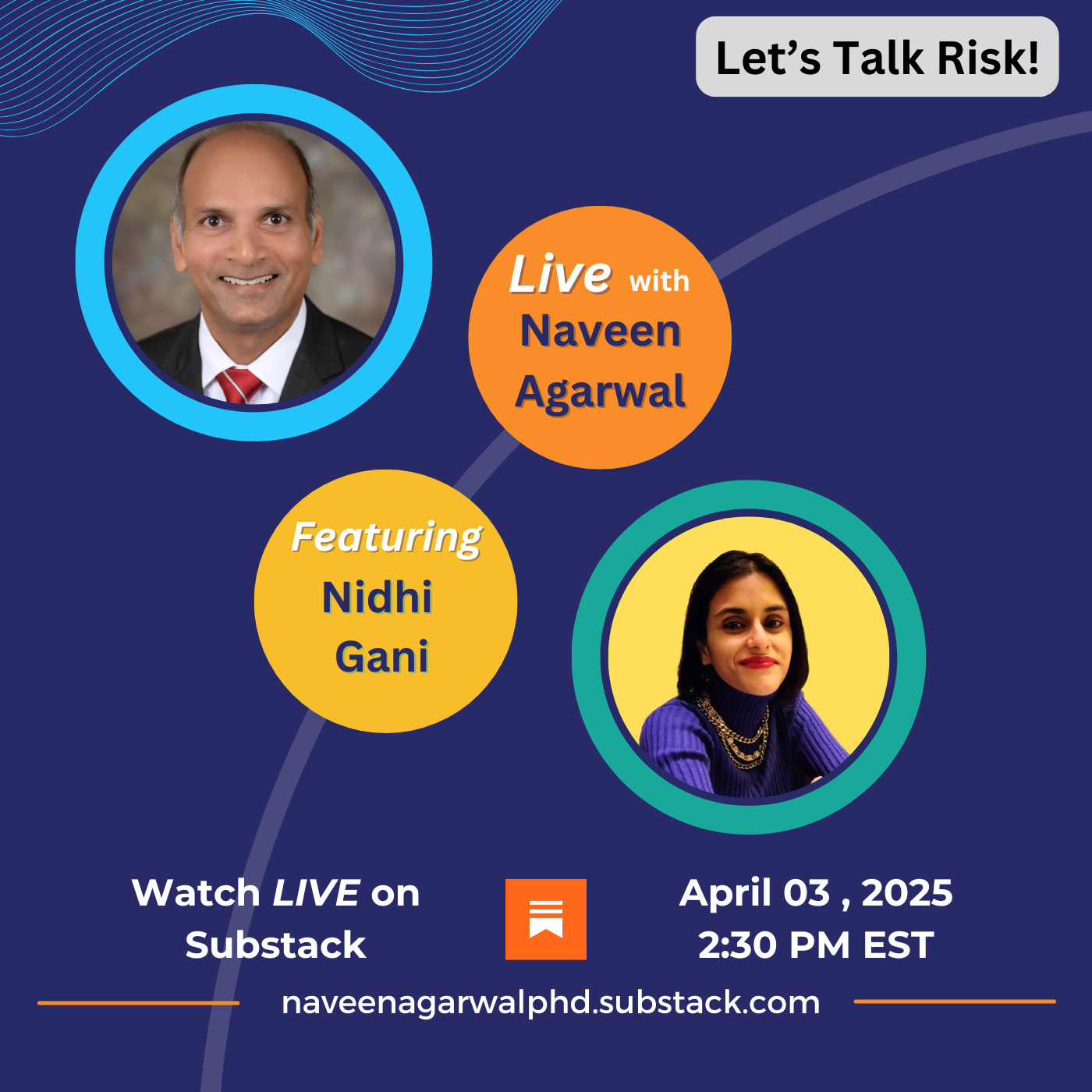
Substack Live: Let’s talk about cyber risk in MedTech!
Hi everyoneHere is the recording of our second Substack Live session. We talked about cybersecurity for medical devices with Nidhi Gani.Our discussion covered the recent Silk Typhoon cyber espionage incident, the implications of cyber attacks on patient safety, and the frameworks for managing cybersecurity risks in healthcare. Nidhi emphasized the shared responsibility of manufacturers and consumers in ensuring the security of medical devices and highlighted the evolving nature of cyber threats, including the role of AI in both attacks and defenses. The conversation concluded with practical takeaways for individuals and organizations to enhance their cybersecurity posture.Here are some of the key points we discussed:* Silk Typhoon is a nation-state actor specializing in cyber espionage.* Cybersecurity threats can directly impact patient safety and healthcare systems.* Vulnerabilities in medical devices can lead to serious health risks.* The importance of post-market surveillance in managing cybersecurity risks.* Manufacturers must take responsibility for the security of their devices.* AI is being used in both cyber attacks and defenses.* Cybersecurity is a culture that needs to be built into organizations.* Consumers should demand secure medical devices for their safety.* The landscape of cybersecurity is ever-evolving, requiring constant vigilance.We will do this again in future. Feel free to suggest topics of interest to you.Join me for my next live video in the app This is a public episode. If you'd like to discuss this with other subscribers or get access to bonus episodes, visit naveenagarwalphd.substack.com/subscribe
LTR 100: What we will need to lead in the age of AI
Summary“If you are not in it, you are already late.” In this episode of the Let's Talk Risk Podcast, Naveen Agarwal and Dr. Juan Daccach discuss the evolving landscape of leadership in the age of AI, particularly within the medical device industry. They explore the challenges of transitioning from clinical practice to corporate leadership, the importance of emotional intelligence, and the need for authenticity in leadership. Dr. Daccach shares insights from his recent Harvard Business Leadership Excellence Program, emphasizing the significance of adaptability and continuous learning. The conversation also addresses the implications of AI on job security, the necessity of maintaining human connections, and the critical role of quality and safety in AI implementation.Listen to the full 30-minute podcast or jump to a section of interest listed below. Chapters00:00 Introducing Dr. Juan Daccach01:30 Transitioning From Clinical to Corporate Leadership03:30 Key Takeaways From Harvard Leadership Program06:03 Growing with AI With Emotional Intelligence10:13 Overcoming Imposter Syndrome Through Authentic Leadership13:10 Nurturing Champions to Accelerate AI Adoption15:25 Clarify the Purpose First, Then Select the Tools (e.g. AI)16:52 Ensuring Safety and Quality in AI Implementation20:26 Championing Innovation and Disruption23:27 Addressing Job Security Concerns with AI27:07 Embracing Emotional Intelligence in Leadership30:28 Becoming Anti-Fragile in a Changing WorldSuggested links:* LTR - AI and the future of work for QA/RA professionals.* LTR: Tips for clinicians transitioning into MedTech.* Taleb: Antifragile - Things that gain from disorder (Talks at Google). Key Takeaways* AI is transforming industries, including medical devices.* Leadership must adapt to the complexities of AI.* Emotional intelligence is essential for effective leadership.* Continuous learning and adaptability are key to success.* Authenticity in leadership fosters trust and collaboration.* AI can enhance efficiency but requires human oversight.* Creating champions for change can drive innovation.* Quality and safety must remain priorities in AI applications.* Navigating job security concerns requires a focus on human value.* The future of leadership involves balancing technology and humanity.KeywordsAI, leadership, medical devices, emotional intelligence, innovation, corporate culture, safety, quality assurance, machine learning, human connectionAbout Dr. Juan DaccachJuan Dacach, MD is currently the Vice President of Product Safety at Merz Aesthetics. Previously he was in various leadership positions in Medical Safety and Medical Affairs at various leading MedTech companies. He specialized in orthopedics, trauma and joint reconstruction during his medical training, residency and fellowship as an MD. As part of his continuing education in the industry, he also acquired certifications in quality, auditing, coaching and leadership communication. DisclaimerInformation and insights presented in this podcast are for educational purposes only. Views expressed by all speakers are their own and do not reflect those of their respective organizations.Let's Talk Risk! is a reader-supported publication. To receive new posts and support my work, consider becoming a free or paid subscriber. This is a public episode. If you'd like to discuss this with other subscribers or get access to bonus episodes, visit naveenagarwalphd.substack.com/subscribe
LTR 99: An exciting growth opportunity for MedTech in India
Summary“85% of the medical devices in India are imported. There is now a strong focus on developing internally but also make healthcare more accessible to the masses.”In this Let’s Talk Risk! conversation, Naveen Agarwal engages with Rajesh Kathuria, a seasoned quality executive, to discuss the rapid growth of the MedTech industry in India and the accompanying regulatory changes. They explore the importance of quality standards, particularly ISO 13485, and how these standards are essential for both domestic and international markets. Rajesh shares insights on the evolving expectations of quality in the industry, the opportunities for quality regulatory professionals, and the importance of continuous learning and collaboration in achieving career growth. The conversation emphasizes the need for a cultural shift in quality assurance roles, moving from a policing mentality to becoming enablers within organizations.Listen to the full 30-minute podcast or jump to a section of interest listed below. Chapters00:00 Introducing Rajesh Kathuria03:15 Growth of the MedTech Industry in India07:55 ISO 13485 Based Regulatory Framework 09:15 How High Expectations Drive Product Quality12:30 Going Beyond ISO 13485 Compliance to Product Quality16:07 Making a Commitment to Quality and Career Growth22:30 Regional and Cultural Differences in Quality Expectations25:05 Final Thoughts and Advice for QA/RA ProfessionalsIf you enjoyed this podcast, consider subscribing to the Let’s Talk Risk! newsletter.Suggested links:LTR: Tips for making customer focused decisions. LTR: Communicate to collaborate, not to impose opinions. ACHIEVE: Post-market surveillance workshop.Key Takeaways* The MedTech industry in India is projected to grow significantly by 2030.* Quality expectations are rising due to increased access to global products.* Regulatory changes are aligning Indian standards with global norms.* Quality assurance professionals must adapt to new challenges and opportunities.* Continuous learning and application of quality tools are essential for career growth.* Cultural differences impact quality expectations across regions.* Collaboration between quality and other departments is crucial for success.* Benchmarking against global standards can drive improvement in quality.* Quality should be viewed as an enabler rather than a policing function.* Networking with experienced professionals can accelerate learning and growth.KeywordsMedTech, India, quality standards, regulatory changes, healthcare, ISO 13485, career growth, quality assurance, Southeast Asia, healthcare accessAbout Rajesh KathuriaRajesh Kathuria is currently the Owner and Director at KMS Solutions, B.V, providing strategic consulting services in Quality and Regulatory for medical device companies. He is a seasoned leader with over 20 years of industry experience in senior leadership positions. He holds a Bachelors degree in Mechanical Engineering and Graduate degree in Management with specialization in International Marketing and Finance. He is also a certified ISO 13485 lead auditor and has extensive experience of auditing/working in various geographies and different global regulations. Let’s Talk Risk! with Dr. Naveen Agarwal is a weekly live audio event on LinkedIn, where we talk about risk management related topics in a casual, informal way. Join us at 11:00 am EST every Friday on LinkedIn.DisclaimerInformation and insights presented in this podcast are for educational purposes only, and not as legal advice. Views expressed by all speakers are their own and do not reflect those of their respective organizations. This is a public episode. If you'd like to discuss this with other subscribers or get access to bonus episodes, visit naveenagarwalphd.substack.com/subscribe
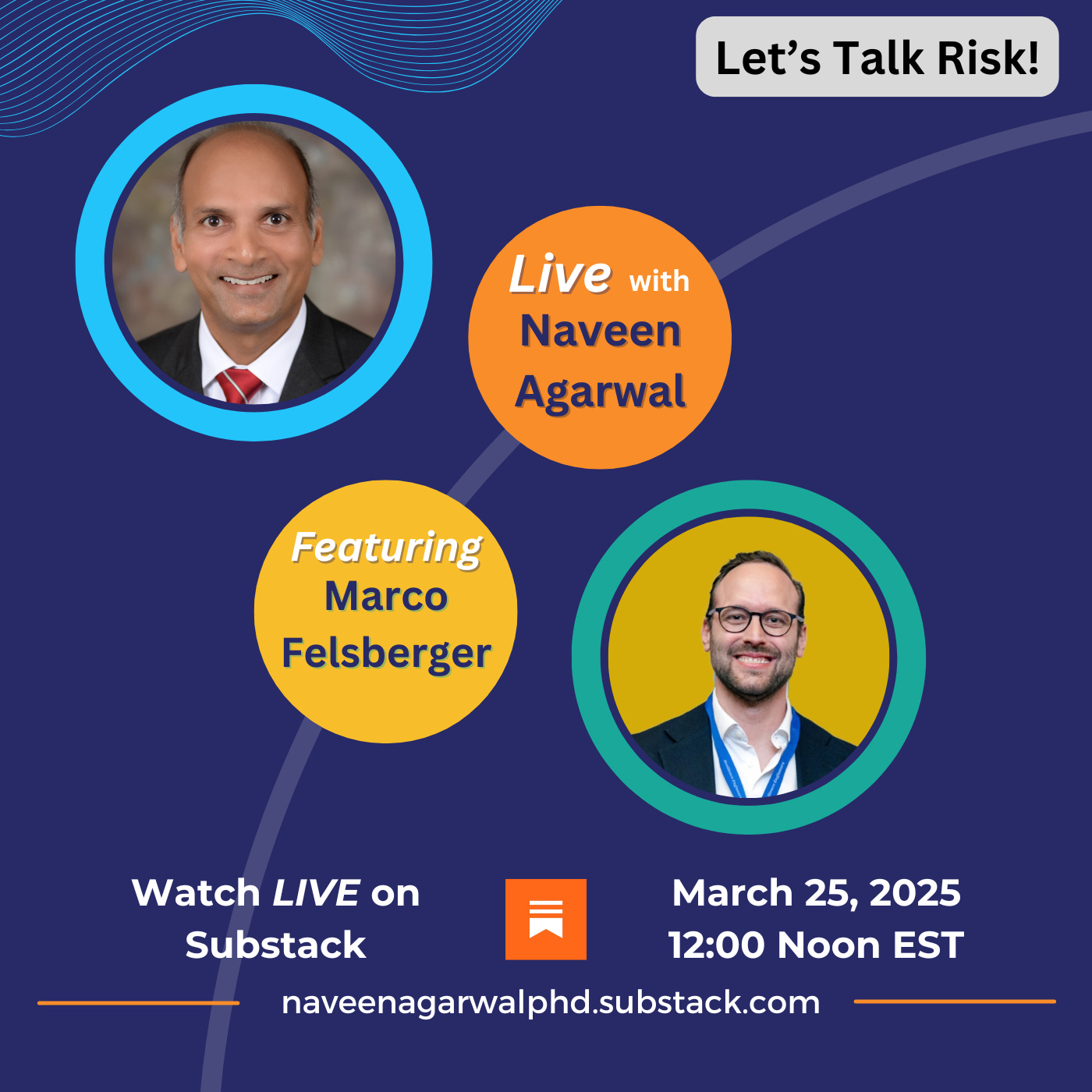
Substack Live: How will tariffs affect pharma and med device supply chains
Hi everyoneHere is the recording of our first Substack Live session. We did have some technical glitches, but it was a lot of fun to talk about the potential impact of tariffs on pharma and medical device supply chains.My guest was Marco who writes about risk and resilience On the Edge of Resilience on his Substack. Please go check it out and subscribe. Here are some of the key points:* Pharma imports into the US could face up to 25% in tariffs. * Tariffs on pharma and med device imports could be more than $60 billion. * The impact of tariffs could lead to increased costs for consumers.* Companies need to build capacity to handle supply chain disruptions.* Investing in resilience should be viewed as a strategic necessity.* The conversation around supply chain costs needs to shift to investment.* Risk management must include both proactive and reactive strategies.* Understanding vulnerabilities in supply chains and mitigating risks is critical.* The medical device industry faces unique challenges in managing costs and risks.We will do this again in future. Feel free to suggest topics of interest to you. Join me for my next live video in the app This is a public episode. If you'd like to discuss this with other subscribers or get access to bonus episodes, visit naveenagarwalphd.substack.com/subscribe
LTR 98: Critical role of medical safety officer in medical devices
Summary“Our true end goal is to be proactive in safety versus reactive. Bring in your medical safety early and often.”How do we figure out why our medical device(s) are failing to perform as intended in the real-world clinical environment? This is where Medical Safety Officers can help us truly understand the root cause(s) during a CAPA investigation. In this Let’s Talk Risk! conversation, host Naveen Agarwal engages with Bettina Brant, Senior Director of Medical Safety at Medtronic, to discuss the critical role of medical safety officers in various processes, including CAPA, risk analysis, product development, and post-market surveillance. The conversation emphasizes the importance of collaboration, proactive safety measures, and the integration of user feedback in the development of medical devices to ensure patient safety.Listen to the full 30-minute podcast or jump to a section of interest listed below. Chapters00:40 Introducing Bettina Brant02:55 Understanding CAPA and the Role of Medical Safety Officers05:47 Investigating CAPA: Insights from Medical Safety09:27 Risk Analysis: Severity Levels and Hazard Identification12:15 Understanding How Users Interact with Medical Devices14:10 Role of Medical Safety Officer in New Product Development16:20 Including Human Factors Engineering Early in Product Development 19:00 Project Management and Early User Involvement20:18 Post-Market Surveillance and Feedback Into Product Development23:44 Key Takeaways and Closing ThoughtsIf you enjoyed this podcast, consider subscribing to the Let’s Talk Risk! newsletter.Suggested links:LTR: A clinician’s insights on risk and collaboration in MedTech. LTR: Tips for improving collaboration in risk management. ACHIEVE: Post-market surveillance workshop.Key Takeaways* Bring your medical safety team in early and often.* The earlier the better to ensure patient safety.* Collaboration with medical safety officers is crucial.* Understanding user experience can prevent issues.* Risk analysis must consider high-risk populations.* Human factors engineering should be prioritized early.* Project managers can facilitate early user involvement.* Post-market surveillance is essential for continuous improvement.* The voice of the patient must be included in all processes.* Failing fast can lead to better product outcomes.KeywordsMedical safety, CAPA, risk management, patient safety, product development, human factors, post-market surveillance, healthcare, quality management, medical devicesAbout Bettina BrantBettina Brant is the Senior Medical Safety Director at Medtronic, where she applies her experience in the Level 1 Trauma center to guide the development of safe and effective medical devices. She is a motivator and a team-builder, with excellent communication and problem-solving skills, that has helped her deliver excellent results with cross-functional leadership in a matrix organization. She is also a member of the Board of Directors of Hot Mess Rescue, a non-profit, women led community supporting women in need. She holds Bachelor’s degree in Nursing and a Master’s in Nursing Administration, Leadership and Management. Let’s Talk Risk! with Dr. Naveen Agarwal is a weekly live audio event on LinkedIn, where we talk about risk management related topics in a casual, informal way. Join us at 11:00 am EST every Friday on LinkedIn.DisclaimerInformation and insights presented in this podcast are for educational purposes only, and not as legal advice. Views expressed by all speakers are their own and do not reflect those of their respective organizations. This is a public episode. If you'd like to discuss this with other subscribers or get access to bonus episodes, visit naveenagarwalphd.substack.com/subscribe
LTR 97: Surviving chaos and uncertainty at the FDA
This is a free preview of a paid episode. To hear more, visit naveenagarwalphd.substack.comSummary“More importantly than ever, a good product development and risk-based approach is going to be critical.” In this episode of the Let's Talk Risk Podcast, Naveen Agarwal and Michael Nilo discuss the current state of the FDA amidst significant staff cuts and organizational chaos. They explore the implications for regulatory affairs professionals, t…
LTR 96: A patient-centric approach to medical device R&D
Summary“Is it good enough for myself as well as my family and the community at large?”How do we keep the patient front and center when making design decisions for a medical device? How can we balance functionality with safety without over-engineering a device that becomes difficult to use and cost-prohibitive? In this Let’s Talk Risk! conversation, Naveen Agarwal explores these questions with Peter Braido, VP of R&D at MediView XR, about his extensive experience in the medical device industry. They talk about the intersection of engineering and patient experience, the challenges of balancing safety and performance in product development, and the importance of cross-functional collaboration. Peter shares personal insights from his journey, including the impact of his own health experiences on his work, and emphasizes the need for soft skills in technical leadership. The discussion also touches on the significance of creating a closed-loop feedback system in medical devices and the innovative concept of biomimicry in engineering.Listen to the full 30-minute podcast or jump to a section of interest listed below. Chapters00:55 Introducing Peter Braido03:12 Focusing on the Patient in Engineering Medical Devices05:22 Balancing Safety and Performance in Medical Device Development08:45 Navigating Trade-offs in Device Longevity and Quality of Life11:13 Fostering Patient Focus and Design Excellence through Mentoring13:53 Managing Competing Requirements: Business vs. User Needs16:50 Building Soft Skills and Nurturing Cross-Functional Collaboration20:14 Creating a Closed Loop Feedback System for Medical Device R&D24:53 Lessons from Nature: Biomimicry in Engineering28:44 Key Takeaways and Closing ThoughtsIf you enjoyed this podcast, consider subscribing to the Let’s Talk Risk! newsletter.Suggested links:LTR: Understanding human factors aspect of AR applications in medical devices. LTR: A fast growing frontier: AR/VR driving innovation in MedTech. ACHIEVE: Post-market surveillance workshop.Key Takeaways* Live your legacy and make an impact.* Quality of life is difficult to quantify.* Perfection is the enemy of goodness.* You cannot do anything on your own.* Always keep the patient first in mind.* Weighing risks and competing requirements is crucial.* Soft skills are as important as technical skills.* We need to align across the board.* Research should solve specific clinical solutions.* Engage with cross-functional teams early and often.KeywordsMedical devices, risk management, patient safety, engineering, innovation, cross-functional collaboration, biomimicry, product development, healthcare technology, leadershipAbout Peter N. BraidoPeter Braido is the VP or R&D at MediView XR, Inc., where he is leading augmented reality enabled innovation for medical applications. He has held various positions in medical device R&D over his 25 year career at many leading MedTech companies. He has worked on next generation transcatheter cardiovascular implants, pulsed field ablation technologies, and XR/AI/Robotics. He holds a Bachelor’s and Master’s degrees in Mechanical Engineering, and various certifications in machine learning for healthcare. Let’s Talk Risk! with Dr. Naveen Agarwal is a weekly live audio event on LinkedIn, where we talk about risk management related topics in a casual, informal way. Join us at 11:00 am EST every Friday on LinkedIn.DisclaimerInformation and insights presented in this podcast are for educational purposes only, and not as legal advice. Views expressed by all speakers are their own and do not reflect those of their respective organizations. This is a public episode. If you'd like to discuss this with other subscribers or get access to bonus episodes, visit naveenagarwalphd.substack.com/subscribe
LTR 95: The case for software risk management in AI-driven home health devices
Summary“If there is a risk in your design for a device used in a hospital setting, you have qualified people there. But at home, there is no more safety net. So (AI) software risk becomes even more important.”In this Let’s Talk Risk! conversation, Erhan Ilhan shares how software is increasingly being used as a medical device in our industry. As a result, we have to pay more attention to software risk management. Software failure will occur, but we need to understand the sequence of events leading to hazardous situations and think of controls to mitigate their impact. In this episode, Naveen Agarwal and Erhan Ilhan discuss the complexities of software risk management in the medical device industry. They explore the differences between software and hardware risks, the importance of usability testing, the challenges of estimating software failure probabilities, and the integration of cybersecurity risks into overall risk management. The discussion also highlights the significance of post-market surveillance and the impact of emerging technologies like AI and ML on medical devices.Listen to the full 30-minute podcast or jump to a section of interest listed below. Chapters01:05 Introducing Erhan Ilhan02:10 Understanding Software Risk vs. Hardware Risk03:12 Understanding Software Failures and Estimating Probability05:20 Potential Effect of Recent Update to IEC 6230406:36 Importance of Post-Market Surveillance in Software Risk Management07:42 Usability Testing and Human Factors in Software Risk Management12:35 Estimating Probability of Software Failure in FMEA18:30 Cybersecurity Risk Management for Software as a Medical Device22:55 AI/ML, GenAI in Medical Devices and Home Health29:42 Final Thoughts and Key TakeawaysIf you enjoyed this podcast, consider subscribing to the Let’s Talk Risk! newsletter.Suggested links:LTR: Tips for medical device software risk analysis. LTR: Cloud computing in MedTech. ACHIEVE: Post-market surveillance workshop.Key Takeaways* Software risk management is essential for patient safety.* Software does not pose direct harm like hardware can.* Assuming a software failure probability of one is incorrect.* Real-world data is crucial for improving software safety.* Usability testing should involve diverse user demographics.* Cybersecurity risks must be assessed alongside safety risks.* Post-market surveillance is vital for ongoing risk management.* AI and ML are transforming the medical device landscape.* Risk control measures should be clearly defined and integrated.* Always prioritize patient safety in software development.KeywordsSoftware risk management, medical devices, usability testing, cybersecurity, post-market surveillance, AI, ML, IEC 62304, ISO 14971, quality assuranceAbout Erhan IlhanErhan Ilhan is the Head of Quality and Regulatory at Circadia Health, where he has been building the company’s Quality Management System (QMS), driving ISO 13485 implementation, and leading the regulatory strategy for Circadia’s software and hardware-based medical devices. His work includes preparing 510(k) submissions, managing FDA interactions, and leading AI/ML-focused pre-submissions to help define the regulatory pathway for Circadia’s AI-driven clinical decision support software.At Circadia, Erhan also leads design quality assurance activities, oversees risk management and cybersecurity compliance, and works closely with cross-functional teams to embed quality into every stage of product development — from design to manufacturing and post-market surveillance.Prior to Circadia, Erhan held various engineering and quality leadership roles at GE Healthcare, Abbott, Danaher, Medtronic, and Glooko. With deep expertise in software development, design controls, verification and validation, design transfer, test method development, production and process controls, risk management, and regulatory submissions, he has contributed to a wide range of medical device and digital health products. His work spans implantable pacemakers and neuromodulation devices, Continuous Glucose Monitoring (CGM) systems, insulin pumps, diabetes management platforms, mobile and web health applications, and cloud-based algorithm engines.Erhan holds a Bachelor’s degree in Industrial and Electrical Engineering and a Master’s degree in Computer Science, blending technical depth with a strong foundation in quality and regulatory compliance.Let’s Talk Risk! with Dr. Naveen Agarwal is a weekly live audio event on LinkedIn, where we talk about risk management related topics in a casual, informal way. Join us at 11:00 am EST every Friday on LinkedIn.DisclaimerInformation and insights presented in this podcast are for educational purposes only, and not as legal advice. Views expressed by all speakers are their own and do not reflect those of their respective organizations. This is a public episode. If you'd like to discuss this with other subscribers or get access to bonus episodes, visit naveenagarwalphd.substack.com/subscribe
LTR 82: Tips for Regulatory Success with AI Devices in Radiology
Summary“Clinicians need to to trust the (AI) algorithm, and knowing how it works helps them understand where it might fail, or where extra attention might be needed.” In this episode of the Let's Talk Risk Podcast, Dr. Jay Vaishnav discusses the rapid growth of artificial intelligence (AI) in the medical technology (MedTech) field, particularly in Radiology. She shares insights from her extensive experience at the FDA and in MedTech, both in roles ranging from scientific to medical affairs and regulatory affairs, emphasizing the importance of understanding the regulatory landscape, navigating benefit-risk assessments, and the challenges of AI model validation. The discussion also covers innovations in triage and notification systems, the future of AI in clinical care, and best practices for regulatory professionals. Dr. Vaishnav highlights the need for transparency in AI development and the importance of involving clinicians early in the process. She concludes with career insights and the value of mentorship in navigating the evolving landscape of MedTech.Listen to the full 30-minute podcast or jump to a section of interest listed below. Chapters00:00 Introducing Dr. Jay Vaishnav01:50 The Rise of AI/ML devices in MedTech04:40 FDA perspective on benefit-risk06:05 Managing risk of clinician over-reliance on AI08:25 Case study: De Novo granted for a triage & notification AI device11:56 Challenges in developing triage & notification AI devices14:00 Current stat and barriers to adoption of AI technologies in healthcare15:35 The need for explainability in AI/ML devices17:16 Future directions for AI/ML in MedTech18:00 Why clinician involvement in AI/ML development is important19:12 Best Practices for QA/RA professionals21:30 Career insights and power of mentoring27:46 Closing commentsSuggested links:* DEN 170073 - ContaCT viz.AI, Inc..* LTR: AI in MedTech. * LTR: Regulating Generative AI.Key Takeaways* AI is growing rapidly in MedTech, especially in radiology applications.* Regulatory considerations are crucial for AI applications.* Benefit-risk assessments are complex and vary by device indication.* Triage applications can significantly improve patient outcomes.* AI models face challenges with false positives and negatives.* Cultural mistrust of AI algorithms can hinder adoption.* Involving clinicians early in AI development is essential.* Transparency about AI limitations is necessary for trust.* The future of AI in healthcare is promising but uncertain.* Career growth opportunities exist for regulatory professionals in AI.KeywordsAI, MedTech, FDA, regulatory affairs, machine learning, healthcare, medical devices, radiology, clinical applications, patient safety.About Jay Vaishnav, Ph.D.Dr. Jay Vaishnav is currently Director of Regulatory Affairs at Canon Medical Informatics, where she leads US regulatory strategy and FDA submissions for Canon's portfolio of Healthcare IT solutions. She holds a Ph.D. from Harvard in theoretical physics, and after some time in academia moved to the FDA, spending over seven years there in positions of increasing responsibility. She eventually joined the medical device industry in Medical Affairs before moving into a Regulatory role.She is a Fellow of the Regulatory Affairs Professional Society, an occasional instructor at UCSC Silicon Valley Extension, and co-editor of the book "From X Rays to AI: Navigating US Regulations in Radiological Health."DisclaimerInformation and insights presented in this podcast are for educational purposes only. Views expressed by all speakers are their own and do not reflect those of their respective organizations.Let's Talk Risk! is a reader-supported publication. To receive new posts and support my work, consider becoming a free or paid subscriber. This is a public episode. If you'd like to discuss this with other subscribers or get access to bonus episodes, visit naveenagarwalphd.substack.com/subscribe
LTR 94: The road ahead for PCCPs and AI/ML amidst chaos at the FDA
This is a free preview of a paid episode. To hear more, visit naveenagarwalphd.substack.comSummary“The Digital Health Center of Excellence was hit pretty heavy, and also AI researchers at OSEL. I am not too worried about PCCP but the impact could be on how quickly FDA can finalize the other draft guidance with larger scope applied to all medical devices.” In this episode of the Let's Talk Risk Podcast, Naveen Agarwal and Yu Zhao discuss the P…
LTR 93: AI use cases in MedTech regulatory applications
Summary“To AI or not to AI is no longer a question.”In this Let’s Talk Risk! conversation, Naveen Agarwal and Michelle Wu discuss the transformative role of AI in the regulatory space, particularly in healthcare and life sciences. They explore key trends observed at the JP Morgan Healthcare Conference, share real-world use cases of AI applications, and address concerns about trust, job security, and privacy in the context of AI adoption. Michelle emphasizes that AI is an enabler rather than a replacement, and highlights the importance of adapting workflows to integrate AI effectively. The discussion concludes with key takeaways on leveraging AI for enhanced productivity and strategic decision-making.Listen to the full 30-minute podcast or jump to a section of interest listed below. Chapters00:00 Introducing Michelle Wu of NyquistAI03:00 Key Trends from the JP Morgan Healthcare Conference06:36 AI Use Cases in Regulatory Applications09:59 Trusting AI in Legal Contexts11:49 AI in Product Development, M&A and Growth14:40 AI's Role in Regulatory Intelligence18:25 Addressing Job Security Concerns with AI22:11 AI in IDE and Early Clinical Phase25:40 Managing Privacy Concerns and IP Protection27:05 Managing Risk of Errors from Hallucination and Data Quality28:40 Announcements, Final Thoughts and Key TakeawaysIf you enjoyed this podcast, consider subscribing to the Let’s Talk Risk! newsletter.Suggested links:LTR: AI and the future of work for QA/RA professionals. LTR: A strategic approach to regulatory success with GenAI devices. LTR: How GenAI is transforming Quality in MedTech.Key Takeaways* AI is an enabler, it's not a replacement.* AI will challenge and shake up our traditional way of work.* The best way to adopt AI is to revamp existing workflows.* Trusting AI is a work in progress.* AI can help optimize resources, save time, and reduce costs.* AI can cut down the time for research and decision-making.* We need multilingual professionals who can communicate AI effectively.* AI will not take away jobs, but those who leverage AI will excel.* Data privacy and security are critical in AI applications.* Experimenting with AI solutions can build confidence and skills.KeywordsAI, regulatory applications, healthcare, Nyquist AI, JP Morgan Healthcare Conference, trust in AI, product development, job security, data privacy, risk managementAbout Michelle WuMichelle Wu is the Co-Founder and CEO of NyquistAI, where her team is building the world’s largest AI-empowered data platform for Life Sciences innovators. She has over 10 years of hands-on experience in connecting real-life business needs with the right technical solutions, as well as a deep understanding of the challenges and opportunities in the life science industry. Previously she launched two other startups and also served as a Strategic Planning and BDL Manager at Novartis. Michelle holds a Bachelor’s degree in Foreign Languages with minor in Economics, and an MBA in Healthcare and Investment. Let’s Talk Risk! with Dr. Naveen Agarwal is a weekly live audio event on LinkedIn, where we talk about risk management related topics in a casual, informal way. Join us at 11:00 am EST every Friday on LinkedIn.DisclaimerInformation and insights presented in this podcast are for educational purposes only, and not as legal advice. Views expressed by all speakers are their own and do not reflect those of their respective organizations. This is a public episode. If you'd like to discuss this with other subscribers or get access to bonus episodes, visit naveenagarwalphd.substack.com/subscribe
LTR 92: Understanding the notified body perspective on clinical evaluation
Summary“When the notified body goes back and asks you (the manufacturer) for more information, they aren’t necessarily saying that whatever you have done is wrong.” Clinical evaluation is a major requirement for medical devices under the EU regulation, and notified bodies must determine whether the evidence provided by the manufacturer is scientifically valid and sufficiently complete to answer the question of safety and effectiveness. However, it is challenging to figure out what the expectations are, and it’s an unfortunate consequence of the way the system is setup. Notified bodies are not allowed to offer any guidance to manufacturers that could be considered consulting. In this episode of the Let's Talk Risk Podcast, Naveen Agarwal and Amie Smirthwaite discuss the complexities of clinical evaluation for medical devices under the EU MDR. They explore the current regulatory landscape in Europe, the role of notified bodies, and the challenges manufacturers face in demonstrating safety and effectiveness. The conversation also delves into the necessity of clinical investigations, the evaluation of software and AI/ML devices, and the implications of ISO standards. Amie shares her career journey and offers valuable advice for aspiring professionals in the QA/RA field, emphasizing the importance of collaboration between engineers and clinicians in risk management.Listen to the full 30-minute podcast or jump to a section of interest listed below. Chapters00:30 Introducing Amie Smirthwaite01:11 The Current Landscape of Medical Device Regulation in Europe04:08 Notified Body Perspective on Clinical Evaluation10:00 Challenges in Clinical Evaluation for Manufacturers13:49 Clinical Investigations: Are They Mandatory Under EU-MDR?21:29 Navigating Software and AI/ML Device Evaluations20:24 Status of ISO 18969 Standard on Clinical Evaluation22:35 Amie’s Career Journey and Insights25:27 Advice for Aspiring QA/RA Professionals27:30 Understanding Clinical Risks and Closing CommentsSuggested links:* LTR - Clinical evaluation is now more important than ever under EU-MDR.* LTR: Clinical evaluation is a lifecycle process, not a one-time activity.* MDCG23-7: Guidance on exemptions from clinical investigations. Key Takeaways* Clinical evaluation is essential for medical devices under EU MDR.* The regulatory environment in Europe has become more stringent.* Notified bodies assess the scientific validity of clinical evidence.* Manufacturers face challenges in understanding regulatory expectations.* Clinical investigations are not always mandatory for all devices.* Software and AI/ML devices have unique evaluation considerations.* ISO standards are evolving to better guide clinical evaluations.* Career paths in QA/RA can be shaped by passion or financial incentives.* Collaboration between engineers and clinicians is crucial for effective risk management.* Clear guidelines from regulators would benefit manufacturers.KeywordsClinical evaluation, medical devices, EU MDR, notified bodies, regulatory challenges, clinical investigations, software devices, ISO standards, career advice, risk managementAbout Amie SmirthwaiteAmie Smirthwaite is leading expert in clinical evidence, with over 30 years’ postdoctoral experience in medical devices spanning new product development, quality and regulatory systems, and clinical evidence. She has been involved in the development of numerous MDCG and other clinical evaluation guidance documents and has served on multiple advisory board positions, including CORE-MD, HEU-EFS, NORE, and ICEPS, amongst others. She is an active participant in several ISO committees and created the original draft of ISO 18969, which recently advanced to CD stage. She currently works as an independent consultant advising on clinical and regulatory affairs, but previously worked for BSI, where she was Global Head of Clinical Compliance. Amie was BSI’s first Head of Clinical Compliance, building their clinical compliance team and leading the development of their clinical evaluation processes, leading to BSI’s successful designation as the first notified body under EU MDR. She also developed extensive training materials while at BSI, including clinical evaluation, technical documentation, risk management, ISO 13485, EU MDR, and biological evaluation. Amie is a Fellow of the Regulatory Affairs Professional Society.DisclaimerInformation and insights presented in this podcast are for educational purposes only. Views expressed by all speakers are their own and do not reflect those of their respective organizations.Let's Talk Risk! is a reader-supported publication. To receive new posts and support my work, consider becoming a free or paid subscriber. This is a public episode. If you'd like to discuss this with other subscribers or get access to bonus episodes, visit naveenagarwalphd.substack.com/subscribe
LTR 91: International conference on medical device safety risk management
Summary“People who were passionate about this subject (safety risk management) and were enthusiastic about it, we got together and said ‘let’s just create a conference for MedTech’, and we did.”In this Let’s Talk Risk! conversation, Naveen Agarwal interviews Bijan Elahi, a leading authority in safety risk management of medical devices. They discuss the upcoming International Safety Risk Management Conference in Amsterdam, focusing on its significance, key speakers, and topics such as AI, cybersecurity, and post-market risk management. The conversation highlights the importance of networking, collaboration, and continuous learning in the medical device industry.Listen to the full 30-minute podcast or jump to a section of interest listed below. Chapters00:00 Introduction to the Conference and Guest02:57 Overview of the International Safety Risk Management Conference05:53 Keynote Speakers and Topics09:08 AI and Cybersecurity in Medical Devices11:50 Post-Market Risk Management Challenges15:09 Global Regulatory Perspectives17:57 Designing Safety into Medical Devices20:49 Networking and Collaboration Opportunities23:58 Closing Remarks and Key TakeawaysIf you enjoyed this podcast, consider subscribing to the Let’s Talk Risk! newsletter.Suggested links:* International conference on medical device safety risk management.* LTR: Key themes in risk management and an upcoming conference. Key Takeaways* The International Safety Risk Management Conference is a unique event focused on medical devices.* The conference will feature keynotes from FDA representatives and industry experts.* AI and cybersecurity are critical topics in medical device safety.* Post-market risk management presents significant challenges for the industry.* Networking opportunities at the conference can enhance professional growth.* Designing safety into medical devices from the start is essential.* The medical device industry is still evolving compared to other sectors like aerospace.* Collaboration among industry professionals can lead to better risk management practices.* The conference will offer both in-person and online participation options.* Early bird registration is available for attendees.KeywordsSafety risk management, medical devices, conference, AI, cybersecurity, post-market, regulatory, design, networking, collaborationAbout Bijan ElahiBijan Elahi is the founder of MedTech Safety and a globally recognized expert on safety risk management of medical devices. Bijan is a technical fellow, and an affiliate professor at Drexel University, USA. Bijan is also a lecturer at Eindhoven University of Technology in the Netherlands, where he teaches risk management to doctoral students in engineering. He is a frequently invited speaker at international professional conferences, and is also a contributor to ISO 14971, the international standard on the application of risk management to medical devices. He has trained over 10,000 people worldwide and his book Safety Risk Management of Medical Devices, now in its second edition, is a bestseller.Let’s Talk Risk! with Dr. Naveen Agarwal is a weekly live audio event on LinkedIn, where we talk about risk management related topics in a casual, informal way. Join us at 11:00 am EST every Friday on LinkedIn.DisclaimerInformation and insights presented in this podcast are for educational purposes only, and not as legal advice. Views expressed by all speakers are their own and do not reflect those of their respective organizations. This is a public episode. If you'd like to discuss this with other subscribers or get access to bonus episodes, visit naveenagarwalphd.substack.com/subscribe
LTR 90: Lead with empathy to grow your Quality career
Summary“As a Quality leader, you need to be empathetic to other departments that are impacted by whatever change(s) you are making.”In this Let’s Talk Risk! conversation, Naveen Agarwal and Amit Tyagi explore the intersection of quality management and career growth. Amit shares insights from his extensive experience in quality engineering, emphasizing the importance of innovative thinking, risk management, and effective CAPA processes. They discuss the challenges of navigating change in quality practices and the human element of leadership. Amit also provides valuable career coaching tips for entry-level professionals, highlighting the significance of networking and showcasing relevant skills. The conversation concludes with key takeaways on the importance of quality as a driver for business success and personal career development.Listen to the full 30-minute podcast or jump to a section of interest listed below. Chapters00:00:05 Introducing Amit Tyagi00:04:10 Why Quality is more than a paper exercise00:06:45 Understanding CAPA: correction vs. corrective action00:11:27 Leading change to improve and sustain Quality00:15:02 Growing your career as a Quality leader00:20:05 Bridging the gap from the WHAT to the HOW00:23:30 Career tips for early stage Quality professionals00:29:26 Closing comments and key takeawaysIf you enjoyed this podcast, consider subscribing to the Let’s Talk Risk! newsletter.Suggested links:LTR: Why risk practitioners must build the empathy muscle. LTR: Communicate to facilitate collaboration, not impose opinions. Career Grow System: A CareerLaunch program with Amit Tyagi.Key Takeaways* Quality should not be seen as just a paperwork exercise.* Effective CAPA processes are crucial for long-term success.* Networking is essential for career growth.* Quality leaders must facilitate change and guide teams.* Understanding the human element is key in quality leadership.* Tools like the 5 Whys can help in root cause analysis.* Communicating value is vital during interviews.* Entry-level professionals should focus on relevant experiences.* Continuous improvement should be a goal for quality management.* Quality impacts not just compliance but also business success.KeywordsQuality management, career growth, risk management, CAPA, quality leadership, engineering, professional development, networking, quality tools, career coachingAbout Amit TyagiAmit Tyagi is currently a Senior Director, Quality Engineering at Abzena. He is also a professional career coach committed committed to helping QA/RA professionals to new heights. With 18 years of experience in empowering individuals across industries, he fine-tuned the art of turning ambitions into accomplishments. His prior industry experience include leadership roles in various pharmaceutical and medical device companies. He holds a Bachelor and Master degrees in Biomedical Engineering, and a Certified Quality Engineer certification from ASQ. Let’s Talk Risk! with Dr. Naveen Agarwal is a weekly live audio event on LinkedIn, where we talk about risk management related topics in a casual, informal way. Join us at 11:00 am EST every Friday on LinkedIn.DisclaimerInformation and insights presented in this podcast are for educational purposes only, and not as legal advice. Views expressed by all speakers are their own and do not reflect those of their respective organizations. This is a public episode. If you'd like to discuss this with other subscribers or get access to bonus episodes, visit naveenagarwalphd.substack.com/subscribe
LTR 89: Navigating uncertain times at the FDA
This is a free preview of a paid episode. To hear more, visit naveenagarwalphd.substack.comSummary“For the foreseeable future, core FDA practices such a reviewing submissions and post-market oversight are going to continue. Smart Money says FDA in 6 months or an year from now, as to these core responsibilities, is operating similarly to FDA of mid-2024.” Yes, there is a lot of uncertainty due to the current political environment in the USA, a…
LTR 88: Decoding Privacy Laws in Clinical Research
Summary“The root cause of most privacy missteps is a lack of education, training and understanding of what the privacy rule actually is.”In this Let’s Talk Risk! conversation, Naveen Agarwal and Edye Edens delve into the critical intersection of privacy laws and clinical trials. They explore the significance of privacy regulations like HIPAA and GDPR, the implications of proposed changes to HIPAA, and the role of AI in enhancing compliance and efficiency in clinical research. Edye shares real-world examples of privacy violations and emphasizes the importance of ongoing education and risk management in navigating the complex landscape of healthcare privacy.Listen to the full 30-minute podcast or jump to a section of interest listed below. Chapters00:00:05 Introduction00:02:12 Why privacy of patient information is important00:04:57 Brief history of HIPAA regulation in the United States00:08:03 Surprising fact: Clinical trial data is not Protected Health Information (PHI)00:10:10 Brief overview of GDPR in EU00:12:20 When to seek legal input during risk analysis00:15:48 Implications of HHS proposed HIPAA security rules for clinical trials00:19:16 Best practices for privacy law compliance00:23:30 Application of AI in clinical trials space00:26:43 Areal-world example of privacy non-compliance and liability00:30:30 Closing comments and key takeawaysIf you enjoyed this podcast, consider subscribing to the Let’s Talk Risk! newsletter.Suggested links:LTR: Clinical evaluation is a lifecycle process, not a one time activity. LTR: Clinical evaluation under EU-MDR. Key Takeaways* Privacy laws are essential for protecting patient data.* HIPAA allows patients to own their medical records.* GDPR covers a broader scope of personal data than HIPAA.* Understanding state laws is crucial for compliance.* Risk identification is key to managing privacy concerns.* AI can streamline regulatory processes in clinical trials.* Education and training are vital to prevent privacy violations.* Data breaches can lead to significant financial penalties.* The sharing of clinical trial data must be managed carefully.* Continued education helps organizations stay compliant.KeywordsPrivacy laws, clinical trials, HIPAA, GDPR, risk management, data protection, healthcare compliance, regulatory frameworks, AI in research, patient privacyAbout Edye EdensEdye Edens is a seasoned legal and compliance professional specializing in clinical research and life sciences. With a Juris Doctor from Indiana University Robert H. McKinney School of Law and a Master’s in International Research Ethics, she brings over 15 years of experience in research compliance, regulatory operations, and clinical trial oversight. Her expertise spans clinical trial compliance, privacy law (HIPAA, GDPR), and research operations, with a focus on oncology and scaling HRPP and site-specific operational needs. Edye’s background includes leadership roles at Indiana University and First Class Solutions, where she served as an adjunct professor, research administrator, and a research business development leader. She currently acts as Senior Attorney for the Kulkarni Law Firm where she advises AMCs, sponsors, CROs, and research sites.Let’s Talk Risk! with Dr. Naveen Agarwal is a weekly live audio event on LinkedIn, where we talk about risk management related topics in a casual, informal way. Join us at 11:00 am EST every Friday on LinkedIn.DisclaimerInformation and insights presented in this podcast are for educational purposes only, and not as legal advice. Views expressed by all speakers are their own and do not reflect those of their respective organizations. This is a public episode. If you'd like to discuss this with other subscribers or get access to bonus episodes, visit naveenagarwalphd.substack.com/subscribe
LTR 87: A Strategic Approach to Regulatory Success with GenAI Devices
This is a free preview of a paid episode. To hear more, visit naveenagarwalphd.substack.comSummary“You can definitely use (GenAI) as your core algorithm, but you need to enforce that it can only do one specific thing or at least a very clarified labeling. ” In this episode of the Let's Talk Risk Podcast, host Naveen Agarwal engages with Dr. Yujan Shrestha to explore the rapid advancements of AI and ML in the medical device industry. They dis…
LTR 86: Managing Post-Market Design Changes
This is a free preview of a paid episode. To hear more, visit naveenagarwalphd.substack.comSummary“Mismatched design controls can feel like driving through two feet of mud. You will eventually get to your destination, but it will take a lot more time and effort than it really should. ” In this episode of the Let's Talk Risk Podcast, Naveen Agarwal and Aaron Joseph discuss the ongoing challenges of design controls in medical devices, particula…
LTR 85: The problem with CAPA problem statements
“If you frame something in a certain way, you can influence the perception of its cause and the solution. ”In this Let’s Talk Risk! conversation, Jack Garvey cautions against starting a CAPA with a problem statement first. Rather, he recommends the analysis to initially begin from a factual review of both technical and situational context leading up to a CAPA, and then defining a specific problem statement appropriately to guide the subsequent investigation of root cause(s) and identification of corrective/preventive actions.Starting with a problem statement, as required by many of the current computer-based tools, leads to bias that can influence the perception of causes and potential solution. Conformity bias, subjectivity, and over-generalization Listen to this Let’s Talk Risk! conversation with Jack Garvey, we cover a range of topics related to CAPA and risk analysis. Jump to a topic of interest using the timestamps below. 00:01:02 Introduction00:02:35 A quick recap of top issues in FDA inspections00:05:50 Why not to start your CAPA with a problem statement00:10:00 How to conduct good investigations in CAPA00:17:00 Analyzing risks in a relative context and diversity of risk flow00:24:10 Why training is necessary for appropriate use of FMEAs for risk analysis00:29:10 Closing comments and key takeawaysIf you enjoyed this podcast, consider subscribing to the Let’s Talk Risk! newsletter.Suggested links:LTR: 5 blind spots to check in your CAPA process. LTR: A risk-based approach to CAPA. Compliance Architects: Writing for compliance. About Jack GarveyJack Garvey is currently the managing partner at Compliance Architects, LLC providing services in compliance and quality consulting, outsourcing, staff augmentation technology-related services to companies regulated by the US FDA. In a career spanning over 30 years, he has held a variety of roles ranging from engineering to regulatory attorney, and leadership roles in Quality and Regulatory functions. Jack holds a Bachelor’s degree in Chemical Engineering, and Juris Doctor in Environmental Law. He has been admitted to practice law in NY and NJ since 1991. Let’s Talk Risk! with Dr. Naveen Agarwal is a weekly live audio event on LinkedIn, where we talk about risk management related topics in a casual, informal way. Join us at 11:00 am EST every Friday on LinkedIn.DisclaimerInformation and insights presented in this podcast are for educational purposes only. Views expressed by all speakers are their own and do not reflect those of their respective organizations. This is a public episode. If you'd like to discuss this with other subscribers or get access to bonus episodes, visit naveenagarwalphd.substack.com/subscribe
LTR 84: Think of human factors for AI as levels of automation
“Many of the AI/ML devices are going through De Novo and (in these) human factors considerations are specifically being called out as special controls.”In this Let’s Talk Risk! conversation, Shannon Hoste highlights some of the new concerns emerging for human factor considerations for AI/ML devices in MedTech. She explains how we could consider the level of automation as we think about new hazards related to the user interface. For example, in a clinical decision support system, having appropriate levels of trust with the physician is important. Shannon emphasizes the need for transparency and explainability of AI models, and highlights the potential for over-reliance as a reasonably foreseeably misuse by physicians. FDA is increasingly looking for human factors studies as part of De Novo submissions of novel AI/ML applications. Listen to this Let’s Talk Risk! conversation with Shannon Hoste, which also includes an open discussion with a live audience. Jump to a section of interest using these timestamps. 00:01:35 Introduction00:03:00 Understanding human factors in AI as levels of automation00:07:30 Two useful guidance documents for human factors in AI00:09:23 Current state of AI/ML devices in MedTech00:11:07 FDA questions/concerns related to human factors in AI/ML00:14:40 Handling reasonably foreseeable misuse for AI/ML devices 00:16:10 Open discussion and audience Q&A00:31:20 Closing comments and key takeawaysIf you enjoyed this podcast, consider subscribing to the Let’s Talk Risk! newsletter.Suggested links:FDA: Clinical Decision Support Software, Final Guidance issued Sep 2022. FDA: Technical Considerations for Medical Devices with Physiologic Closed-Loop Control Technology, Final Guidance issued Sep 2023. LTR: Treat human factors as a driver of customer satisfaction.About Shannon HosteShannon Hoste is currently the Chief Scientific Offer at Pathway for Patient Health, where she is actively creating and sharing knowledge to drive innovation in MedTech. In a career spanning over 25 years, Shannon has served in a variety of roles, including a Human Factors Team Lead at the US FDA. Her extensive experience includes engineering and product development roles, as well as continuing to consult in human factors engineering through Kymanox. She holds a Bachelor’s degree in Mechanical Engineering, and Graduate degrees in Management and Cognitive Systems Engineering, and is currently working on a Graduate Certificate in Epidemiology. Let’s Talk Risk! with Dr. Naveen Agarwal is a weekly live audio event on LinkedIn, where we talk about risk management related topics in a casual, informal way. Join us at 11:00 am EST every Friday on LinkedIn.DisclaimerInformation and insights presented in this podcast are for educational purposes only. Views expressed by all speakers are their own and do not reflect those of their respective organizations. This is a public episode. If you'd like to discuss this with other subscribers or get access to bonus episodes, visit naveenagarwalphd.substack.com/subscribe