
Let's Talk Micro
256 episodes — Page 5 of 6
S2 Ep 5555: Michigan Tech University-MLS Summer Youth Program
This episode features an interview with Claire Danielson and Sarah LewAllen form the Medical Laboratory Sciences Program at Michigan Tech University (MTU). They discuss an initiative that has been in place for quite some time: the Summer Youth Program. This program brings awareness to the Medical Lab Science profession by teaching high school students about the laboratory.
S1 Ep 54Episode 54: VRE tests and media
In this episode I go two types of media and one PCR test used for the detection of Vancomycin Resistant Enterococcus (VRE). What is this media composed of? How does it detect VRE? What about this PCR test? What is it looking for? Tune in to find out.
S1 Ep 53Episode 53: Enterococcus species
In this episode I go over Enterococcus species. What are the most clinically significant species of Enterococcus? Morphology? Biochemicals? Tune in to find out more about these organisms, and why are they so significant in healthcare settings.
S1 Ep 52Episode 52: Tips and suggestions in Microbiology part two
In this episode I continue going over tips and suggestions you can use when you don't have supplies or are having difficulty isolating an organism. What if you are out of PEA or CNA? Will Lim broth help? What else can you use Martin Lewis and Modified Thayer Martin for ? How do susceptibilities help you isolate an organism? Tune in to find out.
S1 Ep 51Episode 51: Tips and suggestions in Microbiology
In the laboratory we have all experienced a shortage of supplies. We have also struggled to isolate and organism. What do we do when this happens? What if you are trying to isolate a gram positive cocci but there is no PEA or CNA? What if you need to isolate a Pseudomonas aeruginosa from a mixed culture? Tune in to this episode to find out.
S1 Ep 50Episode 50: Lights, Camera… Lab! Dr. Alan Wu's Vision
This episode features an interview with Dr. Alan Wu, Professor of Laboratory Medicine at the University of California, San Francisco, and co-Laboratory Director at Zuckerberg San Francisco General Hospital. Dr. Wu has made numerous contributions to the laboratory field—and now he's bringing the lab to television. He's working on a show designed to accurately depict the clinical laboratory and highlight the essential role laboratorians play in patient care. 🎬 Tune in to hear more about Dr. Wu's project, his vision for the show, and why it matters for the future of laboratory medicine. Read more about the show here: UCSF article Check out the website: https://www.letstalkmicro.com/ Questions? Feedback? Send those to [email protected] Want to support the podcast? Here's how: Venmo: https://venmo.com/u/letstalkmicro Buy me a Ko-fi: https://ko-fi.com/letstalkmicro
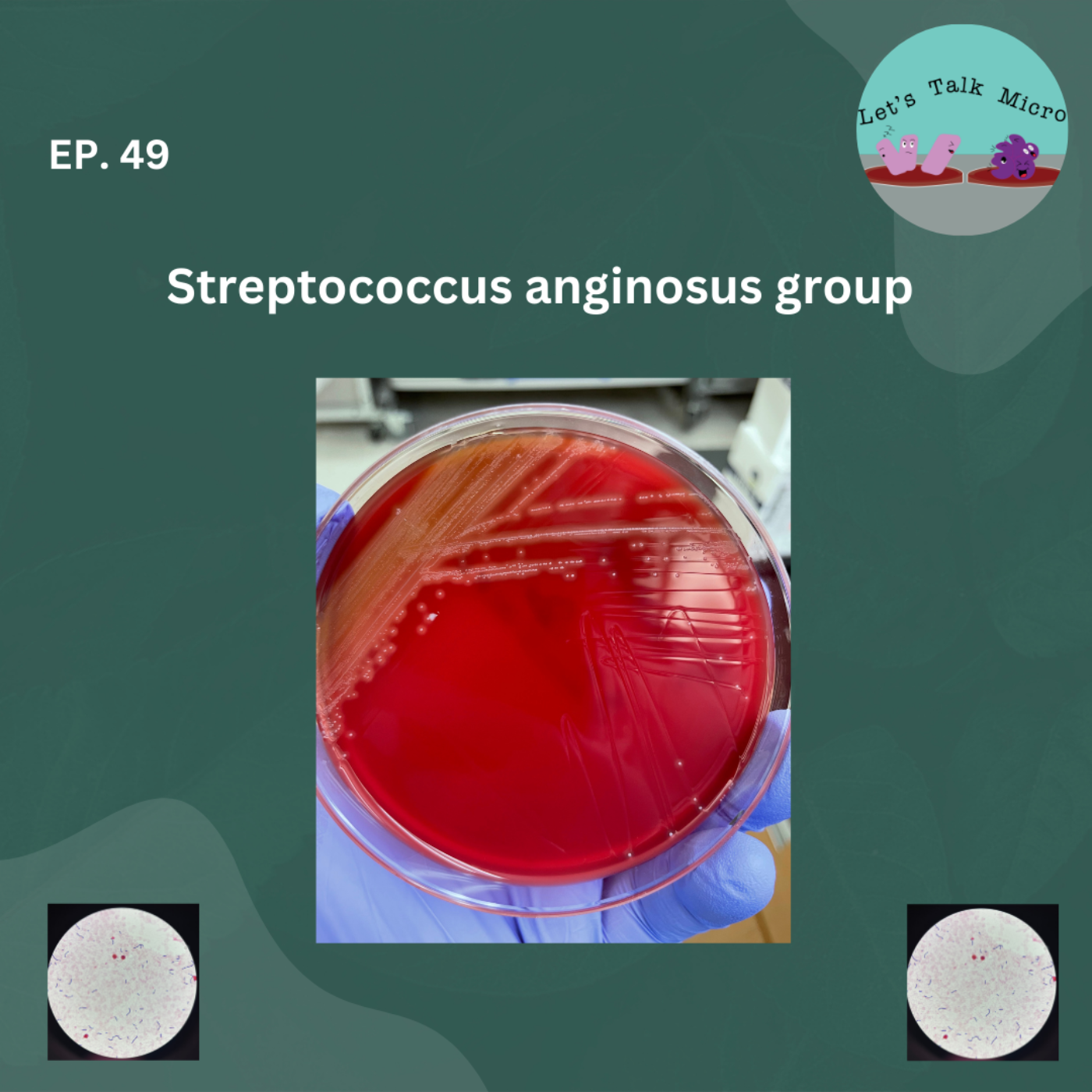
S1 Ep 49Episode 49: Streptococcus anginosus group
In this episode I continue going over beta hemolytic strep: this time Streptococcus anginosus group. What are the species that compose this group? What is the Lancefield group? What about biochemicals and morphology? Tune in to find out. Questions? Feedback? Send those to [email protected] Want to support the podcast? Here's how: Venmo: https://venmo.com/u/letstalkmicro Buy me a Ko-fi: https://ko-fi.com/letstalkmicro
S1 Ep 48Episode 48: Talking monkeypox with Dr. Rodney Rohde
This is a special edition episode. In lieu of all the recent information about monkeypox, Dr. Rodney Rohde comes to the podcast to provide us with some information about this virus. Dr. Rohde is an experienced microbiologist and educator. He is program chair and professor in the Clinical Laboratory Science program at Texas State University. Tune in to learn about monkeypox, including signs, symptoms, treatment options, and outbreak information. Dr Rhode's most recent publication: https://theconversation.com/what-is-monkeypox-a-microbiologist-explains-whats-known-about-this-smallpox-cousin-183499

S1 Ep 47Episode 47: Streptococcus dysgalactiae
This week I continue going over beta hemolytic strep: this time Streptococcus dysgalactiae. What Lancefield group is it? What about media, biochemicals and pathogenicity? Tune in to find out the answers.
S1 Ep 46Episode 46: University of Utah MLS- Summer Immersion Program
This episode features an interview with Dr. Lacy Moss, a professor at the University of Utah Medical Laboratory Sciences program. She joins the podcast to discuss an initiative launched by the MLS program and the University: the Summer Immersion Program. In this program high school students will learn about laboratory medicine. How does it work? How does it help the Medical Laboratory Sciences profession? Tune in to find out. Link to article: https://medicine.utah.edu/pathology/medical-laboratory-science/news/med-lab-sci-summer-immersion-program.php
S1 Ep 45Episode 45: Talking Breakpoints with Dr. Andrea Prinzi
This episode features an interview with Dr. Andrea Prinzi, an infectious disease medical science liaison and a contributor of many articles published in the American Society for Microbiology website. She comes to Let's Talk Micro to talk about antimicrobial susceptibility testing and breakpoints. Many laboratories are or have been using outdated breakpoints? What is the significance of this? How are breakpoints updated? Tune in to this episode to find out and check out Dr. Prinzi's article on the subject. Link to article: https://asm.org/Articles/2022/February/Updating-Breakpoints-in-Antimicrobial-Susceptibili
S1 Ep 44Episode 44: Talking BacterioSight and urine cultures with Dr. Rhoads
What is BacterioSight? As automation becomes a larger part of Laboratory Medicine, how could it help with urine cultures? This episode features an interview with Dr. Daniel Rhoads from the Cleveland Clinic in Ohio. Dr. Rhoades talks about BacterioSight, a deep learning model that was used to interpret images from urine cultures. Other areas of the laboratory already have systems where some results autofile. What if this could be applied to cultures in Microbiology? Tune in to this episode to find out more about BacterioSight and its potential applications. Link to article: https://academic.oup.com/clinchem/article-abstract/68/4/574/6520601?redirectedFrom=fulltext
S1 Ep 43Episode 43: The Microbe Moment talks micro with me
This episode features a collaboration between two Microbiology podcasts: The Microbe Moment and Let's Talk Micro. On this episode I am the one being interviewed. Find out what is like being a Medical Laboratory Scientist (MLS) in Microbiology and what teaching is like. What does an MLS do? What are the responsibilities of a supervisor? What about teaching? Find out by listening to this episode.
S1 Ep 42Episode 42: Talking HIV with Dr. Hsu
This week on Let's Talk Micro, we're tackling a remarkable story in virology—the human immunodeficiency virus (HIV) and a patient who may have been cured. Dr. Jingmei Hsu, a stem cell specialist from Weill Cornell Medical College, joins the podcast to break down a fascinating case involving a cord blood stem cell transplant. What's the role of the CCR5 gene in HIV resistance? Don't miss this compelling conversation. Link to article: https://news.weill.cornell.edu/news/2022/02/patient-possibly-cured-of-hiv-infection-by-special-stem-cell-transplant Check out the website: https://www.letstalkmicro.com/ Questions? Feedback? Send those to [email protected] Want to support the podcast? Here's how: Venmo: https://venmo.com/u/letstalkmicro Buy me a Ko-fi: https://ko-fi.com/letstalkmicro
S1 Ep 41Episode 41: Talking Neisseria with Charlene Kahler
This episode features an interview with Dr. Charlene Kahler from the Marshall Centre for Infectious Diseases Research and Training at the University of Western Australia. She discusses and article titled "Neisseria species and their complicated relationships with human health". Tune in to this episode to find out more information about different species of Neisseria and their significance in the human body. Link to article: https://www.publish.csiro.au/ma/fulltext/ma21024
S1 Ep 40Episode 40: Stenotrophomonas maltophilia and automated susceptibility testing
This episodes features an interview with Dr. Ayesha Khan, one of the authors of a study performed on automated susceptibility testing on S. maltophilia. Three systems were evaluated. How did they perform? Stenotrophomonas maltophilia is a very significant organism that has a high level of intrinsic antibiotic resistance. What are the challenges with breakpoints? Tune in to find out.
S1 Ep 39Episode 39: Talking disk diffusion performed on early growth
This episode features an interview with Dr. Carey-Ann Burnham, Dr. Daniel Webber and Meghan Wallace from Washington University in St. Louis. They are the authors of a study where disk diffusion testing was performed on isolates that had an incubation time of 6 hours. One of the challenges in Microbiology is time. In Microbiology organisms are incubated for 18 to 24 hours, Tune in to this episode to find out the results of this study. Link to article is attached.
S1 Ep 38Episode 38: Staphylococcus singaporensis
In January there was an episode about Staphylococcus argenteus, a member of the S. aureus complex. This episode features an interview about a new member of the Staphylococcus aureus complex: Staphylococcus singaporensis. Dr . Jeanette Teo joins the podcast to discuss her study about this organism. How similar is S. singaporensis to S. aureus? Any virulence factors? Tune in to find out.
S1 Ep 37Episode 37: GBS testing
What is Todd Hewitt broth? Is it the same as LIM broth? What's in it? In this episode I go over Todd Hewitt Broth, and two PCR tests used for the detection of S. agalactiae (GBS).
S1 Ep 36Episode 36: Streptococcus agalactiae
In this episode I continue going over species of Streptococcus. This week's episode is about Streptococcus agalactiae. What is the Lancefield group of this Strep species? Is it pathogenic?. Tune in to this episode to find the answer to these questions and more.
S1 Ep 35Episode 35: Talking Wohlfahrtiimonas chitiniclastica
Wohlfahrtiimonas what? Have you heard about this organism? It is a gram negative rod and it is very unusual. In this episode Dr. Paul Luethy from the University of Maryland School of Medicine comes to the podcast to discuss a case regarding this organism. How is it identified? Does it grow on standard media? What about susceptibilities? Tune in to this episode to find out. The case was published in the Emergent Infectious Diseases journal from the CDC . Link: https://wwwnc.cdc.gov/eid/article/27/12/21-0327_article
S1 Ep 34Episode 34: Group A Strep Testing
In this episode I go over three tests used for the detection of S. pyogenes: two antigen based and one PCR. What are the advantages and disadvantages of each one? Do negative results need to be confirmed by a culture? Tune in to find out.
S1 Ep 33Episode 33: Streptococcus pyogenes
After going over Staph and other gram positive cocci (gpc) in clusters, now is the turn for gram positive cocci in chains. This week's episode is about S. pyogenes or Group A Strep (GAS). What is the clinical significance of GAS? How do we identify it in the lab?. Tune in to this episode to find the answers to these questions and more.
S1 Ep 32Episode 32: Talking Lab with Xander and Maria
This episode goes beyond Microbiology. It is about Medical Laboratory Sciences. In the episode I talk to Xander Fernandes and Maria Roussakis, two Medical Laboratory Technologists from Ontario, Canada. They talk about their website, medlabscholar.com, which contains great resources for Medical Laboratory Science students and professionals. What can we do to bring more awareness to this profession? Tune in to find out.
S1 Ep 31Episode 31: CNS, Micrococcus and Aerococcus
In this week's episode I continue going over Coagulase negative Staph. I also go over other gram positive cocci in clusters such as Micrococcus and Aerococcus. Are these pathogenic? How do we identify them in the lab? Tune in to find out.
S1 Ep 30Episode 30: Coagulase Negative Staph
In this episode I go over Coagulase Negative Staphylococcus or CNS. Are they pathogenic or normal flora? Do we identify them or is a presumptive identification enough? Tune in to this episode to find out.
S1 Ep 29Episode 29: Talking Staphylococcus argenteus
This episode features an interview with Dr. Robin Patel and Dr. Audrey Schuetz to discuss an article titled "Phenotypic and Genomic Profiling of Staphylococcus argenteus in Canada and the United States and Recommendations for Clinical Result Reporting". They are Co-Directors of the Bacteriology Laboratory at the Mayo Clinic in Minnesota. Challenges in identifying this organism are discussed. Staphylococcus argenteus is part of the Staphylococcus aureus complex, and is very similar to S. aureus, including morphology, biochemicals and clinical manifestations. See links for the article.
S1 Ep 28Episode 28: Chromogenic agar for MRSA and more
This the last episode of 2021. What is chromogenic agar? In this episode I go over chromogenic agar used to detect MRSA. I also talk about Mannitol salt agar and how it aids in the isolation of Staphylococcus aureus.
S1 Ep 27Episode 27: Staphylococcus aureus, biochemicals and MRSA
On this episode I go over how to identify Staphylococcus aureus from a standard set of agar plates. I also go over a test used to determine if this organism is an MRSA or not.
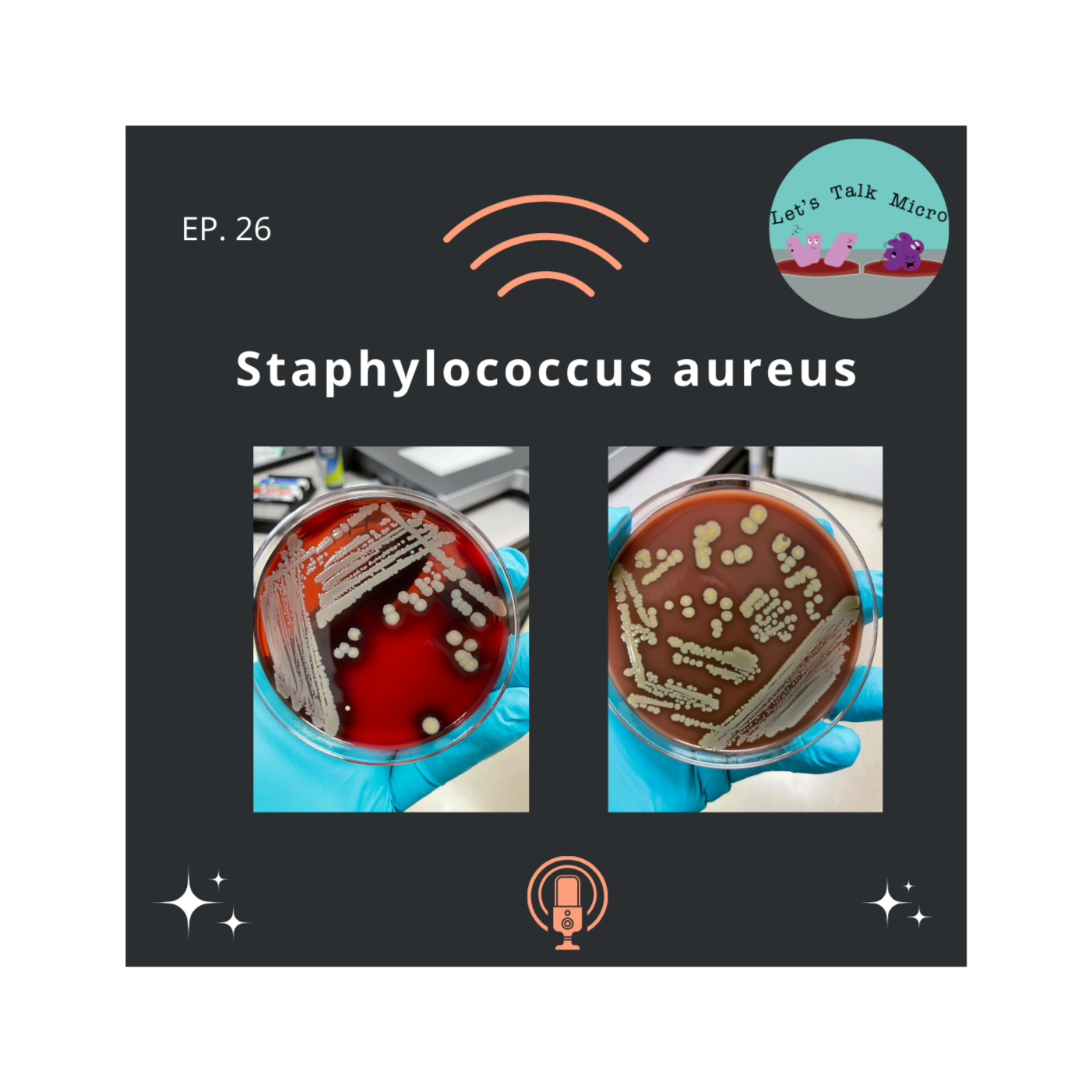
S1 Ep 26Episode 26: Staphylococcus aureus
In this episode I talk about Staphylococcus aureus. This is one of the most common organisms seen in Clinical Microbiology and a very serious one. Tune in to find about more about this organism, including its pathogenicity and significance in health care settings. Questions? Feedback? Send those to [email protected] Want to support the podcast? Here's how: Venmo: https://venmo.com/u/letstalkmicro Buy me a Ko-fi: https://ko-fi.com/letstalkmicro
S1 Ep 25Episode 25: MALDI-TOF (part 2)
This episode is part two of a two-part episode. What are the limitations of the Vitek MS? In this episode I go over the limitations of the Vitek MS regarding identification of organisms. I also go over the pros and cons of having this system in the laboratory.
S1 Ep 24Episode 24: MALDI-TOF (part 1)
What is MALDI-TOF? How is it used in Clinical Microbiology?. This is the first part of a two part episode where I discuss MALDI-TOF, and its applications in Clinical Microbiology.
S1 Ep 23Episode 23: Pasteurella, why is it my favorite?
Instagram follower suggestion: After mentioning on a post that Pasteurella was my favorite, a follower suggested for me to make an episode about it. In this episode I talk about Pasteurella, and why do I like it.
S1 Ep 22Episode 22: Anaerobic agar
In this episode I continue going over anaerobic bacteria. Is blood agar sufficient to recover anaerobes? Listen to this episode to learn about different media used for the recovery of anaerobic bacteria.
S1 Ep 21Episode 21: Anaerobes: Sources and incubation
In this episode I continue going over anaerobes. Are all sources acceptable for anaerobic cultures? How do you achieve the anaerobic environment these organisms need to grow? Find out in this episode.
S1 Ep 20Episode 20: An introduction to anaerobes
What is anaerobic bacteria? What is a facultative anaerobe? In this episode I introduce anaerobic bacteria and its relationship to oxygen and growth. Some species are mentioned.
S1 Ep 19Episode 19: Thioglycolate broth
Following up Dania's interview, in this episode I go over thioglycolate broth. What is it used for? Is it helpful in cultures? Listen to find out.
S1 Ep 18Episode 18: Talking Micro with Dania Casellas
This week's episode features Let's Talk Micro's second interview. Dania Casellas is a microbiologist that performs testing on donor organs.
S1 Ep 17Episode 17: Gram negative cocci
In this episode I continue going over tests and biochemicals for gram negative cocci. In addition I briefly go over different species of gram negative cocci and introduce new agar: Martin Lewis and Modified Thayer Martin.
S1 Ep 16Episode 16: Catarrhalis disk
In this episode I start going over tests and biochemicals for gram negative cocci. First up, the catarrhalis disk, used for the identification of Moraxella catarrhalis.
S1 Ep 15Episode 15: Urease test
What is the urease test? What is the principle of it? Is it only used for gram negative rods? In this episode I go over the urea test, including its principle, reactions, and its differences and similarities to the TSI and LIA tests.
S1 Ep 14Episode 14: Lysine Iron Agar
What is the lysine iron agar test? What is it used for? In this episode I go over this test including reactions and comparing and contrasting it with the TSI test.
S1 Ep 13Episode 13: Triple Sugar Iron
What is TSI? Which organisms is it used for? In this episode I go over the Triple Sugar Iron test, including its components, how does it work and examples of organisms and their reactions.
S1 Ep 12Episode 12: Hektoen, XLD and more
In this episode I go over media that Karla Zamora mentioned in her interview such as Hektoen, XLD and Palcam. I discuss components of the agar, colonial morphology and more.
S1 Ep 11Episode 11: A conversation with Karla Zamora
Let's Talk Micro's first interview features a conversation with Karla Zamora, an environmental microbiologist from Mexico. In this episode she talks about her work including techniques and organisms she works with.
S1 Ep 10Episode 10: Oxidase
In this episode I continue going over biochemicals for gram negative rods: oxidase. I also briefly discuss some species of gram negative rods and their oxidase results.

S1 Ep 9Episode 9: Indole
In this episode of Let's Talk Micro, we kick off biochemicals for Gram-negative rods with the indole test. After wrapping up the Gram-positive cocci last week, we now explore what indole is, how the test works, and how it helps differentiate organisms like E. coli, Proteus, and Klebsiella. A classic biochemical that still matters in today's microbiology lab. Check out the website: https://www.letstalkmicro.com/ Questions? Feedback? Send those to [email protected] Want to support the podcast? Here's how: Venmo: https://venmo.com/u/letstalkmicro Buy me a Ko-fi: https://ko-fi.com/letstalkmicro
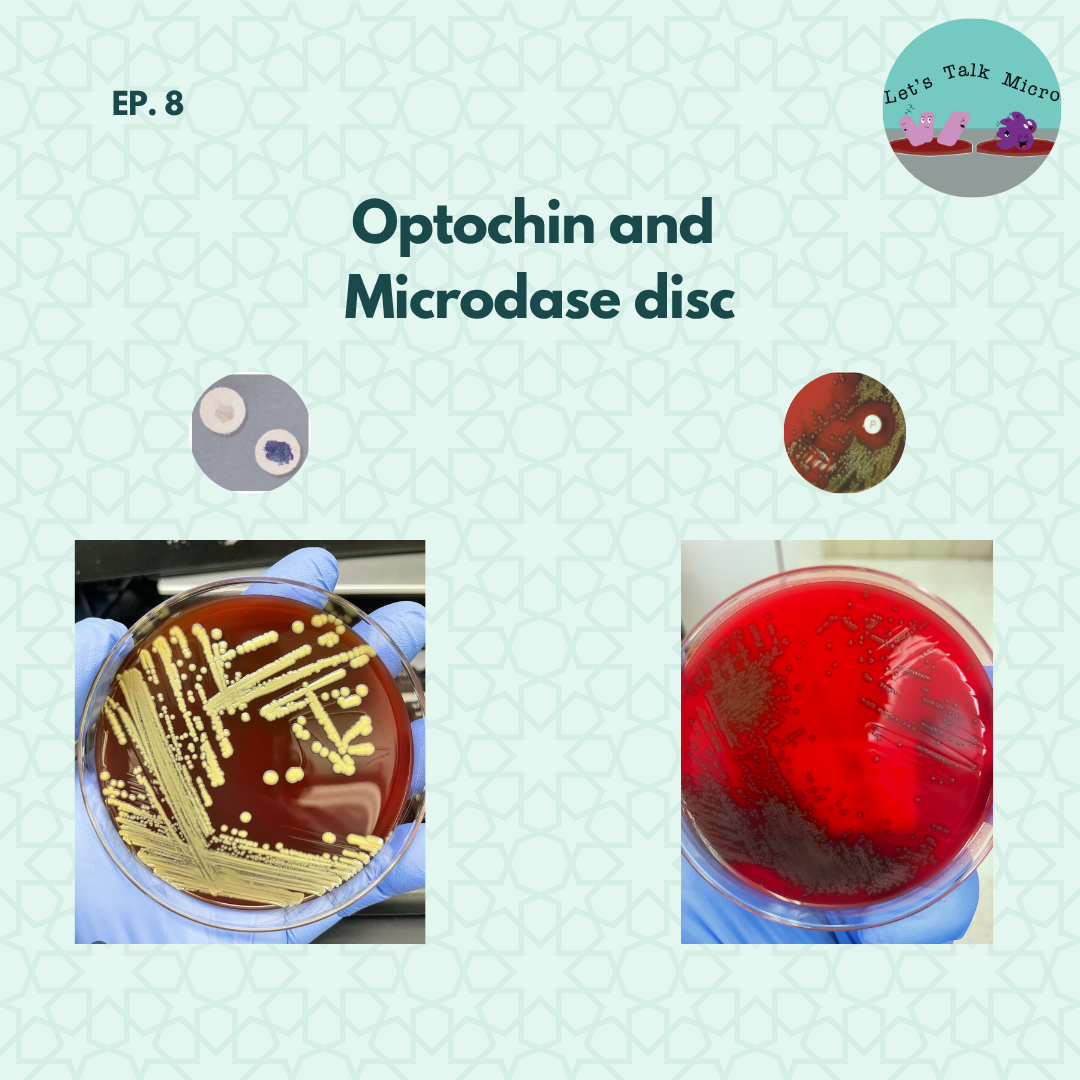
S1 Ep 8Optochin and Microdase disk
In this episode of Let's Talk Micro, we continue exploring the tools that aid in the identification of gram-positive cocci. Tune in as we discuss the optochin disk, used to help identify Streptococcus pneumoniae, and the Microdase disk test, which supports the identification of Micrococcus species. These simple yet powerful tests remain essential in the clinical microbiology lab. Check out the website: https://www.letstalkmicro.com/ Questions? Feedback? Send those to [email protected] Want to support the podcast? Here's how: Venmo: https://venmo.com/u/letstalkmicro Buy me a Ko-fi: https://ko-fi.com/letstalkmicro
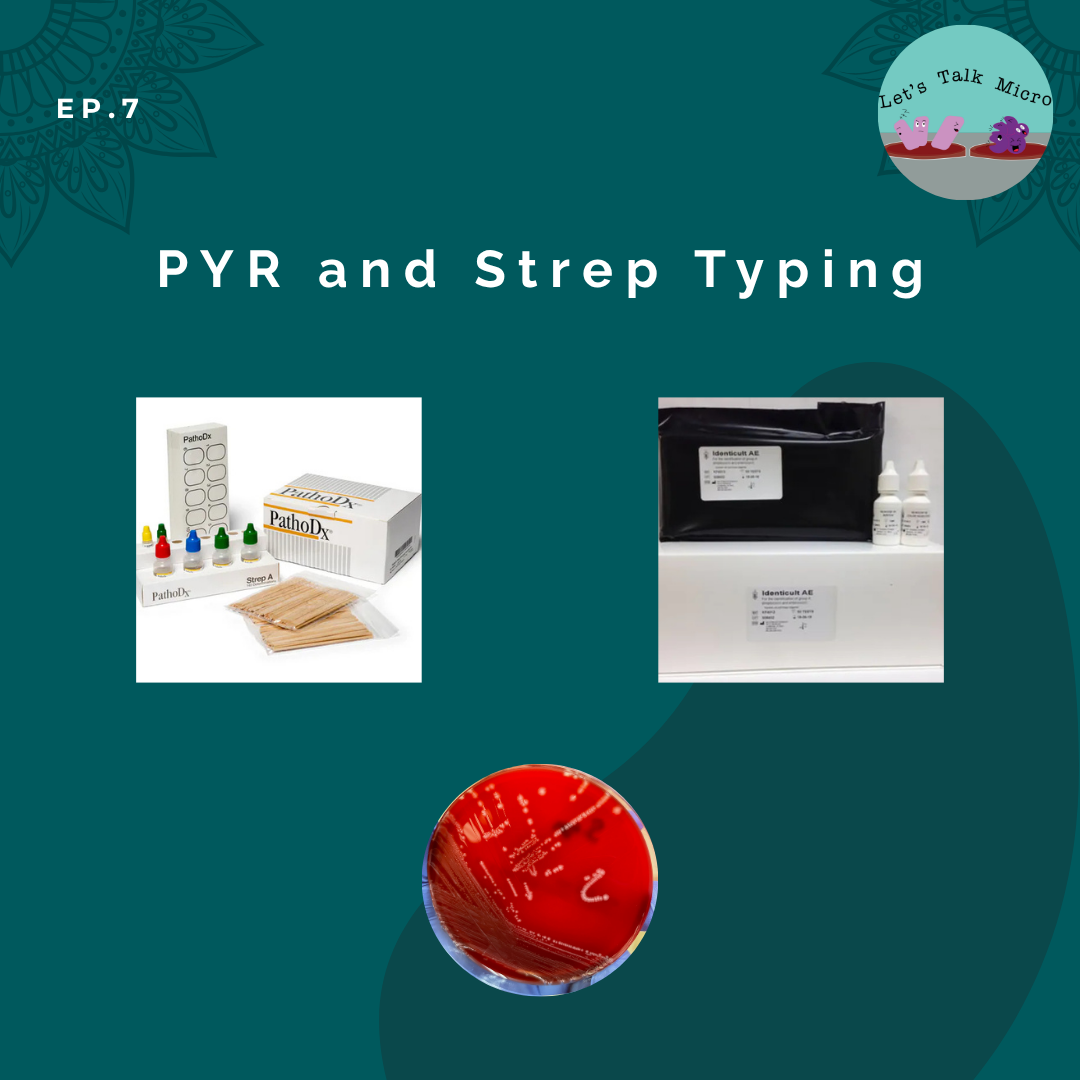
S1 Ep 7Episode 7: PYR and Strep Typing
What is the PYR test? What is strep typing? In this episode of Let's Talk Micro, I explain how these tests are used to identify Gram-positive cocci in the lab. Learn what they are, how they work, and why they're important in clinical microbiology. Questions? Feedback? Send those to [email protected] Want to support the podcast? Here's how: Venmo: https://venmo.com/u/letstalkmicro Buy me a Ko-fi: https://ko-fi.com/letstalkmicro

S1 Ep 6Episode 6: Biochemicals- Catalase and Coagulase
What are biochemical tests—and how do they help identify bacteria? In this episode of Let's Talk Micro, I dive into two of the most commonly used biochemicals in clinical microbiology: catalase and coagulase. Learn what they are, how they work, and why they're essential tools in the micro lab. Questions? Feedback? Send those to [email protected] Want to support the podcast? Here's how: Venmo: https://venmo.com/u/letstalkmicro Buy me a Ko-fi: https://ko-fi.com/letstalkmicro