
Let's Talk Micro
256 episodes — Page 4 of 6
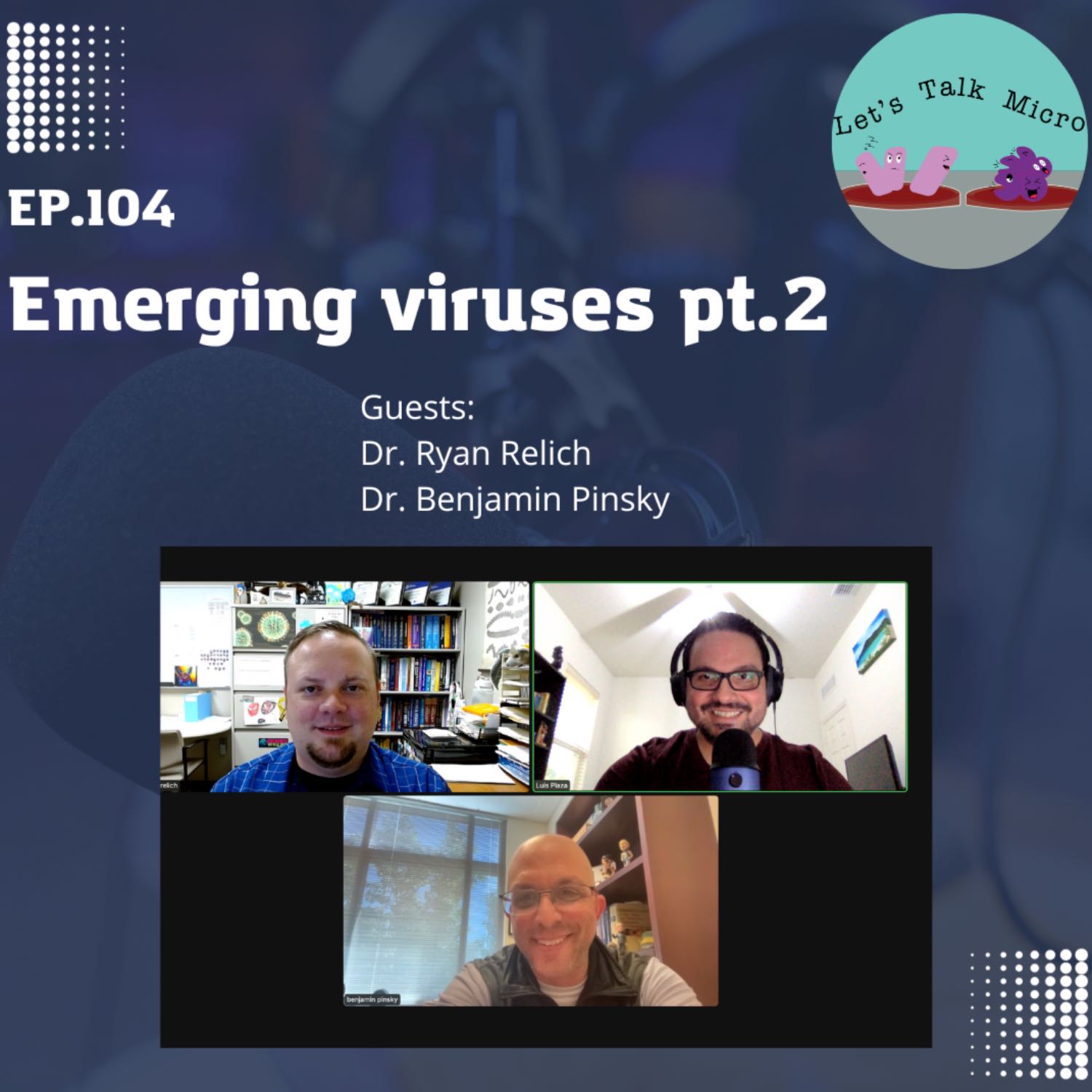
S3 Ep 104104: Emerging viruses pt. 2
This episode is part two of the great emerging viruses talk with Dr. Ryan Relich and Benjamin Pinsky. They talk over diagnostic tests for viruses, challenges with test development, and they share their thoughts on viruses and outbreaks. Link to the National Academies Arbovirus workshop: https://www.nationalacademies.org/our-work/mitigating-arboviral-threats-and-strengthening-public-health-preparedness-a-workshop Link to the Pan American Society for Clinical Virology: https://www.pascv.org/default.aspx
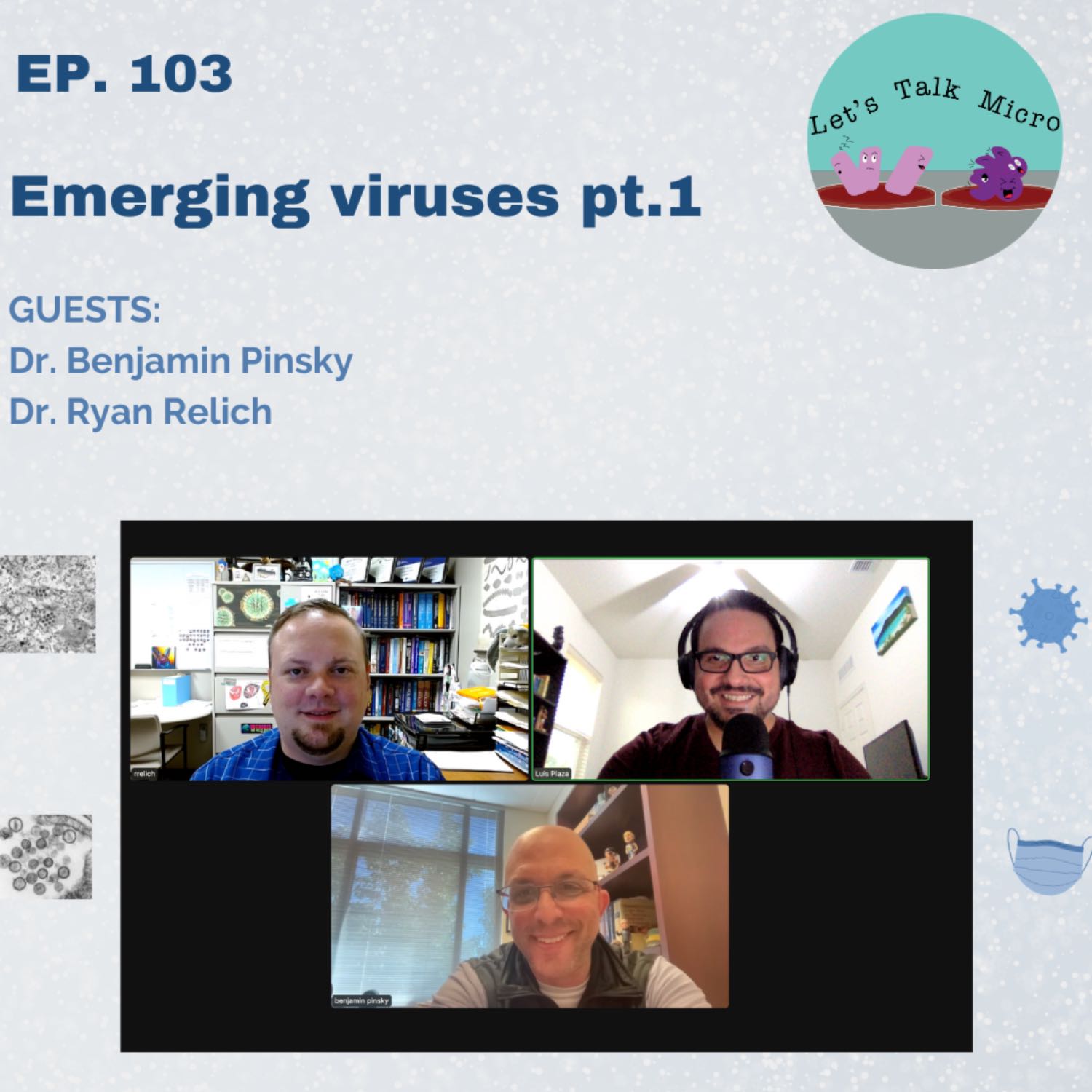
S3 Ep 103103: Emerging viruses pt. 1
With all the information about viruses that we see coming out, what better than an episode about emerging viruses. Dr. Benjamin Pinsky and Dr. Ryan Relich, two experienced virologists, join the podcast to talk about viruses. Tune in to learn about the different type of viruses, mode of entry, diseases, and more. This is part one of a two-part series. Link to the Clinical Virology Symposium: https://asm.org/Events/Clinical-Virology-Symposium/Home

S3 Ep 102102: Talking Francisella: an interesting case
In this episode Dr. Ryan Relich and Dr. Kenneth Gavina join the podcast to talk about an article where Francisella tularensis spp. novicida was recovered from a blood culture. Are you familiar with this organism? What are the subspecies of Francisella tularensis? What are the biochemicals tested on it and their results? While most of us might never see this organism in our careers, being aware and prepared to recognize it is essential. We have to be prepared and have a plan in place. Tune in to learn more about this organism. Link to article: https://journals.asm.org/doi/pdf/10.1128/jcm.00787-22

S3 Ep 101101: Talking AMR: Beta-lactams
Season 3 kicks off with the second episode of the AMR sub-series—this time focusing on beta-lactam antibiotics. Luis and Dr. Andrea Prinzi are joined by Dr. Brian Raux, a pharmacist, to discuss beta-lactam drug classes, mechanism of action, intrinsic resistance, and CLSI guidance. A must-listen for anyone interested in antimicrobial resistance. Questions? Feedback? Send those to [email protected] Want to support the podcast? Here's how: Venmo: https://venmo.com/u/letstalkmicro Buy me a Ko-fi: https://ko-fi.com/letstalkmicro
Season 3: a preview and updates
Hi everyone. Just wanted to take some time to give you some previews of upcoming episodes. From viruses, to Franciscella, to the next episode of the AMR sub-series, Let's talk Micro is kicking off season 3 with some great episodes. Also don't miss the webinar that I am presenting next week on tools and resources in a Microbiology laboratory! Registration is free. Link to sign up for webinar: https://www.clinicallab.com/trends/the-transfusion-medicine-laboratory/2023-blood-microbiology-digital-forum-27034

S2 Ep 100100: Collaboration with Microbe Mail podcast: Hey Micro-There's a yeast in my culture
This episode is a collaboration with the Microbe Mail podcast. Dr. Vindana Chibabhair and I go over yeast in cultures: appropriate sources, significance, and pathogenicity versus normal flora. We also talk about instruments used to identify yeast, antifungals, and more... Check out the Microbe Mail podcast: https://microbemail.captivate.fm
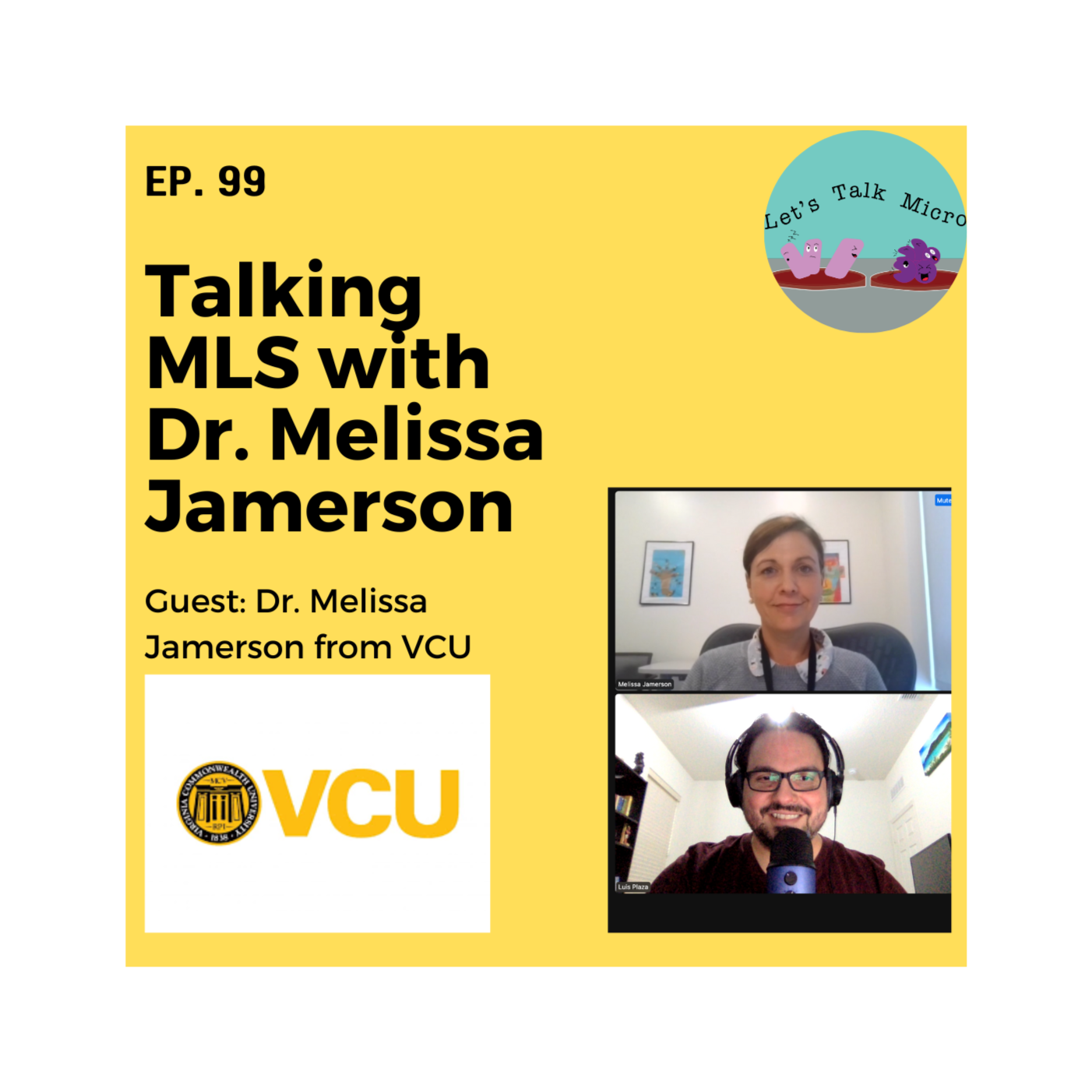
S2 Ep 9999: Talking MLS with Dr. Melissa Jamerson
This episode features a conversation with Dr. Melissa Jamerson, chair of the Medical laboratory Sciences department at Virginia Commonwealth University (VCU). Dr. Jamerson talks about the degrees offered for Medical Laboratory Sciences (MLS) at her institution, which include undergraduate and graduate. A new Masters degree with a concentration in Public Health Laboratories is starting this fall. What are the requirements for this degree? How does it differ from other Masters degrees in MLS? Tune in to find out...Link to VCU page: https://mls.chp.vcu.edu/programs/masters/

S2 Ep 9898: Talking AMR : An overview
This episode is the first episode in what is going to be an Antimicrobial Resistance (AMR) sub-series. Dr. Andrea Prinzi joins me in this series. Together we breakdown this complex topic. In this episode we start with an overview of the state of AMR, Dr. Prinzi provides some history, and we explain what the series is going to be about. Learning this information can be challenging for professionals, but we are going to break it down as simple as we can. Knowing and understanding this information is a crucial part of our job as Medical Laboratory Scientists. We will go over classes of antibiotics, mechanisms of action, resistance mechanisms and more. Hope you tune in.
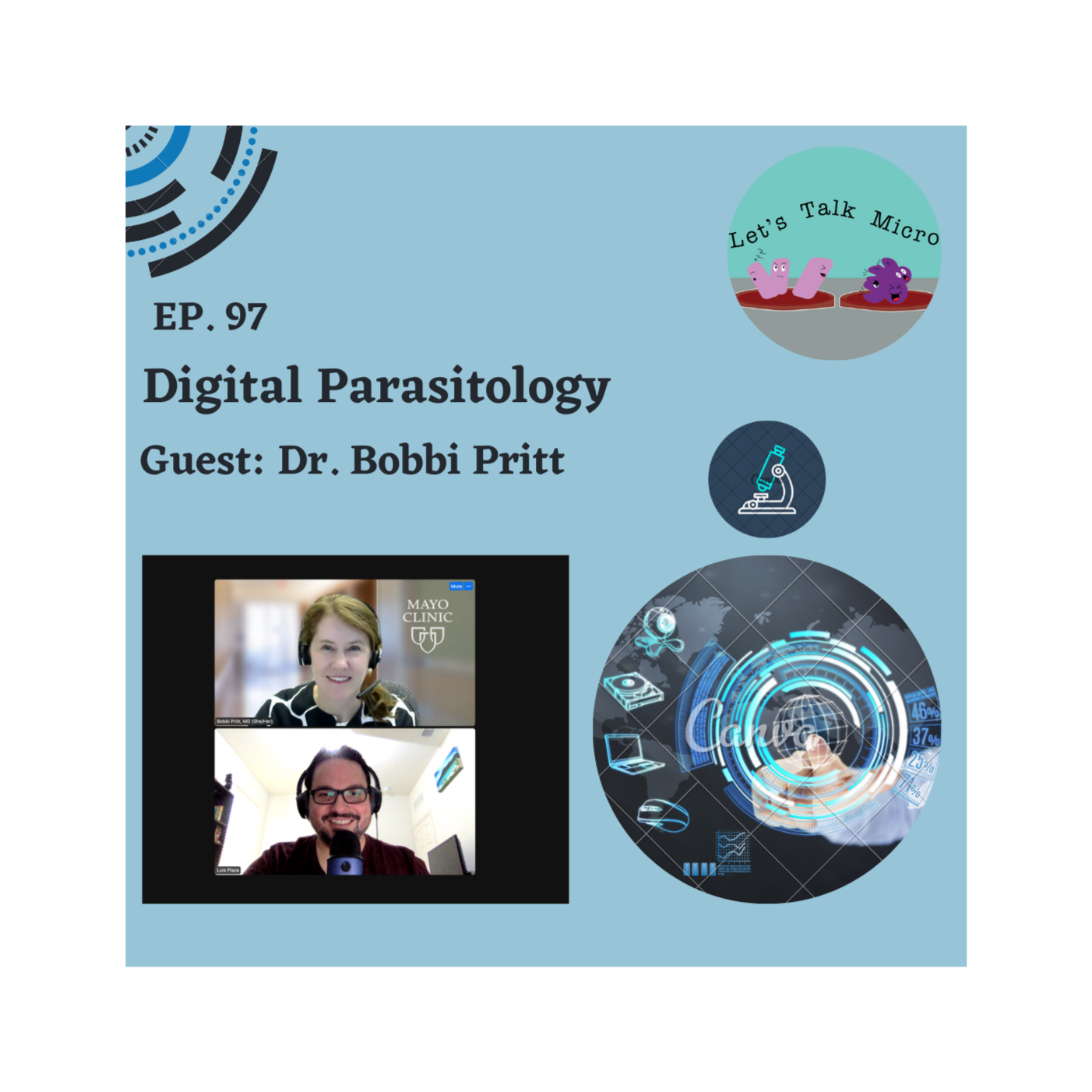
S2 Ep 9797: Digital Parasitology
Digital technology is part of the laboratory. We see it on instruments in Urinalysis and Hematology where images such as those of cells are produced. What about Parasitology? Can it be used for it? Dr. Bobbi Pritt, from the Mayo Clinic Laboratory , joins the podcast to talk about it. An algorithm with Artificial Intelligence has been implemented in her lab for protozoa. How did it do? What are the components? Tune in to find out.
S2 Ep 9696: Live at ASM with the Microbe Moment podcast
This episode was recorded while at the American Society for Microbiology's (ASM) Microbe 2023. I went over what I liked about this conference as a first timer. I also talk more about other courses I took and my experience overall. Then I was joined by great company: Elizabeth Deyett and Jon Mitchell from the Microbe Moment, They have a podcast called the Microbe Moment with the Microbigals. They talk about the impact of microbes in life, provide historical perspectives, and more. They also attended the conference and Elizabeth actually presented a poster. Tune in to listen to this great conversation.....Link to the Microbe Moment's podcast and webpage: https://www.microbigals.com/the-microbe-moment-science-podcast
S2 Ep 9595: ASM Microbe 2023- Sessions, posters and more.
This episode was recorded while at the American Society for Microbiology's (ASM) Microbe 2023 at Houston. I go over my favorite posters, sessions and more. It was great connecting with fellow microbiologists. Great posters such as Shewanella and oysters, frogs and potential compounds, and more. Of course, as a podcaster I had to sit through an episode of Editors in conversation.
S2 Ep 9494: CLSI M100 Ed. 33 updates
In this episode I am joined by Dr. April Bobenchik, the Medical Microbiology Director at Penn State Health. She talks about the latest updates of the CLSI's M100. CLSI (Clinical Laboratory Standards Institute) publishes many documents, the M100 being one of them, which is updated yearly. What is the M100? How does it relate to the work that we do in Clinical Microbiology? What is new this year? Tune in to find out.CLSI's webpage: https://clsi.orgM100 webinar from CLSI link: https://clsi.org/standards/products/microbiology/education/astupdate23indwr1/Any inquiries can be emailed at [email protected]
S2 Ep 9393: An overview of Parasitology with Dr. Pritt
Some of you may be familiar with the popular Parasite Wonders blog. In this episode of Let's Talk Micro, Luis is joined by its creator, Dr. Bobbi Pritt, Director of the Parasitology Laboratory at Mayo Clinic. They dive into key questions: What specimens are typically tested for parasites? What testing methods are used? Is there a role for digital parasitology? Dr. Pritt shares her insights and expertise on all things parasitic. Curious to learn more? Tune in to this fascinating conversation! Sign up for the workshop.... Link to blog: https://parasitewonders.blogspot.com Link to website: http://parasitewonders.com/ Link to workshop: https://news.mayocliniclabs.com/2023-parasitology-workshop/ Questions? Feedback? Send those to [email protected] Want to support the podcast? Here's how: Venmo: https://venmo.com/u/letstalkmicro Buy me a Ko-fi: https://ko-fi.com/letstalkmicro
S2 Ep 9292: Hospital network goes down pt. 2
This episode is the conclusion of Dr. Wojewoda's story about her hospital's network going down. What was the overall effect of the network going down?What happened when the system came back up? Any lessons learned and advice? Tune in to find out. Questions? Feedback? Send those to [email protected] Want to support the podcast? Here's how: Venmo: https://venmo.com/u/letstalkmicro Buy me a Ko-fi: https://ko-fi.com/letstalkmicro

S2 Ep 9191: Hospital network goes down pt. 1
Those of us that work in the laboratory have experienced a downtime at some point or another. They tend to be about 4 hours long. What if the downtime went on for days? How would you perform tasks such as add-on testing or referencing cultures? What if the whole system was down? Dr. Christina Wojewoda from the University of Vermont Medical Center joins the podcast to tell her "horror" story of when the network at her hospital went down. This is part 1 of 2 episodes. Questions? Feedback? Send those to [email protected] Want to support the podcast? Here's how: Venmo: https://venmo.com/u/letstalkmicro Buy me a Ko-fi: https://ko-fi.com/letstalkmicro
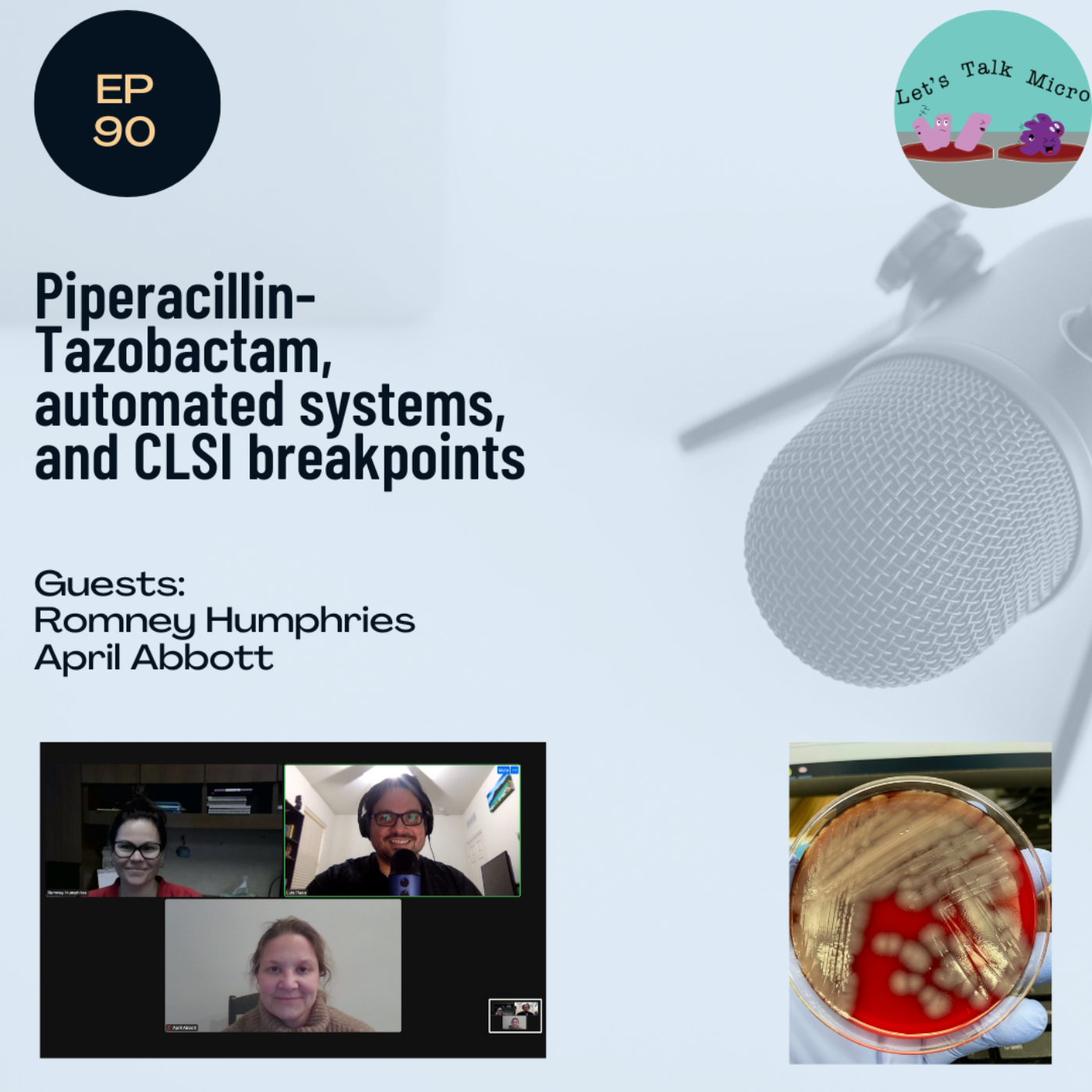
S2 Ep 9090: Piperacillin-Tazobactam, automated systems, and CLSI breakpoints
This episodes features a conversation with Dr. Romney Humphries and Dr. April Abbott. They join the podcast to talk about a study where Piperacillin-Tazobactam (TZP) was evaluated. Testing results from automated systems were compared to a reference method. How did the systems perform? What are the challenges? What are CLSI breakpoints and FDA breakpoints? What is the MERINO trial? Tune in to find out. Link to article: https://journals.asm.org/doi/10.1128/jcm.01617-22 Questions? Feedback? Send those to [email protected] Want to support the podcast? Here's how: Venmo: https://venmo.com/u/letstalkmicro Buy me a Ko-fi: https://ko-fi.com/letstalkmicro
S2 Ep 8989: XDR Shigella
EThis episode features a conversation with Dr. Louise Francois Watkins and Dr. Naeemah Logan from the CDC. They join the podcast to talk about extensively drug resistant Shigella (XDR). What is Shigella? How is it transmitted? What makes it an XDR? Tune in to find out. Resources: Health Alert Network (HAN) - 00486 | Increase in Extensively Drug-Resistant Shigellosis in the United States (cdc.gov) Webinar Tuesday, February 28, 2023 - Epidemiology, Testing, and Management of Extensively Drug-Resistant Shigellosis (cdc.gov) Information for Healthcare Professionals | Shigella – Shigellosis | CDC Health Promotion Materials | Shigella – Shigellosis | CDC
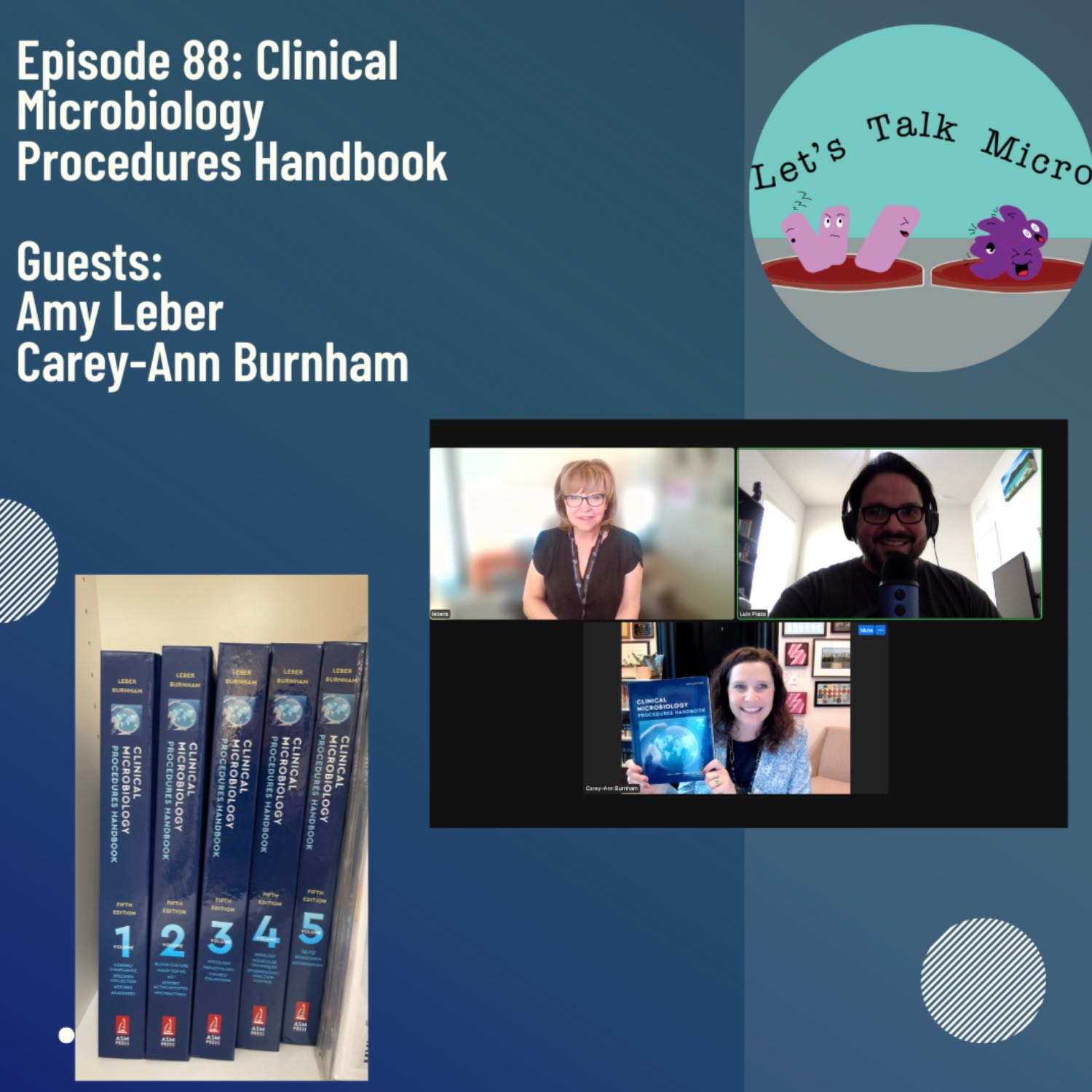
S2 Ep 8888: Clinical Microbiology Procedures Handbook
The Clinical Microbiology Procedures Handbook (CMPH)—a cornerstone resource for clinical labs—has just released its 5th edition. In this episode of Let's Talk Micro, I'm joined by the editors-in-chief, Dr. Amy Leber and Dr. Carey-Ann Burnham, to discuss what's new, what's essential, and why the CMPH continues to be a trusted reference in clinical microbiology. What role does it play in the lab? How has it evolved? Tune in to find out. 📘 Link to ClinMicroNow below Link to ClinMicroNow: https://onlinelibrary.wiley.com/doi/book/10.1002/9781683670438 Questions? Feedback? Send those to [email protected] Want to support the podcast? Here's how: Venmo: https://venmo.com/u/letstalkmicro Buy me a Ko-fi: https://ko-fi.com/letstalkmicro
S2 Ep 8787: Lab week- St. Louis University MLS program
Happy Lab week! Thank you for all you do. This episode features a conversation with Amanda Reed , director of the St. Louis University Medical Laboratory Sciences program (SLU-MLS). In addition to being the director, she also teaches Microbiology. Tune in to find out about their program, a talk about the importance of biochemicals , and more. They also have something called "Name that bug" that prepares students to recognize and learn about organisms.Link to program attached.
S2 Ep 8686: Bacteria Game
This episode features a conversation with the team behind Bacteria Game: Mathilde Lescat, Nicolas Piñeros and Katie Teinallon. A good educator is always trying to find ways to improve and reach the students. There is a lot of information in Microbiology, so coming up with ways students can learn the material is very important. Mathilde Lescat came up with a game to teach students Microbiology. It is supported by the French Society for Microbiology and it is available in French and English. What is Bacteria Game? What audience is it intended for? Tune in to find out. Link to the French Society for Microbiology page where the game can be ordered is attached.

S2 Ep 8585: Bacterial biofilms and antimicrobial resistance
In this episode, Dr. Andrea Prinzi and Dr. Rodney Rohde join the podcast to discuss the article 'The Role of Bacterial Biofilms in Antimicrobial Resistance.' What exactly are biofilms? Which organisms are commonly associated with them? And how do they contribute to antimicrobial resistance (AMR)? Tune in for an insightful conversation on this important topic. Link to article: https://asm.org/Articles/2023/March/The-Role-of-Bacterial-Biofilms-in-Antimicrobial-Re Link to quorum sensing article: https://asm.org/Articles/2020/June/How-Quorum-Sensing-Works Questions? Feedback? Send those to [email protected] Want to support the podcast? Here's how: Venmo: https://venmo.com/u/letstalkmicro Buy me a Ko-fi: https://ko-fi.com/letstalkmicro
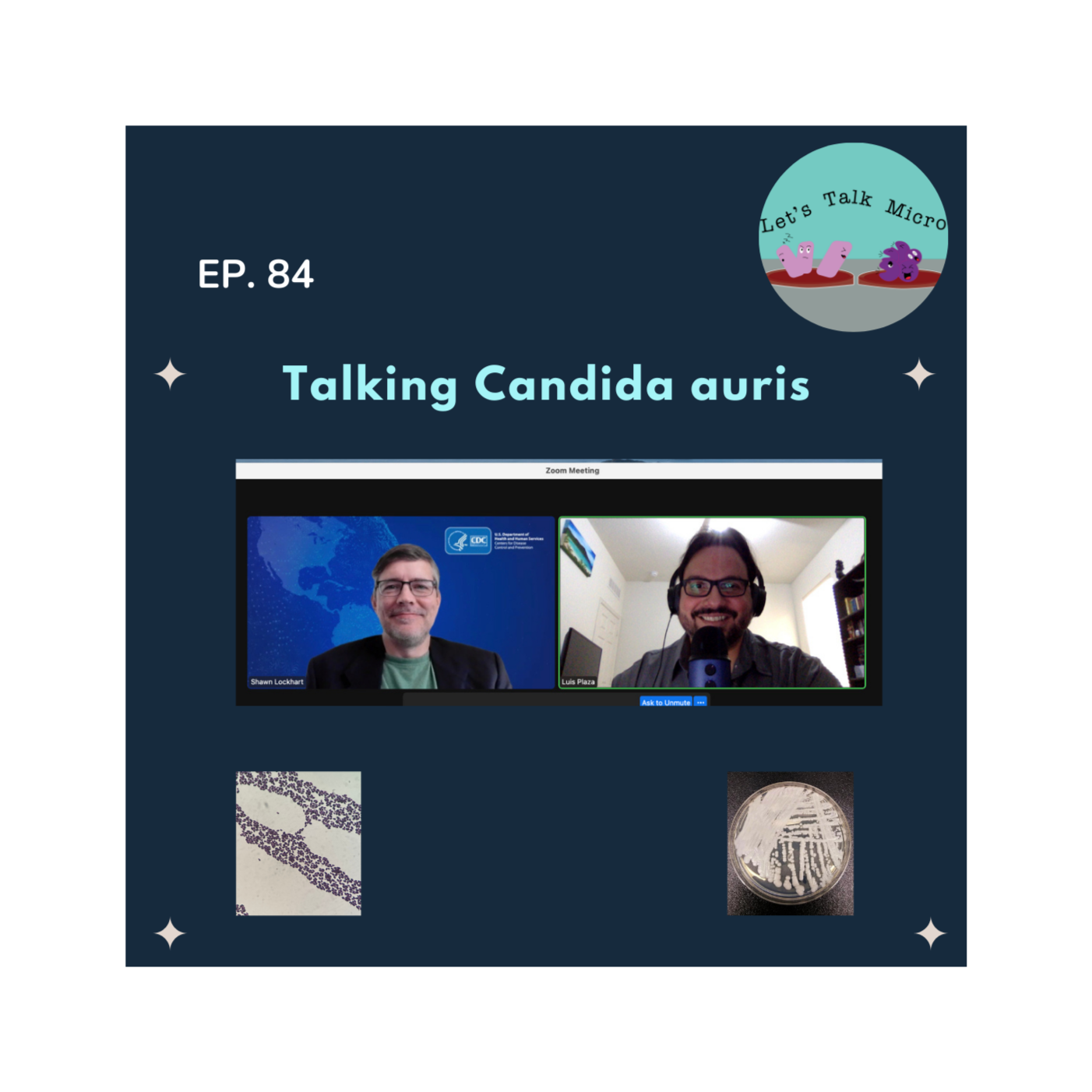
S2 Ep 8484: Talking Candida auris
The Centers for Disease Control and Prevention (CDC) released a press release on March 20, 2023 about Candida auris. There is an increase in cases, so it is a good time to talk about it. Dr. Shawn Lockhart, from the Mycotic Diseases Branch of the CDC joins the podcast to talk about C. auris. What is C. auris? How is it transmitted? What kind of antimicrobial resistance does it exhibit? Tune in to this episode to find out. Link to EPA's P list: https://www.epa.gov/pesticide-registration/list-p-antimicrobial-products-registered-epa-claims-against-candida-auris Questions? Feedback? Send those to [email protected] Want to support the podcast? Here's how: Venmo: https://venmo.com/u/letstalkmicro Buy me a Ko-fi: https://ko-fi.com/letstalkmicro
S2 Ep 8383: Talking MS in MLS and Summer Immersion Program with Loyola University
This episode features an interview with Dr. Kristen Pesavento, from the Medical Laboratory Sciences (MLS) program in Loyola University. Unlike traditional MLS programs where typically a bachelors degree is obtained upon completion, this program confers a Master of Science degree. What prerequisites do you need? Dr. Pesavento also talks about their summer immersion program, which takes place from May 17-19 of this year. Here students can get familiarized with Medical Laboratory Sciences.Link to Loyola MLS program: https://www.luc.edu/parkinson/mls/msinmedicallaboratoryscience/Link to Loyola MLS Immersion Experience: https://www.luc.edu/parkinson/mls/mlsimmersionexperience/
S2 Ep 8282: Discrepancies between phenotypic and genotypic testing in Microbiology pt.2
This is part 2 of a two part series. Dr. Rachael Liesman goes over scenarios where genotypic and phenotypic testing do not match and what to do. What do you do when your molecular instrument detects mec-A and Staphylococcus aureus but your susceptibility report shows oxacillin susceptible? What about VanA and Enterococcus? As Medical Laboratory Scientists in Microbiology, we encounter this type of situations. Tune in to find out how to troubleshoot these discrepancies. Link to Dr. Patricia Simner's article: https://journals.asm.org/doi/full/10.1128/JCM.00138-20
S2 Ep 8181: Discrepancies between phenotypic and genotypic testing in Microbiology pt.1
Those of you that work in Clinical Microbiology have seen at one point that a molecular test detects a gene for antimicrobial resistance and the susceptibility profile does not match. What do we do then? In this episode Dr. Rachael Liesman joins to the podcast to talk about this. What is genotypic testing? What is phenotypic testing? How do we perform these in the lab? How do we troubleshoot these discrepancies? Tune in to this episode which is the first of a two part series to find out. Link to Dr. Liesman's presentation: https://drive.google.com/file/d/1dphVN79alVfQERTL_rTihUA-zlqBOJfY/view?usp=share_link
S2 Ep 8080: Talking DCLS with Dr. Brandy Gunsolus
This episode features an interview with the first graduate from the Doctorate in Clinical Laboratory Sciences (DCLS) program from Rutgers University: Dr. Brandy Gunsolus. What is the DCLS program? What are the requirements for this degree? What does a Doctor in Clinical laboratory Sciences does? Can they be directors? Tune in to find out about this career path for laboratorians and its contribution in Laboratory Medicine. Link to DCLS programs: https://shp.utmb.edu/clls/dcls/home https://shp.rutgers.edu/clinical-lab-and-imaging-sciences/doctorate-of-clinical-lab-science/ https://www.kumc.edu/school-of-health-professions/academics/departments/clinical-laboratory-sciences/academics/doctorate-in-cls-program.html
S2 Ep 7979: Failure to launch- Bacteria and the Hawaiian bobtail squid
In this episode we talk about a relationship between bacteria and the Hawaiian bobtail squid. Dr. Sarah McAnulty and Dr. Spencer Nyholm join the podcast to talk about a study about this squid and bacteria. What is symbiosis? What is the accessory nidamental gland? How does a bacterial community contribute to the development of this gland? What bacteria make up this community? Tune in to find out. Link to article: https://journals.asm.org/doi/10.1128/mbio.02131-22 Link to Skype a Scientist: https://www.skypeascientist.com/meet-us.html
S2 Ep 7878: Cordyceps
The show "The last of us" has brought the topic of fungal infections to the spotlight. What is Cordyceps? Why is the the term zombie used? What is the relationship between fungi and body temperature? Dr. Andrej Spec, an Infectious Diseases physician, joins the podcast to talk about Cordyceps and fungi.
S2 Ep 7777: Bacillus anthracis
This week's episode is about one species of Bacillus that causes disease and has the potential of being used as a bioterror agent : Bacillus anthracis. What is anthrax? How is this organism identified in the lab? What about Bacillus cereus biovar anthracis? Tune in to this episode to find out the answers.
S2 Ep 7676: Bacillus- morphology and media
In this episode I continue going over Bacillus. Now that we know its groups and what diseases they are implicated on, it's time to talk about media and morphology. What do the colonies look like? What is MYP agar? PEMBA? Tune in to find out.
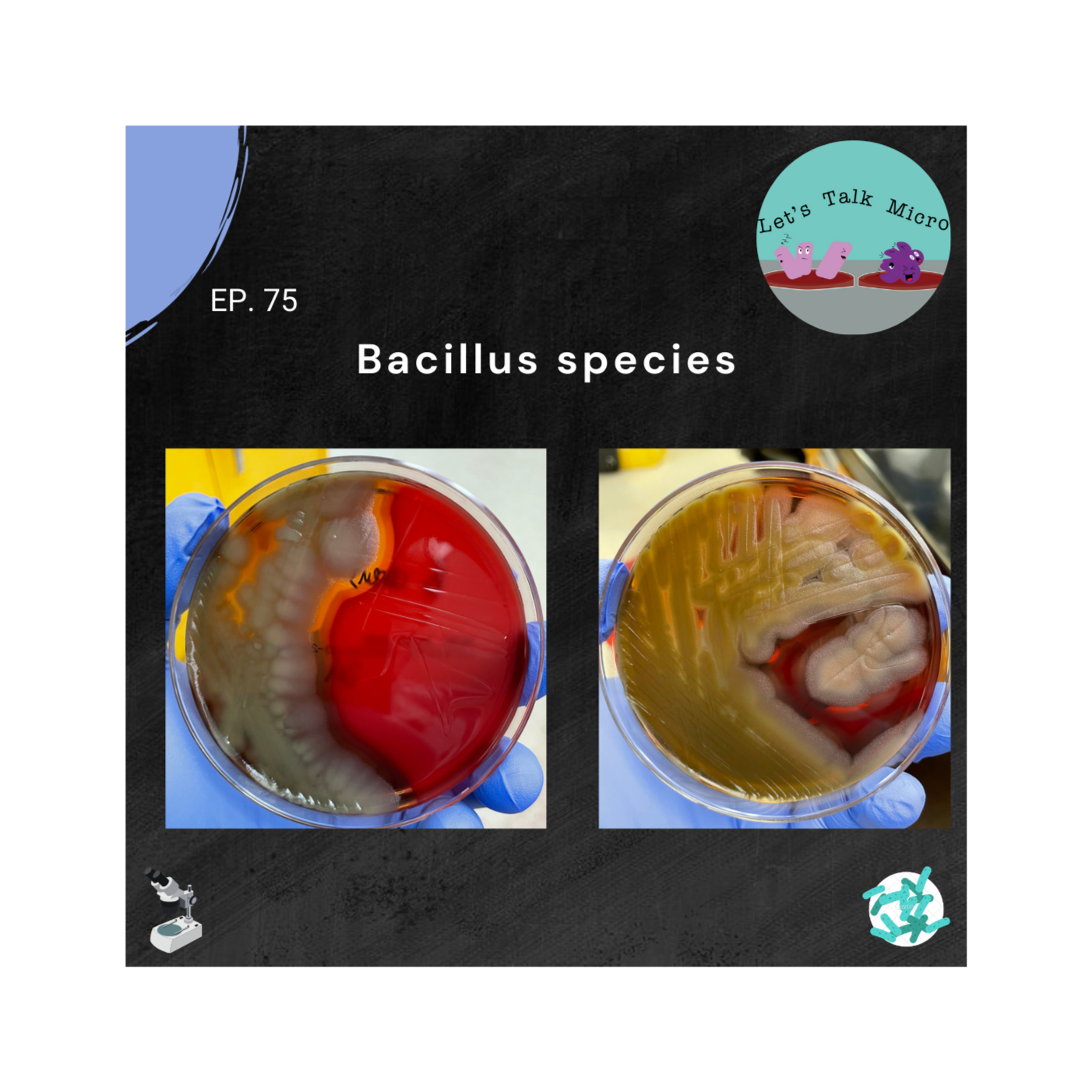
S2 Ep 7575: Bacillus species
This week's episode is about Bacillus and related genera. What are the groups that are part of this genus? Which species cause food poisoning? What about endophthalmitis? What are spores? Tune in to find out. Questions? Feedback? Send those to [email protected] Want to support the podcast? Here's how: Venmo: https://venmo.com/u/letstalkmicro Buy me a Ko-fi: https://ko-fi.com/letstalkmicro
S2 Ep 7474: Microbes in cleaning appliances and tools
In a previous episode we talked about microbes in food. What about appliances such as a washing machine or a dishwasher? Or cleaning tools such as a sponge? Dr. Madeline Barron joins the podcast to answer those questions. She is the author of an article titled "Microbial Inhabitants of Cleaning Appliances and Tools". Tune in to find out what microbes are in those tools and appliances, recommendations for reducing their number, and more. Link to article: https://asm.org/Articles/2022/November/Microbial-Inhabitants-Cleaning-Appliances Questions? Feedback? Send those to [email protected] Want to support the podcast? Here's how: Venmo: https://venmo.com/u/letstalkmicro Buy me a Ko-fi: https://ko-fi.com/letstalkmicro
S2 Ep 7373: Detecting amoeba: development of a PCR test
This episode features an interview with Dr. Jose Alexander and Dustin Evans from AdvenHealth. They join the podcast to talk about a PCR test that they developed to detect amoeba. Not only it detects Naegleria fowleri, which is isolated in cases of Primary Amebic meningoencephalitis, but two other amoeba as well. Which ones does this test detect? Detecting amoeba in the laboratory is challenging due to lack of tests and trained personnel. How does this test compare to others? Tune in to find out. Link to article: https://www.adventhealth.com/medical/adventhealthmd/news/adventhealth-physician-and-team-develop-a-new-test-quickly-detect-brain-eating-amoebas
S2 Ep 7272: Marine Microbiology with Dr. Ocean
In this week's episode we go outside of Clinical Microbiology into Marine Microbiology. What better way to do that than talking with Dr. Jeanette Davis, a.k.a. Dr. Ocean. How do you become a Marine Microbiologist? What kind of work do they do? Besides her work, Dr. Davis is also a published author. Tune in to this episode to learn more! Dr. Ocean's website: https://drjeanettedavis.com
S2 Ep 7171: Let's Talk Micro meets ID:iots
This episode features a conversation with Callum, an Infectious Disease physician and one of the co-hosts of ID:iots, an infectious disease podcast. What is their podcast about? What kind of work does an Infectious Disease doctor do? How do their work relates to the laboratory? Tune in for a great talk about the laboratory, challenges we have, and more. Link to ID:iots podcast: https://idiotspodcasting.buzzsprout.com
S2 Ep 7070: Microbes and your grocery list
This episodes is about microbes in food. It features a conversation with Dr. Andrea Prinzi. Those of us that work in Microbiology are familiar with foods such as yogurt containing microbes. What about feta cheese? Enterococcus in your food? Tune in to find out more about this interesting topic that includes a popular meat substitute. Link to article: https://asm.org/Articles/2021/January/Microbes-That-Span-the-Clinical-Lab-and-Your-Groce
S2 Ep 6969: Online unknowns
One of the ways of assessing and reinforcing a Microbiology student's learning is by giving them unknown organisms. They typically get a broth containing the organism, and they plate it on agar, and perform a gram stain and biochemical testing to properly identify the organism. How can this concept be applied online? This is what this episode is about. Learn how two educators from the University of Nebraska Medical Center incorporated the use of unknowns to remote teaching. How did the students do? How was this done? Tune in to find out. Link to article: https://journals.asm.org/doi/10.1128/jmbe.00071-22 If you have any questions, feel free to contact the authors : [email protected] [email protected]

S2 Ep 6868: Respiratory cultures
In this episode Dr. Andrea Prinzi returns to the podcast to talk about respiratory cultures. What are the types of respiratory cultures? What are the pathogens? What is the significance of yeast in respiratory cultures? Sputum rejection?Tune in to this episode to learn more about these cultures. Link to article about sputum rejection that Dr. Prinzi mentions in the episode: https://journals.asm.org/doi/pdf/10.1128/jcm.16.4.627-631.1982 Questions? Feedback? Send those to [email protected] Want to support the podcast? Here's how: Venmo: https://venmo.com/u/letstalkmicro Buy me a Ko-fi: https://ko-fi.com/letstalkmicro
S2 Ep 6767: Re-release: Wohlfarhtiimonas chitiniclastica Monomicrobial bacteremia
This episode was originally released on February 24 of this year. It features an interview with Dr. Paul Luethy from the University of Maryland Medical Center. It is about a case of Wohlfarhtiimonas chitiniclastica that was seen in bacteremia. Typically this organism is seen in polymicrobial infections. It is being re-released for the benefit of new listeners so it complements the latest episode (66). Link to article : https://wwwnc.cdc.gov/eid/article/27/12/21-0327_article
S2 Ep 6666: Wohlfahrtiimonas and the fly who cried Wohlf
This episode is about another case of Wohlfahrtiimonas chitiniclastica. It was presented in an article titled : "The fly who cried wolf" which was published by the American Society for Microbiology. Drs. David Gaston and Yembur Ahmad joined the podcast to discuss it. Tune in to listen to a great conversation about this organism, including morphology, biochemicals, and so much more. Link to article: https://journals.asm.org/doi/10.1128/jcm.01073-21 Check out Dr. Diana Zhong' s twitter page (came up with the tittle of the article) : @doctordianasaur
S2 Ep 6565: Yersinia pestis
Following the last episode about Yersinia species, on this episode I go over Y. pestis. Why is there concern about encountering Y. pestis in the laboratory? What do you do if you encounter potential bioterror agents? How does the laboratory handle those? As laboratories we are trained on how to recognize, test, handle, and ship these organisms. Tune in to this episode to learn about terms like Laboratory Response Network and the proficiency testing called LPX.
S2 Ep 6464: Yersinia
Following last week's episode about Y. pestis, what better than to learn about different species of Yersinia. What temperature range does Yersinisia grow at? Have you heard the term "bull's eye"? How about CIN agar? From enterocolitis to different forms of plague, tune in to this episode to lear about Yersinia, including media, biochemicals and more.
S2 Ep 6363: The source of the Black Death
This episode features an interview with Philip Slavin and Maria Spyrou. They talk about Y. pestis and the second plague pandemic. A historical overview is provided and they talk about how DNA was obtained from 7 individuals buried in two cemeteries in the fourteenth century. Find out how this information points to an early source of the second plague pandemic. Link to article: https://www.nature.com/articles/s41586-022-04800-3
S2 Ep 6262: Fabimycin: an antibiotic candidate
This week Dr. Paul Hergenrother from the University of Illinois joins the podcast. Dr. Hergenrother talks about Fabimycin, an antibiotic candidate for gram negative bacteria. What is Fabimycin's mechanism of action? To which bacteria does it show activity against? Any intrinsic resistance? Tune in to find out. Link to article: https://pubs.acs.org/doi/10.1021/acscentsci.2c00598 Questions? Feedback? Send those to [email protected] Want to support the podcast? Here's how: Venmo: https://venmo.com/u/letstalkmicro Buy me a Ko-fi: https://ko-fi.com/letstalkmicro
S2 Ep 6161: Options for teaching microscopy remotely
This episode features an interview with Kathryn Lionetti and Heather Townsend. They are two Microbiology college professors. They implemented two ways of teaching microscopy remotely as a result of the pandemic. Just like other educators, they had to adapt. What do these methods consist of? How did the students perform? Tune in to find out. Link to article: https://doi.org/10.1128/jmbe.00332-21
S2 Ep 6060: Learning about Rabies with Dr. Rodney Rohde
Releasing on World Rabies Day (Sept. 28), this episode features an interview with Dr. Rodney Rohde, a Microbiologist and Professor and Chair of the Clinical Laboratory Science program at Texas State University. Dr. Rohde joins the podcast to talk about rabies. What is rabies? How do we acquire it? Prevention? Also, what is World Rabies Day? Tune in to find out. Dr. Rohde's rabies book and website : https://www.elsevier.com/books/rabies/wilson/978-0-323-63979-8 https://rodneyerohde.wp.txstate.edu/ https://pubmed.ncbi.nlm.nih.gov/33659941/
S2 Ep 5959: Teaching Microbiology Remotely
This episode features an interview with Dr. Garcia- Ojeda from the University of California Merced. One of the results of the pandemic was that educators had to adapt to remote teaching. How do they remotely teach students those hands-on skills that are so important in Microbiology? Dr. Garcia Ojeda talks about what he did with his Microbiology laboratory. What was the outcome? How did the students perform? Tune in to find out. Link to article: https://doi.org/10.1128/jmbe.00328-21 If you have any questions please email Dr. Garcia Ojeda at: [email protected]
S2 Ep 5858: S. pneumoniae: testing and more
In this episode I continue going over S. pneumoniae. This time I go over a popular antigen test, and I also discuss molecular testing, including limitations and the importance of correlating the gram stain with the result. Also, have you heard of Streptococcus pseudopneumoniae?
S2 Ep 5757: Streptococcus pneumoniae
This week I return to Streptococcus, this time S. pneumoniae. In this episode I go over its virulence, pathogenicity, and more. How do we identify it in the lab? What tests can we use? What is the bile solubility test?Tune in to this episode to find out.
S2 Ep 5656: Critical shortages in Microbiology
This week's episode features an interview with Dr. Jeniffer Dien Bard and Dr. Amy Leber. Dr. Dien Bard is the Director of Microbiology at the Children's Hospital in Los Angeles, California. Dr. Leber works at the Department of Pathology Laboratory Medicine at Nationwide Children's Hospital in Columbus, Ohio. They join the podcast this week to talk about the shortages of Clinical Medical Laboratory Professionals in Microbiology. Why do we have these shortages? What about training programs? How long does training a professional takes? Tune in to this episode to find out. Link to original article: https://doi.org/10.1128/jcm.00241-22 Link to certification for laboratory personnel: https://www.ascp.org/content/board-of-certification/get-credentialed Link for accredited programs: https://www.naacls.org/Find-a-Program.aspx