Late Night Live — Full program podcast
1,994 episodes — Page 6 of 40
LNL's new theme, lessons from the bridge walk, and Ukraine's corruption woes
After nearly ten years, Late Night Live has changed its tune. Annabel Crabb reflects on the lessons for Australian politicians after the Sydney Harbour bridge walk for Gaza plus Anne Applebaum on Ukraine's corruption issues and the next round of ceasefire talks with Russia.
Future warfare is already here, plus the Chinese survivors of the Titanic
Israel is using AI to track and target Hamas operatives - and those around them. Ukraine is efficiently deploying cheap drones against the military might of Russia. Both conflicts show us how quickly warfare is changing, according to acclaimed New Yorker writer Dexter Filkins. And just when you thought you knew the story of the Titanic, we hear about an overlooked group of passengers. There were eight Chinese men aboard, but their presence has been largely forgotten.
Unearthing the real Pompeii, plus when Zane Grey went shark-hunting in Australia
The Director of Pompeii Archaeological Park Gabriel Zuchtriegel shares some of the latest discoveries from the buried Roman city, as new areas are excavated for the first time. Plus, the Australian adventures of Hollywood writer Zane Grey, who hunted sharks and other game fish in 1930s Australia.
Bruce Shapiro's USA, the lost Israeli Left, and Iraq's 'Garden of Eden' marshlands
Bruce Shapiro on how the ghost of Jeffrey Epstein is haunting US President Donald Trump. Editor-in-chief of the Jerusalem Post, Zvika Klein, on the disappearance of the Left in Israeli politics. Plus, the fight to preserve Iraq's magnificent marshlands, drying out due to climate change.
Annabel Crabb's Canberra, plus Fintan O'Toole on Gaza and the state of global politics
Annabel Crabb looks at why the Coalition is refusing to condemn the starvation of people in Gaza by Israel and why they are walking away from net zero. And acclaimed Irish journalist Fintan O'Toole examines Donald Trump's presidency, seven months in.
John Hewson says sack the NACC, plus the Roosevelts' giant panda hunt
Former Liberal leader John Hewson says after two years the National Anti-Corruption Commission has failed in its mission to properly investigate allegations of systemic corruption. Plus how US President Theodore Roosevelt's sons introduced the panda to the West.
Starvation in Gaza, China's clean energy boom and Putin's sledgehammer
Health officials in Gaza say starvation is now killing Palestinians at a faster rate than at any point in the 21-month war. China might be a coal behemoth, but our northern neighbours are also dominating the world in renewable energy. Plus the rise and fall of Russian mercenary Yevgeny Prigozhin. Two years since he was killed in a plane crash, how has the Wagner group reorganised?
Ian Dunt's UK, the USA's plans to deport Afghan allies, and the death of the chequebook
Regular UK commentator Ian Dunt looks at the Palestine Action group's High Court bid against its proscription as a terrorist organisation. The US is planning to send Afghan expats home, many of whom assisted the US against the Taliban. And Australia will stop processing cheques by 2030. Should we mourn their demise?
Annabel Crabb's Canberra, Saudi drug executions, and Japan's rice shortage
As parliament returns for the first time since the federal election, Annabel Crabb looks at how Labor will use its large majority. Saudi Arabia is executing drug offenders at an alarming rate and Japan is running out of rice.
The decline of history teaching, and abortion through the ages
Professor Chris Wallace argues the decline in both enrolments in, and the offering of history and other humanities subjects at Australian universities has resulted in a loss of capacity for historical thinking. Plus, how women have handled unwanted and dangerous pregnancies throughout history.
What next when climate litigation fails? And tales of tourists lost in the bush
The Torres Strait Islanders' case against the federal government over responsibility for action on climate change may have been lost, but another significant case is coming up in the International Court of Justice which could set a new legal framework for future cases. Plus more than 25 years ago another case of a missing tourist in outback WA dominated the headlines, but in this case the missing man did not want to be found.
Bruce Shapiro on US politics, Bill Bowtell surveys 40 years of HIV, and the world's richest shipwreck
The Trump Administration now has the legal green light to dismantle the Education Department; Australia played a leading role in the fight against HIV/AIDS. And what is being hailed as the world's richest shipwreck, the San Jose, lies off the coast of Colombia.
Annabel Crabb on Albanese's China trip, Gaza's future, and the genius of feathers
ABC's chief online political writer, Annabel Crabb, on what Anthony Albanese is hoping to achieve during his visit to China, and unpacking Israel's plan to forcibly re-locate Palestinians in Gaza into large-scale camps. Plus the evolutionary genius of feathers
President Trump's war on science, and the value of indigenous history telling
Harvard Professor Naomi Oreskes on the impact of President Trump's slashing of science funding. And two historians, one Indigenous (Jackie Huggins) and one not (Ann McGrath), on what can be learnt from Indigenous perspectives on our history.
Why the future of Europe depends on the Baltics, plus how might the universe die?
Author and journalist Oliver Moody examines the historic European flashpoint of the Baltics - a group of nine borderland nations that continue to shape the future of the continent. Plus, theoretical cosmologist Katie Mack contemplates the end of the universe - and what it means for life now.
Ian Dunt's UK, the strange world of biohacking, and the flight of the bogong moth
UK Labour is facing an internal revolt after attempts to cut the welfare budget by more than £5 billion. Bio-hacking is touted as the new secret to longevity, but is it just snake oil? Plus the Taungurung people's efforts to find out why the deberra, or bogong moth, is disappearing.
Telling the truth about Victoria's past, plus a US critique of 'woke' elites
ABC's Bridget Brennan surveys the process that lead to Victoria's Yoorrook Justice Commission's final truth-telling report, which found that the Indigenous people of Victoria were subject to a genocide. Plus, US sociologist Musa al-Gharbi contends that the so-called 'woke elites' of the West, are more concerned about self-promotion than actual social change.
Tracing the trajectory of the Christchurch killer, and is AI a con?
The man who killed 51 people at two Christchurch mosques in 2019, was motivated by far-right extremism and white nationalist ideology. A new podcast traces the killer's digital footprint prior to the massacre. And the promise of AI (artificial intelligence). A linguistics professor warns that AI technologies, particularly large language models like ChatGPT, are often misrepresented as intelligent entities.
The twins separated by foreign adoption, plus the ancient allure of isolationism
The world is experiencing a profound break from the orthodoxy of globalisation. President Donald Trump and his MAGA movement didn’t invent isolationism - the concept goes back to ancient Greece. So what's the appeal of self-sufficiency, from a nation-state level down to the individual? Plus, a story of changing polices and attitudes to children in China - a journalist tracks down a stolen child, and reunites twins who grew up separately in China and Texas.
Could the world have two Dalai Lamas? And a marathon vote on Trump's 'big beautiful bill'
As the Dalai Lama turns 90, a struggle looms over his succession, with China insisting they will choose the next in line. Bruce Shapiro examines divisions amongst Republicans as Trump's 'big beautiful bill' faces a marathon debate in the Senate. And a sweeping 150 year history of test cricket - a story of race, class, money and empire.
Albanese's second term ambitions, a new MI6 chief, and the forgotten Flinders brother
A look at Anthony Albanese's political agenda for his second term with Guardian Australia Political correspondent, Tom McIlroy and for the first time in history, the MI6 chief — codename C — will be a woman. Plus the life of the lesser known Flinders brother, Samuel, who is seems was overlooked because of a family feud.
How to share resources in space, and the true crimes of Wiradjuri brothers Jimmy and Joe Governor
Space lawyer Steven Freeland is just back from UN meetings in Vienna, where his draft principles for accessing space resources were discussed. As chair of a working group, his job is to get all 107 member countries to agree on rules for who can do what. And the truths about Jimmy Governor, and his brother Joe, who inspired the book and film 'The chant of Jimmy Blacksmith'.
What is France's role in the world? Plus, a trailblazing, rebellious Māori Professor
French President Emmanuel Macron's political fortunes may have turned against him at home, but in Europe, he now stands as one of the longest-serving leaders on the continent. What is the role of Macron's France in a tumultuous region and world? Plus, trailblazing Maori Professor Ngāhuia te Awekōtuku tells the wild, heartbreaking and beautiful stories of her life.
Ian Dunt's UK, one year on from Julian Assange's release, and how classical statues lost their noses
Our regular UK correspondent Ian Dunt looks at how the surprise US attack on Iran is playing out in Europe. Journalist Andrew Fowler has the backstory on the politics of getting Julian Assange freed. And the great mystery you may never have thought of - why are the noses missing from so many classical statues?
Will MAGA Republicans split over Iran strikes? And does Israel have its own nuclear weapons?
Late Night Live examines the political fallout from the US strikes on Iran, from Washington DC to Tel Aviv. Plus, as the US and Israel seek to destroy Iran's nuclear weapons capabilities, what sort of arsenal does Israel possess itself?
The fallacies of the fertility crisis, and a gritty history of Macau
Why are people around the world having fewer babies, and what – if anything – should be done about it? And Macau has long been overshadowed by Hong Kong, but it was once a central meeting place of Western and Chinese cultures, a colonial outpost rich in stories and characters.
A shambolic expedition to Arnhem Land, and the first despot of North Korea
In 1948, a team of 17 Australians and Americans went to Arnhem Land to document traditional Aboriginal life, collecting thousands of natural specimens and cultural artefacts. It was an ethical and organisational shambles. And Kim Il-Sung, the grandfather of North Korea's current leader, Kim Jong Un, created the state of despair and oppression that continues today.
Bruce Shapiro's USA, Dutch politics in crisis, and the Inca language of knotted strings
Bruce Shapiro on Trump's Iran plan, and those military parades - how popular were they really? The right-wing firebrand Geert Wilders has walked out of the conservative Dutch coalition. And string writing by the Incas has been misunderstood. These khipus were in fact used to record changes in climate.
Albanese to meet Trump, a history of the Iran nuclear deal, and how the sweet potato crossed oceans
Prime Minister Anthony Albanese is at the G7 in Canada preparing to meet with US President Donald Trump on the sidelines, face-to-face for the first time. As Israel and Iran trade missile strikes, what might have been if President Trump had not dismantled the 2015 Iran nuclear deal? Plus, the story of how the Māori brought the sweet potato - or kūmara - to New Zealand.
Who is America? And Australia's most successful female artist Emily Kngwarray
It's a story of wars, conquests, trade, ideas and political struggle. Latin America and the United States have a long and complex relationship spanning centuries. Pulitzer Prize winning author, Greg Grandin, argues you can't tell the story of the North, without including the story of the South. Plus, one of Australia’s most celebrated figures, Emily Kngwarray is the highest-selling woman artist in national history. The Anmatyerr Elder found global fame in the late ’80s with large-scale paintings deeply rooted in her connection to Country, culture and community.
Young US men are joining Russian churches, plus an infamous brawl over the haka
Journalist Lucy Ash examines the 'masculine' appeal of Russian Orthodox churches to a growing number of young men in the United States. Plus, a new documentary, The Haka Party Incident, recounts a significant race relations incident from 1979 New Zealand, when Maori activists confronted a group of Auckland university students who mocked the haka.
Bruce Shapiro's America, and hunting down the Myall Creek murderers
As protests over immigration raids continue in Los Angeles, US President Donald Trump has sent in the National Guard. Bruce Shapiro surveys the chaos. Plus, on the anniversary of the Myall Creek massacre in northern NSW, Mark Tedeschi KC remembers the good men who pursued justice for the slain Wirrayaraay people.
The true power of land ownership, plus giving children the right to vote
Political scientist Michael Albertus shows that who owns the land determines whether a society will be equal or unequal, whether it will develop or decline, and whether it will safeguard or sacrifice its environment. And David Runciman calls for the emancipation of 6-year-olds.
Two months on from Myanmar's earthquake, and healing a divided United States
The Myanmar military and militia groups have just extended the ceasefire they agreed to after the earthquake. But there are concerns China is using the disaster to increase its influence, and scam centres are still going strong. Plus, the United States has become very divided, again. An anthropologist tries to understand these extremes and how to bridge them.
Haiti's gang crisis takes a dark turn, plus the mother of all languages
Beset by years of gang violence, the Haitian government has enlisted the assistance of the ex-CEO of the defunct private military firm Blackwater, notorious for its role in the death of civilians in Iraq. Plus, the science journalist Laura Spinney traces the ancient origins of English, Russian, Hindi, Greek and more - back to a linguistic origin known as "PIE" (Proto-Indo-European).
Ian Dunt's UK, Pakistan and India's war over water, and who named our body parts?
Ian Dunt examines Britain's new defence plan, as Europe ramps up its war-readiness. Why water is at the centre of ongoing tensions between India and Pakistan. And how did some of the more obscure parts of the human anatomy get their names?
Bernard Keane's Canberra, what America's 'comfort class' doesn't get, and the life of a food critic
Crikey's Politics editor Bernard Keane on the surprising defection of Senator Derinda Cox from the Greens to Labor, and US calls for Australia to increase its defence spending. Writer Xochitl Gonzalez critiques the widening chasm between the haves and have-nots in the US. Plus John Lethlean's colourful life as a food critic.
The origins of the term 'national security', and actress Merle Oberon's false identity
The term 'national security' wasn't always around. It was invented, effectively, by US President Franklin D Roosevelt, as a call to Americans to get involved in WW2. And Hollywood actress Merle Oberon had to hide her South Asian origins in 1930s London and America, in order to work in movies and remain in America.
Abalone cultural heritage in Tasmania and overtourism in the Canary Islands
First Nations in Tasmania have now secured permanent cultural fishing rights for abalone, and now they’re putting it back on the dining tables of Tasmanians. And the civil engineer who quit his job to campaign against the construction of a port in Tenerife.
Bruce Shapiro's America, the money behind the 'Enhanced Games', and an ancient Roman cookbook
US President Trump is threatening to deport a group of men to war torn South Sudan. We track the money behind the Enhanced Games - a kind of Olympics on steroids. And there is much to learn from a famous cookbook from ancient Rome.
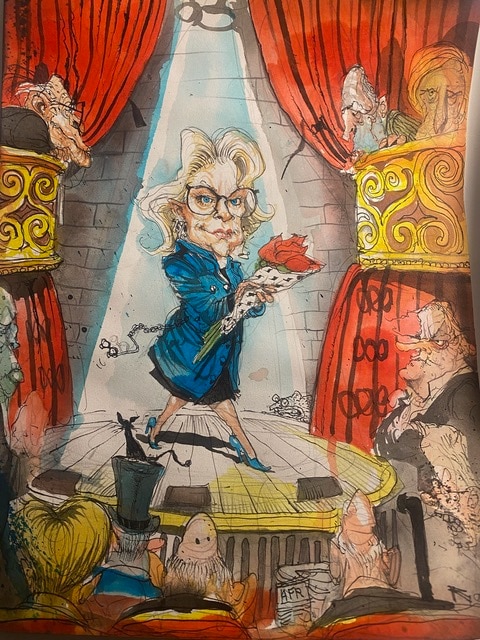
Late Night Live farewells Laura Tingle
After 30 years of appearances on Late Night Live - spanning nine Australian Prime Ministers - Laura Tingle bids farewell to LNL as its political correspondent in Canberra, before commencing her ABC Global Affairs role. In a sprawling conversation, Laura recounts her early beginnings in journalism, the ebbs and flows of Canberra politics through the decades, and what she's come to admire in our representatives.
D-day looms for Woodside's Burrup gas plant, and teaching troubled teens to hunt in the New Zealand wilderness
Australia's Commonwealth government is due to make a decision on the proposed 50-year extension of Woodside's gas lease on Western Australia's Burrup Peninsula. Marian Wilkinson investigates. And David meets the New Zealand hunter, fisher and gatherer Terressa Kollatt, now teaching troubled teens to forage for their own wild food.
The Aussies the union movement left behind, and what causes a society to collapse?
A new history of the union movement in Australia looks at those often left out of the picture: migrants, women, Indigenous Australia and LGBTIQA+ people. Plus Cambridge scholar, Luke Kemp and his historical autopsy of why societies collapse.
Tariff chaos on American shelves, Ukraine minerals deal and Lake Eyre in flood
Trump's constant changes to tariffs are wreaking havoc on US ports, logistics, and the price of goods. Any Russia/Ukraine ceasefire may be at a high cost to Ukraine, given the losses it agreed to in the recent US minerals deal. And Kati-Thunda Lake Eyre is on the brink of its biggest inundation in 15 years.
Laura Tingle's Canberra, and Harriet Walter re-writes Shakespeare's women
7.30 Political Editor Laura Tingle surveys the path ahead for conservative politics in Australia. And from Lady Macbeth to Kate the Shrew - actor Dame Harriet Walter imagines what Shakespeare's women might have said, if the Bard's plays had a more female perspective.
The Brazilian Marxists claiming unused land, and Australia's Antarctic obsession
Journalist Vincent Bevins on the popular Landless Workers Movement of Brazil - an agrarian movement which redistributes unused government land. And environmental historian Rohan Howitt, from Monash University, argues that Australia had an Imperial zeal to claim the Antarctic and Southern Ocean as its own.
Who's still selling arms to Israel? And the legal rights of nature
Antony Loewenstein on the countries still supplying arms to Israel. And nature writer Robert Macfarlane asks, is a river alive?
Ian Dunt's UK, Europe's thirsty data centres, and the survival of Indigenous message sticks
Ian Dunt unpacks the UK government's tough new plan to reduce migration. With swathes of Europe in drought, could new data centres exacerbate growing water problems? And the project preserving Australia's most ancient long-distance communication tool: the message stick.
Laura Tingle's Canberra, US-China trade talks and the art of the courtroom sketch
Analysis of current events to the hottest debates in politics, science, philosophy and culture.
Does our world lack moral ambition? And the Victorian obsession with orchids
Analysis of current events to the hottest debates in politics, science, philosophy and culture.