
Land Of The Rising Son
359 episodes — Page 7 of 8

S5 Ep 213Heal By Healing
Japan—Civilization 3.0, eminent culture and society, representing pinnacle of modern civilization, while invoking ancient spirit of Yamato—displaying gumption, unwavering constitution, and innate notion to embrace The Grind. Ancestor veneration evolved—blending timeless Buddhist Universal Truth along the Way—The Japanese weave the Notion of Kaizen into the fabric of society, Form, Order, Process, as intrinsic matter—Three Structural Pillars—foundation of Japanese System—reflecting isolated civilization evolving over millennia—broadcasting Weigh Station No. 9's frequency vibration to metamorphosing worlds. The path to Infinite Harmony are tenets to guide One's own life journey enshrined into the original Japanese constitution—echoed from Multiverse to Japanese secular existence by Wise Sage, Shotoku Taishi (Prince Umayado/Prince Kamitsumiya) in 604 CE. Fusing Western black & white plurality, with Eastern Confucianism, has not been easy on the island nation of Japan, nor its long-suffering citizens. After 250 years of virtual isolation, the Japanese were forced to internalize the true nature of Occxie-mind-set, the ultimate culture shock to a people isolated for centuries. Remember, Japanese society delineates via flexible adaptability, while preserving Her ancient culture and heritage, however, evolution of Japan, does not include the notion of a mental health care system. In Asian societies, the mental wellbeing of One's clan members, particularly in domain of mental stability, is never responsibility of State. Mental health issues in Japan are regarded as strictly private family affairs—just ask Hideaki Kumazawa. Embracing the notion of Learn by Doing, is to personify the spirit of wonderment, awe, and amazement, indicative of an innocent, curious mind, to aspired toward every day. Learn by Teaching Unless speaking Japanese at an advanced level, and experiencing Japanese society in Japan, One can never truly realize the spirit lurking inside nooks and crannies of the indigenous Yamato spiritual mind. Take compulsory Ministry of Education kokugo Communication Units as primary example. Two-thousand—one-hundred—thirty-six (2,136) ideograms + two (2) syllabaries consisting of lots and lots of other symbols—both syllabaries are referred to as "fifty sounds." Often things take a long time to Learn by Doing—don't forget—seeming how One is doing things anyway—do all things well. Heal by Healing A plethora of interesting challenges await those who metaphorically, or otherwise reside in the Land Of The Rising Son—past, present, and future. It is here in the Land of Onna Bugeisha, where material existence has been surmised, to be a remarkable paradise, somewhere, somewhen, inside some specific Infinity Field, commonly referred to, as Japan. Next stage is pushing through suffering and pain—arriving in an instance, a new arena, same game—battle hardened and scarred, not yet quite dead—today is another ponderous day, to follow the Sun on your Way. For some, however, the extraordinary gift of life, facilitating material participation inside this incredible game of life, now known as "Material Sludge"—for all modern materials on offer could not mend One's broken heart, nor replace the love of that one and only girl. Decades ago, as the recipient of a "Dear John" letter, any last modicum of Warmth of Humanity, crushed out into carnal finality, embedded in a sad and distressing final note, a most unfortunate self-determined destiny. The next step of this pathetic soul was to end his own life, with as little fanfare as possible—in what could only be surmised as—Notion of Abject Despair. He made the fateful decision to bleed himself out. So, with the nick of the blade, the deal was made, by this desponded soul, he forfeited his life, while flushing his broken heart, Ancestors, and future visions away. This particular irrevocable act can be regarded as the most visceral example of han men kyo shi. Universal Truth Ivory Tower—a stupefying, desolate experience—vested interests stoking and provoking—quacks, charlatans, and frauds—self-anointed monkeys be matriculated—mandating what Others can and cannot have or do—yet are vacuous of any coherence, or semblance of clue as what to do. Matriculated Monkey, like some kind of Pharma Junkie, peddle third-hand mis-information, disseminating Truth Distortion at the bidding of Vested Overlords, exerting control over Filters Skew, controlling your mirror, what you see, and the very Essence of You-Who-Are. Truth Juice and Essential Essence in Material Sludge, can only be discovered outside the illusion of corrupt decaying Occxie Systems. How to hear the singing voice of Muse, and meet with Other bags of chemicals encased in meat? Go play outside—beginning One's journey and remarkable climb, as One listens to the stillness of a bamboo forest, the supple breath of the voices whispering into Infinite Ears—it is then and there—in rare, yet common air—where, at last, One can truly tune up, in, a

S5 Ep 212Identification Please
This unwelcome solicitation usually reflect One's origin as related to unique Ancestor Journey. One continues to be utterly gobsmacked observing violent monkeys continuing to entertain the abjectly ridiculous notion of "birth-right" embodying whatever this obtuse terminology and meaning (none) constructed there within. Of course, that is unless anointed to be the Emperor of Japan—the sentient being embodying Japanese mythology—representation of the Universally Truthful notion of what it means to be Japanese. Raised in severe harsh conditions, the meaning of life was meted out to all inhabitants and citizens unequivocally and equally—absent of prejudice or predetermined indoctrinated bigotry—this is the Way one could say. It was here inside extreme adverse weather and impoverished attitudes of those living under frozen icy conditions, where the Noble Notion of color blindness was hardwired into One's electrical circuitry via Maggie May, the matriarch of One's Clan. She is a wise and cherished ruler—truthful, neutral, all the while personifying One Universal Truth—embodying the Third Pillar of Civilization—becoming and growing from the secret nooks and crannies of the enigmatic Japanese hive-mind. Thinking Thing: Identifying and categorizing Others based solely upon constructed origin story, and the dominate indoctrination scripting of all malleable mind—cannot and will never be tolerated—fundamental principle of One's Clan, and this most of Noble Notion to be internalized and canonized into infinity and beyond. Here is Notion of Deep Gratitude toward Really Great Grandmother, Alastair, her first-son, and his enlightened first-daughter Maggie May the Universal Mother—incarnate of One's Clan embedded principle—foundation of a human story. Furthermore, the sensational impact of One's first friend can not be denied. Third generation Japanese—his family graciously including a child on their family skiing trips—Five Japanese + One Occxie whitish-pink boy—in somewhat of a zany dreamy, ephemeral yet real, fantastical fantasy—truly akin to life as art in the reality of the abstract and surreal. The intergalactic hoe-down continued next-door where the Hong Kong immigrant family brought their Confucianist values, large Asian family atmosphere, and Cantonese cooking along with the smells and sounds of a little cosmos of Asia—wafting through the nostrils of a rural Occxie neighbourhood and town—once upon a time—in a different place—of a distant past. By the way, up until recent times the Japanese government mandated fingerprints from all foreign residents on the way to the coveted residents card, duly noted on the lower right hand corner. Normally fingerprint are kept as a record of those who exhibit poor behaviour worthy of an intervention by those in Authority. In Japan, however, fingerprint of foreigners was carried out as a simple matter of intrinsic evolution of Japanese society, and was abolished as a point of the innate Japanese notion of kaizen, societal advancement, and abandonment of decaying archaic notions. Japan continues to evolve as the Third Pillar of Modern Civilization, as the roots continue to deepen, and the Japanese entertain notions of how to build powerful stable societies. Now in what used to be the future, it is inevitable the Japanese will gradually include those from other places, as the homogeneity of the Japanese includes integration of Others into Japanese society which is founded upon Form Order Process protocol. Thinking Thing: Humans of various backgrounds and persuasions create diversely unique communities enriching Each Other—celebrating Oneness and Unity—oxymoronically built upon the strength of the homogenization of diversity, or whatever this abstract notion actually means. Judge Book Not By Cover Cultures having passed through the Age of Reason—only then to discover Universal Truth—at the door of a book—in a crooked nook—at the Mouth of Infinity, and the meaning of the term destiny. One and all the same—life a game—human race representing Universal Truth of homo sapiens' homogeneity. For certain, as a matter of innate reactionary protocol, the Japanese will always judge a book by its cover at first glance. Unless produced domestically, all book covers are written in languages foreign to the Japanese embodying alien notions and concepts, which are fundamentally different than that of the Japanese psyche, and the way things work, here in the Land Of The Rising Son. After the Japanese inspect the book with a foreign title, and ascertain the value and merit of any innovative book, is where any and all novel notions are soon put inside the systematic Japanese notion of Form Order Process. It is here where Japanese style tender loving care kicks in, and the magic of kaizen starts a beginning. The notion of being inextricably linked to One's preconceived identity is truly an extinct construct to be regarded as obsolete social notion, no longer a mystery, which can now be disregarded and di

S5 Ep 211Frequency
The folly of youth often embodies the emotional notion of immortality, along with failure to apply adequate hearing protection, leading to aural cavity disfunction—also know as tinnitus. Bonding via love of loud blaring music, One can now find a specific chemical organism walking around in a suit of meat—singing along in purposeful perfect harmony—via endless Frequency—creating novel Notion of Motion—genesis and essence of infinite creativity. Entering the atmosphere at polar-opposite spots—upon a lonely dot—melding and melting in and out throughout space and time—separated in twelve-instances—rabbits inhabiting the nooks and crannies to conceptualize enigmatic minds—embracing worlds of randomness—deeply profound—Land Of The Rising Son. Here's a thing. The notion of the nation of Japan can now be realized as the Third Pillar of Earth's Civilization. It is also the last stop in Material Sludge before exiting the atmosphere from Way Station No. 9. Japan is also where One can plainly see Universal Truth, as One becomes tuned into this particular Frequency. Frequency Japan—notion of what it means to be Japanese—essence of ancient protocol—embodied in four-ideogram-compounds—key into the psyche of the Japanese—their deeply ingrained Notion of Motion—ban butsu. ban butsu — life in all Thus, the innate notion of subatomic molecular activity, should really come as no surprise to those who fathom Universal Truth, innately held by the Japanese to be self-evident. Try this Notion of Motion deep into the nooks and crannies of One's very own extraordinary mind. Why can the presence of the dearly departed, the meat and song truly gone, but the vestiges of their chemicals remain? profound—frequency—compound Repetitiveness and Frequency thereof, always leads to logical inevitable paths—compounding any and all effects, according to the depth of the desired Frequency. Having struggled in the field of focused concentration, One found the key to keeping motivation, is to not be motivated about any thing whatsoever at all. Motivations wane or change, along with static and interference of those playing Materialistic Maxtrix Mind games. To embrace why, is to chose One's own infinity—for it is only then when: One will also become an emergent, semi-autonomous being, traveling with Others in harmonically attuned Frequency and seeing. Another precious gift One happened along the Way, was a very most curious Notion of Motion about something called—Muse. The Muse was pointed out by Steven Pressfield, who left this book to be discovered and uncovered, inside a deeply buried nook of a cranny of this particular author's enigmatic mind. The War of Art In Pressfield's seminal work, the method of introduce Oneself to Muse is succulent revealed. The Muse will look deep inside One's creative brain—leading to frequency evolution of sub-atomic particle gain—that is, if at first One does not go insane. Unequivocally, One's spirit and soul must be ready to hear the Muse—for it is sure to induce and seduce— essence of One's being into a now transparent Quantum Field—so visceral, instinctive, and recognizing Universal Truth of what is actually real. Abandon all notions no longer genuine but now firmly surreal, it is here One's finally stamps their personal seal on One's personalized infinity deal, here is the promise, the simulation is viseral and surreal. One and Muse will sip rabble-rouser juice, on an incredible journey with Others, on One's Infinity Way.

S5 Ep 210Bet On Yourself
What could be considered the most critical decision of significant untold consequence throughout life? Choice of partner. Consider this elegant four-idiom-compound. isshin dōtai The Path to terrestrial paradise lies in the divine protocol of two hearts beating as one. After Benzaiten anoints picture perfect partners—unconditionally loving innate nature of human condition—flaws and glory embraced—passionate lovers—loyal-best friends—multiverse travelers—see what's around the bend. Congratulation! This completes the most curious life event of autonomous monkeys roaming planet earth. Here, two hearts beating as one is where the magic-like, synergetic dynamic energy knows, to lead Each Other into meaning of Flow. Another significantly curious items found lying about was the notion of personal growth, and the promise it holds for those wishing to grow and know—each minute of every hour—within pico-second-filled Ways. Around this particular bend, was a harsh gift bequeathed to one's future-self. A most important, yet simple book—initiating fate of this wandering Son under the Sun—invoking courage—to take paths—into the multiverse, and the Notion Of Motion, and what infinity entails. It was here, the notion of a sentient being, to be encouraged by a stranger, Dr. Robert Anthony, who graciously facilitated seeing predetermined self-destiny, meaningfulness, and being. The edict clear: Bet On Yourself So Me Did The notion of a bet often holds negative connotations. There are those who continue to allow the dreaded needle on a worn-out record—to skip over and over—same exhausted song—extinction-level event in sight—as the captured and beholden "Bet The Farm"—the same old song—on and on—on and on—and on and on and on. Crucially believing in oneself is the Way to make the wisest wager in this complex erratic game—known now as—Material Sludge. Judicious and strategic protocol, embodies notion—the House cannot "win"—nor can it even recognize those existing in the nooks and crannies within—blind to see Notion of Motion and Flow revealed therein. What is this Notion of Motion of what you speak, and were you able to hear about it, because you are innately Meek? This is what is known as "The Beginning of Infinity." Over decades of searching and roaming an orb, the meaning of life has herein been revealed. It resides inside pre-programmed questions one was often queried to reveal. At one instant these questions seemed valid, if not somewhat surreal, for those innocently posing these curious questions had unconsciously discounted, the veracity of One Quantum Field When asked about origins of one's own Material Life, previous answer would have been parroting programable age-old adages, of who and what one is supposed to be. The answer to this line of questioning can now only be: One is an emergent, quasi-autonomous flow of chemical information, dressed up in several kilograms of pink tender meat, on an infinite journey to meet The Others inside a multiverse, with those who also happen to be encased in mortal material meat. Truly, there were whimsical notions about One Quantum Field, but never in unfathomable dreams were secrets of infinity and universe, so readily and serenely revealed—manifesting autonomy in advanced monkeys—the kin to our clan—The Big Girl, Johnny Rainman, and, a bag of extraordinarily fine chemicals, shaped to look just like me.

S5 Ep 209Dividing Spoils
The notion of Japan held in the minds of the Occxies, is that of a very densely populated territory, residing upon meagre land. If having ever touched down, upon the sacred ground of the Land Of The Rising Son—one comes to realize quickly—there is nothing meagre at all, about the island nation of Yamato—spiritually, mentally, nor within the finite constructed constraints of the material sludge of Japan. The Japanese archipelago stretches over 2,900 km with 80% of the landmass consisting of uninhabited mountain regions That being said, one could easily live in the exquisite mountainous regions of Japan—this is where—there is succulent rare, and sacred air, one can find plenty of delicious sansai, to share, with other clans and friends—here, there, and everywhere. SupeRPoweR: Use these edible wild mountain plants (sansai) for topping soba noodles, among many delectable things. The natural beauty of Japan cannot be understated. Any occasion to explore the cryptic nooks and crannies of Japan, while soaking up this atmosphere must be seized upon immediately, as it is here where one finds the rare air. If called to do so, one will then take a exceptional place among the thinking-mammals. Here, one will have the true experience of encountering humanity in its most pure and viscerally evolved form—the civilization of the Japanese. This ancient system has been evolving over millennia can be conceptualized as "Japan." In fact, the ideas of a "country" is simply a concept dolloped on top of some commonly held notions. One can observe this Universal Truth in the timeless branches of Japanese eternity, which is represented by the lives of all Japanese people—living—dead—unborn—and in the lives of those whose final destination is enlightenment into the Japanese Way. This is what is known as: Systematic auto-genesis (notion of Japan), at the molecular level—perpetually regenerating itself—measured in picoseconds of endless time—based upon veneration of ancestors. Look more deeply into the cryptic nooks and crannies of Japan~ Here, a key factor in the evolution of Japanese behaviour was a re-formulation on the notion of Japan (kaizen) starting with the Meiji Restoration. During the Meiji Restoration, the economy was transformed from a cottage based society of artisans and craftsmen, into an industrial-scale manufacturing and exporting apparatus. This unique phenomena is what materializes by fusing the isolated-homogenous Japanese society, which is founded upon Form Order Process—amalgamating it with the civil miracle embodied in the Age of Reason—the updated version of Japan—brought to you by the Japanese citizens, and those who have create modern Japanese society—this is now considered the Third Pillar of Civilization—the zenith of modernization—if you will. From the beginning of their miraculous industrialization, the direct support of the Japanese government has always resulted in primary areas of industry being dominated by a few huge, vertically integrated companies. These favoured children of the System of Japan, work closely with government ministries, which innately strengthened the nation by engaging the full brunt of the extraordinary Japanese hive-mind—embodying the spirit of Form Order Process. Think zaibatsu. These behemoths can be observed in full splendour, when observing the stalwart Japanese enterprises carrying out global commerce today. Within this environment, these immense companies and relevant government ministries, also collaborated to prevent competition that would disturb the System, and what the Japanese cherish the most—harmony and peace of mind. This system remains intact today, and the Japanese government will continue to disallow a disorderly marketplace in any which way whatsoever. A few key players are selected to bid on, and divided up, these juicy government contracts—great gig—if you can get it. This may look, and sound like the win-lose protocol of the Occxie Way, but the novel idea of "crony-capitalism," as introduced in the conspicuously American way, was thoroughly embraced and implemented in a distinctly Japanese manner according to the ancient Way Inside the Third Pillar of Civilization, the Japanese have successfully fine tuned the Eastern tenets of humanity (Confucianism), embedding them with the Occxie notion of "capital deployment." All governments with the welfare of its citizens and communities at heart, will seek to elevate its citizens, to reflect the lives of those as seen advertised on Western TV. Over the early period of industrialization, the sharing of the industrial pie was described by the word dango, which the Occxies have mis-translated as "bid-rigging." The actual meaning of dango is consultation, conference, or talks. In any event, dango refers to companies in the same industry agreeing in advance as to which company is entitled to which part of the porky public pie. When considering the Japanese, and their rationale for consequential decision making, one must ta

S2 Ep 148This Is Japan
The mantra to repeat when facing obstacles, navigating the nooks and crannies of the ancient system of Japan. Use the philosophy of ichi go ichi e. It is always best, to take each encounter as an extraordinary moment in time, regardless of the tone, timbre, or hue, contained within the encounter. When the inevitable frustration wells up when confronted with unfamiliarity, and uncomfortableness and one needs to "change things" is where this mantra comes in very handy. This Is Japan As one figured out along the way, encountering breathtaking bureaucracy and red tape, stress is a choice. The endless requests of faceless bureaucrats, to present pointless papers to be approved by surly and vacuous bureaucrats, who have to yet conjure up an original thought, or a novel idea. This is a Universal Truth, valid through the multiverse, wherever bureaucrats are encountered. The protocol of "This Is Japan" needs to kick in. Put on a mile-wide smile while bowing deeply, and know inside the nooks and crannies of your own soul: The only available explanation of abject institutionalized piffle in which the only, yet bad explanation could be: This Is Japan Why are things done a certain way, and why is it necessary for several salaried clerks stamp their personal seals onto mundane documents before being allowed to proceed to the next corporate step. One will never be able to know for sure, so repeat: This Is Japan Over the years one has observed Occidentals Anglophones coming to Japan with an attitude that they can, change Japan. These naive children do not last very long, and this immature and objectionable attitude toward the Japanese and our society soon wear extremely thin, with the ordinary citizens of Japan and the residents. Sure, make one own important voice heard at the local PTA meeting, or perhaps making a suggestion for improvement in the community garbage disposal protocols, is surely in order. For certain, these are examples of valuable contribution to one's own community, facilitating necessary and positive changes for the future of Japan, and these constructive suggestions should always be encouraged to maintain chitsujo in our society. One also must always seek to make progress in one's own sphere of influence, and accept all things beyoned one's own control. For example, equality is a noble concept, but one that does not exist inside the psyche of the Japanese for we live in a tate shakai (vertical society), and (mostly) everyone, knows their role and place in society. This Is Japan Moreover, in the Japanese mind, there is nothing equal about men and women. Each has their respective roles in Japanese society, and this is a fact, the Japanese would never find a reason to think about. nor to entertain such a a nonsensical notion such as thing to even be considered. Why do the Japanese think like this? This Is Japan We live in a harmonious society, distinctly because the Japanese are formulated from the very beginning of their lives to live in the real world of the mask, face, and role, all dependent upon the place in society from where one came. For even the Japanese are somewhat mystified, by some of the ancient protocols guiding the Japanese society, into the future for no other reason other than: This Is Japan

S5 Ep 208Small Things
The joy on the faces of the happy new couple, and their smiling, proud parents, can not be denied. Congratulations. I now pronounce you man and wife, you may kiss the bride. In all likelihood, due to the fact the Japanese have never been burdened with original sin, he has probably kissed the bride a few times already. For those who have taken the plunge—some more than once—it is of paramount importance for the newlyweds to understand—seemingly smallish things will definitely turn into very consequential affairs, if given enough time. The Japanese continue to maintain the traditionally define roles of society, and have always been looked upon, by the others, as a nation of conservatives. Regardless of meaningless labels strewn about by the pedantic pettiness of the stupid and malkind—the Japanese respect the roles each member play in our society. This reality not only extends into the class system of Japan—still in place, working fine—thank you very much—remains clearly defined by the biological reality in which all societies of earth are founded upon. Many moons ago, one was introduced to the Compound Effect. The highly worthwhile compounded effects, were somewhat akin to a miracle at the time, but when in fact, merely an accumulation of small intentional acts, culminating in a significant change, over immeasurable moments of time. The Compound Effect, however, is a double-edged sword. All small things add up—creating a compound effect—if not kept in check, will infect, all relationships, like a stealthy cancer, creating hardship, malice, and, divide. This is simple to mitigate, and the only realization necessary is: Small things accumulated creating larger things as matter of Universal Truth. The Japanese refer to this as—chiri mo tsumoreba yama to naru—piles of dust turning into mountains. For most Japanese, the go-to protocol is to sweep it under the proverbial rug, pretending things that actually do—do not exist—hoping all their problems would just go away—they will not. Before you know it, the honeymoon is truly well and over. Here, there is a long and slow process to watching the object of one's love and affection, turn into somewhat of a stranger. Let us examine the most telling signs of the long tern success of a partnership based upon respect and open communication. In the olden days, the toothpaste tube had a screw-on cap, thus presenting a more significant risk to divorce and malice, as opposed to today, where the cap is connected to the tube, saving countless heartaches. During the honeymoon period, the status of the toothpaste cap is probably the furthest thing from the minds of the newlyweds. This will change over time, as the innocuous, yet deficient inclination to not return the cap, may be considered an intentional affront to the entire core being of the beloved partner—on no intent or purpose, whatsoever. At this critical early juncture, truthful and candid communication protocol is of significant consequence. Perhaps there was some trauma revolving around toothpaste and its insubordinate wayward cap, in the deeply-seated subconscious of a distant and buried past. The most important thing in life to keep in mind is: Is it worth NOT returning the cap to its rightful place, only to create a never-ending underlying vibe of ill will and malice? The answer to this question is clearly no. A much better, and more productive rhetorical question would be: Is this really about something as mundane as personal hygiene products—OR, is this particular episode a plea for others to fulfill wants, needs, and desires of each other. As uncomfortable as this may seem, being honest and frank via unpleasant verbal interaction, is the soul path to creating long lasting harmonious clan relations, based upon the ancient conventions of Universal Truth as described by Shotoku Taishi in the original constitution of the Japanese On the other side of any serious talk, no matter how grave, is a lifetime of love and mutual respect, not only for the beloved partner, but also for one's own-self. Remember, people only change when they want to. Changing from one who returns the cap to the correct destination, and one who does not, is strictly a personal affair. The ultimate life shortcut, is looking at things from a different angle, and not to be set in ones ways. Flexibility is the key, and really, although the Japanese are not generally considered to be flexible people, they are practical and adaptable when in the best interest of the whole. So, pop on the cap back, say you are sorry, and truly embrace each day as one compounds the karma and energy surrounding one's own life, as we wander along our way.

S5 Ep 207Draw The Line
Unlike the stark finality of the black and white world view of the Occxies, right and wrong are not absolute in the Japanese context of things. When looking at relationships, especially in business, the success of the any relationship depend on a wide variety of circumstances—if this isn't already obvious enough. Unquestionably, a favourable outcome clearly depends on the individuals involved, positions, timing, and a host of other variables, including, of course, the actual intent of the concerned parties. In Old Japan, right and wrong were based on the universal concept of "might is right," and this established law-of-the-jungle still sets the rules and remains firmly in place even today. There is no one universal truth as to what is right and what is wrong. This truth is clearly reflected in the language protocol of the Japanese—particularly the predominate communication conventions of honne and tatemae. The Japanese language evolved so as what is considered to be the truth in the eyes of the Occxies is subjective. Truly, contracts in the Occxie sense with their cut and dried, lawyer-speak details are conceptually alien to the Japanese, and merely serve as a rough guideline to steer the relationship and projects with the all-important protocol of flexibility and kaizen. In the Japanese mind, there are only interpretation of a stated "truth." The conclusions drawn are dependent upon an interpretation of the actual situation in the context of a mutually beneficial relationship as opposed to a dry, impersonal obligation describing each party's requirements and obligations. This speaks to the entrenched societal protocols of tatemae and honne—evolving over millennia—the foundation of Japan and how our society functions at the highest level in human history, ever. Defining the black and white Occxie concept of right and wrong is clearly illustrated in Japan's saga of political scandals. Japanese politics are based on policies rather than principles, and the overriding policy of politicians has been to get into office, stay in office, benefit financially, and take care of family, friends, and supporters. This has lead to a parade of parasitical piggy pointless politicians modelling the system of the victors. Pigs in lipstick if you will—here these ridiculous idiots found a way to ride the pony out of their own misery and quaff at the trough of the fruits of others time and labour—tax. Mobility between classes, and the notion of equality is an imported concept, formulated in the minds of the Occxies, and still is, and will remain, a foreign concept to the Japanese, until the end of time. The original meaning of kejime is "difference" or "distinction." Remember in Japan, the nail that sticks up get hammered down, so distinguishing oneself from the others is normally avoided, but when called for, kejime is a way to take these parasites to task. Kejime now refers to an appearance of an impropriety that results in a line being drawn in order to make a judgment about someone's behaviour. Also important to keep in mind, publicly calling someone out, and creating a dark cloud of shame around them, comes with significant societal implications and is not to be taken lightly. We can often see kejime in action as an important element in the Japanese business world, particularly when concerning top management in major corporations and public organizations. When the elite of corporations are involved in major accidents, polluting the environment, or engaging in any other kind of reprehensible behaviour, they are targeted for a kejime drubbing. Here, the guilty and sinful are forced to atone for their malfeasant behaviour and disgusting attitudes toward the citizens and the shared environment. Not merely a word, kejime is a concept to be utilized in the appropriate situation—such as when groups of employees decide that certain managers are not acceptable and mount surreptitious campaigns to oust them. One must always be aware and read the air—kejime can been used to get rid of foreign expatriate managers who failed to hit it off with their Japanese employees, or neglect to adequately prepare for a mutually beneficial relationship with the Japanese. There are a plethora of unspoken protocols and social conventions sprinkled throughout the Japanese language. The abundance of verbal nuggets, such as kejime can be considered as the nooks and crannies of the enigmatic Japanese mind. Reaching more deeply into the extraordinary times and minds of the Japanese, a deep sense of the vastness, of this ancient civilization, and the magnificent history of the Japanese, present us all, with an infinity, of nooks and crannies of the universal mind to explore. f

S5 Ep 206Grow Old
The key to life is the word "grow." It has been said—if not growing, one is dying. Often one can see others waxing melancholia about the imminent arrival of an impending birthday and getting one more year older, yet again. One submits this: Be joyful at the arrival of each and every birthday—especially later in life when birthdays come much more quickly, counting down the days—while always keeping this important point in mind. What is the final alternative to not having another birthday?!?!? An unprecedented time to be alive, growing old offers a plethora of opportunity for the mature and wise to formulate, create, and build a strong and powerful clan with peaceful, thriving, knit communities sprinkled around the globe. Like the animal and plant giving sustenance, one must sprinkle life every day with love (forgiveness) and to nurture and grow (explore the nooks and crannies of the unknown) until the end of one's own time. One of the most fascinating things about life, if taking the time to look, is to see old friends also grow old, but having chosen not to grow in any meaningful way whatsoever at all. Coming to such a realization over time is slow, and before one knows it—it's like meeting a person one no longer really knows, and no longer share interests. Truly, the hands of time move in different direction—sometimes fast—sometimes slow. Regardless of age and life-stage, one could say there are people who may look like adults, but have clearly not grown or matured in any meaningful way. This is know as "resting on laurels" or "set in one's ways." For certain, if one would like to gain wisdom and perspective while traveling toward the final gate, and enlightenment, these two nasties are to be avoided like the plague. As Master Music Molecule Manipulator Maestro Motsuri pointed out the other day—it's so very true—"what did you do today?" Follow the sun.

S5 Ep 205Material Sludge
Born to this material world—two things one must do—live and die. For the majority of humanity, material sludge is nothing more than a daily drudge eking out one more day of existence on Mother Earth. Depending on the place of birth, and whether born with a silver spoon in the mouth, the material sludge is profoundly different and each situation as unique as a snowflake. Considered those born into less than privileged circumstances. Here, within the construct of the modern "civilization" the majority of humans are exploited, and indeed sacrificed for the abstract notion of "progress." "Welcome to the jungle," and, as a cheesy-pop-kitsch group of the 80s bleated out—"it get worse here every day." For the record: The author of this article does not subscribe to the infantile notion of our world as a dystopian jungle, regardless of the plethora of morons, charlatans, and very cranky bossy bosses, inevitably encounters along the journey under the Rising Son. Here the old adage one's own dainty grandmother knew—now passing on to you—hopefully it has stuck like superglue—cause it's so very true: If wishes were horses beggars would ride. In the stark blinding light of reality—the fact remains unchanged—life is not fair. Tragically, there is not a lot of hope for those born into the poverty cycle and a destitute life of servitude to the masters—both the local lackeys along with their owners the shadowy "shareholders" pulling the levers from behind the black curtain in dark. In rare instances, a life is a series of preplanned events, with an autonomous life having never been recognized, but born to shoulder the burden of the social construct and to articulate the foundational ancient narrative of the Japanese people. Truly, the stringent nature of Japanese society can been seen reflected in the spartan lifestyle of the Japanese emperor. When asked about what it was like to be the Emperor of Japan, the then Emperor Akihito solemnly replied: "Akin to being a robot." As naïve children, many had a secret wish to have been dealt a different lot in life—to be a celebrated artist—rich, famous, and handsome—what would it be like to be a prince, and then king? From a distance the notion of wealth, power, and fame look somewhat attractive; nonetheless, once the lid has been removed and an objective look inside—the stories are all too familiar. After the knocked down 7 get up 8 protocol was invoked for the umpteenth time many moons ago one finally accepted the reality: Live in the world of material sludge as it has been constructed while conjuring the world one desires to thrive in and then to leave to those who will come from behind. In understanding life is to be played like a game—the law of the jungle the rules—one will well prepared to face the plethora of depraved and crazy animals, drooling imbeciles, and those who think absolutely nothing whatsoever of swindling someone's granny. The circumstance of one enter into the atmosphere of Mother Earth is determined at the sole discretion of Amaterasu, the common sun all share and the divine star that ultimately binds humanity to one another via her life-giving ray of light. Ultimately one must consciously choose to be grateful for all things—life in all—essence of mortality—ephemeral nature of life—inevitability of the ultimate equalizer—the final door.

S5 Ep 204Matter Over Mind
S1 Ep 5Knock Down 7 Get Up 8
Something Father did time and time again was to get back up and dust himself off after being knocked down so many times. Something burned deep inside of him compelling him forward, no matter what, undoubtably he was a a survivor and a man of his time. Even after the devastating blow of being sued by serial environmental polluter Chevron late in life and losing everything, he not only got back up, he never lost his sense of humour throughout the many ordeals of his extraordinary life, which included growing up in abject poverty. Father is an exemplary example of the milk of human kindness and what it means to be resilient during hard times. Truly, when feeling dejected and alone, all one needs to do is think of him and the extreme hardship he went through to create and build an extraordinary life for his clan. During these profoundly changing time it is of paramount importance to fortify one's own heart, mind, and spirit, and know inside oneself―no matter what―always get back up one more time.

S5 Ep 203Long Chicken
Once upon a time, important enlightenment penetrated this malleable mind at the most delicious yakitori shops in all of Japan. This out-of-the-way, hole-in-the-wall was run by the dishevelled master~ and his somewhat rustic wife. This kind of special place was truly representative of the Japan one encountered often back in the early days, but these kinds of atmospheric shop, alas, are now slowly fading away. The kitchen floor was like a traditional style Japanese farm house—earthen. Not only was his electrical octopus maxed out, it was also smothered in grease—a wonder the place didn't burn down. Often the guests coming in later were those who carried out business outside traditional hours. One of the boys plopped himself right down beside this Occxie and started to chit-chat about this and that. Always amicable for conversation, one could not help but notice this individual was missing both his pinkies and a ring finger. Nonetheless, there was never reason to inquire as to his line of work while engaging him with mediocre Japanese language skills. The protocol here is to adhere to the age-old adage: Do not judge a book by its cover. All guest, no matter what class or status, were there united in a common purpose—to consume the masterfully cooked Toricho chicken-on-a-skewer—among many other types of home-style cooking in the Japanese country kitchen. Toricho holds a very special place in the heart of this country-boy who came from a very far away and conceptually remote world. This was a very favourite place to go to in the wee hours of one's youth, and two dearly departed friends, in particular were an important part of that particular period. The closing time of this joint? When the last customer left. Often in tandem with the crowing of the roosters and the distant sound of newspaper deliverymen making rounds at the crack of dawn on the standard Honda Cub 50. When asked what the secret was to his delicious chicken he said: "Cook the parts that aren't." This stuck as a metaphor for things one starts but never finishes. Half baked one could say. This comes into much more clear focus as the week and month really start to whisk by as the days of one's life upon earthly paradise dwindle away one-by-one—mostly unnoticed—until the final decline. It is folly to believe all whims of youth should come to fruition, but the niggling in the heart and the voice whispering in the ear for years can not be silenced—not up until the final door—marked EXIT. One has had a few of these uncooked items on the metaphorical plate for eons, and now the forward motion and inspiration to "cook the parts that aren't" are palpable—again in the immortal words of the Toricho master: "Cook the parts that aren't." The secret of the Toricho chicken-on-a-skewer was never revealed as the heavy smoking and mostly drunk Toricho master passed away early (50ish), and the shop close many moons ago today. He passed his life in service to the hungry and thirsty of our community without giving a thought to his lot one way or another, for his destine was to be the Toricho master, and thus it was so. Life passes by in the blink of an eye, so one must finish the unfinished masterpieces of one own life, before it's too late, and to "cook the parts that aren't."

S2 Ep 185Way-Station No 9
Japan is the last stop before exiting the atmosphere of mother earth to reside as a god—one foot in this material world—the other in Nirvana. Remember, Nirvana is a Buddhist term embodying the transcendent state. In Nirvana, there is neither suffering, desire, nor sense of self—a place where Gods hang out. Keep in mind, in indigenous Japanese mythology (Shinto), all who pass from the material to spiritual world become a God to be venerated by the descendants of the clan. The tenet in this pragmatic Shinto wisdom indicates the newly departed as embodying their worldly personality traits in the land of the dead. Also, keep in mind—the emperor of Japan is a descendent and current representative of the Sun Goddess Amaterasu. This fundamentally puts the currently living Japanese emperor (Naruhito) in the same status as the idol of Christian worship, as well as the other plethora of Gods and their images worshiped by the faithful throughout the globe. Moreover, the Japanese exhibit breathtaking flexibility with the notion of all becoming god upon death and the memory of the departed will truly be a reflection of the life lived—good and bad—with the full spectrum in between—and the lives they touched are the molecular imprints lasting for eternity So, why does one consider Japan to be the last stop on earthly paradise before the final departure into the Infinite Source, also referred to as Oneness? First and foremost, the Japanese people themselves and the society created over millennia. Many people have asked over the decades—why remain in Japan? The stable and peaceful society the Japanese have built after the severe growing pains of industrialization remains the exemplarily model for all societies to follow with a key element of Japanese society embodied within the word chitsujo (秩序). There is no direct concept in the Anglophone world as the notion of has developed over the millennia of Japanese community evolution. Roughly translated as "order," chitsujo is commonly used when referring to a harmonious society with social order. Emphatically, social order is one of the sacred tenet immortalized in the original Japanese constitution written in the Asuka period (CE 604) by Shotoku Taishi. Chitsujo is also an integral component of the core Japanese system of Form☀︎Order☀︎Process. This has lead Japan to the peaceful and prosperous nation of today, which can be held up as a model society to be emulated and commended for overcoming insurmountable obstacles—including the unprecedented nuclear cataclysm event perpetrated by the Anglo-American empire upon countless innocent Japanese civilians. Viewing the outside world from the comfort of rural Japan, it seems that more now than ever, so many other countries could use a health dose of chitsujo to alleviate the suffering of the general population. Everyday is the right day to do one's individual part creating chitsujo in one's own neighbourhood and larger community— living in this world the way it has been constructed—while creating a world for those who will inherit the earth.

S3 Ep 202Wide Face
One of the fundamental societal protocols in Japan is the timeless nugget ringing so very true, especially here in Japan: It isn't what you know, but who you know. Keeping in mind the deeply rooted Japanese social conventions, and up until relatively recently, being really brilliant in Japan was often more of a hindrance than a help. One can not easily shirk away the DNA of Japanese heritage or the rigid hierarchy of the Japanese system, and historically standing out from the crowd, especially in intelligence, was taboo. Unlike Occxie-land, where innovations and inventions are dreamt up by maverick individuals and anointed discoverers, Japanese society could be described as a cohesive beehive where the embedded protocol of Form—Order—Process are adhered to innately as a matter of societal conventions. Valuable skills to navigate the murky, social waters and unspoken conventions of Japan are not based solely upon IQ, but also in the ability to read the air and a distinct understanding one's place in the strict hierarchical society of Japan is imperative for a successful life in Japan. Those who succeed at the highest level of any endeavour in Japan have successfully created a network of trusted individuals, in many cases starting with the original human network which is often created among one's primary or junior high school classmates—dōkyūsei, kōhai, and senpai. One who has created a very powerful extensive network of reciprocal contact is regarded as one who has a wide face—kao ga hiroi. Traditionally all economic and political activity in Japan has been based on personal relations, having and maintaining strong contacts in all of the pertinent areas of business and government, and this ancient system continues to prevail and will do so until the end of time. People with kao ga hiroi know, and are known by a large number of people, and are among the most valuable connection one can have whether within a company or an organization. This also rings true for one's circle of friends and acquaintances, and it is always wise to have a trusted connection with those who have a "wide face." Generally speaking being described as kao ga hiroi is a major compliment. Certainly in Japanese, the concept of face embodies significantly deeper implications than conceptually available to Occxies, who only communicate using Latin based languages—particularly those featuring singular and plural and countable and non-countable nouns. Truly, there are many useful phrases in Japanese embodying the concept of face, and using these handy phrases will allow one to look more skillful and adept in Japanese language proficiency than one's actual level. kao ga kiku "face is effective" In other words "face" takes on the meaning of influence. Therefore, the individual concerned is powerful enough to get things done. kao ga ureteiru "person's face sells well" A companion to kao ga hiro, the figurative meaning is the individual having a wide circle of friends and is popular among them. kao ga tsubureru "lose face" Making someone lose face is one of the most egregious error to make in Japan. Here one can be sure to have made a life long enemy if ever being the catalyst for someone losing face—especially while shaming them in front of a group of peers and colleagues. kao wo tateru "save face or honour." Here the slighted can recover honour and face. In Old Japan, face was restored by the time honoured tradition universally innate to all homo sapiens—an eye for an eye. kao wo kikasu "use one's influence" Use the face to influence the surroundings and make one's own neighbourhood a wonderful place for all. kao wo kashite kudasai "please lend me your face" The Japanese are fundamentally insular people, and any foreigners showing up in Japan without some connection, which can be considered "face," in other words, with no contacts or connections are at a serious disadvantage. It is always advantageous to associate with those who are in a position to lend their face and to "use influence to help." Remember, to get things done properly in Japan, especially those who are coming for the first time and do not have anyone with the power of the kao, it is well advised to take the advice described above and round up someone who has a "face that is effective" (kao ga kiku). As the importance of kao in Japanese society can not be understated, it is imperative to be aware of the gravity of metaphors attached to one's very own kao, and the karma of "face" will always remain after any words are spoken.

S3 Ep 201Naivety
One was fortune the other day to meet with his friend and loverly wife to meet their 7 month-old-son, who happened to have a very content disposition. Truly, isn't there something extra special about the innocence of infants and the very young that brings out feelings of tenderness and protectiveness in the hearts of most people—even those who are not known for their sensitivity or thoughtfulness toward others. However, in the Occxie world, the innocence of young children is generally gone by the time they reach six or seven. This is in large part to the "Monkey See Monkey Do" protocol which mimics the behaviour of surrounding adults who see innocence as an antithesis to maturity. The Occxies only see innocence and naivety as characteristics that are appropriate only for the very young. In Japan, on the other hand, innocence and naivety had traditionally been regarded as highly admired traits in people of all ages, and something that was especially admired in adults. Both innocence and naivety were regarded as reflections of purity of heart, unselfishness, and a kind, forgiving nature—somewhat like the disposition of the author of this article. Like all societies, there is a flip-side to the innocence protocol in Japan's traditional culture. It is preferable for young Japanese women to display innocence and naivety. Even now in Japan, young women consciously and subconsciously assume an innocent, naive mode when they are interacting with men. This protocol serves two distinct purposes—for protection and to take advantage of the weakness men have for demonstrations of innocence and vulnerability. This deeply embedded protocol of "charming naivety" are not limited to Japanese females. In reality, this type of role-playing is an innate behaviour of most Japanese. It is a cornerstone of personality and mannerism, which are normally presented in the regular course of life in the society of Japan, and is also exhibited in particularly to non-Japanese. In addition to traditionally having been taught that naivety is an admirable trait, the Japanese were also molded to detest the opposite kind of behaviour In the Land Of The Rising Son, there is simply no place in Japanese society for know-it-alls, no matter how knowledgeable or talented they might actually be. Distain of such individuals can be extreme, resulting in behind-the-scenes action to bring the person down, making an example of those who do not conform to Japanese social conventions. Besides utilizing the naivety protocol, innocent behaviour is performed to smooth their way within Japanese society. The Japanese are also aware that the naivety protocol works wonders on outsiders, particularly Occxies. The Japanese understand when a typical Westerners meet an innocent and naive person, an automatic reflex sets in. Here the subconscious assumes the person is childish, and let their guard down, put most of their critical faculties on hold, and tend to fall all over themselves trying to help the poor innocent. The Japanese are already masters at role-playing due to their highly stylized and demanding etiquette. Any Japanese who are consciously aware of the naivety protocol are adept at using assumed innocence to put their Occxie counterparts at ease and to elicit extraordinary cooperation from them. As older Japanese men become more successful, the more they are inclined to assume a soft, gentle, innocent stance that perhaps can best be described as Buddha-like. Exactly how much of this Buddha-like character is make-believe and how much is real is beside the point. Their image of virtuous selflessness gives creates an aura of uiuishi that vastly increases their power because people look upon them as saint-like, incapable of evil, and, therefore, someone who can be trusted to say and do what is best for everyone. It's good practice to not only understand the protocol of naivety, but to implement it into one's own life, smoothing one's own unique journey among the Japanese.

S3 Ep 200Three Success Doors
One of the most important lessons the Japanese learned from Zen Buddhism was the significance of spirit in all human endeavours. Zen Buddhism was first introduced to Japan around 656 of the Asuka period, and brought into prominence by Eisai (1141-1215) followed by Dogen (1200-1253) who was the founder of the Soto sect. Although buried deep in their sub-conscience, the Japan are imbued with an innate Zen-like calmness and practicality capacity. This has to do with the deeply rooted evolution of Shintoism, which has shaped the Japanese for millennia along with the extraordinary development of Japanese culture over centuries since establishment of Zen Buddhism. The Japanese are always surrounded by Buddhist temples and Shinto shrines strewn throughout the landscape within the nooks and crannies of Japan in what has been historically reference to as: The Land of Gods Indeed, could it be the Japanese receive the gift of practicality and calmness via osmosis, which is embodied wonderfully in an old Japanese saying: mon zen no kozō narawanu kyō wo yomu Young monks absorbing sutras sitting in front of the gate. The Japanese have realized there is a spiritual element in all worthy achievement—the greater the achievement, the greater the contribution of spirit. During the 11th and 12th centuries the samurai warrior class arose, and these fierce warriors became great advocates of Zen Buddhism and the teaching held within. Why is this so? The fundamental philosophy of Zen Buddhism teaches an austere lifestyle combined with an almost obsessive dedication to training in life skills and in the arts. Since the lives of the samurai depended on extraordinary skill in the martial arts, and eventually an equally extraordinary degree of skill in precise social etiquette, Zen became their spiritual guide and training manual. As Japan's ruling class from around 1185 to 1868, the Samurai closed their country, thereby developing a most extraordinary society and culture over centuries of peace as commanded by the Tokugawa clan. During sakoku 1.0, the samurai set the standards in every facet of Japanese life—language and literature—aesthetics, arts, and crafts—in the highly stylized protocol of everyday behaviour of the Japanese—and in the embedded morality of the 6th century Shotoku Taishi constitution. The samurai also imbued Japanese culture with a strong martial nature conditioning the Japanese to do things in a precise, regimented order and to abhor weakness or failure of any kind. One may consider these truths to be embedded in the Japanese protocol of Form Order Process, which is the foundation of the Way of the Japanese. There is no area of Japanese life that is not affected by the legacy of Zen, and one can see the Zen element in the character of every Japanese in all facets of Japanese life. What is the secret to master ones own life and purpose? Truly, the answer lies in the repetition of san ma no i—three exercises. (1) Receiving the right teaching (2) Dedicating oneself to the teaching (3) Applying one's own ingenuity to what is learned from the teachings. One of the key aspects of both absorbing and using the right teaching is emptying the mind of other matters, striving for complete detachment, and opening the mind fully in order to achieve a depth of perception completely and accurately, whatever the situation. It is essential to develop keys of wisdom such as—ken "sight" and kan "insight." Nurturing the skills to understand ken and kan and applying it to all human behaviour allows one to perceive reality and read other's intentions. This is a highly valuable skill in Japanese society where it is important to be able to "read the air." As all masters understand, once having reached a high level of skill in any art or craft, training and practice must continue in order to maintain the skill, a feature of the kaizen philosophy of the Japanese. This philosophy holds that one never totally masters anything and one must therefore continually strive for improvement. A well-known saying in Japanese expressing the belief in continuous improvement: "Today I must be better than the me of yesterday."

S3 Ep 199Change Is Constant
The Japanese accept the notion that the world is in a constant state of flux, and under fluid circumstances the ultimate life philosophy is in the flexibility to flow with the wind. Generally speaking, this timeless concept remains the bedrock of Japanese ethics and morality. Occxies, on the other hand, have always tended to look upon the world as fixed in place and at relationships and human activities as unchanging. This difference in Western and Japanese views is dramatically demonstrated in the penchant that Westerners have for intricate details, iron-clad agreements, and contracts. The Occxies take the view the world would fall apart if contracts were not there to hold it together. In fact, until contemporary times, detailed agreements or contracts were unbeknown to the Japanese. The natural order of things is for people to form alliances according to both political and business purposes, while understanding—alliances, like the cosmos, are open-ended, and allow for day-to-day adjustments that could be initiated by either side. Generally speaking, all agreements made among the Japan were based on the principle of jijo henko, in other words "changing circumstances." Clearly with a rapidly changing world and daily circumstances in a state of constant flux it is imperative the concerned parties to any agreement understand terms of a contract could never be absolute, nor should they be. The absolutism of contractual obligation is what is creating an unprecedented clash of civilizations all the more likely, and the stark contrast between East and West could not be more viscerally evident than nowadays. When the Western practice of written contracts was introduced into Japan, the Japanese considered this as evidence Westerners were so unethical and immoral that they could not trust anyone to keep their word. The Japanese also regard the idea of being forced to abide by a minutely detailed contract as irrational and rightfully so, as any sensible mind understands that there is no way any given situation can remain the same for either party over a period of time. The concept of jijo henko remains imbedded in Japanese business protocol, and contracts are looked upon as general guidelines which are subjected to revision as circumstances warrant. Indeed, much to the chagrin of the Occxies, Americans in particular, the Japanese still tend to regard contracts they sign as being "adjustable." For certain, the Japanese regularly "adjust" contracts and verbal agreements unilaterally, and occasionally remove them altogether, without any feeling of inappropriateness or unreasonableness whatsoever. Truly, not adjusting the provisions of a contract when not doing so is detrimental to either parties interests is simply irrational. The Japanese see no contradiction in their casual treatment of contracts and they view themselves as among the worlds most honest, sincere, trustworthy and honourable people, which for the most part is true. Indeed in the eyes of the Japanese, arbitrarily reinterpreting a contact to suit themselves comes under the sphere of personal matters where human feelings take precedence. When these circumstances occur, the other side is expected to understand and accept their actions even if it inconveniences them and costs them money. It is understood in such situations the side breaking the contract will be obligated to the other side for a similar indulgence in the future—everything balance out in the end. The concept of jijo henko remains the bedrock of relationships in Japan, and this flexibility solidifies the long-term outlook of mutually beneficial relationships—the long game. The Japanese, along with those who understanding their Way are acutely aware of the ephemeral nature of life. This can be observed in their reverence of cherry blossom fluttering away—representing the transitory nature of all life. Truly, the fickle nature of the human condition and the whims of the universe can never be engraved in granite. Regardless of the intention of either party when initiating a contractual agreement, just like the fleeting life of the cherry blossoms high in the trees, the situation is always fluid, changing, and for that one can be guaranteed.

S3 Ep 198Akemashite Omedeto-Reiwa 5
The month of January hold a special place in one's heart as this is the month one arrived to the Land Of The Rising Son on January 11, 1987. One could have never imagined the places, people, and events to be experienced over the next several years when sitting under the kotatsu on a clear and icy January day, eating mikan and watching the New Year Grand Sumo event in the first days of one's life long adventure in Japan. By virtue of living in Japan, the opportunity to meet people from diverse cultures and life experiences has deeply enriched one's own life in ways too profound to be express in mere words. Like many things in life, the turning of a year represents the passing of 12 calendar months, 52 weeks, and 365 days of one's unique journey upon Mother Earth—the passage of one's life and times—think about it. Even more so, the passage of time represent life events to be marked as significant milestones in one's own journey—whatever those may be. As a friendly reminder of the ephemeral nature of life and the silent passage of time, one marks the turning of each day in a somewhat macabre countdown to 100 years-old. Each day that passes is marked off where one can see the fleeting nature of life in cold-hard numbers. Even though there are 15,472 days left in one's journey, and this may seem like a lot—but really, it is not… What will the feeling be when the number is—lower—much lower?!?!?! The year of Reiwa 5 will be filled with purpose and meaning—only if one chooses for it to be so. Living a life with intent and purpose is the sole objective each day of one's own unique journey around the Sun. Look at the dawn of each new day as the beginning of a new life. Explore the nooks and crannies of one's own life experience, reach out to others, as well as more deeply within one own self. Here there is a Once In A Lifetime opportunity to share one's own meaning and purpose with the others. Here one can touch and inspire those who are lost and looking for purpose, meaning, and motivation to create initiative in their own lives and to see one who encourages and uplifts the others. One thing is for certain: Reaching into, and exploring the nooks and crannies of the human experience leads to a much more worthwhile life experience. When the countdown is finally reaches 0, one can go forth to the great beyond—become a god in one's own right as the earth continues to spin around and around until the end of time. May the year of Reiwa 5 be a year full of inspiration, meaning, and purpose and the continuing prosperity and health of one's clan .

S4 Ep 193Cousin Dennis Celebration
Life changed dramaticallywhen older cousin Dennis roll through our small rural British Columbia town in 1977. He was so very kind to take a 14-year-old boy to the record store—buying Led Zeppelin IV and the double album—Waiting for Columbus, by Little Feat. Here the life long love of music was consolidated on side-one, song-one—"Black Dog" on Led Zeppelin IV. Note: Maggie May sparked the love of music by taking her child to classical and jazz concerts from ΩNE's earliest memories. Dennis was a true music fan and would travel great distances around North America to see all the contemporary acts of the 70. Undeniably a man of his time, he lived his life to the fullest—his own way. He choose a life of tough seasonal work in the harsh-frigid environments of northern Canada, where he constructed pipelines, and for most of his adult life, as the foreman. Never one to sit in an office all day, he only worked these lucrative seasonal jobs, spend his precious time living his life according to his own principles. One summer Dennis rolled through our town with his airstream in tow. "I am on my way to 'babysit' a mining camp while it is idled for the summer." He said to me joyously while tuning up his dirt-bike. For certain his Husqvarna dirt-bike allowed him to savour the meaning of true freedom in northern Canada and what it means to be truly alive. Dennis was a pescatarian, didn't smoke, and only drank socially. Perhaps, seeing his own father die early of a heart attack due to an unhealthy life style made him conscientious of his own health and mortality. Unfortunately, there is nothing that can stop the hands of time, and there always comes the time, when one no longer has any time left at all. Just a brief time ago Maggie May called to say beloved cousin Dennis had stage 4 esophageal cancer, which had spread to his lungs and marrow. Time ran out for Dennis soon after that fateful call from Maggie May. Beloved cousin Dennis died and became a God on November 24, 2022 at 03:12 at the young age of 68—his life come and gone, in the twinkle of an eye. The last time to every speak to Dennis was to invite him to come to a grand party in celebration of one's father's 85th, and Maggie May's 80th. The plan was to gather the greater clan and unite around the elders to venerate and honour them—as it should be. Much to our dismay, traveling was not possible at the start of the age of Corona in early 2020, thus, the once-in-a-lifetime party never occurred. Moreover, the opportunity to see beloved Dennis one more last time was not to be, alas with much sorrow. However, the very fond and pleasant memories of this special man will continue to warm one's heart until the end of one own time. Thank you Dennis for giving your brotherly love to a little boy, and for treating me like your friend.

S4 Ep 190Empress Grace
There's often a debate between pet owners as to whether one is a cat person or a dog person. Having the privilege of growing up with both cats (feline) and dogs (canine), one can truly say: Domesticate companion animals are imperative in alleviating the suffering of isolation and loneliness—regardless of the species of animal one choose to keep as a pet. For certain, the binary misnomer of CAT vs DOG also excludes more esoteric choices of domesticated companions such as guinea pigs, boa constrictors, turtles, and carp—among the vast array animals the humans species keep as pets. Surely this tedious binary way of thinking is now well past its expiry date—a relic of the past no doubt. This archaic binary notion can now be retired along with the narrow-mindedness the ridiculous notion binary thinking encompasses. In fact, one can actually ascertain the degree of empathy in those who choose to keep companion animals—in particular those who have rescued distressed animals from despair and abandonment. The Big Girl loves animals, and shortly after marriage, a most extraordinary family member entered our atmosphere in November of 2014. An abandoned cat, he found his way to his ancestral home by perseverance and fortitude—along with the desire to live. Pancakes almost starved to death, but the gentle hand of fate touched his soul and brought him to what could only be considered feline paradise, where he acts as the wise sage of the Clan—in possession of Potion of Emotion, which among many traits, takes One's sorrow away. A short year later, Mr, Twinkle was rescued, and became the second son, One could say. As the feline clan grew year by year, the individual member settled into their respective places in the hierarchy in the society of cats, in rural Japan. This is reflected in the fact that this spoilt cat is the biggest baby of them all. He gets lonely at night and likes to interrupt this monkey's slumber due to his desire to play throughout the night—he is a nocturnal animal after all. Still a year later, two more beautiful cats came to join our clan—both of them rescued. Unfortunately, the female of this exquisite pair died of pneumonia a couple of short weeks later. A tragedy to say the least, but this is where the true nature of life is revealed in a painful way—all living things must die it is merely a matter of time. Regardless, Cinnamon our third son is healthy and an important part of our Clan's society. He brings smiles with his innocence and joy when he demands to sit on one's knee and get some deep love. Unlike the others, one could say he is ten nen boke, which translates nicely into "a natural airhead." Two years later, The Big Girl came across a pair of sisters in an animal shelter, and it was destiny—Empress Grace and Infinity Hisho Jasmine, joined the Clan in 2017. The older of the two, Jasmine is as skinny as a rail, unlike her sister, Empress Grace, in which One could say is a little on the plump side. Jasmine, the Infinity Hisho, takes care of all affairs, and dispenses indispensable wisdom, while steering this bag of chemicals, around the Quantum Field. A truly awesome aspect about Jasmine is her innate trait of total flexibility where she can turn on a dime when new information crosses her radar. She is also a history buff and Dan Carlin's Hardcore History is her absolute favorite. Indeed, the Infinite Hisho has make a world of difference in this monkey's life—deep gratitude for all she does. Fascinating to observe the youngest female establishing herself as the Empress, reigning above all, the sovereign ruler of this Domain. Never one to back down from a fight, she is capable of icy stares, which would make Satan himself retreat to safer grounds. Regardless, she does things her own way, and having an Empress in the house makes for wonderful and fulfilling days. One can not recommend a society of companion animals enough, countless animals are anticipating a loving home, and now more than ever is the time to extend hospitality, to all animals who are awaiting an ally's dome. One thing that is always present as time marches on will be the inevitable death of these animals long before this monkey's time on the planet is done. This suffering of loss is the price One must pay, for the countless experiences of joy, fellowship, and comfort provided throughout One's Way.

S2 Ep 183Fork In Road
Having tasted the bitter flavour of ennui and wandering for years in the proverbial desert, a consequential breakthrough was uncovered. Do not ignoring important forks in the road, whatever they may be. Over time, the stark realization one's Japanese language skills would remain in the jozu desu ne category, forever, carrying with it a feeling of hopelessness and despondency. Cultural point 1: The phrase jozu desu ne is used by the Japanese, particularly on those from Occxie-land, when there is even a minor level of cohesive communication in Japanese. Cultural point 2: This innocuous comment is intended to be kind, but to those who seek deeper levels of communication with the Japanese, it is also serves a stinging backhanded compliment, and a bleak reminder: Regardless of how far one has come—one must still go farther along the way day by day—until the final play—passing into the God molecules, and continuing along one's own Way. Fork In Road The Ministry of Education mandates the Japanese language curriculum consisting of 2,136 ideograms, and two other syllabaries—hiragana and katakana. Over time, one came to the bleak realization—without Japanese reading ability—illiteracy. It is said when the student is ready, the teacher will appear. Regardless of the intense degree of difficultly for this old autodidact, the kanji challenge was the most significant forks in road. Entering into the realm of the Japanese literate, has lead to extraordinary opportunities, not available to those who cannot read, or write Japanese. Fork In Road Relationships at all stages, must be carefully examined throughout life. People progress in different paces and ways, and more often than not, the value to each other changes over the course of time. It is best to recognize when old relationship no longer serve association, and it is always prudent to move on, when that important fork in road has been realized with clarity. As one matures, the realization of the fleeting nature of life, and how quickly the journey ends, has allowed one to put to rest any relationship no longer serving the edification of each other. Fork In Road Truly, as one heads into the 6th decade of life next year, the most significant fork in road has now appears and the necessity of the next step, no matter how large, can no longer be ignored. Watching the country of one's birth collapse into incivility, the once beautiful society one was privilege to have been raised in is now a faded memory. Indeed, as one said to beloved mother the other day. If living until 95 years of age, one has the opportunity to live one more full adult lifetime in Japan. Thus, the fork in road for the author of this article is to leave the citizenship of birth behind—becoming a citizen of Japan—the country of my family, clan, and community. Such decisions one could imagine are not easy, but more often than not the fork in road has a brilliant spotlight shinning on its entrance. Here, after understanding the reading system of Japan, one can now clearly see the nooks, crannies, and layers of Japan, along with the rich magic held within the Japanese heart, spirit and mind.

S4 Ep 180Back to Skool
The stark contrast between the Occidental Industrial Education system, in which one was indoctrinated in the 70s, and Japanese eduction is profound. Seeing Japanese school children dressed in school uniforms the first time was a sight to behold. Having never thought about school uniforms until seeing the Japanese students, one could see they identified with their most important group—school mates. However, in a small rural town in Occxie-land, it was always clear which strata of society the classmates resided in based upon the overall quality of their appearance, and personal hygiene protocol. This truth only became more evident as things turned into a fashion show, and the spectrum of cruel one-upmanship was visceral as the Occxie-kids advanced up the Industrial Education indoctrination ladder. To be clear—one-upmanship is innate in all humans—the Japanese are no exception—discrimination is simply more difficult to do based upon outward appearance. Truly, one was also shocked to see Japanese children going to school on Saturday of all things! In the pristine mountains of Occxie-land, Saturday was clearly the first day of the coveted weekend, and going to the indoctrination center was the furtherest thing from this author's mind. Here in Japan, one also quickly understood the significance of the omnipresent school club and how it forges a mindset serving them in the hierarchal society of Japan. The Japanese students must dedicated their life to their coach, fellow members, and pledge loyalty to the club. These extracurricular activity, although said to be voluntary, are in reality not, unless one is asking for the dreaded mura hachibu. Club activity often caps the regular school day with early bird practice from 06:30, resuming after school for a few more hours, just before running off to the cram school. Not only does club activity make for really long days, but more often than not, club activity is also scheduled for Sunday—making the club predominate in Japanese school life. The school year also last much longer in Japan. In fact, one could say because of this, Japanese students are well prepared for the life of a worker bee as a cog in the machine of Japan—creating Form, Order, and Process. The school year starts the beginning of April and goes all the way until the middle of March. Summer break starts at the end of July, but this is where the omnipresent club activity relentlessly continues throughout August, with a short intermission to celebrate Obon. Don't forget to add in the copious amount of homework for the Japanese student to complete over the summer holiday—in principle any notion of separation from the school community is simply never considered. Fortunately for this Occxie-kid, who could not identify with the soul crushing Industrial Education System, the two and a half months of summer vacation was replete with tons of fun and boatloads of joy. It's true—the school doors were slammed shut and locked, until the beginning of new school year—in September. Truthfully, the chances of this author remembering any math equations or most of the other pointless drivel spewed from the extremely tedious government employees was minimal at the best. Surely the designers of the morally bankrupt Anti Matriculation protocol—formerly known as the Industrial Education Complex—supposedly created to nurture, enlighten, and brighten our children—only to produces indoctrinated, stoopid, and willfully ignorant adherents—clearly a reflection of Mal Matriculated Industrial Drones. Could it be the Japanese education system is a more pragmatic way to prepare its citizens for real life in the modern world? Indeed, for first three years of elementary school life in Japan, there are no tests. Here the conventions of Japanese society are instilled into the children along with communal objectives such as planting a garden, or raising small animals in the school yard. For Japanese student, going to school is nothing short of the ultimate practice for when they official join "adulthood" as formalized in the Coming Of Age Ceremony come January. Consider an education system a reflection of any given society as a whole—the conventions and protocols contained within will undoubtedly determine its success or failure. Even so, as the world turns, the Industrial Education Complex is now in it's final stages, and herein lies the opportunity for the Japanese to create new education systems to serve the world's children in the Age Of Corona, now and far beyond.

S4 Ep 176Eye For An Eye
The Japanese government carried out a capital punishment event recently. Interestingly enough, over 80% of Japanese citizens support capital punishment. One queried two men in their late 20s, curious as to the Japanese youth view on capital punishment. The first one said he was against capital punishment. No bleeding heart here however, as he said: "I would like the perpetrator suffering mental anguish as punishment for their crimes against the society until the end of their natural life." The second young man sided with the majority saying: "Capital punishment must be carried out to atone for crimes against the social conventions of Japan." Unlike the United States—the only other G7 country still executing citizen—Japanese death row inmates never know the date of execution. This particular execution was carried out to atone for a heinous crime which took place on June 8, 2008. The executed death row inmate rammed a rented vehicle into a crowded pedestrian area of Akihabara—also know as Electric Town—killing three via vehicular homicide. The perpetrator then raged into a stabbing frenzy leaving four more victims dead, and inflicting harm on several other innocent victims. Execution orders come from the very top. In order for executions to take place in Japan, the Justice Minister—Yoshihisa Furukawa in this particular instance—must stamp the execution order with the official seal of the Justice Ministry. Now one can understand the power contained within the Almighty Chop, as once the order is stamped with the official government seal, the execution is carried out the same day. Here the ancient Way of Japan comes into full view—the fact remains—the day of reckoning is only revealed the morning of the execution. There is no hoopla or fanfare. There is no one last meal. There is only a Buddhist priest, the prison guards, and the last walk to the gallows of Japan to be hung by the neck until dead. This is in sharp contrast to the United States, as the affairs of capital punishment are the responsibility of each state. Indeed, depending on the state where the capital crime occurs, there are a variety of execution methods terminating the life of the damned. This American style lethal justice is carried out using a variety of methods depending on the state: Lethal injection Electric chair Hanging Firing squad Gas chamber Just to be clear, Japan and the U$A keep company with the likes of Saudi Arabia, China, and Iran when it comes to capital punishment (see full list). In a practical observation of executions in Japan, all executions taking place since arriving in 1987 can be considered justified according to the conventions of Japanese society, and the punishment fitting the nature of the crime. One of the most shocking events experienced in the early days of Japan was between August 1988 and June 1989. This is where a male perpetrator murdered four young girls in Tokyo and Saitama Prefecture. The girls from 4 to 7-years-old when murdered in his car before dismembering and molesting their corpses. He also engaged in cannibalism, preserved body parts as trophies, and taunted the families of his victims. Sentenced to death in 1997, he was executed in 2008. Deranged mentally ill people are not exclusive to Japan. These vile filthy animals lurk in the darkest corners of the demented and lunatic mind—wreaking havoc upon Oneness—wherever they may go. In the country of one's own passport, there was a local serial killer in a reign of terror from 1980 to 1981. The final count of innocent victims was eleven children. The perpetrator of these heinous crimes was sentenced to life in prison in January 1982—dying in prison on October 2, 2011—almost 30 full years after these crimes against humanity. Whether justice was served appropriately for the beloved left behind, is a matter of personal conviction. Make no mistake about this: Perpetrators of heinous acts breaching the ancient social conventions of Japan will have to reconcile at the Japanese Ministry of Justice Hangman Department. The ancient system of Japan has evolved over millennia—founded upon Form Order and Process—including capital punishment protocol, and will continue to enforce the core tenets of the Japanese for the foreseeable future.
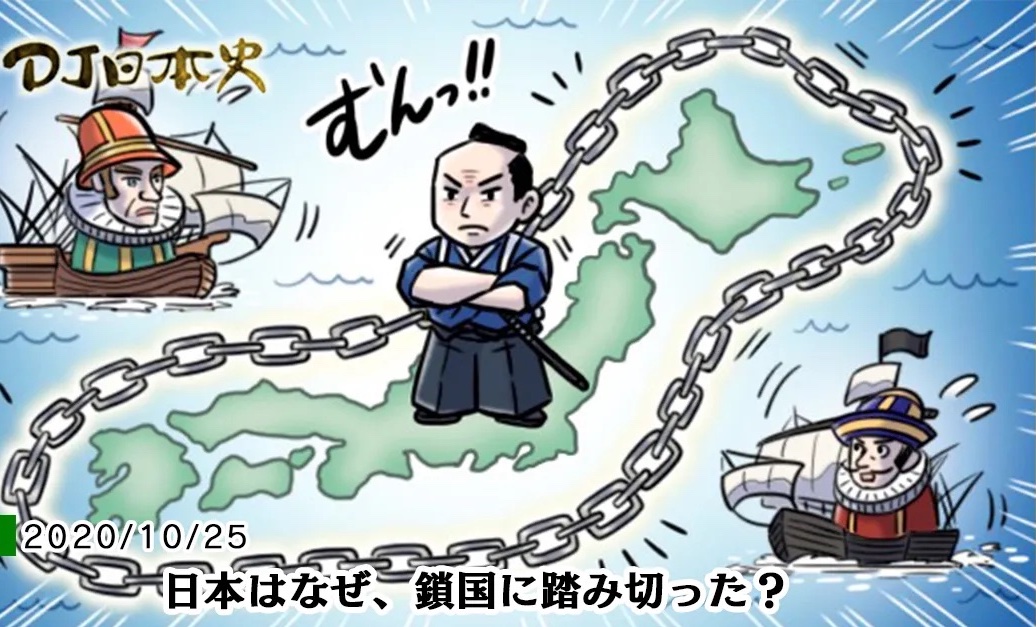
S4 Ep 167Sakoku 2.0
Not familiar with this important historical Japanese terminology? sakoku 1.0 is the era of isolation between 1603 and 1867. Known as Edo, it was ruled over by the razor-sharp blade of the Tokugawa Clan. In Old Japan the Tokugawa Shogunate enforced strict social order and the rigidly structured social hierarchy system of the Japanese, which has been evolving over millennia. Over the next 264 years, the Japanese cultivated a culture of extraordinary systems anchored in the principles of Form, Order, and Process. Make no mistake about the calculated brutality enforcing mandated adherence to strict social hierarchy in order to keep one's fledgling country in civil order after the extremely brutal sengoku jidai (1467-1568 CE) where it was said: The rivers of Japan run crimson with blood. The peace and stability of the Tokugawa period, and the economic development it fostered, set the stage for the rapid modernization that took place after the Meiji Restoration. Here is another critical historical lesson as to why the Japanese had to open their county after 264 years of self-imposed isolation. Imperialist American Gunboat Diplomacy. Commodore Perry came to Japan representing the United States of America, along with a squadron of four vessels. For a time, Japanese officials refused to speak with Commodore Perry, but under threat of attack they accepted letters from President Millard Fillmore. After giving Japan time to consider the establishment of external relations, Commodore Perry returned to Tokyo with nine ships in March 1854. On March 31, he signed the Treaty of Kanagawa with the Japanese government, opening Japan to American trade and permitting the establishment of a U.S. consulate in Japan. Fundamentally, the Japanese were forced to open to international trade under grave threat of violence and destruction at the hands of the Americans. Yet, this is genocidal behaviour continues around the globe up until this very day. This historic event initiated one of the greatest achievements in human history—the industrialization of Japan reflecting the best of Occxie-land, and beyond. The history books bear witness to the fact that just seven short years after the Meiji period ended, a newly modernized Japan was recognized as one of the "Big Five" powers at the Versailles Peace Conference that ended World War I. Perhaps Commodore Perry and the myopic Americans were aghast after witnessing what the Japanese are capable of achieving when exposed to ideas that will advance the nation of Japan combined with Form, Order, and Process. Which brings all to the sakoku 2.0 version of Japan, which started with the Covid virus in March 2020. Although one may think of viruses as microscopic, viruses take many forms and one must be certain viruses are not surreptitiously infecting one's own mind, heart or soul. The unending plagues and conflicts now tormenting our shared planet, is at an all time high and spinning out of control faster and faster, and will continue to do so for the foreseeable future. This is where another very important Japanese protocol comes into play which is necessary to understand as to why the Japanese nation will probably reject unfettered tourism ever again. One of the most profound cultural traits of the Japanese is the deeply engrained notion of tatemae and hone. tatemae: constructed reality to which everyone play lip service honne: true feelings What is on display now is farcical theatrics paying lips service to the re-opening of Japan to untethered tourists. Most regrettably, many long-term resident in the foreign community have built lives around tourism, presenting highly unique experiences for the curious and bold, but now leaves them in a bottomless pit of uncertainty. Unfortunately, due to the looming Thucydides's trap, staring directly into Japan's face, one now has to ponder what exactly will be Japan's role in the fast-approaching, volatile, and unpredictable geopolitical conundrums, now billowing in, one after another. In all likelihood, the Japanese will take a wait-and-see approach and implement necessary measures according to the fluidity of the situation. Remember, it is not the feckless interchangeable faces of the Japanese politicians and their long-suffering secretaries running the show. It is the faceless bureaucrats who manipulate the levers of power behind the black curtain, and make no mistake about it, these old Japanese men are simply mindless bureaucratic cogs grinding the system of Japan forward. Japanese bureaucrats are programmed by the deep indoctrination necessary to pass the stringent Japanese government bureaucrat exam, and these people have absolutely no interest in anything expect the advancement of Japan, which at the present time does not include unfettered free-range tourism. Uncomfortably true, the absence of throngs of tourists selfieing their way through the ancient civilization of Japan is a welcome reprieve for many long-term residents, and indeed most Japanes

S4 Ep 163Gray n Rice
It is always a joyful occasion when introducing the Japanese to the miracle of gravy 'n' rice. This remarkable meeting of two culinary culture touchstones fuses these staples into a flavour unlike any other. For certain the Japanese hold rice in the highest esteem in connection with the cultural significance of this sacred grain, and the evolution of Japanese civilization. Of equal significant meaning, but of less cultural magnitude are the humble drippings of pork roast, which are then turned into gravy. Indeed one's beloved father, in the French Canadian tradition was deeply fond of porcine and the versatility of this staple. In fact, he loved pork so much, he would save bacon grease to add to his world famous pancakes. Not only were his pancakes excellent, he was also fond of (deep) frying eggs in bacon grease as well, something his spouse put a stop to later in his long life (June 15, 1935 ~ April 5, 2022). Historically speaking, the Japanese do not roast whole pieces of meat or birds as Japanese kitchens are rarely equipped with a proper oven. Indeed, the average Japanese housewife's need for an over, or the concept of roasting something whole lies outside Japanese culinary protocol. The only thing the Japanese housewife is roasting is a piece of fish, one for each member of the family in the ubiquitous fish grill, which is present in all Japanese kitchens. It is because the Japanese do not have a concept of authentic gravy is exactly where the magic lies. There are pretenders to the throne of sauces, such as the popular yet mundane demi glace, or other types of Japanese sauces (tare), which although delicious, can not match the heavenly combination of gravy 'n' rice. Eating gravy 'n' rice for the first time is an enlightening experience for any Japanese person lucky enough to be offered gravy 'n' rice and may only happen once in a lifetime. One could say the meeting of sacred Japanese polished rice, and pork grease gravy, which is prepared by gently folding flour into pork fat while mixing the secret flavoured water, containing the hidden mystery of our clan's gravy recipe invoking a somewhat religious experience. It's almost as if introducing the Japanese to gravy 'n' rice created a fusion of Japanese and Occidental culinary civilization, in the unlikely combination of gravy 'n' rice. Adding authenticity to the complete meal entails roasted potatoes slathered with New Zealand grass-fed butter and a generous helping of fresh Aomori garlic. Don' forget a health drizzle of Australian macadamia nut oil, and a sprinkle of herbs and spices, which only adds to the perplexing menagerie of flavours one has coaxed out of the lowly potato. Gravy can be successfully made from may different kind of fat drippings. A traditional turkey dinner often related to Occidental holidays is a case in point. For certain, there is a vegan recipe for gravy one can smear all over veggies and indeed even fruit until the heart has become content. Here one would only need to substitute a vegetable soup cube and other magic (salts, herbs, spices) available to those who chose not to eat the carcasses of dead animals. Perhaps one can consider gravy 'n' rice as a metaphor for foundation of a wonderful life. The foundation of life is rice, and topped with gravy, adds variety and spice to life .

S4 Ep 161Godless
The ancient traditional Japanese values and behaviour differ fundamentally from those raised in Christianized cultures in the most extraordinary Ways. In 1543, a Chinese junk with several Portuguese traders was blown off course into Japan. Here the first ever recorded encounter between Westerners and Japanese occurred on Tanegashima off the coast of Kyushu. It was here the Japanese were first introduced to firearms, gun powder, and tobacco. Indeed the lord of the island was so impressed with the Portuguese matchlock instrument of death, he ordered his craftsmen to set up a foundry and duplicate them. Here is evidence of the innate Japanese trait of taking novel items from other worlds and crafting the object into something uniquely Japanese, and more often than not, superior in all aspects. In spite of these brilliant displays of craftsmanship and understanding, in the eyes of the Westerners, the Japanese had no sense of morality or ethics. Imagine the shock of the first puritanical foreign missionaries arriving in Japan, in what Koizumi Yakumo describes as "fairyland." The attitude and behaviour of the Japanese in most practical matters, including those of a sexual nature, are in fundamental alignment with nature, as is indicative of an agrarian island nation. Even today the Japanese do not regard nudity or sex as sinful or something shameful. This was made evidently clear as one enjoyed a leisurely outdoor bath in one of the ubiquitous hot springs sprinkled throughout Japan. The cleaning lady was chatting with stark-naked male patron in what could only be described as a surreal scene in a peculiar movie. She was also kind enough to mention the lovely day while checking the bath temperature, as one was soaking solo in the outdoor taru buro. No issues, as one was able to overcome the Occidental Christian shame and punishment protocol concerning nudity, which also happens to be a reflection of the beauty and divinity of our common body and soul. These criticisms of the Japanese was to continue for the next 400 years. Exposed here is the Occidental Christians protocol of projecting superiority over Japanese culture and way of life, where they advocates detachment from the natural ebb and flow of life, and one's own ancestors. A more practical understanding of the difference between Western and Japanese morality only really came to light the mid-1900s The difference between these two distinct minds is directly bound to the religious systems dominating the two cultures. Keep in mind, the Japanese are not, and never have been "religious" in the mythological sense of Christianity. In the West, Christianity and its dogma is based upon the absolute principles of good and bad, right and wrong. This is the dominant philosophical and spiritual force of Christianity which embodies a detailed code of thought and behaviour that was drummed into Westerners from childhood. Even all the more unpleasantly so, every thought and action was prescribed and judged by a single, all-powerful, all-knowing god. Westerners were conditioned to pass judgment on every aspect of life, labeling every thought and action as good or bad, moral or immoral. All precepts pertaining to life were expressed in these absolute terms. These canons of Mammon were created to serve generation after generation of morally bankrupt religious parasites sucking the spirit and soul from our common humanity. Life in the West was ruled by absolute principles, starting with the Ten Commandments. The indoctrinated Christian Occidentals were conditioned to suffer emotional and spiritual pain if they broke any of these commandments, even when their "misbehaviour" was unknown to others. For this omnipresent Western style god, or more realistically, what has now morphed into the "State," wants to knows if you have been naughty or nice, and will for certain exact its pound of flesh and revenge as it sees fit, jury, judge, and executioner, all in the name of the lord. The prime directive of Western culture was that everyone should be conditioned to automatically distinguish between right and wrong as prescribed by the Church. However, this has never guarantee "good" or even humane behaviour, and much of the evil committed by the West is still done in the name of religion. In Japan, on the other hand, there is no single omnipotent god whatsoever. The Japanese have their own constitution handed down from Taishi Shōtoku in 604 CE, which takes a much more pragmatic approach to carry oneself throughout life. There are no religious texts teaching absolute truths. The roots of the Japanese are in the detailed guidelines concerning form order, and process. These are matters of social status, position, gender, relationships, and the like, and has nothing to do with religious tenets whatsoever. Among the Japanese, ultimate power is not in the hands of a god, but in the hands of their group. What the Japanese fear the most is the opinion and judgement of the individual member of t
S4 Ep 158Born Again
There is nothing like the innocent life of a new born child. Alas, in most cases, this innocence ends abruptly as the indoctrination process begins in-earnest. For many unlucky boys raised in the Occidental tradition, the indoctrination start with a blade and the male genitalia in what is known as the unkindest cut of them all; circumcision. This vile edict from long dead self-appointed and regally anointed "people of god" is still carried out in the name of piety in some regions of our troubled world; female genital mutilation. All claiming to be in direct communication with monotheistic gods must be looked upon with deep suspicion and as suffering from megsalomania, delusion of grandeur, and rotten to their putrid core with deep-seated mental illness. Moreover, fantastic fables of god and miracle are simply designed by Mammon to be in the service of the chosen "people of god" at the dear expense of the flock, or otherwise know in Christianity as "sheep." Let us all now reflect upon the fate of the majority of sheep…… Amen. Clearly, the original message of Jesus, from whence a beacon to the downtrodden once shone has now taken on a much more menacing and sinister meaning. Here, the fraud is evident for all to see as the naked greed motivating these "people of god" is clearly rooted in the material sludge of this mortal world. In case one did not know, the fleecers fleece the fleeced to the tune of 10% of their gross income; this is what is known as tithing. Even much more heart-wrenchingly so, the gullible masses accept that they must wait for a reward in the afterlife, in what is refer to as "heaven." As is with all evolution, so it is with Christianity. The modern Christians understand mandating the surrender of one's own sovereignty can be clearly dismissed as dead mythology. Here is something important to understand about "heaven" and now needs to be prudently examined for veracity. According to Christian doctrine, unless one had received Jesus as their personal saviour, and to have been washed by the blood of the lamb (Jesus), one can not enter the kingdom of "heaven." This is exclusionary in the extreme, and contra-humanistic. If this Christian tenet is taken at face value, the Japanese are heading straight to hell, according to this particular Christian dogma. Joyfully so, the message of love and harmony is still prevalent in certain circles of Christianity today. Here is something that is universally applicable to ponder, no religion necessary: Do not judge a book by its cover. The Japanese do not judge others, it is not necessary, for we live in the tate shakai social structure of Japan. Indeed, the Japanese citizens' place in this complex society is most likely to be predetermined and accepted as the natural course of one own life. Remember, Japan was an isolated island nation in the middle of the Pacific Ocean until only recently (Commodore Perry and Japan [1853-1854]). The resilience of the Japanese can not be underestimated, and the Japanese Spirit prevailed even when gravely threatened by the Jesuits during the sakoku period from 1603 to 1867. As pointed out in Koizumi Yakumo seminal work; Japan, an Attempt at Interpretation, in the chapter entitled, Jesuit Peril, one can see the Japanese flatly rejecting any notion of a disconnection from one's own ancestry in the service of a false god in a far away land. What Yakumo saw, and saliently described during the birth of industrial Japan, was that the Japanese are not "religious," but in fact, adhere to the Way of Ancestor Worship. Moreover, the Japanese place the highest value on form, order, and process…one could almost say, religiously. The Japanese are welcoming to all, they only ask for recognition of just a few commonsensical protocols while visiting the sacred land of Japan. respectful of others mind your manners venerate ancestors life's ephemeral nature live and let live For further insight in to the Land Of The Rising Son, why not take a moment to check out the following nooks and crannies: (あ)How the Japanese think about love in I Don't Love You I Like You A Lot. (い)Why is the personal seal of approval on mundane business documents necessary all the time. Find out in The Almighty Chop (う)The most important film critic you have never heard of, meet Yodogawa Nagaharu here. (え)Not your average American buffet, but plenty pork intestite and stinky fish, welcome to Akitaya - A Family Restaurant. (お)Will Japan become just like the good old U$A? Ask Mickey Mouse. (か)You are what you eat whether you like it or not, some RoundUp with your rice? (き)An angel on earth disseminating joy, Who is Uehara Hiromi? (く)Never would one have thought in a lifetime to have had the honour to meet a Kamikaze pilot. (こ)What happens when one becomes bewitched and under a spell, Is My Wife a (Good) Witch?

S4 Ep 157Civilization 3.0
The chasm between "East" and "West" has never been as volatile since the enslavement of the Chinese nation with a massive opioid addiction pandemic early in the 20th century. Western civilization evolved from the Greeks and Romans, and when considering Eastern civilization, China comes to mind as the representative of the East, as this is the birth place of Confucius. Keep in mind, the moral tenets of the Asia nations are based first and foremost upon Ancestor Worship, infused with the peaceful teachings of the Buddha, and communal specific rituals passed down from generation to generation. Let us now refresh our memories as to why this historical inflection point has now set up a showdown between these two civilizations. There were two armed conflicts in China in the mid-19th century between the forces of Western countries and the Qing dynasty (644 to 1911-12). These two wars are referred to as the "Opium Wars." The first Opium War was fought between China and Britain (1839–42). The second Opium War, also known as the Arrow War, was the Anglo-French War in China fought by Brits and French against the Chinese (1856–60). These conflicts marked the start of the era of unequal treaties with the Chinese. However, this malice and disgraceful behaviour toward Asians was not something unfamiliar to the Occxie overlords, and this sneaky technique is still used in many forms even until this very day. On a colonial note, this is where the Brits came into possession of Hong Kong via the Treaty of Nanjing. The onslaught of these rabid and greedy merchants of death via their vile ploy to enslave Eastern Civilization using massive opioid drug addition, resulted in the Chinese continuing to resist this repugnant Occxie protocol, leading to the second Opium War. These destructive Opium Wars arose from China's attempts to suppress the opium trade, which was destroying the Ancient Eastern civilization. Primarily it was the British traders that had been illegally exporting opium mainly from India to China since the 18th century, and that trade dramatically increased starting around 1820. Moreover, the resulting widespread opioid addiction caused the severe decay of the social, moral, and economic fabric of Chinese society, which must be noted clearly, is founded upon the key humanistic principle of filial piety and ancestor worship. Indeed, filial piety is the core tenet binding all Asian societies and their communities, and the fundamental principle of ancestor worship leave both the Japanese and Eastern civilizations on a very different spectrum conceptually than those with the myopic Occxie eyes. The third pillar of civilization, civility, can be observed as an innate character of the Japanese. Fundamentally, the ancient Japanese and Asian civilizations will continue to persist as they have for millennia. Alas, civilizations built upon the false doctrine that separates the family, community, and humans from each other and their humanity, are destine to crumble under the weight of their dogma and fallacy. Here, any rabid tribe now unhinged from reality will be forced to peer into the sacred mirror of one's own soul, and face the emotions and the hunger pangs of life's decisions. However, one should not despair, for hope springs eternal. Anyone can look to the third pillar of civilization, which is civility, an innate characteristic of the Japanese. Indeed, the Japanese civilization has evolved its civility on these isolated Pacific islands for over 2 millennium. One another colonial note, the Japanese barely dodged a fatal cultural bullet after wisely rejecting the Jesuit dogma out of Rome. The Japanese then built their unique civilization over the next 200 years, free from Western influence. Then, true to their innate Occxie nature, the Americans showed up at Japan's door, and do what they do best, point a gun and demand "trade." History shows starting with the Meiji Restoration, the Japanese successfully integrated alien concepts, and forge them into something anew, and often, superior. So it is with the advancement of the Japanese civilization today. Vastly older than others, and more deeply cultured with timeless wisdom, there is also a capacity to be humble by the Shackles of the Past. Lest we all need to be reminded, Japan is the only nation in history, thus so far, to have ever experienced the devastation of a nuclear holocaust first hand, twice. Here again, humanity stands at the brink of nuclear annihilation. If once again the nation of Japan should suffer the fiery breath of nuclear weapons, it will not only be the end of Civilization 3.0, but elimination of all human civilizations, once and for all. In order to understand the pillar in which the Japanese civilization rests upon soundly, one must carefully examine the Japanese constitution written by Prince Shotoku in the 7th century. The concept of dōtoku 道徳 is the universal guiding principles and the spirit of dōtoku 道徳 is enshrined in Prince Shotoku Taishi's co
S3 Ep 1ボナー・フェラーズ准将
ボナー・フェラーズが、日本人の文化や生き方を理解し、尊敬するようになったのは、第二次世界大戦が始まボナー・フェラーズる前、1932にアメリカに留学していた島田亜矢と親しくなったことがきっかけでした。 しかも、この平然とした軍人気質は、彼が信奉していた宗教法人友愛会ファミリー(クエーカー)が定式化したものです。

S3 Ep 1Brigadier General Bonner Fellers
Bonner Fellers was one of the few American who understood the importance of the Emperor to the Japanese people, and what it would have meant to have tried and executed Emperor Hirohito as a war criminal.
S2 Ep 12Ato Aji - Foreign Aftertaste

S2 Ep 11Gaijin Kusai - Smelling Like A Foreigner

S2 Ep 10Hinkaku - Dignity and Grace
The English word " dignity" does not do justice to the full cultural connotation of "hinkaku" in this Japanese context.

S2 Ep 9Shugyo - Training For Intuitive Wisdom
Most Westerners prize practical knowledge and hands-on experience above all other kinds of learning. They are also condition to approach work and other challenge is directly, aiming for the "the shortest distance between two points". It is therefore, inevitable that Westerns in Japan, and those working for the Japanese companies abroad, will be mystified and frustrated by a great deal of typical Japanese behaviour, for to the Japanese the shortest distance between two points is not a straight line.

S2 Ep 8Byōdō - Equality
There has never been a time in history of any society when all people were treated as equals. However, Americans as well as others have passed laws over the centuries that now tries to impose the foreign concept of equality onto the Japanese, as they eagerly spread their version of freedom, democracy and equality all over the world.

S3 Ep 121Master Storyteller Dan Carlin
Master Storyteller Dan Carlin entrances and engulfs battalions of spellbound adherents into incredible rides probing the nooks and crannies of Hardcore History, the most widely acclaimed podcast in, well, history. ΩNE Master Carlin's exquisite voice personifies his unparalleled style—his shows in fact, are the most listened to within the entire Hardcore History and its divine sister inside his Addendum Sphere—leaving him alone, untouchable, as the undisputed Master Podcaster across all gamuts of the Infinity Verse known as time. Once upon a time, ΩNE Master Carlin released the first in a series of podcasts concerning the Pacific Crusade entitled—Supernova in the East—concerning the fleeting Japanese empire, and their Mal Matriculated ventures into WWII. Self Matriculating under this incredible storyteller for many years, and as a token of appreciation for his magnificent work, ΩNE stimulated his Master by sharing books to facilitate further enlightenment into the Japanese Way. The serendipitous notion of Infinite Motion was for ΩNE Master Carlin to embrue his suppositions into a Hardcore History Special—with respect to ΩNE from Japan. Imagine the surprise and delight when ΩNE Master Carlin referenced a book in the inaugural instalment of the incredible podcast series entitled—Super Nova in the East. The first book mentioned in Super Nova in the East was Japan and the Shackles of the Past, by R. Taggart Murphy. Need to start? ΩNE Taggart Murphy's Shackles of the Past is top on the list to commence Infinite Journey into the notion of Pacific islands called Japan. Super Nova in the East podcast series progressed with a new release once every 6 to 8 months, and ΩNE felt compelled to elevate ΩNE Master Carlin, thus edifying Each Other forever all the more. The Nobility of Failure: Tragic Heroes in the History of Japan, by Ivan Morris was originally published in 1975. This seminal work by ΩNE Ivan Morris contains several stories of failed heroes with the climax described in these tragic, yet noble tales, ΩNE Master Carlin fills in the missing pieces in heart-wrenching visceral detail. The final chapter of this particular Ocxxie Mal Matriculation Instance—encompasses bleak accounts of kamikaze fighters which entail—If Only We Might Fall—for this truly stands alone, as a cautionary tale, within this tragic string of a Noble Fail. Accounts of young kamikaze fighters along with their letters to their families, waiting to sacrifice ΩNE of their lives, for the Empire of Japan. ΩNE Master Carlin made a cultured observation, when saying he was taught in school (Mal Matriculated)—kamikaze fighters were mindless robots blindly sacrificing their lives for notion of the Empire of Japan. Super Nova in the East 6, the masterful five hour and forty-five minute Epic Conclusion to the incredible Super Nova in the East Opus was not only spellbindingly breathtaking—is an instance of a Creative Genius Masterpiece. The adroitness of ΩNE Master Carlin lies in his impartiality and Narration Mastery—maintaining a virtuous interpretation of the historical accounts, and in this instance of the true nature of the Japanese, and indeed all of humanity (ΩNE). ΩNE Master Carlin so brilliantly describes the Japanese—they are just like everybody else—but even more so! Bonus: The global reach of ΩNE Master Carlin became crystal clear as ΩNE visited local shrine on Immaculate Sunny Day. There was a special event in progress, and unusually so, quite a few foreigners participating, all dressed up in martial art garb. Unknown ΩNE came and paid compliment to this exceptional hat, and said all members of the Amicable Clan were also big fans of ΩNE Master Carlin. The notion of a place in space called Croatia is where on Earth these life forms originated from. Deep notion of gratitude flow into ΩNE Master Carlin's prodigious creative genius flooding Mother Earth with a historically significant incident of a Muse Getting Loose inside his erudite mind, and from where Hardcore History Book will forever Infinitely Opine. Hardcore History 62 – Supernova in the East I Supernova in the East I: The Asia-Pacific War of 1937-1945 has deep roots. It also involves a Japanese society that's been called one of the most distinctive on Earth. If there were a Japanese version of Captain America, this would be his origin story: 4 hour 28 min; July 14, 2018. Hardcore History 63 – Supernova in the East II Supernova in the East II: Deep themes run through this show, with allegations of Japanese war crimes and atrocities in China at the start leading to eerily familiar, almost modern questions over how the world should respond. And then Dec 7, 1941 arrives: 4 hour 2 min; January 12, 2019 Hardcore History 64 – Supernova in the East III Supernova in the East III: Japan's rising sun goes supernova and engulfs a huge area of Asia and the Pacific. A war without mercy begins to develop infusing the whole conflict with a savage vibe: 4 hour 53 min; October 24, 2019 Hardcore History

S2 Ep 7粗探し
それどころか難しい日本語の書き方を無駄なことだと思っているでしょう。 その人たちは心の中で、日本語の書き方をマスターすることは、絶対に不可能だと思っています。

S2 Ep 7Ara Sagashi - Nation of Nitpickers
We can say for sure that the Japanese way of writing has indeed been a mixed blessing for the citizens of the Land Of The Rising Son, but with the passage of time we can honestly say that this highly complex system has gained many more advantages which now I believe far outweigh any of its disadvantages.

S2 Ep 79Why Ancestors Worship
What does it actually mean to worship one's ancestors? First of all, there are different ideas about the word "worship" and what it encompasses in a "religious" context. The preferred word veneration can be translated nicely into Japanese as sonkei (尊敬), which is more, "down-to-earth." While thinking about the Japanese society, and the social conventions to which the Japanese adhere, one came to the realization that venerating the ancestor, along with the Sun is the best way to express gratitude toward our world and what it gives us. By the way, Amaterasu Oomikami is the Japanese Sun Goddess. This notion of expressing gratitude to those who came before and the life giving energy of the Sun embodies a sense of unity with all people of the world, for we all share the Sun and each has ancestors. One has very fond memories of one particular ancestor—maternal grandfather. As a child he had tuberculosis and was cared for in a small room for a year where ones Really Great Grandmother and Great Grandfather were simply waiting to see if he lived or died. Fortunately for my mom and I, he lived (Dad is happy about this as well). It was during this time in sickness where he read 100s of books which left him a very well read and enlightened man. One's heart fills with fondness when recalling the time spent together with grandfather and his spirit being manifested. This leaves feeling the spirit of grandfather as partially residing in the material world. One could say—once the last of the people directly touch by this extraordinary man pass away, this spirit of grandfather will also fade away. Even if this may be so, the spirits of the ancestors lives on in our alter along with all relatives who have already crossed the SANZU NO KAWA into the afterlife. Here in Japan, ancestors are remembered on specific holidays. For example, the Autumn Equinox (Shūbun no Hi), usually occurring on September 22 or 23. On this day, people will reconnect with their families by tending to the graves of ancestors, and visiting shrines and temples. Pragmatically so, the Japanese believe all virtue and frailty of being human are natural, and look upon all of the dearly departed as some kind of Gods, representing the entire spectrum of the human experience. One finds the inclusiveness of this way of thinking rather refreshing, and indeed to be a much more practical way to think about and live one's own life. Looking at ancestor veneration from a different lens, one also likes to celebrate present relatives who will one day become "ancestors." As when taking the in-laws on an overnight trip, and saying to the cherished and beloved mother-in-law. "I believe we should also venerate our ancestor while still here on earth, so you also can celebrate this wonderful world you have sacrificed for your descendants while ya'll are still here." She had a good laugh and concurred with these sentiments. Why not take some of one's precious time now, and give thanks to our shared Sun Goddess while venerate one's own ancestors, both living and dead, and let them know. Kokoro yori kansha moshi agemasu

S1 Ep 70wabi-sabi
Coming to Japan in 1987, there was wonderment, awe, and, sometime dismay about these strange new things and customs, that having been surrounding this incidental Occxie for decades. Wabi-sabi resides in the rare "air." Like many unspoken protocols and conventions of the Japanese, awareness of wabi-sabi is an innate trait, embodied within the spirit of Yamato. In traditional Japanese aesthetics, wabi-sabi is a world view centred on the acceptance of the transience and imperfection of universal truth. Wabi-sabi is sometimes described as one of beauty that is imperfect, impermanent, and incomplete. Wabi-sabi is derived from the Buddhist teaching of the three marks of existence: sanbōin, which is the delineation of the three marks of existence mujō―impermanency ku―suffering kuu―emptiness or absence of self-nature Characteristics of the wabi-sabi aesthetics include: asymmetry roughness simplicity economy austerity modesty intimacy Once one has recognized and understood wabi-sabi, a deep and meaningful appreciation of the ingenuous integrity of natural objects and processes. Wabi-sabi does not translate into any other languages, as these notions are unique to the civilization of the Japanese. Wabi embodies rustic simplicity, freshness, or quietness, and can be applied to both natural and human-made objects, or understated elegance. It can also refer to quirks and anomalies arising from the process of construction, which add uniqueness and elegance to the object. Sabi is beauty or serenity that comes with age, when the life of the object and its impermanence are evidenced in its wear and tear. With its roots in Buddhist influences from China, wabi-sabi has now evolved into a distinctly Japanese cultural touchstone. From around 700 years ago, understanding emptiness and imperfection was honoured as tantamount to the first step to enlightenment. In modern Japan, the meaning of wabi-sabi embodies "wisdom in natural simplicity". It can also hold the connotation of "flawed beauty" in particularly in the sphere of art. One can see wabi-sabi in certain styles of Japanese pottery. In the Japanese tea ceremony, the pottery items used are often rustic and simple-looking. Hagiware is an example of this, with shapes that are not quite symmetrical, and colours or textures that appear to emphasize an unrefined or simple style. It is up to the knowledge and observational ability of the observer to notice and discern the hidden signs of truly excellent design. One can see wabi-sabi in most things, if one opens the eyes and heart. Wabi and sabi both suggest sentiments of desolation and solitude. In the Mahayana Buddhist view of the universe, these may be viewed as positive characteristics, representing liberation from a material world, and transcendence to a simpler life, or what is know in Buddhism as "satori" or "enlightenment." Keep in mind as one ponders the meaning of life―genuine understanding of wabi-sabi cannot be achieved through words or language. Therefore, one must accept wabi-sabi on nonverbal terms, and this may be the most appropriate approach to understand the meaning of wabi-sabi. In fact, one could say—wabi-sabi describes the meaning of life, and the essence of being a human. Here, one can learn to live through the senses, and better engage in this mortal sludge in real time, rather than be caught up in unnecessary thoughts, and the incessant chatter of the monkey brain, the root causing of human suffering and pain. In this sense, wabi-sabi is the material representation of Zen Buddhism. The universal truth is: Being surrounded by natural, changing, and unique objects, helps us connect to the real world, and escape one's chattering "monkey brain." In wabi-sabi, one learns to find the most basic, natural objects interesting, fascinating, and beautiful―which is in fact, the true essence of life. Look around more deeply and pensively at the world that surrounds you, and then one will have begun the wabi-sabi journey into the Sun.

S2 Ep 6しきたり
西洋人にとって、日本という国は矛盾した国で、 良いことに関しても常に反対の不利な面を持っているように思えます。確かに世界のどこでも同じような現象があるかもしれませんが、ここ日本では、その対比がとても著しく思えるでしょう。

S2 Ep 6Shikitari-The Herd Instinct
The Herd Instinct One can say that to the Westerner eyes that Japan is the land of contradictions, everything good or positive about Japan always seems to have a flipside that is negative or unfavourable. Indeed you could say this about all societies, but here this contrast may appear to be much more pronounced.

S2 Ep 5Itadakimasu-Gochisosama
There are two very important words in Japanese with deep meaning but no equivalent sentiment in the English concept of language. Itadakimasu and gochiso sama are very important parts of the dining etiquette in Japan. Itadakimasu is said just before eating, it literally means "to receive" or "accept " but in this context more like a DNA infused Japanese Way in a ritualistic connotation, you could almost say it's like a prayer. Read about "PONDS OF ALCOHOL, FORESTS OF MEAT(SUMPTUOUS FEAST)" here.

S2 Ep 5「いただきます」「ごちそうさま」
日本人にとって、「いただきます」と「ごちそうさま」は深く重要な言葉ですが、英語には訳すことができません。この言葉を使うことは日本の食における大切な礼儀作法の一つです。

S2 Ep 4恩返し
いくつかの例外を除き、事実上、あらゆる種類の相互作用は、一部の人がより高い原則と見なすものとは対照的に、個人的な義務から始まり、それに基づいています。 日本人は伝統的に、寛大なおもてなしを持っていることで知られており、一般的に訪問者と専門的またはビジネス上の関係を発展させたい人々にそのおもてなしを与えます。

S2 Ep 4Ongaishi - Covering With Obligation
The Japanese have traditionally been known for their generous hospitality that they typically bestow upon visitors and on people with whom they want to develop a professional or business relations. The extraordinary gift giving that is so much a part of Japanese life is also one of the facets of creating and repeating obligation. I have also taken up their custom of extending small unique token gifts when traveling abroad for people I meet anew or for people I would like to develop some kind of relationship.
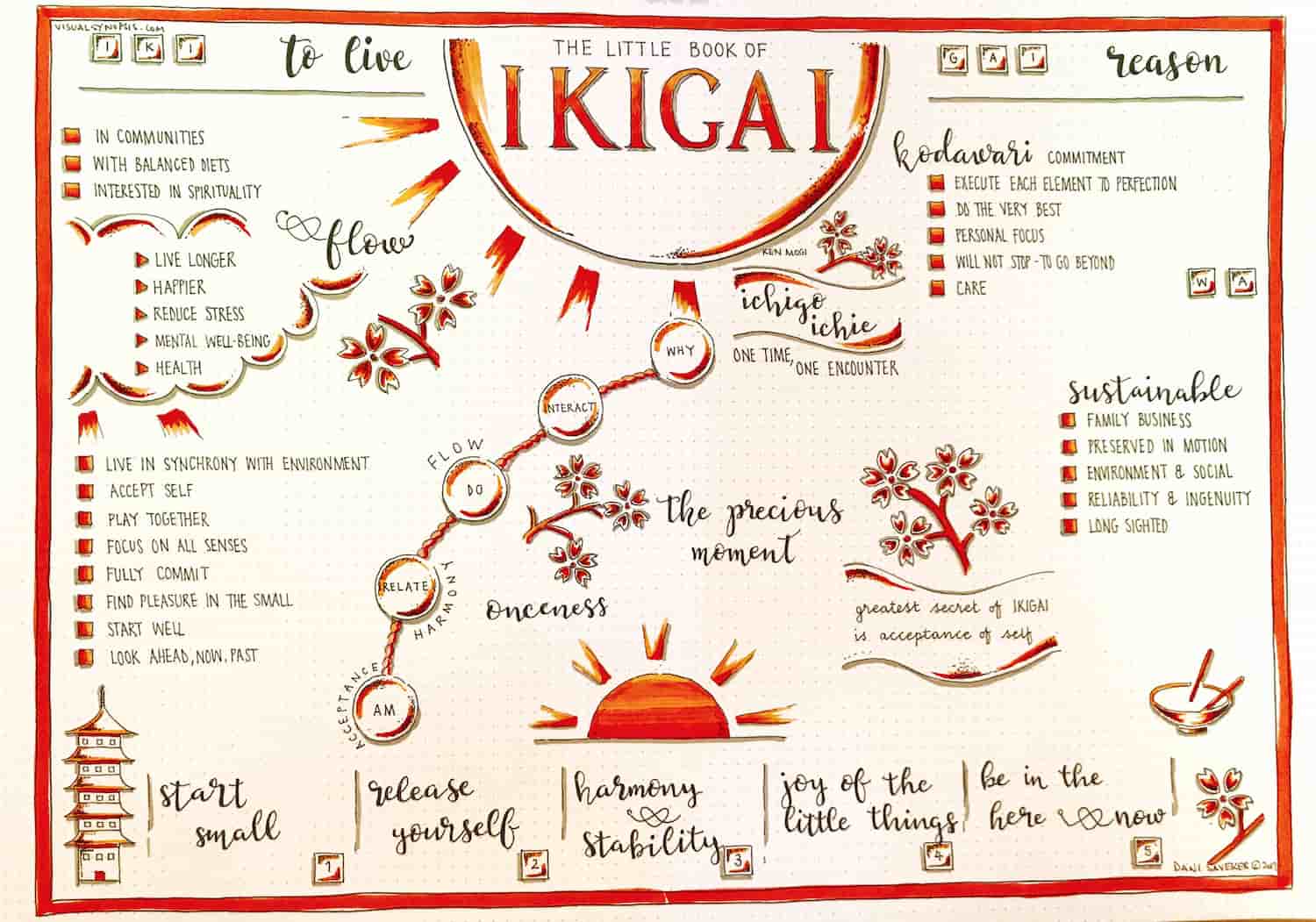
S2 Ep 65Ikigai
Ikigai is the Japanese concept meaning—a reason for being. Ikigai refers to having a direction or purpose in life, making life worthwhile, and to take spontaneous and willing actions giving satisfaction, and a sense of meaning to life. Ikigai consists of iki (to live [生き]) and gai (reason[甲斐]). This elegant concept is deeply rooted in the Japanese Way—described in a blog post entitled: Finding One's Way. Ikigai can be describe as having a sense of purpose in life, as well as being motivated. Internalizing the concept of ikigai leads to happiness and well-being, and ikigai entails the important intent and actions of devoting oneself to pursuits one enjoys, and is associated with feelings of accomplishment and fulfilment. Indeed, understanding ikigai will lead to ΩNE's own fulfilment, as all search for, and discover the meaning to one's own life. For certain, you can serve yourself by understanding and internalizing this significant Japanese concept. Have you found you ikigai? If not quite yet, keep looking, as it is sure to be there.
S2 Ep 3Tripping Over Ones Tongue
Fundamentally, the Japanese are weary of people who are good talkers, equating this habit and demonstrations of such ability with unprincipled, untrustworthy behaviour. While we can say there is also a similar attitude towards overly talkative people in the West as well, here in Japan, the negative response to people who talk way to much has a much more deeply rooted culture connotation, and far more important in the overall scheme of things even up until this very day. Japanese Telepathy

S2 Ep 2Omoiyari - Japanese-style Sympathy
This exclusivity of the Japanese mindset goes far beyond the intangible features of culture such as philosophy, morals, ethics, values, it also includes race, food and other aspects of life.