Episode 12
Capitalism’s finest theater: Inside Christie's Hong Kong evening art auction
This article is by Lee Jian and read by an artificial voice. HONG KONG — A thunderous, synchronized applause erupted within the pristine, glass-walled confines of Christie's salesroom at The Henderson. The final gavel had fallen, punctuating an evenin...
Korea JoongAng Daily - Daily News from Korea · LEE JIAN
March 29, 20266m 39s
Audio is streamed directly from the publisher (cdn.beyondwords.io) as published in their RSS feed. Play Podcasts does not host this file. Rights-holders can request removal through the copyright & takedown page.
Show Notes
This article is by Lee Jian and read by an artificial voice.
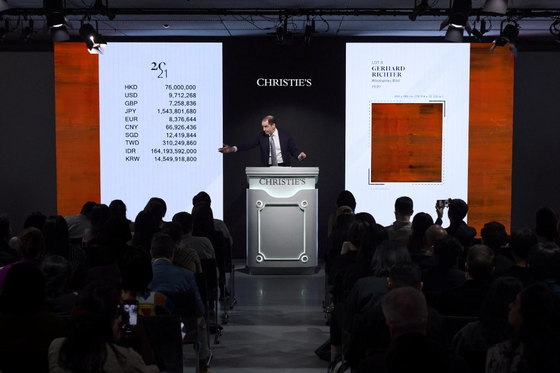
HONG KONG — A thunderous, synchronized applause erupted within the pristine, glass-walled confines of Christie's salesroom at The Henderson. The final gavel had fallen, punctuating an evening of high-stakes financial ballet.
In about 90 minutes, 37 lots were paraded, contested and hammered down, racking up a staggering $83.8 million. When combined with the subsequent day sales, Christie's 20th/21st Century Spring Sale series generated approximately $114 million in just 48 hours.
The evening sale, widely regarded as the main event, featured high-profile and historically significant works, including those by Gerhard Richter, David Hockney, Claude Monet (1840-1926), Pablo Picasso (1881-1973) and Vincent van Gogh (1853-1890). It offered all the drama, tension and calculated art of capitalism's finest theater, where the boundary between cultural appreciation and raw acquisition became indistinguishable.
The performance began at 7 p.m. sharp on Friday. As the house lights dimmed and the hum of socialite chatter faded into a reverent hush, the stage was set. Adrien Meyer, Christie's Global Head of Private Sales, took the rostrum with the practiced poise of a seasoned conductor. He wasted no time, opening the night with "In the Excitement of Dying" (2022) by Li Hei Di, a Chinese artist still in her twenties.
The bidding for Li's work served as an immediate adrenaline shot to the room. Starting at 400,000 Hong Kong dollars ($51,110), the price climbed with dizzying speed. It became a public duel between a woman in the front row and a phalanx of specialists manning the telephones. In less than two minutes, the hammer fell at 1.5 million Hong Kong dollars. The tone was set: the room was hungry and wallets were open.
The momentum surged forward with the classics. Monet's "La Maison à travers les roses" (1925-26), a late-career masterpiece of light and color, rose from an opening bid of 10 million Hong Kong dollars to a final hammer price of 18.5 million Hong Kong dollars. But the evening's first true emotional peak arrived with Lot 7: van Gogh's "Meisje in het bosch (A Girl in a Wood)" (1883).
This was not the van Gogh of sun-drenched sunflowers or swirling starry nights, but a modest-sized oil on canvas from his early Dutch period depicting a dark, somber forest scene. Bidding opened at 5.5 million Hong Kong dollars and quickly narrowed to a tense standoff between an anonymous absentee bidder and a persistent voice on the telephone.
The tension in the room was a physical weight. The telephone bidder moved slowly, adding an extra million Hong Kong dollars with agonizing deliberation, seemingly securing the prize. Then, in a moment of pure theatrical timing, a third buyer jumped in at the final second via another telephone line. The audience let out a collective gasp as if it were watching a plot twist in a Broadway thriller. The piece hammered at 27 million Hong Kong dollars to the last surprise bidder.
Throughout the frenzy, Meyer maintained a calculated gravitas, even as he gestured toward the van Gogh with a salesman's flourish. The cognitive dissonance was jarring when he said, "The van Gogh, right here, could be yours," invoking the Dutch master's name as if it were a vintage Hermès Birkin.
The irony was impossible to ignore. This painting, with its muddy browns and heavy shadows, was van Gogh's tribute to the grueling reality of peasant life. He painted it while enduring extreme poverty, social isolation and the looming specter of mental collapse. Now, over a century later, it served as a high-status centerpiece for the global elite.
The prevailing atmosphere was that this — the spending of fortunes — is fun. While others might decompress with a beer or a musical, this demographic consumes art as an immersive show. The audience was a mix of the curious and the powerful, carefully segregated: the spectators in the back and the "players" with bidding paddles in the fro...
HONG KONG — A thunderous, synchronized applause erupted within the pristine, glass-walled confines of Christie's salesroom at The Henderson. The final gavel had fallen, punctuating an evening of high-stakes financial ballet.
In about 90 minutes, 37 lots were paraded, contested and hammered down, racking up a staggering $83.8 million. When combined with the subsequent day sales, Christie's 20th/21st Century Spring Sale series generated approximately $114 million in just 48 hours.
The evening sale, widely regarded as the main event, featured high-profile and historically significant works, including those by Gerhard Richter, David Hockney, Claude Monet (1840-1926), Pablo Picasso (1881-1973) and Vincent van Gogh (1853-1890). It offered all the drama, tension and calculated art of capitalism's finest theater, where the boundary between cultural appreciation and raw acquisition became indistinguishable.
The performance began at 7 p.m. sharp on Friday. As the house lights dimmed and the hum of socialite chatter faded into a reverent hush, the stage was set. Adrien Meyer, Christie's Global Head of Private Sales, took the rostrum with the practiced poise of a seasoned conductor. He wasted no time, opening the night with "In the Excitement of Dying" (2022) by Li Hei Di, a Chinese artist still in her twenties.
The bidding for Li's work served as an immediate adrenaline shot to the room. Starting at 400,000 Hong Kong dollars ($51,110), the price climbed with dizzying speed. It became a public duel between a woman in the front row and a phalanx of specialists manning the telephones. In less than two minutes, the hammer fell at 1.5 million Hong Kong dollars. The tone was set: the room was hungry and wallets were open.
The momentum surged forward with the classics. Monet's "La Maison à travers les roses" (1925-26), a late-career masterpiece of light and color, rose from an opening bid of 10 million Hong Kong dollars to a final hammer price of 18.5 million Hong Kong dollars. But the evening's first true emotional peak arrived with Lot 7: van Gogh's "Meisje in het bosch (A Girl in a Wood)" (1883).
This was not the van Gogh of sun-drenched sunflowers or swirling starry nights, but a modest-sized oil on canvas from his early Dutch period depicting a dark, somber forest scene. Bidding opened at 5.5 million Hong Kong dollars and quickly narrowed to a tense standoff between an anonymous absentee bidder and a persistent voice on the telephone.
The tension in the room was a physical weight. The telephone bidder moved slowly, adding an extra million Hong Kong dollars with agonizing deliberation, seemingly securing the prize. Then, in a moment of pure theatrical timing, a third buyer jumped in at the final second via another telephone line. The audience let out a collective gasp as if it were watching a plot twist in a Broadway thriller. The piece hammered at 27 million Hong Kong dollars to the last surprise bidder.
Throughout the frenzy, Meyer maintained a calculated gravitas, even as he gestured toward the van Gogh with a salesman's flourish. The cognitive dissonance was jarring when he said, "The van Gogh, right here, could be yours," invoking the Dutch master's name as if it were a vintage Hermès Birkin.
The irony was impossible to ignore. This painting, with its muddy browns and heavy shadows, was van Gogh's tribute to the grueling reality of peasant life. He painted it while enduring extreme poverty, social isolation and the looming specter of mental collapse. Now, over a century later, it served as a high-status centerpiece for the global elite.
The prevailing atmosphere was that this — the spending of fortunes — is fun. While others might decompress with a beer or a musical, this demographic consumes art as an immersive show. The audience was a mix of the curious and the powerful, carefully segregated: the spectators in the back and the "players" with bidding paddles in the fro...