
Journal of Biophilic Design
112 episodes — Page 2 of 3

Designing for the Senses: How Biophilic Workspaces Can Unlock Human Potential
In an age where the modern workplace is rapidly evolving, a growing chorus of designers and workplace strategists are championing a radical new approach - one that reconnects us with the natural world. At the heart of this movement is the principle of biophilic design, which seeks to infuse our built environments with the rejuvenating power of nature.We speak with Collin Burry, design director at global architecture firm Gensler and Allison English, co-founder of workplace experience consultancy Aéto Strategy, who are both speaking at the Workspace Design Show in London on 26-27th February 2024. https://workspaceshow.co.uk"We are sensory beings," explains Collin Burry, design director at global architecture firm Gensler. "Designing for the full range of human senses - sight, sound, touch - is crucial if we want to create spaces that truly nourish and inspire people." Collin, who has transformed the interiors of iconic brands like Apple and Dolby, believes the workplace of the future must move beyond bare functionality to address our deep-seated need for connection with the natural world.Allison English, co-founder of workplace experience consultancy Atos Strategy, agrees. "Sometimes we forget that we, as humans, are not designed to be sitting at desks staring at screens all day," she reflects. "We evolved to be in nature, to thrive in environments that stimulate all our senses." Allison's work has shown how biophilic design - from verdant living walls to soothing natural soundscapes - can have a profound impact on employee wellbeing and productivity. The benefits are backed by a growing body of research. Studies have found that exposure to natural elements can lower stress levels, boost cognitive function and even reduce absenteeism.To find out more about both Collin and Allison’s practices, visithttps://www.gensler.com/people/collin-burryhttps://www.linkedin.com/company/aéto-strategy/To meet them in person register and come to the Workspace Design Show in London on 26-27th February 2024. https://workspaceshow.co.uk. Hope to see you there!In an age where the modern workplace is rapidly evolving, a growing chorus of designers and workplace strategists are championing a radical new approach - one that reconnects us with the natural world. At the heart of this movement is the principle of biophilic design, which seeks to infuse our built environments with the rejuvenating power of nature. We speak with Collin Burry, design director at global architecture firm Gensler and Allison English, co-founder of workplace experience consultancy Aéto Strategy, who are both speaking at the Workspace Design Show in London on 26-27th February 2024. https://workspaceshow.co.uk"We are sensory beings," explains Collin. "Designing for the full range of human senses - sight, sound, touch - is crucial if we want to create spaces that truly nourish and inspire people." Collin, who has transformed the interiors of iconic brands like Apple and Dolby, believes the workplace of the future must move beyond bare functionality to address our deep-seated need for connection with the natural world. Allison agrees. "Sometimes we forget that we, as humans, are not designed to be sitting at desks staring at screens all day," she reflects. "We evolved to be in nature, to thrive in environments that stimulate all our senses." Allison's work has shown how biophilic design - from verdant living walls to soothing natural soundscapes - can have a profound impact on employee wellbeing and productivity. The benefits are backed by a growing body of research. Studies have found that exposure to natural elements can lower stress levels, boost cognitive function and even reduce absenteeism. "It's about creating spaces that make people feel cared for," says Collin. "When you walk into a workplace that's infused with natural materials, textures and greenery, it communicates the organisation's values in a powerful way." Yet, as both Collin and Allison acknowledge, driving this shift requires overcoming entrenched mindsets. "For too long, workplace design has been driven by the bottom line, not the human experience," laments Bury. "We need to get past this idea that sustainability and wellbeing are at odds with good design." Encouragingly, pioneering companies are leading the way. Allison cites the example of Standard Chartered Bank, which has used data-driven insights to create "the world's healthiest building" - complete with vertical farms, outdoor terraces and carefully curated natural elements. As we emerge from the upheaval of the pandemic, the designers believe this biophilic revolution is just getting started. "This is about reconnecting with our roots, with what it means to be human," says Collin. "The workplaces of the future won't just be efficient - they'll be truly life-enhancing."To find out more about both Collin and Allison’s practices, visithttps://www.gensler.com/people/collin-burry https://www.linkedin.com/company/aéto-strategy/ To meet the
Charlotte Church - The Dreaming
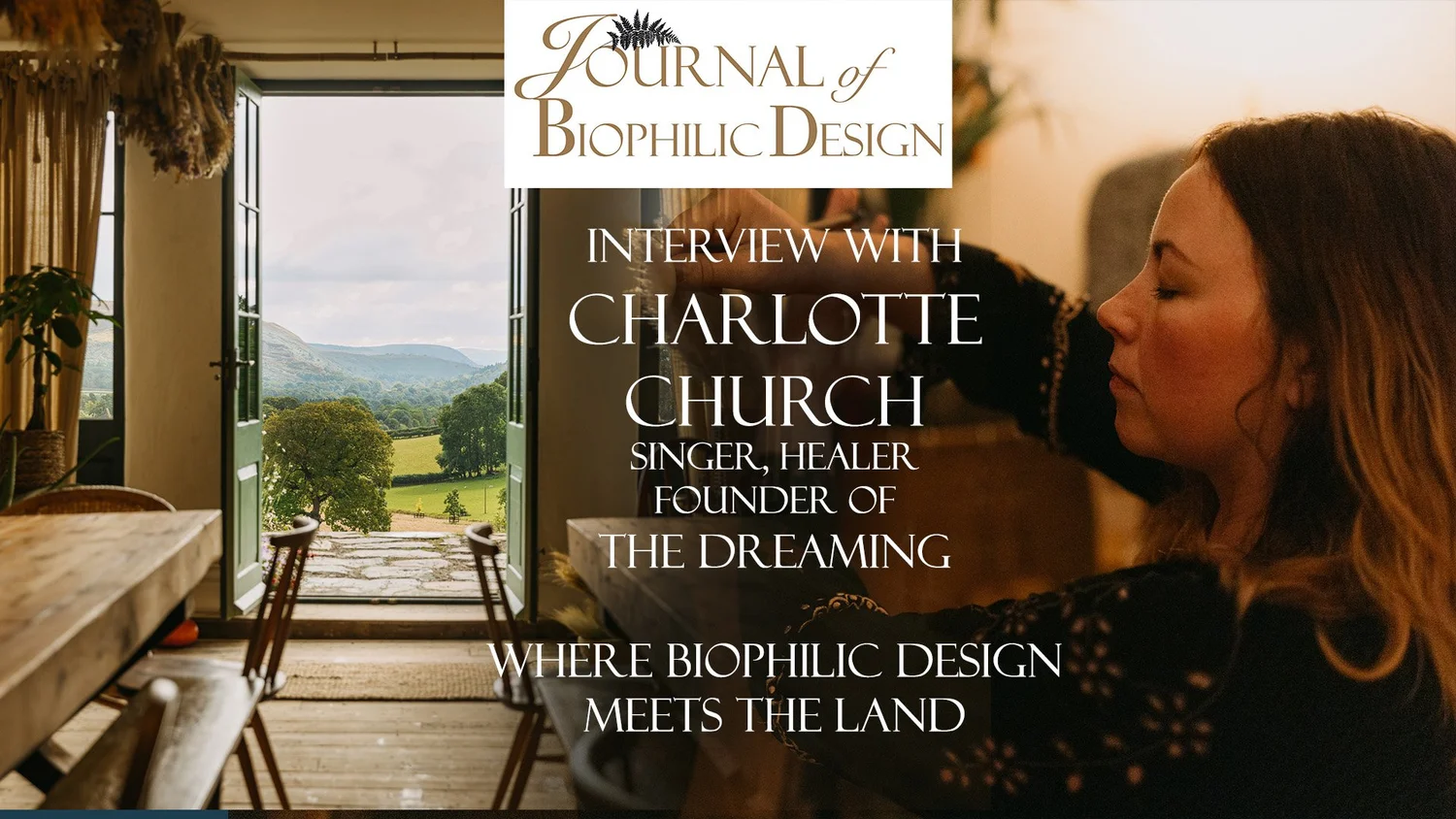
Reconnecting with Nature: Charlotte's Biophilic Retreat Offers Healing and WonderIn a secluded corner of the Welsh countryside, internationally renowned singer-songwriter Charlotte has created a sanctuary that blends the power of nature, music, and design. The Dreaming, her newly opened retreat centre, is a testament to her lifelong passion for the restorative qualities of the natural world.Nestled in the Elan Valley, surrounded by cascading waterfalls and ancient forests, The Dreaming is a place where visitors are invited to shed the trappings of modern life and immerse themselves in the rhythms of the land.Charlotte's journey to this point has been shaped by a growing awareness of the disconnect between humans and nature, a disconnect she believes is at the root of many of society's ills. "Nature keeps us in balance," she explains. "When we separate ourselves from it, we become way out of balance in every way possible."At The Dreaming, Charlotte has created a space that aims to rekindle that essential connection. Through a blend of biophilic design, holistic practices, and the power of music, she hopes to guide visitors on a transformative journey of self-discovery and healing."It's about an opening," Charlotte says of the experiences people have at the retreat. "Almost everybody that comes here, experiences some form of opening, whatever the walls that we build around ourselves and our hearts, they just start to loosen a little bit."The Dreaming's architectural design is a testament to this philosophy. Crafted with natural materials and a keen eye for integrating the outdoors, the spaces are imbued with a sense of warmth and wonder. From the cozy "Cwtch" room, with its plush sofa and rustic charm, to the mystical "Mystic" suite, with its vibrant saris and ancient-inspired decor, each space is designed to evoke a different facet of the natural world.But it's not just the environment that captivates. The Dreaming's programs, led by Charlotte and a team of skilled practitioners, are designed to immerse visitors in the rhythms of nature. Dawn chanting, dark sky immersions, and communal music-making are just a few of the offerings that aim to reconnect people with their innate sense of wonder and creativity."I think that the land does the majority of the work," Charlotte says. "I feel like when people leave, they leave with a sense of awe, wonder, the mysteries, the magic."For Charlotte, this magic is not limited to the confines of The Dreaming. She believes that the power of nature-based healing is accessible to everyone, no matter where they live. "You can go to a beach, you can go to a forest, you can go to a river, wherever you are most drawn."The Dreaming, then, is not just a retreat centre, but a model for a new way of living in harmony with the natural world. By tapping into the deep well of wisdom and healing that resides in the land, Charlotte hopes to inspire a broader cultural shift, one that recognizes the vital role of nature in our individual and collective well-being."I've watched people really connect with joy for the first time in years," Charlotte says. "Another thing that I try and instil when I'm here is that this it doesn't have to be in this place, and it doesn't have to be facilitated by very clever, very learned, very spiritual people - you can go and do this wherever you are, wherever you are."As the world grapples with the mounting challenges of climate change and social disconnection, The Dreaming stands as a beacon of hope, a place where the ancient wisdom of the land is honoured and the power of human creativity is unleashed. For those who venture here, the experience is nothing short of transformative – a reminder that the path to healing and wholeness lies not in the pursuit of material wealth or status, but in the simple act of reconnecting with the natural world that sustains us all.Have you got a copy of the Journal? You can now subscribe to the digital edition or purchase a copy directly from us at the journalofbiophilicdesign.com or Amazon. If you like our podcast and would like to support us in some way, you can buy us a coffee if you’d like to, thank you xWatch the Biophilic Design Conference on demand here www.biophilicdesignconference.com Credits: with thanks to George Harvey Audio Production for the calming biophilic soundscape that backs all our podcasts. Did you know our podcast is also on Audible, Amazon Music, Spotify, iTunes, YouTube, Stitcher, vurbl, podbay, podtail, and most if not all the RSS feeds?Facebook https://www.facebook.com/journalofbiophilicdesign/Twitter https://twitter.com/JofBiophilicDsnLinkedIn. https://www.linkedin.com/company/journalofbiophilicdesign/Instagram https://www.instagram.com/journalofbiophilicdesign
Reconnecting with Nature: The Biophilic Design Revolution
In an age of increasing urbanisation and digital distractions, a growing movement is seeking to reestablish our innate connection with the natural world. At the forefront of this revolution is Martin Brown, a sustainability consultant and self-proclaimed "provocateur," who is challenging the way we design and inhabit our built environments. Speaking with Vanessa Champion on The Journal of Biophilic Design Podcast, Martin recounts his own journey, one that has seen him transition from a career in project management to becoming a leading voice in the world of regenerative design. "I think biophilia, rather biophilic design, was that sort of gateway to try attract more people and gain attention," he explains, describing how simple biophilic elements, such as living walls and textured wood panelling, can have a profound impact on both the occupants and the bottom line. But Martin's vision extends far beyond mere aesthetic improvements. He speaks passionately about the concept of "kinship," a deeper, more spiritual connection to the natural world that draws inspiration from indigenous philosophies. This shift in mindset is essential if we are to address the pressing environmental and social challenges of our time. He laments the "disconnect" he observes in modern society, where people are quick to marvel at the "pretty lights in the sky" but equally quick to discard their litter. The solution, according to Martin, lies in reclaiming our time and space, both physically and mentally. "If you're too busy to spend 20 minutes in nature, you should be spending an hour," he advises, emphasizing the importance of mindfulness and reconnection. It's a message that is resonating with a new generation of designers, architects, and urban planners, who are increasingly recognising the transformative power of biophilic design. As the world grapples with the consequences of our disconnection from nature, the work of visionaries like Martin Brown offers a glimmer of hope. By reweaving the threads of our relationship with the natural world, they are paving the way for a more sustainable, resilient, and fulfilling future. Listen to Martin Brown speak at the Biophilic Design Conference on 12th November. If you missed it you can still buy tickets to access the videos online from the website www.biophilicdesignconference.com To find out more about all the links Martin mentioned visit:https://linktr.ee/martin_brown https://www.living-future.eu/lfa/martin-brown/https://www.living-future.euhttps://fairsnape.substack.com Have you got a copy of the Journal? You can now subscribe to the digital edition or purchase a copy directly from us at the journalofbiophilicdesign.com or Amazon. If you like our podcast and would like to support us in some way, you can buy us a coffee if you’d like to, thank you xBook tickets to the Biophilic Design Conference here www.biophilicdesignconference.comCredits: with thanks to George Harvey Audio Production for the calming biophilic soundscape that backs all our podcasts. Did you know our podcast is also on Audible, Amazon Music, Spotify, iTunes, YouTube, Stitcher, vurbl, podbay, podtail, and most if not all the RSS feeds?Facebook https://www.facebook.com/journalofbiophilicdesign/Twitter https://twitter.com/JofBiophilicDsnLinkedIn. https://www.linkedin.com/company/journalofbiophilicdesign/Instagram https://www.instagram.com/journalofbiophilicdesign
Biophilic Design and Retail spaces
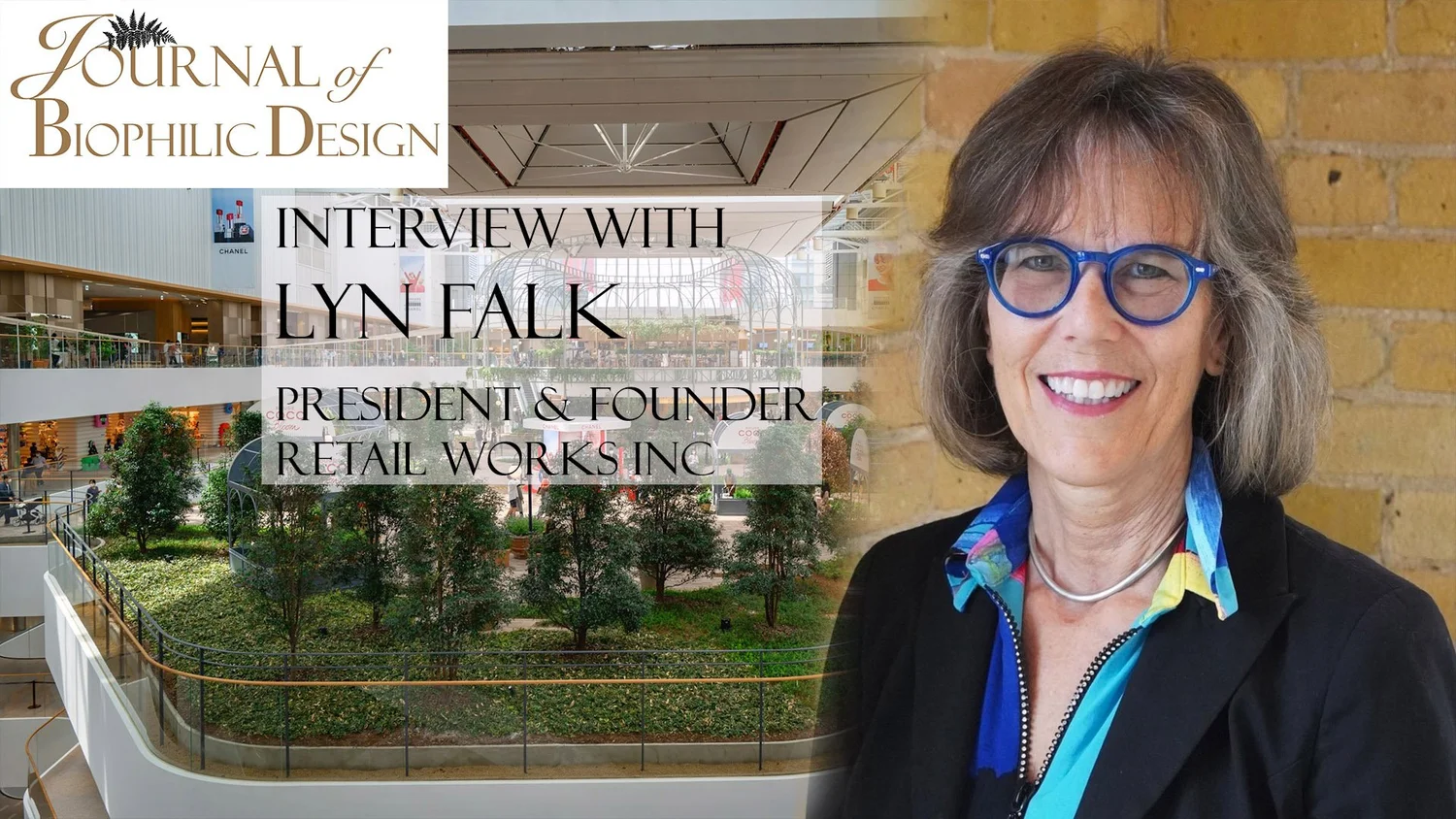
Lyn Falk is founder and president of Retailworks, Inc. – an award-winning branding, design, display and consulting firm specializing in retail, corporate, and hospitality spaces. She has devoted over 35 years to teaching and helping retailers and business professionals build healthy, purposeful and productive spaces that move hearts, minds & merchandise. Her expertise in retail design, business, science, consumer behaviour and environmental psychology has helped her develop designs that not only meet but often exceed her client’s projected goals/sales. Lyn is a passionate advocate of biophilic design. From her perspective, it is important all the time, humans are part of nature and need to reconnect with the environment rather than living in a built environment that pulls us away from nature. Early in her career she was really keen on healthy design, sustainable design and eco-friendly design and took an early interest in Biomimicry and Biophilia.In this podcast, Lyn describes herself as a long-term preacher and educator in the sphere of biophilic design. To her, "Everything is energy, even this brick building I'm in is made from molecules and atoms and energy,", and different materials like glass, wood, and brick vibrate differently, affecting our senses and well-being. She emphasizes the importance of natural materials like wood, which have not undergone extensive processing and retain their original energy. Her designs always include the immediate benefits of incorporating natural elements like plants, natural light, and fresh air into design and as many other elements the brief allows.Lyn's design philosophy is rooted in the understanding that we are fundamentally part of nature, not separate from it. "We cannot exist without abiding by the laws of nature," she says. "We've perhaps been forced into built environments that pull that out of the environment, but we're now seeing the results of that." Those results, according to Lyn, are all too apparent in the retail and hospitality sectors, where a focus on maximizing profits has often come at the expense of human needs.Lyn believes that by reintegrating nature into our built spaces through elements like natural light, plants, and natural materials, we can not only improve the customer experience, but also the wellbeing of employees. "I always say if I had to work in a cubicle, just shoot me," she laughs. “We are living nature, and we've been put in buildings that are static and not necessarily living, breathing buildings.”The key, Lyn argues, is understanding how our senses and subconscious respond to different environmental cues. For instance you can increase dwell time by having your customers listen “to the right genre of music for your target market and for the product that you're selling and your brand the right genre of music at the right volume and the right aroma, people think they were only in your store for a shorter period of time than they actually were."Ultimately, Lyn's vision for a future painted with the “Magic Brush of Biophilia” is one where biophilic design is the norm, not the exception. "Lush green and beautiful, clear blue. It's greens and blues, but all different shades, and just the depths of the green is amazing and enveloping. And the clear, deep, different coloured shades of blue that make you be able to breathe and see and there’s clarity."As the world grapples with the consequences of our disconnection from nature, Lyn's advocacy and insight in this podcast serves as a powerful reminder that the solutions may be found in reconnecting with the very essence of what makes us human.www.retailworksinc.comHave you got a copy of the Journal? You can now subscribe to the digital edition or purchase a copy directly from us at the journalofbiophilicdesign.com or Amazon. If you like our podcast and would like to support us in some way, you can buy us a coffee if you’d like to, thank you xBook tickets to the Biophilic Design Conference here www.biophilicdesignconference.comCredits: with thanks to George Harvey Audio Production for the calming biophilic soundscape that backs all our podcasts. Did you know our podcast is also on Audible, Amazon Music, Spotify, iTunes, YouTube, Stitcher, vurbl, podbay, podtail, and most if not all the RSS feeds?Facebook https://www.facebook.com/journalofbiophilicdesign/Twitter https://twitter.com/JofBiophilicDsnLinkedIn. https://www.linkedin.com/company/journalofbiophilicdesign/Instagram https://www.instagram.com/journalofbiophilicdesign
HuffnPuff House
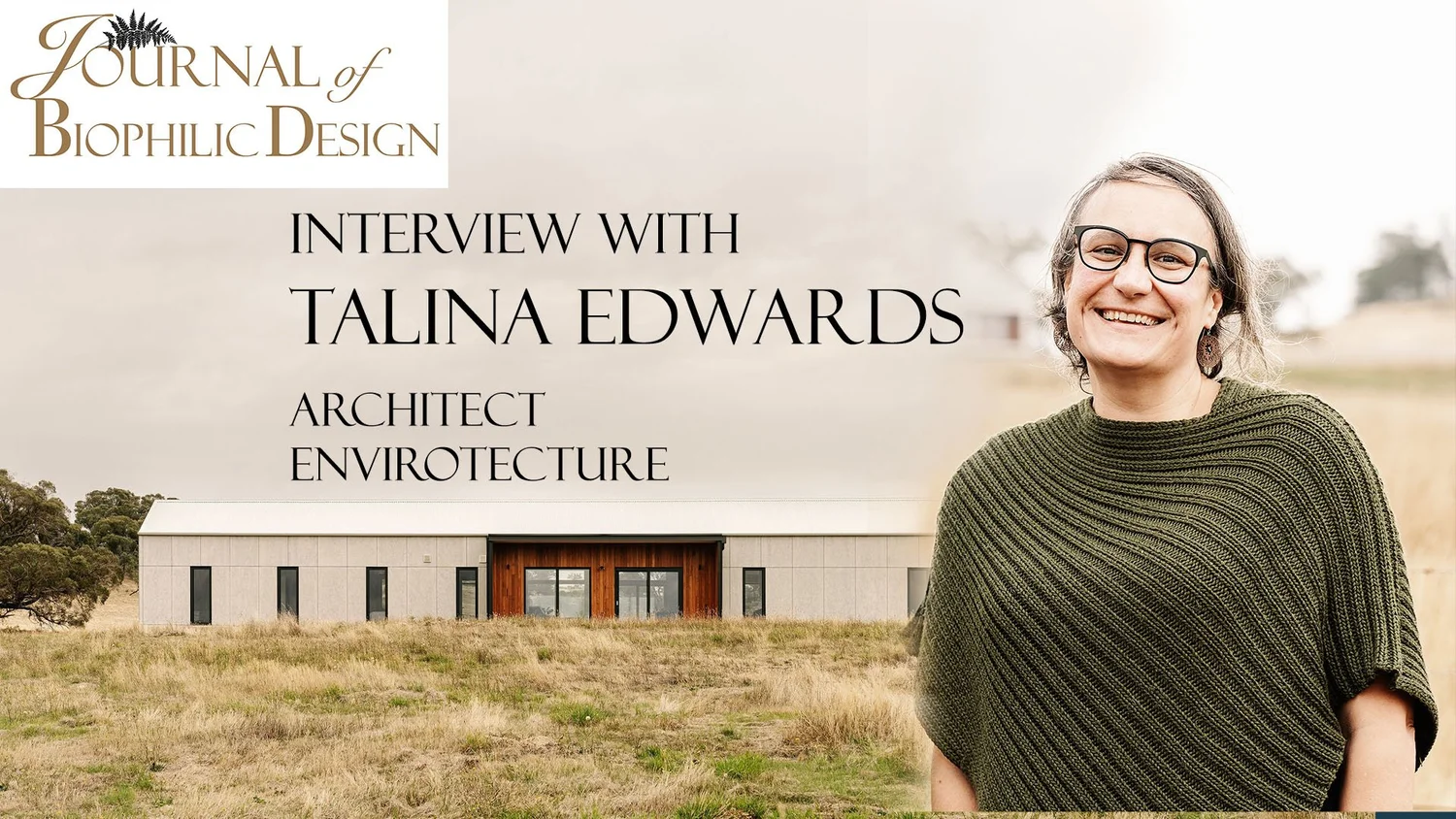
Talina Edwards, founder of the award-winning architecture firm Envirotecture, shares her passion for sustainable, biophilic design that reconnects people with the natural world.Based in Ballarat, Victoria, Talina and her team are at the forefront of a movement to transform the way homes and buildings are constructed in Australia. "We really care about health, we really care about people, and we really care about the planet, because we want a healthy, thriving future for the future generations," Talina explains. This ethos underpins Envirotecture's work, which spans certified PassivHaus projects, off-grid homes, and advocacy for more environmentally-conscious building practices.One of Talina's standout projects is the "Huff and Puff" house, a straw bale home that also achieved PassivHaus certification. "We wanted it to be very healthy. The clients were very keen on using straw because of being so connected to the land there. So that drove the whole project," she said. The home's thick straw walls, combined with careful solar orientation and triple-glazed windows, allowed it to meet the rigorous PassivHaus standard while still maintaining a strong connection to its natural surroundings.This connection to place is a crucial element of biophilic design, which Talina sees as essential for shifting societal mindsets around sustainability.Talina believes that biophilic principles can have a profound impact. “If we remember our true wild nature and our connection to spirit of place, it changes your outlook and everything." This sentiment is echoed in the design of Envirotecture's "Biophilic Bungalow" project, which involves the sensitive renovation and expansion of the existing California-style home.By incorporating elements like a central courtyard, a reflection pond, and carefully curated natural materials, they are creating a space that nurtures its occupants' connection to the surrounding landscape.With projects that seamlessly blend sustainability, health, and biophilic design, Talina and Envirotecture are leading the charge towards a more harmonious, nature-centric future for the built environment in Australia and beyond.Have you got a copy of the Journal? You can now subscribe to the digital edition or purchase a copy directly from us at the journalofbiophilicdesign.com or Amazon. If you like our podcast and would like to support us in some way, you can buy us a coffee if you’d like to, thank you xBook tickets to the Biophilic Design Conference here www.biophilicdesignconference.com Credits: with thanks to George Harvey Audio Production for the calming biophilic soundscape that backs all our podcasts. Did you know our podcast is also on Audible, Amazon Music, Spotify, iTunes, YouTube, Stitcher, vurbl, podbay, podtail, and most if not all the RSS feeds?Facebook https://www.facebook.com/journalofbiophilicdesign/Twitter https://twitter.com/JofBiophilicDsnLinkedIn. https://www.linkedin.com/company/journalofbiophilicdesign/Instagram https://www.instagram.com/journalofbiophilicdesign
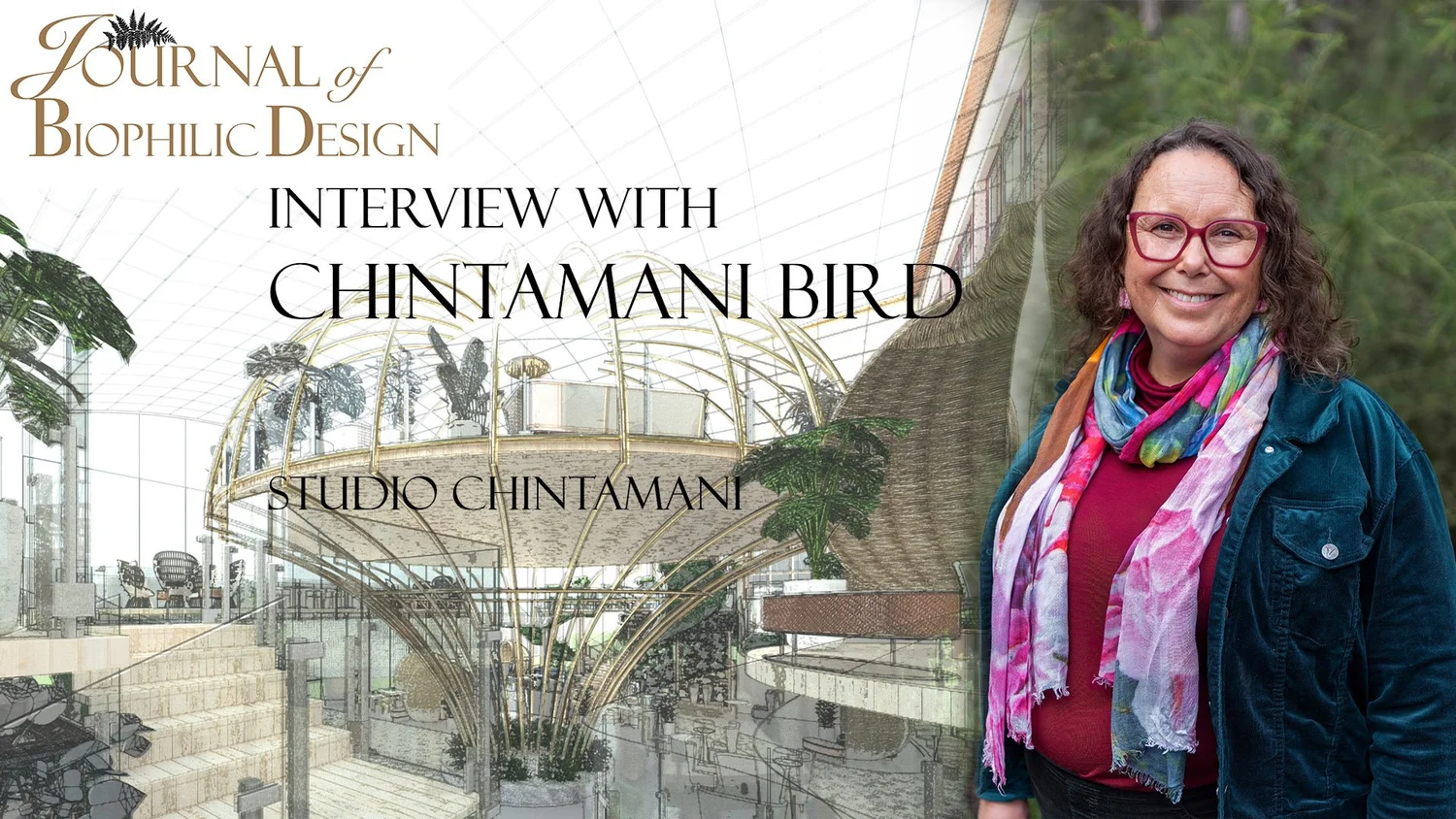
How our Brains respond to Biophilic Design
In a world increasingly disconnected from nature, the principles of biophilic design offer a powerful antidote.Chintamani Bird, an Australian designer committed to biophilic design, shared her insights on how Biophilic Design can heal both people and the planet. She emphasizes that biophilic design has a profound impact on the brain, reducing stress, improving cognitive function, activating the parasympathetic nervous system, and enhancing overall mood and well-being.As the Journal of Biophilic Design expands to Australia in 2025, this is the first in a series of interviews with leading names in Biophilic Designers from that side of the globe and who champion the transformative potential of this design philosophy.At the heart of Biophilic Design is the recognition that humans have an innate need to connect with the natural world. "Biophilic design has the opportunity to heal and heal through biodiversity, heal the soil, heal the environment, heal communities," Chintamani emphasized.When we put people in an environment like a modern open plan office with sensory deprivation, with white walls and square functional modular furniture for instance, we're actually really giving our people a beating. “It's very unkind and quite malicious," Chintamani explains. In contrast, environments infused with natural elements like fractals, water, and greenery can have a profound impact. Because the brain uses up an enormous amount of energy when engaged in any task, having those medium density fractals, allows for cognitive function to reduce as far as the effort it makes, and so helps us use the leftover energy to be more creative, to function, be more productive.This extends beyond the individual to the collective. Chintamani envisions a world "where nature is honoured and treated as sacred, with an integral balance between nature, Earth, and humanity."Biophilic design, she believes, can heal communities and ecosystems alike. The urgency of this approach is clear. "We're at a tipping point, we need to save our planet." With insects facing mass extinction, the time to act is now. Yet Chintamani's vision is not one of sacrifice, but of abundance. "Biophilic design has the opportunity to really do a lot of healing, not just for the environment, but also for people."From healthcare settings to workplaces, the integration of natural elements can reduce stress, improve mental health, and foster a sense of connection. I am often saying that biophilic design sits above everything... it's a catch all design principle that embraces everything and this discussion with Chintamani highlights this in buckets!By honouring our innate biophilia, our love of life, designers like Chintamani are reshaping the built environment to nurture both human and ecological wellbeing. In Chintamani's words, "we should actually imbue it with reverence and then be able to find an integral balance between nature, Earth and humanity."This is the transformative power of biophilic design. To find out more and follow Chintamani’s work visit:https://www.facebook.com/profile.php?id=61557684881987https://www.instagram.com/studio.chintamani/https://www.linkedin.com/in/chintamani-bird-lfa-b3a90662/www.studiochintamani.comHave you got a copy of the Journal? You can now subscribe to the digital edition or purchase a copy directly from us at the journalofbiophilicdesign.com or Amazon. If you like our podcast and would like to support us in some way, you can buy us a coffee if you’d like to, thank you xBook tickets to the Biophilic Design Conference here.Credits: with thanks to George Harvey Audio Production for the calming biophilic soundscape that backs all our podcasts. Did you know our podcast is also on Audible, Amazon Music, Spotify, iTunes, YouTube, Stitcher, vurbl, podbay, podtail, and most if not all the RSS feeds?Facebook https://www.facebook.com/journalofbiophilicdesign/Twitter https://twitter.com/JofBiophilicDsnLinkedIn. https://www.linkedin.com/company/journalofbiophilicdesign/Instagramhttps://www.instagram.com/journalofbiophilicdesign

The Spine - Liverpool: How Biophilic Design was used to create the highest WELL Certified Building in the World…
How does a passion for biophilic design, which stems from a desire to improve an architect and designer’s own health, lead to the design of a major new healthcare building? For Steven Edge, founder of Salvage Sustainable Design, his personal interest in Volatile Organic Compounds (VOCs) expanded into advocacy of Biophilic Design in buildings. We catch up with and discuss his recent project, commissioned by Manchester based architects AHR in 2017, where he acted as biophilic design consultant for their client the Royal College of Physicians’ new £35, million HQ in Liverpool. The Spine opened in the Spring of 2021 and with 109 out of a possible 110 WELL Credits, the highest of any (over 26,000) WELL certified buildings in the world, its set to become one of the healthiest buildings in the world.Stephen is a biophilic design consultant, and a Senior Fellow of the Higher Education Academy, with over 40 years’ experience in academia and the design and construction industry. He shares his background, starting with work in architecture and interior design, and his growing interest in sustainability and healthy materials.Talking about biophilic design principles used in The Spine, Steve describes how The Royal College of Physicians wanted to create a building that would make people feel healthier when they left it than when they entered; a brief that was fully met. Because it's a college as well as Office Spaces, they have young surgeons who would also be diagnosing real patients’ problems in this new building.The design, led by architect Rob Hopkins, drew inspiration from the human body, with elements like the "skin" of the building and the "spine" staircase.Steven describes how the team incorporated biophilic design principles to support health and wellbeing. This included maximizing natural daylight, providing views of nature, and incorporating lush indoor planting that was dubbed the "lungs" of the building. One of the things he mentions, is that trees give out a hormone that stimulates the vagus nerve in our brains. It calms us down, and so we are not only breathing that in but are also visually affected by the fact that we're in nature and walking under a tree canopy.The design also features sensors to allow occupants to control their immediate environment and temperature. Taking an holistic approach it uses innovative materials such as a clay plaster that absorbs toxins from the air.The team also looked at principles of biomimicry, taking cues from natural structures like bone to inform the building's columns. Interactive elements, like kinetic sculptures, were planned to encourage movement and play. Steven explains how lighting was a key consideration, with the team aiming to support circadian rhythms through strategic use of natural and artificial light. They consulted research on how lighting can impact productivity and mood throughout the day.Beyond the immediate health benefits, Edge discusses the links between biophilic design and sustainability. The team explored circular economy principles, looking at designing for disassembly and the potential to lease lighting systems rather than own them outright. They also drew on NASA research to select plant species known for their air purifying properties.The Spine is an amazing and inspirational project for any designer and architect. It demonstrates an holistic approach to biophilic design, integrating elements that support human health, wellbeing, and environmental sustainability.Edge's passion for this approach shines through, as he envisions a future with more playful, interactive biophilic design elements woven into our cities and buildings.For more information on Steve’s work visit: www.salvedge.co.ukThese are a couple of the extra references mentioned in the podcast:https://www.squintopera.com/projects/floodedlondon/ https://www.studioroosegaarde.net/project/wind-3-0 and https://www.studioroosegaarde.net/project/flow Also Dr Vanessa Champion, will also be presenting at the Healthy Cities by Design Conference at The Spine on 15 and 16 October 2024 https://www.healthycitydesign.global And Steve Edge will be presenting at the Biophilic Design Conference 12 November 2024 at the Barbican London (another Biophilic Space, we will also be in the Conservatory, the second largest after Kew Gardens). www.biophilicdesignconference.com
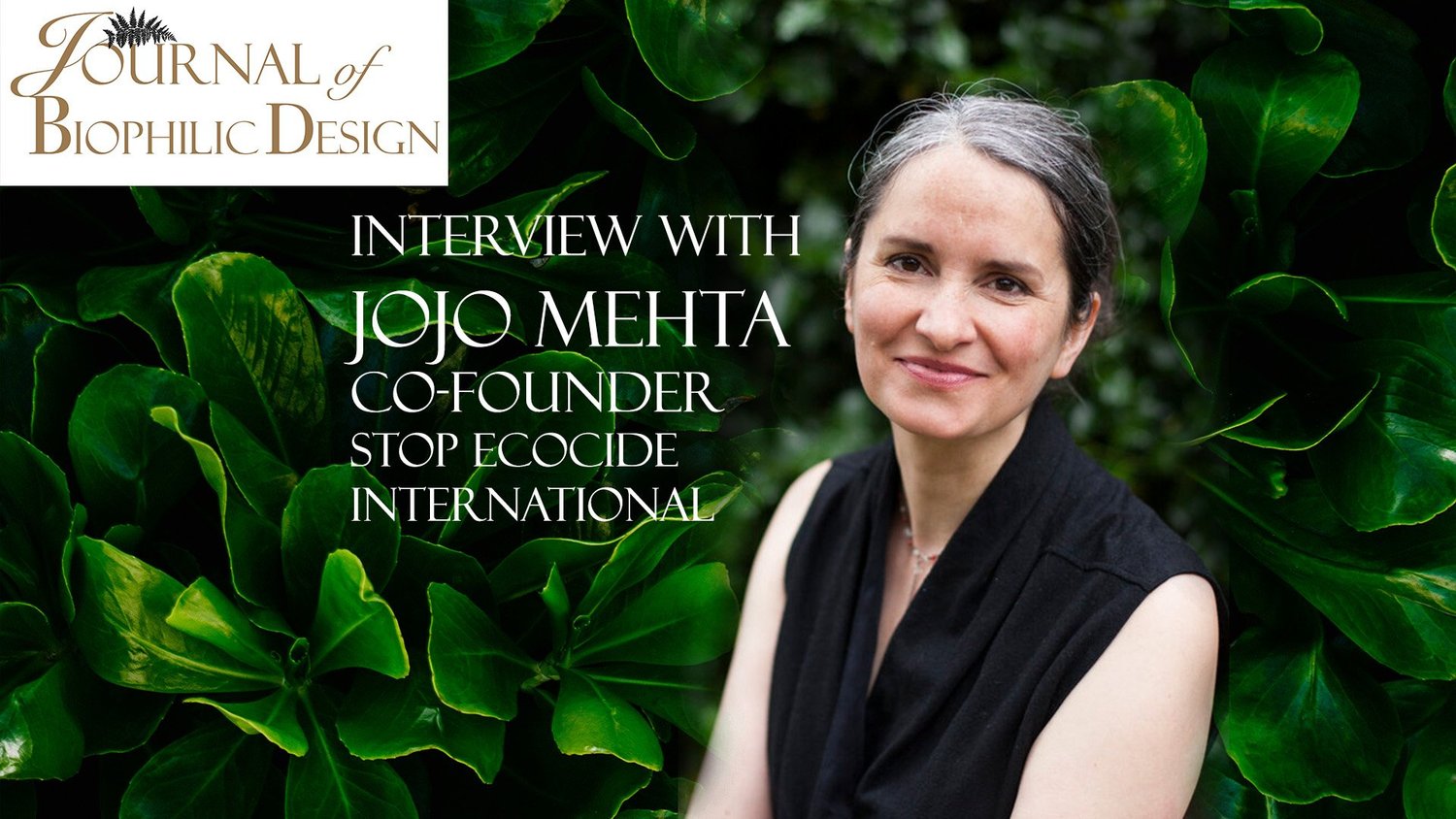
Biophilic Design healing our earth - interview with Jojo Mehta co-founder of Stop Ecocide International
"I love this term biophilia, because it's this, in a sense, it's a love of nature in a word, isn't it? And I had this beautiful description recently of what it actually means to love something or to love someone. In very plain terms, it means to include that person or that thing's interests as one's own." Jojo Mehta, Co-founder, Stop Ecocide International.For me Biophilic Design has the potential to heal more than just physical and mental health of people, it has the potential to help heal our earth too. If we implemented Biophilic Design in cities for instance, we can help mitigate climate change, even just by planting more trees which is a Biophilic Design solution, we increase tree canopy cover, increase biodiversity, mitigate flooding. There are many more, from creating Blue cities with cleaner rivers and waterways to planting on roofs and sides of buildings helping reduce the need to switch on air conditioning units in the summer and heating in the winter, which in turn reduces energy consumption. Also, as interior designers we specify more natural materials, reducing plastic, are more considerate of what textiles are made of and originate from.With our global temperature reaching a danger point, we need to do all we can as designers, architects, fit out managers and anyone who works in the built environment at any point.Today we have got the amazing Jojo Mehta with us on the podcast. Jojo is CEO and co-founder of Stop Ecocide International (SEI), the hub of the global movement to create a new international crime of ecocide to protect the Earth from the worst acts of environmental damage, a movement that is gaining significant political traction. She co-founded SEI with the visionary lawyer, Polly Higgins, who died in 2019, having devoted the final decade of her life to the cause.We explore and put into context just WHY we need to do more as designers, seize every opportunity we can to create better environments, not just for people, but for planet too and also how Biophilic Design is an essential part of the solution.Jojo Mehta is the CEO and co-founder of Stop Ecocide International, the organization working to create a new international crime of "ecocide" to protect the environment from severe damage. The goal of ecocide law is to hold companies and governments accountable for the worst acts of environmental destruction, similar to how genocide and war crimes are treated as international crimes.Jojo explains that ecocide law aims to shift the mindset around the environment, moving away from the perception of nature as an infinite resource to be exploited, towards a more holistic, interconnected view. By making severe environmental damage a crime, it would force decision-makers to consider the consequences of their actions on the natural world.She sees ecocide law as a crucial tool to complement initiatives like biophilic design, which seeks to reconnect people with nature through the built environment.Designers, architects, and others in the built environment sector have a vital role to play, not just in implementing biophilic principles, but in advocating for the legal frameworks that can drive systemic change.Individuals can get involved by raising awareness of ecocide law in their personal and professional networks, encouraging its inclusion in policy discussions and industry publications. Jojo emphasizes the importance of building a broad conversation around the need for such legislation, as politicians are more likely to act when there is clear public support.Ultimately, Jojo envisions a world where people and nature are deeply interconnected, with decisions made with the wellbeing of the natural world in mind.She believes that by aligning our laws and cultural attitudes with this biophilic worldview, we can begin to heal the damage done and create a more sustainable future.Have you got a copy of the Journal? You can now subscribe to the digital edition or purchase a copy directly from us at the journalofbiophilicdesign.com or Amazon. If you like our podcast and would like to support us in some way, you can buy us a coffee if you’d like to, thank you xCredits: with thanks to George Harvey Audio Production for the calming biophilic soundscape that backs all our podcasts. Did you know our podcast is also on Audible, Amazon Music, Spotify, iTunes, YouTube, Stitcher, vurbl, podbay, podtail, and most if not all the RSS feeds?Facebook https://www.facebook.com/journalofbiophilicdesign/Twitter https://twitter.com/JofBiophilicDsnLinkedIn. https://www.linkedin.com/company/journalofbiophilicdesign/Instagram https://www.instagram.com/journalofbiophilicdesign
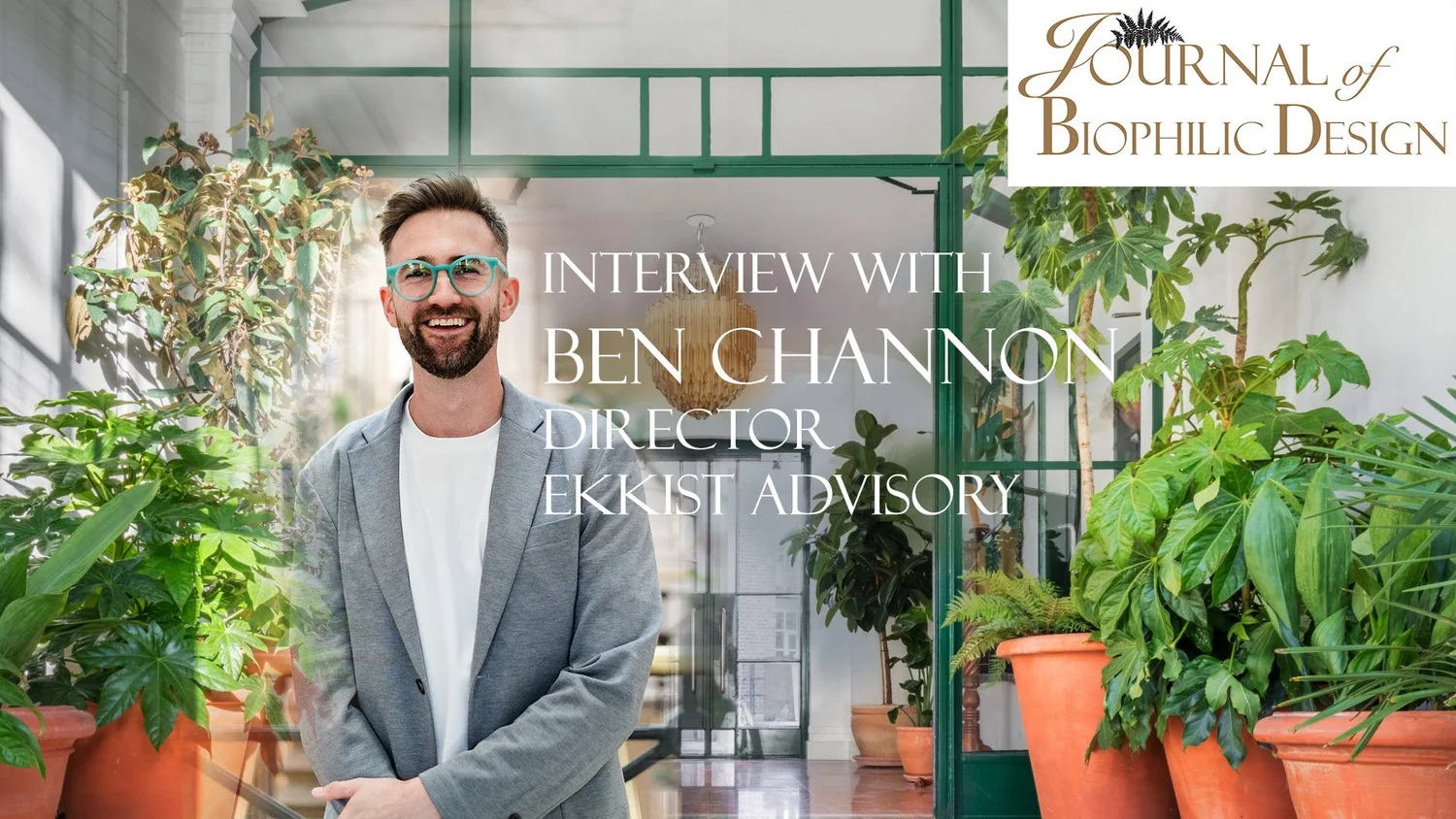
Living in Balance and Symbiosis with Nature through Biophilic Design
How can Biophilic Design be used to create happier and healthier environments? Ben Channon is an architect, author, TEDx speaker and mental wellbeing advocate, and is well known as a thought leader in designing for happiness and wellbeing. As a Director at the wellbeing design consultancy Ekkist, he helps clients and design teams to create healthier places, and researches how buildings and urban design can impact how we feel. He also offers talks on workplace mental health, productivity and company culture, sharing his philosophy that happier staff are better staff.Ben developed an interest in design for mental health, wellbeing and happiness after suffering with anxiety problems in his mid-twenties. His search for solutions to his personal issues led to him unearthing lots of amazing research including in the realm of environmental psychology, which proved that the environment we spend time in has a huge impact on how we feel, think, behave and interact with other people. All this led him to research the relationship between buildings and happiness, which formed the basis of his first book: ‘Happy by Design’. Ben’s second book ‘The Happy Design Toolkit’ - which offers more practical advice on how to create buildings for our mental wellbeing (published in March 2022) which gives people the tools to implement the principles of Happy Design.Ben makes it clear that progress towards Happy Design doesn’t have to be in big steps. He advocates using ‘nudge’ psychology; making small but significant changes that encourage healthier, happier behaviours, to add “little bits of joy” wherever we can, creating uplifting places and spaces that add elements of joy.Biophilic Design is increasingly more widely embraced, but long-term thinking and better education are required for the benefits of a biophilic approach to be fully realised. Listening to this podcast is a fantastic way to start that journey as Ben’s advocacy of the benefits of biophilic design is clear and compelling.As he says:“ We have to live more in balance and in symbiosis with nature. We have to not see nature as something we can plunder and keep taking from, but actually something that we need to support, and that actually, if we support nature, nature will support us back. “https://www.ekkist.co/designforwellbeing/https://www.ekkist.co/healthyhomeschecklist/Have you got a copy of the Journal? You can now subscribe to the digital edition or purchase a copy directly from us at the journalofbiophilicdesign.com or Amazon. If you like our podcast and would like to support us in some way, you can buy us a coffee if you’d like to, thank you xCredits: with thanks to George Harvey Audio Production for the calming biophilic soundscape that backs all our podcasts. Did you know our podcast is also on Audible, Amazon Music, Spotify, iTunes, YouTube, Stitcher, vurbl, podbay, podtail, and most if not all the RSS feeds?Facebook https://www.facebook.com/journalofbiophilicdesign/Twitter https://twitter.com/JofBiophilicDsnLinkedIn. https://www.linkedin.com/company/journalofbiophilicdesign/Instagram https://www.instagram.com/journalofbiophilicdesign
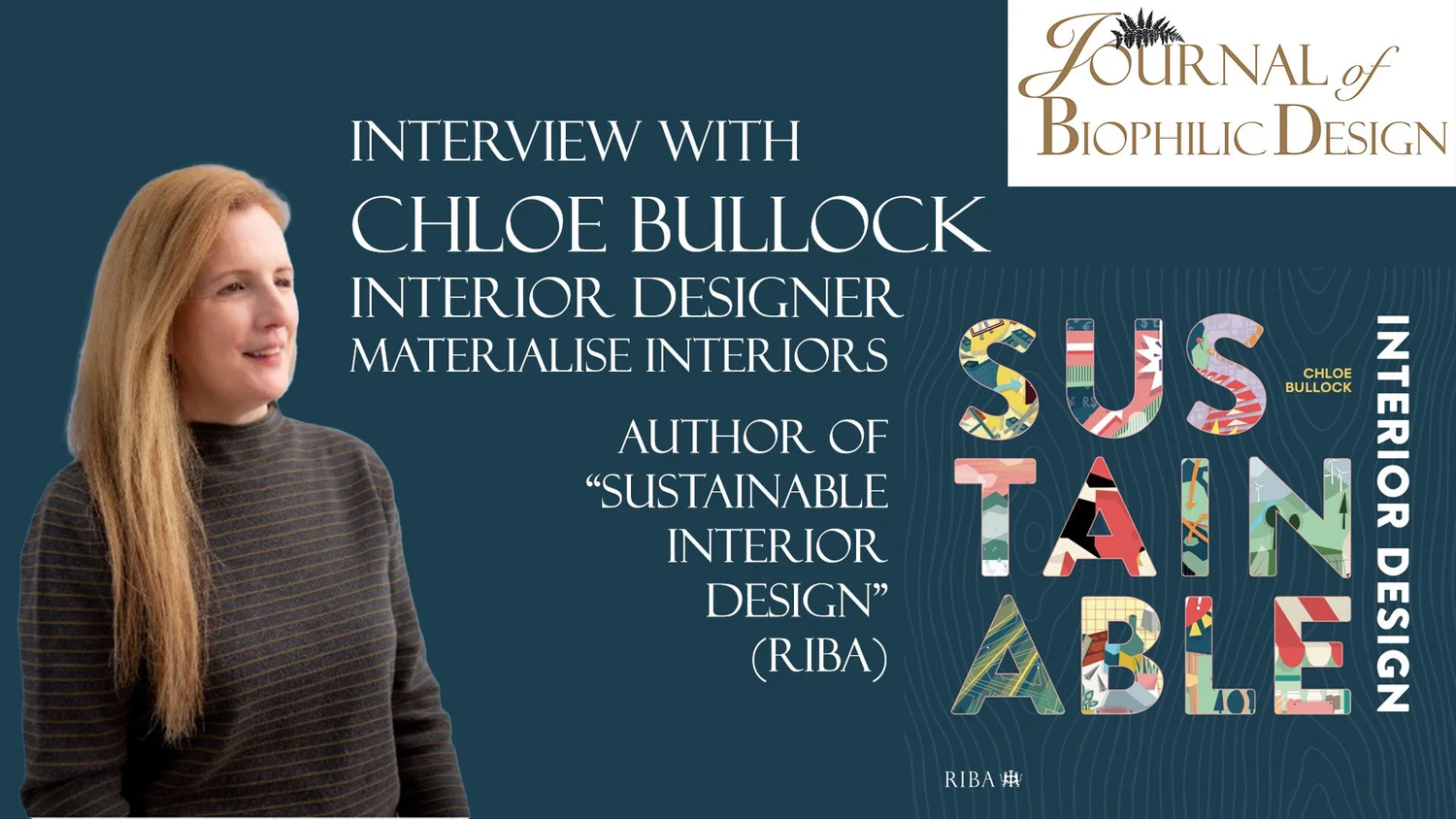
Sustainable Interior Design
Have you got a copy of the Journal? You can purchase a copy directly from us at the journalofbiophilicdesign.com or Amazon. If you like our podcast and would like to support us in some way, you can buy us a coffee if you’d like to, thank you xCredits: with thanks to George Harvey Audio Production for the calming biophilic soundscape that backs all our podcasts. Did you know our podcast is also on Audible, Amazon Music, Spotify, iTunes, YouTube, Stitcher, vurbl, podbay, podtail, and most if not all the RSS feeds?Facebook https://www.facebook.com/journalofbiophilicdesign/Twitter https://twitter.com/JofBiophilicDsnLinkedIn. https://www.linkedin.com/company/journalofbiophilicdesign/Instagram https://www.instagram.com/journalofbiophilicdesign
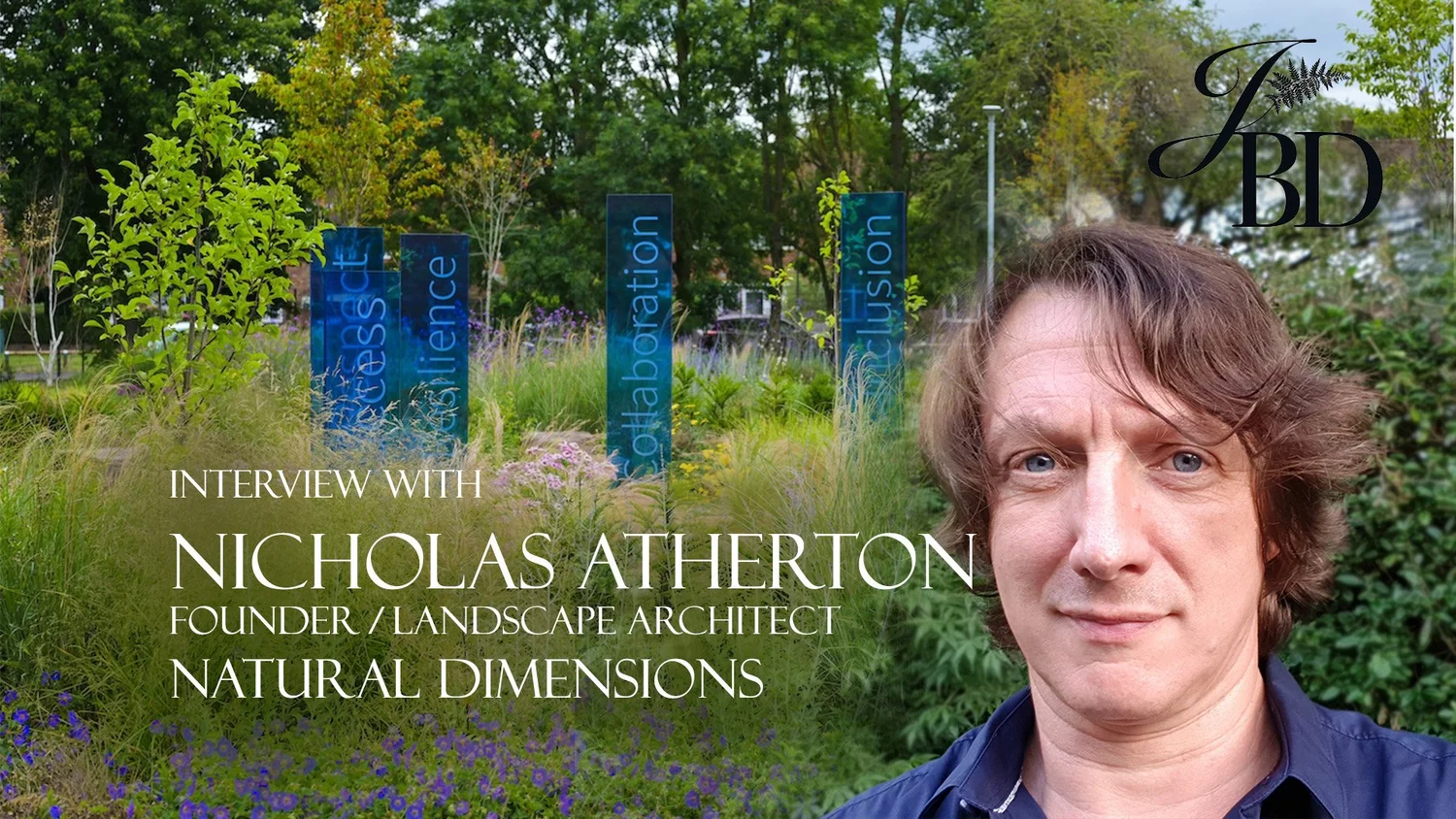
Natural Dimensions - Transforming Schools with Biophilic Design
There is strong evidence that strong green environments can improve educational outcomes as well as improving focus and concentration restoration levels, and for Nicholas Artherton, a chartered Landscape Architect and qualified Urban designer, Biophilic Design is a core tenet to create connections with natural elements and outdoor spaces through diversity, movement and multi-sensory interactions. Nick is founder of Natural Dimensions, a multi-award-winning landscape architecture and urban design practice. For Nick, Biophilic Design is: “a way of incorporating into design a balance of ecological planning and planning for mental well-being and responding to systems which encourage human health.”One of Nick’s most celebrated designs was for Merstham Park School where, Natural Dimensions were appointed to design extensive ground around a ground-breaking new pathfinder secondary school that is a template for low carbon technology and biophilic landscape principles.From the entrance to the school and throughout the grounds, Natural Dimensions created a beautiful space with varied spaces incorporating many different habitats, spaces and an overall feeling of the school sitting within nature.With a rich variety of planting, and so much thought gone into choosing a mix of species that change throughout the seasons, the school is nestled in a beautiful “hug” of colour, shapes and biodiversity. But not only is the landscape beautiful, with the deciduous trees, it maximises solar heating in winter and solar cooling in summer. Nick has also optimised the use and preservation of rainwater through some clever tech under the permeable pathways and planting areas which is then used for irrigation and recycling it for toilet flushing.Nick shares his passion for increasing the awareness of Biophilic Design and believes it should be adopted as the de facto approach to design. In fact, he explains that he can't think of a better location into which to bring biophilic design than schools. With kids being super aware of environmental issues, Nick believes there is no better place for them to be really engaged in really well-designed schools, which represent those values for them, and encourage them to engage with environmental stewardship.His view is that if you are advocating for responsible behaviour towards climate issues, and also mental well-being, it makes complete sense for schools to be the locations for that advocacy. He believes that they can act as community hubs because they are representatives of spaces where there is a focus for environmental stewardship, and that could reach out to the rest of the community.Nick’s personal mission is to enable landscape architecture and urban design to be at the heart of development, with the many benefits it brings for all, including an increasingly important positive ecological impact. Natural Dimensions aims to help companies, organisations, communities and individuals reap the rewards of design in the form of landscape aesthetics and features, natural systems, environmental enhancement and the wellbeing of citizens.With every design, new build, school refit or refurb we have a choice to make, and I think that Nick’s passion for creating well thought out, meaningful spaces and enlightened planning through the adoption of Biophilic Design prove that we can transform public sector design.To find out more about Nicholas Atherton and his practice, Natural Dimensions, visit https://www.naturaldimensions.co.ukAlso come and see him speak at our conference www.biophilicdesignconference.com Pick up a copy of his article in our EDUCATION issue of The Journal of Biophilic Design Ebook or lovely printed edition Have you got a copy of the Journal? You can purchase a copy directly from us at the journalofbiophilicdesign.com or Amazon. If you like our podcast and would like to support us in some way, you can buy us a coffee if you’d like to, thank you xCredits: with thanks to George Harvey Audio Production for the calming biophilic soundscape that backs all our podcasts. Did you know our podcast is also on Audible, Amazon Music, Spotify, iTunes, YouTube, Stitcher, vurbl, podbay, podtail, and most if not all the RSS feeds?Facebook https://www.facebook.com/journalofbiophilicdesign/Twitter https://twitter.com/JofBiophilicDsnLinkedIn. https://www.linkedin.com/company/journalofbiophilicdesign/Instagram https://www.instagram.com/journalofbiophilicdesign
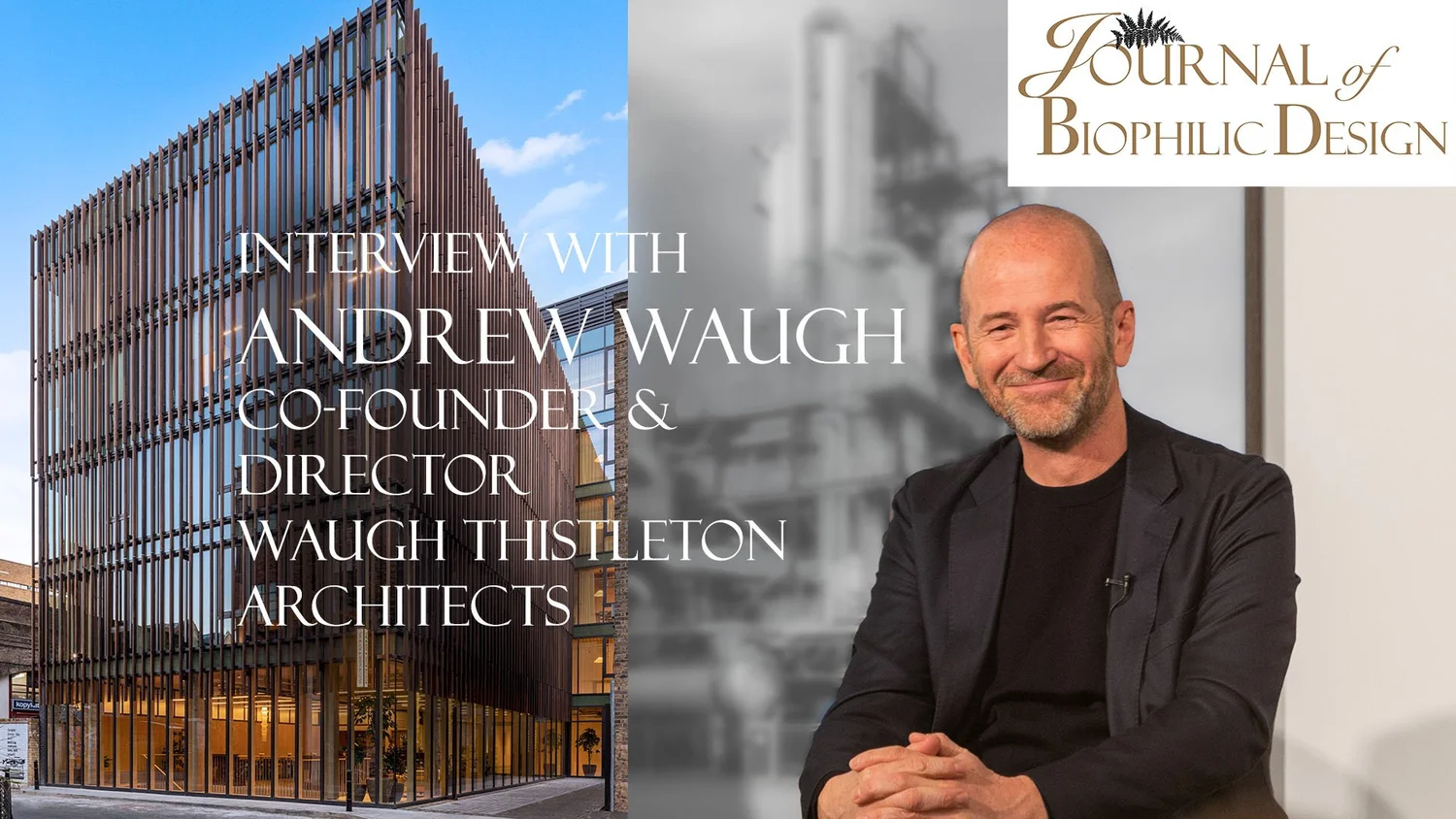
Tall Timber Buildings - are they the Future of our Urban Landscape?
Andrew Waugh is an architect with a passion for using sustainable materials in construction projects. His practice, Waugh Thistleton Architects, is a London based architectural practice producing thoughtful and sustainable projects both locally and internationally. The practice is a world leader in engineered timber and pioneer in the field of tall timber buildings. Of particular renown is the Black & White building in London that has been short listed for a RIBA London Award in 2024. The build was described by RIBA journal as 'a major step forward for the development and construction industry’ and is the tallest engineered timber office building in central London.In 2023, Waugh Thistleton were named Architect of the Year in AJ Architecture Awards 2023. The Architect's Journal recognised the practise for their long standing advocacy for timber saying that 'In the face of the climate crisis, Waugh Thistleton is a worthy winner for its ability to work within the constraints of very challenging policy yet create cutting-edge, sustainable architecture. Not only that, it is also prompting the whole industry to raise its game.’In this podcast, Andrew explains the different types of engineered timber and how some have superior structural strength while others have the mass required to offer superior acoustic performance. The choice of materials, as he outlines, is determined by usefulness, cost and how they fit into an overall objective of using as few materials as possible.! Andrew’s passion for the use of sustainable materials shines through as he explains how the wood used is sourced from forests planted with biodiversity in mind. The forests are not monoculture forests, they are planted with FSC of PEFC licences, and the harvest used for producing construction materials is a long way short of the overall capacity of the forests to produce sustainable timber.From a biophilic design perspective, Andew details some of the many health and well-being benefits of using wood in the built environment. The better acoustics, the hydroscopic nature of wood creating better air quality and the calming properties of sawn timber are among the benefits discussed. He also describes how the external wood design, creates Solar shading on the building which reduces energy use for heating and cooling by about a third.Talking of the Black and White building, Andrew says:“IIt is important for us to ensure that this move towards low carbon construction, low carbon architecture is not a peripheral occupation. It is not just for birdwatching centres, and National Trust museums, it has to be mainstream. The entire building, which was built for a commercial company, Blackstone, is above the ground floor slab made of timber. So, it's timber staircases, timber, lift shafts, timber beams, columns, floor slabs, external wall curtain walling is timber, and the external cladding is timber as well. A completely timber building. It was built very quickly in 83 weeks. So very fast construction. It was cost equivalent to concrete. We were obliged to track the cost of the building all the way to tender with the main contractor against a concrete equivalent building and we were able to demonstrate that it was cost equivalent. So fast, inexpensive, and letting extremely well - the client’s very happy, which is really nice.”Each piece of timber has a QR code, so it can be placed exactly into place. So it’s not only fast but also quiet and clean. Put that against the usual cement trucks and building site cacophony. In fact the whole building took only 70 deliveriesThe overriding message from Andrew’s advocacy of sustainable building, using the example of the Black and White building, is that using these technologies and approaches is a positive advance in construction with myriad benefits. It is no longer necessary to wear a metaphorical hair shirt to build in a way that is sympathetic to the environment. Fast, quiet and quick construction of modern buildings filled with biophilic design is the route to happy owners and happy occupants. To find out more about the projects visit: https://waughthistleton.comTo download the free ebook he mentioned, click here:https://info.thinkwood.com/download/100-uk-clt-projectsHave you got a copy of the Journal? You can purchase a copy directly from us at the journalofbiophilicdesign.com or Amazon. If you like our podcast and would like to support us in some way, you can buy us a coffee if you’d like to, thank you xCredits: with thanks to George Harvey Audio Production for the calming biophilic soundscape that backs all our podcasts. Did you know our podcast is also on Audible, Amazon Music, Spotify, iTunes, YouTube, Stitcher, vurbl, podbay, podtail, and most if not all the RSS feeds?Facebook https://www.facebook.com/journalofbiophilicdesign/Twitter https://twitter.com/JofBiophilicDsnLinkedIn. https://www.linkedin.com/company/journalofbiophil

NEW proof that Biophilic Design increases the Value (£) of the Workplace!
Did you know for every £1 you spend on even simple Biophilic Design enhancements, you could get £2.70 back? So reveals the new research conducted by Joyce Chan Shoof Architect and Sustainability Lead at the UK Parliament. Using a scientific approach with control environments, adding biophilic design elements to test the effect and then removing them to further test the effect of their absence, Joyce explains the rigorous approach she took over a seven-year period to arrive at her conclusion.This is a phenomenal breakthrough for those of us working in Biophilic Design.You can read the whole report here: https://plplabs.com/reap-what-you-sow-2/And come and see Joyce present the research in person at Workplace Trends in London on the 18th April 2024 https://workplacetrends.co/events/wtrs24-prog/We often have struggled trying to articulate the economic benefits of Biophilic Design, this research can be used to support arguments why businesses need it in the workplace. Joyce has also developed a framework to help designers work out what we need and the impact it will have. Using existing frameworks, like the Flourish model (as advocated by Professor Derek Clements Croome) and others, she has woven a great new model we can all hang our designs on.From a career as a practicing architect, Joyce explains that transferring to the client side within the Parliamentary Estate has been transformational in the way she sees building design from feasibility study through to construction. The change and the opportunity it gave her has inspired her to incorporate multidisciplinary approaches and to study the impact of taking a biophilic design on efficiency, productivity and well-being within the workplace.Just like Goldilocks and the Three Bears, one interesting outcome that she highlights during the podcast, the study concludes that an immersive approach to incorporating Biophilic Design in the workplace is less effective overall than a more measured approach. But she explains that the immersive effect was preferred by people. The results showed that the moderate Biophilic Design intervention (that which we could normally advocate) seems to be the best.Joyce sees academic rigour as an important part of her role when leading a complex development. Since 2017, she has been conducting this doctoral research with the Design School at Loughborough University, focused on Sustainable Well-being in the workplace with a particular interest in biophilic and social value. She is a keen advocate of how Architects can make positive impacts towards allowing people to live happier and healthier. Her team sits within the Design Authority who are a group of design professionals and specialists who are managing the estate in Westminster, and their objective is to inject new thinking into the adaptive use of new and heritage buildings within the Parliamentary Estate – a UNESCO site. Parliament’s vision is amibitious; it aims to set an example to lead the early adoption of Zero Carbon (Scope 1, 2 & 3), Healthy Buildings, Social Value and Circular Economy through our own refurbishment projects and procurement. The team manages the design, construction and operations of the Parliamentary Estate of 20 buildings including the Palace of Westminster. Joyce discusses her study of the economic benefits of incorporating a biophilic design approach to workspace and gives many insights into her approach and into how she found a way of attributing economic value to the benefits.Her wish is that we reconnect with nature, the sources of food, the feeling of being part of nature rather than living lives that separate us from the natural world. She wishes that all of us benefit from an improved environment, and her research is a massive and welcome step in that direction. To register for Workplace Trends and meet Joyce in person on the 18th of April 2024: https://workplacetrends.co/events/wtrs24-prog/Reap What You Sow: What’s the value (£) of Biophilic Design? (14.40)– Joyce Chan-Schoof (RIBA), PhD Research Researcher, Loughborough University and Sustainability Lead, UK ParliamentGiven employees are the largest cost for a business, to what extent can biophilic design save companies money by ensuring that staff are healthier and happier at work? We explore these questions by delving into the monetary benefits of biophilic design. This presentation presents new ways to capture the tangible well-being and environmental values of connecting with nature in the workplace. This project is part of a doctoral research project at Loughborough University in collaboration with PLP Architects, Benholm and Reading University. Joyce’s research is funded by the Design Star (AHRC), and the BCO sponsored the pilot study.Read more and follow up on the research:https://plplabs.com/wearables-in-the-workplace/https://www.bco.org.uk/Research/Publications/Use_of_Wearables_In_The_Office_-_A_review_and_examples_in_practice.aspxHave you got a copy

Creating Eden
The UK is one of the most nature-depleted countries and this fact is yet another reason we need more Biophilic Design included into urban planning, architecture, design, and every environmental facet of city and town life. Robert Delius, Associate Director, Architect and Head of Sustainability at Stride Treglown is doing just that. Aiming to maximise biodiversity through design, Robert has a passion to create an Eden, where buildings and landscapes come together and there's a feeling of abundance, where there's nature and birdsong and insect life and a powerful sense of well-being. Robert’s background in housing design and master planning has set him up in good stead to create good design and great places. Distinctiveness and place making are a thread through his career. He also has a particular interest in regenerative design and how great design can have a measurably positive impact on climate, ecology and people. In short, he is a brilliantly creative proactive advocate for Biophilic Design. He believes that forging a closer connection to the natural world, is extremely good for our well-being as well as being good for the planet and good for nature, and his passion for Biophilic Design is life-long. One of the projects he discusses is his Great Bow Yard project in Somerset from 2008. This had gained media attention because it had been flagged as the most energy efficient scheme in the UK. Having recently revisited the project, Robert notes that residents, are not only pleased with the low energy costs, but were actually most enthused by the shared garden and the feelings of well-being that stem from it being a beautiful spot. In this podcast, Robert talks of his background and upbringing and how that has led him to his passion for living in harmony with nature. He discusses how on his projects, and those of his colleagues, he always looks to introduce as many opportunities as possible for planting in designs, both internally and externally to reduce hard space and introduce a softer more natural element. This passion is carried through to the present day. As we said at the beginning, Robert is concerned to note that the UK is the most one of the most nature depleted countries in the world and this fact has inspired him, and others, to create a public event “Code Red for Nature” (link below), a funeral for nature in Bath on 20th April 2024. The event is open to all, even Chris Packham will be there supporting and Dan Pearson design studio will also be taking part. Great Bow Yard: https://stridetreglown.com/projects/great-bow-yard/ Code Red: https://www.coderedfornature.uk/ 2pm on Saturday 20th April 2024 in Bath, TAKE PART IN ONE OF THE MOST POWERFUL AND AMBITIOUS PIECES OF STREET THEATRE YET TO BE ENACTED ON BEHALF OF BIODIVERSITY LOSS If you like this, please subscribe! Please register for our newsletter on our website https://journalofbiophilicdesign.com/podcasts-journal-of-biophilic-design Credits: with thanks to George Harvey Audio Production for the calming biophilic soundscape that backs all our podcasts. Did you know our podcast is also on Audible, Amazon Music, Spotify, iTunes, YouTube, Stitcher, vurbl, podbay, podtail, and most if not all the RSS feeds? Facebook https://www.facebook.com/journalofbiophilicdesign/ Twitter https://twitter.com/JofBiophilicDsn LinkedIn. https://www.linkedin.com/company/journalofbiophilicdesign/ Instagram https://www.instagram.com/journalofbiophilicdesign

Rebalance Earth - Enabling a world worth living in. Creating a Nature Positive Economy
Robert Gardner is CEO and Co-Founder of Rebalance Earth. With over 20 years of experience in the financial industry, he has a unique expertise in sustainability, pensions, and wealth management and believes that money can be a force for good.Rebalance Earth, is a fund manager that redirects the flow of private capital to protect and restore Nature. Their mission is to drive the transition to a nature-based economy by enabling the flow of private capital to protect and restore nature. Rebalance Earth achieves this by creating opportunities for investors to achieve sustainable financial returns from projects to restore Nature.Robert is passionate about the idea of “natural capital”. He believes that investment in the environment shouldn’t simply be about climate change but should take a broader approach. He sees a future in which biophilia is prominent and discussion of environment-conscious investment should include reduced biodiversity loss, rewilding, and all aspects of being in tune with nature.Robert sees nature as the most valuable asset class on the planet. It provides everything from clean air to carbon capture and biodiversity; not forgetting that a balanced ecosystem is essential to create pollination and soil fertility for our food.The investment community currently operates an extractive financial model that has been using all of nature's resources for free, not valuing them and, worse than that, destroying them. Rebalance Earth is taking steps to build and propagate a more sustainable, biophilic approach.In this podcast, Robert talks about how he studied Geography at university and how his passions are hydrography and glaciology. He notes with sadness that a glacier he worked on as part of the Alpine Glacier Project during his studies is now gone. He sees glaciers as the canary in the coalmine of climate change and nature loss but sees the good news as being that this can be turned around with money used as a force for good.Robert explains how his background, growing up in Holland and travelling all over the world with his parents led to his interest in geography and how is career in finance and 25 years of learning how money flows around the world has led him to establishing Rebalance Earth. He says that there is no point having a great pension if we have no coral reefs, rivers are filthy, there are no fish, and the air is polluted. There’s nothing to enjoy!He sets out his idea that nature should be valued. He explains that assets have utility, scarcity and cashflow in order to be valued. He gives us the example of the humble bee and how it has been estimated that it would cost £1.8bn to pollinate crops if the bee were to disappear. Using this and other examples Robert observes that the concept of valuing nature is currently an intangible and how by making the intangible tangible, people will value nature and therefore will look after it. Because people look after things they value. The five key problems that Robert sees in the UK are: Flooding, Drought, Water Quality, Biodiversity and Carbon. He goes on to detail how each of these problems represent significant opportunities for companies to make a return. The essence is the idea that companies can charge customers for reducing the customers’ risks across these areas. He is excited by his dream that pension funds allocate 2% of their capital to invest in nature (enough to bridge the nature deficit), companies start paying for services to reduce risks from the five problem areas and the UK becomes a place worth living in.It would be amazing if we all look at the successful ideas around the world, which Robert shares with us in the podcast, and see how they work, so we really see the value of investing in Nature. For instance, nature-based towns and cities, a countryside with nature back in it and a farming system that has nature at the heart of it. Once people see that it works they will do more. Rebalance Earth: https://www.rebalance.earth/White Paper: https://www.rebalance.earth/s/Rebalance-Earth-The-Nature-Opportunity.pdfhave you got a copy of the Journal? You can purchase a copy directly from us at the journalofbiophilicdesign.com or Amazon. If you like our podcast and would like to support us in some way, you can buy us a coffee if you’d like to, thank you xCredits: with thanks to George Harvey Audio Production for the calming biophilic soundscape that backs all our podcasts. Did you know our podcast is also on Audible, Amazon Music, Spotify, iTunes, YouTube, Stitcher, vurbl, podbay, podtail, and most if not all the RSS feeds?Facebook https://www.facebook.com/journalofbiophilicdesign/Twitter https://twitter.com/JofBiophilicDsnLinkedIn. https://www.linkedin.com/company/journalofbiophilicdesign/Instagram https://www.instagram.com/journalofbiophilicdesign

BIID Interior Design Award Winners - From Chapel Barn to Riverside
The British Institute of Interior Design (BIID) is the only professional institute for interior designers in the UK. Our growing membership represents both the commercial and residential sectors, from heritage to cutting edge. In addition to rigorous entry requirements which assess training, experience and professionalism, they require our members to continue their professional development throughout their career to ensure their continued expertise in design process, practice and regulatory matters. For those wishing to find an interior designer or to confirm the credibility of a potential interior designer they offer a directory of our Registered Interior Designers.Each year BIID celebrates the very best of British interior design through its awards program. The BIID Interior Design Awards showcase the best interior design projects completed across the UK.Winners are awarded across 7 regional categories ranging from the largest commercial project to the smallest residential dwelling. In addition, there are two landmark prices – the Interior of the Year Prize, which is awarded to the best interior design project in the UK and the Anna Whitehead Prize, which is awarded to the best achievement in sustainable interior design. 9 awards will be given out in total, along with acknowledgements of Highly Commended projects.In this podcast, we are joined by two previous award winners and one of the judges of this year’s awards to discuss the value of the awards programme. If you are reading this on an RSS feed, try and visit https://journalofbiophilicdesign.com/podcasts-journal-of-biophilic-design to view the visuals from these brilliant projects.James Gavigan is co-founder of House of Kin (houseofkin.com) who were the Greater London winners for 2023 with their Riverside project. The Riverside is a unique nursery that preserves the character of the original church building, whilst combining clean aesthetics, soft colours, and simple lines with homely and interactive touches. The judges praised its harmonious and child-friendly design, emphasizing sustainability with cork-clad walls, wood waste flooring, and recycled plastic bottle tiles. The space is imaginative, thoughtful, and perfect for children's learning and growth. Susie Pfeiffer founded Pfeiffer design who won the Anna Whitehead Prize in 2022 for their design studio. The studio was designed with sustainability at the forefront; it uses a wide range of the latest sustainable technologies, sourced locally and is an inspiration to others looking to use similar sustainable elements within their own homes and offices.Asif Din is one of the judges for the 2024 awards. He is the Sustainability Director at Perkins & Will. He has worked across the world as an architect and is a keen advocate of Zero Carbon design projects and the use of circularity in design.Susie and James explain the importance to them, as past winners, of the BIID awards. How, the bring kudos and opportunity to their businesses but also how they bring the design community together and elevate design standards, especially when talking about sustainability and fostering creativity so that design doesn't become bland.From a judge’s perspective, Asif comments on how it is often clear that biophilic aspects such as sustainability and environmental factors have been considered from the start as clear elements in any project. Such projects stand out and are key to achieving success at the awards.Throughout the discussion it is clear that just adding sustainable materials to a design doesn’t make the overall design sustainable. Consideration has to be given to materials being appropriate for the design; the design can’t simply include “box-ticking” elements.Durability is mentioned as a major factor in materials choice for many sustainable designs.The participants are all clear that a sustainable design doesn’t involve a compromise on aesthetics. Indeed, taking a biophilic approach to design can enhance the look and feel of a space and contribute to a deeper, more meaningful aesthetic that resonates with the principles of balance with nature.Overall, the conversation brings to the fore the joy and inspiration that great design that fully embraces biophilia brings to those who use the spaces created. Oh, and you might also win kudos and recognition in the form of a BIID award! https://biid.org.uk/biid-interior-design-awardshttps://biid.org.uk/winners-23https://biid.org.uk/judgesChapel Barn: https://www.pfeifferdesign.co.uk/our-approach/sustainability/Riverside: https://biid.org.uk/design-practice-house-kin
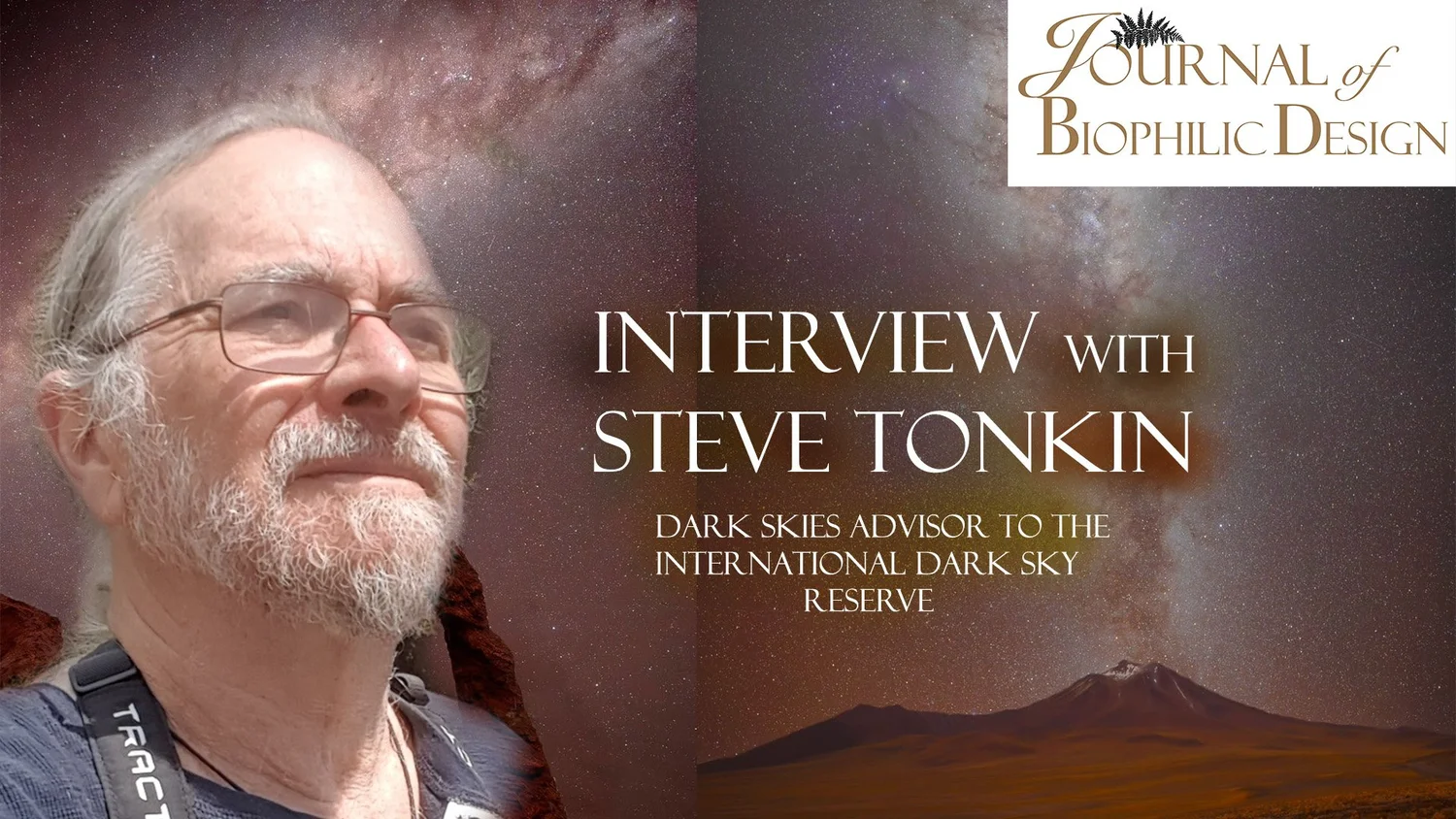
Right Light, Right Place, Right Time
Steve Tonkin is the Dark Sky Advisor to Cranborne Chase National Landscape, in Wiltshire. Cranborne Chase is a designate Area of Outstanding Natural Beauty that, since 2019, has been recognised as an International Dark Sky Reserve.Steve can pinpoint 4 October 1957 as the first became aware of dark skies. His family were, at the time, living 8 miles outside Bulawayo, Zimbabwe and his father took him outside to see if they could see Sputnik which had been launched the previous day. It was his first time looking up at a pristine dark sky and it triggered a life-long passion for astronomy which has made him aware of the effects of light pollution, and he has been raising the issue with anyone who will listen for the last 30 years.After a first career as a telecommunications engineer, he did a BSc in Human Environmental Studies, then postgraduate work in technology policy, before training as a teacher. He taught physics, maths and astronomy in a variety of settings for 35 years, before retiring from teaching to concentrate on astronomy outreach activities. He has written several books on practical astronomy, has a monthly column in BBC Sky at Night Magazine, and is a regular speaker on astronomical topics.Starting with a programme he made for BBC Radio Bristol in the 1980s, Steve has long been an advocate of reducing light pollution. He supported the Cranborne Chase’s International Dark Sky Reserve bid as a volunteer, taking sky quality readings and supporting the stargazing evenings by giving talks and showing people the night sky. His primary task as Dark Skies Advisor is to continue and consolidate the good work that has already been done and strengthen the Cranborne Chase’s standing as an International Dark Sky Reserve.Light pollution is a global issue. The pollution itself is known to affect human health and wildlife behaviour and that is before considering the wasted energy involved in sending light upwards instead of downwards to where it is required. To take a Biophilic approach to the design of lighting is to reduce light pollution with direct and indirect benefits to nature.Steve explains that there are 21 International Dark Sky Reserves across the world that have been recognised as being of distinguished quality. He explains that these spaces are not about no lights but about the right light in the right place at the right time to preserve the area for heritage, educational and enjoyment purposes.Dark skies are relative. A truly dark sky is defined by Steve as one in which the Milky Way galaxy casts a shadow. In the context of Cranborne Chase, it means the ability to see the Andromeda galaxy with the naked eye. Steve expresses his excitement at being able to see something that is 2.5 million light years away and has been visible to earth since before humans were even around and was visible to all humans ever until light pollution started to be introduced 200 years ago.Steve explains in some detail why it is important to take account of the circadian rhythm of light and darkness and how there is always a negative effect of introducing artificial light. He discusses the impact on the reproductive cycle of birds and relates that 8 to 10 million birds a year are killed by lit communication towers.Moving to humans, Steve tells of studies linking light pollution to · increased susceptibility to cancer;· increased incidence of obesity, diabetes and hypertension due to the impact of poor lighting on leptin levels (leptin being the hormone that tells you if you feel full); · the impact of the wrong sort of light on mental and physical health; and · the huge reduction in insect life (both pollinators and composters) and its impact on food production.Across a wide range of examples Steve explains how the wrong light can have disastrous consequences. He introduces the idea that not all light is the same and sets out what to look for in order to achieve healthy lighting.Steve enumerates the five principles of responsible lighting:1. if lighting doesn’t have a clear purpose, don’t do it2. lighting needs to be targeted3. don’t use light brighter than is needed for the task4. use as warm colour as possible (i.e. low colour temperature)5. only have lighting on when it is neededThis leads to a fascinating discussion of lighting design, how it has improved over the last 30 years and of ways to achieve better lighting solutions.Listening to Steve, you learn that Dark Sky movements are not just to keep astronomers happy. It is really a heading that focusses thinking on lighting design and the health and environmental benefits of biophilic lighting design.https://darksky.org/Darkskies.ukhttps://darksky.uk/https://britastro.org/dark-sk
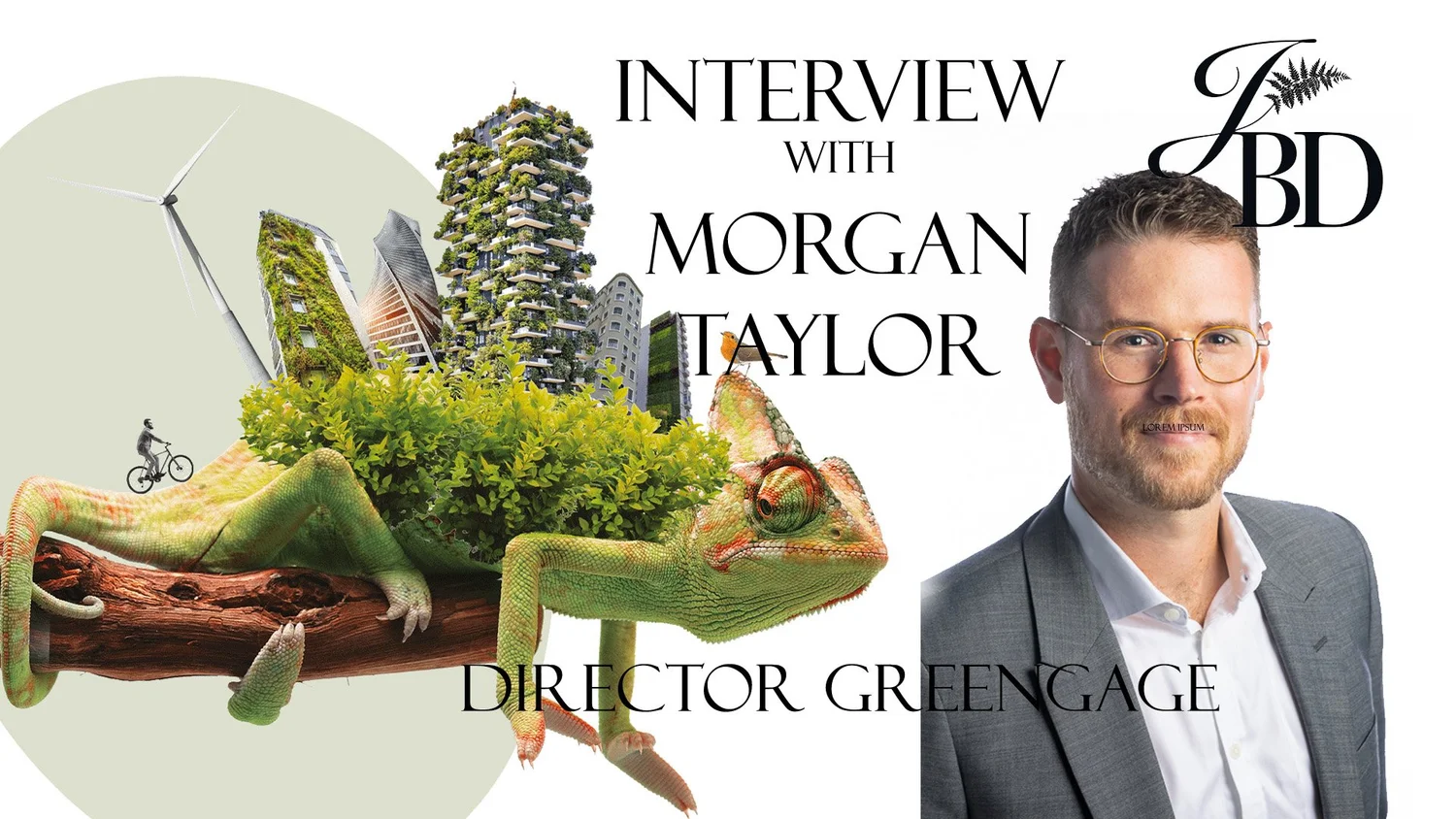
A task force for nature – where sustainability matters
Morgan Taylor leads the biodiversity side of Greengage, a multidisciplinary environmental consultancy who cover everything from energy and carbon assessments, sustainability, health, wellbeing, socio-economic assessment, and EIA management as well as the whole gamut of biodiversity assessment through to planning. As designers, architects, or planners, we all need to be mindful of the impact our ideas, advice and decisions have on the world around us. We recorded this interview in the summer last year* Their work is focused outside of the legislative and planning policy sphere in the world of natural capital and ecosystem service value assessment. So rather than working with developers where they are only brought in because there is a potential impact on biodiversity in the first place, they're working with a lot of people with regards to asset management, land management, informing how financial capital is put towards recovery of natural capital across managed assets.We’ve got hundreds, maybe thousands of years of degradation and we need to take measures and understanding to address the impacts of our actions, and account for the significant loss of biodiversity particularly since the Industrial Revolution.Morgan outlines all the different levels of legislation and planning policy that impact biodiversity in the built environment. He highlights three aspects of legislation and regulation that particularly drive positive change:1. the Wildlife and Countryside Act. 2. The Habitats and Species Conservation Regulations, and 3. the Environment Act, which is from 2021. These three pieces of legislation, he says, drive most actions with regards to protected species, protected habitats and importantly, the Environment Act is the legislation that will require all new development as of November 2023 to deliver measurable gains in biodiversity.Morgan explains how Greengage guide development and design teams to incorporate biophilic design into their projects to improve biodiversity and meet the legal requirements. He explains that the scope can be as narrow as simply integrating swift boxes and house sparrow boxes or as broad and complex as approaches such as recreating woodland.Moving away from the regulatory “stick”, Morgan explains how the requirement for financial disclosure by FTSE 100 companies resulting from the Taskforce for Climate-related Financial Disclosure (TCFD) has created a “carrot” where positive disclosure on areas such as urban heat islands, surface water and all aspects of climate change can improve the prospects of securing investment. Greengage, says Morgan, are particularly excited about the sister disclosure recommendations from the Taskforce for Nature-related Financial Disclosure (TNFD). With a similar “carrot” companies benefit from how they implement biophilic design and how the economic benefits improve investor return.He lays out in some details the potential for improved building performance that comes from delivering a living roof in terms of energy performance for both cooling and heating, reduced surface water meaning lower flood risk and contributions to net zero strategies. The approach Morgan outlines is focused on the key driver for business, capital growth, and explains how biophilic design and improved biodiversity help them achieve that fundamental goal as well as being able to be proud of their green credentials. Morgan expands on his theme covering urban and rural developments and the application of a biophilic approach in many aspects of ecology. He concludes with his personal desire to see an integrated green infrastructure in which grasslands take the place of lawns and the landscape in both town and country is managed as a habitat for nature rather than predominantly as a human playground.To find out more visit https://www.greengage-env.com Have you got a copy of the Cities issue of The Journal of Biophilic Design (you can purchase a copy directly from us at the journalofbiophilicdesign.com or Amazon. If you like our podcast and would like to support us in some way, you can buy us a coffee if you’d like to, thank you x*due to bereavement at the JBD HQ there has been a delay in the final editing, many apologies. But like a late flowering bloom, there is much to be learnt from this podcast, and we are incredibly grateful for Morgan and Greengage’s expertise and patience. xCredits: with thanks to George Harvey Audio Production for the calming biophilic soundscape that backs all our podcasts. Did you know our podcast is also on Audible, Amazon Music, Spotify, iTunes, YouTube, Stitcher, vurbl, podbay, podtail, and most if not all the RSS feeds?Facebook https://www.facebook.com/journalofbiophilicdesign/Twitter https://twitter.com/JofBiophilicDsnLinkedIn. https://www.linkedin.com/company/journalofbiophilicdesign/Instagram https://www.instagram.com/journalofbio

“Bloom” - When Workspace Design meets Biophilia
We speak with Marco Gastoldi, interior designer and Associate at Gensler, who in collaboration with some amazing partners have created the theme of the Workspace Design Show in London this year. The Theme is “Bloom”, and we speak in this podcast about the growing awareness of Biophilic Design, how it has environmental and psychological benefits, that it is based on science, neuroscience and also the many different ways of integrating nature in the built environment.Marco celebrates the fact that Biophilic Design is important for us, that we have a primordial innate connection to nature, an instinct. This connection produces hormones that support feelings of belonging and collaboration which are crucial to performance and connection. Humans are biological organisms and Biophilic Design supports the mind body system in terms of health and wellbeing.“Deep down we are aware that our connection to nature is vital. We forget that recreation is recreating and restoring ourselves. We spend 90% of our time indoors and there is so much data and evidence to prove that Biophilic Design is good in the workplace. For instance the Human Spaces report that proves Biophilic Design can improve productivity by 6% and creativity by 15%. We know that connection with nature, improves individual self-esteem and mood, the presence of water for example creates a relaxing and calming effect.”Marco also talks about Ecological Balance Theory which refers to how we prefer nature resembling colours like green and blue, but not all natural environments are green, so it’s also important to tailor to local colour pallet and ecosystems – so it’s place based.Marco also shares quite a few examples of where Gensler has installed Biophilic Design. For instance views that integrate nature in the environment, that connect people, to bring them together in moments of wonder. He talks about the permeability of outside and inside and the power of Micro restorative experiences. These are small pockets of nature, which might be more accessible than large interventions allowing frequent exposure to small intervention results in compounded restoration response. When a long exposure to nature can’t be achieved, positioning Biophilic interventions along areas of high levels of traffic is beneficial. The Workplace survey carried out by Gensler research institute in 2023, allows Gensler to look at the data and help shape certain choices. You can read it here LINKBiophilic Design can help companies meet the BREEAM and WELL certifications.BREEAM is the widely used environmental assessment method and certification for buildings. It evaluates and certifies the sustainability performance of the building, on criteria such as energy efficiency, material selection and ecological impact. Biophilic Design helps in a positive way by creating indoor environments beneficial to health and wellbeing as well as ecology. Integration of Biophilic Design supports energy efficiency, comfort of the occupiers, overall sustainability and therefore aligns with the overall BREEAM code.WELL is a performance-based system for certifying features in the built environment that impact human health and wellbeing, building design and construction as well as operation. So it looks at air quality, water, fitness, light and comfort, and obviously Biophilic Design interventions supports companies in achieving all these, for instance introduction of natural light, access to outdoor views and greenspaces.We also chat about making #biophilicdesignawarenessday National Holiday..Marco is speaking at the Workspace Design Show in London on 28th February 2024, free entry. The title of the panel is :Bringing energy back to the workplace, nurturing social capital and increasing happiness/productivity in the workspace" https://workspaceshow.co.uk/speaker-marco-gastoldi https://workspaceshow.co.uk/workspace-design-talks-2024 To buy a copy of The Journal of Biophilic Design visit our website www.journalofbiophilicdesign.com or from Amazon. If you like our podcast and would like to support us in some way, you can buy us a coffee if you’d like to, thank you x Credits: with thanks to George Harvey Audio Production for the calming biophilic soundscape that backs all our podcasts. Did you know our podcast is also on Audible, Amazon Music, Spotify, iTunes, YouTube, and most if not all the RSS feeds.Facebook https://www.facebook.com/journalofbiophilicdesign/Twitter https://twitter.com/JofBiophilicDsnLinkedIn. https://www.linkedin.com/company/journalofbiophilicdesign/Instagram https://www.instagram.com/journalofbiophilicdesign
Der Verwondering - Biophilic Primary School - Stephen Kellert Biophilic Design Award Winner
How do we design schools so not only children are inspired, teachers want to come to work, places are healthy, the building sustainable, the landscape regenerative, and supports biodiversity? The answer is Biophilic Design. De Verwondering is a primary school in the Netherlands, designed by architecture firm ORGA. The design won the 2023 Stephen R. Kellert Biophilic Design Award from Living Future Europe in 2023, and justifiably so and is featured in the Education issue of The Journal of Biophilic Design. The name of school means ‘sense of wonder’ or 'amazement', referring to the sensation of curiosity in children that is triggered when they come into contact with the natural world. Any parallels with ‘The Sense of Wonder’, Rachel Carson’s timeless publication from 1960, are coincidental, but both very much speak to the same sentiment. In this podcast we speak with Gijs Bruggink, Chef de bureau of ORGA and discuss the importance of using Natural building materials, and how we need to push boundaries for sustainable and regenerative buildings. Gijs describes the school for our listeners, and you can see visuals of it here on the Journal website. There are three squares, with a triangular area between them, leaf shaped roof across it central area for the kids, there are big wooden steps up to the second floor, a specially designed naturally playground around he school, and there’s lots of greenery. Plus the façade has big wooden grids which allow climbing plants to grow up, so the whole school will be covered in green. There are columns in the central area, stripped tree trunks carrying the structure, sanded and oiled. Plus there is natural ventilation, separate access hatch, outlets, where a chimney effect draw fresh air 24hrs a day into the building smell of new cut grass, or smell of rain on the earth. The difference the Biophilic Design of the school has made to the teachers, staff, and children is phenomenal, and it also shows when an organization wants to do something better with nature deeply embedded into it right from the start of the project. The difference it can make to the business, the reduction of staff and student absenteeism, the improved recruitment, overall wellbeing, air quality, acoustics and so much more. Generally, clients are seeing the benefits of Biophilic Design, and more and more Gijs and his firm are working with them from the start, rather than fight the battle. “It is an interesting time for designers. There are a lot of problems which need solutions nowadays with climate change and biophilic design just has a lot of answers. Not only is it beautiful but it's interesting from the health perspective and it's beneficial from a business perspective because if your users of the building are able to perform better to be more productive and they feel better, it's good for your business. There's a lot of research and science supporting these these ideas and these benefits,” says Gijs. One of the wonderful things about the Der Verwondering design is that they have created a really healthy learning environment for children and the people working there to help them get a good education. There are also all sorts of connections to nature in the building which builds affinity with nature, and children can discover things on their own, they have a natural adventurous inquisitive nature. We also discuss how wood lasts a really long time, and how you can use different types of wood and natural wood finishings that protect the materials of your buildings. The Principal was at the previous school and now also at this one, and has said that the children are right at home right away in the new school with no long adjustment period. They kids can really focus on work after a break outside in nature and this focus is a big change than before. There is less absenteeism and attendance a lot better, so that along with improved recruitment it makes financial sense too. To read more about it and see more images, Gijs also wrote in our Education issue of The Journal of Biophilic Design Printed copy https://journalofbiophilicdesign.com/shop/pre-order-journal-of-biophilic-design-issue-7-education-paperback-printed-versionEbook PDF. https://journalofbiophilicdesign.com/shop/olwe3aq4uukmg3k3o65o1n4k1fhvww ORGA architect: https://www.orga-architect.nl/ Gijs Bruggink: https://www.linkedin.com/in/gijsbruggink A quote from Gijs article in Education Issue 7 of The Journal of Biophilic DesignPrinted copy https://journalofbiophilicdesign.com/shop/pre-order-journal-of-biophilic-design-issue-7-education-paperback-printed-versionEbook PDF. https://journalofbiophilicdesign.com/shop/olwe3aq4uukmg3k3o65o1n4k1fhvww “The school as a biotope - The way the spaces in the building work together is analogous to the system of natural habitats: shared spaces in nature that allow species to both thrive and coex

Can the NHS embrace Biophilic Design?
Dr Leighton Phillips Director of Research, Innovation and University Partnerships for the NHS Wales, Honorary Professor Aberystwyth University, and director on the Hywel Dda University Health Board joins us to share how they are bringing in Biophilic Design into healthcare in South West Wales. Part of his role is about questioning what we want the future to look like. Dr Phillips shares with us how fundamentally important the natural environment is, how it profoundly influences our health and wellbeing. What he finds captivating about biophiilc design, is that there is an opportunity. “With over 1200 hospitals, and a million staff and nearly everyone in the UK having some interaction with the NHS services just imagine the health and planetary impact of the NHS embracing biophilic design.” Hospitals historically have been designed with a particular modernist design approach, where it was thought that clinical settings which were white, were sterile. Of course, sterile environments are exceptionally important, but these environments do not put us at ease. We feel stressed in that setting and it doesn't aid recovery if we are talking about our hospitals. Then if we consider that 90% of us interact more with primary care, the same can be true there. Leighton suggests that we can still maintain safe clean fantastic clinical environments while introducing colour, introducing fresh air, views of nature. We should not compromise all that we knew was good within that modernist period, but we can harness, within our current estates, the things that we know promote health and well-being and use every investment decision that we make as large organisations to do more of that, to support people and create environments that aid their recovery. Embracing the concept of Biophilic Design will drive this change.The 10 year strategy with millions spent on healthcare infrastructure, which also sets out the future of healthcare, INCLUDES the aim to undertake activities promoting health and wellbeing. “We do more than provide services in hospitals and healthcare facilities.” It is important, he says, to “accept a wider role, in promoting health and wellbeing, and that the Biophilic approach and design is part of that. Biophilic Design keeps people healthy and well. Giving people access to fresh air, ability to walk in green spaces.” It is also important for staff to have their own decompression time, whether it is in the facility or in their own environment. Biophilic Design can help blur these boundaries personal and professional life, how we spend our time outside of work influences how we spend time in, and vice versa. A change is happeningThings are changing in the UK, looks at the new Alder Hey Children's Hospital Trust in Liverpool, England, or the new Velindre Cancer Centre in Wales, these include the principles of Biophilic Design. While we can and should plan and build new hospitals inspired by Biophilic Design, we should also bear in mind that we still have to live with the current estate because that will still be with us. We're living with facilities that result from choices made 60-70 years ago. There's still life in those buildings and patients will still receive care, so we should also be mindful how we re-design and renovate our current estates as well. And if you think about it, ensuring success within current estate will give people the confidence to make wider changes. Change happens within organisations because people want it and understand it. Of course you need high level ownership, but it filters down through the tiers of the organisation. To make a real shift you need 100s of people taking this on board, taking it into their personal day to day responsibility. Working with Professor Geoff Proffitt of Swansea University, Dr Phillips and his team have been adopting action learning, the application of knowledge approach. By bringing professionals together, from architects to medical professionals, building engineers, etc, they took them through a structured process over a few months. It was important that they step out of their busy environment and afford them some time to open their minds to biophilic design, and then critically to take that into their day jobs. To think about how a different future could look for our built environment. How do we think differently?Green groups and others within the organisation are starting to run with it. They have the National Botanical Garden of Wales on doorstep. “We are directly working with them on biodiversity and creating spaces for staff and patients to spend time in, and I believe to evidence change sustains the change and motivates people.” Show them this rapid evidence. How do we encourage this take up on a wider scale? Show people and through every investment decision. “Show people the positive impact biophilic design has. There is a pool of people out there who know the powerful impact that the natural w
The Walls are Alive! The Beauty of Greening our Cities - inside and out.
From designing a detailed picture of the New York Skyline in moss to how we need to design with biophilia for helping mitigate climate change this great podcast with Lily Turner explores how we are just starting to realise the very real benefits that Living walls can bring to our cities, and our work and healing spaces. Lily Turner is an environmentalist, biophilic designer and living wall specialist. She's also director of green walls at Urban Strong, the design build maintenance firm offering services for green building technology solutions. In 2013, she co-founded urban blooms a non-profit to bring large scale, publicly accessible living walls to dense urban environments. It was after Hurricane Katrina she was rebuilding homes, restoring landscapes, repairing drip irrigation systems and fields and got to do a lot of great community projects and inspired her to launch urban blooms, which aims to bring greenery back into the built environment to benefit people in the community. We chat about sustainability, and how policy and regulation is needed to implement green spaces, an also how “new language and concepts need to be introduced. Sustainability has become rhetoric and clouded our view of the actual state of things in our products. So adding to our lexicon is also a major part of it.” Lily also advocates like we do, that it is vital to “break down silos when looking at the built environment. Adopting a more collaborative and holistic approach, is really the only way forward. If we look at Singapore's journey, I think it represents an actual a nice beacon of hope and their government's response should be seen as inspiring to the United States and other major offenders around the world.” Shifting our lexicon from just sustainability to regeneration will also shift people's behaviour and also create more awareness. As well as the political, we speak how Living Walls and preserved moss walls can be seen as striking forms of art, especially when you add a frame or incorporate colourful foliage, and how they offer a myriad of environmental, psychological and physiological benefits as well. Lily has been working with Biophilic Design for almost 10 years. It has to be the way forward, it has to happen. “I don't know how we're going to survive without it.” We also discuss the practical benefits plants bring, from creating relative humidity, especially if they're of scale and how you just feel more relaxed. When you bring that into a high stress environment, like an office or even a rehabilitation institution it is extremely important. “And I think we'll see this more and more as our healthcare system changes. And our education systems change as well.” Even a sightline view to the outdoors, we know there's significant benefits, you have reduced stress levels. Direct connection to nature is one of the most powerful of the Biophilic Design Patterns, being surrounded by something natural and green can boost productivity, enhance creativity and cognitive function, and ultimately that leads to increased sales so there's also ROI associated with that. “If people aren't sold on environmental or the aesthetic benefits, let's look at the ROI and try to push that conversation forward And then also just having a statement Living Wall in your lobby or office you're communicating this message of progressiveness and sustainability to your investors, your clients, your partners, everyone involved in supporting your company.” To find out more about Lily and her work visit: https://urbanstrong.com Her work features in our “Cities” issue of the The Journal of Biophilic Design, it is a case study of multi-sensory living wall that UrbanStrong installed in a corporate office in New Jersey. https://journalofbiophilicdesign.com/shop/journal-of-biophilic-design-issue-4-cities-ebook To buy a copy of The Journal of Biophilic Design visit our website www.journalofbiophilicdesign.com or from Amazon. If you like our podcast and would like to support us in some way, you can buy us a coffee if you’d like to,thank you x Credits: with thanks to George Harvey Audio Production for the calming biophilic soundscape that backs all our podcasts. Did you know our podcast is also on Audible, Amazon Music, Spotify, iTunes, YouTube, Stitcher, vurbl, podbay, podtail, and most if not all the RSS feeds?Facebook https://www.facebook.com/journalofbiophilicdesign/Twitter https://twitter.com/JofBiophilicDsnLinkedIn. https://www.linkedin.com/company/journalofbiophilicdesign/Instagram https://www.instagram.com/journalofbiophilicdesign
The Wave - Connecting us to our Blue Mind
Tying in with Issue 6, our Blue Mind edition of The Journal of Biophilic Design we speak with Nick Hounsfield, Founder and Chief Visionary Officer at The Wave in Bristol. The Wave is an inland Surfing destination.After working in the healthcare sector and realizing that not only one of the key aspects for people was that they were lonely but that they also were missing a connection to nature, Nick wanted to create something at scale that would have a positive impact. He also wanted to reach out to people who didn’t have access to a private healthcare system. “How can we democratise this? How can we make it more accessible for more people?” Nick explains how he went on to create The Wave. He had a very clear purpose and mandate, wanting to appeal to everyone, be accessible in all seasons and ensuring he addressed barriers to accessing to green and blue space. “We have to break down those barriers through design, through great landscaping, a good business model, and also make sure that we're not destroying the planet and local ecology either.”Roll forward 10 years, and they’ve managed to build it and deliver exactly what they wanted to deliver blue and green spaces for people of all ages, backgrounds and abilities. So what is The Wave? If you could imagine a huge slice of the ocean or imagine a really amazing Cove down by the beach. It's like taking that cake slice of the ocean and lifting it up and dropping it right in the middle of the field. There are absolutely perfect surfing waves, and lighter ones just as you get at the beach, and then you've got really nice whitewater waves on the inside for people who just want to splash and play around or bodyboard. The water is Caribbean in colour so also looks perfect. People come just to walk the pier which stretches out across the waves to enjoy the sound of the waves. Nick and his team have created a beautiful space where people can connect with water as observers or enjoy an immersive and active connection. Being close to the city of Bristol, partnerships were an important part of the vision. Working with groups who do not have access to green and blue space and who have mental and physical health issues, they bring them to the wave. By growing the adaptive surf community they have made sure that the whole space was designed so it is truly accessible. And with surfing now part of the Olympics we might see that surfing will also be part of the Paralympics. “We've now got the most amazing training facility for these athletes, and have genuine medal contenders in our midst so hopefully that whole sport will grow which is good.”“That's the key thing, really, it's about that partnership because we will never profess to know everything about the challenges and issues that different sectors of society have. So, it's about partnering up with people who do really know what's going on, and we're just providing a facility. We break down the barriers together.”Why is that nature connection important?“It's everything.” Nick goes on to describe how we felt that nature was taken away from us during Lockdown, and even now “there are young families stuck in high-rise apartments with no access to green or space blue space at all, they walk along a concrete road to get to school and it's a concrete playground, there's no green space there. And that is their life. That just doesn't feel like it's a healthy existence.” It’s important to democratize that open space, green space, blue space, “just having some horizons around us to be able to lift your head, lift your mind, lift your spirits. If you're surrounded by things that have been designed to encapsulate you the whole time, that just creates such a closed-minded spirit as well as an attitude. And I think that's a real shame, particularly for the younger generation growing up in that space.”We need to re-establish those connections that have been lost and look back historically when that connection was intrinsic. “We are not better than nature, we are nature. And actually, nature has got so many of the cures for our ills. And we have to be mindful of that and get back to promoting it, that being natural isn't some kind of woowoo but that it is something for the people.” This is where biophilic design comes in, “if we want something to be sustainable for the long term, to have real longevity, we need to go back to nature for that design brief.”What is it about Blue Mind?There is some really good research now that shows how Blue Mind, Blue Health really has a positive impact on physical and mental well-being. From being around water to being in water and experiencing that feeling when gravity is taken away from your body. There is also that penetration of blue, which reduces heart rate and cortisol levels it calms everything down.What about Surfing?“There is a sort of ebb and flow where you're doing something incredibly focused, particularly an activity where you have to be in the moment and you can't think about anything e
Skogluft – Forest Air. Reconnecting people to nature
Building on an earlier conversation we had in 2020 with a co-founder of Skogluft, we speak today with Morten Kvam, CEO of Skogluft. Not only does it sound beautiful and uplifting, in Norwegian it means “Forest Air”. We talk about how plants are essential to have in the built environment and how the main founder of Skogluft Bjorn Virumdal was a mechanical engineer and realised that biological models were needed to explain the effects of nature indoors. NASA had conducted some research on how astronauts would be affected by the lack of nature. After speaking with them to explore their findings Bjorn then conducted further scientific research to prove how different plants and different light affected people in different working environments. His research looked at three main aspects: the feeling of being awake, headaches and respiratory problems and he took readings before and after the intervention. The results showed the positive effects of having nature indoors. Tiredness reduced by 40%, headaches reduced by 35% and concentration problems reduced by 16%. Morten says they have over 7.2kg worth of printed evidence that nature is good for us! There is evidence that plants in a room may reduce the dust level of the air, as found by Lohr and Pearson-Mims (1996). The dust content of the indoor air is often too high and might irritate mucous membranes in eyes and respiratory organs (throat, nose). When plants are healthy and are in your workplace, home, school or healthcare space, there is an increase in air humidity which may bind more of the dust, and as a result reduce some of the health complaints associated with dust (and maybe also pollen). The large leaf surface of plants probably promotes sedimentation of dust from the air, which will reduce the dust level. Just imagine if we place plants close to the computer – where both dust level and the level of static electricity is often high, we might see a reduction in irritations in respiratory organs. This could be really useful in healthcare environments especially receptions and schools. Feedback from users who have installed Skogluft say that one of the benefits is that acoustic levels really improve. They are also ideal in dentist waiting rooms, or anywhere you might feel stressed or anxious because the green walls create a feeling of calm. On the other side of the coin, there is a very large Skogluft wall in a library north of Oslo, who now want to implement it in all libraries in the city. We discuss how we could install green walls in university and study spaces. They have already installed many in the working spaces in Healthcare environments for the employees. If we think of all the halls, rest areas, outside treatment areas, receptions, and so on, there are many places we could implement green walls so many people receive the benefit. Morten shared that the Skogluft Green wall is a best kept secret for one of the Norwegian football clubs who feel it gives them the advantage to compete and win games. It is important for that club to feel the vitality and life of nature, instead of the usual naked walls you get inside clubs. The more plants you have the more positive effects you earn! For Skogluft, their plant of preference is the Golden Pothos, which research has shown that these are very positive and have a greater effect than other plants. One hypothesis is that they produce lots of chlorophyl per time unt per square inch. This is still a hypothesis, but it seems they are better than other green plants. Also they are very robust, look good, and are easy to maintain year after year. They survive even if you forget to water them for a week or two! We also talk about the importance of light. The positive effect of light reflecting on nature. “We are programmed to stay in nature, we have always been surrounded by plants and light together,” Morten says. “It makes people react more positively when we see light reflected on plants.”In his magic brush of biophilia, he says we should be looking to install nature everywhere, and “just like toilets are compulsory in buildings so should nature be compulsory nature indoors everywhere.” I think I’ll be sharing that last thought many many times. It’s straightforward and simple to grasp - nature should indeed be compulsory in every building. Skogluft creates living walls which are super simple to install and even has an app do you don’t kill the plants! We all have a choice when it comes to who we work with and the companies we represent. Morten tells us that while his background was not nature-based, he chose Skogluft because as a company they are making a difference to people’s wellbeing. To find out more about Skogluft: https://www.skogluft.com Have a listen to our the podcast we did with Stine Wettergreen way back in 2020 which this one today builds on that initial conversation! https://journalofbiophilicdesign.com/podcast-journal-of-biophilic-design/skoglu

Learn how to Lead Change - Essential Tools for Biophilic Designers
Change is about people and when it comes to people, there is no formula and there is no one way, this is challenging and hard. For designers, architects, planners who are trying to convince people to do something different, to do something maybe that business has never done before, what tools do we need to help take our clients on that “change” journey with us?I was lucky to catch up with the Change Master, Jennifer Bryan, who will also be speaking at Workplace Trends in London on 18th October 2023. Jennifer shares with us some tips to help you lead that change, for her there is “no change without learning and no learning without change,” and it has to come from a “people centric perspective.”Jennifer, gives us some sound advice. She describes what she calls the “end person in mind approach.” If you think about the person who is the furthest away from the decision making room, when they first hear about the change (whether that the watercooler gossip or a town hall) if you can make that initial moment for that positive then you will have a positive initial moment for everyone else in between.There are 8 different reasons why people resist change. Jennifer outlines some with us here. Sometimes it’s because they don’t understand the change, or it could be how they perceive it, it could be fear or emotional, or historical. If you want to fine tune your potential to lead change, get your hands on her book: “Leading People in Change”. Understand where that “resistance” might be coming from. Ask the questions so you might understand why they might be resisting. Take them on a bit of a journey. Help people understand the “so what”.We forget that other people aren’t in that same space, and we need to be able to articulate that “so what” but it has to be that “so what” for them. Think of this podcast as the essential spanners in your “Toolbox of Persuasion.” There’s a lot of good advice in this podcast for those involved in bringing Biophilic Design into the mainstream. We can help leaders and managers understand that Biophilia is not just fluff, help them to visualise a positive outcome and from a different angle. Jennifer says there are three key questions you need to consider, and when you know the answers you have to articulate the solutions from the heart. Firstly, what is it you’re trying to do, secondly why now, and finally how are people going to think and feel about it?Remember we all have the passion within us to bring about change, learning how to lead that change is a skill, which is why advice from consultants like Jennifer are helpful in encouraging your clients build that change muscle internally.Why not come and meet Jennifer in person on 18th October 2023 in London, where she will be speaking about “Adopting Foresight” at Workplace Trends event, and presenting results from a research project with Henley Business School. To register your place at the event visit:https://workplacetrends.co/events/wt23-programme/USE CODE JBD20 for 20% off the published delegate rate at https://workplacetrends.co/events/wt23/To find out more about Jennifer, visit linkedin.com/in/jennifer-l-bryan abchangeconsultancy.com JenniferLBryan.com (Portfolio)inspirationalspeakers.co.uk/speaker/jennifer-bryan/ (Portfolio)And don’t forget to buy her book “Leading People in Change”To buy a copy of The Journal of Biophilic Design visit our website www.journalofbiophilicdesign.com or from Amazon. If you like our podcast and would like to support us in some way, you can buy us a coffee if you would like to support us, thank you x Credits: with thanks to George Harvey Audio Production for the calming biophilic soundscape that backs all our podcasts. Did you know our podcast is also on Audible, Amazon Music, Spotify, iTunes, YouTube, Stitcher, vurbl, podbay, podtail, and most if not all the RSS feeds?Facebook https://www.facebook.com/journalofbiophilicdesign/Twitter https://twitter.com/JofBiophilicDsnLinkedIn. https://www.linkedin.com/company/journalofbiophilicdesign/Instagram https://www.instagram.com/journalofbiophilicdesign

Building with Nature
Are you an agent for change? What is the barrier to designing better? Sometimes it is the apparent complexity of legislation governing ecology, planning and design that prevents people from discovering the best way of doing something. Fortunately, there is a simple award scheme that helps developers, builders, planners and designers navigate the myriad of paperwork and advisory bodies. We speak with Dr Gemma Jerome, Director of Building with Nature, which helps define what good looks like in terms of green infrastructure (the way planners talk about nature). What I particularly love about Building with Nature is that it also helps give nature a seat around the table, especially at the beginning of the planning process and helps nature become a specification driver in planning and development. Building with Nature has an open-source Standards Framework, a one-stop-shop for all sectorial knowledge and expertise including Nature recovery, Sustainable water management through nature-based solutions, wellbeing, access and inclusivity to open and green spaces.Gemma is also an environmental planner with a specialism in the design, delivery, and stewardship of green infrastructure. She is a Fellow of the Landscape Institute and co-chaired the British Standards Institute panel for the BS8683:2021 Process for designing and implementing Biodiversity Net Gain, and recently supported the RTPI/RSPB design code. In addition, Gemma has sat on various government roundtables and advisory panels offering expertise on design quality and is currently supporting the development of the Natural England Green Infrastructure Standards Framework.We talk about how planners and designers can use the Building with Nature Award Scheme as an external verification to tell the story of what they’ve done, to share learning, and to reassure key stakeholders who want better outcomes for people and wildlife. For instance, if you need to reassure communities that the developer has thought about all these things, or the local authority needs external verification, or investors need assurance. The Award Scheme is measurable and so offers this metric-based assurance to help you demonstrate to stakeholders you are planning and designing with the goal of reaching net zero, supporting nature recovery, as well as supporting people’s health and wellbeing.In an ideal world, before we build, we would watch a space for a year. This would be best practice to understand constraints. But we rarely do that with development, there is always a real rush to approve the master plan, to construct and implement. But then when it’s all done, most of the stakeholders leave, and other people (mainly the residents) have to develop a relationship with it and steward it over time. Gemma encourages us to focus on the front end, let’s start with nature rather than trying to consider it at the end of the process, where it can often cost more money to rectify should issues arise. In the podcast we also look at retrofitting and how it can be done incredibly well. Gemma shares with us as a case study, the Queensland Court in Glasgow https://www.buildingwithnature.org.uk/project-list-blog/2022/9/29/queensland-court-amp-gardens-cardonald There are many more more case studies on their website which showcase best practice and the successs of the Building with Nature Award scheme; visit “projects” and you can filter them by region www.Buildingwithnature.org.uk To buy a copy of The Journal of Biophilic Design visit our website www.journalofbiophilicdesign.com or from Amazon. If you like our podcast and would like to support us in some way, you can buy us a coffee if you would like to support us, thank you x Credits: with thanks to George Harvey Audio Production for the calming biophilic soundscape that backs all our podcasts. Did you know our podcast is also on Audible, Amazon Music, Spotify, iTunes, YouTube, Stitcher, vurbl, podbay, podtail, and most if not all the RSS feeds?Facebook https://www.facebook.com/journalofbiophilicdesign/Twitter https://twitter.com/JofBiophilicDsnLinkedIn. https://www.linkedin.com/company/journalofbiophilicdesign/Instagram https://www.instagram.com/journalofbiophilicdesign
Sensory Reactivity
When we design spaces, we need to consider how beautiful a place looks, how useful it is, is it fit for function and so on. We should also consider how the sensory elements of the space also stack up. In other podcasts and also in the Journal itself, we look at how our senses are impacted by sound, light, smell, even the haptic elements (those things we touch), smell (is the air fresh and clear) and many other things. All of us are affected by the impact our environment has on our senses, some of us more than others. In this episode, we speak with Dr Keren MacLennan, Assistant Professor in Neurodiversity in the Department of Psychology, Durham University. Her research focusses on understanding how autistic people’s sensory processing differences relate to their mental health and experiences of different environments. She is co-producing research to support mental wellbeing to make environments more enabling for autistic individuals. We walk about how we all process sensory experience slightly differently, and how those of us who are neurodiverse might find certain sensory environments really challenging. So what is Sensory Reactivity? Where ‘Sensory Processing’ looks at what’s happening actually inside the brain, ‘Sensory Reactivity’ looks at people’s reactions to the space, and therefore we can then make inferences about what’s going on in the brain itself.Keren talks about ‘Sensory hyper-reactivity’ where people might react more strongly to sounds, taste, touch, who might find some as overwhelming or painful. From this negative response we can infer that something is processing differently in the brain than others might process it. In her research autistic people shared that a lot of environments are disabling because of the sensory input. If you think about public transport, healthcare, restaurants, supermarkets, these can be heavy sensory burdensome environments. The Sensory landscapes in those places are challenging, lots of sounds, people, smells, lights, colours. It is important to design with the people who are using it in mind. In cities we can reduce sound and cacophony, creating zones and spaces for people to take a moment, to take a break and recover. If we look at the spatial design avoiding having just enclosed spaces, include also open spaces so people aren’t going to get funnelled through. There is a high prevalence of sensory sensitivity among autistic people, but it also prevalent among people with ADHD as well as PTSD, OCD or who are experiencing anxiety. For instance someone who is anxious is in a state of fight or flight all the time, and therefore might over process their environment, and so might react to the various stimuli in a similar way. How can we bring in Biophilic Design to support neurodiversity and autistic people? 22 mins From her research we know that the top enabling spaces, are outdoors places like parks, beach, woodlands. The effects of nature on autistic people are positive, and especially for children they help support sensory, motor and social developments.If we also bring in natural elements in design, we are making the spaces more enjoyable. Biophilic colour schemes and patterns tend to be more aligned to our innate processing, for instance, we process nature and natural patterns easier. There is a new BSI Design guide for neurodiversity, which outlines advice on how to make spaces sensory inclusive, and it mentions biophilic design on a number of occasions, suggesting more greenery in spaces, which of course absorbs sound, and our brain enjoys processing nature information. Also in a pilot study she did, videos and sounds from nature were rated as being very enjoyable for autistic people. As always, when designing, don’t just go in with theory, which of course is a good starting point, make sure you also consult the people who are going to engage in that space. Is this going to be a beneficial space for them? Make sure engage with the stakeholders to make sure it is going to work for everyone. There are always different skill sets in a business, and of course these also can be quite varied in personality types, and everybody has expertise. Co-design, collaborate, everyone who shares that spaces, everyone should have that input. To connect with Dr MacLennan, https://www.durham.ac.uk/staff/keren-maclennan/ To read her research:“It Is a Big Spider Web of Things”: Sensory Experiences of Autistic Adults in Public Spaceshttps://www.liebertpub.com/doi/abs/10.1089/aut.2022.0024?journalCode=aut Buy the Cities issueEbook downloadhttps://journalofbiophilicdesign.com/shop/journal-of-biophilic-design-issue-4-cities-ebookPrinted copyhttps://journalofbiophilicdesign.com/shop/journal-biophilic-design-c-design-magazine-cities-biophilia Watch our other podcastshttps://journalofbiophilicdesign.com/podcasts-journal-of-biophilic-design To buy a copy of The Journal of Biophilic Design vis
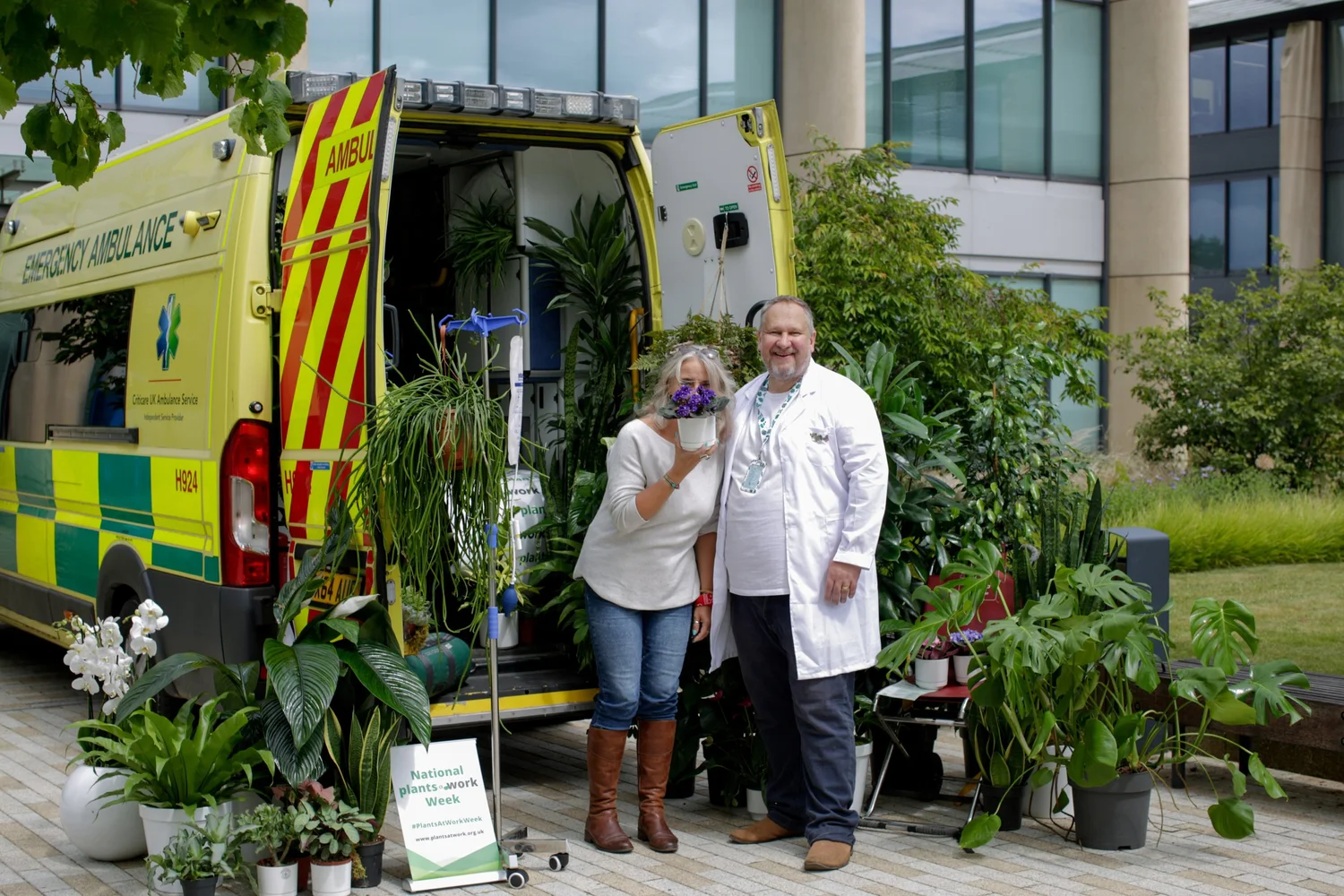
Plants to the Rescue! #PlantsatWorkWeek2023 LIVE in Oxford!
Plants to the Rescue #PlantsatWorkWeek2023 An ambulance makes an appearance at the Oxford Business Park. Everyone is keen to know who’s in need of medical help without appearing too nosey. Watching from afar one person noted something wasn’t quite right – plants kept appearing, peeping out of the back of the ambulance and round the corners of the doors. Where was the patient? And what had happened? Searching for the bed and the patient in the ambulance was difficult as the back was full of plants not patients! Proving that visible signage #plantstotherescue is very apt. NPWW Ambulance LR An ambulance brings #plantstotherescue for National Plants at Work Week 2023 This is how National Plants at Work Week opened in 2023. The brainchild of plants@work ambassador Ian Drummond confirmed, “The ambulance felt like the perfect tool to confirm the importance of plants to our health and wellbeing. Ian at the ambulance lr Ian Drummond of Ian Drummond Botancia Designs who dressed the Ambulance “Research over many years has shown that plants improve our moods and reduce stress levels and generally help our work flow. They can stimulate and improve our performance and concentration plus they lessen noise around us by deflecting and diffracting sound.” Shirley Smith of Botanica Nurseries who has several clients in the business park and looks after their plant installations with the same care as doctors and their patients, commented, “Plants make us more productive and help our creativity as well as reduce our stress levels.” James and Shirley 2 LR James and Shirley Smith of Botanica Nurseries who supplied the plants and helped dress the ambulance Ian added, “The ambulance is a great symbol to show how we should respect the work that plants do for us in the same way as we respect the National Health Service including ambulance crews.” Inside the ambulance LR From 10 – 14 July we will be celebrating the positive benefits of having plants in the workplace. Plants@work members will support this event with stories on the web using the hashtags #plantsatworkweek and #plantstotherescue. Find more information on our website and our social media sites. We hope you’ll join us to celebrate this special week. ends Editor's notes Ian Drummond is a renowned award-winning botanical designer and author of At Home With Plants. A regular contributor to many publications, such as Living Etc magazine, Ian has won multiple awards at Chelsea Flower Show and trade awards. With a client list that includes The Elton John Aids Foundation, London Fashion Week, Bafta, Harrods and Warner Bros., Ian Drummond Botanical Design is in hot demand for design work, planting schemes and events. Botanica Nurseries has been installing and maintaining interior and exterior plant displays for over 35 years. They have worked on the last two National Plants at Work Week installations, supplying space, plants and containers as well as helping with the set up. This year their contact with the Oxford Business Park enabled us to use their space for our Ambulance display. So it’s literally Botanica Nurseries to the rescue!If you like this, please subscribe! Please register for our newsletter on our website https://journalofbiophilicdesign.com/podcasts-journal-of-biophilic-design Credits: with thanks to George Harvey Audio Production for the calming biophilic soundscape that backs all our podcasts. Did you know our podcast is also on Audible, Amazon Music, Spotify, iTunes, YouTube, Stitcher, vurbl, podbay, podtail, and most if not all the RSS feeds? Facebook https://www.facebook.com/journalofbiophilicdesign/ Twitter https://twitter.com/JofBiophilicDsn LinkedIn. https://www.linkedin.com/company/journalofbiophilicdesign/ Instagram https://www.instagram.com/journalofbiophilicdesign

Research proves that Biophilic Design increases Workplace value
A new pioneering research study proves that there is definitely a business case for introducing Biophilic Design into a Workplace. The findings of this study shows an incredible 200% increase in well-being and environmental value compared to a normal workspace! The research was carried out at PLP Offices over the course of 8 weeks. The researchers monitored the participants daily work during three distinct environment scenarios: a controlled space (with no plants), a second space with some planting, and a third space with lots of plants. They monitored participants through qualitative (questionnaires, interviews, journaling with diaries) and quantitative means (air quality, VOC, CO2, temperature, humidity, light, heart rate, steps, sleep quality, noise level, brainwaves). The results are further proof that introducing plants into an office space really makes a difference to employee wellbeing, healthy, productivity, and a business’ bottom line.In this podcast, we speak with Adrian Byne, MD of Benholm Group who supported the research, providing plants and also who will be hosting an event on 28th September 2023 in their Falkirk offices for designers to explore the results with the researchers and network and discuss what makes a good biophilically designed workplace. The link to the research here: https://www.benholm.com/research-study-the-value-of-biophilic-design-follow-up-interview/EVENT - Reap what you Sow 28th September 023At the in person event in Scotland later in the year, we will be sitting down with PLP, Benholm and the researchers Professor Derek Clements-Croome and Joyce Chan-Schoof with a live audience drilling down into the process and the further application of the research. If you are a designer or specifier and would like to come along let us know, register your interest here: https://www.benholm.com/reap-what-you-sow-live-event-form/ 𝘛𝘩𝘪𝘴 𝘧𝘢𝘴𝘤𝘪𝘯𝘢𝘵𝘪𝘯𝘨 𝘳𝘦𝘴𝘦𝘢𝘳𝘤𝘩 𝘱𝘳𝘰𝘫𝘦𝘤𝘵 𝘥𝘦𝘵𝘢𝘪𝘭𝘴 𝘵𝘩𝘦 𝘱𝘳𝘰𝘤𝘦𝘴𝘴 𝘰𝘧 𝘮𝘦𝘢𝘴𝘶𝘳𝘪𝘯𝘨 𝘢𝘯𝘥 𝘮𝘰𝘯𝘦𝘵𝘪𝘴𝘪𝘯𝘨 𝘵𝘩𝘦 𝘸𝘦𝘭𝘭𝘣𝘦𝘪𝘯𝘨 𝘢𝘯𝘥 𝘦𝘯𝘷𝘪𝘳𝘰𝘯𝘮𝘦𝘯𝘵𝘢𝘭 𝘷𝘢𝘭𝘦 𝘰𝘧 𝘣𝘪𝘰𝘱𝘩𝘪𝘭𝘪𝘢 𝘪𝘯 𝘢𝘳𝘤𝘩𝘪𝘵𝘦𝘤𝘵𝘶𝘳𝘢𝘭 𝘥𝘦𝘴𝘪𝘨𝘯. 𝘐𝘵 𝘦𝘹𝘱𝘭𝘰𝘳𝘦𝘴 𝘩𝘰𝘸 𝘥𝘦𝘴𝘪𝘨𝘯 𝘥𝘦𝘤𝘪𝘴𝘪𝘰𝘯𝘴 𝘤𝘢𝘯 𝘣𝘦 𝘨𝘪𝘷𝘦𝘯 𝘢 𝘮𝘰𝘯𝘦𝘵𝘢𝘳𝘺 𝘷𝘢𝘭𝘶𝘦 𝘵𝘰 𝘦𝘯𝘢𝘣𝘭𝘦 𝘳𝘦𝘢𝘭 𝘦𝘴𝘵𝘢𝘵𝘦 𝘤𝘭𝘪𝘦𝘯𝘵𝘴 𝘵𝘰 𝘧𝘢𝘪𝘳𝘭𝘺 𝘦𝘷𝘢𝘭𝘶𝘢𝘵𝘦 𝘵𝘩𝘦 𝘸𝘰𝘳𝘵𝘩 𝘰𝘧 𝘵𝘩𝘦𝘴𝘦 𝘪𝘯𝘵𝘦𝘳𝘷𝘦𝘯𝘵𝘪𝘰𝘯𝘴 𝘢𝘭𝘰𝘯𝘨𝘴𝘪𝘥𝘦 𝘰𝘵𝘩𝘦𝘳 𝘱𝘳𝘰𝘫𝘦𝘤𝘵 𝘤𝘰𝘴𝘵𝘴.Adrian in this podcast makes an impassioned plea: “Plants in an office should be for everybody. They shouldn’t be seen as a luxury or optional extra.”Adrian also gives us some advice on retrofitting plants and Biophilic Design into a workplace. For instance, natural light is really important, look at what is already in the space, can you expose the timber, can you bring in natural wood furniture? He also says that it is important to call on an expert, especially when bringing in planting, for example you need to make sure containers are big enough for the root-space, that they need to be water-tight, where to position plants in terms of lighting etc. If you are a designer listening to this, try and introduce your client to the benefits of bringing Biophilic Design right at the beginning of a new building design, right from the ground up as it were. If you can build planting into the fabric of the building, it makes everything easier, from the water supply to aligning natural light and so on. If you are retrofitting Biophilic Design, of course, there is so much you can do too. Just looking at this research project, they created a fully immersive experience in that space as a retro-fit. We also talk about Dr Wolverton’s report from NASA https://spinoff.nasa.gov/Spinoff2019/cg_7.html , and how air cleaning takes place in the root space of the plants, toxins in the air are cleaned in the root-space of plant.Adrian encourages designers not to go down the artificial route, but to use real plants where they can. “Live plants are the best for us. Use them if you possibly can, they have all these added benefits, if you have to use artificial, make sure they look really real, people should be wanting to water artificial plants.” Live planting really does something for you which this research shows.A few notes on the research: Collaborators in the study are Sustainability Lead at House of Commons and PhD Researcher, Joyce Chan-Schoof, PLP Architecture and their in-house research and development team PLP Labs, Biophilic Design Consultant Alexander Bond, and lecturer, author and expert in multisensory design, Professor Derek Clements-Croome. Together we will measure indoor environmental quality objective data throughout the testing period, and participants will complete questionnaires after each scenario change. For more information on Benholm visit https://www.benholm.comFOR MORE INFORMATION ON THE EVENT: This open discussion will provide a golden
Making a Difference, One Roof at a Time
Have you got a copy of our Cities issue of The Journal of Biophilic Design (you can purchase a copy directly from us at the journalofbiophilicdesign.com or Amazon. To buy a copy of The Journal of Biophilic Design visit our website www.journalofbiophilicdesign.com or from Amazon. If you like our podcast and would like to support us in some way, you can buy us a coffee if you’d like to, thank you x Credits: with thanks to George Harvey Audio Production for the calming biophilic soundscape that backs all our podcasts. Did you know our podcast is also on Audible, Amazon Music, Spotify, iTunes, YouTube, Stitcher, vurbl, podbay, podtail, and most if not all the RSS feeds?Facebook https://www.facebook.com/journalofbiophilicdesign/Twitter https://twitter.com/JofBiophilicDsnLinkedIn. https://www.linkedin.com/company/journalofbiophilicdesign/Instagram https://www.instagram.com/journalofbiophilicdesign

Town Planners as Doctors for Mother Earth – Garden Cities for the 21st Century
It seems that in the 21st century we have even more challenges, from tackling climate change and biodiversity decline to an ageing population. Dr Wei Yang, influential thought-leader and a powerful advocate for climate action and nature-based solutions, advocates a people centric approach to community and environment. It is fundamental to create a balanced system for people, nature and society to exist in harmony. When we are dealing with so many different complex issues, we need to take a simple approach, with the main focus being that without nature we cannot survive. We need a mindset change when it comes to civic planning especially. As human beings we have taken from nature and not given back to nature, and Dr Yang argues, as the Garden City Principle celebrates, we are missing a trick. There is a misunderstanding of garden cities. When we say “garden cities” people think, lots of trees. But it is a sophisticated, yet simple, social economic model. Using a land value capture model. Through development the land value increases and that can be captured providing social economic support to the community. Dr Yang discusses how state run Social welfare can be a very top down approach and not necessarily what the community needs and there is a frustration in general with the Town Planning profession. Dr Yang opens our eyes to the fact that planning is in fact multi-disciplinary, not only is it an applied science discipline but it is also an art discipline. This highly sophisticated profession cuts across so many different disciplines, but, she argues, we need to ensure we maintain compassion and selflessness when we are planning our towns and cities. In fact, town Planners should be Doctors for Mother Earth “As planners we can ensure we bring the beauty of nature and wildlife corridors into cities. At the moment, our approach to Cities, is almost like they are cancers, solid concrete blocks. That’s why we have so many troubles, mental and physical health issues, if we do bring nature in, we can treat the whole environment in a totally different way.” She tells us about the first garden city Letchworth which used that approach, and we can see that the city is thriving. There is connectivity to local agricultural land. It is called a “Garden city” not referring to the “gardens” as in our households, but the agricultural belt, and of course this relates to local food production. Dr Yang also discusses the 15-minute walkable neighbourhood, and says in the 21st Century garden city you have that walkability from your house to work on a daily basis bedded into the very fabric of the city design. The Garden City is a social network, they are Social Cities. Milton Keynes example uses garden principle on a larger scale with flood attenuation and wildlife corridors. The parks Trust, manage the land using the land value capture model to look after the green space. About ¼ of the land is green. The city generates income from the premises on the land and they use this income to look after the green space professionally. Self-sustaining. We need this long-term integrated approach when it comes to town planning. Accessibility to green space affects our behaviour and physical and mental wellbeing. Generally expensive areas are leafy, but Green space is important to everyone. If we remember the pioneer Octavia Hill who helped protect green spaces for those from disadvantaged backgrounds to enjoy green space. It should be accessible to everyone and we should continue this in town planning. 74% of children only play outside. When you compare this to Prisoners who by law have to have at least 1 hour a day outside, children have less freedom than prisoners! If we want the next generation to protect nature we need them to understand it, otherwise they won’t. Let’s bring garden cities right to someone’s doorstep, improve biodiversity, and also improve the porosity of the earth. Let’s have a Place-based approach, work with different professions and maintain a multidisciplinary approach Nothing is more powerful than nature. There are no age or gender differences in planning, if we believe something we can just work on it and we can all achieve something collectively… Dr Yang is an influential thought leader and a powerful advocate for climate action, nature-based solutions, health and well-being, and social equality. Wei was named as a Net Zero Hero by Digital Leaders in 2022.https://www.weiyangandpartners.co.uk/about/team/dr-wei-yang To buy a copy of The Journal of Biophilic Design visit our website www.journalofbiophilicdesign.com or from Amazon. If you like our podcast and would like to support us in some way, you can buy us a coffee if you’d like to, thank you x Credits: with thanks to George Harvey Audio Production for the calming biophilic soundscape that backs all our podcasts. Did you know our podcast is also on Audible, Amazon Music, Spotify, iTunes, YouTube, Sti
Reconnecting with nature will save our society
Sustainability matters, it is a matter of survival. For Carlo Battisti, President at Living Future Europe this is essential. We cannot design or build without considering this.We already know the solutions, we need to implement them.Carlo co-founded the Biophilic Society and coordinates LFE biophilic design strategy. “There are so many global issues to solve, our responsibility must start from the built environment, we know that 40% of emissions come from built environment and these have an impact on global issues.”Each time we build, we start from scratch which means it’s difficult to standardise the processes, also the sector is so slow to change, but the built environment shapes the way we are living.Carlo tells us about his experience and also about the Living Building challenge framework which was developed in 2006. We are now at the 4th version of the standard which was published in 2019. Biophilic Design has always been a core part of this framework. If we design and build with a better connection to nature, using natural light, better airflow, etc, there will be better energy consumption, greater energy efficiency. Also of course, there are lots of studies which show that bringing sufficient daylight into enclosed spaces, for instance in schools or hospitals, patients recover quicker, students learn faster in classrooms. There is such interesting and robust data.The Biophilic Summit is taking place on 7th June 2023. The details of the summit programme and how to register can be found here: https://lfeurope.regfox.com/biophilia-summit-2023Our editor, Dr Vanessa Champion will be moderating the Round table at the close of the event. Also speaking at the event will be two Stephen R. Kellert award winners from 2022 and 2023. The designers of the Railway station in Japan, JR Jumamoto Railway Station (2022 winner). Also the architect who worked on the school in the Netherlands, De Verwondering which won the SKBDA 2023 both European and the Global category. Check out the SKBDA 2023 Europe finalists videos (link on the JBD website too).Do have a look at the Biophilic Society, which, Carlo describes as a living system of passionate people all over the world, meeting once a month, looking at best practice, etc. https://www.living-future.eu/biophilic-society/Some helpful links:Living Future Europe https://www.living-future.eu/Biophilia Summit 2023 https://lfeurope.regfox.com/biophilia-summit-2023The Biophilic Society https://www.living-future.eu/biophilic-society/Sign the ManifestoBiophilic Design at LFEBiophilic Design experts (filter by BD)Biophilia Camp 2022 highlightsBiophilia Camp pre-registration list (22-25 Sep 2023, South Tyrol)De Verwondering wins the SKBDA 2023SKBDA 2023 Europe finalists videosMarion Fire Station Iowa (2023 co-winner)JR Jumamoto Railway Station (2022 winner)To buy a copy of The Journal of Biophilic Design visit our website www.journalofbiophilicdesign.com or from Amazon. If you like our podcast and would like to support us in some way, you can buy us a coffee if you’d like to, thank you x Credits: with thanks to George Harvey Audio Production for the calming biophilic soundscape that backs all our podcasts. Did you know our podcast is also on Audible, Amazon Music, Spotify, iTunes, YouTube, Stitcher, vurbl, podbay, podtail, and most if not all the RSS feeds?Facebook https://www.facebook.com/journalofbiophilicdesign/Twitter https://twitter.com/JofBiophilicDsnLinkedIn. https://www.linkedin.com/company/journalofbiophilicdesign/Instagram https://www.instagram.com/journalofbiophilicdesign
Greening the Streets of Nairobi
Nature is home. Nature is where you can think, rejuvenate, it constantly gives to you. There is nothing man made that can replace the benefits of nature. Edna Odhiambo, is a Climate Change Lawyer based in Nairobi Kenya. Edna was speaking at the brilliant 8th Annual Sustainability Week conference, run by The Economist [PUT LINK IN] As an undergraduate law student, she witnessed one of worst droughts in the Horn of East Africa, and she asked herself “what can the law do about this?” She realised then that one of the main keys to unlocking the solution is through a focus on policy and regulatory frameworks across different sectors. In terms of sustainability, Kenya leads in Africa. For example, more than 85% of their electricity comes from clean energy sources like solar, wind, hydro and geo thermal. But there are many challenges. For example, there are millions of Kenyans who lack access to clean energy sources, some are still using firewood and charcoal, dirty cooking fuels, which also increase respiratory illnesses and people are cutting down forests. 87% of Kenya is arid and semi-arid. If you consider then there is very little arable land and then couple this with climate change impacts, water scarcity we should be looking at opportunities to find solutions locally while we wait for access to innovative and affordable technology. Edna explains there are many basic low-cost solutions which can be done by local communities such as water dams. We need to make a difference as fast as we can. One of the main themes of this podcast is how we need to bring in an integrated approach to transport, we need a multi-modal approach which seamlessly connects walking, bus and public transport, dock-less bikes, cycling lanes and walking pathways. Globally transport is the cause of 15% of emissions. The time has come to stop putting highways before people, building cities around transport, we should be putting people first. Traffic is a major cause of outdoor air pollution, which causes asthma in children, and there are even studies looking at there being an increased risk of dementia event early studies, Edna makes a call for improving our overall quality of life. We are upright creatures, when we are away from our natural set up, that’s when we get very anxious. We also have to remember that in developing cities, more than half of the population walk, they are not using cars, they use public transport when they can afford it and half the time they cannot so they walk. Increasing walking and cycling structure is important. We need to good walk paths cycling paths. If half of the population walks, then let’s aim to make our cities equitable to ensure we are catering for our people. Biophilia, as well as our connection with animals, birds, nature and trees, this symbiosis also extends to people, our interconnection with each other. It is the love of living entities, life.. For Edna her focus on civic environmental improvements includes walking and eco-friendly modes of transport. This closer connection to other people gets you speaking with others, community, maybe even starting friendships. Also consider the sound pollution, the auditory impact traffic noise has on us, it raises our stress levels. Challenges are always there, the good thing is that when you know them then you can address them effectively. In finding solutions you need to ensure you allocate and understand the budgetary requirements. Transport is the responsibility of national and subnational governments, and there is need for coordination, we need to look at them as one system, we need infrastructure to make our lives better, including the deliberate allocation towards walking and cycling. We need policy and regulations, legitimising walking and cycling. Plus we need to bring in citizen awareness, allowing for a constant motion of educating masses of their rights to walking facilities, when we realise how poor environmental transport solutions affect our health, this becomes a personal concern and changes the game. Cities are very central to climate action, by 2050 68% of the people of the world will live in cities. We need to engage more inclusively for the needs on the ground, addressing climate change in all sectors. For instance, in the built environment bringing let’s bring in biophilic solutions, for example, vertical gardens, these improve aesthetics, are air purifiers and sound absorbers. In Kenya everybody tries to have a kitchen garden wherever they can, even growing vegetables in a sack. It’s a culture, everyone grows a few greens in their backyard, even with more and more people in apartments, nature is so resilient Growing your own, allows us to feel closer to nature, to nurture it, giving us a greater appreciation of nature. Think about underserved communities, helping them have access greens and improve their nutrition while also mitigating climate cri
The River of Life – Orientate Earth, Built Environment and Sustainable Workplace
Harvesting the energy of our people, is a key message in this great podcast with Jaime Blakeley-Glover, founder of Orientate.earth and a collaborator with other businesses all working towards the same goal, to make our world and our environment a better place to live and thrive. We talk about his the “Social benefit of buildings”. For Jaime, we have a huge responsibility in relation to how we create our built environment, the decisions we take will have an effect for years after we’ve gone. We leave a legacy, and a choice. Do we create amazing awe-inspiring connected places or create dull and lifeless ones? It is only by understanding and engaging with all the stakeholders, from the building owners to the people who work, visit, use and supply the buildings that will allow us to think about the place our buildings and places have in responding to the needs of people now and in the future. We need to broaden out how we think of things. Buildings are more than just Units and assets, these are places where people live, how we build and design affects their lives and wellbeing. Let’s look at the Social-economic indicators as well as the “warm” data, this collective imagination to assess this broad set of information, and then respond to it. Biophilic design and nature-inspired design does support a more sustainable way of living. It is proven, that if we care about something we do more to protect it, if we bring nature more into our sense of view, we will do more to protect it. We can also be inspired by nature and look at how buildings and cities are living systems. We are part of the living system, in terms of cities, and nature. We can’t think about it in a linear way. All living systems are wonderfully adaptive, they change in response to their surroundings. That’s how we should be looking at how we designing materials, organisations, buildings. Nature has feedback loops, and if we genuinely listen to a place, really understand what is going on in the workplace and a make a commitment to work with what we see, we will flourish. We also talk about the Most Sustainable Workplace Index. There was a report in 2017 that stated that 98% of sustainability initiatives fail to deliver, for Jaime, most of this comes from human factors and we need to reduce that. But we can’t just scatter seeds on stony ground. We need to think about the soil in an organisation which is the culture, the relationship, the purpose, our meaning. Which in turn allows things to grow, the index, helps us understand that so we can sow the seeds, and select the right ones. With a more human centric measure of sustainability based around motivation. If people are motivated, we would not be getting those stats. With the index we can understand our people and respond to what they need to step into action and help build motivation for sustainable behaviour and action. If we use Biophilic Design as a way of working, combined with a process of Adaptation (mimicking nature), we can contextualise what we do, and grow from the inside out. And things will change for the better. To contact Jaime visit www.orientate.earth and www.mostsustainableworkplace.comJaime will be speaking at the Workplace Trends conference on 19th April 2023, in London https://workplacetrends.co To buy a copy of The Journal of Biophilic Design visit our website www.journalofbiophilicdesign.com or from Amazon. If you like this, please subscribe! Please register for our newsletter on our website https://journalofbiophilicdesign.com/podcasts-journal-of-biophilic-design Credits: with thanks to George Harvey Audio Production for the calming biophilic soundscape that backs all our podcasts. Did you know our podcast is also on Audible, Amazon Music, Spotify, iTunes, YouTube, Stitcher, vurbl, podbay, podtail, and most if not all the RSS feeds? Facebook https://www.facebook.com/journalofbiophilicdesign/ Twitter https://twitter.com/JofBiophilicDsn LinkedIn. https://www.linkedin.com/company/journalofbiophilicdesign/ Instagram https://www.instagram.com/journalofbiophilicdesign
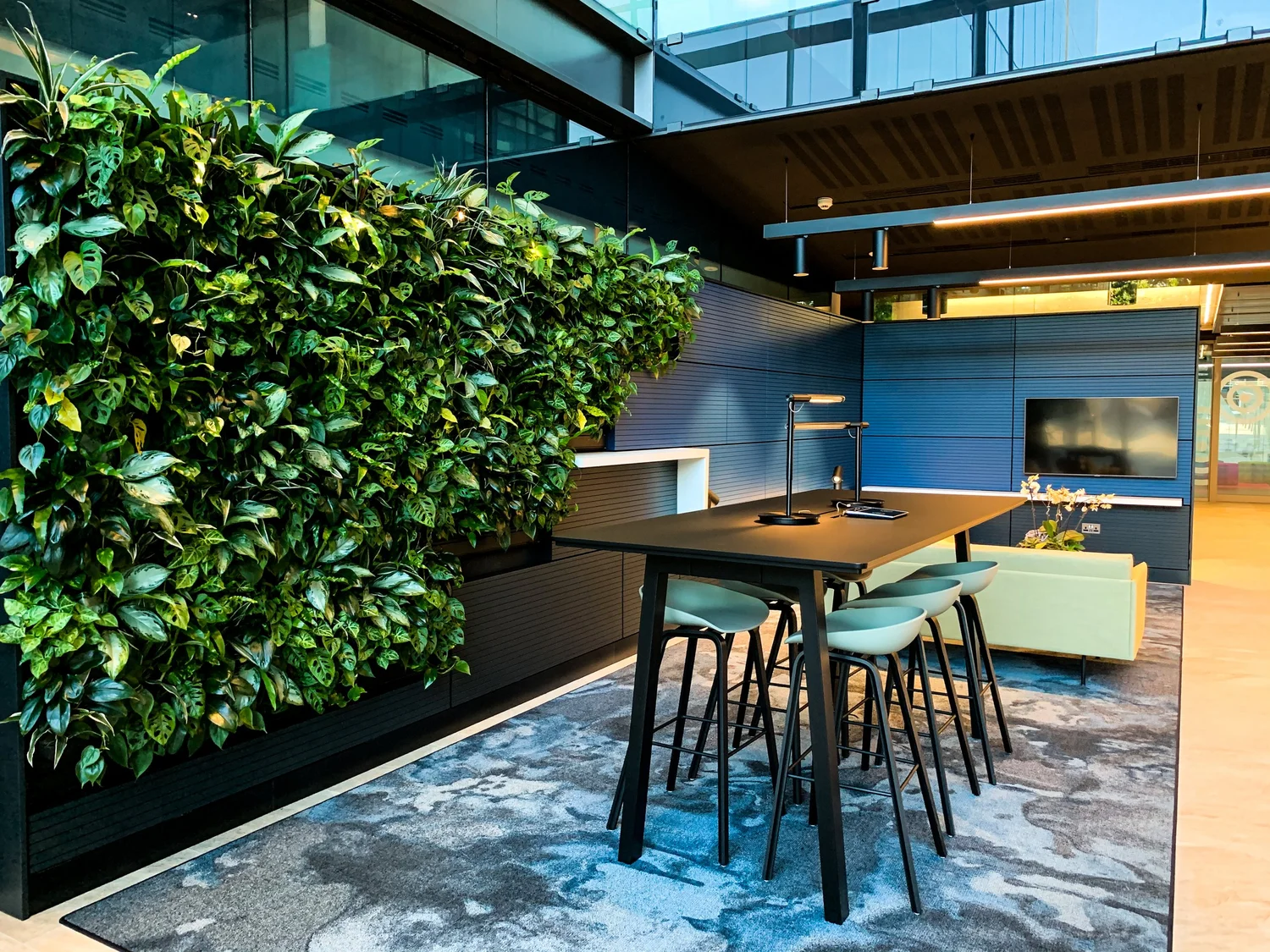
How to design to incite a feeling? Workplace Design 101
How do you design to incite a feeling? We spend five days of our week in the workplace, and it impacts our psychology massively. When we walk into a space, how do we design to excite that sense of awe. For Becky Turner, workplace psychologist for Claremont Group Interiors, they have conducted research to examine how we replicate that feeling of “oooh” in the workplace. For many it is the sense of sense of connection that drives people to the office, what else will encourage the workforce the consider the cost of the commute whether it’s financial or time? Claremont researched office-based workers to find out what types of things invite people back to the office. With an overall low occupancy at 30% businesses are feeling the pinch when it comes to workforce presence.That feeling of connection to other living beings, comes back to Biophilia and Fromm’s expounding of being connected, that love of life, and sense of freedom. It’s a complex thing.How do you design to incite a feeling? Becky talks about colour theory, employee journey, brand experience, and how you drive people into the space for those spontaneous connections. Create a variety of spaces and of course the benefit of Biophilic Design is so widely researched that if we create a variety of spaces, to help increase employees mood we are going to have healthier and happier and productive workforce. Becky describes how important it is to create choice, and freedom to explore in a workplace, so people feel a sense of control, but it is vitally important to ALSO so important, to ensure that the organisation empowers that control. Micro choices are a way forward too.Human centric design of course, also ensure that we take into consideration, job roles, personalities, neurodiversity and physical challenges mean that people are going to use the workplace differently. Overall, Becky is optimistic, there is a progression towards consideration to the human experience in the workplace, and that people are not just commodities. There is so much data to show, that Biophilic Design has a great impact on bottom line performance. Space can impact wellbeing, happiness and healthiness, mentally physically and socially. We also speak about activity based workspaces, and offering prospect and refuges areas, as we would also experience and seek out in nature itself, spaces where you can gain information and also have shelter and protection. Businesses are understanding that we need different workspaces for different tasks. Looking at the Five Factor Model – OCEAN (Openness, Conscientiousness, Extroversion, Agreeableness, and Neuroticism), it is important that we all design with everyone in mind. We need to put safe spaces in, defining these for refuge, so it’s important when we come back to the office, that we use those principles found within nature, to create a similar landscape to satisfy that need we have internally. COME AND HEAR HER SPEAK AT THE WORKPLACE SHOW AT THE NEC - FREE TICKETS https://rfg.circdata.com/publish/WE23/simplereg.aspx?source=Journalofbiophilicdesignvisitor To connect with Becky visit: https://www.linkedin.com/in/becky-wilkins-claremontgi/ or download a recent report click here: https://www.claremontgi.com/balanced-workplaces/ buy our magazine from our website buy our magazine from our website and if you like our podcast and would like to support us in some way, you can buy us a coffee https://www.buymeacoffee.com/biophilicdesign if you’d like to, thank you x Credits: with thanks to George Harvey Audio Production for the calming biophilic soundscape that backs all our podcasts. Did you know our podcast is also on Audible, Amazon Music, Spotify, iTunes, YouTube, Stitcher, vurbl, podbay, podtail, and most if not all the RSS feeds?Facebook https://www.facebook.com/journalofbiophilicdesign/Twitter https://twitter.com/JofBiophilicDsnLinkedIn. https://www.linkedin.com/company/journalofbiophilicdesign/Instagram https://www.instagram.com/journalofbiophilicdesign
Nature-Inspired Workplace Design
Here’s a big question, how do we inspire more people to come back into the workplace? For Steve Brewer, founding partner of the design agency, Burtt-Jones and Brewer, we need to create a workplace EXPERIENCE which works for you as an individual. Having worked with HM Treasury and so many other businesses transforming their workplaces, for Steve the most important part of the conversation is with the individual. Rather than go through a company and blitz a design with a hammer and chisel, for Steve, the keys are workshops. “We benchmark where that company is and where that company wants to go in the future. It’s a very tailored response, and very much we see ourselves as Co-designing workspaces.” The better experience at work, the better the end-result. “The more you can run through that process, the better the foundations you can build.” Steve sees that his role is to pull all the “Jigsaw pieces together and try and make it the best-looking picture that everybody agrees to”. What about Biophilic Design? For Steve, he has always tried to bring outside experience inside the office. Sometimes, businesses might see biophilic design and plants as a sticky plaster solution. If you think about it the buildings are often already there “glass sealed boxes with air conditioning. Maybe you’ve been on tube, rushed to work, grabbed a coffee, no breakfast, kids were screaming, then you are in the work environment. If we can bring more biophilic design into those spaces, then that experience is going to lift your wellbeing, calm you down by not seeing white walls, glaring light, bad acoustics…” Steve goes on to explore how to introduce Biophilic Design early as you can into the design consultation process, but most importantly being sensitive and understanding how and when to convince stake-holders who might have a thousand other things on their mind when they are sitting around the table.

Lloyds Bank, Sustainability and Greening Workplaces
For Paula Rowntree, Head of Workplace Design for LLOYDS BANKING GROUP, the office very much plays an important role in the workplace. For her it is the human connection, the corridor moments, saying hello, being creative, having conversations, seeing when someone is not ok. So when it comes to designing spaces, the focus is very much on the wellbeing of the people using the space, as well as the sustainability aspect, which is why Biophilic Design is such a positive element in a designer’s bag. “Biophilic Design is incredibly important. It is that Deep-rooted connection to nature that we all have. To breathe fresh air, that emotion you get from being connected to nature.” Paula goes on to explain how years ago, the historic design trend was to take nature out of buildings, and make them a little more sterile and austere. Fortunately, that trend is shifting. Bringing in more greenery and timber elements, we feel calm and relax very quickly in a space. “Planting, naturally makes you feel better”. Paula will be speaking at the Workpace Design Show, taking place on 27 and 28 February 2023 in London. “Often, when we come to implement real planting, we might need to create a business case for it (we need watering systems, so there’s a cost to install and maintain). But there is a whole array of plant elements we can bring into a space, from pretend plants, to preserved planting which may be simpler to deploy and gives illusion of planting.” Fortunately, Lloyds Banking Group have a strong sustainability agenda, so for Paula, nature-inspired design is a key to helping reach net-zero targets and encourage sustainable behaviour. With our planet in crises, temperatures are rising, it is a big overwhelming problem. “We are trying to get everyone in the bank thinking about sustainability. What can you do? That’s where I started from, what can I do?” In one of the flagship branches of Lloyds, notably the one on Oxford Street (near Bond Street), Paula pushed the boundaries, as well as changing heating systems, lighting, furniture and fabrics she looked at planting. She installed High-raft moss discs, Preserved planting up at ceiling level, Plant pots with ground-level plants all putting oxygen back into the air, plus a Living wall on the outside with the brand element on the fascia. As a result, the bank colleagues feel very proud to explain what it’s all about, especially the sustainability aspect. “Biophilia and planting becomes a visible statement” something that says that this company is committed to sustainability. “Also by putting planting back into the environment in branches, we are helping make people feel a little bit better in the work environment.” The spaces feel good, there’s re-oxygenation, alongside brand messaging. “There is something so joyful, it makes you feel: wow this in an amazing space. We want to make them timeless, make them last, to be there for future generations, because planting does that right, it doesn’t just stop.” Also note Paula will be speaking at #workspacedesignshow and I'll be chairing a panel discussion. Join me at the UK’s biggest workspace event bringing you networking, thought leadership, and the latest products to transform our country’s offices, taking place 27th & 28th February 2023 at Business Design Centre. Register FREE to attend here https://invt.io/1exbb5fmtdj #WDS23

New Natural History GCSE – so we are not the Last Page of the Book of Earth
With such a depletion of wildlife in the UK alone, with so many schools, cities, towns, and housing estates being built so far removed from our natural world how on earth does the next generation stand a chance to learn about the natural world and be sympathetic to it? At the same time, we also are demanding literally the earth from our natural world, and the way we extract from the natural world is getting more intensive and damaging. As we move further away from it how do we fill that nature gap in society? We speak with Environmentalist, Producer and Writer Mary Colwell who has campaigned and devised a NEW Natural History GCSE designed to help bridge this chasm, helping put nature and the wonderment and fascination of nature into education. “Nature is for everyone, it is there for YOU to engage with, that’s why putting it into the school system is important, making it open access and free to all, for everyone to engage with. We know from the COPs recently that we are looking at a very difficult time ahead, and those young people will have to live in this difficult time, and if they are going to make the right decisions for themselves, people and the planet, they need to be more knowledgeable, more engaged and more connected to this planet we live on.” Research by Miles Richardson of the University of Derby’s Nature Connectedness Research department has shown that by the time children reach secondary school, there is a marked drop off in connection to the natural world. It happens at around 13, it gets crowded out, school gets very academic, and nature is side-lined, squashed into Biology, and then it’s only picked up again when we are 30. With 80% of us in the UK living in urban environments that means only 20% of us live in anything you can call countryside. We have shifted our cultural attitudes, our language, everything has shifted away from nature. All this is creating a perfect storm of disassociation and lack of emotional response and emotional intelligence when it comes to dealing with the natural world. Up until now, through the current education system, we are handing over to the next generation a fractured view of nature. We live in this disassociation, we are just taking what we want, and it’s not even much to pay. This is what we are passing on to the next generation and it must stop. One of the beautiful things about Biophilic Design is that it brings nature and nature-inspired design right under the noses of everyone, it reconnects us to nature. How wonderful would it be, if alongside, the next generation learns how to identify, study, record and monitor the natural world, understanding how habitats make the nature of Britain: how the animals, plants and birds that we live with thrive, that they learn what its job is, how for instance how an Oak Tree fixes the soil, provides habitats, how it interacts with us. We are all part of the same thing, the outside world, we are nature, we are one. The Disgupta review emphasised the importance of learning about biodiversity and ecology at all levels of education. I interviewed Dom Higgins Health and Education director for the Wildlife Trusts, a few weeks back and I was really thrilled to learn that Mary has campaigned and designed this new Natural History GCSE. “We need a nature-literate, engaged, and eco-sensitive generation, we need to start helping fill that gap”. It’s showing up in our culture as well. In literature We use a lot fewer nature words in use of nature fiction poetry song lyrics since the 50s, use of personal pronouns, me, my, mine, has increased by 50% in the language we use on a day-to-day basis, we have become more inward and individualistic and a lot less community and open to the natural world. Nature is everything hopefully it will encourage a general greening in the curriculum. Let’s change that, through design, through education, through inspiration. In this podcast you’ll also learn some interesting facts to tell your friends: Did you know Cabbage White butterflies, migrate over the North Sea. We also see an influx of Painted Ladies from Europe, “I think it’s wonderful to imagine a whole host of Orange butterflies come skipping their way here over the grey North Sea.” A swift never lands unless it comes into nest to breed, drink, eats, mates on the wing, rides out the storms and tempests of the planet and only lands to have its babies. And how about the Curlew, with their most haunting and bubbling call? Did you know it can dip its bill into soft soil, the end of which moves? It acts like a pair of pincers, it feels around. It’s called rhinokinesis. The end of its bill opens independently, like a great pair of tweezers with a sensitive tip helping the bird find food on the water shore. “Your Biophilic Design magazine is important, we need to be inspired by nature to help us live full and fascinating and very beautiful lives, that's really important because
Healing yourself at Home with Biophilic Design
Tying in with the second issue of our magazine, our theme for this podcast is HOME. We speak with Award-winning Interior Designer Nuria Muñoz who tells us about her journey into Biophilic Design and why she decided to follow her dream path start her own company and do something good for the planet. Nuria is a Wellbeing Interior Designer, Consultant, Speaker and Educator based in Valencia Spain and works all over the world. She founded Habitarmonia, a consulting and design studio that offers both B2B and B2C services, has won awards and is passionate about our beautiful planet, and designs interiors that respect our world and brings harmony and happiness to the families who live in them. "We heal people by using Biophilic Design." Giving us an example where she transformed a home of a couple who had stressful jobs and children who were struggling on different levels, she explains the importance of co-creation, working with the family, asking them lifestyle questions, finding out their challenges, listening and also, and this is important, explaining HOW the design changes will help them. "It's important to make people aware of the benefits of biophilic design. We create room and space, but our challenge as interior designers, it's not just about looking saying and showing it looks nice, it is important also to communicate that the Biophilic Design solution helps you with well-being and happiness." Finalist in the Golden Trezzini Awards 2022 for Best Implemented Private House Interior Design Project, Nuria was Award Winner of Wintrade Global and won the Best Service Award in Houzz 2022. For Nuria, Biophilic Design is NECESSARY, to help mitigate climate change by implementing Biophilic Design, helping us reconnect with nature as well as helping the health of people, of families. It is understanding we are nature, and that we can make something. Just like bees help the ecosystem, we too should be a positive cog in the environmental wheel, our biology needs to connect to nature and sustain life. Continuing the connectivity theme, Nuria explains how important this is for her.If people could understand this language of Biophilia, get connected to nature, and go to nature, if they would feel it themselves, then Biophilia could be this common language. Yes, we can create beautiful cities but we also need to understand what we are doing. To find out more about Nuria visit her site https://www.habitarmonia.com/ Why not also visit the link where you can download a free checklist to create a well-being interior (this brings you to the ebook - 144 pages of examples, pictures and worksheets to create your own well-being space): https://www.habitarmonia-academy.com/wellbeing-checklistDid you know our NEW printed and eBook journal is out now https://journalofbiophilicdesign.com/journal-of-biophilic-design-1Please register for our newsletter https://mailchi.mp/4001fc945c4f/untitled-page and view previous podcasts with images here too: https://journalofbiophilicdesign.com/podcasts-journal-of-biophilic-design.Credits: with thanks to George Harvey Audio Production for the calming biophilic soundscape that backs all our podcasts. Did you know our podcast is also on Audible, Amazon Music, Spotify, iTunes, YouTube, Stitcher, vurbl, podbay, podtail, and most if not all the RSS feeds?Facebook https://www.facebook.com/journalofbiophilicdesign/Twitter https://twitter.com/JofBiophilicDsnLinkedIn. https://www.linkedin.com/company/journalofbiophilicdesign/Instagram https://www.instagram.com/journalofbiophilicdesign
Nature on Film - From David Attenborough and the BBC to Termite Mounds!
Biophilia is more than plants, light and air, it’s also about surrounding ourselves with living beings and our living natural world. If we think about it, E.O.Wilson’s seminal book, Biophilia celebrates all aspects of our living planet and is a call for that direct connection with nature. Wilson’s book examines our inherent connection to living species, the fascination of life, and how other living societal systems can inform our own. In fact, his lifelong interest in ant colonies emphasises this. Creating those moments of intimacy with nature has a really important place in our modern world where there is a disconnect with getting out there. In this wonderful podcast, we speak with Michael Potts, who has spent more than 30 years as a wildlife cameraman, mostly for the BBC in more than 50 countries worldwide on major series including working alongside David Attenborough filming Life of Birds, The Life of Mammals and many programmes in the Natural World series. We discuss the importance of nature connection, why we need to introduce and educate the next generation, and also how audio-visual connection to nature through our TVs and devices is a positive thing and how we could take this one step further and introduce it into our built environment. “If you see something and understand it, then you care about it, then you might do something to protect it and encourage other people to do the same.” The messaging, inspiration and education you experience through wildlife films inspire people, and footage of birds in flight for instance has a calming effect as well. Michael regales us with tales of animals, where he has filmed birds of paradise in New Guinea, Grizzly bears in Alaska, Termites in Namibia, Caribou migration, Polar Bears and more. He has spent many hours, up close and personal, feeling the heartbeat of a bird as it sits in his hand, feeling the strength of it, studying the intricacies of plumage which adapted to that way of life, their piercing eyes, incisive bills which continue to fascinate him: “every species is so special, they are all so different, so supremely adapted to where they live.” He has also seen so many changes, reduced habitats for farming birds for instance where prairie-style farming is destroying land and habitats. We can do more to improve the habitats of birds and animals, and the built environment, cities, towns and communities can do much to change how we build and design our communities. Biomimicry is one aspect of nature understanding that has a positive impact on our built environment, he mentions filming Termite mounds, huge, 12-15 feet high, made from mud, clay and sand. “They have incredible internal temperature control systems. It is +40 centigrade during the day, but to near freezing at night, but with a system of chambers and ducts, the termites maintain constant temperatures inside the mound to within 2 degrees.” This was for a study by Loughborough University which were using the knowledge garnered from the filming to use the design as an example for cooling systems in modern buildings. Nature provides us with so many answers, if we have eyes to see. Michael has a fascinating book out “Untangling the Knot, Belugas and Bears: My Natural World on Film” which you can buy directly from all good booksellers, and also directly through Michael, contact him via his website:http://michaelpottsphotography.comHe will also be at The Global Bird Fair in July 2023 https://globalbirdfair.orgDid you know our NEW printed and eBook journal is out now https://journalofbiophilicdesign.com/journal-of-biophilic-design-1 Please register for our newsletter https://mailchi.mp/4001fc945c4f/untitled-page and view previous podcasts with images here too: https://journalofbiophilicdesign.com/podcasts-journal-of-biophilic-design.Credits: with thanks to George Harvey Audio Production for the calming biophilic soundscape that backs all our podcasts. Did you know our podcast is also on Audible, Amazon Music, Spotify, iTunes, YouTube, Stitcher, vurbl, podbay, podtail, and most if not all the RSS feeds?Facebook https://www.facebook.com/journalofbiophilicdesign/Twitter https://twitter.com/JofBiophilicDsnLinkedIn. https://www.linkedin.com/company/journalofbiophilicdesign/Instagram https://www.instagram.com/journalofbiophilicdesign
Feeling Alive
As many of our listeners know, the concept of Biophilic Design brings our contact with nature closer into our lives in the built environment, whether that’s at home, work, hospitals, schools or our cities. In our podcasts we speak to people whose life’s work has been to design and work with nature and also to understand more deeply how and why our connection with nature is so profound and why it has the positive impact it has on us. The underlying factor is our inheritance from our ancestors, how for hundreds of thousands of years we lived outside, close to nature. We are still dependent on nature for our food, air, water, life. In this podcast we speak with Mary Reynolds Thompson, founder of Live Your Wild Soul Story, and who is an award-winning author, internationally recognized speaker, and a pioneer in the spiritual ecology movement, her focus is on the transformative power of landscape archetypes and nature metaphors to reveal our true purpose and right relationship with the planet. We discuss how the way we are living now alienates us from real life, from the living planet, from each other, and from our own authenticity. It’s not just a philosophy, it's proven that time in nature really heals you emotionally, psychologically, and physically, the effects are lasting – it has an accumulative benefit, extending into the stresses of the week. Therefore, simply put, the more connected we are to nature the happier we are. “It’s an unfolding comfort, we feel the warmth or cold of the earth, almost like the heartbeat of the mother, security and happiness. For all human history we lived outside, it’s part of our lineage, and we don’t just cut it off. We don’t lose that desire.” Mary goes on to describe a concept, Shadow wild – this disconnection which leaves such a gaping chasm that we tend to want to fill it with whatever is at hand because we want to feel alive (Joseph Campbell, the mythologist said – more than anything humans want to feel alive, and most of us feel alive when we are outside in the natural world. We are part of the earth's 4.5-billion-year history, everything that comprises us was there even before the big bang. There is a deep knowing that changes how we feel about ourselves, we are not inconsequential, we matter, we are matter, we have meaning. Mary takes this one step further in her practice, she helps people reconnect with themselves and this realisation is part of the beginning of this return to our passion for what we want to do. For her landscapes are archetypes, and they are inside us, we emerged out of these places. Have a listen to the different archetypes which Mary describes. For instance if we are constantly mountain woman or man, there are times in our life when we need water, or desert. As Designers, I imagine some would find this interesting, as we go on to discuss how we could take an office and create zones, creating spaces that resonate with different elements to help users of a space work through a project. The desert is calm and allows thinking time, the forest is an imagining space where we follow threads, we allow our passion to come into its own with the ocean, we manifest on mountains and then we take to the grasslands to share and serve the community, our purpose. Finally, we talk about the environment. Nature and what we’re doing to nature mirrors what we are doing to our own psyche and souls. Razed forest is devastating, in many ways we are felling the most fecund creative aspects within ourselves as we do it, we are cutting down diversity, creativity, and rootedness. What we are doing to the earth is not unrelated to what we are doing to our psyches and souls. We as humans have a deep kinship with all of life. We are not just hurting the planet we are hurting ourselves in very profound ways.Did you know our NEW printed and eBook journal is out now https://journalofbiophilicdesign.com/journal-of-biophilic-design-1 Please register for our newsletter https://mailchi.mp/4001fc945c4f/untitled-page and view previous podcasts with images here too: https://journalofbiophilicdesign.com/podcasts-journal-of-biophilic-design.Credits: with thanks to George Harvey Audio Production for the calming biophilic soundscape that backs all our podcasts. Did you know our podcast is also on Audible, Amazon Music, Spotify, iTunes, YouTube, Stitcher, vurbl, podbay, podtail, and most if not all the RSS feeds?Facebook https://www.facebook.com/journalofbiophilicdesign/Twitter https://twitter.com/JofBiophilicDsnLinkedIn. https://www.linkedin.com/company/journalofbiophilicdesign/Instagram https://www.instagram.com/journalofbiophilicdesign
Designing Climate Change Resilience
Dom Higgins, head of Health and Education for the Wildlife Trusts. We speak about Nature connectedness, biodiversity, purpose, people, place, Cone Snails and the new Natural History GCSE… among other things. We talk about how we need active environments, and how it goes back to when we were hunter-gatherers. If you remove people inside and then we remain stationary, then we stress. We should be outside, away from artificial lights and all the accoutrements of the modern-day office (unless it has biophilic design woven into its very fabric). Take anyone away from connecting with nature and we get chronic stress. The disconnection detrimentally affects us physically and mentally. We discuss this nature-connectedness, that feeling of understanding what is going on in the world, that we are part of something bigger than ourselves. We need that daily thought, that sense of knowing that everything has a place, and is connected back to everything else. This is our life-support system essentially. If we don’t design with that sense at our core, then our planet and our health are doomed. If you don’t have that feeling, that sense of connectedness with nature innate within you, then the decisions being made around the world are skewed, everything from creating fair and sustainable employment to the food we eat, the water we drink, and the air we breathe. It has consequences. And not good ones. Nature is our key to solving the climate crisis, if we reconnect people with nature, bring nature and natural elements closer to people then everything is more joined up. Better decisions will be made. We need to give nature a chance, we might be too late to prevent climate change, but we can mitigate against the challenges such as cooling cities, carbon sinks, cleaning our air, and ecosystems that can mitigate the issues. We need people to take action, so we need to hear it on the Stock Exchange, Factories, taxis, it should be the business of everybody. Dom tells us about the 3 strategic goals of The Wildlife Trusts, the first one is the aim to see 30% recovery in land and sea by 2030, second is to see 1 in 4 people taking action in nature or climate change “we can’t do it alone, we need partnerships, new communities and voices” and finally demonstrating the societal value that nature has, for instance, nature-based solutions to the healthcare social care challenges, and we could add Biophilic Design falls into that last goal. Change has to be mandatory, we need legislation, there is always a cheaper way of doing something, we need to “weave in nature to design resilience to climate change. Nature is there for you.” To find out more about Dom and The Wildlife TrustsGet involved: https://www.wildlifetrusts.org/get-involvedFind a Wildlife Trust near you: https://www.wildlifetrusts.org/wildlife-trustsDid you know our NEW printed and eBook journal is out now https://journalofbiophilicdesign.com/journal-of-biophilic-design-1 Please register for our newsletter https://mailchi.mp/4001fc945c4f/untitled-page and view previous podcasts with images here too: https://journalofbiophilicdesign.com/podcasts-journal-of-biophilic-design.Credits: with thanks to George Harvey Audio Production for the calming biophilic soundscape that backs all our podcasts. Did you know our podcast is also on Audible, Amazon Music, Spotify, iTunes, YouTube, Stitcher, vurbl, podbay, podtail, and most if not all the RSS feeds?Facebook https://www.facebook.com/journalofbiophilicdesign/Twitter https://twitter.com/JofBiophilicDsnLinkedIn. https://www.linkedin.com/company/journalofbiophilicdesign/Instagram https://www.instagram.com/journalofbiophilicdesign Follow Dom: https://twitter.com/DomCHiggins
Designing the Way Nature Would
Merging nature and design together, Outsidein, as their name suggests, does exactly that, they bring the outside in. They were Platinum winners in this year’s 2022 Biophilic Design Awards with a project they designed for a large litigation firm in New Zealand, where the CEO had given them the specification to bring the experience of the wilds of New Zealand into the office to help give their workforce respite and relief during what is often a pressurised workday. Not only does this give relief, but also it is an amazing space to be in, people want to be there, they are drawn to the area. With the recruitment of the best and most talented staff a challenge in many countries, we might be wise to take a leaf (excuse the intended pun) out of this book. We sit down with Ryan McQuerry, Creative Director of Outsidein, who dialled in at 5am from New Zealand to speak with us to find out about his journey into greenscaping and discuss how Biophilic Design when incorporated into the built environment and cities transforms lives. From his first forays into his grandpa’s garden in America to starting his first landscaping business at the age of 17, to being inspired by Patrick Blanc and seeing someone hanging off a building installing plants. He and his family live and breathe the biophilic life, their home is in the countryside, where every window has a view of nature, and materials are organic and natural, it’s no wonder that his work, installations and vision for design is sensitive to the beauty and benefits our natural world brings to us. He shares with us how they designed the winning greenscape using a change of temperature, natural light, indigenous plants, local rocks, terrarium concepts and so much more. It is beautiful, have a look at the images on our website www.journalofbiophilicdesign.com. Ryan describes how architects are intentional about the materials they use for a project, and can be lost when it comes to someone maybe with no design background who hires a “pot” from a plant company and in effect, it is the pot that is hired rather than looking a cohesive design. Ryan took a fresh approach, he hires designers not sales people, and they understand the architect’s vision, and how plants and design integrate into the architecture of the building. With more companies concerned about climate change, wellness and sustainability as well as staff retention, there is actually a downside to NOT implementing Biophilic Design. We even discuss how a visionary in factory design could create biophilically designed areas of respite and give their workers the opportunity throughout the day to use these regularly. I was also thinking this would work in hospitals and even education, some of these spaces are designed functionally like factories, with no “areas” of calm to unwind and come down from a heightened stress level. One of the most lovely things Ryan said, was that he feels designers using Biophilic Design, are giving people a “gift”, a gift of calm: “People might not know why they are drawn to the spaces, and won’t consciously know what you’ve done, but you’ve given them a gift, an ‘ah’ moment, where they can have a pause for a moment, somewhere that feels nice and is comfortable.”To find out more about Ryan McQuerry and Outsidein visit: https://www.outsidein.net.nzhttps://www.outsidein.net.nz/case-study-mc https://www.instagram.com/outsidein_plantscaping/ https://www.facebook.com/outsideinplantscaping https://www.linkedin.com/company/outsidein-plantscaping Read the article on the winning project in the Journal of Biophilic Design ebook Magazine https://journalofbiophilicdesign.com/shop/journalofbiophilicdesign-issue1-workplace or Printed copy https://journalofbiophilicdesign.com/shop/journalofbiophilicdesign-issue1-workplace-magazine Please register for our newsletter https://mailchi.mp/4001fc945c4f/untitled-page and view previous podcasts with images here too: https://journalofbiophilicdesign.com/podcasts-journal-of-biophilic-design and be the first to hear about our new online and printed magazine which launches in October 2022.Credits: with thanks to George Harvey Audio Production for the calming biophilic soundscape that backs all our podcasts. Did you know our podcast is also on Audible, Amazon Music, Spotify, iTunes, YouTube, Stitcher, vurbl, podbay, podtail, and most if not all the RSS feeds?Facebook https://www.facebook.com/journalofbiophilicdesign/Twitter https://twitter.com/JofBiophilicDsnLinkedIn. https://www.linkedin.com/company/journalofbiophilicdesign/Instagram https://www.instagram.com/journalofbiophilicdesign

The Fluid Beauty of Light - Lighting the Workplace
We are diurnal species, we were born under natural light, we have an ingrained ability to imagine and contextualise natural light in our heads. A Biophilic approach to lighting pulls on those cues inwards into the built environment. We spend hours and hours inside, and in the workplace we need spaces that will empower us to do our best work, to flourish, to keep us healthy and as a simple baseline, to also enjoy coming to work. Gary Thornton is speaking at the Workplace Trends “Evolving Ways of Working” conference on 18 October 2022 in London and we catch up with him beforehand to discuss just how should we be applying Biophilic lighting to our Workplaces.A lot of things in the workplace are static, but what can shift during the day is lighting. It can influence our behaviour, the look and feel of a space, more so than any other discipline. That is one reason why lighting is so important, but is also one of the unsung heroes of a space. Historically, we have lit spaces for paper-based work, instead of considering a great deal of our work is screen-based, so there is a lot of overlighting. In this podcast, Gary outlines a lighting schema that considers first how people use the space, how to enhance not only the horizontal space (desks etc) but also the verticals (the walls which can look drab and dull if not lit properly). He suggests lighting spaces which create an experience, a destination to enhance the wellbeing and also positive perception and feeling of a space.We chat about Circadian rhythms, and how important bringing in an automated shift in brightness and colour temperature during the day is, so for instance it’s slightly warmer in the morning when you get to work, but it gets slightly cooler and punchier at lunchtime and then warmer and dimmer before you go home, it’s imperceptible but will support your eyes and body biologically, taking cues from nature does, to enable fit, healthy, productive and creative staff.There are many reasons why we should be considering a better lit environment in the workplace, it draws in tenants and keeps companies there, so there’s longevity, but also staff retention, it supports everybody along the whole workplace chain.To find out more about lighting design and the impact Biophilic lighting can have on us, join him at Workplace Trends on the 18th October at Workplace Trends (in person and online), book here: https://workplacetrends.co Gary wrote an excellent article in our NEW Journal of Magazine now available on Kindle and as a Hardback and Paperback book: https://www.amazon.co.uk/dp/B0BH8D23LF?binding=kindle_edition&ref=dbs_dp_rwt_sb_pc_tukn To connect with Gary at Nulty, visit https://www.nultylighting.co.uk Please register for our newsletter https://mailchi.mp/4001fc945c4f/untitled-page and view previous podcasts with images here too: https://journalofbiophilicdesign.com/podcasts-journal-of-biophilic-design and be the first to hear about our new online and printed magazine which launches in October 2022.Credits: with thanks to George Harvey Audio Production for the calming biophilic soundscape that backs all our podcasts. Did you know our podcast is also on Audible, Amazon Music, Spotify, iTunes, YouTube, Stitcher, vurbl, podbay, podtail, and most if not all the RSS feeds?Facebook https://www.facebook.com/journalofbiophilicdesign/Twitter https://twitter.com/JofBiophilicDsnLinkedIn. https://www.linkedin.com/company/journalofbiophilicdesign/Instagram https://www.instagram.com/journalofbiophilicdesign
Wood - Our Connection to the Forest through Biophilic Design
We often advocate that we should be incorporating wood, views of trees, wood grain, wood textures and wood veneers into our built environment as part of a Biophilic Design solution and we might also understand why from a psychological point of view and have discussed that elsewhere, but the question is HOW should we be selecting woods to incorporate, what woods should we use for instance for flooring, are they different to those used for outside timbers, are they sustainable? This is a definitive podcast on all things wood and trees. We were lucky to speak with Criswell Davis, TED speaker and internationally recognised expert on American Hardwood. He is also co-founder of the Timber and Forestry Foundation, President of Mighty Oaks Consulting and lectures all over the world on Biophilic Design and how we should be incorporating wood into our built environment. In this podcast, he shares with us, his very personal journey, and how a healthcare issue led him first-hand to experience the very big difference Biophilia made to his recovery.At 5.50, Criswell describes the beauty of wood, how these slow-growing majestic entities are doing good things for the environment, how they absorb carbon, and he celebrates their sustainability and aesthetics. He goes on to share his personal journey here, how he had been in an ICU surrounded by nothing other than stainless steel and tubes, how it was “terrifying”. He contrasts that with a subsequent experience, also as a result of cancer, where he woke up in a completely different environment, which was clad in wood and looking out onto trees. He felt “intrinsically and viscerally” that this environment was better. He later was invited back to where he had his first hospital stay to give advice on how to design the space better. Along with other patients they all chose the mood boards with trees, wood, views of nature. Maggie’s cancer care centres are discussed in this podcast there and at 57:42 as well (see here for our podcast with the CEO Dame Laura Lee or search for it in your RSS feed here). We don’t just talk about wood, he also mentions that they installed a 4K video loop of the sky for people about to go into a CAT scan (something we do too here the JBD as part of our Virtual Nature Walls movement). His knowledge of trees, wood, veneers, finishes, biophilic design and sustainable aspect of forestry and the lumber business, was wonderful and I’d like to highlight his discussion from 21:50. He describes how both humans and trees are 60% water, 18% carbon, and reach the peak of life at 80 years, when we become more susceptible to issues, less productive, just like trees. He mentions the book “Search for the Mother Tree”, which highlights how the whole forest is connected, and how younger or sicker trees are cared for. He celebrates that the most important job trees have in the biosphere is to absorb carbon. How we live in symbiosis with the trees: we breathe out Carbon dioxide, the trees breathe it in, and give us back oxygen. The trees then hang on to the carbon which is then sequestered and kept forever in kiln-dried lumber. And when the trees have done all their brilliant work, and it’s time to render them into beautiful pieces of furniture, flooring, and cabinetry we can then still live with that end product from the trees.At 29:00 Criswell urges designers to add “the beauty of wood to your artist palette”, and especially please avoid all woods which come from around the world and cannot be certified as legally harvested. “It is incumbent on all of us to check the legal custodianship of the wood you’re using, is it FSC (or other internationally recognised body) certified.”25:22 he explores the cell structure of woods, including the difference between white and red oak… and how white oak was used in ships and barrels, how the trees draw up nutrients and also at 31:23 how the JANKA scale is used to measure the softness or hardness of woods (which will help you choose which wood to put where in your designs), at 45:30 he discusses how technology is being used in the industry including generating microthin veneers can be used, but of course only if the substrates are non-toxic.There is so much more in this podcast, if you use woods in your practice, this is definitely one to listen to. Reach out to Criswell and also email us too to share any designs where you have used wood in offices, homes, schools, healthcare facilities, we’d love to hear from you.To connect with Criswell visit: [email protected]://timberandforestry.org/And look out for his article in the forthcoming PRINTED and ONLINE edition of The Journal of Biophilic Design.
Are you sitting comfortably? ...probably not...!
What do you think of when people say "ergonomics"? You, like many others, may think 'comfortable chairs and sit-stand desks', but as Guy Osmond, MD of Osmond Ergonomics explains in this podcast, it is more than that. Incorporating Biophilic Design into workplace solutions, ergonomics covers the physical and mental wellbeing of the individual. The word itself comes from the Ancient Greek "ergon" meaning "work" and "nomos" meaning natural law, so ergonomics is the practice of designing a work environment optimised for the individual so they can be the most attentive, most productive and most comfortable at work.In this podcast Guy gives us, at 00:13:00, THREE TIPS you can do at home to improve your home working. He also shares information from a NASA study on how and why we should move to trigger your anti-gravity muscles.Millions of people are still working from their kitchen, with a whole bunch of them suffering from neck, shoulder and back problems, as well as mental health issues. If you have ever heard of the term "Magnetic Office", you will probably know that it is a term referring to the pull of the office. If you want your staff to return to your offices, well, just take a look at their design. Can they can work comfortably? Are you considering the well-being management of your workforce? Up your game and think of the bigger picture, and remember the key takeaway from this podcast: the mental and physical health of your staff are interconnected. Osmond Ergonomics are running an event, "Hybrid Working" on 19th October 2022 at Orangebox showroom in London, visit the link bit.ly/oe-hybrid to find out more.Guy is writing for our new online and print-on-demand magazine which comes out at the end of September (do sign up for updates https://mailchi.mp/4001fc945c4f/untitled-page ), sharing insights and research, tips and discussions on how you can bring improved Biophilic Design and Ergonomics into your interiors. To view lots of free resources on ergonomics visit Guy’s company’s website: ergonomics.co.uk/pages/biophilia or connect with Guy here: linkedin.com/in/guyosmond/ If you like this, please subscribe here, thank you xPlease register for our newsletter on our website https://journalofbiophilicdesign.com/podcasts-journal-of-biophilic-design Credits: with thanks to George Harvey Audio Production for the calming biophilic soundscape that backs all our podcasts. Did you know our podcast is also on Audible, Amazon Music, Spotify, iTunes, YouTube, Stitcher, vurbl, podbay, podtail, and most if not all the RSS feeds?Facebook https://www.facebook.com/journalofbiophilicdesign/Twitter https://twitter.com/JofBiophilicDsnLinkedIn. https://www.linkedin.com/company/journalofbiophilicdesign/Instagram https://www.instagram.com/journalofbiophilicdesign
A Woodland Habitat in the City?
How can we encourage more local greening? Where does Biophilic Design fit in the climate change picture? What can we learn from Paris and its free and equitable access to fountains and water? These and other questions are discussed in this great interview with Ross O’Ceallaigh, founder of the Green Urbanist podcast. With much of the world experiencing unprecedented heat waves this summer, we need to accelerate how we bring Climate Adaptation into our behaviours and city infrastructures. Ross is an urban designer and planner and calls for architects and fellow designers to refocus our aims to mitigate and adapt to climate change. Local greening could be a key solution, but, he says, we need to reduce the bureaucratic barriers that stop communities from planting trees and greening their spaces, the whole process needs to be streamlined to make it really easy. Did you know that 48% of London’s surface area is green and blue? That’s nearly half of the city covered by parks, gardens, canals, ponds and more. This surprising fact emerged as a result of a mapping exercise. Three years ago the Mayor of London formally designated London as a National Park City, which came about after a grassroots campaign took hold. Adelaide in Australia has followed, and there are more cities looking for similar designation. This is exciting on many levels. Changing the mindset that the city is indeed green, should hopefully also add weight to decisions to plant more trees, and reduce the desire to clear the tree canopies in the city which we desperately need. There are many really interesting projects taking place in London. So if you’re in the city, why not check some of them out, from Fruity Walks to the London Fungus Network (or check out the links below). We discuss how it wasn’t that long ago that we were living as hunter-gatherers, living in tune with nature and its natural cycles, and that we need to maintain that connection. Biophilic Design in the city also helps reduce temperatures in cities, from increasing tree canopies (we need at least 40% tree canopy cover to create a balanced temperature he says) to including more water. Let’s reimagine what nature in cities actually means. Together we can design greener, healthier, wilder. To find out more about Ross O’Ceallaigh and his work check out the Green Urbanist Podcast: https://greenurbanistpod.com/ Design South East: https://designsoutheast.org/ and follow him on Linkedin: https://www.linkedin.com/in/ross-o-ceallaigh/ London National Park City: https://www.nationalparkcity.london/ and Twitter: https://twitter.com/LondonNPC London Fungus Network: https://www.londonfungusnetwork.org/ Fruity Walks: https://www.instagram.com/fruitywalks/?hl=en If you like this, please subscribe! Please register for our newsletter on our website https://journalofbiophilicdesign.com/podcasts-journal-of-biophilic-design Credits: with thanks to George Harvey Audio Production for the calming biophilic soundscape that backs all our podcasts. Did you know our podcast is also on Audible, Amazon Music, Spotify, iTunes, YouTube, Stitcher, vurbl, podbay, podtail, and most if not all the RSS feeds? Facebook https://www.facebook.com/journalofbiophilicdesign/ Twitter https://twitter.com/JofBiophilicDsn LinkedIn. https://www.linkedin.com/company/journalofbiophilicdesign/ Instagram https://www.instagram.com/journalofbiophilicdesign
Plants @ Work…and Home… and in every room
As National Plants at Work week comes to a close, we celebrate all things plants with this great interview with ambassador and passionate interior and exterior planting designer, Ian Drummond. Plants at Work week takes place once a year, and aims to promote the many benefits of having plants in the workplace and in the past the designers for Plants at Work week have decorated all kinds of things from a Thames Clipper to a London black cab. In this really passionate interview, be inspired and learn which plants are good where, why we need plants at every stage of our lives. Ian has worked with so many really interesting people, including Elton John, Chelsea Flower Show, BAFTA, London Fasion Week, I left the interview feeling ‘what a cool job he’s got’. Seriously, if you are thinking of working with plants, have a listen to this podcast or share with someone who is considering a career in plants, you’ll definitely leave the podcast impassioned too. Ian started his passion for plants at a young age. He grew up in a council estate surrounded by concrete. One of his family gave him a house plant and it grew from there. One of the most powerful things he said, was how wonderful it would be if there was an opportunity for everyone to have living nature around them, if all communal spaces had a green oasis for everyone to spend time in. You don’t need a big investment, we need to open up our minds as to what’s important, developers and architects need to consider “green”. Not everyone can get outside, so bring the outside in, let’s fill schools, classrooms with plants. It should be an automatic thing, we should grow up surrounded by plants.Ian shares with us some research he started with Dr Craig Knight of Exeter University where they showed that there was a 37% increase in productivity when people could design their own space with plants and artworks that meant something to them. No one wants to be in a lean empty box, you wouldn’t chose to live like that, so why would you chose to go into an office like that? One of the positive things that came out of Covid, was that to entice people back to the office, business owners realised they need to make the office a nice environment to come back to. As a result interior landscaping is booming, and it’s an easy way for corporate clients to change the look of an office. It’s cost-effective and there are lots of benefits from productivity and creativity to wellbeing. We are naturally drawn to nature, as was proven during lockdown. And in fact, during Lockdown, Ian describes how he transformed a simple public seating area with pots and planting with grasses and summer bedding and how it became a haven for people. People are drawn to beauty, nature, plants, and as Biophilia refers to, LIFE, our inherent “love of life and living things”. We do so need it. He shares with us how we can create “shelfies”, why Vanda Orchids are terrific, why we need Monsteras and how Zamioculcas are hard to kill! So some tips there for newbies to planting! His new book “At Home with Plants” shares ideas for what to plant in every room in the house. As he says, and I agree (!), every room should have plants!To look at Ian’s wonderful designs and find out more about him, visit his website www.iandrummond.com and Instagram @plantman_about_town To buy Ian Drummond’s book “At Home with Plants” visit all good bookshops, or click here if you’d like to support our Journal https://uk.bookshop.org/a/6777/9781784721947 (thank you if so!)If you want to become a member of Plants at Work (either as a supplier or as a business wanting to support what they do), visit: https://www.plantsatwork.org.uk If you are an office manager stuck for ideas what to do, have a look through, it’s full of lots of ideas.And also visit their website to buy their third book: “Plants, our Perfect Partners”To view some installations, including their recent NookPod planting, see some of their blogs including this one with some great images: https://www.plantsatwork.org.uk/index.php/item/transforming-workspaces-with-plants Credits: with thanks to George Harvey Audio Production for the calming biophilic soundscape that backs all our podcasts. Did you know our podcast is also on Audible, Amazon Music, Spotify, iTunes, YouTube, Stitcher, vurbl, podbay, podtail, and most if not all the RSS feeds?Facebook https://www.facebook.com/journalofbiophilicdesign/Twitter https://twitter.com/JofBiophilicDsnLinkedIn. https://www.linkedin.com/company/journalofbiophilicdesign/Instagram https://www.instagram.com/journalofbiophilicdesign
Sustainable Habitats for Sustainable Habits?
When you climb up a tree, don’t we see life from a different perspective? We realise we part of something bigger than ourselves, we see an overview of everything and it helps us understand our place in the world more. It is also true, that generally many people and businesses seem to have a distorted relationship with nature, but as Environmental Psychologist and Design professional Anicee Bauer of “Humans in Trees” puts it: “we are nature”. Can Biophilic Design really encourage a more sustainable lifestyle, and why should the Workplace include Biophilic Design in order to help reach that NetZero target? Anicee is going to be speaking about “How to Design Sustainable Habitats for Sustainable Habits” in the NetZero Workplace taking place on 7th July 2022 in London (for more information and book a space, look here: https://workplacetrends.co/events/the-net-zero-workplace/ ). What is inspiring, is that Anicee’s whole business model is to encourage a more Biophilic way of life not only in the external design of a space but also in the inner landscape within each one of us. In this podcast, she shares with us the three fascinating levels in this process. We touch on Wabi-Sabi design strategies, Aristotelian intellectual moral virtues, spirituality, reconnecting with the fun we feel in nature and Einstein. Biophilia is indeed our innate connection with nature and living things. We touch on studies that show how Biophilic Design stimulates pro-social behaviour, trust and empathy in employees. Also how Biophilic Design encourages us to be more predisposed to want to be in contact and to care for nature, which in turn encourages sustainable living habits. We also talk about those “awe”-inspiring moments in nature, how they make us feel humble, and how they encourage us to think less about the ego, the “I/me” and open our focus towards the collective good, our social surroundings and therefore our environment. Imagine a workplace where everyone is fulfilling their purpose. We need more people to be visionary. Question is, are you one of those free-thinking business owners who already do or want to do things better, not just for the greater good of people but of the planet too? Contact us and share your story or better still join us at The Net Zero Workplace: https://workplacetrends.co/events/the-net-zero-workplace/ For more information on Anicee Bauer and Humans in Trees, contact her on: https://humansintrees.com/english/ To read the chapter in the book Anicee mentions, “The Eudaimonic Workplace, A Plea for Change”, you can view it here: https://link.springer.com/chapter/10.1007/978-3-658-33519-9_3 If you would like to learn more about how to reach Net Zero in your workplace, have a listen to our recent interview with Jeremy Campbell and Ian Baker of Emcor, who are also speaking at the NetZero Workplace event here: https://journalofbiophilicdesign.com/podcast-journal-of-biophilic-design/biophilic-design-and-net-zero-targets-in-the-workplaceCredits: with thanks to George Harvey Audio Production for the calming biophilic soundscape that backs all our podcasts. Did you know our podcast is also on Audible, Amazon Music, Spotify, iTunes, YouTube, Stitcher, vurbl, podbay, podtail, and most if not all the RSS feeds?Facebook https://www.facebook.com/journalofbiophilicdesign/Twitter https://twitter.com/JofBiophilicDsnLinkedIn. https://www.linkedin.com/company/journalofbiophilicdesign/Instagram https://www.instagram.com/journalofbiophilicdesign
Biophilic Design and Net Zero targets in the Workplace
So how do we design workplaces and maybe more importantly maintain our workspaces and offices during the course of the building’s life span and use to help create happy, healthy and also sustainable places to be? We speak with Ian Baker, Head of Workplace and Jeremy Campbell, Executive Director Marketing and Business Development for Emcor UK to find out their direct experience as facility managers just what is happening in workplaces, and also how we can improve what we’re doing now to also hit that NetZero target.We talk about how worried they are about climate change and the IPCC report. We are at a turning point, there is no Planet B, if we carry on as we are doing there aren’t going to be future generations, we have moral obligations as business leaders to solve these problems So how can business owners start to address the issue of trying to reach Net Zero? A recent survey Emcor carried out revealed that 50% of business owners were not ready or not yet on a journey to meet their Net Zero targets.We discuss how we can retrofit solutions into buildings. The EPC ratings will come into play for the workplace, and this is going to force companies to really think about that retrofit decision. Before the pandemic we just used our buildings and didn’t really think about HOW we were using them. Now we have an opportunity to really create workplace that we chose to come to, and also to responsibly consume the buildings themselves. We need to really think WHY we are using a space and manage that accordingly.The Journal of Biophilic Design is a media sponsor of the new event THe Net Zero Workplace, which is taking place on 7th July 2022, Cavendish Conference Centre in London. Find out more here and to book tickets. Ian and Jeremy are both speaking there too on “Responsible Consumption in the Workplace”.Biophilic Design is one of the key elements in helping companies meet their targets. How we attract and retain talent, so our workplaces are destinations of choice, we want to create workplaces that make us feel great, that stimulate our personal feeling of wellness and wellbeing and also inspire our creativity. To find out more about Emcor visit: https://www.emcoruk.com And to find out more about the Net Zero Workplace event visit https://workplacetrends.co/events/the-net-zero-workplace/ Credits: with thanks to George Harvey Audio Production for the calming biophilic soundscape that backs all our podcasts. Did you know our podcast is also on Audible, Amazon Music, Spotify, iTunes, YouTube, Stitcher, vurbl, podbay, podtail, and most if not all the RSS feeds?Facebook https://www.facebook.com/journalofbiophilicdesign/Twitter https://twitter.com/JofBiophilicDsnLinkedIn. https://www.linkedin.com/company/journalofbiophilicdesign/Instagram https://www.instagram.com/journalofbiophilicdesign Credits: with thanks to George Harvey Audio Production for the calming biophilic soundscape that backs all our podcasts. Did you know our podcast is also on Audible, Amazon Music, Spotify, iTunes, YouTube, Stitcher, vurbl, podbay, podtail, and most if not all the RSS feeds?Facebook https://www.facebook.com/journalofbiophilicdesign/Twitter https://twitter.com/JofBiophilicDsnLinkedIn. https://www.linkedin.com/company/journalofbiophilicdesign/Instagram https://www.instagram.com/journalofbiophilicdesign