
Journal of Biophilic Design
Vanessa Champion, editor, Journal of Biophilic Design · Vanessa Champion, Editor, Journal of Biophilic Design
Show overview
Journal of Biophilic Design has been publishing since 2022, and across the 4 years since has built a catalogue of 118 episodes. That works out to roughly 75 hours of audio in total. Releases follow a fortnightly cadence.
Episodes typically run thirty-five to sixty minutes — most land between 38 min and 50 min — and the run-time is fairly consistent across the catalogue. None of the episodes are flagged explicit by the publisher. It is catalogued as a EN-GB-language Society & Culture show.
The show is actively publishing — the most recent episode landed 5 days ago, with 24 episodes already out so far this year. Published by Vanessa Champion, Editor, Journal of Biophilic Design.
From the publisher
Welcome to our podcast series from the Journal of Biophilic Design, where we interview workplace consultants, futurists, interior designers, architects, urban planners and those working in healthcare, wellbeing and other industries to find out the latest on Biophilic Design. www.journalofbiophilicdesign.com
Latest Episodes
View all 118 episodesThe Glasshouse - Helping women in custody grow
The Bath, the Bins and the Biology of Light
Nature Preserved - The Ultimate Guide to Preserved Plants
Nature, Nervous Systems and the Places that help us heal
Designing for How We Feel - Robert Hopkins on Biophilic Architecture
How do we make our increasingly dense cities healthier, greener and more resilient?
Living Architecture: Bioreceptive Design for People and Planet
Eye of the Beholder: Frank Lloyd Wright, Photography, Biophilia and Awe
3.8 Billion Years of Design Intelligence - Why the future of design begins by learning from living systems
Biophilic Design you can Taste - How Urban Farming is transforming Workplaces and Cities
How many plants do we need for wellbeing?
Biophilia: Africa, Nature and Remembering What It Means to be Human
Dare to Dream - Why Stone is calling us back to Nature
Sleep by Design - Can your bedroom improve your health?
Why we need nature inside our buildings - The Future of Healthy Buildings with Biophilic Design
Is Colour the Missing Link in Nature-Centric Biophilic Spaces
The Future of Material Innovation and Biophilic Design
The Biophilic Imperative - From Sustainability to Regeneration
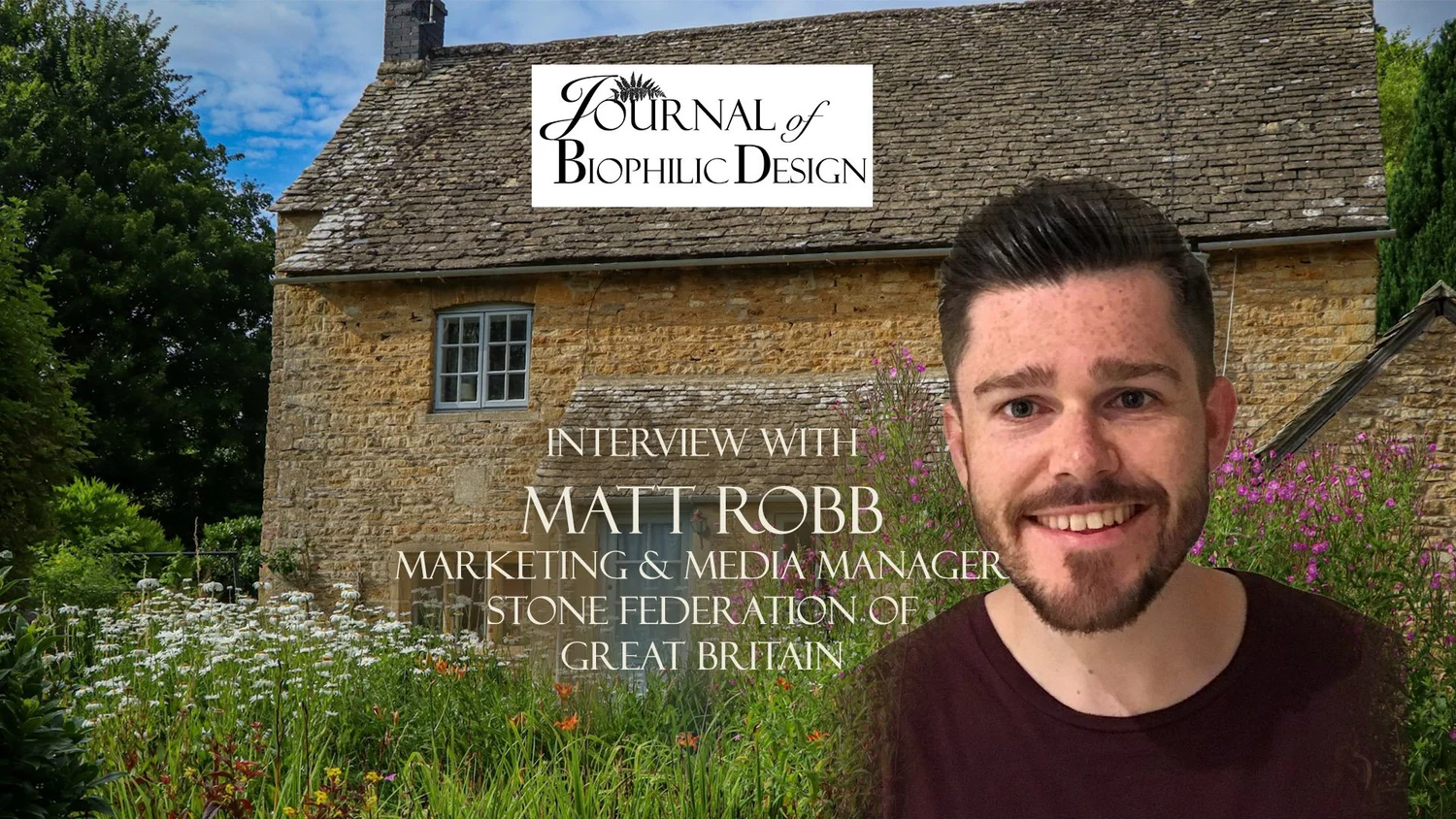
The New Stone Age
Imagine furniture, cities and buildings that tell stories rooted in local geology, where the materials and forms echo the unique landscapes of their region. Imagine a design language spoken with local stones and traditions, elevating cultural identity. Beyond its primal beauty and ancient aura, STONE is a material that embodies sustainability, resilience, and storytelling. If you’ve ever danced barefoot on marble floors or admired the stone facades adorning historic cities, you’ve felt that deep, almost breathing connection to the earth’s history. But how often do we truly understand this miracle of nature and see its potential to transform our built environment? Today, we dive into the heart of biophilic design and explore how embracing natural stone could upscale our approach to architecture, sustainability, and beauty with Matt Robb, Marketing and Media Manager for the Stone Federation of Great Britain. I think you’ll enjoy this interview where we celebrate our relationship with one of the earth’s oldest, most remarkable gifts. Matt shares with us how the story starts deep beneath our feet, formed over millions of years by geological forces, sedimentary layers, thermal metamorphosis, and the slow crystallization of minerals. From limestone and marble to granite and sandstone, each type tells a story of time, place, and process. There's no such thing as a bad stone, only badly used stone. When we understand the qualities of each material we can allow them to inform your design, not constrain it. Think Right Stone, Right Place. Architects like Amin Taha are leading this movement utilising full-range stone blocks, drastically reducing carbon footprints, and proving that sustainability and innovative design are not mutually exclusive. The key? Embrace the narrative of each stone, respect its natural essence, and allow it to shape your architecture—timeless, responsible, and inherently beautiful. When you learn how stone is formed which Matt shares brilliantly where it comes from, and what it can do, your designs become richer, more authentic, and more sustainable. Also there is the sustainability aspect of Stone. Imagine a world where buildings are seen as part of a living, breathing ecosystem, where materials cycle and recycle with grace. That’s the promise of stone. Its longevity is legendary think of Edinburgh’s historic streets or the enduring facades of ancient temples. Stone can be carefully dismantled, catalogued, and reimagined in future projects. The challenge? Building the infrastructure to support this reuse. But progress is happening. Architect-led networks and heritage specialists are leading the charge, turning old buildings into treasure troves of reconditioned stone. Consider this: If the entire 8 billion-strong human population built with stone, the required quarry would be just a tiny pinprick in the Earth’s crust no scars, only stories. Yes, quarrying involves extracting from the earth, but the narrative isn’t black and white. Modern practices focus on minimising impact, returning sites to nature, and enhancing biodiversity. UK quarries, for instance, often serve as reclaimed habitats and even public spaces. Stone has a 74% lower global warming potential than ceramics, and UK-produced bricks made from quarry offcuts boast 75% lower embodied carbon than traditional clay. Plus, with proper design, stone’s durability means it outlives many materials—cutting long-term waste and carbon footprints. While high-tech CNC machinery and ultra-slim stone cladding grab headlines, the most exciting innovation comes from returning to the roots of stone’s purpose. Think: robust, honest, and unpretentious. Using the full range of a stone block, giving it room to breathe, to express its natural beauty is a boundary-pushing act that challenges the wastefulness of modern architecture. Think beyond the CAD drawings with the perfect seam running through the centre of the wall panel, and instead embrace the randomness of nature’s beauty and maybe even let the stone dictate the design not the other way around. Building with the natural grain, textures, and colours celebrates its integrity while reducing waste and costs. Inside and out, designers are reimagining what’s possible when they listen to stone. From structural uses that cut entire carbon footprints to creative installations that tell stories of time and place, the future is rooted in natural materials. How to Integrate Stone into Your PracticeAre you new to specifying stone? Here’s the essential first step:Visit a quarry or large slab yard (which we are going to organise, so make sure you sign up to our Journal newsletter or become a member).See the full range of colours, textures, and sizes.Connect with a stone specialist.Understand how each material is formed and suited to different applications.Challenge misconceptions about cost.Remember: the true co
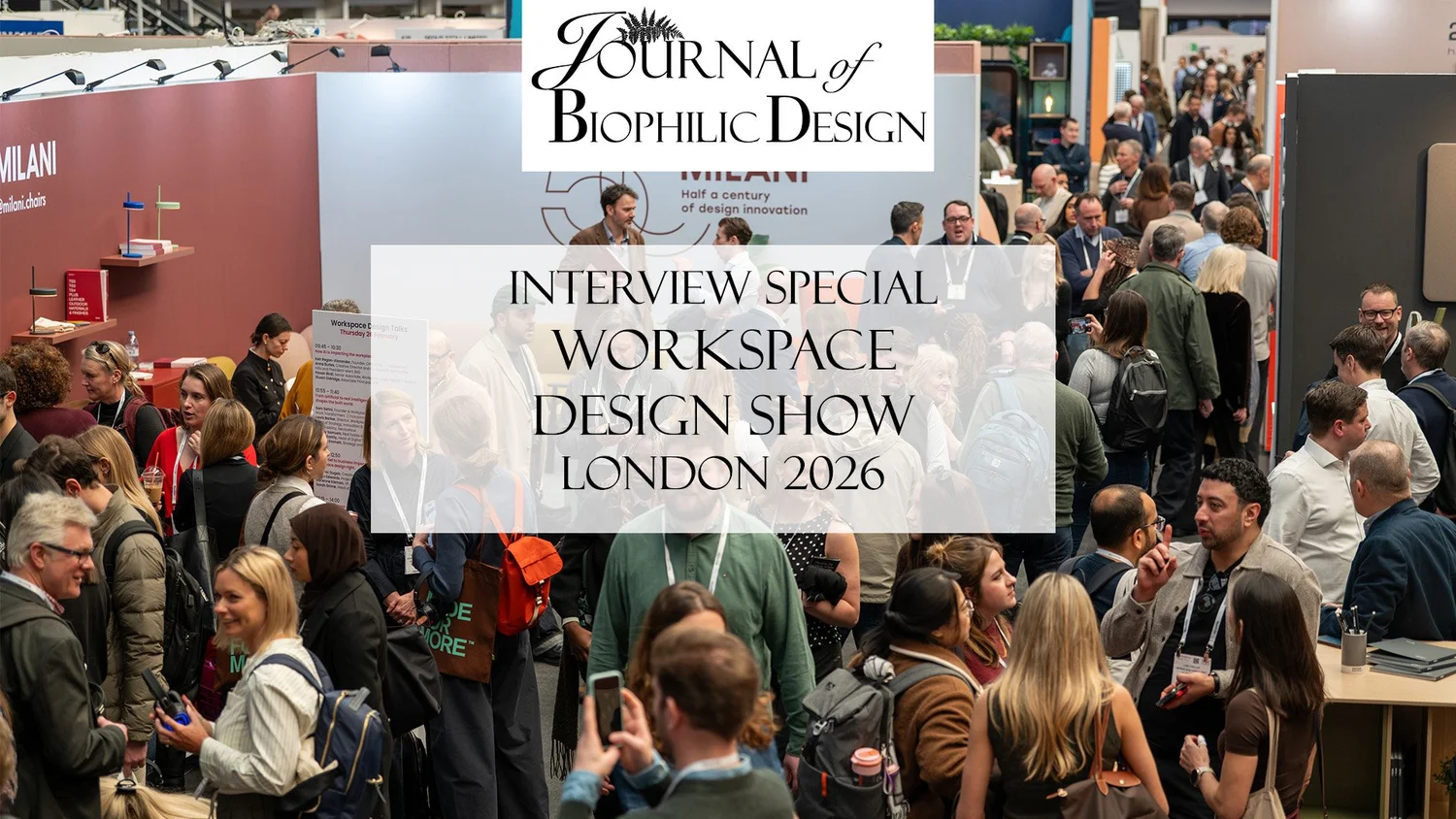
Interview Special - Workspace Design Show 2026 London
At The Workspace Design Show at the Business Design Centre in London this year, I had the privilege of chairing a dynamic panel featuring industry leaders Nicola Tomkins Head of Design for Major Projects at Overbury, Lidia Johansen Associate Environmental Consultant at chapmanbdsp and Paulo Ribeiro Head of Interior Design at Aecom. It was a lively and dynamic discussion to a full house at the show. We looked at how we could reframe Biophilia, moving from Aesthetic to a Performance System. We explored how through collaboration, sourcing and configuring the brief early we can accelerate biophilic design specification. After the panel I took my camera and mic and interviews other biophilic design experts visiting the show to ask them to share their insights on the show and biophilic design, emphasising its critical role in modern architecture and interior spaces. Biophilic Design reconnects us back to nature, to our roots, to what makes us truly human. If you've ever wondered why natural elements in our spaces feel so vital, or how design can heal and inspire us, here’s what you’ll discover: how biophilic design transforms spaces, the science proving its benefits, and the urgent need to rethink our environments for mental, physical, and planetary health. Biophilic Design transforms spaces from mere workplaces into living ecosystems.As Katrina Dalley from Plant Designs puts it, “bringing nature inside makes a massive difference. It’s not just visual—it's psychological, emotional, and physiological.” Emi Melin of Plus Creatives, has been spending a lot of time researching about the impact of Biophilic and multi-sensory design as a layer over conventional interior design, looking at intangible elements like light, smell, humidity or human emotions. Plants, water features, natural textures—they all trigger our senses, grounding us, reducing stress, and boosting creativity. Moreover, as Nicola Tomkins, Head of Design for Major Projects atOverbury notes, “there’s a growing awareness of sensory elements, not just greenery, but all the layers of nature that help us feel more connected and well.” When we surround ourselves with the natural, we foster a sense of belonging that’s essential for mental health and resilience. Visitors like architect, biophilic designer and environmental psychology consultant Lucilla Malara who was visiting from Italy, emphasise the importance of how biophilic elements impact our physiology. Light, especially circadian lighting, influences our body clocks, improving sleep and alertness. Infrared light, with its deep cellular reach, even supports mitochondrial energy production, our cellular powerhouses. Diving deeper, Ulysse Dormoy CEO of Atrium, explains that “light enters our bodies beyond just vision, influencing every cell.” Our planet’s energy, derived from sun, light energy, sustains all life. Modern design must tap into this natural energy flow, not block or distort it. On a personal note, Nicola reflects, “I’m an advocate of evidence-based solutions. When you can prove that biophilic design improves wellbeing and productivity, it’s impossible to ignore.” From reduced stress and better focus to even improving conditions for those with dementia or mental health challenges, the data is compelling. The future is clearly calling for spaces that harmonise with nature, not oppose it. Think: facades punctured with green patches, windows that mimic daylight rhythms, water features inside and out, and materials that echo organic textures. More trees as Loulou Elliott of Plant Designs also advocates. Ulysse’s vision: “We need to design environments that entice people outdoors, spaces that make stepping outside the conscious choice, not a necessity.” We have the power to reimagine cities and workplaces that invite nature in, rather than keep it out. Take it from Nicola: “We’re shifting toward products that integrate greenery and biomaterials, aligning with our modern need for sustainability and wellbeing.” It’s a transformation led by awareness, innovation, and a sense of responsibility. But it’s not just aesthetics. It’s about creating spaces that support human health, emotional balance, and even planetary recovery. As Katrina states, “Biophilic design makes spaces more restorative, not just functional. It’s a holistic approach to wellbeing.” As Ulysse warns, “We are increasingly disconnected from nature, and that’s dangerous. We need to act now — for our health, our planet, and future generations.” A vision of 2100 could show a world where cities are alive with plants, and indoor-outdoor boundaries blur, enabling us to be outside more often and reconnect deeply. In the words of Lucilla: "Nature isn't just plants; it’s sounds, smells, materials, the mystery of complexity. We need to harness all of this to heal and inspire." So, do we continue down a path of disconnection or