
In The Garden
100 episodes — Page 2 of 2
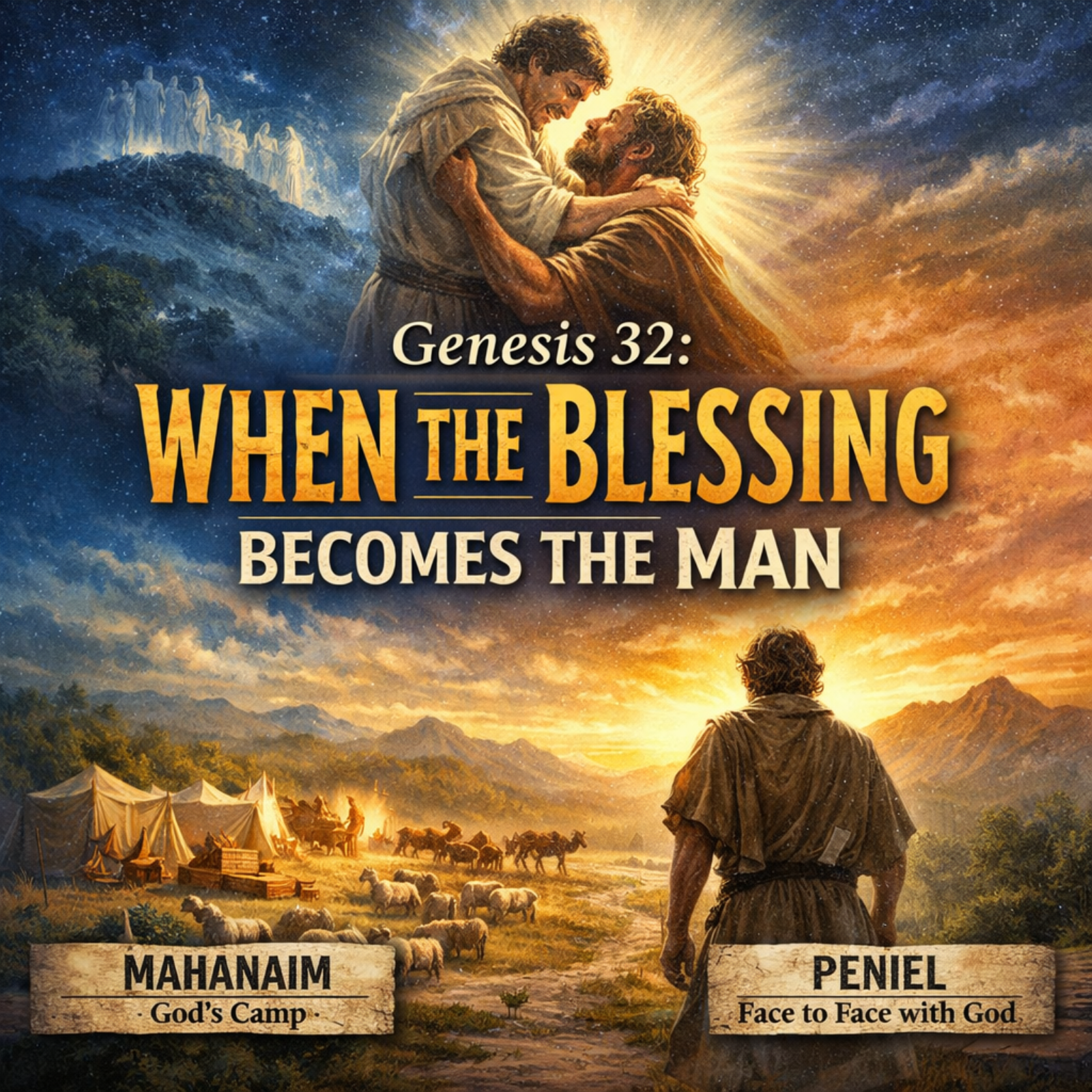
S1 Ep 51Genesis 32: When the Blessing Becomes the Man
Jacob wrestles with God — and walks away a new man. Genesis 32 reveals how God fulfills His blessing not just through abundance, but through transformation.In this episode, we journey with Jacob as he returns home after twenty hard years of exile, labor, and growth. Once a man who grasped blessings through deception, Jacob now finds himself surrounded by God’s unseen protection at Mahanaim — “God’s camp.” Angels meet him on the road, reminding us that God has gone before him, faithfully fulfilling the promise spoken years earlier by Isaac.But Genesis 32 is not about Jacob’s strategies or fears. It is about what God does.In the night, Jacob is left alone — and wrestles with a mysterious man until daybreak. Wounded yet clinging, Jacob refuses to let go without a blessing. In that moment, God changes his name from Jacob (“heel-grabber” and deceiver) to Israel — one who strives with God and prevails.This is where the blessing becomes more than wealth.This is where promise becomes identity.Jacob names the place Peniel, saying, “I have seen God face to face, and yet my life has been delivered.” Before facing Esau’s face, God graciously reveals His own — bringing deliverance, not destruction.Genesis 32 teaches us that God is faithful not only to provide, but to shape and transform the people who carry His promises. The years of struggle were not punishment — they were preparation. The blessing was always coming, but so was the refining work of God.If you’ve ever wrestled through seasons of waiting, hardship, or change, this episode will remind you that God is at work — fulfilling His promises and forming your heart.Keywords: Genesis 32, Jacob wrestles with God, blessing fulfilled, Mahanaim, Peniel, transformation, Jacob becomes Israel, God’s faithfulness, spiritual growth, Biblical promise, wrestling with God, Old Testament podcast👉 Call to Action: If this episode encouraged you, share it with a friend, leave a review, and follow the podcast for more journeys through Scripture that reveal God’s faithfulness from Genesis to Jesus.Scriptures Referenced: Genesis 27:28–29, 39–40 Genesis 32:1–2, 24–30 Genesis 33:9–11
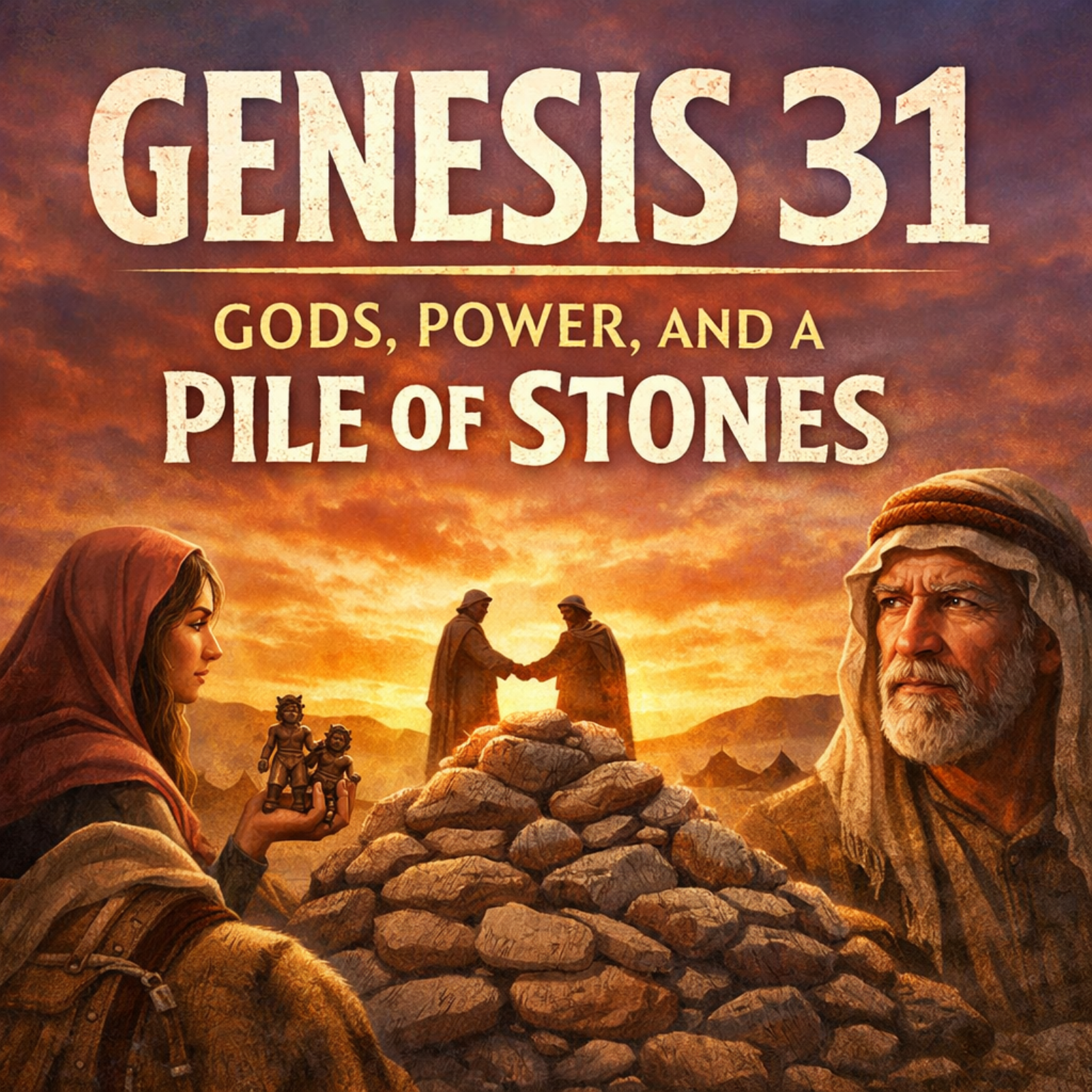
S1 Ep 50Genesis 31: Gods, Power, and a Pile of Stones
Gods were stolen. Power was challenged. And a pile of stones became a treaty before God. In Genesis 31, a family conflict reveals deep truths about idolatry, manipulation, and how God establishes justice across cultures.In this episode, we walk through Jacob’s departure from Laban after twenty years of labor and tension, uncovering the spiritual and cultural layers beneath the story.We begin with Rachel’s theft of the household gods (teraphim)—objects that symbolized protection, inheritance, and authority in the ancient world. Though God had clearly blessed Jacob, Rachel clung to old securities, revealing how faith often grows slowly. Even as God leads us forward, we’re tempted to keep “backup plans” tucked away in our hearts.Next, we examine Laban’s bold claim of ownership over Jacob’s wives, children, and flocks. While such language reflected ancient patriarchal culture, Laban was using tradition to justify control and exploitation. Jacob had fulfilled every obligation—yet Laban leaned on power and custom to manipulate. Scripture quietly exposes this misuse of authority, reminding us that God stands against oppression, even when it’s hidden behind cultural norms.Finally, we explore the powerful moment of reconciliation marked by a heap of stones named in two languages—Jegar-sahadutha in Aramaic and Galeed in Hebrew—both meaning “Heap of Witness.” In a divided world shaped by Babel, this cross-cultural monument becomes a treaty of peace, declaring that God Himself is witness and judge between them.Genesis 31 isn’t just a family drama. It’s a story of God freeing His people from idols, breaking cycles of manipulation, and establishing boundaries rooted in truth and accountability.✨ What false securities do we cling to? ⚖️ Where do we use power or tradition to control others? 🪨 And where is God calling us to trust Him as our witness?👉 Listen now, share with a friend, and join the conversation as we continue exploring the deep wisdom of Genesis.Scriptures Referenced: Genesis 30 Genesis 31:1–55 Genesis 31:14–16 Genesis 31:19 Genesis 31:32 Genesis 31:43 Genesis 31:47–52 Genesis 11:1–9
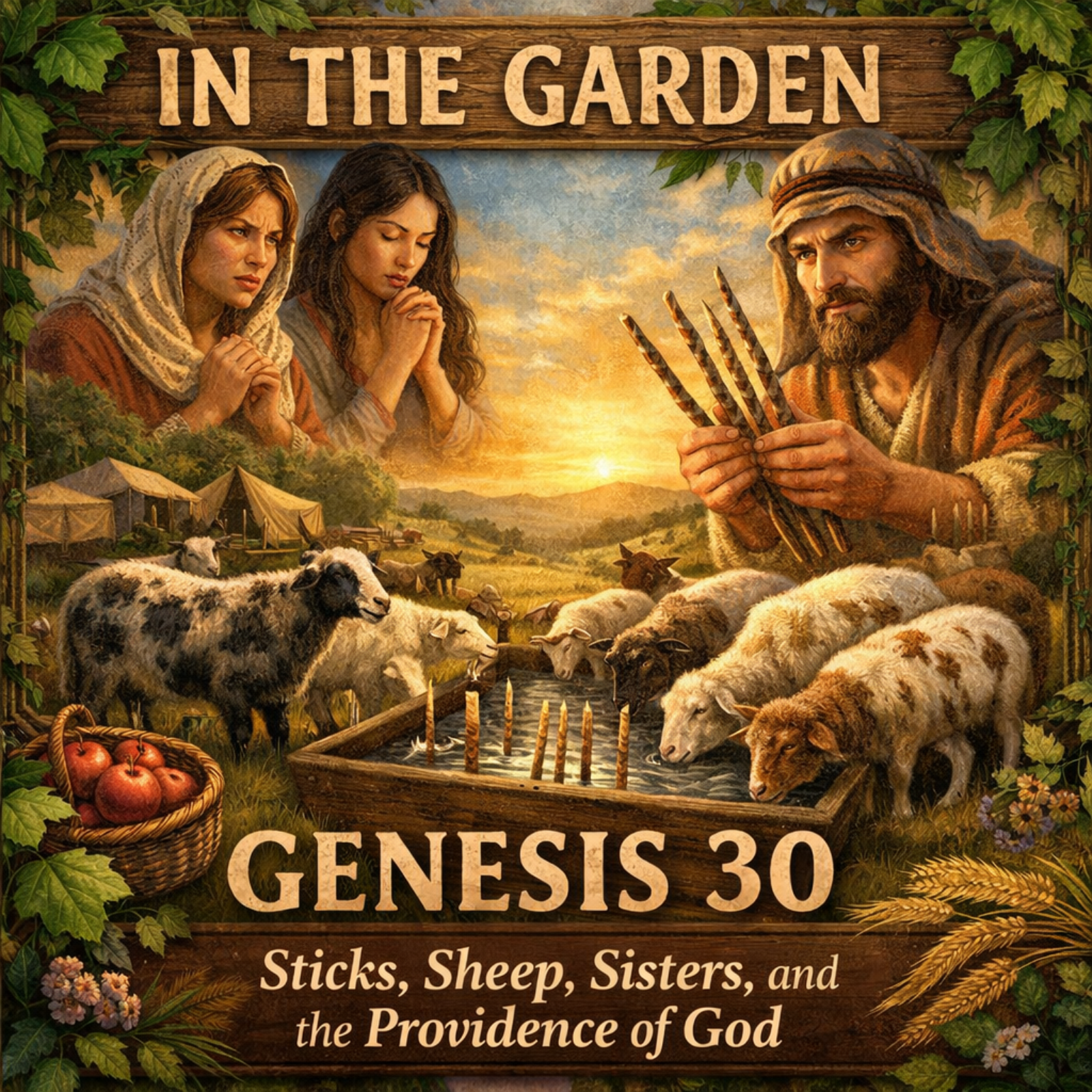
S1 Ep 49Genesis 30: Sticks, Sheep, Sisters, and the Providence of God
What happens when family rivalry, human scheming, and superstition collide in the midst of God’s promises? In Genesis 30, we find Jacob navigating wives, maids, children, and flocks with unusual methods—and yet God’s providence shines through every messy moment.This episode of In The Garden dives into one of the most colorful and chaotic chapters in Scripture. From Rachel and Leah’s competition over children to Jacob’s striped sticks and multiplying flocks, we explore how God works through human weakness, mischief, and even superstition to fulfill His covenant promises. We’ll uncover the spiritual truth hidden behind these strange agricultural practices and see how growth—both in family and in flocks—ultimately comes from God’s hand, not human tricks.What You’ll Learn in This Episode:The family dynamics of Jacob, Leah, Rachel, Bilhah, and Zilpah, and how God’s plan progresses despite rivalry.The meaning behind Jacob’s “rod technique” and why it points to God’s providence, not superstition.How Genesis 30 demonstrates that God can bring life, growth, and blessing through flawed, messy, and scheming people.Insights on faith, trust, and God’s faithfulness even in the dirt of everyday life.Keywords: Jacob, Genesis 30, Rachel, Leah, Bilhah, Zilpah, family rivalry, Bible study, providence of God, God’s faithfulness, parenting, spiritual growth, superstition, shepherding, agricultural themes, covenant promises.Call to Action: Take a moment today to reflect: How might God be working in your life through the “messy” parts—through relationships, plans, or mistakes that feel chaotic or out of control? Listen closely for His providence. And if this episode encouraged you, share it with someone who might need a reminder that God’s blessing often grows in unexpected ways.Scriptures Referenced in This Episode:Genesis 30:1–43 ESV – Jacob’s family, the rivalry of the sisters, and the multiplying flocks.Genesis 31:1–55 ESV – God’s hand in protecting and prospering Jacob despite Laban’s schemes.
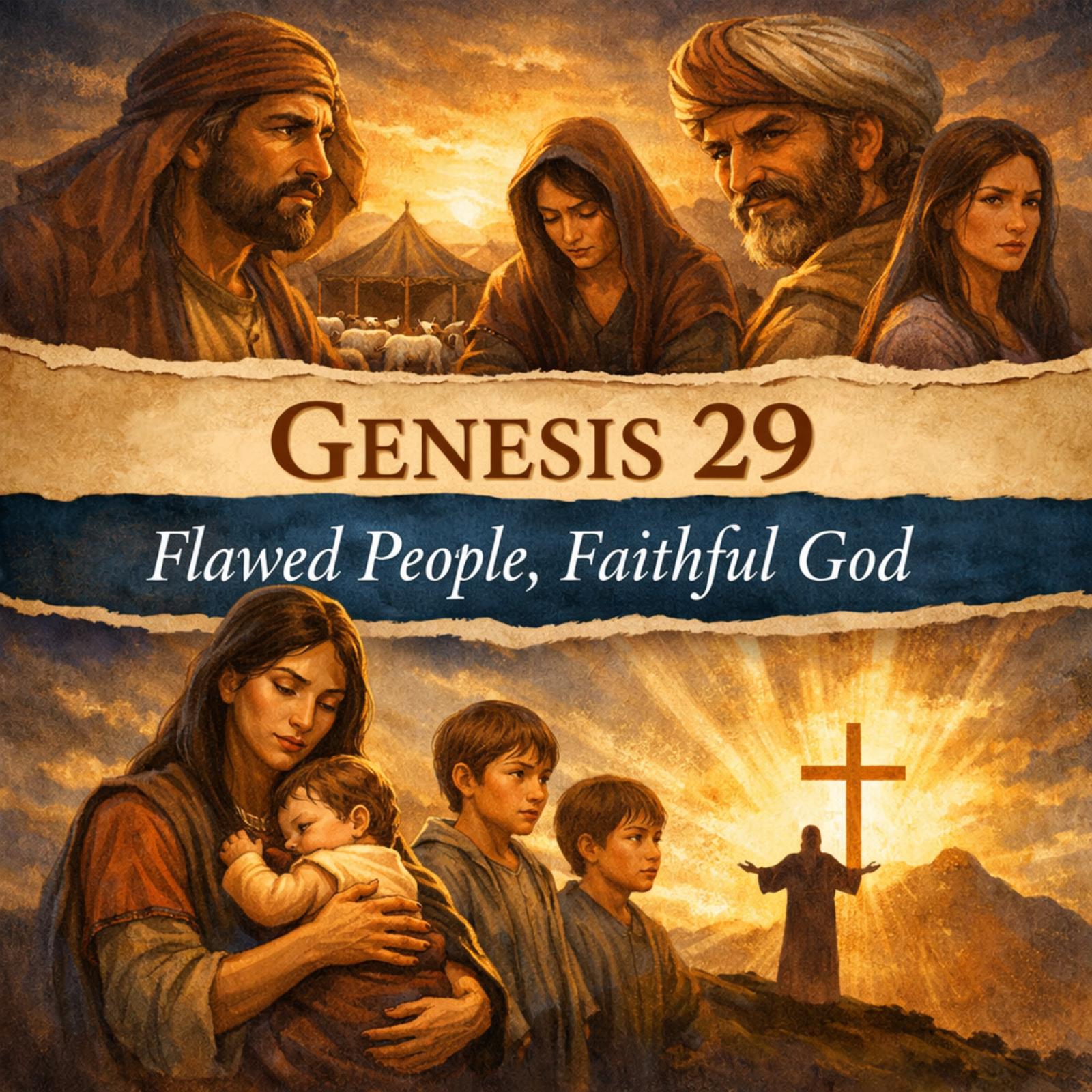
S1 Ep 48Genesis 29: Flawed People, Faithful God
What happens when human sin, jealousy, and deception collide with God’s covenant plan? In Genesis 29, Jacob is tricked into marrying two sisters, Laban manipulates his own family for profit, and love and rivalry collide in a messy household. Yet, in the midst of human brokenness, God’s faithfulness shines through—Leah bears Judah, the son through whom the covenant and redemption will continue.In this episode of In The Garden, we explore how God works through imperfect, flawed people to accomplish His perfect purposes. Jacob, Leah, Rachel, and Laban are not role models to emulate—the Bible shows their failures, not to praise them, but to point us toward our ultimate Redeemer, Jesus Christ. This story reminds us that God’s covenant never depends on human perfection, only on His faithfulness.What You’ll Learn in This Episode:Why Genesis 29 is messy and morally complex, and why that matters.How God uses the overlooked, unloved, and flawed to advance His covenant.Why none of these characters—Jacob, Leah, Rachel, or Laban—should serve as role models.How Judah’s birth points forward to the line of David and ultimately to Jesus, the perfect Redeemer.How the Bible’s honest portrayal of sin teaches us our need for God’s grace.Keywords: Genesis 29, Jacob, Leah, Rachel, Laban, Judah, flawed people, faithful God, covenant, messiness, redemption, Bible study, Jesus, RedeemerCall to Action: Notice the mess, recognize God’s faithfulness, and reflect on your need for a Savior. Share this episode with someone who might feel discouraged by their own imperfections—God’s covenant moves forward even through broken lives. Subscribe to In The Garden to explore more stories of God’s faithfulness throughout Scripture.Scriptures Referenced: Genesis 29:1-35, 30:1-24
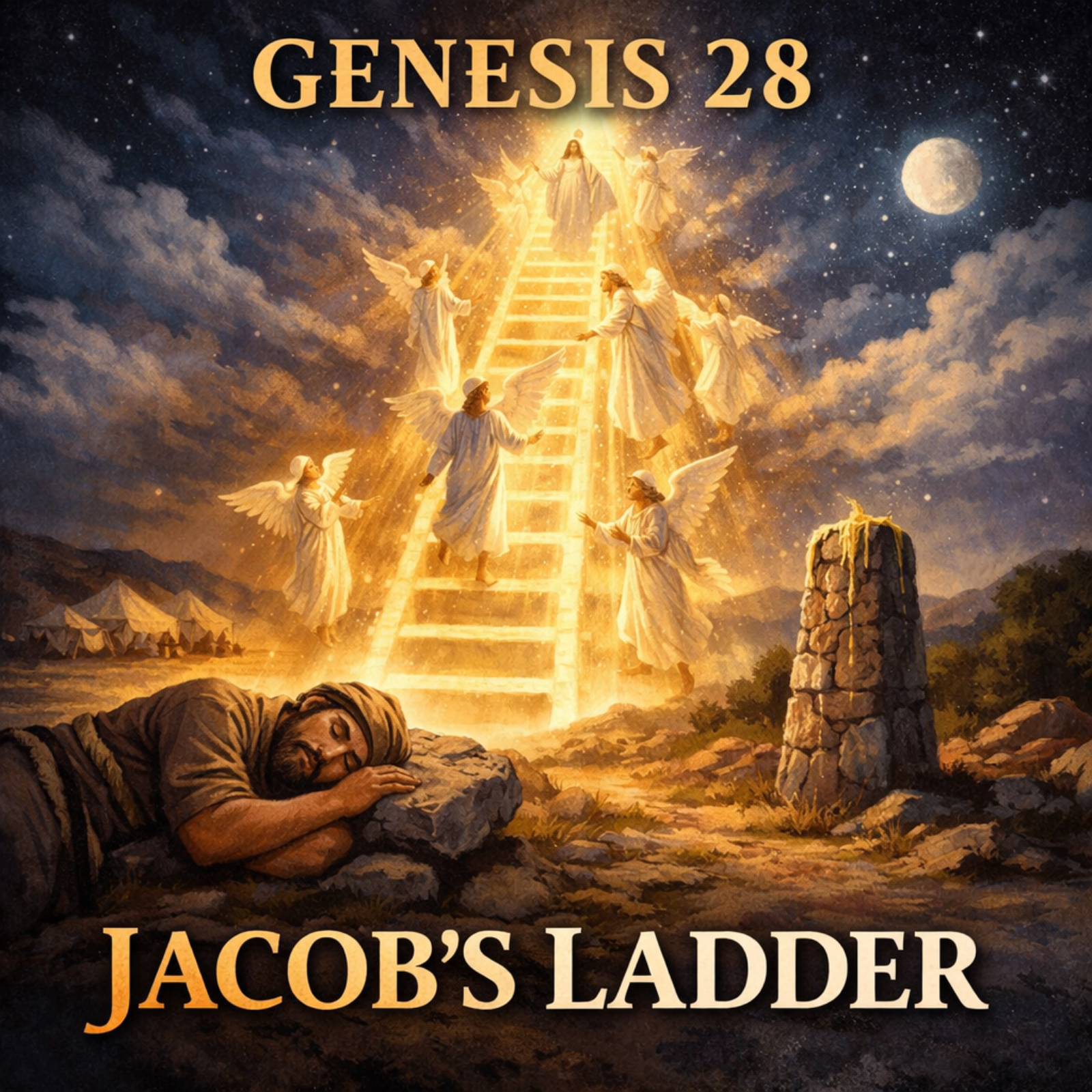
S1 Ep 46Genesis 28: Jacob's Ladder
He slept on a stone—and heaven opened. Jacob’s turning point comes not through striving, but through grace that meets him in the wilderness.In this episode of Genesis 28: Jacob’s Ladder, we explore the powerful contrast between Esau’s pattern of regret without obedience and Jacob’s journey from grasping for blessing to receiving God’s promise. Esau settles into the land through his three marriages—first to Hittite women who grieve his parents, then to a daughter of Ishmael in a self-directed attempt to fix his mistake. Each choice reveals a heart rooted in the present rather than the promise.Jacob, by contrast, obeys his father and leaves everything familiar behind. Alone in the night, with nothing but a stone for a pillow, God meets him in a dream of a ladder stretching from earth to heaven, angels ascending and descending, and the Lord reaffirming the covenant of land, offspring, blessing, and presence.This moment marks Jacob’s shift—from striving to secure his future to learning to trust God’s faithfulness.Yet Jacob’s response also reveals a common human error. He marks the stone, names the place Bethel, and treats the location as sacred—localizing God’s presence rather than embracing the promise that God will be with him wherever he goes. This instinct to contain God becomes the root of many forms of idolatry: turning encounters into objects, places into shrines, and reminders into replacements.We also connect Jacob’s ladder to Jesus’ words in the Gospel of John, where Christ reveals Himself as the true bridge between heaven and earth.Key themes include: • Sojourner vs settler faith • Regret vs obedience • Grace that meets us in exile • The danger of localizing God’s presence • God’s covenant faithfulness • Jesus as the true ladder between heaven and earthIf this episode encouraged you, share it with a friend, subscribe to the podcast, and leave a review to help others discover the story that leads to Jesus.Scriptures referenced: Genesis 26:2, 34–35 Genesis 27:46 Genesis 28:1–2, 8–22 Hebrews 12:16–17 John 1:51
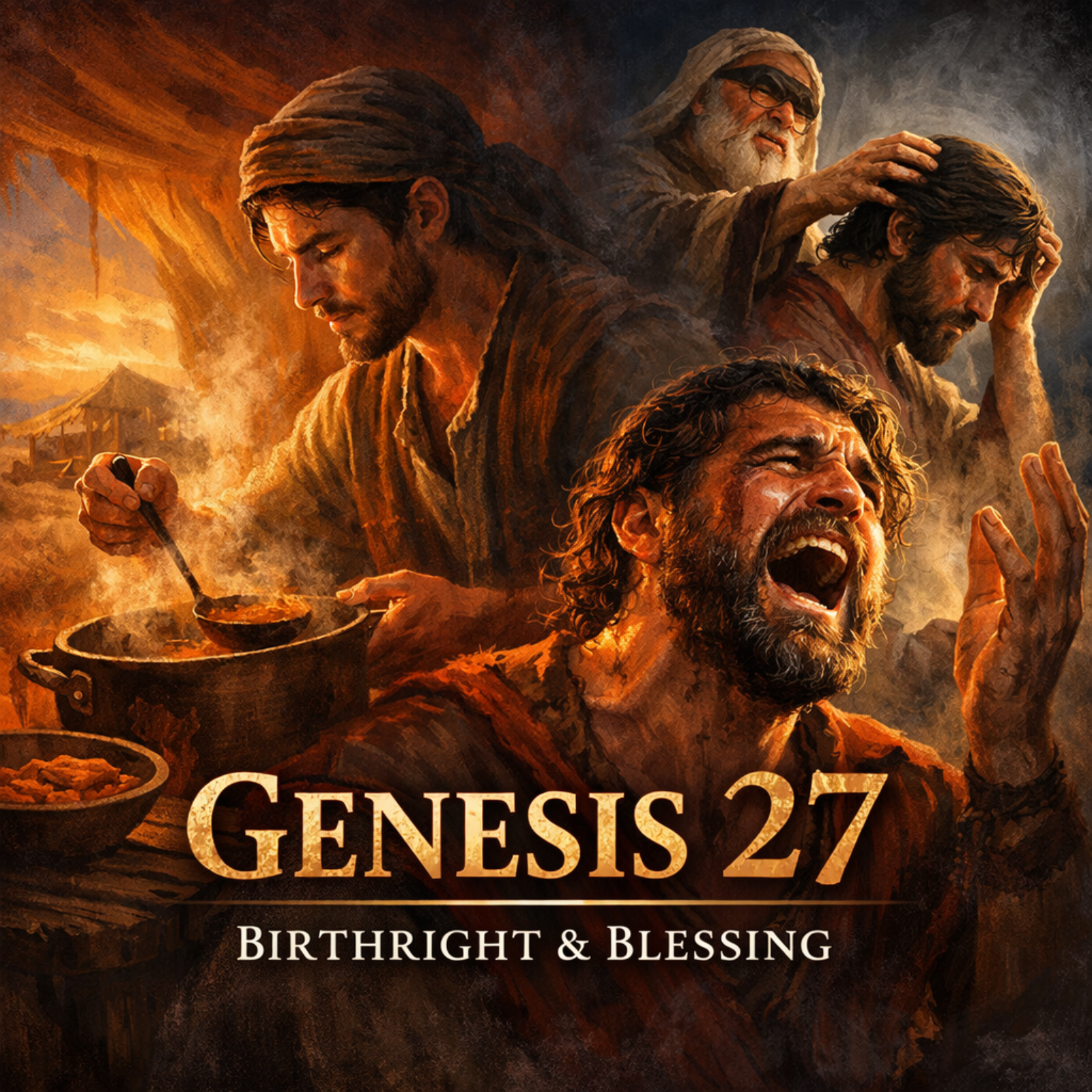
S1 Ep 45Genesis 27: Birthright & Blessing
What if one quiet choice could shape an entire future—and one painful moment reveal its cost? In Genesis 25 and 27, the birthright and blessing form one powerful story of appetite, promise, deception, and God’s unstoppable plan.In this episode, we trace the conflict between Jacob and Esau across two defining moments—the private exchange of the birthright and the public struggle over the blessing. These are not competing stories, but one unfolding movement of God’s will advancing through imperfect people.Esau, driven by hunger and immediacy, despises his birthright for a single meal. Jacob, focused on inheritance and promise, secures what will shape generations to come. Years later, when the blessing is spoken, tears replace stew, and the consequences of earlier choices come into full view.We explore how:The birthright was willingly exchanged, not stolenThe blessing confirmed what God had already declared before the twins were bornIsaac attempted to bless against God’s revealed willEsau sought the benefits of inheritance without valuing the promiseJacob acted wrongly in pursuit of the right futureThis episode also follows Jacob’s long road of transformation—how the deceiver would one day wrestle with God, be humbled through suffering, receive a new name, and become Israel, the father of the Twelve Tribes.Through this story, we see a timeless tension between living for what feels urgent and living for what will last. God’s purposes move forward, not because people are perfect, but because His promises are faithful.Like Jacob and Esau, every generation—and every heart—faces the choice between flesh and future, appetite and inheritance, regret and repentance.Listen, reflect, and share this episode with someone who’s wrestling with hard choices today. Subscribe for more journeys through Scripture that reveal God’s story leading to Jesus.Keywords: Genesis 27, Jacob and Esau, birthright and blessing, Bible study podcast, Old Testament teaching, God’s sovereignty, imperfect people, flesh vs spirit, biblical archetypes, Christian discipleship, spiritual inheritanceScriptures Referenced: Genesis 25:23, 27–34; Genesis 27:1–38; Romans 8:6; Mark 8:36
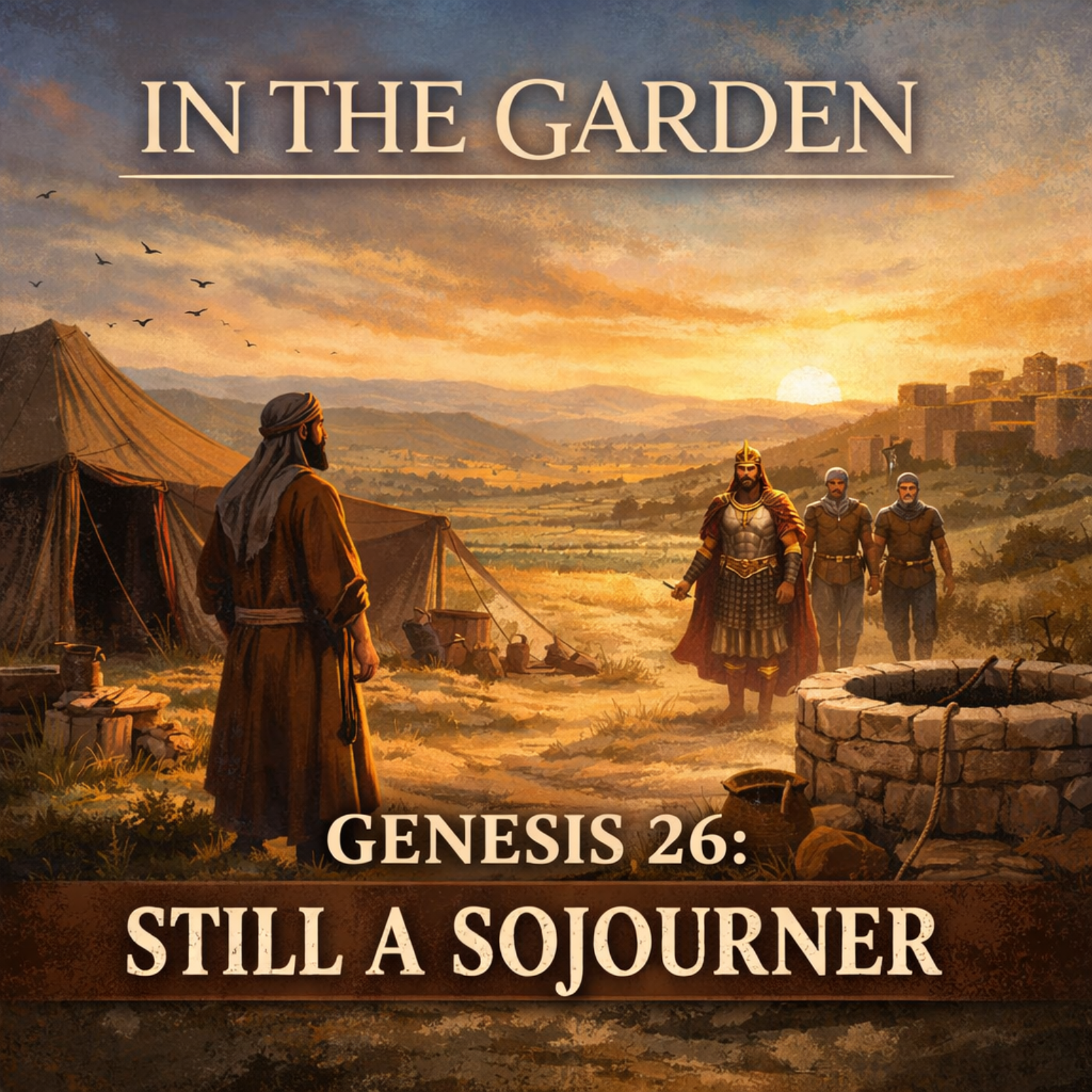
S1 Ep 44Genesis 26: Still a Sojourner
Blessed but unsettled? Digging wells in land you don’t yet own is the life of faith. In Genesis 26, Isaac teaches us how God works in seasons of waiting, resistance, and quiet perseverance.In this episode of In The Garden, we walk through Genesis 26 and discover a powerful pattern in how God’s people live between promise and possession. Isaac is born in the Promised Land, yet remains a sojourner—raising flocks, building altars, and digging wells without owning the land itself. Wells in the ancient world were acts of faith, bringing water, life, and stability where none existed before.Abraham had dug these wells years earlier, improving the land and blessing the region. But after his death, the Philistines deliberately filled them in, undoing the good work. This was more than a land dispute—it was resistance to God’s blessing and an attempt to erase Abraham’s legacy.When Isaac faces fear and opposition, even repeating his father’s mistake with Abimelech, we see that his fear was real and understandable. Living as a foreigner without legal protection, Isaac knew how fragile peace could be. Yet God meets him in the night with a simple promise: “Fear not, for I am with you.”Instead of fighting for control, Isaac rebuilds. He re-digs the wells. He brings life back where it had been buried. And eventually, even his enemies recognize the Lord’s favor and seek peace.This episode reminds us that God often calls His people to improve places they do not yet own—to pour into relationships, communities, and ministries even when others may resist or undo the work. Sojourning is not failure. Waiting is not abandonment. God’s blessing often shows up long before full possession.If you’ve ever felt blessed but unsettled, called but still waiting, this message is for you.Keywords: Genesis 26, Isaac, Abraham, wells, sojourner, faith journey, God’s promises, perseverance, biblical teaching, In The Garden podcast, spiritual growth, waiting on God, living water, peace in trialsCall to Action: If this episode encouraged you, share it with a friend who may be walking through a season of waiting. Subscribe to In The Garden for weekly Bible-centered reflections, and leave a review to help others discover the journey through Scripture.Scripture References: Genesis 26:1–35; Genesis 23:17–20; Genesis 21:22–34; John 4:13–14
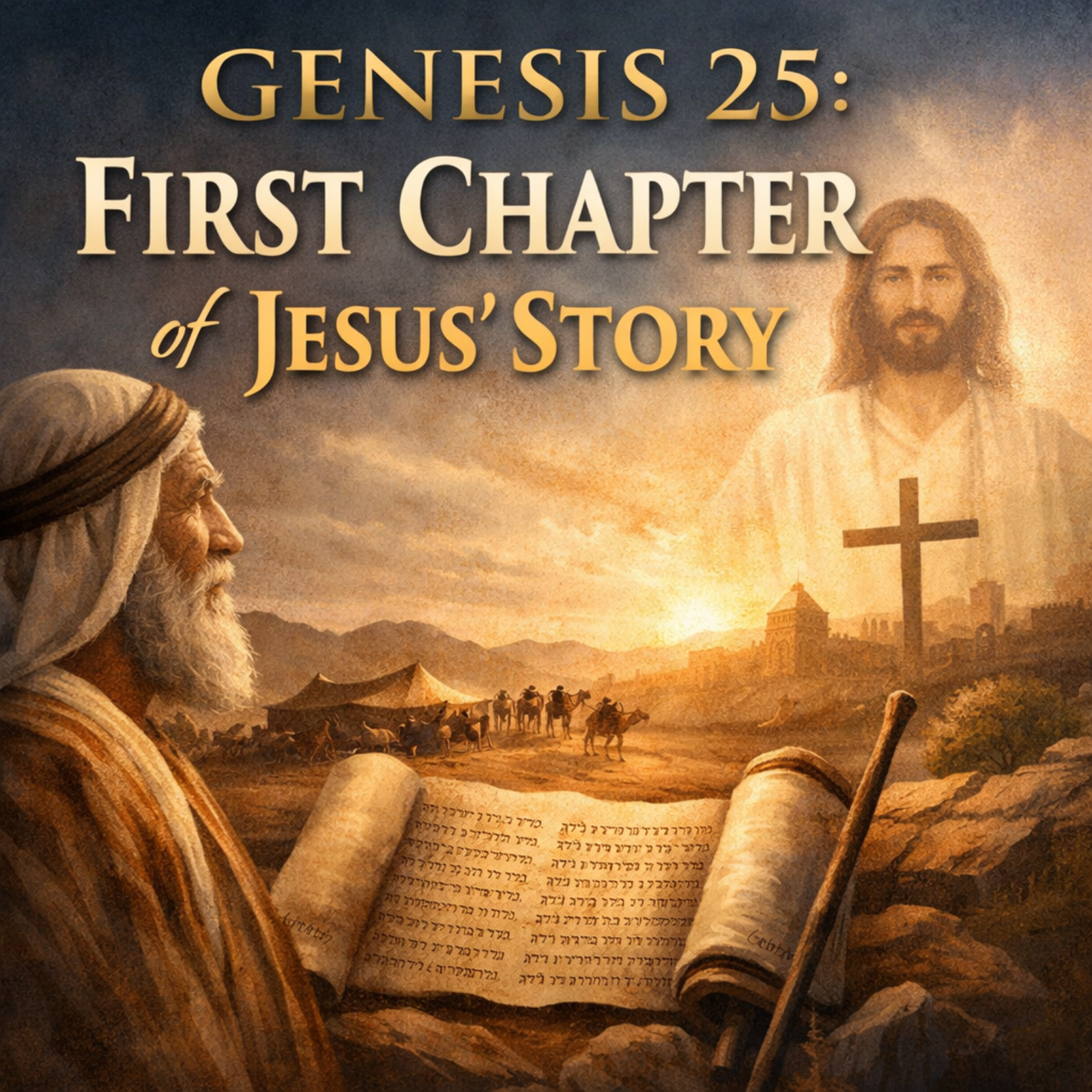
S1 Ep 43Genesis 25: First Chapter of Jesus's Story
Genesis isn’t just the beginning of the Bible; it is the opening chapter of Jesus’ story. In Genesis 25, we see how God carefully carries His covenant promise forward, revealing a narrative that leads straight to Christ.In this episode of In The Garden, we explore a quiet but powerful moment in Scripture where Abraham’s later sons are named and then released from the central story, while Isaac alone receives the full inheritance. Though Abraham fathers many nations, the biblical narrative narrows intentionally — not because God forgets the others, but because He is guiding one redemptive story toward its fulfillment in Jesus.We reflect on how Genesis is not simply ancient history or cultural tradition, but the beginning of God’s rescue plan for humanity. The sons of Keturah are blessed and become peoples of the East, yet the covenant promise moves forward through Isaac, then Jacob, and ultimately to Christ. This selective storytelling shows us that the Bible is focused not on recording everything, but on revealing God’s purpose.Jesus Himself tells us that Abraham rejoiced to see His day — a reminder that even the earliest chapters of Scripture were pointing ahead to the Savior. What may seem like fading genealogies are actually signposts in a carefully guided narrative of redemption.This episode reminds us that without Jesus, the Bible could be read as just another ancient story. But with Him, it becomes the unfolding revelation of God coming to dwell with and redeem His people.Keywords: Genesis 25, Abraham, Isaac, covenant promise, genealogy, redemption story, Jesus in Genesis, biblical narrative, Old Testament fulfillment, Christ-centered ScriptureCall to Action: Join us each week for In The Garden in the Monahans News and daily on KCKM 1330 AM as we walk through Scripture together. Share this episode with a friend, reflect on how Genesis points to Jesus, and consider how your own story fits into God’s greater plan.Scriptures Referenced: Genesis 25:1–6 John 8:56 Galatians 3:16
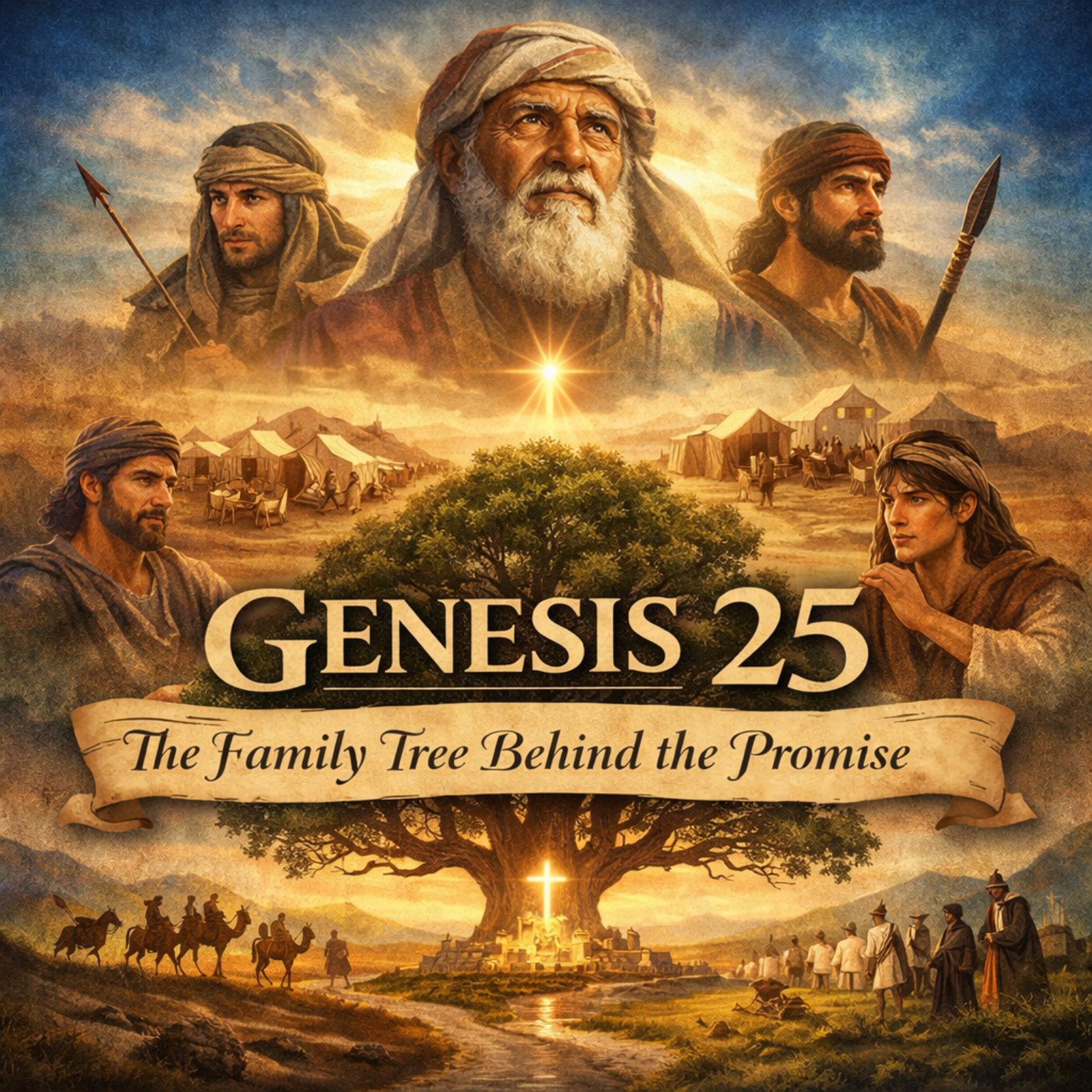
S1 Ep 42Genesis 25: The Family Tree Behind the Promise
Genesis is filled with names, but only one line carries the promise forward. In this episode, we explore Abraham’s wide family tree and the single covenant thread that leads to Jesus.Genesis 25 often feels like a chapter of passing details — sons born, tribes formed, nations spreading across the ancient world. But beneath the surface, God is doing something intentional and profound.Abraham fathers many sons. Through Keturah come six families who settle eastward. Through Hagar comes Ishmael, whose twelve sons become princes and nations in fulfillment of God’s promise to bless him. These are not forgotten people. They are real families, real histories, real blessings.Yet the covenant promise — the line through which redemption will come — does not branch outward. It moves forward.“All that Abraham had, he gave to Isaac.”The story narrows.From Isaac come two sons, Esau and Jacob. Esau becomes the father of Edom, a nation strong and enduring. Jacob becomes the father of the twelve tribes of Israel. Though both are blessed, only one inherits the birthright — the promise that began in Abraham and will one day reach its fulfillment in Christ.Genesis 25 paints a rich tapestry of humanity surrounding the covenant story. God blesses many nations, but He guides one lineage carefully, generation by generation, toward redemption.Centuries later, Luke will trace that same line backward — from Jesus, through David, through Abraham, all the way to Adam. Genesis looks forward. Luke looks back. Both testify to the same truth:God has been telling one saving story all along.Jesus Himself confirms it:“Your father Abraham rejoiced that he would see my day. He saw it and was glad.”This episode invites us to see Genesis not as scattered ancient history, but as the opening movement of the gospel — a story of blessing that spreads wide, and a promise that flows straight to Christ for the sake of all nations.If God has been patiently guiding history toward redemption, then your story is not random either. You are being drawn into something far greater than you can yet see.Keywords: Genesis 25, Abraham’s sons, Keturah, Ishmael twelve princes, Jacob and Esau, birthright, covenant promise, lineage of Jesus, Luke genealogy, biblical narrative, redemption story, Jesus in Genesis, In the Garden podcastCall to Action: If this episode encouraged you, share it with a friend and join us as we continue tracing the one story that leads to Jesus. Follow, subscribe, and reflect with us each week as Scripture unfolds God’s great plan of redemption.Scriptures Referenced:Genesis 25:1–6 Genesis 25:12–18 Genesis 25:27–34 Luke 3:23–38 John 8:56 Galatians 3:16
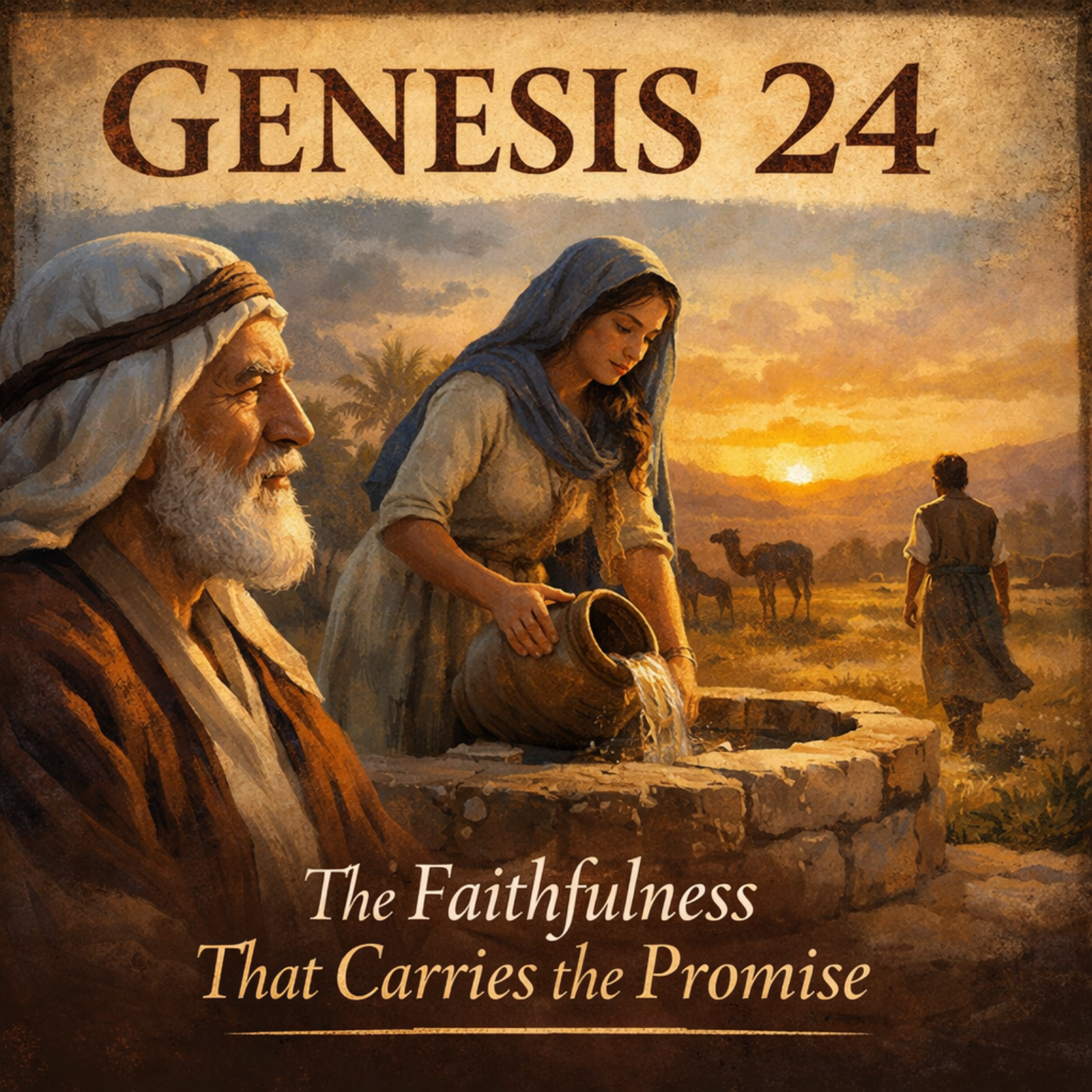
S1 Ep 41Genesis 24: The Faithfulness That Carries the Promise
Quiet faith often carries God’s greatest promises forward. In Genesis 24, we discover how God’s steady faithfulness works through prayer, obedience, and ordinary kindness to secure the future of His covenant.Genesis 24 may seem like a simple love story, but it is a powerful turning point in the biblical narrative. As Abraham nears the end of his life, he entrusts God’s promise to a faithful servant and sends him on a long journey to find a wife for Isaac. What unfolds is not a tale of chance, but a beautiful display of God’s steadfast love guiding every step.We watch Abraham rest in God’s promises, confident that the Lord will go before his servant. We see the unnamed servant pray with humility, observe with discernment, and worship before the mission is even complete. At a well in a foreign land, Rebekah’s generosity and strength reveal a heart prepared by God to carry the covenant forward.Meanwhile, Isaac waits quietly in the land of promise, reminding us that God’s work is not always advanced through bold action, but through trust and faithful obedience.This chapter teaches us that God’s faithfulness does not only appear in dramatic miracles—it moves through long journeys, patient prayer, unseen service, and everyday acts of kindness. Even in seasons that feel slow or ordinary, God is actively keeping His promises.If you’re walking through a quiet season of life, Genesis 24 offers encouragement: God has not stopped working. He is still guiding, providing, and carrying His purposes forward—one faithful step at a time.Keywords: Genesis 24, Abraham, Isaac and Rebekah, God’s faithfulness, biblical covenant, prayer and obedience, providence, Old Testament study, Bible podcast, trusting God, servant leadershipIf this episode encouraged you, share it with someone walking through a waiting season, leave a review, and follow the podcast for more Scripture-centered reflections.Scripture References: Genesis 24:1–67 (with emphasis on Genesis 24:7, 24:12–27, 24:48, 24:63–67)
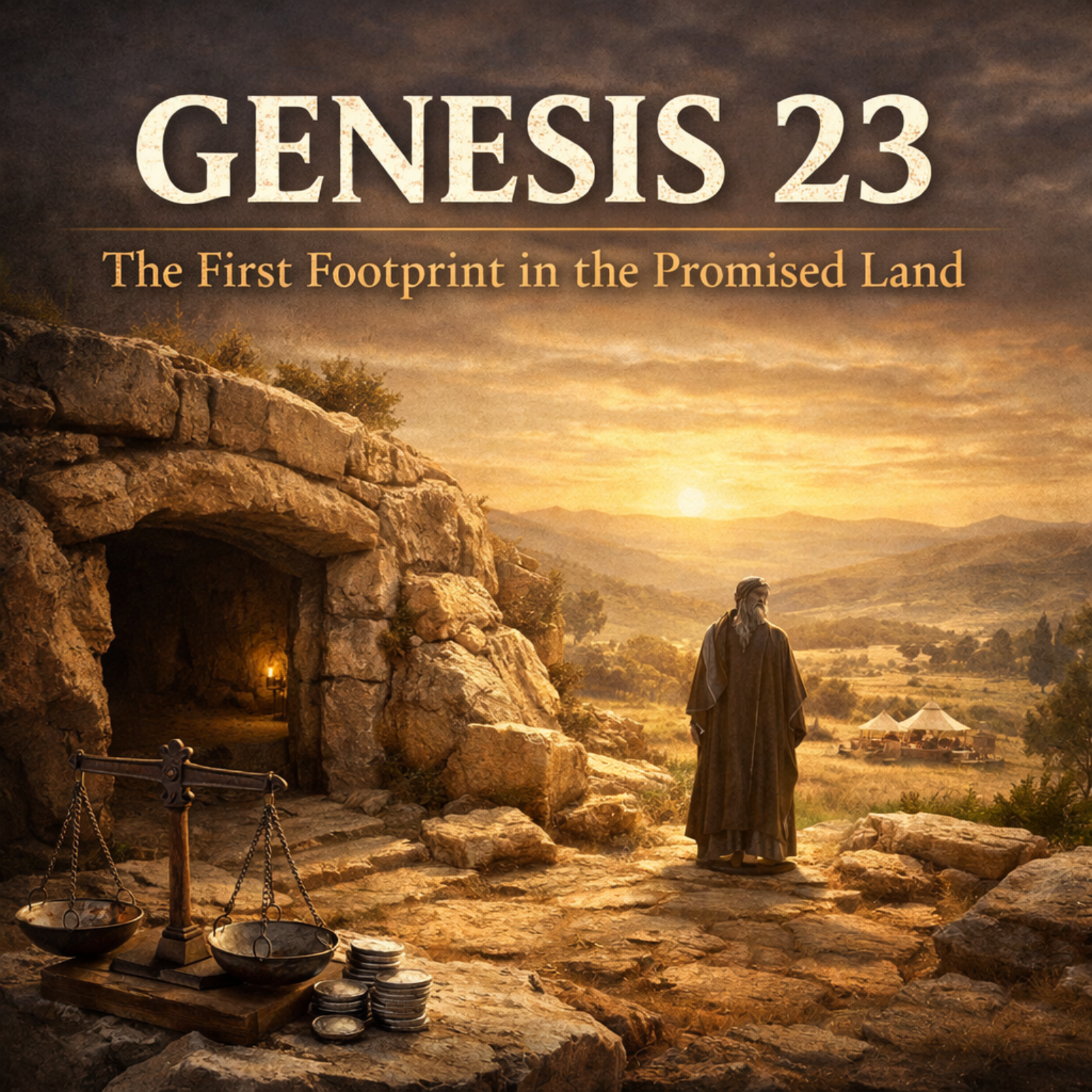
S1 Ep 40Genesis 23: The First Footprint in the Promised Land
Abraham’s first piece of the Promised Land wasn’t a home—it was a grave. In Genesis 23, a quiet land purchase reveals profound faith, grief, and the long view of God’s promises.In this episode, we walk through Abraham’s purchase of the Cave of Machpelah following Sarah’s death and uncover why this moment is far more than a real estate transaction. Abraham, once only a sojourner, becomes a landowner for the first time—yet the land he claims is a burial place. Through careful negotiation and a costly payment, Abraham insists on fully owning what God has promised, refusing symbolic favors and anchoring his hope in God alone.We explore the cultural context behind Ephron’s show of generosity, the significance of Abraham paying the full price publicly, and the irony that the Promised Land begins with a tomb rather than a home. This moment becomes a seed of faith pointing beyond Abraham’s lifetime—marking the land through burial, waiting for fulfillment God would bring in His time.The episode also reflects on how faith often looks like waiting, trusting, and planting hope even in seasons of grief. Abraham’s act quietly foreshadows the biblical pattern of promise, death, and eventual resurrection—fulfilled ultimately in Christ.Keywords: Genesis 23, Abraham, Sarah, Cave of Machpelah, Promised Land, biblical faith, sojourner, land purchase, God’s promises, burial and hope, Old Testament theology, faith and waiting, resurrection themes, integrity in ScriptureIf this episode encouraged you, share it with a friend, leave a review, and subscribe for more daily journeys through The One Story That Leads to Jesus. Let’s keep seeking God together.Scripture References: Genesis 23:1–20 Hebrews 11:9–10 Matthew 22:32
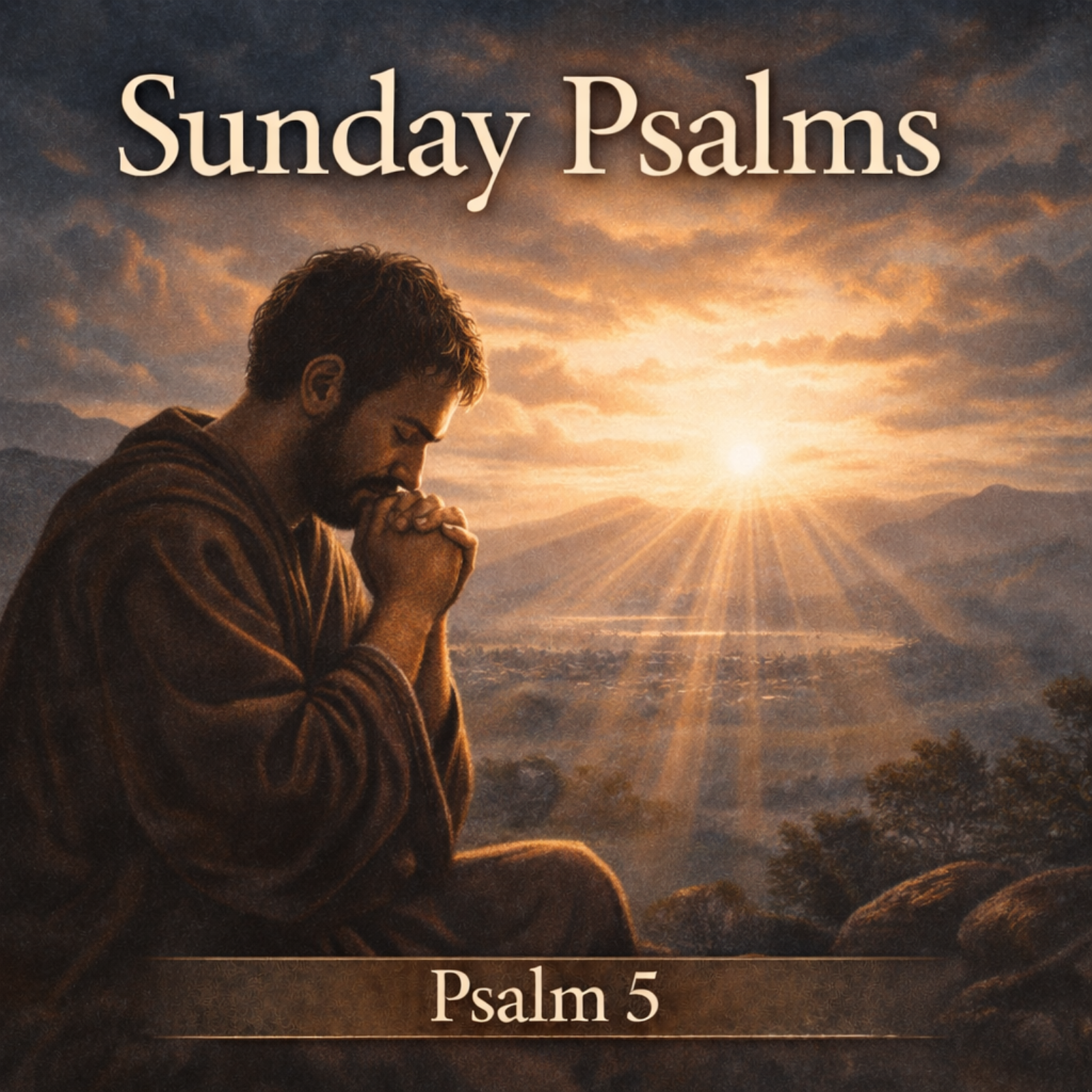
S1 Ep 39Sunday Psalms: Psalm 5
The day begins with groaning—but it ends in joy. In Psalm 5, David teaches us how to bring our fears to God each morning and find refuge that leads to lasting joy.Sunday Psalms — Psalm 5 Finding Refuge and Rejoicing in the LordPsalm 5 is a morning prayer of David, offered before the battles of the day begin. Rather than starting with strength or certainty, David begins with honesty—bringing his cries, groaning, and need before his King and his God.This Psalm holds together two powerful realities: the brokenness of the world and the faithfulness of God.David acknowledges wickedness, lies, and injustice around him. He asks the Lord to lead him in righteousness and to make His path straight. Yet in the midst of danger and opposition, the Psalm turns toward hope.The meditation focuses especially on verse 11:“But let all who take refuge in you rejoice…”Here we learn that joy does not come from trouble disappearing—it comes from running to God for refuge. A refuge is not denial of hardship; it is shelter in the middle of it.Those who take refuge in the Lord are invited to rejoice, to sing for joy, and to rest under God’s protection. This is a lasting joy, rooted not in circumstances but in the presence and faithfulness of God.The episode invites listeners to reflect on where they run when life feels overwhelming and encourages beginning each day in prayer—bringing every burden honestly before the Lord and trusting Him as our shield.Keywords: Sunday Psalms, Psalm 5, morning prayer, refuge in God, joy in the Lord, Biblical meditation, Christian reflection, trust in God, prayer life, God as shieldCall to Action: Take a few quiet moments today to read Psalm 5 slowly. Bring your worries to God in prayer and choose to take refuge in Him. If this episode encouraged you, share it with a friend and join us each Sunday as we pause to Selah in the Psalms.Scriptures Referenced: Psalm 5:1–12 (ESV)
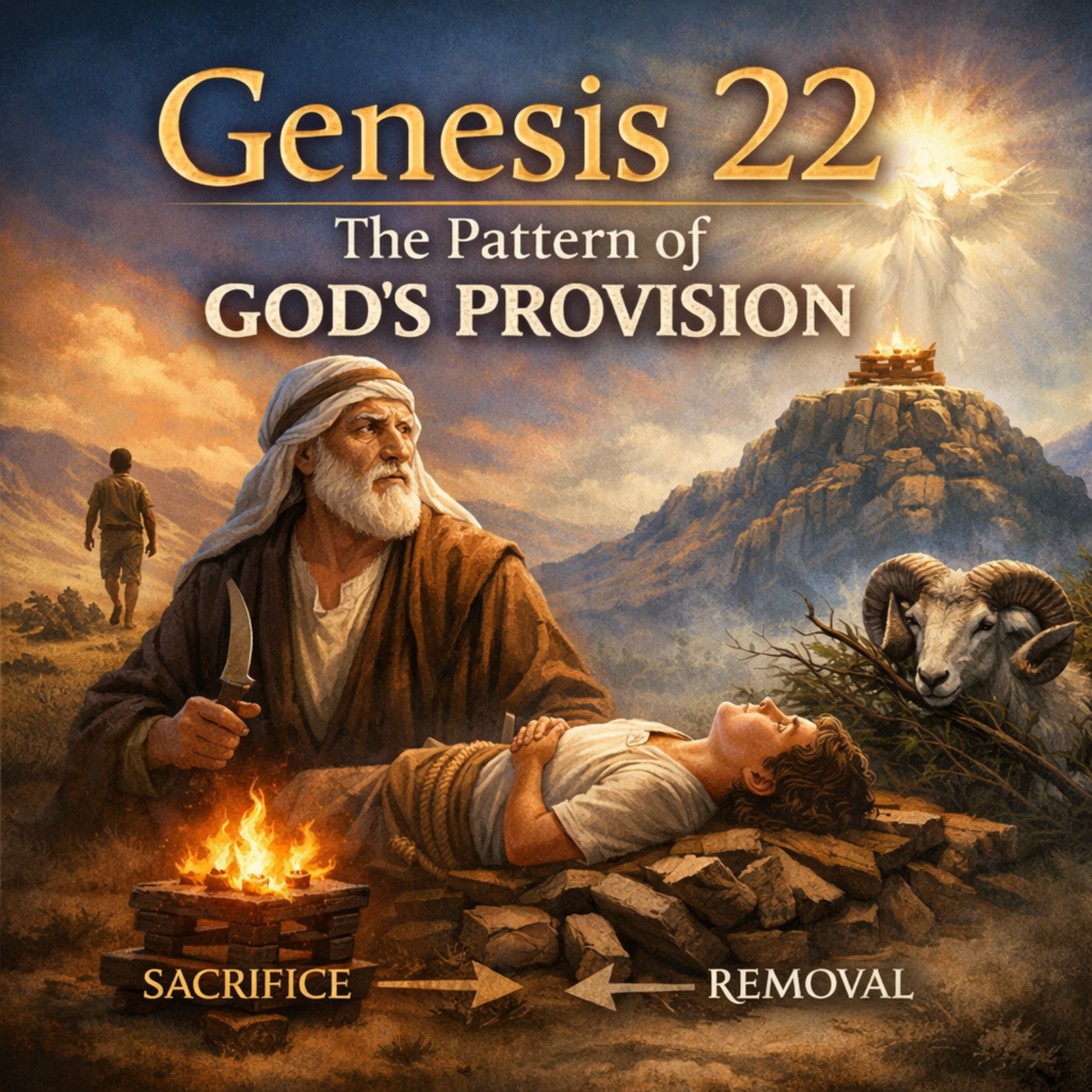
S1 Ep 38Genesis 22: The Pattern of God's Provision
What happens when God asks for what you love most? In Genesis 22, Abraham’s faith is tested, God’s provision is revealed, and a powerful redemption pattern begins to unfold.In this episode of In The Garden, we walk through the binding of Isaac on Mount Moriah — not as a story of cruelty, but as a story of trust, obedience, and God’s gracious provision.God calls Abraham to surrender his promised son, Isaac. Abraham obeys in faith, believing God will somehow provide. At the last moment, the Lord stops Abraham and provides a ram in Isaac’s place, clearly rejecting human sacrifice and establishing substitution as God’s design.We also connect Genesis 22 to the growing biblical pattern of sacrifice and removal — first seen in Abraham releasing Ishmael into the wilderness in Genesis 21 and later repeated in Israel’s worship. This pattern ultimately finds its fulfillment in Jesus Christ, the true Lamb God provides, who bears our sin and brings redemption.This episode explores how God patiently grows faith, reveals His plan over generations, and teaches us to trust Him with what matters most.Keywords: Genesis 22, Abraham and Isaac, God’s provision, sacrifice, substitution, faith and obedience, biblical patterns, redemption, In The Garden podcast, Jesus the Lamb of God, Old Testament foundations, trust in God👉 Call to Action: If this episode encouraged you, please share it with a friend, subscribe to In The Garden, and leave a review. Your support helps others discover God’s Word and walk through Scripture with us.Scripture References (ESV): Genesis 22:1–14 Genesis 21:8–21 Leviticus 16:7–10, 20–22 John 3:16 Mark 10:45
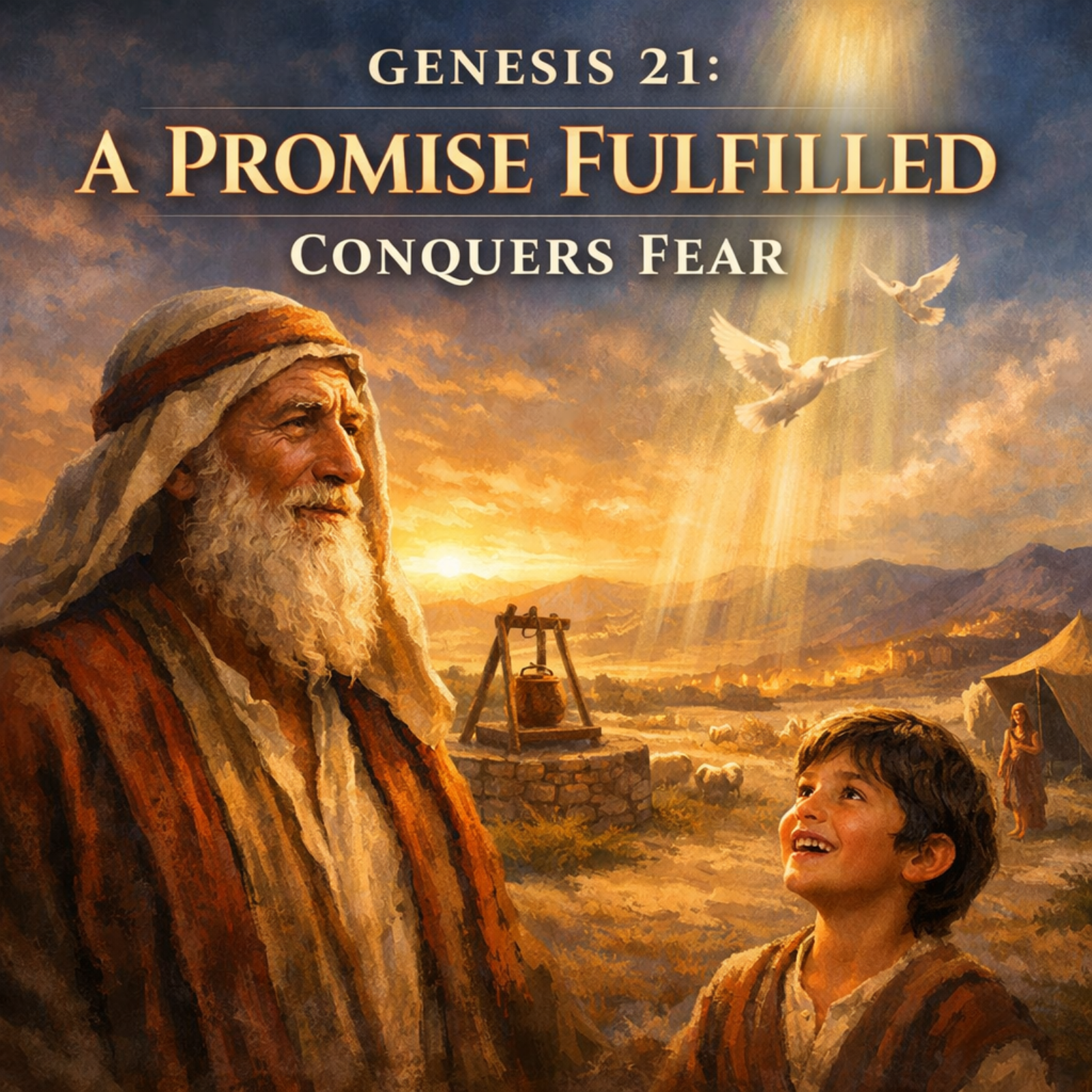
S1 Ep 37Genesis 21: A Promise Fulfilled Conquers Fear
When God’s promise is finally fulfilled, Abraham’s long-standing fear loses its power. Faith matures from striving and self-protection into trust, integrity, and worship.1. Promise Kept After Long DelayGod fulfills His word exactly as spoken:“The LORD visited Sarah as He had said, and the LORD did to Sarah as He had promised.” (Genesis 21:1, ESV)Isaac is born when Abraham is 100 and Sarah is 90 (Genesis 21:5; cf. Genesis 12:4).The promise waited 25 years, eliminating all human credit (cf. Romans 4:19–21).2. Faith No Longer Needs a Backup PlanIshmael, born when Abraham was 86 (Genesis 16:16), is now a teenager.God commands Abraham to release the son of the flesh:“Whatever Sarah says to you, do as she tells you, for through Isaac shall your offspring be named.” (Genesis 21:12)God personally claims responsibility for Ishmael:“I will make a nation of the son of the slave woman also.” (Genesis 21:13)Abraham learns to trust God with what he loves but cannot save.3. Fear Gives Way to IntegrityPreviously, Abraham lied to Abimelech out of fear (Genesis 20:2, 11).Now Abimelech asks for an oath:“Swear to me here by God that you will not deal falsely with me.” (Genesis 21:23)Abraham responds with honesty and peace, not deception (Genesis 21:24–30).Fulfilled promise removes the need for manipulation.4. Living Securely While Still WaitingAbraham sojourns peacefully:“Abraham sojourned many days in the land of the Philistines.” (Genesis 21:34)He does not seize land but trusts God’s timing (cf. Genesis 15:18).5. Worship Rooted in TrustAbraham plants a tree and worships:“There Abraham called upon the name of the LORD, the Everlasting God.” (Genesis 21:33)God is confessed not merely as Promise-Maker, but as Promise-Keeper over time.Key TakeawayBefore Isaac: fear shaped Abraham’s choices.After Isaac: faith shapes Abraham’s character.When God secures the future, fear loses its grip on the present.Looking AheadGenesis 21 prepares the way for Genesis 22. Only a man who trusts God with everything else can trust Him with Isaac.
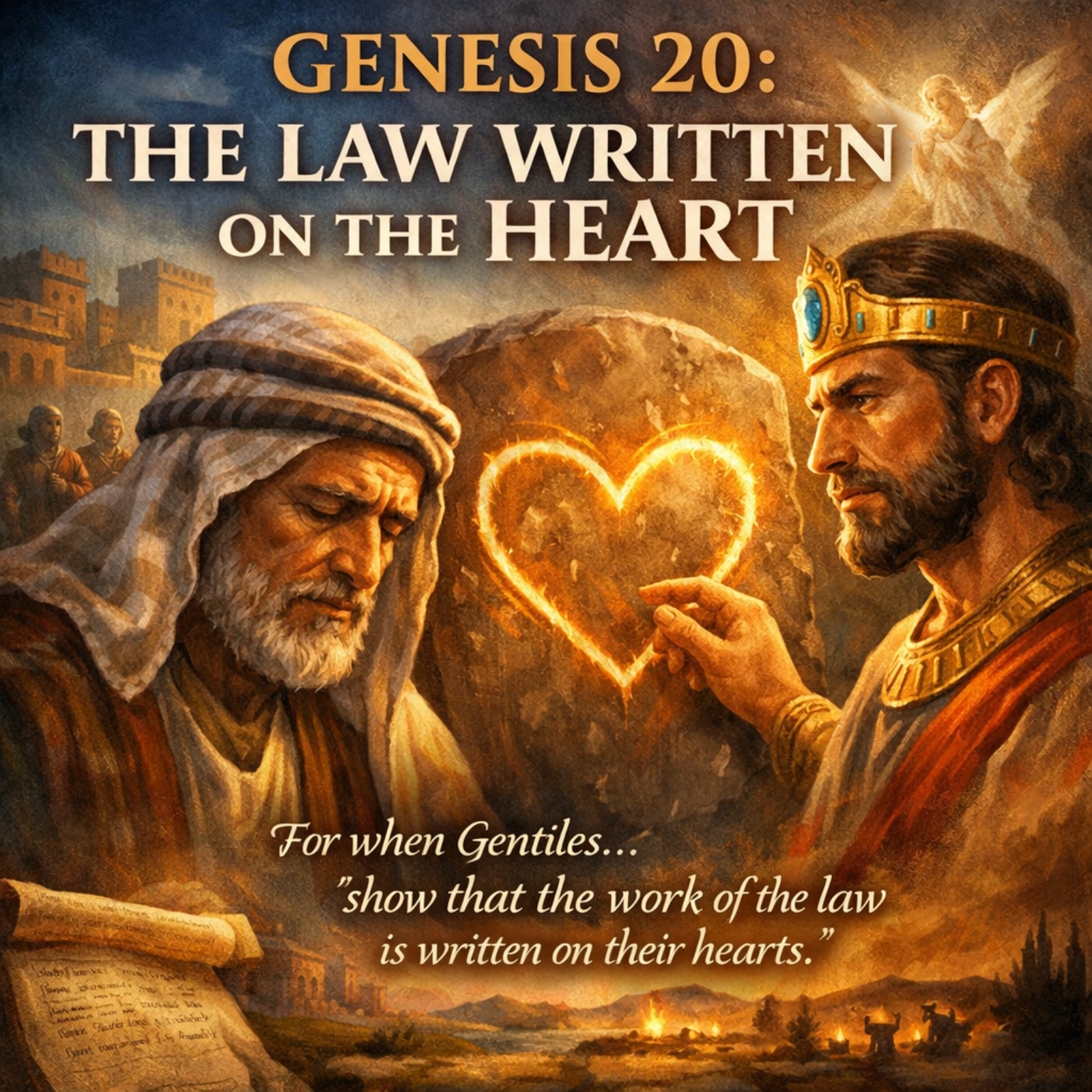
S1 Ep 36Genesis 20: The Law Written on the Heart
Primary Text: Genesis 20 Companion Text: Romans 2:14–151. Setting the Scene: Repeated Sin, Familiar FearAbraham journeys into Gerar (Genesis 20:1).He repeats the same half-truth told earlier in Egypt:“She is my sister.” (Genesis 20:2; cf. Genesis 12:10–20)Fear, not faith, drives Abraham’s decision.This reminds us: Abraham’s righteousness is grounded in faith, not flawless obedience (Genesis 15:6; Romans 4:3).2. God Intervenes with a Gentile KingAbimelech takes Sarah—but before any harm occurs, God intervenes:“God came to Abimelech in a dream by night…” (Genesis 20:3)Abimelech immediately appeals to justice and innocence:“In the integrity of my heart and the innocence of my hands I have done this.” (Genesis 20:5)3. God Affirms Moral Awareness Apart from the LawGod responds with a striking affirmation:“Yes, I know that you have done this in the integrity of your heart.” (Genesis 20:6)This occurs centuries before Sinai, before the Ten Commandments.Abimelech knows adultery is wrong without written law.This directly anticipates Paul’s teaching:“For when Gentiles, who do not have the law, by nature do what the law requires… they show that the work of the law is written on their hearts.” (Romans 2:14–15)4. Role Reversal: The Pagan Acts RighteouslyAbimelech fears God (Genesis 20:8–11).Abraham, the covenant bearer, admits fear motivated his deception (Genesis 20:11).Scripture does not excuse Abraham—yet God remains faithful to His promise.5. Grace Without Excusing SinGod commands restitution:“Return the man’s wife.” (Genesis 20:7)Yet God also acknowledges Abimelech’s innocence.Moral awareness does not equal covenant membership.Righteous behavior does not replace faith—but it reveals God’s moral order.6. Intercession and HealingGod requires Abraham to pray for Abimelech (Genesis 20:7).Abraham intercedes, and God heals Abimelech’s household (Genesis 20:17–18).God preserves Sarah, protects the promise, and moves the covenant forward.7. Theological TakeawaysThe law written on the heart is real and active among the nations (Romans 2:15).Faith, not moral performance, is counted as righteousness (Genesis 15:6; Romans 4:3).God judges hearts, not pedigrees.The covenant advances because God is faithful—even when His people fail.Closing ThoughtGenesis 20 quietly prepares us for the Gospel:Gentiles can recognize God’s moral law.God’s people still stumble.Righteousness has always been by faith.
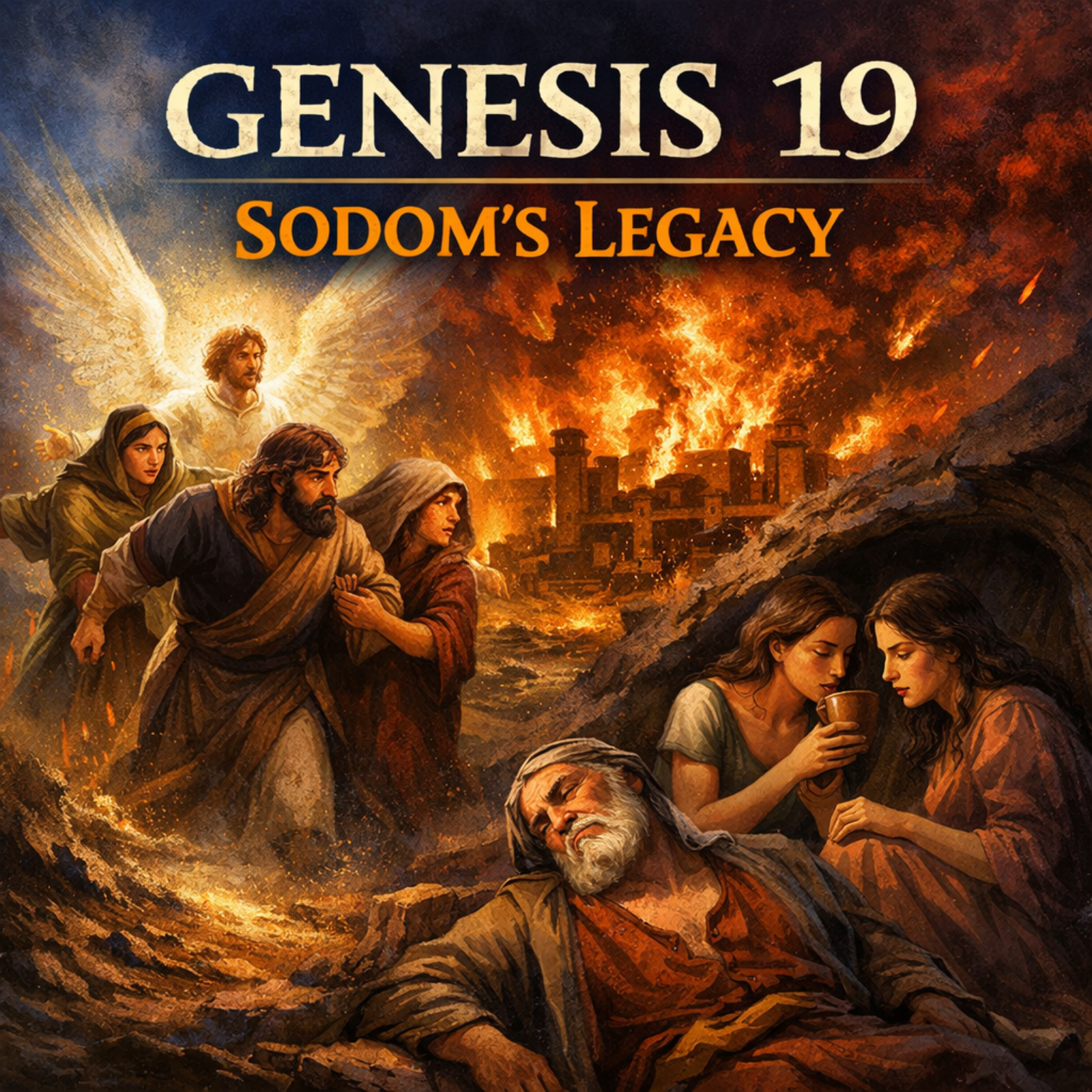
S1 Ep 35Genesis 19: Sodom’s Legacy
Genesis 19 unfolds in three movements:God rescues LotGod destroys SodomSodom’s corruption survives through Lot’s daughtersThe chapter confronts a hard truth: deliverance from judgment does not equal transformation of the heart.Movement 1: God Rescues Lot — Mercy, Not MeritAngels arrive to remove Lot and his family from Sodom.Lot hesitates, delays, and negotiates.Scripture emphasizes God’s initiative, not Lot’s decisiveness.“But he lingered… the men seized him by the hand… the Lord being merciful to him.” — Genesis 19:16Lot is spared because God remembers Abraham, not because Lot proves righteous.“God remembered Abraham and sent Lot out of the midst of the overthrow.” — Genesis 19:29Key insight: Grace can rescue a person without fully healing them.Movement 2: God Destroys Sodom — Judgment with CauseSodom’s destruction follows long-standing moral collapse.Scripture elsewhere clarifies Sodom’s sins: pride, neglect of the poor, violence, and abominations.“So they were haughty and did an abomination before me.” — Ezekiel 16:49–50God removes the place of corruption—but judgment alone does not renew hearts.Movement 3: Sodom Lives On — Lot’s DaughtersAfter fleeing, Lot’s daughters believe survival requires immoral action.They intoxicate their father and conceive children by him.“Come, let us make our father drink wine… that we may preserve offspring.” — Genesis 19:32The text offers no approval—only stark honesty.Their thinking reflects Sodom’s values:Sex detached from covenantBoundaries erased in fearMorality treated as negotiableTruth: You can take people out of Sodom, but Sodom can still live in them.Jesus Interprets the Deeper IssueJesus clarifies what Genesis 19 exposes:“What comes out of a person is what defiles him. For from within, out of the heart of man, come evil thoughts…” — Mark 7:20–21The problem is not location—it is the heart.Jesus also issues a brief but haunting warning:“Remember Lot’s wife.” — Luke 17:32Longing for what God destroyed is as dangerous as living in it.Final ReflectionGenesis 19 teaches:Rescue ≠ discipleshipEscape ≠ repentanceJudgment removes cities; only God renews heartsJesus names the true solution:“You must be born again.” — John 3:7Closing truth: Fire can destroy a city. Only God can remake a soul.
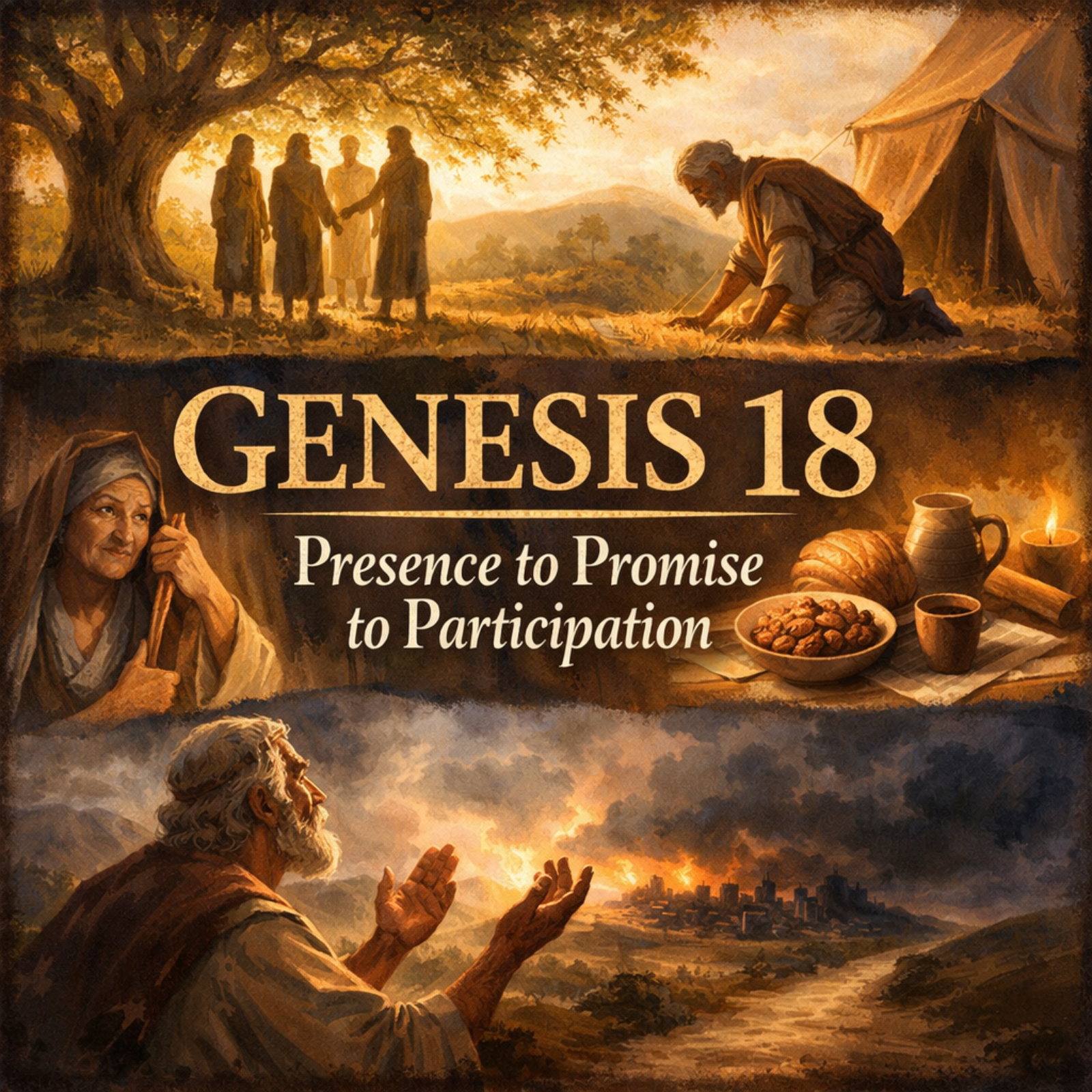
S1 Ep 34Genesis 18: Presence to Promise to Participation
Theme: Covenant intimacy unfolds in three movements: God draws near, God speaks promise, and God invites human participation—without tidy resolution.1. Presence: God Comes Near (Genesis 18:1–8)Timing matters: Genesis 18 follows immediately after Abraham’s obedience through circumcision (Genesis 17:23–27).“And the LORD appeared to him…” (Genesis 18:1) — presence precedes explanation.God appears as three men, yet the text speaks of the LORD (Genesis 18:1–2), holding mystery without clarification.Abraham responds with urgency and humility: he runs, bows, and serves (Genesis 18:2, 6–7).A table is set: bread, curds, milk, and a calf (Genesis 18:6–8).Eucharistic echo: God shares a meal with humanity—anticipating later table fellowship and sacramental language (cf. Luke 22:19).2. Promise: Life Where Hope Has Failed (Genesis 18:9–15)God speaks a direct promise: “Sarah your wife shall have a son” (Genesis 18:10).Sarah laughs privately, worn down by time and disappointment (Genesis 18:11–12).God responds not with rebuke, but a question:“Is anything too hard for the LORD?” (Genesis 18:14)Luke 1 mirror:The angel tells Mary, “For nothing will be impossible with God” (Luke 1:37).Two impossible births—Sarah and Mary—frame God’s redemptive work as grace, not biology.3. Participation: Invited into God’s Purposes (Genesis 18:16–33)God pauses and speaks aloud:“Shall I hide from Abraham what I am about to do?” (Genesis 18:17)Abraham is chosen to walk in the “way of the LORD”—justice and righteousness (Genesis 18:19).Abraham draws near and intercedes for Sodom (Genesis 18:23).He appeals to God’s character, asking if the righteous will perish with the wicked (Genesis 18:23–25).The count descends: fifty… forty-five… forty… thirty… twenty… ten (Genesis 18:24–32).God listens and agrees—yet no outcome is revealed.4. The Unfinished Ending (Genesis 18:33)“And the LORD went his way…” (Genesis 18:33)No resolution. No explanation. No comfort.Covenant life remains suspended between:presence and fulfillmentprayer and outcomepromise and judgmentClosing InsightGenesis 18 teaches us:God comes nearGod speaks promiseGod invites participationBut faith does not always end in satisfaction—sometimes it ends in silence.The table is cleared. The city still stands. And God walks on ahead.
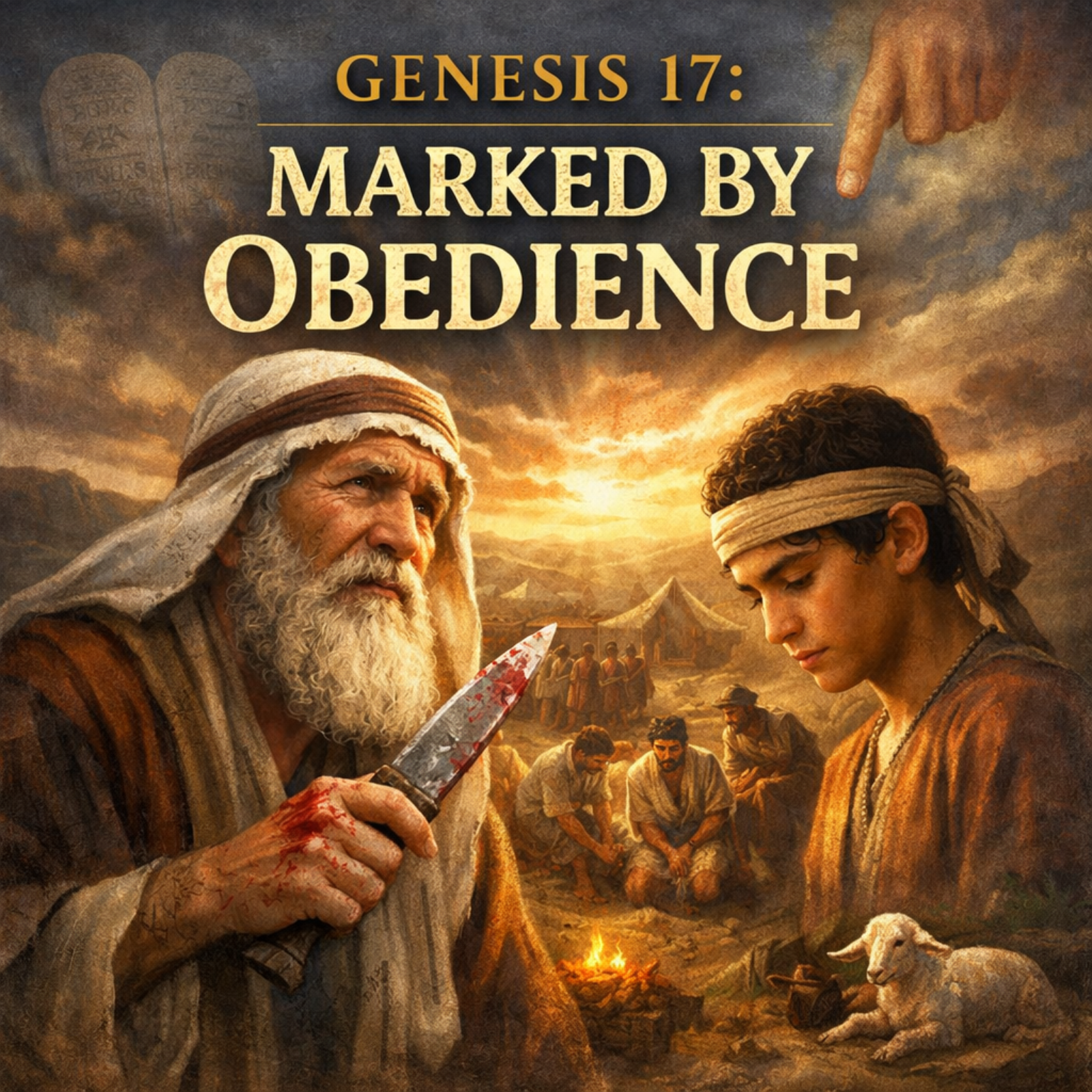
S1 Ep 33Genesis 17: Marked by Obedience
In this episode of In the Garden, we explore Genesis 17 and the profound meaning of covenant obedience. God calls Abraham to a radical act: circumcision as the sign of His covenant (Genesis 17:10–11, 23–27). This physical mark was not just a ritual—it represented total surrender of self to God, beginning even with the body and extending to all of life.Abraham had previously tried to fulfill God’s promise through human means by fathering Ishmael with Hagar (Genesis 16). Like Adam before him, Abraham momentarily placed human reasoning above God’s word. Yet God calls him back into covenant faithfulness, demonstrating that obedience cannot be partial or delayed. Genesis emphasizes that Abraham obeyed “that very day” (Genesis 17:23, 26), at ninety-nine years old, along with his son Ishmael, who was thirteen.Even though Ishmael was born outside the covenant line God intended to establish through Isaac (Genesis 17:19), Abraham’s love for Ishmael is evident:“Oh that Ishmael might live before you!” (Genesis 17:18)And God blesses Ishmael as well, promising to make him a great nation. His inclusion reminds us that God’s love and blessing extend beyond the covenant line, even to those born through human missteps.The act of circumcision foreshadows a deeper spiritual truth. God later calls His people to circumcise the heart:“Circumcise therefore the foreskin of your heart, and be no longer stubborn.” (Deuteronomy 10:16)Paul reinforces this in the New Testament, highlighting that covenant obedience requires faith and total commitment:“Present your bodies as a living sacrifice, holy and acceptable to God, which is your spiritual worship.” (Romans 12:1)Jesus brings this principle to its fullest expression:“If your right hand causes you to sin, cut it off… If your right eye causes you to sin, tear it out.” (Matthew 5:29–30)He teaches that no part of our lives is neutral—our hands, our minds, our bodies, and our choices are all under God’s authority.Through Abraham and Ishmael, we see that God’s covenant requires immediate, costly, whole-life obedience, yet His love and blessing are never limited by our mistakes. Circumcision points forward to baptism and the call to offer our entire selves to God, marking us not only physically or ritually, but spiritually as His children.Key Scriptures Referenced:Genesis 16: Abraham and HagarGenesis 17:10–11, 17–19, 23–27: Covenant and circumcisionDeuteronomy 10:16: Circumcision of the heartRomans 12:1: Present your body as a living sacrificeMatthew 5:29–30: Radical obedience of all parts of lifeThis episode invites us to reflect: How is God asking us to surrender our whole selves in covenant obedience today? Just as Abraham obeyed immediately, we are called to trust God fully—even when it is costly or uncomfortable.
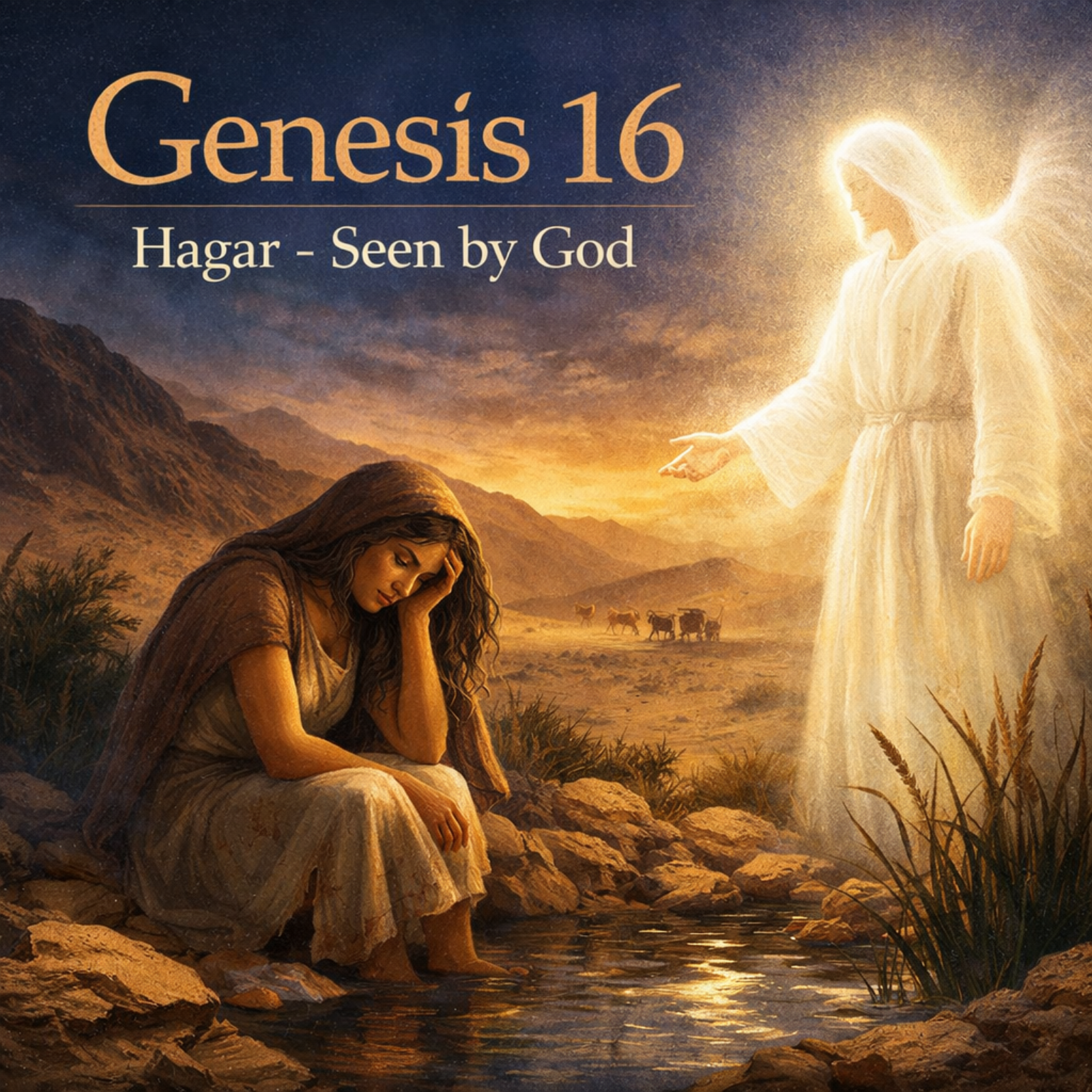
S1 Ep 32Genesis 16: Hagar - Seen by God
In this episode of In the Garden, we explore the story of Hagar in Genesis 16, one of the most difficult and powerful narratives in Scripture. Hagar, an Egyptian servant in the household of Abram and Sarai, is thrust into circumstances beyond her control. Sarai gives Hagar to Abram as a wife, hoping to obtain children through her (Gen 16:2–3). From our modern perspective, Hagar is powerless, and what happens to her is rape—she cannot consent, and her body becomes the arena of fear, oppression, and human sin.Despite the injustice, God meets Hagar in the wilderness. When she flees her mistress, the Angel of the Lord finds her by a spring of water and speaks directly to her (Gen 16:7–9). God’s instructions are both practical and faithful: she is told to return to her mistress and submit (Gen 16:9), not as an endorsement of Sarai’s abuse, but as a path for her protection and survival under God’s providence.God also promises Hagar that her suffering will not go unnoticed. He assures her that her descendants will be multiplied and that she will bear a son named Ishmael, “because the Lord has heard your affliction” (Gen 16:10–11). Ishmael’s life is described as that of “a wild donkey of a man” (Gen 16:12), independent and free, yet marked by conflict. Over time, God’s promise is fulfilled: Ishmael’s descendants become a great nation (Gen 25:12–16).This story echoes into the New Testament. Paul instructs Christian slaves to obey their earthly masters with sincerity of heart, not as people-pleasers, but “knowing that whatever good anyone does, this he will receive back from the Lord, whether he is a slave or free” (Eph 6:5–8; Col 3:22–24; 1 Pet 2:18–19). The principle is similar to Hagar’s story: faithfulness under human authority does not justify abuse, but God sees every act of obedience and every suffering. Submission under authority is not moral approval of wrongdoing; it is trusting in God’s justice and providence.The story of Hagar also confronts us with timeless truths. Slavery, oppression, and exploitation are never endorsed by God. Hagar’s suffering is real and profound, and God’s response shows us His care for the vulnerable. Her experience calls us to action: to see those who are suffering, to speak for the powerless, and to embody neighborly love. Jesus’ command to “love your neighbor as yourself” (Matt 22:39) echoes Hagar’s call to witness and care.Hagar’s story reminds us that God sees the oppressed, hears their cries, and fulfills His promises in ways that human hands cannot undo. In the wilderness of sorrow and fear, God runs to meet those whom society ignores, calling them by name and promising a future.Scriptures cited in this episode:Genesis 16:2–3, 7–12 (Hagar’s oppression, encounter with God, promise of Ishmael)Genesis 25:12–16 (Ishmael’s descendants)Ephesians 6:5–8 (instructions for Christian slaves)Colossians 3:22–24 (obedience to masters)1 Peter 2:18–19 (commendable endurance under unjust authority)Matthew 22:39 (love your neighbor)Hagar’s story is not only history; it is a mirror for our own call to justice, mercy, and faithful witness in the face of human sin. God sees, God hears, and God acts. May we follow His example in our lives today.
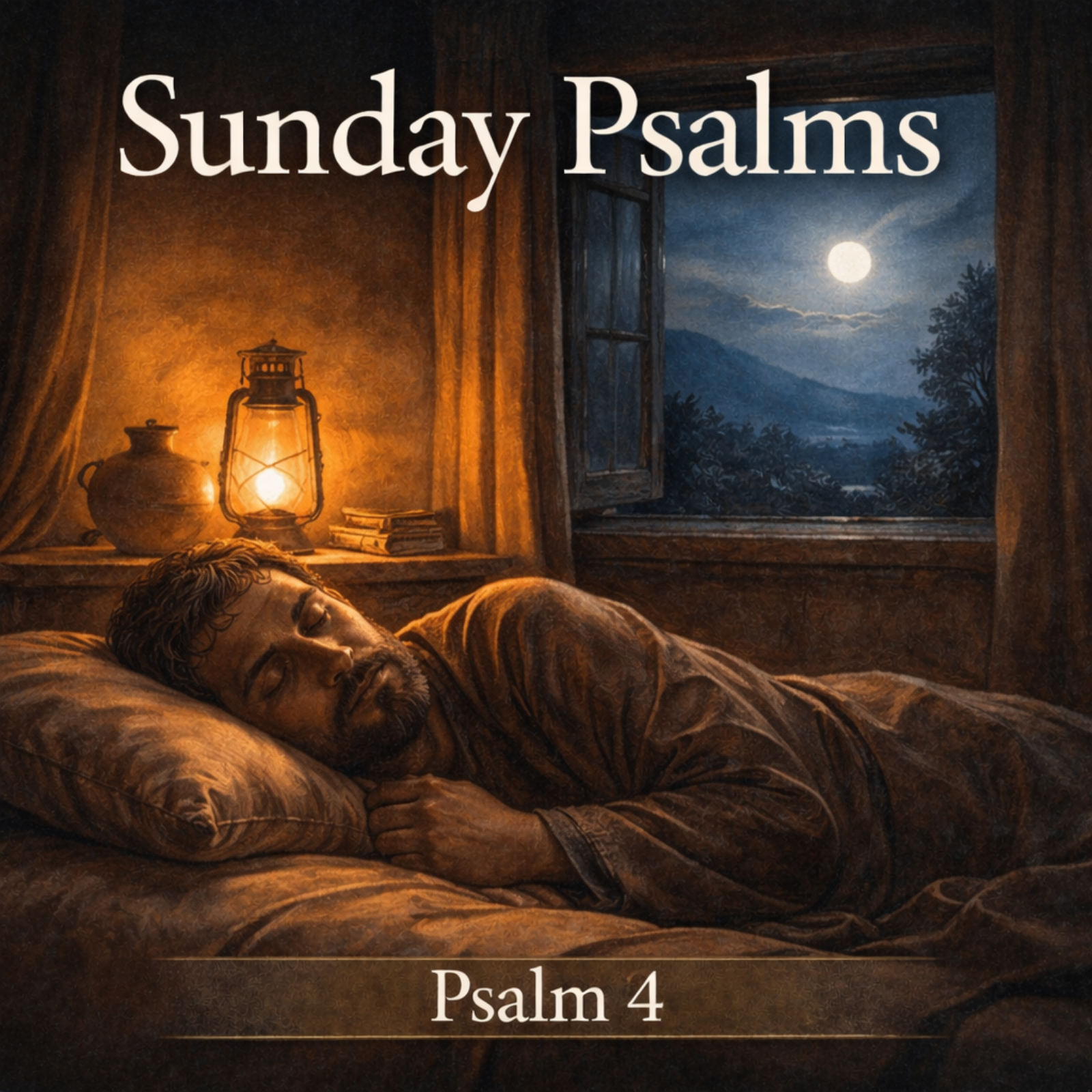
S1 Ep 31Sunday Psalms: Psalm 4
“Be angry, and do not sin.”Opening Frame Psalm 4 is an evening prayer. The noise of the day has faded, but the arguments, accusations, and unrest remain. David is under pressure—his honor questioned, truth twisted, lies preferred over faithfulness. Yet instead of escalating the conflict outward, David turns inward and upward.This Psalm teaches us how to end the day with God when emotions are still loud.Scripture Reading Psalm 4:1–8 (ESV)(Full reading included in the episode, allowing space for Selah pauses.)Meditation on Verse 4“Be angry, and do not sin; ponder in your own hearts on your beds, and be silent. Selah.”Anger itself is not condemned here. Scripture acknowledges it as a human response to injustice, betrayal, and loss. What matters is where anger is taken.David does not vent his anger into violence or bitterness. He brings it to the bed. To stillness. To silence before God.This verse invites restraint, reflection, and reverence:Be angry — Don’t deny what you feel.Do not sin — Don’t let emotion become your master.Ponder on your bed — Let the night become a place of prayer, not plotting.Be silent — Stop arguing long enough to listen.Anger that is not examined becomes destructive. Anger examined before God becomes instructive.Trust Re-centered The Psalm moves from unrest to reassurance. David reminds himself that:The Lord sets apart the godly for Himself.The Lord hears when he calls.True joy is not found in abundance, but in God’s presence.Peace is possible—even sleep is possible—when trust is placed in the Lord alone.This is not denial of danger; it is confidence in God’s nearness.Closing Rest“In peace I will both lie down and sleep; for you alone, O Lord, make me dwell in safety.”Psalm 4 ends where many of us hope to arrive: rest. Not because the world is calm, but because God is faithful.Invitation to the Listener As this day closes, bring your anger honestly before God. Lay it down without letting it rule you. Sit in silence. Trust His justice. Receive His peace.Selah.
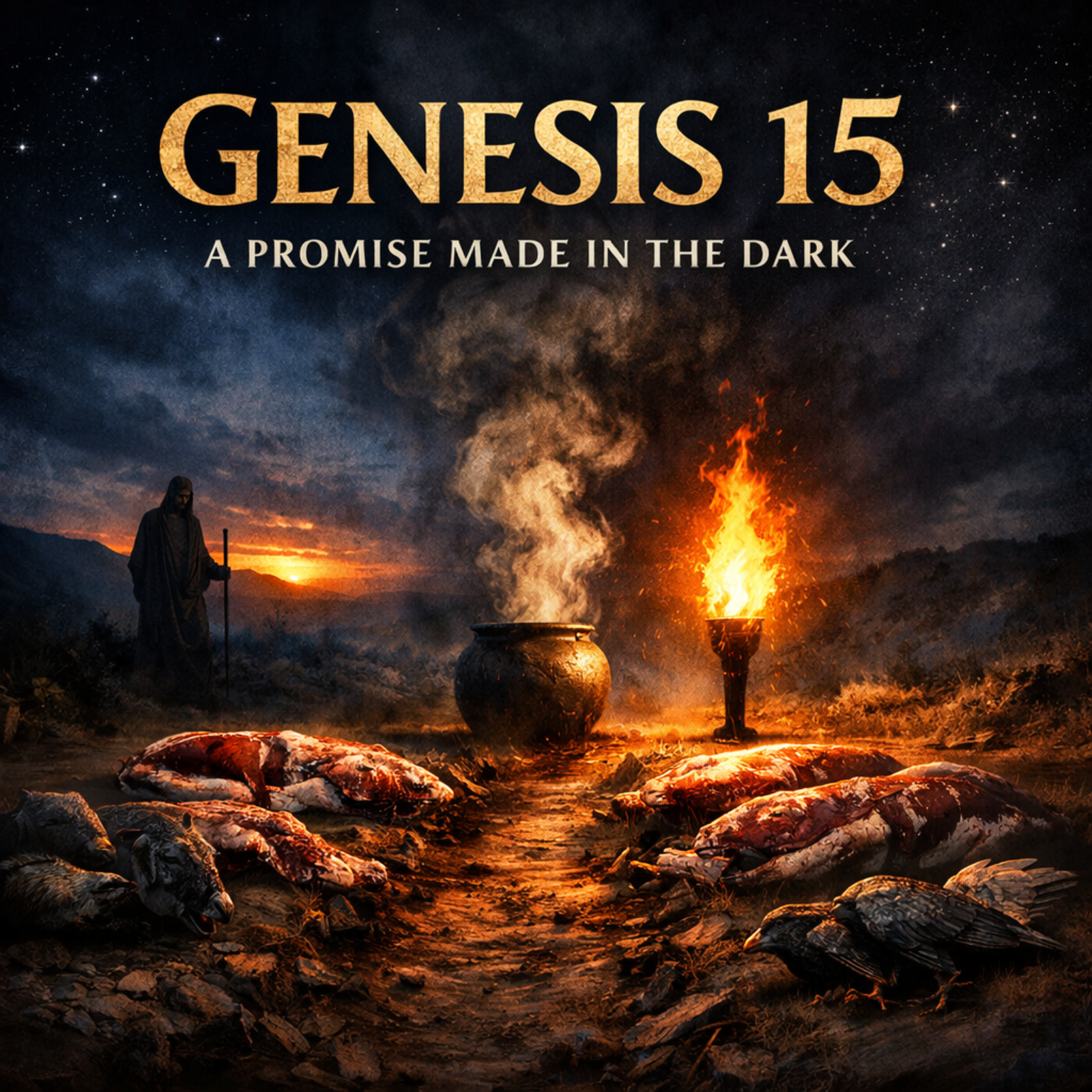
S1 Ep 30Genesis 15: A Promise Made in the Dark
Genesis 15 is one of the most mysterious and formative chapters in the Bible. It contains vision and ritual, fear and promise, sacrifice and grace. To modern readers, it can feel primitive or unsettling—but to its original audience, it was a profound declaration of trust, responsibility, and hope.The chapter opens with Abram wrestling honestly with God. Though promised descendants, Abram remains childless and wonders whether the promise will ever be fulfilled (Genesis 15:1–3). God responds not with explanation, but with reassurance—inviting Abram to look at the stars and trust that his future will be shaped by God’s word, not by present circumstances (Genesis 15:4–5).Abram believes God, and that trust—before any evidence—is “counted to him as righteousness” (Genesis 15:6). Faith here is not moral perfection, but relational trust.God then instructs Abram to prepare animals for a covenant ritual (Genesis 15:7–10). In the ancient Near East, covenants were “cut” through sacrifice. Both parties would normally walk between the divided animals, symbolically declaring that the fate of the animals would fall upon anyone who broke the promise.As Abram waits, birds of prey descend on the carcasses, and Abram drives them away (Genesis 15:11). The scene emphasizes vigilance and anticipation—guarding a promise still unfolding.As night falls, Abram enters a deep and dreadful darkness (Genesis 15:12). In Scripture, such darkness often accompanies encounters with the divine—moments of awe rather than comfort (cf. Exodus 20:18–21). In this darkness, God speaks truthfully about the future: Abram’s descendants will suffer oppression before eventual deliverance (Genesis 15:13–16). The promise will be fulfilled, but not quickly or painlessly.Then the heart of the passage: a smoking fire pot and a flaming torch—symbols of God’s presence—pass between the pieces of the sacrifice (Genesis 15:17). Abram does not walk through. God alone does.This is the theological shock of Genesis 15. God assumes full responsibility for the covenant. The promise does not rest on Abram’s ability to perform, but on God’s commitment to remain faithful.The chapter closes with God reaffirming the promise of land and descendants (Genesis 15:18–21), grounding hope not in human strength, but in divine faithfulness.For believers, Genesis 15 reveals the foundations of grace. For those familiar with ritual and symbolism, it presents a radical inversion—God binding Himself to humanity. For skeptics, it offers a powerful ethical claim: that true relationship is sustained when the stronger party bears the cost. And for the merely curious, it asks a universal question: Who carries the weight when promises are broken?Genesis 15 is not escapist religion. It is a promise made in the dark—and a declaration that faith, if it exists at all, is sustained not by certainty, but by trust.Key Scriptures Referenced: Genesis 15:1–21 Genesis 15:6 Exodus 20:18–21
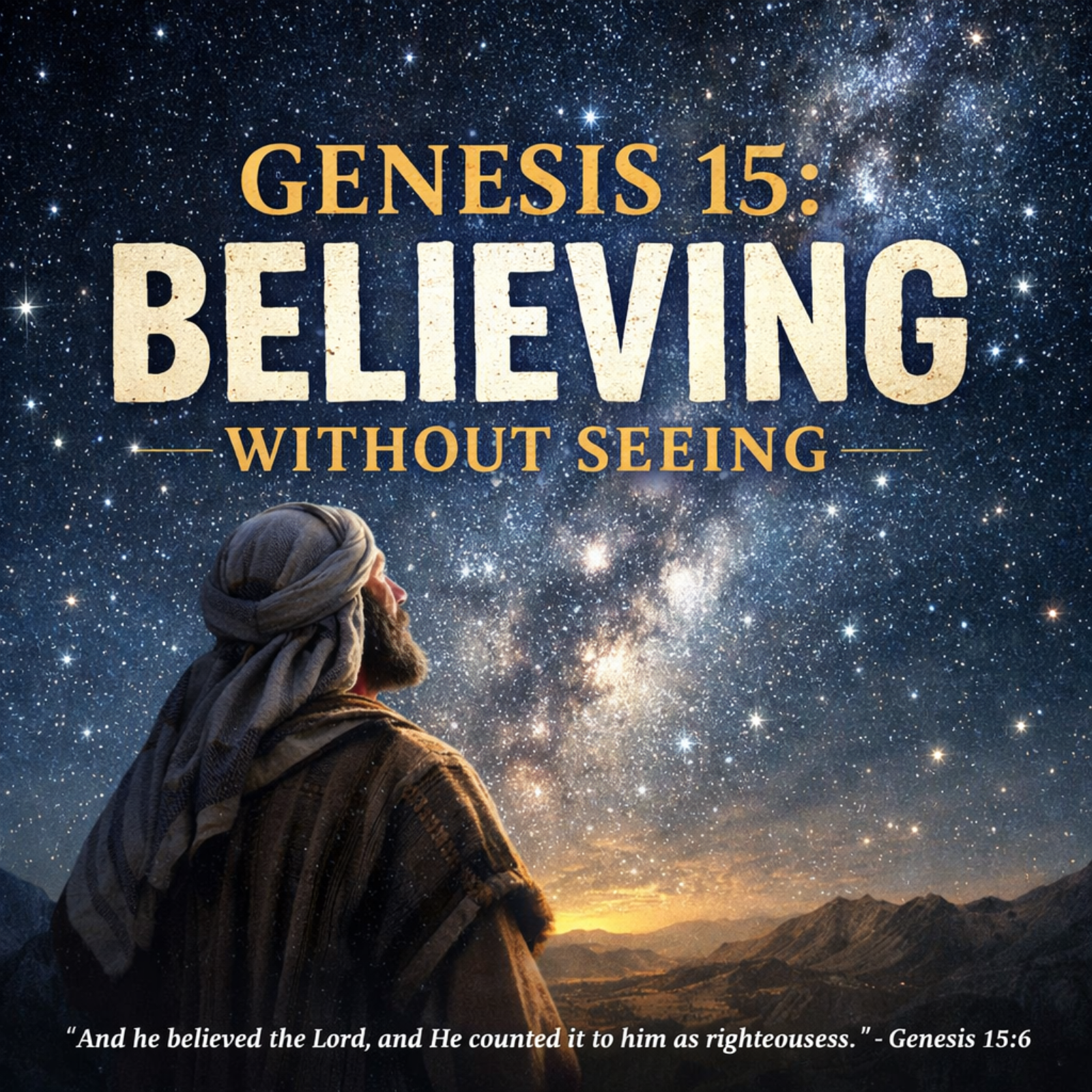
S1 Ep 29Genesis 15: Believing Without Seeing
At the center of Genesis 15 is a single sentence that echoes throughout the entire Bible:“And he believed the Lord, and He counted it to him as righteousness.” (Genesis 15:6)Abram believes God before anything changes. He is still childless. The promise is still unfulfilled. There is no visible evidence—only God’s word. Scripture presents this belief, not achievement or certainty, as the foundation of righteousness.Abram’s response matters because it establishes a biblical pattern: God does not require proof before trust, nor perfection before promise. He speaks, and He invites belief.This theme is not isolated.Centuries later, the prophet Habakkuk summarizes the same truth:“The righteous shall live by his faith.” (Habakkuk 2:4)Jesus affirms this pattern when speaking to Thomas after the resurrection:“Blessed are those who have not seen and yet have believed.” (John 20:29)The New Testament repeatedly returns to Genesis 15:6 to explain the Gospel. The apostle Paul cites it directly:“For what does the Scripture say? ‘Abraham believed God, and it was counted to him as righteousness.’” (Romans 4:3)Paul emphasizes that this belief came before the law, rituals, or religious systems—making faith, not performance, the starting point (Romans 4:9–11).Scripture does not define faith as denial of reason. Hebrews offers a working description:“Now faith is the assurance of things hoped for, the conviction of things not seen.” (Hebrews 11:1)Faith, as presented in the Bible, acknowledges limits. Human life already depends on belief without full certainty—relationships, commitments, and meaning all require trust beyond evidence.Jesus does not reject honest doubt. He engages it. He invites listening, following, and discernment—but He also issues a challenge:“Do not disbelieve, but believe.” (John 20:27)Genesis 15:6 confronts skepticism with a deeper question. Not whether belief can be avoided—but whether refusing belief is truly neutral. Scripture insists that everyone lives by faith in something.The question is not if belief exists, but what belief is worthy of shaping a life.Abram looks at the stars, hears a promise, and trusts the God who speaks. According to the Bible, that moment becomes the foundation of redemption itself.
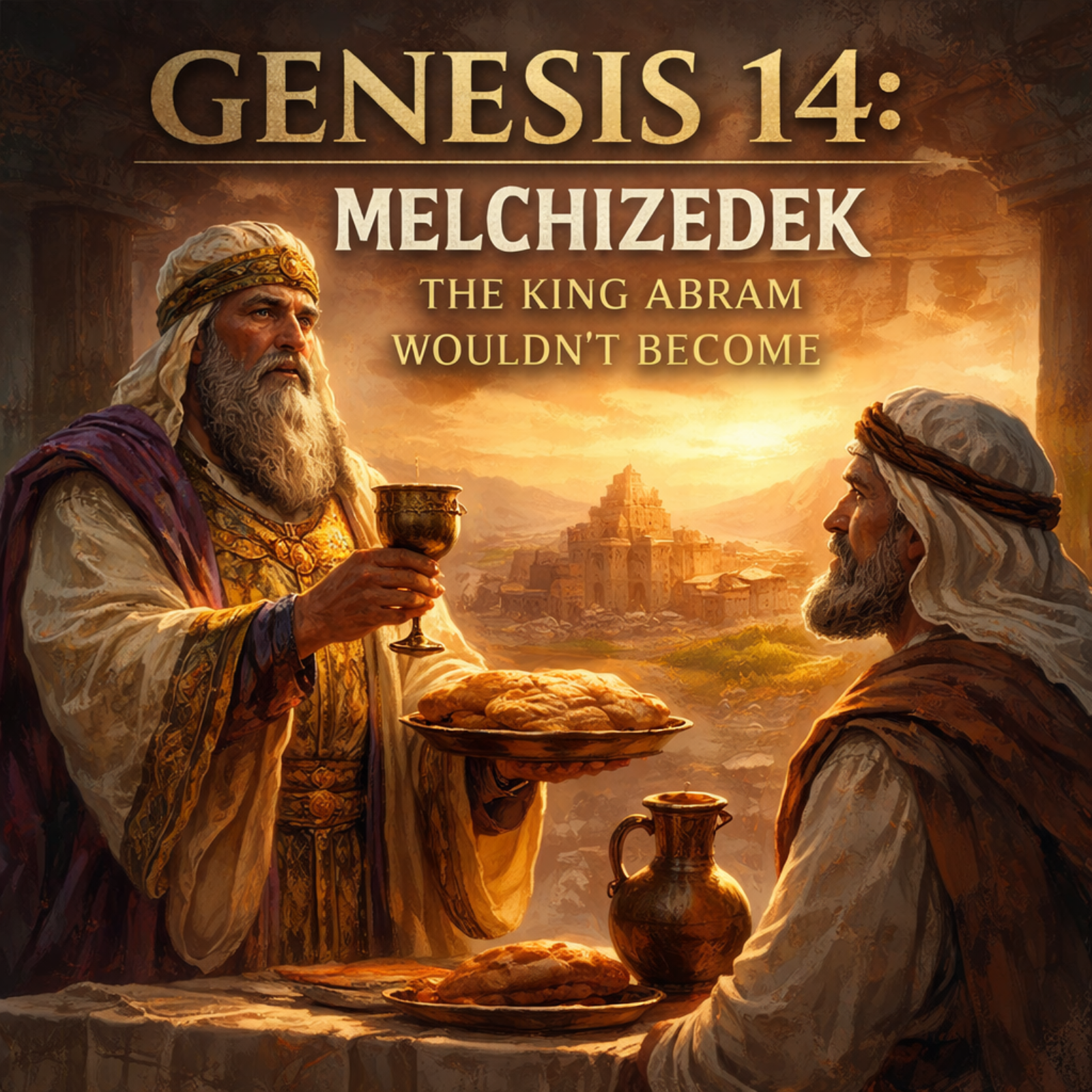
S1 Ep 28Genesis 14: Melchizedek, the King Abram Wouldn’t Become
After Abram’s astonishing military victory and the rescue of Lot, Genesis 14 shifts the focus away from war and toward worship. As Abram returns from defeating the eastern kings, he is met not first by the king of Sodom, but by Melchizedek, king of Salem and priest of God Most High (Genesis 14:17–18).Melchizedek is a unique figure in Scripture. He appears suddenly, without genealogy, without recorded beginning or end. He is both king and priest, a combination that Israel will never successfully unite under the Law. His name means “king of righteousness,” and he rules over Salem, meaning “peace” (Genesis 14:18; Hebrews 7:1–2).Melchizedek brings bread and wine and blesses Abram, declaring:“Blessed be Abram by God Most High, Maker of heaven and earth; and blessed be God Most High, who has delivered your enemies into your hand” (Genesis 14:19–20, ESV).This offering is not merely refreshment after battle. In the ancient world, sharing bread and wine was covenant language—an act of fellowship, unity, and kinship. It was a way of saying: we are bound together; we are one people. This moment anticipates the covenant meal Jesus will later offer His disciples at the Last Supper (Matthew 26:26–28; Luke 22:19–20).The New Testament identifies Melchizedek as a type and prefigurement of Christ. Hebrews describes him as one who resembles the Son of God, remaining a priest forever—not by lineage, but by divine appointment (Hebrews 7:1–3). Jesus, like Melchizedek, is both King and Priest, mediating blessing through covenant rather than conquest (Psalm 110:4; Hebrews 7:17).Abram’s response is just as revealing. He gives Melchizedek a tenth of everything (Genesis 14:20), acknowledging that the victory came not from military strength but from God Most High. Abram, who could have claimed authority through power, instead submits to divine priesthood. He chooses blessing over dominance, covenant over kingship.Immediately afterward, Abram refuses the wealth of the king of Sodom, swearing that no earthly ruler will be able to say, “I have made Abram rich” (Genesis 14:22–23). Abram will not become the kind of king the world understands. He will remain a man of promise, trusting God alone to provide and exalt.This passage shows us that Genesis 14 is not ultimately about war—it is about what kind of kingdom God is building. Melchizedek represents a rule founded on righteousness and peace, fulfilled later in Jesus Christ. Abram’s choice reveals a faith that values covenant relationship with God above power, wealth, or reputation.The bread and wine of Salem point forward to the bread and wine of the cross—a declaration that God is forming a family, uniting people not by bloodlines or empires, but by covenant grace through Christ.Key Scriptures CitedGenesis 14:17–24Genesis 14:18–20Genesis 12:1–3Psalm 110:4Hebrews 7:1–3, 7:17Matthew 26:26–28Luke 22:19–20
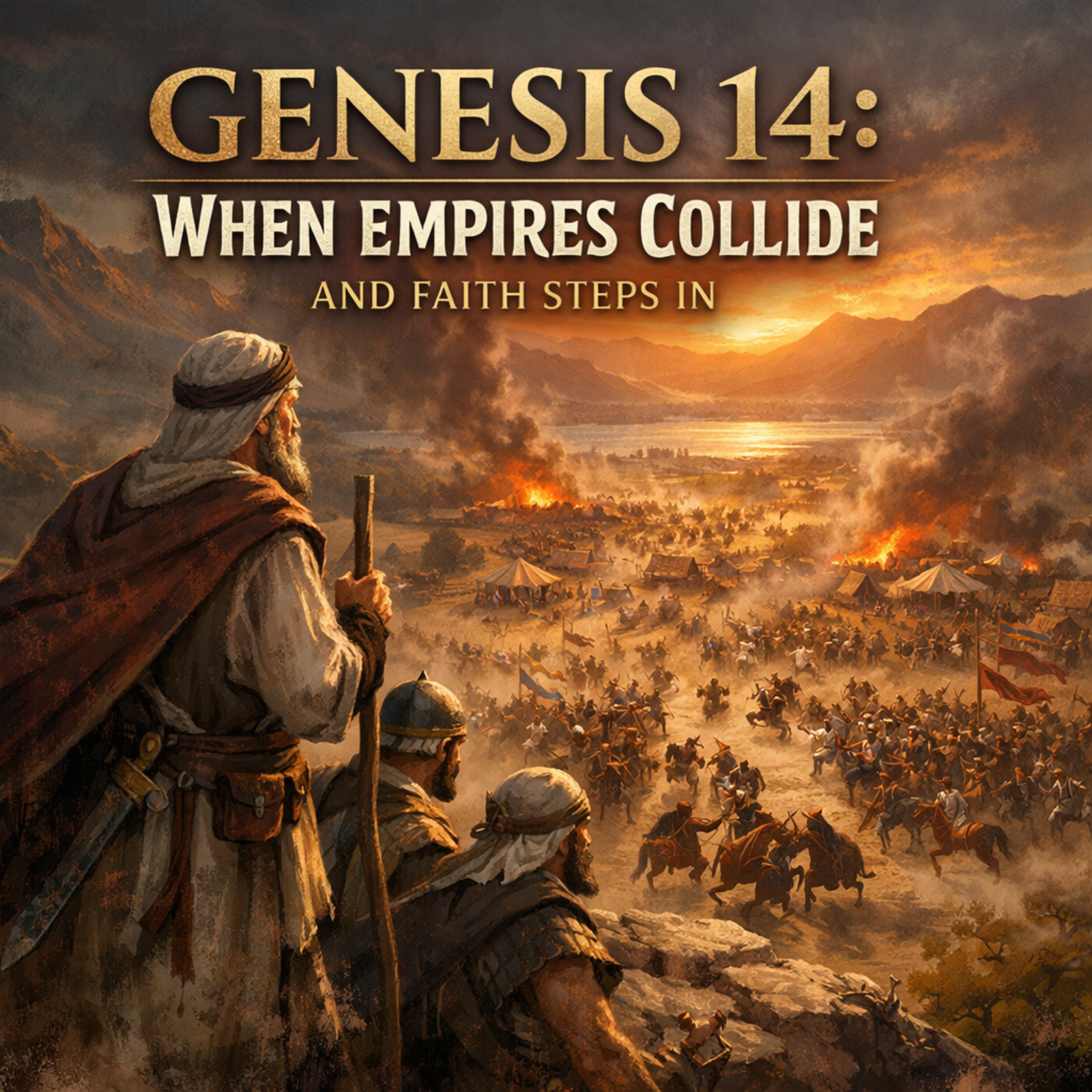
S1 Ep 27Genesis 14: When Empires Collide and Faith Steps In
In Genesis 14, we witness the first recorded international conflict in Scripture—a clash of empires and city-states that sets the stage for God’s promises to Abram to shine.Four powerful kings from the east—Amraphel of Shinar, Arioch of Ellasar, Chedorlaomer of Elam, and Tidal of Goiim—march westward, sweeping through the lands of the Rephaim, Zuzim, Emim, and Horites (Genesis 14:1–7). These are remnants of pre-Israelite peoples, warriors of the post-Flood world, representing the full spread of nations descended from Shem, Ham, and Japheth.Against them stand five city-state kings in the Jordan Valley: Sodom, Gomorrah, Admah, Zeboiim, and Bela (Zoar)—all descendants of Ham → Canaan (Genesis 10:15–19). For twelve years, these cities had paid tribute; in the thirteenth year, they rebelled. By the fourteenth year, the eastern alliance responds with overwhelming force (Genesis 14:4–9).When the kings plunder the cities, Abram’s nephew Lot is taken captive. Abram, a sojourner with no army of his own, mobilizes 318 trained men born in his household (Genesis 14:14). Without hired soldiers, without alliances, and without political power, Abram pursues the invaders through the night, dividing his forces strategically and defeating the kings in battle (Genesis 14:15–16).All captives and possessions are restored—including Lot. Abram’s victory demonstrates that God’s promises are not constrained by human power. It is not wealth, weapons, or numbers that determine the outcome, but faithful obedience and reliance on God.This chapter sets the stage for the encounter with Melchizedek, priest of God Most High, in Genesis 14:17–24, which we will explore in our next episode. There, the focus shifts from military victory to spiritual reality—blessing, worship, and the recognition that God’s plan triumphs through righteousness, not conquest.Key Scriptures:Genesis 14:1–17 – The war and Abram’s pursuitGenesis 10:15–19 – Descendants of Canaan, the cities of the plainGenesis 12:1–3 – God’s promise to Abram as backdrop to his faithGenesis 14:4–9 – The kings, their rebellion, and conquestGenesis 14:14–16 – Abram’s rescue missionTakeaway: Even when the world seems dominated by powerful empires, God’s promises cannot be thwarted. Abram’s faith and courage remind us that God’s presence and purpose surpass every human obstacle.
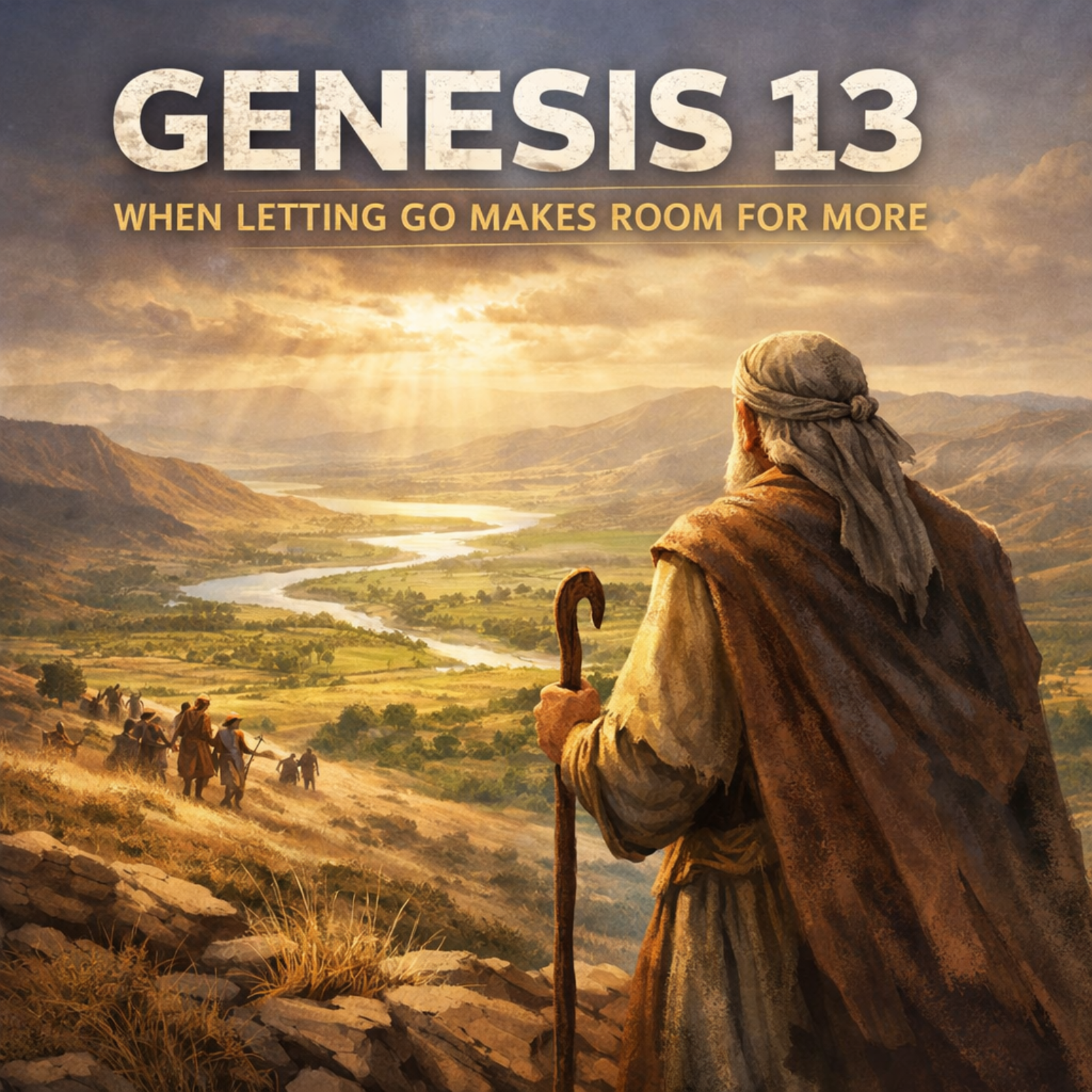
S1 Ep 26Genesis 13: When Letting Go Makes Room for More
In Genesis 13, Abram and his kinsman Lot face a moment of necessary separation. Their flocks have grown so large that the land cannot support them together, and tension arises—not from sin, but from abundance (Genesis 13:5–7).Abram responds in a way that defies human instinct. Rather than asserting seniority or claiming the best land, he gives Lot first choice:“If you take the left hand, then I will go to the right, or if you take the right hand, then I will go to the left.” (Genesis 13:9)Lot lifts up his eyes and chooses what appears best by sight—the fertile, well-watered Jordan Valley, described as being “like the garden of the Lord” (Genesis 13:10). He settles near Sodom, pitching his tents toward the city (Genesis 13:12).Abram remains.Then Scripture marks a decisive turning point:“The Lord said to Abram, after Lot had separated from him…” (Genesis 13:14)Only after Abram releases his claim does God speak again.God invites Abram to lift up his eyes—not to choose, but to receive—and promises the land in every direction:“For all the land that you see I will give to you and to your offspring forever.” (Genesis 13:15)The promise expands further:“I will make your offspring as the dust of the earth…” (Genesis 13:16)What Abram gives up, God returns—multiplied.Lot walks by sight. Abram walks by faith, embodying what Scripture later names clearly:“For we walk by faith, not by sight.” (2 Corinthians 5:7)God then tells Abram to physically walk the land he has been promised:“Arise, walk through the length and the breadth of the land, for I will give it to you.” (Genesis 13:17)This is not immediate possession, but faith practiced in advance—a covenant promise extending beyond Abram’s lifetime.The New Testament reflects on Abram’s posture of faith:“For he was looking forward to the city that has foundations, whose designer and builder is God.” (Hebrews 11:10)Jesus later teaches the same kingdom logic Abram lived:“Whoever loses his life for my sake will find it.” (Matthew 16:25) “Where your treasure is, there your heart will be also.” (Matthew 6:21) “Seek first the kingdom of God and his righteousness, and all these things will be added to you.” (Matthew 6:33)Genesis 13 reminds us that God’s promises are not secured by grasping, but by trusting. Sometimes the blessing comes after we let go—and discover that what God has promised was never truly at risk.
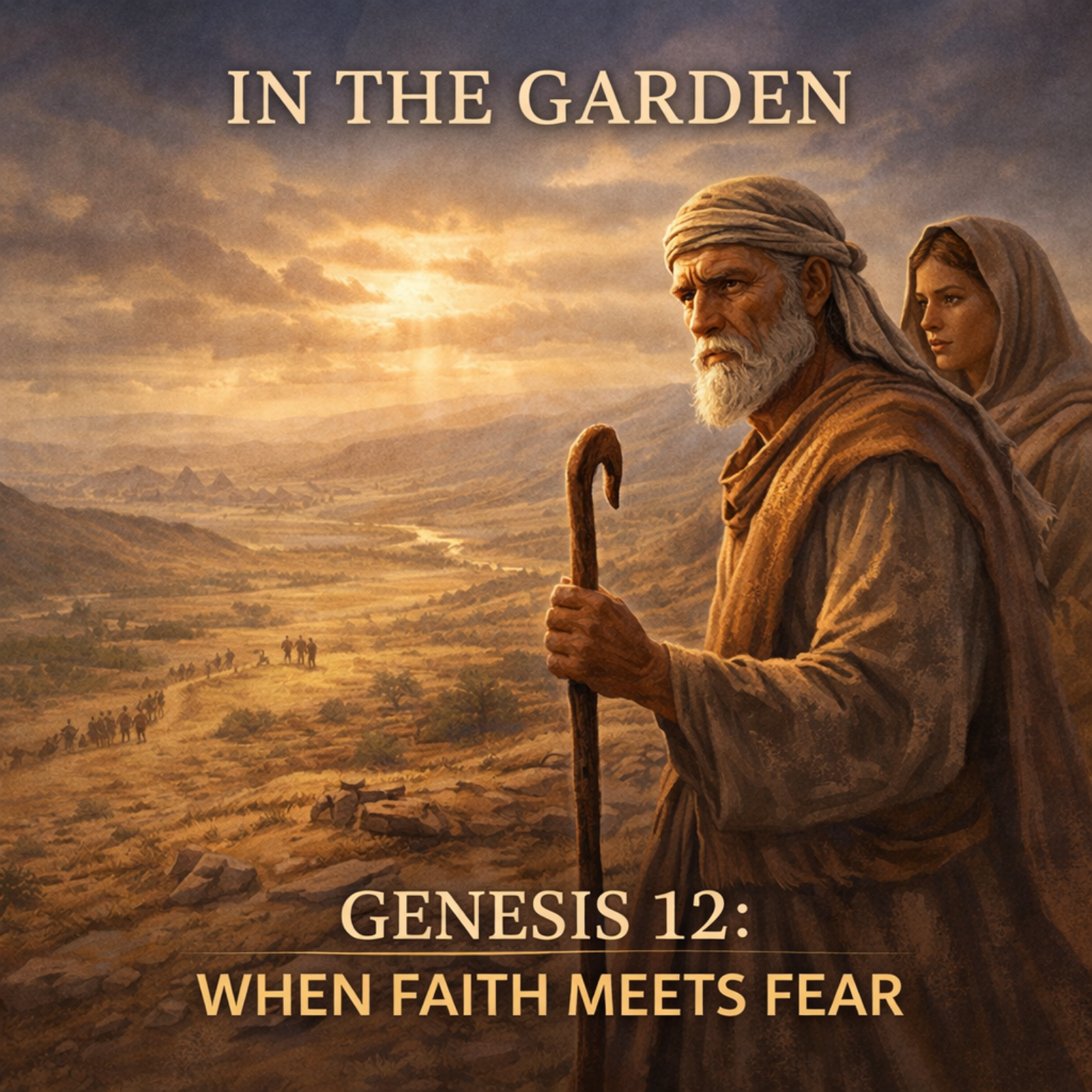
S1 Ep 25Genesis 12: When Faith Meets Fear
In this episode of In the Garden, we explore one of the most human moments in Abraham’s story: the tension between faith and fear.God has called Abram to leave his homeland and promises land, descendants, and blessing for all peoples (Genesis 12:1–3). But almost immediately, reality presses in: a famine strikes the land (Genesis 12:10), testing Abram’s trust.Fear rises. Abram worries for his life and the safety of his wife Sarai. He tells a half-truth:“Say you are my sister, that it may go well with me because of you…” (Genesis 12:13)Abram’s decision is human, yet flawed. God intervenes, preserving Sarai and protecting the covenant:“The Lord afflicted Pharaoh and his house with great plagues because of Sarai.” (Genesis 12:17)This episode highlights a timeless truth: Abram is not perfect. His fear and human cleverness are evident, and this pattern echoes in his descendants. Abraham repeats the “she is my sister” lie to Abimelech in Genesis 20:2, and Isaac repeats it in Genesis 26:7. Yet Scripture emphasizes what counts: faith, not flawless deeds:“Abraham believed God, and it was counted to him as righteousness.” (Romans 4:3)Abram’s story shows that faith can coexist with fear. Trusting God does not require perfection; it requires following Him despite uncertainty.This episode also connects to Genesis 13, where Abram demonstrates growth. After his nephew Lot chooses the fertile Jordan Valley, Abram steps back:“If you take the left hand, then I will go to the right, or if you take the right hand, then I will go to the left.” (Genesis 13:9)Lot walks by sight; Abram walks by promise. God responds:“Lift up your eyes from where you are, northward and southward and eastward and westward, for all the land that you see I will give to you and to your offspring forever.” (Genesis 13:14–15)The promise still comes, even though Abram is still human and imperfect. Faith grows not by avoiding mistakes, but by trusting God through them.Jesus later summarizes the principle of faith amid fear:“Whoever would save his life will lose it, but whoever loses his life for my sake will find it.” (Matthew 16:25)Abram tried to save himself in Egypt. Later, he learned to trust God enough to step aside and let God’s plan unfold. His faith—not his deeds—secured the promise.Scriptures cited in this episode:Genesis 12:1–3 — God’s call and promise to AbramGenesis 12:10 — The famine in the landGenesis 12:11–13 — Abram’s fear and half-truth about SaraiGenesis 12:17 — God’s intervention and protectionGenesis 20:2 — Abraham repeats the “sister” lieGenesis 26:7 — Isaac repeats the patternRomans 4:3 — Abraham’s faith counted as righteousnessGenesis 13:9 — Abram offers Lot first choiceGenesis 13:14–15 — God promises Abram the landMatthew 16:25 — Jesus on losing life to find it
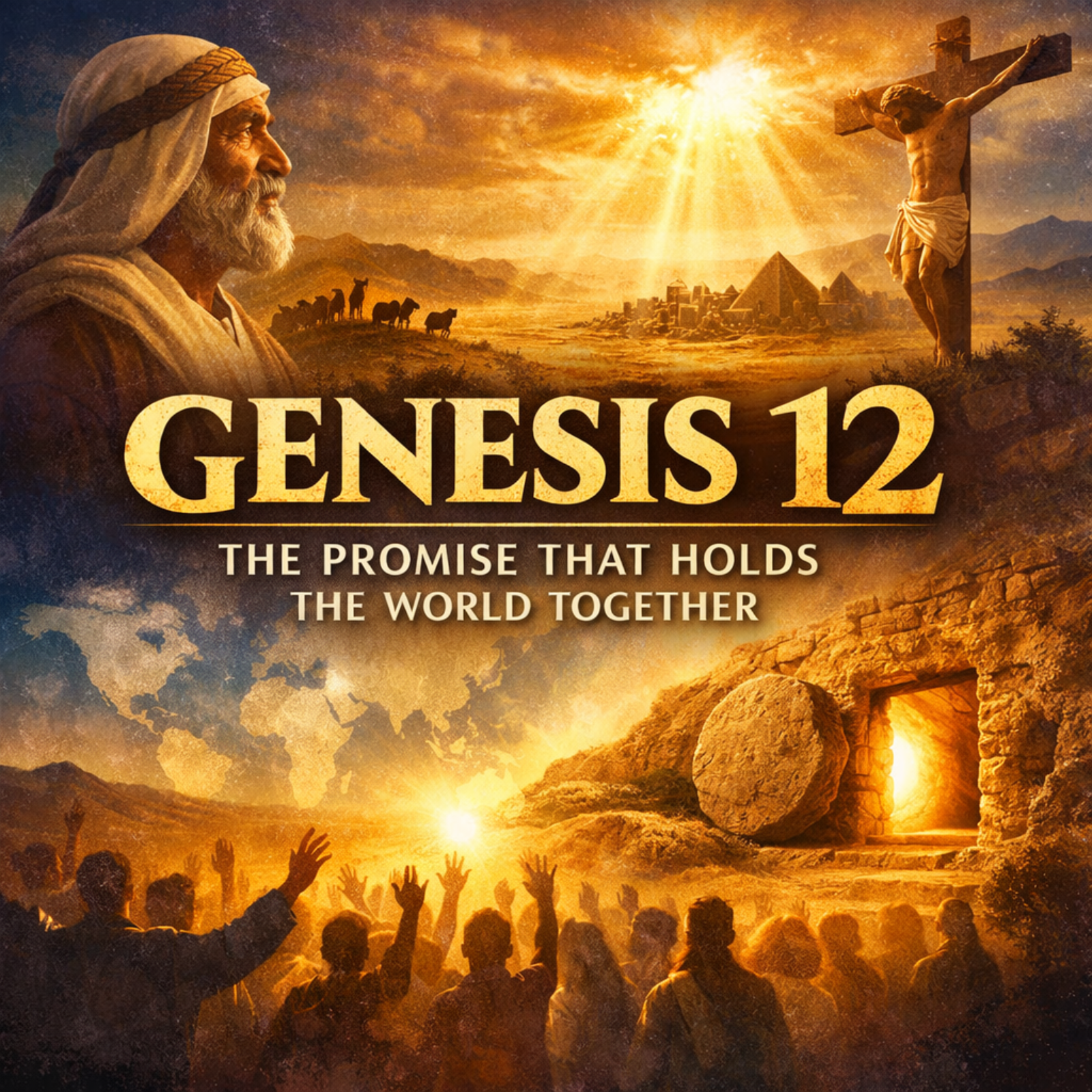
S1 Ep 24Genesis 12: The Promise That Holds the World Together
Genesis 12 marks a turning point in Scripture. After creation, fall, flood, and dispersion, God speaks a promise that will shape all redemptive history.The Call of AbramGod calls Abram to leave his land, people, and father’s house—not with explanations, but with a promise grounded entirely in God’s initiative.Genesis 12:1–3 — God promises land, descendants, blessing, and that “in you all the families of the earth shall be blessed.”This promise is spoken into a fractured world still reeling from the scattering at Babel.Genesis 11:1–9 — Humanity divided by pride, language, and fear.Grace Before ObedienceAbram is not chosen because of merit or strength. Scripture emphasizes God’s “I will,” revealing that the covenant rests on divine faithfulness, not human perfection.Even Abram’s failures later in the chapter do not nullify the promise.Genesis 12:10–20 — Abram’s fear in Egypt (background context).The Promise RepeatedGod reaffirms this blessing to Abram’s descendants, showing continuity across generations.Genesis 26:4 — Promise confirmed to IsaacGenesis 28:14 — Promise extended to JacobThe Prophetic HopeIsrael’s prophets cling to this promise during seasons of collapse and exile, envisioning a future where the nations are restored.Isaiah 2:2–4 — Nations drawn to the LordMicah 5:2 — A ruler coming from BethlehemFulfilled in JesusThe New Testament declares that this ancient promise finds its fulfillment in Christ.Luke 1:31–33 — The angel announces Jesus’ kingshipJohn 8:56 — Jesus says Abraham rejoiced to see His dayGalatians 3:8 — The gospel preached beforehand to AbrahamJesus is the true descendant through whom the blessing reaches the world.Reversing the CurseWhere Adam brought death, Christ brings life. Where Babel scattered the nations, the gospel gathers them.Genesis 3:17–19 — The curse introducedRomans 5:12 — Death through AdamGalatians 3:7 — Those of faith are sons of AbrahamThe Foundation of Our FaithGenesis 12 teaches that faith is not confidence in ourselves, but trust in a God who keeps promises across generations.The covenant spoken to Abram, fulfilled in Christ, continues to bless the world today.
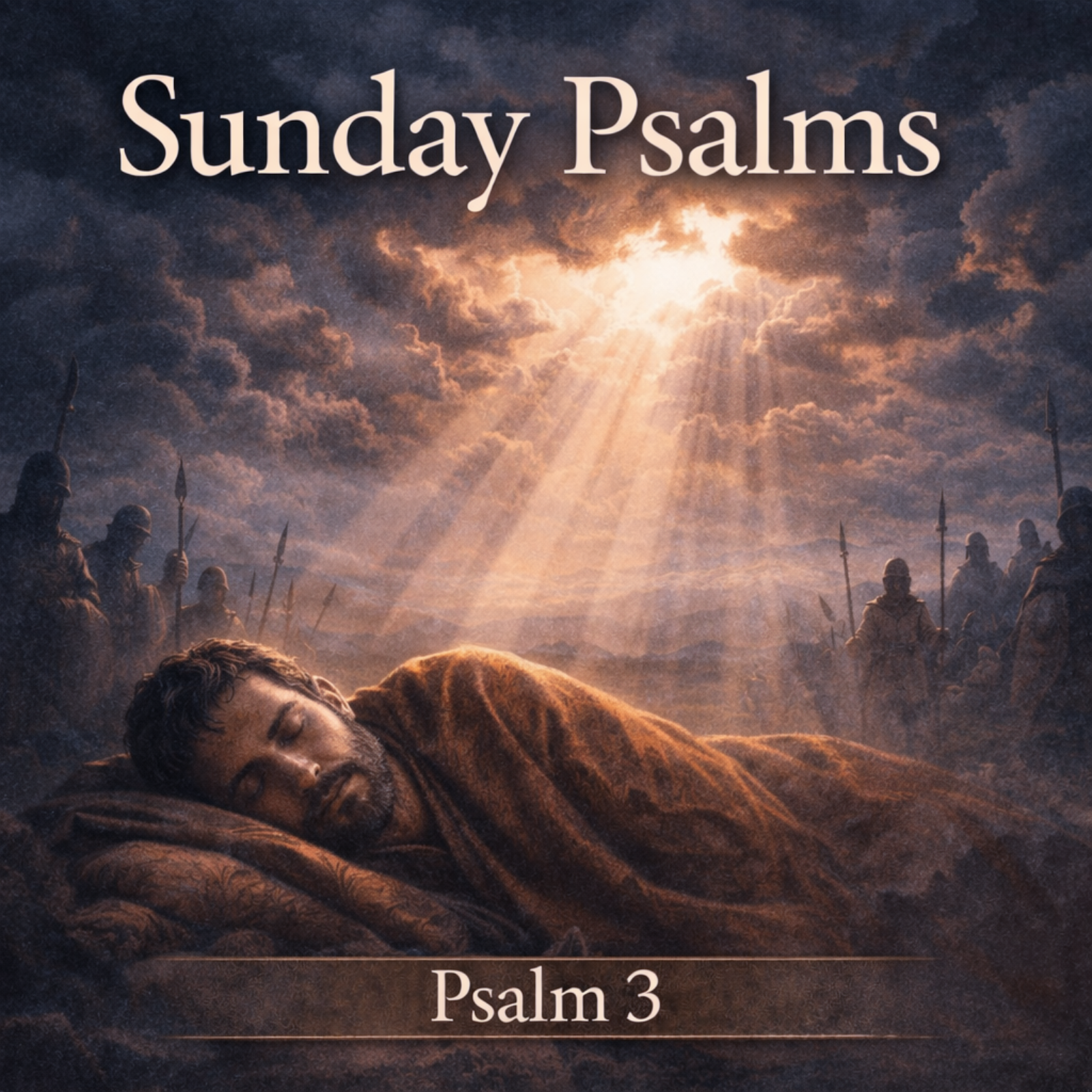
S1 Ep 23Psalm 3: Save Me, O My God
Sunday Psalms is a weekly addition to our daily Scripture reading—a deliberate pause to slow down and linger. While daily readings help us move steadily through God’s Word, Sundays invite us to sit with a single Psalm, allowing it to speak into the real pressures, fears, and questions of our lives.Psalm 3 is the first Psalm in the Psalter that is explicitly set in a moment of crisis. Traditionally attributed to David during his flight from his son Absalom, it is a prayer born out of betrayal, danger, and deep distress. The Psalm opens with brutal honesty: enemies are many, opposition is rising, and voices declare that even God will not save him.This is not polite prayer. It is raw and unfiltered. David names both the external threat and the internal wound—the doubt planted by others that his situation is beyond God’s help. The pause marked by Selah invites us to stop and sit with that weight.Yet Psalm 3 pivots on a powerful word: “But you.” “But you, O Lord, are a shield about me, my glory, and the lifter of my head.” God is described not only as protection, but as the One who restores dignity and hope. To lift the head is to restore a person who has been bowed down by shame or fear.David cries aloud to the Lord—and the Lord answers. The response does not remove the danger immediately, but it restores trust. That trust leads to one of the most striking lines in the Psalm: “I lay down and slept; I woke again, for the Lord sustained me.” Surrounded by threats, David rests. His sleep becomes an act of faith, a declaration that God remains watchful even when he is not.As the Psalm continues, fear gives way to courage. David does not deny the presence of enemies, but he refuses to be ruled by them. His confidence grows, not because the situation has changed, but because his focus has.Psalm 3 ends with a declaration that grounds the entire prayer: “Salvation belongs to the Lord.” Deliverance is not something we manufacture or earn. It is God’s to give. The final blessing—“Your blessing be on your people”—widens the prayer beyond the individual, reminding us that God’s saving work is communal as well as personal.Psalm 3 teaches us that faith does not require calm circumstances. It invites us to bring our fear honestly before God, to trust Him enough to rest, and to believe that even in the night, He sustains us. When we feel surrounded, misunderstood, or overwhelmed, this Psalm reminds us that God is still our shield—and that salvation belongs to Him.
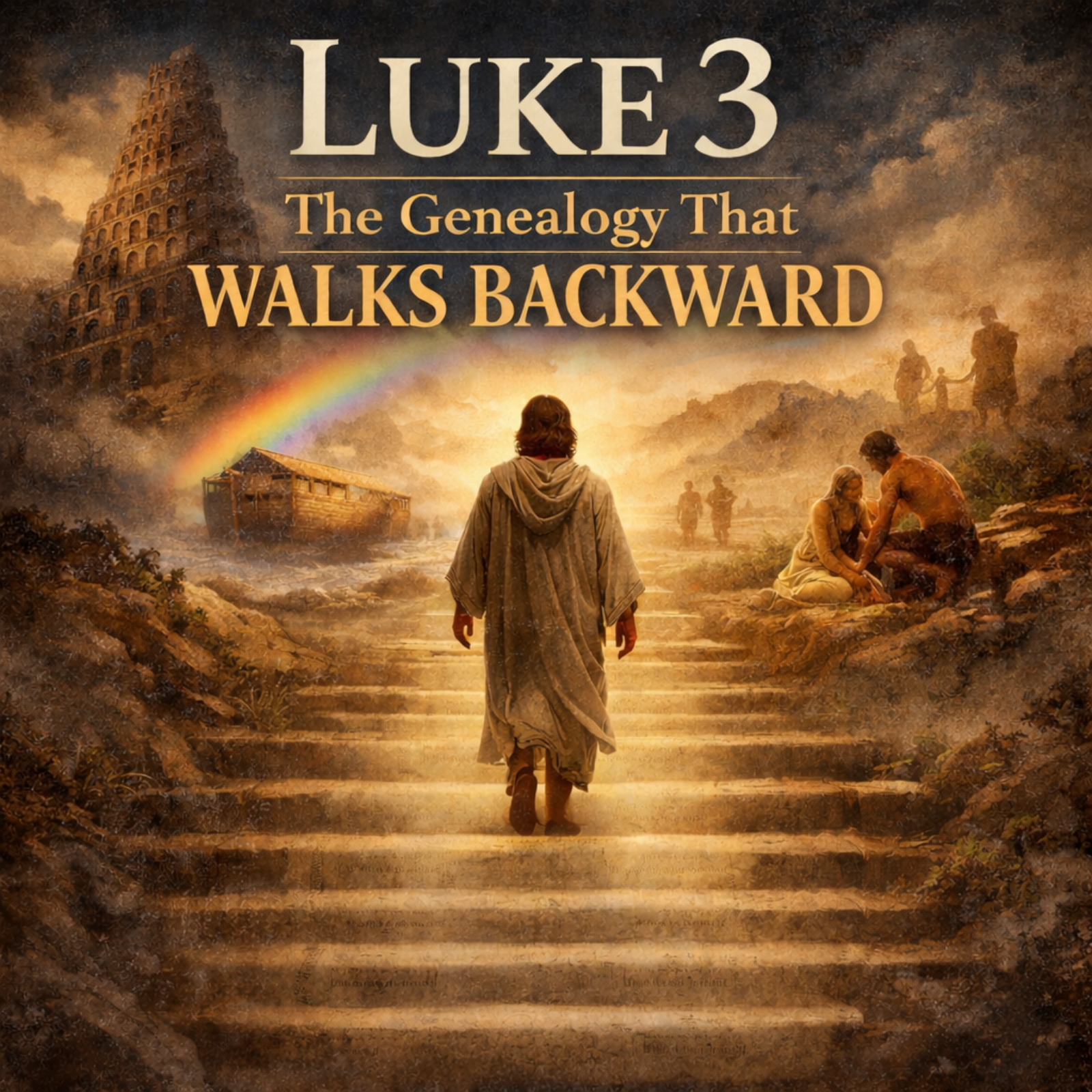
S1 Ep 22Luke 3: The Genealogy That Walks Backward
Luke places the genealogy of Jesus immediately after His baptism, where the Father declares:“You are my beloved Son; with you I am well pleased.” — Luke 3:22Only then does Luke trace Jesus’ lineage—not forward, but backward.Unlike Matthew, who begins with Abraham (Matthew 1:1–17), Luke begins with Jesus and walks back through ordinary men, forgotten names, kings briefly mentioned, and promises quietly carried (Luke 3:23–31).This genealogy is not a climb toward power. It is a descent toward solidarity.Luke continues past David (Luke 3:31), past Abraham (Luke 3:34), past the tower of Babel and the scattering of nations (Genesis 11:1–9), past the flood (Genesis 6–9), and through the long funeral rhythm of Genesis 5 (Genesis 5:1–32).Each repeated phrase—“and he died”—echoes the judgment spoken in Eden:“You shall surely die.” — Genesis 2:17; Genesis 3:19Luke does not stop where Genesis 11 stopped. He goes all the way back:“the son of Enos, the son of Seth, the son of Adam, the son of God.” — Luke 3:38Adam was called the son of God (Genesis 1:26–27). Adam fell (Genesis 3:6–7).Jesus is called the Son of God (Luke 3:22). And He will not fall.This genealogy proclaims that Jesus does not save humanity from above history—but from within it. He steps into the full human line, bearing every fracture introduced by sin.Genesis 11 shows humanity building upward—seeking security, permanence, and a name apart from God (Genesis 11:4). Luke 3 shows God walking downward—entering the family line Himself.Where humanity tried to reach heaven by towers, God comes down through incarnation.This prepares us for what follows: • Jesus will face temptation where Adam failed (Luke 4:1–13). • He will remain faithful where Israel wandered (Deuteronomy 8:2; Luke 4:4). • He will carry humanity’s story forward into redemption.Luke’s genealogy is not a list of names. It is a confession of hope.The Son of God became the Son of Adam so the sons of Adam might become children of God (John 1:12; Romans 5:18–19).No matter how far back the fracture goes, grace goes farther still.
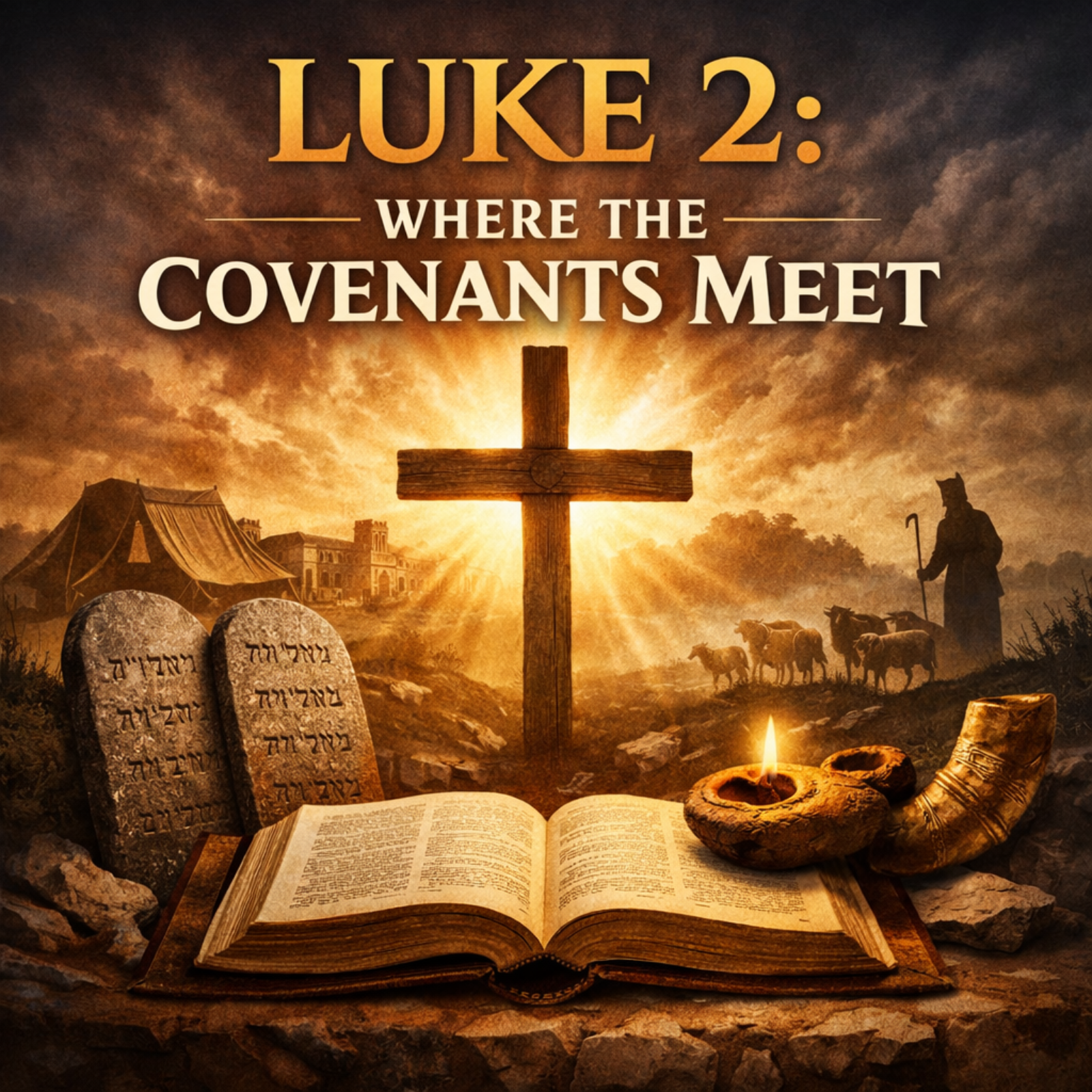
S1 Ep 21Luke 2: Where the Covenants Meet
This episode traces the unified story of Scripture—from Genesis to the cross to the resurrection—and shows how Jesus stands at the meeting place of the old covenants and the new.From the Beginning: Why the Cross Was NecessaryThe story opens in Genesis 2–3, where humanity falls in the garden. Adam, created good, fails to obey God’s command. Sin enters the world, bringing death and separation from God (Genesis 2:16–17; 3:6–19). From that moment forward, the human problem is not ignorance, but rebellion.God’s covenants unfold across Scripture—Abrahamic, Mosaic, Davidic—not because humanity can keep them, but because God is faithful. The Law reveals righteousness but cannot produce it. It exposes sin without curing it.The Law and Its LimitsThe Law is holy and good, yet powerless to make humanity good (Romans 7:12). Scripture is clear about the human condition:“None is righteous, no, not one.” (Romans 3:10)This includes Adam, Abraham, Moses, and David. Even the best men fall short.Jesus: Born Under the LawLuke’s Gospel shows that Jesus enters fully into this broken story. He is born under the Law and fulfills it in every detail (Luke 2:21–24, 39).Paul summarizes this moment:“When the fullness of time had come, God sent forth his Son, born of woman, born under the law, to redeem those who were under the law.” (Galatians 4:4–5)Jesus does not abolish the Law. He fulfills it perfectly:“Do not think that I have come to abolish the Law or the Prophets; I have not come to abolish them but to fulfill them.” (Matthew 5:17)The Only Good ManWhere Adam disobeyed, Jesus obeyed completely. His life is marked by perfect faithfulness—to God, to the Law, and to His calling.Paul contrasts Adam and Christ directly:“By the one man’s disobedience the many were made sinners, so by the one man’s obedience the many will be made righteous.” (Romans 5:19)The cross only saves because the life that led to it was flawless.The Promise to Abraham FulfilledAs we return to Genesis and Abraham, Scripture reframes the promise:“The promises were made to Abraham and to his offspring… who is Christ.” (Galatians 3:16)The blessing of Abraham does not rest on lineage or effort. It is inherited through Christ alone.Cross and Resurrection: The Meeting PlaceAt the cross, the Law’s demands are satisfied. At the resurrection, God declares the sacrifice complete (Luke 24:1–7).The empty tomb is the verdict:Sin is defeatedDeath is undoneThe righteous Son is vindicatedBig IdeaThe birth, life, death, and resurrection of Jesus are one unified act of redemption. This is where Genesis finds its answer, the Law finds its fulfillment, and the covenants meet—not in contradiction, but in Christ.Key Scriptures Referenced: Genesis 2:16–17; Genesis 3:6–19 Luke 2:21–24, 39 Matthew 5:17 Romans 3:10; Romans 5:19; Romans 7:12 Galatians 3:16; Galatians 4:4–5 Luke 24:1–7
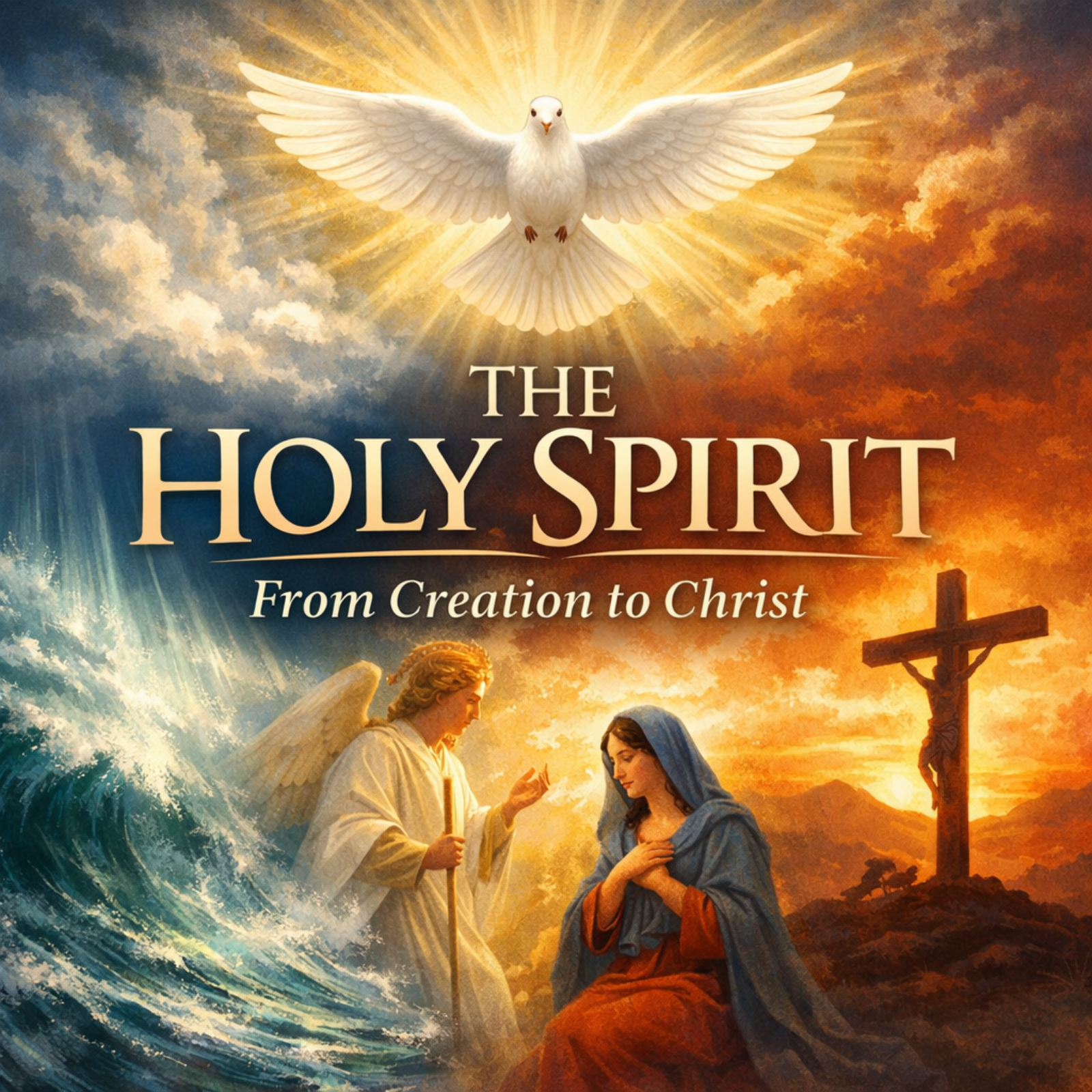
S1 Ep 20Luke 1: The Holy Spirit
The Holy Spirit: From Creation to ChristBig Idea: Luke opens his Gospel by showing that the coming of Jesus is the work of the Holy Spirit—continuing God’s creative, revealing, and redeeming work begun in Genesis.1. The Spirit at the Beginning (Genesis → Luke)Genesis 1:2 – “The Spirit of God was hovering over the face of the waters.” Creation begins with God’s presence before God’s speech.Luke intentionally echoes creation language to show that the birth of Jesus is new creation, not merely a miracle.2. The Spirit Creates Life (Luke 1:35)“The Holy Spirit will come upon you… overshadow you.”Language recalls:Creation (Gen 1:2)God’s glory filling the tabernacle (Exod 40:35)Jesus is called holy not by human achievement but divine action.Pattern established: God acts first; humanity receives in faith.3. The Spirit Reveals and Produces Joy (Luke 1:41–42)Elizabeth is filled with the Holy Spirit before she speaks.The Spirit enables:Recognition of Jesus’ identityUnderstanding beyond sightOverflowing joyJohn leaps in the womb—joy responds to God’s presence, not explanation.The Spirit opens eyes to see God’s work already underway.4. The Spirit Restores Prophetic Speech (Luke 1:67)Zechariah, once silent because of unbelief, is now filled and speaks.His prophecy:Magnifies God, not selfAnchors salvation in God’s covenant promisesThe Spirit restores voice and re-centers the story on God’s faithfulness.Prophecy is not new truth, but old promises made alive.5. A Consistent PatternAcross Luke 1:The Spirit comesPeople respondGod’s purposes advanceCreation → Recognition → Restoration6. Looking Ahead to JesusThe same Spirit will:Descend on Jesus at baptism (Luke 3)Empower His ministry (Luke 4:18)Be promised to His followersJesus later teaches: “It is the Spirit who gives life.” (John 6:63)
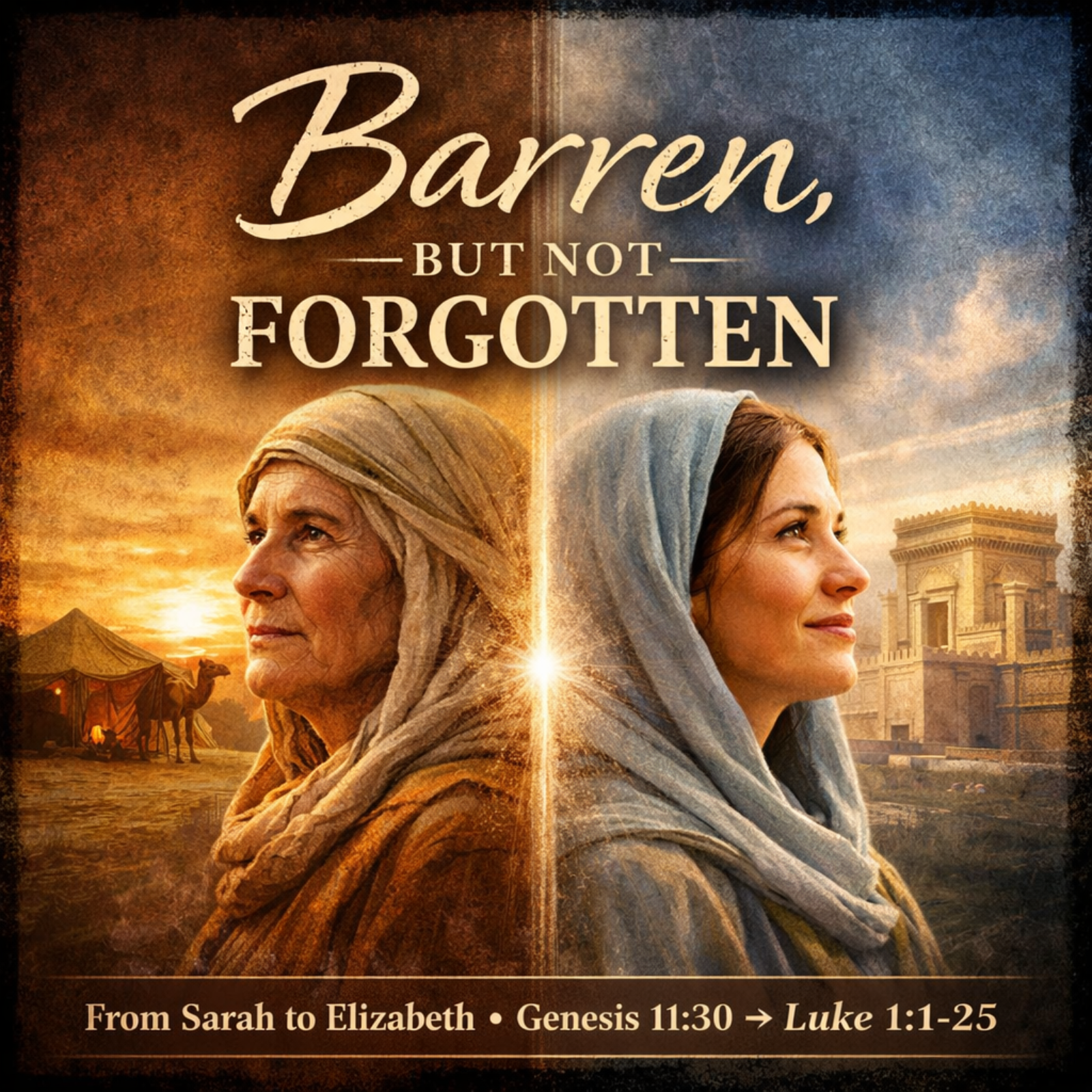
S1 Ep 19Genesis 11 → Luke 1: Barren, But Not Forgotten
Genesis 11 ends quietly—with no resolution, no miracle, only a sentence heavy with tension:“Now Sarai was barren; she had no child.” (Gen. 11:30)After the noise of nations and the collapse of Babel, Scripture narrows its focus. God’s redemptive work does not continue through towers or cities, but through a single family—and through a woman who cannot conceive.In Scripture, barrenness is never merely biological. It is theological. It marks the place where God’s promises appear delayed, even impossible.God has already promised Abraham descendants and blessing. Yet Sarai remains childless for decades. This is not failure—it is foreshadowing. Sarai will conceive. God will bring forth Isaac, the child of promise, from her barren womb. The future of God’s people will move forward not by human strength, but by grace.Luke opens his Gospel by deliberately echoing this moment.“But they had no child, because Elizabeth was barren, and both were advanced in years.” (Luke 1:7)The language is intentional. We have been here before.Elizabeth is not merely like Sarai—she is her descendant. Separated by nearly two thousand years, Elizabeth and her husband Zechariah stand as children of Sarai’s womb. The promise carried through Isaac, Israel, exile, and silence has arrived here, once again, in a barren woman.Just as Sarai carried Isaac, Elizabeth will carry John.John is not the promise itself, but the forerunner—the voice crying in the wilderness, preparing the way of the Lord. His birth signals that God’s long-awaited plan is moving toward fulfillment.Luke also emphasizes silence. Zechariah, a priest meant to speak for God, is struck mute. Between Genesis and Luke lie centuries without prophetic voice. God’s work has not stopped—but it has been quiet.This is how God works.When humanity builds towers to make its own name great, God scatters them. When God builds His kingdom, He begins in places that appear empty, weak, or finished.A barren womb. An aging couple. A waiting world.The goodness of God is not that He avoids barrenness, but that He enters it—and brings life from it. From Sarai to Elizabeth, God proves Himself faithful to promises spoken long ago.If you find yourself in a season of waiting or silence, Scripture offers hope:Barrenness is not the end of the story. It is often where God chooses to begin.
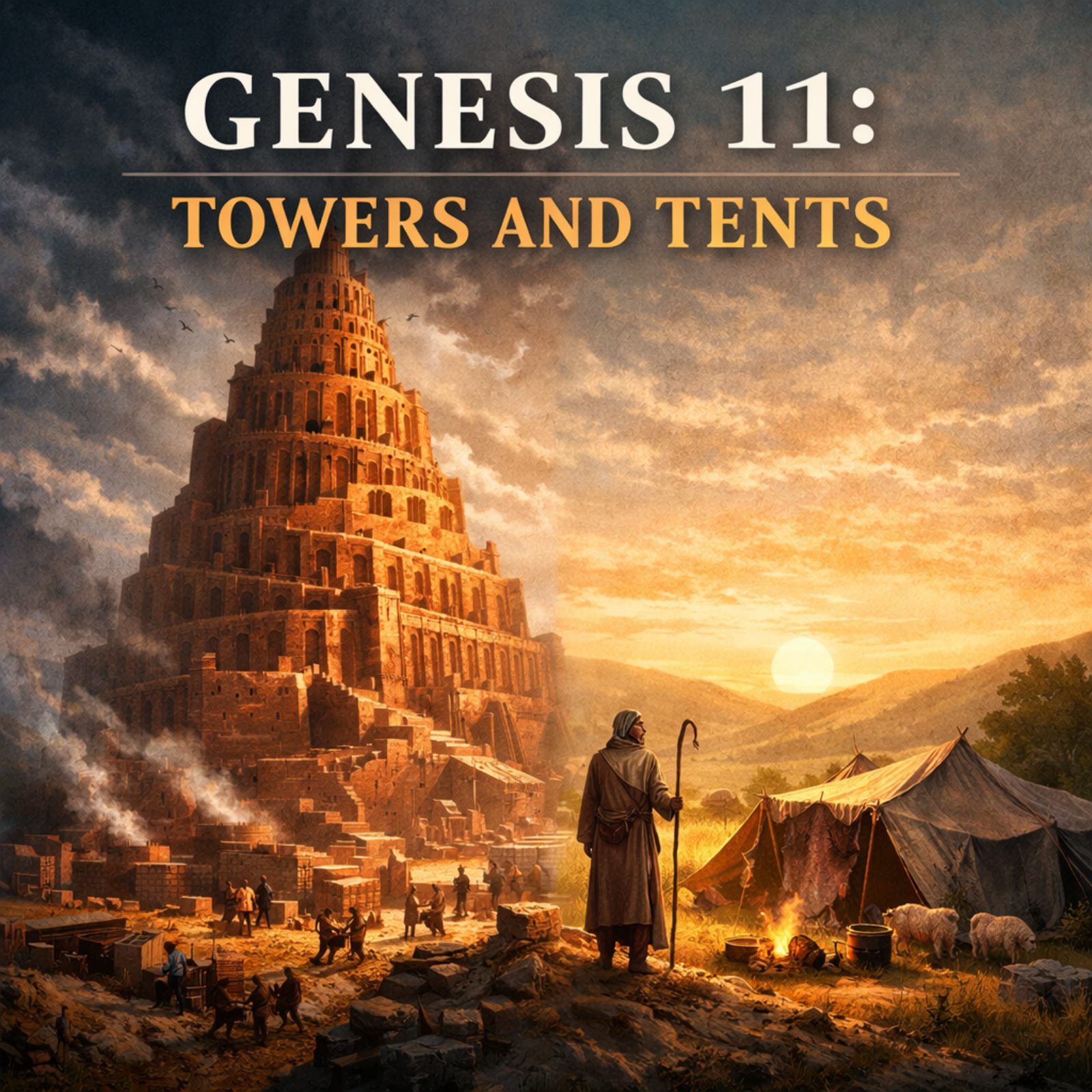
S1 Ep 18Genesis 11: Towers and Tents
Genesis 11 marks a turning point in the biblical story. It looks backward at humanity’s repeated failures and forward toward God’s unfolding plan of redemption.The Tower of Babel: Greatness Without GodAfter the flood, humanity advances quickly. Genesis highlights new technology—bricks fired thoroughly, bitumen for mortar. These are signs of ingenuity, organization, and unity.The problem is not progress. The problem is purpose.The people say:“Let us build for ourselves”“Let us make a name for ourselves”“Lest we be scattered”God had commanded humanity to fill the earth. Babel represents humanity refusing to trust God’s word and instead seeking security, permanence, and greatness on its own terms.This echoes the pre-flood world: power growing faster than goodness, unity detached from obedience. The tower is not about height, but about control.God’s Intervention: Mercy Through RestraintWhen God says that “nothing they propose will now be impossible,” it is not praise. It is discernment. As before the flood, unchecked human ambition would lead to destruction.God scatters the people by confusing language—not to destroy humanity, but to restrain pride. In Genesis, judgment often appears as interruption rather than annihilation.From Scattering to PromiseImmediately after Babel, the story narrows:“These are the generations of Shem…”While nations spread outward, God’s redemptive work moves inward—through a single family line. The genealogy leads quietly but deliberately to one name: Abram.This creates a powerful contrast:Babel builds towers, cities, and monumentsAbram will dwell in tents, owning no land, trusting promisesAt Babel, humans seek to make their own name. With Abram, God promises, “I will make your name great.”Towers represent fear of being scattered. Tents represent faith in a God who leads.A Pattern That RepeatsThroughout Scripture, empires rise through towers and monuments—Egypt, Babylon, Rome. Yet God consistently works through the humble: shepherds, slaves, families, and children.God’s kingdom does not advance through human self-exaltation, but through obedience and trust.Setting the Stage for LukeBefore continuing to Genesis 12, this series pauses to move forward in time—to Luke chapters 1–3. There, another genealogy is given, tracing Jesus not only to Abraham, but to Adam.At Babel, God came down to confuse language. In Christ, God comes down to dwell among us.The scattering of Babel finds its answer in the gathering power of the gospel.After exploring Luke 1–3 and the genealogy of Jesus, the story will return to Genesis 12—where God calls Abram out of the city and into a life of faith.The choice between towers and tents is not ancient history. It remains a living question for every generation.
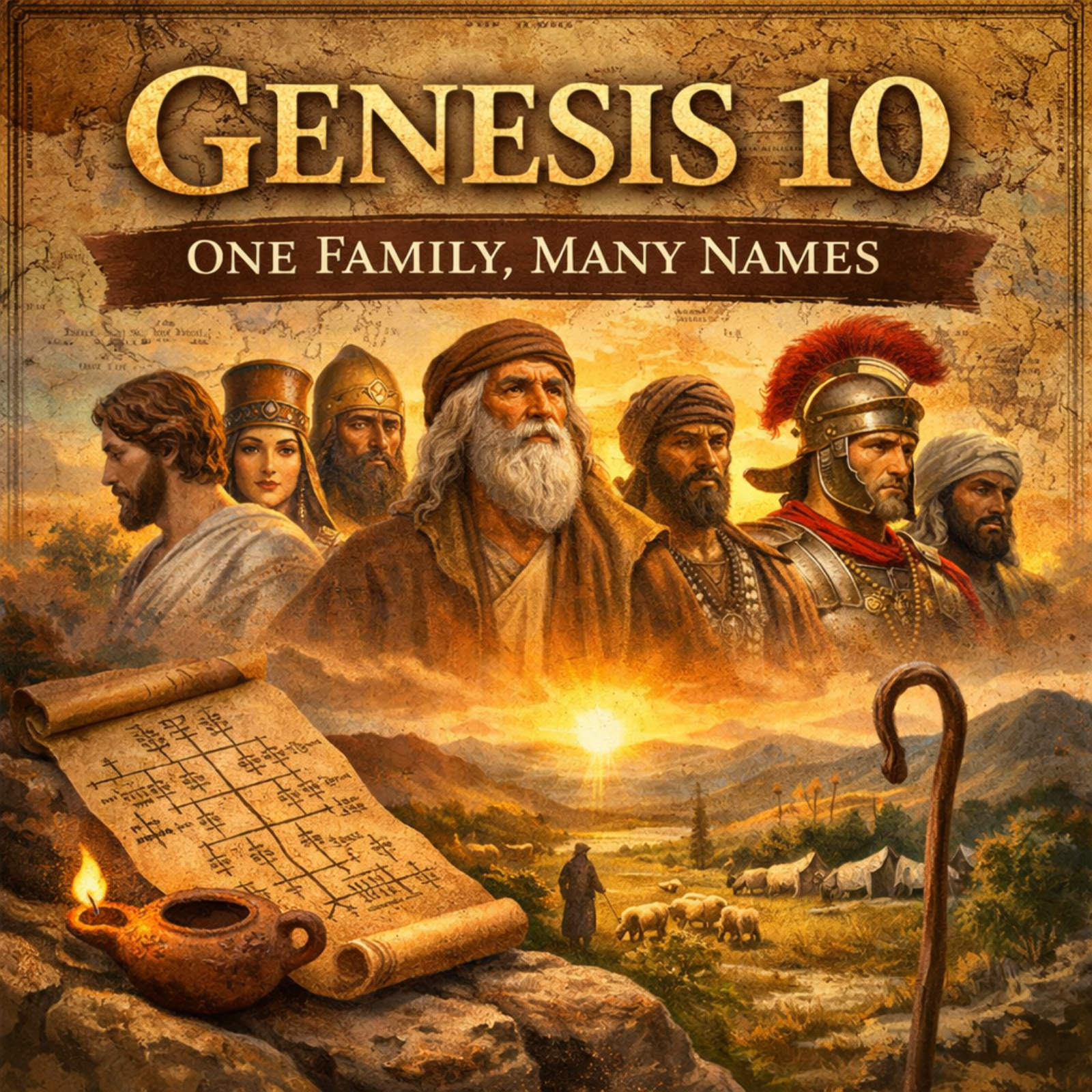
S1 Ep 17Genesis 10: One Family, Many Names
Genesis 10 is often overlooked—a long list of unfamiliar names that feels easy to skip. But this chapter quietly lays one of the most important foundations in the entire Bible.Known as The Table of Nations, Genesis 10 traces the descendants of Noah’s three sons—Shem, Ham, and Japheth—and shows how the nations of the world spread after the Flood.“From these the nations spread abroad on the earth after the flood.” (Genesis 10:32)This chapter makes a bold and deeply biblical claim: every people group in the biblical story belongs to the same human family.Abraham does not appear from nowhere. Neither do the Egyptians, the Canaanites, the Assyrians, the Greeks, or the Romans. Even the Roman centurion standing at the foot of the cross is part of this same family line.Genesis 10 is not a science textbook. It does not attempt to map DNA, migration routes, or population genetics. Instead, it offers the poetry of names—a theological family history that answers a different question:Who are we to one another?The answer Scripture gives is simple and unsettling: We are kin.Modern science, through different methods and language, also points to common human descent. But Genesis is not trying to compete with science. It is establishing meaning, not mechanism—unity, not data.This shared ancestry explains why Jesus’ teachings consistently cross ethnic and national boundaries. Why the Good Samaritan is the hero of His story. Why Jesus speaks of “other sheep not of this fold.” Why the gospel is sent to all nations.Genesis 10 dismantles every myth of racial superiority, tribal isolation, and spiritual hierarchy based on birth or nation. Before covenant, law, or kingdom, there was family.In the garden—and in the world—this matters.The soil does not ask where a seed came from. Rain does not favor one field over another. Creation itself reflects the truth Genesis 10 declares: humanity was meant to live, work, and steward the earth together.This episode invites listeners to slow down, look again at the names, and remember: They are not strangers. They are cousins.And the story of Scripture—from Noah to Abraham, from Israel to Rome, from the cross to the nations—is the story of God calling one divided family back together.
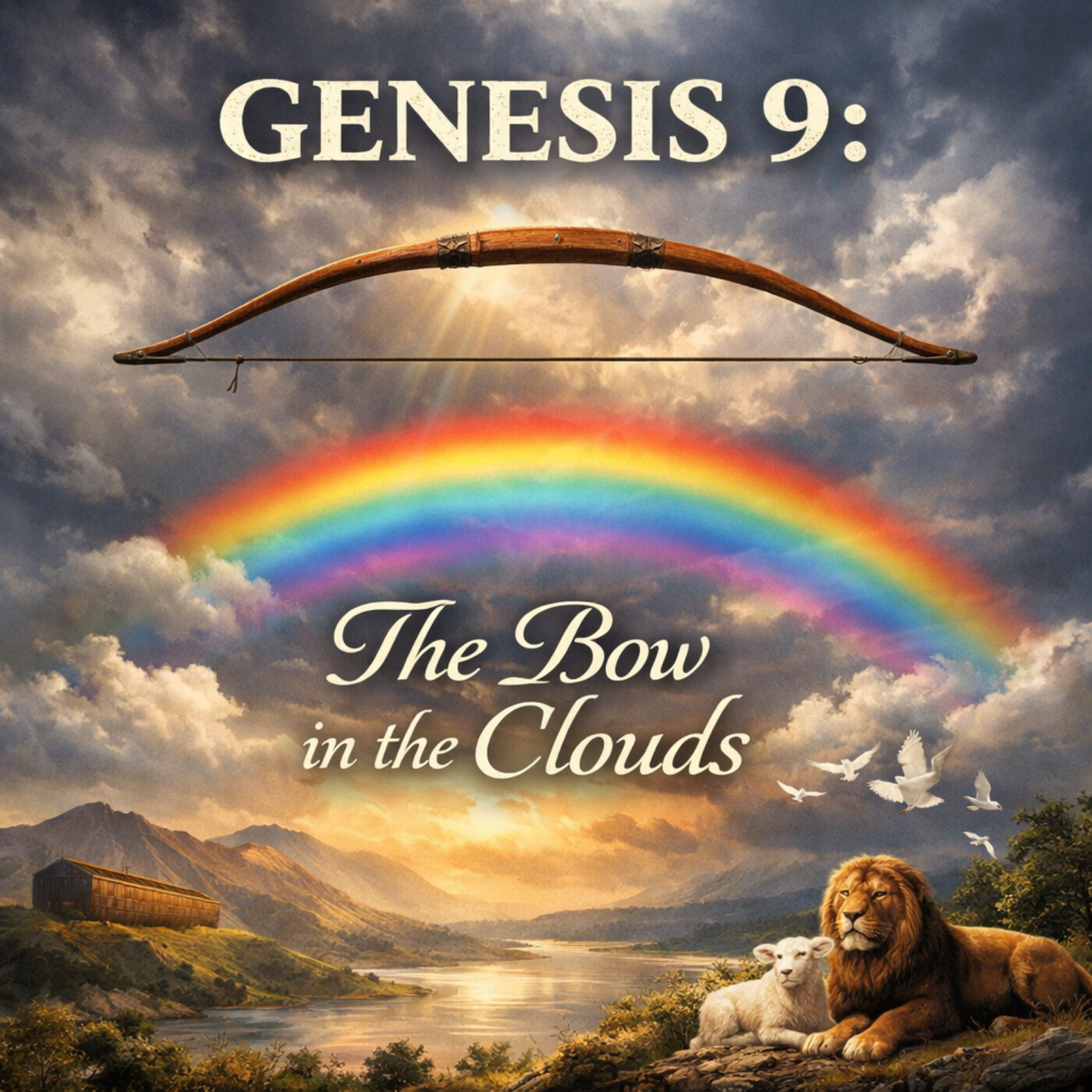
S1 Ep 16Genesis 9: The Bow in the Clouds
Genesis 9 invites us to wrestle with a familiar tension: our desire to understand how versus God’s insistence on showing us what it means.After the Flood, God establishes a covenant—not only with Noah and his descendants, but with every living creature and even the earth itself. This covenant is unconditional: never again will all flesh be destroyed by floodwaters.The sign of this covenant is the rainbow.Scripture does not explain how the rainbow works, whether it existed before the Flood, or whether the atmosphere changed. Those questions—interesting as they may be—are not answered because theology does not depend on the answer.In Genesis 9:13, God says, “I have set my bow in the cloud.” The Hebrew word for “bow” (qeshet) is the word for a weapon of war. This is not decorative imagery. The bow is hung up, unstrung, no longer aimed at the earth. The sign is not primarily for human reassurance—God says it is a reminder for Himself of His covenant restraint.Throughout Scripture, God repeatedly teaches us that meaning outweighs mechanism:• Where Cain’s wife came from does not change the story. • How tall the giants were in the Promised Land does not change the story. • Whether the rainbow existed before Genesis 9 does not change the story. • The unanswered technical questions surrounding the Flood do not change the story.What matters is trust.When the spies said, “We seemed to ourselves like grasshoppers,” their failure was not faulty measurement—it was fear instead of faith.Jesus teaches the same principle. When pressed for explanations, He redirects us toward meaning:• “Do not worry about tomorrow.” (Matthew 6:34) • “Unless you repent, you will all likewise perish.” (Luke 13:3) • “The wind blows where it wishes…” (John 3:8) • “As were the days of Noah…” (Matthew 24:37)Jesus affirms the story without explaining the science. Because obedience, trust, and repentance do not depend on technical certainty.Genesis 9 tells us that judgment is real—but so is mercy. The Flood reveals God’s seriousness about sin. The rainbow reveals God’s commitment to restraint.The bow remains in the clouds, unfired.Meaning—not mechanism.And that is enough.
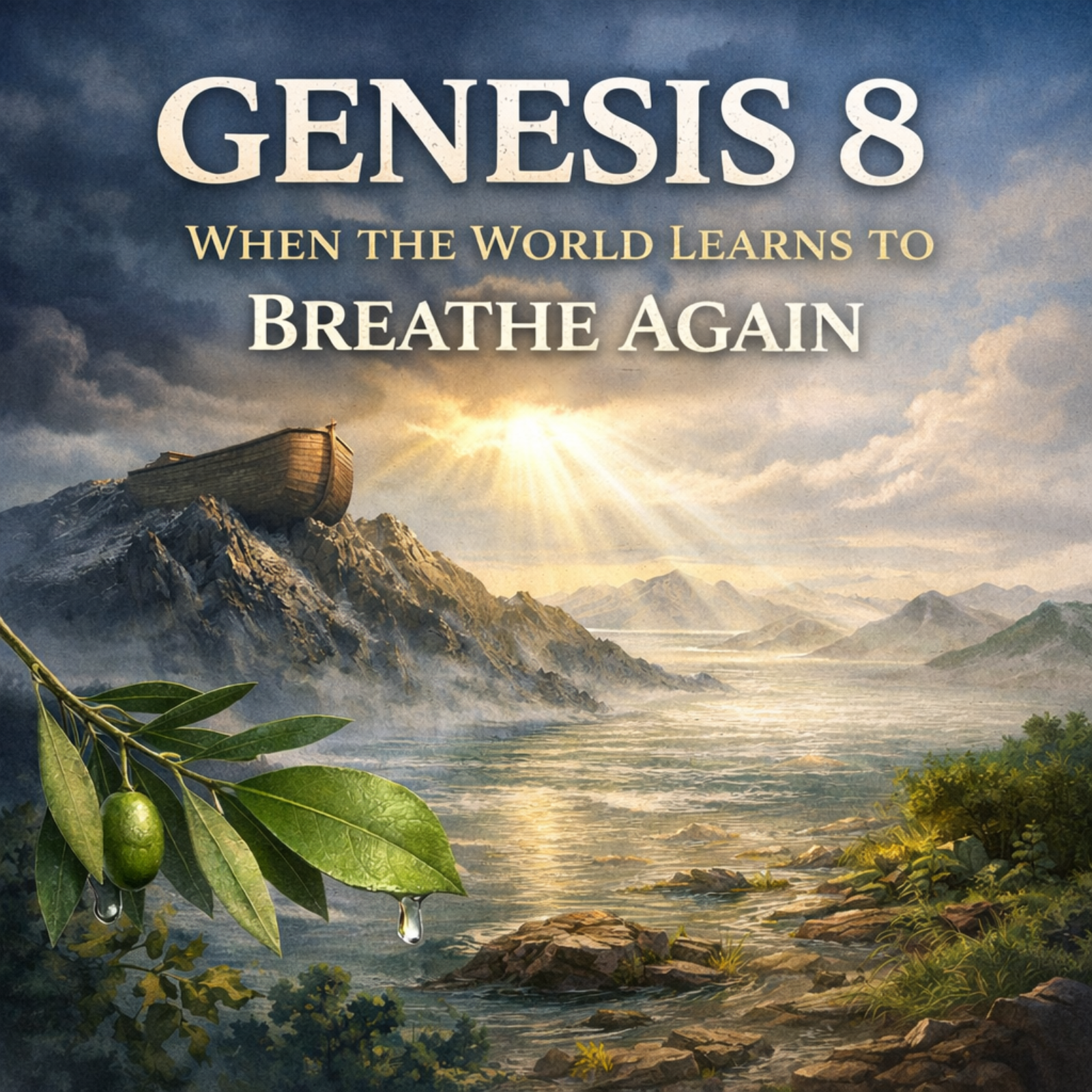
S1 Ep 14Genesis 8: When the World Learns to Breathe Again
Genesis 8 is not the moment the Flood ends. It is the long, quiet chapter where the world learns how to exist again.The storm has already passed. The rain has stopped. But everything is still underwater.Genesis 8 opens with one of the most hopeful and understated lines in Scripture:“But God remembered Noah.”This does not mean God had forgotten. It means God now acts—deliberately, faithfully, personally.What follows is not spectacle, but process.The Science of Receding WatersThe text says the waters “receded continually.” Not suddenly. Not magically. Continually.Genesis describes a world where:Rain stops fallingSubsurface sources are closedWater redistributes across the earthThis is not vanishing water—it is draining water.The ark comes to rest on the mountains of Ararat, likely on submerged high ground. It stops drifting before mountaintops are visible. For months afterward, Noah waits.Scientifically, this fits:High plateaus emerge before plainsUplands slow moving waterDrainage systems take time to stabilizeGenesis does not rush the recovery. Neither does the earth.The Poetry of WaitingGenesis 8 is filled with time markers: Days. Months. Seasons.This is not filler—it is poetry shaped like patience.Noah sends out birds—not once, but repeatedly. The raven goes. The dove returns. Seven days pass. Again. And again.When the dove finally returns with a freshly plucked olive leaf, it is not proof the world is ready.It is proof that life has begun again.An olive leaf is fragile. It does not grow in chaos or rushing water. It grows where soil is stabilizing and roots are alive.Life returns not with thunder— but with a leaf.The World Is Still DangerousEven when dry ground appears, Noah does not leave the ark.This detail matters.The door that saved him is not his to open.Genesis teaches us: Salvation and restoration are not the same moment.The storm can be over and the world still unsafe. Visibility does not mean readiness. Healing takes time.So Noah waits—until God speaks again.The Promise Spoken Over the EarthWhen Noah offers sacrifice, the tone shifts.God speaks “in His heart.”He acknowledges humanity has not changed: “The intention of man’s heart is evil from his youth.”What changes is not human nature— it is divine restraint.Then comes the promise:“While the earth remains, seedtime and harvest, cold and heat, summer and winter, day and night shall not cease.”This is not a denial of disaster. It is a guarantee of order.Not perfection— but predictability.Science, Poetry, and Promise TogetherGenesis 8 does not diagram hydrology or climate systems.It does something deeper.It declares:Creation is governed, not randomJudgment is restrained, not endlessLife will be given timeScience studies how the cycles work. Genesis promises that they will.And without that promise, science itself would be impossible.A Quiet EndingGenesis 8 ends not with celebration, but stability.Noah steps into a world that is wounded but breathing. Ordered but fragile. Promised, but not yet redeemed.The flood was not the end of the story. It was the end of unrestrained judgment.From this point forward: Seeds will sprout. Seasons will return. Day will follow night.Not because humanity deserves it— but because God has chosen mercy.
S1 Ep 15Psalm 2: Who Really Rules the World?
Sunday Psalms is a weekly addition to our daily Scripture reading—a chance to slow down and linger. While daily readings help us move steadily through God’s Word, Sundays invite us to sit with a single Psalm, to meditate, and to allow Scripture to shape our hearts in the midst of the world as it is right now.Psalm 2 follows directly after Psalm 1 and widens the lens. If Psalm 1 asks what kind of life leads to blessing, Psalm 2 asks a larger and more unsettling question: Who truly rules the world?The Psalm opens with a scene that feels strikingly familiar. Nations rage. Peoples plot. Kings and rulers gather power and counsel together, resisting God’s authority and describing His boundaries as bondage. “Let us burst their bonds apart and cast away their cords from us.” The desire to rule ourselves—to define good and evil on our own terms—is not new. It is ancient.Psalm 2 offers a sharp contrast to this frantic striving. While earthly powers scheme and posture, God sits enthroned in heaven. He is not anxious. He is not threatened. He laughs—not because injustice is amusing, but because human power is never ultimate. History is not spinning out of control.At the heart of the Psalm is God’s declaration: “I have set my King on Zion, my holy hill.” For Christians, this points forward to Jesus—the Anointed Son. His kingship does not come through political maneuvering or violent force, but through God’s decree. He is given the nations, not because He demands them, but because the Father appoints Him.Psalm 2 carries both warning and invitation. Earthly rulers are called to wisdom, humility, and reverent fear—to recognize the limits of their authority. Yet the Psalm’s final word is not destruction, but refuge: “Blessed are all who take refuge in Him.”In a world marked by political outrage, fear, and division, Psalm 2 calls God’s people to a different posture. Not rage. Not despair. Not blind allegiance to any earthly power. Instead, reverent trust in the One who truly reigns.As the noise of the week rises and voices compete for loyalty, Psalm 2 reminds us of this steady truth: Christ is not campaigning. He is reigning. And those who take refuge in Him are truly blessed.
S1 Ep 13Genesis 7: The World Unmade
Genesis 7 is not written like a disaster report. It is written like an undoing.The language deliberately echoes Genesis 1—but in reverse. Creation is not merely judged; it is unmade. The ordered world is returned to chaos, not because God has lost control, but because humanity has severed itself from the order that gives life.1. The Language of UnmakingIn Genesis 1, God brings order by separating:Light from darknessWaters above from waters belowSea from landIn Genesis 7, those boundaries collapse.“All the fountains of the great deep burst forth, and the windows of the heavens were opened.” (Gen 7:11)The same waters God once restrained now return. This is not random violence—it is the reversal of creation itself. The Hebrew imagination sees chaos as unbounded water. To remove boundaries is to remove life.The flood is not primarily about rain. It is about everything breaking loose.2. Death as a Form of TruthGenesis is brutally honest:Life that breathes dies.Humanity’s violence does not endure.Creation itself groans under the weight of human corruption.The text does not flinch. Extinction happens. Landscapes change. What once was familiar is gone.And yet, the point is not destruction for its own sake. The flood reveals a hard truth: a world severed from God’s ways cannot sustain itself.3. Noah and the Ark: Order Preserved in ChaosAmid unmaking, God preserves a seed of order.The ark is not a boat of escape—it is a floating sanctuary. Inside:PairsKindsOrdered lifeMeasured spaceWhile the world outside dissolves into chaos, inside the ark creation is held together by obedience and trust.God does not abandon the world. He carries it through death.4. Baptism Before ResurrectionLater Scripture will name what Genesis 7 only shows.Peter will call the flood a form of baptism. Paul will describe baptism as death before resurrection. Jesus will step into the Jordan, not because He needs cleansing, but because the world does.Genesis 7 is the earth’s baptism:Death comes first.Silence follows.Waiting stretches on.But baptism is never the end of the story.5. Not Just Then — But NowThis is not merely an ancient flood story echoed in other cultures. Genesis insists something deeper happened:Humanity lost a world.God preserved a future.Creation passed through death toward renewal.Every generation lives somewhere between chaos and covenant.Genesis 7 asks us: What boundaries have we broken? What chaos have we normalized? And are we willing to pass through death—of pride, violence, illusion—to receive new life?Because Scripture’s pattern is consistent: God does not abandon His creation. He remakes it.Closing Reflection: The world was unmade—but not unloved. And the God who closed the ark will one day open the door again.
S1 Ep 12Genesis 6 — Greatness Without Goodness
Genesis 6 is one of the most unsettling chapters in Scripture—not because it is confusing, but because it is clear. Humanity has grown great, but not good.The chapter opens with expansion: people multiplying, cities rising, culture advancing. This is the fulfillment of Genesis 1’s command to “be fruitful and multiply.” But something has gone wrong. Growth has outpaced faithfulness. Power has outpaced wisdom.We meet the Nephilim—figures wrapped in mystery, remembered as “mighty men of old, men of renown.” Scripture does not linger on their biology or origin. Instead, it tells us what mattered: reputation, strength, greatness. These were heroes in the eyes of the world—and yet the chapter immediately pivots to God’s grief.“The LORD saw that the wickedness of man was great in the earth…”Greatness is repeated. So is wickedness.This is the central tension of Genesis 6: humanity achieves greatness without goodness.Cities grow. Technology advances. Lineages strengthen. But hearts decay. Genesis tells us that every intention of the thoughts of man’s heart was only evil continually. Not ignorance. Not weakness. Intention.This corruption is not random—it follows a trajectory. The descendants of Cain built cities apart from God, cultures defined by human achievement rather than divine dependence. Violence escalated. Pride hardened. Humanity no longer walked with God, but away from Him—together.God’s response is not rage, but sorrow.“And the LORD regretted that He had made man on the earth, and it grieved Him to His heart.”This is not divine surprise. It is divine heartbreak.From a poetic and historical lens, Genesis 6 reads like an ancient warning etched into memory: civilizations can flourish outwardly while rotting inwardly. From a scientific perspective, unchecked power without moral constraint always leads toward collapse—environmental, social, and spiritual.Genesis 6 is not about monsters. It is about misaligned humanity.And then—quietly—we meet Noah.No speeches. No heroics. Just this:“Noah walked with God.”In a world obsessed with renown, Noah is remembered for relationship. While humanity pursued greatness, Noah pursued goodness. While culture accelerated, Noah slowed his steps to match God’s.Genesis 6 reminds us that judgment is not God’s first move—mercy is. God warns. God waits. God preserves a remnant. Even the flood, terrible as it is, comes only after patience is exhausted.This chapter invites us to ask uncomfortable questions: Where have we mistaken progress for righteousness? Where have we celebrated power without character? Where have we built cities—and lives—without God?Genesis 6 stands as a mirror. And it whispers the same truth today:Greatness without goodness always ends in grief. But walking with God still preserves life.
S1 Ep 11Genesis 5: A Poem Written in Years
Welcome back to In The Garden. Today, we step into the genealogy of Genesis 5—a chapter that, at first glance, reads like a long list of names and numbers. But if we pause and lean into it as poetry, the chapter transforms. It’s not just history; it’s a carefully crafted meditation on life, legacy, and the faithful unfolding of God’s creation.Genesis 5 traces the line from Adam to Noah, giving each man a name, an age at the birth of his son, and the age at which he dies. These aren’t just data points. In Hebrew, names carry meaning. Adam, the earthling, gives birth to Seth, “appointed,” a replacement, a promise continued. Enosh, meaning “mortal,” reminds us of humanity’s fragile state. Kenan, “possession,” marks inheritance. Mahalalel, “praise of God,” speaks of worship threaded into life. Jared, “descent,” hints at the downward arc of humanity, yet still pointing forward. Enoch, “dedicated,” stands out—not for his years but for walking with God. Methuselah, “his death shall bring,” holds the tension of mortality and hope. Lamech, “powerful,” anticipates Noah, “rest” or “comfort,” the deliverer in God’s design.Now, let’s talk about the numbers. Ages like 930 for Adam, 969 for Methuselah, and 600 for Noah are staggering. Are they literal? Perhaps. But in the poetry of Genesis, the literal is secondary. The structure of these years is rhythmic, accentuating the names and their meanings. Each age functions like a beat in a song, a stress in a line of verse, echoing the continuity of life from Adam to Noah.Poetically, the genealogy invites us to reflect on two themes: the persistence of life and the transmission of God’s promises across generations. These men may have lived centuries, but more importantly, their lives are part of a poetic cadence—a chain of being, each name a note in God’s unfolding story. The rhythm of years marks not just the passage of time but the continuity of God’s faithfulness.We can also notice that some of Noah’s ancestors were still alive when he was born. Adam, Seth, Enosh, Kenan, and others overlapped, showing a living network, a community of generations, not a simple line. This layering reinforces the poetic quality: life stretches, overlaps, and echoes through time, each life enriching the next.As you read Genesis 5, let it wash over you like a hymn. Let the meanings of the names linger on your tongue. Let the long years of life be the music of the poem. And remember, whether literal or symbolic, the chapter celebrates God’s providence: life continues, God’s promises persist, and ultimately, Noah emerges as the rest in a world preparing for renewal.In the garden of Genesis, even numbers are sacred. Even lifespans speak. Even names sing. Genesis 5 reminds us that God’s story is woven across generations, and poetry, not just chronology, helps us hear it.
S1 Ep 10Genesis 4: Soil That Remembers
Genesis chapter 4 is often read as a story about sibling rivalry, jealousy, and violence. But read carefully—and patiently—it also tells a deeper agrarian story: how humanity’s relationship with the soil, with one another, and with God begins to fracture outside the garden.After Eden, work enters the world as necessity rather than delight. Two brothers are born. Cain works the ground. Abel keeps flocks. These are not just occupations; they represent two ways of relating to creation. Abel’s work depends on living systems—life reproducing life. Cain’s work requires breaking the soil, forcing productivity, and extracting yield.Both bring offerings. Abel brings the firstborn of his flock—life offered back to the Giver of life. Cain brings fruit of the ground, but Scripture does not call it firstfruits. God’s concern is not profession, but posture. Worship rooted in gratitude contrasts with worship rooted in effort and comparison.Before violence ever occurs, God warns Cain: “Sin is crouching at the door… but you must rule over it.” The language is agricultural—like a predator hidden in tall grass, waiting at the edge of the field. Cain ignores the warning.When Cain kills Abel, the earth itself responds. “Your brother’s blood cries out to me from the ground.” This is poetic language, but it reveals a theological truth: creation absorbs violence. The soil remembers what is done upon it.Then comes the key verse: “When you work the ground, it shall no longer yield to you its strength.” This is not merely punishment—it is revelation. Soil that is overworked loses fertility. It must be constantly amended just to remain productive. Genesis names this reality thousands of years before modern agricultural science.Cain becomes a wanderer. In response to failing soil and instability, he builds the first city. Cities arise as buffers against scarcity, against dependence on God, and against the limits of the land. As civilization advances through Cain’s lineage, so do tools, technology, and violence.Throughout Scripture, God continues to speak in agrarian language—fields, flocks, vines, seed, soil. Jesus teaches almost exclusively this way. He calls Himself the true vine, the good shepherd, the sower of seed. Where Cain sheds his brother’s blood into the ground, Christ pours out His own blood to redeem it.The Bible does not end in a return to Eden alone, but in a garden city—the New Jerusalem. A city not built by human striving, but prepared by God. A place where the ground yields freely, where trees bear fruit each month, where there is no hunger, no violence, and no want.Genesis 4 teaches us that how we treat the land cannot be separated from how we treat one another—or how we worship God. The soil remembers blood, but it also responds to faithfulness. From Cain’s field to Abel’s flock, from Babel to the New Jerusalem, Scripture traces a single truth: when humans try to control life, life breaks. But when life is received as gift and returned with gratitude, the garden grows again.
S1 Ep 9Genesis 3: Death, Exile, and the Mercy We Misread
In The Garden — Episode NotesIn Genesis 3, God’s word is fulfilled immediately—but not in the way we often expect.When Adam and Eve eat from the tree of the knowledge of good and evil, they do not collapse physically. Their hearts keep beating. Their lungs keep breathing. Yet something essential dies that very day: their unbroken relationship with their Creator.This is the Bible’s first definition of death—not the end of existence, but the rupture of communion. Shame enters where innocence once lived. Fear replaces trust. Humanity hides from the God who had never condemned their nakedness.The fig leaves they sew mark the birth of human religion: fragile attempts to cover shame on our own terms. Yet God responds not with exposure, but with provision. He clothes them Himself. Before repentance is spoken, before understanding is complete, God covers His children. From the very beginning, grace precedes comprehension.Then come the words often called “the curses.” But these are not spells hurled in anger. They are descriptions of life once harmony is broken. The ground resists. Work becomes toil. Relationships strain. Dust remembers what we are. God does not invent cruelty—He names reality in a world separated from trust.Finally comes the most misunderstood moment of all: exile from the garden.God prevents humanity from eating from the Tree of Life—not to punish, but to protect. To live forever in a state of shame, fear, and separation would not be life at all. Exile becomes mercy. Death becomes a limit placed on brokenness so corruption does not become eternal.This moment establishes a design pattern echoed throughout Scripture. Cain is exiled but marked for protection. The flood cleanses but preserves a remnant. Babel scatters to prevent false immortality. Israel is sent into exile but not abandoned. Again and again, God saves by removing, heals by limiting, and preserves hope by refusing permanence to what is broken.At the center of the story, God Himself enters exile. Jesus is rejected, pushed outside the city, and lifted onto a cross—experiencing separation so separation can one day end. And in His words, the story turns toward home: “I go to prepare a place for you.”Genesis 3 is not the story of God giving up on humanity. It is the story of God refusing to let brokenness last forever.Exile was mercy. Death was delayed hope. And the garden was always meant to be found again.
S1 Ep 8Genesis 3: The Fruit We Were Never Meant to Edit
Genesis 3 — “The Fruit We Were Never Meant to Edit”Genesis 3:1–7Genesis 3 marks a turning point in the biblical story—not because humanity suddenly encounters evil, but because humanity decides to define good and evil apart from God.The tree in the garden is called the tree of the knowledge of good and evil. Whether its fruit was literal, symbolic, or both, Scripture makes clear that the issue was not hunger or curiosity—it was authority. Who gets to say what is good? Who gets to say what is evil?God had already spoken clearly:“You may surely eat of every tree of the garden, but of the tree of the knowledge of good and evil you shall not eat.”The command was simple, generous, and sufficient. Yet when the command is later repeated, something subtle changes:“Neither shall you touch it, lest you die.”God never said that.Somewhere between God’s voice and human obedience, His word was expanded, filtered through human caution, interpretation, or fear. Scripture does not pause to assign blame—but it shows us the danger. When God’s word is no longer received as spoken, it becomes vulnerable to distortion.The serpent does not begin with denial. He begins with confusion. And once the word is blurred, obedience becomes negotiable.This pattern echoes throughout Scripture.God repeatedly warns His people:“You shall not add to the word that I command you, nor take from it.”Adding to God’s word implies He did not say enough. Subtracting from it implies He said too much.Both replace trust with control.The fruit of the tree of knowledge of good and evil represents more than information—it represents self-authored morality. It is humanity’s decision to determine right and wrong internally rather than receive them relationally from God.This stands in contrast to another kind of fruit Scripture describes.In Galatians 5, Paul speaks of the fruit of the Spirit: love, joy, peace, patience, kindness, goodness, faithfulness, gentleness, and self-control. This fruit is not seized. It is borne. It grows not through knowledge alone, but through abiding obedience.The tree in the garden offered wisdom without dependence. The Spirit offers life through dependence.Jesus confronts this same temptation in the wilderness. When tested, He does not expand God’s word, soften it, or reinterpret it. He simply says:“It is written.”Not more than what is written. Not less than what is written.Jesus succeeds where Adam failed by trusting the Father’s word without editing it.Genesis 3 confronts us with a timeless question:Will we obey God as He has spoken—or as we have revised Him?We rarely reject God’s word outright. More often, we adjust it. We add restrictions and call it holiness. We remove commands and call it grace. We elevate our interpretations and call them wisdom.But life is found not in mastering the knowledge of good and evil, but in trusting the God who speaks.The gospel tells us this: Though we took the fruit, Jesus gives us His Spirit.And where God’s word is received—not edited—His Spirit still bears fruit.
S1 Ep 6Sunday Psalms: Psalm 1
Psalm 1: Planted or PassingSunday Psalms is a weekly addition to our daily Scripture reading—a deliberate slowing down. While daily readings help us move steadily through God’s Word, Sundays invite us to linger. To listen again. To let a single Psalm shape not just our understanding, but our posture for the week ahead.The Psalms were written to be returned to, prayed through, and lived with. Giving them a dedicated space each Sunday allows us to rest in Scripture rather than rush through it. This weekly rhythm reminds us that formation requires both faithfulness and stillness.Psalm 1 stands at the entrance to the Book of Psalms like a doorway. Before there are prayers of praise or cries of lament, before songs of joy or grief, we are first invited to consider a question of formation:What kind of life leads to blessing?This Psalm does not begin with a prayer to God, but with a picture of a human life shaped over time. It describes movement—walking, standing, sitting—a slow settling into a way of being. Psalm 1 reminds us that lives are rarely formed in a moment. They are shaped by counsel we listen to, paths we linger on, and seats we eventually take.The word translated “blessed” (ashrei) does not mean easy or comfortable. It speaks of deep, rooted happiness—a life aligned with God’s design. The blessed person is not defined by avoidance alone, but by delight: delight in the law of the Lord, God’s instruction, His revealed way of life. Meditation here is not constant study, but continual return—allowing God’s word to shape thought, memory, and desire.The central image of the Psalm is a tree planted by streams of water. This tree does not chase nourishment; it is planted near a reliable source. Its fruit comes in season, not on demand. Even when fruit is not visible, its leaf does not wither. There is patience, endurance, and quiet faithfulness in this image.In contrast, the Psalm offers a second picture: chaff. What remains after the grain is separated—dry, weightless, driven by the wind. The contrast is stark: rooted or rootless, planted or passing. Some lives gather substance; others scatter.Psalm 1 is not primarily about condemnation, but direction. It invites us to consider what is forming us right now. Whose counsel shapes our thinking? What paths are becoming habits? Where are we planted?The Psalm closes with a promise of presence rather than performance: “The Lord knows the way of the righteous.” To be known here is more than to be observed—it is to be attended to, walked with, and cared for.As this week begins, Sunday Psalms invites us not to rush toward fruitfulness, but to remain rooted. Not perfect. Not finished. Simply planted.
S1 Ep 7Genesis 3: When God Spoke Clearly, and we added a little more
Bonus Extended Cut — Genesis 3When God Spoke Clearly, and We Added a Little MoreIn Genesis 2:16–17, God speaks plainly to Adam:“You may surely eat of every tree of the garden, but of the tree of the knowledge of good and evil you shall not eat, for in the day that you eat of it you shall surely die.”The command is generous, precise, and sufficient. Life is offered freely; death is warned honestly. God does not explain Himself. He does not hedge His words. He simply tells the truth.But in Genesis 3:3, when the woman recounts God’s command, something has changed:“You shall not eat of the fruit of the tree that is in the midst of the garden, neither shall you touch it, lest you die.”God never said, “neither shall you touch it.”This small addition weakens the command rather than strengthening it. What was relational becomes rule-based. What was clear becomes vulnerable. Scripture repeatedly warns against this pattern: adding to God’s word creates space for deception (Deut 4:2; Prov 30:6).When Eve touches the fruit and does not die, confidence in God’s word is shaken—setting the stage for the lie to take root. Deception does not begin with rebellion, but with distortion.The consequences arrive immediately—before the curse is ever spoken. Adam and Eve’s eyes are opened, not to wisdom, but to shame. They cover themselves with fig leaves, defining good and evil for themselves and attempting self-made righteousness. This is the birth of religion: hiding from God while trying to look “good.”Throughout Scripture, humanity repeats this same mistake. Israel adds to the Law. The Pharisees burden the people with traditions. Jesus confronts this moralistic religiosity directly, saying, “You leave the commandment of God and hold to the tradition of men” (Mark 7:8).Those who crucified Jesus believed they were doing good—according to their own definitions of good and evil. Like Adam and Eve, they tried to preserve righteousness through control and self-justification.At the cross, the pattern is reversed. Jesus bears the curse: thorns on His brow, shame on His body, blood for a true covering. The Second Adam does not reach for the tree—He is nailed to one. “Christ redeemed us from the curse of the law by becoming a curse for us” (Gal 3:13).The fig leaves fall away.Revelation shows us the end of the story: no shame, no darkness, no religion—only light. “The Lamb is its lamp” (Rev 21:23). The Light has come, and every shadow disappears.God spoke clearly. We added a little more. Christ came to restore what was lost.
S1 Ep 5Genesis 2:7 Formed From Dust (How God Creates What Comes Next)
Episode 4: Genesis 2:7 – Formed From Dust (Extended Cut)Genesis 2:7 slows creation down to a pace we can almost watch:"Then the LORD God formed the man of dust from the ground and breathed into his nostrils the breath of life, and the man became a living creature."Up to this point, creation moves at the speed of speech—God speaks, and light appears, waters separate, vegetation springs forth, and sun, moon, and stars take their places. But with humanity, the text changes. God does not merely speak us into existence; He forms us. He works with what already exists—dust, ground, earth.The Hebrew word yatsar evokes a potter shaping clay, pressing, molding, and forming with care. Humanity is crafted from creation. Dust is not a downgrade; it’s a theological clue. It reminds us we are created beings and that God delights in working through process. Life unfolds from what came before—plants grow from soil, animals from the ground, bread from grain, wine from grapes.Genesis 2:7 reveals God’s method. Science and faith need not be in conflict. Asking “How did that happen?” is not irreverent—it’s wonder. Observing patterns, tracing development, and studying continuity can deepen our awe for the Creator. God uses what exists to bring forth what comes next.This doesn’t make Genesis a biology textbook, nor does it endorse all claims of modern evolutionary theory. But it does show that God’s creative activity is not limited to instantaneous command. He forms, shapes, and works with material—ordering life over time. Evolution framed as random and godless conflicts with Scripture, but God-guided process is consistent with Genesis.Finally, the breath of life is a line science cannot cross: dust alone does not become a living soul. Life comes from God. The physical and spiritual meet here, and both matter. Science can trace continuity, but Scripture reveals spiritual origin.The God of Genesis is not fragile. He invites questions, withstands scrutiny, and reveals Himself through both Scripture and creation. In forming humanity from dust and breathing life into clay, God shows a Creator who works with intention, order, and patience—a Creator whose depth invites awe, study, and faith.
S1 Ep 4Genesis 2:7 Formed from Dust
Formed From DustGenesis 2:7Episode Overview Genesis chapter one tells us that God created the world. Genesis chapter two invites us to slow down and watch how He creates.In this episode of In The Garden, we explore Genesis 2:7—the moment God forms humanity from the dust of the ground and breathes into him the breath of life. Unlike the other acts of creation, humanity is not simply spoken into existence. We are shaped, formed, and brought to life through divine breath.This detail reveals something profound about God’s creative work: He often uses what already exists to bring about what comes next.Key ScriptureGenesis 2:7 (ESV) “Then the LORD God formed the man of dust from the ground and breathed into his nostrils the breath of life, and the man became a living creature.”Major ThemesCreation Slows Down at Humanity Genesis shifts from spoken command to hands-on formation when God creates man.Dust as Design, Not Disgrace Being formed from the ground is intentional, revealing both humility and purpose.God Works Through Process Scripture shows God forming life using what He has already created.Science as a Question, Not a Threat Asking “How did God do this?” is an act of curiosity and reverence, not unbelief.Faith and Evidence Together Scripture and creation speak in harmony when approached honestly.The Breath of Life Biology may explain bodies, but life itself comes from God.Key InsightsHumanity is created differently than the rest of creation—formed, not merely spoken.Genesis does not deny process or development within creation.Evolution as a godless, purposeless explanation conflicts with Scripture—but the idea of God using ordered processes does not.Science can investigate the how without dismissing the Who.Human life is both physical and spiritual—dust and breath.
S1 Ep 3Genesis 2 Hands In The Dirt
In The Garden — Episode 3Hands In The DirtGenesis 2Episode Summary In this episode of In The Garden, we slow down and step inside Eden. Genesis 2 does not tell a different creation story—it draws us closer to the heart of it. What was spoken in Genesis 1 is now planted, shaped, and entrusted.Humanity is placed in a garden—not a palace, not a wilderness—to work it and keep it. Before sin entered the world, before thorns and toil, God gave mankind meaningful work. Hands in the dirt was not a curse; it was a calling.This episode explores the sacred nature of cultivation, stewardship, and faithful care for what God has made. From the very beginning, mankind was created to dwell with God and to participate in His ongoing creative work.Key ScripturesGenesis 1:26–29 — Humanity created in God’s image and given dominionGenesis 2:8 — God plants the garden and places the man thereGenesis 2:15 — The man is put in the garden to work it and keep itKey Themes & IdeasGenesis 2 expands Genesis 1 Creation is revisited, not revised. The focus narrows from the cosmos to the garden.Dominion begins with stewardship Authority is expressed through care, not control.Work is not a result of the Fall Cultivation existed before sin. Labor was originally a gift, not a burden.The first human vocation was gardening Before priests, prophets, or kings—there was a gardener.Hands in the dirt is sacred work Tending creation is an act of worship and obedience.Humanity as servant-kings Created to serve God by caring for what He has made.

S1 Ep 2Genesis 1 Let There Be Light
In The Garden — Episode 2“Let There Be Light”Genesis 1:3Episode DescriptionBefore there was a sun. Before there were stars. Before time was measured or matter was formed— there was light.In this episode of In The Garden, we linger over the first words God speaks into the darkness: “Let there be light.” We explore why Genesis places light before the luminaries, how modern science also points to light as foundational to reality, and how Scripture consistently reveals God Himself as the true source of all illumination.This is not a debate between faith and science, but a conversation—where both are understood as sincere quests for truth.In This Episode, We Reflect On:Why light is created before the sun, moon, and starsThe theological meaning of light apart from physical light-bearersHow modern physics begins with energy and light before matterThe significance of E = mc² and the speed of light as a defining constant of the universeHow Genesis, the Gospel of John, and Revelation form a unified story of divine lightWhy life depends on God first—and instruments secondKey Scripture PassagesGenesis 1:3 — “And God said, ‘Let there be light,’ and there was light.”John 1:1–5 — “In Him was life, and the life was the light of men.”1 John 1:5 — “God is light, and in Him is no darkness at all.”Revelation 21:23 — “The glory of God gives it light, and its lamp is the Lamb.”Deuteronomy 4:29 — “If you seek the LORD your God, you will find Him.”A Thought to Carry With YouCreation does not begin with answers. It begins with light.Light before understanding. Presence before provision. Truth before explanation.God speaks—and the darkness listens.
S1 Ep 1Genesis 1:1 In The Beginning
In The Garden — Episode 1Genesis 1:1 | “In the Beginning”“In the beginning God created the heavens and the earth.” — Genesis 1:1 (NIV)Every great story begins somewhere. The Bible begins with God.In this opening episode of In The Garden, we slow down and sit with a single verse—Genesis 1:1—and ask a foundational question that shapes everything that follows:Who is worthy of our worship?Before commandments, before covenants, before debates about science or poetry, Scripture begins by establishing a relationship: Creator and created.In this episode, we explore:What “in the beginning” means—biblically and scientificallyHow modern cosmology and ancient Scripture both point to a universe with a beginningWhy Genesis opens with worship rather than explanationThe idea of God as eternal—existing before and outside of timeWhy the Bible starts with who before it ever addresses howThis is not a race through Scripture. It is a daily invitation.Whether you come with faith, curiosity, questions, or quiet skepticism, you are welcome here. The God who created the universe is not distant or hidden. Scripture promises that those who seek Him will find Him.Tomorrow, we’ll continue into the rest of Genesis 1. For today, we begin where everything begins.I’m glad you are here.