IFS Zooms In: The Economy
193 episodes — Page 1 of 4
Are business rates 'killing the high street'?
Is a degree a good investment?
Are people saving enough for retirement?
The tax and spending choices facing Andy Burnham
Will devolution solve the UK’s economic woes?
The inequality of 'good jobs'
Why is the UK so geographically unequal?
Inequality: what does Britain really think?
How unequal is Britain?
The tough fiscal reality facing the UK government
Why is UK electricity so expensive?
What Do Councils Actually Do?
The tough choices facing Wales’s next government
Why Scotland’s next government faces tough choices
S7 Ep 9Will everyone have to work until they are 67?
The state pension age is rising. It is currently 66, and by 2028 it will reach 67. But what does that actually mean for the people approaching retirement, and does it really mean everyone will have to work longer?In this episode, Helen is joined by Jonathan Cribb and Heidi Karjalainen to examine one of the biggest questions facing the pensions system: how high should the state pension age be? They discuss why it has been rising, what the state pension is designed to do, and how changes to the pension age affect work, retirement and government spending.They also look at who is able to keep working into their late 60s, who is not, and whether a single state pension age makes sense for everyone. Along the way, they explore how the UK compares with other countries, what happens to people who cannot work up to pension age, and whether the state pension system is financially sustainable in the long run.Become a member: https://ifs.org.uk/individual-membershipFind out more: https://ifs.org.uk/podcasts-explainers-and-calculators/podcasts Hosted on Acast. See acast.com/privacy for more information.
S7 Ep 8Are pensioners richer than everyone else?
For decades, pensioners were one of the poorest groups in Britain. That is no longer true. Today, the average pensioner is at least as well off as the average working-age person, and in wealth terms many are far better off.In this episode, Helen Miller is joined by Jonathan Cribb and Heidi Karjalainen to examine what the data really say about pensioner incomes, wealth and living standards. Where does pensioners’ money come from? How much is driven by the state pension, private pensions and housing wealth? Which pensioners are still struggling? And how do today’s retirees compare both with their parents’ generation and with younger people who are still working?They also look ahead to the future: will younger generations enjoy the same living standards in retirement, or are higher house prices, lower homeownership and the decline of defined benefit pensions changing the picture? This episode sets out the big story of how pensioners’ finances have changed, and what it means for the future.Become a member: https://ifs.org.uk/individual-membershipFind out more: https://ifs.org.uk/podcasts-explainers-and-calculators/podcasts Hosted on Acast. See acast.com/privacy for more information.
S7 Ep 7The Spring Forecast explained
Helen Miller is joined by IFS colleagues Ben Zaranko and Bee Boileau to discuss the Spring Forecast. The headline numbers haven’t moved much since the autumn, but that stability may not last. With conflict in the Middle East pushing up oil and gas prices, the UK faces a potential negative shock: higher inflation, pressure on interest rates, and a tougher outlook for households, businesses and the public finances.We discuss what higher energy prices could mean for government policy (from fuel duty to targeted support), why calls to raise defence spending are growing, and the scale of the trade-offs involved. We also look at three key forecast uncertainties: unemployment, migration, and volatile capital gains tax receipts. Finally, we ask how realistic tight future spending plans look ahead of the next Spending Review.Become a member: https://ifs.org.uk/individual-membershipFind out more: https://ifs.org.uk/podcasts-explainers-and-calculators/podcasts Hosted on Acast. See acast.com/privacy for more information.
S7 Ep 6How to fix the fiscal rules
Fiscal rules can sound technical, but they shape some of the biggest choices in economic policy: what we spend today, what we invest for tomorrow, and how we share costs across generations.In this episode of IFS Zooms In, Helen is joined by Ben Zaranko to unpack why governments use fiscal rules, what the UK’s current rules are designed to do, and why - despite repeated promises - debt has continued to ratchet upwards. They discuss how a narrow, pass–fail approach has encouraged a fixation on “headroom”, contributed to last-minute policy changes driven by forecast movements, and crowded out wider debate about long-run sustainability.They then set out an alternative approach: a clearer fiscal strategy at the start of each parliament, assessed against a broader dashboard of indicators rather than a single bright-line test, using a traffic-light style system to support a more transparent and nuanced public conversation about the state of the public finances.Become a member: https://ifs.org.uk/individual-membershipFind out more: https://ifs.org.uk/podcasts-explainers-and-calculators/podcasts Hosted on Acast. See acast.com/privacy for more information.
S7 Ep 5Are Plan 2 student loans 'unfair'?
On average, students now leave university with just over £50,000 in student loan debt. Repayments are income-contingent: many graduates will repay little or nothing, while others repay 9% of their income above a threshold for decades, often watching the outstanding balance rise. That design has led some to argue the system is unfair and to argue that students were mis-sold loans whose terms have shifted over time.In this episode, Helen is joined by Nick Hillman, Director of the Higher Education Policy Institute and a former government adviser during the introduction of Plan 2 in the early 2010s, alongside Kate Ogen, Senior Research Economist at IFS, to unpack how the student loan system works in practice. We explain how the system has evolved across cohorts, how it differs across the UK, and when it makes sense to think of student finance as a loan versus a graduate tax. We also look at who repays what across the earnings distribution, how repayment thresholds shape lifetime payments, what changed with the move to Plan 5, and what recent policy choices mean for graduates and for the public finances.Finally, we discuss competing claims about “fairness”, between graduates and taxpayers, among graduates, and across generations, and ask the core question: who should pay for higher education?Become a member: https://ifs.org.uk/individual-membershipFind out more: https://ifs.org.uk/podcasts-explainers-and-calculators/podcasts Hosted on Acast. See acast.com/privacy for more information.
S7 Ep 4Did inflation cause the cost of living crisis?
Inflation has fallen a long way from its peak - but many people still feel worse off, and price rises have remained stubbornly above the Bank of England’s 2% target. So what actually caused the big inflation spike, how close are we to “normal”, and what does that mean for households? Helen is joined by David Miles (OBR and former member of the Bank of England’s Monetary Policy Committee) and Peter Levell (IFS) to break down the basics: what inflation is, why central banks target 2% rather than 0%, and what drove prices up so sharply in recent years. We also dig into who inflation hits hardest, how much of the cost-of-living crisis is really about inflation, and why the Bank raises interest rates even though it can make life feel tougher in the short run. Become a member: https://ifs.org.uk/individual-membershipFind out more: https://ifs.org.uk/podcasts-explainers-and-calculators/podcasts Hosted on Acast. See acast.com/privacy for more information.
S7 Ep 3Does the minimum wage cost jobs?
The UK minimum wage is one of the biggest economic policy changes of the past few decades. Introduced in 1999 at £3.60 an hour, it’s now over £12 and it shapes pay for a large share of the workforce. But what has it done to jobs? And if firms pay higher wages, where does the money come from - higher prices, lower profits, or higher productivity?In this episode, Helen is joined by Eduin Latimer (IFS) and Professor Alan Manning (LSE) to unpack what we do and don’t know about the minimum wage. We look at the evidence on employment effects, the knock-on impacts on pay compression, and whether the current minimum wage is set too high. Finally, we look ahead to the government’s ambitions, including faster rises for younger workers, and the trade-offs involved.Become a member: https://ifs.org.uk/individual-membershipFind out more: https://ifs.org.uk/podcasts-explainers-and-calculators/podcasts Hosted on Acast. See acast.com/privacy for more information.
S7 Ep 2Why isn’t the NHS improving faster?
The NHS holds a unique place in British life: a source of national pride, and the single biggest public service in England. This year it’s set to cost over £200 billion, around £3,500 per person, more than we spend on education, defence, justice and transport combined. And yet, despite sustained funding increases and around a quarter of a million more staff than in 2019, concerns about performance haven’t gone away.Labour came into office promising to get a grip on record waiting times, but progress so far looks limited. The waiting list stands at 7.3 million, only slightly down from around 7.6 million when the government took office a year and a half ago. With winter pressures, flu surges, and resident doctors taking strike action, it raises a big question: what’s actually going on inside the system, and is improvement realistically on the horizon?In this episode, Helen is joined by IFS colleagues Olly Harvey-Rich and Max Warner to unpack the data and the trade-offs. We look at winter pressures and capacity, what the latest performance metrics tell us, and the real constraints facing the NHS in England - money, productivity and system design. Finally, we look ahead to the rest of the parliament: should we be hopeful about meaningful change, or are the obstacles bigger than the plans?Become a member: https://ifs.org.uk/individual-membershipFind out more: https://ifs.org.uk/podcasts-explainers-and-calculators/podcasts Hosted on Acast. See acast.com/privacy for more information.

S7 Ep 1What really matters for the UK economy in 2026
Moving into 2026, the government faces a critical period of delivery. After 18 months in power and several major fiscal events behind them, the focus is shifting from setting policy to seeing it through. However, with unemployment reaching 5.1% and a series of high-stakes reviews underway, the road ahead remains complex.In this episode, we are joined by Christine Farquharson and Tom Waters to examine the economic landscape for the year ahead. We look at the rising pressures on the public purse, from health-related benefits to the "national conversation" on SEND, and ask what the upcoming fiscal events might reveal about the government’s long-term strategy. We also look at what could shift the outlook, for better or worse, from public sector productivity to the economic impact of new technologies like AI and GLP-1 drugs.Become a member: https://ifs.org.uk/individual-membershipFind out more: https://ifs.org.uk/podcasts-explainers-and-calculators/podcasts Hosted on Acast. See acast.com/privacy for more information.
S6 Ep 33Tax changes in the Budget
As ever the big-picture choices in the Budget dominated media coverage - but some of the most interesting changes were buried in the detail. From electric vehicles to tourist tax, how much do these quieter tax shifts really matter?In this episode, we dig into the lesser-noticed policies: why the government is offering upfront EV grants while planning a per-mile tax, how tweaks to salary sacrifice and cash ISAs could shape saving behaviour, and what the changes to EIS and EMI mean for investment and entrepreneurship. Joining Helen are Stuart Adam and Ben Zaranko from the IFS to break down what’s changed, why it matters, and what the “devil in the detail” tells us about the government’s tax strategy.Become a member: https://ifs.org.uk/individual-membershipFind out more: https://ifs.org.uk/podcasts-explainers-and-calculators/podcasts Hosted on Acast. See acast.com/privacy for more information.
S6 Ep 32The Autumn Budget explained
This week on IFS Zooms In, host Helen Miller is joined by IFS economists Ben Zaranko and Christine Farquharson to unpack one of the biggest Autumn Budgets in years. With seventy-five policy measures, major tax and spending changes, and a striking shift in the economic forecasts, this was a Budget that surprised almost everyone.Helen, Ben and Christine break down:Why the expected “fiscal repair job” never arrivedHow a “lucky” surge in forecast tax receipts reshaped the Chancellor’s optionsThe major spending stories: abolishing the two-child limit, rising welfare pressures, SEND funding reform, and tighter departmental plansThe government’s tax decisions - from threshold freezes to the new ‘mansion tax’Whether any of this adds up to a credible long-term strategy for growthBecome a member: https://ifs.org.uk/individual-membershipFind out more: https://ifs.org.uk/podcasts-explainers-and-calculators/podcasts Hosted on Acast. See acast.com/privacy for more information.
S6 Ep 31How could the Chancellor cut spending?
As the Chancellor prepares her Budget, attention is turning not just to how she could raise more tax - but how she might cut spending. Where does the government actually spend its money? Why is it so difficult to reduce that spending in practice? And what would it take to genuinely pare back the size of the state?Helen Miller is joined by IFS colleagues Ben Zaranko and Tom Waters to unpack the realities behind public spending. They look at how the government’s budget is divided across welfare, public services, and investment; how pressures such as an ageing population, defence commitments and struggling services constrain choices; and whether efficiencies or productivity gains could ever plug the gap.Become a member: https://ifs.org.uk/individual-membershipFind out more: https://ifs.org.uk/podcasts-explainers-and-calculators/podcasts Hosted on Acast. See acast.com/privacy for more information.
S6 Ep 30Is the UK in hock to the bond market?
The bond market plays a crucial role in shaping government spending decisions - but how much power does it really have? With a Budget around the corner, are investors or Rachel Reeves setting the limits on fiscal policy?In this episode, we unpack how the government borrows, why it’s so expensive right now, and what “fiscal credibility” really means. Joining Helen are Jack Meaning, Chief Economist at Barclays, and Ben Zaranko, IFS, to discuss the state of the bond market, the lessons from the Liz Truss era, and what investors will be watching for in the 2025 Budget.Become a member: https://ifs.org.uk/individual-membershipFind out more: https://ifs.org.uk/podcasts-explainers-and-calculators/podcasts Hosted on Acast. See acast.com/privacy for more information.
S6 Ep 29How could the Chancellor raise more tax?
As the Chancellor prepares for her next Budget, attention is turning to how more tax revenue could be raised. What options are on the table - and what would they mean for households, businesses and the wider economy?Helen Miller is joined by IFS colleague Stuart Adam and tax expert Dan Neidle to explore the choices facing the Treasury. They discuss options from income tax and frozen thresholds to landlords, partnerships, pensions, and property taxes, asking which levers make sense and which should be left well alone.Recorded live as part of the ESRC Festival of Social Science.Become a member: https://ifs.org.uk/individual-membershipFind out more: https://ifs.org.uk/podcasts-explainers-and-calculators/podcasts Hosted on Acast. See acast.com/privacy for more information.
S6 Ep 28How to fix VAT
Why are chocolate-covered shortbread and plain shortbread taxed differently? The UK’s VAT system is full of bizarre inconsistencies that make it complex, inefficient, and unfair.In this episode, we dive into how VAT works, why economists tend to love it in theory, and why the UK’s version falls short in practice. We explore zero and reduced rates, exemptions, myths about regressivity, and discuss how simplifying VAT could make it fairer and less distortionary.In the fourth and final episode of our tax mini-series, Helen, Ben and Stuart look at how to fix one of the UK’s most important and misunderstood taxes.Become a member: https://ifs.org.uk/individual-membershipFind out more: https://ifs.org.uk/podcasts-explainers-and-calculators/podcasts Hosted on Acast. See acast.com/privacy for more information.
S6 Ep 27How to fix property taxes
From council tax and stamp duty to business rates and taxes on landlords, the UK’s system for taxing property is complicated, inconsistent, and long overdue for reform.Homes aren’t just places to live - they’re also assets and a major form of saving - which makes deciding how to tax them especially tricky. In this episode, Helen is joined by Stuart Adam and Ben Zaranko to explore how property is currently taxed, what’s gone wrong, and how it could be made fairer and more efficient.Become a member: https://ifs.org.uk/individual-membershipFind out more: https://ifs.org.uk/podcasts-explainers-and-calculators/podcasts Hosted on Acast. See acast.com/privacy for more information.
S6 Ep 26How to fix wealth taxes
In the second episode of our mini-series on how to fix the UK’s tax system, Helen is joined by Stuart Adam and Ben Zaranko to explore one of the most contentious areas of taxation - savings and wealth.Why do people who earn through investments often pay lower taxes than those earning a salary? Why do business owners and landlords sometimes end up both undertaxed and overtaxed? And could an annual wealth tax ever work in practice?This episode unpacks how the UK taxes savings, dividends, capital gains and inheritances, revealing the tensions at the heart of our system - and what a fair, efficient approach to taxing wealth might really look like.Become a member: https://ifs.org.uk/individual-membershipFind out more: https://ifs.org.uk/podcasts-explainers-and-calculators/podcasts Hosted on Acast. See acast.com/privacy for more information.
S6 Ep 25How to fix income tax
In the first episode of our new mini-series on how to fix the UK’s tax system, Helen is joined by Stuart Adam and Ben Zaranko to explore income tax - the cornerstone of government revenue, and one of the most confusing parts of our system. Why do we have two separate taxes on earnings? Why do odd kinks and cliff edges exist that distort behaviour? And what would a well-designed income tax actually look like?This episode dives deep into the structure of income tax and National Insurance, revealing how small design flaws create big inefficiencies - and what we can do to fix them.Become a member: https://ifs.org.uk/individual-membershipFind out more: https://ifs.org.uk/podcasts-explainers-and-calculators/podcasts Hosted on Acast. See acast.com/privacy for more information.
S6 Ep 24The Budget Dilemma: Tax Rises or Spending Cuts?
Rachel Reeves is once again facing tough choices on tax and spending. After promising no further tax rises last autumn, the Chancellor could now see a sizeable downgrade to the borrowing outlook - enough to wipe out the limited ‘headroom’ she built into her fiscal plans last spring. To stick to her ‘iron-clad’ rules, Reeves may now need a sizeable fiscal consolidation through tax rises, spending cuts, or both.Helen talks to IFS economists Carl Emmerson and Ben Zaranko about why we’re back here again, what’s really driving the UK’s fiscal challenges, and what options the Chancellor has to get the public finances back on track. They discuss whether Reeves can stick to her fiscal rules, what role productivity and growth forecasts play, and how the government could avoid fiscal 'ground hog' day again.This episode is part of the 2025 Green Budget, our annual report exploring the Chancellor’s options.📘 Read more: https://ifs.org.uk/publications/green-budget-2025-full-report💡 Become a member: https://ifs.org.uk/individual-membership Hosted on Acast. See acast.com/privacy for more information.
S6 Ep 23Should Labour scrap the two-child limit?
The two-child limit stops most families on Universal Credit from claiming support for a third or later child — worth about £3,500 a year per child. Introduced in 2017, it’s now at the centre of a political debate, with the Chancellor under pressure to scrap or reform it in the November Budget.Helen talks to IFS economists Tom Waters and Christine Farquharson about why the policy was introduced, how it’s affected families and child poverty, and what the options are for changing or removing it.Become a member: https://ifs.org.uk/individual-membershipFind out more: https://ifs.org.uk/podcasts-explainers-and-calculators/podcasts Hosted on Acast. See acast.com/privacy for more information.
S6 Ep 22Should the middle class get benefits?
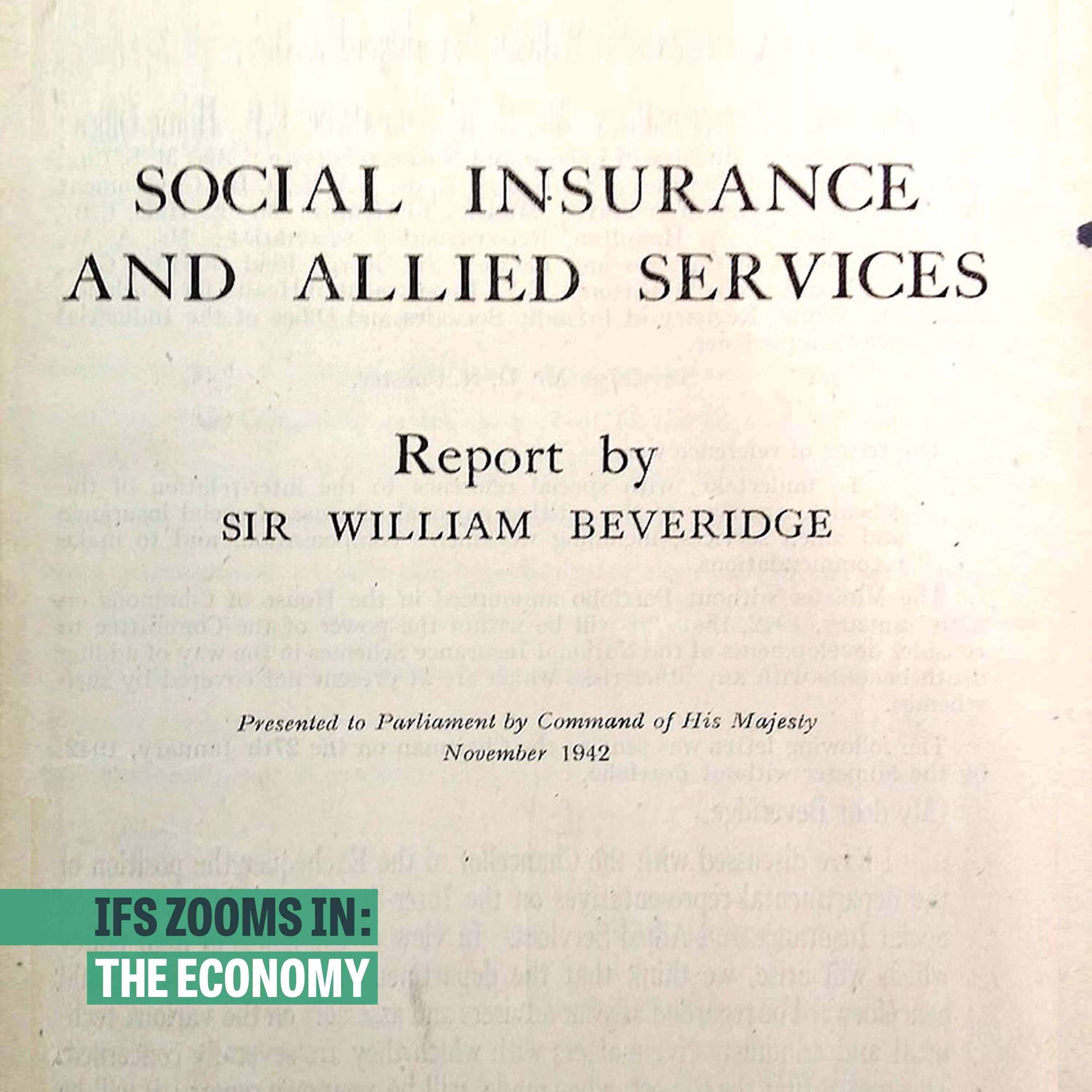
From child benefit to winter fuel payments, debates over who really deserves support run through the history of the UK’s welfare state. In this episode of IFS Zooms In, we ask whether benefits should be universal, means-tested or contributory — and why the UK's benefits system has become one of the most means-tested in the developed world.Helen is joined by Nicholas Timmins (Institute for Government) and Tom Waters (IFS) to explore Beveridge’s original vision, the rise of means-testing and whether ideas like Universal Basic Income could work.Become a member: https://ifs.org.uk/individual-membershipFind out more: https://ifs.org.uk/podcasts-explainers-and-calculators/podcasts Hosted on Acast. See acast.com/privacy for more information.
S6 Ep 21Why is defence spending rising?
The UK has promised to raise defence spending to levels not seen since the 1980s. That means tens of billions more pounds each year, with big implications for the armed forces, the economy, and the public finances.In this episode, Helen speaks to Matthew Savill (RUSI) and Max Warner (IFS) about what defence spending actually pays for, how it has changed over time, and what the government’s new commitments could mean for growth and future military capabilities.Become a member: https://ifs.org.uk/individual-membershipFind out more: https://ifs.org.uk/podcasts-explainers-and-calculators/podcasts Hosted on Acast. See acast.com/privacy for more information.
S6 Ep 20Children and young people: your questions answered | Are the kids OK? #5
This week, we turn the tables and put your questions to the experts.From childcare and early years, to schools, apprenticeships, and family life — listeners sent in brilliant questions on the challenges facing children and young people today.Helen Miller is joined by Christine Farquharson and guests Carey Oppenheim, Sam Freedman, Philip Augar, and Anne Longfield to discuss:- Should mothers be supported to stay at home rather than return to work?- Has YouTube made teaching harder for schools?- How can we encourage more firms to offer apprenticeships and sponsorships?- What are the consequences of declining physical activity and play?👉 Share your thoughts in the comments, and don’t forget to subscribe for more evidence-based discussions from IFS Zooms In.Become a member: https://ifs.org.uk/individual-membershipFind out more: https://ifs.org.uk/podcasts-explainers-and-calculators/podcasts Hosted on Acast. See acast.com/privacy for more information.
S6 Ep 19What’s happening to families in the UK? | Are the kids OK? #4
Nearly a third of children in the UK live in relative poverty, and rising numbers face material deprivation. The government’s Opportunity Mission pledges that every child should grow up in a safe, loving home and that families should be able to afford the essentials — but how close are we to that goal?In this episode of IFS Zooms In, Helen Miller is joined by Christine Farquharson (IFS) and Baroness Anne Longfield (Centre for Young Lives; former Children’s Commissioner for England) to explore:- How family structures are changing and what that means for children- The impact of child poverty and financial insecurity- Why children’s social care is under growing pressure- What early intervention could do to improve outcomes👉 Don’t forget to subscribe for the final Q+A episode, where we put your questions to the experts.Become a member: https://ifs.org.uk/individual-membershipFind out more: https://ifs.org.uk/podcasts-explainers-and-calculators/podcasts Hosted on Acast. See acast.com/privacy for more information.
S6 Ep 18Is further education treated as second class? | Are the kids OK? #3
What happens after GCSEs, and how well does England’s education system support young people as they move into adulthood?The government’s Opportunity Mission sets out to “build skills for opportunity and growth,” aiming to give every young person a pathway that’s right for them. In practice, that means navigating a system divided between academic routes, like A levels and university, and technical or vocational routes, often delivered through further education colleges.In this episode of IFS Zooms In, Helen Miller is joined by Christine Farquharson (Associate Director, IFS) and Sir Philip Augar (Chair of the government’s 2019 review of post-18 education and funding) to explore the strengths and challenges of post-16 education in England. They discuss GCSE attainment, the divide between higher and further education, funding pressures, and what a skills system fit for the future might look like.📩 We want your questions for our final Q&A episode! Send them – voice notes welcome – to [email protected].🎧 Subscribe for the full Are the kids ok? mini-series: just search IFS Zooms In in your podcast app.Become a member: https://ifs.org.uk/individual-membershipFind out more: https://ifs.org.uk/podcasts-explainers-and-calculators/podcasts Hosted on Acast. See acast.com/privacy for more information.
S6 Ep 17Are England's schools working? | Are the kids OK? #2
Are England’s school-aged children thriving – or are too many being left behind?The government’s Opportunity Mission promises to end the link between a child’s background and their future. But with rising absences, a growing mental health crisis, and a SEND system under strain, how close are we to that goal?In this episode of IFS Zooms In, Helen Miller is joined by Christine Farquharson (Associate Director, IFS) and Sam Freedman (Institute for Government, Ark Schools) to explore:What’s driving improvements in average attainmentWhy so many children are still struggling to keep upThe challenges in special educational needs and disabilities (SEND)How COVID has shaped education, attendance, and well-beingWhat reforms could ensure every child has the chance to succeed📩 We want your questions for our final Q&A episode! Send them – voice notes welcome – to [email protected] or comment on the episode.🎧 Subscribe for the full Are the Kids OK? mini-series: just search IFS Zooms In in your podcast app.Become a member: https://ifs.org.uk/individual-membershipFind out more: https://ifs.org.uk/podcasts-explainers-and-calculators/podcasts Hosted on Acast. See acast.com/privacy for more information.
S6 Ep 16Are Britain’s youngest children getting the best start? | Are the kids OK? #1
Are England’s youngest children getting the best possible start? Or are too many beginning school already behind?One of the government’s five ‘missions’ is to break down barriers to opportunity by tackling inequalities in early childhood. Its ‘Best Start in Life’ strategy aims for 75% of children to reach a ‘good level of development’ by age five - but with only 68% meeting that bar today, how ambitious is that goal, and what will it take to get there?In this episode of IFS Zooms In, Helen Miller is joined by Christine Farquharson (Associate Director, IFS) and Carey Oppenheim (Nuffield Foundation) to discuss:Why the early years matter for long-term outcomesThe role of childcare, parenting and home environmentWhat the evidence says works to close development gapsHow government policy can (and can’t) deliver change📩 We want your questions for our final Q&A episode! Send them – voice notes welcome – to [email protected] or comment on the episode.🎧 Subscribe for the full Are the Kids OK? mini-series: just search IFS Zooms In in your podcast app.Become a member: https://ifs.org.uk/individual-membershipFind out more: https://ifs.org.uk/podcasts-explainers-and-calculators/podcasts Hosted on Acast. See acast.com/privacy for more information.
S6 Ep 15What are the big threats to public finances?
Is the UK heading for a fiscal crisis? Or can policymakers still steer the public finances back to a sustainable path?The Office for Budget Responsibility’s latest Fiscal Risks and Sustainability report warns that, without action, UK government debt could climb above 270% of GDP by the 2070s - driven by rising borrowing, an ageing population, and the fiscal impacts of climate change.In this episode of IFS Zooms In, Helen Miller (Director, Institute for Fiscal Studies) is joined by Richard Hughes (Chair, OBR) and Ben Zaranko (Associate Director, IFS) to explore the forces shaping the long-term outlook for the public finances, the 50 risks highlighted by the OBR, and what can be done now to avoid a crisis later.Become a member: https://ifs.org.uk/individual-membershipFind out more: https://ifs.org.uk/podcasts-explainers-and-calculators/podcasts Hosted on Acast. See acast.com/privacy for more information.
S6 Ep 14One year of Labour government: Is mission-driven politics really happening?
Has Keir Starmer’s Labour government really brought in a “new way of doing government”? Or are its five missions more rhetoric than reality?To mark the one-year anniversary of Labour’s 2024 general election victory, the Institute for Fiscal Studies and the Institute for Government held a joint event exploring the government’s approach to governing – and whether its decisions, trade-offs and spending priorities reflect a genuinely mission-driven approach.In this episode of IFS Zooms In, we bring you the recording of that event, hosted by Hannah White (Director, Institute for Government), with panelists Helen Miller (Director, Institute for Fiscal Studies), Stephen Bush (Columnist, Financial Times) and Gemma Tetlow (Chief Economist, Institute for Government).Become a member: https://ifs.org.uk/individual-membershipFind out more: https://ifs.org.uk/podcasts-explainers-and-calculators/podcasts Hosted on Acast. See acast.com/privacy for more information.
S6 Ep 13Paul Johnson’s final episode: big challenges ahead for the UK economy
Today, we’re zooming out to ask: what are the biggest economic challenges facing the UK in the years ahead?As Paul Johnson hosts his final episode before stepping down as IFS director, he’s joined by incoming director Helen Miller to reflect on the country’s fiscal outlook, the importance of economic growth, and the pressures of an ageing population.With rising demands on public services, debates over tax policy, and uncertainty around fiscal rules, how should policymakers navigate the road ahead? What choices will the government face to deliver sustainable growth?Paul and Helen discuss these big-picture questions - and what the coming years might hold.Become a member: https://ifs.org.uk/individual-membershipFind out more: https://ifs.org.uk/podcasts-explainers-and-calculators/podcasts Hosted on Acast. See acast.com/privacy for more information.
S6 Ep 12How to fix UK pensions?
Today, we’re asking whether people in the UK will be able to afford a decent standard of living in retirement.While the foundations of the system—like the state pension and automatic enrolment—are strong, there are growing concerns. Rising state pension ages, the unpredictability of the ‘triple lock’, low private saving rates, and the complexity of managing pension wealth in later life all pose challenges for future retirees.So, what changes are needed to improve outcomes? What’s the right balance between state support and private saving? And how can pensions be made easier to navigate?Paul Johnson is joined by IFS Deputy Director Carl Emmerson and Senior Research Economist Laurence O’Brien to discuss the findings of the IFS pensions review.Become a member: https://ifs.org.uk/individual-membershipFind out more: https://ifs.org.uk/podcasts-explainers-and-calculators/podcasts Hosted on Acast. See acast.com/privacy for more information.
S6 Ep 11The policy that changed childhood in the UK
Today, we’re looking back at one of the most ambitious policies ever introduced for young children in England – Sure Start. Launched by the Labour government in 1999, Sure Start aimed to give every child the best start in life by bringing together early education, childcare, health services, and parental support under one roof. At its peak, more than 3,000 centres were operating across the country. But since 2010, the programme has been scaled back, with funding cut by around two-thirds. So, what difference did Sure Start really make? How was it implemented? And why does it still shape today’s debates around early years services? Paul Johnson is joined by IFS Associate Director Christine Farquharson and former Education Secretary Ed Balls to explore the legacy and lessons of Sure Start.Become a member: https://ifs.org.uk/individual-membershipFind out more: https://ifs.org.uk/podcasts-explainers-and-calculators/podcasts Hosted on Acast. See acast.com/privacy for more information.
S6 Ep 10What’s gone wrong in the Crown Courts?
Delays in the Crown Court are at record highs, despite more funding and longer court hours. So what’s really causing the growing backlog of serious criminal cases in England and Wales?In this episode, Paul Johnson is joined by Ben Zaranko (IFS) and Cassia Rowland (Institute for Government) to explore why court productivity may have slowed, what the consequences are for victims and defendants, and whether more money alone can fix the problem.Become a member: https://ifs.org.uk/individual-membershipFind out more: https://ifs.org.uk/podcasts-explainers-and-calculators/podcasts Hosted on Acast. See acast.com/privacy for more information.
S6 Ep 9Spending Review 2025: What it means and why it matters
In this episode, we unpack the government's 2025 Spending Review with analysis from experts at the IFS. Paul is joined by Helen Miller and Ben Zaranko to discuss what the Chancellor’s plans mean for public services, government investment, and the broader economic outlook. Become a member: https://ifs.org.uk/individual-membershipFind out more: https://ifs.org.uk/podcasts-explainers-and-calculators/podcasts Hosted on Acast. See acast.com/privacy for more information.
S6 Ep 8Trade Wars: The end of globalisation?
Rising tariffs, deepening tensions between the US and China, and a growing wave of protectionism—are we witnessing the unravelling of globalisation as we know it?In this episode of IFS Zooms In, Paul is joined by Professor Meredith Crowley (University of Cambridge) to explore the shifting landscape of global trade. Together, they unpack why trade barriers are rising, how trade wars are reshaping international relationships, and what this means for the UK and the global economy.This episode builds on Meredith’s 2025 IFS Annual Lecture. You can watch the full talk here: https://www.youtube.com/watch?v=EPIATYktrRM&t=1sSubscribe for new episodes each month and support our work by becoming a member: https://ifs.org.uk/individual-membership Hosted on Acast. See acast.com/privacy for more information.
S6 Ep 7Why is the government reforming health-related benefits?
It's been two months since the government first announced its plans to enact the largest welfare reforms for a generation, aiming 'to help sick and disabled people who can and have the potential to work into jobs’. Since then, there has been considerable debate about the consequences of these reforms. But why does the government want to implement reforms in the first place? How does the current system work? And what could the impact be for those receiving these benefits?In this episode, Helen is joined by Tom Waters, Associate Director at IFS, and David Finch, Assistant Director at the Health Foundation, to unpack the government’s proposals and explore what they mean for the future of health-related benefits.Become a member: https://ifs.org.uk/individual-membershipFind out more: https://ifs.org.uk/podcasts-explainers-and-calculators/podcasts Hosted on Acast. See acast.com/privacy for more information.