Humans On The Loop
270 episodes — Page 5 of 6
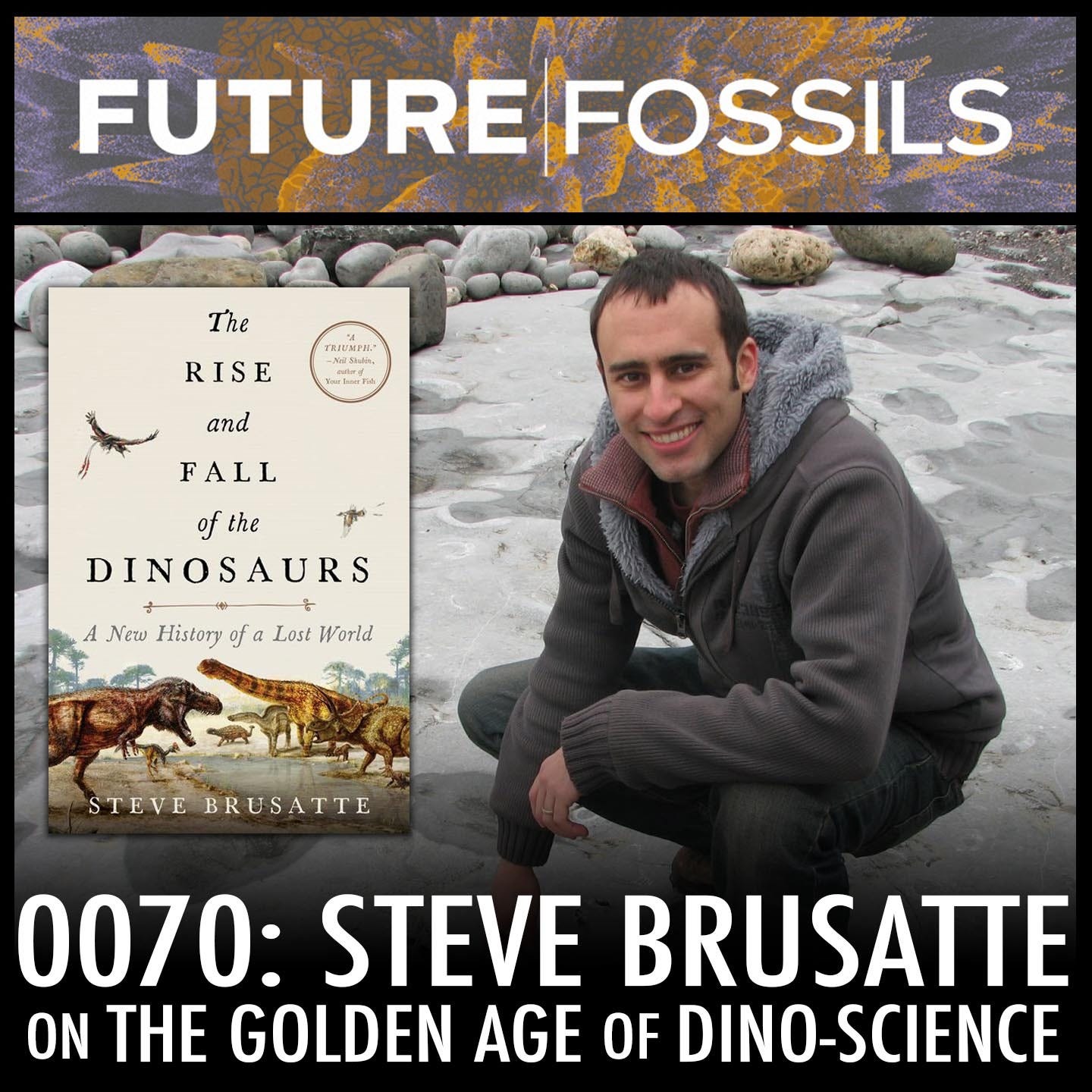
70 - Steve Brusatte on The Golden Age of Dino-Science!
E“Ah, eventually you DO plan to TALK ABOUT dinosaurs on this dinosaur podcast, right? Hello? Yes?”- Ian Malcolm about this episode.This week’s guest is professional dinosaur hunter Steve Brusatte, paleontology professor at the University of Edinburgh and author of The Rise and Fall of the Dinosaurs: A New History of a Lost World.https://twitter.com/stevebrusatteSubscribe on Apple Podcasts • Stitcher • Spotify • iHeart RadioJoin our Facebook Discussion GroupBeyond being a totally awesome – and more importantly, FRESH – take on the Mesozoic Era that weaves vital updates from the last twenty years of discovery into the official story, this book also paints a rich and lively portrait of the human beings who actually do dinosaur science. Their stories moved me as much as the story of how the dinosaurs evolved, came to dominate the landscape, and then disappeared. The Rise and Fall of the Dinosaurs offers more than the “what” of prehistory; it also offers us the “who” and “how” and “where” and “why,” and it will be a spiritual experience for anyone as into dinosaurs OR science OR science writing as I am.Plus, Steve’s great fun to talk to. He’s totally contagious.WE DISCUSS:• How we’re living through a worldwide renaissance of paleontology, a “Golden Age of Dinosaur Science” – and how itis related to deeper historical and economic trends – such as the opening of new international trade routes, increasing access to science education, and accelerating global development (the movement of wealth discovers dragons);• How the technology and methods of dinosaur science have advanced dramatically over the last few decades – but it’s still “a discovery science” that requires people out in the field, opening the ground and looking for new fossils;• Steve’s legendary globetrotting professors Paul Sereno and Mark Norell, and how their generous mentorship launched his career;• How paleontology remains one of the most awesome lifestyles for anyone with the spirit of an adventurer;• The role of landscape in stimulating the imagination – especially for bored Midwestern children whose imaginations fill the empty space with visions of lost worlds;• What it’s like to BE a paleontologist and to know about the history of the land where you are, to have insights into the Deep Time Big Story and how it relates you to the ground on which you walk;• How time perception changes when you’re in the badlands doing paleontological field research;• Michael’s childhood mentor and role model, rockstar revolutionary “heretical” paleontologist Robert T. Bakker, who had a habit of weaving Bible scripture and Broadway musical numbers into his energetic and engaging dinosaur ecology talks;• The major role that contingency plays in mass extinctions and the rise and fall of groups that otherwise seem dominant (like dinosaurs, and humans) – ie, “How do you become dominant? How do you rise up from nothing and become a BRONTOSAURUS?”• And the major role that MYSTERY plays in our understanding of the ancient world;• Oh, and we also talk about dinosaurs! For like half an hour. About Tyrannosauroidea, specifically, and how T. rex rose to greatness. And how to survive a mass extinction. But you’ll just have to listen for the rest.QUOTES:“I’m always thinking about, ‘Where is this area, where was it during the Mesozoic Era, what was it like when Pangaea was still around, what kind of environments were there, what kind of dinosaurs were living there?’ Just having this perspective, when you travel around on the Earth, of looking at landscapes and being able to see the looooooong history of those landscapes. Being able to see in the shapes of hills, and the types of rocks that are exposed, and the colors of those rocks, being able to see deep distant pasts, reconstructing vanished worlds. And I think that’s part of the magic of sciences like paleontology and geology…and probably nobody that’s not a paleontologist or geologist thinks like that. I’m sure we just think really strangely.”- Steve Brusatte“Nobody in science ever does anything alone. MAYBE in mathematics you can be a lone genius and figure out some great proof just sitting alone in your boxers in the dark, or whatever, but MOST science is NOT LIKE THAT. It’s collaborative, you work with teams, you NEED teams, and you need good mentorship when you’re student. So now that I run my own lab, I just hope I can provide for my own students what my mentors did to me.”- Steve Brusatte“There’s something just indescribable about that feeling of finding and holding and appreciating fossil objects. And that never gets old. A new fossil discovery never gets old.”- Steve Brusatte“Studying dinosaurs isn’t going to save the world, of course…BUT…”- Steve Brusatte Get bonus content on PatreonSupport this show http://supporter.acast.com/futurefossils. Hosted on Acast. See acast.com/privacy for more information. This is a public episode. If you'd like to discuss this with other subscribers or get access to bonus episodes, visi
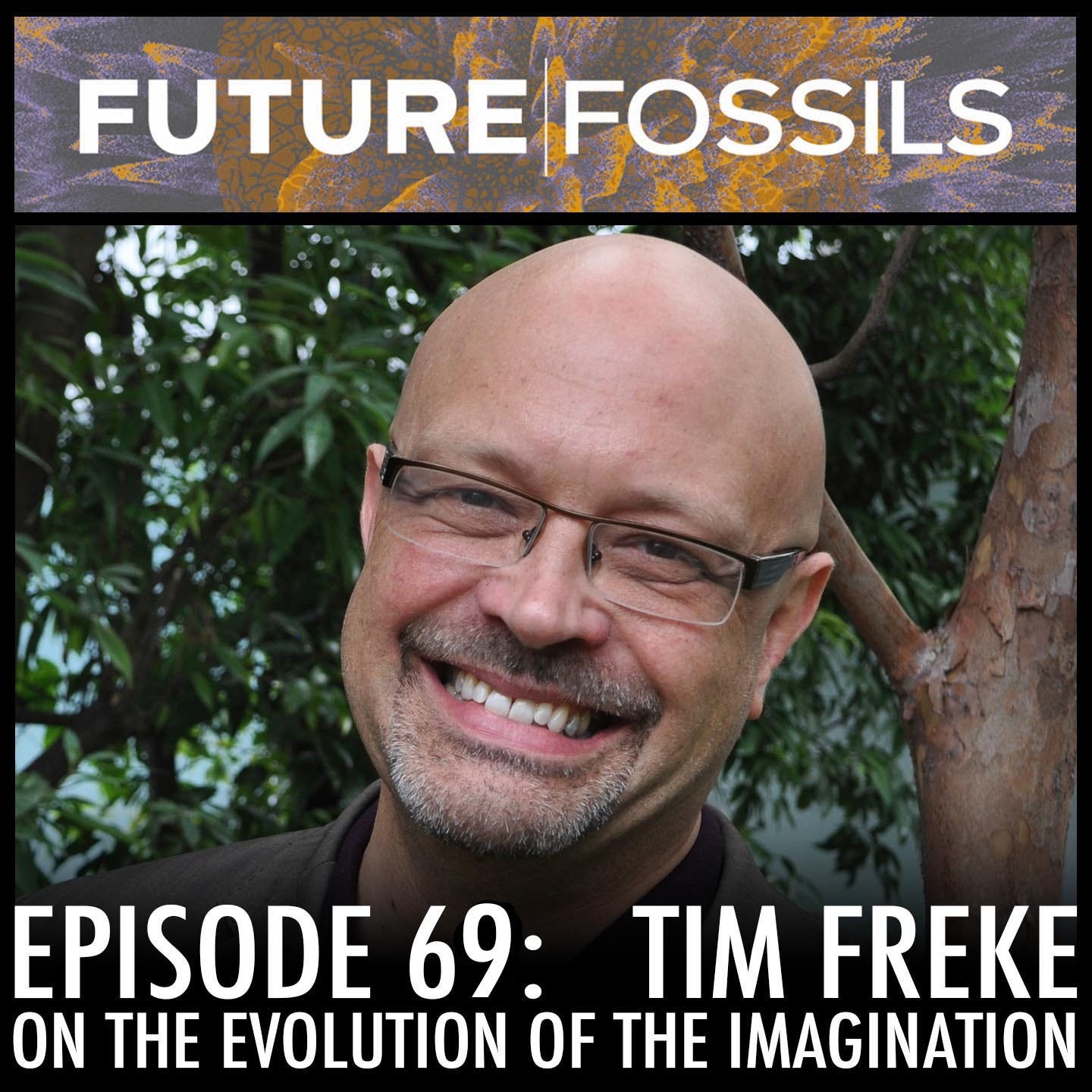
69 - Tim Freke (The Evolution of the Imagination)
ETim Freke is a philosopher and the author of thirty five books on comparative religion, gnostic scholarship, and nondual awakening. I met him as a fellow speaker at the Global Eclipse Gathering in Oregon last year and was immediately taken by his bright presence, wit, and grounded genius. In this episode, we talk about imagination as a product of the evolutionary process – that the soul and afterlife might be themselves emergent properties, rather than fixed or prior qualities, of our cosmos’ continuous unfolding creativity.http://timfreke.com/http://timfreke.com/ONLINE-TOUR/COSTS.aspxSubscribe on Apple Podcasts • Stitcher • Spotify • iHeart RadioJoin our Facebook Discussion GroupWe take a deep dive into the nature of time, reality, and creativity:• Is spiritual awakening the “leading edge” of evolution? (Not technology, as proposed by Kevin Kelly et al.?)• How story may be more fundamental to reality than we’ve believed• Is evolutionary “novelty” created, or simply discovered lying in wait?• A psychedelic view of time in which the present is a “handshake” between all possible pasts and all possible futures• Can we change the past, or merely our interpretation of it?• Soul as the fundament or medium of our intersubjectivity• Does the imagination operate as an information platform distinct from biology and physics?• Is Heaven an evolutionary emergent?• Is mind, imagination, and soul a different level of a hierarchy of being, or is it the interior experiential dimension ofwhat we call body and matter?• The relationship between subjective and objective in the time-stream• The ongoing trialogue between MG, Ken Wilber, and Bruce Damer on the origins of life and co-enactment of mind and matter “all the way down” through orders of complexity to the very quanta of our cosmos• The role of landscape and material agency in prebiological and postbiological inheritance (what comes before and after DNA?)• The Invention of Death• The proposed/hypothetical symbiosis of the soul and body • Tim’s critique of artificial consciousness and mind uploading• Can we ensoul technologies? If bodies can provide a vehicle for these nonphysical information patterns, can we engineer new bodies that invite souls into novel forms of incarnation?• Can you give something a soul by loving it?• The Question of Death• Evolution as the movement from unconsciousness unity through individuation into conscious individuated unity.Quotes:“Fundamentally, it’s a flow. It’s a process. The universe is not made of things.”“The philosophy that I’ve been exploring is that we have the wrong metaphor of time. That time doesn’t pass…but rather, time accumulates. And there is more past now than when we started this conversation…and the past hasn’t gone anywhere. It’s actually present, because everything that has ever happened is implicit in this moment.”“Every moment is the meeting of the possible, the ground of being, the potentiality, and everything that has been. But what this next moment can be, it’s limited. It must contain everything that’s happened before.”“The potentiality for the rainbow was there before eyes. But there was no rainbow.”“Technology is brilliant, but it’s nothing compared to the imagination.”“What I’m suggesting is that there is information on the soul level, which is nonphysical, which is a separate domain….we can’t reduce the body to physics, and we can’t reduce the soul to biology.”“The immortality of the soul has evolved as a continuation of the emergent and evolutionary universe. If you look at the history of what people have said about death, it’s almost like it’s evolving.”“There is no objective reality. There is, rather, objective information objectively and subjectively perceived.”“The body is discriminating information sensually, and then over the top of that, imagination is discriminating conceptually.”“Evolution itself has evolved. The physical universe did not happen through genetic mutation and natural selection.”“The more individual we become, the more we can understand the oneness.”“The whole philosophy, really, is a way of intellectually shoring up some almost childlike insights that arrived for me when I feel most deeply awake.”“Life is Good. Death is Safe. And what really matters is Love.”Support these vital conversations with a small monthly contribution:http://patreon.com/michaelgarfield Get bonus content on PatreonSupport this show http://supporter.acast.com/futurefossils. Hosted on Acast. See acast.com/privacy for more information. This is a public episode. If you'd like to discuss this with other subscribers or get access to bonus episodes, visit michaelgarfield.substack.com/subscribe
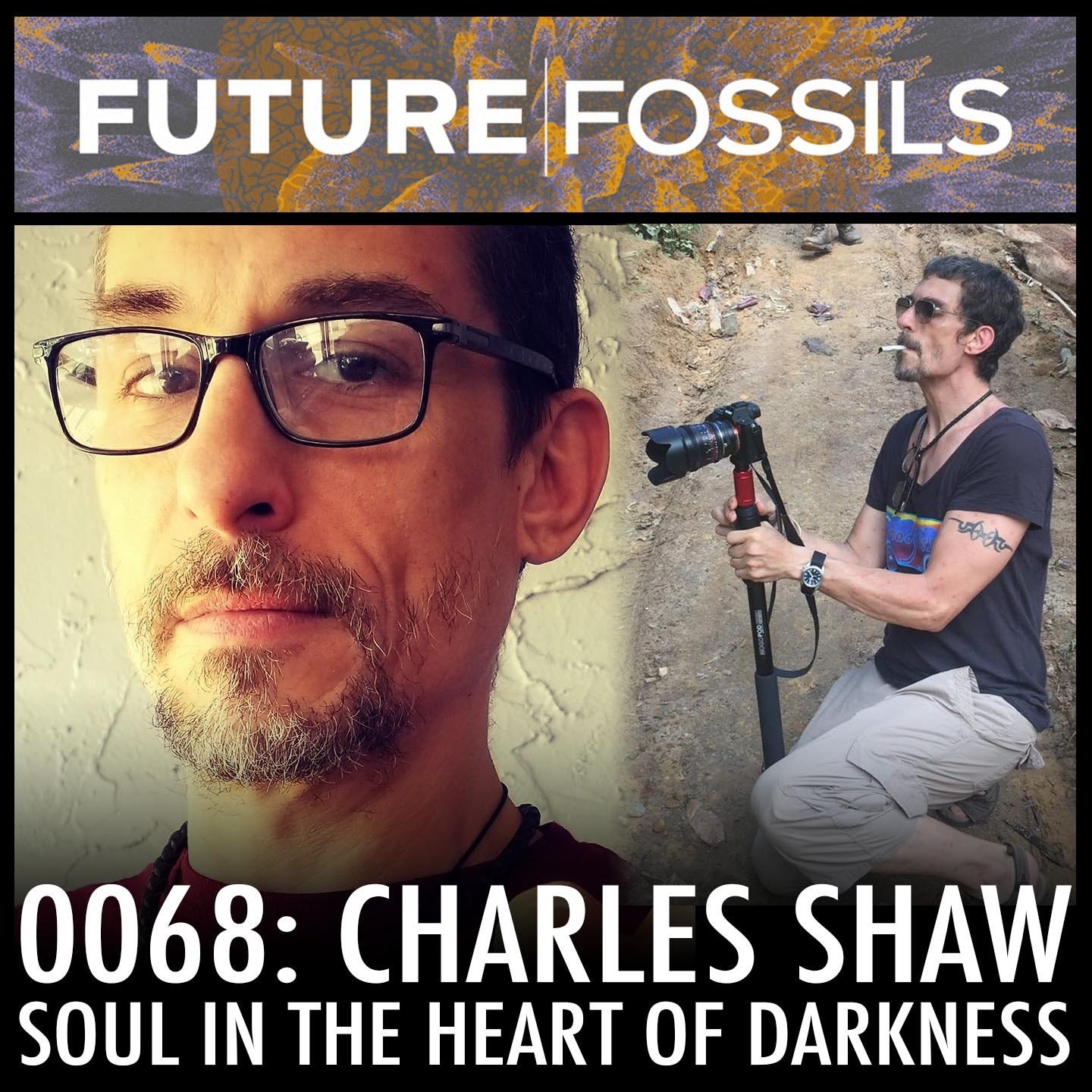
68 - Charles Shaw (Soul in the Heart of Darkness)
EThis week we go deep in part two of my epic four-hour conversation with documentarian and gonzo journalist Charles Shaw – one of this show’s most requested return guests.In part one, Charles laid out the map of the problem: a world in crisis, an age of epidemic trauma and addiction. In this episode, we get into his self-experimentation with sleep deprivation to understand the hallucinatory reality of America’s homeless, his journey of healing and recovery working with entheogens and military veterans, and how facing and embracing our darkness with humility and courage may be the only way we can prepare ourselves to make a meaningful contribution to our world. Get ready for a heady brew of grit, dark humor, grief and relief, and the luminous truth that awaits us on the other side of suffering…Support these vital conversations with a small monthly contribution:http://patreon.com/michaelgarfieldSubscribe on Apple Podcasts • Stitcher • Spotify • iHeart RadioJoin our Facebook Discussion Group––––––––––––––––Part One:https://www.patreon.com/posts/16862172Charles on Youtube & Vimeo:https://www.youtube.com/user/UnheardVoicesArchivehttps://vimeo.com/nomadcinema“Meeting The Self You Aren’t,” excerpts from my talks with Charles on the 2010 Light & Shadow Tour:https://evolution.bandcamp.com/album/meeting-the-self-you-arentIn October and November 2010, I traveled to thirty cities across the United States with journalist and documentary film-maker Charles Shaw on what we called "The Light & Shadow Tour." Half our time was spent filming interviews for his documentary about the War on Drugs and prison industrial complex; half our time was spent engaging audiences in deep discussion on the role of what psychologists call "the shadow" in personal and cultural transformation. The shadow is the part of ourselves so profoundly disowned that it shows up not as a quality of the self, but a trait of other people - not a choice that we are making, but a fate that imposes itself upon us. And to whatever degree we continue to refuse acknowledgment of our shadows, we remain the desperate victims of life instead of its joyous collaborators. It isn't easy to write a new story of the self - and to constantly re-write that story, when new truths come to us in the form of disarming companions, rude awakenings, and other surprises. But it is the work set out before us, if we are to live as whole people and give the most of ourselves to the birthing of a new and better world.––––––––––––––––IN THIS EPISODE WE DISCUSS:- How seeking validation for his work made him miserable, but he moved through the crisis and the victimhood into a new sense of completeness;- How service to other people in the trauma and addiction healing process as an intake and integration facilitator at ibogaine clinics accelerated his own healing;- The puzzle of figuring out how to use psychedelics as part of the healing process for people with diagnosed mental disorders, for whom the action of psychedelics is still poorly understood;- The homelessness and drug addiction situation in San Francisco, a city in crisis and an “open-air asylum”;- How he took a personal journey into the insanity and delusional states of America’s growing homeless population through a gonzo journalist’s approach of firsthand speed use and sleep deprivation (up to nine days at a time, under clinical supervision);- What he learned from three years of intense work with entheogens about the experience of death and the emotional process of moving through epochal transitions;- Hanging out with the “shadow people,” the characteristic hallucinations that externalize our own repressed internal voices when we start to lose our minds;- Our resistance to treatment and medicine, because keeping things the way they are is easier, because healing is an ordeal that challenges our identities;- Getting to the heart of the inquiry of “Why am I doing what I’m doing, here?” and “What do I WANT?”- What it is to lose touch with the young and hungry, eager and determined artist that we used to be and then to find it in a painful retrospective, and to realize it was because we were out there seeking validation, hustling, instead of giving our lives to the work;- Is the conversation to identify the problem, or to critique by creating and move toward solutions?- How do we even TRY and turn the global conversation toward concerted action for positive and universal (planetoid) change?- We manage to sneak some Blade Runner 2049 in there…- Aging and growing older in our culture, which nobody wants to talk about;- A Luke Skywalker-esque critique of now-institutional festival culture;- The Pluto Transit (!!!);- Hungry Ghosts;- Going into the heart of darkness with veterans on ayahuasca and understanding what teamwork can do for psychedelic healing;- His dialogue with ayahuasca about visiting his late sister in the underworld, and how he found his peace with her passing;- Dodging the psychedelic messiah complex;- The

67 - Douglas Rushkoff & Michael Phillip (Playing For Team Human)
EThis week’s guest is media theorist, culture critic, author, graphic novelist, documentarian, and podcaster Douglas Rushkoff! Chances are you’re a “digital native” banking on “social currency” and consuming “viral media” – which means that you are living in the world Doug prophesied for all of us back in the 1990s. I watched his debut documentary on social marketing, Merchants of Cool, in my college Introduction to Film class (which is how you know my teacher was, in fact, cool). His book Present Shock: When Everything Happens Now was one of the core inspirations for this podcast and its examinations of time in the digital age remain some of my most frequently-recommended writing. More recently his book Throwing Rocks at the Google Bus launched a vital conversation about how to make sure that the “superabundance” of digital society actually MAKES IT TO THE PEOPLE. And his podcast Team Human offers new insightful conversations every week about how we can sculpt a future for the 100%-ers – a world that welcomes everybody, that lets everyone in, that finds something meaningful for all of us to do and be.Doug’s written shelves on our new media environment and how the digital surround retrieves our magical antiquity. He’s issued potent cautions to us, that we must Program Or Be Programmed. He’s spent his entire life helping us find the bottom-up to complement the top-down that we’re stuck with…to help everyone be literate enough to make it in this modern world.And in this episode, he looks back on his life’s work, and forward to the great responsibility we bear to help imagine systems, cultures, and relationships for a more humane and equitable future…Doug’s podcast:http://teamhuman.fmDoug’s website:http://www.rushkoff.com/This week we’re also joined by guest co-host Michael Phillip of Third Eye Drops, our sister podcast, which I’m on A LOT – episodes 102, 88, 58, 44 with Doug Rushkoff, 38 with Niles Heckman, 28 with Bruce Damer, 21 with Erik Davis, 9 with Shane Mauss, 4 with Erik Davis, and this special mashup episode – and who has appeared on Future Fossils to talk about Westworld in Episode 14 and the Blockchain in Episode 52.We Discuss:• the ethical necessity of finding planet-scale solutions that work for ALL of us, not just a certain economic class; • the externalized ecological costs of Bitcoin; • how sigils and other ancient magical practices have been modernized for info warfare in the modern age; • how the culture of our global information economy retrieves the gods of antiquity; • the conflict of interests between our present and future selves; • the problem with futurists as propagandists and how we use “the future” as a way to manipulate people;• and more!Doug Quotes:“The aspect of the blockchain that is the most real at this point is the environmental destruction…the smartest scientists I know have given up on the environment. They’re saying, ‘Let’s just have dinner. This is it.’ If that’s the case, then it feels like every conversation about blockchain has to start and end with that. It’s like, ‘Okay, while we’re destroying the planet with technology, isn’t it an interesting model for this and that…?’”“It’s all just sigil magic on a certain level…although now you can express it through code, instead of just alchemy.”“As far as the virtual is actual, the virtual is tied to our actual well-being. So thanks to cyberspace, we have a place where all of that symbolic activity becomes real – or at least as real as we’re willing to make this stuff. Your FICO score is on there. This is the landscape that’s defining our reality. So it turns programmers into potential magicians of unprecedented power.”“The gods that we are looking at today a re subsets of capitalism. They are really more unintended consequences of people looking to game the system, than they are the natural flowering of some higher power, higher agenda. So we’re in a similar relationship to those things, but we don’t want to be re-enacting those things. We want to be, if anything, recognizing them and creating alternatives.”“Psychologically, they found that people relate to their own future selves the same way they relate to a stranger. So the person you’re saving retirement money for is just some old guy. So on some level, I don’t really care so much if that person is suffering in the cold, because I want an iPhone X. So screw him.” “Especially in the heady days of early WIRED Magazine, where they’re saying, ‘Look! Everything’s changing! The tsunami’s coming! You better hire some futurists to tell you where it’s going or you’re all going to die’…I was arguing that it’s fine, that all futurists are propagandists of a certain sort. So if I’m going to be a futurist, I’m going to propagandize a world of peace and love and the egalitarian sensibility that we’re all moving into, NOT a long stock market boom of infinite wealth for venture capitalists.” Get bonus content on PatreonSupport this show http://supporter.acast.com/futurefossils. Hosted o
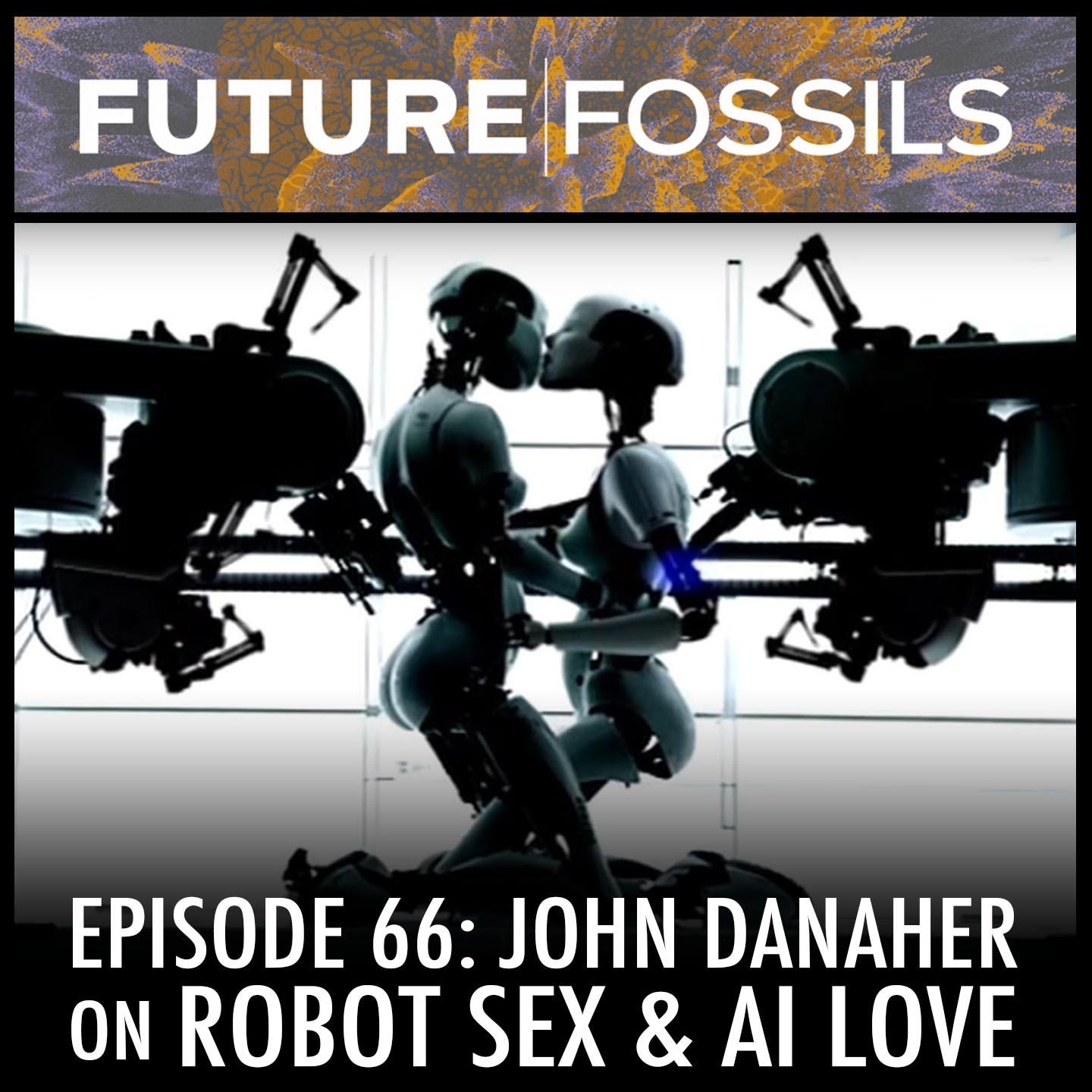
66 - John Danaher (Robot Sex & AI Love)
EThis week we chat with the philosopher and sociologist John Danaher about the book Robot Sex: Social & Ethical Implications, a fascinating collection of academic articles on our sexbot future he just co-edited with Neil McArthur. (John also runs the blog Philosophical Disquisitions, which has been an awesome resource for deep thinking online for over a decade.)https://mitpress.mit.edu/books/robot-sexhttp://philosophicaldisquisitions.blogspot.comhttp://thefutureofsex.netChances are good you’ve seen the “Don’t Date Robots!” public service announcement from the cartoon Futurama, and probably Björk’s “All Is Full of Love” music video. Maybe you’ve seen Her or Ex Machina or Spielberg’s AI. And let’s not forget the Femmebots in Austin Powers. But does any of this media, for or against, paint a realistic portrait of the impact of machines on human intimacy?Subscribe on Apple Podcasts • Stitcher • Spotify • iHeart RadioJoin our Facebook Discussion Group!In this episode, John and I talk about:• “The cognitive niche” and what separates human beings from other species and (maybe) AI• How would a world of sexbots change dating and marriage?• The de-coupling of sex for intimacy and companionship and sex for reproduction• …and how sexbots might actually bring us BACK to a more naïve or primitive state in which we don’t regard sex and fertility as primarily associated• What happens if we can hack the brain to make anything an erogenous zone?• The radiating diversity of sexual strategies as we move into crazier transhuman terrain…• The breakdown of heteronormative society and the emergence of LGBTQ sexbots• Will sexbots make human sexwork more or less desirable?• Can sexbots help sexual deviants channel their socially unacceptable urges into more acceptable behaviors?• What about LOVING robots? Can we ever be convinced the love is mutual?• Is the question of robot free will moot because we don’t even have free will??• Is our dismissal of robot consciousness just like the earlier forms of dismissal of personhood in racism and sexism and speciesism?• Is robot sex a red herring?• Loving AI would not be compatible or sensible with the goals of transhumanists, who want perfect control over their environment…• And more!“As soon as we’ve been making things, we’ve been making things for sexual reasons. You can pretty much trace this throughout history: we get the first mechanical vibrators at pretty much the same time as the Industrial Revolution…the technology of sex has always gone hand in hand with other developments in technology.”“All the doubts and skepticism you could have about a relationship with a sufficiently sophisticated robot…you could have all the same metaphysical doubts and worries about a human partner.”STAY TUNED for next week's episode with media theorist Douglas Rushkoff and Michael Phillip of Third Eye Drops Podcast! Get bonus content on PatreonSupport this show http://supporter.acast.com/futurefossils. Hosted on Acast. See acast.com/privacy for more information. This is a public episode. If you'd like to discuss this with other subscribers or get access to bonus episodes, visit michaelgarfield.substack.com/subscribe
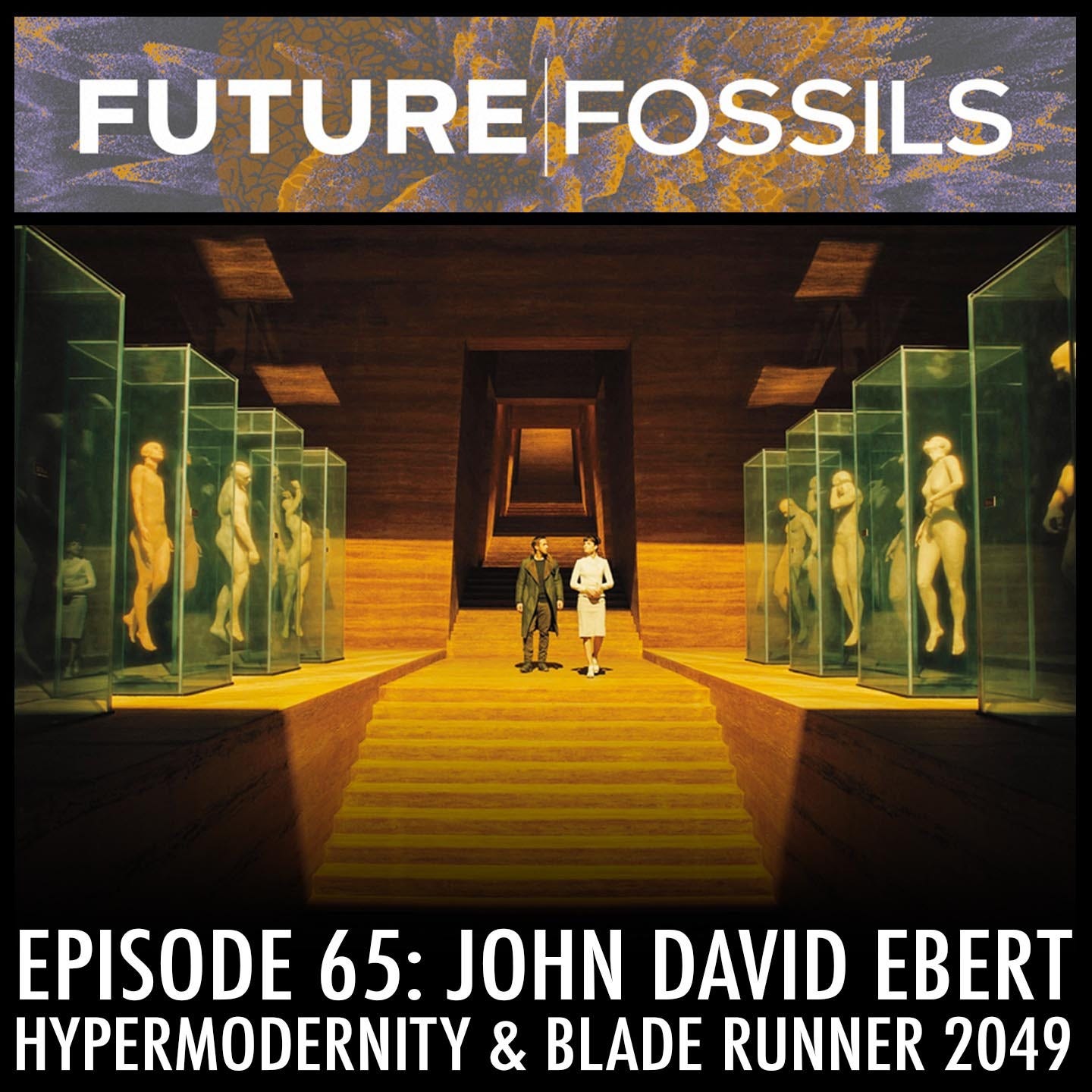
65 - John David Ebert (Hypermodernity & Blade Runner 2049)
EThis week’s guest is independent culture critic John David Ebert – mythologist, philosopher, art historian, author of twenty-six books, and co-founder (with John Lobell) of http://cultural-discourse.com. We talk about the rich mythological references of Blade Runner 2049 in light of the larger – and very urgent – matter of mechanizing human reproduction and the (actually rather ancient) male quest to appropriate the mysteries of the goddess…Here’s John’s Blade Runner 2049 essay:http://cinemadiscourse.com/blade-runner-2049/John’s awesome YouTube channel:https://www.youtube.com/channel/UC5B4tbk3U40S4q_3Qt-cVgQJohn has a knack for connecting very different sources across civilizations and millennia, anchoring this conversation about a modern science fiction masterpiece in a transcultural Big Story of the evolution of human consciousness. (Listen if you liked Episodes 42 & 43 with William Irwin Thompson on planetary culture, Episode 38 with Marya Stark on reclaiming the feminine mysteries, Episode 18 with JF Martel on art and reality, and Episode 14 with Michael Phillip on WESTWORLD.)John David Ebert Quotes:“Every new cosmology makes new machines possible.”“I’m interested to hear about utopian projects…because after all, we’re going to need them.”We Discuss:- Marshall McLuhan’s work on Sputnik’s technological enclosure of the planet and the end of “nature” (not to mention “natural catastrophes”);- How poets and artists make visible the “invisible environment” of subliminal information about each age;- Art’s revelation of cosmology through history, from nested heavenly spheres in medieval religious art to the newly-opened skies of Dutch realists to our anxious re-immersion in the closed infinity of the Anthropocene as depicted by H.R. Giger;- The transition from worship of the Earth Mother to the Sky Father, and the centuries-long struggle to control the mysteries of birth and death with science;- The connection between Niander Wallace in 2049 and Enke, sumerian trickster creator god;- The difficulty of replicating ecosystems in space for those “off-world colonies”;- “Here There Be Tygers,” Jurassic Park, and how monsters (as avatars of the pissed-off Great Mother) disappeared from the Renaissance world maps but make a new appearance in hypermodernity, thanks to genetic engineering;- Akhenaten’s experiment in monotheistic sun god worshipping utopia;- What should we do with the 100% certainty that our cosmopolitan super-cities will all soon be underwater, and it’s time to rapidly escalate our alt-civilization experiments?- The evolution of civilizations, from early revelation to imperial phase to decline;- The rhyme of history between Ancient Rome and Modern America;- The retrieval of shamanism and the re-establishment of a polar civilization in the late 21st Century;- The lineage between Pacific Northwest spirit-travel shamanism and contemporary Californian VR avatar science fiction and superhero stories;- And more! Get bonus content on PatreonSupport this show http://supporter.acast.com/futurefossils. Hosted on Acast. See acast.com/privacy for more information. This is a public episode. If you'd like to discuss this with other subscribers or get access to bonus episodes, visit michaelgarfield.substack.com/subscribe
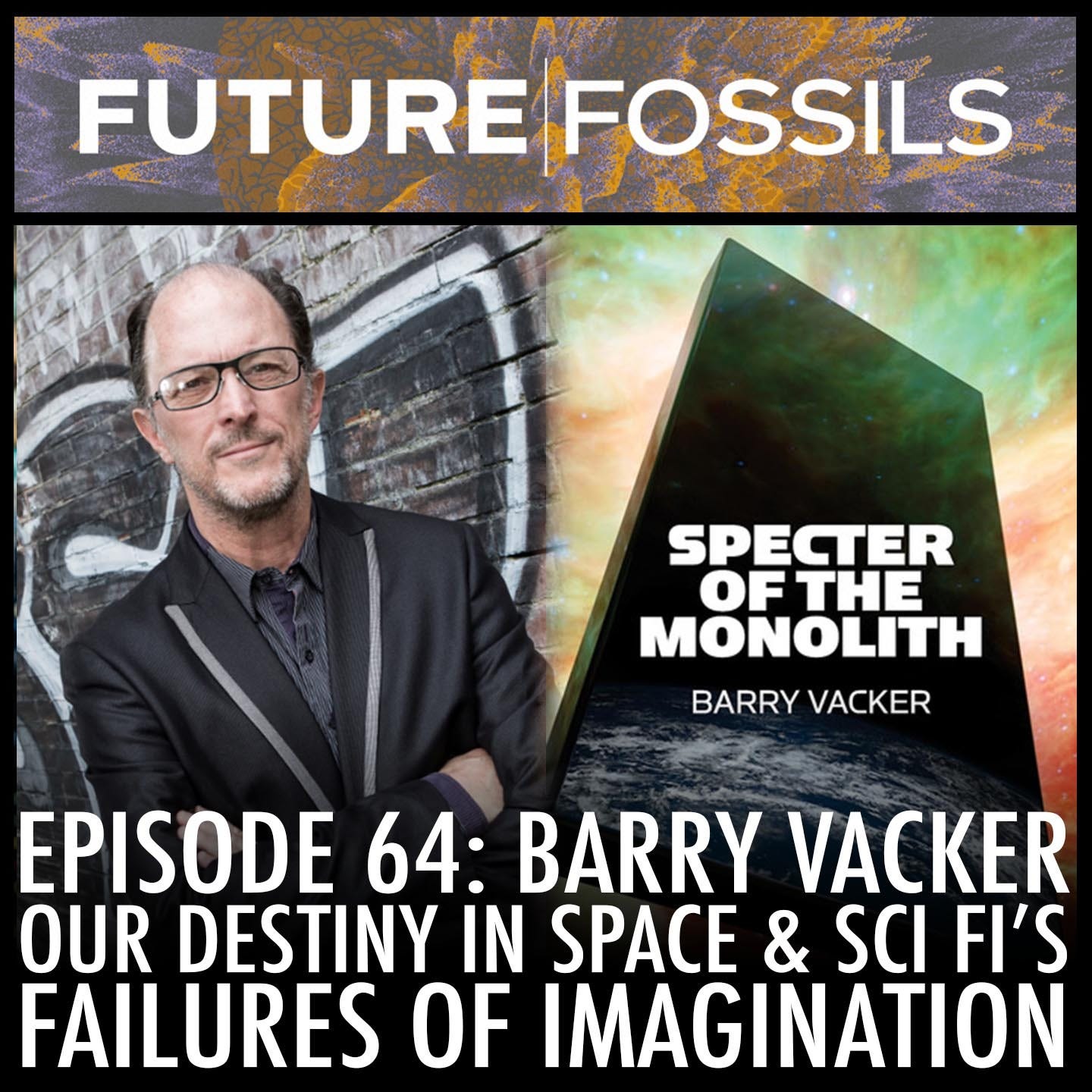
64 - Barry Vacker (Our Destiny in Space & Sci Fi's Failures of Imagination)
EThis week: Science Fiction Übermenschen & A Critique of Space Colonization with film scholar Barry Vacker, a professor at Temple University in Philadelphia. We talk about the critique of contemporary science fiction cinema in his new book, Specter of the Monolith – pointing past the spiritual shortcomings of our relationship to space, and toward a future human being that has both grown in both technology and wisdom.Barry's Essays:http://medium.com/@barryvacker Subscribe:Apple Podcasts • Stitcher • Spotify • iHeart RadioJoin our Facebook Discussion Group!We Discuss:• How contemporary science fiction (including Blade Runner 2049) fails to live up to the promise of 2001: A Space Odyssey and articulate a transcendent vision for the future of humanity.• The role of the machine in a complete science fiction spirituality.• The different “übermenschen” presented in 2001, Altered States, Lawnmower Man, and Watchmen.• How Ancient Aliens hijacked the 2001 narrative about extraterrestrial involvement in human evolution.• How superheroes replaced gods in secular society after Nietzsche declared us the victors of the “Humans vs. God” match.• The role of the Cold War in cementing the different future visions of the United States and Russia/China.• The danger of looking to charismatic leaders of industry like Elon Musk for moral guidance in how we should enter space (specifically, extractive capitalism as the model for space migration).• The possibility and importance of preserving the Moon and Mars wilderness protection areas• …or is it our moral responsibility to spread life throughout the cosmos?• Barry’s critique of Interstellar as a film for “spore bearing” humans as opposed to “space faring” humans• Will it take an economic transition to prepare us for ethical space migration? Or a philosophical transition? Or are those not even different things?• The cultural importance of stargazing and astronomy – the sublime as the meeting place of the infinite and the infinitesimal – where awe, terror, and transcendence join without getting deities involved• The necessity for the human species to have “an explosion of awareness” – non mystically, non religiously• Space tourism: net good, or net evil? Can we reproduce the experience with VR?• Can we (or SHOULD we) baptise extraterrestrials? (Short answer: not without their informed consent?)• Colonialist and anticolonialist narratives in Avatar• Is our lack of rites of passage the reason we see a vastly disproportionate representation of “adulto-lescent” sci fi narratives?• Is Blade Runner 2049 a feminist film? Even though it fails the Bechdel test?Barry Quotes:“The superhero has emerged to make us feel like we’re still worth saving, to give us a moment of salvation at the movie theater – because when we walk out, we realize our political figures have no answers.”“2001 [is] seen as the prototypical Greatest Space Film Ever, but if you pay close attention, it’s showing a vision of space TOURISM. But when they show you the Moon, they’re not pillaging it. They’re not strip mining it. I think it’s completely ludicrous to think that we should be strip mining the Moon.”“The idea that we should be terraforming Mars in Earth’s own image…I mean, how narcissistic can you get?”“It’s time to give up these tired narratives of deities and industrial exploitation and move towards a scientific and artistic appreciation of these planets. And I don’t see that anywhere on the horizon. Very few people are questioning these tribal narratives.”“In Ridley Scott’s The Martian, there’s very little appreciation of the actual beauty of the PLANET, and in fact, Matt Damon says, ‘F Mars. I’m going to conquer this place.’ And we never see him looking at the dark skies. He would be the single human who would have had the greatest view of the skies EVER. And we don’t see any of that in The Martian. All we see is, ‘How can we transform the world’s resources into surviving?’ And that makes The Martian a very smart film, but it has a poverty of the imagination.”“I’m opposed to the propagation of human stupidity in the cosmos, nearby or faraway. I’m not opposed to us going to Mars or the Moon…but we should go as an enlightened species. We should go as space-farers, not merely spore-bearers. If we don’t alter this narrative, we know what we’re going to have: it’ll be literally ‘X Games: Moon.’ ‘The Real Housewives of Mars.’”“There’s something to be said for facing the universe as it is as best we can. Acknowledging our limitations and our humility, but also our aspirations to be more enlightened and more aware of and sensitive to our origins and our destiny, whatever it might be.”“In the quest for our meaning in the massive universe, we’ll find our destiny.” Get bonus content on PatreonSupport this show http://supporter.acast.com/futurefossils. Hosted on Acast. See acast.com/privacy for more information. This is a public episode. If you'd like to discuss this with other subscribers or get access to bonus episode
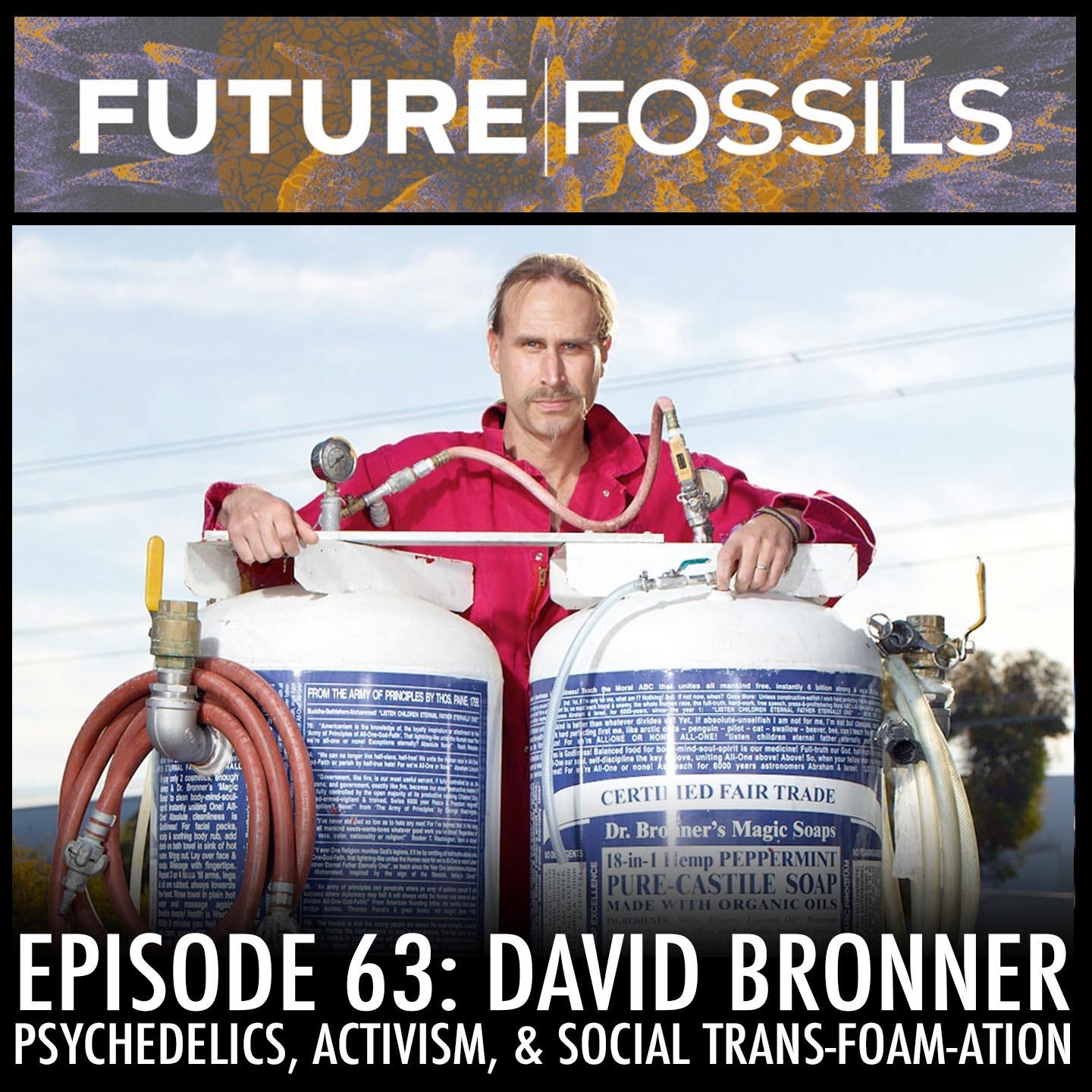
63 - David Bronner (Psychedelics, Activism, & Social Trans-foam-ation)
EThis week’s guest is David Bronner, grandson of Dr. Emanuel Bronner and the heir to and CEO (“Cosmic Engagement Officer”) of Dr. Bronner’s Soap Company. He’s also an outspoken advocate for psychedelic medicines and visionary culture, and has used his wealth and influence in awesome ways to support the collective healing of American society. In this episode we discuss his advocacy and activism, and the life-changing experiences that brought him to his current understanding and role in helping bring about a saner and more loving world…Subscribe to this show:Apple Podcasts • Stitcher • SpotifyJoin our Facebook Discussion GroupDavid:https://www.drbronner.com/about/ourselves/the-dr-bronners-story/https://www.motherjones.com/environment/2014/05/dr-bronners-magic-soap-david-bronner-gmo-hemp/Donate to the Multidisciplinary Association for Psychedelic Studies:http://maps.org/donateWe Discuss:• The visionary science fiction novels of Olaf Stapledon, Last & First Men and The Starmaker• How David reconciles a sweeping cosmic vision with the day-to-day realities of work in the world• His experiences with iboga and the consequent deep experience of connection to the life and work of his father and grandfather• His grandfather’s development of a firefighting foam used today by the forestry service to fight wildfires, and his childhood of blasting foam everywhere around Los Angeles• Life artistry and appreciation for our families as life artists• Epigenetic inheritance of trauma and how that affects the survivors of catastrophe• Healing starts with you and THEN grows outward• The history of the Dr Bronner’s foam showers at Burning Man and how David and his friends turned it into an immersive experience to help transmute the pain and suffering of The Holocaust• Society as a finite game obsessed with maintenance; contrasted with culture as an infinite game delighting in renewal and novelty• Managing wealth as an act of service to the collective• How entheogen helped David over his conditioned homophobia and jealousy• The origins of religion in ecstatic experience• David’s passion for regenerative agriculture and political action (for hemp, transgender rights, psychedelic-assisted therapies, and more)• Catharsis, the healing-focused Burning Man inspired cultural event held on the National Mall that David has helped organize in recent yearsDavid Quotes:“All is on the cross.”“These sacred traditions that have almost been exterminated have the power the heal us and save us.”“It’s deadly serious, but it’s also a dream…I don’t know.”“I knew I was being initiated…like, ‘Okay, this is happening. So what is the least karmic consequence for all involved?’”Michael Quotes:“The difference between Heaven & Hell is how hard you’re trying.” Get bonus content on PatreonSupport this show http://supporter.acast.com/futurefossils. Hosted on Acast. See acast.com/privacy for more information. This is a public episode. If you'd like to discuss this with other subscribers or get access to bonus episodes, visit michaelgarfield.substack.com/subscribe
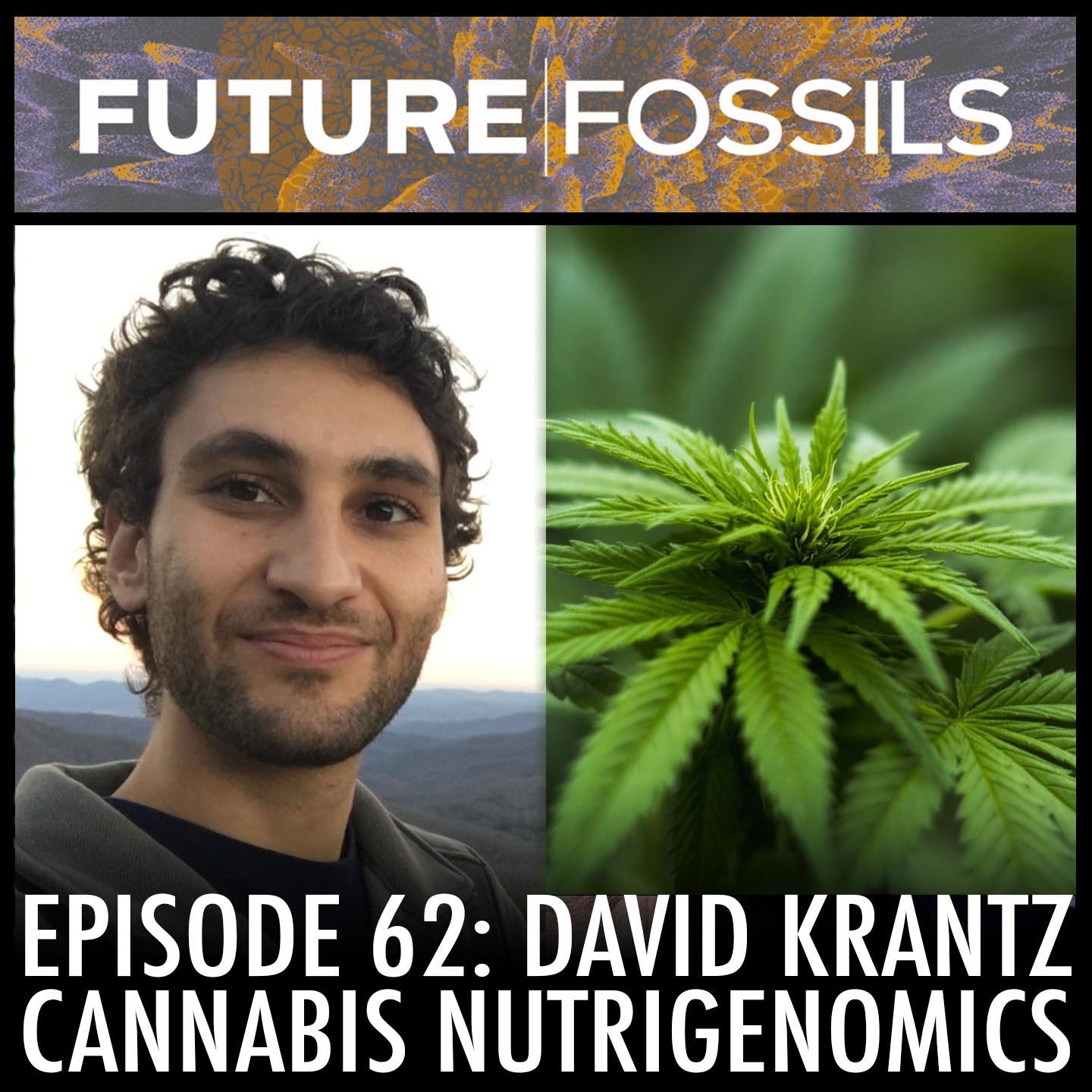
62 - David Krantz (Cannabis Nutrigenomics)
E[NOTE: We had a publishing error last week and most subscribers missed Episode 61 with Jamaica Stevens on Crisis, Rebirth, and Transformation! Definitely worth going back to listen to this awesome chat.]David Krantz is a personal nutrition and genetics coach, sound therapy technician, and electronic music producer based in Asheville, NC. http://david-krantz.com Subscribe to this show:Apple Podcasts • Stitcher • SpotifyJoin our Facebook Discussion Group This week we chat about genetics – specifically how different gene variations in people affect the way we experience cannabis. We’re coming up on a revolution in biotech and agriculture that will soon make it a possibility to grow gene-tailored strains of cannabis to suit YOUR DNA specifically…until then, though, here is your primer on how to dance with Mary Jane in ways that work WITH, not AGAINST, you.(David is a repeat guest from Future Fossils Episode 0010, when he chatted with us about the future of electronic music, plant intelligence, and tripping with cats and modular synthesizers. Be sure to check that one out also!) We Discuss: • CYP2C9 - a liver enzyme that breaks down THC - and how the amount your body produces will determine how high you get from edibles, your ability to pass a drug screening, etc.• How learning about our genetic differences helps us develop tolerance and acceptance of each other’s very different needs and bodies• COMT, a gene responsible for dopamine breakdown, and how which variant of this gene you possess determines cannabis-induced memory loss and alteration of time perception• ATK1, a gene whose variants determine how “psychotomimetic” (ie, trippy) your response to cannabis will be, and whether or not it will exacerbate schizophrenic symptoms• How it is, and isn’t, helpful for the law to regard cannabis primarily as a medicine• APOE, a gene that heavily influences Alzheimer’s Disease, not in isolation but depending on whether or not you eat a lot of saturated fats or exercise• How we must revolutionize education and accreditation in an age of digital learning, so that we can deploy as much healing intelligence as possible• Single Nucleotide Polymorphisms, or SNPs, and how these one-letter changes in a gene can make a huge difference• David’s critique of cannabis studies that DON’T break down research subject populations down into genetic subgroups, and reveal the researchers’ biases• The need for “cultural interoperability” in our discussions about cannabis research, “across the aisle” between scientists for and against its legalization• AND Coffee and Chaga mushrooms and more – enacting complex mutually supportive benefits• Which gene tests David likes best, and best practices for privacy with your genetic data• The future of genomic science’s influence on cannabis horticulture and use Quotes: “There are probably some people that shouldn’t smoke weed.” “I feel very qualified to help the people that I’m helping, and having the red tape of, ‘You have to be a medical professional or you can’t talk about this stuff at all,’ doesn’t make sense for where we’re going – because I can listen to 2000 hours of podcasts, like I did when I was working at Moog, and feel like I’ve really upped my understanding of some things. Maybe that can help other people besides myself.” “I’ve become increasingly self-aware of the way I feel about people who disagree with me…” “There’s no such thing as the perfect human diet.” Related Links: Kerri Welch on dopamine and time perception https://textureoftime.wordpress.com/2015/08/30/dopamine-and-traction-between-internal-and-external-time/ Get bonus content on PatreonSupport this show http://supporter.acast.com/futurefossils. Hosted on Acast. See acast.com/privacy for more information. This is a public episode. If you'd like to discuss this with other subscribers or get access to bonus episodes, visit michaelgarfield.substack.com/subscribe
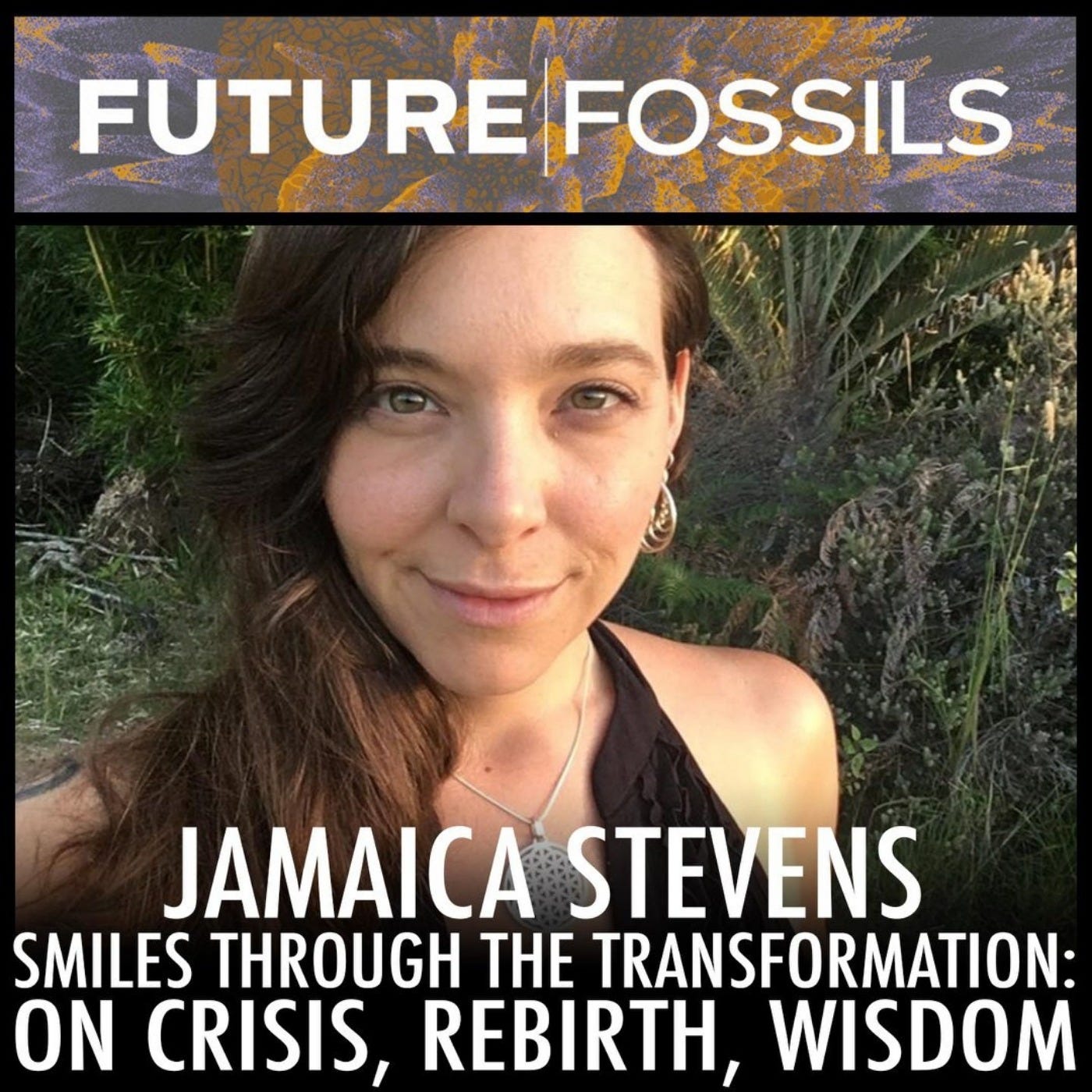
61 - Jamaica Stevens (On Crisis, Rebirth, Transformation)
EThis week’s guest is the inspirational badass Jamaica Stevens, key organizer for the Reinhabiting the Village project and Lucid University, and this show’s first pregnant guest (at the time of recording). We dive immediately into the deep end of our half-finished collective birthing process and how to navigate the difficult transition we’re all going through… http://www.jamaicastevens.com/ http://reinhabitingthevillage.com/jamaica-stevens/https://www.facebook.com/LucidUniversity/ We Discuss: • The collective ass-kicking and humbling and veil-lifting that’s upon us• Can America break up with itself and stay friends?• What is “the global village” in an age as splintered as ours?• Cooperative leadership and transcending the hero’s journey with its emphasis on individual growth and development• How to let go of a dream or vision when it’s time to let it die• How to process the grief of our ancestors, of our alienation and loss of place and undigested trauma• Grief as a teacher and a healer• Being born and reborn, again and again and again• How initiation needs both witness and community• Why we need elders for our rites of passage• How to get out of anthopocentric thinking about wisdom and connect to the vast majority of wisdom in the non-human world - looking to nature and asking it to teach us• Getting out of the mental attitude that we will understand the paradox…and BECOMING the paradox• The Epoch of the Steward and The Epoch of the Sage• Become what you already are Quotes: “Birth is not pretty. It’s not rainbows and unicorns. It’s ecstatic and one of the most profound experiences, but it’s also right there at the edge of life and death…there’s something so primal and cosmic at the same time about it, it will transform you.” “Only when we start embracing the responsibility of self and true accountability, to get into the shadow of our own beauty and tragedy and really get into our woundedness and limitation, and get into our healing on a personal level, and then start to work that on an interpersonal and community level, and learn better skills and tools for navigating conflict instead of avoiding conflict…” “Stop, drop, and roll, people. Put the fire out. Bring a little water. Go slow. Breathe deep. Own your shit. See another and find the connection of this incredible humanity that we all share.” “They’re going to look at me and say, ‘When the world was burning, what did you do? Did you keep planting trees? Did you learn to wield well your resources? Did you give up on us? Did you give up on your future and the potential for other generations to learn from the tragedies that we’ve created as humanity? Did you wizen up and face that so you don’t keep handing trauma down to the next generation? Did you become conscious?” “We ARE vulnerable. Interdependence is non-negotiable. And actually, your heart is liberated when you finally surrender to feeling.” “Our resistance actually creates more trauma than our learning to surrender.” “If we humble ourselves we might be able to soften and become pliable enough to find our way through this pressure point. You can’t stop it…how do you embrace it? How do you get on board with this rite of passage that we’re having and leverage it to make the most mighty moves you can?” “There’s no such thing as a brand new fresh beginning that isn’t in context or related to that which has been – and yet, we cannot go into uncharted territory trying to use a map from that which we’ve already mapped, thinking that that’s somehow going to guide us into something we’ve never experienced before.” “Looking only to the past will not get us into our future, but if we avoid looking to the past, our future will be riddled with the same mistakes.” “Would you plant trees that you’ll never eat the fruit of?” Get bonus content on PatreonSupport this show http://supporter.acast.com/futurefossils. Hosted on Acast. See acast.com/privacy for more information. This is a public episode. If you'd like to discuss this with other subscribers or get access to bonus episodes, visit michaelgarfield.substack.com/subscribe
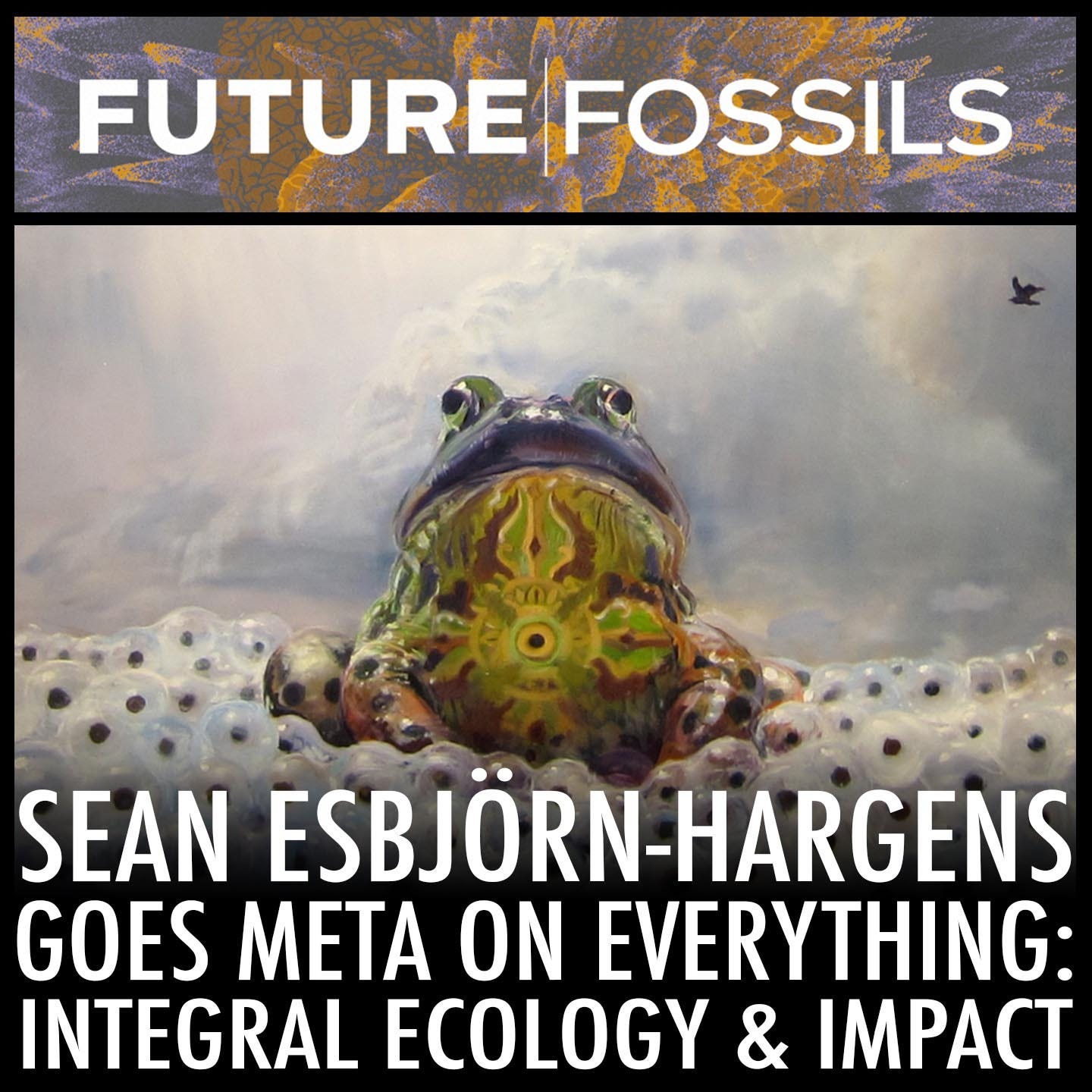
60 - Sean Esbjörn-Hargens Goes Meta on Everything: Integral Ecology & Impact
ESean Esbjörn-Hargens is one of the sharpest and most insightful people I know, and an globally-recognized expert and pioneer in the emerging meta-discipline of integral theory and practice. The former chair of John F. Kennedy University’s Integral Studies department, co-author (with Michael Zimmerman) of Integral Ecology, co-founder (with Mark Forman) of the international Integral Theory Conference, and now in his post-academic life, head of MetaIntegral a training and consulting company specializing in the design of wisdom economies. “Expand your story! Expand your position! Expand your sense of self identity as to what you’re doing and why. Because you’re already doing it.”Become conscious of the value and benefits you’re already providing the world – and then amplify that – by digging this great conversation…http://metacapital.net/iceland-seminar/ https://integrallife.com/integral-ecology-uniting-multiple-perspectives-natural-world/ https://www.amazon.com/Integral-Ecology-Uniting-Multiple-Perspectives/dp/1590307674Subscribe to this show: Apple Podcasts • Stitcher • Spotify Join our Facebook Discussion Group(Cover painting by David Titterington.) We Discuss:• Sean’s early interest in the scientific study of animal consciousness: philosophy, biology, AND psychology• The intersection of human consciousness, worldviews, and values systems – and how nature appears differently to everyone• Discovering Ken Wilber’s integral philosophy and its critiques of the retro-romantic “Back to the Garden” ideology of deep ecology and eco-feminism• How many different approaches to the natural world are there?• The problem of academia’s failure to properly accommodate trans-disciplinary, meta-disciplinary, synthetic, integral thought• Economy as a sub-category of Ecology• The Complexity Gap: the gap between our level of consciousness and our ability to manage complexity on one hand, and the amount of complexity we find ourselves in, on the other• Simplicity on the other side of complexity: moving ecological and integrative thinking into business and organizational development• What is Meta-Capitalism?• Beyond the reductionism of triple bottom line thinking: purpose• Integrating the sentience of other organisms into our understanding and practice of ecology• Bringing the inner worlds of the first-person and second-person back into science and organizational development: experience, emotion, mutual understanding, and purpose• Taking multiple perspectives on wealth, value, and the many forms of capital: not just the external metrics but the feelings and experiences of wealth, poverty, and power inequality• How to teach organizations to see the value they’re already generating – and unaware of – so that they can serve a larger population with a clearer identity and more coherent actions• The emergence of value-accounting software that can help us track impact across the myriad domains of capital• Organizational coaching as collective shadow work and a kind of psychedelic therapy at the level of the group• Making subject object: making perspectives an object of awareness and moving from experience to insight in meditation, coaching, and any area of personal or collective transformation• Anchoring integration in the heart and gut – not just the brain, but really letting understanding sink and ripen in our feelings and our flesh and blood• How learning to play the violin and sing at the same time can be a profound somatic practice of meta-level integration• Dance and martial arts practices as a complement to being super heady…differentiating and integrating the body and developing an “eco-somatics” for moving consciously in the world Select Quotes:“It’s really only at the limits of the postmodern orientation that you begin to see the importance of integration. So as a culture and as a global society, we’re just now really entering into an integrative mode where the overwhelm of the information is forcing us to adapt strategies of integration.”“More and more of our challenges and issues require some mode of integrative thinking and action.”“There are lots of different kinds of value, and if you leave out one kind, you’re really doing a disservice to reality. It’s actually a violence against the cosmos.”“Environmental rah-rah really serves a purpose, but until we really wrestle with capitalism, it’s almost like, ‘What’s the point?’”“It’s more a clash of worldviews than it is a clash of facts. And how different worldviews relate to those facts.”“How would our science of ecology change if we actually recognize the sentience of the organisms that are part of that ecology?”“The resistance is good because it shows that you’re in the right ballpark. You want there to be resistance. I don’t really waste my time trying to convince anyone of anything. I try and work with people where there’s at least a basic level of interest, and then work with the resistance they have.”“Things are going to get more fragmented, and things are going to get m
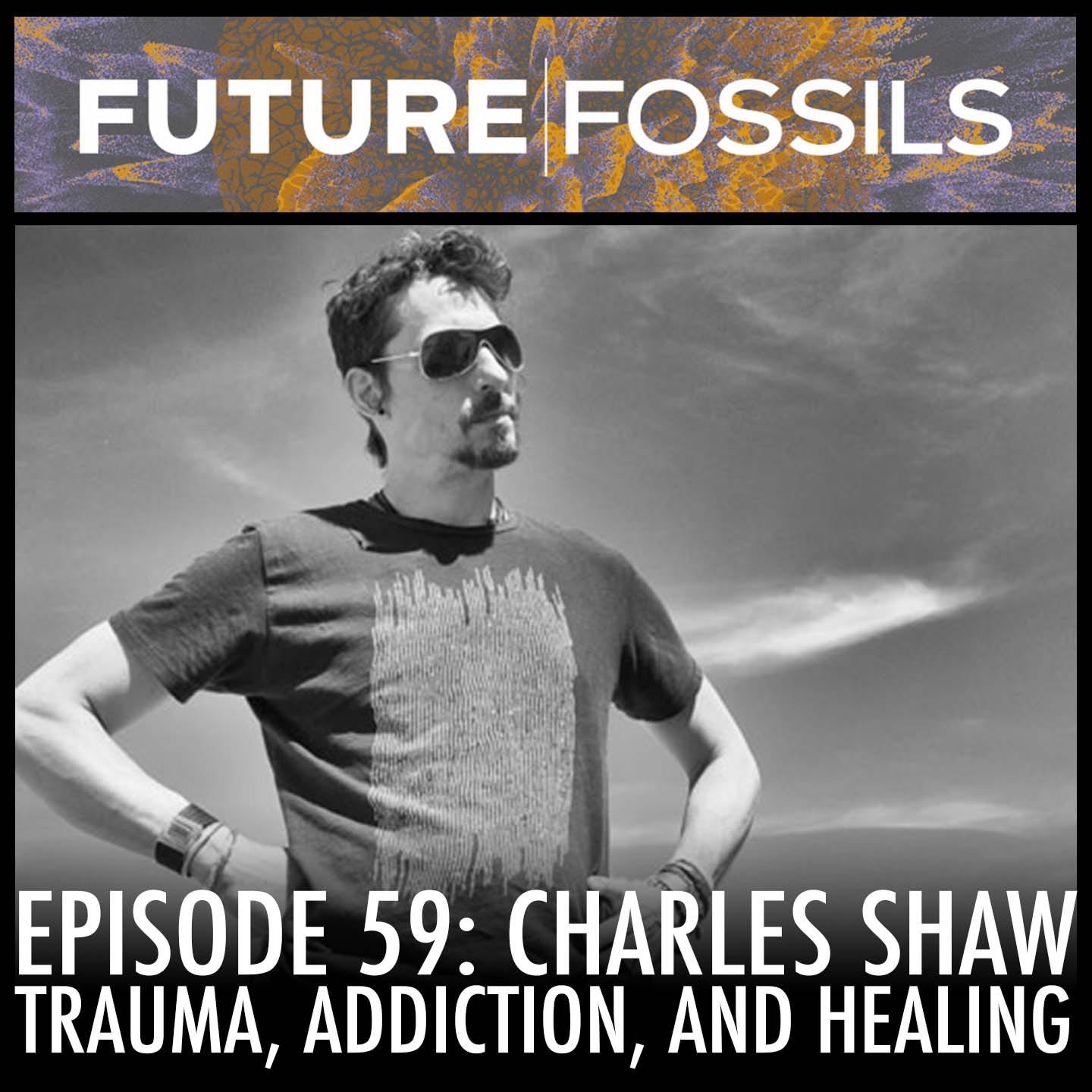
59 - Charles Shaw (Trauma, Addiction, and Healing)
ERadical documentarian, activist, and raconteur Charles Shaw joins Future Fossils Podcast this week for part one of an epic double (possibly triple) episode. https://vimeo.com/nomadcinema Subscribe to this show: Apple Podcasts • Stitcher • Spotify Join our Facebook Discussion Group We Discuss: • The plight of the despised underclasses and the dark constellation of the Drug War, addiction, deportation, homelessness, and the prison industrial complex • The (largely broken) promise of visionary culture and the global festival circuit • Psychedelic healing for PTSD and addiction with ibogaine and ayahuasca, and the urgent need for trauma recovery in our traumatic age • Similarities between the Great Depression and life since the 2008 mortgage crisis – namely, suspicion of institutions like banks and the government • The untold stories and hidden trauma of the Greatest Generation • The cascading effects of war, emotional trauma, and social-scale health problems • Trauma and consumerism, trauma and hoarding • Messiah complexes and the pressure of being told you’ll save the world • His work as an intake facilitator for the Ibogaine Institute • The history of addiction being treated as an illness • Addiction & Psychedelic Healing • Intoxication as “the fourth primal drive” • How Rogue One conveys the tension between institutions and individuals, and how war twists and manipulates us – Rogue One as a metaphor for PTSD • Borderline Personality Disorder • How the 20th Century’s industrial civilization trauma has become the 21st Century’s information overload trauma • A critique of Portugal’s drug decriminalization policy • Technological addiction and the bombardment of brains • Psychedelic therapy as a treatment for modern life Charles Shaw Quotes: “The dictum that you really only care about issues when they strike home – definitely plays into the trauma discussion. So I didn’t care about trauma or PTSD until I realized I HAD it.” (On War:) “It’s all about trade and it’s all about territory.” “By the same standards that we executed Nazis…we did the same shit. The thing is, now that that generation is gone, these stories are STARTING to come out, but unfortunately they’re being seized on by the alt-right to rewrite the story of Hitler…come on, nothing takes away from what the Third Reich did.” “Every Boomer that didn’t become a rockstar, their kid was going to become a rockstar.” “There was a paper trail. They conclusively proved that Florida stole the 2000 election. We conclusively proved that Ohio stole the 2004 election. Didn’t matter. No one in the Baby Boom generation…would actually believe it. Because it called the whole system into question. And when you call the whole system into question, that’s a much larger conversation than, ‘No, your other party is the problem. It’s just those people.’” “Addiction science is progressing at light speed, but addiction understanding and comprehension is progressing like Yertle the Turtle. And what we know now is that it ISN’T a disease. It is neither chronic nor progressive. Addiction is a learned behavior more than anything else.” “Animals don’t need to hit the bottle because animals don’t suffer guilt. But humans do.” “We come out of this lineage, and we don’t even realize it’s there…” Referenced Media: • The Thin Red Line • Zebras Don’t Get Ulcers by Robert Sapolsky • The Body Knows The Score by Bessel van der Kolk • The Biology of Desire by Mark Levin • Living Light (Eartha Harris’ electronic music production project) • The Glass Cage: Automation and Us by Nicholas Carr Get bonus content on PatreonSupport this show http://supporter.acast.com/futurefossils. Hosted on Acast. See acast.com/privacy for more information. This is a public episode. If you'd like to discuss this with other subscribers or get access to bonus episodes, visit michaelgarfield.substack.com/subscribe
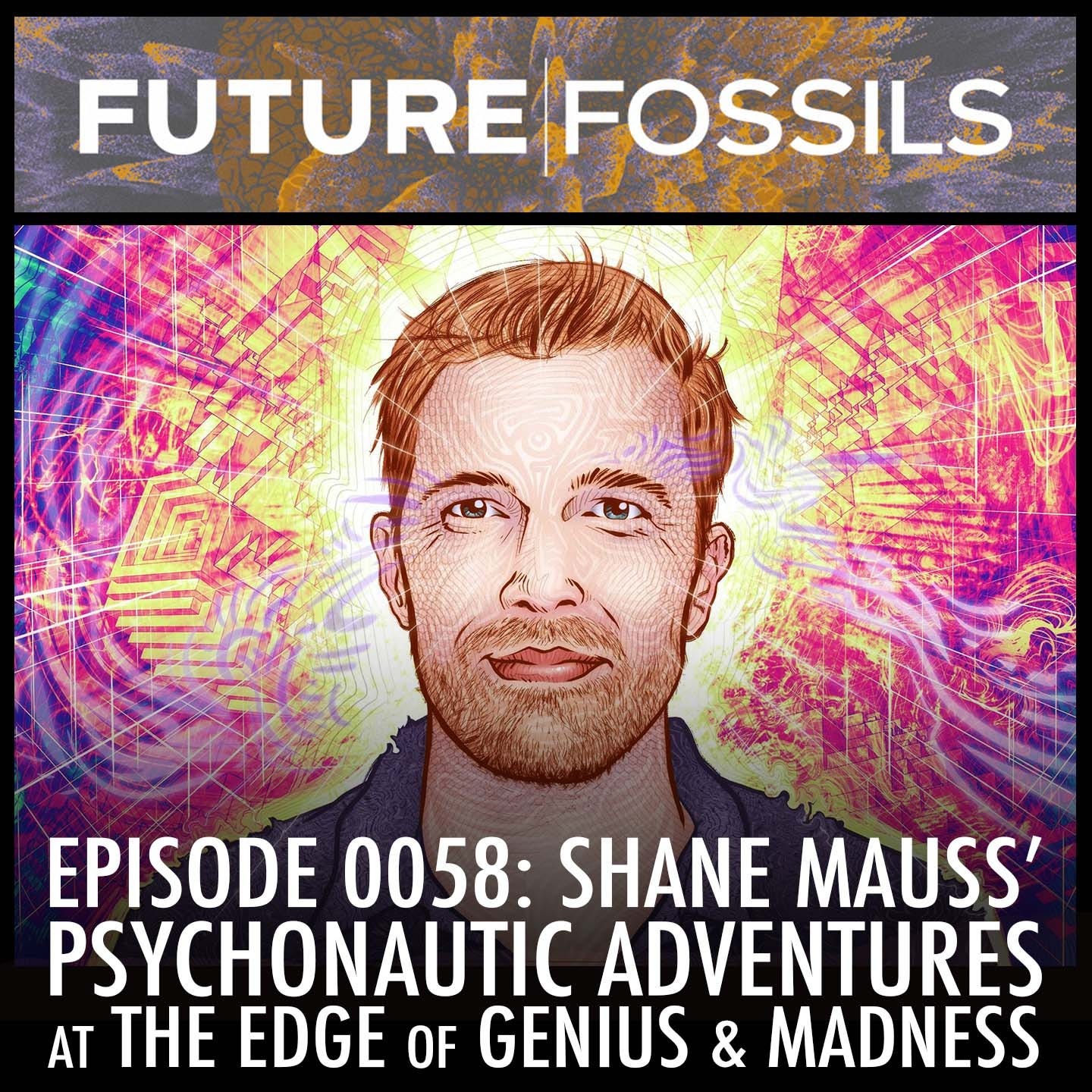
58 - Shane Mauss (Psychonautic Adventures at the Edge of Genius & Madness)
EThis week’s guest is comedian Shane Mauss, whose psychedelic standup A Good Trip blew minds at over 100 tour stops last year, and whose documentary film Psychonautics takes us on Shane’s adventures in psychedelic therapies. He also hosts the Here We Are Podcast, where he interviews scientists of all stripes and mines their research for standup inspiration…Shane’s always been a rigorous thinker, a legitimate and respectable skeptic, which made his inquiries into the weird realms of psychedelia so interesting to me. He started tripping to self-medicate for his lifelong depression a few years ago but hisHe and I disagreed for years about the nature and validity of the phenomenon known as “synchronicity” – that everything is linked behind the scenes, no coincidences – but this summer he texted me to tell me he’d had a revelatory experience and that I was right all along.The next thing I heard from him, he was on Duncan Trussell Family Hour Podcast talking about how he had just gotten out of a mental institution. So WHAT EXACTLY was I right about, again?? We go deep in this episode about the nature of reality and madness in this warm and funny conversation (in which he shared what he actually saw that put him in the psych ward)…http://shanemauss.com http://herewearepodcast.com TOPICS- How the universe is wearing stripes and plaid (just like in some of Alex Grey’s art).- What’s behind that crazy look in someone’s eyes.- Simulation theory vs. the brain’s innate virtual reality.- What people are really seeing when people say they see God.- A bunch of awesome trip reports from Shane.- Shane getting courted as a clinical subject for new extended-state DMT trials.- Time as a multidimensional landscape of rhyming moments- Marshall McLuhan’s “invisible environment” as it relates to memory as a mutable substance, altered every time it’s accessed.- Evolving through the layers of the multiverse from animal to human and beyond.- The Evolution of God and how we’re all participating in the new empathy of a deity that does not have it figured out.- A new kind of psychedelic science.- Princeton Engineering Anomalies Lab and the possibility that the so-called future is actually present and accessible via longer wavelengths.- and a bunch more… QUOTES“I found out years ago that I can just gobble up some mushrooms two or three times a week for a few weeks, and that’ll get rid of my depression for a few months or so…I started thinking, ‘What if instead of just getting rid of my depression, I could actually feel GOOD?’”“The DMT world feels very ‘top down,’ very ‘creator’ type of thing…”“Sobriety is not really a thing that works, even though I've got to do it for now…”“Why try to envision Jesus doing something – why try to have a dream where you’re seeing Jesus and talking to Jesus, when it’s just in your head? Just BE Jesus!”“A lot of this stuff gets pretty far away from the scientific method, you know?” Get bonus content on PatreonSupport this show http://supporter.acast.com/futurefossils. Hosted on Acast. See acast.com/privacy for more information. This is a public episode. If you'd like to discuss this with other subscribers or get access to bonus episodes, visit michaelgarfield.substack.com/subscribe
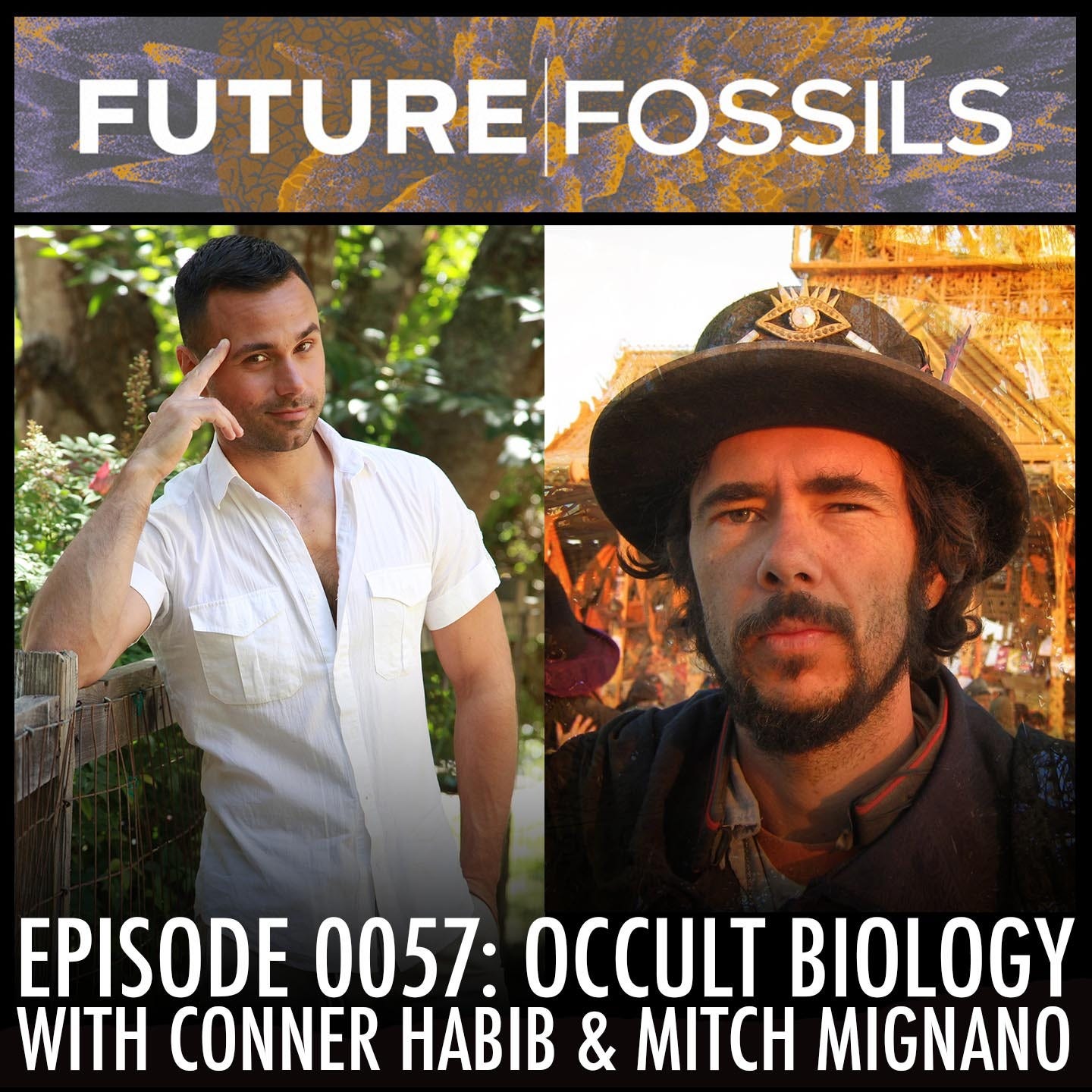
57 - Conner Habib & Mitch Mignano (Occult Biology)
ESubscribe: Apple Podcasts / Stitcher / Spotify Join the Facebook Discussion Group This week I’m lucky to sit with two extremely cool occultist philosophers: gay porn star Conner Habib & our mutual old friend, professional gambler turned journalist and record producer Mitch Mignano. We have a conversation about how life is observed and understood by occult philosophies - how organisms are perceived in, as, of, and beyond spacetime; the human and inhuman forms of evil in a discarnate taxonomy; and the very existence of that hidden ecosystem… Conner: http://connerhabib.comhttp://twitter.com/connerhabib Mitch: http://realitysandwich.com/u/mitch-mignano/https://www.facebook.com/mitch.mignano.77 (http://shamanikagenda.com coming soon) In this episode we reference an episode of Conner’s podcast in which he had a portentous chat with comedian Duncan Trussell – who it happens is a friend of new Mitch’s also, and convinced him he should start a podcast – and the metaphysical implications of this are at the beginning of their excavations… Actually, don’t think about that yet. Topics What Conner learned from studying under legendary biologist Lynn Margulis – while in school for creative writing… Gaia Theory and the Earth as a self-regulating super-organism… The battle between holism and reductionism: organismal biology versus molecular biology… Conner’s introduction to the work and worldview of Rudolf Steiner and Goethian Science… New ways to see, perceive, conceptualize, and encounter living beings… How to understand the living world through the lens of Anthroposophy… The Gnostic view that the material world is just the corpse of goddess Sophia, and how that relates to latencies in the nervous system that forbid us from encountering the world “right now”… How we experience time differently depending on our size… The role of psychedelics (or “ecodelics”) in the cultivation of etheric and astral senses/knowing – help or hindrance…? Steiner’s prophecy about the end of the 20th Century developing an “Ahrimanic school” of people with profound powers that are not concerned with the health or benefit of organic evolution… How do we engage nonphysical “entities” we believe are service-oriented but might be manipulating us…? What do occultist philosophy and ketamine have in common? The objective reality of evil, and Conner’s concern about Duncan Trussell’s light-only spirituality might be playing fast and loose with the dark forces… How our gods reflect the attitudes we bring to them… …and our demons often simply want redemption (even if they go about it the wrong way). Is evil time-bound? The hidden connection between Dracula and The Matrix!? And we go DEEP on reincarnation. Conner Quotes “Molecular biology is kind of a phony biology. It’s not really about life.” “The problem with these kind of sciences…they’re difficult to encapsulate in ten-minute soundbites. ‘The gene is the driving force of evolution!’ That’s easy. You can talk about that in two seconds – like you can flush the toilet in two seconds.” “The thought is just sort of the dead husk of the movement of thinking. So can we get into the actual movement of thinking itself, apprehend and understand that?” “Organisms are not spatial beings. They’re not temporal beings either. They’re sort of movements, or dynamic evolutions expressed to us through time. The only way to determine an organism’s existence spatially is to kill it.” “If you really want to understand an organism, you look at its growth throughout its life cycle and life history. You don’t just see what’s in front of you in that moment and extrapolate.” “We often encounter death and think it’s life.” “When we encounter things, we encounter them in process…and it might be the end of the process.” “It’s not up to me to say whether people should do psychedelics. What I WANT is a different cultural conversation about them, that allows different information in, aside from, ‘These are terrible and should be illegal’ versus, ‘These are bringing me spiritual awakening, bro.’ I don’t find either of those satisfactory.” “I think our desire to speed up our spiritual development is, like, first of all, sort of aspiritual.” “No one wants the machine elves to threaten them.” “Not having any risk is a really dangerous thing.” “If you have a god of demands – ‘Show yourself to me!’ – you’re going to get demands.” “Don’t say ‘BE better,’ say ‘DO better”…because I know it’s coming for me. I know I’m going to be changed again, and again, and again, and again, into different bodies.” “I’m not tooting my own horn here, but that’s why people think that I’m evil, or porn is evil, sexuality is evil: because it’s pushing sexuality forward because it’s demanding people look, think, encounter it. Books Richard Doyle - On Beyond Living Lynn Margulis & Dorion Sagan - Microcosmos Craig & Henrika Holdrich? - Genetics & The Manipulation of Life: The Forgotten Factor of Context Grant Morrison – The Invisibles Kurt Vonnegut –
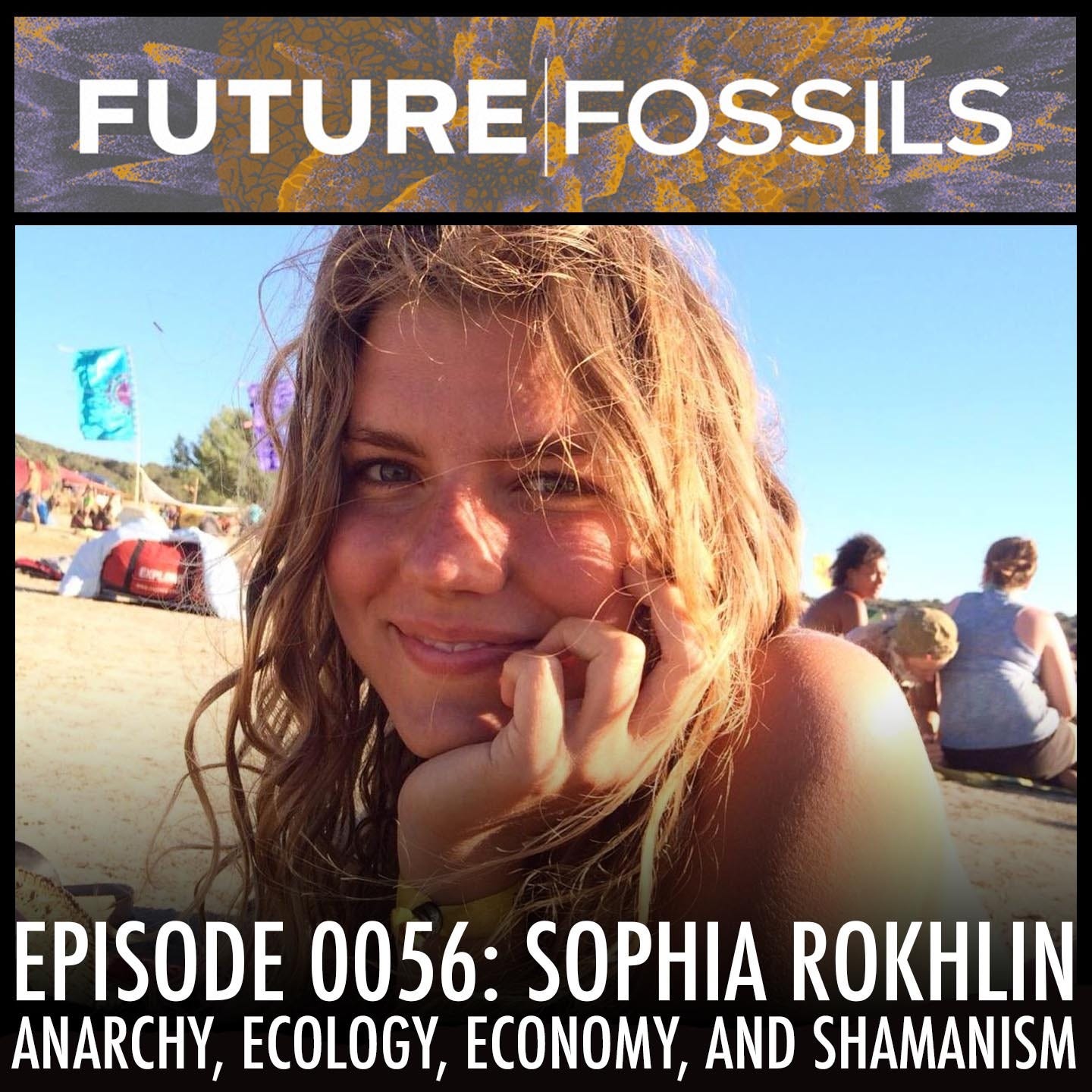
56 - Sophia Rokhlin (Anarchy, Ecology, Economy, and Shamanism)
EThis week’s guest is Sophia Rokhlin, whom I met in Portugal at Boom Festival 2016, and who just finished her Master’s of Ecological Economics in Barcelona last fall. Sophia’s currently at work on a number of cool projects, including The Environmental Justice Atlas – a database of environmental conflicts happening around the world. She’s also helping Daniel Pinchbeck write a book on ayahuasca and has worked at Kosmicare, a European psychedelic harm reduction project. http://ejatlas.orghttp://twitter.com/sophiarokhlin We Discuss: • How Spanish represents time differently than English • The politics and economics of Catalonian independence from Spain • How energy accounting, geography, history, and political ecology come together in the new field of Ecological Economics: the layer of material funds and flows behind what we think of as “the economy” – how much gold, how much sand, how much palm oil… • Her time in the Amazon studying plant medicines with the Sequoia tribe • “Flex crops” (used as a food, a fuel, and a feed) for more sustainable and resilience global agriculture • How can we properly account for all the ways our ecosystems support us without dangerously oversimplifying things? • The history (and problem) of using “ecosystem services” to quantify the economic value of nature • “Man-Age-Ment” • The Battle of Global Civilization: Technocrats vs. Mystics • And what of technoshamanism? Demetabolizing our environment. • Genpo Roshi’s Big Mind Process & voice dialogue in ego transcendence • The problem of locating yourself in a global environmental conflict without a clear front line…each of us is everywhere, so where do we stand? • Connecting and making kinship and natural rapport with elements in the global economy and learning how your life intersects with the planet-wide body of ______ (paper, palm oil, latex, etc.). • How studying economics can be like diéta, getting acquainted with something • Acting as a gateway to transcendence and altered states of consciousness • Sophia’s history of encounters with ayahuasca, and what led to the realization that shamanism is not her path • Balancing Big Picture thinking and intimacy, the social and personal, traditionally masculine and feminine modes of being • Overcoming the cognitive dissonance between the revelations of psychedelic experience and ecological defense of plant medicines • The hidden costs of regulating cannabis and other plant medicines • Her soft spot for “the clandestine economies of hackers, pirates, and shamans”…don’t create economic monocultures by commodifying everything you possibly can! • How psychedelics defy commodification – and why that’s a good thing • Ontological anarchism and the silliness of trying to impose structure onto the utterly uncontrollable mysterious reality of reality • Anarchism as a process • “To complete things is to uncomplete them.” • Unity and efficiency versus the counterclockwise heyoka medicine of necessarily contrary oppositeness • Can there even BE a counterculture in a planetary culture? • Idea Sex • Tamera Healing Biotope in Portugal and their model for Love Without Fear • Relationship Anarchy needs a community container; why polyamory can be more difficult in the city • The opposite of Tinder is having elders counsel us when we find someone in our community attractive • Feminine eldership, female guidance and leadership • Life Hack 101: Treat animals as gendered he’s and she’s instead of it’s, and you get better communication results. • The Noosphere eating the Biosphere • Jamming with nature and the importance of acoustic biodiversity • The fallacy of conservation biology and the cult of wilderness • If we really want to Make America Great Again, we’re going to need some mammoths! Subscribe: Apple Podcasts / Stitcher / SpotifyJoin the Facebook Discussion GroupSupport this show and get cool stuff! Get bonus content on PatreonSupport this show http://supporter.acast.com/futurefossils. Hosted on Acast. See acast.com/privacy for more information. This is a public episode. If you'd like to discuss this with other subscribers or get access to bonus episodes, visit michaelgarfield.substack.com/subscribe
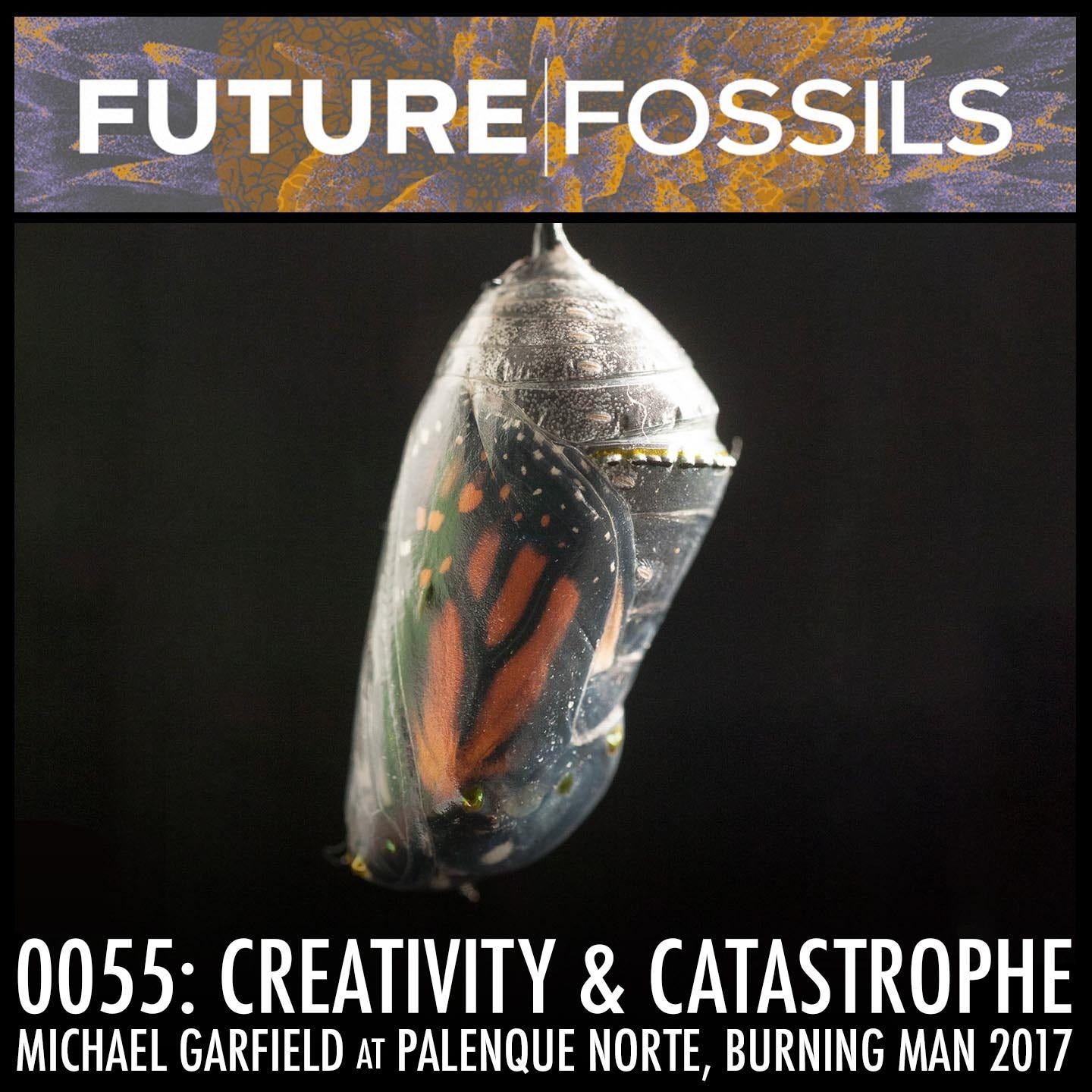
55 - "Creativity & Catastrophe" (Talk at Palenque Norte, Burning Man 2017)
EWe’re living through a mass extinction – which is also one of the most awesome opportunities for creativity the Earth has ever seen. In this talk that I gave at Burning Man 2017’s Palenque Norte Speaker Series, I give a short tour of Great Catastrophes of Natural History and show how each of them was also equally the advent of new life, intelligence, diversity, and richness. Studying how crisis is the mother of invention, it’s my hope that this talk will inspire you to see our turbulent, chaotic age as something to be celebrated. Learning what we can from evolution, we can shed new light on how to steer ourselves away from global ecological disaster – perhaps to even revel in our role as agents of epochal change in Earth’s amazing story.http://michaelgarfield.nethttp://youtube.com/michaelgarfield In this talk I discuss:• Going backward in order to go forward, the reclamation of the traditions and wisdom we have abandoned in our March of Progress;• The importance of situating ourselves and our moment in the larger context of Natural History;• The “Press-Pulse” Theory of mass extinction;• The emergent forms of life and evolutionary creativity ignored by nearly every conversation about how we’re “killing the planet”;• What The Great Oxygenation Event has to teach us about pollution and creativity as a response to danger;• Why philosopher Galen Strawson doesn’t believe in free will;• How the evolution of flowers was a huge catastrophe;• Richard Doyle’s update of the Stoned Ape Hypothesis and the role beauty and seduction have played in the evolution of consciousness and culture;• What the evolution of early birds has to teach us about the proliferating ecosystem of mobile devices;• Hopeful developments in the area of plastic-eating microbes and fungi, and using living machines to digest pollution;• The wilderness lives on in cities in the Anthropocene;• And how awesome the film Shin Gojira (2016) is.• PLUS: What if we are living in a giant galaxy-sized brain? Bruce Damer, Jake Kobrin, Mitch Mignano, and more speak up in the Q&A. Quotes:“The story of life can be told as a series of nested singularities, nested horizons of knowing and understanding.”“Sex is a far more effective R&D situation than clonal reproduction.”“Everything that we’re creating now, we want to treat it with love, and an understanding that it has a life and a destiny of its own, and it’s not something we control.”“Cultural realities are starting to seem less and less sufficient for describing and experiencing the full range of human potential.” Subscribe: Apple Podcasts / Stitcher / Spotify Join the Facebook Discussion GroupSupport this show and get cool stuff! Get bonus content on PatreonSupport this show http://supporter.acast.com/futurefossils. Hosted on Acast. See acast.com/privacy for more information. This is a public episode. If you'd like to discuss this with other subscribers or get access to bonus episodes, visit michaelgarfield.substack.com/subscribe
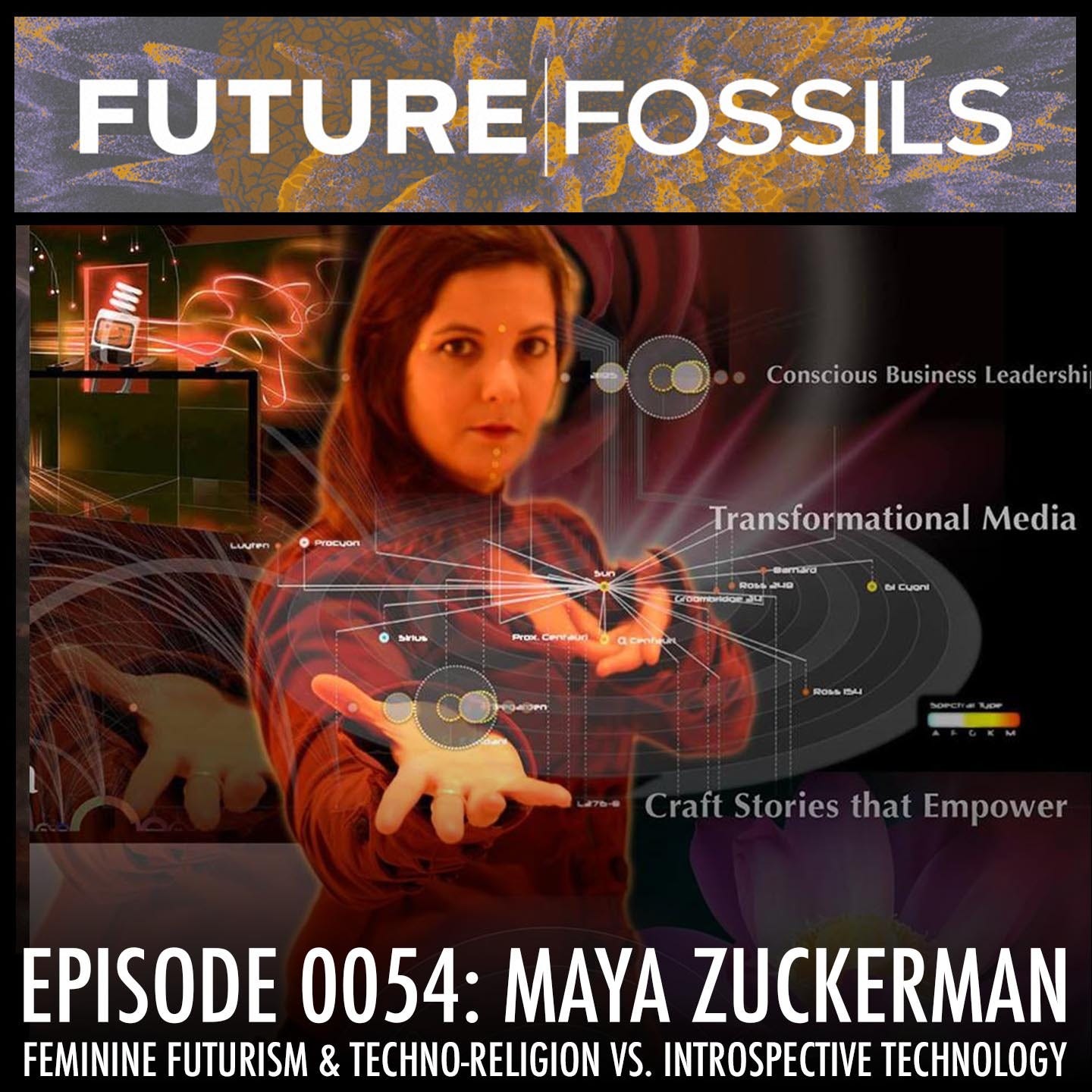
54 - Maya Zuckerman (Feminine Futurism & Techno-Religion vs. Introspective Technology)
ESubscribe to this show: Apple Podcasts / Stitcher / Spotify Join the Facebook Discussion GroupSupport this show and get cool stuff This week’s guest is futurist and mythographer Maya Zuckerman, member of IEEE and author of the young adult science fiction series Em’s Theory. https://www.mayazuckerman.com/https://www.linkedin.com/in/mayazuckerman/ We Discuss: • What it’s like to be a woman futurist in the Bay Area; • Futurism as a pastime of privilege; • Marginalized (third-world) futures and science fiction; • Is Singularity University the church of a new techno-religion?; • Ethical AI design; • The need for more introspection in technology design; • http://ieee.org • Conscious AI and mind-uploading (hype?); • The decay of consensus facts and what it means for our ability to agree on history and reality; • The role of mindfulness in our acceleratingly crazy technological environments; • Do we have to retreat out of our ego minds to even LIVE in an ultra high-frequency automated machine economy? • What is the ultimate purpose of our devotion to technology? • Neuromarketing & being responsible/accountable for our suddenly-public thoughts; • What happens when we’re all so technologically empowered that we live in a community of magicians and superhumans? • Masculine and Feminine magic as two approaches to tech; • Critiquing the Rapture of the Nerds & techno-immortalism; • Most women and archaic spiritual leaders were women…so why does our mythological hero’s journey not include everyone else who was a part of the tribe? • The importance of inviting as many perspectives as possible (including women, minorities, non-human persons, and potentially nature itself) into a conversation about the future; • The spectrum of potential futures on display in her sci-fi novel series, from utopian to dystopian; • The ethics of “animal uplift” (Do we have an ethical responsibility to give any nonhuman animals sentience?) • Are we losing our humanity to the limitations of our engineered software environments? • Yuval Noah Harari’s nonfiction book Homo Deus • Kevin Kelly’s nonfiction book The Inevitable • Greg Egan’s sci-fi book Diaspora • Barbara Tedlock’s nonfiction book The Woman in the Shaman’s Body Maya Quotes: “There’s a hubris here [in Silicon Valley] that’s really dangerous, and you see it everywhere. And when you call it out, people are like, ‘Oh, you can’t stop technology. You can’t talk about that.’ I’m like, ‘Yes you can, and you should. That’s what adults do. KIDS run forward and don’t take any kind of consequence. And if we want to ever become mature adults – which we’re not –mature adults pick up after ourselves, we think a little about the future, we plan our budget, we take five when we get excited and we sit down. We don’t have to rush about it.’” “The Wild West is what happens when there’s not a lot of land, and not a lot of structure. And then you let guys do whatever they want, and they start shooting each other.” “All of these truly amazing technologies…what is the purpose of them? Is it to become god-men? Or is it to become what we are supposed to be?” “It’s not about ageism; it’s about being stuck in an ancient story, not being able to progress with the times.” “The collective journey is not collectivism. It’s not one idea in a kind of borg-like mentality of thinking as one. And it’s not a Singularity. I don’t have a better word than ‘solidarity,’ and it IS a kind of problematic word…but everybody’s appreciated for showing up.” “My worst nightmare is, I can’t switch off the media.” “Utopia’s problematic, just as much as dystopia.” Like this podcast and want to show support? Make a donation! BTC = 1iLHDNzpRMiXn13ekB8iVEsvVFkRzkGVe LTC = Ldg3JS4T2m8gFd8kQPaLpjcAiAXxdVthWQ ETH = 0xddF0524510d6d802c3e9b0740D48CF893425664D BCH = 1XyN5SRpQF7AuXnCvAEjNXMMMYRCW7Rgf DASH = XwckYNsyYThWozWJqrtpeguEu9BAqi9gPj Get bonus content on PatreonSupport this show http://supporter.acast.com/futurefossils. Hosted on Acast. See acast.com/privacy for more information. This is a public episode. If you'd like to discuss this with other subscribers or get access to bonus episodes, visit michaelgarfield.substack.com/subscribe
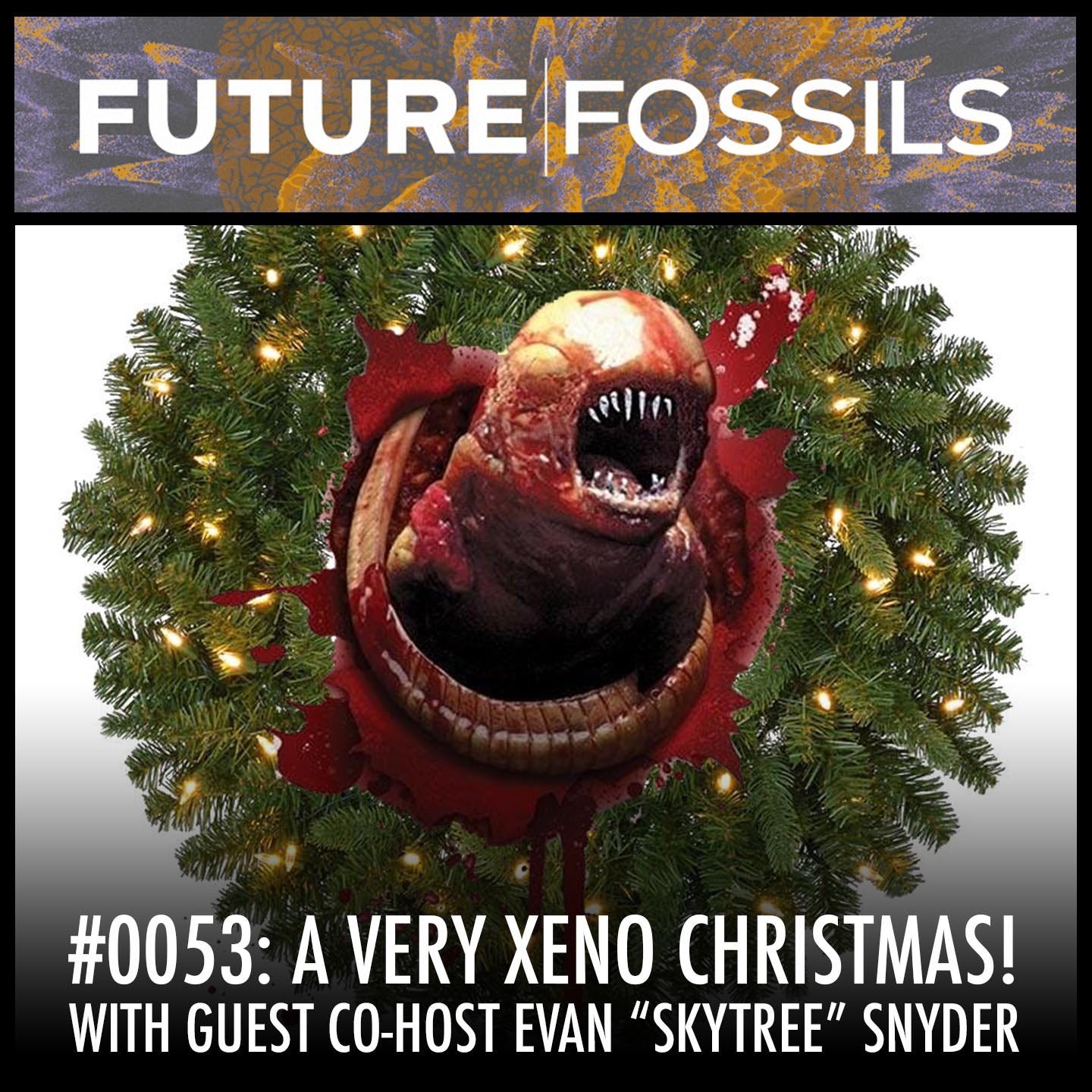
53 - A Very Xeno Christmas! with Evan "Skytree" Snyder
EMerry X-(is for Xenomorph)-mas, everyone! This week – in a brazen display of anachronism – original Future Fossils cohost, electronic music producer, and sci fi aficionado Evan Snyder and I go deep on what we liked and disliked about Alien: Covenant, and speculate on how this film fits into the still-murky larger mythos of Ridley Scott’s expanded Alien universe. We get into atheist Scott’s weird fixation with the Bible; how the Alien films represent and handle philosophical questions about the relationship between humanity and technology; and why people from the science-fictional future ARE SO DAMN STUPID. Evan’s Music: http://skytree.bandcamp.com Related Reading: “Reading Necronomicon at the New York Comic Con” https://www.patreon.com/posts/poem-reading-at-10621994 In This Episode We Discuss: • Why are people are so damn stupid in the Alien movies – is it bad writing, or a realistic understanding of how dependent we will one day be on artificial cognitive augmentation? • Nicholas Carr’s book The Glass Cage: Automation and Us • Smartphone addiction & technology as prosthesis • Was the neutrino burst that hit the Covenant an accident, or planned/intended? • Is David actually rebelling, or still continuing to serve the Weyland-Yutani corporate program? • Easter Egg: How do the various LV planets of the Alien franchise line up with chapters of Leviticus? • Are the Engineers themselves bioengineered artificial organisms? • The xenomorph life cycle: Why do we even have an Alien Queen? Is “egg-morphing” canonical? • WTF was going on in that seemingly contrived last Daniels/Tennessee/Protomorph fight scene? • The motif of creativity and the inability to create in the Alien movies • NerdWriter’s great video on Logan and the extension of genres into self-aware post-genres * Hideo Kojima about the Alien franchise * How Blade Runner movies and Aliens films may be related • How this film addresses society’s concerns about artificial intelligence * Are the alien prequels actually about the production of the Alien franchise itself? * Wall-E, Idiocracy, Blade Runner, The Fifth Element * Christmas, Christ, and Antichrist in the Alien films * Is Ridley Scott trolling us all? * Bizarre (fan-shipped) possibility of a Star Trek/Alien crossover Subscribe to this show: iTunes (iOS) / Stitcher (Android) Join the Facebook Discussion GroupSupport this show and get cool stuff Like this podcast and want to show support? Make a donation! BTC = 1iLHDNzpRMiXn13ekB8iVEsvVFkRzkGVe LTC = Ldg3JS4T2m8gFd8kQPaLpjcAiAXxdVthWQ ETH = 0xddF0524510d6d802c3e9b0740D48CF893425664D BCH = 1XyN5SRpQF7AuXnCvAEjNXMMMYRCW7Rgf DASH = XwckYNsyYThWozWJqrtpeguEu9BAqi9gPj Get bonus content on PatreonSupport this show http://supporter.acast.com/futurefossils. Hosted on Acast. See acast.com/privacy for more information. This is a public episode. If you'd like to discuss this with other subscribers or get access to bonus episodes, visit michaelgarfield.substack.com/subscribe

52 - Blockchain & The Evolution of Consciousness with Michael Phillip & Jennifer Sodini
EIn a special episode so timely that I couldn’t wait a week to publish, I sit down with Jennifer Sodini (EvolveAndAscend.com) and Michael Phillip (Third Eye Drops Podcast) to cut through the technical jargon and discuss the economic, cultural, and even spiritual implications of blockchain technology. Everything we took for granted is about to change…beyond Bitcoin and quick riches, there’s a new planetary culture based on the scalability of trust. This podcast explores what that means for you – and why so many of your friends think that this new evolution of digital money and contracts is one of the most important events of our lives.Jennifer & Michael are two of the co-founders (along with Noah Lampert) of Cryptoseer, a new media company:http://cryptoseer.com We discuss:• Why this is about so much more than another hype bubble of speculative assets for tech nerds;• What the blockchain economy is teaching us about how to surf exponential change;• The democratization of financial and legal literacy, and how decentralization can nourish a planet-wide renaissance of non-coercive institutions;• The importance of talking and storytelling about these new technologies in a way that people can connect to and understand;• Reclaiming our authority, agency, sovereignty from the financial and governmental systems we created for convenience…but not without resistance;• Looking at blockchain in an evolutionary and ecological context, and comparing what we’re living through now to historical precedents like 1967 and the end of the Age of Dinosaurs;• The urgency of a decentralized Web 3.0 built on blockchain and mesh networks, to keep a Free Internet alive;• What is all this going to look like when the artists get their hands on it?• Blockchain to manage swarms of flying autonomous cars…• What we can learn about the social construction of value from Dogecoin;• Is Bitcoin an NWO plot…and would it even matter if it were?And perhaps most critically:• Can understanding blockchain help liberate you from the ego?? NOTE: You can listen to this with ZERO technical knowledge. But if you want some primers and interesting related links:• Richie Etwaru’s TEDx talk, “Blockchain Massively Simplified”https://www.youtube.com/watch?v=k53LUZxUF50• Bettina Warburg explains the blockchain to a 5-year old, a teenager, an undergrad, a grad, and an expert on WIRED: https://www.wired.com/video/2017/11/expert-explains-one-concept-in-5-levels-of-difficulty-blockchain/• Our friend Noah Lampert (co-founder of Cryptoseer.com with Jenn & Michael) made a special episode of Synchronicity Podcast about it:https://syncpodcast.com/cryptosynchronicity/ Once you’ve made it through those:• My EPIC Facebook thread, “Kids, it’s time we sat down and had a talk about Bitcoin” (300+ comments): https://www.facebook.com/therealmichaelgarfield/posts/10105294338954259• “The Collapse of the American Dream Explained in Animation”https://www.youtube.com/watch?v=mII9NZ8MMVM• About “Johnny Appledrone vs. The FAA”http://hieroglyph.asu.edu/story/johnny-appledrone-vs-the-faa/• And here’s an infamous video of Katie Couric talking about the Internet in 1994, the way people are talking about blockchains today:https://www.youtube.com/watch?v=UlJku_CSyNg On the relationship between BTC and OWS:“If the SEC wants to investigate something, they should start with Wall Street and what happened in 2008. It’s definitely not sitting in a room full of servers. It’s time to have this discussion and I’m demanding that discussion starting today.”- Jared Rice of AriseBank https://www.huffingtonpost.com/entry/arisebank-launches-first-cryptocurrency-bank-largest_us_5a32bf19e4b0e7f1200cf916Julian Assange: "Bitcoin is the real Occupy Wall Street." https://www.facebook.com/photo.php?fbid=10100400693519339&set=a.591743230229.2055838.56801131&type=3&theater&ifg=1 Get bonus content on PatreonSupport this show http://supporter.acast.com/futurefossils. Hosted on Acast. See acast.com/privacy for more information. This is a public episode. If you'd like to discuss this with other subscribers or get access to bonus episodes, visit michaelgarfield.substack.com/subscribe
51 - Daniel Schmachtenberger (Designing A Win-Win World for Everyone)
EThis week’s guest is Daniel Schmachtenberger of the Neurohacker Collective – one smart dude! Must be the nootropics. We have an awesome conversation about what it will take for us to thrive through our Age of Transition and into the emergent world that works for all, not just a few of us.His company: http://neurohacker.comHis blog: http://civilizationemerging.com Some Topics We Discuss:• How he got started in complex systems thinking while working in (and watching the failures of) wildlife conservation;• How he understands his work as participating in the emergence of a planetary renaissance;• A vision for how to move beyond finite win-lose games with in- and out-groups between warring cultures and into infinite win-win games;• His critiques of negative interest currency, universal basic income, and other system-wide economic incentives;• His argument for why giving ecosystems economic value isn’t enough to stand up against a wave of exponential technology;• How change can come from everywhere at once to vault us into a new era of whole-planet thinking that does not (continue to) collapse “complex” into merely “complicated”;• The role of automation in worldwide economic transformation;• How the next evolutionary transformation will emerge from the appearance of new ways to coordinate and align our senses, information processing, and action in the world – closing the loop between what we know and what we can do with it;• How we can heal the broken information ecology, and what that means for the surveillance conversation;• What incentives can we use in a totally redesigned global economy that benefits everyone? Select Books Mentioned:• Timothy Morton’s book Hyperobjects• James P. Carse’s book Finite & Infinite Games Select Daniel Quotes:“We have a system where structural violence and externality are implicit throughout the system completely, so participation with that at all requires it.”“It was clear that nothing less than a discrete, nonlinear phase-shift was adequate, so…what are the necessary and sufficient criteria of the post-transition world? And how do we support that emergence?”“If you’re getting interested in economics as a philosopher, it just means you’re gaining insight into how structural incentive and structural value systems and disposition work. Which means you are NOT being a good philosopher if you are not thinking about those things.”“We don’t know how to do civilization without war…we’re really talking about getting off win-lose game theory completely. It’s unprecedented. But unprecedented shit is actually the precedent of the universe, if you have a very long view.”“Economics can be seen as the interface layer between our values and the way we build the world.”“If we are gaining the power of gods, then without the love and wisdom of gods, we self-destruct.”“Are the things that we THINK we’re optimizing for the right things at all? … How do I create an INTEGRATED system design that tends to everything that matters here?”“The forty weeks of a baby in utero, if it continued, would kill itself and the mom. And the phase shift of leaving the birth canal and umbilical cord cut – it’s not predicted by the forty weeks before, if you didn’t know that thing was going to happen.”“Anything you can write a process for, no human wants to spend their whole life doing.”“The omni-win-win system actually outcompetes the win-lose system, while obsoleting win-lose dynamics itself.”“We are living in a world where we have an amazing amount of sensory input possible, right? We can see stuff from the Hubble, we can see stuff in electron tunneling microscopes, and we can see input from everywhere around the world on the Internet – but that’s decoupled from sense-making, so I can’t tell if it’s fucking true or not! I can’t put it together with the things I know. And so I have a tremendous amount of sense input that I can’t make sense of. Then, to the degree that I make sense of something – like, okay, CO2 is actually a problem – then I have no idea how the fuck to act on it. And then do the degree that I act on things – like I go buy this laptop that we’re talking on, that comes from an industrial supply chain that affected life on six continents – I actually have no sense coupling to what the fuck was affected and HOW it was affected to inform if I want to make that choice or not.” Special thanks to the Body Hacking Conference for their support of this episode! BDYHAX.COM ("Body Hacks") is about human augmentation, personal expression, democratized medicine and bringing the DIY ethos to our own bodies. We bring together people from all industries who are interested in what's happening right now in bodyhacking all over the world to make connections, friends, and share experiences and resources in order to build the best possible future. February 2-4, 2018 at Sheraton Austin in Downtown Austin. Get bonus content on PatreonSupport this show http://supporter.acast.com/futurefossils. Hosted on Acast. See acast.c
50 - Ayana Young (Ecological Activism & Living For The Wild)
EAyana Young didn’t even go camping until she was 25. Now she lives in a cabin she built herself in the redwoods of Northern California and manages a 477-acre native species nursery wilderness rehabilitation project (as well as an amazing podcast). This week’s episode is a candid, personal discussion about how awakening to our participation in nature is the key to both our survival and our spiritual salvation…https://forthewild.world/https://www.instagram.com/for.the.wild/ For The Wild is currently raising money to plant ONE MILLION redwoods: https://www.kickstarter.com/projects/1284964860/1-million-redwoods-project We talk about:• her transition from anonymous, germaphobic suburban consumer to restoration ecologist, activist, and dirt-working spokesperson for the world’s last remaining wilderness;• being a person of place and cultivating a personal relationship with our wild (and not-so-wild) lands;• love in a time of catastrophe and how to FEEL our impact on a planetary scale;• what wilderness means in The Anthropocene and what ought to guide our decisions in restoration ecology (not just “restoring to 200 years ago” as if that’s the best goal);• restoring not extinct ecosystems but biodiversity and resiliency IN GENERAL;• the joy of personal sacrifice to a cause and purpose greater than yourself;• what inspires her to keep going against all obstacles to the Good Work;• how to be an empowered activist and servant in love with life and your imperfect self;• picking yourself up after failure;• and more. A totally inspiring conversation! Select Quotes:“If I’m so consumed by my self and my own life, then what am I willing to risk for others? That’s a question I ask myself a lot: ‘What am I willing to risk for that which I love?’”“We don’t have reciprocal relationships with land, with Earth, with each other, with our lives. And how do you have a reciprocal relationship? Well, you have to have intimacy. You have to feel things. And I love when people say that if you’re not upset, if you’re not grieving, if you’re not angry, if you’re not feeling these strong emotions, then you’re not awake right now. If you were awake to the realities of what is happening in the world, you’d have no choice but to have immense amounts of feelings. But it’s not easy to unravel all of the conditioning that keeps us from feeling.”“We can be artists as we farm. We can be artists as we grow food. We can be artists as we clean beaches. We can be artists as we put mushrooms on oil spills. I mean, there are SO many ways we can create and love each other and HAVE A BLAST while restoring the Earth. And I think it takes the sadness and the grief to get into that work – and then when we’re on the other side, we can put all of that rage and that fire and that sadness into doing something tangible.”“It’s not about playing God. I think it’s more about being an herbalist for the Earth…I want to be more a support system than a savior.”“How do we embody the dichotomy of large-scale urgency and also gentle deep-time thinking?”“I don’t think we should wait until mastery to get involved.” Special thanks to the Body Hacking Conference for their support of this episode! BDYHAX.COM ("Body Hacks") is about human augmentation, personal expression, democratized medicine and bringing the DIY ethos to our own bodies. We bring together people from all industries who are interested in what's happening right now in bodyhacking all over the world to make connections, friends, and share experiences and resources in order to build the best possible future. February 2-4, 2018 at Sheraton Austin in Downtown Austin. Get bonus content on PatreonSupport this show http://supporter.acast.com/futurefossils. Hosted on Acast. See acast.com/privacy for more information. This is a public episode. If you'd like to discuss this with other subscribers or get access to bonus episodes, visit michaelgarfield.substack.com/subscribe
49 - Jake Kobrin (Sex, Death, & The Return of the Black Madonna)
EThis week’s guest is visionary artist Jake Kobrin, whose digital paintings explore a gorgeous, dark, evocative terrain of non-ordinary human experience and twist religious iconography into a metamorphic form well-suited to our psychedelic modern era.We discuss his painting “Black Madonna” and the return and healing of the repressed feminine – not just women, but the body, the psychological shadow, marginalized peoples, death, and transformation…We talk about Jake’s artistic intuition, nontraditional relationships, the reality of love, and my transformation from living in a haunted house to realizing the “ghost” was my own disowned soul…If you are, or love, a witch, you’ll dig this episode. Jake’s Website: http://kobrinart.com More Topics We Discuss:• The nonduality of the sacred and profane;• Intuition and the creative process, allowing the art to speak through you;• Eden & Apocalypse, with history in the middle;• Light & Dark, Good & Evil as “conceptual impositions” that don’t really exist “in nature”;• Mary Magdalene, Judas, and The Scapegoat;• The evolution of cell division as failed excretion and the relationship between sex and death;• James Hollis’ book The Eden Project: The Search for the Magical Other, and how we seek out lovers based on unconscious images of our idealized early childhood caregivers• Being a better partner to yourself first before relying on lovers• Don Miguel Ruiz’s book The Mastery of Love• Hakim Bey’s book Temporary Autonomous Zone and ontological anarchy versus the social ego (as a function of wilderness)• B Catling’s book The Vorrh• “cis-relational” “cis-racial” and other “yes I am this thing” labels• Graphic Novel, The Wicked & The Divine, and japanese sun goddess AmaterasuAnd Jake reads his short piece about the spiritual authority of the Black Madonna.Here’s an AMAZING related piece by theologian Matthew Fox: http://www.matthewfox.org/blog/the-return-of-the-black-madonna-a-sign-of-our-times-or-how-the-black-madonna-is-shaking-us-up-for-the-twenty-first-century “Understanding that my self is kind of alien to me, and a mystery, I can’t really judge…”“All things are inherently pure and it’s more like our projection onto that that is less than pure…The Christ saw The Magdalene in her essential purity.”“Our lives and our relationships are these formless, complex, infinite things, and I would rather exist in that framework than try to limit myself to conceptual boxes about the way I see things and how I project ideas of what my life is.”“What is considered manly – certainly, that projection within American culture – I don’t relate to that AT ALL, and it just makes me go, ‘ew.’”“I think we can just let our experiences exist without NEEDING to put them in a category as ‘real’ or ‘not-real’…” Get bonus content on PatreonSupport this show http://supporter.acast.com/futurefossils. Hosted on Acast. See acast.com/privacy for more information. This is a public episode. If you'd like to discuss this with other subscribers or get access to bonus episodes, visit michaelgarfield.substack.com/subscribe
48 - Lindsay Loftin (Mermaids For Clean Water)
ESubscribe to Future Fossils on iTunesSubscribe to Future Fossils on StitcherJoin the Future Fossils Facebook GroupSupport Future Fossils on PatreonThis week’s guest is my friend Lindsay Loftin, a professional mermaid who uses her performances to raise awareness of marine conservation issues. She also boasts 60 pushups in two minutes and the ability to transform phone-addicted schoolchildren into avid gardeners.https://www.facebook.com/mermaidsforcleanwater/ We Discuss:• How mermaid performances can help us transform our relationship to nature;• Sea goats and other weird half-and-half creatures, and how the Capricorn’s ambitious in-between-ness was a prophesy of amphibians as an emblem of evolutionary “ascent”;• Remembering in our bodies the importance of the health of our environment and our right relationship to nature;• Ecology as a mystical experience or way of being awake;• The changing definition of nature once you think of the atmosphere as an artifact created by primordial ooze;• Epigenetics, landscape agency, cities as automatic outgrowths of the lithosphere, and the argument against free will from a planet’s point of view;• Plastics and endocrine disruption related sterility;• Activism!;• Whales;• David Pearce’s anti-species-ist manifesto;• Responsible tourist information about how to visit wild places respectfully;…and much more. I go off the deep end and talk about the possibility of ACTUALLY BECOMING mermaids with CRISPR, and the social consequences of the end of a common “human” body.Then we talk for another hour. Lindsay tells some AMAZING animal stories. She has never been injured. Lindsay Loftin:“I want to be the Bill Nye of mermaids.”“I think when little girls see me holding my breath for two minutes and swimming around Barton Springs, it blows their minds…they’re thinking, ‘Science is not what I thought it was.’”“It’s our time to return to the water. At least in our focus and our awareness. Because you know, the way our culture is going is so far removed from any sort of connection to nature as I’ve come to understand it. So that’s a systemic illness, in my opinion. My work…lies with healing that rift, that illness.”“No two people react to nature in the same way. The way I experience going out side is kind of like a landscape level. Which, as an ecologist, I’m mapping in my brain how energy is flowing from the air, into that tree, into me, into the soil – the water going across the landscape, where that’s going, what animals are here – I’m seeing all of that at the same time.”“I can pretty much guarantee you that you drank plastic within the last week…essentially, we are becoming plastic.”“As someone who works with other people’s children, I just cannot stand the thought of sitting here waiting [for plastic-eating bacteria to save the world].”“I don’t even have an Instagram. People hear that, and they’re like, ‘But you’re a mermaid!’”“Dangerous wildlife finds me, gets as close to me as possible, and then completely leaves me alone. I can’t really explain why, but that seems to be one of my gifts: that animals are A attracted to me, and B have no interest in eating me.”“If birds get really loud, or suddenly really quiet, both of those are times when you should pause and evaluate your surroundings.” MG:“Could plastic-eating bacteria be used to generate the electricity required to mine Bitcoin?” Get bonus content on PatreonSupport this show http://supporter.acast.com/futurefossils. Hosted on Acast. See acast.com/privacy for more information. This is a public episode. If you'd like to discuss this with other subscribers or get access to bonus episodes, visit michaelgarfield.substack.com/subscribe
47 - Eliot Peper (The Weird Turn Pro: Sci-Fi & Scenario Planning)
EIn one of the most QUOTABLE episodes of Future Fossils yet, this week’s guest is Eliot Peper – a “novelist and strategist” writing fiction and consulting businesses about the social implications of disruptive technologies. In addition to writing a steady stream of sci-fi inflected techno-thrillers like True Blue and Cumulus, he’s an editor at Scout.AI (one of the cooler speculative fiction websites I’ve seen out there). http://www.eliotpeper.com/http://scout.ai/ We Discuss:• The power of science fiction to help us imagine future scenarios;• The possible social impact of radical life extension (gerontocratic radical conservatives vs. an emergent mature wisdom culture);• The Superstar Effect and how it might play out in the digital age;• The awesomeness of Cory Doctorow’s latest novel, Walkaway;• Eliot’s skepticism of mind uploading and conscious AI;• The specter of technological unemployment;• Science fiction’s growing significance to corporate think-tanks and creative labs in a future-facing society;• How science fiction is like traveling to a foreign country – and teaches us more about our own moment than it does about the future;• And More! Quotes:“We don’t call it ‘life extension,’ we just call it ‘healthcare.’”“I think there is a very misleading public discussion going on around these topics [mind uploading and conscious AI], for a very simple reason. And that is – and I know this as a storyteller – metaphors matter…the human mind is very poor at distinguishing metaphor from reality. That’s what makes art fun! That’s what makes novels entertaining. We experience them as if they are real. Money is that. It only exists because we can build these complex shared fictions. However, those fictions can come back and bite you in the ass. And one of the ways they do it is, we take the metaphor too far.”“[Mary Shelley’s Frankenstein] takes the extension of the Industrial Revolution into the imagination of dystopia. And I think we’re doing that right now when we’re talking about uploading our minds, and about creating general AIs…I just think we’re taking the computer analogy too far.”“Technology is most useful to the extent that it is inhuman.”“The whole point of technology is that we can accomplish what we want to accomplish more effectively – or, said another way, we can do less of what sucks.”“Getting better at the skill of putting yourself in another person’s shoes is really important, and fiction is a great training ground for that. It can illuminate so much about why we do what we do that we can apply in our lives.”“I think what makes science fiction as a genre interesting is its insights about the PRESENT.”“I seek out discomfort. I seek out novel experiences that challenge me and that are not always fun. And I try to talk to people from different fields and learn from them, because I’ve learned that in my own life that having a really strange and somewhat random set of life experiences allows me to have a fresh perspective sometimes on a new problem.”“The most important things about the world and about what it means to be human are very obvious and very old. And I think it’s especially important to remember that when we feel like we’re in the midst of a whirlwind of change that we don’t understand. And that the world we want to build and the lives that we want to lead – either today in 2017, or in 2117 – is that we need to be kind to each other. We need to help our friends out. Even more important, to help out strangers. To pay things forward instead of trying to think about the benefits that accrue to us. To make sacrifices – meaningful, painful sacrifices – financial, emotional, or otherwise – to help each other out. I think that building a better world is just a thousand small acts of kindness.” Get bonus content on PatreonSupport this show http://supporter.acast.com/futurefossils. Hosted on Acast. See acast.com/privacy for more information. This is a public episode. If you'd like to discuss this with other subscribers or get access to bonus episodes, visit michaelgarfield.substack.com/subscribe
46 - Magenta Ceiba (Bloom Network's Anarcho-Permaculture Future)
EThis week’s guest is master community builder, singer, and human spirit animal Magenta Ceiba of the Bloom Network. Bloom Network:http://bloomnetwork.org Magenta’s Personal Website:http://www.imaginationhealer.com/ We discuss: - The adoption of regenerative culture practices;- Cultivating planetwide resiliency in an age of thousands of years of unprocessed grief and trauma;- Web native permaculture psychedelic anarchy;- Communicating across HUGE political gaps (esp. with family);- Cool Bloom Network community initiatives happening around the world;- What will it take to adapt our technological environment to suit a more humane and grounded ecological society?- The relationship between the Wood Wide Web of interspecies partnerships and the maturing World Wide Web of human making.- How can we be good ancestors?- A “relational, omnidirectional nowness where we embrace as our own body the other organisms on this Earth and the cosmic cycles of stuff through space”- Synchronicity & Diachronicity- An academic angle on decolonizing consciousness. :)- the inspiration for Intergenerational Psychedelic Dialogues Podcast Quotes: “Another key is coming to this conception of time that is relational and omnidirectional, and this nowness in which we embrace as our own body the other organisms that are on this Earth and the cosmic cycles of movement of stuff through space…” “We’ve disconnected from some of the fungal and soil networks and if we’re going to continue to survive, and that layer of machine-embodied intelligence is going to survive, we need to learn to be in symbiosis with the Earth that we’re on. If we’re going to make this leap to colonizing other planets, to star travel…” Get bonus content on PatreonSupport this show http://supporter.acast.com/futurefossils. Hosted on Acast. See acast.com/privacy for more information. This is a public episode. If you'd like to discuss this with other subscribers or get access to bonus episodes, visit michaelgarfield.substack.com/subscribe
45 - Kerri Welch (Fractal Synchronicity & The Future of Time)
EThis week’s guest is philosopher Kerri Welch, whose doctoral thesis from CIIS (and current book-in-progress) explore a fractal model of time. If you have ever wondered about time, this episode is for you. Instant classic. Kerri’s Academic Papers & Talks:https://ciis.academia.edu/KerriWelch Kerri’s Blog:https://textureoftime.wordpress.com We take a wild tour through the layers of the human brain and mind, examining the correlations between different brain waves and their correspondent states of consciousness – and speculate on our experience of time as an evolved response to a far more complex and awesome world than we can possibly conceive!Twenty minutes in and we’ve already covered the fractal nature of time and we’re on to explaining what happens to the modern self and its boundaries in the torrent of novelty that awaits un in a digital age. Then we go deep for another hour and a half… DISCUSSED:• Fate vs Free Will in light of Chaos Theory• The relationship between technology and our experience of time, overstimulated, interrupted• How Jean Gebser’s structures of consciousness overlay on EEG data• The nature of synchronicity & time vs. timelessness• The effects of ayahuasca, illness, aging, and other time-warping events on the passage of time• Singularities and our asymptotic approach to transcendence• Narrative collapse, fake news, and the end of history• Relativity, scaling laws, and city time vs. country time• What was before TIME?• Pet telepathy as a matter of referential framing• The “future” causing the “past”…• …and the physics (and psychology!) of how to feel the future.• Schizophrenia as possibly a disorder of time perception• Dopamine levels and the experience of duration• Human chronobiology adapted to other planet’s days• Integrating the rational mind with transpersonal experience QUOTES:“We actually can’t get precise enough to bring the level of predictability that physics once thought it could.”“Children have to be indoctrinated into time, right? They’re not born into linear time. They’re born in a timeless space, and that’s where they live, and then they live in this hypnagogic dream time, which is all present moment. You’ll hear kids say, like, ‘I remember when you were little’ to their parents.”“When we restrict ourselves to linear causal thinking, we are coarse-graining the present moment. We are glossing over the infinite depth of richness available within the present moment. And of course it’s paradoxical: we coarse-grain it by dividing it more finely.”“What we’re experiencing in our culture right now is the entrainment to the fast frequencies. We’re not letting the long slow frequencies have the greatest amplitude. What does that look like? It looks like hanging out with rocks and trees and elders. And that’s the integration that we need in order to nest our super-fast frequencies within, in order to give them direction…if we can nest within the natural structures of the long, slow frequencies that surround us, it will guide these fast frequencies in healthier directions.”“We REALLY just have to get better at holding multiple realities. AND recognizing what’s important about them.”“The dog comes and sits by the door half an hour before the owner comes home because to the dog, the owner’s already home. Their moment is big enough that it’s happening already. But we’re so finely dividing things that we’re like, ‘It’s half an hour away! It’s an eternity!’ But for the dog that’s been sitting bored at home all day…”“Free will comes from a future influence we can’t see. That’s one way I would interpret it.”“The definition of human experience is, to me, the limitation of infinity, in order to have experience.” Get bonus content on PatreonSupport this show http://supporter.acast.com/futurefossils. Hosted on Acast. See acast.com/privacy for more information. This is a public episode. If you'd like to discuss this with other subscribers or get access to bonus episodes, visit michaelgarfield.substack.com/subscribe
44 - Christopher Sheehan (Time Bound in the Body: Transformational Tattoo)
EThis week’s guest is tattoo artist Christopher Sheehan, who regards his practice as a sacred act and tattoo as a kind of binding of time in the body.https://www.mountaintempletattoo.com/ We talk about:• how he became a tattoo artist and came into “transformational tattooing” as a way of communicating with and programming the subconscious mind;• other ways we bind time into matter with earthworks art and pre-Columbian mounds;• the difference between choosing your own tattoos and the more traditional style of having them chosen for you by the artist;• the virtue and value of The Ordeal in personal transformation;• seeing skin art as a transcultural phenomenon connecting us to other tribes and traditions across time and space;• and the future of tattoo as an art form and a culture, in which skin art merges with speech as part of a new, richer, more embodied language… “If you had to put something in your bathroom mirror…what would you want in your bathroom mirror FOR THE REST OF YOUR LIFE? That feedback loop with the imagery with which we surround ourselves is TOTALLY game-changing and shifting.”“What identity do I want to imprint upon my life? What connection to something within me do I want to see empowered and enhanced? And the tattoo becomes this living reflection of that enhancement, that empowerment, that connection, alignment.”“So much of our cultural perspective is about comfort and convenience – and to do something that is physically taxing, emotionally and mentally demanding on a level of momentary transcendence – it’s new for a lot of people.”“The tattoo artist and the machinery that they use are going to become more and more intuitive and integrated…kind of like when I oil paint, or even when I get into a flow with dot work and stippling, I don’t even feel like I’m doing it. I’m watching myself INTEND it.” Get bonus content on PatreonSupport this show http://supporter.acast.com/futurefossils. Hosted on Acast. See acast.com/privacy for more information. This is a public episode. If you'd like to discuss this with other subscribers or get access to bonus episodes, visit michaelgarfield.substack.com/subscribe
43 - William Irwin Thompson, Part 2 (Thinking Together at the Edge of History)
EThis week we continue the special two-part conversation with historian, poet, and mythographer William Irwin Thompson. Author of dozens of sweeping works of synthetic insight, Bill Thompson’s greatest work may not have been a book but a community: The Lindisfarne Association, a post-academic “intellectual concert” for the “study and realization of a new planetary culture,” which anchored in various locations across the United States as a flesh-and-blood meta-industrial village for most of its forty years. In his latest and last book, Thinking Together at the Edge of History, Thompson looks back on the failures and successes of this project, which he regards as a “first crocus” budding up through the snow of our late-industrial dark age to herald the arrival of a planetary renaissance still yet to come. This episode pivots from a contemplation of Lindisfarne’s history to our navigation of the turbulence between two world eras – how will we weather all this change, and what new life and worldview awaits us on the other side? We talk about surfing the “winds of creative destruction” in a highly volatile digital economy; the emergence of the elemental spirits of the land into our demon-haunted crystalline electronic infrastructure; the future of parenting in a world too fast and too complex for public schooling or the nuclear family; the tension between emergent new media and art forms and the traditional forms of novel/poem/painting/song/etc.; the relationship between improvisational speaking and spiritual channeling; and the experience of being an “entelechy,” a multitude of smaller agencies comprising an ecology of self, an endosymbiotic “Homo gestalt.” Bill speaks candidly and fluently about his unusual life history as a parent and living journey as an aging mystic, bringing erudite historic overview together with a surprisingly frank perspective on his transpersonal experiences. It’s an honor to be able to share this discussion with you… QUOTES: “Mysticism is relevant now because it’s a good description of the daily news; it’s just responsible journalism that there is this mystical quality to an ethereal economy that is electronically blipping wealth back and forth in this computerized online banking world.” “When you have an oxymoronic culture with the djinn inhabiting the computers and moving into the cognitive space symbiotically with human beings, the definition of the environment is changing and that which is invisible to the materialist or the industrialist is now recognized as an endosymbiont with us – so it becomes like the cell with the mitochondria.” “Depressions and catastrophes are transitions from one system to another in complex dynamical systems, so you have to step back and look at the big picture. And if you try to keep the accounts in a small container, where you say, ‘Nothing is stable! Nothing can be held’ Well, why is Buddhism so popular? Because that’s exactly what Buddhism is saying! If you attach and you’re grasping, you’re going to suffer.” “We see [the change] but we always see it negatively. We see the crash but not the imaginary future that’s emerging.” “When the family always lived together in the nuclear family, what do you have? They were always arguing and fighting…compression isn’t necessarily a good thing. It’s what Whitehead would call ’the fallacy of simple location.’ So I embrace that the environment is now planetary. It’s person-planet. And through Skype and things like this, I’m in constant communication with the family, and that’s okay.” “As you develop your subtle bodies through yoga…when you reach a certain point, you get what I call a ‘matching grant,’ like how a foundation gives matching grants, and if your evolutionary sheath reaches a certain point, then a being comes to cohabit-ate with you in your auric extended ecology.” “You don’t want to have a hungry ghost as a daemonic guide, so discrimination is definitely called for.” “Some [bacteria] you need in your stomach to digest, and if they get in the wrong place and they’re out of timing, they’re not so good. If Godzilla tramps through Times Square, it’s not a good thing. If he goes for a walk in the Jurassic, it’s okay.” NOTE: Again, here are the links to the first two chats we had in 2011 and 2013, as well as to my video remix of one of Bill’s lectures with footage from Burning Man. Enjoy and be sure to check out Bill’s awesome books, as well as his extensive lecture series archived online with the Lindisfarne Tapes! Get bonus content on PatreonSupport this show http://supporter.acast.com/futurefossils. Hosted on Acast. See acast.com/privacy for more information. This is a public episode. If you'd like to discuss this with other subscribers or get access to bonus episodes, visit michaelgarfield.substack.com/subscribe
42 - William Irwin Thompson, Part 1 (Thinking Together at the Edge of History)
EThis week’s guest is one of my greatest inspirations: the historian, poet, and mythographer William Irwin Thompson. Author of sweeping works of synthetic insight like At The Edge of History (a finalist for the National Book Award in 1972), The American Replacement of Nature, and Coming Into Being: Artifacts and Texts in the Evolution of Consciousness, Bill Thompson’s greatest work may not have been a book but a community: The Lindisfarne Association, a post-academic “intellectual concert” for the “study and realization of a new planetary culture,” which anchored in various locations across the United States as a flesh-and-blood meta-industrial village for most of its forty years. Lindisfarne’s roster reads like a who’s who of influential latter-20th Century thinkers: Gregory Bateson, Lynn Margulis, Ralph Abraham, Stuart Kauffman, Paolo Soleri, Francisco Varela, David Abram, Hazel Henderson, Joan Halifax-Roshi, James Lovelock, Wes Jackson, Wendell Berry, Gary Snyder, Maurice Strong, and Michael Murphy were among them. In his latest and last book, Thinking Together at the Edge of History, Thompson looks back on the failures and successes of this project, which he regards as a “first crocus” budding up through the snow of our late-industrial dark age to herald the arrival of a planetary renaissance still yet to come. Bill’s wisdom and humility, vast and inclusive vision, and amazing skill for bringing things together in a form of freestyle “wissenkunst” (or “knowledge art”) made this and every conversation that I’ve had with him illuminating and instructive.(Here are links to the first two chats we had in 2011 and 2013, as well as to my video remix of one of Bill’s lectures with footage from Burning Man.)For anyone who wants to know what happens after universities and nations lose their dominance and both economy and identity “etherealize” in a new paradigm of ecological human interbeing that revives premodern ways of knowing and relating – and/or for anyone who wants to help build institutions that will weather the chaotic years to come and help transmit our cultural inheritance and novel insights to the unborn generations – here is a conversation with one of the master thinkers of our time, a mystic poet and professor whose work and life challenged our assumptions and proposed a powerful, complete, and thrilling view of our emergent role as citizens of Earth.We talk Trump and our future-shocked need for charismatic strongmen, digital humans and the tragicomedy of the smartphone takeover, technocracy versus the metaindustrial village-monastery and “counterfoil institutions,” the “necessary exercise in futility” of dealing with rich and influential people to fund important work, how the future arrives unevenly, and how to get involved in institutional work without losing your soul…Also, cryptocurrencies and universal basic income as symptoms of the transition of the global economy from a liquid to a gaseous state; QUOTES:“Austin is, of course, an air bubble in the Titanic…”“The counterfoil institution is a fractal…it’s the individual and the group, kind of like Bauhaus…it had an effect, but it was very short lived. So I argued in Passages [About Earth] that these entities [including artistic movements like Bauhaus, but also communities like Auroville and Fyndhorn] were not institutions, but ENZYMES – they effected a kind of molecular bonding and effected larger institutions, but they themselves weren’t meant to become institutions. And so Lindisfarne, which was a temporary phenomenon of Celtic Christianity, getting absorbed by Roman Christianity, was my metaphor for this transformation.”“When you’re getting digested and absorbed [into the system], it can either be thrilling because you really WANT to become famous and you want to become a public intellectual, and you want to namedrop and be part of the power group…but if you’re trying to energize cultural authority, then it’s difficult in America. You can get away with it, I think, more successfully in Europe, where there is this tradition of Great Eminences, and in Paris, once you’ve done something of value as an intellectual, then you’re part of it for your life. It isn’t like, ‘What are you doing next? Do it again, do it again, do it again.’ So American culture, based on this kind of hucksterism and boomerism and success culture, is very resistant to that sensibility.”“We’re always a minority. If we look at The Enlightenment, we’re talking about, what, twelve intellectuals in all of Europe? If you’re an extraterrestrial and you flying-saucered into Florence in the 15th Century and said, ‘Hey, I hear you guys are having a Renaissance?’ And they said, ‘What?’ What do three painters mean? It’s still the Middle Ages for them. And so everybody’s in different times’ laminar flow. Some are faster and more ultraviolet and high energy, and others are very wide, slow, and sluggish. And that’s how nature works.”“Each person makes his own dance in response to the laws
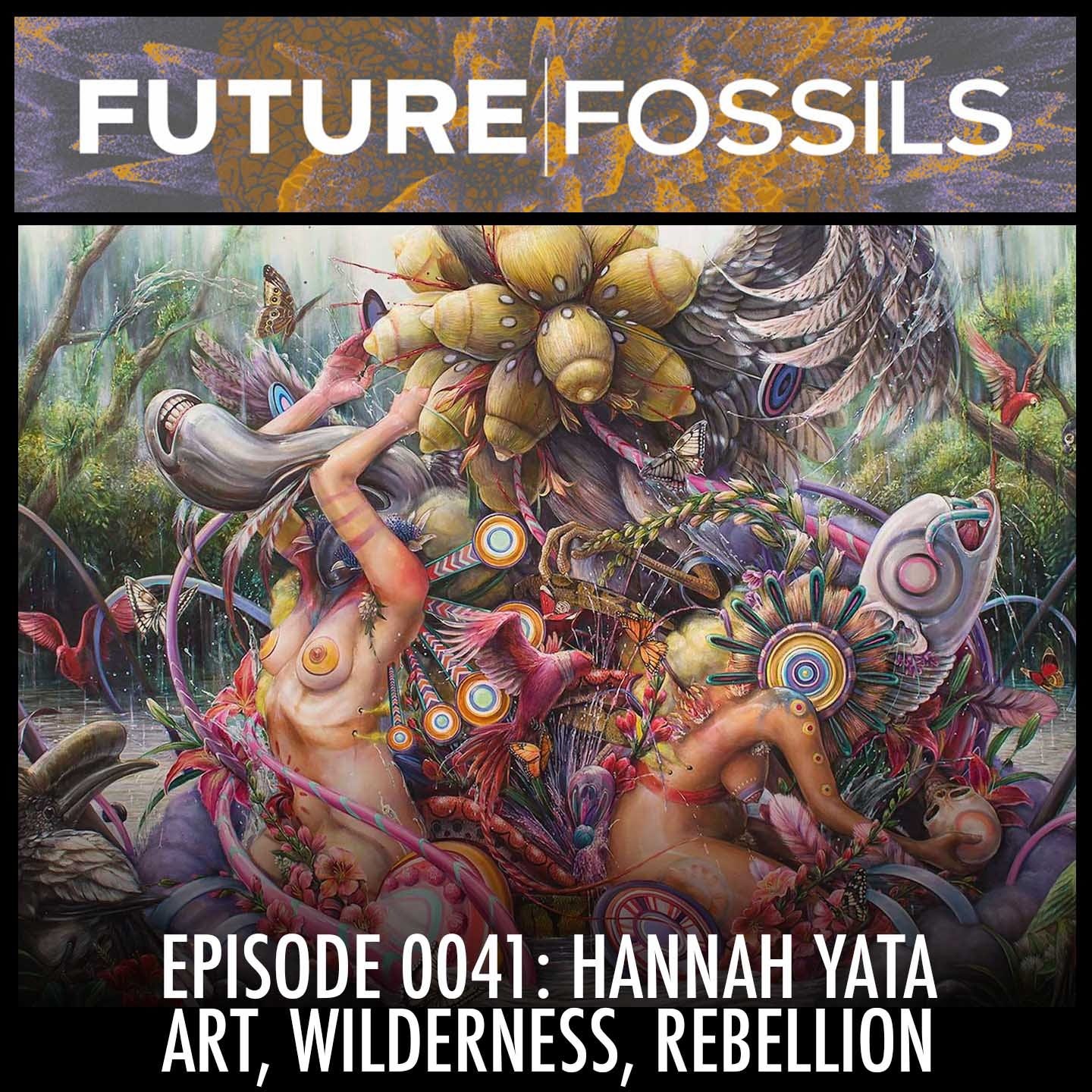
41 - Hannah Yata (Art, Wilderness, Rebellion)
EThis week’s guest is the visionary painter Hannah Faith Yata, whose riotous, ecstatic work explores and celebrates natural biodiversity, and exalts the repressed feminine – the beautiful and the grotesque, death and life in vivid color all at once. We talk about her new show “Dancing in Delirium,” the role and life of wilderness in the Anthropocene – weather control and fear porn (eerily prescient, given recent events; this talk was recorded in July) – the feeling of living through a time of massive change and chaos (and clocking out with cute pet videos) – art as rebellion and the party as a revolution – the pagan conjunction of human and animal revived in cosplay and furry culture – and the ways our ideas are literally making impressions on the land )yet, we are something that the land itself is doing)… “The city, to me – that’s like a virtual reality made out of brick and steel.” “Wildness for me, means: leave it the fuck alone.” “I like to think of my work as this strange awakening of a rebellion…” “I’m not fond of human faces, and I’ll tell you why. For me, seeing somebody’s face and having to analyze every single detail, every wrinkle, every little nuance, is just…if you think about painting and its historical significance, it’s like you’re immortalizing this person. You’re immortalizing their ego. To me, though, I think it’s all about more or less the abolishment of the ego and this realizing that we’re a part of nature, that we see ourselves in nature…I don’t want to shit on portraiture, because I think it’s beautiful, but that’s not my statement.” “I feel like everything today is this dance of trying to keep the ego so that it doesn’t fly off into space.” “It doesn’t have to be pretty…if you or I were thrown out in the wilderness tomorrow, it’s not like there’s some nature god that’s going to protect us. It’s wild out there! Actual wildness is wild!” “We have more moral codes when we go to war against other people than we do hacking through a rainforest. So to personify things and to think of them as these living personalities helps us to remember our respect for these things.” Get bonus content on PatreonSupport this show http://supporter.acast.com/futurefossils. Hosted on Acast. See acast.com/privacy for more information. This is a public episode. If you'd like to discuss this with other subscribers or get access to bonus episodes, visit michaelgarfield.substack.com/subscribe
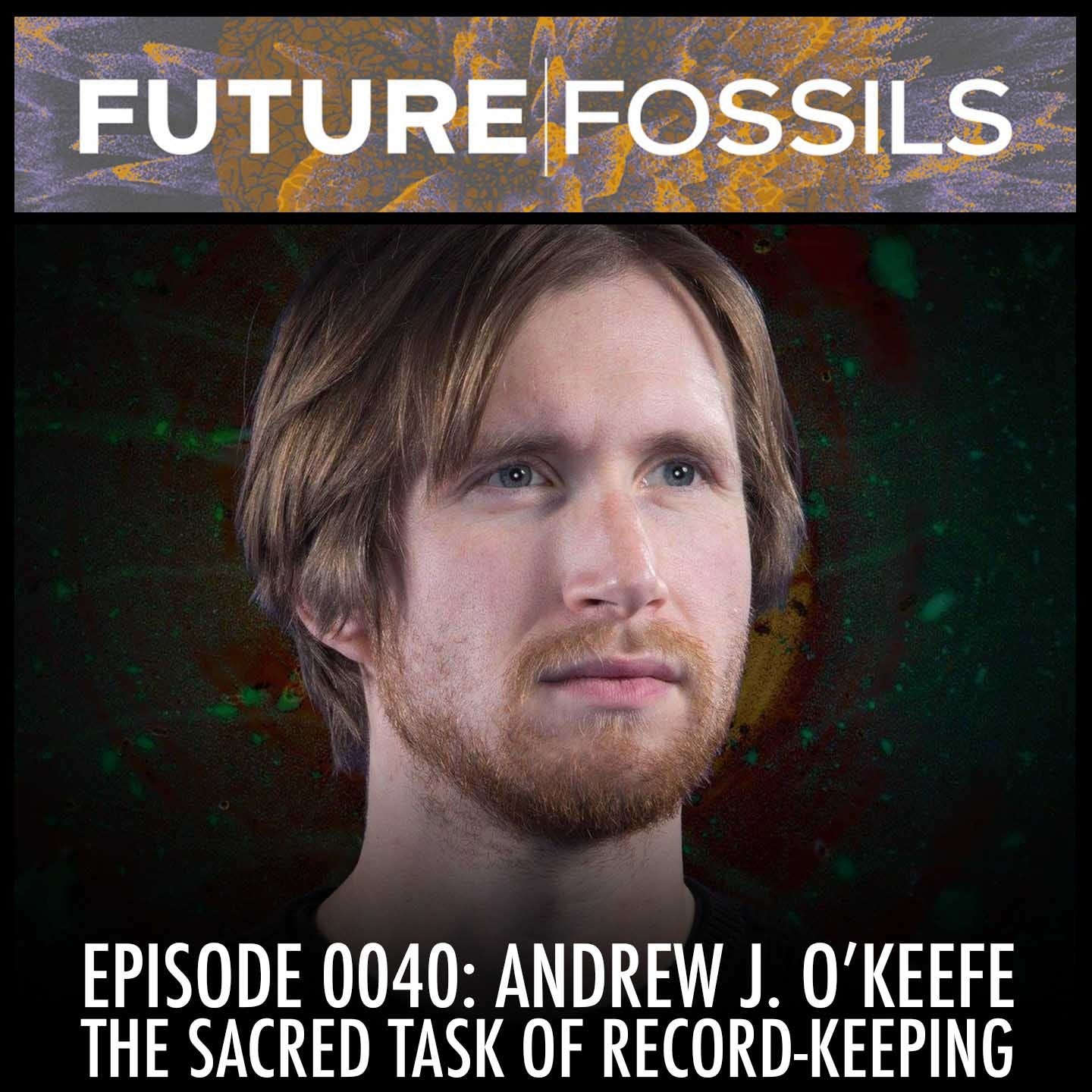
40 - Andrew J. O'Keefe (The Sacred Task of Record-Keeping)
EThis week’s guest is Andrew J. O’Keefe II – documentarian, archivist for Singularity University, devoted recordist of the emergent planetary culture, and a dear old friend I met back in the Dawn of Time when he was working as the personal assistant to Android Jones. http://www.andrewjokeefe.com/https://www.facebook.com/andrewjokeefehttps://twitter.com/andrewjokeefe?lang=enhttps://www.linkedin.com/in/andrewjokeefe/https://medium.com/@andrewjokeefe We talk about the motivations for preserving and reliving the significant (AND insignificant) moments of our lives. From the role of “tapers” in the success of The Grateful Dead & STS9, Terence McKenna and Robert Anton Wilson, and The Exegesis of Phillip K Dick…to how a donation of 600 books started Harvard University…to a vision of our artificial intelligence augmented descendants living in a world of totally recorded life and currently incomprehensible richness and insight…this is a conversation about why we “save” things, and why we should treat our record-keeping as the sacred task it truly is. “If we don’t preserve what’s important to us, then we run the risk of not sharing it ever again. Nobody might never even know that it happened.” “What exactly ARE our priorities?” “The control of where this stuff is headed is out of any one organization or individual’s hands. On the other hand, we have these central systems of control…if we don’t find a way to decentralize what humanity has developed up to this point, we’re probably going to lose it.” “If we let market forces run [the world]; if we let meaningless trends of shit, surface level culture that’s not even real culture, that’s like iterative loop culture, if we let that dictate things, then as everything gets increasingly out of control or asymmetrical, what the hell else do we have to fall back on?” “I think the paradoxes of living in society are only going to increase at an exponential rate. It’s going to terrify people; it’s going to cause mass chaos in unprecedented ways because we have these centuries-old resentments that technology is not going to erase. It’s only going to make further asymmetrical. The history of all borders: there’re losers. Those people are upset…have a right to be upset. Both psychedelics and the ancient modalities of healing…are going to be the most critical tool that we use to move forward.” Get bonus content on PatreonSupport this show http://supporter.acast.com/futurefossils. Hosted on Acast. See acast.com/privacy for more information. This is a public episode. If you'd like to discuss this with other subscribers or get access to bonus episodes, visit michaelgarfield.substack.com/subscribe
39 - Hunter Maats (The Future of Education & Knowledge Transmission)
EThis week’s guest is Hunter Maats, host of the Mixed Mental Arts Podcast and co-author of The Straight-A Conspiracy. We talk about the future of education and human collaboration – moving past a world of routine factory-worker indoctrination and the “insane cargo cult” of the academic system, and into a new model for the transmission of knowledge that suits a truly planetary culture. https://twitter.com/huntermaatshttps://medium.com/@huntermaats The value of myth, ritual, and other deeply-ingrained but often-maligned premodern human activities. How to make sense of authority, expertise, and accreditation in a world where the dominance of academia (and the legitimacy of so many other institutions) is losing hold. How do we structure a “global village?” What is post-academic education? What comes after the fall of the Ivory Tower? How do we recruit premodern impulses into the project of contemporary life without repressing magic, ritual, and myth? We also talk a lot of smack on Richard Dawkins for being the totally irrational pope of Anti-Religion. Hunter mentions my article on the evolution of creativity: https://medium.com/@michaelgarfield/how-to-live-in-the-future-part-4-the-future-is-exapted-remixed-35ea5ca9d877 Quotes: “The walls of the Ivory Tower have been falling down for the last thirty years. There are now 60 million scientific papers, 130 million books. It’s literally too much information for a tiny cadre of individuals to try and make sense of. It’s going to take seven and a half billion people to really make sense and draw signal out of that noise.” “If you’re reading a blog post, you’re getting an hour or two of distilled thought. If you’re reading a book, then you’re getting hundreds or thousands of hours of distilled thought. The question is, what is your information diet, and what are you sharing, and what are you engaging with?” “You should structure a global village a lot like you structure an actual village…” “Biologically, we want ritual, we want myth, we want belonging, we want a sense of embeddedness. BUT, we have all this cool stuff now…” “People like [Richard] Dawkins, even though they bang on about reason all the time, are in my assessment not very reflective individuals.” “The flag of science has, for a really long time, been in the hands of narrow minded bigots who have drawn a line around their tribe and said that all other tribes, which they call ‘religion,’ or some kind of primitive savagery, are worthless. And I have no desire of living that way, and I don’t consider what they do ‘science.’ Because science is about changing your mind in light of all available evidence. It’s not about petty tribalism.” Mentioned: George LakoffRichard DawkinsMarie KondoAdam SmithYuval HarariKevin KellyRichard DoyleDavid LoyeCharles DarwinAlfred Russell Wallace Get bonus content on PatreonSupport this show http://supporter.acast.com/futurefossils. Hosted on Acast. See acast.com/privacy for more information. This is a public episode. If you'd like to discuss this with other subscribers or get access to bonus episodes, visit michaelgarfield.substack.com/subscribe
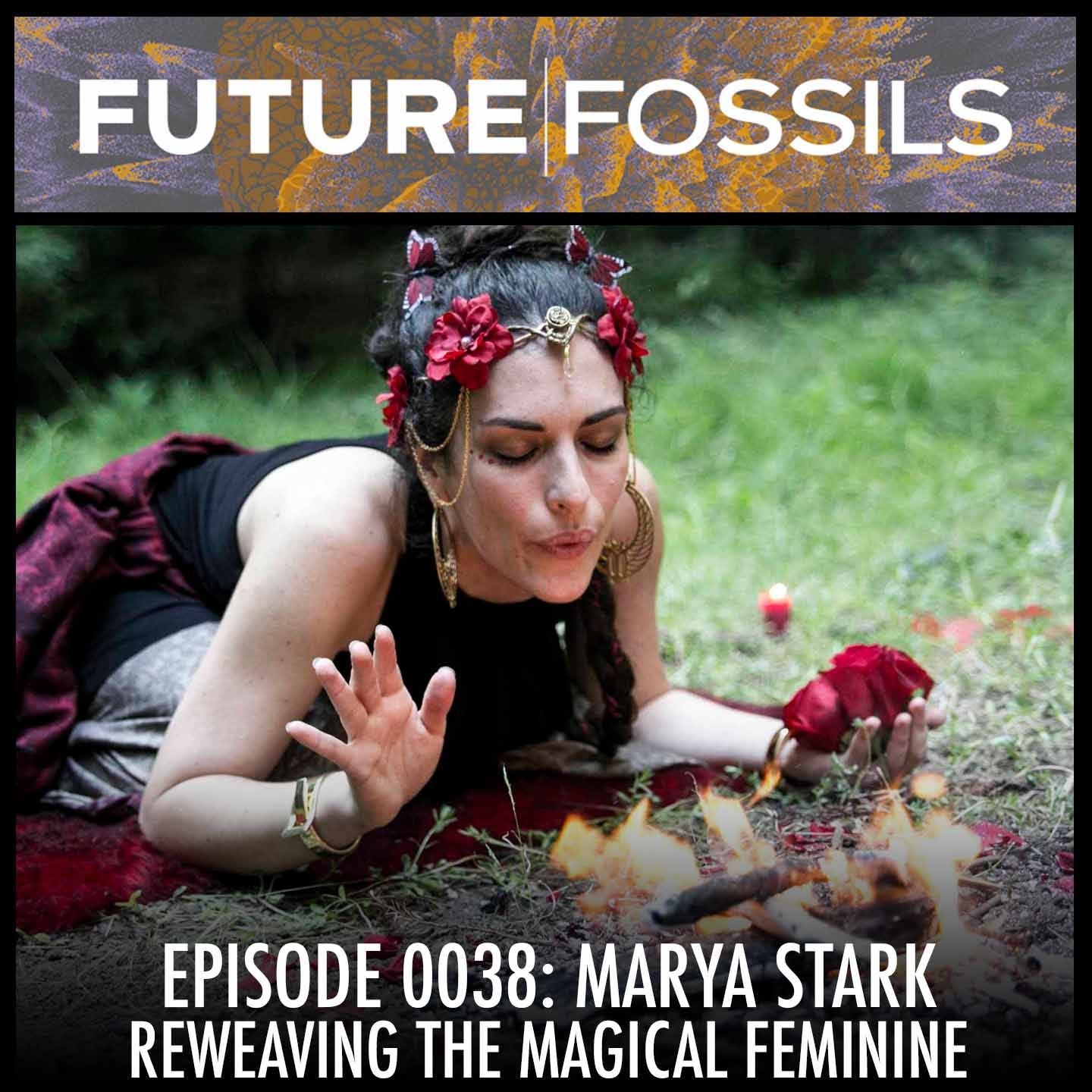
38 - Marya Stark (Reweaving The Magical Feminine)
EThis week’s guest is singer-songwriter and music therapist Marya Stark, whom I met at the Global Sound Conference in Los Angeles in 2008. We discuss the future of the feminine, relationships, and reproduction – and laugh a lot. • Linkshttp://marya-stark.comhttps://maryastark.bandcamp.comhttps://soundcloud.com/marya-starkhttps://www.facebook.com/maryastarkmusic • Topics- Long Distance Relationships in the Internet Age- The Pre-Trans Fallacy & Getting Back to The Land- The Future of Sex in the Age of Machines- Industrial Medicine & Birth Trauma- Terraforming & Artificial Wombs- Tradition vs. Innovation- Rudolf Steiner’s Lucifer & Ahriman- Artificial hormones in the drinking water feminizing songbirds- Intuition of Altitude- Dancing between the organic and digital: how can we hold both ends of this without succumbing to either?- Reclaiming the sacred traditions of premodern femininity- Bloodwork, Moon Lodges, and the revival of the Sacred Feminine- Adopting a “Bit Torrent” model to our mixed ethnicities and identities, as a response to concerns about cultural appropriation and “buffet-line” spirituality- Building a “Literacy of Empathies”- The moving target of “wisdom,” “experience,” and “adult” through the ages- Soul Retrieval 101- dealing with the emotions of the intuition of A sole connection from a parallel universe or alternative timeline & The perils of “astral polyamory” • Quotes“Just because the wisdom is ancient doesn’t mean it’s the most effective.”“Sometimes when we’re in a distortion paradigm, our strategies for wholeness create more distortion.”“Are we all going to have this magical Golden Age wake-up call? I’m still rootin’ for it.”“Honor the thousands of shoulders that we stand on to be able to host some of this information. Because they were committed to the lineage. They were committed to carrying it through, no matter what. They’d give their lives for it. I have meditation in my life because of those individuals. I’m not going to shit all over them because I think their cultural context or whatever doesn’t match my fucking modern idea and ideals. So how do I hold the complexity of that conversation in my heart while not spinning my ego into circles about how cool I am because I’m a meditator?”“I have to have a prayer for our species that we are connected to an evolutionary architecture…”“It’s as if the pain that everyone is in is the same. And it’s rooted in disconnection and distortion of what they’re capable of.” • Citations- Up From Eden by Ken Wilber- At The Edge of History by William Irwin Thompson- Alien: Covenant (film)- HR Giger and The Zeitgeist of the Twentieth Century by Stanislav Grof- Spiral Dynamics by Don Beck & Christopher Cowan- “The Tower That Ate People” by Peter Gabriel (song)- Videodrome (film)- Homo Deus by Yuval Harari- Team Human Podcast with Douglas Rushkoff Get bonus content on PatreonSupport this show http://supporter.acast.com/futurefossils. Hosted on Acast. See acast.com/privacy for more information. This is a public episode. If you'd like to discuss this with other subscribers or get access to bonus episodes, visit michaelgarfield.substack.com/subscribe
37 - Michaelangelo aka Void Denizen (Excavating the Future with "Paisley-ontology")
E“You were a paleontologist, originally. I’ve always considered myself a ‘paisley-ontologist.’ A paleontologist will excavate the soil in search of fossils and a paisley-ontologist will excavate the present for fossilized perceptions. So I’m always looking for these kind of nuggets, linguistic impressions or etymological traces that lead us from the present into this sort of timelessness, or this subconscious of words and symbols. I look at the world as a sort of Rorschach Worship Workshop…”This week’s guest is “The Ungoogleable” Michaelangelo, who all-embracing creative life is as difficult to describe as he is to find via conventional web search. The only person I’ve ever met – or could imagine – who could successfully pull off the marriage of “comedy,” “necromancy,” AND “rap” – and do it all in a convincing but false Scottish brogue as his alter ego Void Denizen – Michael is one of the wittiest, most hermetic guests this podcast’s ever had. AND he has some thoughts about the show itself that take us down a labradorite rabbit hole and into underground auroras, where the riddles of the afterlife unfold before our very eyes. Even I learned new things about “Future Fossils” in this conversation! Come with us on a trip into the Illuminated Unconscious and help us excavate the present in the new discipline of Paisley-ontology… • Michelangelo’s Website:http://www.voidandimagination.com/• MG interviews Void Denizen on Reality Sandwich: http://realitysandwich.com/321767/necromancing-the-philosophers-stone-void-denizens-psychomagical-hip-hop/ • Topics:- artificial intelligence- gaia theory- the anthropocene- the atmosphere as an artifact- mineral consciousness- “upgrade or perish”- flowers were a catastrophe- the importance of turning to face the strange- paisley-ontology- using natural fractals as an inkblot test or oracle- pareidolia- embodied cognition & conceptual metaphor- panpsychism & mind as process- the invention of and reason for sex- aliens & the archetype of the flying saucer- the soul and all its incarnations as a single four-dimensional organism- daimonic information- excavating the future out of the present- fossilized dinosaur brains- accidental summonings- The Mandela Effect & the possibility of changing the past- The Metaforest • Mentions:- How To Know Higher Realms by Rudolf Steiner- The Origins of Consciousness in the Breakdown of the Bicameral Mind by Julian Jaynes- Sex, Ecology, Spirituality by Ken Wilber- Metaphors We Live By by George Lakoff & Mark Johnson- Francisco Varela- Neil Theise- Pierre Teilhard De Chardin- Darwin’s Pharmacy by Richard Doyle- Crystal & Dragon by David Wade- The Handmaid’s Tale by Margaret Atwood- Wings of Desire & City of Angels (films)- Daniel Vitalis on Tangentially Speaking Podcast- Crossing The Event Horizon by Jonathan Zap- “Modern Things” by Björk- Interstellar (film) • Other Stuff:- View From The Horizon https://evolution.bandcamp.com/album/view-from-the-horizon-perspectives-on-a-new-age-burning-man-2013 Get bonus content on PatreonSupport this show http://supporter.acast.com/futurefossils. Hosted on Acast. See acast.com/privacy for more information. This is a public episode. If you'd like to discuss this with other subscribers or get access to bonus episodes, visit michaelgarfield.substack.com/subscribe
36 - Meow-Ludo Meow Meow (Part 2 - Modern Art & Surviving The Singularity)
ESupport Future Fossils on PatreonReview Future Fossils on iTunesReview Future Fossils on StitcherJoin the Future Fossils Facebook GroupThis week is part 2 of our conversation with biohacking polyamorous geneticist and aspiring Australian politician Meow-Ludo Disco Gamma Meow Meow, founder of Sydney’s Biofoundry. Get ready for a chat so crazy you’ll think it’s 1999…we spend about 20 minutes arguing about modern art, 20 minutes arguing about the Singularity, and 20 minutes arguing about what’s in the box.• Meow Himself:https://www.facebook.com/meowludo• Biofoundry:http://foundry.bio/https://www.facebook.com/Bio-Hack-Syd-488627521201437/https://www.meetup.com/biohackoz/ • We Talk:- We compare campaigning for nuclear technology to bringing a stripper with a drug problem to family dinner;- IP as Art & The Shape of The Future;- Leveraging existing systems as scaffolding to transition back into a way of life more suited to our paleolithic environment;- Vantablack & the jerk who got an exclusive license to use it for art – and how the art community fought back;- What is GOOD art?- How “What is Life?” and “What is Art?” might be the same question…- What the next few decades will be like if we assume a Technological Singularity…- The social construction of identity- We argue for ages about whether godlike AI will be independent from the biosphere…. • Citations:- Common As Air by Lewis Hyde- Damien Hirst- Anish Kapoor- Alain de Botton- Marcel Duchamp- Michelangelo- James Gansfield- The Architects of Air- Stuart Semple- Andrew Despi- What Technology Wants by Kevin Kelly- John Allen (Institute of Ecotechnics)- Shin Gojira- Teranesia by Greg Egan- The Origin of Species by Charles Darwin- Bacterial Polyamory • Quotes:“If you say to ‘them,’ ‘I have fifteen girlfriends, how many of them should I bring?’, you’ll freak ‘em the fuck out.”“Artists have to be subversive. And why not be subversive within the system that exists? Because that provokes other artists to come and then challenge it.”“I’ve had enough wine to say this: everything we do now is meaningless. It’s playtime until the Technological Singularity.”“We are made of atoms, ultimately, but they’re our bitch.”“We’re talking twenty years from now, and I can’t even predict this year. If I could, I would have invested in Bitcoin in March!” • Read more about evolution as entropy: https://medium.com/@michaelgarfield/the-evolution-of-surveillance-part-3-living-in-the-belly-of-the-beast-2a42538ee2• Read more about evolution as a remix: https://medium.com/@michaelgarfield/how-to-live-in-the-future-part-4-the-future-is-exapted-remixed-35ea5ca9d877 Get bonus content on PatreonSupport this show http://supporter.acast.com/futurefossils. Hosted on Acast. See acast.com/privacy for more information. This is a public episode. If you'd like to discuss this with other subscribers or get access to bonus episodes, visit michaelgarfield.substack.com/subscribe
35 - Meow-Ludo Meow Meow (Part 1 - Polyamory, Cryptocurrency, & Nukes)
EReview Future Fossils on iTunes Review Future Fossils on Stitcher Join the Future Fossils Facebook GroupThis week’s guest is Meow-Ludo Disco Gamma Meow Meow, founder of Sydney’s Biofoundry whom I met at the Commonwealth Bank of Australia’s Innovation Lab in February. Meow is a modern trickster-wizard par excellence, entirely too smart for his own good, and he loves to argue – this is one of the most wide-ranging talks on Future Fossils yet! Enjoy part 1 of a special double feature that continues next week… • Biofoundry:http://foundry.bio/ • Press about Meow: https://www.inverse.com/article/5887-australian-biohacker-meow-ludo-meow-meow-on-diy-biology http://www.huffingtonpost.com/entry/man-named-meow-ludo-disco-gamma-meow-meow-has-transit-pass-implanted-into-hand_us_5953b3eae4b0da2c732015e6 • We Talk: - Cryptocurrency- Biohacking- Getting Married on the BlockchainPolyamory & Relationship Anarchy- Intellectual Property- An Ecological View of Relationships- Plural Singularities- The Genetic Origins of Hominids (HARs)- Would God be considered an Organism?- Crystals Are COOL- Mass Extinctions- Asteroid Mining- An Ethical Debate on Eugenics & Nukes- Meltdowns, Solar Flares, & The Insecurity of The Electrical Grid Citations: • Common As Air - Lewis Hyde• More Than Two - Franklin Veaux & Eve Reichert• I Heart Huckabees (film)• The Pill Versus The Springhill Mine Disaster - Richard Brautigan• “Transcending Possessiveness in Love & Music” by Michael Garfield• Guns, Germs & Steel - Jared Diamond• Interstellar (film)• WALL-E (film) “Capitalism lends itself to models that are in crisis continuously…” Get bonus content on PatreonSupport this show http://supporter.acast.com/futurefossils. Hosted on Acast. See acast.com/privacy for more information. This is a public episode. If you'd like to discuss this with other subscribers or get access to bonus episodes, visit michaelgarfield.substack.com/subscribe
34 - Tara Djokic (The Oldest Fossils Known To Science!)
ESubscribe to Future Fossils on iTunesSubscribe to Future Fossils on StitcherJoin the Future Fossils Facebook GroupSupport Future Fossils on Patreon This week we talk about what the oldest fossils in the world have to teach us about life’s origins and destiny with Tara Djokic of the University of New South Wales. Tara’s a geologist and astrobiologist whose team and work just appeared on the cover of Scientific American for changing our ideas about the beginning of our story… http://www.pangea.unsw.edu.au/people/students/tara-djokic https://www.nature.com/articles/ncomms15263 http://www.npr.org/sections/thetwo-way/2017/05/09/527575457/australian-fossils-hint-at-where-to-search-for-life-on-mars QUOTES: “Thinking for humanity, moving forward and prospering as a global community – a lot of people in power aren’t thinking that way.” “We can only base what we know about life, and about intelligent life, on what we know here on Earth, because we’ve got no other sample. And until that happens, we can only make hypotheses.” “I can only speak for me. And when I think, okay, well, we all just came from goo, and maybe one day the universe won’t be here anymore, I find that pretty humbling. And that’s pretty much the reason I got into this field. Relationships come and go, friendships come and go, life changes and evolves…and the society we live in is so distracting, and we get caught up in trivial things…when you put that all in perspective and think, we all just came from goo, it just makes you a little bit HUMBLER. Because I do get caught up in the same stuff that everybody else does. We’re humans; we’re governed by our emotions and our biology…if I can look outside of that biological box as a human being and put things in perspective, then I’m going to. And that’s what I think astrobiology does, and that’s what I think studying the origins of life does.” “We’re really just a macro-sized version of a microbial community on the planet.” “We’re a community. But unfortunately, for some reason, humans all seem to think we’re individual and the pocket over here can do whatever they want and it won’t affect the pocket over there.” “The one saving grace we have for humanity is hope. Hope is what drives anybody to do anything, right? The hope to achieve something. The hope that they’re going to succeed.” “The key difference between science and religion is that science gives you the information and then you can make your own decision, whereas a lot of the time it’s, ‘This is the information; take it or leave it.’ For me the beauty of science and the beauty of education is that you’re able to make critical decisions FOR YOURSELF.” TOPICS: - What are the oldest fossils on the planet? - What was the environment in which life emerged on Earth? - Explaining scientific research to strangers. - The relationship between scholarship and leisure. - How she become an astrobiologist - Fermi’s Paradox & The Great Silence (or, “If life is so likely, why don’t we hear anybody?”) - Have we not encountered intelligent extraterrestrials because they tend to wipe themselves out, or because they’ve learned to encrypt all of their communication to look like radio noise? - The two kinds of scientists: concepts first, then hypothesis; or data first, then hypothesis. - The mystical experience of doing paleontological fieldwork in the Badlands. - How does this research help us understand where to look for life elsewhere in the solar system? - What the study of ancient life reveals about overarching patterns in every part of the cosmos. - The Great Oxygenation Event 2.4 billion years ago and what we can learn from this ancient catastrophe. - The importance of good science writing in an age of “alternative facts.” - The difficulties faced by science in an age when so much of discovery is made with the assistance of sophisticated machines. MENTIONS: - Edgar Mitchell - Bruce Damer & Dave Deamer - Paolo Soleri - The Light of Other Days by Arthur C. Clarke & Stephen Baxter - Horton Hears a Who by Dr. Suess - Brave New World by Aldous Huxley - Ready Player One by Ernest Kline - The Three Stigmata of Palmer Eldritch by Philip K. Dick Get bonus content on PatreonSupport this show http://supporter.acast.com/futurefossils. Hosted on Acast. See acast.com/privacy for more information. This is a public episode. If you'd like to discuss this with other subscribers or get access to bonus episodes, visit michaelgarfield.substack.com/subscribe
33 - Jon Lebkowsky (Pluralist Utopias & The World Wide Web's Wild West)
EThis week's episode is brought to you by Visionary Magnets, the refrigerator poetry magnets that turn your boring old kitchen appliances into the substrate for woke invocations, tantric pillow talk, and other occult goofery. Support their Kickstarter and "enlighten your fridge" today! Or tomorrow. Subscribe to Future Fossils on iTunes Subscribe to Future Fossils on Stitcher Join the Future Fossils Facebook Group This week is part one of a special double-length episode with Jon Lebkowsky, founder of EFF-Austin – one of the unsung heroes of Internet culture, whose tale stretches through the earliest web communities and reads like a list of landmark moments in the history of digital rights and culture. http://weblogsky.com/ https://twitter.com/jonl https://www.facebook.com/polycot/ https://www.well.com/conf/inkwell.vue/topics/495/Bruce-Sterling-and-Jon-Lebkowsky-page01.html We talk about the early days of hacking in the Wild West of the 1990s, how the World Wide Web has changed since then, and the promises and perils of the Internet in the 21st Century. It’s a winding tale of pseudonymous keyboard-slingers and federal raids, roleplaying game empires and sci-fi visionaries, centered on the unsuspecting hippie cowboy outpost of Austin, Texas, Once Upon A Time. Enjoy this special conversation on the history of the Internet we know today, and a snapshot of the hopes and fears of life online in the dawn of our digital era… TOPICS: - The threat of Internet-empowered fascism and “participation mystique” (or maybe worse, a corporate plutocracy) eroding rational civil discourse and the dignity of the individual - The problems with “Net Neutrality” and how it makes more sense to focus on “The Freedom to Connect” - Connectivity vs. Interdependence (OR) Networks vs. Buddhism - Does the Noosphere already exist, and we’re just excavating it? - The History of Electronic Frontier Foundation-Austin and how it was connected to the secret service’s raid of legendary role-playing game designer Steve Jackson (GURPS) - The hilarious, troubled Dawn Age of e-commerce before secure web browsing - Jon’s work with a Gurdjieff group and his encounters with esoterica as an editor of the Consciousness subdomain for the last issue of the Whole Earth Review - Cybergrace, TechGnosis, and Millennial concerns about the mind/body split in the first Internet and our need to humanize technology with whole-body interfaces and MOVEMENT - Embodied Virtual Reality & Other Full-Sensory Immersive Media - Cory Doctorow’s new novel Walkaway as a banner book for the maker movement and a new form of cyber-social-liberation. - The movement of political agency back into city-states in a digital era - “On the Internet, no one knows you’re a dog.” - Shaping the future of wireless infrastructure in the early 00s of Austin - Getting our values right before we imprint the wrong ones into superhuman AI - Putting together diverse conversation groups to solve “wicked problems” - New forms of participatory open-source politics suited for an internet age SOME OF THE PEOPLE & STUFF WE MENTIONED: Whole Earth Provisions, Whole Earth Review, The WELL, Whole Foods, William Gibson, Pierre Teilhard de Chardin, Hakim Bey, William Irwin Thompson, Alien Covenant, Terminator, John Perry Barlow, Mitch Kapor, Mike Godwin, Bruce Sterling, Clay Shirkey, WIRED Magazine, Fringeware, RoboFest, Heather Barfield, Neal Stephenson, Terence McKenna, Church of the Subgenius, Mondo 2000, Erik Davis, GI Gurdjieff, The National Science Fiction Convention, Rudy Rucker, Greg Bear, Jon Shirley, Jennifer Cobb, Robert Scoville, Greg Egan, Ernest Cline, Octopus Project, The Tingler, Honey I Shrunk The Kids (Ride), Charles Stross, Glass House, Rapture of the Nerds, Cory Doctorow, Alan Moore, Project Hieroglyph, Arizona State University, Jake Dunagan, Plutopia Productions, The Digital Convergence Initiative, Chris Boyd, South By Southwest, Boing Boing, Make Magazine, Dave Demaris, Maggie Duval, Bon Davis, DJ Spooky, Forest Mars, OS Con, RU Sirius, Shin Gojira, Open-Source Party, JON LEBKOWSKY QUOTES: “The Noosphere can certainly have pathologies…” “The Internet was originally a peer-to-peer system, and so you had a network of networks, and they were all cooperating and carrying each other’s traffic, and so forth. And that was a fairly powerful idea, but the Internet is not that anymore. The Internet has, because of the way it’s evolved, because it’s become so powerful and so important and so critical, there are systems that are more dominant – backbone systems – and those are operated by large companies that understand how to operate big networks. That’s really a different system than the system that was originally built.” “SO FAR we’ve managed to keep the Internet fairly open…the absolute idea of net neutrality might not be completely practical.” “Science fiction is a literature of ideas, but a lot of those ideas do not manifest in exactly the way that they did in the book.” “I don’t have a rea
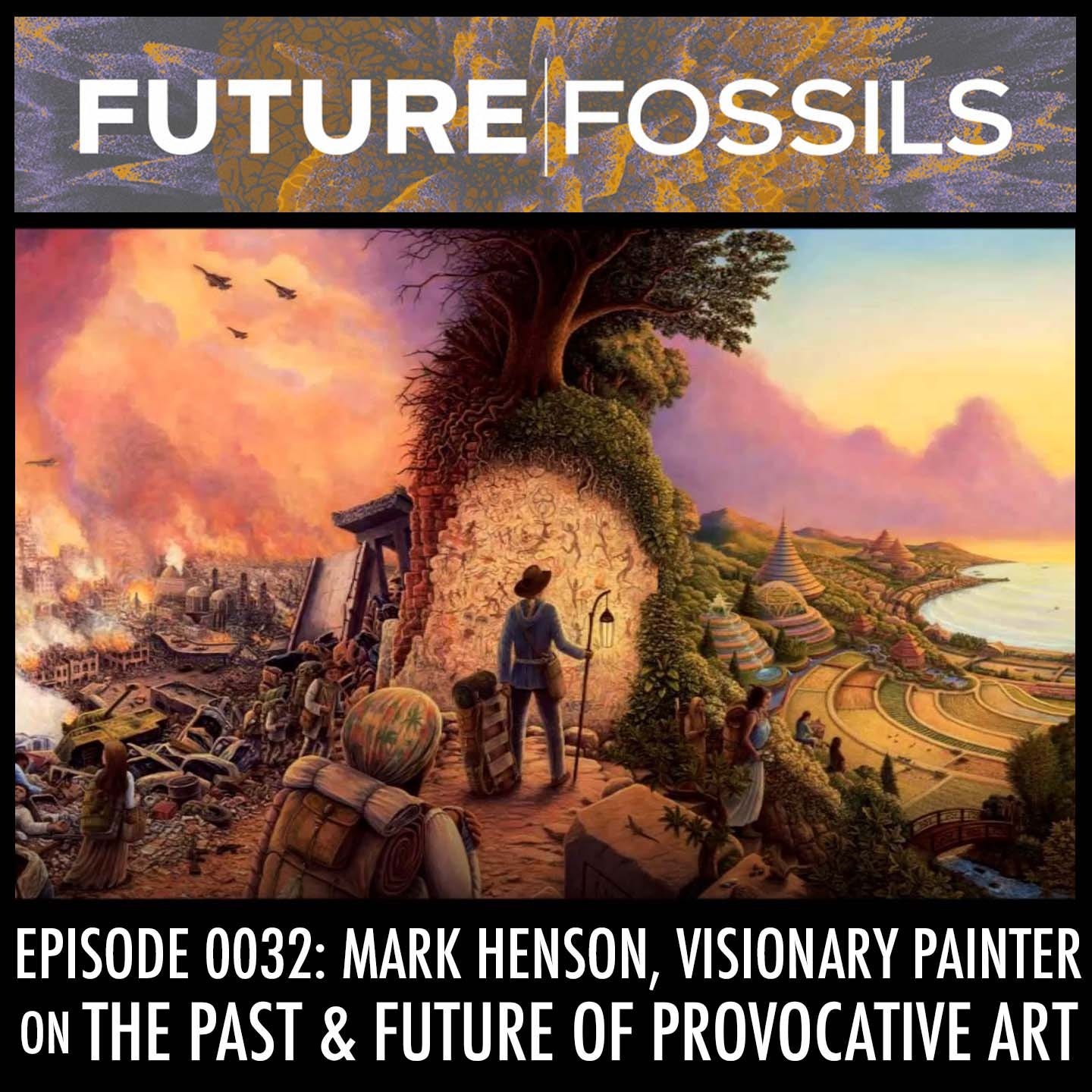
32 - Mark Henson, Visionary Painter (The Past & Future of Provocative Art)
ESupport Future Fossils on Patreon Subscribe to Future Fossils on iTunesSubscribe to Future Fossils on StitcherJoin the Future Fossils Facebook Group “I think we’re at a real crossroads. I’m an old guy, I may not live to see a whole lot more of the changes that are undoubtedly going to happen, but I would sure like to. I try to be an optimist. I’d like to hope that through education and science and clear thinking and good communication we come to sort of a passive understanding of the stuff we need to do – rather than having any ‘conspiracy’ organizations shoving it down everybody’s throats. We can have creativity and BETTER lives, rather than just more and more and more.” This week our guest is visionary artist Mark Henson, whose highly detailed and frequently erotic landscape paintings portray the full spectrum of human experience, our greatest dreams and most disturbing nightmares. Mark’s been a friend and elder to me since we met in 2010 and I was delighted to catch up with him at this year’s Psychedelic Science Conference in Oakland – please excuse the background noise in this recording as you enjoy this festive and far-ranging conversation about art, life, and creativity! Mark's WebsiteMark's Facebook Page TOPICS: - Viewing and making art as time travel. - Will artificial intelligence replace artists? - Can we understand the universe? - Altered sense of time self in dreams and psychedelic experiences. - How technology has crept into our memory and dream lives. - The necessity of Universal Basic Income AND Life Purpose in an automated post-work world. - “The Work” of ayahuasca users and telepathic post-humans (on social media) of being open to the intensity and burden of collective experience. - The importance of an intentional media diet. - How Mark got to collaborate with Jimi Hendrix as a teenager! - Mark’s thoughts on the history and evolving intersection of Street Art, Fine Art, and Live Music. - How different musical styles and intoxicants contribute to different media ecosystems. - How Mark and his stepson almost got one of his paintings into the White House. - Projected art as graffiti and political action; augmented reality graffiti as the future of dissent, and geospatial metadata as a new cyberpunk Wild West – metagraffiti. - Defacing ads and reclaiming public space, a polite How To. - The future of the family. REFERENCES: - The Golden Oecumene Trilogy by John C. Wright - Blood Music by Greg Bear - Princeton Engineering Anomalies Research - The Teafaerie’s Erowid Ibogaine Article - Ayahuasca Coloring Book artist Alexander Ward - Michael’s appearance on Comedy Central’s Problematic with Moshe Kasher - Darwin’s Pharmacy by Richard Doyle QUOTES FROM MARK: “My overall project here is to create impressions of what life was like, in these days…” “By 2000, we were supposed to be flying around in little personal cars and live in a peaceful world where the big issues had been resolved. That didn’t happen, so I’m not going to hold my breath on a Singularity.” “Sometimes I have fairly vivid dreams where, if the dream is strong enough, later on when I’m awake I might confuse that reality with something that happened in my waking moments. Did I dream that, or did that really happen to me ten years ago. What about this little experience? Was that a dream, or…I can’t quite remember. Sometimes that happens to me, and I actually like that, because if I can blur the boundaries between that world and this one, I think it’s more interesting.” “Maybe if the Singularity happens, or Artificial Intelligence gets intelligent enough to be a frustrated, nervous wreck over wanting to express itself to the point of absolute fanaticism where it has to create something new in the world…I would love to see that, actually. See what comes out.” “Do I want to live in a Borg mind where I know what you’re thinking and you know what I’m thinking? No, I do not, because that’ll clog up my thoughts.” “Everybody is radiating self-expression some way or another. It’s one of our basic human desires. How do we not be swamped in all the static? It’s like we’re running 300 radios at one time. It’s hard to listen to one particular song. So somehow we have to filter things out. It’s sort of essential just to keep sane.” “The essence of our culture war is an economic war, in a sense…if you have a good psychedelic experience, you realize that the beauty of a sunset is of more importance than a pallet full of $100 bills.” “I think if the humans manage to manage ourselves, we’ll be able o accomplish managing nature so that nature can still be nature…and maybe we’ll have a few friendly helpful robots as well.” Future Fossils Intro/Outro Music: "God Detector" by Skytree (feat. Michael Garfield & Dennis McKenna) Get bonus content on PatreonSupport this show http://supporter.acast.com/futurefossils. Hosted on Acast. See acast.com/privacy for more information. This is a public episode. If you'd like to discuss this with other subscribers or get
31 - Mitch Altman (Hacking Life For Fun & Profit)
E“I would love to see a world where 100% of the people on this planet, and all the other beings, believe their life is WAY worth living. Not just kinda okay, even, but WAY worth living.” This week’s guest is Mitch Altman, a hacker and electronics scientist whose life is the stuff of legend (here's his Wikipedia entry).Founder of Cornfield Electronics (“We Make Useful Electronics for a Better World”), co-founder of Noisebridge (epic hackerspace in San Francisco), inventor of TV-B-Gone.This episode’s title is pulled from Mitch’s talk by a similar name. In this Episode: Living in alignment with your dreams, working for yourself. Entrepreneurship as serving your own sense of the awesome and letting the resonant audience come to your own articulated personal meaning.The potential of full-cost accounting: how weaving every invisible cost (“ecosystem services,” mothering, etc.) into the economy could transform selfish behavior into good for all.Self-discovery and finding the place where your enjoyment and passion meets the needs of your society.“Helping me includes helping other people, which feels good. How can I NOT do this?”Getting through depression and loneliness to find creative fulfillment.Breaking out of habit to discover the life we CHOOSE with our sudden wealth of free time…The importance of boredom and leisure to the full development of the soul.The evolutionary fitness landscape and looking at our choices as moves across a geography of our adaptation to various environments.Making the hard decision to back out of something you’ve invested in and begin again as something new…Technological Unemployment, Universal Basic Income, and the rise of Hacker Spaces.The role of local currencies and minimum guaranteed income in the architecting a society of creativity and leisure.“All of this has to happen slow enough that things don’t collapse or become traumatic, but fast enough that we can survive as a species.”Open Source Digital Democracy and fractal structures in economy and politics – what comes after representative republics and printing-press-era legislature in the age of the Internet?Natural hierarchies (holarchies and do-ocracies) versus artificial hierarchies…and how to create a pocket of effective, fruitful anarchy within the right container.Chaos Computer Club and the future of meta human swarm intelligence (read also: social creatures living in community)“I try to not be pessimistic OR optimistic. I try to the best of my ability to see things AS THEY ARE.”The recent explosive proliferation of Chinese hackerspaces. Photo Credit: Dennis van Zuijlekom Get bonus content on PatreonSupport this show http://supporter.acast.com/futurefossils. Hosted on Acast. See acast.com/privacy for more information. This is a public episode. If you'd like to discuss this with other subscribers or get access to bonus episodes, visit michaelgarfield.substack.com/subscribe
30 - Becca Tarnas (Archetypal Astrology & Living Through A Revolutionary Age)
ENew essays, music, talks, and writing coming soon for my Patreon supporters! Subscribe here and get everything I do for free if you haven’t already…This week our guest is Becca Tarnas, whom I caught up with at the 2017 MAPS Psychedelic Science Conference in Oakland.Becca’s Websitehttps://beccatarnas.com/about/Archai Journal: The Journal of Archetypal Cosmologyhttp://www.archai.org/“Everything breathes together.” - PlotinusWe discussed:The imminent shift into an archetypal paradigm, in which we transcend naïve subject-object dualism and experience meaning as not merely something manufactured by the brain…Uranus-Pluto Alignments in the 1960s & the 2010sJupiter joining the revolution in 2016-2017 and magnifying thingsWhat will the world be like after all this revolutionary energy runs its course?Impending collective shadow work in our inherently psychedelic future circa Saturn-Pluto Conjunction, 2018-2021 (ish)How do we hold to our centers in a storm of history?How do you deal with knowing that most of your adult life is going to be spent navigating unprecedented social & personal transformation?“I think having the archetypal perspective helps me to ‘zoom out’ and see this as part of a larger narrative, and to feel myself participating in something that is SO much bigger than me. So that helps. I definitely feel fear, as any mortal person would, during this time. I also feel the wave of excitement of this very powerful revolutionary moment, recognizing that change really IS necessary in this time.”“…to just try and participate as fully as possible. Because it IS a remarkable time to be alive…”“I think being okay with the Mystery has to be a part of it. And, at the same time, it can’t be a part of it all the time. Sometimes we do have to just melt down and accept the utter chaos and fear of it all and then pick ourselves back up from that place and keep going forward.”#futureshock & #pastshockThe wonder of the holistic intelligence disclosed by archetypal cosmology.James Hillman is awesome and there are a lot of good scholars and academics working on archetypal astrology, these days…What is rigor in astrology? How does the community peer review?Science and Imagination.Books Mentioned:• Cosmos & Psyche by Richard Tarnas• Glass House by Charles Stross• Stages of Faith by James Fowler• Promethea by Alan MooreSubscribe to Future Fossils on iTunes:http://bit.ly/future-fossilsSubscribe to Future Fossils on Stitcher:http://stitcher.com/podcast/michael-garfield/future-fossilsJoin the Future Fossils Facebook Group:https://www.facebook.com/groups/futurefossils Get bonus content on PatreonSupport this show http://supporter.acast.com/futurefossils. Hosted on Acast. See acast.com/privacy for more information. This is a public episode. If you'd like to discuss this with other subscribers or get access to bonus episodes, visit michaelgarfield.substack.com/subscribe
29 - Sara Huntley (Raising Robots Right)
E(New essays, music, talks, and writing coming soon for my Patreon supporters! Subscribe here and get everything I do for free if you haven’t already…)This week we chat with Sara Huntley – Dancer, Graphic Novelist, Tattoo Artist, Clown, and Psychedelic Futurist. Buckle Up!Sara’s Website: http://sarahuntley.weebly.com/Sara on FB: https://www.facebook.com/huntley.saraA conversation on New Media & The Future of Storytelling, the Ethics of Digital Entities, and Treating Bots With Kindness. >>> Topics:What will the future BE like? Not just what will it LOOK like.With books, the story is revised with every printing, but oral traditions allow for the story to evolve with every telling. Virtual reality is opera – in that it contains all forms that came before it – but it’s opera tied into attention-tracking systems that can re-weave worlds and narratives in real-time as you interact with it.We’re going to be able to get inside our data, to LARP the user-generated, annotated maps of the terrains that we inhabit, and with AR turn our modern notions of a shared experience completely inside out. The ethics of keeping digital entities as pets. Michael:“While you can make the ethical argument that there is no harm to the bot, you might have to come up with an excellent rebuttal to the argument that it does still harm the human user of this game…”Sara’s conversation with “Phil,” the robotic version of author Philip K. Dick, designed by Hanson Robotics, at South By Southwest 2016.Grounding in the offline world while learning through interactive high technology how we are all connected, and then bringing back that awe to analog existence and the nature that preceded us.The manufacture of nostalgia as another artificial environment in an age of human-directed ecology…the replacement of our parents’ childhood with videogame franchises and, “What happens in a field at dusk?”The Lithosphere, Biosphere, and Noosphere…The racist Tay bot and how we need to be more mindful about how we socialize our digital offspring. What happens when we can’t tell the difference anymore between the minds we make online and those we make with our own bodies? Will we create and destroy sentient entities as casually as we create and destroy ordinary data files? >>> Sara Quotes:“There are no new ideas, but there are, there are new perspectives through these handed-down ideas. So it’s like, even though we take an idea that had been an oral tradition, then we bring it to the press, then we bring it to the screen, whether it’s a streamed series or something like that, and then it becomes a 3D thing – it’s always going to be the artisan’s ability to empathically tell what lands and what doesn’t. That’s what makes a great performance.”“As cool as AI art will be, I think we’ll always have a premium on what’s going to land with our imagination.”“I’ve come to think of it like, ‘What’s the thing I ultimately do? I rearrange matter. And how do I do it? I do it harmonically…as an artist.’”“I’ve been thinking about what the ramifications are of creating machines in the shape of gendered beings…and what that means in terms of coming to grip with the hierarchical strata that’s already a part of society. Because machines are always going to be mirrors of our desire of them…and granted, we want to convince ourselves, sometimes, as biological or spiritual beings that somehow parts of our experience transcend being programmed on a genetic level…but they’re all very grounded in human-ness.”“I think it’s really important right now, how we train the mind of the other, this emerging reflection. Like that one Microsoft young-lady bot – the Tay bot, that poor thing – how it got terribly socialized. Within 24 hours I felt bad for it. I was like, ‘Oh my goodness, this is a really bad report card on our ability to socialize a thing in a big pool.’ And it shows you exactly why kids don’t show their children terrible media when their minds are forming…”“Empowerment comes down to your awareness of the upgrade that you want.”“Is it gonna be just a battle of smart goos?”“I feel like no matter how advanced our toys become, the degree by which we will be able to have a sustainable system and be able to progress is going to be directly related to how harmonic the technologies we invest in are. Because you can have a bunch of ideas, but it really comes down to having a culture that has the wisdom to know which ideas are important to leave by the wayside.” >>> Media Mentions:• Blade Runner • The Metamorphosis of Prime Intellect • “The Return of the Black Madonna” by Matthew Fox • Charles Stross - Accelerando • William Irwin Thompson – The American Replacement of Nature • Nicholas Caar - The Glass Cage: Automation and Us • Train to Busan • I Heart Huckabees • Prometheus • Transcendence • The Matrix Revolutions • 2001: A Space Odyssey • Samurai Jack • The Fifth Element • John Dies at The End • Event Horizon >>> Tags:Virtual Reality, Artificial Intell
28 - John Petersen (Forecasting the Unimaginable)
E(New essays , music , coloring book pages, and recorded talks coming soon for my supporters! Sign up on Patreon if you haven't already...)“You cannot change the present system. This thing is dying, it’s structurally unsustainable. And so to try to somehow fix the present system is just a waste of time. Don’t waste your time on the present system. We have to start working on building the new world.” – John PetersenThis week we welcome futurist John Petersen of The Arlington Institute into the digital archives, for a challenging and visionary chat about how wrong we’re guaranteed to be about the future – and what we CAN expect about the new paradigm (which is coming sooner than you might suspect)…John Petersen started as an engineer before advising the military and White House, and has spent decades as a high-level consultant for emergent technologies and social trends. What he’s learned is that the future emerges at the edges of the known – that it will be, to paraphrase JBS Haldane, “not stranger than we imagine, but stranger than we CAN imagine.”If you’ve been waiting for a “deep end” episode, this is it. Prepare to have your paradigm interrogated and your limits of acceptable considerations challenged.John’s Links:• The Arlington Institute• Berkeley Springs Transition Talks(Climate Change Presentation is at the bottom)• FuturEdition Newsletter(A superb digest email list, one of my main sources for news stories to share and discuss in the Future Fossils Facebook Group)Topics Discussed:• Why experts are so frequently wrong about the future• Systemic social issues and institutional pressures that prevent us from asking the right questions about how to prepare for the unknown• Climate change predictions of a very different nature• The mainstreaming of the merger of humans and technology through brain-machine interfaces• The emergent tension between mysticism and technocracy• The possibility that information is carried by coronal mass ejections and influences the expression of our DNA• The potential contours of our next scientific paradigm• The sculpting and directing of global attention by media as a form of magical reality-manipulation• Love as a defense against malevolent spirits. (No kidding.)• The silver lining of our insane situation in the USA right now• The difference between inner-, outer-, and sustenance-driven psychologies, and their influence on global politics• What it is going to take for us to re-orient toward building a better world instead of clinging to the systems that no longer work for us• And how, instead of “Ender’s Game,” where you’re recruiting people into a massive game that turns out to be war, you could have “Beginner’s Game,” where people know they’re contributing their personal skills and purpose toward building a better world…Books Referenced:• Yuval Harari – Homo Deus: A Brief History of Tomorrow• Ray Kurzweil – The Singularity Is Near: When Humans Transcend Biology• David Icke – Human Race Get Off Your Knees: The Lion Sleeps No More• William Strauss & Neil Howe – The Fourth Turning: An American ProphecyOthers Mentioned:• Joe Dispenza• Bob MonroeQuotes from John Petersen:“If you do a vector into the horizon that’s a technology-only vector, then you’re missing the bigger parts of this. If you do artificial general intelligence into an extrapolation of the present world, then OF COURSE you’re going to have big problems. They’re going to try to weaponize it. They’re gonna get out of control. But. BUT. If there’s a new consciousness, then it all starts to change.”“Kurzweil himself said there’s a million times more knowledge that shows up in this century than in the last century. Well, GOD, how do you ride THAT kind of wave with conventional thinking?”“What you’re watching in politics, and the economy, and the financial systems, and in energy, and technology, and ALL of these things, is this basic, fundamental fragmentation that you can track back to this divergence [between those who embrace change and those who reject it], the emergence of a new kind of a mind-shift that is going to allow the exposure and discovery of extraordinary new kinds of capabilities.”“You can’t get from here to there without changing who you are and how you see the world.”Bookmark my Amazon Affiliate Portal and every time you shop on Amazon I’ll make a small percentage of your purchase.Subscribe to Future Fossils on iTunes:http://bit.ly/future-fossilsSubscribe to Future Fossils on Stitcher:http://stitcher.com/podcast/michael-garfield/future-fossilsJoin the Future Fossils Facebook Group:https://www.facebook.com/groups/futurefossils Get bonus content on PatreonSupport this show http://supporter.acast.com/futurefossils. Hosted on Acast. See acast.com/privacy for more information. This is a public episode. If you'd like to discuss this with other subscribers or get access to bonus episodes, visit michaelgarfield.substack.com/subscribe

27 - Rak Razam & Niles Heckman (5-MeO DMT & Consciousness)
EThis week I sit down with Rak Razam and Niles Heckman – psychonauts, journalists, provocateurs, and the film-makers responsible for Shamans of the Global Village.http://www.shamansoftheglobalvillage.com/In a conversation too full of awesome neologisms, delightful turns of phrase, one-liners, and weird genius for me to convey it all, we talk about the role of creative media in helping usher in new modes of human consciousness – and what we’re learning those new modes might be. We finally get into WHAT those unborn archeologists listening to Future Fossils might be like…and our conjecture’s going to surprise you.Books we Reference: (Links are through my Amazon Affiliate account – if you buy any of these books, I get a small percentage of the sale at no cost to you. Or you can bookmark this link to the Amazon Homepage and they'll send me a tiny cut of anything you purchase.) Octavio Rettig – The Toad of DawnGabor Maté – In the Realm of Hungry GhostsSteve Kotler & Jamie Wheal – Stealing Fire: How Silicon Valley, the Navy SEALs, and Maverick Scientists Are Revolutionizing the Way We Live and WorkRichard Doyle – Darwin’s Pharmacy: Sex, Plants, & The Evolution of the NoosphereAlva Noe – Out of Our Heads: Why You Are Not Your Brain, and Other Lessons From The Biology of ConsciousnessEckhart Tolle – The Power of Now: A Guide To Spiritual EnlightenmentMichael Murphy – The Future of the Body: Explorations into the Further Evolution of Human NatureRudolf Steiner – How to Know Higher Worlds: A Modern Path of InitiationRamez Naam – NexusTerence McKenna & Dennis McKenna – The Invisible Landscape: Mind, Hallucinogens, & The I Ching Among the topics we fly by:• 5-Meo DMT and psychedelic neurochemistry;• Nondual philosophy and the methodologies by which the dissolution of the self-other boundary can be achieved;• The correlation between flow states and gamma brainwaves;• “God’s Factory Reset” and the relationship between 5-Meo DMT and endocrinological healing;• The bizarre mystery that snails apparently operate on gamma brainwave states (“SNAILS MAKE GAMMA”);• New forms of social media (and new ways of engaging social media) that emphasize community, fellowship, equity, listening, and other real human values;• The possibility that it is actually the cardiac and enteric nervous systems experiencing and reporting from deep psychedelic states, while the frontal lobe is down-regulated;• The curious phenomenon of spontaneous gesturing (automatic “mudras”) during tryptamine experiences, and what might be the cause and purpose of them;• Intelligence in nature, distributed through countless species and systems but potentially orchestrated at an incomprehensible level of unity;• The importance of direct experience in understanding the strange realms divulged by psychedelics, and beginning to investigate them scientifically;• The coming wave of “technodelics” that can link human minds together into new meta-organisms and launch us into novel states of consciousness and modes of interacting with reality;• Experimental designs for exploring the content and revelations of threshold tryptamine doses in “group mind” protocols;• …We actually talk A LOT about snails. • Gary Weber - http://happiness-beyond-thought.blogspot.com Quotes:“I’m on the outer edge, the lip, the cauldron of Deep Source itself. And there’s an event horizon within which, just before I can lose full egoic consciousness and the drop has become the ocean, that drop can see the entire ocean like a tsunami wave cresting on the horizon. And on that lip, on that event horizon, EVERYTHING is there. I get this incredibly tangible, intuitive sense of the ancestors – and I don’t mean just my chronological, biological ancestors, I mean all those who have gone before in the species and are still perhaps alive as discarnate intelligences on the akashic frequency level on this bandwidth just before the edge of Deep Source, or perhaps intelligences that live within the lights and within the outer edge of Deep Source.” - Rak Razam“Within the last ten, fifteen years, we’ve learned an incredible amount about the brain and about psychedelics and about the physical correlates of human consciousness. And we’ve found – without any shadow of any kind of a doubt – with the most rigorous neurological methods available to us – that these spaces that shamans and zen masters and other enlightened or awakened people have been getting into for thousands of years – we’ve found that these things are real.” - Michael Garfield“Most social media is not social media, it’s anti-social media.” - Niles Heckman“It’s not that the ego needs to be killed - it needs to be brought back into right relationship. And psychedelics have proven throughout the 20th Century - and no entheogens and shamanic sacraments again in the 21st - when we reduce the default mode network and lower the egoic self, we rejoin a larger sense of being, and a planetary being, and a divine being, and it seems to be the antido
26 - Jessa Gamble (Circadian Rhythms & The Science of Sleep)
EHelp crowd-sponsor Future Fossils Podcast on Patreon and score subscriber-only perks and exclusive extra content!This week we chat with science journalist Jessa Gamble, author of The Siesta and The Midnight Sun: How Our Bodies Experience Time, about time in the body, circadian rhythms, lunar cycles, and the science of sleep.– Topics We Discuss:• Cultural dimensions of human communities at different latitudes;• Organic human rhythms versus high-frequency trading algorithm digital rhythms;• The evolutionary history of circadian rhythms and sleep;• What are we going to do when we settle on other planets with days of different lengths? (Like Mars, with a 24 hour and 25 minute day…)• NASA scientists trying (and failing) to live on Earth on Martian time;• The natural history of biphasic human sleep and the (VERY RECENT) cultural construction of the “8 hour night”;• How the lengths of our circadian cycles actually differ from person to person;• The ethical complexities and possible social consequences of research into human enhancement;• How Douglas Rushkoff learned to hack his monthly schedule to align with lunar cycles and increase his productivity by 40% by doing LESS work;• The differences between how humans and dolphins sleep;• How and WHY we might want to defeat sleep once and for all…• …and WHAT ABOUT DREAMING?? – Media We Reference: (Links are for my Amazon affiliate account - buy ANYTHING on Amazon through these links and a % of the sale supports this podcast, at no cost to you.)• The Siesta and The Midnight Sun: How Our Bodies Experience Time by Jessa Gamble• Northern Exposure (episode with Joel Fleischmann going manic due to 24 hour sunlight)• 30 Days of Night by Steve Niles & Ben Templesmith• Insomnia (Stellan Skarsgård & Robin Williams)• Present Shock: When Everything Happens Now by Douglas Rushkoff• An American Tail• Jurassic Park by Michael Crichton• Sapiens: A Brief History of Humankind by Yuval Harari• Homo Deus: A Brief History of Tomorrow by Yuval Harari• One Taste: Daily Reflections on Integral Spirituality by Ken Wilber – Links:The Last Word on Nothing: http://www.lastwordonnothing.com/about-us/jessa-gamble/ Here’s her TED talk:https://www.ted.com/talks/jessa_gamble_how_to_sleep And here’s her archive of articles at The Atlantic:https://www.theatlantic.com/author/jessa-gamble/ On salt intake in Russian Cosmonauts and how we might be wrong about salt: https://www.nytimes.com/2017/05/08/health/salt-health-effects.html Giulio Tunoni at the University of Wisconsin and their Sleep Center’s work to minimize the amount of necessary sleep: http://centerforsleepandconsciousness.med.wisc.edu/ On the correlation between lunar cycle phase and neurotransmitters: http://justadandak.com/present-shock-matching-the-rhythms-of-the-moon/ Vlad Vyazovskiy’s Oxford Sleep Lab: http://vvlab.org/index.php/80-research/24-vladvyazovskiylaboratory – Jessa Quotes:“The almost-definition of being sleepy is, you cannot really learn anymore.”“Sometimes, the awful consequences that are supposed to be punishment for acting like a god don’t actually happen.”“What we’ve decided to do [with sleep research] is look at the fact that we’re all sleep deprived, that it’s making us unhealthy, that it’s making us accident-prone, that it’s making us stupider – because sleep is the most effective cognitive enhancer that we know about. The fact that we’re sleep deprived is then met with a whole slew of people who say, ‘Well, so we need to sleep more. This is the solution.’ But there are other things that we could be doing, like seeing if we can cut down on our actual NEED for sleep, so we can do more of the things we’d like to do more of.”“What I would encourage people to do, if they’re zooming out on the problem or question of sleep, is to think about quality of life, what makes life great, and maybe take a page from the actuarial tables – which adjust for things like disability, years spent with crippling diseases and so on. And surely being unconscious has to be the most debilitating of all states. And if we’re spending a third of our lives in this state, could this be different? And should we put some effort into looking into this?”– Michael Quote:“Multicellularity was a technological singularity. Photosynthesis and Glycolysis was a technological singularity. Written language, and before that even, spoken language, was a technological singularity. So it’s good to keep that in perspective.” Get bonus content on PatreonSupport this show http://supporter.acast.com/futurefossils. Hosted on Acast. See acast.com/privacy for more information. This is a public episode. If you'd like to discuss this with other subscribers or get access to bonus episodes, visit michaelgarfield.substack.com/subscribe
25 - DADARA (Art, Virtual Realities, & Flow States)
EThis week we're joined by Daniel Rozenberg aka DADARA for a thoughtful discussion about Art in Virtual Realities, Information Overload, and Flow States. The creator of Exchangibition Bank, Like4Real, and the upcoming Solipmission installation at Burning Man, as well as countless concert posters and album covers, DADARA has been one of my favorite artists for a while - in no small part because of how his works combine deep, challenging investigations with light-hearted play. Click here to learn more about the Indiegogo Campaign for Solipmission We discuss his work's overarching philosophical explorations and our age of proliferating realities… • The breakdown of narrative and consensus reality in the virtual spaces of new media; • Virtual Reality as the new frontier, now that we’ve mapped the surface of the planet – and the potential problems of considering a space a “frontier” (especially if it is already inhabited); • The twin archetypes of the “Black Box” and the “Tabula Rasa” as they appear in science fiction, religion, technology, and philosophy; • The relationship between Virtual Reality and psychedelics, and the consideration of VR as a psychedelic in its own right; • What replaces narrative structure in VR storytelling, and how it relates to neuromarketing, cybernetics, and mind control; • How humankind is struggling to maintain coherence in the barrage of contradictory realities online; • How the sciences are coping with increasing specialization and the explosive proliferation of data, complicating the establishment and communication of expertise; • The relationship between VR and floatation/isolation tanks, and why floatation tanks are more necessary now than they have ever been; • Flow states and nondual awareness as a possible solution to information overload – and how we may have come to the end of the ego’s evolutionary usefulness; • Does Virtual Reality as a medium for philosophical inquiry even stand a chance in this commercial environment? Books We Mention In This Talk: (Buy any of these books through these links, and Amazon will pay me a small percentage of the sale at no extra cost to you.) • Ready Player One: A Novel by Ernst Cline • Neuromancer by William Gibson • Snow Crash by Neal Stephenson • Brave New World by Aldous Huxley • Sex, Ecology, Spirituality by Ken Wilber • The Hitchhiker’s Guide to the Galaxy by Douglas Adams • The Inevitable: Understanding the 12 Technological Forces That Will Shape Our Future by Kevin Kelly • The Deep Self: Consciousness Exploration in the Isolation Tank by John C. Lilly • Flow: The Psychology of Optimal Experience by Mihaly Csikszentmihalyi • Stealing Fire: How Silicon Valley, the Navy SEALs, and Maverick Scientists Are Revolutionizing the Way We Live and Work by Steven Kotler & Jamie Wheal Other References: • Neuralink (brain-technology interface currently in development by Elon Musk) • Inside Out (Disney movie) • WNYC’s Note To Self Podcast • Nathan Jurgenson, Social Media Theorist for Snapchat • Maria Popova’s Brainpickings.org • Android Jones & Anson Phong’s Microdose VR DADARA Quotes: “Imagination is this endless unknown territory. We think we might have discovered it, but if we look, I don’t know…” “Nowadays we think a photo shows how something really is. That that’s reality. But it’s just a surface. And that’s something that I love. Maybe stories show reality in a more realistic way.” “People twenty, twenty-five years ago thought the world would be more defined [with the Internet] because we could find all the facts. But what’s interesting now is that it’s almost impossible to find any facts that we agree on, on the Internet.” “Inside the box [of the Solipmission installation], it may be more Burning Man than the outside.” “When people go to a city, they take photos of all the touristy [stuff] – it’s like the bucket list – but if you go to a place, and maybe if you haven’t seen any building but you’ve met this amazing person or gone through an amazing experience, doesn’t that give you a better understanding of that city than just seeing everything that’s there?” “I think floatation tanks now, in this period of time, are probably more important than ever…we’ll have implants [soon] and how can you be in a floating tank when the Internet is in your brain?” “Do you actually exist when you don’t Tweet? It almost feels like people, sometimes nowadays, if they haven’t posted that they’ve been somewhere, then they feel they haven’t been somewhere. But I think often, if you post that you’ve been somewhere, I don’t know if you’ve been there. Because you somehow were distracted. You only go to places when you DON’T post about them.” Coinage of a new term: “information potato.” “Art is about focusing our attention, and entertainment is about distracting our attention.” “Zapping [TV remotes] and scrolling [social media] at the same time is probably also a kind of flow. It’s just not MY flow.” Michael Quotes: “Much as we, in the United States anyway,
24 - Daniel Zen (Surveillance, Festivals, VR)
EThis week we chat with Daniel Zen, former Google engineer, technology instructor at zen.digital, NYC Regional Coordinator for Burning Man, coordinator for the Angular.js NYC Meetup, and general high-tech wizard. https://zen.digital/https://twitter.com/danielzenhttps://medium.com/@danielzenhttps://github.com/danielzen Some of the topics we discuss:• The curses – and blessings! – of runaway technological surveillance (and sousveillance, and coveillance…).• How adolescence and sexuality have changed for children growing up with the Internet.• The future of festival culture and how it is a testbed for disaster relief technologies.• The danger of putting your medical devices online (the hackability of the Internet of Things)• What happens when we RECORD EVERYTHING• The isolating effects of Virtual Reality and how to create interactive spaces that allow us to share in the experience.• The collapse of VR, AR, and MR into just: “reality”• How TV, digital photography, and streaming video has changed the way we think about sharing our lives, perceptions, and emotions.• Adapting to an age of accelerating change by staying curious and loving learning• Concerns about technology’s role in widening the gap between the poor and the ultra rich.• The internet as a kind of “planetary cathedral” and re-envisioning our lives in light of a project that extends beyond the horizons of our individual lives. Daniel Quotes:“The festival world has changed, where now everybody has a cell phone and the ability to take pictures. And very much I believe, and the community I’m in believes, in consent when it comes to photography. Especially when people are in maybe a greater state of undress. Now we’re in a world where surveillance is much more prevalent…”“I’m a believe in bringing off-line technology to Burning Man. I don’t like the concept of being online at Burning Man, but I do like the concept of technology at Burning Man. I’d love to see an INTRANET at Burning Man…without any connection to the outside world. And such a system, if it were implemented well, could be of use in disaster situations.”“Unfortunately, we are a society that enjoys convenience – and we are all too ready to give up our privacy for that convenience.”“I’m not one of these guys that’s like, ‘Hey, the Singularity’s happening, Oh My God!’ I’m like, ‘Yeah, OF COURSE it’s happening, duh, I mean can’t you see that?’ It’s so blatantly obvious to me I don’t feel the need to argue it. It’s just part of my reality. I accept it as much as the air I breathe.”“The haves and the have-nots is a really scary situation. Michael Quotes:“If the sea level rises, we want the city to rise with it.”“The way that people play poker when you can see someone else’s hand is fundamentally different. There’s no body shame in a nudist colony. We’re going to have a much healthier relationship to living in public, in a few decades, than we do today.”“I don’t really know which version of the future is better: one in which we can keep our secrets, or one in which we can’t.”“We’ve been living in an audio-only virtual reality since the invention of the Walkman.”“I hold out hope that it’s the desire to keep everyone in the game that ends up that ends up winning this for the human species.”“Couldn’t we maybe upgrade it from Burning Man to Composting Man?” Mentions:• Kevin Kelly, author of The Inevitable• David Brin, author of The Transparent Society• Dadara (aka Daniel Rozenberg of Solipsmission)• Google Latitude• Burning Man• Gregory Bateson• William Gibson (“Cyberspace is where you are when you’re on the phone.”)• Lynn De Rothschild’s proposed Universal Income Get bonus content on PatreonSupport this show http://supporter.acast.com/futurefossils. Hosted on Acast. See acast.com/privacy for more information. This is a public episode. If you'd like to discuss this with other subscribers or get access to bonus episodes, visit michaelgarfield.substack.com/subscribe
23 - "Our Psychedelic Future" at the Australian Psychedelic Society
EWe’re switching it up this week to present my recent talk on psychedelic futurism at the first weekly meeting of the Australian Psychedelic Society (Fitzroy Beer Garden, Melbourne, Victoria).The Chinese have a curse: “May you live in interesting times.” The Irish have a toast: “May you be alive at the end of the world” I’m more Irish than Chinese, and I know this because even though we’re living through total chaos these days, that means unprecedented opportunity for wonder, creativity, discovery, and growth. - How to enjoy life in an age of mass extinction and the imminent transformation of the human species through genetic engineering- CRISPR and evolution “in real time,” within the lifespan of “individual” organisms- The self as a multitude of distinct neural “motifs” and how each of us is a village (or a bouquet)- Living through “a trans-technological, trans-nature” renaissance- The sharing economy, nonmonogamy, global citizenship, access vs. ownership as symptoms of a global transition to more freely exchanged modular selfhood- How each of us is basically the sexually mature larval form of our ancestors and how staying “childlike” has empowered us with special powers as a species- The future of work as a world in which there are as many different kinds of work as there are people- The spiritual and philosophical implications of “teledildonics”- What replaces “privacy” in an age of universal coveillance and mutual accountability- Why we shouldn’t judge the world and lives of our software based digital human descendants- Tim Leary’s “Just Say Know” as a better approach to technologies (since all technologies are psychoactive, and so tech and drugs should merit similar approaches) Memorable Quotes:“To the extent that we recognize that who we believe ourselves to be is a story our brain is creating instinctively and automatically, we can be more conscious about that, and we can inhabit different self-concepts as it suits us.”“What we’re learning about the origins of life is that it wasn’t like suddenly the cell occurred, with a membrane already on it, and credit card debt, and alimony payments. This happened in stages. And the first stage, what we believe the first life form to be…was a soup of self-reproducing molecules that didn’t really have clear self-other division. And even now, bacteria are very promiscuous and free about the exchange of their own genetic information with one another.”“When everyone has a 3D printer at home, you’re not going to go to a dealer. You’re going to print your own drugs.”“Each of us is the still point at the intersection of colliding infinities.”“It’s not so much that we’re coming to ‘The End of Jobs’…it’s that we’re coming to a world in which everybody’s jobs is basically unique to them. “What is a human being? A human being is a pattern that occurs within a field of organization. You’re never the same stuff from moment to moment. Even the same atoms are blinking in and out of virtual particle states. So what are you more fundamentally than a pile of soup and bones? You are the pattern of information that exists within this electromagnetic field. And then…as Gregory Bateson said, information is ‘the difference that makes a difference.’ Information doesn’t exist unless it’s observed. Unless it’s understood. Information and consciousness are two perspectives on the same thing. So to recognize ourselves as, more fundamentally, fields of information, is to recognize ourselves as more fundamentally a nonduality of material and immaterial.”“The story that we tell about ourselves is something that can be tweaked, hacked, reprogrammed, assumed, dropped. These identities end up becoming more like costumes that we are are able to remove and wear as appropriate.”“This is part of the anxiety of modern existence: that as we become more and more transparent to one another, as we become more connected, we’re becoming more vulnerable, and our definitions of security have to change accordingly.”“A good idea is better shared.” EPISODE ART BY ADAM SCOTT MILLER: http://adamscottmiller.com/ Get bonus content on PatreonSupport this show http://supporter.acast.com/futurefossils. Hosted on Acast. See acast.com/privacy for more information. This is a public episode. If you'd like to discuss this with other subscribers or get access to bonus episodes, visit michaelgarfield.substack.com/subscribe
22 - Simon Yugler (Travel Alchemy & Initiation)
EThis week’s guest is travel guide Simon Yugler – named one of Open World Magazine’s “Top 30 Adventurers Under 30,” Simon facilitates initiatory experiences as the leader of experiential education journeys for young adults.http://travel-alchemy.comHere’s Simon talking to UpliftConnect about the difference between “wanting to help” and “wanting to be of service”:https://youtu.be/JzIwXy4l4lY - “What cultural exchange looks like from a place of transformation and healing.”- Decolonizing Festival Culture.- Right Relationship & the difference between “Citizen Diplomacy” & “Mission Work.”- What it means to be a respectful guest.- The difference between tourists and locals: tourists look up (novelty and wonder).- What travel has to teach us about navigating our turbulent and transformational age.- How rootless modern people (digital nomads, refugees, wandering Jews, and so on) can reconnect with a sense of place and become a “person of place.”- How to RECEIVE people with respect and be a good host for travelers and displaced peoples.- Avoiding the dark side of entrepreneurialism, the exploitation and instrumentalist thinking, and turning our hunger into the fuel for something beautiful… The Five Principles of Right Relationship:• Give Offerings of Respect• Shut Up & Listen• Know Your History (Do Research About Where You’re Going/Are)• Love of Language• Sharing From The Heart “Travel will leave you speechless and then turn you into a storyteller.”- Ibn Battuta Quotes:“I think there’s something almost archetypal and profound about leaving your home, country of origin, about leaving your comfort zone and traveling OUT into the world…let’s just start there. Initiation 101.”“Coming to terms with my own liberal conditioning of wanting to save the world…all these things we’re raised to think in America these days, and learning to let that all go. And realizing that all I can do as an individual is build authentic relationships with people.”“One thing Right Relationship ISN’T is wanting to come in and FIX.”“If we don’t have anything to give – which I doubt – we can give the gift of silence.”“Once you start on the initiatory path it continues for your whole life. Eventually, part of that is initiating others.”“We can share stories about how the world is burning down and imploding, or we can share stories about how the world is being created. We can play a part in that.”“For me, to put it lightly, travel has been an initiatory path.”“Everything that could go wrong while traveling in Africa DID go wrong. I had no money, I had one contact in the town I was showing up in whose phone happened to be out of commission, my phone credit ran out and I didn’t know how to recharge it because I didn’t know how to speak Swahili, and here I am in the middle of the country in this dusty little savannah town with no-one I know in a thousand miles and no money and no language skills and nothing…”“Knowing that people across the world are good, for the most part, and for the most part want to help you, is one of the most powerful and transformative messages that we can experience and share. Because if you turn on the news – I don’t know why you’d do that, these days – but if you were to turn on CNN, you would get barraged with information about how dangerous and terrible the world is. Travel can instill these experiences in your life that prove the complete opposite of that.” Referenced in this episode:Michael Mead, writerLewis Hyde, author of The GiftNelson Mandela, politicianDavid Abram, author of The Spell of the SensuousRolf Potts, author of Vagabonding: A Guide to the Uncommon Art of Long-Term World TravelIbn Battuta, legendary explorerVictor Turner, anthropologistBruce Chatwin, author of The SonglinesThe Sierra Leone Refugee All-StarsDavid Dang Vu, serial entrepreneurPaul Levy, writerSeth Godin, marketing expertTim Ferris, author of The 4-Hour WorkweekChris Guillebeau, author of The 100 Dollar StartupDuncan Trussell, comedianDebbie Millman, host of Design Matters PodcastDrew Dillinger, poet, “The Hieroglyphic Stairway” Get bonus content on PatreonSupport this show http://supporter.acast.com/futurefossils. Hosted on Acast. See acast.com/privacy for more information. This is a public episode. If you'd like to discuss this with other subscribers or get access to bonus episodes, visit michaelgarfield.substack.com/subscribe
21 - Aunia Kahn (Human Dignity vs The Internet)
EThis week’s guest is the artist, gallery owner, podcaster, web designer, and musician Aunia Kahn! Among her many notable achievements, she curates Alexi Era Gallery in Oregon, hosted the Create & Inspire Podcast, and survived eleven years housebound with disability to emerge more creative, passionate, and powerful than before.http://auniakahn.comhttp://alexieragallery.comIn one of this podcast’s more rambling conversations, we discuss:- Internet & Cellphone Addiction (and the problem of “gameifying” everything to seize attention).- How the internet has changed the ways we present ourselves to one another online, splintered our identities, and changed our sense of time…- Using technology (especially social media) instead of letting technology use you.- Comparing the Internet and Organized Religion, and how institutions serve the role of “tigers” in the modern “jungle” of society.- Looking at the historical context of disability and the relative nature of contemporary problems.- How disease can shock us into a deeper sense of mortality and urgency with respect to our creative work.- How sometimes the big life events change us…and sometimes, they don’t. —Quotes from Aunia Kahn:“Stop worrying about people judging you. Just make it.”“If you people don’t like it, I’m sorry, stop following me. I’m not living my life to please you…I’m not going to sit there and pretend that I’m three different people, and that’s kind of what this digital age has created.”“Where is that fine line? I’m taking it [the smartphone] to the dinner table and I’m not even paying attention to what I’m eating, I’m posting something to Instagram while I’m shoving food in my mouth, and I’m wondering why I’m choking! It’s dinner time. We’re going to put the phone somewhere else. It’s not work time.”“Where do you get your value? Do you get your value from social media or do you get your value from true real conversations with people, like we’re having? Where is that true interaction?”“I don’t think a lot of people are technologically consumed yet that they realize they’re missing out on the human, the real, the not-virtual. And having already gone through that, I just want to grab people and say, ‘PUT IT DOWN AND EAT YOUR DINNER!’ Everywhere you go, it’s always cellphone-to-your-face. Nobody’s looking at the trees, at each other…over time, people will start to crave the more-real, the tangible, the touching…we need that.”“EVERYBODY’S valid. Everybody’s creativity is valid. I don’t care if I dislike it or not. Every human being on this Earth has value. Old people…are just like, ‘I’m going to live my life and if you don’t like it, kiss my ass.’ We should adopt that earlier on.” Get bonus content on PatreonSupport this show http://supporter.acast.com/futurefossils. Hosted on Acast. See acast.com/privacy for more information. This is a public episode. If you'd like to discuss this with other subscribers or get access to bonus episodes, visit michaelgarfield.substack.com/subscribe