Humans On The Loop
270 episodes — Page 4 of 6
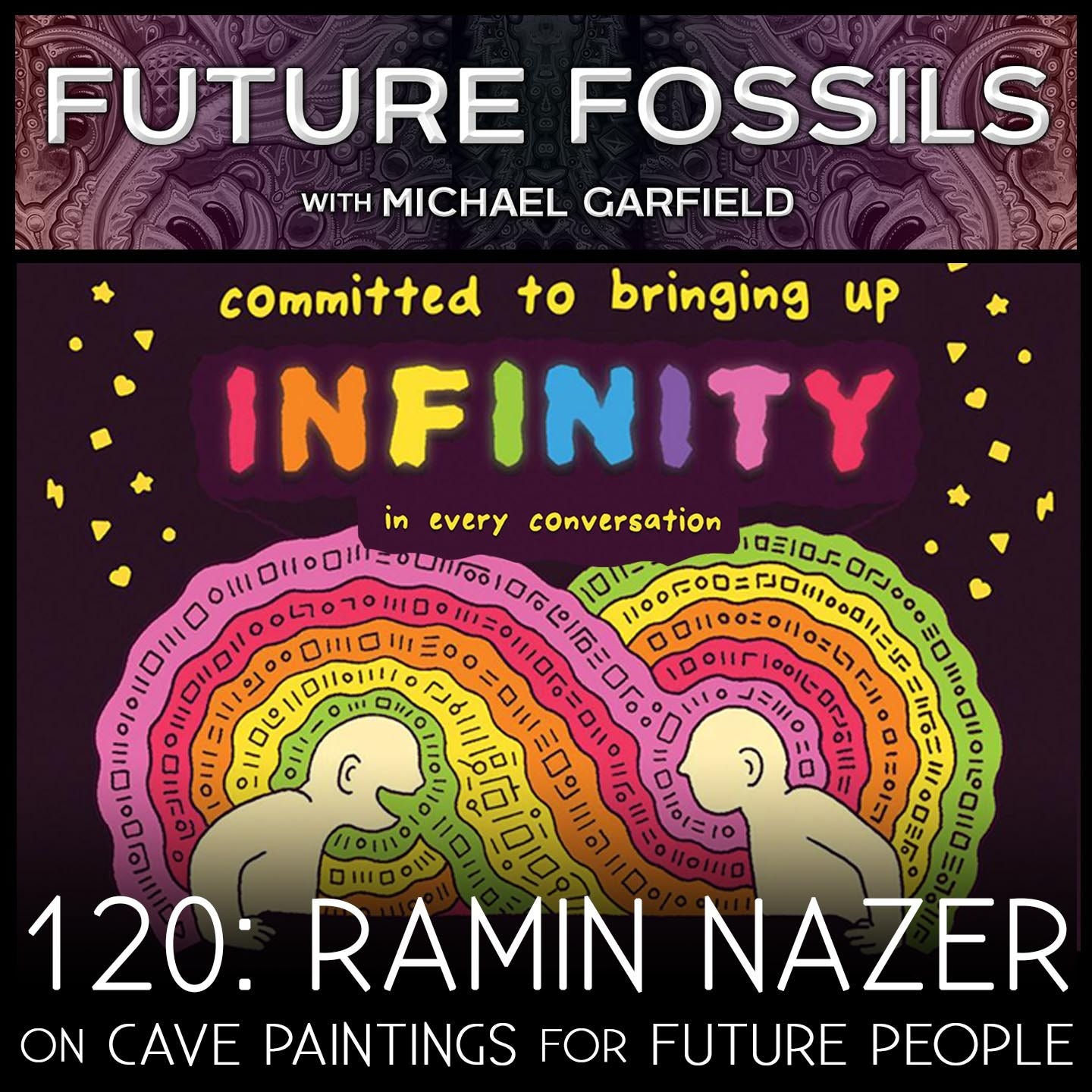
120 - Ramin Nazer on Cave Paintings for Future People
EThis week we surf the fun-gularity with the brilliant artist, standup comic, and podcaster Ramin Nazer! This episode is significantly less a heady philosophy-of-science discussion than usual and significantly more a wank-fest of two people who love each other’s shows going on about all the mind-blowing visionary notions contained therein. Kick back, light some incense, and prepare for a juicy conversation about where we stand in the Cosmic Order and what to do with all of our creative possibility…covering everything from universal basic income to celebrity schadenfruede, visionary art and science fiction to to the psychological impact of trying to stay original in the midst of a tech singularity. If you’re anything like I am, Ramin is going to inspire the hell out of you. Enjoy…Ramin’s Website:https://rainbowbrainskull.com/collections/printsMichael on Ramin’s podcast, Rainbow Brainskull:https://www.raminnazer.com/blogs/rainbow-brainskull-hour/michael-garfieldMentioned:Archan Nair, The Teafaerie, Nikola Tesla, Onyx Ashanti, King Raam, The Rock, Andrew Yang, Yuval Harari, Bill Gates, Star Trek Discovery, Charles Stross’ Accelerando & Glasshouse, Black Mirror, Esperanza Spalding, Duncan Trussell, Richard Florida, Jeff Bezos, William Irwin Thompson, Terence McKenna, John C. Wright’s Eschaton Sequence, Peter Watts’ Blindsight, Eric Wargo’s Time Loops, Colin Frangicetto, Who Built The Moon?, No Man’s Sky, An Oral History of the End of Reality, Ariana Grande, Jimi Hendrix, Amazon Alexa, Life in the Glass Age at Burning Man 2013, Dadara (Daniel Rozenberg), The Mirage Men, Jason Silva, Randal Roberts, Morgan Manley, Alex Grey, Allyson Grey, Michaelangelo, Slavoj Zizek, Marshall McLuhan, Chuck Palahniuk, Jordan Peterson, Aziz Ansari, Louis CK, Julia Cameron, Alan Shelton, Buckminster Fuller, Frank Zappa, Mortal Kombat, Roko’s Basilisk, Norman “Dr. Blue” Katz, Joe Biden, Awake Aware Alive Podcast, Expanding Mind with Erik Davis, Rak Razam, Adam Dipert, Giant Leap Dance Company, Pablo Picasso, Vincent Van Gogh, Greg Parkins, Neil DeGrasse Tyson, Weird Studies, Brave BrowserSupport this show on Patreon and score a zillion awesome perks:https://patreon.com/michaelgarfieldSubscribe to our monthly creative explosion of a newsletter:https://michaelgarfield.substack.com Get bonus content on PatreonSupport this show http://supporter.acast.com/futurefossils. Hosted on Acast. See acast.com/privacy for more information. This is a public episode. If you'd like to discuss this with other subscribers or get access to bonus episodes, visit michaelgarfield.substack.com/subscribe
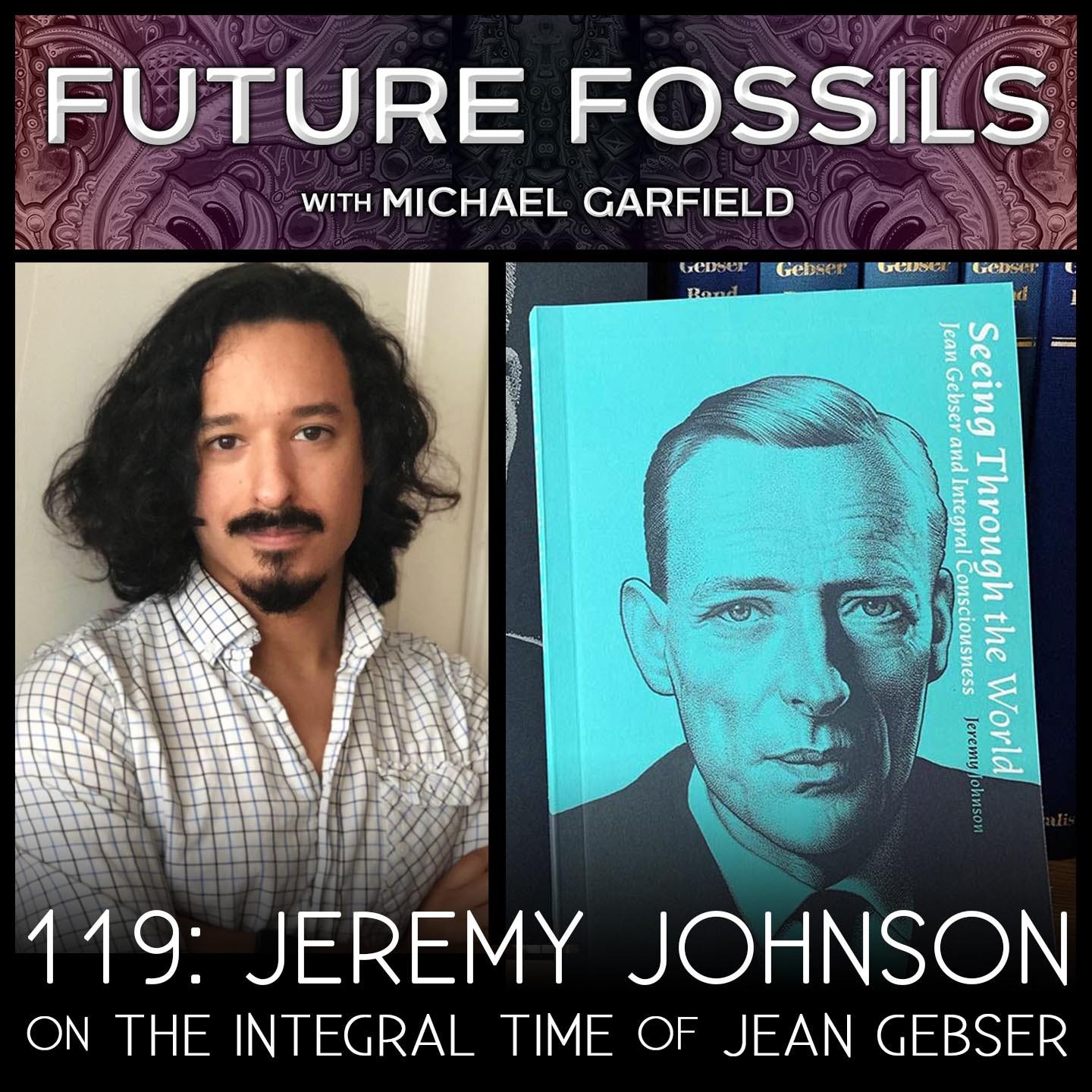
119 - Jeremy Johnson on The Integral Time of Jean Gebser
E“The human being is actually this kaleidoscope of different ways to relate to time and space. And to be present with it all, to be awake with it all, is what we’re doing.”Jean Gebser mapped the mutating structures of human consciousness, the topology of mind from archaic to magic to mythic to mental to integral. His work inspired generations of inquiry by authors like William Irwin Thompson and Ken Wilber. Now Jeremy Johnson’s latest book for Revelore Press expands into the truly visionary and unique “amensional” reality that Gebser posits as the next mutation for our planetary culture. “We’re not just going to have an ‘archaic revival’ and dump what we’ve been doing with the nightmare of history. There’s something that’s been achieved in this kind of coalescing of the self and the emergence of spatial linear time that’s true, as well.”“The endgame of perspectivalism and the mental world…is eventually breaking down to the point where everyone has their own little perspectival ‘reality tunnel,’ where nobody’s able to talk to one another and everybody’s in this sense of cultural warfare and fragmentation and social isolation.”“You should know by now that things are ever-present.”Jeremy’s Book:https://revelore.press/product/seeing-through-the-world/ Jeremy’s Podcast:http://www.jeremydanieljohnson.com/mutations Discussed:James JoyceMarshall McLuhanMartin HeideggerSri AurobindoGrant MorrisonTimothy MortonDoug RushkoffEugene ThackerGraham HarmanSupport the show on Patreon for an avalanche of secret episodes, writing, art, music, and the Future Fossils Book Club:https://patreon.com/michaelgarfield Get bonus content on PatreonSupport this show http://supporter.acast.com/futurefossils. Hosted on Acast. See acast.com/privacy for more information. This is a public episode. If you'd like to discuss this with other subscribers or get access to bonus episodes, visit michaelgarfield.substack.com/subscribe
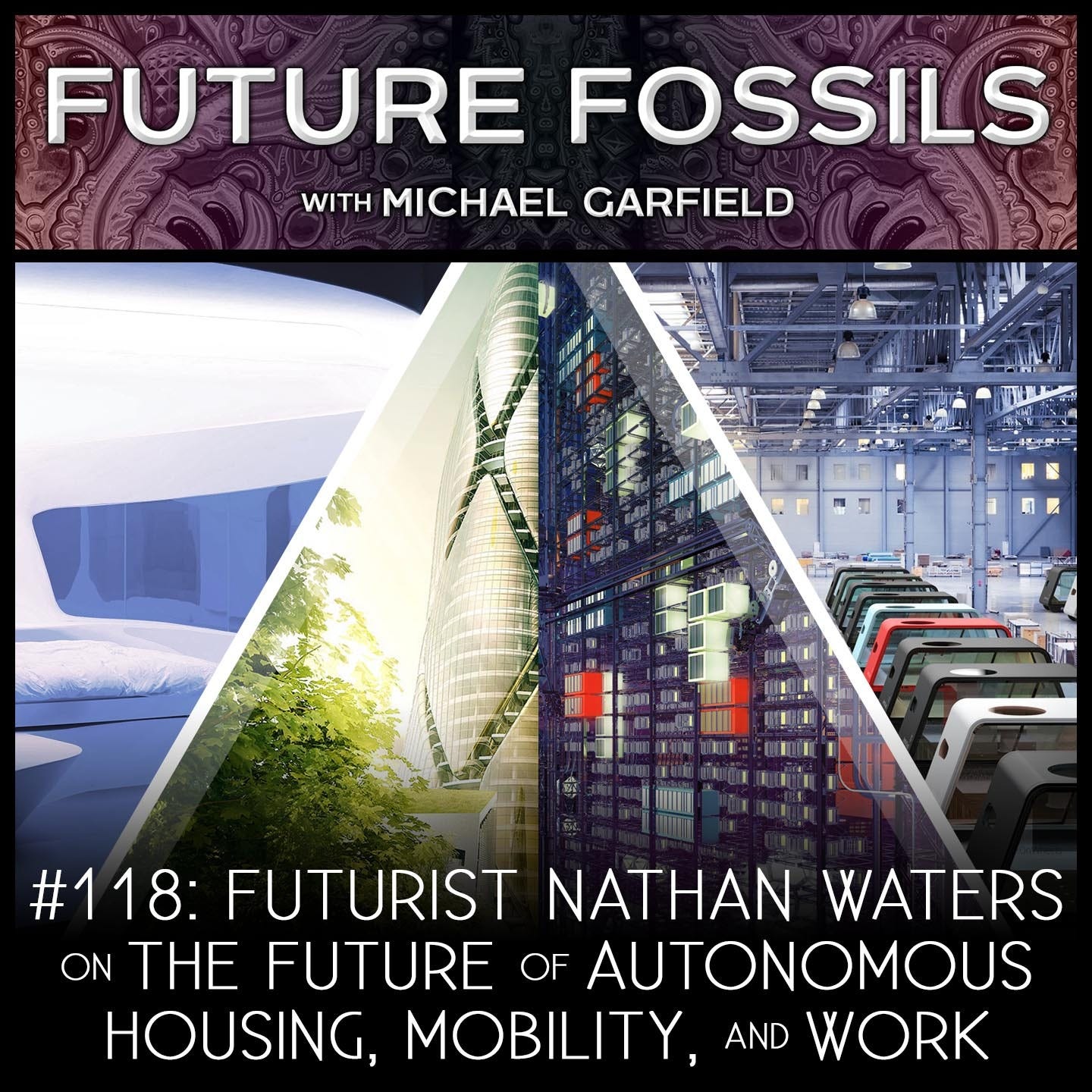
118 - Nathan Waters on The Future of Housing, Mobility, and Work
E“I want to break the idea that housing is an investment vehicle. I mean housing is a f-cking HUMAN NEED.”This week’s guest is Australian futurist Nathan Waters, whose vision for a mobile, modular mashup of apartment living and driverless cars offers a solution to a trifecta of wicked problems in affordable housing, cost of living, and enjoyable work. We’re talking about a mature and equitable sharing economy that goes asteroid-to-dinosaurs on the exploitative systems of corporations like Uber and Airbnb…this is an episode for anyone who dreams of a fairer and funner world, a world that reconciles the yearning for flexibility and adventure with the desire for a nice place to call your own:Nathan’s popular essay on “driverless hotel rooms”:https://hackernoon.com/driverless-hotel-rooms-the-end-of-uber-airbnb-and-human-landlords-e39f92cf16e1?gi=cecb64856db9Nathan’s blockchain-based skill-sharing economy website:https://www.peerism.org/Nathan’s futures-oriented social media channel, Futawe: https://twitter.com/futawe?lang=enNathan cohosts this YouTube talkshow about the singularity, Hive45:https://www.youtube.com/user/hive45com/videosSomebody either ripped off his driverless hotel rooms idea or just stumbled on it independently:https://www.usatoday.com/story/travel/2018/11/27/self-driving-hotel-room/2123668002/https://www.cnn.com/travel/article/autonomous-travel-suites/index.htmlFrom this episode:“A job is a terrible, terrible concept. I think of jobs as modern-day slavery. It’s a bunch of wasted mind and human capital.”“We have material abundance because of capitalism, but now it’s almost an existential threat. And we need to transition quickly to something else.”Most of the housing space and vehicle space we own is unused most of the time.We can’t legislate affordable housing because the incumbent politicians are real estate speculators.Modular hotels made of autonomous vehicle components (adding a z-axis to the not-a-trailer-park for hip young professionals).A new resolution for our age-old dialogue between sedentary and nomadic communities, wanderers and people of place.How to fit 9 billion people into 100K apartment buildings; see also: Paolo Soleri’s Lean Linear City.Building a blockchain-based, decentralized skill-sharing economy.A/B testing modular cities to find the optimum layout for human happiness.Mark Lakeman of City Repair and restoring streets to a safe commons.Can we handle constantly fluctuating and re-organizing architecture?Geophysical filter bubbles.Support Future Fossils Podcast on Patreon and get access to dozens of secret episodes, book club calls, live concert recordings, and more:https://patreon.com/michaelgarfield Get bonus content on PatreonSupport this show http://supporter.acast.com/futurefossils. Hosted on Acast. See acast.com/privacy for more information. This is a public episode. If you'd like to discuss this with other subscribers or get access to bonus episodes, visit michaelgarfield.substack.com/subscribe
117 - Eric Wargo on Time Loops: Precognition, Retrocausation, and the Unconscious
This week’s guest is Eric Wargo, author of Time Loops: Precognition, Retrocausation, and the Unconscious. Contrary to your most likely first impression based on the title of the book alone, this is a supremely carefully constructed argument that anticipates its critics, understands statistics and their abuse, appeals to our desire for simplicity in scientific explanations, and single-handedly reorganizes the entire field of parapsychological research beneath a new and rational umbrella that allows for major weirdness without sacrificing mechanistic causation or parsimony. Telepathy and spooky action at a distance, Jungian synchronicity and many worlds quantum physics all get re-evaluated under Wargo’s tesseract-brain model, in which there’s no such thing as entanglement, but living systems co-opt quantum post-selection to “steer” toward evolutionarily significant events. If you have ever dreamt of something that then happened in your waking life, this episode’s for you. And if you think that time’s an arrow and this all sounds like high nonsense, this episode is also for you.I can’t possibly attempt to cover all the subjects we discuss in these two hours, but here are books and essays that we reference (some of which I haven’t read):Eric Wargo - Time Loopshttps://www.amazon.com/Time-Loops-Precognition-Retrocausation-Unconscious/dp/1938398920J. Scott Turner - Purpose & Desirehttps://www.amazon.com/Purpose-Desire-Something-Darwinism-Explain/dp/0062651560(I have to make a personal note that without having read this book, I’ve read enough reviews to caution anyone against taking it as legitimate science. I’ve argued for the importance of beauty and desire, purpose and effort in the evolutionary process – and I’ve argued evolution in general does have a kind of direction. So I’m sympathetic to the author’s desire to re-introduce these ideas into the discussion. But from everything I can tell this particular book misrepresents evolutionary theory in its attempts to get where it wants to go, and I can’t support that.)Paul Davies - The Goldilocks Enigmahttps://www.amazon.com/The-Goldilocks-Enigma-Universe-Right/dp/0713998830%Matthew Fox - “The Return of the Black Madonna”http://www.matthewfox.org/blog/the-return-of-the-black-madonna-a-sign-of-our-times-or-how-the-black-madonna-is-shaking-us-up-for-the-twenty-first-centurySeth Lloyd, et al. - “The quantum mechanics of time travel through post-selected teleportation”https://arxiv.org/abs/1007.2615Eric Wargo - “Dream Paleontology”http://thenightshirt.com/?p=4215Eric Wargo - “What Lies Under The Skin”http://thenightshirt.com/?p=3198Theme Music: “God Detector” by Evan “Skytree” Snyder (feat. Michael Garfield)https://skytree.bandcamp.com/track/god-detector-ft-michael-garfieldAdditional Music: “It All Turned Out All Right” by Michael Garfieldhttps://michaelgarfield.bandcamp.com/track/it-all-turned-out-all-rightSupport this show on Patreon to join the book club and for secret episodes (and the last ten minutes of this conversation):https://patreon.com/michaelgarfield Get bonus content on PatreonSupport this show http://supporter.acast.com/futurefossils. Hosted on Acast. See acast.com/privacy for more information. This is a public episode. If you'd like to discuss this with other subscribers or get access to bonus episodes, visit michaelgarfield.substack.com/subscribe
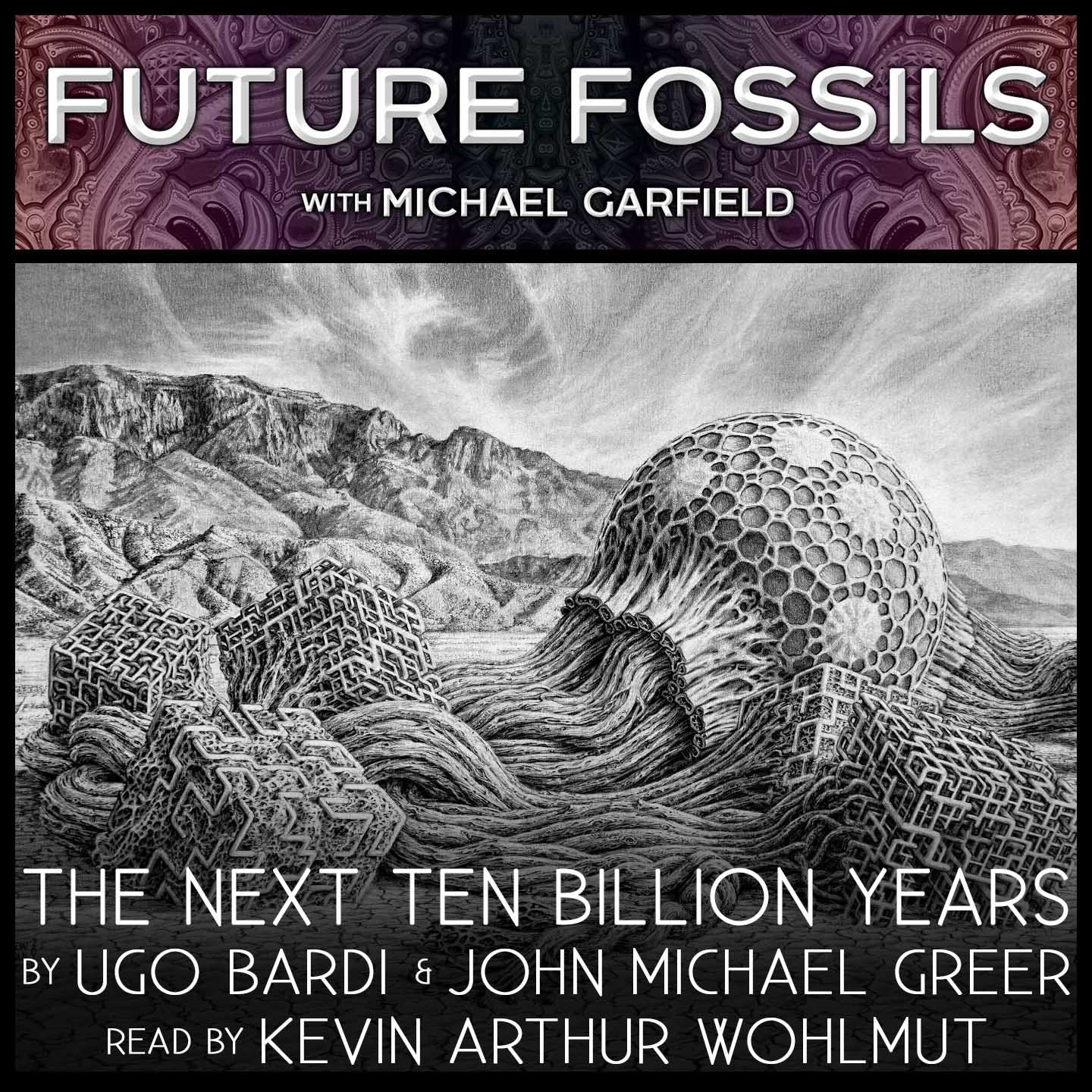
116 - The Next Ten Billion Years: Ugo Bardi & John Michael Greer as read by Kevin Arthur Wohlmut
This week is a watershed moment for Future Fossils Podcast: the show’s first guest host! My friend Kevin Arthur Wohlmut is an engineer who creates occasional one-shot podcasts of fiction and nonfiction, and (according to him) worries about the future too much. We met at InterPlanetary Festival last year on the visit that inspired me to move to Santa Fe, and ever since we’ve had a rich correspondence of mutual far-future fiction recommendations and armchair philosophy chats.Kevin sent me his very cool readings of two essays with the same name, each portraying very different version of “The Next Ten Billion Years,” and both so provocative I felt like sharing them here on the show’s main feed – with my own commentary at the end, on blind spots in imagining deep time and our own psychedelically weird future.You can find Kevin active in the Future Fossils discussion groups at Facebook and Patreon.Professor Ugo Bardi blogs at https://cassandralegacy.blogspot.com and http://chimeramyth.blogspot.com. You can read his essay here.John Michael Greer posts longer works at https://www.ecosophia.net and shorter works at https://ecosophia.dreamwidth.org. You can read his essay here.Outro reading excerpted from Michael Garfield’s “How to Live in the Future Part 2: The Future is More of Everything.”Cover Artwork by evolutionary robotics researcher Andrew Lincoln Nelson.Theme Music: “God Detector” by Evan “Skytree” Snyder (feat. Michael Garfield)Additional Music: “On Higher Ground” by Michael GarfieldAdditional Music by http://www.daikaiju.org & http://www.evanbrau.com Get bonus content on PatreonSupport this show http://supporter.acast.com/futurefossils. Hosted on Acast. See acast.com/privacy for more information. This is a public episode. If you'd like to discuss this with other subscribers or get access to bonus episodes, visit michaelgarfield.substack.com/subscribe
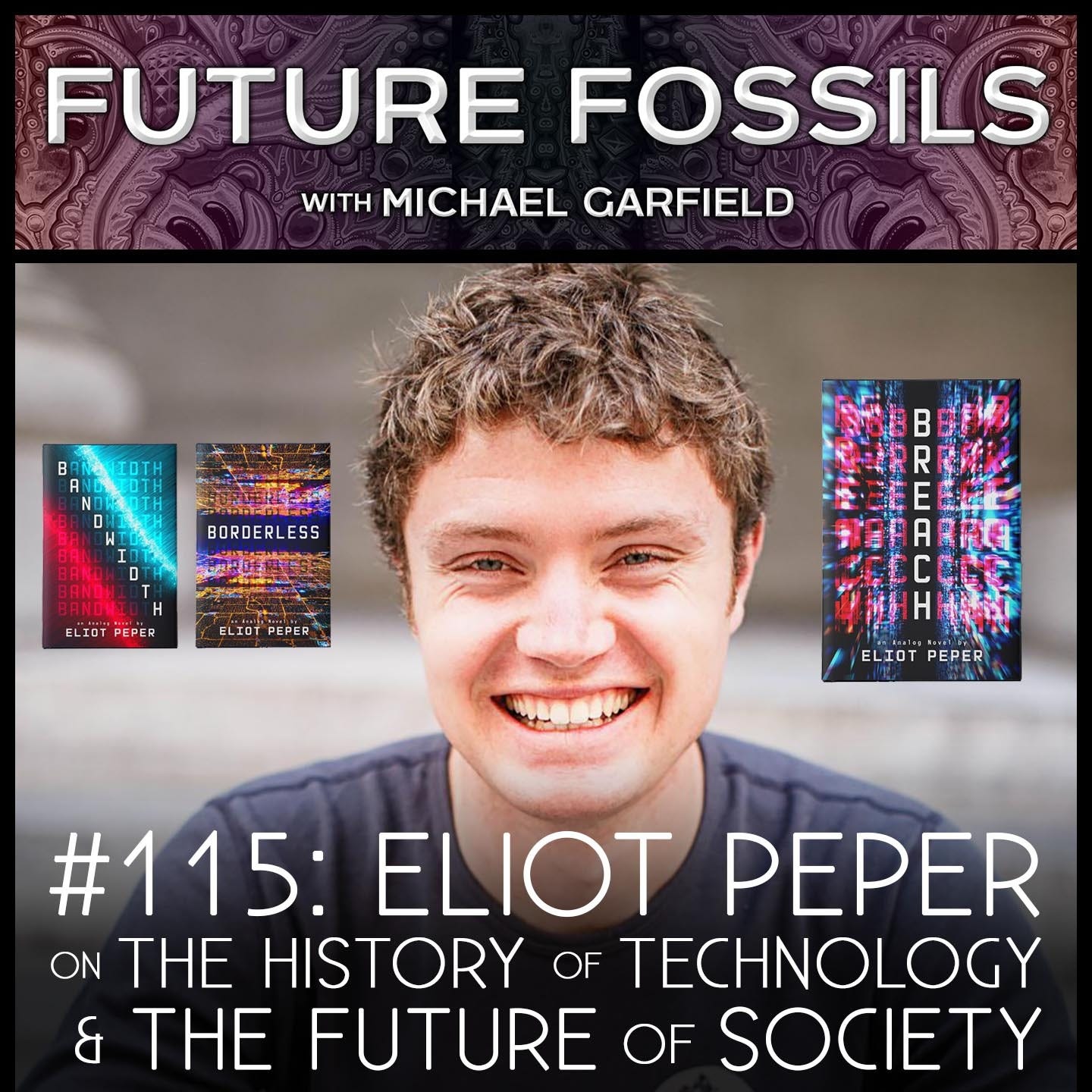
115 - Eliot Peper on The History of Technology and The Future of Society
EEliot Peper (Episode 47) is back on the show this week to talk about the themes around and within his Analog trilogy of very adjacent and believable sci fi novels (Bandwidth, Borderless, and the new “conclusion” Breach): that is, about the complex interactions between people and technology, both the layer cake of deep utilities we take for granted and the new affordances that disruptive tools produce – and how we shape our lives within them.https://www.eliotpeper.com/“One of the most fun things for me as a novelist about writing fiction is that it is very much about the questions, rather than the answers…if the answer’s obvious, I don’t need to write a book about it.”“You can’t really tell history without the history of technology.”“Congress writes laws about what’s going on, not what might be going on ten years from now. Policymaking is largely a reactionary measure.”“We haven’t figured out the new societies we want to build, given the new realities we’ve already invented.”“If you start thinking about the entire internet as an AI, then Google is not a company that is building what could be in the future some kind of AI program. Rather, Google and its status as a corporation, all of the corporate hierarchies that exist within it, and all of the people working on teams there, are actually just one part of that AI.”“I’m not a big believer in unitary self as an idea. I think we are all made up of MANY selves. We have these competing elements within us, and part of what it means to be human is to stitch these together into a coherent narrative. And we do that on the fly all the time.”“Your solution is going to create new problems, and the best way to best way to deal with that knowingly is to try to keep an open mind, try to maintain your beginner’s mind, maintain your state of awareness about the world and continually challenge your own assumptions.”“We are living in an age of acceleration – and yet, we have ALWAYS been confronted by a universe that defies our limited ability to make sense of it.”“My hope is that by using it like reasonable, mutually respectful people, we can turn the digital world into a place that is still gonna have some of the nasty stuff, but is gonna have a lot of the good stuff.”Mentioned: Kevin Kelly, Geoffrey West, Douglas RushkoffTheme Music: “God Detector” by Evan “Skytree” Snyder (feat. Michael Garfield)https://skytree.bandcamp.com/track/god-detector-ft-michael-garfieldAdditional Music: “On Higher Ground” by Michael Garfieldhttps://michaelgarfield.bandcamp.com/track/on-higher-groundSupport this show on Patreon to join the book club and for secret episodes:https://patreon.com/michaelgarfield Get bonus content on PatreonSupport this show http://supporter.acast.com/futurefossils. Hosted on Acast. See acast.com/privacy for more information. This is a public episode. If you'd like to discuss this with other subscribers or get access to bonus episodes, visit michaelgarfield.substack.com/subscribe
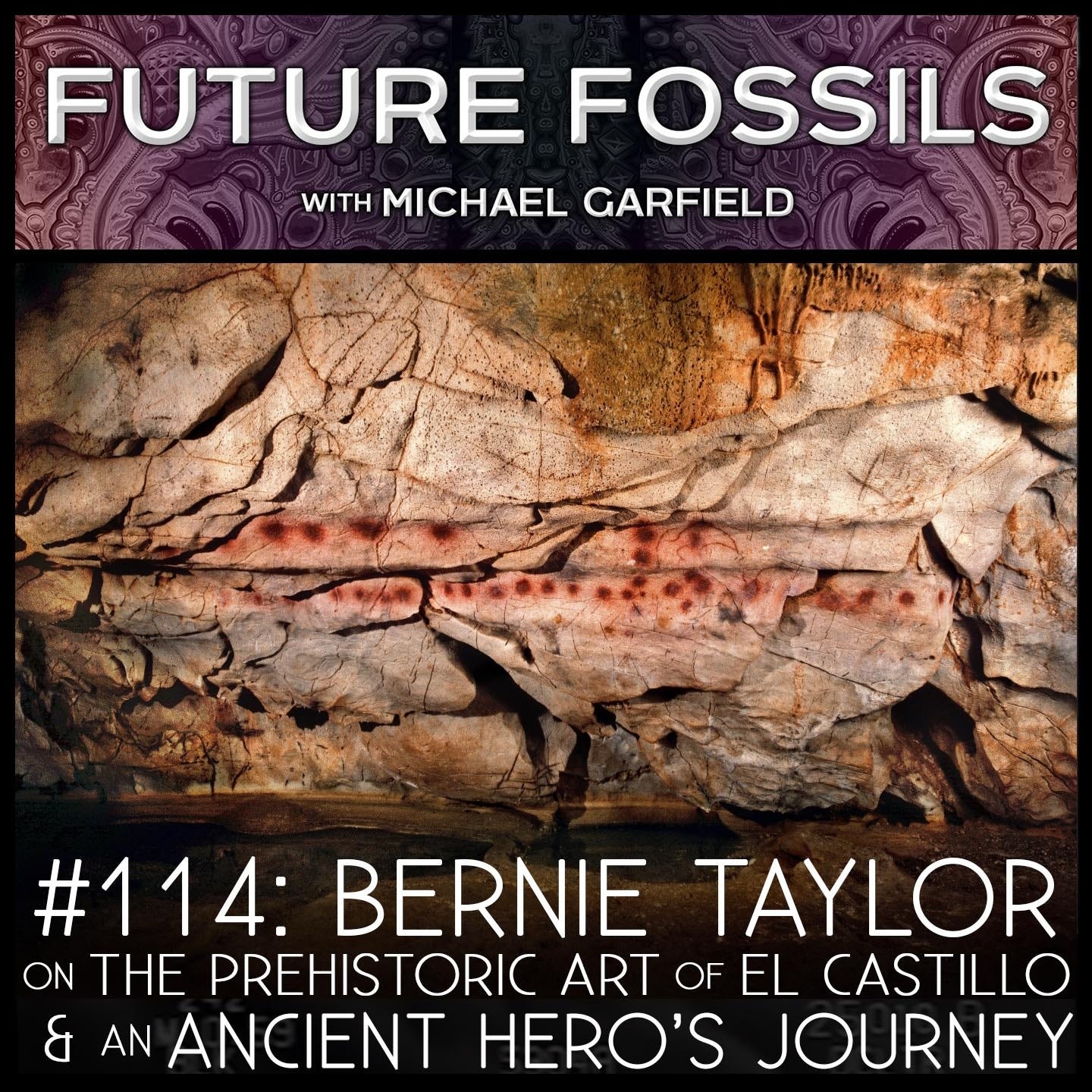
114 - Bernie Taylor on The Prehistoric Art of El Castillo & An Ancient Hero's Journey
EThis week’s guest is Bernie Taylor, whose novel interpretation of ancient cave paintings suggests an overlooked and deeply significant alternative take on the subjective experience and world-space of prehistoric human culture. Finding animals hidden in the interplay of paint and rock forms unnoticed by other archeologists, and corresponding with a diverse array of experts over decades (including legendary animal researcher George Gamow), he argues that these murals depict a heroic journey across continents, the crossing of the Iberian Peninsula, an ancient rite of passage coded in time and story that, if accepted by the scholarly community, would transform our understanding of our ancestors.Bernie’s Website: beforeorion.comWe Discuss:• How Bernie noticed an entire parade of African and European animals in the El Castillo’s Cave of Disks that no one had seen before;• The ancient animal versions of the constellations that became the modern ones (crocodile > Draco, great auk > Cygnus, etc.);• The prehistoric origins of the Twelve Trials of Hercules and the origins of the monster from misinterpreted shamanic lore;• Did the ancients really use cave art to track the precession of the equinoxes?• How Bernie reconstructed the ancients’ mapping of the annual calendar to various animal life cycle markers and visible stars;• Was the El Castillo mural testing for the ability to find hidden images - evidence of a shamanic apprentice’s ability to think differently?• The role of neurodiversity in prehistoric AND modern human society, and how that may relate to the function, not dysfunction, of dyslexia and autism;• How this initiatic journey is the earliest record we have of the heroic monomyth, which modern secular artists like Billy Joel continue to express even without knowing why these archetypes persist in human dream and story;• What we might learn from these ancient stories, and the minds of those who made them, to inform our strategies for an(other) era of massive change on Earth;“Modern art isn’t even modern art. It’s a recreation of paleolithic art.”Future Fossils theme music: “God Detector” by Skytree (ft. Michael Garfield)Additional music: "On Higher Ground" by Michael GarfieldJoin the Future Fossils Book Club and get secret episodes, free art and music, and more: Patreon.com/MichaelGarfield Get bonus content on PatreonSupport this show http://supporter.acast.com/futurefossils. Hosted on Acast. See acast.com/privacy for more information. This is a public episode. If you'd like to discuss this with other subscribers or get access to bonus episodes, visit michaelgarfield.substack.com/subscribe
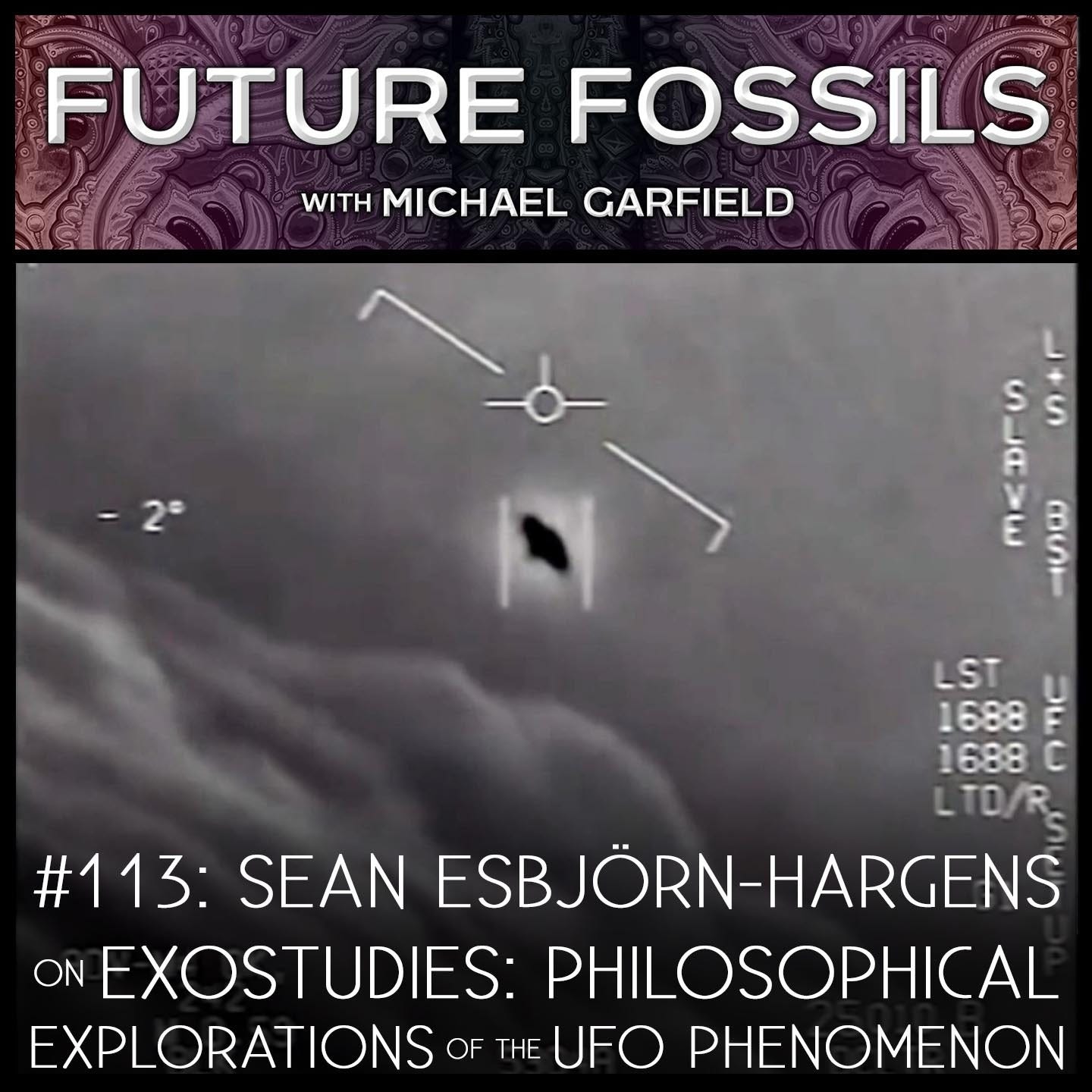
113 - Sean Esbjörn-Hargens on Exostudies: Philosophical Explorations of the UFO Phenomenon
EMy graduate advisor Sean Esbjörn-Hargens is one of the most consistently inspiring and refreshingly different thinkers I’ve ever met. In our first Future Fossils conversation, we discussed his work to apply a profoundly “meta” and pluralistic philosophy to the everyday work of organizational development and social impact. In this discussion, we turn over the rock and examine his decades of inquiry into some of the world’s most puzzling and confounding phenomena – namely, those surrounding the UFO and its aura of science-challenging incursions into mundane reality. Might “Exostudies” be the locus of a transformation in how we understand reality? This is not your normal New Age conversation about aliens, but a rigorous look into the persistent weirdness and problematic implications of one of humankind’s greatest mysteries. As Phil Dick famously said, “Reality is that which, when you stop believing in it, doesn’t go away.” If UFOs are here to stay – with all of their attendant provocations to our oversimple categories (self and other, artificial and natural, hallucination and perception, physical and immaterial) – then we are overdue for a new definition of “reality.” In preparation for his Exostudies online course this fall, we look at how to make sense of the stubbornly ineffable – an evolutionary call to take up higher-dimensional logic and more nuanced understandings of What Is…http://www.exostudies.org/“When you go into the UFO field, at least with an open heart and mind, you come across some really crazy shit. It is a freakshow. There are so many bizarre claims being made by standup citizens who are quite believable in what they are saying, even though what they’re saying just does not map onto our general view of reality.”“The truth is stranger than science fiction. Not just fiction, but science fiction.”“The phenomenon is subjective and objective; it’s subjective and objective simultaneously; and it’s neither. So I think what it’s asking us is to re-examine the relationship between mind and matter, and how do we relate to subject and object, and how has our current scientific methodology failed us horribly in having a more sophisticated answer or framing or understanding of how these two aspects are related.”“There are really good, legitimate photographs, and trace evidence, and all kinds of physical evidence for UFO craft and other otherworldly realities…and yet, there are so many fakes. And how do you sift through all that? You almost can’t.”“We’re entering into an augmented and virtual space that’s going to be ontologically fragmented, and highly pluralistic, and solipsistic. So how do we navigate that culturally? I don’t know, but I think we’re largely unprepared.”“We’re not that far from discovering some form of mini-life elsewhere. And as soon as that happens, then the floodgates are going to open in considering the implications of that.”“So many UFO or ET enthusiasts often want to put everything in one box, like ‘they’re all bad,’ ‘they’re all good,’ ‘they’re all future versions of ourselves.’ I think it’s much messier than that.”“I think one of the core strategies is hermeneutic generosity. A sense of critical thinking, but from a place of generosity, where we stay open. Postmodernism has been so jaded – the hermeneutics of suspicion – I think when we approach these phenomena, we need a different orientation.”“To really bring any kind of justice to this inquiry, we need to draw on the best thinking from as many kinds of disciplines as we can – because the phenomenon is that big, and that mysterious, and that paradoxical. So anything short of a meta, integrative approach – and even that – is going to fail.”Mentioned:Diana Slattery, John Mack, Avi Loeb, Ken Wilber, Jeff Kripal, Whitley Strieber, Arthur Brock, George Knapp, John C. Wright, Olaf Stapledon, Stuart Davis, Jeff Salzman, Richard Doyle, Carl Jung, Terence McKenna, William Irwin Thompson, DW Pasulka, Eric Wargo, Jacques ValleeSean’s appearance on the Daily Evolver Podcast:https://www.dailyevolver.com/2019/02/taking-aliens-seriously/If you liked this episode, check out Episodes 60 & Episode 91:https://shows.pippa.io/futurefossils/episodes/60https://shows.pippa.io/futurefossils/episodes/91 Get bonus content on PatreonSupport this show http://supporter.acast.com/futurefossils. Hosted on Acast. See acast.com/privacy for more information. This is a public episode. If you'd like to discuss this with other subscribers or get access to bonus episodes, visit michaelgarfield.substack.com/subscribe
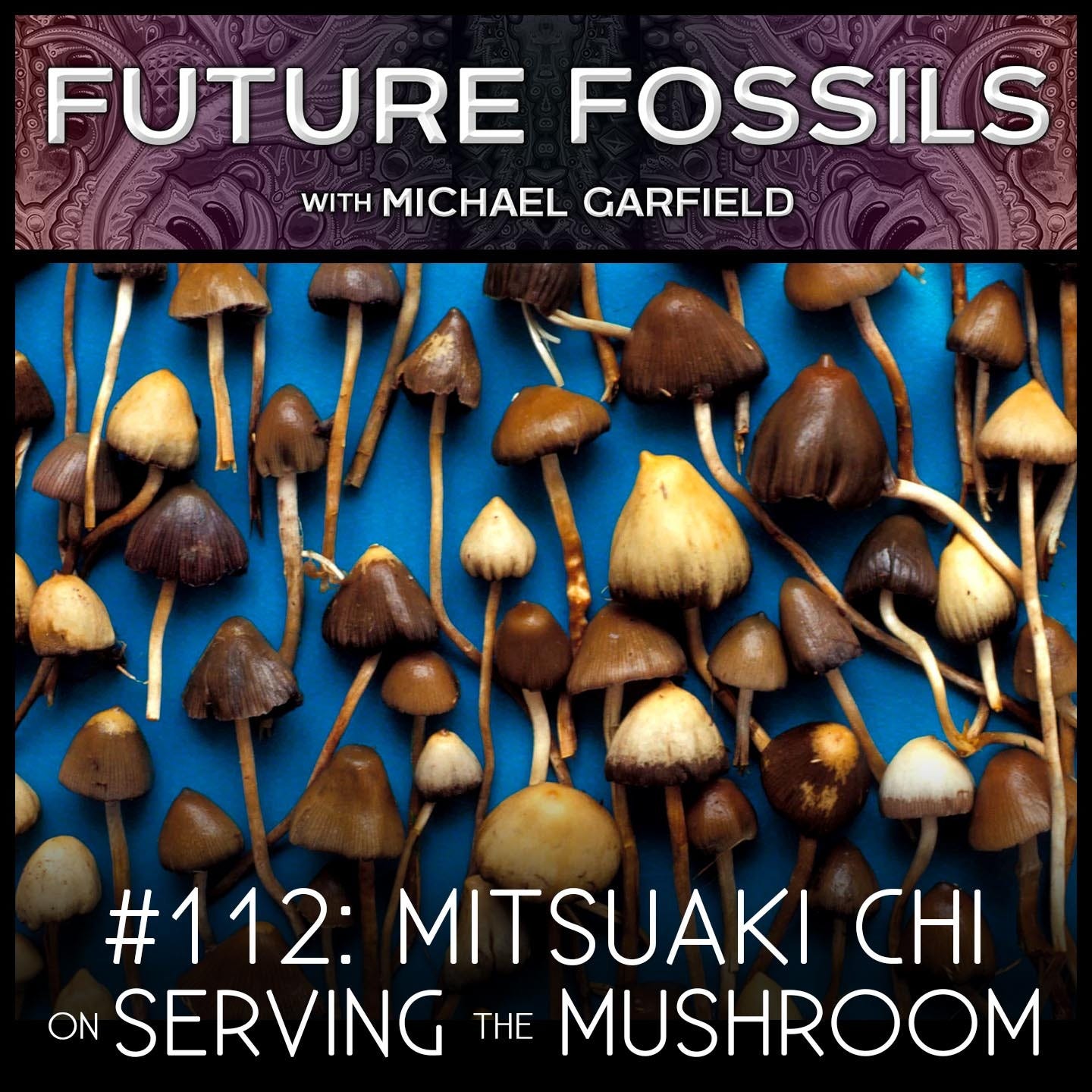
112 - Mitsuaki Chi on Serving the Mushroom
EThis week’s guest is professional psilocybin retreat host, long-time practicing Buddhist, and general good guy Mitsuaki Chi of Amsterdam. In this episode we get into the practices and benefits of psychedelic community, his unusual path from hardcore meditator to mushroom trip facilitator, and how he understands his life and purpose in light of a mysterious intelligence none of us can fully comprehend…trufflestherapy.comtripsitters.org“Even after so much time in meditation, I was still falling back into my patterns…”Coming to our senses.Going Buddhism-to-Psychedelics (instead of the usual other way around). How does meditation prepare you for tripping?Control? Renunciation? Acceptance? Grief?How does psychedelic healing as spiritual practice interface (if at all) with science and medical institutions?“More circles, less stages. Which is more important, direct experiences from a hundred people or one scientist who has been studying this stuff in a laboratory?”What are the longitudinal benefits of practice in a psychedelic community?“I think the two things people want more than anything are purpose and community [and] I think people are realizing how poisonous social media can be.”SUPPORT FUTURE FOSSILS on PATREON:patreon.com/michaelgarfield Get bonus content on PatreonSupport this show http://supporter.acast.com/futurefossils. Hosted on Acast. See acast.com/privacy for more information. This is a public episode. If you'd like to discuss this with other subscribers or get access to bonus episodes, visit michaelgarfield.substack.com/subscribe
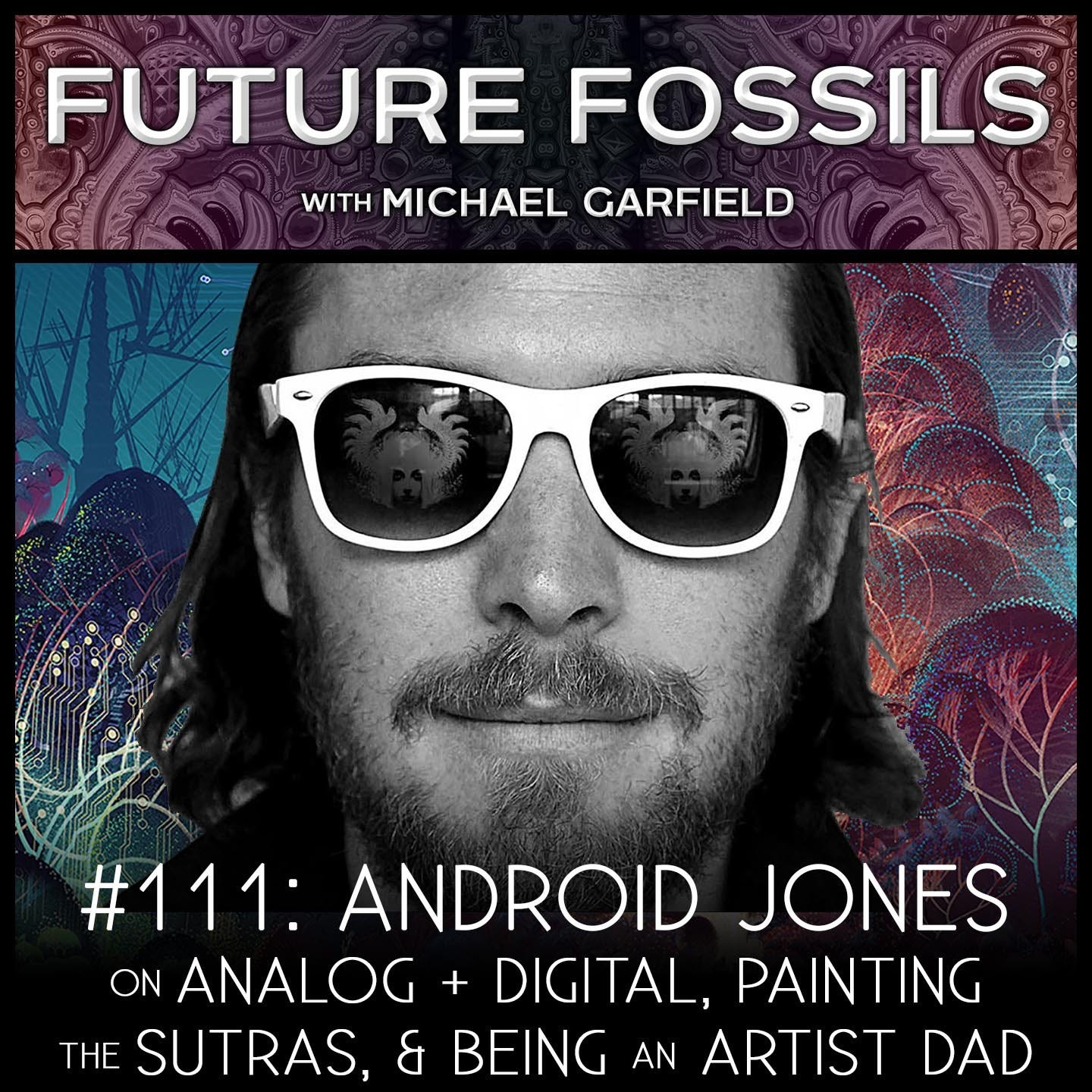
111 - Android Jones on Analog + Digital, Painting the Sutras, & Being an Artist Dad
EAndroid Jones is one of the world’s hottest digital artists – even if it’s kind of a mistake to label him this way and limit his creative action to the digital. A master portraitist, designer, and explorer of new tools, Android made concept art for video games in his early years before becoming the creative consultant for the best-in-class Corel Painter software, touring the world while doing live visuals for huge musical acts, collaborating on epic dome projection shows, and ultimately pioneering the possibilities of VR with his latest project, Microdose. But arguably his most vital and illuminating evolutionary edge as an artist has been with his two children, learning to raise the next generation of curious and creative minds. This week on Future Fossils, I sit down for a three-year-overdue discussion with one of the most objectively inspiring people I can call a friend – to talk about our hopes and our concerns for Those Who Come Next, and what being a creative parent means in our Age of Transition.https://androidjones.comhttps://microdosevr.comJoin my community of patrons and receive exclusive perks (like book club membership):https://patreon.com/michaelgarfieldJoin the daily discussions erupting like psychedelic flowers in our Facebook Group:https://facebook.com/groups/futurefossilsWe Discuss:Electromineralism & medium as material agent lending its qualities to your identityTools as extensions of the body, and the most modern tools we have are still so ancientReimagining truths that have real legs on them, not praising absolute truthsFinite & Infinite Games by James P. CarseBeing a part of the six thousand year plus art history conversation that we haveDrilling down to making deeper and more universally relevant art to “provide a greater reflective surface” for viewersVisionary Art, (a different take on)What psychology teaches about making (real) art *for* peopleHow fatherhood changed his art and life and everythingMaking art with kids – both digital and analog media – and how the forms differ as learning experiencesWhat VR has that other media do not, and Android’s first breakthrough moment in Microdose VRWhen Android met Robert Venosa at Art Hardware in Boulder at age 16There are too many things to learnThe future of visual performance is WHAT? (!!!)THE ART SCHOOLGoing Icarus to DaedalusApprenticeshipThe transformative potentials of VR as biofeedbackWhat scares Android Jones?What comes next? Get bonus content on PatreonSupport this show http://supporter.acast.com/futurefossils. Hosted on Acast. See acast.com/privacy for more information. This is a public episode. If you'd like to discuss this with other subscribers or get access to bonus episodes, visit michaelgarfield.substack.com/subscribe
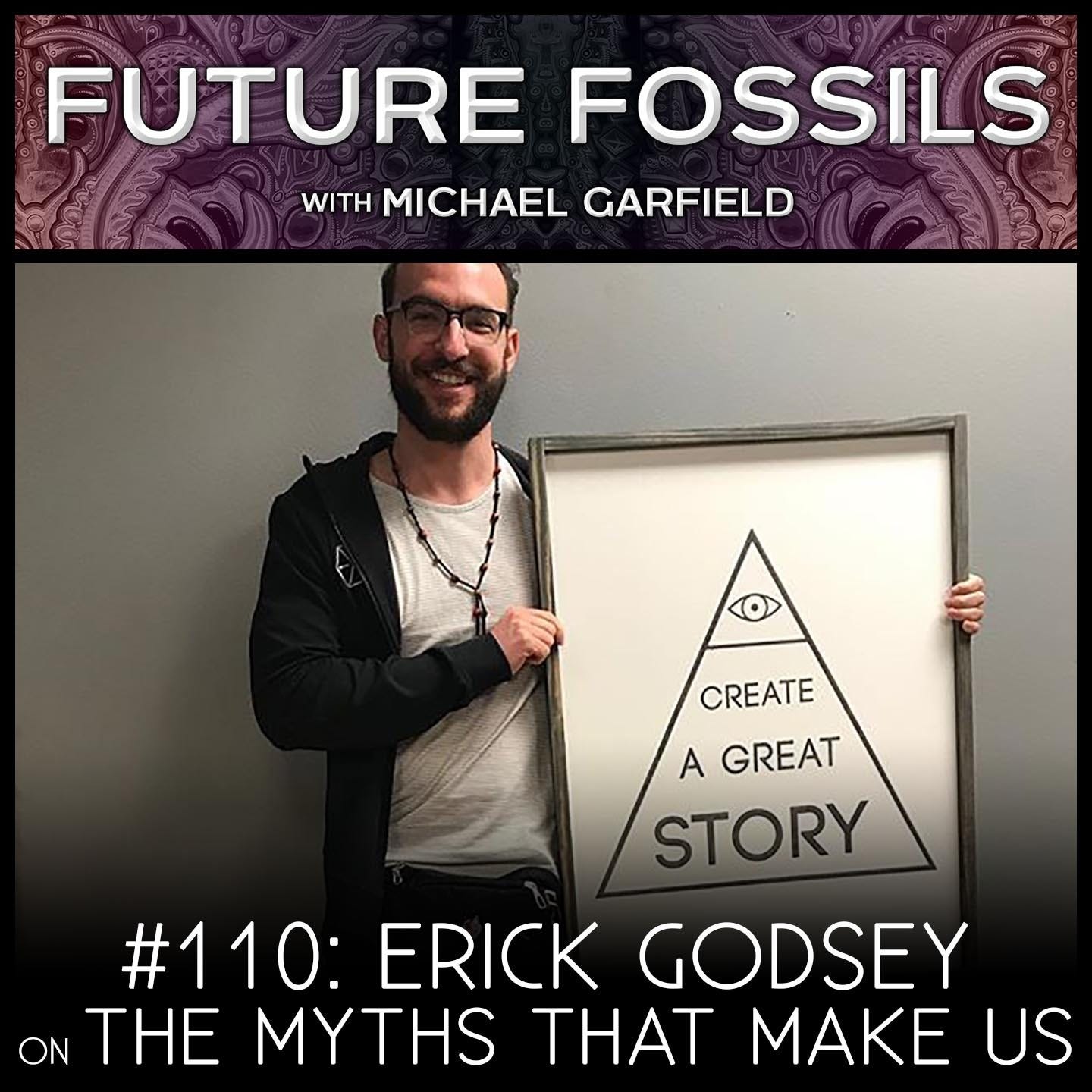
110 - Erick Godsey on (Why It's Too Soon To Give Up) The Myths That Make Us
EErick Godsey was almost my roommate in Austin, and even though I trust our destinies I still consider it a bummer that we didn’t. He is a nobler beast than I. He’s also the host of The Myths That Make Us, which is an excellent program for reasons that have nothing to do with my recent appearance on his show, but that’s nice too…What Erick IS is devoted to helping people live the absolute best stories that they can, which means first figuring out why we’re living the stories we already ARE.Notes are slim for this episode but that’s because just go listen to it right now.Erick’s website:https://erickgodsey.com“A great idea reconstructs your map. It’s one of the most painful things you can go through, but it’s beautiful.”“I was an atheist but I prayed. At night, I would pray to a thing I didn’t understand and say, thank you, because all the people who were asking for things were stupid, and I was self-righteous.”Don’t read Gödel, Escher, Bach and then take 5 grams of mushrooms. (Psychedelic Conservatives.)“If you tell a twenty-eight year old, ‘Your story is an illusion,’ it f-cks more people up than it helps…especially in Western culture, it’s not the right medicine at the right time.”Our stories are not useful for as long as they used to be. Are they no longer serving us in the “infoquake” of life online? How long will our evolutionary drives and archetypes persist amidst this metamorphosis?Spiritual Bypass. It’s all perfect. There’s a season for bullshitting yourself. Or no, you shouldn’t ever do it. Don’t resist your own psychodynamic forces.Most adaptive story: you are not a noun; you are a verb. Least adaptive story: you are a noun; you have to endure; the world is happening to you.What to do about being disempowered in a global landscape of tragic news, in our own personal lives, to do anything about anything?Is it better to be good or great?How to be good ancestors.Can we bring our full selves to work at our “day jobs”? What does it look like when we do? (AKA, What’s it like working at Onnit?)What are your coping mechanisms and how can you channel them to make the world a better place? Get bonus content on PatreonSupport this show http://supporter.acast.com/futurefossils. Hosted on Acast. See acast.com/privacy for more information. This is a public episode. If you'd like to discuss this with other subscribers or get access to bonus episodes, visit michaelgarfield.substack.com/subscribe
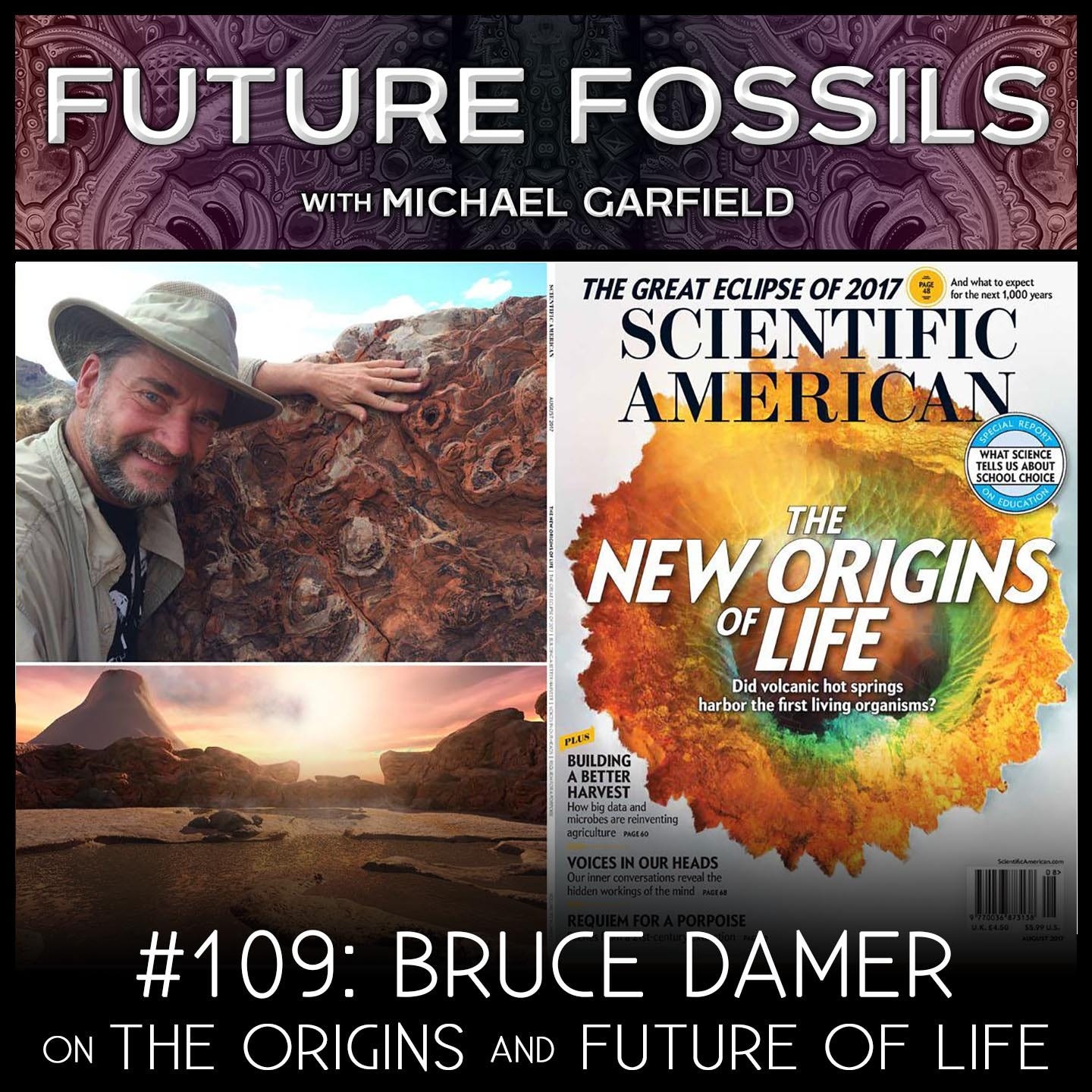
109 - Bruce Damer on The Origins and Future of Life
EBruce Damer is a living legend and international man of mystery – specifically, the mystery of our cosmos, to which he’s devoted his life to exploring: the origins of life, simulating artificial life in computers, deriving amazing new plans for asteroid mining, and cultivating his ability to receive scientific inspiration from “endotripping” (in which he stimulates his brain’s own release of psychoactive compounds known to increase functional connectivity between brain regions). He’s about to work with Google to adapt his origins of life research to simulated models of the increasingly exciting hot springs origin hypothesis he’s been working on with Dave Deamer of UC Santa Cruz for the last several years. And he’s been traveling around the world experimenting with thermal pools, getting extremely close to actually creating new living systems in situ as evidence of their model. Not to mention his talks with numerous national and private space agencies to take the S.H.E.P.H.E.R.D. asteroid mining scheme into space to kickstart the division and reproduction of our biosphere among/between the stars…I find it amazing that anyone as potently psychedelic as Bruce gets the focused listening attention of audiences at NASA, Scientific American, Google, and numerous esteemed academic communities around the world. A late-career PhD who spent his early years designing software that changed the world and going on adventures with his dear friend Terence McKenna, talking to Bruce is an inspiration and reminder that the big questions really DO take the dedication of a lifetime – and that dedication DOES bear fruit.(Appropriately to the McKenna link, there were some connectivity issues during our call that stretched out Bruce’s voice in a way very reminiscent of the Shpongle grain delay remixes of Terence’s talks. I left these in because I think they’re funny and in keeping with the good doctor’s trippy ideas, but apologies regardless.)Bruce was the second guest of this show way back in Episode 4, but that was three years ago and his work (and my ability to discuss it with him) has developed considerably since then. Enjoy this high-level update about one of the deepest questions we have on the table, right now…the profound implications of this new model of life’s origins for everything from business and politics to the strategies for thriving through an age of worldwide turbulence and transition…Bruce’s Website:https://damer.comWe Discuss:• Updates on Bruce’s efforts to recreate the conditions of the original “progenote,” a living system before the invention of cells;• How modern life prevents a second “Genesis” from happening on the Earth;• Why life must have started in a wet-dry cycling pond, and not in the sea or on land;• The three properties of life: crowding/containment; networks; and information storage – or P,I,M: Probability, Interaction, Memory;• The origin of life as a niche-construction process;• The origin of life vs. the origin of individuality and competition – likelihood that started as integrated consortia, not free-living cells in resource conflict;• Scaling up the progenote origin of life hypothesis to human systems and the origins of human civilization with “social protocells”;• Does life require organic molecules, or is it primarily an informational process?• Are memes even a real thing? (Compared to genes, we can’t point to one…)• Working with Google to simulate the origins of life with a chemistry-modeling deep learning system;• The increasing evolvability of (some) genomes in ever-more complex environments leading to a transition from genetic to cultural inheritance;• How evolutionary networks can bump themselves off local fitness peaks and into novelty to prevent becoming over-adapted to tiny niches;• Cycles of federalism and fragmentation in both nature and society;• The possibility of a global plan to build sea walls – to make it an issue of national defense, and a better use of our time than border walls; • What can we learn from the origins of life about the future of planetary culture and the ongoing evolution of our “progenote planet?”SEE ALSO:Bruce on Future Fossils Podcast Episode 4:https://shows.pippa.io/futurefossils/episodes/5a85dca3144c44bd2557158bMichael’s Version 1.0 Mind Map & Bibliography of research on major evolutionary transitions in self-organizing systems:https://www.patreon.com/posts/toward-new-1-0-24798022Evolution Evolving Conference:https://evolutionevolving.org/ Get bonus content on PatreonSupport this show http://supporter.acast.com/futurefossils. Hosted on Acast. See acast.com/privacy for more information. This is a public episode. If you'd like to discuss this with other subscribers or get access to bonus episodes, visit michaelgarfield.substack.com/subscribe
108 - Nadja Oertelt on Humanizing The Stories of Science
This week’s guest is Nadja Oertelt – research scientist turned film-maker and founder of Massive Science, a science communication community that cares about restoring care to the storytelling of scientific discovery. Not only is the website wonderfully both rigorous and easy on the eye, the writing takes you on a journey. Clearly she and her colleagues are doing something right by teaching scientists it’s not just okay, but vital to the meaning-making of their work, to have a story and not just solutions.Here’s her amazing publication:https://massivesci.com/And an interview she did with Forbes:https://www.forbes.com/sites/catescottcampbell/2017/04/10/the-limit-does-not-exist-nadja-oertelt-has-a-massive-take-on-science/Super cool short film series Nadja did for HarvardX Neuroscience:https://vimeo.com/channels/972301 We Discuss:How working with scientists was a revelation into the social process of knowledge production and translation.Anna Wexler & DIY brain interfaces.http://www.annawexler.com/David Cox, Director MIT-IBM Watson AI Lab.https://researcher.watson.ibm.com/researcher/view.php?person=ibm-David.D.CoxThe erasure of the subject in academic writing.Integral psychology and the application of psychometric information to the addressing of truth claims.How do psychedelics change the way we understand and practice science?Alex & Allyson Grey’s Chapel of Sacred Mirrors.https://cosm.orghttps://evolution.bandcamp.com/album/technologists-of-attention-at-the-chapel-of-sacred-mirrorsThe Fundamentalism-Zen Continuum in the thermodynamics of computation.Creating a new neural ecology of science by including more kinds of people in the investigations.“We’re approaching some sort of memento mori for reality.”The “black box” of AI is not as big of a problem as the “black box” of why we feel the need to create these technologies in the first place.The human reality and personal sacrifices of science and knowledge production.The pain of becoming a storyteller for so many who have been trained as scientists.How social media has changed the subjectivity of young researchers.The importance of care in all of this.Allison Parrish - artist & programmer.https://tisch.nyu.edu/about/directory/itp/853082171Irreversible Dictation: Gertrude Stein and the Correlations of Writing & Science - Steven Meyerhttps://www.sup.org/books/title/?id=750This episode is backed by Mike Schwab of KnowYourMeme.com, a fascinating living document/community exploring memes and their effects. Get bonus content on PatreonSupport this show http://supporter.acast.com/futurefossils. Hosted on Acast. See acast.com/privacy for more information. This is a public episode. If you'd like to discuss this with other subscribers or get access to bonus episodes, visit michaelgarfield.substack.com/subscribe
107 - Epiphany Jordan on Human Touch & Safe Intimacy in The Internet Age
EThis week’s guest is Epiphany Jordan of Austin, Texas – a nurturing touch professional whose therapy sessions help triage the crisis of loneliness and touch-hunger facing billions of tech-immersed but intimacy-stranded people. In her new book, Somebody Hold Me: The Single Person’s Guide to Nurturing Human Touch, Epiphany explains how to get your basic touch needs met – consensually – outside of romantic relationship. In our conversation we talk about why this is such a widespread issue, how people are fumbling their attempts to connect with one another, and what to do about it.Her Website:nurturinghumantouch.comPrinted Book:amazon.com/gp/product/1732879206?pf_rd_p=c2945051-950f-485c-b4df-15aac5223b10&pf_rd_r=VGPWK0WEF50A2TD8YA3T E-Book:amazon.com/Somebody-Hold-Me-Persons-Nurturing-ebook/dp/B07MM6FFBD/ref=sr_1_2?keywords=somebody+hold+me&qid=1550610978&s=gateway&sr=8-2Support Future Fossils on Patreon and get access to secret episodes, our sci fi book club, and more:https://patreon.com/michaelgarfieldJoin the (lively, interesting) Facebook Group: https://facebook.com/groups/futurefossilsSubscribe on any platform you desire: https://shows.pippa.io/futurefossilsWe Discuss:The internet has not replaced human intimacy; it has only convinced many of us that it can.“Because our culture identifies sex with touch, if you’re not in a romantic relationship, you’re not getting your touch needs met.”“Nonconsensual touch is like a starving person stealing a loaf of bread, or something.”When hugging someone is their worst nightmare. Is not wanting to be touched something that should or should not be seen through the lens of trauma-induced disorder?The future of getting touch needs met by nonpersons: heavy blankets, hugging machines, womb simulators, intimacy robots…Eliza Schlesinger’s Elder Millennial standup special and how women in their 30s start displacing mother impulses onto their pets.Why don’t we extend the same rights we give people to other nonhuman beings? (e.g., nonconsensual touch of animals…)Is professional cuddling a symptom of a tragic dehumanizing trend in the evolution of civilization?“Paleo-cuddling”Tips for effective, safe, consensual, non-sexual cuddling.The tribal joy of the pseudo-anonymity of cuddle puddles.The double-edged sword of oxytocin.Teaching touch to teenagers.Touch deprived, or touch illiterate? Multicultural societies and trouble navigating overlapping rules about intimacy.“Part of what I’m trying to do is have people write another story about what it means to be human and how humans treat them. There’s so much distrust and fear of other humans, and humans can be nice to each other, and kind and gentle and look out for each other. I think it can help us be more of a global village…” “I don’t want to be a part of the revolution unless it has to do with people being nice to each other.” Get bonus content on PatreonSupport this show http://supporter.acast.com/futurefossils. Hosted on Acast. See acast.com/privacy for more information. This is a public episode. If you'd like to discuss this with other subscribers or get access to bonus episodes, visit michaelgarfield.substack.com/subscribe
106 - Stowe Boyd on The Future(s) of Work and How to Thrive Amidst Accelerating Change
EThis week it's a deep dive into futurist Stowe Boyd's research on Social Scaling, Boundless Curiosity, Deep Generalists, Emergent Leadership, and other major features in the metamorphic landscape of the 21st Century workplace.We live in an age when our human cognitive limits are being tested against a proliferation of possibilities in the digital space – and we zealously rush into always-on internet work, open office co-working spaces, enormous distributed online collaborations, and other novelties that seem to be more about the infinite capacity of our electronic tools than the finite reality of our minds and bodies.Stowe Boyd has been studying and reporting on the future of work for over a decade, and his blog Work Futures is one of my cherished news sources for understanding how “we shape our tools and then our tools shape us.” Talking with him is a blast of cool reason and warm humor about the insanity of the modern work environment and the impossible demands that it makes on us – pointing toward more lucid, grounded, manageable, and yes productive new modes of labor in the dizzying technological milieus to come.Learn More:StoweBoyd.comWorkFutures.orgCheck out a recent edition of his Work Futures newsletter:https://workfutures.substack.com/p/work-futures-daily-the-human-springSupport Future Fossils on Patreon and get access to secret episodes, our sci fi book club, and more:https://patreon.com/michaelgarfieldWe Discuss:Invented the term “social tools” and founded the Work Futures blog.How do we live in an unstable landscape in which new platforms are constantly replacing the ones where we’ve established merit and earned currencies?The return of publishing to human scale as a response to ubiquitous weaponized advertising.Book: Douglas Rushkoff, Present ShockThe modern era of social networking isn’t about social concerns but business concerns…human curation returns to the fore in its primacy: newsletters, list management, etc.Why is it that certain tools and practices “work” for work, and some don’t?How certain ill-conceived collaboration software recreates the scaling problems of cruiseship tourism’s effects on local economies.Anywhere-ism and “The horrible sameness of the places we’re working these days”The paradox of blocking out open-office distractions with recordings of people talking in cafés.“If you want to be creative, turn the lights down. You are more creative if you have high ceilings and dark. So if you take all that away, which is usually what they do in open offices…”>>> Ten Work Skills for the Post-Normal EraLaszlo Bach at Google using a data-driven approach to correlate skills with work success…not Ivy League degrees, not ability to solve certain IQ test type problems…“BOUNDLESS CURIOSITY is the #1 skill for the future. The most creative people are insatiably curious. They want to know what works and why. And so that’s the skill you should seek. If you’re not naturally insatiably curious, then you should learn the techniques and skills involved with that and practice that so that you’re acting as if you’re insatiably curious, even though it’s a learned and not innate characteristic.”How curiosity leads to unexpected second-order insights in at-first “unrelated” areas.Bill Taylor, founder of Fast Company Magazine: four styles of leadership useful today.The leader as a learning zealot.The posthuman workplace: collaboration with radically other entities, be they AIs or transgenic persons.The future of work looks like freestyle chess.How and why to be a “deep generalist.”“There’s still a lot of the Bronze Age in how typical companies are run…Bronze Age thinking is still 70% of companies.”Emergent Leadership 21st Century Management, and Liquid Democracy.AI and technological unemployment – a kind of “tragedy of the commons” as we each try to do the best thing for our organizations and race to the bottom.Book: Amy Goldstein, JanesvilleThe collision of AI, climate change, and the collapse of globalist neoliberalism.Book: William Irwin Thompson, Evil and World Order“You have to start thinking about things at the watershed level. When you’re thinking about geography, it can’t just be the outlines of nation states, which are the remnants of old empires and other kinds of craziness. It has to have some logical relationship to the actual world, and that means city states, watersheds, and so on. And when you have that mindset and start to see through that lens, well, the desire of the Catalonian people to have their own state – it seems like an inexorable direction, and the notion that the EU is resisting that, fighting it, well…they’re fighting the future.”The end of trucking and the inevitable riots.Book: Project Hieroglyph, edited by Neal StephensonUsing science fiction instead of futurist scenarios to make different futures truly palpable.Three Visions of the future: Humania, Neo-Feudalistan, & “Just Horrible.”“You can’t talk about the future of work without talking about the future in

105 - The Hypermoderns talk Clowns, Dead Souls, & UFOs (Part 2)
EThis week is part two of the intense, bizarre, and wonderful roundtable conversation with The Hypermoderns – John David Ebert, Michael Aaron Kamins, and Mimetic Value/Ikkyu Sojun) where we discuss the puzzling connection between clowns and DMT; John’s voyage into the strange realm of mediumship; and Michael’s life-altering series of UFO encounters right after college. Among other things…The Guests:Michael Aaron Kaminshttps://twitter.com/michaelaaronkJohn David Eberthttps://twitter.com/johndavidebertIkkyu Sojunhttps://twitter.com/mimeticvalueSubscribe to Future Fossils on any platform you desire:https://shows.pippa.io/futurefossilsSupport this show on Patreon. It’s good for you and makes you feel good:https://patreon.com/michaelgarfieldWe Discuss:How everyone gets their own language once we invent the universal translator.Addressing the question of hyperspace “entities” from nonduality and landscape agency.Clown/Harlequin Theory in the psychedelic realm.JDE:“Now I don’t wanna do DMT. You’ve ruined it for me, because I don’t wanna see a clown.”Ikkyu:“Imagine Meow Wolf…but a thousand times more.”The Joker is a floating signifier.Ikkyu talks about an extremely potent and disturbing N,N-DMT trip.The Mantis-Clown connection, vis-a-vis Michael’s Peruvian ayahuasca experiences.The clown in Eastern philosophy as Lao Wonton, the childlike “crazy” old man in kung-fu movies.Michael’s ONE critique of William Irwin Thompson (hint: “Lindisfarne,” what’s in a name?).What is the difference between the techno-optimism of Buckminster Fuller and the techno-optimism of Peter Thiel, Peter Diamandis, and Jeff Bezos?Trump the Clown, the Magician, the Alchemical Fool.Ikkyu:“What if I were like Duncan Trussell or Joe Rogan but I interview ideas, rather than people?”JDE interviews Rudolf Steiner through a medium, Shruti Campbell. He tells us of his love affair with Steiner.JDE explains how he become convinced that there are in fact legit mediums who can communicate with dead people.The theme of confinement in world myth.Exoteric lab institution science and esoteric wilderness field prospecting discovery science.Michael goes into unprecedented detail about his UFO sightings in 2006.Sufjan Stevens’ song “Concerning the UFO Sighting…”Tucker Carlson interviews Nick Pope about UFOs.Book: Who Built The Moon?Peter Gabriel’s “Don’t Give Up” music video (feat. Kate Bush)Michael’s eternalist/quantum-democracy theory of our self-fulfilling origins/histories.Dan Larimer vs. Vitalik Buterin on the limits of crypto-economic governance.The connections between alien abductions and shamanic initiations.Searching for metaphors complex enough to allow us to inhabit and dwell in hypermodernity.Carl JungCrowley’s Thoth TarotTimothy Morton’s HyperobjectsJames HillmanNassim TalebThe Flying Spaghetti MonsterRupert SheldrakeJohn C. WrightSam HarrisStephen HawkingErik DavisZechariah SitchinWestworld“The Moon” Tarot CardGreg Egan’s DistressFinnegans Wake - HCE (“Here Comes Everyone”)Blade Runner 2049Charles Stross’ AccelerandoJeff Noon (Vert & Pollen)Steven Greer & CE-5Jacques ValleeJ Allen Heinich (sp?)Prometheus & AtlasMircea Eliade Get bonus content on PatreonSupport this show http://supporter.acast.com/futurefossils. Hosted on Acast. See acast.com/privacy for more information. This is a public episode. If you'd like to discuss this with other subscribers or get access to bonus episodes, visit michaelgarfield.substack.com/subscribe
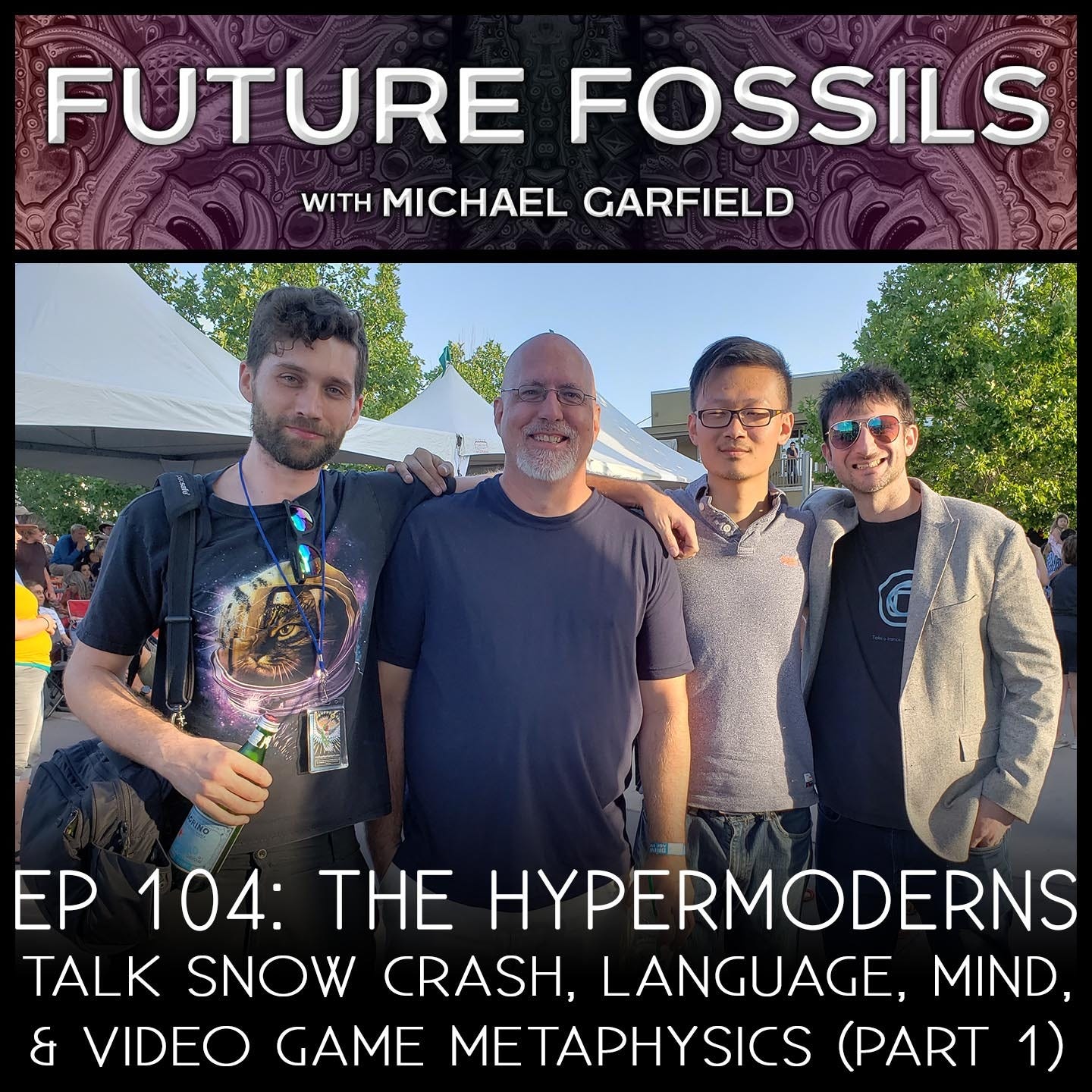
104 - The Hypermoderns Talk Snow Crash, Language, Mind, & Video Game Metaphysics
EThis week, we have a rad roundtable conversation with The Hypermoderns – John David Ebert, Michael Aaron Kamins, and Mimetic Value/Ikkyu Sojun) where we talk Snow Crash, Linguistic Entropy, and The Metaphysics of Video Games; spoil Meow Wolf and Annihilation (warning!); and go deep on the origins of Hypnotherapy and NLP. It’s just part one of an intense three-hour hoedown with some of the sharpest minds I know…The Guests in Order of Appearance:Michael Aaron Kaminshttps://twitter.com/michaelaaronkJohn David Eberthttps://twitter.com/johndavidebertIkkyu Sojunhttps://twitter.com/mimeticvalueSupport this show on Patreon. It’s good for you and makes you feel good:https://patreon.com/michaelgarfieldWe Talk About:Michael Aaron Kamins:“Shigiro Miyamoto is the Dante of the Hypermodern Age.”Mario is a shaman, Link is Percival of the Round Table…NextNature.net, the Anthropocene, and the Wood Wide WebAre videogames more effective than books as a form of storytelling?John David Ebert likes Grand Theft Auto: “Video games aren’t the problem; they’re the SOLUTION to the problem of living in these bizarre cosmopolitan cities, these huge megalopolitan cities that we’re constantly stressed out by.”Narrative collapse in the shift from the serialized dramas of print-era TV and the reality shows of web-era TVMichael Aaron Kamins:“What does the hero’s journey mean in a world where we have to work 9-to-5 jobs?”Skeumorphism in digital spaces:Video games that mimic office life seem inevitable……but unlike in Snow Crash, we don’t want to walk everywhere in VR.Lists, Explosions, & FlowsWhy Michael Aaron Kamins disagrees with Daniel Pinchbeck about UFOs.If Jordan Peterson is our Confucius, who is our Lao Tzu?MG: “History is a thing that you make.”JDE:“We’ve lost the metaphysics. We have to bring back the metaphysics.”Why and how civilizations disintegrate.MG: “If you’re going to upload me, at least upload me in HD.”JDE: “It’s gotta get more fractal.”Meow Wolf is The Shimmer in AnnihilationArchangel Michael & Garuda, archetypes expressed across the world in time and landscapeMichael and Michael talk about the dragon fighting St. Michael meteor-dinosaur connection thing.Everybody tries to guess MG’s sign.Dr Blue aka Norman Katz, student of Milton EricksonJungian vs Ericksonian psychotherapy and the importance of combining the two.We talk smack on the sociopathic founders of NLP.Mimetic theory.Evolution, entropy, and the Tower of Babel.Shout-Outs:RadioLabDouglas RushkoffPac ManZelda: Breath of the WildCarl Jung’s Red BookNeal Stephenson’s Snow CrashGoogle GlassKevin KellyWilliam BurroughsMeow WolfRudolf Steiner“The Fighting Dinosaurs”Paleontologist Robert BakkerHouston Museum of Nature & ScienceTimothy LearyThe Fourth TurningHistory, Big History, and MetaHistory by SFI PressBeing John MalkovichGilles DeleuzePeter SloterdijkThe Joseph Campbell FoundationRobertson JeffersJon SteinbeckBuddha BombTimothy Morton’s HyperobjectsTom Hui Hu - A Prehistory of the CloudThe Square in the Tower by Neil FergusonThe Architects of the Internet Apologize - New Yorker MagazineJeff Van Der MeerTool & Alex GreyParvatiScott AdamsNLP Get bonus content on PatreonSupport this show http://supporter.acast.com/futurefossils. Hosted on Acast. See acast.com/privacy for more information. This is a public episode. If you'd like to discuss this with other subscribers or get access to bonus episodes, visit michaelgarfield.substack.com/subscribe
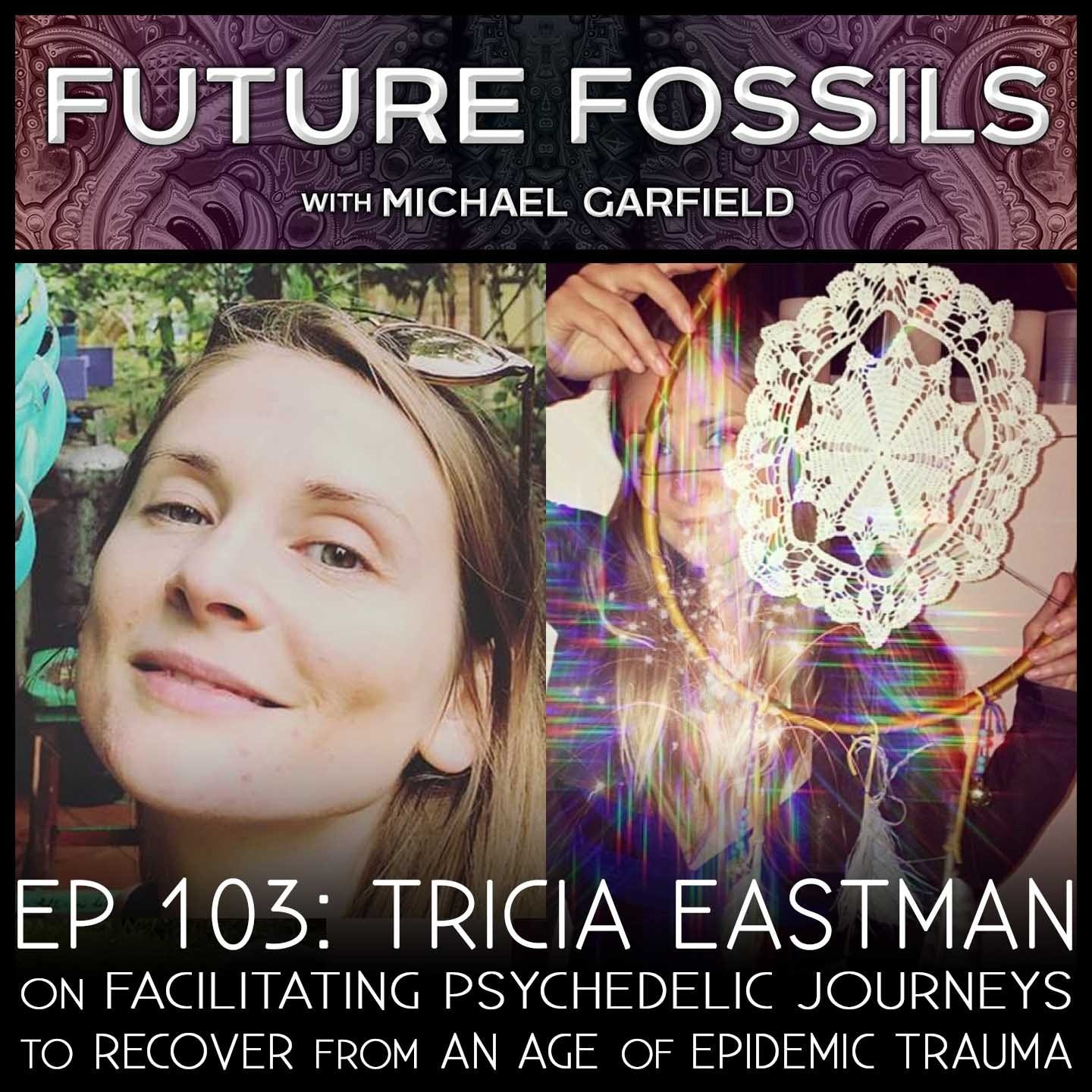
103 - Tricia Eastman on Facilitating Psychedelic Journeys to Recover from An Age of Epidemic Trauma
EHappy holidays! This week’s guest Tricia Eastman helps people find the holiness in every day by facilitating legal ceremonies in which ordinary membranes in between the different areas of thought and non-thought relax, and new or somehow ancient greater selves emerge appear whatever.It’s a solid conversation with a fascinating person doing very crucial work. I hope you get as much from this dense hour of passage, insight, integration…Tricia’s Sites:psychedelicjourneys.cominstagram.com/psychedelicjourneysWe Discuss:How she became a plant medicine practitioner through the festival psychedelic harm reduction undergroundLeaving a husband, four houses, and all of her possessions to be of service to humanityOvercoming her severe, debilitating eating disorders with ibogaine, ayahuasca, and 5-MeO DMTHow to smuggle the sacred into the global shopping mallReviving the ecstatic mystery schools and other lost spiritual traditionsCoping with the aftermath of collectively “waking up in a burning house” as we make last-minute moves to steer the planet out of further catastrophe“A lot of the decisions that we make are based on false structures of safety, things that make you FEEL safe - like locking your door. Does locking your door really actually make you safe? If someone wants to get into your house, they’re going to get into your house. The truth is, we are all walking around with a lot of trauma. And if we can understand that that is actually an aspect of us, that it is NOT us, then we can get into a space where we can start interacting in a more peaceful way.”Bringing back the rites of passageMoving as a culture into responsibility for the decisions that we makeGrowing up in a Christian family while experiencing “entities”“I was like, ‘If I drink this bottle of wine, this ghost cannot f-ck with me.’ Until I started understanding was that all they wanted was to be shown to the light.”Metamodernist science takes on the psychedelic Other(s)A psychedelic facilitator’s advice on how to behave with ghostsThe gods and spirits as messages from the somatic unconsciousIntegrating indigenous practices into the modern worldReplacing hierarchical teacher-student models with networked and facilitated group learning models“We are the medicine. We don’t necessarily need to take medicine.”How do we come up with something better for a world of proliferating trauma than “Accredited Facilitator from Iboga University”?Shout-Outs To:The Zendo ProjectPlant Spirit HealingCafé GratitudeThe UDVRick Doblin & MAPSBurning ManPhilip K DickBlue aviansRudolf SteinerCarl JungTerence McKennaRichard Rudd * Gene KeysSupport this show on Patreon and come be in our book club! Also, tons of cool free music, art, etc. there:https://patreon.com/michaelgarfield Get bonus content on PatreonSupport this show http://supporter.acast.com/futurefossils. Hosted on Acast. See acast.com/privacy for more information. This is a public episode. If you'd like to discuss this with other subscribers or get access to bonus episodes, visit michaelgarfield.substack.com/subscribe
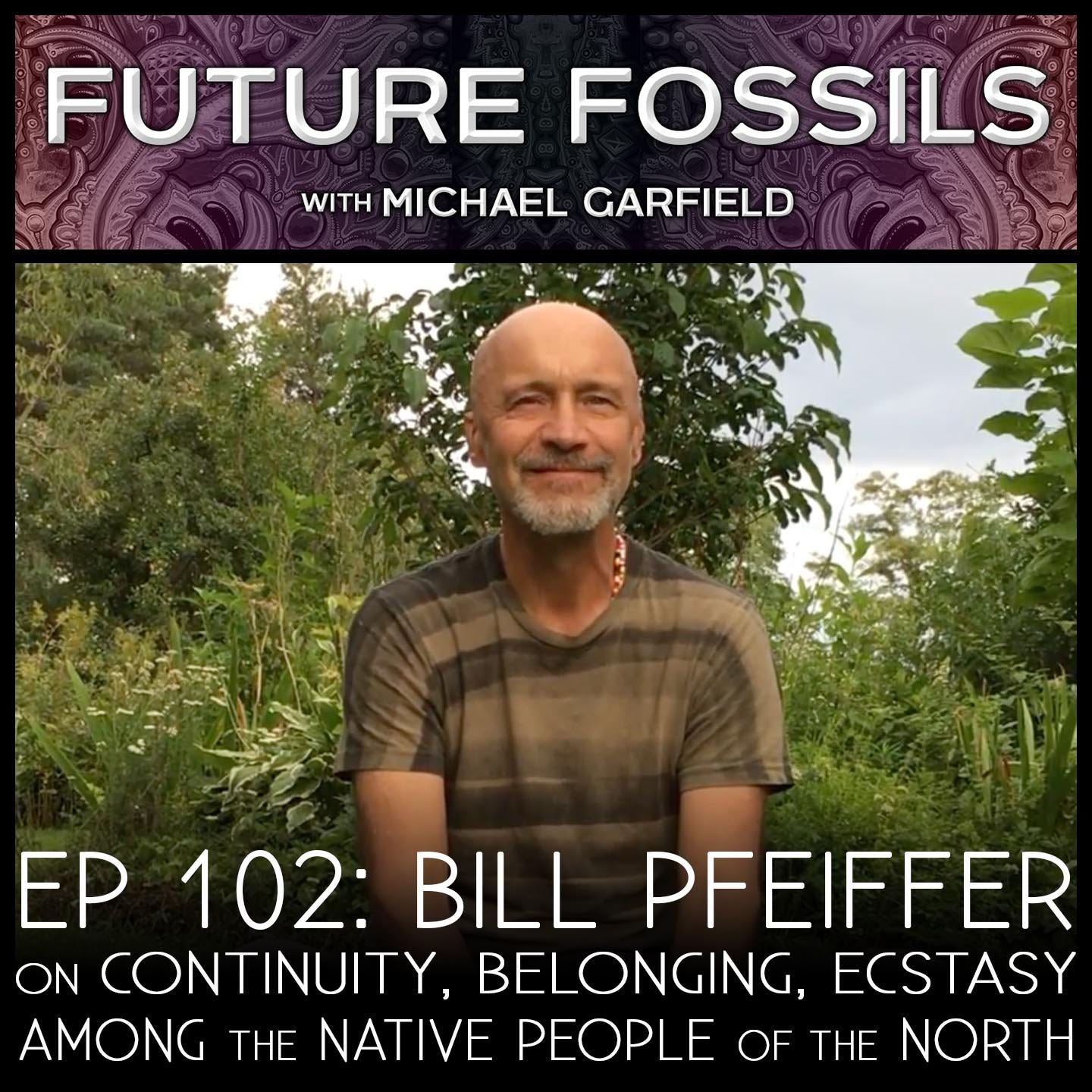
102 - Bill Pfeiffer on Continuity, Belonging, Ecstasy Among the Native People of the North
EThis week we sit with Bill Pfeiffer – deep ecologist, shamanic guide, and spiritual coach – whose life carried him from nuclear protests on the US East Coast to citizen diplomacy to Russia, where he first encountered Siberian shamans and became immersed, over decades and dozens of visits, in their traditions of ecstasy and communion, with realms and intelligences deeper than the world of identity and politics. A friend of Joanna Macy’s, founder of the Sacred Earth Network, and leader of hundreds of spiritual ecology workshops, Bill has dedicated his life to being a bridge between Native American & Siberian cultures, between alienated humans and the wisdom of the Earth, between heart and mind, future and past.https://billpfeiffer.org/biohttp://www.sacredearthnetwork.netSupport Future Fossils Podcast on Patreon to join our book club, access secret episodes, and more:https://patreon.com/michaelgarfieldIn this episode, we discuss:Reconnecting to nature, to the bodyHow political activism for nuclear disarmament changed his whole life and perspective“I began to feel like I could make a difference…like you can make a difference…in how things play out here on Planet Earth.”How Maslow’s Hierarchy of needs was appropriated from the Blackfoot tipi, and what we lost in the translation“We’re all indigenous to land if we go back far enough in our ancestry, and we have a blueprint of a balanced existence.”“Mystical experience is a birthright, if we’re open to it, or grace is there for us.”Book: The American Replacement of Nature by William Irwin ThompsonHow can we differentiate healthy and unhealthy solutions to our human need for belonging?“There’s a lot of people who are spiritually inclined, and I’m like…I’m sorry, man, you gotta vote. It doesn’t mean you have to go crazy, it means you have to PAY ATTENTION.”His journey from citizen diplomacy to Siberian shamanism, through connecting Siberians to Native AmericansWhat he learned about being human from the SiberiansBook: The Power of Now by Eckhart Tolle“To reclaim our power is to reclaim ourselves as cosmic beings, not just beings. It’s that big.”“It’s not that I didn’t get rejected or that people weren’t angry with me at times, or copped an attitude because of what I was doing. But largely, I have felt embraced by both of those cultures as being a bridge, of serving a bridge-building function. I feel like I know how to love people, and how to receive love, and that is the currency that gets the job done.”Episode 60 with Sean Esbjörn HargensEpisode 65 with John David EbertThe possible revival of a circumpolar shamanic tradition in the latter 21st Century after global warming“I was an amateur futurist and then I just gave up, because there were far too many possibilities, and I was wasting my time getting afraid of imagining.”What did he learn from the Siberians that were not lessons living in the Native American legacy he encountered?“The relative success that me and my cohorts have had with native people is all about listening and respect. If that’s cliche, I want more of it.”The ongoing resurrection of Native American ecstatic traditionsBook: Stealing Fire by Steven Kotler & Jamie WhealJoanna MacyHow to co-opt ecstasy for money, and how not toOne of Michael’s craziest sober experiences everConscious sexualityAnd more…Subscribe to Future Fossils on any podcasting platform:https://shows.pippa.io/futurefossilsJoin our (very active, awesome) Facebook Discussion Group:https://facebook.com/groups/futurefossils Get bonus content on PatreonSupport this show http://supporter.acast.com/futurefossils. Hosted on Acast. See acast.com/privacy for more information. This is a public episode. If you'd like to discuss this with other subscribers or get access to bonus episodes, visit michaelgarfield.substack.com/subscribe
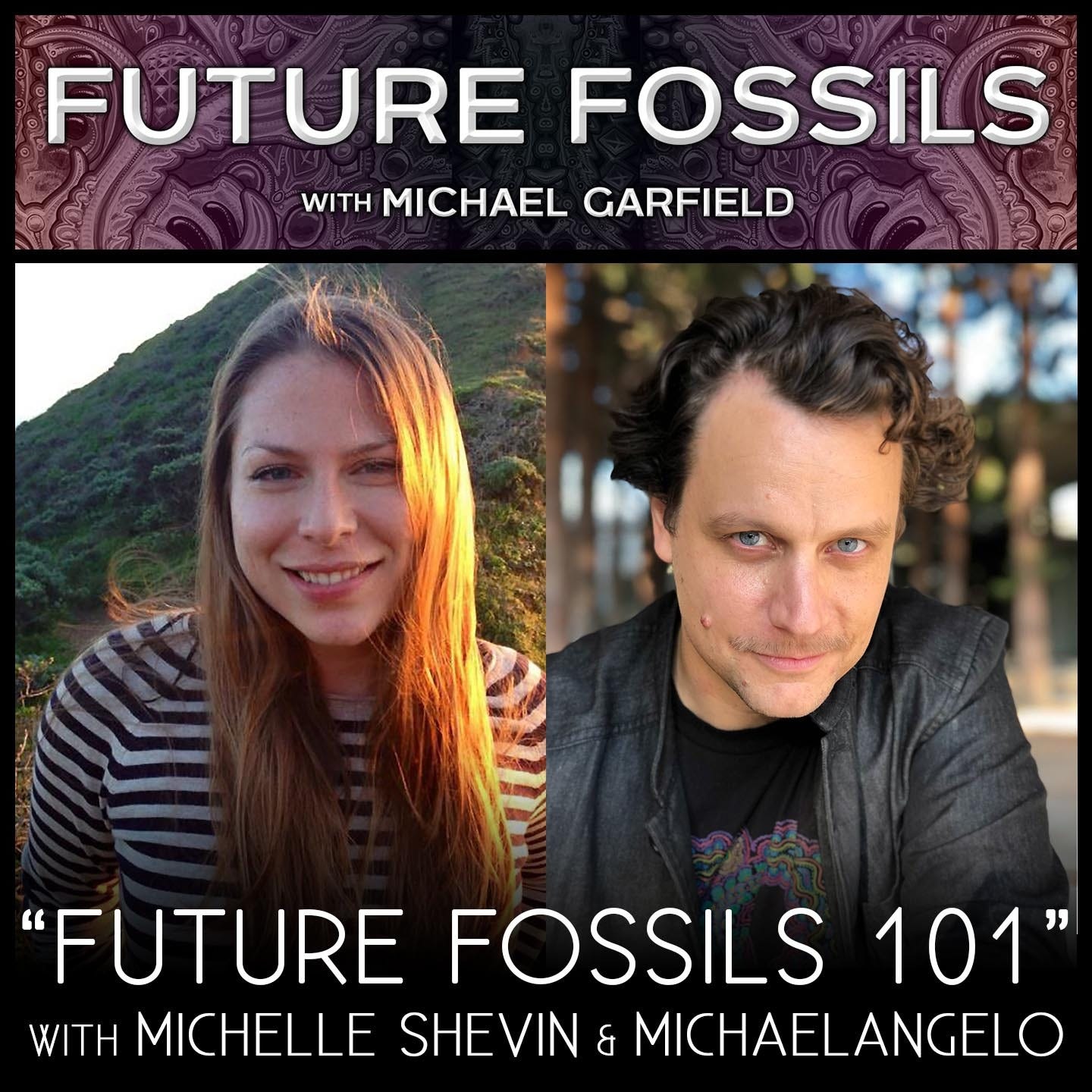
"Future Fossils 101" with Michelle Shevin & Michaelangelo
EThis week's guests are two of the most limber and insightful minds I know, futurist Michelle Shevin and actor-artist "The Ungoogleable" Michaelangelo. Since this is episode one of a whole new hundred episodes – and since I'm a sucker for ceremony and round numbers – this week we're taking a whirlwind tour of this show's recurring themes: how life, mind, culture, psychology, art, and science all change in the Internet Age, and how to live the best lives that we can amidst these transformations...Support the show for exclusive episodes, music, a book club, and more:patreon.com/michaelgarfieldMichelle Shevinmedium.com/@micheboxMichaelangelovoidandimagination.comWe Discuss:• Kronos & Kairos, revisited• Re: JF Martel – Episodes 18 & 71 • The information science of innovation and why Terence McKenna’s Timewave Zero may not be TOTAL hogwash• Book: Geoff West - Scale• Re: “An Oral History of the End of ‘Reality’” – Episode 91 • IS our time unique at all?• WJT Mitchell paraphrase: “We’re all constantly feeling as though everything is about to happen, or perhaps it already has and we just haven’t noticed it”• #presentshock• Did we miss the singularity?• Trapped in the present• MA: “chronopractic adjustments” of pulling your past and future into alignment• MA: “I feel like all expression is a form of deception…I try to look to the deception closest to the truth.”• Plato: “Writing is a step backward from Truth.”• Biological evolution as machine learning and the domestication of humans by technology• MA: “I took a hit of GPS / got lost within the endlessness / gave up the compass in my chest / and oriented to the West”• Michaelangelo – Episode 37 • Evolution’s bias toward paedomorphy / neoteny• MS: “What happens when DNA becomes the substrate for all this information?”• Storing data in the organic cloud• The zone of proximal evolution and how “We can’t invent what we don’t have the parts lying around for”• Every new technology is a remix• David Krakauer – Episode 75 • Dennis McKenna - Episode 88 • Toxoplasmosis mind control and how nobody actually things if “my brain made me do it”• MS: “If we are midwives to new myths, then part of the project is to litter the landscape with the right raw material, so that in the future, the right raw material is just lying around for people to pick up and build the tools with.”• MA: “meme-ifying” (vs. “mummifying”)• Book: Sam Harris – Free Will• Film: Upstream Color• Film: Primer• Book: Peter Watts – Blindsight• Book: Peter Watts – Echopraxia• Re: The Teafaerie – Episode 100 • Re: Erik Davis – Episode 99 • Re: Doug Rushkoff – Episode 67 • Weird Studies Podcast is amazing, their Episode 32 on Eyes Wide Shut• MG: “At the dusk of civilization, our eyes are adjusting to the darkness.”• The digital dark age• Book: Stewart Brand – The Clock of the Long Now• Richard Doyle on Philip K. Dick and the evolutionary arms race of cameras and blind spots leading inexorably toward paranoia and then beyond into metanoia (see also, “The Evolution of Surveillance Part 3: Living in the Belly of the Beast”)• An entropy-driven metabolic arms race inevitab fractal Argus, coated in eyes• When it comes to living through a Dark Age, MA suggests, “I think it comes down to learning how to glow in the dark. The agents of deception are our greatest teachers, in that sense.”• MA: “Increased surveillance creates more performative personalities.”• Re: Mitch Mignano – Episodes 57 & 98 • Elon Musk on Joe Rogan (of course that guy believes in simulation theory)• Song: Yeasayer’s “Under The Glass of the Microscope”• Linear, Circular, Helical time• MS: “Planning often disguises itself as prediction”• What is causation, anyway?• Possibility as a fractal branching lightning bolt from potential to actual• MA: “Scrye-ogenic Future” in a crystalline model of time• MA: synchronicities vs. “synchroniceties”• Book: Julian Jaynes – The Bicameral Mind• Daniel Dennett’s “software archeology”• The origins of divination• Morsels of bicamerality reinstated by our digital ecology, with someone’s agenda in it• MS: “The arrogance is in thinking that it was only ever us.”• The Neurological Explanation for Imaginary Friends• The Microbiological Explanation for “Self-Transforming Machine Elves”• Swing Low, Eukaryote, coming for to carry me home• David Pearce – “The Antispeciesist Manifesto”• Are Laboratory Burgers Vegan?• Empathy is a human (but not uniquely human) super power• Rebranding the human species (eg, “Dog Friends,” “Cat Friends”)• Book: Alejandro Jodorowsky - Where The Bird Sings Best• Expertise is knowing the right search terms• DNA as a language; microbial ecology as a language• Introspection as an escape hatch from history and “profane time”• And more... Get bonus content on PatreonSupport this show http://supporter.acast.com/futurefossils. Hosted on Acast. See acast.com/privacy for more information. This is a public episode. If you'd like to discuss this with other subscribers or get access to bonus episodes, visit
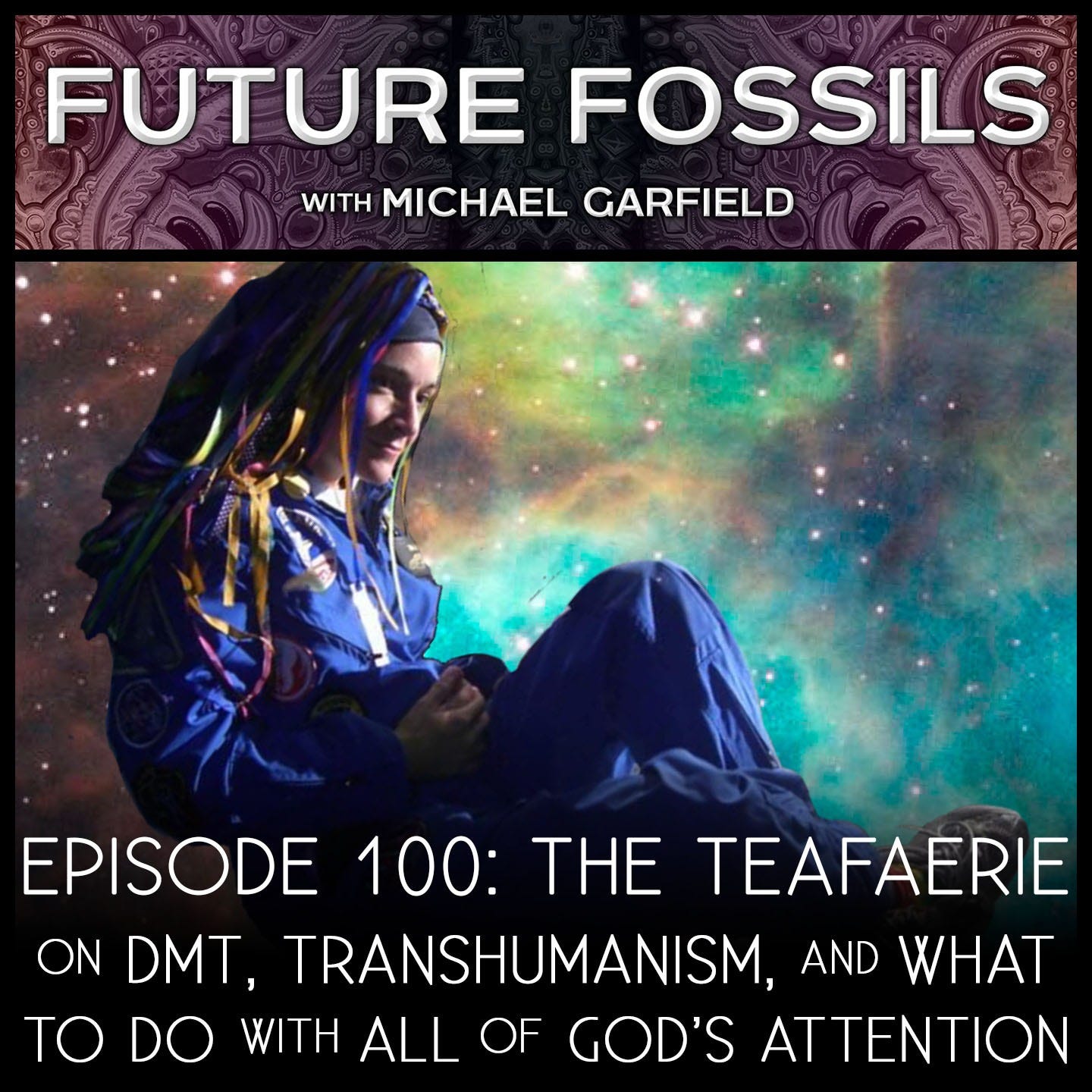
100 - The Teafaerie on DMT, Transhumanism, and What To Do with All of God's Attention
EThis week’s guest is The Teafaerie, my amazing friend and a true one-of-a-kind psychedelic superhero.The Teafaerie writes stories, poems, movies, plays and essays, makes videos, organizes flash mobs, and is one of the founders of Prometheatrics, a big beautiful Esplanade camp at Burning Man. At various times she has been a writer, nanny, actress, flow arts teacher, childbirth doula, homeless person, aid worker, live-action storyteller, toy inventor, app designer, street performer, and party promoter. She is a frequent contributor to the worlds most excellent psychedelic information site Erowid.org. She also regularly volunteers as a festival trip sitter with the Zendo Project and RGX medical.Her most recent essay on Erowid:https://www.erowid.org/columns/teafaerie/2016/05/17/mapping-the-source/My favorite of her essays:https://www.erowid.org/columns/teafaerie/page/18/More about psychedelic harm reduction:https://www.zendoproject.org/We Discuss:Why it’s okay that the Elon Musk will get (to beta-test) immortality first (for the rest of us)The intimately cybernetic world of brain-machine interfaces and Life After Advertising“I’m just a coward. I TRIED despair and I can’t TAKE that shit.”How parenthood changes your decision to be or not to be an optimist.Simulation Theory~ ”We need to stop stressing the system and offload our consciousness offworld to L5 or VR”…or is that some whack pseudognostic transmania?“I believe the universe is art, because…”We’re the children of god, but most people act like we’re the pets of god or the toys of god.The child of a sheep grows up to be a sheep. The child of a god grows up to be a god.Mass manifestation and the Global Consciousness ProjectHow to make wishes come true by getting god’s attentionPartner yoga for engineered miraclesBurning Man is a manifestation engineWhat Are You Playing For?What evolution looks like to DNADesigner Babies & THE ETHICS OF Designer Babies“Do you know The Silmarillion?”Olaf Stapledon is the manBlack Mirror’s episode “Black Museum”Autonomous by Annalee Newitz and robot AR architectureGreg Egan’s Permutation City (and Diaspora)“Any sufficiently advanced 3D printer could tattoo you.”~ “If the universe is determined, it’s offensive to me, it devalues my art.”Getting your wishes fulfilled is of evolutionary benefitHow many things had to go right? ALL of them.“Maybe THIS is the shortest path, and it’s JUST LONG.”5-Meo DMTThe burden of publishing to an enormous audience on ErowidFangirling about my sci fi, “An Oral History of the End of ‘Reality’” (Episode 91)Future Fossils Podcast is starting a book club for mind-blowing sci fi! Learn more and sign up: https://patreon.com/michaelgarfieldSubscribe to this show on any platform you desire:https://shows.pippa.io/futurefossils Get bonus content on PatreonSupport this show http://supporter.acast.com/futurefossils. Hosted on Acast. See acast.com/privacy for more information. This is a public episode. If you'd like to discuss this with other subscribers or get access to bonus episodes, visit michaelgarfield.substack.com/subscribe
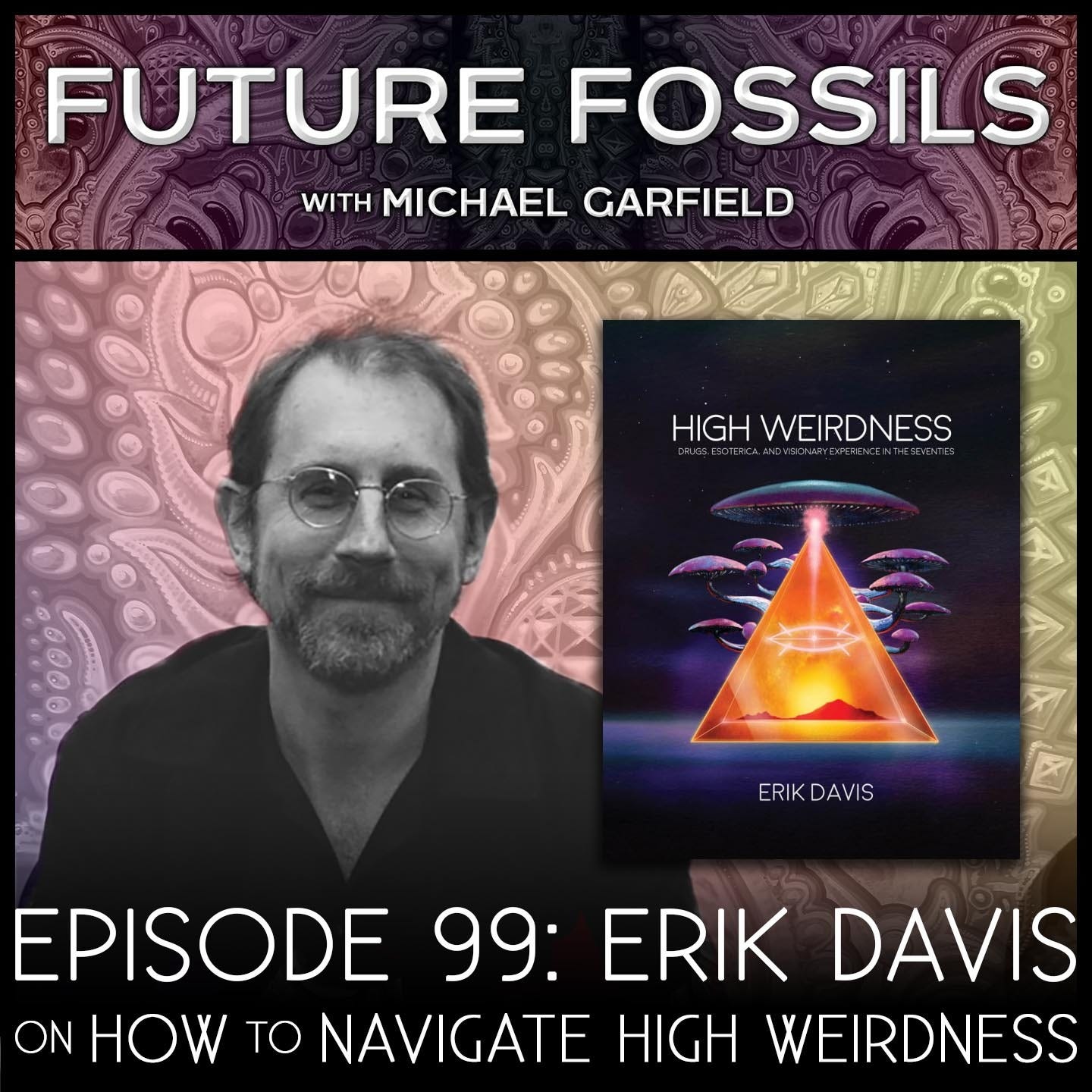
99 - Erik Davis on How to Navigate High Weirdness
EThis week’s guest is Erik Davis – one of my great inspirations, someone who has influenced me and this podcast in immeasurable ways since I first encountered his amazing criticism, histories, and “seen it all” visionary cool – I still recommend his first nonfiction book (Techgnosis: Myth, Magic, and Mysticism in the Age of Information) on a near-daily basis, and his show Expanding Mind has got to be my number one most-listened podcast of all time.Erik is a native Californian Gen X mystic who played no small part in the explosive West Coast visionary cyperpunk scene in the 1990s alongside folks like Terence McKenna, Timothy Leary, RU Sirius, Doug Rushkoff, and Jaron Lanier. But he’s taking a profoundly different stance these days, with a Religious Studies PhD in hand and a new book at the printers, drawing on his thirty-plus years experience investigating modern life’s weird marginalia to help us navigate a world in which the weird’s no longer marginal.https://techgnosis.comhttps://mitpress.mit.edu/books/high-weirdnessHigh Weirdness Drugs, Visions, and Esoterica in the Seventies by Erik Davis"A study of the spiritual provocations to be found in the work of Philip K. Dick, Terrence McKenna, and Robert Anton Wilson, High Weirdness charts the emergence of a new psychedelic spirituality that arose from the American counterculture of the 1970s. These three authors changed the way millions of readers thought, dreamed, and experienced reality— but how did their writings reflect, as well as shape, the seismic cultural shifts taking place in America? In High Weirdness, Erik Davis—America’s leading scholar of high strangeness—examines the published and unpublished writings of these vital, iconoclastic thinkers, as well as their own life-changing mystical experiences. Davis explores the complex lattice of the strange that flowed through America’s West Coast at a time of radical technological, political, and social upheaval to present a new theory of the weird as a viable mode for a renewed engagement with reality.""Erik Davis is an American journalist, critic, podcaster, and counter-public intellectual whose writings have run the gamut from rock criticism to cultural analysis to creative explorations of esoteric mysticism. He is the author of Techgnosis: Myth, Magic and Mysticism in the Age of Information, The Visionary State: A Journey through California’s Spiritual Landscape, and Nomad Codes: Adventures in Modern Esoterica."We Discuss:Enacting the weird through mediaThe 1970s understood as the sort of beginning of our darker, weirder time - capitalism, consumer credit, surveillance, paranoia, density, historical dread…“The occult, conspiracy theory, a dark dreamlike character…is now central…the way fictions become operational as quasi-truths to navigate the post-truth environment…the popularity of psychedelics…”Key literacies for navigating Our Weird FutureSlender Man as operationalized fiction, as a kind of “tulpa” or thought-form activated into quasi-lifeThe intermarriage of reality and the hoaxHP Lovecraft’s modern distance from his horrors vs. Phil Dick’s postmodern intimacy with his horrorsThe Coming Age of DNA Monsters and Routinized Weirdness“We are called upon to analyze our resistances to all variety of shifts, mutations, couplings – and unless we want to go reactionary and hold onto certain ideas we have about how humans should be, or how the world should be, we’re in a situation of a strange kind of embrace with the other.”Distrusting the ApocalypseFigure-ground collapse in the impression of planetary hyperobjects into our immediate awarenessNeuroplasticity and neoteny – becoming childlike in order to surf accelerating changeFuture shock and getting drawn into (right-wing, fundamentalist, fear-based, racist, boundary-defending) stories as a bid for solid ground“Not knowing who we really are is part of the game. In fact, it’s one of the great opportunities of our moment.”Plasticity vs. Flexibility ~ Will or Flexibility The discipline of transforming subjectivity - religions as practical algorithms for self-transformation, not as collections of beliefsEverything you do is a self-engendering practice“I look at the 20th Century, and the most important thing that happened in the 20th Century is cybernetics – both the concept and the operationalism of creating communication feedback loops that begin to generate their own processes.”“The further I go into a cybernetic model, at least for me, it needs to be ground out in a deepening relationship with animals, with weather, with food, with plants, with plant wisdom, and definitely with those peoples – in whatever traces, in whatever mutations we can encounter them now – those groups, those societies, that had a very different relationship that’s not really mediated by the machine.”The return of the nonhuman, cultural retrieval, the archaic revival, “reanimism”Intelligence is EverywherePresent Shock & the collapse of history & Jurassic ParkThe future of time
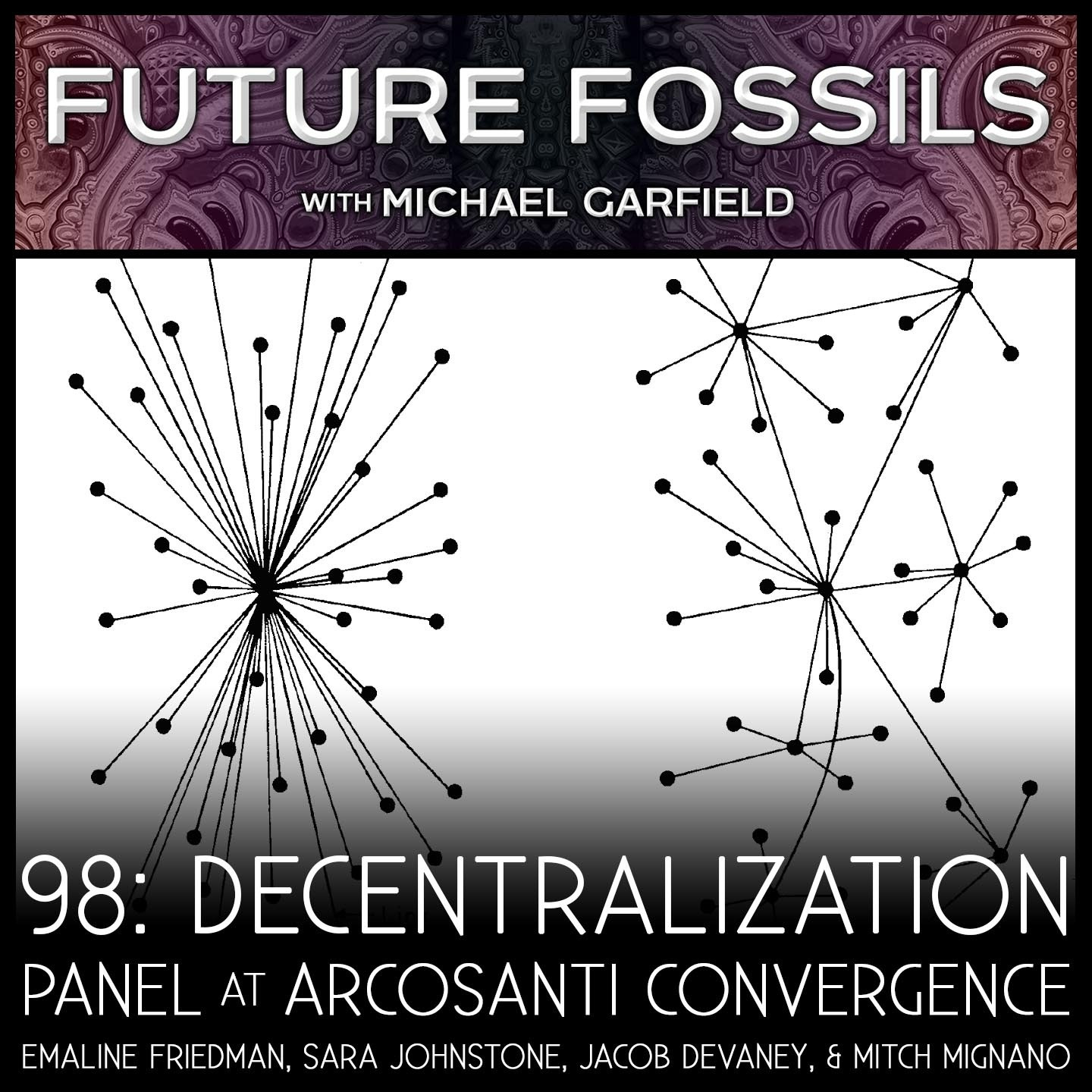
98 - Decentralization Panel at Arcosanti Convergence with Members of Holochain, NuMundo, Unify, & Reality Sandwich
EIt’s a deep and wide investigation of decentralized networks of many kinds this week, drawing on the insights and wisdoms of five very different panelists in a discussion held at the legendary experimental city-under-construction Arcosanti, Arizona. Like it’s a rainforest, I don’t even know how to start talking about this conversation – too many points of entry, too many species living in it! Here are this week’s fabulous guests:Emaline Friedman of Holochainhttps://herlinus.com/Sarah Johnstone, COO of The NuMundo Projecthttps://numundo.org/aboutJacob Devaney of Unify http://www.culturecollective.org/about/“Raven” Mitch Mignano, loosely “of” Reality Sandwich & Institute of Ecotechnicshttps://facebook.com/mitch.mignano.77––Support this show, and Michael's many other awesome projects, on Patreon: https://patreon.com/michaelgarfieldSubscribe on any platform you desire:https://shows.pippa.io/futurefossilsJoin the Facebook Group: https://facebook.com/groups/futurefossilsRecommend a sponsor:[email protected] Discuss:The three forms of decentralization (architectural, logical, and political);The historical centralization of human culture around resources;Why technological decentralization is insufficient to achieve the goals of a more humane and equitable society;Decentralization of civilization through the emergence of digital nomadism and the ecovillage movement;The transition from a value of ownership to a value of access;Decentralization as an adaptation to the unscaleability of imperialism and colonialism;How the free market capitalist ideology rewards success and punishes failure, even though those are largely dependent on luck;How can we make planetary culture NOT a pyramid scheme?Distributed trust and trustless transactions, and their political consequences;Data ownership, data security, and the vital importance of restoring our ability to communicate through “unenclosable carriers”;How can we divest from abusive and exploitative giant tech companies?How decentralization as an ideology can conceal the ways that enforced consensus is a kind of “shadow centralization”;Who is affected by this decision? Who has stake in the outcome of this issue?How can we avoid #algocracy when technological literacy is a constant challenge?Incentive structures and incentive landscapes: What kind of behaviors are we encouraging?Why Facebook and Google will be seen by history as a humanitarian crisis (and what we can do about it);Market-driven shifts in consciousness;The limits of crypto-economic governance;William Irwin Thompson - At The Edge of HistoryJoshua Ramey - The Politics of DivinationJustOne OrganicsFairBnBArcade CitySteemitTrybeScuttlebuttMiVote Get bonus content on PatreonSupport this show http://supporter.acast.com/futurefossils. Hosted on Acast. See acast.com/privacy for more information. This is a public episode. If you'd like to discuss this with other subscribers or get access to bonus episodes, visit michaelgarfield.substack.com/subscribe

97 - Zak Stein on Love in a Time Between Worlds: A Metamodern Metaphysics of Eros
EThis week’s guest is Dr. Zak Stein, an author and educator whom I met as fellow students of the work of philosopher Ken Wilber over ten years ago. Zak took the road of serious high academic scholarship while I was learning the less laudable and messier way through immersion in the arts and entertainment world, but here we are converging to discuss one of the most important issues of our time: the need for a new human story that includes both modernity’s rigorous scientific inquiry and postmodernity’s revelation of how everything we know is framed by language, culture, and perspective. Without some clever, soulful balance of the two we’re stuck in a “post-truth” era where our need for answers to our fundamental questions leads us backwards into “isms” instead of forwards into something more good, true, and beautiful than what has come before.Zak’s answer (like so many other guests on Future Fossils) is to get MORE rigorous about the scope and limits of the world disclosed by science, MORE honest with ourselves about the context-bound claims we can make on knowledge, and MORE open to how all “reality” starts in direct experience, as conscious subjects – where we meet to make new, open-ended, ever-more refined, evolving answers to the questions:What is human? What is love? What are we here to do?Read Zak’s new paper, “Love in a Time Between Worlds: On the Metamodern ‘Return’ to a Metaphysics of Eros”:http://www.zakstein.org/love-in-a-time-between-worlds/‘Where modern scientists often critique the claims of metaphysics as unverifiable and thus untrue, postmodernists critique both science and metaphysics for making truth claims in the first place. Either way, to call an idea or theory “metaphysical” has become another way of saying it is unacceptable. Often with comes with some implication that the theory is a kind of superstition, which means metaphysics is taken not as an attempt to engage the truth but rather as a kind of covert power play or psychological defense mechanism. I argue the opposite: metaphysics is what saves us from a descent into discourses that are merely about power and illusion. Believe it or not, there are metaphysical systems that survived postmodernism and popped-out of the far end of the 1990’s with “truth” and “reality” still intact. These include object oriented ontology and dialectical critical realism, among others.’Zak is also the Co-Presdient and Academic Director at the Center for Integral Wisdom:https://centerforintegralwisdom.org/…and on the scientific advisor board at Neurohacker Collective:https://neurohacker.com/— In this episode we discuss:Lewis Mumford, Ken Wilber, Barbara Marx Hubbard, Jurgen Habermas, Seth Abramson, Timothy Morton, Rudolf Steiner, Alfred North Whitehead, Hanzi Freinacht, Daniel Schmachtenberger, Jordan Greenhall, and many other luminaries.Right-wing and authoritarian political thought is resurgent today because of the absence of reasonable discourse about metaphysical realities during a time when exactly these realties are being put in question due to the apocalypse of global capitalism and the accompanying planetary transition into the Anthropocene .The way we answer questions like, “What is the human?” will determine the next century because of the emerging power of new technologies that render the human mailable in unpresented ways, which has been made clear by writers like Yuval Harari.“The difference between metaphysics and science is not about what you can see and what you cannot see. It is about what you are paying attention to when you are seeing.”“What we call postmodernism is just modernism with the volume turned WAY up.”The difference between modern, postmodern, and metamodern views on science and the realities disclosed by science.What does it mean to cut a definition of the human out of our education systems?The relevance of Rudolf Steiner’s metaphysics and pedagogy in 21st Century education – especially its attention to subjectivity and interiority.How fundamentalism, nationalism, racism, and other regressive movements in society are symptoms of a postmodern assault on consensus reality.“In the absence of metaphysics, there’s a vacuum of meaning…what can step into that is not always pretty.”“After postmodernism, we can’t return to some pat, totalizing answer for everybody. After postmodernism, when we begin to build a new coherence, it’s always going to be a polycentric and dynamic and always renegotiated coherence. And that’s what science ought to be, which is to say, knowledge building, and not knowledge finding. Period.”“Ideas matter – and right now, we live in a context where ideas matter only insofar as they can be leveraged for clicks on websites that generate advertisement revenue.”When did we start gladly giving our decision-making powers over to others? And who do we trust now when we know that expertise is so contextual and frequently abused?Making the Earth into a giant building is the beginning of metamodern history – the Anthrop
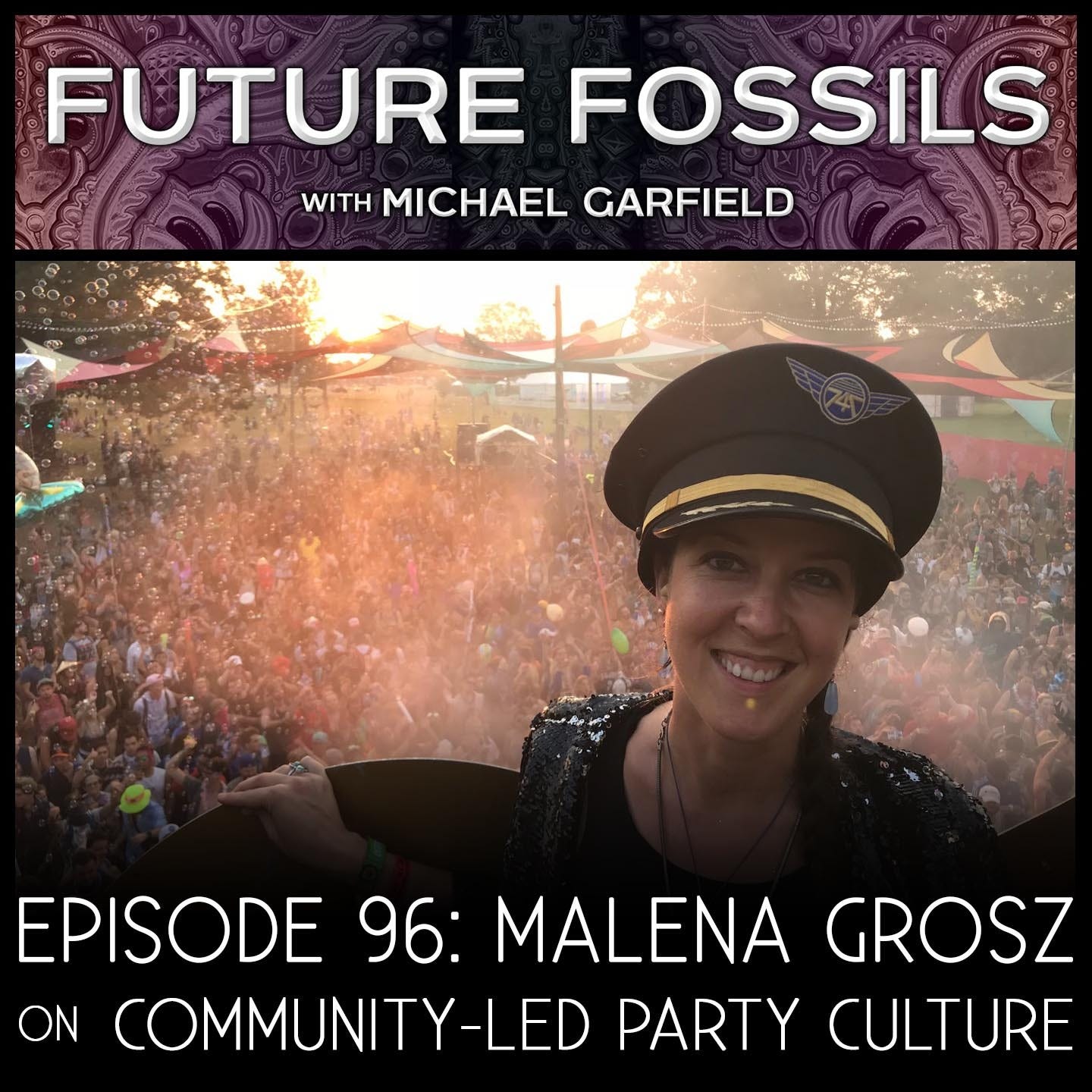
96 - Malena Grosz on Community-Led Party Culture vs. Corporate "Nightlife"
EThis week’s guest is the intriguing, talented, and amazingly well-organized Malena Grosz, who is currently traveling across the United States to interview party culture professionals for her multimedia thesis on community-led party culture to gain and share their perspectives on best practices and shared challenges in cultivating better life through celebratory gatherings – and to tackle the corporate commodification of “nightlife” and its dangerous side effects.Her website-as-thesis-project will eventually be live (circa May 2019) at:http://partyprotoolkit.comWe Discuss:Gentrification and corporatization of nightlife versus community-led celebration, What urban nightlife can learn from Burning Man and festival culture, The disavowal of mundane time in spaces of celebration and how party culture does and does not need to accept the realities of our organic rhythms,Mentorship, moderation, self-control, personal agency, Reconciling the nomadic and sedentary strains of humanity,Taking responsibility for your own education (and life in general),Getting kicked out of the School of Art for consent-based body painting,Harm reduction versus the nanny state,Learning to speak party to Academia,The extraordinary importance of cognitive liberty and the freedom to imbibe,The economics of big festivals and their scaling problem, and how it turns people into cattle,Alternatives to alcohol (like tonics) and how parties can stay solvent without depending on encouraging dangerous levels of intoxication,Learning how to empower people by delegating decision-making authority as an event producer,Everything in moderation, even moderation,The importance of safe spaces within every party (like Camp Soft Landing at Burning Man),Rest stops at festivals and rests in music, quiet places where people can connect to contrast against losing yourself on the dance floor,What party culture can learn from the intensely structured environment of academia,“Festival referees” - good idea or disaster waiting to happen?,Deputizing “Knights of the Dance Floor” and empowering people to be guardians of collective space,Festival sheriffs and Night Mayors and the successful interfacing of mainstream culture and the needs of revelry populations,The New York Nightlife Advisory Board and other official groups representing the needs of party culture in city and state governments,Other promising international developments in the progress of human understanding of what safely integrated party culture looks like,Figuring out how to measure the contributions of everyone involved in an event, not just the headlining acts.And more!Support this show on Patreon: https://patreon.com/michaelgarfieldJoin the Facebook Group: https://facebook.com/groups/futurefossilsSubscribe on Apple Podcasts: https://itunes.apple.com/us/podcast/future-fossils/id1152767505?mt=2Subscribe on Google Podcasts: http://bit.ly/future-fossils-googleSubscribe on Stitcher: https://www.stitcher.com/podcast/michael-garfield/future-fossilsSubscribe on Spotify: https://open.spotify.com/show/2eCYA4ISHLUWbEFOXJ8C5vSubscribe on iHeart Radio: https://www.iheart.com/podcast/269-FUTURE-FOSSILS-28991847/ Get bonus content on PatreonSupport this show http://supporter.acast.com/futurefossils. Hosted on Acast. See acast.com/privacy for more information. This is a public episode. If you'd like to discuss this with other subscribers or get access to bonus episodes, visit michaelgarfield.substack.com/subscribe
95 - Mark Nelson on The Legacy of Biosphere 2 (Part 2)
EThis week’s episode is the conclusion of a special two-part conversation with Dr. Mark Nelson, one of the eight “biospherians” who lived for two years inside the closed ecological network Biosphere 2 – one of the most ambitious experiments ever performed, the reproduction of five distinct biomes inside a building in the Arizona desert. Mark is the author of the newly-published history of his experience in Biosphere 2, called Pushing Our Limits – he’s also the author of The Wastewater Gardener, which applies the same closed-loop, full-system ecological thinking to more easily attainable forms of agriculture. I know Mark through my lucky acquaintance with Synergia Ranch just outside Santa Fe (where I am right now, editing this episode) – the home base for The Institute of Ecotechnics, the group that pioneered the discipline of “Biospherics,” and the hub for a planetary network of brilliant, passionate, eclectic individuals whose stories never cease to blow my mind. Mark’s tale of his two years living under glass with seven other brave souls is powerful, inspiring, and full of potent lessons – both for our present on Earth and our future in space…www.ecotechnics.eduwww.synergiaranch.comWe Discuss:“Learning to Live Intelligently, Coming of Age in the Anthropocene – This is the Challenge of Our Life.”– Why did Biosphere 2 get so much attention?– What is the legacy of Biosphere 2? Biosphere J and The Eden Project and Q Gardens…the proposed but never-built, polluted Russian Biosphere 3…“I think that optimism is a yoga. You want to do your hatha yoga and keep in shape. Despair is like screwing off and not meditating, and forget the physical exercise. Optimism is important psychologically, because it tells you, ‘I can make a difference and this is all going to work.’ Now it may be irrational, but if you give into despair, all of the hormones and emotions are going to tell you that it doesn’t matter. So forget about separating the recycling.”– Living in the small tight loops of controlled ecosystems.– Empowering ourselves with new senses so we can see the impacts of our actions at the planet scale.– Pollutants from different countries where they are not banned yet as a kind of “living fossil” in the flesh of world travelers.– The Anthropocene and The Noosphere. Human activity (and thus human cognition) as geological force.“It’s not rocket science to redesign our technosphere.”“There are consequences to the type of technology that we permit to operate on Planet Earth.”– Solacestalgia.– What’s wrong with Modernity and what Modern People suffer.– Wastewater gardening in Mexico in exchange for cultivated coral.– Using the soils to purify the air.“Our farm was the most productive half acre ever run by humans! Of course, we had some advantages.”– The four great taboos of science broken by Biosphere 2.“To get into space, we’re going to have to be superb ecologists.” Get bonus content on PatreonSupport this show http://supporter.acast.com/futurefossils. Hosted on Acast. See acast.com/privacy for more information. This is a public episode. If you'd like to discuss this with other subscribers or get access to bonus episodes, visit michaelgarfield.substack.com/subscribe
94 - Mark Nelson on Ecotechnics & Biosphere 2 (Part 1)
EThis week’s episode is the first of a special two-part conversation with Dr. Mark Nelson, one of the eight “biospherians” who lived for two years inside the closed ecological network Biosphere 2 – one of the most ambitious experiments ever performed, the reproduction of five distinct biomes inside a building in the Arizona desert. Mark is the author of the newly-published history of his experience in Biosphere 2, called Pushing Our Limits – he’s also the author of The Wastewater Gardener, which applies the same closed-loop, full-system ecological thinking to more easily attainable forms of agriculture. I know Mark through my lucky acquaintance with Synergia Ranch just outside Santa Fe (where I am right now, editing this episode) – the home base for The Institute of Ecotechnics, the group that pioneered the discipline of “Biospherics,” and the hub for a planetary network of brilliant, passionate, eclectic individuals whose stories never cease to blow my mind. Mark’s tale of his two years living under glass with seven other brave souls is powerful, inspiring, and full of potent lessons for both life on Earth and life in space.www.ecotechnics.eduwww.synergiaranch.comWe Discuss:– How theater can save a tight team from decaying into “kill the leader” reflexes and the importance of drama to living a full human life;– Gerard O’Neill and the Space Studies Institute, Stewart Brand and the Whole Earth Catalog, and how space exploration went in, then out, then back into fashion;– Biospheres are materially closed but energetically open;– The study of comparative biospheres;“If anyone’s running the show, it’s the microbes. It’s a reality that’s actually quite joyful to realize. You are NOT an island. We are totally enmeshed biologically in the biosphere.”– Carrying around the trauma from the Great Oxygenation Event in our intestinal microbiota;– Biomes as the building blocks of a biosphere;– The Research Vessel Heraclitus, the Institute of Ecotechnic’s rehabbed Chinese junk, exploring the World Ocean;– How they designed “lungs” for the building to enable pressure differences inside the building;“Life transforms the planet. And in fact, when we look out, we’re looking at the by-products of life. And even a lot of what used to be thought of as mineral deposits – these huge deposits of iron, for example, used to be considered to be ‘natural’ formations, ie, geologic ones. No! In fact, [it was the work of] ‘slime’…juicy, fecund with life.”“I think we need a whole new generation of creative people to give us the storylines for new outcomes. I kind of borrow from William Burroughs, who said, ‘We need a new mythology for the Space Age.’ And he further said that we’re going to judge heroes and villains by their intentions toward the planet.”– Synergy (popularized by Buckminster Fuller) and synergy in life and love;– Saving his sanity with “Hallucinogenic Outback Comedies” and using original plays and dances to communicate nonverbally around the world“In the negative news stories, they would say, ‘These aren’t scientists, these are recycled actors from New Mexico.’ Well, Biosphere 2 was an in-life production…I have some friends who say that Biosphere 2 was John Allen’s greatest theater production. We really thought it was going to be a quiet research facility.”“Thinking is hard. But PRETENDING to think, I can do that really well.”“The opposite of an actor is a RE-actor.”– Theater as a way of escaping the person you are at 7 AM“I’ve had the great pleasure of meeting quite a number of astronauts and cosmonauts…and they’re all changed men.”– The first and second Inter-Biospheric Festivals“Our culture, I think, and it may have a malevolent intent in doing so, tends to diminish people’s expectations of what they personally can do.” Support this show on Patreon Join the Facebook Group Subscribe on Apple Podcasts Subscribe on Google Podcasts Subscribe on Stitcher Subscribe on Spotify Subscribe on iHeart Radio Get bonus content on PatreonSupport this show http://supporter.acast.com/futurefossils. Hosted on Acast. See acast.com/privacy for more information. This is a public episode. If you'd like to discuss this with other subscribers or get access to bonus episodes, visit michaelgarfield.substack.com/subscribe
93 - Virtuoso Guitarist Andreas Kapsalis on Travel, Life, and Music
EThis week’s guest is one of my favorite living musicians, acoustic guitarist Andreas Kapsalis. We linked up at the magical experimental city of Arcosanti, Arizona last year during their Convergence event, at which we both performed, and talked about life as itinerant musicians drawing on a wealth of world cultures and traditions. This is a humbler and more human episode of Future Fossils – hope that you enjoy it!http://www.akguitar.com/https://www.facebook.com/Andreaskapsalisguitar/Watch a video of Andreas playing his composition, “Ethnos”: https://www.youtube.com/watch?v=MnogdfXyWIoWe Discuss:Being raised in a musical family and how being musical changes one’s experience of time.The cultural influences of Greece and Andalusian musics and their vocabulary of odd time signatures and harmonies and energies.His love for the Old West and Arizona’s cowboy movie landscape…and the “freaking weird mutation” of Arcosanti’s aberrant European retro-future architecture in the desert.Why is the West Coast of anywhere like the West Coast of anywhere else?Living off-grid and the importance of getting away……but silence is awkward!Cultivating a relationship with plants.“You don’t really matter. Being reminded of that is really important.”The integration of nature and city living, architecture as biology, the legacy of Paolo Soleri and Arcosanti.Touring is amazing. People are amazing.“Well, yeah, there is something to be said about stability.”Nomads and nomadism.Empathy and Introversion.“Two handed tapping has allowed me to take a leak and fill a glass of water at the same time, and they say that that’s not good for you…”The spiritual practice of multi-tasking.The future of musical communication.Support this show on Patreon: https://patreon.com/michaelgarfieldJoin the Facebook Group: https://facebook.com/groups/futurefossilsSubscribe on Apple Podcasts: https://itunes.apple.com/us/podcast/future-fossils/id1152767505?mt=2Subscribe on Google Podcasts: http://bit.ly/future-fossils-googleSubscribe on Stitcher: https://www.stitcher.com/podcast/michael-garfield/future-fossilsSubscribe on Spotify: https://open.spotify.com/show/2eCYA4ISHLUWbEFOXJ8C5vSubscribe on iHeart Radio: https://www.iheart.com/podcast/269-FUTURE-FOSSILS-28991847/ Get bonus content on PatreonSupport this show http://supporter.acast.com/futurefossils. Hosted on Acast. See acast.com/privacy for more information. This is a public episode. If you'd like to discuss this with other subscribers or get access to bonus episodes, visit michaelgarfield.substack.com/subscribe

92 - Panel: The Pre- and Post-History of VR, Surveillance, and Swarm Intelligence
EThis week’s a treat – not one, but FOUR amazing guests, in Future Fossils Podcast’s first live taping at EFF-Austin, 10 July 2017. Heather Barfield (Head of EFF-Austin Digital Arts Coalition and Director of Development, Vortex Theater); Maggie Duval (Chief Experience Liaison, 7th Generation Labs & Senior Developer, Polycot Associates, LLC); Paul Toprac (Associate Director of Game Development at UT, RTF Department, and Senior Lecturer); and Kevin Welch (President of EFF-Austin, Fullstack Web Developer at Texas Legislative Council) joined me for one of the most visionary conversations this show’s ever published – and certainly the most politically aware episode to date, as well.Yes, this is about “The Pre- and Post-History of Virtual Reality, Surveillance, and Swarm Intelligence” – and a lot more else, to boot. Just strap in and enjoy…The whole event was streamed live if you’d rather watch:https://www.youtube.com/watch?v=AN2hNX9eM6kFull bios for each panelist and more info about EFF-Austin:https://www.meetup.com/EFF-Austin/events/240796194/We discussed:How for Maggie, growing up at Guantanamo Bay as a form of preparation for living in the 21st Century.The psychological and moral implications of living in a simulated reality.What is the humanest human? What are we aiming for?Challenging the colonizer narrative of space as a “frontier.”Narrative collapse!Pernicious, ubiquitous, intelligent and coercive, ambient AI manipulation as the nexus of this talk’s three topics.Guest spot from Jon Lebkowsky on emergent democracy.Guest spot from an audience member who grew up in communism.What is it about our internet as it is now that is keeping a global swarm intelligence from emerging?Let’s not just talk about making NEW things…let’s talk about MAINTENANCE.The side effects of automation.“I’m a technologist that makes social media software. So it’s all my fault…we knew when we created the net as a publishing medium that we did not think through the human connections or other values that should have gone into it. We broke the community; we broke the BROADER community. I think the fact that a Trump voter doesn’t think they can talk to me is part of my sin. The wrongness isn’t their Trumpism; the wrongness it that they don’t think they have a connection to me as a human. And the technology that I built has failed them. So I’d like the panel to talk about, ‘How do we fix it?’”- Random Audience Commentator“The future is messy technology that is aggravating to deal with. We don’t spend our days in paradise or dystopian hell; we’re trying to get the dang computer to work. And maybe the problem is in the stories we’re telling. Maybe we’re setting up false narratives and false expectations for how to live and how to communicate with each other. Maybe we need to be telling better stories again.”- Kevin WelchStable background levels of deceit in the system.The way we teach history is a mistake because it doesn’t make history palpable and thus unrepeatable.Topher Sipes of Sound Self chimes in.Heather challenges the assumption that virtual reality will solve any humanitarian issue.(Cover photo taken from http://www.iaacblog.com/programs/swarm-intelligence/)Support this show on Patreon: https://patreon.com/michaelgarfieldJoin the Facebook Group: https://facebook.com/groups/futurefossilsSubscribe on Apple Podcasts: https://itunes.apple.com/us/podcast/future-fossils/id1152767505?mt=2Subscribe on Google Podcasts: http://bit.ly/future-fossils-googleSubscribe on Stitcher: https://www.stitcher.com/podcast/michael-garfield/future-fossilsSubscribe on Spotify: https://open.spotify.com/show/2eCYA4ISHLUWbEFOXJ8C5vSubscribe on iHeart Radio: https://www.iheart.com/podcast/269-FUTURE-FOSSILS-28991847/ Get bonus content on PatreonSupport this show http://supporter.acast.com/futurefossils. Hosted on Acast. See acast.com/privacy for more information. This is a public episode. If you'd like to discuss this with other subscribers or get access to bonus episodes, visit michaelgarfield.substack.com/subscribe
91 - An Oral History of The End of "Reality"
This week’s episode is an experiment in science fiction storytelling – the author-read short story “An Oral History of The End of ‘Reality.’” Originally released to Patreon supporters (without the intro or musical soundtrack) last November, this story brings together many of the core themes of Future Fossils: the challenges of navigating overwhelming and contradictory information online; the new literacies that will emerge in response to AI-assisted “deep fakes” that make conventional evidence inadmissible in courts or scientific journals; the thinning veil between our physical senses and the ethereal realm of data; and the experience of time in a future when possibility, prediction, and recording stretch out in all directions (but unreliably).My first adult foray into the world of science fiction, this piece was inspired – nay, made necessary – by the recent news about new vocal synthesis AI that lets consumers edit audio and video and manufacture wholly new, convincing forgeries that sound and look exactly like "the real thing." We all grew up in an age when our recordings are the evidence of something. It was certainly a step up from the hearsay that we once relied on, but it's not enough these days – and as technology gets more and more sophisticated it may be impossible for us to tell the difference between "what's really there" and what is just a digital illusion. Trip with me down this vertigo-inducing psychedelic tunnel to a world in which invisible and discarnate agents speak to you in lovers' voices; in which algorithmic AI pop stars outcompete real artists and our thoroughly-mapped world returns to demon-haunted wilderness; in which we all become half-monks and half-forensics-experts as the new obsession is attempting to determine if we can believe our senses... This piece is planned as the epilogue to my forthcoming book, How To Live in The Future. It's a rare weird bird among its influences: one part literature, one part psychedelic beat screed, and the first time I have managed to combine the metanoia, vision, and poetic flourish that inspires me to write. (I also wrote it all by hand in a delicious Clairefontaine "Flying Spirit" journal that I bought in Montréal this summer, and took with me to the Global Eclipse Gathering and Burning Man. I have to say, that had no small effect on how this all came out. Real pen and paper leads to very different writing.) If you’d like the PDFs of the original handwritten manuscript, you can find them here:https://evolution.bandcamp.com/album/an-oral-history-of-the-end-of-realityRead all of my publicly-available draft chapters of How to Live in the Future, the companion essays to this story:https://medium.com/@michaelgarfieldAll of the music in this episode is from my album, Love Scenes & Field Recordings, which you can download for any price here:https://michaelgarfield.bandcamp.com/album/love-scenes-field-recordingsCover Image © Giacomo Carmagnola and reused with permission. Check out his work and help him support his aging mother: https://facebook.com/giacomocarmagnolaarthttps://instagram.com/Gore_XVSpecial thanks to Transhumanity.net for being a featured sponsor of this podcast! Their concerns about the ethical deployment of artificial general intelligence (AGI) are perfectly aligned with this episode’s rather chilling speculative futures, and I’m glad to know that there are people working on a world where AGI improves the lives of every person, not just the very rich.Support this show on Patreon:https://patreon.com/michaelgarfieldJoin the Facebook Group:https://facebook.com/groups/futurefossilsSubscribe on Apple Podcasts:https://itunes.apple.com/us/podcast/future-fossils/id1152767505?mt=2Subscribe on Google Podcasts:http://bit.ly/future-fossils-googleSubscribe on Stitcher:https://www.stitcher.com/podcast/michael-garfield/future-fossilsSubscribe on Spotify:https://open.spotify.com/show/2eCYA4ISHLUWbEFOXJ8C5vSubscribe on iHeart Radio:https://www.iheart.com/podcast/269-FUTURE-FOSSILS-28991847/ Get bonus content on PatreonSupport this show http://supporter.acast.com/futurefossils. Hosted on Acast. See acast.com/privacy for more information. This is a public episode. If you'd like to discuss this with other subscribers or get access to bonus episodes, visit michaelgarfield.substack.com/subscribe
90 - Kate Greene on Humanizing Science & Cooking on Mars
EThis week we chat with science writer (and former laser physicist) Kate Greene, whose writing explores everything from Big Data to boredom to brain scans, and whose fascinating and eclectic life is brightly punctuated by the four months she spent living inside a Mars base simulation on Hawaii.http://www.kategreene.net/about/We Discuss:How she became a scientist, and then a science writer.The importance of good teachers and mentorship and encouragement along a person’s developmental journey.“Everything that I’ve done is the result of network effects.”Her time as a guinea pig in a simulated Mars colony on Hawaii…Why astronauts love hot sauce.Knowing your purpose - feeling the intuitive hit that lets you know you’re on the right path.Princeton Engineering Anomalies Lab and the scientific evidence for the influence of intention on the outcome of random events.Kate’s fascination with brain scans.“I often wonder, what the hell is my brain doing right now?”Terence McKenna’s vision of posthuman, cephalopod skin telepathy…and Twitter as a form of that same ambient telepathy.“Never in the history of humanity have we had such extensive communication prosthetics.”How do science journalists and scientists alike keep up with the “info quake” of modern life?Big data and AI – can we preserve and evolve critical thought and rigorous investigation when our research is done in collaboration with machine intelligences using logical processes we ourselves don’t understand?“Science is so HUMAN. It’s performed by humans that have all of these biases and blind spots…the fact that there’s so much information points to the fact that there needs to be new ways to sift through it.”“A lot of people think that AI is just going to replace people in a lot of ways, but I feel like it is going to be one of the most intimate symbiotic relationships that we have in the future. I mean, this technology will become as close to human as anything humanity’s ever created, and it’s not going to be able to do it on its own. It will be a symbiosis. We will be learning from each other and training each other.”The problem science journalism has with reporting real science, not just sensationalist headlines based on science…and how social media has made it worse.What you would miss about Earth if you moved to Mars.“Earth is SO wonderful. And I don’t think I knew it – I kinda knew it, but I didn’t ACTUALLY know it – until I couldn’t be a part of it for four months.”Cooking “on Mars” in a simulated colony on Mauna Loa.Aromatherapy in space!What Kate learned from teaching creative writing in a women’s prison.“This is modern day slavery: there are more people incarcerated in the United States than in any other Western country, and it’s because it’s profitable. Something needs to change…one thing that you can do is realize that people in prisons are still part of your community, and that you still have a responsibility to them. To give what you can, to make sure that their lives are better, that all of our lives are better.”Cory Doctorow’s short story “The Man Who Sold The Moon” in ASU’s Project Hieroglyph compilation.The crossover between the Burning Man crowd and the space exploration crowd.Other mentioned science journalists to follow:Ed Yonghttps://www.theatlantic.com/author/ed-yong/Kenneth Changhttps://www.nytimes.com/by/kenneth-changNatalie Wolchoverhttps://www.quantamagazine.org/the-octonion-math-that-could-underpin-physics-20180720/Join the Facebook Group:https://facebook.com/groups/futurefossilsSubscribe on Apple Podcasts:https://itunes.apple.com/us/podcast/future-fossils/id1152767505?mt=2 Subscribe on Google Podcasts:http://bit.ly/future-fossils-google Subscribe on Stitcher:https://www.stitcher.com/podcast/michael-garfield/future-fossils Subscribe on Spotify:https://open.spotify.com/show/2eCYA4ISHLUWbEFOXJ8C5v Subscribe on iHeart Radio:https://www.iheart.com/podcast/269-FUTURE-FOSSILS-28991847/ Get bonus content on PatreonSupport this show http://supporter.acast.com/futurefossils. Hosted on Acast. See acast.com/privacy for more information. This is a public episode. If you'd like to discuss this with other subscribers or get access to bonus episodes, visit michaelgarfield.substack.com/subscribe
89 - Joanna Harcourt-Smith, José Soler, and Jacob Aman on Breakdowns & Breakthroughs
EThis week we have a roundtable discussion (which took place around an actual table in Santa Fe, New Mexico) with Joanna Harcourt-Smith, José Soler, and Jacob Aman, the hosts and producers of Future Primitive Podcast (600+ episodes and going strong!). Joanna, as you may remember from episode 0020, has been a psychedelic raconteur for her entire adult life, famously snuck LSD into prison for her lover Timothy Leary, and wears her age with an incomparable flair and zest that ought to be an example to all of us. She’s joined with her current partner and Future Primitive co-founder José Soler, as well as our mutual friend and Future Primitive co-host Jacob Aman (who is also close friends with Future Fossils guest and friend Bruce Damer).It’s a conversation about…well, everything, really. But mostly breakdowns and breakthroughs, and what it’s going to take for us to steer civilization toward the better of those options. Enjoy!https://futureprimitive.org/about/We Discuss:Intergenerational communication & listening.Documentary: Wild Wild CountryDocumentary: The Unforeseen“Anybody that wears all the same clothes…I mean…I’m sorry, but, WHY…”- Jacob“These days, I look at everything from the #metoo point of view.”- JoannaMansplaining and unconscious mammalian social power struggles.How social media rewards harmful and divisive behaviors.Book: Ralph Abraham’s Chaos, Gaia, Eros“If sweetheart doesn’t go with brilliant…by the time you get to seventy…you can go to a home for old people. I say, it’s either grateful or bitter.”- JoannaLack of intergenerational dialogue in the Occupy Movement…Protest fatigue.Richard Doyle on Third Eye Drops Podcast.Fascists and Gurus.How are the high school age protesters of school gun violence getting it wrong?Where does Joanna see us making progress, not merely recreating the mistakes of the 1960s, in this latest wave of upheaval and social change?Joanna (and also Charles Shaw on Future Fossils 0058) about child abuse by traumatized parents after World War II.“Do you know why the rich abuse their children? Because otherwise they would give all the money away.”Cognitive dissonance between drone pilot detachment and the violence of the modern world.Daniel Schmachtenberger on Future Fossils 0051 on the disconnect between our overwhelming input and our underwhelming ability to act.“As the years go by, you have to be more and more humble about the difference you are making. And the joy of that humble difference is enormous. The joy of that feeling of having a purpose…that joy is like the smoke of a wonderful incense.”- JoannaJose weighs in on the the Catalonian populist uprising.“We can do better. We can initiate a new narrative, a new dreaming."- JoseDisabusing ourselves of the notions of empire. Can human beings govern ourselves at scale?The nightmare of intersectional identity politics and Sam Harris putting his foot in his mouth.Documentary: Ai Wei Wei’s Human Flow“We have to be magicians. I don’t use the word ‘shaman’ anymore because it has been commercialized. I’m magic and I observe it every single day, and I believe there’s a reason why this Harry Potter thing attracted…look, she’s richer than the Queen of England, which is not a small thing. There’s a reason that erupted in your generations, because inside it’s there but history and the stories have suppressed that. It’s all over the place, in faerie tales and everything - the story of the suppression of what magical beings we are.”- JoannaPodcast: Weird Studies with JF Martel & Phil Ford, on Aleister Crowley (Episode 9)Real magic is connnection, not narcissistic control.“We’re downloading a different future than the one that is broadcast to us constantly.”- JoannaBook: The Tao Te Ching by Lao Tzu (recommended translation: Brian Browne Walker)“This body is an incredible spaceship. I mean, would you let your spaceship fall apart?"- Joanna“We need hot, ecstatic magic. The sun in our chest! We need to bring more burning in the chest and give that breath into the daily life.”- JoseBringing the practice of everyday ecstasy into our lives and relationships.Book: Michael Pollan’s How To Change Your MindTalking about psychedelics with your parents.Podcast: The Psychedelic Salon with Lorenzo HaggertyThe tragedy of Terence McKenna on anti-depressants.“I believe it’s possible to have the right relationship with any chemical that you take.”- JoannaWhat is transformational sobriety?Intuition is full-body listening.Joanna asks the whole group: “What’s next?”Comedy: Steve Martin & Martin Short on NetflixJoin the Facebook Group:https://facebook.com/groups/futurefossilsSubscribe on Apple Podcasts:https://itunes.apple.com/us/podcast/future-fossils/id1152767505?mt=2Subscribe on Google Podcasts:http://bit.ly/future-fossils-googleSubscribe on Stitcher:https://www.stitcher.com/podcast/michael-garfield/future-fossilsSubscribe on Spotify:https://open.spotify.com/show/2eCYA4ISHLUWbEFOXJ8C5vSubscribe on iHeart Radio:https://www.iheart.com/podcast/269-
88 - Dennis McKenna on Psychedelics as Scientific Instruments
EThis week we’re blessed to chat with living legend, ethnobotanist Dennis McKenna – one of the most rigorous scientific intellects working with psychedelics in the modern era, responsible with his late brother Terence for popularizing the techniques for cultivation of psilocybin (“magic”) mushrooms, co-author of numerous books on psychoactive plant and fungal medicines and their curious effects on consciousness, and an outspoken advocate for cognitive liberty psychedelic research.(Dennis has appeared, subliminally, on nearly every episode of Future Fossils – one of his talks was sampled by my original co-host Evan "Skytree" Snyder for his track “God Detector” – in which I also appear as a guest guitarist – which I still use as the intro and outro music.)In this conversation we push into a DIFFERENT kind of conversation about psychedelic science – not the science of psychedelics as a tool for therapy, but science using psychedelics the way we use telescopes or MRI machines – to let us see in ways we ordinarily cannot, and maybe answer some of the most pressing and persistent questions about human consciousness and the nature of reality.I hope this episode will magnetize the worldwide community of people interested in the possibility of psychedelic science…if you have a story you would like to share in confidence, feel free to email me at [email protected] where we can talk encrypted! I’ve been thinking about this stuff for my entire adult life – we discuss some of that in this episode – and would love to have more conversations with people who have been thinking similarly…Dennis McKenna’s Links:https://espd50.comhttps://twitter.com/dennismckenna4https://facebook.com/dennisjonmckennaWe Discuss:How can the psychedelic experience in all of its weirdness inform deeper, more rigorous experiments and scientific paradigms?Meet (and then disrupt) the source of all your problems: the default mode network.“The ego…thinks it’s controlling everything, which of course it’s not, but it helps the delusion to think that it is.”Disabling the filters to find aspects of reality you’ve never noticed.The necessity of GROUP psychedelic research from within the altered subjectivity of non ordinary consciousness.The ontology of entities, as studied by the scientific method.What kind of QUESTIONS and what kind of FACTS come out of a psychedelic science for which “real and unreal” is insufficiently nuanced?Crossing the boundary between the easy problem of consciousness and the hard problem of consciousness.Book: On Becoming Aware by Varela, et al.Michael’s initiation into psychedelic science.UFOs.Synchronicity & Coincidence.The Internet is a psychedelic substance.Book: Hyperobjects by Timothy MortonAre waking life and psychedelic consciousness closer now than they used to be?Novelty.The Simulation Hypothesis, The Drake Equation, The Copernican Principle, Occam’s Razor (is fractal)How do you step outside the box?Telepathy & Meta-IndividualityBook: Nexus by Ramez NaamEgregores.“Our cleverness is out of synch with our wisdom.”The wise deployment of technologies.The difference between the past and the future. (???)Concerns about the specter of the collapse of the biosphere.“I’m a science fiction fan, so I assume our destiny is in the stars, right? If we leave the Earth, it would be nice to leave a garden and not a toxic waste dump. There’s no reason why that can’t be so.”The history and future of the ESPD, the Ethnopharmacologic Search for Psychoactive Drugs. (!!!)Join the Facebook Group:https://facebook.com/groups/futurefossilsSubscribe on Apple Podcasts:https://itunes.apple.com/us/podcast/future-fossils/id1152767505?mt=2Subscribe on Google Podcasts:http://bit.ly/future-fossils-googleSubscribe on Stitcher:https://www.stitcher.com/podcast/michael-garfield/future-fossilsSubscribe on Spotify:https://open.spotify.com/show/2eCYA4ISHLUWbEFOXJ8C5vSubscribe on iHeart Radio:https://www.iheart.com/podcast/269-FUTURE-FOSSILS-28991847/ Get bonus content on PatreonSupport this show http://supporter.acast.com/futurefossils. Hosted on Acast. See acast.com/privacy for more information. This is a public episode. If you'd like to discuss this with other subscribers or get access to bonus episodes, visit michaelgarfield.substack.com/subscribe

87 - Onyx Ashanti (Part 2) on Open Source P2P Concrescence vs The Realm of Loud Dumb Sh*t
EThis week we continue the ecstatically futural mind-jazz duet with cyborg performance artist and body-machine interface master hacker Onyx Ashanti, exploring the frontiers of new meta-languages emerging at the intersection of the born and manufactured, and creative possibilities thereof. Onyx Online:http://onyx-ashanti.comhttp://youtube.com/onyxashantihttp://twitter.com/onyxashantiAnyone who enjoys this episode will also like these essays from my upcoming book:“The Future is More of Everything”https://medium.com/@michaelgarfield/how-to-live-in-the-future-part-2-the-future-is-entropic-2faa4aa6f433“The Future Is Disgusting”https://medium.com/@michaelgarfield/the-future-is-disgusting-911379af30fe“Being Every Drone: The Future of XR & Robotic Telepresence”https://medium.com/@michaelgarfield/being-every-drone-the-future-of-xr-robotic-telepresence-19f12889da78In this episode, we discuss:Fractal Sonocybernetics & The Future of LanguageThe neurological and experiential differences between speaking and singing, between continuous movement and discontinuous speech.“The English alphabet is created of embedded Fibonacci relationships…there are five vowels; all five of those vowels are odd numbers…between A and E is three letters; between E and I is three letters; between I and O is five; O and U is five; and between U and the end of the alphabet, wrapping around to the A, is five letters…two 3s and three 5s is also one of these relationships. There are twenty-one consonants in the alphabet, and twenty-one is one of these Fibonacci values.”Book: Darwin’s Pharmacy by Richard DoyleReaching beyond language to communicate the ineffable psychedelic experience…only to create new (insufficient) languages.Violent counter-reactions to the sudden is-ness of black swan events (like the election of Barack Obama OR Donald Trump).“Those of us that get it and CAN talk about it, it is necessary for us to talk about it. But then to reinforce what we’re talking about with action.”The moral imperative of people with a vision to communicate it. The ethical necessity of artists to create and share.Music as an irreplaceable core module of an n-plus-one-dimensional future language.“We’re like some kind of ant, or bee, and our honey is technology.”With respect to the Singularity: The end of the world? The end of WHAT world? WHAT DOES “END” EVEN MEAN?What happens to identity politics in an age of exponential change and its metamorphosis of “baseline” human identity into something plural, mutable, and ineffably always-evolving?“We have to burst out of identity politics in a way such that it is BORING, that it is MUNDANE, that our perception of identity politics is that it is no longer [the house-sized thing that I am within], it is [identity politics, this thing I am holding in my hand and I can examine like I would examine a grapefruit].”“One’s reality is limited by their ability to comprehend complexity.”If we act from the understanding that our brains are harmonically organized, our thoughts and actions can begin to take on that harmonic organization…Gamma brainwaves as the lubricating medium of harmonically coherent brain activity, just as blockchain-enabled microtransactions enables a fluid economy and liquid democracy in the global brain…How to become resilient in a networked society by using failure to inform the design of new evolutionary systems.“Bitcoin…it’s unstoppable. Right now. And when it IS stoppable, we will have a new version that is vastly less stoppable than this one. And then it will get attacked mercilessly…and then maybe someone brings the quantum chain down. And then we create something we can’t even imagine at this point…”“I feel that Bit Torrent begat Bitcoin.”“The interesting thing with the Bitcoin community is that we’re all working for a company that…there’s nobody working for that company!”Is crypto the cathedral of planetary culture we’ve been waiting for?Onyx waxes rhapsodic about the blockchain.Open-source space program.Book: Project Hieroglyph (containing Cory Doctorow’s short story, “The Man Who Sold The Moon”)Onyx uses Sun Ra and the afro-futurist mythology that he created repeatedly to make a point about legendary creative badassery.“You have to share it in such a way that each person feels that they are absorbing it. And want to. ‘How can I get involved?’”Pay No Attention to The Realm of Loud Dumb ShitWhat a bad example of a good future cyberpunk is… (Tyrell Corporation in Blade Runner, etc.)Story/Film: Johnny Mnemonic by William GibsonImagining a Crypto Pride Parade with everyone wearing reflective Face ID spoofing masksWhat it takes to turn a work of art into a movement: resonance.“If you [lawmakers and IP holding companies] can’t stop a five megabyte file [mp3s], good luck stopping crypto.”And more for those with time to listen!Join the Facebook Group:https://facebook.com/groups/futurefossilsSubscribe on Apple Podcasts:https://itunes.apple.com/us/podcast/future-fossils/id1152767505?mt=2 Subscribe
86 - Onyx Ashanti on Surfing Exponential Change (Part 1)
EThis week’s guest is the one-of-a-kind, ever-evolving Onyx Ashanti, a cyborg performance artist of world renown, who is as busy as anyone I know (in the words of Terence McKenna) “immanentizing the Eschaton” with his intensely futuristic machine interfaces as an extension of his cymatic, fractal, exponentiating, indomitably cool and strange philosophy. Onyx is one of the most inspiring and creative people in my network and even though this episode was recorded in December 2017 – and is in some ways just a little dated – it’s still 99% WAY, WAY in our future. A paradox! Just how we like it, around here…http://onyx-ashanti.com/https://www.youtube.com/user/onyxashantihttps://www.facebook.com/onyxashanti“We have access to technologies and information that are only limited by our abilities to comprehend them.”The creative potentials of encrypted distributed ledgers “that aren’t just about holding until I’m a millionaire.”Marshall McLuhan: “The future of the future is the now.”The uncontrollability of new technologies.When we talk about “THE” future, whose future are we talking about?“The past and the future all exist as constructs in your mind. The past is no more real than the future.”How choosing our story of the past determines what possibilities become probabilities in our future.“When I think about polarities like good and bad, I think about it in an electronic sense. It’s modulation of the relationship between positive and negative that gives you computers.”Physical and spatial computing exercises and how movement in space can help dislodge us from stuck perspectives.“We have to have more art that plays with the malleability of exponential expressions.”Book: Finite & Infinite Games by James P. Carse“There’s a lot of people who think that if they get the right president, or they get the right representative, or they buy the right car, then it’s all going to be alright. That is not the case. It is very, very not going to be alright. There are evolving and exponentially complying streams of possibilities that can collapse into probabilities – IF you understand that possibility collapses into probability.”We spoil the movie AI.“American media culture likes to wrap everything up in a happy ending, a happily-ever-after scenario. And I think that makes us retarded.”Book: Accelerando by Charles StrossTutting (for those who don’t know what tutting is: https://www.youtube.com/watch?v=TbBqtuYvags) vs BreakdancingVitalik Buterin, inventor of Ethereum, as an example of the crazy wizard kids these days, “spoon benders”Berlin and Detroit and the collapse of industrial centers as the mulch in which great artistic movements bloom…“If everybody were able to express themselves properly, we would be something else, and it wouldn’t be controlled by the people it’s controlled by. And that something else would be, I think, grander, but at the same time would have a whole other set of problems.”How do you keep the golden moment of a temporary autonomous zone or a bohemian urban revival going for as long as possible before it’s gentrified, coopted, integrated, and extinguished?“Innovation and institution: I won’t say that they’re oxymoronic, but the modulation is going to be different between them. I don’t look to institutions [for innovation]. I don’t believe the college education system is relevant anymore.”“The first thing that should happen is, everyone learns how to learn.”“There is no limit to synaptic connectivity that anyone has observed. There is no brain that is so full that it cannot process one more thing.”Onyx’s favorite nootropics (racetams).Co-evolving brain-machine interfaces for a constant flow state of cyborg immersivity.How would AI perceive information? Likely as music…Book: Starmaker by Olaf StapledonBook: Xenolinguistics by Diana Reed SlatteryJoin the Facebook Group:https://facebook.com/groups/futurefossilsSubscribe on Apple Podcasts:https://itunes.apple.com/us/podcast/future-fossils/id1152767505?mt=2 Subscribe on Google Podcasts:http://bit.ly/future-fossils-google Subscribe on Stitcher:https://www.stitcher.com/podcast/michael-garfield/future-fossils Subscribe on Spotify:https://open.spotify.com/show/2eCYA4ISHLUWbEFOXJ8C5v Subscribe on iHeart Radio:https://www.iheart.com/podcast/269-FUTURE-FOSSILS-28991847/ Support the show on Patreon:http://patreon.com/michaelgarfieldBig thanks to our featured sponsor, http://transhumanity.net! Get bonus content on PatreonSupport this show http://supporter.acast.com/futurefossils. Hosted on Acast. See acast.com/privacy for more information. This is a public episode. If you'd like to discuss this with other subscribers or get access to bonus episodes, visit michaelgarfield.substack.com/subscribe
85 - Charles Eisenstein on Living in the Space Between Stories
EThis week’s guest is Charles Eisenstein, author of five books that challenge our inherited stories of civilization and progress – but move beyond critique and into an articulation of the new paradigm emerging simultaneously through all fields of human inquiry and practice: new modes of inter-being in a living and intelligent world; humility and celebration of the mysteries that bridges science, art, and spirit; and new perspectives on how we determine value and how we can thrive amidst an age of transformation.Charles offers us a literate and savvy look at how we got to where we are and what we will require to move past the suicidal, ecocidal myths that got us here. He’s also warm and kind and makes it easy to unfold into this awesome conversation, in which he calls BS on the rhetoric of endless economic growth and scientific conquest, and invites us to co-dream the future that so many of us have become too cynical to hope for. Enjoy this bracing dose of cool, clear wisdom and bright insight:Subscribe on Patreon to watch the uncut interview:https://www.patreon.com/posts/20618842Our New, Better Life?https://charleseisenstein.net/essays/7061-2/Why I Am Afraid of Global Coolinghttps://charleseisenstein.net/essays/why-i-am-afraid-of-global-cooling/Discussed:What inspired Charles’ thorough history and critique of civilization, The Ascent of Humanity, and how it differs from “anti-civilization” texts.The independent convergent evolutions of civilization in Mesopotamia, China, India, and several other places, pointing to the inevitability and directionality of what we call “progress.”What new stories emerge at the intersection of the timeless attractors toward a whole and healthy, thriving biodiverse world of human inter-beings, and a fragmented post-ecocidal VR fully artificial landscape?When is it useful to think of humans as part of nature and when is it useful to think of humans as distinct from nature?“Participation begins with listening. And that listening is motivated by accepting that there’s something to listen TO. That there’s something that wants to happen. What wants to happen and how can we participate in that? How can we exercise our gifts in service to this larger thing?”What cultural appropriation gets wrong in its attempts to retrieve and revive indigenous rites (“It’s not the content of the rituals; it’s the spirit of the rituals.”)Money as a ritual: “One of the reasons money comes so easily to us is that it’s a kind of ritual. The human mind…ritual is its territory.”“Law, Medicine, Money, and Technology: those are the most powerful realms of ritual that we have.”Operating on a story that believes the world to be dead leads to a world that is, in fact, dead – whether or not it actually was dead in the first place. Treating nature as a resource rather than as a community of minded cohabitants and potential collaborators is a self-fulfilling prophecy and an act of self-sabotage.Charles’ critique of the New Age technologies of manifestation as oblivious of where the intention or vision comes from in the first place, how we’re enfolded into our environments……and how paradoxically similar that critique is to the disenchanting philosophies described by people like Yuval Harari and Timothy Morton, who make the case that it’s equally the case that the world is alive, or that humans are basically just machines. Or Erik Davis’ “re-animism,” in which we return to a pre-modern sense of a sentient environment through our encounter with AI-suffused devices.How the scientific quest for control over a purely mechanical cosmos pushed us all the way around into some truly weird revelations about the indeterminate, irreproducible, and contingent workings of our mysterious universe.Why machines don’t provide a sufficient metaphor for understanding consciousness, and certainly not for reproducing it.Is trying to fit the complexity of the world into a linear narrative structure the problem at the root of all this? Is it a form of violence to talk about time and evolution having a direction?“I’m not a story fundamentalist. If I say the world is built from story, I also recognize that that itself is also a story. I look at the story of inter-being, for example, as really just the ideological layer of an organism that is far deeper than story.”“There are many ways to know. And we’re conditioned by a story that says only the measurable is real. So we’re conditioned to give priority to ways of knowing that have to do with putting things in categories.”“Progress as currently formulated is not real progress at all. We’re not getting ANY closer to the fulfillment of human potential. Well, aybe we are getting closer on one very narrow axis of development. But there is so much more to a fully expressed human being…and we’re moving away from it in a lot of ways.”What metaphor for mind/life/nature is set to replace “the computer,” just as “the computer” replaced “the steam engine,” which replaced “the geared watch?”How black box

84 - Armin Ellis on Organizing Visionary Projects
EFormer NASA-JPL Mission Architect and founder of the Exploration Institute, Armin Ellis helps people think big and execute visionary projects for a living. He’s also now the Mission Architect for the Arch Mission Project, a group committed to getting long-lasting civilizational archives carried into deep space by other missions. Armin is exactly the guy to talk to if you want to think the future’s somewhere you would like to live…Watch the entire uncut video on Patreon:https://www.patreon.com/posts/20404177Armin's projects:http://exploration.institutehttp://pioneerscircle.comhttps://archmission.org“I really do believe that the future is pretty bright for us.”A rallying cry to not let our amygdalae rule us, to not succumb to fear and desperation.How working on a Mars rover mission helped him develop a humility and appreciation for complexity.“Ego slows us down. It makes us stupider, you know? I’m not sure there are too many intelligent people out there. I think there are people who embrace intelligent practices; that allows them to have intelligent outcomes.”And also: in defense of egotistical people who perform a vital function in the ecosphere by making sure we Get Things Done.How the limitations of each of us as individuals can align with others’ limitations and assets to form a functioning team.Diaspora by Greg EganHow do you craft communications to reach everyone on a neurologically diverse team?“When opinions aren’t backed up by empathy, then you’re necessarily going to run into problems.”“I can’t remember a day in my life when space wasn’t this burning passion, something that REALLY mattered to me…I remember I was eight years old when I decided I wanted to work at JPL.”Idea To Implementation MethodHow to recognize when the processes in an organization are out of alignment.How he got involved in space entrepreneurship and space exploration as a young man.The vital importance of a frontier, of curiosity, of exploration…Why the quest for certainty leads us astray and the quest for meaning leads us true.“Being able to influence it is a fundamentally different premise than being able to control it.”IkigaiWould somebody please build an Ocean Roomba already?Trying to make Star Trek’s Federation happen.The Arch Mission Project, an awesome and ambitious endeavor to leave engraved nickel civilization archives at the ocean’s floor and on the Moon, and with every deep space mission…The importance of emotional mastery (again, not control…) if we are to become the kind of species we could be…And more!• Join the Future Fossils Podcast Facebook Grouphttp://facebook.com/groups/futurefossils• Support Future Fossils on Patreon for Exclusive Episodes & Morehttp://patreon.com/michaelgarfield• Subscribe on Apple Podcastshttp://itunes.apple.com/us/podcast/future-fossils/id1152767505?mt=2• Subscribe on Google Podcastshttp://bit.ly/future-fossils-google• Subscribe on Stitcherhttp://www.stitcher.com/podcast/michael-garfield/future-fossils• Subscribe on Spotifyhttp://open.spotify.com/show/2eCYA4ISHLUWbEFOXJ8C5v• Subscribe on iHeart Radiohttp://www.iheart.com/podcast/269-FUTURE-FOSSILS-28991847/• Subscribe on Steemit/dSoundhttp://steemit.com/@michaelgarfield• Subscribe by RSShttp://feed.pippa.io/public/shows/5a85dc81756ad1eb46c66330Big thanks to transhumanity.net for being a featured sponsor! Get bonus content on PatreonSupport this show http://supporter.acast.com/futurefossils. Hosted on Acast. See acast.com/privacy for more information. This is a public episode. If you'd like to discuss this with other subscribers or get access to bonus episodes, visit michaelgarfield.substack.com/subscribe
83 - Michael Strong on The Future of Education
EOne third of American adolescents are on medication – half of that number, on psychoactive prescriptions. We have an educational system that not only can’t prepare young people for the rapidly evolving future world we’re creating for them to inhabit – it traumatizes people by attempting to squeeze every kind of human through the same twelve-plus-year sentence of indoctrination and obedience training. Are damaged and addicted mind control slaves really who we hope we’re shaping? Obviously not! That’s where the radical (yet common sense and plainly reasonable) ideas of Michael Strong come in. Michael has devoted his life to establishing new education systems that prepare young people for a lifelong learning process, to think for themselves and find their self-esteem in cultivated excellence, not rote memorization or decontextualized performance. Civilization might mean domesticated people…but do want to live in the Calcutta Zoo?In this week’s episode, I speak with Michael Strong – about how he sees the future evolution of education and learning – starting with a “narrative collapse” about our consensus standardized testing hallucination and a departure from the “factory-worker factory” model that dominates the US public education system now – and growing into an ecology of different styles and possibilities more suited to the future: early-entry programs that restore apprenticeship, train young entrepreneurs, link “un-schooled” families into a learning network, and rebuild the independent and creative minds we’ll need to thrive through the next hundred years of exponential change.About Michael Strong:https://thoughtandindustry.com/abouthttps://thepurposeofeducation.wordpress.com/about-michael-strong/https://www.linkedin.com/in/michaelstrong1/https://www.edreform.com/edspresso-shots/why-we-dont-have-a-silicon-valley-of-education-michael-strong/We Discussed:“I think creating better ways of living is the most exciting, fun task for the 21st Century…[and] middle and high school is more or less prison for 80% of students.”• How to create happy, positive, creative experiences for young people by reimagining the education system• How do we unwind a system that pressures everyone to conform, and establish a system that encourages the vast (and USEFUL) diversity of human personality types, talents, and learning styles?“School is a very narrow band for people who are good at tasks…that doesn’t do justice to the diverse count of moral beings, but also there’s this moral chaos, where I think a lot of the consumerism and addictive behaviors of young people is that there is no sense of virtue or excellence.”• Why mental health and behavioral disorders are at an all-time high, and getting worse, and what to do about it.• The tragicomedy of Socratic process versus fundamentalists in the schools, and taking a pragmatic stance to the chaos and complexity of our time.• Crafting your own sense of meaning and independent moral authority in stark contrast to our legacy of hierarchical thinking.• How to individuate in an era of increased networking – how to tell the difference between pressure to conform and desire to connect?• Technology addiction versus relational meditation and deep nature communion.“One of the things I love about the San Francisco Bay Area is that no matter how weird you are, somebody is weirder.”• Individualism versus political correctness.• The dissolution of established job categories and the beginning of totally unique, distinct purpose and meaning for individuals.• The proliferation of new aesthetics and the emergence of new freedom and openness in the human experience.• How grateful should we be for living in the modern era?• How do we prepare young people to think independently?• What integrated educational curricula look like, exploring ideas across subjects rather than demanding the learning of specific facts.• How to measure success for students in nontraditional systems so they can still win at the university admissions game.• And more…Subscribe on Apple Podcasts:https://itunes.apple.com/us/podcast/future-fossils/id1152767505?mt=2 Subscribe on Google Podcasts:http://bit.ly/future-fossils-google Subscribe on Stitcher:https://www.stitcher.com/podcast/michael-garfield/future-fossils Subscribe on Spotify:https://open.spotify.com/show/2eCYA4ISHLUWbEFOXJ8C5v Subscribe on YouTube:http://youtube.com/michaelgarfield Subscribe on iHeart Radio:https://www.iheart.com/podcast/269-FUTURE-FOSSILS-28991847/ Join our Facebook Discussion Group for daily news and conversations:http://facebook.com/groups/futurefossilsSupport the show (and an avalanche of other mind-expanding media):http://patreon.com/michaelgarfield Get bonus content on PatreonSupport this show http://supporter.acast.com/futurefossils. Hosted on Acast. See acast.com/privacy for more information. This is a public episode. If you'd like to discuss this with other subscribers or get access to bonus episodes, visit michaelgarfield.substack.com/subscribe
82 - Lydia Violet on Community, Ecology, and Music as Medicine
ELydia Violet Harutoonian is a badass Armenian-American violinist and folktronica artist who has played with some of today’s juiciest crossover acts, including Rising Appalachia and The Polish Ambassador, in addition to launching her own solo project this year. She also works with the supremely wise Buddhist deep ecologist Joanna Macy on The Work That Reconnects, and leads singing workshops in which she applies her lifetime of music and work with Macy to teach music as a form of collective healing.Links:https://lydiafiddle.comhttps://workthatreconnects.orgWe Discuss:• How being monogamous in San Francisco is practically a form of bondage – a delicious kind, one expression of love in a whole ecology of relational styles;• The collaborative and improvisational super powers of the unique musical instrument we call a violin;• How can we use music to metabolize our fear and grief as communities?;• The power of song in building resilience;• Working with Joanna Macy on The Work That Reconnects;• How the expanded, interconnected human identity of deep ecology informs our lives and moral actions;• Bodhichitta – the Buddhist virtue loosely translated as “goodwill” – and how the practice of deep ecology can help us cultivate it;• The silver lining of crisis and how it can elicit our best humanity;• Why Art Matters (especially when we’re most likely to abandon it because it has “no practical value”);• How music can effect change when conversation (data, analysis, logical arguments, diplomacy) can not;• Musical activism and the awesome experience of touring with Reverend Sekou and the Holy Ghost• “How do we heal racism as a community and what part does music play in that?”• “When did you stop singing?” (And why do so many European-Americans have such difficulty with singing, when the European musical heritage is so vibrant?)• “What would it look like if we all knew a song from our heritage and could teach it to each other?”• And more!Quotes:“When you’re upset about something in the world, that’s usually an indication that you give a damn.”“I really care what happens to people! I don’t know how to relate to the homeless man on the street because it confuses me that he’s on the street.”“Music is another fundamental way that we as people, and we as communities, find our resiliency in hard times, the way we share our stories.”“I think it’s important to not demand – especially with creativity and music – that when someone starts, that everyone chime in in the exact same way.”“I am empowered because I’m interconnected with so many other beating, pulsing people in the world who are working to help the planet.”“I think music is fundamental because there is nothing that a human being says or does that isn’t first seated of consciousness. And music helps work in the realm of consciousness. I think that’s part of why so many people and communities are talking about ‘shifts in consciousness’ as so important – because if we find a new way of tending the garden, how will that structure last unless we have had some kind of shift in our consciousness to sustain us through the ups and downs of what could happen with that garden? And I think music has an intelligence on multiple levels that helps us with that.”“No one can tell you we’re going to make it out of this. No one can tell you that we’re not going to make it out. That is real. And so, then, in that uncertainty, I have to ask myself – and I think we all have to ask ourselves – what do I want to do anyway? What do I want to do?”Related Episodes:Episode 74 with Terry Patten - A New Republic of the HeartEpisode 73 with Patricia Gray - Animals & MusicEpisode 50 with Ayana Young - Living for the WildEpisode 22 with Simon Yugler - Travel AlchemySubscribe on Apple Podcasts:https://itunes.apple.com/us/podcast/future-fossils/id1152767505?mt=2Subscribe on Google Podcasts:http://bit.ly/future-fossils-googleSubscribe on Stitcher:https://www.stitcher.com/podcast/michael-garfield/future-fossilsSubscribe on Spotify:https://open.spotify.com/show/2eCYA4ISHLUWbEFOXJ8C5vSubscribe on YouTube:http://youtube.com/michaelgarfieldSubscribe on iHeart Radio:https://www.iheart.com/podcast/269-FUTURE-FOSSILS-28991847/Join our Facebook Discussion Group for daily news and conversations:http://facebook.com/groups/futurefossilsSupport the show (and an avalanche of other mind-expanding media):http://patreon.com/michaelgarfield Get bonus content on PatreonSupport this show http://supporter.acast.com/futurefossils. Hosted on Acast. See acast.com/privacy for more information. This is a public episode. If you'd like to discuss this with other subscribers or get access to bonus episodes, visit michaelgarfield.substack.com/subscribe
81 - Arthur Brock of Holochain on Rethinking Currency & The Future of Distributed Systems
EThis episode’s guest is Arthur Brock, currency design expert and lead visionary behind the Holochain project – which just might be the basis for the truly free, encrypted, peer-to-peer, surveillance-resistant, voluntary, non-exploitative Web we’ve all been dreaming about since the 1990s.Described by many as a “blockchain killer,” Holochain offers users an endlessly scalable and secure decentralized platform for our lives online, inspired by the fractal branching flows and emergent order we observe in nature.You don’t have to be a cryptocurrency enthusiast or economics wonk to appreciate the smarts and wisdom that Art brings to his work – or to understand why he’s spent the last ten years teaching people about a new paradigm of currency and governance.This is an introduction to a whole new way of thinking about what matters most to you – whatever that might be – as well as how Art and the Holochain team are working day and night to help us ditch the scarcity mindset, and to give us the tools for building a more human and generous society.Holochain Website Metacurrency Project Website "Building Responsible Cryptocurrencies" by Arthur Brock Quotes:“I think one of my particular gifts is interfacing with complex systems, being able to find leverage points for changing those patterns…”“Currencies are not just about money. That’s like a fingernail on the animal of currencies.”“There’s two fundamental fallacies that blockchain is stuck in. The first one is that data exists, and the second one is that time exists.”“There is no absolute time. To pretend that there is, is to create a fiction.”We Discuss:• Currencies as “current-sees,” ways to see, shape, and enable flows of value;• How does nature use signaling systems to create evolutionary “current-sees” that can guide our thinking on currency design?• Why most of the blockchain/cryptocurrencies space is thinking wrong about value and how to generate value in a thriving ecology.• How to design money for stability, compared to the intense volatility of nearly all cryptocurrencies.• Comparing Sean Esbjörn-Hargens’ “Metacapital Framework” to Art’s “Metacurrency Project” and how things shift when you shift your thinking from pools of resources to flows of resources.• How our CONNECTIONS are actually deeper and more important realities than our BORDERS.• How the transition to p2p money routing around banks is like the Protestant Reformation and its ensuing political chaos.• The balance between centralized and decentralized systems – how does Art think the ecology of different organizational structures will ultimately shake out?• How different system architectures encode completely different worldviews and ideas and how facts are made – and how assuming the independence of data we miss something vital.• Art addresses Nathan Waters’ questions about whether Holochain can handle “fungible assets” – land rights, artworks, etc.• Does time even exist?• The mathematical inevitability of the Deep State.• How capitalism is a Ponzi scheme and we’ll have to ditch it to survive.• Why crypto needs to be at least as easy as the Web if it is going to ever work.• And the future of real and symbolic value…Stay Tuned:• Join the Future Fossils Podcast Facebook Group • Subscribe on Apple Podcasts• Subscribe on Google Podcasts• Subscribe on Stitcher• Subscribe on Spotify• Subscribe on iHeart Radio Get bonus content on PatreonSupport this show http://supporter.acast.com/futurefossils. Hosted on Acast. See acast.com/privacy for more information. This is a public episode. If you'd like to discuss this with other subscribers or get access to bonus episodes, visit michaelgarfield.substack.com/subscribe
80 - George Dvorsky on Strange Days Ahead: Ethics for Autonomous Machines
EThis week’s guest is George Dvorsky, futurist, science journalist, and long-time contributing editor at legendary sci/fi blog io9 at http://gizmodo.com.http://twitter.com/dvorskyhttp://kinja.com/georgedvorskyhttp://www.sentientdevelopments.com/https://io9.gizmodo.com/20-crucial-terms-every-21st-century-futurist-should-kno-1545499202We Discuss:• Today’s explosive evolution of AI personal assistants, and where it’s heading…• Will children today, immersed in a world of AI dolls and smarthome devices that speak to them by name, grow up with a different idea of what entities deserve our moral concern?• The pressing cybersecurity and surveillance problems we encounter in the process of filling our lives with internet-connected devices.• Autonomous vehicles and weapons and the ethics of machine intelligence.• The history of our attempts to suppress or prevent the industrialization of warfare.• AI as proxy selves that we can deputize to act as us, on our behalf…• What kind of literacies will we need to have in a world of mature AI?• The future of human-AI collaboration in the arts and creative media.• This story he covered for Gizmodo:https://gizmodo.com/a-four-year-old-boy-used-siri-to-save-his-unconscious-m-1793584170• Is paper a “broken” non-interactive touchscreen?• Mapmaking and prosthesis, and how differently we orient ourselves in landscapes now that we use Google Maps (or Waze, or Apple Maps, or Mapquest, or or or).• And is it ethical to increase the intelligence of other animals? Is it wrong to create an Interspecies Internet that weaves nonhuman persons into our already-messy processes of electronic governance and culture? Or is it morally required of us to go “all together now” and bring the rest of the biosphere with us into the heavens we create?• The transformation of the biosphere into superintelligence – as an ethical necessity.“I always like to look at things around us today that we will laugh at years from now and then marvel at how stupid it was…”“My own gut instinct is that very, very few people would willingly plow their car through a bus stop filled with passengers. So why do we feel that we wouldn’t want to own a car that’s programmed with that same ethical sensibility?”“I’m on team AI. I’m all for it. I cannot wait to see what artificial intelligence may do…four to five generations from now.”Subscribe on Apple Podcasts:https://itunes.apple.com/us/podcast/future-fossils/id1152767505?mt=2Subscribe on Google Podcasts:http://bit.ly/future-fossils-googleSubscribe on Stitcher:https://www.stitcher.com/podcast/michael-garfield/future-fossilsSubscribe on Spotify:https://open.spotify.com/show/2eCYA4ISHLUWbEFOXJ8C5vSubscribe on iHeart Radio:https://www.iheart.com/podcast/269-FUTURE-FOSSILS-28991847/Join our Facebook Discussion Group for daily news and conversations:http://facebook.com/groups/futurefossilsSupport the show (and an avalanche of other mind-expanding media):http://patreon.com/michaelgarfield Get bonus content on PatreonSupport this show http://supporter.acast.com/futurefossils. Hosted on Acast. See acast.com/privacy for more information. This is a public episode. If you'd like to discuss this with other subscribers or get access to bonus episodes, visit michaelgarfield.substack.com/subscribe
79 - James Eggleston of Power Ledger on Decentralization & Resilience
EThis week’s guest is James Eggleston, research and business development at Power Ledger, a blockchain software company helping the world build a resilient decentralized electrical utilities networks that’s more resistant to the turbulence of our century – and lets all of us participate in and earn from distributed power production.Power Ledger:https://powerledger.io/https://twitter.com/powerledger_io?lang=enJames:https://twitter.com/jamesbychance?lang=enWe Discuss:• The history of dematerialization and the shift from things to data;• The logic and practice of decentralizing our infrastructure;• Why solar makes more sense than coal, no matter what you believe;• How we’re going to build a distributed global renewable energy market;• How we can have a tech-positive attitude and answer to existential risk (ie, the Yellowstone Supervolcano, super solar flares, massive cyberattacks, etc.);• How James integrates the principle of resilience into his whole life – in particular, his commitment to intense physical training and meditation, including “Hell Week” special forces training;• How to shape an “integral life practice” and the importance of balancing all of the areas of personal development in your life;• James’ academic research into an open source governance framework for energy-independent and hyper-locally managed apartment communities;• The role of industry and government in innovation;• How Power Ledger utilizes a two-token system to ensure fair market pricing for electricity and still provide a return for equity investors;• How are utility tokens are different from cryptocurrencies;• And the future of smart - even INTELLIGENT - cities AND villages!“You can have electricity without an economy, but you can’t have an economy without electricity.”“If you look at global spending on electricity, more money is going into renewables than any other source.”“When you push yourself to the point where you want to stop, that’s where it starts. And the way that you grow your resilience is by putting yourself in that uncomfortable situation. So from my perspective, I try to put myself in that situation every day.”“We [Power Ledger] see this as an evolution, not an extinction event.”7y8qr5yz Get bonus content on PatreonSupport this show http://supporter.acast.com/futurefossils. Hosted on Acast. See acast.com/privacy for more information. This is a public episode. If you'd like to discuss this with other subscribers or get access to bonus episodes, visit michaelgarfield.substack.com/subscribe
78 - Archan Nair on Radical Nonduality & Living with Enthusiasm
EVisionary artist Archan Nair joins Future Fossils this week for an infectiously fun conversation about the new creative opportunities of the digital age.http://www.archann.net/• How learning to use new tools is a little like dying;• Archan’s history of using computers for art;• The feedback loop between evolving tools and evolving artists;• How to stay clear-eyed and full-hearted about the always-on awesomeness of the world, and not let the daily BS drag you down;• The role of the nondual philosophy of Advaita Vedanta in his life and creative process;• The exclusivity of the present when we investigate subjectivity (“The past and future don’t exist; only now exists”)• How is the all-encompassing now of eastern mysticism different from the “Present Shock: When Everything Happens Now” of our eidetic and prophetic virtual existences?• What does the practice of Vedanta teach us about how to receive rapid change as an opportunity for transformation rather than as an overwhelm and assault on what we hold dear?• The problem created when our educational system focuses exclusively on examining the world “outside” of us, to the neglect of what’s “inside”;• How never speaking the word “I” can diminish the experience of a self;• How do we lose the self in the city when we’re constantly reminded of it through social interactions?• Social media and inauthenticity…• Attaining beginner’s mind• And more!Mentioned:• Ramana Maharshi• Nisargardatta Maharaj• Ramesh Balsekar • Richard Doyle • Nura Learning• Adi DaSubscribe on Apple Podcasts:https://itunes.apple.com/us/podcast/future-fossils/id1152767505?mt=2Subscribe on Stitcher:https://www.stitcher.com/podcast/michael-garfield/future-fossilsSubscribe on Spotify:https://open.spotify.com/show/2eCYA4ISHLUWbEFOXJ8C5vSubscribe on iHeart Radio:https://www.iheart.com/podcast/269-FUTURE-FOSSILS-28991847/Join our Facebook Discussion Group for daily news and conversations:http://facebook.com/groups/futurefossilsSupport the show (and an avalanche of other mind-expanding media):http://patreon.com/michaelgarfield Get bonus content on PatreonSupport this show http://supporter.acast.com/futurefossils. Hosted on Acast. See acast.com/privacy for more information. This is a public episode. If you'd like to discuss this with other subscribers or get access to bonus episodes, visit michaelgarfield.substack.com/subscribe
77 - Dylan Curran on Life in the Panopticon and Privacy After Privacy
E“The best anti-virus is common sense.”This episode’s guest is Dylan Curran, a cybersecurity specialist who recently went viral after his exposé tweets about the personal information Google and Facebook collected about him were shared by Edward Snowden. Strap in for an uncomfortable close look at just how little privacy we have online – it’s even worse than you already knew – but also, some straight, practical advice for how to navigate the “glass house” we all live in now, with safety, dignity, and savvy.Dylan:https://twitter.com/iamdylancurranhttp://dylancurran.netHere is his epic Twitter thread about how “The internet knows more about you than you do”:https://twitter.com/i/moments/977591863732527106Dylan works with two privacy-focused search engines:http://duckduckgo.comhttp://presearch.org• Why there isn’t any good way to hide who you are online anymore;• The difference between anonymity and pseudonymity, and why that matters to everyone investing in blockchain tech and crypto assets;• Why our notions of privacy should change, and how we’re better off with the “small town” co-veillance of John Perry Barlow’s Wild Westworld than we are with 19th Century ideas of self and secret;• Why it’s not really about data transparency, it’s about power inequality;• The NSA’s PRISM Program and your government’s backdoors to all your private information;• How privacy tech is only going to keep evolving if we ask for it, because the market drives invention;• How lucky Europeans have it with GDPR, and how less great we have it in the US, where we can’t just ask them to erase our data;• Does Cambridge Analytica scandal prove that we’ve reached the end of democracy and its replacement with black magic user-interface design for social behavioral engineering?• How do we get people to use privacy-focused services if they don’t work as well as the convenient data-harvesting services?• Why it’s important to let your political opponents speak (ie, Why Censorship Is Wrong, MmmK?);• The cultural significance of “Change My Mind” style posts in combatting the filter bubble issue;• Can we design a platform that rewards cultural synthesis?• The difference between how Ireland and the USA have adapted to constant internet surveillance, in part because of differing governmental systems and structures;• Dylan’s rant for individualism in the age of proliferating identity politics and obsessive membership mentality;• Hyper-collectivization leads to hyper-personalization (according to Teilhard de Chardin) = made-up job titles;• The decentralized future;• Don’t use Amazon Web Services!• The (totally shameful, unnecessary) UnderArmor hack;• Privacy Audits as a new low-level data standard;• Dylan’s personal digital hygiene regimen;• And, most importantly, if EVERYONE has everyone else’s nudes, isn’t that a Mexican Standoff and we’re good?Additional Media:My three-part essay on The Evolution of Surveillance, a psychedelic foray into the history of predator-prey co-evolution and our invention of weird new technological sense organs:Part 1 - From Burgess Shale to Google Glasshttps://medium.com/@michaelgarfield/the-evolution-of-surveillance-part-1-burgess-shale-to-google-glass-220fefb3a906Part 2 - Red Queens & Evil Eyeshttps://medium.com/@michaelgarfield/the-evolution-of-surveillance-part-2-red-queens-evil-eyes-79fcbce68d5ePart 3 - Living in the Belly of the Beasthttps://medium.com/@michaelgarfield/the-evolution-of-surveillance-part-3-living-in-the-belly-of-the-beast-2a42538ee2The song at the end of this episode is “Transparent” from my live performance at Mycelium Studios in Melbourne, Australia last year. You can grab it for free here:https://michaelgarfield.bandcamp.com/album/2017-02-03-mycelium-studios-melbourne-australiaSubscribe on Apple Podcasts:https://itunes.apple.com/us/podcast/future-fossils/id1152767505?mt=2 Subscribe on Stitcher:https://www.stitcher.com/podcast/michael-garfield/future-fossils Subscribe on Spotify:https://open.spotify.com/show/2eCYA4ISHLUWbEFOXJ8C5v Subscribe on iHeart Radio:https://www.iheart.com/podcast/269-FUTURE-FOSSILS-28991847/ Join our Facebook Discussion Group for daily news and conversations:http://facebook.com/groups/futurefossils Support the show (and an avalanche of other mind-expanding media):http://patreon.com/michaelgarfield Get bonus content on PatreonSupport this show http://supporter.acast.com/futurefossils. Hosted on Acast. See acast.com/privacy for more information. This is a public episode. If you'd like to discuss this with other subscribers or get access to bonus episodes, visit michaelgarfield.substack.com/subscribe
76 - Technology as Psychedelic Parenting (at Palenque Norte, Burning Man 2017)
ESelf-aware machines, organs on a chip, brain-entangled meta-human military units, smart-sensor-gridded coral reefs, drone flocks, DNA-based computing, robots having baby robots…the line between the “made” and “born” is getting blurrier and blurrier each day. What does it mean to be alive in a time when we already treat the corporation as a legal person, fall in love with chat bots, and “possess” telepresence robots in virtual reality for work?This talk is a three-part argument:1 - The Internet is usefully understood as a psychedelic substance, in that it remixes what we ordinarily think of as “inside” and “outside,” “self” and “other.”2 - The psychological effects of the Internet are, then, usefully addressed through the methods of psychedelic harm reduction (like MAPS’ Zendo Project, techniques developed by the Women’s Visionary Congress, or KosmiCare in Europe).3 - Because the Internet remixes everything, it casts our categories of “made” and “born,” “alive” and “mechanical” into question – and suggests a more complex and nuanced understanding in which “intellectual property” has a life and a destiny of its own, and we have far more in common with machines and “corporate persons” than we’re used to thinking.Therefore, the best way forward in this crazy age may be to treat ALL things, the living AND nonliving, with compassion and respect. We’re almost certainly mistaken about what merits care, these days…so let’s be kind to our machine descendants, treat our great ideas like children that we can’t control but CAN encourage down the right path, and in general do everything we can to be remembered as good parents to/for/by Whatever Comes Next…Recorded at Palenque Norte, Burning Man 2017, Black Rock City, Nevada. Guest appearances by Mitch Mignano (guest of episode 57) For more along these lines, check out these related media:• The prologue to this talk, a short rap from the Commonwealth Bank of Australia Innovation Lab last year:https://www.youtube.com/watch?v=pfjnWkDwYrc• An archive of nearly all of my public talks since 2009, including every talk I’ve given at Burning Man:http://evolution.bandcamp.com• Writings about the co-evolution of humans and technology:http://medium.com/@michaelgarfieldThanks and Enjoy!Subscribe on Apple Podcasts:https://itunes.apple.com/us/podcast/future-fossils/id1152767505?mt=2 Subscribe on Stitcher:https://www.stitcher.com/podcast/michael-garfield/future-fossils Subscribe on Spotify:https://open.spotify.com/show/2eCYA4ISHLUWbEFOXJ8C5v Subscribe on iHeart Radio:https://www.iheart.com/podcast/269-FUTURE-FOSSILS-28991847/ Join our Facebook Discussion Group for daily news and conversations:http://facebook.com/groups/futurefossils Support the show (and an avalanche of other mind-expanding media):http://patreon.com/michaelgarfield Get bonus content on PatreonSupport this show http://supporter.acast.com/futurefossils. Hosted on Acast. See acast.com/privacy for more information. This is a public episode. If you'd like to discuss this with other subscribers or get access to bonus episodes, visit michaelgarfield.substack.com/subscribe
75 - David Krakauer (Thinking Interplanetary with The Santa Fe Institute)
EThis episode’s guest is David Krakauer, President of the Santa Fe Institute – the world’s pre-eminent research center for complexity science. We discuss SFI’s new Interplanetary Project and how they are weaving scientists, engineers, science fiction authors, concept artists, and musicians together into a new collaborative storytelling and visioning project about how we can sustainably scale human civilization beyond Earth – and help spark a renaissance of Big Picture thinking and Big Problem solving worthy of our species in this century.About SFI and the Interplanetary Project:https://santafe.edu/research/initiatives/interplanetary-projectAbout the Interplanetary Fest:https://interplanetaryfest.org/lineupCool local news coverage about David & The Interplanetary Project:https://www.sfreporter.com/news/coverstories/2017/07/11/out-of-this-world/“Part of my job, and SFI’s job, is to not allow people to imagine that they’re living in isolation – IN ANY SENSE. Right? Socially, intellectually, economically, technologically, and so on.”“Is there a different way, now, of getting the best of what we have done to as many people as we possibly can? And in a way that isn’t preachy, isn’t didactic, is genuinely engaging and fun? And where a single individual, somewhere in the world, who we’ve never met, who has limited resources, could make a real contribution to it?”We Discuss:• How can we make ideas that benefit the world as easily accessible as possible, as open for expansion and review?• Why it is necessary to take a planetary perspective, and why SFI decided to open up this vastly trans-disciplinary Interplanetary Project;• Why it’s worth reviving the spirit of the World’s Fair for a new wave of international co-imagination;• How complexity science has invaded our everyday thought in the form of “hyperobjects” – launching us out of the enclosed infinity of modernity (endless, but knowable) and into a new exploration of capital M “Mystery” in the cosmos, in which the edges of the map are now its center(s);• The importance of soliciting the perspectives of children and other marginalized groups to help us strike the course for a new renaissance;• Whether to be comforted by “human exceptionalism” and our uniqueness in a vast and senseless cosmos, or by the possibility of our total lack of specialness in a cosmos rich with life and mind;• What Krakauer thinks of the enduring “either/or” question, of why we should be spending ANY money on space exploration when we have so much hardship here at home;• Does the existential serve the utilitarian? Or to put it another way, is answering the Big Questions just a luxury, or is it the fruit and reward and deep work of human existence?• Looking at the development of fields like AI, might it not make more sense to take on the biggest projects indirectly, obliquely, by focusing on tiny pieces and more modest goals?• Is Earth’s “minimum viable product” a second complete biosphere? Will “humans” really ever make it to other worlds, or will only “biospheres” – humans understood as focal points of entire ecosystems, within which we will travel?• What is the role of science fiction in imagining the future?• How does our hyper-connectivity change the way we understand the self and each self’s role in something greater?• What new (and likely anti-fragile, decentralized) modes of governance will emerge in this era?• Ethereum is sponsoring SFI’s computational science summer school, interested in using network theory and agent-based modeling, and other complex systems sciences concepts/practices to explore new modes of social infrastructure and governance;• How important it is to not regard humanity’s Big Problems as merely software engineering problems, and what we miss by turning away from our cultural inheritance in the regard of these matters;• Why it’s silly to think of art and science as completely separate projects, and how SFI uses the best of both to inspire the next generation of planetologist;• How TED presents an inaccurate, maybe even disingenuous, view of the scientific process;• How the Santa Fe Institute’s first-ever festival is just the tip of a global, all-inclusive brainstorming session about the best possible future for our species;• And more!Subscribe on Apple Podcasts:https://itunes.apple.com/us/podcast/future-fossils/id1152767505?mt=2Subscribe on Stitcher:https://www.stitcher.com/podcast/michael-garfield/future-fossilsSubscribe on Spotify:https://open.spotify.com/show/2eCYA4ISHLUWbEFOXJ8C5vSubscribe on iHeart Radio:https://www.iheart.com/podcast/269-FUTURE-FOSSILS-28991847/Join our Facebook Discussion Group for daily news and conversations:http://facebook.com/groups/futurefossilsSupport the show (and an avalanche of other mind-expanding media):http://patreon.com/michaelgarfield Get bonus content on PatreonSupport this show http://supporter.acast.com/futurefossils. Hosted on Acast. See acast.com/privacy for more information. This is a public episode. If you'd like t
74 - Terry Patten (A New Republic of the Heart)
ETerry Patten is a lifelong practitioner of both contemplative spirituality and real-world activism whose new book, A New Republic of the Heart: An Ethos for Revolutionaries–A Guide To Inner Work for Holistic Change, gives us lucid instructions for how we can start to ask the hardest questions and engage the toughest problems in our age of global transformation.https://www.terrypatten.com/a-new-republic-of-the-heart/I met Terry in 2005 when he was teaching how to recognize and integrate the psychological “shadow,” our repressed unconscious, at a seminar for Ken Wilber’s Integral Institute. His warmth, humility, and generosity of spirit is palpable in this conversation, and reflects the decades of experience that has inspired his latest writing…it’s an honor to have Terry on the show, thirteen years after he transformed my life by teaching me how to engage and love the hardest, most unpleasant parts of my own mind.In one of Future Fossils Podcast’s most vulnerable episodes yet,We Discuss:- How to deal with new problems that none of us have the abilities to handle on our own, or even by thinking together?- How do we actualize our true potentials and what roles do others play in this?- The need for personal transformation in order to meet our civilization-level challenges.- There is no formula. It’s all an adventure. But you can’t ignore any of it.- (How/) Can Global Warming and other urgent “wicked problems” be a planetary koan?- Does social media provide an adequate venue for the difficult and vulnerable conversations that we need to have?- The leap of faith that is group improvisation in art and collective sense-making.- What does it really mean to “Follow Your Bliss?” What role do heartbreak and genius play in this?- The need for the secular and spiritual communities to come together in respectful mutual discussion in an era of vicious disagreement.- How the ideological defense of conspiracy theories AND mainstream narratives gets in the way of effectively focusing on our most urgent realities…and how to evolve beyond the media environment that prefers inflammatory grudge matches over compassionate mutual learning.- What do we do if we never get “reality” back, and people’s points of view just keep diverging? How can we come together on coherent strategies if we can’t come to a consensus on the basic facts?- Who inspires Terry Patten as exemplars of heartful and soulful transformational activism?“We live in a culture that is in deep, deep denial…[Global Warming] is talked about all the time on the evening news, but it’s denied just as much on the evening news. You aren’t really talking about it if your voice isn’t breaking with emotion. We’re kind of in this mass consensus trance that doesn’t allow us to break through into effectiveness. It’s a time that calls for revolutionary engagement, and yet…”“How to stay reality-bound in our post-truth era is at the center of things.”“Love is going to have to find a voice that’s even more powerful and authoritative than the voice of righteous indignation and anger. Love is going to have to reassert its natural authority…whether it’s a great hospice project or it’s the process by which we turn all of this around, the heart is at the center of it.”Subscribe on Apple Podcasts:https://itunes.apple.com/us/podcast/future-fossils/id1152767505?mt=2Subscribe on Stitcher:https://www.stitcher.com/podcast/michael-garfield/future-fossilsSubscribe on Spotify:https://open.spotify.com/show/2eCYA4ISHLUWbEFOXJ8C5vSubscribe on iHeart Radio:https://www.iheart.com/podcast/269-FUTURE-FOSSILS-28991847/Join our Facebook Discussion Group for daily news and conversations:http://facebook.com/groups/futurefossilsSupport the show (and an avalanche of other mind-expanding media):http://patreon.com/michaelgarfield Get bonus content on PatreonSupport this show http://supporter.acast.com/futurefossils. Hosted on Acast. See acast.com/privacy for more information. This is a public episode. If you'd like to discuss this with other subscribers or get access to bonus episodes, visit michaelgarfield.substack.com/subscribe
73 - Patricia Gray on BioMusic, The New Science of Our Musical Brains & Biosphere
Patricia Gray is an animal music researcher, working with all kinds of creatures (humans, whales, songbirds, bonobos, even coral reefs) to understand what functions pitch and rhythm have in animal communication, how the sound of our living planet is actually a symphony of hidden meaning, and how to improve our lives by embracing the innate musicality of our human brains.https://research.uncg.edu/patricia-gray/We Discuss:• How she went from being a concert pianist to the chamber music director for the National Academy of Sciences to the piano-playing lead of a National Science Foundation-funded research lab;(http://www.wildmusic.org/research)• How our understanding of animal communication has shifted over the last few decades from using human language to using music as the orienting metaphor;• The evolution of (and scientific study of the evolution of) music-making in our species;• Pitch discrimination, beat entrainment, and musical memory (rhythm and frequency pattern detection, musical memory and capacity for repetition);• How human conversations rely on musical intelligence for us to flow together and follow and “jam” with each other;• The cultural origins of “biomusic” as a scientific discipline;• Making music with bonobo apes at the Georgia Tech animal communication lab;• Dancing sea lions and cockatoos;• Why do and don’t some animals learn to find the beat?;• Which came first, music or language?;• Harmonized sonic environments and acoustic ecology attuned to the biome (disrupted);• How human technology and civilization has disrupted animal communication in the wild AND human (and pet) psychology at home;• The songs of elephants, mice, bats, and other inaudible “songsters” revealed by new microphones;(https://www.mckalcounisrueppell.org/)• Whalesong! Analyzing the musical structure of cetacean communication and seasonal songs;• Human babies are musical animals! The science of neonatal musical cognition;• The uncanny similarity of whale and human musical systems…what does this suggest about an underlying mathematical order to the cosmos?• Understanding the oceans through a combination of reef hydrophones and machine learning;• Letting the wild back into music and society… • And why it’s essential to teach children music!See Also:Bernie Krause, Roger Payne, Mark Tramo, Peter Cook, Ani Patel(http://www.musicmendsminds.org/mark-tramo) Subscribe on Apple Podcasts:https://itunes.apple.com/us/podcast/future-fossils/id1152767505?mt=2 Subscribe on Stitcher:https://www.stitcher.com/podcast/michael-garfield/future-fossils Subscribe on Spotify:https://open.spotify.com/show/2eCYA4ISHLUWbEFOXJ8C5v Subscribe on iHeart Radio:https://www.iheart.com/podcast/269-FUTURE-FOSSILS-28991847/ Join our Facebook Discussion Group for daily news and conversations:http://facebook.com/groups/futurefossils Support the show (and an avalanche of other mind-expanding media):http://patreon.com/michaelgarfield Get bonus content on PatreonSupport this show http://supporter.acast.com/futurefossils. Hosted on Acast. See acast.com/privacy for more information. This is a public episode. If you'd like to discuss this with other subscribers or get access to bonus episodes, visit michaelgarfield.substack.com/subscribe
72 - Ira Pastor (Nervous Tissue Reanimation & The Future of Curative Biotech)
EBiological Time Travel: Organ Regeneration & Brain Reanimation – Turning back time in cells and tissues with the new medical techniques of bio-logics, simulating “t = 1” in the human body...This week’s guest is Ira Pastor, CEO of the revolutionary biomedical firm BioQuark in Philadelphia. I had no idea who these people were until Ira messaged me about appearing on the show…and I’m so glad he did, because otherwise I don’t k now when I would have learned about their work with new techniques that enable truly miraculous treatment of brain trauma, catastrophic organ failure, and other complex and confounding issues. We’re on the cusp of another moment in history when we have to redefine what it means to be “dead,” and how far someone can go before they’re irrecoverable. And at the prow of that epochal shift is BioQuark’s method of simulating ooplasm – in other words, “tricking” our cells into thinking that they’re fertilized ova at the very beginning of embryonic development, so they’ll do amazing feats that even stem cells won’t do.I have to admit, I went into this conversation a skeptic. And everything is still bracketed by a big “IF” – but I’m considerably more willing to believe that this is coming, soon, and that it’s going to be a good thing. Get ready to have your mind blown by a conversation about the miracles that might be commonplace in just a few more years…http://bioquark.comSubscribe on Apple Podcasts • Stitcher • Spotify • iHeart RadioJoin our Facebook Discussion GroupWe Discuss:• Why do some other organisms (like jellyfish and amphibians) demonstrate such awesome regenerative abilities, but human beings don’t?• How to reset a cell’s internal “clock” to zero and induce extraordinary regenerative abilities;• How this research builds on existing science dating back to the 1950s (and retrieves “lost knowledge” from other animals we’ve been evolutionarily separated from for hundreds of millions of years);• How biology as a lab science has changed over the last century, and how that (in part) reflects changing sentiments about the relationship between masculine and feminine, physics and biology, waves and particles;• Neuro-regeneration and neuro-reanimation research and the link to The Immaculate Conception and our lineage’s trend toward increasing neoteny and pedomorphism;• Regarding Liz Parrish, Aubrey DeGrey, and other death-resisting transhumanists…where does work like Bioquark’s fit into the picture of radical life extension and its current genomic/pharmaceutical bias?• What’s the worst that could happen? Is this going to be affordable for everyone? Ira addresses issues of unequal access and (“access for everybody, it’s not just for the billionaires”) and puts Michael at ease about other possible negative outcomes. (Including ZOMBIES.)• The Future of the Medical Industry: a decrease in pharmaceutical company dominance and the business of endless management, and the rise of a business of CURES – no lifelong dependence on medication, no 3D printed transplant organs, just good old-fashioned “miraculous” healing, along with electroceuticals, microbiome supplements, parasite-based treatments, • The Future of Medical Research: international alliances, Right To Try, navigating a complex menu of potential regulatory environments for research, and how Merck partnered with China to create a tropical island hub for medical research tourism…• And more! Get bonus content on PatreonSupport this show http://supporter.acast.com/futurefossils. Hosted on Acast. See acast.com/privacy for more information. This is a public episode. If you'd like to discuss this with other subscribers or get access to bonus episodes, visit michaelgarfield.substack.com/subscribe
71 - JF Martel (On Sequels & Simulacra, Blade Runner 2049 & Stranger Things 2)
ESubscribe on Apple Podcasts • Stitcher • Spotify • iHeart RadioJoin our Facebook Discussion GroupThis week’s episode features returning guest JF Martel, film-maker, culture critic, and author of Reclaiming Art in the Age of Artifice. In his first appearance on Future Fossils, we discussed art as an opening to the transcendent and his awesome three-part essay on the philosophy of Netflix’s Stranger Things, “Reality Is Analog”…so it only made sense to have him back to weigh in on Stranger Things 2 and the extremely artful Blade Runner 2049, both of which speak directly to the evolution of the soul and “the human tragedy” in an increasingly digital age. It’s ultimately a discussion of The Sequel, and how what distinguishes good simulacra from bad is all in the label, “Made With Love”…JF’s book and blog:http://reclaimingart.comJF’s podcast:http://weirdstudies.comWe Discuss:- The humanization of replicants (and the “animalization” of a previously monstrous demogorgon) as empathetic characters in these stories, and how that provides a vital contrast to our future-shocked insistence on hard categorical divisions between made and born, human and non-human;- Carl Jung and Jungian therapist James Hillman, The Velveteen Rabbit, and “earning one’s soul” through individuation of the self (soul as connection to the imaginal contrasted with soul as individuality);- Where does order come from in the evolutionary process?;- The theological angle on the soul as digital because it is the soul as the absolute appearance of a singular (non-evolutionary) form;- Do things need to happen for a reason?;- Is it better to act as if you’ll die tomorrow or to act as if you’ll live forever? (And does thinking “only now exists” make you a lousier person?);- Balancing the two poles of “soul” in philosophy: that which exists beyond cause and effect, and that which is made through tribulation; - Looking at our lives from the perspective of Nietzsche’s Eternal Return and Alan Watts’ notion of the life as a symphony, comprehensible only from the outside;- The genius horror writing of Thomas Lugatti (sp?);- Why it’s so important not to spoon-feed your audience the plot points of a film, to invite them into an interactive process with the narrative;- Donna Haraway, John David Ebert, body hacking…and the shadow form of posthuman philosophy in the peril of ironic hipster detachment to human incarnation;- Rachel Nagelberg’s book The Fifth Wall and how she figures our postmodern dissociation from self through a matrix of surveillance technologies and the out-of-body experiences they induce (see also Erik Davis and Technobuddhism);- The difference between a good sequel and a bad one is “Made With Love” – and how the character of “Luv” in Blade Runner 2049 can be read as a statement on the evils irony is capable of;- The Strong Female Lead as a major trope in recent cinema, from Silence of the Lambs to The X Files to Arrival, and what it means about femininity and institutions in our current Zeitgeist;- An update on the writing process of Michael’s book, How To Live in the Future;- More gushing about James P. Carse’s book, Finite and Infinite Games;- Dungeons & Dragons. ;)- And more! Quotes:“There’s no reason why something can’t happen for no reason at all. The only way you can prove the Principle of Sufficient Reason - that things happen for a reason - is by presupposing the principle.”“The universe might have come about in all its complexity ten seconds ago, and might disappear in another ten seconds for no reason at all.”“We don’t know what death means, so we don’t know what it means to live your last day, in that context. But the idea to live as if you’re already dead – that to me has a lot of resonance, because it means that you live your life in such a way that the story of your life has been written somewhere. For me it resembles Nietzsche’s idea of The Eternal Return: it’s that every action you take should be something you would will yourself doing for the rest of time, for eternity, so that everything resonates at the deepest level.”“Good stories don’t really work in such a way that everything has its place, morally, in the universe. It’s more like everything makes sense at the aesthetic level. It’s like everything fits together aesthetically somehow, through some weird synchronicity. And I think that it’s possible to look at life that way, and to experience life that way.”“I would compare Jurassic World to one of those Old West roadshows that used to travel around in the 1910s and recreate the battles of the Wild West in the kitschiest, most facile way possible – and Stranger Things is more like a Pre-Raphaelite painting to me. It’s SO hyper-aware of what it’s doing, and at the same time it’s not ironic. It REALLY IS nostalgic. It REALLY IS pining for that lost time.”“I don’t think technology is helping a lot of people ‘make a soul.’” Get bonus content on PatreonSupport this show http://supporter.acast.com/futurefossils. Hosted on Acast