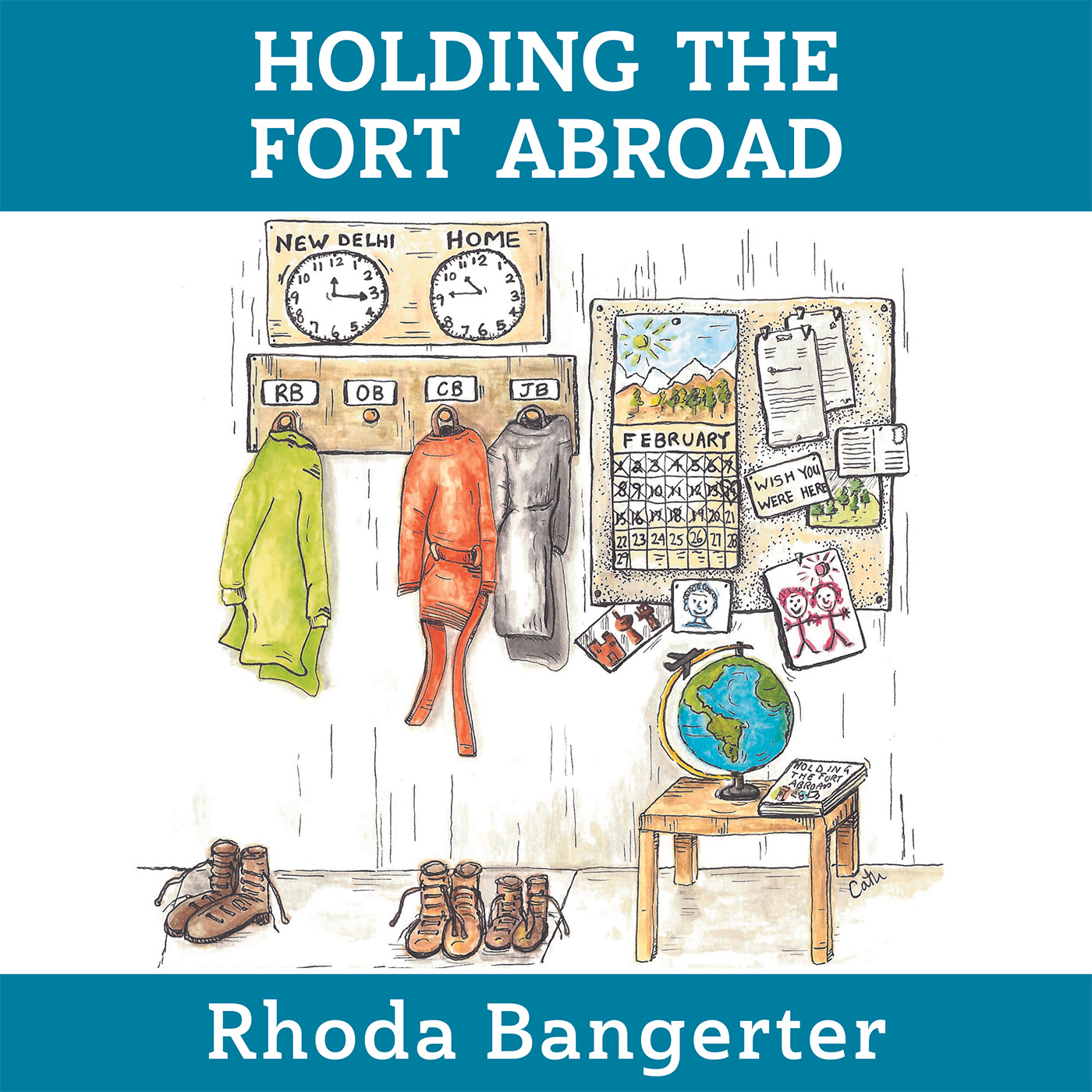
Holding the Fort Abroad
103 episodes — Page 1 of 3
#102 How to help your child when you are away for work - with Barb Varcl-Smith
#101 United Front For Couples That Often Live Apart - with Pesa and Whitney Shayo
#100 Supporting Travelling Staff and their Families Across the World - with Rhoda Bangerter
#99 Moms who travel for work: Maximise the Benefits and Adjust to the Challenges - with Rhoda Bangerter
#98 Travelling Dads: Benefits, Challenges and Agency - with Rhoda Bangerter
#97 The Unexpected Career Benefits of a Long-Distance Relationship - with Sue Schoormans
#96 When Storms Come during Business Travel (Part 4) - with Rhoda Bangerter
#95 How to stay strong as a couple when often apart (Part 3) - with Rhoda Bangerter
#94 How do you cope as a working parent with a traveling spouse? (Part 2)- with Rhoda Bangerter
#93 Part 1: My Partner Travels for Work: How to Support Myself - with Rhoda Bangerter
S1 Ep 92#92 Life Lessons from Frequent Business Travel and Global Relocations - with Flor Bretón-Garcia
Episode Takeaways:Flor Garcia has experience of frequent business travel in family life, and now that her children have grown up she explains to us how she and her husband adapted frequent business travel with children who have flown the nest! Flor works across cultures and helps organisational leaders deliver sustainable, cost effective solutions for global teams. She is also the President of Families in Global Transitions. Key Takeaways Flor’s story and message to new mums with travelling partnersFlor was born and raised in Venezuela, where she lived until age 22. In 2002, she left her homeland, got married, and settled in the southern United States. There, she and her husband started their family, welcoming their first son just a year and a half after marriage as her husband worked on building his career and started travelling. She acknowledged the loneliness of those years and offers hope.She emphasizes self-compassion: “You don’t have to know it all or do it all perfectly.”Avoid isolation and seek connections, even if language or cultural barriers feel daunting.Your capacity for resilience and adaptability is a gift to your children.“there is the hope of knowing that, you know, you're raising children that are going to grow in a way that they are going to learn by example what it is to be, to adjust, to adapt, to be agile. In different circumstances, they see their mothers juggling and trying different things.”Careers & Community:The importance of nonlinear, portable careers—embracing flexibility and finding the common thread in your professional path.Families in Global Transition (FIGT) is a supportive community for anyone navigating globally mobile lifestyles. It offers resources, networking, and opportunities for learning and growth.Adapting in New Seasons:With grown children, Flor Garcia now joins her husband on trips, enjoying new routines and intentional reconnection as a couple.She highlights the importance of being intentional about rediscovering partnership when transitioning into “bird launcher” parents (i.e. children flying the nest)Flor Garcia is a global cultural strategy leader who advises senior executives on how to lead and perform across complexity. With over 15 years of experience, she has partnered with multinational organizations to align culture, leadership, and business strategy across regions.Flor is known for translating cultural dynamics into practical leadership actions that improve decision-making, alignment, and performance. She has led large-scale global initiatives reaching thousands of leaders across the Americas, EMEA, and APAC.As President of Families in Global Transition, she also supports a global community navigating identity, mobility, and belonging across borders.Fluent in English, Spanish, and German, Flor brings both lived experience and strategic rigor to her work.She is the co-founder of Leading Across Culture, where she helps organizations turn cultural complexity into clarity, connection, and growth.Connect with Flor LinkedInLeading Across CultureFind out more about Families in Global Transitions (FIGT) at Families in Global Transition - HomeTwo events you may be interested in: FIGT is holding a session on nonlinear careers in June -ideal for anyone wrestling with professional transitions across borders (43:17).FIGT April Forum: Connect with globally-minded peers and experts, membership optional.Contact Rhoda: [email protected] news regularly on new episodes of HTFA Podcast and on new events and resources. Subscribe to my newsletter.Buy the book: Holding the Fort AbroadYour partner's job opportunity in another country seemed like an exciting idea, but lengthy work assignments mean you're holding down the family fort - alone.OR Your partner is working and living in another country, and you feel like you are shouldering all the home responsibilities alone.You may be wondering:How can we be a family when we're miles apart?Can I cope, alone, when troubles arise?I believe there are answers to the above questions, and the answers start with you. In this context, it's more important than ever to invest in yourself, to care for yourself, to set your own goals and to watch yourself grow. Equally important is to nurture your relationship with your partner and learn to parent together.
S1 Ep 91#91 Travelling Parents Part 3: Re-enforce The Bond Across the Distance - with Rhoda Bangerter
Synopsis:Practical strategies for families when one parent works away. Part 1 is on the importance of naming your family structure to reduce stress and avoids future regret.Part 2 highlights the power of using language that reinforces family experience and teamwork.Part 3 looks at the triangulation relationship between At Home Parent, Travelling Parent and Child and how that helps reinforce bonds across the distance.Keywords: travelling parents, connected family life, parent away from home, long-distance familyThe first of a 3-episode series: Episode 89 Recognise it for what it isEpisode 90 Reframe as WEEpisode 91 Re-enforce The Bond Across the Distance These are mainly findings from my Masters thesis, where I interviewed adults who had grown up with a father who travelled frequently for work.The Travelling ParentDoes not necessarily communicate with the Child when awayIs in communication with At Home Parent and Child knows itIs always involved when home (outings to the park, hiking, biking, restaurant)“I knew he cared because he cared when he was home”Watch out for how technology can take away that presence from home timeThe At Home ParentThe role of the at home parent was highlighted as crucial in the evolving and developing relationship between the travelling parent and the child.Keeps Child informed of traveling parent’s whereabouts and comings and goingsKeeps Travelling Parent informed of what is happening with Child and makes sure Travellng Parent is involved in Child’s big eventTeaches communication between Child and Travelling Parent. Facilitates phone calls.Positive Portrayal of Travelling Parent‘My mum was putting up this really good image of my father that he is pretty much involved in our life, even though he physically was traveling. And the reason why he was, because of us, to give us a life that we did not have to worry about anything’Consider your own triangular relationship.Questions to ask yourself:What do you and your partner communicate to each other about the Child?As the At Home Parent how do you:Portray the Travelling Parent to the Child?Facilitate their relationship?As the Travelling Parent:How do you keep informed about your Child’s life, interests and needs?What can you ask of your At Home Partner that would help you stay connected to your Child?Find out how you can use the ICAN Model: Distance Parenting: How the ICAN Model Helps Families Stay Connected When One Parent Travels - Rhoda BangerterContact Rhoda: [email protected] news regularly on new episodes of HTFA Podcast and on new events and resources. Subscribe to my newsletter.Buy the book: Holding the Fort AbroadYour partner's job opportunity in another country seemed like an exciting idea, but lengthy work assignments mean you're holding down the family fort - alone.OR Your partner is working and living in another country, and you feel like you are shouldering all the home responsibilities alone.You may be wondering:How can we be a family when we're miles apart?Can I cope, alone, when troubles arise?I believe there are answers to the above questions, and the answers start with you. In this context, it's more important than ever to invest in yourself, to care for yourself, to set your own goals and to watch yourself grow. Equally important is to nurture your relationship with your partner and learn to parent together.
S1 Ep 90#90 Travelling Parents Part 2: Re-enforce Work Travel As A Family Project- with Rhoda Bangerter
Synopsis:Practical strategies for families when one parent works away. Part 1 is on the importance of naming your family structure to reduce stress and avoids future regret.This episode (Part 2/3) highlights the power of using language that reinforces family experience and teamwork.Keywords: travelling parents, connected family life, parent away from home, long-distance familyThe first of a 3-episode series: Episode 89 Recognise it for what it isEpisode 90 Reframe as WEEpisode 91 Re-enforce The Bond Across the Distance Episode 2 Reframe as WE 1. Do a Language Audit Do you emphasise teamwork and working together as a family?When I speak with people who work far from home, and when I speak with their spouses at home, what I am hearing is one family narrative, one family story.Even though you are not under the same roof, the way that people talk is ‘my family’, ‘this is what we are doing for the family’Example: Colleen EP 71 about transitions in global lifeAnd then there's the emotional side. So for things, things like grief, you can power through for a while, but at some time, some point, I know our family, we've been learning it's better to just give it some space because it's going to come anyway.2. Family The overwhelming majority of participants of my research for my Masters mentioned the word ‘family’ over 10 times during their interviews although the questions related to what their childhood was like with a travelling parent, communication with their travelling parent, how they knew their parent cared“I think the important thing is finding family rituals in the sense of figuring out what are things you enjoy doing together as a family’Parents working as a team also strongly came out in the interviews.3. Family Project Whether one of you frequently travels or lives and works in another county, consider this from a project management perspective and treat it as a whole family project. It is a project after all, with stakeholders: you and your spouse, your children, certain members of your extended family, close friends will all be ‘key stakeholders’ in your family project.“Key stakeholders can make or break the success of a project. Even if all the deliverables are met and the objectives are satisfied, if your key stakeholders aren’t happy, nobody’s happy.” ADRIENNE WATTCreate joint meaning, work towards a common goal, and celebrate the wins along the way, even at a distance!!Contact Rhoda: [email protected] news regularly on new episodes of HTFA Podcast and on new events and resources. Subscribe to my newsletter.Buy the book: Holding the Fort AbroadYour partner's job opportunity in another country seemed like an exciting idea, but lengthy work assignments mean you're holding down the family fort - alone.OR Your partner is working and living in another country, and you feel like you are shouldering all the home responsibilities alone.You may be wondering:How can we be a family when we're miles apart?Can I cope, alone, when troubles arise?I believe there are answers to the above questions, and the answers start with you. In this context, it's more important than ever to invest in yourself, to care for yourself, to set your own goals and to watch yourself grow. Equally important is to nurture your relationship with your partner and learn to parent together.
S1 Ep 89#89 Travelling Parents Part 1: Do A Language Audit - with Rhoda Bangerter
Synopsis:Practical strategies for families when one parent works away, and how naming your family structure reduces stress and avoids future regret.Keywords: travelling parents, connected family life, parent away from home, long-distance familyThe first of a 3-episode series: Episode 89 Recognise it for what it isEpisode 90 Reframe as WEEpisode 91 Re-enforce The Bond Across the Distance Episode 1: What Are We Recognising Main TakeawaysYou’re not broken. Your family isn’t unusual. This is a legitimate family form.Different namesSplit Family International AssignmentsMulti location families, Split Location FamiliesNon family duty stationsUnaccompanied PostingsFrequent Business TravelDifferent lengths of timeA few weeks at a timeLiving and working in another countryDifferent sectors, different scenarios, different reasonsSame absence, same toing and froingSimilar challenges, big emotions, hidden loadThe parent at home becomes default parentThe travelling parent fears losing connectionAmbiguous grief for childrenSame potential for regretTwo well-known studies:Impact on Spouses of World Bank StaffAnne Copeland, Interchange Institute, Voices from Home and Voices from the Road2. Why naming and recognising it mattersNot recognising it and ‘just getting on with it’ can lead to regrets later onUnderestimating impact on self and others and self blameCouples often don’t anticipate systemic impact. Recognising and naming it allows to put things in place. It gives structure.3. How do we name it? Importance of not mis-labeling: single parent, absent parent.Labels that undermine the travelling parentAbsent parentNot really therePart-time parentWeekend dad / weekend mumSecondary parentThe one who leftThe one who is never hereVisitor in the homeFinancial provider onlyFun parent (implies superficial involvement)Reduces authority, legitimacy of travelling parentChild may internalise:They are less importantTheir parent is less committedTheir family is less stableEven if not trueLabels that overload the home-based parentSingle parent (when still in intact partnership)Solo parentParenting aloneDoing it allThe real parentPrimary parent (can be neutral in research but harmful in family narrative depending on tone)Why harmful:Removes the psychological presence of the travelling parent.Increase overload of home parentChild may internalise:One parent is carrying everythingThe other parent is peripheralFamily system is incompleteIncrease anxiety in childrenThese labels are harmful because they imply deficiency, abandonment, or dysfunction, rather than recognising structure and adaptation.Wrong labels are often unintended.Reasons:Lack of better languageTrying to express difficultySeeking validationCultural default languageNot malicious. But still impactful.Avoid deficiency labels.Use structural labels.Examples:Instead of:Absent parent → Travelling parentInstead of:Single parent → Parent at homeInstead of:Not here → Working away, still part of usDo a Language Audit and Create A Family Narrative (Listen to #58)3. Lived Experience 7 Interviews of adults that have grown up with a travelling fatherAcross sectors (military, business, airline, non-profit sector) and continents (all continents represented) small sample but the same topics came up) and homogenous experience of this father who was gone and came backMany it was the first time they were thinking about it from this angle, started having conversations before the interviews and after the interviewsAll had good relationships with fathers, wanted more time with them, knew them more as a friend I did not have an absent father.Looked at the systemic strategies how both parents worked together that will be the next episode. More in Episodes 2 & 3Episodes to Listen to#55 Michael Pollock, #48 Lucas, #36 Anaju, #45 Ophelia, #51 Katia Vlachos, #46 IreneMany more from the point of views of mothers and fathersConclusionShift from uncertainty, vague experience and hidden challenges to “We are a multi-location...

S1 Ep 88#88 Travel and Parenting in the Hotel Industry - with Andrea Schmitt
Synopsis:Andrea Schmitt shares what it felt like to be the spouse of someone working the hotel industry and who travelled a lot. Listen to what helped her keep the family connected, and what she wishes more families understood about growing up and loving across international moves and frequent travel. Andrea is a clinical psychologist and she coaches expat teen girls, helping them make sense of identity, belonging, and the emotional ups and downs that come with a mobile life.“He travels 50% a month”You have a choice Andrea Schmitt opens up about how she managed loneliness as a “trailing spouse” and later as a “trailing mom.” She highlights the power of intentionally choosing her situation, seeking out international communities, and repeatedly putting herself out there to build new connections—even when it meant being vulnerable time and again.“I sat myself down and I thought “it feels like you don't have a choice, but you do…I loved us as a family, and I thought “ how can I manage better? And that's when everything sort of shifted and I became less resentful because I had the feeling that I chose being there”Staying Connected as a FamilyWith her husband away so much, keeping the family bonded was a real challenge. ‘Good morning’ and ‘good night’, especially with their daughter, Jessica, were always time for check in, even quick, and even if they landed in the middle of the night for Andrea’s husband.“he would always make time whenever he had a little break. And he has this particularly nice habit. He, not me. He will always pick up the phone, even if he's in a meeting. And he will at least say, I'm in a meeting, I will call you back…It's like he's always there. He will always pick up.”He invented Action Family with different characters. At night, in person or on the phone, dad and daughter would spend sometimes hours making up stories about this family. This went on for years and years. “That continued at night in whatever country, in whatever time zone. So at night for us, for Jessica. It was their thing” says Andrea.When her husband was home, Andrea would deliberately find activities to do that would give her husband space to parent. She also created a photo album of her husband, the places where he grew up, photos of him with Jessica. It was even small enough that she could take it on holidays with her and they would look at it often when dad was not around.Andrea would also update her husband on Jessica’s schooling and what was going on in their lives when he was away. Now that their daughter is an adult, she has different topics she shares with each parent and ‘there is no need to update each other on those’Attachment with the travelling parent Changes in return dates, constant coming and going, grief when a parent leaves home can take a toll on the relationship between travelling parent and child.If you know about attachment style and you look at the four different ones, you know which one you want to avoid for their future.To find out more about attachment styles and travelling parenting, you can listen to episode #82 How to nurture parent child attachment when work travellingSupporting Kids Through TransitionAs both a mom and coach, Andrea underscores the importance of scaffolding positive childhood experiences for kids growing up in globally mobile families—balancing normal teen issues with the extra layers of moving countries and parental absence.Key PCS are:Emotional Connection: The ability to talk with family about feelings.Safety and Support: Feeling safe, protected, and supported by adults in the home.Community and Belonging: A sense of belonging in school, having friends, and participating in community traditions.Mentorship: Having at least two non-parent adults who genuinely care.Positive Childhood Experiences (PCEs) InventoryPractical Advice for Globally Mobile FamiliesDon’t dismiss the challenges (“kids are resilient” isn’t enough—support and scaffolding are needed).Tiny rituals make a big impact—whether it’s a 30-second call, a special story, or bringing home a small gift as a symbol of care.Keep educating yourself about expat family dynamics and attachment. There are more resources than ever to help you navigate.Andrea and her co-host Matthieu Gagnon now offer the TCK Research Podcast, breaking down research on third culture kids (TCKs), expats, and globally mobile families.Contact Rhoda: [email protected] news regularly on new episodes of HTFA Podcast and on new events and resources. Subscribe to my newsletter.Buy the book: Holding the Fort AbroadYour partner's job opportunity in another country seemed like an exciting idea, but lengthy work assignments mean you're holding down the family fort - alone.OR Your partner is working and living in another country, and you feel like you are shouldering all the home responsibilities alone.You may be wondering:How can we be a family when we're miles apart?Can I cope, alone, when troubles arise?I believe there are answers to the
S1 Ep 87#87 Creating a Life for Yourself
Another episode from the Top Five most listened episodes. This conversation is with Margaret Ghielmetti. Margaret knows what it is like to be home alone when she thought she was moving abroad with her husband and not moving abroad waiting for her husband to come home. She talks about her journey from thinking she would be fine to the reality she encountered to finally being open about needing help and creating a life for herself on her own terms. In this Episode: The metaphorical life handbook we receive from our families.Why Margaret was surprised by the effect of her husband’s travelling although she (thought she) knew what she had signed up for.Supporting each other when not in the same place. Expressing your needs.Sharing the blessing of allowing others to help us.Stop saying ‘I’m fine’.Deciding non-negotiables for you! Keeping soft boundaries.Casting a wide net.Feeling lonely when you feel you should be feeling lucky.Contact Margaret:‘Bravi(ish): A Memoir of a Recovering Perfectionist’www.margaretghielmetti.com
S1 Ep 86#86 (Re) Build Intimacy in Long Distance Relationships - with Dr. Veronique Elefant-Yanni
Synopsis:Clinical psychologist Dr. Veronique Elefant-Yanni guides us on how to (re)build emotional intimacy for couples separated by frequent business travel or international assignments. Drawing on her 25 years of experience and her innovative 3D Human Therapy, she explains why sharing day-to-day experiences—even trivial ones—is essential. The conversation covers the invisible pressures of expat life, how to recognize and address codependency, and practical strategies to reconnect across distance. This episode offers actionable advice for maintaining meaningful relationships when work and geography pull families apart.1. Small Daily Exchanges Build and Preserve Intimacy Sharing everyday experiences—even a passing thought, a funny encounter, or a fleeting feeling—is vital for emotional closeness.For families dealing with frequent travel or split assignments, these “small talk” exchanges provide the threads that keep relationships strong. It's not the depth of each conversation that matters, but maintaining a consistent flow of communication that mirrors daily life together. When partners make space for regular sharing, even via text or short calls, it helps them reconnect and avoid becoming strangers.2. Healthy Relationships Require Psychological Independence Balanced couples are made up of individuals who can both “stand on their own two feet”—functioning independently rather than relying on each other for emotional validation.Frequent travel or split family assignments amplify this need. When partners fall into codependency, it can lead to resentment and dysfunction. Working on personal growth—by cultivating self-worth and independence—empowers couples to share genuine love, rather than need. This foundation is essential for surviving the unique stresses of expatriate or traveling lifestyles.3. Communication Is Crucial—Don’t Assume, Speak Up Open dialogue about stress, loneliness, or frustration is necessary, especially when life circumstances mean one partner is away and the other is settling in alone.Expat couples often assume the other understands their burdens, but Dr. Veronique Elefant-Yanni stresses the importance of expressing what you’re experiencing (“Your partner doesn’t know what you go through, so you have to speak”). This is especially important so accompanying spouses don’t feel invisible—communication is the lifeline that maintains empathy and support.4. Addressing Internal Conflict and Rebuilding Self-Trust Emotional independence often means facing and diffusing internal conflict—like fear, anger, or self-doubt—that might be rooted in early experiences. Dr. Veronique Elefant-Yanni’s 3D Human Therapy model gives practical ways to restore trust in one’s own feelings and decisions. For those separated by work, understanding this process is key to avoiding self-sabotage and ensuring that interactions with loved ones remain constructive and authentic. Her free online guide offers tools for self-work, allowing listeners to begin healing and rebuilding from afar.Contact Dr Elefant-YanniDr. Elefant-Yanni knows that expat life isn’t always glamorous — it can be disorienting, lonely, and full of invisible pressures. As a Clinical Psychologist with over 25 years of experience and the creator of 3D Human Therapy®, she supports internationally mobile individuals and couples to recentre, rebuild connection, and reclaim their vitality. Originally from France and now based between Switzerland and Singapore, Véronique works fully online in French and English, helping clients across continents reconnect with their inner compass.Website: https://psychologyexperts.online/Free guide: www.psychologyexperts.online/3dformContact Rhoda: [email protected] news regularly on new episodes of HTFA Podcast and on new events and resources. Subscribe to my newsletter.Buy the book: Holding the Fort AbroadYour partner's job opportunity in another country seemed like an exciting idea, but lengthy work assignments mean you're holding down the family fort - alone.OR Your partner is working and living in another country, and you feel like you are shouldering all the home responsibilities alone.You may be wondering:How can we be a family when we're miles apart?Can I cope, alone, when troubles arise?I believe there are answers to the above questions, and the answers start with you. In this context, it's more important than ever to invest in yourself, to care for yourself, to set your own goals and to watch yourself grow. Equally important is to nurture your relationship with your partner and learn to parent together.
S1 Ep 85#85 Long Distance Relationships and what makes them work
For the next few months, I will be publishing one new episode every first Monday of the month. The second monthly episode will be a replay of the most popular episodes. My interview with Vivian Chiona is a top FIVE. Vivian is the founder of Expat Nest, online counselling service for internationals. She is a registered psychologist with Master’s degrees in both Child & Adolescent Psychology and Health Psychology. She was recognised in 2020 as one of the 100 most influential women in the world by Women appreciating Women. She is bicultural with family all over the world, Vivian is familiar with the international community and inspired by its diversity. In this episode, she shares top strategies for long distance couples. Enjoy! WarmlyRhoda
S1 Ep 84#84 Global Mobility and Multi-Location Family Life: A Mother’s Story - with Susana Ortega Roig
Episode takeaways:Define Your “Why” — Together: Susana Ortega highlights the importance of being crystal clear on your personal, familial, and professional reasons behind such big life decisions. It’s not enough to move because it’s required; when your “why” is aligned and discussed as a family, it becomes a pillar of resilience during times apart.Set Clear Timeframes & Reevaluate as Needed: Open-ended separations can take a toll. Susana’s method—setting boundaries on time apart and regularly reevaluating the arrangement—keeps everyone grounded and allows for easier transitions (and renegotiations) as circumstances change.Consistent Communication Anchors Connection: Whether it’s daily FaceTime calls during a morning dog walk or creative “matchmaking” to keep kids and a traveling parent close, finding practical ways to stay in touch can transform how families experience separation. These small habits foster ongoing emotional bonds, no matter the miles between.Silver Linings: Susana found an unexpected confidence in managing teenage years and family life solo, realizing she was much stronger than she had thought. Her children, meanwhile, grew up grounded, flexible, and always felt part of a close-knit family, no matter the distance.Special Offer: Heading home for the holidays? Susana is offering personalized one-on-one sessions to help you prepare, handle tricky family dynamics, and return to your expat life feeling recharged and confident. Connect with her via Instagram at Abroad with Susanna.About Susana:Susana Ortega Roig was born in Barcelona in 1969. She lived, studied, and built a life there until a beautiful twist of fate changed everything. In 1997, she married Toru which opened the door to a global adventure that has shaped her for more than 28 years.From Barcelona to Tokyo, Brussels, Frankfurt, Amsterdam, Singapore, and back again, her life has been a rich tapestry of love, challenge, and discovery. Our two boys, Shoh (born in Tokyo) and Daigo (born in Frankfurt), grew up as true Third Culture Kids. And when Toru’s work sent him to São Paulo and later Los Angeles, they made the decision she would to stay in Amsterdam so their sons could finish school — a difficult chapter, but one they navigated with heart and resilience.Her mission is to support expat spouses and mums who find themselves in a new country, feeling disconnected, lonely, or unsure where to begin.For direct support, connect with Susana via her website abroadwithsusana.com and instagram @abroadwithsusanaContact Rhoda: [email protected] news regularly on new episodes of HTFA Podcast and on new events and resources. Subscribe to my newsletter.Buy the book: Holding the Fort AbroadYour partner's job opportunity in another country seemed like an exciting idea, but lengthy work assignments mean you're holding down the family fort - alone.OR Your partner is working and living in another country, and you feel like you are shouldering all the home responsibilities alone.You may be wondering:How can we be a family when we're miles apart?Can I cope, alone, when troubles arise?I believe there are answers to the above questions, and the answers start with you. In this context, it's more important than ever to invest in yourself, to care for yourself, to set your own goals and to watch yourself grow. Equally important is to nurture your relationship with your partner and learn to parent together.
S1 Ep 83#83 People Care in Practice: Sustaining Family Wellbeing Business Travel
Synopsis:Today’s episode is for anyone experiencing relationship strain due to frequent work travel or international assignments. My guest, Ian Orton, counsellor and founder of People Care Matters, has spent 35 years supporting professionals who work far from home and the families affected by these separations. We discuss how travel impacts connection, how distance can slowly create emotional drift, and how couples and families can intentionally maintain closeness even when time apart is unavoidable.I think frequent travel is a part of the whole deal with relief and development work and with other NGO work. There's often a huge amount of travel. And I've come across it where people have said that home is really an aeroplane seat, or it's on a train somewhere, or it's in the car traveling between places Key Takeaways:Performance at Work Is Often Linked to Home LifeDisrupted family relationships and stress from prolonged separations commonly impact work performance. Pastoral support and organizational care are vital when international work or frequent travel creates tension at home, affecting focus and well-being on the job. Recognizing this interplay helps organizations and individuals respond more compassionately and proactively.Frequent travel impacts everyone—be proactiveWhether you’re the one traveling or the partner holding things together at home, Ian highlighted that both sides face stress, and the drifting apart can happen without realizing it. He suggests annual reevaluations, prioritizing quality time, and even creative exercises to keep connections strong. Intentional Relationship Maintenance is essential is just as crucial in frequent travel scenarios as in long-term split-living.Reintegration Takes Planning and SkillReturning home after being away can upset established family routines and dynamics. Both partners should learn negotiation and communication skills to ease reintegration and avoid unnecessary conflict. Periodic check-ins and adjustments help families re-establish connection instead of feeling like intruders in their own homes.Organizational Support Goes Beyond the EmployeeEmployers should recognize the impact of travel/split assignments on non-employee family members. Offering resources, pastoral care, or flexibility acknowledges that spouses and children also need support. When leaders or HR notice decreased performance or well-being, addressing underlying family stresses is just as important as work-focused interventions.Trusted Advisers Offer Perspective and SupportCultivating honest relationships outside the immediate family – with peers, mentors, or experienced friends – provides invaluable perspective and accountability. Trusted advisers can help spot challenges early, offer practical wisdom, and keep families aligned with their values as contexts and needs shift over time.Contingency and Crisis Planning Is CrucialFamilies separated by work should actively plan for emergencies: legal documentation, guardianship, communication protocols, and scenario planning. This forward thinking reduces anxiety and ensures stability for children and spouses when unexpected events occur. Proactive conversations about “what if” scenarios help everyone feel safer and more prepared.Ian’s experience and honesty about his own journey serve as a valuable resource for all global professionals and families managing work life and family life when time away from family is routine.the organizational duty of care, it seems to me, can be to really encourage people to have those great conversations and to overcome some of those difficulties without going down the well worn pathways of meeting their own needs in wrong ways or just becoming angry people or the convenience of having another assignment to go away to.Listen to the episode for actionable strategies and real stories, or check out the show notes for extra resources.Action Steps You Can Take Now:Assess your current habits: Are you prioritizing family time, or has travel slowly shifted your priorities without you realizing?Plan periodic “relationship audits” and ask, “What do we want to be known for as a family?”Engage with your community and seek feedback—sometimes, an outside perspective helps us see what we’re missing.Remember, investing in family connection now leads to stronger relationships in the long term—don’t wait until retirement to find out you’ve drifted apart!It’s never too late to make positive changes—intentionality and communication go a very long way.Contact Ian OrtonBy Email at: [email protected]’s Counselling Directory Page https://www.counselling-directory.org.uk/counsellors/ian-ortonContact Rhoda: [email protected] news regularly on new episodes of HTFA Podcast and on new events and resources. Subscribe to my newsletter.Buy the book: Holding the Fort AbroadYour partner's job opportunity in another country seemed like an exciting idea, but lengthy work assignments mean you're holding down the family fort - alo
S1 Ep 82#82 How to nurture parent child attachment when work travelling - with Todd Sarner
Synopsis:“Building an attachment culture, which is what I'm talking about, is a way to just make kids feel more connected more often. That doesn't depend on just you being with them. When you have this culture built around them, they feel more connected more often.”If you’ve ever worried about how frequent travel or long work assignments away from home affect your connection with your children, this episode is for you. This week, host Rhoda Bangerter sat down with expert guest Todd Sarner - licensed marriage family therapist and former Neufeld Institute faculty member - to unpack the science of attachment and how families can build secure, lasting bonds even when parents are separated by distance.Key Takeaways from Todd Sarner:Attachment Is a Lifelong Journey: Todd emphasises that attachment isn’t just about those early baby years—it’s a “cradle to grave phenomenon.” Whether your child is a toddler or heading into adulthood, the quality of your connection matters far more than the quantity of time spent together.Connection over Perfection: Parenting is a long-term project: what matters most is that children feel loved, understood, and supported—even if things aren’t perfect every day.Signals and Responses: Kids express their emotional needs in different ways—sometimes directly (“Do you love me?”), other times through acting out or even directly saying ‘you don’t love me’. Both are invitations for connection, and Todd’s advice is simple: don’t take it personally. Respond with compassion, not reactivity.Three-Phase Approach for Attachment:Attachment & Connection: Always gather that sense of connection first, whether face-to-face or on a video call. Simple gestures like getting your child’s attention and eye contact matter.Ritual & Structure: Create rituals that bring predictability—even if routines shift when a parent is away. Consistency in consequences and boundaries helps children feel secure, no matter the setting. This is especially important when the rhythms change on departure days and return days. Even if it is okay for there to be ‘two rhythms’, one when a parent is away and one when they are home, agreeing on key consequences helps.Guiding Behavior: Discipline works best when rooted in relationship. Focus on compassionate limit setting, teaching kids to process feelings rather than resorting to punishment or anger.Bridging & Matchmaking: When apart, use “bridging” language to let kids know you’re thinking of them and looking forward to reunion. Meanwhile, the parent at home can “matchmake”—facilitate conversations and positive stories about the traveling parent to keep that connection strong.Parental Self-Compassion and Alpha Leadership Matter Most: Todd highlights that striving for perfection is not only impossible but unnecessary. Parents should focus on becoming the “alpha” (guiding, calmly in charge, nurturing) figure, regardless of distance. Seeking resources, support, and coaching is beneficial, but your unique bond as a parent is irreplaceable. Communicating love, pride, and trust—especially in focused, heartfelt moments—can remain with your child long after the call or visit ends.Actionable Ideas for Your Family:Schedule regular touchpoints (calls, messages) with your child focused on connection, not just logistics.Share stories and memories that make your child feel special.Collaborate with your partner on a few key family rituals and consequences so your child experiences predictability, no matter who’s at home. Practice “matchmaking” by bringing up stories about the other parent in positive ways.Connect with Todd Sarner Website: https://www.transformativeparenting.comYoutube: https://www.youtube.coom/transformativeparentingFacebook: https://www.facebook.com/tparentingInstagram: https://www.instagram.com/tparentingLinkedin: https://www.linkedin.com/in/toddsarner/Todd’s book ‘The Calm Connected Parent’ comes out November 18th!Contact Rhoda: [email protected] news regularly on new episodes of HTFA Podcast and on new events and resources. Subscribe to my newsletter.Buy the book: Holding the Fort AbroadYour partner's job opportunity in another country seemed like an exciting idea, but lengthy work assignments mean you're holding down the family fort - alone.OR Your partner is working and living in another country, and you feel like you are shouldering all the home responsibilities alone.You may be wondering:How can we be a family when we're miles apart?Can I cope, alone, when troubles arise?I believe there are answers to the above questions, and the answers start with you. In this context, it's more important than ever to invest in yourself, to care for yourself, to set your own goals and to watch yourself grow. Equally important is to nurture your relationship with your partner and learn to parent together.
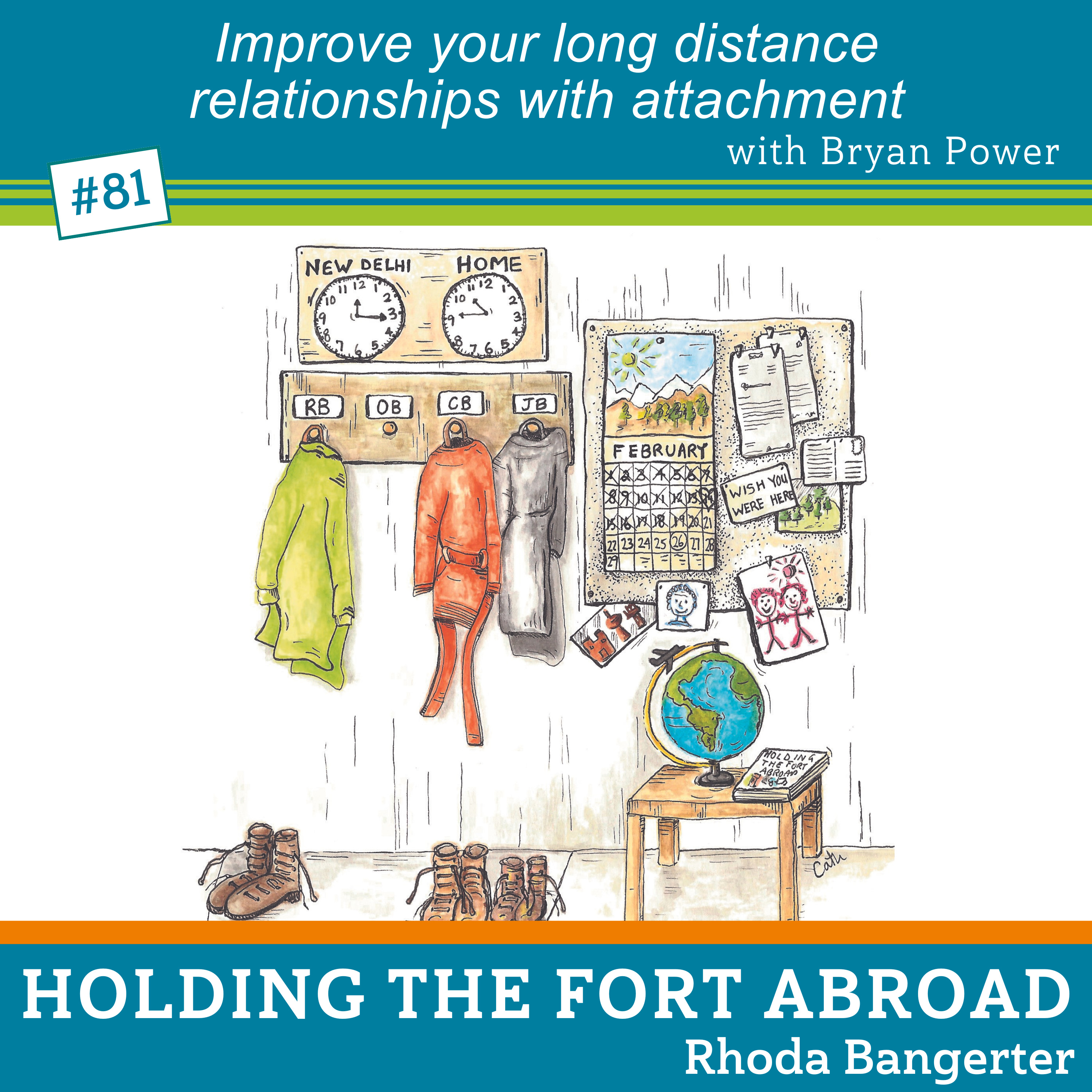
S1 Ep 81#81 Improve your long distance relationships with attachment - with Bryan Power
Synopsis:Ever wondered how your childhood wounds impact your relationships? Today my guest is Bryan Power. He is the founder of make your relationship fail and a certified integrated attachment theory coach. We look at integrated attachment theory together, what it is, how it can be useful for our relationships, and specifically then looking at how it works where there is geographical separation. 3 key takeaways:Attachment Styles Shape Every Relationship: Whether you’re anxious, avoidant, or secure, understanding your own and your partner’s attachment style is crucial for better communication and connection (especially if you’re miles apart!).“If I believe this person doesn't love me, this person is going to leave me, I'm going to be left here alone to deal with the family, the kids, they're never coming home. Those are the stories I'm telling myself that are taking my emotional bandwidth and just throwing it through the roof. Now I'm again, I'm at an emotional level 10. Instead of just being able to relax and say, hey, my spouse loves me, we're in this situation. They're away from me a little bit, but I know he loves me. I know she loves me. I know that we're okay. I know that this time away is just time that we're going to have to deal with a little bit on our own and. And someday we're going to be able to have that full time together. You're able to relax in that.”Healing Starts with Self-Awareness: “Fixing” a relationship often begins with working on yourself—identifying your personal wounds, triggers, and stories you’re telling yourself. The more aware you are, the healthier your connections become. Some of the wounds could be fear of abandonment, fear of losing independence, fear of being trapped, feeling unsafe. *When my emotions are really high, it's a really good time to say, why do I feel this way? What is it? What is it that I'm really afraid of here?”Distance Can Be an Opportunity: Time apart isn’t just a challenge—it’s a chance to foster growth, both individually and as a couple. Investing in relationship tools and self-development during these periods pays dividends when you’re reunited.“How can I look at this and say, okay, why am I so triggered? What are my core wounds that are causing me to be maybe overly sensitive to these things? And then begin to work on those. Because as we work on those wounds now, I'm going to be a little bit more okay with some distance. I don't have to call 10 times a day. Maybe I could call once or twice. I can now find a little bit better balance that actually works for both sides. Because if you're super needy like that, let's face it, the other person you're going to drive them crazy at some point.”The key is to find a balance. So how can I, as the anxious person not be so needy to where I can handle a lot of my needs myself? I don't have to be worried about my spouse constantly. On the flip side, as a dismissive how can I be sensitive to my spouse and realize that they may need a little bit more attention than I do at this point and I don't have to call them 10 times a day, but that one phone call a day could be that one great call that helps my spouse find some emotional connection and be able to regulate and be able to kind of feel good about this situation. Because if we just take it as a dismissive avoidant and we just poo poo the whole thing and just act like, oh, you're just being overly sensitive or overly needy, that doesn't really validate the other person at all. And it really makes them feel disconnected and unloved and unwanted, and it actually causes more and more anxiety. So you're actually triggering that. You actually could be triggering that even more for that person.”Visit Bryan Power’s website makeyourrelationshipfail.com for a free attachment style quiz. Through his website you can access personal coaching, pursue self-guided learning and join Thais Gibson’s Personal Development School. Thais Gibson interview with Mel Robbins - integrated attachment theory Contact Rhoda: [email protected] news regularly on new episodes of HTFA Podcast and on new events and resources. Subscribe to my newsletter.Buy the book: Holding the Fort AbroadYour partner's job opportunity in another country seemed like an exciting idea, but lengthy work assignments mean you're holding down the family fort - alone.OR Your partner is working and living in another country, and you feel like you are shouldering all the home responsibilities alone.You may be wondering:How can we be a family when we're miles apart?Can I cope, alone, when troubles arise?I believe there are answers to the above questions, and the answers start with you. In this context, it's more important than ever to invest in yourself, to care for yourself, to set your own goals and to watch yourself grow. Equally important is to nurture your relationship with your partner and learn to parent together.
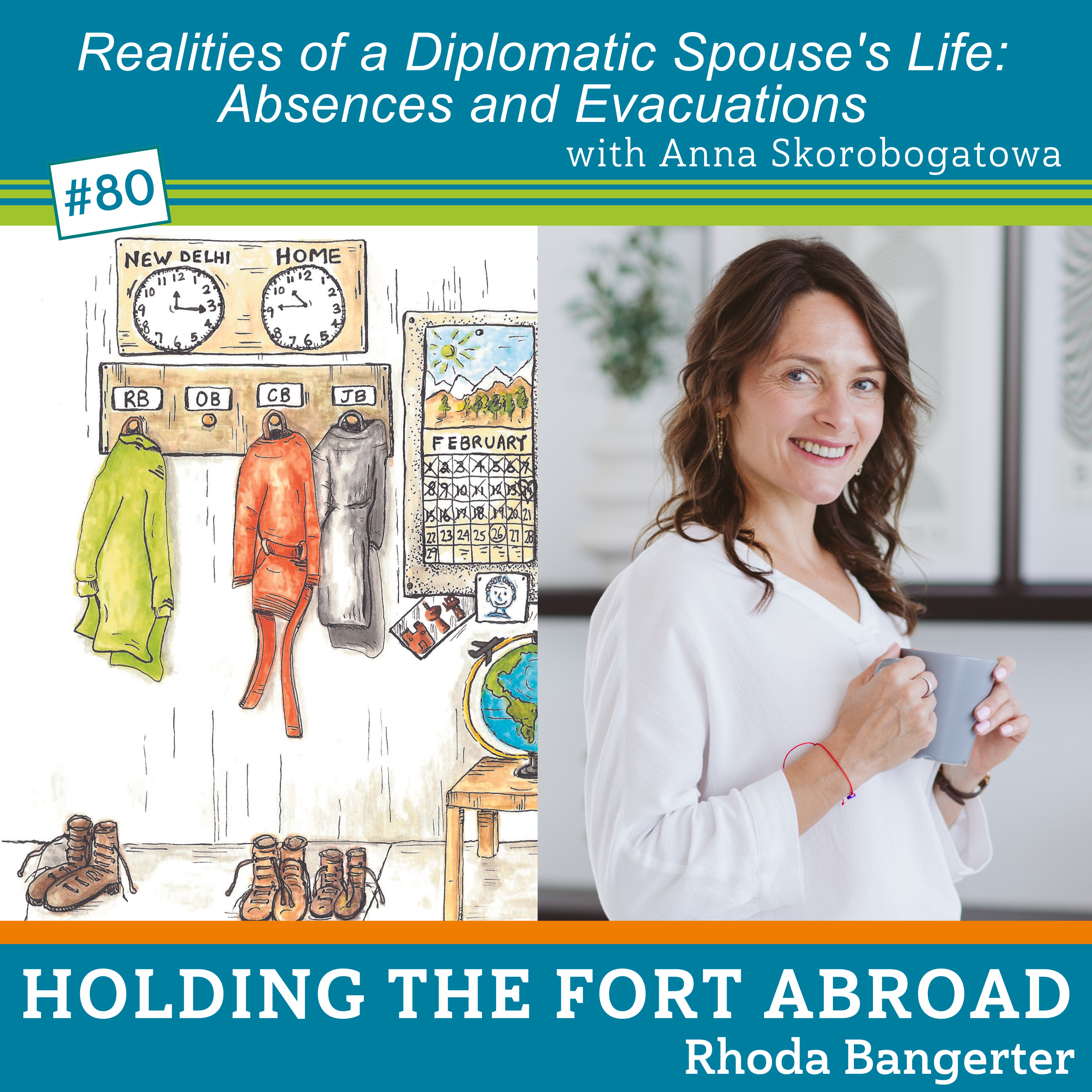
S1 Ep 80#80 Absences, Evacuations and Other Realities of a Diplomatic Spouse's Life - with Anna Skorobogatowa
ESynopsis:In this episode, I sit down with Anna Skorobogatowa, a powerhouse diplomatic spouse, mentor, and founder of Not Just a Spouse. Anna shares honest stories about juggling career aspirations, raising three kids, and handling life’s curveballs - including sudden evacuations and living apart as a family.We explore the unseen resilience it takes to support a family across borders, navigate parenting separately at times, reinventing yourself during constant change. We also underline the vital importance of community and sharing with each other. The episode is a shout out to diplomatic spouses, who sometimes also live geographically separate. Here are 3 key takeaways for anyone navigating a life that’s anything but ordinary:Community & Safe Spaces: Anna talks about why she created both in-person and global meetups for diplomatic and expat spouses: to tackle isolation, share the unspoken challenges, and offer real, judgment-free support.The Realities of Time Apart: Anna opens up about juggling a demanding degree, parenting three young children, and how repeated separations—sometimes due to emergencies—stretched her to her limits.Survival Mode & Self-Care: Both Anna and I reflect on those “crawl-through-the-day” periods. Anna emphasizes the lifesaving power of support networks and why giving yourself permission to ask for, pay for, or creatively source help is not a luxury, but a necessity.Adapting and Reinventing: Hear how Anna’s experience of multiple moves, solo transitions, and even evacuations forged a deep adaptability and strategic mindset—plus practical examples of how she made life work (like moving into a fully furnished home rather than starting from scratch)!The Importance of Validation: Anna and I validate the challenge and resilience it takes to hold the fort abroad. You’re not “just” anything: you’re resourceful, adaptable, and deserving of support.Join Anna’s next online community event here Diplomatic and expat spouses: your resilience, adaptability, and resourcefulness are incredible. Let’s keep lifting each other up and advocating for the support all globally mobile families deserve!Looking for more?Check out Anna’s initiative, Not Just a Spouse, and the Unpacked podcast for deeper dives into diplomatic spouse life. Contact Rhoda: [email protected] news regularly on new episodes of HTFA Podcast and on new events and resources. Subscribe to my newsletter.Buy the book: Holding the Fort AbroadYour partner's job opportunity in another country seemed like an exciting idea, but lengthy work assignments mean you're holding down the family fort - alone.OR Your partner is working and living in another country, and you feel like you are shouldering all the home responsibilities alone.You may be wondering:How can we be a family when we're miles apart?Can I cope, alone, when troubles arise?I believe there are answers to the above questions, and the answers start with you. In this context, it's more important than ever to invest in yourself, to care for yourself, to set your own goals and to watch yourself grow. Equally important is to nurture your relationship with your partner and learn to parent together.
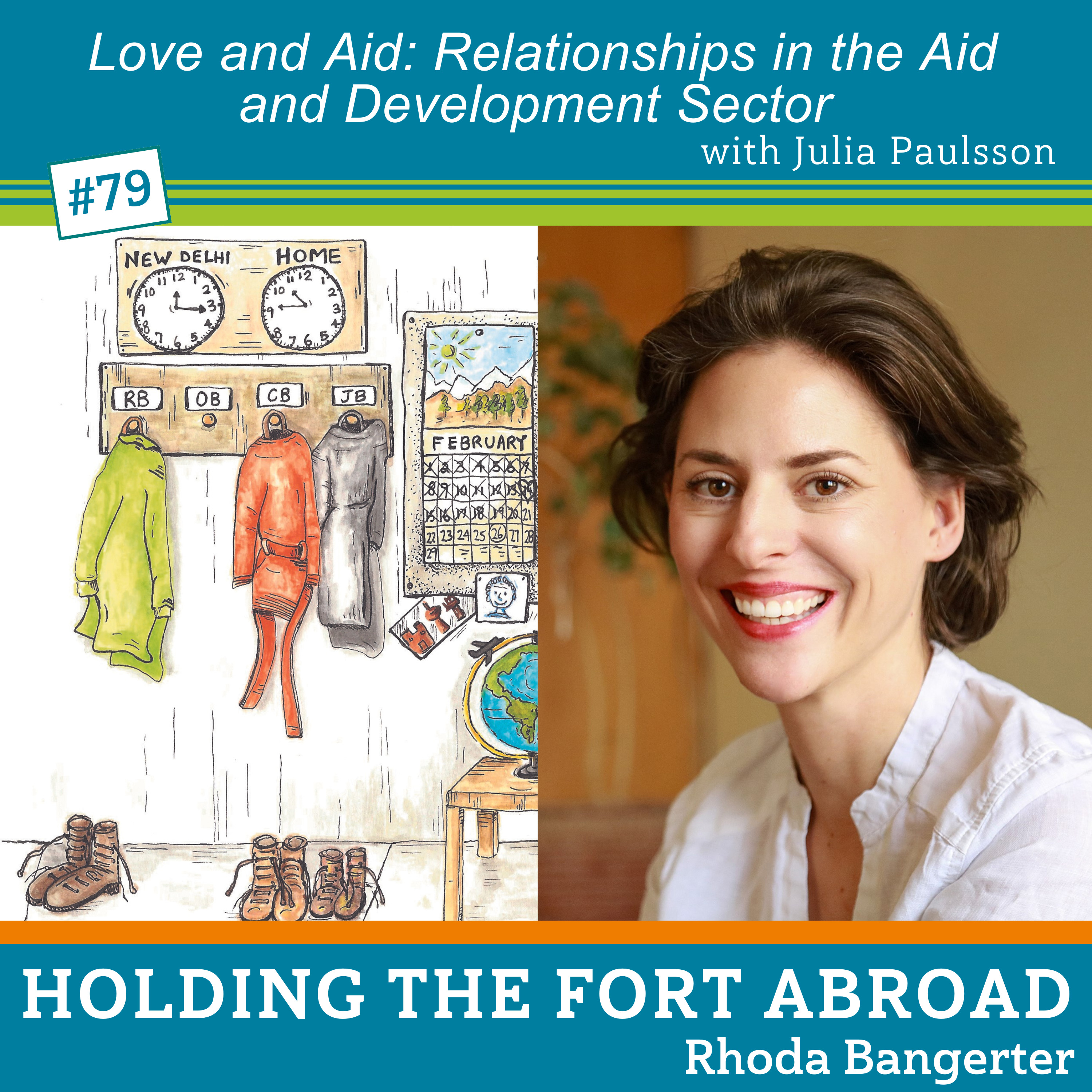
S1 Ep 79#79 Love and Aid: Relationships in the Aid and Development Sector - with Julia Paulsson
Synopsis:“My conclusion is that at the end of the day, what matters is the strategies that couples use to navigate the stress. And this is sort of then what mediates between the stressors and the couple's satisfaction.” In this episode, Julia Paulsson Jandl and I talk about the findings of her research in the aid and development sector: the challenges couples face and the strategies that they use. She is a seasoned humanitarian and development specialist, a relationship counselor and coach. She has just finished her Masters Thesis on couple satisfaction in that sector.. Interestingly, 12% of participants were in split location situations and 24% alternated so we delved into this aspect too. Her insights are useful not just for aid-sector families, but for anyone navigating high-mobility or long-distance relationship challenges.Key Takeaways: Julia Paulsson’s research emphasises that while the pressures of aid work and split location create unique challenges, satisfaction and relational resilience are possible through intentionality, open communication, creative rituals, and mutual respect for each partner’s individuality. The common thread is not the absence of challenge, but the presence of agreed-upon strategies to keep the relationship - and both individuals - healthy.1. Specific Strategies from the Study: Making Relationships WorkJulia’s research didn’t just dwell on the challenges; it also lifted out practical, evidence-backed strategies that resilient couples use, which can be helpful whether you’re living in the same place or miles apart:A. Commitment as Active PracticeCouples emphasized “commitment as an anchor”—it’s not passive but an ongoing, active choice (“minute by minute decision”) to show up, protect your partner’s interests, and maintain fairness and respect.B. Prioritizing Both Individuality and the CoupleResilient couples pursue both individual and shared goals. Making intentional space for each partner’s dreams, interests, and career ambitions—even if not realized at the same time—was key to long-term satisfaction and avoiding resentment.C. Intentional Boundaries and “Rules”Many couples developed rules and agreements to manage the intersection between demanding aid work and personal life. Examples included:Agreed limits on time apart (for split location couples: “maximum amount of time we are willing to be apart”)Family guidelines about what types of duty stations or posts were acceptable (“veto rules”)Minimum standards for things like schooling or healthcare access for the accompanying familyRituals to prioritize couple time-such as trying to be home for dinner or bedtime when possible, even if exceptions ariseD. Communication and Difficult ConversationsSuccessful couples had learned how to tackle difficult discussions directly—about moves, career priorities, and unmet needs—while being open to influence and willing to negotiate.E. Drawing From the Gottman “Six Magic Hours” ApproachJulia shared research-based recommendations rooted in the Gottman method:Partings and Reunions: Mindful transitions whether in daily routines or returning after periods apart—using messages, video notes, or rituals to connect even when physically distant.Appreciation and Admiration: Actively express positive observations, using messages or journals, to counterbalance negativity bias.Affection: This can be a challenge at a distance, but couples find creative ways (sharing clothing, sending heartbeats using smartwatches, or even virtual hugs).Date Nights: Don’t have to be dinner out—could be a virtual movie, shared meal via video, or just a dedicated walk-and-talk.State of the Union Check-Ins: Regular reviews—not just to surface grievances but to celebrate successes and keep in tune with each other even in asynchronous time zones.Repair Attempts: Learning the art of reconciliation after disagreements, and recognizing that “every couple under the sun fights”—the difference is how you reconnect.F. Flexibility and SeasonalityCouples acknowledged there will be seasons where one partner’s career might take precedence, but this should rotate and never be permanently lopsided.2. Split Location Relationships in the Aid SectorJulia Paulsson’s research looked deeply at couples, including those navigating split location arrangements, within the humanitarian and development sector. About 36% of her respondents lived in split locations either permanently or alternated between periods together and apart. The findings were illuminating in several ways:A. Relationship SatisfactionContrary to common assumptions, her study found that couples living apart in split locations had comparable levels of relationship satisfaction to those who always lived together. Julia emphasized that “being in different locations in itself does not predict relationship satisfaction.” The structure of the relationship (together or apart) isn’t as significant as how the couple actually manages the distance and accompanying stressors.B. Terminology
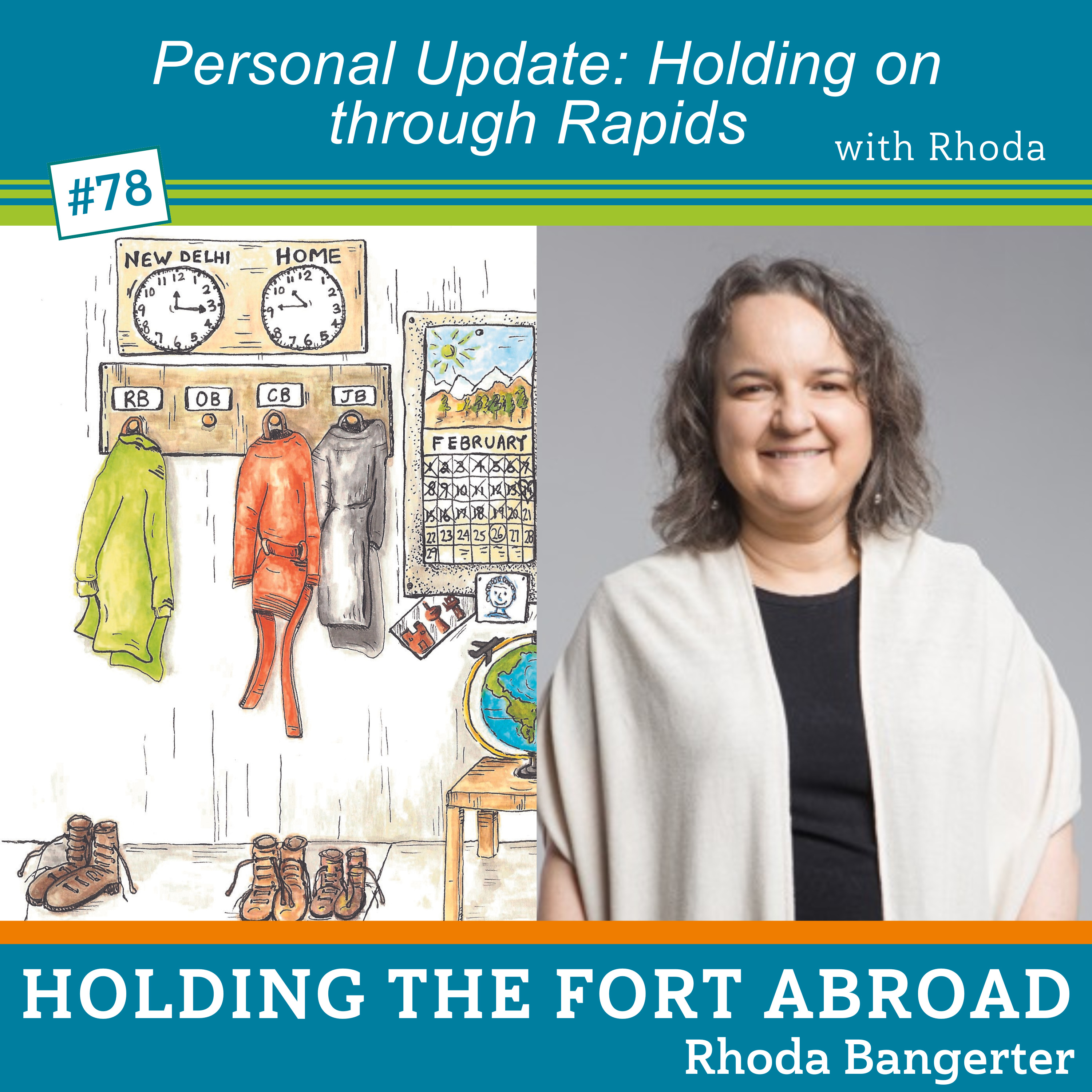
S1 Ep 78#78 Personal Update - Holding on through Rapids -with Rhoda Bangerter
Synopsis:This episode is more of a personal episode as our family has been through a huge transition this year. I was also contemplating that it was a complex transition with more than one change going on over this summer. I share an update but also what I found most helpful. Application of the 5 Pillar Framework during TransitionsPersonal Well-being: tracking sleep, 30 minutes ‘brain reset’, checking in on personal needs, blood tests for mineral deficiencies and stress markersCouple Relationship: coping with limited time together, focus on logistics and admin, balancing intensity and connectionParenting: supporting children (especially teens) through transitions, creating open space for emotional sharingTransitions: acknowledging the challenge and normalizing the stress that comes with itEmergencies: dealing with unexpected issues (e.g., canceled flight tickets, administrative challenges), learning the value of resilience and stubbornness.Contact Rhoda on [email protected] news regularly on new episodes of HTFA Podcast and on new events and resources. Subscribe to my newsletter.Buy the book: Holding the Fort AbroadYour partner's job opportunity in another country seemed like an exciting idea, but lengthy work assignments mean you're holding down the family fort - alone.OR Your partner is working and living in another country, and you feel like you are shouldering all the home responsibilities alone.You may be wondering:How can we be a family when we're miles apart?Can I cope, alone, when troubles arise?I believe there are answers to the above questions, and the answers start with you. In this context, it's more important than ever to invest in yourself, to care for yourself, to set your own goals and to watch yourself grow. Equally important is to nurture your relationship with your partner and learn to parent together.
S1 Ep 77#77 August Announcement - with Rhoda Bangerter
This is a quick announcement to let any new listeners know that I traditionally do not publish new episodes in August. It gives me a chance to pause a bit and it also gives you the opportunity to listen to previous episodes, especially if you can only listen to one every so often. You can search the episodes by topic on my website rhodabangerter.com/podcast for example mums who travel or transitions or split location. There will be more episodes in French as an opportunity arises. I record them. They are numbered F1,F2 etcIf you are with the kids on summer holidays alone then episode 50 is for you with a reminder to make memories and make the time work for you too not just for your kids.I'm grateful this year to have been ranked #35/100 in Feedspot's 100 best expat podcasts. It's a great recognition of the impact of the podcast and also of what we are living when geographical separation or a parent travels for work As a family, we are on another split location. I can't give you as many details as last time when I wrote a whole book about it but rest assured I am taking notes and will share when possible. Especially now as we live it with teenagers.If you haven't signed up for my newsletter then you can go to the link. This will keep you informed of new episodes and new resources coming out. Remember wherever you are, wherever your partner is you are not alone. Buy the book: Holding the Fort Abroad
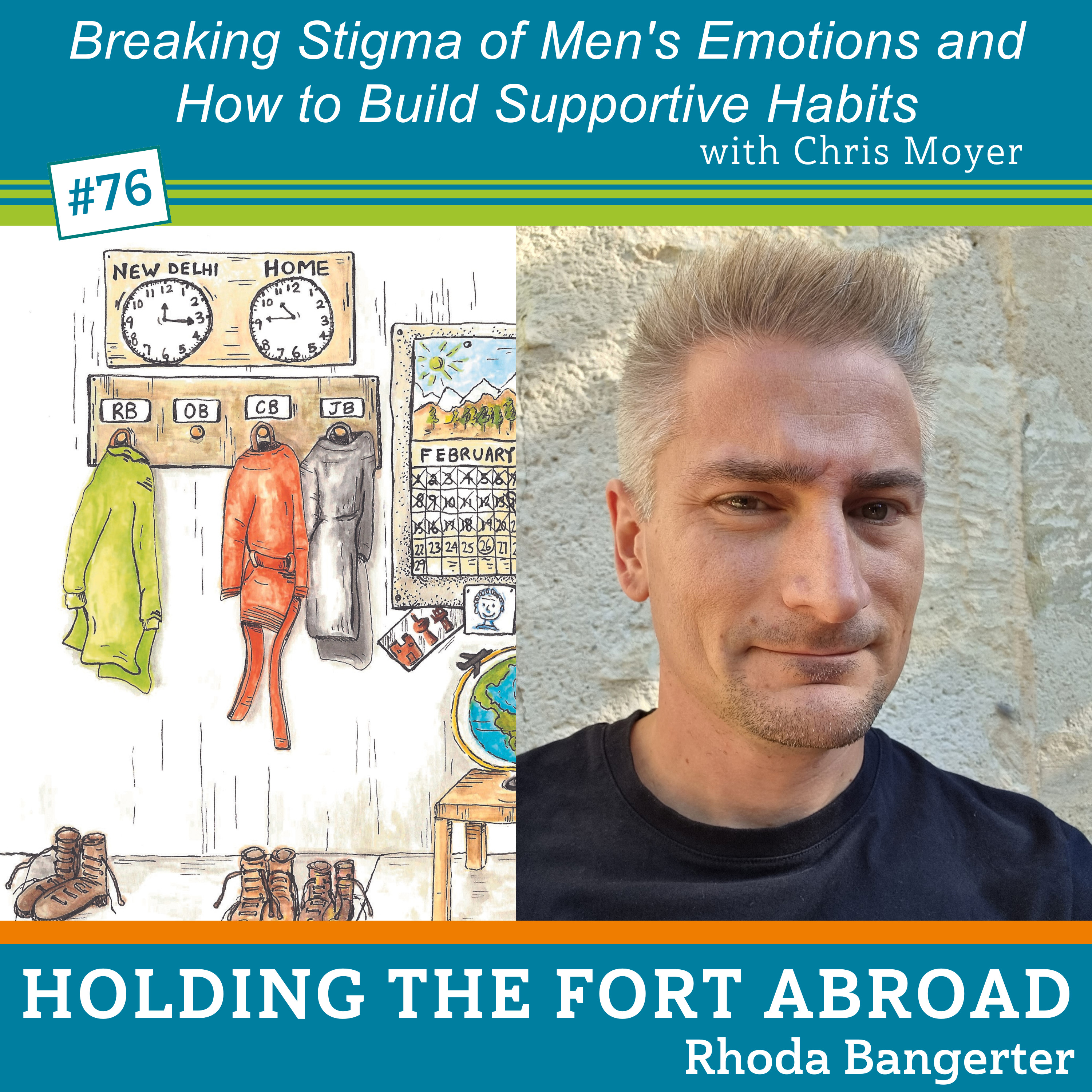
S1 Ep 76#76 Breaking Stigma of Men's Emotions and How to Build Supportive Habits - with Chris Moyer
Synopsis:Men and emotions, a topic that often goes unspoken. This conversation offers insights and practical advice for men struggling to navigate their feelings—especially against the backdrop of expat life and being away from family for work. We discuss loneliness, anger, anxiety, guilt. Whether you’re a man living abroad, a partner supporting one, or simply interested in emotional wellness across cultures, this episode brings actionable tips, and hopeful encouragement for the journey. Chris Moyer is a leader in Third Culture Kid care. He brings years of experience in coaching, counseling, and supporting expatriates. He currently lives with his family in France. “I think your average man may not necessarily feel the need for a discussion like this, but the reality is that men and women are emotional beings and part of our overall health is emotional wellness. And so finding a way to bridge that gap is really important and something that I'm quite passionate about.”KEY THEMES:1. Men and Emotional ExpressionRhoda and Chris explore the unique challenges men face around acknowledging, understanding, and expressing emotions—particularly in the context of expat and globally mobile lifestyles. Chris highlights how men often lack “permission” to be emotional, with social norms limiting emotional discourse mainly to anger. , “Many of us have learned one way or another that as men, emotions are typically not okay. They’re a sign of weakness.2. The Importance of Emotional HealthEmotional health is tied to overall wellbeing and healthy relationships. The conversation compares emotional self-care to physical health maintenance—a proactive, ongoing practice rather than only a reactive one.3. Navigating Difficult Feelings AbroadLiving abroad, especially for men, can intensify feelings such as loneliness, guilt, anxiety, and resentment. Chris shares his personal experience with loneliness when his family travels, and they discuss how these emotions are often magnified by distance or the transient nature of expat life.4. Overcoming Stigma and Building SupportChris speaks on the stigma men face seeking support (from friends or professionals) for emotions like anxiety or guilt. Men often struggle to find spaces or relationships that allow honest emotional conversation, as “fixing” is the default response from others.5. Family & Cultural ImpactThe role of upbringing, culture, and family dynamics is discussed, including how societal expectations shape the emotional lives of men and perpetuate certain patterns (or help break them in the case of intentional parenting).6. Actionable Tips & ResourcesPermission & Awareness: The first step for men is granting themselves permission to feel and name emotions.Relationships & Mentors: Cultivating close, trusted friendships and finding mentors can create spaces for vulnerability. Intentionally build a core support group, especially as a transient expat. This can sometimes take years. Normalise emotional conversations among men, and don’t be afraid to seek or offer presence rather than solutions.“it's more about a way of life. To me it's about checking in with myself regularly. And so part of that is I've got a mentor who I meet with on a regular basis, somebody who's walked a very similar way of life, who's a dear friend, but also a mentor who just listens and encourages”Physical Activity: Movement and exercise are powerful tools for managing emotional stress and processing feelings.“Making sure that we're taking care of our bodies is critical, it doesn't solve all of our emotional stuff, but it does get out a lot of some of the angst that we can be feeling.” Proactive Self-Care: Routinely checking in with yourself and your support network is key—don’t wait until emotional “warning lights” flash.Proactively prepare emotionally before relocating or traveling for extended periods.“how are you building into your emotional health in a proactive way? If you're doing that, I think you're going to have what you need around you to help you when the crisis comes. Because crises come, that's just part of life”Professional Help: Sometimes professional support is essential, and there’s no shame in seeking it.“Part of the human journey is learning how to relate to myself, and then how I relate to others, whether it’s my emotions or theirs.”Resources mentioned in this episode: Top Tip Sheet: How To Manage Intense EmotionsBook The Winding Road to Portugal: 20 Men from 11 Countries Share Their Stories: Ross, Louise: 9781905597994: Amazon.com: BooksHolding the Fort Podcast Episodes on EmotionsEpisode #49: Tapping and managing emotionsEpisode #43: Related emotional wellness topicsContact Chris Moyer on his LinkedIn Page https://www.linkedin.com/in/chris-j-moyer/Receive news regularly on new episodes of HTFA Podcast and on new events and resources. Subscribe to my newsletter.Buy the book: Holding the Fort AbroadYour partner's job opportunity
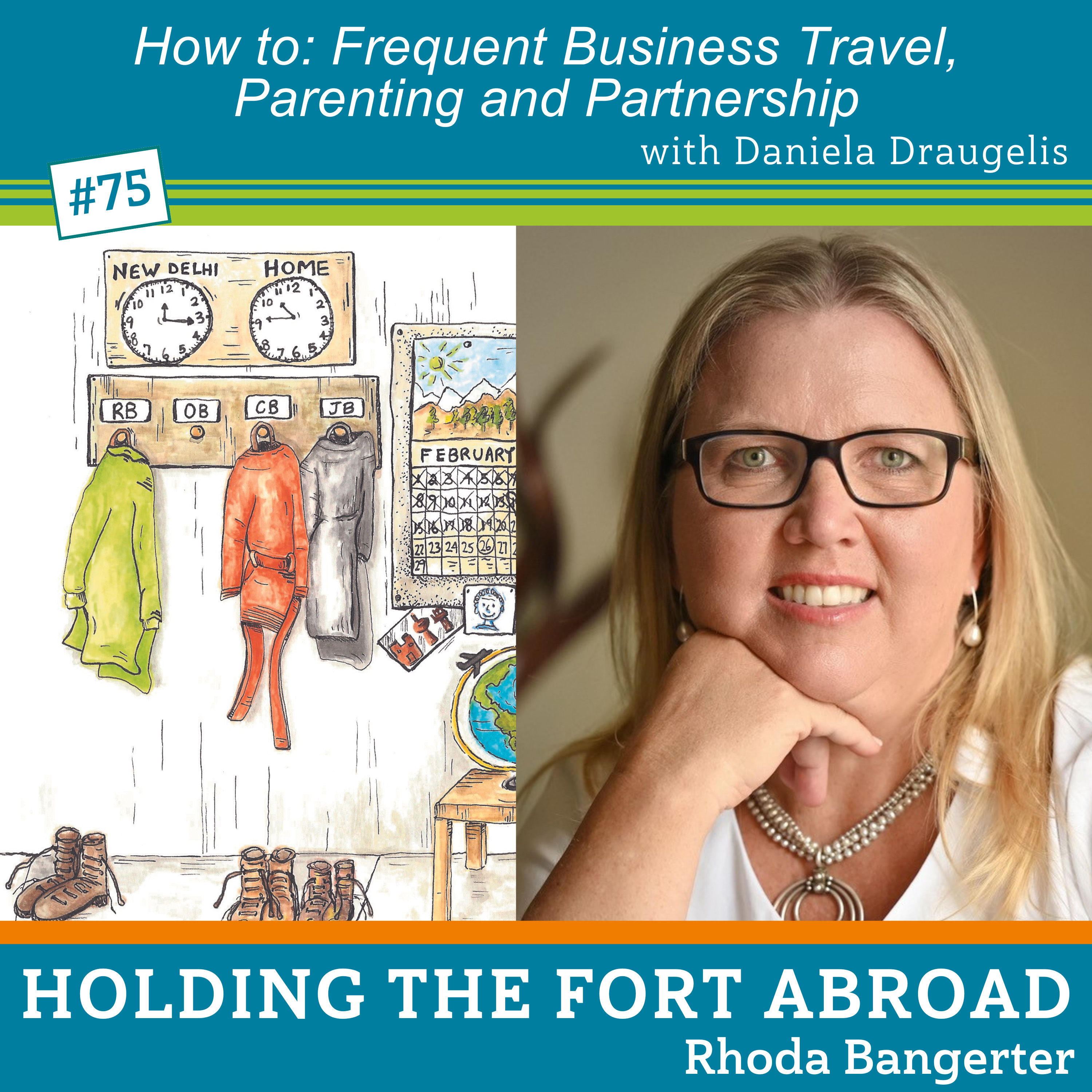
S1 Ep 75#75 How to: Frequent Business Travel, Parenting and Partnership – with Daniela Draugelis
Synopsis:As the spouse of a World bank executive for over 30 years, Daniela Draugelis has experienced firsthand the unique challenges and growth that come with raising a family while navigating extended work travel, often more than 100 days a year. Daniela is an intercultural trainer, a certified professional coach and cultural intelligence facilitator with over 20 years of experience living and working across cultures. Today, she helps expats, diplomats and internationally mobile families thrive through coaching and training that blends cultural intelligence, energy, leadership, and deep personal insight.In the children’s early years, Daniela’s husband was absent for periods of travel lasting 4-5 weeks, repeated absences from when children were newborns to age six or seven. Later years: transition to more local/domestic weekly travel; changes in family rhythm Emotional and Practical Impact of Early Years Absences Daniela’s experience of isolation: living outside her home country, lack of support system, balancing professional life, childcare, and household responsibilities during husband’s absences.Impact of child’s health condition (breath holding spells) on couple’s decision that Daniela would pause her career to focus on her child’s health. Importance of local friendships and informal support networks Examples of reaching out to neighbors for help (especially during illness) Using calendars and stickers to help young children understand the duration of absences Rituals for departure and return: airport drop-offs/pick-ups as a family routine. Managing children’s expectations and emotions around time and connectionBrief conversations with young children. Mainly Daniela’s husband consistently made the effort to be involved with children’s lives and to never miss major milestonesNavigating Reentry and Shifting Dynamics Jet lag and fatigue upon returnChallenges for Daniela switching between solo-parenting and co-parenting Maintaining authority and involvement for both parentsEstablishing and Preserving Father-Child Bonds Deliberate decision to let “fishing” be a special dad-and-children activity Creating unique touchpoints for father-child connection that persist into adulthoodChildren’s current relationships with their fatherstrong bondsno lasting resentment In children’s older years, the rhythm of travel changed. Availability of household help, school routines, and after-school activities easing stress for DanielaFocus on family time during reunions, sometimes at the expense of couple time Reflection on the need for intentional couple routines and conversation Challenges in maintaining both professional and marital identities for Daniela Daniela’s return to Personal and Professional FulfillmentVolunteering, skill-building, and staying engaged while not formally employed Transition into new career as a coach and intercultural facilitator Hindsight and Lessons Learned Wish for more guidance and support in earlier years The value of not feeling alone, and building routines for smoother transitions Importance of discussing changes and keeping the traveling partner updated on family life Resources mentioned in this episode: The ICAN Model, developed by Dr Ken Canfield stands for Intentional Involvement, Consistency, Awareness, Nurturing, This model works well for parenting at a distance and can be supported by both parents. Read more about it here How the ICAN Model Helps Families Stay Connected When One Parent Travels - Rhoda BangerterHow to contact Daniela Draugelis Connect with her on LinkedInVisit her website: Cultural Pathways Receive news regularly on new episodes of HTFA Podcast and on new events and resources. Subscribe to my newsletter.Buy the book: Holding the Fort AbroadYour partner's job opportunity in another country seemed like an exciting idea, but lengthy work assignments mean you're holding down the family fort - alone.OR Your partner is working and living in another country, and you feel like you are shouldering all the home responsibilities alone.You may be wondering:How can we be a family when we're miles apart?Can I cope, alone, when troubles arise?I believe there are answers to the above questions, and the answers start with you. In this context, it's more important than ever to invest in yourself, to care for yourself, to set your own goals and to watch yourself grow. Equally important is to nurture your relationship with your partner and learn to parent together.
S1 Ep 74#74 Work, Love, Distance: Real Strategies For Couples Living Apart – with Pascale
Synopsis:Today my guest is Pascale. She and her husband are living in different countries and working in different countries and she's going to share a little bit what it's been like for her, what they've put in place and just how it works for them to encourage listeners, anyone who's living and working in different countries. We always decide together which assignment is best for the family. We don't have any children so it's easier but we need to mind our dual careers. 00:26:17 - 00:26:30Highlights from today’s episode: 1. **Mutuality Over Martyrdom** Pascale and her husband operate as a “winning team.” Each time one scales back for the other, it’s for the health of the bigger “us,” not as an IOU to lord over each other later. “Dual career needs dual involvement,” she says. “You can't do things on your own…it needs to be a winning team.”2. **Your Network Is Your Lifeline** In each new country, Pascale sought out expat associations, not just for information about “where to shop” but, crucially, to ease the transition. Locally embedded friends and colleagues who “lift you up” are an emotional and practical anchor, especially when time zones and travel get in the way.3. **Relentless Communication - Even on Call** With modern technology, they don’t let days go by without checking in—even if it’s just a quick chat to share their day. The only time they miss If she’s on call” Pascale says.4. **Redefining Milestones and Celebrations** When you inevitably miss a birthday or family gathering, you don’t wallow: you reschedule, adapt, and invent new rituals. “Sometimes you can move things around—so you have to adapt.”5. **Reframing Criticism** When faced with skepticism (“Why be together at all?”), Pascale notes that having supportive friends—often fellow expats who “know the problematics”—makes a world of difference. Find your tribe.Not Just Survival, But Fulfillment Pascale isn’t sugarcoating reality: sometimes, compromise means slower career progression. Sometimes, you truly do miss out. But, critically, solidarity, mutual support, the skill of adaptability and a willingness to see the adventure in the arrangement replaces doom with possibility.“Look at the positive things first,” Pascale urges. “Work as a winning team within your couple and your family…and get a good network of support.”This isn’t about pretending the split-location lifestyle is easy—or right for everyone. But for some the arrangement can flip the script: transforming anticipated loss into new connections, growth, and even fulfillment. Sometimes, having your heart (and, yes, your luggage) in two places really can work.Receive news regularly on new episodes of HTFA Podcast and on new events and resources. Subscribe to my newsletter.Your partner's job opportunity in another country seemed like an exciting idea, but lengthy work assignments mean you're holding down the family fort - alone.OR Your partner is working and living in another country, and you feel like you are shouldering all the home responsibilities alone.You may be wondering:How can we be a family when we're miles apart?Can I cope, alone, when troubles arise?I believe there are answers to the above questions, and the answers start with you. In this context, it's more important than ever to invest in yourself, to care for yourself, to set your own goals and to watch yourself grow. Equally important is to nurture your relationship with your partner and learn to parent together.Buy the book: Holding the Fort Abroad
S1 Ep 73#73 Expatriation, Repatriation and Commuting: Behind the Scenes of Expat Life – with Karlijn Jacobs
Synopsis:Karlijn Jacobs supports organisations to enhance the success of international relocations through a family centered approach. She is the world's first ombudsperson for international children and families.Today we're going to be speaking about what she does at Expat Valley, and we're also going to hear a bit of her story of a time when her husband was away for work. Highlights from today’s episode: Moving to Shanghai with the whole family - navigating change and maintaining both careers. Taking the decision together. The importance of supporting families for a successful expatriation Karlijn’s and her husband’s experience of commuting. What led to the decision for Karlijn’s husband to commute to another country. ‘this was a good way to move forward…in the beginning, we thought we were getting the best of both worlds. My husband could progress his career and I would be home with the kids, close to our extended family and friends in the place that we wanted them to grow up. But, oh boy. 22:58 - 23:14Underestimating repatriationAdapting to the new setup: leaving on Tuesdays and returning on Thursdays eveningsThe context matters as well: how many transitions are you going through at the same time: Birth, move, new job, repatriation? “I think it was really only after a year or so that it was fully dawning on us that we signed up for something that was a lot more complicated than we anticipated.” (23:55)Open ended commuting assignments are harder “We realized that we signed up for something that we weren't going to make disappear. Like that was there, that was part of our normal routine. It wasn't a matter of investing time and energy and then you can finish that part 26:47 - 27:00The difficulty of setting up a business at the same time (the first attempt at establishing a business with two children under 3, her husband commuting and Karlijn blaming herself and feeling she was failing as a parent)The shifting between being 3 to being 4 people at the week-ends “the family dynamics, that would just change twice a week. Like it would drive all four of us nuts…for me to make that shift every so many days, that was exhausting.” 33:07 - 33:32Understanding that ‘split location’ comes with common challengesIf you have people who can help ‘and they're only a phone call away, then pick up the phone, ask for help, protect your own sanity. Embrace that you don't have to do it all by yourself and take all the help you can get up there. 38:53 - 39:12What stopped Karlijn from asking for help: used to being independent feeling she should be able to do it yourselfnot wanting to be a burden“if you really want to hold on to these beliefs, then don't sign up for it (commuting or split family assignment), because you can't do this all by yourself.” 38:01- 38:09“I could have been so much more relaxed with myself as opposed to setting the bar really high, pretending that we were a normal family and then not, not succeeding because of all sorts of self imposed goals and objectives.” 40:15 - 40:30Commuting with little children: transition times and colour coded calendarsAsk Karlijn anything about Successful Family Relocation Experiences in a 15-min call: https://calendly.com/expatvalley/ask-me-anythingemail: [email protected]: www.expatvalley.com Receive news regularly on new episodes of HTFA Podcast and on new events and resources. Subscribe to my newsletter.Your partner's job opportunity in another country seemed like an exciting idea, but lengthy work assignments mean you're holding down the family fort - alone.OR Your partner is working and living in another country, and you feel like you are shouldering all the home responsibilities alone.You may be wondering:How can we be a family when we're miles apart?Can I cope, alone, when troubles arise?I believe there are answers to the above questions, and the answers start with you. In this context, it's more important than ever to invest in yourself, to care for yourself, to set your own goals and to watch yourself grow. Equally important is to nurture your relationship with your partner and learn to parent together.Buy the book: Holding the Fort Abroad
S1 Ep 72#72 Long-Distance Love: Handling Porn, Apps, and Real Talk – with Karina Lagarrigue
ESynopsis:This episode dives into the complexities of intimacy, fidelity, and connection for couples navigating life in different locations. In this candid conversation with Couples Therapist, High Sensitivity Specialist and Sex Therapist Karina Lagarrigue we bring to the forefront the tough and often unspoken realities faced by partners separated by distance.We unpack why issues like pornography and dating app use can arise. We discuss the loneliness and vulnerability that can lead couples to seek comfort online, and how seemingly simple actions can have deeper meanings and impacts on relationships.Host Rhoda Bangerter and Karina Lagarrigue don’t shy away from the difficult questions: Is fidelity truly possible when you’re physically apart for months at a time? How do you build trust and intimacy when life keeps pulling you in different directions? And, most importantly, how do you create a safe space to talk about your needs and desires—no matter where you are in the world?If you’ve ever struggled with maintaining closeness across the miles or wondered how to keep the connection alive, you’re not alone. This episode is full of empathy, practical advice, and encouragement for couples everywhere, and especially those living geographically separate across countries and continents. Tune in for an honest, nuanced look at modern intimacy and the power of communication, knowing yourself, creativity, and trust.Key takeaways for anyone navigating these waters—whether you’re an expat, frequent traveler, or simply in a long-distance relationship:🔹 Understanding the "Why" MattersBefore reacting to a partner’s use of technology—whether it’s pornography or dating apps—stop to ask why. Often, these behaviors stem from unmet needs, loneliness, or gaps in connection, not just disinterest or infidelity.🔹 Communication & Boundaries Are Non-NegotiableMeaningful conversations about needs, fears, and boundaries can transform how couples experience distance and sexual intimacy. Don’t wait for a crisis to talk; proactively clarify what fidelity and trust look like in your unique context.🔹 Intimacy Is Broader Than We ThinkPhysical reconnection after time apart isn’t just about sex. Find creative, pressure-free ways to connect—emotionally, intellectually, and physically. Rebuilding intimacy requires patience, generosity, and sometimes professional support.Remember: we aren’t raised to have these conversations, so it’s normal to feel awkward or uncertain. But cultivating trust and self-awareness is possible - and worth it.If you want to hear more on this subject, listen to my conversation with Phillips Hwang in Episode #37 ‘Love Knows No Borders, Connection and Intimacy in Long Distance’ Are you a couple who moves? Join Wiebke and I in Autumn 2025 for a virtual summit designed to inspire, educate, and empower you as an expat couple. www.expatcouplessummit.com Receive news regularly on new episodes of HTFA Podcast and on new events and resources. Subscribe to my newsletter.Your partner's job opportunity in another country seemed like an exciting idea, but lengthy work assignments mean you're holding down the family fort - alone.OR Your partner is working and living in another country, and you feel like you are shouldering all the home responsibilities alone.You may be wondering:How can we be a family when we're miles apart?Can I cope, alone, when troubles arise?I believe there are answers to the above questions, and the answers start with you. In this context, it's more important than ever to invest in yourself, to care for yourself, to set your own goals and to watch yourself grow. Equally important is to nurture your relationship with your partner and learn to parent together.Buy the book: Holding the Fort Abroad
S1 Ep 71#71 Powerful Lessons from a Life of Constant Change – with Colleen Higgs
Synopsis:Colleen Higgs shares her insights from many moves and times when her husband worked far from home. We discuss the hidden costs of change, the importance of recognising and naming transitions, and Coleen shares hard-won wisdom about making space for recuperation and letting go of impossible expectations. She offers practical strategies drawn from her upcoming book and her own journey - reminding us that it’s okay to prioritise, slow down, and ask, “What matters now?”If you are in the middle of a transition and feel you don’t have time to listen to more podcasts, this episode is worth the listen! It will help you give yourself grace, it is packed with insights that you need for your transition, you’ll recognise yourself in what we talk about as we meander through the huge impact of change and transition in our life. “Expecting to go through a big transition without stress is like going to the gym and expecting not to sweat. You have extra demand, but you need to recuperate more often.” Here are four standout takeaways for anyone tackling transitions—at home, at work, or across continents:Transitions Demand More Than You Think Transitions are supposed to be hard! Expecting zero stress is unrealistic; be ready for extra emotional, mental, and practical load when life shifts.Transitions Will Change Your Day to Day Life What will be more difficult? What will require more planning? How will my responsibility change? Intentional Recuperation Is Non-negotiableYou can’t just power through. Colleen recommends building in time to truly recuperate (not just rest), intentionally choosing what to drop, and giving yourself permission to ease up during intense periods of change.Prioritize What Matters NowWhen routines and roles are in flux, ask yourself: what matters most in this moment? Don’t worry about ideal standards or “best practices” from another season or culture—focus on what your family, team, or self needs right now.For those in split locations, Colleen recounts a conversation she had with someone recently: ‘she and her husband did a split location situation for a period of a few years, and they were both very high functioning career people, so they just did it. In retrospect, she told me, by the time I knew it was too much for me, we were in it. We were committed. I felt like I couldn't tell him. It took us years to recover, to get on the same page as parents and as a family again. And just if I had any idea of what a big transition it would be, would have been for our family, I would have done things differently. I would have dropped some commitments, some committees, maybe stepped off the corporate ladder for a period. I would have made some intentional decisions, but I didn't realize how hard it would be until I was in the middle of it.’It is also important to think about how that transition affects your life on a more daily level. Moves will be more obvious, but think how a split location will affect your day to day life: what is going to be more difficult, what it going to take more planning, etc.Colleen's BookColleen’s book on transitions is nearly ready for beta readers! If you’d like to share your perspective or get a sneak peek, sign up for her newsletter or express your interest at: [email protected] news regularly on new episodes of HTFA Podcast and on new events and resources. Subscribe to my newsletter.Buy the book - Holding the Fort Abroad.Your partner's job opportunity in another country seemed like an exciting idea, but lengthy work assignments mean you're holding down the family fort - alone.OR Your partner is working and living in another country, and you feel like you are shouldering all the home responsibilities alone.You may be wondering:How can we be a family when we're miles apart?Can I cope, alone, when troubles arise?I believe there are answers to the above questions, and the answers start with you. In this context, it's more important than ever to invest in yourself, to care for yourself, to set your own goals and to watch yourself grow. Equally important is to nurture your relationship with your partner and learn to parent together.
S1 Ep 70#70 The Spaces In Between: Family Life in Constant Transition
Synopsis:"It seems to me that globally mobile people and people who live these geographical separations, we tend to have these ongoing non stop transitions and not only one at a time, we tend to have multiple transitions going on at the same time."Whether it’s a big move, a new role, the bittersweet send-off when a loved one leaves, or adjustments that come with globally mobile living, transitions are everywhere. Using William Bridges’ renowned model, this episode explores the three phases of transition-endings, the neutral zone, and new beginnings - and discusses how these play out in our lives as expatriates or families separated by work commitments. I also reflect on my own ongoing transitions, share insights from expert guests from previous episodes, and talk about crucial skills that can make every transition just a little bit easier.What transitions are you in at the moment?Biggest takeaways from ‘Transitions’ from William BridgesOngoing transitions and multiple transitions at a time including strategies to navigate themHow transitions show up in Frequent Work Travel and longer geographical separationsResources mentioned in this episode :Transitions; Making Sense of Life’s Changes by William BridgesHolding the Fort Abroad Episode #17 with Arlette Chatlain (Family rituals during split-location)Episode #28 with Kirsten Pontius (Maintaining your minimum amid chaos)Episode #23 with Kate Gondouin (Coping with frequent transitions in corporate and personal life) Action Steps:Make a list of all the transitions you’re in (or have recently experienced) - even the small ones!Identify your “minimum” self-care routine to preserve your wellbeing during busy times.Collaborate with your partner/family to create your own set of reconnecting questions and rituals.Wherever you are in the world, know that you’re not alone.

S1 Ep 69#69 Takeaways from 3 years of conversations on living geographically apart – with Rhoda Bangerter
Synopsis:In this anniversary episode, we celebrate the third anniversary of the Holding the Fort Abroad podcast! With 66+ episodes, the podcast carves a unique space in the global podcast landscape. The podcast explores the realities and nuances of split location family life and life when one of you is a frequent business traveller. The podcast episodes include deeply personal stories, honest conversations, and connect with experts to bring you real talk and impactful narratives. My mission is to provide not just insight, but also practical strategies and emotional support for families who live apart, ensuring that they never feel alone in their journey. Today, Wiebke Anton turns the tables on me to interview me diving into my experiences, insights, and the cherished moments that have defined this incredible journey. Join us as we reflect on the past, celebrate the present, and look forward to where Holding the Fort Abroad is headed next with plenty of useful strategies included!Keep your ear out too for surprise appearances from Amel Derragui, Olivier (Rhoda's husband!) and Navine Eldesouki.PART 1: Looking back at Rhoda’s journey as a podcasterThree years in — how has hosting this podcast influenced you personally and professionally?If you could go back to the first episode and give yourself one piece of advice, what would it be?What was the most unexpected or surprising insight you gained from a guest?PART 2: Memorable Moments and big lessons (lessons still applicable to new listeners)Out of all the episodes, is there one conversation that deeply moved you or shifted your perspective on split-location families? Was there a story that stuck with you—something that made you pause and rethink how families navigate distance?Looking back at all the conversations you’ve had, what are some of the biggest misconceptions people have about making long-distance/split-location family life work?Have you seen a gap between the way people imagine it versus the reality?What is a recurring topic or concept in your podcast conversations that many seem to overlook?You’ve spoken to so many couples and families who make it work in different ways—what do they have in common?Are there specific habits, mindsets, or approaches that seem to set the most "successful" ones apart? And, can you please explain, how families should define "successful" in this context?And on the flip side, what are the early warning signs that a setup might not be sustainable?PART 3: Connecting to Rhoda’s upcoming journey You’ve spent years speaking to families navigating split-location life - and now you’re about to embark on it again yourself. Has anything you've learned from the podcast changed the way you're approaching this transition?Is there an episode or a piece of advice from a guest that you’re personally holding onto as you prepare for this next chapter?PART 4: Impact and OutlookHas a listener ever reached out with a story about how your podcast impacted them?If you had to distill three years of conversations into one key message for international couples (who live it or consider living it), what would it be?What’s next for the podcast? Any exciting plans or dreams for the future?If you could interview anyone on this topic and invite to your podcast-past or present, dead or alive, who would it be and why?CLOSING:What’s one question you still don’t have an answer to but would love to explore in the coming years?About Wiebke:Wiebke Anton is a relationship Coach for Expat Couples and the co-Founder of the Expat Couples Summit. She supports expats, intercultural couples and singles in Rwanda and Beyond. Curious about the state of your relationship? Get instant feedback with Wiebke’s Couples Health Check-up Questionnaire! Takes just minutes to find out where you stand and what can make it better… Help4Love Relationship CoachingAre you a couple who moves? Join Wiebke and I in 2025 for an immersive virtual summit experience designed to inspire, educate, and empower you as an expat couple.www.expatcouplessummit.com
S1 Ep 68#68 Anchor Yourself in Fitness: How to embrace Daily Exercise – with Mylene Jalladeau
Synopsis:Mylene Jalladeau specializes in fitness for busy people. Join us as Mylene shares her holistic approach to fitness, emphasizing the importance of integrating physical activity into daily life as seamlessly as eating and drinking. Mylene candidly discusses her personal journey from exercising for aesthetics to finding a balanced, health-oriented approach. Together, Rhoda and Mylene explore how fitness can serve as an anchor in the demanding lifestyles of expatriates and those living with work travel, fostering both mental and physical well-being. Tune in to discover effective strategies and insights on commencing and maintaining a fitness journey, tailored to support the unique challenges faced by those frequently on the move.Key Takeaways from Our Discussion:Holistic Approach to Fitness: Mylene believes that exercise should be integrated into our lifestyles as naturally as brushing our teeth. It’s not just about aesthetics but creating a balance that supports mental, physical, and emotional well-being.Starting Point: Everyone has a unique starting point. Mylene stresses the importance of beginning your fitness journey with the body and capabilities you have now and gradually improving from there.Consistent Effort: Mylene highlights that consistency outweighs perfection. Even short, regular sessions can lead to significant improvements over time. She encourages beginning with just 20 minutes if that's what you can manage.Balancing Life and Fitness: For busy parents and individuals frequently traveling for work, fitness should be adaptable. Mylene provides insights on how to make it a natural part of your life without overwhelming your schedule.Mindset Transformation: Beyond physical workouts, changing your mindset and finding your personal 'why' is crucial for long-term health and motivation.Contact Mylene: Mylene coaches online and in person in Bishkek. To discuss the best plan for you find her on:Instagram Linkedin where she also writes about the interaction of fitness and work.
S1 Ep 67#67 How to improve communication for families living apart – with Kathleen Smith
SynopsisIn this episode, we explore how the C-Me Color profile can enhance communication and understanding for those living apart or frequently traveling.We have the pleasure of hearing from Kathleen Smith, the membership director of Families in Global Transitions and the founder of Global Grandmas. Kathleen brings a wealth of experience in assisting families in navigating international relocations and maintaining their core values across borders. Kathleen shares her fascinating journey, insights into building supportive family dynamics, and how anyone can find or become a "global grandma." Whether you're a family adjusting to a new country or an individual managing work-life balance from afar, this episode is packed with practical advice and heartwarming stories.Families in Global Transition (FIGT):FIGT is a community that supports families globally through transitions. It began as a "kitchen table" gathering where real conversations happen.The organization emphasizes service and mutual support.C-Me Color Profile: A tool that can be used to enhance communication among family members who live apart due to frequent travel or international assignments.The profile focuses on working preferences rather than personality types, highlighting four colors:Blue: Detail-oriented, structured, enjoys problem-solving.Green: Caring and concerned for others, often indecisive as they seek group harmony.Red: Bold, confident, sets goals, and leads decisively.Yellow: Talkative, optimistic, enjoys spontaneity.Importance of Colors in Family Communication:Understanding these color preferences can aid families in bettering their communication and complement each other’s styles, especially during transitions or separations due to travel.The personal development tips for each color were provided, aiming for better family dynamics.Global Grandmas InitiativeKathleen introduces the concept of Global Grandmas, also encouraging older individuals to become supportive figures in the community even if not biologically related.The initiative fosters intergenerational bonds, asking and offering supportFind out more about the history of C-me. It is not meant to put anyone in a box! The benefits of using colours: colours blend more, they feel less judgemental, how we express them is unique and they are memorable. C-me colour profiling: Understanding your strengths: Organisational Development : Schools and services : University of SussexJoin us at Families in Global Transition Global Grandmas – Gathering Together, Flourishing Forward
S1 Ep 66#66 How to prepare for geographical separation: Tips for families with one parent about to live abroad – with Rhoda Bangerter
Synopsis:Living geographically apart can be a challenge, but with the right preparation and support, it can also be an opportunity for growth. I'm Rhoda Bangerter, host of Holding the Fort Abroad. In this episode, I share three essential ways to prepare for this unique lifestyle once the decision has been taken. This episode follows episode 42 about deciding whether to take on an assignment which would mean geographical separation. Tune in to learn more! You might want a pen and paper to jot down the questions to ask yourselves. Three Essential Ways to Prepare:1. Observe and Adjust:Write down and observe what each partner contributes to the household before the move. This will help in delegating tasks and understanding what needs adjusting when one partner is away. Also include where and how each partner receives emotional support and whether adjustments will need to be made. 2. Communication is Key:Establish a communication plan to keep your relationship strong and avoid misunderstandings. But hold on to it lightly as things can change once the assignment is under way and also as it evolves as time goes on.3. Involve the Kids:Keep kids engaged in the transition by having family meetings. This ensures they feel heard and can express their thoughts about the changes. Identify each family member's love language to maintain strong emotional connections despite the distance.4. One step at a time Don’t try planning for the whole assignment, take it one section at a time (i.e. one departure and one return at a time) Preparing for this new phase thoughtfully can make the journey smoother for everyone involved. For more insights and tips, listen to our full episode!
S1 Ep 65#65 How to create psychological safety – with Elizabeth Vahey Smith
Synopsis:Elizabeth Vahey Smith is back to talk about trauma informed leadership. Find out practical tips for parents on how to engage with their children when witnessing heightened emotional responses, ensuring the child feels heard and understood. We give examples about how that could happen when a parent is away for work. Elizabeth gives insights from her new book on establishing psychological safety in the workplace, recognizing elevated responses, and fostering a culture of trust and resilience. You can also listen to her previous episode on HTFA podcast #49 where she gives strategies on how to process our emotions.What you Will Learn:1. Parenting isn't just about raising kids-It's about leading them. Elizabeth Vahey Smith, COO of TCK Training, sheds light on how trauma-informed leadership principles can transform our approach to parenting.2. Elizabeth shares a pivotal moment when she realized that leadership, both at work and home, was being handled poorly. Her experience of being triggered by leadership at work made her rethink how she was parenting her children.3. The key insight? Leadership behaviors-like not listening or giving few choices-can erode psychological safety, whether you're at the office or at home with your kids. Parents often exert authority over children without realizing the impact. 4. Trauma isn't always about big events. Even small incidents can leave lasting emotional consequences. For kids, it might be something as subtle as a parent missing a significant event due to work travel. 5. Want to be more trauma-informed? Start by asking questions and getting curious about your child's resistance. Understand what's blocking them rather than just exerting authority. 6. In the workplace, similar principles apply. Leaders should aim for psychological safety, ensuring that team members feel heard and valued, which boosts engagement and productivity. 7. Elizabeth's upcoming book: "Trauma Informed Leadership," offers a comprehensive guide on navigating trauma in various settings—from parenting to corporate management. 8. Let's redefine leadership: It's about mobilizing people with an awareness of their past experiences and fostering environments that promote healing and resilience. 9. Let's build cultures of trust and safety, where everyone feels heard, whether at home or in the office, . Empowering families and teams to thrive begins with understanding and compassion. 10. It's time to bring trauma-informed principles to the forefront. Dive deeper into Elizabeth Vahey Smith's work and redefine the way you lead at home and beyond. Read more: Trauma Informed Leadership by Elizabeth Vahey SmithAbout ElizabethContact Elizabeth
S1 Ep 64#64 How to improve Sleep Health For The Traveller And The Stressed – with Funke Afolabi-Brown
Synopsis: Dr. Funke Afolabi-Brown is a distinguished medical doctor specialised in sleep medicine. We discuss the crucial impact of sleep on well-being and productivity, particularly for those leading high-intensity lifestyles and constant travel.In This Episode:Importance of Sleep and Its Consequences Negative Effects of Poor SleepCognitive impacts: focus, memory issues, increased risk of Alzheimer’sPhysical health impacts: blood pressure, heart issues, immune system functionality, metabolism, diabetes, obesityMental health impacts: burnout, anxiety, depression, suicidalitySleep and High-Intensity Lifestyle Jet LagDifference between temporary jet lag and jet lag sleep disorderStrategies for pre-travel, during travel, and post-arrival adjustmentsImpact of frequent travel on circadian rhythm and strategies for mitigationOrganizational Support for Employees Educating OrganizationsImpact of lack of sleep on health and productivityStrategies for organizational support: recovery time, comfortable sleeping arrangements, etc.Importance of promoting sleep wellness for better organizational outcomesManaging Stress and Sleep Techniques for Reducing Stress and Improving SleepImportance of a bedtime routineStrategies: journaling, breathing exercises, progressive muscle relaxation, cognitive shuffleImportance of intention and finding personalized methodsSleep for Parents, Especially Moms Balancing Personal Time and SleepTime audit to find opportunities for self-careInvesting in personal time for restorative sleep and well-beingNapping During the DayGuidelines for NapsShort naps (20-30 minutes) recommendedBest time earlier in the dayAvoiding naps when suffering from insomniaIdentifying Sleep Disorders Signs of Sleep DisordersDifficulty in falling or staying asleep, frequent awakenings, fatigueSymptoms specific to sleep apnea: snoring, restless sleep, mouth breathingConsulting a specialist when necessarySleep Trackers Using Sleep TrackersBenefits for monitoring trendsCaution against obsession over dataImportance of balancing technology use with listening to one’s bodyDr. Funke Afolabi Brown’s Book "Beyond Tired"Overview of the book’s focus on children’s sleepTopics covered: behavioral sleep issues, sleep disorders, sleep in children with complex living arrangements, sleep for busy momsAvailability on AmazonFaith-Based Devotional Seven-Day DevotionalFocus on sacred rest: mentally, physically, and emotionallyAvailable for download on Dr. Brown’s websiteConclusion Encouragement to ListenersImportance of prioritizing sleep qualitySeeking help when necessaryRhoda and Funke express mutual appreciation.

S1 Ep 63#63 How to respond when criticised for choosing split locations – with Rhoda Bangerter
Synopsis:Welcome to Holding the Fort Abroad, the podcast about frequent business travel and working away from home. My name is Rhoda Bangerter and I help parents manage the stress and disconnect from living this life so that they can enjoy the growth and intention this lifestyle can bring. What you will learn:1. What members of our family have said2. Listen to those who know you and have followed your choice process 3. Split locations is an unusual way of life, but you are not the only ones doing it.Relevant episodes:#09 Shellee Burroughs #17 Arlette Chatlein#15 Becky Grappo#19 Colleen Higgs #20 Carole Hallett Mobbs#52 Florence Reisch #39 Michael Sullivan #60 Navine Eldesouki 4. Split locations can be devastating and break the familyWarnings re children: #06 Sharoya Ham Parenting Together Long Distance #46 Irene You Have to Behave When I Am Away - became a ‘good girl’ #51 Katia Vlachos The Impact of Parental Absence on Childhood#29 Dr Laura Anderson How to be a Family on Split LocationsWarnings re couples:#05 Vivian Chiona Facing the Challenges of Expat Life Together #24 Jenny Linton Myths that threaten long distance marriages #37 Phillips Hwang, Love Knows No Borders,Connection and Intimacy in Long Distance Relationships 5. How to create a family narrative#58 Lidia Lae
S1 Ep 62#62 How to be a strong family when miles apart – with Rhoda Bangerter
Synopsis:How do families stay together when work takes them away from each other? Wellbeing, Partnership, Parenting Together, Smooth Transitions and Emergency Preparedness: strengthen these five pillars. After I describe the pillars, I go through how you can use this framework if you are the one travelling, you are the one with the children, you are deciding whether to take a posting that would mean time apart, you are preparing to live geographically apart.What you will learn:Pillar 1 Personal Wellbeing and DevelopmentPillar 2 Partnership as a Long-Distance RelationshipPillar 3 Parenting Together Pillar 4 Smooth TransitionsPillar 5 Emergencies and Dangerous LocationsAfter I describe the pillars, I go through how you can use this framework if you are the one travellingif you are the one with the childrenif you are deciding whether to take a posting that would mean time apartif you are preparing to live geographically apartSign up for the Resource Center Find out more about my storyAs 2024 comes to a close, I thank all my guests for sharing their stories and insights and I thank all my listeners. I have enjoyed hearing your feedback on how you have been encouraged. Enjoyed This Episode? Please Leave A Review, Like and ShareThis will help more people find the podcast and get encouragement for this very specific lifestyle!
S1 Ep 61#61 Super Commuter Couples and what keeps them together – with Megan Bearce
Synopsis:Megan Bearce is a therapist, a speaker and the author of the book ‘Super Commuter Couples, the subtitle sums it up ‘staying together when a job keeps you apart’. Something that she and her husband have personally experienced. The book is also full of stories of others who live it. In this episode, Megan and I talk about building resilience when we live this kind of lifestyle, silver linings and also her work with organisations and why organisations need to support their staff who are away from home a lot for work.You Will Learn:Megan's experience and why she wrote the book. Why she thinks living geographically separate is not talked about much. Plus, changes since the book was published.Best ways of creating resilience. Silver liningsMegan’s work with organisations and why organisations need to support thisMegan's Links:WebsiteBookApple Books and Amazon Public Speaking:Megan’s Keynote speaker - demo video Relationships and Counselling - Megan’s interview by Matt Holman Become a patient:Megan takes patients for therapy in Minnesota, USA. Megan accepts coaching clients, specifically if you are thinking about one of you super commuting for work.

S1 Ep 60#60 Coffee with an expat on split location – with Navine Eldesouki
Synopsis:Navine Eldesouki shares with us what it is like living in split locations. She is the founder of Coffee with an expat, a community of women who lift each other up! At age 20, she left her home country of Australia and has lived in 8 countries, currently living in Dubai. Since 2020, her husband works and lives in another country.What you will learn:9 lessons from the podcast episode with concise titles and brief descriptions:1. Flexibility in ExpectationsBe adaptable, as life changes often affect plans, particularly in expatriate families dealing with distance and logistics.2. Importance of Self-carePursue hobbies and interests independently to maintain personal happiness and avoid relying solely on your partner for fulfillment.3. Emergency PreparednessHave a detailed plan for emergencies, including contact information and important documents, to handle unexpected situations smoothly.4. Maintaining Regular CommunicationUse scheduled Zoom calls to connect beyond logistics, maintaining a vibrant relationship through humor and personal interaction.5. Parental Responsibility BalanceRecognize the extensive responsibility of solo parenting while ensuring the traveling partner stays engaged and supportive.6. Transitioning Family DynamicsManage the complexities of reintegrating a traveling partner into household routines, especially during short visits.7. Building Local Support NetworksForge connections with neighbors and local peers for emergency support and daily assistance in the absence of a partner.8. Children's Emotional Well-beingAddress separation anxiety and maintain open communication to support children emotionally during parental absences.9. Encouraging Direct CommunicationFoster direct relationships between children and the absent parent, promoting strong family bonds.Resources Mentioned in the Show:Navine Eldesouki:LinkedIn InstagramDiary of an Expat: Unfiltered | NewsletterCoffee With An Expat:WebsiteMembershipInstagram
S1 Ep 59#59 Prioritising Family: A Story of High Performance and Presence – with Christian Ray Flores
Synopsis:Is a high performance life compatible with family life? Christian Ray Flores went from being a child refugee, a famous popstar, to the founder of Exponential Life, high performance coaching for purpose driven professionals with a lot of philanthropy, teaching, and speaking as well. In this episode, we speak about high performance, work demands, what it means for the family, and the changes he has made in his life. Key Takeaways:After hearing about Christian’s fascinating experience growing up across continents and his life as a famous popstar, we dive into why he changed direction and how he adjusted his travel time to prioritise his family life, although it cost him financially. 1. Navigating Work Travel and Family Life:Being able to balance frequent business travel with maintaining strong familial relationships is critical. Christian's experiences underscore the importance of setting boundaries and prioritizing family despite professional demands.2. Travel's Impact on Personal Relationships:Frequent work travel can significantly strain personal relationships, making it difficult to sustain connections. Both Christian and Rhoda emphasized the necessity of conscious efforts and lifestyle adjustments to mitigate these impacts.3. Implementing Travel Moratoriums:Christian shared his personal decision to implement a six-month moratorium on travel to re-focus on his family life. This pause allowed him to reset and reestablish a stable family environment.4. Frequency Management for Sustainable Balance:Post-moratorium, Christian decided to reduce his travel frequency to once every one or two months, finding this more manageable and less disruptive to his family life.5. Innovative Lifestyle Choices:To balance career demands with family presence, Christian suggested alternative lifestyles such as traveling with family and homeschooling children, emphasizing the importance of full immersion and presence with family during critical upbringing years.6. Role of Personal Relationships in High Performance:The episode highlighted that sustainable high performance is closely tied to support from personal relationships, including family. Frequent travelers must ensure that their work does not overshadow the need to maintain these essential bonds.7. Cumulative Time with Children:Christian opened up about the limited cumulative time one gets with their children after they leave home, stressing the importance of making the most of these early, critical years by being present and involved.8. Metacognition and Self-Awareness During Travel:For frequent travelers, having strong metacognitive skills helps in making conscious, deliberate decisions about how to balance work and personal life, avoiding the pitfalls of being constantly on the move without reflection.9. Communication and Boundary Setting:Effective communication and clear boundary setting are central to successfully managing the pressure of frequent travel on family life. This includes expressing needs directly and managing expectations both at home and on the road.10. Encouragement for Personal Growth:The podcast encourages personal growth for both those who travel frequently and their partners, advocating for a dynamic where both parties pursue self-improvement and clear communication to maintain a healthy balance.These insights provide valuable perspectives for frequent travelers on how to navigate the intersection of work demands and personal relationships, advocating for strategies that prioritize family without sacrificing professional aspirations.Guest Links:Christian Ray Flores https://www.xponential.life/ https://www.instagram.com/christianrayflores/https://www.christianrayflores.com/
S1 Ep 58#58 How to create your family story – with Lidia Lae
Synopsis:Create a strong family narrative that embraces diverse cultures and values to bridge any disconnect. In this episode, my guest Dr Lidia Lae explains how to develop a unique family culture that blends elements from different backgrounds, recognizing the best of both worlds. Lidia is a seasoned psychologist specialising in self-narratives. She shares her extensive research on how these stories shape our identities and influence our emotional well-being. She also provides practical tips and personal anecdotes on maintaining family unity, even when a parent is frequently away, using tools like family journal apps and focusing on gratitude. This episode reveals the power of self-narratives in reinforcing family bonds, fostering emotional closeness, and setting and achieving individual and family goals.You will learn:Developing a Family CultureLearn how to merge elements from different cultures into a cohesive family narrative that celebrates the best of both worlds.Harnessing Self NarrativesDiscover the impact of self-narratives in reinforcing family bonds and maintaining emotional closeness, even when a parent is away.Technology and CommunicationFind out how tools like family journal apps can aid in communication, fostering gratitude and making the absence of a parent less daunting for children.Personal StoriesLidia shares her experience preparing her eight-month-old daughter for her absence, demonstrating the power of positive narratives and communication with children.Emotional Support and Goal SettingUnderstand the importance of providing emotional support by framing absences as part of a bigger family story. We also discuss setting individual and family goals to build a strong family identity, offering a positive role model for children.Cultural ComparisonsLidia presents her research comparing self-narratives of European Australians and Singaporean Chinese, shedding light on how cultural differences influence family dynamics and identity.About Lidia:Dr Lidia Lae is an East-Timorese Chinese Australian writer, psychologist, and speaker. With a PhD in social psychology, Lidia explores themes of culture, memory, meaning, purpose, self, and identity, unravelling the intricacies of the human condition with deep curiosity and empathy. Through her writing—including upcoming books and regular blog posts at www.lidialae.com—she aims to inspire, educate, and empower by making complex topics engaging and relatable. As the director of To Learn Consulting, Lidia offers psychological and consulting services, guiding individuals and organizations to embrace their unique stories for personal and collective growth. Beyond her professional endeavours, Lidia balances her roles as a therapist, mother, and world traveller, bringing a rich, multicultural perspective to her work.Find out more about self-narratives and how to harness them for your family’s narrative
S1 Ep 57#57 How Companies Can Support Unaccompanied Staff – with Kathy Borys Siddiqui
Synopsis:Today my guest is Kathy Borys Siddiqui, she is the founder of Active Action and she works with organisations, helping them support their staff, specifically with intercultural training and family support. She was a panelist speaker at the HR event held in March on how organisations can better support their staff on split family assignments and today we are going to be continuing our conversation. If you are listening and you are the spouse of a staff or a staff member yourself, this conversation may correspond to some of the concerns you have about the support that you receive from your organisation and we would love to hear from you if any of what we are saying is resonating with you.If you are in a role supporting staff, I hope this conversation gives you ideas on how and why you need to increase your staff support. What you will learn:The importance for organisations to undertand that staff are relocating for the job and therefore that they, the organisatioins have a responsibility towards the whole family unit, whether families are accompanying or staying in their home countries. In doing so, they will retain their staff longer. What do some organisations do? What kind of data should organisations track? Why? What can employees do to advocate for themselves?
S1 Ep 56#56 Embracing Adventure: Raising a Family with a Travelling Partner – with Jenny Butter
Synopsis:Listen to Jenny Butter’s story and learn how she and her husband navigate family life and his frequent work travel. She begins her married life leaving her job and accompanying her husband to Sri Lanka right after the Tsunami hits in 2004. He travels around the country and the region but she is surrounded by other spouses in the same situation. A little while later, they move to New York and have two children born a few months apart. Although culturally New York is closer to her home culture, and Jenny is a go-getter, her husband is still travelling and she feels lonely. Jenny reflects on how she was raised with a father who travelled and that it felt normal to be living a similar family set-up. Jenny's Words of Wisdom:Different marriages normals “I can remember one of my friends once saying to me, “does Jan actually exist? Because we've never met him.” I would go and see my friend when Jan was traveling, because when he was home, we could have that couple time. She was in a marriage where they were always together. They did everything together. They visited people together. I'd never really perceived her norm. She hadn't perceived my norm. And both can be normal, depending on your relationship, you know, I didn't see mine as abnormal. It's just the way it was, because that was a model of my parents."You can be both strong and lonely sometimes"I'm a doer, I'm capable, I just get on with it. But there was one instance where I remember just, like, crying in relief because he told me he wasn't going to Japan because I'd sort of, like, held it together for three weeks when he'd been somewhere else, and it was for a couple of days, then go off somewhere, I was like, oh, thank you. You're not going. I hadn't realized just how hard I was finding it up until that point when the relief just went through me. The fact, actually he wasn't going away again, that he would be home for a couple of weeks."Reentering workforceWhen I was in radio, it was all social action broadcasting. So it helped people move forward, change their lives in whatever way that would be, getting them out of domestic violence or laying a new skill or raising money. So then I retrained to be a coach, but it worked out really well because I could do it from home. When my children in school and they were young, so they'd be in bed for seven, I could do it in the evenings when people had come home from work, So that's how it started. And then I could do face to face when my husband was home. Otherwise it would be online. So I've been doing twelve years now. And so that's why I had the career change, because I had to do something that's flexible to be the full time carer.Her husband’s involvement now their children are olderSo he's very good at texting them or sending them messages and things that they might be interested in. So my daughter's a foodie, so wherever he goes, you know, he'll send her photos of the food he's eaten and, you know, what there is in the local supermarkets and that type of thing. And, you know, my son, he loves, you know, I don't know, words and culture and history, so he might send him, you know, something historical so he, he really thinks about what they're, what they're interested in and, you know, try and send them relevant information.On choosing split locations or an expatriationWhat would the split family location look like (...)? Because I think sometimes it's okay in some seasons and sometimes it's not okay in other seasons. You have to really look at where you are now and think, would this work for us as a family, for our marriage, and as you get older for aging parents, would it work for us in this season of our life? And then going in with the facts and actively choosing it and then knowing what you've chosen and reinforcing those choices.Her message to new parentsYou having an adventure so it can be fun and exciting and making sure you've got things to look forward to, but also being aware that the toll it might take on your emotional mental health and making sure that you have support systems in place for that, either in country or externally. You know, Zoom counseling, Zoom coaching, support network, because it can be hard, it can be lonely, it can be isolating. No blame"I think it's important to keep an open line of communication, to not blame, but to be honest about how you're feeling and talk about it with your spouse and with your partner, with other people. And I think that's why you have to go into any decision with the facts. If at all possible, it's a joint decision. I know some people don't have that because they're sent with work or they need to go because it's the only job that they could get. But within that, if, as much as possible, if it is a joint decision, because there can sometimes be blame involved and anger which doesn't help people settle or be happy. And so I think it's being responsible for yourself and your own emotions and putting in your own support network and

S1 Ep 55#55 Sharing my father with the world – with Michael Pollock
Synopsis:Growing up as the child of a minister and a father who was also actively involved in cross-cultural work, had a profound impact on Michael. His father's frequent travels for youth ministry, pastoral duties, and later, more global roles in raising awareness about Third Culture Kids, created a complex dynamic in their family life. While there was a sense of pride and recognition in the meaningful work his father did, it also brought challenges. Michael reflects on the mixed emotions of having to "share" his father with others, often feeling that it wasn't a choice but a necessity. This experience shaped Michael's perspective, giving him an appreciation for the importance of his father's work while also highlighting the personal cost of his absence during key moments of his upbringing.This insightful podcast highlights the complexities of mobile family dynamics and the importance of attachment theory in understanding the experiences of TCKs.Key takeaways: The child has a limited say in how often the parent travels The memories that stand out are times spent togetherTravel is a whole family project and is supported by the whole familyThe importance of knowing about attachmentThe importance of knowing what creates healthy strong attachments when there are separationsThe importance of community around global families. “The anchor relationships are the ones that over time, they're not going to change. They're people who love you, love your family, and nothing's going to change that.” Acronyms used in this episode HSP Highly Sensitive PersonPK Pastor’s kidsMK Missionary KidsBook mentioned in the episode: ‘I have to be perfect and other holy heresies’ Contact Michael:LinkedIn Website Receive news regularly on new episodes of HTFA Podcast and on new events and resources.Subscribe to my newsletter
S1 Ep 54#54 How to be a father and frequent business traveller – with Rhoda Bangerter
Synopsis:The ICAN Model helps you stay in touch with what is going on with your family’s life. If you are a father who travels, you may find it tricky to be emotionally present when you are away from home for work. The risk is that you feel like a stranger when you come home, especially if you’ve been away a long time, or that you stop being involved in raising your children. The ICAN model gives you a framework to stay connected. Your partner at home can use this framework to support your involvement as well. You will learn:The risks involved if you are not involved in family lifeThe ICAN Model: Involvement and IntentionConsistencyAwarenessNurtureUsing the ICAN Model in the three levels of parenting: the big picture vision, the implementation, and finally the responsive moments of parentingResources mentioned in the episode:The ICAN Model was created by Dr Ken CanfieldStaying connected - with Kerry Byrne, episode 7How to engage your child on the phone (download)The five love languages Long distance bracelets The Toolbox for Multilingual Families, by Ute Limacher-Riebold Record stories with Audacity Record and then save as an mp3 file you can send to your children https://www.youtube.com/watch?v=bBzk0MtuB5E
S1 Ep 53#53 Whose career? Yours, mine or ours? – with Yvonne Quahe
Synopsis:In dual career relationships, couples must navigate the challenges of balancing career and family responsibilities. Rhoda and Yvonne discuss the impact of frequent business travel on the stay-at-home partner and navigating the complexities and challenges of spending prolonged periods of time apart. The podcasts shines a light on the need for clear boundaries and constructive dialogue to make informed decisions because split location living does impact both careers and relationships.Key Takeaways:Have the conversationsEmbrace the unknownBe mindful of the impact on the stay-at-home partnerIntentionality and re negotiation are important to staying on track so both partners are happyContact Yvonne:WebsiteWhat’s worked for you?Let me know on IG @amulticultural life