Hay Matters
58 episodes — Page 1 of 2
Building a Mixed Farming System That Spreads Risk
The Legacy Tour: Inspiring the Next Generation of Hay
S3 Ep 5Season 3 Episode 5 - Freight, Fuel & Forward Contract with David Clothier
Freight is up. Fuel is tight. And supply is shifting further south.In this episode of Hay Matters, Steve Page sits down with David Clothier to unpack what’s really happening on the ground as we head into April.From recent travel across South Australia and Victoria to conversations with growers and buyers, this episode covers the key forces shaping decision-making right now.In this episode:How recent rain events have disrupted movement and demandWhy freight is becoming the biggest factor in pricing decisionsWhere supply is sitting and how far it needs to travelThe growing role of forward contracts in managing riskWhat’s happening with lucerne, cereal hay and protein opportunitiesWhy vetch is gaining attention heading into the next seasonFeedlot demand and what it means for northern buyersThe outlook heading into winter and beyondKey takeaway: The fundamentals are strong, but distance, cost and timing are everything. Positioning yourself early could make all the difference this season.
S3 Ep 4Life, Legacy and Farming the Future with Ella Lanyon
Show NotesIn this episode of the Hay Matters Podcast, part of our Next Generation series, we sit down with Ella Lanyon, a broadacre grower from Victoria’s Wimmera region, to talk about farming, industry connections and the inspiration behind the Griffin Lanyon Legacy Tour.Ella shares the story behind the tour, created in memory of her younger brother Griffin, and how it brought together young people from across Australia to explore different farming systems, businesses and opportunities within agriculture.Alongside the tour, Ella also talks about her own farming operation near Birchip, where she manages a broadacre cropping business with her father while completing a Masters in Agriculture. From crop rotations and hay production to machinery investment and planting strategies, the discussion offers a practical look at decision-making on farm.In this episode, you’ll hear about:The idea behind the Griffin Lanyon Legacy Tour and how it honours Griffin’s passion for agriculture and community Why getting young farmers off farm to see other systems and operations is so valuable • The importance of networking and learning from others across the industry Visiting farms, feedlots, machinery operations and processing facilities across Victoria and South Australia Ella’s broadacre cropping operation near Birchip A three-way rotation of legumes, barley and oaten hay Increasing lentil production and how it compares to vetch Balancing grain and hay production depending on seasonal conditions Opportunistically cutting cereals for hay when moisture becomes limiting Planning for the season ahead, including planting windows and weed control Investing in machinery to improve efficiency and expand capacityElla’s story highlights both the opportunities and pressures facing the next generation of farmers, from managing family businesses to making strategic decisions about crops, inputs and investment.One key takeaway?Young farmers benefit enormously from stepping outside their own operations. Seeing different systems, sharing experiences and building industry connections can bring new ideas, perspective and confidence back to the farm.
S3 Ep 3Hay in the Rotation: Agronomy in the Mallee with Georgia Boddington
Next Generation is a special mini-series within Hay Matters — spotlighting the voices building agriculture’s future.In this episode Steve Page catches up with graduate agronomist Georgia Boddington from ExceedAg to discuss hay production and cropping systems across the Wimmera Mallee.Georgia shares her journey from growing up on a sheep and hay contracting operation near Narracoorte to becoming an agronomist based in Swan Hill. With strong early exposure to hay production, she now works closely with growers across the region advising on rotations, crop management and seasonal decisions.The conversation explores how hay fits into mixed cropping systems in a low rainfall environment, with growers often planning paddocks that can go either to grain or hay depending on how the season unfolds. Georgia also talks about the importance of hay in managing resistant ryegrass, improving rotations and maintaining strong gross margins.Steve and Georgia discuss the realities of the past season, including dry starts, staggered germination and the challenges of managing crops across variable Mallee soil types. They also cover current paddock preparation, moisture conservation and how growers are positioning themselves ahead of the coming season.Georgia also reflects on her first year conducting hay inspections with Feed Central, explaining how the role complements her agronomy work and gives her the opportunity to see crops all the way through to the finished hay product.In this episode:Georgia’s pathway into agronomy and hay productionCropping systems and rotations in the Wimmera MalleeWhy growers include hay paddocks in their rotationsManaging resistant ryegrass through hay productionPlanning paddocks that can switch between grain and haySeasonal challenges and lessons from last yearCurrent paddock preparation and moisture conservationGeorgia’s experience as a Feed Central hay inspectorIf you work in cropping, hay production or agronomy, this episode offers practical insights into how hay fits into modern rotations in one of Australia’s key grain growing regions.
S3 Ep 2Preventing Hay Fires & Spontaneous Combustion
Guest: Michele Jolliffe, Agriculture Victoria Host: Steve Page Duration: 41:20Episode OverviewAfter dry seasons and increased on-farm hay storage, the risk of haystack fires is higher than ever. In this episode of Hay Matters, Steve Page sits down with Michele Jolliffe, Dairy Extension Officer at Agriculture Victoria, to explore the science behind hay fires and spontaneous combustion. Michele shares practical advice for growers, contractors, and producers to safeguard their feed, property, and infrastructure.What You’ll Learn in This EpisodeThe causes of spontaneous combustion in hayHow moisture levels influence fire riskWhy large square bales require extra careEarly warning signs of heating haySafe temperature thresholds and monitoring techniquesBest practices for stacking, ventilation, and storageWhen to call for emergency helpThe role of preservatives and modern monitoring technologyKey Takeaway“Check the moisture and temperature of your hay before and after baling - proper stacking, ventilation, and monitoring are essential to prevent spontaneous combustion and protect your feed investment.”Links & ResourcesFeed Central websiteLocalAg MarketplaceCFA Guidelines for Heating HayAgriculture Victoria: The Science Behind Hay Fires
S3 Ep 1Seed, Germination & Hidden Forage Risks with Ken Cunliffe
In Season 3, Episode 1 of Hay Matters, Steve Page chats with Ken Cunliffe from AgEtal about why seed is one of the most critical inputs on farm.Ken explains:Germination vs vigour – how seed performs under stressFarm-saved vs purchased seed – what to check before plantingSeed storage & handling – why heat, moisture, and treatment matterPrussic acid & nitrate testing – managing hidden forage risksHe also shares insights into Feed Central’s in-field test kits, helping growers make faster, safer decisions for both crops and livestock.Listen now for practical tips to protect yield and reduce risk from planting through grazing.
S2 Ep 26Summer Series - From Baling to the Boardroom
As the Hay Matters Summer Series wraps up, host Steve Page is joined by Harry Divall, a progressive hay and mixed farming operator based around West Wyalong and Stockinbingal, and a recent National Hay Award winner.Harry shares his journey into agriculture, from leaving school early and working with livestock in cold southern NSW, to discovering his passion for hay production and building a growing multi-farm operation. Together, they discuss the realities of making quality hay, managing weather risk, and adapting cropping and storage strategies across diverse regions.The conversation also explores Harry’s approach to crop rotations, soil health, silage versus hay decisions, and how spreading production geographically helps manage seasonal variability. Harry reflects on the steep learning curve of haymaking, the importance of continual improvement, and his vision for the future of the industry.The episode closes with Harry’s thoughts on joining the AFIA board, and his desire to see practical, accessible education become a cornerstone of the hay and silage sector.In this episode, you’ll hear about:Harry’s pathway into agriculture and hay productionLessons learned from producing quality hay in challenging seasonsCrop rotations including oats, barley, vetch, canola and lucerneManaging risk through silage, grain, and staggered cutting timesBenefits of farming across multiple regions and climatesHay storage strategies, including sheds and tarpingHarry’s goals for AFIA and industry educationThanks for listening to the Hay Matters Summer Series. Season 3 is coming soon with new conversations, fresh insights, and more stories from across the hay and forage industry.Interested in being a guest, sponsor, or advertiser? Get in touch with the team at Feed Central.The Hay Matters Podcast is proudly presented by Feed Central and LocalAg.
S2 Ep 25Summer Series - Mixing Family and Business in Ag
In this Summer Series episode of the Hay Matters Podcast, brought to you by LocalAg and Feed Central, host Jon Paul Driver chats with Megan Ford about her path into agriculture, the growth of Feed Central, and the changing role of women in the industry.Megan reflects on the early days of building a business alongside her husband Tim while raising a young family, sharing the realities of juggling growth, family life, and big ideas. From kitchen-table planning and conversations on the go, to moments that tested resilience, this episode offers an honest look at what it takes to build something lasting.Listeners will hear about the pivotal 2014 hay shed fire and how strong family, team, and community support helped shape Feed Central’s future. Megan also highlights the impact of women’s networks such as the Queensland Rural Women’s Network and Australian Women in Agriculture, and how mentorship and connection have supported leadership and confidence along the way.The conversation also unpacks the thinking behind LocalAg—a platform developed over years of listening to farmers and customers, designed to reflect how producers want to do business today: with flexibility, transparency, and trust at the core.A thoughtful and inspiring episode about resilience, relationships, and evolving agriculture in Australia.
S2 Ep 24Summer Series - Talking Grasses with Marty Conroy
In this episode of Hay Matters, host Jon Paul Driver chats with Marty Conroy, Agronomy Services Lead for Northern Australia at Barenbrug Seeds. From Northern NSW, Marty provides a practical look at tropical pasture systems across Queensland, the NT, and northern NSW. He unpacks the science behind C3 and C4 grasses, explains how feed quality drives profitability, and highlights the untapped potential of pasture management and modern breeding programs.Marty explains how pasture breeding is now focused on fibre quality, seasonal fit, and regional adaptability. C4 grasses like Rhodes and panicum are critical in northern systems, with planting tied to rainfall and temperature windows. Feed quality is key to intake, weight gain, and financial returns.The episode also explores accelerated breeding through genomic tools, underutilised C4 pasture management strategies, strategic input use such as nitrogen, and the importance of benchmarking paddock performance year-on-year to make smarter decisions in unpredictable seasons.
Summer Series - 1,000 Tonnes of Hidden Haylage with Pat Hull
bonusIn this Summer Series episode of Hay Matters, Tim Ford and Grower Services Manager, Steve Page, revisit one of the most unique fodder stories we’ve come across — the unearthing and marketing of four- to five-year-old haylage buried in underground pits near Warren, NSW. This episode follows the full journey: from the moment new property owner Pat Hull realised he had up to 1,000 tonnes of haylage hidden beneath mounds on his driveway, to uncovering the pits, testing the feed, and successfully selling it to Victorian dairy farms through LocalAg.Steve first sets the scene, explaining how Pat discovered the buried forage sorghum bales left by the previous owner, who had sealed them underground during the exceptional 2020 season. When tight feed supplies hit southern Australia, Pat decided it was time to dig them up. The results were surprising — despite years underground, the haylage tested extremely well, with strong protein, energy and fibre readings. With quality confirmed, the product was listed on LocalAg, attracting interest from buyers across VIC and SA, all while avoiding the hassle of endless phone calls and unvetted enquiries.Listeners also hear from Ben Wright of Central West Contracting, the contractor who originally cut, conditioned, raked, baled and buried the haylage. Ben explains the conditions in 2019–20, how the crop was made into haylage due to cooler winter weather, the bale specifications used, and why buried feed can remain in top condition even decades later. Together, Pat and Ben offer a full picture of how buried haylage works, its value as a drought-proofing strategy and how modern tools like LocalAg make marketing niche products simpler than ever.
S2 Ep 22A Line in the Sand: Reflecting on 2025 and What's Ahead for the Hay Industry
In the final Hay Matters episode of the season, host Steve Page sits down with Tim Ford, Managing Director of Feed Central and LocalAg, to reflect on an eventful year for the fodder industry. They unpack the challenges and opportunities across regions, discuss how the Feed Central and LocalAg partnership has evolved, and share insights on what 2026 might hold for hay growers, traders, and buyers across Australia.1. A Year of Change and GrowthFeed Central and LocalAg have formally separated their Quality Assurance and Marketplace functions, creating independence and clarity for clients.The focus moving forward is helping farmers understand how both arms work together to improve transparency and trust.2. A Tough but Rewarding SeasonSouthern regions faced weather damage and tough conditions, while Central and Northern NSW and Southern Queensland enjoyed exceptional hay quality and yields.Modern cropping techniques are producing strong results despite low rainfall — proof of innovation in the industry.3. Diversity Builds ResilienceSuccessful growers are those who diversify — balancing hay, grain, pulses, storage, and even transport.Flexibility in switching between hay and grain helps spread risk and manage volatile markets.4. Quality and Trust Drive ProfitFeed Central’s Quality Assurance System ensures consistency in testing and grading — giving buyers confidence and helping sellers achieve premium prices.A recent standout sale of vetch hay highlighted how quality, testing, and transparency lead to win–win deals.5. Technology Meets RelationshipsThe new LocalAg platform allows direct communication between buyers and sellers, backed by Feed Central’s support team and Check Vault secure payments.Relationships remain central — technology enhances, not replaces, the trust built in the paddock.6. Market Volatility and the Road Ahead2025 has been one of the most volatile years in 25 years of hay trading.Tim predicts record hay prices again in 2026, driven by inevitable dry spells and unprepared buyers.The aim for the coming year: education, stability, and better-informed trading across the industry.
S2 Ep 21New Season Hay Report – Quality, Yields and Market Outlook
In this episode of Hay Matters, recorded on Thursday 16 October 2025, Cara Stewart steps in as guest host to chat with Feed Central’s Grower Services Manager and Podcast Host, Steve Page and National Sales Manager, David Clothier. Between Steve’s time on the road inspecting new season hay and Dave’s work connecting buyers and sellers across Australia, they bring an on-the-ground look at what’s happening in the hay market right now.From the standout quality in southern Queensland to the first vetch crops ever inspected west of Goondiwindi, this episode unpacks the season’s early results, key market movements, and what both growers and buyers should be planning for in the months ahead.Key Topics Covered:Early results from the 2025 hay season across Queensland and New South WalesRecord-quality cereal and vetch hay and the first inspected lots from Western AustraliaHow strong hay-to-grain gross margins are influencing grower decisionsNational inspection results: 22,000 tonnes tested and graded through Feed CentralMarket trends as buyers restock after starting the year with “empty cupboards”Pricing realities for shedded hay versus paddock stacksThe importance of feed testing, visual grading, and on-farm inspectionsHow proper stacking, sheds, and hay caps protect product and maximise returnsShort-term and long-term market outlook, including livestock demand and export interestPractical advice for both buyers and sellers navigating a busy seasonWhy Listen? This episode offers a grounded look at the new season’s realities - from paddock conditions to price dynamics. Whether you’re producing, storing, or buying hay, you’ll find practical insights to help make informed decisions this season. It’s an honest conversation about quality, supply, and the smarter ways to market and manage your hay in 2025.
S2 Ep 202025 Hay Quality Award Winners - With Wade Alexander (Part 2)
In this follow-up episode, Steve Page continues his conversation with award-winning lucerne hay producer Wade Alexander from Mundubbera, QLD.Wade opens up about the tough lessons learned from the 2013 floods, his approach to risk management, and how he’s future-proofing his family farm through smart planning, water efficiency, and sound financial strategies.🌾 Key Topics Covered:Floods, storms and lessons learned: How the Alexanders rebuilt stronger after disaster struck.Insurance and risk management: The value of insuring for the worst and learning from the past.Efficient irrigation and rising power costs: Why Wade is transitioning from high-pressure pivots to low-pressure laterals.The economics of lucerne: Balancing high machinery costs, input efficiency, and quality production.Lucerne establishment and management: Soil prep, fertiliser programs, and why Wade replants every three years.Marketing through Feed Central and LocalAg: Building trust, ensuring secure payments, and staying connected to repeat buyers.Family, work-life balance, and resilience: Why Wade chooses life on the farm over high-income work away from home.🎙️ Why ListenThis episode delivers a grounded look at what it takes to survive and thrive in Australia’s hay industry. Wade shares the reality behind producing premium lucerne - from irrigation and power costs to marketing and resilience - offering practical insights for farmers of any scale.
S2 Ep 192025 Hay Quality Award Winners - With Wade Alexander (Part 1)
In this first of a two part series of Hay Matters, Steve Page speaks with Wade Alexander from Mundubbera, Queensland - the winner of the Queensland Visual Lucerne Hay Award and the National Dual Visual Award.Wade shares his journey from growing up on a poultry farm to becoming a lucerne hay producer. After floods devastated his family’s property in 2013, Wade rebuilt with a new focus on irrigation and hay production, leaning on his engineering background to master the machinery and systems needed to survive.Key Topics Covered:Wade’s shift from poultry and cattle to lucerne hayThe role of irrigation bores and Mundubbera’s unique conditionsMachinery choices: from round balers to big square balesBuilding a customer base and working with Feed CentralWeather challenges in Queensland and how Wade manages risk in hay productionUsing inoculants and moisture management to maintain hay qualityThe importance of off-farm income and contracting to spread financial riskForward planning, financial management, and why storage doesn’t always equal “money in the bank”Wade’s mindset on risk, resilience, and what keeps him motivated each morningWhy Listen?This episode is full of practical insights for farmers navigating hay production and trade - from managing machinery and weather challenges to making financial decisions that reduce risk. Wade’s story is a testament to resilience, innovation, and the value of producing quality hay that customers can trust.Next Episode (Part 2): Wade will share how he manages disasters, his lucerne planting cycle, and future plans for his farming operation.
S2 Ep 182025 Hay Quality Award Winners - Part 2 with Michael Pfitzner and Wayne Williams
PODCAST HIGHLIGHTSIn this episode of Hay Matters, brought to you by Local Ag and Feed Central, Steve Page continues celebrating this year's National Hay Quality Award winners with another outstanding partnership. In the Riverina, Michael Pfitzner has secured back-to-back vetch hay Visual Awards – the National winner last year and NSW State winner this year, working closely with contractor Wayne Williams to achieve consistently exceptional results. Their collaboration showcases the precision timing and equipment choices that separate award-winning hay from the rest of the field.● Michael and Drew Pfitzner operate 3,400 hectares (8,500 acres) of cropping in the Riverina with vetch comprising 10-12% of their rotation alongside other legumes including lupins, lentils and peas.● Their award-winning vetch hay achieved 3-4 tonne per hectare yields across multiple paddocks, with the state award-winning lot stored under hay caps in the paddock and successfully avoiding rain damage.● Wayne Williams uses a Claas 930 with triple 10-meter mowers cutting 50 acres per hour, followed by a 10-meter merger for windrow management and a New Holland 1290 HD baler with loop knot system producing 650kg bales.● Strategic use of silage inoculant proved crucial when September weather turned challenging, with only 20 out of 1,000 bales showing heat issues after rain events that required re-working the windrows.● Michael has used the Local Ag Marketplace platform and likes that it provided secure payment systems and is creating trusted buyer-seller relationships through built-in messaging and transparent transaction processes.● Machinery ownership challenges drive contractor relationships, with Wayne’s specialised equipment including merger technology capable of combining 2-5 windrows and shifting material up to 30 feet in single passes for optimal bale density.● Wayne had a devastating shed fire last year that destroyed 1,000 tonnes of lucerne-sorghum mix hay after seven weeks in storage, highlighting critical insurance lessons with shed values nearly doubling during the four-year period since construction.
S2 Ep 172025 Hay Quality Award Winners - Part 1 with Grant Alday & Ben Wright
In this episode of Hay Matters, brought to you by LocalAg and Feed Central, Steve Page catches up with two of our 2025 National Hay Quality Award winners - Grant Alday and Ben Wright. At Sea Lake in Northwest Victoria, grain grower Grant turned a challenging frost-damaged season into profitability by pivoting to hay production, earning both National Cereal Hay Feed Test and Visual awards. Meanwhile, contractor Ben Wright from Central West Contracting shares insights into achieving the National Heaviest Cereal Straw Bale award and the equipment strategies behind consistent, high-density bale production.Grant Alday's mixed farming operation at Sea Lake typically dedicates 8-10% of area to oat hay and another 8-10% to vetch, but last season's widespread frost damage prompted an opportunistic shift to cut hay across multiple paddocks.The decision to cut frost-damaged crops for hay transformed what would have been a break-even season into a profitable one, with over 9,000 bales produced compared to their typical 4,000-6,000 bale annual output.Strategic hay cutting eliminated harvest headaches by removing problematic regrowth areas and avoiding the challenge of blending mature grain with frost-damaged sections, particularly in lower-lying paddocks with retained moisture.Chemical withholding periods became a critical timing consideration, with fungicide applications creating mandatory waiting periods before hay cutting could commence on treated paddocks.Ben Wright's national heaviest cereal bale award-winning wheat straw averaged 14.2% moisture and was produced using an eight-string Krone baler, achieving bale rates of up to one every 20 seconds in optimal conditions.Eight-string balers offer some advantages over six-string models through improved durability, fewer string breaks, heavier bale weights for better storage efficiency, and reduced transport costs per tonne.Ben's two eight-string Krone balers each process 15,000-20,000 bales annually, with comprehensive yearly maintenance programs focusing on VFS systems, knotters, and bushes to maintain peak performance.
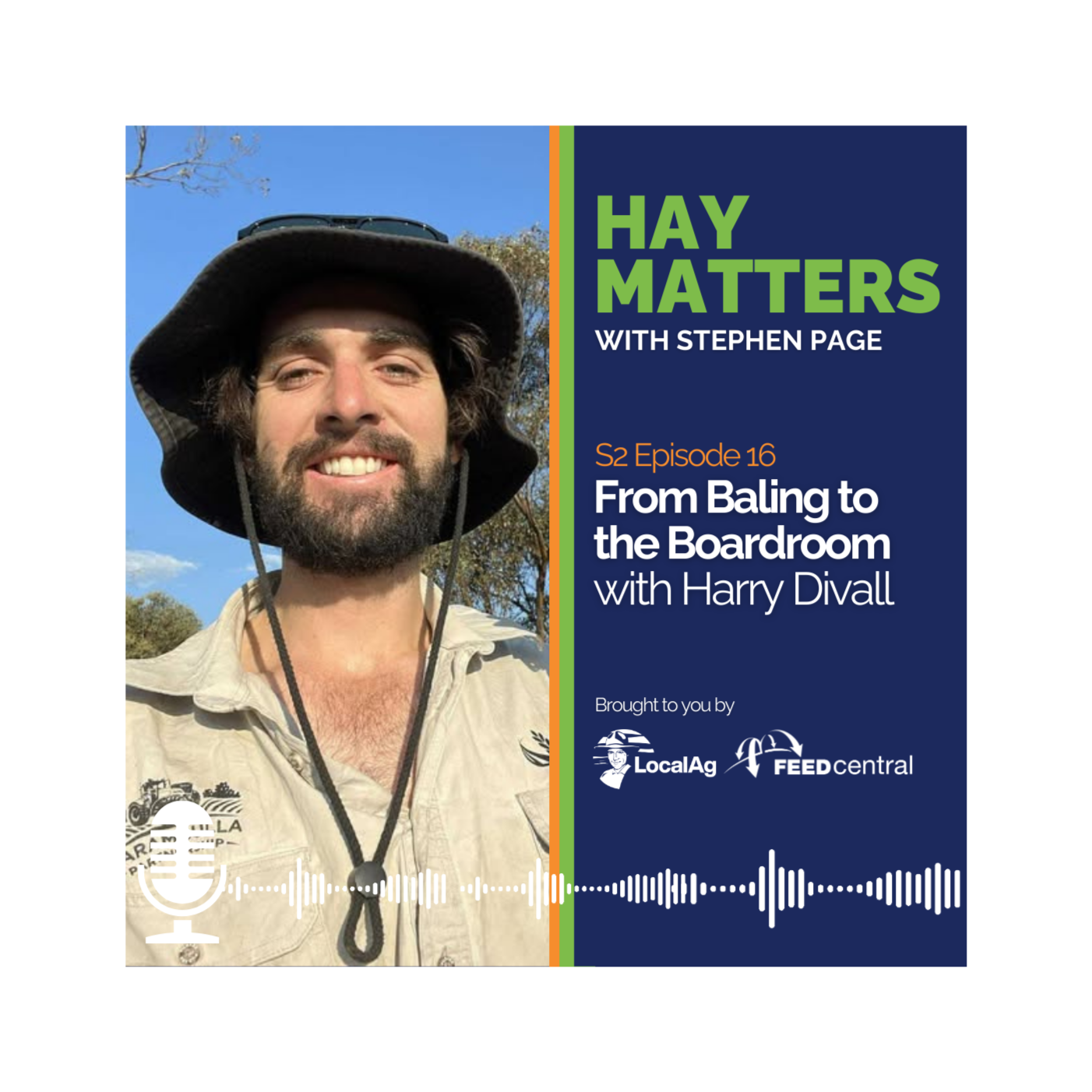
S2 Ep 16From Baling to the Board Room with Harry Divall
Podcast Highlights In the latest episode of Hay Matters, brought to you by LocalAg and Feed Central, Steve Page catches up with Harry Divall; hay contractor, grower and AFIA board member. Harry shares his path from livestock work in Goulburn to running a growing hay operation across West Wyalong, Stockinbingal, and Crookwell. He shares the ups and downs of learning how to make quality hay, how he manages seasonal risk, and what he hopes to contribute to the fodder industry.Harry left school early and started fencing and working cattle near Goulburn before setting up a mixer on the family farm to boost weight gains in steers and heifersCold conditions limited hay production at home, so his family expanded west and bought their first baler, a Massey 2270XD, in 2016He now operates two Krone balers and produces between 15,000 and 25,000 bales a year, depending on the seasonWith farms spread across Goulburn, Stockinbingal and West Wyalong, he uses geography to manage weather risk and extend the cutting window from September to JanuaryCrop rotations include oats, barley and vetch out west, with canola, oats, barley and lucerne on the Stockinbingal farmHarry adjusts his plan each year, converting crops to silage or grain when conditions aren’t right for hayShed storage now holds over 2,000 bales, but he’s also experimenting with tarping, aiming to protect quality from the bottom upAs a new AFIA board member, Harry wants to make learning resources more visual and hands-on, helping others see what good practice looks like in the paddock
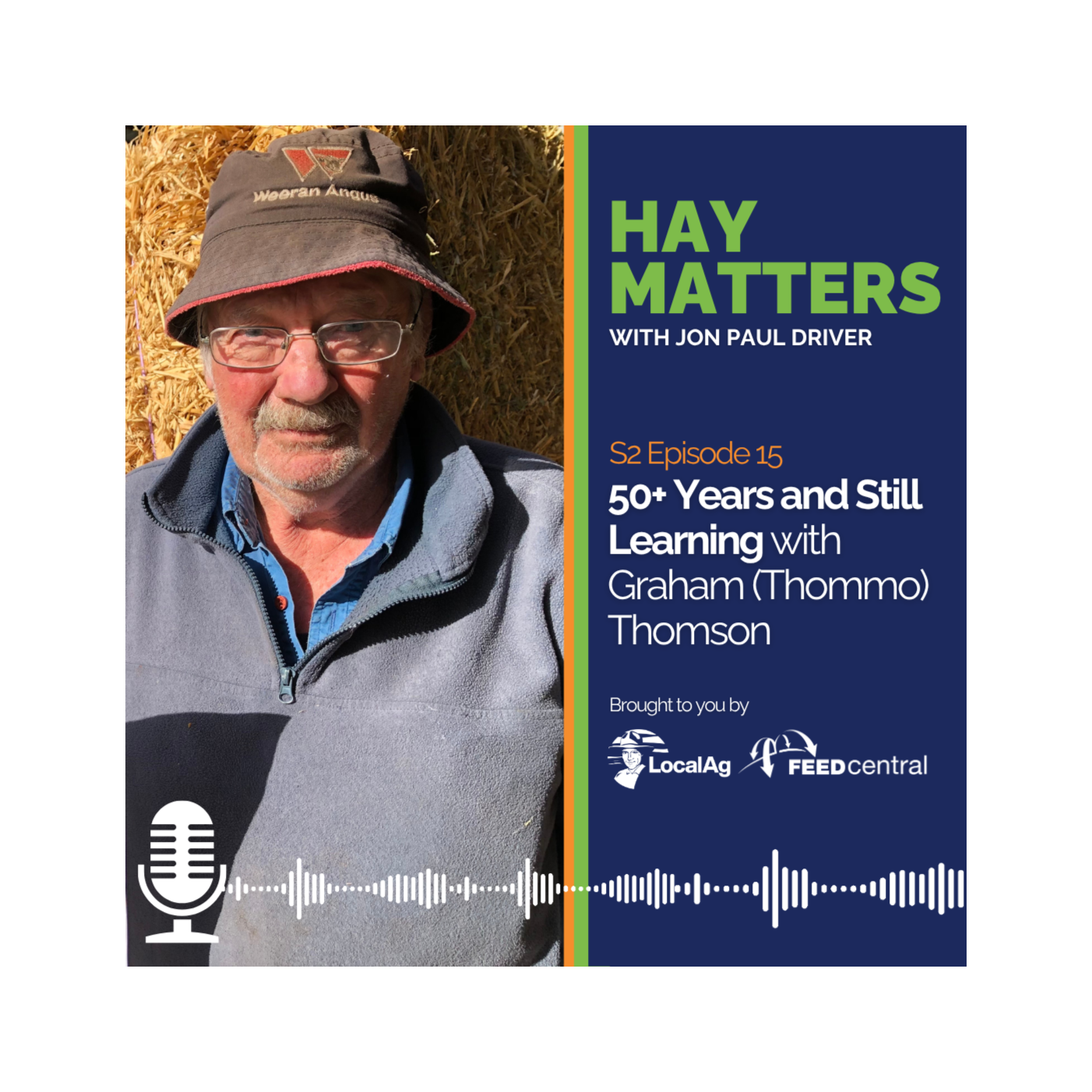
S2 Ep 1550+ Years and Still Learning with Graham (Thommo) Thomson
In the latest episode of Hay Matters, brought to you by LocalAg and Feed Central, we welcome back a familiar voice. Graham (Thommo) Thomson joins Steve Page live from the 2025 AFIA Conference to reflect on one of the toughest seasons he’s seen in more than five decades. With his hard-earned perspective, Thommo shares how he kept going through record-low rainfall, what he saw on the road north, and why he’s still not ready to retire.Thommo shares that this past year brought the lowest rainfall he’s recorded in 52 years of daily measurements on his farm, and how a patch of leased river country helped him scrape throughHe talks about the daily challenge of feeding stock when there’s nothing in the paddock — and how sheep were chasing anything that looked like a baleA long drive to the Gold Coast revealed just how bare things are, with empty sheds and only small loads of hay moving southDespite the tough conditions, livestock prices stayed strong, giving some much-needed breathing roomThommo shares why he keeps showing up to the AFIA Conference, and what’s changed (and stayed the same) in the industryHe’s not retiring yet — with a capable apprentice at home, he’s keen to learn more about tech and continue mentoring the next generationAnd before we go… Jon Paul shares a quick update: he’ll be handing over the hosting reins to Steve and Alex, as he focuses on some exciting new projects with Feed Central. He’ll still pop in from time to time — and he’s looking forward to sharing what’s next.
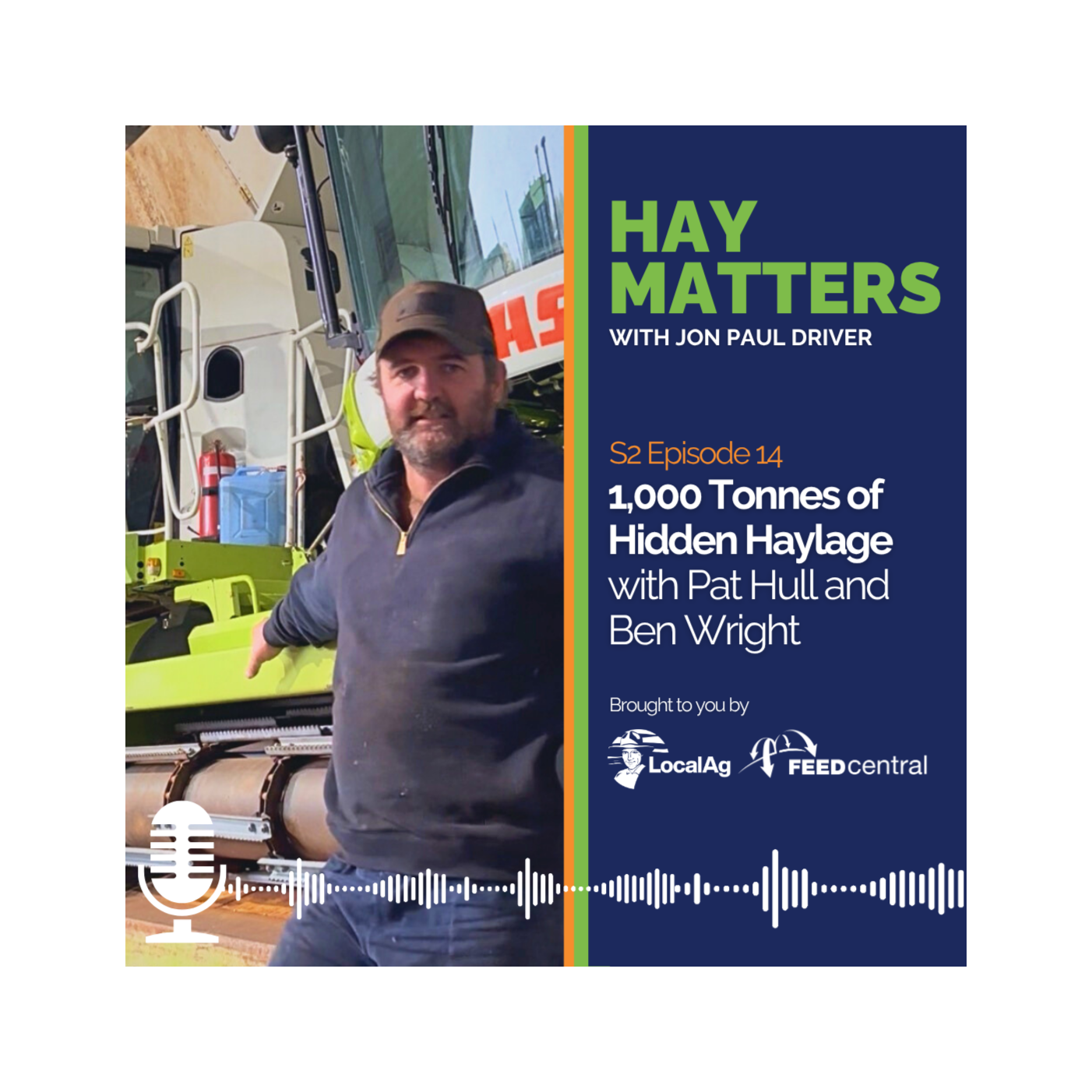
S2 Ep 141,000 Tonnes of Hidden Haylage with Steve Page and Pat Hull
Podcast Highlights In this episode of Hay Matters, brought to you by LocalAg and Feed Central, Grower Services Manager Steve Page hits the road to uncover a unique regional story of buried haylage, long-term storage, and unexpected opportunity.When grain grower Pat Hull purchased a property near Warren in 2022, he wasn’t expecting to find over 1,000 tonnes of buried forage sorghum haylage stored in pits by the previous owner, following the drought-breaking rains of 2020. With no livestock of his own and limited on-farm use, Pat turned to LocalAg to connect with buyers further south, and the response was immediate.The haylage was originally cut, baled and buried in 2020 by contractor Ben Wright from Central West Contracting, after strong summer growthBales were stacked four high in excavated pits, wrapped in plastic and sealed with soil for long-term storage and pest protectionFeed tests returned excellent results for aged haylage: 12.4% CP, 9.25 MJ/kg ME, 51.4% NDF, 35.7% ADF, and 41.7% DMPat listed the product on LocalAg using original baling photos, generating national interest before opening any pitsWith feed shortages in Victoria, the first truckload has already moved to southern dairies, with more to followHay contractor Ben Wright shares practical insights on why buried haylage works, key moisture thresholds, and how proper handling influences long-term results
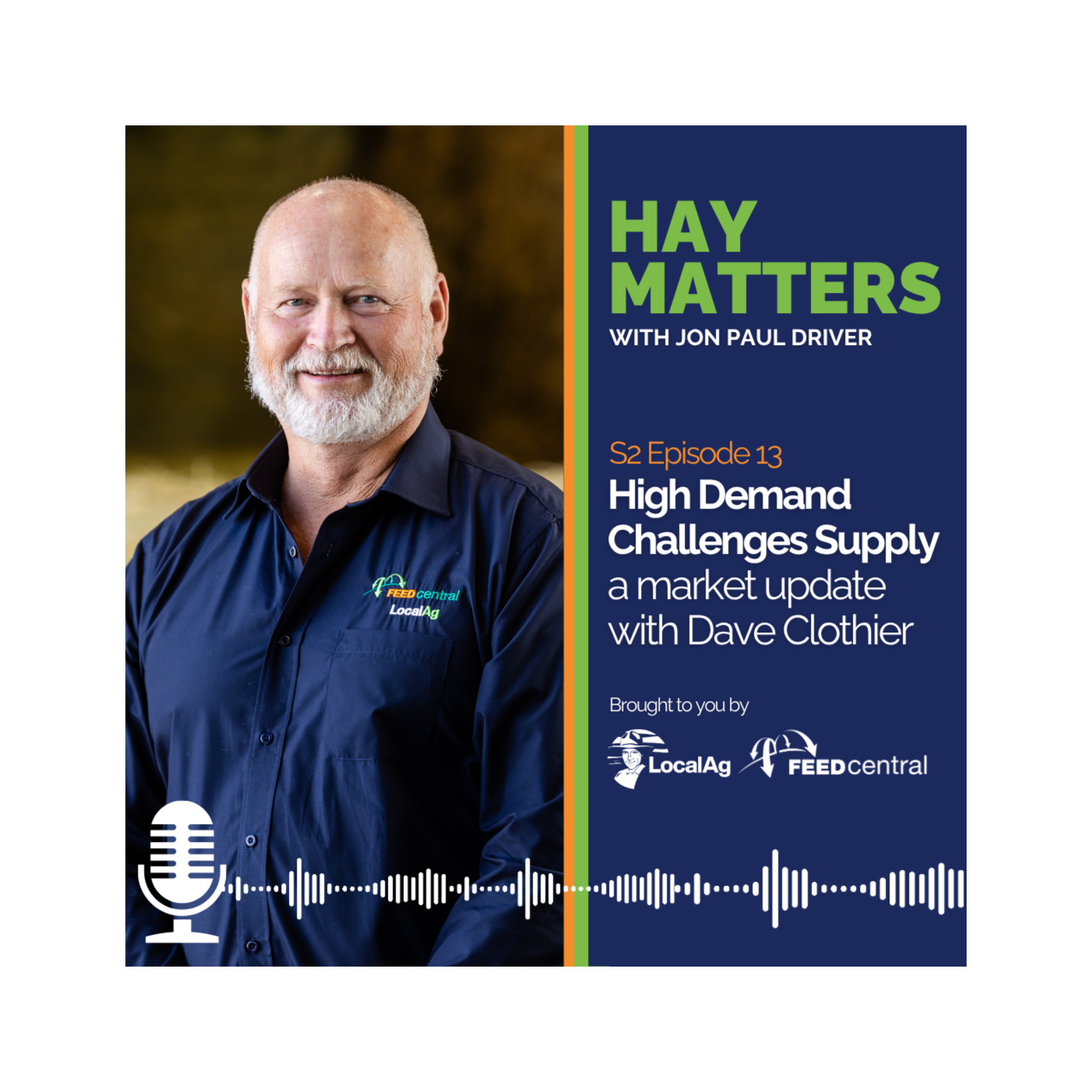
S2 Ep 13High Demand Challenges Supply: a Market Update with Dave Clothier
Podcast Highlights In this episode of Hay Matters, brought to you by LocalAg and Feed Central, Jon Paul Driver is joined by National Sales Manager Dave Clothier to unpack current fodder market conditions. With drought in the south driving record demand and pushing prices up fast, Dave explains what’s moving across the country and what’s not — and what buyers and sellers need to know as an early northern season begins to take shape.April and May marked one of the busiest trading periods Feed Central has seen in over 20 years, as drought across southern NSW, Victoria and SA pushed up demandMany southern growers held onto hay, concerned the dry conditions would extend north, which further tightened supply during a period of rapidly increasing demandRain has restored some confidence but feed shortages are expected to continue for six to eight weeks while pasture growth catches upWhile Western Australia and Northern Territory have good supply, biosecurity restrictions and high freight costs are limiting movement eastPrices are sitting above $400 ex farm for cereal hay and $600 for lucerne, with freight adding up to $350 per tonne and some landed prices topping $700In some cases straw is being transported long distances to fill gaps in southern supply and buyers are feeding at any cost to retain core breeding herdsNorthern Australia is set for an early season with cereal hay cuts expected from mid July while southern crops remain four to six weeks behindWith the new financial year underway, more growers are releasing hay to the market but windows are narrow and buyers should act quicklyPrice pressure is expected to remain until southern yield prospects become clearer
S2 Ep 12Systems, Safety, and Stepping Up with Matt Eckert (Part 3)
Podcast Highlights In this episode of Hay Matters, brought to you by LocalAg and Feed Central, host Jon Paul Driver concludes his three-part series with South Australian farmer Matt Eckert. This final instalment shifts focus to the financial, mechanical, and personal pressures that often sit behind the paddock - and how Matt and his team are navigating them.From soaring machinery costs and safety scares to family life, team trust, and planning for the future, this conversation reveals the daily challenges that aren't always get discussed, but shape everything on the farm.Why machinery costs are blowing out and how that’s reshaping timelines for soil improvement and capital investmentWhat efficiency really looks like across an operation, and how mismatched upgrades can create new bottlenecksLessons from scaling up hay production, from baler selection to matching loaders, trucks and shed spaceHow past safety incidents have prompted changes in processes and a stronger focus on risk managementWhy trust and teamwork are central to how the farm operates today and how stepping back has helped others step upThe juggling act of parenting, marriage and leadership and how Matt is learning to keep farm pressures from following him homeWhat tough seasons have taught Matt and why backing your people makes all the difference
S2 Ep 11Hard Seasons, Strong Ties with Matt Eckert (Part 2)
In this episode of Hay Matters, brought to you by LocalAg and Feed Central, host Jon Paul Driver continues the conversation with South Australian farmer Matt Eckert. In Part 2 of this three-part series, Matt opens up about the people, mindset, and decisions that help keep the wheels turning during hard seasons.From financial pressure and breakdowns to succession planning and emotional burnout, this episode digs into the less visible side of managing a large farming operation in a drought — and the personal resilience it takes to carry it through.How a tight-knit team, family loyalty, and off-farm connections have helped carry the business through some of its hardest seasonsWhy your relationship with the bank needs to be built before things go wrong — and how it pays off when flexibility is neededThe story behind three trucks, a 53-metre road train, and how hauling hay turned into a lifelineWhy adaptability beats prediction - and how building practical ability into the business opened unexpected doorsHow a shared focus on quality and ag systems has strengthened a long-standing working relationship with Feed Central and LocalAgWhy succession planning, clear communication, and staying close as brothers matters more than ever in generational farmingHow back-to-back breakdowns, fires, and a sudden dry season pushed mental resilience to the limitMatt’s advice for getting through the hard seasons - and why they sometimes bring the clarity needed to change direction
S2 Ep 10Farming through the Dry with Matt Eckert
Podcast Highlights In this episode of Hay Matters, brought to you by LocalAg and Feed Central, host Jon Paul Driver speaks with South Australian grower Matt Eckert in the first of a three-part series. Matt shares a candid look at the decisions, trade-offs, and resilience required to keep a mixed farming operation running during a prolonged dry spell.With the region facing one of its hardest seasons in recent years, Matt opens up about the real impact of drought — from feed shortages and pasture losses to the mental load of managing stock and cropping programs when nothing goes to plan.Drought pressure is forcing a rethink of pasture renovation and cropping programs across mixed farmsResowing lucerne has its limits - and knowing when to push on or start again is shaping long-term plansSoil amelioration, including deep ploughing and clay spreading, continues to improve outcomes but isn’t a fix-all in extreme seasonsSeeding strategies are being adjusted in real time, with lessons from previous dry years influencing crop timing, inputs, and variety choiceEarly fodder purchasing and stored inventory have been critical in keeping livestock fed and breeding programs afloatDecisions around feeding, destocking, and confinement lambing are being made fast, with economics and animal welfare front of mindWhile the short-term outlook is tight, a clear long-term view is helping guide every decision on the farm
S2 Ep 9Reverse Markets and Forward Momentum with Tim Ford
In the latest episode of Hay Matters from Feed Central and LocalAg, our host Jon Paul Driver catches up with Director Tim Ford to discuss the current market and LocalAg's first quarter.As southern sheds sit nearly empty, Queensland hay has begun heading south in a reversal of traditional seasonal movement. With biosecurity concerns under control in most areas and demand climbing, the coming weeks could see more sheds open if rain arrives.Meanwhile, the LocalAg platform is handling high volumes well, and buyer demand has led to the introduction of LocalAg Plus, re-introducing delivered pricing and logistics for those who want a hands-off experience.Market Update:Australia is experiencing extreme weather contrasts, with parts of Western Queensland recovering from floods while South Australia and Victoria face severe drought.Queensland hay is now moving south in increasing volumes, a major shift from the usual supply direction. Local supply in Southern Australia is limited, but strong recent seasons mean there's still stock available.Key seasonal milestones, including Anzac Day and Mother's Day, have passed without rain in many southern regions, increasing concerns about the coming winter.If forecast rain fronts materialise, more sheds may open across southern states. Sellers are watching conditions closely, and timely rainfall could ease some market pressureLocalAg UpdateBuyer demand is strong, with listings moving quickly across the platform.We've listened to buyer feedback, and introduced LocalAg Plus to offer the delivered pricing model many of our users were familiar with on Feed Central.We're seeing a positive response to payments handled securely via escrow, as sellers appreciate the peace of mind, speed of payments and buyers and sellers can deal directly.Additional Biosecurity Resources:Importing commercial plants and plant products (PIRSA)Bringing Hay Into South AustraliaNational Fire Ant Eradication Program

S2 Ep 8From Grass to Growth with Marty Conroy
In this episode of Hay Matters from Feed Central and LocalAg, host Jon Paul Driver chats with Marty Conroy, the Agronomy Services lead for Northern Australia at Barenbrug Seeds. From his base in Northern NSW, Marty offers a practical look at tropical pasture systems across Queensland, the NT, and northern NSW. He unpacks the science behind C3 and C4 grasses, explains how feed quality directly impacts profitability, and highlights the untapped potential of pasture management and modern breeding programs.Pasture breeding is shifting focus toward fibre quality, seasonal fit, and regional adaptability in tropical systems.C4 grasses like Rhodes and panicum are critical in the north, with planting tied to rainfall and temperature windows.Feed quality drives intake, weight gain, and returns, making it as much about profit as nutrition.Breeding is being accelerated through genomic tools, improving local performance and reducing development time.C4 pasture management - especially grazing and cutting intervals - remains underutilised despite the potential for a strong return on investment.Strategic input use, like nitrogen, can deliver returns that rival financial investments.Benchmarking paddock performance year-on-year is key to making smarter decisions in unpredictable seasons.
S2 Ep 77,500km of Aussie Ag with Stefan Hollmann
In the latest Hay Matters Podcast brought to you by LocalAg and Feed Central, host Jon Paul Driver catches up with Stefan Hollmann, a German-born machinery operator and high-density baling expert based in South Australia. After arriving for one harvest, Stefan stayed on and has since produced over 100,000 bales across eight years with the Schusters. He reflected on his recent 7,500-kilometre trip across the east coast, sharing insights on seasonal variability, farming practices, and why understanding feed quality matters more than ever.Seasonal contrasts were striking, with some regions flooded, others in deep drought - highlighting the need for localised decision-making and adaptable farming strategies.Visiting operations from cotton to corn to rice in a single day highlighted the diversity and complexity of Australian agriculture.Farmers are experimenting with seeding tech, chemical timing, and soil improvement methods like delving and spading; Stefan noted there’s no one-size-fits-all approach, even among similar farms.A visit to Feed Central’s Toowoomba lab shifted Stefan's perspective on hay analysis, seeing first-hand the precision behind NIR testing and the variety of fodder types tested nationally.Coming from Germany’s dairy sector, Stefan values knowing the nutritional content of feed, and believes Australian producers could benefit more from NIR testing, not just visual inspection.The trip reinforced how much producers can learn by stepping outside their own patch. Conversations with other farmers sparked ideas he’s keen to explore back home.
S2 Ep 6Southern Market Update with Alex Smith
In the latest Hay Matters Podcast brought to you by LocalAg and Feed Central, Key Account Sales Manager Alex Smith shares insights from the ground as he travels across the south-eastern states. With southern regions facing dry conditions and Queensland still dealing with the impacts of flooding and beginning their recovery, Alex discusses the shifting dynamics in feed production, market demand, and the value of forward planning.Key takeaways from the episode:Widespread silage has already been made, with buyers now selectively sourcing high-quality cereal, vetch, and lucerne hay.The feed trade has flipped again this year, with hay moving from northern and central regions back down to the south.Flooded areas in Queensland are experiencing supply delays, while drought conditions in the south are increasing demand pressure.Quality hay is in high demand, with delivered costs climbing as buyers look further afield.Recent weather events across much of Queensland and Northern NSW have lifted cattle prices due to limited access and uncertainty around pasture recovery. It may take several months before the full impact is known, which is keeping fodder demand in the north relatively low for now.
S2 Ep 5Cattle, Hay and Hard Conversations with Gillian Fennell
In the latest Hay Matters Podcast, brought to you by LocalAg and Feed Central, Jon Paul Driver is joined by cattle producer, advocate and agfluencer Gillian Fennell.Gillian has spent time serving on industry boards and committees at a local, state and national level, and has a special interest in on-farm succession planning and the impact that it has on farming families and communities.With over 20 years in the beef industry and a base in one of the most remote parts of Australia, Gillian brings insight and lived experience to this episode, covering everything from succession and farm management to social media, leadership and the realities of modern ag life.Gillian and her husband operate a family-run cattle station spanning a million acres, running around 5,000 breeders.They’ve recently expanded into fodder production on a newly acquired irrigation block in the Flinders Ranges.Producing their own hay has added flexibility, reduced reliance on freight and provided new opportunities for cattle marketing and logistics. A new hay shed at the home station marks one of their biggest infrastructure investments to date.Gillian discusses how social media—especially Twitter—has become an important space for connection, advocacy, and countering negative perceptions of agriculture.She highlights innovations like no-till cropping and improved chemical use as major steps towards sustainable production.Three core messages for agricultural advocacy are: producers are skilled, already sustainable, and deeply connected to the environment that supports them.Gillian sees succession as less of a legal or accounting challenge and as more of a people problem; it needs to start early, with open and long-term business conversations, not last-minute decisions.Gender dynamics also play a role; many women feel excluded from farm leadership, even when they bring training, ideas, and experience.There need to be more pathways into the Ag industry, beyond university or tech roles—especially for those with strong work ethic and practical skills.Gillian's upcoming podcast "Suck-session" explores succession breakdowns, featuring real stories to help others avoid common pitfalls.
S2 Ep 4Mixing Family & Business in Ag with Megan Ford
In the latest Hay Matters Podcast, brought to you by LocalAg and Feed Central, Jon Paul Driver sits down with Megan Ford to discuss her journey in agriculture, the evolution of Feed Central, and the role of women in the industry.From the early days of building a business while raising a young family to the challenges of expansion and the launch of LocalAg, Megan shares her experiences and the lessons learned along the way.Tim and Megan started Feed Central with big ideas and a hands-on approach, balancing business growth with raising a young family.Strong family support was essential, with relatives stepping in to help, allowing the business to grow during the tough early years.Business discussions didn’t always happen in an office; late-night board meetings, car conversations, and stolen moments between school runs often shaped key decisions.A major hay shed fire in 2014 was a defining moment, testing resilience and reinforcing the importance of a strong team and community.Women’s networks, including the Queensland Rural Women’s Network and Australian Women in Agriculture, played a key role in providing mentorship, connections, and opportunities for leadership.LocalAg wasn’t an overnight decision; it was shaped by years of conversations with farmers and customers, identifying gaps in the market and building a platform that gives users more control.The introduction of LocalAg reflects a shift in how farmers want to do business, offering more flexibility while maintaining the trust built over decades.
S2 Ep 3The Changing Face of Ag Trade with Dave Clothier
Podcast HighlightsIn the latest Hay Matters Podcast, brought to you by LocalAg and Feed Central, Jon Paul Driver and National Sales Manager Dave Clothier explore the early days of Feed Central's LocalAg and the wider impact it will have on Australian agriculture.They discuss how extreme weather, from drought and scorching heat in the south to heavy rains and flooding in the north, is reshaping feed supply and market dynamics. Real-time feedback and market adaptability are charting a new course for ag across the country with customers asking for more flexibility and transparency with their purchase decisions.The platform presents two distinct options: traditional full-service account management and a flexible, direct interaction model.Early feedback indicates that buyers and sellers value the choice to adopt a transaction style that best meets their individual needs.Sellers can now showcase their entire range of offerings with free listings, allowing potential customers to discover additional products and services.Customisable features let users tailor transactions to specific requirements, such as negotiating part truck loads or managing customised deals.Overall, the platform is fostering more direct and transparent communication in the agricultural market, enhancing both efficiency and customer engagement.On the market front, despite extreme weather including drought in some regions and heavy rains in others, buyers are proactively securing quality feed ahead of winter.
S2 Ep 2The Science Behind Better Oats with Dr Allan Rattey
In this episode of the Hay Matters Podcast brought to you by LocalAg and Feed Central, host Jon Paul Driver is joined by Dr Allan Rattey, National Oat Breeder at InterGrain, to explore the future of Australian hay and forage production.They discuss how cutting-edge technology is accelerating oat breeding, the importance of balancing yield with quality, and why fibre digestibility is a game changer for both sustainability and livestock performance.Dr Rattey also shares insights into how InterGrain is delivering practical solutions to Australian farmers, including varieties tailored to unpredictable weather and dual-purpose crops that maximise flexibility and profitability.Breeding times for new oat varieties are now as short as 9-10 years, thanks to innovations like speed breeding and advanced trait selection tools.Fibre digestibility is a key focus, improving both livestock nutrition and sustainability by reducing waste.The integration of new technologies, including drone imaging, has streamlined the process of selecting high-performing crops, helping farmers achieve better results faster.InterGrain bred for speciality Hay and Grain oat varieties. They also heavily select for dual-purpose oat varieties that improve growers in season flexibility to decide whether to harvest for hay or grain, depending on market conditions and seasonal challenges.Curing time is key for hay production, ensuring farmers can work within limited weather windows.Collaboration with farmers and feedback from processors are central to breeding programs, ensuring new varieties deliver real-world value across the industry.InterGrain leads Australia’s barley and oat breeding programs, developing high-yield, disease-resistant varieties that are adaptable to diverse conditions.
S2 Ep 1Special Edition: Feed Central's Next Chapter with Tim Ford
To start the new year on the Feed Central Hay Matters podcast, Jon Paul Driver sat down with Tim Ford, Director of Feed Central, to pull back the curtain on Local Ag - a bold new marketplace that’s been 22 years in the making. Born from decades of experience, countless conversations with farmers, and a relentless drive to innovate, Local Ag is set to revolutionise how Australian agriculture connects and trades. Local Ag launches 29th January 2025, offering a fresh and modern way for Australian farmers and agribusinesses to trade hay, grain, seed, fertiliser, livestock, machinery, and more.Built to simplify transactions while keeping them secure, Local Ag combines decades of Feed Central expertise with cutting-edge tech tailored for agriculture.Tim describes the platform as the handshake deal reinvented; buyers and sellers connect directly, chat through the platform, and close deals seamlessly with payment, contracts, and logistics all managed along the way.At the heart of it all is Kev, an AI chatbot who’s part junior trader, part contract genius, and always learning to keep transactions running smoothly. He’s friendly, practical, and distinctly local - just like the team that built him.Kev isn’t just a bot; he’s a tribute to Tim Ford’s late father, a man who brought wisdom, warmth, and a deep love for rural life. That legacy is built into the platform itself.Farmers can build their own profiles, showcase their products, and connect with buyers in a way that feels modern but rooted in trust.Unlike generic marketplaces, Local Ag is designed specifically for rural Australia; it's built to balance the no-nonsense practicality of farming with the convenience of online tools.Every detail has been shaped by 20+ years of Feed Central’s experience, from the AI chat to the quality assurance options and the human support team that’s always a phone call away.Built locally in Toowoomba, Local Ag stands apart from off-the-shelf solutions with tech designed and coded right here in Australia.Local Ag reflects how today’s farmers do business: building their brands, taking control of supply chains, and stepping into the digital world on their own terms.The platform is as much about relationships as it is about transactions. Farmers will be able to connect with buyers, get direct feedback, and build trust in ways that go far beyond selling a product.Whether it’s a small batch of seed, a truckload of hay, or a piece of second-hand machinery, Local Ag will make the process simpler, safer, and more personal.Feed Central isn’t going anywhere. The team you know and trust remains the backbone of this new venture, ensuring continuity for hay services while opening doors to new opportunities.Launching just after Australia Day, Local Ag celebrates the heart of rural Australia: family, community, and innovation wrapped up in one trusted platform.Don't get left behind; register now for early access.
S1 Ep 24The year in review and preparing for 2025: a Market Wrapup with Dave Clothier
Podcast HighlightsIn the final Feed Central Hay Matters Podcast for 2024, Jon Paul Driver catches up with National Sales Manager Dave Clothier to discuss the challenges and market shifts faced by hay producers during the 2024 season and what we can expect in the year ahead.Early in the year, drought cleared stockpiles of low-grade hay, but wet weather later reduced overall production and caused quality deterioration. Strong demand continues, driven by record feedlot numbers and booming beef exports, while the sheep flock declines and the dairy sector remains cautious. Looking ahead, hay prices are expected to rise, with limited availability of high-quality supply for key demand periods. Forward planning is essential as 2025 brings new opportunities and challenges.The Year that's Been:Early drought in southern Australia cleared stockpiles of low-grade hay from previous seasons.Variable spring and summer conditions has either reduced hay yields or impacted quality, while frost events produced some high-quality hay in far smaller volumes than expected.Current stockpiles are mostly mid-grade hay, with limited availability of premium fodder needed for the March–April weaning period.Feedlot numbers are at record highs of 1.4 million cattle, with strong confidence feedlots will remain full throughout 2025.Australian beef exports reached a record-breaking 1.3 million tonnes, driven by strong demand from Japan, Indonesia, and the US.Looking Ahead:National sheep flock is declining due to drought, live export policy changes in Western Australia, and challenging weather conditions across southern production regions.The dairy sector faces reduced milk production, fluctuating weather, and budget pressures, leading to more cautious fodder purchasing decisions.Hay prices are predicted to rise by at least 10% in early 2025 due to limited supply, grower cash flow priorities, and strong demand.Forward contracting is recommended to secure quality hay and manage costs before peak demand periods.
S1 Ep 232024 Harvest Insights from the Road: a discussion with Steve Page
In the latest Feed Central Hay Matters Podcast, Host Jon Paul Driver talks to Steve Page, Grower Services Manager, about the challenges faced by hay producers during a season marked by wet weather, frost events, and fluctuating market dynamics. Steve, who has recently been on the road visiting growers, shares insights into what the season looked like and the impact of these challenges across Australia.Southern Queensland and northern New South Wales experienced a wet baling period, resulting in quality deterioration.The Riverina faced frost damage, while Wimmera-Mallee growers shifted to 100% hay production but reported reduced yields.South Australia endured one of its toughest seasons in decades, with little surplus hay available for domestic markets.Of the cereal hay inspected, only 1% achieved FCAA grade, while most fell into high FCB or FCC grades due to weather impacts.Lucerne hay production is increasing as growers shift away from seed due to weak global markets, filling gaps left by a shortage of protein hays.Many growers are storing high-quality hay to sell in early 2025, while FCC-grade hay is being sold to avoid further deterioration.Steve recommends growers monitor their hay quality, wait for the right market conditions, and consider Feed Central’s quality certification services to optimise sales opportunities.
S1 Ep 22Farming Tomorrow: an Ag2050 discussion with Dr Sabrina Greenwood
Podcast HighlightsIn this episode of the Feed Central Hay Matters Podcast, host Jon Paul Driver welcomes Dr. Sabrina Greenwood from CSIRO to discuss the AG2050 initiative.From farms equipped with digital farming and precision agriculture technologies to systems that provide real-time data optimising everything from soil health to water use, AG2050 envisions a sustainable and technologically advanced future for Australian agriculture by 2050.CSIRO, Australia’s national science agency known for significant contributions like the invention of Wi-Fi and advanced polymer banknotes, is spearheading this strategic initiative. Dr. Greenwood provides an in-depth overview of AG2050's ambitious goals, designed to reshape farming practices across the nation through innovation and strategic foresight, hand-in-hand with industry partnerships.AG2050, a strategic initiative within CSIRO’s Agriculture and Food research unit, envisions what Australian agriculture could and should look like by 2050, aiming for sustainability and resilience.In AG2050, hay and other forage-based commodities, influenced by climate factors and groundwater availability, are essential for enhancing productivity across diverse regions.Over 100 community partners were involved in initial AG2050 workshops to discuss major stressors and drivers in their industries, aiding the development of four future scenarios for Australian agriculture.These four scenarios - Regional Ag Capitals, Landscape Stewardship, Climate Survival, and Systems Decline - each provide a different vision of what could happen based on current trends and potential interventions.The ongoing need for community engagement is crucial for refining and implementing strategies that will drive Australian agriculture towards the desired futures outlined in AG2050.If you'd like to get involved, you can visit the AG2050 website.
S1 Ep 21Harvest Wrap Up: a Market Update with Dave Clothier
In this market update episode of the Feed Central Hay Matters Podcast, host Jon Paul Driver and Dave Clothier discuss the Australian hay market as the harvest season winds down. They cover how recent weather has impacted hay quality, with a mix of grades now available, and look at the impact on yields in regions like South Australia and Western Victoria. With high demand from the beef sector, and steady prices across most areas, this episode provides timely insights for buyers navigating this season’s unique challenges.Hay production in Queensland is mostly complete, with limited shed availability there is a higher proportion of paddock stacks.New South Wales and Victoria are nearing completion, although recent rain has affected quality, resulting in variable quality and the majority of sheds now full.In South Australia and Western Victoria, drought and frost have reduced yields by 30-50% compared to last year, causing significant losses for some growers.Recent storms and wet conditions have delayed harvests in the north, leading to bleached, lower-grade hay with thicker stems and higher NDF. Overall, high-quality hay volumes are down, as adverse weather and frost have pushed many high-yielding crops toward grain production instead of hay.High canola prices mean fewer frosted canola crops were turned into hay, contrary to initial expectations.Limited vetch planting this season has reduced supply, driving up demand for lucerne and other protein-rich hays, with prices expected to remain firm.Prices are steady across regions, with FCA grade cereal hay around $250 per tonne, likely holding through Christmas. Many producers are holding back supply in anticipation of stronger demand and firmer prices in early 2025.The beef sector’s demand for hay is strong due to herd growth and export opportunities, while the dairy sector is purchasing more cautiously given the variable hay quality and limited protein-rich options.Buyers are advised to secure supplies now to access the broadest quality selection at stable prices, avoiding potential price increases and compromised quality in early 2025.With high-demand periods likely through the summer and autumn periods, it’s important to factor in both quality and location to optimise the best delivered pricing.
S1 Ep 20Hay Meets AI & Innovation: a discussion with Dr Andrew Walters
In the latest episode of the Feed Central Hay Matters podcast, our host, Jon Paul Driver, caught up with Dr. Andrew Walter for a deep dive into agricultural research and innovation. Dr. Walter has extensive experience across government, business, and academia, which has positioned him to lead projects that are reshaping hay production in Australia. His role has included leading the development of Australia's levy system, which funds agricultural research, and his practical experiences with advanced technologies such as AI to improve hay baling schedules and crop management. In addition to agricultural technology, the discussion includes pragmatic strategies that effectively manage carbon while maintaining agricultural productivity.Australia's cutting-edge agricultural R&D includes the new hay levy, uniquely positioning Australian fodder on the global market through structured research funding that advances practices and sustainability.A detailed comparison between Australia's agricultural technology and global standards shows how Australia’s proactive levy system has been instrumental in driving forward-looking research for over two decades.The Australian Fodder Industry Association (AFIA) effectively consolidates the entire supply chain from seed companies to exporters, ensuring a unified voice in global discussions.Challenges and opportunities in implementing agricultural technology, including AI and automation, are set to redefine farming practices and efficiency.Climate change impacts on agriculture highlight the need for practical carbon management strategies and realistic goals towards achieving net-zero emissions in farming.The future of farming is being shaped by advancements in AI, with current projects utilising AI for precise crop and animal management, marking significant progress in precision agriculture.Despite being misconceived by some as a 'sunset industry', agriculture is vibrant and innovative, playing a crucial role in economic and technological advancement.The dynamics of international fodder markets demonstrate the importance of balancing competitive spirit with cooperative strategies for research and development.
S1 Ep 19Hay Innovators Part 2: with Damon Humphris and Gavin Leersen
For the second part of the Feed Central Hay Matters Hay Innovators series, Jon Paul Driver caught up Damon Humphris of Taggr and Gavin Leersen of BaleTime at the recent AFIA Conference. This episode dives into the solutions both innovators have developed to tackle age-old challenges in hay production. Discover how Damon's journey led to the creation of an automated tagging system for hay bales, simplifying the traceability process for exporters. Meanwhile, Gavin introduces BaleTime, a device that transforms hay baling timing with accurate humidity readings, boosting productivity and allowing farmers to manage baling schedules remotely, reducing the need for early morning field checks.Damon Humphris describes the inception of Taggr’s automated hay bale tagging system, highlighting its role in streamlining the baling process and ensuring traceability for hay exports.Through trial and error, Damon integrated advanced robotics into Taggr, ensuring that each hay bale was tagged accurately and efficiently, setting a new standard in the industry.Damon’s journey through the technological hurdles overcome to develop Taggr included creating an effective tag-feeding mechanism that could withstand the rigors of large-scale farming operations.The idea for BaleTime came to Gavin Leersen while he was timing his sheep shearing; a farmer's offhand remark about needing to know the best baling time led him to harness humidity sensors for precise baling schedules.BaleTime provides farmers with a system to measure ambient and in-windrow humidity, helping them to optimise hay baling times with precision, improving yield quality and reducing unnecessary labour.The monitor operates effectively in areas with poor cellular service by utilising a simple SMS-based system that requires minimal signal, ensuring reliable communication and functionality even in remote locations.With their innovative approaches, Damon Humphris and Gavin Leersen are actively shaping the future of farm management, setting new benchmarks for operational excellence in agriculture.
S1 Ep 18Hay Innovators Part 1: with Louis Kelly and Bryce Riddell
In the first of our two-part Hay Innovators series on the Feed Central Hay Matters Podcast, Jon Paul Driver sits down with Louis Kelly, Chairman of the Australian Fodder Industry Association (AFIA), and Bryce Riddell, the creator of HayShepherd, a groundbreaking system for monitoring hay sheds. The conversation covers critical developments from the AFIA conference, new technologies transforming hay farming, and the challenges and opportunities facing the fodder industry in Australia. Bryce Riddell introduces the HayShepherd system, developed to prevent hay shed fires by monitoring temperature changes in stored hay bales.Louis Kelly talks about the role of AFIA in the hay industry, particularly in driving collaboration between farmers and innovators.Technology and innovation, while often incremental, can lead to significant changes in farm operations over time.Bryce Riddell joins the podcast to introduce the HayShepherd monitoring system, explaining how it was developed to detect temperature changes that indicate a risk of spontaneous combustion in hay sheds.The increasing cost of insurance for hay sheds and technological solutions, like HayShepherd, are now critical for mitigating risk and keeping insurance costs manageable.The hay sector must adapt to both environmental changes and market pressures, and the role technology will play in this transformation.HayShepherd works through sensors placed in the hay shed to monitor temperature variations between bales and the shed’s control temperature, with real-time alerts sent to farmers.The system was initially developed to meet strict insurance demands but has since become a critical tool for large-scale hay operations.The system can scale for use in large hay operations, with sensors spread throughout sheds to pinpoint problem areas.
S1 Ep 17National Stockpile Runs Low: a Market Update with Dave Clothier
Jon Paul Driver catches up with National Sales Manager Dave Clothier for a hay market report and an indepth discussion on the current status of the national hay market ahead of new season. While Southern Queensland has seen good early-season hay production, and early harvesting in New South Wales promises high yields, dry conditions in South Australia and Western Victoria are expected to lead to lowered production. With much of the 2022 hay stock now gone, and high fodder demand, this is the idea time to fill the sheds.The national stockpile of hay is largely depleted, with existing supplies either committed for domestic use or export. Price stability is expected by late October to early November as the status of the stockpile becomes clearer.In southern Queensland, there's been substantial hay production due to favourable early-season weather. Meanwhile, New South Wales has hay prematurely on the ground, and regions like the Darling Downs are experiencing unusually high yields and early harvests.In contrast, South Australia and Western Victoria face reduced yields due to ongoing dry conditions, affecting overall availability.With grain prices decreasing and cattle numbers on the rise, fodder demand is leading more farmers to turn to hay production to capitalise on the fodder market.Hay is only made for 90 days, but cattle eat 365 days a year, and this is the ideal time to fill sheds with high quality feed in preparation for upcoming demand.
S1 Ep 16From Hay to Hydrogen: a Discussion with Dr Louise Brown
In this episode of the Hay Matters podcast, Jon Paul Driver talks with Dr. Louise Brown, CEO and founder of Hydgene Renewables. They dive into how hay and fodder are being turned into green hydrogen, revolutionising the way farmers can produce and use ammonia for fertilisers. Louise discusses her shift from academic research to spearheading this innovative startup, focusing on the practical benefits and potential of this technology for the farming community.Louise transitioned from a career in academia to pioneering a startup that harnesses engineered bacteria to convert biomass into hydrogen.The process not only produces a key ingredient for ammonia but also offers a more environmentally friendly alternative to the traditional methods that rely heavily on fossil fuels.This technology's adaptability for on-farm use could significantly lower fertiliser costs and improve self-sufficiency for farmers.The technology is scalable, with the potential to bring economic and environmental benefits to farming communities.There are a range of opportunities for farmers to collaborate on creating the infrastructure needed to support this new technology, enhancing sustainability and community resilience.
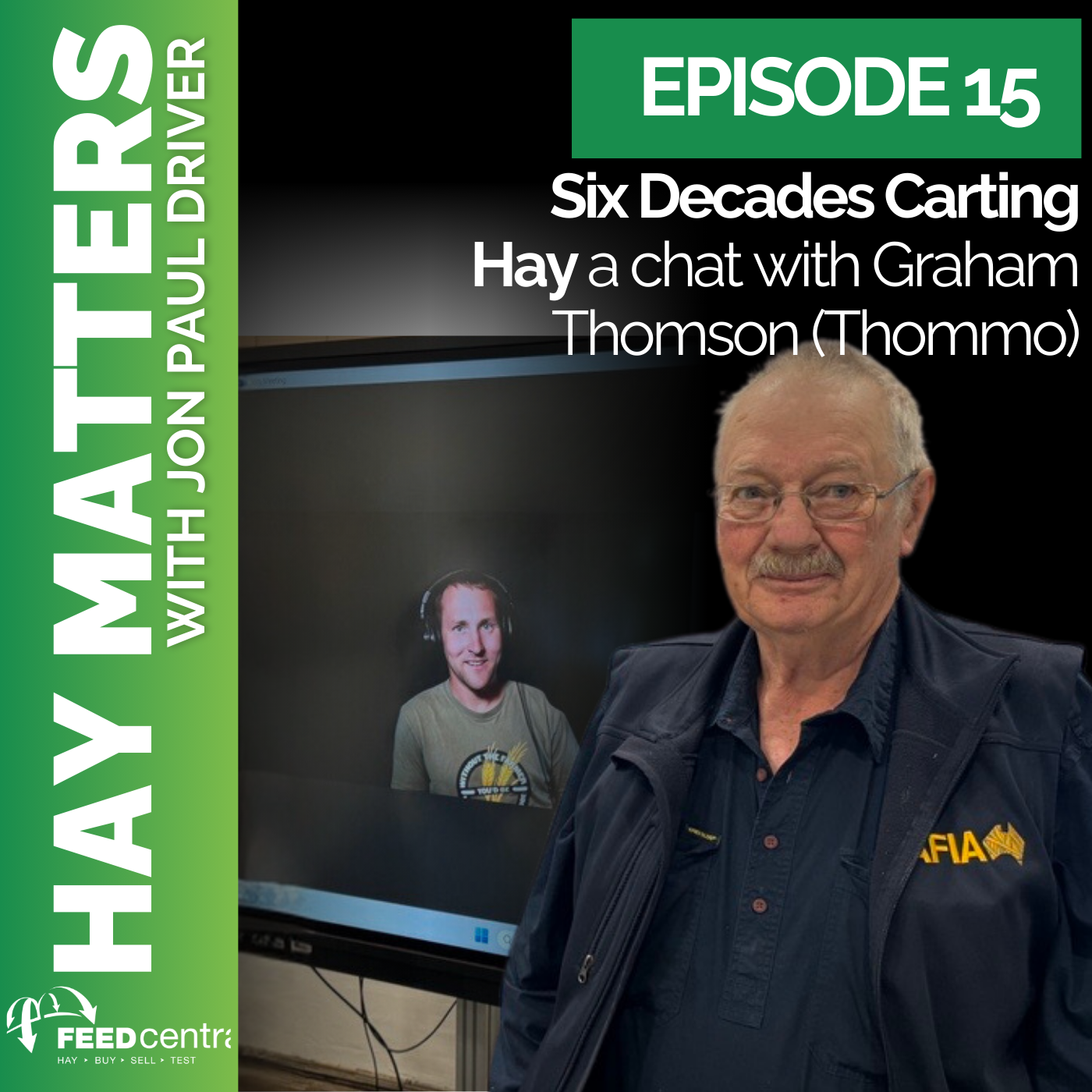
S1 Ep 15Six Decades Carting Hay: A Chat with Graham Thomson (Thommo)
In this episode, Jon Paul Driver talks with Thommo, a hay industry veteran who began carting hay for over 62 years ago. Thommo discusses his early days of manual hay baling, his role as a founding member of the Australian Fodder Industry Association, and the technological changes he's witnessed and embraced in his long career. He also shares insights from his international travels and the strong network of relationships he's built across the industry. From his first hand-operated baler to a 50 foot mower to Australia's first Heston baler, join us for a fascinating episode as Thommo recounts the developments he's seen shape modern hay production over six decades.Thommo started his hay carting career at 14, using a tractor and trailer borrowed from his dad to move hay 30 bales at a time to a location a mile away, and earning himself a shilling a bale. By the time he was 18, Thommo had saved enough money from carting hay to buy a Ford Falcon Ute.His big break came when he secured a major contract to supply 15,000 tons of small square bales yearly to a large feedlot. Despite the challenges, with three trucks and continuous hard work, he managed to make it work, hauling hay from as far as 200 miles away.In the 1980s, the introduction of round rolls and big square bales eased the labour and logistics of moving hay and Thommo's area was among the first in Australia to use the large Heston square balers, leading to a dramatic increase in efficiency and output.Thommo is a founding member of the Australian Fodder Industry Association (AFIA) and prides himself on never missing a conference in 25 years.He believes firmly in embracing new technologies; failing to adapt means getting left behind and staying current is essential for success in modern agriculture.Thommo values the connections he’s made throughout his career, highlighting that the relationships built across Australia, and his six years of work on agricultural boards in Canberra, have been crucial in navigating agricultural challenges.He embarked on a study tour to America about 20 years ago, which altered his initial perceptions of American farmers. The trip included visits to farms and a John Deere factory where he gained significant insights from interactions with both farmers and industry leaders.After the U.S. tour, he extended his travels to England, where his experiences included seeing a 50-foot mower that could mow 1000 acres in a day.Despite the technological advances he saw, there are practical limitations of relying solely on digital solutions in farming, making it a necessity to maintain a balance with both traditional methods and new innovations.
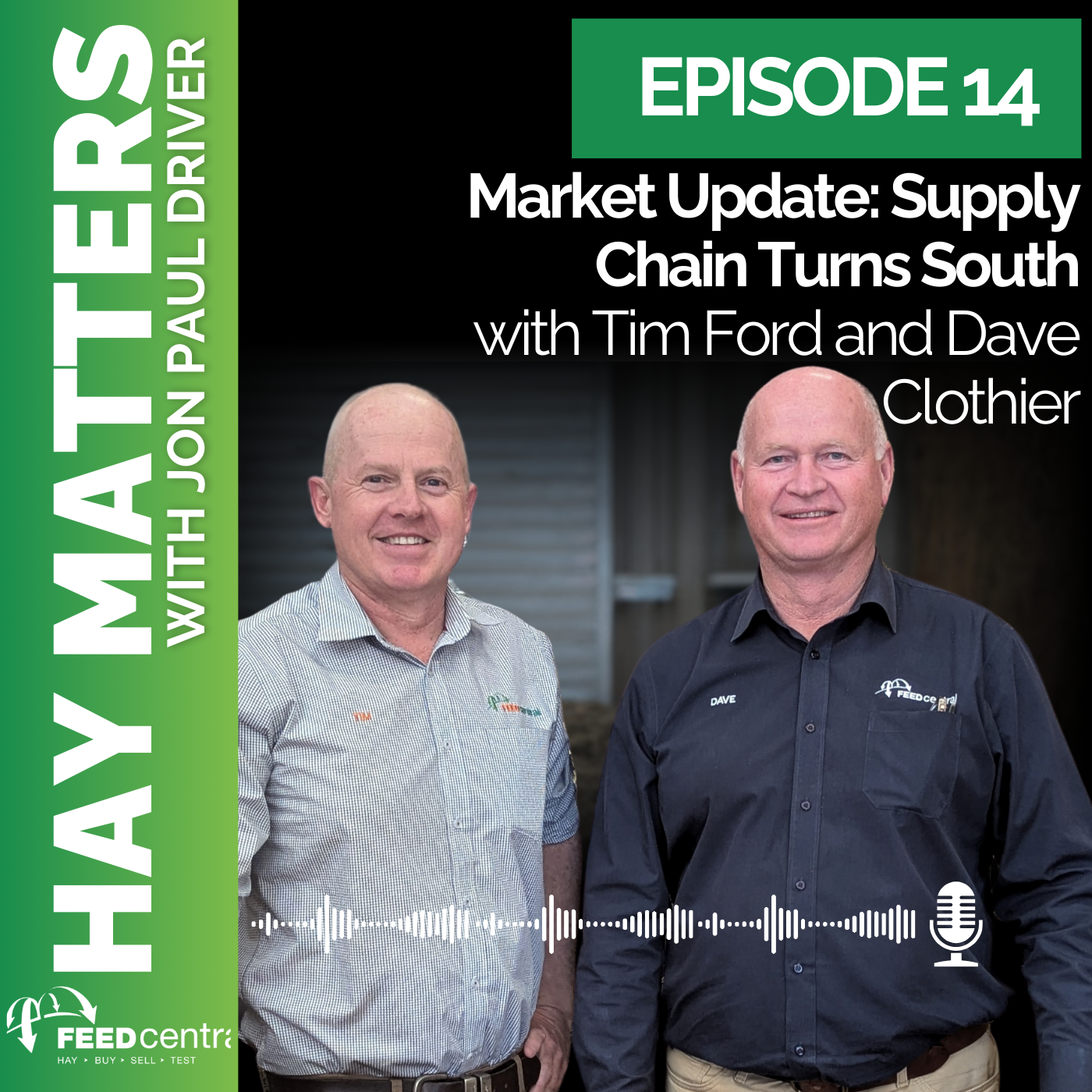
S1 Ep 14Market Update: Supply Chain Turns South with Tim Ford and Dave Clothier
Tim Ford, Director:While there has been recent rain, many areas continue to experience a "green drought" with slow grass growth, particularly in the intensive grazing and dairy regions of Southern Victoria and South Australia.Despite some growth stimulated by summer rain, a dry autumn and delayed onset of winter have led to significant feed gaps and strong demand for hay, which has shifted industry dynamics.Historically, intensive dairy areas produced their own silage; however, this year has seen a substantial southward movement of hay from northern Victoria and Southern New South Wales, disrupting established supply chains.Reports indicate a disconnection between hay producers and consumers, possibly due to lost relationships and a general lack of knowledge on how to secure hay supplies, further complicated by changes in business ownership and succession planning.Feed Central has been facilitating the procurement of necessary feed since the 2002 drought, focusing on aligning the right product with customer needs through a detailed six-step process including listing, inspection, grading, testing, and delivery coordination.Dave Clothier, National Sales Manager:Lucerne prices are coming down slightly to stimulate the market as we head into the colder months.Sheds continue to empty in preparation for the new season, resulting in minimal carryover, which is great for filling with high-quality new season hay.Western Victoria and South Australia have been dry, affecting yields and leading to a big feed gap; recent rains are helping, but spring weather will be critical to watch.Hay is moving from northern and eastern Victoria into these drier areas, with some growers re-sowing due to delayed rain.In Southern Queensland, hay is already on the ground, with conversations happening on early harvests around mid to end of August in northern NSW; longer curing periods will potentially have an impact on quality.Stable hay pricing is anticipated, similar to last year, but dependent on factors including above-average rainfall and the potential for frosted crops affecting volumes.With a bumper grain harvest forecasted, we might see a softening in hay prices, impacting both the hay and export markets.
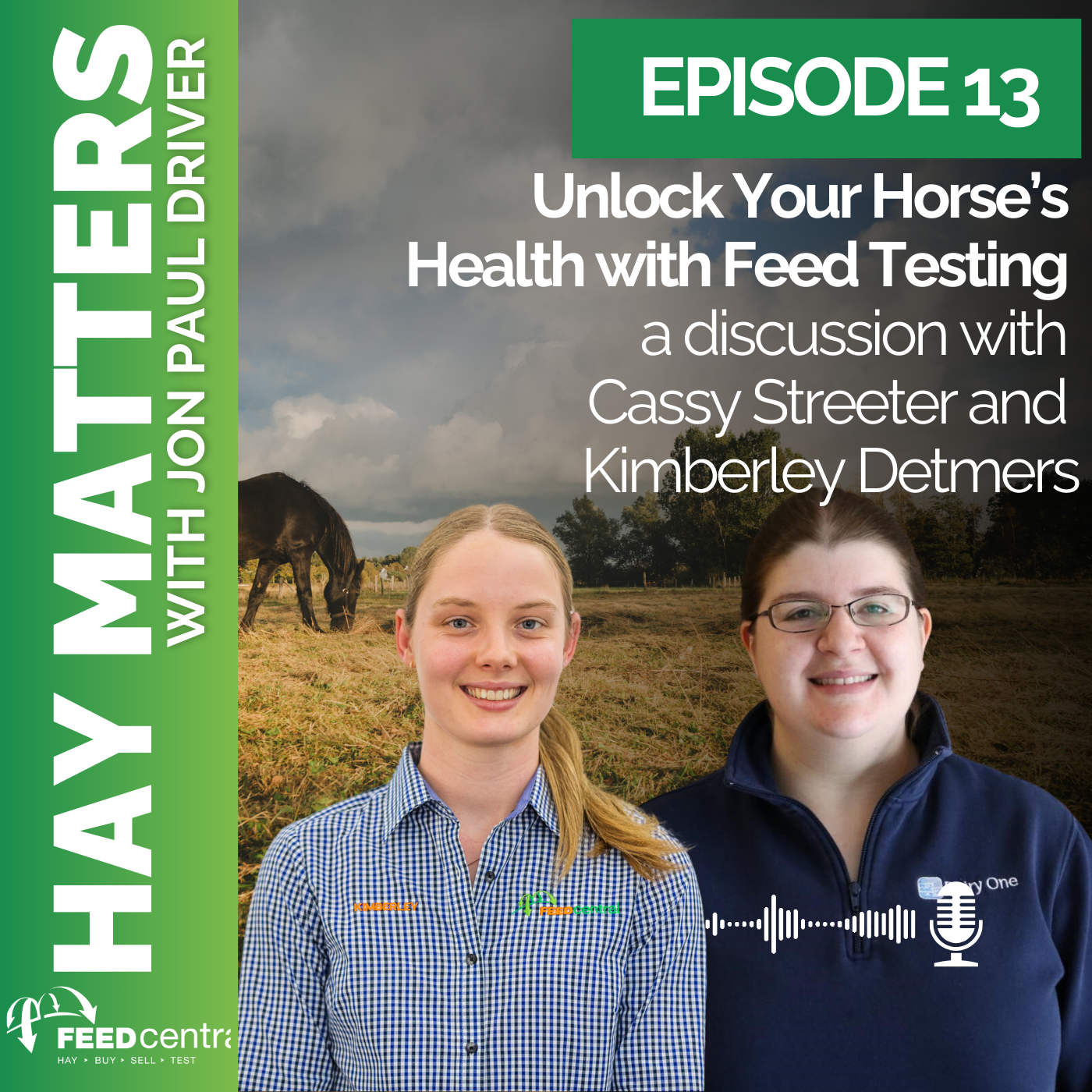
S1 Ep 13Unlock Your Horse’s Health with Feed Testing: a discussion with Cassy Streeter and Kimberley Detmers
Episode Highlights:Equi-Analytical was launched in June 2004 in response to the equine industry's need for specialised hay and pasture testing. Known for its robust NIR technology calibrations, Equi-Analytical licenses these globally.Equi-Analytical's launch in Australia will benefit the local equine market by reducing testing turnaround times for some services.Hay might be tested for many reasons such as to choose the best feed, or to assess the available feed to determine if supplementation may be required to meet your equine’s nutritional needs. Many metabolic health issues in horses, such as Cushing's Syndrome or Insulin Resistance, can be greatly improved by managing their diet.Hay corers help ensure accurate forage testing by collecting representative samples. They are available for purchase through Feed Central, or to borrow through some nutritionists, pony clubs, and rural stores. In the lab, samples are ground to a 1mm particle size, with only 60ml used for analysis at Feed Central. This highlights the importance of accurate in-lab and on-farm sampling given the small amount tested from potentially large sources.The Feed Composition Library on the Equi-Analytical website is a useful resource to compare forage test results with typical grass and hay profiles, providing a helpful starting point for understanding the numbers.Nutritional requirements will vary based on individual variations such as breed, age, and workload.After testing, it's best to take the results to a vet or nutritionist for advice for your circumstances. Alternatively, you can use nutrition software like FeedXL to import the data and identify dietary needs yourself.
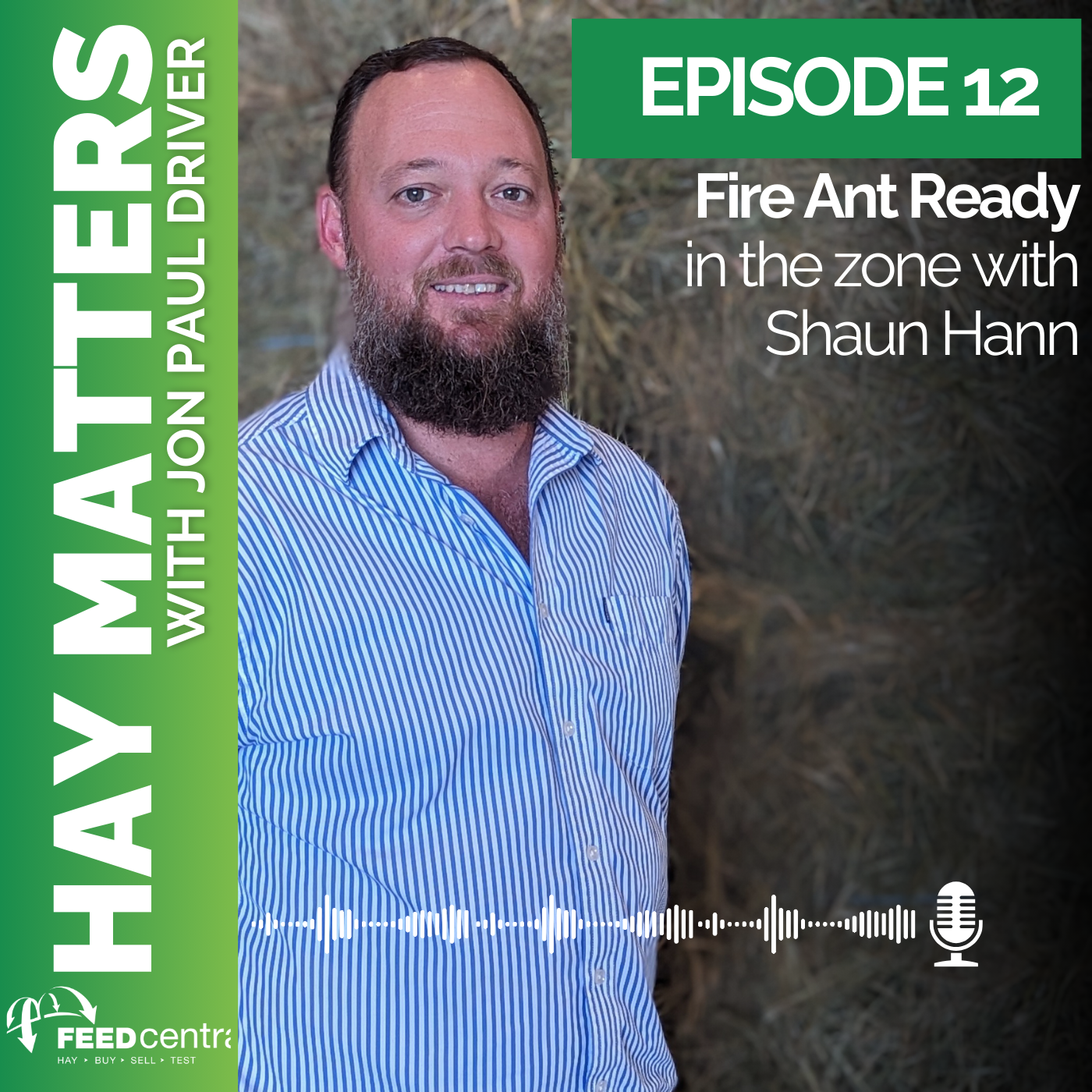
S1 Ep 12Fire Ant Ready: in the Zone with Shaun Hann
This week on the podcast, Jon Paul Driver sits down with Shaun Hann, the Manager at Toowoomba Hay Farm, to discuss his firsthand experiences after one of their storage facilities was declared to be in a fire ant zone. Shaun shares how this unexpected challenge has impacted their operations, the new regulations they are navigating, and the practical steps they are taking to remain fire ant free and compliant.Episode Highlights:The recent discovery of fire ants just kilometres away from Toowoomba Hay Farm's Oakey storage facility has necessitated a rapid educational and operational response to comply with stringent biosecurity standards.Fire ants, known for their destructive impact on crops and painful stings, represent a significant agricultural and public health threat.Following the identification of a fire ant nest in May, a five-kilometre contamination zone was established around the nest site, placing Toowoomba Hay Farm’s Oakey storage facility within this high-alert area.Fortunately, Toowoomba Hay Farm’s storage facilities already had bitumen and concrete flooring, but has taken additional biosecurity measures, including setting up chemical barriers and updating storage protocols, to prevent the spread of ants.Staff at the facility underwent extensive training and received certifications in fire ant management, ensuring preparedness and compliance with the National Fire Ant Eradication Program and Queensland's Biosecurity 2016 guidelines.Toowoomba Hay Farm has adopted additional safety protocols, including weekly inspections and advanced pest control treatments, to proactively exceed governmental requirements.The ongoing government-led baiting and chemical treatments aim to reduce the spread of the ant colonies, with the storage facility's status remaining in Zone One, indicating continued high vigilance and control efforts.The potential downgrade of the contamination zone from Zone One to Zone Two remains uncertain, which could impact future plans and costs.Visit the Feed Central website for helpful tips on biosecurity, along with training, and certification resources compiled by the team after their experience in a fire ant zone: https://www.feedcentral.com.au/fire-ant-resources/
S1 Ep 11Southern Demand Challenging National Supply: a Market Update with Dave Clothier
Episode Highlights:Recent rainfall across the eastern seaboard has had minimal impact on reducing fodder demand.The EOFY is influencing decision making. Some growers are choosing to defer payments and buyers are deciding between filling on-farm storage now or in the new financial year.Demand is high and driven from the south, spreading into the north; all grades are selling well which bodes well for the new season.Beef prices are expected to remain strong for the next few years, supported by exceptional seasons and high livestock numbers in QLD, NT, and NSW. High calving and weaning rates are expected to continue boosting supply on the eastern seaboard.In WA, dry conditions are leading to increased livestock movement to eastern graziers and into abattoirs.While there is still a significant volume of hay available, it is distributed in smaller lots, making it challenging to secure large quantities. All grades are available, but larger lines of quality hay are scarce.The rapid sale of all hay grades, including weather-damaged stock, is setting the industry up for a promising new season. Unlike last year, when quality hay was left on pads due to limited shed space and faced higher risks, the current situation looks much more favourable for the upcoming season.Across the board, hay prices are firm, except for quality cereal grades where prices are rising due to demand.
S1 Ep 10Export Hay Opportunities: a discussion with Denis Johnson
Episode Highlights:There are concerns about potential oversupply in both Australia and the US. Natural events like droughts and floods regulate this supply to some extent. However, there is a limit to how much the market, especially in Asia, can absorb.There is a severe supermarket duopoly in Australia which is currently a major topic at the federal government level. This market dominance is not only impacting consumers who are already paying high prices but even more so for suppliers and growers, who are facing severe disadvantages.There's a need to ensure that growers can sustain their businesses, and at the same time, it's crucial to make products affordable so customers can also maintain sustainable operations.Opportunities in China's dairy industry are emerging as the market reopens after political issues and companies remain understandably cautious. If managed well, however, China could become a significant market again.Despite China's reopening, it's wise to also consider other regions. The Middle East, for instance, presents a substantial opportunity for the export market due to its potential for growth.Emerging markets, particularly in Southeast Asia, are demanding higher-quality products and proteins. The region cannot produce feed sources as efficiently as Australia, presenting opportunities for sustainable and profitable exports.
S1 Ep 9The Evolving Hay Market: a discussion with Pat Guerin (Bonus Episode)
Episode Highlights:Each export company in Australia has its own procurement matrix, lacking a single industry standard.R&D priority is shifting to focus more deliberately on the animal performance contribution value.There are ironies in the industry: breeding for some desired stem sizes can be counterproductive for animal performance, even when buyers are accustomed to a those sizes, for example.Due to these complexities, RD&EE (Research, Development, Education, and Extension) are crucial.While it may seem like there is competition for supply from different countries, the focus on animal productivity and growing the industry increases the overall market, benefiting everyone.In a growing market, everyone wins, whereas mature markets lead to competition over market share.Current investments in Australian export fodder focus on health and wellbeing for the future.Weather-damaged product is a major contributor to lower gross margins for hay growers in Australia. Investments in mitigating this issue can positively impact profitability.Conditioning the hay reduces the risk of rain damage by reducing drying time. Focusing on shortening the dry-down period can significantly improve contribution value.Using a tedder rake can hasten the drying process but increases the risk of losing colour. This problem has made people hesitant to adopt teddering.US tedders don’t spread the hay out; they fluff the windrows to promote airflow through them.
S1 Ep 9The Evolving Hay Market: a discussion with Pat Guerin (Part 1)
Podcast This week, Jon Paul Driver is joined by Pat Guerin in a special two part episode to discuss some of the many opportunities in the Australian hay industry. The discussion covers the need for industry-wide standards, a shifting R&D focus towards animal performance, and tackling challenges like weather damage and drying processes. It also highlights the importance of collaborative growth in the export market.Pat Guerin has a strong technical background in the hay industry. His career includes managing large hay export facilities in South Australia and Western Australia, and a background in agronomy and animal nutrition.Episode Highlights:There are significant opportunities to increase the value from research and development investments. AgriFutures, the peak government body, oversees 16 different industries, managing their R&D strategic plans. R&D investments benefit the entire process chain, not just the grower or plant breeder.Over the past 10-20 years, there have been significant productivity increases in the grain sector, making hay less competitive in crop rotations.To achieve high yields and improve production quality, the hay growing system needs modification. Key components like optimising the plant's response to light and cold are not inbred in the oat and hay varieties used in Australia.There is room to improve production quality in the oat and hay industry by incorporating traits like photoperiodism and vernalisation, which are currently lacking in Australian varieties.Focusing on these areas presents an opportunity to achieve higher yield values alongside better quality.