Hardcore Software by Steven Sinofsky (Audio Edition)
109 episodes — Page 2 of 3

058. Synergy
Welcome to planning Office10 and going inside the strategy, synergy, unification engine that characterized the early 2000s Microsoft (beginning in late 1998). This is a beefy post (too long for email) and even includes an embedded PDF (a new Substack feature 🔥) of the entire Office10 Vision document.This post is not paywalled. Perhaps consider sharing it with friends or coworkers. 🙏 Sync with Windows 2000. Sync with Whistler (the codename for Windows XP). Sync with Windows Server. Sync with Exchange Platinum (codename for Exchange 2000). Sync with Exchange Titanium (the one after that). Sync with SQL 2000. Sync with the one after that that didn’t even have a codename yet. Sync. Sync. Sync. That was what we heard from every corner of the company when it came to building the next release of Office. Sync wasn’t just about schedule. Sync implied deep strategic connections in the code and user experience—it was all about product synergy.A remarkable accomplishment of Microsoft’s earliest days was entering all the major lines of software at the time. In a c. 1981 video produced by Microsoft, “A Hard Line on Software”, the company touted its product line.A full line of system software not just one or two products, and all of our products are designed to work together…a full line. Microsoft products cover all three areas of system software: languages, operating systems, and end-user tools.Microsoft’s core DNA was having products in all the major areas of software while also committing to products worked better together. This was BillG to the core.By the late 1990s, Microsoft had spawned two businesses greater than $10 billion in Windows and Office and breaking those down further one could find multiple businesses closing in on $1 billion in revenue from Visual Studio and developer tools to the various servers such as Exchange and SQL to the new business of MSN and games. The breadth part of the DNA was firing on all cylinders.The other part of our DNA was proving to be more difficult and at the same time the demands for products to work together were only increasing. This was happening as product complexity skyrocketed and the predictability of product releases was not improving. More importantly, each of these big products began to have significant overlap: Exchange and SQL, Basic and C++, Word and Publisher (and anything that edited text), Excel and the Access database (and Visual Basic), Internet Information Server and Windows file server, and the list goes on and on. Mind you, the overlap was not entirely obvious to most as the market clearly saw these as different products. Inside Microsoft, however, the overlap was at some deep architectural level worthy of debate and ultimately synergy and unification.As enterprise customers came to dominate the business, strategy was no longer just about features. Strategy was how products were deployed, managed, and integrated into business scenarios. Something entirely clear at a usage level such as e-mail, a database for line of business data, and file storage became a galactically hard strategy problem when customers wanted to deploy and manage one scaled “place to store data”.The technical leaders of the company spent most of our executive time on the collisions between products when it came to deployment and management and the seams between them when it came to user-experience and scenarios. Having more than one way to do something or failing to have clarity in prescriptive guidance to the field sales organization was reason enough for a big meeting or offsite.Call it what you will, synergy, strategy, unification, consistency, or simply efficiency were the key attributes everyone was to aim for. It was assumed achieving this was part of the schedule, though this operational aspect was almost never discussed or even challenged. Unify was definitely BillG’s favorite way to describe his goal.For better or worse, those of us with our experience in Office made oft-repeated calls that synergy comes from synchronizing ship dates across products. Surprisingly it seemed to have sunk in now that a big wave of server products (Windows 2000 and the 2000 servers) were nearing completion. So now everyone wanted to know when the next Office was shipping and importantly, would that date align with what they were planning on for the next releases. Such scheduling was of course impossible. Not only was no one in the company hitting ship dates but having any two groups first agree on a target and then hit that target was akin to bullets colliding mid-air downrange, on purpose. Important here is that we’re not talking about new groups or small teams, but massive billion-dollar products and customers spending tens of millions of dollars per year on their Enterprise Agreements. Each of the product teams approached 1,000 people at this point. The scale was immense.As it would turn out and much to our collective surprise, the next releases of both Windows and Office (the releases being pla

057. Enterprise Agreements [Ch. IX]
Welcome to Chapter IX, taking place 1999 to 2001 where the world realized just how dependent it had become on email and the PC when viruses became a mainstream part of the technology vernacular. In the halls of Microsoft, it became apparent that being early was as strategically deadly as being wrong. PCs sell more than 100 million units for the first time in 1999. Things start to heat up on the antitrust front. We are learning to plan a release in the context of a massive change in the business of selling software to the enterprise.Back to 056. Going Global…Mother TreeEnterprise wasn’t just the direction of the business—it was the only business.But could we listen to customers and still fail? That’s what it felt like was happening.Office 2000 had become entrenched in the enterprise, if not yet deployed it seemed inevitable. In the process, we left end-users behind. Those concerns over too much enterprise focus that were pushed aside to make way for Office 2000 became front and center. From a product development perspective, we were failing in the reviews that we had been trained to want the most to win. Starting with “nothing in it for the little guy” to “thousands of features, some useful and most not” the product was not something end-users wanted.Business results told an entirely different story. Most quarters our Office finance lead would come to a senior manager meeting and discuss the earnings announcement and put it in context. As a public company these discussions were not news, but at least helped the broader team to understand where the money came from (and how much we were spending). Each quarter of results had a new entry in the filings and disclosure that went something like this from Microsoft’s 2000 annual report:At June 30, 1999 and 2000, Windows Platforms products unearned revenue was $2.17 billion and $2.61 billion and unearned revenue associated with Productivity Applications and Developer products [Office] totaled $1.96 billion and $1.99 billion. Unearned revenue for other miscellaneous programs totaled $116 million and $210 million at June 30, 1999 and 2000.It would be an understatement to say that finance was almost giddy over the unearned revenue number. It was growing at a crazy rate and the numbers were billions of dollars. Sometimes it felt like the world’s largest rainy-day fund (even though Microsoft’s cash on hand was also astronomical) or that we could stop selling software and run the company on unearned revenue for a couple of years. The company came a long way from BillG’s founding principle of maintaining a full year of cash on hand to weather economic uncertainty.Revenue was no longer as simple as how many copies of Office were sold. The turn of the millennium was about selling multi-year contracts for Office (and other Microsoft products, often all together). While Office for $100 or even $150 dollars per desktop PC seemed historically low, gone was the angst over upgrades. The largest companies in the world were buying our software for every PC and committing to keep buying it for the next three years, called an Enterprise Agreement or EA. It was effectively a massive increase in revenue per customer, in exchange customers received the full enterprise treatment of support, sales teams, strategic partnering and more. Those benefits were known as Software Assurance.Wall Street had to find new ways to think about earnings. Instead of booking the revenue for one box of Office entirely in the quarter it was sold, revenue was formally recognized over the life of the contract (usually three years). Contractually the revenue was guaranteed, but accounting rules meant Microsoft had to wait to recognize revenue. It is easy to see why this is a good idea, as absent that we could conceivably have monster quarters only to fail to sell more products in the future.This created a radically new problem for how we thought of the business. Microsoft created a virtual line-item unearned revenue representing all the future payments yet to be recognized. Instead of topline, Wall Street was now focused on the rate of growth of the unearned revenue. Very quickly billions of dollars from Windows and Office were piling up in the unearned revenue line item. Unearned revenue would convert to plain old revenue on a schedule based on length of the agreement and would be added to the revenue line of reported earnings. As quickly as these agreements took over, we had to change how we thought about product development.Unearned revenue (almost an oxymoron, and certainly not a phrase coined by marketing) could sound like an accounting gimmick and was especially tricky for the teams in headquarters that had no real insights into pricing, number of agreements, or even the promises and terms. We only had one important rule, which was that we could not (ever) disclose the future release date of a product. Doing so would potentially turn unearned revenue into earned revenue as the rights to buy an upgrade went
056. Going Global . . . Mother Tree
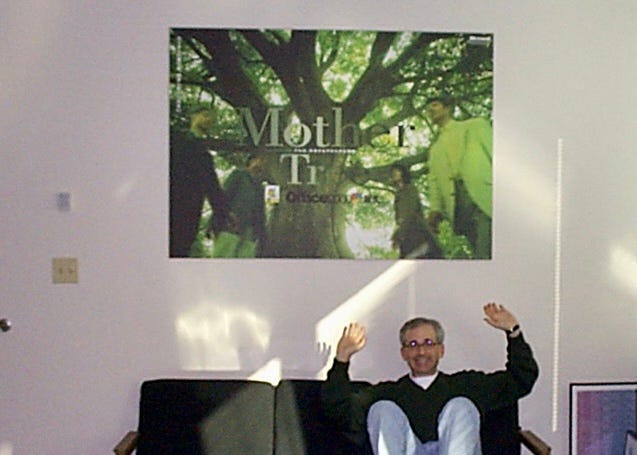
Launching a product in a local market, natively so to speak, is an extraordinarily special experience. It is so special that for nearly every product I worked on I chose to be outside the US and participate in some aspect of the global launch, most of the time in Asia. With this love of the market came a learning curve and some fun times. Office 2000 was my first chance to launch a product as an executive and in Asia—it was a dream come true.This is the final post of the millennium and concludes the chapter and launch of Office 2000, which I think you can tell was a tremendous period of personal growth that went along with the scaling of our product team, and why the past three posts have been a bit more personal. The PC is entering a new phase, the maturing of the market as an enterprise product. The next two chapters cover this incredibly important time in an evolving Microsoft—everything was happening at enormous scale and global diversity yet coordinated in a manner consistent with the need to develop enterprise products. The stories of Microsoft during this time are few and far between and I’m hoping to fill that void because this builds the foundation of today’s Microsoft.There will be no post next week due to the US holiday.Back to 055. Office 2000 is Good to Go!Everything about participating in our launch event in Japan was as orchestrated and as on time as the JR subway. For weeks before launch, I received down-to-the-minute schedule updates, “1635: move to event hall”, “0940: prepare with translator”, “1210: meet for the box lunch” and so on. I could not have been more excited to attend.My friends (co-workers) in Japan were frustrated that I flew there by myself, navigated the city on my own, and declined being met at Narita Airport to be shuttled into town, a 2-hour trip. In the ’90s my ways were not how American executives did Japan, even though it was not one of my first trips (see Michael Lewis’s Liar’s Poker for how bankers did business in Japan). They were so concerned I might get lost that someone prepared a camcorder recording of the entire transit route for me from customs at Narita to the hotel, which they sent to me on a CD-ROM to view.Using my video directions, I arrived in Tokyo. The head of East Asia R&D, Akio Fujii (AkioF) met me at the hotel—he insisted, no, he really insisted—and drove us (his car had a TV in the dashboard!) to the Windows World Expo/Tokyo 99 event, which was a 1000-person venue that we would fill. Oddly, a bright yellow Lamborghini was parked practically at the front door of the expo hall. Fujii-san explained that the launch event creative manager drove that car and that he was (very) big in Japan event circles. I was already off to an over-the-top start to the event.We arrived and met with Susumu “Sam” Furukawa (SamF). SamF, a tech legend in Japan, was an original leader of the Microsoft subsidiary, MSKK, and served as Chairman of Microsoft Japan. He was a relentless champion for the PC, Microsoft products, and an advocate for Japan in the United States where he kept a home by Microsoft. In addition to his passion for every conceivable electronic gadget, audio/video tool, or handheld device, Sam was famous for his love of model railroads and built elaborate scale scenes often featured in the magazines. He was also known as one of Japan’s leading gadget gurus and had deep relationships with Japanese consumer electronics companies. His enthusiasm was so remarkable and infectious I often failed to keep up with him in meetings because his excited English ran together and sounded like one long word or sentence. Then once BillG mentioned to me that he was pretty sure no one could keep up with Sam in Japanese either, which was quite a relief.The stage seemed rather stark. Draped over most of the front of it was a plain gauze curtain, a scrim. Puzzling. SamF arrived and was his incredibly excited self. He secured “the brightest high-definition projector in existence from a best friend at Hitachi.” The Hitachi crew in matching jumpsuits and hard hats was up on the catwalk calibrating the projector.They gave me staging for the next morning’s event. There was no room for improvisation. The translator was briefed. I was to say only what I was told to say—“Konichiwa, Sinofsky desu” and then recite the English script, ending with “Arigatou gozaimasu.” That became my Japanese business vocabulary that served me for decades. It was Lost in Translation happening to me (also I was staying at the relatively new Park Hyatt). It took hours to get everything right. At least I thought it was right.They told me that after my rehearsed words, music would play and the scrim would drop, revealing a Hitachi projection of Office 2000. Sam had me leave the stage so I could see it all from the audience perspective. We headed to the back of the room by the control board that must have been twenty feet long staffed by six people.The stage lights dimmed, a spotlight lit up where I’d been standing

055. Office 2000 is Good to Go!
Office9 (aka Office 2000) was the very first release of Microsoft Office built by a team that began the project and ended the project as one. Well, almost as there was that pesky Outlook challenge. That said, the project was coming to a close by the end of 1998 and it was late. It was not terribly late or out of control as I reflected on my 1:1 with SteveB, but late nonetheless. The way old-timers would talk about projects to me was that product development slogs “really sucked” and then you ship and that is the “best feeling ever” and it is worth it. I was hoping to feel that way soon. The last month of 1998 would be eventful for me personally and the team in ways that were unexpected, both happy and tragic, and a reminder of the scale at which we worked.Back to 054. Steve and Steven Get New JobsNot only were we five months late by the end of 1998, we also faced the lag time that would happen on the other side of our pending a holiday break. It became clear our end-of February completion date for Office9 was going to be a challenge.At least we were on the glide path to completing the product before we left for the holidays. As far as the enterprise sales team was concerned, we were going to finish in the first quarter, which was important for customers buying or renewing volume license contracts. Office 2000 was shaping up to be a significant release for the end of the millennium. And yes, Office 2000 was Y2K ready.As I prepared to head to Florida for holiday vacation to see family, JonDe let me know that I was being promoted to corporate vice president. This was truly a big deal personally, and as I look back I realize it was a big deal for the company. Along with BrianV leading Exchange a press release would go out announcing our promotions in about a week—the ranks of executives were small enough then that not only did we do press releases for promotions, but we became named officers in the company and the two latest additions from the product development teams. If you’ve ever been part of a rocket ship, what you experience is growth in executive promotions when you start to wonder if this is a worthy promotion or will people outside your immediate group roll their eyes. NatalieY, the spiritual and cultural leader of the company in human resources, sent me an incredible note telling me how “real” the promotion was which meant everything. These insecurities come with what does seem like one of the most significant milestones in a career and for me, I will always think of this as the most significant, owing much to JonDe and all of the Apps people before him.While everything was the same organizationally, what was simply a title change in the Exchange address book was the start of being treated differently, particularly by those I did not yet know, especially in the field sales org, and, perhaps even more entertaining, by the various Microsoft systems and services.In short order, Colleen Johnson (CollJ) was being briefed on the exec travel desk (EXTRAVEL), executive tech support (EXECSUPP, yes, there was special on-call PC and tech support for executives), executive shuttle (sort of an Uber for VPs to go between buildings that I almost always walked anyway), and even the special team that helps make PowerPoint slides for execs, and so on. I knew these existed, but I thought they were for Bill, Steve, the CFO, and Board, not all the VPs. Oh, and my card key worked in all sorts of places it used to not work, like weekend access to the Executive Briefing Center! I did have mixed feelings about special treatment for run of the mill execs in product groups. The teams were all incredibly nice, but this felt like excess to me.CollJ was a key addition to our team who had an outsized impact on our operational excellence and culture. Hired as an administrative assistant, she quickly and quietly assumed the role of indirectly managing the dozens of administrative/group assistants across the team (on average one for every 100 people) which was the front line of our culture of careful management of resources. She also took on the role of formalizing all our headcount tracking which was a key enabler for how I would manage the team. A dumb example was instituting a code in our SAP-based system for what individuals worked on (Word, Excel, Office shared, etc.) and what functional group they were in (dev, test, program management). Amazingly our systems did not track that and yet it is all that mattered in managing a significant team. For decades neither she nor I managed to coach other teams into managing this way, even after the yearly visits from teams being told to learn a best practice from how we managed things. There’s a lesson in there—you can’t manage a big team at scale if you don’t know what people are working on and how humans (not dollars) are allocated!Colleen also led our efforts at developing a new more scalable Office culture. Too much of Microsoft was still acting like it was college when it came to team

054. Steve and Steven Get New Jobs
Steve Ballmer was named Microsoft president in July 1998. There was not much fanfare because it seemed an entirely natural progression of his role at the company, partnership with Bill, and recognition of the incredible accomplishment in building a world-class sales force over the past few years leading that effort. At the start of his tenure, he set out on a schedule of 100 one-on-one meetings with people across the company. Just as I was about to meet with him, I was promoted to general manager of Office. How did the meeting go? Back to 053. Strategy Tax: Outlook Storage, First AttemptSubscribers, be sure to check out the subscriber only bonus post Competing with Lotus NotesThe full-page story in InfoWorld July 27, 1998 began ominously “Most new presidents can count on a 100-day honeymoon...but for newly appointed Microsoft president Steve Ballmer, that blissful period is probably going to be something less than 100 hours.” This wasn’t the typical coverage.In fact, most of the coverage reflected the broadly shared internal view that Microsoft was growing up and needed an executive structure to match. It was growing up in precisely the way Steve had orchestrated and been leading—Microsoft was becoming an enterprise company. The coverage was by and large friendly and reminiscent of the close connection Bill and Steve had and the natural evolution of the role he had been playing in the company.Previously, Microsoft had a legendary President/COO Jon Shirley (JonS) who brought 25-years of experience from Radio Shack and was responsible for building out Microsoft’s business infrastructure through 1990 and remained an active board member for years. Microsoft brought on several other senior leaders, but like many growing companies had a difficult time helping them to fit in and thrive. Bob Herbold (BHerbold) joined from P&G in 1994 and remained as COO reporting to Steve through 2001. Steve, with his connection to Bill and his strong role in shaping the new Microsoft, was a more certain appointment.SteveB was named president of Microsoft in July 1998 (Microsoft’s fiscal year ended June 30, and frequently big changes happened either right before or just after the end of the year). For many, me included, this was viewed as a natural progression and one that most felt was entirely right for the company. Steve was managing worldwide sales and support and was promoted to lead the product groups and all the operational groups.BillG emphasized that he still planned to devote time to product issues, and with so much to do he saw himself spending the next 10 years as CEO, perhaps to put people at ease. To be clear, this was a huge change for Microsoft. For the first time, we had a non-product/technologist managing all product groups. In a 1:1 with Bill he emphasized to me this “10 years as CEO” talking point which was in most of the press, countering an oft-repeated assertion that Bill might be making room to spend more time on the looming regulatory challenges Microsoft faced. Bill assured me that he was going to continue to spend time, now more time, immersed in product development. After the recent email debates, over HTML, it wasn’t as clear to me that was a positive. I kept that thought to myself.Steve orchestrated perhaps the largest and swiftest pivot (a phrase that became deeply rooted in Microsoft lingo due to Excel’s successful feature) to an enterprise sales operation ever seen, expanding and building out a global sales and support organization that easily matched in quality if not scale any of Microsoft’s competitors, from Oracle to Sun to IBM. From databases to networking to directory to email to productivity, SteveB’s sales machinery across LORGs, MORGs, SORGs (large, medium, and small organizations), governments and education, and industry verticals from finance to health care all were covered. Operationally, the enterprise sales force was a machine. It was present. It was loud. It was visible. And mostly it was all new, as if synthesized from thin air. The field, the collection of account managers (sales and technical), country general managers, and business segment leaders, is often hailed as Microsoft’s biggest asset, and what has certainly fended off many competitive challenges (even if product people like me like to think the product did the heavy lifting). It is the field operation that carries Microsoft today.SteveB never approached a job with tepidness, often employing a saying from his father, “If you’re going to do a job, then do a job.” He began his tenure as president by a widely known (and followed via backchannels) series of 100 1:1s with leaders across the company (and innumerable calls and meetings with customers and partners). Mine was scheduled for the end of August. It was not like a list was published or anything, but among many there was a desire to know, “Did you do your meeting?” I knew SteveB from working with Bill, showing him the internet, and many meetings with the Japan subsidiary

053. Strategy Tax: Outlook Storage, First Attempt
Most tend to think of Microsoft strategy as the march from BASIC to DOS to Windows to Azure. While that is a robust external narrative, the more interesting view is how the company changed strategically and organizationally as we transformed from a consumer to an enterprise company. We changed from relatively independent (and culturally unique) Apps and Systems organizations to increasingly interconnected strategies with a growing list of top-down initiatives. The ultimate expression of these strategic goals came in the form of the transformation of the senior leadership who increasingly emerged from the System/Platforms teams. No single initiative would be a bigger symbol for top-down strategy, and execution failure, than unified storage, a grand vision for the one-database-for-everything technology providing the underpinnings for everything from email to photos to documents while scaling from laptops to servers. In creating Office9, Outlook was on the front lines of the start of this journey. This is the first of three attempts, but also the start of increasingly challenging strategic initiatives across the company. Working through and managing such initiatives proved quite difficult for me personally.Back to 052. Alleviating Bloatware, First AttemptDuring a visit to Japan, I ran across a new Sony laptop, the VAIO C1 PictureBook. What a wonderful machine. Crammed into a half a sheet of A4 paper in length and width was a laptop processor, 64MB of RAM, a 1024x480 screen, and a PCMCIA slot for wired or wireless networking. It also had a port replicator to support the new USB connector, CDROM, and floppy drives. It ran Japanese Windows 98. One of most distinguishing features aside from size and weight was that it was one of the first portables to have a built-in webcam. It was my new favorite computer.I spotted this machine at Yodobashi Camera at Shinjuku Station, which was always my first stop after landing at Tokyo’s Narita Airport. In order to be prepared to meet with the Japan team, known by the corporate moniker MSKK, I needed to see first-hand what was on display at the world’s largest electronics store. Each year more people visit Yodobashi than visit Disney World. Among the hundreds of computers, cameras, home appliances, and everything imaginable, Sony reigned supreme. Something stood out this year. Sony products, including PCs, were starting to support a new kind of removable storage card, like the CompactFlash cards in use by the first digital cameras, but smaller and proprietary to Sony (I learned it was designed to compete with a new standard memory proposed by all the other Japanese electronics companies). It was called the Memory Stick. Sony had been trying to create proprietary formats and consumables ever since it lost the Betamax battle and this seemed the latest effort.What was more interesting was how it caught BillG’s eye on his own trip to Sony meeting with Idei-san and Morita-san among others. He too learned about Memory Stick (and also the digital rights management features called MagicGate that he really loved) but more interesting than the storage technology was how Sony seemed to rally around adding new memory stick support to every product, whether it needed it or not. Camcorders, cameras, mobile phones, music players, televisions, and more were all outfitted with Memory Stick slots.At some big meeting I was using my PictureBook during a conversation about Microsoft’s own storage technology, then known as Web Store (as in web storage, as it was going to be a place to store files in Exchange mail server that would make it act like a web server), and the desire for it to be used across all products. The topic wasn’t new, and we’d been going in circles for quite some time already because it was clearly too early and the technology was, as far as I was concerned far in the future at best. My skepticism frustrated BillG and those making the technology, primarily in the Exchange team where they were building the next release called Platinum. If that’s all too many codewords, don’t worry you weren’t the only one confused (This might be one of the few stories that even those that lived through it cannot agree on the precise terminology used and codenames as the technology evolved). Web Store ran on Exchange. Local Store was a similar technology that ran on laptop and desktop PCs providing symmetry between the server and PC. It was at first a generic term and then morphed into a project called LIS, local information store. These all represented the same concepts at different points in the evolution from 1998-2001, sometimes on the PC and sometimes on the server.I made a semi-serious/semi-sarcastic statement about how we should all have to use Web Store the way that Sony was putting Memory Stick in every product.Bill jumped on that comment in a way I did not quite expect, proclaiming something along the lines of “Yes, that’s called strategy. Why can’t we have that?” He wasn’t really asking.

052. Alleviating Bloatware, First Attempt
What happens when your biggest strength and greatest asset as a product development organization becomes your biggest weakness? Perhaps that is inevitable. With so many potential disruptive forces, at least that’s what we were hearing, it was almost too much that the very thing we really excelled at—building new features—would become a problem. While the idea of software bloat or even the phrase bloatware was hardly new, it was being applied increasingly to Office. This is the story of the first attempt at doing something about this issue.Note to readers: Substack introduced a new feature this week—free excerpts with the remainder of the post for subscribers. I’m trying this out to see what subscribers and potential subscribers think. I do welcome feedback. The proceeds of this work do not benefit me, and subscribers can also join in the comments and discussions.Back to 051. HTML: Opportunity, Disruption, or WedgeFeatures. That’s all we ever talked about. Adding features. Fixing features. Missing features to be added or fixed. Office achieved the position it achieved, as precarious as it seemed now with the rise of the WWW and Internet, by adding more features with more regular releases of new versions than competitors. Reviews focused on features and we won reviews. We had built a team, an engine to add features.As fast as Clippy could appear after hitting the F1 key, it seemed as though our greatest strength and our most significant asset—features—had become a great weakness. We went from dominating with more well-executed features to being crushed by the perception of the weight of our products. The industry latched on to the expression bloatware to describe products that seemed to have too much—too many features, too many megabytes, too slow, too difficult to use, or simply too much.It was one thing to develop a strategy to address a customer problem we had created, albeit inadvertently, when it came to total cost of ownership. We even committed to building fewer productivity features, despite the internal backlash over personal productivity moving to priority six. It was entirely another thing, however, to look at what we built and be pressured into admitting customers didn’t want or need it. Still, customers were buying Office by the tens of millions of copies. Were customers, press, and analysts right? Did we have a product problem, a technology issue, or a marketing challenge, or some combination? Of course, the development team was certain marketing wasn’t convincing people how amazing the product was. Marketing was certain the dev team was not delivering business value. Press and analysts were relentless. What could we do?Our hometown Seattle Times reporter, Paul Andrews wrote “already some have nominated Office for Bloatware of the Year.” While unclear who “some” were and knowing there was no actual award (thankfully), that was a sharp dig in an otherwise positive Office 97 review.Worse, however, was the headline in the Wall Street Journal that simply stated “Microsoft May Face Backlash Against ‘Bloatware’” right on the front of the Marketplace section. The article used every possible way to explain the scale of Office as big from “two years and several hundred million dollars [in R&D]” to “appetite of companies for such programs” it did not let up. The requisite quote at the start of the article from an IT professional was brutal “couldn’t care less… there was nothing from a business point of view that was a compelling reason to upgrade.” To this day I still get a sick feeling in my stomach from the box in the story stating, “Microsoft’s Office 97 contains 4,500 commands for features both useful and arcane.” Each of those features meant something we were so proud of and represented real effort. Plus, during the interview the reporter kept pushing for ways to talk about how big Office 97 was. I resisted and let this slip in a moment of pride, only for it to be used against me. I added this article to the binder I carried around and had it at the ready whenever the topic of bloatware came up.Bloat was a constant source of strain in conversations with field sales, in the Executive Briefing Center, and with the press. Each time the topic came up I used my go to answer, which was that there is a set of features that everyone in Office uses and those are easily understood such as open, save, print, copy and paste, and a host of basic formatting commands. Everyone nods. Then I would talk about how each application has features that a few people use, perhaps footnotes, financial formulas, or animations in PowerPoint. Most would agree with that. A common variant of this discussion was “your bloat is my crucial feature” or “yes this is bloat, except that one time a year I need to use it.” Most PowerPoint presentations are minimal when it comes to production values, except for that one time a year when the stakes are high and huge effort goes into making a great show. A favorite example is that few claimed

051. HTML: Opportunity, Disruption, or Wedge
While we knew the time was wrong to build a whole new Office out of one of the new disruptive technologies, we did need to arrive at a strategy for HTML. After the debacle of the file format changes for Office 97, the allure of HTML was everywhere. The enterprise customers we intended to impress were fed up with the traditional (and ever-changing) binary file formats in Office. HTML had achieved the status of “magic beans” and could solve any (and all) problems. But how?Back to 050. The Team’s Plan in the Face of DisruptionFirst thing Saturday, 9:44AM December 5, 1998, so might as well have been 5:44AM, I received an unsolicited mail from BillG subject line “Office rendering” and copying the full management chain in case they weren’t busy that morning. I joke, this was normal even though Bill had been increasingly focused on broader issues lately. For some reason (no context provided), Bill read something somewhere that gave him concerns about the use of HTML in Office. We already had a plan, which he knew about but was now having second thoughts or something. It was not unusual to have to back up and go through our logic and approach to get to an admission that we were not nuts, or perhaps to tweak something. This was a big issue though and cut to the core of our second highest priority in Office9, “HTML in Office9”. Bill had some concerns, to put it mildly.When we changed the traditional binary file formats in Office 97, we caused a real disruption in work. Suddenly files were being emailed within and outside the company and they simply couldn’t be opened if the recipient had the wrong version of the application. Worse, even if a converter was available there was a pretty good chance after a few edits the document returned in email would look funny or even wrong. What had served our industry so well—the binary format that represented the internal data structures of each application—had hit a wall with the combination of email and slow deployment of the latest version of software. Without new file formats we were really stuck because every new feature was represented as a change in the data structures and file formats. That’s just how things were done.The browser and HTML were the cool new thing, but they also held out a promise of a universal platform for viewing documents. Enterprise customers and industry analysts were enamored with the idea that HTML was a resilient, text-based format. If people used different browsers, they could still read documents with just a few formatting hiccups and all they needed was a browser and not some expensive new version of a productivity tool. Plus, everything just seemed better in a browser, better than the old File Open dialog, connecting to network drives, endlessly navigating folders in hopes of finding something. Just click on a cool blue link and up pops the most current sales numbers or marketing plan. Little details like being connected to a high-speed internet from a laptop, something that was nearly impossible outside large office buildings in major cities, would take years or a decade, to address.We knew all this. Solving these problems was our plan. The big problem? No one knew how those cool documents that were so easy to read, so resilient, so friendly, so snappy, and so much better could be made. What tools would typical knowledge workers use to create web pages? What server would they be stored on? Our strategy: Office and FrontPage.Even if we had some ideas, there were many questions about the role of Word and PowerPoint, and to some extent Excel, given the increasing preeminence of browsing. In a world of browsing web pages created with the relatively simple formats in HTML, where and how would tools designed for sophisticated print-formatted documents fit in?The most complex cross-group feature of Office9 was the second pillar of the vision, HTML file creation. Demonstrating that these large apps could be relevant in the face of the WWW was a major part of our strategic challenge, especially within Microsoft.Our choice not to do browser Office, Java Office, or components of Office was a big miss for many in the company who saw those technologies as synonymous with embracing the WWW. The answer in the vision (and in High Hopes) was using Office to participate in the WWW, using the apps to create HTML documents that could be viewed in the browser. In a sense, this was turning the WWW into a giant online printer or document repository for businesses. FrontPage powered this ability to publish documents from the desktop PC—we called it the two-way web.A response to potentially disruptive technologies is for the incumbent product to do a bit of a jiu-jitsu move and attempt to turn the disruptive technology into a feature within the product—rather than build a whole new product out of the new technology, embrace the technology as part of the existing product. That’s what we were doing with HTML. Rather than rewrite Office in HTML, what if we made HTML a fea

050. The Team's Plan in the Face of Disruption
With the looming threat of disruption, at least according to everyone at the company and the desire to get moving on adding new features to the apps, there was a need to have a strategy in place. Putting together a plan is never easy, and at Microsoft in the late 1990s you’d be challenged to find something that looks like a complete product plan combined with an execution plan. Starting from Basic for the Altair through DOS for the PC and even Windows itself, Microsoft asserted what a product was with little more than a meeting, some slides, or just an announcement or commitment. Execution often fared no better with even our best products, as we have seen, shipping a year or years later than expected. Even the Office apps individually, while having the best executed plans, had not yet combined that execution across the apps into a plan and execution for the suite.What follows is the story behind my favorite process that we developed and honed over every product release that followed Office9 and ultimately Windows—affectionately called “the vision process”. It is also a real lesson in culture and how even with well-documented artifacts and tools, delivering and executing was really a product of the people.Back to 049. Go Get This RockLeading the plans for Office9 placed me decidedly in the role of the incumbent in the context of “technology disruption,” as was being thrown around the hallways (or thrown at me). We were moving forward with a plan that was either going to work or prove to be one of the biggest cases of disruption ever, not to mention biggest mistakes ever made for an incredibly successful business on a huge upswing. Therein is the most counter-intuitive aspect of this plan—almost no one on the outside would think we needed to do anything to “save” Office, and everyone on the inside had wildly different theories on how we must save Office, all relying on nascent (at best) technologies.I committed to create a document outlining the plans, a vision, for the whole Office9 product and my self-imposed deadline approached. The High Hopes offsite and memo turned out to be a draft, which was helpful. When I wrote the Priorities and Processes for Office9 that declared there would be a unified plan for the release I didn’t quite know what I had signed up to create. The offsite and accompanying memo were clarifying.The bet the product team made was on transforming us from a machinery adept at making new productivity features for individuals—IntelliSense, formatting, document creation and editing—to a new execution machine aimed at creating tools for a whole business. The cost of entering that market as a leader was to significantly improve deployment and manageability, or said another way reduce the total cost of ownership. The features we would aim for were not personal productivity features that saved minutes, but business features that saved teams hours and saved IT headaches and dollars.In other words, the plan for the product—the vision—would completely upend the historic priorities for the product. This was a big change years in the making but faced with a single moment, the distribution of the plan to the complete team, to most the change would happen suddenly. While we were busy easing a group of 50 or so senior managers, the other 1500 people were mostly hearing rumors while they were busy working on their own team’s features. There’s no easy way to make a big change in a big company.I took what I wrote for High Hopes, removed the defensive tone, and made it much more forward looking, focused on what we planned to deliver to customers, detailing the state of the business, and how we would work. It was an exciting document, if not a bit overly poetic as I’d not yet found a style for these. I wrote it using Word’s Internet Assistant and would eventually post it in HTML to our new http://officeweb running FrontPage sitting on a machine in my office. In 1997, almost nothing was written for an intranet website. The text was in the new sans serif Verdana font, blue with a muted yellow background, as I tried to make it look cool like a web page. It was rather unreadable and mostly unprintable, and with Office 97 copy/paste from the browser really did not work yet. We learned quite a bit from forcing ourselves to use web technologies in this way.It is important to the process to understand that the past few months were spent in offsites and meetings, and a host of cross-team efforts, arriving at features that would be done by each app and the shared OPU team. High Hopes itself was a summary of what we had iterated on up until that point. This is the heart of what is meant by the Office process of “the best of top-down, bottom-up, middle-out.” The vision is not a news event when individuals see their own work and their features, but a chance to see what the rest of the hundreds of people will be up to. It is also a tool for the all-important process of adds/cuts—when each team (or feature team, the smalle

049. Go Get This Rock
The most difficult thing to do in a big company is change a core belief. Microsoft was going through a late 1990s change, and rather unevenly. We were moving from a company primarily or almost exclusively selling products to consumers to one selling to IT professionals. The unevenness was seen in customer engagement, product roadmaps, release dates, and cross-company strategic alignment. It was also seen in how various executives perceived each team, and importantly how Office was viewed now that our management chain at the executive level was rooted, for the first time, in Platforms history and not Office history. This transition to an enterprise company was happening in parallel with every major product quickly embracing (and extending) the Internet. Across the company a new book, The Innovator’s Dilemma, became ever-present in conversations, debates, and characterizations.Back to 048. Pizza for 20 Million PeoplePlease consider subscribingPlanning Office9 was going to be difficult because it was the first time we would plan a release from the start as a suite. We soon realized most other groups thought Office was being disrupted by the Internet (disrupted, as I will explain was all the rage in business jargon). To address this challenge, or I should say inevitability, Office needed to navigate external competitive forces and internal strategies that conflicted with each other, even before taking into account what Office might do for customers strategically or technically.Windows existed in a parallel world where the Windows 95 consumer code base was almost entirely engrossed by the Internet, while the NT code base designed for business and IT was working to add a modern graphical interface and then build up compatibility with the consumer ecosystem (a project that would take three releases and 6 years.) The server products such as Exchange and SQL were built around IT as the buyer and the user, which led to a world view exclusively about the enterprise, where embracing internet technologies had a less urgent need. Windows Server, the core platform product, had a clear mandate to be a great WWW server, building on the early work of Internet Information Server which was itself in a bare-knuckle competitive race with both Netscape and the open source Apache web server, both of those primarily running on Unix and increasingly Linux.Office 97 finished the last consumer release and as a team we were in the process of figuring out how to focus on enterprise customers, while also recognizing that our buyer was IT, but our user remained the individual or workgroup. Our internet plans were based on what we had started years earlier, apart from Outlook which was in the process of its sudden embrace of internet protocols resulting in the off-cycle release separate from the Office suite. Nevertheless, in many markets Office was going to remain a consumer or retail business for some time to come, especially Japan which was approaching half of our business. With the organization above me in flux and the executive overseeing the Office organization during Office 97 changing a couple of times, I discovered that sometimes there was opportunity in chaos. During this time, I experienced my own evolution as a leader, learning to be focused on the team and getting the product built, while stuff above me just sort of happened. I began planning the release in my role as program management leader for the Office Product Unit (OPU) but finished the release as the General Manager and then VP for the entire Office suite, though the team experienced none of the “big reorg” issues. My manager was JonDe for the entire release as he endured the changes above him, and diligently worked to minimize the impact of the chaos on the Office team. There’s no way we would have finished Office9 without that support.As a program management team, we held offsites for several months prior to Office 97 shipping. I scheduled one to kick off the process of buy-in from upper management. I structured it in the way I believed the Platforms culture (our new executive leadership) preferred, which was a series of slide decks presented by area experts with interaction and discussion including a deliberate description of architecture. This differed from how Office usually handled offsites. I saw these cultural differences in working across teams and as BillG’s technical assistant and knew how important it was to have discussions culturally in sync, even if I did not always do a good job myself.The plan was to have BradSi (now JonDe’s manager and Senior Vice President Applications & Internet Client Group) and PaulMa (Brad’s manager and Group Vice President of the new Platforms & Applications Group, which was everything but MSN) attend, as well as my manager, JonDe, and his reports, plus the group program managers (the product leaders across Office and also several teams from Windows and across Platforms) and of course marketing.But then a wrench was thrown into

048. Pizza for 20 Million People
Few recall our products being developed at the end of the 20th century, but they were the foundation of modern Microsoft: Windows NT 5.0 (Windows 2000 Server and Workstation), Office9 (Office 2000), and Exchange Platinum (Exchange 2000). These products had none of the glitz or bang that consumers experienced with the 1995 wave of products, but the company used the intervening years to mature and “pivot” from that consumer company to an enterprise company. It has been said (by many) the best products don’t always win, but the products that win become the best products. Take these relatively uninspiring products and launch them with a hungry, organized, and focused global sales force waiting for the opportunity to prove Microsoft was an enterprise company and we had the makings of, well, the future of Microsoft. For Office the first step, however, was to figure out how to even build products for these new customers.Back to 047. Don’t Ship the Org ChartA characteristic of the early computing era was how much of it was created and built simply for our collective enjoyment or our view of what the products should do and how they should work. Looking back, it is easy to see the limitations of such an approach. How could a bunch of math and computer science majors with no previous work experience build a word processor for lawyers or a spreadsheet for bankers? This was even more true in tools and operating systems where just doing the work to make other stuff function was not only miraculous enough to constitute a product release, but also kind of fun. Even Microsoft’s biggest bets, such as the graphical user interface, were not based on any sort of “what the customer wants” or even customer problems, as much as building it because we (or more correctly conventional wisdom among hackers) thought it made sense or simply because we could.This approach, which I previously referred to as testosterone-based development, hinged on the most assertive argument or fastest to write code dictating what we did, served the company and industry extremely well. Then one day we looked around and the universe of people buying computers was much larger than our fellow techies. The people with all the money were interested in a more nuanced approach to software, and that included meeting what they perceived were their needs. They wanted computers to contribute to the business bottom line, and to do so cost-effectively.Our approach to building the platform and apps led to a complexity that even we could not understand at times. I recall once struggling in my office to build a histogram with Excel. I just couldn’t do it (there was no internet to ask). I finally asked a teammate who was one of the original Excel developers to help me. We spent hours that night, some of it in the Excel debugger, trying to figure out how to make Excel do something we knew (or so we thought) it could do. It was a weird moment that left a real mark on me but in hindsight it was no surprise that even an Excel developer wasn’t an expert in actually using Excel. This pattern repeated itself across the whole Microsoft product line. Our “power users” and those that authored the 1000-page how-to books were far more expert in what we were doing and the limitations than we were. One group in particular had raced well ahead of us in understanding Office, the corporate IT administrator of our new LORG customers—those tasked with putting a PC on every desk. Much to our surprise, the complexity of issuing a PC to every worker was vastly more than going to the store and buying one for home or even managing the 5 PCs in a typical developer office. It was, in a favorite Microsoft-ism, non-linear complexity—the more PCs a company had the ever more complexity each additional PC created.We needed to wrap our collective minds around both the suite and LORGs in a new way. What did it mean to build Office for LORGs? To be concrete, what features would sell? What were customer pain points that if we solved would cause more customers to upgrade?Teams like Windows Server and especially Microsoft Exchange fully embraced the complete trappings of LORG product teams. The leaders were showing up in the newly renovated Executive Briefing Center where potential customers came to spend a day learning about our strategy. Teams engaged with the industry analysts at firms like Gartner Group, Meta, and Forrester. These groups acted almost as referees of enterprise product strategy and roadmaps, charging enterprise IT, our customers, handsomely for interpretation and explanation of vendor strategies. Microsoft even paid to have their strategy heard and critiqued knowing customers were paying for an objective interpretation—this was the enterprise game, or racket. These activities spun up and were driven by a newly LORG-focused Office marketing team with dedicated leadership for LORGs, staffed with people who previously worked in field sales. Server groups spent considerable energy on these ef
047. Don’t Ship the Org Chart
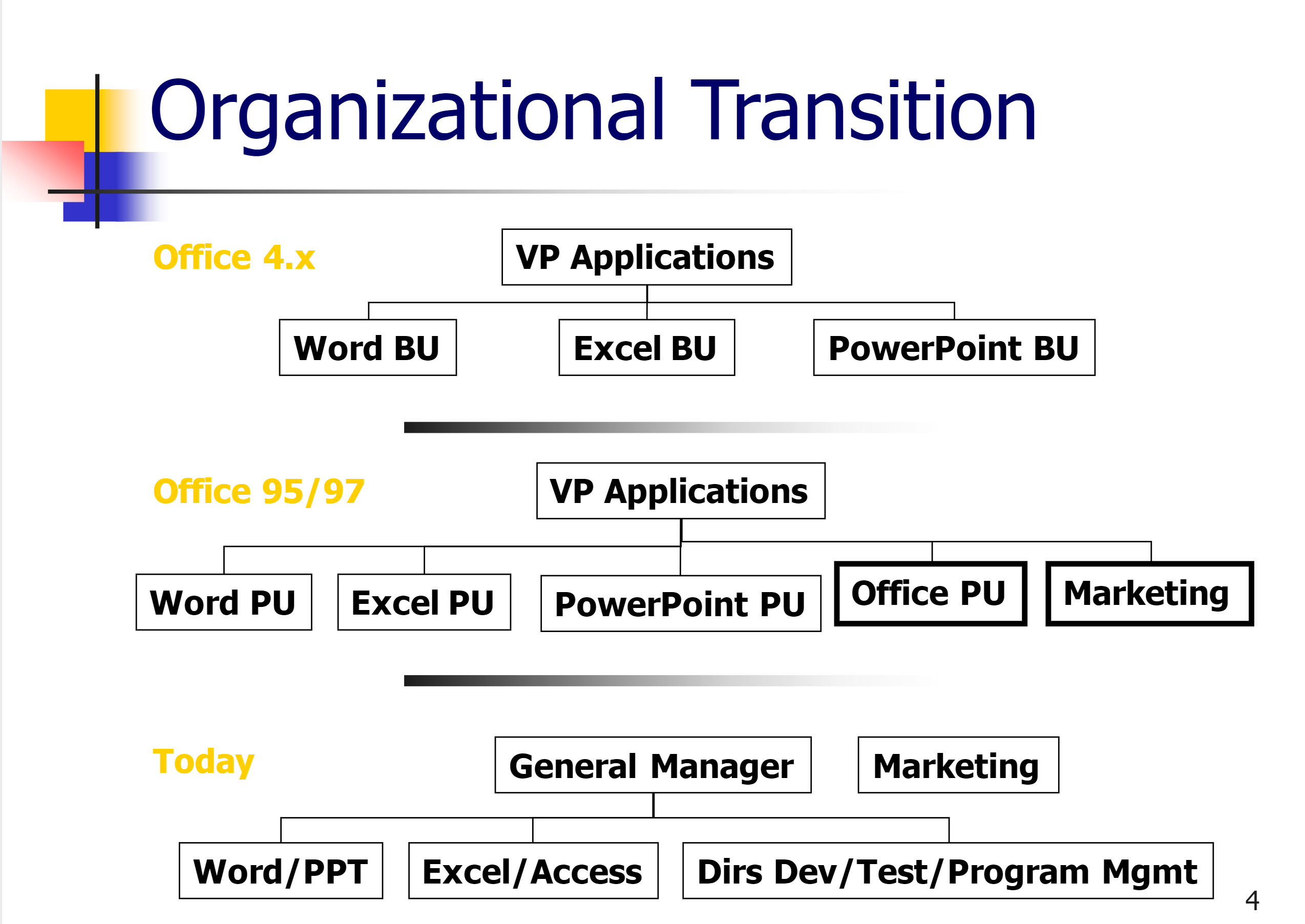
The Microsoft sales force had a ritual of reorganizing every fiscal year, like clockwork. The Platforms teams always seemed to be in some state of organization change, at least to me. Office, on the other hand, had been relatively stable except for two deliberate changes. As successful as Office 97 would prove to be, the product still reflected the development organization more than the value proposition. We needed to change that. To change that required us to develop a more robust planning process that was relevant to everyone that mattered.Back to 046. Prioritizing a New Type of Customer [Chapter VIII]With the start of our company-wide transition to becoming enterprise-focused, the product group organization seemed to be in a state of flux as we began a new release to follow Office 97. Churn across the senior leadership was a defining element of middle age for Microsoft.Over the next decade or more, at least for me, it seemed as though we were always fluid at the top. We were either restructuring or leaders were being moved around, and sometimes both at once.By the time Bob Muglia (BobMu) was my manager, starting in March 1999 and right around the release of follow-on to Office 97, Microsoft had gone through three major restructurings over the course of seven years—changing first to five main operating units then to seven and then back to three. Just keeping track of division acronyms was impossible, and as fast as we could distribute T-shirts and logo items, the acronyms expired. It wasn’t uncommon to enter an office with moving boxes that remained packed in anticipation of the next move.Desktop Applications had four different executive leadership structures during planning and delivering a single release of Office over 30 months. From the end of Office 97 until we shipped the next product, the larger division containing Office would change names numerous times: ACG (Applications and Content Group), AICG (Applications and Internet Client Group), ATG (Applications and Tools Group), BPG (Business Productivity Group). The groups were each defined as Office and other stuff, often not particularly adjacent in the market. Each one of those changes came with some feeling that even after the successful launch of Office 97, some things needed to be done differently. But what?While never explicit, the executive changes all had one thing in common. Each was a gradual move towards Apps being managed by executives from Platforms. There was a subtle reminder that the company was a Windows company, and importantly that when it came to the senior executives, it was the Apps teams that needed leadership from Platforms, not the other way around. It always felt like we were getting a message that we needed help in some way.A level below these new executives, Applications had been stable for quite some time. As described previously, from the earliest days until Mike Maples’ business unit re-organization in the late 1980s, the teams were organized by job function. The business unit function served well through the rise of the Macintosh business leading to Office and the creation of the apps for Windows, until the creation of OPU in 1994, the Office Product Unit. This relative organization stability coincided with a growing execution capability on the team. While products were late, they were (with few exceptions) never out of control. Individuals became strongly committed to the individual apps teams and finishing what you started became a key element of the strengthening culture of Apps.By way of comparison, Windows ran with parallel teams through much of a release, with one team focused on shipping the current product and another team focused on the next release. Culturally, there were starters and finishers. The starters were the big thinkers in terms of ideas and architecture, and the finishers were the closers who drove a project to completion and managed the complexities of closing down ecosystem contributions.That meant that at any given juncture there were always two buckets, with code names: Chicago/Cairo, Nashville/Memphis, and Whistler/Blackcomb, for example. When a product finished, there was a changeover in leadership. The finishers came in and the starters moved on. It was their culture. The presence of a future team seemed to me to almost distract executives providing a team to meet with and a place for all the new ideas to go, while the shipping team worked heads down. The handoffs were never that clean and with some frequency the future product failed to make it to market or would change substantially with the shipping leadership.Office, on the other hand, was predominantly single-threaded—focused on one release at a time. Office believed firmly in a culture of engineers finishing what they started, program managers owning features from start to finish, and testers being involved from the start of a feature. Most of our performance evaluations and promotions were based on understanding complete product cycle

046. Prioritizing a New Type of Customer [Ch. VIII]
This new chapter begins the middle of the PC era, starting in 1998, as I experienced. In a very short time, the industry from customers to suppliers, went through enormous change. It is easy to look at the products to see the change as we moved from 8-bit or 16-bit systems that could hardly power the software we wrote (that practically did not work) to 32-bit processors with 32-bit operating systems. Or to consider the change from character mode to graphical and to client server mode (both the fragile model as implemented across all the major platforms, and the loosely coupled model as the WWW embraced). Equally important, and perhaps even more so when it comes to how Microsoft evolved, is the transition from selling products where the buyer and user were the same person, a tech enthusiast, to selling products to an entire IT profession. The next three chapters detail that unprecedented transition and how it dramatically changed Microsoft. As we will see here, it was not just the products or customers, but the very nature of how the company was managed.Back to 045. Incompatible Files, Slipping, Office 97 RTMSince the organization was still in the early stages of creating Office first, rather than apps first, there was pressure and challenges that came from the race to start planning the next release. Apps figured if their plans could be put in place then they would be harder to unwind in favor of other ideas from the Office Product Unit. And so, the planning for the next product release began in an uneven manner prior to RTM for Office 97.But over the next three product releases, almost seven years, the Office team and the business transformed. The era of apps, each operating independently, gave way to a coherent Office suite. The single user of productivity tools on a personal computer was the toehold upon which Microsoft built an organizational productivity toolset that became an integral part of IT infrastructure in large organizations (LORG). The focus on LORGs and the transformation of the business to multiyear enterprise agreements (EA) resulted in an increase in revenue, profits, and ubiquity of Office and set the stage for the business for years to come.Although Office was sold as a bundle, it was built as independent, and award-winning, products. The next step was to build the product we were selling, an integrated productivity software suite.The journey, however, was difficult and repeatedly pitted our efforts to build innovative and empowering software for individuals against the demands by IT professionals to reduce change and maintain a level of control over the ever-sprawling, always-connected personal computer.These changes in the business and role of Office required the team to transform from a set of reasonably well-executing but independent entities, OPU and the app product units, to a single, execution engine. We needed LORG product development machinery to match the LORG business that was growing. Building software, at the time, was still too hit or miss, quality too uneven, and predictability lacking. These were all qualities that our new, and extremely large, customers were demanding of Microsoft. If we were to sit across the table from General Motors, the Department of Defense, or Proctor & Gamble we needed to operate at scale as effectively and maturely as they operated their organizations, even if we were making relatively newfangled PC software.PaulMa was leading Platforms and had recently returned from one of his many trips visiting with CIOs and enterprise customers. PaulMa, more than any other product leader, was responsible for Microsoft embracing the dialog with CIOs most of whom were not from the PC generation, but began their careers on mainframes. Paul pushed across teams to engage with CIOs and even upgraded the Microsoft Executive Briefing Center against BillG’s wishes to provide a very deluxe setting for CIOs (and government leaders) from around the world to visit Microsoft and learn the latest in technology from the newly crowned leader. Upon returning from this trip, Paul wrote up his notes as he always did and proclaimed that he heard very little about “open systems” (as Unix was called). In fact, customer dialog had dramatically shifted away from open and towards “making Windows work”. The root of the problem was a phrase total cost of ownership or TCO coined by the industry analyst firm Gartner Group. TCO measured the real cost of computers and servers in organizations, not just the cost of hardware and software licenses, but all the internal costs for training, management, upkeep, helpdesk, upgrades, and more. The numbers were astounding when we saw them. One of the first TCO reports from Gartner concluded that a Windows 95 PC connected to a network in a business costs almost $10,000 dollars per year. Strategically, the Network Computer, NC, was a huge topic of discussion. The NC was a form of PC championed by Oracle and Sun that only ran a browser. That seemed cra

045. Incompatible Files, Slipping, Office 97 RTM
Back to 044. Our First Big M&A Deal (Beating Netscape)Please keep the feedback rolling in. This post concludes with shipping Office 97. It represents the end of the first era of the PC, where the focus was on features, retail consumers, tech enthusiasts, and mostly just getting stuff to work and shipping. The next couple of chapters represent a major shift in the PC as the focus turns to the enterprise business and the primary customer the business itself and professional IT.Office96 was quickly becoming the biggest slip to an Office or Apps release in years, and that was extraordinarily disappointing. We reached our Zero Bug Bounce milestone (ZBB, because for a brief moment the product would bounce around a mythical zero bug count) in July 1996, and that was great. We were also behind our original schedule by months, and we knew there was no way to catch up. We needed more time. We felt like s**t.I did not always go to lunch in the building 17 cafeteria but happened to go one summer day. I was waiting to pay, holding my two slices of Marriott cheese pizza, when I heard, “SINOFSKY! SINOFSKY! WHAT DO YOU MEAN YOU ARE CHANGING THE FILE FORMATS?? WE CAN’T DO THAT!”SteveB was yelling across the cafeteria at me, and all of a sudden, I felt like a few hundred people got quiet and were watching to see how I reacted. His voice seemed to come from everywhere, so it took me a moment to locate him. A 10-minute conversation followed that started in earnest as he made his way toward me about the reality that Office 97, as it had been officially named, had a whole new architecture with loads of new features for document creation like drawing and fancy Word tables, animations in PowerPoint, and new charts with top-notch graphics in Excel. Word and Excel changed the file formats to support these features. A changed file format meant a customer file such as FOO.DOC or FOO.XLS on disk was only compatible with the version of the app that created the file, or a newer version. Trying to open FOO.DOC created with Word 97 on a Word 6.0 setup would give an inscrutable error message. This message would often terrify the user into thinking they had a corrupt file or the computer had eaten all their work. This horrible experience was perfectly normal for state-of-the-art software. I kid you not.Well, it turned out that the strategy of not changing the file formats in Office 95 (at least for Word and Excel) was a huge hit with the field sales force. So much so that they thought it was our new strategy to maintain the same file formats forever. When, in fact, we thought of 95 as the exception and only way to sync up with Windows 95—we had spent a ton of creative energy arriving at sellable features that did not require a file format change but were severely constrained in doing so.I never really thought of mentioning this because it was so obvious, or so I thought. Steve thought we were totally screwed and had misled his sales team.The file format changed probably within the first weeks of the project and was standard industry practice. The success of Office 95’s unchanged file formats caused a bit of a crisis as we were working on Office96. It was obviously both too late and impossible, regardless, to reverse course. HeikkiK coordinated what could best be described as a crisis mitigation plan involving format converters for existing applications and Save As capability within the new versions to produce down-level files (with the risk of losing new features). This was a reasonable solution but would require organizations to install software on every PC, whether it was just a converter for existing computers or the whole new Office 97 on new PCs. In other words what we thought was reasonable was a huge pain. SteveB was right.The Apps culture was tuned to avoiding crisis moments, usually by rewarding prevention, and a low tolerance for avoidable drama. When a crisis did hit, self-inflicted or otherwise, the Apps approach aimed for cool, calm, collected. ChrisP often described this like listening to the cockpit recordings of Naval aviators landing jets in difficult circumstances. That calm was accompanied by an executive team that did not view a crisis as an opportunity to micro-manage or upend existing processes.As a result, we thought this through in excruciating detail. All of the test managers and PMs from each team had developed a complete plan to support the new file formats in old products and deliver product updates to existing products, even using the novel approach of internet downloads. This did not solve the physics problem that we could not make the new features of Office96 show up in Office 95 or Office 4.3, but we could ease the pain and prevent people from being unable to open files they received due to the growing use of email.One bit of good news was that the biggest motivator for changing the file format was to support the new world-wide standard for representing text in computers, called UNICODE, that Microsoft had con

044. Our First Big M&A Deal (Beating Netscape)
Office had been early and aggressive inserting Internet technologies across the product, including hyperlinks (so new!) and HTML, as well, sort of, email with Outlook. We started to notice a challenge for us—web sites were not single documents but collections of documents. Office was not particularly useful for dealing with collections of documents (except for the failed Binder experiment). We were about to enter the fray, going head-to-head with Netscape to acquire a “hot” internet product being developed in Boston. Back to 043. DIM OutlookWe enjoyed a very fancy and atypical dinner at Daniel's Broiler on Lake Union. Chris Peters and I were hosting the co-founders of a Cambridge, Massachusetts startup, Vermeer Technologies, Incorporated. It was awkward. Only after would we learn that none of us knew what we were doing and we were all nervous and kind of terrified. If email was the biggest application on the internet, the technology that was causing Office the most strategic concern was HTML publishing pages to the web. When it came to web publishing, figuring out the role, if any, Office would play was much more difficult. The internet was quickly splitting into two camps. There were those who were hand-crafting sites in HTML. Using basic text editors they pushed the limits of HTML to do everything in the browser—going all in on native HTML, which at the time did not even support basic tables or much of anything. Then there were those who would navigate with HTML until at the very end a link pointed to non-HTML documents such as PDF files (almost like the eventually extinct Gopher application), particularly inside the earliest corporate web servers called intranets or the new consumer web sites from print magazine publishersOur approach was to find ways to use Office to create HTML content so it could be viewed in browsers even without Office—in a sense the idea was to turn the World Wide Web into the next generation printer or workgroup file server for Office. Except we had two big problems. First, HTML was too minimal to support any common business documents, even as a “printer” so to speak. Second, from a PC there was no way to emulate the Save dialog to save a file to a web site. As much as we had a vision for these intranets, the technology was not there yet. We had to invent something.The Internet Assistants across the apps bringing HTML add-ins to market for this “print-to-the-web” scenario was a level of agility that Office had not yet exercised, with much of the work happening while both Office 95 and Office96 were under development. A key person in those efforts was Kay Williams (KayW), a program manager on the Word team who had worked on getting Word’s first Internet Assistant to market just in time to beat Netscape 1.0. At one of the internet conferences in Boston, Internet World, in the fall of 1995, Kay spotted the demonstration of a product called Vermeer (named after the artist) by the company cofounder Randy Forgaard. Kay fired off mail to the Word team highlighting Vermeer’s WYSIWYG HTML Editor (What You See Is What You Get, an editor that showed what the end result would look like while the document was being created). The product was especially clever. It not only edited HTML pages, but it had a new model for managing a full website collection of pages.Nothing like that had been done before.The technical challenges of typing a web page were understood, but no one had invented a way for less technical people to create a whole site. A site needed a home page, navigation aids, and a way to link all the pages together. This was something that many of us were experimenting with at the time as we all raced to register domain names based on our last names or other pet projects. Creating web pages was tricky enough but managing a collection of pages and especially doing basic things like collecting information from a form were equivalent to programming. Vermeer seemed to address this. I had been using early versions of the HTML assistants to share digital photos (taken with the Epson PhotoPC, one of the first consumer digital cameras, which I had found for BillG to give as a gift to the exec staff one holiday). I pulled together a bunch of photos and created a PowerPoint HTML slideshow. I did this for a trip we took to the USS Ohio nuclear sub in Bremerton hosted on my original sinofsky.com. That was the early world-wide web. Several of us tried the Vermeer product and were all impressed. We later learned Vermeer was keenly aware from its server logs that Microsoft people had downloaded the product, decidedly something we were not used to. Sitting in ChrisP’s office he was pondering the idea of approaching the company to see what could come of a relationship with them. Chris was many things but not usually spontaneous, so for at least an hour we rehearsed a “cold call” to the company CEO with an offer to simply meet and see a demonstration. It was kind of exhausting and very ChrisP.After some d

043. DIM Outlook
I’ve received so much positive feedback which I do not thank readers enough for. A few have asked for more sooner, so I am going to see about a slightly increased frequency and how that goes. Please do not hesitate to send feedback at any time, [email protected] to the rising importance of email, Outlook, which originated in a separate division from Office, ended up becoming a second anchor tenant of the Office Suite early in the Office96 cycle. Arguably the reason that it became possible for Office (in combination with a service-based Exchange mail) to transition to the Office 365 cloud, Outlook had a very bumpy start. Simply getting the product shipped then deciding on the packaging, and as we will see over subsequent chapters making it reliable enough for the modern world, were all challenges. Back to 042. Clippy, The F*cking ClownWhen we started the 94/96 plan, Office was Word, Excel, PowerPoint, and (for about half our customers) the Access database in the premium edition, Office Professional. By the time we shipped Office96 we added two entirely new products, FrontPage (acquired from Vermeer corporation) for website creation, and Ren & Stimpy (the code name for what would become Outlook) for email and scheduling. It is rather remarkable in hindsight that by some measures the Office product nearly doubled in size and complexity along the way. Bringing two products into Office proved to be equal parts learning and terror, and my first experience dealing with the role bundling plays in our business execution.Through the whole Office 95 product cycle, I was maniacally focused on all things internet. One of the fastest rising uses of the internet turned out to be the oldest, and that was email. Microsoft tended to view email through the lens of the nascent yet growing server business because of Exchange Server, still under development in the Workgroup Apps team (WGA). With the release of Windows 95 (and WordMail), Exchange Server was front and center for all of Microsoft and the growing enterprise business, and still a year away from release to the public but deploying inside Microsoft and a few select customers.Being a server team, the end-user experience for the product would characteristically receive less attention. The Exchange-created mail client program, Windows 95 Inbox (previously Capone, but still called that in discussions), and the calendaring program, called Schedule+, which was ported from the legacy MS Mail system, constituted the Exchange clients. None of these clients (client as in client-server architecture) were particularly good at connecting to internet mail. The industry, in general, had a blind spot for internet mail. New entrants like Netscape were the exception, as everything at Netscape was native to the internet. Lotus Notes, the primary competitor to Exchange, was aggressively building in Internet capabilities. They already had a successful product in market and recently executed a big launch of internet connectivity at their conference, all with the backing of IBM ownership.Surprisingly, within the Workgroup Apps team there was a second mail client being built with the code name Ren & Stimpy. Originally the team planned two releases, Ren a lightweight product to include in Windows, followed by a more full-featured product, Stimpy, to include potentially in Office. Work had been going on for quite some time already.Brian MacDonald (BrianMac), leading the team, was legendary in his ability to project a monstrous and all-encompassing vision for a project and recruit and rally an ever-growing team to go after the vision. Brian was well known within Apps, having created Microsoft Project as a start-up acquired by Microsoft 1989, growing it to a business of hundreds of millions of dollars. Project was a traditional project management tool used to manage timelines and resources for big projects such as construction. It was one of several market-defining and significant revenue-generating products from the expanding roster that were often over-looked in telling the story of the Apps business.Sometimes people with BrianMac’s set of skills, their aspirations grow faster than the execution. Perhaps through no fault of their own, they find the product positioned between one or more teams who alternatively believe they are competitors or depend heavily on the product for their own success. In the case of Ren (the shorthand name), it was clear the team achieved a combination of most of these.The Ren vision was extremely broad—to encompass the whole flow of daily work on a PC from mail and contacts to scheduling to tasks, including managing your files and even custom business apps like Lotus Notes could create. It is this breadth that at once caused it to become an essential part of every team’s strategy and also a competitor. Without having shipped a line of code and without anyone outside the team even close to using the product, Ren had become central to most every conversa

042. Clippy, The F*cking Clown
As a company gains success and grows, taking risks becomes, well, riskier. The costs of failure come front and center, as the ability for a company to play out scenarios where something would not work overwhelms the naïve optimism that used to characterize efforts. It is like one day, suddenly, everything becomes more difficult and scarier. Clippy, née Clippit, needs no introduction as the failure, the evolution to kitsch, and the resurrection as a technology ahead of its time have been baked into even mainstream consciousness. If you would have asked me in 2000, three years after the debut, if I would still be talking about this failed feature, I would have LOLed. While I could probably fill a book with the story and the team that brought the feature, this is the story told in the context of the arc of the PC and Microsoft.Also, a good time to note that success has many parents and failure has none. There’s no shortage of told-you-so around Clippy, until recently that is.Note, this post is best read in a desktop browser for a complete experience.Back to 041. Scaling the Office Infrastructure and PlatformIn early discussions, we attempted to explain how we had learned from the abysmal failure of Microsoft Bob and that we had a plan. At one point, the conversation turned from stepping through a complex task in Excel to BillG bringing us to tears in playing back what he heard. They were both tears of joy and tears of pain. It went something like this:Demo: The Assistant will then appear and offer each step in sequence to create a chart, as the user interface does today. But it will be more friendly and approachable and have easy access to help content.Bill: So, when I want to create a chart the clown will pop up and say, “I’m here to help” and . . .Demo: Not clown, but assistant.Bill: The clown pops up and then I’m like clicking on the clown saying clown next, next, clown next or something just to create a chart.Demo: The Assistant is just a more approachable and helpful version of the same number of clicks and steps you always had.Bill: Next . . . next . . .next, and pretty soon I just want the f*****g clown to get out of the way.Bill often had these routines or short skits that he would play out over and over—if you were the target, it was painful the first couple of times then it was for show for other attendees then you had to assert yourself. This was one of those. Through the entire rise and ultimate fall of the idea of an animated character or agent, which he referred to as a “clown”, this pattern complete with the escalating high-pitched frustrated BillG voice would make an appearance. I lost track of how many times he ridiculed the feature this way. Still, he doesn’t get the right to say told-you-so.This started with the earliest products based on an animated helper that were developed in the early 1990s and released while I was working as Technical Assistant, so I was quite familiar with the above routine. Then Microsoft’s focus was on bringing software and PCs to children and like all products for children, the general theory of education told us that products needed to be fun, engaging, and immersive, and different from business-oriented or grownup products. A pair of products were developed together for Windows 3, Creative Writer and Fine Artist, a kid-oriented word-processor and drawing program. While these products were nominally about the basics of productivity, they were part of an entire animated world called Imaginopolis hosted by the ever-present guide, McZee, a lanky purple humanoid. It is easy to be dismissive of the products, but in fact they contained enormous feature-depth for the time. McZee was more than just a helper, but essentially the full user interface for the products. All the actions were directed through McZee. Measuring success in the new Microsoft Kids line was difficult because the unit sales weren’t spectacular and because everything was new and the company was determined to stick with it (remember the Microsoft reputation for taking three versions to get something right). The spiritual successor to these two products was an even greater product risk as it was not just for kids, but for the home. The problem that needed solving was that people were buying home computers, but lacked software to do home things, like keep lists, write letters, track to-do items, and calendars. While there were business packages that did that, the general theory was that software for the home needed to be more friendly and approachable, especially because those not skilled in business computers would use it. The Consumer Division where Microsoft Kids software came from was filled with people on a mission to bring software to a broader audience. One of those was Karen Fries (KarenFr) who was the lead advocate and pioneer for the use of what was widely known in academic circles as social interface. Karen was co-leading program management for these new products and was deeply immersed in the c
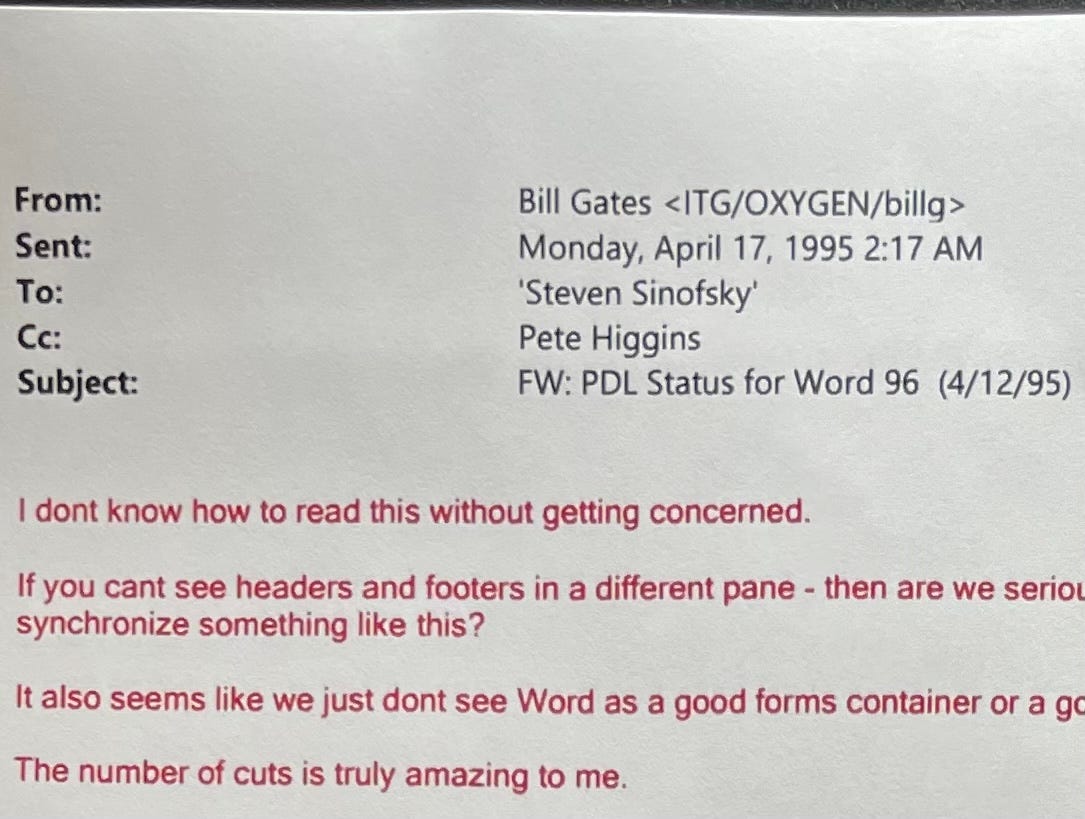
041. Scaling the Office Infrastructure and Platform
Perhaps more than any particular feature in what would become Office 97, though there were a lot of features, the biggest innovation was building the organization and culture supporting a shared infrastructure and platform team. Before Office 97, Microsoft decidedly switched to selling Office, yet we continued to build Word, Excel, and PowerPoint, and we were organized that way. The Office96 product cycle, starting in 1994 (in parallel with what became Office 95) built out the new team, OPU the Office Product Unit, and new approaches to creating shared code and infrastructure. Not only did this come to define the Office product and organization, in many ways it defined my own career and high-order bit.Please note, this post might be a bit long for email so be sure to click the link to get the full experience.Back to 040. Creating the First Real Office [Chapter VII]In shipping at scale, it is not enough to agree on what needs to be done. There also needs to be agreement on how it gets done.While the big apps were successful in their own right, won reviews, sold incredibly well, had high customer satisfaction, and were made by teams that were exemplars of the MikeMap value system, they evolved with different engineering systems. Differing in detail, they all accomplished the same: shipping high quality (for the era, or at least higher quality than everyone else), while striving for a ready-to-ship product every single day of the process. To developers and testers, the micro details of how this worked across teams for committing changes, check-in tests, unit testing, localization, and more were highly evolved. Each step in the process was tuned to the “unique” needs of each product’s engineering organization, or perhaps tribe is a better description. Minor differences would be amplified both at scale and across teams. A common example was how much time in the schedule was reserved or buffered for the unknown. Excel with its record of getting closer and closer to on time RTM, could be seen as either extremely hardcore or excessively conservative, but managing the day-to-day progression through the schedule was critical and very much a key part of the culture. It is a statement about Microsoft culture that the better Excel got at hitting projected ship dates and shipping award-winning products, the more the discussion across Microsoft (outside the Excel team) centered around how conservative the team was getting. To Excel, they were just being hardcore. This was best symbolized by the leather biker jackets developers earned as a ship gift adorned with a Recalc or Die logo. Times were different.The idea that getting better at daily engineering and hitting scheduled milestones was somehow a sign of being less aggressive or grandiose in plans gets to the heart of the divergence of Microsoft cultures across the company. The Apps teams not only wrote the Zero Defects memo but internalized a cultural attribute of promise and deliver. Much of the rest of Microsoft seemed to have succumbed to the idea that such a process (or philosophy) was somehow less hardcore or even wimpy. There was a strong belief among the over-promise side of the house that building a platform was simply more difficult than building applications (never mind that the applications were also platforms, but I digress) and that there was a real difference in impact if a platform cut features the ways Apps did in order to ship. I can say this because many times when it came to collaborating across the company I was on the receiving end of comments along the lines of “yes, but that’s only because it is just an app.” In my weaker moments I would say the quiet parts aloud, such as “yes, but you’ll never ship.” Apps, meaning Office, was the more fragile growth engine of the company, and bigger opportunity for profits. Office depended on customers choosing to buy Office over an existing product they already owned or competitor, and that decision benefitted from a new version of Office drawing interest to new capabilities and over time would come to depend on much more profitable corporate deals (as we will learn in the next chapter). Windows, on the other hand, was going out on most every new PC (at a much lower price than Office but a much higher attach to a PC). Whether an updated version of Windows was on the PC or not, PC sales were going up primarily due to businesses buying first PCs for many employees, and in a bit of a twist those customers often preferred the current or even previous version of Windows anyway. There was certainly a pop that came from a new Windows, especially when timed with updated PCs for back to school or holiday, but no one was confused over the revenue drivers. These differences in the business models directly led to the variation (and tensions) in development processes, and also to the differences in how each business evolved and innovated well into the future. We were all products of our environment.As an example, within Off

040. Creating the First Real Office [Ch. VII]
Welcome to Chapter VII, 1995 to 1997 and Office 97. As PC sales surge, growing at a rate of 60 percent in 1996, the enormity of the internet becomes widely realized and will soon dwarf the impact of everything that came before it.The Apps and the Office team were 110% focused on what should have been the last months of Office96 as part of our 12/24 plan of parallel releases. The product turned out to be much more difficult to finish and the new Office-centric organization met with much more resistance than planned. On top of that, Office 95 took our entire Test team to get out the door, putting us behind on quality. In other words, the 24-month project was going to take longer but we did not yet know how much longer.Something about Windows 95 shipping changed Microsoft, especially at the top and how the company thought strategically. It was as though with the success of Windows 95 came the need, though not necessarily the ability, to think big thoughts and to develop big plans for the future. The products we were working on were a given, but just not interesting. Everything interesting was yet to begin. Or was that really the case? A post about planning for a big future while trying to build a product that was already late.Back to 039. Start Me UpIt was as though we had not been working on Office96 for the past year. With all the excitement of Windows 95 (oh, and Office 95) the conversation quickly turned to asking what would Office do next, after the release we hadn’t even finished and was late. It was kind of weird. In a relatively short time many things changed. MikeMap retired and with that a slight change in the organization to accommodate, with BillG taking on product groups directly. Microsoft Research was a few years old and occupying more and more of BillG’s headspace. Windows NT 4.0 was on a path to completion and with that a solid spot in the minds of IT leaders, especially for the most anticipated business product of all, Microsoft Exchange email. The much-anticipated Cairo project began to fade in interest and what became more interesting (and ultimately much more important) would be bringing the Windows 95 user experience to the Windows NT operating system kernel. The browser war between Internet Explorer and Netscape and the broader competition over back-end server technologies for the Internet was well underway. Windows would kick off a series of updates to Windows 95 primarily for the benefit of holiday or back-to-school PC Sales (Windows 98, Windows 98 SE, and finally Windows Me). For Office, by many accounts it appeared as though Office had successfully taken the leadership position in the new product category of suites. We were still paranoid about competition especially that Lotus was now owned by IBM and had a huge sales motion behind it.That seems like a lot of work going on and it was, but from a company strategy perspective it was as though that was all known and thus, for lack of a better word, boring. The real excitement and interesting work was answering the question from BillG “What is Next?”. There was an almost insatiable demand to know our plans for a few years from now, not our current development efforts. It was rather sudden, but soon the altitude of our company dialog was less about the products under development and more about what products should be under development. The concern or even fear was not losing in the next release cycle but in the ones that came later. Intellectually that seemed prudent, but practically it was enormously frustrating as I would alternate between significant execution challenges and vague discussions about an infeasible future.There were people in parts of the company that had what were considered great visions for where to go, but it always seemed to me like there were practical ways to get to 90% in much less time. Others had ideas for how things should be done, but clearly there was no way to build those now because of some limitation like how different everything else would need to be to be able to build that. Innovations like work from General Magic captivated BillG and everyone but were not selling well (even with a big IPO). As I’d become accustom, a failure in the marketplace was not a failure for BillG so that meant we needed to treat it like a potential competitor. I needed to find a way to engage in this dialog and to represent applications and productivity effectively as “thought leadership” (a popular buzzword).We were still deep in building Office96, the second part of the 12/24 strategy of working on a pair of releases in parallel. In fairness to me, this was occupying every cycle I had. We were almost two years into the project by the end of 1995 and it was clear we were going to ship much later than planned. Yet, no one really wanted to talk about Office96. Rather, everyone wanted to talk about what would be next. What would be big and bold. To us, Office96 was huge. The scale of the product was greater than anything we had e

039. Start Me Up
It has been 26 years since the Windows 95 launch and still no launch from any company has come close to the global scale and impact of the event. There have been big events and massive opening weekends for many products, but nothing like August 24, 1995. Even from our supporting role in Office, it was an event of a lifetime.While we signed off in July, our focus immediately turned to continuing to build Office96. The world would treat Office 95 as though it was a major new product from Microsoft, but we knew we had put most of our development efforts into the next release of 12/24. We were also behind because one thing we learned about parallel releases was that 15% of our engineering still required nearly all of our resources for testing, marketing, and the rest of the product pipeline. We could in a sense fool the market that we did a full release but we could not fool ourselves.The other industry-shifting event happening at the same time—in hindsight, perhaps foreshadowing—was the Netscape IPO. Windows 95 was big, but the Internet and WWW would prove even bigger. In the years that follow, it became much clearer that Windows accelerated the adoption of the Internet long before it was threatened by it, and more importantly by mobile phones. . .and Apple.Back to 038. Designed for Windows 95Please feel free to leave a comment or memory about the Windows 95 launch and impact on you. For this post comments are open to everyone, not just subscribers.By late July, Word, Excel, PowerPoint, the Office 95 suite (called Office Standard), and a number of other products from all over Microsoft were off to manufacturing. This only left four weeks for the manufacturing and airlifting of retail product all around the world. The baton had been passed to marketing and logistics.Just after sign-off, I got a call from my mother that my grandfather was ill. I flew back to Miami immediately. Pop was 90 years old and up until then had been perfectly fine, walking miles every day around his North Miami condo complex, Point East, (Seinfeld fans picture Del Boca Vista). Sitting beside his hospital bed, we talked about a lot of stuff. His biggest frustration was that Microsoft was not paying a dividend. He was a depression-era person with little faith in the rise of equity. He would often send me newspaper clippings and earnings press coverage via postal mail, something many of us experienced from our Greatest Generation relatives. That said, he also would place a bet on anything with a starting line or a clock and we had spent most of my vacations at the Hollywood Racetrack betting his numbers, 6 and 7 or 4 and 8 (the birthday he shared with Grandma). His winnings paid for my nursery school and summer camps growing up. When it was time for me to leave, lying in his bed, he wished me a happy birthday (my thirtieth) and flicked his wrist at me and said, “Get out of here, don’t worry about me.” Two days after the Windows 95 launch event, I flew back for his funeral. We celebrated the full life he lived.Planning the launch event consumed DAD marketing (development team was still mostly working on Office96), with product availability, newspaper and magazine ads, all the tools needed for retail point of sale, and especially public relations. By 1995, the tech press had become a mainstream phenomenon and all major newspapers, magazines, and even television networks had dedicated technology reporters. I had no idea how much time I would end up spending supporting our marketing team as the “product” person in all sorts of interviews, demos, lunches, and more. This was the release at which I met most of the industry beat reporters and established relationships that still exist.Everyone was writing stories and reviews of Windows 95 and Office 95. Everyone.Shipping Office 95 as a single product was a huge accomplishment for the Desktop Applications Division, and it was only fitting that it was a small part of the myriad accomplishments under the leadership of Mike Maples. As the previews were going out, Mike announced that he was going to retire from Microsoft and live full time in the Hill Country of Texas. While many of us stayed in touch with him for decades, in 2016 I had the privilege of coteaching a class at Stanford with Mike—teaching alongside my teacher was a great joy.Without Mike, Microsoft would have become a different place. Mike brought to Microsoft, especially to Apps and Office, a culture, attitude, and strategy that perhaps more than most any other person were responsible for the success of Office, a success still felt decades later in Office 365.The Redmond, Washington, launch event was set to be the biggest and craziest event ever hosted on Microsoft’s campus. The entire sports and grass area, about two football fields, was tented that third week of August. Most Microsofties ended up watching in the conference rooms all around campus.For the tech press, the event was the culmination of months of writing about the ever-expan

038. Designed for Windows 95
A quick story about something that felt like a corporate or ecosystem tax, the “Designed for Windows 95” logo.Back to 037. Capone and Email Without TyposBy early 1995, the most essential elements for the Windows launch were determined. Chicago had picked an early summer RTM date. For Office, what had been “no more than 30 days later” was simultaneously shipping, which was awesome for the retailers and for the business. Windows had chosen the name Windows 95 and the idea of using the Rolling Stones’ Start Me Up in future ads was floated. Things were really hopping, and everything went from uncertainty to terror in the sense that we truly needed to finish. We transitioned from a software team to a team gated by duplicated CD-ROM discs, assembling boxes, and distributing palettes around the world.Office94 received the name Microsoft Office Professional Designed for Windows 95version 7.0 in a classic Microsoft naming bonanza, and to compound that there were other editions including Small Business or With Bookshelf on the box. Everyone on the planet called it Office 95, including all of Microsoft at launch events. But there were real forces at work, such as the fact that the Product Support systems relied heavily on the actual version number of the program to route and track support calls. It was also kind of a funny name since the apps were each on different versions (Word 6.0, Excel 5.0, PowerPoint 4.0). Version 7.0 came from bumping the highest number product, Word 6.0, to the next version. In what was a big deal, we versioned all the apps to 7.0 (Excel 7.0, PowerPoint 7.0, Access 7.0), which seemed like a weird (and often used) marketing gimmick. In fact, it was to be Office for the first time and to simplify all the downstream systems that we required real version numbers. And, because the company wanted only one product 95 and that was Windows. The chosen blue sky and cloud theme was visible on the Office box, but it was challenging to find a “95” without looking closely. Only today does the irony of using clouds on the box generate a chuckle once one considers the role of clouds today in software.For the development team to fully feel the terror and pressure of the deadline, Robbie Bach, (RobbieB), the head of marketing for all of Desktop Apps, suggested I attend his weekly meeting where the planning for the launch was being coordinated. My first reaction was immature, and I thought between Office 95 [sic] and Office96 I had enough to do on the product and sitting in a long meeting going over launch minutiae seemed like a poor use of time. In addition, we had a team reporting to ChrisP specifically set up as the interface between marketing and development, known as Product Planning and led by Mark Kroese (MarkK), who had been working to make sure the product SKUs, naming, and branding were accurately reflected in the software coordinating with product design as needed.Despite my resistance, it proved to be a critical learning experience as the scale and complexity of an Office launch was nothing at all like the nice little events we had in Languages, and this was truly going to be, to date, the biggest of all launches (and in hindsight the biggest one ever). Every week, I learned more small but important product issues—demo scripts that were not right, feature names that needed to be changed, concerns about localization, and good things to know like how much lead time one needed to rent out venues and the importance of mobilizing a global sales effort with the right sales tools and information. Everyone always says that PM and marketing need to work closely together, but until you experience the myriad of details marketing needs to get right for a worldwide consumer launch it is just an abstraction. . What no one could have prepared me for was just how many of these details came crashing together under crazy deadlines at the end of the project. There was a great deal of learning.One recurring theme in the marketing meeting was a desire for “more” evidence that Windows 95 and Office 95 were designed to work together. This was particularly frustrating because by far the biggest features were 32-bits, long file names, and shipping the whole thing on time. Nevertheless, as soon as we had a ship date, we also had a lengthy list of Windows 95 integration feature requests. The list was not only long, but like a cake rising in the oven it seemed to be alternating between collapsing under its own weight and flowing over to make a total mess. Many of these details felt like a growing list of “must have” features from the Windows team about what makes for a great Windows 95 application. I had been asking for such a list for more than a year.I was going back and forth every day between building 17 and the old buildings of the Chicago team—the shell team, networking, setup, and more—trying to figure out how important, how real, and what was the least amount of work needed to get things done. Seeing what was going on i

037. Capone and Email Without Typos
All we wanted to do was bring the rich formatting and lack of typos people experienced with Word to email. We saw how email was replacing many uses for Word and figured it seemed like a good idea to reuse all that code to make for better email. That put Office right in the mix with every other division—each of which had their own idea for how email should be done. While the WWW and browsers were killer applications for consuming all that was out there, email was the killer application for communicating with friends and family, and increasingly coworkers. So every team had to do something.Some reading this today will point out Zawinski’s law, “Every program attempts to expand until it can read mail. Those programs which cannot so expand are replaced by ones which can.” That is precisely what was going on at the time, except a few years before this too-truthful observation. Email was the first time I experienced a classic Microsoft dynamic, which is when something is interesting every group finds a way to build their interpretation of it. Back to 036. Fancy Wizard and Red Squiggles Leading up to Windows 95 shipping was probably the most explosive era in product development in Microsoft history. Whole new divisions, lines of business, and products were springing up so fast it was often difficult to keep track. It wasn’t just the strategic clarity of focusing on Windows, but also expanding Windows into new areas from automobiles to televisions, from markets as far flung as hospitals to passenger aircraft, not to mention the global expansion of the ever-expanding enterprise sales force.It wasn’t just that every one of these new efforts was capitalizing on the Windows strategy that was finally approaching market readiness. It was also, and perhaps more important, that each effort also lead the way in embracing the Internet.While most everyone outside of Microsoft would aim their concerns at the “The Internet” icon on the Windows 95 desktop, the ownership and strategy behind that was all contained within one team in one division, Windows. The real battle, or more appropriately consternation and endless debate, would take place over a much less discussed desktop icon, “Inbox”—the email client application that could connect to Microsoft’s two email products, the legacy MS Mail and the not-quite-finished enterprise mail product, Exchange, as well as what was then called internet mail (email that used standard internet protocols such as POP3 or IMAP). Unlike a WWW browser, building the company’s email strategy lacked a singular organizational focus. Rather, it was more of a classic strategy of permissiveness and letting many flowers bloom, an approach that Microsoft would employ repeatedly (photos, messaging, collaboration, and more). When something was cool or the next big thing, it always seemed as though every group would somehow manage to find the resources to squeeze it into their strategy. Eventually, in the 1990s every part of the company had an email strategy: Windows, Online/Consumer, Servers, and Applications. Those didn’t always align or even work well together. Windows, like OS/2 and Unix and soon Macintosh, was like every operating system and assumed that connecting to standard internet protocols for email was important. Even though by email accounts, most consumers were reading email in America Online (AOL) or one of the other online services, these protocols were wildly popular with Internet Service Providers (those providing dial up access directly to the internet without the walled garden services of an online company) and small businesses. About a year after Windows 95 shipped, the team released “Microsoft Internet Mail and News” (codename Athena) which would go on to become one of several extremely popular email clients for customers using internet protocols.The Online/Consumer division was building the Microsoft Network which of course had email. The email experience relied on a purpose-built mail server, custom protocol, and mail interface that would power the @msn.com email addresses. In a short time, the same group would acquire HotMail, which provided free email directly through any WWW browser with an internet connection. The team would spend quite some time reconciling the implementation of this strategy.Servers, the division building the back office products powering the client/server strategy for business, was the home of the team building EMS as previously discussed. The team was primarily made up of hardcore server or backend developers focused on scale, reliability, and performance. EMS had many more email features than could be supported through internet protocols, such as calendaring, shared mail folders, and enterprise-level security. To support those EMS had its own proprietary protocol or API, which meant it needed to build its own email client. So they did. Applications, specifically the Office team, ended up part of this effort by a re-organization in mid-1994. There was a second

036. Fancy Wizard and Red Squiggles
Office94 (still the working name for what would become Office 95) was primarily about working with Windows 95 and shipping on the same day. That led to the constraint of having a relatively small team, less than 20 software engineers across the product compared to almost 60 on just Word 6.0. We knew that simply working with the new operating system would not be enough to get people to shell out a couple of hundred dollars (at the time, about 1 in 10 PC owners were also legal owners of our apps). The apps were also constrained by not changing the file format, which limited fancy features. There was a surgical approach to choosing features that we hoped would garner winning reviews of the suite and each app. Winning reviews remained the highest priority for the team. As part of writing this book, I am making an effort to include stories about features that everyone uses but often exist without a sense of where they came from or why. Back to 035. Windows 95, August or Bust [Chapter VI]Using a PC mystified most people, even in the workplace. Features designed to assist or help customers were almost always viewed positively even necessary as part of product reviews in magazines. Answer Wizard was our first attempt at using natural language processing and early artificial intelligence techniques to provide assistance in using ever more complex products. The early days of PCs were days filled with in-person courses to learn the products, and these had given way to 600-page books that filled the shelves at Barnes & Noble and Tower Books, regurgitating every feature, menu, and dialog box in alphabetical order. We had written thousands of pages, provided reference materials, created online “computer-based training,” and more, but still the first days of the PC era were marked with too much complexity and too high a hurdle to begin to use. Most people buying a new computer were also enrolling in courses that met for a couple of hours every week for a month (courses were the upsell much like today’s extended warranty).One of the core problems was jargon. There are dozens of phrases in the user interface that look like words a normal person would know but used in a way only a techie might grok (grok is a common techie expression for “to understand” that comes from Stranger in a Strange Land.) For example, PowerPoint, a tool few were comfortable with or had any understanding of, defied any logical English word (or any native language). What is a “slide master” or a “meeting minder”? What’s a “snap to grid”? The worst were features that were not so obscure but used English words in ways that most people could not understand, such as Word’s “mail merge” or Excel’s “lists.” We used to joke that we could probably put the version of Office with German language menu commands in front of English speakers and they probably wouldn’t even notice the difference. Answer Wizard was designed as a bridge between humans and computer jargon. If someone typed, “How do I send letters to a list?” Answer Wizard would find the Mail Merge feature (without literally going through all the menu items trying things at random). Sometimes commonly used symbols in Word such as the pilcrow, ¶, were totally unknown to regular people who would type questions into Answer Wizard such as, “How do I get rid of the elephant character?”Answer Wizard was a collaboration with Microsoft Research and proved to be the foundation of future work in Office96 being developed in parallel. Answer Wizard was the underlying technology of the natural language interface to what would become the Office Assistant, or Clippy. The earliest research group at Microsoft was the natural language research group where they were working on big hard problems of translation and understanding. That technology was more than a decade away and ultimately delivered by Google. Instead, we collaborated with the MSR’s first group of AI researchers using Bayesian mathematics to probabilistically select from among a set of choices. Basically, we tried to add an element of probabilistic guessing to the solution rather than relying on a traditional full text search or index. The guessing was based on a small database of words not already in the index or help database that we could map to the various articles in the help system. We called these metanyms because they were not precisely synonyms but somewhat close in meaning. We brought together those who wrote documentation, called User Education, or UserEd, and for the first time they were working on much more technology baked into the product. We renamed the team and the effort and called it User Assistance, or UA. It would be a few more years until we stopped referring to customers and humans as users, as we would often remark that only one other industry called customers users.One of the seemingly minor changes we made was that hitting the universal help key, F1, would always bring up Answer Wizard. We designed the new experience with a flashy an

035. Windows 95, August or Bust [Ch. VI]
1994 to 1995: Sharing code and processes to build Office pays off and the concept of the suite takes hold in the market. The Windows schedule becomes a death march to finish what is hoped to be a revolutionary new operating system. Netscape IPOs in the summer of 1995, weeks before the public availability of Windows 95. This is the first of five sections in this chapter on building Office 95.Back to 034. Office 94, 96Office94 had a plan in place, with a date and resources, as well as the major architectural bets of 32-bits and suite. There was so much focus on getting started and the resource constraints so extreme that, while this was the first release of an Office product, it would also be the last release for which the planning was fully distributed to each team with little centralized effort.The organization was set with a feature team for each product and one in OPU. For the most part, the feature team leads were running this project, at least from the start, as the more senior leaders were supposed to focus more on Office96. Putting in place the plan for Office96 happened in parallel with a different set of people and a lot more attention from the BUMs. Unless there was something specifically troubling, for the most part Office94 was flying under the radar of DAD and had almost a skunkworks feel to it, at least at the start. That did not last long, for me.As the new PM leader in Office, I was wearing two hats juggling both releases—in hindsight the first 12 months in Office were probably the time I put in the most hours working as I was learning how to manage managers for the first time, not to mention learning the DAD ways of working.While I was juggling, among our team of about 15 program managers Mike Conte (MikeCon) was the primary program manager on OPU driving Office94. Mike joined the Excel team after experience running his own Macintosh startup. On Excel, he was a key to Excel gaining adoption at large customers, especially banks. A true New Yorker, Mike wore all black and had a no-nonsense attitude. He laid the groundwork for the release, but early on moved to a new role on the Windows team. He easily transitioned the release work to Heikki Kanerva (HeikkiK). Products had a formal management team that was ultimately accountable, but each release saw people step up and take on the informal leadership required for complex cross-group work. This was Heikki’s release to step up.Heikki was a Finnish Olympic-caliber skier who found his way to Microsoft by studying business and computer science on a scholarship to the University of Alaska, after mandatory Finnish military service on a submarine. He joined DAD in the shared interoperability group and cut his teeth on shipping the enormously complex OLE technology. As it turned out, Heikki had absolutely the perfect demeanor to lead all of the teams through shipping the first synchronous release of Office. He was unflappable and possessed a military precision and the dedicated work ethic of an Olympian. And when needed, he could make light of a situation with a Finnish submariner expression that did not translate well at all into business English or, frankly, polite company.Heikki led the newly formed Office-wide project meetings—the first time that key managers across all the apps assembled routinely to make progress on work. These meetings started off weekly and then as milestones approached, daily and then twice daily. While this was only a few people at the beginning, it was the organizational and cultural shift required to begin to operate as a suite, not as a bundle. These meetings became the operating heartbeat of the team, not a tax while the real work happened elsewhere.I know it seems ridiculous to mention that we scheduled a weekly meeting for a new project, but up until this point creating Office essentially flew under the radar without an operational motion. From an engineering perspective, the move to 32-bits was fairly smooth especially since much of the work had been done earlier in the side projects of making native apps for Windows NT as proofs of concept (and to make them available for sale). From a practical perspective, however, the transition to 32-bits hit Microsoft where it cared the most, performance. If there was one thing deep in the culture of the company, it was squeezing the most out of the scarce compute resources of CPU and memory. The move to 32-bits was inevitable, but the impact on performance was counter-intuitive.In moving all the apps to 32-bits, no surprise but all the code got twice as big. And much of the data stored in memory got twice as big. Moving all that around made things slower. Crazy. For Office, 32-bits didn’t mean very much—Word already handled long documents, and spreadsheets could be pretty big. These products grew up in extremely limited memory. In fact, many of our own tests were showing that the 16-bit versions of apps performed better on Windows 3.1 and were even a bit slower on Chicago. That’s

034. Office94, Office96
With the Office Product Unit in place, and the outline of a plan to release with Chicago in about a year (whenever Chicago was finishing, which was unclear) and a second major release of Office a year after that, we still had to sell the team on the whole approach. This included allocating resources both to OPU as well as the app teams. From the Windows (and thus Microsoft) perspective, anything less than betting 100% on Chicago was seen as a hedge, yet that was exactly what DAD intended to do. This was decidedly about managing the applications business instead of viewing that business as simply supporting evidence for a new release of Windows. Many firmly believed in a wait and see approach to Chicago which was already, and customarily, very late and the existing Office products would run great anyway. This post wraps up the chapter on building the organization and plan for building two releases in parallel. Looking ahead, the chapters tell the story of building those products.Back to 033. Creating the Office Product Unit (OPU)The use of year-of-release code names was not arbitrary but reflected a broad consensus within leadership that Microsoft needed to move to product releases that reflected more of an annuity or subscription relationship with customers. The idea of using the year moniker was based on how car companies used model years. We had yet to prove software could be released in this fashion, reliably, and we still lacked a way to distribute products so quickly, but the idea became a cornerstone of planning what to build and how to articulate value. The early naming research for Chicago was heading down the path of using a year name, and similarly Office 4.x would be the last “version number” release.Marketing had mixed feelings about the year names. The biggest issue was that for some period of time customers would hold off purchasing a product knowing the current version was old. It was also quite stressful for the development teams that had no idea how to ship so much software on real deadlines. Taking the idea of one release in 12 months and a second one 12 months later, both starting from the same date in late 1993 led naturally to naming the releases 94/96, or Office94 and Office96 (no spaces since this was all for file names and source projects). The 94/96 plan was in place. Sync within 30 days of Chicago in the spring of 1995 or thereabouts. Then Office96 12 months later.The team’s passion was around Office96, with Office94 being somewhat of a strategy tax while at the same time being viewed as an excellent opportunity to prove out Office as a product and OPU as a team. The plan covered what was necessary and sufficient, albeit with a huge risk—what if Office94 took too long as Windows slipped, bumping up against Office96? You can see the schedule chicken already being played with the assumption that Windows would slip their schedule but Office would not, though there was little history across Word, Excel, and PowerPoint to think Office schedules were that robust and zero experience shipping the entire Office suite at once. History would show that no matter how far off Apps might be, Windows was going to be further off.To execute required employing a great deal of finesse and some game theory. A plan emerged prior to me joining the team but one I sold to BillG as his TA. The Office team’s 94/96 plan split the resources across releases substantially in favor of Office96. Each Product Unit (Word, Excel, PowerPoint, and OPU) devoted one “feature team” to Office94 and the remaining teams were on Office96. A feature team was the organizational unit of a dev team and it is made up of a software development lead and anywhere from three to seven software developers. There was an equal amount of testing and two to three program managers. This was phrased (marketed internally) as “15 percent of the resources dedicated to Chicago” or “85 percent of the resources on Office96.” See what was done there? Everyone got something. When talking to Windows we emphasized the dedicated Chicago team. When speaking across DAD and especially to marketing, we emphasized the 85% on Office96.Depending on perspective, this was either a relief, albeit still a high cost to pay to get moving on Office96, or a total snub aimed at Chicago. “What, only 15 percent of the team!?” One view was that the unreliability of the Chicago schedule was such that to “sacrifice” any more resources would not be prudent. The worst case would be, ironically, if Chicago did hit the date then too many people trying to do too much in Office would never finish within 30 days. A different view was that 15 percent was hardly sufficient. Chicago was aiming to be the most important release for consumers (Windows NT was for business) and since the Office business was still a consumer-driven phenomenon it didn’t make sense to be so frugal. In the 15 percent there was a lot for Systems to dislike. If the requirement was to ship simultaneously and rel

033. Creating the Office Product Unit, OPU
The most difficult transition for most new companies is going from a single product to multiple products, something Microsoft managed to pull off fairly early. Inevitably, the next transition is one based on combining products into a suite or bundle in an effort to deliver a better deal to customers while also simplifying (making more efficient) sales and marketing. In 1993 it became clear that Office for Windows would be as successful as Office for Macintosh, and the numbers from 1994 were proving that. The problem was there was a mismatch between what Microsoft was selling (Office) and what Microsoft was building (Word, Excel, PowerPoint). While there were many ways to potentially fix this, a reorganization was chosen. Reorgs are a most dreaded part of corporate life, but they are necessary. The most difficult reorgs are those that reflect strategic changes yet to come, versus “doing things better” that typify most reorgs. The Desktop Applications Division, by all accounts was doing fantastic, accomplishing this with the streamlined Business Unit organization MikeMap put in place. Why change now? Back to 032. Winning with the SuiteThe year 1994 marked the first time a new organizational structure also signaled a new product strategy for DAD. This was disconcerting to the existing BU structure as it created an unsolvable problem up front: What comes first, the suite or category?It was challenging.Just prior to when I joined the team, OPU was formed at the end of 1993. The leadership of the team was put in place and designed to make a statement by choosing Chris Peters (ChrisP) to lead the team as the division’s first product leader vice president (in 1994 there were 29 vice presidents among the over 15,000 employees). This was a huge deal at the time—an actual Microsoft engineer hired directly from college made it to product group vice president for the first time. ChrisP’s no-brainer choice to lead development for OPU would be Jon DeVaan (JonDe), who just finished up Excel 5.0 (for Windows). Leading testing was a new hire and a rare industry hire for DAD, Grant George (GrantG) who started on the team just before me. He joined Microsoft from a major project—huge in scale and in failure—the legendary Taligent project at Apple, which was cancelled in favor of Apple acquiring NeXT and thus returning Steve Jobs to the company. It wasn’t immediately clear, but Grant’s leadership and the elevated role of testing would be one of the most major contributions to making Office a reality of a product.Staffing the team was a non-trivial choice. Do you draft people by skills and need or do you take only volunteers in the hopes of keeping everyone happy? Drafting people would have the effect of sending a clear message about priorities but no one performs well in a job they don’t want. Taking only volunteers would make OPU a happy place while all but guaranteeing the individual apps teams would lobby for people to stay in their jobs and solidify the discord between the apps and OPU. There was some experience in these staffing choices that came from the gentle persuasion that was used by leaders to nudge people from Excel to Word for example. The code bases, development processes, and cultures were different enough that changing jobs was viewed as a bit of a reset. Plus, why would one want to go from Excel to Word when a word processor is nothing more than a spreadsheet with one cell, as ChrisP used to say (Chris moved from Excel to be GM of Word prior to leading OPU). The undercurrent of the staffing choice was that resources were being reallocated from individual apps to OPU. The apps teams were getting smaller to fund OPU, at least in the immediate term. This was a huge issue. The apps teams had plenty of work to do and could not understand how they would get all that work done while reducing staff size. Plus this all seemed insane to do right on the cusp of potentially winning in the market. The market in this case meant the market for stand-alone word processors or spreadsheets, not the suite market. The apps were not only committed to winning only in their category, but they had ample evidence the industry was not quite there yet as well. The feeling was at any minute Lotus could release a killer Windows spreadsheet or WordPerfect could release a Windows product that would lure all those existing MS-DOS customers to Windows. This was a legitimate concern. It was also not the bet Microsoft was making—the bet was on the suite.Meanwhile every team continued to hire as many graduating engineers as we could, so we would have plenty of people to do all the work. In software development, the number of engineers is literally everything (perhaps, except for schedule time). The WOBU (Word Business Unit, renamed from OBU when the Mail product was moved to the new Messaging Business Unit) team had grown to over 65 software engineers (plus an equivalent number of Test Engineers and about 25 program managers). The Excel team was

032. Winning With the Suite
Strategically, the bundling-unbundling arc or cycle is one of the most common dynamics in technology. Something that starts off as a single product or category inevitably becomes part of a bundle of features or products. Only later that bundled product faces intense competition from a stand-alone product introducing a different point of view. Choosing when to compete with a bundle and how to innovate within category occupied our collective mind in Applications in 1994. A big bet was made to market the Office Suite (or bundle) while the categories were still in play. Organizationally and culturally, we were still very much a set of categories. Had the market settled on Suites or not? This is a question faced by most every company with a single successful product and provides some interesting experiences and lessons. Back to 031. Synchronizing Windows and Office (the First Time) [Chapter V]There were two major shifts taking place in the early 1990s together altering the market landscape for business software. The most visible was the move by the business market to Windows, beginning with Windows 3.0 but picking up the pace dramatically with each subsequent release, Windows 3.1 and Windows 3.11. Bringing networking to the operating system, a seemingly simple ability for PCs in an office to share files and printers, was becoming a force.By 1993, Windows/DOS PCs were outselling Macintosh ten to one and Windows was on 30 million of the 120 million PCs worldwide, with Windows dominating new PC sales.That transition itself did not instantly shift the Applications market, though. The leaders of each category, particularly WordPerfect for word processing and Lotus with its 1-2-3 spreadsheet, as well as Borland with both Paradox and dBase databases, were not only entrenched but had passionate customer followings. Law schools were using WordPerfect and newly minted lawyers were proficient in the inner workings of the mysteries of formatting a brief with reveal codes (WordPerfect’s mysterious codes that showed formatting before WYSIWYG, or what you see is what you get in GUI). MBA students were masters of the 1-2-3 slash commands for navigating a financial model. That Windows 3.x ran these products extremely well, because compatibility with MS-DOS was a key design point, only solidified them. Windows 3.x made running MS-DOS products even better by supporting multiple programs running at the same time.However, the graphical interface was beginning to put pressure on existing MS-DOS leaders. The improved support for printing (supporting more printers from various manufacturers), as well as the ease at moving information from one app to another with the clipboard were tangible benefits. With the rise of laser printers, the era of producing business and school reports that included charts, graphs, and tables in-line with the text—all prepared camera ready—was a new baseline expectation. This was vastly easier with GUI apps.As a result, product reviews began to evaluate the MS-DOS and Windows products in the same category. The word processor category, for example, included Word for Windows and WordPerfect for MS-DOS. The reviews would compare features but also compare ease of use at complex scenarios, often including the ability for documents to incorporate information from other sources. Even though the Windows applications were behind on features and had different user-interfaces from MS-DOS, there was an uptick in perception based on ease of use of GUI.To be fair, the tech elites of the time greatly resisted the GUI—often claiming the mouse and all those graphics were counter to productivity. I had witnessed this myself in 1984 at Cornell when people looked at the mouse and shook their heads, referring to it as a toy, and to the inefficiency of lifting their hands from the keyboard. Working within the disconnect between evolving technology and entrenched elites proved to be a theme throughout my career.At the same time, existing software leaders resisted or at least paced themselves with the move to Windows. Many over the years tried to either explain or rationalize this and much has been written. Microsoft committed a ton of energy trying to get the likes of Lotus and WordPerfect to be launch partners with Windows versions or to just commit to Windows, even as Microsoft was building Windows versions of its own apps. There was no head fake on the part of Microsoft—it was believed that Windows would be best with Windows versions of leading apps and the Microsoft apps would, as they had been on MS-DOS, do everything they could to compete and win. Even with all the effort, leading vendors viewed Windows as yet another platform and most were also not wild about adopting the Mac (this was the opening that was created for Microsoft) and were still focused on character mode platforms. The reluctance of betting on a platform Microsoft controlled with its apps was real, but in hindsight proved . . . limiting.Ironically, the succes
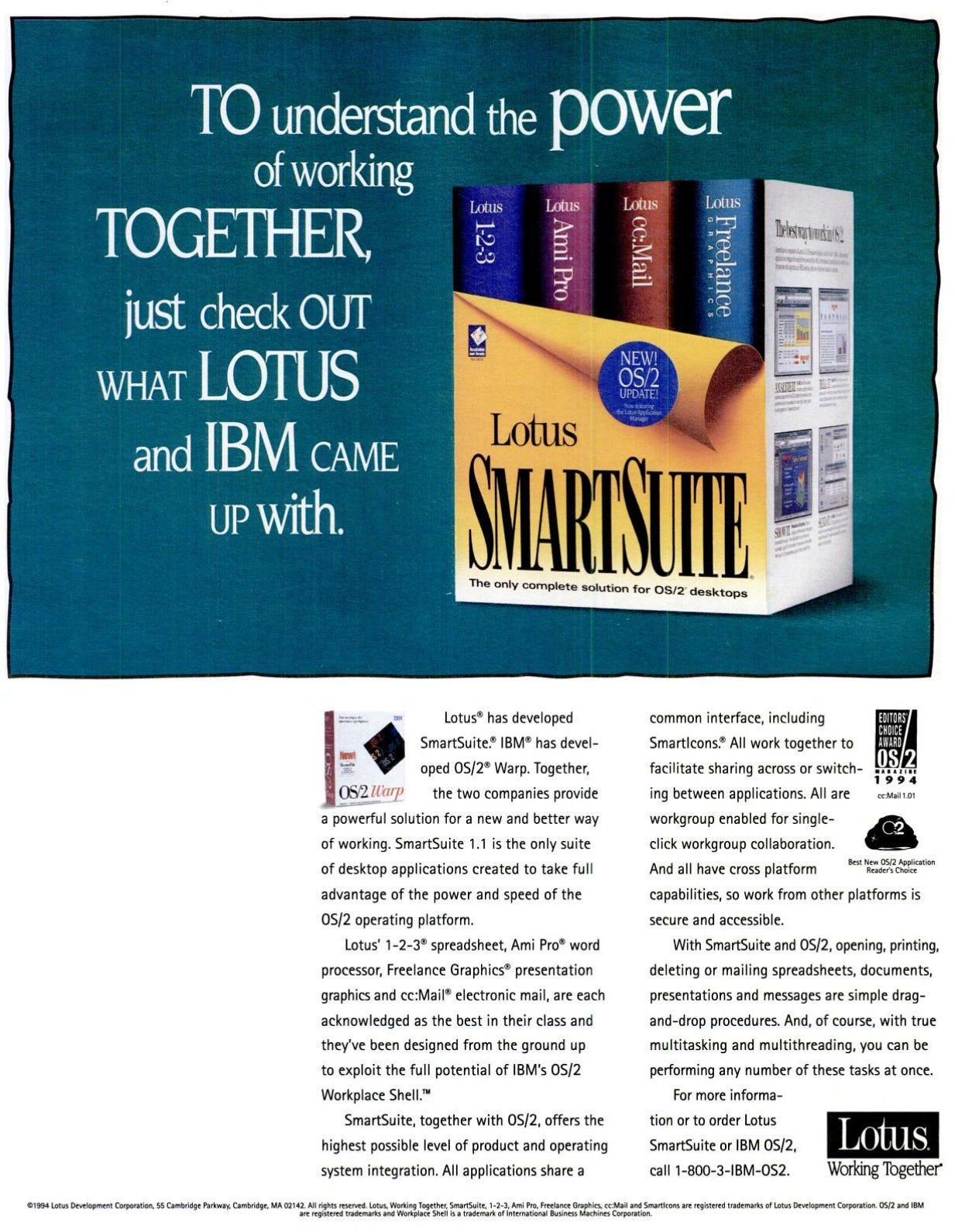
031. Synchronizing Windows and Office (the First Time) [Ch. V]
Welcome to Chapter V. Subscribers, if this were a printed book then you’ve just read through a typical trade press book by word count. Since we’re only in 1994, now you know one good reason why Substack makes for a better approach.1993 to 1994: The rise of the internet dramatically accelerates the growth of the PC, the Windows PC in particular, as it soon becomes a must-have home appliance and an essential business tool for most every profession around the world. Windows PC unit sales have doubled since 1989 to over 40 million units and the growth rate was increasing.Microsoft and the industry were in a transition. The world was fired up about the Internet and World-Wide Web, while anxiously awaiting a PC that was really up to the task—that would be Windows 95, code name Chicago. Unfortunately, Chicago was running late. Still, the Internet offered a real break in computing separating the early days of 16-bit computing from what was to come with 32-bit computing.Inside Microsoft’s hallways the mood was different. Most products were still late and buggy, and importantly the strategy remained confusing internally. “Windows, Windows, Windows” was the top line, but the differences and even rivalries between the two Windows teams, Chicago and Cairo/NT, made for complexity. Applications spent the better part of a year finishing the release of the much-hailed Office 4.2, which was the last 16-bit product. While Windows and Office were the main products, the company was spawning new shiny objects at a feverish pace. Online services was growing incredibly fast and the Consumer Division was becoming the favorite destination for the increasingly experienced workforce.During this I needed to find a new job and would learn valuable lessons along the way. Back to 030. My Performance Review (and An Expense Report)During a visit to my family in Miami, I was bored with the July heat and endless trips to the mall to avoid the heat, so I went to the local CompUSA to buy the newly released Lotus SmartSuite version 2. Wanting to spend time with it firsthand, I loaded it floppy-by-floppy on to my Compaq LTE laptop running Windows 3.11 and used the better part of the vacation diving deep into the product.The main messaging for SmartSuite was consistency and the way in which each of the programs worked together. At Spring COMDEX 1994, the booth had been a relentless chorus of a work together jingle. The promotional materials offered up SmartIcons® shared across applications as supporting evidence—basically toolbars with customization. As I began to use the 1-2-3 spreadsheet, Ami Pro word processor, Freelance graphics/slides, Lotus Organizer personal information manager, and Approach database (the latter four were acquisitions), I saw a fairly sophisticated suite of products, but I didn’t see a lot of user experience consistency.It was weird. It felt like we were being marketed to. We were.A normal person would have taken screenshots of the user experience and compared them. But I was a developer tools person, so I groveled around in the compiled code looking clues to see how shared SmartIcons were in reality. This was a big deal to my Apps friends because performance was everything and loading Word, Excel, and PowerPoint meant a good deal of duplicated code. Surprisingly, all those buttons took a lot of memory and used scarce graphics resources in Windows. Office was a bundle but not an architected product (yet).Much to my surprise (but given the acquisition history of the product it should not have been), not only did each Lotus app have its own copy of icons, but each frequently varied across apps.Busted. We were being marketed to.I quickly put together a nearly 30-page memo, detailing inconsistencies and inefficiencies in the product. I made a giant table of copy/paste between apps to see how each was handled. In hindsight, decades later, nobody would think this was even a problem, but in the early days of cross-application scenarios, simply moving information between products was hit and miss. It had been an area Office 4.x had worked hard on, especially using the new object linking and embedding (OLE) technology. I also detailed the disk footprint, memory utilization, and even the number of help topics.Consistency was all the rage in the world of applications. There were two historic drivers of this. First, there was a strong belief, in part encouraged by Microsoft and Apple, that a graphical interface was inherently consistent across applications. Apple relentlessly touted their extensive documentation, Human Interface Guidelines or HIG, as a sort of rules of the road for building graphical apps. The HIG provided specific, almost Talmudic, rules for how to display commands, dialog boxes, and menus. Windows was just beginning to recognize the importance of this kind of effort and with Chicago would release a major set of guidelines, the Windows Application Design Guide or WADG (wad-gee). Unlike MS-DOS where every application m

030. My Performance Review (and an Expense Report)
Summertime at Microsoft was also performance review time. I was also busy trying to figure out what job to do next and was quite stressed. While this is a brief look at my own performance review, there was a great lesson for being or managing staff that I carried with me for my career. This goes beyond the Rumsfeld-like Rules I crafted and to the relationship between the support staff and leader.Back to 029. Telling the Untold StoryIn July 1994, after almost 18 months as TA, NatalieY, head of recruiting but also in many ways the emotional leader of Microsoft, sent me an email reminding me that BillG needed to fill out the spreadsheet with my review score, which was Microsoft’s performance review system, and, more importantly, my salary and bonus. Yes, the review system in place was a spreadsheet managers filled out with a rating, raise, and bonus. Because of all the work and excitement of the job, I had totally spaced and not even thought about that. Natalie reminded me because she also knew I would be changing jobs soon and any new manager would want to know what Bill had thought of my work. I later referred to my time with BillG as “the two most expensive years of my life” because I missed out on the material compensation that I might have earned had I filled out the performance review form and received typical salary and stock awards. The non-material compensation was priceless, so, obviously, no complaints.Most everything I did was well-documented because mostly all I did was send email about meetings I had with different groups or write memos about the lessons learned from conferences, using software, or other trips. I really took to heart the early advice I received, which was not to take up or waste too much of Bill’s time. In fact, we never met about what I was doing or should do. Except for ThinkWeek, I don’t recall meeting with him one on one except for when he would occasionally dart into my office to follow up on something or fix some beta product that stopped working. Even when we flew to the same place, I would take a different flight knowing that someone else would find more value in bugging him on the trip. Though I should note, Bill’s routine for flying was to sit in a window seat with a blanket over his head and not talk to anyone, often disappointing those hoping for a discussion.For my review I wrote a memo, rather than use the performance review form, which wasn’t something BillG was familiar with. Rather than waste his time, the memo detailed all the projects I worked on and the memos I had written. I noted all reports I’d written for learning trips I had taken as Bill’s eyes and ears.Except for one.PaulMa, leader of all Platforms under MikeMap, asked me to go with him to London on short notice to help document what was going on with a sizable enterprise customer. PaulMa was the most enterprise-focused of executives and with Windows NT beginning to gain traction this type of customer learning was important. Having never taken overseas travel for Microsoft, I emailed Paul’s executive assistant, Kay Barber-Eck (KayB) for help and she obliged, booking a plane ticket and a hotel. I packed my blue suit and off we went to visit with several UK banks.When I got back, I took the plane ticket (the red-backed carbon paper kind) and the hotel receipt (one night) and filled out the standard expense report in triplicate and gave it to JulieG like I always did. The following Monday morning when Bill signed things for the week he refused to sign off on the expense because “he flew business class” as per the note on the form. I panicked. The ticket was thousands of dollars, and I could not afford that on my own. I emailed KayB and she said to submit it again and tell him it was the policy, and it was okay. She let me know the employee handbook included the travel policy, which said flights of eight hours or more could be optionally business class. I copied that policy page from the employee handbook and printed out a note explaining myself. A week went by. The report came back unsigned, noting that the flight was seven hours 45 minutes. At that point, I was about to be overdue on my credit card bill. I panic-telephoned KayB. She said to bring the expense report over and PaulMa would sign it. Phew.Microsoft was still a start-up in Bill’s mind. How could one not respect that, I asked myself.Out of protest, I never sent Bill my trip report on the future of ATMs and banking from home in the United Kingdom.Natalie insisted that I schedule a meeting with Bill to go over the review even though we both disliked scheduling time to talk. Bill read the memo and agreed with my self-assessment but zeroed in on one line, which to this day we still joke about.In my performance review memo, I said that in an effort to be efficient and not waste his time I never asked for feedback about how I was doing or even what to do. Instead, I wrote stuff and sent it to him, such as the pre-meeting notes or trip reports, and the

029. Telling the Untold Story
A more interesting aspect of being in a staff role is how your perspective changes from day-to-day execution to strategic milestones. From this perspective, one doesn’t see the daily progress as much as the experience of what the starting point was and then results. There are meetings and demos, and (tons of) daily builds in the middle (my favorite), but the experience lacks the context of daily trade-offs or even the realities of product development. It is very easy from a staff role to assume people don’t get it or they are messing up, but it just isn’t the role or even a valid perspective. This would be a valuable lesson I would learn in this job that I was not expecting.Back to 028. Pivotal OffsiteThe clock was ticking, and to get things done for Chicago meant starting immediately. Chicago, originally planned for early 1994 or maybe 1993 depending on who you ask, was not yet in beta and so practically speaking was not going to finish in 1994 given the time required for broad beta testing (recalling my previous Cornell recruiting trip and the debate over whether Cairo would ship before “Windows 4” aka Chicago later in 1993). Evangelizing tactical work items for the internet strategy and making sure they landed with owners was my job as TA. With regards to the “Internet mania”, our mantra as per BillG was two-tiered: embrace and extend.Much like killer app, the phrase embrace and extend proved to be far more loaded an expression than intended. Computing evolved by companies constantly finding ways to uniquely extend existing software and hardware, elements viewed as commodities, while at the same time always bowing to the existing investments of customers by claiming an embrace of any standards or winners. That was the view of how value was created—everyone built on all that came before. That was how everything worked. In a sense, each new product somehow related to the product it would supersede while extending it in uniquely valuable ways.What had changed was the open-source movement that viewed everything as embrace with no advantage bestowed to any party, with any extensions going back to the community. As it would turn out, embrace and extend is precisely how nearly every open-source innovation was commercialized, particularly as software moved to the data center. Not everyone believes that is good, but it is what happened. In 1994, embrace and extend was synonymous with evil. Admittedly, it didn’t help that the phrase was sometimes attributed to Microsoft as “embrace, extend, and extinguish.”With specific action items outlined, for the next couple of months I made sure the company was embracing the key protocols I had seen at Cornell (and that our brave corporate customers were beginning to demand): TCP/IP, email over SMTP, HTML for online documents, NNTP for discussions and bulletin boards, HTTP and Gopher on the server, and IRC for chat.In doing so, I found myself in the role of shuttle diplomat or “glue” as we said looping around the cluster of single-X buildings, the location of the Chicago team, and the next version of Windows NT under development, Daytona, and over in building 16 where Peter Pathe (PPathe), the general manager of the Word team, sat. Many days I found myself almost in a constant swirl running between buildings in the misty drizzle of Redmond.My agenda was to help identify issues and bring teams together to arrive at the common goals outlined at the offsite. I was to help, not do. It is a confusing a difficult spot to be in, especially as a self-described zealot, and particularly as someone with no responsibility for a product schedule. Chicago was on a mission, a new mission to embrace the WWW. The team quickly came to its own point of view and strategy, which included the get on the internet capabilities, as well as coming up with a viewer and browser strategy. During the offsite the Chicago team affirmed this point of view, but the commitment was for after the initial Chicago release. The realities of the Chicago schedule meant that work that did not impact the product directly had a chance of being delivered simultaneously to customers because of the way OEMs ship new PCs, known as a service release in the OEM process—taking advantage of the ability to add features to Windows on new PCs even after the retail boxes of Windows were manufactured for upgrade customers who would later download those same changes or purchase the same-day add-on for Windows 95 called “Plus!” which in addition to those same internet capabilities including Internet Explorer 1.0, included games, screen savers, and other extras. While much would be made by regulators of these small changes in dates and what the “final product” was, this is what agility looked like in the age of massive software projects, a multi-month manufacturing channel required by ecosystem partners, and a schedule that was always a bit fluid until it wasn’t.This became the plan of record led by a longtime engineer, Ben Slivka (Ben

028. Pivotal Offsite
There was no shortage of energy around the internet. It was clear that a bunch of stuff would happen. Turning that energy into something resembling a strategy was an open question. For all the excitement, each group seemed to have its own way of defining the Internet, or its own view of how it could subsume the Internet into existing products. Convening an offsite of the 20 or so most senior product leaders in the company was a big deal. All I could really do was create an opportunity for leaders to lead and strategy to emerge. The rest was up to BillG and those leaders. JAllard and I brought the enthusiasm and hopefully a spark. It was not going to be easy.Back to 027. Internet EvangelistMicrosoft loved a good offsite. We loved a chance to “wallow” in the minutiae of technologies, implementation, and competitors. We also enjoyed tearing apart ideas and approaches with our proverbial tech buzzsaw. In setting up the offsite I had no idea how critical it would become.BillG famously tilted (or pivoted) the company away from character-based MS-DOS products to graphical user interface products in a retreat just a decade earlier. Platform shifts in technology seem to come in these decade waves (though perhaps that is a retroactive timeline). Was the Internet the next platform shift, even though GUI had just started? Was this offsite going to be as pivotal to Microsoft’s future as when the bet was made on making Excel for Macintosh? I certainly hoped for that, but had no idea how the company’s leaders would see things when they were all assembled to discuss it. I thought about that as I remembered DougK, the inventor of minimal recalculation in spreadsheets, telling me the story of leaving Microsoft after that offsite because he disagreed with the new direction.Scheduled for April 5, 1994 (coincidentally the day after the incorporation of Mosaic Communications Corporation—later to be renamed Netscape Corporation—created by legendary founder of SGI, Jim Clark, and original Mosaic programmer Marc Andreessen), I prepared the mother of all briefing books for the offsite. No offsite was complete without an elaborate briefing book. I hand carried the entire thing to the copy center (MSCOPY) and ordered 30 copies, doubled-sided, bound, with tabs. They called me an hour later and told me I needed two volumes, so I headed back and removed enough pages to keep it at the 300-page limit.Looking at the book now, it serves as a great reminder of just how small the whole of the internet was back then. One of the books I ordered for many people was by Ed Krol, The Whole Internet: User’s Guide and Catalog. How crazy to think that the entirety of the Internet could be represented as a book and cataloged, but that was sort of what it was. Similarly, the technology underpinnings were perhaps 100 pages of protocols and formats that everyone at the offsite could easily absorb. Episode of Computer Chronicles from 1993, hosted by Stewart Cheifet. (Source: https://archive.org/details/computerchronicles)One of the most popular prep materials was a copy of a video tape episode of The Computer Chronicles, the award winning Public Television show hosted by Stewart Cheifet from 1983-2002. The video was essentially the entire briefing book in a one hour television segment. It is a remarkable time capsule of the 1993 Internet. It was already a bit out of date by the time of the offsite but it was easily absorbed, especially for those who did not come by my office for a demo.Perhaps I got a little carried away.About 20 people gathered at Shumway Mansion in Kirkland about 8AM, early for developers. In his introduction without any slides, Bill improvised the term “mania” to describe the internet and emphasized a core company value, which was that exponential phenomena cannot be ignored. The internet was exponential. He said something that I thought was critically important and returned to time and time again over the years that followed. He told us the internet was not to be “studied.” It was already decided that it would be a critical part of our next wave of products. We were kicking off the process to decide what to do, not if we should do anything. His choice of words and body language was as strong as his email a few years ago declaring Windows our strategy.In order to develop a plan, we divided into three groups, each given a set of questions:* Systems. How do we make Microsoft platforms the preferred choice for internet as both a client and server? How do we make internet applications available given that most everything is free? What is the internet experience missing that we could provide? How does Cairo/EMS (the next, next generation OS and the new mail server, both very early in development) complement or conflict with the above?* Tools and Services. Can Microsoft use the internet for customer support? How do we connect with developers using the internet? If we use the internet for support will we get credit for providing better support

027. Internet Evangelist
I’m about to get my first lesson in disruption. It wasn’t called that yet, the first HBR article is a year a way and the book and phrase “innovator’s dilemma” more than three years away. Trapped in the snow seeing the power of the loosely connected, mostly University-created, software almost immediately turned me into a zealot. I don’t use that term lightly. I had seamlessly transitioned from character to graphical interface, even from mainframe to PC, without suffering the pains of disruption. I had no business to run or customers to keep happy. I was just a kid, a technologist. I was now facing an entirely new challenge—not only did I feel compelled to evangelize the internet to people, but I had to wonder with every question, with every push back if I was even right. Smart, very smart, and successful, very successful, leaders at Microsoft and giants in the industry didn’t seem to get it. Who was I to be so certain? What did I know? It turns out, not knowing what I did not know was an asset.. And so begins my intense few weeks evangelizing the internet to anyone who would stop by my office and experience my dedicated internet “DTAP” connection.Please consider subscribing. Thank you.Back to 026. Blue Suede PumasThe Securities Exchange Commission (SEC) made public company filings available on the WWW. This was interesting because the information had been previously difficult to obtain and was only available with a subscription fee.That would get BillG’s attention.In the early stages of a technology, users are also the builders. As a result, there was a lot of easily accessed material about the WWW itself, a sign of a healthy movement. Many individuals tracked metrics such as number of servers, connectivity speed, and volume of major protocols. Part of my research was building up a data set to explain the growth and diffusion of the WWW and associated technologies. I went to the Kinko’s on Broadway on Seattle’s Capitol Hill and once again used their crazy copy machine to make a big poster of the NSFNet internet backbone map of the United States. This would often become a main talking point for business-oriented discussions.For technology discussions, I also started building my own library of important internet technical documents. These were called requests for comments (RFCs) and were the specifications for how different internet technologies worked. RFCs began with the research network itself in 1969 and continue today. While many other standards bodies started contributing to internet and networking (IEEE, ISO, W3C, etc.), much of the important work for the internet still takes place via this process. These documents are as important culturally as they are technically. When you read about email, domain names, network address translation (NAT, this was brand new at the time) you not only understand the implementation but gain a whole appreciation for the culture of openness and collaboration. These were the exact opposite of the rigid specifications from IBM or the NT team.After meeting with JAllard and hearing his excitement and also concerns, I scheduled a few more meetings. I met with people on the Chicago networking protocol team and the team working on higher level user features for networking. I also got an earful from my new friends in the Microsoft Information Services group about security concerns and also risks of leaking intellectual property, at the same time they were anxious to find ways to offer secure connectivity as a service to employees.My first demo was with Bill. It was very intense and probably lasted two hours. As fast as I could click on the screen, Bill had deep questions about technology, business models, ownership, intellectual property, and more. I jotted down notes of questions I knew nothing about and kept the demos moving. I was less than a week into learning the internet. Bill was two hours in.What kind of questions did Bill ask? Though I was able to show BillG a lot, he stumped me asking to explain the difference between WinHelp, Microsoft’s relatively new online help engine, and the WWW. They were both formatted text with hyperlinks and the user experience was similar. The formats even looked the same. WinHelp used Word’s Rich Text Format (RTF) which was also a tagged text format. In fact, WinHelp looked world’s ahead of HTML because it was richer and compressed, so it took fewer bytes. On the face of it, distinguishing between WinHelp looking at Visual C++ help and Cello looking at the Novell site was not easy. Bill immediately saw WinHelp as Microsoft’s “competitive response” or counter to the new WWW.It took a few minutes for both of us to converge toward a shared understanding, but this was important learning. WinHelp at the time could not access links between different files, let alone different computers on different networks. This was a key innovation in HTTP and the invention of URIs (Uniform Resource Identifier, then often called the more specific URLs, uniform re
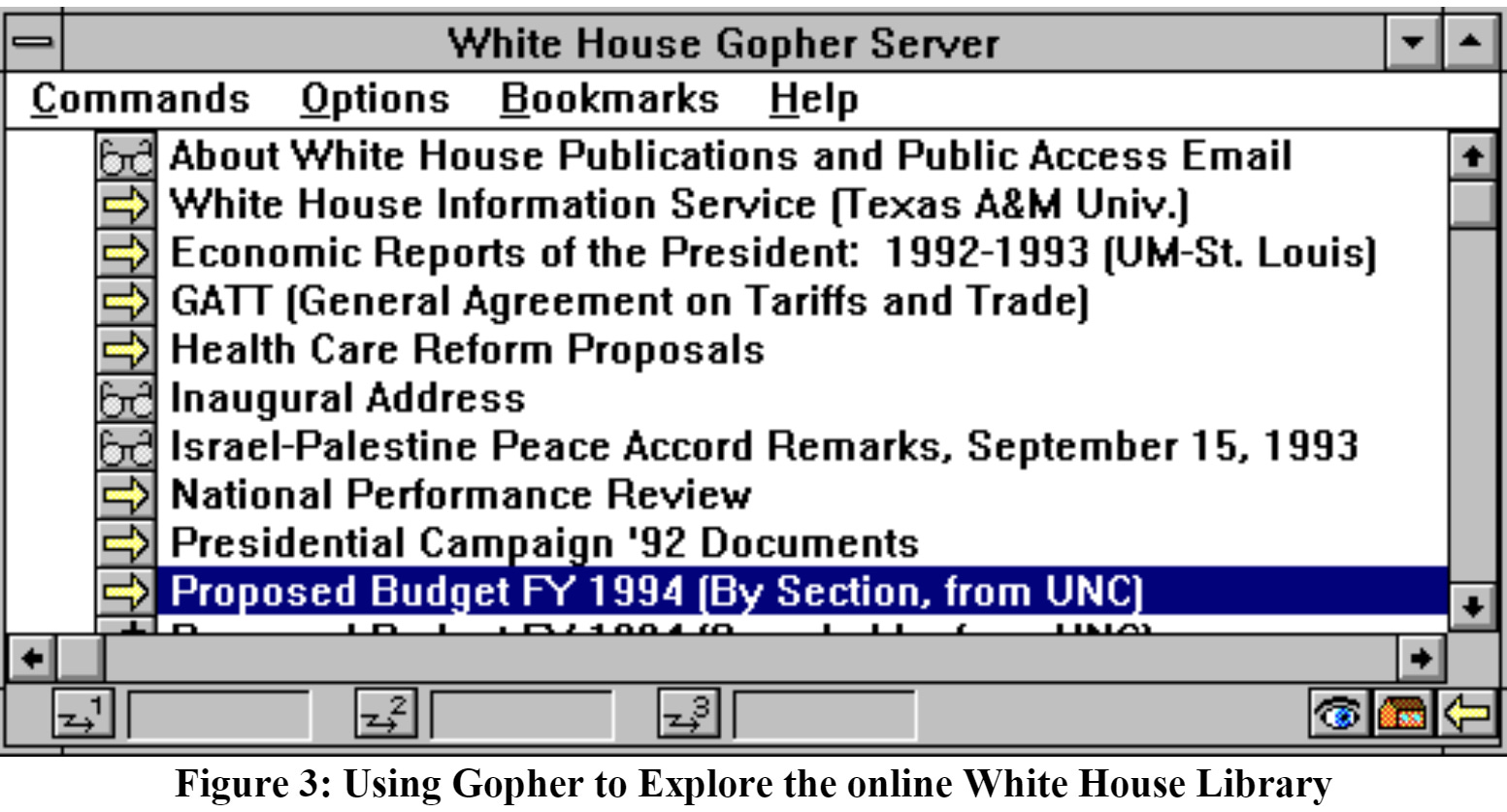
026. Blue Suede Pumas
Microsoft was now big enough in early 1994 that it was easy to know the really old-timers (10 years was really old, 5 years was the period of doubling year over year), but anyone hired after you outside of your immediate group (or school) became more difficult to know. Working as Technical Assistant gave me a chance to meet people at every level in every product and technology group. By far, the strongest bonds I built were with people who were more peers than anything else. James “J” Allard (JAllard) just authored the memo Windows: The Next Killer Application on the Internet and after my Cornell is WIRED! exchange I was immediately connected to him as “he’s a guy who has been working in this area”. As soon as I returned from being snowed in I headed over to meet J in one of the original single-X buildings, steps from the side door of Building 8.Head over to the comments and share your first experiences with the Internet if you were there when it was new.Back to 025. TrappedBack home, I went to J’s office in one of the single X buildings just across the walkway from Building 8. He had a typical Microsoft interior office for a junior program manager, but his had an aquarium with some reptile in it. Yuck. We were both wearing blue suede retro Puma Clydes. Because of our footwear, I was able to forgive the reptile which even after showing up at his office 100 times made me uncomfortable.J graduated from Boston University in 1991 and Microsoft was his first job. At BU he worked in the computing facilities the way I did at Cornell and we bonded over that. He described the job he was given by SteveB as “make this TCP problem go away.” He joined the networking group at a time SteveB was still running Systems, which included the always struggling LanMan product. TCP referred to the customer problem Steve was seeing where Microsoft did not support the technology that was rapidly becoming the preferred protocol in business networks, TCP/IP. This was a time when the choice of a network protocol was a strategic business decision guided by IBM, DEC, and hopefully Microsoft someday, and few would think of using what was generally considered a research platform.This was one of my first lessons in Microsoft challenges in developing an internet-centric strategy. It was new to me, but for J, it was the daily “battle” he already faced. Microsoft thought it would develop a connected PC by also developing the networking protocols that connected the PCs. There was a great deal of work that had gone into many “layers” of the networking software. Microsoft could do a better job if all the parts of the network were running Microsoft software. Microsoft was not unique in thinking this, but it was late to the party.The internet didn’t work that way, though. The protocols themselves were openly developed. Vendors developed their own implementations of those protocols, but they needed to interoperate with all the other parts of the network. J’s job was to make sure Microsoft had great support for TCP/IP, the base networking layer for the internet. Some big commercial and government customers were early in adopting TCP/IP, including money center banking and defense departments which were very large Microsoft customers.To the Windows and NT teams, TCP/IP was one of several ways of connecting. Windows NT was designed from the start to be networking agnostic but solidly favored and made a bet on TCP/IP, which was a significant departure for a Microsoft product, and also evidence of the difference between NT and LanMan. Chicago was working hard to support Netware’s protocols, which were the current business leader, with TCP/IP support coming from NT in an evolving partnership JAllard described to me. The speed at which networking switched to TCP/IP was stunning. The reality was that it was vastly superior to any other solution for running corporate networks. As I recalled from my first day at Microsoft, the beeping death due to network failure was still all too common and not something I experienced in graduate school where TCP/IP dominated. TCP/IP addressed that with a much more robust approach. J re-explained all of this to me.He was tracking the public sources of data and was seeing the exponential growth in the use of the internet. This is really what got everyone’s attention, including, and especially, BillG’s. BillG gravitated toward the exponential.The internet was over two million connected “nodes” at the time. Today, a node might be a house with dozens of devices on the internet or a business with tens of thousands. Then, a node was a single computer (a Mac like at Cornell or a Gopher server). It was estimated that 25 million people were using the internet and it was growing at a rate of more than 5 percent per month, 70 percent per year. Importantly all the companies that offered networking over phone lines and leased lines were starting to offer internet (or packet switched) connectivity to businesses.The numbers were breathtakin

025. Trapped
Imagine having all the confidence of an early twenty-something at an incredibly successful technology company leading the industry and lucky enough to be in a job giving you access to the leaders that made that happen. Now imagine getting trapped in the snow at a university and experiencing a software experience cobbled together by a tiny number of people using free code from other universities. That would be one thing. But what if that experience collided head-on with the grand vision the company was working towards.Back to 024. Discovering Cornell is “WIRED!” [Chapter IV]Feeling nostalgic, and trapped, I decided to go visit old lecture halls and campus sites. Cornell was used to the snow and even with all the warnings of a big storm, most students were going about their evening. From the career center in Hollister Hall I made my way over to the Upson Hall basement where I had worked the terminals and the mini-computer room for computer science majors.It was still early enough in the PC revolution and connectivity that most students were still doing their work in these shared facilities.The layout of Upson had changed dramatically from my time there. Walled cubicles of VT-100s with a shared line printer were replaced with long tables of Macs. There were new NeXT cubes that were getting a lot of use. There were even laser printers that had magnetic Vend-a-Card readers that stored cash to pay $0.20 a page for printing. When I worked in the Uris Hall computer room, I was lucky enough to have the only public laser printer on campus, but alas it was only connected to the IBM mainframe.It was the end of the day. The room was buzzing. People were racing in, spending a few minutes at a Macintosh, and racing out. At first, I couldn’t tell what they were doing, and with no student ID I wasn’t able to use a machine. After watching a few students, I realized they were all following the same flow.Each quickly sat down at a Mac and pulled out a floppy disk from a backpack (slung over one shoulder, none of this both-shoulder thing the kids do these days). Shaking the mouse to wake the machine up, the Macs were set to launch only one program called Bear Access (Cornell’s mascot is a bear). Students typed in some ID, inserted a floppy disk, and then quickly navigated to mail. I later learned the students were storing their mail on the floppy because the Cornell mail servers were running the POP protocol and were not storing it after the initial download (for cost).As dinner approached, Upson vacated, and a quick look outside made it obvious that everyone was hunkered down in dorms and apartments for the evening. I asked the operator if they were closing due to weather (we would never have done that) and he assured me he would be around because he needed to get the hours in that week. I was staying across the quad at the Statler Hotel, so I headed into Collegetown to eat.After a quick stop at Souvlaki House I went back to Upson. It was completely empty. The operator was reading from Foley & van Dam, the standard text on computer graphics.“I know this will sound strange, but I used to work here about 10 years ago,” I said. He looked annoyed.“I see you are taking Graphics. . .is it Professor Greenberg?”While I had not taken the class, all my friends did and I was also friends and classmates with Professor Greenberg’s son, which I was quick to mention. He remained bothered.“Well, I work at Microsoft and I am here interviewing students for internships next summer . . .”He interrupted me, grabbed his backpack, and pulled out a resume.After a few minutes of typical discussion about opportunities and how to interview and more, I asked, “Can you maybe show me how Bear Access works and tell me how you are using computers these days?”We pulled up chairs at a Mac. He logged on. I stopped him and asked where and how students got an ID, thinking back to the punch card with [email protected] I received orientation week freshman year. Cornell IT (CIT) had built an identity system such that it maintained the canonical mail address for students and faculty and routed mail to the appropriate mail server. The email system in use at the time, as was typical in most organizations (academic or otherwise), was distributed and heterogenous. Different departments each ran their own mail servers of different types along with different ways of assigning email IDs. CIT created login IDs so students could always be referred to by a single @cornell.edu mail address no matter where their mail went. Every single member of the university community had a login ID.This was the first example of a solution to a problem that was a product under development at Microsoft, Windows NT.The business or enterprise version of this problem was known as directory service and was a rather heated battle between Netware and the new entrant, Windows Server along with the EMS project described previously. But at Cornell, this was already working. Most companies in the early ’

024. Discovering “Cornell is WIRED!” [Ch. IV]
Welcome to Chapter IV. The next series of sections detail one of the most interesting, exciting, and to many, troubling eras in the history of Microsoft. While Microsoft was busy developing Chicago (Windows 95) and rallying the entire company around that massive project and opportunity, an unprecedented and unstoppable force was taking root, the modern internet (back then it was called the Internet). Today we would refer to this as a disruptive technology change—a less capable, cheaper, alternative to all the things we were building, but the notion of a disruptive technology change was still years away from becoming business canon. This is the story of how the Internet happened to Microsoft—a story that has many participants and at least as many perspectives. As Technical Assistant at the time I found myself in the middle as a facilitator but also an activist and champion. The personal growth that I experienced during this time would prove to be an incredible blessing that led to enduring friendships and amazing memories. At the same time, this was a period of remarkable turmoil and angst, mixed in with an unrelenting corporate urgency.Let’s start with the online landscape of 1994?Back to 023. ThinkWeekThe pending storm was all anyone was talking about as I completed the last few interviews at the end of my annual (or more) recruiting trip to Cornell in February 1994. As snow, and more snow, piled up, I knew I was not getting out that day as planned. This happened every other year or so.What I did not know was that getting stuck would turn into a lesson on what it takes for a large and successful organization to change course and rally around something new.Microsoft, and BillG in particular, were thinking about the opportunities online, as it was called. Russ Siegelman (RussS) focused on the opportunity. As a recently-hired fellow TA, he was exclusively looking at the existing world of online information services and connectivity.The biggest online service by far was America Online (AOL); the dial-up service had membership of over two million households, and notably was equally accessible from both Windows and Macintosh. AOL along with CompuServe and Prodigy were collectively a sort of big three of online services and gave a bit of a feel that they were like TV networks and in some sense they operated that way with various forms of channels. In 1992, AOL released a Windows version of the software, which previously ran on MS-DOS, putting it at parity with Macintosh (I used it in graduate school with the screen name SHNOWZ, it’s still mine but that’s another story). Apple even had a deal with AOL that offered online services for Macintosh users on the AOL platform, and that in turn gave them leverage to develop exclusive online content deals with major media brands. That’s the kind of thing that would concern Microsoft.Millions of people sent email to each other on AOL, participated in communities, and explored deep information services on finance, sports, entertainment, and more. All of this was done from within the AOL application. Few, if any, at the time thought this approach, a so-called walled garden, was bad. In fact, most people thought it was the only way to “package up” a variety services and information sources. AOL uniquely combined services with an application that handled the complexities of connecting a computer modem to the service over a landline. It was slick. To attract customers, AOL was spreading floppy disks everywhere, through magazine inserts, cash register checkouts, and direct mail. It was growing fast, approaching $100 million in revenue.AOL was so exciting that Microsoft cofounder PaulA became a major investor, much to the chagrin of the Microsoft competitive spirit. He even tried unsuccessfully to acquire controlling interest of the entire company. Paul correctly recused himself for several Board meetings during this time because of the ownership stake. BillG was spending a great deal of time on the earliest stages of working with the “carriers,” or the phone companies, trying to navigate the right partnership model. Dial-up made these companies essential to the online world. Household high-speed connectivity was still years away with many predictions of timelines and technologies, but no approach seemed like it would take hold any time soon. In Europe, somewhat faster ISDN was useful to business customers, but globally connectivity was rooted in the traditional phone companies over dedicated connection-based lines, and slow.The phone companies, and later the cable companies, were motivated to achieve more than their pipeline or carrier status. Both wanted to play in the world of content and services and own more of customer experience, especially for consumers. This led to a long series of discussion and eventually pilot projects between various players including Microsoft. The spectacle of giant companies navigating a new space while simultaneously partnering and competing (fren

023. ThinkWeeks
People always seem to want to know the habits or techniques used by CEOs for managing the company. I’m not sure if that helps or not, but at the very least it can be interesting. Before I became Technical Assistant, Bill started on his own process of organizing time to get away and “think” which eventually became ThinkWeek. I put a good deal of energy into making ThinkWeek a more structured and productive time as the rise of email had a way of substituting email activity with the kind of deep learning Bill intended. Over the years, ThinkWeek achieved some sort of mythical qualities for some. While the process evolved to be rather different over later years, the early days were definitely something to look back on and reflect.Back to 022. Injecting New Ideas and IQ: The Information SuperhighwayMicrosoft’s overall rhythm, the “rhythm of the company”, as SteveB later called it, was still in the formative stages. In the early 1990s, the company fiscal year budget drove most of the rhythm for executives. The performance review process tended to set a yearly rhythm for product groups, though the product schedule was the real master often trumping work on reviews. For BillG, who was always obsessive about planning out a calendar for himself, the rhythm that seemed to matter most to him was the twice-yearly ThinkWeek times he set aside (they weren’t a full week, but close). ThinkWeek had been mostly an informal time for Bill to catch up and to get away from the day-to-day of the CEO job and Redmond. Given the scope of thinking, it seemed an opportune time to up-level the process.Bill’s family vacation house, Gateaway, was located on the Hood Canal, about two hours by car or by ferry from Redmond. The Canal was a favorite place for Bill and his family, and where he vacationed with his grandparents when he was young. It was peaceful and isolated.Learning about ThinkWeek from AaronG, the previous TA, I decided to make it a much bigger deal than simply gathering materials from teams for Bill to read. ThinkWeek was a fascinating way to immerse Bill in the details of what was going on, not just at Microsoft but across the industry. I spent a month preparing (overachieving) for each of the three ThinkWeeks we had together. Bill offered some guidance each time, such as the topic of a memo(s) he wanted to write, or if there was a theme he wanted to explore. He would suggest I speak with specific people for ideas. I discretely pinged people 1:1 who I knew would not start big email chains with subject lines like “BILLG THINKWEEK!!!” The frontline leaders in program management offered the best suggestions that came without agendas.I created a spreadsheet (of course) to track ideas for content across a wide range of formats: product plans, books, magazine articles, memos, and demonstrations. I had a field day at an office supply store buying filing boxes, color-coded folders, and labels to create banker’s boxes of ThinkWeek materials. One of the ground rules I established was that I tried to avoid the use of ThinkWeek as a deadline or forcing function to rush to get something written just for the week. I generally insisted on memos and product plans that were already written for the normal course of work, and not special ThinkWeek pieces. I always felt these would confuse more than enlighten since there was no way of knowing if something was or would ever get connected to ongoing product development. Interestingly this is something that would completely reverse in a few years, when ThinkWeek would become more of a wide-open all-company brainstorming event.The demos presented the most difficulty. In the early 1990s before software was released, it was almost always the case that a given product required a bunch of random hacks to work, and those hacks meant nothing else would run on that PC. Preparing a demo of something like a new version of Excel meant preparing an entire PC to demo only that version of Excel. This was also before laptops, so each ThinkWeek also meant there were a half dozen or more PCs that I had packed into my Jeep Cherokee (I was in my Northwest phase) along with reading material, all of which I delivered after he’d had one full day on his own.Our first ThinkWeek together was in April of 1993, a few months after I started the job. The contents skewed toward the present, with the whole company immersed in the development of Chicago, Cairo, and finishing the first major release of Windows Office with new versions of Word, Excel, PowerPoint, and the Access database. Microsoft Research was getting started as well.Bill was fixated on the need to gain more alignment and synergy across the product lines with respect to 32-bits, the shell, and more were still being settled. Execution plans were being put in place. Bill used ThinkWeek as a chance to delineate all the places where Microsoft could have a stronger strategy and leverage shared code more, to be more efficient in engineering effort, use less memory on run

022. Injecting New Ideas and IQ: The Information Superhighway
In 1993, it would have been difficult to overstate the hype surrounding the “Information Superhighway”. Whatever definition or capabilities it might have, it consumed the imaginations of everyone from Wall Street to Main Street with magazine covers, morning news show pieces, investor conferences, and more. Microsoft had risen with the juggernauts of MS-DOS, Windows, and soon Office and found itself, surprisingly, at the nexus of Hollywood, newspapers, cable TV companies, and telephone companies each believing they would come to dominate the highway. Only one thing was missing and that was some software to power it. Could Microsoft be that “vendor” or would software be so central that Microsoft would come to dominate the very nature of information delivered to the home as some felt it already dominated computing. Fear of Microsoft, and fear of Bill Gates, began to dominate. Gone were the wonders of the programming nerds in the Pacific Northwest. Back to 021. Expanding Breadth versus Coherency: The EMS ProjectWhenever I was feeling caught between shipping products and big vision or hearing about a product that was deep in bugs and had an unpredictable ship date, I could be rescued from my supply closet of an office by a demonstration from Microsoft Research (MSR) or the Advanced Consumer Technology group (ACT).Bill viewed the gathering of the level of “IQ” and experience in these groups with great pride and a good deal of personal effort, as he often personally recruited them. Icons filled the rosters of the two teams over the years: Jim Gray, pioneer in databases; Chuck Thacker, coinventor of ethernet networking; Gary Starkweather, inventor of the laser printer; Alvy Ray Smith, Academy Award winner, cofounder of Pixar, and inventor of alpha channel in graphics; and Butler Lampson, founding member of Xerox PARC and inventor of the personal computer—and those were just the people hired in the early 1990s. I sometimes had to pinch myself that I even got to meet these legends. When Butler Lampson (BLampson) was being recruited I was asked to take him to lunch, but I was mostly starstruck.NathanM and Craig Mundie (CraigMu, who at the time reported to Nathan) were a yin and yang. NathanM and Craig Mundie (CraigMu, who at the time reported to Nathan) were a yin and yang. Nathan brought an eclectic background in physics and science, though he founded a PC software company acquired by Microsoft that brought him to the company, among others including DavidW the pioneering Windows engineer. CraigMu was an industry veteran, having seen the entire arc of computing. He got his start at legendary Data General then ultimately started a well-known supercomputer company, Alliant. The company fell victim to the advances of Moore’s law, which brought him to Microsoft, “having seen failure,” as BillG used to say. Officially Craig was leading the Windows CE project, Microsoft’s first efforts in mobile, but he often managed, formally or informally, advanced projects and an ever-expanding portfolio. Part of the yin to Nathan’s yang was that Craig was a former CEO of a larger company and a technology industry veteran.The information superhighway, as it was called, was front and center of all the future discussions BillG and NathanM were involved in. The internet, as we think of it today, was more than a year away when I first started as TA, though the first version of the Mosaic browser was released in the summer of 1993. The highway was how the phone companies and cable television companies described accessing information over their respective networks. Bill’s first book, which he began writing around this time, was titled The Road Ahead (1995) and spoke quite a bit about this metaphorical highway. The cover photo by Annie Leibovitz even featured Bill on a lone stretch of highway. In public, Bill was a bit of a realist about the timeline and who would “win”. The highway was the first time as a public company that Microsoft faced a huge mainstream hype cycle. Part of this cycle were alternating predictions about how Microsoft with come to dominate the superhighway or how Microsoft was missing out.Prior to the internet, much of the discussion in BillG meetings looked like the internet, only it used proprietary software and required dedicated hardware devices from Microsoft, phone companies, or cable companies, and mostly worked only over private networks of leased lines running proprietary protocols or archaic phone company standards. The Information at Your Fingertips vision (more on this in a future post), first articulated in 1990, looked a lot like the internet would come to be in a very short time, but with an entirely different implementation. While there was no single definition of the Superhighway, the common articulation was the idea that a wide variety of consumer services would be available directly to home computers using a new type of data connectivity offered by phone or cable companies (the obvious incumbents with wire

021. Expanding Breadth versus Coherency: The EMS Project
Back to 020. Innovation versus Shipping: The Cairo ProjectThrough Microsoft Office, even the first versions, Microsoft sold a primitive form of email that worked for small groups of people in the same physical offices. Delivering enterprise email that worked for a company the size of Microsoft, and many times larger (though it would be years before companies would use email the way Microsoft did) was a massive undertaking. The product would become known as Microsoft Exchange and formed the cornerstone of the entire Microsoft enterprise strategy. If you’re looking for an analogy, Exchange was to Windows Server and enterprise computing as Excel was to Windows and the PC desktop. At least I think so. This is a look at the early days from the perspective of BillG strategy and management.Nearly all of my job as TA involved email—long, detailed, memos written as email. BillG routinely emailed weekend or late-night missives prompting response chains that would go on for hours. Not missing a “thread” was part of the culture.Microsoft did not use its own product for email. Well, it sort of did. Microsoft’s email ran on Xenix, a precursor to the Linux operating system, and typically a mail PC was issued that was a dumb terminal connected directly to Xenix computers. Mail was simple plain text with no formatting. Using attachments could be awkward. To alleviate the annoyance of using command lines for email, product team developers wrote mail programs to use in MS-DOS and later Windows that copied mail from Xenix and made it easy to use mail in character mode (WzMail) or GUI mode (WinMail). Given how much time we spent in email, there was no shortage of efforts to build mail programs as side projects. I was a hold out and continued to use my Xenix terminal for as long as they were supported. The big disadvantage to these tools was that all your mail was copied down from the Xenix server to a PC—if your PC hard drive crashed you also lost your mail. Clever people figured out all sorts of ways to avoid this failure point, only pointing out just how important email was and how much time and effort typical employees put into just keeping it working. Windows hanging in the middle of drafting a long message or reply was the sort of thing that ruined your day and happened all too frequently. Everyone had email horror stories.The rest of the corporate world was light years behind Microsoft and almost never used email outside of the technology teams or other companies in the software and technology industries. IBM was the leader in corporate email, using an arcane mainframe system, Professional Office Systems (PROFS), made famous by Oliver North in the Iran-Contra hearings. Since nobody in the PC industry had mainframes, email was a collection of ad hoc tools and systems that worked well only for relatively small companies, like the one mail product Microsoft had called Microsoft Mail. Microsoft Mail competed with a Lotus-acquired product called cc:Mail, which dominated the email category to the degree it existed. Microsoft Mail was based first on a licensed Macintosh product and then subsequent versions were based on technology acquired from a Canadian company called Network Courier held by Consumers Software.There were many other products. I installed and used several of them during my summer internships when simply connecting the computers together was difficult. These early products were built on basic infrastructure of sharing files over dedicated networks—a mailbox was simply a file on another computer and sending mail was for all practical purposes reading data from one file and copying it to another. I’m simplifying for effect.Because email relied on connecting one set of mail products to another, there was a time when the big telephone companies believed they would provide email service much the same way that they provided voice connectivity, especially since mail between companies involved phone lines. This led to attempts to standardize email using Byzantine standards that only phone companies could love.While all this was going on, one of the first substantial Windows programs, designed by Ray Ozzie at a company called Iris, owned by Lotus but kept independent in a nod to the difficulty of developing innovative products within an established leader, increasingly gained momentum. The product, Lotus Notes, was a platform for building custom applications that could run on several different operating systems as well as being a rich graphical application. It was also an email program. Notes created a new category called workgroup computing. Even though Notes competed with Microsoft, Ray Ozzie and the team received a Windows Pioneer Award in 1994 at a ceremony honoring the most significant third-party contributions to the creation of Windows.Notes had an architectural appeal that cut right to the core of everything Microsoft valued. It ran on PC hardware. It was designed for Windows. It worked whether connected to the ne

020. Innovation versus Shipping: The Cairo Project
Back to 019. BillG the ManagerAs technical assistant I spent most of my time navigating our operating system strategy and progress during late-1992 to mid-1994. There were three main OS development projects going on at the time. Chicago was the code name of the successor to Windows 3.1 (shipped April 1992), rooted in the MS-DOS architecture and trying to build up from there. Windows NT building a portable, secure, and robust operating system from scratch aiming for the workstation and server market (version 3.5 to ship September 1994). These were both products under development unified by the Win32 API strategy announced at the professional developer conference. Cairo was a new project built on the core parts of NT but innovating (and inventing) in most every possible dimension. An entire book could be written about any one of these projects, but all were happening at once. This post is about what that was like. I don’t take this lightly when I say this, even after all these years many people I know still have emotional reactions to this period of time and the traumatic experiences of this project and how played out.It wasn’t like Microsoft’s operating system strategy was ever simple, at least to me. Perhaps it was asking too much for a cleaner or more straight forward strategy to emerge with the move away from OS/2 and the early success of Windows 3.0, and now 3.1. Being complacent or content was not in Microsoft’s DNA—a bold vision for Windows was, however, and with that came even greater product complexity. Microsoft had a simple external message of “Win32.” The problem was the product had not yet caught up to that message. Windows NT was just shipping its first version while the market was predicting NT would soon dominate the desktop. Microsoft was also anxious for that, first almost always talking about Windows NT after selling Windows 3.1. The “real” 32-bits, advanced networking. client-server developer strategy were all great selling points, but Windows NT was a new code base and lacked compatibility with huge numbers of applications and devices that represented the richness and key strategic value of the 16-bit Windows (and MS-DOS) ecosystem. Beyond that, Windows NT had the capability to run on non-Intel microprocessors which only fueled more punditry over the future of the PC. This left many believing the operating system market still seemed up for grabs and buying a PC remained a complex decision.In the meantime, Microsoft had fallen woefully behind Apple Macintosh when it came to ease of use and the day-to-day effort required to keep a PC working—not behind in sales, but that was not what counted for currency with BillG. Microsoft had yet to release a simple files and folders experience that matched Macintosh and was still mired in the vestiges of MS-DOS, such as file names restricted to “8.3” (eight characters plus three for the file type). It is a cliché even today, but Macintosh just seemed to work, and PCs always seemed to be crashing, hanging, or flaking out, or just much more difficult to use. Just as PCs became common in schools and the workplace, “the dog ate my homework” was replaced with “my PC crashed and ate my work” or something like that.Microsoft’s core Windows project for consumers was Chicago (eventually Windows 95). Chicago would bring the compatibility and ecosystem support enjoyed by Windows 3.1 together with the new Win32 API, while at the same time addressing ease of use shortcomings of Windows compared to Macintosh. Chicago had the goal of being a PC that was better than Macintosh plus bringing with it all the benefits of Windows that had cemented leadership in the market. The project was still early enough that most attention was on the just released and bolder Windows NT, primarily because so many believed that the 16-bit heritage of Chicago was a fragile legacy code base ill-suited for the modern 32-bit world. Microsoft’s own efforts around marketing NT only emphasized this point. For any company that would be enough of a big bet, not for Microsoft or BillG though. Chicago was just one part of an all-out assault on the operating system market, one Microsoft already dominated: Chicago for consumers, Windows NT Workstation for professionals, Windows NT Server for the back office, along with numerous early-stage efforts on both living room and handheld computing devices going on in NathanM’s advanced technology group. These all came about as a direct reflection of BillG’s scalable Windows strategy best expressed by a slide from the Win32 Professional Developers Conference showing one Windows scaling from the smallest devices to the biggest computers—a slide that would in some form carry Microsoft’s vision for the remainder of Bill’s leadership.Then there was Cairo. Whereas the major axis that defined everything along the scalable strategy was simply how much computer horsepower a device had, Cairo set out to redefine how people interacted with computers and how developers

019. BillG the Manager
The breadth of the Microsoft product line and the rapid turnover of core technologies all but precluded BillG from micro-managing the company in spite of the perceptions and lore around that topic. In less than 10 years the technology base of the business changed from the 8-bit BASIC era to the 16-bit MS-DOS era and to now the tail end of the 16-bit Windows era, on the verge of the Win32 decade. How did Bill manage this — where and how did he engage? This post introduces the topic and along with the next several posts we will explore some specific projects.Please feel free to share this and subscribers, please join in the discussion.Back to 018. Microsoft’s Two Bountiful GardensAt 38, having grown Microsoft as CEO from the start, Bill was leading Microsoft at a global scale that in 1993 was comparable to an industrial-era CEO. Even the legendary Thomas Watson Jr., son of the IBM founder, did not lead IBM until his 40s. Microsoft could never have scaled the way it did had BillG managed via a centralized hub-and-spoke system, with everything bottlenecked through him. In many ways, this was BillG’s product leadership gift to Microsoft—a deeply empowered organization that also had deep product conversations at the top and across the whole organization.This video from the early 1980’s is a great introduction to the breadth of Microsoft’s product offerings, even at a very early stage of the company. It also features some vintage BillG voiceover and early sales executive Vern Raburn. (Source: Microsoft videotape)Bill honed a set of undocumented principles that defined interactions with product groups. The times of legendary BillG reviews characterized by hardcore challenges and even insults had become, mostly, a thing of the past excepting the occasional sentimental outburst. More generally, they were a collective memory of hyper-growth moments any start-up experiences, only before the modern era when such stories were more commonly understood.Much later in 2006, when BillG announced his intent to transition from full time Microsoft and part time philanthropy to full time philanthropy, many reporters surprised him by asking how Microsoft would continue without his coordination of technical strategy and oversight. But even in the early ’90s, at the height of the deepest and most challenging technology strategy questions, he never devoted the bulk of his time to micromanaging product development. He spent a good deal of time engaged with products, but there were far too many at too many stages of development to micro-manage them. In many ways this was the opposite of the approach Steve Jobs took, even if both were known for their own forms of challenging interactions. The most obvious contrast between the two was the breadth of the product line and the different market touchpoints. Having grown up through Development Tools and Languages, I was familiar with Microsoft’s product line, but only as TA did it become clear how comparatively broad Microsoft had so quickly become. The software world was thought of through a lens of major categories: operating systems, tools and languages, networking, and applications, roughly mirroring Microsoft’s org chart. The latter was thought of as word processing, spreadsheets, graphics, databases, as well as assorted smaller categories. It was easy to identify leaders in each of those areas—names that were tip of the tongue at the time and most of which are no longer in the PC software space (IBM, Borland, Novell, WordPerfect, Lotus, Aldus, Ashton Tate, and many more). The ah-ha moment in the early 1990s was the realization that no company on that list was competing in more than one category. Microsoft was hardly winning in every category. In fact, in most categories it was new entry, a distant second, or even third place, but the company was in every space. Bill was committed and patient. Microsoft was relentless. And Microsoft was focused on Windows.BillG had fostered Microsoft with a grand vision to compete in every category of PC software, from some of the earliest days. With rare exceptions, no other company set out to do that. BillG led a deep technology strategy. It started with the operating system, supported by tools and languages, and then using those to build applications. This seemed simple enough. In fact, it is what IBM built for mainframes and DEC built for minicomputers.There was a crucial difference. Microsoft did not build hardware and was not vertically integrated to reduce competition. Microsoft built an operating system on an openly architected PC (the same Intel-based architecture that came to power both Macintosh and Linux years later) and published APIs so that anyone could build tools and applications for the operating system—an open hardware platform and open operating system APIs. This approach simply addressed all the early challenges Microsoft itself faced trying to figure out how to build winning applications—it was so busy dealing with dozens of proprie

018. Microsoft’s Two Bountiful Gardens
Back to 017. Eyes On Competition, Architecture, and Left FieldOne of the first things I did as Technical Assistant was to set up time with each of the leaders of the Office of the President and key executives to see what they could tell me that would help me to work with Bill. Mike Maples offered me a great and lifelong lesson in being in a supporting role while also explaining in his unique way the culture that was at the root of Microsoft—the culture across Apps and Systems where I would spend my whole career.I had to figure out how to have a high bandwidth (a BillG word) relationship with BillG and the key execs in his orbit, known as the Office of the President created in early 1992. I felt I should reach out to leaders and meet with them to see if they had any idea how to do this job. Microsoft was organized into a triumvirate or troika of executives (something about using a Russian word just after the fall of the Berlin wall seemed exciting to the press): Steve Ballmer (SteveB) leading Worldwide Sales Support Group (WWSSG), MikeMap leading the Worldwide Products Group (WWPG), and Frank Gaudette (FrankGa) leading all the financial and administrative functions. Collectively, this was the Office of the President, which Microsoft promptly turned into the acronym BOOP for Bill and the Office of the President.The BOOP filled a gap left by the retirement of Jon Shirley (JonS) who, from 1983, served as president and chief operating officer through 1991. JonS brought a level of scale and discipline to Microsoft’s execution that established the solid foundation upon which everything was subsequently built. Jon remained on the board through most of my time at the company. I, and many others, benefited enormously from his wisdom. After Jon retired, Michael Hallman joined to fill Jon’s role. His tenure was only two years and was not a match from the early days. The reports at the time focused on that failing and to some degree viewed the new organization as Microsoft giving up on hiring external executives. As it would turn out, that was probably true.It was no surprise, but MikeMap reached out even before I had a chance to reach out to him. He was like that. Walking over to his office I was running through the scope of his job in my head.As I became Technical Assistant, TA, MikeMap was almost a year into managing all product groups and organized them into divisions: Systems, Desktop Applications, Database and Development Tools, Consumer Software Division, and Workgroup Applications. This was an enormous job by Microsoft standards, but relative to Mike’s previous employer IBM ($60 billion in sales, 250,000 employees in 1993) this probably didn’t seem so huge. It was the first time all product development was under one executive who was not BillG. That was actually huge.WWPG was a sprawling organization. Fiscal 1993, which was only half over at this point, brought in more than $3.75 billion in product revenue, with more than half coming from Applications ($2.17 billion) and about 34 percent from Systems ($1.27 billion). The remainder from hardware and consumer. It had 14,000 employees. While Microsoft did not break out the profitability of each group, the reality was (and for years remained) that the operating systems were more profitable because of the OEM model, the original equipment manufacturers or PC makers. Few inside or outside would realize the revenue size of the applications business relative to MS-DOS and Windows, a theme that would be consistent for another 20 years. By most every account and every action, the operating systems group came first, and applications were the gravy. BillG understood the brilliance of developing both and building the network effect and ecosystem, but emotionally Apps played backup to Systems regardless of revenue, perhaps because of the profit.Taken all together, this was MikeMap’s WWPG world. The Research & Development budget was $470 million that year, or more than 4,000 people. He also had the marketing for all the WWPG, though there was a significant shift in budget, ownership, and accountability for marketing with SteveB leading sales—distributing much of the spend and accountability to country managers.Mike brought with him a wealth of experience from IBM. Many believed that wealth of experience demonstrated what we should not be doing or copying. This was decidedly true for the Systems teams who had forged a beneficial, albeit dysfunctional, relationship with IBM over the past decade, most recently with respect to OS/2, which by this time was circling the drain along with the IBM-Microsoft Joint Development Agreement. In practice, MikeMap’s experience in managing organizations at massive scale was not only relevant but essential for Microsoft at this point. He had seen it all when it came to org dynamics and dysfunction. Not only was he in the right place at a much-needed time, but he was exactly the right person.Mike didn’t fear change. In his first year, he restruct
017. Eyes On Competition, Architecture, and Whitespace
Back to 016. Filling the Void Left By IBMI’m still just finding my footing in the role of technical assistant. My first weeks happen to be a flurry of meetings with various product groups. I quickly try to come up with a framework for how Bill works and how he is approaching meetings. I still haven’t talked one on one with him outside of just before meetings, so these are my observations that await validation.Please don’t hesitate to join in the discussion or to share this post with friends. We’re starting to get deep into the management and strategy lessons I’m lucky enough to accumulate (to put to work soon enough!).Unsure of exactly how to interact with BillG or what to do at all, I got some insight about a week after the offsite as I was summoned to his office. Holding a Microsoft supplied steno pad like I was going to take shorthand, I headed through the glass door to Bill’s office, where we had our first discussion of expectations and process. He suggested I look at the schedule and be sure to attend review meetings, which sounded easy enough. He told me he didn’t need notes summarizing the meetings (as I had sent him a few times previously) but he told me that I should be on the lookout for any interesting follow-up items. He also did not seem interested in being briefed before the meeting, which seemed fine to me, but later in life I would come to appreciate that this was unique to BillG because he was able to dive into any topic. Rather than briefs, I would develop a process of sending notes on what I had learned about the broader concepts prior to meetings.Bill then rattled off a list of topics that were top of mind: text strategy and code reuse, forms, indexing, image editing, multimedia authoring, Microsoft research, Lotus Notes, architecture, and more. Bill seemed to think in two dimensions. First, lists. Everything was always a list. The list of technologies was consistent over time and rarely did something fall off the list. Instead, something was either making progress or something was in a bad state. Usually these technology lists had a single team in mind that owned (or should own) each item or worse there were several teams with competing and suboptimal implementations. The lists were two columns, the problem area in one and the people or teams in the other.Second, calendars. Everything was always viewed through a time dimension. Bill would routinely sketch out a calendar with a black felt tip on an ever-present legal pad. This would map out the next weeks of meetings or next months of milestones, relative to that list of technologies or perhaps speeches or travel. While Bill was always keenly aware of his time, he often ran late or over in meetings. That would change later in life. We did not have fancy Microsoft Exchange schedules back then with delegate access or anything. In fact, there was no personal Schedule+ calendar for BillG (the Microsoft product we used at the time). Everything was kept in JulieG’s Schedule+ to avoid moving things around or removing appointments “accidently”. The real source of truth was an old fashioned large-format appointment calendar where appointments were written in pencil and the pages archived at the end of the week. If I ever really needed to know what was going on, that calendar was where I looked.It quickly became clear that redundancy and inefficiency in code and the use of scarce developer resources was top of mind, all the time. Bill was worried about redundancy across groups and, while this was inefficient in headcount, more worrisome was the inefficiency in code and thus memory. Everything always came back to memory because Bill squeezed BASIC into 4K (over the weekend as he would remind people, still). Redundancy also created a suboptimal user experience because no single group devoted the resources to do an excellent job on one code base and every group just built a random (BillG word) subset that was just enough for them. Something like text editing drove him crazy. Everywhere in Windows apps people were building little mini text editors with varying levels of capability. Some supported basic formatting like bold and italics. Some others might support Japanese characters but not right-to-left languages. Others might support editing but did not have good support for copy/paste across apps, and so on. Several of the topics on that list were places where this inefficiency existed, and it was super annoying (BillG phrase) that no group (or Windows) was solving this problem. Which meant that we needed a group that was hardcore (BillG word) focused on text editing. Apple Macintosh had one extremely good text capability, why couldn’t Windows? (Note to reader, Office eventually solved this with RichEdit leveraging the incredible typography and typing from Word, but it ended up being too late for the internet and so now we’re all using the editing and rendering capabilities of HTML, which are still trying to catch up.) Text editing, forms, graphics,

016. Filling the Void Left by IBM
One of the first things I did as Technical Assistant (TA) in early 1993 was attend something called the “Management Conference” which was a new offsite created for emerging people in the company. This was the second or third time it had been run. This post is free but please tell your friends and subscribe. We’re over 5,000 now and growing every day! Back to 015. Every Group Is Screwed UpGetting settled in my new office was pretty much like each of my previous moves. Unpacked my boxes, placed my developer-issued books on my tall bookshelf, and began to setup my new Compaq LTE laptop. This was my first corporate issued laptop. Trying to figure out what I was supposed to do was a bit weird. It wasn’t like I could check in with my manager, or should I? BillG was generally free from ceremony and rather spartan in executive presence, including minimal staff. He had JulieG, who handled scheduling, travel (commercial and in coach), direct inbound calls, and everything else (literally). His small reception area had the same oak receiving area that was in the front of every building and it was staffed by an administrative assistant, Debbie Stanley (DebS). She handled all the calls from the switchboard (calls to 206-882-8080 requesting, “Connect me with Bill Gates, please”), as well as all the inbound postal mail and packages (which would eventually get screened, but only later in my tenure). And then there was me. My title was technical assistant, but it became apparent I was really assistant for everything else. I kept his PCs running (at home and the office), mail connected, slides made, and anything else that kept us efficient, especially when we were on the road and it was just the two of us. Bill had not grown a dedicated staff (nor had any executives in the company really) and instead leaned heavily on the team he was working with for any event, sales call, or other external work. If he was giving a speech about Windows, for example, the Windows marketing team and DRG (Developer Relations Group) would make the slides and iterate with him in a meeting before leaving for the event. I’d end up in most of these meetings.No sooner had I moved into my office than I was off to Semiahmoo, a golf resort near the Canadian border, for the Management Conference. Semiahmoo had become the site of all the official executive offsites, though few of us knew anything about golf (Bill tried, PeteH was really good!), especially me. This was my first time at a fancy offsite with executives and my first opportunity to spend time with about 35 people in jobs I had no familiarity with (sales, subsidiaries, corporate functions). I was told I was invited to attend because of my work on C++ but now attending as TA had the effect of setting me apart, preparing me for how people would react differently to me.The format of the offsite was straightforward and, as I learned, the canonical Microsoft offsite format. Upon arrival, we had a small mixer that included the most basic of matchmaker games. We each previously provided an interesting, yet unknown, bit of trivia about ourselves and we matched trivia to people by meeting and talking. The fun tidbit we recalled for years was that one attendee had “just met Sting.” That was BillG and he was excited about it.During the mixer I encountered the first time I had to introduce myself as Bill’s TA. I wasn’t sure how to answer the most basic questions about my new job. Did I say “I’m Bill Gates Technical Assistant” or “I am on BillG’s staff” or maybe “I work for BillG”. No matter what I came up with I was answered with a pause and then there would be a follow up question asking what I really did. Since I’d been on the job just a few weeks, my answer was always vague, but not on purpose. Even at this offsite, my fellow Microsofties were circumspect or even a bit put off by the role. It became awkward for me. For external use, I ordered business cards that simply said “Technical Assistant to the Chairman” which turned out to mitigate things believe it or not. It was saying Bill’s name that got the attention, not the title. For Japan, I was told I must have a Japanese language card and it must have Bill’s name on it. Internally I quickly came to realize people I was not close to always thought I was eavesdropping or something. To say the role was isolating would be true, but at the same time I found myself in most every meeting with people ten years and 5 stops above my actual pay grade.We then convened in the small auditorium at the resort. BillG and the new VP of Human Resources, Mike Murray (MikeMur), who moved from Marketing to Human Resources. Before Microsoft he was the legendary head of Mac marketing at Apple who led the launch and creation of the famous 1984 commercial. Mike explained that the offsite was basically the same offsite the executive staff had held and the idea was to see if a “select group of up-and-coming” Softies would come up with better or different answers to the questions p

015. Every Group Is Screwed Up
Back to 014. Chapter III. Executing on the Expansive Vision of Bill GatesEven to this day I get queasy when I think about being late to this first meeting. If you know me it makes no sense at all. I often wonder if the world was telling me something back then!I was hyperventilating by the time I got to BillG’s office, having raced from building 17 to the double-X building 8 overlooking the fountain. Being late was out of character for me. I never missed anything. At the time, it was entirely typical for BillG to be late. Bill totally changed this later in life and became maniacal about being on time.Once I made it to BillG’s office on the second floor (there was an executive suite, but no special receiving area or security or anything), his executive assistant, Julie Girone (JulieG), gave me the look one would expect to receive for showing up late. Still, she pointed to the open glass door, where I got another look, this time from BillG, that basically said, “Nice of you to show up.”BillG’s desk was a giant pile of memos, papers, magazines, books, a lot of three-ring binders for BillG Reviews, and two old school leather travel suitcases were by the door (I would learn that Bill traveled with one suitcase of clothes and one used as an over-stuffed briefcase and laptop bag). The bookshelves were jammed with more books and older review binders. He had the same oak desk that we all had, but he had the deluxe version with a credenza and a long bookshelf on the wall above. On the few bare walls, there was a framed poster of the layout of an Intel microprocessor and another of a radio wave spectrum map, and on a narrow column was a photo of Henry Ford. Behind the spectrum map was a secret white board.We sat on the standard-issue Microsoft couch. I tried an icebreaker by mentioning that I had been difficult to get ahold of during college recruiting season three years earlier. BillG un-hunched himself and laughed a bit too loudly with a single “Ha!” and then said, “And you were late to this.”Okay, this was going well.What was left of our hour was a blitz of questions—deep technical ones about Windows, C++, and Excel. The former surprised me in a sense because even though he had pushed so hard on NeXTStep, he was not as deep into programming Windows as I might have expected. The latter was interesting since he knew I didn’t work on Excel. As we talked about Excel, the questions were much more about user interface and topics such as handling text in the product, connecting to databases, and new features (at the time) such as toolbars (the rows of icons representing commands, that previously were hidden in menus or complex keyboard sequences) and automatically generating better charts and graphs.At one point, he said, “You seem to know a lot about Excel.”This surprised me and I wasn’t sure what to make of it. How could I not know about Excel as it was a flagship app? I was surrounded by the Excel team from ADC (from DougK through that talk with JonDe) through AFX (Jeff and RickP!). And I used it every day for computing all the stats about MFC.When we discussed Windows, his concern was performance as well as the difficulty of writing software for the platform compared to NeXT. I was super prepared to talk about that. While I was talking Bill would engage in his characteristic rock—a little hunched over, elbows on knees, rocking back and forth in his chair, lifting his toes in an almost choreographed manner, pausing only occasionally to push his eyeglasses back into position.He talked about C++ at length, without asking any questions, about extending C++ in a proprietary way to make it easier to write Windows programs. While this could, in hindsight, sound nefarious, it was not. First, Borland had not only done this but was touting it in the press. NeXT had essentially taken over a programming language, Objective-C, which was much more appealing to BillG than using an industry language like C++. And second, Microsoft had a long history of essentially owning a language going back to BASIC. This was how the industry worked. IBM owned COBOL and Fortran. Sun and the Unix world owned C. PCs owned BASIC. It seemed like a natural evolution waiting to be exploited to improve the platform. Over the years, we ended up having many debates about when and where proprietary languages and APIs made sense.Obviously, with our meeting cut short, a second one was needed. For this one, at Jeff’s suggestion, I brought some of the patents I had applied for in developing MFC and we talked about those. BillG loved patents and was interested in what I had filed as a result of working on C++. Patents were new to the company and we had heard the first mention of them at a recent all-company meeting where BillG said we would file patents more often going forward, but they would only be used defensively. This was a big deal because the libertarian streak among programmers was quite real and patents were viewed as almost anti-software by many develop
014. Executing on the Expansive Vision of Bill Gates [Ch. III]
At the start of Chapter III towards the end of 1992, I thought I was about to start on the next release of Visual C++. Instead, a surprise email has me discussing a new job working for BillG as his “technical assistant”. I begin think about what the company is like to the outside world. Inside the company, we’re just working (and working, and working some more) trying fix the bugs, to ship, and get PCs to actually work. Microsoft was growing up. I was growing up. I didn’t even know Bill yet, having only met him at the new hire party. This chapter and the following chapter (about 15 posts) describe the next two years. These years were probably the craziest time for the company, for Bill, and even to date for the technology industry.Just a gentle reminder, this post is free to all those that signed up for the substack. Shortly I might do some posts that are subscriber only. Everyone will receive an excerpt though. Back to 013. End of the Beginning I blew off Bill Gates the first time I was supposed to meet with him—well, at least the first 20-plus minutes of our meeting in the fall of 1992.I had been in AFX group leader Jeff’s office talking about some last-minute ship details for VC++ when I realized, “Oh crap, I am supposed to be meeting with BillG.”Days earlier, Natalie Yount (NatalieY), at the urging of Jeff, spoke to me about taking a job that I knew nothing about, working for a person I had never really met, doing . . . I had no idea what. It was called technical assistant.NatalieY represented a rarity at Microsoft. She was a core torch-carrier of the company culture, but not a technical person. She came from the famed Xerox PARC where she worked as a research librarian in the labs during some of the most innovative years at one of the most innovative places in technology (or anywhere). At Microsoft, she quickly captured Microsoft’s culture and became the leader that bridged fresh-out-of-college technologists and the real world.During our meeting, she and I talked for a bit about me, my least favorite subject, but our conversation did not feel like an interview. Then she described the job. There had only been one other formal technical assistant and that was Aaron Getz (AaronG), another college hire who had worked with DougK on Microsoft Money as the only program manager. Carl Stork (CarlS), a college classmate of BillG’s, had previously unofficially held the job very early on where he worked with Bill on the organization of commands for Multitools apps. Richard Brodie, the original Word for DOS developer and former Xerox PARC engineer held the job for a year. Jabe Blumenthal (JabeB) had as well. JabeB had joined Microsoft as a college hire in the early 1980s. JabeB was the original program manager at Microsoft and had led the design of Microsoft Excel before leading efforts in the newly formed Consumer Software Division, where multimedia CD-ROM products and other home software was being developed.It sounded like the job was “assist BillG with technical stuff” I thought to myself. In other words, there was no real job description. Jeff later described it as BillG’s “eyes and ears” on a deep technology level so he could continue to be engaged in a way he wanted to. That helped slightly. One thing was clear: The previous holders of this job were Apps program managers, while I was more of a Tools software design engineer. A concern (BillG had, I was told) was that as an SDE I lacked a big picture view and was too focused on the code, but that was not how I had been trained. (JeffH told me not to worry.)Natalie later sent me a note and copied BillG’s assistant to schedule a meeting.In thinking about what this sort of meeting would be like and how to prepare, the realities of Microsoft began to sink in. Not the product realities, those I understood well, but the realities of the company and that it, and BillG, were changing.Jeff, my mentor who clearly arranged for this meeting to happen, offered me some of his insights. First and foremost, he confided in me that the company was now at a scale that Bill can’t keep track at the level of detail that he wants to. This was not to take away from his IQ or anything, but just simply that Microsoft had a lot of stuff going on. Jeff talked about how he could not put a finger on it, but Bill was “different” during the formation and shipping of AFX products—different in the sense that his input was more abstract, strategic for sure, but not at the level of detail he engaged on the evolution of Word or the first versions of Windows. Bill wanted to and believed he could continue to engage at a deep technical level, but Jeff felt he needed tools, or a person, to scale that effort. That’s how he came to suggest me to Bill.The first few years after Microsoft’s IPO had been kind to Microsoft. Whether before the IPO on the cover of Time Magazine in 1984 or the cover of Fortune Magazine in 1986 just after the IPO, the image of the youthful and brainy nerd cemented Bill as a lea

013. End of the Beginning
It is 1992 and we’re finishing up the release of what would become Visual C++. Powering through the battles of naming a product, engaging on reviews, and figuring out what comes next keeps us all busy. At a Seattle-area event learning why Aldus (of PageMaker fame) chose Microsoft C++, I meet a career-long colleague. It is the end of the 16-bit era of Windows as far as developers are concerned, and the start of the Win32 32-bit era. This concludes Chapter II.Comments for this post are open to all newsletter recipients. I welcome feedback on the journey so far and the structure of this work.Back to 012. I Shipped, Therefore I AmAs we closed in on release mid-1992, the product needed a name. Naming products at Microsoft was known to be somewhere between painful and traumatic. That proved to be so for my first experience. I already learned that my accidental naming of Microsoft Foundation Classes caused two problems. One was a cease and desist from a French bank over the use of the acronym MFC as software and banking were the same trademark category. This made us spell out Microsoft Foundation Classes everywhere which led to the second problem of absurd complexity and grammatical gymnastics in our volumes of documentation. Oh well.It was clear the compiler was going to be version 8 because compilers just get version numbers (and continue to). C8, as everyone called it, ultimately became the world’s best and most industrial strength C++ compiler. It was an achievement.MFC 1.0 (I’m stubborn about the acronym here) was officially bumped to version 2.0. Class Wizard and App Wizard names remained. Composer became the visual centerpiece of the product and gained the name App Studio, which was how we competed with NeXTStep Interface Builder.Naming the individual pieces was easy. What to call the entire product was tricky. Microsoft was notorious for finding it difficult to arrive at simple names. In this case, calling the whole collection of tools C++ 8.0 or something descriptive, and the logical successor to C/C++ 7.0, seemed lame and not all that competitive with Turbo from Borland. As we debated, some advocated reusing the Quick moniker, but that represented the low-end or amateur programmer. It was complex.In the meantime, Microsoft Languages had a huge hit product on its hands, Microsoft Visual Basic or VB. VB came from out of nowhere—it was a combination of Microsoft’s BASIC language runtime with a Windows-based “forms” editor and runtime, an idea originally seeded by an email question from BillG. A runtime or runtime library provides programmers with additional capabilities that can be accessed by the programmer as a form of reusable code. Some runtimes provided simple capabilities such as basic math functions while others can provide sophisticated capabilities for creating games or connecting to databases. Runtimes were in many ways the heart and soul as well as a secret ingredient of the early PC era. Basic had a runtime. dBase had a runtime. Runtimes were even a vibrant market where developers could buy special purpose ones for use in their applications. These runtimes presaged the world today of APIs and services.GUI forms were windows with buttons, checkboxes, menus, and more associated with them—BillG loved forms and would spend the next decade pushing for more and better implementations from many different groups. VB pioneered the ability to rapidly draw a form then use the BASIC language to program all the logic of an application, called code behind forms. VB 1.0 released approximately 18 months earlier but took the world by storm, particularly among professional developers inside of corporations. In code name shorthand, VB was Ruby plus EB, EB was short for the embedded BASIC runtime, and Ruby was the code name of the forms package, and together had the codename Thunder. A version of the forms portion was created independently by Alan Cooper and acquired by Microsoft. Alan was later honored as an original Windows Pioneer and is known as the Father of Visual Basic for his work.Coincidently, Visual Basic was also loosely an ancestor in the Quick family of products and the original editor and development environment derived from QuickBASIC. It seemed logical then that the new C++ product should take on a similar naming scheme.There were a lot of meetings, a great deal of consternation, and even some lawyers. It turned out that the success of VB spawned a cottage industry of people registering product names derived from Visual, before Microsoft. The various Languages marketing teams agreed to start a family of products, first with Visual Basic and then Visual C++. Microsoft also worked to secure a few other visual names (though Visual COBOL never made it to market). While we called the product VC++, BillG stubbornly insisted on calling it VC for some reason.Just before we launched Visual C++, I attended a fall 1992 meeting hosted by Microsoft at the original Northup building (Microsoft’s second Bellevue lo
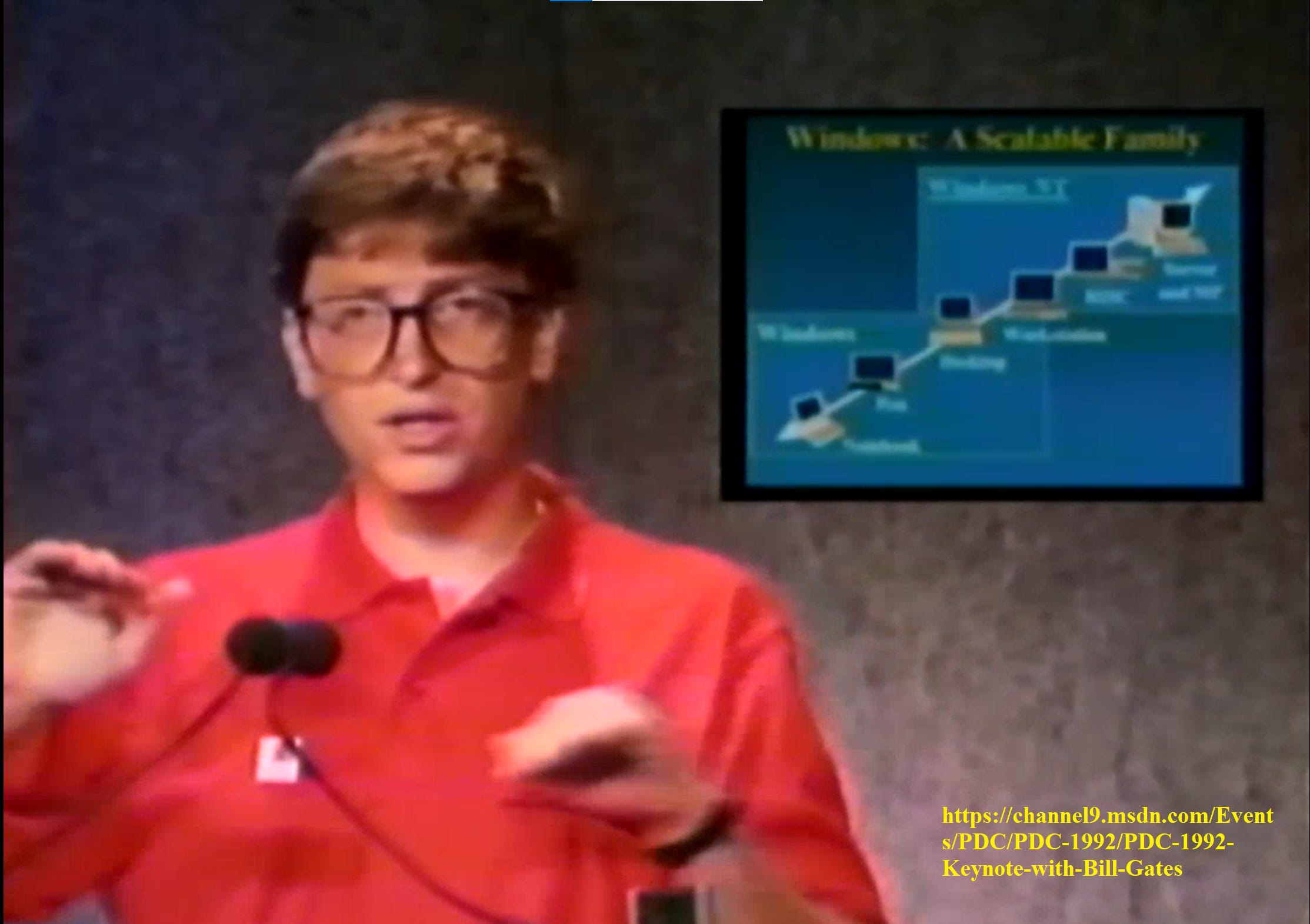
012. I Shipped, Therefore I Am
Attending and presenting at the first Win32 Windows Professional Developer Conference (PDC) and meeting (and being intimidated by) Dave Cutler along the way. Shipping my first product while navigating the contentious battle for the real first product.Back to 011. A Strategy for the ‘90s: WindowsBy July 1992, it seemed like the whole of the industry gathered in San Francisco at the Moscone Center for the first Win32 Professional Developers Conference, which came to be known as the Win32 PDC, named after the 32-bit Windows APIs that were unveiled and the cornerstone of the event. For the first time Microsoft also mentioned Chicago, the code name for the successor to Windows 3.11, which would become Windows 95, real soon now. More than 5,000 developers attended this event, an enormous number, and were introduced to Windows NT 3.1 Preliminary Release Build 297, dated June 28 and provided to attendees. As I recall, something like 25,000 developers ultimately received the first CDROM.Windows NT was a next-generation operating system, aiming for the professional workstation and high-end data center markets to compete with Unix and VMS (from Digital Equipment Corporation, DEC). TThe project leader and architect was the legendary Dave Cutler (DaveC) and included a group of experienced industry engineers also from DEC, collectively the key members of the original VMS team. Windows NT was a 32-bit (and soon 64-bit) operating system designed from the start to run on several of the latest microprocessors, including those from Intel rival AMD and Silicon Valley upstart MIPS. When it was under development, it was always scheduled to ship real soon now, though the project was always under control and managed with military precision and discipline. The task of building NT was immense. Like every project, it just took longer than people thought it would, even the most experienced people.At the PDC the OS was referred to as a beta by most. Not quite a beta, officially it was labeled Preliminary Release for Developers. It was a build (basically the most current version that worked). The team was extremely hardcore about maintaining daily quality. Every day a build was created that was reliable enough for the team to self-host. The NT daily build was as solid as anything Microsoft was doing at the time, and it was a new OS built from scratch running on brand new hardware. It was impressive, even in its early stages.Along with the compiler and tools from the Languages group, a major effort, we released a beta version of our entire MFC application framework, which eventually became version 2.0. This included the ability to create Windows programs for NT on MIPS and ‘386 chips (by this time the industry was calling chips ‘386 because the i386 from Intel had a competitor in the AMD Am386 which was fully compatible), and Win32 (and also Windows 3, now referred to as Win16). For the sake of completeness, I should mention “Win32s” the implementation of the Win32 API on Windows 3.1. It was viewed as potential way to expand Win32 applications to existing PCs. In the end it sounded better than it really was (we even considered using it for the C++ product), but at the time it was comforting to developers who thought it would expand the reach of new Win32 applications and a classic Microsoft approach of trying to include existing hardware and code in a new strategy.Reaching this milestone was huge for our AFX team, all 18,692 lines of code.Our team shipped our first product! I shipped a product! It was a beta and all, but still. It was on a CDROM and everything!It was also my first time speaking at an industry conference. This was a huge conference with many tracks and a wide range of developers. C++ and OOP were extremely hot topics, so I ended up giving a talk to what seemed like the largest room I had ever been in, certainly bigger than the USENIX ballroom and bigger than any meeting on Microsoft’s campus. By this time, we had a great story to tell about being reformed oopaholics and “hardcore”, using C++ as a better C, and, importantly, about our class library being all about Windows and not competing with Windows or duplicating it.A funny thing happened along the way to the PDC—I got to meet DaveC. It was terrifying. And then gratifying. As soon as it became clear that MFC and C++ would ship with the PDC release of Windows NT we were introduced to the NT “ship room.” This was a conference room, but one where the team met every day to discuss bugs and propose changes to the product. The NT team (and many other teams) preferred to call it the “War Room” as a source of pride, sometimes even officially with an officially engraved door sign. I always hated that term and wouldn’t use it (building software is not a war, at the very least). It was lorded over by the most imposing engineer I ever met, DaveC. Everyone was terrified of Dave. No one wanted to be responsible for slowing down the progress or worse introducing an error somewhere th
011. A Strategy for the '90s: Windows
Back to 010. Our BillG ReviewFinally, in the Spring 1991 we had clarity on our platform mess, but complexity in how to move forward. I get promoted to a lead software design engineer. I worry about getting fired for ordering T-shirt. We “rm -rf” all that old work so we have a clean slate and refer to all of that as “Old AFX”. We are building tools for Windows, running on Windows, and a class library that was dedicated to building Windows apps. Note: This is a bit longer than I expect sections to be normally. Lots going on in a short time.With our BillG review completed we needed to regroup. We knew what we did wrong technically, but we lacked a strategy to build a product that involved target customers and product goals. We were a technology team in search of a problem. Microsoft’s strategy was coming into focus and Jeff set our small team up to be the glue by amplifying our efforts. We needed to ship. Shipping is everything.The traditional C compiler team was working on C++ after the death march release of C 6. They were making progress on what was an enormous task. The team of about two dozen brilliant compiler and code-generation expert developers added Martin O’Riordan (MartinO), who pioneered the implementation of many of the esoteric features of C++ in the Glockenspiel compiler (the one we had been using for ET++ and AFX). The team was making significant progress at the core compiler technology and immersed itself in the language standardization process ensuring Microsoft had a front row seat for C++.Windows 3.0 shipped and exceeded any and all expectations. Pre-installed sales in its first few months shot up to more than one million copies. By the time our BillG Review happened, Windows 3.0 sold twice that or more. Work was well underway for the successor, Windows 3.1, which would make substantial progress in using the latest Intel processors, significantly improving networking and file sharing, and adding new user interface APIs that would make building Windows programs easier.Its success meant that our strategy was handed to us. With all the conflicting goals and external relationships, knowing what to do or having a feeling about what made sense from a technology perspective is not the makings of a strategy. Strategic shifts, like the one BillG orchestrated with the transition to GUI in the first place, take clear, top-down, direction. We had anything but that, still.Windows morphed into Microsoft’s main strategy, from a side project. While the Apps team was already heavily invested in Macintosh, when it came to Microsoft’s operating systems we were inconsistently spread across MS-DOS, Windows, and OS/2.Often, in times of strategic turmoil or doubt, a few simple observations on the state of the world expressed plainly can lead to an effective strategy, removing ambiguity and doubt.Our team knew we needed something to compete with NeXTStep and we knew we were going to use C++. We had two big problems. First, AFX was given the mission to develop tools for all of the platforms Apps might build for, which included Windows (which at the time would always mean some of the older versions and the newest ones), Macintosh (where the money came from), OS/2 (because that was the company strategy), and even MS-DOS (where most of the customers still were). Second, we had been strategically focused on professional developers, which might not sound like much but implied many things about the product such as using character-based tools instead of GUI and not worrying much about how easy it was to write programs. The most important apps of the new era were being written by professionals, not hobbyists, but now Borland was attracting professionals. We were hamstrung by the perceived need to cater to professional developers who were focused on the complex Microsoft platform strategy of MS-DOS, Windows, and OS/2. How could we pick one without breaking the strategy? Who were we, the small group in Apps, to make such a decision? The answer was right in front of our faces. Windows 3.0 sales surpassed Macintosh sales. In the entire first year, Windows 3.0 sold about 4 million units, almost twice the number of Macintosh computers sold and over twice the number of all Windows units sold previously since 1985. Windows sales were doubling in months and Macintosh was growing sporadically but about 30% per year on average. The rest of MikeMap’s Apps organization turned to focus boldly and clearly on Windows (and Macintosh) at the expense of MS-DOS and OS/2, which led to only one conclusion: Focus our efforts on Windows. Borland was already doing that. Many application vendors were starting to do that (except for the biggest ones). The situation for programmers was rapidly becoming one where if someone was building a new app, then it would be on Windows. For existing companies, the question was not if the focus would shift almost exclusively to Windows, but when. Even Macintosh started to be questioned in some commercial circles

010. Our BillG Review
Back to 009. Password is NeXTStepThe story of my first BillG review, except I’m too junior to attend. Soon I will find myself doing nothing but BillG reviews for almost two years. For now, I had to sit out this transformational meeting. All is not lost as I was on my first business trip which also proved transformational. Jeff scheduled a BillG Review for a week or so after App Month. I could not imagine why as we had nothing to show so it seemed like an opportunity to get yelled at. Still, Bill was anxious for our progress and Jeff, having learned some valuable lessons about overpromising, was careful to moderate Bill’s expectations. But the prospect of a looming BillG Review was intense, I quickly learned.In 1991, a BillG Review was a big deal, a really big deal. The company was large enough that most teams were not having routine (say monthly) in-person contact with Bill (though email was nearly constant), but it was also small enough that he knew most of the key developers and program managers, especially on the main products. AFX was a main product, sort of as it had the attention of one. Our team was small and I was too junior and never shipped anything so obviously wasn’t invited. I felt left out, but I also relieved. I was too new to be called stupid or to say “the dumbest thing” BillG ever heard. I had not established my “IQ”. These were all examples of well-known Billg-isms, right up there with rocking back and forth in his chair. But still I felt I was missing out.The team was supposed to show Bill our progress and how close we were to state-of-the-art tools for GUI and beating Steve Jobs at his own game. Any indications of progress were poor. Our code was big and bloated. Our tools were not revolutionary. We could not create GUI programs quickly. But we understood the existing tools well. We wrote many memos on how NeXTStep, Borland, ET++, and several other commercial products were superior to Microsoft’s lack of products.Jeff knew Bill and understood how he worked better than most anyone. Jeff asked us to put together our materials—literally printouts of code, APIs, benchmarks of memory usage, competitive product briefs, and more—and assemble them into a binder. Back in those days a “good” review came with a big binder of papers that were sent over a day or so before the meeting so Bill could prepare. Bill read everything. Bill remembered everything he read. Jeff knew we had to be buttoned up, of course.We also knew we had been poor engineers.I spent many evenings standing in RickP’s doorway talking and learning from him. Rick was the nicest, most thoughtful developer and, at the same time, he was unbelievably hardcore, the ultimate Microsoft accolade for a developer, focused on every line of code, every byte of memory, and every CPU cycle. Ahead of the BillG Review, he did a group presentation summing up his App Month. He had slides—everyone was flummoxed! Rick never made slides or even led meetings. Our conference rooms had overhead projectors so when we used slides (which MikeMap referred to as the IBM word foils) we prepared them in PowerPoint (or Word), printed them out, and then photocopied them onto transparency pages.The title of Rick’s talk read, “What Would Make Rick Happy?”Through a series of slides, Rick took his perspectives of building real shipping apps and his hardcore focus on performance and reliability and defined a broad set of criteria for how a reusable framework should be built. He played back all the choices made on the Excel layer system but applied them broadly. This presentation hit me like a 16-ton weight. He converted me to a performance zealot in 20 minutes—a transformation of the highest order. Whenever I encounter a buggy, slow, fat product I think back to how unhappy that would make Rick and ask myself, “What Would Make Rick Happy?”In addition to being hardcore about performance and bloat, Rick made a number of incredibly astute observations that would carry great weight moving forward in terms of distinguishing our product. First among those was that we tried to “fix” the operating system. We took building a cross-platform framework as a chance to cherry pick the best concepts from each target operating system, or more likely simply our favorites. We thought of that as making a new and better OS. In fact, it was just different. Jeff had a great way of describing this both to BillG and back to us. He would remind us that the OS groups were huge teams of 100 engineers compared to our team. How could our tiny team possibly “compete” with those big teams at designing an operating system. Even more straightforward, was how could our team of one contract documentation writer compete with the dozens of books about programming Windows, Macintosh, or OS/2 that filled Tower Books. There would never be enough to learn about our framework. What is amazing about this point is that literally every framework was doing this same sort of fixing of operating systems. Even more a
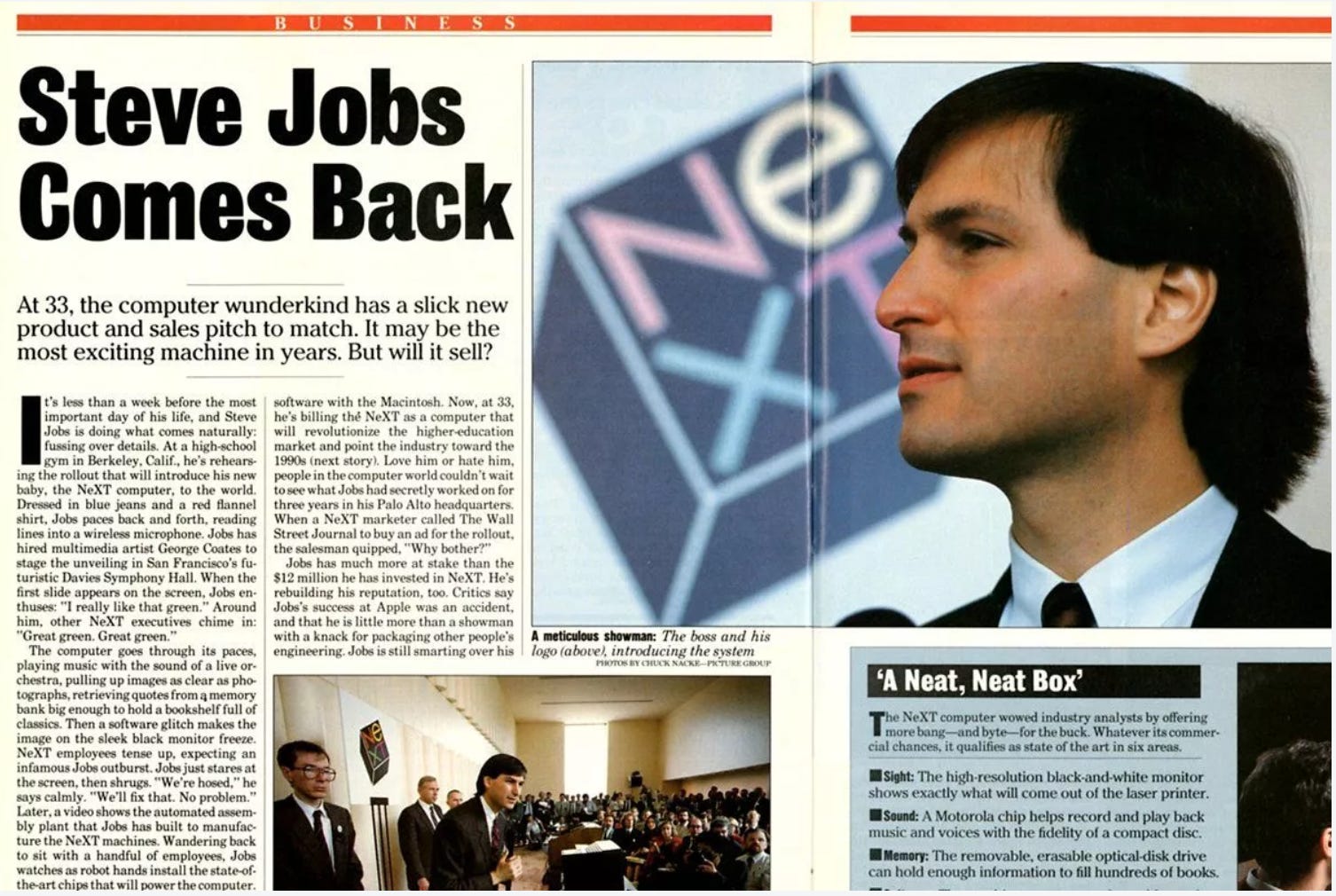
009. Password is 'NeXTStep'
Back to 008. Competing with Steve Jobs (the First Time) [Chapter II]It is only fitting that a post about an accomplishment by Steve Jobs would come on the eve of his birthday. NeXT, founded and led by Steve Jobs, developed new hardware, a new OS, and, importantly, entirely new object-oriented tools to build programs for their platform. The computers were not selling well (yet), but there was a growing belief that the technology was unique and forward-looking. Due in no small part to Jobs himself, the industry stood up and took notice.One person really noticed. That was BillG.Steve Jobs was famously separated from Apple in 1985, and later created NeXT Inc. along with several key members of the Apple Macintosh team (he also started Pixar but that’s another story). NeXT produced three main products and had recently been refreshed with new models after the 1988 launch. First there was the NeXT computer which was a blazing fast workstation class computer (along with an incredible display, fancy optical drive, and a laser printer). Second, was the operating system that ran on the computer, object-oriented (of course) with a graphical user-interface, called NeXTStep. And third, an incredibly rich set of tools for programmers to build object-oriented GUI programs for the hardware and OS, called Interface Builder. The whole product was launched in 1988 as almost a “super Macintosh” or at least was viewed that way by many. It was covered broadly across mainstream press because of the fascination with new home computers and of course Steve Jobs. By this point, many local newspapers were covering home computers as a regular section, something that seemed inconceivable just a few years earlier.NeXTStep, while object-oriented, did not use C++ but a different object-oriented language which only made it seem cooler. BillG who believed strongly in having complete ownership of a programming language, thus his general reservations around C++ as I would soon learn, and his favorable views of Objective-C.On my first college recruiting trip to Cornell in search of more Microsofties, I visited my old lab where many of the Macintosh computers were replaced with NeXT computers. Steve Jobs’ new company followed the same marketing plan that Apple followed with the launch of Macintosh, convincing a number of computer science departments to make a bet on NeXT. This would not be the first time a recruiting trip to Cornell would show me something unexpected.ScottRa procured a NeXT computer, the new pizza box form factor (like a true workstation) and we would explore it late into the night, sharing our discoveries with each other and the rest of our team. It was truly a marvel of engineering and experience. It was amazing to me that a computer and software built from scratch could do so much (technically, much of the core operating system was built on a research project foundation from Carnegie Mellon University, known as Mach, which becomes important later in this story). It ran at full 32-bits and running a variant of Unix under the graphical interface it rivaled the workstations I used in graduate school. It featured a level of sophistication in software and features that made Windows 3.0 PCs seem almost toy-like while having an ease of use of a packaged software product. It cost almost $10,000 1990 dollars and had minimal support from mainstream software makers who were already busy navigating MS-DOS, Windows, and OS/2. Still the capabilities were so significant that NeXT was viewed as a major strategic “threat” (Microsoft, as I was learning, frequently used that to describe competitors). ScottRa explained to me the importance of competing with NeXT but I had difficulty grokking what that meant for our little team tasked with building cross-platform tools. It became increasingly clear to me, however, why our source code server was named \OBJECTS. Scott cleverly named the share \DART, a joke that was lost on me for years. I’ll never forget the first time he told me the password. He said, “the password is ‘NeXTStep’, capitalized correctly.” Everyone by then knew it was “NeXTStep” or perhaps “NeXTSTEP”. While I had no first-hand knowledge, the idea was in the air that BillG was frustrated at trailing a product by Steve Jobs. NeXT appeared to be a better product than anything Microsoft was about to ship or had planned for the foreseeable future. One of the things I am thankful for is having a direct competitor at such an early stage in my career. While how to compete was fuzzy, it was clear what we were supposed to compete with. Rumors of what BillG thought were cool or competing products or features would race around the company, and NeXT was one of those products. Microsoft was a product company, so the fact that it cost so much money or sold so few units was no excuse for not knowing what a product did or why it was viewed as good (and what we would do about it). BillG was (and remains) fiercely competitive and would often drive conver