Gaia's Call
86 episodes — Page 1 of 2
Sometimes the Web of Life Asks Us to Stop
A Gaia's Call 2.0 Conversation with Erin Remblance
Independence Day… or Interdependence Day?
The Stories We Live By — Part 1: The Sea of Meaning
The Stories That Shape Our World
Manda Scott & the Rise of Thrutopia
Becoming a Trimtab for Life on Earth: How small actions help turn the larger system
The Invisible Forces Beneath Our Feet
Why People Actually Change: The surprising science of motivation—and how it applies to our relationship with Earth
Update on Our Moves - Literally
Changing the Story, Changing the Future: The Inner Shift That Makes the Great Turning Possible
Our planet’s Resources - Limited or Unlimited?
We’re in the 4th Turning
When the Weather Speaks
A Special Announcement - We’re Moving

When My Daughter Asked About the World… and History Answered
There are moments in a parent’s life when a conversation shifts from the everyday into something deeper—something that feels like it matters not just for your family, but for the times we’re living in. This was one of those moments.Amber and I were talking—not about anything unusual at first. Just the world as it is right now. The noise. The intensity. The constant stream of headlines and opinions and reactions that can leave even the most grounded among us feeling unsettled. And then she said something that stopped me.Not in fear—in wisdom.She told me that instead of getting pulled into the emotional swings of social media, she’s been trying to step back… to look at what’s happening through the lens of history. To understand this moment not as chaos—but as part of a larger pattern. As a dad, and as someone who has spent much of his life trying to make sense of the deeper patterns of life, I felt a quiet sense of respect. And curiosity. Because that’s exactly the question I’ve been living inside of too.What if what we’re experiencing right now isn’t random? What if it’s not just “things falling apart”? What if it’s part of something that has happened before?That question led us into a conversation about a book I’ve been reading: The Fourth Turning Is Here by Neil Howe. And while the book itself can be a bit dense at times, the core idea is surprisingly simple—and surprisingly powerful. History, it suggests, moves in cycles. Not perfect circles, but rhythms. Like seasons.According to this framework, society tends to move through four “turnings” over the course of roughly 80 to 100 years: a time of stability and building, a time of questioning and awakening, a time of unraveling and fragmentation, and then a time of crisis—a Fourth Turning. A winter. A time when systems break down, tensions rise, and the future feels uncertain. But also a time when something new begins to emerge.If Howe is right—and many historians and observers of history across centuries have sensed that time moves more like a rhythm than a straight line—then we are living in that fourth phase. From Ibn Khaldun’s observations of civilizations rising and falling in cycles, to Arnold Toynbee’s view that societies move through recurring patterns of challenge and response, there has long been an intuition that history has seasons of its own.As Amber and I explored this together, something else began to come into focus. This moment we’re living through isn’t just about “the world.” It’s about who we are in the world—at this moment in time. According to this model, each generation tends to play a different role during these cycles. And suddenly, it felt very personal.My generation—what Howe calls the “Prophet” generation—we are the elders now. The ones who have lived through earlier seasons. The ones who remember, or at least can sense, that these cycles are real. Our role isn’t to control what happens next, and it’s not to rescue. It’s to offer perspective. To help name what’s happening. To remind others—especially our children—that winter, as harsh as it can be, does not last forever.Amber’s generation—the “Hero” generation, those born roughly in the 1980s and 90s—came of age in a time of increasing instability and are now stepping into adulthood during a time of crisis. If this framework holds true, this is the generation that will do the rebuilding. Not alone, but together. They are the ones who will shape the next set of systems, the next culture, the next “normal.” Which means Amber’s instinct—to step back, to look at the bigger picture, to seek understanding rather than reaction—isn’t just wise. It’s exactly what this moment is asking of her.And then there’s Logan. Five years old. Full of curiosity, energy, and that beautiful openness to the world. In Howe’s language, he would be part of what’s called the “Artist” generation—the ones who are born during the crisis but grow up in what comes after. The ones who don’t lead the rebuilding, but inherit it and shape it in quieter, more relational, more creative ways.Just the other day, I watched him crouch down in the yard, completely absorbed in something most of us would have walked right past. A tiny line of ants moving with quiet determination across the soil. He stayed there for several minutes, studying them, asking questions, narrating what he thought they were doing. In that moment, the world wasn’t chaotic or broken—it was alive, fascinating, and worthy of his full attention.Which raises a question that feels very real to me as a grandfather: what kind of world will he grow up into based on what we choose to do now?One of the things I appreciated most about this framework is that it doesn’t try to sugarcoat the difficulty of times like these. Every Fourth Turning in history has included real hardship, conflict, loss, and uncertainty. The American Revolution tore apart loyalties and families even as it gave birth to a new nation. The Civil War brought unimaginable division and loss of li
The Day I Became One with Trees
If dogs were my first teachers of kinship, the rainforest was my initiation into something far larger.We awoke before dawn to the sound of birds I had never heard before—notes that seemed less like “song” and more like conversation. The air was thick, humid, alive. My fellow travelers from the North— still a bit jet-lagged, but also curious, slightly unsure—gathered near the Amazon River with members of the Sapara community who had graciously welcomed us into their village.The ceremony was simple.Sacred tobacco. Chanting. Leaves brushed gently across our bodies. Murmured words in a language older than my own. The smell of earth and river. The towering trees encircling us like quiet elders.On one level, it was unadorned. No spectacle. No drama.On another level, it blew my mind.I did not merely “appreciate nature” that morning. I experienced being one with it. And especially with the trees.Not in a metaphorical way. Not in a poetic way. In a felt, embodied way that bypassed analysis. It was as if some subtle membrane between “me” and “them” dissolved. The massive trunks around me no longer felt like background scenery. They felt like presences—vast, patient, ancient participants in a shared field of being.It wasn’t that I believed the trees were alive. I experienced aliveness as a shared current. That’s a different territory altogether.Perception as ParticipationLooking back, I realize that moment marked a shift. Before Ecuador, I loved trees. I admired them. I had even planted a few. I cared about forests around me where I live in the North Carolina mountains. After Ecuador, something changed in how I related to my surroundings. It was no longer “I am here, observing nature.” It was “I am inside a living community.”The crisis of meaning so many of us sense today is often framed as a loss of faith. But I’m increasingly convinced it is something deeper: a loss of relationship with thew living world of which we are an inextricable participant—the web of life.In The Spell of the Sensuous, David Abram writes:“For a thousand generations, human beings viewed themselves as part of the wider community of nature, and they carried on active relationships not only with other people but with other animals, plants, and natural objects… How, then, did humans come to sever their ancient reciprocity with the natural world?”That word—reciprocity—landed hard. In that rainforest clearing, I did not feel like an observer of trees. I felt like a participant in a reciprocal exchange of breath, presence, and awareness.This is not doctrine. I am not claiming a cosmology. I am sharing a lived moment that altered me. Interconnectedness ceased being an abstract concept. It became sacred and cellular.From Experience to VowOut of that experience grew something that now forms an essential part of my One Cause Morning Vow:We are here to create life, not destroy it.We of Earth—of Gaia, of Pachamama—may be the only place in the vastness of the universe where the miracle and experiment of life is unfolding.To support that miracle through regeneration is, for me, a sacred act.When I say those words each morning, I am not speaking in metaphor. I am remembering a forest that felt like family.The Four Great Truths shifted from philosophy to practice.Interconnectedness was no longer an idea. It was a felt reality.Sufficiency revealed itself in the forest’s quiet wisdom. Nothing in that rainforest seemed to operate on “more-more-more.” Growth was abundant, yes—but cyclical, balanced, regenerative. Leaves fell. Soil formed. Life fed life without hoarding.Reciprocity became visible in every layer of that ecosystem. Exchange, not extraction. Giving and receiving as the rhythm of survival.I am still learning this sacred rhythm and how to be an active steward of it all.Back home in my garage, I plant seeds in small hydroponic containers and in small recycled containers designed to bring back food from the restaurant. I watch tender shoots push upward toward the light. I harvest greens and enjoy them in my salads. Even there—in that modest act of tending—I feel a whisper of the forest’s lesson: life thrives through relationship.Meaning Recovered Through RelationshipIf our crisis is one of meaning, perhaps it is not because we lack belief. Perhaps it is because we lack participation. The forest did not give me answers to geopolitical instability or climate complexity. It gave me orientation.It reminded me that I am not outside the web of life. I am a thread within it. And threads have responsibility—not because they are commanded to, but because they belong. Meaning, I am discovering, does not come primarily from ideology. It comes from intimacy.A Simple PracticeIf you’re curious to explore this without flying to Ecuador, try something small.For one week, choose a tree near your home. Visit it daily for two minutes. Stand beside it. Notice the light at different times of day. Notice the mood of the air. Notice what shifts in your own thoughts and breath.
Our First Gaia's 2.0 Call Interview - Katharine Burke
This is a public episode. If you'd like to discuss this with other subscribers or get access to bonus episodes, visit wbradfordswift.substack.com/subscribe
My First Fellow Animist Was a Dog
I’m not writing this as an expert in animism.I’m writing as someone who, late in life, has discovered that something he has been practicing for more than seventy years actually has a name.Animism.It’s an old word. Older than most religions. Older than most civilizations. And yet it feels strangely fresh to me—as if I’ve simply rediscovered a way of belonging that was always there, waiting patiently under the surface.Before I had language for it, I had a dog.His name was Tiddlywink.I was five years old when he entered my life. A sturdy, loyal sled-pulling hero who changed winter forever. My brother and I would race down the hill on our sled, laughing wildly, and when we reached the bottom, Tiddlywink would pick up the rope in his teeth and pull the sled to the top. Over and over again. We were the envy of every kid on the block, all of whom had to drag their own sleds uphill.But what I remember most isn’t the convenience.It’s the companionship.He wasn’t a “pet” in the ornamental sense. He was family. A presence. A personality. A partner in adventure. There was loyalty in his eyes. Humor. Even what felt like pride in his work.Fast forward seventy years.As I write this, Rascal—my current canine companion—lies sleeping under my desk. His gentle breathing keeps time with the clicking of these keys. The love affair continues.Reflecting on it now, I realize it was that first love affair that had me decide at seven that I wanted more than anything else to become a veterinarian. Thanks, Tiddlywink. It wasn’t that I had some grand strategy, but it felt natural to devote my life to beings I had always experienced as “someone,” not “something.” Over decades of practice, I met thousands of dogs and cats—each with their own temperament, quirks, dignity, and heartbreak.I also witnessed something profound in their human companions.No one believes their dog (or cat) is family.They know.There’s a difference between belief and experience. You can read a book about how to ride a bicycle, memorize the mechanics, understand the physics—and still fall over the moment you climb on. Knowing the mechanics is not the same as riding.In the same way, you don’t believe your dog is part of your family the way you believe a political opinion or a theological claim. You know it because you experience it. You’ve felt the nudge of a nose when you were grieving. You’ve felt the weight of a head on your knee. You’ve watched eyes light up when you walk in the door.That’s not belief. That’s relationship. And this is where animism quietly enters the room.Animism, at its simplest, is the shift from seeing the world as a collection of “things we use” to experiencing it as a community of beings we relate to. It doesn’t require superstition. It doesn’t require abandoning science. It simply asks us to notice that our most meaningful relationships often cross species lines.This is not anti-science.It’s relational perception.When I say my dog is a “who” rather than a “what,” I am not making a scientific claim. I am naming a lived reality. A dog is not a human person—but he is undeniably a personality, a presence, a participant in my life. Rascal is one of my best friends who just happens to walk on four legs rather then two.Over the past year, I’ve taken on what I call the One Cause Vow—to live as though the Four Great Truths are real: Interconnectedness. Sufficiency. Reciprocity. Stewardship.In reflecting on this vow, I realized something that surprised me.I didn’t learn interconnectedness from a textbook. I learned it from a dog who loved to pull my sled. I learned reciprocity from decades of two-way devotion—the simple truth that love is a current, not a possession. I rescued Rascal from the Blue Ridge Humane Society. And in the aftermath of losing my beloved Argos, Rascal rescued me from grief and loneliness. That’s reciprocity in its purest form.And stewardship? Care is the original human technology. Before there were ideologies, before there were institutions, there was the act of tending. Feeding. Healing. Walking. Protecting. Sitting quietly beside another living being simply because they matter.If this is animism, then perhaps many of us have already been animists without knowing it. Perhaps our first doorway into an ancient way of belonging has always been sleeping at our feet. Here’s a small experiment for today.One Who TodayChoose one non-human “who.” It could be your dog. A bird at the feeder. A tree outside your window. For sixty seconds, relate without multitasking. No phone. No agenda. Just presence. Notice what shifts in your nervous system. In your breathing. In your sense of aliveness. You may find that meaning does not arrive as an idea. It arrives as relationship.If animals were my first doorway into kinship, the rainforest blew the door off its hinges. And that’s where we’ll go next.Unleashed - W. Bradford Swift is a reader-supported publication. To receive new posts and support my work, consider becoming a free or paid subscriber.
AI, misinformation & the erosion of human connection
If something looks like a human, sounds like a human, responds like a human — but no one is actually there — what does that do to us?Are we using technology to solve crises… or to avoid feeling them?What happens when systems scale faster than our capacity for care?Is AI neutral — or is it simply revealing what we already value?At what point does innovation become organised abandonment? This is a public episode. If you'd like to discuss this with other subscribers or get access to bonus episodes, visit wbradfordswift.substack.com/subscribe
Raising Our Children as Eco-Guardians in a Time of Collapse
A few weeks ago, Ann and I reopened a conversation that has been quietly circling for years. What if Amber and Justin moved into the upstairs of Loving Homestead… and Ann and I moved downstairs to the ‘mother-in-law’ apartment? Four loving adults. Two extraordinary children. One shared roof. One shared experiment.It feels beautiful. It feels bold. It feels right. And then—as real life tends to do—a wrinkle surfaced. The local school Logan and Piper would attend has a “poor” rating. That word landed heavily. Of course it did. Parents want the best for their children. We all do.And I found myself sitting with a deeper, slightly uncomfortable realization: even if the school had a five-star rating… would it actually be preparing them for the world they are growing into?That question has not left me.The World Our Children Are InheritingWe are living in what many are calling a polycrisis or metacrisis—overlapping ecological, political, economic, technological, and spiritual disruptions. Some call it the Great Collapse. Others call it the Great Turning. And others, including myself, see it as something messier and more mysterious—like what happens inside a chrysalis as a caterpillar transforms into a butterfly.Inside that chrysalis, everything dissolves. Structures break down. It looks like chaos. And yet, imaginal cells begin to organize around a new pattern of being.Perhaps we are living inside such a chrysalis moment. Perhaps our children are not merely inheriting a mess—perhaps we and they are the imaginal cells of what comes next. Whatever language we use, one thing is clear: the world Logan and Piper will inhabit as adults will not look like the world I grew up in. And probably not even like the world their parents grew up in.So the real question isn’t, “Is this school highly rated?” The real question is: What prepares children to steward a changing world?Stewardship Is Not the Same as SuccessMost school ratings measure standardized test scores, reading and math proficiency, graduation rates, and college admissions. Important? Yes. Sufficient? Not even close…not for these times that are before us and that our children are inheriting.Because stewardship requires something deeper.Stewardship is about how we show up in relationship to the Earth, to community, to uncertainty, and to ourselves. It asks not only, “Can you compete?” but “Can you care?” Not only, “Can you achieve?” but “Can you regenerate?”In many ways, our dominant educational model is based on and a reflection of the Great Untruths:* that we are separate from nature,* that more is always better,* that Earth’s resources are unlimited, or* that technology will save us.* But the world our children are stepping into demand a different set of capacities altogether—ones based in and are a reflection of the four Great Truths.What Might Actually Prepare Our Children?As I’ve reflected on this—both as a grandfather and as someone deeply living true to the four Great Truths—a few qualities rise to the top.Emotional resilience. Not the stiff upper lip of suppression, but the ability to feel deeply without being overwhelmed. To face unsettling realities without collapsing into despair. To experience disappointment without losing direction. In a time of disruption, emotional regulation may be more important than algebra.Collaborative skills. The future will not be navigated alone. Climate events, economic shifts, technological upheaval—these are collective challenges. Children who can listen, negotiate, co-create, and repair relationships will be far better equipped than lone high-achievers. Stewardship is relational.Comfort with uncertainty. My generation was largely raised with the promise of predictability: study hard, work hard, retire comfortably. That storyline is fraying. Our children need to become fluent in ambiguity—not paralyzed by not knowing, but energized by exploration. This may be one of the most countercultural capacities of all.Ecological intimacy. To steward something, you must feel connected to it. If nature is merely scenery or resource, stewardship feels optional. But if children grow up planting, composting, repairing, noticing birds, understanding soil… something shifts. They no longer see themselves as separate from nature. They experience interconnection. And that changes everything.Entrepreneurial adaptability. Not hustle culture, but creative agency. The ability to see problems as invitations. To start small initiatives. To experiment and pivot. In a rapidly shifting world, adaptability may matter more than institutional credentials.Inner steadiness. Perhaps the quiet foundation beneath all the others—an anchored sense of self, a moral compass not easily swayed by noise, a capacity to act from values rather than panic. Inner steadiness is cultivated slowly—through modeling, conversation, presence. Not through rankings.The Deeper RealizationAs I’ve wrestled with the school rating question, I’ve had to confront something in myself.Part
Grieve Globally While Thriving Locally
In our recent Gaia’s Call 2.0 conversations, Marla and I explored the polycrisis—the overlapping ecological, social, and spiritual challenges shaping our world. In this episode, we go one step deeper, asking a more intimate question: How do we live inside this reality without losing ourselves—or each other? Drawing from the simple yet profound inquiry “Grieve globally. Thrive locally,” we explore how caring deeply for the world does not have to lead to burnout or despair. Instead, when grounded in the Four Great Truths of One Cause—interconnectedness, sufficiency, reciprocity, and stewardship—we discover a way of living that honors grief while still making room for joy, presence, and meaningful action. This is a conversation especially for eco-conscious families navigating how to stay open-hearted, sane, and hopeful in uncertain times. This is a public episode. If you'd like to discuss this with other subscribers or get access to bonus episodes, visit wbradfordswift.substack.com/subscribe
The Polycrisis Part 2
This is a public episode. If you'd like to discuss this with other subscribers or get access to bonus episodes, visit wbradfordswift.substack.com/subscribe
To Share or Not to Share
The other night, Ann and I were having dinner with Amber and Justin (daughter and son-in-law). The kids were nearby—Logan and Piper laughing, moving, playing the way only young children can, fully inhabiting the moment. It was one of those evenings that feels quietly complete. Nothing spectacular. Nothing missing.And yet, somewhere between passing food and watching the kids, a familiar question rose up in me.Is this a moment to say something?To check in with the adults about what they’re seeing… or not seeing… about the world we’re living in?To ask whether they’re aware of the polycrisis—or where they might be in relationship to it?Just as quickly, another voice answered back.Don’t ruin this.Don’t turn a good night into a heavy one.Why bring global grief into a room full of local joy?I noticed myself holding the tension rather than resolving it. And I realized: this wasn’t just a family moment. It was a microcosm of a much larger question many of us are quietly carrying.To share—or not to share—the reality of the polycrisis with the people we love.And if we do share… when?How?To what end?I don’t have clean answers. But I’m no longer convinced that not having answers is a failure.The Question Beneath the QuestionOn the surface, this looks like a communication dilemma. But underneath it lives something deeper.We are living through a time of undeniable global grief: ecological unraveling, political instability, widening inequality, accelerating technological disruption, and the quiet erosion of shared meaning. Many of us feel it in our bodies long before we can articulate it.At the same time, life keeps happening locally. Children grow. Gardens need tending. Meals are shared. Laughter still breaks through.So the real question becomes:How do we grieve globally without abandoning the small, sacred forms of thriving that make life worth living?And just as importantly:How do we invite others into this awareness without overwhelming them—or ourselves?Taking the Question to CommunityRather than answer this alone, I did something that increasingly feels essential in this time: I brought the question to community.I shared this inquiry—nearly as raw as I’ve written it here—with members of the Home Grown Human community, an online gathering of people already aware of the polycrisis and committed to supporting one another through it. (If you’re curious, I’ll share a link at the end.)I didn’t ask for advice. I asked for lived wisdom.What came back wasn’t a single answer—but a constellation of insights that now live inside this piece.What I Heard (and What Shifted in Me)One recurring theme was attunement.Not every truth belongs in every moment. Timing matters. Tone matters. Relationship matters more than content.Several people shared that when conversations about the polycrisis go wrong, it’s often because of what Jamie Wheal aptly named “therapeutic aggression”—when we speak not because it’s what the other person is ready for, but because we need relief from carrying the truth alone.That landed hard for me.It made me ask:Am I sharing to serve the relationship… or to unburden myself?Another insight that stayed with me: presence is not avoidance.Laughter, play, ordinary love—these are not denials of reality. Sometimes they are the most honest responses available. Especially with children. Especially when nervous systems are already overloaded.One community member put it simply: staying connected is more important than being right.And yet—silence isn’t always care either.A few people spoke about how sharing, when done gently and incrementally, can actually deepen connection—if it’s rooted in curiosity rather than persuasion, and grounded in evidence rather than opinion. Not to convince, but to invite.Still others described choosing a third path: placing the “hard information” somewhere accessible—writing, podcasts, Substack essays—and trusting loved ones to engage if and when they’re ready.That, too, felt like wisdom.Where This Is Still Hard for MeThere are days when global grief overwhelms me—when the scale of suffering makes local thriving feel insufficient, even indulgent. When playing pickleball, tending soil, or planning the spring garden feels almost naïve in the face of what’s unraveling.And yet, I’ve come to see something else.Thriving locally is not a distraction from collapse.It is resistance to the forces that want us frozen, despairing, and disconnected.When I walk in the woods.When I sit with Logan and Piper.When Ann and I share a quiet meal.When I call a friend for tea instead of doomscrolling.I’m not turning away from grief—I’m metabolizing it.This is what “Grieve Globally, Thrive Locally” has begun to mean for me.Not an answer.A practice.Releasing the Savior ReflexOne of the most important shifts I’m making as we move into 2026 is releasing a familiar but exhausting pattern: the need—or addiction—to save the world.I’m not abandoning responsibility.I’m relinquishing grandiosity.I can still share One Cause here
What Is the Polycrisis? Part One
This is a public episode. If you'd like to discuss this with other subscribers or get access to bonus episodes, visit wbradfordswift.substack.com/subscribe
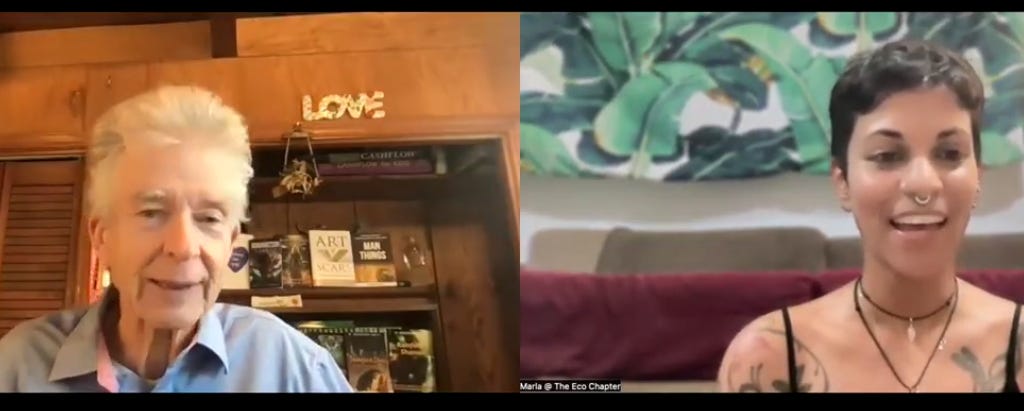
S1 Ep 1Gaia Call 2.0 – Episode One
Hello everybody. this is Brad Swift of Gaia’s Call and this is Gaia’s call, but this is 2.0. And as you will notice, it’s not just me, it’s also Marla from the Eco Chapter. Hey Marla.Hi. How are you?I’m good. I’m good. And I’m looking forward to this.And I’m a little trepidatious about it, you know, it’s it is a first, a lot of firsts are coming my way these days. but I’m also excited about it because we’re here. first we’re going to kind of just share our background and how we got connected. also who we’re kind of directing this to, you know, the, the people that we would really like to reach with this.one of the things that we talked about, and may end up, you know, renaming this at some point, but, certainly a segment of this is called, is. Regeneration with capital GE in, because as you can see, we’re not of exactly the [00:01:00] same generation. I’m a couple years older. So there’s some differences.And we actually want to, given the, the nature of the world these days and how much we are, pointing to the, in a bad way, the differences. We wanna embrace the differences. So I’m, white skinned. And Marla is brown skinned and I’m a male and she’s a female, and I live in the mountains of North Carolina and we don’t really know where we might find Marla at any time, but right now you are where?Right now I’m in Singapore.Right?The other side of the world from you.Yes. So right now we are at like nine 40 in the morning here in the North Carolina mountains. And it is what time there?Those are differences. Now, there’s some things that we share, which is, well, certainly first and top most for me would be [00:02:00] our deep love and compassion for planet.And all of its, all of its beings. Not just human beings, but all the beings, the plants and animals that we share this planet with. So, and that’s kind of what has connected us. So, let’s just take a, moment or two Marla, and share, from our own memories, how did, we get connected?Yeah, so hi everyone.My name is Marla, and yes, I’m all the way over here in Singapore. I am an Earthling. I like to call myself that and I run the eco chapter. And the eco chapter is a ecoliteracy and regenerative storytelling consultancy. and the crazy thing is that me and Brad, we met on Substack, through my company, the eco chapter.I write a lot. articles that translate science and complex concepts into easier to digest and more accessible, literature. So articles with metaphors, and I sometimes write poetry. just any kind of way to get the science to [00:03:00] be a little bit easier. And so the nice thing was. read my stories.and it was Brad, so it’s crazy because it was almost exactly a year ago. We met in December, I think 2024. so it’s, yeah, it’s been a journey. Brad, you wanna add anything to, that?Yeah, I, I had a major, revelation, insight, whatever you want to call it. about two days. After the, USA, elections of a year ago when, they did not go the way I wanted, I did not have a whole lot of hope for either party, directing much attention to the, climate crisis, and the crisis that, you know, the climate crisis is a part of.But when, president Trump became president, I got really clear there’s something, something that I’ve gotta do. I’ve gotta up my game, so to speak around that. And, The, other piece that was kind of woven in there at the same time, at that [00:04:00] time, I had a, grandson, three and a half, Logan and Piper, one and a half.So now a year later, four and a half and two and a half. and I, it was on YouTube was where I ran into this thing about. 3:00 AM in the morning and I cannot sleep because my great-great-grandchildren are asking me what did I do? What did I do when I realized the earth was burning and the democracy was falling, and da da die, it goes on beautiful peace.And it woke me up to like, yeah, what will I tell Logan and Piper as they get older? What did I do? And about that time I was reading, you know, I read, a couple of pieces from Marla and thought, wow, this is a real connection there. And I started writing one cause, which is now written and in revision stages.And we’ll be released sometime, hopefully in the first quarter, first half of, 2026. [00:05:00] And it’s my take on. what is the fundamental causes of climate change? That climate change is not a cause, it’s the effect of something. And so, that’s, kind of the evolution. And then, I think somewhere in the mix of that, you, expressed an idea about.Wanting to write a book, a, more positive book of, positive narratives. And given that, one of the things I still do is as a coach. I coach aspiring authors. I was like, I wanna work with this woman. I, wonder how much I’m gonna have to pay her to let me coach her. And you were kind enough to not charge me anything for that.So, that was another piece of it. So why don’t you say just a little bit about, where that went.We had our first meeting in December last year, just around Christmas, I think. And I was so stumped that [00:06:00] s
Raising Children—and Ourselves—for the World That’s Coming
Living Through the Polycrisis - This is part three. Part one is here, and part two is here.When I think about the future now, I don’t start with graphs or projections. I start with my grandkids, Logan and Piper. And just as importantly, I start with their parents—Amber and Justin—the generation standing in the narrow, demanding passage between what was and what’s coming.The future stopped being theoretical the moment I held my grandchildren. It took on faces, laughter, scraped knees, curious questions, and a fierce tenderness that refuses abstraction. Whatever the polycrisis is asking of us, it’s no longer an intellectual exercise. It’s personal. It’s relational. It’s generational.And that changes everything.What if the polycrisis isn’t only a breakdown to survive, but a rite of passage for humanity itself?Unleashed - W. Bradford Swift is a reader-supported publication. To receive new posts and support my work, consider becoming a free or paid subscriber.Every culture that has understood maturation knows this pattern. There is a time of innocence, a time of testing, a time of confusion and fear, and—if the initiation is met rather than avoided—a time of responsibility and belonging. Adolescence is not optional. It arrives whether we’re ready or not. What is optional is whether we meet it consciously.For most of human history, initiation rites marked the passage from childhood into adulthood. Today, no one is guiding us through that threshold. Instead, the planet itself is doing the initiating. Climate disruption. Ecological loss. Political instability. Technological acceleration. The collapse of old stories that once promised safety and control.This is not happening because humanity is evil. It’s happening because we outgrew a worldview without growing up beyond it.Children feel this moment intuitively. Long before they understand carbon cycles or geopolitics, they sense when the adults in the room are anxious, distracted, or pretending. They feel incoherence in their bodies. They notice when reassurance replaces truth, when busyness replaces presence. Logan and Piper don’t need us to explain the polycrisis—but they do need us to become adults they can trust.And that brings us to the real work of this time.Not prediction.Not perfection.But character, presence, courage, and care.When systems fail, character remains. It’s what children learn when they watch how we treat the land, how we speak to neighbors, how we respond to fear, how we handle grief. Presence matters now because nervous systems learn from nervous systems. Calm isn’t something we explain—it’s something we embody. Courage matters because someone has to tell the truth without collapsing into despair. And care matters because care is the original human technology. Long before money, before markets, before machines, there was care.This is the living heart of One Cause. The Four Great Truths are not abstract principles; they are embodied ways of being that children absorb simply by watching us live.Collapse, seen through this lens, begins to look less like punishment and more like correction. A simplification. An undoing of excess. A quiet insistence that the experiment of domination has reached its limit. In that undoing, something ancient begins to surface again: community, rhythm, humility, interdependence, love.Perhaps Earth is not failing us. Perhaps, in her formidable wisdom, she is calling us home.The Four Great Truths, then, are not just remedies for crisis—they are ancestral gifts. Ways of orienting ourselves that we pass forward not as answers, but as inheritances. Interconnectedness. Sufficiency. Reciprocity. Stewardship. Especially stewardship—no longer as control, but as love across time.We are the ancestors now.What do I hope Logan and Piper will remember?Not that their Grand-Dude wrote books or spoke about crises—but that he showed up. That he paid attention. That he loved fiercely. That he told the truth without bitterness. That he practiced unconditional love as best he could—the kind I see modeled so purely by Rascal and Luna, my canine teachers in unconditional love, presence, and loyalty. That Ann and I faced hard realities without surrendering joy. That we bent without breaking. That we practiced radical hope not as a feeling, but as a set of daily actions.Ann and I don’t pretend to control anything. But we’ve learned something quieter and more powerful: we influence everything. Through shared meals. Through tending land. Through conversations with neighbors. Through choosing to live the Four Great Truths locally rather than panicking globally or retreating into the old untruths when fear rises.The emotional journey of this time is not linear. It moves from grief—because grief is the price of love—into fierce love, into responsibility, and finally into a profound, grounded hope. Not the hope that everything will turn out fine, but the hope that how we show up matters, regardless of outcomes.We may not get to choose the times we
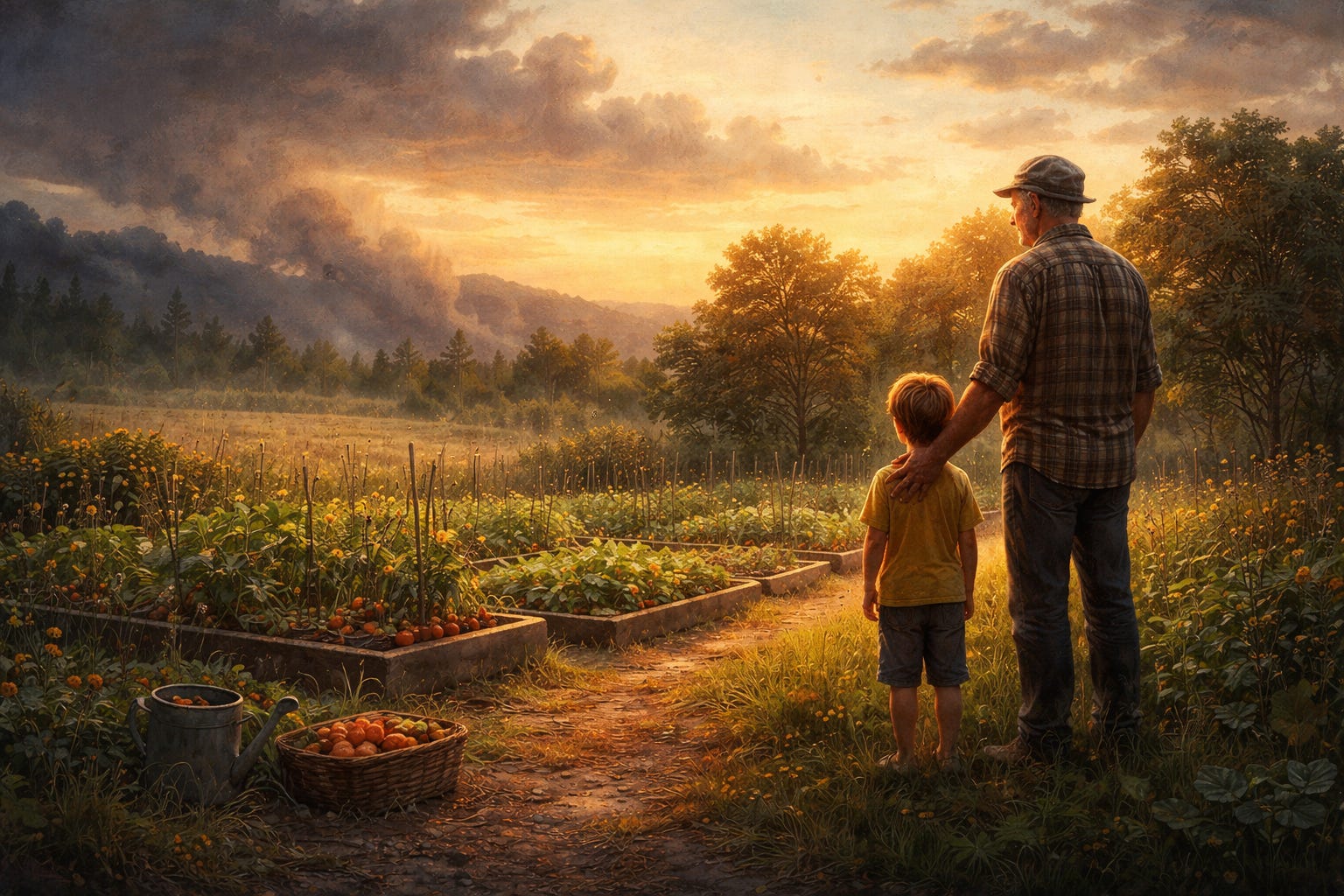
The Great Turning Begins at Home
Living Through the Polycrisis — Part Two of a Three-Part One Cause Reflection (Part One is Here.)Author’s Note: I called an audible over the holidays, feeling like we could all use a break from dealing with this challenging topic—the Polycrisis, here we are in the New Year of 2026 which could, according to many experts, be a make or break year, so let’s dig in. Once you stop trying to outrun the polycrisis, you start asking a different kind of question: What does a good life look like now?By “outrun,” I mean all the ways we try—often unconsciously—to escape what we sense is happening around us. Denying the seriousness of it. Minimizing it. Staying so busy we don’t have time to feel it. Doom-scrolling until we’re numb. Freezing in place because the scale of it feels too big to face. Or pinning our hopes on some distant rescue—technological, political, or economic—so we don’t have to change how we live today. All of these are understandable human responses. They’re not moral failures. They’re coping strategies in a world that’s asking more of us than we were prepared for.But eventually, exhaustion sets in. The running doesn’t work. The distractions lose their power. And in that quiet moment—sometimes gentle, sometimes forced—we begin to wonder whether the real work isn’t escaping the polycrisis at all, but learning how to live inside it with integrity, care, and coherence.That’s where the Four Great Truths come in.In One Cause, I describe them as an alternative worldview to the Four Great Untruths that brought us to the brink. But they’re more than ideas. They’re a lived orientation—a different way of standing in the world. Where the old story told us we are separate, that more is always better, that Earth’s resources are limitless, and that technology will save us, the Four Great Truths offer something quieter and sturdier. They remind us that we are interconnected, that sufficiency is possible, that reciprocity is how life actually works, and that stewardship—not domination—is our true role.This shift isn’t abstract. It doesn’t live in policy papers or distant futures. It shows up in how we live, love, and belong—especially close to home.Regeneration, I’ve come to see, is relational, local, and embodied. It begins not with grand plans to “save the world,” but with small, grounded choices that restore right relationship—with the land beneath our feet, with the people we share our lives with, and with the future generations who will inherit what we leave behind. That’s why collapse, as frightening as it is, can also function as an invitation. Not to panic, but to maturity. Not just to grieve what’s breaking down, but to grow into what’s being asked of us now.For Ann and me, the Loving Homestead has become a kind of living laboratory for this inquiry. Not a solutionist fantasy or a claim that we’ve figured anything out, but a place to practice living differently—more attentively, more humbly, more in rhythm with life. It’s where the Four Great Truths stop being concepts and start becoming habits, conversations, and sometimes uncomfortable mirrors. So, let’s spend a few minutes delving into the Four Great Truth a bit more. Interconnectedness shows up for me most clearly in family and place. Living closer to the land has made it impossible to pretend we’re separate—from soil health, from weather patterns, from the creatures who share this space, or from one another. When I’m gardening with Logan, or watching Piper toddle around the yard with curiosity and wonder, interconnectedness isn’t an idea. It’s a felt sense. Their well-being is bound up with the choices we make now. So is the health of the land that feeds us. Community, too, starts to feel less optional and more essential. Conversations with neighbors, shared concerns, shared meals—these become threads in a larger web we’re re-learning how to tend.Sufficiency has been one of the more challenging truths to live into, precisely because our culture trained us so well in “more.” More productivity. More output. More efficiency. More stuff. Stepping off that treadmill isn’t dramatic; it’s subtle and ongoing. It looks like asking, again and again, What is enough here? Enough work for today. Enough growth for this season. Enough plans. Enough striving. In our household, sufficiency has meant simplifying, slowing down, and letting go of the quiet guilt that says we should always be doing more. It’s been surprisingly freeing—and surprisingly difficult—to trust that there really is enough when we stop racing past it.Reciprocity has deepened my relationship with the Earth itself. Gardening, food forests, basement growing through the winter—these aren’t just projects. They’re exchanges. The soil gives, and we give back. We compost. We pay attention. We learn. We fail. We try again. The same is true in human relationships. Reciprocity reminds me that giving and receiving are not opposites. Accepting help, listening deeply, allowing others to contribute—these are as muc
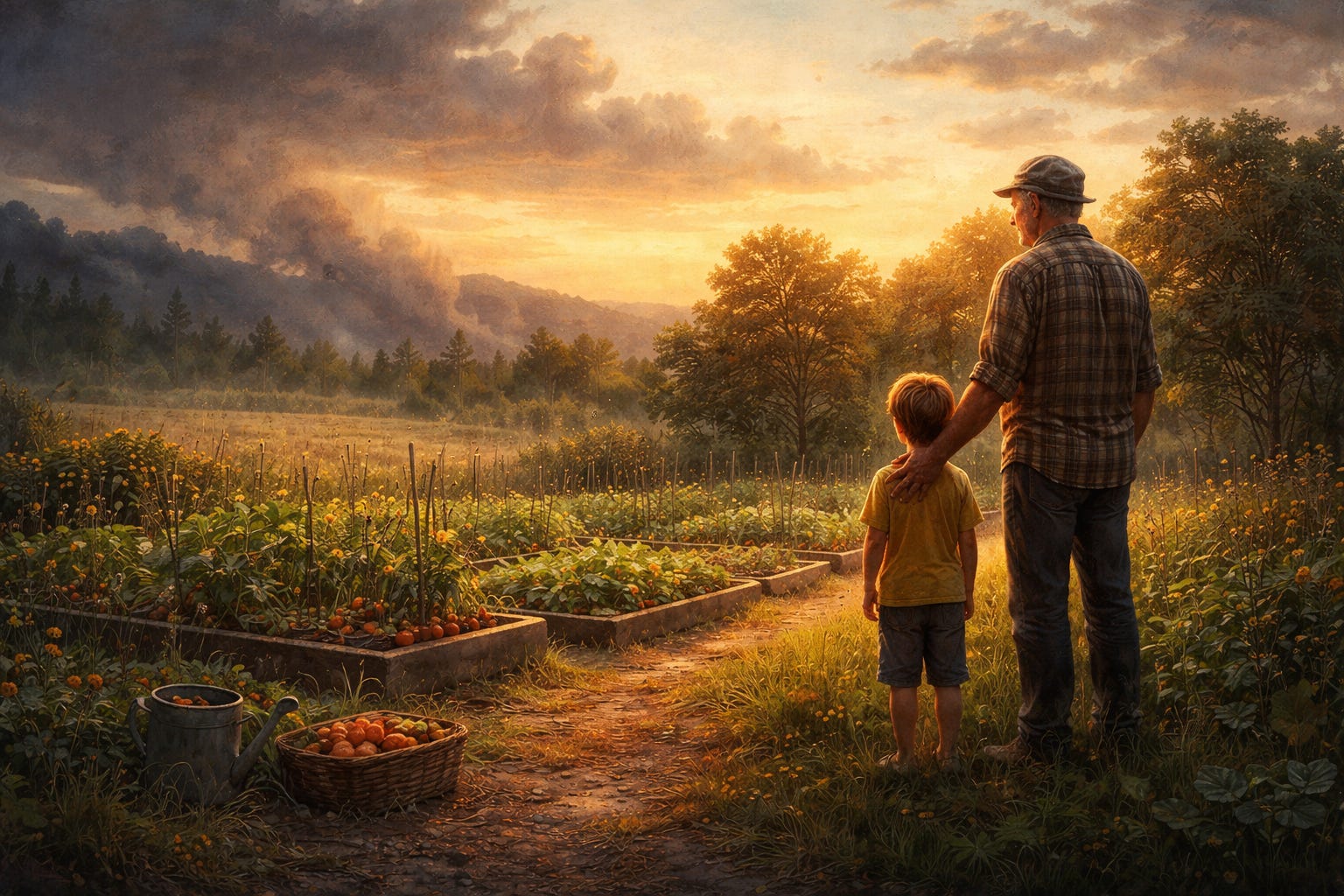
The Polycrisis We’re Already In
(Living Through the Polycrisis — Part One)You’re not imagining it. Something fundamental really is breaking down. And if you’ve been sensing that—feeling it in your body, your conversations, your sleep, your worry for the kids and the future—you’re not weak, pessimistic, or “too negative.” You’re paying attention.I don’t remember exactly when I first heard the terms metacrisis or polycrisis. It was probably sometime shortly after I began writing One Cause: Breaking Free from the Four Great Untruths—and Embracing the Truths That Will Shape Our Future. That would put it at about a year ago. At the time, they felt like big, academic words—useful, perhaps, but abstract. What changed wasn’t the vocabulary. It was the realization that the climate crisis, as urgent and terrifying as it is, is only the tip of a much larger iceberg.An important tip. A sharp one. A deadly one. But still not the whole thing.As I dug deeper—reading, listening, following the threads—the picture widened. Climate collapse is intertwined with biodiversity loss, food and water instability, economic fragility, political polarization, authoritarian drift, technological disruption, and a deep spiritual and cultural exhaustion. These aren’t separate problems stacking up neatly on top of one another. They are interconnected systems unraveling together, amplifying each other, cascading in ways that are hard to predict and even harder to control.That’s what people mean when they talk about the polycrisis.The term points to a system-of-systems failure—a convergence of crises so entangled that you can’t fix one without triggering consequences in another. And that, I think, explains why so many people today feel overwhelmed, anxious, numb, frozen, or strangely detached. It’s not because they don’t care. It’s because their nervous systems are trying to process something that doesn’t fit into the tidy problem-solution stories we were taught to expect.Some people are just now beginning to sense this. Others have known it for years. And many—good, thoughtful people—are choosing, consciously or unconsciously, not to look too closely at all. It feels too confronting. Too destabilizing. Too much. So they freeze, like a deer in the headlights, hoping that if they don’t move, the danger might pass.I understand that response. I’ve felt it myself.If you know others who are feeling similarly disoriented, why not share today’s article?A turning point for me came when a good friend introduced me to Sarah Wilson’s TED Talk, How to Respond to Societal Collapse. Watching it was unsettling—and oddly relieving at the same time. Wilson doesn’t sugarcoat what we’re facing. She lays it out plainly: climate deadlines missed, planetary boundaries breached, AI accelerating toward unknown thresholds, nuclear risk intensifying, democracies eroding, authoritarianism rising. Not as isolated headlines, but as a single, tangled reality.What struck me most wasn’t just her analysis. It was her honesty about the emotional terrain. She named something I had been feeling but hadn’t fully articulated: that the deepest distress many of us are experiencing doesn’t come from the bad news itself. It comes from the disconnect between what we sense is true and what we’re allowed—or encouraged—to say out loud.In psychology, that disconnect is called cognitive dissonance. Living in a world that insists everything is basically fine while your gut tells you it’s not creates anxiety, loneliness, and a quiet despair that’s hard to name. But Wilson points to something counterintuitive and deeply important: facing the truth, even when it’s brutal, often brings relief. A strange, grounded relief. A sense of congruence. Of finally being able to breathe honestly.This insight aligns powerfully with the core of One Cause.Let’s band together and move through the polycrisis with grace. Subscribe today.The polycrisis didn’t come out of nowhere. It is the inevitable result of what I’ve come to call the Four Great Untruths—the deep assumptions that have shaped modern culture and driven us to this edge. The belief that we are separate from nature. The belief that more is always better. The belief that Earth’s resources are effectively infinite. And the belief that technology will ultimately save us from the consequences of our own behavior.When these untruths become normalized—woven into our economics, politics, education, and daily habits—they produce exactly the kind of world we’re now living in. A world that is impressively complex, incredibly productive, and profoundly fragile. A world that runs fast, extracts relentlessly, and leaves very little room for pause, presence, or wisdom.No wonder so many people feel exhausted and disoriented. No wonder anxiety and burnout are everywhere. Our inner lives are struggling to keep up with a system that no longer makes sense, even on its own terms.And here’s the paradox that keeps revealing itself to me: naming this reality doesn’t have to lead to despair. In fact, fo
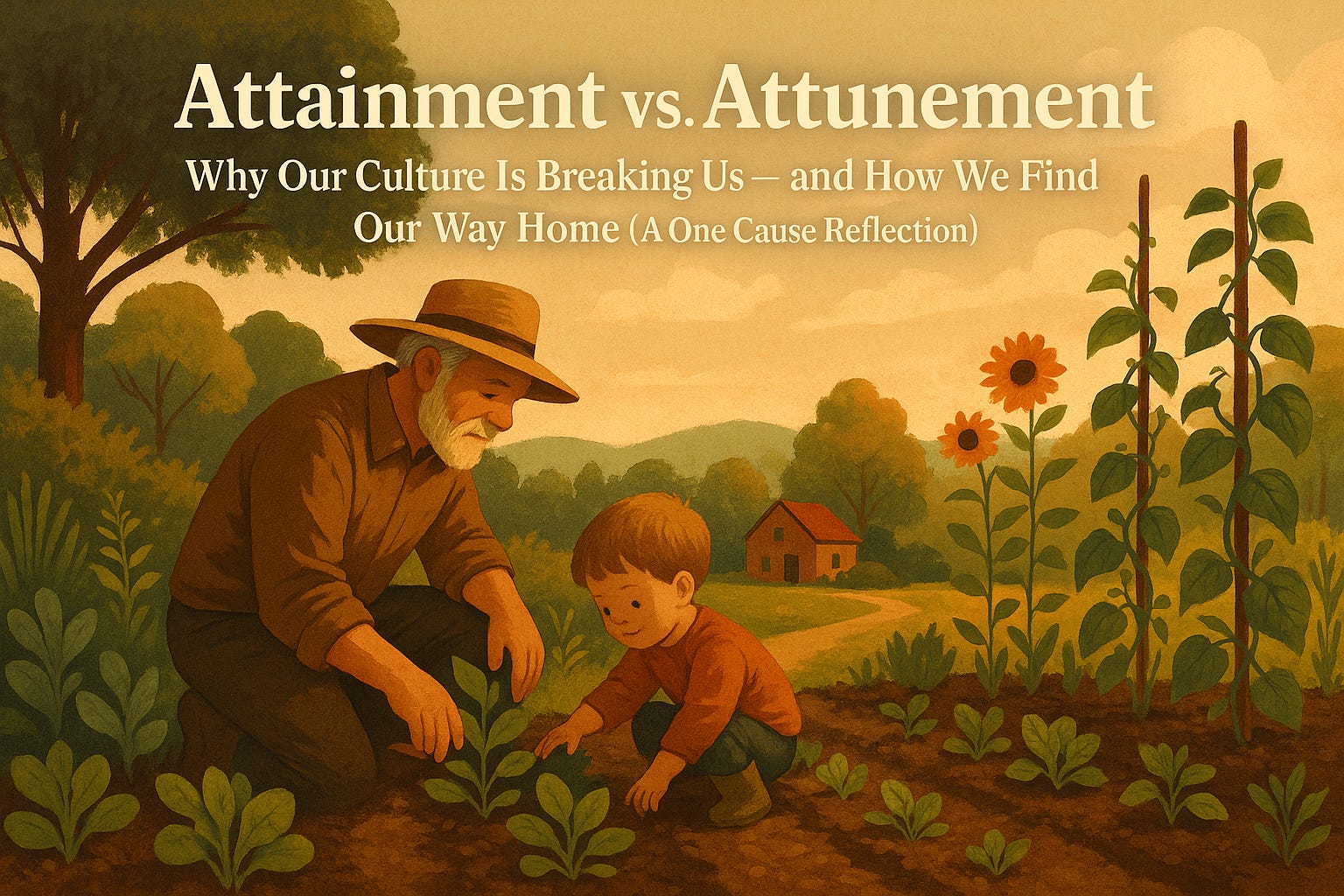
Attainment vs. Attunement:
I’ve been setting up a small growing area in my basement these past few weeks—a little winter haven where I can keep veggies going through the cold months and continue my slow but curious experiment with hydroponics. At first, it was all about the task. Get the shelving in. Set up the lights. Hang the timers. Figure out the water flow. Make it efficient. Make it productive. Get it done. And in the middle of it all, I caught myself doing something I’m not proud of: I started beating myself up for not doing it faster — for not carving out more time, for letting “life” get in the way, for not being more… well… attain-y. It’s funny how quickly old habits creep in—even when we think we’ve moved beyond them.Then Amber mentioned that when she picked up four-year-old Logan from preschool, one of the first things he said was, “I really like gardening with Grand-Dude.” That one sentence stopped me cold. Just… stopped me. All at once, the whole project shifted. It was no longer about productivity or efficiency or finishing my to-do list. It became a question: How can this be something we do together? Something he remembers? Something Piper can toddle into? Something that grows more than just vegetables?The Core Distinction: Attainment vs. AttunementWe live in a culture that worships attainment. Do more. Get more. Produce more. Achieve more. Optimize more. Buy more. Follow more. Become more. It’s the air we breathe, and it’s the unspoken scoreboard so many of us learned to keep without ever realizing we were playing a game we didn’t choose. But for all the striving and accumulating and checking boxes, something essential is missing. Attainment is outer-focused. It measures life in metrics and milestones, productivity and performance. It lives in speed, comparison, and acquisition — and because of that, it constantly reinforces the quiet suspicion that we’re behind, not enough, or failing to keep up.Attunement, on the other hand, is inner alignment. It’s the quieter, steadier knowing that rises when we listen rather than react, when we connect rather than compete, when we let life shape us rather than trying to conquer it. Attunement shifts the question from “What can I get done?” to “What is life asking of me in this moment?” or “Who am I becoming through this?” Where attainment pushes, attunement invites. Where attainment strives, attunement senses. Where attainment measures, attunement feels. One is louder; the other truer.Why This Matters NowWe are living in a moment of profound overwhelm — ecological, political, social, and spiritual. Our planetary crisis is not just about carbon, heat, storms, or melting ice; it’s about the worldview that created those problems in the first place. This is exactly what One Cause points to: the Four Great Untruths. The belief that we are separate from nature. The belief that more is always better. The belief that Earth’s resources are infinite. The belief that technology will save us. Attainment culture is simply these untruths made habitual and normalized.We strive because we’re told there isn’t enough. We compare because we believe we’re separate. We extract because we believe nature exists for us to use. And we wait for a technological miracle because we’ve forgotten how to live in right relationship with Earth. Attainment culture isn’t just stressful—it’s unsustainable. It’s a worldview that inevitably leads to burnout on the personal level and collapse on the planetary level. Attunement, however, is the doorway out.Attunement = Living the Four Great TruthsThis is where the One Cause framework becomes a map—not just for saving the world but for saving our own sanity. Attunement naturally expresses the Four Great Truths that we know are the antidote to the metacrisis.Interconnectedness reminds us that we are not separate from nature or each other. When we attune, we feel that truth in our bones—whether through gardening with a child or resting a hand on the living trunk of a tree. Sufficiency tells us that there truly is enough when we slow down and reconnect with the rhythms of life. Attunement softens the grasping and the guilt and opens space for gratitude. Reciprocity reminds us that giving and receiving are part of the same sacred loop. Attunement invites us to give in ways that nourish rather than drain. And Stewardship—perhaps the most profound truth—becomes a natural expression of attunement. When we feel connected and grateful and present, caring for Earth stops being a duty and becomes a joy.Attainment can’t access any of this because it’s too busy pushing. Attunement makes space for the wisdom that’s been waiting for us all along.The Three Dimensions of Attunement (Health, Growth, Depth)Attunement isn’t a single practice; it’s a way of being shaped by three interconnected dimensions. There’s the past-oriented dimension of health—healing old patterns, trauma responses, and reactive habits that keep us locked into striving and scarcity. Then there’s the future-oriented d
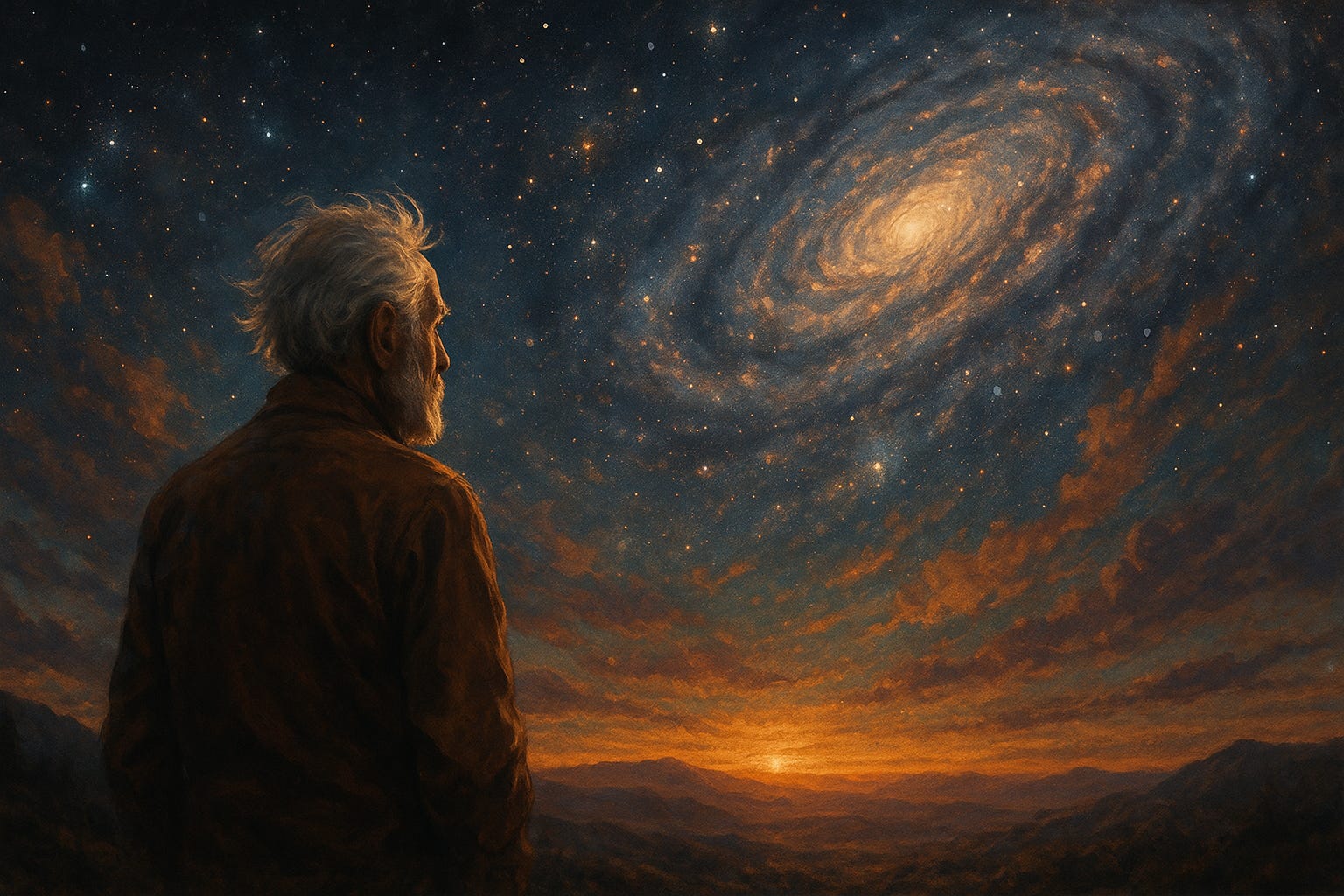
Conversations Across Time:
(Part One of a Possible New Series: Conversations Across Time)A few nights ago, during one of our Community After Hours gatherings here in the mountains, a participant tossed out an idea about how we might draw more locals into our growing web of community. I wish I could tell you exactly what he said—but the suggestion itself evaporated before I arrived home.What did stick with me was the spark it ignited.I found myself thinking:What if we could interview notable, difference-making people who are no longer with us…and ask them what they make of the moment we’re living through?Not in a séance kind of way. Not in a “dear departed, knock twice for yes” kind of way. But in a more grounded, imaginative, spiritually curious way:What would the great visionaries of the past say about the in-between time we are living through now—this tension between the Great Turning and the Great Collapse?And before the thought even finished forming, one name rose to the surface—my hero: Buckminster Fuller. His picture sits on my Hero Board. The man who saw the earth as a spaceship before most of us realized it even had a hull. The man who believed fiercely in Humanity’s capacity to evolve into a success rather than a failure.No, I don’t have a direct channel to the afterlife. But I do have a conversation partner named GePeTo—my AI collaborator—who can help me synthesize Bucky’s worldview, writings, tone, and fierce optimism.So I sat down and asked a simple question:“If Buckminster Fuller were alive today, what would he say about the moment we’re in?”Here’s how that conversation unfolded.Four Questions for Bucky Fuller—and the Responses He Might Offer TodayWhat follows isn’t meant to be historical quotation.It’s a synthesis—a creative, integrity-centered imagining based on Bucky’s principles, writings, and unmistakable voice. Call it… Bucky through a modern-day trimtab filter.Bucky, how would you describe the moment we’re living in—this tension between the Great Turning and the Great Collapse?He might say something like this:Humanity has reached a critical point where the assumptions guiding our behavior are no longer adequate for the complexity we’ve created. In a sense, we are running 21st-century planetary-scale hardware on metaphysical software from the 1800s—and the system is flashing warning lights.Whether we move toward the Great Turning or slip into the Great Collapse depends not on resources—which are still abundant—but on whether we update our thinking in time.I’ve always said we’re crew members on Spaceship Earth, not passengers on a luxury liner with infinite buffets. The crisis is not a shortage of materials. It is a shortage of imagination, synergy, and design.In other words: This is a metaphysical crisis before it is an ecological one.(Which, I might add, aligns perfectly with One Cause: the crisis beneath the crisis.)What would you say about the Four Great Untruths—especially the idea that ‘more is always better’?Bucky might respond:The idea that “more” equals “better” has always been a fundamental misunderstanding of wealth. Real wealth is not accumulation—it is the capacity to survive forward days. It’s the ability to meet human needs in a way that increases options rather than reduces them.Nature never operates on excess. Nature operates on sufficiency and synergy.Humanity, on the other hand, still behaves as though it must hoard its way to security. But the Universe is already providing more than enough energy and materials for every person on Earth to thrive—if we align with Nature instead of fighting her.This is where the Four Great Truths come alive. Particularly sufficiency and interconnection. The problem is not scarcity. The problem is human metaphysics—the stories we tell about what we are and what the world is for.What is the role of the outlier—the ‘strange person’—in times like these?This one felt especially personal to me, Brad—given the Strange Man series we just completed. Here’s how Bucky might say it:The future is always initiated by the outliers. Never the majority. The majority follows after the new pattern has proven itself.When I designed the geodesic dome, people laughed. When I talked about doing more with less, it was dismissed as fantasy. When I suggested that humanity could become a success, they called it naïve.But the Universe never asks the past for permission to invent the future. If people find your actions strange, it simply means you’re operating from a more current worldview. Evolution always begins at the edges—with individuals who are one step further into tomorrow.So if you’re the strange person in the room, take heart. You’re the early adopter of the next epoch.Given everything you stood for—synergy, design science, trimtabs—what advice would you give ordinary people who want to help?Here’s where Bucky’s clarity becomes beautifully sharp:Stop trying to save the world by persuading people. You save it by building a new model that renders the old one obsolete. Institutions are

How Strange People Change the World
Links to Parts Oneand Two.There comes a moment on any meaningful inner journey when you suddenly realize something quietly radical: you no longer fit the default settings of the culture around you. You still look the same, sound the same, and move through grocery stores, coffee shops, and family gatherings the way everyone else does. But something in your internal operating system has been rewritten. And even though no one can see that shift from the outside, it begins to shape everything you do.Sharing this helps more of the ‘strange ones’ find each other. Thank you for being part of this emerging regenerative story.At first it’s subtle, then steady, then unmistakable—until someone close to you, maybe even your own child, pauses at some small act of yours (like a takeout box filled with coffee grounds by the door) and says, “You are a strange person.” In that moment, if you listen closely, some deeper part of you might whisper back: Yes. I am. And thank God for that.Because as Krishnamurti reminded us, “It is no measure of health to be well-adjusted to a profoundly sick society.” If our culture has normalized disconnection from nature, endless consumption, and an almost religious devotion to convenience, then perhaps strangeness is not a flaw—it’s a sign of sanity emerging.The World Has Never Been Changed by the Comfortable MiddleThe center of culture is where habits sleep, where norms self-replicate, and where the Four Great Untruths feel so familiar, so unquestioned, that they become invisible. The middle is stable, predictable—and by design, inert. The people who shift the world don’t live there.They live on the edges, collecting coffee grounds because soil is sacred, planting food forests where lawns used to be, choosing reciprocity over convenience, and raising children and grandchildren to see Earth not as “resources” but as kin. They live in the quiet places where old assumptions lose their grip and a new story begins to take root.This is the frontier where emerging cultures are born—not through speeches or global summits, but through tiny, repeated acts that seem irrational to the old worldview until suddenly they become common sense.Every New Pattern Starts With One OutlierHistory and nature both tell a similar story: transformation begins with the one who behaves differently long before anyone else understands why. There is always a first strange person—the first to compost instead of discard, the first to conserve water when everyone else lets it run, the first to ask, “What if we treated the Earth as a partner rather than a possession?” These individuals are often misunderstood at first. They’re told they’re impractical, idealistic, or naive. Yet time and again, the very behaviors once dismissed later become the blueprint for what is needed.Slowly, beautifully, the outlier’s strangeness ripples outward. What began as a single point of deviation becomes a signal of the future, a small tremor that precedes a cultural shift.Why Being “Strange” Is a ComplimentTo be “strange” simply means you are living from a different set of assumptions than the dominant culture. Perhaps you’ve internalized a new worldview—something rooted in interconnection, sufficiency, reciprocity, and stewardship—and because of that, your actions no longer match the old script. You compost differently. You shop differently. You speak differently. You see the world through a lens that honors life, not consumption. You feel the Earth in your bones.And yes, you may place coffee grounds in a repurposed takeout box with a sense of reverence that would bewilder most people in a Costco checkout line. But this is what spiritual and ecological evolution looks like in real life: a quiet willingness to act from a deeper truth even when it makes you stand out.The Gift of the Outlier RoleOne of the great misunderstandings is that the outlier is an exception. The truth is the outlier is the beginning. Outliers are pattern-breakers, trend-starters, and early signalers of new cultural DNA. They embody tomorrow’s norms today. It can be lonely at times. People may misunderstand your motives or gently tease your choices. But outliers don’t lead by consensus—they lead by integrity.And in doing so, they create a subtle gravitational field. People—especially the young—feel it. They may not be able to articulate what they’re sensing, but they recognize the authenticity, the groundedness, the coherence. They intuitively know: “This is the direction life is trying to move.”This is how cultures shift—not from the top down, but from the inside out, one quietly courageous person at a time.The New Story Needs Strange PeopleWe are living through a moment when the old stories are collapsing under their own weight:* “We’re separate from nature.”* “More is always better.”* “The Earth’s resources are infinite.”* “Technology will save us.”These are fictions that can no longer sustain us. Meanwhile, the regenerative story—the one Ernesto van Peborgh describes as

The Strange Man’s Inner Game
(Part Two of the “Strange Man” Mini-Series — read Part One Here.)Sometimes the most important spiritual work doesn’t happen on a meditation cushion or in the quiet of early morning vows. Sometimes it happens in a kitchen—with kids playing, coffee brewing, and a grown daughter calling you a “strange man.”If you missed Part One of the story, here’s the short version:I rescued the used coffee grounds from my daughter’s barista-level machine, packed them neatly into an empty takeout box, and placed the box by the door next to my jacket and knapsack—fully intending to take them home to compost and burn for ash to add to my garden.When Amber discovered my little treasure box and asked what it was, I explained. She paused… then declared solemnly: “Dad, you are a strange man.”We laughed. And fortunately, that’s not where the story stayed. Because inside me, another moment unfolded—one I didn’t share in Part One. A moment that mattered even more than the compost or the coffee or the cardboard container.A moment that could’ve easily slipped into the Dreaded Drama Triangle.The Micro-Moment Where Everything Could’ve Gone SidewaysWhen she said “strange man,” the first sensation wasn’t laughter.It was… a pinch. A quick little inner wince. The kind that happens faster than thought. The old, familiar thread: Am I being judged? Mocked? Misunderstood?That is the Victim voice—the first doorway into the Drama Triangle. As a graduate of Landmark World Wide, I also learned it as the “automatic and mechanical.” In that split-second, without any real awareness, I could have shifted into one of the three roles:Victim: “I was just trying to help the planet… why is she making fun of me?”Persecutor: “Well maybe if you composted more… we wouldn’t have so much trash in the first place.”Rescuer: “I’m sorry, I’m sorry—I’ll just throw it away next time.”None of these paths lead to connection. None lead to truth, or love, or empowerment. They lead to drama. And drama is a waste stream far more toxic than used coffee grounds.The Pause That Saved the MomentWhat changed everything was one breath.One beat of awareness that said: “Hold on. This isn’t about being judged. This is about being seen.”And that’s when the deeper truth surfaced: Amber wasn’t criticizing me. She was naming what the world hasn’t yet caught up to—the emerging, awkward, beautiful phase between one way of living and the next. My “strangeness” is what it looks like when someone begins living the Four Great Truths in a world still arranged around the Four Great Untruths.In that moment, the entire inner landscape shifted.From Drama to the Empowerment DynamicInstead of slipping into Victimhood, something new rose up—the Creator role from the Empowerment Dynamic. (Check out the book, The Power of TED by David Emerald. )The Creator asks different questions:* “What’s really happening here?”* “What meaning am I adding?”* “Is there a possibility hidden inside this moment?”And the answer was simple, and almost funny:My daughter wasn’t dismissing me. She was witnessing my evolution.She was naming the gap—lovingly—between the culture she was raised in by my wife and I and the one I’m trying to help midwife into existence—a regenerative future based in the Four Great Truths.Suddenly, “strange man” felt… accurate. Even honorable.The Deeper Lesson at 76 (That I Wish I’d Learned at 36)There was a time—decades ago—when a comment like this would have hooked me for hours. I would have replayed it, analyzed it, defended myself, explained myself. I would have tried to earn approval.But living by my One Cause Vow—day after day, breath after breath—has been quietly rewiring my emotional reflexes.The Four Great Truths are not just ecological principles. They are relational principles.* Interconnectedness softens the old defensiveness because it reminds me how deeply interconnected I am with my daughter.* Sufficiency dissolves the need for validation because the ‘enoughness’ includes my relationship with myself.* Reciprocity makes feedback part of the dance; it’s the sharing and receiving of everyday life.* Stewardship reminds me that my job is to model, not persuade.So instead of reacting, I smiled. Because it was true. I am a strange man. A man becoming stranger in all the right ways.Why This Matters in a Time of Cultural UnravelingWe are living through a moment in history when misunderstanding will be rampant. People making conscious, regenerative choices will often look “odd” to a culture still built on extraction, speed, and disposability.This is where the inner game becomes critical. If we collapse into the Drama Triangle every time someone raises an eyebrow at our choices—we’ll waste our energy defending rather than creating.If, instead, we shift into the Empowerment Dynamic, moment by moment—we become steady. Grounded. Available for the real work. Living the Great Truths externally requires practicing them internally and expressing them externally through our words and actions.And that start

My Daughter Called Me a Strange Man
Toward the end of a recent visit with my daughter, Amber, and the grandkids—Logan racing a plastic dinosaur across the living room battlefield and Piper dancing around with a squeal that could wake the ancestors—I decided to fix myself a cup of coffee, in part because they have one of those barista-level machines that makes a cup so smooth it practically hums a lullaby. So there I was, savoring the thought of a rare mug of delicious Joe, when the machine politely informed me I needed to empty the grounds receptacle first.Fair enough. I opened the little compartment, scooped out the still-warm grounds, and headed toward the trash can. And that’s when I saw it: an empty cardboard takeout container sitting right on top.Hmm, I thought. That could hold the coffee grounds….One more hmm: And I could bring both home—grounds to compost, container to burn in the wood stove for more ash to eventually make its way into the garden.It was the kind of thought that feels completely normal to me now, a natural extension of my daily rhythm here at the Loving Homestead. So, with the confidence of a man on a mission, I packed the grounds into the takeout box, carried it over, and placed it gently by the door alongside my jacket and knapsack.Job done. No big deal. A tiny act of stewardship—with a side of convenience.Or so I thought.The Strange Man RevealedAbout an hour later, Amber walked by, noticed the box by the door, and stopped in her tracks. She stared at it for a few seconds, the way you’d look at a squirrel holding a flip phone.“What’s this?” she asked.I explained my plan: Take the coffee grounds home, compost them, and burn the cardboard for heat and soil building. Simple. Elegant. Efficient. A win for Earth and a win for Dad.She stared a moment longer before rolling her eyes. Then, with the seriousness of a judge rendering a life verdict, she said:“Dad… you are a strange man.”I chuckled—because it was funny and yes, a bit true. But if I’m honest, there was also a quick flicker of something tender in me, a tiny wince.Strange.Odd.Different.Those words carry some weight, even when delivered with love. But before I could wander down the familiar path of “What did she mean by that?”, something else rose within me. A kind of deeper understanding.And I realized: This “strangeness” is exactly what I’ve been cultivating. On purpose. Let me elaborate.When Strange Is Just the Early Stage of New TruthEver since June 1st, I’ve been saying and meditating on my One Cause Vow every morning. I wrote it not as a declaration of moral superiority (goodness knows that’s not the path I’m on) but as a grounding practice—something to nudge me gently toward the person I’m becoming.Here’s a short piece of it:On this new day, I commit—and recommit—to living in alignment with the Four Great Truths:Interconnectedness.Sufficiency.Reciprocity.Stewardship.I know I won’t be perfect. I expect to stumble, but each step is a chance to remember who I really am—and who I’m becoming.The truth is, my vow has been working on me in subtle and not-so-subtle ways bit mostly in quiet ways. Domestic ways. Ways involving coffee grounds and takeout boxes. I don’t think about these things as “trying to be environmental.”They just… feel normal now.Normal, for someone living inside the Four Great Truths. Strange, for a world still built around the Four Great Untruths.If the old worldview says:“Just toss it in the trash—away it goes,”the new worldview asks:“Away to where? And at what cost?”One worldview stops the thought at the trash can. The other travels all the way to the compost pile, the soil, the seedlings, the next meal, the next generation. Strange? Only until it isn’t.A Glimpse of Tomorrow’s NormalI imagine a future—one Logan and Piper will inherit—where this kind of strangeness is no more unusual than brushing your teeth:* Food forests in front yards instead of lawn deserts* Native plant oases humming with bees* Compost steaming gently on crisp mornings* Kids excitedly adding banana peels “to feed the soil”* Cardboard becoming biochar becoming living earthA world where taking home coffee grounds isn’t odd—it’s common sense. A world where stewardship isn’t “strange”—it’s simply what we do and who we are. And if odd little habits like mine can help nudge the culture that direction, even a millimeter at a time, well… I’m happy to be a strange man. Truth be told, I’ve probably been a strange man for much of my life.In fact, may we all become just strange enough to help turn this ship toward life again.A Quiet Reflection to Ponder This WeekWhen someone calls you strange, pause for a moment. Feel the sting. Smile anyway. And ask yourself:Is this strangeness actually a sign I’m waking up? Growing? Maturing? Becoming someone new?Maybe, just maybe, your strangeness isn’t the flaw. Maybe it’s the doorway. This is a public episode. If you'd like to discuss this with other subscribers or get access to bonus episodes, visit wbradfordswift.substack.com/subscribe

Tapping the Sun's Potential for a Regenerative Future
Imagine greeting the sun each morning, not just as a source of warmth but as a symbol of untapped potential. That’s what I’ve done for over two years which is what led me to writing today’s article/podcast. Every day, Earth receives an astonishing 173,000 terawatts of energy from the sun. Yet, humanity's annual energy consumption is only around 20 terawatts. In other words:A single day’s sunlight provides far more than we need to power our entire planet for a year. This raises a simple but profound question: Why are we not harnessing this energy more effectively?The path to making solar power a cornerstone of our energy system isn’t just about technology. It's about mindset, policy, and creative integration into our everyday lives. What sounds like eco-fantasy—like powering entire cities or global infrastructures from sunlight alone—could become eco-fact. But we need visionaries and bold thinkers, much like the characters in my eco-fantasy worlds, to turn these possibilities into realities.As Rollo May said in The Courage to Create, “Creative courage is the discovery of new forms, new symbols, new patterns on which a new society can be built.” The challenge before us is to cultivate that courage, embracing both creativity and science to envision a new, regenerative world.Breaking Down the Numbers: How Little We Need to Change the WorldThe math behind solar energy is startling. Humans only use about 0.01% of the solar energy that hits Earth each day. If we could capture even a small fraction of that, we could power our world without fossil fuels. To illustrate, if solar panels could convert just 15-20% of the sunlight they receive into energy (which is roughly the current efficiency), even modest advancements in technology could revolutionize energy storage and distribution.Todd Henry, in Die Empty, encourages us to seize opportunities and constantly develop our skills to be ready for the future. Just as "The Developer" in his book weaves available resources into value, we must do the same with solar technology—taking the raw potential of sunlight and turning it into power. The challenge lies in storing this energy efficiently and creating decentralized systems that allow every building, every piece of infrastructure to contribute to the solution.Imagine what would be possible if we invested the time, money, and other resources into tapping this near limitless energy resource that we are putting into A. I. Ideas That Could Transform Eco-Fantasy Into Eco-FactHere are five visionary ideas that could push us beyond our current limitations:* Urban Solar Integration: Imagine cities where solar panels are embedded in every surface. From rooftops to windows to roads, each element of our infrastructure could become a micro power station. With technologies like perovskite solar cells showing promise for higher efficiency at lower costs, we could soon see a future where energy generation is woven seamlessly into our daily environment. Perovskite solar cells are a type of thin-film solar cell that uses a perovskite crystal structure to generate electricity and are a promising next-generation renewable energy technology. Their advantages include high efficiency through the absorption of a broader range of light, potential for low-cost manufacturing with flexible methods like printing, and versatility in applications* Distributed Solar Grids: Shifting away from centralized power plants toward local, distributed solar energy grids would reduce energy loss and improve resilience. Each home, office, and public building could generate and store its own solar power, contributing to the local grid and reducing reliance on large-scale energy infrastructure.* Agrivoltaics – Merging Solar Power and Agriculture: Solar panels placed above crops create a win-win scenario: they generate electricity while also providing shade that reduces water loss for plants. This combination, known as agrivoltaics, optimizes land use by producing both food and energy, offering a practical solution in regions prone to drought.* Space-Based Solar Power: Although it sounds like science fiction, space-based solar farms could be a future game-changer. Solar panels in space would have uninterrupted access to sunlight, generating energy 24/7. The energy could be beamed back to Earth as microwaves or lasers, offering a consistent and limitless power source.* Solar-Powered Desalination: Water scarcity and energy needs could be addressed simultaneously through solar-powered desalination plants. These facilities use the sun’s energy to convert seawater into drinkable water while generating electricity, solving two critical issues in regions struggling with drought and energy shortages.The Courage to Act and Create New RealitiesJust as Leonardo da Vinci envisioned possibilities far beyond the limits of his time, we must cultivate the same sense of creative curiosity. Michael Gelb’s How to Think Like Leonardo da Vinci highlights the importance of questionin
Interlude of Inspiration: From Homo sapiens to Homo guardianis
It feels fitting that this piece arrives on Halloween—a day when we flirt with shadows and celebrate transformation…of sorts.After all, Frankenstein was never just about monsters. It was about creation without conscience—knowledge without wisdom, invention without care.In many ways, we’ve been living our own version of that story as Homo technologicus—powerful, brilliant, but disconnected from the living whole.The time has come for a new creation story—not stitched together from parts, but born of reconnection.This is our real experiment: Becoming Homo guardianis—the Eco-Guardian-in-Training. So. let’s dig in.As I sit here, reflecting on nearly a year of writing and recording One Cause—week after week, article after article—I find myself feeling both awe and humility. What began as an attempt to name “the one cause beneath the many crises” has turned into something much larger: a living invitation to evolve.For eleven months now, I’ve been tracing the story of how humanity’s mistaken sense of separation from nature has led to the metacrisis we now face—ecological, spiritual, political, and cultural all at once. But somewhere along the way, the work began to shift. The question was no longer just How do we fix what’s broken?It became:Who must we become to live in harmony with the Earth again?That question has stayed with me like a heartbeat.The Old Story: Homo technologicusWe humans have been telling ourselves that intelligence is our crowning glory—that progress means mastering the natural world through innovation and control. And to be fair, this capacity has given us much: art, science, medicine, wonder.But it has also given rise to what some have called Homo technologicus—humans defined not by wisdom, but by the tools we wield. A species so clever we can split atoms and code consciousness… yet so distracted we barely pause to feel the forest’s breath or hear the river’s song.We have become brilliant—and dangerously unbalanced. Our inventions outpace our introspection. Our reach exceeds our roots.The Evolutionary InvitationBut what if our next evolutionary step isn’t about better technology, but better relationship? What if the true frontier isn’t Mars, but the mycelial web beneath our feet—and the reawakening of our hearts to the Earth that made us?That, I believe, is the threshold we now stand upon: the emergence of Homo guardianis—the Eco-Guardian-in-Training.This isn’t a new biological species. It’s a new story of what it means to be human.It’s a remembering that intelligence without empathy is incomplete, and progress without reciprocity is regression.The Eco-Guardian-in-TrainingAn Eco-Guardian-in-Training is someone who knows they are part of the Earth’s living community, not separate from it.They live simply and gratefully, finding joy in sufficiency rather than excess.They practice reciprocity—giving back to the web of life that sustains them.They see stewardship not as sacrifice, but as a sacred responsibility.And most importantly, they recognize that this journey has no finish line—that we are always learning how to care more deeply, to listen more fully, to belong more completely.In short: we are becoming Homo guardianis, the humans who remember how to live in right relationship with life itself.The Work of a LifetimeI often think about my grandchildren—and someday, perhaps, theirs.If they ever ask, “What did you do while the world was changing?” I want to be able to answer with my head held high:I chose to evolve. I chose to love the Earth back to life.That’s what One Cause has been about all along—uncovering the deep root of our collective forgetting, and rediscovering the Great Truths that can guide us home: interconnection, sufficiency, reciprocity, and stewardship.The Eco-Guardian Youth Project is one way to bring those truths alive—helping young people (and the adults who love them) experience themselves as part of the living Earth, and step consciously onto this path of becoming.But the truth is, the youth aren’t the only ones in training. We all are.Every time we plant a tree, tell a story that honors the more-than-human world, or choose sufficiency over consumption, we take another step in this great re-evolution of consciousness.A Closing ReflectionIf Homo technologicus was the human who asked, “How can I control?”Then Homo guardianis is the human who asks, “How can I care?”That shift—from control to care—is the hinge on which our future turns.It’s the work of a lifetime, and perhaps many lifetimes.But I believe it’s the most important work there is.Reflection for YouWhat does becoming an Eco-Guardian-in-Training look like in your life—right here, right now? What small act of reciprocity or reverence might you offer to the web of life today?With gratitude,—Brad (Your fellow Homo guardinis and Grand-dudeP.S.Now that the One Cause rough draft is complete, I’d love to hear from you:What would you like to see from me here on Substack moving forward?This project has been a labor of love, c

The Fourth Quarter
I took a long walk through the woods this morning with Rascal, my ever-eager walking partner and four-legged philosopher-in-residence. No phone. No podcasts. Just crisp leaves underfoot, a rising breeze, and the steady rhythm of paws and boots side by side.Out there on the trail, something stirred in me.A quiet voice reminding me:We’re in the Fourth Quarter now.Not just me. (I’m 76.) All of us…all humanity.And the question pressing in is this:How will we play it?Four Fingers in the AirIf you’ve ever watched a Clemson football game—especially in Death Valley—you’ll know the moment I’m talking about.It’s the start of the Fourth Quarter.The whole stadium rises.Thousands of fans raise four fingers into the air.No shouting. No dancing. Just that silent signal.Now is when we give everything.Now is when the real game is won—or lost, so:Stay Focused—Finish StrongI married into this tradition, thanks to my dear wife Ann, a Clemson graduate and lifelong fan. I still remember her mother—bless her soul—perched on the edge of the couch, eyes glued to the screen, hands clenched in nervous joy as the final quarter approached.And I’ll admit: something about it stuck with me.Not just the football—the metaphor.My Fourth Quarter PerspectiveAt 76, I’m very aware I’m in the fourth quarter of my own life. That doesn’t feel like a problem—it feels like an opportunity. I experience a clarity I didn’t always have in the early quarters.And yet, there’s a weight to it too.Because every time I look into the eyes of my grandson Logan (age 4½) or hear my granddaughter Piper’s laughter (2½ and full of wonder), I feel this paradox:Deep joy. And deep responsibility.I adore these little humans. I want them to inherit more than just books and stories and family traditions. I want them to inherit a future: A world worth growing old in.So I’ve recommitted—with full heart and full voice—to my daily One Cause Vow.It’s my personal playbook for this quarter. A sacred agreement I whisper each morning:I am nature. You are nature. We are all one.Let my actions reflect that truth.No, I won’t be perfect. Yes, I’ll fall short. But I will keep showing up. After all, it’s the fourth quarter…for all of us.Humanity’s Scoreboard CheckLet’s be real. If this were a football game, the scoreboard might look… concerning.* We’ve got climate instability spiking across the globe* Biodiversity loss racing forward at terrifying speeds* Economic systems burning out people and ecosystems alike, and * I’m not even going to get into the whole political upheavelSome say we’re in the final two minutes of the Fourth Quarter.Others say overtime may not even be an option.But here’s what I also see:* Solar panels sprouting like sunflowers on rooftops* Youth leaders standing tall, fearless and fierce* Indigenous wisdom resurfacing* Earth Listening Circles forming in libraries and backyards* Grandparents marching with their grandkids* Millions of micro-acts of regeneration already underwaySo yes, it’s late.But it’s not over.Not if we choose to play full out.Why This Quarter Counts MostBack in 2008, when Dabo Swinney became Clemson’s head coach mid-season, he and his strength coach Joey Batson launched what became a team mantra:“They don’t put championship rings on smooth hands.”The message?The work that matters most happens when no one is watching… in the dirt.As Brian Klaas reminds us in his book, Fluke: Chance, Chaos, and Why Everything We Do Matters, ‘seemingly inconsequential actions have life-changing consequences.’What if the most important acts we take don’t show up on social media but rather within our hearts, in our homes, or among our communities? It all adds up. And yes — it all matters.What Legacy Will We Leave?When we talk about legacy, we often mean what we leave behind.But I think it’s more powerful to ask: What will I set in motion?What ripple will move forward because I cared enough to start?Think about the lives of Joanna Macy and Jane Goodall—both eco-activists, truth-tellers, soul-stirrers. Both recently passed from this world.What did they leave behind?* Macy inspired generations with her Work That Reconnects—turning grief into action* Goodall launched Roots & Shoots—inviting young people to lead with love and curiosity* And both of them did so by starting smallOne circle. One conversation. One spark.That’s legacy. So, raise your hand and your heart.So here’s where I leave you.If you’ve read this far—if you’ve walked this far with me through One Cause—I thank you. It’s been an amazing rise these past eleven months.And I ask you:What does your Fourth Quarter look like?We don’t need to be perfect.It does help to be present.We don’t need every answer.It does help to have the courage to keep showing up.So if you’re with me… if you’re ready to give your heart to the future…Raise your metaphorical four fingers.Stand tall. And play like everything depends on it. Because it does. This is our time, and we still have a shot.Let’s play like we mean it. Game On!— Brad (a
Projects That Matter
For a long time, I thought the answer was just doing more.More writing. More coaching. More composting. More sharing. More everything.But here’s what I’ve come to realize: doing more only really matters if we’re doing what matters—to us. Purposefully. Joyfully. In alignment with what we love and long to protect.Taking action as an Eco-Guardian doesn’t mean becoming a full-time climate activist (although it could lead there). It might mean planting a single tree with your child… starting a weekly soup & story night… writing a short story that changes one reader’s mind. Small acts matter. Especially when they’re rooted in joy and aligned with your why. Remember the trimtab effect we learned from my hero, Bucky.Follow the Breadcrumbs of PurposeLet me tell you a slightly sideways story.Remember Hansel and Gretel?As the story goes, they dropped breadcrumbs behind them in the forest so they could find their way home. But the birds came and gobbled them up—leaving the kids lost.That part always felt like a tragedy to me… until recently.Because now I think the breadcrumbs did serve a purpose.Even though the kids couldn’t see them anymore, they’d already done something wise: they’d followed their intuition. They’d paid attention. And even without a clear path back, they found their way forward.So here’s my invitation to you:Follow the breadcrumbs of your own purpose and passion.Even if you can’t yet see where the path leads, I promise—you won’t be disappointed where you end up.That’s what happened for me.This entire One Cause project began with a breadcrumb of inspiration (and yes a little desperation mixed due to the results of the latest presidential election). It’s now growing into a movement here on Substack. I then added in a daily a vow to help true myself up to the 4 Great Truths (Interconnectedness, sufficiency, reciprocity, and stewardship). And now it’s evolving into the Eco-Guardian Youth Project — complete with a Secret Library, an Eco-Guardian Compass, an Eco-Author Challenge, and plans for an Eco-Guardian Training Camps that equip the next generation of planetary protectors.I never could have imagined all that. But I’m grateful I started anyway.So, what about you?Where might your breadcrumbs be leading you? Let’s chat about it here.The Seeds of Inspired ActionLet’s simplify this. Inspired action almost always starts with one (or more) of these three seeds:LoveWhat breaks your heart—or makes it sing with joy and possibility (or perhaps both)?CuriosityWhat question or story keeps tugging at your sleeve? You know, the one that wakes you up in the middle of the night or won’t let you fall asleep to begin with.PurposeWhat feels like a sacred yes—even if you don’t know how to begin? (It may even feel like an ‘impossible mission’ to you. I know mine does.)You don’t need all three. One is enough. Of course, the more the merrier.My own seed was this simple question: How can we raise a generation of young people who truly know themselves as part of Earth’s living system—and are excited to protect it?That seed led to One Cause, which then grew into:* The Eco-Guardian Secret Library* The Storyteller to Storymaker pathway (more about this later.)* The Eco-Author Challenge* And the beginnings of the Eco-Guardian Training Camp(s)All of which share a single intention:To create a new generation of joyful, purposeful Earth protectors—Eco-Guardians-In-Training.Where & How to BeginYou don’t have to start big. Just start where you are.Here’s your Regeneration Action Menu—real things you can do, tailored to different spheres of life:Personal / Inner Actions* Take a daily “walk with Earth”—no phone, just presence* Journal your values, hopes, and ideas using One Cause prompts* Consume mindfully (what we read, watch, and yes, eat shapes us)* Write your own Eco-Guardian Vow—to remind yourself who you’re becomingWhy not share your own personal action here?Family / Household Actions* Start a weekly Soup & Story Night of reading eco-fiction together or share nature gratitude (Not sure what to start with? Send me an email at [email protected] to receive ‘beta access’ to the Eco-Guardian Secret Library.)* Grow something—even a single herb pot* Take on a family challenge from the Dominion Over All Eco-Adventure Playbook (one of the many resources you’ll find within the Secret LibraryCommunity-Based Actions* Host a Repair Café or Clothing Swap* Join or launch an Earth Listening Circle* Organize a Litter Walk + Nature Reflection event for local youthGlobal & Movement-Aligned Actions* Write your local rep with ideas for regenerative policy* Start a “One Cause Club” or Eco-Guardian Pod with friends* Share this project with someone who might just run with itEducators, mentors, and parents: many of these resources are available free via the growing Eco-Guardian Secret Library. Let me know if you’d like early access.Micro-Missions by AgeHere are a few sample starter missions by age group—and yes, you’re invited to remix or invent your
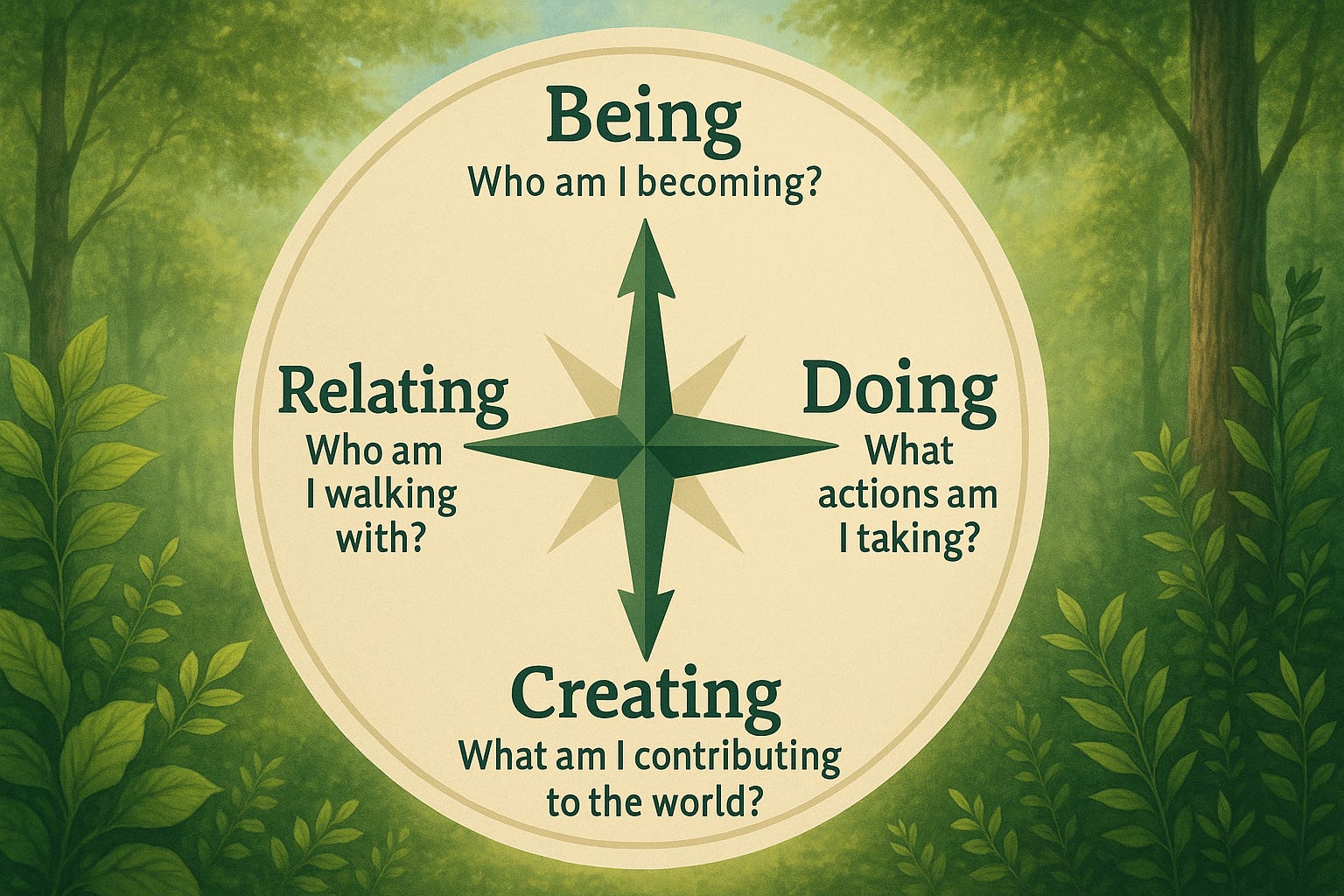
Becoming the Kind of Person Who Acts
For a long time, I thought the solution was just doing more.More writing. More coaching. More composting. More advocacy.I thought the world needed me in action.And it does.But what I’ve come to understand—what life has been teaching me, especially over the past few years—is that before we change the world, we must change our relationship to the world. That’s really what One Cause is all about. Releasing the four Great Untruths and embracing and living from the four Great Truths. And that requires becoming someone new. Not inauthentically, not by trying to be someone else, but by growing into the next expression of who we truly are.That’s the journey I’ve been on.That’s the invitation of One Cause.That’s what this article and podcast episode is about.A Vow to GrowI wake each morning now with a quiet ritual—what I call my One Cause Daily Protocol. It’s simple. I sit, I breathe, and I re-commit. Not just to writing or activism or checking items off a to-do list. But to being a person who lives as if the Four Great Truths are real, trustworthy, and the foundation for a regenerative future.I won’t share the whole thing here (it’s long and sacred to me), but I’ll give you a piece of it:“Even while living in a world and culture shaped for hundreds of years by the Four Great Untruths, I choose to dedicate my life to living in alignment with the Four Great Truths—to the best of my ability.”“This is, without a doubt, an impossible mission for me… and yet, it is also the next level of my Life On Purpose journey, which began in earnest in 1996.”That was nearly 30 years ago.Now, at 76, I’m choosing to level up again.Not to “save the world” but to live in service to it.That choice shows up in my morning meditations, in my rhythm of writing, in the creation of the Loving Homestead, and in the launch of the Eco-Guardian Youth Project.But most of all, it shows up in who I’m becoming.Some days I do this with a steady heart and a strong spine. Other days, I’m tired or anxious or distracted. I fall short. But I come back. Because this isn’t about perfection. It’s about purposeful practice.The Compass for BecomingOne of the tools that’s helped me orient this journey is a framework adapted from Ken Wilber’s Integral Theory—a way of seeing ourselves and our actions in four interrelated dimensions:* Being – Who am I becoming?* Doing – What actions am I taking?* Relating – Who am I walking with?* Creating – What am I contributing to the world?This simple compass reminds me that inspired action is not just about what I accomplish out there. It’s about what I cultivate in here—and how I connect it all together.Let me walk you through how these quadrants have shown up in my life… and how they might serve you, too.Being: The Inner Ground of Inspired ActionWhen we speak of action, we often rush past the inner world—the emotions, habits, and self-perceptions that shape how we show up. But as I’ve learned (again and again), becoming the kind of person who takes inspired action begins inside.For me, this has meant cultivating flow states—both on the pickleball court and at the writing desk. It’s not just about playing better or writing faster. It’s about discovering that place where action and awareness merge. Flow reminds me that I’m capable of more than I think—and that joy, not fear, can power progress.It’s also meant learning emotional agility.I used to believe that if I felt anxious or overwhelmed, I needed to “fix it” before moving forward. Now, I’m learning to walk with those emotions. To listen to them. To let them sharpen my focus rather than steal my power.And perhaps most of all, I’ve discovered the power of eudaimonic joy—that deeper kind of fulfillment that comes not from getting what I want, but from living in alignment with what matters. Purpose. Service. Connection. These are the renewable fuels of a regenerative life.Doing: Hero Training in Daily LifeIt’s one thing to feel inspired. It’s another to act on it.One of my core commitments lately has been to take daily actions, no matter how small, that strengthen my alignment. I think of it as hero training—not in a flashy, Marvel-movie kind of way, but in the ordinary, real-world sense of being someone others can count on.For me, that includes:* Moving my body with intention (pickleball is my dojo)* Journaling my thoughts, doubts, and dreams* Tackling micro-missions like writing letters, planting pollinators, or simply sharing a Substack note that might ripple outwardSmall doesn’t mean insignificant.Small is how everything starts.Relating: Who We Walk WithOne of the biggest breakthroughs I’ve had in the One Cause journey is realizing that I don’t need to do it all alone. In fact, I can’t.Whether it’s building the Loving Homestead with Ann…Or coaching a client who’s writing a legacy-worthy novel…Or participating in organizing a Community After Hours with my friend, Kerry…I’m discovering that action becomes more joyful—and more sustainable—when it’s done in community.Even this
What is an Eco-Guardian-in-Training? Are You One?
Not long ago and more nights than I care to remember, two questions kept me awake at night.What is an Eco-Guardian-in-Training (EGIT)?And are you one?The questions wouldn’t let me go. They prompted me to remember a time from my past when I co-founded the Life On Purpose Institute and, for 22 years, watched thousands of people begin their journey by taking the Life On Purpose Self-Test. That simple tool became the first step for countless people clarifying and living into their Divinely Inspired Purpose.And it hit me: maybe it’s time for a new self-test.Not for purpose alone this time, but for something bigger:To help people of all ages — from curious 10-year-olds to wise elders — discover where they are on the journey of becoming an Eco-Guardian.A Bit of BackstoryLong before One Cause had a name, I was writing eco-fiction for young people with this mission in my heart:To inspire young people to become joyful lifelong readers and responsible, caring stewards of the Earth and all her inhabitants.As One Cause evolved, a new name surfaced for that vision: Eco-Guardians.Eco-Guardians aren’t superheroes (though they sometimes feel like it). They are ordinary people who remember the extraordinary truth: we are not separate from nature, but part of it. Their calling is simple and profound—to care for Earth, her creatures, and each other.But how do we know if we’re on this path?That’s where the Eco-Guardian Self-Test comes in.The Self-Test: Three Paths, One JourneyWe’ve created three versions of the Self-Test, each tuned to where you are in life:* Eco-Guardian Foundations Test (ages 10–14): 10 questions to help younger seekers explore belonging, kindness, curiosity, and gratitude.* Eco-Guardian Growth Test (ages 15–18): 15 questions that stretch into resilience, systems thinking, and identity.* Eco-Guardian Mastery Test (adults & elders): 20 questions for those ready to weave stewardship, reciprocity, and mentorship into daily life.Each test is short, fun, and designed to help you see both your strengths and your growth edges.And like any true initiation, there are stages of progress: Explorer → Helper → Hero. Awakening → Engaged → Thriving. And ultimately: Stewardship.Why It MattersThe Self-Test isn’t about a score. It’s about remembering who we really are.Through myth, story, and the 20 Qualities of Eco-Guardianship, we are building not just a new kind of human being — but remembering who we’ve been all along, before the Four Great Untruths clouded our way.How to Take the TestHere’s where it gets fun. The Self-Test will live inside the Secret Library, alongside Ra-Kit’s Initiation and other treasures. (All of which are available on a “Pay What You Will” format.)Why? Because this isn’t just a “quiz.” It’s a portal.When you step through, you’ll not only gain access to the Eco-Guardian Self-Test Report (with all three versions), but you’ll also be joining a circle of people committed to remembering and living as Eco-Guardians (and who has access to the growing resources found within the Eco-Guardian Secret Library. An InvitationTake the test. Share your results here either as a comment or join this week’s chat: Then, invite your kids, grandkids, students, or friends to do the same.Share with the community:* What stage are you on the path?* What quality are you most proud of?* What’s one edge you’re excited to grow?Let’s see what happens when we take this journey not just alone, but together.Because being an Eco-Guardian is not a title. It’s a lifelong practice.And it begins with a single step of remembering.We’re growing a community of Eco-Guardians-In-Training so join this movement within the larger movement of the Great Turning. Subscribe for free or with a paid subscription. This is a public episode. If you'd like to discuss this with other subscribers or get access to bonus episodes, visit wbradfordswift.substack.com/subscribe
One Cause: Section Three – Inspired Action
A Letter from the FogDear fellow Ego-Guardians-In-Training,If I’m being fully transparent, this next part of the journey—moving from vision to action—feels both exhilarating and daunting. I’ve spent months now weaving together the threads of One Cause—laying out the Great Untruths that got us here, and the Great Truths that could guide us home. We’ve imagined a possible new future or at least a framework for one. We’ve planted the seed of a youth movement. And now… we’re standing at the edge.It’s time to act.And here’s where I want to pause and speak plainly. Because if I’ve learned anything from my own path—and from the people I coach and write for—it’s this:Knowing what to do is not the same as being ready to do it.Truth is, I’ve been circling this very chapter for days…no, weeks. Each time I sat down to write it, I found myself distracted… hesitant… heavy. And slowly I began to realize: this chapter isn’t just about writing about the roadblocks.I was inside one.If you relate to this, leave me a comment so I know I’m not alone.Some days, it’s resignation that grabs hold. “It’s too late,” it whispers when I read the latest climate data or hear yet another political leader dodge the truth.On other days, it’s confusion. “Where do I even begin?” I ask, even as I sit in a room full of notes and plans.And more often than I’d like to admit, I feel that slow fog of overwhelm creep in—when the gap between what I want to create and what I can manage feels too wide to cross.I used to see these feelings as failures. Signs I wasn’t committed enough. Or strong enough. But now I recognize them for what they are:They’re the friction before the flame. The fog before the light.And so I want to offer this to you—whoever and wherever you are on the path. If you’ve ever felt stuck… or small… or unsure how to begin—you are not alone.There’s a reason we don’t leap into action the moment we learn the truth. There’s a kind of grief to face first. A kind of disorientation. We have to come to terms with the fact that the world we thought we lived in is already changing—and that the solutions will almost certainly not come from the systems that caused the harm.That’s a lot to hold.So I say this with love and urgency: Let’s hold it together.Let’s stop pretending that we have to have it all figured out before we move. Because more often than not, it’s the moving that brings the clarity. Do we wait to feel inspired or do we act knowing that it is through action that inspiration is ignited and sustained?Action is what clears the fog. Action is what unlocks the flow.One action that could lead to a community inspired would be to join the chat where you can share your challenges as well as your successes. It doesn’t have to be grand. You don’t need to launch a nonprofit or write a book although you may choose to do either or both. Maybe it starts with planting one native flower in your yard. Maybe it’s writing a letter to your grandkids—born or not yet born—about the future you dream for them. Maybe it’s just sitting with the discomfort and not allowing yourself to go numb.That’s still movement.That’s still sacred.So yes, this chapter could have been titled “The Five Barriers to Action” and offered tidy bullet points on resignation, complacency, confusion, overwhelm, and hopelessness.But I’d rather tell you this:I’m stumbling through these barriers too. And I believe with all my heart that we can meet them—and move through them—together.We can turn despair into devotion.We can compost confusion into clarity.We can turn stuckness into a seed that breaks open—with just enough light.Because the truth is, you don’t need perfect clarity to begin. You just need to say yes.Yes to trying.Yes to caring.Yes to showing up, however you can.And I’ll be here with you as we take those next steps—toward inspired action, and a future worth regenerating.With muddy boots and an open heart,BradJoin a movement in the process of moving forward through the fog and straight on to dawn. This is a public episode. If you'd like to discuss this with other subscribers or get access to bonus episodes, visit wbradfordswift.substack.com/subscribe
Inspirational Interlude: When a Seed Becomes a Movement
Last November, something cracked open in me.The U.S. presidential election results had just landed, and like many, I was holding out hope for leadership that might finally meet the moment—leadership that could help steer us away from collapse and toward regeneration. Truthfully, I didn’t hold out a lot of hope that either political parties’ candidates would focus sufficient efforts on our global climate crisis, but I felt pretty confident that at least one of them would make some effort in the right direction. But when the winner was a ‘self-proclaimed climate change denier, I felt a sinking ache in my chest.Our political leaders aren’t going to save us. In fact, our entire political system that continues to cling to the myths of domination, separation, and control isn’t the answer. We can’t continue to do the same thing over and over and over while expecting different results. I was tired of that insanity.I recalled a powerful YouTube video I’d watched during one of my Game Changers Intensives. It started with this haunting reframe: “It’s 3:23 in the morning and I’m awake because my great great grandchildren won’t let me sleep. They ask me in dreams, What did you do while the planet was plundered? What did you do while the earth was unraveling?…what did you do once you knew?”I didn’t have to wonder that far into the future about my great great grandchildren. I wondered and worried what I would say to my grandkids, Logan and Piper. I didn’t know what my answer would be. I just knew I couldn’t keep holding back. I had to do something and it didn’t take a giant leap to know that it would include writing, but not about symptoms—carbon, consumption, corruption—but about causes. Deeper causes. Root causes. And that was the birth of One Cause.It started as a short Substack series. A weekly space to share hard truths and hopeful visions. But over the months, it grew—into a book-in-progress, a blueprint of Four Great Untruths and Four Great Truths, and maybe, just maybe… a movement.Not a movement in the marching sense. A movement in the growing sense. A living thing. Organic. Unfolding.The Moment BetweenRight now, we’re in what Joanna Macy would call “The Space Between Worlds.” The Great Unraveling is here. You can feel it. The systems that once held us no longer do. But we are also in the midst of the Great Turning. It will not be led from Washington or Wall Street. It will be led by us—eco-conscious families, community visionaries, regenerative thinkers, and most especially… our youth. Because when I asked myself where the real turning point might come from, the answer was immediate: Our kids, and our grandkids, and their kids…The ones who haven’t yet forgotten what it means to live close to the Earth.And so, the next seed began to germinate.Inspired by the Great Turning? Share this article with another eco-conscious soul: a teacher, parent, or young person Introducing: The Eco-Guardian Youth ProjectOut of One Cause, the Eco-Guardian Youth Project (EGYP) is emerging—a multi-phase, multi-generational invitation to reawaken our children’s connection to nature, story, purpose, and the power of their own creative voice. Here’s what it looks like in its early form:Vision SummaryEGYP is a movement to inspire, awaken, and empower youth ages 10–18 to become joyful, creative stewards of the Earth.It begins with story.It deepens through creative expression.It takes root through community, mentorship, and regenerative training. It’s about equipping a new generation of Eco-Guardians-in-Training (EGITs) with the courage, collaboration, and leadership to protect what they love.Here’s How I See It UnfoldingEntry Portal: Storyteller to StorymakerOne of the main entry points will be local and online co-creative Storyteller to Storymaker events where kids create a magical eco-story in real time. These will be opportunities for young participants to tap into their purpose-inspired imagination—and glimpse the world they will help shape. They will also learn about and receive a special ‘library card’ to the Eco-Guardian Secret Society Library, a hidden online space filled with eco-fiction, nonfiction, and Earth-honoring wisdom. Access to the secret library is on a Pay-What-You-Will basis, because no child should be left out of this movement by monetary constraints.Our initial goals for the Secret Library by the end of the first quarter of 2026:* 500+ digital library cards issued* 200+ library patrons visiting the library* 300+ eco-book downloadsPhase 2: The Eco-Author ChallengeIn 2026, the plan is to launch our first Eco-Author Challenge where young writers, artists, and eco-storytellers will submit fiction and nonfiction work for possible inclusion in a youth-authored anthology of writing and illustrations. This will be also be the opportunity for participants to learn the fun and joy of cooperative and creative collaboration.Phase 3: The Eco-Guardian Training Camp (EGTC)A deeper dive for the kids who want to keep going. Towards the
End of Summer Loving Homestead Update
This is a public episode. If you'd like to discuss this with other subscribers or get access to bonus episodes, visit wbradfordswift.substack.com/subscribe
Innovation, Imagination & Regeneration
“Bring out the secrets of nature for the happiness of humanity.”—Thomas EdisonWhen you think of a genius, you might picture someone like Thomas Edison—brilliant, prolific, and ruthlessly practical. He held over 1,000 patents, lit up the world with electricity, and helped create entire industries.And yet, one of his lesser-known quotes reveals something deeper:“Anything that won’t sell, I don’t want to invent. Sales are proof of utility, and utility is success.”What if that had been different?What if Edison had said instead,“Anything that doesn’t serve nature, I won’t invent”?Or, “I’ll make sure all my inventions serve all of nature.”What if genius wasn’t just measured in profits—but in regeneration?In healing ecosystems? In protecting future generations?Rethinking Genius for the Climate EraWe’re not just in a tech revolution. We’re in a values revolution.And it’s asking us to realign our creative brilliance with Earth’s needs.What does that look like?Let’s explore how genius unfolds when aligned with the Four Great Truths.InterconnectednessBuildings designed like trees. Cities modeled after watersheds. Living walls that breathe. Biophilic design is more than beautiful—it’s genius guided by connection.SufficiencySolar-powered irrigation tools shared across community farms. Open-source tech in the Global South. These are innovations that whisper: “There is enough, if we share.”ReciprocityRegenerative farming practices. Fungi that form mutualistic partnerships underground. Genius, it turns out, doesn’t dominate the soil—it listens to it.StewardshipDesigners embracing cradle-to-cradle design ask:“Can this product return to the Earth or be used again endlessly?”From sneakers to smartphones, stewardship is becoming a blueprint.Eco-Innovation SpotlightsVinisha Umashankar (India)At just 14, she designed a solar-powered ironing cart—clean, portable, and practical. It replaces charcoal carts used by millions of vendors. She’s been recognized by the Earthshot Prize and spoke at COP26.Tree-Planting DronesCompanies like Dendra Systems are using drones to reforest areas faster and more precisely than humans can alone. Tech meets trees. Restoration at scale.Indigenous Climate SolutionsFrom controlled burns to solar-powered fish camps, Indigenous wisdom is guiding new climate adaptations. Ancient intelligence meets modern need.These aren’t just cool projects. They’re proof: Real genius is humble, regenerative, and in service to life.What If… the Next iPhone Healed the Planet?Let’s stretch our vision.What if the next iPhone regenerated coral reefs?What if our “smart homes” grew vegetables and filtered rainwater. Or even better what is our homes separated our ‘gray water’ to use in our garden from the waste water which was then ‘composted’ locally for future use?What if middle school science fairs became incubators for rewilding the suburbs?Imagination isn’t a luxury—it’s a tool of survival and ultimately a portal to our thriving in a regenerative future. It’s time to start dreaming forward.Visioneering Your Own Eco-Genius ProjectHere’s your invitation to get started:* Ask: What breaks your heart about what’s happening to Earth?(Dead coral? Plastic-filled oceans? Birdsongs going silent? The loss of pollinators globally?)* Imagine: If Nature could whisper an answer, what might she say?(Start with what’s alive near you.)* Begin: What small, doable project could you begin or continue as a small step to a regenerative future? A backyard pollinator patch? A soil experiment? A letter to your mayor? For example, one of my ongoing project is transforming my yard that I once had to cut everyone two weeks into a food forest. Here are a few pics of our latest additions/kins.4. Then tell someone about your mini-eco project. How about including this Gaia’s Call community by leaving a comment in the Chat By the way, the chat feature is available both within the Substack app and on the website. Redefining GeniusWe’ve inherited more than Edison’s brilliance—we’ve inherited his blind spots.So let’s rewrite the rules.Not “What will sell?” But “What will serve life?”Real genius isn’t just clever.It’s caring. It’s regenerative.It grows futures worth living into.Your Bonus Mini-Mission: Activate Your Inner VisionaryThis week, choose one:* Learn about a young climate innovator like Vinisha.* Write down 3 “What if…?” ideas for healing the planet.* Start a journal of nature-inspired ideas (yes, doodles count).* Share this article with someone who needs a nudge of possibility.Because the next revolution in innovation won’t come from tech titans.It’ll come from gardeners. Grand-Dudes. Librarians. Artists. You.P.S. What If Genius Became a Movement?Behind the scenes, I’ve been nurturing a bold new vision:The Eco-Guardian Youth Project.It begins with a Secret Library.Leads into a youth writing challenge.And blossoms into an Eco-Guardian Training Camp—a place where young readers, writers, and visionaries gather to reimagine the future.Think: Hogwarts for
The Call to Heroism in a Time of the Great Unraveling
A Heroic MomentIt started with a phone call.It was a Thursday night. Ann and I had just settled in when Amber, our daughter, called. Their basement was flooding. Justin, her husband, had been called away as a first responder, and she needed help—immediately. “No big deal,” I thought. I packed a bag, grabbed some clothes, and drove up the mountain to their home. I figured I’d help vacuum the water, maybe stay the night.I had no idea we were stepping into a storm that would soon be named Helene.By 2 a.m., the power was gone. The vacuum was useless. The water kept rising. Inches of rain kept falling—hour after hour, day after day. We were to learn later that our area received from 13 to over 30 inches of rain. Cell towers went down next, due primarily to the power outages and disruption of the fiber optic lines, and with them, our ability to communicate with anyone. We were cut off. It was just Amber and me, two Eco-Guardians in crisis mode, with two small children—Logan, 3½, and Piper, 1½—and no idea what was coming next.For five days, we hunkered down. No power. No news. Just each other, and the steady rhythm of responsibility: diapers, food, water, buckets, blankets, calming fears. Was Ann okay? We had no way to know… until Justin managed to reach her days later, confirming she was safe.That week, I learned something about heroism.Not the cinematic kind. Not the lone savior kind.The real kind. Collaborative. Courageous. Committed to care.What does it mean to be a hero when the world we know is unraveling?When was the last time you felt the pull to rise—not as a savior, but as a steward?The true superpower of our time isn’t domination. It’s cooperation and collaboration. But what does this look like?Consider the International Space Station. It took 15 nations—many of them former adversaries—over a decade to build something none could have accomplished alone. Astronaut Ron Garan calls this the Orbital Perspective —the worldview that emerges when you look back at Earth from space and realize we’re all in it together.And I believe this is the same as the On Purpose Perspective that has inspired the One Cause movement: seeing Earth not as a battlefield, but as a beloved home. A shared miracle…one that we’ve been mistreating and taking for granted, but also one that has amazing healing powers when given the chance.The Hero, the Genius, the Visionary: They All Live in YouBrian Johnson says, “You are the hero we’ve been waiting for.”And I’d add: the genius? That’s you, too. The visionary? Also you.You don’t need superpowers. Just purpose.Joseph Campbell gave us the Hero’s Journey. But our dragons today aren’t fire-breathing monsters. They’re internal illusions:* The myth that we’re separate from nature.* The addiction to more is always better.* The belief that we can innovate our way out of responsibility.The call to adventure today is to live aligned with the Four Great Truths.This is more than action. It’s a full-system shift—what Ken Wilber would call a four-quadrant transformation:* Upper Left: How we see ourselves.* Lower Left: How we relate to others.* Upper Right: What we create and build.* Lower Right: How we organize communities and systems.Here’s a brief overview of the quadrants. To be a hero now means embracing a worldview that regenerates life, rather than depletes it.Living the Truths: Real-World Eco-GuardiansHere are four real-world heroes whose work embodies the Four Great Truths:Interconnectedness → Robin Wall KimmererBotanist and author of Braiding Sweetgrass, Kimmerer weaves science with Indigenous wisdom. She reminds us that plants are not just resources—they are relatives. Her work is a living invitation to reciprocity and reverence.Sufficiency → Wangari MaathaiFounder of Kenya’s Green Belt Movement, Maathai empowered thousands of women to plant over 50 million trees. Her work was rooted in the belief that there is enough—enough land, enough water, enough life—if we share and care for it.Reciprocity → Joanna MacyThrough The Work That Reconnects, Macy offers practices for transforming ecological grief into grounded, regenerative action. She helps people see their pain for the world not as weakness—but as love in disguise. ( I realize that Joanna has recently passed away. I’m also sure her work lives on in many of us.)Stewardship → Boyan Slat and Youth Eco-LeadersAt just 16, Slat launched The Ocean Cleanup. Today, his efforts inspire a generation. Around the world, youth-led permaculture teams, regenerative garden crews, and Earth Listening Circles are reclaiming stewardship as sacred.Want to spotlight your own local hero?Click the “Join the Chat” button and share your story. I’ll start with mine: my wife, Ann, who founded the Hendersonville Repair Cafes—teaching people to fix what’s broken instead of tossing it out.You Are Already on the PathHere’s the truth: if you’re reading this, you’re already walking your path.I’m walking mine, too.* These weekly One Cause articles? That’s part of it.* My t
What If Our Laws Helped the Earth?
A Note for Families and the Young at HeartLast Friday, I shared some reflections on a new energy law passed by Congress—how it reveals the deeper beliefs shaping our politics, and how we might start building something better from the ground up.But the real question I’ve been sitting with since then is this: What are we teaching the next generation about freedom, responsibility, and the earth we all share?That’s why I wrote the following piece—not as a political commentary, but as a walk through the woods with my grandkids and other young Eco-Guardians in training. It’s a conversation I imagine having with Logan when he’s just a little older and starting to wonder how this world works… and how he can help shape it.It’s written from the heart, in the voice of “Grand-Dude,” with just enough dirt on the boots to keep things grounded in love, wonder, and truth.Feel free to share it with the kids in your life—or with the child still alive in your own heart.What If Our Laws Helped the Earth?A Post-July 4th walk with Grand-DudeHey there, kiddo.Imagine you and I are out for one of our favorite walks through the woods. The sun’s peeking through the trees, birds are singing overhead, and there’s a gentle breeze that smells just a little like pine needles and adventure.Now, let me ask you something.What if the rules we made—you know, the big ones, the laws—helped the Earth instead of hurting it? What if every decision grown-ups made about energy, land, and how we live was also a promise to care for nature, for animals, and for kids like you?What Happened This WeekWell, this week, the grown-ups in charge passed a big new law. It’s all about energy. It might sound good at first—more jobs, more power, more stuff—but here’s the thing: most of that energy will come from digging up fossil fuels like oil and gas.And fossil fuels? They’re kind of like old buried treasure... but when we burn them, they make the air dirty, hurt animals’ homes, and heat up the planet more than it already is.So that got me thinking...The Four Great Untruths (a.k.a. some big misunderstandings)You see, there are some ideas many adults still believe—ideas that just don’t hold up when you look at the world closely, especially out here in the woods. I call them the Four Great Untruths. Let me tell you what they are, and you tell me if they sound right to you, okay?* “We’re separate from nature.”That’s like saying a tree doesn’t need the soil, or that we don’t need air or water. Silly, right?* “More is always better.”Imagine trying to eat 100 cookies in one sitting. You’d probably get a bellyache. The Earth does too.* “The Earth has endless resources.”Even your flashlight runs out of battery. So does the planet when we take too much.* “Technology will save us.”Tech is cool—robots, rockets, and all—but we also need love, kindness, and wisdom. You can’t plug that into a charger.The Four Great Truths (the real treasures)Now here’s what I believe deep down—and I bet you do too. These are the Four Great Truths. These are the seeds we can plant together for a better world:* Interconnectedness – We’re all part of one big web of life. Like when a bee helps a flower, and the flower feeds a butterfly, and the butterfly makes us smile.* Sufficiency – There’s enough for everyone when we share—like pie on Thanksgiving when we each take just what we need.* Reciprocity – Giving and receiving go together. Like when you give a hug and get one back. Or when you help nature, and nature helps you.* Stewardship – This is the big one: taking care of the Earth like it’s your pet, your playground, your best friend. Because it is.Your Mini-Mission: Ready to make some magic?I’ve got a few little quests for you. Pick one—or all—and make this Independence Day about more than just fireworks.Draw a “Freedom Flag”Not just stars and stripes. Try trees and rivers, birds and bees. Make it a flag for all life.Ask your family a big question“What does real freedom mean—for people, animals, and the planet?” You might be surprised by what they say.Plant somethingA seed. A flower. A tree. Even a dream. And while you're at it, pick up a piece of trash if you see one.And Remember…You may be small, but your heart is huge. And your voice matters more than you know.So let’s walk a little further, hand in hand, and dream together...Because the future needs you, brave Eco-Guardian. With love and muddy boots,Your Grand-DudeUnleashed - W. Bradford Swift is a reader-supported publication. To receive new posts and support my work, consider becoming a free or paid subscriber. This is a public episode. If you'd like to discuss this with other subscribers or get access to bonus episodes, visit wbradfordswift.substack.com/subscribe
Red, White, and Burnt: The Cost of Independence at Any Price
Before the fireworks faded this year and Rascal (my canine companion) had finally calmed down, I found myself caught in the sparks of something else entirely: a clash of narratives surrounding H.R.1, dubbed by some the “Big Beautiful Bill.” I’d heard plenty of heated rhetoric from Democratic leaders condemning the bill as a blatant handout to the wealthy and fossil fuel interests. But then I read a very different take—this time from a thoughtful Trump-supporting acquaintance who spoke glowingly of the bill’s promise for energy independence and economic revival.So I did what I often do when something doesn’t sit quite right on either side.I paused. I got quiet. And I chose to look for myself.Not through the lens of party loyalty. Not through the red vs. blue tribalism that dominates our national conversation. But through the deeper lens of One Cause—a project I’ve been living, writing, and inviting others into since the last election.Because the truth is, we don’t just need new policies. We need a new foundation for policymaking itself. A worldview that doesn’t pit us against each other or against the planet we depend on—but one that recognizes our interdependence and shared future.And this bill? Whether you love it or hate it, it reveals exactly what happens when we legislate from a dysfunctional and unsustainable worldview.Let’s unpack that.What Is the “Big Beautiful Bill” Really About?H.R.1, officially titled the “Lower Energy Costs Act,” is a sweeping piece of legislation aimed at ramping up fossil fuel extraction, deregulating environmental protections, and accelerating the permitting process for energy development—including oil, gas, and mining.Its supporters frame it as a bold move toward energy independence and economic prosperity. Its critics argue it’s a catastrophic giveaway to fossil fuel corporations, furthering environmental degradation and inequality. From the surface, it’s a political clash like any other.But let’s go deeper.What if the real issue isn’t just the bill’s content—but the worldview beneath it?The Four Great Untruths at WorkAs part of One Cause, I’ve identified what I call the Four Great Untruths—core assumptions that quietly shape much of our modern life, including our political systems. They’re not just wrong. They’re dangerously out of alignment with Indigenous wisdom of the ages, modern science, and the living systems we depend on.Let’s see how each shows up in H.R.1:1. We Are Separate from NatureThis untruth justifies treating the Earth as a resource pit rather than a living partner. H.R.1 reinforces this by stripping away environmental safeguards and fast-tracking extraction as if the land were inert, disposable, and unfeeling.2. More Is Always BetterThe bill celebrates growth—especially fossil-fueled economic growth—without acknowledging limits or consequences. It promotes more drilling, more mining, more consumption as if expansion were the same as prosperity.3. The Earth’s Resources Are InfiniteNowhere does H.R.1 reckon with planetary boundaries. There’s no mention of climate tipping points, ecological degradation, or the cost to future generations. It’s the legislative equivalent of raiding Earth’s savings account with no plan to repay.4. Technology Will Save UsThe bill leans heavily on innovation and deregulation, assuming that if we just remove enough “red tape,” market forces and tech will fix what’s broken—without needing to rethink the deeper patterns that created the problem in the first place.This isn’t to demonize those who support the bill. It’s to shine light on the operating system beneath it.And to ask: what if we chose a different foundation?The Four Great Truths: A Compass for Regenerative GovernanceNow imagine a bill shaped not by domination, scarcity, and short-term thinking—but by life-affirming truths grounded in ancient wisdom, ecological science, and human dignity.These are the Four Great Truths we explore in One Cause:1. InterconnectednessAll life is connected. We flourish together or not at all. Policy grounded in this truth would account for the well-being of watersheds, pollinators, ecosystems, and future generations—not just GDP.2. SufficiencyThere is enough for everyone when we use wisely and share fairly. Rather than hoarding or extraction, sufficiency prioritizes equity, access, and regenerative design.3. Reciprocity with NatureWe are part of nature’s web, not outside it. True freedom isn’t the right to exploit, but the opportunity to give back. Policy aligned with this truth would build soil, restore forests, and invest in life-giving systems.4. Humanity as Stewards, Not MastersWe are not rulers over nature, but caretakers within it. Governance rooted in stewardship sees leadership as service—not domination—and future-proofing as sacred responsibility.These truths aren’t partisan. They’re planetary.They’re not “left” or “right.” They’re forward.And we desperately need politics that reflect them.So What Are We Legislating For?Maybe that’s the
Reimagining Education and Community
Our current educational model isn’t broken—it’s doing exactly what it was designed to do: prepare children to succeed in a world built on the Four Great Untruths. But what if that’s the problem?Want more inspiration like this? Subscribe to join a movement reimagining the future—one story, one step, one spark at a time.Why Traditional Education Needs to EvolveLet’s start with a hard truth: the dominant model of education is not preparing young people for the world they’re inheriting. It was never designed to. Rooted in the industrial era and shaped by the Four Great Untruths (GUTs), today’s schools often serve as pipelines—not to purpose or wisdom, but to productivity, conformity, and consumerism. These GUTs include:* We Are Separate from NatureThis untruth underlies much of our educational design—students spend the majority of their time indoors, disconnected from the natural world. It reinforces the illusion that humans are observers of nature, not participants in it.* More Is Always BetterThe relentless pursuit of grades, test scores, and academic accolades fosters a scarcity mindset and undermines intrinsic motivation, creativity, and well-being. Students become driven to outperform, rather than collaborate and create.* The Earth’s Resources Are InfiniteMost schools fail to teach ecological literacy—how systems like water, energy, and biodiversity actually function. Without understanding planetary boundaries, students grow up unaware of the ecological crises unfolding around them.* Technology Will Save UsWhile innovation matters, over-reliance on technological fixes discourages critical thinking and disconnects us from embodied wisdom. True resilience comes not just from knowing how to code, but from knowing how to compost, conserve, and connect.But what if we flipped the script? What would it look like to educate young people from the foundation of the Four Great Truths (GTs). Let’s imagine such an education system:* InterconnectednessThis truth teaches that everything is connected. When students learn from ecosystems, they begin to see the invisible threads linking soil to seed, breath to tree, and self to society. Compassion and systems thinking emerge naturally.* SufficiencyEnough is a powerful concept. In classrooms grounded in sufficiency, the race to 'do more' gives way to depth, presence, and joy. Students learn to work with what they have—creatively and gratefully.* ReciprocityLearning becomes a mutual exchange. Students are not empty vessels to be filled but co-creators of knowledge. Service learning, peer teaching, and real-world projects model the give-and-take of thriving communities.* StewardshipPurpose guides education when stewardship is the norm. Students aren't just preparing for jobs—they're preparing to be caretakers of the Earth, each other, and the generations to come. Education becomes not just informative, but transformative.This kind of education fosters creativity, resilience, and regenerative thinking—not just for surviving the future, but for co-creating it.What if school helped you solve real-world problems, like saving the planet?Know a parent, teacher, or changemaker who needs to read this? Let’s spread the vision. Tap to share.Small-Scale, Experiential Education ModelsFortunately, this reimagining is already happening in pockets around the world.Forest SchoolsForest schools bring students outdoors in all seasons, engaging with the rhythms of the land. Children explore forests, build shelters, track animals, and learn to care for the Earth through immersion and play. These schools prioritize curiosity, resilience, and hands-on engagement. Learn more at Forest School Association.Waldorf EducationFounded by Rudolf Steiner, Waldorf education emphasizes imagination, creativity, and the integration of the arts with academics. Children learn through movement, music, handwork, and storytelling. Rooted in rhythms, relationship, and reverence, Waldorf aligns powerfully with the Great Truths by fostering inner development and ecological awareness. Explore further at Waldorf Education - AWSNA.Project-Based LearningProject-Based Learning (PBL) allows children to learn by doing—designing, building, questioning, and solving real-world problems. Whether it’s designing a sustainable house or launching a school recycling campaign, students take ownership of their education through inquiry and collaboration. A strong example is High Tech High, which uses PBL to connect learning with life.Indigenous Models of EducationMany Indigenous communities around the world practice educational models rooted in storytelling, ceremony, and learning from elders. These traditions honor the sacred interconnection of life and emphasize respect, reciprocity, and stewardship. Examples include the Hawaiian "Aloha ʻĀina" (love of the land) programs and the First Nations' "Land as Teacher" approach. Learn more at The Indigenous Education Institute.“Imagine your school was a garden, and you learned math by measurin
What Are We Celebrating?
Before the fireworks light up the sky, before the flags wave and the anthems echo, I invite you to take a breath with me. Not a performative one, not a patriotic puff of the chest—but a quiet, thoughtful breath. One that asks: What are we actually celebrating today? And perhaps more importantly: What do we want future generations to celebrate on this day a hundred years from now?A Meditation with the Mighty MuseI sat this morning in meditation—seeking clarity, grounding, perspective. I imagined I was in conversation with the Mighty Muse, that deep current of Cosmic Consciousness that has long whispered through the trees, flowed through rivers, and stirred the hearts of those willing to listen.And I asked:What might a truly liberated nation look like—one that honors all life, not just human life? What kind of freedom are we shaping with our daily choices, our politics, our parenting, our presence?What came was not a scolding, but an invitation. A gentle yet firm invitation to reflect, to reconnect, and to re-found what this country—and this world—might become.The Founding Fathers and the Seeds of Truth (and Untruth)Let’s give credit where it’s due. Many of the Founders, flawed and limited as they were, did tap into powerful ideas that mirrored what I now call the Four Great Truths (GTs):* Interconnectedness: Many early communities understood their lives depended on neighbors, land, and local systems.* Sufficiency: The American Revolution arose partly from frustration with royal excess. Simplicity and sufficiency had value.* Reciprocity: Self-governance emerged from the belief that rights come with responsibilities.* Stewardship: In agrarian life, land wasn’t just property—it was partnership.And yet, these Truths were quickly overshadowed by the Four Great Untruths (GUTs):* We Are Separate from Nature: Enslavement and land theft were justified by a belief in human superiority.* More Is Always Better: From manifest destiny to consumer culture, the drive for more became law.* The Earth’s Resources Are Infinite: Expansion never paused to ask what the land could bear.* Technology Will Save Us: Even then, there was a seduction in mechanization over mutuality.So here we are today—our cultural DNA a tangle of contradiction, potential, and peril.Fossil Fuels: The Hidden Architect of American PowerLet’s fast-forward to 1859. The first commercial oil well in Pennsylvania.That black liquid energy—so dense, so cheap, so powerful—poured fuel not only into engines but into entire worldviews. We stopped living off Earth’s "daily solar income" and began burning through her stored capital. Fossil fuels gave us highways, high-rises, global trade, industrial food… and the illusion that we were gods of endless growth.This changed everything. Including our politics.Cheap energy allowed us to externalize costs—ecological, emotional, and economic. It let us believe that distance erased consequence. And it built a political and economic system where those with access to the most energy (and money) could control the narrative.Even now, on this holiday, fossil fuels will power most of the fireworks shows, the traffic, the grills, the flights, the mass-produced flags…So again I ask: What are we really celebrating?Share Your Thoughts on This PostA New Declaration: Interdependence, Not Just IndependenceMaybe what we need isn’t a revolution, but a re-rooting. A return to the Great Truths:* Interconnectedness: We’re not above the web of life—we are the web of life. What harms one, harms all.* Sufficiency: There is enough—if we share wisely, live simply, and create systems rooted in equity.* Reciprocity: Rights and responsibilities go hand-in-hand. Democracy is not a spectator sport.* Stewardship: We are caretakers, not kings. Let us govern for the seventh generation.What might a political system rooted in these truths look like? Perhaps it would:* Prioritize the well-being of all species, not just human GDP.* Weigh policy based on long-term ecological health, not quarterly profits.* Replace extraction with regeneration.* Treat clean air, water, and soil as rights, not commodities.Call it Purposeful Politics. Call it Re-Founding America. Call it a dream.But if we don’t dream differently, we’re destined to keep repeating the same nightmares.So Where Do We Begin?We begin by not turning away. By refusing to let cynicism close our hearts. By reclaiming the power of civic imagination.Let’s talk with our kids—not just about fireworks but about why this land deserves our care. Let’s host intergenerational conversations about real freedom—the kind that includes Earth, the unseen, and the unborn. Let’s redefine patriotism as a love so deep, we’re willing to tell the truth about where we’ve been—and where we must go.Share This Post with a FriendMini-Mission: Redefine Your FreedomThis July 4th, I invite you to:* Light a candle in gratitude for Earth* Host a family “What is real freedom?” circle* Plant something. Literally. In soil.* Post a photo with
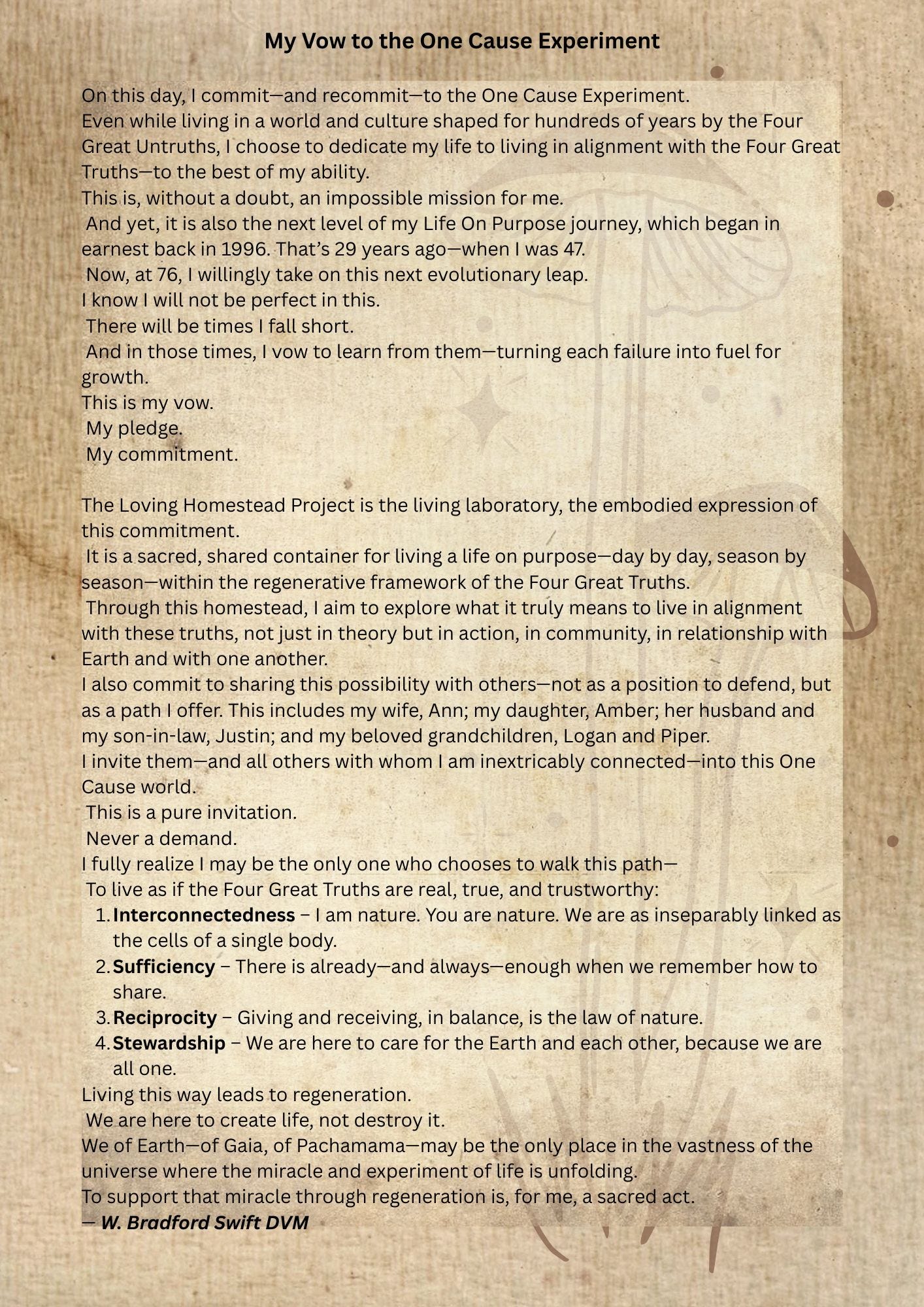
The Four Great Truths: A Sacred Blueprint for Regeneration
Last week, I shared a personal TED talk-style exploring the deeper roots of the climate crisis—not just as an ecological emergency, but as a crisis of belief.Today, in Part Two, I invite you to turn toward the path of healing and regeneration. This video introduces the Four Great Truths—ancient, enduring principles that offer a new foundation for how we might live, love, and lead forward.These truths aren’t abstract theories.They’re how life actually works when it’s in right relationship.And they’re the compass behind everything I’m doing with the One Cause Project.I’ve also decided that now is the right moment to share something even more personal: my Vow to the One Cause Experiment—a declaration I read each morning and evening, and one that defines how I want to live the rest of my life. You’ll find it below this introduction. If it speaks to you, I invite you to sit with it… maybe even speak it aloud or accept my invitation into the One Cause world.And again, if these videos move you, feel free to share them—or even nominate me to speak on the TED stage using this link.We need more truth in the world.We need more voices rising not in fear, but in care, courage, and commitment.Thank you for being one of those voices.Watch Part Two above. This is a public episode. If you'd like to discuss this with other subscribers or get access to bonus episodes, visit wbradfordswift.substack.com/subscribe