When My Daughter Asked About the World… and History Answered
Gaia's Call · Brad Swift
Audio is streamed directly from the publisher (api.substack.com) as published in their RSS feed. Play Podcasts does not host this file. Rights-holders can request removal through the copyright & takedown page.
Show Notes
There are moments in a parent’s life when a conversation shifts from the everyday into something deeper—something that feels like it matters not just for your family, but for the times we’re living in. This was one of those moments.
Amber and I were talking—not about anything unusual at first. Just the world as it is right now. The noise. The intensity. The constant stream of headlines and opinions and reactions that can leave even the most grounded among us feeling unsettled. And then she said something that stopped me.
Not in fear—in wisdom.
She told me that instead of getting pulled into the emotional swings of social media, she’s been trying to step back… to look at what’s happening through the lens of history. To understand this moment not as chaos—but as part of a larger pattern. As a dad, and as someone who has spent much of his life trying to make sense of the deeper patterns of life, I felt a quiet sense of respect. And curiosity. Because that’s exactly the question I’ve been living inside of too.
What if what we’re experiencing right now isn’t random? What if it’s not just “things falling apart”? What if it’s part of something that has happened before?
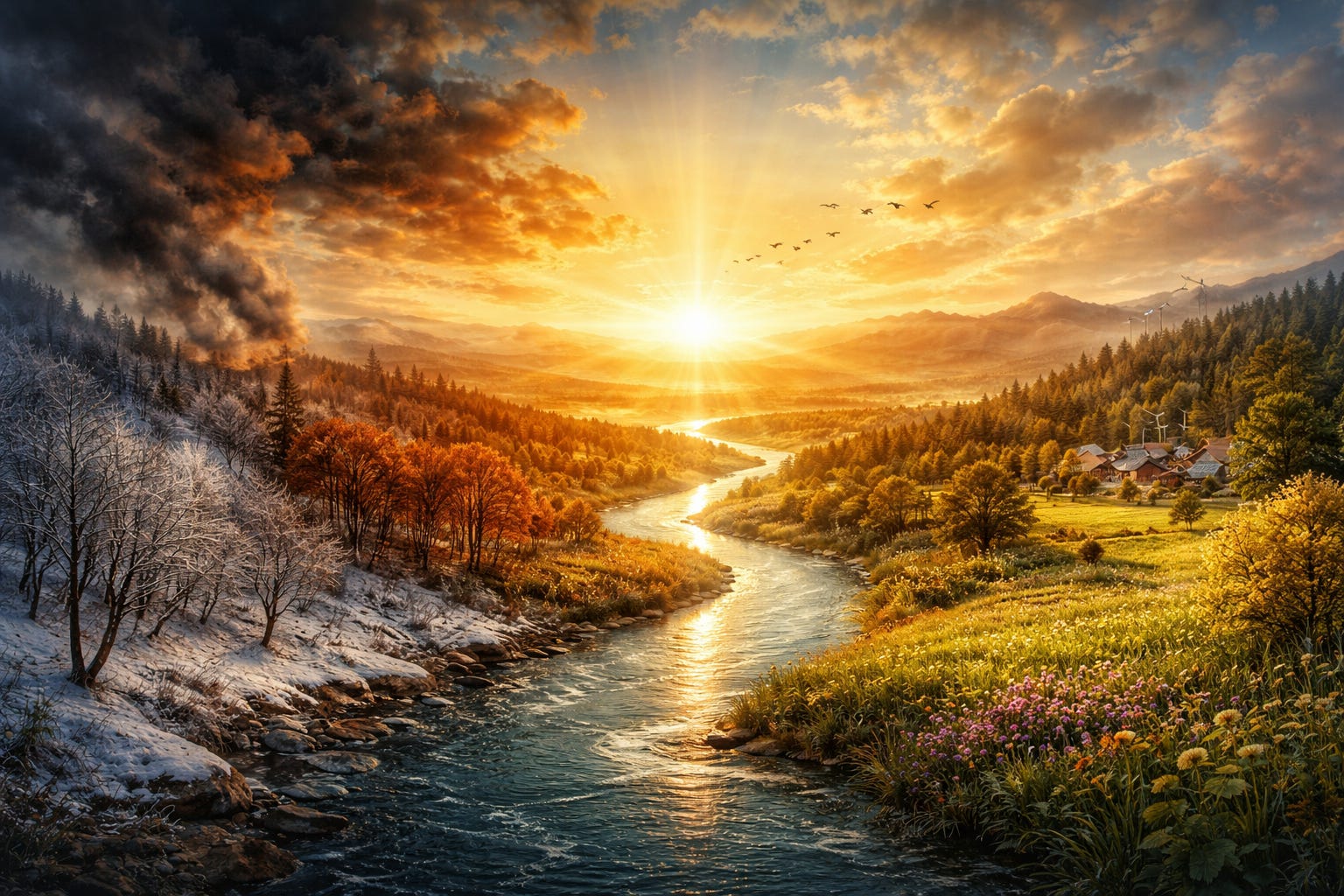
That question led us into a conversation about a book I’ve been reading: The Fourth Turning Is Here by Neil Howe. And while the book itself can be a bit dense at times, the core idea is surprisingly simple—and surprisingly powerful. History, it suggests, moves in cycles. Not perfect circles, but rhythms. Like seasons.
According to this framework, society tends to move through four “turnings” over the course of roughly 80 to 100 years: a time of stability and building, a time of questioning and awakening, a time of unraveling and fragmentation, and then a time of crisis—a Fourth Turning. A winter. A time when systems break down, tensions rise, and the future feels uncertain. But also a time when something new begins to emerge.
If Howe is right—and many historians and observers of history across centuries have sensed that time moves more like a rhythm than a straight line—then we are living in that fourth phase. From Ibn Khaldun’s observations of civilizations rising and falling in cycles, to Arnold Toynbee’s view that societies move through recurring patterns of challenge and response, there has long been an intuition that history has seasons of its own.
As Amber and I explored this together, something else began to come into focus. This moment we’re living through isn’t just about “the world.” It’s about who we are in the world—at this moment in time. According to this model, each generation tends to play a different role during these cycles. And suddenly, it felt very personal.
My generation—what Howe calls the “Prophet” generation—we are the elders now. The ones who have lived through earlier seasons. The ones who remember, or at least can sense, that these cycles are real. Our role isn’t to control what happens next, and it’s not to rescue. It’s to offer perspective. To help name what’s happening. To remind others—especially our children—that winter, as harsh as it can be, does not last forever.
Amber’s generation—the “Hero” generation, those born roughly in the 1980s and 90s—came of age in a time of increasing instability and are now stepping into adulthood during a time of crisis. If this framework holds true, this is the generation that will do the rebuilding. Not alone, but together. They are the ones who will shape the next set of systems, the next culture, the next “normal.” Which means Amber’s instinct—to step back, to look at the bigger picture, to seek understanding rather than reaction—isn’t just wise. It’s exactly what this moment is asking of her.
And then there’s Logan. Five years old. Full of curiosity, energy, and that beautiful openness to the world. In Howe’s language, he would be part of what’s called the “Artist” generation—the ones who are born during the crisis but grow up in what comes after. The ones who don’t lead the rebuilding, but inherit it and shape it in quieter, more relational, more creative ways.
Just the other day, I watched him crouch down in the yard, completely absorbed in something most of us would have walked right past. A tiny line of ants moving with quiet determination across the soil. He stayed there for several minutes, studying them, asking questions, narrating what he thought they were doing. In that moment, the world wasn’t chaotic or broken—it was alive, fascinating, and worthy of his full attention.
Which raises a question that feels very real to me as a grandfather: what kind of world will he grow up into based on what we choose to do now?
One of the things I appreciated most about this framework is that it doesn’t try to sugarcoat the difficulty of times like these. Every Fourth Turning in history has included real hardship, conflict, loss, and uncertainty. The American Revolution tore apart loyalties and families even as it gave birth to a new nation. The Civil War brought unimaginable division and loss of life while redefining what that nation would stand for. And the Great Depression and World War II tested an entire generation through economic collapse and global conflict—yet ultimately led to a period of rebuilding and shared purpose. We have been through winters like this before. But it also offers something that feels deeply needed right now: orientation. A way of seeing that helps us move from “everything is falling apart” to “something is changing—and I have a role to play in what comes next.”
For me, this conversation with Amber didn’t end with answers. It opened something. A shared way of looking at the world that feels less reactive and more purposeful. Less about surviving the moment, and more about participating in what’s emerging. It also reinforced something I’ve been feeling more and more clearly: the future isn’t something that just happens to us. It’s something that is being shaped right now through how we live, how we relate, and what we choose to build together.
If it’s true that we are living in a kind of historical winter, then maybe the question isn’t “How do we get through this as quickly as possible?” Maybe the question is: Who is this time asking us to become?
As parents. As grandparents. As citizens. As stewards of this living Earth.
And perhaps most importantly: what are we creating now that our children—and our grandchildren—will one day call “normal”?
And for Ann and me, that question—what is my role in what comes next?—is no longer theoretical. It’s becoming practical. After more than three decades in our home, we’re in the midst of a significant transition—choosing to move downstairs into a smaller space so that Amber, Justin, and the kids can move into the main home. On the surface, it looks like downsizing. But at a deeper level, it feels like something else entirely. A quiet, imperfect, very human attempt to live into what this moment is asking of us—less accumulation, more connection… less “more,” and more enough. I’ll share more about that journey soon, because in many ways, it feels like our small, personal response to a much larger turning.
P.S. I’d love to hear how this lands for you. Does the idea of a “Fourth Turning” help bring clarity to what you’re seeing in the world… or raise new questions? Feel free to share in the comments or join the conversation in the chat. These are times that call for more than opinions—they call for shared reflection and connection.
This is a public episode. If you'd like to discuss this with other subscribers or get access to bonus episodes, visit wbradfordswift.substack.com/subscribe