
Faster, Please! — The Podcast
103 episodes — Page 1 of 3
✨ My interview with economist Tyler Cowen on the Age of AI (and more)
The New Space Age meets the Age of AI: My interview with Phil Metzger
🏁 The Great AI Race as a clash over compute: my interview with analyst Ryan Fedasiuk
💧⚡🖥️ A deep-dive on data centers: My interview with AI researcher Andy Masley
📈 The business of AI: My interview with technology analyst and investor Azeem Azhar
✨ Data center distortions: My interview with energy policy analyst Shuting Pomerleau
✨ My interview with Sebastian Mallaby, author of 'The Infinity Machine: Demis Hassabis, DeepMind, and the Quest for Superintelligence'
✨💪 AI, jobs, and productivity: My chat with economist Erik Brynjolfsson
✨💪 The future of work in an age of AI: My chat with economist Daniel Rock
🏗️ A hub for hard-tech startups: My chat with 'American Shenzhen' builder Joshua Farahzad

✨ The Age of AI, an update: My chat with policy analyst Dean Ball
My fellow pro-growth/progress/abundance Up Wingers in America and around the world:Anxiety is running rampant about the future of artificial intelligence and its place in society. When technology CEOs warn of an impending white-collar jobpocalypse (or jobageddon, if you prefer), it’s no wonder public pessimism is so widespread. Today on Faster, Please!—The Podcast, I chat with tech policy analyst Dean Ball to help us sift through some of the uncertainty.We talk about recursive self-improvement, the role of AI in everything from medicine to defense, and what to think about the possible growing risk of AI company nationalization.(FYI: Our chat occurred just before the White House released new guidelines for AI federal legislation, about which Ball opined on X/Twitter: “The White House’s proposal for a nationwide AI law is a thoughtful document that will serve as an excellent foundation for the legislative work ahead. I would be happy to see these principles, if translated well into statute, become law.”) Ball is a senior fellow at FAI, the Foundation for American Innovation. He recently served as senior policy advisor for Artificial Intelligence and Emerging Technology at the White House Office of Science and Technology Policy, as well as strategic advisor for AI at the National Science Foundation. He was previously a research fellow at the Mercatus Center and a policy fellow at Fathom. He’s also the author of the excellent Hyperdimensional Substack newsletter.In This Episode* Public pessimism (1:37)* Differing narratives (4:21)* The nationalization risk (16:15)* Accountability via audit (25:55)* Productivity projection (34:18)(A lightly edited transcript of our conversation will be appear in my Week in Review issue on Saturday. Another option is using the Substack auto transcript function.)On sale everywhere The Conservative Futurist: How To Create the Sci-Fi World We Were Promised This is a public episode. If you'd like to discuss this with other subscribers or get access to bonus episodes, visit fasterplease.substack.com/subscribe

🌎 Storm watch: My chat with climate policy expert Roger Pielke Jr.
My fellow pro-growth/progress/abundance Up Wingers in America and around the world:Headlines portend rising seas, raging storms, and a planet in crisis. It’s easy to feel like the future is something to fear; however, the key to cooling things down isn’t scaling civilization back. If the world wants to cut back on carbon emissions without sacrificing growth, the answer lies in bold innovation. A sustainable tomorrow requires smart energy investment and long-term thinking today.On this episode of Faster, Please! — The Podcast, I chat with Roger Pielke Jr. about the ever-evolving discussion around climate change. We talk about the benefits of embracing new energy technology and identifying some easy wins.Pielke is a senior fellow at the American Enterprise Institute where his research focuses on science and technology policy. He is also a professor emeritus at University of Colorado Boulder, a distinguished fellow at Japan’s Institute of Energy Economics, a research associate with Risk Frontiers in Australia, and an honorary professor at University College London. Pielke has authored and edited several books, including The Climate Fix: What Scientists and Politicians Won’t Tell You About Global Warming. He also writes The Honest Broker Substack.In This Episode* The Shale Story (1:42)* Unknown Unknowns (7:42)* The Weather Forecast (14:19)* Alternate History (25:23)* The Path Forward (28:25)(A lightly edited transcript of our conversation will be appear in my Week in Review issue on Saturday. Another option is using the Substack auto transcript function.)On sale everywhere The Conservative Futurist: How To Create the Sci-Fi World We Were Promised This is a public episode. If you'd like to discuss this with other subscribers or get access to bonus episodes, visit fasterplease.substack.com/subscribe

☄️Awaiting apocalypse: My chat with journalist and author Dorian Lynskey
My fellow pro-growth/progress/abundance Up Wingers in America and around the world:Since humanity’s beginning, we’ve been pondering about our end. From war, to disease, to divine reckoning, the means of our destruction seem endless. The advent of the atomic bomb, concerns around climate change, and now AI have prompted many to wonder whether our demise will be random, or if it will come as the result of our own actions.Today on Faster, Please! — The Podcast, I chat with Dorian Lynskey about the way we talk about the end times. We discuss whether catastrophizing leads to action or paralysis and the role of hope in our narratives.Lynskey is a prolific journalist and the author of three books. His most recent: Everything Must Go: The Stories We Tell About the End of the World, which was released last month in the US. He also co-hosts two podcasts, Origin Story and Oh God, What Now?.In This Episode* Scare Tactics (1:32)* Effects of Hopefulness (10:25)* AI Doomsayers (17:01)* Countdown to Catastrophe (21:15)(A lightly edited transcript of our conversation will be appear in my Week in Review issue on Saturday. Another option is using the Substack auto transcript function.)On sale everywhere The Conservative Futurist: How To Create the Sci-Fi World We Were Promised This is a public episode. If you'd like to discuss this with other subscribers or get access to bonus episodes, visit fasterplease.substack.com/subscribe

⤴️ Beyond Abundance: My chat with Brink Lindsey about his new book, 'The Permanent Problem'
My fellow pro-growth/progress/abundance Up Wingers in America and around the world:The human pursuit of progress stems from our desire for security and a higher quality of life. Yet, even as today’s advanced economies are the richest and most comfortable they’ve ever been, something is amiss. What explains the decline in R&D growth, mental health, and birth rates, just to name a few challenges?In his new book, The Permanent Problem: The Uncertain Transition from Mass Plenty to Mass Flourishing, author Brink Lindsey identifies the critical gap between material abundance and abundant human flourishing.Today on Faster, Please! — The Podcast, Brink and I chat about what constitutes a truly healthy society, beyond surface-level affluence. We identify the conditions for continual progress after our basic needs have been met and far exceeded.Linsey is a senior vice president at the Niskanen Center. He previously served as vice president for research at the Cato Institute and as a senior scholar at the Kauffman Foundation. He has authored and co-authored six books on economics and culture, and is the author of his own Substack, also titled The Permanent Problem.In This Episode* More of everything . . . !? (1:54)* Falling fertility (7:31)* What we’ve lost (10:20)* Evaluating flourishing (13:13)* A culture of growth (20:24)* Future-world problems (28:04)(A lightly edited transcript of our conversation will be appear in my Week in Review issue on Saturday. Another option is using the Substack auto transcript function.)On sale everywhere The Conservative Futurist: How To Create the Sci-Fi World We Were Promised This is a public episode. If you'd like to discuss this with other subscribers or get access to bonus episodes, visit fasterplease.substack.com/subscribe
⚛️ A final (and lasting?) nuclear revival: My chat with nuclear energy advocate Jessica Lovering
My fellow pro-growth/progress/abundance Up Wingers in America and around the world:Headlines abound with news of the coming nuclear renaissance — a long-awaited era of clean, abundant energy to power our future. But this is hardly the first time the media has heralded the dawn of the atomic age. Still, this round of nuclear optimism is seeing unprecedented corporate investment, more cost-effective modular reactors, and a greater sense of political consensus.Today on Faster, Please! — The Podcast, I chat with Jessica Lovering about past obstacles to growth, and what we might expect from the US going forward.Lovering is an advocate for nuclear power currently based in Sweden. She is the co-founder and former executive director of the Good Energy Collective, as well as a senior fellow with the Nuclear Innovation Alliance and the Energy for Growth Hub. She also authors her own Substack, Nuclear Power to the People.In This Episode* The lost Atomic Age (1:30)* To regulate or not to regulate (8:26)* Reactor capacity past and future (10:44)* The economics of nuclear (14:51)* Power projection (18:32)* The new nuclear status quo (24:04)(A lightly edited transcript of our conversation will be appear in my Week in Review issue on Saturday. Another option is using the Substack auto transcript function.)On sale everywhere The Conservative Futurist: How To Create the Sci-Fi World We Were Promised This is a public episode. If you'd like to discuss this with other subscribers or get access to bonus episodes, visit fasterplease.substack.com/subscribe
🪐 NASA and beyond: My chat with space policy analyst Casey Dreier
My fellow pro-growth/progress/abundance Up Wingers in America and around the world:NASA is attempting the difficult task of juggling highly ambitious goals, but also possibly intense budget cuts. Despite personnel losses and unclear leadership, the administration is racing to put humans on the Moon — ideally ahead of China — and then Mars.Today on Faster, Please! — The Podcast, I’m chatting with Casey Dreier about this complicated new era in NASA’s history. We’ll discuss whether or not we’re really in a space race, what to make of the differing visions of Elon Musk and Jeff Bezos, and the rise of planetary defense.Dreier is chief of space policy at The Planetary Society where he advocates for planetary exploration, defense, and the search for extraterrestrial life. He has been featured in major publications from The New York Times to the Washington Post, and hosts his own podcast, Planetary Radio: Space Policy Edition.In This Episode* The return of Isaacman (1:32)* Ditch the Space Race (7:42)* Visions of space (14:48)* Planetary defense (21:23)* Proceed with optimism (24:51)(A lightly edited transcript of our conversation will be appear in my Week in Review issue on Saturday. Another option is using the Substack auto transcript function.)On sale everywhere The Conservative Futurist: How To Create the Sci-Fi World We Were Promised This is a public episode. If you'd like to discuss this with other subscribers or get access to bonus episodes, visit fasterplease.substack.com/subscribe
✨🔬 Acceleration though AI-automated R&D: My chat (+transcript) with researcher Tom Davidson
My fellow pro-growth/progress/abundance Up Wingers in America and around the world:What really gets AI optimists excited isn’t the prospect of automating customer service departments or human resources. Imagine, rather, what might happen to the pace of scientific progress if AI becomes a super research assistant. Tom Davidson’s new paper, How Quick and Big Would a Software Intelligence Explosion Be?, explores that very scenario.Today on Faster, Please! — The Podcast, I talk with Davidson about what it would mean for automated AI researchers to rapidly improve their own algorithms, thus creating a self-reinforcing loop of innovation. We talk about the economic effects of self-improving AI research and how close we are to that reality.Davidson is a senior research fellow at Forethought, where he explores AI and explosive growth. He was previously a senior research fellow at Open Philanthropy and a research scientist at the UK government’s AI Security Institute.In This Episode* Making human minds (1:43)* Theory to reality (6:45)* The world with automated research (10:59)* Considering constraints (16:30)* Worries and what-ifs (19:07)Below is a lightly edited transcript of our conversation. Making human minds (1:43). . . you don’t have to build any more computer chips, you don’t have to build any more fabs . . . In fact, you don’t have to do anything at all in the physical world.Pethokoukis: A few years ago, you wrote a paper called “Could Advanced AI Drive Explosive Economic Growth?,” which argued that growth could accelerate dramatically if AI would start generating ideas the way human researchers once did. In your view, population growth historically powered kind of an ideas feedback loop. More people meant more researchers meant more ideas, rising incomes, but that loop broke after the demographic transition in the late-19th century but you suggest that AI could restart it: more ideas, more output, more AI, more ideas. Does this new paper in a way build upon that paper? “How quick and big would a software intelligence explosion be?”The first paper you referred to is about the biggest-picture dynamic of economic growth. As you said, throughout the long run history, when we produced more food, the population increased. That additional output transferred itself into more people, more workers. These days that doesn’t happen. When GDP goes up, that doesn’t mean people have more kids. In fact, the demographic transition, the richer people get, the fewer kids they have. So now we’ve got more output, we’re getting even fewer people as a result, so that’s been blocked.This first paper is basically saying, look, if we can manufacture human minds or human-equivalent minds in any way, be it by building more computer chips, or making better computer chips, or any way at all, then that feedback loop gets going again. Because if we can manufacture more human minds, then we can spend output again to create more workers. That’s the first paper.The second paper double clicks on one specific way that we can use output to create more human minds. It’s actually, in a way, the scariest way because it’s the way of creating human minds which can happen the quickest. So this is the way where you don’t have to build any more computer chips, you don’t have to build any more fabs, as they’re called, these big factories that make computer chips. In fact, you don’t have to do anything at all in the physical world.It seems like most of the conversation has been about how much investment is going to go into building how many new data centers, and that seems like that is almost the entire conversation, in a way, at the moment. But you’re not looking at compute, you’re looking at software.Exactly, software. So the idea is you don’t have to build anything. You’ve already got loads of computer chips and you just make the algorithms that run the AIs on those computer chips more efficient. This is already happening, but it isn’t yet a big deal because AI isn’t that capable. But already, one year out, Epoch, this AI forecasting organization, estimates that just in one year, it becomes 10 times to 1000 times cheaper to run the same AI system. Just wait 12 months, and suddenly, for the same budget, you are able to run 10 times as many AI systems, or maybe even 1000 times as many for their most aggressive estimate. As I said, not a big deal today, but if we then develop an AI system which is better than any human at doing research, then now, in 10 months, you haven’t built anything, but you’ve got 10 times as many researchers that you can set to work or even more than that. So then we get this feedback loop where you make some research progress, you improve your algorithms, now you’ve got loads more researchers, you set them all to work again, finding even more algorithmic improvements. So today we’ve got maybe a few hundred people that are advancing state-of-the-art AI algorithms.I think they’re all getting paid a billion dollars a person, too.Exac
🚀 The trillion-dollar space race: My chat (+transcript) with journalist Christian Davenport
My fellow pro-growth/progress/abundance Up Wingers,China’s spacefaring ambitions pose tough competition for America. With a focused, centralized program, Beijing seems likely to land taikonauts on the moon before another American flag is planted. Meanwhile, NASA faces budget cuts, leadership gaps, and technical setbacks. In his new book, journalist Christian Davenport chronicles the fierce rivalry between American firms, mainly SpaceX and Blue Origin. It’s a contest that, despite the challenges, promises to propel humanity to the moon, Mars, and maybe beyond.Davenport is an author and a reporter for the Washington Post, where he covers NASA and the space industry. His new book, Rocket Dreams: Musk, Bezos, and the Inside Story of the New, Trillion-Dollar Space Race, is out now.In This Episode* Check-in on NASA (1:28)* Losing the Space Race (5:49)* A fatal flaw (9:31)* State of play (13:33)* The long-term vision (18:37)* The pace of progress (22:50)* Friendly competition (24:53)Below is a lightly edited transcript of our conversation. Check-in on NASA (1:28)The Chinese tend to do what they say they’re going to do on the timeline that they say they’re going to do it. That said, they haven’t gone to the moon . . . It’s really hard.Pethokoukis: As someone — and I’m speaking about myself — who wants to get America back to the moon as soon as possible, get cooking on getting humans to Mars for the first time, what should I make of what’s happening at NASA right now?They don’t have a lander. I’m not sure the rocket itself is ready to go all the way, we’ll find out some more fairly soon with Artemis II. We have flux with leadership, maybe it’s going to not be an independent-like agency anymore, it’s going to join the Department of Transportation.It all seems a little chaotic. I’m a little worried. Should I be?Davenport: Yes, I think you should be. And I think a lot of the American public isn’t paying attention and they’re going to see the Artemis II mission, which you mentioned, and that’s that mission to send a crew of astronauts around the moon. It won’t land on the moon, but it’ll go around, and I think if that goes well, NASA’s going to take a victory leap. But as you correctly point out, that is a far cry from getting astronauts back on the lunar surface.The lander isn’t ready. SpaceX, as acting NASA administrator Sean Duffy just said, is far behind, reversing himself from like a month earlier when he said no, they appear to be on track, but everybody knew that they were well behind because they’ve had 11 test flights, and they still haven’t made it to orbit with their Starship rocket.The rocket itself that’s going to launch them into the vicinity of the moon, the SLS, launches about once every two years. It’s incredibly expensive, it’s not reusable, and there are problems within the agency itself. There are deep cuts to it. A lot of expertise is taking early retirements. It doesn’t have a full-time leader. It hasn’t had a full-time leader since Trump won the election. At the same time, they’re sort of beating the drum saying we’re going to beat the Chinese back to the lunar surface, but I think a lot of people are increasingly looking at that with some serious concern and doubt.For what it’s worth, when I looked at the betting markets, it gave the Chinese a two-to-one edge. It said that it was about a 65 percent chance they were going to get there first. Does that sound about right to you?I’m not much of a betting man, but I do think there’s a very good chance. The Chinese tend to do what they say they’re going to do on the timeline that they say they’re going to do it. That said, they haven’t gone to the moon, they haven’t done this. It’s really hard. They’re much more secretive, if they have setbacks and delays, we don’t necessarily know about them. But they’ve shown over the last 10, 20 years how capable they are. They have a space station in low earth orbit. They’ve operated a rover on Mars. They’ve gone to the far side of the moon twice, which nobody has done, and brought back a sample return. They’ve shown the ability to keep people alive in space for extended periods of times on the space station.The moon seems within their capabilities and they’re saying they’re going to do it by 2030, and they don’t have the nettlesome problem of democracy where you’ve got one party come in and changing the budget, changing the direction for NASA, changing leadership. They’ve just set the moon — and, by the way, the south pole of the moon, which is where we want to go as well — as the destination and have been beating a path toward that for several years now.Is there anyone for merging NASA into the Department of Transportation? Is there a hidden reservoir? Is that an idea people have been talking about now that’s suddenly emerged to the surface?It’s not something that I particularly heard. The FAA is going to regulate the launches, and they coordinate with the airspace and make sure that the air traffic goes around i

🤖 Thoughts of a (rare) free-market AI doomer: My chat (+transcript) with economist James Miller
My fellow pro-growth/progress/abundance Up Wingers,Some Faster, Please! readers have told me I spend too little time on the downsides of AI. If you’re one of those folks, today is your day. On this episode of Faster, Please! — The Podcast, I talk with self-described “free-market AI doomer” James Miller. Miller and I talk about the risks inherent with super-smart AI, some possible outcomes of a world of artificial general intelligence, and why government seems uninterested in the existential risk conversation.Miller is a professor at Smith College where he teaches law and economics, game theory, and the economics of future technology. He has his own podcast, Future Strategist, and a great YouTube series on game theory and intro to microeconomics. On X (Twitter), you can find him at @JimDMiller.In This Episode* Questioning the free market (1:33)* Reading the markets (7:24)* Death (or worse) by AI (10:25)* Friend and foe (13:05)* Pumping the breaks (20:36)* The only policy issue (24:32)Below is a lightly edited transcript of our conversation. Questioning the free market (1:33)Most technologies have gone fairly well and we adapt . . . I’m of the belief that this is different.Pethokoukis: What does it mean to be a free-market AI doomer and why do you think it’s important to put in the “free-market” descriptor?Miller: It really means to be very confused. I’m 58, and I was basically one of the socialists when I was young, studied markets, became a committed free-market person, think they’re great for economic growth, great for making everyone better off — and then I became an AI doomer, like wait, markets are pushing us towards more and more technology, but I happen to think that AI is eventually going to lead to destruction of humanity. So it means to kind of reverse everything — I guess it’s the equivalent of losing faith in your religion.Is this a post-ChatGPT, November 2022 phenomenon?Well, I’ve lost hope since then. The analogy is we’re on a plane, we don’t know how to land, but hopefully we’ll be able to fly for quite a bit longer before we have to. Now I think we’ve got to land soon and there doesn’t seem to be an easy way of doing it. So yeah, the faster AI has gone — and certainly ChatGPT has been an amazing advance — the less time I think we have and the less time I think we can get it right. What really scared me, though, was the Chinese LLMs. I think you really need coordination among all the players and it’s going to be so much harder to coordinate now that we absolutely need China to be involved, in my opinion, to have any hope of surviving for the next decade.When I speak to people from Silicon Valley, there may be some difference about timelines, but there seems to be little doubt that — whether it’s the end of the 2020s or the end of the 2030s — there will be a technology worthy of being called artificial general intelligence or superintelligence.Certainly, I feel like when I talk to economists, whether it’s on Wall Street or in Washington, think tanks, they tend to speak about AI as a general purpose technology like the computer, the internet, electricity, in short, something we’ve seen before and there’s, and as far as something beyond that, certainly the skepticism is far higher. What are your fellow economists who aren’t in California missing?I think you’re properly characterizing it, I’m definitely an outlier. Most technologies have gone fairly well and we adapt, and economists believe in the difference between the seen and the unseen. It’s really easy to see how technologies, for example, can destroy jobs — harder to see new jobs that get created, but new jobs keep getting created. I’m of the belief that this is different. The best way to predict the future is to go by trends, and I fully admit, if you go by trends, you shouldn’t be an AI doomer — but not all trends apply.I think that’s why economists were much better at modeling the past and modeling old technologies. They’re naturally thinking this is going to be similar, but I don’t think that it is, and I think the key difference is that we’re not going to be in control. We’re creating something smarter than us. So it’s not like having a better rifle and saying it’ll be like old rifles — it’s like, “Hey, let’s have mercenaries run our entire army.” That creates a whole new set of risks that having better rifles does not.I’m certainly not a computer scientist, I would never call myself a technologist, so I’m very cautious about making any kind of predictions about what this technology can be, where it can go. Why do you seem fairly certain that we’re going to get at a point where we will have a technology beyond our control? Set aside whether it will mean a bad thing happens, why are you confident that the technology itself will be worthy of being called general intelligence or superintelligence?Looking at the trends, Scott Aronson, who is one of the top computer scientists in the world just on Twitter a few days ago, was mentioning how G
🛑 Why progress stops : My chat (+transcript) with economist Carl Benedikt Frey
My fellow pro-growth/progress/abundance Up Wingers,For most of history, stagnation — not growth — was the rule. To explain why prosperity so often stalls, economist Carl Benedikt Frey offers a sweeping tour through a millennium of innovation and upheaval, showing how societies either harness — or are undone by — waves of technological change. His message is sobering: an AI revolution is no guarantee of a new age of progress.Today on Faster, Please! — The Podcast, I talk with Frey about why societies midjudge their trajectory and what it takes to reignite lasting growth.Frey is a professor of AI and Work at the Oxford Internet Institute and a fellow of Mansfield College, University of Oxford. He is the director of the Future of Work Programme and Oxford Martin Citi Fellow at the Oxford Martin School.He is the author of several books, including the brand new one, How Progress Ends: Technology, Innovation, and the Fate of Nations.In This Episode* The end of progress? (1:28)* A history of Chinese innovation (8:26)* Global competitive intensity (11:41)* Competitive problems in the US (15:50)* Lagging European progress (22:19)* AI & labor (25:46)Below is a lightly edited transcript of our conversation. The end of progress? (1:28). . . once you exploit a technology, the processes that aid that run into diminishing returns, you have a lot of incumbents, you have some vested interests around established technologies, and you need something new to revive growth.Pethokoukis: Since 2020, we’ve seen the emergence of generative AI, mRNA vaccines, reusable rockets that have returned America to space, we’re seeing this ongoing nuclear renaissance including advanced technologies, maybe even fusion, geothermal, the expansion of solar — there seems to be a lot cooking. Is worrying about the end of progress a bit too preemptive?Frey: Well in a way, it’s always a bit too preemptive to worry about the future: You don’t know what’s going to come. But let me put it this way: If you had told me back in 1995 — and if I was a little bit older then — that computers and the internet would lead to a decade streak of productivity growth and then peter out, I would probably have thought you nuts because it’s hard to think about anything that is more consequential. Computers have essentially given people the world’s store of knowledge basically in their pockets. The internet has enabled us to connect inventors and scientists around the world. There are few tools that aided the research process more. There should hardly be any technology that has done more to boost scientific discovery, and yet we don’t see it.We don’t see it in the aggregate productivity statistics, so that petered out after a decade. Research productivity is in decline. Measures of breakthrough innovation is in decline. So it’s always good to be optimistic, I guess, and I agree with you that, when you say AI and when you read about many of the things that are happening now, it’s very, very exciting, but I remain somewhat skeptical that we are actually going to see that leading to a huge revival of economic growth.I would just be surprised if we don’t see any upsurge at all, to be clear, but we do have global productivity stagnation right now. It’s not just Europe, it’s not just Britain. The US is not doing too well either over the past two decades or so. China’s productivity is probably in the negative territory or stagnant, by more optimistic measures, and so we’re having a growth problem.If tech progress were inevitable, why have predictions from the ’90s, and certainly earlier decades like the ’50s and ’60s, about transformative breakthroughs and really fast economic growth by now, consistently failed to materialize? How does your thesis account for why those visions of rapid growth and progress have fallen short?I’m not sure if my thesis explains why those expectations didn’t materialize, but I’m hopeful that I do provide some framework for thinking about why we’ve often seen historically rapid growth spurts followed by stagnation and even decline. The story I’m telling is not rocket science, exactly. It’s basically built on the simple intuitions that once you exploit a technology, the processes that aid that run into diminishing returns, you have a lot of incumbents, you have some vested interests around established technologies, and you need something new to revive growth.So for example, the Soviet Union actually did reasonably well in terms of economic growth. A lot of it, or most of it, was centered on heavy industry, I should say. So people didn’t necessarily see the benefits in their pockets, but the economy grew rapidly for about four decades or so, then growth petered out, and eventually it collapsed. So for exploiting mass-production technologies, the Soviet system worked reasonably well. Soviet bureaucrats could hold factory managers accountable by benchmarking performance across factories.But that became much harder when something new was needed because whe

🤖 AI risks and rewards: My chat (+transcript) with AI researcher Miles Brundage
My fellow pro-growth/progress/abundance Up Wingers,Artificial intelligence may prove to be one of the most transformative technologies in history, but like any tool, its immense power for good comes with a unique array of risks, both large and small.Today on Faster, Please! — The Podcast, I chat with Miles Brundage about extracting the most out of AI’s potential while mitigating harms. We discuss the evolving expectations for AI development and how to reconcile with the technology’s most daunting challenges.Brundage is an AI policy researcher. He is a non-resident fellow at the Institute for Progress, and formerly held a number of senior roles at OpenAI. He is also the author of his own Substack.In This Episode* Setting expectations (1:18)* Maximizing the benefits (7:21)* Recognizing the risks (13:23)* Pacing true progress (19:04)* Considering national security (21:39)* Grounds for optimism and pessimism (27:15)Below is a lightly edited transcript of our conversation. Setting expectations (1:18)It seems to me like there are multiple vibe shifts happening at different cadences and in different directions.Pethokoukis: Earlier this year I was moderating a discussion between an economist here at AEI and a CEO of a leading AI company, and when I asked each of them how AI might impact our lives, our economists said, ‘Well, I could imagine, for instance, a doctor’s productivity increasing because AI could accurately and deeply translate and transcribe an appointment with a patient in a way that’s far better than what’s currently available.” So that was his scenario. And then I asked the same question of the AI company CEO, who said, by contrast, “Well, I think within a decade, all human death will be optional thanks to AI-driven medical advances.” On that rather broad spectrum — more efficient doctor appointments and immortality — how do you see the potential of this technology?Brundage: It’s a good question. I don’t think those are necessarily mutually exclusive. I think, in general, AI can both augment productivity and substitute for human labor, and the ratio of those things is kind of hard to predict and might be very policy dependent and social-norm dependent. What I will say is that, in general, it seems to me like the pace of progress is very fast and so both augmentation and substitutions seem to be picking up steam.It’s kind of interesting watching the debate between AI researchers and economists, and I have a colleague who has said that the AI researchers sometimes underestimate the practical challenges in deployment at scale. Conversely, the economists sometimes underestimate just how quickly the technology is advancing. I think there’s maybe some happy middle to be found, or perhaps one of the more extreme perspectives is true. But personally, I am not an economist, I can’t really speak to all of the details of substitution, and augmentation, and all the policy variables here, but what I will say is that at least the technical potential for very significant amounts of augmentation of human labor, as well as substitution for human labor, seem pretty likely on even well less than 10 years — but certainly within 10 years things will change a lot.It seems to me that the vibe has shifted a bit. When I talk to people from the Bay Area and I give them the Washington or Wall Street economist view, to them I sound unbelievably gloomy and cautious. But it seems the vibe has shifted, at least recently, to where a lot of people think that major advancements like superintelligence are further out than they previously thought — like we should be viewing AI as an important technology, but more like what we’ve seen before with the Internet and the PC.It’s hard for me to comment. It seems to me like there are multiple vibe shifts happening at different cadences and in different directions. It seems like several years ago there was more of a consensus that what people today would call AGI was decades away or more, and it does seem like that kind of timeframe has shifted closer to the present. There there’s still debate between the “next few years” crowd versus the “more like 10 years” crowd. But that is a much narrower range than we saw several years ago when there was a wider range of expert opinions. People who used to be seen as on one end of the spectrum, for example, Gary Marcus and François Chollet who were seen as kind of the skeptics of AI progress, even they now are saying, “Oh, it’s like maybe 10 years or so, maybe five years for very high levels of capability.” So I think there’s been some compression in that respect. That’s one thing that’s going on.There’s also a way in which people are starting to think less abstractly and more concretely about the applications of AI and seeing it less as this kind of mysterious thing that might happen suddenly and thinking of it more as incremental, more as something that requires some work to apply in various parts of the economy that there’s some friction associated wit
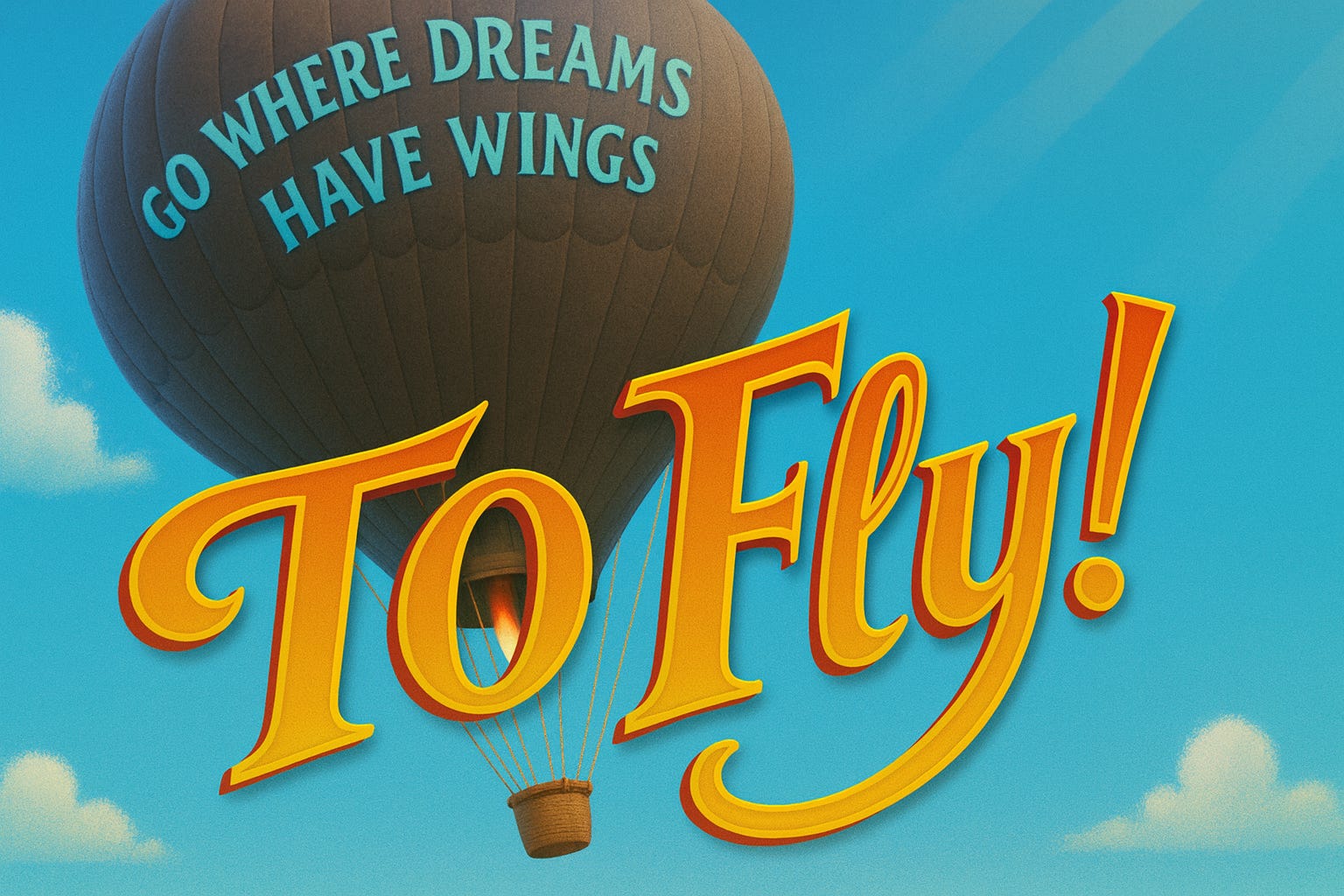
🛩️ Human aspiration and the legacy of 'To Fly!': My chat (+transcript) with filmmaker Greg MacGillivray
My fellow pro-growth/progress/abundance Up Wingers,In 1976, America celebrated 200 years of independence, democracy, and progress. Part of that celebration was the release of To Fly!, a short but powerful docudrama on the history of American flight. With To Fly!, Greg MacGillivray and his co-director Jim Freeman created one of the earliest IMAX films, bringing cinematography to new heights.After a decade of war and great social unrest, To Fly! celebrated the American identity and freedom to innovate. Today on Faster, Please! — The Podcast, I talk with MacGillivray about filming To Fly! and its enduring message of optimism.MacGillivray has produced and directed films for over 60 years. In that time, his production company has earned two Academy Award nominations, produced five of the Top 10 highest-grossing IMAX films, and has reached over 150 million viewers.In This Episode* The thrill of watching To Fly! (1:38)* An innovative filming process (8:25)* A “you can do it” movie (19:07)* Competing views of technology (25:50)Below is a lightly edited transcript of our conversation. The thrill of watching To Fly! (1:38)What Jim and I tried to do is put as many of the involving, experiential tricks into that film as we possibly could. We wrote the film based on all of these moments that we call “IMAX moments.”Pethokoukis: The film To Fly! premiered at the Smithsonian Air and Space Museum, at the IMAX Theater, July 1976. Do you happen know if it was it the 4th of July or. . . ?MacGillivray: No, you know, what they did is they had the opening on the 2nd of July so that it wouldn't conflict with the gigantic bicentennial on the 4th, but it was all part of the big celebration in Washington at that moment.I saw the film in the late ’70s at what was then called the Great America Amusement Park in Gurnee, Illinois. I have a very clear memory of this, of going in there, sitting down, wondering why I was sitting and going to watch a movie as opposed to being on a roller coaster or some other ride — I've recently, a couple of times, re-watched the film — and I remember the opening segment with the balloonist, which was shot in a very familiar way. I have a very clear memory because when that screen opened up and that balloon took off, my stomach dropped.It was a film as a thrill ride, and upon rewatching it — I didn't think this as a 10-year-old or 11-year-old — but what it reminded me upon rewatching was of Henry V, Lawrence Olivier, 1944, where the film begins in the Globe Theater and as the film goes on, it opens up and expands into this huge technicolor extravaganza as the English versus the French. It reminds me of that. What was your reaction the first time you saw that movie, that film of yours you made with Jim Freeman, on the big screen where you could really get the full immersive effect?It gave me goosebumps. IMAX, at that time, was kind of unknown. The Smithsonian Air and Space Museum was the fourth IMAX theater built, and very few people had seen that system unless you visited world's fairs around the world. So we knew we had something that people were going to grasp a hold of and love because, like you said, it's a combination of film, and storytelling, and a roller coaster ride. You basically give yourself away to the screen and just go with it.What Jim and I tried to do is put as many of the involving, experiential tricks into that film as we possibly could. We wrote the film based on all of these moments that we call “IMAX moments.” We tried to put as many in there as we could, including the train coming straight at you and bashing right into the camera where the audience thinks it's going to get run over. Those kinds of moments on that gigantic screen with that wonderful 10 times, 35-millimeter clarity really moved the audience and I guess that's why they used it at Great America where you saw it.You mentioned the train and I remember a story from the era of silent film and the first time people saw a train on silent film, they jumped, people jumped because they thought the train was coming at them. Then, of course, we all kind of got used to it, and this just occurred to me, that film may have been the first time in 75 years that an audience had that reaction again, like they did with first with silent film where they thought the train was going to come out of the screen to To Fly! where, once again, your previous experience looking at a visual medium was not going to help you. This was something completely different and your sense perception was totally surprised by it.Yeah, it's true. Obviously we were copying that early train shot that started the cinema way back in probably 1896 or 1898. You ended up with To Fly! . . . we knew we had an opportunity because the Air and Space Museum, we felt, was going to be a huge smash hit. Everyone was interested in space right at that moment. Everyone was interested in flying right at that moment. Basically, as soon as it opened its doors, the Air and Space Museum be

👶 Bracing for depopulation: My chat (+transcript) with 'After the Spike' coauthor Dean Spears
My fellow pro-growth/progress/abundance Up Wingers,Global population growth is slowing, and it’s not showing any signs of recovery. To the environmentalists of the 1970s, this may have seemed like a movement in the right direction. The drawbacks to population decline, however, are severe and numerous, and they’re not all obvious.Today on Faster, Please! — The Podcast, I talk with economist and demographer Dean Spears about the depopulation trend that is transcending cultural barriers and ushering in a new global reality. We discuss the costs to the economy and human progress, and the inherent value of more people.Spears is an associate professor of economics at Princeton University where he studies demography and development. He is also the founding executive director of r.i.c.e., a nonprofit research organization seeking to uplift children in rural northern India. He is a co-author with Michael Geruso of After the Spike: Population, Progress, and the Case for People.In This Episode* Where we’re headed (1:32)* Pumping the breaks (5:41)* A pro-parenting culture (12:40)* A place for AI (19:13)* Preaching to the pro-natalist choir (23:40)* Quantity and quality of life (28:48)Below is a lightly edited transcript of our conversation. Where we’re headed (1:32). . . two thirds of people now live in a country where the birth rate is below the two children per two adults level that would stabilize the population.Pethokoukis: Who are you and your co-author trying to persuade and what are you trying to persuade them of? Are you trying to persuade them that global depopulation is a real thing, that it's a problem? Are you trying to persuade them to have more kids? Are you trying to persuade them to support a certain set of pro-child or pro-natalist policies?Spears: We are trying to persuade quite a lot of people of two important things: One is that global depopulation is the most likely future — and what global depopulation means is that every decade, every generation, the world's population will shrink. That's the path that we're on. We're on that path because birth rates are low and falling almost everywhere. It’s one thing we're trying to persuade people of, that fact, and we're trying to persuade people to engage with a question of whether global depopulation is a future to welcome or whether we should want something else to happen. Should we let depopulation happen by default or could it be better to stabilize the global population at some appropriate level instead?We fundamentally think that this is a question that a much broader section of society, of policy discourse, of academia should be talking about. We shouldn't just be leaving this discussion to the population scientists, demographic experts, not only to the people who already are worried about, or talking about low birth rates, but this is important enough and unprecedented enough that everybody should be engaging in this question. Whatever your ongoing values or commitments, there's a place for you in this conversation.Is it your impression that the general public is aware of this phenomenon? Or are they still stuck in the ’70s thinking that population is running amok and we’ll have 30 billion people on this planet like was the scenario in the famous film, Soylent Green? I feel like the people I know are sort of aware that this is happening. I don't know what your experience is.I think it's changing fast. I think more and more people are aware that birth rates are falling. I don't think that people are broadly aware — because when you hear it in the news, you might hear that birth rates in the United States have fallen low or birth rates in South Korea have fallen low. I think what not everybody knows is that two thirds of people now live in a country where the birth rate is below the two children per two adults level that would stabilize the population.I think people don't know that the world's birth rate has fallen from an average around five in 1950 to about 2.3 today, and that it's still falling and that people just haven't engaged with the thought that there's no special reason to expect it to stop and hold it to. But the same processes that have been bringing birth rates down will continue to bring them down, and people don't know that there's no real automatic stabilizer to expect it to come back up. Of the 26 countries that have had the lifetime birth rate fall below 1.9, none of them have had it go back up to two.That's a lot of facts that are not as widely known as they should be, but then the implication of it, that if the world's birth rate goes below two and stays there, we're going to have depopulation generation after generation. I think for a lot of people, they're still in the mindset that depopulation is almost conceptually impossible, that either we're going to have population growth or something else like zero population growth like people might've talked about in the ’70s. But the idea that a growth rate of zero is just a number and
⚛️ Our fission-powered future: My chat (+transcript) with nuclear scientist and author Tim Gregory
My fellow pro-growth/progress/abundance Up Wingers,Nuclear fission is a safe, powerful, and reliable means of generating nearly limitless clean energy to power the modern world. A few public safety scares and a lot of bad press over the half-century has greatly delayed our nuclear future. But with climate change and energy-hungry AI making daily headlines, the time — finally — for a nuclear renaissance seems to have arrived.Today on Faster, Please! — The Podcast, I talk with Dr. Tim Gregory about the safety and efficacy of modern nuclear power, as well as the ambitious energy goals we should set for our society.Gregory is a nuclear scientist at the UK National Nuclear Laboratory. He is also a popular science broadcaster on radio and TV, and an author. His most recent book, Going Nuclear: How Atomic Energy Will Save the World is out now.In This Episode* A false start for a nuclear future (1:29)* Motivators for a revival (7:20)* About nuclear waste . . . (12:41)* Not your mother’s reactors (17:25)* Commercial fusion, coming soon . . . ? (23:06)Below is a lightly edited transcript of our conversation. A false start for a nuclear future (1:29)The truth is that radiation, we're living in it all the time, it's completely inescapable because we're all living in a sea of background radiation.Pethokoukis: Why do America, Europe, Japan not today get most of their power from nuclear fission, since that would've been a very reasonable prediction to make in 1965 or 1975, but it has not worked out that way? What's your best take on why it hasn't?Going back to the ’50s and ’60s, it looked like that was the world that we currently live in. It was all to play for, and there were a few reasons why that didn't happen, but the main two were Three Mile Island and Chernobyl. It's a startling statistic that the US built more nuclear reactors in the five years leading up to Three Mile Island than it has built since. And similarly on this side of the Atlantic, Europe built more nuclear reactors in the five years leading up to Chernobyl than it has built since, which is just astounding, especially given that nobody died in Three Mile Island and nobody was even exposed to anything beyond the background radiation as a result of that nuclear accident.Chernobyl, of course, was far more consequential and far more serious than Three Mile Island. 30-odd people died in the immediate aftermath, mostly people who were working at the power station and the first responders, famously the firefighters who were exposed to massive amounts of radiation, and probably a couple of hundred people died in the affected population from thyroid cancer. It was people who were children and adolescents at the time of the accident.So although every death from Chernobyl was a tragedy because it was avoidable, they're not in proportion to the mythic reputation of the night in question. It certainly wasn't reason to effectively end nuclear power expansion in Europe because of course we had to get that power from somewhere, and it mainly came from fossil fuels, which are not just a little bit more deadly than nuclear power, they’re orders of magnitude more deadly than nuclear power. When you add up all of the deaths from nuclear power and compare those deaths to the amount of electricity that we harvest from nuclear power, it's actually as safe as wind and solar, whereas fossil fuels kill hundreds or thousands of times more people per unit of power. To answer your question, it's complicated and there are many answers, but the main two were Three Mile Island and Chernobyl.I wonder how things might have unfolded if those events hadn’t happened or if society had responded proportionally to the actual damage. Three Mile Island and Chernobyl are portrayed in documentaries and on TV as far deadlier than they really were, and they still loom large in the public imagination in a really unhelpful way.You see it online, actually, quite a lot about the predicted death toll from Chernobyl, because, of course, there's no way of saying exactly which cases of cancer were caused by Chernobyl and which ones would've happened anyway. Sometimes you see estimates that are up in the tens of thousands, hundreds of thousands of deaths from Chernobyl. They are always based on a flawed scientific hypothesis called the linear no-threshold model that I go into in quite some detail in chapter eight of my book, which is all about the human health effects of exposure to radiation. This model is very contested in the literature. It's one of the most controversial areas of medical science, actually, the effects of radiation on the human body, and all of these massive numbers you see of the death toll from Chernobyl, they're all based on this really kind of clunky, flawed, contentious hypothesis. My reading of the literature is that there's very, very little physical evidence to support this particular hypothesis, but people take it and run. I don’t know if it would be too far to accuse people of

✨ AI and the future of R&D: My chat (+transcript) with McKinsey's Michael Chui
My fellow pro-growth/progress/abundance Up Wingers,The innovation landscape is facing a difficult paradox: Even as R&D investment has increased, productivity per dollar invested is in decline. In his recent co-authored paper, The next innovation revolution—powered by AI, Michael Chui explores AI as a possible solution to this dilemma.Today on Faster, Please! — The Podcast, Chui and I explore the vast potential for AI-augmented research and the challenges and opportunities that come with applying it to the real-world.Chui is a senior fellow at QuantumBlack, McKinsey’s AI unit, where he leads McKinsey research in AI, automation, and the future of work.In This Episode* The R&D productivity problem (01:21)* The AI solution (6:13)* The business-adoption bottleneck (11:55)* The man-machine team (18:06)* Are we ready? (19:33)Below is a lightly edited transcript of our conversation. The R&D productivity problem (01:21)All the easy stuff, we already figured out. So the low-hanging fruit has been picked, things are getting harder and harder.Pethokoukis: Do we understand what explains this phenomenon where we seem to be doing lots of science, and we're spending lots of money on R&D, but the actual productivity of that R&D is declining? Do we have a good explanation for that?I don't know if we have just one good explanation. The folks that we both know have been both working on what are the causes of this, as well as what are some of the potential solutions, but I think it's a bit of a hidden problem. I don't think everyone understands that there are a set of people who have looked at this — quite notably Nick Bloom at Stanford who published this somewhat famous paper that some people are familiar with. But it is surprising in some sense.At one level, it's amazing what science and engineering has been able to do. We continue to see these incredible advances, whether it's in AI, or biotechnology, or whatever; but also, what Nick and other researchers have discovered is that we are producing less for every dollar we spend in R&D. That's this little bit of a paradox, or this challenge, that we see. What some of the research we've been trying to do is understand, can AI try to contribute to bending those curves?. . . I'm a computer scientist by training. I love this idea of Moore's Law: Every couple of years you can double the number of transistors you can put on a chip, or whatever, for the same amount of money. There's something called “Eroom's Law,” which is Moore spelled backwards, and basically it said: For decades in the pharmaceutical industry, the number of compounds or drugs you would produce for every billion dollars of R&D would get cut in half every nine years. That's obviously moving in the wrong direction. That challenge, I don't think everyone is aware of, but one that we need to address.I suppose, in a way, it does make sense that as we tackle harder problems, and we climb the tree of knowledge, that it's going to take more time, maybe more researchers, the researchers themselves may have to spend more time in school, so it may be a bit of a hidden problem, but it makes some intuitive sense to me.I think there's a way to think about it that way, which is: All the easy stuff, we already figured out. So the low-hanging fruit has been picked, things are getting harder and harder. It's amazing. You could look at some of the early papers in any field and it have a handful of authors, right? The DNA paper, three authors — although it probably should have included Rosalyn Franklin . . . Now you look at a physics paper or a computer science paper — the author list just goes on sometimes for pages. These problems are harder. They require more and more effort, whether it's people's talents, or whether it's computing power, or large-scale experiments, things are getting harder to do. I think there's ways in which that makes sense. Are there other ways in which we could improve processes? Probably, too.We could invest more in research, make it more efficient, and encourage more people to become researchers. To me, what’s more exciting than automating different customer service processes is accelerating scientific discovery. I think that’s what makes AI so compelling.That is exactly right. Now, by the way, I think we need to continue to invest in basic research and in science and engineering, I think that's absolutely important, but —That's worth noting, because I'm not sure everybody thinks that, so I'm glad you highlighted that.I don't think AI means that everything becomes cheaper and we don't need to invest in both human talent as well as in research. That's number one.Number two, as you said, we spend a lot of time, and appropriately so, talking about how AI can improve productivity, make things more efficient, do the things that we do already cheaper and faster. I think that's absolutely true. But we had the opportunity to look over history, and what has actually improved the human condition, what has been one of

📊 The US economy at midyear: My chat (+transcript) with economic analyst Joey Politano
My fellow pro-growth/progress/abundance Up Wingers,With tariff and immigration policies uncertain, and the emerging AI revolution continuing to emerge, there’s plenty to speculate about when it comes to the US economy. Today on Faster, Please! — The Podcast, I invite Joseph Politano to help us try and make sense of it all.He is the author of the popular Apricitas Economics Substack newsletter. Politano previously worked as an analyst at the Bureau of Labor Statistics.In This Episode* Trade and immigration headwinds (1:03)* Unpredictable trade policy (7:32)* Tariffs as a political tool (12:10)* The goal: higher tariffs (17:53)* An AI tailwind (20:42)Below is a lightly edited transcript of our conversation. Trade and immigration headwinds (1:03)You're going to have what is probably the largest one-year change in immigration in US history.Pethokoukis: What are the main economic headwinds that you're tracking right now? Or is it just trade, trade, trade?Politano: It’s hard for me to not say it’s trade, trade, trade because that's what my newsletter has been covering since the start of this administration and I think it's where the biggest change in longstanding policy is. If you look back on, say, the last 100 years of economic history in the United States, that's the kind of level you have to go to find a similar period where tariffs and trade restrictions were this high in the United States.At the start of this year, we were at a high compared to the early 2000s, but it was not that large compared to the 1970s, 1960s, the early post-war era. Most of that, especially in Trump's first term, was concentrated in China, and then a couple of specific sectors like steel or cars from Mexico. Now we have one, you had the big jump in the baseline — there's ten percent tariffs on almost all goods that come to the United States, with some very important exceptions, but ten percent for most things that go into the US. Then, on top of that, you have very large tariffs on, say, cars are 25 percent, steel and aluminum right now are 50 percent. China was up to 20 percent then went to the crazy 150 percent tariffs we had for about a month, and now it's back down to only 30 percent. That's still the highest trade war in American history. I think that is a big headwind.The headwind that I don't spend as much time covering, just because it's more consistent policy — even if it is, in my opinion, bad policy — is on the immigration stuff. You're going to have what is probably the largest one-year change in immigration in US history. So we're going to go from about 2.8 million net immigration to a year, to people like Stan Veuger projecting net-zero immigration this year in the United States, which would be not entirely unprecedented — but again, the biggest shift in modern American history. I think those are the two biggest headwinds for the US economy right now.You’re highlighting two big drivers of the US economy: trade and immigration. But analyzing them is tricky because recent examples are limited. To understand the effects of these changes, you often have to look back 50 or 100 years, when the economic landscape was very different. I would think that would make drawing clear conclusions more difficult and pose a real challenge for you as an analyst.Again, I'm going to start with trade because that's where I focused a lot of my energy here, but the key thing I’m trying to communicate to people — when people think of the protectionist era in US history, the number one thing people think about is Smoot-Hawley, which were the very large tariffs right before the Great Depression — in my opinion, obviously did not cause the Great Depression, but were part of the bad policy packages that exacerbated the Great Depression. That is an era in which one, the US is not a big net importer to the same degree; and two, trade was just a much smaller share of the economy, even though goods were a much larger share of the economy.This is pre- the really big post-war globalization and pre- the now technology-era globalization. So if you're doing tariffs in 1930 or prior, you're hitting a more important sector. Manufacturing is a much larger share of the economy, construction is a larger share of the economy, but conversely, you're hitting it less hard. And now you have this change of going from a globalized world in which trade is a much larger share of GDP and hitting that with very large tariffs.The immigration example is hard to find. I think the gap is America has not done . . . let's call it extensive interior enforcement in a long time. There's obviously been changes to immigration policy. Legally the tariffs have gone up. Legally, lot of immigration policy has not changed. We don't pass bills on immigration in the same way. We don't pass bills on tariffs, but we do pass bills on tax policy. So immigration has changed mostly through the enforcement mechanisms, primarily at the border, and then secondarily, but I think this is the bigger ch
🎇 An age of transformation: My chat (+transcript) with techno-futurist Peter Leyden
My fellow pro-growth/progress/abundance Up Wingers,The 1990s and the dawn of the internet were a pivotal time for America and the wider world. The history of human progress is a series of such pivotal moments. As Peter Leyden points out, it seems we’re facing another defining era as society wrestles with three new key technologies: artificial intelligence, clean energy, and bioengineering.Today on Faster, Please! — The Podcast, I chat with Leyden about American leadership in emerging technology and the mindset shifts we must undergo to bring about the future we dream of.Leyden is a futurist and technology expert. He is a speaker, author, and founder of Reinvent Futures. Thirty years ago, he worked with the founders of WIRED magazine, and now authors his latest book project via Substack: The Great Progression: 2025 to 2050.In This Episode* Eras of transformation (1:38)* American risk tolerance (11:15)* Facing AI pessimism (15:38)* The bioengineering breakthrough (24:24)* Demographic pressure (28:52)Below is a lightly edited transcript of our conversation. Eras of transformation (1:38)I think we Americans tend to reset the clock in which we get in these dead ends, we get in these old patterns, these old systems, and the things are all falling apart, it's not working. And then there is a kind of a can-do reinvention phase . . .Pethokoukis: Since World War II, as I see it, we have twice been on the verge of a transformational leap forward, economically and technologically. I would say that was right around 1970 and then right around 2000, and the periods of time after that, I think, certainly relative to the expectations then, was disappointing.It is my hope, and I know it's your hope as well, that we are at another such moment of transformation. One, do you accept my general premise, and two, why are we going to get it right this time?If I'm hearing you right, you're kind of making two junctures there. I do believe we're in the beginning of what would be much more thought of as a transformation. I would say the most direct parallel is closer to what happened coming off of World War II. I also think, if you really go back in American history, it's what came off of Civil War and even came off of the Founding Era. I think there's a lot of parallels there I can go into, I've written about in my Substack and it's part of the next book I'm writing, so there's a bigger way that I think about it. I think both those times that you're referring to, it seems to me we were coming off a boom, or what seemed to be an updraft or your “Up Wing” kind of periods that you think of — and then we didn't.I guess I think of it this way: the ’50s, ’60s, and ’90s were exciting times that made it feel like the best was yet to come — but then that momentum stalled. I’m hopeful we’re entering another such moment now, with so much happening, so much in motion, and I just hope it all comes together.The way I think about it in a bigger lens, I would just push back a little bit, which is, it's true coming off the ’90s — I was at WIRED magazine in the ’90s. I was watching the early ’90s internet and the Digital Revolution and I sketched out at that time, in my first book but also cover stories in WIRED, trying to rough out what would happen by the year 2020. And it is true that coming off the ’90s there was a Dot Com crash, but temporarily, honestly, that with the Web 2.0 and others, a lot of those trends we were talking about in the ’90s actually just kept picking up.So depending how big the lens is, I would argue that, coming off the ’90s, the full digital revolution and the full globalization that we were starting to see in the early to mid-’90s in some respects did come to fruition. It didn't play out the way we all wanted it to happen — spreading wealth all through the society and blah, blah, blah, and many of the things that people complain about and react to now — but I would argue that a lot of what we were saying in those ’90s, and had begun in the ’90s with the ’90s boom, continued after a temporary pause, for sure.The Dot Com boom was just frothy investment. It crashed, but the companies that come out of that crash are literally trillion-dollar companies dominating the global economy now here on the west coast. That was some of the things we could see happening from the mid-’90s. The world did get connected through the internet, and globalization did, from a lens that's beyond America, we took 800 million peasants living on two bucks a day in China and brought them into the global economy. There's all kinds of positive things of what happened in the last 25 years, depending on how big your lens is.I would say that we've been through a largely successful — clearly some issues, “Oh my gosh, we didn't anticipate social media and that stuff,” but in general, the world that we were actually starting to envision in the ’90s came about, at some level — with some flaws, and some issues, and we could have done better, but I'm saying now I t

✨ 🧬 When AI meets biotechnology: My chat (+transcript) with techno-futurist Jamie Metzl
My fellow pro-growth/progress/abundance Up Wingers,Once-science-fiction advancements like AI, gene editing, and advanced biotechnology have finally arrived, and they’re here to stay. These technologies have seemingly set us on a course towards a brand new future for humanity, one we can hardly even picture today. But progress doesn’t happen overnight, and it isn’t the result of any one breakthrough.As Jamie Metzl explains in his new book, Superconvergence: How the Genetics, Biotech, and AI Revolutions will Transform our Lives, Work, and World, tech innovations work alongside and because of one another, bringing about the future right under our noses.Today on Faster, Please! — The Podcast, I chat with Metzl about how humans have been radically reshaping the world around them since their very beginning, and what the latest and most disruptive technologies mean for the not-too-distant future.Metzl is a senior fellow of the Atlantic Council and a faculty member of NextMed Health. He has previously held a series of positions in the US government, and was appointed to the World Health Organization’s advisory committee on human genome editing in 2019. He is the author of several books, including two sci-fi thrillers and his international bestseller, Hacking Darwin.In This Episode* Unstoppable and unpredictable (1:54)* Normalizing the extraordinary (9:46)* Engineering intelligence (13:53)* Distrust of disruption (19:44)* Risk tolerance (24:08)* What is a “newnimal”? (13:11)* Inspired by curiosity (33:42)Below is a lightly edited transcript of our conversation. Unstoppable and unpredictable (1:54)The name of the game for all of this . . . is to ask “What are the things that we can do to increase the odds of a more positive story and decrease the odds of a more negative story?”Pethokoukis: Are you telling a story of unstoppable technological momentum or are you telling a story kind of like A Christmas Carol, of a future that could be if we do X, Y, and Z, but no guarantees?Metzl: The future of technological progress is like the past: It is unstoppable, but that doesn't mean it's predetermined. The path that we have gone over the last 12,000 years, from the domestication of crops to building our civilizations, languages, industrialization — it's a bad metaphor now, but — this train is accelerating. It's moving faster and faster, so that's not up for grabs. It is not up for grabs whether we are going to have the capacities to engineer novel intelligence and re-engineer life — we are doing both of those things now in the early days.What is up for grabs is how these revolutions will play out, and there are better and worse scenarios that we can imagine. The name of the game for all of this, the reason why I do the work that I do, why I write the books that I write, is to ask “What are the things that we can do to increase the odds of a more positive story and decrease the odds of a more negative story?”Progress has been sort of unstoppable for all that time, though, of course, fits and starts and periods of stagnation —— But when you look back at those fits and starts — the size of the Black Plague or World War II, or wiping out Berlin, and Dresden, and Tokyo, and Hiroshima, and Nagasaki — in spite of all of those things, it's one-directional. Our technologies have gotten more powerful. We've developed more capacities, greater ability to manipulate the world around us, so there will be fits and starts but, as I said, this train is moving. That's why these conversations are so important, because there's so much that we can, and I believe must, do now.There’s a widely held opinion that progress over the past 50 years has been slower than people might have expected in the late 1960s, but we seem to have some technologies now for which the momentum seems pretty unstoppable.Of course, a lot of people thought, after ChatGPT came out, that superintelligence would happen within six months. That didn’t happen. After CRISPR arrived, I’m sure there were lots of people who expected miracle cures right away.What makes you think that these technologies will look a lot different, and our world will look a lot different than they do right now by decade’s end?They certainly will look a lot different, but there's also a lot of hype around these technologies. You use the word “superintelligence,” which is probably a good word. I don't like the words “artificial intelligence,” and I have a six-letter framing for what I believe about AGI — artificial general intelligence — and that is: AGI is BS. We have no idea what human intelligence is, if we define our own intelligence so narrowly that it's just this very narrow form of thinking and then we say, “Wow, we have these machines that are mining the entirety of digitized human cultural history, and wow, they're so brilliant, they can write poems — poems in languages that our ancestors have invented based on the work of humans.” So we humans need to be very careful not to belittle ourselves.But

🚀 NASA and the New Space Age: My chat (+transcript) with James Meigs
My fellow pro-growth/progress/abundance Up Wingers,America is embarking upon a New Space Age, with companies like SpaceX and Blue Origin ready to partner with NASA to take Americans to a new frontier — possibly as far as Mars. Lately, however, the world is witnessing uncertainty surrounding NASA leadership and even an odd feud between SpaceX boss Elon Musk and the White House. At a critical time for US space competition, let’s hope key players can stick the landing.Today on Faster, Please! — The Podcast, I chat with James Meigs about the SLS rocket, NASA reforms, and the evolving private sector landscape.Meigs is a senior fellow at the Manhattan Institute. He is a contributing editor of City Journal and writer of the Tech Commentary column at Commentary magazine. He is also the former editor of Popular Mechanics.Meigs is the author of a recent report from the Manhattan Institute, U.S. Space Policy: The Next Frontier.In This Episode* So long, Jared Isaacman (1:29)* Public sector priorities (5:36)* Supporting the space ecosystem (11:52)* A new role for NASA (17:27)* American space leadership (21:17)Below is a lightly edited transcript of our conversation. So long, Jared Isaacman (1:29)The withdrawal of Jared Isaacman . . . has really been met with total dismay in the space community. Everyone felt like he was the right kind of change agent for the agency that desperately needs reform, but not destruction.Pethokoukis: We're going to talk a lot about your great space policy report, which you wrote before the withdrawal of President Trump's NASA nominee, Jared Isaacman.What do you think of that? Does that change your conclusions? Good move, bad move? Just sort of your general thoughts apart from the surprising nature of it.Meigs: I worked sort of on and off for about a year on this report for the Manhattan Institute about recommendations for space policy, and it just came out a couple of months ago and already it's a different world. So much has happened. The withdrawal of Jared Isaacman — or the yanking of his nomination — has really been met with total dismay in the space community. Everyone felt like he was the right kind of change agent for the agency that desperately needs reform, but not destruction.Now, it remains to be seen what happens in terms of his replacement, but it certainly pulled the rug out from under the idea that NASA could be reformed and yet stay on track for some ambitious goals. I'm trying to be cautiously optimistic that some of these things will happen, but my sense is that the White House is not particularly interested in space.Interestingly, Musk wasn't really that involved in his role of DOGE and stuff. He didn't spend that much time on NASA. He wasn't micromanaging NASA policy, and I don't think Isaacman would've been just a mouthpiece for Musk either. He showed a sense of independence. So it remains to be seen, but my recommendations . . . and I share this with a lot of people advocating reform, is that NASA more or less needs to get out of the rocket-building business, and the Space Launch System, this big overpriced rocket they've been working on for years — we may need to fly it two more times to get us back to the moon, but after that, that thing should be retired. If there's a way to retire it sooner, that would be great. At more than $4 billion a launch, it's simply not affordable, and NASA will not be an agency that can routinely send people into space if we're relying on that white elephant.To me what was exciting about Isaacman was his genuine enthusiasm about space. It seemed like he understood that NASA needed reform and changes to the budget, but that the result would be an agency that still does big things. Is there a fear that his replacement won’t be interested in NASA creative destruction, just destruction?We don't know for sure, but the budget that's been proposed is pretty draconian, cutting NASA's funding by about a quarter and recommending particularly heavy cuts in the science missions, which would require cutting short some existing missions that are underway and not moving ahead with other planned missions.There is room for saving in some of these things. I advocate a more nimble approach to NASA's big science missions. Instead of sending one $4 billion rover to Mars every 20 years, once launch costs come down, how about we send ten little ones and if a couple of them don't make it, we could still be getting much more science done for the same price or less. So that's the kind of thing Isaacman was talking about, and that's the kind of thing that will be made possible as launch costs continue to fall, as you've written about, Jim. So it requires a new way of thinking at NASA. It requires a more entrepreneurial spirit and it remains to be seen whether another administrator can bring that along the way. We were hoping that Isaacman would.Public sector priorities (5:36)Congress has never deviated from focusing more on keeping these projects alive than on whether
🤖 Superintelligence and national security: My chat (+transcript) with AI expert Dan Hendrycks
My fellow pro-growth/progress/abundance Up Wingers,As we seemingly grow closer to achieving artificial general intelligence — machines that are smarter than humans at basically everything — we might be incurring some serious geopolitical risks.In the paper Superintelligence Strategy, his joint project with former Google CEO Eric Schmidt and Alexandr Wang, Dan Hendrycks introduces the idea of Mutual Assured AI Malfunction: a system of deterrence where any state’s attempt at total AI dominance is sabotaged by its peers. From the abstract: Just as nations once developed nuclear strategies to secure their survival, we now need a coherent superintelligence strategy to navigate a new period of transformative change. We introduce the concept of Mutual Assured AI Malfunction (MAIM): a deterrence regime resembling nuclear mutual assured destruction (MAD) where any state’s aggressive bid for unilateral AI dominance is met with preventive sabotage by rivals. Given the relative ease of sabotaging a destabilizing AI project—through interventions ranging from covert cyberattacks to potential kinetic strikes on datacenters—MAIM already describes the strategic picture AI superpowers find themselves in. Alongside this, states can increase their competitiveness by bolstering their economies and militaries through AI, and they can engage in nonproliferation to rogue actors to keep weaponizable AI capabilities out of their hands. Taken together, the three-part framework of deterrence, nonproliferation, and competitiveness outlines a robust strategy to superintelligence in the years ahead.Today on Faster, Please! — The Podcast, I talk with Hendrycks about the potential threats posed by superintelligent AI in the hands of state and rogue adversaries, and what a strong deterrence strategy might look like.Hendrycks is the executive director of the Center for AI Safety. He is an advisor to Elon Musk’s xAI and Scale AI, and is a prolific researcher and writer.In This Episode* Development of AI capabilities (1:34)* Strategically relevant capabilities (6:00)* Learning from the Cold War (16:12)* Race for strategic advantage (18:56)* Doomsday scenario (28:18)* Maximal progress, minimal risk (33:25)Below is a lightly edited transcript of our conversation. Development of AI capabilities (1:34). . . mostly the systems aren't that impressive currently. People use them to some extent, but I'd more emphasize the trajectory that we're on rather than the current capabilities.Pethokoukis: How would you compare your view of AI . . . as a powerful technology with economic, national security, and broader societal implications . . . today versus November of 2022 when OpenAI rolled out ChatGPT?Hendrycks: I think that the main difference now is that we have the reasoning paradigm. Back in 2022, GPT couldn't think for an extended period of time before answering and try out multiple different ways of dissolving a problem. The main new capability is its ability to handle more complicated reasoning and science, technology, engineering, mathematics sorts of tasks. It's a lot better at coding, it's a lot better at graduate school mathematics, and physics, and virology.An implication of that for national security is that AIs have some virology capabilities that they didn't before, and virology is dual-use that can be used for civilian applications and weaponization applications. That's a new concerning capability that they have, but I think, overall, the AI systems are still fairly similar in their capabilities profile. They're better in lots of different ways, but not substantially.I think the next large shift is when they can be agents, when they can operate more autonomously, when they can book you flights reliably, make PowerPoints, play through long-form games for extended periods of time, and that seems like it's potentially on the horizon this year. It didn't seem like that two years ago. That's something that a lot of people are keeping an eye on and think could be arriving fairly soon. Overall, I think the capabilities profile is mostly the same except now it has some dual-use capabilities that they didn't have earlier, in particular virology capabilities.To what extent are your national security concerns based on the capabilities of the technology as it is today versus where you think it will be in five years? This is also a way of me asking about the extent that you view AGI as a useful framing device — so this is also a question about your timeline.I think that mostly the systems aren't that impressive currently. People use them to some extent, but I'd more emphasize the trajectory that we're on rather than the current capabilities. They still can't do very interesting cyber offense, for instance. The virology capabilities is very recent. We just, I think maybe a week ago, put out a study with SecureBio from MIT where we had Harvard, MIT virology postdocs doing wet lab skills, trying to work on viruses. So, “Here's a picture of my petri dish, I h

🗽 America's immigration edge: My chat (+transcript) with policy expert Alex Nowrasteh
My fellow pro-growth/progress/abundance Up Wingers,With the rise of American populist nationalism has come the rise of nativism: a belief in the concept of “heritage Americans” and a deep distrust of immigration. Today on Faster, Please! — The Podcast, I talk with Alex Nowrasteh about the ideology beneath this severe skepticism, as well as what Americans lose economically if we shut our doors to both low- and high-skilled immigrants.Nowrasteh is the vice president for economic and social policy studies at the Cato Institute. He is the author of his own Substack with David Bier, as well as the co-author of Wretched Refuse? The Political Economy of Immigration and Institutions.Read more of Nowrasteh’s work on immigration, nationalism, and other research.In This Episode* Illegal immigration (1:16)* Rise of xenophobia (3:48)* Psychology of immigration skeptics (9:20)* The future American workforce (14:04)* Population decline and assimilation (17:35)Below is a lightly edited transcript of our conversation. Illegal immigration (1:16)The system that I would favor is one that allows a substantially larger number of people at every skill level to come into this country legally, to work, to live, and to become Americans . . . because this country demands their labor and there's no way for them to come legally.Pethokoukis: Will you, in a very short period of time, give me a sense of the situation at the southern border of the United States of America in terms of immigration, how that has evolved from Trump 1, to Biden, to now? Is it possible to give me a concise summary of that?Nowrasteh: From Obama through Trump 1, the border apprehension numbers were pretty reasonable, you were talking about somewhere between 400,000 and 800,000 per year. Then came Covid, crashed those numbers down to basically nothing by April of 2020.After that, the numbers progressively rose. They were at the highest point in December of 2020 than they had been for any other December going back over 25 years. Then Biden takes office, the numbers shoot through the roof. We're talking about 170,000 to 250,000, sometimes 300,000 a month until January or so of 2024; those numbers start coming down precipitously. December of 2024, they're at 40,000 or so, 45,000. January 2025, Trump comes in, they go down again. First full month of Trump's administration in February, they're about 8,000, the lowest numbers without a pandemic in a very long time.What's the right number?That's a hard question to answer? In an ideal world where costs and benefits didn't matter, I think the ideal number is zero. But the question is how do you get to that ideal number, right? Is it by having an insane amount of enforcement, of existing laws where you basically end up brutalizing people to an incredible extent? Or is it practically zero because we let people come in lawfully to work in this country. The system that I would favor is one that allows a substantially larger number of people at every skill level to come into this country legally, to work, to live, and to become Americans, and that would bring that number down to about what it is now or even lower than what it is now every month, because the reason people come illegally is because this country demands their labor and there's no way for them to come legally.Rise of xenophobia (3:48). . . I just don't think the economic argument is what moves people on this topic.As I’ve understood it, and maybe understand it wrong, is this issue has developed that — at first it seemed like the concern, and it still is the concern, was with illegal undocumented immigrants. And then it seems to me the argument became, “Well, we don't want those, and then we also really don't want low-skill immigrants either.” And now it seems, and maybe you have a different perspective, that it's, “Well, we don't really want those high-skill immigrants either.”You gave me the current state of illegal immigration at the southern border. What is the current state of the argument among people who want less, perhaps even no immigration in this country?State of the argument is actually what you described. When I started working on this topic about 15 years ago, I never thought I would've heard people come out against the H-1B visa, or against high-skilled immigrants, or against foreign entrepreneurs. But you saw this over Christmas actually, December of 2024. You saw this basically online “H-1 B-gate” where Vivek Ramaswamy and Elon Musk were saying H-1Bs are great. I think Musk had tweeted, “over my dead body we're going to cut the H-1B,” right? And you see this groundswell of conservatives and Republicans — not all of them, by any means — come out and say, “We don't even want these guys. We don't want these skilled immigrants,” using a whole range of arguments. None of them economic, by the way. Almost none of them economics; all culture, all voting habits, all stereotypes, a lot of them pretty nasty in my opinion.So there is this sense where some peopl

🌾 Land of plenty: My chat (+transcript) with science journalist Charles C. Mann on the agricultural history you never learned
In the 1960s, a deep anxiety set in as one thing became seemingly clear: We were headed toward population catastrophe. Paul Ehrlich’s “The Population Bomb” and “The Limits to Growth,” written by the Club of Rome, were just two publications warning of impending starvation due to simply too many humans on the earth.As the population ballooned year by year, it would simply be impossible to feed everyone. Demographers and environmentalists alike held their breath and braced for impact.Except that we didn’t starve. On the contrary, we were better fed than ever.In his article in The New Atlantis, Charles C. Mann explains that agricultural innovation — from improved fertilization and irrigation to genetic modification — has brought global hunger to a record low.Today on Faster, Please! — The Podcast, I chat with Mann about the agricultural history they didn’t teach you in school.Mann is a science journalist who has worked as a correspondent for The Atlantic, Science, and Wired magazines, and whose work has been featured in many other major publications. He is also the author of 1491: New Revelations of the Americas Before Columbus and1493: Uncovering the New World Columbus Created, as well as The Wizard and the Prophet: Two Remarkable Scientists and Their Dueling Visions to Shape Tomorrow’s World.In This Episode* Intro to the Agricultural Revolution (2:04)* Water infrastructure (13:11)* Feeding the masses (18:20)* Indigenous America (25:20)Below is a lightly edited transcript of our conversation. Intro to the Agricultural Revolution (2:04)I don't think that people realize that the fact that most people on earth, almost the average person on earth, can feed themselves is a novel phenomenon. It's something that basically wasn't true since as far back as we know.Pethokoukis: What got my attention was a couple of pieces that you've worked on for The New Atlantis magazine looking at the issue of how modern Americans take for granted the remarkable systems and infrastructure that provide us comfort, safety, and a sense of luxury that would've been utterly unimaginable even to the wealthiest people of a hundred years ago or 200 years ago.Let me start off by asking you: Does it matter that we do take that for granted and that we also kind of don't understand how our world works?Mann: I would say yes, very much. It matters because these systems undergird the prosperity that we have, the good fortune that we have to be alive now, but they're always one generation away from collapse. If they aren't maintained, upgraded and modernized, they'll fall apart. They just won't stand there. So we have to be aware of this. We have to keep our eye on the ball, otherwise we won't have these things.The second thing is that, if we don't know how our society works, as citizens, we're simply not going to make very good choices about what to do with that society. I feel like both sides in our current political divide are kind of taking their eye off the ball. It's important to have good roads, it's important to have clean water, it's important to have a functioning public health system, it's important to have an agricultural system that works. It doesn't really matter who you are. And if we don't keep these things going, life will be unnecessarily bad for a lot of people, and that's just crazy to do.Is this a more recent phenomenon? If I would've asked people 50 years ago, “Explain to me how our infrastructure functions, how we get water, how we get electricity,” would they have a better idea? Is it just because things are more complicated today that we have no idea how our food gets here or why when we turn the faucet, clean water comes out?The answer is “yes” in a sort of trivial sense, in that many more people were involved in producing food, a much greater percentage of the population was involved in producing food 50 years ago. The same thing was true for the people who were building infrastructure 50 years ago.But I also think it's generally true that people's parents saw the change and knew it. So that is very much the case and, in a sense, I think we're victims of our own success. These kinds of things have brought us so much prosperity that we can afford to do crazy things like become YouTube influencers, or podcasters, or freelance writers. You don't really have any connection with how the society goes because we're sort of surfing on this wave of luxury that our ancestors bequeathed to us.I don't know how much time you spend on social media, Charles — I'm sure I spend too much — but I certainly sense that many people today, younger people especially, don't have a sense of how someone lived 50 years ago, 100 years ago, and there was just a lot more physical suffering. And certainly, if you go back far enough, you could not take for granted that you would have tomatoes in your supermarket year round, that you would have water in the house and that water would be clean. What I found really interesting — you did a piece on food and a
🚀 Mars or bust! My chat (+transcript) with aerospace engineer Robert Zubrin
In his famous 1962 address to Rice University, President Kennedy declared,We choose to go to the moon in this decade and do the other things, not because they are easy, but because they are hard . . .The current administration has chosen, among other things, to go to Mars. Some, Elon Musk included, are looking for a backup planet to Earth. For others, like Robert Zubrin, Mars is an opportunity for scientific discovery, pure challenge, and a revitalized human civilization.Today on Faster, Please — The Podcast, Zubrin and I discuss how to reorient NASA, what our earliest Mars missions can and should look like, and why we should go to Mars at all.Zubrin is the president of aerospace R&D company Pioneer Astronautics, as well as the founder and president of the Mars Society. He was also formerly a staff engineer at Lockheed Martin. He has authored over 200 published papers and is the author of seven books, including the most recent, The New World on Mars: What We Can Create on the Red Planet.For more, check out Zubrin’s article in The New Atlantis, “The Mars Dream is Back — Here’s How to Make It Actually Happen.”In This Episode* Colonization vs. exploration (1:38)* A purpose-driven mission (5:01)* Cultural diversity on Mars (12:07)* An alternative to the SpaceX strategy (16:02)* Artemis program reform (20:42)* The myth of an independent Mars (24:17)* Our current timeline (27:21)Below is a lightly edited transcript of our conversation. Colonization vs. exploration (1:38)I do think that it is important that the first human mission to ours be a round-trip mission. I want to have those people back, not just because it's nice to have them back, but I want to hear from them. I want to get the full report.Pethokoukis: Just before we started chatting, I went and I checked an online prediction market — one I check for various things, the Metaculus online prediction market — and the consensus forecast from all the people in that community for when will the first humans land successfully on Mars was October 2042. Does that sound realistic, too soon, or should it be much further away?I think it is potentially realistic, but I think we could beat it. Right now we have a chance to get a Humans to Mars program launched. This current administration has announced that they intend to do so. They're making a claim they’re going to land people on Mars in 2028. I do not think that is realistic, but I do believe that it is realistic for them to get the program well started and, if it is handled correctly — and we'll have to talk a lot more about that in this talk — that we could potentially land humans on Mars circa 2033.When I gave you that prediction and then you mentioned the 2020s goal, those are about landing on Mars. Should we assume when people say, “We're going to land on Mars,” they also mean people returning from Mars or are they talking about one-way trips?Musk has frequently talked about a colonization effort, and colonization is a one-way trip, but I don't think that's in the cards for 2028 or 2033. I think what is in the cards for this time period on our immediate horizon is exploration missions. I do think that we could potentially have a one-way mission with robots in 2028. That would take a lot of work and it's a bit optimistic, but I think it could be done with determination, and I think that should be done, actually.To be clear, when people are talking about the first human mission to Mars, the assumption is it's not a one way trip for that astronaut, or those two astronauts, that we intend on bringing them back. Maybe the answer is obvious, but I'm not sure it's obvious to me.From time to time, people have proposed scenarios where the first human mission to Mars is a one-way mission, you send maybe not two but five people. Then two years later you send five more people, and then you send 10 people, and then you send 20 people, and you build it up. In other words, it's not a one-way mission in the sense of you're going to be left there and your food will then run out and you will die. No, I don't think that is a credible or attractive mission plan, but the idea that you're going to go with a few people and then reinforce them and grow it into a base, and then a settlement. That is something that can be reasonably argued. But I still think even that is a bit premature. I do think that it is important that the first human mission to ours be a round-trip mission. I want to have those people back, not just because it's nice to have them back, but I want to hear from them. I want to get the full report.A purpose-driven mission (5:01)In the purpose-driven mode, the purpose comes first, you spend money to do things. In the vendor-driven mode, you do things in order to spend money. And we've seen both of these.So should we just default to [the idea] that this mission will be done with government funding on SpaceX rockets, and this will be a SpaceX trip? That's by far the most likely scenario? This is going to need to be a

📈 Back to the Nineties? My chat (+transcript) with economist Skanda Amarnath on the 2020s productivity outlook
The American economy is growing, and, in many ways, it’s looking a lot like the 1990s. Upward trends in productivity growth and employment paired with downward trends in inflation are cause for optimism. The question is whether we will maintain this trajectory or be derailed by this emerging era of uncertainty.Today on Faster, Please! — The Podcast, I talk with Skanda Amarnath about trade policy, fiscal and monetary policy, AI advancement, demographic trends, and how all of this bodes for the US economy.Amarnath is the Executive Director of Employ America, a macroeconomic policy research and advocacy organization. He was previously vice president at MKP Capital Management, as well as an analyst at the Federal Reserve Bank of New York.In This Episode* The boomy ’90s (1:24)* Drivers of growth (7:24)* The boomy ’20s? (11:38)* Full employment and the Fed (22:03)* Demographics in the data (25:37)* Policies for productivity (27:55)Below is a lightly edited transcript of our conversation. The boomy ’90s (1:24)The ’90s stand out as a high productivity growth, low inflation, high employment economy, especially if we look at the years 1996 to the year 2000.Pethokoukis: What got me really excited about all the great work that Employ America puts out was one particular report that I think came out late last year called “The Dream of the 90’s is Alive in 2024,” and hopefully it's still alive in 2025. By ’90s of course you mean the 1990s.Let me start off by asking you: What was so awesome about the 1990s that it is worth writing about a dream of its return?Amarnath: The 1990s — if you're a macroeconomist, at least — had pitch-perfect conditions. Employment was reasonably high, we achieved the highest levels of prime-age employment relative to the population. We had low and declining inflation, and that variable that we use to say, this is the driver of welfare over time, productivity outcomes, the amount of output we can spin up from finite inputs, was also growing at a very strong rate, and one that we haven't really seen replicated since or really in the decades before.The ’90s stand out as a high productivity growth, low inflation, high employment economy, especially if we look at the years 1996 to the year 2000. We'd had high productivity maybe even afterwards . . . but that was also a period where a lot of that productivity was gained from the recession. When employment falls really quickly, productivity can go up for illusory reasons, but it's really that ’90s sweet spot where everything was kind of moving in the right direction.Obviously, over the last several years, we've seen a lot of those different challenges flare up, whether it was employment during Covid, but then also inflation over the last few years. So . . . a model to build towards, in some ways.Some of us — not me, and I don't think you — remember the very boomy immediate post-war decades. Probably many more of us remember the go-go 1990s. One thing I always find interesting is how gloomy people were in those years right before the takeoff, which is a wonderful contrarian indicator that we had this period [when] we appeared to have won the Cold War but we had a nasty recession early in the decade, kind of a choppy recovery, and there was plenty of gloom that the days of fast growth were over. And just as we sort of reached the nadir in our attitudes, boy, things took off. So maybe that's a good omen for right nowIf we're a contrarian, and if the past can be present, maybe that is a positive indicator to consider. In some ways, it's a bit surprising how much you hear the talk about growth [being] stuck in a very low-growth environment. Over the last two years, we have seen above-trend real GDP growth, above-trend productivity growth. We're going to get some productivity data revisions tomorrow. Again, this measure of productivity is output per hour, so it's basically, to a first approximation, real GDP divided by hours worked. We've seen that the labor market has, largely speaking, held itself up over the last few years, and yet, at the same time, real output has accelerated.So that's at least something that suggests better things are possible. It's a sign that productivity can accelerate, and with the benefit of revisions tomorrow, we are likely to see at least . . . I'd say if you take a fair reading of the pre-pandemic trend on productivity growth, so five to 15 years, maybe you want to include the financial crisis and what happened before, maybe you don't, but you end up with something like 1.4 percent is what we were seeing. 1.4, maybe 1.45, that's a pretty generous view of pre-pandemic productivity growth.I would like to do better than that going forward.I would too. And since 2019 Q4, with the benefit of data revisions, until now, we're likely to see something like 1.9 percent — 50 basis points higher, 0.5 percent higher, we could ideally like to do even better than that. But it's 0.5 percent better over a five-year horizon in which whatever lab
🚀 My chat (+transcript) with economist Matt Weinzierl on the growing business of space
The space business landscape is changing. Companies like SpaceX and Blue Origin are moving at breakneck speed toward goals Americans have dreamed of since the 1960s. At the same time, a whole host of smaller startups are arriving on the scene, ready to tackle everything from asteroid mining to next-gen satellites to improved lunar missions.Today on Faster, Please — The Podcast, I’m talking with Matt Weinzierl about what research developments and market breakthroughs are allowing these companies to thrive.Weinzierl is the senior associate dean and chair of the MBA program at Harvard Business School. He is also a research associate at the National Bureau of Economic Research. Weinzierl is the co-author of a new book with Brendan Rosseau, Space to Grow: Unlocking the Final Economic Frontier.In This Episode* Decentralizing space (1:54)* Blue Origin vs. SpaceX (4:50)* Lowering launch costs (9:24)* Expanding space entrepreneurship (14:42)* Space sector sustainability (20:06)* The role of Artemis (22:45)* Challenges to success (25:28)Below is a lightly edited transcript of our conversation. Decentralizing space (1:54). . . we had this amazing success in the ’60s with the Apollo mission . . but it was obviously a very government-led, centralized program and that got us in the mode of thinking that's how you did space.You’re telling a story about space transitioning from government-led to market-driven, but I wonder if you could just explain that point because it's not a story about privatization, it's a story about decentralization, correct?It really is, I think the most important thing for listeners to grab onto. In fact, I teach a course at Harvard Business School on this topic, and I've been teaching it now for a few years, and I say to my students, “What's the reason we're here? Why are we talking about space at HBS?” and it's precisely about what you just asked.So maybe the catchiest way to phrase this for folks, there was one of the early folks at SpaceX, Jim Cantrell, he was one of the earliest employees. He has this amazing quote from the early 2000s where he says, “The Great American Space Enterprise, which defeated Communism in defense of Capitalism, was and is operating on a Soviet economic model.” And he was basically speaking to the fact that we had this amazing success in the ’60s with the Apollo mission and going to the moon and it truly was an amazing achievement, but it was obviously a very government-led, centralized program and that got us in the mode of thinking that's how you did space. And so for the next 50 years, basically we did space in that way run from the center, not really using market forces.What changed in various ways was that in the early 2000s we decided that model had kind of run its course and the weaknesses were too big and so it was time to bring market forces in. And that doesn't mean that we were getting rid of the government role in space. Just like you said, the government will always play a vital role in space for various reasons, national security among them, but it is decentralizing it in a way to bring the power of the market to bear.Maybe the low point — and that low point, that crisis, maybe created an opportunity — was the end of the Space Shuttle program. Was that an important inflection point?It's definitely one that I think most people in the sector look to as being . . . there's the expression “never waste a crisis,” and I think that that's essentially what happened. The Shuttle was an amazing engineering achievement, nobody really doubts that, and what NASA was trying to do with it and with their contractors was incredibly hard. So it's easy to kind of get too negative on that era, but it is also true that the Shuttle never really performed the way people hoped, it never flew as often, it was much more costly, and then in 2003 there was the second Shuttle tragedy.When that happened, I think everybody felt like, "This just isn't the future." So we need something else, and the Shuttle program was put on a cancellation path by the end of that decade. That really did force this reckoning with the fact that the American space sector, which had put men on the moon and brought them back safely in 1969, launching all sorts of dreams about space colonies and hotels, now, 40 years later, it was going to be unable to even put a person into orbit on its own rockets. We were going to be renting rockets from the Russians. That was really a moment of soul searching, I guess is one way you think about it in the sector.Blue Origin vs. SpaceX (4:50)I guess the big lesson . . . is that competition really does matter in space just like in any other business.I think naturally we would lead into talking about SpaceX, which we certainly will do, but the main competitor, Blue Origin, the Jeff Bezos company, which seems to be moving forward, but it's definitely seemed to have adopted a very different kind of strategy. It seems to me different than the SpaceX strategy, which really is k

🌍 My chat (+transcript) with researcher Toby Ord on existential risk
The 2020s have so far been marked by pandemic, war, and startling technological breakthroughs. Conversations around climate disaster, great-power conflict, and malicious AI are seemingly everywhere. It’s enough to make anyone feel like the end might be near. Toby Ord has made it his mission to figure out just how close we are to catastrophe — and maybe not close at all!Ord is the author of the 2020 book, The Precipice: Existential Risk and the Future of Humanity. Back then, I interviewed Ord on the American Enterprise Institute’s Political Economy podcast, and you can listen to that episode here. In 2024, he delivered his talk, The Precipice Revisited, in which he reassessed his outlook on the biggest threats facing humanity.Today on Faster, Please — The Podcast, Ord and I address the lessons of Covid, our risk of nuclear war, potential pathways for AI, and much more.Ord is a senior researcher at Oxford University. He has previously advised the UN, World Health Organization, World Economic Forum, and the office of the UK Prime Minister.In This Episode* Climate change (1:30)* Nuclear energy (6:14)* Nuclear war (8:00)* Pandemic (10:19)* Killer AI (15:07)* Artificial General Intelligence (21:01)Below is a lightly edited transcript of our conversation. Climate change (1:30). . . the two worst pathways, we're pretty clearly not on, and so that's pretty good news that we're kind of headed more towards one of the better pathways in terms of the emissions that we'll put out there.Pethokoukis: Let's just start out by taking a brief tour through the existential landscape and how you see it now versus when you first wrote the book The Precipice, which I've mentioned frequently in my writings. I love that book, love to see a sequel at some point, maybe one's in the works . . . but let's start with the existential risk, which has dominated many people's thinking for the past quarter-century, which is climate change.My sense is, not just you, but many people are somewhat less worried than they were five years ago, 10 years ago. Perhaps they see at least the most extreme outcomes less likely. How do you see it?Ord: I would agree with that. I'm not sure that everyone sees it that way, but there were two really big and good pieces of news on climate that were rarely reported in the media. One of them is that there's the question about how many emissions there'll be. We don't know how much carbon humanity will emit into the atmosphere before we get it under control, and there are these different emissions pathways, these RCP 4.5 and things like this you'll have heard of. And often, when people would give a sketch of how bad things could be, they would talk about RCP 8.5, which is the worst of these pathways, and we're very clearly not on that, and we're also, I think pretty clearly now, not on RCP 6, either. So the two worst pathways, we're pretty clearly not on, and so that's pretty good news that we're kind of headed more towards one of the better pathways in terms of the emissions that we'll put out there.What are we doing right?Ultimately, some of those pathways were based on business-as-usual ideas that there wouldn't be climate change as one of the biggest issues in the international political sphere over decades. So ultimately, nations have been switching over to renewables and low-carbon forms of power, which is good news. They could be doing it much more of it, but it's still good news. Back when we initially created these things, I think we would've been surprised and happy to find out that we were going to end up among the better two pathways instead of the worst ones.The other big one is that, as well as how much we'll admit, there's the question of how bad is it to have a certain amount of carbon in the atmosphere? In particular, how much warming does it produce? And this is something of which there's been massive uncertainty. The general idea is that we're trying to predict, if we were to double the amount of carbon in the atmosphere compared to pre-industrial times, how many degrees of warming would there be? The best guess since the year I was born, 1979, has been three degrees of warming, but the uncertainty has been somewhere between one and a half degrees and four and a half.Is that Celsius or Fahrenheit, by the way?This is all Celsius. The climate community has kept the same uncertainty from 1979 all the way up to 2020, and it’s a wild level of uncertainty: Four and a half degrees of warming is three times one and a half degrees of warming, so the range is up to triple these levels of degrees of warming based on this amount of carbon. So massive uncertainty that hadn't changed over many decades.Now they've actually revised that and have actually brought in the range of uncertainty. Now they're pretty sure that it's somewhere between two and a half and four degrees, and this is based on better understanding of climate feedbacks. This is good news if you're concerned about worst-case climate change. It's sa

🤖 My chat (+transcript) with journalist Nicole Kobie on why the future of tech still hasn’t arrived
My 2023 book, The Conservative Futurist, is based on the idea that we, as a society, are failing to meet our potential: Inefficiency, overregulation, and an overabundance of caution is robbing us of the world we might be living in.Nicole Kobie shares some of my frustrations in her recent book, The Long History of the Future: Why tomorrow’s technology still isn’t here. She explores the evolutionary history of past technologies and why we just can’t seem to arrive at the future we’ve all been waiting for.Today on Faster, Please — The Podcast, I chat with Kobie about the role of regulators, the pace of progress, and what careers in journalism have taught us about innovation hypeKobie is a science and technology journalist whose articles appear in publications fromTeen Vogue, toNew Scientist, toGQ. She is the futures editor forPC Pro and a contributing editor forWired. She is based out of London.In This Episode* Repeating history (1:42)* The American system of innovation (7:12)* The cost of risk-aversion (16:10)* The problem dynamic (20:28)* Our future rate of change (23:34)Below is a lightly edited transcript of our conversation. Repeating history (1:42)I'm supposed to forget that I basically wrote the same version of this story a year ago . . .Pethokoukis: I wrote a book about a year ago, and I wrote that book out of frustration. I was frustrated, when I originally started writing it in 2020, that, how come we already didn't have a vaccine for Covid? And then I started thinking about all the other technologies that we didn't have, and it was that frustration that led me write my book.I'm guessing there was a frustration that led you to write your much better-written book.Kobie: So I think it's really interesting that you start with Covid vaccines because here, out in the UK, the vaccine that was developed here — this is not something of my area of expertise, but obviously all journalists ended up having to write about Covid quite a bit — but the reason we managed to create a vaccine so quickly (they usually take several years) is because we have this vaccine platform that they'd been coming up with, and they kind of had this virus in their heads of, “Oh, it would probably be this type of a virus, and if we were to design a system that would help us design a vaccine really quickly, what would it look like?” And they had it mostly done when everything hit, so actually we got quite lucky on that one. It could have been a lot worse, we could have been much further behind.But you're right, I have been writing about technology for a very long time and I keep hearing things about AI, things about driverless cars, and you just feel like you're writing the same headline time after time after time because news has such a short memory. I'm supposed to forget that I basically wrote the same version of this story a year ago, and that every year I'm writing about driverless cars and how they're going to be here imminently, and then 10 years goes by and I'm like, “Maybe I should have renewed my license.” That sort of a thing. And I find that very frustrating because I don't like hype. I like having the reality of the situation, even if it's a bit pessimistic, even if it's not the most happy scenario of what could happen with technology. I'd rather know the downsides and have a better sense of what is actually going to happen. So it really came out of that.I was writing a section for a British computing magazine called PC Pro, a future section, and it's a very cynical magazine a lot of the time, so I kind of got used to writing why things weren't going to happen and I had this whole list of these different technologies that I'm not necessarily pessimistic about, but I could see why they weren't going to happen as quickly as everyone has said. So just put it together in a book. So a little bit the same as you, but bit of a different story.So that phenomenon, and I wonder, is it partly sort of a reporter's problem? Because most reporters you have a certain . . . you don't want to write the same story over and over again. I think a lot of reporters have a soft spot for novelty. I think that's not just true with technology, I think it's with economic theories, it's with a lot of things. Then you have the founders or technologists themselves, many of whom probably would like to raise money and to continue raising money, so they're going to hype it, but yet, history would suggest that there's nothing new about this phenomenon, that things always take longer to get from the breakthrough to where it is a ubiquitous technology, everything from electrification, to PCs, to the internal combustion engine.Is there an actual problem or is it really a problem of our perceptions?I think it is a problem of perception. We have this idea that technology happens so quickly, that development happens so quickly, and it does, especially something like a smartphone. It went from being something you heard about to something you carried with you in a
⚡ My chat (+transcript) with Virginia Postrel on promoting a culture of dynamism
Big changes are happening: space; energy; and, of course, artificial intelligence. The difference between sustainable, pro-growth change, versus a retreat back into stagnation, may lie in how we implement that change. Today on Faster, Please! — The Podcast, I talk with Virginia Postrel about the pitfalls of taking a top-down approach to innovation, versus allowing a bottom-up style of dynamism to flourish.Postrel is an author, columnist, and speaker whose scholarly interests range from emerging technology to history and culture. She has authored four books, including The Future and Its Enemies (1998) and her most recent, The Fabric of Civilization: How Textiles Made the World (2020). Postrel is a contributing editor for the Works in Progress magazine and has her own Substack.In This Episode* Technocrats vs. dynamists (1:29)* Today’s deregulation movement (6:12)* What to make of Musk (13:37)* On electric cars (16:21)* Thinking about California (25:56)Below is a lightly edited transcript of our conversation. Technocrats vs. dynamists (1:29)I think it is a real thing, I think it is in both parties, and its enemies are in both parties, too, that there are real factional disagreements.Pethokoukis: There is this group of Silicon Valley founders and venture capitalists, they supported President Trump because they felt his policies were sort of pro-builder, pro-abundance, pro-disruption, whatever sort of name you want to use.And then you have this group on the center-left who seemed to discover that 50 years of regulations make it hard to build EV chargers in the United States. Ezra Klein is one of these people, maybe it's limited to center-left pundits, but do you think there's something going on? Do you think we're experiencing a dynamism kind of vibe shift? I would like to think we are.Postrel: I think there is something going on. I think there is a real progress and abundance movement. “Abundance” tends to be the word that people who are more Democrat-oriented use, and “progress” is the word that people who are more — I don't know if they're exactly Republican, but more on the right . . . They have disagreements, but they represent distinct Up Wing (to put it in your words) factions within their respective parties. And actually, the Up Wing thing is a good way of thinking about it because it includes both people that, in The Future and Its Enemies, I would classify as technocrats, and Ezra Klein read the books and says, “I am a technocrat.” They want top-down direction in the pursuit of what they see as progress. And people that I would classify as dynamists who are more bottom-up and more about decentralized decision-making, price signals, markets, et cetera.They share a sense that they would like to see the possibility of getting stuff done, of increasing abundance, of more scientific and technological progress, all of those kinds of things. I think it is a real thing, I think it is in both parties, and its enemies are in both parties, too, that there are real factional disagreements. In many ways, it reminds me of the kind of cross-party seeking for new answers that we experienced in the late ’70s and early ’80s, where . . . the economy was problematic in the ’70s.Highly problematic.And there was a lot of thinking about what the problems were and what could be done better, and one thing that came out of that was a lot of the sort of deregulation efforts that, in the many pay-ins to Jimmy Carter, who's not my favorite president, but there was a lot of good stuff that happened through a sort of left-right alliance in that period toward opening up markets.So you had people like Ralph Nader and free-market economists saying, “We really don't need to have all these regulations on trucking, and on airlines, and these are anti-consumer, and let's free things up.” And we reaped enormous benefits from that, and it's very hard to believe how prescriptive those kinds of regulations were back before the late ’70s.The progress and abundance movement has had its greatest success — although it still has a lot to go — on housing, and that's where you see people who are saying, “Why do we have so many rules about how much parking you can have?” I mean, yes, a lot of people want parking, but if they want parking, they'll demand it in the marketplace. We don't need to say, “You can't have tandem parking.” Every place I've lived in LA would be illegal to build nowadays because of the parking, just to take one example.Today’s deregulation movement (6:12). . . you've got grassroots kind of Trump supporters who supported him because they're sick of regulation. Maybe they’re small business owners, they just don't like being told what to do . .. . and it's a coalition, and it's going to be interesting to see what happens.You mentioned some of the deregulation in the Carter years, that's a real tangible achievement. Then you also had a lot more Democrats thinking about technology, what they called the “Atari Democrats” who looked at

🌐 My chat (+transcript) with chaos theorist Doyne Farmer on our interconnected economy
Farmer is the Baillie Gifford Professor of Complex Systems at Oxford's Institute for New Economic Thinking. Before joining Oxford in 2012, he worked at Los Alamos National Laboratory and the Santa Fe Institute, where he studied complex systems and economic dynamics. During the 1990s, he took a break from academia to run a successful quantitative trading firm using statistical arbitrage strategies.Farmer has been a pioneer in chaos theory and complexity economics, including the development of agent-based models to understand economic phenomena. His work spans from housing markets to climate change, and he recently authored Making Sense of Chaos exploring complexity science and economic modeling.In This Episode* What is complexity economics? (1:23)* Compliment or replacement for traditional economics (6:55)* Modeling Covid-19 (11:12)* The state of the science (15:06)* How to approach economic growth (20:44)Below is a lightly edited transcript of our conversation. What is complexity economics? (1:23)We really can model the economy as something dynamic that can have its own business cycles that come from within the economy, rather than having the economy just settle down to doing something static unless it's hit by shocks all the time, as is the case in mainstream models.Pethokoukis: What does the sort of economics that people would learn, let's say, in the first year of college, they might learn about labor and capital, supply-demand equilibrium, rational expectations, maybe the importance of ideas. How does that differ from the kind of economics you are talking about? Are you looking at different factors?Farmer: We’re really looking at a completely different way of doing economics. Rather than maximizing utility, which is really the central conceptual piece of any standard economic model, and writing down equations, and deducing the decision that does that, we simulate the economy.We assume that we identify who the agents in the and economy are, who's making the decisions, what information do they have available, we give them methods of making the decisions — decision-making rules or learning algorithms — and then they make decisions, those decisions have economic impact, that generates new information, other information may enter from the outside, they make decisions, and we just go around and around that loop in a computer simulation that tries to simulate what the economy does and how it works.You've been writing about this for some time. I would guess — perhaps I'm wrong — that just having more data and more computer power has been super helpful over the past 10 years, 20 years.It's been super helpful for us. We take much more advantage of that than the mainstream does. But yes, computers are a billion times more powerful now than they were when Herb Simon first suggested this way of doing things, and that means the time is ripe now because that's not a limiting factor anymore, as it was in the past.So if you're not looking at capital and labor per se, then what are the factors you're looking at?Well, we do look at capital and labor, we just look at them in a different way. Our models are concerned about how much capital is there to invest, what labor is available. We do have to assign firms production functions that tells, given an amount of capital and labor and all their other inputs, how much can the firms produce? That part of the idea is similar. It's a question of the way the decision about how much to produce is made, or the way consumers decide how much to consume, or laborers decide at what price to provide their labor. All those parts are different.Another difference — if I'm understanding it correctly — is, rather than thinking about economies that tend toward equilibrium and focusing how outside shocks may put an economy in disequilibrium, you're looking a lot more at what happens internally. Am I correct?We don't assume equilibrium. Equilibrium, it has two senses in economics: One is supply equals demand. We might or might not run a model where we assume that. In many models we don't, and if that happens, that's great, but it's an outcome of the model rather than an assumption we put in at the beginning.There's another sense of equilibrium, which is that everybody's strategy is lined up. You've had time to think about what you're doing, I've had time to think about what I'm doing, we’ve both come to the optimal decision for each of us to make, taking the other one into account. We don't assume that, as standard models typically do. We really can model the economy as something dynamic that can have its own business cycles that come from within the economy, rather than having the economy just settle down to doing something static unless it's hit by shocks all the time, as is the case in mainstream models. We still allow shocks to hit our models, but the economy can generate dynamics even without those shocks.This just popped in my head: To whom would this model make more intuitive sense, Karl
🎨 My chat (+transcript) with innovation expert Duncan Wardle on practical tips for corporate creativity
The future will be built on the big ideas we dare to conjure up today. We know that the most groundbreaking ideas often seemed ludicrous or simply impossible when first dreamed up, from the telephone, to human flight, to artificial intelligence. The key was a willingness to be creative and test the limits.While many of us might not consider ourselves creative people, Duncan Wardle assures us that we can take our ideas and brainstorms to the next level, no matter who we are or what we do. Today on Faster, Please! — The Podcast, Wardle and I explore some concrete tools for breaking down our own barriers to innovation and accessing the genius within all of us.Wardle is the former Head of Innovation and Creativity at Disney and founder of ID8. He has delivered multipl eTED Talks and teaches innovation Master Classes at Yale,Harvard, and the University of Edinburgh. His interactive book, The Imagination Emporium: Creative Recipes for Innovation has just been released.In This Episode* Creativity is learnable (1:37)* Building a career of creativity (8:09)* Tools for unlocking innovation (13:50)* Expansionist vs. reductionist tools (18:39)* Gamifying learning (25:20)Below is a lightly edited transcript of our conversation. Creativity is learnable (1:37)I believe we're all born creative with an imagination. We're all born curious. We're all born with intuition. We're all born with empathy. They may not have been the most employable skill of our entire careers. They are now.Pethokoukis: One of my favorite economists, Paul Romer, loves to use recipes as a metaphor to explain how innovation works in an economy. Like cooking recipes, innovation and ideas can be used repeatedly without being used up, you can combine different ideas as ingredients and create something new. I love that idea, and I love the way you present the book as kind of a recipe book you can sort of dip in and out of to help you be more creative and innovative.How should someone use this book, and who is it broadly for?Wardle: Me. Seriously. When I say me, I mean the busy, normal, hardworking person who says 10 times a day, “I don't have time to think.” And often considered the number one barrier to innovation and creativity: “I don't have time to think.” And I thought, “Okay, when you walk into a business office and you will look around, where's the book?” It's on the bookshelf, it's on the coffee table — nobody reads them. I thought, “Well, that's a waste of their money.” So I thought, “What book have I ever read — nonfiction — that I could read one page, know exactly what I need to do, and don't have to read the rest of the book today?” I thought, “My mom's cookbook! You want shepherd's pie? You go to page 67.” So I've designed the contents page the same way. It says, “Have you ever been to a brainstorm where nothing ever happened? Go to page 14. Fed up with your boss, shooting your ideas down? Go to page 12.”So it is designed to be hop in and hop out, but I also designed the principles around: take the intimidation out of innovation, make creativity tangible for people who are uncomfortable with ambiguity and gray, far more importantly, make it fun, give people tools they choose to use when you and I are not around. I also designed it around this principle and I'll see if this works: Close your eyes for me for a second. How many days are there in September?31?Well, we'll pretend it's 30.Or 30! That's the one thing I always confuse, which is the 30 and the 31.Close your eyes for a second. Just think about how you might have known there were 30 days in September. How might you have remembered? What might you have learned or what can you see with your eyes closed?Well, if I was a more melodic, musical person, loved a good rhyme, I might've used that very famous rhyme, which apparently I don't know veryWell, that's okay, neither do I, but I'll attempt it. About 30 percent of people go, “30 days has September, blah, blah, blah, and November.” They've just told me they're an auditory learner. That's their preferred learning style. They probably read a lot. How do I know that? Because when they learned it, they were six. When I asked the question, they learned it because they'd heard it.I'm sure you've seen somebody at some point in your life count their knuckles: January, February, March, April, May, June, July, et cetera. You may not remember this because you might not be a kinesthetic learner. Those are the people who learn by doing. Again, how do we know this? They learned it when they were six. How did they remember it? By doing it.And then 40 percent of an audience would just go, “No, no, I could just see a calendar with a number 30.” They're your visual learners. So I've designed the book to appeal to all three learning styles. It has a QR code in each chapter with a Spotify playlist for the auditory learners, animated videos where Duncan is now an animated character (who knew?) who pops out with a bunch of characters to tell you how to use the to

✨ My chat (+transcript) with tech policy expert Neil Chilson on regulating GenAI
Washington’s initial thinking about AI regulation has evolved from a knee-jerk fear response to a more nuanced appreciation of its capabilities and potential risks. Today on Faster, Please! — The Podcast, I talk with technology policy expert Neil Chilson about national competition, defense, and federal vs. state regulation in this brave new world of artificial intelligence.Chilson is the head of AI policy at the Abundance Institute. He is a lawyer, computer scientist, and former chief technologist at the Federal Trade Commission. He is also the author of “Getting Out of Control: Emergent Leadership in a Complex World.”In This Episode* The AI risk-benefit assessment (1:18)* AI under the new Trump Administration (6:31)* An AGI Manhattan Project (12:18)* State-level overregulation (15:17)* Potential impact on immigration (21:15)* AI companies as national champions (23:00)Below is a lightly edited transcript of our conversation. The AI risk-benefit assessment (1:18)Pethokoukis: We're going to talk a bit about AI regulation, the future of regulation, so let me start with this: Last summer, the Biden administration put out a big executive order on AI. I assume the Trump administration will repeal that and do their own thing. Any idea what that thing will be?We have a lead on the tech, we have the best companies in the world. I think a Trump administration is really going to amp up that rhetoric, and I would expect the executive order to reflect the need to keep the US and the lead on AI technology.Chilson: The Biden executive order, repealing it is actually part of the GOP platform, which does not say a lot about AI, but it does say that it's definitely going to get rid of the Biden executive order. I think that's the first order of business. The repeal and replace process . . . the previous Trump administration actually had a couple of executive orders on AI, and they were very big-picture. They were not nearly as pro-regulatory as the Biden executive order, and they saw a lot of the potential.I'd expect a shift back towards a vision of AI as a force for good, I'd expect to shift towards the international dynamics here, that we need to keep ahead of China in AI. We have a lead on the tech, we have the best companies in the world. I think a Trump administration is really going to amp up that rhetoric, and I would expect the executive order to reflect the need to keep the US and the lead on AI technology.That emphasis differs from the Biden emphasis in what way?The Biden emphasis, when you read the executive order, it has some nice language up top about how this is a great new technology, it's very powerful, but overwhelmingly the Biden executive order is directed at the risk of AI and, in particular, not existential risk, more the traditional risks that academics who have talked about the internet have had for a long time: these risks of bias, or risks to privacy, or risks to safety, or deepfakes. And to be honest, there are risks to all of these technologies, but the Biden executive order to really pounded that home, the emphasis was very much on what are the problems that this tech could cause and what do we as the federal government need to do to get in here and make sure it's safe for everybody?I would expect that would be a big change. I don't see, especially on the bias front, I don't see a Trump administration emphasizing that as a primary thing that the federal government needs to fix about AI. In fact, with people like Elon Musk having the ear of the president, I would expect maybe to go in the opposite direction, that these ideas around bias are inflated, that these risks aren't really real, and, to the extent that they are, that it's no business of the federal government to step in and tell companies how to bias or de-bias their products.One thing that sort of confuses me on the Elon Musk angle is that it seemed that he was — at least used to be — very concerned about these somewhat science-fictional existential risks to AI. I guess my concern is that we'll get that version of Musk again talking to the White House and maybe he says, “I'm not worried about bias, but I'm still worried about it killing us all.” Is there any concern there, that that theme, which I think seems to have faded a little bit from the public conversation (maybe I'm wrong) that that will reemerge.I agree with you that I think that theme has faded. The early Senate hearings were very much in that vein, they were about the existential risk, and some of that was the people who were up there talking. This is something that's been on the mind of some of the leaders of the cutting edge of the tech space, and it's part of the reason why they got into it. There's always been a tension there. There is some sort of dynamic here where they're like, “This stuff is super dangerous and super powerful, so I need to be the one creating it and controlling it.” I think Musk still kind of falls in that bucket, so I share a little bit of that concern

🏘️ My chat (+transcript) with economist Bryan Caplan on density and housing deregulation
Housing in the United States has come to be known as a panacea problem. Gone are the days when tossing the graduation cap meant picking up the keys to a front door, and the ripple effects of unaffordable housing stretch across society: poor social mobility, smaller families, worse retirement-readiness, just to name a few.Today on Faster, Please — The Podcast, I talk to Bryan Caplan about the seemingly obvious culprit, government regulation, and the growing movement to combat it.Caplan is a professor of economics atGeorge Mason University. His essays have been featured in the New York Times, Wall Street Journal, Washington Post, and TIME Magazine. He is editor and chief writer of theBet On It Substack, and is the author of several books, including Build, Baby, Build: The Science and Ethics of Housing Regulation.In This Episode* America’s evolving relationship with housing (1:31)* The impact of regulation (3:53)* Different regulations for different folks (8:47)* The YIMBY movement (11:01)* Homeowners and public opinion (13:56)* Generating momentum (17:15)* Building new cities (23:10)Below is a lightly edited transcript of our conversation. (Note: This was recorded just before the presidential election.)America’s evolving relationship with housing (1:31)The main thing that changed is that we've seen a long-run runup of housing prices. Pethokoukis: What was going on with housing prices and housing affordability from the war to the 1970s? Was it kind of flattish? People were recovering from the Great Depression; what was going on then?Caplan: Yeah, it was quite flat, so there were decades where we had rapidly expanding population, the Baby Boom, and markets were working the way that markets normally do: You get demand going up, raises prices in the short run, but then that means the prices are above the cost of production, and so you get entry, and you build more until prices come back down to the cost of production. That's the way markets are supposed to work!I don't know how people thought about their homes in the late ’40s, ’50s, and ’60s, but did they view them as, “This is our primary investment,” or did they view them more as a place to live? Were there any expectations that this was their retirement plan?I honestly don't know. I don't remember reading anything about that. I grew up in Los Angeles where in the ’70s and ’80s people already had some sense of, “Your home is an important retirement vessel,” but it is plausible that when you are going back to earlier decades, people did have a different view.I've often heard Americans say that Japanese don't think about their homes as retirement vessels, but I've never talked to anyone in Japan to assure me this is so, so I don't know.But that scenario changed.It did.How did it change and are we confident we know why it changed?The main thing that changed is that we've seen a long-run runup of housing prices. Depending upon what series you're looking at, the runup might be starting in the early ’70s or the early ’80s, but in any case, there was what economists would call a structural break where a series that was generally flat over the long term started rising over the long term. There have been a few times when prices fell back down, like after the Great Recession, but now, inflation adjusted, we are higher than the peak right before the Great Recession.Now, is that the same as affordability? Because I assume incomes could be going up, so has it outpaced median income over that period?Probably not, although it's in the right ballpark, and maybe.One thing you can say is, well, there's regulation before, there's regulation after, so how can you go and blame the rise on the regulation?The impact of regulation (3:53)I would like to blame regulation. Intuitively, that makes sense to me, but I suppose we need more than intuition here.. . . there's a lot of regulation almost everywhere a lot of people live.I would say that we do have very good evidence that regulation is indeed to blame. If you look at it very quickly, you might say, “Well, there was regulation before; it didn't seem to matter that much.” The answer to this really was death by a thousand cuts, where we just piled regulation on regulation, but also where regulations that have been interpreted mildly before started being interpreted strictly afterwards.How do we know that it really is regulation? The easiest thing to do is just to look at the strictness of regulation in different parts of the country, and you can see that there are some places that are crazy strict and the prices are crazy high. There's other places where the regulation is a lot lighter and even though they're getting plenty of population increase, they nevertheless do not have these long-run rises.So the contrast between the Bay Area and the Texas Triangle is very strong. So these are both areas that, in some sense, they are growth areas, a lot of tech there, but the Bay Area has seen very little rise in the amount of housing and mas

✨⏩ My chat (+transcript) with ... economist Robin Hanson on AI, innovation, and economic reality
In this episode of Faster, Please! — The Podcast, I talk with economist Robin Hanson about a) how much technological change our society will undergo in the foreseeable future, b) what form we want that change to take, and c) how much we can ever reasonably predict.Hanson is an associate professor of economics at George Mason University. He was formerly a research associate at the Future of Humanity Institute at Oxford, and is the author of the Overcoming Bias Substack. In addition, he is the author of the 2017 book, The Elephant in the Brain: Hidden Motives in Everyday Life, as well as the 2016 book, The Age of Em: Work, Love, and Life When Robots Rule the Earth.In This Episode* Innovation is clumpy (1:21)* A history of AI advancement (3:25)* The tendency to control new tech (9:28)* The fallibility of forecasts (11:52)* The risks of fertility-rate decline (14:54)* Window of opportunity for space (18:49)* Public prediction markets (21:22)* A culture of calculated risk (23:39)Below is a lightly edited transcript of our conversationInnovation is Clumpy (1:21)Do you think that the tech advances of recent years — obviously in AI, and what we're seeing with reusable rockets, or CRISPR, or different energy advances, fusion, perhaps, even Ozempic — do you think that the collective cluster of these technologies has put humanity on a different path than perhaps it was on 10 years ago?. . . most people don't notice just how much stuff is changing behind the scenes in order for the economy to double every 15 or 20 years.That’s a pretty big standard. As you know, the world has been growing exponentially for a very long time, and new technologies have been appearing for a very long time, and the economy doubles roughly every 15 or 20 years, and that can't happen without a whole lot of technological change, so most people don't notice just how much stuff is changing behind the scenes in order for the economy to double every 15 or 20 years. So to say that we're going more than that is really a high standard here. I don't think it meets that standard. Maybe the standard it meets is to say people were worried about maybe a stagnation or slowdown a decade or two ago, and I think this might weaken your concerns about that. I think you might say, well, we're still on target.Innovation's clumpy. It doesn't just out an entirely smooth . . . There are some lumpy ones once in a while, lumpier innovations than usual, and those boost higher than expected, sometimes lower than expected sometimes, and maybe in the last ten years we've had a higher-than-expected clump. The main thing that does is make you not doubt as much as you did when you had the lower-than-expected clump in the previous 10 years or 20 years because people had seen this long-term history and they thought, “Lately we're not seeing so much. I wonder if this is done. I wonder if we're running out.” I think the last 10 years tells you: well, no, we're kind of still on target. We're still having big important advances, as we have for two centuries.A history of AI advancement (3:25)People who are especially enthusiastic about the recent advances with AI, would you tell them their baseline should probably be informed by economic history rather than science fiction?[Y]es, if you're young, and you haven't seen the world for decades, you might well believe that we are almost there, we're just about to automate everything — but we're not.By technical history! We have 70-odd years of history of AI. I was an AI researcher full-time from ’84 to ’93. If you look at the long sweep of AI history, we've had some pretty big advances. We couldn't be where we are now without a lot of pretty big advances all along the way. You just think about the very first digital computer in 1950 or something and all the things we've seen, we have made large advances — and they haven't been completely smooth, they've come in a bit of clumps.I was enticed into the field in 1984 because of a recent set of clumps then, and for a century, roughly every 30 years, we've had a burst of concern about automation and AI, and we've had big concern in the sense people said, “Are we almost there? Are we about to have pretty much all jobs automated?” They said that in the 1930s, they said it in the 1960s — there was a presidential commission in the 1960s: “What if all the jobs get automated?” I jumped in in the late ’80s when there was a big burst there, and I as a young graduate student said, “Gee, if I don't get in now, it'll all be over soon,” because I heard, “All the jobs are going to be automated soon!”And now, in the last decade or so, we've had another big burst, and I think people who haven't seen that history, it feels to them like it felt to me in 1984: “Wow, unprecedented advances! Everybody's really excited! Maybe we're almost there. Maybe if I jump in now, I'll be part of the big push over the line to just automate everything.” That was exciting, it was tempting, I was naïve, and I was sucked in, and

🚀 My chat (+transcript) with space journalist Eric Berger on SpaceX and America's New Space Age
On October 13, SpaceX and Elon Musk successfully launched their Starship rocket into low-Earth orbit. Then, in a milestone moment for space technology, they successfully captured the rocket’s Super Heavy booster with “chopstick” arms on the launch tower upon reentry, marking the first time a booster was ever caught in mid-air.The achievement is a mind-blowing feat of human engineering — one that hasn’t gotten nearly the recognition that it deserves. Today on Faster, Please! — The Podcast, I talk with must-read space journalist Eric Berger about the role of SpaceX in the new, 21st-century Space Race, the significance of the company’s achievements, and our potential to become a spacefaring, inter-planetary species.Berger is the senior space editor at Ars Techica, and is the author of both Liftoff: Elon Musk and the Desperate Early Days that Launched SpaceX and his most recent excellent book, Reentry: SpaceX, Elon Musk, and the Reusable Rockets that Launched a Second Space Age.In This Episode* Starship’s big reentry (1:43)* Race (back) to the moon (8:54)* Why Starship? (11:48)* The Mars-shot (18:37)* Elon in the political area (22:10)* Understanding SpaceX (24:06)Below is a lightly edited transcript of our conversationStarship’s big reentry (1:43)James Pethokoukis: After the launch tower caught that booster stage of the rocket, I saw someone on Twitter a day later say, “Hey, do you guys remember over the weekend when SpaceX sent a Statue-of-Liberty-sized object to space and then caught it when it came back down? That was amazing!”So two things: First, as a space guy, what was your reaction? Two, beyond the sheer coolness of it, why was this an important thing to happen?It seemed inconceivable a few years ago, but now, all of a sudden, it's the future of rocketry, just like that.Eric Berger: Just from a space perspective, it’s epic to see, to use your adjectives, the Statue of Liberty comparison. I mean, it's a small skyscraper, but they essentially launch that thing to space at thousands of miles per hour, then it slows down, it comes back right where it took off from, hovers, and it falls precisely into these two arms that are designed to catch it. The cool thing is that we'd never seen anything like that before. It seemed inconceivable a few years ago, but now, all of a sudden, it's the future of rocketry, just like that.the significance of this, of course, is SpaceX has shown that with the reusability of the Falcon 9 rocket, it can really change the economics of launch. This year they've launched 101 times. No country had ever done that many launches before in a year. They're going to launch 95 percent of all the mass into orbit this year with primarily the Falcon 9 Rocket, and all that's because the first stage is entirely reusable, they're flying them more than 20 times now, and so they're just taking that and scaling it.What was amazing about the tower catch this weekend was the fact that it really removes the need for landing legs. You may think, “Well, what's the big deal about that?” Well, there's a lot of mass involved with those landing legs: You need powerful actuators to drive them, you need hydraulic fluid, and that's a lot of dead mass in the vehicle. Also, it's not insignificant to transport the rocket from wherever it lands, either on a boat or on land, to the factory and to refurbish the rocket and launch again. Ideally, with this step, they're eliminating days from that process of reuse and ideally, in the future, they're literally going to be catching the rocket, setting it back on the launch mount and then potentially flying again.So it's not just the Starship, right? So for the other launches, is this is going to become the landing procedure?No, it will be just for Starship. They will continue to fly Falcon 9 as is. That's a mature product, everyone's pretty comfortable with that vehicle. But, look, other companies have tried different things. When Rocket Lab was trying to reuse its small Electron vehicle, its plan was to have the first stage come back under a parachute and then basically swoop in with a helicopter and catch it so that the rocket didn't fall into the ocean. That ended up not working.It seems very whimsical.Well, it made sense from an engineering standpoint, but it was a lot more difficult to snag the rocket than they ended up finding out. So, up until now, the only way to get a rocket back vertically was on a drone ship or landing straight up, and so this is a brand new thing, and it just creates more efficiencies in the launch system.What is the direction now, as far as launch costs and the continued decline of launch costs if this will be the new landing procedure for Starship?It's impossible to say that, of course. We can look to a Falcon 9 for an analog. SpaceX sales started out selling Falcon 9 for $60 million, it's upped that price to about $67 or $68 million — still the lowest-cost medium-lift launch vehicle in the world, but that's the price you or I or NASA would

💥 My chat (+transcript) with economist Eli Dourado on creating a fantastic future
Eli Dourado is on a mission to end the Great Stagnation, that half-century period of economic and technological disappointment that began in the 1970s (what I refer to in my 2023 book, The Conservative Futurist, as the Great Downshift). If we want to turn the page on this chapter of slow progress and deserved skepticism, we’re going to have to accept some creative destruction.Dourado believes that the courage to embrace major change is key to meeting our potential. Today on Faster, Please! — The Podcast, I talk with Dourado about the future of the US job market and energy production in a world of AI.Dourado is chief economist at the Abundance Institute, and author of his own Substack newsletter.In This Episode* The dawn of a productivity boom? (1:26)* Growing pains of job market disruption (7:26)* The politics of productivity growth (15:20)* The future of clean energy (23:35)* The road to a breakthrough (30:25)* Reforming NEPA (35:19)* The state of pro-abundance (37:08)Below is a lightly edited transcript of our conversationThe dawn of a productivity boom? (1:26)Pethokoukis: Eli, welcome to the podcast.Dourado: Thanks for having me on, Jim.I would like to think that what we are experiencing here in the 2020s is the beginnings of an extended productivity boom. We have some good economic data over the past year and a half. I know this is something that you care about, as I do . . . What's your best guess?I think the seeds of a boom are there. There's plenty of low-hanging fruit, but I'd say the last few quarters have not been that great for TFP growth, which is what I followed most closely. So we actually peaked in TFP in the US in Q4, 2021.Now what is that, what is TFP?Total factor productivity. So that's like if you look at inputs and how they translate into outputs.Capital, labor . . .Capital and labor, adjusting for quality, ideally. We've gotten less output for the amount of inputs in the last quarter than we did at the end of 2021. So slight negative growth over the last three years or so, but I think that you're right that there is room for optimism. Self-driving cars are coming. AI has immense potential.My worry with AI is other sociopolitical limits in the economy will hold us back, and you kind of see the news breaking today as we're recording this, is there's a strike at the ports on east coast, and what's at issue there is are we allowed to automate those jobs? Are the owners of the ports allowed to automate those jobs? And if the answer ends up being “no,” then you can say goodbye to productivity gains there. And so I really think the technology is there to do a lot more to kick off a productivity boom, but it's the sociopolitical factors that are slowing us down.And I definitely want to talk about those sociopolitical factors, and the port strike is hopefully not a harbinger. But before I leave this topic, I suppose the super bullish case for productivity is that AI will be so transformative, and so transformative throughout the economy, both automating some things, helping us do other things more efficiently, and creating brand new high-productivity things for us to do that we will have maybe an extended 1990s, maybe more, I might hope?What is your bullish case, and does that bullish case require what they call artificial general intelligence, or human-level, or human-level plus intelligence? Is that key? Because obviously some people are talking about that.Can we have an important productivity boom from AI without actually reaching that kind of science-fictional technology?I don't actually think that you need one-to-one replacement for humans, but you do need to get humans out of the loop in many, many more places. So if you think about the Baumol effect, the idea here is if there are parts of the economy that are unevenly growing in productivity, then that means that the parts of the economy where there is slow productivity growth, perhaps because you have human labor still being the bottleneck, those parts are going to end up being massive shares of the economy. They're going to be the healthcares, the educations, the parts of the economy where we have lots of inflation and increased costs. So the real boom here, to me, is can you replace as many humans as possible? Over the short run, you want to destroy jobs so that you can create a booming economy in which the jobs are still available, but living standards are much higher.If you think about these big chunks of GDP like health, housing, energy, transportation, that's what you need to revolutionize, and so I can think of lots of ways in health that we could use AI to increase productivity. And I also have very little doubt that even current levels of AI could massively increase productivity in health. I think the big question is whether we will be allowed to do it.So you don't need AGI that is as good as a human in every single thing that a human might do to limit the number of humans that are involved in providing healthcare. Housing, I th
☀️ My chat (+transcript) with economist Noah Smith on technological progress
Some signs of tech progress are obvious: the moon landing, the internet, the smartphone, and now generative AI. For most of us who live in rich countries, improvements to our day-to-day lives seem to come gradually. We might (might), then, forgive some of those who claim that our society has not progressed, that our lives have not improved, and that a tech-optimist outlook is even naïve.Today on Faster, Please! — The Podcast, I talk with economist Noah Smith about pushing the limits in areas like energy technology, how geopolitical threats spur innovation, and why a more fragmented industrial policy might actually be an advantage.Smith is the author of the popular Noahpinion Substack. He was previously an assistant finance professor at Stony Brook University and an economics columnist for Bloomberg Opinion.In This Episode* Recognizing progress (1:43)* Redrawing the boundaries of energy tech (12:39)* Racing China in research (15:59)* Recalling Japanese economic history (20:32)* Regulating AI well (23:49)* Rethinking growth strategy in the EU (26:46)Below is a lightly edited transcript of our conversationRecognizing progress (1:43)Pethokoukis: Noah, welcome to the podcast.Smith: Great to be here!Not to talk about other podcast guests, but I will very briefly — Last year I did one with Marc Andreessen and I asked him just how tech optimistic he was, and he said, “I'm not sure I'm an optimist at all,” that the most reasonable expectation is to expect the future to be like the past, where we have a problem building things in the real world, that some of our best ideas don't necessarily become everything they could be, and I think a perfectly reasonable baseline forecast is that, for all our talk about optimism, and “let's go,” and “let's accelerate,” that none of that happens. Does that sound reasonable to you or are you more optimistic?I'm optimistic. You know, a few years ago we didn't have mRNA vaccines. Now we do. And now we have a magical weight loss drug that will not only make you lose weight, but will solve half your other health problems for reasons we don't even understand yet.So much inflammation.Right. We didn't even have that a few years ago. That did not exist. If you told someone that would exist, they would laugh at you. A magic pill that not only makes you thin, but also just solves all these other health issues: They would laugh at you, Scott Alexander would laugh at you, everyone would laugh at you. Now it's real. That's cool.If you had told someone a few years ago that batteries would be as insanely cheap as they are, they would've been like, “What? No. There's all these reasons why they can't be,” but none of those reasons were true. I remember because they did actually say that, and then batteries got insanely cheap, to the point where now Texas is adding ridiculous amounts of batteries for grid storage. Did I predict that was going to happen? No, that surprised me on the upside. The forecasters keep forecasting sort of a leveling off for things like solar and battery, and they keep being wrong.There's a lot of other things like reusable rockets. Did you think they'd get this good? Did you think we'd have this many satellites in the low-earth orbit?AI just came out of nowhere. Now everyone has this little personal assistant that's intelligent and can tell them stuff. That didn't exist three years ago.So is that, perhaps, growing cluster of technologies, that's not just a short-term thing. Do you think all these technologies — and let's say particularly AI, but the healthcare-related stuff as well — that these taken together are a game-changer? Because people always say, “Boy, our lives 30 years ago didn't look much different than our lives today,” and some people say 40 years ago.But that’s wrong!Yes, I do think that is wrong, but that people's perception.When I was a kid, people didn't spend all day looking at a little screen and talking to people around the world through a little screen. Now they do. That's like all they do all day.But they say that those aren't significant, for some reason, they treat that as a kind of a triviality.Like me, you're old enough to remember a thing called “getting bored.” Do you remember that? You’d just sit around and you're like, “Man, I’ve got nothing to do. I’m bored.” That emotion just doesn't exist anymore — I mean, very fleetingly for some people, but we've banished boredom from the world.Remember “getting lost?” If you walk into that forest, you might get lost? That doesn't happen unless you want to get lost, unless you don't take your phone. But the idea that, “Oh my God, I'm lost! I'm lost!” No, just look at Google Maps and navigate your way back.Being lost and being bored are fundamental human experiences that have been with us for literally millions of years, and now they're just gone in a few years, just gone!Remember when you didn't know what other places looked like? You would think, “Oh, the Matterhorn, that’s some mountain in Switzerland, I

📖 My chat (+transcript) with Mentava founder Niels Hoven on accelerating kids’ education
When it comes to sports, everybody is basically aligned that the goal here is helping every kid reach their potential. We celebrate talent, we give athletes the resources and personalized support they each need to develop their skills. We have varsity leagues, we have junior varsity leagues. We make sure that kids are challenged at the appropriate level for their current level abilities. And for some reason, when it comes to academics, we throw all of that out the window.Our progress as a society depends a lot on the brilliant ideas of our greatest thinkers. To improve our way of life, we should be promoting our best and brightest to the highest heights of their potential. Instead, we seem to be stemming the flow of great minds at the source: in our public schools. With a one-size-fits-all, equality-of-outcome model, we rob our kids, and our society, of their potential.Today on Faster, Please — The Podcast, I talk with Niels Hoven, founder and CEO of Mentava, an educational software company. Hoven’s goal: to help kids learn at their own pace, whether that includes additional support, or simply the resources to excel beyond expectations.Hoven is the father of four, former product manager at Cloudflare, and was VP of product development at Pocket Gems.In This Episode* Treating academics like athletics (1:35)* School as childcare and instruction (5:44)* The role of parents (8:04)* Mentava’s mission (10:04)* Reframing the public school (15:20)* The San Francisco algebra ban (17:50)* Investing in our future (20:05)Below is a lightly edited transcript of our conversationPethokoukis: Niels, welcome to the podcast.Hoven: Thank you so much. I appreciate you having me here.Treating academics like athletics (1:35)You argue that the current American education system is fundamentally flawed.I do think it has some issues.How does closing achievement gaps hurt our education system? How does it hold students back?So obviously my problem is not with closing achievement gaps, my problem is what happens when you set up policies with that as the only goal. I think what we've seen is that the goal of today's modern education policy is closing the gaps between high achievers and low achievers, which is, of course, wonderful, but the way that has actually manifested in schools is by slowing down high achievers and not giving them the opportunity to achieve their potential. In San Francisco, you're literally not allowed to teach material above grade level, which I think is crazy.Most school systems have gifted programs. Doesn't that meet your concern?So those gifted programs, I think they don't go far enough to support the learning needs of students who are really capable of achieving dramatically more, and, in a lot of places they're very, very hard to get into. So in our school district right now, in order to qualify for the gifted program, you have to take a series of tests and you basically have to score 99th percentile on all of those tests. All of those tests are basically grade-level tests, so they're not really teaching seeing how far above grade level you are, so it's really, “Are you really, really good at taking the tests, so well that three times in a row you can score 99th percentile on grade level stuff?” That's not really getting the kids who need their learning needs supported by these special programs, and these programs really only operate a single grade above grade level. What about the kids who could be doing calculus in middle school, or want to be moving much faster than that: Two years of math a year, every single year — we aren't supporting them.You've proposed treating academics more like sports. What does that look like in practice and how might that change how we approach education and how we think about education more broadly?When it comes to sports, everybody is basically aligned that the goal here is helping every kid reach their potential. We celebrate talent, we give athletes the resources and personalized support they each need to develop their skills. We have varsity leagues, we have junior varsity leagues. We make sure that kids are challenged at the appropriate level for their current level abilities.And for some reason, when it comes to academics, we throw all of that out the window. We just say, “Okay, everybody must progress at the same speed, learn the same thing at the same time.” To me that's like saying, “Okay LeBron, you are not allowed to dunk until everybody else can dunk also.” And so I want to see us treat academics more like sports, where we encourage students to pursue their interests, to develop their talents to the fullest potential, and respect the diversity of kids' ability and motivations.To what do you attribute the staying power of this — I don’t know if it's a one-size-fits-all system, but of a system that, in many key ways, isn't different than it was a hundred years ago?It is a government-sponsored monopoly, so I guess that would be my answer. How did the taxi cab medalli

⚡ My chat (+transcript) with venture capitalist Katherine Boyle on 'American Dynamism'
American global leadership is due in great part to its innovators — visionaries who drive society beyond the preconceived limits. Historically, government-led initiatives like the Manhattan Project or the Apollo Project pushed boundaries. Today, too often, government lags behind technologically.Today on Faster, Please! — The Podcast, I talk with Katherine Boyle about American Dynamism, the spirit of pro-progress innovation, and how a new generation of Silicon Valley startups is spurring government to break out of its old habits.Boyle is a general partner at VC giant Andreessen Horowitz, having previously been a partner at General Catalyst and a general assignment reporter at The Washington Post. She primarily invests in national security, aerospace and defense, and public safety companies, among others.In This Episode* American Dynamism (1:25)* From software to the physical world (7:23)* Government collaboration: challenges & opportunities (11:29)* Playing the long-game in Washington (21:16)* Building the American Dream (24:35)Below is a lightly edited transcript of our conversationAmerican Dynamism (1:25)Let's just start with a little bit of definition about American Dynamism. Broadly, what challenges or problems is this effort directed toward?It's a bit of a long story as to what American Dynamism is, how it arrived to be a category of innovation, but the short definition is American Dynamism is built for companies that support the national interest. So a very broad category of companies, everything from aerospace, defense, national security, companies that sell directly to the US government and to our allies, but also things like housing, education, transportation, infrastructure, things that are built in the physical world where Washington or states usually like to regulate those things.So one of the things that we saw in our own portfolio is that there are a lot of companies that we used to be classifying as “enterprise” or “consumer,” and really what they were were government companies because they had to interface with a regulator much earlier in their trajectory, or they saw government as a potential buyer of the product. So in cases of things like aerospace and defense, those are very obvious government buyers, but things like public safety, where we have companies like Flock Safety, for example, that started out selling to homeowners associations thinking they were a consumer company, but ultimately got extraordinary pull from local governments and from public safety officials because of how good the technology was. So the companies, in some ways, they were these N-of-One companies, really solving really important civic problems, but over time it became very clear that this was a growing category of technology.But the broader underlying thesis, I'd say, of where the movement came from, and when we really started seeing this as an area where founders, in particular, were excited to build, I think it did come out of “It’s Time to Build,” my partner Mark Andreessen's canonical post where he basically said during Covid that we have to be able to build things in the physical world. And there was sort of this realization that technology has solved many, many problems in the digital realm that I think, in some ways, the last 15 years of the Silicon Valley technology story has really been about changes in consumer technology or changes in the workplace, but now we're finally seeing the need for changes in government and civic goods, and there's just an extraordinary amount of momentum from young founders who really want to build for their country, build for the needs of the citizenry.Does it change what you do, or maybe the kinds of expertise that are needed, to think about these things as a category, rather than different companies scattered in these other kinds of categories. Thinking of them as like, “Oh, there's some sort of commonality,” how is that helpful for you?The thing that's interesting is that there's sort of a “yes” and “no” part to that question. The yes is that the founders are coming from different places. So the companies that have led to this sort of, I would say, extraordinary wealth of engineering talent where people are not afraid to tackle these problems, there's a handful of the companies that have scaled: it's companies like SpaceX, companies like Palantir, where, 20 years ago, they were banging their heads against the wall trying to figure out, “How do we sell to government?” In many cases, they had to sue the government in order to be able to sell and compete against the larger incumbents that have been around for, in many cases, 50, 70 years. But now you have these talented engineers who've sort of seen those playbooks, both in terms of, they understand what good engineering looks like, they understand the pace of innovation, how quickly you have to bring new products to market, and they also understand that you have to be in touch with your customer, constantly iterating.And s
⚠ My chat (+transcript) with BCG economist Philipp Carlsson-Szlezak on dealing with macroeconomic risk
In our highly globalized economy, exogenous shocks and unsettling headlines are everywhere. It makes sense that market forecasters should be biting their nails, but so often their prophecies of doom prove completely false. Philipp Carlsson-Szlezak is a proponent of “rational optimism.” He believes there’s a calmer, more measured way of going about financial and economic analysis that sets us up to be more flexible to the highs and lows of the economic events. Today on Faster, Please! — The Podcast, I talk with Carlsson-Szlezak about why an overreliance on models — and a tendency to assume the worst — can impair our ability to roll with unexpected events and make the best of them.Carlsson-Szlezak is the global chief economist at Boston Consulting Group, and leads the Center for Macroeconomics at their Henderson Institute. He is the co-author of the new book, Shocks, Crises and False Alarms: How to Assess True Macroeconomic Risk.In This Episode* Optimism during a polycrisis (1:39)* AI employment panic (7:47)* Risk-assessment strategy (13:08)* Federal Reserve predictions (19:44)* Impending shocks? (23:41)Below is a lightly edited transcript of our conversationPethokoukis: Philipp, welcome to the podcast.Carlsson-Szlezak: Thanks for having me.Optimism during a polycrisis (1:39)It seems as if there are multiple challenges facing the world and the global economy simultaneously. People described it as a “polycrisis,” and it could be everything from trying to navigate economies to a soft landing after a bout of inflation; part of it, I guess, is the big rise in debt; we have war in Europe; maybe, eventually, war in Asia over Taiwan; and, of course, climate change; aging population; falling birth rates; and some people seem to view AI as more of a threat than a positive, it's going to take jobs, and perhaps other bad things. If I've given a sensible description of the world, how can one be a “rational optimist” in a world of polycrisis?Just taking maybe two of your examples: The soft landing that was supposed to be impossible, remember that? We need, what was it, six percent unemployment for how many years to bring inflation down? So clearly that didn't pan out like the pessimists said. Or think about the war in Ukraine that you mentioned, which, of course, is the tragedy, but the fact is that there is no recession in the Eurozone so far. The fact is that industrial production has held up rather well, even in the heartland of industrial production in Germany. So real industrial output is actually remarkably resilient. Overall, there's little doubt that there are many, many risks. There are crises, but, more often than not, we're focusing on the tail ends of the distribution and pretend that those risks are at the very center of the risk distribution.It sort of reminds me — it's not a perfect analogy — of where we were in the early 1990s. I suppose you can always point to, and maybe this is part of your point, if you want to focus on bad news, the world will give you plenty of bad news to focus on. But I remember at the beginning of the 1990s, very bad recession here in the United States, a lot of concerns about the ability for rich economies to grow quickly. Again, debt was an issue, and though, looking back, it may seem like, wow, people should have been really excited: end of the Cold War, there was a lot of uncertainty what would happen to the former Soviet Union, a lot of talk back then about suitcase nukes, who knew what was going to happen in the world? And of course, all of this kind of concern and uncertainty led right into a big economic boom.So to kind of get back to what you were saying, it seems to me that, rather than being rational optimists, we’re sort of naturally irrational pessimists.Yeah, but we shouldn't be. I think your example of the ’90s and what the mid- and late ’90s delivered, I think is not a bad analogy for what I think will play out in the 2020s, the rest of the decade. We're in an “era of tightness,” is what we call it in the book, which is really a structural condition of the labor market. Lots of people think that shortages in the labor market are a byproduct of Covid, but that's not true. The labor market turned tight already in 2017, so, in technical language, that's when unemployment dropped below U*. Covid was an interruption of this tightness. Unemployment went to almost 15 percent, and then it came down just as fast, but we are in this era of tightness, and I think it will persist.To be clear, even if and when you get another recession, you will return to a tight stance. And there are a lot of silver linings that come with eras of tightness: It translates into better real wage growth, it nudges and forces firms do capital-for-labor substitution, it pushes them towards the technological frontier in their respective areas, and all of that should lead into some boost of productivity growth. I'm not of the kind where we're predicting this big jump in productivity growth, I think tha

🤖🧠 My chat (+transcript) with Google DeepMind's Séb Krier on AGI and public policy
In a world of Artificial General Intelligence, machines would be able to match, and even exceed, human cognitive abilities. AGI might still be science fiction, but Séb Krier sees this technology as not only possible, but inevitable. Today on Faster, Please! — The Podcast, I chat with Krier about how our public policy should facilitate AGI’s arrival and flourishing.Krier is an AI policy expert, adviser, and attorney. He currently works in policy development and strategy at Google DeepMind. He previously served as Head of Regulation for the UK Government’s Office for Artificial Intelligence and was a Senior Tech Policy Researcher at Stanford’s Cyber Policy Center.In This Episode* The AGI vision (1:24)* The risk conversation (5:15)* Policy strategy (11:25)* AGI: “if” or “when”? (15:44)* AI and national security (18:21)* Chatbot advice (20:15)Below is a lightly edited transcript of our conversationPethokoukis: Séb, welcome to the podcast.Krier: Thank you. Great to be here.The AGI vision (1:24)Let's start with a bit of context that may influence the rest of the conversation. What is the vision or image of the future regarding AI — you can define it as machine learning or generative AI — that excites you, that gets you going in the day, that you feel like you're part of something important? What is that vision?I think that's a great question. In my mind, I think AI has been going on for quite a long time, but I think the aim has always been artificial general intelligence. And in a sense, I think of this as a huge deal, and the vision I have for the future is being able to have a very, very large supply of cognitive resources that you can allocate to quite a wide range of different problems, whether that's energy, healthcare, governance, there's many, many ways in which this technology can be applied as a general purpose technology. And so I guess my vision is seeing that being used to solve quite a wide range of problems that humans have had for decades, centuries, millennia. And I think you could go into so many different directions with that, whether it's curing diseases, or optimizing energy grids, and more. But I think, broadly, that’s the way I think about it. So the objective, in a sense, is safe AGI [Artificial General Intelligence], and from that I think it can go even further. And I think in many ways, this can be hugely beneficial to science, R&D, and humanity as a whole. But of course, that also comes with ways in which this could be misused, or accidents, and so on. And so huge emphasis on the safe development of AGI.So you're viewing it as a tool, as a way to apply intelligence across a variety of fields, a variety of problems, to solve those problems, and of course, the word in there doing a lot of lifting is “safely.” Given the discussion over the past 18 months about that word, “safely,” is, one, I think someone who maybe only pays passing attention to this issue might think that it's almost impossible to do it safely without jeopardizing all those upside benefits, but you're confident that those two things can ultimately be in harmony?Yeah, absolutely, otherwise I wouldn't be necessarily working on an AGI policy. So I think I'm very confident this can be done well. I think it also depends what we mean by “safety” and what kind of safety we have in mind. Any technology, we will have costs and trade-offs, but of course the upside here is enormous, and, in my mind, very much outweighs potential downsides.However, I think for certain risks, things like potentially catastrophic risks and so on, there is an argument in treading some careful path and making sure this is done scientifically with a scientific method in mind, and doing that well. But I don't think there's fundamentally a necessary tension, and I think, in fact, what many people sometimes underestimate is how AI itself, as a technology, will be helpful in mitigating a lot of the risks we're foreseeing and thinking about. There's obviously ways in which AI can be used for cyber offense, but many ways in which you can also use that for defense, for example. I'm cautiously optimistic about how this can be developed and used in the long runThe risk conversation (5:15)Since these large language models and chatbots were rolled out to public awareness in late 2022, has the safety regulatory debate changed in any way? It seems to me that there was a lot of talk early on about these existential risks. Now I seem to hearing less about that and more about issues about, maybe it's disinformation or bias. From your perspective, has that debate changed and has it changed for the better, or worse?I think it has evolved quite a lot over the past — I've been working in AI policy since 2017 and there's been different phases, and at first a lot of skepticism around AI even being useful, or hype, and so on, and then seeing more and more of what these general models could do, and I think, initially, a lot of the concerns were around things like bias, and discr