
Faster, Please! — The Podcast
103 episodes — Page 2 of 3
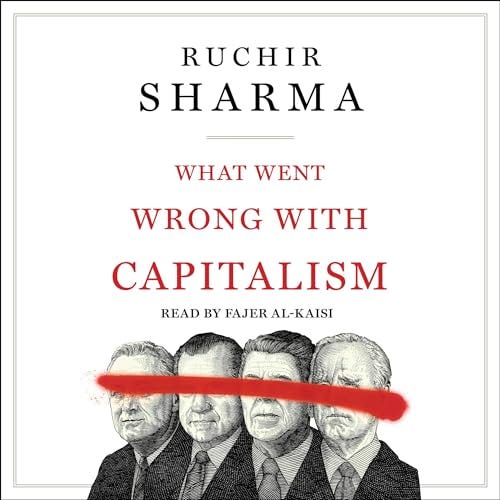
⤵ My chat (+transcript) with investor Ruchir Sharma on where capitalist economies went wrong
✈ A quick note: I will be traveling through the middle of the month and will be posting a bit less than usual and perhaps a bit shorter than usual.These days, it seems that critics of capitalism are more prevalent and more vocal than ever. But Ruchir Sharma, author of What Went Wrong with Capitalism, argues that the free market never let us down; our government did. Today on Faster, Please! — The Podcast, Sharma and I discuss the American addiction to “pain management” — unnecessary economic intervention aimed at dulling the effects of the natural ups and downs of a free market, and how it crippled American capitalism.Sharma is chairman of Rockefeller International and the founder and chief investment officer of Breakout Capital. He previously served as head of emerging markets and chief global strategist at Morgan Stanley.In This Episode* Disillusionment (1:20)* Economic booms (6:12)* Pain management (8:49)* Populist policy (14:38)* Catalyzing change (17:32)Below is a lightly edited transcript of our conversationDisillusionment (1:20)Pethokoukis: In the book, you write with some concern about the declining faith in capitalism, really among all Americans, especially Democrats and the young. It may be worrisome, but is it really surprising, given we had a financial crisis . . . hard to believe it was, what, 14 years ago? 15? Well, I guess 16, 2008 . . . Financial crisis, slow recovery. So, for a lot of people, there's a pretty good chunk of their lives where the economy didn't seem to be really zipping along very quickly and making a big change in their lives, so if people are skeptical of capitalism, can you really blame them?Sharma: Well, as I argue in the book, Jim, that the current system we have in place is very far from capitalism. It's a very distorted form of capitalism that we have in place, and the surprise, I think, has to be the fact that, at the headline level, the numbers from the American economy look pretty good, which are the fact that the economy is growing at above two percent, the stock market is booming, America is seen as the center of all the tech innovation, AI, and, compared to its major rivals such as Europe, America seems to be in a much better place. And I think that a lot of people in the Biden administration try to put that out, which is that, “What's the problem, given how well the American economy is doing?”And I think that the polling data is obviously very different. It shows a persistent and consistent decline in faith in the American economy, that the voters and people have, and, as you pointed out at the outset, that a lot of young people, in fact, say that now they prefer socialism to capitalism. So I guess that's the surprise, which is the fact that, at the headline level, the numbers look fine, and especially when you compare it to other countries, and yet, if you look beneath the hood, both the numbers, in terms of polling numbers and then a deeper look at capitalism, which is what I've done in the book, reveal that something is wrong with the system. The general feeling that the average American has, that the system is almost rigged against them, and rigged in favor of Big Business.Clearly one reason people are sort of unhappy is because we had a big surge of inflation, and, even though the rate of inflation has come down, prices are still a lot higher than they remember. But that seems to me to be a temporary aberration. As every day, and month, and year goes by, we'll be a little further from this inflation surge. And then you mentioned all those positive things: in every sort of emerging technology, America seems to be the leader. Is there really a deep problem that will be more or less solved on its own the further we get away from the pandemic and that pandemic-era economy?Well, anything can happen, but I wouldn't bet on that because, as you said, that the decline in the faith in America's brand of capitalism and the number of people who feel that the country's moving in the wrong direction, all that data predates the pandemic. So it's not as if there was a surge in inflation and that suddenly changed people's thinking about the economy and they're feeling much worse off because their real wages got wiped out by inflation. This happened even before that. Through the last 10 or 20 years, you've seen a consistent decline in American faith in the economy, in American faith in government. So this is not just about the near-term inflation data, or even in terms of what's happened in the post-pandemic world, and to bet, therefore, that, with the passage of time, as the pandemic sort of becomes more and more of a distant memory that this is going to change. I think the problems are much deeper, and it shows up in the fact that, as I argue in the book, that economic and social mobility in America today is close to record lows. Only 35 percent of Americans feel today that they're going to be better off than their parents, and when the American Dream was really flowering,
⚛ My chat (+transcript) with the US Energy Department's Mike Goff on powering the US with more nuclear energy
✈ A quick note: I will be traveling through the middle of the month and will be posting a bit less than usual and perhaps a bit shorter than usual.After decades of resistance to nuclear power, growing concern over climate change, rising electricity needs, and a desire for greater energy independence are spurring renewed public interest in a future powered by atomic fission (perhaps fusion, too). Today on Faster, Please! — The Podcast, I talk to Dr. Mike Goff about the state of US nuclear power, the developing advancements in nuclear technology, and what it will take to reach our vast potential.Goff is the acting assistant secretary and the principal deputy assistant secretary for the Department of Energy’s Office of Nuclear Energy. He previously spent over 30 years at Idaho National Laboratory, including a major advisory and management role. He has written over 70 publications on the nuclear fuel cycle.In This Episode* Atomic Age 2.0 (1:31)* Major concerns (7:37)* Out of practice (11:04)* Next-generation policy (17:38)* Human capital (21:48)* Fusion forecast (23:12)Below is a lightly edited transcript of our conversationAtomic Age 2.0 (1:31)The Energy Secretary recently spoke about adding a lot more nuclear capacity, tripling it, I think, by 2050 or so. And before we get into whether that's possible, I wanted to ask you: As you understand it, what is the current consensus explanation for why the Nuclear and Atomic Age of the ’50s and ’60s, why that kind of ended? Because when the secretary spoke about building more capacity, I thought about the — and this is something maybe a lot of people are unaware of, that President Nixon had a plan to build a lot of more nuclear reactors in this country back in the ’70s during the oil crisis; that didn't happen, and we all know about Three Mile Island. But is there a consensus as to why Atomic Age 1.0 came to an end? Obviously we still get a lot of energy from nuclear, but not what people had imagined 40 years ago.There are a variety of reasons. We did build a lot at one point, and we were building 10 plants a year, pretty extensive builds out there. We did then have Three Mile Island in the late ’70s, and then we got costs started going up, and schedules started increasing on the builds, and we ended up not having a lot of energy growth, in fact, we went for a long period where we weren't having a lot of energy growth, and we had a lot of other energy sources, natural gas, coal, and all. We had a lot of other energy sources out there as well. So yeah, we became pretty stagnated around 20 percent of the electricity. But now, like you say, yeah, there's been a big change in what we think the needs are for nuclear going forward, for a variety of reasons.My background is journalism, and as a journalist I’ve written, I know, multiple stories in my life about a Nuclear Renaissance. So I'm wondering why this time looks to be different. You suggested in your previous answer that there might be some reasons. What are those reasons that we may be entering a new age where we will see an expansion in the nuclear sector?I do think we will see that expansion, and, in fact, I think we have to see that expansion, and it's because of a lot of the positive attributes of nuclear right now. Obviously there's a lot of focus on trying to get more clean energy out there, and nuclear is a large base load source of clean energy. And it's not just CO2 emission, but it doesn't emit particulates and all, as well, so it's good air, good quality of life. So it has those key attributes. But there are other clean energy sources as well: renewables, hydro, and all that. But I think the recognition that, if you are going to go toward decarbonization, you need still base load electricity too. You need base load electricity to help intermittent sources like renewables to be able to expand more as well. So nuclear is very good at enabling decarbonization, not just by adding clean electricity to the grid, but enabling you to expand out other renewables like wind and solar and all, as well.Additionally, nuclear is very reliable. Of the energy sources, it has the highest capacity factor of any of the energy sources. In the United States, we run 93 percent of the time, so the existing fleet that we have out there of 94 plants, they're producing a 100 percent of the power 93 percent of the time, which dwarfs what any other energy source does out there as well.Nuclear is safe. At times people are concerned about safety, but, in reality, it's actually one of the safest energy sources out there and continues to demonstrate that.It's resilient for different weather-related events. It can still produce electricity out there as well. It also has a lot of energy security. And as we've learned, unfortunately, from Russia's unprovoked and unjustified invasion of Ukraine, we recognize energy security is national security, so nuclear really does help us on that national security front. It provides an energy source that

🤖 My chat (+transcript) with Google economist Guy Ben-Ishai on seizing the historic AI moment
Artificial intelligence may revolutionize the American economy, but whether we see that potential actualized depends on a few key factors: whether generative AI is a general purpose technology, whether the labor force makes a smooth pivot, how employers prioritize their resources, and whether the US chooses to take the lead in AI’s deployment. These are just a few of the topics I cover on the podcast today with Guy Ben-Ishai.Ben-Ishai is the head of economic policy research at Google. He previously served as a principal at the Brattle Group and as chief economist in the office of the attorney general of the state of New York. He is also a co-author of the paper “AI and the Opportunity for Shared Prosperity: Lessons from the History of Technology and the Economy.”In This Episode* Is gen AI a general purpose tech? (1:22)* Risks and benefits (7:46)* Barriers to a boom (14:27)* Investing in employees (19:16)* Human-complimenting AI (25:29)Below is a lightly edited transcript of our conversationIs GenAI a general purpose tech? (1:22)Pethokoukis: Do you have any doubt that generative AI, and perhaps machine learning more broadly, is an important general purpose technology that will eventually make a substantial and measurable impact in the economic statistics and productivity and economic growth? Ben-Ishai; The immediate response is absolutely, but let me unpack that: Do I have doubts about the immense potential of the technology? No, and I'm saying that very confidently, which is uncommon for an economist. We put together the paper that you've initially cited at Google to look exactly at that question: When we say that AI marks a pivotal moment in human history, what does that actually mean for an economist? And I think the conclusion there that we're looking not in an ordinary technology, but rather at a general purpose technology, that is immense. That means that we're probably looking at the most transformative economic development of our generation. And to think, Jim, that the two of us are having a conversation about that today, that is historic. I feel incredibly privileged and lucky to think and work of these issues in our day and age.But the second part of your question alluded to not the potential, but actually the actual impact. And if there's one takeaway from that exercise from the paper that we put together and from my conversation with so many academics and policymakers around the world, is that this is not just a watershed moment, it's not just a pivotal moment in human history, it's a fragile moment as well. This story can easily be a story of missed opportunity. I think that we so easily take for granted the fact that, yes, we will of course develop AI and deploy it and apply it very successfully. And it's so easy to get caught in the moment, particularly as the nation that advanced the science, I think somewhere in the back of the minds of all of us, there's that presumption that we will be the global leaders in deployment of AI. I am actually worried about that. To ensure that we are, it’s a tumultuous, fragile, and careful process that we’ve got to be really thoughtful about, with a lot of deliberate action about what we do, how do we proceed, and how do we ensure that we are indeed the ones that capitalize on the potential?It's remarkable how quickly the narrative around American tech has shifted. Not long ago, Silicon Valley faced criticism for focusing on social media rather than groundbreaking innovations like the Apollo program or cancer cures. Now, they've unveiled generative AI, potentially the most significant technology of our era.Regarding fragility, it's worth considering why AI might need special handling. Unlike the seamless diffusion of technologies like the internal combustion engine or electricity, AI seems more akin to nuclear power - a technology that was stifled by regulation. Do we need a proactive agenda to prevent AI's potential from being similarly constrained?That's a great question, Jim. I'm so tempted to go back to your first part of the question about the importance of digital technologies, and economists get a really bad rap, but try to be a librarian these days. We tend to overlook the tremendous importance of information as a driver of economic growth in our economies. And even if you look just at small businesses and the tremendous opportunities that digital technologies have provided them. To think that a mom and shop store today can actually run a marketing campaign, analyze its customer base on large databases, export products to far markets, those are things that used to be the exclusive domain of just a few large companies that today are actually available broadly and widely through digital technologies. And maybe it's the fault of economists that we are not shouting off the tops of mountains frequently enough about the tremendous power of information and digital technologies and the accumulation of knowledge as a driver of economic growth.The application o

🏙 My chat (+transcript) with ... economist Jason Barr on the skyscrapers of tomorrow
The image of the skyscraper is the hallmark of the modern city. Futuristic depictions of urban landscapes nearly always feature towering structures high above the clouds. Today, however, developing countries seem to be putting the greatest effort into building the most impressive skyscrapers, from the Burj Khalifa in the UAE, to the future Jeddah Tower in Saudi Arabia. Whether you love them or hate them, it’s worth asking why we build skyscrapers and what their role will be in future cities. Today on Faster, Please! — The Podcast, I sit down with Jason Barr, author of Cities in the Sky: The Quest to Build the World’s Tallest Skyscrapers.Barr is a professor of economics at Rutgers University – Newark, and is a member of the Rutgers Global Urban Systems PhD program. He is also the author of Building the Skyline: The Birth and Growth of Manhattan’s Skyscrapers.In This Episode* Demand for the skyscraper (1:35)* The end of the skyscraper (9:00)* Pillars of commerce (14:05)* The sky’s the limit (18:36)* Manhattan extension (23:04)* Trends and styles (24:23)Below is a lightly edited transcript of our conversationThe image of the skyscraper is the hallmark of the modern city. Futuristic depictions of urban landscapes nearly always feature towering structures high above the clouds. Today, however, developing countries seem to be putting the greatest effort into building the most impressive skyscrapers, from the Burj Khalifa in the UAE, to the future Jeddah Tower in Saudi Arabia. Whether you love them or hate them, it’s worth asking why we build skyscrapers and what their role will be in future cities. Today on Faster, Please! — The Podcast, I sit down with Jason Barr, author of Cities in the Sky: The Quest to Build the World’s Tallest Skyscrapers.Barr is a professor of economics at Rutgers University – Newark, and is a member of the Rutgers Global Urban Systems PhD program. He is also the author of Building the Skyline: The Birth and Growth of Manhattan’s Skyscrapers.Demand for the skyscraper (1:35)Pethokoukis: You obviously love skyscrapers, you're fascinated by them. You wrote a whole book on them. So I want to just start the very basic question: Why do skyscrapers fascinate you, and the people who aren't fascinated by them, what are they missing?Barr: Great questions. Well, I grew up on Long Island, and so I was always really fascinated with Manhattan. I grew up in the ’70s, and so New York back then was a very dark, mysterious place for a youngster. So when I grew up, actually when I was in college, I started hanging out in the city. So to me, the skyline of Manhattan and New York City, they're just two sides of the same coin. I really developed an interest in tall buildings through my interest and fascination with Manhattan’s and New York City's history.So when I came to Rutgers Newark, I just started doing research on tall buildings, especially in New York City: what was driving the heights of these buildings; there's all these interesting height cycles over the last 150 years. So I wrote my first book on the Manhattan skyline, that was called Building the Skyline, and then after that I thought, let's see what's happening around the rest of the world. So to me, the tall building is an interesting thing because it's part and parcel with urbanization, and I just personally don't think you could have one without the other.I think some people might think that skyscrapers are, at least for rich countries, that they're kind of a 20th-century thing that we did as we were growing, and cities were getting bigger, and skyscrapers are a part of that, but now they're for other parts of the world, parts of the world which are still urbanizing, which are still getting richer. Are skyscrapers are still a thing for America?The short answer is yes, but, given how dense cities are, tall buildings are just being added a lot more slowly. In New York, the population's kind of slowly growing, and so tall buildings are either replacing old buildings that are wearing out, or there's always this push by big global corporations to be in the newest and latest tall building. And obviously there's this international demand from people abroad to have an apartment — or national demand — global demand to have some kind of residential presence in New York. But the thing is, people in other countries: cities, planners, residents in other countries, they look to New York, they look to Chicago, and I think, for many of them, they see New York as something they want to emulate, and New York is, on just about almost any metric, it's probably the top global city. And so I think cities today, especially in China, and Asia more broadly, they're trying to kind of replicate that, what you might call “the Manhattan magic,” and I don't really think people in this country realize how much tall building construction is going on in other cities around the world. People in this country are a little bit more cynical about the role of the tall building in urba

🤖🌈 My chat (+transcript) with Nick Bostrom on life in an AI utopia
The media is full of dystopian depictions of artificial intelligence, such as The Terminator and The Matrix, yet few have dared to dream up the image of an AI utopia. Nick Bostrom’s most recent book, Deep Utopia: Life and Meaning in a Solved World attempts to do exactly that. Bostrom explores what it would mean to live in a post-work world, where human labor is vastly outperformed by AI, or even made obsolete. When all of our problems have been solved in an AI utopia . . . well, what’s next for us humans?Bostrom is a philosopher and was founding director of the Future of Humanity Institute at Oxford University. He is currently the founder and director of research at the Macrostrategy Research Initiative. He also wrote the much-discussed 2014 book, Superintelligence: Paths, Dangers, Strategies.In This Episode* Our dystopian predisposition (1:29)* A utopian thought experiment (5:16)* The plausibility of a solved world (12:53)* Weighing the risks (20:17)Below is a lightly edited transcript of our conversationOur dystopian predisposition (1:29)Pethokoukis: The Dutch futurist, Frederik Polak famously put it that any culture without a positive vision of the future has no future. It's a light paraphrase. And I kind of think that's where we are right now, that despite the title of your book, I feel like right now people can only imagine dystopia. Is that what you think? Do I have that wrong?Bostrom: It's easier to imagine dystopia. I think we are all familiar with a bunch of dystopian works of fiction. The average person could rattle off Brave New World, 1984, The Handmaid's Tale. Most people couldn't probably name a single utopian work, and even the attempts that have been made, if you look closely at them, you probably wouldn't actually want to live there. It is an interesting fact that it seems easier for us to imagine ways in which things could be worse than ways in which things could be better. Maybe some culture that doesn't have a positive vision has no future but, then again, cultures that have had positive visions also often have ended in tears. A lot of the times utopian blueprints have been used as excuses for imposing coercively some highly destructive vision on society. So you could argue either way whether it is actually beneficial for societies to have a super clear, long-term vision that they are staring towards.I think if we were to ask people to give a dystopian vision, we would get probably some very picturesque, highly detailed visions from having sort of marinated in science fiction for decades. But then if you asked people about utopia, I wonder if all their visions would be almost alike: Kind of this clean, green world, with maybe some tall skyscrapers or something, and people generally getting along. I think it'd be a fairly bland, unimaginative vision.That would be the idea of “all happy families are alike, but each unhappy family is unhappy in its own unique way.” I think it's easy enough to enable ways in which the world could be slightly better than it is. So imagine a world exactly like the one we have, except minus childhood leukemia. So everybody would agree that definitely seems better. The problem is if you start to add these improvements and you stack on enough of them, then eventually you face a much more philosophically challenging proposition, which is, if you remove all the difficulties and all the shadows of human life, all forms of suffering and inconvenience, and all injustice and everything, then you risk ending up in this rather bland future where there is no challenge, no purpose, no meaning for us humans, and it then almost becomes utopian again, but in a different way. Maybe all our basic needs are catered to, but there seems to be then some other part missing that is important for humans to have flourishing lives.A utopian thought experiment (5:16)Is your book a forecast or is it a thought experiment?It's much more a thought experiment. As it happens, I think there is a non-trivial chance we will actually end up in this condition, I call it a “solved world,” particularly with the impending transition to the machine intelligence era, which I think will be accompanied by significant risks, including existential risk. In my previous book, Superintelligence, which came out in 2014, focused on what could go wrong when we are developing machine super intelligence, but if things go right—and this could unfold within the lifetime of a lot of us who are alive on this planet today—if things go right, they could go very right, and, in particular, all kinds of problems that could be solved with better technology could be solved in this future where you have superintelligent AIs doing the technological development. And we might then actually confront the situation where these questions we can now explore as a thought experiment would become pressing practical questions where we would actually have to make decisions on what kinds of lives we want to live, what kind of future we want

🤖 My chat (+transcript) with tech policy analyst Adam Thierer on regulating AI
While AI doomers proselytize their catastrophic message, many politicians are recognizing that the loss of America’s competitive edge poses a much more real threat than the supposed “existential risk” of AI. Today on Faster, Please!—The Podcast, I talk with Adam Thierer about the current state of the AI policy landscape and the accompanying fierce regulatory debate.Thierer is a senior fellow at the R Street Institute, where he promotes greater freedom for innovation and entrepreneurship. Prior to R Street, he worked as a senior fellow at the Mercatus Center at George Mason University, president of the Progress and Freedom Foundation, and at the Adam Smith Institute, Heritage Foundation, and Cato Institute.In This Episode* A changing approach (1:09)* The global AI race (7:26)* The political economy of AI (10:24)* Regulatory risk (16:10)* AI policy under Trump (22:29)Below is a lightly edited transcript of our conversationA changing approach (1:09)Pethokoukis: Let's start out with just trying to figure out the state of play when it comes to AI regulation. Now I remember we had people calling for the AI Pause, and then we had a Biden executive order. They're passing some sort of act in Europe on AI, and now recently a senate working group in AI put out a list of guidelines or recommendations on AI. Given where we started, which was “shut it down,” to where we're at now, has that path been what you might've expected, given where we were when we were at full panic?Thierer: No, I think we've moved into a better place, I think. Let's look back just one year ago this week: In the Senate Judiciary Committee, there was a hearing where Sam Altman of OpenAI testified along with Gary Marcus, who's a well-known AI worrywart, and the lawmakers were falling all over themselves to praise Sam and Gary for basically calling for a variety of really extreme forms of AI regulation and controls, including not just national but international regulatory bodies, new general purpose licensing systems for AI, a variety of different types of liability schemes, transparency mandates, disclosure as so-called “AI nutritional labels,” I could go on down the list of all the types of regulations that were being proposed that day. And of course this followed, as you said, Jim, a call for an AI Pause, without any details about exactly how that would work, but it got a lot of signatories, including people like Elon Musk, which is very strange considering he was at the same time deploying one of the biggest AI systems in history. But enough about Elon.The bottom line is that those were dark days, and I think the tenor of the debate and the proposals on the table today, one year after that hearing, have improved significantly. That's the good news. The bad news is that there's still a lot of problematic regulatory proposals percolating throughout the United States. As of this morning, as we're taping the show, we are looking at 738 different AI bills pending in the United States according to multistate.ai, an AI tracking service. One hundred and—I think—eleven of those are federal bills. The vast majority of it is state. But that count does not include all of the municipal regulatory proposals that are pending for AI systems, including some that have already passed in cities like New York City that already has a very important AI regulation governing algorithmic hiring practices. So the bottom line, Jim, is it's the best of times, it's the worst of times. Things have both gotten better and worse.Well—just because the most recent thing that happened—I know with this the senate working group, and they were having all kinds of technologists and economists come in and testify. So that report, is it really calling for anything specific to happen? What's in there other than just kicking it back to all the committees? If you just read that report, what does it want to happen?A crucial thing about this report, and let's be clear what this is, because it was an important report because senator Senate Majority Leader Chuck Schumer was in charge of this, along with a bipartisan group of other major senators, and this started the idea of, so-called “AI insight forums” last year, and it seemed to be pulling some authority away from committees and taking it to the highest levels of the Senate to say, “Hey, we're going to dictate AI policy and we're really scared.” And so that did not look good. I think in the process, just politically speaking—That, in itself, is a good example. That really represents the level of concern that was going around, that we need to do something different and special to address this existential risk.And this was the leader of the Senate doing it and taking away power, in theory, from his committee members—which did not go over well with said committee members, I should add. And so a whole bunch of hearings took place, but they were not really formal hearings, they were just these AI insight forum working groups where a lot of people
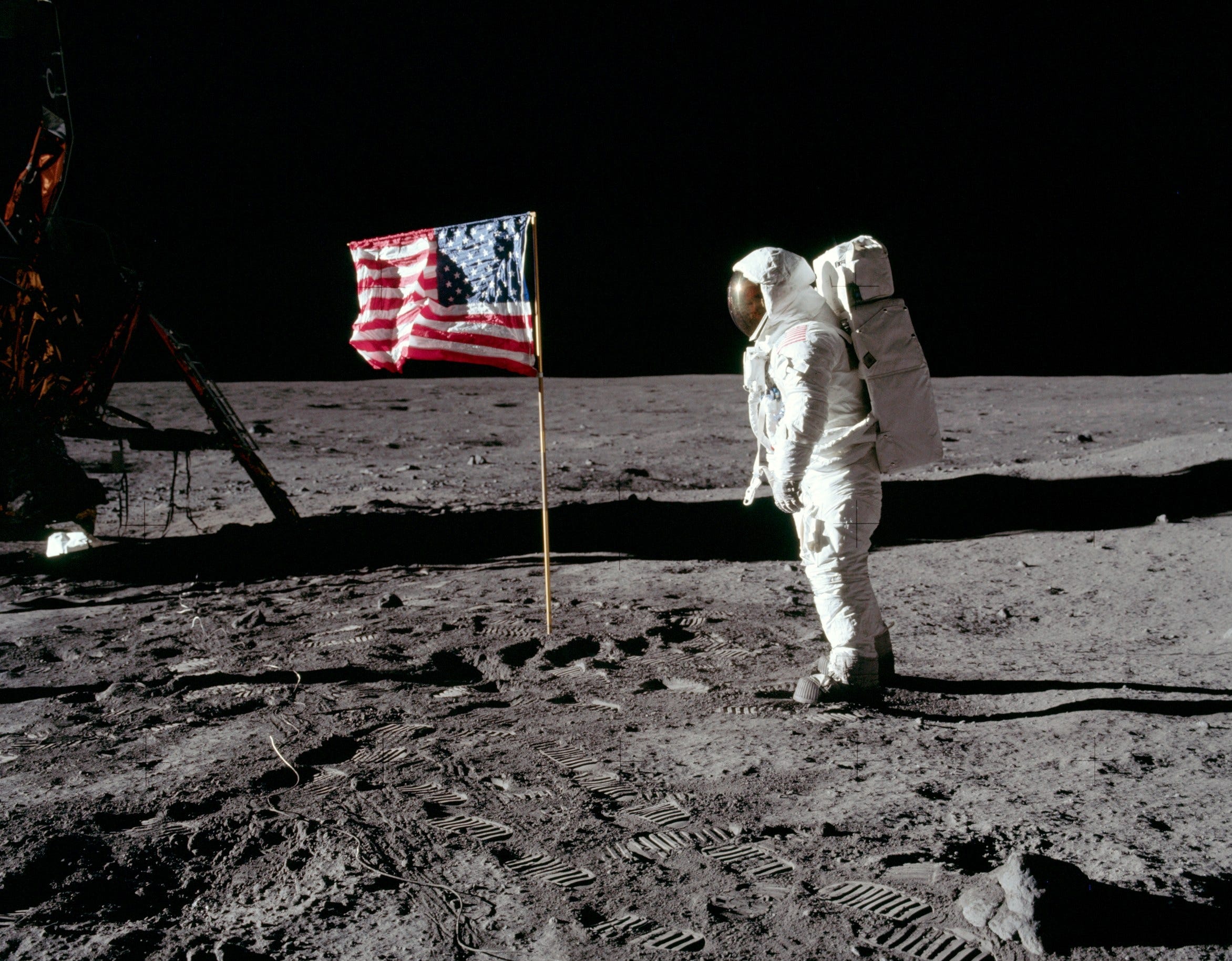
🚀 My chat (+transcript) with Charles Murray on Project Apollo
Project Apollo was a feat of human achievement akin to, and arguably greater than, the discovery of the New World. From 1962 to 1972, NASA conducted 17 crewed missions, six of which placed men on the surface of the moon. Since the Nixon administration put an end to Project Apollo, our extraterrestrial ambitions seem to have stalled along with our sense of national optimism. But is the American spirit of adventure, heroism, and willingness to take extraordinary risk a thing of the pastToday on the podcast, I talk with Charles Murray about what made Apollo extraordinary and whether we in the 21st century have the will to do extraordinary things. Murray is the co-author with Catherine Bly Cox of Apollo: The Race to the Moon, first published in 1989 and republished in 2004. He is also my colleague here at AEI.In This Episode* Going to the moon (1:35)* Support for the program (7:40)* Gene Kranz (9:31)* An Apollo 12 story (12:06)* An Apollo 11 story (17:58)* Apollo in the media (21:36)* Perspectives on space flight (24:50)Below is a lightly edited transcript of our conversationGoing to the moon (1:35)Pethokoukis: When I look at the delays with the new NASA go-to-the-moon rocket, and even if you look at the history of SpaceX and their current Starship project, these are not easy machines for mankind to build. And it seems to me that, going back to the 1960s, Apollo must have been at absolutely the far frontier of what humanity was capable of back then, and sometimes I cannot almost believe it worked. Were the Apollo people—the engineers—were they surprised it worked?Murray: There were a lot of people who, they first heard the Kennedy speech saying, “We want to go to the moon and bring a man safely back by the end of the decade,” they were aghast. I mean, come on! In 1961, when Kennedy made that speech, we had a grand total of 15 minutes of manned space flight under our belt with a red stone rocket with 78,000 pounds of thrust. Eight years and eight weeks later, about the same amount of time since Donald Trump was elected to now, we had landed on the moon with a rocket that had 7.6 million pounds of thrust, compared to the 78,000, and using technology that had had to be invented essentially from scratch, all in eight years. All of Cape Canaveral, those huge buildings down there, all that goes up during that time.Well, I'm not going to go through the whole list of things, but if you want to realize how incredibly hard to believe it is now that we did it, consider the computer system that we used to go to the moon. Jerry Bostick, who was one of the flight dynamics officers, was telling me a few months ago about how excited they were just before the first landing when they got an upgrade to their computer system for the whole Houston Center. It had one megabyte of memory, and this was, to them, all the memory they could ever possibly want. One megabyte.We'll never use it all! We'll never use all this, it’s a luxury!So Jim, I guess I'm saying a couple of things. One is, to the young’ins out there today, you have no idea what we used to be able to do. We used to be able to work miracles, and it was those guys who did it.Was the Kennedy speech, was it at Rice University?No, “go to the moon” was before Congress.He gave another speech at Rice where he was started to list all the things that they needed to do to get to the moon. And it wasn't just, “We have these rockets and we need to make a bigger one,” but there was so many technologies that needed to be developed over the course of the decade, I can't help but think a president today saying, “We're going to do this and we have a laundry list of things we don't know how to do, but we're going to figure them out…” It would've been called pie-in-the-sky, or something like that.By the way, in order to do this, we did things which today would be unthinkable. You would have contracts for important equipment; the whole cycle for the contract acquisition process would be a matter of weeks. The request for proposals would go out; six weeks later, they would've gotten the proposals in, they would've made a decision, and they'd be spending the money on what they were going to do. That kind of thing doesn't get done.But I'll tell you though, the ballsiest thing that happened in the program, among the people on the ground — I mean the ballsiest thing of all was getting on top of that rocket and being blasted into space — but on the ground it was called the “all up” decision. “All up” refers to the testing of the Saturn V, the launch vehicle, this monstrous thing, which basically is standing a Navy destroyer on end and blasting it into space. And usually, historically, when you test those things, you test Stage One, and if that works, then you add the second stage and then you add the third stage. And the man who was running the Apollo program at that time, a guy named Miller, made the decision they were going to do All Up on the first test. They were going to have all three stages,

🦁 My chat (+transcript) with investment strategist Ed Yardeni on his optimism for a Roaring 2020s
As I often remind subscribers to Faster, Please!, predictions are hard, especially about the future. The economic boom of the 1990s came as a surprise to most economists. Equally surprising was that it ended so soon. Neither of these events caught Ed Yardeni off-guard. Some forecasters, Yardeni included, anticipated a new Roaring ’20s for this century… only to be interrupted by the pandemic. But is it too late for this prediction to become a reality? According to Yardeni, not at all.Ed Yardeni is president of Yardeni Research, and he previously served as chief investment strategist at a number of investment companies, including Deutche Bank. He has additionally held positions at the Federal Reserve Bank of New York, Federal Reserve Board of Governors, and US Treasury Department. For more economic insights and investment guidance, visit yardeni.com.In This Episode* The ’90s Internet boom (1:25)* The Digital Revolution (5:01)* The new Roaring ’20s (9:00)* A cautious Federal Reserve (14:24)* Speedbumps to progress (18:18)Below is a lightly edited transcript of our conversationThe ’90s Internet boom (1:25)Pethokoukis: Statistically speaking, the PC Internet boom that you first started writing about back in the early ’90s ended in 2004, 2005. How surprising was that to economists, investors, policy makers? I, to this day, have a report, a 2000 report, from Lehman Brothers that predicted, as far as the eye could see, we would have rapid growth, rapid productivity growth for at least another decade. Now, of course, Lehman didn't make it another decade. Was that a surprise to people that we didn't have an endless productivity boom coming out of the ’90s?Yardeni: I think it definitely was a surprise. I mean, it was surprising both ways. Not too many people expected to see a productivity boom in the second half of the 1990s, which is what we had. I did, as an economist on Wall Street. More importantly, Alan Greenspan was a big promoter of the idea that the technology revolution would in fact lead to better productivity growth and that that might mean better economic growth and lower inflation. And it didn't look that way for a while; then suddenly the Bureau of Economic Analysis went back and revised the data for the late 1990s and, lo and behold, it turned out that there was a productivity boom. And then it all kind of fizzled out, and it raises the question, why did that happen? Why was it such a short lived productivity boom? And the answer is—well, let me give you a personal anecdote.I worked at Deutsche Bank in New York in the late 1990s, and I had to be very careful walking down the corridors of Deutsche Bank in midtown Manhattan not to trip over Dell boxes. Everybody was getting a Dell box, everybody was getting the Dell boxes loaded up with the Windows Office. And when you think back on what that was able to do in terms of productivity, if you had a lot of secretaries on Selectric typewriters, Word could obviously increase productivity. If you had a lot of bookkeepers doing spreadsheets, Excel could obviously increase productivity. But other than that, there wasn't really that much productivity to be had from the technology at the time. So again, where did that productivity boom come from? It couldn't have been just secretaries and bookkeepers. Now the answer is that the boxes themselves were measured as output, and so output per man hour increased dramatically. It doesn't take that many workers to produce Dell boxes and Windows Office and Windows software. So as a result of that, we had this big boom in the technology output that created its own productivity boom, but it didn't really have the widespread application to all sorts of business model the way today's evolution of the technology boom is, in fact, capable of doing.What you've just described, I think, is the explanation by, for instance, Robert Gordon, Northwestern University, that we saw a revolution, but it was a narrow revolution.It was the beginning! It was the beginning of a revolution. It was the Technology Revolution. It started in the 1990s and it's evolved, it's not over, it's ongoing. I think a big development in that revolution was the cloud. What the cloud allowed you to do was really increase productivity in technology itself, because you didn't need to have several hundred people in the IT department. Now, with the cloud, one person can upgrade the software on hundreds of computers, and now we're renting software so that it automatically upgrades, so that's been a big contribution to productivity.The Digital Revolution (5:01)So perhaps I spoke too soon. I talked about that boom—that ’90s boom—ending. Perhaps I should have said it was more of a pause, because it seems what we're seeing now, as you've described it, is a new phase of the Digital Revolution—perhaps a broader phase—and, to be clear, if I understand what you've been speaking about and writing about, this isn't an AI story, this predates what we're seeing in the data now, it
⚡⚛ My chat (+transcript) with Steve Obenschain of LaserFusionX on laser fusion
As private and government interest in nuclear fusion technology grows, an array of startups have arisen to take on the challenge, each with their own unique approach. Among them: LaserFusionX. Today on Faster, Please!—The Podcast, I talk with CEO Stephen Obenschain about the viability of fusion energy, and what sets his approach apart.Obenschain is the president of LaserFusionX. He was formerly head of the Plasma Physics Division branch at the U.S. Naval Research Laboratory.In This Episode* Viability of commercial fusion (0:58)* The LaserFusionX approach (7:54)* Funding the project (10:28)* The vision (12:52)Below is a lightly edited transcript of our conversationViability of commercial fusion (0:58)Pethokoukis: Steve, welcome to the podcast.Obenschain: Okay, I'm glad to talk with you. I understand you're very interested in high-tech future power sources, not so high tech right now are windmills…Well, I guess they're trying to make those more high tech, as well. I recall that when the Energy Department, the National Ignition Laboratory [NIF], they had the—I guess that's over about maybe 15 months ago—and they said they had achieved a net gain nuclear fusion, using lasers, and the energy secretary made an announcement and it was a big deal because we had never done that before by any means. But I remember very specifically people were saying, “Listen, it's a great achievement that we've done this, but using lasers is not a path to creating a commercial nuclear reactor.” I remember that seemed to be on the news all the time. But yet you are running a company that wants to use lasers to create a commercial fusion reactor. One, did I get that right, and what are you doing to get lasers to be able to do that?I don't know why people would come to that conclusion. I think we are competitive with the other approaches, which is magnetic fusion, where you use magnetic fields to confine a plasma and get to fusion temperatures. The federal government has supported laser fusion since about 1972, starting with the AEC [Atomic Energy Commission]. Originally it was an energy program, but it has migrated to being in support stockpiled stewardship because, with laser fusion, you can reach physics parameters similar to what occur in thermonuclear weapons.Yeah. So that facility is about nuclear weapons testing research, not creating a reactor—a fusion reactor.Yeah. All that being said, it does advance the physics of laser fusion energy, and what the National Ignition Facility did is got so-called ignition, where the fuel started a self-sustaining reaction where it was heating itself and increasing the amount of fusion energy. However, the gain was about three, and one of the reasons for that is they use so-called indirect drive, where the laser comes in, heats a small gold can, and the X-rays from that then that drive the pellet implosion, which means you lose about a factor of five in the efficiency. So it's limited gain you get that way.Your way is different. It sort of cuts out the middleman.Okay. The better way to go—which, we're not the only ones to do this—is direct drive, where the laser uniformly illuminates the target at the time that Livermore got started with indirect drive, we didn't have the technologies to uniformly illuminate a pellet. First at NRL [Naval Research Laboratories], and then later at University of Rochester in Japan, they developed techniques to uniformly illuminate the pellets. The second thing we're doing is using the argon fluoride laser. The argon fluoride laser has been used in lithography for many years because it's deep UV.The unique thing we have been trying to do—this was when I was supervising the program at the Naval Research Laboratory—was to take it up to high energy. We started years ago with a similar Krypton fluoride laser, built the largest operating target shooter with that technology, demonstrated the high repetition rate operation that you need for energy and NIF will shoot a few times a day—you need five to 10 shots per second to do a power plant—demonstrated that on a krypton fluoride laser, and, more recently, we switched to the focus to argon fluoride, which is deeper UV and more efficient than the Krypton fluoride. And that basically—at NRL when I was supervising it—reached the energy record for that technology. But we've got a long ways to go to get it to the high energy needed for a power plant.Now, what the immediate goal of my company is to get the funds and to build a beam line of argon fluoride that would have the energy and performance needed for a power plant. One of the advantages to laser fusion: you want have a situation where I'm building more than one of something, so for an implosion facility, you have many beam lines, so you build one and then you have the advantage of building more, and a learning curve as you go toward a power plant. We developed a phase program where first we build the beamline, then we build a NIF-like implosion facility only operating wit

☢ My chat (+transcript) with Spencer Weart on the history of nuclear energy fear
In a world facing climate change and clean energy challenges, it’s starting to look like a nuclear energy renaissance is starting to happen. That is, if we can overcome our irrational fear of nuclear. In this episode of Faster, Please! - The Podcast, I talk with Dr. Spencer Weart about the cultural influences that shaped generations of anxiety around nuclear power, and how that tide may be turning.Weart holds advanced degrees in both Astrophysics and History. For over three decades, he served as Director of the Center for History of Physics at the American Institute of Physics. He is the author of two children’s science books and has written or co-edited seven other books. Among his most recent is The Rise of Nuclear Fear, published in 2012.In This Episode* A history of radiation (1:05)* The rise of nuclear fear (7:01)* Anti-bomb to anti-nuclear (11:52)* Today’s anti-nuclear voices (20:21)* Changing generational attitudes (24:01)* Nuclear fear in today’s media (28:58)Below is a lightly edited transcript of our conversationA history of radiation (1:05)Pethokoukis: To what extent, when radiation was discovered at the turn of the century—and then, of course, the discovery of nuclear fission—to what extent were we already as a society primed by our cultural history to worry about radiation and nuclear power?Weart: Totally. Because you say radiation was discovered, presumably you're referring first to the discovery of X-rays and then, shortly after that, the discovery of what they called “atomic radiation,” we now call it “nuclear radiation.” But, of course, before that, there was the very exciting discovery of infrared radiation. And before that, people have always known about radiation: the rays, the heat from the sun; and they've always had a very powerful cultural significance. You think of the halos of rays of light going out from holy figures in Buddhism and Christian iconography, or you think of the ancient Egyptians with the life-giving rays of the sun bestowing life on things because actually, of course, radiation of the sun is life-giving, it does contain a vital life force. So it's not a mistake to think of radiation as some kind of super magical, powerful thing.And then of course there's also death rays. Death rays actually did become very popular in the literature after the discovery of X-rays because X-rays could, in fact, cause great damage to people, and then so could atomic rays, so, already by the early 20th century there were lots of kids' books and exciting adventure fiction featuring death rays. But you go back before that, there's the evil eye. There's rays radiating out from the evil eye could cause harm. Then there's astrology, the rays from the stars could influence human destiny. So as soon as you mention radiation, there's an enormous complex of things that come out, which was very easily linked to atomic radiation because of all the other characteristics of atomic discoveries.And yet, certainly in the first half or first third of the 20th century, there was, people saw radiation as having great promise, even to create a Golden Age. Tell me a bit about that.It came out as soon as radiation was discovered. Whenever there's a new physics discovery, almost the first thing that people think about is medical applications. And that happened with electricity and with X-rays—of course, x-rays do have great medical applications—and nuclear radiation (I'll call it “nuclear,” even though they called it “atomic” back then). Nuclear radiation did turn out to be radon and radium and so forth that Curie discovered did turn out to be useful for curing certain types of skin cancers and so forth.But people went much beyond that because there was all this magical stuff associated with it. We have to remember that very early on it was discovered that nuclear radiation is the product of the transmutation of elements: uranium and radium and so forth and even other elements.Like alchemy.Yeah, transmutation was alchemy. It was immediately recognized that, oh, the nuclear physicists were the new alchemist and they were happy to talk of themselves as that. But of course, as soon as you have something powerful, as I said, the first thing, when you have a new discovery, that you think about is medicine. The second thing you think about 10 seconds later is weapons, so nuclear death rates were very early imagined. And the atomic bomb—the first atomic bomb actually was sort of a device carried by a terrorist in the 1901 novel. And then in 1915, H.G. Wells conceived of the idea of an atomic warfare weapon that civilization destroyed, but then followed by transmutation and of course humans destroy civilization, then we’ll rise again in atomic powered cars. We love utopia powered by nuclear energy. So all these things were there together, the good side and the bad side. On one side you had people saying that this is the 1930s mind. This is before nuclear fission was discovered. This was entirely science fiction.Would y
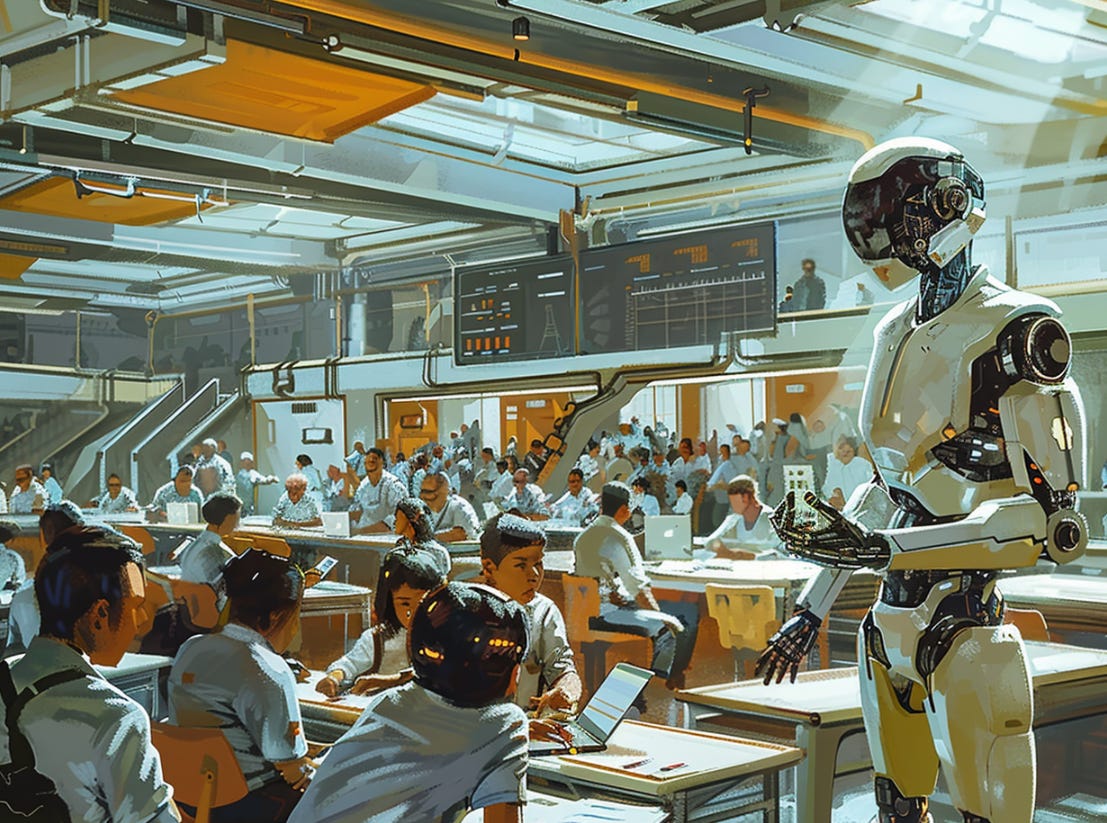
🌐 My chat (+transcript) with John Bailey on the potential for AI in education
Education was among the first victims of AI panic. Concerns over cheating quickly made the news. But AI optimists like John Bailey are taking a whole different approach. Today on Faster, Please! — The Podcast, I talk with Bailey about what it would mean to raise kids with a personalized AI coach — one that could elevate the efficacy of teachers, tutors, and career advisors to new heights.John Bailey is a colleague and senior fellow at AEI. He formerly served as special assistant to the president for domestic policy at the White house, as well as deputy policy director to the US secretary of commerce. He has additionally acted as the Director of Educational Technology for the Pennsylvania Department of Education, and subsequently as Director of Educational Technology for the US Department of Education.In This Episode* An opportunity for educators (1:27)* Does AI mean fewer teachers, or better teachers? (5:59)* A solution to COVID learning loss (9:31)* The personalized educational assistant (12:31)* The issue of cheating (17:49)* Adoption by teachers (21:02)Below is a lightly edited transcript of our conversationEducation was among the first victims of AI panic. Concerns over cheating quickly made the news. But AI optimists like John Bailey are taking a whole different approach. Today on Faster, Please! — The Podcast, I talk with Bailey about what it would mean to raise kids with a personalized AI coach — one that could elevate the efficacy of teachers, tutors, and career advisors to new heights.John Bailey is a colleague and senior fellow at AEI. He formerly served as special assistant to the president for domestic policy at the White house, as well as deputy policy director to the US secretary of commerce. He has additionally acted as the Director of Educational Technology for the Pennsylvania Department of Education, and subsequently as Director of Educational Technology for the US Department of Education.An opportunity for educators (1:27)Pethokoukis: John, welcome to the podcast.Bailey: Oh my gosh, it's so great to be with you.We’d actually chatted last summer a bit on a panel about AI and education, and this is a fast moving, evolving technology. People are constantly thinking of new things to do with it. They're gauging its strengths and weaknesses. As you're thinking about any downsides of AI in education, has that changed since last summer? Are you more or less enthusiastic? How would you gauge your evolving views?I think I grow more excited and enthusiastic by the day, and I say that with a little humility because I do think the education space, especially for the last 20 years or so, has been riddled with a lot of promises around personalized learning, how technology was going to change your revolutionize education and teaching and learning, and it rarely did. It was over promise and under-delivered. This, though, feels like it might be one of the first times we're underestimating some of the AI capabilities and I think I'm excited for a couple different reasons.I just see this as it is developing its potential to develop tutoring and, just in time, professional development for teachers, and being an assistant to just make teaching more joyful again and remove some of the drudgery. I think that's untapped area and it seems to be coming alive more and more every day. But then, also, I'm very excited about some of the ways these new tools are analyzing data and you just think about school leaders, you think about principals and superintendents, and state policy makers, and the ability of being able to just have conversations with data, not running pivot tables or Excel formulas and looking for patterns and helping to understand trends. I think the bar for that has just been dramatically lowered and that's great. That's great for decision-making and it's great for having a more informed conversation.You're right. You talked about the promise of technology, and I know that when my kids were in high school, if there were certain classes which were supposedly more tech adept, they would bring out a cart with iPads. And I think as parents we are supposed to be like, “Wow, every kid's going to have an iPad that's going to be absolutely amazing!” And I'm not sure if that made the teachers more productive, I'm not sure, in the end, if the kids learned any better.This technology, as you just said, could be different. And the one area I want to first focus on is, it would be awesome if we had a top-10-percent teacher in every classroom. And I know that, at least some of the early studies, not education studies, but looking at studies of using generative AI in, perhaps, customer service. One effect they notice is kind of raising the lower-performing group and having them do better. And so I immediately think about the ability to raise… boy, if we could just have the lowest-performing teachers do as well as the middle-performing teachers, that would seem to be an amazing improvement.I totally agree with you. Yea

🌐 My chat (+transcript) with James Walker of microreactor startup NANO Nuclear Energy
Readers and listeners of Faster, Please! know how incredible the untapped potential of nuclear power truly is. As our society (hopefully) begins to warm to the idea of nuclear as an abundant, sustainable, and safe source of energy, a new generation of engineers and entrepreneurs is developing a whole new model of nuclear power: the microreactor.Here on this episode of Faster, Please! — The Podcast, I talk with James Walker, a nuclear physicist and CEO of NANO Nuclear Energy about the countless applications of his company’s under-development, mobile, and easily-deployable nuclear reactors.In This Episode* Why the microreactor? (1:14)* The NANO design plan (7:11)* The industry environment (11:42)* The future of the microreactor (13:45Below is a lightly edited transcript of our conversationWhy the microreactor? (1:14)Pethokoukis : James, welcome to the podcast.Walker: I would say the way NANO got going is probably of interest, then. When we first entered the nuclear space, and my background is a nuclear physicist, nuclear engineer, so I knew that there's a very high bar to entry in nuclear and there's a lot of well-established players in the space. But, really, when we actually took a look at the whole landscape, most of the development was in the SMR space, the Kairos, the Terra Powers, the NuScales, and we could see what they were doing: They were aiming for a much more manufactural reactor that could deploy a lot faster. It was going to be a lot smaller, fewer mechanical components, smaller operating staff to bring down costs. So that all made a lot of sense, but what I think was missing in the market—and there are a few companies involved in this—was that the microreactor space looked to be the larger potential market. And I say that because microreactors are more readily deployable to places like remote mining sites, remote habitation, disaster relief areas, military bases, island communities… you put them on maritime vessels to replace bunk fuel, charging stations for EV vehicles... Essentially hundreds of thousands of potential locations competing against diesel generators, which, up until now, up until microreactors, had no competition. So the big transformative change here is—obviously SMRs are going to contribute that, but—micro reactors can completely reshape the energy landscape and that's why it's exciting. That's the big change.You gave some examples, so I want you to give me a couple more examples, but I'll say that I was thinking the other day about the expansion, partially due to AI, of these big data centers around the country. Is that the kind of thing—and you can give me other examples, as well—of where a much smaller microreactor might be a good fit for it, and also tell me, just how big are these reactors?AI centers and data centers are particularly a big focus of tech at the moment. Microsoft even have people deliberately going out and speaking to nuclear companies about being able to charge these new stations because they want these things to be green, but they also want them in locations which aren't readily accessible to the grid. And a lot of the time, some of the power requirements of these things might be bigger than the town next to them where they've got these things. So their own microreactor or SMR system is actually a really good way of solving this where it's zero carbon-emitting energy, you can put it anywhere, and it is the most consistent form of energy. Now you can out-compete diesel in that front, it can go outcompete, wind or solar. It really has no competitors. So they are leaning in that direction and a lot of the big drive in nuclear at the moment is coming from industry. So that's the big change, I think. It's not strictly now a government-pushed initiative.What's the difference between these and the SMR reactors, which my listeners and readers might be a little bit more familiar with?SMRs, the small modular reactors, obviously if you think of a large conventional nuclear power station, you're thinking dozens and dozens of acres of land being occupied by essentially a big facility. An SMR brings that down by an order of magnitude. You still need to probably have an area about 10 city blocks, but the reactor itself is much, much smaller, occupied by a much smaller footprint than that.Microreactors are much smaller, again, so if you take our design as an example, the whole system, the core and the turbine that produces the electricity, all fits within an ISO container. If you think of the standard shipping container you see on the back of a ship or you see on the back of a truck or a train, that's where you're really looking at. And the reason for that is that we're trying to make it as deployable and as mobile as possible. So conventional transportation—infrastructure, trucks, trains, ships—get these things anywhere in the world. Helicopter them in, if you really want. And once they're down there you've got 10, 15, 20 years of power consistently without that constant

🌐 My chat (+transcript) with defense policy analyst Todd Harrison on the US Space Force
The US Space Force, the newest branch of the American military, takes national defense to a new frontier. Here on Faster, Please! — The Podcast, I sit down with AEI senior fellow Todd Harrison to discuss the state of the Space Force and its evolving mission.Harrison has served as senior vice president and head of research at Metrea, a defense consulting firm, been a senior fellow for defense budget strategies at the Center for Strategic and Budgetary Assessments, directed the Defense Budget Analysis and Aerospace Security Project at the Center for Strategic and International Studies, and served as a captain in the US Air Force Reserve.In This Episode* Creating the Space Force (0:53)* A New Kind of Warfare (9:15)* Defining the Mission (11:40)* Conflict and Competition in Space (15:34)* The Danger of Space Debris (20:11)Below is a lightly edited transcript of our conversationCreating the Space Force (0:53)Pethokoukis: I was recently looking at an image that showed the increase in the number of satellites around the earth, and it's been a massive increase; I imagine a lot of it has to do with SpaceX putting up satellites, and it's really almost like—I think to an extent that most people don't understand; between government, military, and a lot of commercial satellites—it's really like the earth is surrounded by this information shell. And when looking at that, I couldn't help but think, “Yeah, it kind of seems like we would need a Space Force or something to keep an eye on that and protect that.” And I know there was a lot of controversy, if I'm not mistaken, like, “Why do we need this extra branch of government?” Is that controversy about why we need a Space Force, is that still an active issue and what are your thoughts?Harrison: To start with where you started, yes. The number of satellites in space has been growing literally exponentially in the past few years. I'll just throw a few numbers out there: In 2023 alone, about 2,800 new satellites were launched, and in that one year it increased the total number of satellites on the orbit by 22 percent, just in one year. And all the projections are that the number of satellites, number of launches, are going to keep growing at a pace like that for the foreseeable future, for the next several years. A lot is going into space, and we know from all other domains that where commerce goes conflict will follow. And we are seeing that in space as well.Like the Navy protecting the shipping lanes. Yeah, exactly. So we know that to a certain extent that's inevitable. There will be points of contention, points of conflict, but we've already seen that in space just with the military dimension of our space. Back in 2007, I think a lot of the world woke up to the fact that space is a contested environment when the Chinese tested an anti-satellite weapon, which, by the way, produced thousands of pieces of space debris that are still in orbit today. More than 2,600 pieces of debris are still in orbit from that one Chinese ASAT test. And, of course, that was just one demonstration of counter-space capabilities. Space has been a contested war fighting domain, really, since the beginning of the Space Age. The first anti-satellite test was in 1959, and so it has become increasingly important for economic reasons, but also for military reasons. Now, when the Space Force debate kicked into high gear, I think it took a lot of people who weren't involved in military space, I think it took a lot of people by surprise that we were having this debate.Yeah, it really seemed like it came out of nowhere, I think probably for 99 percent of people who aren't professionals tracking the issue.In reality, that debate, it started in the 1990s, and there was a senator from up in New Hampshire who had written a journal article basically talking about, “Hey, we need to separate space into its own military service.” You had the Air Force chief of staff at the time in the mid-1990s, General Ron Fogleman. He said that the Air Force should eventually become an Air and Space Force, and then one day a Space and Air Force. So you had the seeds of it happening in the ’90s. Then you had Congress wanting to look at, “Okay, how do we do this? How do we reorganize military space?” They created a commission that was led by Donald Rumsfeld before he became Secretary of Defense for the second time. That commission issued its report in 2001, and it recommended a bunch of reforms, but it said in the midterm, in five to 10 years we should create a separate military service for space, something like a Space Corps.Nothing happened, even though Rumsfeld then became Secretary of Defense. We kind of took our focus off of it for a while, there were a few other studies that went on, and then in 2016, two members of Congress, a Republican and a Democrat, Mike Rogers and Jim Cooper, who were on the House Armed Services Committee, they took this issue up. They got so fed up with the oversight of looking at how the Air Force wa
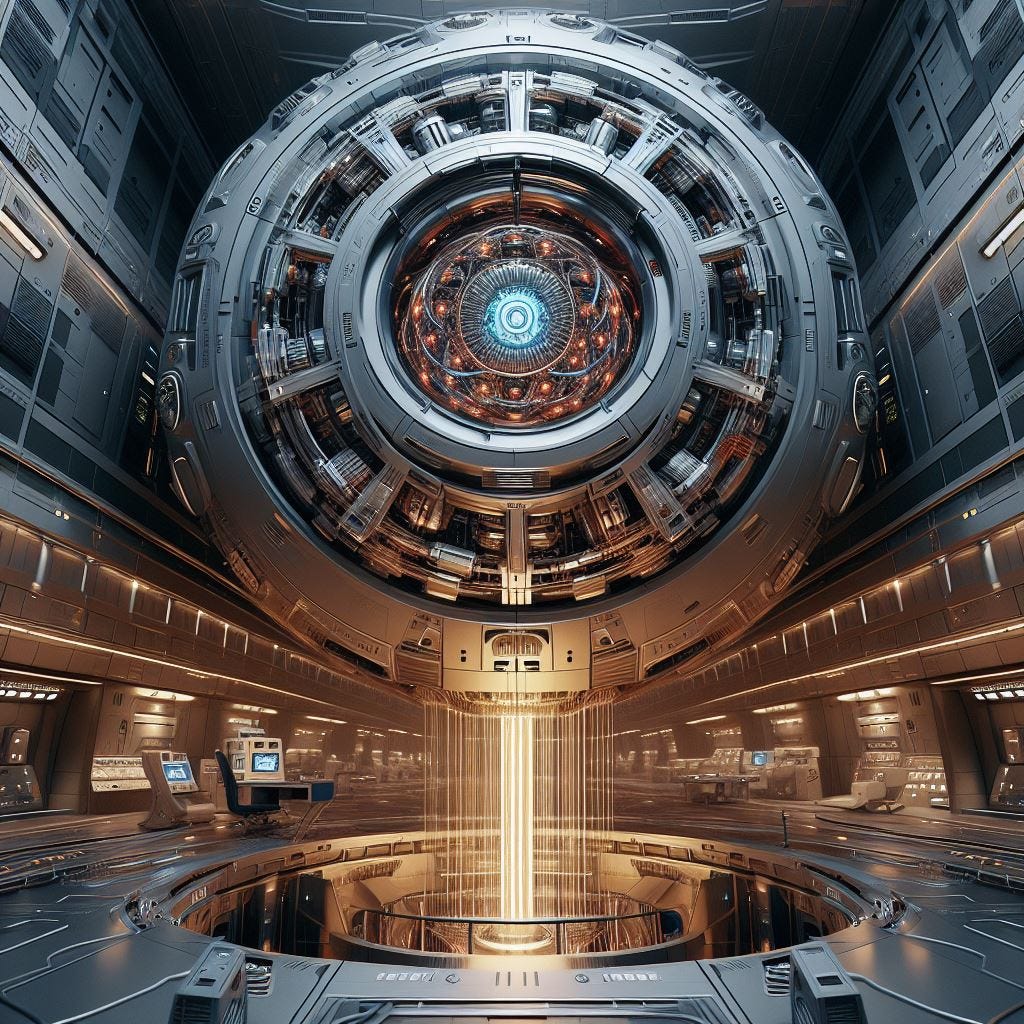
⚛ My chat (+transcript) with TAE Technologies CEO Michl Binderbauer on the future of fusion
What if there were a way to generate massive amounts of affordable, carbon-free energy with minimal environmental or safety risk? Sounds too good to be true, but nuclear fusion just might be the kind of energy source that America—and the world—has been waiting for.Michl Binderbauer is the CEO of California-based TAE Technologies, a company trying to develop an aneutronic commercial fusion reactor. Michl joins us on this episode of Faster Please! — The Podcast to explain how his team is trying to make fusion power a real thing.In This Episode* Fusion’s Moment (1:11)* The Technical Challenge (12:11)* The Economic Challenge (15:33)* The Role of Government (22:20)Below is a lightly edited transcript of our conversation.Pethokoukis: What is sort of the current state of your company's technology, and in describing that, could you tell me how it sort of differs from other approaches in the field, keeping in mind I am not a nuclear physicist?Binderbauer: Understood. Alright, well it's a great introductory question. So TAE has been around, as you probably have read, for a good two decades plus, but the 25 year anniversary was just this past April, actually. We're at the stage now, it’s really exciting, where the machine we're under construction on now, which we call Copernicus, which is our generation six, is actually intended to get us to a point to demonstrate that we can harvest more energy than we have to feed it. And this is on a really engineering comparison, how much energy comes into the site and deploys on the machine versus how much can you harvest. To be fair, this is not a full power plant, so we're going to measure the heat output, the collective heat output on it. Now that's where we're going, and that's really enabled by 20 plus years of a journey of, interestingly enough, a lot of scientific nuance discoveries, but mostly technology development.What you learn is that the journey that we were on was mostly one of underestimating the complexity of power supplies, vacuum systems, heating systems in the form of us, this means energetic particle beams, and the technological tool chest around those things and making that work as a symphony, as a nice orchestra to do what we need it to do, and that's really where we spend most of the time, and now we're at the point where there's a confluence in understanding the science, understanding or having full practice capability, mastery of the tools, bringing these two things together in the sixth generation machine to drive net energy output. That's the goal. The other thing you asked me was how do we differ and to kind of contrast that a little bit?Because this is a very interesting moment for fusion, broadly, which are a number of startups, of course some of my listeners might be familiar with the breakthrough from the National Ignition Facility, which isn't really meant to create a nuclear power plant, but it was a great proof of concept that we can do some sort of fusion here. So I guess in a somewhat understandable way, given my own personal limitations, what are you doing that's sort of different than maybe some of the other companies such as, I mean I've written about Commonwealth Fusion and a few others, as well.Of course. Let me start by saying that, for most of that I should give credit to my brilliant PhD mentor who was a technical co-founder and co-founder in general of TAE. Norman Rostoker was his name, and Norman had an illustrious career in the field of fusion science and, in fact, accelerators and a few other areas of physics. He was a sort of polymath and really broad guy, which probably was a critical ingredient to get to where we are today. And so while he was very instrumental in the early days of the field in putting together a lot of the fundamental theory and things that I always joke and say, “You can't get a PhD in this field without suffering through a lot of the stuff he discovered.” But he also was very critical at the later stage in his career and he looked at this and said, “If we want to build something that caters to power production in a civilian way with good economics and the right kind of maintainability and practicality, then maybe what we're doing as a field today on the large sort of federal or national program-funded research was sort of missing the mark a little bit because it was building towards the Tokamaks, which some of your readers may know, those donut-shaped machines, the biggest of which is under construction in the south of France right now, it’s a big international project. And Norman looked at that and said, “That can get us to maybe net energy but not necessarily practical net energy or economic net energy.”In the end it's about an applied end product that we're going after, not textbook knowledge, in a sense, or a proof point for a laboratory experiment. With that in mind, when the company, before it even started—this is in the early ’90s when I became a student—he had a very delineated philosophy of end in mi
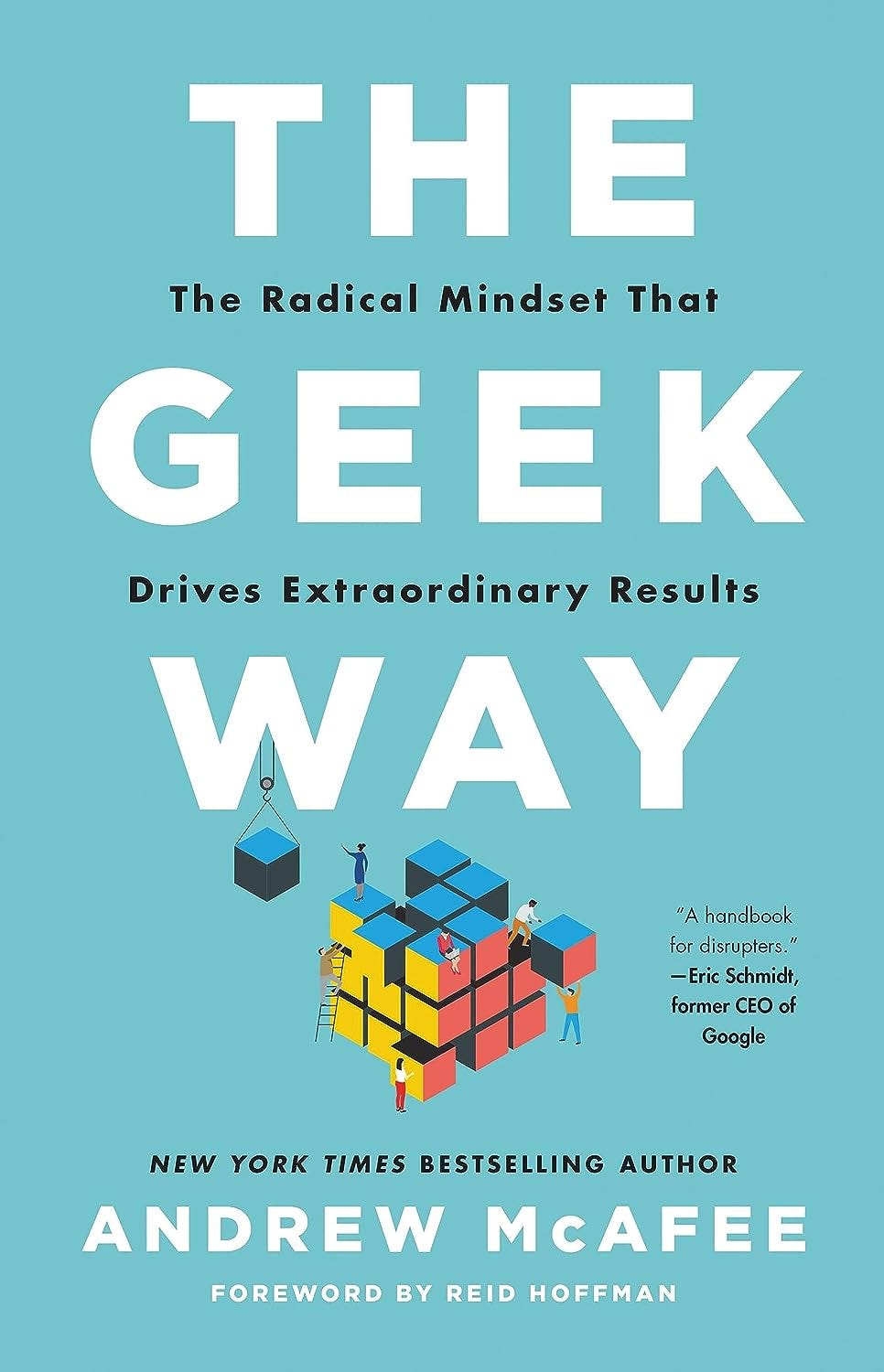
🌐 My chat (+transcript) with Andrew McAfee on how to upgrade any company like a geek
Science. Ownership. Speed. Openness.These are the four pillars of Andrew McAfee’s observed structure for successful companies. It is the “geeks,” the leaders at the forefront of cross-industry innovation, who embrace these norms and have the potential to redefine business as we know it. In order to break ground and create the kind of future we dream of, organizational leaders need to banish the fear of failure, embrace mistakes, and accept hard feedback with open arms.Andrew is a best-selling author, Principal Research Scientist at the MIT Sloan School of Management, and co-founder of MIT’s Initiative on the Digital Economy. His books include More from Less and The Second Machine Age, co-authored with Erik Brynjolfsson. Today on the podcast, we discuss the ideas captured in his most recent book, The Geek Way: The Radical Mindset that Drives Extraordinary Results. In This Episode* The universal geek (1:35)* The four geek norms (8:29)* Tales of geeks and non-geeks (15:19)* Can big companies go geek? (18:33)* The geek way beyond tech (26:32)Below is a lightly edited transcript of our conversation.The universal geek (1:35)Pethokoukis: Is The Geek Way really the Silicon Valley Way? Is this book saying, “Here's how to turn your company into a tech startup”?McAfee: You mentioned both Silicon Valley and tech, and this book is not about either of those—it's not about a region and it's not about an industry, it's about a set of practices. And I think a lot of the confusion comes because those practices were incubated and largely formulated in this region called “Silicon Valley” in this industry that we call “tech”. So I understand the confusion, but I'm not writing about the Valley. Plenty of people do that. I'm not writing about the tech industry. Plenty of people do that. The phenomenon that I don't think we are paying enough attention to is this set of practices and philosophies that, I believe, when bundled correctly, amounts to a flat old upgrade to the company, just a better way to do the thing a company is supposed to do. That needed a label, because it's new. “Geek” is the label that I latched onto.But there's a universal aspect to this, then.Yeah, I believe there is. I understand this sounds arrogant—I believe it's a flat better way to run a company. I don't care where in the world you are, I don't care what industry you are in, if you're making decisions based on evidence, if you're iterating more and planning less, if you're building a modular organization that really does give people authority and responsibility, and if you build an organization where people are actually comfortable speaking truth to power, I think you're going to do better.One reason I'm excited about this book is because, you as well, we think about technological progress, we think about economic growth and productivity and part of that is science and coming up with new ideas and a new technology, but all that stuff has to actually be turned into a commercial enterprise and there has to be well-run companies that take that idea and sell it. Maybe the economist’s word might be “diffusion” or something like that, but that's a pretty big part of the story, which I think maybe economists tend not to focus as much on, or policy people, but it's pretty darn important and that's what I think is so exciting about your book is that it addresses that: How to create companies that can do that process—invention-to-product—better. So how can they do it better?Let me quibble with you just a little bit. There are alternatives to this method of getting goods and services to people, called “the company.” That's what we do in capitalist societies. Jim, like you know all too well, over the course of the 20th century, we ran a couple of experiments trying it a different way: These collectivist, command-and-control, centrally planned economies, those were horrible failures! Let's just establish that right off the bat.So in most of the parts of the world—I think in all the parts of the world where you and I would actually want to live—I agree with you, we've settled on this method of getting most goods and services to people, most of what they consume, via these entities called companies, and I don't care if you're in a Nordic social democracy, or in the US of A, or in Southeast Asia, companies are the things getting you most of what you consume. I think in the United States, about 85 percent of what you and I consume, by some estimates, comes from companies. So, like them or hate them, they're incredibly important, and if a doohickey comes along that lets them their work X percent better, we should applaud that like crazy because that's an X percent increase in our affluence, our standard of living, the things that we care about, and the reason I got excited and decided to write this book is I think there's an upgrade to the company going on that's at the same level as the stuff that [Alfred] Chandler wrote about a century ago when we invented the large, pr

🌞 My chat with Marc Andreessen on the need for techno-optimism
If you’re looking for a smart and punchy companion piece to my new book, The Conservative Futurist: How to Create the Sci-Fi World We Were Promised, then you are in luck. Look no further than venture capitalist Marc Andreessen’s wonderful new mega-essay, “The Techno-Optimist Manifesto.”If there’s a sentence or even a word in that manifesto that I disagree with, I have yet to find it. That’s why I am so delighted to have Marc Andreessen, a founder and general partner at Andreessen Horowitz — as well as the co-author of Mosaic, the first widely used web browser, and co-founder of Netscape — on this special episode of Faster, Please! — The Podcast. In This Episode* The time for techno-optimism is now (1:19)* Why has there been a downshift in innovation? (8:56)* The importance of embracing AI (16:08)* Slouching towards Utopia: Marc’s response to AI critics (23:27)* The economics of techno-optimism (36:29)* The future of domestic technology policy (44:38)Oh, by the way, the transcript of our conversation will be posted tomorrow, November 9.Hey, I have a new book out! The Conservative Futurist: How To Create the Sci-Fi World We Were Promised is currently available pretty much everywhere. I’m very excited about it! Let’s gooooo! 🆙↗⤴📈* Amazon* Barnes & Noble* Books-A-Million* Target* Walmart* BookshopFrom the Introduction of The Conservative Futurist: This is a public episode. If you'd like to discuss this with other subscribers or get access to bonus episodes, visit fasterplease.substack.com/subscribe
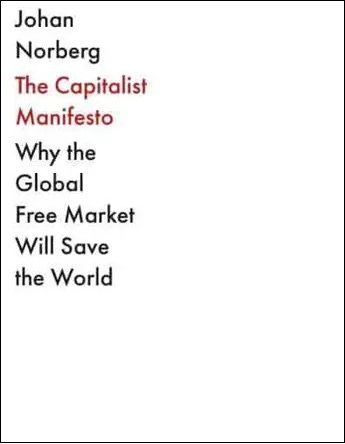
🌐 My chat (+transcript) with Johan Norberg on the case for capitalism — and the myth of Swedish socialism
Johan Norberg’s work revolves primarily around economic and intellictual history and attempting to learn lessons from past financial systems. In this episode of Faster, Please! — The Podcast, Johan takes us through his version of capitalism, giving an especially interesting perspective on the economic system of his home country. Johan is a senior fellow at the Cato Institute and the author of several books. His latest is The Capitalist Manifesto: In Defense of Global Capitalism, available now. In This Episode* “Capitalism” and its meanings (0:55)* The state of contemporary capitalism (2:34)* Coordination in capitalism (7:59)* The cyclical nature of economic systems (13:54)* Swedish capitalism (16:56)* The case for capitalism (21:48)Below is a lightly edited transcript of our conversationJames Pethokoukis: Let's begin with a little definitional work here. Capitalist Manifesto: “Capitalist” is a word people assign a variety of meanings to. What is the capitalism that you're talking about here?Johan Norberg: Yeah, it's not a great word. Quite often it's misunderstood; people think it's all about capital. It's not. We can have capital in many different economic systems. To me, free-market capitalism is about a decentralized economic system with private property where decisions are made locally, decentralized, not command and control, and the prices and wages and things are set in voluntary negotiations rather than top-down.The economist Deirdre McCloskey hates the word "capitalism." She prefers "innovism" or "trade-tested progress." Should we insist on using a different word to describe the world’s dominant socio-economic system?Deirdre McCloskey is right. Capitalism is a bad word. I would much prefer “innovism” or something like that. But I've realized that in order to communicate with people, I'd better use some of the words that they are using. And I've realized that we're stuck with the word “capitalism” and the whole concept of capitalism, and if we don't fill it with meaning, those of us who like free markets and free trade, I've realized that somebody else is going to fill it with meaning, and in that case, we are losing the debate. Go to where the sinners are. That's my take.Twenty years ago, it seemed like markets had won. Capitalism was changing the world and bringing people out of poverty. President Clinton declared "the era of big government is over." China was opening its economy. What happened? Why did you feel the need to write this book in this moment?That's exactly why I wrote this book, because nowadays it seems like nobody likes free markets and free trade anymore. I've realized that, in the US, and that should be a place where people appreciate some of this, fewer people believe in capitalism than believe in ghosts nowadays. And there's this lack among politicians and governments everywhere in belief in global capitalism. There's this whole, repatriate stuff, subsidize specific businesses and sectors back home, rather than having global supply chains. So that's why I wrote this.I think this is all based on a complete misunderstanding of what has happened in the world in the past 20 years. It's not that markets have failed. On the contrary, despite the fact that we've had 20 rough years with financial crises and wars and the Great Pandemic and stuff like that, and yet we've seen, when you look at objective indicators of human living standards, more progress than ever before over these 20 years. When it comes to the reduction in poverty, more than 130,000 people lifted out of extreme poverty every day over the past 20 years. We've seen an increase in global GDP per capita of roughly a third. We've reduced child mortality by almost half, which means that four million fewer children died last year than in 2002. And this is because entrepreneurs and innovators, they keep innovating ourselves out of problems all the time — if we give them some freedom to do that. And that's what I'm worried about: that they'll have less freedom in the future if we do not keep on pounding and keep on explaining this.Those are some pretty impressive statistics. But people don't seem to notice. We keep hearing the same narrative of "late-stage, failed capitalism.” Why is that?I think the financial crisis is a very important part of this. If some capitalists do bad stuff, people lose faith in capitalism and I think we saw this in the US but also around the world. There's this sense that perhaps we shouldn't imitate what America is doing if these are the consequences. And I don't think that the financial crisis was a result of unleashed market forces. And I even wrote a book on this a couple of years back, Financial Fiasco. I think there were massive regulatory failures and central banks and ministers of finance trying to make capitalism very safe by implementing a very homogenous structure on everybody, telling everybody to go into the same way, searching for the same AAA-rated securities and stuff like that. And if e

🌎 My chat (+transcript) with political scientist Francis Fukuyama on technological change and liberal democracy. Some sci-fi, too!
More than 20 years ago, the political scientist Francis Fukuyama characterized the Information Technology revolution as "benign" but cautioned that "the most significant threat posed by contemporary biotechnology is the possibility that it will alter human nature and thereby move us into a post-human stage of history." From Twitter to CRISPR to ChatGPT, a lot has changed since then. In this episode of Faster, Please! — The Podcast, Dr. Fukuyama shares his thoughts on those developments and the recent advances in generative AI, as well as the cultural importance of science fiction.Dr. Fukuyama is the Olivier Nomellini Senior Fellow at Stanford University's Freeman Spogli Institute for International Studies. His books include The End of History and the Last Man, Our Posthuman Future, and 2022's Liberalism and Its Discontents, among many others. Other writings can be found at American Purpose.In This Episode* The consequences of the IT revolution (1:37)* Can government competently regulate AI? (8:14)* AI and liberal democracy (17:29)* The cultural importance of science fiction (24:16)* Silicon Valley’s life-extension efforts (31:11)Below is an edited transcript of our conversationThe consequences of the IT revolutionJames Pethokoukis: In Our Posthuman Future more than 20 years ago, you wrote, “The aim of this book is to argue that [Aldous] Huxley was right [in Brave New World], that the most significant threat posed by contemporary biotechnology is the possibility that it will alter human nature and thereby move us into a ‘posthuman’ stage of history. This is important, I will argue, because human nature exists, is a meaningful concept, and has provided a stable continuity to our experience as a species.” But then you added, “It may be that, as in the case of 1984” — and, I think, parenthetically, information technology — “we will eventually find biotechnology’s consequences are completely and surprisingly benign.” After 20 years, and the advent of social media, and now it seems like possibly a great leap forward in AI, would you still characterize the IT revolution as “benign”?Francis Fukuyama: That's obviously something that's changed considerably since I wrote that book because the downside of IT has been clear to everybody. When the internet was first privatized in the 1990s, most people, myself included, thought it would be good for democracy because information was power, and if you made information more widely available, that would distribute power more democratically. And it has done that, in fact. A lot of people have access to information that they can use to improve their lives, to mobilize, to agitate, to push for the protection of their rights. But I think it's also been weaponized in ways that we perhaps didn't anticipate back then.And then, there was this more insidious phenomenon where it turns out that the elimination of hierarchies that controlled information, that we celebrated back then, actually turned out to be pretty important. If you had a kind of legacy media that cared about journalistic standards, you could trust the information that was published. But the internet really undermined those legacy sources and replaced it with a world in which anyone can say anything. And they do. Therefore, we have this cognitive chaos right now where conspiracy theories of all sorts get a lot of credibility because people don't trust these hierarchies that used to be the channels for information. Clearly, we’ve got a big problem on our hands. That doesn't mean that the biotech is not still going to be a big problem; it's just that I think the IT part has moved ahead very rapidly. But I think the biotech will get there in time.While I think most of the concern that I've heard expressed about AI, in particular, has been about these science fiction-like existential risks or job loss, obviously your concern has more to do, as with in Our Posthuman Future, how it will affect our liberal democracy. And you point out some of the downsides of the IT revolution that weren't obvious 30 years ago but now seeing plainly obvious today.To me, the coverage of AI has been really very, very negative, and we've had calls for an AI pause. Do you worry that maybe we've overlearned that lesson? That rather than going into this with kind of a Pollyannaish attitude, we're immediately going into this AI with deep concerns. Is there a risk of overcorrecting?The short answer is, yes. I think that because of our negative experience with social media and the internet lately, we expect the worst from technology. But I think that the possibilities for AI actually making certain social problems much better are substantial. I think that the existential worries about AI are just absurd, and I really don't see scenarios under which the human species is going to face extinction. That seems to be this Terminator, killer, Skynet scenario, and I know very few serious experts in this area that think that that's ever likely to materialize.

🌎 My chat (+transcript) with climate scientist Zeke Hausfather
Is climate change an impending existential threat, or a serious but manageable problem we can tackle with innovation and human ingenuity? Zeke Hausfather joins this episode of Faster, Please! — The Podcast to explain the basics of climate modeling and give a clear-eyed assessment of the risks we face and the measures we can take.Zeke is a climate scientist and energy systems analyst. He is the climate research lead for Stripe and a research scientist at Berkeley Earth.In This Episode* Human impact on the climate (1:11)* Global temperature forecasting (6:33)* Low-probability, high-risk scenarios (15:07)* Reducing carbon emissions (17:06)* Carbon capture and carbon removal (25:25)Below is an edited transcript of our conversationFaster, Please! is a reader-supported publication. To receive new posts and support my work, consider becoming a free or paid subscriber. Thanks!Human impact on the climateJames Pethokoukis: How do we know that our planet is warming? And secondarily, how do we know the actions of people are playing a key role?Zeke Hausfather: That's a great question. In terms of how we know it's warming: We've been monitoring the Earth's climate with reasonably dense measurements since the mid-1800s. That's when groups like NASA, NOAA, the UK Hadley Centre, my own Berkeley Earth group, have been able to put together reliable global surface temperature estimates. And we've seen in the period…That's since the 1980s?1850.1850. NASA was not around in 1850.No. But enough measurements were being taken both at weather stations around the world and on ships in the oceans that we can reconstruct global temperatures with an accuracy of a couple tenths of a degree going back that far. We know that the world has warmed by about 1.2 degrees centigrade since 1850 with the vast majority of that warming, about 1 degree of it, happening since 1970. That isn't in much dispute in the scientific community at all. Now, going further back is harder, obviously. We only invented the thermometer in the early 1700s. There are a few locations on land that go back that far, but to go back further in time, we need to rely on what we call climate proxies: things like ice cores, tree rings, coral sediments, pollen in lakes — various natural factors that are in some way related to the temperature when those things occurred.Those have much higher uncertainties, of course, but we do know using those reconstructions that current temperature levels are probably unprecedented in at least the last 2000 years and are at the high end of anything we've seen in the last 120,000 years or so. Certainly if current temperatures were to stay at today's levels for another century, they'd be higher than anything we've seen in 120,000 years. But it's harder to precisely make those claims because the time resolution of these indirect proxy measurements is very coarse when we go back further in time. You might have one ice core measurement reflect a hundred-year average period, for example, rather than a specific year. We know from the temperature record that the world has warmed. How do we know that human activity is playing a role? Well, we've known since the mid-1800s, due to pioneering work by folks like John Tyndall or Arrhenius, that carbon dioxide is a greenhouse gas and that greenhouse gases like carbon dioxide, water vapor, methane are critical to maintain a habitable planet. Without greenhouse gases in our atmosphere, the Earth would be a snowball and life would probably not exist.We also know that the amount of carbon dioxide in the atmosphere has increased pretty dramatically. We have measurements from ice cores going back about 800,000 years of carbon dioxide in the atmosphere at a reasonably high resolution. And because carbon dioxide is well mixed, knowing it in one location in one ice core gives us a good picture of carbon dioxide for the whole planet. And we know that prior to the year 1850, carbon dioxide concentrations in the atmosphere varied between about 170 to 280 parts per million. They're lower during ice age periods; they're higher during warmer interglacial periods. But since the 1850s, that value has increased dramatically. The amount of carbon dioxide in the atmosphere has increased by about 50 percent. It's gone from 280 parts per million, which was over the last 10,000 years since the end of the last ice age, up to about 420 parts per million today.And that reflects a huge amount of carbon dioxide in the atmosphere. I don't think people realize quite the magnitude we're talking about. The amount of carbon dioxide that humans have added to the atmosphere by digging up stuff from underground and burning it is roughly equal in mass to the entire biosphere. We took every single bit of life on Earth and burned it. That was about how much CO2 we put up in the atmosphere since the Industrial Revolution. Or to put it another way, it's equal in mass to all of everything humans have ever built: the pyramids, every skyscraper, every
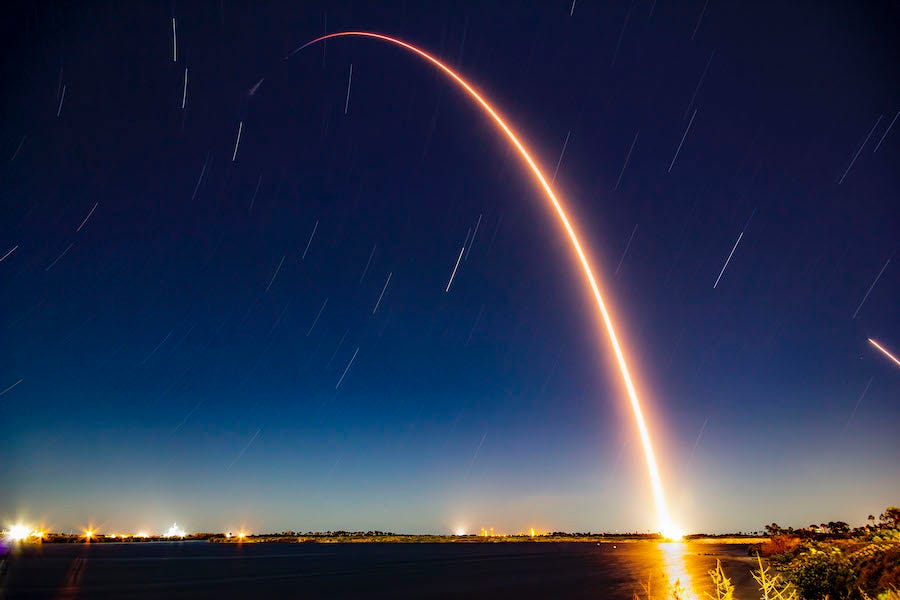
🚀 Faster, Please! — The Podcast #35
As the cost to launch a rocket into orbit has come down over the past decade, a slew of startups have joined the emerging space economy. But is there enough business for all these companies? And what's the broad economic case for space? In this episode of Faster, Please! — The Podcast, I'm chatting about those questions and more with Michael Sheetz.Michael is a space reporter for CNBC where he also writes the "Investing in Space" newsletter.In This Episode* The business case for space (1:05)* SpaceX, Blue Origin, and the other players in space (4:03)* How much demand is there for space services? (10:15)* To the Moon and Mars (13:59)Below is an edited transcript of our conversationThe business case for spaceJames Pethokoukis: How do private companies intend on making money in space over the next decade?Michael Sheetz: The first and foremost way is the tried-and-true way when it comes to making money in space, which is providing communications data and other services back to people here on Earth. You're talking about communication systems like Starlink, which are the next generation of communication services that have been around, from the geo-communication satellites of decades prior. That's the primary, immediate way that people are making money right now in space. The second way that people are making money in space is by launching satellites for other customers: You're talking about the rocket business, the transportation business. You see stuff like OTVs, or orbital transfer vehicles. That's a way to deliver stuff into space.Then there's a third kind of newer way, which is just microgravity research in general. That's coming to the fore really in the last decade as NASA has really opened up the International Space Station as a testbed for commercial technologies and not just NASA's own technologies. And a lot of companies see that as really just a first foray into that ground. Some of them are trying to do it in their own way by sending capsules into orbit and bringing them back, not going to a space station. The other way is by sending it to a space station, and there are actually four or five major projects underway in the United States to build private space stations in orbit. Those are companies that are either working together or building their own solo units, and they're all just kind of vying for a future in which you don't just have one giant space station, because the International Space Station is huge, but instead of the ISS, you have lots of these little space stations that people can sign agreements with. Say a pharmaceutical company wants to test out a new drug in orbit, they'll sign a research agreement with a company that's going to fly them up there, test it out, fly it back down. They might have astronauts on board. They might not.The other way — this is the other kind of nascent sector — is the lunar infrastructure world, and that's all very much a new space race, if you will, because there's a geopolitical element there. We’ve got India, we have China both firmly in that mix. China has been arguably one of the most successful at landing on the Moon in the last decade. And NASA, instead of trying to fly themselves to the Moon for these cargo missions and research, they've actually gone to companies and said, “Hey, bid on these contracts, deliver services to us. We'll put our payloads onto your spacecraft, your lander, your rover, and then get it down to the Moon and either get us back data or even return materials.” But mostly just, “Let's try to figure out if we can actually make use of the water that's believed to be on the surface of the Moon.” And that's a really big key point: The first round in terms of trying to make use of the Moon is all about, can we harvest the resources that are on the lunar surface?SpaceX, Blue Origin, and the other players in spaceMuch of the conversation among regular people, to the extent they're aware of really what's going on, what you've just described so wonderfully, is SpaceX. Maybe they've heard of Jeff Bezos and Blue Origin. How far behind is Blue Origin of SpaceX? Do we have a feel for where that company is?I, at this point, wouldn't even put it as really a competition, because SpaceX is very much in a league of their own. Blue Origin has so dramatically taken a different approach to development, very much more akin to the aerospace and defense contractors of the past. It's fascinating because both companies are actually very similar sizes in terms of personnel, but SpaceX has taken this approach of, let's just get one win after the other and try to just break things a little bit at a time and keep pushing further that way. Whereas Blue Origin is taking the route of, we want everything to work the first go, the first launch, the first landing on the Moon, all these other nuances in there. And so far, SpaceX's strategy has been dominant. Now, the United States is not looking at United Launch Alliance, one of the existing providers for rocket laun

🚀 Faster, Please! — The Podcast #34
Rapid progress in artificial intelligence, especially large language models such as ChatGPT, has rekindled an old debate about the feasibility of top-down economic planning. While 20th-century experiments in socialism ultimately failed, some techno-socialists have argued a new set of tools could help planners outperform markets. But today’s guest argues no amount of computing power or sophisticated algorithms can overcome the fundamental issues with socialist planning. Pete Boettke joins this episode of Faster, Please! — The Podcast to discuss.Boettke is a university professor of economics and philosophy at George Mason University and director of the F.A. Hayek Program for Advanced Study in Philosophy, Politics, and Economics at the Mercatus Center. Last year, he and Rosolino Candela authored the paper, “On the Feasibility of Technosocialism.”In This Episode* Technosocialism in the 20th century (1:34)* The appeal of economic planning (6:14)* The recent resurgence of socialism (10:34)* Can AI aid industrial policy? (24:08)* Not wrong, just early (32:51)Check back tomorrow at Faster, Please! for the full transcript of this interview. (Typically each podcast includes the transcript, but I’m currently traveling. So please forgive me!)Faster, Please! is a reader-supported publication. To receive new posts and support my work, consider becoming a free or paid subscriber. Thanks! This is a public episode. If you'd like to discuss this with other subscribers or get access to bonus episodes, visit fasterplease.substack.com/subscribe
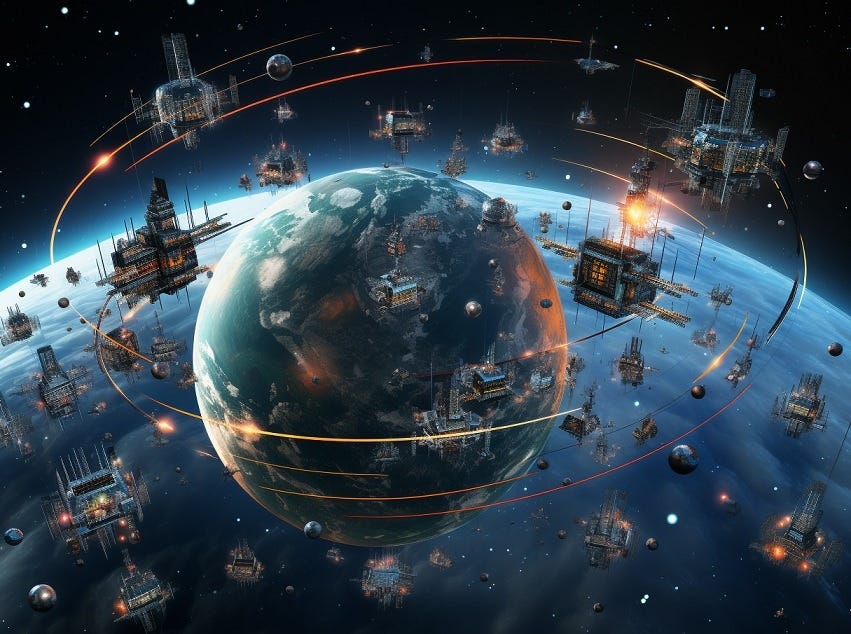
🚀 Faster, Please! — The Podcast #33
Over the past 15 years, the cost to launch a rocket into orbit has declined dramatically thanks to SpaceX. Today, we're witnessing the launch of a new Space Age — one built around billionaires like Elon Musk, but also a flowering of smaller private ventures. To discuss the state of play in the emerging orbital economy, I've brought Ashlee Vance on this episode of Faster, Please! — The Podcast.Vance is the author of the new book, When the Heavens Went on Sale: The Misfits and Geniuses Racing to Put Space Within Reach. He previous wrote, Elon Musk: Tesla, SpaceX, and the Quest for a Fantastic Future in 2015.Faster, Please! is a reader-supported publication. To receive new posts and support my work, consider becoming a free or paid subscriber.In This Episode* How SpaceX launched a new Space Age (1:13)* The companies building a “computing shell” around the planet (8:37)* The proliferation of satellites (15:07)* The downsides of the emerging space economy (24:07)Below is an edited transcript of our conversationHow SpaceX launched a new Space AgeJames Pethokoukis: The book begins with a story of the first successful orbital launch of a SpaceX Falcon 1. There were three failed attempts, the whole thing is looking pretty dicey about the future of the company in this effort, and on the fourth attempt, September, 2008, they're able to get to orbit and release a payload. Before September, 2008, what does the space economy/space industry look like? Where are we starting?Ashlee Vance: The starting point: sort of sadly, it looked a lot the same for many, many decades. We had this nation-backed space program, [which was] dominant. There were just a handful of nations, really, that were the major players in all this. Some wealthy people at various stages had come along and tried to commercialize space and make their own rockets, and had varying degrees of success, but no staying power. It ended up that it always takes longer and costs more than you think. And NASA was always sitting there really as your main competitor and undermining your business. With the Falcon 1, it really was this watershed-type moment where finally somebody had succeeded. Yes, SpaceX had people from traditional aerospace, but Elon [Musk] certainly was not from the aerospace world. He had a lot of 20-somethings on his team who had never done this before. It just signaled this new era, or the possibility of a new era, because you had people just who hadn't been part of the old guard doing this thing.The goal here was to get a rocket into space and get it there way cheaper than what NASA was doing. What was the key breakthrough that allowed that decline in costs? And why didn't NASA just do this?NASA, and in particular the Department of Defense, had desired this type of thing for a long time: a low-cost rocket that could get to space quickly and often. It seems like this should be doable, but they had really struggled to make it happen. The DOD had funded various efforts. There's a couple things going on. SpaceX had this huge advantage, I think, of this clean slate to this. They came at this without the usual baggage. And in this case, the baggage means a lot of military government contractors who are pricing things quite expensively. They're doing things the way they've always done them, which means you probably don't want to see any sort of failure so you're building it in a ton of redundancy and spending all this extra money to make sure you look good when this thing goes.SpaceX comes in with this clean slate. The original pitch deck for SpaceX described it as like the Southwest for space. Cost was like at the top of [Elon Musk’s] mind and he wanted to make this cheap. They did have some breakthroughs. The physics around a rocket are the physics, and we've known this for decades. There's not much room for huge breakthroughs in engineering that nobody has thought of yet. But they did come in with this modern, Silicon Valley–style approach to software, particularly to electronics—although this kind of comes in later in SpaceX's history—where SpaceX was going to build a lot of the electronics themselves, often turning to consumer-grade electronics instead of what people call space-grade, which means it's built by a military contractor, it probably costs a thousand times what it should cost, but it's guaranteed to work in space. They had this clean slate. They did things as cheap as possible. The team was small. It wasn't this bloated contractor. That was their primary advantage at the beginning, I would argue. Over time, as they've gotten much bigger and much more money is coming in, there's a whole host of technological advantages. But on the Falcon 1, it really was that clean slate, this low-cost approach.Obviously if you're beginning your book, which is not a history of SpaceX, but you're beginning with SpaceX, then that must have marked an important inflection point where you could sort of imagine two paths. One path: the 2010s look a lot like the

🚀 Faster, Please! — The Podcast #32
On Faster, Please! — The Podcast, I've interviewed guests on exciting new technologies like artificial intelligence, fusion energy, and reusable rockets. But today's episode explores another Next Big Thing: biotechnology. To discuss recent advances in CRISPR gene editing and their applications for medicine, I'm sitting down with Kevin Davies.Kevin is executive editor of The CRISPR Journal and author of the excellent 2020 book, Editing Humanity: The CRISPR Revolution and the New Era of Genome Editing.In This Episode* CRISPR advances over the past decade (1:13)* What CRISPR therapies will come next? (8:46)* Non-medical applications of gene editing (13:11)* Bioweapons and the ethics of CRISPR (18:43)* Longevity and genetic enhancements (25:48)Faster, Please! is a reader-supported publication. To receive new posts and support my work, consider becoming a free or paid subscriber.Below is an edited transcript of our conversationCRISPR advances over the past decadeWhen people talk about AI, for instance, they might be talking about different versions or applications of AI—machine learning being one. So when we talk about CRISPR, are we just talking about one technique, the one they figured out back in 2012? Are there different ones? Are there improvements? So it's really a different technique. So how has that progressed?You're right. CRISPR has become shorthand for genome editing. But the version of CRISPR that was recognized with the Nobel Prize three years ago in 2020 to Jennifer Doudna and Emmanuelle Charpentier was for one, we can call it the traditional form of CRISPR. And if I refer to it again, I'll call it CRISPR-Cas9. Cas9 is the shorthand name for the enzyme that actually does the cutting of the DNA. But we are seeing extraordinary progress in developing new and even more precise and more nuanced forms of genome editing. They still kind of have a CRISPR backbone. They still utilize some of the same molecular components as the Nobel Prize–winning form of CRISPR. But in particular, I'm thinking of techniques called base editing and prime editing, both of which have commercial, publicly funded biotech companies pushing these technologies into the clinic. And I think over the next five to 10 years, increasingly what we refer to as “CRISPR genome editing” will be in the form of these sort of CRISPR 2.0 technologies, because they give us a much broader portfolio of DNA substitutions and changes and edits, and give the investigators and the clinicians much more precision and much more subtlety and hopefully even more safety and more guarantees of clinical efficiency.Right. That's what I was going to ask. One advantage is the precision, because you don't want to do it wrong. You don't want mutations. Do no harm first. A big advantage is maybe limiting some of the potential downsides.In the ideal gene-editing scenario, you would have a patient with, say, a genetic disease that you can pinpoint to a single letter of the genetic code. And we want to fix that. We want to zero in on that one letter—A, C, T, or G is the four-letter alphabet of DNA, as I hope most of your listeners know—and we want to revert that back to whatever most normal, healthy people have in their genetic code at that specific position. CRISPR-Cas9, which won the Nobel Prize, is not the technology to do that sort of single base edit. It can do many other things, and the success in the clinic is unquestionable already in just a few years. But base editing and, in particular, prime editing are the two furthest developed technologies that allow investigators to pinpoint exactly where in the genome we want to make the edit. And then without completely cutting or slicing the double helix of DNA, we can lay up the section of DNA that we want to replace and go in and just perform chemistry on that one specific letter of DNA. Now, this hasn't been proven in the clinic just yet. But the early signs are very, very promising that this is going to be the breakthrough genome-editing technology over the next 10 to 20 years.Is CRISPR in the wild yet, or are we still in the lab?No, we're in the clinic. We are in human patients. There are at least 200 patients who have already been in or are currently enrolled in clinical trials. And so far, the early results—there are a few caveats and exceptions—but so far the overwhelming mood of the field is one of bullish enthusiasm. I don't want to complete this interview without singling out this one particular story, which is the clinical trial that has been sponsored by CRISPR Therapeutics and Vertex Pharmaceuticals for sickle cell disease. These are primarily African-American patients in this country because the sickle cell mutation arose in Africa some 7,000 years ago.We're talking about a pretty big share of the African-American population.This is about 100,000 patients just in America, in the US alone. And it's been a neglected disease for all kinds of reasons, probably beyond the scope of our discussion. But the ea

🚀 Faster, Please! — The Podcast #31
"The promise of eternal life has conventionally been the dangled carrot of religion. It is now the holy grail of Silicon Valley," writes novelist Lionel Shriver in a recent National Review cover essay. In this episode of Faster, Please! — The Podcast, Lionel joins me to discuss why some tech billionaires are chasing after immortality and the serious challenges that would accompany extended human lifespans.Lionel is a columnist for Britain's Spectator magazine. Her books include We Need to Talk About Kevin and Should We Stay or Should We Go.Faster, Please! is a reader-supported publication. To receive new posts and support my work, consider becoming a free or paid subscriber.In This Episode* The promise and peril of immortality (1:11)* Storytelling and optimism (6:44)* Lifespan vs. healthspan (12:23)* Post-humanity (19:19)Below is an edited transcript of our conversationThe promise and peril of immortalityJames Pethokoukis: In the National Review essay, you make it clear you are not a medical expert, you're not a research scientist; you're a writer of fiction. Of all the things you could have written about, both as an essay and also in your book, Should We Stay or Should We Go, what originally created your interest in this topic of longevity?Lionel Shriver: I should also clarify that, for someone who's writing about life extension, I am not immortal either. So I have no qualifications for this aside from having applied myself to it imaginatively. The book you mentioned, Should We Stay or Should We Go, is a novel about a couple that has vowed to kill themselves once they both reach the age of 80 because they don't want to fall apart. They don't want to burden others with their own crumbling. It's a parallel universe book that explores any number of different futures for this couple. And one of those futures is why I suspect I was approached to write this essay for National Review, and it's one in which there's a cure for aging. Basically, my characters live forever. Everyone in the world looks 25 and they never look any older. I have addressed myself to what that future might look like and not just look like, but feel like. What would it feel like to address yourself to a future that was potentially infinite?In the novel, it starts out great. It was exhilarating to watch your spouse, rather than get older and older, get younger and younger and return to the age when you fell in love. And everyone is healthy. There are no limitations anymore. And all your choices are also potentially infinite. You can try out every profession. It's no longer a matter of, what are you going to be when you grow up? You can be whatever you want, and then you can change your mind. It'd be something else. You can move to any city. All your choices are just this kind of smorgasbord of what you might sample. And that seems fun to begin with.That sounds like a near-utopian scenario.Yeah. The trouble is that when you think about it, one of the things that gives our lives urgency is finitude, that our decisions matter because you can't undecide them. The way we choose to spend our time matters because there's a limited amount of it. There's no redo. And effectively with eternal life, there is a redo. There's infinite redo. You can just go back and do something else. You can just go in a different direction. If you marry the wrong person, you can just marry someone else and you won't have given them, say, 10 years of your precious life. I mean, yes, but there are so many years left that it doesn't matter. And the trouble is that once you remove that, then nothing seems to matter. And that is depressing. When you remove that urgency, you also potentially remove meaning. And everything becomes arbitrary.One of the things that happens to my characters is their characters start to decay. In some ways, they trade places in terms of what kind of person they are. The wife has always been the more optimistic and reflective and joyous, whereas her husband was more programmatic and more of an ideologue. And as the hundreds of years go by, he becomes much more himself reflective and philosophical and she becomes impatient and misanthropic. Because character itself becomes arbitrary. In the essay, I'm trying to look in a nonfiction sense at, what would it really be like both emotionally and practically to have a permanent human population? And that raises huge practical problems, too. Like, you don't have any children anymore. You can't.Storytelling and optimismIs it easier for you to come up with the more dystopian scenarios? Oftentimes, I'll criticize sci-fi writing, television, books as overly focused on the dystopian. It’s almost like a lack of effort. In this case, is that basically justified: that it's very hard to write a scenario where everything kind of turns out okay if people are living forever?It is hard to write. It's always hard to write positively. It's hard for me even to write characters that are purely lovable. Since I don't know a
🚀 Faster, Please! — The Podcast #30
Nuclear fusion holds the potential to provide the world with cheap, clean, virtually inexhaustible energy for the future. For decades, the technology was dismissed as sci-fi fantasy. But a series of recent technological breakthroughs — including a net-energy gain ignition at Lawrence Livermore National Laboratory last December — and spate of startups have made both government and investors increasingly optimistic. To talk about the state of the fusion industry, I’ve brought on Andrew Holland, chief executive officer at the Fusion Industry Association.In This Episode* The importance of recent fusion breakthroughs (1:17)* What should policymakers be doing to promote fusion? (5:58)* Environmentalism and fusion energy (14:09)* Will fusion be the main energy source of the future? (18:57)Below is a lightly edited transcript of our conversationThe importance of recent fusion breakthroughsJames Pethokoukis: Until recently, fusion energy was a government science project that you didn’t hear much about. But now we have dozens of startups involved and frequent media coverage of big breakthroughs. What happened?Andrew Holland: It's results. Results, results, results. Science is progressing. Things have happened on both sides of the science of fusion. Plasma physics has been around for 60 years. It's really hard. It's really challenging. And they had to create a whole new area of physics, plasma physics, to be able to understand how to do fusion. They did that for 60 years, and it was continued short progress here and there, two steps forward, one step back. Until we got to the point probably about five or 10 years ago where the scientists said, “We think we know how to make this work.” But then what's happened is that startups and new thinking came in and applied all of the other technological advances that were out there—things like material science, artificial intelligence, machine learning, high-speed computing—as well as new business practices, putting those in effect onto what had been this kind of staid field of government science.Putting those two together, and that's where the real developments and changes and things are happening. In fact, there are 38 members of the Fusion Industry Association now, with a few others around the world that are stragglers. And it's been just this almost Cambrian explosion of different technologies and ways forward and paths to get there. And everybody is competing to be the one to get there first and the one to get there best. So it is an exciting time. And we're seeing the effects of all of this other technology coming into plasma physics. Things have really changed.So how significant was that breakthrough at Lawrence Livermore last year, both for the technology and also for investor and public awareness? Yeah, it is significant in the kind of public awareness and public assessment of it. I can tell you that our website had its highest day ever in December when the announcement from the NIF happened. And I can tell you just kind of anecdotally a lot of that awareness came about. But the nature, I think, of an exponential curve, a Moore's law–type thing where it doubles every year, doubles every so often—is that when it's exponential, it's going straight up, but for a long time it looks pretty flat. So a long time below the level, it's been doubling and doubling and doubling over a number of years. It just started from a very low point. Those inside the field knew that something was happening, but it never broke out. It never got into the New York Times. It never got into Twitter discussions. It was all sort of inside baseball discussions.It's been a completely new thing for the fusion community to now have a lot of interest coming into it. That said, though, the investors were a little keyed in a little bit earlier. Since the NIF announcement, we've seen some new deal flow. We've got about $6 billion invested in private fusion. Of that, most of it came in before the NIF announcement. Investors were looking at this. Investors were aware of it. We are still seeing some of the deal flow that post-NIF takes some time. There's a lot of due diligence that investors do and stuff like that, so we haven't yet seen the real explosion from NIF of investment and running. But I think we're due to pretty soon.We're seeing this as kind of a starting gun of competition around the world. What should policymakers be doing to promote fusion?What is the policymaker awareness and action on this technology?We're getting there. In March of 2022, the White House held an event calling for a “bold decadal vision on commercial fusion,” basically saying, can you get to commercial fusion in 10 years? It's an aggressive target. Our company said, yes, we can—with your help. The White House put in not an aggressive amount of budget in the scheme of billions and trillions even in the IRA and various other subsidy measures. Instead what they've started up is what's called a new milestone-based public-private pa

🚀 Faster, Please! — The Podcast #29
Many countries around the world have below-replacement fertility rates. And today’s today's guest says it's happening faster than we think, with world population on track to peak around 2060. That’s decades before the well-known UN model projection. What does that mean for the American and global economies, and what can we do about it — if anything? My AEI colleague Jesús Fernández-Villaverde joins this episode of Faster, Please! — The Podcast to discuss those questions and more.Jesús is a professor of economics at the University of Pennsylvania, where he serves as director of the Penn Initiative for the Study of Markets. He’s also the John H. Makin Visiting Scholar at the American Enterprise Institute.In This Episode* The speed of demographic transition (1:19)* World population prospects (5:57)* The geopolitics of declining fertility (9:51)* Can public policy reverse demographic trends? (15:09)* Immigration and demographics (23:28)Below is an edited transcript of our conversationThe speed of demographic transitionJames Pethokoukis: A lot of our discussion is going to be based on a paper that you co-authored, “Demographic Transitions Across Time and Space.” When you talk about a demographic transition, you're talking about a shift that countries undergo as they get richer and develop, from a high-fertility/ high-mortality demographic to low-fertility and low-mortality. Is that what you mean by demographic transition?Why is that something economists study?Jesús Fernández-Villaverde: Two reasons. First, because we believe that demographics are intimately linked with economic growth. Go back to the beginning of our science: [Thomas] Robert Malthus, one of the very earliest economists, already wrote very coherently about it. And second, because it helps us to think about a long list of policy questions that depend in a crucial way on demographics. When I think about the future of Medicare, when I think about the future of Social Security, those depend crucially on demographics. Understanding demographics is key to having good economic policies.The key findings of that paper have to do with the speed and the depth of that transition? What are you saying that is different from what people previously believed about the demographic transition?You're absolutely right: It's about the speed. If you stop any economist or demographer and you ask them what is happening with fertility on the planet, they will tell you it's falling. That's well known. What we add is a twist; we say it's falling much faster than anyone had realized before. And it's falling at a speed that is going to fundamentally transform many of our societies and the planet as a whole in ways that most policymakers are not really taking into consideration. So it's the speed. It's not that it's falling; it is falling immensely fast.I look at the fertility of the planet as a whole in 2023. According to my calculations, it’s already 2.2. That means that the planet in 2023 is already below replacement rate. Which means that the world population will start falling some moment around the late 2050s to early 2060s. … What I want the listeners to understand is, for the very first time in the history of humanity — humans have been around for 200,000 years — we are below replacement rate in terms of fertility.People and policymakers may have a general knowledge, but what you're saying is that they're dramatically underestimating how fast that is happening across the world.Exactly. Let me give you a couple of numbers which personally I think are mind-blowing. Usually, we talk about the replacement rate. The replacement rate is how many children does a woman need to have on average to keep population constant in the long run? And many listeners may have heard the number 2.1. Why 2.1? Because under natural circumstances, without any type of selective abortion, there are around 105 boys born per 100 girls. And a few of the girls that are born are not going to complete their fertility age. So that's why you need a little bit more than two.In fact, 2.1 is a very good number for the United States. It’s not a good number for the planet. Why is it not a good number for the planet? Because of two reasons. Reason one: selective abortions. You go to China, you go to India — and these are huge countries, demographically speaking — there is a lot of selective abortions. In India or China, you have around 110 kids per 100 girls. Second, because in Africa, another big part of the demographic future of humanity, infant mortalities is still sufficiently high that it makes a little bit of a difference. For the planet as a whole, the replacement rate is not 2.1. It's more like 2.2, 2.25. It’s kind of hard to know the exact number.So I go to the planet and I look at the fertility of the planet as a whole in 2023. According to my calculations, it’s already 2.2. That means that the planet in 2023 — I'm not talking about the United States, I'm not talking about North America, I'm not tal

🚀 Faster, Please! — The Podcast #28
Does technological progress automatically translate into higher wages, better standards of living, and widely shared prosperity? Or is it necessary to steer the development of technological improvement to ensure the benefits don't accrue only to the few? In a new book, two well-known economists argue the latter. I'm joined in this episode by one of the authors, Simon Johnson.Simon is the Kurtz Professor of Entrepreneurship at MIT. He and Daron Acemoglu are authors of the new book Power and Progress: Our Thousand-Year Struggle Over Technology and Prosperity. Simon is also co-author with Jonathan Gruber of 2019's Jump-Starting America, now out in a new paperback.In This Episode* Is America too optimistic about technology? (1:24)* Ensuring progress is widely shared (11:10)* What about Big Tech? (15:22)* Can we really nudge transformational technology? (19:54)* Evaluating the Biden administration’s science policy (24:14)Below is an edited transcript of our conversationIs America too optimistic about technology? James Pethokoukis: Let me start with a sentence or two from the prologue: “People understand that not everything promised by Bill Gates, Elon Musk, or even Steve Jobs will likely come to pass. But, as a world, we have become infused by their techno-optimism. Everyone everywhere should innovate as much as they can, figure out what works, and iron out the rough edges later.” Later, you write that that we are living in a “blindly optimistic” age.But rather, I see a lot of pessimism about AI. A very high percentage of people want an AI pause. People are very down on the concept of autonomous driving. They're very worried that these new technologies will only make climate change worse. We don't seem techno-optimistic to me. we certainly don't see it in our media. First of all, let me start out with, why do you think we're techno-optimistic right now, outside of Silicon Valley?Simon Johnson: Well, Silicon Valley is a very influential culture, as you know, nationally and internationally. So I think there's a deep-running techno-optimistic trend, Jim. But I also think you put your finger on something very important, which is since we finished the book and turned in the final version in November, I think the advance of ChatGPT and some of our increased awareness that this is not science fiction — this is actual, this is real, and the people who are developing this stuff have no idea how it works, for example—I wouldn't call it pessimism, but I think there's a moment of hesitation and concern. So good, let's have the discussion now about what we're inventing, and why, and could we put it on a better path?When I think about the past periods where it seemed like there was a lot of tech progress that was reflected in our economic statistics, whether it's productivity growth or economic growth more broadly, those were also periods where we saw very rapid wage growth people think very fondly about. I would love to have a repeat of 1995-2000. If we had technologies that could manage that kind of impact on the economy, what would be the downside? It seems like that would be great.I would love a repeat of the Henry Ford experience, actually, Jim. Henry Ford, as you know, automated the manufacturing of cars. We went from producing tens of thousands of cars in the US to, 30 years later, producing millions of cars because of Ford's automation. But at the same time Ford and all the people around him — a lot of entrepreneurs, of course, working with Ford and rivals to Ford — they created a lot of new jobs, new tasks. And that's the key balance. When you automate, when you have a big phase of automation, and we did have another one during World War II and after World War II. We also created a lot of new tasks, new jobs. Demand for labor was very strong. And I think that it's that balance we need. A lot of the concerns, the justified concerns about AI you were mentioning a moment ago, are about losing jobs very quickly and faster than we can create other tasks, jobs, demand for labor in other, non-automating parts of the economy.Your book is a book of deep economic history. It's the kind of book I absolutely love. I wonder if you could just give us a bit of a flavor of the history of what's interesting in this book about those two subjects and how they interact.We tried to go back as far as possible in economic and human history, recorded history, to understand technological transformations. Big ones. And it turns out you can go back about 1000 years with quite reliable information. There are some things you can say about earlier periods, a little bit more speculative to be honest. But 1000 years is a very interesting time period, Jim, because as you know, that's pretty much the rise of Europe timeframe. A thousand years ago, Europe was a nothing place on the edge of a not very important part of one continent. And through a series of technological transformations, which took a long time to get going — and that's part of the medi

🚀 Faster, Please! — The Podcast #27
I have many times written about the importance of the story we tell ourselves about the future, especially in big-budget science fiction films. But does all the doom and gloom from Hollywood even matter? And is it driven from creatives at the top or by audience demand? To discuss those questions and more, I'm talking with Sonny Bunch.Sonny is the culture editor for The Bulwark, where he hosts The Bulwark Goes to Hollywood newsletter and podcast.In This Episode* Netflix’s upcoming $200 million techno-pocalyptic movie (1:06)* Why is Hollywood obsessed with dystopia? (6:17)* The solutionism of The Martian (8:48)* Do sci-fi visions of the future even matter? (15:03)Below is an edited transcript of our conversationNetflix’s upcoming $200 million techno-pocalyptic movieJames Pethokoukis: I write a lot about negative future-pessimistic media. Netflix has a big new movie in the works, a $200 million film directed by the Russo brothers, who you may know from the Marvel movies. They’ve got Millie Bobby Brown, Chris Pratt. Big production. It's called The Electric State. And this is a summary of this film: “A runaway teenager and her … robot travel west through a strange USA, where the ruins of gigantic battle drones litter the countryside heaped together with the discarded trash of a high tech consumerist society in decline.” And then it goes on about our “hollow core of civilization has finally caved in.”This might be a fantastic film, and I have a lot of confidence in the Russo Brothers and that budget. Here we are, we have a lot of interesting things cooking in the world from the Musk rockets and AI and huge breakthroughs in biotechnology, and that's the movie they're giving us for $200 million, about the decline of consumerist society. You've been writing a bit about this topic. When does it end?Sonny Bunch: It's interesting because I was thinking about this the other day: Really, what is the only truly utopian vision of the future? It's Star Trek. That's about it. In terms of mass popular entertainment, the only really, truly utopian ideal of the future is Star Trek. Now, there's still conflict in Star Trek. But it is at least a kind of post-scarcity society where folks are interested in exploring the world and bettering everyone. Look, part of this is it is easier to create tension and drama out of things that are bad. And what's the easiest way to look at how things might be bad? Look at what basically works about right now and say, “Well, what if this doesn't work? What if it's actually bad for us?” The idea of Netflix producing a stirring condemnation of consumerist society is kind of funny in and of itself. Netflix is the absolute peak of consumerism.Literally, the mission statement of Netflix is to sit on your couch and consume; consume so much you don't fall asleep. The initial argument for Netflix one of the creators the company made was, “We are trying to win the war against sleep.” They're not winning the war against sleep by encouraging people to create wonderful new advancements of society. It’s just to sit there and passively consume. So it's kind of funny. I like a good dystopian action movie. I can watch those all day long, so I'm probably as much of the problem as anything else. But it's definitely a thing.And it just doesn't seem that hard to me to have some sort of positive message, even if it's overall kind of dystopian or apocalyptic. I just don't see that there's any attempt. It's just full-throated doom.Remember when Interstellar came out? I love Interstellar. Great movie. It is hopeful in a certain way. It's about trying to find new places for Earth to live; it's on the edge of collapse. When Matthew McConaughey's character comes back about a hundred years later because of all the time dilation, humanity has moved up to the space stations that are orbiting and people have been saved. As far as these things go, it's actually a fairly positive message. Except there was an undercurrent from some critics who were like, “You know, this means that like billions of people died, right? They didn't save more than a handful of folks up on those space stations. Most of humanity is dead or dying.” And I was like, yeah, but they didn't focus on that. It's still pretty positive.I would counter argue that one of the themes of that movie is at some point we turned our back on progress. It's like society be has become anti-technology. To me, that movie says if we had not abandoned technological progress, maybe this huge disaster which has befallen the Earth, maybe we could have fixed it. But now it's too late. Now we have no other choice but to head to the stars, which is something we probably should have been thinking about anyways. I think a superficial viewing of that movie is that it is pessimistic. And I think you're right. I think, fundamentally, that is a future pro-progress film.Why is Hollywood obsessed with dystopia?But you mentioned Star Trek at the beginning. Why do you think Hollywood's sci-fi,

🚀 Faster, Please! — The Podcast #26
The conventional narrative about the economic history of World War II says that new learning from wartime mobilization jumpstarted a postwar golden age of fast economic growth. But, economist Alexander Field writes in his 2011 book, A Great Leap Forward, "It was not principally the war that laid the foundation for postwar prosperity. It was technological progress across a broad frontier of the American economy during the 1930s." Field develops that argument in his new book, The Economic Consequences of U.S. Mobilization for the Second World War, released last fall. In this episode of Faster, Please! — The Podcast, I'm joined by Alex to discuss his argument.Alex is the Michel and Mary Orradre Professor of Economics at Santa Clara University's Leavey School of Business.In This Episode* Depression-era technological progress* Economic detective work (8:04)* What about the scientific advances of WWII? (13:23)* The US economy if WWII never happened (17:39)Below is an edited transcript of our conversationDepression-era technological progressJames Pethokoukis: You write in A Great Leap Forward, a book that I consult frequently and mention frequently in my writings: “The years 1929-1941 were, in the aggregate, the most technologically progressive of any comparable period in U.S. economic history. … It was not principally the war that laid the foundation for postwar prosperity. It was technological progress across a broad frontier of the American economy during the 1930s.” Your new book builds upon that argument, but could you, just for a moment, give a quick summary of A Great Leap Forward, and then how that moves into your new book?Alexander Field: The basic argument of A Great Leap Forward was that behind the backdrop of double-digit unemployment for at least a decade, potential output was growing by leaps and bounds during the Great Depression. It wasn't really recognized until Simon Kuznets had to try to do a back-of-the-envelope calculation of what the potential of the economy could be. But the contributors to that were, I think, several. Number one was the last third of the conversion of the internal transmission of power within American factories from the shafts and belts, which was a signature of the 19th-century factory, to fractional-horsepower electric motors and electric wiring. And the second part was just an enormous amount, surprisingly, of research and development spending. Just astounding, if you think of the Depression as being so disastrous macroeconomically, but in terms of the number of people employed growing by leaps and bounds, number of labs established. And then finally, although it's widely accepted that the New Deal spending was too small in a Keynesian sense to immediately bring the economy out of the Depression, nevertheless, that spending on streets and highways and bridges and hydropower and so on had very strong positive supply-side effects. I think it's the combination of those three factors that I see as responsible for making potential output so much larger in 1941 than people thought it was.For the layman, your finding in that book, your thesis, is extraordinarily counterintuitive. You would never expect that underneath that sky-high unemployment number and the failing banks and the breadlines, there was this sort of innovative ferment happening and foundations laid for future progress. Similarly, to the extent that people would have an economic opinion about World War II, I would guess: 1) that it brought us out of the Great Depression, and 2) that it was a period of key advances, key technologies and the fact maybe we learned how to do things more efficiently during the war, whether it's build boats or what have you. Those two things are what played a huge role in postwar prosperity—I think that might be sort of the everyman way they would conceive of it. That is not exactly what you found.I think you've done a very good job characterizing what I see as the two key themes in the conventional wisdom about the Second World War. Basically, the argument that fiscal and monetary stimulus rapidly closed the output gap, the unemployment rate went from under 10 percent in ‘41 to unimaginably low, below 2 percent, in ‘43 and ’44. That's accepted and I'm not challenging that. But the second part of the conventional wisdom is what the economists call learning by doing: the emphasis on the decline in unit costs with accumulated output as a result of producing military durables. And the argument is exactly as you stated it. The argument is that learning spilled over into the postwar period and kind of underlined the supply side foundations for the golden age, which is ‘48 to ‘73. Now, my argument is different.I see the Second World War from a productivity history perspective as a detour. My argument is that the progress, the growth of potential output up through 1941, that's essentially most of the reason why the US stands astride the world economy in ’48, not what happened between ‘41 and
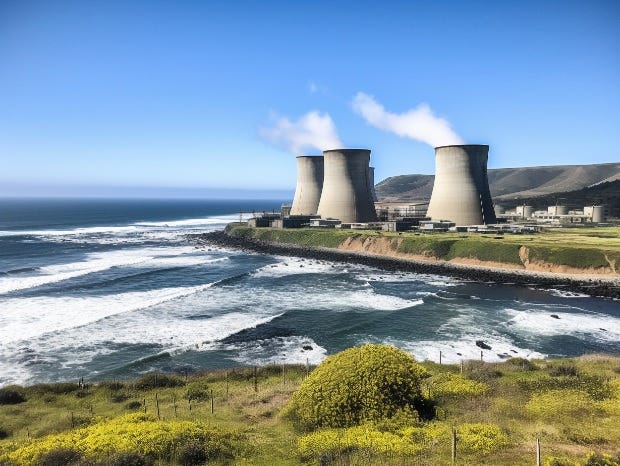
🚀 Faster, Please! — The Podcast #25
When it comes to Up Wing thinking, there's no better litmus test than nuclear power. Setting aside the regulatory barriers we've imposed on ourselves, the United States can tap a source of clean, reliable energy that overcomes the carbon emissions and geopolitical challenges of fossil fuels. Here to make the case for nuclear in this episode of Faster, Please! — The Podcast, is Robert Zubrin.Robert is a nuclear engineer and the author of the new book, The Case for Nukes: How We Can Beat Global Warming and Create a Free, Open, and Magnificent Future.In This Episode* Is the case for nukes contingent on climate change? (1:14)* How the Atomic Age ended (6:39)* A 75-percent nuclear America (15:03)* Is a nuclear renaissance coming? (23:00)Below is an edited transcript of our conversationIs the case for nukes contingent on climate change?James Pethokoukis: Were it not for climate concerns, would there still be a case for nukes, or would you be writing The Case for Carbon instead?Robert Zubrin: No, there still would be a case for nukes. The primary case for nukes is to expand humanity’s energy resources. Regardless of climate change, we have an imperative to make energy more cheap and available. The primary problem in the world today is poverty. We have poverty in America, but in America, the average per capita income is $50,000 a year. Globally, the average is $10,000 a year. And half of the world is below average. So the existence of poverty in the world is quite prevalent. And that stifles people's lives. It kills people — people die of diseases that could easily be cured. They don't get educations. They suffer from malnutrition. They suffer from lack of opportunity. This is the thing that needs to be answered. We need to increase the availability of energy to put the whole world on an American standard of living. Once again, we still even have poverty here. We'd have to increase world energy five times. And fossil fuels cannot support that. So regardless of the issue of climate change or carbon enrichment of the atmosphere, we need more energy.And secondly, we need the energy to come from freedom, not from possession. It needs to come from the power of creation. A major problem with fossil fuels is it puts a lot of global power in the hands of people who just simply have it by force of possession, not through creativity. It gives wealth to those who take it rather than those who make it. For example the OPEC oil cartel could, as it did in 2008, constrict the world's energy supply below what it needs and send the price of oil up to $150 a barrel and cause a massive worldwide economic dislocation as a result. That's even a potential threat right now. Whereas nuclear power fundamentally comes from mind. That is, it’s the result of technological creativity: turning something that is not a resource into a resource — an incredibly abundant resource. So it moves power where it needs to be, into the hands of the creative, which is to say in the hands of the free.Let me continue on the theme from that first question: Why isn't it The Case for Solar? I know that solar prices seem to have come way down in recent years. Why not that as the thrust of your book?The problem is this, that solar energy, and in this I would also add wind as well, are intermittent energy sources. They are not reliable sources of power with which to power an industrial civilization. They are useful boutique energy sources. Wind power has had a major role in the development of human civilization by powering ships. Worldwide commerce was enabled by putting wind to work as a classic example of off-grid power. Solar energy is predominant in space, once again, way off-grid. But if we're talking about the production of energy at scale in a reliable way to power industrial society, they simply do not cut it.Does solar still not cut it, even if we figure out new ways and better ways of storing that energy? That sounds like it's doable. We just need better batteries or ways of storing that solar energy for when it's cloudy out.There are a couple of problems there. First of all, the amount of solar energy to power Manhattan would cover most of Long Island — and try buying Long Island to put the solar energy capacity there. And then you have the problem with storage. First of all, the problem with storage on a planned basis, that is just storing for a night, is bad enough. And it basically increases the cost of a solar installation by like a factor of five just to do that. But what if it's cloudy for three days going? What if there's this thing called winter that happens? Which it does. Solar energy can be inadequate for months on end. Having the capacity to deal with that is simply not possible. So, in fact, solar energy power systems have to be 100 percent backed up by reliable sources of power, which to say either fossil fuels, nuclear, or hydroelectric.How the Atomic Age endedWhy did the Atomic Age end? Do we understand the culprits? Do we understand who
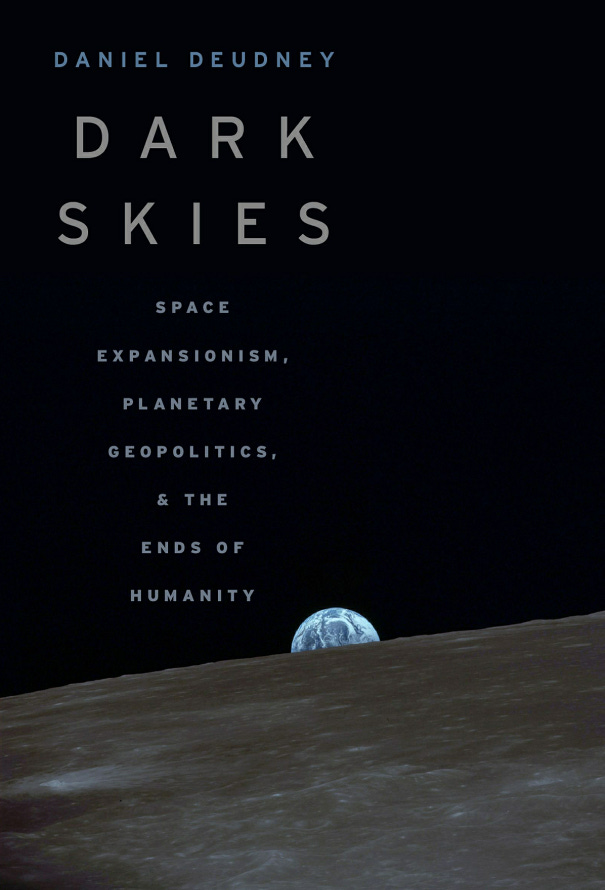
🚀 Faster, Please! — The Podcast #24
As space enthusiasts and entrepreneurs look to expand human civilization to the Moon, Mars, and beyond, few stop to examine the geopolitical risks of space colonization or the opportunity costs of not fixing problems on Earth. While most Faster, Please! guests advocate further expansion into space, Daniel Deudney offers a different perspective. Deudney is a professor of political science, international relations, and political theory at Johns Hopkins University. He’s the author of several books, including Dark Skies: Space Expansionism, Planetary Geopolitics, and the Ends of Humanity, released in March of 2020.This interview was first released in June 2021 for my AEI podcast, Political Economy, and now I’m sharing it with subscribers to Faster, Please! (Unfortunately, our chat preceded my viewing and reading of The Expanse, which does a great job suggesting Deudney’s concerns.)In This Episode* Space expansionism and its dangers (1:24)* Space infrastructure (13:57)* Hedging existential risk (18:13)* Principles for space policy (30:40)Below is an edited transcript of our conversation.Space expansionism and its dangersJames Pethokoukis: My listeners love when I read during these podcasts. I’m going to start by reading two quotes. The first quote is from Elon Musk:“You want to wake up in the morning and think the future is going to be great – and that’s what being a spacefaring civilization is all about. It’s about believing in the future and thinking that the future will be better than the past. And I can’t think of anything more exciting than going out there and being among the stars.”Quote two is from the Blue Origin website:“Blue Origin was founded by Jeff Bezos with the vision of enabling a future where millions of people are living and working in space to benefit Earth. In order to preserve Earth, Blue Origin believes that humanity will need to expand, explore, find new energy and material resources, and move industries that stress Earth into space.”Now, I think you would probably call both those visions “space expansionist”. But that is not your vision, right? So what don’t you like about those visions?Daniel Deudney: Well, Musk and Bezos articulate a vision of space expansionism that was first articulated early in the 20th century and has been subsequently developed. Bezos was actually a student of Gerard O’Neill, who was one of the main visionaries of space colonization in the United States during the 1970s. So they’re articulating a central set of ideas that is held by a large number of people, both in the United States and globally. And my book, Dark Skies, is really a systematic evaluation of the actual impact of space activities to date and a critical assessment of the likely impacts of many of these yet unrealized projects.So to start with the historical record, this is not a simple task because space is just a place. And so there’s a heterogeneity of activities that have gone on there. So it’s like summing up apples, light bulbs, and grenades. But the standard narrative of space activities to date, I argue, is woefully inaccurate. It leaves out one of our major space programs — and, depending on how you count, perhaps our major space program and arguably our most consequential space program — which is the use of ballistic missiles to deliver thermonuclear weapons at global distances in very short periods of time.The standard definition of space weapons is that they are weapons used against objects in orbit or placed in orbit. That’s completely insufficient because it leaves out the use of the frictionless environment of space as a corridor for rapid bombardment at distance. And so I say that we have this major space program that we don’t acknowledge as a space program. It’s what would be called an “unknown known.” Everyone knows that these exist, but they get misplaced or miscategorized. And if we put ballistic missiles back into the ledger sheet for an assessment of space activities to date, I have to conclude that the impact has been to increase the probability of nuclear war, which would obviously be a civilizational, perhaps existential, catastrophe for humanity. Take the Cuban Missile Crisis. The fact that these weapons move so rapidly — are so difficult to intercept — has created this unprecedented situation of vulnerability.And this really points to a more general fallacy of this very optimistic thinking about space, which is to simply neglect the violence potential and the tendencies for this violence potential to be harnessed. It’s like they think that space is good, and if something is not good, then it can’t be involved in space. The reality is that this major space program (that we don’t acknowledge as such) has been a major negative in terms of the survival of our civilization. And so the first step for the space expansionist, I think, is really to be a bit more realistic and accurate about what they’ve actually done and the inherently enormous violence potential involved in this dom
🚀 Faster, Please! — The Podcast #23
Thanks to SpaceX, it’s getting cheaper and cheaper to launch stuff into orbit. But just imagine if instead of using rockets, we could send cargo and people to space on an incredibly tall elevator. This may sound like a total sci-fi idea, but it has some grounding in real-world physics. In theory, we could build a space elevator by putting a counterweight in geostationary orbit and attaching a cable between the satellite and Earth. An elevator could then climb the cable, delivering payloads to space at a fraction of the cost of propulsive rockets. As you can imagine, it isn't quite that easy, which is why I'm joined today by Stephen Cohen.Stephen teaches physics at Vanier College in Montreal and has been working on space elevator concepts for almost 20 years. Recently, he wrote “Space Elevators Are Less Sci-Fi Than You Think” for Scientific American. Stephen also has a new book, Getting Physics: Nature's Laws as a Guide to Life, which was released earlier this year.In This Episode* Space elevators 101 (1:42)* The engineering challenges (7:14)* The economics of space elevators (11:07)* Space elevators in sci-fi (19:21)Below is an edited transcript of our conversation.Space elevators 101James Pethokoukis: In the intro, I tried to do my best at explaining what a space elevator is. But the simple version is we have something big and heavy in orbit, a cable extends down from that thing, attaches somewhere on the Earth, and we run an elevator up and down it. That's a space elevator. Am I right?Stephen Cohen: Sure.Now that we have a picture in our heads, why is it something more than just an interesting engineering thought experiment? What attracts you to it, other than sort of a technical problem that would be interesting to solve on paper?Well, it's space infrastructure, which is something we don't currently have and never have had. Right now, and for all time we've accessed space, going to space is like a one-off each time. Sometimes you have some reusable parts, but basically what a space elevator is, is a bridge instead of just a bunch of boats.And the advantage of a bridge over boats is what?Access. Right now, each time you want to plan a mission, to simply put something into orbit requires a lot of planning. The weather has to be right. And then you want to plan another mission, you sort of have to begin again. With a space elevator, you can just days in advance say, “Okay, we're going to send something up to a desired orbit.” And just hours later after that one would be sent, you could send something else. And you basically have a housing — that's what the climber is, effectively — that you put the payload inside and up it goes. That's the transformative part. But we haven't talked about really the cost savings, the energy savings, and that's just basic physics.The way you get around in general is by applying forces. And that's something you do without thinking. When you walk, you push on the ground. When you fly through the air, you're basically pushing on air molecules and they push back. But in space, you have none of that. And so what rockets do is they literally are the medium. The fuel you bring is the medium you're pushing against — rather, you're throwing it out the back. It's a hugely wasteful, inefficient way to get around. It's preposterous when you think about it. But it's the only way we can get things to the speeds we need to get them to. Just as a mode of getting things into this is extremely practical. You can't compare the efficiencies. It’s orders of magnitude of difference.It really strikes people. When they hear the general concept, they really think it's something big and it sounds like it's amazing. It's something that is science fictional, but maybe we could turn into science fact. There's something else about it, I think, that just grabs people's attention.Yeah, for sure, because it's a physical connection to space. It's like, if you could just touch the cord at the Earth port, then you're in contact with something that's reaching out all the way into space, which is wild. But I think there's an element missing. People don't realize tethers in space are not a new thing. We've had missions since the ‘70s that are effectively two bodies orbiting earth connected by a long tether, sometimes kilometers long. Now, that's not in the ballpark of 100,000 kilometers long, which is a common number thrown out there for what the eventual space elevator might be. But a lot of the same technologies are involved. The biggest difference is of course, instead of two bodies connected by a tether, like a big spacecraft to a small spacecraft, say, this is a big structure connected all the way to Earth. The amount of tension is tremendous. That's the big difference. That's what effectively becomes the big engineering challenge about it all.To be clear, the cable would be connected to something large in orbit, and that could be something we build, but I've also heard maybe it could be a small asteroid? Am

🚀 Faster, Please! — The Podcast #22
"You can see the computer age everywhere but in the productivity statistics," said Nobel laureate economic Robert Solow in 1987. A decade later, the '90s productivity boom was in full swing. Likewise, it took decades for electrification to have an impact on productivity growth in the early 20th century. Today, artificial intelligence can write a coherent paragraph or generate an image from a simple prompt. But when will AI show up in the statistics, boosting productivity and then economic growth? Avi Goldfarb joins Faster, Please! — The Podcast to discuss that question and more.Avi holds the Rotman Chair in Artificial Intelligence and Healthcare at the University of Toronto's Rotman School Of Management. He's also co-author, along with Ajay Agrawal and Joshua Gans, of 2022's Power and Prediction: The Disruptive Economics of Artificial Intelligence.In This Episode* Prediction at scale (1:34)* How AI has transformed ride hailing and marketing (5:37)* The potential for “system-level” changes (11:26)* When will AI show up in the statistics? (16:12)* The impact of ChatGPT and DALL-E (19:46)Below is an edited transcript of our conversation.Prediction at scaleJames Pethokoukis: What this book is about—and then you can tell me if I've gotten it horribly wrong—this is a book about machines making predictions using advanced statistical techniques. 1) Is that more or less right? And 2) why is that an important capability?Avi Goldfarb: That's more or less right. The only place where I [would offer] a little correction there is, the reason we're talking about artificial intelligence today is almost entirely due to advances in computational statistics. Yes, it is just stats and that sounds kind of unexciting. But once we have prediction at scale, it can be really transformative to all aspects of business in the economy. There's a reason why we're calling computational stats “artificial intelligence” and we didn't use to.Prediction at scale. That's a great three-word description. Probably why you used it. To what extent is that now happening? The name of the book is Power and Prediction: The Disruptive Economics of Artificial Intelligence. Is this prediction at scale already disruptive to some degree or is it, will be disruptive?The technology, for the most part, is pretty close to there, in the sense that we can do prediction at scale because we have the data and we have computational power to do all sorts of amazing things. For the most part, it hasn't been disruptive yet. And it hasn't been disruptive yet, just because we have the technology doesn't mean we know how to use it well and we know how to use it productively in our processes and systems in order to get the most out of it.Are there sectors currently doing this, but they're not doing it well yet? It’s in a variety of sectors, but not enough companies doing it? Lots of companies are already using these machine learning tools, but they tend to be using them for things they were already doing before. If you had some prediction process to predict, if you're a bank, whether somebody's going to pay back a loan. In the very old days you'd have some human, the loan officer, look the customer up and down and go with their gut. And then, starting in the 1960s and especially in the ‘90s and beyond, we started to use scoring rules, partly your credit score and partly other things, to get a sense of whether people are going to pay them back. And so we were already doing a prediction task done by a machine. And now increasingly we're using these machine learning tools. We're using what we're calling AI, over the past five to 10 years, to predict whether people are going to pay back a loan. We're seeing those kinds of things all over the place, which is: You had some prediction, maybe you’ve used even a machine prediction before, and now we're using machine learning. We're using AI to make those predictions a little bit better. Lots of companies are using that.That sounds incremental. That sounds like an incremental advance.It's absolutely an incremental advance. We call these point solutions, which is, you look at your workflow, you identify something that a human is doing. You take out that human; you drop in a machine. You don't mess with a workflow because it's always easier to do things when you don't mess with a workflow. The problem is, when you don't mess with a workflow, there's only so much gain you can get. We've seen AI-based point solutions, prediction point solutions, all over the place. We haven't seen real transformation in very many industries. We've seen it in a couple. We haven't seen it in very many industries because real transformation requires doing things differently.How AI has transformed ride hailing and marketingDo you think that it has happened in one or two industries that you think would actually meet that bar of transformational? Can you give me an example?Absolutely. If you wanted to be a cab driver in the city of London 20 years ago, or even

🚀 Faster, Please! — The Podcast #21
It was only three decades ago that astronomers first discovered planets outside our solar system. Since then, astrophysicists have found more of these "exoplanets" — including some Earth-like worlds that exist in their star's habitable zone. Today, astronomy has moved far beyond pointing a lens at the night sky, so I've brought on Gioia Rau to describe her work on exoplanets, as well as how AI and recent declines in launch costs will change astronomy.Gioia is an astrophysicist and program scientist at Schmidt Futures. Previous to joining Schmidt Futures, Gioia was a research scientist at NASA’s Goddard Space Flight Center.In This Episode* NASA’s exoplanet discoveries (1:19)* Innovation in telescopes and astronomy (5:57)* The near future for astronomy (16:02)* Americans’ enthusiasm for space (22:04)Below is an edited transcript of our conversation.NASA’s exoplanet discoveriesJames Pethokoukis: When I hear that there's been a discovery, that NASA has discovered an Earth-sized world inside the habitable zone of its star, I think, are there people there? Is there intelligent life there? When you hear that, what do you think? What strikes you? What are the implications you draw? What do you want know more of?Gioia Rau: That's a great question. As a scientist, I have many questions after this discovery. I would like to … discover which other molecules are in there. I would like to understand better what the size of this planet [is], what is its atmosphere and its surroundings. But as a human, as a person, and also as a scientist, it completely blows my mind. I'm so excited by the multiple discoveries. The James Webb Space Telescope is great to understand the atmosphere of these exoplanets, but what really kept us going from zero to 5,300—where we are now in terms of how many exoplanets have been confirmed—is first Kepler and then TESS.What is TESS?TESS is another telescope of NASA. It has discovered many, many exoplanets. It has scanned both atmospheres of the sky. And actually, at NASA, my group has used TESS with light curves … [and a] neural network, and so through artificial intelligence we were able to discover 181 new planet candidates. Those are incredible machines. Let's say TESS is our searcher, but then to really understand what is in there, what's the composition of this planet, we need …How many Earth-like, in a very broad sense, worlds have we found that are in habitable zones?That’s a very good question, and I don't have the number on the top of my head, but those are just a bunch.At some point we had discovered none. And it wasn't that long ago that we probably had not discovered any of these?Right. The difficulty is in defining what is Earth-like. There are multiple meanings of this. One is the distance from the parent star that is similar to the distance between the Earth and our own sun. So this is called a “habitable zone.” But another measure of Earth-like is the size of the planet, or the fact that it's rocky versus gaseous. Definitely, TESS is the telescope that has helped us a lot with such discoveries.And even before we had found any of these, I imagine there was considerable speculation that obviously they had to exist, there had to be all kinds of planets outside our solar system. But we had not discovered them. And yet, I imagine it's been a pretty wonderful run we've had from going from pure speculation to beginning to analyze what these planets, whether they're Earth-sized or not, what other worlds are like.Absolutely, and it's just about 30 years, 33 years, that we’ve known that, actually, other planets, exoplanets—which by definition are planets outside our own solar system—exist. Before it was, as you mentioned, just a speculation. But the first ever planet was discovered around 33 years ago. And so since then, really our revolution began. And, actually, these two scientists that co-authored and discovered the first exoplanet have just recently been awarded the Nobel Prize.Innovation in telescopes and astronomyIt might seem to some people that NASA hasn't really done much since the Apollo program. But there's a lot more to space science than crewed missions. It seems to me like NASA’s doing a whole lot of things right now.Absolutely. The time we are living now is a time of revolution for so many aspects in space exploration. Not only human exploration, which of course during the Apollo time peaked, and now hopefully also with the Artemis mission, named after the sister of Apollo in Greek mythology, is coming. But the James Webb Space Telescope, which is really a marvel of engineering. We never before have thought that we could put a telescope inside the rocket like an origami and then deploy it in the atmosphere. And we are discovering with Webb so many different things about the universe. Our early universe: Webb is basically a machine to look back in time. With its infrared vision, we will be able to look back over 13.5 billion years. But also with Webb we can discover gala

🚀 Faster, Please! — The Podcast #20
On previous episodes of Faster, Please! — The Podcast and in my newsletter essays, I've argued for the importance of optimistic science fiction. But what exactly qualifies as future-optimistic fiction, and how is it different from utopian literature? To discuss one of my favorite science-fiction book and TV series, The Expanse, and to consider the importance of what fiction tells us about the future, I've brought on Peter Suderman.Peter is features editor at Reason magazine. He has written a number of fantastic pieces on science fiction including "The Fractal, Fractious Politics of The Expanse" in the December 2022 issue of Reason.In This Episode* Does The Expanse count as optimistic science fiction? (1:15)* Optimistic—not utopian—visions of the future (9:10)* The evolution of science fiction (19:30)* The importance of the future sci-fi shows us (27:09)Below is an edited transcript of our conversation.Does The Expanse count as optimistic science fiction?French film director François Truffaut famously claimed it was impossible to make an anti-war film. He said, “I find that violence is very ambiguous in movies. For example, some films claim to be antiwar, but I don't think I've really seen an antiwar film. Every film about war ends up being pro-war.” And that quote, which has always stuck in my head, reemerged in my brain when I came across a somewhat similar observation from Jurassic Park author Michael Crichton, who said, “Futuristic science fiction tends to be pessimistic. If you imagine a future that’s wonderful, you don’t have a story.” I think some people may interpret that as meaning you cannot write optimistic science fiction.And I think of a show that you have written a long essay about, and I've written about—not as intelligently, but I've written about it from time to time: the TV show The Expanse. And I find The Expanse to be optimistic sci-fi. It takes place in the future, a couple hundred years in the future. Humanity has spread out to Mars and the asteroid belts. There's certainly conflict. As an Expanse fan, someone just wrote an essay on it, would you agree that it’s optimistic science fiction?I think it is, with some caveats. The first one is that it's optimistic but it's not utopian. And I think a lot of the argument against optimistic science fiction is actually not really arguing against optimism. It's arguing against utopianism and this idea that you sometimes see—there are hints of it sometimes in Star Trek, especially in Star Trek: The Next Generation—of, in the future humanity will have all of its problems solved, we won't have money, there will be no poverty. If you think about the Earth of Star Trek: The Next Generation's future, it's actually kind of boring, right? There isn't a lot of conflict. Writers eventually found ways to drive conflict out of conflicts between the Federation and other planets and even within the Federation. Because of course, they realized the utopian surface is just a surface. And if you dig down at all beneath it, of course humans would have conflict.But I think a lot of the opposition to the idea of optimistic science fiction just comes from this idea of, “Well, wouldn't it be utopian?” And what The Expanse does is it tells a story that is, I think, inherently optimistic but really deeply not utopian, because it recognizes that progress is not an easy, straight linear line in which everybody comes together and holds hands, and there's a rainbow and My Little Ponies, and everybody just sort of sings, and it's wonderful. That's not how it works. In fact, the way that progress happens is that people have things they want in their lives, and then they seek, either on their own or in coalitions, factions, organizations—whether that's governments, whether that's the private sector, whether that's unions, whatever it is—they organize somehow or another to get the thing that they want. And sometimes they build things. Sometimes they build habitats.And so this is something you see a lot of in The Expanse. Humans have colonized the solar system, as the story begins, and there are just all of these fascinating habitats that humans have built. Some of those habitats actually have problems with them. There are air filtration issues, where you have to constantly be supplying ice from asteroid mining. That sort of thing. Some of the main characters, when we first meet them, are working as ice haulers. Because of course, you would have to have some sort of trade of important resources in space in order to make these habitats work. And you could call this, “That’s not optimistic. In fact, a lot of these lives are sort of grubby and unpleasant, and people don't get everything they want.” But I think that misunderstands the idea of progress, because the idea of progress isn't that suddenly everything will be happy and My Little Pony-ish. It's not My Little Pony. It's actually conflict and it's clashing desires and it's clashing ideals about how humans should live. And then
🚀 Faster, Please! — The Podcast #19
If humanity is to become a multi-planetary species, we can't forever remain dependent on Earth's resources. That's where space resource extraction comes in. So how would space mining work, what problems would it solve, and how long will we have to wait? To answer those questions, I'm joined in this episode by Kevin Cannon. Kevin is a professor of space resources and geology and geological engineering at Colorado School of Mines in Golden, Colorado. He's also author of the Planetary Intelligence newsletter on Substack.In This Episode* How mining in space could benefit Earth (1:13)* The basic economics of space mining (3:56)* Space resources and multi-planetary civilization (9:32)* Public and private sector space exploitation (14:00)* The next steps for space resource extraction (17:56)* The criticisms and hurdles facing space mining (26:15)Below is an edited transcript of our conversation.How mining in space could benefit EarthJames Pethokoukis: You've written that building a space-based civilization is all about raw materials. Given your academic specialty, these are raw materials out there, not down here. But if I am not interested in building a space-based civilization, do I care what's out there, what materials, what elements I can find out there?Kevin Cannon: Let me give you two examples of how this could kind of come back to Earth. One is something that's being talked about increasingly lately, and that's this idea of space-based solar power. We want to undergo this energy transition, switch to renewables. Solar power, the issue there is the scaling and the land that's available. You only have so much land that you can put up more solar panels on. So if we wanted to have a truly energy-abundant future, one way to do that is to actually put up structures, satellites, in orbit that collect solar power and beam it back to the Earth via microwaves. And it turns out the only way to really make this economic is to actually make those structures out of raw materials that are found in space, either from the Moon or from asteroids. If you try to launch everything that you need, it's just too expensive. It's too difficult. So that's one example.A second example related to that, there's obviously a lot of talk about climate in general, and there's still this idea out there that we can get through this climate issue by just reducing emissions. I think at a higher level, the discussions out there are that that's not going to be enough, that we're not drawing down those emissions fast enough, and that we may need to use different geoengineering techniques. There are different ways to do that. You can inject stuff into the atmosphere. You can put stuff into the ocean. Those are a little bit problematic politically. One alternative is to actually just block out a small fraction of the sun's radiation with something called a planetary sun shade. You put up a structure in space at the L-1, the Lagrangian point between the sun and the Earth, and that structure blocks out, say, 1 to 2 percent of the sunlight and cools the planet and helps as a mitigation effort. And again, that structure is so large that we could not possibly launch that into the space. We would have to build that out of materials that we find. So even if you don't want to leave the Earth, you're happy here, you still have problems on Earth. And there are solutions to those that could potentially be found by using raw material on the Moon or on asteroids.The basic economics of space miningYou're saying that even with the decline we've seen in launch costs in recent years, and even assuming some continued progress, it would be more affordable to build these two examples with the regolith — or the surface dirt from the Moon or Mars or from some other place, some asteroid — than just getting it out into space with a rocket, even if it's a rocket that goes up pretty cheaply compared to the rockets of the past.The thing you have to understand is that as those launch costs come down, it also becomes cheaper to put the factory on the Moon that makes the components, that assembles the structure in space. And it's also the case that we wouldn't build 100 percent of the structure. You would still be launching the intricate parts, the dopants for your solar panels, the wiring, things like that. It's kind of the bulk structure that we would make, what we call the “dumb mass” as opposed to the “smart mass.” But yes, as the launch costs come down, it's easier to put things in orbit, but it's also easier to put construction material and assembly material to do this kind of space-based construction effort.That’s always the big concern: trying to make the economics work. I find that people aren't fully aware of what possibilities have been opened up because it's gotten a lot cheaper to launch rockets into space. And hopefully it will get a bit cheaper still.We're anticipating right now in the months ahead, the first orbital launch of the SpaceX Starship. SpaceX has brough
🚀 Faster, Please! — The Podcast #18
It's been more than 50 years since humans last set foot on the lunar surface. But the recent success of NASA's Artemis I mission has put the US back on track to return man to the Moon. As the Artemis program proceeds, space enthusiasts remain skeptical of NASA's timeline and its expensive Space Launch System rocket — especially as the reusable SpaceX Starship rocket comes online. To find out more about the future for NASA as well as private companies like SpaceX, I'm joined today by Eric Berger.Eric is the senior space editor at Ars Technica and author of 2021's excellent Liftoff: Elon Musk and the Desperate Early Days That Launched SpaceX.In This Episode* When will the US return to the Moon? (1:19)* How SpaceX’s Starship will change the game (5:58)* Reusability and launch costs (12:04)* The future of America’s space program (15:59)* Is the window for Mars colonization closing? (24:13)Below is an edited transcript of our conversation.When will the US return to the Moon?James Pethokoukis: I think you have one of the best journalism jobs in America. I hope you feel that way too.Eric Berger: I have a fantastic job. I love space, I live and breathe it every day, and I get to write about what I think is really happening out there. It's pretty nice.It's almost like someone who is covering the internet in the late ‘90s, when all of a sudden there's just so much happening. I remember you at year end recounting what happened in 2022, and it was a pretty long list of space achievements.I first got into space more than 15 years ago, and at the time it was really pretty dull — not to downgrade the space shuttle program, but it was kind of dull. They would do six or seven launches a year, go up, work on the International Space Station, come down. Everything pretty much worked like clockwork. There just wasn't a whole lot happening. It's really accelerated and accelerated since then. And you just have so much happening in the United States commercially, abroad. It is just a very vibrant field. And as you say, it feels like we're in the early days of this space flight revolution.When will the United States return to the Moon, and what is going to take us there?We returned to the Moon last year, right? We sent an uncrewed spacecraft, Orion, around the Moon. That really was the first step back to the Moon. And I think probably in about two years from now, we'll send the first crewed mission up there. This was going to be a mission where they fly out to the Moon, loop around, and come back. So it's not like they're going to go to the surface or anything like that. But that will be the first people going into deep space in more than 50 years. And then we're going to have a lunar landing later this decade. I don't really feel comfortable putting a date out there. I think it's probably 2027, 2028 maybe. And most likely, they're going to launch on the Space Launch System rocket built by NASA and its contractors, and go up on Orion, and land on the Moon in a SpaceX Starship.Is there a current official target date?It's 2025, but that's completely unrealistic.What hasn't happened to make a 2025 mission seem highly unlikely to you?The first thing is they have got to do the crewed flight, the Artemis II mission, around the Moon. And we're probably 22 to 24 months away from that happening. They're not going to turn around then and do Artemis III the same year. And then you've got two other really important pieces to put together. SpaceX has to fly its Starship, it has to do a bunch of orbital refueling tests, then it has to actually go and land on the Moon and take off and show that everything's ready ahead of that lunar landing. And the other big piece of this is there's a private company in Houston, Axiom Space, that is building the space suits for Artemis III. These are the suits that will allow the crew to get out on the surface of the Moon, walk around and explore. And this company has never built a space suit before, and they just got the contract last fall. It's going to take time for Artemis II to happen, and everything has to go right there. There's a bunch of planning that has to go on, and then you've got to have the Starship and the space suit pieces come together.Is there a chance that the rocket that ends up taking Americans to the surface will end up being a Starship rocket?There is a chance. But at this point, I would think it's a fairly low one. The fact is, the Space Launch System rocket, which took a decade and billions and billions and billions of dollars to develop, finally did fly in November of last year. And by all accounts, the flight was flawless. It's pretty impressive for the debut launch of this rocket for it to perform as well as it did. I think NASA has pretty high confidence now in that launch vehicle. And it will have more confidence in Orion after the second mission. I do think that, initially, that's how we're going to get to the Moon. I think eventually that will change. It would not surprise me to
🚀 Faster, Please! — The Podcast #17
Skeptics joke that nuclear fusion is the energy source of the future … and always will be. But when the Biden White House made a big announcement about the progress of fusion research last week, even diehard skeptics surely took note. My guest on this episode of Faster, Please! — The Podcast is Arthur Turrell, plasma physicist and author of 2021's excellent and must-read The Star Builders: Nuclear Fusion and the Race to Power the Planet.In This Episode* The consequences of fusion’s latest breakthrough (1:06)* Where does fusion go from here? (3:55)* The best path forward for fusion (8:14)* The importance of fusion for an energy-abundant future (13:13)* Will star power take us to the stars? (24:09)Below is an edited transcript of our conversation.The consequences of fusion’s latest breakthroughJames Pethokoukis: On December 14, Energy Secretary Jennifer Granholm announced that researchers at Lawrence Livermore had succeeded in generating a net-energy-gain fusion reaction. Just how consequential is this?Arthur Turrell: Jim, I would say that we're witnessing a moment of history, really. Controlling the power source of stars, I think, is the greatest technological challenge humanity has ever undertaken. If you look back at human history, there are different stages where we've unlocked different types of energy sources. You can think about unlocking wood. You can think about when humans started to use coal, which packs in more energy than wood. You can think about nuclear fission, which has even more energy than coal. A lot more, because it's a nuclear technology instead of a chemical one. And then you can think about this moment when we have the first proof of concept of using fusion for energy. And of course, fusion unlocks huge amounts of energy: 10 million times, kilogram for kilogram, as compared to coal.There are two main approaches to fusion as I understand it. This was what they call inertial confinement, and then there's magnetic confinement. Does it make a difference, as far as where this technology goes, that it was inertial confinement versus magnetic?It's absolutely a huge scientific achievement. The level of precision and the level of innovation and invention that the researchers at Lawrence Livermore have had to deploy to get here is just an astonishing feat on its own, even if we weren't talking about how this could eventually change the supply of energy.Does it get us anywhere? I think the honest answer is we don't know. We, today, don't know what version of fusion, what way of doing fusion is going to ultimately be the one that is the most economical and the most useful for society. But what I think this result will do is have a huge psychological effect because throughout fusion's history, researchers have said, “Hey, I'd really like to, you know, build a reactor, a prototype reactor.” And funders have quite reasonably said, “We don't even know if the principle works. Go off and show us that it can produce, in principle, more energy out than is put in.” And of course, fusion research has been trying to do that since the 1950s. Now we finally and absolutely have proof of that. I think that it's going to crowd in innovation, interest, and investment in all types of fusion because even though this approach got to that milestone first, it doesn't necessarily mean that this is going be the most economical or the best in the long run.Where does fusion go from here?I think it's Benjamin Franklin who gets the credit, at least that's what I learned in third grade, for discovering electricity in the 1700s. We didn't get the first electric motor until the 1820s, and we really didn't get factories electrifying their factory floors really until the first decades of the 20th century. So this could be an amazing discovery, but it could be a long time just based on how fast it takes advances to be modified and diffuse into an economy. It could be quite some time, if ever, before this actually gets plugged into a grid.Right. Traditionally, these new energy sources take a long time to come onstream. One of my favorite facts, and I have to double check that I've got the year right here, but I think the first solar cell was working in 1883. And only now in the last few years has solar energy become commercially viable in terms of cost. These things take a long time, or they have historically. And here's the really important point. It's never about the amount of time. It's about the amount of investment and political will that we put behind it.If our elected representatives choose to really push this and put lots of funding behind it, and the private sector decides that it's really going to push this, things will move much faster. Correspondingly, if we don't put lots of investment behind it, things will move more slowly. But you are absolutely right when you say that there is a gap here between what we've seen — which is an astonishing experiment, but only scientific feasibility — and what you'd have to have for f

🚀 Faster, Please! — The Podcast #16
I often write about the need for Up Wing thinking. Despite the political drama that unfolds on cable news and social media, the key divide in America is not Left versus Right but Up versus Down. Up Wingers are all about acceleration for solving big problems, effectively tackling new ones, and creating maximum opportunity for all Americans. Down Wingers, on the other hand, are soaked in nostalgia, scarcity, and risk minimization. In this episode, I'm joined by Steve Fuller to discuss the political implications of Up Wing and Down Wing thinking.Steve holds the Auguste Comte Chair in Social Epistemology at the University of Warwick's Department of Sociology. He's the author of several books, including 2014's The Proactionary Imperative.In This Episode* Up-Wing versus Down-Wing thinking (1:25)* America’s emerging Down-Wing coalition (9:45)* Towards an Up-Wing environmentalism (18:54)* Up-Wing politics and risk (25:31)* How Up Wingers should think of Elon Musk (31:30)Below is an edited transcript of our conversation.Up-Wing versus Down-Wing thinkingJames Pethokoukis: In 1973, almost 50 years ago, the futurist F.M. Esfandiary wrote the book Up-Wingers: A Futurist Manifesto, where he posited a new political axis, where future-oriented Up Wingers and more traditionalist Down Wingers would replace the existing Left Wing-Right Wing axis. You've also framed this as Green — meaning traditional environmentalist — versus Black — the sky is the limit, perhaps space is the limit.I wonder if you could just speak for a moment or two about the tenets of being Up Wing or on the Black pole versus Down Wing, Green pole. What does that look like in the modern political environment?Steve Fuller: I think the first thing to say, given that you started with Esfandiary, who's known as FM-2030 to his fans in transhumanism, is that the book Up-Wingers actually only talked about Up Wingers but didn't talk about Down Wingers, because he was an incredibly optimistic guy, you might say. What he was really arguing in that book back in the ‘70s was that the Left-Right political axis would just be replaced by Up Wingers. There wouldn't be Down Wingers. That's an interesting aspect of what was going on back then in the ‘70s. And in fact, what he thought about as so-called “black sky thinking” — which is what you were alluding to in your question about Black being the kind of signal color for Up Wingers — he was actually talking about something rather close to the kind of internet that we have now, basically. Especially in terms of the personalized aspects of it: social media, the world-wide web, all of this kind of stuff. That was kind of what he was getting at. He wasn't really getting at some of the more profound things that I would say is now part of the political landscape in the contemporary world, which in a way makes the Up Winger or Down Winger distinction a much more visible distinction and much more salient than it was back 50 years ago.Now, I think there is an Up Wing or Down Wing distinction in a very clear kind of way. I'm the one who kind of brings in the Down Wing aspect of this. And so as you said in your introductory remarks, at least in the European political spectrum, Red means Left and Blue means Right. Whereas I understand the United States these days, with the way the states get mapped, it's the other way around. But the point is, in any case, that color scheme is gone. And what we instead have is Black versus Green. The idea of Black for the Up Wingers is that the sky is the limit. You're imagining sort of the “black sky” kind of thing. That's the stellar cosmos color. Whereas the Down Wingers are Green in the sense that they basically want human beings to be planted on Earth. It's a very Earth orientation. It is a sky versus Earth thing in a way, Up Wing or Down Wing, in the way I'm talking about it.The interesting thing about this distinction, as I think it plays out now, is that it shows a fundamental instability, you might say, in the concept of the human. Insofar as we've thought about social life and political life as revolving around humanity — how to organize humanity, what humanity is about, and so forth — we generally have had a kind of common understanding of what a human being is. And that's, roughly speaking, homo sapiens. Homo sapiens, in a way, provides a kind of outer limit to what we think about as a human. But now, with a lot of things going on — not just the stuff that has to do with information technology, where we can perhaps upload our consciousness or merge with machines in some way, even in some kind of Elon Musk-Neuralink fashion where we become cyborgs in a sense — it's not just that that's going on: There are all these potential biological transformations, biomedical transformations, which in a way could really destabilize even the biological nature of the human being. For example: human beings living indefinitely. All of that stuff would have incredible knock-on effects with regard to how we or
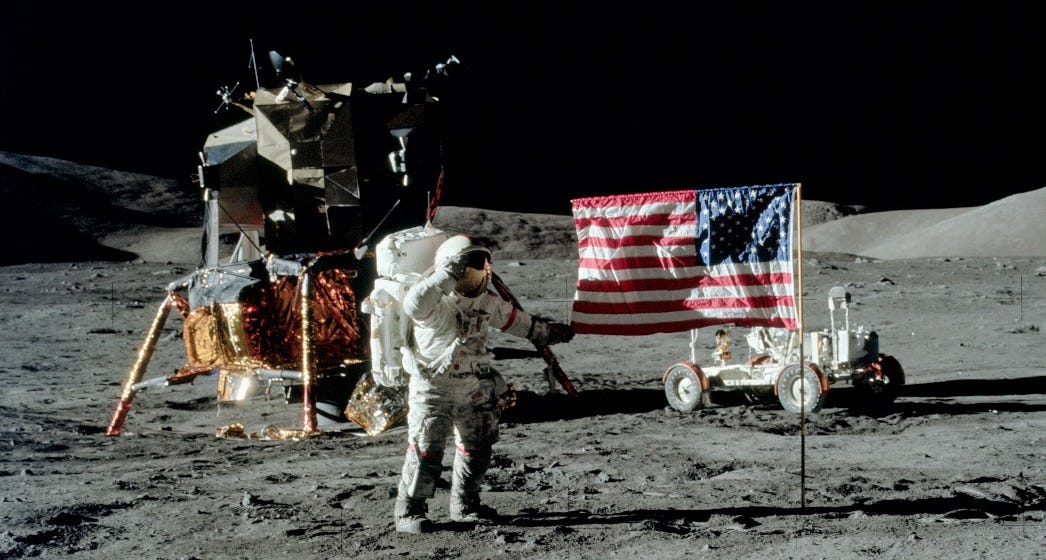
🚀 Faster, Please! — The Podcast #15
This month, December 2022, marks the 50-year anniversary of when man last stood on the Moon. NASA's Apollo missions were an awe-inspiring triumph of human achievement, but do people really care about space anymore? To discuss the wonder of space exploration, the virtues involved, and why robotic missions just aren't enough, I'm joined by Charles T. Rubin.Charles is a contributing editor at The New Atlantis, where he has published several excellent essays on space exploration, his latest being "Middle Seat to the Moon" in the fall 2022 issue. He's also a professor emeritus of political science at Duquesne University and the author of several books, including 2014's Eclipse of Man: Human Extinction and the Meaning of Progress.In This Episode* Will space become mundane? (1:29)* The case for astronauts (10:10)* Billionaires in space (14:29)* Sci-fi and the future of space (19:41)Below is an edited transcript of our conversation.Will space become mundane?James Pethokoukis: In your New Atlantis essay, you write that “to make something routine is precisely to suck the wonder out of it, to make it uninteresting.” In regards to space exploration, is it important that people have a sense of wonder to it? Is it important to maintain public support for government efforts? And is it important in a higher spiritual sense, that we have a sense of wonder about the vastness of the universe outside our own little pale blue dot of it?Charles Rubin: I think both of those are true, actually. It applies not just to government space program efforts, but also now to private space program efforts. The private ones obviously will operate in a market environment. Someday, I think it is hoped that such trips will not just be for immensely wealthy people, but will be for normally wealthy people. And they're going to have to have a reason to want to go into space. I think, as is true in many, many circumstances of tourism, it will be because there's something very cool and wondrous to be seen out there. That is certainly part of any justification — an important part, it seems to me, for both private space efforts and, of course, public space efforts. There are going to be many different reasons why people will support or be against a government-funded space program. But here also, I think that wonder plays an important role in attracting some kinds of people to those efforts who would otherwise not be attracted. The science of it, the technology of it — those are crucial things, but they're not going to appeal to everybody. But exploration and going where no human being has gone before: These are things that are going to have a broader appeal, I think.I wonder, even if we get to the point where it's maybe not common that people take a quick trip into almost space or even at the point where they can have a vacation in orbit, even if you know people who have done that, I think there will still be a sense of wonder. I've done some traveling, probably a lot less traveling than some other people. But I'm pretty sure that when I go to Italy and see the Colosseum, or if I went to Australia and saw Mount Uluru, even though I am not the first person to do that and I know people have done that, I would still probably think those are pretty awesome.I certainly hope that's true. It may be useful if I say something more about my concerns about routinization: I think that there are problems that will be faced as space travel gets more common and is available to more people. That will be a wonderful thing in terms of the success of the technology, but we will potentially find ourselves in a situation where it's going to be like flying in an airplane to Australia or flying in an airplane to Italy: I don't know how many people look out the window under those circumstances. And yet here you are flying at an immense height with extraordinary vistas to be seen around you, and we simply take it for granted.I began to think about some of this in the way I do when I was going occasionally into New York City from New Jersey. I don't think this is a train ride that is known — well, I can know for sure — it's not known for its natural beauty, and I could look around me and see that people were doing almost anything other than looking out the window. But it's kind of an extraordinary ride. You're passing through suburban America, you're passing through decaying industrial areas. There's just a lot to be seen there. But of course, it's just a train ride so who really is going to be looking too carefully at what's going on around them? I'd like to see that in our space efforts we maintain that level of interest at all levels of the journey. And again, I think that's going to be an important part of both commercial and governmental success.Is that possible? Is that an unavoidable downside? Some things are going to become common and there's always going to be a certain amount of people like yourself — I'm probably more like you in this; I always think it's cool the f

🚀 Faster, Please! — The Podcast #14
➡ Reminder: I will be writing much less frequently and much shorter in November — and November only. So for this month, I have paused payment from paid subscribers.Also, I’m making all new content free without a paywall. In December, however, everything will be back to normal: typically three meaty essays and two enlightening Q&As a week, along with a pro-progress podcast like this one 👇 several times a month (including transcript). And, of course, a weekly recap over the weekends.Melior MundusHere at Faster, Please!, I write a lot about the need for optimistic, inspiring science fiction. As I’ve put it before:It’s important that our culture create aspirational and inspirational visions of the future. Underlying the rapid advance of human progress over the past quarter-millennium has been a powerful optimism about tomorrow combined with what sociologist Elise Boulding has described as a “utopian sense of human empowerment.” We have to believe that the inevitable disruption caused by progress will be worth it — if we make the right decisions.We also need to believe that we can invent, broadly, the future we want. Right now, however, it seems we think that we’ve carelessly created a future that our kids and grandkids won’t want — a future of rising temperatures and rising inequality. And since the early 1970s, Hollywood has both reflected and encouraged that gloomy belief. But sci-fi could again be pro-progress and future-optimistic (what I call “Up Wing”). It could have plenty of dramatic tension while also showing a path toward a better, although still imperfect, world.I'll often ask my podcast or 5 Quick Questions guests/interviewees to point to an example of that kind of science fiction. And perhaps no film, book, or TV show gets held up as the standard for sci-fi more than Star Trek. To learn more about the history of the franchise and to discuss its future-optimism and cultural importance, I'm speaking with Ryan Britt.Ryan is the author of the tremendous new book Phasers on Stun! How the Making and Remaking of Star Trek Changed the World, out earlier this year. Previously, he wrote Luke Skywalker Can’t Read and Other Geeky Truths. Ryan is also an editor at Fatherly and a contributing writer for Inverse; both BDG brands. In addition, he also writes regularly for Esquire, Den of Geek! and Star Trek.com.In This Episode* The Original Series and ‘60s sci-fi (1:19)* The mainstream appeal of Star Trek (5:44)* Star Trek’s future-optimism (12:06)* The essence of Trek (21:24)Below is an edited transcript of our conversation.The Original Series and ‘60s sci-fiJames Pethokoukis: When originally broadcast, Star Trek did not have great ratings. Obviously it has become an institution since then. Why didn't it do better when it was first on regular television back in the ‘60s?Ryan Britt: It's a little bit of a matter of debate. One of the people that I interviewed for my book, Marc Cushman, did these deep dives into the ratings for his books, which were these very, very in-depth books called These Are The Voyages. And his contention is that if you look at it by today's standards, five or 10 million people is a lot. Now we have all these streaming services that target these niche audiences and stuff like that. It would no longer be considered a failure. But at the time, you only had three networks. You had NBC, CBS, and ABC. And Star Trek was on NBC, and it didn't compete in the way that NBC wanted it to long term.That said, it had a very strong start. And Lucille Ball who ran Desilu Studios that produced Star Trek sent a note of congratulations to Gene Rodenberry when it started, saying they were off to a great start. But the flip side of that is we forget that Star Trek introduced mainstream American television audiences to all this stuff in science fiction that they had no exposure to before. On the one hand, five, 10 million people, 20 million people, might not seem like a lot compared to today's viewership, but back then it was a huge explosion.When talking about the original series, people often will say it was really a piece of its time with a “New Frontier” spirit. You had the Cold War analogies between the Federation and the Klingons; you could even look at Captain Kirk as a John F. Kennedy kind of character. But those are really things of the early ‘60s. And granted, it's the same decade, late ‘60s. But there was a big difference between the America of 1960–62, then getting into the heart of the Vietnam era, civil rights, the late 1960s by the time the show aired. I wonder if you think that had a role, that already by that time it seemed maybe out of step with the America of that era?It's funny because science fiction in general—this is true of all science fiction, whether it's print or film—it always is oddly a little behind. Star Trek was taking this imagery that you would see on the covers of pulp science-fiction magazines from two decades prior. The way in which it kind of looks reminds you of old issues

🚀 Faster, Please! — The Podcast #13
➡ Reminder: I will be writing much less frequently and much shorter in November — and November only. So for this month, I have paused payment from paid subscribers.Also, I’m making all new content free without a paywall. In December, however, everything will be back to normal: typically three meaty essays and two enlightening Q&As a week, along with a pro-progress podcast like this one several times a month (including transcript). And, of course, a weekly recap over the weekends.Melior Mundus“Generations of people throughout the world have been taught to believe that there is an inverse relationship between population growth and the availability of resources, which is to say that as the population grows, resources become more scarce.” That’s how Marian Tupy and Gale Pooley open their new book, Superabundance: The Story of Population Growth, Innovation, and Human Flourishing on an Infinitely Bountiful Planet. It’s also the central premise of much of today’s Down Wing, zero-sum thinking. And it happens to be wrong. Tupy and Pooley:It is free people, not machines or deities, who generate new ideas, and it is free people who test those new ideas against other people’s ideas in the marketplace. The process of knowledge and value creation is at the heart of humanity’s moral and material progress. It is what enables our civilization to bend towards goodness and superabundance.What is superabundance? The authors again: “[A]bundance occurs when the nominal hourly income increases faster than the nominal price of a resource,” meaning resources become cheaper (more abundant!) in real terms. Superabundance occurs “when the abundance of resources grows at a faster rate than population increases.” And that’s exactly what we see in the world today.Cato Institute senior fellow and HumanProgress.org editor Marian Tupy joins me in this episode of Faster, Please! — The Podcast to discuss superabundance, Hollywood’s Malthusianism, and more.In This Episode* Will we ever run out of Earth? (1:33)* Can our planet sustain billions of people living like Americans? (5:13)* The burden of proof is on the doomsayers (12:12)* The more people, the better (18:04)Below is an edited transcript of our conversation.Will we ever run out of Earth?James Pethokoukis: There's only so much Earth, so eventually, aren't we going to run out of Earth and its bounty?Marian Tupy: It's certainly true that the Earth has a finite number of atoms, but the amount of value that we can get from those atoms is basically infinite. Look at something as simple as sand that has been on Earth for billions of years. At some point thousands of years ago, people realize that they could turn sand into glass jars and later into windows. And now we are using sand in order to create fiber optic cables, which are carrying information around the world at very high speeds and a lot of volume in order to power our civilization's communication networks. So from something as simple as a grain of sand, you can get ever more value.If you are somebody who thinks economic growth is a good thing, who wants the global economy to keep growing—and, gee, it'd be great if it grew even faster—at some point it's going to hit a limit. Aren't we already seeing that with lithium shortages? I hear that lithium shortages are going to slow the green transition. So aren't people who are pro-growth, pro-progress, or pro-abundance—even pro-superabundance—isn't that just kind of a temporary state and eventually, I don't know, 50 years, 100, that's not a tenable position over the really long, long run?No, because knowledge continues to expand. As long as we have more people on Earth, and hopefully one day in cooperation with AI or advanced computing, we'll be able to create evermore knowledge. And it is that knowledge which allows us to get around problems of scarcity. Lithium is a perfect example. Lithium-ion batteries are a massive advance in terms of storage of electricity. But who is to say whether batteries in the future will be powered by lithium? Maybe we'll come up with a different compound, which will allow us to store energy at a much cheaper price. In fact, people are already working on basically creating batteries out of, not lithium-ion, but sodium-ion, which apparently is going to last even longer and will be massively cheaper. So it's not only a question of efficiency gains—instead of using three ounces of tin or aluminum for a can of Coke, you are now using only half an ounce—and it's not just about technological breakthroughs like, for example, GMO foods so that you can increase the yield of plants for an acre of land; it's also about substitution. This is very important. It's about substitution. You are using something in order to get to a certain goal, but you may realize 10 years, 100 years from now that you don't actually need it, that you need something completely different. And humanity has been through this very often. Two-hundred years ago, the great discovery was of course coal

🚀 Faster, Please! — The Podcast #12
We’ve all heard the stories and statistics about the supposed death of American manufacturing. But America's industrial sector never truly went away. Many, many companies are thriving, and today's guest argues we're experiencing an outright renaissance. In this episode of Faster, Please! — The Podcast, I’m joined by Gaurav Batra, who previously co-led McKinsey & Company’s Advanced Electronics Practice in the Americas. Along with Asutosh Padhi and Nick Santhanam, he's the author of the new book, The Titanium Economy: How Industrial Technology Can Create a Better, Faster, Stronger America. This from the book:The Titanium Economy is the secret weapon of American industrial revival—the key to ensuring the country’s economic vitality as the Fourth Industrial Revolution progresses and we face steep competition from global rivals. The next few years will be critical, as the future growth of the Titanium Economy sector in the United States is far from assured. Investors, policy makers, and the public at large must appreciate the importance of providing more robust investment in these companies, as well as how their growth brings so many positive ripple effects for individuals and communities, providing more high-quality jobs and boosting the economic prosperity of communities and whole regions.So what is the Titanium Economy? Listen in to find out!In This Episode:* The US industrial renaissance (1:14)* The businesses of the Titanium Economy (7:48)* American industry and technology (12:29)* Workers in the US manufacturing sector (16:20)* Finding America’s next-generation industrial workers (21:26)Below is an edited transcript of our conversation.The US industrial renaissanceJames Pethokoukis: I think there's a caricature or perhaps a misperception about the US economy—I think you see it in the media—that the US economy is basically Wall Street, Silicon Valley, and big box stores. And that's basically your American economy, and it's certainly an economy that doesn't really make stuff in the physical world—with atoms—anymore. And the book, I think, is a corrective to that view. Why is that view wrong and, as you state, that the US is in the middle of an industrial renaissance?Gaurav Batra: Jim, you very accurately represented the perception of what's happened in the US economy over the last couple of decades. I think the story, whenever anybody tells it, is mostly about technology companies. It's mostly about financial services, mostly about Wall Street. As we started digging in, not just with the book but our work in the industrial sector, we realized that the reality is actually very disconnected with this perception. The reason we say that is, if you look at just pure numbers, still 20 percent of the US economy is completely dependent on US manufacturing. That number has not gone down. It may not have increased, but that number has sustained pretty well. If you look at employment, this sector still employs the bulk of the US economy's workers today. In terms of pure numbers, in terms of relevance, the sector never went away. It definitely slowed down because other sectors started growing, but manufacturing as a sector in the US still remained pretty staunch. That is at the sector level.As you unveil that a little bit and go under the hood, you realize that whenever we talk about Wall Street, we talk about the Facebooks, the Alphabets, the Apples of the world delivering incredible stock market growth. Everybody talks about how much of that you own in your portfolio. But the moment you start unraveling the industrial landscape, you actually see several—and the number is actually north of 20, 30—companies who have done actually fairly well over a much longer time period in terms of even delivering value to their shareholders. And these companies have done it not necessarily leveraging outsourcing, but they've done it by just strong, sensible business practices: how they run their companies internally, how they work with their customers, how they potentially create a niche for themselves in particular markets. For us, at least as we started (and I spent about a decade in this particular industry), as I looked at that perception, which was exactly what my idea was coming into the sector, versus what I took away from it after being a practitioner in the segment for about 10, 12 years: the perception and the reality don't match. I think the perception, as you rightly said, is all about Wall Street, all about technology, all about financial services. But the reality tells us that manufacturing has never gone away. Given what's happened over the last two years with the pandemic and the geopolitics of the globe around us, it is only telling us a flashing red [light] that this is actually going to get even more critical for all of us here in the US in the next couple of years.These are industrial companies. While they may not be classified as technology companies, they use technology. Consultants like talking about 5G and AI

🚀 Faster, Please! — The Podcast #11
When Japan suffered an earthquake and tsunami in 2011, the Fukushima Daiichi nuclear power plant melted down, resulting in one of the worst nuclear accidents in history. In response, the Japanese government shut down all of its nuclear reactors. But subsequent economic research reveals that the unintended consequences of abandoning nuclear energy have been worse than the accident itself.In this episode of Faster, Please! — The Podcast, I'm joined by Matthew Neidell, an economist in the Department of Health Policy and Management at Columbia University's Mailman School of Public Health. In 2021, Matt coauthored a paper on those unintended consequences called “The unintended effects from halting nuclear power production: Evidence from Fukushima Daiichi accident.” From that paper: This paper provides novel evidence of the unintended health effects stemming from the halt in nuclear power production after the Fukushima Daiichi nuclear accident. After the accident, nuclear power stations ceased operation and nuclear power was replaced by fossil fuels, causing an increase in electricity prices. We find that this increase led to a reduction in energy consumption, which caused an increase in mortality during very cold temperatures, given the protective role that climate control plays against the elements. Our results contribute to the debate surrounding the use of nuclear as a source of energy by documenting a yet unexplored health benefit from using nuclear power, and more broadly to regulatory policy approaches implemented during periods of scientific uncertainty about potential adverse effects.In This Episode:* The Fukushima meltdown (1:30)* The consequences of Japan’s shift away from nuclear (7:30)* Japan’s nuclear reversal (17:15)* Public perceptions of nuclear risks (20:43)Below is an edited transcript of our conversation.The Fukushima meltdownJames Pethokoukis: The title of the [working] paper is "Be Cautious with the Precautionary Principle: Evidence from Fukushima Daiichi Nuclear Accident." Let's start with a quick explanation. What is the precautionary principle?Matthew Neidell: One thing I should clarify first: The title of the paper ended up changing. We do talk about the precautionary principle, but it ended up not being the title in the published version. We got a lot of pushback on the use of “precautionary principle” in the title. That said, I'm happy to talk about it, because I think everything in here is relevant to the precautionary principle.You could teach a whole intro to econ class from this paper. Two things that pop out to me are the precautionary principle and also the idea of trade-offs, because this paper is very much about trade-offs. Starting with that, in what way do you think those principles are illustrated by the Fukushima accident?I think what's really important here is that—this is almost anytime we think about nuclear but especially when big accidents happen, like Fukushima—we tend to focus on the one thing that happened and we don't think about the alternatives. That's the important thing. We think about nuclear as “nuclear carries risk.” And it does carry risk. There are dangers associated with nuclear. Just about anyone should know that who is following this. But it's “How do the dangers compare to something else, to the alternatives that we can use?” One of the problems is that we tend to think of nuclear in isolation. Like people are just saying, “Nuclear is bad, therefore we shouldn't do it.” And that's the kind of precautionary principle aspect of things. It says, “Unless we are fully informed about the risks associated with something, there's no uncertainty associated with the risks with something, we shouldn't do it.” And that's hampering because there are so many opportunities that are out there that carry risk. And if we just say, “Let's not engage in these opportunities because there's a chance of risk,” we end up cutting back on so many things that we might otherwise do.There's a scale of nuclear accident severity. It's a seven-point scale, and so far there have only been two level-seven—the worst—accidents: One was Chernobyl, and the other was Fukushima. In our experience in the nuclear age, Fukushima was one of the absolute two worst accidents that we've had. If you're looking for an example, this would seem to be a fantastic test case about just how dangerous it is, and also just how dangerous the counterfactual is.Yeah, I think that's right. They are the two most dangerous, the third one being Three Mile Island.That's actually down the list. I think that’s a five. We'll start with the actual accident: What do we know about the fatalities and the damage from the accident itself?The biggest thing that people focus on are the radiation deaths. We have the meltdown, there's radiation that's getting out in the environment that's not contained, and how many people are being exposed to that and dying from cancer as a result? That is, I think, the biggest fear to most peo
🚀 Faster, Please! — The Podcast #10
Welcome to part two of my conversation with Michael Mandel, vice president and chief economist at the Progressive Policy Institute. In the last episode of Faster, Please! — The Podcast, we considered the capital investments and job-creating power of America's major tech companies. In this episode, we discuss the Biden administration's CHIPS and Science Act, industrial policy, and whether we should expect an uptick in US productivity growth.In This Episode:* Innovation and industrial policy (1:14)* Looking at productivity numbers (4:14)* How technology affects jobs (7:19)* The future of productivity (12:38)* Investing in bioscience and materials science (15:00)* Policy for societal resilience (19:29)Below is an edited transcript of our conversation.Innovation and industrial policyWhat do you make of this recent CHIPS and Science Act and perhaps a move in the United States toward what some people call industrial policy—a phrase that can mean a lot of things. I think in this case it means subsidizing sectors that government thinks are important, especially in competition with some other countries.I have to say, quite honestly, that I took my eye off the semiconductor industry for a couple of years because I assumed we were in good shape. And then when I looked over, I said, “Wait a second, something happened here. All of a sudden, we're not in good shape anymore.” I support investment in this sector. I don't consider this to be classic industrial policy at this point. I just consider this to be doing what we've done in the past. We did this with memory chips: There was government intervention with SEMATECH. You sort of say, “Here's a sector, we need to fix it. Let's just go ahead and spend some money here.” We haven't gotten to the point of being strategic yet. This was not really a strategic investment. We're just saying, “Let's throw money at this problem.” We know that at the margin, throwing money at this problem is going to get us further along than we need to be.Do I think that more of this is needed? The country you didn’t mention, of course, was China. I do think China's innovation policy is a really interesting question because we haven't had an experience with authoritarian countries that were successfully innovative. For a lot of reasons, because it seems that capitalism works better to produce good innovation. If it turns out that authoritarian innovation works, many countries around the world will want to imitate that model because it's much more comfortable for governments to run innovation from the top. The only reason why they allow innovation to bubble up from the bottom is because doing it the other way doesn't work.What I would expect to see in the US is a combination of the two, a lot that is bubble up from the bottom. We will be faced with technological and social and environmental challenges that we can't imagine. And we have to have invested the money in the new technologies before we get there. We don't know what the problems are going to be. We don't know what the technologies are going to be. We discovered this in the pandemic, where it turned out that mRNA technology, which was sitting on the shelf for 20 years, was a solution to a problem that we didn't even know it was a solution to. But if we hadn't been investing in it so it wasn’t there, it wouldn't have been available as quickly as it was.Looking at productivity numbersStatistically, we had this productivity boom during the pandemic, at least in 2020, 2021. And people read about a lot of technologies happening: maybe AI spreading, mRNA, CRISPR, rockets. The first half of this year, statistically, was not so good with productivity. These numbers tend to jump around a lot. What's the reality going forward?As you know, productivity numbers, especially total factor productivity numbers, are useless over any period less than 10 years. We mentioned earlier the shift of hours from the household sector to the market sector as part of e-commerce. Remember: Hours in the household sector are not measured as part of the productivity basis. If you actually include them, it significantly adds to the productivity growth in this period. Because what's happened is, if we take the total amount of hours being put into consumer distribution, which is both the market hours and the non-market hours, market hours has gone up, which is what shows up in the official productivity numbers. If you look at retailing, you don't actually see very much productivity gain because, in fact, the hours have gone up a lot. But they're not counting the fallen hours in the household sector. What has happened is when you count the fall of hours in the household sector, productivity growth—I haven't done these calculations recently, but it goes up a lot: quarter percentage point a year, half a percentage point a year. It’s actually a significant increase.In the sector or economy-wide?Economy-wide. Because it's a lot of hours. The degree to which telehealth, for example
🚀 Faster, Please! — The Podcast #9
Technology and e-commerce companies have a reputation for being drivers of creative destruction, sometimes at great cost to local communities. Economic nostalgia tells us to lament those jobs and fear the changes that come with technological progress. But it's worth remembering that tech companies are also a major source of high-wage job growth in the US economy. On this episode of Faster, Please! — The Podcast, I'm joined by Michael Mandel to consider the role of tech companies in the American economy.Michael is vice president and chief economist at the Progressive Policy Institute. He's also the author of "Investment Heroes 2022: Fighting Inflation with Capital Investment," co-authored with Jordan Shapiro.In This Episode:* Tech sector job growth (1:23)* How technology affects the labor market (6:08)* Job-replacing tech vs. job-creating tech (10:46)* Encouraging the digitization of US manufacturing (15:00)* America’s tech firms: investment heroes (18:34)Below is an edited transcript of our conversation.Tech sector job growthJames Pethokoukis: Last year you said, “We’ve seen in recent years [that] the tech/broadband/e-commerce sector has been the main source of job growth in the economy.” Do you think this is a widely understood fact either among the public or among policymakers here in Washington?Michael Mandel: That's such an excellent question. No, it's not a widely understood fact. I've just calculated the latest numbers, and if you look at full-time equivalents, all of the job growth since the pandemic started has been in what I call now the “tech/e-commerce” sector. And the rest of the economy and job growth has been much, much weaker.Is this purely a pandemic-era phenomenon, or do you expect it to continue to happen?It was happening before the pandemic. It is going to continue after the pandemic, too. I think what we've learned in the past is that whichever sectors grow during a recession tend to lead the next recovery as well. The fact that we've had all this growth in the tech/broadbrand/e-commerce sector during the pandemic suggests that's going to be the job leader going forward as well. The Bureau of Labor Statistics has just released its occupational projections for the next 10 years. I haven't had a chance to look through them yet. I suspect that they will understate the future job impact of the tech/broadband/e-commerce sector as they have in the past.Is that an accurate forecast that they put out?It is about as accurate as just extending long-term trends. In terms of looking forward [at] telecom-related jobs or app-economy jobs or computer-related jobs, it has consistently under projected. They actually make no real claims. They don't say it's a forecast. They say it's a projection. Probably, if you ask them privately, they would tell you they really don't want to do it. But it's really widely read.The part of that sector I think people might be surprised by is e-commerce. I'm guessing that a lot of people view e-commerce as a jobs killer: It's replacing all the people who work at in-person stores with kiosks. Is that your perception? That is wrong, though.That is my perception, and that is wrong. The way that I think about e-commerce is it doesn't pull jobs out of brick-and-mortar retail. It actually pulls hours out of the household sector. So what happened is that people used to put an enormous amount of hours into driving to stores, parking, walking around, and standing on line, and so forth. And if you look at the data that comes out of the Bureau of Labor Statistics on the American Time Use Survey, you see a really sharp drop in the number of hours that people spend shopping for goods. It's gone down by about 20 percent over the last 15 years. And it dropped about 10 percent just over the course of the pandemic. All of these hours, which is an enormous number of unpaid household hours, are being moved into the paid market sector. Instead of you going into a store and picking out the stuff yourself, somebody else is doing this using robots in an e-commerce fulfillment center. And instead of you driving to the store by yourself and spending all that time parking, somebody else is putting the stuff in a big truck and delivering it to you, using more capital, doing it more efficiently. There's been a very sharp drop in the number of hours that households are spending on shopping, which (A) creates a lot of jobs in the market sector, (B) really distorts the productivity numbers, and (C) leads us to misunderstand the sources of growth in the economy: what the effect of productivity is, what the effect of technology is.I know you and I have talked about this in the past, for many years we used to wonder, when was technology going to start generating jobs for the ordinary person? And that's what e-commerce has done: generate tech-enabled jobs in e-commerce fulfillment centers, in the entire supply chain, that pay better than the old retailing jobs, that pay a lot better than the non-paid jobs i

🚀 Faster, Please! — The Podcast #8
When does economic policy become industrial policy, and has the Biden administration crossed that line? In this episode of Faster, Please! — The Podcast, I'm talking with industrial policy skeptic Scott Lincicome about the CHIPS and Science Act, how competition with China complicates the argument for free markets, and more.Scott is the director of general economics and the Herbert A. Stiefel Center for Trade Policy Studies at the Cato Institute. He is the author of numerous reports on industrial policy and international free trade, including "The (Updated) Case for Free Trade" with Alfredo Carrillo Obregon and “Questioning Industrial Policy” with Huan Zhu. He’s also the author of Capitolism, a Dispatch newsletter.In This Episode:* Is Bidenomics really about boosting productivity? (1:19)* We’re all industrial policy enthusiasts now (3:37)* The climate change exception (9:34)* Thinking about China (17:29)* Can the US play the semiconductor game and win? (21:35)Below is an edited transcript of our conversation.Is Bidenomics really about boosting productivity?James Pethokoukis: The Biden administration has been doing quite a bit: this infrastructure bill, we've had a chips and R&D bill, now we have the Inflation Reduction Act. The president has said that one thing he's trying to do is boost the productive capacity of the economy. Do you view that as the main thrust of these bills?Scott Lincicome: No. I think it's actually much more about picking and choosing specific sectors. You can maybe argue for infrastructure: to the extent that roads and bridges are going to actually lead to the expansion of the national productive capacity, okay. But particularly with semiconductors and the IRA, this is just classic industrial policy. “The market has failed. We don't like the sectoral composition of the United States economy. In particular, we are not making enough semiconductors. We are not making enough solar panels and wind turbines and electric vehicles, and government needs to get involved. We need to not only encourage the consumption of these goods, but we need to actually forcibly, or through a lot of subsidies and sweeteners, incentivize onshoring of these critical industries.” I know that there are some attenuated ideas that this will then boost the overall productive capacity after several years. This is the whole idea that the Inflation Reduction Act will actually reduce inflation by spending all this money. But let's be clear: the immediate effects, the ones that don't require stretching the economic imagination beyond all recognizable length, are about a sectoral composition. It's about changing the shape of the US economy.We’re all industrial policy enthusiasts nowA more market-oriented approach would focus on things like creating a favorable tax code that's neutral to sectoral composition and funding basic research. But with industrial policy, you care about sectoral composition. You care about what the economy looks like, rather than just GDP growth. Is America now doing full-throated industrial policy?No, but we definitely have pushed the envelope. That actually gets to one of the big myths that is pushed by industrial policy advocates here in the United States: this idea that we lived through this grand or terrible — depending on your viewpoint — era of free market fundamentalism in which Milton Friedman got a hold of the economy and ran it like a textbook. That's absolute nonsense. We have experimented with industrial policy for ages, going back to the ‘60s, the ‘70s, then into the ‘80s. We really liked it in the ‘80s and ‘90s. We backed off a little bit in the ‘90s and 2000s but still had tons of industrial policy initiatives to encourage certain types of manufacturing, certain types of jobs, to protect certain sectors. And some of this was new; some of it was longstanding stuff like the Jones Act. So the idea that we weren't engaging in industrial policy is pretty silly. But we certainly have pushed the accelerator down a little bit in the last few months, starting with the infrastructure bill which has local content provisions: “Buy American” this, “Use these American workers,” “Produce these types of charging stations,” that kind of stuff. Specific things, not just infrastructure as we normally consider it. But then really ramping up with the CHIPS Act, which certainly has some basic research stuff in it. But throws $80 billion — potentially more, depending on how these tax credits shake out — to domestic semiconductor manufacturers to actually put more fabs in the United StatesIt's a subsidy to build these plants in the United States.Correct, and with several strings attached even further. But the idea, generally, is (so the argument goes) the United States has experienced a dramatic collapse in semiconductor productive capacity over the last 30 years — thanks, again, to the Milton Friedmanites, us at Cato, we libertarians always run Washington so it's all our fault. And we need to tilt the scale

🚀 Faster, Please! — The Podcast #7
In this episode of Faster, Please! — The Podcast, I'm continuing last week's discussion with Robin Hanson, professor of economics at George Mason University and author of the Overcoming Bias blog. His books include The Age of Em: Work, Love and Life when Robots Rule the Earth and The Elephant in the Brain: Hidden Motives in Everyday Life.(Be sure to check out last week’s episode for the first part of my conversation with Robin. We discussed futurism, innovation, and economic growth over the very long run, among other topics. Definitely worth the listen!)In part two, Robin and I talk about the possibility of extraterrestrial life. Earlier this year, the US House of Representatives held a hearing on what Washington now calls "unexplained aerial phenomena." While the hearing didn't unveil high-def, close-up footage of little green men or flying saucers, it did signal that Washington is taking UAPs more seriously. But what if we really are being visited by extraterrestrials? What would contact with an advanced alien civilization mean for humanity? It's exactly the kind of out-there question Robin considers seriously and then applies rigorous, economic thinking. In This Episode:* The case for extraterrestrial life (1:34)* A model to explain UFOs (6:49)* Could aliens be domesticating us right now? (13:23)* Would advanced alien civilization renew our interest in progress? (17:01)* Is America on the verge of a pro-progress renaissance? (18:49)Below is an edited transcript of our conversation.The case for extraterrestrial lifeJames Pethokoukis: In the past few years there have been a lot of interesting developments on the UFO — now UAP — front. The government seems to be taking these sightings far more seriously. Navy pilots are testifying. What is your take on all this?Robin Hanson: There are two very different discussions and topics here. One topic is, “There are these weird sightings. What's with that? And could those be aliens?” Another more standard, conservative topic is just, “Here's this vast empty universe. Are there aliens out there? If so, where?” So that second topic is where I've recently done some work and where I feel most authoritative, although I'm happy to also talk about the other subject as well. But I think we should talk first about the more conservative subject.The more conservative subject, I think, is — and I probably have this maybe 50 percent correct — once civilizations progress far enough, they expand. When they expand, they change things. If there were a lot of these civilizations out there, we should be able to, at this point, detect the changes they've made. Either we've come so early that there aren't a lot of these kinds of civilizations out there … let me stop there and then you can begin to correct me.The key question is: it looks like we soon could go out expanding and we don't see limits to how far we could go. We could fill the universe. Yet, we look out and it's an empty universe. So there seems to be a conflict there.Where are the giant Dyson spheres?One explanation is, we are so rare that in the entire observable universe, we're the only ones. And therefore, that's why there's nobody else out there. That's not a crazy position, except for the fact that we're early. The median star will last five trillion years. We're here on our star after only five billion years, a factor of 1000. Our standard best theory of when advanced life like us should appear, if the universe would stay empty and wait for it, would be near the end of a long-lived planet. That's when it would be most likely to appear.There's this power of the number of hard steps, which we could go into, but basically, the chance of appearing should go as the power of this time. If there are, say, six hard steps, which is a middle estimate, then the chance of appearing 1000 times later would go as 1000 to the power of six. Which would be 10 to the 18th. We are just crazy early with respect to that analysis. There is a key assumption of the analysis, which is the universe would sit and wait empty until we showed up. The simplest way to resolve this is to deny that assumption is to say, “The universe is not sitting and waiting empty. In fact, it's filling up right now. And in a billion years or two, it'll be all full. And we had to show up before that deadline.” And then you might say, “If the universe is filling up right now, if right now the universe is half full of aliens, why don't we see any?”We should be detecting signals, seeing things. We have this brand new telescope out there sitting a million miles away.If we were sitting at a random place in the universe, that would be true. But we are the subject of a selection effect. Here's the key story: We have to be at a place where the aliens haven't gotten to yet. Because otherwise, they would be here instead of us. That's the key problem. If aliens expand at almost the speed of light, then you won’t see them until they’re almost here. And that means if you look backw

🚀 Faster, Please! — The Podcast #6
Few economists think more creatively and also more rigorously about the future than Robin Hanson, my guest on this episode of Faster, Please! — The Podcast. So when he says a future of radical scientific and economic progress is still possible, you should take the claim seriously. Robin is a professor of economics at George Mason University and author of the Overcoming Bias blog. His books include The Age of Em: Work, Love and Life when Robots Rule the Earth and The Elephant in the Brain: Hidden Motives in Everyday Life.In This Episode:* Economic growth over the very long run (1:20)* The signs of an approaching acceleration (7:08)* Global governance and risk aversion (12:19)* Thinking about the future like an economist (17:32)* The stories we tell ourselves about the future (20:57)* Longtermism and innovation (23:20)Next week, I’ll feature part two of my conversation with Robin, where we discuss whether we are alone in the universe and what alien life means for humanity's long-term potential.Below is an edited transcript of our conversation.Economic growth over the very long runJames Pethokoukis: Way back in 2000, you wrote a paper called “Long-Term Growth as a Sequence of Exponential Modes.” You wrote, “If one takes seriously the model of economic growth as a series of exponential … [modes], then it seems hard to escape the conclusion that the world economy will likely see a very dramatic change within the next century, to a new economic growth mode with a doubling time perhaps as short as two weeks.” Is that still your expectation for the 21st century?Robin Hanson: It's my expectation for the next couple of centuries. Whether it's the 21st isn’t quite so clear.Has anything happened in the intervening two decades to make you think that something might happen sooner rather than later … or rather, just later?Just later, I'm afraid. I mean, we have a lot of people hyping AI at the moment, right?Sure, I may be one of them on occasion.There are a lot of people expecting rapid progress soon. And so, I think I've had a long enough baseline there to think, "No, maybe not.” But let's go with the priors.Is it a technological mechanism that will cause this? Is it AI? Is it that we find the right general-purpose technology, and then that will launch us into very, very rapid growth?That would be my best guess. But just to be clear for our listeners, we just look at history, we seem to see these exponential modes. There are, say, four of them so far (if we go pre-human). And then the modes are relatively steady and then have pretty sharp transitions. That is, the transition to a growth rate of 50 or 200 times faster happens within less than a doubling time.So what was the last mode?We're in industry at the moment: doubles roughly every 15 years, started around 1800 or 1700. The previous mode was farming, doubled every thousand years. And so, in roughly less than a thousand years, we saw this rapid transition to our current thing, less than the doubling time. The previous mode before that was foraging, where humans doubled roughly every quarter million years. And in definitely less than a quarter million years, we saw a transition there. So then the prediction is that we will see another transition, and it will happen in less than 15 years, to a faster growth mode. And then if you look at the previous increases in growth rates, they were, again, a factor of 60 to 200. And so, that's what you'd be looking for in the next mode. Now, obviously, I want to say you're just looking at a low data set here. Four events. You can't be too confident. But, come on, you’ve got to guess that maybe a next one would happen.If you go back to that late ‘90s period, there was a lot of optimism. If you pick up Wired magazine back then, [there was] plenty of optimism that something was happening, that we were on the verge of something. One of my favorite examples — and a sort of non-technologist example, was a report from Lehman Brothers from December 1999. It was called “Beyond 2000.” And it was full of predictions, maybe not talking about exponential growth, but how we were in for a period of very fast growth, like 1960s-style growth. It was a very bullish prediction for the next two decades. Now Lehman did not make it another decade itself. These predictions don't seem to have panned out — maybe you think I'm being overly pessimistic on what's happened over the past 20 years — but do you think it was because we didn't understand the technology that was supposedly going to drive these changes? Did we do something wrong? Or is it just a lot of people who love tech love the idea of growth, and we all just got too excited?I think it's just a really hard problem. We're in this world. We're living with it. It's growing really fast. Again, doubling every 15 years. And we've long had this sense that it's possible for something much bigger. So automation, the possibility of robots, AI: It sat in the background for a long time. And people have been

🚀 Faster, Please! — The Podcast #5
Almost 50 years ago, in December 1972, the Apollo 17 astronauts splashed down in the Pacific Ocean, marking the end of the Apollo program. In the half-century since, no crewed mission — not Americans nor anyone else — has ventured beyond low Earth orbit. Despite a series of presidential promises, NASA has yet to return to the Moon, let alone venture to Mars. And despite recent declines in launch costs, thanks in large part to SpaceX, NASA remains in many ways committed to the old, Apollo-style way of doing things. To learn more about why NASA's manned missions always seem to run over budget and behind schedule — and to get a sense of the way forward with commercial space companies — I'm speaking with Lori Garver.Garver was previously Deputy Administrator of NASA during the Obama administration, from 2009 to 2013. Previously, she worked at NASA from 1996 to 2001 as a senior policy analyst. Garver is the founder of Earthrise Alliance, an initiative to better use space data to address climate change. She also appears in the 2022 Netflix documentary Return to Space. Her fascinating memoir, published in June, is Escaping Gravity: My Quest to Transform NASA and Launch a New Space Age. Below is an edited transcript of our conversation.James Pethokoukis: In December of this year, it will mark the 50th anniversary of the Apollo 17 splashdown and the end of the Apollo program. Humanity has been stuck in low Earth orbit ever since. And for a while, the United States couldn't even get to low Earth orbit on its own. What happened to all the dreams that people had in the ‘60s that just sort of disappeared in 1972?Lori Garver: I think the dreamers are still out there. Many of them work on the space program. Many of them have contributed to the programs that we had post-Apollo. The human space flight program ended and took that hiatus. [But] we’ve been having, in the United States a very robust and leading space program ever since Apollo. For human space flight, I think we got off track, as I outline in my book, by really trying to relive Apollo. And trying to fulfill the institutions and congressional mandates that were created for Apollo, which were too expensive to continue with more limited goals. The Nixon administration actually had the right idea with the Space Shuttle. They said the goal was to reduce the cost of getting to and from space.Money was no object for a while.When you have your program tied to a national goal, like we did in Apollo of beating the Russians and showing that a democratic system was a better way to advance society and technology and science, we built to a standard that tripled the budget every couple years in the early days. We [NASA] then had to survive on a budget about half the size of the peak during Apollo and have never been able to really readjust the infrastructure and the cost to sustain it. So I'd say our buying power was greatly reduced.We'll talk about government later in the interview, but to some degree, isn't this a failure of society? If politicians had sensed a yearning desire from the American public to continue moving out further in space, would we have done it?It's hard to know how we measure public support for something like that because there's no voting on it per se. And there are so few congressional districts whose members are really focused on it. So the bills that come up in Congress are funding bills. NASA is buried among many other agencies. And so I think the yearning on the part of the public is a little more diffuse. What we want to see is the United States being a leader. We want to see us doing things that return to our economy, and we want to see things that help our national security. Those are the ways space contributes to society. And I think what we got off track in doing is delivering hardware that was built in certain people's districts instead of being a purpose-driven program as it was in Apollo.Even though the Space Shuttle wasn't going to fly to the Moon, people were really pretty excited by it. I'm not sure polls always capture how interested people are in space.We don't really gauge based on people who are attending launches. As someone who's been to a lot of launches, there are lots of people enthused. But that's not 300 million people in the country. I think that polls tend to show, as compared to what? And NASA tends to be at the bottom of a list of national priorities. But, of course, its budget isn't very large. So these are all things that we try to evaluate. I think if you believe that network news was able to track public interest, by the time of the Challenger accident — which was only the 25th shuttle launch — they weren't showing them live anymore. So that's the kind of thing that you can look into. We really like things the first time. And those first couple missions were very exciting. Or if we did something unique, like fix the Hubble Space Telescope, that was interesting. But we had 134 missions, and not every one of those got a l