Radical Founding, Modern Threat: America’s Unfinished Fight for Equality | July 3, 2025 Podcast & Article Analysis
Earl & Kate Deep Dive · Earl Cotten and Katherine Mayfield
Audio is streamed directly from the publisher (api.substack.com) as published in their RSS feed. Play Podcasts does not host this file. Rights-holders can request removal through the copyright & takedown page.
Show Notes
The Ongoing Struggle for Equality's Promise
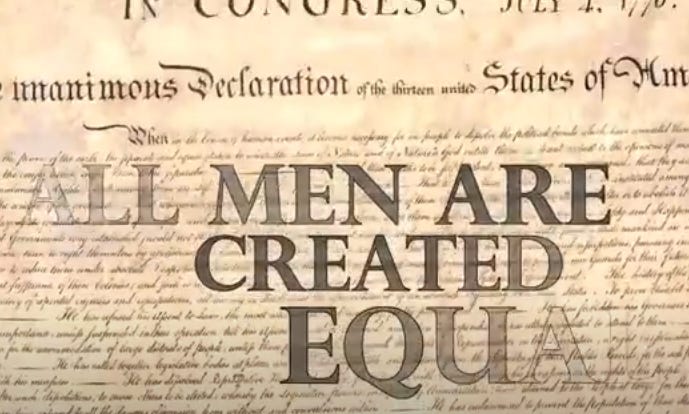
The proposition hangs in the air still. That one, drafted in Philadelphia heat: all men are created equal. We recite it now like catechism, forgetting how the words exploded onto a world ordered by blood and crown. A radical utterance, yes. An act of faith scribbled onto parchment while men were bought and sold down by the docks, while nations lived on the land beyond the settlements, while half the human race remained legal non-persons. The dissonance was baked in from the start. The promise universal, the application viciously particular.
One learns to live with the crack in the foundation. Or rather, the nation learned, uneasily. The dissonance festered. It split the house. It spilled blood in fields from Manassas to Selma. The Civil War settled nothing finally, only made the contours of the lie starker. The Civil Rights Movement clawed at the edifice, chipping away mortar. Always the proposition was contested territory, fought over clause by clause, inch by bloodied inch. "Equality" expanded not through grace, but through relentless, grinding pressure applied against the original, deliberate exclusions.
And yet. The threat persists. It never recedes for long. The core idea – that fragile, audacious proposition born in 1776 – remains perpetually vulnerable. Not to frontal assault, perhaps, but to erosion, to neglect, to the slow poison of thinking the work is done. It requires vigilance, this American faith. It demands the fight. Always the fight. For its realization was never guaranteed, only promised. And promises, as we know too well, are easily broken.
The Cost of Liberty: A Nation's Unfinished Proposition
The heat. Always the heat when one speaks of Philadelphia in July. A wet wool blanket thrown over the chest, the air thick with the promise of thunder that rarely breaks clean. One imagines it then, in that room: the tall windows perhaps open, admitting not relief but the dense, insect-thrumming air of a city simmering. The smell of horse dung and unwashed wool and the peculiar metallic tang of anxiety. Men in waistcoats, sweat beading at their hairlines, their collars wilting. A fly buzzing against a pane. The scratch of quills. The weight of words being set down, words like stones intended to anchor a new world.
We hold these truths to be self-evident.
Consider the audacity. Consider the sheer, breathtaking nerve of it. In the year 1776, in a world rigidly stratified by blood and land and divine right, where kings were kings by God’s own ordinance and peasants knew their place as surely as the ox knows the yoke, a collection of provincial lawyers, planters, merchants – revolutionaries, yes, but men accustomed to a certain order within their sphere – inscribed onto parchment a sentence that detonated the bedrock of centuries.
That all men are created equal.
It is the sentence that echoes, still. The sentence that defines the American experiment, or perhaps haunts it. One reads it now, the ink long dry on the engrossed copy under its bulletproof glass in Washington, and the words vibrate with a dangerous purity. They were radicals, these men. They knew it. The King knew it. The comfortable hierarchies of Europe recoiled. To declare inherent human equality, unalienable rights bestowed not by monarch or parliament, but by a Creator – it was an intellectual grenade tossed into the powder keg of history. It implied, demanded even, a perpetual state of becoming, a constant unsettling of any imposed station. No man born better. No man born to kneel.
And yet.
The fly buzzing against the pane. The slave outside, fanning the air for his master. The indigenous nations beyond the Alleghenies, whose concept of land and sovereignty bore no resemblance to the deeds being drawn up in coastal capitals. The silence in that room, the profound, unexamined silence, hangs heavy over the parchment now. It is the silence of exclusion, the silence of a radicalism bounded by the horizon of the possible, or perhaps merely the horizon of the comfortable. "Men," in that luminous sentence, shimmered with a specific meaning. White men. Men of property, certainly. The enslaved African? Property. The indigenous inhabitant? An obstacle, perhaps a savage. The woman? An adjunct, invisible in the political calculus. The truths were self-evident, it seemed, only within a very specific frame of reference. The radical document was, simultaneously, a document of profound limitation. The revolution was declared, but its deepest implications were quarantined.
The dissonance was there from the start, a hairline crack in the foundation stone. America was born not merely on an idea, but on this specific, potent, and ultimately unstable contradiction: the declaration of universal equality predicated on a tacit understanding of profound, inherent inequality. The nation would spend its blood and treasure and moral capital wrestling with this dissonance. The silence in that Philadelphia room would roar.
Eighty-seven years. A biblical span. A lifetime, then. The heat now is the furnace blast of cannon fire, the choking smoke of battlefields from Shiloh to Gettysburg. The nation conceived in that humid room had swollen, stretched, fractured. The silence had metastasized. The radical proposition of equality had curdled in the South into its grotesque opposite: the assertion that the inequality of races was the true self-evident truth, ordained by God and nature, essential to their peculiar civilization. White men, descendants of those revolutionaries, were now prepared to rend the Union, to forge a new nation explicitly dedicated to the principle that all men were not created equal, that certain men – Black men, primarily – were born to be property, forever locked into a lower status. The Chinese laborer building the railroads out West? An alien, exploitable. The Mexican displaced by war and annexation? A problem. The Irish fleeing famine? A suspect underclass. The proposition was under siege, not from without, but from within its own house.
Abraham Lincoln understood the weight of words. He understood the power of the original incantation, even fractured. Standing on the scarred earth of Pennsylvania, he reached back deliberately, precisely, to that Philadelphia room. Not to the document’s silences, but to its radical core: "Four score and seven years ago our fathers brought forth on this continent, a new nation, conceived in Liberty, and dedicated to the proposition that all men are created equal."
Proposition. Not self-evident truth. Not anymore. The intervening decades had stripped away that easy certainty. The blood soaking the fields around him testified to the violent, contested nature of that proposition. It was no longer an axiom; it was a hypothesis being tested in the cruelest laboratory imaginable. "Now we are engaged in a great civil war, testing whether that nation, or any nation so conceived and so dedicated, can long endure." The question hung in the sulfurous air: Could a nation founded on an idea of universal equality survive when a significant portion of its people violently rejected that universality? Could the proposition withstand the assault of those who believed equality itself was the error?
The rebellion failed. The Union endured, scarred and transformed. The proposition, battered, survived its trial by fire. The Thirteenth Amendment struck the chains. The Fourteenth promised equal protection. The Fifteenth granted the vote. Slowly, fitfully, agonizingly, the definition of "men" began its painful, necessary expansion. Black men. Men of color. Decades later, women. The circle widened, inch by contested inch. The nation stumbled towards a broader, more inclusive understanding of its founding proposition, driven by protest, by legislation, by court decisions, by the slow erosion of old certainties and the insistent demands of those previously silenced. The journey was halting, marked by backlash and retreat, by Jim Crow and Klan robes, by lynchings and poll taxes and the stubborn persistence of prejudice. Yet, the direction, however tortured, was towards a fuller realization of that Philadelphia sentence. The proposition demanded it.
The heat now. Our July. Not the humid stillness of 1776, nor the smoke-choked pall of 1863, but a different kind of fever. A polarization that crackles like static. A coarsening of discourse. A retreat into fortified camps of identity and grievance. And once again, the proposition is under assault. Not with cannon this time, but with lawsuits, with gerrymandered districts, with disinformation campaigns swirling like digital locusts, with the systematic dismantling of voting rights hard-won in an earlier era, with rhetoric that deliberately dehumanizes the immigrant, the queer, the non-white, the dissenter. We see the rise of movements, ideologies, political figures explicitly dedicated to the proposition that all men are not created equal. That some, by virtue of birth, wealth, race, or creed, are inherently superior. That rights are conditional, contingent on loyalty to a particular vision, a particular leader, a particular interpretation of history that excludes and diminishes. They seek, with chilling clarity, to reshape America into a nation where hierarchy is celebrated, where the powerful consolidate power, where the status conferred at birth becomes destiny once more.
It is a rebellion against the radical heart of 1776. A rebellion against the proposition Lincoln invoked to save the Union. It manifests not as gray uniforms marching in formation, but as the quiet erosion of norms, the normalization of the previously unthinkable, the calculated appeal to fear and resentment. It whispers in boardrooms and shouts on social media platforms. It wears suits and carries briefcases. It passes laws.
The men who signed that parchment knew the cost. "And for the support of this Declaration, with a firm reliance on the protection of divine Providence, we mutually pledge to each other our Lives, our Fortunes and our sacred Honor." They understood they were committing treason. They understood the gallows awaited failure. Lives. Fortunes. Sacred Honor. The currency of revolution. Ever since, across the sweep of American history, others have paid in that same coin. Soldiers on frozen fields. Abolitionists facing mobs. Suffragists force-fed in prisons. Civil rights workers buried in earthen dams. The names are etched on monuments and memorials, but the true accounting is written in the collective memory of struggle, in the quiet sacrifices of ordinary citizens who stood on courthouse steps, sat at lunch counters, marched across bridges, who risked jobs and homes and safety to demand the proposition be made real.
Lincoln, at Gettysburg, spoke to the living in the shadow of the dead. "It is for us the living, rather, to be dedicated here to the unfinished work which they who fought here have thus far so nobly advanced... that we here highly resolve that these dead shall not have died in vain—that this nation, under God, shall have a new birth of freedom—and that government of the people, by the people, for the people, shall not perish from the earth."
Government of the people, by the people, for the people. It sounds simple. It is the most radical, the most fragile proposition of all. It depends entirely on the acceptance of that first, dangerous idea: that all are created equal, endowed with unalienable rights. Without that bedrock, "the people" fractures into factions, into the privileged and the dispossessed, the included and the excluded. The proposition becomes a lie told over mass graves.
The fireworks will bloom tonight. Sparkling chrysanthemums of red, white, and blue against the velvet dark. There will be the smell of gunpowder and grilled meat, the sound of patriotic songs slightly off-key. We will celebrate the declaration made in that stifling room. We will speak of freedom, of independence.
But in the echoing silence after the last rocket fades, one might hear the fly buzzing against the pane. One might feel the weight of the unresolved proposition. One might remember the cost already paid, and wonder about the cost yet to come. The heat remains. The test endures. The rebellion against the radical idea is once again among us. Words to live by? Perhaps. Or perhaps words to fight for, again, before the silence consumes the proposition entirely. The nation conceived in Liberty remains perpetually in labor, struggling to give birth to its own meaning. The outcome, as always, is not self-evident.
The Earl Angle is a reader-supported publication. To receive new posts and support my work, consider becoming a free or paid subscriber.
This is a public episode. If you'd like to discuss this with other subscribers or get access to bonus episodes, visit earlcotten.substack.com/subscribe