Diverse Thinking Different Learning
267 episodes — Page 4 of 6
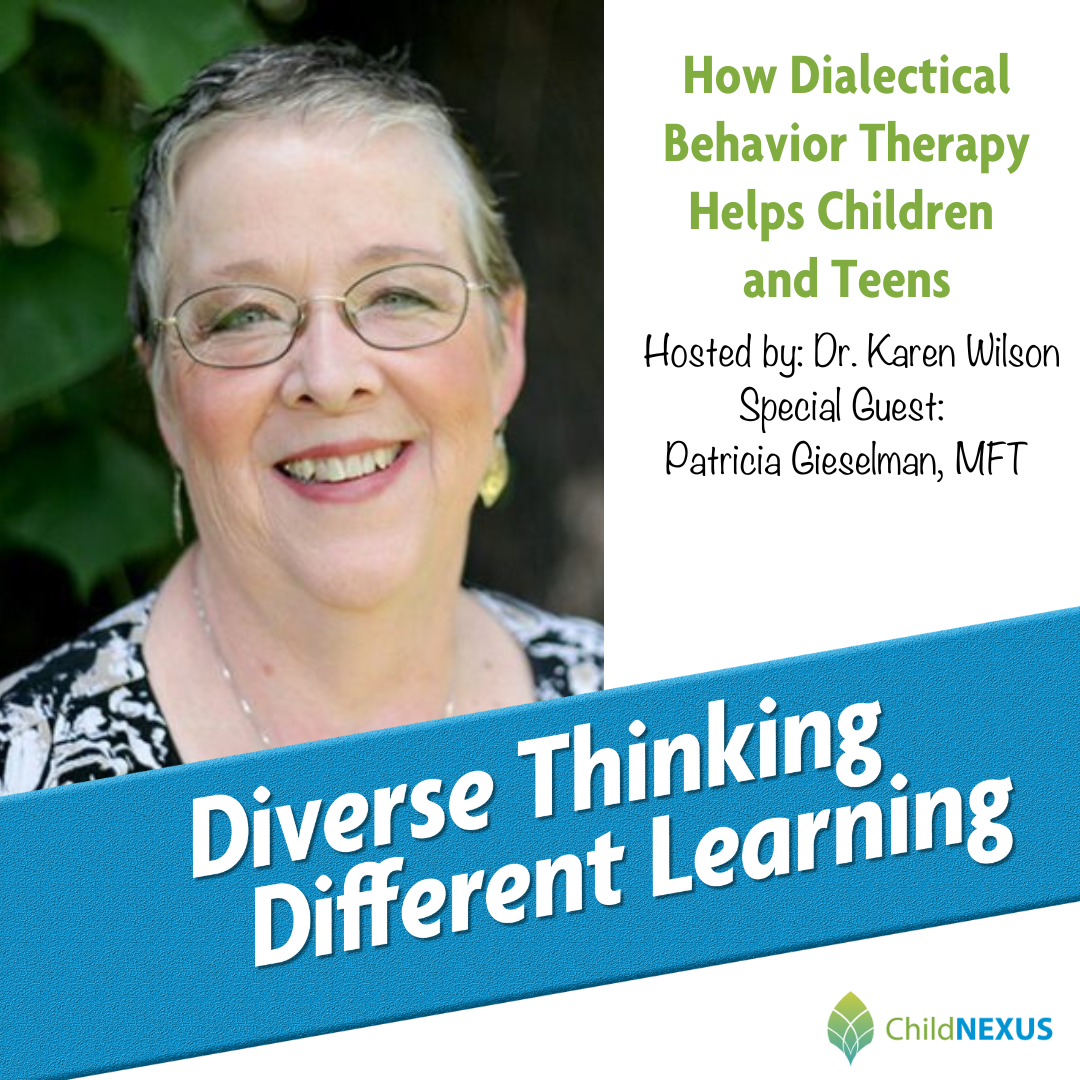
Ep. 116: How Dialectical Behavior Therapy Helps Children and Teens with Patricia Gieselman, MFT
Parents have recently reached out with questions and topics they'd like to hear more about. One commonality these topics have is the child or teen who is struggling with emotional regulation. That may be anger, defiance, or communication problems. So in today's episode, we're starting to explore different treatment options in the hopes of providing information to families. Today's focus is on Dialectical Behavior Therapy or DBT. Our guest on this topic is an expert in the field. Patricia (Patty) Gieselman, MFT is the founder and Executive Director of Choices Counseling & Skills Center, which specializes in this type of behavior therapy. She has tons of experience working with adults, adolescents, children, and their families using this approach. In our conversion, she explains why it is important to provide youth with skills and strategies that improve their ability to manage their emotions and give them the tools needed to accept those parts of their life that cannot be changed. This model is unique in many ways and in Patty's experience, extremely impactful and successful. Show Notes: [3:43] - Patty is an expert in Dialectical Behavior Therapy (DBT) and explains how and why it was developed. [4:41] - DBT is Cognitive Behavior Therapy and zen practice combined. [6:02] - The goal is to bring together acceptance, validation, and change. DBT treats problem behaviors that are caused by emotional dysregulation. [7:18] - The DBT model includes multiple components, broken up into skills groups and individualized therapy. [9:03] - There is an adaptation of DBT for children. Children are sensitive and easily reactive to the world. [10:23] - A part of DBT is a family component that gives parents the skills to create an environment that is validating to the child. [11:15] - DBT for Children has a child component, a parent component, and a parent/child component. [13:35] - Parents are also given the skills to manage their own emotional dysregulation. [14:41] - Patty lists some of the behaviors that are treated by DBT. But the goals for DBT for Children are different from those for adults. [16:31] - A specific diagnosis is not the focus of DBT, but rather the behaviors that impact daily life. [18:28] - In the beginning of DBT for Children, there's an assessment period to help parents triage the problem that impacts their relationship. [20:26] - Through the multi-family skills groups, parents have the same assignments and activities as their children. [22:29] - Patty describes DBT as mindfulness that has been behavioralized. [24:06] - Through the process, Crisis Survival Skills are also taught to help children. [25:46] - We all have to accept things we don't like and know the difference between those things and the things we can change. [27:23] - Other therapies use the term "trigger", but DBT views triggers differently. [29:51] - Patty explains what "Check the Facts" means and the ways clients are taught to manage the situation without exhibiting problem behaviors. [32:38] - Patty describes what they look at in individual therapy sessions and how parents sometimes inadvertently reinforce behaviors. [35:03] - DBT gives children, adolescents, and families the skills and tools to handle difficult situations and accept the things that can't be changed. [36:50] - Parents also have access to skills leaders for coaching as needed. [37:32] - Validation is not the same thing as praise. [38:31] - We are all guilty of skipping the step of validating emotions and jumping to solving problems. We can't solve the problem with high emotions. About Our Guest: Patricia (Patty) Gieselman, MFT is a DBT-Linehan Board of Certification, Certified Clinician™. She is the founder and Executive Director of Choices Counseling & Skills Center, which specializes in comprehensive Dialectical Behavior Therapy (DBT) for adults, adolescents, children and their families. She is a licensed Marriage and Family Therapist with extensive experience working with adults, adolescents, and families in both community-based and residential settings. During her career, she has worked in the public and private sector as a clinician, consultant, trainer, program director, and Vice President of Clinical Services. In addition to offering counseling services, Ms. Gieselman trains mental health professionals as a provider of continuing education courses for the California Association of Marriage & Family Therapists (CAMFT), Board of Registered Nursing (BRN) and the California Psychological Association (CPA) and has been an adjunct instructor for local universities. She has been an invited trainer both nationally and internationally. Patty is well-known for her practical yet often whimsical approach to teaching and problem solving. Connect with Patty: Choices Counseling & Skills Center 626-470-9834 ext. 328 Email [email protected] Links and Related Resources: Find a Psychologist Find a Marriage and Family Therapist Find a Therapist (Licensed Clinical Social Worker) Beyon
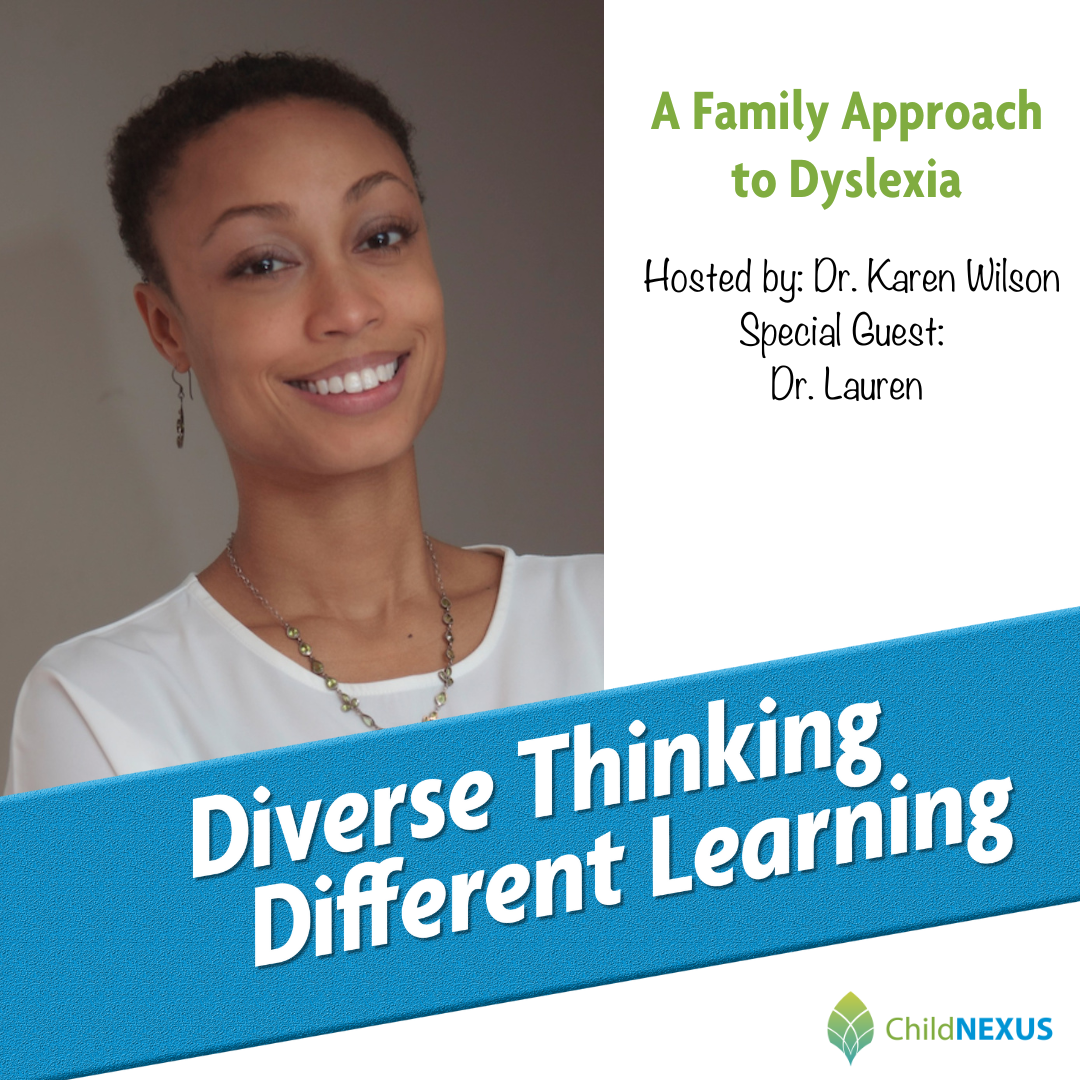
Ep. 115: A Family Approach to Dyslexia with Dr. Lauren
When one person in a family is struggling, it impacts the entire family. This is true for everything, but it is particularly true for the families of a child with learning difficulties. Today, we have the first guest of a brand new year, Dr. Lauren who has graciously been on the Diverse Thinking Different Learning Podcast before. Since the previous discussion we had about dyslexia (episode 21), Dr. Lauren has continued her mission in supporting families by launching The Dyslexia Mom Boss Podcast. She is also a member of the ChildNEXUS community and she takes a family approach when working with students. Ultimately, it's not just about the child with dyslexia, but about the entire family and how to support each other. Show Notes: [1:44] - Dr. Lauren was a previous guest on the podcast and has since launched her own podcast called Dyslexia Mom Boss. [3:29] - Learning disabilities are not exclusive to the United States. They are a world issue. [5:12] - Dr. Lauren shares her own experiences with ADHD. Although she does not have dyslexia herself, her experiences with learning impacted her mission as an educator. [7:05] - Her first teaching job was working in a school for students with dyslexia. This was the start of her passion in helping this population of learners. [9:27] - There is a disconnect between what parents and educators know about dyslexia and the struggling child in the classroom. [10:22] - A huge problem is the access to reliable information. [12:02] - What is D3 and why does Dr. Lauren group these three learning disabilities together? [14:14] - More often than not, there is a comorbidity in children with dyslexia. [15:32] - Through the public school system, it could take a lot of time to discover learning disabilities, and delays in identification cause parents and children to become overwhelmed. [17:03] - Parent training and learning is also incredibly important in supporting dyslexic children at home. [18:05] - Dr. Lauren puts us in the shoes of a child with dyslexia. [19:15] - When one person in the family is struggling, it impacts the entire family. [21:54] - When your child is upset or struggling, your initial reaction is to make it better. [23:17] - Through her experience, Dr. Lauren has found that intervention sessions turn into listening to the concerns of the parents. [24:18] - Parents need to also pour into themselves and not solely focus on the unique needs of their child. [26:06] - The stressors of raising a child with struggles can have a negative impact on the marriage and relationship between parents. [27:20] - Our brains go to the negatives first. We have to actively change our mindset. [29:53] - Our thoughts have so much power in how we feel and how we behave. [31:40] - When there is so much focus on the struggle, it is easy to forget that these students have strengths too. [33:20] - There is no one curriculum for the dyslexic learner because everyone is completely different. [35:02] - In order to advocate for your child's needs, it is crucial to learn about dyslexia and how to support your child. About Our Guest: Dr. Lauren's passion for educating, advocating, and bringing awareness to dyslexia at the domestic and international levels began in the elementary classrooms of private schools serving students with language-based learning disabilities. She has been a certified Special Educator for over a decade, and she earned her Doctor of Education in Teaching, Learning, Leadership, & Curriculum in 2019 from Northeastern University and holds a dual masters in Special Education and Elementary Education from Syracuse University and a Bachelor's degree in Psychology from Syracuse University. Dr. Lauren is the CEO and founder of Think Dyslexia LLC and delivers training and professional development for teachers and administrators at the district level focusing on dyslexia awareness and dyslexia screening. Dr. Lauren has worked with over 15 school districts at the national and international level leading educators and leaders to success. Dr. Lauren believes in a holistic approach to the dyslexia journey and coaches families every step of the way in the process. Connect with Dr. Lauren: Free Resources from Dr. Lauren ChildNEXUS Provider Profile Email: [email protected] Dr. Lauren on Instagram The Dyslexia Mom Boss Podcast The Dyslexia Mom Boss Podcast on Instagram Holistic Strategy Session Consultation Call Links and Related Resources: Episode 111: Overcoming Dyslexia and Addressing the Reading Crisis with Sally Shaywitz, M.D. Episode 21: What You Know and Don't Know About Dyslexia with Dr. Lauren McClenney Rosenstein Episode 27: Why We Need to Support Parents Whose Kids Struggle with Learning with Maria Fagan Hassani Episode 76: Using Content and Connections to Help Kids Thrive Join our email list so that you can receive information about upcoming webinars - ChildNEXUS.com The Diverse Thinking Different Learning podcast is intended for informational purposes only and is not a subs
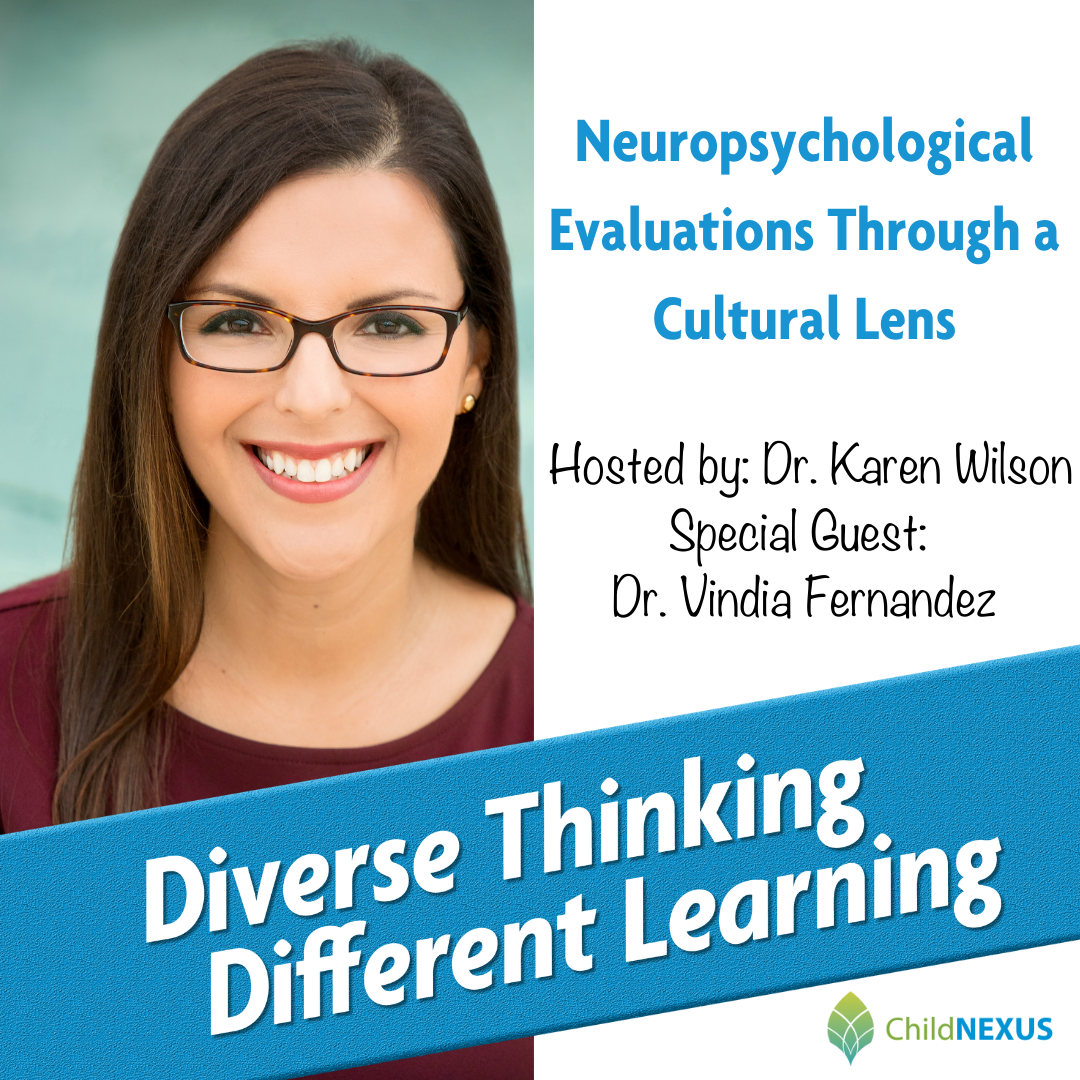
Ep. 114: Neuropsychological Evaluations Through a Cultural Lens with Dr. Vindia Fernandez
When is it important to consider an evaluation for your child? Well, the earlier the better. But then the question is, what are the differences between evaluations and which is best for your child? My guest on today's episode helps break it down and dives deep into the differences between a neuropsychological evaluation and a psychoeducational evaluation. Not only that, but we also discuss the challenges of evaluating non-English speakers and identifying neurodevelopmental disorders in children whose native language is not English. I am thrilled to have Dr. Vindia Fernandez with me today. Dr. Fernandez is a pediatric neuropsychologist who specializes in working with children, adolescents, and young adults with neurodevelopmental issues including autism, epilepsy, ADHD, and learning disabilities as well as schizophrenia-spectrum disorders. As a private practice neuropsychologist in Southern California, she also sees the impact and importance of culturally and linguistically appropriate evaluations. Today she shares with us her valuable expertise. Show Notes: [0:48] - Dr. Fernandez is the founder of the Center for Pediatric Neuropsychology to address the growing need for appropriate evaluations for Latino/a children. [2:16] - Dr. Fernandez defines a psychoeducational evaluation, as that is the most commonly used assessment offered to parents of school-aged children. [3:40] - A neuropsychological evaluation is not a specific type of evaluation but more an assessment performed by a neuropsychologist. [5:19] - It not only helps identify the learning difficulties a child may have, but also gets deeper into the medical side of things to find possible underlying medical issues. [7:01] - The purpose of an evaluation in schools is different from the evaluations done when a parent goes to see a neuropsychologist. [8:50] - Psychologists in a private practice have a lot more flexibility in diagnosing as opposed to the more narrow guidelines of a school evaluation. [9:36] - A diagnosis is important but it is what you do with that information that is the most valuable. [11:04] - Dr. Fernandez wrote an article about dyslexia and she discusses some of the reasons why students could have trouble reading. [13:54] - The intervention and accommodations that are recommended as a result of the evaluation will certainly differ depending on what those results are. [15:31] - Oftentimes there is more than one issue that the student is struggling with. All issues need to have an intervention simultaneously. [17:32] - For a period of time, minority or underrepresented populations were overrepresented in special education. [18:44] - Several laws have since been passed as a result of some landmark cases in education. [20:00] - Some immigrant parents may not have a lot of experience with formal education and may feel uncomfortable in a professional setting. [21:49] - Developing rapport with parents is important. [22:37] - The parent interviews and questionnaires that are a part of the evaluation process will vary in detail. Some parents share a lot of information and others do not. [25:52] - One myth is that bilingual children automatically have a limited vocabulary when they learn two languages simultaneously. [27:42] - We should not overpathologize differences in learning, but working with specific populations, it is important to be aware of various cultures and backgrounds. [29:37] - The types of children Dr. Fernandez usually sees are the ones who are struggling in school in comparison to their peers. [31:25] - When there's a level of distress associated with the learning difficulty that can't be explained by normal development, the behaviors are red flags. [33:21] - Don't ignore your gut feeling. If you feel that your child is struggling more than their peers, seek an evaluation to determine the root cause of the struggle. About Our Guest: Dr. Fernandez obtained her Ph.D. in clinical psychology from the University of Houston where she studied pediatric neuropsychology and completed research on the neuroanatomical markers of dyslexia. She completed her APA-accredited internship and postdoctoral fellowship at the UCLA Semel Institute. Her specialty training includes working with children, adolescents, and young adults with neurodevelopmental issues including autism, epilepsy, ADHD, and learning disabilities as well as schizophrenia-spectrum disorders. Dr. Fernandez has also worked closely with the UCLA PEERS Program and developed a passion for teaching social skills to neurodiverse youth. In 2017, Dr. Fernandez founded the Center for Pediatric Neuropsychology in part to address the growing need for culturally and linguistically appropriate evaluations for Latino/a children. She is an attending clinician and volunteer clinical faculty member in the UCLA Hispanic Neuropsychiatric Center of Excellence and collaborates with the Los Angeles Department of Mental Health on program development and training. Connect with Dr. Vindia Fernandez: P
Ep. 113: Demystifying the Assessment Process
I feel very strongly that if we put in place certain practices, more children with undetected learning disabilities would be identified early and receive appropriate treatment. There's a lot of education that needs to be done about the different learning challenges that students face. And that's why I started this podcast. In this re-aired episode of the Diverse Thinking Different Learning Podcast, I discuss the first step in uncovering why a child is struggling - assessment. Why does a child need an assessment? What does an assessment involve? What does an evaluation tell parents and educators? Let's dive into what an assessment looks like and why it is more than just testing. Show Notes: [1:29] - The reasons you seek an assessment will vary per child, but you see their difficulties are hindering their success. [2:38] - It is never too late to evaluate a child when you see that they are struggling and need some support. An assessment helps you get to the root of the difficulties. [3:35] - Some struggles can be overcome by implementing appropriate intervention. [4:12] - The assessment is so much more than testing. [6:13] - A child's early developmental milestones will also be discussed to find if the challenges the child is having now may have been observed early on as well. [7:23] - Dr. Wilson also explains that the assessment involves gathering information from other sources, especially from teachers. [8:38] - Observations will begin when they first enter the office. [10:04] - An assessment should also involve the child's perspective. It's not only about getting information from parents and teachers. [12:01] - There are several domains that are being assessed during the testing session. Domains may vary depending on the test, but Dr. Wilson breaks down the domains you will find in a comprehensive evaluation designed for determining the root of the problem. [12:27] - One such domain is Intellectual Functioning. This typically asks the child to complete tasks that they have never been asked to complete before. [14:09] - Another domain that is typically assessed is Academic Achievement in the areas of Reading, Writing, and Math. [15:35] - When assessing academics, Dr. Wilson explains that some tasks will be timed and others will be untimed which helps determine an appropriate intervention or accommodation. [16:21] - Another domain that's assessed is Attention and Concentration which can greatly interfere with learning processes. [17:15] - Can the child pull information from memory? Does the child have a stronger visual memory than verbal memory? [18:39] - Another process that is looked at is Executive Functioning which is an umbrella term that includes organization, planning, and an individual's ability to work towards a goal. [19:19] - Language Functioning includes expressive language and receptive language. How do they express themselves? How do they understand others? [20:14] - The evaluation also looks at Visual Spatial and Visual Motor Functioning which helps us understand how the child perceives information that he or she sees. [21:23] - Something important to keep in mind is that children and adolescents are social beings. They will often have an emotional response to their struggles. [23:15] - In parent and teacher questionnaires, there will be questions about stomachaches and headaches to determine if there is a pattern. [23:50] - Behaviors such as defiance or breaking rules are also looked at as these could co-exist with the learning difficulty or a way for the child to cover up the struggle. [24:45] - Media use will be asked about which could be affecting sleep, attention, and has a connection with depression. [26:46] - Exercise is also looked at as it can enhance mental health and brain growth. Is there a connection between the child's amount of exercise and their challenges? [27:18] - Once all of this information is gathered, Dr. Wilson can use it to determine if there is a disorder, what the disorder is, and can then develop an appropriate intervention. [28:51] - The information from this assessment also helps a parent or educator be more patient and gives them guidance on how to help them. [30:23] - An assessment is only the first step. It determines the reason for the struggle and once we have that information and gives us a roadmap to help the child to overcome their struggles so that they can thrive. Links and Resources: ChildNEXUS Home Page More About Dr. Karen Wilson What is a Comprehensive Evaluation and How Can it Help Support My Child's Learning? Pediatric Neuropsychological Assessment Signs Your Child May Have a Learning Disorder Join our email list so that you can receive information about upcoming webinars - ChildNEXUS.com The Diverse Thinking Different Learning podcast is intended for informational purposes only and is not a substitute for medical or legal advice, diagnosis, or treatment. Additionally, the views and opinions expressed by the host and guests are not considered treat
Ep. 112: Rethinking/Redefining Homeschooling with Mel Nichols
The end of the calendar year marks the middle of a school year and for many this is a time to explore school options. Many parents are making decisions for after the holiday break or even for the next academic year. Today, we are exploring the homeschooling option and you may be surprised to find that it might be the right fit for you and your family. Today's guest is Mel Nichols, an educator who is passionate about one-on-one instruction and has chosen the homeschool option for her own child. In the conversation today, Mel breaks down what homeschooling actually is and why there are so many misconceptions about it. She also lists some of the many advantages it has to offer with the main ones being flexibility and time. Don't let the word homeschool scare you. Mel shares the resources available that support families and how this non-traditional option might be exactly what your child needs. Show Notes: [2:20] - The end of December means that some parents are taking a look at their child's progress and making decisions for the rest of the year or for next school year. [3:57] - Homeschooling can take many different forms and works differently for every family. [5:35] - There are many advantages to homeschooling, but it isn't the right fit for everyone. [7:08] - Mel says that the main advantage is time. [8:42] - Homeschooled students do not have to adhere to a school calendar. [10:37] - Social emotional skill development is a concern some families have when making the decision to homeschool. [12:01] - Every state has a homeschool association and some cities have homeschool groups. If there isn't one, you can create one. [13:37] - When a child is at home, parents can build a sense of what they need. [15:09] - Some families also choose to travel as part of their curriculum, but you can also explore the community around you. [16:26] - There are many opportunities that you can choose for your child to do. [17:56] - We need to rethink and redefine what homeschooling actually is. [19:37] - As you homeschool, you can adapt and make changes to each day. [20:54] - Homeschooling also allows students to make their own choices and learn what works for themselves. [22:17] - Mel describes the things that Pacific Preparatory offers to homeschool families. [24:28] - Homeschool could be the answer to a child's struggle in school. Mel has some tips on taking a moment before structuring your homeschool routine. [25:53] - Talk to other homeschool families and find people for support. [27:01] - You can reach out to Pacific Preparatory and Tutor Corps to ask questions and gain some guidance on making the decision to homeschool. About Our Guest: Mel Nichols has worked in the 1:1 education space through Pacific Preparatory and Tutor Corps since 2015, overseeing the work of the leadership team and managing the organization as Chief Operating Officer. She holds a Bachelor of Arts in Secondary English Education from Western Michigan University, a Single Subject Teaching Credential in English Language Arts, and a minor in political science. Prior to joining the Tutor Corps & Pacific Prep team, Mel taught middle school in Sacramento through the Teach For America program and with the Knowledge is Power Program (KIPP) in San Francisco. She has also served as an Instructional Coach through Breakthrough Collaborative's summer programming at San Francisco University High School where she supported aspiring teachers. As an absolute 1:1 education enthusiast, Mel is currently beginning a journey into home education with her oldest daughter, who is five-years-old. Outside of her professional work, Mel enjoys spending time with her family, reading, traveling, and dabbling in real estate investing. Connect with Mel: Pacific Preparatory Website Tutor Corps Website Email Mel Links and Related Resources: Episode 85: How a Personalized, Differentiated Curriculum Helps Students with Erika Sneath Episode 17: How Micro Schools Use an Innovative and Personalized Approach to Help Students Thrive with Dr. Maureen O'Shaughnessy Join our email list so that you can receive information about upcoming webinars - ChildNEXUS.com The Diverse Thinking Different Learning podcast is intended for informational purposes only and is not a substitute for medical or legal advice, diagnosis, or treatment. Additionally, the views and opinions expressed by the host and guests are not considered treatment and do not necessarily reflect those of ChildNEXUS, Inc or the host, Dr. Karen Wilson.
Ep. 111: Overcoming Dyslexia and Addressing The Reading Crisis with Sally Shaywitz, MD
We are in the midst of a reading crisis in the United States. This problem has existed for a long time, but it has been exacerbated by the COVID-19 pandemic. It has been said that the pandemic has caused the loss of 2 decades worth of progress made in reading. We have the knowledge, research, and science to address this issue, but we are lacking action. Today's guest is Dr. Sally Shaywitz, one of the world's preeminent experts on reading and dyslexia and author of Overcoming Dyslexia. Dyslexia is the most common learning disorder on the planet, affecting about one in five individuals, regardless of age or gender. In today's episode, Dr. Shaywitz shares what is known about dyslexia, the 40 years of data to show what works in overcoming dyslexia, and the sad reality that there is little action being taken to improve screening students and providing the appropriate interventions. There is so much we can do and it all starts with understanding. Show Notes: [2:31] - Regardless of decades of research, there are still a lot of misconceptions. [3:44] - Dyslexia is a very specific learning disability, but the term "learning disability" is very vague. [5:21] - Through brain imaging, Dr. Shaywitz was able to determine the neuro signature of dyslexia. [7:21] - Educators, parents, and the individual with dyslexia need to know that they are intelligent and have the intelligence to read, but dyslexia makes it a struggle. [8:58] - Dyslexia is common in all areas of the world. The consequences are similar in all cultures. [10:06] - Those with dyslexia can be good readers while still reading slowly. [11:02] - The most important step is for the student to be identified as dyslexic. [12:34] - Through her studies, Dr. Shaywitz has nearly 40 years worth of data for both typical readers and dyslexic readers from childhood to adulthood. [13:50] - Indicators of dyslexia can be seen as early as first grade. Identifying those at risk for developing dyslexia and intervening early can accelerate reading growth. [15:06] - Screening can take place later, but by then, the window of time for the most reading growth has passed. [17:03] - Currently, we are scoring worse in previous years in identifying dyslexia in young students. [18:09] - Dr. Shaywitz describes the screener used to determine the risk of dyslexia. [20:08] - A universal screener is a solution to this reading crisis. [21:13] - Given that we know a great deal about dyslexia, it is disgraceful that more isn't being done to support students. [22:14] - ADHD and anxiety often co-occur with dyslexia. [23:36] - We often hyperfocus on the struggles, but what are the common strengths for those with dyslexia? [24:42] - School policies and teacher training surrounding dyslexia need to be changed. [25:46] - There is also research on individuals incarcerated who are also dyslexic. [27:06] - Dr. Shaywitz offers a course on Coursera that can be found here. [29:36] - We need screening, intervention, and education for parents, teachers, and students. About Our Guest: Sally E. Shaywitz, M.D. is the Audrey G. Ratner Professor in Learning Development at Yale University and Co-Founder and Co-Director of the Yale Center for Dyslexia & Creativity. She is a world renowned scientist and dedicated, compassionate physician who is devoted to bringing ground-breaking scientific advances to benefit dyslexic children and adults. Connect with Dr. Shaywitz: Overcoming Dyslexia by Sally Shaywitz, MD Overcoming Dyslexia Online Course with Sally Shaywitz, MD Links and Related Resources: 6 Quick Questions for Parents Concerned About Dyslexia Dyslexia Episode 22: How Students with Dyslexia Can Develop the Skills Needed for Reading with Forough Azimi Dyslexia Parent Learning Group Join our email list so that you can receive information about upcoming webinars - ChildNEXUS.com The Diverse Thinking Different Learning podcast is intended for informational purposes only and is not a substitute for medical or legal advice, diagnosis, or treatment. Additionally, the views and opinions expressed by the host and guests are not considered treatment and do not necessarily reflect those of ChildNEXUS, Inc or the host, Dr. Karen Wilson.

Ep. 110: Why Representation in Books Matters for Neurodiverse Students with Carol Kauffman, MA/CCC-SLP
Imagine books where the characters have ADHD, Autism, and think differently. Now imagine a book where these characters are the heroes. Representation is so vitally important, but those who are neurodiverse often see themselves in books as the person who gets bullied. So when deciding to write a Science Fiction novel, author Carol Kauffman knew her 40 years of experience as a speech and language pathologist would play a big role in developing these characters. This is a different type of episode today as Carol shares just enough about Crystal Child: The Diamond Star Saga to get excited about reading it. It is her hope that not only children and teens read this story, but that the adults in their lives do as well. What they may discover is that those who experience struggles will see that their ability to overcome their disabilities or thrive despite their challenges may actually be their greatest superpowers. Show Notes: [2:23] - We learn a great deal from books, but we also see ourselves in the characters in books. [3:18] - We like to have heroes that are like us. When starting her book, Carol noticed the trends in current literature. [4:58] - In Carol's book series, Crystal Child: The Diamond Star Saga, the hero in the story deals with real challenges as a girl with ADHD. Carol describes the characters. [7:01] - Carol sums up the story and the real challenges that Crystal faces. [11:40] - This book has readers guessing till the end. [12:33] - Through her experience with helping neurodiverse students, kids she has known over the years have creeped into the story. [14:25] - Carol's hope is that readers will realize that there is hope for them and they are valuable regardless of their challenges. [16:27] - The book was written from a place of empathy and knowledge. [17:34] - Students who experience struggles can see that aspects of their disabilities may actually be their greatest superpowers. [20:29] - Grit is what children with ADHD attribute to success. [22:25] - With brilliance must come compassion. [24:33] - The book is a middle grade or young adult novel with a main character who is 13 years old. [26:21] - Carol hopes the adults in a child's life will read this book together with them. [27:51] - There are many talking tools that Crystal uses in the book that are actual techniques used to teach social skills to children who think differently. [29:17] - There are also grounding techniques to help those with anxiety disorders. [31:13] - There will be a sequel to this story and Carol already has plans for answering some unanswered questions. About Our Guest: Carol Kauffman, MA, provided services as a speech-language pathologist for over forty years to children with challenges such as ADHD, autism, anxiety, communication disorders, and trauma as both a professional and parent. In addition to direct services, she has also written articles, e-courses, and presented online and live seminars to other professionals, stressing the critical need for better collaboration to help treat the whole child. Her other interest is healing the environment. Both passions are featured in her first full-length middle grade novel about a girl, Kristal, and her twin, Tad, who has autism. Kristal has ADHD, anxiety, and PTSD - and is astonished to find out she's been named in a mysterious prophecy as the only one who can save humanity from a coming catastrophe. At first, she is terrified, but eventually realizes her so-called disabilities may actually be her greatest superpowers. Ms. Kauffman hopes that through this story, she can help decrease the stigma and celebrate the gifts of those with neurodiverse learning styles. Connect with Carol: ChildNEXUS Provider Profile Email: [email protected] Crystal Child: The Diamond Star Saga by Carol Kauffman Links and Related Resources: ALPS Children - A Steep Climb But Well Worth It Attention Deficit Hyperactivity Disorder Autism Spectrum Disorder Episode 63: Supporting Youth with Autism and ADHD with Holly Blanc Moses Episode 106: Childhood Anxiety and ADHD with Dr. Norrine Russell Join our email list so that you can receive information about upcoming webinars - ChildNEXUS.com The Diverse Thinking Different Learning podcast is intended for informational purposes only and is not a substitute for medical or legal advice, diagnosis, or treatment. Additionally, the views and opinions expressed by the host and guests are not considered treatment and do not necessarily reflect those of ChildNEXUS, Inc or the host, Dr. Karen Wilson.

Ep. 109: IEP and 504 Plan Q&A with Vickie Brett and Amanda Selogie
Returning to the podcast today are Vickie Brett and Amanda Selogie in a unique collaboration episode that will also air on the Inclusive Education Project (IEP) Podcast. Through my experience as a clinical neuropsychologist specializing in pediatric assessments, parents ask a lot of great questions. In this episode, together with Educational attorneys, Vickie and Amanda, we are addressing some of the most common IEP-related questions in an effort to inform and educate parents. Show Notes: [1:26] - Does my child need a diagnosis to get accommodations at school? [4:49] - What should parents do when they approach the teacher with concerns, but the teacher discourages an assessment? [6:53] - What are SST meetings and their purpose within the school? [10:01] - Does a child need an assessment if there is a diagnosis of just ADHD? [11:23] - If I, as a parent, do not agree with the school's assessment results and believe that something else is going on, what are my options? [13:12] - What will an IEP provide that a 504 Plan will not? [16:10] - What are the pros and cons of requesting an Independent Educational Evaluation (IEE)? [18:04] - If a parent chooses to have a private assessment done and the results show the need for accommodations, modifications, or treatment, what is the next step with their school district? [20:41] - What are parents entitled to if they have a private evaluation done? [24:01] - Why are services not provided at private schools and can private school students still access public school services? [26:57] - How does Child Find work in school districts to ensure they find students in private schools that need services? [28:29] - If the school is recommending support that is not evidence-based, can I push back to ensure that my child gets an evidence-based intervention, and what should that look like? [34:01] - No matter the situation, follow your gut feeling. About Our Guests: Vickie BrettVickie Brett was born and raised in Southern California and through the Inclusive Education Project she focuses on advocating and educating families about their legal rights. Vickie is committed to strengthening her clients who come to her disheartened and beaten down by the current education system. Because Vickie is bilingual, she represents and empowers many monolingual Spanish-speaking families. She is a dedicated pro bono attorney for the Superior Court of Los Angeles's Juvenile and Dependency 317(e) Panel and, in the past, was a supervising attorney for the UCI Law School's Special Education Law Project. Amanda Selogie Amanda Selogie received a bachelor's degree in Child and Adolescent Development, specializing in Education from California State University, Northridge and a Juris Doctorate from Whittier Law School where she served as a Fellow in the prestigious Center for Children's Rights Fellowship Program and served in the school's pro-bono Special Education Legal Clinic. Amanda immersed herself in the world of civil rights and educational advocacy through her work in education, empowerment, and advocacy with the Inclusive Education project, supporting inclusion in early education through her appointment to the Orange County Child Care and Development Planning Council and their Inclusion Collaborative Committee, previous work serving as a supervising attorney for UCI Law School's Education Rights Pro-bono project and coaching of AYSO's VIP (Very Important Player) program coaching players living with disabilities and creating an inclusive soccer program. Connect with Vickie and Amanda: Inclusive Education Project Website Links and Related Resources: Episode 32: Advocating for Children with Special Needs with Heather Zakson Episode 1: Demystifying the Assessment Process What is a Comprehensive Evaluation and How Can It Help Support My Child's Learning? How to Initiate a Special Education Assessment Need a more individualized learning and support experience? Join one of our learning groups! Join our email list so that you can receive information about upcoming webinars - ChildNEXUS.com The Diverse Thinking Different Learning podcast is intended for informational purposes only and is not a substitute for medical or legal advice, diagnosis, or treatment. Additionally, the views and opinions expressed by the host and guests are not considered treatment and do not necessarily reflect those of ChildNEXUS, Inc or the host, Dr. Karen Wilson.
Ep. 108: 5 Things to Do After Your Child Gets a Diagnoses with Sari Goodman and Shelley Lawrence
When your child receives a diagnosis, it can be overwhelming. Even when a report is thorough and clear on what the next steps are, it can be frightening and a lot to process. This is something we hear all the time from parents, "What do I do next?" Guests Sari Goodman and Shelley Lawrence are here to answer that question. There really are many things you can and should do, but today we've narrowed it down to the top 5 things you need to do right away after your child receives a diagnosis. Sari and Shelley walk you through what to do and why each step is important. When parents have greater knowledge about their child's struggles, it can lead to an increase in understanding and an improvement in adherence and response to treatment. We want to reduce parenting stress, increase understanding of your child's strengths and weaknesses, and give parents the tools they need to adequately support their child. Show Notes: [2:27] - Oftentimes parents aren't sure what to do with the information they receive after their child gets a diagnosis. [3:47] - First and foremost, read and learn what is written in the report. [4:48] - Ask questions about the report to better understand. [5:55] - Remember that your child has strengths in addition to the weaknesses identified in the report. [7:28] - Find out who your "go-to" person is at your child's school and have a meeting. [8:29] - Always make sure that all the actions taken are in service to your child. [10:45] - Parents can focus on areas of support that the school doesn't give. [12:01] - It is important to share report information with schools. [13:44] - The report will be enlightening and may serve as a form of relief. [14:53] - Kids know when they are struggling. [16:07] - The more parents understand what is in the report, the more they can help their children with understanding themselves. [17:18] - Show kids their progress! [18:32] - This report and diagnosis does not change who your child is. [19:20] - There are people whose job it is to help you understand and implement this report. [22:39] - Sharing evaluation results with the child is incredibly important and a relief to them as well. [24:40] - You don't have to be an expert in education, but you can be an expert in your child. [26:01] - Sometimes, support could be a change in parenting style. [27:14] - A child can use their strengths to compensate for areas of weakness. [28:55] - Social support is important for parents. [30:32] - When you're equipped with the knowledge, you can better advocate for and support your child. Want More Learning Group Information? https://bit.ly/ChildNEXUSParentGroups About Our Guests: Shelley Lawrence As an Independent School administrator for 2 decades, Shelley had the unique experience of working with families of students who were striving to succeed in school. She is adamant in her belief that, with the proper support in place, all children can succeed in school. Shelley brings her passion for children, her strong connections with outside providers in the community, her keen observation and listening skills and her understanding of the complexities of learning, to help families navigate the school journey with their child. In addition, Shelley is a trained advocate who can help families navigate the IEP process. Sari Goodman Sari Goodman is a Certified Parent Educator and Trainer who is an avid cheerleader for the most significant people in a child's life - the parents. She supports parents and guardians by developing a comprehensive understanding of family dynamics to create a customized action plan that reduces chaos and brings calm. She has been an educator of students, teachers, and parents for over 30 years. Connect with Sari and Shelley: ChildNEXUS Provider Profile: Sari Goodman ChildNEXUS Provider Profile: Shelley Lawrence Links and Related Resources: Episode 27: Why We Need to Support Parents Whose Kids Struggle with Learning with Maria Fagan Hassani ChildNEXUS Parent Learning Groups Join our email list so that you can receive information about upcoming webinars - ChildNEXUS.com The Diverse Thinking Different Learning podcast is intended for informational purposes only and is not a substitute for medical or legal advice, diagnosis, or treatment. Additionally, the views and opinions expressed by the host and guests are not considered treatment and do not necessarily reflect those of ChildNEXUS, Inc or the host, Dr. Karen Wilson.

Ep. 107: How to Motivate Kids Who Couldn't Care Less with Dr. Ellen Braaten
Do you have a child in your life that just doesn't seem to care about anything? In a post-pandemic world, we're seeing children and adults alike struggling to regain the motivation they once had. This is particularly challenging for the students who have learning differences and have been trying to catch up. Today, we welcome back Dr. Ellen Braaten, author of the bestseller Bright Kids Who Can't Keep Up and an upcoming release Bright Kids Who Couldn't Care Less, which is the topic of today's discussion. Oftentimes, kids are very bright but they just don't seem to care. Dr. Braaten discusses how to meet kids where they are, set goals, and maintain motivation. Show Notes: [2:08] - Welcome back, Dr. Braaten! A previous episode featuring Dr. Braaten is one of the podcast's most popular conversations. [3:34] - Motivation has become a struggle for kids and adults alike since the pandemic. [4:56] - Motivation is the reason behind the things we do. It varies for everyone. [6:01] - There are three parts of motivation: initiation, persistence, and intensity. [7:17] - There is some overlap with executive functioning skills and ADHD. [8:59] - The focus on catching up at school has negatively impacted motivation. Kids need to do the things that bring them joy. [10:30] - "Understanding is the foundation of hopefulness." [11:03] - Dr. Braaten lists some of the things to consider in your own child. [12:36] - Kids can be good at something but might not enjoy doing it. Parental and societal expectations play a huge role in motivation. [14:35] - Make sure life includes the things that they love. [16:17] - Observe behavior and character in different environments. [18:10] - Practicing is more about being deliberate rather than rote drills. [19:27] - As adults, we need to realize the things that individuals need to do to be motivated. Overscheduling impedes joy. [21:30] - Overscheduling is a huge problem. Kids need rest that isn't just sleeping. [22:23] - Sometimes the goal needs to be to take a step back. [23:50] - Meet your child where they are. [25:33] - Involve your child in these conversations. [27:41] - Imagining the future is a powerful motivational tool. [29:19] - Connect the things that they're doing and focusing on to their future. [32:41] - It is challenging to go from one thing to another, especially at a young age. [33:38] - What are the red flags to look for and what should you do about them? [35:40] - Depression can attribute to lack of motivation. [36:33] - You can pre-order Dr. Braaten's new book, Bright Kids Who Couldn't Care Less. About Our Guest: Dr. Ellen Braaten is the founder and executive director of the Learning and Emotional Assessment Program (LEAP) at Massachusetts General Hospital, the Kessler Family Endowed Chair in Pediatric Neuropsychological Assessment, and associate professor at Harvard Medical School. She is widely recognized as an expert in the field of pediatric neuropsychological assessment, particularly in the areas of learning disabilities and attentional disorders. She has published numerous papers, chapters, and reviews on topics related to ADHD, learning disorders, child psychopathology, processing speed, and intelligence, and written and edited numerous books for parents and professionals, including the bestseller Bright Kids Who Can't Keep Up and her newest book, Bright Kids Who Couldn't Care Less. Dr. Braaten has a strong interest in educating the public on topics related to child mental health. She maintains an active speaking schedule and contributes regularly to local and national news outlets such as NBC and the New York Times. She received her PhD in Psychology at Colorado State University and completed her psychology internship and post-doctoral fellowship at Massachusetts General Hospital and Harvard Medical School. Connect with Dr. Ellen Braaten: Website Links and Related Resources: Bright Kids Who Couldn't Care Less by Dr. Ellen Braaten Episode 53: Understanding Depression in Children and Teens with Dr. Dorie Weiss Episode 67: Your Child's Anxiety - When to Worry with Dr. John Piacentini Anxiety and Depression in Adolescents Episode 61: Slow Processing Speed with Dr. Ellen Braaten Find a Provider/School Need Some Guidance? Book a Consultation Join our email list so that you can receive information about upcoming webinars - ChildNEXUS.com The Diverse Thinking Different Learning podcast is intended for informational purposes only and is not a substitute for medical or legal advice, diagnosis, or treatment. Additionally, the views and opinions expressed by the host and guests are not considered treatment and do not necessarily reflect those of ChildNEXUS, Inc or the host, Dr. Karen Wilson.

Ep. 106: Childhood Anxiety and ADHD with Dr. Norrine Russell
Did you know that between 25 and 33 percent of children with ADHD have a coexisting anxiety disorder? In fact, childhood anxiety is the second most common condition co-occurring with ADHD. So how can we help children who struggle with both? We've had several conversations about ADHD and anxiety separately, but now let's dive into the topic of comorbidity with today's guest Dr. Norrine Russell. Dr. Russell comes to us with over 20 years of experience creating positive youth development and parenting education programs. She has extensive knowledge of child development, learning profiles, special needs, and positive parenting philosophies. She blends this knowledge to provide students and parents with comprehensive support and the tools they need to grow and thrive. I am thrilled to have her join this conversation today. In this episode, Dr. Russell describes what it might look like for a child or an adolescent to struggle with both ADHD and anxiety and what that means for parents and caregivers. Show Notes: [2:26] - The "honeymoon period" after starting the new school year is over. [4:11] - Comorbidity is when you have two or more disorders. [5:16] - Since the pandemic, there are more children experiencing anxiety, children experiencing higher anxiety, and more parents with anxiety. [6:37] - Support for anxiety often includes family support. [7:44] - There has been a cultural shift in parenting that has created increased anxiety. [9:10] - Sometimes the trigger for an anxious parent is another parent's experience. [10:43] - Anxiety hijacks the brain. [12:02] - The process of calming down and being inside the thinking part of their brain can take a long time for a student with anxiety. [13:51] - It's common for adolescents with anxiety to stuff their anxiety down, but there will be a trigger that allows it to come back up. [15:02] - It's important to consider the question of comorbidity. This impacts the approach to helping students with either ADHD, anxiety or both. [16:28] - Very few have just ADHD. [18:15] - Multimodal therapy is the most impactful. [19:56] - Medication isn't a magic potion but alongside coaching can be helpful. A combined approach is what's best. [21:30] - When medication is needed and there's a delay in accessing it, there can be a contribution to anxiety. [23:54] - A common concern about medication is addiction. [25:18] - There is a lot of misinformation out there for parents when making decisions about treatment for their children. [26:36] - Collaboration between therapists and other adults working with students is very valuable. [28:31] - For younger children, it is harder for them to understand their feelings. Older children will be able to identify when they feel anxious. [30:01] - Sometimes teacher comments are taken as mandates to take action when in reality it is just information. [31:18] - It is not your fault. You do not need to feel ashamed. But, you are responsible for finding out what to do. [32:30] - People in a child's support team all have a different role. [33:40] - Be clear on what support schools can provide. About Our Guest: Dr. Norrine Russell is the founder of Russell Coaching for Students, which uses an innovative method of coaching for complex students, including those who are 2E; have ADHD, Autism, or Anxiety; and those with learning differences. This innovative method, Connected Coaching, has proven successful for hundreds of students since 2009. She is the author of the recently published guide for parents, "Asking the Right Questions Before, During, and After Your Child's ADHD Diagnosis." Connect with Dr. Russell: Russell Coaching Website LinkedIn Facebook Email: [email protected] Links and Related Resources: Episode 67: Your Child's Anxiety - When to Worry with Dr. John Piacentini Anxiety and the Family Episode 99: Straight Talk About ADHD in Girls with Dr. Stephen Henshaw FOMO and How it Might Affect Children with Attention Issues Join our email list so that you can receive information about upcoming webinars - ChildNEXUS.com The Diverse Thinking Different Learning podcast is intended for informational purposes only and is not a substitute for medical or legal advice, diagnosis, or treatment. Additionally, the views and opinions expressed by the host and guests are not considered treatment and do not necessarily reflect those of ChildNEXUS, Inc or the host, Dr. Karen Wilson.
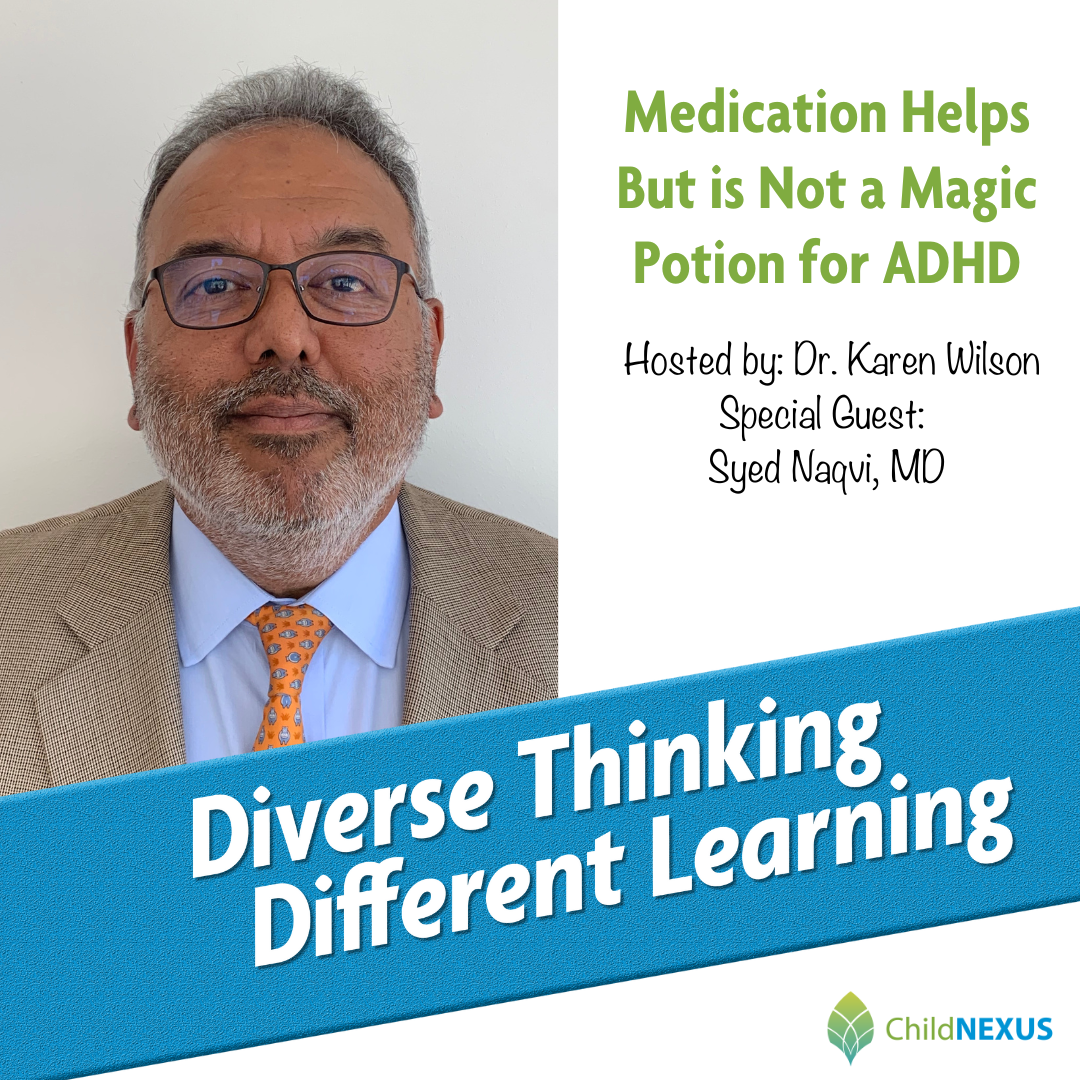
Ep. 105: Medication Helps But is Not a Magic Potion for ADHD with Syed Naqvi, MD
If your child has been diagnosed with ADHD, you might be considering your treatment options. The American Academy of Pediatrics recommends that for children between the ages of 4 and 6, the first line of treatment should include parent training in behavior management and behavioral classroom interventions. Medication should be used if those interventions do not result in significant improvement or if the child continues to have serious problems. For children and adolescents between the ages of 6 and 18, recommended treatment is FDA approved medications along with parent training in behavior management and classroom interventions. Medication works alongside behavior management. We get questions frequently about medication and they need to be answered by a pediatric expert. That's why I have asked Dr. Syed Naqvi to join the podcast for this conversation on medication as a treatment for ADHD. In this episode, you'll learn how medication can benefit a child with ADHD, but also the steps to take before it is ever considered. Show Notes: [2:46] - Over the years, Dr. Wilson has received numerous questions about medication. [3:33] - Medication consultations are necessary to determine if it's appropriate. [4:26] - Not every case of ADHD needs medication as treatment. [5:50] - For medication to be used, ADHD must interfere with daily life. [7:01] - Be mindful that ADHD might not be the sole factor in disruptive behavior. [8:55] - Dr. Naqvi is adamant about using standard scales. [10:10] - Sometimes, Dr. Naqvi can be doing an ADHD assessment and notice other learning disabilities. [11:33] - Interventions will vary depending on the age of the child and there are a lot of factors that impact them. [13:14] - Interventions need to be revisited every 6-12 months. [15:29] - The root cause is the most important piece to find and that's challenging in a child as they are growing and changing. [17:23] - All medications have side effects and they need to be considered. If the risks outweigh the benefits, that is not the route to take. [18:49] - The benefits of medication will be different per child. [20:50] - Setting boundaries and rules to help manage behavior is necessary in addition to medication. [23:07] - Dr. Naqvi and Dr. Wilson discuss work by Russell Barkley. [24:01] - Interventions need to take place before medication is introduced. [25:19] - Some parents are disappointed when medication isn't immediately prescribed, but Dr. Naqvi shares that it is not a magic potion. [27:05] - Dr. Naqvi shares the differences between some common medications prescribed for ADHD. [30:16] - FDA guidelines must be considered. [31:36] - Dr. Naqvi educates parents on other types of supplements that could benefit children with ADHD before resorting to medication. [33:12] - Let children have their joy but be aware of things like treats and how they impact their behavior. [35:26] - Be aware of myths that surround ADHD and ADHD medication. [36:43] - Genetics also plays a role in side effects. [37:53] - ADHD is a genetic disorder, which may impact the parent in remembering to give the child medication appropriately. [40:39] - If you have questions for Dr. Naqvi, email is the best way to reach him. About Our Guest: Syed Naqvi MD is Board certified and recertified, in both adult and child & Adolescent psychiatry. He provides state-of-the-art psychopharmacological treatment to children with autism, intellectual disabilities with psychiatric issues, Autism Spectrum Disorder, bipolar disorder, attention deficit hyperactivity disorder, and Tourette's disorder. He has been the recipient of numerous awards. Dr. Naqvi is a Clinical Associate Professor of Psychiatry in UCLA. He also devotes his professional time as Director of Psychiatric services at Wayfinder family services in Los Angeles and in his private practice in Beverly Hills and Calabasas. Connect with Dr. Naqvi: Email: [email protected] Links and Related Resources: Episode 34: Key Principles for Raising a Child with ADHD with Dr. Russell A. Barkley What Causes ADHD? The Intersection of Executive Function, ADHD, and Other Learning Differences Executive Functioning and Self Regulation in ADHD Mindfulness in the Treatment of Attention Deficit Hyperactivity Disorder Join our email list so that you can receive information about upcoming webinars - ChildNEXUS.com The Diverse Thinking Different Learning podcast is intended for informational purposes only and is not a substitute for medical or legal advice, diagnosis, or treatment. Additionally, the views and opinions expressed by the host and guests are not considered treatment and do not necessarily reflect those of ChildNEXUS, Inc or the host, Dr. Karen Wilson.
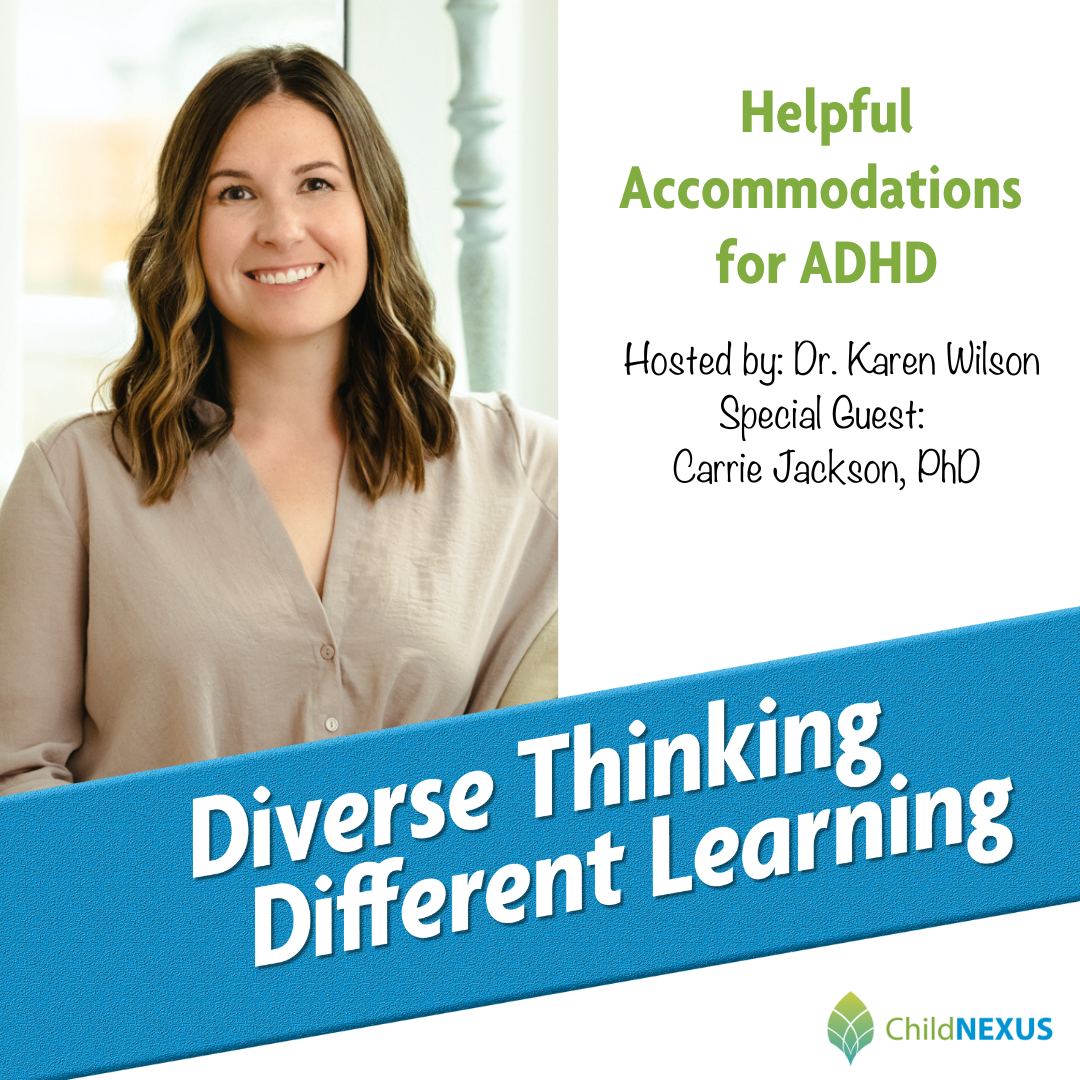
Ep. 104: Helpful Accommodations for ADHD with Carrie Jackson, PhD
As we record this episode in October, keep in mind that now is a good time to review your child's classroom accommodations. If they have a learning disability, learning challenges that affect them in the classroom, or mental health difficulties that also impact their ability to access the curriculum, they may benefit from classroom accommodations. With accommodations, expectations are the same. What a child is expected to know, learn, or do does not change. Accommodations offer support to account for challenges that students face and really help level the playing field. But when it comes to ADHD specifically, what accommodations are helpful? Dr. Carrie Jackson is today's guest and she has a wealth of knowledge about accommodations, how to properly use and track them, and which ones are helpful for children and adolescents with ADHD. In our conversation today, Dr. Jackson explains what accommodations are, how ADHD impacts a student's ability to learn in a classroom environment, and how parents and educators can support their needs with accommodations. Show Notes: [2:19] - There is so much to discuss when it comes to ADHD. It can be overwhelming. [3:29] - Dr. Jackson has a parent guide on her website that is extremely helpful. [5:07] - Girls with ADHD are more likely to be overlooked and misdiagnosed. [6:30] - Inattention is a very internal struggle which is hard to see, but accommodations are very helpful. [8:38] - Classroom accommodations are changes to the classroom environment in a way that will support your child with their learning style. [9:48] - There is a misconception about accommodations being unfair. [10:50] - Classroom accommodations also help with self-confidence. [11:50] - When it comes to ADHD, the accommodation of having a distraction free environment is often recommended. [13:40] - Peers can often make a difference in seating as well. [15:40] - Wobble seats and fidget toys can be helpful but for others they are more distracting. [17:12] - Daily report cards are a great motivational tool and accommodation. [18:39] - ADHD changes as the child gets older. [20:00] - An organization accommodation is particularly helpful for older students with ADHD. [21:28] - Sometimes after an assessment, the child doesn't want the accommodation. [23:17] - Some accommodations will not be noticeable by peers. [24:37] - It's about paying attention to what is helpful to each student in accessing the curriculum. Track these over time. [26:19] - Schools will not give these accommodations automatically. [27:12] - Start the conversation with your child's teacher about their diagnoses. About Our Guest: Carrie Jackson, PhD is a licensed child psychologist, speaker, and author working in San Diego, California. She has published over 20 articles and book chapters related to parenting, ADHD, and defiance. Dr. Carrie Jackson maintains a private practice and shares evidence-based mental health information on social media. In addition to her private practice, Dr. Carrie Jackson is also an adjunct professor at the University of San Diego, where she teaches child therapy to Marriage and Family Therapy graduate students. Connect with Carrie Jackson: Website Parenting ADHD Instagram Phone: 619-719-1940 Links and Related Resources: Episode 99: Straight Talk About ADHD in Girls with Dr. Stephen Henshaw Episode 91: Key Principles for Raising a Child with ADHD with Dr. Russell A. Barkley Book a Consultation Find a Provider/School Search for Articles/Blogs Join our email list so that you can receive information about upcoming webinars - ChildNEXUS.com The Diverse Thinking Different Learning podcast is intended for informational purposes only and is not a substitute for medical or legal advice, diagnosis, or treatment. Additionally, the views and opinions expressed by the host and guests are not considered treatment and do not necessarily reflect those of ChildNEXUS, Inc or the host, Dr. Karen Wilson.

Ep. 103: How Speech-Language Therapy Helps Students with Dyslexia with Nancy Rose Steinbock, M.A., CCC-SLP
Today we are continuing the conversation about language skills and development, but this time we're discussing how speech-language therapy helps students with dyslexia. In previous episodes we've talked about speech and language development and we've talked about dyslexia, but now we combine the two because they are certainly linked. My guest today is Nancy Rose Steinbock, an absolute expert in the field of language and literacy disorders. In our conversation today, Nancy talks in length about the connection between language development and literacy and the unfortunate truth that some teachers and educators are not equipped or prepared to effectively support students who are struggling. Nancy gives fantastic tips on what to look for in the early years before school begins for a child, even when pediatricians and caregivers are saying "wait and see". All this and more in this conversation today with Nancy Steinbock. Show Notes: [3:01] - We often talk about language development and literacy separately, but they are closely linked. [4:36] - The key to mitigating language disorders is early identification and intervention. [5:49] - Nancy describes research that demonstrates what to look for in early stages of language development. [7:50] - While being told to "wait and see", there are things we can look for before professional intervention. [9:02] - Non-verbal communication is a form of language. [11:30] - We need to be careful about discerning the difference between a child who has a language development disability and one who is progressing differently. [13:06] - A parent's concern should always be considered as they know their child better than anyone. Don't always buy into the "wait and see" approach. [14:13] - There are times that language development plateaus and makes it appear that some are catching up when there is still an issue. [17:11] - Many children miss out on early intervention due to the lack of understanding of the link between language and literacy. [19:35] - One of the mistakes we've made in teacher education is that we're not training teachers in the last decade in language. [21:18] - Nancy shares the problems she ran into when working with students and teachers virtually. [24:03] - Nancy demonstrates speech to print vs. print to speech. [26:30] - Language encompasses reading, writing, and speaking and these are developing simultaneously. [28:46] - Because language has been a struggle, children who have not had support become less attuned to listening and experience learned helplessness. [31:08] - Nancy describes some of the other behaviors that develop when a student has not received the help they need. [32:51] - This is not a quick process. This could take years. [34:28] - Asking indirect questions when a student is engaged is much more effective. [36:01] - It is important for students to engage with a story. [37:40] - Connect with Nancy to learn more. About Our Guest: As a speech language pathologist, Nancy Rose Steinbock, M.A., CCC-SLP is an expert in the field of language and literacy disorders. Over 40 years' experience in the field and engagement with experts in the fields of language development and disorders have developed her expertise in diagnosing and treating spoken and written language skills. She was fortunate to complete four years of doctoral study at City University of New York, CUNY, when children identified as 'learning disabled' were seen to be 'language disabled.' Connections between early childhood speech-language development and academic under-achievement were studied across disciplines in the program. Knowing that prevention is key to mitigating language disorders, Nancy has created numerous programs and strategies to work with teachers and students who are at risk for developing these disorders. Focusing on bilingual language acquisition and interventionist methods, she founded Inglese Dinamico, an innovative bilingual education project in Venice, Italy, where she provided extensive teacher-training in speech and language development disorders for nearly 15 years. Her 'intervention methodology' for EL teaching has been carried over into her EL teaching for adults in her practice located on Martha's Vineyard in Massachusetts. Connect with Nancy Steinbock: ChildNEXUS Provider Profile MV Language Website Links and Related Resources: Episode 102: Everyday Activities That Help Build Language Skills with Stefanie Trenholme, MS, CCC-SLP Dyslexia Article 6 Quick Questions for Parents Concerned About Dyslexia Episode 21: What You Know and Don't Know About Dyslexia with Dr. Lauren McClenney Rosenstein Get Reading Support Join our email list so that you can receive information about upcoming webinars - ChildNEXUS.com The Diverse Thinking Different Learning podcast is intended for informational purposes only and is not a substitute for medical or legal advice, diagnosis, or treatment. Additionally, the views and opinions expressed by the host and guests are not considered trea

Ep. 102: Everyday Activities That Help Build Language Skills with Stefanie Trenholme, MS, CCC-SLP
There are countless opportunities built into a child's everyday life that could be used for support in language development. The best parts are that they won't even know they're working on these skills and they're fun! Today's guest is Stefanie Trenholme, a Speech and Language Pathologist and children's book author. In our conversation today, Stefanie explains some common misconceptions about speech and language development and disabilities. She describes the different areas of language development and the red flags that are often overlooked or misinterpreted. Did you know your daily routines could be used to help your child's language development? In this episode, Stefanie really digs into the topic. Be sure to listen to the end to also hear about Stefanie's fun book that can be used to enhance any child's language skills and boost their motivation to read. Show Notes: [2:18] - There is a misconception about what Speech and Language Pathologists do. [4:27] - Red flags for language development can look different for different kids at different ages, but Stefanie shares some common ones. [5:52] - There are different areas of language development and for some children, they could be impacted in one area or all. [7:00] - Some red flags are overlooked by parents. [8:47] - Although there are different areas of language development, they are connected and often one area's deficit impacts other areas. [10:18] - Unaddressed language difficulties in young children can lead to behavior concerns as they are easily frustrated. [12:12] - Kids may have a difficult time sharing about their day. [13:27] - Language variation is another area of difficulty that is often overlooked. [14:51] - By the time a student is in high school, social language becomes more complex. [17:01] - Parents may not always see language difficulties when they happen most often at school. [18:45] - Executive functioning also plays a role. [20:50] - For all children, routines are great for language development. [22:46] - Kids won't know they are working on language skills because they are focused on their routine. [25:00] - There are so many opportunities in a week to hone in on skills in daily routines. [26:23] - Make the child an active participant in learning. [27:42] - Stefanie has written a children's book that parents can use to help with vocabulary and routines. [29:36] - It is a picture book typically for "little" kids, but picture books can easily be adapted to work with any age. [31:31] - Lola is a real dog and with her help, Stefanie demonstrates different language skills in a fun and motivational way. [33:17] - One more thing! Cooking together is great for language skills and executive functioning. About Our Guest: Stefanie Trenholme is the owner of Trenholme Speech Therapy, a private pediatric practice in West Los Angeles. She has been practicing both in Canada and the United States for twenty years. She has also been a guest speaker at various private schools in both Los Angeles and New York City discussing how speech-language pathologists can help support educators in the classroom. She also goes into schools to teach students how to treat animals. In addition to being voted one of Los Angeles's top Speech Pathologists by Expertise.com 5 years in a row, she recently was featured as one of the "Top 30 Inspiring Women To Look Out for in 2022." Stefanie also recently published her first children's book, "Little Lola Frenchie Loves Bathtime" which stars her therapy dog Lola. The Little Lola Frenchie™️ book series was created not only because Lola is an amazing therapy dog and loved by all who meet and work with her, but also to help children learn language - especially language through daily routines. Stefanie is currently working on her second book which should be out at the beginning of 2023. Connect with Stefanie Trenholme: Website ChildNEXUS Provider Profile Links and Related Resources: Little Lola Frenchie Top 5 Signs Your Need a Speech and Language Pathologist Episode 20: How Speech and Language Difficulties Affect a Child's Life with Carol Karp Helping Your Child with Language Based Learning Disabilities with Dr. Daniel Franklin Join our email list so that you can receive information about upcoming webinars - ChildNEXUS.com The Diverse Thinking Different Learning podcast is intended for informational purposes only and is not a substitute for medical or legal advice, diagnosis, or treatment. Additionally, the views and opinions expressed by the host and guests are not considered treatment and do not necessarily reflect those of ChildNEXUS, Inc or the host, Dr. Karen Wilson.

Ep. 101: How Parent Education and Perseverance Made the Difference with Raja Marhaba
Today's guest is a force in the special education space and her journey began as a parent of a special needs child. Raja Marhaba joins the conversation today to tell you about her traumatic experiences navigating the special education system and how her journey led her to create The Jonathan Foundation. The Jonathan Foundation for Children With Learning Disabilities is a non-profit organization that raises funds for parents who can't afford assessments for their children. In many unfortunate situations, a child's struggles go unnoticed, undiagnosed, and without support for too long and that wasted time impacts their education and their future. This conversation with Raja will put you in her shoes as a parent who has learned through the eyes of her own children. She hopes that, through the work she does with The Jonathan Foundation, fewer families will experience the challenges she faced and more families will get the support they need. Show Notes: [1:50] - Welcome to the show, Raja! [3:15] - Raja's experience began 26 years ago and she has a parent's perspective. [5:27] - As a new mom, she didn't know how to navigate the special education process. But, she knew her child better than anyone and she learned to be her child's best advocate. [7:16] - At the time, Raja found that not every piece of information was given to her. [8:15] - Raja realized that not everything that was suggested was happening at school to help her son, Jonathan. [9:57] - Raja describes the journey of learning her son has dyslexia. [11:37] - He lost a lot of confidence, but acting classes helped to build it back up. [12:42] - Raja had a lot of questions and lost faith in the school system. [14:54] - This experience set Raja on a new path. She knew she needed to fight and advocate for her children. She sees this as a turning point in her life. [16:35] - Back then, there was no Google. Raja's resources for information were limited, but many of the same problems exist today. [19:38] - This process and the lack of understanding leads to wasted time. [20:53] - Because a psychologist took the time to explain and answer her questions, Raja understood the data from assessments. [21:57] - The assessments could cost a family up to $15,000. [23:55] - It is important for parents to have a professional in their corner. Raja describes some situations where advocacy was crucial. [25:57] - Raja focused on assessments with The Jonathan Foundation because of her experience with the huge cost of assessments for her sons. [27:23] - This experience hurt her family and her own mental health. [28:20] - Raja describes what she learned about her children and what she learned from them. [30:11] - Understanding her children opened up the world for her. [32:05] - Having one child who took so much of her attention, Raja's youngest son was impacted. [34:51] - The sooner the better when it comes to an assessment. [36:29] - If you feel that your child is struggling and the school has said that their evaluation revealed no difficulties, you can request another assessment. [39:02] - The data from an assessment tells a story. [40:41] - Donations can be made to the Jonathan Foundation to help children and families without the funds to afford a quality assessment. [43:29] - Sometimes schools are missing a piece to the puzzle without an assessment. [44:27] - Raja is currently writing a book and she provides a sneak peek. [49:57] - Raja's book will connect you with her story; she hopes that others can learn from her experience. About Our Guest: Raja B. Marhaba is the Founder and President of The Jonathan Foundation for Children with Learning Disabilities, Inc. The motivation for establishing The Jonathan Foundation was driven by her personal struggles with having two children with disabilities and the multiple battles she endured to obtain appropriate special education and related services from their school district over a period of eight years. The result: eight due process complaint filings, including a hearing; an appeal to the Federal Ninth Circuit District Court; as well as periods of extreme financial hardship from the cost of paying for private assessments, specialized interventions, and placements, retaining legal representation, and witness fees. Thus, Raja envisioned The Jonathan Foundation to be the vehicle she would use to assist families, like her own, in dealing with a "broken" special education system, "one child at a time". Since its inception in 2001, The Jonathan Foundation has provided families of children and adolescents with various types of disabilities with information, resources, referrals, and direct advocacy services by Raja in both special education and regional center matters. Connect with Raja Marhaba: The Jonathan Foundation Website Apply for an Assessment Scholarship Links and Related Resources: Episode 1: Demystifying the Assessment Process How to Initiate a Special Education Assessment Episode 14: Pursuing and Pushing for a Special Education
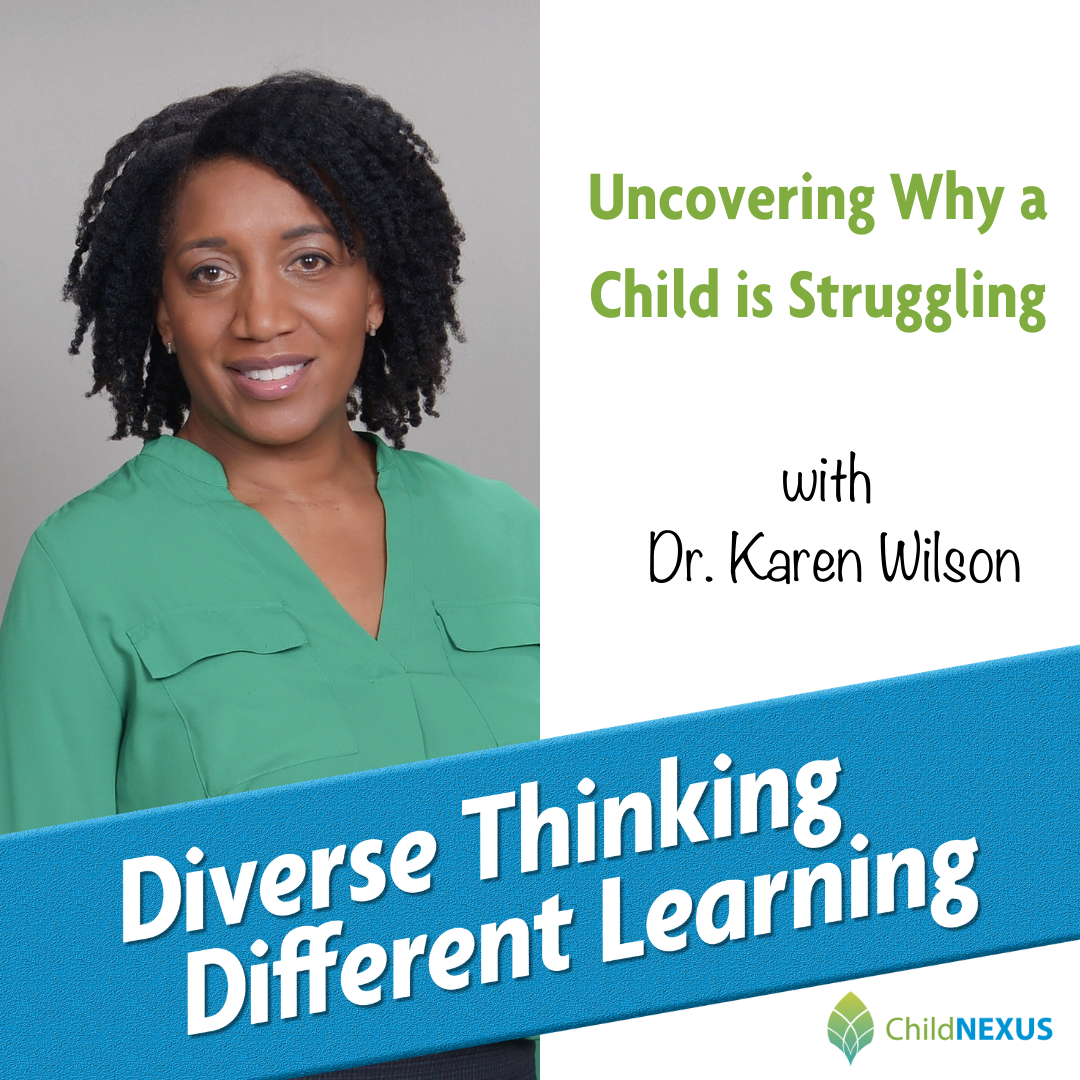
Ep. 100: Uncovering Why a Child is Struggling
This podcast began in November 2020 in the early months of the Covid-19 pandemic with the hopes of helping parents with a child struggling at home. I wanted to bring information and expertise into their home so they can better support their children. And now, Diverse Thinking Different Learning is celebrating 100 episodes! Let's revisit the very first episode that sets the stage for the work we do at ChildNEXUS and the mission of the podcast. Millions of kids struggle with learning, processing, and social difficulties. These challenges interfere with their ability to reach their full potential. My name is Dr. Karen Wilson and I am on a mission to make sure that when kids are struggling, we find out why and we give them the support they need to thrive. Welcome to the Diverse Thinking Different Learning Podcast. This podcast is a resource for parents and educators working with children with learning difficulties. It is my hope that after listening to this show, you will better understand the challenges that some kids face and know how to help them overcome difficulties, become more resilient, maintain a love for learning, and experience more success. Today I'm discussing what struggles look like for kids with learning challenges, what parents and educators should do when they see kids are struggling, when to consider an evaluation for a child, and the benefits of targeted intervention. Show Notes: [2:51] - This episode is about why the identification of learning challenges is so important. What do we do right and where do we go wrong? [3:39] - Approximately 5% of school aged children have a learning disability and 13% of all public school students receive special education services. Another 15% are struggling due to an unidentified learning or attention issue. [5:25] - Struggles can look different in different children. Dr. Wilson lists many different examples of what struggles look like in different children. [6:51] - With misunderstanding sometimes comes mislabeling. Mislabeling can lead to behavioral problems and can cause a lot more anxiety. [8:12] - We see the struggle, but what we tend to do is to rationalize the difficulty. [10:16] - With a learning disorder, a child typically experiences trouble learning skills in the regular classroom and tends to be behind their peers in one or more areas. [11:28] - If you don't know what the underlying problem is, how can you appropriately intervene? [12:30] - Some reasons a child may be struggling with reading comprehension is poor working memory, poor phonological processing, and issues with receptive language. [16:00] - The same is true for writing. Writing is such a complex task for students to tackle. [19:23] - If you don't know why a child is struggling, it is difficult to give them the proper support. [19:57] - Assessments serve as a guide for appropriate intervention to address the difficulties a child experiences. [22:16] - When we give children the appropriate, evidence-based intervention for their specific learning disorder, we can reorganize their brain pathways. [24:06] - Not all kids who struggle need a full, comprehensive evaluation. Some learning struggles could be tied to anxiety. [25:13] - If a child has anxiety and a learning disorder, the intervention for the learning disorder is not enough. The anxiety also needs to be addressed. [26:46] - When kids don't get enough sleep, you get poor attention or other possible issues in school. [28:56] - When a real problem remains unidentified, children may grow to have low self esteem and are at greater risk of struggling with anxiety and depression. [30:33] - We have to move from observing the struggle to getting students the appropriate intervention and stop rationalizing the problem. Links and Resources: ChildNEXUS Website Find a Provider Request a Consultation Search Articles Listen to more Diverse Thinking Different Learning episodes Join our email list so that you can receive information about upcoming webinars - ChildNEXUS.com The Diverse Thinking Different Learning podcast is intended for informational purposes only and is not a substitute for medical or legal advice, diagnosis, or treatment. Additionally, the views and opinions expressed by the host and guests are not considered treatment and do not necessarily reflect those of ChildNEXUS, Inc or the host, Dr. Karen Wilson.
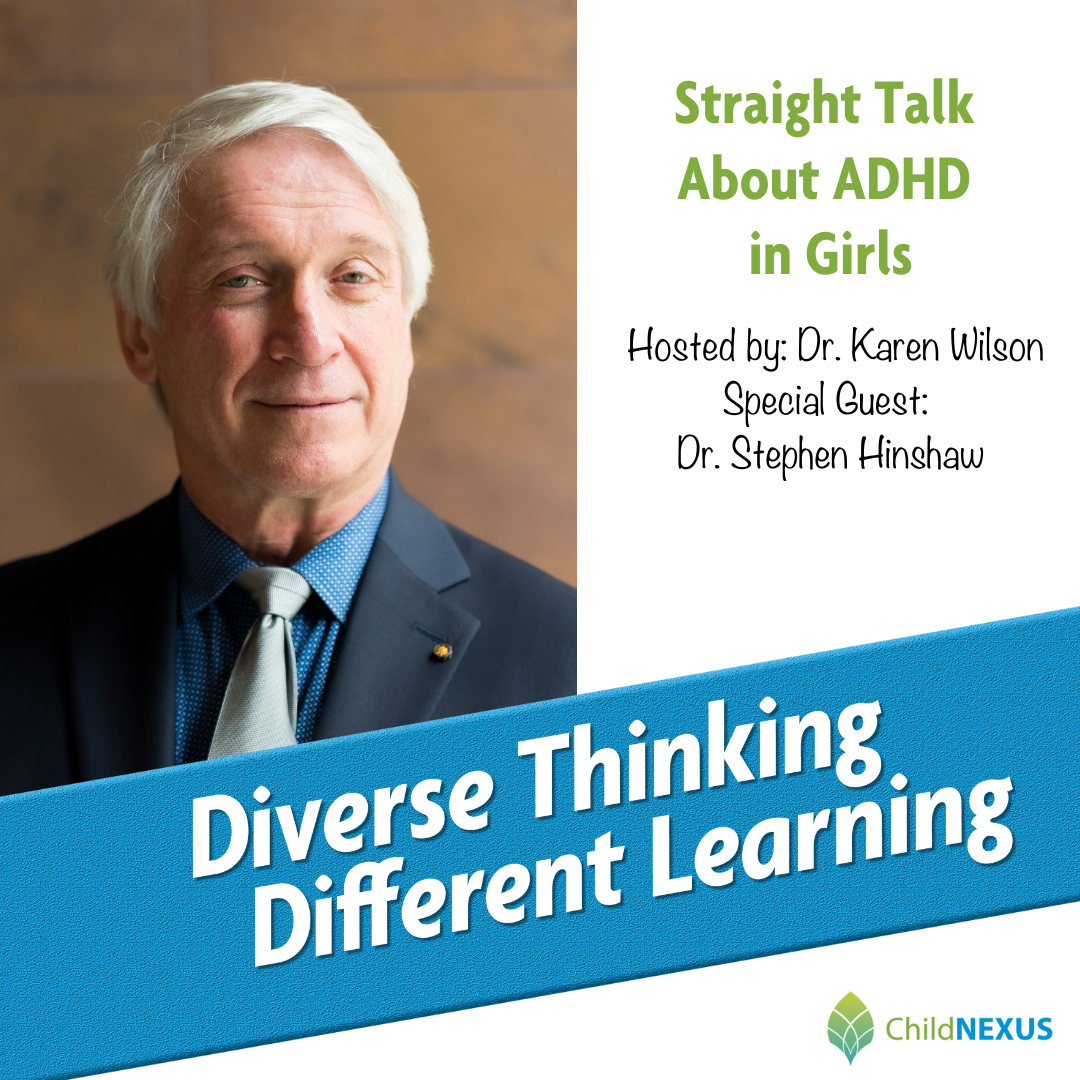
Ep. 99: Straight Talk About ADHD in Girls with Dr. Stephen Hinshaw
We've discussed ADHD on the podcast before and it continues to be an important topic. But something we haven't delved into yet is what ADHD looks like in girls. Dr. Stephen Hinshaw has conducted years of research including a longitudinal study on girls with ADHD and his findings are not only fascinating but important to consider especially if you are the parent of a daughter with ADHD. Dr. Hinshaw has recently written a book called Straight Talk About ADHD in Girls: How to Help Your Daughter Thrive. Parenting a daughter with Attention-Deficit/Hyperactivity Disorder is no easy path, especially because of the myth that the disorder is rare or nonexistent in girls. In his book, Dr. Hinshaw provides vital information and advice to help you understand and meet your daughter's needs. And in this episode, he does the same. He delivers up-to-date facts on what ADHD is, why symptoms often appear differently in girls than in boys, why girls with ADHD behave the way they do, how to get an accurate diagnosis, and what treatments are most effective. There is so much pressure on girls to be perfect and for those with ADHD, it feels especially hard to measure up. The social stigmas and academic challenges ADHD present to girls is often isolating and painful. So listen to Dr. Hinshaw explain the science behind it all and what we can do as parents and educators to help our girls with ADHD. Show Notes: [2:22] - ADHD is more prevalent in boys than girls, but why? [3:23] - Because of the difference in development, symptoms of ADHD in girls are often overlooked. [4:27] - Girls with ADHD tend to show their symptoms differently. Many don't get diagnosed until they are teenagers or even young adults. [5:28] - ADHD causes problems with the self-regulation of attention. [6:30] - It takes some time to observe and diagnose ADHD. [7:16] - Some girls may show their hyperactivity verbally instead of physically. [8:43] - Dr. Hinshaw conducted the largest longitudinal study on girls with ADHD. [9:37] - In childhood, girls with ADHD are just as impaired as boys. Socially, they tend to get rejected by their peers more so than boys. [11:26] - Dr. Hinshaw shares the differences in the larger consequences like delinquency, substance use, and mental health. [13:34] - ADHD increases the risk of self harm and suicide. [15:08] - Low self-esteem, difficult peer relationships, increasing academic struggles, make things challenging in young adulthood too. [17:01] - Across many studies and types of research, both males and females and the differences between them are not taken into consideration. [18:54] - There can be more severe social consequences of lack of early intervention for girls. [21:39] - There are consistent inconsistencies. [23:00] - Milder conditions or conditions that don't have as many outward indicators, result in more stigma. [24:52] - If you are the parent of a girl who has ADHD with a solid diagnosis, you have to show radical acceptance and commitment.[26:33] - Motivation, regulation, and even medication are things to be considered. [27:28] - What are your daughter's strengths? [28:31] - One valued and strong friendship can offset the social complications they experience. [29:45] - Research has shown that parents of girls with ADHD tend to have much more parental stress. Parent management training is beneficial. [31:19] - Get Dr. Hinshaw's book for 20% off using this special Diverse Thinking Different Learning discount code: 1F2017 About Our Guest: Stephen P. Hinshaw is Distinguished Professor of Psychology at UC Berkeley and Professor of Psychiatry and Behavioral Sciences at UC San Francisco. His work focuses on developmental psychopathology, child and adolescent mental health (particularly ADHD), and the use of clinical trials to understand underlying mechanisms. He also actively investigates mental illness stigma and interventions to reduce it. Hinshaw has authored over 400 articles, chapters, and commentaries plus 13 books. He has won numerous national and international research awards, including the James McKeen Cattell Fellow Award from the Association for Psychological Science, the Distinguished Scientific Contributions Award from the American Psychological Association, and the Sarnat International Prize in Mental Health from the National Academy of Medicine. He was inducted into the American Academy of Arts and Sciences in 2021. His extensive media coverage includes the New York Times, Washington Post, Wall Street Journal, Today Show, CBS Evening News, ABC World News Tonight, and many more. Connect with Dr. Stephen Hinshaw: Email: [email protected] Hinshaw Lab at The Institution of Human Development at Berkeley Dr. Stephen Hinshaw's Website GET THE BOOK! The discount code for listeners is 1F2017 and it expires September 30, 2022 Links and Related Resources: Attention Deficit Hyperactivity Disorder Episode 40: Lifestyle Activities That Can Improve ADHD Symptoms with Dr. Joel Nigg Executive Functioning and Self Regulation

Ep. 98: Managing Technology Use at Home with Dr. Joe Dilley
With the use of technology increasing at a rapid rate among people of all ages, we have to ask ourselves how much is too much? The answer to that is kind of complicated. It depends on the content, depends on the activity, and it definitely depends on each individual user. But today's guest shares why it is important to follow your gut if you think screen time and technology use is a deeper problem. In this episode, Dr. Joe Dilley helps us see how to identify when kids are dependent on their electronics. This type of addiction as with any addition can be detrimental so he also shares ways we can break the addiction. We have to look for reasons and the motivations behind the use of technology and determine how much is enough and what is beyond the limit. Dr. Joe Dilley is a licensed Clinical Psychologist practicing in Texas and California. He is also the author of a fantastic book called The Game is Playing Your Kid. This book was written pre-pandemic and although the Covid-19 pandemic changed the way we use technology, the book remains relevant and useful. Show Notes: [2:07] - Dr. Dilley wrote his book and a few articles for ChildNEXUS regarding technology use in kids pre-pandemic. [3:03] - The pandemic provided an unexpected and unwelcome boost to everybody's digital time spent. [4:01] - Lockdowns and quarantines exacerbated an already high use of technology at home. [5:08] - Dr. Dilley shares some of the issues high use of technology can cause. [6:22] - Anxiety has a complex relationship with isolation. [7:55] - We are just scratching the surface of mental health effects. What will the ripple effect be with academics? [9:03] - Kids having to learn to read remotely during the pandemic, especially those who have learning differences, are likely to get looked over. [11:29] - There are unique risk factors of tech use for those with ADHD and/or Autism Spectrum Disorder. [13:36] - Technology could also be used as an escape for struggling students. [15:27] - Trust your gut as a parent. If you are concerned that your child is spending too much time using technology, look into it. [16:55] - Kids are going to push back. [18:31] - "Screen time" encompasses so many types of use like television, social media, phone use, video games, and more. [19:54] - What are the physiological and psychological effects of screen time? There are differences depending on the quality of the screen time. [21:30] - There is a very complex relationship between the use of technology and the possible effects it has. [22:58] - After about 3 hours, the benefits of gaming diminish. [23:58] - Playing a video game as a team for 2 hours is much different than scrolling through Instagram for 2 hours. [26:26] - The methods in his book have been recommended to parents by their own children. [27:27] - Going back to school could be a great time to reset the guidelines around technology use at home. [29:34] - There are ways to communicate with your child or adolescent that can place boundaries on technology use. [30:41] - This isn't a quick process and it can be difficult. [31:31] - It is much easier to just put the kids in front of the screen, especially the younger ones. [33:22] - Seize the opportunities to make some changes. About Our Guest: Dr. Joe Dilley graduated from the University of Iowa with honors and high distinction in Psychology. He then brought this multifaceted view of the human psyche to his doctoral studies at Northwestern University, where he completed his Ph.D. in Clinical Psychology. Now a licensed psychologist practicing in Texas and California, Dr. Joe specializes in the assessment and treatment of anxiety, ADHD, and Gaming Disorder. His book The Game Is Playing Your Kid: How to Unplug & Reconnect in the Digital Age offers practical and fair approaches to managing screen time, even in the COVID era. Connect with Dr. Joe Dilley: Synergy Psych Website Phone: (626) 539-2001 x1 Links and Related Resources: The Game is Playing Your Kid by Dr. Joe Dilley How to Unplug and Reconnect in the Digital Age by Dr. Joe Dilley Clarifying Gray Areas in Family Tech Use Family Tech Use Part 2: Resolving Common Dilemmas Episode 24: Should We Worry About Screen Time During a Pandemic? with Dr. Allison Kawa Join our email list so that you can receive information about upcoming webinars - ChildNEXUS.com The Diverse Thinking Different Learning podcast is intended for informational purposes only and is not a substitute for medical or legal advice, diagnosis, or treatment. Additionally, the views and opinions expressed by the host and guests are not considered treatment and do not necessarily reflect those of ChildNEXUS, Inc or the host, Dr. Karen Wilson.

Ep. 97: Building Communities of Support and Resistance with Dr. Bibi Pirayesh
This episode may make you angry but I am hoping that it will also motivate you to advocate for change. I've invited Dr. Bibi Pirayesh back to the Diverse Thinking Different Learning Podcast to talk about learning disabilities as a social justice issue. This topic is certainly charged and rightfully so. Today, we discuss whether our current education system was built for neurodiverse learners. It is hard for me to believe that Dr. Pirayesh fell into educational therapy by accident as she is extraordinary at the work she does. She is also an extraordinary advocate. Her work in the field is tireless and in this episode, she and I discuss the hardships we face as a society that does not allow all learners to reach their potential. Show Notes: [2:47] - Welcome back, Dr. Pirayesh! [3:53] - Learning disabilities is a social justice issue and in recent years social justice has become extremely politicized. [5:10] - While social justice is typically viewed as based around race, gender, and sex, it is all connected through ableism. [6:19] - Why people may feel frustrated and feel like they can't move forward. [8:19] - What is the ideology that fuels ableism in the education system? [9:57] - The way that it is, isn't necessarily the way it is supposed to be. It's just the way it was built and the education system is working exactly the way it was designed. [11:10] - The education system was designed to be competitive. [13:53] - When you read special education law, it becomes clear that this system is created in a specific way. [15:56] - As a system, we don't always interpret the science correctly. [16:54] - During the pandemic, people became more aware of learning problems and mental health issues, but this is not a new problem. [18:41] - Dr. Pirayesh was hopeful in the beginning of the pandemic when there were fast changes in education, but things are settling back to where they were as the pandemic slows. [20:18] - One positive change is access to mental health support, but we haven't made any shifts for marginalized students who learn differently. [22:10] - Reading is one area where research is plentiful and solid and yet we aren't making changes in the system. [23:16] - There is a connection between the prison system and education system. [26:09] - Many people, including Dr. Pirayesh, have felt at times hopeless for change. [27:45] - Small change is a starting point and Dr. Pirayesh sees the impact of individuals and schools being receptive to advocacy. [29:49] - Change is absolutely possible. [31:21] - Dr. Pirayesh shares some mindset shifts she has had to make in her business and personal life. [33:04] - There are hopeful things in a society that isn't built for everyone. Having these conversations isn't enough. There has to be action. [34:42] - How are people coming up against the system and what is the result? [37:10] - Share your story here. About Our Guest: Dr. Bibi Pirayesh holds a Bachelor's degree in Neuroscience and Education from the University of Pittsburgh and a Master's degree in Developmental Psychology from Columbia University where her work focused primarily on children's development of mathematical thinking and cognitive neuroscience. While the emphasis of Dr. Pirayesh's work is on remediating learning disabilities in a one-on-one setting, she is also a sought after speaker and community advocate for children and families around learning rights. Bibi works with children grades 1-12 and covers a wide range of learning difficulties including dyslexia, ADHD, and spectrum disorders. Dr. Pirayesh completed her doctoral work at Loyola Marymount University where she is also faculty and is involved with a number of service organizations including The Association of Educational Therapists. Connect with Dr. Bibi Pirayesh: The Difference is Not the Deficit Project: Share your story Links and Related Resources: Episode 5: Educational Therapy, Distance Learning, and Social Justice with Dr. Bibi Pirayesh 6 Quick Questions for Parents Concerned About Dyslexia Join our email list so that you can receive information about upcoming webinars - ChildNEXUS.com The Diverse Thinking Different Learning podcast is intended for informational purposes only and is not a substitute for medical or legal advice, diagnosis, or treatment. Additionally, the views and opinions expressed by the host and guests are not considered treatment and do not necessarily reflect those of ChildNEXUS, Inc or the host, Dr. Karen Wilson.
Ep. 96: Why Early Intervention is Important with Tania Abouezzeddine
Why is intervention, particularly early intervention, so important? The answer is brain plasticity, which is the brain's ability to change, reorganize, and even develop more efficient pathways for processing information. Research into the neurological bases of reading disorders, for example, has shown the educational and cognitive strategies can reroute brain networks and the brain can reorganize to overcome reading obstacles. Today's guest shares with us all about early intervention. Dr. Tania Abouezzeddine is a licensed Clinical Neuropsychologist and is also a faculty member at Rosemead School of Psychology at Biola University. In today's episode she explains why early intervention is key and how it results in positive changes in the brain. She not only shares why early intervention is important but how it impacts the development of the brain and the science behind it all. Show Notes: [2:45] - It is important to understand why a child is struggling before deciding on the intervention. [3:31] - Any good intervention begins with an accurate diagnosis or assessment. [4:28] - What makes a good assessment? [5:52] - A lot of times, children are more likely to be labeled with behavior disorders. [6:55] - Tania shares research surrounding behavior disorders diagnosed to particular demographics that result in a negative trajectory. [9:09] - Tania describes some of the negative results of an inaccurate diagnosis or assessment. [10:18] - If an intervention has not begun by age 8, a child with a reading disorder will likely not bridge the gap in their reading. [11:48] - Reading disorders are hereditary. [14:03] - There is evidence that you can change the brain through good, consistent, and intense intervention. [15:19] - External interventions result in a positive change in the brain. [16:24] - The purpose of interventions is not to have a better reading score. [17:43] - Every brain is working at its own pace, but it will improve with intervention and depends on the severity of the disorder. [19:02] - There's a high percentage of children with more than one disorder. [20:17] - The child also needs to understand why an intervention is necessary. [21:59] - Tania works with high school graduates in college who have not been diagnosed and still cannot read independently. That window of time has been missed. [23:23] - Training the brain through early intervention can create new brain pathways that are similar to a child without a disorder over time. [24:46] - Sometimes parents are afraid to know and they avoid an assessment. [26:14] - Early intervention is also important because you can catch these problems before a child becomes jaded. [27:50] - The identification of strengths can help the intervention as well. [30:49] - Knowing strengths shows the child that their weaknesses don't define them. [32:19] - What happens when a child doesn't receive positive early intervention? [34:25] - We all have things we are not good at, but when it comes to reading and learning disorders they can have negative ramifications. [36:02] - Tania shares examples of students who choose majors or professions based on areas of weakness rather than their strengths. [38:41] - Students can also receive a charted plan to help with prioritizing. About Our Guest: Dr. Abouezzeddine is a licensed Clinical Neuropsychologist (across the lifespan with a specialty in Pediatrics) and is a full-time faculty member at Rosemead School of Psychology at Biola University. She obtained her doctoral degree from the University of Southern California where she specialized in childhood trauma and resilience, which continue to be areas of research interest. After the completion of her doctoral studies, Dr. Abouezzeddine went on to specialize in Clinical Neuropsychology, beginning with a clinical internship in Geriatric Neuropsychology at the West Los Angeles VA Medical Center and continuing on with two additional years of clinical postdoctoral studies in Pediatric Neuropsychology at UCLA's Semel Institute of Neuroscience. Dr. Abouezzeddine specializes in the cognitive assessment of children and adolescents with neurodevelopmental disorders (e.g. ADHD, Autism), Learning Disabilities (e.g. Reading, Math), as well as cognitive impairments related to Traumatic Brain injury or and other medical conditions (e.g. epilepsy). She also occasionally assesses adults and older adults in Arabic schedule permitting. She is fluent in both English and Arabic. Connect with Tania Abouezzeddine: Website Email: [email protected] or [email protected] ChildNEXUS Provider Profile Links and Related Resources: Episode 2: Demystifying the Assessment Process Episode 22: How Students with Dyslexia Can Develop the Skills Needed for Reading with Forough Azimi Episode 1: Uncovering Why a Child is Struggling Join our email list so that you can receive information about upcoming webinars - ChildNEXUS.com The Diverse Thinking Different Learning podcast is intended for informational purpo
Ep. 95: Hope for a New School Year with Lindsay Recknell
How are you feeling about this new upcoming school year? Would you say you feel hopeful about it? Now it is really important to feel hopeful about the upcoming school year, but it isn't enough to just hope that your child or client will have a better school year. We know that there are many pieces to the puzzle of having a great school year, but hope does matter. And today our guest talks about the science of hope and what that means for heading back to school. Lindsay Recknell is an expert in hope and in this episode, she explains what this intangible concept feels like within our brains. When you dig deep into it, it seems complicated with the Hope Theory, the Hope Circuit, the Hope Scale. But really, this concept is simple to grasp and even better, it can be taught. Hope is contagious and can absolutely change your mental health and wellbeing. In this episode, Lindsay also walks us through an incredibly useful exercise that you can do independently or even with your family as we cultivate hope for a new school year. Show Notes: [2:31] - This time of year is a time of new beginnings. [3:58] - When we think about the word hope, it feels intangible. [5:39] - Lindsay explains Positive Psychology. [6:40] - Hope Theory is when the action of hope comes into play. Lindsay also explains the Hope Circuit. [7:47] - This concept is simple to grasp. Hope can be taught. [8:38] - We all have hope, even if it is deep down. There is a scientifically validated test called The Hope Scale. [9:24] - Lindsay believes that hope is contagious. [10:16] - You can also increase your hope independently. [11:31] - The Hope Circuit connects to our intrinsic thoughts on hope. [12:40] - Lindsay explains the Hope Circuit and what happens in your brain. [14:13] - Do this activity with Lindsay. Pause and write these things down. [16:24] - As you think about the vision you've created, you will feel something. That's your brain on hope. [17:05] - If you can do this exercise over and over with your family when you need a hope booster, it is so powerful. [18:38] - Hopefulness is not all about feeling happy. Hope and optimism are related but are independent from each other. [19:42] - Lindsay's definition of hope is that the future will be better than today by taking action over the things we can control. [21:04] - What are some of the things we can do to help build hope? [23:01] - You don't have to start with something huge. [24:20] - The process of reaching the goal is more important than the goal itself in a lot of ways. [25:40] - We know that life is hard sometimes, but we have tools to help us leverage hope. About Our Guest: As an expert in hope and a Certified Psychological Health & Safety Advisor, Lindsay Recknell works with individuals and organizations to increase their levels of psychological health & safety in the workplace using Positive Psychology and the Science of Hope. She empowers individuals, strengthens teams and transforms organizations through her Self-Awareness Superhero, Dream Catalyst and Wellness Webinars programs. Lindsay lives in Calgary with her husband and their two Golden Retrievers. Connect with Lindsay Recknell: Expert In Hope Website Phone: 403-200-0943 Instagram Hope Motivates Action Podcast Links and Related Resources: Episode 51: How Parents and Educators Can Collaborate to Help Students Thrive with Shelley Lawrence Parent Professional Partnerships: Seven Tips for Success Reflections on Being Back in the Classroom: Reaching for Gains and Growing Pains Episode 15: From High School to College: Steps to Success for Students with Disabilities with Elizabeth C. Hamblet Join our email list so that you can receive information about upcoming webinars - ChildNEXUS.com The Diverse Thinking Different Learning podcast is intended for informational purposes only and is not a substitute for medical or legal advice, diagnosis, or treatment. Additionally, the views and opinions expressed by the host and guests are not considered treatment and do not necessarily reflect those of ChildNEXUS, Inc or the host, Dr. Karen Wilson.

Ep. 94: Back to School: Key Principles of Homework with Josh Horwatt
Many argue that homework is not all that important in the grand scheme of things. Research actually shows that it has little to no beneficial effect on learning. But of course the independence and organization of schoolwork at home is absolutely helpful in building habits, and it is important to practice skills learned. But for many kids who think and learn differently, homework can be a struggle, and my guest today says it is not worth sacrificing important family time and certainly not your relationship with your child. Josh Horwatt is an educational therapist and founder of Beyond Bored Educational Services. In addition to working with kids through Beyond Bored, he is also a dad who has experienced homework from the parent's point of view as well. Listen as Josh gives some great pointers on how to manage homework and as he reminds us that it's not always a big deal. "It's just homework." Show Notes: [2:39] - Back to school can be exciting, but it is also a return to homework. Most students do not have a positive feeling about homework. [3:32] - After experiencing a 6 to 7 hour school day, students then complete more schoolwork at home in the form of homework. [4:42] - Students are at different stages; homework means something different and is more or less important depending on where they are. [6:09] - The type of homework has different levels of priority. [8:16] - Josh shares his approach to homework with his own kids and students. [9:35] - Setting a time limit for homework is a great strategy as well. The younger the student, the shorter the amount of time. [11:32] - Homework helps to develop work ethic and independence; it is not used to learn new skills. [12:38] - Some parents have a lot of hang-ups about homework. It's okay if it's not done. Most teachers are very reasonable. [13:45] - Some parents are intense about the details regarding homework and that can put strain on the parent-child relationship. [15:38] - If a learner did their homework incorrectly, don't make them go back and redo it. Make note of it and reach out to the teacher. [17:37] - Ask your child what help they need with their homework. This teaches them to reflect. [19:24] - A lot of parents have their own negative relationship with homework and may be repeating a lot of the things they experienced. [20:52] - Teachers receive the end result of homework, but don't know the strain and help that the student might have needed to complete it. [22:01] - Communication with teachers is so important. [23:34] - With neurodivergent students, homework comes on top of the work they do with educational therapists or outside therapists. [25:01] - Educators need to be cognizant of the homework load they're putting on students who have a lot on their plate already. [27:15] - If you can model to a family how to complete homework, it's worth it. [28:35] - Working with your own child is different from them working with a tutor or teacher. That's okay. [29:47] - Josh describes a personal experience of working with a challenging student and what he learned from working with him. [31:28] - Tutoring is academic, but connection is the ultimate goal. [33:19] - Take it slowly. Remember that there are stages. In the beginning, kids are going to be diligent, but their motivation may slide as time goes on. About Our Guest: Josh Horwatt is an educational therapist and founder of Beyond Bored Educational Services. He specializes in working with kids with dyslexia and kids who are highly resistant to intervention. Beyond Bored provides specialized tutoring for kids who are bored and detached from school using an approach called "Connection Tutoring." Josh is a father of 3 children and says he is a bad but avid surfer. Connect with Josh Horwatt: Beyond Bored Website Email: [email protected] ChildNEXUS Provider Profile Links and Related Resources: Supporting Parents of Children with Language Based Learning Disabilities Classroom and Home Accommodations for More Effective Learning Reading With Your Child Find Support Join our email list so that you can receive information about upcoming webinars - ChildNEXUS.com The Diverse Thinking Different Learning podcast is intended for informational purposes only and is not a substitute for medical or legal advice, diagnosis, or treatment. Additionally, the views and opinions expressed by the host and guests are not considered treatment and do not necessarily reflect those of ChildNEXUS, Inc or the host, Dr. Karen Wilson.

Ep. 93: How Social-Emotional Learning Helps Students Succeed with Jess Corinne
With back to school season quickly approaching, most families are looking for ways to set their children up for success as we settle back into a routine. This looks different for every family and every child, but one thing that everyone should consider is the importance of social-emotional learning. Today's episode is about just that and its connection to executive functioning, self-awareness, and self management skills. Joining the podcast today is Jess Corinne from Learnfully, a personalized educational program that connects students with specialists that meet their needs and set them up for success. Jess is the Head of Educational Services for Learnfully and comes to us with over 20 years of neurodiversity experience, including being the mother of her own neurodiverse children. As we start to transition back to a school routine, what are things you can do at home to ease that transition for your learner? Show Notes: [2:43] - Jess comes to Learnfully from private practice and feels like she now has a greater reach to help more students. [3:31] - 1 in 5 students have some sort of learning difference, but those are only the ones that are actually diagnosed. [4:42] - Social-emotional learning gets overlooked a lot of times but for neurodiverse students, this area needs explicit instruction. [6:18] - So much of what children do is within a social environment. There are a lot of components to social emotional development. [7:25] - 80% of your success as an adult is based on your emotional intelligence. Connectivity leads to the highest level of results. [8:27] - Neurodiverse or neurotypical, all children need direct instruction on the components of social-emotional learning. [10:54] - The majority of learners need to be taught how to problem solve and interact with their peers. [12:10] - Learnfully offers social skills groups to enhance a learner's confidence in safe social environments. [13:47] - A growth mindset is important to cultivate for young learners. [15:06] - Anything is possible and a growth mindset opens up a learner's eyes to their capability. [16:16] - What is mindfulness and self-regulation? [17:56] - Coaching caregivers in how to teach self-regulation tools before children are faced with situations in the classroom is very effective. [19:25] - Learning challenges can make social emotional problems worse. [20:57] - When we're overwhelmed, it's hard to access higher level skills, like decision making skills and problem solving skills. [22:41] - At home, it is important to model and validate. [24:05] - Set up a schedule that works explicitly for your child before the school year starts. They can practice in a safe space. [25:43] - Ease back into a routine before school starts rather than starting it the day before going back to school. [26:50] - Lowering anxiety and increasing readiness at the start of a new school year helps with more than academics. [28:23] - Jess explains some strategies that worked for her. [29:46] - Collaboration gives students agency. [30:53] - The more that students learn about how they learn, the more success they will see in their learning. [32:12] - What is Learnfully and what do they do to help children with their learning differences? About Our Guest: Jess Corinne is the Head of Educational Services for Learnfully and has dedicated her life to providing learning support to families using multi-sensory, evidence-based curriculums. She has 20+ years of neurodiversity experience including 10 years as an Executive with Lindamood-Bell Learning Processes and several years serving neurodivergent learners and their families within her private practice. At Learnfully, she oversees the administration of academic assessments, the development of differentiated instructional plans, and instructional implementation for children with or without diagnoses. Learnfully focuses primarily on building learner confidence while developing skills in reading, comprehension, spelling, writing, math, social skills, Executive Functioning, and beyond. Jess is the parent of three (most likely, four) neurodivergent kiddos and prides herself on being the best teacher mama she can be! Connect with Jess Corinne: Learnfully Website Call or Text: 650-459-5400 Links and Related Resources: Episode 79: How to Develop Social Thinking Skills with Michelle Garcia Winner Episode 43: Building Social Competence and Enhancing Social Skills with Dr. Elizabeth Laugeson 5 Tips for Fostering Social Emotional Development in Twice Exceptional Children Find a Provider/School Join our email list so that you can receive information about upcoming webinars - ChildNEXUS.com The Diverse Thinking Different Learning podcast is intended for informational purposes only and is not a substitute for medical or legal advice, diagnosis, or treatment. Additionally, the views and opinions expressed by the host and guests are not considered treatment and do not necessarily reflect those of ChildNEXUS, Inc or the host, Dr. Karen Wilson.
Ep. 92: Executive Functioning Skills Over the Summer with Michelle Porjes
While the summertime is a great time for a break, it is also an opportunity to stretch and practice executive functioning skills. Executive functioning skills are often connected to success at school, but in reality, they are necessary for all aspects of life. We've discussed executive functioning skills in previous episodes, but today's conversation is all about how we as parents can use this down time in the summer to help our children improve these skills before they head back to school. Today's guest for this conversation is Michelle Porjes, an educational psychologist who is passionate about executive functioning. She provides a plethora of great ideas for these weeks in the summer leading up to a new school year and reminds us that practicing executive functioning skills does not have to look like schoolwork. Because these are skills are necessary for all aspects of life, practicing them could look like playing board games and even planning vacations. Listen for ways you can practice these skills with your kids at home. Show Notes: [2:49] - How does Michelle explain what executive functioning is? She helps people manage their time, their stuff, and information. [4:07] - Executive functioning isn't study skills. It is much more than that. [5:50] - You can practice some things over the summer when there's not as much chaos. [6:51] - Structure and checklists are so helpful. [8:06] - There is a benefit to some intellectual work over the summer as well like reading and writing. [9:36] - It doesn't have to be schoolwork. Intellectual stimulation can come from a lot of real world experiences. [11:01] - Family games are extremely beneficial to executive functioning, but are also fun and great for family time. [12:39] - While we do read in school, reading shouldn't be tied to school. Reading happens everywhere. [13:44] - We function in relation to other people. Kids need to engage with executive functioning with communication and practice. [15:57] - When you go on a trip, even for just a weekend, involve your kids in the planning. [18:08] - August is a weird month with consuming thoughts of the upcoming school year. [19:09] - Before buying school supplies, see what you already have. Do this with your child. [21:35] - You might think your schedule is set, but things could change. Model flexibility. [23:41] - Carve out time for family time to help with anxiety about the upcoming year. [25:08] - Kids should be included in the planning. This not only gets them excited and gives them some control, but also helps with executive functioning skills. [26:47] - There are a lot of factors to consider when planning extracurricular activities. [28:30] - Michelle posts a lot of articles and blog posts on a variety of topics. She also has a lot of resources on her website and offers consultations. About Our Guest: Michelle is a licensed educational psychologist and a credentialed school psychologist in the state of California. She also is a member of the Association of Educational Therapists. She has worked in the private school world for over 23 years where she specialized in consulting, case management, supervision, leadership, and program development. Currently, Michelle has her own practice where she specializes in executive functioning coaching and helping experienced educators establish tutoring and educational support services that thrive. She routinely works with individuals of all ages and presents workshops and trainings on executive functioning coaching. Connect with Michelle Porjes: ChildNEXUS Provider Profile: Michelle Porjes Instagram Facebook Website Links and Related Resources: What is Executive Functioning? Episode 11: Executive Functioning 101 Episode 69: How Games Can Help Kids Learn The Intersection of Executive Functioning, ADHD, and Other Learning Differences Summertime and Executive Functioning Skills Navigating the Yearly Calendar: Executive Functioning in August Join our email list so that you can receive information about upcoming webinars - ChildNEXUS.com The Diverse Thinking Different Learning podcast is intended for informational purposes only and is not a substitute for medical or legal advice, diagnosis, or treatment. Additionally, the views and opinions expressed by the host and guests are not considered treatment and do not necessarily reflect those of ChildNEXUS, Inc or the host, Dr. Karen Wilson.

Ep. 91: Key Principles for Raising a Child with ADHD with Dr. Russell A. Barkley
In today's episode, we are revisiting an episode about Attention-Deficit/Hyperactivity Disorder (ADHD) with the incredible Dr. Russell Barkley. He has officially retired this year after a career in making significant contributions to understanding ADHD. I was honored to have him on the Diverse Thinking Different Learning Podcast last year as an internationally recognized authority in ADHD and I know that this discussion is a great resource for parents, families, educators, and clinicians working with the child with ADHD. Dr. Barkley is a clinical psychologist and a Clinical Professor of Psychiatry at the Virginia Commonwealth University School of Medicine. He is also an author of numerous books particularly on the subject of ADHD and today we discuss his most recent book The 12 Principles for Raising a Child with ADHD, which I highly recommend. In addition to sharing his vast amount of knowledge, Dr. Barkley also shares how ADHD has affected his own family that has helped lead to his passion for understanding it and guiding others. He has been incredibly supportive of ChildNEXUS and was gracious enough to allow me to republish his ADHD fact sheets on our website. So listen on to learn the science behind ADHD and several of the key principles for raising a child with the disorder. Show Notes: [3:16] - The fourth edition of Dr. Barkley's best selling book Taking Charge of ADHD: The Complete, Authoritative Guide for Parents became available in 2020. There is also a companion guide called The 12 Principles for Raising a Child with ADHD. [3:56] - Dr. Barkley explains that a superficial definition of ADHD is a neurodevelopmental disability in the emergence of two mental functions that we all possess: the capacity to pay attention and the ability to inhibit excessive action. [6:41] - When you look at ADHD beyond the superficial level, you can see how debilitating it can be. [7:22] - Dr. Barkley explains the inhibition dimension of ADHD and how it appears in children with ADHD. [9:37] - The hyperactivity we see not only affects movement, but also manifests as excessive talking and interrupting. [10:06] - Another type of impulsivity that most people don't talk about is motivational impulsivity. [11:04] - Those with ADHD don't value delayed gratification and consequences which can lead to problems with some types of intervention. [13:00] - The emotional impulsivity in ADHD is different from mood disorders because the emotions are rational, just not controlled. [14:20] - Many times, these impulsivities are missed especially when manifested in preschoolers with ADHD. [15:19] - Dr. Barkley describes how ADHD impacts a child's executive functioning development from preschool onward. [16:46] - Across development, ADHD is first and foremost a self-regulation problem. Relative to your age, one is not able to do what their peers can. [19:04] - What is normal age-appropriate behavior and what is cause for concern? ADHD begins where impairment begins. [20:11] - The dimensionality is something that can cause a lot of confusion and misconceptions. [22:20] - Raising a child with ADHD has been found through research to be as stressful and as challenging as raising a child with Autism Spectrum Disorder. [23:32] - In the 1970s when Dr. Barkley entered the field, it was believed that ADHD came from bad parenting. [25:14] - Dr. Barkley emphasizes the importance of finding strengths and aptitudes of a child with ADHD even if they are "outside the box." [27:12] - There are a lot of pathways to success and it's not all about making money. It is about finding something that is meaningful to you and following it. Those with ADHD can do that in spite of their difficulties. [28:45] - The next step is to find opportunities in the community that help the child with ADHD with their aptitude. Develop the non-traditional aptitude and be in their corner all the time. [30:04] - Focusing solely on excellence in school will not lead to success for children with ADHD. [31:51] - Dr. Barkley discusses the importance of true acceptance and throwing your ideas of "good parenting" out the window. [32:55] - Focusing on what is developmentally critical over the trivial can improve your relationship with your child. [35:33] - Because of a strong relationship, when consequences become inevitable, you won't be driving your child away. [37:23] - Dr. Barkley's book comes highly recommended for parents with practical strategies for raising a child with ADHD. [38:21] - Why did Dr. Barkley write The 12 Principles of Raising a Child with ADHD? [40:07] - The book is a great next step for parents after a diagnosis. [41:09] - Dr. Barkley shares the personal impact ADHD has had on him, including the death of his twin brother. [43:07] - Time blindness is something people with ADHD really suffer with and can be very demoralizing and devastating if not understood. About Our Guest: Russell A. Barkley, Ph.D. is an internationally recognized authority on Attention-Deficit/Hype

Ep. 90: Why You Need to Review IEP and 504 Plans Over the Summer with Vickie Brett and Amanda Selogie
During the summer months, parents have an opportunity to review some things to get ready for the next academic year. This is especially true for parents of a child who learns and thinks differently. Whether your child is attending summer school or taking a mental health break over the summer, there are things that you can do to ensure that your child's IEP, 504 Plan, or your child's need for an evaluation are ready to go. To help us understand this topic and our rights, powerhouses Vickie Brett and Amanda Selogie join the podcast today. Vickie and Amanda are both attorneys and founders of the Inclusive Education Project, which includes support groups, an IEP Learning Center, and a podcast. Ultimately, they are committed to strengthening and empowering clients who come to them beaten and broken down by their experience in the education system. Show Notes: [2:34] - Right now in the summer, Vickie and Amanda are feeling the need to recharge. [4:01] - There is a collective trauma as a result of the pandemic that we continue to be impacted by. [6:37] - Schools don't know if gaps in learning are due to Covid or if there are underlying issues that a student needs support for. [8:36] - The Individuals with Disabilities Education Act does not look at a student as compared to their peers. It looks at their needs and circumstances. [10:11] - If their experience is impacting them in the educational environment, a student may be eligible for an IEP. [12:52] - The majority of people working at schools do not have legal knowledge. [14:13] - If there is a suspicion of a disability, an assessment must be done, even if they don't believe they'll qualify. [15:53] - Include several people in an email when requesting assessments or IEP evaluations. [17:44] - If requested over the summer, the time frame begins on the first day of school. In California, schools have 15 days to complete an assessment. [19:41] - At the beginning of Covid-19 lockdowns, many parents experienced seeing their child learn for the first time. [21:14] - What do you get with an IEP that you don't get with a 504? [22:39] - Even if your child does not qualify for an IEP, the information gathered from the evaluation is valuable. [24:00] - You should not be getting pushback regarding an assessment. [27:07] - It is important to know that you can request an IEP meeting at any time. Vickie and Amanda share when to request one. [29:14] - Sending an email to all teachers is important to keep in contact about their IEP. [31:47] - IEP goals should be written concisely. Take a look at those goals and see what you can work on over the summer as well to see what they're able to do. [33:47] - Take every opportunity to ask questions. [35:08] - It is completely okay, however, to take the summer off for mental health breaks. [36:41] - Another valuable tip is to bring a friend to an IEP meeting to take notes. [38:14] - When should you reach out for legal help? [40:33] - Each school year brings increased academic demands. Bring concerns up to the school and request an IEP meeting. [41:57] - If you send an email over the summer, be aware that administrators may not prioritize this until the school year starts. About Our Guests: Vickie Brett was born and raised in Southern California and through the Inclusive Education Project she focuses on advocating and educating families about their legal rights. Vickie is committed to strengthening her clients who come to her disheartened and beaten down by the current education system. Because Vickie is bilingual, she represents and empowers many monolingual Spanish-speaking families. She is a dedicated pro-bono attorney for the Superior Court of Los Angeles's Juvenile and Dependency 317(e) Panel and, in the past, was a supervising attorney for the UCI Law School's Special Education Law Project. Amanda Selogie received a bachelor's degree in Child and Adolescent Development, specializing in Education from California State University, Northridge and a Juris Doctorate from Whittier Law School where she served as a Fellow in the prestigious Center for Children's Rights Fellowship Program and served in the school's pro-bono Special Education Legal Clinic. Amanda immersed herself in the world of civil rights and educational advocacy through her work in education, empowerment, and advocacy with the Inclusive Education project, supporting inclusion in early education through her appointment to the Orange County Child Care and Development Planning Council and their Inclusion Collaborative Committee, previous work serving as a supervising attorney for UCI Law School's Education Rights Pro-bono project and coaching of AYSO's VIP (Very Important Player) program coaching players living with disabilities and creating an inclusive soccer program. Connect with Vickie and Amanda: Inclusive Education Project Website Contact Inclusive Education Project Links and Related Resources: Episode 32: Advocating for Children with Special Needs with Heather Zakson E

Ep. 89: Understanding and Helping Kids Cope with Trauma with Dr. Cheryl Arutt
We have all experienced a lot of challenges in the last few years. While children have shown an incredible amount of resilience, we cannot dismiss the trauma that many have experienced and continue to experience in an unpredictable world. This episode with guest Dr. Cheryl Arutt is all about how to help kids cope with trauma. But first, what exactly is trauma? What distinguishes it from anxiety? And what happens when our bodies forget how to tell when we're safe? Dr. Cheryl Arutt is a nationally recognized expert on PTSD and in our conversation today, she shares her expertise and excitement over new trauma treatment. You will learn a great deal about what trauma is, what it does to the body, why even small traumas can be cumulative, and what we can do about it as parents and educators. Show Notes: [2:35] - Over the last three years, children have shown an incredible amount of resilience, but some have lasting trauma from recent experiences. [3:41] - Everyone experiences anxiety. But when your nervous system becomes overwhelmed, you can't tell when you are safe. [4:58] - With trauma, our brains are dysregulated and this is particularly impactful for children because their brains are still developing. [6:27] - We have been through so much with the pandemic and the barrage of school shootings. Unpredictability can cause trauma. [7:58] - It is very reassuring to keep things as predictable as possible in the home. [9:08] - fMRI was a huge game-changer for trauma treatment and understanding our brains. [10:44] - Parts of our brains are completely unavailable when you're dysregulated. [12:12] - Dr. Arutt shares a beneficial breathing exercise to do when dysregulated that can be done with children. [13:56] - Under the best circumstances, parenting is hard. With recent challenges, parenting got even tougher. Past trauma can also impact parents. [15:11] - Fear responses are meant to help in the moment. But when there is constant fear, a child's brain is not functioning fully. [16:56] - Dr. Arutt explains how PTSD triggers work. [17:59] - Seemingly small instances can be traumatizing. Everyone experiences this differently. For those with learning differences, school can be encoded as trauma. [19:43] - Children don't learn when they are dysregulated. [20:32] - Dr. Arutt describes EMDR treatment. [23:01] - EMDR can be done in groups and can be done with children. [24:15] - There is a misconception about "big T and little t" traumas. All traumatic experiences need to be addressed. [25:54] - Small traumas are insidious and cumulative. [28:04] - Connection protects us from a lot of trauma. [29:21] - What are some things parents can do to help support children at home and prepare them for the transition back to school? [31:12] - Dr. Arutt explains the difference between fight and flight. About Our Guest: Dr. Cheryl Arutt is a licensed clinical and forensic psychologist in private practice specializing in trauma recovery and creative artist issues. Her approach to therapy emphasizes insight, self-awareness, and empowerment to help people have more gratifying lives. Dr. Cheryl is also a nationally recognized expert on PTSD, a sought-after mental health commentator on national TV programs & podcasts, a high-profile speaker and a forensic consultant. She strongly believes in the human capacity to heal from trauma and is a passionate advocate for the understanding of mental health issues both in and beyond the consulting room. Connect with Dr. Cheryl Arutt: Dr. Cheryl's Website Instagram Links and Related Resources: Anxiety and the Family Anxiety and Depression in Adolescents Episode 8: Mindfulness with Dr. Kathleen Carroll Wray Episode 6: Managing Family Stress and Anxiety with Dr. Stephanie Mihalas Need anxiety and trauma support for your child? Psychologists (California) Marriage and Family Therapists (California) Licensed Clinical Social Workers (California) Join our email list so that you can receive information about upcoming webinars and community learning groups - ChildNEXUS.com The Diverse Thinking Different Learning podcast is intended for informational purposes only and is not a substitute for medical or legal advice, diagnosis, or treatment. Additionally, the views and opinions expressed by the host and guests are not considered treatment and do not necessarily reflect those of ChildNEXUS, Inc or the host, Dr. Karen Wilson.

Ep. 88: The Importance of Mentoring and Enrichment Programs for 2e Students with Samuel Young
For many parents, it is a struggle to strike that perfect balance between supporting their child in their area of struggle while also developing areas of talent. This is especially true for 2e, or twice exceptional, kids. It is possible to boost an area of strength and talent while also working on skills that are more challenging and today's guest has developed an exciting program that can help strike that balance. Samuel Young is the founder of Young Scholars Academy, a virtual enrichment program that helps twice-exceptional students to feel seen, nurtured, confident, and happy. Their primary focus is to empower students to develop their interests and talents so that they may lead meaningful, fulfilling lives and be the creative agents of change that our world desperately needs. As a neurodivergent educator, Samuel knows firsthand how it feels to be on the brink of giving up, but through the connection with a mentor, he persevered and is now giving back to others through exciting virtual learning opportunities that are highly engaging and interesting. In this episode, Samuel demonstrates the power of a strong mentorship and why enrichment programs are crucial for 2e students to thrive. His passion for this topic is contagious and this interview will leave you feeling excited, empowered, and inspired. Show Notes: [2:30] - Samuel explains what is meant by twice exceptional or 2e students. [3:51] - There are three ways of masking which means that there are different ways someone is hiding their talents or deficits. [5:20] - Everyone has strengths and weaknesses. [6:22] - Samuel shares his own experience as a struggling student. [8:18] - Twice exceptional students are underserved because they aren't talked about often. Samuel explains why it is so rewarding to work with 2e students. [10:02] - Instead of being gifted or learning disabled, people can be both. [11:03] - Students are constantly being told what their challenges are; we need to also reinforce their strengths. [12:35] - Key ingredients to support are mentoring and like-minded peers. [13:29] - We love Superman because he has a weakness and a strength. [14:53] - Mentors can say the same thing as parents, but it will land differently for a student because of their similarities and connection. [16:12] - A good mentor is someone who can help students tap into their own voice, profile their own strengths, and allow them to understand their areas of growth. [17:48] - Because they are so asynchronous, social emotional skills may not be developing the same as their peers. [19:49] - Samuel is passionate about reaching marooned 2e students who are not getting the support they need through virtual mentoring. [21:57] - Samuel describes some of the ways he connects students together and demonstrates how they are creating something and truly owning it. [23:17] - If the offered solution to helping students with academics is taking away electives or extracurricular, don't do it. Don't take away something they love. [25:02] - We celebrate the people who are really good at what they love. [26:41] - Samuel describes the programs available at Young Scholars Academy that are not available through schools. [28:31] - There's also a course that creates intuitive writers that can tap into their own voice. [30:01] - Ultimately, it is important to take what students love and promote self-esteem. [33:38] - These are students who are the future of the world and they may be on the brink of giving up. [35:37] - We have to allow youngsters to fail with grace. We all fail and we need to normalize failure. [37:51] - Students are going to fail. We have to prepare them for that and show them how to cope with it and learn from it. About Our Guest: Samuel Young, MEd, is a growth-minded, two-time Fulbright Scholar and director of Young Scholars Academy, a strength-based, talent-focused virtual enrichment center that supports twice-exceptional students and their families. Samuel is a neurodivergent educator who has ADHD. As an ADHD learner, he has a tremendous understanding of, experience in, and respect for all things related to neurodiverse education. Samuel has been featured in the documentary 2e2: Teaching The Twice Exceptional, the textbook Understanding The Social and Emotional Lives of Gifted Students, 2nd Ed., Variations Magazine, 2e News, and other publications. Connect with Samuel Young: ChildNEXUS Member Profile Young Scholars Academy Website Phone: (424) 835-5324 Links and Related Resources: Young Scholars Blog: Mentoring 2e Kiddos Episode 38: Understanding the Gifted and Twice Exceptional Child with Dr. Nicole Tetreault 5 Tips for Fostering Social Emotional Development in Twice Exceptional Children Creative and Crushed Children Who Think Differently Find Additional Educational Therapists here.Find More Educational Specialists here. Join our email list so that you can receive information about upcoming webinars - ChildNEXUS.com The Diverse Thinking Different Learning podcast is
Ep. 87: Why Dyslexic Students Can Excel in Tech with Jeannette Roberes
We often talk about ways to help students with dyslexia while in the classroom. But what happens when they are ready to enter the workplace and they still feel like their learning challenges will hinder them? There is a place for everyone and, in reality, those with dyslexia are a true asset to many companies, specifically those in the tech industry. Today's guest is Jeannette Roberes and she wears a lot of different hats. She is an author, speech pathologist, educator, and software engineer. While it sounds like a disconnected career path, Jeanette has used her multitude of experiences and passions to guide her to her role today: an advocate for individuals with dyslexia to pursue careers in tech. She works tirelessly to help organizations be better equipped and accessible to those with dyslexia, and she helps companies understand that individuals with dyslexia come with their own set of superpowers that can be a true asset. Show Notes: [2:21] - Jeannette is on the board for Smiles for Speech and she explains her role there alongside previous podcast guest, Sandy. [4:06] - As a speech pathologist, Jeanette found the work extraordinary and she explains how she became an advocate for those with dyslexia. [5:34] - Jeannette is also a software engineer and she shares why she sought a career change by utilizing her interests. [7:01] - This experience allowed Jeannette to see how she could be multi-passionate. [8:03] - In the past, we've seen our parents and grandparents work one job for their whole career, but things are different these days. [9:12] - She now focuses on helping technology companies hire neurodiverse individuals. [10:27] - Dyslexia is a language-based disorder that results in a high level of difficulty in reading. Dr. Wilson shares a bit about dyslexia. [11:12] - Jeannette's book outlines ways for employers to create accessible work spaces for those with dyslexia and what they bring to the job. [12:33] - Many educators are not familiar with dyslexia and are inadvertently providing their students with a negative experience. [13:49] - There is a mindset shift that needs to take place for not only employers but for those with dyslexia to know that they are valuable. [15:54] - We want to tap into our interests and work in a space that allows us to do that. [17:17] - Jeannette and Dr. Wilson discuss tools that can be used to better prepare someone with dyslexia to become proficient in technology. [19:16] - There are several products available and assistive technologies that have a huge impact; however, many parents and students think it is "cheating." [21:22] - It is not the case that working harder results in success. It is so much more than who works the hardest. [24:02] - No matter the learning difference, we need to embrace every dynamic, including employers. [26:43] - Not only do employers and educators need to embrace their differences, individuals need to know that they are assets. About Our Guest: Jeannette Roberes is an author who has worked as a speech pathologist, software engineer, and educator. She has spoken in over 40 countries and has earned recognition in The Washington Post and U.S. News & World Report, among other media acknowledgements. Jeannette's commitment to life-long learning is noted through her LETRS ® early childhood facilitator certification, TEACCH ® , Fast ForWord ® and PROJECT READ ® curriculum certifications. Her debut book, Technical Difficulties: Why Dyslexic Narratives Matter in Tech, has received 5 star reviews across Goodreads and Amazon. Jeannette is the chief academic officer of Bearly Articulating and a board member of Smiles for Speech. Connect with Jeannette Roberes: Barely Articulating Website Smiles for Speech Technical Difficulties: Why Dyslexic Narratives Matter in Tech by Jeannette Roberes Links and Related Resources: 6 Quick Questions for Parents Concerned About Dyslexia Dyslexia Episode 21: What You Know and Don't Know About Dyslexia with Dr. Lauren McClenny Rosenstein Episode 22: How Students with Dyslexia Can Develop the Skills Needed For Reading with Forough Azimi Episode 27: Why We Need to Support Parents Whose Kids Struggle With Learning with Maria Fagan Hassani Join our email list so that you can receive information about upcoming webinars - ChildNEXUS.com The Diverse Thinking Different Learning podcast is intended for informational purposes only and is not a substitute for medical or legal advice, diagnosis, or treatment. Additionally, the views and opinions expressed by the host and guests are not considered treatment and do not necessarily reflect those of ChildNEXUS, Inc or the host, Dr. Karen Wilson.
Ep. 86: How to Provide Meaningful Intervention to Struggling Kids with Toni-Ann Millen
Today's guest is a force. She is a change maker and a passionate advocate who works with the schools in her community to develop programs that facilitate neurodiversity. Hailing from Jamaica, Toni-Ann Millen joins the Diverse Thinking Different Learning Podcast to discuss building trust, normalizing making mistakes, facilitating inclusion and belonging, and creating a safe space. These are the first steps to intervention for kids who learn and think differently. Toni-Ann and I connected through LinkedIn and moving forward, we plan to work together to bring more awareness and education to parents and educators. Be sure to also listen till the end of the episode as ChildNEXUS has an exciting announcement about doing just that through virtual learning sessions for parents. Show Notes: [2:39] - Toni-Ann is based in Jamaica and works actively in her community. [4:07] - It's important for educators to stay up to date on research and best practices. [5:32] - Sometimes parents decide to relocate their family to gain access to services for their child. Toni-Ann describes Jamaica's accessibility. [7:42] - Awareness in many areas is a problem. [8:20] - In some schools, there may be 50 students in one classroom with one teacher. [9:32] - Toni shares common comments from teachers and parents as a result of lack of awareness. [11:49] - To bring awareness to the abilities of children, Toni has done many things in her community including meeting with the Prime Minister. [13:14] - The private schools in Jamaica should be replicated and become the norm in rural areas as well. [15:20] - Parents who can afford private schooling have the advantage. This is not a lot of families which causes larger class sizes in public schools. [17:09] - It is just one piece to have access to assessments. [18:23] - In her private practice, Toni-Ann found that when reports were sent to schools, they went into a file and nothing was done with them. [20:31] - If there are not enough resources to support private school placement for students who are struggling, support should be integrated into all schools. [21:52] - Toni-Ann is passionate about the term "neurodiversity." [22:42] - We need to move from "What do you have?" to "What do you need?" [24:03] - Toni-Ann knows there is a need in her country and is passionate about working in her community. [25:24] - EduPhase came out of Toni-Ann's desire to do more. [26:36] - EduPhase gives support to parents to find the resources they need. [28:10] - When students start with EduPhase and Toni-Ann, her first priority is creating a safe environment. [29:14] - Toni-Ann admits frustration but shares how she controls it. [31:10] - Toni-Ann makes it a point to normalize making mistakes. [32:18] - A major concern is when parents think that a child's behavior or struggle is due to learning loss from the pandemic. [34:00] - A child without any challenge in learning will catch up, but people may miss the opportunity to help students who need intervention. [35:55] - Virtual learning groups are available and accessible from anywhere in the world to help educate parents in what can be done at home. [37:20] - In Jamaica, a disabilities act was very recently written but it takes time to implement change. [39:07] - Toni-Ann shares her dream for Jamaica regarding neurodiversity. [40:24] - If a teacher doesn't feel like a child belongs, the child won't feel safe. [41:23] - Toni-Ann shares an experience of a parent who felt hurt and broken when they didn't feel like they belonged. [42:46] - Special needs classes are not a bad thing, but it shouldn't be the first plan. [43:50] - Dr. Wilson and Toni-Ann will be partnering together. [44:29] - Dr. Wilson announces Virtual Learning sessions for parents to help increase understanding of learning differences and provide guidance on how to support children at home. About Our Guest: Toni-Ann Millen is currently working with schools in the development of school programs that facilitate neurodiversity in Jamaica. She has a private practice where she provides educational assessments to provide targeted individualized learning programs for students with learning challenges and disabilities who need support in the general classroom. She also has experience working as a Special Educator, Special Education Coordinator, Lecturer in Special Education, and Education Consultant. Connect with Toni-Ann Millen: EduPhase Website LinkedIn Phone: (876) 433-8331 Links and Related Resources: Is Your Child Struggling in School? What Are the Indicators of Learning Disabilities? Classroom and Home Accommodations for More Effective Learning Episode 5: Educational Therapy, Distance Learning, and Social Justice with Dr. Bibi Pirayesh Episode 37: Literacy: A Social Justice Issue with Resha Conroy Episode 62: How Lessons Learned in 2021 Can Help All Students Join our email list so that you can receive information about upcoming webinars and our new virtual learning groups - ChildNEXUS.com The Diverse Thinking
Ep. 85: How a Personalized, Differentiated Curriculum Helps Students with Erika Sneath
How do differentiated curriculum integrated with SEL support students with learning differences and mental health challenges? It's safe to say that this type of instruction is fantastic for any student as it targets individual needs and strengths and today's guest has all the answers. Joining today is Erika Sneath, a former classroom teacher turned Curriculum Specialist at the unique Pacific Preparatory School where individualized curriculum isn't only possible, it's the norm. She is passionate about her job and creates lessons that are engaging, rigorous, and support the needs of all students. In this episode, we dive into those three components of a strong curriculum, why they are important, and how Pacific Preparatory School is able to provide that. She answers questions about flexibility and how students can get what they need in a 100% virtual setting. Show Notes: [2:08] - Through her years of teaching, Erika learned so much about kids who learn differently. [3:11] - There is so much involved in being a student. Erika describes the lessons she learned from her students. [4:37] - As a teacher, sometimes Erika felt that she couldn't give every student exactly what they needed as an individual. She learned to give herself grace. [6:00] - When there's a relationship, learning soars because it is a safe, collaborative learning environment. [7:14] - Curriculum and lessons should be engaging, rigorous, and supportive, but as a classroom teacher, Erika felt that she had to pick and choose. [8:27] - What is appropriate for a student's access point? [9:49] - In a classroom, the access point might be all over the place. Where did students start with their learning and where can they go? [11:29] - A lot of times, students who learn differently can get lost in a classroom of many students and fall behind without the level of support they need. [12:50] - Erika gives an example of how she learned student behavior is linked to rigor, engagement, and support. [15:42] - There are some questions teachers can ask themselves about lessons and individual students when individualizing curriculum. [16:46] - Erika describes how the curriculum works at Pacific Preparatory School. [17:50] - Customized curriculum looks different for each student and even takes into consideration a student's anxiety. [20:40] - As parents, ask questions. Pacific Preparatory School is very collaborative. [22:20] - Virtual learning can be overwhelming, but reaching out for support is helpful. [24:23] - How is Social Emotional Learning integrated into a fully online setting? [25:57] - Growth Mindset is a large component of the curriculum at Pacific Preparatory School. [27:02] - Social Emotional Learning cannot take place without a safe and collaborative learning environment. [29:20] - In addition to collaborating with parents, other professionals are brought into conversations to help customize a student's curriculum. [31:15] - Pacific Preparatory School includes extracurricular activities that give students opportunities to socialize. [33:18] - A flexible schedule creates new opportunities for students to socialize. About Our Guest: Erika graduated with a Bachelor of Arts in Elementary Education from Whitworth University before completing her Masters of Science degree in Curriculum and Instruction from Portland State University. She was a dedicated elementary classroom teacher for several years, and saw herself continuing along that path, until her passion for creating engaging curriculum led her to become the Curriculum Specialist & Academic Dean at Pacific Preparatory School. There she works with families and teachers to support the individualized curriculum development process. She is passionate about ensuring that lessons are engaging, rigorous, and support the needs of all students. In her free time, she enjoys spending time with her friends and family, working on a puzzle, getting outside, and reading. She is currently in the process of writing her own children's book, which seeks to highlight the ordinary in inclusion and difference. Connect with Erika Sneath: Pacific Preparatory School Website ChildNEXUS Provider Profile: Pacific Preparatory Email: [email protected] Phone: (314) 722-7737 Links and Related Resources: Episode 52: How a 1:1 Instruction Model Helps Students with Jaime Porras and Vailet Yarijanian Episode 18: How Non-Public Schools Meet the Needs of Diverse Learners with Dr. Jason Bolton Episode 17: How Micro Schools Use an Innovative and Personalized Approach to Help Students Thrive with Dr. Maureen O'shaughnessy Schools that serve kids who think and learn differently Join our email list so that you can receive information about upcoming webinars - ChildNEXUS.com The Diverse Thinking Different Learning podcast is intended for informational purposes only and is not a substitute for medical or legal advice, diagnosis, or treatment. Additionally, the views and opinions expressed by the host and guests are not considered t
Ep. 84: Dynamic Assessments with Dr. Daniel Franklin
We've discussed assessments before in previous episodes, but today's episode is unique. Parents and educators may be unfamiliar with dynamic assessments and how they can not only benefit the educator in driving instruction, but also help the student learn more about the ways they learn and achieve success. Dr. Daniel Franklin is no stranger to the ChildNEXUS community as a ChildNEXUS provider and the Diverse Thinking Different Learning Podcast. In a previous episode, Dr. Franklin discussed his book Helping Your Child with Language-Based Learning Disabilities and he joins me today to share his expertise on the topic of dynamic assessments. For the conversation today, Dr. Franklin discusses this type of assessment from the point of view of the practitioner, but he also shares a lot of the history and science behind why dynamic assessments can benefit students and educators. What sets these assessments apart from other forms? Listen to find out more. Show Notes: [2:24] - Dynamic assessments are not as well known as other forms of assessments to parents and educators. [3:12] - Dynamic assessments involve a high level of interaction in varying degrees. [4:23] - Dr. Franklin describes the history of dynamic assessments dating back to the 1930's. [5:46] - The younger the student is, the more necessary it is for instruction to be mediated. [6:32] - How can we use assessments dynamically to determine a student's potential? [8:44] - You can have two kids get the same exact score on the exact same test but they can have their score for very different reasons. [10:55] - When a child takes a test, they may have a behavioral or psychological difference that impacts their ability to perform on the test. [12:04] - Dr. Franklin demonstrates how he proctors a dynamic assessment. [13:27] - You can have a child take a test that they should do very well on, but they may shut down on the first question. [14:52] - Teachers may not be available to provide a dynamic assessment. [15:51] - Dynamic assessments are a reasonable and appropriate accommodation on a student's IEP. [17:33] - Are guidance and prompts permitted during dynamic assessments? Dr. Franklin says there are different approaches. [21:14] - Repeated mistakes can be examined quickly. [23:02] - The valuable information gathered from a dynamic instruction is why a student is struggling. [24:51] - Another key element to dynamic assessments is in writing. [26:32] - Within writing support, there is the concern about authorship. [27:31] - Practitioners should be in contact with educators to clarify all the notes taken and the legitimacy of the assessment particularly in the area of writing. [29:17] - Standardized tests are given to all students under the same conditions and cannot be deviated from the set guidelines. [30:50] - Dr. Wilson gives an example of how she creates a report to show what a child could do outside a standardized test and what information can help guide teachers in their instruction. [32:52] - One of the benefits of dynamic assessments is determining the potential of a child. [34:02] - If children continue to experience struggle and failure, it can unfortunately become how they perceive themselves. [35:18] - Sharing your observations with the child is an opportunity to model instruction and boost confidence. [36:53] - A parent can also use a homework assignment dynamically to help determine where they can help in a meaningful way. [37:50] - Traditional testing often makes the assumption that every child comes to the assessment with the same tools. About Our Guest: Dr. Franklin is the author of Helping Your Child with Language-Based Learning Disabilities, and a co-editor of The Los Angeles Psychologist. He holds a master's degree from the Harvard Graduate School of Education and a PhD from UCLA in Education. Dr. Franklin has over 30 years of experience in education as a teacher, administrator, and educational consultant. Connect with Dr. Daniel Franklin: FranklinEd.com (310) 571-1176 ChildNEXUS Provider Profile: Dr. Daniel Franklin Facebook Twitter Links and Related Resources: Episode 4: Helping Your Child with Language Based Learning Disabilities with Dr. Daniel Franklin Episode 2: Demystifying the Assessment Process How to Initiate a Special Education Assessment Helping Your Child with Language-Based Learning Disabilities by Daniel Franklin PhD Supporting Parents of Children with Language-Based Learning Disabilities Join our email list so that you can receive information about upcoming webinars - ChildNEXUS.com The Diverse Thinking Different Learning podcast is intended for informational purposes only and is not a substitute for medical or legal advice, diagnosis, or treatment. Additionally, the views and opinions expressed by the host and guests are not considered treatment and do not necessarily reflect those of ChildNEXUS, Inc or the host, Dr. Karen Wilson.

Ep. 83: What Students with Disabilities Should Do When Starting College with Eric Endlich, Ph.D
In this informative episode, we take a look at college for students with disabilities. Oftentimes, we focus our energy on children with learning differences when they are young, but what happens when students reach young adulthood and express a desire to attend college? Are they ready? What does ready mean? Dr. Eric Endlich is today's guest and he offers key strategies and mindsets that can help set students up for success. He has said that students with disabilities may have tremendous potential as well as exceptional needs but to fulfill that potential in college, they need to be sufficiently prepared. Dr. Endlich also shares that it is never too early and it is never too late to start working on skills that prepare students for higher education. Show Notes: [2:42] - We spend a lot of time ensuring that students get the support they need when they are young, but there comes a time when students may want to go to college and lack preparation. [4:01] - Dr. Endlich helps students find colleges that meet their needs and also helps college-bound students complete the application process. [5:35] - There are a lot of things that Dr. Endlich looks at regarding skills that ensure independence. [6:56] - Individuals with the same diagnosis have different needs and the college selection process is very important. [8:14] - Graduation rates are lower for students with learning differences. [9:16] - It is important to not only consider the colleges that students can get into, but also colleges where students can be successful and finish their program. [10:02] - Parents and students should not wait until senior year in high school to ask questions and should consider what things their child can do independently. [12:25] - Academic coaching is available at some colleges. [13:34] - When should you begin working on skills needed for independence? Dr. Endlich says it is never too early and never too late. [15:04] - Executive functioning and adaptive living skills are things that can be asked about. There may be support available. [16:30] - Community colleges are excellent at providing study and financial skills courses and many school districts offer dual enrollment with community colleges. [18:32] - Self-awareness comes first. Students need to know what they are good at and what their deficits are. [20:21] - If they have self-awareness and can then self-advocate, students are on their way to success. [21:48] - In most colleges, it is up to the student to approach the professors with their list of accommodations. [23:21] - In many cases, students have not yet had to solve their own problems. [25:44] - Dr. Endlich was involved with a film called Autism Goes to College and describes some of his students on the panel. [27:55] - Obsessions or special interests seen in autism may lead to a career. [29:27] - It is so important for students to find their community. If they get into a college and are unable to make friends there, they will often want to leave. About Our Guest: Eric Endlich, Ph.D., clinical psychologist and founder of Top College Consultants®, helps neurodivergent students transition to college. Dr. Endlich is on the Learning Differences/Neurodiversity Committee and Diversity/Equity/Inclusion Committee of the Independent Educational Consultants Association, and has been awarded the "Making a Difference" award by the IECA. He co-manages a 2,400-member Facebook group, Parents of College Bound Students with Learning Disabilities, ADHD and ASD. A professional writer and national presenter, he has been interviewed by Forbes, Business Insider, CollegeXpress, College Confidential and U.S. News & World Report. Connect with Eric Endlich, Ph.D.: Top College Consultants Website (617) 515-3568 Parents of College Bound Students with Learning Disabilities, ADHD, and ASD Facebook Group Links and Related Resources: Episode 15: From High School to College: Steps to Success for Students with Disabilities with Elizabeth C. Hamblet Episode 47: Helping Students Transition to Adulthood with Dr. Gwennyth Palafox Join our email list so that you can receive information about upcoming webinars - ChildNEXUS.com The Diverse Thinking Different Learning podcast is intended for informational purposes only and is not a substitute for medical or legal advice, diagnosis, or treatment. Additionally, the views and opinions expressed by the host and guests are not considered treatment and do not necessarily reflect those of ChildNEXUS, Inc or the host, Dr. Karen Wilson.
Ep. 82: How to Foster a Teen's Independence with Nicole Kaplan and Peggy Oram
Does your teen have the necessary skills needed to achieve autonomy? If not, how can we build these skills through empowering rather than enabling? As parents, we often think we are doing the right thing by jumping in and helping with tasks and responsibilities, especially if they seem challenging or uncomfortable. But we may be doing more harm than good. On the Diverse Thinking Different Learning Podcast today, we have two guests, Nicole Kaplan and Peggy Oram. Both guests are members of the ChildNEXUS provider community, which is a tool you can use to search for providers of various expertise. Today, Nicole and Peggy share their expertise on the topic of executive functioning skills and independence in adolescents. If you are the parent, educator, or caregiver of a younger child however, they also share ways to avoid codependency by starting this skill development early on. Show Notes: [1:53] - Welcome to the show, Nicole and Peggy! [2:58] - We want to foster independence so adolescents are less reliant upon adult assistance. [4:02] - Sometimes we think we are doing the right thing by doing things for our children, but we may be causing more harm than good. [5:01] - There are some tasks that aren't chores, they're real responsibilities. By doing so many things for them, we set them up with bad habits. [6:16] - This is an ongoing process for teens and young adults. [7:10] - There is an important link between executive functioning skills and autonomy. [8:40] - Nicole and Peggy describe biological age and executive functioning age. [10:31] - Keep in mind that this is a rule of thumb. Every child learns differently. [11:35] - Executive functioning skills are only taught in school through academics. Many schools do not teach them at all. [13:13] - Just because you are intelligent doesn't necessarily mean you have the executive functioning skills to succeed in everyday life. [14:51] - It is human nature to jump in and take over to make things easier for your child. [15:45] - Peggy and Nicole explain the difference between empowering and enabling. [17:09] - Learning to manage frustration is key to learning EF skills. [18:41] - The framework in helping and stepping back is called scaffolding. [20:34] - The hardest part for the parent is to sit back and watch. [22:06] - Take tasks apart and look at each step. Using laundry as an example, teens might not know how to fold laundry because they've not thought about it. [24:45] - Knowing why each step is important is something adolescents need to understand. [27:14] - If we jump in too soon, we're sending the message that we don't think they can do it. [28:40] - These skills are teachable at any time. It's never too late to help build autonomy. [30:11] - Sometimes these skills feel very unnatural. [30:42] - Peggy and Nicole share some resources that are also linked below. [31:49] - We should start teaching kids to capitalize on their strengths. [33:10] - Keep in mind that these skills are not always easy for kids. Modeling is important, but kids need to move from observer to active participant. About Our Guests: Nicole Kaplan received her undergraduate degree in English Literature, with an emphasis in Education, from the University of California, Los Angeles. She went on to earn her Master's degree in Special Education with a specialization in Educational Therapy from California State University Northridge. She is also an active member of the Association of Educational Therapists. For over two decades, Nicole has seen clients in a private practice setting collaborating with students, parents, teachers, learning specialists, psychologists, and neuropsychologists to create a game plan tailored to her client's specific academic and emotional needs. She works from a strengths-based perspective, helping students from age 6 through adulthood to overcome or compensate for learning challenges. She is the founder of empowerED Learning, which provides holistic, comprehensive services for neurodiverse students and parents. Nicole and her team work in-person and virtually, depending on the students' academic needs. Peggy Oram graduated with a Master's Degree in Special Education with an emphasis in Educational Therapy. She has worked with neurodiverse students of all ages, from pre-K to young adults, for almost 30 years. Her primary focus is one-on-one remediation of various types of learning issues: reading, writing, mathematics, language skills, processing skills, social skills, and executive functioning skills. Through her practice and personal experience, she takes a special interest in children and teens with ADHD and/or diagnosed as being on the autism spectrum. These students need a strong foundation and important tools to succeed in an increasingly complex world, and she is excited to share how parents can learn how to support their children every step of the way. She recently moved from Los Angeles to the greater Nashville area, where she is seeing students in person and v

Ep. 81: Yes! Your Child Can with Victoria Waller, Ed.D
Welcome back for another exciting conversation, this time with an educator who has been working with children for over 40 years. Dr. Victoria Waller, author of Yes! Your Child Can: Creating Success for Children with Learning Differences, joins the Diverse Thinking Different Learning Podcast to help us identify the strengths of each child to unlock their full potential. Her focus for the last 40 years and counting is not what is wrong with children, but what is right. In our discussion today, Dr. Waller shares several of her experiences and student success stories that have resulted from focusing on interests and strengths. As parents and educators, sometimes we get caught up in honing in on deficits and while early intervention is crucial, we can better reach a child and develop a trusting relationship when we help them with the things they love. Releasing in June 2022, Dr. Waller's book is highly recommended for all parents. Show Notes: [2:07] - Victoria Waller's book is available for preorder for release in June 2022. [3:10] - Even 40 years ago, Victoria never called it a disability and sees kids' incredible abilities. [4:14] - Victoria shares the statistics that show that most parents think their child will "snap out of it" and educators think children with learning differences are "lazy." [6:01] - What inspired her to write this specific book? After putting the book aside, Victoria had two experiences that pushed her to publish. [8:19] - When you have a gut feeling, you have to get your child help. [10:40] - Sharing another story about a child's passion, Victoria proves the impact of using a child's interests in their learning. [12:32] - All children have positives and strengths and recognizing them is empowering. [13:53] - Some kids spend all day in school and every day in therapy after school and it can be detrimental to have too much going on. [14:59] - Most parents pay close attention to what their child can't do rather than what they can do. [16:12] - Sometimes you need to get creative to teach a skill using a child's passion. It connects their interest with learning and sparks more interest. [18:41] - Many children with learning differences can use their passions to create. [20:56] - In her book, Victoria takes readers on a step by step process. [23:06] - You can be smart, but still struggle. [24:23] - Parents tend to be afraid of learning problems and struggles can cause stress for both the parents and the student. [25:44] - While helping parents understand, Victoria's book is also helping empower students. [27:24] - Confidence is crucial and is even a key component of socializing. [30:01] - It is okay to reach out to a teacher or therapist. [31:21] - Victoria's book also provides educators with ways to communicate with parents about a child's strengths. About Our Guest: Victoria E. Waller, Ed.D. holds a B.S. in Education from Wayne State University, and both an M.Ed. as a certified reading specialist and an Ed.D. focusing on reading and learning differences from the University of Cincinnati. Dr. Waller has been awarded the University of Cincinnati's Distinguished Alumna College of Education Award, was one of three finalists for the L.A. Music Center's Bravo Award for Outstanding Teaching, and was named a Local Hero in the L.A. Times for her Printer Pal Program, connecting students with nursing home occupants. She was the creator of the Disney Busy Bags for Travel on Planes and Cars for Disney/Hyperion Books and has created backpacks and toys for M&M Mars, Inc. Connect with Victoria Waller, Ed.D: Victoria Waller, Ed.D. Website Instagram Links and Related Resources: Yes! Your Child Can: Creating Success for Children with Learning Differences by Dr. Victoria Waller Turning Kids' Passions and Enthusiasms into Superpowers with Barry Prizant, Ph.D., CCC-SLP Helping Your Child with Language-Based Learning Disabilities with Dr. Daniel Franklin Join our email list so that you can receive information about upcoming webinars - ChildNEXUS.com The Diverse Thinking Different Learning podcast is intended for informational purposes only and is not a substitute for medical or legal advice, diagnosis, or treatment. Additionally, the views and opinions expressed by the host and guests are not considered treatment and do not necessarily reflect those of ChildNEXUS, Inc or the host, Dr. Karen Wilson.
Ep. 80: Turning Kids' Passions and Enthusiasms into Superpowers with Barry Prizant, Ph.D., CCC-SLP
What would happen if we switch from seeing problematic behaviors as a child being defiant and willfully uncooperative to seeing those behaviors as strategies to cope with anxiety and emotional dysregulation? Dr. Barry Prizant is here to show us what happens when we make that shift. In his recently updated and expanded book Uniquely Human: A Different Way of Seeing Autism, Dr. Prizant presents seemingly problematic behaviors as part of a range of strategies to cope with a world that feels chaotic and overwhelming. Rather than curb these behaviors, it's better to enhance abilities, build on strengths, and offer support that will lead to more desirable behavior and a better quality of life. In this episode, Dr. Prizant explains how different behaviors appear to us as parents and educators, but what would happen if we take the time to find out why the behaviors are occurring. He also helps us take deep interests and reframe how we see them to expand learning and ultimately boost confidence and motivation. Show Notes: [2:06] - Welcome to the show, Dr. Prizant! Karen highly recommends Dr. Prizant's book Uniquely Human. [3:26] - Books like Uniquely Human, humanize the experiences of those on the Autism spectrum. [4:50] - Dr. Prizant describes his background and in depth training. He looks through a developmental lens. [6:21] - For decades, parents have been wanting to understand the reason for a behavior but it is hard to understand if we don't ask them about their experience. [8:05] - We have to see a child's behavior as their way of coping with emotional dysregulation. [9:49] - When you justify a behavior or jump to conclusions, it gives you permission to not ask why. [10:38] - You have to find the underlying issue and find a solution rather than just trying to stop the behavior. [11:58] - Dr. Prizant's book is focused primarily on children with Autism, but these issues are seen in many others, too. [13:45] - Most often, we focus on things a child cannot do, but honoring a child's strengths is so crucial. [15:10] - Peaks could be characterized by intense interests. [16:48] - The most important thing is building trust. [17:57] - To demonstrate, Dr. Prizant shares a story about a child intensely interested in flags and about a child who was fascinated by calendars. [20:33] - What is the difference between an obsession and an enthusiasm? It's how we see the behavior. [22:06] - When we respect a child's interest, we build trust and expand their learning and engagement with others. [24:34] - We should show appreciation for a child's interest. Show your appreciation by engaging with them in their interest. [26:19] - Sometimes we can set special times for enthusiasms or integrate them into the day to day routines. [28:27] - The limitations are in our creativity in how we can see the possibilities of their interests. [30:36] - Dr. Prizant shares the story of a student who is hyperlexic. [32:46] - It is important to give every child the opportunity to shine with their unique strengths. About Our Guest: Dr. Barry Prizant is a speech-language pathologist with close to 50 years experience as a researcher and international consultant for autistic individuals and their families. He is a Visiting Scholar at Brown University and Director, Childhood Communication Services. Publications include The SCERTS Model manuals, an educational approach implemented in more than a dozen countries, four books and 130 scholarly chapters and articles. Barry has presented more than 900 seminars and keynote addresses internationally, including two invited presentations at the UN for World Autism Awareness Day. He has received numerous honors for his career contributions. Connect with Barry Prizant, Ph.D., CCC-SLP: Uniquely Human Podcast Website | LinkedIn | Facebook | Twitter Links and Related Resources: Episode 43: Building Social Competence and Enhancing Social Skills with Dr. Elizabeth Laugeson Episode 25: Raising Differently Wired Kids with Joy and Confidence with Debbie Reber Uniquely Human: Updated and Expanded: A Different Way of Seeing Autism by Barry Prizant, Ph.D. Join our email list so that you can receive information about upcoming webinars - ChildNEXUS.com The Diverse Thinking Different Learning podcast is intended for informational purposes only and is not a substitute for medical or legal advice, diagnosis, or treatment. Additionally, the views and opinions expressed by the host and guests are not considered treatment and do not necessarily reflect those of ChildNEXUS, Inc or the host, Dr. Karen Wilson.
Ep. 79: How to Develop Social Thinking Skills with Michelle Garcia Winner, MA, CCC-SLP
In this brand new episode, guest Michelle Garcia Winner joins me as we discuss social thinking skills. If you have ever heard of the Zones of Regulation, Think Social, or Thinking About You Thinking About Me, you've got Michelle Garcia Winner to thank. Her work is recognized globally and she joins the Diverse Thinking Different Learning Podcast today in her mission to share the importance of social learning. Social Thinking is the ability to consider your own and others' thoughts, emotions, beliefs, intentions, and knowledge to help interpret and respond to the information in your mind and possibly through your social behavioral interactions. During the last two years, we have experienced never-before-seen changes in how we interact with others due to the pandemic. We know that socially, many children experienced social loss in addition to academic loss. But now what? How can we integrate evidence-based strategies to help children improve their social competencies? You don't want to miss this conversation. Listen to the brilliant Michelle Garcia Winner demonstrate the importance of social thinking skills and what we can do as parents and educators. Show Notes: [2:20] - Because of the pandemic, many children have experienced social loss in addition to academic loss. [3:11] - Kids don't only learn academics in schools, they learn how to be a part of a community. [4:01] - We tend to think that kids have a lot of these social skills when they start school. [5:02] - Social vocabulary is a component of the Social Thinking program. [6:31] - Michelle demonstrates a way to show kids to "think with their eyes." [7:56] - Social expectations and social rules are constantly changing and we have to be flexible. [9:23] - Problems are not all the same size and most young children react to all problems as if they are the same size. [10:40] - There are so many hidden social rules in different situations. [12:07] - We need to teach why we do things in certain situations. [13:54] - Social thinking impacts more than just social interactions, but also academics. [14:57] - In many cases, we don't tell kids what we expect or why. [16:03] - Imagination also plays a key role. [18:34] - Isn't it amazing what your brain is already doing? Kids did remarkably well imagining that they were still in a classroom when shifting to distance learning. [20:27] - When we empower kids to describe what they want from others, they have better tools to reflect on their own behavior. [21:56] - We have to give ourselves grace that these skills are not always taught well. Each of us cannot do this full throttle all of the time. [24:02] - There is a difference in how we communicate and thrive socially, virtually and in-person, especially in young children. [25:59] - Because of the extended amount of time on screens, kids did not experience social learning. [26:56] - It is never too late to start Social Thinking. [28:03] - This learning is preparing children to live independently and is important to integrate into all learning. About Our Guest: Michelle Garcia Winner, MA, CCC-SLP, is the founder of Social Thinking and a globally recognized thought leader, author, speaker, and social-cognitive therapist. She is dedicated to helping people of all ages develop social-emotional learning, including those with social learning differences. Across her 35+ year career she has created numerous evidence-based strategies, treatment frameworks, and curricula to help interventionists foster social competencies in those they support. Michelle's work also teaches how these competencies impact a person's broader life, including their ability to maintain relationships and their success in school and career. Connect with Michelle Garcia Winner, MA, CCC-SLP: Social Thinking Website Links and Related Resources: Social Thinking Website What is Social Thinking? Episode 43: Building Social Competence and Enhancing Social Skills with Dr. Elizabeth Laugeson Bully-Proofing Strategies for Teens with Autism Spectrum Disorder and Other Social Challenges Join our email list so that you can receive information about upcoming webinars - ChildNEXUS.com The Diverse Thinking Different Learning podcast is intended for informational purposes only and is not a substitute for medical or legal advice, diagnosis, or treatment. Additionally, the views and opinions expressed by the host and guests are not considered treatment and do not necessarily reflect those of ChildNEXUS, Inc or the host, Dr. Karen Wilson.
Ep. 78: Supporting Youth with Autism and ADHD with Holly Blanc Moses
With April being Autism Awareness and Acceptance Month, we want to do our part to increase acceptance and understanding as well as help parents and educators connect with the resources they need. So, today we are re-airing an episode with Holly Blanc Moses all about youth with both Autism and ADHD. We've had several episodes on them separately and while Autism and ADHD do have a lot of overlapping qualities, children who have both have unique differences. Today's guest is the perfect expert not only professionally, but personally as well because she is a parent to two differently wired boys. Holly Blanc Moses joins the podcast today as everyone's favorite behavior expert and licensed mental health therapist. She has over 23 years of experience in ADHD, Autism, and anxiety and is the host of The Autism ADHD Podcast. Listen on to find out ways we can not only support youth with Autism and ADHD, but also find the support we need as parents and educators. Show Notes: [3:11] - How are kids with both Autism Spectrum Disorder and ADHD different from those with one or the other? [3:56] - In the past, people were not allowed to be diagnosed with both. [5:05] - Autism and ADHD have a lot of overlapping characteristics. [6:47] - Dysregulation is a major topic of concern. [8:34] - Many parents may feel at a loss when it comes to needing support. Holly reminds us that you are not alone. [11:07] - Once you have your support in place, you can better regulate yourself and find the support and mentors for your child. [11:59] - There are many groups on social media full of parents in need of support. [13:38] - Parents are better parents when their own needs are met too. [17:10] - Be in tune to the reason behind behaviors observed. You have to address the reason before you can address the behavior. [18:36] - Holly tells a personal story that illustrates the reason behind a behavior. [22:17] - Children might be confused and afraid to ask questions due to anxiety, which can lead them to appear defiant or give up. [25:37] - With autism and ADHD, students are more likely to exhibit high anxiety and depression, and experience loneliness. [29:39] - Holly has an online course for setting your child up for social success. [31:07] - Be flexible in changing interventions if something isn't working. [32:07] - Once per year IEP meetings may not be sufficient. If something needs to change, parents should ask for additional meetings to review progress. [33:39] - Don't punish a child for poor grades or for things they cannot control. [35:42] - With differently wired kids, there is an emphasis on the challenges, but remember that everyone's wins are different. [37:07] - Practice shifting your mindset to one of celebration. [39:03] - Their wins are going to be different. As a parent or educator, it is important to celebrate every win possible. [41:03] - Holly has many resources on her website, hosts the Autism ADHD Podcast, and has a lot of groups to connect with her and other parents. About Our Guest: Holly Blanc Moses is a Licensed Psychological Associate, a Licensed Clinical Mental Health Counselor, and an ADHD Certified Clinical Services Provider with over 23 years of experience in ADHD, Autism, and anxiety. She understands from both a professional standpoint and a personal one as a mother of two differently wired boys. She is also the host of the Autism ADHD Podcast. Connect with Holly Blanc Moses: Holly Blanc Moses Home Page The Autism ADHD Podcast Free Behavior and Social Success Guides Autism/ADHD Facebook Group for Parents Links and Related Resources: Autism Spectrum Disorder Episode 25: Raising Differently Wired Kids with Joy and Confidence with Debbie Reber Episode 45: How Sensory Processing Impacts Communication with Jessie L. Ginsburg Episode 43: Building Social Competence and Enhancing Social Skills with Dr. Elizabeth Laugeson What is an Autism Mama Bear? Beyond Credentials: Three Extras to Look for in Your Child's Therapist Join our email list so that you can receive information about upcoming webinars - ChildNEXUS.com The Diverse Thinking Different Learning podcast is intended for informational purposes only and is not a substitute for medical or legal advice, diagnosis, or treatment. Additionally, the views and opinions expressed by the host and guests are not considered treatment and do not necessarily reflect those of ChildNEXUS, Inc or the host, Dr. Karen Wilson.
Ep. 77: Understanding Autism Spectrum Disorder with Lisa L. Hancock, Ph.D., MBA
April is Autism Awareness and Acceptance Month and here at ChildNEXUS, we want to do our part to increase acceptance and understanding as well as help parents and educators connect with the resources they need. So, today we are re-airing an episode with Dr. Lisa Hancock to help us better understand what Autism Spectrum Disorder is. 1 in 54 children in the United States are diagnosed with Autism Spectrum Disorder. With this number growing, it would make sense that this is a very well understood disorder. Unfortunately there is a lot of confusion surrounding ASD, what it looks like, and what to do about it. Because of this confusion, I knew we needed an expert to help us better understand it. Our guest today is Dr. Lisa Hancock. Dr. Hancock is a licensed clinical psychologist who specializes in working with individuals with Autism Spectrum Disorder, those who are twice-exceptional, and those who are highly gifted. She has worked for many years helping families navigate both public and private school systems, and she provides neuropsychological assessments to determine underlying issues in children, teens, and adults. In today's episode, Dr. Hancock paints a clearer picture of what Autism Spectrum Disorder is, why there is confusion surrounding it, and what it could look like in children and adults. She helps us better navigate understanding of this large umbrella term and leaves us wanting to learn more. Show Notes: [3:57] - Prior to 2013, there was a distinctive difference between Autism, Asperger's, and other terms. Dr. Hancock explains why there was a difference. [5:10] - After 2013, Autism and Asperger's were put under one umbrella term. [6:41] - Dr. Hancock understands why Autism and Asperger's are grouped together but explains why those in the field will use both terms when speaking to parents. [9:14] - Dr. Hancock diagnoses Autism in adults who were previously missed. [10:09] - The tests used in diagnosing are different depending on the age of the child. [10:59] - There is a test that is commonly used to diagnose Autism that Dr. Hancock does not use. [13:41] - Diagnosing Autism could be missed for a variety of reasons. [15:14] - Age 4 and 5 is a window for noticeable Autism-related behaviors. [16:26] - What is a child capable of doing but isn't doing consistently? [18:44] - There is no standard for diagnosing Autism in teens and adults in the United States. Some adults realize they may have been misdiagnosed. [20:31] - Dr. Hancock developed a battery for identifying Autism in adults. [23:10] - Those with Autism Spectrum Disorder and a developmental or intellectual delay are often diagnosed by a pediatrician. Dr. Hancock sees children who have less noticeable symptoms. [25:56] - Dr. Hancock explains patterns in birth history, learning disabilities, eating issues, sleeping problems, and auditory processing. [26:59] - Social issues in early years are harder to pinpoint especially when children attend the same school for several years. [28:10] - Dr. Hancock describes some social issues that could vary depending on the child in question. [29:53] - There is confusion around children being able to outgrow symptoms. Some young people with ASD continue to struggle with certain things, but you just don't see it because they learn compensatory skills and strategies. [31:42] - Why is it important to have an Autism diagnosis? [33:51] - A lot of parents don't want to tell the child's school about a diagnosis due to stigma. But Dr. Hancock explains why this is not a good idea. [34:47] - Dr. Hancock discusses safety in those with Autism. [36:44] - There are things that are impacted that aren't generally thought about. [38:09] - We need to believe children when they say that they "don't know" instead of assuming that they don't want to do something. About Our Guest: Dr. Lisa Hancock is a licensed clinical psychologist who provides neuropsychological assessments, counseling, and psychotherapy to children, teens, families, couples, and adults. She has experience with neurodevelopmental, learning, processing, anxiety, and mood disorders; including ADHD, Autism Spectrum Disorders, dyslexia, math and writing disorders, dysgraphia, auditory and visual processing, communication and language disorders, anxiety disorders, conduct disorders, and depressive disorders. Dr. Hancock is experienced in conducting Independent Educational Evaluations (IEE); as well as supporting parents through the Individualized Education Plan (IEP) process. Additionally, she specializes in working with twice-exceptional individuals (those who are gifted and have concurrent learning or developmental challenges) as well as with individuals who are highly gifted. Dr. Hancock also works with school and district administrators to provide teacher in-service training; conducts parent education workshops; and provides presentations at area schools and community events. Connect with Dr. Hancock: Summit Center Office Home Page Phone: (925) 708-6296 Links and Re
Ep. 76: Using Content and Connections to Help Kids Thrive
Diverse Thinking Different Learning Podcast is a small part of ChildNEXUS. Today's episode is a bit different as we are going to dive into all the resources that ChildNEXUS has to offer in addition to guest interviews with the podcast. I want to connect you with the right resources for your child and as ChildNEXUS continues to expand, we can reach more families and educators. So what is ChildNEXUS? It is a digital platform that provides expert curated content to parents and educators about the identification of and the intervention for learning disorders and mental health issues in children and teens. ChildNEXUS goes a step further. We connect parents with professionals who provide psychological and educational support services. Listen to this episode to learn more about what ChildNEXUS can help you with and check out the links below. Show Notes: [1:24] - Dr. Wilson describes her passion for helping children and what she has seen over the years. [2:40] - Many families are told that their children are fine without the support until later in childhood and adolescence. [3:39] - Mental health concerns and academic skill deficits are at an all time high in the United States. [4:30] - Dyslexia is disproportionately underdiagnosed in children of color and those experiencing poverty. [5:10] - Dr. Wilson shares staggering numbers of undiagnosed disorders in children across the world. [6:11] - What is ChildNEXUS? [6:49] - When a child is experiencing difficulties, parents are faced with searching for information and professionals. ChildNEXUS has it all in one place. [7:50] - When kids are connected with the right provider, they can thrive. [8:43] - Many professionals also offer virtual services. [10:03] - Through content and connection, we can change the lives of children and adolescents. Links and Related Resources: Find a Provider or School Search Articles Listen to more podcast episodes here Not sure what type of provider or support your child needs? Join our email list Are you a provider or head of school who serves kids who learn and think differently? We would love to have you in our community. Click here to find out more. Join our email list so that you can receive information about upcoming webinars - ChildNEXUS.com The Diverse Thinking Different Learning podcast is intended for informational purposes only and is not a substitute for medical or legal advice, diagnosis, or treatment. Additionally, the views and opinions expressed by the host and guests are not considered treatment and do not necessarily reflect those of ChildNEXUS, Inc or the host, Dr. Karen Wilson.
Ep. 75: How to Raise Justice-Minded Kids with Dr. Traci Baxley
In this highly anticipated interview, Dr. Traci Baxley and I discuss a critical topic in today's world: raising justice-minded children. Dr. Baxley's book Social Justice Parenting: How to Raise Compassionate, Anti-Racist, Justice-minded Kids in an Unjust World is incredibly powerful and I recommend that everyone read it. I am thrilled to have Dr. Baxley join the Diverse Thinking Different Learning Podcast today to talk about her book and what exactly Social Justice Parenting really is. In addition to being an author, Dr. Baxley is also a professor, consultant, parenting coach, speaker, and mother to five children. Her passion and specialization is in belonging, diversity and inclusion, and social justice education. Her guidance is needed now more than ever as we navigate parenting children through a world that doesn't yet embrace differences. How can we as parents, caretakers, and educators raise children who are compassionate, kind, loving, accepting, and aspire to be change agents? Listen to Dr. Baxley's important message and get your hands on a copy of her book. Show Notes: [1:46] - Welcome to the show, Dr. Baxley! [2:50] - Dr. Baxley's book Social Justice Parenting resonated with Dr. Wilson's personal and professional life. [4:10] - Social Justice Parenting is a way of being intentional and purposeful in how we are raising our children to be more compassionate and be change agents. [6:04] - We tend to let our own biases and experiences become our guiding light in how we parent. [7:19] - What is radical love and how can it change the way we parent? [8:33] - It is not just about race, but all identities. [10:00] - Dr. Baxley shares the neurodiversity of her family. [11:12] - It is important to instill a sense of confidence and acceptance of the labels placed by society as a wonderful part of them, rather than something to feel shame about. [12:04] - When you accept your child for all that they are, it makes it easier for them to accept their life journey too. [13:34] - It is a daily challenge to parent out of radical love and reflection rather than fear. [14:55] - We owe our children the acknowledgement of our own mistakes and acting out of alignment with core values. [16:47] - This modeling is something that your child will remember when they interact with others in the world. [18:55] - There are times when children who learn differently will not feel included. [19:45] - As parents and caregivers, it is our job to create a safe space. [21:30] - Dr. Baxley shares one of the ways she changes her thinking when listening to her children intentionally in different scenarios. [22:50] - Who makes up the team outside the home for your children? [24:37] - We build a compassionate village that extends beyond our home. [25:50] - Show kindness to yourself as well. [26:56] - Through even little things, you can model social justice engagement. [28:52] - Micro acts of kindness can change someone's life. [30:08] - Dr. Baxley's book is available and her work is making an impact. About Our Guest: Dr. Traci Baxley is a professor, consultant, parenting coach, speaker, and mother to five children. She is the creator of Social Justice Parenting™ and the author of Social Justice Parenting: How to Raise Compassionate, Anti-Racist, Justice-minded Kids in an Unjust World. An educator for over 30 years with degrees in child development, elementary education, and curriculum and instruction, she specializes in belonging, diversity and inclusion, anti-bias curriculum, and social justice education. As a diversity, equity, and inclusion consultant, Dr. Baxley supports organizations and corporations in developing inclusive practices and policies that lead to workplace belonging and high productivity. Connect with Dr. Traci Baxley: Email: [email protected] Social Justice Parenting Website Social Justice Parenting: How to Raise Compassionate, Anti-Racist, Justice-minded Kids in an Unjust World by Dr. Traci Baxley Instagram LinkedIn Links and Related Resources: Fostering Social Justice in Our Youth Episode 5: Educational Therapy, Distance Learning, and Social Justice with Dr. Bibi Pirayesh Episode 37: Literacy: A Social Justice Issue with Resha Conroy Episode 4: Helping Your Child with Language Based Learning Disabilities with Dr. Daniel Franklin Join our email list so that you can receive information about upcoming webinars - ChildNEXUS.com The Diverse Thinking Different Learning podcast is intended for informational purposes only and is not a substitute for medical or legal advice, diagnosis, or treatment. Additionally, the views and opinions expressed by the host and guests are not considered treatment and do not necessarily reflect those of ChildNEXUS, Inc or the host, Dr. Karen Wilson.

Ep. 74: Not What I Expected - Help and Hope for Parents of Atypical Children with Dr. Rita Eichenstein
Part of the mission for this podcast is to provide help and hope to parents, caregivers, and educators to children who learn and think differently. Oftentimes the parents' feelings may be overlooked when it comes to raising an atypical child and today's episode is all about validating your emotions during various phases of helping your child. Dr. Rita Eichenstein joins me today to talk about her research and her award winning book, Not What I Expected: Help and Hope for Parents of Atypical Children. She found that in the midst of tons of parenting books, there wasn't anything for parents who are dealing with confusing and sometimes overwhelming emotions. Dr. Eichenstein uses her expertise and passion to provide parents with the validation that it is okay to feel the way you do and that you are certainly not alone. So listen to this episode to learn the science behind the brain of a parent and what to expect emotionally as you help your child navigate their own unique journey in life. Show Notes: [3:12] - There are patterns in how parents feel. There are a lot of stigmas and common reactions. [4:18] - The goal is for children to be happy and people need support. [5:12] - Dr. Eichenstein gives examples of what questions parents commonly come to her with. [6:51] - With raising an atypical child, fear and anxiety are common feelings for parents. [7:46] - What makes us human is our diversity. [9:19] - It is important to know that some kids will need more support than others. [10:31] - There are tons of parenting books available but Dr. Eichenstein realized that there wasn't anything about what it is like inside the mind of a parent. [11:56] - Research shows that the development of the brain changes when a person becomes a parent. [13:12] - Dr. Eichenstein explains the science behind the changes in the brain and hormones when becoming a parent. [14:29] - The brain of a parent with a baby is the equivalent to the brain of someone in love. [15:27] - There is also a time of grieving that Dr. Eichenstein describes. [18:10] - Depending on the age, atypical children will need different types of support. The parent worry brain is normal and you are not alone. [20:01] - The first phase for some parents is denial. [21:20] - Anger is the next phase for some parents. [22:24] - Anger is a natural response and parents need to learn to trust. [24:32] - Seeking solutions is commonly what happens next. Google can be a resource but you will not always find accurate information. [25:54] - There is research to support evidence based intervention provided by experts. [27:21] - Depression is also normal during these times. [28:33] - Self-care is incredibly important and it is okay to ask for help. [30:14] - Acceptance will come and it is okay to feel heartbroken and total love for the child you have at the same time. [32:40] - Although we think a child may not understand, be careful of the messages you send to your child by being self-aware. [34:08] - Make it clear to the child that you are there for them. Convey messages with compassion and empathy. [35:39] - In some cases, parents may feel a sense of relief when they learn what causes certain behaviors. [38:14] - Being wired differently are both superpowers and obstacles. [40:01] - Dr. Eichenstein's book is available on Amazon and highly recommended. About Our Guest: Dr. Rita Eichenstein is a licensed psychologist with post-doctoral training in pediatric neuropsychology and special education. She specializes in pediatric neuropsychological assessments and parent training skills. Dr. Eichenstein maintains a private practice at Cedars-Sinai Medical Towers in Los Angeles, California. Areas of expertise include learning disabilities, attention deficit disorders, autism spectrum, gifted populations, as well as college students and graduate students, as well as counseling parents of all ages. She is also the author of the award winning book, Not What I Expected: Help and Hope for Parents of Atypical Children. Connect with Dr. Rita Eichenstein: Dr. Rita Eichenstein's Website Not What I Expected: Help and Hope for Parents of Atypical Children on Amazon Links and Related Resources: Episode 2: Demystifying the Assessment Process What is a Comprehensive Evaluation and How Can it Help Support My Child's Learning? How to Initiate a Special Education Assessment Episode 32: Advocating for Children with Special Needs with Heather Zakson Episode 3: Neuropsychological Evaluations Through a Cultural Lens with Dr. Vindia Fernandez Join our email list so that you can receive information about upcoming webinars - ChildNEXUS.com The Diverse Thinking Different Learning podcast is intended for informational purposes only and is not a substitute for medical or legal advice, diagnosis, or treatment. Additionally, the views and opinions expressed by the host and guests are not considered treatment and do not necessarily reflect those of ChildNEXUS, Inc or the host, Dr. Karen Wilson.

Ep. 73: Building Language Skills with the Personal Narrative with Carol Karp
Returning to the podcast today is Carol Karp, and this episode is all about the impact a personal narrative has on language development. Many of us love stories and storytelling, but we don't often think of storytelling as a way to develop language skills. The personal narrative helps kids who struggle with language based learning challenges, and Carol is here to explain how. Carol brings her own stories to this episode to truly demonstrate the power the personal narrative can have. The personal narrative is something that can be developed at all different ages, and Carol gives us strategies to start conversing with kids in ways that help promote their language skills, creativity, flexibility, and self-image. Show Notes: [2:03] - Welcome back, Carol! [3:33] - "Meeting kids where they are" means having conversations with them about their interests and figuring out what they can and can't do. [4:41] - Carol shares a story with a child and how meeting her where she was made the biggest difference. [6:50] - You can't work in a traditional sense all of the time or you will miss out. [8:07] - Some kids have these great continuous stories that go on in their head that can be used to help them communicate. [9:47] - Studies show that children who tell stories well are more accepted by peers. [10:31] - A personal story is the story we have about ourselves in our head. [11:50] - Having a more complicated personal narrative can positively affect writing. [12:49] - Young children tend to tell stories about things that have happened and the older they get the more fiction develops. [14:40] - Narration style is developed by asking questions. [15:30] - A real sense of self can't be replicated through technology. [16:40] - Language develops in a social setting. [18:22] - When a child doesn't tell a story in sequence, parents can direct them to think about the order of events. [19:32] - Sometimes, children develop a negative personal narrative. [22:16] - Carol demonstrates the effect of a negative personal narrative and how to help. [24:01] - When children see improvement in their communication, their personal narrative changes. [27:08] - With language difficulties, slow things down and listen. [29:50] - A common assignment in school is how to relate to the text. Kids have to have a personal narrative to be able to connect. [32:37] - Vocabulary lessons help promote personal narrative and language flexibility. [35:14] - Early intervention is very important. [38:10] - Cultural variations were not taken into account when grammar norms were created. [40:01] - Storytelling is rooted in culture. [41:51] - It is harder to connect with other people without a personal narrative. About Our Guest: Carol W. Karp, M.S., M.Ed., CCC-SLP, is a pediatric clinical speech-language pathologist. Carol holds two Master's Degrees, one in Education and one in Communicative Disorders. She has two teaching credentials and was an elementary school teacher and training teacher for LAUSD. Upon completion of training in communicative disorders Carol was awarded a clinical fellowship at the Neuropsychiatric Institute Hospital (Semel Institute) at UCLA, where she received advanced training in diagnosis and intervention for children with speech and language difficulties. She is one of only a small number of Speech and Language Pathologists with this unique dual background. Carol has a Certificate of Clinical Competence in Speech-Language Pathology from the American Speech Language Hearing Association (ASHA Number 01099141); as well as licensure as a Speech-Language Pathologist by the California Speech-Language Pathology and Audiology and Hearing Aid Dispenser Board for over twenty years (License Number Sp8297). She is the founder of Westside Speech and Language Pathology Associates, Inc. and has conducted a thriving private practice since 1991. Connect with Carol Karp: CK Curriculum Coaches Website Phone: (310) 804-7805 ChildNEXUS Profile: Carol W. Karp M.S., M.Ed. Links and Related Resources: Top 5 Signs You Need a Speech and Language Pathologist Speech and Language Disorders in Children More Than Meets the Mouth Episode 20: How Speech and Language Difficulties Affect a Child's Life with Carol Karp Episode 4: Helping Your Child with Language Based Learning Disabilities with Dr. Daniel Franklin Cited Research: Clarke, P. J., Snowling, M. J., Truelove, E., & Hulme, C. (2010). Ameliorating children's reading-comprehension difficulties: a randomized controlled trial. Psychological science, 21(8), 1106–1116. https://doi.org/10.1177/0956797610375449 Join our email list so that you can receive information about upcoming webinars - ChildNEXUS.com The Diverse Thinking Different Learning podcast is intended for informational purposes only and is not a substitute for medical or legal advice, diagnosis, or treatment. Additionally, the views and opinions expressed by the host and guests are not considered treatment and do not necessarily reflect those of ChildNEXUS, In

Ep. 72: Prioritizing Co-Regulation and Self-Regulation in Communication with Danielle G. Kent. M.S., CCC-SLP
As human beings, we are constantly filled with different emotions. As adults, we have learned our own ways of managing these emotions, but for children who learn and think differently managing big emotions is a challenge that's hard to understand. Regulation of big feelings is a skill that takes a long time for many children to develop and that's why co-regulation is important for parents and caregivers to be able to provide. But what is self-regulation and co-regulation? Today's guest helps us understand the terms and how crucial it is to teach and model. Danielle Kent joins the podcast today to share the importance of self-regulation and how we can co-regulate to support children and adolescents. Danielle gives examples and some tips on how to regulate our own emotions to stay calm and to model the skills used to do so. And after hearing this conversation, I think you'll agree that teaching co-regulation and self-regulation should be prioritized. Show Notes: [2:24] - Managing big emotions is a frequently seen challenge. Danielle explains why she is passionate about normalizing big feelings. [4:10] - There's nothing wrong with having frustration, but how it is communicated can be inappropriate for the situation. [5:28] - Self-regulation is the ability to connect the dots between your thoughts and emotions and direct yourself forward. [6:45] - Co-regulating is regulating with someone, a caregiver in particular. [7:55] - Some kids need a longer amount of time to co-regulate before they can self-regulate. [9:09] - Danielle describes proactive and responsive co-regulation. [11:32] - Sometimes it may be difficult to understand behaviors. [12:34] - Executive functioning encompasses several skills and Danielle gives an example to demonstrate how regulation is part of that. [14:29] - The ability for you as the parent to be regulated while your child is struggling is very important. [15:30] - Seek to understand the experience your child is having. [17:49] - The parent's experience also matters and how you model regulation can calm down a child as well. [19:12] - As parents, we are coaching imperfectly. [20:15] - Approaching experiences as learning opportunities is a crucial mindset. [21:17] - Danielle gives an example to show how to look at regulation skills as a long game. [22:50] - We all have different brains and we all need different tools. [24:30] - Sometimes kids need explicit language on how to shift. [26:57] - Kids need to understand that everyone has different brains and that it is not a bad thing. [27:43] - Teaching self-regulation skills must be a priority. [30:02] - Normalizing all types of communication and types of play helps give children a strong sense of self and an understanding of others. [31:43] - As an SLP, Danielle noticed regulation concerns in some students but her passion for self-regulation came from learning about her son. About Our Guest: Danielle graduated with her Masters in Speech-Language Pathology in 2011 and has worked in a variety of settings. She is dedicated towards equipping and empowering parents and professionals to support the development of self-regulation and joyful/autonomous communication via prioritizing co-regulation. She completed the VT- LEND fellowship in 2016 and completed DIR Floortime (R) Certification the fall of 2021. She is the owner/operator of Piece of Mind Therapy and Consulting, LLC. Danielle stepped into the Program Director position for the VTHEC Neurodiversity and Inclusion Program in the Spring of 2021. Danielle runs The Brainy SLP Podcast and The Brainy SLP YouTube station. Links and Related Resources: Episode 9: How Occupational Therapy Helps Kids with Leah Hiller Episode 45: How Sensory Processing Impacts Communication with Jessie L. Ginsburg, M.S., CCC-SLP Self-Regulation and Toxic Stress: A Comprehensive Review of Self-Regulation Interventions from Birth Through Young Adulthood Co-Regulation From Birth Through Young Adulthood Connect with Danielle Kent: The Brainy SLP Podcast The Brainy SLP YouTube Channel Danielle Kent's Website Danielle Kent on Instagram Join our email list so that you can receive information about upcoming webinars - ChildNEXUS.com The Diverse Thinking Different Learning podcast is intended for informational purposes only and is not a substitute for medical or legal advice, diagnosis, or treatment. Additionally, the views and opinions expressed by the host and guests are not considered treatment and do not necessarily reflect those of ChildNEXUS, Inc or the host, Dr. Karen Wilson.

Ep. 71: ADHD and Asperger Syndrome in Smart Kids with Dr. Thomas Brown
Joining the conversation today is Dr. Thomas Brown, Director of the Brown Clinic for Attention and Related Disorders. Dr. Brown is also the author of several articles and books, but today we talk about his most recent book ADHD and Asperger Syndrome in Smart Kids and Adults. Listen to Dr. Brown as he describes common difficulties individuals with ADHD and Asperger Syndrome have and how it impacts them going into adulthood. In many situations that he has seen, children with Asperger Syndrome go unnoticed until middle school, high school, or even beyond as their level of intelligence is generally very high. As they get older, executive functioning and social demands increase and that's where things might get challenging. This episode is about those struggles and helping these individuals better understand the world around them. Show Notes: [2:49] - Dr. Brown shares what inspired him to write his most recent book, ADHD and Asperger Syndrome in Smart Kids and Adults: Twelve Stories of Struggle, Support, and Treatment. [4:01] - A common struggle for children and adults with ADHD and Asperger Syndrome is with socialization. [5:09] - Dr. Brown believes the grouping of Asperger Syndrome with Autism is a disservice and notes the differences. [6:24] - The executive functioning of those with ADHD and those with Asperger Syndrome have a lot of similarities. [8:52] - Autism Spectrum Disorder is a very broad spectrum but Dr. Brown notes some of the differences in Asperger Syndrome. [11:08] - Moving into middle school and high school makes things more difficult with executive functioning and social demands. [13:12] - Many times, Asperger Syndrome is not detected in early elementary grade levels. [15:24] - Another concern that Dr. Brown notes is regulating emotions. [17:32] - Dr. Brown looks closely at executive functioning to understand the profile for each child he sees. [19:30] - Dr. Brown gives an example of the complexity of ADHD. [22:17] - The cognitive ability of individuals with Asperger Syndrome is very high. [24:20] - Many times, they are not able to see someone else's perspective. [25:57] - In those with Asperger Syndrome, there is difficulty understanding how their interaction makes others feel. [27:42] - Dr. Brown shares a story of a man who continued to lose his job to demonstrate how social struggles can manifest in adulthood. [31:07] - Dr. Brown lists some of the noticeable social tendencies in early years. [32:51] - Emotional regulation also impacts motivation in both positive and negative ways. [34:47] - When Asperger Syndrome goes unnoticed until high school or even later, it can be difficult to deal with. Many times, individuals are praised for their intelligence but then struggle with other challenges. [38:01] - Remember that it is not intentional when individuals say something hurtful. [39:18] - While very intelligent, some individuals struggle with reading social cues. [40:11] - Dr. Brown says to remember strengths and talents in treatment. About Our Guest: Thomas E. Brown earned his Ph.D. in Clinical Psychology at Yale University and then served on the clinical faculty of the Dept. of Psychiatry at Yale School of Medicine for 21 years while operating a clinic in CT for children and adults with ADHD and related problems. In May 2017, he relocated to California where he sees patients and directs the Brown Clinic for Attention and Related Disorders in Manhattan Beach, California. Dr. Brown has taught continuing medical education courses on ADHD for the American Psychiatric Association for 20 years and has given lectures and workshops in hospitals, medical schools, universities, and for professional and advocacy groups throughout the U.S. and in more than 40 other countries. He served as Adjunct Clinical Associate Professor of Psychiatry & Behavioral Sciences at the Keck School of Medicine of the University of Southern California and is an elected Fellow of the American Psychological Association and the Society for Child and Adolescent Psychology. Connect with Dr. Thomas Brown: ADHD and Asperger Syndrome in Smart Kids and Adults: Twelve Stories of Struggle, Support, and Treatment by Dr. Thomas Brown Brown Clinic for Attention and Related Disorders Website Links and Related Resources: Episode 33: Attention Deficit Hyperactivity Disorder 101 with Dr. Nicholas Thaler Episode 44: Understanding Autism Spectrum Disorder with Lisa Hancock Ep. 43: Building Social Competence and Enhancing Social Skills with Dr. Elizabeth Laugeson Episode 45: How Sensory Processing Impacts Communication with Jessie Ginsburg Join our email list so that you can receive information about upcoming webinars - ChildNEXUS.com The Diverse Thinking Different Learning podcast is intended for informational purposes only and is not a substitute for medical or legal advice, diagnosis, or treatment. Additionally, the views and opinions expressed by the host and guests are not considered treatment and do not necessarily reflect those of ChildNE

Ep. 70: How to Help Students Develop Good Study Skills with Jenny Aguilar, M.Ed., ET/P
Many parents say that their kids struggle with study skills. But what are study skills? Are students taught study skills or are they developed naturally? Today's guest helps demystify study skills and guides us as parents, caregivers, and educators in supporting our children, adolescents, and even young adults in developing the skills necessary to learn. Jenny Aguilar is an educational therapist who specializes in supporting students with ADHD and math and writing challenges. She is passionate about instilling a growth mindset to all students, enhancing their confidence, and making learning fun and accessible. This includes study skills and habits. In this episode, Jenny explains what studying is and how it may vary per student. She also emphasizes the importance of rewarding the process instead of the outcome as well as creating the right environment for studying. This may mean something different for each student and even each subject or study task. So, take some notes while you listen because the tips she offers in this episode might make all the difference for your learner. Show Notes: [2:35] - Often, children are told to study but don't know what that means. Studying means you devote effort and time into learning something. [3:10] - There are many different ways to study including passive and active. [4:18] - Active studying is more challenging but more effective. [5:19] - Passive studying makes one feel like they've learned a lot but doesn't always stick. [6:31] - Jenny teaches kids what happens in their brains when studying and learning. [9:32] - Study plans are great tools that implement spaced practice rather than cramming. [10:47] - Study plans interweave previous lessons and content and make it clearer what needs to be practiced more. [13:12] - Attention issues, slow processing speed, and anxiety can make studying very challenging. [15:51] - It is important to acknowledge effort and provide support needed for students who struggle with studying. [17:24] - Sometimes students with poor study skills will spend their time reviewing material they already know because it feels safe. [19:06] - Preparing students for what would happen if they study and if they don't study gives them a better mindset and the tools to make their own choices. [22:09] - Parents, remember that students want to do well. Rather than focusing on the outcome, focus on the process and highlight their efforts. [24:27] - Notice how your child is behaving instead of emphasizing the amount of time spent working. Take breaks when needed. [26:02] - Jenny notes that sleep and rest are crucial to being sure students are present in their learning. [29:06] - The physical space in which you study makes a huge difference. [31:01] - Scan the environment to help students make decisions about their study space. [33:28] - Phone notifications are extremely distracting. [34:32] - Students need to vocalize and make their own choices in their study environment to make it meaningful. About Our Guest: A certified educational therapist and an active member of the Association of Educational Therapists, Jenny Aguilar specializes in supporting students with ADHD and math and writing challenges. Growing up, Jenny panicked anytime a teacher assigned a writing assignment and every time she entered her math class. After seeing her students grapple with the same challenges and feelings, and their self-confidence dip, Jenny became a certified educational therapist. Jenny has over ten years of teaching students in private and public schools and coaching students 1-1. In addition to having completed the JST- Coaching and Training Teens and College Students with ADHD program, an ICF-accredited course, Jenny has been trained by Peg Dawson to support elementary-aged students and young adults in executive skills. She's passionate about instilling a growth mindset into all students, enhancing their confidence and reframing their narrative, and making learning fun and accessible. She holds a Master's degree in Education and teaching credential from Pepperdine University and an educational therapy certificate from the University of California, Riverside. Her private practice in West Los Angeles supports students in person and virtually! Connect with Jenny Aguilar: WeThrive Learning Website Email Jenny: [email protected] ChildNEXUS Provider Profile: Jenny Aguilar M.Ed., ET/P Links and Related Resources: Episode 10: Building Independence Through Educational Therapy with Rachel Kapp The Intersection of Executive Function, ADHD, and Other Learning Disabilities Get in the Driver's Seat of Your Teen's Executive Functioning Be the Executive in Charge Join our email list so that you can receive information about upcoming webinars - ChildNEXUS.com The Diverse Thinking Different Learning podcast is intended for informational purposes only and is not a substitute for medical or legal advice, diagnosis, or treatment. Additionally, the views and opinions expressed by the hos
Ep. 69: How Games Can Help Kids Learn with Stephanie Pitts
You are in for a treat with this episode, because on Diverse Thinking Different Learning, it is Game Time! Did you know that the board games that might be collecting dust on your shelves could be used to help children? They help all children, but can be very powerful tools for those who learn and think differently. Not only are games fun to play, but they can be used to improve language skills, executive functioning, memory, and numerical skills. Today's guest lists many of the ways that a simple card game can be "up-leveled" to facilitate learning. Stephanie Pitts, owner of My Ed Therapist, is known as "The Game Whisperer" and in this episode she shares her experience with games in her practice. With over 200 games in her collection, Stephanie has creative ideas that give a simple game the twists it needs to become something even better - a learning tool. Be sure to also check out the links below and follow her on Instagram to find ways to facilitate learning during your next family game night. Show Notes: [3:20] - Specifically for kids who learn differently, games are very helpful, but we don't often use them. [4:34] - What better way to reach a child than by having fun? [6:10] - Games can be made to be educational and can target many skills. [7:03] - For many kids who have already experienced so much failure, winning a game that is educational without them realizing is impactful. [8:34] - Stephanie says that games are "low investment, high return." [9:44] - Some games are specifically designed to target a specific skill, but Stephanie demonstrates how other games can be "up-leveled" and used differently. [11:15] - Games can also be used as a simple break between difficult tasks. [13:11] - By using games, you can gather so much information about someone. [14:38] - Stephanie explains that video games have provided an outlet for students during the pandemic but when it affects behavior, it could be a problem. [17:20] - As a result of the pandemic, socializing and problem solving have been affected. [19:02] - Games provide practice for students without the pressure of earning a grade. [20:20] - Stephanie gives some examples on how games can support reading comprehension and following directions. [23:00] - As a parent, don't overthink it. Just simply play the game and have fun. [24:40] - Some games can even help auditory processing. [25:08] - Stephanie lists some of her favorite games to target specific skills. [27:43] - Some games take too long for Stephanie to play with her clients in a session, but she recommends playing them as a family or looking into the junior version. [28:57] - Stephanie is very active on Instagram where she shares different ways to use games. She is also the co-host of the Learn Smarter podcast. About Our Guest: Stephanie Pitts is the owner of My Ed Therapist, an educational therapy group practice in Redondo Beach, Palos Verdes, and virtually, nationwide. She works with students one-on-one to help parents get a full picture of what is going on with their children, reading reports, conducting assessments, and creating and attending individualized learning plans and meetings. Known as "The Game Whisperer," with a collection of over 200 games she uses with her clients, Stephanie expertly weaves fun and play into her work with clients to help them have more fun learning and make better connections between kids, parents, and educators. Stephanie is a Los Angeles native and received her B.A. in Sociology from USC and a Master's Degree in Education from Pepperdine University. She completed her Certificate in Educational Therapy at CSUN and has been trained as an Academic Coach. In her free time, Stephanie enjoys spending time with her two dachshunds, traveling, and spending time with friends. Connect with Stephanie Pitts: Instagram Website Learn Smarter Podcast ChildNEXUS Provider Profile: Stephanie Pitts Links and Related Resources: The Intersection of Executive Function, ADHD, and Other Learning Differences Learn Smarter Podcast featuring Dr. Karen Wilson Links to Game Specific Episodes of Learn Smarter Podcast: Ep 19: Steph's Top Games and Apps (Reading Series) Ep 32: Our Favorite Apps and Games of 2018 Ep 64: Steph's Favorite Math Apps & Games for Elementary (Math Series) Ep 80: Steph's Favorite Middle/High School Math Games (Math Series) Ep 139: Social Emotional Games with Tara Eddy (Professionals Series) Ep 187: Steph's Favorite Games of 2021 Join our email list so that you can receive information about upcoming webinars - ChildNEXUS.com The Diverse Thinking Different Learning podcast is intended for informational purposes only and is not a substitute for medical or legal advice, diagnosis, or treatment. Additionally, the views and opinions expressed by the host and guests are not considered treatment and do not necessarily reflect those of ChildNEXUS, Inc or the host, Dr. Karen Wilson.
Ep. 68: Getting Through the Mid-School Year Slump with Michelle Porjes
The middle part of the school year between January and March is an important chunk of time that is focused on mastering academics of the school year. Learning expectations increase during this time and after the last couple of years of school year disruptions, the pacing of curriculum is increasing. Unfortunately, this is also the time for the mid-school year slump. The mid-year slump impacts both children and adults but can be felt even more strongly by those who learn and think differently. Today's guest, who just recently wrote a blog post on this important topic, joins the conversation today to help parents and educators understand what this is and how to get kids through it. Michelle Porjes is a licensed educational psychologist who specializes in executive functioning coaching and helping experienced educators establish tutoring and support services. In this episode, Michelle gives us so many useful tools and strategies and you can find even more from her in the Pocket Guide of Tools to help support the development of executive functioning skills. Show Notes: [2:51] - The mid-year slump is an interesting time following the excitement of the holidays. Michelle explains how this time affects us as adults and children. [4:36] - Motivation is highly impacted during this time of year. [5:54] - Give this problem a name and normalize it. Share a story with children to normalize and validate their feelings about the mid-year slump. [6:39] - The second thing Michelle recommends is to make a plan and do some different things to change things up a bit. [7:15] - Search for activities that are great for the winter months. [8:30] - The learning expectation and pace during this time increase which makes the mid-year slump even more challenging. [10:20] - Michelle shares how she would plan for the rhythm of the year when she was an administrator. [11:59] - Keeping a calendar is not only great for executive functioning, but it is particularly helpful during the mid-year slump in making things feel more doable [14:01] - Constructing a calendar at home with your child is making them an active participant in experiencing how time passes. [15:50] - Michelle shares her inspiration for creating the Pocket Guide of Tools. [17:15] - The Pocket Guide of Tools is accessible by children, parents, and educators and provides executive functioning tools and strategies for students. [19:51] - Michelle models using the Pocket Guide of Tools with students and reminds them to look back for strategies. [22:36] - You can't do great if you are in a terrible mood. Self regulation is crucial. [25:17] - Collaboration between educators and parents is very important. [27:49] - The pace of curriculum in schools is much faster than it was just a few years ago. [30:00] - Because of the disruptions in school, the mid-year slump can feel even worse. Communicate with your child and educators on providing support. About Our Guest: Michelle Porjes is a native Los Angelino. She grew up in Ladera Heights and was educated in a variety of learning settings including public, private independent and parochial schools. She attended UCLA where she majored in Psychology. After college, Michelle moved to Denver, Colorado where she earned a Master's Degree in Educational Psychology at the University of Denver. Michelle finished her formal education at the University of South Florida in Tampa, Florida where she earned a Master's and Specialist degree in School Psychology. While there, she gained valuable experience in working with students on assessing learning, emotional and behavioral difficulties, as well as facilitating social skills and anger management groups. Michelle is a licensed educational psychologist and a credentialed school psychologist in the state of California. She also is a member of the Association of Educational Therapists. She has worked in the private school world for over 23 years where she specialized in consulting, case management, supervision, leadership, and program development. Currently, Michelle has her own practice where she specializes in executive functioning coaching and helping experienced educators establish tutoring and educational support services that thrive. She routinely works with individuals of all ages and presents workshops and trainings on executive functioning coaching. Connect with Michelle Porjes: Michelle Porjes Website ChildNEXUS Provider Profile: Michelle Porjes Links and Related Resources: Taking on the Mid-School Year Slump Episode 11: Executive Functioning 101 What is Executive Functioning? Executive Functioning: Emotional, Behavioral, and Educational Implications Join our email list so that you can receive information about upcoming webinars - ChildNEXUS.com The Diverse Thinking Different Learning podcast is intended for informational purposes only and is not a substitute for medical or legal advice, diagnosis, or treatment. Additionally, the views and opinions expressed by the host and guests are not consi

Ep. 67: Your Child's Anxiety: When to Worry with Dr. John Piacentini
We know that anxiety is common and many of us have experienced some level of anxiety. But there are many myths and misunderstandings about anxiety that could be preventing a child from getting the care and treatment they need. One of the myths you might have heard is that "kids will grow out of it." While stress and fear are normal components of childhood development, 80% of children who are experiencing problematic anxiety are not getting treatment. Dr. John Piacentini joins me today to help us understand what anxiety is, how it differs from stress, and how to help your child if they are struggling with anxiety. For children and adults alike, stress levels continue to be high as we are still dealing with the uncertainty of the pandemic. But there are things we can do to validate a child's feelings and help them through mild anxiety. And for those who are experiencing severe anxiety, Dr. Piacentini explains different types of treatment and support that can positively impact the trajectory of a child's development. Show Notes: [2:25] - There have been and continue to be concerns about the impact of anxiety on childhood development. [3:26] - Stress is a physical reaction in response to something difficult or even exciting. [4:29] - When stress becomes chronic, it is cause for concern. [5:04] - Alternatively, anxiety is related to fear. Fear is a response to something that is threatening. [6:31] - Dr. Piacentini gives an example to show the difference and similarities between stress, anxiety, and fear. [7:58] - There are times in development when anxiety and fear are normal. [10:30] - The intensity of the anxiety and anxious behaviors is something that is looked at and is cause for concern. [12:04] - Avoiding the thing the child is fearful of can intensify the anxiety. [13:34] - Dr. Piacentini explains the difference between positive and negative reinforcement and how each kind impacts behavior. [15:43] - A parent's nature is to want to protect their child from stress, but Dr. Piacentini reminds us that their independence needs to develop. [17:05] - Missing out on social situations has a negative impact on anxiety. [18:51] - There are higher levels of mental health issues associated with the pandemic. Children with anxiety are even more sensitive. [20:10] - When schools closed, many children with anxiety and OCD felt validated, but the return to school has caused more stress, fear, and anxiety. [21:30] - Avoid having young children watch the news and catastrophizing the pandemic and provide as much structure as you can. [23:26] - Don't accommodate the anxiety. [25:15] - Dr. Piacentini describes Cognitive Behavior Therapy and discusses how effective it can be. [28:50] - About 10% of kids meet criteria for problematic anxiety. Only 2 out of 10 are getting the treatment they need. [30:01] - A common physical symptom of anxiety are frequent headaches and stomachaches. [31:48] - The mission of UCLA CARES is to increase awareness and to help identify early signs of anxiety. About Our Guest: Dr. John Piacentini is a board-certified clinical child and adolescent psychologist and Professor of Psychiatry and Biobehavioral Sciences in the David Geffen School of Medicine and Semel Institute for Neuroscience at UCLA. He is also the Director of the UCLA Child OCD, Anxiety and Tic Disorders Program and the Center for Child Anxiety, Resilience, Education and Support. Dr. Piacentini's research focuses on the development of science-based treatments for child anxiety, OCD, tic, and related disorders. Through UCLA CARES, he and his team have implemented a number of school and community-based education and prevention programs to reduce the burden of child anxiety. Dr. Piacentini has authored over 300 scientific publications, including seven books, and his research has been funded by the National Institute of Mental Health and other leading foundations and philanthropic organizations. Dr. Piacentini is a frequent lecturer, and with his team has trained hundreds of mental health clinicians around the world in cognitive-behavior therapy and other evidence-based treatments and provided care to over 1000 children, adolescents, and their families. Connect with Dr. John Piacentini: UCLA CARES Center Website Dr. Piacentini on Twitter Links and Related Resources: Anxiety and the Family Anxiety and Depression in Adolescents How Social Anxiety Differs From Shyness and How to Help Your Child Episode 8: Mindfulness with Dr. Kathleen Carroll Wray Episode 6: Managing Family Stress and Anxiety with Dr. Stephanie Mihalas Join our email list so that you can receive information about upcoming webinars - ChildNEXUS.com The Diverse Thinking Different Learning podcast is intended for informational purposes only and is not a substitute for medical or legal advice, diagnosis, or treatment. Additionally, the views and opinions expressed by the host and guests are not considered treatment and do not necessarily reflect those of ChildNEXUS, Inc or the host,