Diverse Thinking Different Learning
267 episodes — Page 3 of 6

Ep. 166: Educational Therapy, Distance Learning, and Social Justice with Dr. Bibi Pirayesh
Let's revisit one of our favorite Diverse Thinking Different Learning Podcast episodes with Dr. Bibi Pirayesh. Dr. Bibi Pirayesh is a Learning Specialist and an Educational Therapist who has been in private practice for over a decade. While the emphasis of Dr. Pirayesh's work is on remediating learning disabilities in a one-on-one setting, she is also a sought after speaker and community advocate for children and families around learning rights. In this episode, we discuss how educational therapists help students develop the skills they need in order to be successful. You will also learn what can be done now to make a difference in the life of a child who is struggling in school. Listen on to hear Dr. Pirayesh's riveting statements on how learning differences and disorders can be viewed as a social justice issue. Show Notes: [2:31] - Dr. Pirayesh began her career in education by accident and shares her story on how she started on this path with observing children and families as a researcher. [7:14] - Using a processing lens, Dr. Pirayesh helps students with remediation by first knowing what the issues are and provides targeted intervention. [9:34] - Educational therapists are important as they will be able to bring in speech pathologists, occupational therapists, psychologists, etc. as they discover the needs of the student. [11:50] - There are certain types of progress that are really easy to measure. Bibi uses phonics and phonemic awareness as an example. [12:32] - So much of the work is about helping kids own their learning and demystifying the learning process. There are a lot of emotions for parents and students to manage. [14:27] - All brains are equipped to learn, grow, and expand. When we are able to help a child find what is getting in the way of that natural flow. [15:30] - We live in a world where there is a lot of pressure on both students and parents. [16:49] - When kids struggle, they lose the motivation for learning. [18:41] - Bibi explains that the way our formal education system works is a very linear and limited way of thinking and it is a social injustice. [20:20] - What we know from research is that 10-15% of children struggle with learning difficulties. [21:24] - There is a constant demand for higher and better production and that is what our education system has become. [23:24] - These issues are large-scale cultural issues, and so much of the work we need to do is to undo the damage. [27:27] - Many parents have trouble accessing the very resources that protect them. [28:57] - Due to the way these laws are designed, we see the overrepresentation of minorities and students from a low socio-economic background. [33:16] - When kids with learning difficulties pass through school, are they ready to navigate the real world? [36:23] - Communities are organically designed to be able to figure out and solve their own problems, but a narrow education system prevents this. [39:53] - The system needs to work in a way that increases access to services in an equitable way no matter where you attend school. [43:19] - We've limited ourselves by seeing the world through a very tiny lens. [44:30] - Having this conversation and acknowledging the problem is an important first step. [46:20] - "Regardless of what is going on, if you move forward with the idea of connecting, empathizing, and understanding, somehow miraculously it will work." [48:45] - Take a moment to build a relationship with your child's teacher and start a meaningful conversation. [49:47] - When you reach out to the teacher, you are modeling to your child that it is the right thing to do to make yourself vulnerable and ask for help. [51:10] - Remember that we are raising human beings and you can't do that in a factory system. About Our Guest: Dr. Bibi Pirayesh holds a Bachelor's degree in Neuroscience and Education from the University of Pittsburgh and a Master's degree in Developmental Psychology from Columbia University where her work focused primarily on children's development of mathematical thinking and cognitive neuroscience. While the emphasis of Dr. Pirayesh's work is on remediating learning disabilities in a one-on-one setting, she is also a sought after speaker and community advocate for children and families around learning rights. Bibi works with children grades 1-12 and covers a wide range of learning difficulties including dyslexia, ADHD, and spectrum disorders. Dr. Pirayesh completed her doctoral work at Loyola Marymount University where she is also faculty and is involved with a number of service organizations including The Association of Educational Therapists. Connect with Dr. Bibi Pirayesh: Los Angeles Educational Therapy - Dr. Bibi Pirayesh and Associates ChildNEXUS Profile: Dr. Bibinaz Pirayesh Dr. Bibi Pirayesh on LinkedIn Links and Related Resources: 6 Quick Questions for Parents Concerned About Dyslexia Episode 97: Building Communities of Support and Resistance with Dr. Bibi Pirayesh Episode 132: Social Justice: A

Ep. 165: Helping Your Child with Language-Based Learning Disabilities with Dr. Daniel Franklin
It's time to spend some time with family for the holidays and now is a great time to look back at some of the earliest episodes of Diverse Thinking Different Learning. Today, we're revisiting our conversation with Dr. Daniel Franklin. What is a Language-Based Learning Disability and when should we as parents be concerned? Well, let's ask an expert! Today my guest is Dr. Daniel Franklin, the founder and clinical director of the Los Angeles based Franklin Educational Services and the author of the book Helping Your Child with Learning-Based Learning Difficulties. In today's episode my guest and I discuss how the parent-child relationship is an important component of any intervention. We also recognize the fine line between being a helicopter parent and a helpful parent and Dr. Franklin gives great advice on walking that fine line. This conversation will leave you feeling empowered and inspired. Show Notes: [3:37] - Research shows that many children who have a reading difficulty or diagnosed specific learning disability frequently have a behavioral difference as well, like ADHD. [4:29] - Because of this overlap in learning difficulties, they are grouped under a broader umbrella of Language-Based Learning Disabilities. [6:20] - We want to remember that the human brain, especially a child's brain, is a social organ that functions best in a context of healthy, positive relationships. [7:32] - Only when a child is in a calm, regulated state can they experience meaningful learning. [9:41] - The difference between a helicopter parent and a helpful parent is that a helicopter parent provides help that is not needed. [11:04] - When we need to provide more help, that is fine, but when help is no longer needed in an area, as parents, we need to step back. [13:39] - Dr. Franklin gives some suggestions on how to help students with writing without being counterproductive. [17:05] - Dr. Franklin emphasizes the importance of identifying underlying difficulties to provide students the correct instruction and intervention. [18:04] - The hierarchy of reading support is discussed in Dr. Franklin's book and he breaks it down briefly with Dr. Wilson. [19:40] - Dr. Franklin was featured in a documentary called Unteachable by Anthony Sherin which focuses on the importance of student-teacher relationships. [22:05] - Having a strong relationship with students is important in helping them develop self-confidence and reinforce a love of learning. [24:58] - No two kids are the same. No two kids learn the same things in the same way at the same time. [28:11] - Sharing your observations with teachers is important. [30:47] - If you want to know what is going on in a child's mind, observe their body. If they are slumped over, their brain is slumped, too. About Our Guest: Dr. Daniel Franklin is the author of Helping Your Child with Language-Based Learning Disabilities, and a co-editor of The Los Angeles Psychologist. He holds a master's degree from the Harvard Graduate School of Education and a PhD from UCLA in Education. Dr. Franklin has over 30 years of experience in education as a teacher, administrator, and educational consultant. Connect with Dr. Daniel Franklin: Franklin Educational Services ChildNEXUS Provider Profile - Dr. Daniel Franklin Dr. Franklin on Facebook Dr. Franklin on Twitter Call Dr. Franklin (310) 571-1176 Links and Resources: Helping Your Child with Language-Based Learning Disabilities by Dr. Daniel Franklin Supporting Parents of Children with Language-Based Disabilities Documentary featuring Dr. Daniel Franklin: Unteachable Connect with Us: Get on our Email List Book a Consultation Get Support and Connect with a ChildNEXUS Provider Check out some amazing schools for incredible students Register for Our Self-Paced Mini Courses with LIVE AMA Sessions The Diverse Thinking Different Learning podcast is intended for informational purposes only and is not a substitute for medical or legal advice, diagnosis, or treatment. Additionally, the views and opinions expressed by the host and guests are not considered treatment and do not necessarily reflect those of ChildNEXUS, Inc or the host, Dr. Karen Wilson.
Ep. 164: 5 Keys to Productive IEPs with April Rehrig
The IEP process is notoriously daunting, overwhelming, and can be confusing to parents. However, parents have the right to be active participants in all aspects of an IEP. There's more that parents can do to be a part of their child's education and successfully advocate for the support they need in the classroom. Today's guest is April Rehrig, the founder of Rise Educational Advocacy and Consulting. April has a unique approach to special education reform that promotes team collaboration and communication to ensure every child feels valued. Through Rise Educational Advocacy, she guides families through the IEP process and helps bridge the gap between schools and parents. This episode is all about the 5 keys to productive IEPs and how to build a relationship with the team of people supporting a child. Show Notes: [2:09] - April has been working with neurodiverse students since she was a teenager. She shares her background and what drives her passion. [4:45] - An experience in her early years of teaching opened her eyes to presumed competency. [5:32] - After 20 years as a school psychologist, April now bridges the gap between schools and parents. [6:54] - Parents just want their kids to get the support they need, but it is daunting to get started. Most parents don't know what to expect. [8:41] - Just like building a house, you must have a solid foundation. [11:02] - If schools and psychologists communicate with parents from the very beginning, it saves time and makes things easier for families. [12:32] - Parents have the opportunity to write a parent report to share during the IEP meeting. [14:41] - Psychologists and teachers are trained to look for what the deficits are. But reports are a snapshot. Really good evaluations are based on multiple measures. [16:44] - What is a child's inferential learning? Standardized test scores do not provide this information. [19:23] - Comprehensive evaluations drive the IEP. [21:00] - Parents have the right to participate in all aspects of the IEP process. [25:24] - There's a misnomer called predetermination. April has a different opinion on giving reports before a meeting. [28:09] - Each state and district has a different approach to the IEP process. But something that is universal, the parent input section is often only three lines long. [30:27] - When we take sides, we lose the importance of talking about the child as a team. [32:57] - Parents can get stuck on advocating for a particular service, but should look at weaknesses and the outcomes they want. About Our Guest: April Rehrig is the founder of Rise Educational Advocacy and Consulting, LLC. She has over 20 years of experience as a school psychologist, teacher, and parent in the public school setting. With her Build a Better IEP™️curriculum, April teaches parents and teachers nationwide how to successfully navigate special education from a strength-based perspective. Her unique approach to special education reform promotes team collaboration and communication. April holds a master's degree in education and is a Board Certified Education Advocate (BCEA) Fellow. She completed the prestigious Council of Parent Attorneys and Advocates (COPAA) SEAT™ 2.0 & 3.0 program, is a Licensed Educational Psychologist (LEP), Certified Autism Spectrum Disorder Clinical Specialist (ASDCS), Master IEP Coach©, and credentialed teacher. Connect with April: ChildNEXUS Provider Profile April Rehrig Special Education Advocate on LinkedIn Rise Ed Advocacy on Instagram Rise Ed Advocacy on Facebook Rise Ed Advocacy Website Links and Related Resources: Episode 146: How Parents and Educators Can Collaborate to Help Students Thrive with Shelley Lawrence Episode 157: What Dyslexia Screening in Schools Means For Your Child with Vickie Brett and Amanda Selogie Episode 145: Advocating for Children With Special Needs with Heather Zakson Connect with Us: Get on our Email List Book a Consultation Get Support and Connect with a ChildNEXUS Provider Register for Our Self-Paced Mini Courses with LIVE AMA Sessions The Diverse Thinking Different Learning podcast is intended for informational purposes only and is not a substitute for medical or legal advice, diagnosis, or treatment. Additionally, the views and opinions expressed by the host and guests are not considered treatment and do not necessarily reflect those of ChildNEXUS, Inc or the host, Dr. Karen Wilson.
Ep. 163: Raising Children with Mental Health Challenges with Jan Stewart
In her raw and emotional book Hold On Tight: A Parent's Journey Raising Children with Mental Illness, Jan Stewart shares her deeply personal experience as a mother of two children with wildly different needs. Through the challenges of finding the right diagnoses and treatments, Jan learned to insist on an integrated partnership approach, leading her to then support other parents facing similar struggles. She joins the podcast today to talk about this rollercoaster journey for her as a parent and how the experience led her to work in mental health governance. Her insight is profound because she has certainly walked in the shoes of an overwhelmed mother. Listen in to learn more about her journey and her advice for navigating the ups and downs of yours. Show Notes: [2:16] - Jan wrote the book to help people understand the pain and struggle in this journey and how to navigate through it. [3:38] - First-time parents worry, but in Jan's case, it took her years to learn to trust her gut. She knew something was going on. [6:11] - Jan's son and daughter showed completely different concerns. [7:34] - Her children were so deep in distress; when doctors finally listened, Jan was able to seek the help they needed. [9:27] - The "wait-and-see" approach puts things off for so long until a child is in crisis. [11:01] - Jan doesn't only provide support for parents, but also provides education. [13:52] - You have to take a breather from time to time when diving into education. But you also need to stay current. [14:28] - Take a collaborative approach with every single person that is a part of your child's life. [15:37] - If a doctor, therapist, or any other individual working with her child is not fully cooperative, Jan goes elsewhere. [18:19] - The experience can feel like a rollercoaster, with a lot of ups and downs. [19:08] - Be completely open and truly listen to your children. [20:26] - Don't hide information from your children, especially when it comes to taking medication. [22:42] - Other family members may not understand or support you and your child. They may be misinformed and you can limit the amount of engagement you have with them. [24:34] - The right friends will know how to ask when you need support and how they can help. [26:58] - As a society, we have a responsibility to spread facts. [29:06] - The process for parents can be very overwhelming. [31:23] - Mental illness has such a negative connotation and even villains in movies and media are portrayed with mental illness. [33:15] - Toxic positivity is also a problem on social media. [36:21] - Find Jan's book online and in some bookstore locations. About Our Guest: Jan Stewart is a highly regarded mental health governance expert and advocate. Growing up in New York and moving to Toronto after marrying a Canadian, she was untouched by major adversity throughout her youth and imagined a similar, happy life for her children. In her raw and emotional book Hold on Tight: A Parent's Journey Raising Children with Mental Illness, she candidly describes the shock she and her husband faced when each of their two young children started exhibiting troubling behaviors. Connect with Jan: Website Links and Related Resources: Hold On Tight: A Parent's Journey Raising Children with Mental Illness by Jan Stewart Connect with Us: Get on our Email List Book a Consultation Get Support and Connect with a ChildNEXUS Provider Register for Our Self-Paced Mini Courses with LIVE AMA Sessions The Diverse Thinking Different Learning podcast is intended for informational purposes only and is not a substitute for medical or legal advice, diagnosis, or treatment. Additionally, the views and opinions expressed by the host and guests are not considered treatment and do not necessarily reflect those of ChildNEXUS, Inc or the host, Dr. Karen Wilson.

Ep. 162: Can Play Therapy Help My Child? with Cathi Spooner, LCSW, RPT-S
Today, we're answering the question, "Can play therapy help my child?" But first, we need to understand what play therapy is and what it is not. Our guest, Cathi Spooner shares insights on helping children navigate complex emotions through play therapy. And there's a lot to talk about! We've had several episodes discussing different treatment modalities and information about ways we can provide social and emotional support to our children and adolescents. Play therapy might be the right fit for your child and your family. Listen to find out how Cathi has used play therapy to support children and adolescents struggling with anxiety, depression, trauma, divorce and separation, attachment issues, self-regulation issues, and grief and loss. Show Notes: [2:56] - Play therapy is about helping children access the therapeutic powers of play through a specific therapy modality. It's grounded in a theoretical model. [4:32] - Play is the language of children. [5:13] - It is more than just pulling out games and toys. [6:29] - To an outsider looking in, it looks like the counselor or therapist is just playing. But they know how to use play to work through emotions. [7:36] - Children naturally work things out and make sense of the world through play. [10:43] - Cathi describes the types of toys and games in a play therapy room. [12:36] - Anger and aggression are normal emotions and parents tend to want to avoid them. [15:12] - Play gives therapists a way to see what's going on underneath a child's behavior. [17:32] - Children need parents to be able to co-regulate emotions. [19:31] - Children can't be the ones responsible for learning how to regulate their emotions. [22:02] - One key is to empower parents to continue this work at home outside of the therapy room. [24:22] - Parents need support and guidance on how to help their children. [28:20] - If parents don't trust the therapist, they will not be able to feel comfortable and confident in being the parent they want to be. [31:26] - Expressive art is an amazing modality to incorporate into play therapy to show children other ways to work through and make sense of things without verbally articulating. [33:14] - When we're in distress, making sense of things is challenging. Play makes it more accessible. About Our Guest: Cathi Spooner is an LCSW and RPT-S. She has worked with children, adolescents and their families since 1982 in a variety of capacities including therapeutic recreation, teaching special education for children with emotional and learning difficulties, residential mental health treatment programs, substance abuse treatment, and outpatient psychotherapy. Her expertise includes working with children, adolescents and families experiencing trauma and attachment issues as well as depression, anxiety, grief & loss, behavior problems, court-involved youth, homeless populations, ADHD, foster care and adoption issues, parental separation and divorce, and school problems. Cathi has conducted numerous professional play therapy training sessions at the local, state, national, and international level. Her Play Therapy Academy program prepares child and adolescent therapists to become play therapists. She is the author of Attachment-Focused Family Play Therapy: An Intervention for Children and Adolescents After Trauma (Routledge). Connect with Cathi: Renewing Hearts Play Therapy Training Website Play and Expressive Arts Therapy Facebook Group LinkedIn Instagram YouTube Links and Related Resources: Episode 131: Cognitive Behavior Therapy for Kids and Teens with Dr. Shadab Jannati Episode 116: How Dialectical Behavior Therapy Helps Children and Teens with Patricia Gieselman, MFT Episode 130: How Parent-Child Interaction Therapy Strengthens the Family Relationship with Dr. Karrie Lager Q&A with Dr. Karen Wilson Register for Our Self-Paced Mini Courses with LIVE AMA Sessions Connect with Us: Get on our Email List Book a Consultation Get Support and Connect with a ChildNEXUS Provider Register for Our Self-Paced Mini Courses with LIVE AMA Sessions The Diverse Thinking Different Learning podcast is intended for informational purposes only and is not a substitute for medical or legal advice, diagnosis, or treatment. Additionally, the views and opinions expressed by the host and guests are not considered treatment and do not necessarily reflect those of ChildNEXUS, Inc or the host, Dr. Karen Wilson.

Ep. 161: The Intersection of Neurodivergence and Substance Use with Eric Rydzewski and Chris Wilson
Research shows that individuals with learning and thinking differences are at higher risk for substance abuse. It is also known that there is a connection between mental health problems, like depression and anxiety, and substance abuse. But now that we know that, what do we do about it? Today's guests support neurodiverse youth and help with substance use and abuse concerns. Eric Rydzewski and Chris Wilson join me today from Aspen Growth Coaching to help guide us through some of the misinformation on this topic and the many things that people generally don't understand about the connection between neurodivergence and substance abuse. In the end, we can't always stop a teenager from being impulsive, but we can understand why they are more vulnerable to substance abuse and learn what to do to help them. Show Notes: [2:36] - Teenagers with ADHD are at greater risk for substance use and abuse. [4:37] - Receiving a later diagnosis of something that impacts someone's daily functioning can lead to seeking comfort in drugs and alcohol. [6:21] - Some people don't need an official diagnosis to know that they are drawn to substances that make them feel calm or stimulated. [7:59] - Drugs and alcohol seem like a "quick fix" to a struggle or challenge. [9:32] - There is also a lot of societal pressure especially for teens who already feel isolated. [10:44] - It is common for drugs and alcohol to be used as performance enhancement in social connections. [14:20] - Eric and Chris work with a lot of people who function well while using substances, but the dependence grows. [16:48] - Teenagers are naturally impulsive and experimental. Some who are neurodiverse may be more impulsive. [18:51] - The risk of substance abuse is also connected to nutrition and sleep. Part of the work Eric and Chris do is addressing taking care of their bodies. [21:25] - Mental health conditions like depression and anxiety increase risks of substance abuse. These mental health conditions are also seen in those who are neurodiverse. [24:00] - Parents get lost in these situations, but it is important to have healthy boundaries. [25:23] - There are thousands of families in the United States dealing with this. There are a lot of support groups. [27:11] - A critical part of building resilience is knowing there is a caring adult in their corner who can have difficult but supportive conversations with them. [28:40] - What does it look like when an intervention works? Everyone is very different. [32:26] - Recognize if your child is on a self-destructive path and seek the support they need to learn to be healthy and independent. About Our Guests: Eric Rydzewski Eric is a Licensed Professional Counselor who specializes in working with adolescents and young adults with comorbid neurodivergent stress and addiction issues He is trained in autism identification and screening and uses an emotionally focused approach to the families he works with as a way of enhancing connection rather than dividing through intervention. He has over 12 years of experience working with neurodivergent populations. Eric lives in Grand Junction, Colorado with his wife and family. Chris Wilson Chris is a Sobriety, ADHD, and Life Coach. He has a bachelor's in English Literature and a long professional history as a corporate executive in the maritime shipping industry. After a decade in this high-powered career, Chris walked away from his business success to hike the Pacific Crest Trail and prioritize sobriety and living a more intentional life. After this dramatic life change, Chris has dedicated himself to supporting others with similar experiences. Using the skills he brought with him from his business background, Chris supports his clients to set themselves up for success. Moving away from shame and a failure-focused mindset, Chris teaches a "back to the basics" approach, helping clients establish lifestyle changes that encourage a healthy life while practicing resiliency in the face of relapse, attention challenges, and identity struggles. Connect with Eric and Chris: Aspen Growth Coaching Website Email Eric: [email protected] Email Chris: [email protected] Connect with Us: Get on our Email List Book a Consultation Get Support and Connect with a ChildNEXUS Provider Register for Our Self-Paced Mini Courses with LIVE AMA Sessions The Diverse Thinking Different Learning podcast is intended for informational purposes only and is not a substitute for medical or legal advice, diagnosis, or treatment. Additionally, the views and opinions expressed by the host and guests are not considered treatment and do not necessarily reflect those of ChildNEXUS, Inc or the host, Dr. Karen Wilson.
Ep. 160: The Sleep-Deprived Teen with Lisa Lewis
Today's topic is no stranger to the Diverse Thinking Different Learning Podcast. We're talking about sleep, but this time, we're discussing the impact of sleep (and lack thereof) on teens. Lisa Lewis explains it all beautifully in her book The Sleep-Deprived Teen: Why Our Teenagers Are So Tired, and How Parents and Schools Can Help Them Thrive. And in our conversation today, she shares some interesting facts about the adolescent brain, how sleep deprivation impedes brain development, and what we can do about it as parents and as a society. Show Notes: [2:19] - In the early years of our child's life, we think about naps and sleep often. But it is something that becomes overlooked as they get older. [3:24] - Adolescence is a time of major brain development. [5:02] - Sleep, specifically, is incredibly important for this process. [6:18] - The number of hours needed for a teen is more than for adults. Teens should be getting 8-10 hours at least of sleep. Young teens should be getting 11 hours. [8:02] - Naturally, teens will start going to bed later. This is a normal rhythm change. [9:25] - There are a number of factors behind why teens are not getting enough sleep. [11:08] - The biggest policy change that could greatly benefit adolescents is a later school start time for middle and high school students. [13:04] - Tech use late at night is a big factor as well as overscheduling. [15:10] - Lisa explains some of the processes that are impacted by sleep deprivation, specifically academically. [16:23] - Mood, irritability, and emotional regulation are greatly impacted by sleep. This is true for adults as well. [17:50] - Sleep deprivation also has a link to suicidality, mental health issues, and impulsivity. [19:20] - Many teens are involved in athletics and sleep deprivation increases risk for injury. Sleep deprivation is a concern for teens learning to drive as well. [20:54] - What are some of the things we can do as parents and as a community? [23:01] - There are many things to consider including homework time and extracurricular activities. [25:11] - Technology is here to stay. But how is it impacting sleep? [26:58] - There are some best practices for parents and teens regarding tech use at night. [29:27] - Making changes in the home needs to be collaborative. [31:26] - Part of technology rules and wind-down routines is being a good role model. About Our Guest: Lisa L. Lewis is the author of The Sleep-Deprived Teen: Why Our Teenagers Are So Tired, and How Parents and Schools Can Help Them Thrive (described as "a call to action" by Arianna Huffington and "an urgent and timely read" by Daniel H. Pink). Her book, which was reviewed by The New York Times, is an outgrowth of her previous work on the topic, including her role in helping get California's landmark law on healthy school start times passed. Lewis has written for The Atlantic, The Washington Post, The New York Times and the Los Angeles Times, among others, and has appeared on the TODAY show, WBUR "On Point," BBC World Radio, and local radio and TV in Los Angeles, San Francisco and elsewhere. She has a master's degree from the Medill School of Journalism at Northwestern University, an MFA from Mills College, and a bachelor's degree from UC Berkeley. The parent of a teen and a recent teen, Lewis lives in California with her family. Connect with Lisa: The Sleep-Deprived Teen: Why Our Teenagers Are So Tired, and How Parents and Schools Can Help Them Thrive by Lisa Lewis LisaLLewis.com Links and Related Resources: Episode 148: How Sleep Affects Academic Performance and Mood The Teen Brain - 6 Things to Know Connect with Us: Get on our Email List Book a Consultation Get Support and Connect with a ChildNEXUS Provider Register for Our Self-Paced Mini Courses with LIVE AMA Sessions The Diverse Thinking Different Learning podcast is intended for informational purposes only and is not a substitute for medical or legal advice, diagnosis, or treatment. Additionally, the views and opinions expressed by the host and guests are not considered treatment and do not necessarily reflect those of ChildNEXUS, Inc or the host, Dr. Karen Wilson.

Ep. 159: The Benefits of Boarding for Diverse Learners with Sara Jackson
Parents frequently find themselves searching for the perfect educational environment for their child. And when you have a child who thinks and learns differently, you may also look for an environment where your child has access to interventions that address their unique needs, a program that incorporates clinical support, helps your child develop social-emotional learning and adaptive functioning skills, and provides them with the support of a community of educators and peers. For some students, that could mean a residential or boarding program, where they live and learn in the same place. Sara Jackson joins us today to talk about the benefits of this type of program for neurodivergent youth. Listen to learn more. Show Notes: [2:30] - A boarding school is special because a student is getting the full academic learning, but their life after school is intentionally programmed as well. [4:35] - Boarding school integrates social-emotional learning into the day-to-day schedule for students which in many other environments is missing. [6:42] - There is a lot of opportunity for incidental learning. [8:02] - The biggest benefit for neurodiverse students in a residential program is the built-in community. [9:33] - Sara explains that the students they serve are experiencing life-changing events that are building self-confidence. [11:04] - Who is a good candidate for a residential program and what is the right age? It's a whole family decision. [13:06] - For a child with learning challenges, the struggles are often the focus. But, a personalized education program like this gives the opportunity to focus on strengths and interests. [15:13] - In order to thrive, some students need a specialized program. [16:48] - When students are successful outside of school, it increases confidence during academic learning as well. [19:01] - Sara describes a typical day for students at Riverview School. [21:16] - Parents are close partners with Riverview School. [22:49] - For more information, visit their website. There are virtual and in-person information sessions available. About Our Guest: Sara has a BA in Neuroscience from Hamilton College and Master of Social Work from Boston University. She is a licensed clinical social worker. Sara has worked at Riverview School since 2001, in a number of positions including as direct care staff, a clinician, the social pragmatics and behavior specialist and currently as the coordinator of the middle school/high school boarding program. Connect with Sara: ChildNEXUS School Profile Riverview School Website Connect with Us: Get on our Email List Book a Consultation Get Support and Connect with a ChildNEXUS Provider Register for Our Self-Paced Mini Courses with LIVE AMA Sessions The Diverse Thinking Different Learning podcast is intended for informational purposes only and is not a substitute for medical or legal advice, diagnosis, or treatment. Additionally, the views and opinions expressed by the host and guests are not considered treatment and do not necessarily reflect those of ChildNEXUS, Inc or the host, Dr. Karen Wilson.
Ep. 158: Why I Homeschool with Wendy Zanders
Although today's guest is a declutter coach and has been featured as a guest on the podcast before, she's here for a completely different reason today. Today, Wendy Zanders is here in her role as a mom who homeschools. This episode is a down-to-earth and realistic conversation about the popular topic of homeschooling. Wendy shares her journey, the ups and downs, the reasons behind her family's decision, and the possibilities homeschooling has opened up for her children. If you are thinking about homeschooling or have questions about how you can homeschool more effectively, Wendy will have some answers in this conversation. Show Notes: [2:06] - Even though the homeschool journey for Wendy is for the whole family, both of her children are homeschooled differently. [3:10] - Some families changed to homeschooling during the pandemic in 2020 and made the decision to continue. [4:22] - Wendy shares the experience of meeting another family that was homeschooled and her daughter knew right away she wanted to be homeschooled as well. [6:20] - It is okay to simply try homeschooling. If you don't like it or it isn't the right fit for your family, you can always go back to public school or find another option. [7:48] - If you feel that you are not qualified or not feeling confident in a certain subject, you can find a tutor for support. [9:19] - Wendy shares a bit about their structured school schedule and the things they do that are outside the traditional structure. [10:49] - There are so many different options and you can make the decision that is best for you and your family. [13:14] - Wendy shares the recent milestones for her children. [15:26] - Through her son's passion and interests, Wendy was able to create the perfect curriculum for him and he is now in a program for welding. [17:10] - An important component of homeschooling is a community. [19:14] - It is a myth that homeschooled children are missing out on the socialization opportunities provided in public schools. [20:42] - There was a big mental shift that Wendy had to make. Unschooling has been the best fit for her and her family. [23:52] - It is not at all required to spend a ton of money on a homeschool curriculum. [25:30] - There doesn't always have to be a dedicated school space in your home. Your kids may not learn that way. About Our Guest: Wendy Zanders is a professional organizer, Your Declutter Coach, and a United States Army veteran. Her family has been homeschooling both kids since 2019. They are a special needs homeschooling family that loves to learn outside the box. Her 16-year-old son graduated and is now a professional welder pursuing a career in the automotive industry. Their 10-year-old wants to be a scientist, and they enjoy exploring that path with her. Wendy is the biggest cheerleader for her kids and their journeys. Connect with Wendy: ChildNEXUS Provider Profile Email: [email protected] Your Declutter Coach Website Links and Related Resources: Episode 123: How Decluttering Helps to Manage ADHD Symptoms with Wendy Zanders Episode 151: Parenting with ADHD Insights and Inspiration with Holly Blanc Moses Connect with Us: Get on our Email List Book a Consultation Get Support and Connect with a ChildNEXUS Provider Register for Our Self-Paced Mini Courses with LIVE AMA Sessions The Diverse Thinking Different Learning podcast is intended for informational purposes only and is not a substitute for medical or legal advice, diagnosis, or treatment. Additionally, the views and opinions expressed by the host and guests are not considered treatment and do not necessarily reflect those of ChildNEXUS, Inc or the host, Dr. Karen Wilson.

Ep. 157: What Dyslexia Screening in Schools Means for Your Child with Vickie Brett and Amanda Selogie
With a new dyslexia screening law coming into effect next year in the state of California, parents need to know what to expect and what the rights of their children are. To help educate us on what this screener is and what it means for our children, educational attorneys Vickie Brett and Amanda Selogie join the podcast again. Vickie and Amanda are both attorneys and founders of the Inclusive Education Project, which includes an IEP Learning Center and a podcast. As educational attorneys, they focus on advocating for and educating families on their legal rights, especially when it comes to the services their child is entitled to through public education. Today, we're discussing what this law means and how it impacts all students in Kindergarten through second grade in the state of California. You'll learn what to expect and how you can be prepared for pushing for a comprehensive evaluation in the event that your child is found to be at risk for dyslexia. Show Notes: [1:49] - Welcome back, Vickie and Amanda! They were previously on during the COVID-19 pandemic discussing legal rights of students needing services. [4:00] - October is specifically a busy month for IEP meetings and initial assessments. [6:42] - Because of holidays and the busy season, there are a lot of things to accomplish in a short amount of time. [8:08] - It is so important for parents to understand the rights their children have. [9:31] - In 2024, California will have funding for universal screening for dyslexia in students from Kindergarten through second grade. [11:34] - Schools are supposed to implement these screenings in 2024. The goal with this law is it uses a universal screener. [13:23] - Interventions being provided through RTI and reading groups are not enough. [16:46] - The timing in California also coincides with the universal pre-Kindergarten program. [18:18] - Screening is not the same thing as intervention or assessment. They identify kids who are at risk for dyslexia. But then what? [20:30] - Vickie explains how the law works and the requirements it outlines. [23:03] - For a screener to really work, it needs to be done for all students. [24:30] - One common trait of children with dyslexia is that they are able to compensate in the early years of school and tend to be overlooked. [26:47] - Being at risk should be enough of an alert to proceed with a comprehensive evaluation. [29:19] - There are certain things that the school will take care of, but parents need to be vigilant in requesting more if it's needed. [30:52] - With a universal screener, there should be a universal intervention. [34:59] - Amanda thinks that implementation will be left to each county and school district. [37:04] - Is every county going to be able to train and implement this screener? [40:15] - You can find more information on the Inclusive Education Project website. About Our Guests: Vickie Brett Vickie Brett was born and raised in Southern California and through the Inclusive Education Project she focuses on advocating and educating families about their legal rights. Vickie is committed to strengthening her clients who come to her disheartened and beaten down by the current education system. Because Vickie is bilingual, she represents and empowers many monolingual Spanish-speaking families. She is a dedicated pro bono attorney for the Superior Court of Los Angeles's Juvenile and Dependency 317(e) Panel and in the past was a supervising attorney for the UCI Law School's Special Education Law Project. Amanda Selogie Amanda Selogie received a bachelor's degree in Child and Adolescent Development, specializing in Education from California State University, Northridge and a Juris Doctorate from Whittier Law School where she served as a Fellow in the prestigious Center for Children's Rights Fellowship Program and served in the school's pro-bono Special Education Legal Clinic. Amanda immersed herself in the world of civil rights and educational advocacy through her work in education, empowerment and advocacy with the Inclusive Education project, supporting inclusion in early education through her appointment to the Orange County Child Care and Development Planning Council and their Inclusion Collaborative Committee, previous work serving as a supervising attorney for UCI Law School's Education Rights Pro-bono project and coaching of AYSO's VIP (Very Important Player) program coaching players living with disabilities and creating an inclusive soccer program. Connect with Vickie and Amanda: Inclusive Education Project Website @inclusiveeducationproject on Instagram Email [email protected] Links and Related Resources: Register for Our Self-Paced Mini Courses with LIVE AMA Sessions Inclusive Education Project Podcast Dr. Karen Wilson on the Inclusive Education Project Podcast Connect with Us: Get on our Email List Book a Consultation Get Support and Connect with a ChildNEXUS Provider Check out some amazing schools for incredible students The Diverse Thinki
Ep. 156: To Test or Not to Test (ACT/SAT) in the Test-Optional Era with Annika Guy
If you have a teen who is preparing for or thinking about applying to college, you are likely aware that some colleges and universities are test optional or even test blind when it comes to ACTs and SATs. But what does that mean? Should students with learning differences, test anxiety, or struggles with test-taking in general take these tests? Annika Guy is the Director of Independent Study/Homeschool and SAT/ACT programming at Hayutin Education and a valued ChildNEXUS member. And while they know so much about test-optional and test-blind colleges and universities, they are here to tell us that it is a constantly changing landscape. We've definitely entered a new era of college acceptance processes and even the tests themselves have gone through some evolution over the last several years. So if you and your teen are considering colleges, we now need to answer the question: to test or not to test? Show Notes: [2:42] - So much has changed in the last few years and it continues to evolve very quickly. [3:49] - There is a lot of conflicting information and opinions when it comes to testing and college prep. This makes the decision to test that much harder. [4:59] - It can be very frustrating to go through testing and then learn that the university or college doesn't require it. [5:38] - Test-optional means that schools will not require test scores to be submitted when applying, but will look them over if submitted. [7:21] - Test blind means that schools don't even look at test scores at all even if you submit them. [9:08] - A big concern for students and parents is that learning differences and test-taking difficulties result in scores that don't reflect a student's ability and potential. [11:24] - Although it can be confusing, it is ultimately a good thing that there are test-optional and test blind schools. [13:10] - Testing companies are beginning to shift their thinking around the necessity and accuracy of test scores. [14:43] - The SAT has gone through a lot of changes in the last ten years. Now it is a much shorter test and is provided digitally. [17:53] - There are some things that can be put into a test-prep plan including practice tests and test-prep tutors. [21:24] - Hayutin Education is very transparent about the murky waters of testing and test prep. They help students navigate this decision. [23:19] - Homeschooled students need to test and there are other demographics that feel more pressured to test like international students and athletes. [25:01] - Test prep should not be prioritized over keeping up a GPA. [26:36] - Hayutin Education offers a number of services including test prep services, college application guidance, and academic support. About Our Guest: Annika Guy is the Director of Independent Study/Homeschool and SAT/ACT programming at Hayutin Education. Annika joined the Hayutin administrative team in 2021 after two years on the educator team. Annika has worked with students ranging from elementary school through college in a variety of humanities-based subjects as well as math, science, executive function coaching, independent study/homeschool, and test prep. As Director of Independent Study, Annika is passionate about custom curriculum design and developing the best program for each student's unique learning style. In their role as Director of Hayutin's SAT/ACT program, Annika consults with families about the changing landscape of college admissions in the test-optional era, and what that means for students facing the question of whether or not to test. Connect with Annika Guy: ChildNEXUS Provider Profile Hayutin Education Website Links and Related Resources: Episode 16: The Independent Study Option with Maya Varga Episode 126: Why Self Awareness and Self Determination are Important for College Success with Elizabeth Hamblet Episode 15: From High School to College: Steps to Success for Students with Disabilities with Elizabeth Hamblet Connect with Us: Get on our Email List Book a Consultation Get Support and Connect with a ChildNEXUS Provider Check out some amazing schools for incredible students The Diverse Thinking Different Learning podcast is intended for informational purposes only and is not a substitute for medical or legal advice, diagnosis, or treatment. Additionally, the views and opinions expressed by the host and guests are not considered treatment and do not necessarily reflect those of ChildNEXUS, Inc or the host, Dr. Karen Wilson.

Ep. 155: Providing Support with Virtual Educational Therapy with Rachel Kapp
Educational therapy is oftentimes an unknown term for parents and families. Today's guest has actually shared with us in a previous episode what it is and how it can benefit so many different students in Episode 10: Building Independence Through Educational Therapy. But what we haven't talked about is what educational therapy looks like… virtually. Welcome back to Rachel Kapp, who is an educational therapist with an extensive background in the field of education. After working with so many types of students through tutoring in private practice, she became passionate about building relationships with and helping students who learn differently. She is now a sought after educational therapist and co-host of the Learn Smarter Podcast. In our conversation today, Rachel shares how virtual educational therapy has changed the way students can access the services they need. She explains the surprising benefits and misconceptions about virtual therapy and how to find the right fit for you and your family. Show Notes: [1:43] - Rachel was a previous guest on the podcast and introduced educational therapy in episode 10. [4:27] - During the pandemic, for the first time parents saw firsthand the learning challenges of their children. [5:57] - Rachel explains what educational therapy is and what they focus on at Kapp Educational Therapy. [7:12] - While the therapy impacts academics, educational therapy is also extremely beneficial for executive functioning and life skills. [10:02] - Virtual educational therapy is not "Zoom School". [11:10] - Compared to in-person educational therapy, virtual therapy has a lot of different benefits including flexibility and, surprisingly, connection with the therapist. [13:11] - One type of therapy isn't faster than another. Rachel has not seen a difference between the results of in-person and virtual. [15:09] - In most cases, Rachel sees students for 50 minutes twice a week, but when it is virtual, there are a lot of different ways to spend that time. [16:49] - Rachel has had students who are in virtual educational therapy as guests on her podcast and has great connections with them. [19:13] - Writing is typically very challenging for students with executive functioning issues. [21:47] - There's not a "perfect" age for virtual educational therapy. It depends on the child. [25:27] - When it is the right fit for the family, virtual therapy is so accessible. [27:40] - Be open to alternative solutions. The most important thing is the clinician match. About Our Guest: Rachel grew up in Los Angeles. She graduated from the University of California, Berkeley, where she earned a Bachelor of Arts with Honors in Sociology and minored in Jewish Studies. Rachel began tutoring students in high school, eventually choosing to pursue a career in education. For over six years, Rachel was a lead preschool teacher, where she gained a firm foundation in explicit teaching. Rachel has been a tutor in private practice since 2004, working with students in a variety of subjects, including all levels of math, reading, history, and writing. After working with so many types of students over the years and realizing she was passionate about building relationships with and helping students who learn differently, Rachel decided to pursue educational therapy. She completed her coursework at California State University, Northridge, in December 2015 and Masters degree in December 2016. In her free time, Rachel loves spending time with her husband, Adam, son, Elliot, and their dog, Fritzy, watching Cal Football, cooking for friends, and spinning. Rachel is a Board Certified Member of the Association of Educational Therapists and an active participant in ongoing education through the International Dyslexia Association. She is also trained in Wilson Reading Systems. Connect with Rachel Kapp: ChildNEXUS Provider Profile Kapp Educational Therapy Group Website @KappEdTherapy on Instagram Learn Smarter Podcast @LearnSmarterPodcast on Instagram Email: [email protected] Links and Related Resources: The Intersection of Executive Function, ADHD, and Other Learning Differences Episode 10: Building Independence Through Educational Therapy with Rachel Kapp Connect with Us: Get on our Email List Book a Consultation Get Support and Connect with a ChildNEXUS Provider Check out some amazing schools for incredible students The Diverse Thinking Different Learning podcast is intended for informational purposes only and is not a substitute for medical or legal advice, diagnosis, or treatment. Additionally, the views and opinions expressed by the host and guests are not considered treatment and do not necessarily reflect those of ChildNEXUS, Inc or the host, Dr. Karen Wilson.
Ep. 154: Why Self-Efficacy and Self-Advocacy are Important for Diverse Learners with Ashley Harding
Today's guest is Ashley Harding and we're discussing the importance of students having a sense of belonging in their learning environment. Ashley is a valued member of the ChildNEXUS community and a compassionate advocate for diverse learners. In this episode, Ashley explains how impactful a sense of belonging is to a student. Knowing they hold a significant space somewhere, feeling a sense of connection and safety, and knowing that their educational needs are being met while also getting the support they need are critical keys to the concept of "mattering". All of these things have long-term outcomes that go far beyond academic mastery and it's important for educators to foster this and value a child's sense of belonging. This is what is going to help students thrive and reach their full potential. It's not just about academic mastery. Listen on to find out how students can learn self-efficacy and self-advocacy and how this can change the trajectory of their success. Show Notes: [2:31] - North Star Academics was founded on three principles: academic mastery, self-efficacy, and parent engagement. [3:38] - In Ashley's experience, the disconnect for a lot of students is not having a feeling of belonging. [5:37] - Students have ecosystems of their own. How do they feel connected to their school and is there a gap? [7:04] - Ashley describes some of the things they look at when a student begins with North Star Academics. [8:11] - We have to start with our own internal biases. Bias is well beyond culture. [9:34] - Communicating with educators can be challenging with new families. [10:47] - How are we evaluating processes in order to have a continuum of success? [12:58] - Investment in private and independent schools is a social justice issue. [14:33] - Stakeholders need to be tuned into the needs of every student, but students need to also be aware of their own learning profile as well. [16:05] - Academic mastery is often the easier part of this. [18:37] - When parents have a deference with teachers, it prevents the child from getting what they need. Advocacy needs to be modeled. [21:27] - You are not waiting to be empowered. You have power and are working in collaboration. If you aren't empowered, is this the right placement? [24:16] - If students aren't getting the accommodations they require, is it the right place for them? [26:55] - This is a long term process. What does it take for your child to be successful not just this school year, but the next one and beyond? [28:01] - It's important to meet with the school in order to support the child. [29:53] - Schools are often focused on academic mastery. [31:20] - Research shows that if a child has just one person invested in them, they are more likely to be successful. [33:30] - Space is not just physical space. People at school should be safe spaces for students as well. About Our Guest: Ashley Harding is a passionate fourth-generation educator and the Founder of North Star Academics. With a decade of experience, she's committed to improving the educational experience for children and families nationwide. Born and educated in West Los Angeles, she holds a Bachelor of Science from USC and a master's degree from Tufts University. Her focus includes creating social capital and support for students and families of color, and she has previously served as Director of Family and External Engagement for KIPP DC. Ashley's interests include promoting veganism, wearing black Chucks, and enjoying 1990s R&B. Connect with Ashley Harding: ChildNEXUS Provider Profile Email: [email protected] North Star Academics Website Connect with Us: Get on our Email List Book a Consultation Get Support and Connect with a ChildNEXUS Provider Check out some amazing schools for incredible students The Diverse Thinking Different Learning podcast is intended for informational purposes only and is not a substitute for medical or legal advice, diagnosis, or treatment. Additionally, the views and opinions expressed by the host and guests are not considered treatment and do not necessarily reflect those of ChildNEXUS, Inc or the host, Dr. Karen Wilson.

Ep. 153: Understanding Obsessive-Compulsive Disorder (OCD) with Dr. Jesse Spiegel
Over the last few years, we've seen a noticeable increase in anxiety and anxiety disorders in children and adolescents. And we've talked about anxiety many times on the Diverse Thinking Different Learning Podcast. But one thing we haven't discussed yet is Obsessive-Compulsive Disorder or OCD. This is a topic that has been requested by listeners and I'm thrilled to have found today's guest, Dr. Jesse Spiegel, an expert on OCD. Everyone has had the occasional concern about misplacing something or has had a fear of germs or contamination. Sometimes we have a need to order and arrange things in a particular way. But when these thoughts and behaviors become intense and begin to interfere with life, they may indicate OCD. In our conversation today, Dr. Spiegel explains the major differences between obsessive behaviors and compulsions as well as common unintentional mistakes parents make with children who exhibit these behaviors. Show Notes: [2:28] - We are currently seeing a noticeable increase in anxiety in children and teens. [4:05] - OCD has two components: obsessions and compulsions. [5:48] - There are some compulsions that are observable to other people, but many compulsions are mental and unseen by others. [8:04] - Reassurance seeking is often overlooked by parents, but it is common in OCD and tends to feed the obsessions and compulsions. [10:03] - When you accommodate the child's compulsive behaviors, it actually accommodates the OCD. [11:49] - Anxiety disorders overlap in a lot of ways, but OCD is overpowering. [15:00] - Exposure Response Prevention (ERP) is a component of the treatment for OCD. Dr. Spiegel explains what this entails. [19:12] - Being over accommodating or over demanding are mistakes that a lot of parents of children with OCD make. [20:16] - Parents need to learn new ways to respond because a lot of behaviors unintentionally fuel OCD. [22:27] - Let's give a name to OCD for children. Some call it "The Worry Monster". [24:57] - Giving it a name takes the power away from OCD. It's not who you are, but it is impacting you. [26:30] - A lot of times, kids do not want to be in therapy. Dr. Spiegel describes some ways to provide motivation. About Our Guest: Dr. Jesse Spiegel is a licensed clinical psychologist treating children, adolescents, and adults. He works in private practice in Los Angeles, CA, where he specializes in treating OCD, anxiety, insomnia, and behavioral-related problems. In addition to utilizing CBT and exposure-based therapies, Dr. Spiegel takes a family-based approach when working with clients. Dr. Spiegel is a clinical instructor at UCLA's David Geffen School of Medicine's Department of Psychiatry and Biobehavioral Sciences. He is the Vice Chair of the Anxiety Depression Association of America's (ADAA) OCD SIG. Dr. Spiegel is a graduate of the IOCDF's Behavioral Therapy Training Institute (BTTI), as well as the Supportive Parenting for Anxious Childhood Emotions (SPACE) program. Connect with Dr. Jesse Spiegel: Dr. Jesse Spiegel's Website Email: [email protected] Links and Related Resources: Anxiety and the Family Anxiety and Depression in Adolescents Episode 67: Your Child's Anxiety - When to Worry with Dr. Piacentini Connect with Us: Get on our Email List Book a Consultation Get Support and Connect with a ChildNEXUS Provider Check out some amazing schools for incredible students The Diverse Thinking Different Learning podcast is intended for informational purposes only and is not a substitute for medical or legal advice, diagnosis, or treatment. Additionally, the views and opinions expressed by the host and guests are not considered treatment and do not necessarily reflect those of ChildNEXUS, Inc or the host, Dr. Karen Wilson.

Ep. 152: A Roadmap for Parenting Differently Wired Kids with Debbie Reber
Today we are welcoming back parenting activist and previous podcast guest, Debbie Reber. Debbie and I have had the opportunity to speak on multiple occasions and her support for parents of differently wired kids is extraordinary. As the founder and CEO of Tilt Parenting, Debbie has provided resources to parents around the world and uses her own experiences as a parent of a neurodivergent child to help other families navigate their unique journeys. In our conversation today, we are talking about her five step roadmap for parents. Parents of differently wired kids don't get a roadmap for their journey, a journey which can be anxiety-provoking and lonely. But Debbie has created one and in our discussion, she shares what the steps are and why they are so important. And after learning each step, she explains how this roadmap changes in middle school. It is a conversation and resource you won't want to miss. Show Notes: [2:38] - Congratulations to Debbie for her 7 years of incredible work. [4:57] - Once it is understood the reason behind a behavior, it is easier to address it and support regulation. [6:44] - Karen has seen a shift in parents coming in for assessments not to "fix" their child but to better understand them. [8:47] - Homeschooling her own differently wired child for six years impacted Debbie's understanding of the connection between learning and the environment. [11:02] - Debbie has created a roadmap for parents. This tool is incredible because parents typically don't get a roadmap for raising a neurodivergent child. [12:26] - The first step on the roadmap is processing. Give yourself time to take a breath and get clear on what your values and goals are as a family. [15:04] - The second step is connecting. This journey feels isolating. [16:27] - Gathering is the third step and Debbie explains that it is all about creating your team. [19:36] - The next step is prioritizing. We can't do it all at once and at any time in the journey, parents can get overwhelmed. [22:44] - If a child is not regulated, no meaningful growth will take place. [24:33] - The last step in the roadmap is acceptance. We're here to support our kids. Part of acceptance is knowing that this is really hard. [26:18] - Our kids are constantly changing and the transition to middle school is particularly challenging. [27:47] - Sometimes you have to revisit things you already understand. For example ADHD in a 6 year old is different when they become a teenager. [29:47] - You have your limitations as a parent. You can't do it all. [31:01] - The social landscape gets more complicated as a child ages and is certainly different from what parents experienced as adolescents. [33:05] - It's important for us to unpack our own middle school trauma and experiences because they're going to impact our parenting. [35:34] - Be your child's companion through this journey. About Our Guest: Debbie Reber, MA is a parenting activist, bestselling author, speaker, and the CEO and founder of Tilt Parenting, a resource, top-performing podcast, consultancy, and community with a focus on shifting the paradigm for parents raising and embracing neurodivergent children. Her most recent book, Differently Wired: A Parent's Guide to Raising an Atypical Child with Confidence and Hope, came out in June 2018. After living abroad in the Netherlands for five years, Debbie, her husband, and differently wired teen moved to Brooklyn, NY in 2019. Connect with Debbie Reber: Tilt Parenting Website Links and Related Resources: Tilt Parenting Roadmap More Conversations with Debbie and Karen: Tilt Parenting Episode 320: Dr. Karen Wilson on How and When to Talk to Kids About Their Diagnoses Diverse Thinking Different Learning Episode 144: Raising Differently Wired Kids with Joy and Confidence with Debbie Reber Tilt Parenting Episode 192: Dr. Karen Wilson on How to Know if Your Child is Ready for the Transition to Elementary School Connect with Us: Get on our Email List Book a Consultation Get Support and Connect with a ChildNEXUS Provider Check out some amazing schools for incredible students
Ep. 151: Parenting with ADHD: Insights and Inspiration with Holly Blanc Moses
Many parents see themselves in their children. And when a child is evaluated and diagnosed with ADHD, some parents realize that they have had the same struggles. Research shows that as many as 1 in 5 people have ADHD and because we know that the heritability of ADHD is about 80%, the odds that many adults are struggling with undiagnosed ADHD are high. With this realization, many parents are receiving an ADHD diagnosis during adulthood and like today's guest, their struggles make a lot of sense. Holly Blanc Moses returns to the podcast today to share her own experience with a late diagnosis of ADHD. We also discuss what it's like parenting when you yourself have ADHD and what strategies are helpful for navigating the parent and life journey. Holly is the host of The Autism ADHD Podcast where she describes this experience, offers support and resources for parents, and continues to navigate her own parenting journey of two neurodivergent children. Show Notes: [2:13] - Welcome back, Holly! [3:51] - Holly learned that she struggled because of undiagnosed ADHD and opened up about it on her podcast The Autism ADHD Podcast. [5:50] - Holly reflects back on her childhood and the struggles that make more sense now that she understands her diagnosis. [7:37] - The symptoms are different in girls and women because they are so good at masking. Symptoms are often overlooked. [9:14] - Many adults who have gone undiagnosed have created a story in their minds that they aren't good enough. [11:01] - Holly describes her experience in realizing that she likely has ADHD and why she sought an evaluation for herself. [12:28] - The completion of the evaluation and the diagnosis of ADHD was such a relief for Holly. [14:30] - Some tasks for Holly are still very hard, but she is able to focus without distraction on her interests. [15:53] - A lot of parents become concerned that they can't help manage their child's ADHD if they can't manage their own. [19:22] - Many women with ADHD also struggle with perfectionism. [21:55] - We have to be patient with ourselves and stop beating ourselves up. We have to look at a lot and be okay with not getting everything done. [26:05] - Don't try to be something that you are not. [27:21] - Mindfulness is important. [30:03] - Connect with Holly through her podcast The Autism ADHD Podcast. About Our Guest: Holly Blanc Moses is a neurodivergent therapist, coach, and online course creator who specializes in supporting neurodivergent children, teens, adults, and their families. Over the last 23 years, she has provided mental and behavioral health services in the areas of emotional regulation, anxiety, depression, social interaction, and school success. Holly is the host of the popular podcast - The Autism ADHD Podcast. She is the owner of Crossvine Counseling in Raleigh, NC, a therapy group specializing in evaluations and therapy for neurodivergent individuals and she is also the mother of two neurodivergent boys. Connect with Holly Blanc Moses: Holly Blanc Moses Home Page The Autism ADHD Podcast Links and Related Resources: Attention Deficit Hyperactivity Disorder Mindfulness in the Treatment of Attention Deficit Hyperactivity Disorder The Intersection of Executive Function, ADHD, and Other Learning Differences Episode 78: Supporting Youth with Autism and ADHD with Holly Blanc Moses Episode 144: Raising Differently Wired Kids with Joy and Confidence with Debbie Reber Invisible Struggle: My Late ADHD Diagnoses Story Connect with Us: Get on our Email List Book a Consultation Get Support and Connect with a ChildNEXUS Provider Check out some amazing schools for incredible students The Diverse Thinking Different Learning podcast is intended for informational purposes only and is not a substitute for medical or legal advice, diagnosis, or treatment. Additionally, the views and opinions expressed by the host and guests are not considered treatment and do not necessarily reflect those of ChildNEXUS, Inc or the host, Dr. Karen Wilson.

Ep. 150: Vision-Related Learning Difficulties with Dr. Juanita Collier, MS, OD, FCOVD
In her book, The Hidden Link Between Vision and Learning, Wendy Beth Rosen cited a study by Ohio State University. That research study found that 69% of students with IEPs identified as having treatable vision problems, yet would pass a typical school screening. Most people only associate vision with eyesight, but today's guest explains that there is so much more to the visual system and even a child with great eyesight could be struggling with vision-related learning difficulties. Today's guest is Dr. Juanita Collier and she is here to discuss these vision related learning difficulties. A parent actually recommended this interview after her experience finding the help her child needed. I am so glad they reached out. This interview is so informative for all parents and Dr. Collier provides us with some great tips and guidelines to help the development of a child's visual system. Show Notes: [2:57] - 10% of children have a vision-related problem that interferes with learning. [3:22] - Vision is how you are taking in anything through your visual system. It is more than eyesight. [4:33] - Most screenings test distance vision, but near vision isn't frequently checked in children. [5:46] - Kids don't know how to explain that their vision is poor, especially if that is how it has always been for them. [8:43] - Dr. Collier describes the different parts of a vision test and how she is able to determine if the challenges a child is having are due to their vision. [11:56] - In addition to eyesight, visual processing needs to be evaluated. [13:50] - Dr. Collier explains what visual therapy entails and how it can positively impact students with vision-related learning difficulties. [16:03] - For children who didn't crawl, parts of their vision hasn't been fully developed. [18:23] - Currently, we are teaching children to read before their visual system is ready. [21:03] - Excessive screen time can create some problems. [23:19] - We are losing the need for a lot of skills that used to develop naturally because of excessive screen use. [25:05] - Eye strain is a concern. Adults will take a break when they have eye strain from screen time, but children don't have that regulation. [26:09] - What is the 20-20-20 Rule? [28:23] - Dr. Collier shares information on concussions in children due to sports. About Our Guest: Dr. Collier is a leading Behavioral Optometrist and the founder of 4D Vision Gym. She specializes in post-concussion care, vision-related learning difficulties, visual rehabilitation and visual development for patients of all ages. She is one of only a few Optometrists in Connecticut to have earned Fellowship status by the International Examination & Certification Board (IECB) of the College of Optometrists in Vision Development. Dr. Collier has lectured extensively to physicians, therapists, school faculty, healthcare professionals and students on the importance of visual functioning, and advocates to make vision rehabilitation accessible to individuals of all ages and abilities. Connect with Dr. Collier: 4D Vision Gym Home Page (860) 632-8243 Links and Related Resources: Our Child's Hidden Learning Struggle: 6 Tips for Parents by Natasha Mileusnic It Could Be Your Eyes Podcast Connect with Us: Get on our Email List Book a Consultation Get Support and Connect with a ChildNEXUS Provider Check out some amazing schools for incredible students The Diverse Thinking Different Learning podcast is intended for informational purposes only and is not a substitute for medical or legal advice, diagnosis, or treatment. Additionally, the views and opinions expressed by the host and guests are not considered treatment and do not necessarily reflect those of ChildNEXUS, Inc or the host, Dr. Karen Wilson.
Ep. 149: Supporting Children and Teens' Mental Health via Nutrition
Lately, we've been focusing on preparing students who think and learn differently for a transition back to school. But today's topic is an interesting and often overlooked aspect of mental health - nutrition. Studies show that what we eat can significantly impact our mental wellbeing. The same is true for children and teens and we can help support their mental health through their diet. Show Notes: [1:34] - Emerging research is showing that our dietary choices play a role in our mental health. [3:07] - Avoiding processed options is best but Americans get most of their calories from processed foods. [4:10] - How does nutrition impact our brains? [5:19] - Improving nutrition can have positive effects on depression and ADHD. [8:49] - Embrace whole foods. [9:04] - Variety is key. [9:20] - Consider a culture of mindful meals. [9:50] - Minimize processed foods. [11:14] - Everyone is different. It is important to consider a personalized approach. Connect: Get on our Email List Book a Consultation Get Support and Connect with a ChildNEXUS Provider Check out some amazing schools for incredible students Links and Related Resources: Adolescents prone to poor dietary choices, leading to changes in the brain Food and mood: how do diet and nutrition affect mental wellbeing? That salad isn't just good for your nutrition - it may help stave off depression The Diverse Thinking Different Learning podcast is intended for informational purposes only and is not a substitute for medical or legal advice, diagnosis, or treatment. Additionally, the views and opinions expressed by the host and guests are not considered treatment and do not necessarily reflect those of ChildNEXUS, Inc or the host, Dr. Karen Wilson.
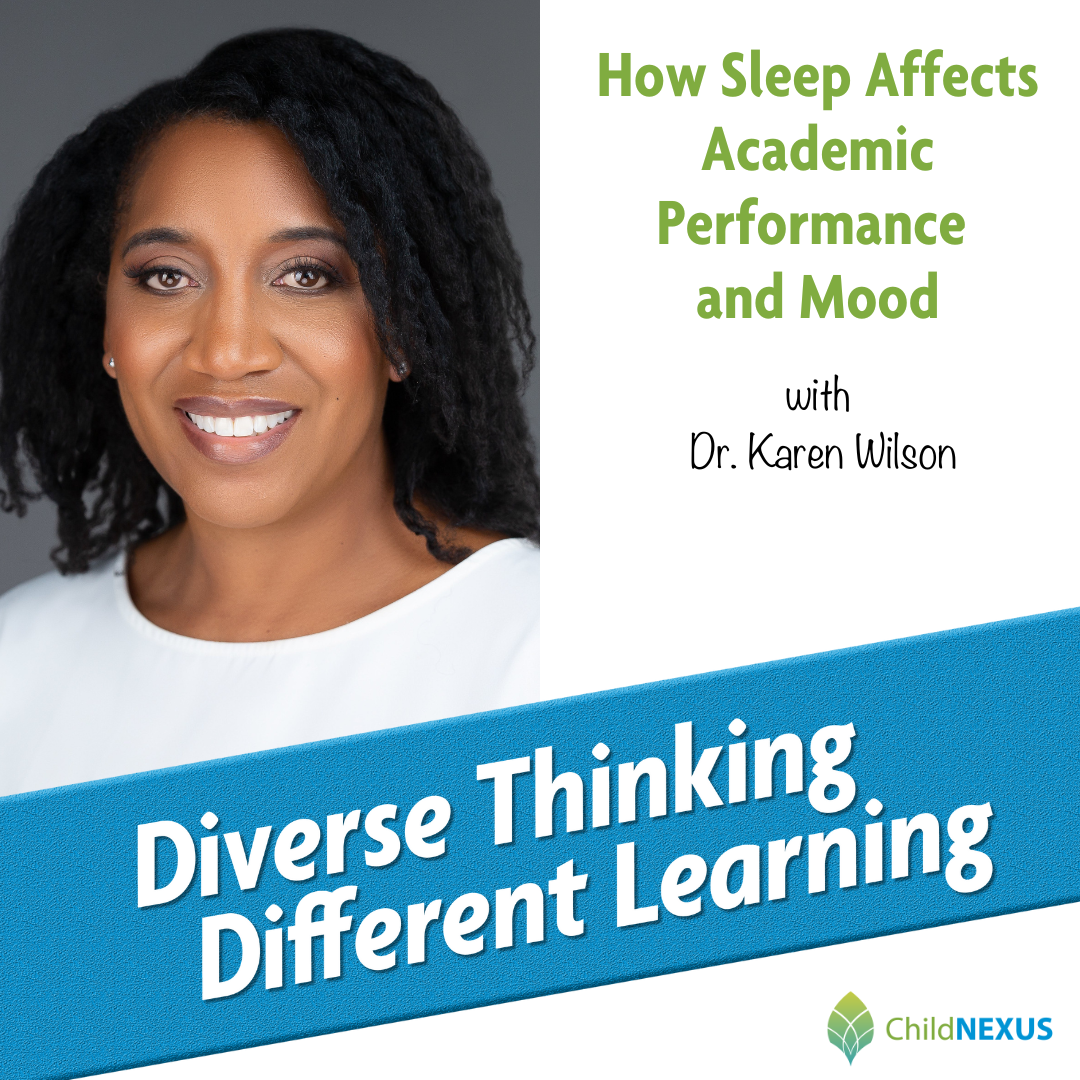
Ep. 148: How Sleep Affects Academic Performance and Mood
As we get started and accustomed to a new academic year for students, we need to take a moment to talk about sleep. How much sleep do children and adolescents actually need? What are signs that they are getting quality sleep or insufficient sleep? Many adults track their own sleep, but are you monitoring your child's? When children and adolescents don't get enough sleep it impacts their ability to focus, remember information, and regulate their emotions - all things that are critical to their wellbeing on any given day. In today's episode, we're discussing this crucial piece to a child's health. So listen to find out if your child is sleeping enough, getting quality sleep, and some tips to improve sleep if it is a struggle. Show Notes: [3:00] - Transitioning from a summer with little sleep schedule to a new school year with a routine can be very difficult for children. [5:04] - How much sleep do kids actually need? [8:13] - What are the signs of sleep deprivation in kids? [10:18] - Insufficient sleep can cause issues with memory, mood, and stress. [11:26] - Early sleep issues are predictive of ADHD symptoms later. [13:51] - School schedules have an impact on sleep and some school districts start later in the morning to allow for students to sleep longer durations. [15:19] - Kids with ADHD are more likely to challenge parents and have behavioral problems around bedtime. [19:11] - Lights from screens can suppress melatonin and can delay the onset of sleep. [19:56] - Having a dark and cool room is best for quality sleep. [20:50] - Always talk about sleep patterns with your child's pediatrician. [21:35] - Making sleep a priority for yourself is modeling the importance of sleep in a healthy lifestyle for your children. Connect: Get on our Email List Book a Consultation Get Support and Connect with a ChildNEXUS Provider Check out some amazing schools for incredible students Links and Related Resources: 5 Reasons Sleep Matters Most for Children 8 Ways Teenagers Suffer When They Don't Get Enough Sleep Episode 40: Lifestyle Activities That Can Improve ADHD Symptoms with Dr. Joel Nigg Episode 147: 5 Tips to Help Students Transition Back to School The Diverse Thinking Different Learning podcast is intended for informational purposes only and is not a substitute for medical or legal advice, diagnosis, or treatment. Additionally, the views and opinions expressed by the host and guests are not considered treatment and do not necessarily reflect those of ChildNEXUS, Inc or the host, Dr. Karen Wilson.
Ep. 147: 5 Tips to Help Students Transition Back to School
A new school year is upon us! This can be an exciting time but it can also be challenging for parents and their children especially for those who think and learn differently. This quick episode is designed to help ensure a smooth start for these students and their families. These five tips can help navigate this period successfully. It's not an exhaustive list, just a few tips to get the ball rolling for a great new school year. Show Notes: [1:52] - Tip #1: Establish a predictable routine. [3:02] - Plan for adequate amounts of sleep. [4:20] - Tip #2: Prepare well in advance. [6:14] - Tip #3: Foster open communication. Schedule a meeting with your child's teacher. [8:08] - Trust your gut. Don't hesitate to take an active role. [8:35] - Tip #4: Break tasks into manageable steps. [9:52] - Tip #5: Focus on strengths and self-care. Celebrate success and encourage hobbies. Connect: Get on our Email List Book a Consultation Get Support and Connect with a ChildNEXUS Provider Check out some amazing schools for incredible students Links and Related Resources: Episode 146: How Parents and Educators Can Collaborate to Help Students Thrive with Shelley Lawrence Episode 142: How to Help Neurodivergent Kids Manage Social Media The Diverse Thinking Different Learning podcast is intended for informational purposes only and is not a substitute for medical or legal advice, diagnosis, or treatment. Additionally, the views and opinions expressed by the host and guests are not considered treatment and do not necessarily reflect those of ChildNEXUS, Inc or the host, Dr. Karen Wilson.
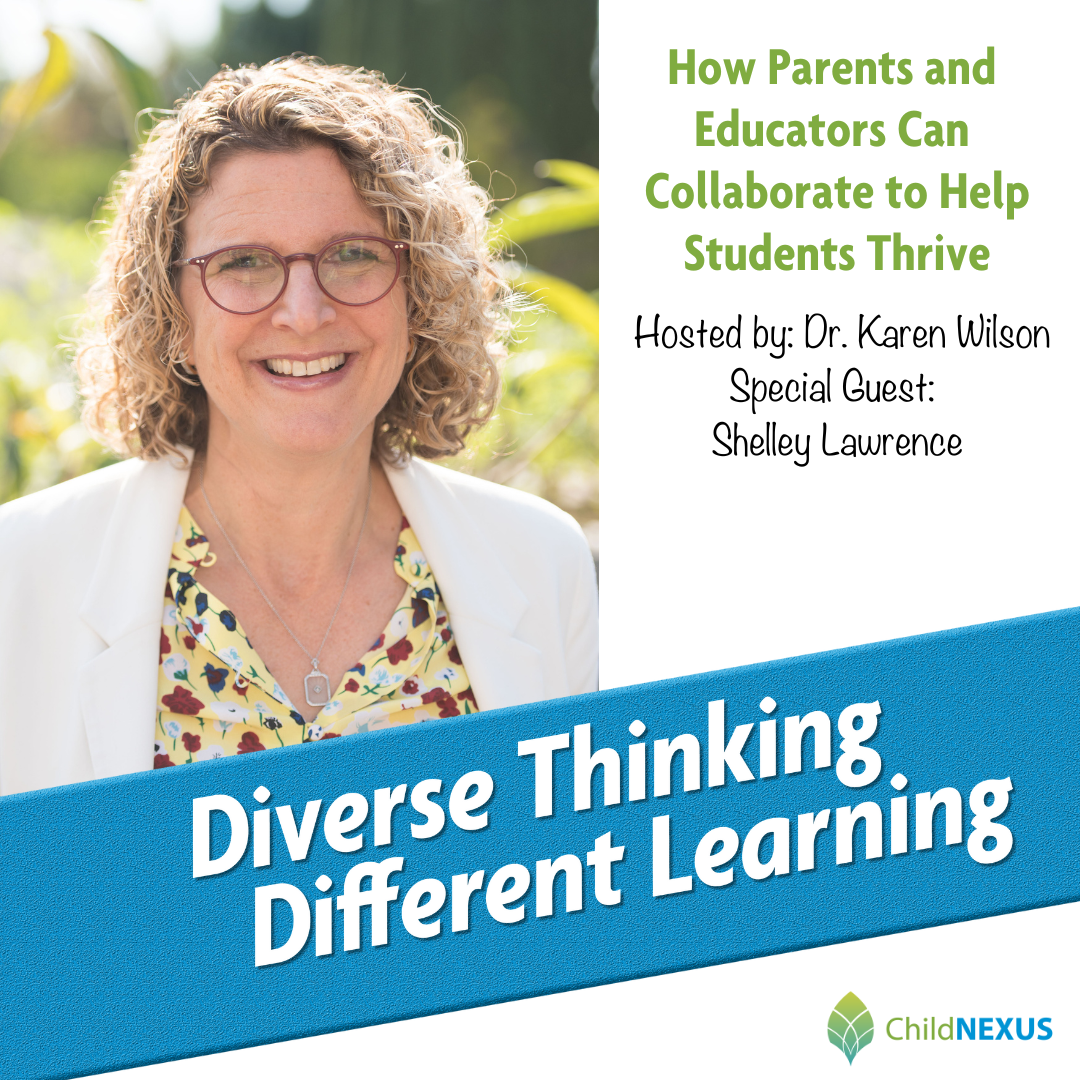
Ep. 146: How Parents and Educators Can Collaborate to Help Students Thrive with Shelley Lawrence
For many families, it is hard to hear that your child has been struggling in school. Some parents may already know or have a feeling their child is struggling. They have even received assessment results, only to feel worried about the negative stigma or sharing that information with their school. Today, we are re-airing a discussion about the importance of collaboration between parents, families, and educators. Today's guest is Shelley Lawrence and she comes to us with two decades worth of experience as a school administrator. In this episode, her experience shines and she shares her knowledge of how evaluations are used in schools, what to expect after an evaluation is completed, and she really drives home the need for developing a team. Feeling worried is absolutely a normal reaction, but communicating the needs of your child to schools and educators can make a world of difference in their educational progress. Show Notes: [2:03] - The parent/educator relationship is so important. [4:36] - It's not about a diagnosis. The purpose is to better understand why a child is struggling. [6:24] - Shelley shares a story of a student she worked with and demonstrates how the teachers' knowledge of weaknesses helped him. [7:56] - Phrasing this information in a certain way can bolster student confidence. [8:45] - Strengths and weaknesses are harder to determine in some students. [9:56] - As an administrator, Shelley has found that many parents are worried about the negative stigma of having an IEP or 504 plan. [11:40] - When an evaluation is recommended, Shelley explains that many parents are worried about going through with it. [13:31] - It is normal to feel worried, but educators can rephrase the need for an evaluation. [14:47] - Every family Dr. Wilson and Shelley have worked with do not regret the assessment process and getting their child the support they need. [17:29] - After completing an evaluation, it is important to break it down based on priorities. [18:51] - Everyone needs to be working together, including the parents and teachers. [20:43] - Some parents are also concerned about making more work for teachers, but teachers want and need to know how to help their students. [22:20] - What should parents expect from the school after an evaluation? [25:01] - Look beyond the IEP goals. Parent and teacher observations are markers of progress as well. [27:50] - Sometimes progress is very slow. Different interventions can be implemented. [29:20] - The point is to make sure the child is learning rather than spinning their wheels. [32:20] - Emphasizing that it is a team that helps the child can make things more impactful for parents and educators. About Our Guest: As an Independent School administrator for two decades, Shelley Lawrence had the unique experience of working with families of students who were striving to succeed in school. She is adamant in her belief that, with the proper supports in place, all children can succeed in school. Shelley brings her passion for children, her strong connections with outside providers in the community, her keen observation and listening skills and her understanding of the complexities of learning, to help families navigate the school journey with their child. In addition, Shelley is a trained advocate who can help families navigate the IEP process. Connect with Shelley Lawrence: ChildNEXUS Provider Profile: Shelley Lawrence Schoolhouse Collaborative Website Phone: (310) 251-5908 Links and Related Resources: Get on our Email List Book a Consultation Get Support and Connect with a ChildNEXUS Provider Check out some amazing schools for incredible students The Diverse Thinking Different Learning podcast is intended for informational purposes only and is not a substitute for medical or legal advice, diagnosis, or treatment. Additionally, the views and opinions expressed by the host and guests are not considered treatment and do not necessarily reflect those of ChildNEXUS, Inc or the host, Dr. Karen Wilson.

Ep. 145: Advocating for Children with Special Needs with Heather Zakson
Are you concerned about whether your child has made meaningful progress over the last year in school? Today's guest is an incredible special education attorney who is passionate about advocating for children and adults. You can hear the passion in her voice throughout this entire episode and she brings to light a lot of concerns as we begin the transition to heading back to the brick and mortar classroom environment. Our guest, Heather Zakson, is a special education attorney. She answers a plethora of questions in this episode, shares staggering statistics, explains legislation and federal funding, and encourages all parents to strongly advocate for their children. Show Notes: [3:01] - The transition going back to school is a front and center concern for a lot of families. [5:10] - Distance learning unlocked more tools and opportunities for many students. [7:57] - Data is our stock and trade in special education. We need the information to compare data over time to see what's working. [8:59] - A lot of work is done on screen and not kept in a paper format. Heather recommends always taking a screenshot of work to archive a child's progress. [11:49] - Don't think of assessments as something dictated only by schools. [12:46] - A psychological assessment will give us information on what intervention and support is needed. [13:44] - When seeking a private assessment, you have the control on who to conduct the testing and who to share the information with. [14:33] - If you are unable to have a private assessment done, Heather explains how it works through the school system. You can ask for a second opinion. [17:20] - Although we have seen the good things that have come from distance learning, there are many students who have suffered with great educational loss. [18:25] - Heather advises that if you think there is something wrong, follow your gut. [19:40] - All public schools have the ability to assess. [21:38] - When a child is behind, moving forward without support will just make them fall farther behind. Early intervention is crucial. [23:10] - When you are out there advocating for your child, don't take no for an answer. [27:53] - We know how to support children with social difficulties and with appropriate support, they can have a completely different educational experience. [30:54] - Heather explains what recoupment means and how this affects the near future of special education. [32:46] - Children with learning disabilities are legally entitled to remediation. [34:22] - When there is a reading and/or language delay, there needs to be evidence-based targeted reading instruction. [37:18] - Information doesn't hurt anyone. It doesn't put labels on anyone. [40:28] - Dyslexia screening should be a mandatory part of assessment early on for every student. [41:10] - What is SB 488 and how will it affect university programs for teachers? [44:50] - The Right to Read Project and Decoding Dyslexia are highly recommended to look into by both Heather and Karen. [46:27] - Every year is different when it comes to funding. Heather explains the push for federal funding for special education. [48:19] - The real test of our educational system is how we support our students who struggle the most. [49:02] - Every child is entitled to an appropriate education and remediation of learning disabilities when appropriate. About Our Guest: Heather Zakson represents children and adults in special education, Regional Center and discrimination cases and provides expert consultation on complex custody and guardianship matters. She is widely recognized for her creativity and tenacity on behalf of those whose rights have been violated and needs have gone unmet. She is a graduate of UCLA School of Law and Brandeis University, and has been practicing law for 18 Years. Connect with Heather Zakson: Zakson Law Home Page Phone: (424) 369-9529 Heather Zakson on LinkedIn Heather Zakson, Attorney on Facebook Links and Related Resources: Get on our Email List Book a Consultation Get Support and Connect with a ChildNEXUS Provider Check out some amazing schools for incredible students Join our email list so that you can receive information about upcoming webinars - ChildNEXUS.com
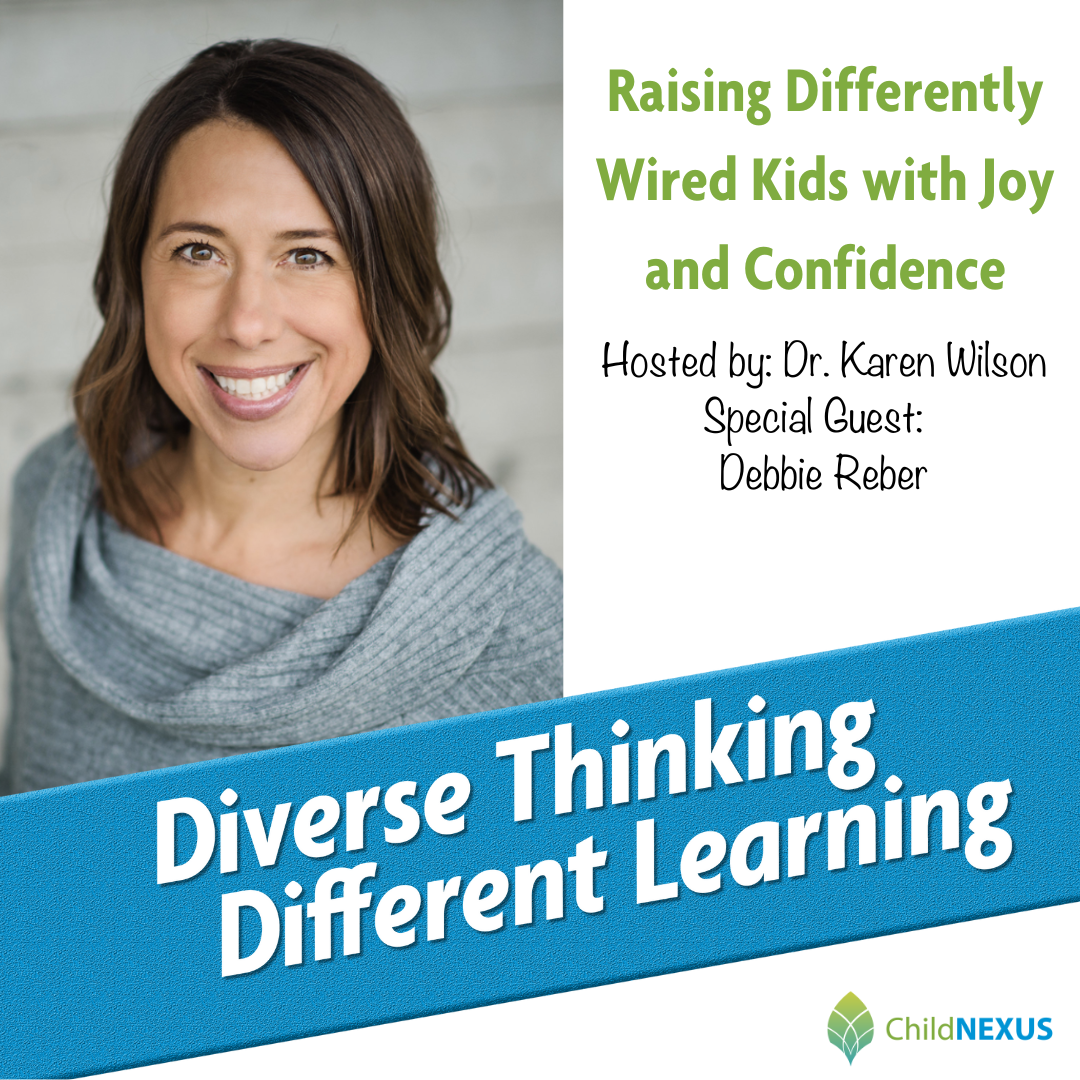
Ep. 144: Raising Differently Wired Kids with Joy and Confidence with Debbie Reber
If you have a child who thinks, learns, or experiences the world differently than others, this episode is for you. Parents of differently wired kids may face a negative stigma, uncertainty, and may make decisions from a place of fear, especially in regards to education. But today's guest shares her experience and encourages parents to change their mindset and make decisions from a place of possibility. I am thrilled to welcome Debbie Reber as today's guest on the Diverse Thinking Different Learning Podcast. Debbie inspired me to begin this podcast journey and as a parent of a differently wired child herself, she comes to the podcast today with personal stories, many years of experience, and open arms to welcome other parents on the same journey. Debbie is a parenting activist, author, keynote speaker, and founder of TiLT Parenting. The resources and community she offers through TiLT Parenting are helping parents around the world connect and support each other in raising differently wired children. We could talk for hours, but on today's episode with Debbie we focus on what it means to be "differently wired," how Debbie grew from making decisions from fear to making decisions from love and possibility, and how parents can use their voices to make positive change in the education of their children. Show Notes: [1:35] - Debbie really leans in to embracing the fact that your child may be differently wired. [3:26] - Debbie never intended to walk this path, but as her son received diagnoses, it made things more challenging. [5:01] - Sharing the challenge in finding the right environment for her son, Debbie explains that they bounced around to different schools and then homeschooled for 6 years. [6:00] - This experience was the catalyst for her to start her own podcast and help other parents in similar situations. [7:58] - As she observed her son learning at home, Debbie made the realization of why traditional schooling had not been a success. [9:16] - There needs to be a shift in how we educate children. [11:00] - Debbie demonstrates that the traditional school model does not teach kids to be critical thinkers. [15:57] - Learning loss is of course a concern, but Dr. Wilson believes that social, emotional, and mental health support is more important. [18:49] - Debbie talks about her book Differently Wired: Raising an Exceptional Child in a Conventional World. [20:04] - There is no clear path for parents, especially when raising a differently wired child. [21:07] - Debbie provides some reflection questions to ask yourself as a parent to find out more about choosing love and possibility. [22:23] - If we, as parents, have a negative idea of what a child with a diagnosis looks like, we will not make decisions that are best for the child. [24:38] - The idea behind Debbie's podcast and the community she has built is to help support parents. [28:21] - Dr. Wilson and Debbie talk about the IEP process and the changes that need to be made to the educational system. [30:10] - Debbie references a book that she recommends called The End of Average by Todd Rose and how there really isn't any such thing as "average." [31:23] - Karen highly recommends Debbie's book and her TEDtalk. About Our Guest: Debbie Reber is a parenting activist, New York Times bestselling author, keynote speaker, and the founder of TiLT Parenting, a top podcast, community, and educational resource for parents raising differently wired children. Her book, Differently Wired: Raising an Exceptional Child in a Conventional World, came out in June 2018. After living abroad in the Netherlands for five years, Debbie, her husband, and 16-year-old son relocated to Brooklyn, NY in 2019. Connect with Debbie Reber: TiLT Parenting Home Page TiLT Parenting Podcast Links and Related Resources: Get on our Email List Book a Consultation Get Support and Connect with a ChildNEXUS Provider Check out some amazing schools for incredible students Join our email list so that you can receive information about upcoming webinars - ChildNEXUS.com

Ep. 143: How Virtual Reality Helps Neurodivergent Individuals Develop Important Skills with Vijay Ravindran
With different types of technology becoming more and more accessible, today's guest has found the surprising and amazing benefits of virtual reality on neurodivergent individuals. As the father of a child on the autism spectrum, Vijay Ravindran discovered first hand what the technology can provide for those who think and learn differently. Vijay's positive experience led him to create Floreo, a research-based and effective therapy that uses virtual reality (VR) to teach social, behavioral, and life skills to neurodivergent individuals. This technology is not only effective, it is also engaging and exciting. Floreo is available to anyone to use and in today's episode you'll learn more about the technology and what it offers learners. Show Notes: [2:07] - Vijay's inspiration for Floreo came from his experience as the father of a child on the autism spectrum. [3:24] - Virtual reality is special because it is fully immersive and accessible. [4:45] - The environments created are very engaging. [6:17] - Virtual reality is a technology that allows someone wearing a headset with screens built in to feel a sense of presence in a different place. [7:33] - Floreo's VR content is designed to help develop skills. [9:04] - They recreate scenes with animations and supervision to have social interactions as an intervention. [11:21] - This platform incorporates lessons on a vast number of skills including those for adults. [13:01] - Floreo offers the program through video conferencing and telehealth therapy. [15:22] - Floreo provided so much support for children in need of services during the COVID-19 pandemic. [18:24] - Situations can be recreated for individuals with anxiety to practice before experiencing them in person. [20:15] - Floreo is focusing on partnering with health care providers and special education administrators. [24:45] - Visit Floreo's website to see what it is all about. About Our Guest: Inspired by his experience as an autism father and his child's first experience with VR, Vijay Ravindran founded Floreo. Vijay started his career as an engineer and leader at Amazon in its early retail days before dedicating himself to impact-oriented leadership opportunities that have taken him from building key voter technology used by the Obama campaign in 2008 to Chief Digital Officer at The Washington Post Company. Vijay lives in Washington DC with his wife, two Star Wars obsessed kids, and hundreds of Transformers robots which he doesn't let his kids play with. Outside of work, when he's not rooting on his beloved Oklahoma Sooners, you can find him on the tennis courts. Connect with Vijay: Floreo for Providers Floreo for Education Floreo for Families Links and Related Resources: Episode 80: Turning Kids' Passions and Enthusiasms Into Superpowers with Barry Prizant Episode 63: Supporting Youth with Autism and ADHD with Holly Blanc Moses The Diverse Thinking Different Learning podcast is intended for informational purposes only and is not a substitute for medical or legal advice, diagnosis, or treatment. Additionally, the views and opinions expressed by the host and guests are not considered treatment and do not necessarily reflect those of ChildNEXUS, Inc or the host, Dr. Karen Wilson.
Ep. 142: How to Help Neurodivergent Kids Manage Social Media
In this short summer episode, we're talking about social media. There was a recent health advisory issued by the US Surgeon General on social media use in adolescence and ways to mitigate risks. The findings on excessive social media use are not entirely surprising, but it is important to keep in mind the added risks for neurodivergent kids. Today, we'll talk about what those risks are and six ways to help manage social media use by kids and teens. Show Notes: [2:10] - Increased stress, anxiety, and depression have been associated with excessive social media use. [2:56] - Neurodivergent kids may be more vulnerable to these risks. [4:04] - Excessive screen time can lead to poor sleep and even greater difficulty with attention. [5:44] - Establish clear rules and boundaries. [6:06] - Establish open communication channels to discuss online experiences and concerns. [6:34] - Create technology-free spaces. Talk about online safety. [7:12] - Encourage balance. [7:51] - Monitor social media use. [9:06] - There are some benefits of social media, and it can be a powerful tool. Connect: Get on our Email List Book a Consultation Get Support and Connect with a ChildNEXUS Provider Check out some amazing schools for incredible students Links and Related Resources: The Surgeon General's Advisory can be downloaded in full HERE Episode 98: Managing Technology Use at Home with Dr. Joe Dilley Episode 140: 10 Ways Parents Can Support Their Child's Mental Health Over the Summer Clarifying Gray Areas in Family Tech Use Family Tech Use Part 2: Resolving Common Dilemmas The Diverse Thinking Different Learning podcast is intended for informational purposes only and is not a substitute for medical or legal advice, diagnosis, or treatment. Additionally, the views and opinions expressed by the host and guests are not considered treatment and do not necessarily reflect those of ChildNEXUS, Inc or the host, Dr. Karen Wilson.
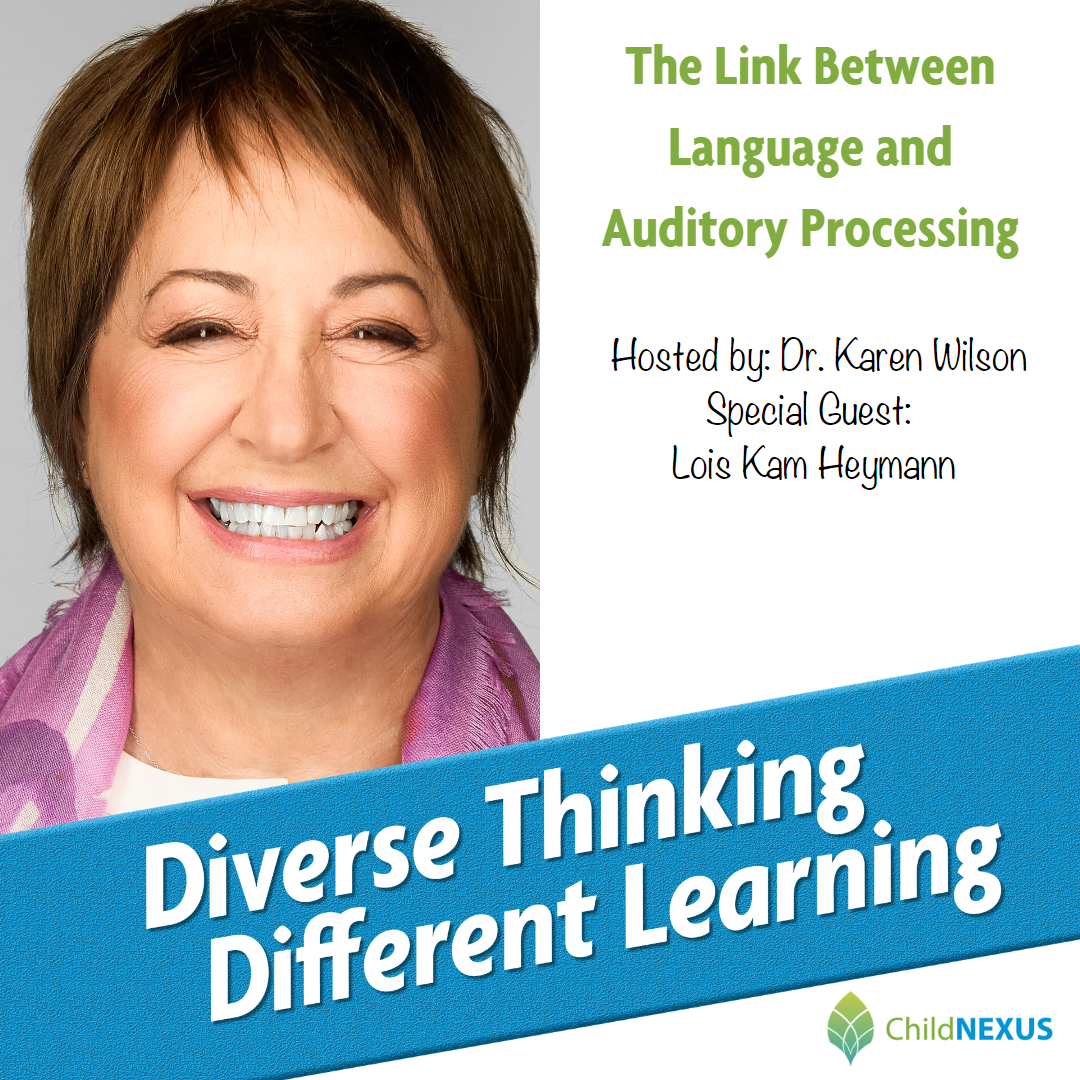
Ep. 141: The Link Between Language and Auditory Processing - Lois Kam Heymann, M.A., CCC-SLP
Auditory processing and language processing are two subjects that overlap, but not everyone understands how they are related and how they impact children who struggle with both of them. Joining me today to help me discuss this is Lois Kam Heymann, a speech and language pathologist with over four decades of experience with auditory processing disorder and auditory language processing challenges. Parents often come to Lois saying that their children aren't listening, and if you are someone who feels that their child or children don't listen, then this episode is definitely going to be worthwhile for you as Lois explains what could be going on. She also explains the difference between auditory processing disorders and ADHD, which are often confused even by medical professionals. The only way for parents and professionals to intervene appropriately is for a thorough assessment to be done. We need to know exactly where the problem lies so that we can intervene appropriately, especially since these problems can lead to frustration and low self-esteem in the child. I love the work that Lois is doing, so I hope that you will tune in as she discusses all of these topics and more! It's never too late to address auditory processing disorders. Show Notes: [2:39] - Auditory skills don't usually start in the ear but in the brain. [5:11] - Some kids with language difficulty are misdiagnosed with something like ADHD. [6:39] - The difference between an auditory processing disorder and ADHD. [9:28] - Lois lists off and explains the different parts of auditory processing. [11:39] - How auditory processing difficulty can affect behavior. [14:14] - What can parents do to help their children succeed in school? [17:19] - The only way to build pathways is with auditory input. [19:42] - It is not generally a teacher's job to teach auditory skills. [20:39] - Adults can have auditory processing disorders, and it's never too late. [21:27] - What can parents do during summer months? [24:56] - Modeling language and behavior is the best way a parent can teach. [25:40] - Lois shares information with us about her company ListenLoveLearn. [28:54] - Hear about Lois' main objective. Links and Related Resources: Get on our Email List Book a Consultation Get Support and Connect with a ChildNEXUS Provider Check out some amazing schools for incredible students Ep. 49: Understanding Auditory Processing Disorder with Dr. Bea Braun ListenLoveLearn Website Email Lois: [email protected] Lois Kam Heymann - The Sound of Hope: Recognizing, Coping with, and Testing Your Child's Auditory Processing Disorder The Diverse Thinking Different Learning podcast is intended for informational purposes only and is not a substitute for medical or legal advice, diagnosis, or treatment. Additionally, the views and opinions expressed by the host and guests are not considered treatment and do not necessarily reflect those of ChildNEXUS, Inc or the host, Dr. Karen Wilson.
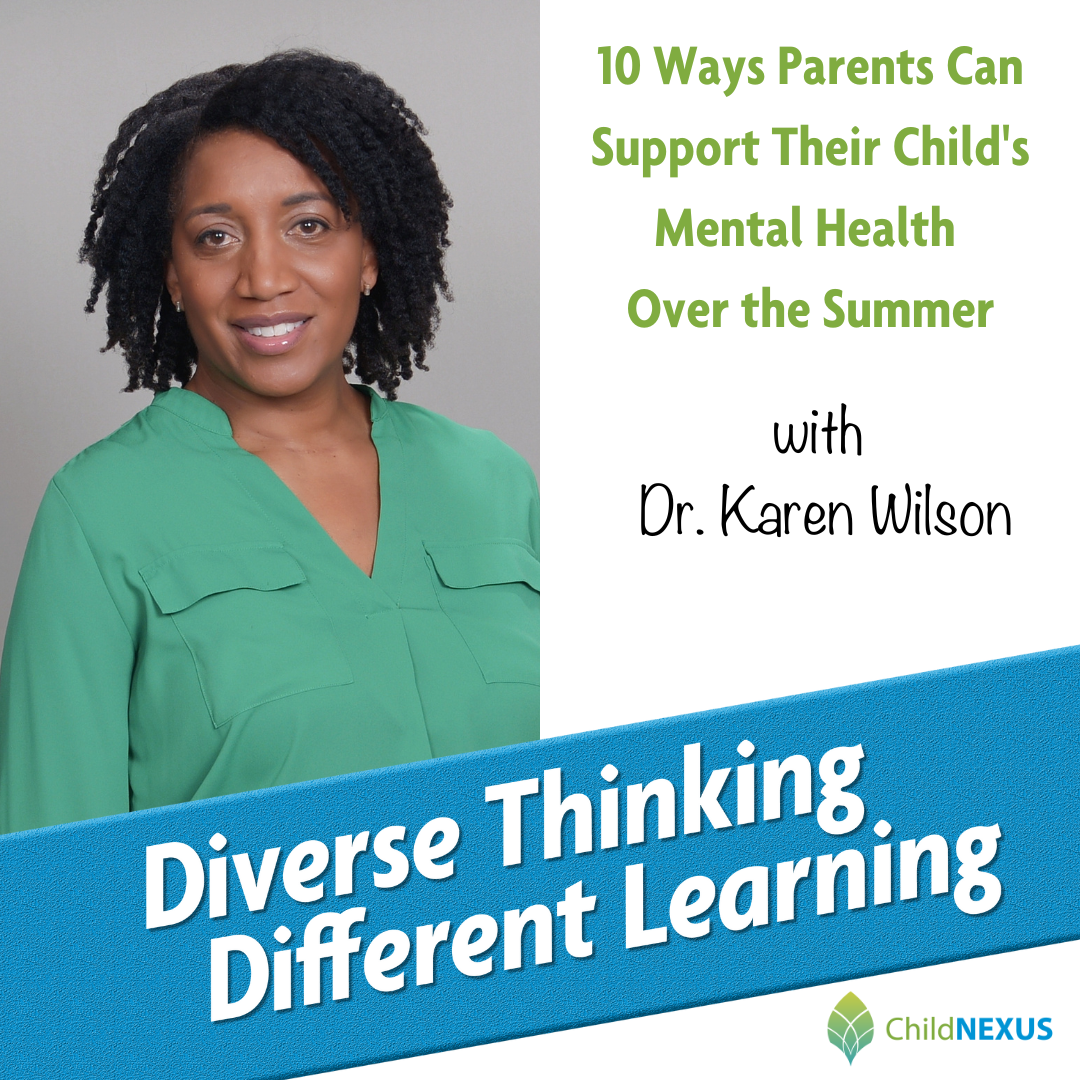
Ep. 140: 10 Ways Parents Can Support Their Child's Mental Health Over the Summer
It's time for a summer mental health check in. This time of year, children are home from school for their summer break and it is a great opportunity to connect, explore, and celebrate progress. With the United States in a national state of emergency in child and adolescent mental health, it's important now more than ever to support your child's mental health. So in this episode, you'll learn 10 tips on how to do just that. Remember that every child is different and what works for one, may not work for another. Consider these strategies and modify them to fit the needs of you and your family. Show Notes: [1:08] - In 2021, the United States was in a national state of emergency in child and adolescent mental health. But this isn't just a problem in the US. [3:15] - Tip #1: Maintain a routine. [3:44] - Tip #2: Encourage physical activity. [4:06] - Tip #3: Explore interests and hobbies. [4:22] - Tip #4: Foster social connections. [5:21] - Tip #5: Continue learning. [5:57] - Tip #6: Open communication. [6:19] - Tip #7: Celebrate progress. [6:42] - Tip #8: Promote independence. [7:03] - Tip #9: Practice self-care. [7:27] - Tip #10: Seek professional help if you need it. Links and Related Resources: Get on our Email List Book a Consultation Get Support and Connect with a ChildNEXUS Provider Check out some amazing schools for incredible students The Diverse Thinking Different Learning podcast is intended for informational purposes only and is not a substitute for medical or legal advice, diagnosis, or treatment. Additionally, the views and opinions expressed by the host and guests are not considered treatment and do not necessarily reflect those of ChildNEXUS, Inc or the host, Dr. Karen Wilson.

Ep. 139: Environmental Changes You Can Make to Support a Child's Learning with Lindsay Astor Grant
The end of a school year is a great time to reimagine learning environments for the next academic year. While that may seem like a topic only applicable to teachers and their classrooms, these redesign ideas are amazing additions to a child's home as well. Today's guest is Lindsay Astor Grant, a pediatric occupational therapist and founder of Learning Redesigned. At Learning Redesigned, Lindsay helps teachers and parents reimagine the learning space with the mission of partnering with schools to help create and sustain the optimal learning potential of their students. In our conversation today, Lindsay describes what changes we can make to a child's environment to ensure that the brain is in the readiness stage for learning. And while we are preparing for the next academic year, this is the perfect time to start thinking about what we can do to help support the needs of our children and students. Show Notes: [2:52] - The learning environment is often overlooked but it is so important and could contribute to dysregulation. [4:34] - Lindsay did a great amount of research and observation about the classroom environment impacting student behavior. [6:01] - Behavior is communication. [7:38] - When beginning the redesign process, Lindsay starts small in creating spaces that help children stay as even as possible internally. [9:12] - Rather than focusing on the behavior itself, we need to think about the sensory issue that contributes to the behavior. [11:01] - Everyone, including neurotypical adults, have a threshold on how much we can handle before we are in sensory overload. [12:41] - Understimulation can also cause behavioral reactions from children. [15:27] - In classroom and even home environment redesign, Lindsay creates a space that is not punitive that allows a child to come down from overstimulation. [17:24] - Providing a safe space also gives students validation for their feelings. [20:28] - It's not white walls and white furniture, it's more neutral colors that are calming and peaceful in the classroom. [22:16] - Let the background be neutral and the color come from the artwork. [23:48] - The majority of problems come from transitions. [24:50] - Visual schedules are not only helpful in the classroom but in the home as well. [28:01] - Creating a "zen zone" is something that Lindsay has done for students in as early as pre-k classrooms. [30:02] - Many teachers are worried that students will just spend their whole day in the zen zone, but Lindsay says that if it is done in conjunction with others, that won't be a problem. [33:24] - When a kid is uncomfortable, they won't be able to take in the information you need them to learn. [35:18] - Using the same or similar supports as the classroom at home creates consistency for the child. [38:29] - Sometimes, the entire school will adopt this approach and the impact is noticeable especially over time. [41:06] - Another effect of this is a classroom culture that fosters acceptance and understanding. About Our Guest: Lindsay Astor Grant is a licensed pediatric occupational therapist and owner of Learning Redesigned. She earned her M.A. in Occupational Therapy from the University of Southern California and has advanced training in Sensory Integration, Executive Function, Motor Skill Development, and Classroom Design. Lindsay has more than two decades of experience in the field. She began her career as an OT for the Los Angeles Unified School District and in 2007, she started Children First Therapy, providing private in-home and school-based occupational therapy services. In 2018, Lindsay founded Learning Redesigned, working as an independent consultant for schools. She leads staff professional development sessions, as well as parent education seminars on topics including Executive Function, Sensory Integration, Classroom Layout and Design, Movement-Based Learning, and Motor Development. Connect with Lindsay Astor Grant: Email [email protected] Learning Redesigned Home Page Consult with one of our Occupational Therapists here Links and Related Resources: Episode 133: How Occupational Therapy Can Help Address Picky Eating with Dr. Ellie Bendetson and Leah Hiller Episode 117: How Surf Therapy Helps Neurodivergent Kids with Naomi Matanick Episode 9: How Occupational Therapy Helps Kids with Leah Hiller Trying to figure out next steps in supporting your child? Book a 1:1 consultation with Dr. Karen Wilson - https://www.childnexus.com/consultation Join our email list so that you can receive information about upcoming webinars - ChildNEXUS.com The Diverse Thinking Different Learning podcast is intended for informational purposes only and is not a substitute for medical or legal advice, diagnosis, or treatment. Additionally, the views and opinions expressed by the host and guests are not considered treatment and do not necessarily reflect those of ChildNEXUS, Inc or the host, Dr. Karen Wilson.
Ep. 138: Bullying, Learning Differences, and Anxiety with Kayla Taylor
In today's episode, we have the author of an incredible book called Canaries Among Us, Kayla Taylor. And in our conversation today, we are tackling three topics at once: bullying, learning differences, and anxiety. Canaries Among Us is a raw and honest exploration of the everyday lives of children challenged by learning differences, anxiety, and bullying. Author Kayla Taylor blends science and poignant storytelling to create this necessary, timely, and stigma-tackling resource for anyone interested in child well-being. Kayla writes to address important issues plaguing families, and she uses a pseudonym to protect the identities of minors and other vulnerable individuals. She supports organizations that promote mental health, neurodiversity, and bullying prevention. This is a conversation that will resonate with many families, especially those of children with learning differences. Show Notes: [2:26] - Kayla shares that she never saw herself as a writer, but had an experience that rocked her and her family's world which drove her to write Canaries Among Us. [4:05] - After journaling, writing creates meaning for Kayla. [5:07] - She felt alone for a very long time, but she realized how many families were dealing with the same thing. She felt a moral obligation to pay it forward. [7:17] - We have a huge societal issue with how we treat children with learning differences. [8:05] - When something is seemingly wrong, we try to fix the kid. But we don't look at how broken the system is. [9:10] - We strip the joy out of life when we put people into boxes. [10:29] - Kayla explains the title of her book Canaries Among Us. [12:18] - If we just see a child based on their weakness, we miss so much about them. [15:09] - As a society, we are not equipping teachers with the tools and strategies they need to support all students in their classes. [17:12] - This is also impacted by the healthcare system. [19:28] - There are so many points where we can improve the systems we have. [21:28] - Kayla shares a story about a child who very clearly needed support and was denied everything. [23:38] - Average doesn't bring out the strengths in anyone. A child may appear average when it comes to testing, but is filled with anxiety and struggle. [25:55] - When we focus on average and not everyone's individual strengths and weaknesses, not only does the individual suffer, but society as a whole does as well. [28:41] - Kayla explains why bullying is a major topic of her book in addition to learning differences and anxiety. [30:39] - Marginalized children are unfortunately the most targeted for bullying. [33:55] - Bullying is not a right of passage. [36:47] - Kayla describes an experience with an administrator that denied bullying exists in elementary school. [39:32] - There are different reactions to bullying and Kayla shares that the people who are the most helpful and empathetic are those who have had struggles themselves. [41:45] - We need to shine a spotlight on the children who are making the effort to show their differences and celebrate the differences of others. [43:52] - One way Kayla models acceptance to her own children is to strip her vocabulary of words like "strange" and "weird". About Our Guest: Kayla Taylor is a best-selling writer, researcher, advocate, and parent. She recently published Canaries Among Us, an exposé blending poignant storytelling and groundbreaking research to empower those caring for the millions of kids challenged by learning differences, bullying, and anxiety. This heartrending chronicle bravely tackles harmful stigmas and proposes new ways of thinking about how we raise and teach our children. Throughout her story, Taylor reveals both the exquisite joy and painful heartache inherent in raising children who don't fit society's definition of "normal." Connect with Kayla Taylor: Instagram Kayla Taylor Home Page Canaries Among Us: A Mother's Quest to Honor Her Child's Individuality in a Culture Determined to Negate It by Kayla Taylor Links and Related Resources: What Are the Consequences of Bully Victimization on Children and How Can You Help Them Cope? Bully Proofing Strategies for Teens with Autism Spectrum Disorder and Other Social Challenges Episode 43: Building Social Competence and Enhancing Social Skills with Dr. Elizabeth Laugeson What is a Comprehensive Evaluation and How Can It Help Support My Child's Learning? Episode 132: Social Justice: A Framework for Equity in Education with Charles A. Barrett Trying to figure out next steps in supporting your child? Book a 1:1 consultation with Dr. Karen Wilson - https://www.childnexus.com/consultation Join our email list so that you can receive information about upcoming webinars - ChildNEXUS.com The Diverse Thinking Different Learning podcast is intended for informational purposes only and is not a substitute for medical or legal advice, diagnosis, or treatment. Additionally, the views and opinions expressed by the host and guests are not considered treat

Ep. 137: Helping Kids Understand Their Amazing Brains with Dr. Liz Angoff
A common struggle for parents and families is how to help their children understand their developmental and learning differences. For some parents, they don't want to have the conversation at all. But today's guest not only explains why it is important for a child to understand their brain, but the language we can use to start shifting a negative narrative. Dr. Liz Angoff is an Educational Psychologist who provides assessment and consultation services to children and their families. She is also the author of the Brain Building Books, tools for engaging children in understanding their learning and developmental differences as part of the assessment process. In our conversation today, Dr. Angoff shares the language and strategies she uses with the children and adolescents she works with to help them understand their strengths and struggles with the perfect balance to normalize and validate it all. Show Notes: [2:22] - Kids know that they are different in some way and it shouldn't be kept a secret from them. [3:38] - When kids don't have the understanding of the way their brains work, they create their own narrative, which is often negative. [4:52] - When we can be realistic and transparent with kids, they can shift this narrative. [6:17] - The vast majority of the kids that Dr. Angoff works with express relief when they learn about their differences. [7:10] - Striking the balance means acknowledging both strengths and areas of struggle. [8:19] - Dr. Angoff shares a metaphor that helps kids understand how their brains work. [10:43] - This language normalizes always having something to work on and the process of learning new things. [12:53] - Kids need to understand that all adults also have ongoing construction projects as we are all always learning. [14:16] - Assessment should be approached from a place of curiosity. [16:06] - Many parents choose not to share a diagnosis with their child. The concerns are understandable. [17:29] - When we name what's going on, we are giving kids a container for all these feelings and experiences. It also gives you community. [19:31] - Dr. Angoff shares some language and verbiage to use that becomes empowering and validating. [21:21] - When we understand how kids think about their experience, we can work on shifting their narrative. [24:23] - Dr. Angoff shares an example of how to address a struggle and area of frustration with a child. [27:28] - When kids understand why they are receiving an intervention, they are more invested. [29:58] - Dr. Angoff shares the experience of a child who became curious about her own disability. [32:27] - These are ongoing conversations and not a one time thing. [34:12] - Every child is different, but Dr. Angoff offers resources on how to talk to your children about their differences. About Our Guest: Liz Angoff, Ph.D., is a Licensed Educational Psychologist with a Diplomate in School Neuropsychology, providing assessment and consultation services to children and their families in the Bay Area, CA. She is the author of the Brain Building Books, tools for engaging children in understanding their learning and developmental differences as part of the assessment process. Connect with Dr. Liz Angoff: Website for Parents Website for Practitioners Brain Building Books Instagram Links and Related Resources: What is a Comprehensive Evaluation and How Can It Help Support My Child's Learning? Episode 2: Demystifying the Assessment Process Episode 28: Why We Need to Celebrate and Continue to Build Our Kids' Resilience Trying to figure out next steps in supporting your child? Book a 1:1 consultation with Dr. Karen Wilson - https://www.childnexus.com/consultation Join our email list so that you can receive information about upcoming webinars - ChildNEXUS.com The Diverse Thinking Different Learning podcast is intended for informational purposes only and is not a substitute for medical or legal advice, diagnosis, or treatment. Additionally, the views and opinions expressed by the host and guests are not considered treatment and do not necessarily reflect those of ChildNEXUS, Inc or the host, Dr. Karen Wilson.
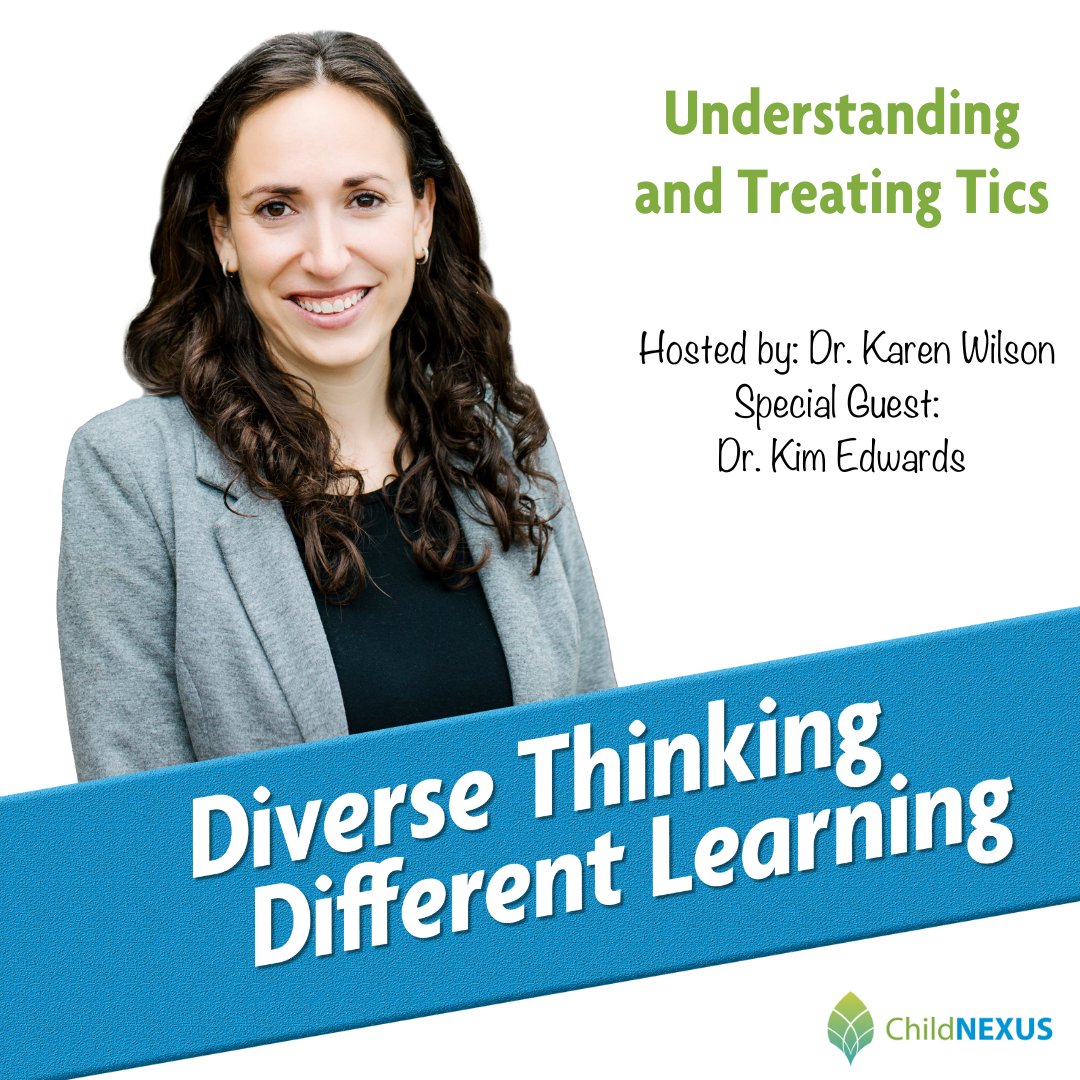
Ep. 136: Understanding and Treating Tics with Dr. Kim Edwards
We have talked about many different topics on the Diverse Thinking Different Learning Podcast, but today's topic of conversation is a new one. Although a new topic, it is a concern for many parents. Today we are talking about tics and our guest is an expert in this area. I'm thrilled to invite Dr. Kim Edwards to the show to talk about tics and Tourette Syndrome. I've had the pleasure of working with Dr. Edwards, and her expertise in this area provides so many families with the education and empowerment they need to manage their tics in a healthy way. Tics are more common than you think. Dr. Edwards explains just how common they are in children, and she discusses ways we can help them manage the behavior. It's an interesting and uplifting conversation that you won't want to miss. Show Notes: [2:32] - Tics are rapid and repetitive movements or sounds. Dr. Kim Edwards shares some of the common motor and vocal tics. [3:35] - Some tics are part of normal development in childhood. [4:55] - Dr. Edwards compares the relief of a tic to scratching a mosquito bite. People with tics who try to suppress it compare it to holding their breath. [6:34] - Tics are not something that kids and adults want to do. It is not a choice and they struggle suppressing the urge. [7:48] - Tics love attention but sometimes responding to a tic establishes a connection and can make it worse. [9:55] - A common question from parents is "Will my child have this tic forever?" Some will pass, but some may experience more chronic tics. [11:30] - We cannot underestimate the power of education and understanding for families and the child themselves. [13:06] - There are environmental factors that play a role in the waxing and waning of tics. [14:06] - The swearing tic is actually very rare contrary to popular belief. [15:05] - It is possible for tics to be a part of ADHD or OCD. [16:23] - Tics don't hurt the brain and because they aren't impairing, there is no need to intervene unless it is harmful or bothersome to the individual. [17:37] - Dr. Edwards describes Comprehensive Behavioral Intervention for Tics (CBIT). [19:34] - CBIT is a management strategy, not a cure. There is no real way to make a tic go away completely and some new tics might pop up. [21:25] - There are medications that are possibly needed for intervention, but they are less impactful on targeting tics and have some side effects. [23:07] - What are sudden onset explosive tics? [24:32] - Functional tics are a little different. It is thought that increased stress and screen time during COVID led to an increase. [25:56] - Dr. Edwards has found that CBIT does not help individuals with functional tics. [28:53] - People, especially kids, need to understand how their brain works. [30:54] - When kids understand their brains, they can advocate for themselves and be a part of the conversation. Don't underestimate the power of involving your child. [32:27] - Going through hard things builds resilience and challenges cannot be avoided. [35:31] - Dr. Edwards shares an analogy that helps parents realize that the journey they are on with their child is wonderful. About Our Guest: Dr. Kim Edwards is a registered clinical and health psychologist in the Province of Ontario and the State of New York. Dr. Edwards specializes in the assessment and treatment of repetitive behavior disorders. She is one of only three Canadian Psychologists who can certify other health care professionals in Comprehensive Behavioural Intervention for Tics (CBIT) – the behavioral treatment for tic disorders. After receiving her PhD from the University of Western Ontario, Dr. Edwards completed a 1-year clinical residency and a 2-year fellowship specializing in pediatric neuropsychiatric disorders at The Hospital for Sick Children in Toronto. While at SickKids, she co-developed and ran the hospital's first groups for youth with tics and Body Focused Repetitive Behavior disorders. After her fellowship, Dr. Edwards worked at McMaster Children's Hospital where she was a founding member of the pediatric chronic pain program and an assistant clinical professor in the department of Psychiatry and Behavioural Neurosciences. Connect with Dr. Kim Edwards: Email: [email protected] Phone: 647-646-3348 Links and Related Resources: Specialized MindFit Programs Tics and Tourette Syndrome Trying to figure out next steps in supporting your child? Book a 1:1 consultation with Dr. Karen Wilson - https://www.childnexus.com/consultation Join our email list so that you can receive information about upcoming webinars - ChildNEXUS.com The Diverse Thinking Different Learning podcast is intended for informational purposes only and is not a substitute for medical or legal advice, diagnosis, or treatment. Additionally, the views and opinions expressed by the host and guests are not considered treatment and do not necessarily reflect those of ChildNEXUS, Inc or the host, Dr. Karen Wilson.

Ep. 135: Your Child's Anxiety: When to Worry with Dr. John Piacentini
We know that anxiety is common and many of us have experienced some level of anxiety. But there are many myths and misunderstandings about anxiety that could be preventing a child from getting the care and treatment they need. One of the myths you might have heard is that "kids will grow out of it." While stress and fear are normal components of childhood development, 80% of children who are experiencing problematic anxiety are not getting treatment. Dr. John Piacentini joins me today to help us understand what anxiety is, how it differs from stress, and how to help your child if they are struggling with anxiety. For children and adults alike, stress levels continue to be high as we are still dealing with the uncertainty of the pandemic. But there are things we can do to validate a child's feelings and help them through mild anxiety. And for those who are experiencing severe anxiety, Dr. Piacentini explains different types of treatment and support that can positively impact the trajectory of a child's development. Show Notes: [2:25] - There have been and continue to be concerns about the impact of anxiety on childhood development. [3:26] - Stress is a physical reaction in response to something difficult or even exciting. [4:29] - When stress becomes chronic, it is cause for concern. [5:04] - Alternatively, anxiety is related to fear. Fear is a response to something that is threatening. [6:31] - Dr. Piacentini gives an example to show the difference and similarities between stress, anxiety, and fear. [7:58] - There are times in development when anxiety and fear are normal. [10:30] - The intensity of the anxiety and anxious behaviors is something that is looked at and is cause for concern. [12:04] - Avoiding the thing the child is fearful of can intensify the anxiety. [13:34] - Dr. Piacentini explains the difference between positive and negative reinforcement and how each kind impacts behavior. [15:43] - A parent's nature is to want to protect their child from stress, but Dr. Piacentini reminds us that their independence needs to develop. [17:05] - Missing out on social situations has a negative impact on anxiety. [18:51] - There are higher levels of mental health issues associated with the pandemic. Children with anxiety are even more sensitive. [20:10] - When schools closed, many children with anxiety and OCD felt validated, but the return to school has caused more stress, fear, and anxiety. [21:30] - Avoid having young children watch the news and catastrophizing the pandemic and provide as much structure as you can. [23:26] - Don't accommodate the anxiety. [25:15] - Dr. Piacentini describes Cognitive Behavior Therapy and discusses how effective it can be. [28:50] - About 10% of kids meet criteria for problematic anxiety. Only 2 out of 10 are getting the treatment they need. [30:01] - A common physical symptom of anxiety are frequent headaches and stomachaches. [31:48] - The mission of UCLA CARES is to increase awareness and to help identify early signs of anxiety. About Our Guest: Dr. John Piacentini is a board-certified clinical child and adolescent psychologist and Professor of Psychiatry and Biobehavioral Sciences in the David Geffen School of Medicine and Semel Institute for Neuroscience at UCLA. He is also the Director of the UCLA Child OCD, Anxiety and Tic Disorders Program and the Center for Child Anxiety, Resilience, Education and Support. Dr. Piacentini's research focuses on the development of science-based treatments for child anxiety, OCD, tic, and related disorders. Through UCLA CARES, he and his team have implemented a number of school and community-based education and prevention programs to reduce the burden of child anxiety. Dr. Piacentini has authored over 300 scientific publications, including seven books, and his research has been funded by the National Institute of Mental Health and other leading foundations and philanthropic organizations. Dr. Piacentini is a frequent lecturer, and with his team has trained hundreds of mental health clinicians around the world in cognitive-behavior therapy and other evidence-based treatments and provided care to over 1000 children, adolescents, and their families. Connect with Dr. John Piacentini: UCLA CARES Center Website Dr. Piacentini on Twitter Links and Related Resources: Anxiety and the Family Anxiety and Depression in Adolescents How Social Anxiety Differs From Shyness and How to Help Your Child Episode 8: Mindfulness with Dr. Kathleen Carroll Wray Episode 6: Managing Family Stress and Anxiety with Dr. Stephanie Mihalas Join our email list so that you can receive information about upcoming webinars - ChildNEXUS.com The Diverse Thinking Different Learning podcast is intended for informational purposes only and is not a substitute for medical or legal advice, diagnosis, or treatment. Additionally, the views and opinions expressed by the host and guests are not considered treatment and do not necessarily reflect those of ChildNEXUS, Inc or the host,
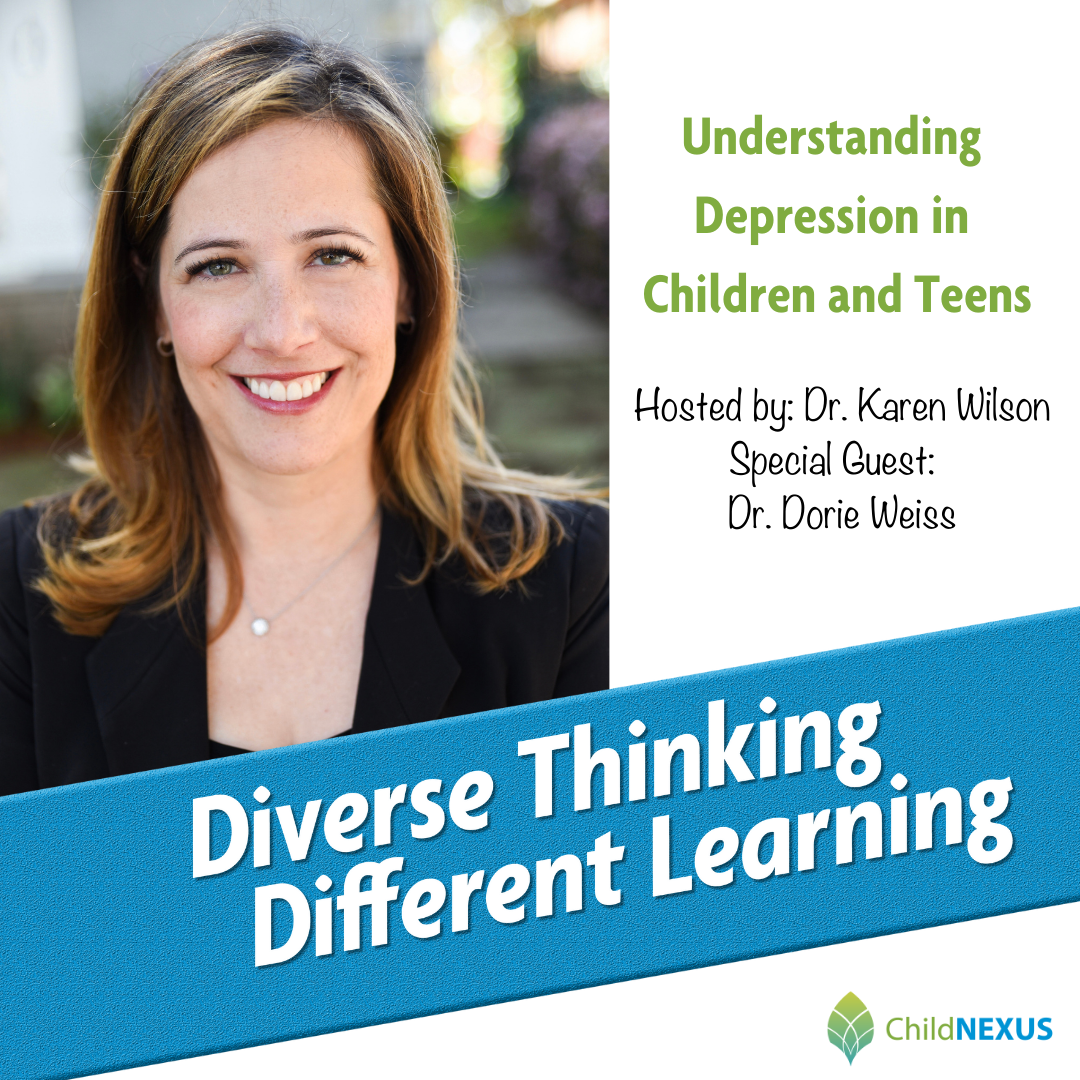
Ep. 134: Understanding Depression in Children and Teens with Dr. Dorie Weiss
With depression in children and teens on the rise, it is important to know the red flags and what to do to help. 3.2% of children between 3 and 17 are diagnosed with depression but when do you know what is expected sadness and when it crosses into something more serious? Today's guest helps us understand what depression looks like in children and adolescents and what they need and want from their parents as support. Dr. Dorie Weiss joins me today on the Diverse Thinking Different Learning Podcast, and her expertise on this topic guides us to better understand depression. For 20 years, Dr. Weiss has been providing psychotherapy and has successfully helped clients realize their cognitive potential. She has helped clients overcome seemingly intractable challenges including anxiety, perfectionism, depression, ADHD, autism, executive-functioning challenges, self-esteem issues, life transitions, and overwhelming academic stress. The stress and grief from the COVID-19 pandemic have been particularly challenging for children and teens, and although things are much better than they were last year, many kids are experiencing grief and sadness. Listen to find out what this looks like and when to reach out for help for your child. Show Notes: [1:54] - The stress and grief from the COVID-19 pandemic has been particularly challenging for children and adolescents. [3:35] - Clinically significant depression is unusual sadness for many days. [4:29] - It is important to discuss symptoms with a pediatrician as well as a mental health professional because there could be other underlying issues. [6:40] - A decrease and change in services and inconsistent remote learning has been isolating for children. [8:45] - Younger children who aren't able to communicate their feelings may show them through their behavior. [9:38] - Sometimes teens will not realize their depression but may show red flags like withdrawal and shutting down. [11:11] - Acting out in school is mostly seen as a behavioral problem but depression could be an underlying issue. [13:04] - Undetected learning disabilities or ADHD can contribute to depression. [14:19] - It is very common to see depression and anxiety together. [15:43] - Dr. Weiss describes Cognitive Behavioral Therapy. [17:07] - With younger children, Dr. Weiss uses the Zones of Regulation. [18:22] - With teens, she sets up goals and education components to allow them to better understand their feelings and what activities boost their mood. [20:40] - Sometimes negative thoughts and self-talk occur without us even knowing it. [22:01] - A common complaint from teens she works with is that parents are not supporting them in the right way. [24:00] - Educating parents on treatment is crucial. [24:51] - If the depression is treatment resistant, Dr. Weiss refers to a psychiatric evaluation to see if medication would benefit the child. [27:36] - Dr. Weiss suggests daily family meetings to just talk about the ups and downs of the day together. [29:00] - Younger children may not remember what life was like prior to COVID. But, older children and teens do remember and may need to express what they miss. [30:12] - Pairing validation with optimism and gratitude is helpful. [31:49] - Dr. Weiss acknowledges that therapy is not something a lot of teens want to start, so she gives them some of the control and choice. About Dr. Dorie Weiss: Dr. Weiss is recognized in her field and by her clients for providing empathetic, results-driven psychotherapy and careful and comprehensive psychodiagnostic evaluations that get to the correct diagnosis the first time. Dr. Weiss's approach stems from her belief that optimal results come from working collaboratively with clients, families, teachers, and other treating professionals to generate treatment plans appropriately tailored to individual clients. Leading academic institutions across Los Angeles and elsewhere trust and rely on Dr. Weiss's recommendations. Dr. Weiss takes an individualized approach to each client, drawing from cognitive-behavioral, psychodynamic, family systems, and mindfulness frameworks. She believes effective treatment requires a strong connection between client and psychologist, as well as collaboration with other treating professionals. Dr. Weiss has used this approach to help children, adolescents, adults, and families overcome a wide variety of psychological challenges. Connect with Dr. Weiss: Dr. Dorie Weiss Website Email - [email protected] Facebook Instagram Phone: (424) 209-9877 ChildNEXUS Provider Profile: Dr. Dorie Weiss Links and Related Resources: Episode 6 - Managing Family Stress and Anxiety with Dr. Stephanie Mihalas Anxiety and Depression in Adolescents Anxiety and the Family Parenting Youth in a World of Rising Suicide Rates CDC Guide: Children's Mental Health - Depression Join our email list so that you can receive information about upcoming webinars - ChildNEXUS.com The Diverse Thinking Different Learning podcast is intended for informa

Ep. 133: How Occupational Therapy Can Help Address Picky Eating with Dr. Ellie Bendetson and Leah Hiller
We've talked about occupational therapy on the podcast before, but we've never dug into a struggle for some children and families that occupational therapy can help. The topic of picky eating comes up for many families, for both neurodiverse and neurotypical children. And parents of picky eaters know that it impacts so many aspects of their lives, not just mealtime. While picky eating is a common behavior in early childhood, it's not always something a child will simply "grow out of". And today's guests explain how unique everyone's experience is with food. Dr. Ellie Bendetson is an expert in picky eating and in supporting families of picky eaters. She joins the conversation today with Leah Hiller, who returns as a guest from Episode 9, where we introduced what occupational therapy is. Many conversations about occupational therapy tend to be broad, so let's dig into one area of impact it can have on picky eaters and their families. Show Notes: [2:12] - Many conversations about occupational therapy are very broad and generalized. But picky eating is Dr. Bendetson's area of expertise. [3:21] - Picky eating is very common and there is no universal definition of what it means. [4:36] - Food and mealtime are complicated. There are so many things that could cause picky eating and can shift day to day. [6:07] - There are a lot of cultural aspects to this as well. [7:30] - For some children there are really only a few foods they will eat. Ellie works with many families like this and starts where they are. Picky eating is isolating. [9:11] - Early experiences play a key role. What are some factors that impact picky eating? [10:27] - Body awareness plays a role as well and for children with sensory processing issues, this is even more of a challenge. [12:30] - During an assessment, feeding is broken down into every little step. [14:30] - It's shown that supporting the parents and families around picky eaters is so crucial. [16:41] - There's an emotional connection and cultural importance put on food. [17:38] - Dr. Ellie describes her program Making Mealtimes Matter. [19:20] - Parents being able to help each other is so empowering. [20:52] - The goal isn't to be able to eat everything. It is to be healthy and have a healthy relationship with food. [22:20] - Starting out by playing with food is a great place to start. This allows a child to understand the food. [24:03] - What can parents model? [26:17] - Getting a child involved in cooking and preparing foods is a great way to get kids excited about food. [28:49] - Parent groups with Hiller Therapy are virtual. Other programs are in-person. About Our Guests: Dr. Ellie Bendetson Dr. Ellie Bendetson, OTD, OTR/L is a pediatric occupational therapist in Los Angeles. Ellie attended the University of Southern California, graduating with her bachelors in OT in 2019, her masters in 2020, and her doctorate in 2021. She completed her doctoral residency at Hiller Therapy | Outdoor OT, specializing in parent education and picky eating. She also holds certifications in sensory integration and the sequential-oral-sensory (SOS) approach to feeding. She is passionate about working with families to better their mealtime experience and working with children of all ages and abilities in supporting their growth at home, at school, and at play. When she's not working, Ellie enjoys hiking, baking, and playing with her dogs. Leah Hiller Leah Hiller is a pediatric occupational therapist, an educational consultant, and a former Jewish day school teacher. Leah provides teachers and parents with the strategies, support, and evidence-based resources to help children thrive at home, school, and play. In addition to providing individualized OT services in her private practice, Leah offers workshops for parents and educators, and she teaches graduate courses in special education. Leah lives here in Los Angeles with her family, and her OT therapy studio is located in a natural setting - her backyard. Connect with Our Guests: Hiller Therapy Website Email Dr. Ellie Bendetson: [email protected] Email Leah Hiller: [email protected] Links and Related Resources: Episode 9: How Occupational Therapy Helps Kids with Leah Hiller Helping the Picky Eater Handle Back to School ALPS Children: A Steep Climb But Well Worth It Trying to figure out next steps in supporting your child? Book a 1:1 consultation with Dr. Karen Wilson - https://www.childnexus.com/consultation Join our email list so that you can receive information about upcoming webinars - ChildNEXUS.com The Diverse Thinking Different Learning podcast is intended for informational purposes only and is not a substitute for medical or legal advice, diagnosis, or treatment. Additionally, the views and opinions expressed by the host and guests are not considered treatment and do not necessarily reflect those of ChildNEXUS, Inc or the host, Dr. Karen Wilson.
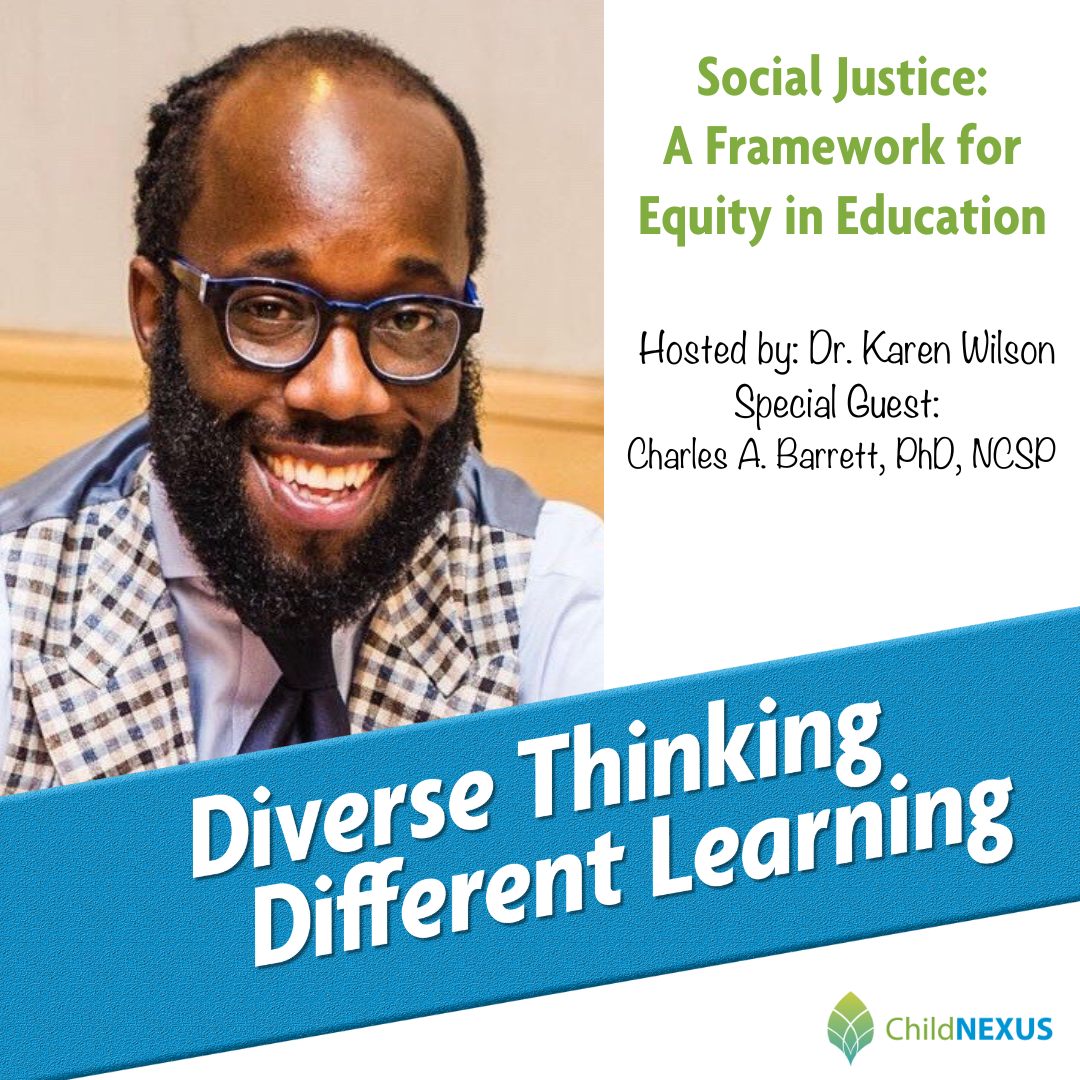
Ep. 132: Social Justice: A Framework for Equity in Education with Charles A. Barrett, PhD, NCSP
Social justice is a topic of discussion on several episodes of this podcast and today's guest joins the conversation on this important part of education. Because, social justice is truly a framework for equity in education. Today's guest is Dr. Charles Barrett, an experienced school psychologist, speaker, and author of Social Justice in Schools. Dr. Barrett knows that significant contextual factors, events happening around students, can affect their social, emotional, and behavioral functioning. He joins me today to discuss actionable steps that parents, educators, and practitioners can take to promote positive outcomes for all students and communities. Show Notes: [1:58] - Dr. Barrett has an extensive background, and he shares how he got into this particular area. [3:46] - There are a lot of variables that can impact how well a child does in school. We need to be mindful of these realities. [4:42] - Not everyone has the access to the things they need to reach their potential. [6:12] - Where do we even begin in understanding social justice? When can we move from knowledge to action? [7:40] - There are systems in place that cause inequitable outcomes. One major one is education funding. [8:57] - It is a reality that children do not receive the same level of education based on their demographic. [9:37] - Racism is another factor in inequitable outcomes. [11:03] - Distance learning during COVID-19 placed a spotlight on the disparity in education. [12:40] - Are we misinterpreting student performance as a disability? [14:24] - When returning to school after the COVID-19 pandemic, students experienced difficulty in socializing. [16:10] - Be present. Be proactive. Be persistent. [18:58] - Dr. Barrett and Dr. Wilson discuss what it looks like to be persistent. [20:26] - Access to information is key to advocating. An informed parent is the best partner. [21:44] - The partnership between the parent, the school, and the teacher is so important. [23:11] - There are more things that can be provided that parents don't always know about that are outside of the IEP. [24:12] - Dr. Barrett explains the benefits of Cognitive Behavioral Therapy. [26:59] - Understanding and access to information is not just important for parents. Students need to understand how they learn as well. [29:33] - If you are an educator, Dr. Barrett recommends first being critical of your own work. [31:08] - For parents, a great place to start is asking questions. About Our Guest: Charles A. Barrett, PhD, NCSP, a district-level administrator in Virginia, practiced as a school psychologist for 13 years at the elementary and secondary levels. He serves as an adjunct lecturer at several universities, where he is actively involved in the training and development of future school psychologists. Dr. Barrett was named School Psychologist of the Year by the Virginia Academy of School Psychologists and received the Rookie of the Year Award from the National Association of School Psychologists (NASP). His past leadership positions within NASP include co-chair of the Social Justice Task Force and African American Subcommittee, chair of the Multicultural Affairs and Social Justice Committees, and Virginia Delegate to the NASP Leadership Assembly. Dr. Barrett serves on the editorial boards of School Psychology Review and School Psychology. He is a frequent speaker and workshop presenter for educators, families, and community organizations. Connect with Charles Barrett: Charles Barrett's Website Twitter Instagram Email [email protected] Links and Related Resources: Social Justice in Schools by Charles Barrett Episode 75: How to Raise Justice-Minded Kids with Dr. Traci Baxley Episode 97: Building Communities of Support and Resistance with Dr. Bibi Pirayesh Episode 37: Literacy: A Social Justice Issue with Resha Conroy Episode 5: Educational Therapy, Distance Learning, and Social Justice with Dr. Bibi Pirayesh Fostering Social Justice in our Youth Trying to figure out next steps in supporting your child? Book a 1:1 consultation with Dr. Karen Wilson - https://www.childnexus.com/consultation Join our email list so that you can receive information about upcoming webinars - ChildNEXUS.com The Diverse Thinking Different Learning podcast is intended for informational purposes only and is not a substitute for medical or legal advice, diagnosis, or treatment. Additionally, the views and opinions expressed by the host and guests are not considered treatment and do not necessarily reflect those of ChildNEXUS, Inc or the host, Dr. Karen Wilson.
Ep. 131: Cognitive Behavior Therapy for Kids and Teens with Dr. Shadab Jannati
Let's continue our conversation about treatment today with a discussion on Cognitive Behavior Therapy (CBT) for anxiety and issues with mood. CBT has shown to be an effective treatment for individuals with anxiety and depression, and research shows substantial support for CBT as an effective first line treatment for children. More research shows that up to 60% of children and teens treated with CBT experience significant decreases in symptoms that are lasting for 4 years or more. But what is Cognitive Behavior Therapy? Today's guest, Dr. Shadab Jannati, has seen firsthand the impact CBT has on children and teens with anxiety and depression. In this episode, she explains what CBT is, what a session might look like, and what this form of psychotherapy does to help children, teens, and their families. Show Notes: [3:05] - CBT is a form of psychotherapy established in the 1960s that has evolved over the years. [3:57] - This form of therapy is goal-oriented and focused on the here and now. [5:27] - Children and teens without a formal diagnosis still benefit from CBT. [6:44] - Dr. Jannati gives examples of scenarios where children and adolescents experience anxiety. [8:18] - CBT also gives kids and teens the ability to listen to body cues and their feelings. [9:49] - When these feelings come up, kids and teens can then recognize that they are anxious and change their thinking. [11:24] - Anxiety can show up in many ways, but common problems are negative thinking and "mind-reading," which are irrational. [12:59] - The first step is being aware of the feelings and negative thinking. The next step is to find the right coping strategies. [14:15] - Like waves, feelings come and go. [15:42] - For younger children, play-based strategies are also used in CBT. [17:13] - CBT is appropriate for most ages; Dr. Jannati works with children ages 4 to 16. [20:04] - There is a sense of relief and hopefulness with CBT. Anxious feelings are validated, and children and teens can learn what to do. [22:05] - It is ideal when parents can be involved in the sessions as well. [23:53] - 80% of kids with problematic anxiety don't receive treatment. [24:43] - CBT doesn't last for years. The number of sessions varies per person but 12-24 sessions is average at about 6 months to a year. About Our Guest: Dr. Shadab Jannati is a licensed clinical psychologist with a private practice in West Los Angeles. She received her B.A. in Psychology from University of California, Irvine in 2001 and completed her doctoral studies at Alliant International University in 2006. She has over 20 years of experience working with children with a variety of social, emotional, and behavioral challenges. Dr. Jannati provides an empathic, strength-based approach and utilizes Cognitive Behavioral strategies, play therapy, and mindfulness practice to assist children in managing and coping with their emotional struggles. Additionally, she provides parent consultation, as parents are an integral part of the child's treatment and progress. As a mother of two, Dr. Jannati understands the daily struggles that affect children and parents and is passionate about helping families find strategies to improve their daily lives. Connect with Dr. Shabab Jannati: ChildNEXUS Provider Profile Children Thrive Website Email: [email protected] Links and Related Resources: Episode 67: Your Child's Anxiety - When to Worry with Dr. John Piacentini Episode 130: How Parent Child Interaction Therapy Strengthens the Family Relationship with Dr. Karrie Lager Episode 116: How Dialectical Behavior Therapy Helps Children and Teens with Patricia Gieselman Anxiety and the Family Anxiety and Depression in Adolescents Trying to figure out next steps in supporting your child? Book a 1:1 consultation with Dr. Karen Wilson - https://www.childnexus.com/consultation Join our email list so that you can receive information about upcoming webinars - ChildNEXUS.com The Diverse Thinking Different Learning podcast is intended for informational purposes only and is not a substitute for medical or legal advice, diagnosis, or treatment. Additionally, the views and opinions expressed by the host and guests are not considered treatment and do not necessarily reflect those of ChildNEXUS, Inc or the host, Dr. Karen Wilson.
Ep. 130: How Parent Child Interaction Therapy Strengthens the Family Relationship with Dr. Karrie Lager
Do you experience struggles around morning routines, getting to school, transitions, homework, mealtime, getting off screens, and bedtime? You're not alone. And if so, you don't want to miss this conversation with Dr. Karrie Lager. With Dr. Karrie, we're taking another look at a treatment modality that could be right for you and your family. It's called Parent Child Interaction Therapy (PCIT) and it focuses on play-based coaching for parents to better interact with their child to strengthen relationships and improve behavior. Many parents have said that this was a life changing experience for them and Dr. Karrie can help us understand what PCIT is, what it entails, who it's right for, and how it can impact the entire family. Show Notes: [2:23] - Let's continue the conversation about different treatment modalities with parent child interaction therapy. [3:21] - PCIT is evidence-based and is designed to strengthen the parent child relationship. [4:35] - Common moments of parent stress can become a problem. [5:20] - PCIT is unique in that therapists coach parents in real time. [6:05] - In the past, therapists would coach through a one way mirror. Now with technology and telehealth platforms, therapists can coach in the home. [8:28] - What are the benefits of coaching in the moment? [9:46] - Dr. Karrie shares some of the things PCIT helps guide parents through, specifically tantrums and aggression. [11:04] - How to notice the good in others and how to positively interact with others is one key feature of PCIT. [13:32] - PCIT can be adapted to work with children with ADHD, Autism, and learning differences. [14:40] - Screen time is a sticky situation for a lot of families. Dr. Karrie shares some good points about the age of the child and how they interact with screens. [16:30] - PCIT is very play-based. [19:12] - Typically PCIT lasts anywhere between 14 and 20 sessions and is based on the parents feeling confident in the skills. [20:48] - Many parents have given the feedback that PCIT is life changing. [22:13] - Parents need to also have patience and compassion for themselves as they learn how to best support their child. About Our Guest: Karrie Lager, Psy.D. is a California licensed clinical psychologist with over 20 years experience providing therapy to children and adults. She is the founder of the group practice and training center, Healthy Focus Psychological Center. Dr. Karrie's specialties include parenting, mindfulness, and cognitive behavioral therapy (CBT). Dr. Karrie is a UC- DAVIS certified PCIT and PC-CARE therapist and provides in-the-moment parent-child coaching to increase more calm, cooperative, and joyful family interactions. In addition to providing direct coaching to families, Dr. Karrie is a training partner with UC Davis, and she provides online therapist training in PCIT and PC-CARE certificate programs. Also, Dr. Karrie is trained as a SPACE Treatment provider through the Yale Child Study Center. In this treatment, Dr. Karrie coaches parents on tools designed to help reduce their child's anxiety, OCD, or other related challenges. As a strong advocate for life-long learning, Dr. Karrie also oversees Healthy Focus's education programs, offering creative and innovative continuing education for psychologists and other helping professionals. For fun, Dr. Karrie enjoys long walks with her family and puppy, mindfulness, yoga, arts and crafts, and writing. Connect with Dr. Karrie: ChildNEXUS Provider Profile A Healthy Focus Website Dr. Karrie's Website Links and Related Resources: The Exhausted Parent and the Endlessly Energetic Child Executive Functioning and Self-Regulation in ADHD Why Does My Child Act Up For No Reason Anxiety and Depression in Adolescents Episode 72: Prioritizing Co-Regulation and Self-Regulation in Communication with Danielle G. Kent Trying to figure out next steps in supporting your child? Book a 1:1 consultation with Dr. Karen Wilson - https://www.childnexus.com/consultation Join our email list so that you can receive information about upcoming webinars - ChildNEXUS.com The Diverse Thinking Different Learning podcast is intended for informational purposes only and is not a substitute for medical or legal advice, diagnosis, or treatment. Additionally, the views and opinions expressed by the host and guests are not considered treatment and do not necessarily reflect those of ChildNEXUS, Inc or the host, Dr. Karen Wilson.

Ep. 129: Strategies for Traveling with Anxious, Inflexible, and Neurodivergent Children with Dawn Barclay
As we ease into the summer months, this time of year we begin to think about summer travel plans. And with the recent emphasis on neurodivergence, traveling is more accessible than ever before. But it can still seem daunting to travel with a child who is anxious or inflexible. In fact, a recent study shows that 87% of parents surveyed said they wouldn't even consider traveling with their neurodivergent child. But today's guest shares helpful tips and travel strategies that can not only make this possible, but an amazing experience for everyone. Dawn Barclay is an author and has spent her career in the travel industry. She's seen it all. The ups and downs, the pros and cons. But what she has also seen are the ways that make traveling with neurodivergent children easy and joyful. In this episode, Dawn shares things you can do now to start preparing for summer travel and how you can make these experiences a reality for your family. Show Notes: [1:44] - Traveling with children is challenging and is intimidating and daunting for some parents of neurodivergent children. [2:34] - 87% of parents in a study said that they would not travel at all. [3:56] - There are a lot of benefits to traveling with your family. [5:35] - When planning a trip, start with getting your child on board by introducing the concept of traveling. [7:18] - Start small by traveling to places that are a little closer to home. [9:15] - Preparation is key. [10:31] - Build trips around special interests and contact airports beforehand to help make sure your child is accommodated. [12:33] - Working with a travel planner, you can plan for where to sit on an airplane or things to consider that you've not thought of before. [14:07] - We all become anxious when faced with the unknown and children don't always know how to express their anxiety. [15:49] - Think about the things that will make the experience easier when looking for hotel rooms or other lodging. [18:17] - There are also specific destinations that are specifically designed to accommodate people with special needs, including neurodivergence and even dietary restrictions. [21:40] - Parents may feel uncomfortable with onlookers and other people around them when traveling with their children. [23:50] - Sometimes parents even provide information to the people who are traveling around them to explain the situation. [25:22] - It's a great idea to travel with someone who can also spend time with your child while you take time to yourself. About Our Guest: Dawn M. Barclay is an award-winning author who has spent a career working in different aspects of the travel industry. After spending ten years working in sales and marketing for her parents' two firms, Barclay Travel Ltd and Barclay International Group Short-Term Apartment Rentals, she branched out into travel trade reporting with senior or contributing editor positions at Travel Agent Magazine, Travel Life, Travel Market Report, and most recently, Insider Travel Report. She is a mother of two and resides in New York's scenic Hudson Valley. A member of the Society of American Travel Writers (SATW) and the Family Travel Association (FTA), she also writes fiction as D.M. Barr and holds leadership roles in several writer organizations. Connect with Dawn: Traveling Different Website Facebook Twitter Instagram LinkedIn Traveling Different by Dawn Barclay Links and Related Resources: Episode 63: Supporting Youth with Autism and ADHD with Holly Blanc Moses Episode 72: Prioritizing Co-Regulation and Self-Regulation in Communication with Danielle G. Kent Episode 40: Lifestyle Activities That Can Improve ADHD Symptoms with Dr. Joel Nigg Trying to figure out next steps in supporting your child? Book a 1:1 consultation with Dr. Karen Wilson - https://www.childnexus.com/consultation Join our email list so that you can receive information about upcoming webinars - ChildNEXUS.com The Diverse Thinking Different Learning podcast is intended for informational purposes only and is not a substitute for medical or legal advice, diagnosis, or treatment. Additionally, the views and opinions expressed by the host and guests are not considered treatment and do not necessarily reflect those of ChildNEXUS, Inc or the host, Dr. Karen Wilson.
Ep. 128: How Deep Learning Can Help Develop Critical Thinking Skills with Jim Hahn and Dr. Jon Cassie
Navigating a complex world is daunting and it becomes even more challenging for people who think and learn differently. These students may struggle in the traditional school environment, particularly with engagement. They might even ask, "What's the point?" But the traditional school environment isn't the only option and today's guests from Qualia: The School for Deeper Learning join this conversation about how their model of education not only engages students but prepares them to navigate adulthood with strong critical thinking skills. Qualia can be compared to an all-day intellectual dinner party – a place where brainy word play, clever argumentation, and surprising ideas come together in a milieu that provokes, entertains and inspires. Jim Hahn and Dr. Jon Cassie explain the importance of creating the space and time for reflection, reasoning, existential questioning, and the sharing and communicating of ideas and how this became the core of deeper learning at Qualia. Show Notes: [2:15] - The focus is often on remediation for students who struggle, but critical thinking is overlooked. [3:37] - At Qualia, students take Philosophy courses every year to help develop critical thinking skills. [6:20] - Why Philosophy? What is it about this subject area that Qualia focuses on? [8:06] - Adding in this model of education is impactful as early as Kindergarten. [9:26] - With small class sizes, teachers can give students the appropriate amount of attention and hold real conversations. [11:51] - Through sharing and communicating ideas, students show their identity rather than letting their diagnoses be their identity. [13:20] - Jim describes the outcomes of this type of educational model. [15:45] - Having an influence on critical thinking early on pays off in adulthood. [18:53] - There are five questions that are crucial to someone's ability to think critically about anything they encounter. [20:51] - These conversations are so memorable for students. This "less is more" approach makes things simple but impactful. [23:05] - Content is important, but linking the content to the big questions is what creates deep learning. [24:56] - How do introverts do in this type of environment? Jim and Jon share what the culture is like at Qualia. [26:20] - Character development is another key component in these types of discussions. [28:03] - Dr. Wilson shares the online description of Qualia which is a depiction of meaningful, deep learning that can happen there. [29:57] - Kids are eager to make connections and adults can serve as facilitators. [31:31] - Teachers trust students to carry a conversation, collaborate and solve messy problems. [32:35] - The challenges through this model of learning are realistic. [33:42] - The focus on helping students develop connections and discover themselves prepares them to navigate a complex world. [35:30] - Listen to an example of a student's work on environmental justice. About Our Guests: Jim Hahn An inveterate explorer of knowledge, ideas, contraptions, and cultures, Jim has taught everything from philosophy to chemistry to Rube Goldberg Machines during his 30+ year career in education. As the founder of Qualia: The School For Deeper Learning, Jim is bringing his renowned cutting-edge educational model to a new level with his democratic educational philosophy, unique teaching and mentoring approach, and innovative deep learning curriculum. Jim began his teaching career at Crossroads School, then joined New Roads as Academic Dean and Dean of Faculty, and later founded Areté Preparatory Academy to create a next-generation school for brilliant and independent young minds for over a decade. Jim has inspired many students to think deeply, care deeply, and forge extraordinary paths. Jim is the proud parent of an Areté alumna, currently attending Pitzer College, and a current Qualia student; both children are living embodiments of the impactful results of Jim's transformative and revolutionary educational methods. Dr. Jon Cassie Dr. Cassie has been in independent school education for 25 years serving in virtually every teaching and leadership capacity schools have to offer. His book on game-based learning, Level Up Your Classroom was published in 2016 and won a gold medal for best technical book from Association Media and Publishing in 2017. His chapter on social-emotional learning and roleplaying games, "Don't Split the Party," was published in "Teaching in the Game-Based Classroom," in 2021. He has also written for the tabletop roleplaying sector for about 20 years. Two of his books, Loot and Folkways are about cultural aspects of roleplaying design and are available on DriveThruRPG. Dr. Cassis also hosts two podcasts about education - "Many Windows" and "Game Level Learn." He has also appeared on a number of podcasts speaking about the future of education, given the commencement address at Northland Pioneer College, and has presented at conferences and forums on learning and games in the US and

Ep. 127: How Family Environment Shapes Brain Development with Dr. Jesse Fischer
Research has shown that family environment is a significant predictor of outcomes when it comes to traumatic brain injuries. But how can family environment, things like parenting, intimacy, and communication styles impact outcomes in children and adolescents with learning challenges? Turns out, family environment has a huge impact on the way every child's brain develops and Dr. Jesse Fischer joins the conversation today to help us understand how. In this episode, Dr. Fischer, a licensed clinical neuropsychologist specializing in assessment, diagnosis, and treatment planning, explains what family environment factors are and how they are taken into consideration when assessing a child with learning differences. Many of these factors actually change the way the brain develops, but because of the brain's plasticity, it's never too late to make a change if needed. Show Notes: [2:32] - There's a huge emphasis on the academic side of learning support, but family environment is also important. [4:16] - With a comprehensive assessment, more than academic testing is looked at. [5:27] - Family environment factors are not looked at in a way to place any kind of blame, but to understand the level of support possible for the child. [6:55] - When it comes to traumatic brain injuries, family environment is a significant predictor of outcomes. [8:56] - Certain factors stand out like caregiver/child relationships and caregiver strain. [10:51] - These factors are impactful but are modifiable. [14:03] - Parenting styles can buffer some of the issues that pop up. Research shows that nurturing and warm parenting styles predict better outcomes. [15:56] - Family environments show differences in the trajectory of brain development. [18:28] - With resource support, families can find access to the opportunities they need. [19:16] - Family-focused intervention and family counseling has been proven to be effective. [20:29] - What can we as a society do to promote strong family environments through support and policies that allow parents to provide what they want for their families? [23:20] - Clinicians can promote positive family environments through clear communication, advocating for policy change, and providing resources. [25:10] - The plasticity of the developing brain lasts into a person's 20s. We have multiple opportunities throughout development to intervene. [26:51] - Your body, including your brain, is one big system and all of these factors are connected. [29:08] - It's worth the struggle to get at these factors and find ways to optimize sleep, physical activity, and nutrition. [32:24] - If resources are a barrier, there are avenues in the community that can help. [33:47] - Reach out to a professional if you need additional support and guidance. About Our Guest: Dr. Jesse Fischer is a licensed clinical neuropsychologist who specializes in assessment of children, adolescents, and young adults who think and learn differently. His clinical expertise includes assessment, diagnosis, academic and treatment planning for individuals with neurodevelopmental concerns (e.g., Dyslexia, AD/HD), traumatic brain injury/concussion, epilepsy, emotional difficulties, and other complex medical conditions. Dr. Fischer sees children and families in Los Angeles, where he was born and raised. Dr. Fischer's most recent research has focused on the role of the family environment and early childhood stress (e.g., trauma, brain injury) on brain development, neural correlates of neuropsychological problems following TBI, as well as interventions to enhance recovery from sports concussion and more severe TBI. Connect with Dr. Fischer: ChildNEXUS Provider Profile Email [email protected] Instagram Twitter Website Links and Related Resources: 3 Things Every Parent Should Know About Their Child's Brain Navigating Brain Injuries Including Concussions in Children and Adolescents 8 Ways Teenagers Suffer When They Don't Get Enough Sleep 5 Reasons Sleep Matters for Children Trying to figure out next steps in supporting your child? Book a 1:1 consultation with Dr. Karen Wilson - https://www.childnexus.com/consultation Join our email list so that you can receive information about upcoming webinars - ChildNEXUS.com The Diverse Thinking Different Learning podcast is intended for informational purposes only and is not a substitute for medical or legal advice, diagnosis, or treatment. Additionally, the views and opinions expressed by the host and guests are not considered treatment and do not necessarily reflect those of ChildNEXUS, Inc or the host, Dr. Karen Wilson.

Ep. 126: Why Self-Awareness and Self-Determination are Important for College Success with Elizabeth Hamblet
Today we welcome back Elizabeth Hamblet, who previously discussed the transition from high school to college in an earlier episode. She's back today to discuss it further after the publication of her new book Seven Steps to College Success: A Pathway for Students with Disabilities. Elizabeth has worked for two decades as a learning disabilities specialist in college disability services offices. She's heard all the questions, she's guided many students and she's here to talk about the keys to college success: self-awareness and self-determination. In this episode, Elizabeth answers so many questions. What accommodations do colleges provide? What are the differences between college programs when it comes to accessibility? What about IEPs and 504s? And most importantly, how can we prepare our students for college beyond academics? Show Notes: [2:07] - Elizabeth's new book is so helpful for parents whose children are transitioning to college or starting to think about the next step. [3:37] - The goal isn't just to get into college. It's to succeed in college. [4:38] - Even in the early stage of the 8th grade IEP meeting, there are things you can do to prepare. [5:51] - The support and accommodations in high school don't always overlap with those that will be provided in college. [7:59] - All IEPs and 504 accommodations may not be implemented at the college level. [9:33] - What accommodations are available on the college level? [10:56] - Families and students can ask the disabilities services department about the accessibility of software at colleges. [12:27] - Once students graduate from high school, IEPs are no longer legally required for colleges to adhere to. [16:31] - Although IEPs and 504s expire, some colleges will provide the same or similar support. [17:56] - Students should choose a college based on the things that any student would. Choosing a school solely based on their support does not make a good match. [19:52] - There is a misconception that colleges go out of their way to exclude students with disabilities, but it's just not true. [20:58] - College is more than academics. [22:50] - Parents can help, but Elizabeth encourages students to call and ask questions in their process of making a big decision. [25:29] - Accommodations are important, but too many and too much support in high school leads to students not being ready for college. [26:52] - Families and teachers can do a lot to promote independence and self-advocacy. [30:54] - Extended time for papers is not commonly provided in college. [33:26] - You have worked so hard to get your child this far, and there is anxiety when it comes to thinking about college. [34:18] - College is not binary. You don't have to attend at a specific time. [36:19] - The self-management piece of college is just as important as the academic aspect. About Our Guest: Elizabeth C. Hamblet has worked as a learning disabilities specialist in college disability services offices for two decades. In addition to working at a university, she is a nationally-requested speaker on preparing students with disabilities for successful college transition. Hamblet is the author of Seven Steps to College Success: A Pathway for Students with Disabilities and a concise guide on transition, and her work has appeared in numerous journals and online platforms. She offers advice and information on her website at www.LDadvisory.com and shares resources on numerous social media platforms. Connect with Elizabeth: ChildNEXUS Provider Profile LD Advisory Website LD Advisory Facebook Page Seven Steps to College Success: A Pathway for Students with Disabilities by Elizabeth Hamblet Links and Related Resources: Episode 15: From High School to College - Steps to Success for Students with Disabilities with Elizabeth Hamblet Episode 83: What Students with Disabilities Should Do When Starting College with Eric Endlich PhD Episode 125: Does Your Teen Need a Transition Assessment? with Dr. Gwen Palafox Trying to figure out next steps in supporting your child? Book a 1:1 consultation with Dr. Karen Wilson - https://www.childnexus.com/consultation Join our email list so that you can receive information about upcoming webinars - ChildNEXUS.com The Diverse Thinking Different Learning podcast is intended for informational purposes only and is not a substitute for medical or legal advice, diagnosis, or treatment. Additionally, the views and opinions expressed by the host and guests are not considered treatment and do not necessarily reflect those of ChildNEXUS, Inc or the host, Dr. Karen Wilson.
Ep. 125: Does Your Teen Need a Transition Assessment? with Dr. Gwen Palafox
What is a transition assessment, and how do you know if your child needs one? If they do, when do they need it and what does it look like? There are a lot of questions about transition assessments and today we have the perfect guest to answer them all. Today, we welcome back Dr. Gwennyth Palafox (Dr. Gwen) to the Diverse Thinking Different Learning Podcast. Dr. Gwen is a clinical psychologist and a fierce ally of neurodiverse and disabled individuals and has supported their wonderful families and support systems for over 25 years. She's laser-focused (and borderline obsessed) about empowering through reliable knowledge, creativity, and skill-building. She loves curating and collecting tools, sharing mindsets, and promoting habits to help the neurodiverse community thrive and find joy and meaning in their lives. Listen on to learn about what transition assessments entail, why they are important, and why you want to start transition planning early on. Show Notes: [3:01] - The idea of transition is change. Change is not something that is abrupt, especially when it comes to development. [4:04] - Ideally, transition planning should happen when high school begins. [6:10] - "What does it take to live as an autonomous, fully independent adult?" [7:29] - For students with an IEP, they need an ITP. Dr. Gwen explains what that is and how many students don't know about it. [9:07] - This assessment must include more than where your child is academically. [10:03] - Dr. Gwen shares the most important skills for transition. [12:52] - When these skills are solid or at least emergent and we are focusing on the process of living in this world as an adult, we get postsecondary results. [14:58] - Skills are only built by experience. [17:31] - High school should be preparing students for adult life. [19:28] - Transition assessments and psycho-educational diagnostics are very different. [21:01] - Learning, living, and working are the three components of a transition assessment. [24:03] - Where we lose sight of the data is when we don't paint a qualitative picture of where the person is today. [27:17] - Good transition assessments connect to activities and community resources with the goal in mind of what comes next after high school. [28:49] - The student needs to be involved in this process. [31:01] - We need to presume competence when communicating to the student. [33:01] - Dr. Gwen always includes something in the transition assessment recommendations that parents and teachers can begin doing immediately. [35:22] - Assessment results can be overwhelming to families and having a transition plan early ensures that there's enough time for support. About Our Guest: Dr. Gwen is a licensed psychologist who has been actively changing the lives of individuals with neurodevelopmental disabilities for over two decades. She is laser-focused on promoting the happiness and wellbeing of disabled teens and adults and is a fierce ally of disabled individuals and their families. Dr. Gwen has shared her expertise in local and global workshops, at a TEDx event, as an expert witness, and in collaboration with other engaged and radically awesome professionals. Her clients are wonderfully complex, unique, and awesome. She says that out-of-the-box thinking, creativity, grit, and compassion are some of the best tools that she has. Connect with Dr. Gwen: ChildNEXUS Provider Profile Meaningful Growth Website Dr. Gwen Empowered on YouTube Links and Related Resources: Episode 47: Helping Students Transition to Adulthood with Dr. Gwennyth Palafox Be the Executive in Charge Trying to figure out next steps in supporting your child? Book a 1:1 consultation with Dr. Karen Wilson - https://www.childnexus.com/consultation Join our email list so that you can receive information about upcoming webinars - ChildNEXUS.com The Diverse Thinking Different Learning podcast is intended for informational purposes only and is not a substitute for medical or legal advice, diagnosis, or treatment. Additionally, the views and opinions expressed by the host and guests are not considered treatment and do not necessarily reflect those of ChildNEXUS, Inc or the host, Dr. Karen Wilson.

Ep. 124: A Non-Medication Treatment for Children with ADHD with Dr. Sandra Loo
Many parents hesitate to jump to a medication treatment for their child's ADHD and ask about alternatives to medication. On this podcast, we have talked about different medication options but also behavioral therapies, mindfulness, and classroom accommodations, but today we're talking about an empirically supported non-medication treatment for ADHD and the results look very promising. Today's guest is Dr. Sandra Loo who researches Trigeminal Nerve Stimulation and its impact on ADHD symptoms in children ages 7-12 at UCLA. In today's episode, she describes what Trigeminal Nerve Stimulation (TNS) is and how it works to generate brain activity. She also shares the benefits of the treatment and provides updates on how the study is going. It is a very exciting advance in non-medication treatment alternatives for children and you can reach out to Dr. Loo through the links below to participate in the study as well. Show Notes: [2:44] - The work Dr. Loo is doing with this new treatment is exciting and hopeful. [4:06] - Trigeminal Nerve Stimulation is the first FDA cleared treatment of ADHD of kids ages 7-12 years old. It's a mild stimulation that generates brain activity. Dr. Loo describes the process. [5:15] - After about 4 weeks of nightly stimulation, Dr. Loo has seen improvement in ADHD symptoms. [7:18] - Children on the older side of the 7-12 age range tend to feel comfortable putting the device on themselves. Dr. Loo explains what it might feel like for a child to wear. [9:16] - This isn't medication and results are slower than medication treatment. [10:22] - Improvements show the greatest results in inattention. [11:35] - Dr. Loo is also working on predictors that will help determine what treatment would be best for individual children. [13:08] - One observation from parents is that ADHD symptoms are better and that their child is less emotionally dysregulated. [15:45] - After 4 weeks in the study, they found that stopping the treatment did see an increase in the symptoms again. [17:37] - There are other goals for this treatment that are still being researched. [18:15] - There have not been any adverse side effects of this treatment and everyone responds differently. [20:47] - What are the comparisons to more common medication treatment results? [23:33] - All presentations of ADHD are welcome to participate in this study. [25:23] - Dr. Loo shares how to get more information and who to contact to participate, all of which are linked below. [30:26] - This is a multi-site study, also available in Washington. About Our Guest: Sandra Loo, Ph.D. is Professor of Psychiatry and Director of Pediatric Neuropsychology within the Department of Psychiatry, UCLA David Geffen School of Medicine. Dr. Loo is a licensed clinical psychologist and translational researcher whose work over the past 25 years has encompassed genetic, electrophysiology (EEG) and neurocognitive biomarkers within ADHD and other neurodevelopmental disorders. Currently, her research is focused on the development of empirically supported, non-medication treatments for ADHD. She has published over 150 peer reviewed journal articles and book chapters on these and related subjects. Dr. Loo's teaching and clinical activities are focused on comprehensive neuropsychological assessment of youth with pediatric (traumatic brain injury, epilepsy, brain tumors) and psychiatric (ADHD, Specific Learning Disorders, mood and anxiety) disorders. She oversees research and clinical training activities for trainees interested in specializing in ADHD and related neurodevelopmental disorders. Connect with Dr. Loo: Contact UCLA at 310-825-3735 Email: [email protected] UCLA Research Study Participation Links and Related Resources: Episode 34: Key Principles for Raising a Child with ADHD with Dr. Russell A. Barkley Episode 105: Medication Helps But is Not a Magic Potion for ADHD with Syed Naqvi, MD Mindfulness in the Treatment of Attention Deficit Hyperactivity Disorder UCLA: ADHD and Mood Trying to figure out next steps in supporting your child? Book a 1:1 consultation with Dr. Karen Wilson - https://www.childnexus.com/consultation Join our email list so that you can receive information about upcoming webinars - ChildNEXUS.com The Diverse Thinking Different Learning podcast is intended for informational purposes only and is not a substitute for medical or legal advice, diagnosis, or treatment. Additionally, the views and opinions expressed by the host and guests are not considered treatment and do not necessarily reflect those of ChildNEXUS, Inc or the host, Dr. Karen Wilson.

Ep. 123: How Decluttering Helps to Manage ADHD Symptoms with Wendy Zanders
For most of us, clutter can become distracting. Now imagine how clutter can impact those who find it difficult to focus all the time. Clutter is so easy to pile up and if we're feeling disorganized on the outside, it makes us feel cluttered on the inside. Today's interesting topic can apply to everyone and their family and can benefit us in some surprising ways. Today's guest is Wendy Zanders, the Declutter Coach. In our conversation today, Wendy shares her experience growing up undiagnosed with ADD and how through her education she coped with stress by decluttering. She has since taken her experiences and applies them now to help neurodivergent individuals and their families organize their space to go from overwhelmed to simplified. Listen for some easy tips and tricks on how to start the declutter process in your own home, life, and brain that will also help your child or teen do the same. Show Notes: [2:32] - Wendy shares her experience being diagnosed with ADD later in life. [4:05] - In her youth, Wendy found herself cleaning and organizing her room to de-stress. It calms her down still in her adulthood. [5:40] - It's all about focusing on something specific to declutter rather than cherry picking certain things. [6:57] - When your child has ADHD and you may also have ADHD, getting things organized can feel impossible. Where do you start? [8:46] - Parents reach out to Wendy when their adolescent needs support and a lot of times realize they struggle with the same challenges. [10:50] - There's a misconception of what "minimalism" really means. [12:37] - The goal is not to get rid of everything. It's about getting things that are meaningful organized. [13:46] - Task initiation can become a problem when a student's space is cluttered and distracting. [16:30] - Decluttering areas in the home can lead to other areas being organized. [17:15] - Let your child choose things that may help them focus, like their work space or even the clothes they wear. [20:47] - Purchasing bins or organizational materials and systems does not declutter. [23:08] - There are three steps to organization. [25:47] - No two homes are the same. Avoid comparing your home with someone else's. [27:30] - Generally, people work better on whatever task they need to focus on when things are organized first. [28:17] - Brain dumping is a great strategy to declutter your mind and still remember things. [30:50] - Use a calendar to keep things straight and organized as a family. [32:44] - In addition to having a calendar available, sometimes the act of writing something down helps you to remember. [34:15] - Don't stay stuck and reach out to someone for help who is compassionate and non judgemental. About Our Guest: Wendy Zanders is a Professional Organizer, Declutter Coach, Special Needs Mom, and United States Army Veteran. She is passionate about helping Veterans and the special needs community take their homes and lives FROM Overwhelmed TO Simplified. An underperformer in grade school due to undiagnosed attention deficit disorder (ADD), Wendy worked hard and surpassed the expectations of everyone around her. Early in her career, she found that she had a knack for systems and organizing, but found herself living in a totally disorganized home after several episodes of depression. She helps the community get organized by helping them identify what has created the disorder in their lives, and by helping them create systems so they can get back in control of their possessions and homes. Connect with Wendy: ChildNEXUS Provider Profile Email [email protected] Your Declutter Coach Website Links and Related Resources: Attention Deficit Hyperactivity Disorder Episode 40: Lifestyle Activities That Can Improve ADHD Symptoms with Dr. Joel Nigg Be the Executive in Charge Trying to figure out next steps in supporting your child? Book a 1:1 consultation with Dr. Karen Wilson - https://www.childnexus.com/consultation Join our email list so that you can receive information about upcoming webinars - ChildNEXUS.com The Diverse Thinking Different Learning podcast is intended for informational purposes only and is not a substitute for medical or legal advice, diagnosis, or treatment. Additionally, the views and opinions expressed by the host and guests are not considered treatment and do not necessarily reflect those of ChildNEXUS, Inc or the host, Dr. Karen Wilson.
Ep. 122: Accommodations for Students Who Struggle with Math with Adrianne Meldrum
Today, we welcome back podcast guest Adrianne Meldrum, founder of Made for Math. In a previous episode, Adrianne and I discussed multisensory interventions for kids who struggle with math, and it was extremely helpful to parents and teachers. This time, we're talking about accommodations for students who struggle with math. And some of them might be surprising both because of what the accommodation helps and how easy it is to incorporate for students. Listen as Adrianne describes common accommodations, some lesser known (and used) accommodations, math anxiety, and an incredible tool that she developed called the Math Accommodations Generator. You'll learn about output and input accommodations and how they might be just what your child or student needs to improve their relationship with math. Show Notes: [2:49] - Behavior is a form of communication. Adrianne shares some behaviors that could indicate struggles. [3:46] - Teachers are not intentionally hurting your child's math learning as they can't control how their teaching is received, but there is such a thing as a math wound. [5:41] - Struggling in math can take form in many ways. There are a lot of different components in math, like number sense, processes, and memory retrieval. [7:48] - There are two types of accommodations: output and input. [9:23] - Output accommodations are the more commonly seen of the two types as they are typically things you see in reports and IEPs. [11:49] - The reason output accommodations are the most common is because they are easy to implement. [12:52] - Adrianne gives examples of input accommodations and explains how they differ from output accommodations. [14:51] - When we focus on these accommodations, we think about ways we can help a student understand instead of ways to help them complete something. [15:48] - Input accommodations also have a verbal component. [16:58] - You don't have to wait until math facts are mastered to work on other content. [18:40] - Semantic input accommodations focus on bigger visual concepts. [19:46] - Math anxiety can be accommodated by gamifying content and doodling on the back of a test without turning it in. [22:43] - There is a lot of evidence to support schema-based word problems. [24:06] - Attention issues can also create challenges in math and there are some accommodations that can help. [26:15] - Give kids a compelling reason why we need these steps in math. This is particularly important for kids with ADHD. [28:04] - Some parents feel that by needing accommodations, their child isn't being taught the same things as the rest of the class. [32:05] - Adrianne describes the Made for Math Accommodations Generator which is a unique tool that asks questions about the child and provides accommodations to try. About Our Guest: Adrianne Meldrum is the founder and owner of Made for Math (MFM), an all-online math center focused on serving students with dyslexia, dyscalculia, and math learning disabilities. She is a certified Multisensory Math Instructor through Marilyn Zecher. She holds a Master's Degree from Bridges Graduate School of Cognitive Diversity. Adrianne is married with three boys and lives in Mesa, AZ where she enjoys poolside living. Connect with Adrianne: ChildNEXUS Provider Profile: Made for Math Made for Math on Instagram Made for Math on YouTube Made for Math Website Links and Related Resources: Episode 60: A Multisensory Intervention for Kids Who Struggle with Math with Adrianne Meldrum Made for Math Accommodations Generator Trying to figure out next steps in supporting your child? Book a 1:1 consultation with Dr. Karen Wilson - https://www.childnexus.com/consultation Join our email list so that you can receive information about upcoming webinars - ChildNEXUS.com The Diverse Thinking Different Learning podcast is intended for informational purposes only and is not a substitute for medical or legal advice, diagnosis, or treatment. Additionally, the views and opinions expressed by the host and guests are not considered treatment and do not necessarily reflect those of ChildNEXUS, Inc or the host, Dr. Karen Wilson.

Ep. 121: Task Initiation - Why It's Hard and Strategies for Success with Jenny Drennan and Hannah Ross
The ability to get started on a task right away even when you don't feel like doing it is an executive functioning skill for students and adults. And it's not just an academic skill, it's a life skill. That's why it is an important topic and discussing it can help a lot of students and their families. Returning to the podcast are Jenny Drennan and Hannah Ross. Jenny and Hannah have both been on the podcast before but as separate interviews. Now they are together to talk about task initiation and the work they do with students to help them get the ball rolling. Not only do they beautifully explain task initiation and why it is hard, but they provide strategies to use at home and at school, for both children and adults, to help with this struggle. Show Notes: [2:44] - Task initiation is misunderstood and often associated with laziness and motivation. [3:46] - Students developmentally don't have the self-talk skills yet to talk themselves through starting a task. [5:03] - At school, this can look like a student not working on assignments or taking a long time to get started. [6:12] - When we struggle to gain momentum on a task, it is likely a task that is something we aren't looking forward to or is daunting. [7:23] - Task initiation brings up a lot of conflict in families. [9:21] - It's important to know that this struggle is human nature and that we all have tasks that are challenging to start. But there are factors that make it harder for some. [11:33] - Lack of interest in the task can also lead to struggling with starting it. [12:53] - Part of the work Jenny and Hannah do is help parents in interacting with their child that struggles with task initiation. [14:42] - There are also ripple effects to struggling with task initiation. [16:03] - When students can unlock what helps them initiate tasks, they are usually less anxious and stressed as well. [17:40] - This isn't just an academic skill. It's a life skill. [18:37] - Modifying distractions is a strategy to help students in their environment. [20:18] - Routines are also very helpful but can be difficult to stick to. [21:32] - Breaking a task into smaller chunks is a great way to make a large task approachable and manageable. [23:29] - Scheduling breaks is helpful for some students but is used on a case by case basis. [25:35] - Modify the instructions in a school task to be less detailed and use verbs. [28:19] - Allow students to make mistakes and focus on the process instead. [29:45] - A student's experience needs to also be validated. [31:20] - Modeling task initiation and using your own self-talk out loud when you don't want to do something is a great way to help develop the child's self-talk. [32:44] - You can download a free guide that includes strategies for task initiation by clicking here. Be sure to also check out the links below. About Our Guests: Jenny Drennan is a Certified Educational Therapist and Founder of WeThrive Learning, Jenny specializes in supporting students with ADHD, and math and writing challenges. Drawing on best practices and the latest research, her practice provides 1-1 support for students and families globally. She is certified by ImpactParents as a Sanity School® behavior therapy program trainer and is attaining her certification as a dyscalculia specialist by the Association of Dyscalculia. Hannah Ross is a professional educational therapist based in Los Angeles, California. Her practice, Summit Learning, specializes in providing dyslexia remediation, as well as executive function coaching to learners of all ages, both in person and virtually. Hannah currently serves as the vice-president of the International Dyslexia Association of Los Angeles, in addition to being a member of the Association of Educational Therapists. Connect with Jenny and Hannah: ChildNEXUS Provider Profile: Jenny Drennan Email [email protected] We Thrive Learning Website ChildNEXUS Provider Profile: Hannah Ross Email [email protected] Summit Learning Website Links and Related Resources: Episode 11: Executive Functioning 101 Episode 12: Executive Functioning Support for Struggling Learners with Hannah Ross Episode 70: How to Help Students Develop Good Study Skills with Jenny Aguilar Strategies for Task Initiation (download) Trying to figure out next steps in supporting your child? Book a 1:1 consultation with Dr. Karen Wilson - https://www.childnexus.com/consultation Join our email list so that you can receive information about upcoming webinars - ChildNEXUS.com The Diverse Thinking Different Learning podcast is intended for informational purposes only and is not a substitute for medical or legal advice, diagnosis, or treatment. Additionally, the views and opinions expressed by the host and guests are not considered treatment and do not necessarily reflect those of ChildNEXUS, Inc or the host, Dr. Karen Wilson.
Ep. 120: Meeting the Needs of Culturally and Neurodiverse Students with Juniette Kanga and Maria Kennedy
What can we do to create more inclusive communities where students' needs are met? This conversation needs to be had and is probably the most important conversation we've had on the Diverse Thinking Different Learning Podcast to date. There is a lot to unpack here, but today's guests show us that every journey and every discussion has a first step and they're here to help us take it. Maria Kennedy and Juniette Kanga join me today to talk about the intersection between ethnicity and neurodiversity. Through their own experiences as educators, parents, and their own unique cultural differences, they share the ways they've learned the biases, both conscious and unconscious, in the education system. But more than just saying there's a problem, Maria and Juniette have taken the next step in helping others understand and creating communities where culturally diverse and neurodiverse individuals can come together. This will not be the last we'll hear from Maria and Juniette and the work they do. Show Notes: [3:35] - There is so much to unpack. Every journey starts with one step and we have to take the first step in understanding. [5:03] - In Maria's experience, if children and teens of color do not excel in athletics, their strengths and challenges aren't always acknowledged. [6:47] - Learning differences and neurodiversity are so common and yet still misunderstood. [8:50] - In education, we have a deficit model. Teachers are taught to look for things children can't do. [10:37] - Remediation is very restrictive. If the focus is remediation, we miss out on engagement and identifying needs. [12:09] - Children are not broken and they do not need to be fixed. One size fits all does not work in education. [13:50] - Remediation is important and impactful, but it isn't enough on its own. [14:46] - At the symposium Maria hosted, she had students speak about their experience and the lessons they spoke about were the ones in which they felt valued. [16:35] - As a community, we have a responsibility to encourage the growth and development of all people in the community. [17:23] - Juniette joins the conversation and shares how different is equally as beautiful. [19:01] - Some companies are tapping into creative, outside-of-the-box thinking and cultural differences to move things forward. [20:36] - As parents, we are constantly trying to protect our children and sometimes that holds them back. [21:54] - Educators need to be aware of their biases to properly help every child. [23:27] - Maria shares a story about her own three year old son being sent out of the classroom for refusing to complete an assignment that was too easy. [26:29] - Even as a supporter of public schools, Maria knew that it wasn't the right fit for her exceptional learner. [28:16] - Education needs to be culturally aware and look at the needs of everyone in the classroom. [29:50] - Some children are ostracized for asking questions. [31:18] - Adults need to ask more questions and take the step in understanding. [33:17] - It is common for teachers to not want to differentiate instruction as it is more work. [34:54] - Culturally, there is a hesitation to accept a child's giftedness. [36:57] - Teacher training and education needs to be stronger so teachers can see the signs of learning differences. [38:16] - Strength-based education is best for all students. [39:44] - Teachers also need to know the impact they have on their students and their drive to learn. [41:52] - Maria and Juniette's goals are to empower you. They have cross-cultural pods for discussions and resources. About Our Guests: Juniette Kanga, M. Des, is a mother of five children and a doctoral student at Bridges Graduate School of Cognitive Diversity. She holds a graduate certificate in twice exceptional education, is a trained Social Emotional Needs for the Gifted (SENG) facilitator and a North American Scholastic Esports Federation (NASEF) 2022 - 2023 fellow, a role she recently ventured into in supporting interests based learning for non-traditional learners, such as homeschooled and twice-exceptional children. She is the founder of a consultancy to support parents like her advocacy and education. Maria M. Kennedy first joined the Bridges Academy staff as the Director of Phoenix. After successfully growing the program each year, she has taken on the position of Director in the Bridges Educational Group. Speaker, author, and advocate Maria has been an educator for almost 30 years. Maria received her B.Ed. and M.Ed. in education from Manchester University. She earned Advanced Teacher Status from the Manchester Department of Education for her ability to develop curriculum and her skills within the classroom. She traveled internationally, teaching students and training teachers how to tap into the strengths of their gifted and challenged students. Maria believes that effective educators must continue to learn and grow as a person. With this in mind, she constantly reads and works closely with leadin

Ep. 119: Autistic Girls - Overlooked and Underrecognized with Megan Beardmore, PhD, NCSP
I have been asked this question from parents and from colleagues: Is it autism? And this question is more often asked when we are talking about girls. So the conversation today with guest Dr. Megan Beardmore is about autistic girls and about understanding the less obvious presentations of autism. Many autistic youth feel misunderstood and research shows that being autistic leads to increased risk for a host of mental health issues including anxiety, depression, suicidal thoughts, and others. For many, an accurate diagnosis can be life changing. But it's not enough to uncover a diagnosis. In fact, it's not the goal. The goal is to understand struggles, identify strengths, and provide the individual and their family with appropriate tools, strategies, and support moving forward. Dr. Megan Beardmore and I have this important conversation about this overlooked population of autistic girls. Show Notes: [3:06] - Over the past few years, the prevalence of autism has increased. What has contributed to that? [4:40] - The neurodivergent community has also become more vocal about themselves on social media. [5:54] - Girls are often diagnosed later than boys even when they present with the same behaviors. Dr. Beardmore shares some of the things they look for that are less obvious in girls. [7:40] - Generally speaking, females tend to have a little more social savviness that makes them better at masking. [9:12] - Social camouflaging works until it doesn't and internalizing symptoms can be harmful to mental health. [11:04] - Dr. Beardmore describes the common conversations she has when identifying autistic girls and the questions she asks. [13:15] - There is a distinction between self-awareness and understanding the self within a relationship. [14:19] - Oftentimes, autistic individuals, especially girls, are hyper aware of other people's body language and facial expressions. [15:43] - There is a misconception about empathy when it comes to autistic individuals. They aren't without empathy, but rather that they don't know what to do with it. [18:57] - Rigidity is often a struggle for autistic individuals but in general, girls internalize this stress while boys tend to outwardly show their emotions. [21:11] - Regardless of gender, those with high intellectual functioning are more likely to fly under the radar and be overlooked. [23:01] - Internalizing symptoms are common in girls and create a delay in seeking help and a diagnosis. [25:49] - The purpose of an assessment isn't to find a diagnosis. It's to help know what to do after a diagnosis. [27:57] - Understanding why an autistic person behaves the way they do is important for the individual and their family. It validates their experience. [29:14] - Once they have a diagnosis, some people choose to share and some don't. [30:18] - As a parent, develop a sense of safety for your child to talk to you. [31:18] - Look out for rigidity, stress, signs of depression, or other mental health issues. About Our Guest: Dr. Megan Beardmore is a licensed school psychologist with expertise in assessment and treatment of children and young adults with autism spectrum disorder (ASD) and related neurodevelopmental disorders. Originally from Iowa, she received her graduate training at the University of Arizona where she practiced in schools and community mental health settings providing therapeutic services as well as diagnostic evaluations. During her predoctoral internship, she served as the evaluation coordinator at a K-8 school, a role that involves conducting assessments to determine special education eligibility. Dr. Beardmore then received specialized postdoctoral training in the assessment and treatment of children with ASD at The Help Group and UCLA. She later worked in a nonpublic, multidisciplinary school where she developed and implemented a social skills program for students with social-communication and behavioral challenges. Currently, Dr. Beardmore works at Spectrum Psych Los Angeles splitting her time between conducting psychological evaluations and providing outpatient therapy. Her focus in assessment tends to target psychoeducational, social-emotional, and autism-specific referrals. In therapy, she draws upon a flexible, integrative blend of evidence-based (e.g., CBT) and holistic (e.g., mindfulness, somatic) interventions. Connect with Megan Beardmore: Spectrum Psych Website Links and Related Resources: Episode 44: Understanding Autism Spectrum Disorder with Lisa Hancock Episode 63: Supporting Youth with Autism and ADHD with Holly Blanc Moses Episode 25: Raising Differently Wired Kids with Joy and Confidence with Debbie Reber Trying to figure out next steps in supporting your child? Book a 1:1 consultation with Dr. Karen Wilson - https://www.childnexus.com/consultation Join our email list so that you can receive information about upcoming webinars - ChildNEXUS.com The Diverse Thinking Different Learning podcast is intended for informational purposes only and is not a sub
Ep. 118: Understanding the Intersection Between Autism and LGBTQIA+ with Dr. Laurie Stephens
Many topics of the Diverse Thinking Different Learning Podcast come from parents and individuals who provide services to children. Today's topic has come up more than once and our guest is able to shed some light on the intersection between autism and LGBTQIA+. Dr. Laurie Stephens joins today to share the research on this overlap and what she sees herself as the Senior Director of Autism and Clinical Programs for The Help Group. Through her work with The Help Group, she has also developed an affirming community called Kaleidoscope which is offered in person and online. And she explains how we can better understand and support multi-minority status individuals with their own self-acceptance, their education, and their mental health. Show Notes: [1:55] - There's no universal agreement on terms used, but it is important that the majority of the autistic community prefer identity-first language. [4:03] - Many psychologists are seeing a trend in autistic adolescents. [5:10] - There is recent research that shows the overlap of autism and identifying as gender diverse. [6:39] - Something important to note is that because of the stigma surrounding LGBTQIA+, that the number of individuals is likely under-reported. [8:21] - Dr. Stephens explains the differences between gender fluid, non-binary, and transgender. [9:26] - Autistic individuals are less likely to be concerned with social norms and societal pressure. [10:58] - Autistic people are advocating for society to accept their autism and neurodiversity which also leads to advocating for their gender diversity. [12:01] - This population is oftentimes multi-minority status. [13:29] - There are common mental health concerns that overlap in minority groups that are compounded when individuals are a part of more than one. [14:40] - Dr. Stephens describes some of the common misconceptions about autism. [16:22] - Society needs to expand its view rather than autistic people masking to fit in. [18:07] - Many adults are seeking an autism diagnosis later in life and many of those individuals identify as gender diverse. [19:21] - Females tend to be under diagnosed and most people ignore the autistic presentation in them. [21:05] - It's important for mental health providers to be educated and trained to help autistic people. It's not about treating their autism. [22:51] - Dr. Stephens describes how she helps parents who come to her with the concern that they don't know how to support their child. [24:28] - Dr. Stephens began a program called Kaleidoscope. [26:50] - Just one affirming person in your life can reduce suicidality by 60%. [28:02] - The Help Group's Kaleidoscope program is local to California, but all the social services and advocacy programs are offered online. About Our Guest: Dr. Laurie Stephens is a developmental psychologist who currently serves as the Senior Director of Autism and Clinical Programs for The Help Group. Dr. Stephens has been passionate about finding innovative and effective ways to work with autistic children, teens, young adults, and their families and communities since 1990. Among her accomplishments are having created Young Learners Preschool for Autism, founding the first post-doctoral fellowship in autism at The Help Group, starting the early diagnosis state-run autism clinic in New York, and creating a social skills curriculum for camps, schools, and clinics. She is a highly regarded public speaker and has spoken throughout the US, Canada, Japan, the UK, and Finland to name a few places. Prior to her current role with The Help Group, Dr. Stephens worked as the Director of Clinical Services at Education Spectrum, where she provided individual and group therapy, social skills classes, and psycho-educational and diagnostic testing. During this time, Dr. Stephens developed an interest in the overlap between gender diversity and ASD. She noted that many of her autistic clients were coming out as transgender, gender fluid, and non-binary. Dr. Stephens became passionate about finding the most effective ways to help these multi-minority status individuals find and accept their authentic selves while finding an affirming community. After 12 years of direct clinical service, Dr. Stephens returned to The Help Group to help them develop Kaleidoscope, the first of its kind LGBTQ+ program for children, teens, and adults who are also neurodivergent. She and her colleagues have established a specialty diagnostic clinic for transgender and non-binary folk who suspect they may also have ASD, the first of its kind on the west coast. Connect with Dr. Stephens: ChildNEXUS Provider Profile Kaleidoscope Website About The Help Group's Kaleidoscope Program: Kaleidoscope supports LGBTQIA+/Questioning youth, young adults, and their families in building healthy relationships, strong social connections, and critically needed life skills. Through high quality, innovative programming, using the latest research and evidence-based programs, our mission is to help each per
Ep. 117: How Surf Therapy Helps Neurodivergent Kids with Naomi Matanick, OTR/L
As we continue our conversation about different treatment and therapy options, you may discover unique options that are a right fit for your child. Today's topic is certainly unique! We're diving into surf therapy. Surf therapy is one mode of therapy among many that helps neurodiverse kids with many different skills. You may not have heard about this therapeutic tool that uses the elements of the ocean, a surfboard, and sand, but it targets sensory processing, physical and emotional regulation, motor planning, coordination, and mental health. To help us learn more about surf therapy is guest Naomi Matanick who has become passionate about helping neurodiverse children and adolescents through the properties of the ocean. She explains what surf therapy is, how different skills are targeted and impacted, and the types of kids that would benefit from it. Show Notes: [2:50] - Surf therapy is one therapeutic tool among many. There are many properties in the ocean that impact our bodies. [4:13] - This mode of therapy is particularly beneficial for children with sensory processing difficulties. [4:50] - The movement of the ocean brings on a sense of body awareness and activates different body systems. [6:27] - Surf therapy helps with emotional regulation, but going into the water can initially be scary. [8:03] - Naomi lists some of the skills integrated into surf therapy, including balance, visual development, and core strength. [9:54] - Surf therapy also affects executive functioning skills as well as higher level cognitive functions like safety and planning. [11:24] - Surf therapy can help so many kids, but particularly those who struggle with self-regulation and sensory integration. [13:43] - The end goal is not to become a surfer. It's to have the child engage in something that is fun and playful. [14:40] - Age 6 and up into early adolescence is a great time to start this kind of therapy but it is really based upon each individual child's needs. [16:45] - There is an increasing rate of mental health issues among adolescents but research shows the benefit of physical activity on mental health, including surfing. [19:31] - Naomi shares her experience in how neurodiverse children overcome specific challenges with surf therapy. [21:48] - Currently, Naomi works with children one-on-one, but would like to expand to group therapy. [23:16] - Surfing is a very individualized sport rather than a competitive one. [24:23] - Naomi's hope is that through this mode of therapy children gain self-confidence and self-trust. About Our Guest: Naomi Matanick is a pediatric occupational therapist specializing in sensory integration therapy, surf therapy, and childhood and infant development. Kids are amazing and dynamic individuals. Yet, they have a lot to conquer. In her years of experience, she has served infants to early adolescents in a variety of areas including: sensory processing, physical and emotional regulation, organization of behavior and attention, acquisition of vital motor milestones, motor coordination development, and oral-motor therapy for feeding. Naomi's mission is for each caregiver and child to feel understood and empowered as they are equipped with life-long tools. Her passion is to see children feel joy as they playfully develop a strong identity and sense of self through the skills and knowledge they have obtained. Connect with Naomi: ChildNEXUS Provider Profile Hang-Ten Therapeutics Website Phone: (419) 420-4995 Email: [email protected] Links and Related Resources: Episode 9: How Occupational Therapy Helps Kids with Leah Hiller Episode 30: How Physical Activity Can Enhance Mental Wellness with Drs. Shannon McHugh and Jesi Sasaki Dizziness and Balance Problems Common in the U.S. Episode 39: Why Fine Motor Skills Matter with Jennifer Morgan Join our email list so that you can receive information about upcoming webinars - ChildNEXUS.com The Diverse Thinking Different Learning podcast is intended for informational purposes only and is not a substitute for medical or legal advice, diagnosis, or treatment. Additionally, the views and opinions expressed by the host and guests are not considered treatment and do not necessarily reflect those of ChildNEXUS, Inc or the host, Dr. Karen Wilson.