
DevReady Podcast
328 episodes — Page 6 of 7
How to Adapt Change in Technology with Jodi Woelkerling - Episode 78
In this episode of the DevReady Podcast, Andrew Romeo is joined by Jodi Woelkerling, author of “World Class Leadership” and a trusted authority on building enduring, resilient cultures and building personal resilience and the two talk about change that technology can bring about within the workplace, the impact that it might have, and how to ensure that the change is positive for all concerned stakeholders. Jodi emphasizes that the modern workplace is filled with constant challenges, both for the business at large and for the individuals within the business, and resilience is a key component of effectively navigating these challenges. And because humans are fundamentally hard-wired to resist any kind of change, for any business, it is paramount that they manage the process of change so that neither the business nor the individuals in the business suffer. Topics Covered: · Building Resilience at Individual and Corporate Levels · Strategies for Staying Calm · Dealing with Technology Change · Need for Stakeholders to Accept Change · Engaging Stakeholders to Have a Positive Impact on Acceptance to Change · World-Class Leadership
From a Musician to a Technologist with Mark McCormack from Design Posse - Episode 77
In this episode of the DevReady Podcast, hosts Andrew Romeo and Anthony Sapountzis talk to Mark McCormack, Co-Founder, Design Posse. Mark has had a pretty long and eventful career, from being in a cover band to designing digital strategies for various advertising agencies to supporting start-ups and innovation in entertainment-related technology—he has surely done it all. Having worked in different industries, Mark strongly believes that two things are key to success in any industry, no matter how disruptive a product or service is: 1. Ability to build networks 2. Ability to solve a problem Topics Covered: · Moving into the Software Industry from Music · Struggles of being the Pioneer · How to educate your customers · Taking Risks · Building effective Networks
Build a Happy Tech Team with Alexandra Andrews - Episode 76
In this episode of the DevReady Podcast, Andrew Romeo sits with his coach, Alexandra Andrews, Managing Director and Executive Coach Director of My Personal Coach and over the duration of a little more than half an hour, they discuss the difference that getting the right coach can make to not just one’s business but also to one’s other projects and relationships. Many in the business are either driven by ego or are victims to paralysis by analysis, and Alex’s advice to those is, first and foremost, to work out the ‘Whys’: why are you making a certain business decision, why are you thinking a certain thing. She furthers, the key then is to never settle for the first answer because that is the ‘safe answer’, the filter that we all use, either knowingly or unknowingly. She emphasizes that there is a need to dig deeper and to keep on asking until one gets to that fundamental, heartfelt ‘Why’. Topics Covered: · Overcoming ‘Paralysis by Analysis · The Process of Building a Happy-Team · Understanding Team Dynamics · Right People for the Right Roles · Assessing and Reflecting
Expanding the support community with The Pitch Portal with Amanda Fay - Episode 75
In this episode of the DevReady Podcast, Andrew Romeo sits with Amanda Fay, Founder & CEO, The Pitch Portal, a platform through which she helps connect business ideas and opportunities with expert service providers who have the skills to make them fly. During the course of the episode, the two cover a lot of ground: connect between venture capitalists and startups; vetting of experts and also the pitches, tools used by The Pitch Portal to ensure an efficient and effective support system; access to information and mentors early on in the startup journey, among others. While the three tools (the lab, the interface, and my pitch) have been put to use since The Pitch Portal was set up, the survey tool is a new addition and would help startups and businesses have a much-rounded idea of their goals before putting in all they’ve got into something that might or might not yield the returns they seek. Having seen people lose everything in the startup journey, Amanda’s goal was to expand the support economy and make profits along the way—basically, a win-win for all parties involved. Topics Covered: · The life of venture capitalists and startups · The process of vetting the experts · Tools used by the Pitch Portal · The importance of flexible payment arrangements for service providers · How to vet the pitches
Why Don’t Kids Run Companies with Andrew Grant (Creativity in Start-ups Series Part 3) - Episode 74
Andrew starts by adding on to the topics of the previous podcasts and how the book and game can be used as a diagnostic tool to try and discover what blocks our creativity. By using a crime scene investigation, he wants users to play detectives to hide behind safe characters to try and work out what the things that block creativity are. He believes that understanding the blockers to creativity is a pre-requisite for creative thinking. Having left the listeners with a question to ponder over: ‘Why are children not CEOs of companies when they are great at creative thinking?’, he answers the same by saying that children might be great at creative thinking but they are not good at critical thinking—a balance of which is needed to run successful businesses. While creative thinking is the thinking we do when we generate ideas, critical thinking is the thinking we do when we judge those ideas. He believes the problem here lies in the fact that not many people have both. Topics Covered - If children are so creative why are they not the CEOs of companies? - The ability to think both creatively and critically. - Connecting two seeming unrelated things to create something that is spectacularly creative. - Prototyping and implementation. - Playing the devils' advocate. - Importance of embracing diversity
Tools to foster creativity with Andrew Grant (Creativity in Start-ups Series Part 2) - Episode 73
On this episode of the DevReady Podcast, Andrew and Anthony continue their conversation with Andrew Grant, Director of Tirian International Consultancy, and co-author of ‘Who Killed Creativity?... And How Can We Get it Back?' and ‘The Innovation Race’. Andrew talks about how our workplaces are not built to foster creativity and are in fact characterized by blockers. So, in order to deal with the blockers of creativity, the suspects as he calls them, he and his team developed a game, not necessarily a competitive game, but one with a theme and a metaphor that people can hide behind so that they have a safe place to talk about some of the issues they are facing. Topics Covered - Need to set up an environment that encourages creative thinking - How to use the CSI board-game and digital-game to understand creativity blockers - How to ask the right questions and find ambiguity within the questions - How to ideate, brainstorm and map out creative ideas - How to connect seemingly distant things and find solution to a wicked problem - How to figure out what works and then implement it
Who Killed Creativity with Andrew Grant (Creativity in Start-up Series Part 1) - Episode 72
On this episode of the DevReady Podcast, Andrew and Anthony talk to Andrew Grant, Director of Tirian International Consultancy, and co-author of ‘Who Killed Creativity?... And How Can We Get it Back?' A keynote presenter at TEDx (HK), in this episode of the podcast, he talks about what kills creativity and how to get it back, much along the lines of his acclaimed book. Andrew talks about his being in the business for over 2 decades along with his partner, Gaia Gates and how they started in Asia working with cross cultural teams, expats and locals. Both of them often got invited to attend conferences and soon discovered that such gatherings were very boring in the mornings with lots of keynote talks and childish in the afternoons with silly team building games and everyone getting drunk. Thinking that continuing to do so was a waste of people’s money, they came up with lots of creative ideas on how to make the mornings more interactive and afternoon sessions more intelligent. That got them started on the importance of how creativity can help solve problems. That’s what later went from being the contents of a book to workshops to a game around who killed creativity. (To find the CSI Board-game, go to https://whokilledcreativity.com/game-board/intro-game/) When researching on why people would want to read yet another book on creativity, they came to a conclusion that the actual issue of what’s blocking people’s creativity was something that wasn’t explored. There was no diagnostic tool to explore one’s journey from childhood to adulthood and to fill that gap they partnered with a neuroscientist and psychologist to try and really understand all that was going on inside a person’s brain, and from that was born the book-‘Who Killed Creativity?... And How Can We Get it Back?' Andrew then goes to explain why he decided to use the metaphor of a crime scene where creativity is killed. That’s what makes the book memorable; these questions: who killed creativity, with what weapon, and how do we get it back? In the book, the authors basically, distil it down to seven key suspects. (To read more on the suspects, go to https://whokilledcreativity.com/articles/csi-7-suspects/) The Control Crew The Fear Family The Pressure Pack The Insulation Clique The Apathy Clan The Narrow-Minded Mob The Pessimism Posse The essence of the podcast being that creativity doesn’t happen magically over a hack-a-thon, that people first need to be aware of the fact that there’s much in their culture and environment that can block creativity, and use this diagnostic tool allows people to talk about issues in a safe environment. Topics Covered: - Need for creativity in the workplace. - The memorable concept of who killed creativity, with what weapon and how to get it back. - Difference between creativity in the artistic sense and business sense. - Why does creativity decrease as one grows up? - The seven suspects that block creativity - The growing importance of creativity in the workplace as AI becomes more prevalent. - How to foster creativity?
Intuition: Make Your Business Successful With Your Gut with Sunil Godse - Episode 71
We often don’t know where a “gut decision” comes from, but the feeling is unmistakable. This episode of DevReady demystifies that little voice in the back of our heads that can so influence our choices, for good or ill. Sunil Godse explains why we should listen, but not without doing the work to understand fully the elements of intuition. As an “Intuitionologist,” he has learned to decode the many ways in which life experience impacts our brains and shapes a whole spectrum of decisions, particularly in the realm of business. An author, branding expert, coach and consultant, Sunil has devoted thousands of hours to researching the neuroscience behind the reflexive choices we make. He traces the roots of trust and shares real-world case studies that reveal the influence of powerful subliminal signalling, including: ○Experiential Intuition ○Situational Intuition ○Relational Intuition ○Creative Intuition When properly leveraged, intuition (and the trust upon which it is based) can transform entrepreneurial ventures, employee morale and customer experience alike. Sunil takes us from his early career path (often dictated by influences that didn’t align with his gut) through the many examples of intuition as a tool for honouring core values and building sound relationships based on self-awareness and understanding. Enjoy the many “knowledge bombs” Sunil has to share in this episode, including additional reading and further resources. Topics Covered: - What differentiates entrepreneurial success from failure? - Follow your instinct. - 4 types of intuitive signalling that impact decision-making. - How to define your signals?
From Surfboard Salesman to Software Innovator with David Pillinger - Episode 70
On this episode of the DevReady Podcast, Andrew and Anthony sit down with David Pillinger, a serial entrepreneur who took his experience running a surfboard company and transitioned it into managing multiple software companies. David started out making and selling surfboards when he left school early, eventually launching an online real estate company called Property Gallery and then a software company called Safesoft in 2018. David now heads up his software as a service company, Venture Capital Exchange (VCEX). Throughout their conversation, David tells Anthony and Andrew about how he started VCEX and the practical side of running the company technology-wise. Together the three discuss how David sources talent from LinkedIn, David’s motivations for getting up and continuing to innovate every day, and how the internet is changing the way we do business. David believes that anything is possible for anyone—a mindset he draws from his own life and struggling with school, only to go on to become a successful business owner. The episode wraps up with a look at where David sees himself in five to ten years, and how leaders have to be constantly looking out for “icebergs” on the horizon that could hinder their progress and continued innovation. David’s childlike wonder at opening up the “present” under the Christmas tree that is waking up every day serves as a motivation for all entrepreneurs and innovators alike to keep moving forward. Topics Covered: •The story of surfboard seller turned to software innovator. •How do some regulations tend to make expanding software technology harder? •How David developed the technology platforms for his different businesses. •Building the best team.
The road to success in business: Changing your mindset & heartset with Leigh Eggins - Episode 69
On this episode of the DevReady podcast, Andrew engages Leigh Eggins, founder of the Million Dollar Business Club, in a fascinating exploration of holistic coaching. In what amounts to a paradigm shift, Leigh asks clients to reconsider assumptions and dig around in the shadows to unearth self-limiting beliefs. The result? Tremendous growth not only from a business perspective but in myriad other aspects of life. “At the end of the day, it is a person running the business,” says Leigh, “and if that person’s not performing at their best then the business won’t be performing at its best.” Makes sense! The question is: How do we get there? Leigh shares some of the tools he recommends to clients, including out-of-the-box ideas like meditation and “heart set.” If you’re ready to break with received wisdom and get comfortable being uncomfortable, then this is the episode for you. It’s all too easy to get “addicted” to outmoded systems or patterns of thoughts long overdue for re-examination and change. But we don’t have to stay locked into counterproductive stressors or false beliefs. Leigh and Andrew share tips and illuminate a path towards not only business success but also personal growth and fulfilling life. Topics Covered: ●Leigh unspools how he came to his coaching philosophy. ●How to get out of our comfort zones? ●What is heart-set and how does heart-set affects brain function and outcome? ●When stress goes up, intelligence goes down. ●Leigh shares the art and science behind a transformational tool “Smile-Posture-Breath/Thank-Trust-Receive.”
How to shorten your sales cycle with Rashid Kotwal - Episode 68
In this episode of the DevReady Podcast, Andrew and Anthony interviewed Rashid Kotwal, a sales coach and mentor, about how companies can optimize their teams for proficiency and profitability. Through his consulting firm, Revealed Resources, Rashid is sharing lessons gleaned over 30 years. He has over his career executed complex deals, bringing to bear expertise in both tech engineering and identifying key patterns of human behaviour. While technologists love to sell technology, Rashid explains that it’s “a huge mistake” to shift the focus away from what is ultimately the heart of solution selling: Making the business case. Sales cycles can be short or long, but in all cases, it’s important to identify the right decision-makers, articulate their pain points and propose a strategic response. Enjoy this fascinating conversation about all things sales. Rashid Kotwal provides a template, explaining what it takes to set the stage for your company’s long-term growth and bottom-line numbers that will keep improving … year over year. Topics Covered: ●The importance of buy-in. ●The art of identifying opportunities and key players to accelerate sales cycles. ● Marketing and sales: Two sides of the same coin. ●Are salespeople born not made? ● The 3 pillars to growth ●Go to strategies for engaging stakeholders, locating pain points and creating a win-win-win scenario that closes sales.
How to Build High-Performance Start-up Teams with Nicola Steel - Episode 67
On this episode of the DevReady Podcast, Andrew and Anthony speak with Nicola Steel, IT recruiting expert and founder of JJP Talent Solutions. During the conversation, Nicola shares her knowledge about how to bring your talent scouting resources in-house to build high-performing teams. At the heart of building good teams are the people themselves. In order to build a high performing team, you need to attract high performing people. But what a lot of companies get wrong is that they don’t have their own values nailed down first. The best teams are driven by values and principles, so you must design the values of the company as early as possible. If you have the foundation of principled people, your teams will be set up for success. Nicola believes in the power of a people-first attitude. When companies place the emphasis on their own people first and their fears, their personalities, their strengths, they will be much more capable of guiding their teams through to victory. Topics Covered: ●How High-performing teams are values-driven. ●Why being people-first is better than numbers first. ●Creating psychological safety. ●How to celebrate wins as a team. ●Why remote work needs to be looked at on an individual basis. ●The rise of Zoom fatigue.
Understanding the subscription economy with Jonathan Callinan - Episode 66
On this episode of the DevReady Podcast, we talked to Jonathan Callinan, business coach, co-founder and marketing strategist at the Online Business Accelerator. Jonathan discusses the subscription economy, why trust is better than “tribe”, and why you should be building your own communities. Human behaviour and the world at large is moving toward lifestyles that favour a subscription model for consumer services, it only makes sense that all businesses that want to survive need to think about how to build that into their business plan. At the heart of Jonathan’s message is the idea that people are drawn into opportunities for networking and community. He explains to us that because of this, your brands are more likely to succeed if they feel they are part of a community. Topics Covered: ●What underpins successful subscriptions. ●People ultimately want to be connected in the community. ●Trade tribe for trust to be connected to like-minded people. ●Why businesses should be trying to create their own communities. ●The challenges of transitioning a free community to a high-value paid service. ●How to build communities around a target audience.
Close More Deals with SaaS DEAL Framework with Matt Wolach - Episode 65
On this episode of the DevReady Podcast, Andrew and Anthony speak with Matt Wolach, SaaS expert and former guest on the show. During the conversation, Matt explains his philosophy behind The Perfect DEAL process and how to successfully scale SaaS platforms. The key to a successful sales model is that it is easy to understand and easy to transfer to someone new. Matt talks about how a lot of early wins in the software space are a direct result of the passion of the founders, which is not a bad thing. But that passion isn’t easily transferred to new hires. This is where the simplicity of the perfect deal process comes in. A repeatable process helps the sales team to grow seamlessly. Matt explains that the DEAL stands for four key things that must happen on a sales call in order to close. He boasts a 63% close rate on his team after using the Perfect DEAL strategy. The process is not intuitive, Matt repeats, but it is worth the time to help your SaaS companies really grow. Topics Covered: ●The Perfect DEAL helps you sell and scale SaaS companies. ●Why existing sales models need to be moulded to fit SaaS. ●A repeatable process to scale your business. ●Getting prospects to feel bad enough about the problems that they want to fix them. ●Cater your SaaS products to specific customer needs and you’ll win. ●How to demonstrate expertise in your niche

A Perfect Space: Becoming Google of Film Scouting with Kate Tiller - Episode 64
In this episode of the DevReady Podcast, Andrew and Anthony welcome Kate Tiller, Chief Brand Officer at A Perfect Space. Identifying a niche within the entertainment industry, this experienced startup founder set out to develop a searchable database that eliminates much of the legwork involved in scouting film locations. But as with so many startup origin stories, there have been some painful lessons learned along the way to delivering this invaluable service to production teams across North America, Australia and Europe. Kate generously shares her experience with bringing A Perfect Space from conception to execution, including the disappointments she suffered after partnering (more than once) with tech developers who made promises on which they couldn’t deliver. Short of industry regulation to ensure that coders perform to standard, it’s up to entrepreneurs to protect their vision and the large sums required to turn an innovative idea into a robust web-based solution. Kate explains why both business and tech sides need to be in sync with clear communication, accountability and mutually understood milestones. A Perfect Place couldn’t have realized its potential without a clearly defined, disciplined development framework – something Kate has learned is most efficiently established by hiring an effective CTO from the outset. While A Perfect Space caters to a very specific sector, the lessons Kate has learned in building out, debugging and populating her platform are universally applicable. With candor and humor, she shares the journey to realizing her vision for “the google of location scouting” -- a searchable database designed to drastically reduce the travel, expense and spade work associated with identifying far-flung locales for all manner of film and television productions. Join Andrew and Anthony in exploring with Kate the many ways in which technologists and entrepreneurs must intersect on the way to turning a business dream into reality. Topics Covered: ●The challenges associated with scouting locations. ●How specifically A Perfect Space streamlines the scouting process. ●Supporting tech is essential to deliver a disruptive vision. ●Millions of dollars lost and overstating of tech developers. ●Why Big-picture entrepreneurial goals are important. ● The value in creating a hierarchy of needs within a business model. ● Defining and targeting a given market drives the tech tools deployed to reach it.

From Concept to Design: Launching a SaaS Product with Alex Pirouz - Episode 63
Launched in 2013, linkfluencer started initially as a service – an online course that helped users optimize business marketing and development resources available through LinkedIn. But ultimately Alex found that his customers required something beyond a three-step mentoring program. They craved community, long-term strategy and, most importantly, support implementing sales plans and measuring for results. After identifying this pain point, Alex partnered with an experienced software developer to design Jayla, a powerful platform that helps SMEs and corporates manage marketing and sales opportunities generated through LinkedIn. This episode of DevReady explores how Alex Pirouz has transformed an entrepreneurial idea from an online service into an end-to-end solution. Topics Covered: ●Optimizing LinkedIn: How linkfluencer morphed from a service to a scalable software. ●The importance of metrics. ●Why 99% of entrepreneurs “suck at execution”. ●How a non-tech founder approached the development/build-out of his Jayla application.
How to Market with CX with Neel Bhattacharya - Episode 62
On this episode of the DevReady Podcast, Andrew and Anthony talk to Neel Bhattacharya, commercial software strategist and SaaS extraordinaire. During the conversation, Neel describes what makes CX (or customer experience) unique from UX in the SaaS space, and why businesses should even care. To understand how customers experience brands, businesses use a variety of tools to gather meaningful data. This data can then be used to help shape the whole range of customer experience, from tone in an email to the color of an app icon. Customer experience plays a large part in customer retention, so businesses are keen to pay attention to the methods they can use to boost customer experience. The customer survey is a popular metric for gauging customer experience. Questionnaires are infinitely customizable and simple to use for startups. These surveys also help to establish what are known as personas. Personas help an organization with the planning process. In the process, Neel says, they fix the marketing messages. In other words, businesses use personas to direct marketing campaigns, and if they are ineffective, they can use personas to figure out why. Topics Covered: ● The differences between UX and CX. ● Understanding how customers experience our brands? ● Customer service vs customer experience. ● Key metrics to measure customer experience. ● The Net Promoter Score as a useful CX metric. ● Persona trees.

The Power of Voice in Digital Age with Ronsley Vaz - Episode 61
On this episode of the DevReady Podcast, Andrew and Anthony talk to Ronsley Vaz, founder and Chief Energy Officer at Amplify. During the conversation, Ronsley describes many of the ways that podcasting has helped his business and improved his own quality of life. In the way of business podcasting, Ronsley explains that understanding who your market is is critical, and it won’t help to send the right message to the wrong audience, so locking in your target is key to business success. This even extends to product launches, which we should use to learn instead of making a profit. “It hurts the ego to have a failed launch, but you can learn so much and not hurt the bank account,” Ronsley says, speaking to the power of embracing failure. Ronsley als talks briefly about why he thinks podcasting is intrinsically beneficial. He says that the institutions of education didn’t teach us to raise our voices, so there is some trepidation that comes along with this. But at its core, podcasting is about the power of the human voice—a power that we are evolutionarily predisposed to—and how it can help lift the voices of the unheard and give volume to the silenced. In a way, podcasts help amplify. Toward the end, Ronsley describes what Amplify actually does, which involves bringing the right podcasts to the right people to amplify them. He hopes everyone interested in podcasting could find out how to use it as a platform to share their stories and build in connection with one another, because there’s nothing more rewarding. Topics Covered: ●The science of creativity. ●The value adds of podcasting. ●How people make use of podcasting within their businesses. ●Reusing content versus intentional volumes. ●Why the Agile methodology works. ●Finding the proper MVP for your business design. ●What we owe to the freedoms of our ancestors.
How Thought Leadership is Changing Content with Robyn Foyster - Episode 60
On this episode of the DevReady Podcast, Andrew and Anthony sit down with former editor-in-chief and current content strategy entrepreneur Robyn Foyster to talk all things thought leadership. Robyn is the founder of InProfile, a thought leadership agency that helps clients curate their online presence through a specialized content strategy. In the current climate of personal brands and 24/7 news, we’re all thought leaders, no matter the size of our audience. Robyn believes having a strategy behind the content you put out into the world is key to attracting followers to your corner of the internet. Content has changed so much in the past 25 years, but as a former journalist and editor-in-chief, Robyn says she still uses that “gut feeling” instinct to guide content strategy and keep followers engaged. The thing is, we’re all the editors and publishers of our own personal content brands, but just because we have that power, doesn’t mean we know how to wield it—that’s where Robyn and her team come in. The episode wraps up with the three discussing how much is too much to share when curating your online brand, and the importance of creating consistent content for your audience. In the past, getting on the sofa for a talk show interview was the surest way to get your message out there, now we all have the ability to share our story through personalized social media channels. That power is available to us, but to truly become a thought leader in the online space, we have to create a consistent and engaging content strategy that compels people to stick around to hear what we have to say. Topics Covered: •Why Robyn started InProfile •How thought leadership is changing marketing •How to become a thought leader? •The strengths of LinkedIn •Tools to create weekly content •Being the publisher and editor of your own content •How content has changed in the last 25 years •Personal branding versus business branding and the crossover •Creating content to become a thought leader •Creating consistent content for your audience
Succeeding with Software Business with Stewart Marshall - Episode 59
On this episode of the DevReady Podcast, Andrew and Anthony talk to Stewart Marshall, commercial software strategist and SaaS extraordinaire. Stewart covers everything from using software to solve problems and implementation. He says that most people just want their problems solved, but devs need to think about it in the context of the system as a whole. As a SaaS expert, Stewart also joins the podcast to talk about some of the hurdles that software services overcome in the developmental stages as well as in going to market. This is Stewart’s guide to developing a business plan for any startup itching to deliver a tech solution: 1.Articulate the problem. 2.Understand whose problem it is. Get it to a point where you can walk up to a person and say “here’s the problem we have and here’s how we’re going to solve it.” Then you have a business. But remember that technology on its own is not a solution but merely a tool. A key takeaway from this episode is Stewart’s advice to founders about incorporating technology. He says it’s like looking at a jigsaw puzzle. The commercial side of the business will look at the picture, but the technical side will look at the pieces and how they fit together. When they work together, you get a really good outcome. Topics Covered: ●How COVID has forced digitization on Australia? ●SaaS experts today and what they have to offer. ●Smart marketing to your target audience. ●Software is only a tool. ●Mistrust in the technology sphere because of pricing structure. ●The AI arms race of the future. ●The distinction between customer needs and the customer wants. ●Why UX & UI are inherently complicated? ●Need to be inquisitive?
High Performance Teams in the Remote-Work Era with Julie Starovoitova - Episode 58
On this episode of the DevReady Podcast, Andrew and Anthony speak with Julie Starovoitova, People Experience Lead at PaperCut Software. Over the course of the conversation, Julie describes some of the key initiatives she has helped launch toward building high-performing teams. Some of these strategies include: 1. Making sure that all your values and principles are actually lived. This even informs performance reviews. 2. Job-swapping helps team members understand each others’ roles. Julie also shares how PaperCut’s performance review questions reflect a desire to build high-performing teams. The four questions for a PaperCut performance review (adopted from Deloitte): 1.General performance and cultural fitness 2.Performance around values and principles 3.Risk of low performance question 4.If at risk of leaving, what should be done to keep them. Topics Covered: ●Controlling growing teams. ●Successes in transitioning to a remote work platform. ●Seeing team members adapt to working from home. ●What high-performing culture means. ●Investing in teams as pivotal to growth. ●“Anyone can talk to anyone” as a principle. ●Bringing transparency and openness to decisions like promotion. ●Real-life scenarios are more accurate than abstract performance reviews. ●Codifying the essence of your business.
Design Thinking & Architecting Enterprises with Darryl Carr - Episode 57
On this episode of the DevReady Podcast, Andrew and Anthony talk to Darryl Carr, enterprise architect and professional community builder. During their conversation, Darryl talks about enterprise architecture and how business can architect solutions that deliver results and scale to profit. Darryl describes how he understands systems and community architecture. He talks about how businesses should work with architects early on in the development process to have them inform all stages. Architects can help businesses plan a software solution that will actually deliver value, empower investors, and scale. Among his most poignant pieces of advice is that understanding architecture is ultimately about scale. A key takeaway from this episode is that businesses primarily need to concern themselves with creating solutions for real problems. A common problem with tech startups is that they try to create solutions for problems that don’t really exist. Avoid this trap by listening to your clients. Give them your honest ear that will allow you to hear their problems for what they are, empowering your team to develop solutions that affect meaningful change. And that’s the bottom line. Deliver value at the end of the day. Topics Covered: ●How architecture fits into the agile movement. ●Don’t launch straight into the technology. ●Non-functional requirements. ●How to architect to scale your solutions. ●Advice for building a tight tech team. ●Your main goal should be to create value. ●We need to find problems that actually need solving. ●Why communicating drive and passion matters. Key Quotes: ❏“Architects help you make sure, when you’re building something, that it’s built well, that it will run well and that it will scale well.” (4:20) ❏“Involve your architects as early as possible.” (6:15) ❏“Architecting a platform, really, is understanding the scale.” (9:30) ❏“Pivot toward something you can validate in the real world.” (19:45) ❏“You can impact and create more value by listening.” (22:10) ❏“What you really want to convey is how passionate you are about the problem you’re solving.” (27:50)
E56 - Good Hustle: Building A Better World with Tom Dawkins
Our guest on this episode of the DevReady Podcast is Tom Dawkins, CEO and Co-Founder of StartSomeGood, the leading home of cause-driven crowdfunding, innovative partnerships and social entrepreneur education. Before StartSomeGood, Tom founded Australian youth non-profit Vibewire, was the first Social Media Director at Ashoka in Washington DC and was the founding Director of the Australian Changemakers Festival. Tom’s varied experience and journey to where he is now has taught him valuable lessons but also gave him the insight he needs to better support the next generation of social entrepreneurs. His passion for innovation and sustainable impact is the basis behind StartSomeGood and has helped countless people find success along the way. Tom’s journey to a career that didn’t exist when he started out was full of risk but his optimistic attitude and adherence to his vision and purpose has helped him to achieve significant goals. As an early adapter and innovator, he wasn’t deterred by technology he didn’t understand but learned the value of key partnerships and how to leverage them to get to where you want to be. At the end of the day, Tom’s desire to help others better create social change is inspiring and truly accessible. Throughout this conversation he shares useful advice and combines it with tangible action steps, connecting anyone wanting to pursue their ideas with the tools they need to make it happen. Topics Covered: •How seemingly random events and opportunities paved the way for Tom’s career path •Becoming a crowdfunding entrepreneur before it existed •Youth empowerment is tokenistic, haphazard and deeply biased towards wealth. •Tom’s path as an early adapter and innovator •Building technological companies as a non-tech person •Focus on equipping people •Success stories from the platform •What inspires people to give and invest Key Quotes: •“My whole life purpose is to try and build… a better democracy and to me that means one where people can participate in making things happen.” (1:22) •“The heart of democracy is not an election. It's every other day of the year; how we participate, how we make a difference, how we create the future that we want (1:43) •“Today you shouldn't know what you want [to do] because the thing you want to be probably doesn't exist yet.” (2:36) •“Create spaces where people can engage in conversation, can share their stories and perspectives, and hopefully come up with new ideas and ways to collaborate together to create a better future.” (8:32) •“I'm an early adapter and so I'm constantly scanning what's around me and then wondering how that might be relevant for the things I care about. (13:00) •“People are always looking for that big idea that fresh idea that they can come out of their own mind, but sometimes we can take a concept that's in one market or another country and then bring it into a different space and create something new and innovative.” (14:58) •“Paying for innovation means paying for failure. The only way you get innovation is by trying stuff that may or may not work and along the way there is risk.” (17:35) •“Burnout is actually one of the great sources of failure for startups.” (34:46) •“One of the things we pitch with crowdfunding is; it's not just an alternative source of capital, it's a source of validation that then helps you get the capital.” (40:39)
Episode 55 - Growing Your Tech Business with Zachary Kohler
Episode 55 - Growing Your Tech Business with Zachary Kohler by Aerion Technologies

Episode 54 - Legal Agility In Developing New Tech with Jeremy Streten
Our guest on this episode of the DevReady Podcast is Jeremy Streten, founder of “Business Legal Life Cycle”, a business focused on making legal advice accessible to business owners. Jeremy briefly started out his career in IT before pivoting to become a lawyer about 17 years ago. After several years in the industry, Jeremy realized that many lawyers tend to speak with their clients in unnecessarily complicated ways that are not helpful to average people who do not have legal training. He saw an opportunity for building a bridge between business owners and helpful legal advice and he sought out a developer to help him create the infrastructure. The basis for the BLL assessment came from Jeremy’s outline of the 13 business phases, which eventually became his book entitled “The Business Legal Life Cycle.” During the creation of the first version of the Business Legal Life Cycle software, Jeremy experienced plenty of miscommunications with the developer he had hired. This solidified in his mind the necessity for a tech partner and also for the implementation of proper documentation at the beginning of all client and employment relationships. When it came time to work on version 2.0, Jeremy reached out to a Mastermind group that he was a part of in the U.S. and met an interested developer there who eventually became his business partner. He says that having a tech partner continually involved in the business and the evolution of the tech being used is a crucial part of the business. Topics Covered: •Many lawyers aren’t very helpful because they don’t speak plain English to their clients. •How Jeremy’s legal background helped prepare him to fill in this gap between business owners and proper legal advice. •Keeping in mind what you want to do in the future. •Setting up your documentation the right way from the start. •Finding the right developer and building out the tech. •How miscommunications can lead to misaligned expectations and outcomes. •Changing the targeting of the product based on feedback. •Having a larger purpose: to make legal advice accessible to business owners. Key Quotes •“It’s to help business owners generally to know what they need to do from a legal perspective.” (1:10) •“People change. Money changes people.” (6:04) •“Every business evolves over time, and if you’re not evolving then you’re probably going backward.” (19:25) •“You get what you pay for.” (25:11)
Episode 53 - Four Pillars of Scaling SaaS Company with Matt Wolach
On this episode of the DevReady Podcast, Andrew and Anthony sit down with Xsellus founder and SaaS enthusiast, Matt Wolach. Matt has been into SaaS for about 15 years. On the podcast, Matt shares his insights into how to develop a SaaS company, how to market it to the right people, and how to scale to something big—even in a world dominated by cloud services. Matt argues that people are usually missing one or more of the four pillars of scaling your SaaS company. He developed these pillars as follows: 1.Attract—This is where you guarantee you bring the right people in. 2.Engage—It doesn't matter how you do this, but you need to find a way to engage your customers in a meaningful way. 3.Close—Once you’ve spent the money attracting and engaging them, you need to close the deal. Focus on emotion. 4.Scale—We need to be able to repeat this. Beyond this, Matt shares key details about what actually works when thinking about attracting and engaging the people who will really allow your company to flourish. Key takeaways from this episode are that you need to figure out how to remove barriers to your product (both on entry and exit), and that there is a way to use emotion to create buy-in that transforms into real conversion. Matt says the emotional language is about getting people to see services applied to their very own situations. Get them talking about themselves to understand the real emotional value. Topics Covered: ●SaaS businesses. ●Methods to scale a SaaS business. ●Steps to attract customers for expansion. ●Why you need to pounce. ●How to remove barriers to entry (so you can close). ●Understanding the middle ground. Key Quotes: ❏“I help other software founders to not go through those early-stage struggles that I went through.” (3:00) ❏“It’s really hard to find anything that’s not server-based now.” (4:45) ❏“Whether or not you do it, your information is still there.” (6:00) ❏“Everyone is so used to being pitched at for some new software tool.” (7:30) ❏“We, as founders, still have conversations with our market.” (9:20) ❏“Competitors will come.” (18:00) ❏“Free trials are not your closers. Free trials are not your closers.” (21:00) ❏“Never make it hard for someone to hand you money.” (26:15) ❏“If they’re not a good fit, don’t make it hard for them to transition out.” (29:30) ❏“People get emotional about themselves, about their own world.” (31:50) ❏“They kind of sell themselves.” (34:20) ❏“Hire three; fire two.” (36:30) ❏“If you have the right process, it’s all about reining them in.” (39:45)
Episode 52 - R&D, Product Design, and Innovation with George Mirabelli
On this episode of the DevReady Podcast, Andrew and Anthony sit down with SoftLogic Solution's R&D Director, George Mirabelli. George got his start designing air-traffic controller systems for the military and various governments around the world. He then started working with R&D in insurance and finance systems. He had a long career in design and software development. Recently, he’s been showing businesses how to really make the most of the R&D tax incentives from a design perspective. Criteria for the R&D tax incentive: ●Australian company ●High innovation ●New knowledge requires experimentation and risk of failure George really plainly puts it that with R&D, you’re investing previous profits into developing new products—so it needs to be worth it. The R&D structure of your product design needs to be fully incorporated to reap your maximum ROI. George also explains the difference between the apportionment method vs. the timesheet method. Topics Covered: ●Understanding the R&D tax incentive. ●The knowledge that can be easily accessed is not new knowledge. ●Core and supporting R&D activities. ●Getting your documentation straight early on is key. ●R&D is an integral part of the product strategy. ●Tracking costs in core and supporting R&D. ●Creating an R&D manual. Key Quotes: ❏“With a rebate up to 43%, [The R&D tax incentive] is designed for high innovation, like new knowledge.” (4:30) ❏“It doesn’t matter if the experimentation is successful.” (5:45) ❏“It’s really important that people take the documentation process and embed it into the way they think about R&D, which is basically what I do.” (12:25) ❏“It’s important in software development to separate the idea of Agile development from the iterations.” (15:45) ❏“It’s just writing it down.” (17:15) ❏“You want to be able to find [your R&D processes] consistently.” (24:45) ❏“R&D starts when the product is being conceptualized.” (28:30)
DevReady Podcast E51 - Conquer Your Market With Design Thinking with Andrew Bird
On this episode of the DevReady Podcast, Andrew and Anthony talk to Andrew Bird, director at Foundstone Advisory. During their conversation, they talk about implementing a meaningful business strategy, involving your tech team from the beginning, and how technology and design thinking can transform how you bring value to your customers. Before working at Foundstone Advisory, Andrew spent eight years at Datacom managing strategy and consulting businesses. At Foundstone, he has done a lot of work with businesses in technology and the digital space. He helped develop technology solutions in healthcare and other industries, consulting them on how to migrate and scale their models with growing IT and digital functions. Andrew provides some insight into how design thinking can help alleviate headaches downstream from the initial business strategy rollout. He stresses getting into the mindset of the client and spending as much time front-end loading to try to understand their problems and wishes. And of course, do not fall into the trap of thinking that technology itself can stand in as a solution to big industry problems. Ask good questions, but the customer’s needs first, and seriously consider how technology could enable you to do business better. Topics Covered: ●How technology comes into a strategy in the first place. ●Technology should be used to better customer experience. ●We need to educate senior people on what technology can really do. ●Customer experience and getting into the head of your audience. ●Communicating upfront will greatly increase your ROI. ●People jump into building the product way too early. ●Tech teams are often removed from the business strategy. ●The principle of design thinking. ●Covid changed people’s minds about design thinking. Key Quotes ❏“If you’re not asking how technology can better a customer experience, you probably need to question why you’re investing in that technology.” (4:00) ❏“People on the board need to ask ‘how can technology actually enable our business?’” (6:35) ❏“Building technology, really, is the easy part.” (8:45) ❏“Technology is not the be-all, end-all of any solution. (10:30) ❏“What can we do to make sure we’re building a product that people need and actually want in the first place?” (14:00) ❏“We try to get as close to the customer as possible. (16:15) ❏“Explore what you know and what you don’t know, and make the decision after. (22:30) ❏“Asking good questions is the key.” (28:00) ❏“The customer wants to be heard, ultimately.” (39:30)
DevReady Podcast E50 - The Future of Well-Rounded Leadership with Christine Khor
On this episode of the DevReady Podcast, Andrew and Anthony talk to the CEO of Peeplcoach.com and talent executive, Christine Khor. During their conversation, they discuss thought leadership, the benefits of executive coaching, and how to overcome fear in the marketplace. At the beginning of the episode, Christine talks about what coaching actually is, and what it is not. She provides her background and discusses why she has a passion for helping people to improve their processes and their work-life balance. Going off the cuff for a moment, she mentions the fact that being a braggart about workaholism is not a virtue, and that Gen Z and the Millennials might actually have that part right. She shares some industry insight into how executive coaching works, who it might be right for, and how people might get started in the coaching process. Christine believes that all people will ultimately benefit from coaching, and they can take their renewed perspectives back with them into the workplace to enhance their productivity and passion. This means having a diverse team around you to help make tough decisions. It also means not being afraid. It’s not as simple as just choosing not to fear things, though. It takes work, and Christine’s team of coaches at PeeplCoach know how. Ultimately, the leadership at any startup is trying to create value for their investments, and executive coaching can help to maximize the returns on those investments by preparing leadership for any challenge that may come their way. You can reach Christine at the contact info provided below. Topics Covered: ●How executive coaching helps you understand your limiting beliefs. ●Managing work expectations against working your life away. ●What should you take in if you want to coach others? ●Diversity ultimately creates better outcomes. ●First, try recruitment matching. ●Coaching yourself through fear—and managing to push you forward. ●Be careful about how much focus you put on money. ●Your startup is looking for value for money, not for what is cheap. ●The kinds of people that are ready for coaching. Key Quotes: ❏“Marketing is like psychology but for brands.” (2:00) ❏“What we think of us impacts us more than what other people think of us.” (7:15) ❏“A coach is not a friend or a partner.” (10:25) ❏“Part of what a coach does is to question, to poke, to probe—to get a better understanding of who you are.” (12:00) ❏“Me being proud to say I’m a workaholic is actually not a good thing.” (17:45) ❏“By not being a tech person, I am not restricted by what can be done or what can’t be done.” (20:30) ❏“How do we bring values and goals into the recruitment process?” (29:00) ❏“It makes you a better father, brother, worker...to be passionate about your work.” (31:30) ❏“The financial reward isn’t enough of a motivator...you need passion and drive.” (35:45) ❏“The biggest mistake that I’ve made is with the investment side, the non-tech part of it.” (38:50) ❏“Being a startup means being frugal, but not being cheap.” (41:00) ❏“Who is your target? It’s everybody.” (46:45)
DevReady Podcast E49 - Ecommerce and Customer-Centric Design with Ben Shapira
On this episode of the DevReady Podcast, Andrew and Anthony talk to digital marketing strategist Ben Shapira about digital marketing, ecommerce strategy, and how to link your target audience to your product. In the early days, e-commerce was so expensive. But now, almost all companies will benefit from creating an online presence. And it has never been easier. Ben talks about a variety of tools that companies can use to better understand the personalities of their customers and effectively grow their businesses. The more you understand about who your customers really are, the more you can deliver in the way of what they actually want. He provides examples of Target and Costco, and how they combine different marketing tactics to play to the interests of their consumer personas. Ben also describes attribution methods, which ultimately let business understand the nature of how their customers interact with the brand, as well as how long it took them to become a customer. Here are the attribution methods described: 1.First-click—When did they first interact with us? 2.Last-click—When did they become a customer? 3.Linear attribution—Tracking all points of engagement between Breaking into this field of digital marketing may seem daunting, but business owners can use free resources to start experimenting with research on their own. Here are the three main websites for gathering user data: 1.Pew Research 2.Nielson Data 3.Helix Personas Once you have a handle on what you consumer personas are, it really would be advantageous to bring in an outside professional to help understand what to to next. The= key takeaway from this episode is how to actually grow your digital marketing. Ben says the best way is to: 1.Educate yourself about consumer personas, who your customer base really is, and other extrinsic data. 2.Bring in someone from the outside to help you analyze and make sense of that data. 3.Create an actionable plan to bring your customers what they really want and turn them into brand loyalists. Topics Covered: ●The barriers to entry into ecommerce are low today. ●Traditional marketing approaches don’t really apply in the digital space. ●Why you need to understand your audience for digital marketing. ●Understanding market research tools to boost digital profitability. ●How to serve your customers to become brand loyalists. ●“Single-source” models attribute multiple streams of disparate data to one individual. ●Using Google Analytics to boost your understanding of your audience. ●Turning your conversion rates with the right data. ●How Costco has engineered the layout of their floors. ●Less is more: satisfy your customers with less. Key Quotes ❏“When I started, Microsoft frontpage extensions were all the rage.” (1:20) ❏“Just because you have an internet presence doesn’t mean you’re going to have sales in the long term.” (2:30) ❏“Social media builds a richer story around our customers.” (6:45) ❏“It’s more important to ask questions than anything else.” (4:25) ❏“Every business has at least two personas.” (5:00) ❏“Personas are not monolithic: they are a general best-guess.” (12:30) ❏“We can make inferences based on a single piece of hardware: your phone.” (13:25) ❏“The data that’s being collected has both positive and negative connotations.” (18:10) ❏“Personas are bad for privacy but good for companies and consumers.” ❏“Even if you don’t have a Facebook account, you are interacting with it, and they are tracking your engagement.” (21:45) ❏“Investing a little bit upfront in the research side will ultimately return a lot in the long run.” (28:20) ❏“The way Target markets to mom, she will sacrifice brand names for herself so that she can buy brand name stuff for her kids.” (31:00) ❏“It’s really important as a business owner to surround yourself with experts in the field.” (33:30)
DevReady Podcast E48 - Storytelling, Modelling & Creating Value in a Start-up with James Bilson
On this episode of the DevReady Podcast, Andrew and Anthony talk to the founder and CEO of Primary, a tech consulting firm based in the Greater Melbourne Area. They talk about the challenges of modeling, working with clients, and the art of storytelling. James talks about his history in the tech world and expresses some of the frustrations he experienced as an early developer. Among these are the problems he saw with the companies that used the agile model. He speaks to why agile doesn’t really provide any solutions for the customer, and what tech companies need to do is create models that address real problems to create real value. Andrew and Anthony share in this frustration because of all the projects they have been on where apps were developed that ultimately did not create any value for the customer. The key takeaways from this episode iare James’s ideas that modeling is probably the most important step in the early stages of development, and that you can add value to the user’s experience by involving them in the story that the product is telling. In other words, storytelling has the power to create a meaningful experience (and valuable interactions in the real world). By building and model and developing a “scaffolding” of storytelling in your application, you can provide your customers with solutions they actually want instead of meaningless products that offer no value and ultimately hurt your company in the long run. Topics Covered: ●Getting customers to clearly express their needs in the startup phase. ●The agile approach as a “solution” to real problems. ●The world of use-case models. ●PHP and user-management systems. ●The problems with novel tech and integration of systems. ●Storytelling as a way to connect the user to the app experience. ●Defining what the software actually should be doing. ●How just jumping in will often build the skills you need. ●Start by building a model. Key Quotes ❏“We were a hacker shop—we were just making it up as we went along.” (6:00) ❏“I ended up building a lot of stuff that was beautifully crafted but did stuff that was stupid and that nobody wanted.” (8:55) ❏“I agree that the agile solution that’s been bandied around--I don’t think it is.” (13:00) ❏“You want to create a series of stories...that merge the tool and the communication piece.” (15:40) ❏“A user must end up doing something of value to them in the real world.” (19:32) ❏“Interfaces as an organizational structure are not great.” (22:35) ❏“If you have too many conditions in the story, then the story arc is lost.” (25:40) ❏“You can involve the other dev people [in the modeling process] and they can have real value.” (30:35) ❏“Sometimes the answer is no dev, not pursuing an outcome at all.” (34:00) ❏“We link processes that people are already carrying out.” (36:12) ❏“It’s a massive win if you can take even just one or two iterations out.” (37:55) ❏“There is this reticence to get started—just jump in.” (39:00) ❏“The product will evolve over time as your relationship develops with the customers.” (44:10)
DevReady Podcast E47 - The Future of Parking with Mosstyn Howell
On this episode of the DevReady Podcast, Andrew and Anthony talk to Mosstyn Howell, founder and CEO at UbiPark, a startup that streamlines the parking experience for drivers in the greater Melbourne area. UbiPark has completely digitized the entire parking experience. They call it SNAP: search, navigate, access and pay—directly from the app. This allows customers to automate the whole process of parking, removing troublesome fees and interactions with staffers. Mosstyn shares his experience as a parking lot attendant to eventual tech company founder and how all the work along the way opened him to the idea of automated parking. One thing Mosstyn hammers on in this interview is the importance of the team. That no matter how foolproof your idea is, without the right team, it’s going to be very difficult to translate that to real market value. Andrew and Anthony also discuss funding strategy for business ideas like these, when you only have friends and family to help support the costs initially. Mosstyn is fortunate enough to reflect on the fact the UbiPark has seen delightful returns for his earliest investors. Finally, Mosstyn and the hosts talk about growing a business in the middle (and wake) of a global health crisis. Mosstyn opines that there has been a trend in the tech world for some time now to move to a remote work model, it just needed a catalyst to set it off. He believes that the world will more than likely transition to more remote work options after analyzing the great cost real estate is to business. He shared one story of a company paying $8M a year for parking spaces alone. Remote work, along with automated parking to ease congestion, could grow the bottom line like we’ve never seen. Mosstyn is excited to be on the frontline of this change to the way we think about parking. Topics Covered: ●The challenge of finding the right people to come around. ●Raising funds on your own in the initial phases. ●Building the product based on feedback. ●The restrictions that Apple often places on developers. ●What do you do when you don’t have all the answers? ●Bringing development in when you have the funding to do so. ●Clarity is key. ●Remote working as a trend ahead of COVID. ●COVID’s changing mindset around tech and productivity. ●How UbiPark is providing the platform to spring into other value markets. ●Do your due diligence. Key Quotes ❏“I needed the best app in the parking industry.” (5:35) ❏“Every time I took it to a new tech company, they said we had to start again.” (8:25) ❏“By the time you set it up and get it out to market, it’s probably not exactly what they need anymore.” (13:00) ❏“We want our customers to search, navigate, and pay for parking right from the car’s touch screen.” (16:20) ❏“Listening to the customer is the number one thing.” (18:10) ❏“There’s no right or wrong way to build a product.” (21:35) ❏“If you don’t have a documented plan in place, it becomes very difficult.” (30:00) ❏“There are pivots that are required, and there are trends in the thinking.” (38:30) ❏“They’re going to invest in YOU.” (41:00) ❏“The key is to make sure everyone on the team is on the same page.” (56:40) ❏“You have to make sure you’re going into it with the right idea.” (1:00:00)
DevReady Podcast E46 - Why Innovation Depends on Process Improvement with Yuriy Tyurin
On this episode of the DevReady Podcast, Andrew and Anthony have a conversation with Yuriy Tyurin, founder and senior consultant at ConceptAngle Consulting. Yuriy is an expert in automation and process improvement, which his firm, ConceptAngle, was founded to help businesses achieve. A tried and true software developer, Yuriy made his way into automation and consulting when he realized he could apply his knowledge and experience to a wider set than just construction and army engineering. Yuriy suggests that awareness is the first step to improving processes. “I don’t need to tell people what their problems are,” he says. You only need to ask more questions. Once someone in leadership becomes aware of a problem, they can then be more susceptible to discussions around process improvement. Beyond asking questions of his clients, Yuriy urges founders and team members in leadership to question themselves. The only way to really grow and tackle innovation is to keep improving, which is the opposite of settling for “what we’ve always done.” The businesses that fail to recognize this—that fail to see how to address their own problems and innovate in a breakneck world—will ultimately not be successful. ConceptAngle wants to empower businesses to improve their processes and keep a knife’s edge on the competition. Topics Covered: ●The language barrier Yuriy encountered as a Russian living in Australia. ●Software is merely a tool, and it should be treated as such. ●Purpose is the only intrinsic motivator that can drive people. ●The importance of meaningful impact. ●The value that people bring to business. ●Coaching, coaching, coaching. ●Process improvement through problem solving. ●Questions matter--that’s where innovation happens. ●The danger of building “solutions” that have no problems. ●Why you need to diversify your organization’s knowledge store. ●Keep asking “why” to get a better handle on value. Key Quotes ❏“When you come from a management position, it’s very difficult to get back.” (7:20) ❏“Software by itself doesn’t improve anything.” (9:40) ❏“Technology is a multiplier. If there are problems in the organization, technology will only multiply them.” (11:00) ❏“Money is a good goal, but it cannot be a purpose.” (13:30) ❏“Every activity contributes to something meaningful.” (17:45) ❏“We’re not human doings, we’re human beings.” (21:00) ❏“Ideating on a new technology is where innovation sits.” (25:00) ❏“You cannot deliberately solve a problem you don’t know about.” (26:00) ❏“We should be questioning the way we operate.” (30:00) ❏“You need to be adding value.” (32:30) ❏“If you’re not making a profit, you can’t help your next customer.” (35:15)

DevReady Podcast E45 - Leveraging Data, Optimizing for Sustainability with Blue IoT with Bob Sharon
On this episode of the DevReady Podcast, Andrew and Anthony talk to Bob Sharon about his journey to building an ambitious cloud-based platform for the management of smart buildings and the built environment. Blue IoT’s globally recognized suite of products and services reduces energy and maintenance costs while increasing human comfort, safety and productivity. Bob traces a long and varied IT career that has culminated in Blue IoT -- a transformational start-up driven by his passion, vision and the remarkable team he has assembled. He shares both the personal and entrepreneurial challenges he has encountered, from early setbacks to fostering a healthy team culture to understanding client needs to adapting evolving technologies within a burgeoning new space. Blue IoT has developed a range of leading edge technologies, platforms and sensors of all descriptions combined with data analytics and interpretation, machine learning and AI. The company is driven by Bob’s hunger for excellence, commitment to making a difference and progressing towards a more sustainable future. In this far-ranging conversation, he describes the path, the people and the values that have fueled his company’s rapid growth. Enjoy a deep dive into how Blue IoT is pioneering the reduction of risk, carbon footprint, energy, maintenance and operations costs for a multitude of built environments – offices and malls, governmental and university buildings – that impact individual lives and the planet every day. Topics Covered: Bob shares his tech background and personal history with entrepreneurial trial and error. There’s no failure – unless you fail to embrace and grow from lessons learned. Start-up success depends upon putting together a strong, cohesive, collaborative team. How Blue IoT evolved to become the world’s first building management platform. Bob details some of the nuts and bolts of Blue IoT’s suite of service offerings. Covid19 as an opportunity for Blue IoT to help facilities mitigate risk with bleeding-edge monitoring and environmental management techniques. Developing client interfaces and customization. Answering client questions related to Cloud resiliency and redundancy. How Bob has leveraged seed capital to organically grow his business structure, including staffing, marketing and employee retention. Outsourcing: pitfalls and process. How Blue IoT team members break down in terms of R&D and technical delivery. Pointers for establishing and guiding an advisory team and eventual board. What drives Bob. Hint: Passion is a primary ingredient. Advice from Bob to his younger entrepreneurial self. Hint: Tenacity is key. Key Quotes “Data centers are the homes of the world’s data and the amount of energy they consume is the same as aviation (prior to Covid19), so a massive carbon footprint.” (1:38) “I made a lot of mistakes. I took a lot of things for granted. Didn’t consult. Thought I knew when I knew nothing.” (3:55) “One day I’m going to write a book: ‘100 Ways How NOT to Run a Business’ ” (3:48) “What’s most important is that (employees) are psychologically invested, because we don’t want people who just come to work 9 to 5.” (7:01) “In the end what happened was something so much better in that we ended up inventing the world’s first IoT cloud-based building management platform.” (10:28) “We’re the square pegs in the round holes; the crazy ones doing crazy, bleeding edge things like deliver amazing outcomes.” (15:25) “We’re getting under three years to ROI, not counting the savings on unplanned maintenance and staffing and resources.” (22:50) “What happens if there’s a disconnect from the cloud? How is the building going to keep going… It’s a common question from clients.” (24:19) “There’s no impediment to continuous improvement, continuous optimization, because we’re continuously using our machine learning and will soon be using artificial intelligence.” (26:10)
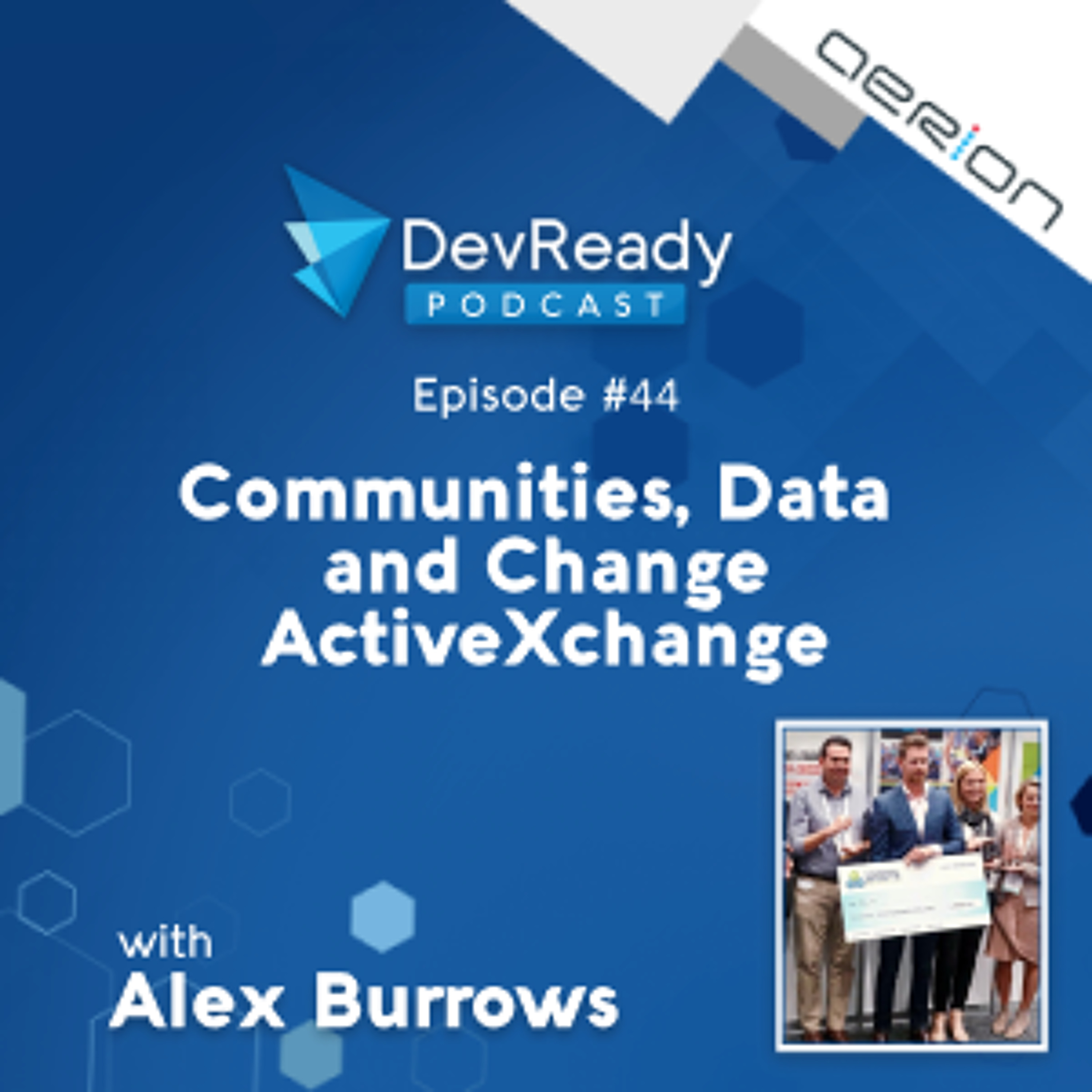
DevReady Podcast E44 - Communities, Data, and Change-ActiveXchange with Alex Burrows
On this episode of the DevReady Podcast, Andrew and Anthony talk to Alex Burrows, founder and CEO of ActiveXchange, a community sports organization that helps people with leisure management. He works with national and international sports organizations to help community outreach with fitness and activity programs. ActiveXchange partners with a swimming program in Australia. Their partnership allows them to show the local governments the social value that these fitness programs actually have, which can in turn further their financing and sponsorship. Alex discusses his journey toward developing this kind of software and why it matters to him. The most significant impact that Alex would like to see ActiveXchange accomplish is connecting health fitness programs to the 100 million Australians who need it. ActiveXchange gathers user data that partners can then use to tailor programs and access support from their local government and civic organizations. Ultimately, ActiveXchange seeks to make it easier for more people to get and stay healthy by using smart tech. Alex believes this can only be done with the right team: make your critical hires early and keep those people onboard. It will be so much easier to carry out big visions for your company if you’ve got the right people to deliver them. Topics Covered: ●Security and operations. ●Leisure markets. ●Integrating fitness systems into the community. ●Focus as a challenge: understand what to do with huge pools of data. ●The value that AI and machine learning adds to massive data sets. ●The benefits of creating a “sticky network.” ●Getting the first hires right is vital. ●Questioning your thinking is hard to do, but it opens up different opportunities. ●The obesity problem in Australia. ●Creating industry partnerships to build healthier, more active communities. ●Improving data processing for gyms. Key Quotes: ❏“You are doing a favor to that system provider by giving them fitness usage data.” (12:20) ❏“How can I best support my franchisee?” (15:40) ❏“We are trying to positively influence 10 million people on a rolling basis—how they’re active, how they’re healthy—through offering sporting and leisure opportunities.” (17:45) ❏“It’s important to have a really clear purpose.” (19:00) ❏“It’s about keeping as flexible [as you can] as long as possible.” (22:15) ❏“A lot of the time, organizations just want to be connected around more data.” (25:00) ❏“Hire people that have a passion for the area you’re working—it means they’ll go the extra mile.” (31:30) ❏“Just having a chat with someone outside your box can open up different ideas.” (34:20) ❏“Software can be challenging right out of the box.” (37:10) ❏“A third of leisure centers are at risk in Australia.” (43:30) ❏“We need a good team to deliver any outcome.” (53:05) ❏“Maybe don’t jump at every opportunity—you need a plan.” (57:45) ❏“Sometimes life happens for us.” (59:00) Contact Alex: ●Connect with Alex on LinkedIn ●www.activexchange.org ●Email Alex: [email protected]
DevReady Podcast E43 - Leading Sales by Guiding the Customer with Peter Strohkorb
On this episode of the DevReady Podcast, Andrew and Anthony talk to Peter Strohkorb about changing the thinking around sales, client engagement, and b2b marketing. Peter shares his experiences in sales and talks about how the methods of thinking about sales need to change. Even though the bottom line will ultimately be “top of mind” when it comes to growth, there are other metrics that can measure the success of the sales team, and companies should be using them. Among those assets are engagement. Peter explains that engaging your client on a personal level—figuring out how they think, and what their problems are—can ultimately guarantee you more work. The reason is that your client will see your value proposition. If you and your sales team haven’t worked through what value you can actually bring to your clients, then you’re not going to get very far. But most important is probably that you understand what your clients’ problems are, that you understand what solutions they’re talking about. You need to put in the work to understand how you can deliver value to the client and get them to trust you on that. Best case scenario, they accept the proposal, you deliver on time, and they say something good about you to a partner. Referral work is the best work, after all, because their guard is already down. Demonstrate that you have a proven sales model, and give the customer a good experience in the beginning, middle, and end. Topics Covered: ●The reward-oriented structure of sales needs to change. ●We need to rethink selling. ●Shifting the psychology of hitting monthly targets. ●Quality of interactions vs. the quantity of sales. ●You need a proven, structured sales process. ●Why you need a good sales tagline. ●You need to be able to articulate the value that you bring. ●How do you engage the client? ●Shape your conversation around who your point of contact is. ●Talk about how you can avoid risk. ●Creating value for our customers. ●OneTeam and “Smarketing.” ●Give the customer a good experience at all points. ●Referral business is the best kind of business. Key Quotes: ❏“When something goes right, people take the credit, but when something goes wrong, they blame others.” (1:58) ❏“It’s a push conversation that becomes a pressure conversation.” (4:25) ❏“We need to help our customers make an informed decision to buy from us.” (6:45) ❏ “Every organization needs growth, but we can change how we monitor sales achievements.” (11:00) ❏“The biggest value we can create is when we’re working with our customers one-on-one.” (15:00) ❏“You want a tagline that means something to your customer.” (19:45) ❏“You want a tagline that’s about an experience they can reasonably expect from your business.” (20:30) ❏“In this day and age, values are not enough. You have to have values, but you have to bring value as well.” (23:50) ❏“Challenging their thinking can create a conversation that feels sales-y.” (26:35) ❏“B2b sales is a long, drawn-out process in many cases.” (31:00) ❏“You don’t avoid the question of risk by showing that other people trust you.” (35:45) ❏“Once you send a proposal through, you’ve lost control of the sale.” (38:00) ❏“The worst thing you can do is just send the proposal.” (40:40) ❏“You want your client to feel like they’re being looked after.” (47:15) ❏“You don’t want to help them and have them go somewhere else.” (49:40)
DevReady Podcast E42 - Mentorship Network at Ylemer with Islam Abdullah
On this episode of the DevReady Podcast, Andrew and Anthony interview Islam Abdullah, CEO and founder of Ylemer—a company that connects entrepreneurs to mentors, which ultimately helps them to grow their community and their business. Islam talks to the hosts about how technology is a tool but that you need a vision for growth. Oftentimes, we are lacking in direction with regard to that vision. What Ylemer does is set up entrepreneurs with mentors to help them fine-tune and adjust their processes for growth. This is rooted in the idea that we need to lean on the experience of others to make the right choices. And the guidance of a deep network of mentors is invaluable. A key takeaway of this episode is that no one really knows what the next right move is. And a lot of time, that indecision can actually cripple your progress. What Andrew offers is this idea that decisiveness is the true virtue. You would be better to make the wrong choice and learn from it than to idle in indecision for too long. Islam is also aware of this and builds it into the brand at Ylemer. Taking small actions, building the trust of your clients, and leaning on the counsel of those with more experience can help you to make decisions quickly while offering the tools to help analyze and apply those lessons learned. Topics Covered: ●Investing in blockchain. ●C-chat in Windows 98. ●Cryptocurrency and entrepreneurship. ●Producing something to be able to attract attention and investment. ●Empowering entrepreneurship to drive impact. ●The concept of the “purpose mountain.” ●Leaning on the experience of others and asking the right questions. ●Filter out what is not adding value to your path. ●Little actions make huge differences. Key Quotes: ❏“We have intelligence and we waste it living paycheck to paycheck.” (7:00) ❏“What is really the vision that you want to do?” (8:30) ❏“Facebook and Twitter changed the way we have conversations.” (12:20) ❏“Everyone has their own story...advice doesn’t across the board.:” (18:45) ❏“Technology allows you to scale and automate.” (22:00) ❏“No process is set in stone.” (24:13) ❏“Purpose doesn’t have to be overly complex.” (29:06) ❏“Businesses have to realize that they are in discovery every single day.” (32:20) ❏“Working with someone to guide you is very important—what is the road ahead?” (38:00) ❏“You have no idea where you will be after you take the next step.” (39:20) ❏“Entrepreneurship is about your mindset and personal growth.” (42:20) ❏“Knowledge is easily obtained, but action is the key.” (47:45) ❏“Make decisions fast.” (52:00)
DevReady Podcast E41 - Dealing with Change with Sanne Del
On this episode of the DevReady Podcast, Andrew and Anthony sit down and talk to Sanne Del, national operations and quality manager at Six Degrees Recruiting. Sanne Del discusses her daily life as an operations manager and how she uses data analysis to drive her company forward. One of the most difficult problems in operations and data is dealing with change. Sanne shares how she uses her skills as a people person and as a manager to help her team deal with changes as they are rolled out, whether in company-wide infrastructure or in the small details of user interface. She is dedicated to helping everyone on her team to accomplish their tasks more efficiently and with fewer hiccoughs. A key takeaway of this episode is that companies really do have the power to drive change with thoughtful data analysis. It’s not as simple as just looking at a bunch of collected data and hoping the solutions will come to you. You need sharp people on your team who can analyze data and provide meaningful insights, whether internally or to a client. And with these kinds of tools in your camp, you should be able to weather any changes your company faces. It’s up to, people in leadership, to guide your team through changes and mitigate loss and fatigue. These are the signs of the best teams in the world. Topics Covered: ●Digital transformation ●Operations of a recruiting firm. ●Data analysis for operations optimization. ●Integrating with LinkedIn. ●The challenges in migrating to new systems in operation. ●Identifying problems areas and breaking down solutions. ●Change management and dealing with challenges. ●Working with integrated systems. ●Interface as a barrier to user functionality. ●Continuous learning and puzzles in operations management. ●Delivering meaningful data analysis to your team or client. ●Data without insights is useless. Key Quotes: ❏“We track internal and applications.” (02:25) ❏“I make sure the information is clear and where we need it.” (04:45) ❏“Our focus is on simplifying our systems now.” (07:10) ❏“It’s really hard to understand what you need to do and how you need to do it.” (10:45) ❏“Technology is an enabler; it is not a solution.” (14:22) ❏“There’s no such thing as a perfect plan.” (18:30) ❏“If you see a change, and it doesn’t stop you from being able to do your work, then just roll with it.” (19:20) ❏“Things change, but you can still figure it out.” (21:00) ❏“Sometimes systems just need tweaking so they’ll talk to each other.” (23:20) ❏“People use only 10% of the functionality of MS Word.” (32:30) ❏“Automation allows us to find problems more quickly.” (36:40) ❏“If you’re not working in the technology space, sometimes it’s really lonely.” (44:30) ❏“[In data analysis] if you don’t go in with a specific goal, it’s really difficult to find.” (46:45) ❏“90% of the world’s data was created in the last two years.” (48:36) ❏“Doing it for technology’s sake is the wrong reason.” (51:30) https://www.linkedin.com/in/sannegr/
DevReady Podcast E40 - Preventing Worksite Accidents with Machine Learning with Nathan Kirchner
On this episode of the DevReady Podcast, Andrew and Anthony talk to Nathan Kirchner, founder and CTO of Presien, an AI company providing solutions for heavy machines. Nathan describes the process of working with heavy machinery and seeing otherwise preventable accidents. After spending some time designing his ideas, he presented the solution to VCs who saw its value. Nathan’s vision allows for engineers to build artificial intelligence platforms that give heavy machinery a sense of situational awareness. This awareness can help reduce accidents by sensing blind spots and workers in the way of heavy equipment. Nathan’s company Presien currently develops this platform. In the episode, Nathan also explains how his concept came to life, how he built his dream team, and how he applied certain takeaways from his time in Silicon Valley. Nathan’s favorite catchphrase he picked up from Silicon Valley: “There are a thousand engineers who are 100% right, but unfortunately, there are 7 billion other people who don’t care.” Topics Covered: ●Situational awareness in machines. ●Preventing machine-related accidents. ●The hardware and software used in machine situational awareness. ●Founding a tech business without a tech background. ●Picking up the resilience of Silicon Valley. ●You need to get your organization to see the value of your idea. ●Lessons learned in Silicon Valley. ●Structuring your business in the beginning. ●VCs want you to be coachable. ●Develop an MVP with real value and the rest is momentum. ●Talk to customers like they’re real people. ●You can improve the product by learning about the customer. ●Solve a problem, don’t build a product. Key Quotes: ❏“It’s all about the machine-person interaction.” (2:40) ❏“Some 65% of those accidents are related to working with machines.” (4:35) ❏“If I provide the information, I’ve already got the best control of the machine.” (7:49) ❏“In the consumer space...you expect it to work, and you don’t care how it does it.” (12:20) ❏“They have a fear that they [the company] will take it or ignore it.” (17:50) ❏“It’s better to have a small slice of the pie than no pie at all.” (18:45) ❏“You’re there to build efficiency, not create a product.” (21:10) ❏“We had a product, we had traction, and we had some ability to generate revenue out of it.” (24:15) ❏“If you can demonstrate that you’ve solved a real need, that’s enough to buy you the time for the rest of the things to happen.” (26:40) ❏“Don’t try so hard...and listen!” (34:40) Contact Nathan: ●LinkedIn ●www.presien.com
DevReady Podcast E39 - Contracting & Startups with Rafael Kaluri
On this episode of the DevReady Podcast, Andrew and Anthony talk to Rafael Kaluri, founder of NextContract, a digital platform that connects businesses to their next technology contractors. Raf has had a variety of roles in tech contracting in different industries, from business analyst to product development and helping to institute organizational change. Tech contractors are often hired to know, understand, and find problems that you can actually solve. The positives in contracting include exposure and being able to connect with a multitude of stakeholders across an organization or an industry. There is a network-building benefit to contracting. And the networks grow deeper with more work. Be in the know, stay motivated, and look and create for more opportunities. The mission of NextContract is to ensure that contractors are employed and are able to go between contracts with minimal downtime. The three tips from Raf: 1.If you have an idea, validate it. 2.Understand the partners you’re going to select to work with. 3.You are an investor building in your platform, so you need to understand how you’re going to get it to market. Topics Covered: ●Tech contractors. ●Culture and accepting organizational change. ●The benefits of networking. ●Rewards and challenges of contracting. ●You need to have unparalleled growth on your profitability. ●The importance of branding for your own success. ●You might move between organizations fairly quickly as a contractor. ●Spending time with users and a high degree of planning. ●Brainstorming! ●Struggles in determining the cost of your product. ●Preparing to engage with potential clients and organizations. ●Designing based on use cases. ●Project managing in the software space. Key Quotes: ❏“When we try to challenge what has been socially accepted, it doesn’t sit well with those that have been in the business for a long time.” (5:45) ❏“Being small is an opportunity when you’re innovating.” (8:35) ❏“You’re delivering an outcome and you’re selling yourself on the next outcome.” (15:00) ❏“You are your own brand, and you need to build that with intention and purpose.” (15:45) ❏“It is, predominantly, being in the know and keeping those doors open.” (19:30) ❏“You’re not applying for a job; you’re applying for an opportunity to deliver an outcome.” (25:10) ❏“The saying goes something like: we spend three years in planning and one year in building.” (30:10) ❏“You might get one shot to showcase your platform to the users.” (32:45) ❏“People are generally open and honest [when critiquing design].” (45:00) ❏“You already know the solution if there is a problem.” (46:20) ❏“It’s not just the idea, it’s how you’re going to monetize it.” (56:00) Contact Rafael: ●LinkedIn ●https://www.nextcontract.com.au ●Email Raf at: [email protected]
DevReady Podcast E38 - Using Navy Principles in a Startup with Kurt Alexander
On this episode of the DevReady Podcast, Andrew and Anthony talk to Kurt Alexander, founder of Quick Safety, a company dedicated to making electrical regulatory compliance easy. Born and raised in Wyoming, Kurt describes a childhood that fostered his analytical nature. A Navy veteran, he worked on nuclear submarines while he was in the service. Working in sonar, he learned a lot about electrical engineering before launching careers in consulting, furniture, retail, and eventually the tech space. Over the course of the episode, Kurt tells the story of Quick Safety and how it has revolutionized the electrical industry in Australia. Beyond just explaining the mechanics and the need for Quick Safety’s digital electrical tests, Kurt offers advice to startups on how to stay focused, why you have to hunt for opportunity, and why you need to empower your business first. A main takeaway is that you need to know your customers. They have to understand the value of your product. Quick Safety is an electrical regulation compliance company that streamlines the testing process so electricians can determine the safety of systems more quickly, efficiently, and reliably. This all helps the homeowner and asset owner to avoid potentially life-threatening electrical situations. Topics Covered: ●Kurt’s time in the military during the Cold War. ●The issues that the electrical industry faces. ●The 8 tests that electrical regulators have to conduct on new dwellings. ●You have to actually seek out opportunity; it doesn’t just come to you. ●Founders have an opportunity to connect and make things happen online. ●The difference between incubators and accelerators. ●Quick Safety validates the test information. ●Quick Safety’s tech makes electrical tests easier and protects electricians and homeowners. ●You have to attribute the cost of your product back to the asset. ●People get a little too focused and fixed on the product. ●Data dumping to get the support of tech companies. ●Ensuring all your processes are correct to drive revenue and empower your business. ●People are happy to share, but you can lead the conversation, too. ●The effectiveness of “small teams” and load sharing. Key Quotes: ❏“89 days was the longest that we stayed submerged.” (6:32) ❏“I made the mistake of spending too much time in the business instead of on the business.” (15:00) ❏“My time on the forklift gave me a chance to think—what do I really want to do?” (19:01) ❏“The retail industry is more consumer-focused.” (24:15) ❏“You have to put yourself out there and you have to network.” (36:10) ❏“Most of the electricians prior to Quick Safety were doing all the math in their heads.” (46:50) ❏“The real target customer is the asset owner.” (51:05) ❏“If you’re going to be pushing your product, you have to make it as easy as possible for a customer to come on and off of that system.” (56:25) ❏“Your vision and product should be developing all the time.” (1:00:10) ❏“You only have to develop the nucleus of your company once.” (1:10:31) ❏“You want to get from conception to revenue as quick as you can.” (1:11:05) ❏“The real drivers in the team are those that will take responsibility.” (1:21:45) Social Media Clips: 1.Kurt’s career experience leading up to Quick Safety. (14:00 - 16:00) 2.What the state electrical regulators actually do. (27:20 - 28:51) 3.Incubators and accelerators. (38:40 - 40:31) 4.Founders and their relationships with tech companies. (1:03:50 - 1:06:45) Contact Kurt: ●Find Kurt on LinkedIn: https://www.linkedin.com/in/kurtalexander/?originalSubdomain=au ●www.quicksafety.com.au
DevReady Podcast E37 - Growing Your Business with CX with Brendan Tremble
On this episode of the DevReady Podcast, Andrew and Anthony talk to Brendan Tremble, founder and director of CX consulting at FT Executive. Brendan explains the concept of CX and how it relates to growing your business and customer base. Brendan also shares some of the things startups should expect when structuring their culture, processes, and products around the values that are informed by best customer experience. Brendan leads one of the top consulting firms in Australia. Topics Covered: ●CX (Customer Experience) Consulting. ●Working with startups. ●The core competencies of customer experience. ●Culture as a driver of customer satisfaction. ●How do you measure customer focus? ●Avoiding transactional relationships in your customer base. ●Attracting and keeping customers with CX-based values. ●Understanding the different life cycles of the customer. ●Collecting data to improve customer processes. ●You need to know WHO your customer is. Key Quotes: ❏“Customer needs change every day.” (3:25) ❏“You need your team around you to be about it.” (6:45) ❏“It’s a lot cheaper to keep a customer than to go out and get a new one.” (12:00) ❏“You need to actually have customer-centric values.” (14:45) ❏“Product development people understand the life cycle of the product.” (20:55) ❏“It’s not just collecting metrics — it’s how you’re using them.” (22:30) ❏“Process improvement people make the best CX people.” (25:05) ❏“Customer experience is really process improvement for customers.” (32:40) ❏“Trying to do everything doesn’t really serve anyone.” (39:10) ❏“You have to know which questions to ask.” (43:58) Contact Brendan: Check out Brendan’s company: www.ftexecutive.com.au Find Brendan on LinkedIn. The Books Brendan Mentions: ●Design Thinking ●Sprint by Jake Knapp ●Outside In by Harley Manning and Kerry Bodine ●Chief Customer Officer 2.0 by Jeanne Bliss
DevReady Podcast E36 - Making Crowdfunding Work for Your Business with Matt Vitale
Summary: Our guest on this episode of the DevReady podcast is Matt Vitale, Co-founder of Birchal equity crowdfunding. Matt and the other co-founders combined their knowledge from their different industries to create Birchal with the goal of making the site mainly focused on the companies and facilitating a seamless process for the transaction from beginning to end. Birchal was an integral part of the lifting of the Australian government’s restrictions on equity crowdfunding several years ago, and they continue to impact related legislation as the company and the industry continue to grow in popularity and scope. The Birchal team has a very specific process for reviewing companies who are interested in posting campaigns on the site which includes both objective and subjective filters to ensure that the idea is viable before it is presented to potential investors. Through the expression of interest process, companies are able to gauge interest and receive pledges before ultimately launching their campaigns. Birchal is Australia’s leading crowdfunding platform, accounting for more than half of the monies invested through crowdfunding last year. For more information about hosting a campaign on Birchal or if you have further questions for Matt, don’t hesitate to reach out. Topics Covered: ●How Birchal was formed ●Equity crowdfunding ●How government regulation has impacted and continues to impact the industry ●The process that companies go through in order to post campaigns on Birchal ●Which businesses should pursue crowdfunding ●Getting feedback from interested investors ●Guiding companies to appropriate valuations ●Crowdfunding as a vehicle for fundraising ●Which campaigns are successful during COVID ●How to handle investors who are ready to cash out their investments ●The healthy tension between the company and their investors Key Quotes ❏“It took about 5 years for the government to realize it wanted to do this and then pass the legislation to do it.” (2:55) ❏“Looking back, it was a very effective execution of building technology for what is often a fairly complicated process.” (4:39) ❏“It’s all about finding the relevant audience for each company and treating each campaign as a discrete project.” (9:47) ❏“It’s all about momentum.” (15:16) ❏“When we started the platform, we decided to quite deliberately describe the businesses that we want to work with as those that have a strong consumer proposition.” (18:58) ❏“It’s about finding an audience that will derive benefit from your success.” (20:58) ❏“Things are worth what people are willing to pay for them.” (22:38) ❏“You want to give them enough information so they’re interested in you and then have this opportunity for engagement.” (26:29) ❏“Every campaign that we host has at least a handful of investors that are investing over $10,000.” (31:27) ❏“Crowdfunding is still open for business.” (37:24) ❏“The trouble that we have is with the law.” (44:54) Contact Matt: https://www.birchal.com/ [email protected]
DevReady Podcast E35 - Understanding the Market for Your Startup Idea with Ahron Young
On this episode of the DevReady Podcast, Andrew and Anthony speak with Ahron Young, the founder and CEO of Ticker TV, a Melbourne-based news streaming service. Just out of high school, Ahron got a job at a local newspaper. There he got his toes wet in journalism. This continued with a job at a local TV station, and the Russian news service, RT then Sky News. Ahron chose the name Ticker because it scrolls at the bottom of the screen, but it’s also our heart. He describes his time building Ticker as an alternative to morning cable news, targeted directly at millennials. Ahron gives advice for breaking into the field, building value and discovering the market for your idea. He runs a successful TV service with just over 30 people on his team. He intends to grow Ticker into a global company. He also advises us to look out for our mental health, especially in the tech world. “Don’t expect yourself to be a winner,” he says, “but it’s just as important to learn to forget as it is to learn.” Topics Covered: ●Ahron’s background in commercial TV. ●The importance of marketing. ●Working at RT and how it was the best and the worst experience. ●Be wary of who you bring in for equity because it’s difficult to get rid of people. ●We really don’t have long attention spans anymore — too many are fighting for it. ●Where Ahron got the idea for Ticker TV. ●Ticker TV is a news service that looks to answer “what do people want from the news?” ●Working in a corporate environment, and how it hurts your individuality. ●As long as you deliver what people want, the rest doesn’t matter. ●You need to understand who you are, and establish your identity. ●The average age of a startup founder in Australia is 54. ●What you forget is just as important as what you learn. ●Structuring the business in its early stages. ●Working in a culture where people take ownership of their work. ●Get bigger, and faster, and better — or someone else will. ●COVID has been difficult, but Ticker’s business has not struggled. ●Identify your brand and really pump it out. Key Quotes: ❏“Journalism is a lifestyle choice, and it basically owns you.” (03:30) ❏“The floor manager at RT pulled out a gun.” (07:55) ❏“We are members of the business communities to which we are a part of.” (10:05) ❏“It’s never been an open opportunity: it’s always been something you’ve had to fight for and strive for.” (12:25) ❏“You can’t fight a fleeing customer base in court.” (16:50) ❏“It’s all about looking for gaps in the marketplace.” (21:30) ❏“Every time talent meets the corporate world, something gives: and it’s usually the talent.” (25:35) ❏“When you love what you do, it’s hard to realize when you need to ask for help.” (28:45) ❏“In the end, TV is your graphics package, your audio, your presenters, and your studios: nothing else matters.” (37:55) ❏“It’s up to you to know the time to forget and the time to remember.” (47:10) ❏“It doesn’t matter how you structure it, you’re not starting a business on your own. You need a team around you. (54:30) ❏“Don’t ever create a barrier to entry for yourself.” (1:02:05) ❏“We want to start Ticker in 10 other countries.” (1:14:00)
DevReady Podcast E34 - Writing with Your Audience and Your Purpose in Mind with Adam Turner
On this episode of the DevReady Podcast, Andrew and Anthony speak with Adam Turner, freelance technology journalist who writes for the Sydney Morning Herald. Starting out working for The Age, he developed a passion for tech and decided to go freelance – writing consumer tech for magazines like PC Authority and MacWorld, along with biztech for publications like the AFR and CRN. He also has his own tech news podcast called Vertical Hold. Adam dives deep into the world of freelance writing and explains some of the nuances in building credibility. He spends a bulk of the episode breaking down helpful tips as well as scathingly criticizing the cumbersome tech writing of today. His main points here are that writing needs to be concise and engaging. There are tricks, but ultimately it’s a skill. Topics Covered: ● How to start selling your name and your business in press releases. ● The importance of the brief on a press release. ● Understanding what you want for the outcome. ● It’s all about the hook, for journalism and everything else. ● General advice for making your writing better. ● Why reading a lot makes you a better, more engaging writer. ● You need to understand the style you want to capture. ● It’s all about writing concisely and engagingly. ● The move now is away from academic language to tight, engaging writing. ● You must have something to say — it’s the most important thing. Key Quotes: ❏ “If you’re writing a thought leadership post, you’re helping them know stuff.” - (12:20) ❏ “If they see your press release and it reads like an ad: swipe.” - (14:10) ❏ “It’s not easy to write about yourself and not about yourself at the same time.” - (15:46) ❏ “When you’re talking to a journalist, you’re talking to them in 5 second increments, if you’re lucky.” (18:20) ❏ “Sometimes you have to throw out the line you worked really hard for.” (21:16) ❏ “Don’t get too bogged down in it.” (24:10) ❏ “Have a look at what your competitors are doing as well.” (28:25) ❏ “Every word and every paragraph needs to be doing a job -- if it’s not, get rid of it.” (34:10) ❏ “I always find more mistakes on a printed page than I do on a screen.” (39:00) ❏ “If I get stuck, I go back to the beginning.” (40:25)

DevReady Podcast E33 - Knowing the Product, the Problem, and the Portability with Mark Milanese
On this episode of the DevReady Podcast, Andrew and Anthony speak with Mark Milanese, founder at OneLenz, a tech platform that connects startups to VCs and investors. Over the course of the episode, the guys speak with Mark about how companies should approach investors, what things young startups should consider, and how to avoid common pitfalls when seeking funding. The main takeaways here are that it’s very hard to build a successful product on a weak platform. Spend the time (and money) hammering out all the details first and you’ll be much more likely to find success when it comes time to seek investment rounds. If you know the value that your product brings to the market and to your customers, it’ll be much easier to grow. Learn the tech, know the problem that your product solves for your base, and figure out how to fail. Investors will be impressed with your tenacity. Topics Covered: Startups need to chase clients, not funding. Where to start if a founder comes to OneLenz for investment. People need guidance in getting the requirements right. Your first version doesn’t need to be perfect, but it needs to be good enough to get feedback on. Founders should definitely bring in a tech consultor to save money in the long run. Global founders are ambitious and relentless. You need to know what your value is to your customer. The best thing to do is to fail fast. Don’t try to be everything to everyone. If someone hands you a big check, they’re going to run right through you. Building a product is a full-time job. People are understanding the value of meeting digitally through Zoom now. Key Quotes: “Where you start depends on your tech.” (10:50) “You need to know how to link what you want to what you can deliver.” (13:30) “What’s your business, what’s your business model…how big do you want to go?” (18:40) “You’re still on the phone 24/7.” (20:15) “You gotta learn how to fail fast…and move on.” (23:20) “You’ll want to be on the VC’s radar at least six months out.” (27:15) “I’d rather chase sales than chase investor’s money.” (31:00) “Keep your job as long as you can.” (44:00) “It’s all about the kind of business you want.” (48:00)

DevReady Podcast E32 - Transforming Business for the Future with Saleem Qureshi
On this episode of the DevReady Podcast, Andrew and Anthony speak with Saleem Qureshi, investor and CEO of Assessment Fund, based in London. They talk about the need for digital transformation in the wake of COVID, the very apparent digital divide, and the tools (and rationale) for successful digital transformation. COVID has pushed virtually all companies to consider a work-from-home model, and this is necessarily changing the way we do business. Saleem suggests that companies that want to survive need to lean into those changes and really understand how they can transform digitally. Ultimately, the companies that fail to do this will be left behind. Saleem also talks about how education is tied intimately to the problems businesses are facing in digital transformation, but there may be tools around the corner. The world is digitizing — and that doesn’t just mean going online — and it’s up to the young companies to have the hard conversations they need to transform. A new economy is being created, even though we don’t know what it will look like. To best prepare and future-proof ourselves, businesses need to have conversations about who they are, and who they will be going forward. The digital divide will eventually shrink, but only when companies successfully transform into the digital age. Topics Covered: ●The problems in trying to digitize the world. ●Bringing education up to digital speed. ●The importance of digital transformation in staying alive. ●Focus on the value you deliver to your customers. ●Preparing pre-IPO companies prepare for their IPOs. ●Educating the boardroom on the financial impact of tech. ●Work-from-home models changing the world. ●Unemployment in the future. ●The new economy that is being created. ●Problems in the developing world. ●Some of the issues that work-from-home is bringing to the table. ●Demand to move to the bigger cities. ●The main concerns for digital transformation. ●Volkswagen is transforming itself into a software company. ●Digital transformation is transforming the business model. Key Quotes: ❏“We wanted to understand ‘what is intelligence?’” (01:35) ❏“The people are still analog.” (2:40) ❏“Turn your data into dollars.” (10:00) ❏“Digital transformation actually increases your value.” (12:25) ❏“The boardroom is not tech savvy.” (15:20) ❏“It’s the vendor’s responsibility to sell the board on the tech.” (18:00) ❏“We need to talk to people in the same language that they use.” (21:00) ❏“The stock prices of companies are going up.” (25:25) ❏“Work-from-home is going to test people’s ability to upskill themselves.” (26:30) ❏“You can either stay relevant or you can not be counted.” (28:08) ❏“You don’t really need a four-year degree anymore because the education sector is so far behind.” (28:50) ❏“It’s easy for small companies to transform; it’s difficult for large companies to transform.” (39:45) ❏“The real value is in giving the customer the life they want, and the car is just a tool to get there.” (41:10) ❏“Everybody must be transforming the way they do business.” (44:00)

DevReady Podcast E31 - Product Design, From Prototype to Profit with Hamed Ghajarnia
On this episode of DevReady Podcast, Andrew and Anthony speak with Hamed Ghajarnia, Managing Director and polymer engineer at DreamLaunch, a company that helps people bring hardware visions to life. During the conversation, Hamed speaks to the processes surrounding idea generation and execution for hardware needs. He also breaks down what it’s like for a new company to wrestle with their software and hardware development needs. They discuss the value of investing in research early on in the design process, and the difficulty in trying to bring a new idea to market rather than capitalizing on the existing competition. Hamed also breaks down the nature of prototypes and how businesses can best use them to develop great products. The key takeaway from their conversation with Hamed is that, like many others they’ve had on the show, listening to the customer is paramount. There is no skill more valuable than being able to hear what a customer’s needs are and allowing that information to inform your processes at every step. That’s how you can guarantee success.

DevReady Podcast E30 - ’Sweat Equity’ and Real Value with Paul Lange
On this episode of DevReady Podcast, Andrew and Anthony speak with Paul Lange, “Business Growth Accelerant”, about working in private equity, the life of buying companies to scale, and the importance of understanding how to grow your business. When looking to draw investors, what you really need to be able to do is demonstrate that you can sell what you want to sell. “Sweat-equity” is great but investors care about real valuation. Paul lays out a 9-point strategy for growing your business and prepare for success from the perspective of an investor: 1.Figure out ways to minimize your risks. a.Find out what’s in it for you. b.“Where’s the exit?” c.“Show me the money”: demonstrate the capital-building potential. 2.Taking money (because you cannot really “make” money). a.Structures: get the structures of your company right. b.Systems: the balance of formalized and personable. c.Scalability: so you can grow beyond your local market. 3.Making it happen: all about people. a.Who’s on the team? b.Where’s your niche? (The target market.) c.Traction: Why, what, and how you do what you do Some tips from Paul: 1.Spend one day writing out your plan, and get it on paper. 2.Iterate, iterate, iterate. 3.It has to be good enough to start — and then start! The strategy for implementing all nine of his points: ask yourself the question, answer the question, and question the answer. Rinse and repeat until you really like what you have. Topics Covered: ●Private equity firms. ●Managing buyouts. ●The dizziness associated with taking on a multi-million dollar portfolio. ●Money should be the last thing that’s “in it for you” in your business. ●Your vision needs to extend beyond your business. ●The effectiveness of collaborative campaigns. ●How to minimize the risks in your business. ●The importance of understanding the marketplace. ●Folding a business into yours to mutually grow. ●Understanding how much it costs to scale even a small business. ●Sweat-equity is not nearly as valuable as real valuation. ●There’s no right or wrong about structures: just put some thought into it. ●The result of systems is that they put the focus on your values. ●Small business owners need to divide and conquer. ●Hire based on values not skills. ●Think about who you really want on your board. ●Define very clearly who you add value to. ●Measuring traction. ●The experience is what keeps people coming back. Key Quotes (Time Stamps): ❏“I don’t want to fly C-130s: I want to be Top Gun!” - (6:30) ❏“Before you get into anything, you need to have your exit strategy nailed down.” (8:00) ❏“I tell most people: ‘how about you try selling your way out of your funding issues.’” (9:45) ❏“Business is not built to last -- think about where your exit is gonna be.” (15:15) ❏“At the end of the day, an investor and an business owner are looking to put money into their wealth account.” (19:00) ❏“Whenever possible, we will put the smallest amount of money on the table.” (22:45) ❏“I know people who have bootstrapped a business on a grand.” (30:15) ❏“To really be random and fluid, you need a solid structure underneath you.” (36:40) ❏“You cannot effectively scale without the systems in place.” (43:45) ❏“There are different levels of exit.” (47:10) ❏“Passion is teachable.” (49:50) ❏“Even the Catholic Church doesn’t have 100% of the religious market.” (55:10) ❏“If you can’t measure it, you can’t demonstrate it.” (1:02:35) ❏“A restaurant is only as good as its last meal.” (1:07:45) ❏“Perfection is procrastination.” (1:10:50)

DevReady Podcast E29 - Suits and Sneakers: Strategy and Technology Combined with Anne Miles
In this episode, startup founder Anne Miles talks about her journey with her company, Suits and Sneakers — where she started, what has worked and what hasn’t, and where she’s headed in the future. The name “Suits and Sneakers” comes from the essence of her business: the combination of strategic people like project managers (suits) and the technology, creative, and production people (sneakers). Suits and Sneakers was birthed so that advertising and marketing specialists don’t get lost in the shuffle and was, at the beginning, intended to be a directory. Through a series of events, Anne ended up setting up a format so that people could tell her directly what they need and she has been doing manual matching since then. Anne talks about where her company fits in the market; somewhere between a directory and a PR agency with hands-on services. The three discuss the advantages and disadvantages of investors and Anne shares why she hesitates to have them and is instead leaning toward an advisory board. They also talk about the pros and cons of Wordpress, how to use technology in light of your customers, beta testing, and IP rules. At the end, Andrew and Anthony ask Anne what advice she would give herself two years ago and they provide a bit of their own advice as well.