Deviate
235 episodes — Page 4 of 5

S3 Ep 121How to balance creative success with business success: An open chat
“The dualities of the ‘creative person’ and the ‘business person’ don’t need to exist any more, because one person can do all of it.” –Sachit Gupta In this episode of Deviate, Rolf and Sachit discuss creativity versus business success, and the currency of social media (2:30); the diminishing returns of listening to advice, and the importance of action (16:00); interview and preparation techniques, and how how “bringing value” can apply to spiritual ideas as readily as business ideas (24:00); being creative in business, and how creative people are now expected to do their own marketing and promotion (36:00); thinking innovatively, and breaking with habit and tradition (44:00); how success can be compromised in the clickbait era, and creativity in the age of social media (59:00). Sachit Gupta (@sachitgupta) is the founder of Platforms Media, where he helps creators build, grow, and scale their online platforms to amplify their message and connect with brands. He is also the host of the Conscious Creators Show. Notable Links: Tim Ferriss (entrepreneur / podcaster) Entourage (television show) The Mixed Reviews (podcast) Kanye West (rapper) Rick Rubin (record producer) Craig Ferguson (television host) Scrivener (application) Punk icon Ian MacKaye (Deviate episode) Why dinosaurs matter (Deviate episode) Fallibility, reflexivity, and the human uncertainty principle (article) Range, by David Epstein (book) Powerhouse, by James Andrew Miller (book) Understanding Media, by Marshall McLuhan (book)
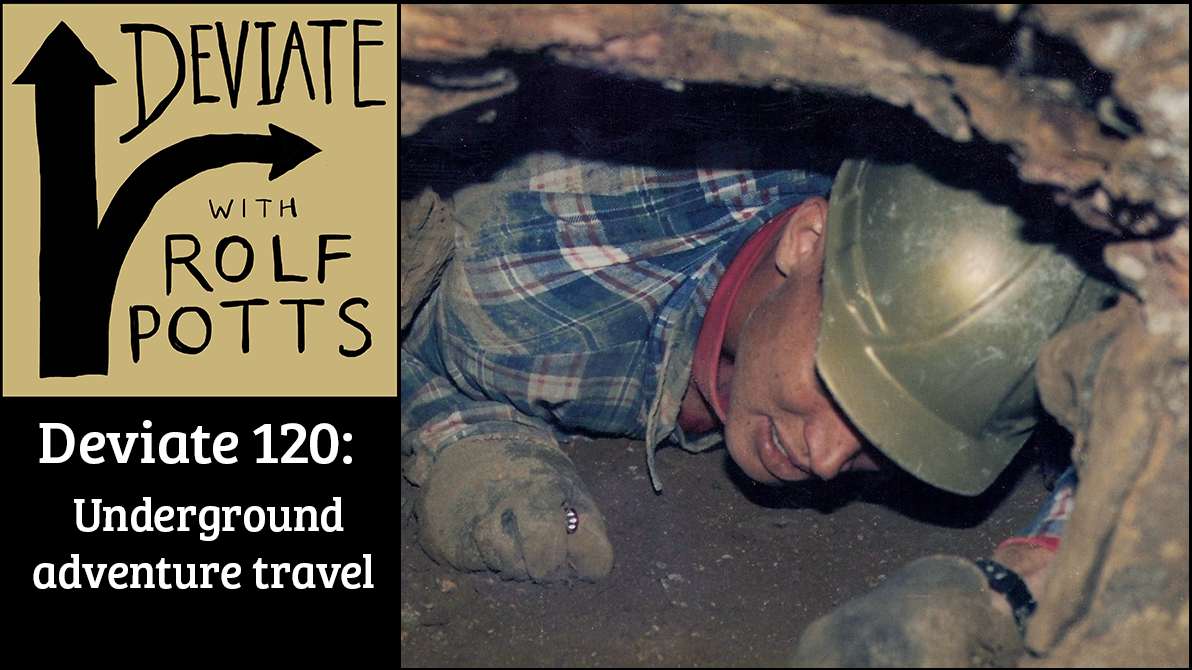
S3 Ep 120How underground exploration is the perennial frontier of adventure travel
“Even the briefest trip into a tunnel or a cave can feel like an escape into a parallel reality, the way characters in children’s books vanish through portals into secret worlds.” –Will Hunt In this episode of Deviate, Rolf and Will talk about our imaginative relationship with underground places, and how it often starts in childhood (4:30); the concept of “urban exploration” in the industrial spaces underneath cities, and Will’s fascination with a NYC graffiti artist named REVS (11:00); the catacombs of Paris, how easy it is to get lost underground, and how hard it is to map underground passages (26:15); going underground as a form of time travel, the microbes that live underground, and the relics that can be found underground (40:00); the spiritual aspect of spending time underground in the dark zone of a cave (51:00); and how and why to get started exploring underground (59:00). Will Hunt’s (@willhunt__) writing, photography, and audio storytelling have appeared in The Economist, the Paris Review Daily, The Atavist, The Guardian, Discover, Audible Originals, and Outside, among other places. He is currently a visiting scholar at the NYU Institute for Public Knowledge. Underground is his first book. More about Will at: https://www.willhunt.net/ Notable Links: Salt Cathedral of Zipaquirá (underground church in Colombia) Mount of the Temptation (hill in the Judean Desert) Panoptikum (labyrinth in Budapest) Freedom Tunnel (railway tunnel in NYC) Urban exploration (exploration of abandoned places in cities) Revs (graffiti artist) Catacombs of Paris (tunnel network) Philibert Aspairt (man who died in the Paris catacombs in 1793) Cataphiles (urban explorers who illegally tour the Mines of Paris) Metro-2 (purported secret underground metro system in Moscow) How Getting Lost in a Cave Affects the Brain (article) Strataca (salt-mine museum in Kansas) Lakota Wind Cave (site in South Dakota) Homestake Mine (deep South Dakota gold mine) Gregory of Nyssa (Christian saint) This episode of Deviate is brought to you by Tortuga Backpacks, which set the standard for the best, most durable, organized, and comfortable travel backpacks. Tortuga products also include daypacks, duffels, and other travel accessories, which are all made with the traveler in mind and have been featured by Wirecutter, The New York Times, Travel + Leisure, Business Insider, Carryology, and many other...
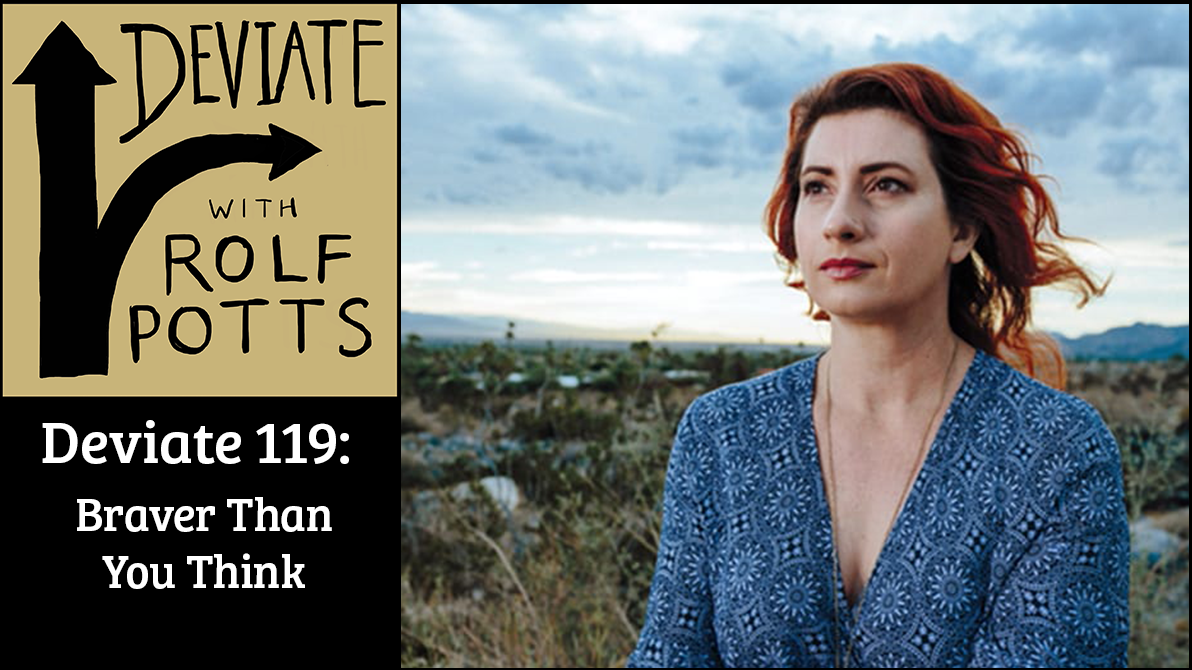
S3 Ep 119Honeymoon without her husband: Maggie Downs’ uncommon world journey
“You need to create your own life, and gather memories while you still can. There are no guarantees that you will have a ‘next year’ or a ‘ten years from now’ or even a tomorrow.” –Maggie Downs In this episode of Deviate, Rolf and Maggie discuss how she started traveling (3:00); “trying on” different versions of yourself during travel (17:00); and travel as a way to reflect on your life (37:00). Maggie Downs (@downsanddirty) is an award-winning writer whose work has appeared in The New York Times, The Washington Post, The Los Angeles Times, and Lonely Planet’s True Stories From the World’s Best Writers and Best Women’s Travel Writing. She is the author of Braver Than You Think. This episode is also brought to you by AirTreks, an industry leader in multi-stop international travel, specializing in complex routes with up to 25 stops. The AirTreks website offers suggested pre-planned travel itineraries to help you get started, but can customize to fit your journey. The Deviate theme music comes from the title track of Cedar Van Tassel’s 2017 album Lumber. Note: We don’t host a “comments” section, but we’re happy to hear your questions and insights via email, at [email protected].
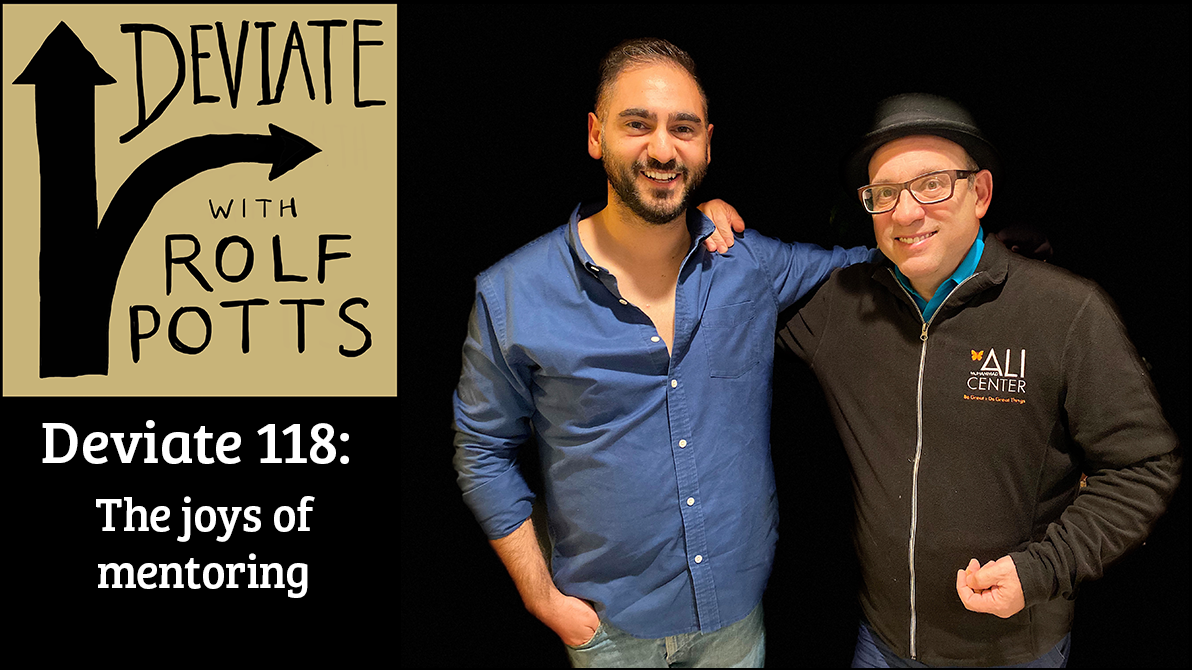
S3 Ep 118The win-win of being a mentor, with Cal Fussman and Alex Banayan
“I reached out to dozens of potential mentors. The two that that changed my life are the ones who didn’t give me advice upon first meeting me, but asked me questions..” –Alex Banayan In this episode of Deviate, Rolf, Cal, and Alex discuss how Alex realized he desperately he needed help in writing his book The Third Door, how Cal Fussman came to help him with the project, and why asking questions is as essential of a mentor as is giving advice (5:30); why the vulnerability and tension of good storytelling is more essential than conveying dry facts in writing a business book, and how Cal encouraged Alex to recount a humiliating story about sending a single shoe to Warren Buffet at the behest of a bad-faith mentor (23:00); what happens when a would-be mentor gives the mentee advice out of narcissism or bad faith, and how to know when not to heed the advice of a mentor (35:00); how to find and recount the most vulnerable and appealing part of your own life-narrative, and how Cal taught himself how to tell good stories (42:00); what Cal and Alex’s mentoring sessions looked like, in terms of what Cal was trying to get Alex to understand (51:00); what Cal learned from Alex as his mentor, how Alex’s insights improved his career, and what older people in general can learn from younger people (56:30); and what kinds of advice Cal and Alex have for people seeking to discover and fine-tune mentor-mentee relationships (1:02:00). Cal Fussman (@calfussman) is a journalist, author, and Writer at Large for Esquire Magazine, where he has interviewed the likes of Muhammad Ali, Mikhail Gorbachev, Jeff Bezos, Richard Branson, Robert DeNiro and hundreds of others who’ve shaped the last half-century. Alex Banayan (@AlexBanayan) was named to Forbes’ 30 Under 30, and Business Insider’s “Most Powerful People Under 30” lists. He is the author of the international bestseller The Third Door. For more about Cal and Alex, check out their websites, https://www.calfussman.com and https://thirddoorbook.com. Notable Links: Larry King (television host) Warren Buffett (American investor) Reid Hoffman (American internet entrepreneur) Nelson Mandela (former President of South Africa) Muhammad Ali (boxer)
S3 Ep 117Why a “Shelter in Place Film Festival” beats bingeing video right now
“Binge watching is designed to make time disappear. A home film festival is designed to be time well spent.” –Kevin Smokler Kevin Smokler (@weegee) is a writer, public speaker, critic, and author of Brat Pack America and Practical Classics. He speaks on the future of media and culture and his written work has appeared in such publications as the Los Angeles Times, Buzzfeed, and Vulture. He previously appeared as a guest on Episode 33 of Deviate, Why 1980s coming-of-age movies matter, and Episode 60, “Celebrating the best travel movies ever.” In this episode of Deviate, Rolf and Kevin explain how to organize and execute a Shelter in Place Film Festival as an alternative to bingeing video during a time of pandemic. Kevin hosts a full guide online at his website, but here’s an outline version: Notes on creating a Shelter in Place Film Festival Establish a time-constraint An afternoon? A day? A weekend? Film Festivals are inherently a time-bound activity. It may seem counterintuitive to begin planning with how much time you wish to spend watching movies rather than how many or what movies you wish to see. But you can always add movies if everyone’s having a great time, or cut the lineup short if everyone’s falling asleep. Setting a time-limit also creates reasonable expectations. Watching eleven movies in a day is not going to happen. Watching three over a week might seem anti-climactic, something you’d do anyway instead of creating an event. Film festivals are about maximizing quality for each hour spent watching, not about watching until you and your guests physically can’t anymore. Establish who will be a part of it A film festival for just you and your loved ones at home is the easiest way to do this. Level up by inviting friends or another family to join: Everyone watches the movies in their own home then signs on to Zoom or Google Hangout afterward at a designated time to talk about the movie you just saw. If you’re making it a truly virtual film festival, it’s a bit more important to stick to a schedule so all participants know when they should be watching and when they should be talking with each other. Choose a leader and delegate responsibilities You can either designate a leader who picks all the movies, or you can create a list based on a theme (see next) and vote. A designated leader, like dictatorship, is more efficient. Democracy, as Oscar Wilde said, “is great but takes up a lot of weeknights.” If you’re the leader, do your own research and come up with the program or poll your own electorate of family and friends for both a theme or movies that fit it. But remember, this kind of film festival is designed to entertain the guests, not show what sort of genius you were for coming up with the event in the first place. Film festivals benefit from a strong leader so the movies are well chosen and hang together. Someone who is a leader, but listens to those he/she has invited to the festival.
S3 Ep 116Using your travel skills to make quarantine life better: An open chat
“Give yourself the luxury of unplugging from the news cycle. Like travel, this will allow you to reconnect with an older way of being human.” –Rolf Potts To celebrate the launch of Deviate Season 3, Rolf gets the tables turned on him as he is interviewed by Konrad Waliszewski as part of TripScout’s #TravelFromHome initiative. Discussion topics include how travel skills apply to quarantine life at home, and how to engage in creative new habits a familiar environment (3:00); how to find serendipity and spontaneity at home when you can’t travel (12:00); hopes and advice for “getting travel right” once we’re able to travel again (17:30); how to engage in the spirit of long-term travel when you have a more traditional life, such as kids or a place-based job (26:00); which travel books Rolf recommends right now, why he started the Deviate podcast, and which projects he plans to tackle in the near-future (31:00); and how Rolf plans his journeys, what inspired his early travels, and how he seeks to go vagabonding in places close to home (43:00). Konrad Waliszewski (@goKonrad) is the CEO and co-founder of TripScout, a travel entertainment platform and app that provides a portal for visual discovery by featuring the best articles and videos from top publishers and local influencers for each destination. Prior to TripScout, he was the COO of Speek as well as a consultant for private equity firms and Fortune 500 companies. Notable Links: Bocce (ball game) An African in Greenland, by Tété-Michel Kpomassie (book) Song of the Open Road, by Walt Whitman (poem) Leaves of Grass, by Walt Whitman (poetry collection) Annie Dillard (author) Video Night in Kathmandu, by Pico Iyer (book) Barbarian Days, by William Finnegan (book) On Photography, by Susan Sontag (essay collection) Still Processing (podcast)
S2 Ep 115Reports from my travels in quarantine: A Deviate Season Two coda
“The pandemic might be a pretext to reinvent travel writing in a way that actually reports on the nuances of a complicated world rather than just framing vacation experiences.” –Rolf Potts In this episode of Deviate, Rolf reports solo from his quarantine to talk about the end of his second podcast season, and the misconceptions people have about his home state of Kansas (0:50); what travel might look like once we are no longer in quarantine, the ethical issues surrounding the consumer rituals of the travel industry, and the shortcomings of commercial travel media and travel writing (9:00); how vagabonding travel skills, habits, instincts can help make pandemic quarantine easier and more dynamic, including reading books (16:00); a recap of the most interesting and unique episodes of Deviate Season Two, including movie episodes (20:40); what to expect from Season Three of Deviate, including episodes about travel, travel writing, nostalgia, and racial diversity (25:10); and what life is like for Rolf in quarantine in Kansas (30:00). The episode also includes songs from Cedar Van Tassel’s album Lumber, including “USD 306,” “Turkey Vulture Sky,” and “Lumber.” Notable Links: Deviate theme music: Cedars in Violent Territory Lumber album 13 Podcasts for Wandering Souls (New York Times article) Van Life before #VanLife (Deviate episode 79) Holiday (travel magazine published from 1946-1977) Abroad: British Literary Traveling between the Wars, by Paul Fussell (book) Spanish influenza (1918-1920 flu pandemic) Ari Shaffir on the finer points of indie travel (Deviate episode 103) On keeping a travel journal (Deviate episode 71) My Struggle, Karl Ove Knausgård (autobiographical series of novels) Seneca the Younger (Stoic philosopher) Ari Shaffir and Rolf on doing psychedelics (Deviate episode 53) The power of small choices across decades (Deviate episode 96) Why dinosaurs matter (Deviate episode 99) Leonardo DiCaprio’s The Beach, 20 years later (Deviate episode 59) Why Do the Right Thing remains a classic (Deviate episode 76) Wesley Morris (journalist and critic) Remembering Anthony Bourdain (Deviate episode 34) Travel and health in the age of COVID-19 (Deviate episode series) Rolf’s pandemic book readings and suggestions: The Art of Memoir, by Mary Karr Native Stranger, by E...
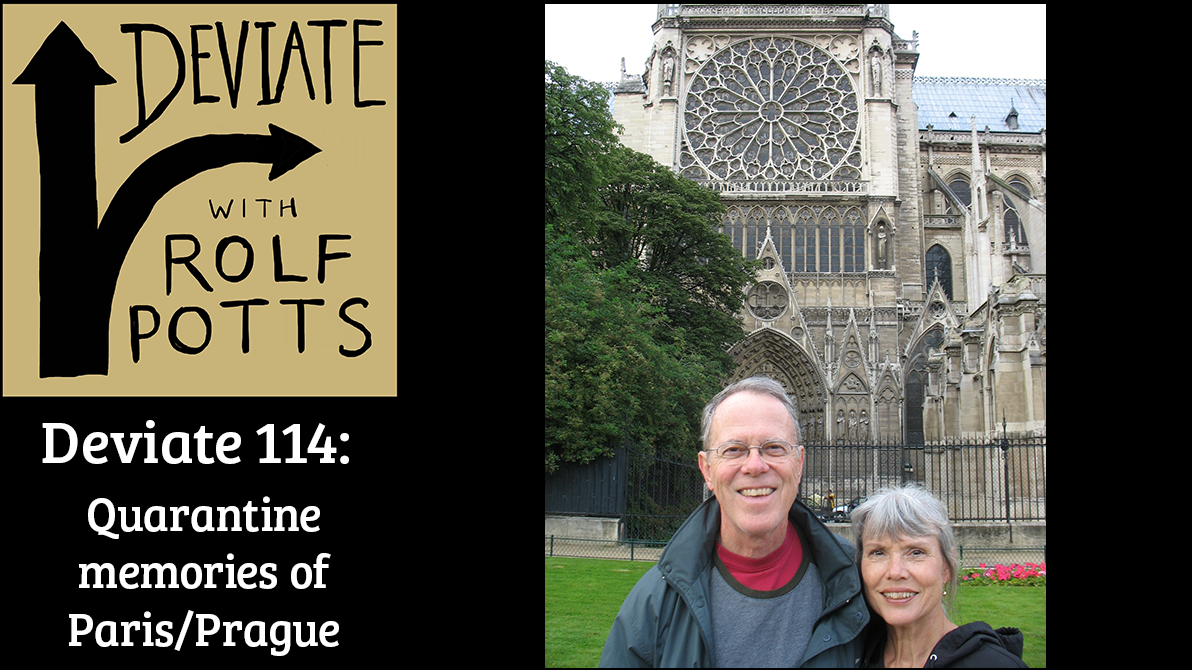
S2 Ep 114Life changing travel experiences, quarantine edition: Paris and Prague
“This is another thing that travel teaches you: It reminds you that you have to live now, and travel is a way of living now.” – Rolf Potts In this episode of Deviate, Rolf and his parents convene in quarantine to reminisce about their old trip to Paris and Prague together, and how it deepened their memories, their understanding of Europe, and their relationship with each other. They begin by talking about why exactly they went to Paris and Prague (8:00); what sights they saw in Paris, both intentional and accidental, and how they remember their experience there (13:00); how in some ways travel to other cultures is a form of “time travel” (18:00); how travel has a way of reverting travelers into a childlike awareness of their surroundings (24:00); why Père Lachaise Cemetery is a fascinating place to visit in Paris (30:00); how a hostel made for a good place from which to base an exploration of Prague, and what they found in the city by walking everywhere (36:00); the joy of taking public transport into unfamiliar neighborhoods and finding Corvette rallies and street performers and old citadels (43:00); and what their strongest memories of the travel experience were (52:00). George and Alice Potts are retired schoolteachers based in Kansas. Alice taught second graders in the Wichita public schools for more than 30 years. In 1994 her classes succeed in promoting legislation to declare the barred tiger salamander the Kansas State Amphibian. George taught science at various Wichita high schools, as well as at Friends University, where he pioneered graduate-level programs in Zoo Science and Environmental Studies. He also helped facilitate the Outdoor Wildlife Learning Sites (OWLS) program for the Kansas Department of Wildlife and Parks. Notable Links: 2020 COVID-19 pandemic (global viral outbreak) The Decameron (novellas collection by Giovanni Boccaccio) Black Death (14th century pandemic) China and Mongolia with my parents (Deviate episode) Paris Writing Workshop (summer creative writing class) SkyEurope (defunct budget airline) Souvenir, by Rolf Potts (book) Jardin des Plantes (botanical garden in Paris) Sainte-Chapelle (Gothic chapel in Paris) Palace of Versailles (old French royal residence outside of Paris) Père Lachaise Cemetery (largest cemetery in Paris) Frédéric Chopin (Polish composer) Jim Morrison (American rock singer) Abelard and Héloïse (French lovers) Czech Inn (hostel in Prague) Prague astronomical clock (medieval clock) House of the Black Madonna...
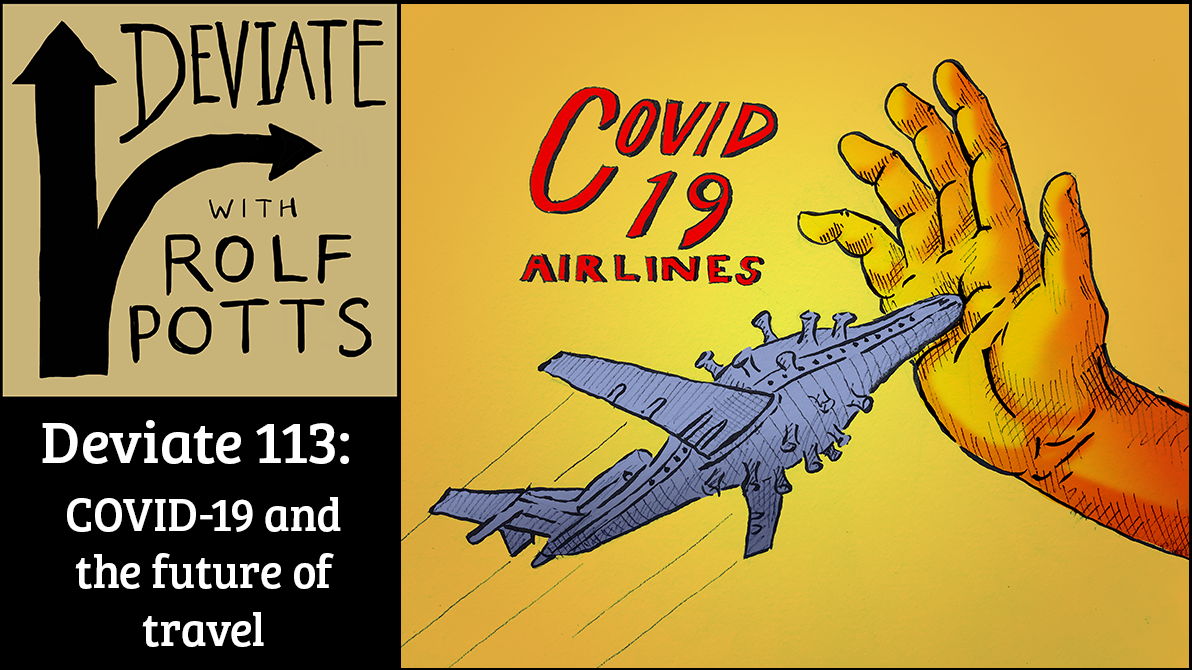
S2 Ep 113How COVID-19 will transform the business of long-term world travel
“What will travel look like after the pandemic? In material ways it will probably change more than it did post-9/11.” –Sean Keener In this episode of Deviate, Rolf and Sean talk about how fast the assumptions surrounding international travel have changed in recent weeks, and how that has transformed the assumptions of the travel industry (4:15); making sense of the current uncertainty about how travel has been altered by the COVID-19 pandemic (9;30); distinguishing facts from stories while information about travel keeps changing (16:00); and what travel possibilities and travel ideals might look like in the near future (21:00). Sean Keener (@SEKeener) is the Cofounder and CEO of the BootsnAll Travel Network, a travel media network focused on planning complex, multi-stop, round-the-world travel. He is also the Chairman of AirTreks, a travel network specializing in multi-stop international travel. Notable Links: 2020 COVID-19 pandemic (global viral outbreak) Travel pros reflect on being grounded (Washington Post article) How COVID-19 will transform airports (Deviate episode) What it’s like to travel during COVID-19 (Deviate episode) How to make sense of pandemic health data (Deviate episode) 5 ways indie travel has changed since 1999 (Deviate episode) Monte Carlo simulation (predictive algorithm) Indie Travel Manifesto (travel-values initiative) The Deviate theme music comes from the title track of Cedar Van Tassel’s 2017 album Lumber. COVID-19 episode art was created by Luke Van Tassel. More of his art online here. Note: We don’t host a “comments” section, but we’re happy to hear your questions and insights via email, at [email protected].
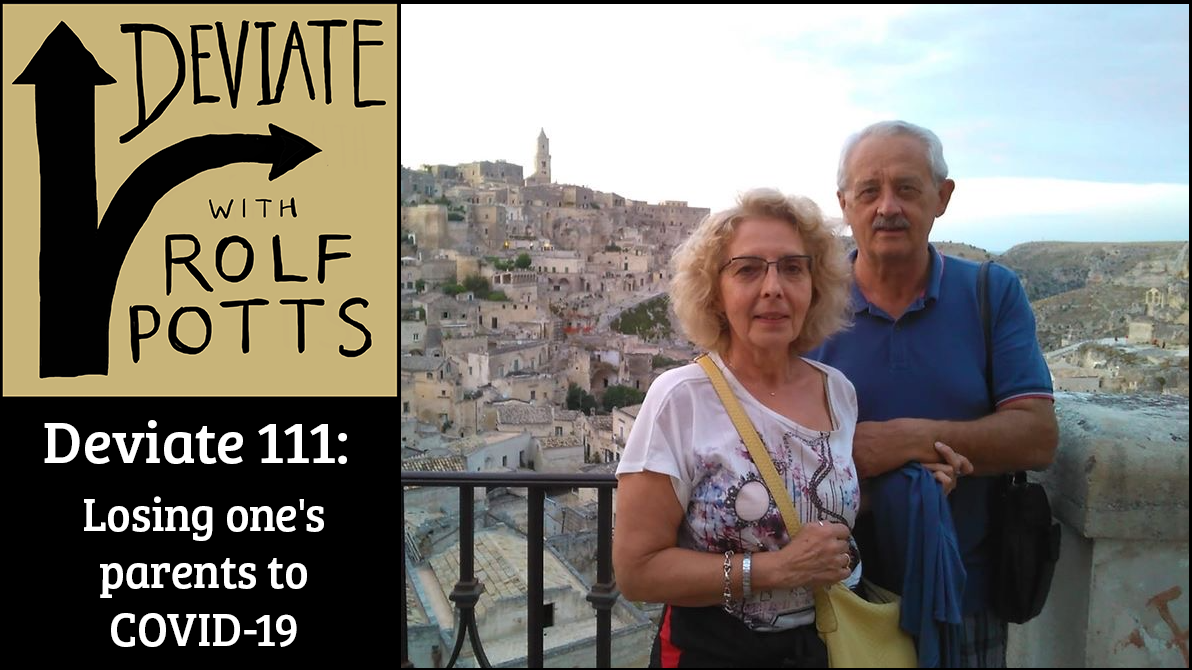
On losing one’s parents to COVID-19: A traveler-report addendum
“Imagine you wake up and you get this call telling you that your father died three days after your mother. How do you think I felt? I couldn’t even cry any more. ” –Marco Ferrarese This episode of Deviate, Rolf summarizes the pandemic-travel reports he’s been getting from travelers is places like London, Turkey, Mexico, India, and Macau (2:00); then the episode transitions into Marco Ferrarese’s report about his travel-writing excursion in Peru, and what it’s like to be locked down in the Peruvian mountain town of Cabanaconde (4:45); how he heard that Tundra and Maurizio, his parents back home in the Lombardy region Italy, had become sick, and why the virus was still spreading in that part of the country (6:45); how his parents’ illness was initially misdiagnosed, and how things changed when they were admitted to the hospital (11:40); how it was difficult to interpret the news that was being passed along from the hospital as his parents’ conditioned worsened, and how he found out that his mother, and later his father, had died (14:00); and how seriously we need to take the warnings we hear about COVID-19 (21:00). Marco Ferrarese is an independent researcher and freelance writer. He is author of Nazi Goreng, and Banana Punk Rawk Trails: A Euro-Fool’s Metal Punk Journeys in Malaysia, Borneo and Indonesia, and has reported from all over Asia for a number of international publications including BBC, CNN and National Geographic Traveller. His other projects include Penang Insider and Monkey Rock World: Untamed Travel on Asia’s Hidden Roads. Episode art shows Marco Ferrarese’s parents, Tundra and Maurizio, visiting the southern Italian town of Matera in 2015. The Deviate theme music comes from the title track of Cedar Van Tassel’s 2017 album Lumber. Note: We don’t host a “comments” section, but we’re happy to hear your questions and insights via email, at [email protected].
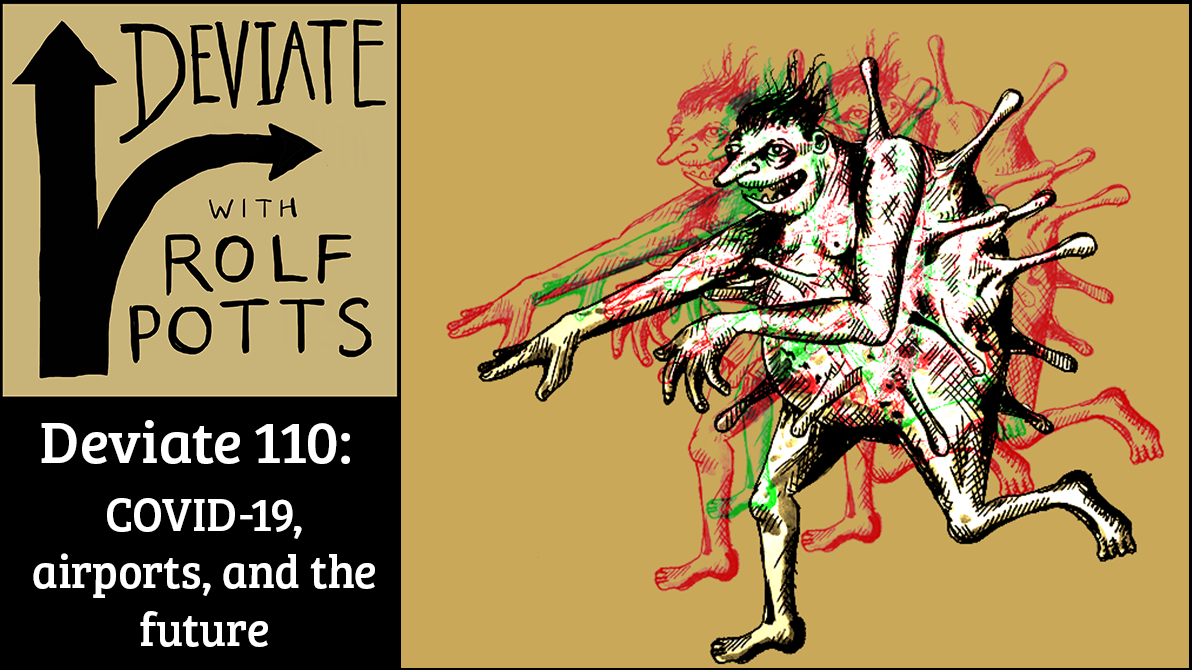
How COVID-19 will transform airports (and other pandemic considerations)
“Epidemiologists have found that you can slow a pandemic tremendously by focusing public hygiene efforts on three key global airports.” –Dr. JP Santiago In this episode of Deviate, Rolf and Dr. JP Santiago talk about how the COVID-19 pandemic will change global air travel moving forward (2:00); the prescience of the 2011 movie Contagion, what the scientific data says right now about how long COVID-19 can contaminate various surfaces (13:30); what to make of certain “folk cures” for COVID-19, as well as whether or not it’s safe to take medicines like ibuprofen to treat symptoms (20:00); the future of post-traditional medical treatment approaches, such a telemedicine (29:30); what other pandemics, such as H1N1 can (or cannot) teach us about how to respond to COVID-19 (34:00); and when “normal” life might return, given pandemic concerns, and what that might look like (42:00). JP Santiago has been a family medicine physician in private practice in Dallas/Fort Worth for nearly 20 years. He earned his medical degree in 1997 from the University of Texas Southwestern in Dallas, and did his residency training and was chief resident at the University of Kansas Medical Center before returning to Texas. He will be retiring from private practice in April to work for the Indian Health Service to provide medical care to Native American reservations as a traveling physician. His wife is a physician as well and he has four children. He maintains an aviation magazine online at: https://theavgeeks.com/ Notable Links: World Health Organization COVID-19 updates (website) JP’s updates on the COVID-19 pandemic (Facebook posts) 2020 COVID-19 pandemic (global viral outbreak) 2020 coronavirus pandemic in Iceland Airport security repercussions due to the September 11 attacks Contagion (2011 Steven Soderbergh film) The New England Journal of Medicine (medical journal) 2003 SARS outbreak (global viral outbreak) Tiger King: Murder, Mayhem and Madness (TV show) 1918 Spanish Flu pandemic (global viral outbreak) 2009 H1N1 flu pandemic (global viral outbreak) Antibody (protein utilized by the immune system) This episode is also brought to you by AirTreks, an industry leader in multi-stop international travel. AirTreks is a distributed travel company with employees working from all corners of the world to help with your flight planning, specializing in complex routes with up to 25 stops. The AirTreks website offers suggested pre-planned travel itineraries to help you get started, but can customize to fit your journey. The Deviate theme music comes from the title track of Cedar Van Tassel’s 2017 album ...
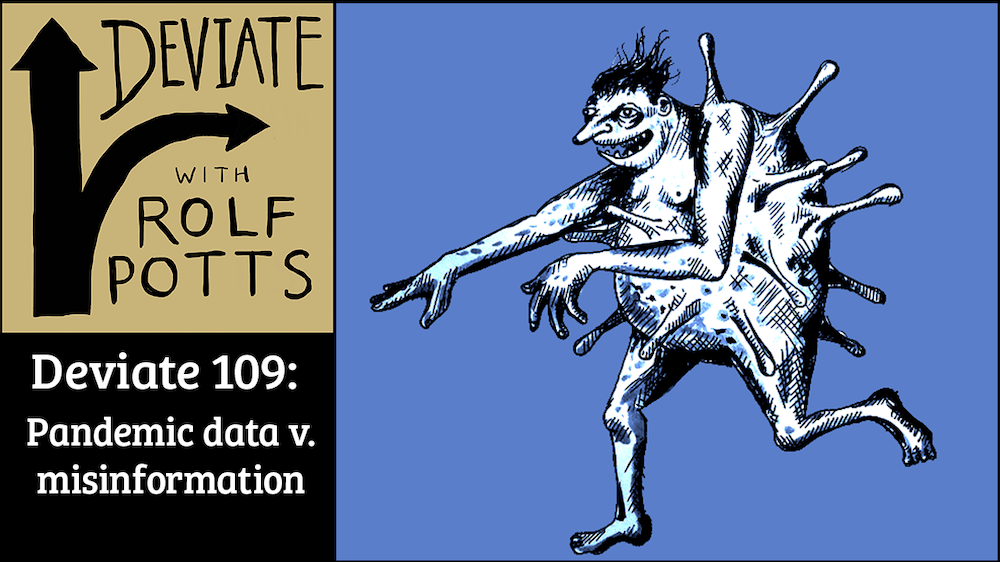
Why the way we discuss (and interpret information about) COVID-19 matters
“We need to avoid cherry-picking pandemic data that suits our personal narrative of what we think is going on.” –Dr. JP Santiago In this episode of Deviate, Rolf and Dr. JP Santiago talk about how the “existential threat” of pandemic is changing the way family-practice doctors are dealing with patients right now (1:40); the role of data in medicine, the definition of “observer bias,” and how the willingness to arrive at conclusions that contradict one’s initial hypothesis is essential in a medical context (9:30); a history of the shortcomings and dangers of naming infectious diseases after animals, people, or geographical places (20:00); how capitalism can be a force that can both enable and compromise solutions during a pandemic (33:30); and Dr. Santiago’s advice on how people should respond to the pandemic (40:00). JP Santiago has been a family medicine physician in private practice in Dallas/Fort Worth for nearly 20 years. He earned his medical degree in 1997 from the University of Texas Southwestern in Dallas, and did his residency training and was chief resident at the University of Kansas Medical Center before returning to Texas. He will be retiring from private practice in April to work for the Indian Health Service to provide medical care to Native American reservations as a traveling physician. His wife is a physician as well and he has four children. He maintains an aviation magazine online at: https://theavgeeks.com/ Notable Links: World Health Organization COVID-19 updates (website) JP’s updates on the COVID-19 pandemic (Facebook posts) 2020 COVID-19 pandemic (global viral outbreak) Mike Pompeo (American secretary of state) WHO Best Practices for the Naming Infectious Diseases (PDF) AIDS (immunodeficiency virus) Gay-related immune deficiency (original name for AIDS) 1918 Spanish Flu pandemic (global viral outbreak) 2003 SARS outbreak (global viral outbreak) 2009 H1N1 flu pandemic (global viral outbreak) 2012 Middle East respiratory syndrome (global viral outbreak) This episode is also brought to you by AirTreks, an industry leader in multi-stop international travel. AirTreks is a distributed travel company with employees working from all corners of the world to help with your flight planning, specializing in complex routes with up to 25 stops. The AirTreks website offers suggested pre-planned travel itineraries to help you get started, but can customize to fit your journey. The Deviate theme music comes from the title track of Cedar Van Tassel’s 2017 album Lumber. COVID-19 episode art was created by Luke Van Tassel. More of his art
What it’s like to travel during COVID-19: Reports from around the world
“All the struggles of travel have taught me lessons about survival that will be useful coming up.” –Rollie Peterkin “I don’t think there are any ‘right’ choices at the moment. We’re all making the best with what we’ve got to work with.” –Aimée Bruneau “I think we’ll come out of this with a better sense that caring for other people is the most important thing in life. Not material possessions. Not political differences. Not ethnicity or religion. Just the fact that we’re all one human family.” –Barbara Weibel In this episode of Deviate, Mike and Anne Howard describe what it’s like to be staying put in Poland during the pandemic lockdown (2:30); Justine Miller talks about being stuck in a Tunis hotel after flights stopped leaving the airport (6:00); Rollie Peterkin recounts what it was like to travel in Turkey as news of the pandemic mounted (9:00); Samantha Page talks about how Australian emergency preparedness was enhanced by the recent wildfire outbreak there (13:30); Aimée Bruneau describes a comparatively laid-back atmosphere in Mexico (17:00); Jeremy Kroeker talks about how his inter-continental motorcycle journey has come to a stand-still in Uruguay (22:00); Barbara Ann Weibel talks about how locals and expats are working together to solve problems in Thailand (26:00); Karen Catchpole and Eric Mohl describe uncertain attitudes toward outsiders in parts of Argentina (30:45); Troy Nahumko talks about how his kids are dealing with new developments in Spain (35:00); and Dennis and Stephanie Kay describes how pandemic life in France is a model for what could happen in the United States (39:30). Pandemic dispatch correspondents: Mike & Anne Howard (@HoneyTrek) are the authors of Ultimate Journeys for Two: Extraordinary Destinations on Every Continent, and Comfortably Wild: The Best Glamping Destinations in North America. Justine Miller (@JustineIMiller) is a TV reporter for News 12 The Bronx and News 12 Brooklyn in New York City. She and her husband are in the middle of a seven-month sabbatical that is taking them around the world. Rollie Peterkin (@Rolliepeterkin) is the author of The Cage: Escaping the American Dream, which recount his experience of becoming an MMA fighter in Peru after having left a career as a bond trader on Wall Street. Samantha Page (@sampagee) has traveling internationally for more than two years, and is now based in Canberra, where she works as a writer and content developer for the Australian National University. Aimée Bruneau is a professor of acting, a public speaking coach, an audiobook narrator, a children’s book author, a yoga teacher, a world travel addict, and an international pet-sitter. Jeremy Kroeker (@Jeremy_Kroeker) is the author of Motorcycle Therapy: A Canadian Adventure in Central America, and Through Dust and Darkness: A Motorcycle Journey of Fear and Faith in the Middle East. Barbara Ann Wei...
How Nomadic Matt got COVID-19. Plus: Reports from stranded travelers
“Being diagnosed with COVID-19 creates a lot of anxiety. And then you think: Is this thing I’m feeling just anxiety, or is it shortness of breath? Do I need to go to the hospital?” –Nomadic Matt Kepnes This episode of Deviate, begins with Rolf and Matt Kepnes taking about what it has been like for Matt to suffer from COVID-19, where he might have contracted it (having recently traveled to Taiwan, Paris, and New York), and what will happen to TravelCon in 2020 (2:30); digital nomad Melissa Witmer describes her social isolation in the Canary Islands after having traveled in Turkey (13:00); Marco Ferrarese talks about getting stuck in Peru while COVID-19 ravages his home country of Italy (16:40); Stephanie Johnson explains her decision to stay in rural Kenya rather than try and return stateside (21:05); Jon DeHart describes a seemingly lackadaisical pandemic atmosphere in Tokyo (27:10); Amber Hoffman recounts reactions to COVID-19 in Hong Kong and Spain (32:15); Claire and Sam Jessup talk about waiting out the lockdown in a motorhome in Denmark (37:50); and Brooks Eakin recounts the atmosphere in Shanghai, dating back to the first time in made headlines back in January (43:55). Travelers and correspondents appearing in this episode: Matt Kepnes (@nomadicmatt), commonly known as “Nomadic Matt,” is a travel blogger and the New York Times bestselling author of Travel the World on $50 a Day. He is also the founder of TravelCon, a yearly conference to help people learn the skills needed to develop a profitable and sustainable career in the travel industry. His newest book is Ten Years a Nomad. Melissa Witmer is the founder of UltyResults.com a business that helps ultimate frisbee players and coaches improve their performance on the frisbee field. She has been running this business as a digital nomad with no permanent location since 2015. Marco Ferrarese is an independent researcher and freelance writer. He is author of Nazi Goreng, and Banana Punk Rawk Trails: A Euro-Fool’s Metal Punk Journeys in Malaysia, Borneo and Indonesia, and has reported from all over Asia for a number of international publications including BBC, CNN and National Geographic Traveller. Originally from Washington DC, Stephanie Nasbe Johnson currently lives in Kabarnet, Baringo County, Kenya, where she teaches art and computers through the Polkadot Library, which was set up to encourage a reading culture and promote gender equality. Jonathan DeHart is a Tokyo-based writer and editor focused on culture and society in Asia. He is the author of a first-edition Japan guidebook for Moon Travel Guides and a journalist with more than 500 published articles. Amber Hoffman is the food and travel writer behind With Husband In Tow, and, more recently, The Bean Bites, which is a recipe site that focuses on beans and lentils, including pantry staples. Her...
How to make sense of health data in a time of pandemic (and beyond)
“Travel is in our nature. We’ll have to counterbalance our new ‘normal’ when borders reopen to weigh in an extra element of risk.” –Dr. JP Santiago In this episode of Deviate, Rolf and Dr. JP Santiago talk about how to make sense of the misinformation about COVID-19 that has flooded social media, and how American cultural attitudes toward the pandemic differ from those in Asia (2:10); how COVID-19 affects its victims, and what data doctors are looking for about the pandemic (12:00); how the virus replicates itself, the duration of its incubation period, and how to stay healthy in public places (17:45); the importance of social distancing and self-quarantine for sick people, and how to keep from transmitting sickness to health workers (22:00); reliable online sources for information about the COVID-19 virus (29:00); how the pandemic has affected travel, and how travelers can stay healthy moving forward (32:00); what happens next with the COVID-19 pandemic worldwide, our efforts to create a vaccine, political foresight, and how the virus will affect human behavior moving forward (38:20). JP Santiago has been a family medicine physician in private practice in Dallas/Fort Worth for nearly 20 years. He earned his medical degree in 1997 from the University of Texas Southwestern in Dallas, and did his residency training and was chief resident at the University of Kansas Medical Center before returning to Texas. He will be retiring from private practice in April to work for the Indian Health Service to provide medical care to Native American reservations as a traveling physician. His wife is a physician as well and he has four children. He maintains an aviation magazine online at: https://theavgeeks.com/ Notable Links: World Health Organization COVID-19 updates (website) JP’s updates on the COVID-19 pandemic (Facebook posts) Ajit Pai (FCC chairman under Donald Trump) 2020 COVID-19 pandemic (global viral outbreak) Social distancing (anti-contagion action) Intubation (medical procedure) Acute respiratory distress syndrome (lung inflammation) 1918 Spanish Flu pandemic (global viral outbreak) 2003 SARS outbreak (global viral outbreak) 2009 H1N1 flu pandemic (global viral outbreak) 2012 Middle East respiratory syndrome (global viral outbreak) CDC Travelers’ Health (website resource) Joshua Lederberg (American molecular biologist) This episode is also brought to you by AirTreks, an industry leader in multi-stop international travel. AirTreks is a distributed travel company with employees working from all corners of the world to help with your flight planning, specializing in complex routes with up to 25 stops. Th...
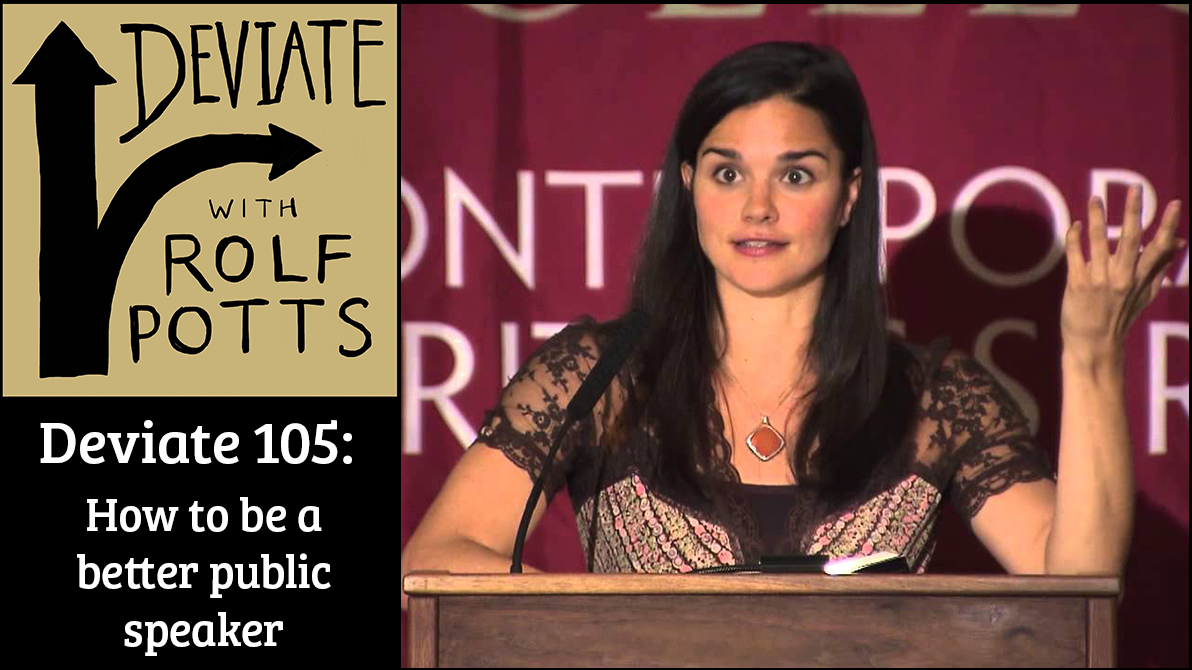
How to enhance your career by becoming a better public speaker and reader
“The average human ear tunes out after about six minutes of orality. It used to be nine.” –Elena Passarello In this episode of Deviate, Rolf and Elena talk about the first giraffe ever to live in Paris in the 19th century (3:30); how public presentation and performance differs from other kinds of speaking and reading, and how to prepare for it (9:00); the role of nervousness in public speaking, and how to deal with it (21:00); how prepare a text or script before reading or using it as an outline in a public speaking situation (31:00); and the importance of concrete language and “syntactical music” in public speaking (42:00). Elena Passarello is an American writer, actor, and professor. Her book Let Me Clear My Throat (Sarabande, 2012), won the gold medal for nonfiction at the 2013 Independent Publisher Awards, and her essays on performance, pop culture, and the natural world have been published in Oxford American, Slate, and Creative Nonfiction, among other publications,. For more on Elena, check out https://www.elenapassarello.com/. Notable Links: Paris Writing Workshop (annual summer creative-writing class) Jardin des Plantes (botanical garden in Paris) Zarafa (giraffe who lived in the Jardin des Plantes) King Charles X of France (19th century king) Geoffroy Saint-Hilaire (French naturalist) Luis Alberto Urrea (poet, novelist, and essayist) Stump speech (standard speech used by a politician) Stage combat (theater technique) Bob Dole (American politician) Ian MacKaye on the history of rock (Deviate episode) Cher Ami (heroic World War I homing pigeon) Gerald Ford (38th president of the United States) T. Geronimo Johnson (author) Al Gore (American politician) Benjamin Percy on telling stories (Deviate episode) Karen Russell (novelist and short story writer) George Saunders (novelist) This episode is brought to you by AirTreks, an industry leader in multi-stop international travel. If you’ve ever planned a trip with multiple stops, you know that finding the right flights can be difficult. Between balancing travel logistics and cost, it often becomes impossible to build an itinerary that matches your travel goals. AirTreks is a distributed travel company with employees working from all corners of the world to help with your flight planning, specializing in complex routes with up to 25 stops. The AirTreks website offers suggested pre-planned travel itineraries to help you get started, but can customize to fit your journey. The Deviate theme music comes from the title track of Cedar Van Tassel’s 2017 album Lu
On sabbaticals: How to take a career break without breaking your career
“Travel is kind of strength-training for your soul.” –Tara Quinn In this episode of Deviate, Rolf and Tara talk about she got started coaching people pm setting up work sabbaticals, what her clients’ most common concerns are, and how Americans’ attitude toward work are different from the rest of the world (3:00); common tactics and techniques she employs as a sabbatical coach, and what kinds of clients she attracts (17:00); how to use travel as a pretext for professional development, self-education, and changing careers (28:00); the importance of imperfection and failure in learning useful lessons from travel (40:00); and ending a long-term sabbatical journey and transitioning back into professional life (48:00). Tara Quinn (@threemonthvisa) is a certified life and career coach with a passion for working with clients who dream of taking time off to travel, live, work, study or volunteer abroad. Tara roster of clients includes people from companies such as Apple, Google, Microsoft, Bank of America, UC Berkeley, and The United Nations. For more on Tara and her career, check out http://www.threemonthvisa.com/. Notable Links: Dude, Where’s My Car? (movie) Vagabonding, by Rolf Potts (book) Wanderlust, edited by Don George (book) “Why We Travel,” by Pico Iyer (essay) Pico Iyer on what Japan can teach us about life (Deviate episode) Tales of a Female Nomad, by Rita Golden Gelman (book) Gap year (yearlong break before or after university) Wharton School (business school at UPenn) Gap analysis (comparison of desired versus actual performance) Explore Europe on Foot (Deviate episode) Le Cordon Bleu (culinary school) Digital nomadism (mobile work-travel movement) Bodh Gaya (Buddhist pilgrimage site in India) Culture shock (anxiety from being in an unfamiliar place) CSI: Miami (police procedural TV drama series) This episode of Deviate is brought to you by Tortuga Backpacks, which set the standard for the best, most durable, organized, and comfortable travel backpacks. Tortuga products also include daypacks, duffels, and other travel accessories, which are all made with the traveler in mind and have been featured by Wirecutter, The New York Times, Travel + Leisure, Business Insider, Carryology, and many other industry outlets. This episode is also brought to you by AirTreks, an industry leader in multi-stop international travel. If you’ve ever planned a trip with multiple stops, you know that finding the right flights can be difficult. Betwe...
Ari Shaffir and Rolf do a deep-dive on the finer points of indie travel
“It doesn’t matter where you’re going. Just find a reason to go.” –Ari Shaffir Ari Shaffir (@AriShaffir) is a comedian, writer, podcaster, and actor. He is the current host of the Skeptic Tank podcast. For more information on Ari, visit his website. This episode of Deviate is excerpted from Ari Shaffir’s Skeptic Tank episode #298: Vagabonder. In this episode of Deviate, Ari and Rolf sit down in New York’s Tompkins Square Park and talk about the esoteric obsessions that lead you into unique adventures in faraway countries, and the best way to meet people on the road (4:20); learning languages other than English (11:30); how the presence of communication technology has changed travel, including its social dynamic (17:30); using toilets, eating unfamiliar food, and haggling in markets in non-Western countries (28:00); how travel changes once you’re more experienced as a traveler (53:00); comfort food, ordering food overseas, living as an expat overseas, and getting started out in your career overseas (1:04:00); how expectations affect a journey, and how expectations affect one’s task as a travel writer (1:17:00). Notable Links: The Chernobyl Podcast (HBO companion podcast) Scriptnotes (screenwriting podcast) Another Name for Every Thing (Richard Rohr podcast) Qamishli (Syrian-Turkish border town) Ulpan (school for the intensive study of Hebrew) Yinzer (Pittsburgh vernacular word) Quiet, by Susan Cain (book) Squat toilet (toilet common in Asia and Africa) A few notes on wiping your ass (Barry Sonnenfeld essay) Marco Polo Didn’t Go There, by Rolf Potts (book) Souvenir, by Rolf Potts (book) Hogg Market (Kolkata market) Kelsey Timmerman (author) “Man bites dog,” by Rolf Potts (dog meat article) Balut (Asian street food, boiled egg embryo) Vélib’ (bicycle sharing system in Paris) Mandarin Oriental (Bangkok luxury hotel) Yeshiva (Jewish educational institution) “On the Trans-Siberian Express,” by Rolf Potts (travel essay) Freighthopping (riding a railroad freight car) Van Life before #VanLife (Deviate podcast episode)
Remembering Nirvana, and how music can frame experience (and memory)
“Part of our lives are lived on social media and part are lived in our heart and in the real world. The discrepancy between the two often makes people miserable.” – Aaron Hamburger In this episode of Deviate, Rolf and Aaron discuss identifying with Nirvana (3:00); the nature of genius (11:00); and the search of authenticity (20:00). Aaron Hamburger (@hamburger_aaron) is an author whose writing has appeared in The New York Times, The Washington Post, The Chicago Tribune. He is the author of Nirvana is Here and The View from Stalin’s Head, which was awarded the Rome Prize by the American Academy of Arts and Letters and nominated for a Violet Quill Award. For more on Aaron, check out https://aaronhamburger.com/. Notable Links: Nevermind (music album) Smells like Teen Spirit, by Nirvana (song) Kurt Cobain (musician) Leonard Cohen (singer) McCabe & Mrs. Miller (film) Hallelujah (song) Random Access Memories (music album) The Stone Roses (band) Pixies (band) The Smashing Pumpkins (band) Ferris Bueller’s Day Off (film) Marcel Proust (writer) Claudine at School, by...
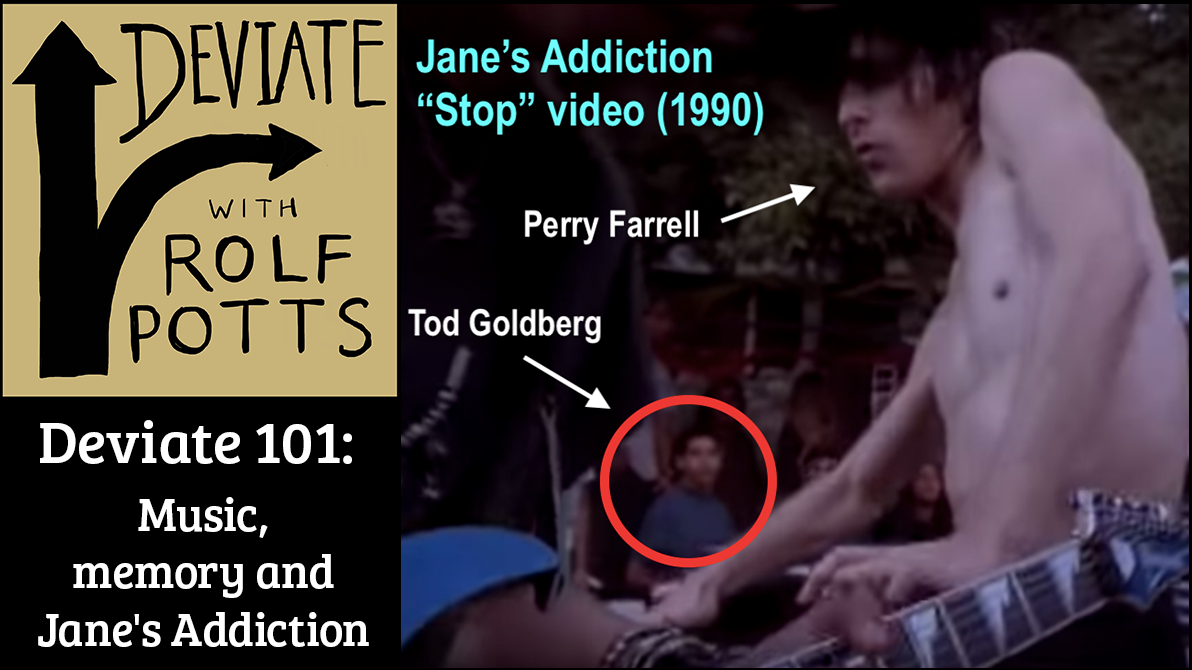
How music affects you when you’re young (or, the joys of Jane’s Addiction)
“In the late 1980s human beings were your YouTube algorithm. Flesh-and-blood people introduced you to the music that changed your life.” —Rolf Potts In this episode of Deviate, Rolf and and Tod talk about Tod’s experience of being in the Jane’s Addiction “Stop!” video (3:00); Rolf reads his essay about discovering the album “Nothing’s Shocking” in 1989 (7:00); Rolf and Tod discuss what it was like to see Jane’s Addiction in the southern California music scene of the mid-late 1980s, versus what listening to AOR radio music was like in the middle of the country (19:30); how radio programming, independent record stores, and personal relationships dictated musical tastes in the 1980s, and how music enabled certain alternative lifestyles (30:00); how Jane’s Addiction influenced the sound of certain 1990s Seattle grunge bands, (38:00); what it’s like when you’re older to listen to music you loved when you were young, and how online algorithms and new technologies have changed the way people now listen to music (44:00); and the legacy of bands like Jane’s Addiction and how they changed the way we listen to music now. Novelist Tod Goldberg (@todgoldberg) is the New York Times bestselling author of over a dozen books, including the novel Gangsterland, which is currently being developed into a television series for Amazon. He is also the director of the University of California-Riverside Palm Desert Low-Residency MFA, and the co-host of the Literary Disco podcast. Notable links: The 33 1/3 B-sides: Authors on Beloved Albums (book) Jane’s Addiction (alternative band) Nothing’s Shocking (Jane’s Addiction album) Ian MacKaye on the official history of rock music (Deviate episode) Jane’s Addiction’s “Stop!” MTV video Andrew McCarthy on how travel changed his life (Deviate episode) Dramarama (1980s alternative rock band) KROQ (radio station) High Fidelity (movie) Grunge (heavy 1990s “Seattle sound” rock music) Nirvana (1990s alternative rock band) Pansexuality (sexual orientation) Alternative Press (magazine) John the Baptist (biblical figure) Mother Love Bone (pre-Pearl Jam alternative band) Temple of the Dog (1990s rock supergroup) Bruce Springsteen’s cover of Prince’s “Purple Rain” New Order‘s “Age of Consent” (song) Gary Numan‘s “M.E.” (song) This episode is brought to...

Life-changing travel experiences: China and Mongolia with my parents
“Home is in dialogue with the places you travel, and often serves as an interpretive lens.” – Rolf Potts In this episode of Deviate, Rolf and his parents reflect their journey to China and Mongolia many years ago. The episode starts with an excerpt of Rolf’s 2001 NPR dispatch about the experience, then they recall their visit Korea four years earlier, when Rolf worked as an English teacher in Pusan (13:00); then they recount their impressions of staying together in a youth hostel in China, and exploring the sights of Beijing (20:00); and finally they recall their train ride to Mongolia, and their unusual experiences in the countryside outside of Ulan Bator (48:00). George and Alice Potts are retired schoolteachers based in Kansas. Alice taught second graders in the Wichita public schools for more than 30 years. In 1994 her classes succeed in promoting legislation to declare the barred tiger salamander the Kansas State Amphibian. George taught science at various Wichita high schools, as well as at Friends University, where he pioneered graduate-level programs in Zoo Science and Environmental Studies. He also helped facilitate the Outdoor Wildlife Learning Sites (OWLS) program for the Kansas Department of Wildlife and Parks. Notable Links: Raising My Parents in Mongolia, by Rolf Potts (NPR broadcast) The Rewatchables (podcast) The great railway bizarre (2018 Deviate podcast episode) On the Trans-Siberian Express, by Rolf Potts (1999 essay) Noraebang (Korean interactive music entertainment) Temple of Heaven (complex of religious buildings in Beijing) Tiananmen Square (large public square in Beijing) Summer Palace (ensemble of gardens and palaces in Beijing) Beijing Museum of Natural History Beijing Zoo Sedgwick County Zoo (Kansas wildlife park) Flint Hills (iconic prairie region in Kansas) Naadam (Mongolian festival) Ger (Mongolian-style tent) Karakorum (old Mongolian imperial capital) Tough Mongolian horse-riding girl mentioned in episode (photo) This episode is also brought to you by AirTreks, an industry leader in multi-stop international travel. If you’ve ever planned a trip with multiple stops, you know that finding the right flights can be difficult. Bet...
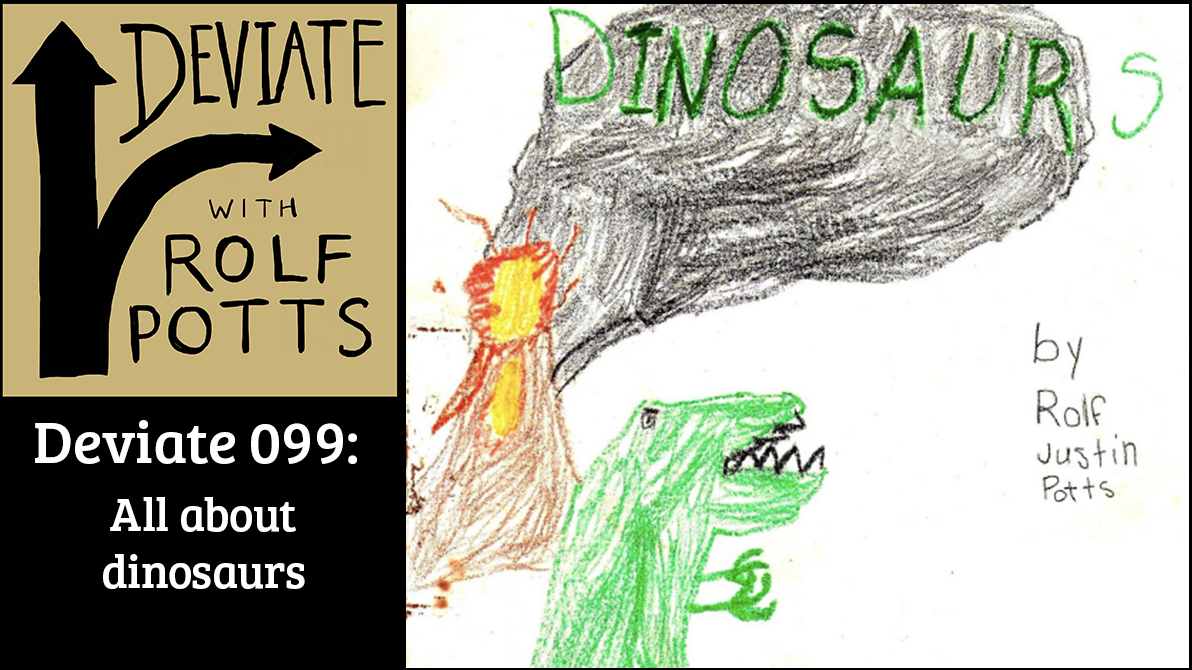
Why dinosaurs matter (also: Rolf fact-checks the dino book he wrote at age 7)
“Common sense is a very poor guide to understanding the universe. Science is kind of the opposite of common sense. It seems fanciful to think that a bird is a dinosaur, but that is literally true.” –Kenneth Lacovara In this episode of Deviate, Rolf and Kenneth discuss why dinosaurs matter, especially for little kids (5:00); how we have come to learn what we know about dinosaurs (23:00); the “butterfly effect,” and how we use the ancient past to predict the future (35:00); the distinctions between the dinosaurs, and what field-work looks like (42:00); and myths about dinosaurs (53:00). Kenneth Lacovara (@kenlacovara) is a paleontologist and geologist. He is a professor at Rowan University and fellow at the Explorers Club where he received the Explorers Club Medal, the highest honor bestowed by The Explorers Club. He is the author of the book Why Dinosaurs Matter, which is based on his TED Talk, “Hunting for dinosaurs showed me our place in the universe.” Notable Links: Dinosaurs, by Rolf Justin Potts (PDF of Rolf’s hand-illustrated 1978 “book”) Paleontology (scientific study of life predating the Holocene Epoch) Jurassic Park (movie) Cretaceous–Paleogene extinction event Hallucigenia (genus of Cambrian xenusiids) Triassic (geologic period) Jurassic (geologic period) Origin of birds (started as theropod dinosaurs) Clades (organism group consisting of a common ancestor and its descendants) Sauropsids (clade consisting of reptiles and birds) Synapsids (animal group that includes mammals) Hominids (taxonomic family of primates) Butterfly effect (chaos theory postulation) Dinosaurs mentioned: Tyrannosaurus Rex (carnivorous theropod) Stegosaurus (armored herbivore) Triceratops (herbivorous ceratopsid) Ankylosaurus (armored herbivorous) Brontosaurus (herbivorous sauropod) Velocirapt...

What Matt Green discovered by walking every single street in New York City
“Traveling, for me, is all about destroying stereotypes and narratives about people and places.” – Matt Green In this episode of Deviate, Rolf and Matt discuss Matt’s mission to walk every street in New York City (3:00); walking across the entire United States and breaking stereotypes (12:00); bucket lists as a catalyst for action (28:00); and Matt’s experiences walking in unfamiliar places and finding comfort in being a stranger (50:00). Matt Green is the wanderer who was profiled within the documentary The World Before your Feet, directed by filmmaker Jeremy Workman and produced by Jesse Eisenberg. Matt has walked across the entire United States and is currently in the process of walking every street in New York City. For more about Matt and his current project, check out https://imjustwalkin.com/. Notable Links: East of Eden, by John Steinbeck (book) East of Eden excerpt The Journey Home, by Edward Abbey (book) Cannery Row, by John Steinbeck (book) Cannery Row excerpt Gary House (traveler) The World Before Your Feet at Kanopy This episode is also brought to you by AirTreks, an industry leader in multi-stop international travel. If you’ve ever planned a trip with multiple stops, you know that finding the right flights can be difficult. Between balancing travel logistics and cost, it often becomes impossible to build an itinerary that matches your travel goals. AirTreks is a distributed travel company with employees working from all corners of the world to help with your flight planning, specializing in complex routes with up to 25 stops. The AirTreks website offers suggested pre-planned travel itineraries to help you get started, but can customize to fit your journey. The Deviate theme music comes from the title track of Cedar Van Tassel’s 2017 album Lumber. Note: We don’t host a “comments” section, but we’re happy to hear your questions and insights via email, at [email protected].

A personal history of being a lifelong pro-sports fan (Super Bowl special)
“Because I was entering football fandom at the same age that Star Wars was blowing up, the Roger Staubach Dallas Cowboys were my Luke Skywalker, and the Steelers and the Raiders were, in my child mind, the Evil Empire.” —Rolf Potts In this episode of Deviate, Rolf shares his 2002 NPR “Savvy Traveler” dispatch about trying to watch the Super Bowl in Thailand (2:00); then he and Tod Goldberg discuss how they became NFL football fans as kids in the 1970s, and how this affected their fandom later in life (9:00); how it could be difficult in the days before the Internet for kids to find information about NFL teams and players, and which books they read about the early days of pro football (26:00); the origins of the San Francisco 49ers and Kansas City Chiefs in upstart pro leagues, their more recent fortunes in the NFL, and how the last Chiefs Super Bowl appearance was nine months before Rolf was born (42:30); on watching Super Bowls from overseas and following the Chiefs (or 49ers) as adults, the strengths of the 2020 Chiefs and 49ers teams, and the emotional stakes of Super Bowl LIV (53:00). Novelist Tod Goldberg (@todgoldberg) is the New York Times bestselling author of over a dozen books, including the novel Gangsterland, which is currently being developed into a television series for Amazon. He is also the director of the University of California-Riverside Palm Desert Low-Residency MFA, and the co-host of the Literary Disco podcast. NFL games and players: Super Bowl LIV (2020 KC Chiefs versus SF 49ers NFL title game) Rolf Benirschke (San Diego Chargers placekicker in the 1980s) Roger Staubach (Dallas Cowboys quarterback in the 1970s) Jack Lambert (Pittsburgh Steelers linebacker in the 1970s) Christian “Nigerian Nightmare” Okoye (Chiefs fullback in the 1980s) Ray Guy (Oakland Raiders punter in the 1970s) Mike Mercer (NFL punter in the 1960s) Lou “The Toe” Groza (NFL punter and offensive tackle in the 1950s) Marshall Goldberg (Jewish Chicago Cardinals running back in the 1940s) Red “Galloping Ghost” Grange (Chicago Bears player-coach in the 1930s) 1934 NFL Championship Game, aka the “Sneakers Game” (title game) 1940 NFL Championship Game, (73-0 Bears-Giants title game) Steve Grogan (New England Patriots quarterback in the 1980s) Ed “Too Tall” Jones (Cowboys defensive end in the 1980s) Super Bowl IV (1970 Chiefs versus Vikings NFL title game) NFL Films: Super Bowl IV Highlights (sports documentary) Hank Stram (Chiefs coach from 1960-1974)
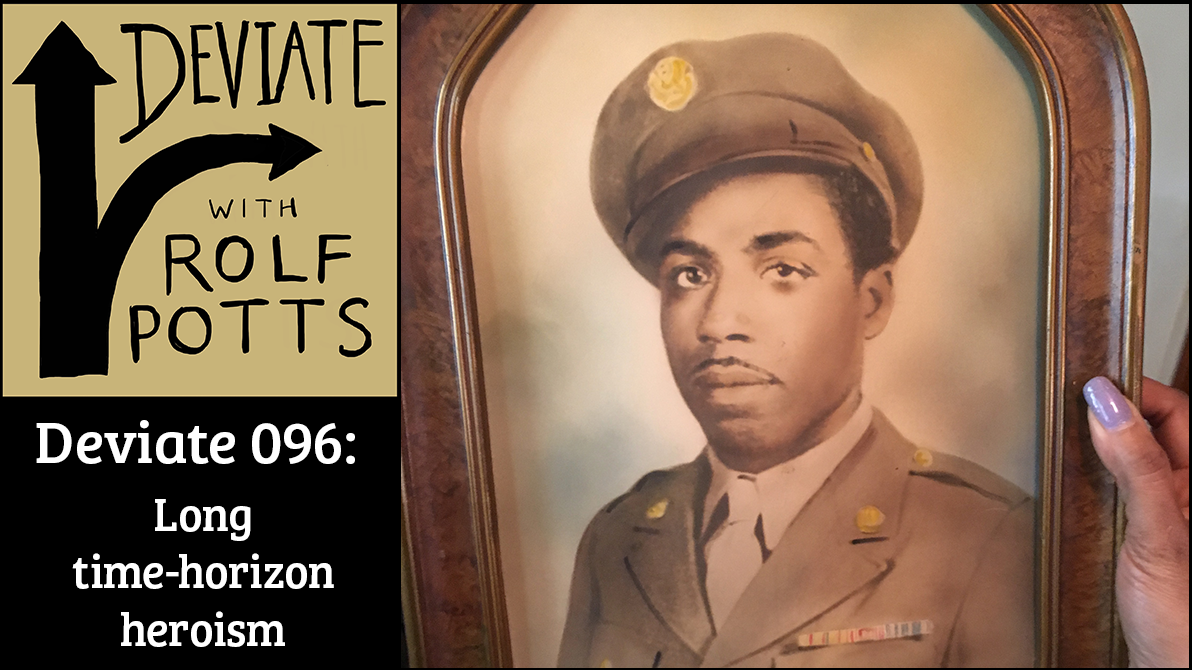
The power of small choices across decades: The Sgt. John Monk story
“You have to make moves that will not just impact your today but the lives of folks down the road.” —Kaye Monk-Morgan In this episode of Deviate, Rolf and Kaye discuss the life of her grandfather John Monk, growing up in Louisiana during Jim Crow, and the extended impacts of sharecropping (13:00); the challenges of assimilating to military life and overcoming racial adversity during World War II (25:00); and how small choices and sacrifices can have an outsized impact on our lives and the lives of others (43:00). John Monk (1916-2018) was born into a family of sharecroppers in Haynesville, Louisiana. He served in the United States Army through World War II, the Korean War, and the Vietnam War. After retiring from the military he moved to Wichita, where he raised his family and worked as a doorman at Park Lane Towers. Kaye Monk-Morgan is an Assistant Vice President for Academic Affairs at Wichita State University, where she facilitates leadership and professional development opportunities for low-income and first-generation students, especially in science, technology, engineering and mathematics. Notable Links: Targeting Black Veterans: Lynching in America (Equal Justice Initiative report) Long-ago choice leads to life of dreams fulfilled (newspaper story on John Monk) Hometown Heroes: 101-year-old Army veteran’s secret to life (TV story on John Monk) Jim Crow laws (local laws enforcing racial segregation) Sharecropping (agricultural landowner/tenant arrangement) Harlem Hellfighters (World War I infantry regiment) Greatest Generation (American demographic cohort) Fort Knox (United States Army post in Kentucky) Barrage balloon (anti-aircraft kite balloon used in WWI and WWII) Quartermaster (senior soldier who supervises barracks) Drill Sergeant (non-commissioned officer assigned to train new recruits) Dockum Drug Store sit-in (1958 Wichita Civil Rights protest) Guess Who’s Coming to Dinner (1967 Sidney Poitier movie) Exodusters (African Americans who migrated to Kansas in 1879) Barry Sanders (Wichita-born NFL Hall of Fame running back) This episode is also brought to you by AirTreks, an industry leader in multi-stop international travel. If you’ve ever planned a trip with multiple stops, you know that finding the right flights can be difficult. Between balancing travel logistics and cost, it often becomes impossible to build an itinerary that matches your travel goals. AirTreks is a distributed travel company with employees working from all corners of the world to help with your flight planning, specializing in complex routes with up to 25 stops. The AirTreks website offers suggested pre-...
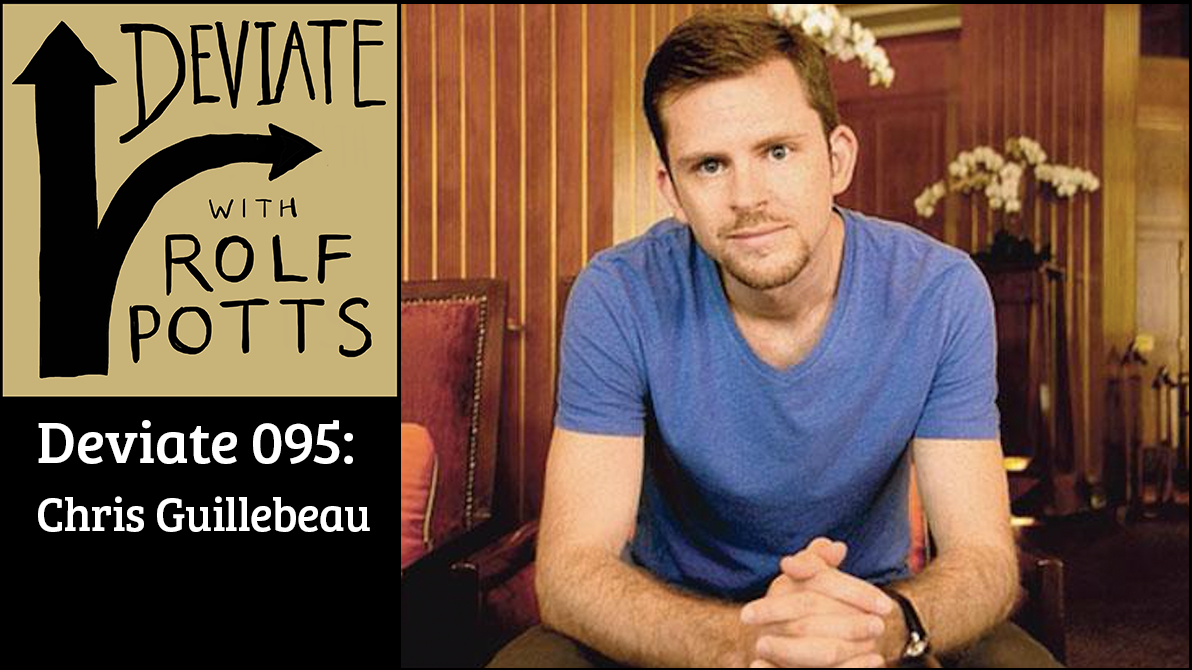
Chris Guillebeau on goals, writing books, and travel as alt-university
“Have a bias toward action.” – Chris Guillebeau In this episode of Deviate, Rolf and Chris discuss Chris’ quest to travel to every country in the world (4:30); discovering and fine-tuning your passions through travel (17:00); exploring creativity through various mediums, and discontentment as a catalyst for change (27:00); knowing when to write a book (44:00); and overcoming adversity as a creative person (56:00). Chris Guillebeau (@chrisguillebeau), who visited every country in the world before his 35th birthday is a New York Times bestselling author. His books include The Art of Non-Conformity, The $100 Startup, The Happiness of Pursuit, and Side Hustle. He is also the host of the Side Hustle School podcast. For more on Chris, check out https://chrisguillebeau.com/ or his 193 Countries Project at https://www.instagram.com/193countries/. Notable Links: School of Travel (podcast) The 4-Hour Workweek, by Tim Ferriss (book) Rolf’s Big Idea Book Bootcamps Paris Writing Workshops World Domination Summit (event) Ryan Holiday (author) Scrivener (note management application) Evernote (note management application) This episode of Deviate is brought to you by TripScout. This app provides a portal for visual discovery by featuring the best articles and videos from top publishers and local experts for each destination. Every restaurant, café, shop, or site featured within the content is mapped to one of TripScout’s...
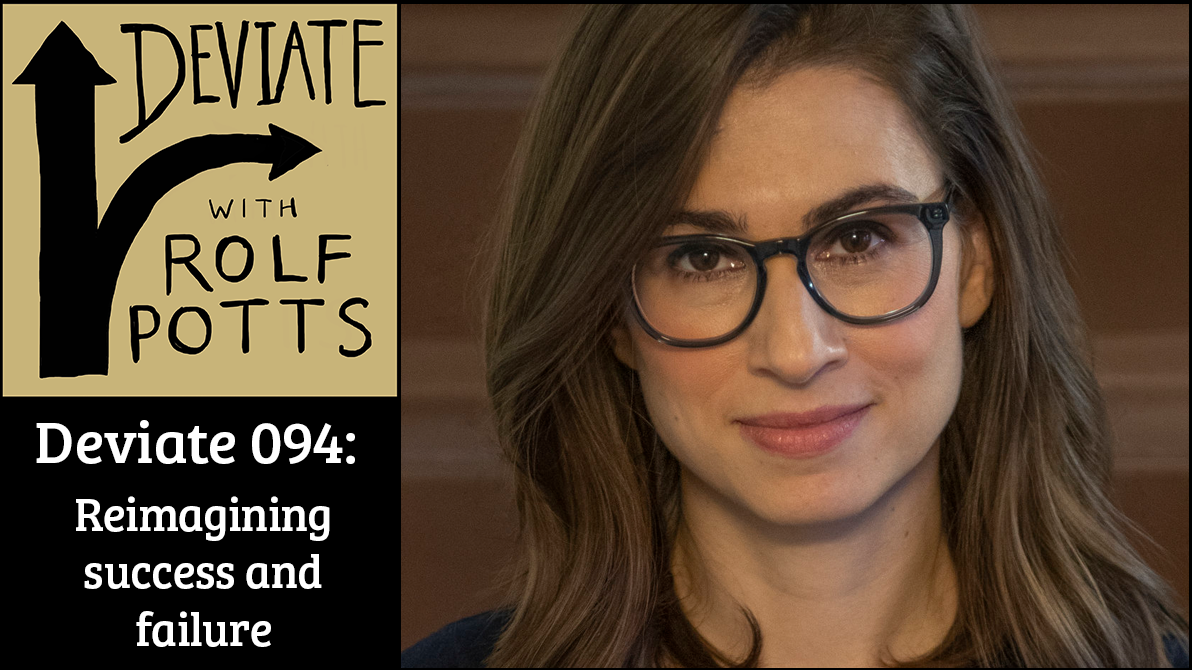
How to balance a life of artistic ambition with sanity and happiness
“Do not hold on to any one vision of what your life should look like.” – Rachel Friedman In this episode of Deviate, Rolf and Rachel discuss perceptions of success (3:15); the upside of failure and non-linear paths to success (13:00); ordinariness and the influence of public validation (23:00); and the reconciling old and new goals and the art of quitting (36:00). Rachel Friedman (@RachelFriedman) is a traveler, writer, and author of The Good Girl’s Guide to Getting Lost, which was chosen as a Target Breakout Book and selected by Goodreads’ readers as one of the best travel books of 2011. Her latest book, And Then We Grew Up is out now. For more about Rachel, check out https://www.rachel-friedman.com/. Notable Links: At Eternity’s Gate (film) Vincent Van Gogh (artist) José Ortega y Gasset (philosopher) Malcolm Gladwell (author) The Road Not Taken, by Robert Frost (poem) Napoleon Dynamite (film) Black Mirror (television show) This episode is also brought to you by AirTreks, an industry leader in multi-stop international travel. If you’ve ever planned a trip with multiple stops, you know that finding the right flights can be difficult. Between balancing travel logistics and cost, it often becomes impossible to build an itinerary that matches your travel goals. AirTreks is a distributed travel company with employees working from all corners of the world to help with your flight planning, specializing in complex routes with up to 25 stops. The AirTreks website offers suggested pre-planned travel itineraries to help you get started, but can customize to fit your journey. The Deviate theme music comes from the title track of Cedar Van Tassel’s 2017 album Lumber. Note: We don’t host a “comments” section, but we’re happy to hear your questions and insights via email, at devi...
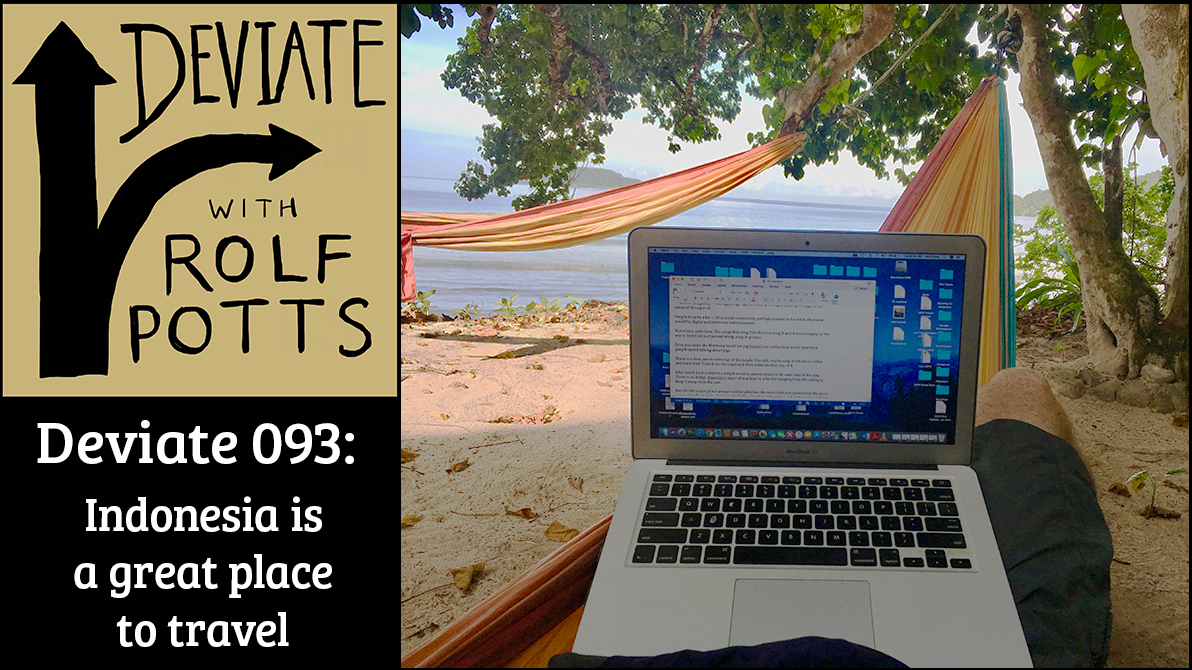
Indonesia: An argument for (and essential tips on) traveling the archipelago
“Treat Indonesia as a continent, not a country.” – Tim Hannigan In this episode of Deviate, Rolf and Tim discuss why Indonesia is underrated (3:00); the role of Indonesia in the popular consciousness (15:00); the history or Bali and the geography of Indonesia (22:00); cultural differences and the influence of travel blogging (38:00); and strategies for first time travelers (55:00). Tim Hannigan (@Tim_Hannigan) is a travel and history writer, specializing in Southeast Asia and particularly Indonesia. He has written travel features for newspapers and magazines in Asia, the Middle East, North America and the UK, and has contributed to various radio and television documentaries on Asian history. He has also worked on guidebooks to destinations including Bali, Nepal, Myanmar, and India. Tim is the author of A Brief History of Indonesia and A Geek in Indonesia. For more about Tim, check out https://timhannigan.com/. Notable Links: Krakatoa, by Simon Winchester (book) Nathaniel’s Nutmeg, by Giles Milton (book) Marco Polo (explorer) Eddie Van Halen (musician) Insights from Henry Rollins’ 2018 Travel Slideshow (blog post) Avenged Sevenfold (band) Indohoy (website / blog) This episode is also brought to you by AirTreks, an industry leader in multi-stop international travel. If you’ve ever planned a trip with multiple stops, you know that finding the right flights can be difficult. Between balancing travel logistics and cost, it often becomes impossible to build an itinerary that matches your travel goals. AirTreks is a distributed travel company with employees working from all corners of the world to help with your flight planning, specializing in complex routes with up to 25 stops. The AirTreks website offers suggested pre-planned travel itineraries to help you get started, but can customize to fit your journey. The Deviate theme music comes from the title track of Cedar Van Tassel’s 2017 album Lu
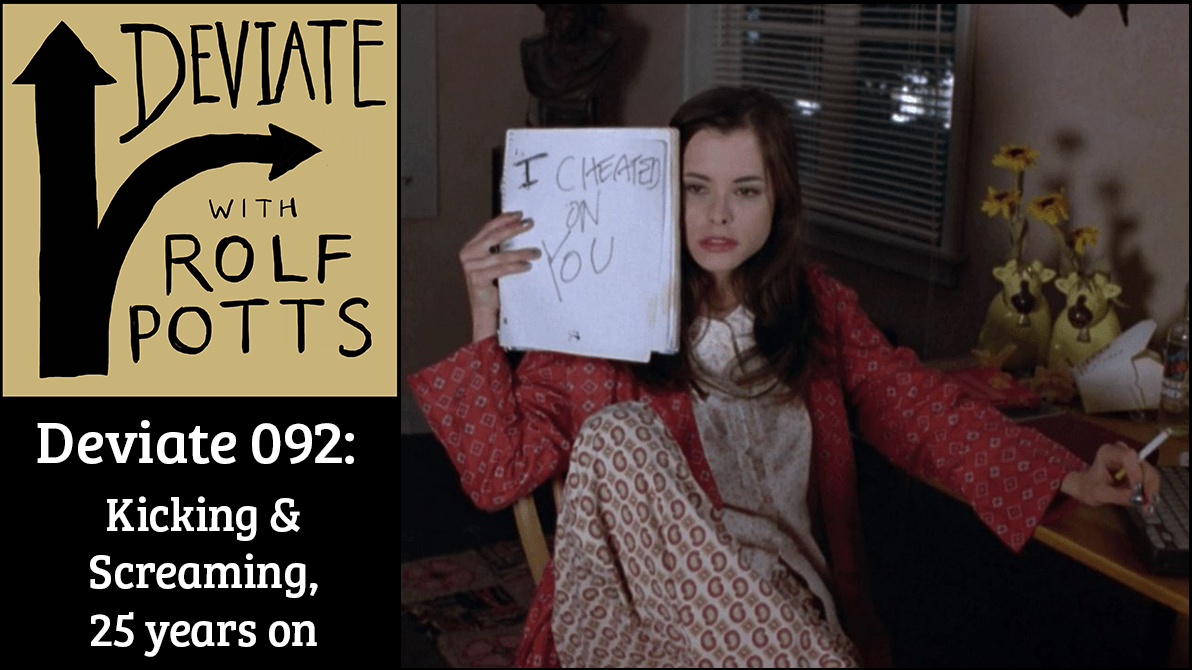
Why Noah Baumbach’s “Kicking & Screaming” might be the best movie ever
“Kicking and Screaming is a more arch and far more intelligent version of the TV show Friends. If you want to experience that feeling of being young and not really knowing yet what you’re doing in life, watch this movie instead.” –Michael Weinreb In this episode of Deviate, Rolf and Michael discuss the plot of Noah Baumbach‘s debut movie Kicking & Screaming, and how it explores life-transition and the loss of status that accompanies college graduation (3:15); Generation X movie marketing, and how Michael and Rolf came to find the movie in video stores (9:00); other movies with a similar youth theme, such as Glory Daze, and how even slacker movies could be aspirational for people who watched them (18:00); the way Kicking & Screaming played with notions of nostalgia (27:00); plot aspects that do double comedic/dramatic-duty (33:00); ties to other Noah Baumbach characters, and the philosophical texture of indecision (43:00); the way the movie explores the small problems of being young and upper-middle class in a time of relative peace (48:00); how sense of place affects the characters the story, and how the movie has a writerly sensibility (51:00); and the case for why one should watch the movie (1:01:00). Michael Weinreb (@MichaelWeinreb) is the author of three sports books, including Game of Kings, about a Brooklyn high-school chess team; Bigger Than the Game, about the rise of celebrity sports culture in the 1980s; and a cultural and personal history of college football, Season of Saturdays. He has been a contributing writer for ESPN, The New York Times, Grantland, Rolling Stone, The Athletic, and The Ringer. For more about Michael, check out https://michaelweinreb.com/. 1980s and 1990s youth-culture links: TIME’s 1990 “Twentysomething” article (which first defined Generation X) Sophfronia Scott on defining a generation (Deviate podcast episode) Remembering Noah Baumbach’s fan-site Q&As (essay) Wayback Machine (digital archive) “Age of Consent” (New Order song) Friends (1990s TV show) Details (1990s youth-culture magazine) Roger Ebert (movie critic) Blockbuster (video rental store) Tetris (video game) Books and creators mentioned: All the Pretty Horses, by Cormac McCarthy (novel) A Separate Peace, John Knowles (novel) The Catcher in the Rye, by JD Salinger (novel) Lena Dunham (writer and actor) Bill Simmons (writer and podcaster)

Deviate Christmas Special: Celebrating the Sears Wish Book [Rebroadcast]
“The Sears Christmas Wish Book was, for me, a kind of foundational text — a secular counterpoint to the Bible stories I learned around that time in Sunday School. I paged through the holiday catalog’s 620 glossy pages as if they amounted to an intoxicating graphic novel of desire, rich with abundance and possibility.” – Rolf Potts, from “Literature of Desire” In this episode Rolf reads an audio version of his Christmas-themed essay “Literature of Desire,” and discusses the wonders of the Sears Christmas Wish Book with novelist Tod Goldberg (@todgoldberg). Tod is the New York Times bestselling author of over a dozen books, including the Gangsterland series, which is currently being developed into a television show. He is also the director of the University of California-Riverside Palm Desert Low-Residency MFA, and the co-host of the Literary Disco podcast. Introduction (01:35 – 12:20) Vintage Sears Wish Book online archive What Exactly is Christmas Tree Flocking? from Mental Floss Klonopin (anxiety medication) Janis Ian (singer-songwriter) Enchroma glasses (to correct colorblindness) Literature of Desire essay (12:20 – 33:20) Richard Warren Sears (catalog founder) Mr. Sears’ Catalog (video) from PBS’s American Experience Sears Catalog Home (ready-to-assemble houses) That ’70s Show, Happy Days, Good Times, Welcome Back, Kotter (TV shows) Christie Brinkley and Renee Russo (fashion models) Pong (video game) Big Jim’s P.A.C.K. (toy line) Jay J. Armes (private investigator) JJ Armes action figure (TV commercial) “Is Jay J. Armes For Real?” from Texas Monthly WishBookcom Sears Wish Book memories (33:20 – 51:10) Action figures (dolls marketed to boys) Toughskins (jeans for children) Huffy (bicycle brand) BEST (showroom retail store) “
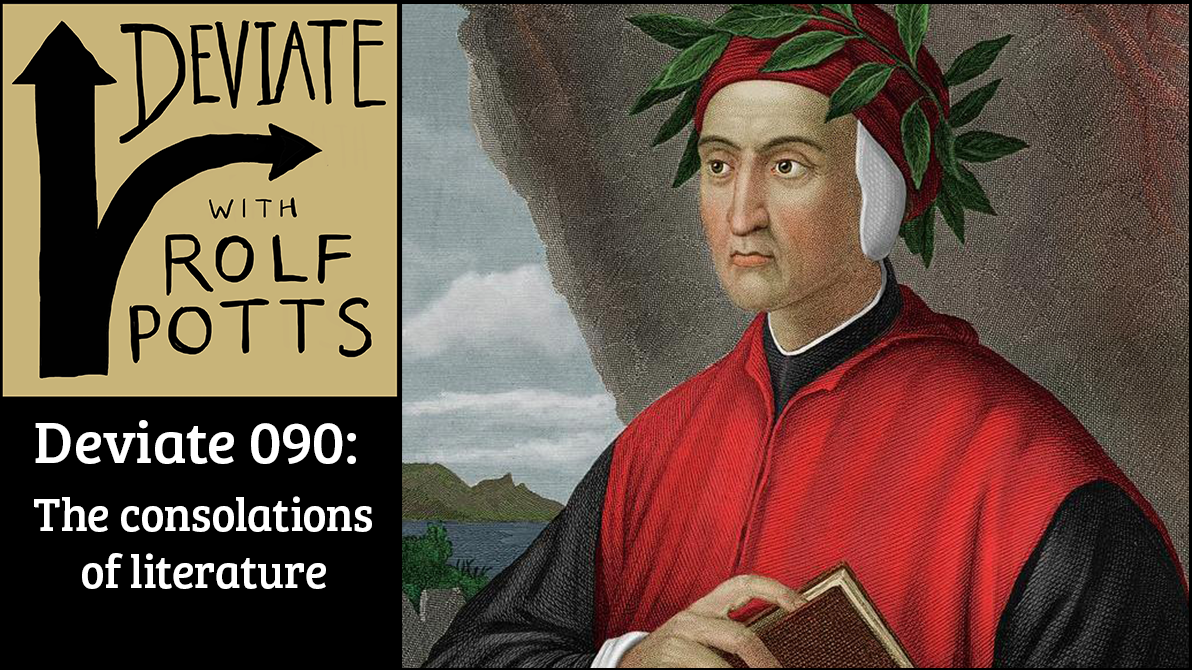
Bonus: On the therapeutic uses of reading classic literature and scripture
“Going the longer route through literature, rather than just reading self-help, will ultimately be more satisfying.” – Jeffrey Tayler In this episode of Deviate, Rolf and Jeffrey discuss navigating life’s challenges through literature (3:00); Ecclesiastes and the great stories of history (12:00); and using literature to make sense of ones life (19:00). Jeffrey Tayler (@JeffreyTayler1) is an American writer and journalist living in Moscow. He is a contributing editor at The Atlantic, and many of his essays have been selected for The Best American Travel Writing series. Two of his travel essays were also selected by Bill Bryson for the inaugural edition of The Best American Travel Writing 2000. He is the author of seven books, including Siberian Dawn and Facing the Congo. His recent book, In Putin’s Footsteps, which he co-authored with Nikita Khrushchev’s great grand-daughter, is out now. Notable Links: Ecclesiastes (biblical text) A Book of the Bible Even an Atheist Can Love, by Jeffrey Tayler (essay) Geneva Bible (Shakespeare era bible translation) King James Bible (iconic English bible translation completed in 1611) NIV Bible (modern bible translation first published in 1978) The Gospels (biblical books about Jesus’ life and teaching) Turn! Turn! Turn! (Pete Seeger song popularized by The Byrds) Paradise Lost, by John Milton (poem) Homer (author) Virgil (poet) Epicurus (Greek philosopher) The Divine Comedy, by Dante (narrative poem) Walden, by Henry David Thoreau (book)
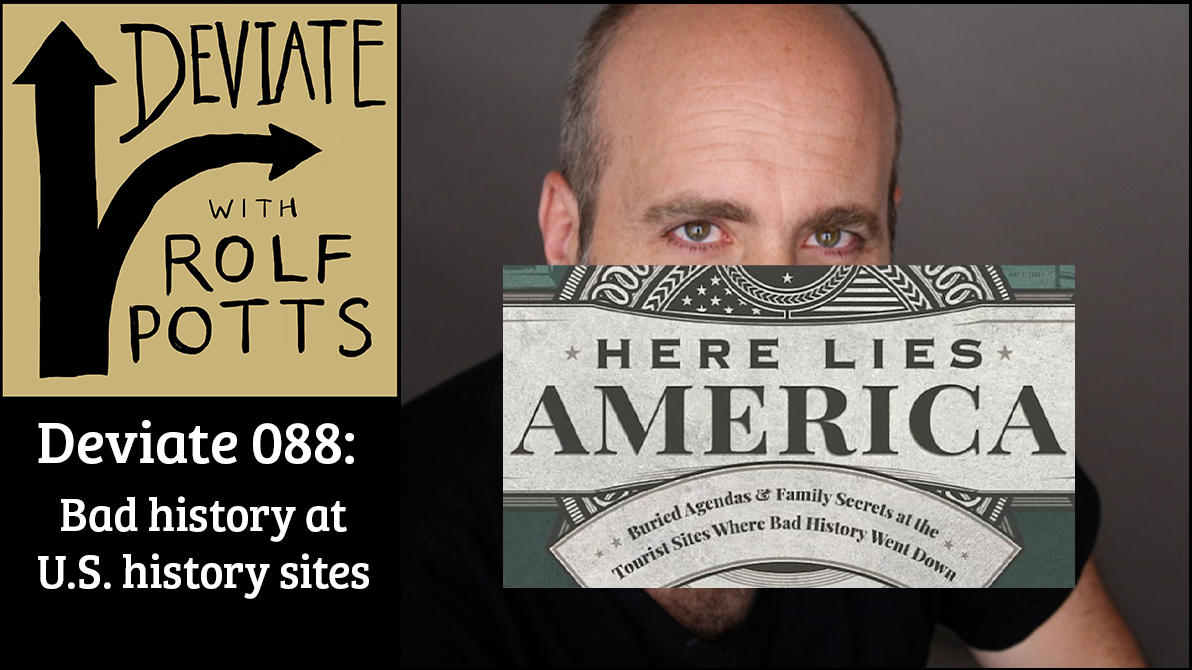
America’s most solemn historical sites rarely offer an honest take on history
“So much of what is wrong with America today began with the Civil War and Reconstruction” – Jason Cochran In this episode of Deviate, Rolf and Jason discuss the monuments at Gettysburg, and the concept of a Civil War “hero” (2:00); the revisionist post-war memorial efforts by Southern organizations (13:00); the concept of memorials, and how they shape memory (26:00); and our relationship with deceased celebrities, and how to interpret America through its monuments (40:00). Jason Cochran (@JasCochran), the award-winning author of Here Lies America, has been a travel authority and consumer expert for over 20 years. His work has appeared in such publications as Travel + Leisure, the New York Post, USA Today, and The New York Times. He is currently Editor-in-Chief of Frommers.com and co-host with Pauline Frommer of the weekly Travel Show on WABC. For more about Jason, check out https://jasoncochran.com/. Notable Links: Battle of Gettysburg Andersonville Historical Site Reconstruction Era Robert E. Lee (Commander of the Confederate Army) United Daughters of the Confederacy (association) Ladies Memorial Associations (Southern monument effort) Ford’ Theatre (site of Lincoln assassination) Ken Burns (filmmaker) Jim Crow Laws National Lynching Memorial The Canterbury Tales, by Geoffrey Chaucer (book) Negro Leagues Baseball Museum USS Maine National Monument<...
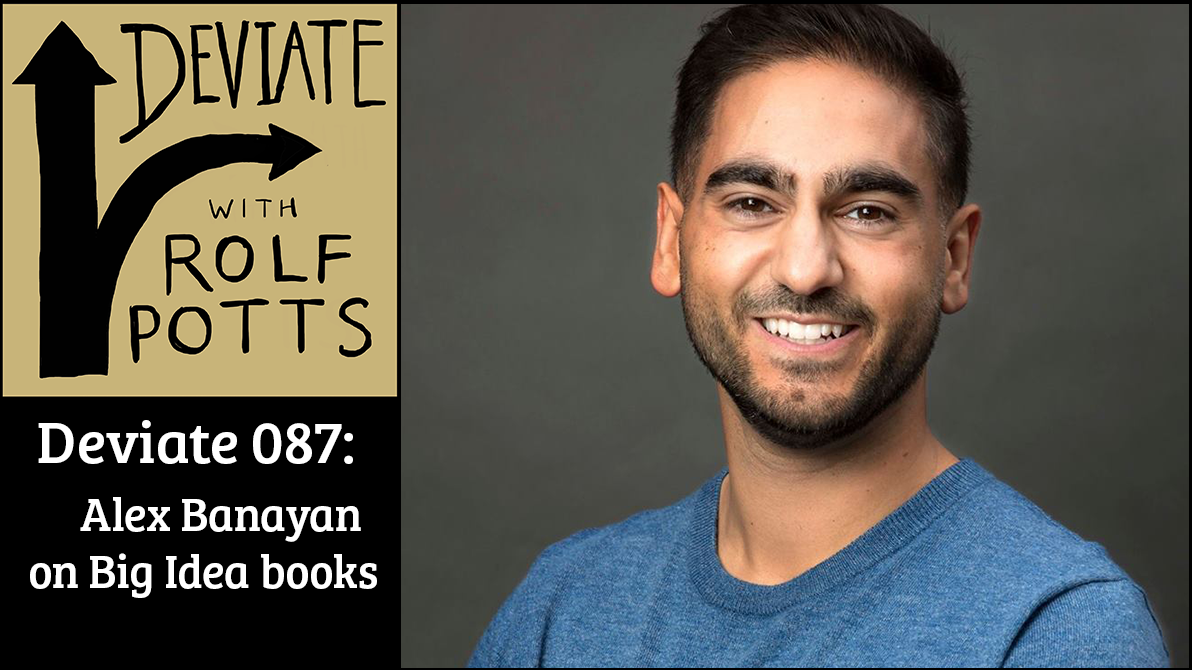
Author Alex Banayan on seeking mentors for life (and writing) guidance
“You cannot change your reality until you see your reality.” – Alex Banayan In this episode of Deviate, Rolf and Alex discuss mentorship (3:00); the genesis of Alex’s book The Third Door (10:00); “opportunity hurdles” (30:00); structural storytelling, and the art of learning (54:00); and the importance of thinking differently (1:11:00). Alex Banayan (@AlexBanayan) is the bestselling business author of The Third Door, which chronicles his five-year quest to track down Bill Gates, Lady Gaga, Warren Buffett, Maya Angelou, Steven Spielberg, and dozens more of the world’s most successful people to uncover how they broke through and launched their careers. Alex has been named to Forbes’ 30 Under 30 list, Business Insider’s Most Powerful People Under 30, and been featured in major media including Fortune, Forbes, and Businessweek. For more about Alex, check out https://thirddoorbook.com/. Notable Links: Tim Ferriss (entrepreneur) Bill Gates (businessman) Lady Gaga (singer) Maya Angelou (poet) Warren Buffett (businessman) Steven Spielberg (filmmaker) Elliott Bisnow (investor) Cal Fussman (journalist) Tools of Titans, by Tim Ferriss (book) Tribe of Mentors, by Tim Ferriss (book) The Odyssey, by Homer (epic poem)

The world’s cheapest destinations, and why (besides savings) they’re great
“It’s good as you travel to take the time to do nothing, and have nothing planned.” –Tim Leffel In this episode of Deviate, Rolf and Tim discuss the advantages of traveling to cheaper parts of the world (3:00); how living overseas can actually be cheaper than your life at home (13:00); strategies to save money on the road (23:00); setting a budget, and counterintuitive sightseeing (34:00); and breaking the myth of expensive European travel (51:00). Tim Leffel (@timleffel) is an award-winning travel writer and author of The World’s Cheapest Destinations and A Better Life for Half the Price. He is the editor of the narrative web publication Perceptive Travel. For more about Tim, check out https://timleffel.com. This episode of Deviate is brought to you by Tortuga Backpacks, which set the standard for the best, most durable, organized, and comfortable travel backpacks. Tortuga products also include daypacks, duffels, and other travel accessories, which are all made with the traveler in mind and have been featured by Wirecutter, The New York Times, Travel + Leisure, Business Insider, Carryology, and many other industry outlets. This episode is also brought to you by AirTreks, an industry leader in multi-stop international travel. If you’ve ever planned a trip with multiple stops, you know that finding the right flights can be difficult. Between balancing travel logistics and cost, it often becomes impossible to build an itinerary that matches your travel goals. AirTreks is a distributed travel company with employees working from all corners of the world to help with your flight planning, specializing in complex routes with up to 25 stops. The AirTreks website offers suggested pre-planned travel itineraries to help you get started, but can customize to fit your journey. The Deviate theme music comes from the title track of Cedar Van Tassel’s 2017 album Lumber. Note: We don’t host a “comments” section, but we’re happy to hear your questions and insights via email, at [email protected].
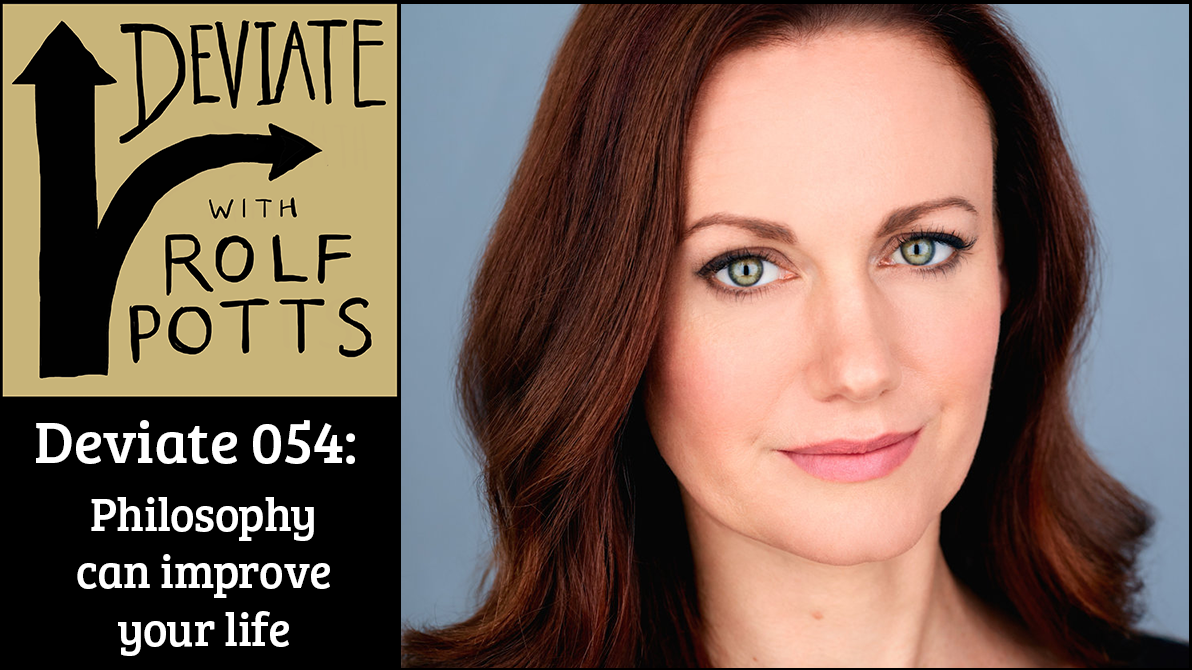
How philosophy can (truly) improve your life, featuring Monica McCarthy
“The challenge is that we have to become philosophers ourselves, in a way. We have to learn to ask better questions and more questions than we had to before.” – Monica McCarthy Monica McCarthy (@MissMMcCarthy) is an actress, writer, and host of The Happier Hour podcast and live show, which aims to make philosophy useful and accessible. For more about Monica, you can check our her website or watch her TedX talk, Philosophy: The Life Hack of the Future. In this episode of Deviate, Rolf speaks with Monica about the “definition” of philosophy (3:00); where people should start when seeking to embrace philosophy (16:00); travel as a metaphor for discussing philosophy (22:00); Western philosophy and common assumptions about it (32:00); and key takeaways from Monica’s podcast (50:00). Notable Links: Tim Ferriss (author / entrepreneur) Ryan Holiday (author) Alain de Botton (author / philosopher) Socrates (philosopher) Søren Kierkegaard (philosopher) Ludwig Wittgenstein (philosopher) Simone de Beauvoir (philosopher) Jean-Paul Sartre (philosopher) Friedrich Nietzsche (philosopher) Albert Camus (philosopher) David Hume (philosopher) Epicurus (philosopher) Avicenna (philosopher) Stoicism (school of philosophy) Existentialism (school of philosophy) Nero (Roman emperor) Massimo Pigliucci (professor of Philosophy at CUNY-City College) At the Existentialist Café, by Sarah Bakewell (book) The Good Place (television show) Trolley Problem (thought experiment) The School of Life (educational company) The Deviate theme music comes from the title track of Cedar Van Tassel’s 2017 album Lumber. Note: We don’t host a “comments” section, but we’re happy to hear your questions and insights via email, at [email protected].

Deviate Season One finale with Ari Shaffir
“The hashtag level of social media discourse can be really frustrating. It tends to bend narratives toward the hashtag slogan. But when we start sweeping everything into the same category, we begin to trivialize the core issue.” – Rolf Potts Ari Shaffir (@AriShaffir) is a comedian, writer, podcaster, and actor. He is the current host of the podcast Skeptic Tank. In the Season 1 Finale of Deviate, Rolf and Ari resume their conversation about magic mushrooms (7:00); discuss Ari’s strange bets and the experience of panhandling for money (17:00); reflect on lessons learned from the past year of podcasting (32:00); discuss the shortcomings of travel television (55:00); and explore self-mythology and society’s over-simplification of complex topics (1:07:00). This episode of Deviate is brought to you by AirTreks, an industry leader in multi-stop international travel. If you’ve ever planned a trip with multiple stops, you know that finding the right flights can be difficult. Airtreks can help with your international flight planning, specializing in complex routes with up to 25 stops. The Airtreks website offers suggested pre-planned travel itineraries to help you get started, and can customize to fit your journey. Visit https://www.airtreks.com/deviate/ and get a signed copy of Vagabonding when you book your first trip with Airtreks. Deviate episodes mentioned Bestselling author Tim Ferriss on how to create a successful podcast Comedian Ari Shaffir on ‘shrooms, hugging, and quitting smartphones Ari Shaffir on travel, memory, and the odd psychology of souvenirs Satanic backward masking changed 1980s rock (but not in the way you think) What it’s like to be a black police officer in America What it’s like to be a Latino police officer in America The weird and complicated history of America’s national anthem Punk icon Ian MacKaye on why we should question the official history of rock music Celebrating the best places to live (and the quest for home) in America Kink Doctor Dulcinea Pitagora on sex therapy, BDSM, and dominatrix work The way we grow food has been broken for 10,000 years (but we can fix it)
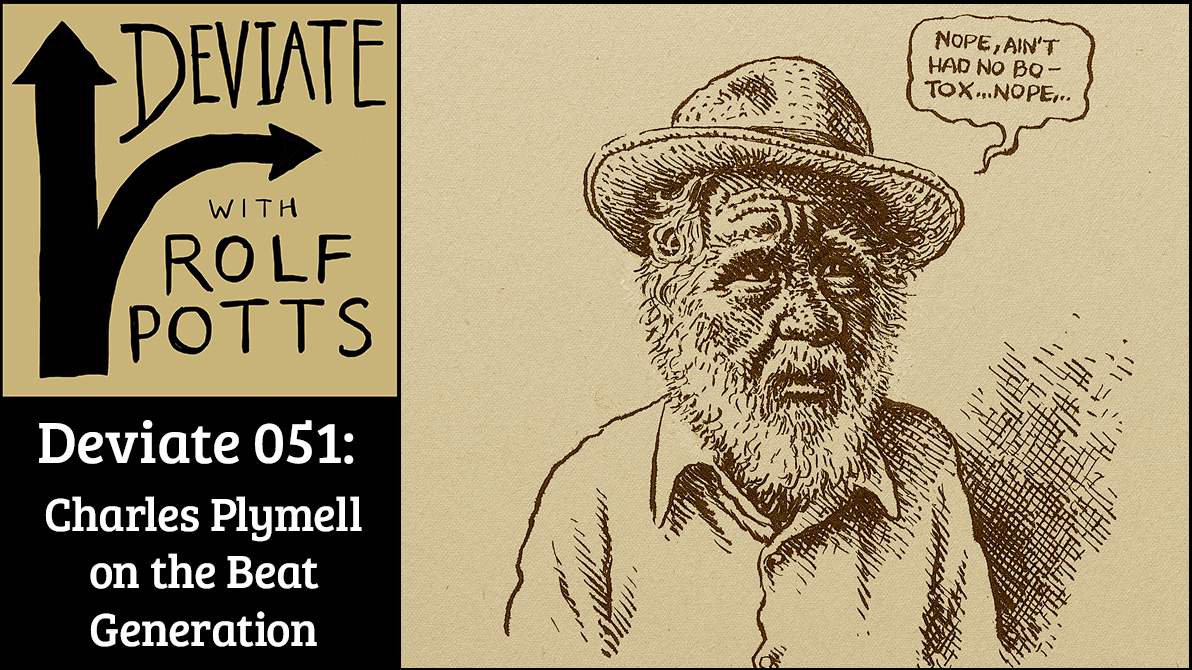
An outsider’s inside history of the Beat Generation, as told by Charles Plymell
“To me the term Beat was like, “Hey man I’m beat,” after all night on Benzedrine. I never considered myself a Beat. But my first book was published by Ferlinghetti and they all arrived at my doorstep when I lived at Gough Street, so I guess I became a Beat by osmosis.” —Charles Plymell Charles Plymell is a poet, novelist, and small press publisher. Plymell has collaborated with and published many poets, writers, and artists, including principals of the Beat Generation. Benzedrine Highway, published in 2013, is an anthology of his best-known poetry and prose, including excerpts from his 1971 City Lights novel The Last of the Moccasins. In this episode of Deviate, Charles and his wife Pamela Beach Plymell discuss their memories of (and interactions with) Jack Kerouac (4:55); Charley’s upbringing in Dust Bowl-era Kansas, and his early road-trips to California (11:05); life as a young hood and hipster in Wichita (14:40); meeting and interacting with the Beats in San Francisco (19:20); rooming with Neal Cassady and Allen Ginsberg when Cassady was trying to write his own book (23:55); hosting Ginsberg during the poet’s Wichita Vortex Sutra journey to Kansas in 1966 (30:50); publishing the first issue of R. Crumb’s Zap Comix just before the Summer of Love (35:35); working at a teamster on the San Francisco docks, and getting his own novel published (39:50); and interacting with William S. Burroughs in the later years of the author’s life (46:00). For more information on Charley, check out his fan page at http://hipsterfansite.blogspot.com/. Notable Links: Beat Generation (literary movement) Jack Kerouac (Beat author and poet) William F. Buckley Jr. (conservative intellectual) Firing Line (public affairs TV show) Truman Capote (author and critic) Hand on the Doorknob, by Charles Plymell (book) Benzedrine and Dexedrine (amphetamine pills) Neal Cassady (Beat Generation personality) Allen Ginsberg (Beat poet) The First Third, by Neal Cassady (book) Lawrence Ferlinghetti (poet and publisher) City Lights (independent bookstore) Wichita Vortex Sutra, by Allen Ginsberg (poem) “The Last Anti-War Poem,” by Rolf Potts (essay) Wichita Vortex (PBS documentary about the poem) Robert Crumb (underground cartoonist) Zap Comix (counterculture comic book series) Summer of Love (1967 hippie event in San Francisco) Human Be-in (Summer of Love event)...

Author Pam Houston on the joys of creating home amid a lifetime of travel
“How do we become who we are in the world? We ask the world to teach us.” – Pam Houston Pam Houston (@pam_houston) is an author and professor of English at the University of California, Davis. Her books include Cowboys Are My Weakness and Contents May Have Shifted, with her latest, Deep Creek, set for release in January 2019. In this episode of Deviate, Pam discusses her interactions with writing students (2:30); living an non-traditional life (16:30); developing a notion of home (25:00); and how Pam’s life on the ranch affects her writing (34:00). The episode concludes with Rolf reading his short essay “Creating a new sense of home is part of the travel process.” For more information on Pam, check out her website at https://pamhouston.wordpress.com/ Notable Links: Santa Fe Writers Workshop “Some Kind of Calling,” by Pam Houston (essay) “Pam Houston on (Finally) Finding True Love” (essay) Desert Solitaire, by Edward Abbey (book) Pilgrim at Tinker Creek, by Annie Dillard (book) My Antonia, by Willa Cather (novel) Alice Munro (author) Terry Tempest Williams (author) The Meadow, by James Galvan (book) West Fork Complex (2013 wildfire) The Deviate theme music comes from the title track of Cedar Van Tassel’s 2017 album Lumber. Note: We don’t host a “comments” section, but we’re happy to hear your questions and insights via email, at [email protected].

Major Jackson on the poetics of time (and how best, in life, to spend it)
“The act of creating is a way of stopping time.” – Major Jackson Major Jackson (@Poet_Major) is an American poet, professor, and author of four collections of poetry: Roll Deep, Holding Company, Hoops, and Leaving Saturn. He currently serves as the Poetry Editor of the Harvard Review. In this episode of Deviate, Rolf and Major discuss the changing perception of time and how creation leads to a deeper experience of time (2:00); poetry and the lessons it teaches us about life (23:00); and time as prison, the way we claim our freedom, and art as a means toward transcendence (39:00). For more information on Major, check out his website at http://www.majorjackson.com/ Poems and books mentioned: The Gutenberg Elegies, by Sven Birkerts (book) “The World Is Too Much With Us” (poem by William Wordsworth) “To the Virgins, to Make Much of Time” (poem by Robert Herrick) “Ode: Intimations of Immortality” (Wordsworth poem) “On Disappearing” (poem by Major Jackson) “Stations” (poem by Stanley Moss) Into the Mecca by Gwendolyn Brooks (book) Jerusalem (poem by James Fenton) Jerusalem, by Peter Cole (essay) The Snow Leopard, by Peter Matthiessen (book) “Lying in a Hammock at William Duffy’s Farm in Pine Island, Minnesota” (poem by James Wright) Notable Links: Paris Writing Workshop (summer creative writing course) Dead Poets Society (film) Carpe Diem (Latin aphorism) Walt Whitman (poet) Eastern State Penitentiary (former prison in Philadelphia) Michel Foucault (philosopher) True Detective (HBO TV series) John Muir (naturalist) Jack Kerouac (author) Croesus (wealthy king from ancient times) Seneca (philosopher) Dazed and Confused (film)

White Zombie guitarist J. Yuenger on music, expat life, and long-term travel
“Travel feels like a generational signifier the way rock music was when I was a kid. The whole idea of having experiences as opposed to accumulating stuff feels like this planetary alignment, the way rock was in the ’70s.” – Jay Yuenger Jay Yuenger (@JYuenger) is a rock guitarist best known for his work with the Grammy-nominated heavy metal band White Zombie. In this episode of Deviate, Rolf and Jay discuss Cuba and access to technology (3:00); J’s White Zombie backstory, and his travels with the band (13:30); the rise in popularity of White Zombie and the evolution of travel (40:00); the breakup of the band and Jay’s post-band years spent traveling (50:00); and souvenirs (1:01:00) For more information on Jay, check out his website or his Instagram account. Notable Links: Vagabonding, by Rolf Potts (book) Taxi Driver (film) Thunder Kiss ’65 (song, by White Zombie) Anthony Bourdain (chef and travel documentarian) The Practical Nomad, by Edward Hasbrouk (book) Hardcore Punk (music genre) Minor Threat (band) Metallica (band) Misfits (band) Ramones (band) Slayer (band) Cro-Mags (band) Suicidal Tendencies (band) Danzig (band) Headbangers Ball (television program) 120 Minutes (television program) Butthole Surfers (band) Faith No More (band) Get in the Van, by Henry Rollins (book) The Smashing Pumpkins (band) Fugazi (band) Jane’s Addiction (band) Walt Whitman (poet) Kurt Vonnegut (author) The Deviate theme music comes from the title track of Cedar Van Tassel’s 2017 album Lumber. Note: We don’t host a “comments” section, but we’re happy to hear your questions and insights via email, at [email protected].

Traveling Russia onboard the Trans-Siberian express: A 2018 case study
“I can’t imagine what the Trans-Siberian train would be like if you knew what time it was. That was the ongoing fun of the experience — never really having any clue what time it was.” – Jonathan Arlan Jonathan Arlan (@JonathanArlan) is the author of the book Mountain Lines: A Journey through the French Alps and a recent Tablet essay titled Off the Rails in Birobidzhan. In this episode of Deviate, Rolf and Jonathan discuss travel bucket lists (2:30); the Trans-Siberian experience, including being an American on the train (12:30); the passing of time on the railway (28:00); and a final evaluation of the journey (38:00). For more information on Jonathan Arlan, check out his website at http://jonathanarlan.com/ Notable Links: Trans-Siberian Handbook, by Bryn Thomas (guidebook) Lonely Planet Trans-Siberian Railway (guidebook) Real Russia (travel agency) Monkeyshrine (Trans-Siberian travel agency) The Man in Seat 61 (train-travel website) The Deviate theme music comes from the title track of Cedar Van Tassel’s 2017 album Lumber. Note: We don’t host a “comments” section, but we’re happy to hear your questions and insights via email, at [email protected].
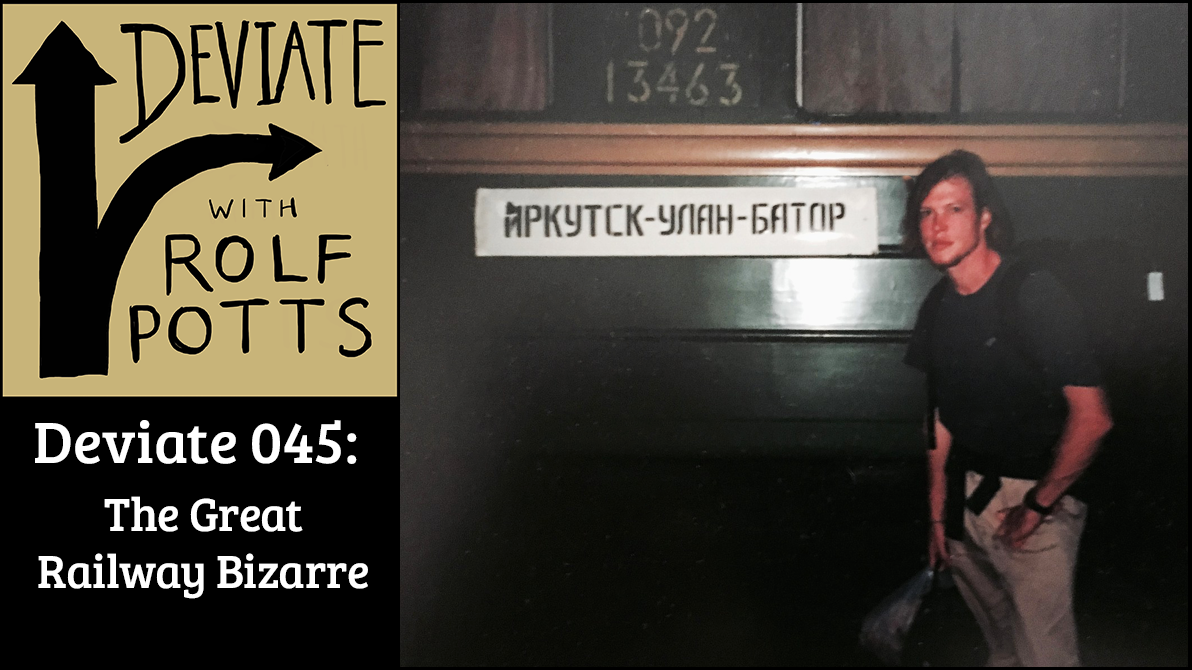
The great railway bizarre: A Trans-Siberian story (plus audio endnotes)
“If there is any revelation to be gleaned from spending several days on a single train, it will come from the bizarre details that lurk beneath the mundanity of the trip itself.” – Rolf Potts In this episode of Deviate, Rolf reads his essay On the Trans-Siberian Express (2:00) and then recounts, with Jonathan Arlan, the story behind the story, discussing his approach to writing about his experiences on the Trans-Siberian railroad (1:17:00). Jonathan Arlan (@JonathanArlan) is the author of the book Mountain Lines: A Journey through the French Alps and a recent Tablet essay titled Off the Rails in Birobidzhan. Notable Links: Marco Polo Didn’t Go There, by Rolf Potts (book) Genghis Khan (historical figure) David Foster Wallace (author) In Xanadu, by William Dalrymple (book) Naadam (festival) Ulan-Ude (Russian city) Elderhostel, i.e., Road Scholar (non-profit organization) Hunter S. Thompson (journalist and author) Douglas Coupland (author and artist) Fyodor Dostoevsky (author) William S. Burroughs (writer) The Deviate theme music comes from the title track of Cedar Van Tassel’s 2017 album Lumber. Note: We don’t host a “comments” section, but we’re happy to hear your questions and insights via email, at [email protected].
Writer-producer LaToya Morgan on TV storytelling and creative self-discipline
“It’s better for characters if their arc isn’t a straight line. You get to see how far they will go for something. You get to test them.” – Latoya Morgan LaToya Morgan (@MorganicInk) is screenwriter who currently serves an executive producer on AMC’s Into the Badlands. Previously, she has worked on the shows Shameless and Turn. She is currently developing a drama for AMC based on Wesley Lowery’s best-selling book They Can’t Kill Us All. In this episode of Deviate, Rolf and LaToya talk about her early upbringing and influences (2:30); diversity on television (8:30); her decision to become a writer (15:00); the role of research versus personal experience in writing (28:00); the the experience of working in a writers’ room (34:00); and managing work/life balance (48:00). Notable Links: Stephen King (author) The Twilight Zone (television show) Black Mirror (television show) General Hospital (television show) One Life to Live (television show) Oprah (television personality / media executive) Friday Night Lights (television show) Mad Men (television show) Game of Thrones (television show) The X-Files (television show) John Steinbeck (author) American Film Institute Charlie Chaplin (actor) City Lights (film) Final Draft (screenwriting software) Melrose Place (television show) Sunset Boulevard (film) Warner Brothers Television Writers’ Workshop Southland (television show) Books mentioned: Of Mice and Men, by John Steinbeck The Grapes of Wrath, by John Steinbeck Cannery Row, by John Steinbeck The Art of Dramatic Writing, by Lajos Egri Save the Cat, by Blake Snyder The Hero’s Journey, by Joseph Campbell Story, by Robert McKee On Writing, by Stephen King Outliers, by Malcolm Gladwell
Punk icon Ian MacKaye on why we should question the official history of rock music
“Punk is not a sound for me. It’s not a style of music. It’s not a look. It’s not even an attitude. For me punk is the free space: It’s the place where new ideas can be presented without having to hew to profit motives.” — Ian MacKaye Ian MacKaye is the co-founder of Dischord Records and former front man for Fugazi and Minor Threat. He currently performs in the two-piece indie band The Evens with his partner Amy Farina. He curates an informal archive of the Washington DC hardcore and post-hardcore music scenes, including the Fugazi Live Series, an extensive online library of digitized concert recordings. In this episode of Deviate Rolf and Ian discuss the “Nirvana moment” of the early 1990s, how new ideas find their way into music, and how lesser known acts influence the dynamic of popular culture (8:00); the task of archiving and preserving evidence of music that was created outside the commercial music industry (29:00); skateboarding and punk rock as lenses through which to see the world in a different way (45:30); and the lessons and experiences of traveling the world as a musician. Notable links: Our Band Could Be Your Life, by Michael Azerrad (2001 book) Lipstick Traces: A Secret History of the 20th Century, by Greil Marcus (1989 book) Get in the Van: On the Road With Black Flag, by Henry Rollins (1994 book) “Why Do So Many Kids Think Fugazi is God?” 1993 Washington Post article Henry Rollins’ 2018 KCRW interview with Ian MacKaye Woodstock (documentary film) The Vietnam War (Ken Burns TV documentary series) Thích Quảng Đức (Vietnamese monk who died by self-immolation) Phonograph cylinder (19th century recording technology) Dada (early 20th century avant-garde art movement) Rock & Roll Hall of Fame (museum) Bands, musicians, and music mentioned: Henry Rollins (vocalist, author, and performer) Dave Grohl (rock musician) Kurt Cobain (rock musician) Ted Nugent (rock musician) Jimi Hendrix (rock musician) The Stooges (rock band) Black Flag (hardcore punk band) Bad Brains (hardcore punk band)

How to survive a natural disaster (and recover when it’s over)
“Social capital is as important as formal training when it comes to disaster response. We see in every event people who have never had emergency training playing critical roles.” – Daniel Neely Daniel Neely is the Manager of Community Resilience and Regional Recovery Manager at the Wellington (New Zealand) Region Emergency Management Office. In this episode of Deviate, Rolf and Daniel discuss the importance of community relationships when it comes to responding to a disaster (4:00); emergency preparedness tips (8:00); disaster response strategies (13:00); and preparing for a disaster from both a personal and business perspective (19:00). For more disaster preparedness information, check out https://www.ready.gov/ and https://getprepared.nz/ Notable Links: “Teen who rescued 17 in Harvey flooding wins national Citizen Hero award” Federal Emergency Preparedness Resources FEMA (US Agency) National Flood Insurance Program (FEMA program) 100 Resilient Cities (Rockefeller program) “How to Step Up in the Face of Disaster” (TED Talk) “How to survive a disaster” (BBC article) “Recovering from disasters” (Conversation article) Neighborhood Empowerment Network (community resilience alliance) Cajun Navy (volunteer group) John Leach (survival psychologist) Laurie Johnson (survival consultant) The Deviate theme music comes from the title track of Cedar Van Tassel’s 2017 album Lumber. Note: We don’t host a “comments” section, but we’re happy to hear your questions and insights via email, at [email protected].
Wesley Morris on podcast-fame, sports, and performing blackness in America
“There’s nothing that will stop white people from trying to do some black shit. It’s fundamentally baked into every aspect of American popular culture. It is the first thing that we invented that was entirely ours — white people dressing as black people and entertaining other people.” — Wesley Morris Wesley Morris (@Wesley_Morris) the Pulitzer Prize-winning critic at large for the New York Times. Formerly the co-host of the Grantland podcast “Do You Like Prince Movies?”, he now co-hosts the “Still Processing” podcast with Times colleague Jenna Wortham. In this episode of Deviate Rolf and Wesley discuss the nature of podcast celebrity and how it differs from traditional celebrity (2:45); the stories that sports uniforms tell to the people who watch sports (23:00); the unique task of cultural criticism in the 21st century (30:00); the challenge of being seen as racially representational as a journalist and critic (40:15); and Wesley’s upcoming book about the invention of the performance of blackness in America (51:00). Media personalities mentioned Jenna Wortham (technology reporter and podcaster) Roger Ebert (film critic) Ta-Nehisi Coates (journalist and public intellectual) Bill Simmons (sports columnist and podcaster) Ira Glass (This American Life host) Angelo Moore (lead-singer of Fishbone) Lilly Singh (YouTube star) Rebecca Black (YouTube star) Emily Bazelon (journalist and podcaster) Jordan Peele (film director and actor) Ian MacKaye (DIY punk pioneer) Rany Jazayerli (sports writer) Roxane Gay (writer and commentator) Spike Lee (filmmaker) Sidney Poitier (actor and diplomat) Books and articles mentioned “The Misunderstood Genius of Russell Westbrook,” by Sam Anderson “Bagginess, baseball bodies, and the post-steroid era,” by Wesley Morris “Treme’s Big Problem: Authenticity,” by Rolf Potts “The Frustrating Unlikeability of Treme,” by Alex Pappademas “‘Whitney,’ a Pop Music Tragedy, Is Sad, Strange and Dismaying,” By Wesley Morris The Geto Boys (33 1/3), by Rolf Potts To the Break of Dawn, by Jelani Cobb “

Satanic backward masking changed 1980s rock (but not in the way you think)
“There are the actual facts of what was happening in popular culture in the 1980s — and then there was this tantalizing notion that music played backwards was going to seed our minds with evil. Which was scary, but also kind of cool to a certain kid-like way of thinking. You can almost see a book like Backward Masking Unmasked as young-adult literature.” — Rolf Potts In this episode of Deviate Rolf delves into another musical mystery — the idea of “backward masking” in rock music, and how it came to influence notions of “Satanic Panic” in America over the course of the 1980s. Returning to the show for this musical deep-dive are Jedd Beaudoin (@JeddBeaudoin), who hosts the syndicated music show “Strange Currency,” and Michael Carmody (@Carmody68), a musician, record collector, and donut shop entrepreneur. Together they discuss preacher Jacob Aranza’s underground-classic 1983 anti-rock book Backward Masking Unmasked and its idiosyncratic take on popular music (4:00); the history of rock and roll and American culture that led up to Satanic Panic in the 1980s (31:10); how rock acts exploited the idea of Satanism to sell records just as preachers, politicians, and pop-journalists fixated on its supposed dangers to attract followers (42:10); and the legacy of Satanic Panic and the seeming lack of evil in today’s popular music (1:05:45). Rock and roll curiosities mentioned Backmasking (audio technique) Gene Simmons’ Tongue (Snopes article) Blood in KISS Comic Book (Snopes article) Paul is Dead (Beatles urban legend) Aleister Crowley (English occultist) Robert Johnson sold soul to the devil (blues myth) Sign of the horns (rock hand gesture) Eddie (zombie-like Iron Maiden mascot) Dark Side of the Rainbow (movie/album mashup) Acid rock (psychedelic rock subgenre) Judas Priest suicide lawsuit Ozzy Osbourne suicide lawsuit Norwegian black metal (extreme metal genre) Classic rock is not dead. Classic rock is undead (podcast episode) Hammer of the Gods (controversial book about Led Zeppelin) Movies and TV shows mentioned CHIPs “Rock Devil Rock” episode (1982) The Decline of Western Civilization (Penelope Spheeris documentary) Decline of Western Civilization Part II: The Metal Years (docum...
Celebrating the best places to live (and the quest for home) in America
“We all have different priorities in life, and there is a place for each of us where we can live according to what those priorities are.” – Winona Dimeo Winona Dimeo (@winona_rose) is the managing editor of Livability.com, a website that ranks America’s most livable small and mid-sized cities. In this episode of Deviate, Rolf and Winona discuss what people are looking for in a place to live (2:00) and Livability.com’s latest rankings for America’s most livable cities (23:00). Then, Rolf takes recommendations from listeners on their favorite places to live in America (53:00). For more livability tips, check out 2018 Top 100 Best Places to Live. Livability also publishes its methodology. Cities mentioned in the main interview include: Portland, OR; Austin, TX; Minneapolis, MN; Pittsburgh, PA; Manhattan, KS; Lawrence, KS; Overland Park, KS; Lindsborg, KS; Ottawa, KS; Wichita, KS; Buffalo, NY; Rochester, MN; Kingsport, TN; Sevierville, TN; Fargo, ND; Savannah, GA; New Orleans, LA; Cincinnati, OH; Yellow Springs, OH; Athens, OH; Astoria, OR; Lincoln City, OR; Nashville, TN; Asheville, NC; Black Mountain, NC; Brevard, NC; Traverse City, MI; Marfa, TX; Charleston, SC; Bend, OR; and Hood River, OR. Notable Links: Konza Prairie (biological preserve) Tallgrass National Prairie Preserve Kanopolis State Park Stiefel Theater “One of the Coolest Cities in America Doesn’t Even Realize It Yet” (Thrillist article) Dollywood (theme park) Alicia Underlee Nelson (travel writer) Gooding (band) 1,000 Places to See Before You Die, by Patricia Shultz (book) Oregon Shakespeare Festival Transcendental Meditation Wollowa Mountains (mountain range) Terminal Gravity (brewery) Maharishi Vastu Architecture Audio contributors: Adam Karlin (Staunton, VA) Alicia Ard (Bend, OR) Sarah Bell (Phoenixville, Pennsylvania) Gooding (Kingston Springs, TN) Steven Gray (Pensacola, FL) Avery Gunns (Truth or Consequences, NM) Max Hartshorne (Northampton, MA) Michele Hermann (Buffalo, NY) Karen Hugg (Ashland, OR) Jamie-Lee Josselyn (Galena, IL) Brian Kevin (Joseph, OR and Enterprise, OR) Tim Leffel (Chattanooga, TN) Deborah Lewis

On American Highways II: A brief history of the Negro Motorist Green Book
“The traditional black experience is not the traditional white experience, so until we recognize that I don’t think it’s going change. But I think that is the first hurdle—compassion and consciousness.” – Candacy Taylor Candacy Taylor (@candacytaylor) is a writer, photographer and cultural critic. She is the founder of Taylor Made Culture. In this episode of Deviate, Rolf and Candacy discuss the African American experience along Route 66 (2:30); the history of The Negro Motorist Green Book (15:00); and the current travel issues facing African Americans (27:30). Notable Links: The Negro Motorist Green Book (guidebook) Victor Hugo Green (founder of The Green Book) Sundown Town Fantastic Caverns (show cave) John A. Williams (author) The Warmth of Other Suns, by Isabel Wilkerson (book) Esso (oil company) Harlem Riot of 1935 Laura Spelman Rockefeller (abolitionist and philanthropist) Sammy Davis Jr. (musician) Duke Ellington (musician) Pearl Bailey (actress and singer) Jackie Robinson (baseball player) The Deviate theme music comes from the title track of Cedar Van Tassel’s 2017 album Lumber. Note: We don’t host a “comments” section, but we’re happy to hear your questions and insights via email, at [email protected].

On American Highways I: A brief history of family road-trips in the USA
“Once again road trips are becoming more about the journey rather than the destination and I see that as a very encouraging sign that maybe people are realizing the merit of enjoying the journey.” – Richard Ratay Richard Ratay (@RichRatay) is the author of Don’t Make Me Pull Over!, an informal history of the family road trip. In this episode of Deviate, Rolf and Richard discuss the history of long-haul automobile travel and the interstate highway system (6:00); the effects of interstate highways on American travel culture (19:00); the station wagon and the evolution of the road trip car (35:00); and the decline of the road trip Golden Age (48:00). Notable Links: Henry Ford (founder of Ford Motor Company) Horatio Nelson Jackson (automobile pioneer) Desert Solitaire, by Edward Abbey (book) Howard Deering Johnson (entrepreneur and businessman) Motel 6 (hotel chain) Ralph Teeter (inventor of cruise control) I Can’t Drive 55 (song by Sammy Hagar) Citizens Band Radio (short distance radio communications) Convoy (song) Convoy (movie) Wooly Willy (toy) Handheld electronic games Mattel (toy manufacturing company) The Sears Christmas Wish Book was (truly) great American literature (Deviate podcast episode) 8-track tape (sound recording technology) Bill Lear (inventor and businessman) Barry Manilow (musician) M*A*S*H (TV series) MacArthur Park (song) Duran Duran (band) Herb Kelleher (founder of Southwest Airlines) Airline Deregulation Act The Deviate theme music comes from the title track of Cedar Van Tassel’s 2017 album Lumber. Note: We don’t host a “comments” section, but we’re happy to hear your questions and insights via email, at [email protected].