Deviate
235 episodes — Page 3 of 5

S4 Ep 171Finding the best places to live: Searching for home in America [encore]
“We all have different priorities in life, and there is a place for each of us where we can live according to what those priorities are.” – Winona Dimeo In this episode of Deviate, Rolf and Winona discuss what people are looking for in a place to live (2:00) and Livability.com’s latest rankings for America’s most livable cities (23:00). Then, Rolf takes recommendations from listeners on their favorite places to live in America (53:00). Winona Dimeo (@winona_rose) is the managing editor of Livability.com, a website that ranks America’s most livable small and mid-sized cities. For more livability tips, check out its rankings of the best small to mid-sized cities in the USA. Livability also publishes its methodology. Cities mentioned in the main interview include: Portland, OR; Austin, TX; Minneapolis, MN; Pittsburgh, PA; Manhattan, KS; Lawrence, KS; Overland Park, KS; Lindsborg, KS; Ottawa, KS; Wichita, KS; Buffalo, NY; Rochester, MN; Kingsport, TN; Sevierville, TN; Fargo, ND; Savannah, GA; New Orleans, LA; Cincinnati, OH; Yellow Springs, OH; Athens, OH; Astoria, OR; Lincoln City, OR; Nashville, TN; Asheville, NC; Black Mountain, NC; Brevard, NC; Traverse City, MI; Marfa, TX; Charleston, SC; Bend, OR; and Hood River, OR. Notable Links: Konza Prairie (biological preserve) Tallgrass National Prairie Preserve Kanopolis State Park Stiefel Theater “One of the Coolest Cities in America Doesn’t Even Realize It Yet” (Thrillist article) Dollywood (theme park) Alicia Underlee Nelson (travel writer) Gooding (band) 1,000 Places to See Before You Die, by Patricia Shultz (book) Oregon Shakespeare Festival Transcendental Meditation Wollowa Mountains (mountain range) Terminal Gravity (brewery) Maharishi Vastu Architecture Audio contributors: Adam Karlin (Staunton, VA) Alicia Ard (Bend, OR) Sarah Bell (Phoenixville, Pennsylvania) Gooding (Kingston Springs, TN) Steven Gray (Pensacola, FL) Avery Gunns (Truth or Consequences, NM) Max Hartshorne (Northampton, MA) Michele Hermann (Buffalo, NY) Karen Hugg (Ashland, OR) Jamie-Lee Josselyn (Galena, IL) Brian Kevin (Joseph, OR and Enterprise, OR) Tim Leffel (Chattanooga, TN) Deborah Lewis (...
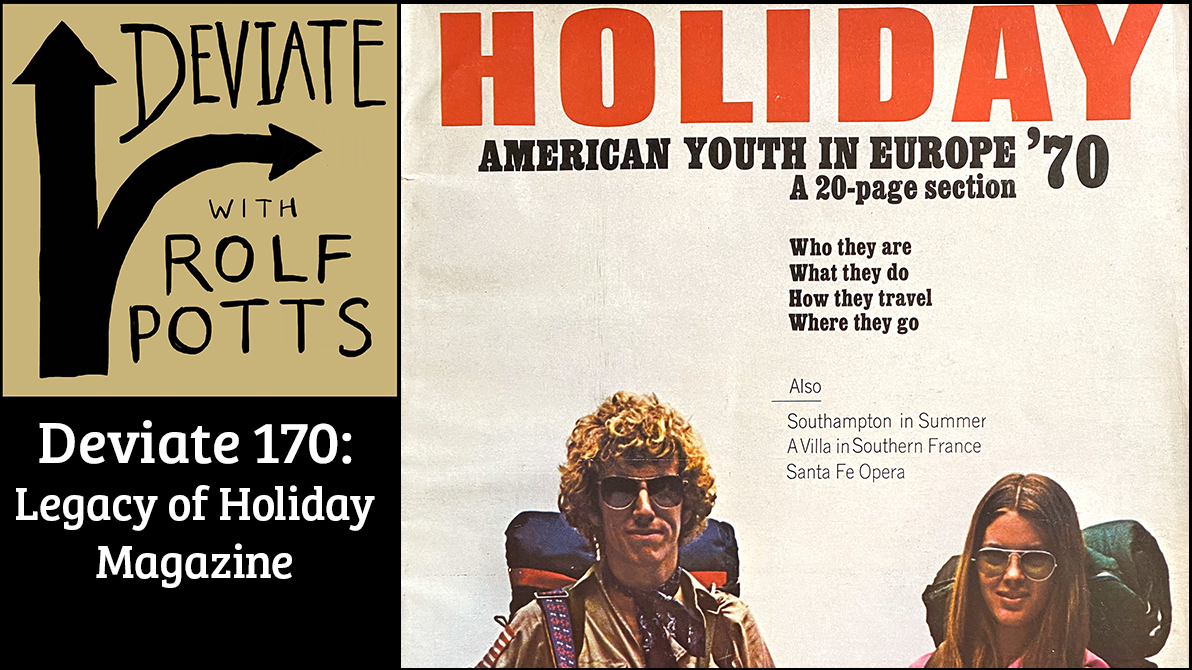
S4 Ep 170Travel writing in the “Mad Men” era: The myth and legacy of Holiday Magazine
“Holiday gave its writers room to tell a comprehensive story. A place was evoked in thousands of words instead of the usual 800 we are now accustomed to reading.” – Pamela Fiori In this episode of Deviate, Rolf and Pamela talk about the origins of Holiday Magazine, why it attracted good writers, and how its creation was connected to advertising markets (2:15); famous articles to appear in the magazine, and why it was successful (7:00); who the magazine’s audience was, how television and political-cultural changes in America affected things in the 1960s (15:00); the decline of Holiday Magazine magazine amid the economic and cultural changes of the 1970s, and why there are no archives (24:30); and the legacy of Holiday Magazine in the 21st century. Pamela Fiori made publishing history in May 1993, when she became the first woman to be named editor in chief of Town & Country, America’s oldest continuously published general-interest magazine. She is the author of Holiday: The Best Travel Magazine that Ever Was. Notable Links: Holiday Magazine (travel publication) See the USA in Your Chevrolet (song performed by Dinah Shore) The Dinah Shore Chevy Show (1950s TV show) Travels with Charley (1962 John Steinbeck travel book) Saturday Evening Post (American general-interest magazine) Ladies’ Home Journal (American women’s magazine) Curtis Publishing (American magazine publisher) Ted Patrick (magazine editor) Joan Didion (American essayist) Roger Angell (American essayist) Here is New York (essay and book by E.B. White) Mad Men (TV show about advertising) Big Sur (coastal region of central California) Travel + Leisure (American travel magazine) Mag Men, by Walter Bernard (book) The Deviate theme music comes from the title track of Cedar Van Tassel’s 2017 album Lumber. Note: We don’t host a “comments” section, but we’re happy to hear your questions and insights via email, at [email protected].
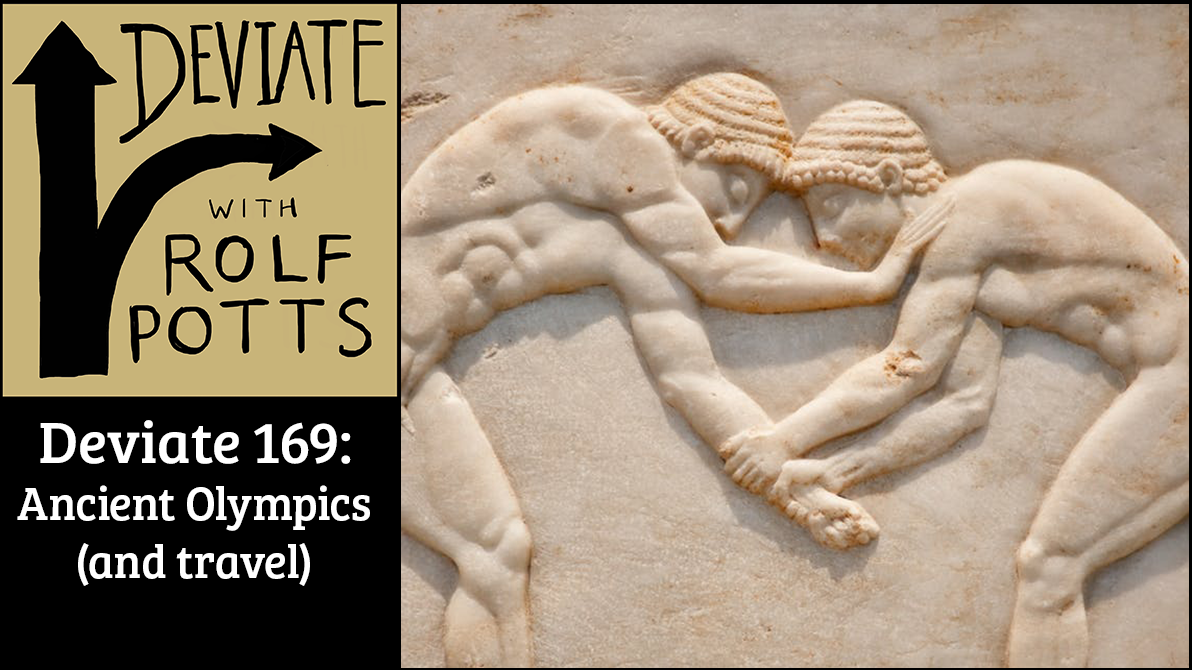
S4 Ep 169The Olympics started out as a travel fest: All about the ancient Greek Games
“In ancient Greece, entire eras were measured by Olympiads. It’s how history was arranged. The Olympics were that important.” – Tony Perrottet In this episode of Deviate, Rolf and Tony discuss how the ancient games was a religious festival, now it was never delayed, and why it was important (2:00) non-sports events that happened the the ancient Games, performance enhancing potions, and Greek competitiveness (17:00); the sporting events competed in the ancient games, and how they differed from modern sports (24:00); the training and diet that went into the games, aristocrats versus commoners who competed, and which ancient Olympians are still remembered (32:00); and what non-Greeks thought to the games, Greek skeptics of the games, and what it’s like to travel to the old sites of the ancient Greek games (45:30). Tony Perrottet (@TonyPerrottet) is the author of six books, including Pagan Holiday: On the Trail of Ancient Roman Tourists; The Sinner’s Grand Tour: A Journey Through the Historical Underbelly of Europe; and The Naked Olympics: The True Story of the Greek Games, upon which this interview is based. Notable Links: Ancient Olympic Games (sporting festival) Olympia, Greece (location of the ancient Games) Statue of Zeus at Olympia (ancient tourist attraction) Herodotus (ancient Greek historian) Pausanias (ancient Greek geographer) Symposium (ancient Greek drinking banquet) Monty Python (British comedy troupe) Gilgamesh (Mesopotamian mythological hero) Enkidu (Mesopotamian mythological hero) Funeral games (ancient honor ritual) Pankration (ancient fighting sport) Ben Hur (epic historical movie) Pierre de Coubertin (founder of the modern Olympics) Milo of Croton (ancient Greek wrestler) 300 (2007 epic historical movie) Battle of Thermopylae (ancient Greek battle) Diogenes the Cynic (ancient Greek philosopher) Karate gets its due at the Olympics, by Tony Perrottet (article) The Deviate theme music comes from the title track of Cedar Van Tassel’s 2017 album Lumber. Note: We don’t host a “comments” section, but we’re happy to hear your questions and insights via email, at [email protected].

S4 Ep 168Experiencing Japan the slow way (on the 750-mile Shikoku Pilgrimage)
“Don’t define your journey while you’re still on it. Be open to it. Don’t think it’s only going to be one way.” – Paul Barach In this episode of Deviate, Rolf and Paul discuss why Paul chose Japan for a pilgrimage, and the seven categories of disciplines he used on the hike (1:40); the route and history of the Shikoku Pilgrimage (9:40); Paul’s experiences on the trail (21:00); and Paul’s lessons and regrets from the trip, including why you shouldn’t define your journey while you’re still on it (34:30). Paul Barach is a stand-up comic, storyteller, producer, and writer. He is the author of Fighting Monks and Burning Mountains, about his experience hiking the Shikoku Pilgrimage trail. Notable Links: Kūkai (Japanese Buddhist monk) Burning Mountain Temple (Shikoku pilgrimage site) Camino de Santiago (Spain pilgrimage route) Shikoku Henro Trail (online resource) Ryokan (Japanese inn) Kyokushin (karate style) Gōjū-ryū (karate style) Ichiro Suzuki (Japanese baseball player) The Deviate theme music comes from the title track of Cedar Van Tassel’s 2017 album Lumber. Note: We don’t host a “comments” section, but we’re happy to hear your questions and insights via email, at [email protected].
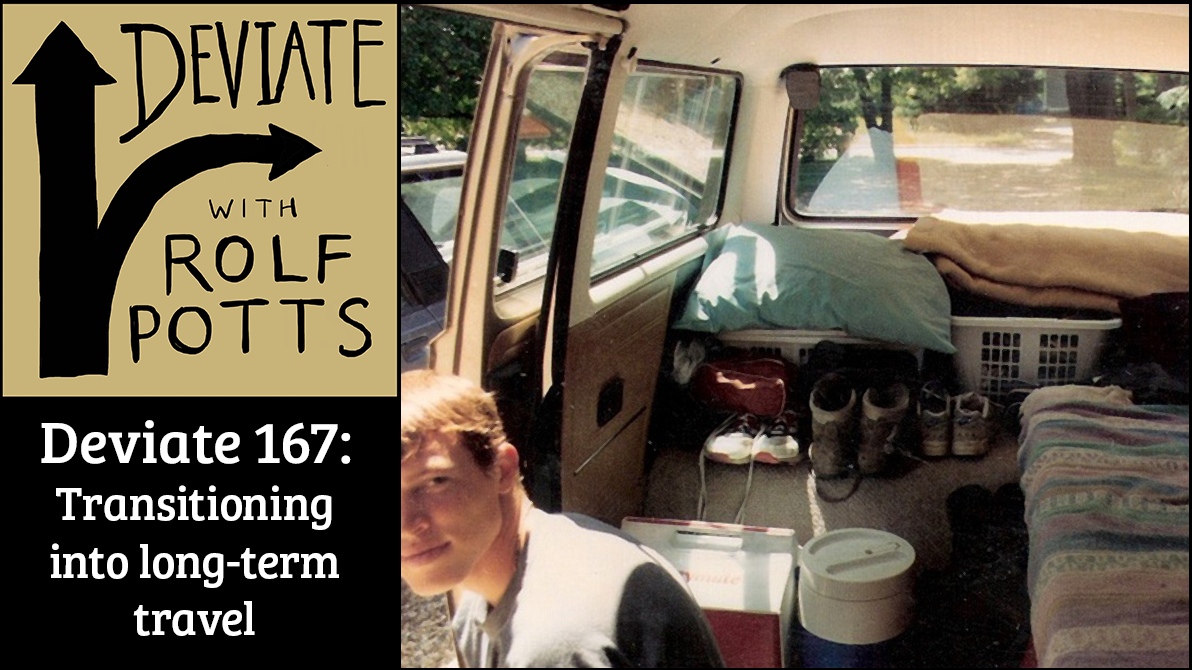
S4 Ep 167Vagabonding audio companion: How your earliest journeys transform you
“Travel is life’s best education, if you allow it be.” – Rolf Potts In this episode of Deviate, Rolf remixes his interview from the Looking Up Podcast, by Max McCoy. They discuss why travel is a great catalyst for finding direction in life (1:30); how being lonely, lost, and bored allow you to experience travel in a deeper, more vulnerable, more spiritual way (12:30); how traveling and journaling about it can focus one’s writing discipline (20:00); the relationship of one’s travels and one’s work over time (31:00); how to whet your travel appetite by finding adventures at home, and how to navigate relationships as a traveler (41:30); the weird ways souvenirs can deepen the experience and memory of travel (46:00); and Rolf’s life advice to his younger self (50:00). Max McCoy is the host of the Looking Up podcast. Notable Links: Van Life before #VanLife (Deviate episode) Epiphanies of expatriate life in Korea (Deviate episode) Time Wealth and the spiritual texture of travel (Deviate episode) Thomas Merton (American monk and writer) Rumi (13th-century Persian poet) Stephen King (American horror author) Astronaut pen (writing tool) Paris Writing Workshops (Rolf’s writing classes) Geoarbitrage (lifestyle-location strategy) Robert Creeley (American poet) Souvenir, by Rolf Potts (book) One Month On the Mekong, by Rolf Potts (essay) Donald Barthelme (American author) The Deviate theme music comes from the title track of Cedar Van Tassel’s 2017 album Lumber. Note: We don’t host a “comments” section, but we’re happy to hear your questions and insights via email, at [email protected].

S4 Ep 166Digital nomadism: A history and future (from a documentary film in progress)
“Digital nomadism is still being figured out. In twenty years digital nomadism will have a concrete reality that we can’t even predict now.” – Rolf Potts In this episode of Deviate, which is excerpted from an in-progress documentary called The Nomads, filmmaker Anne von Petersdorff asks Rolf to discuss how digital nomadism is defined, how it has emerged from earlier generations of travel and human mobility, and how it is more than just a “Western” trend (3:00); how the digital nomad movement will affect the nation-state and global citizenship, and how these notions have historically always been in flux (10:00); the importance of respecting local cultures versus treating destinations as utilitarian backdrops, and how the concept of digital nomadism is changing (24:00); and what happens to the concept of “home” when one is leading a nomadic life (32:30). Anne von Petersdorff is a scholar, writer, filmmaker, and educator from Berlin, Germany. Wade Shepard (@vagabondjourney) is an itinerant writer and filmmaker who has been traveling the world, through ninety countries, since 1999. Digital nomads interested in lending experiences or insights to the documentary film The Nomads can contact producer Wade Shepard at [email protected]. Notable Links: Digital nomadism (location-independent lifestyle) Nation-state (political unit) Social welfare (government support for individuals) Go Viral (media festival in Kazakhstan) China and Mongolia with my parents (Deviate episode) In Patagonia, by Bruce Chatwin (travel book) Epiphanies of expatriate life in Korea (Deviate episode) @lukeoakvt (Rolf’s nephew’s TikTok account) Grand Tour (upper-class 18th/19th century travel ritual) Thomas Cook (19th century travel entrepreneur) Dispatches, by Michael Herr (Vietnam War book) The Deviate theme music comes from the title track of Cedar Van Tassel’s 2017 album Lumber. Note: We don’t host a “comments” section, but we’re happy to hear your questions and insights via email, at [email protected].
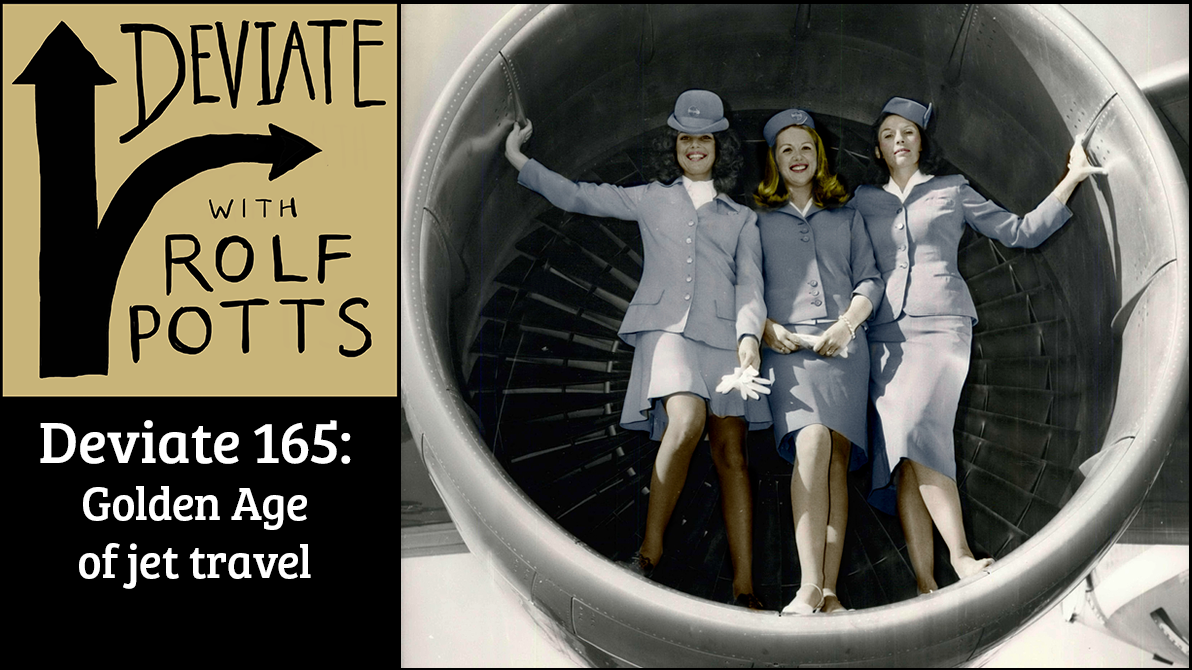
S4 Ep 165Travel in the “Mad Men” era: Stewardess work at the dawn of the Jet Age
“Stewardesses were instructed to not serve caffeinated beverages or alcohol during a hijacking, and were encouraged to use their femininity to manipulate the hijackers.” – Julia Cooke In this episode of Deviate, Rolf and Julia talk about how Julia came to write a book about international airline stewardesses in the golden age of jet travel, and how commercial air travel as we know it came of age more than half a century ago (1:30); what Pan Am was, what made it special, and the role of stewardesses on the airline (11:00); the former Pan Am stewardesses that Julia interviewed, how she found them, and what she learned from them (18:30); how stewardesses foreshadowed and became a unique part of the feminist movement (26:00); how military flights, refugee flights, and hijackings were a common part of the Pan Am flight experience in the 1970s (30:00); and the research methods and surprises that came with writing Julia’s book (41:00). Julia Cooke (@juliaccooke) has written for Condé Nast Traveler, The New York Times, Playboy, The Village Voice, and The Atavist. She is the author of Come Fly The World and The Other Side of Paradise: Life in the New Cuba. More about her at https://www.juliacooke.com/ Notable Links: PanAm (airline) Eero Saarinen (architect) Paul Theroux (author) Italo Calvino (author) Second wave of feminism (social movement) The Power of Glamour, by Virginia Postrel (book) Internationalism (movement) Coffee, Tea, or Me? (fictitious 1967 memoir) The Skies Belong to Us, by Brendan I. Koerner (book) Barbara Romack (pro golfer) Flag carrier (type of airline company) Operation Babylift (1975 evacuation of children from Vietnam) The Deviate theme music comes from the title track of Cedar Van Tassel’s 2017 album Lumber. Note: We don’t host a “comments” section, but we’re happy to hear your questions and insights via email, at [email protected].
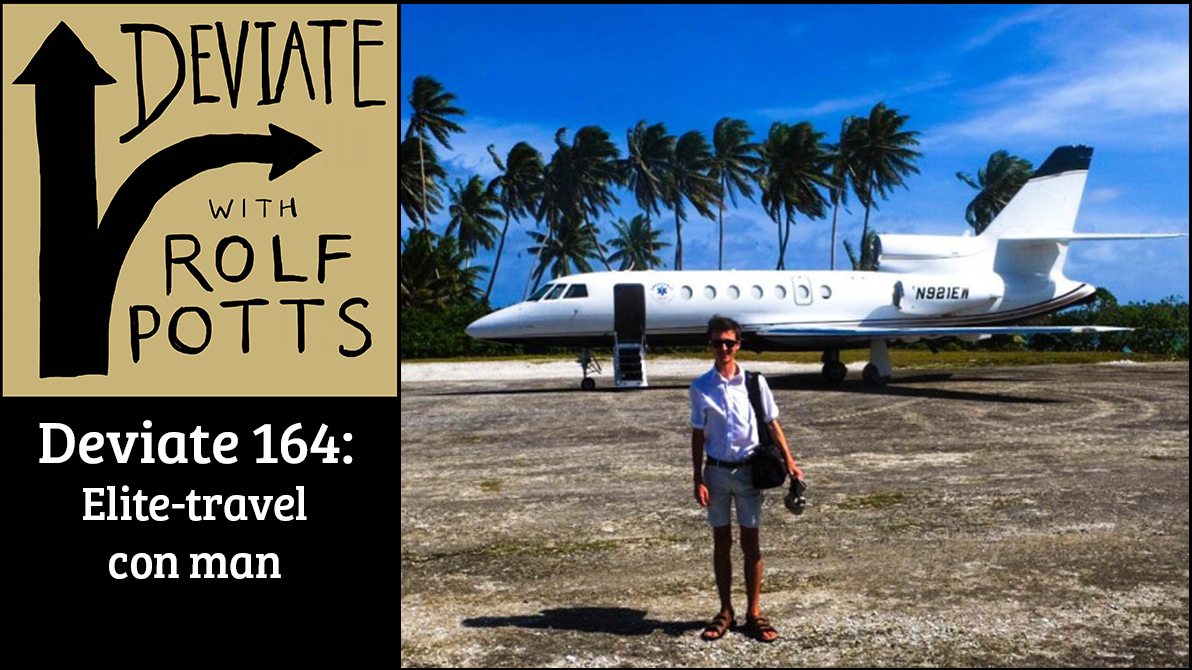
S4 Ep 164The curious case of a con-man who infiltrated the world of elite travelers
“Wanderlust can dictate the course of your life.” – Dave Seminara In this episode of Deviate, Rolf and Dave discuss the philosophical underpinnings of wanderlust (2:00); the subculture of competitive travelers (10:00); the mystery of William Baekeland (20:00); and the impact of wanderlust on peoples’ lives (44:00). Dave Seminara is a writer and former diplomat. His latest book, Mad Travelers: A Tale of Wanderlust, Greed and the Quest to Reach the Ends of the Earth, is a deep exploration of wanderlust, focused around the true story of William Baekeland, a young Brit who conned many of the world’s most traveled people as they sought to reach the planet’s most remote and off-limits places. For more about Dave, check out his website at https://daveseminara.com. Notable Links: Most Traveled People (club) Nomadmania (club) The Travelers’ Century Club (club) Charles Veley (traveler) The Deviate theme music comes from the title track of Cedar Van Tassel’s 2017 album Lumber. Note: We don’t host a “comments” section, but we’re happy to hear your questions and insights via email, at [email protected].

S4 Ep 163Memories you didn’t know you remembered: A deeper dive into nostalgia
“This is a weird time to be grateful for, but I’m sure we’ll feel heaps of nostalgia for it.” – Kristen “Kiki” Bush In this episode of Deviate, Rolf and Kiki talk about how interacting with objects from your past (or getting rid of them) forces a kind of nostalgia on you (2:00); how cultural nostalgia can fall on generational lines, and how venues like YouTube curate generational nostalgia (7:30); how nostalgia can hinge on sports and music from the past, how going to concerts to reconnect with times of your life, and the phenomena known as the “nostalgia bump” (12:00); how journals are a way to collect and hold on to moments and memories, and what it feels like to revisit them (24:00); how technology has changed the way we interact with other people, as well as the way we experience things and remember and revisit things (31:30); and how it’s hard to tell what from the current moment will evoke nostalgia later (36:00). Kristen “Kiki” Bush is an actress, known for Paterno (2018), Liberal Arts (2012), and Synecdoche, New York (2008). Her TV credits include The Affair, The Good Wife, Elementary, and Law & Order: SVU. She has performed onstage at Manhattan Theatre Club, The Public, the Old Globe, Goodman Theatre, and Lincoln Center. Notable Links: A personal history of nostalgia (Deviate episode) Revisiting “American Pilgrim” (Deviate episode) Generation X (demographic cohort) Emergency! (TV show) Denny Matthews (Kansas City Royals announcer) Disintegration (1989 album by The Cure) Robert Smith (musician) Dillon’s (Kansas supermarket chain) Van life before #VanLife (Deviate episode) “I Wanna Go Back” (Billy Satellite song sung by Eddie Money) “If You Don’t Know Me by Now” (1972 Harold Melvin song) Our Town (play by Thornton Wilder) The Joshua Tree (album by U2) 2017 Joshua Tree Tour (U2 30th anniversary album tour) Live Aid (1985 benefit concert) Achtung Baby (1991 U2 album) Kyuss (1990s rock band) Cleveland Browns (pro football team) NCIS: New Orleans (TV show) T
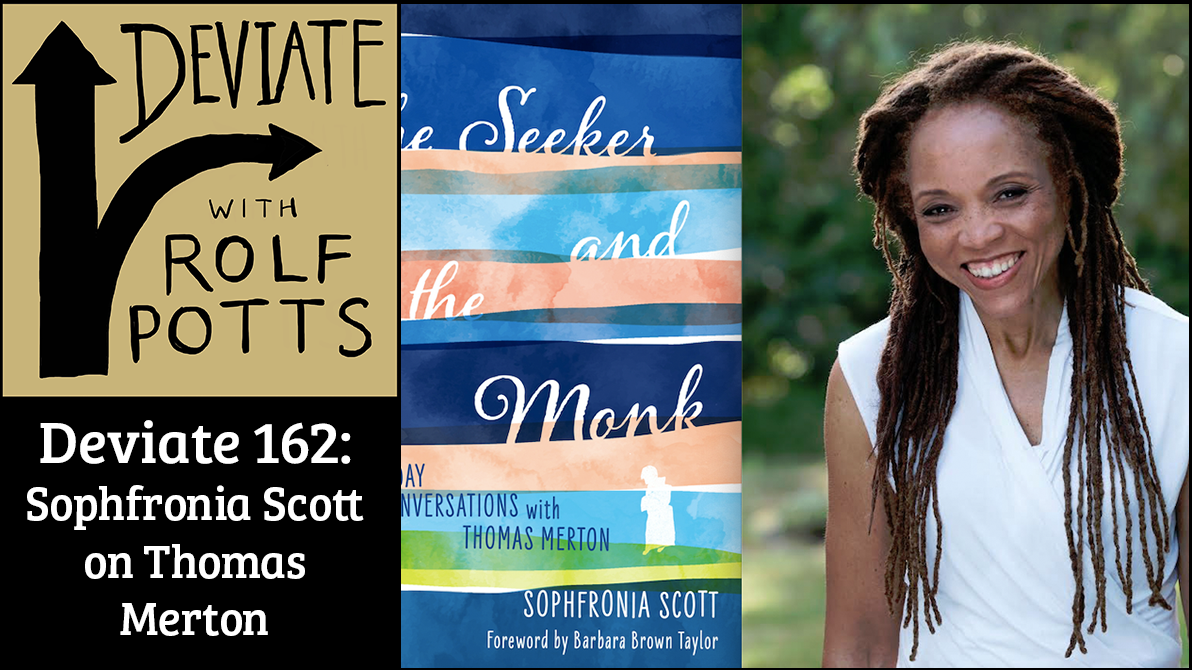
S4 Ep 162What a 20th century monk can teach us about living (with Sophfronia Scott)
“For as much as we seek our paths and have questions about the journey, there is a sense deep within us, like a primeval compass, that shows we already know where to go.” – Sophfronia Scott In this episode of Deviate, Rolf and Sophfronia talk about how they came to know of Merton, and how his journals reveal his truer self (2:00); being “spiritual but not religious,” the language of beholding versus the language of belief, and how interactions with nature are a spiritual exercise (9:00); human versus divine love, and how the most spiritual moments are often the most difficult ones in life (17:00); the importance of seeking a life of needing less, and how not be in a constant state of wanting (25:00); contemplation versus activism, learning to love people we do not agree with, and regulating desire in a world of abundance (34:30); and what Merton’s example can teach us in the 21st century, in an age of click-bait and decontextualized life (45:00). Sophfronia Scott (@Sophfronia) is the author of five books. Her newest, The Seeker and the Monk, is about Catholic writer and activist Thomas Merton. She last appeared on Deviate to discuss mid-life career change, and her role in defining Generation X. Notable Links: Thomas Merton (monk and writer) Merton Prayer Conjectures of a Guilt Bystander (1968 Merton book) The Seven Storey Mountain (1948 Merton autobiography) The Asian Journal of Thomas Merton (1975 book) Festival of Faith and Writing Barbara Brown Taylor (theologian) New Seeds of Contemplation (1962 Merton book) Moonstruck (1987 movie) Abbey of Gethsemani (Merton’s monastery in Kentucky) Henri Nouwen (theologian) 2021 Capitol insurrection (attack on the U.S. Congress) Sandy Hook shooting (2012 mass shooting) The Deviate theme music comes from the title track of Cedar Van Tassel’s 2017 album Lumber. Note: We don’t host a “comments” section, but we’re happy to hear your questions and insights via email, at [email protected].
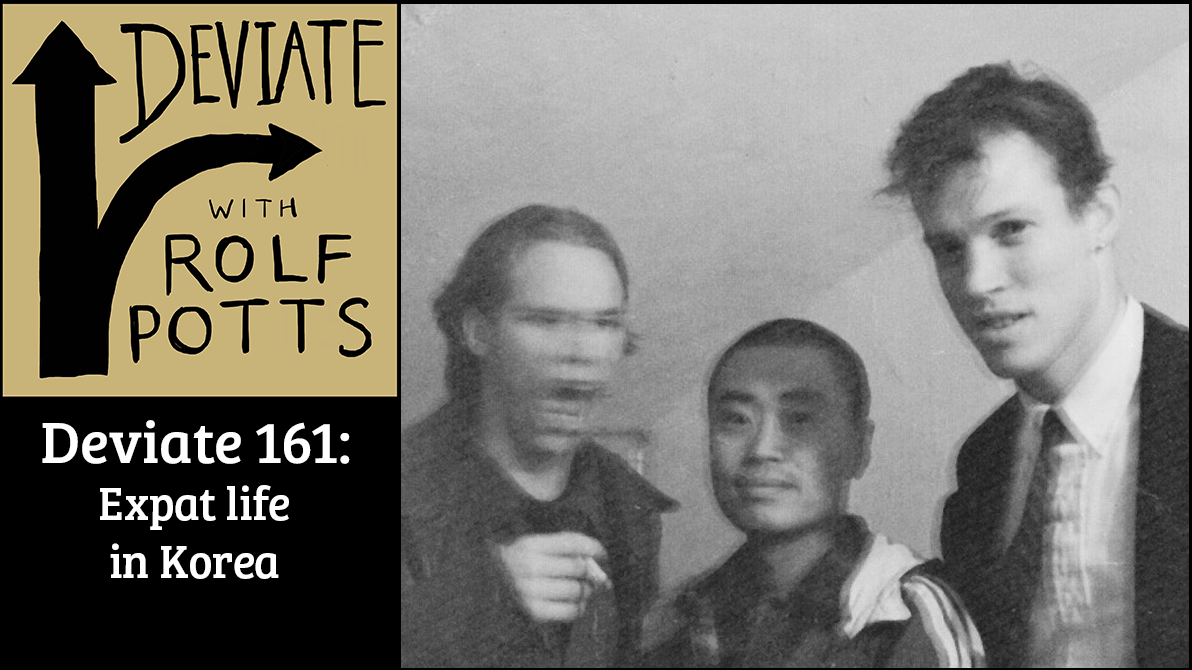
S4 Ep 161Life changing travel experiences: Epiphanies of expatriate life in Korea
“I came to live and work in Korea and walked out two years later way more equipped in life, not just as a traveler, but as a person.” – Rolf Potts In this episode of Deviate, Rolf and his old friends Brian and Steve talk about the factors that led them to live and work in South Korea when they were in their twenties, and what they experienced when they first arrived (2:30); the cultural differences, idiosyncrasies, and lessons learned as expat English teachers during South Korea’s globalization boom-years (17:30); culture shock, North Korean provocations, anti-U.S. sentiment, and how what was “normal” was different in Korea than in the U.S. (30:00); drinking-culture, dating rituals, expat meltdowns, what they loved about being in Korea, and how it changed their lives (47:30). Notable Links: Lost Generation (Paris expats in the 1920s) Jeonju (city in South Korea) Van Life before #VanLife (Deviate episode) Mid-20s crisis (quarter-life anxiety) Michael Bolton (American singer) Culture shock (cross-cultural disorientation) Confucianism (Asian system of behavior) Hagwon (private learning academies in Korea) Parasite (2019 South Korean movie) Chan-Ho Park (Korean MLB baseball player) Sunshine Policy (South Korean diplomacy) Dokdo (islet disputed between Korea and Japan) Busan (city in South Korea) Korean bathhouse (sex-segregated spas) Bosintang (Korean dog-meat strew) Man Bites Dog, by Rolf Potts (essay) Tico (small Daewoo car in the 1990s) Ondol (Korean heated floor) The Deviate theme music comes from the title track of Cedar Van Tassel’s 2017 album Lumber. Note: We don’t host a “comments” section, but we’re happy to hear your questions and insights via email, at [email protected].
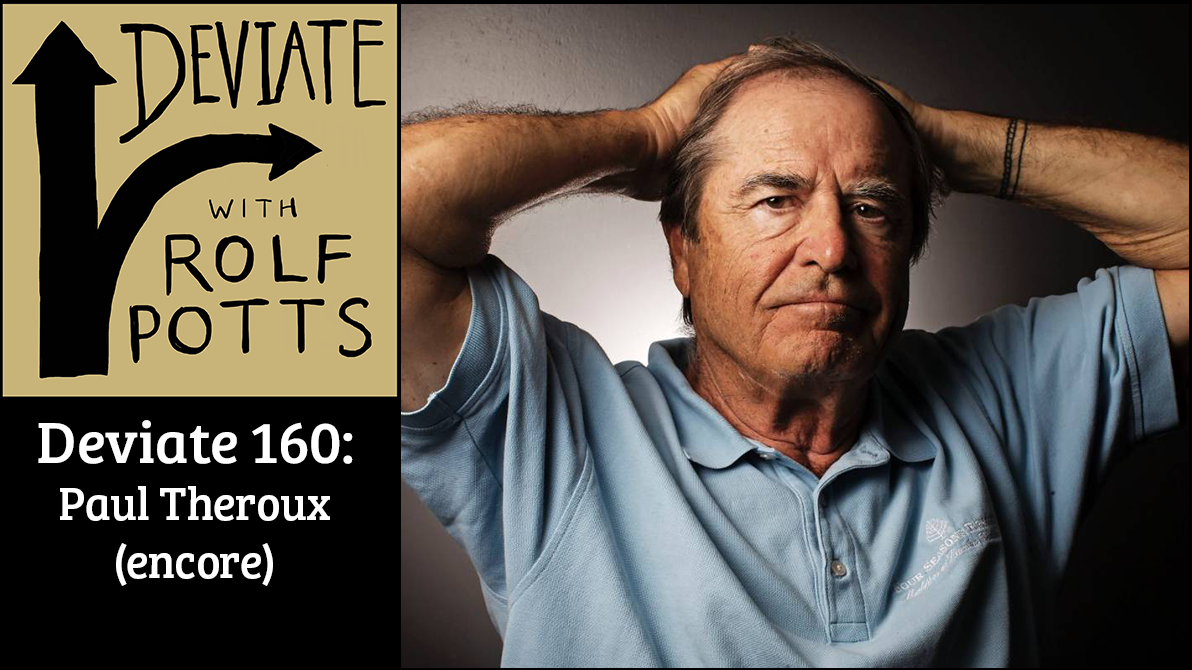
S4 Ep 160Paul Theroux on the necessary obstacles of immersive slow travel [encore]
“All writing is trying to destroy a stereotype, and the individual that you’re writing about — the figure in the landscape — is actually the ideal.” —Paul Theroux Paul Theroux‘s highly acclaimed novels include Blinding Light, My Other Life, and The Mosquito Coast. His 1975 book The Great Railway Bazaar is credited with revitalizing the genre of literary travel writing, and his more recent travel books include Ghost Train to the Eastern Star, Dark Star Safari, and The Last Train to Zona Verde. His newest book, out this month, is Under the Wave at Waimea. In this episode of Deviate, Rolf and Paul talk about Theroux’s book Figures in a Landscape, and strategies for writing about the “human architecture of a place” (4:30); the attitude and time-investment required for meaningful travel reportage (19:30); the qualities that determine successful travel writing (24:50); the essential discomforts and obstacles of travel (31:45); the uses and shortcomings of paper maps in developing countries (39:15); and where Paul is traveling next (45:00). Books, articles, and films mentioned “Paul Theroux on Blogging, Travel Writing, and ‘Three Cups of Tea’” (2011 Atlantic interview) The Great Railway Bazaar, by Paul Theroux The Mosquito Coast, by Paul Theroux The Tao of Travel, by Paul Theroux Deep South, by Paul Theroux American Notes, by Charles Dickens Barbary Shore, by Norman Mailer Journey Without Maps, by Graham Greene Sea and Sardinia, by D.H. Lawrence Travels, by Ibn Battuta Travels, by Marco Polo Lafcadio Hearn’s Japan: An Anthology India: A Million Mutinies Now, by V.S. Naipaul “Paul Theroux’s Quest to Define Hawaii” (2012 Smithsonian article) “Mandalay,” by Rudyard Kipling (poem) Rashomon (1950 Akira Kurosawa film) The Life and Death of Colonel Blimp (1943 film) People mentioned Doris Lessing (novelist and poet) Tom Wolfe (author and journalist) Robin Williams (actor and comedian) Elizabeth Taylor (actress) Michael Jackson (singer-songwriter) Rod Steiger (actor) Mike Nichols (film director)
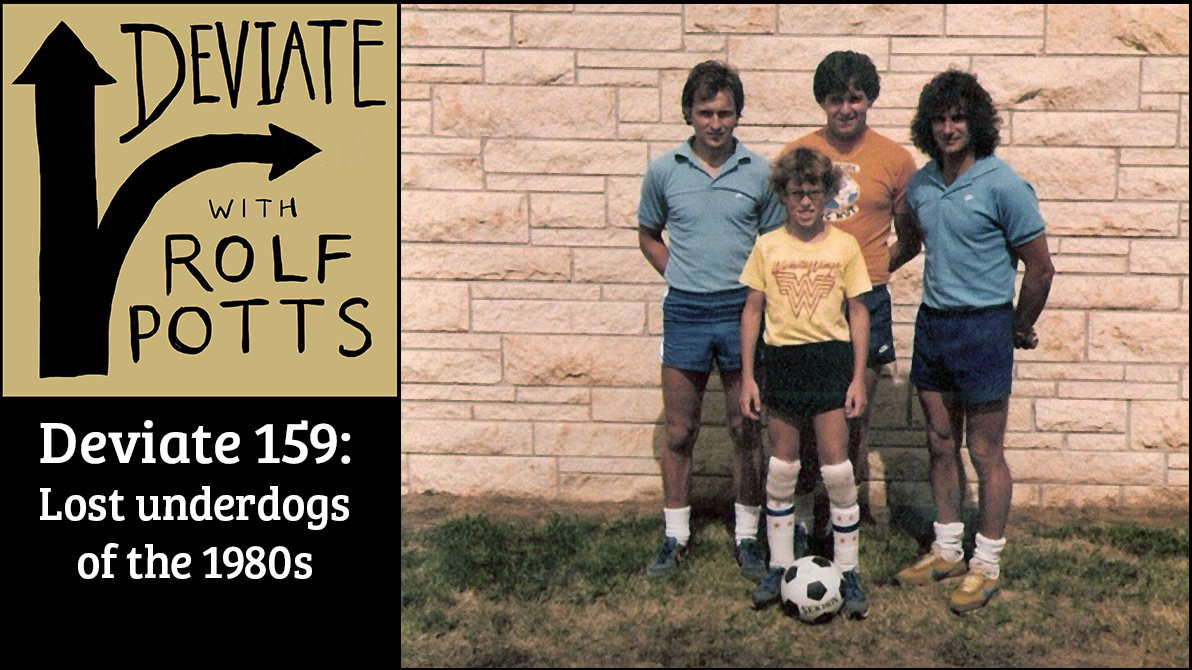
S4 Ep 159Triumph in the middle of nowhere: The most 1980s underdog story of the 1980s
“If you put Harrison Ford, Sting, and Andy Chapman in a room together in Kansas in 1981, the girls of Kansas would have trampled the actor and the rock star in an effort to get closer to the charismatic young soccer player.” – Rolf Potts In this essay episode of Deviate, Rolf talks about the iconically 1980s sports phenomenon known as Major League Indoor Soccer, and how the league came about (5:00); his childhood fixation with the Wichita Wings, and how the presence of the pro soccer team and its players affected his mid-sized Kansas hometown (11:00); and the most famous game in MISL history, which pitted the Wings against the St. Louis Steamers, and what became of major league indoor soccer — and its legacy –as the 1980s wound down (23:00). God Save the Wings (@GodSaveTheWings) is a feature-length documentary about the Wichita Wings, an indoor soccer team of European party boys who went toe-to-toe with all major markets in the crazy 1980s. Its latest screening is April 12-18, 2021 at Kansas City FilmFest International. Tim O’Bryhim (@WichitaStory) is the producer of God Save the Wings, and co-author of Make This Town Big: The Story of Roy Turner and the Wichita Wings. Notable Links: Wichita Wings (indoor soccer team) NASL (American outdoor soccer league) Henry Kissinger (politician and diplomat) Pele (Brazilian soccer player) MISL (soccer league) Show, Sex, and Suburbs (Sports Illustrated article) Norman Lear (TV producer) Green Bay Packers (NFL football team) Krazy George (professional cheerleader) Andy Chapman (MISL soccer player) Nolan Ryan (baseball player) Tony Dorsett (football player) St. Louis Steamers (indoor soccer team) Slobo Ilijevski (MISL soccer player) Mike Dowler (MISL soccer player) New York Arrows (indoor soccer team) ESPN (sports TV network) FNN-Score (sports TV network) The Deviate theme music comes from the title track of Cedar Van Tassel’s 2017 album ...

S4 Ep 158On the road with the superstars of Negro League baseball, 100 years on
“Baseball history needs to be looked at again. The statistics don’t make sense unless you understand the story that went behind those numbers.” – Phil S. Dixon In this episode of Deviate, Rolf and Phil talk about the racial integration of Major League baseball in 1947, and the decades of high-level black baseball that came before it (4:00); how baseball was segregated in the 19th century, and why the Negro Leagues were formed in the early 20th (9:30); “barnstorming” baseball in local communities in places like Kansas, and what life on the road was like for these black teams (17:00); how Phil researched the history of the Negro Leagues, and the challenge of finding century-old game statistics (29:30); and how the Negro Leagues stars compare to other baseball players from history (39:00). Phil S. Dixon (@NegroLeagueMan) is the author of seven books about baseball, and cofounder of the Negro Leagues Baseball Museum in Kansas City. Notable Links: J. L. Wilkinson (owner of the Kansas City Monarchs) All Nations (barnstorming professional baseball team) Barnstorming (traveling sports matches) Bud Fowler (pre-segregation professional player) Pythian Baseball Club (19th century black baseball team) Moses Fleetwood Walker (baseball player) Rube Foster (founder of the Negro Leagues) Topeka Jack Johnson (baseball player) House of David (baseball team from a Michigan commune) Grover Cleveland Alexander (baseball player) George Giles (baseball player) Only the Ball Was White, by Robert Peterson (book) Negro Baseball Leagues: A Photographic History, by Phil S. Dixon (book) The 1931 Homestead Grays, by Phil S. Dixon (book) Buck O’Neil (baseball player, manager, and scout) Satchel Paige (baseball player) The Deviate theme music comes from the title track of Cedar Van Tassel’s 2017 album Lumber. Note: We don’t host a “comments” section, but we’re happy to hear your questions and insights via email, at [email protected].
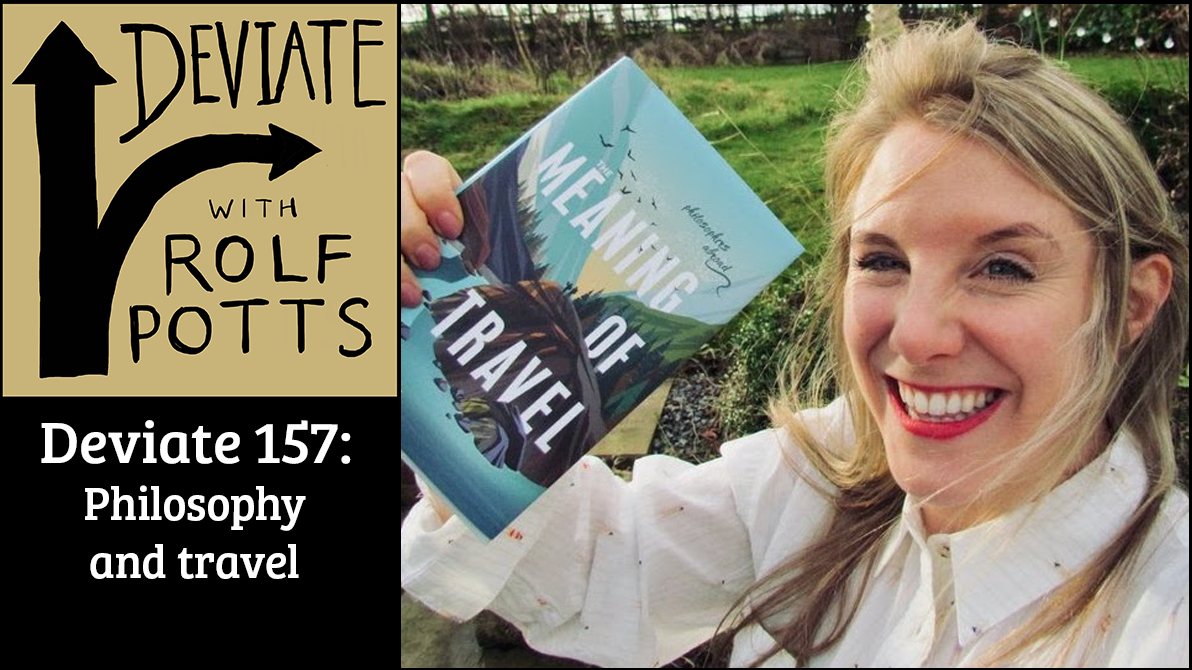
Notes on the philosophy (and deeper meaning) of travel, with Emily Thomas
“Asking questions about travel, and exploring ways philosophy has changed travel, can help us think more deeply about our journeys.” – Emily Thomas In this episode of Deviate, Rolf and Emily discuss the relationship between philosophy and travel (2:00); speculative fiction as a form of travel writing, and the relationship between feminism and travel (13:30); maps as a way of representing the world, and the aesthetic significance of mountains (24:00); beauty versus the sublime, and American naturalism and literature (32:00); and “cabin porn” and doom travel (40:00). Emily Thomas (@emilytwrites) is an Associate Professor in Philosophy at Durham University. She completed her PhD at the University of Cambridge, and has published extensively on the philosophy of space and time. She is the author of The Meaning of Travel. For more about Emily, check out https://emilythomaswrites.co.uk. Notable Links: Age of Discovery (period of European exploration) Francis Bacon (philosopher) Robinson Crusoe, by Daniel Defoe (book) The Blazing World, by Margaret Cavendish (book) Mary Kingsley (explorer) Isabella Bird (explorer/writer) Mary Wollstonecraft (philosopher/writer) Egeria (pilgrim) Utopia, by Thomas More (book) Henry David Thoreau (philosopher/naturalist) Ralph Waldo Emerson (philosopher/essayist) Climate change (large-scale shift in global weather) Into the Wild, by Jon Krakauer (book)
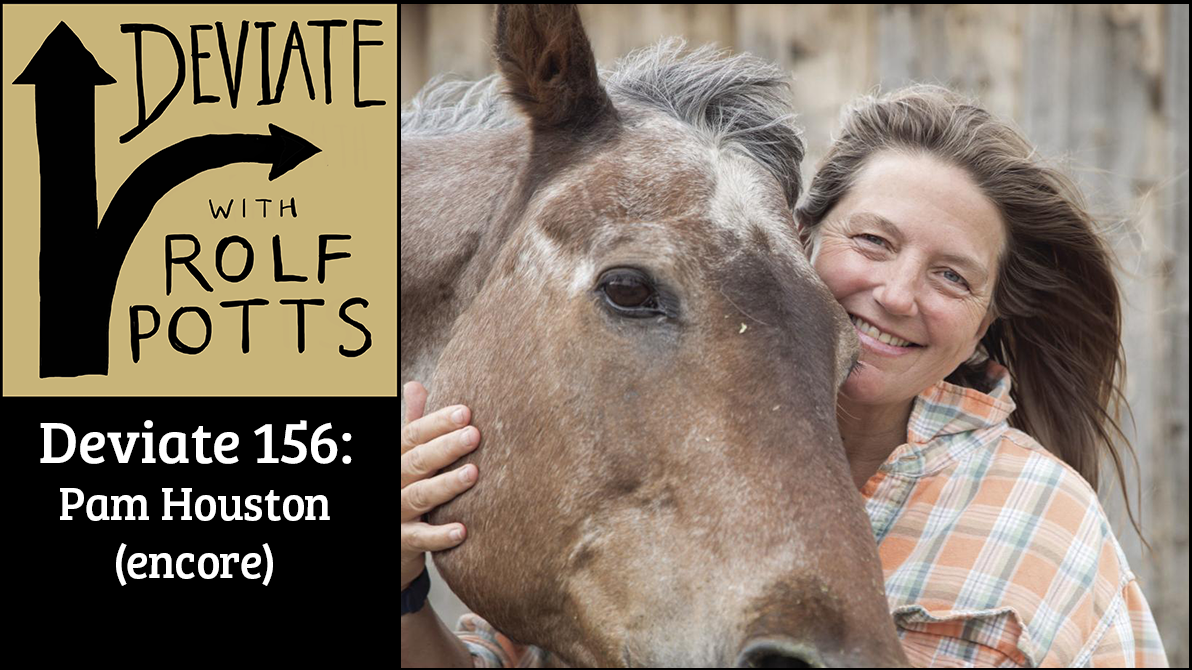
S4 Ep 156Pam Houston on home, and the beauty of our pared-down lives [encore]
“How do we become who we are in the world? We ask the world to teach us.” – Pam Houston In this episode of Deviate, Pam discusses her interactions with writing students (2:30); living an non-traditional life (16:30); developing a notion of home (25:00); and how Pam’s life on the ranch affects her writing (34:00). The episode concludes with Rolf reading his short essay “Creating a new sense of home is part of the travel process.” Pam Houston (@pam_houston) is an author and professor of English at the University of California, Davis. Her books include Cowboys Are My Weakness and Contents May Have Shifted, with her latest, Deep Creek, set for release in January 2019. For more information on Pam, check out her website at https://pamhouston.wordpress.com/ Notable Links: Santa Fe Writers Workshop “Some Kind of Calling,” by Pam Houston (essay) “Pam Houston on (Finally) Finding True Love” (essay) Desert Solitaire, by Edward Abbey (book) Pilgrim at Tinker Creek, by Annie Dillard (book) My Antonia, by Willa Cather (novel) Alice Munro (author) Terry Tempest Williams (author) The Meadow, by James Galvan (book) West Fork Complex (2013 wildfire) This episode is brought you by the Santa Fe Workshops, which offer a variety of online and in-person classes and seminars in writing and photography, including “The Particular Beauty of Our Pared-Down Lives,” an online writing workshop featuring author Pam Houston (March 30 – April 15, 2021). The Deviate theme music comes from the title track of Cedar Van Tassel’s 2017 album Lumber. Note: We don’t host a “comments” section, but we’re happy to hear your questions and insights via email, at [email protected].
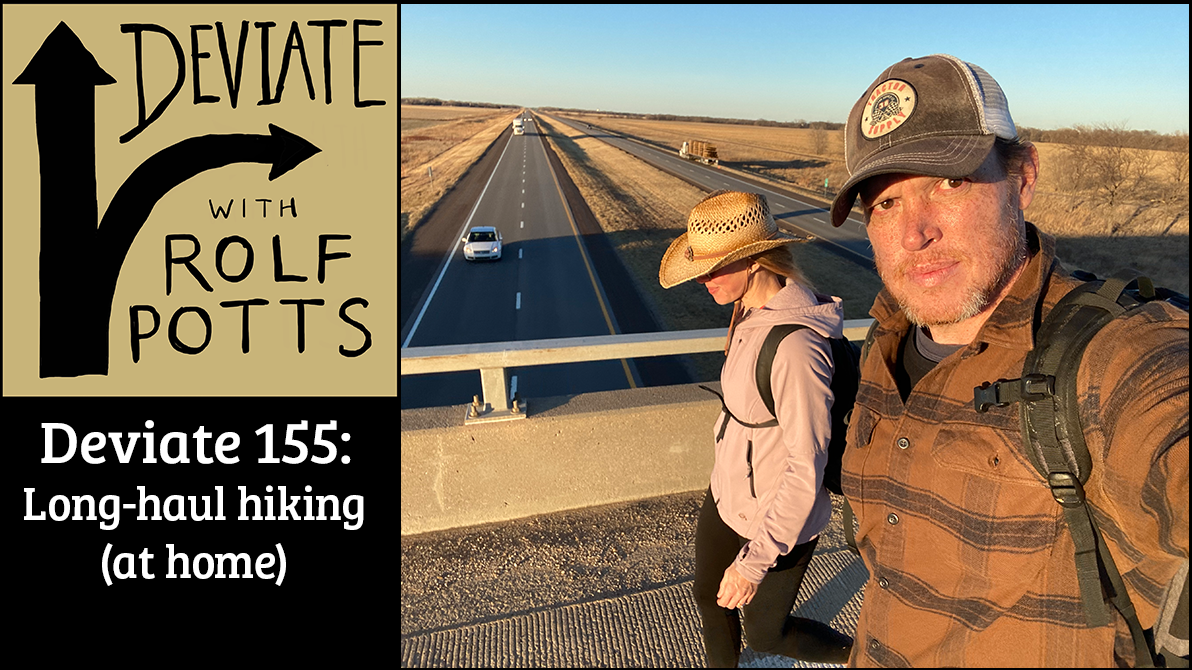
S4 Ep 155Long-distance hiking at home: The art of journeying out of your own back door
“In COVID times it’s harder to get on a plane and go hiking in, say, Austria or Italy. So we said, ‘why not do a 20-mile hike out of our back door?’” –Kristen Bush In this episode of Deviate, Rolf and Kiki sit in a Kansas town known as “Little Sweden” and talk about the joys and challenges of having walked 22 miles there the day before (3:00); the difference between urban, rural, and wilderness walking, how these experiences differ for men and women, and how the suffering of a long walk affects the experience (20:00); the subtle beauty, idiosyncrasies, and historical narratives contained a landscape like Kansas (28:00); Rolf and Kiki’s resumed hike to Coronado Heights, and how meeting a dog named “Larry” the day before made their day more interesting (41:00); how walking enforces a more deliberate pace of travel, and how people see you differently when you’re walking (53:00); how routine tasks like “using the toilet” or getting tired when you’re walking allow you to get in touch with your body in a new way (1:00:30); how walking frees you from having a “consumer” relationship to the world, and how it makes you realize the miracles inherent in everything (1:08:30); and an “Easter Egg” bonus about walking and silence (1:16:15). Kristen “Kiki” Bush is an actress, known for Paterno (2018), Liberal Arts (2012), and Synecdoche, New York (2008). Her TV credits include The Affair, The Good Wife, Elementary, and Law & Order: SVU. She has performed onstage at Manhattan Theatre Club, The Public, the Old Globe, Goodman Theatre, and Lincoln Center. Notable Links: Lindsborg (Kansas town known as “Little Sweden”) Ol Stuga (restaurant-bar in Lindsborg) Grain elevator (building that stores grain) Flâneur (urban mode of walking) Wanderlust, by Rebecca Solnit (book about walking) The Flaneur, by Edmund White (book about urban walking) Of Walking in Ice, by Werner Herzog (book) Christina’s World (painting by Andrew Wyeth) Larry Lapsley (African-American pioneer in Kansas) Nicodemus (Kansas town established by African-Americans) Coronado Heights (butte near Lindsborg) Dala horse (traditional Swedish carved horse) Hemslöjd (Swedish gift shop in Lindsborg) Edward Abbey (American author and essayist) Thomas Swick (travel writer) Søren Kierkegaard (Danish philosopher) Thích Nhất Hạnh (Vietnamese Thiền Buddhist monk and author) This episode is brought you by the Santa Fe Workshops, which offer a variety of online and in-person classes and seminars in writing and photography, including “The Particular Beauty of Our Pared-...
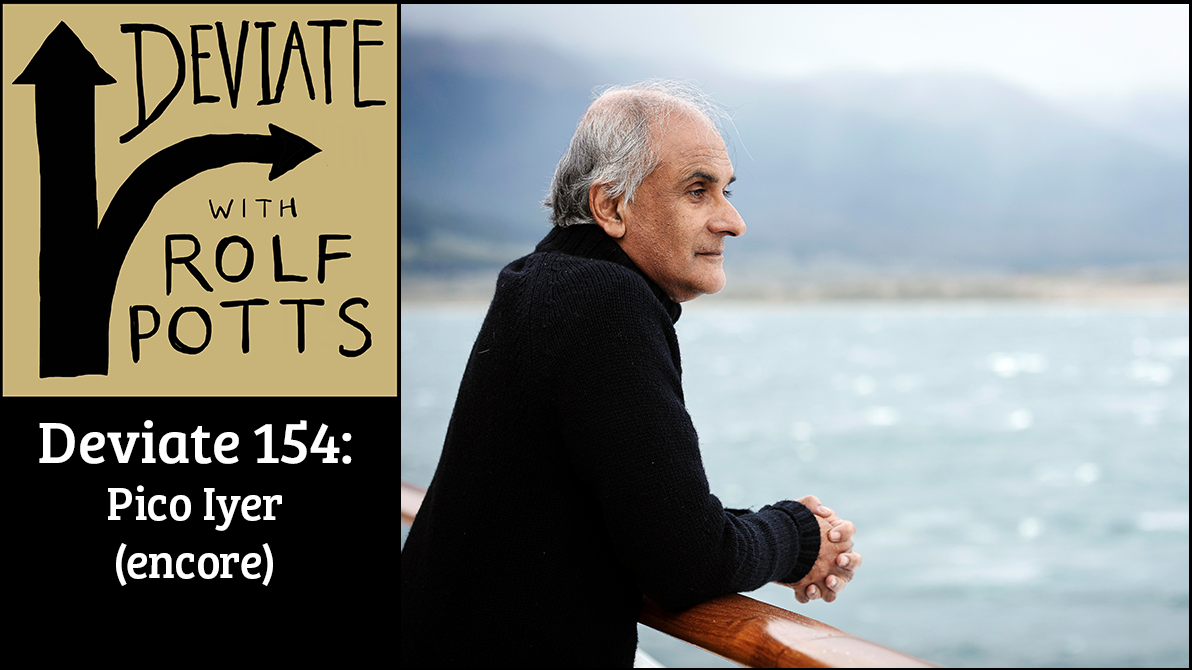
S4 Ep 154Pico Iyer on the creative task of travel across the world and deep within [encore]
“The boundaries of life are responsible for the beauty of life.” – Pico Iyer In this episode of Deviate, Rolf and Pico discuss the people we become when we travel (4:00); what led Pico to travel (10:00); travel in the age of technology (20:00); finding the remarkable in the unremarkable (32:00); ping pong as a metaphor for life (40:00); the importance of impermanence (50:00); and the idea of being versus becoming (1:01:00). Pico Iyer (@PicoIyer) is a novelist, essayist, and one of the most influential travel writers of his generation. He is known for such books as Video Night in Kathmandu and The Lady and the Monk, with many of his works receiving significant critical acclaim. He has also written for such publications as The New York Times, Time, and Harper’s. For more about Pico, check out http://picoiyerjourneys.com/ Notable Links: A Beginner’s Guide to Japan, by Pico Iyer (book) Autumn Light, by Pico Iyer (book) Walt Whitman (poet / essayist) John Muir (naturalist) Herman Melville (writer) Let’s Go (travel guide series) Salman Rushdie (writer) John Burroughs (naturalist / writer) This episode is brought to you by the Santa Fe Workshops, which offer a variety of online and in-person classes and seminars in writing and photography, including “Across the World and Deep Within,” a travel webinar featuring author Pico Iyer (February 16-18, 2021). The Deviate theme music comes from the title track of Cedar Van Tassel’s 2017 album Lumber. Note: We don’t host a “comments” section, but we’re happy to hear your questions and insights via email, at [email protected].
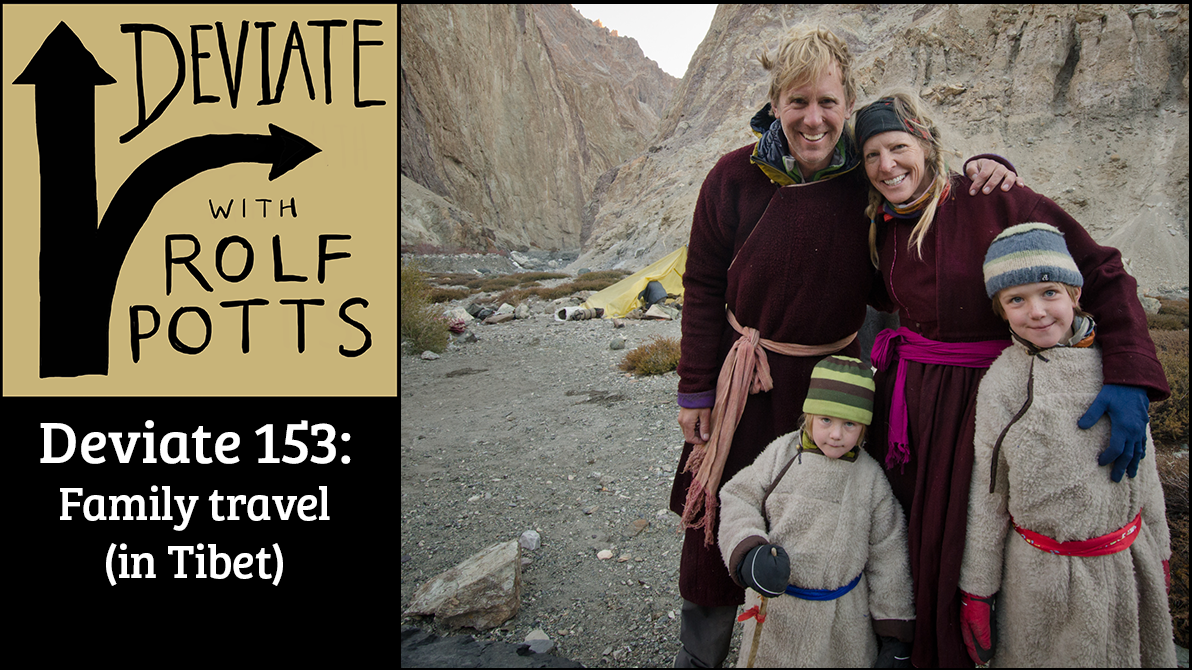
S4 Ep 153What it’s like to take your kids on a three-month journey in the Himalayas
“I learned so quickly that children change everything about travel.” –Bruce Kirkby In this episode of Deviate, Rolf and Bruce discuss how Bruce got his travel-writing career started, and why he ended up traveling to a Tibetan Indian monastery with his young family (3:00); what it is like to travel overland with young kids in tow, from Canada to India, and how having a child on the autism spectrum affects the experience (12:30); what it was like to travel to Asia with a sixteen-person TV crew in tow (23:00); what it was like to life a low-tech offline life and teach English in a remote (yet changing) mountain region in Tibetan India (27:30); how Bruce and his family navigated the tension between tradition and modernity in Zanskar, and how being there for three months differs from a shorter visit (38:00). Bruce Kirkby (@bruce_kirkby) is a Canadian adventurer, photographer, and writer. His newest book, discussed in this episode, is Blue Sky Kingdom: An Epic Family Journey to the Heart of the Himalaya. More about Bruce and his career can be found at: http://brucekirkby.com/. Notable Links: Mergui Archipelago (group of islands in southern Myanmar) Family Ties (1980s TV show starring Michael J. Fox) Kate Harris (Canadian travel writer) Kate Harris on travel (Deviate podcast episode) Zanskar (mountain region in Tibetan India) Ladakh (union territory in India’s Kashmir region) Autism spectrum disorder (neurodevelopmental condition) Big Crazy Family Adventure (Travel Channel show) Long Way Round (TV travel doc featuring Ewan McGregor) Monkey mind (Buddhist concept) 14th Dalai Lama (Tibetan spiritual leader) Rumspringa (Amish rite of passage) Leh (capital city of Ladakh) Being a better bad tourist (Deviate episode) This episode is sponsored by the Santa Fe Workshops, which offer a variety of online and in-person classes and seminars in writing and photography, including “Three Simple Lines & The Color of Wind,” a hybrid writing-photography webinar featuring Natalie Goldberg and Eddie Soloway (January 27-29, 2021); and “Across the World and Deep Within,” a travel webinar featuring author Pico Iyer (February 16-18, 2021). The Deviate theme music comes from the title track of Cedar Van Tassel’s 2017 album Lumber. Note: We don’t host a “comments” section, but we’re happy to hear your questions and insights via email, at [email protected].
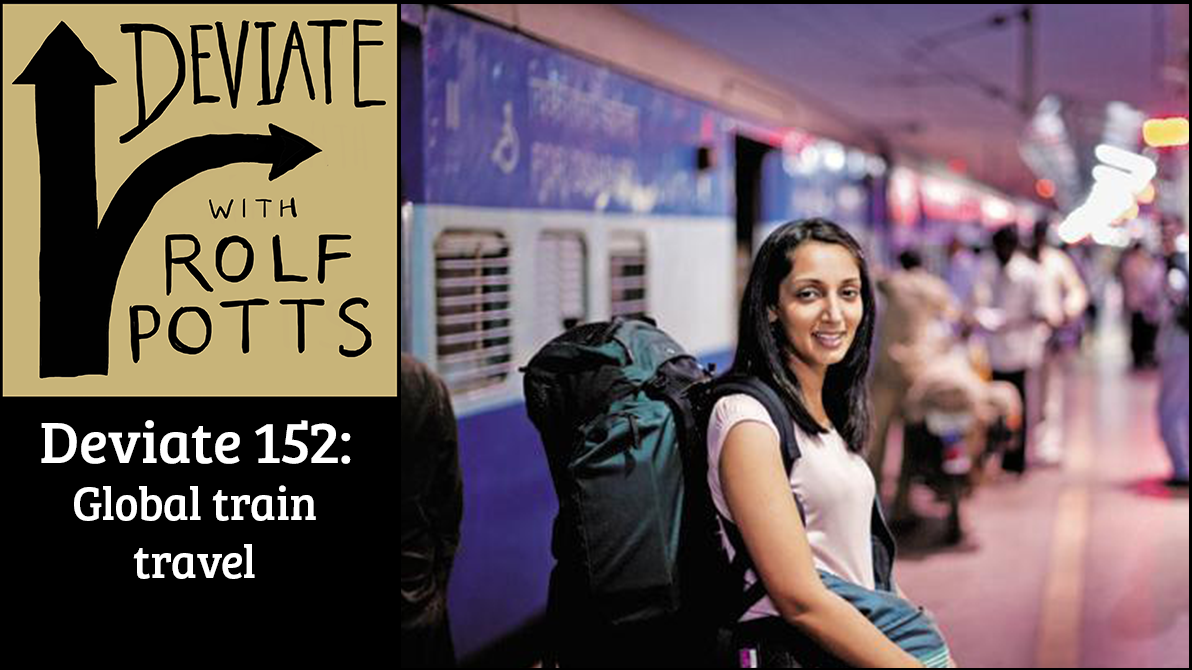
S4 Ep 152The joys and idiosyncrasies of global train travel (with Monisha Rajesh)
“Riding trains offered a great chance to chat with people we’d never cross paths with in our lives normally.” –Monisha Rajesh In this episode of Deviate, Rolf and Monisha discuss how her interest in train-travel dates back to a series of journeys she took around India (2:00); her more recent experience of taking the Trans-Mongolian train across Russia and into Asia (14:00); what it was like to travel by train in North Korea, China, and Southeast Asia, and how they differ from European trains (28:00); what it was like to take trains across Canada and the United States, and which global trains Monisha likes best (45:00). Monisha Rajesh (@monisha_rajesh) is a travel journalist, and the author of Around India in 80 Trains, and Around the World in 80 Trains. She currently lives in London with her husband and two daughters. Notable Links: Indrail Pass (Indian rail-pass for foreign nationals) Saint Basil’s Cathedral (church in Moscow’s Red Square) Eurail Pass (rail-pass covering 33 European countries) Trans–Mongolian Railway (long-haul train route) Circum-Baikal Railway (railway in Russia’s Irkutsk region) War and Peace (novel by Leo Tolstoy) Game of Thrones (fantasy TV series) Korean State Railway (train system in North Korea) Southwest Chief (American Amtrak route) German Baptist Brethren (Anabaptist group) Qinghai–Tibet railway (Asian train route) Skeena (Canadian passenger train service) Mandovi Express (train route in India) Flight shaming (environmental social movement) Sunset Limited (American Amtrak route) This episode of Deviate is brought to you by Tortuga Backpacks. Tortuga products also include daypacks, duffels, and other travel accessories, which are all made with the traveler in mind and have been featured by Wirecutter, The New York Times, Travel + Leisure, Business Insider, Carryology, and many other industry outlets. This episode is also brought to you by AirTreks, an industry leader in multi-stop international travel. The AirTreks website offers suggested pre-planned travel itineraries to help you get started, but can customize to fit your journey. The Deviate theme music comes from the title track of Cedar Van Tassel’s 2017 album Lumber. Note
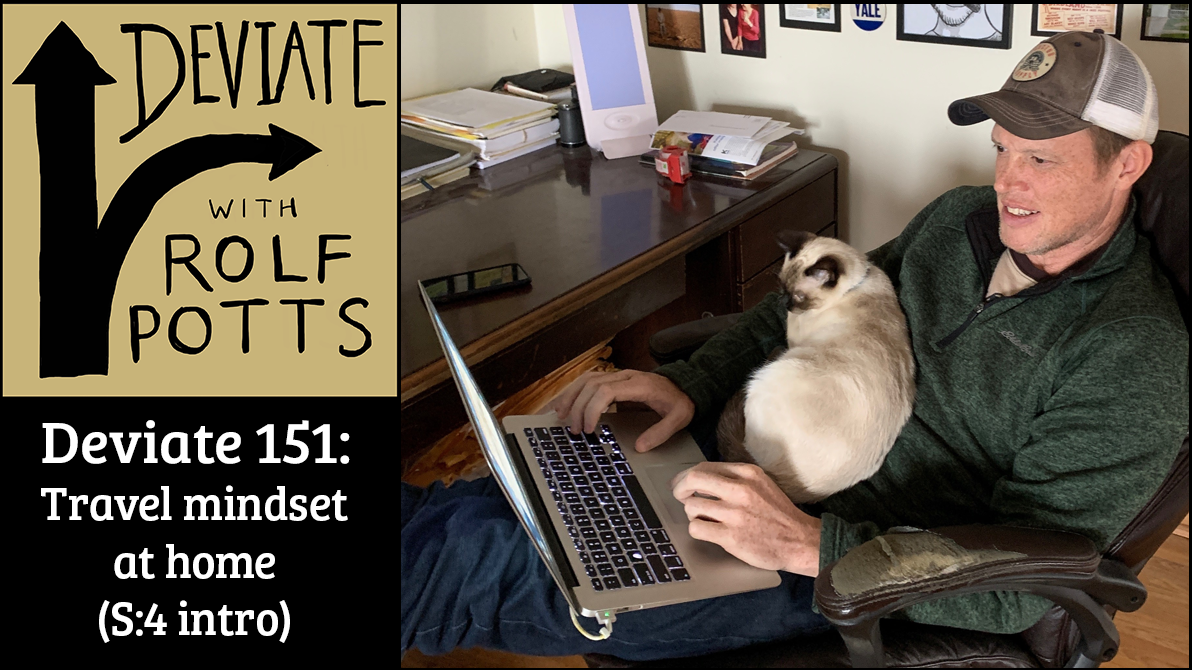
S4 Ep 151Five Travel Lessons You Can Use at Home (a road-trip intro to Deviate Season 4)
“The best experiences in life can be had for the price of showing up.” –Rolf Potts In this episode of Deviate, Rolf and Kiki take a road-trip to Colorado (with Salvie the cat yowling in his pet-carrier) and discuss how Rolf’s 2010 essay “5 Travel Lessons You Can Use at Home” can apply to home-life during a time of pandemic, including the notion that “Time = Wealth” (5:00); the importance of knowing how to “Be Where You Are” (8:30); the advantages of knowing when to “Slow Down” (20:00); the merit that comes in knowing how to “Keep it Simple” (25:00); and how life is more dynamic when you “Don’t Set Limits” (39:00). Kristen “Kiki” Bush is an actress, known for Paterno (2018), Liberal Arts (2012), and Synecdoche, New York (2008). Her TV credits include The Affair, The Good Wife, Elementary, and Law & Order: SVU. She has performed onstage at Manhattan Theatre Club, The Public, the Old Globe, Goodman Theatre, and Lincoln Center. For information on the Paris-based Travel Memoir classes Rolf is offering to Deviate listeners in 2021, inquire at [email protected], or via the online forms at the Paris Writing Workshops website. Notable Links: “5 Travel Lessons You Can Use at Home,” by Rolf Potts (essay) “A personal history of nostalgia” (Deviate episode) Late Night with Seth Meyers (news satire talk show) Rocky Mountain National Park (American wilderness area) Geographers’ A–Z (British street atlas) Thomas Guide (Los Angeles street atlas) Marie Kondo (Japanese organizing consultant and author) No Baggage Challenge (Rolf’s 2010 minimalist journey) Hoarders (reality TV series) Bumble (dating app) Atomium (landmark building in Brussels) Kanopolis State Park (hiking area in Kansas) Marquette Pioneer Trail (hiking area in Kansas) Lindsborg (Swedish-settler town in Kansas) Sterling (small-college town in Kansas) Coronado Heights (sandstone overlook in central Kansas) Richard Rohr (American spiritual writer) This Week in Flips (producer Justin Glow’s YouTube channel) This episode of Deviate alludes to Rolf’s...
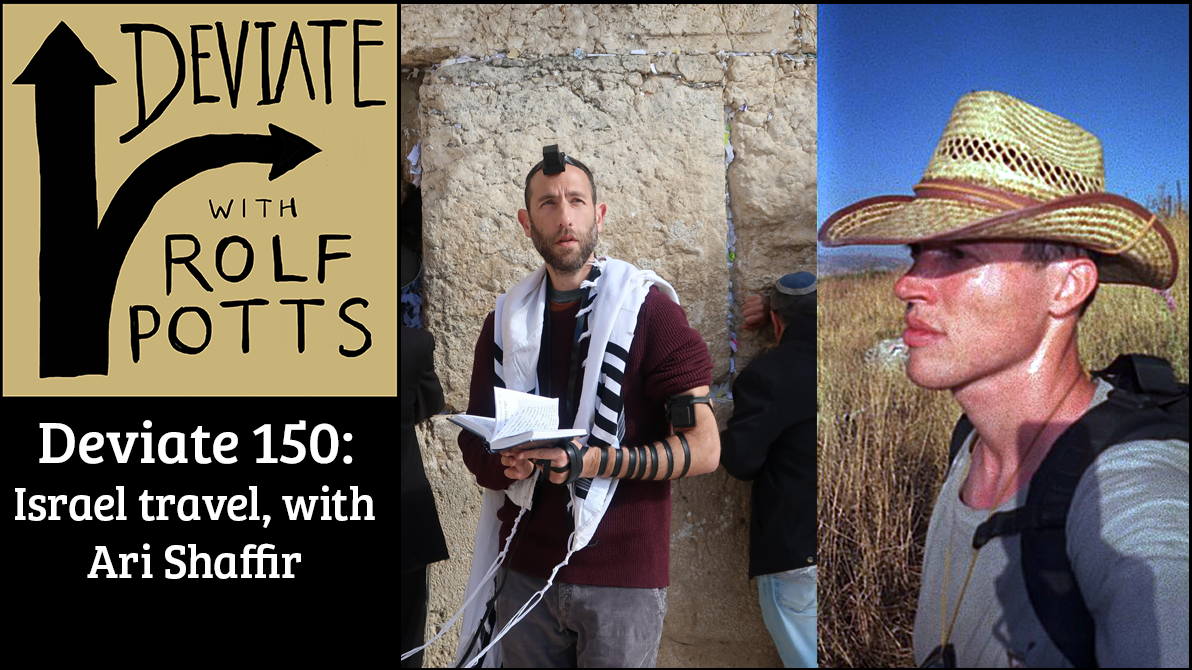
S3 Ep 150Life changing travel experiences (with Ari Shaffir): Walking across Israel
“A lot of people seek out spiritual travel-sites without any ties to a specific religion: When they’re in Israel and they’ll go to the Western Wall and feel so spiritual there; a month later they’re in Thailand and they’ll go to a Buddhist retreat. They just glom on for a minute and play pretend.” – Ari Shaffir Note: Rolf is giving away copies of books by Deviate guests (like Paul Theroux, Kate Harris, and Chris Guillebeau) for people who buy Tortuga backpacks online, or who buy copies of Vagabonding at local independent bookstores. Just email a receipt (and, if applicable, a photo of yourself at your local bookseller) to [email protected], and Rolf will share a list of available books and mail a free copy of your choosing to any USA address. In this episode of Deviate, Rolf and Ari discuss Rolf’s pilgrimage across Israel 20 years ago and why he took it, and Ari’s experiences there in a yeshiva and on a kibbutz as a young man (4:45); what it was like to walk in the agricultural north of Israel near the Sea of Galilee, and navigating the Jewish versus Arab cultural aspects of the country (15:00); longing as a part of travel, and what it was like to go to Israel as young man and see women in swimsuits after traveling in conservative Arab lands (29:00); the proliferation of Christian sites throughout Israel, getting picked up by Israeli girls while hitchhiking and going to Tel Aviv (36:00); the difference between Tel Aviv and Jerusalem, and what it was like to visit sites like the Wailing Wall and the Church of the Holy Sepulchre (51:00); Rolf’s experience of canvassing for a pub in Jerusalem as an act of self-abnegation, and fasting on the Mount of the Temptation near Jericho (1:13:00); and the tendency of some travelers to superficially embrace the local spiritual tradition in places like Israel and India and Thailand, and how travel is in itself a spiritual act (1:26:30). Ari Shaffir (@AriShaffir) is a comedian, writer, podcaster, and actor. He is the current host of the Skeptic Tank podcast. For more information on Ari, visit his website. Notable Links: Galilee (region in northern Israel) Orthodox Judaism (traditionalist Jewish sect) Yeshiva (Jewish educational institution) 613 commandments (tradition from the Torah) Messianic Judaism (sect that combines Christianity with Judaism) Oslo Accords (1993 Israel/PLO agreement) Yardenit (baptismal site on the Jordan River) Saint Helena (influential 4th century Christian pilgrim) Megiddo (ancient city site in Israel) South Lebanon Army (Christian militia) Jerusalem Syndrome (mental disorder) Wailing Wall (site in the Old City of Jerusalem) Al-Aqsa Mosque (Muslim site in Old City of Jerusalem) Via Dolorosa (processional route in the Old City of Jerusalem)
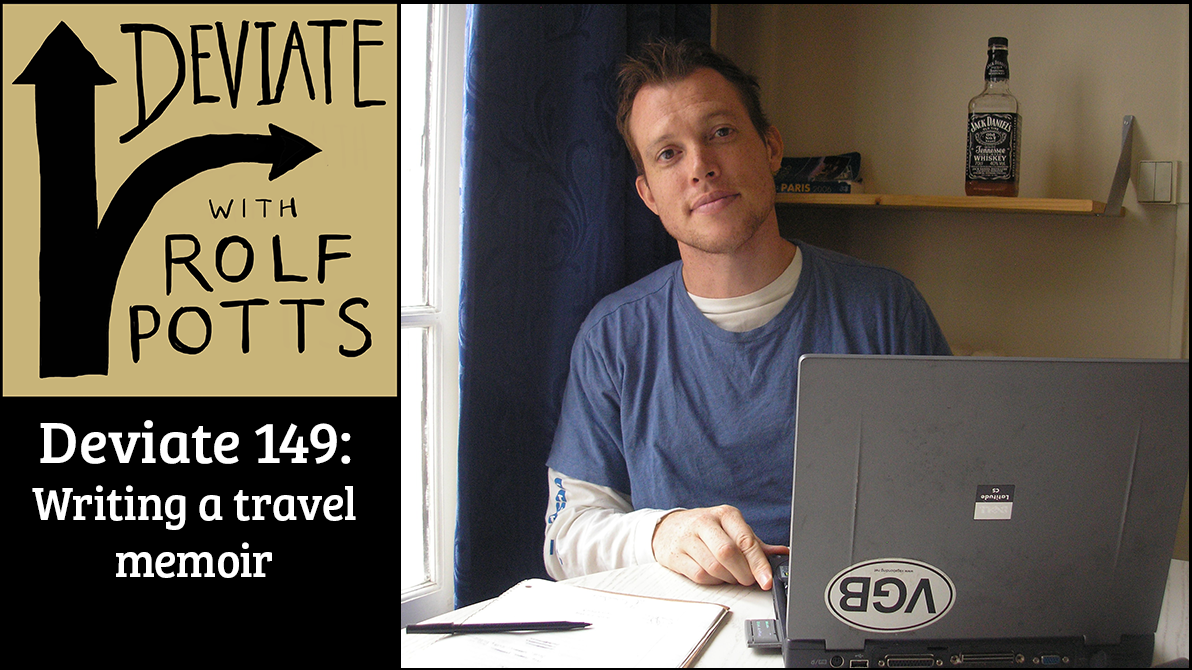
S3 Ep 149How to write a travel memoir (and how failure is the best teacher)
“Earnest, hard-won failure can teach you as much as anything.” – Rolf Potts Note: For information on the Paris-based Travel Memoir classes Rolf is offering to Deviate listeners in 2021, inquire at [email protected], or via the online forms at the Paris Writing Workshops website. In this episode of Deviate, Rolf and Jeremy discuss breaking into travel writing and learning through failure (4:00); what defines travel memoir, and how it’s different from other kinds of travel writing (11:00); the role of research in travel writing, and the balance between personal expression and reportage (17:00); the travel writing industry, and what topics are covered in Rolf’s Paris Writing Workshop (25:00); and how “flaneuring” in place like Paris can lend a new perspective on place (37:00). Jeremy Bassetti (@jeremybassetti) is a writer, editor, educator, and host of the Travel Writing World Podcast. His website, travelwritingworld.com, features interviews with travel writers, book reviews, author profiles, and resources for travel writers and their readers. For more about Jeremy, check out jeremybassetti.com. Notable Links: Storming the Beach, by Rolf Potts (essay) Van Life before #VanLife (Deviate episode) The Last Whalers, by Doug Bock Clark (book) Deviate interview with Doug Bock Clark (podcast) Eat, Pray, Love, by Elizabeth Gilbert (book) On the Plain of Snakes, by Paul Theroux (book) Deviate interview with Paul Theroux (podcast) Braver Than You Think, by Maggie Downs (book) Deviate interview with Maggie Downs (podcast) Writing Away, by Lavinia Spalding (book)

S3 Ep 148Strategies and arguments for the simple life (from an off-grid perspective)
This episode of Deviate explores the benefits of minimalism (3:00); changing ones life philosophy and getting rid of bad habits (11:00); pragmatic approaches to personal finance and avoiding debt (20:00); living off the grid and life tips (29:00); and finding a life purpose (42:00). Deviate is brought to you by Tortuga Backpacks, which set the standard for the best, most durable, organized, and comfortable travel backpacks. Tortuga products also include daypacks, duffels, and other travel accessories, which are all made with the traveler in mind and have been featured by Wirecutter, The New York Times, Travel + Leisure, Business Insider, Carryology, and many other industry outlets. The Deviate theme music comes from the title track of Cedar Van Tassel’s 2017 album Lumber. Note: We don’t host a “comments” section, but we’re happy to hear your questions and insights via email, at [email protected].
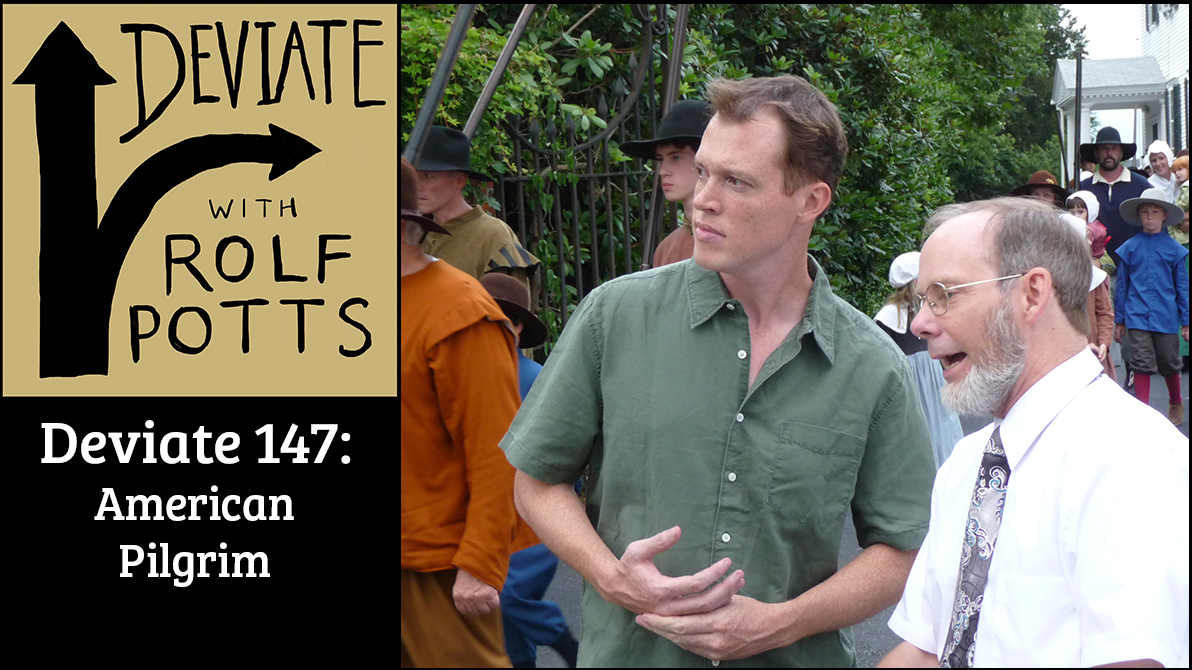
S3 Ep 147American Pilgrim: Revisiting Rolf’s lost Travel Channel Thanksgiving special
“The perception that most Americans have about the original Thanksgiving is very much a Hallmark-card stereotype, where the native people and the colonists came together and broke bread and sang ‘Kumbaya.’ In truth, there was a great deal of trepidation on both sides.” – Paula Peters Full video episode In this episode of Deviate, Rolf presents an audio remix of American Pilgrim, the Thanksgiving Special he hosted for the Travel Channel in 2008. The episode begins with some contextual history of the Pilgrims’ voyage from England, and a visit to chef Bryant Alden’s kitchen in New Hampshire to discuss what food the Pilgrims ate (5:00); next, Rolf sails out of Plymouth Harbor with John Brewster, and learns about the sea conditions the Pilgrims faced coming over from England (12:00); at Mayflower Brewing Company in Plymouth, brewer Drew Brosseau talks about the importance of beer to the Pilgrims (17:00); elsewhere in Plymouth, Reverend Bill Fillebrown talks about how religious convictions shaped the lives of the Pilgrims (21:00); at Plimoth Plantation, indigenous descendants talk about relations between with Pilgrims and the native people in the area (27:30); in rural Connecticut, Rolf talks with farmer Courtland Kinnie about the Pilgrims’ agricultural practices (30:40); finally, at Fort Hood in Texas, U.S. Army Major Chuck Assadourian talks about the Pilgrims’ approach to defense and security (34:00). As the holiday season gets underway, a reminder that Rolf’s travel books make great Christmas stocking-stuffers. Vagabonding is a perennial gift favorite for travelers, though please also consider Rolf’s travel-essay collection Marco Polo Didn’t Go There, his travel-history book Souvenir, or his comic-book adaptation of an ancient Egyptian travel tale, The Misadventures of Wenamun. Fort Hood deleted scene Notable Links: Pilgrims (English settlers in North America) Plimoth Plantation (living history museum) Mayflower II (replica of 17th century ship) Wampanoag (Native American people) John Alden (Mayflower Pilgrim) Squanto (Patuxet tribal liaison) Pottage (thick stew) Edward Winslow (Mayflower Pilgrim) William Brewster (Mayflower Pilgrim) Mayflower Compact (governing document) Barque Eagle (U.S. Coast Guard training cutter) Mayflower Brewing Company (craft-beer business) Cooper (profession) William Bradford (Governor of the Plymouth Colony) Peregrine White (baby boy born on the Mayflo...
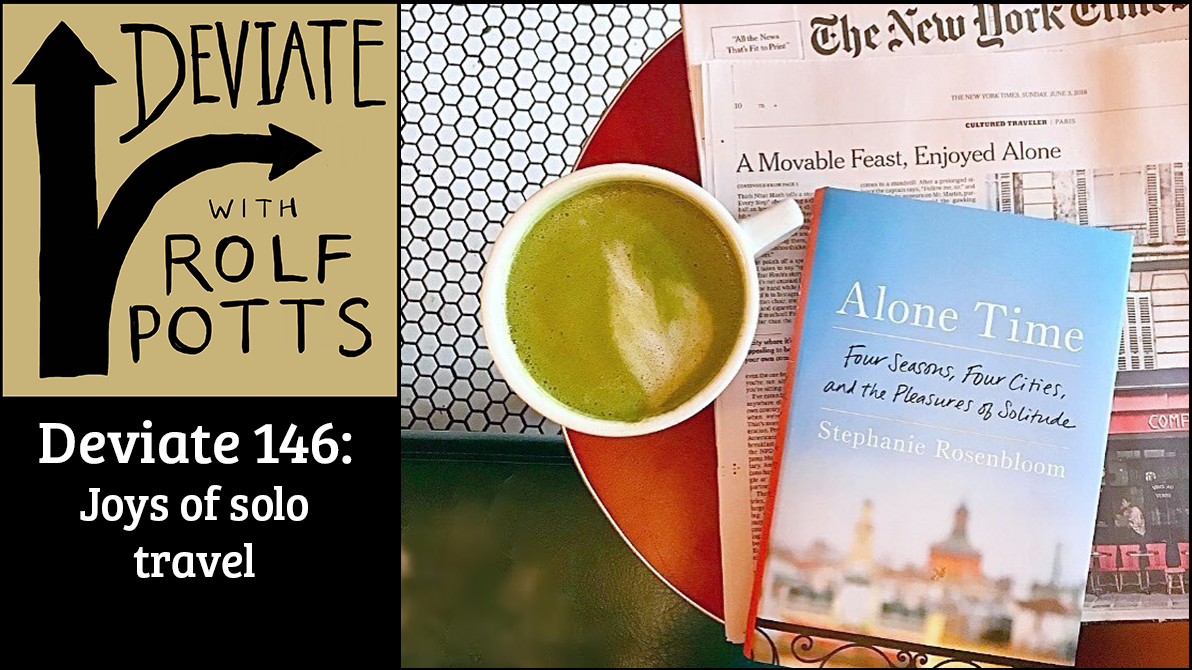
S3 Ep 146Solo travel: Celebrating the pleasures of (and strategies for) journeying alone
“Savoring is attending to the moment.” – Stephanie Rosenbloom In this episode of Deviate, Rolf and Stephanie discuss solitude versus loneliness (3:00); the joy of eating alone (14:00); the art of being a flaneur and savoring experiences (22:00); the joy of going to museums alone (32:00); the relationship between anticipation, experience, and retrospection (43:00); and exercising your travel muscles as part of everyday life (54:00). Stephanie Rosenbloom (@stephronyt) is a travel writer for The New York Times, where she has been a reporter for more than a decade, and the author of the book, Alone Time: Four Seasons, Four Cities, and the Pleasures of Solitude. For more about Stephanie, check out http://www.stephanierosenbloom.com. Notable Links: Abraham Maslow (psychologist) AllTrails (website) Bella DePaulo (Professor of Psychology) Thích Nhất Hạnh (Vietnamese Buddhist monk) Savoring: A New Model of Positive Experience, by Fred Bryant (book) The Lonely Guy (Steve Martin movie) Charles Baudelaire (poet) Sandro Botticelli (painter) The Birth of Venus (painting by Botticelli) Elizabeth Dunn (psychologist) On Photography, by Susan Sontag (collection of essays) Marcel Duchamp (painter / sculptor) LiveTrekker (app)

S3 Ep 145Vagabonding audio companion: Time Wealth and the spiritual texture of travel
“Getting in touch with reality is literally the essence of spiritual life.” – Rolf Potts In this episode of Deviate, Rolf remixes his interview from the Far Out Podcast, by Julie-Roxane and Alasdair. They discuss “Time Wealth,” and vagabonding as a philosophy for life (3:00); sifting through mediated information, versus getting local information on the road, and “reality” as the essence of spirituality (13:00); appreciation versus achievement, embracing the possibility of travel, and how you get smarter about travel the more you travel (24:00); seeking to have an “option-rich” life, the freedom that comes with not having preconceptions about where to go or what to do, and the joy of being surprised on the road (46:00); travel as a way to find out what you value and love in life (58:00); and the importance of slowing down, on the road and in life (1:03:00). Julie-Roxane and Alasdair (Instagram: @thefaroutcouple) are travelers, entrepreneurs, guides, coaches, and co-hosts of the Far Out Podcast, where they chronicle their adventures in unconventional living. For more about Julie-Roxane and Alasdair, check out https://www.jrkrikorian.com and https://alasdairplambeck.com. Notable Links: John Muir (naturalist) Stoicism (school of Hellenistic philosophy) Platonic idealism (philosophical doctrine of ideas) Rolf on the Tim Ferris Show (podcast episode) The Snow Leopard, by Peter Matthiessen (book) Henry David Thoreau (philosopher) Leaves of Grass, by Walt Whitman (poetry collection) Situationist International (French avant-garde movement) Dérive (experimental urban behavior) The best hostel ever, in Cairo (Deviate episode) Into the Wild, by Jon Krakauer (book) Falling Upward, by Richard Rohr (book) Antonio Machado (Spanish poet)
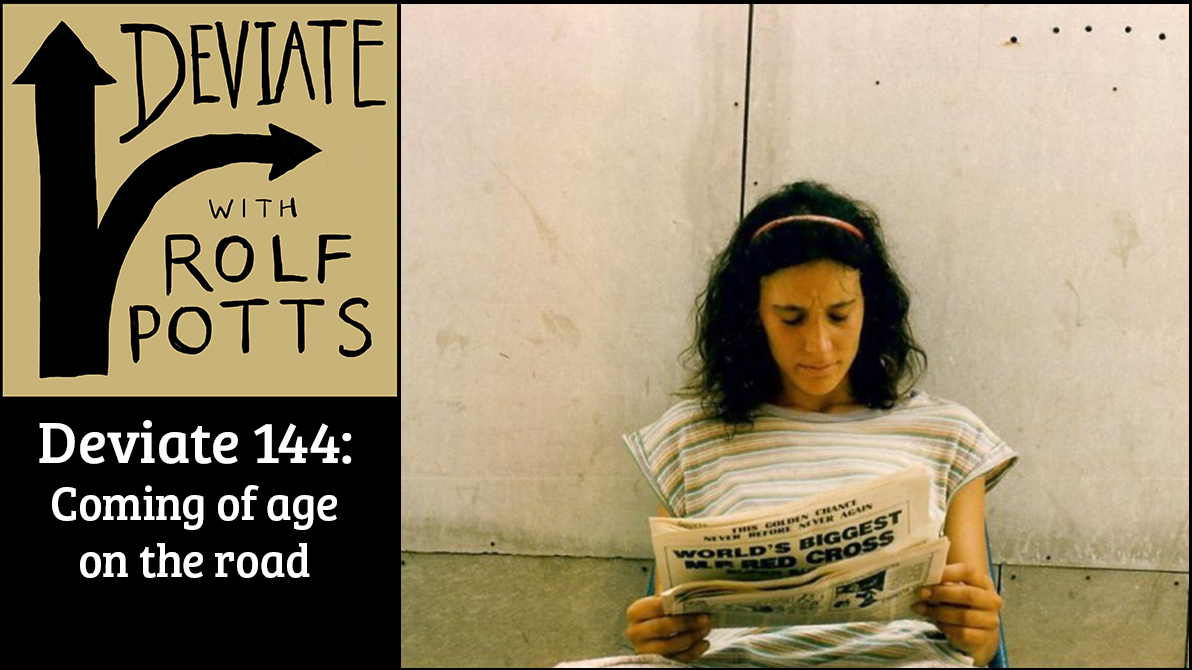
S3 Ep 144Coming-of-age on the road as a dirtbag backpacker (with Pam Mandel)
“That sort of fearlessness, and the assumption that the world is a good place – I like holding onto that idea to this day.” – Pam Mandel In this episode of Deviate, Rolf and Pam discuss the good that can come out of bad travel, and how Pam became a person who spent a lot of her teen years outside of the US (2:30); how Pam came to travel to Israel and work on a kibbutz as a teenager after high school (9:00); the magic of traveling while young, and Pam’s experiences of hitchhiking across Europe (21:00); Onward travel to Egypt, Pakistan, and India, and how the assumptions of travel as a woman in certain countries are different from those of young men travelers (30:00); what it was like to write a book about experiences that happened 40 years ago (45:00); and how Pam now sees her coming-of-age travels as a complicated mix of good and bad experiences (51:30). Pam Mandel (@nerdseyeview) is a travel writer and co-founder of The Statesider, a travel newsletter. Her book The Same River Twice, comes out this November. For more about Pam, check out her Nerd’s Eye View blog. Notable Links: Hippie trail (1960s and 1970s travel subculture) Kibbutz (collective community) Tony Wheeler (founder of Lonely Planet) Squatting (practice of living in abandoned buildings) Child marriage in Pakistan Fields & Stations (magazine) This episode of Deviate is brought to you by Tortuga Backpacks, which set the standard for the best, most durable, organized, and comfortable travel backpacks. Tortuga products also include daypacks, duffels, and other travel accessories, which are all made with the traveler in mind and have been featured by Wirecutter, The New York Times, Travel + Leisure, Business Insider, Carryology, and many other industry outlets. This episode is also brought to you by AirTreks, an industry leader in multi-stop international travel. AirTreks is a distributed travel company with employees working from all corners of the world to help with your flight planning, specializing in complex routes with up to 25 stops. The AirTreks website offers suggested pre-planned travel itineraries to help you get started, but can customize to fit your journey. The Deviate theme music comes from the title track of Cedar Van Tassel’s 2017 album

S3 Ep 143On penis theft, creepy clowns, anxiety, and how culture tells us what is real
“Beliefs are contagious. The stories we tell take on their own logic and become real, in a way. As travelers in another culture part of your role is to try and understand what narrative ecosystem you’re a part of.” – Frank Bures In this episode of Deviate, Rolf and Frank discuss “culture shock,” and the origins of Frank’s book (2:00); narrative ecosystems, “penis theft,” and culture as a lens to view to the world (10:00); the form cultural panics and idiosyncrasies take in the West (23:00); and how to treat conditions that are both cultural and biological (30:00). Frank Bures is a writer and the author of The Geography of Madness, which Newsweek called one of the best travel books of the decade. His writing has appeared in such publications as Harper’s, Lapham’s Quarterly, and the Best American Travel Writing. For more about Frank, check out www.frankbures.com. Notable Links: Penis theft (culture-bound syndrome) Culture shock (cross-cultural anxiety) Korean fan-death (culture-bound syndrome) Traditional Chinese medicine (cultural pseudoscience) Anorexia nervosa (eating disorder) Bigorexia (body dysmorphic disorder) 1967 Singapore genital panic, by Frank Bures (article) Satanic Panic (moral panic in the 1980s and 1990s) 2016 “creepy clown” scare (viral panic) Chemtrails (conspiracy theory) Premenstrual syndrome (emotional disorder) This episode is also brought to you by AirTreks, an industry leader in multi-stop international travel. AirTreks is a distributed travel company with employees working from all corners of the world to help with your flight planning, specializing in complex routes with up to 25 stops. The AirTreks website offers suggested pre-planned travel itineraries to help you get started, but can customize to fit your journey. The Deviate theme music comes from the title track of Cedar Van Tassel’s 2017 album Lumber. Note: We don’t host a “comments” section, but we’re happy to hear your questions and insights via email, at [email protected].

S3 Ep 142Pandemic love, cheating death, & cassette tapes: A personal history of nostalgia
“Nostalgia isn’t rational, and just like Warrant’s 1990 song “Cherry Pie” reminds me of 1989 more than the recorded sound of my own voice from 1989, watching the movie Dazed and Confused for the first time literally made me long for a time in life that was less happy than the time I was living in when I saw it.” — Rolf Potts In this essay episode of Deviate Rolf talks about four recent factors in his life that have changed the ways he views nostalgia (4:00); how he may well could have been killed in a motorcycle wreck in Asia in 2019, and how the accident affected his way of seeing the world in the months after it happened (8:30); how the word “nostalgia” has conventionally been defined, in both the modern and premodern sense (18:45); Rolf’s complicated memories of youthful interactions with movies like Star Wars, Dazed and Confused, and Before Sunrise (23:00); how Rolf met a traveler named Kristen Bush (aka “Kiki”) in Kansas during the pandemic, and what factors made their connection unique (34:45); how Michel de Montaigne made sense of his near-fatal horse accident in the 16th century, versus how Rolf has come to make sense of his motorcycle accident in Asia (40:00); how Rolf has trouble intuiting his own past when he listens to his own voice on old cassette tapes (43:30); and how Rolf and Kiki have come to make sense of their past, present, and future together, and how this pandemic moment will one day feed its own nostalgia (48:30). Kristen Bush is an actress, known for Paterno (2018), Liberal Arts (2012), and Synecdoche, New York (2008). Her TV credits include The Affair, The Good Wife, Elementary, and Law & Order: SVU. She has performed onstage at Manhattan Theatre Club, The Public, the Old Globe, Goodman Theatre, and Lincoln Center. Notable Links: “Turkish Knockout,” by Rolf Potts (essay) “Laos in the time of cholera,” by Rolf Potts (essay) Jonathan Yevin on no-baggage travel (Deviate episode) Schadenfreude (experience of joy in the misfortunes of others) Hyposmia (reduced ability to smell odors) Marguerite Yourcenar (French novelist) William Faulkner (American novelist) Starship Enterprise (fictional spacecraft on Star Trek) Woodstock (1969 music festival) Grunge (rock music genre) Bumble (dating app) “The Dark Side of Travel Romance,” by Rolf Potts (essay) Ceylon lesser albatross (butterfly species) Howard Cosell (American sportscaster) Joan Didion (American writer) John Muir (naturalist and author) Josh Radnor (actor and filmmaker)

S3 Ep 141A folk history of Satanic Panic, backmasking, and rock music in the 1980s
“There are the actual facts of what was happening in popular culture in the 1980s — and then there was this tantalizing notion that music played backwards was going to seed our minds with evil. Which was scary, but also kind of cool to a certain kid-like way of thinking.” — Rolf Potts In this rebroadcast episode of Deviate Rolf delves into the idea of “backward masking” in rock music, and how it came to influence notions of “Satanic Panic” in America over the course of the 1980s. Returning to the show for this musical deep-dive are Jedd Beaudoin (@JeddBeaudoin), who hosts the syndicated music show “Strange Currency,” and Michael Carmody (@Carmody68), a musician, record collector, and entrepreneur. Together they discuss preacher Jacob Aranza’s underground-classic 1983 anti-rock book Backward Masking Unmasked and its idiosyncratic take on popular music (4:00); the history of rock and roll and American culture that led up to Satanic Panic in the 1980s (31:10); how rock acts exploited the idea of Satanism to sell records just as preachers, politicians, and pop-journalists fixated on its supposed dangers to attract followers (42:10); and the legacy of Satanic Panic and the seeming lack of evil in today’s popular music (1:05:45). Rock and roll curiosities mentioned Backmasking (audio technique) Gene Simmons’ Tongue (Snopes article) Blood in KISS Comic Book (Snopes article) Paul is Dead (Beatles urban legend) Aleister Crowley (English occultist) Robert Johnson sold soul to the devil (blues myth) Sign of the horns (rock hand gesture) Eddie (zombie-like Iron Maiden mascot) Dark Side of the Rainbow (movie/album mashup) Acid rock (psychedelic rock subgenre) Judas Priest suicide lawsuit Ozzy Osbourne suicide lawsuit Norwegian black metal (extreme metal genre) Classic rock is not dead. Classic rock is undead (podcast episode) Hammer of the Gods (controversial book about Led Zeppelin) Movies and TV shows mentioned CHIPs “Rock Devil Rock” episode (1982) The Decline of Western Civilization (Penelope Spheeris documentary) Decline of Western Civilization Part II: The Metal Years (documentary) Rosemary’s Baby (horror movie)
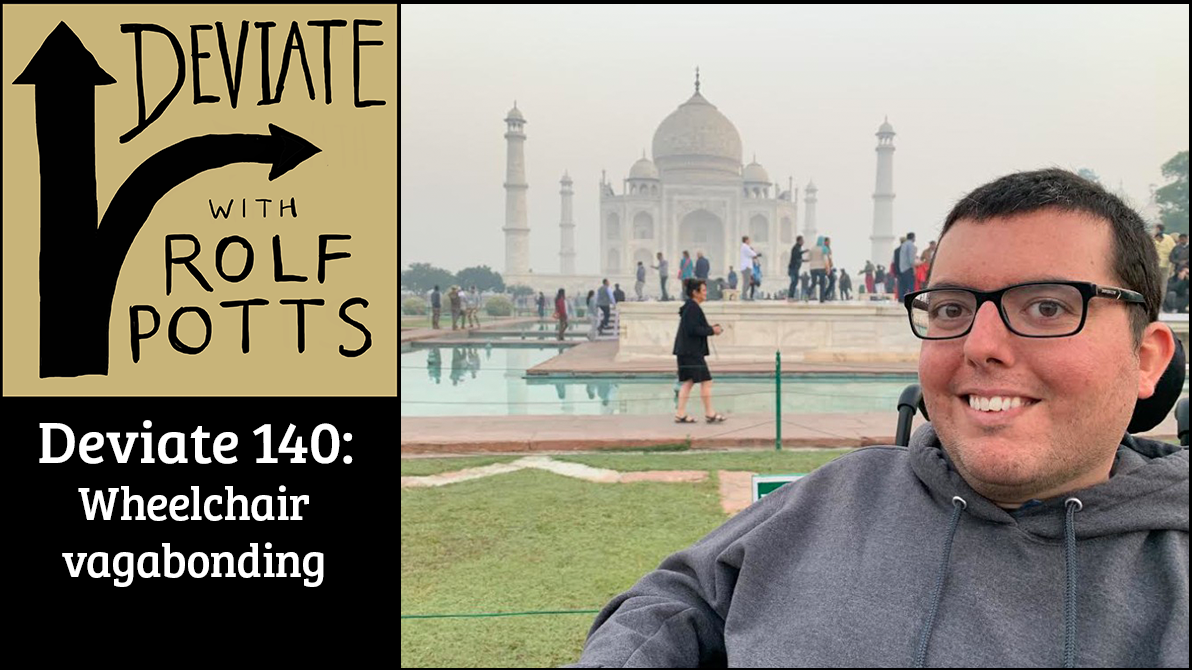
S3 Ep 140What it’s like to travel 37 countries (and counting) in a wheelchair
“Face the fear, and go for it.” – Cory Lee In this episode of Deviate, Rolf and Cory discuss what challenges disabled travelers contend with, and how Cory got started as a traveler with spinal muscular atrophy (2:30); good destinations for travelers with mobility issues, and what challenges present themselves on the ground for travelers with disabilities (10:00); non-traditional activities like adventure travel or volunteering for people with disabilities, (20:00); and what it’s been like for Cory to write and blog about disability travel, and how it became his full-time job (26:00). Then, Rolf is joined by listener Zachary York to discuss what it’s like to travel with Neurofibromatosis type I (32:00). Cory Lee (@coryleetweets) is the founder of Curb Free with Cory Lee, a travel blog sharing his experiences from a wheelchair user’s perspective. Cory is a 2-time Lowell Thomas Award winner for Best Travel Blog and was named the 2018 Person of the Year by New Mobility Magazine. Notable Links: Spinal muscular atrophy (neuromuscular disorder) The Wheel Chair Singers (disabled gospel singing group) Accessible Travel Club (Facebook Group) Accessible Travel Online Resource Book (Travel Book) Americans with Disabilities Act (civil rights law) Volunteering for the Disabled in Northern Ireland, by Cory Lee (blog post) Saku Travel (Estonia tour agency catering to disabled travelers) Gatorland (Florida theme park) Zachary York (traveler with Neurofibromatosis type I) Mount Whitney (tallest mountain in the contiguous U.S.) This episode of Deviate is brought to you by Tortuga Backpacks, which set the standard for the best, most durable, organized, and comfortable travel backpacks. Tortuga products also include daypacks, duffels, and other travel accessories, which are all made with the traveler in mind and have been featured by Wirecutter, The New York Times, Travel + Leisure, Business Insider, Carryology, and many other industry outlets. This episode is also brought to you by AirTreks, an industry leader in multi-stop international travel. AirTreks is a distributed travel company with employees working from all corners of the world to help with your fligh...

S3 Ep 13920 lessons learned from 20 years as a travel writer: A TravelCon keynote
“Embrace your travel mistakes. You can’t ‘fail’ at travel; you can only learn from travel.” –Rolf Potts In this episode of Deviate, which excerpts a keynote talk from TravelCon, Rolf talks a bit about his background of growing up in Kansas and dreaming about travel, his earliest vagabonding travels, and his first forays into travel writing (3:30); then Rolf shares his “20 lessons learned from 20 years as a travel writer,” (7:30). Notable Links: TravelCon (travel-media conference) Don George (travel writer) Rolf’s ongoing travel writer interview series Eva Holland (travel writer) Bachata (Dominican dance style) Merengue (Dominican dance style) Omo Valley (tribal region in Ethiopia) Mursi people (ethnic group in Ethiopia) Ranong (town in Thailand) Gringo Trails (2013 travel documentary film) Podcasts and essays alluded to: Nomadic Matt Kepnes on travel (Deviate episode) Van Life before #VanLife (Deviate episode) A Trans-Siberian story (Deviate episode) No Baggage Challenge (round-the-world video series) The wrong town in Morocco (blog/video dispatch) Up Cambodia without a phrasebook (travel essay) Cowboys and Indians, Thai-style (travel essay) Going Native in the Australian Outback (travel essay) A Vagabond Finds a Home (essay) Toura Incognita (Conde Nast Traveler article) 20 lessons learned from 20 years as a travel writer 1) Relationships count more than platforms 2) Distinctive content counts more than self-promotion 3) If in doubt, ask for help 4) If in doubt say yes 5) There is always more to learn 6) Don’t postpone things 7) Be an expat at some point in your travel career 8) Take it slow 9) It’s OK to make mistakes 10)
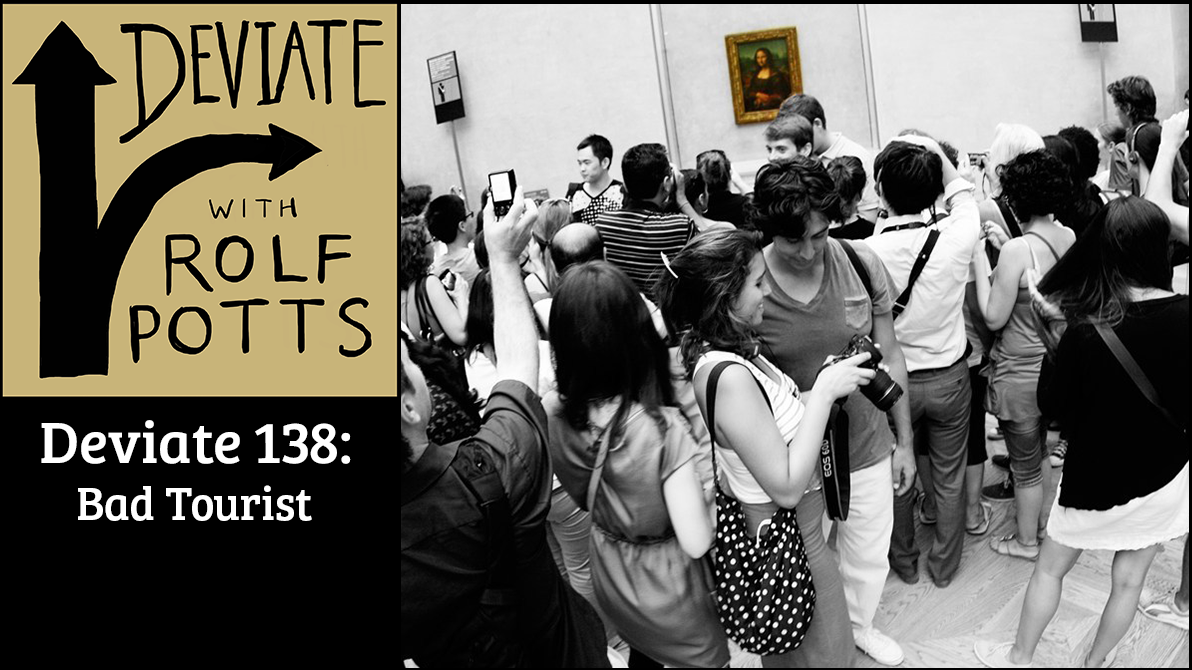
S3 Ep 138Sex, travel, and the art of being a better bad tourist (with Suzanne Roberts)
“Sometimes we do things for ourselves in the name of adventure, without thinking about how this affects other people.” – Suzanne Roberts In this episode of Deviate, Rolf and Suzanne discuss what it means to be a bad traveler, and the ethical quandaries that come with being a tourist (3:00); examples from Suzanne’s book about her interacting from a position of privilege with trekking guides during a mudslide in Peru, giving a Power Bar to a leper in India, or wanting to help underaged prostitutes in Nicaragua (12:00); burning-ghat tourism in Varanasi, and how places where death is more public make one confront the notion of death and “aliveness” in a more realistic way (23:00); sex, dating and relationships abroad (34:00); and the challenge of writing about sensitive cross-cultural topics, and the utility of “sensitivity readers” versus good on-the-ground reporting in travel writing (55:00). Suzanne Roberts (@SuzanneRoberts) is a travel writer, memoirist, and poet. Her books include the 2012 National Outdoor Book Award-winning Almost Somewhere, her new travel memoir Bad Tourist, and four collections of poetry. For more about Suzanne, check out https://www.suzanneroberts.net/ Notable Links: A Small Place, by Jamaica Kincaid (book-length essay) Postcolonialism (academic critical theory) White savior complex (trope applied to some travelers) Aguas Calientes (place in Peru) Ghats in Varanasi (riverfront area along the Ganges) Memento mori (artistic or symbolic reminder of death) Thomas Merton (Christian writer / theologian) Attar of Nishapur (Sufi poet) Sholeh Wolpé (Iranian-American poet) Favela (type of slum in Brazil) Poverty porn (media stereotype) Souvenir, by Rolf Potts (book) AWP Conference (American literary event) This episode of Deviate is brought to you by

S3 Ep 137Drunk in China: A vicarious Middle Kingdom adventure via its favorite booze
“There is this arrogant assumption that the things we don’t know or understand must be bad, because if they were good, we would already know about them or understand them.” –Derek Sandhaus In this episode of Deviate, Rolf and Derek discuss the culture and traditions of baijiu liquor in China (4:00); Derek’s introduction to China and baijiu, and how Sichuan, more than any other province, is known for making baijiu (15:00); the history of baijiu, its significance to Chinese culture, and the rules that surround its consumption at meals (22:00); how alcohol influenced Chinese culture and agriculture over the years, and how foreigners have interacted with baijiu (31:00); the challenge in introducing baijiu to the American market, how it has as many variations as different as vodka and tequila, and how to find and enjoy baijiu in the United States (36:30). Derek Sandhaus (@dsandhaus) is a writer, traveler, and author of several books on Chinese history and culture, including Baijiu: The Essential Guide to Chinese Spirits and Drunk in China. He is a cofounder of Ming River Sichuan Baijiu and currently serves as the brand’s communications director. He is also the editor of DrinkBaijiu.com. Notable Links: Baijiu (Chinese liquor) William of Rubruck (missionary / explorer) Marco Polo (explorer) Chengdu (capital of Sichuan province in China) Zhou Enlai (first Premier of the People’s Republic of China) Chiang Kai-shek (Chinese politician) Seven Sages of the Bamboo Grove (Chinese scholars) Eight Immortals of the Wine Cup (Chinese scholars) Jiahu (Neolithic settlement in China) Henry David Theroux (author) Ernest Hemingway (author) Taoism (philosophy)

S3 Ep 136Growing up racially diverse: A not-so-politically-correct roundtable
“So many hate-filled things—whether on social media or just people talking—are based on stereotypes that are not accurate. Too many people simply don’t interact with people who are different from them.” —Joe Rodriguez In this episode of Deviate, childhood friends Rolf, Kaye, Tony, and Joe discuss the racially specific nicknames people gave each other in high school back in the 1980s (7:40); how exactly their racial and socioeconomic situations influenced the way they grew up as young people (14:30); why it’s important to respect specific aspects of other people’s lives, even if you can’t entirely relate to them, and how individual people don’t necessarily represent everyone in a given group (37:00); what it feels like to be judged by strangers on the basis of your race, especially when you come from a minority group (51:30); how their race and the location of their neighborhoods affected their extracurricular lives as teenagers, and how diversity exists even within individual racial groups (1:06:00); how dating and marrying across racial lines can give you a deepened perspective on racial difference (1:18:00); and how the personal experience of racial diversity is so much richer, more nuanced, and intertwined with “social capital” than the way it’s discussed in the click-bait atmosphere of social media (1:30:00). Kaye Monk-Morgan is an Assistant Vice President for Academic Affairs at Wichita State University. Tony Johnson works with troubled youth as an intervention specialist with the Wichita Public Schools. A former newspaper journalist, Joe Rodriguez works as the Director of Development at Wichita’s Holy Savior Catholic Church and Academy. Notable Links: Wichita North High School What it’s like to be a black police officer in America (Deviate episode) What it’s like to be a Latino police officer in America (Deviate episode) The power of small choices across decades (Deviate episode) On Political Correctness, by William Deresiewicz (essay) Wichita State Shockers men’s basketball (sports program) Nico Hernandez (Olympic boxer from Wichita) Mike George (20th century professional wrestler) Lawrence Welk (20th century TV bandleader) Code-switching (linguistic “language alternation”) Colin Kaepernick (American athlete and activist) Kansas Bureau of Investigation (criminal justice agency) Barry Sanders (former NFL running back from Wichita) James Jabara (Korean War jet ace from Wic...
S3 Ep 135Eric Weiner’s journey into the ways philosophy compels us to live better
“The more we try to seize happiness, the more it slips from our grasp. Happiness is a by-product, never an objective. It’s an unexpected windfall from a life lived well.” –Eric Weiner In this episode of Deviate, Rolf and Eric discuss why practicing (rather than just studying) philosophy is important (2:00); which philosophies make the most sense during pandemic, and Nietzsche’s notion of “Eternal Recurrence” (10:00); aging versus staying young, and the similarities between Greek and Buddhist philosophy (21:00); how travel underpins the philosophical journey, and how train travel promotes deep thinking (31:00); how walking enables thinking and reflection, and the value or art and music (42:00); and loving life while also coming to terms with death (53:00). Eric Weiner (@Eric_Weiner) is an award-winning journalist, bestselling author, and speaker. His books include The Geography of Bliss and The Geography of Genius, as well as the spiritual memoir Man Seeks God and, his latest title, The Socrates Express. Eric is a former foreign correspondent for NPR, and reporter for The New York Times. For more about Eric, check out https://ericweinerbooks.com/ Notable Links: Stoicism (school of philosophy) Friedrich Nietzsche (philosopher) Albert Camus (philosopher) Groundhog Day (film) Thích Nhất Hạnh (Buddhist monk) Epicurus (philosopher) Simone de Beauvoir (writer / philosopher)
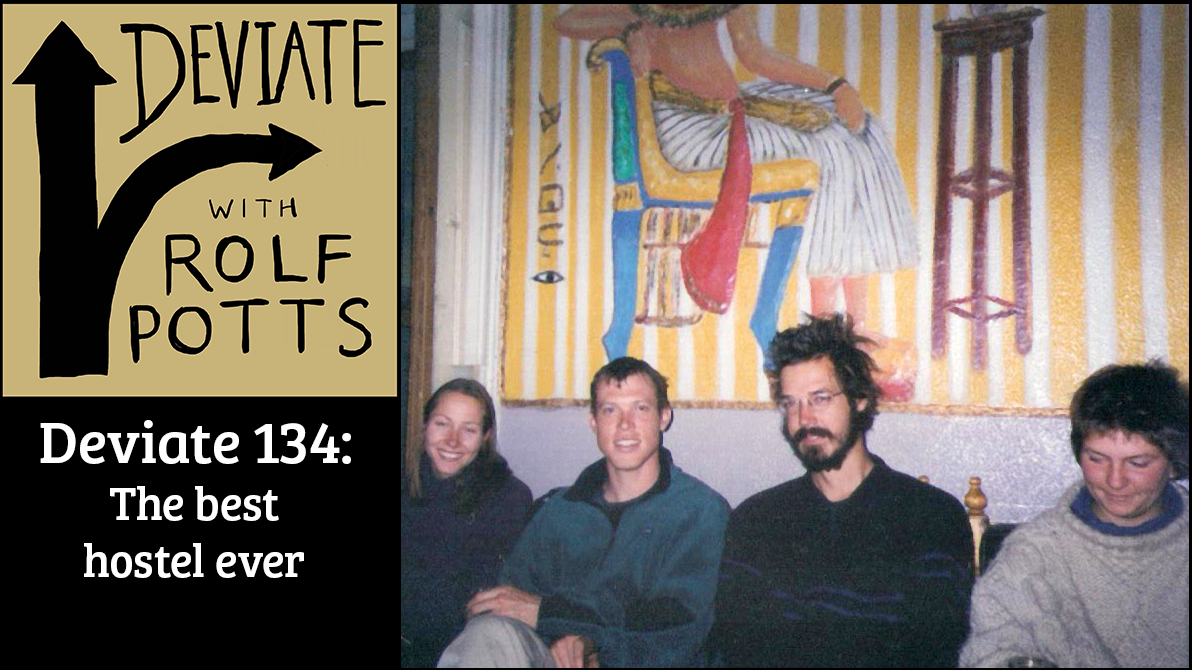
S3 Ep 134Life changing travel experiences: The best hostel ever (in Cairo)
“There are so many ways travel can change your life, in ways you could never imagine before you leave home.” –Daniel Neely In this episode of Deviate, Rolf reads his essay, Backpackers’ Ball at the Sultan Hotel (7:30) before he and Dan reflect on the international cast of characters they met at at the Sultan Hotel in Cairo, and how workaday activities can make the city more interesting than tourist attractions (36:30); the friendships you make in hostels and how they end up shaping your life (44:45); how smartphones may have changed the vibe of some hostels, and how interacting with strangers at hostels can change your life (60:00). A native of Arizona, Daniel Neely served as Peace Corps volunteer in Honduras in the early 2000s. He now works as a Senior Advisor in Emergency Preparedness at the Wellington (New Zealand) Region Emergency Management Office. He previously appeared on Deviate episode 42, “How to survive a natural disaster.” Notable Links: Backpackers’ Ball at the Sultan Hotel, by Rolf Potts (essay) Marco Polo Didn’t Go There, by Rolf Potts (book) Flaubert in Egypt: A Sensibility on Tour (collection of letters) Il signor Bruschino (Rossini operatic farce) Kuchuk Hanem (19th century Egyptian belly dancer) Johnnie Wadie Red Tabel (Egyptian spirit) Herodotus (ancient Greek historian) Hello America (2000 Egyptian movie) Saqqara (ancient burial ground in Egypt) Pyramid of Djoser (archaeological site in the Saqqara necropolis) Giza Necropolis (Egyptian pyramid complex) Djellaba (Arab robe) Keffiyeh (traditional Arabian headdress) Hijab (Muslim veil) “Kicking & Screaming” might be the best movie ever (Deviate episode) Kushari (Egyptian street food) Dahab (backpacker town in the Egyptian Sinai) This episode of Deviate is brought to you by
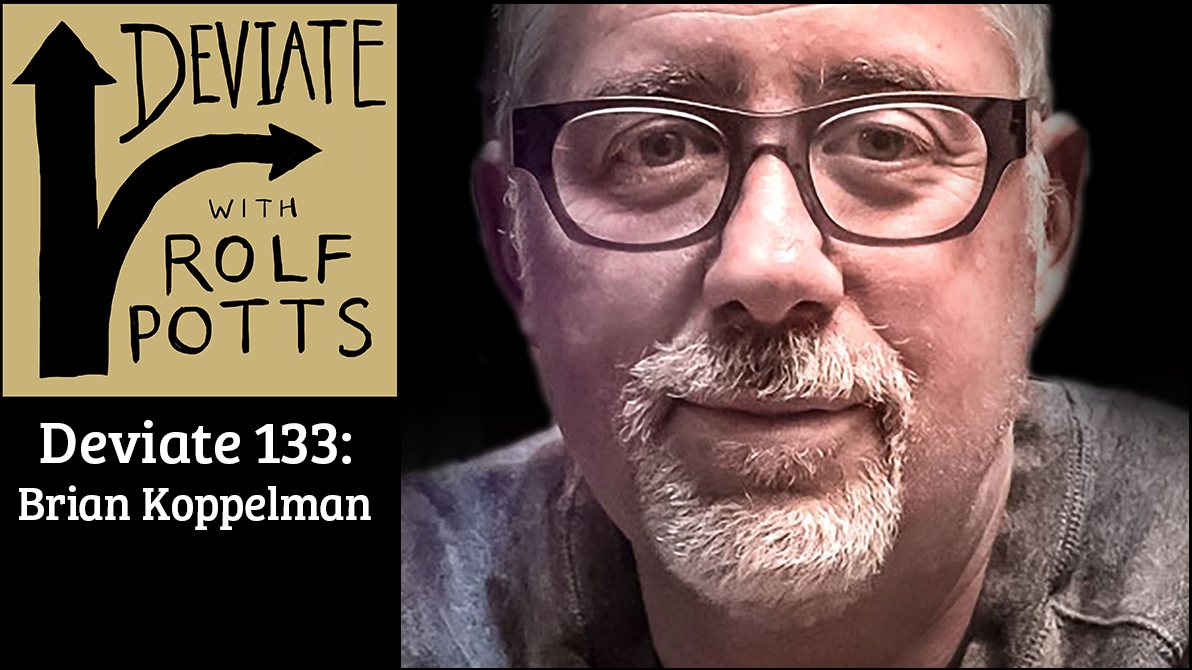
S3 Ep 133Brian Koppelman on the intimacy of podcasting and the genius of Iron Maiden
“My ambition was not financial, but a creative ambition toward fulfillment and satisfaction — and to be a better human toward those whom I loved.” – Brian Koppelman In this episode of Deviate, Rolf and Brian discuss podcast fandom, and how listening to podcasts is intimate in a way other media is not (2:00); self-improvement and ambition versus fulfillment, and the cultural reach of what Brian has created (11:00); the influence of music, and how a single album or artwork affects you at certain ages or times of your life (22:00); and masculine emotions as they are expressed in music, and writing to music informs your creativity (41:00). Brian Koppleman (@briankoppelman) is a screenwriter and co-creator / showrunner of the television show Billions. His screenwriting credits include Rounders and Ocean’s Thirteen. He is also the host of The Moment podcast. Notable Links: Grantland (sports and culture website) Bill Simmons (podcaster and sports writer) Wesley Morris on podcast fame (Deviate episode) Killing Yourself to Live, by Chuck Klosterman (book) This Is What They Want (Jimmy Connors documentary) “I Contain Multitudes” (2020 Bob Dylan song) The Four Hour Workweek, by Tim Ferriss (book) Rolf Potts on Travel Tactics (Tim Ferriss podcast episode) Seth Godin (business executive) Scriptnotes (podcast)
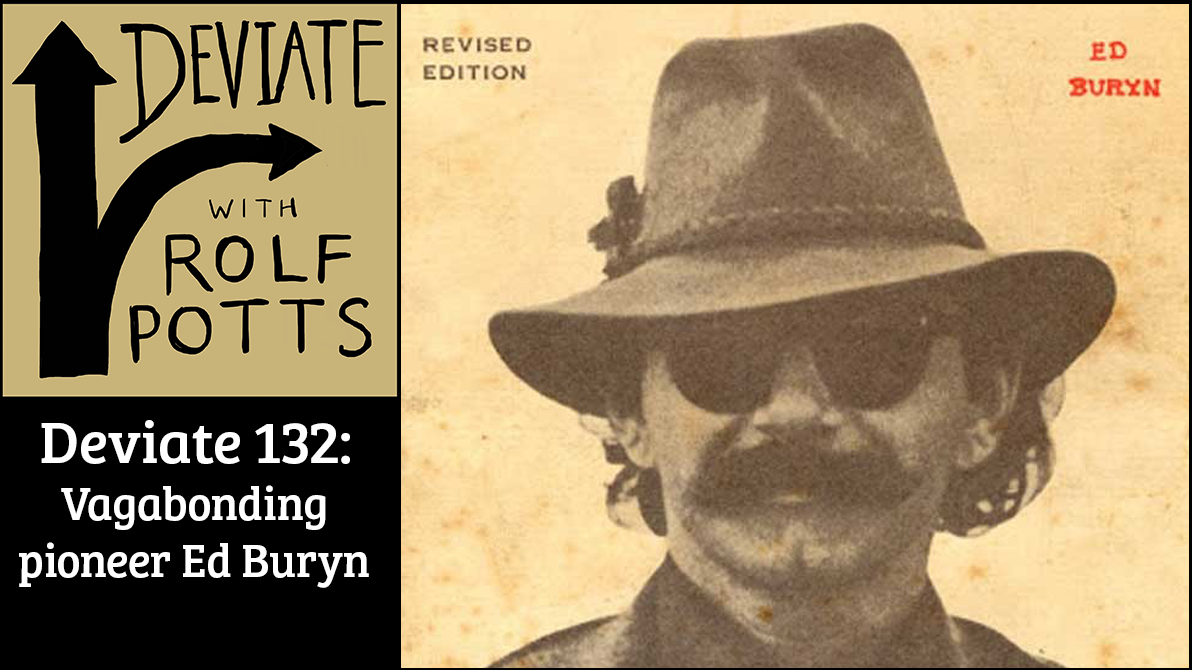
S3 Ep 132Vagabonding pioneer Ed Buryn on what indie travel was like in the 1960s
“Realizing that you will die greatly clarifies your vision of life, and stimulates opportunities for making the vision real.” –Ed Buryn In this episode of Deviate, Rolf and Ed discuss the impetus behind Ed’s first travels to Europe by van in the 1960s, and his early forays into self-printed and self-promoted books about the experience (3:00); how travel to Europe was different 50 years ago, and the joy and freedom that comes with not knowing what happens next (14:30); Ed’s philosophies and influences, including living in “the now” (21:00); how travel allows you to reinvent yourself, and how meeting people is the best gift of travel (36:00); and Ed’s ambitions for poetry and travel, and his advice to travelers in today’s world (44:30). Ed Buryn is an author and photographer who was one of the first to popularize the term “vagabonding” through the publication of his books Vagabonding In Europe and North America and Vagabonding in America. For more about Ed, check out https://edburyn.com. Notable Links: Kevin Kelly (writer, editor, and publisher) Tony Wheeler (founder of Lonely Planet travel guides) Bill Dalton (founder of Moon travel guides) Charles Plymell on the Beat Generation (Deviate episode) The Drifters, by James Michener (book) Zorba the Greek, by Nikos Kazantzakis (book) Henry Miller (author) CouchSurfing ((homestay and social networking service) Richard Halliburton (traveler and author) Tarot (playing cards used for divination) Nevada City (community in northern California) This episode of Deviate is brought to you by Tortuga Backpacks, which set the standard for the best, most durable, organized, and comfortable travel backpacks. Tortu...
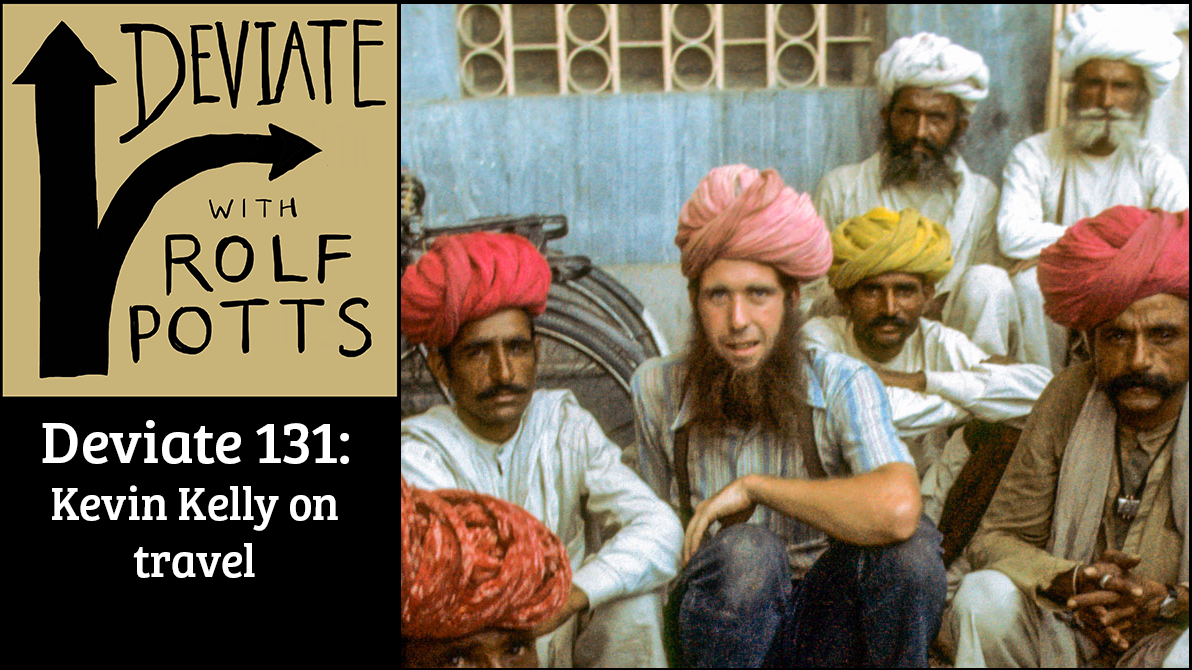
S3 Ep 131Kevin Kelly on how travel has changed over the past 50 years [rebroadcast]
“I met people who would say, ‘I wish I had more time to travel like you do.’ They had more money than time, and I had more time than money. In terms of traveling it’s much better to have more time than more money. …If you have a chance to travel, just do it. You won’t regret it.” – Kevin Kelly Kevin Kelly (@kevin2kelly) is a polymath in the truest sense of the word. Aside from being a co-founder of Wired magazine, he is also co-founder of the Rosetta Project, which is aiming to build an archive of all documented human languages, and he serves on the board of the Long Now Foundation. He is a photographer, writer, and futurist (he was “futurist adviser” on the 2002 Steven Spielberg movie, Minority Report), with much of his work centering on Asian and digital culture. In this episode of Deviate, Rolf and Kevin discuss the inspiration for his Asia travel in the 1970s (3:00); getting around and dealing with language barriers (15:00); the people he encountered while traveling in Asia, and the life-expanding nature of his journey (32:00); what he packed (47:00); modernity and technology in Asia, and managing his photography during travel (1:07:00); and self-actualization, discovering oneself through travel, and what the future holds in Asia. For more on Kevin, check out http://kk.org/ Notable Links: Asia Grace, by Kevin Kelly (photography book) “Shoulda Been Dead” (This American Life episode on Kevin’s Jerusalem conversion experience) Out of Control, by Kevin Kelly (book) Kevin Kelly’s interview with Tim Ferriss (podcast episode) “1000 True Fans” by Kevin Kelly (essay) Aerogram (pre-stamped airmail envelope) Poste restante (postal pick-up service for travelers) Maureen Wheeler (publisher) Tony Wheeler (publisher) Rick Steves (travel writer and publisher) Hilary Bradt (guidebook publisher) Bill Dalton (guidebook publisher) Lonely Planet (travel guidebook) Moon Guide (travel guidebook) Rough Guides (travel guidebook) National Geographic (magazine) Video Night in Kathmandu, by Pico Iyer (book) Leaves of Grass, by Walt Whitman (book) Hippie Trail (travel route) “Re...

S3 Ep 130Remembering Bettina Gilois (and what writers can learn from her work)
“The opening line of your work should hold within it the germ of your entire idea. Attention spans are growing ever shorter. Grab your reader while you can.” – Bettina Gilois Bettina Gilois (1961-2020) was an award-winning screenwriter and author who worked in Hollywood for more than thirty years. Her screen credits included McFarland, USA and Glory Road. In this rebroadcast episode of Deviate (which originally aired in July of 2019), Bettina and Rolf discuss writing about real people (4:00); Bettina’s career path and the importance of perseverance (24:00); the importance of simplicity in storytelling (41:00); why certain stories are worth telling (56:00); and the craft of writing (1:15:00). Notable Links: Bettina’s Chapman University page (includes links to craft-advice essays) Thomas Kinkaid (painter) Billion Dollar Painter, by Bettina Gilois (book) Andy Warhol (artist) Talking Heads (band) Ari Emanuel (talent agent) Twister (film) Robert Durst (real estate heir) Rick Hall (record producer) This episode of Deviate is brought to you by AirTreks, an industry leader in multi-stop international travel. If you’ve ever planned a trip with multiple stops, you know that finding the right flights can be difficult. Between balancing travel logistics and cost, it often becomes impossible to build an itinerary that matches your travel goals. AirTreks is a distributed travel company with employees working from all corners of the world to help with your flight planning, specializing in complex routes with up to 25 stops. The AirTreks website offers suggested pre-planned travel itineraries to help you get started, but can customize to fit your journey. The Deviate theme music comes from the title track of Cedar Van Tassel’s 2017 album Lumber. Note: We don’t host a “comments” section, but we’re happy to hear your questions and insights via email, at [email protected].
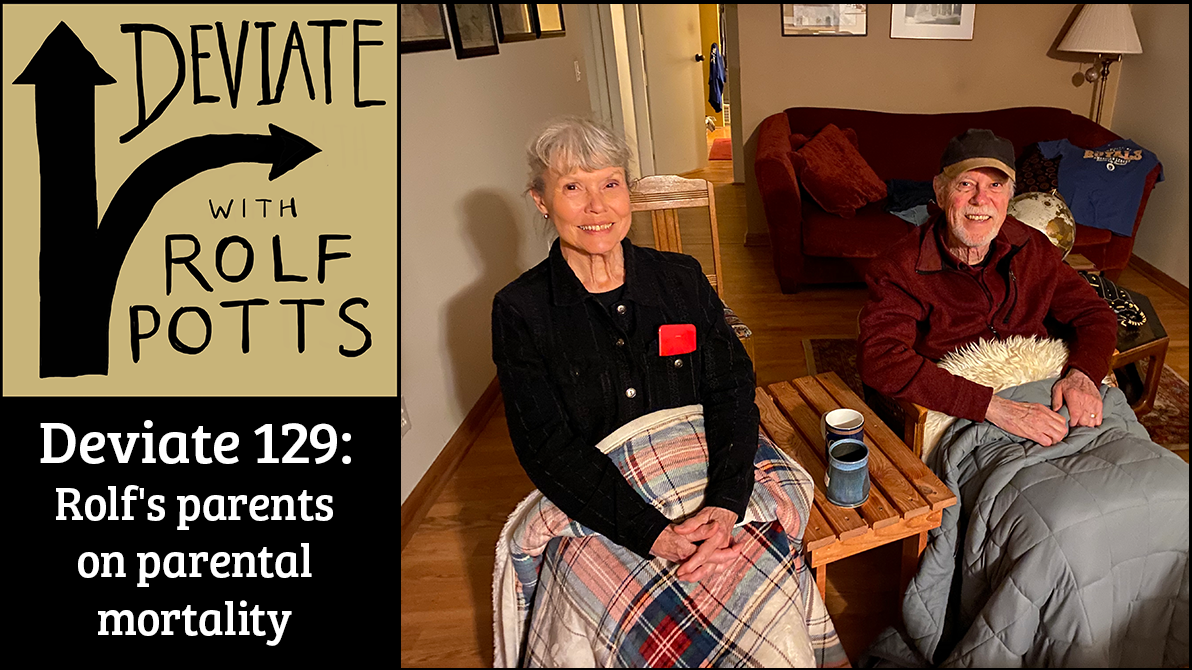
S3 Ep 129Talking with my parents about how to handle it when your parents die
“In America aging is often seen as an insult rather than an inevitable human process. We don’t celebrate getting older; we ‘fight’ age by pretending to be young.” –Rolf Potts In this episode of Deviate Rolf and his parents, Alice and George Potts, talk about how surviving the COVID-19 pandemic has changed their relationship, and how it gave them a pretext to go through a “death checklist” together (3:00); how one’s grandparents and parents live on in one’s memories and one’s conversations, the life-values they passed on, and what it felt like when those loved ones declined and died (14:00); how, over the years, elderly people and philosophers have come to terms with notions of decline and death (31:00); and personal insights about what it’s like to have grown older after having lived a long life (44:00). George and Alice Potts are retired schoolteachers based in Kansas. George taught science at various Wichita high schools, as well as at Friends University, where he pioneered graduate-level programs in Zoo Science and Environmental Studies. He also helped facilitate the Outdoor Wildlife Learning Sites (OWLS) program for the Kansas Department of Wildlife and Parks. Alice taught second graders in the Wichita public schools for more than 30 years. In 1994 her classes succeed in promoting legislation to declare the barred tiger salamander the Kansas State Amphibian. Notable Links: What to Do When a Loved One Dies (AARP death checklist) How we die in America (Deviate episode) The therapeutic uses of reading scripture (Deviate episode) On losing one’s parents to COVID-19 (Deviate episode) 1985 World Series (baseball championship) Joe Louis (20th century boxing champion) John Prine (singer-songwriter) Alzheimer’s disease (chronic neurodegenerative disease) You Are My Sunshine (folk song) Will You Miss Me When I’m Gone (folk song) Ecclesiastes (book in the Old Testament of the Bible) Epistle of James (book in the New Testament of the Bible) Crowfoot (19th century Siksika First Nation chief) Ted Kaczynski (the Unabomber) Epicurus (ancient Greek philosopher) Varanasi (Hindu holy city in India) Lamentations 3:22-23 (Old Testament Bible verse) The Deviate theme music comes from the title track of Cedar Van Tassel’s 2017 album Lumber. Note: W...
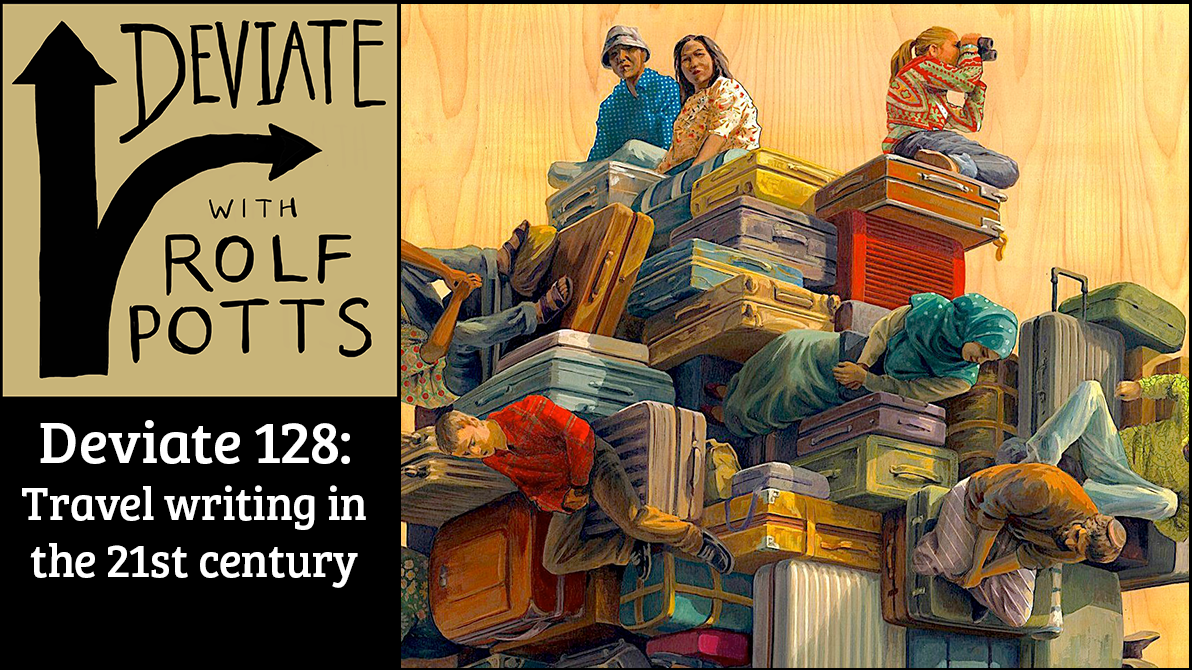
S3 Ep 128Bonus: Unpacking the mission of travel-writing in the 21st century
“One of the miracles of travel writing is to constantly be reminded of how much we don’t know.” – Doug Bock Clark In this episode of Deviate, Rolf and Doug discuss how travel writing is defined, and what purposes it serves in the twenty-first century (3:30), the boundaries of travel writing, the nuanced task of trying to humanize people in a travel story, and the future of the form (19:00). Then, Rolf reads his essay, “Why Travel Writing Matters” from the Fall 2017 issue of The Chattahoochee Review (29:00). Doug Bock Clark (@DougBockClark) is a GQ correspondent and a contributor for the website of The New Yorker. His first book, The Last Whalers, was a New York Times Notable Book for 2019. He also produced the feature documentary Assassins, which premiered at Sundance in January 2020 and was inspired by one of his investigations. Notable Links: The Missionary and the Uncontacted Tribe, by Doug Bock Clark (article) Down Myanmar’s Sacred Irrawaddy River, by Doug Bock Clark (article) Behind the Beautiful Forevers, by Katherine Boo (book) Peter Hessler (writer) Storming “The Beach”, by Rolf Potts (essay) Making sense of The Beach, 20 years later (podcast episode) Marco Polo Didn’t Go There, by Rolf Potts (book) William of Rubruck (explorer) Siberut (island in Indonesia) Andaman Islands (archipelago in the Bay of Bengal) Zhang Qian (2nd century BC Chinese envoy) The Histories, by Herodotus (ancient travel narrative) Orhan Pamuk (Turkish author) Why Travel Writing Matters, by Rolf Potts (essay) This episode of Deviate is brought to you by
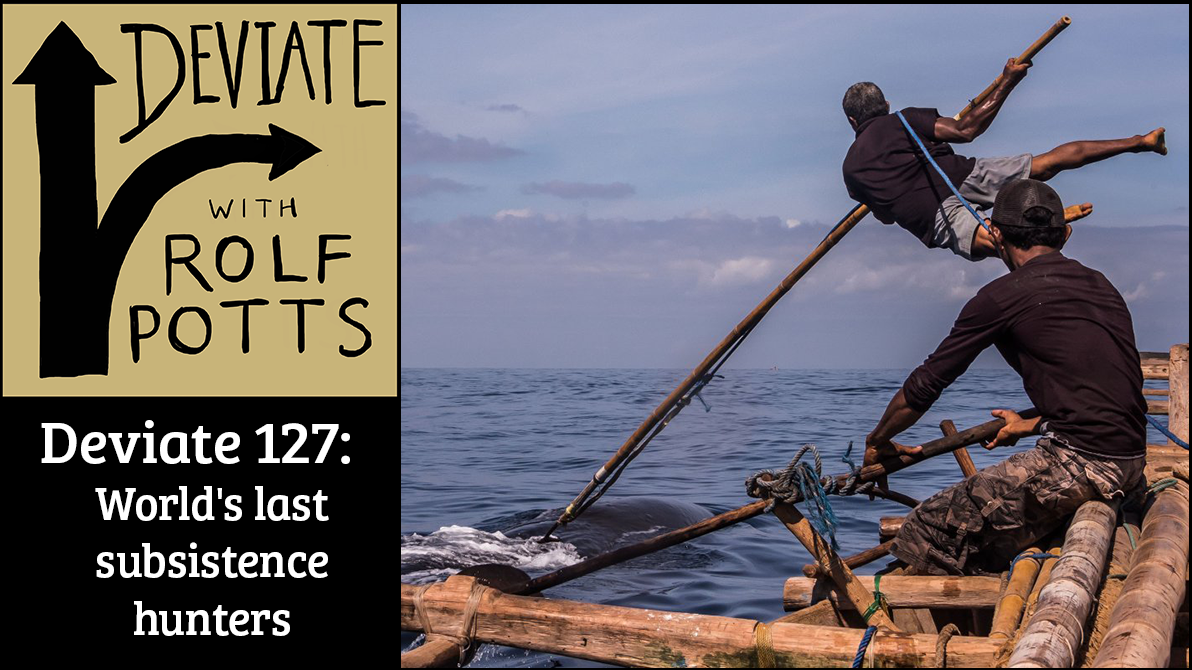
S3 Ep 127What the world’s last subsistence hunters can teach us about humanity
“The Lamalerans hunt in a way that is almost exactly the same as the way people hunted during Moby Dick’s time. Going on one of these hunts is analogous to what Ishmael or Queequeg was doing.” –Doug Bock Clark In this episode of Deviate Rolf and Doug talk about how he came to write about the Lamalerans, and how he aimed to evoke a sense for what it’s like to live in the isolated fishing communities of that part of the world (2:30); how and why the Lamalerans came to embrace a traditional hunting and barter lifestyle, and what indigenous groups are trying to live similar lifestyles (7:30); unique social rituals, spiritual systems, and ways of speaking carried out by Lamalerans (18:30); what aspects of modernity had been embraced by the tribespeople, and why, when Doug went to that part of the world (25:00); Doug’s personal experience of living on the island with the Lamalerans, and how he chose to tell the story of the islanders (33:00); how the influence of technology and the outside world, including tourism, is affecting the Lamalerans (41:00); and what encounters with cultures like this can teach us about who we are, who we were, and who we will be (53:00). Doug Bock Clark (@DougBockClark) is a GQ correspondent and a contributor for the website of The New Yorker. His first book, The Last Whalers, was a New York Times Notable Book for 2019. He also produced the feature documentary Assassins, which premiered at Sundance in January 2020 and was inspired by one of his investigations. Notable Links: Aboriginal whaling (traditional hunting method) Lembata (island in Indonesia) John Allen Chau (American missionary killed on North Sentinel Island) “The American Missionary and the Uncontacted Tribe” (article) Lashed-lug boat (ancient boat-building technique) Melanesians (indigenous peoples in the South Pacific) Moby-Dick, by Herman Melville (novel) 19th century American whaling (industry) Ishmael and Queequeg (Moby-Dick characters) Amish (traditionalist Christian sect) Rumspringa (Amish rite of passage) Bahasa Indonesian (language) Lamaholot (language) Siberut (largest the Mentawai Islands, near Sumatra) Human Planet (TV documentary series) This episode of Deviate is brought to you by Tortuga Backpacks, which set the...
S3 Ep 126Revisiting The Great Gatsby, high-school-style, in quarantine
“One reason why Gatsby is called a ‘Great American Novel’ is that it illuminates a conversation we haven’t stopped having in this country. We keep pretending to be people we’re not.” –Rolf Potts In this episode of Deviate Rolf and his old high school friends reflect on the role of Nick Carraway as the narrator of The Great Gatsby, how he deals with race and privilege, and whether or not his perspective is reliable (7:00); Fitzgerald’s use of language and juxtaposition in depicting characters and their relationships (22:00); the characters’ lack of moral grounding amid the opulence and wealth, and how it drives the story (28:00); how the youth and the age of the characters in Gatsby resonates differently depending your age when you read it (38:30); and how big questions like love, money, and life are addressed in the novel (49:00). [Easter Egg “Lightning Round” kicks in at 51:45.] Kaye Monk-Morgan is an Assistant Vice President for Academic Affairs at Wichita State University, where she facilitates leadership and professional development opportunities for low-income and first-generation students. Erin Perry O’Donnell operates Dovetail Community Workshop, which teaches woodworking classes in Albuquerque, New Mexico. Tom Davis teaches English at Sumner Academy of Arts & Science in Kansas City, Kansas. Notable Links: The Great Gatsby, by F. Scott Fitzgerald (novel) Wichita North High (public school) Black buck (racial slur) Nouveau riche (class-specific term) Unreliable narrator (storytelling point-of-view) Bromance (close male relationship) Wall Street Crash of 1929 (stock market crash) 1918 Spanish flu pandemic (influenza outbreak) Poor Richard’s Almanack, by Benjamin Franklin (book) Narrative of the Life of Frederick Douglass (memoir) Immanuel Kant (German philosopher) Baby boomers (demographic cohort) “The Ivy Crown,” by William Carlos Williams (poem) Playboy Mansion (former home of Hugh Hefner) Kato Kaelin (pop-culture personality) Manic Pixie Dream Girl (stock character in films) The Deviate theme music comes from the title track of Cedar Van Tassel’s 2017 album Lumber. Note: We don’t host a “comments” section, but we’re happy to hear your questions and insights via email, at [email protected].
S3 Ep 125Why travelers visit museums (in places like Iceland), and what they find there
“You can’t ever really know what a museum will offer you until you get there.” – Kendra Green In this episode of Deviate, Rolf and Kendra discuss their own earliest fascination with museums (2:40); the appeal and particularities of Icelandic museums (10:00); museums as a form of national identity (24:00); the relationship of collecting to the creation of museums (35:00); and museums as a way of engaging with one’s imagination (46:00). Kendra Greene is a writer, artist, and author of The Museum of Whales You Will Never See. She has worked at various museums, including the Museum of Contemporary Photography, and the Chicago History Museum. Karen is currently Associate Editor of prose at the Southwest Review and a Fellow at Harvard University’s Library Innovation Lab. For more about Kendra, check out http://akendragreene.com. Notable Links: Chicago Museum of Science and Industry (museum) Field Museum of Natural History (Chicago museum) La Brea Tar Pits (Los Angeles attraction) Icelandic Phallological Museum (penis museum) Museum of Jurassic Technology (Los Angeles museum) Cabinets of curiosities (pre-museum collections) Jack London (author) John Steinbeck (author) Nábrók (Icelandic necropants) Egil’s Saga (Icelandic saga) The Tourist, by Dean MacCannell (book) Elgin Marbles (Greek sculptures) Petra’s Stone Collection (museum) Museum of Sorcery and Witchcraft (museum) This episode of Deviate is brought to you by AirTreks, an industry leader in multi-stop international travel. Airtreks is a distributed travel company with employees working from all corners of the world to help with your flight planning, specializ...

S3 Ep 124Life changing travel experiences: Jumping freight trains in the Pacific NW
“He gave us five rules for jumping freight trains, and we broke every one of those rules once the adventure began.” –Brian H In this episode of Deviate, Rolf and his longtime friend Brian recall their old ambition to jump freight trains across the Pacific Northwest, and what factors inspired it (4:00); what kinds of research and preparation they did to make the train-jumping experience possible (16:30); the early hours of their attempt to reach Canada by catching a boxcar from the Vancouver, Washington rail yard, and the dangers of challenges that awaited them (28:30); their unanticipated detour through the Columbia Gorge to Pasco, and their experience of getting detained by railroad police in Spokane (35:00); making the decision to escape Spokane by retracing their route, and getting stuck in a “hobo jungle” in the town of Wishram (56:30); making sense of the adventure afterwards, and how train-jumping has (and has not) changed in the social-media age (1:15:30). Notable links: Van Life before #VanLife (Deviate episode) Jack Kerouac (American novelist) “Travel,” by Edna St. Vincent Millay (poem) The Autobiography of a Super-Tramp, W. H. Davies (1908 memoir) Chris McCandless (traveler, subject of Into the Wild) Hero’s journey (narrative template) Dr. Giggles (1992 horror movie Rolf appeared in as an extra) Emperor of the North Pole (1973 movie) Wishram, Washington (freight-depot town) Invisible Man, by Ralph Ellison (1952 novel) Rainbow Family (counterculture group) Freight-jumping links: Freight jumping (train-travel method) Burlington Northern (railroad company) Freight Train Riders of America (criminal gang) Boxcar Killer (serial killer, a.k.a. Robert Joseph Silveria Jr.) Boxcar (type of freight car) Covered hopper (type of freight car) Flatcar (type of freight car) Gondola (type of freight car) Stobe the Hobo (YouTube playlist) Remembering Stobe the Hobo (Facebook group) The Deviate theme music comes from the title track of Cedar Van Tassel’s 2017 album Lumber. Note: We don’t host a “comments” section, but we’re happy to hear your questions and insights via email, at [email protected].
S3 Ep 123Kate Harris on the way travel can lead us into deeper questions about the universe
“Travel is often one part geography and nine parts imagination.” –Kate Harris In this episode of Deviate Rolf and Kate discuss Kate’s early fixation with exploration and interest in Mars (3:00); science as a catalyst for exploration (10:30); the universality of the human experience and her trip through Asia (21:00); the concept of borders (32:00); nostalgia and the transformational effect of travel (43:00); the role of home in relation to travel (52:00); and letting adventure into your life (1:02:00). Kate Harris (@kateonmars) is an adventure writer, named by Condé Nast Traveler as one of the “world’s most adventurous women.” Her work has appeared in Outside, The Walrus, and Georgia Review. Her book, Lands of Lost Borders, is a national bestseller For more about Kate, check out www.kateharris.ca Notable Links: Rolf’s Q&A with Kate Harris (book foreword) Silk Road (network of trade routes) Mars Desert Research Station (Mars simulation in Utah) Morehead-Cain Scholarship (UNC program) Ernest Shackleton (explorer) Fridtjof Nansen (explorer) Annie Dillard (American author) Wind, Sand and Stars, by Antoine de Saint-Exupery (book) Henry David Thoreau (writer) My Journey to Lhasa, by Alexandra David-Neel (book) Aksai Chin (region administered by China) Marco Polo (historical figure) Tomas Tranströmer (poet) Atlin (community in British Columbia) This episode of Deviate is brought to you by
S3 Ep 122Andrew McCarthy on the Proust Questionnaire (and Brat Pack legacy)
“I had a great day in Cambodia, and I was like, ‘Oh my god I’m so happy right now.’ I had no idea what I was doing, or what I would discover, and I just trusted that I would be OK.” –Andrew McCarthy In this episode of Deviate Rolf and Andrew discuss his relationship with interviews and the origin of the Brat Pack (3:30); fear and journaling in the time of pandemic, and treasured possessions (12:30); regrets, and artistic truth (23:00); writing as a way of thinking, and what Andrew values in his friends (29:00); and happiness, quarantine-reading, The Great Gatsby, and coming to terms with ones youthful success (38:00). Andrew McCarthy (@AndrewTMcCarthy), who rose to fame as a teen actor during the John Hughes 80’s era, is a television director and writer of such books as The Long Way Home and Just Fly Away. Notable Links: Proust Questionnaire (set of interview questions) Confession album (19th century autograph book) Pretty in Pink (1986 film) St. Elmo’s Fire (1985 film) Camino de Santiago (pilgrimage route) Weekend at Bernie’s (1989 film) “Hollywood’s Brat Pack,” by David Blum (article) Brat Pack (group of young actors in the 1980s) Mannequin (1987 film) Emilio Estevez (actor) George Carlin on “stuff” (comedy routine) Off the Road, by Jack Hitt (travel book) Joan Didion (American author) The Art of Memoir, by Mary Karr (book)