
DangerMouth: The Innovation Station
Mike Conroy
Show overview
DangerMouth: The Innovation Station has been publishing since 2024, and across the 2 years since has built a catalogue of 73 episodes, alongside 1 trailer or bonus episode. That works out to roughly 80 hours of audio in total. Releases follow a fortnightly cadence, with the show now in its 3rd season.
Episodes typically run an hour to ninety minutes — most land between 58 min and 1h 14m — and the run-time is fairly consistent across the catalogue. None of the episodes are flagged explicit by the publisher. It is catalogued as a EN-language Business show.
The show is actively publishing — the most recent episode landed 2 days ago, with 22 episodes already out so far this year. The busiest year was 2024, with 35 episodes published. Published by Mike Conroy.
From the publisher
The podcast that takes you on the long and dangerous journey from the siloed foothills of inventing things to the yawning abyss of reinventing society. Each week we take a subject related to innovation and set off on a verbal stroll to see what wonders unfold.
Latest Episodes
View all 73 episodesStill Waiting for the Economic Paradigm Shift w. George Cooper
S4E02 Dream Maker w. Blandine Anderson
S4E01:Estuarine Chatting w. Dave Snowden
S3E29 Catalysing Education with Fun w. Kalyan Banerjee
S3E19 Mud, Lino, Paper: W. Blandine Anderson
S3E018 Leaning into the Gemba w John Bicheno
S3E17: Are Humans Economically Redundant?
S3E16 Create with Freedom: Technology, India, People w. Gopi Katragadda

Ep 35S3E15: Story Weaving: Why There Are No Shortcuts to Insight w. Olly Hawes
A delicious appentiser not to be missed! This episode of Danger Mouth centres on a conversation with Olly Hawes, a portfolio artist, actor and writer whose work probes the limits of human connection and the points where society strains. It moves easily between the physical and the reflective, from Ollie’s account of being accidentally stabbed on stage during a production of Julius Caesar to a broader examination of craft, activism and the place of AI in artistic practice. At the core is a simple rule he lives by and teaches his children: look after yourself and look after other people. From that starting point the discussion opens out. Ollie describes the turning point that followed a near fatal incident in Edinburgh, an event that reshaped his life, led to marriage and fixed his commitment to storytelling. The group explores his instinct for working across opposites, arguing that tension rather than coherence often produces the most interesting art and the most effective solutions in business. They also examine the encroachment of AI into creative work. Ollie reflects on using a large language model to help secure Arts Council funding, while questioning what may be lost if technology begins to erode the presence and immediacy that give live performance its force. Running through it all is the practical reality of making a life in the arts. Money is uncertain, purpose is not. Ollie speaks plainly about the pressure to remain creatively alive, not just for himself but for the people who come after. It is a conversation that holds together injury and humour, principle and improvisation. At its centre is a working artist who has come close to the edge and decided to keep going, with intent.
Ep 34S3E14: The Value Equation with Per Lindstedt
This is an episode of the Danger Mouth podcast, hosted by Darrell Mann, Mike Conroy, and Shauna, featuring Swedish guest Per Lindstedt, co-author of The Value Model. The Value Model defines value as a ratio — satisfaction of customer needs divided by use of customer resources. Per breaks this into 6 strategic levers: three to increase satisfaction (solve an undiscovered problem, improve performance, enhance feelings/experience) and three to reduce resource consumption (time, money, effort). The iPhone is used throughout as the prime example of a product with a sky-high ratio — and the App Store as an accidental masterstroke that Jobs initially resisted. The conversation broadens into organisational innovation and S-curves: why companies near the peak of one S-curve become complacent, why very few (perhaps 10% in Europe) survive the jump to the next, and whether it's sometimes healthier to simply let companies die. Nokia's inability to abandon its Symbian OS is the cautionary tale; a Chinese manufacturer pivoting from bread-makers to LEDs in eight weeks is the counter-example. The final third focuses on Per's AI tool (built using Lovable), which takes messy requirement specifications and sorts them into five information domains — customers, needs, functions, solutions, and processes — flagging what's actually a customer need versus a disguised technical solution. This is positioned as a scalable version of the consultancy work Per spent decades doing manually.
S3 Ep 13S3E13: The Transformation Economy with Joe Pine
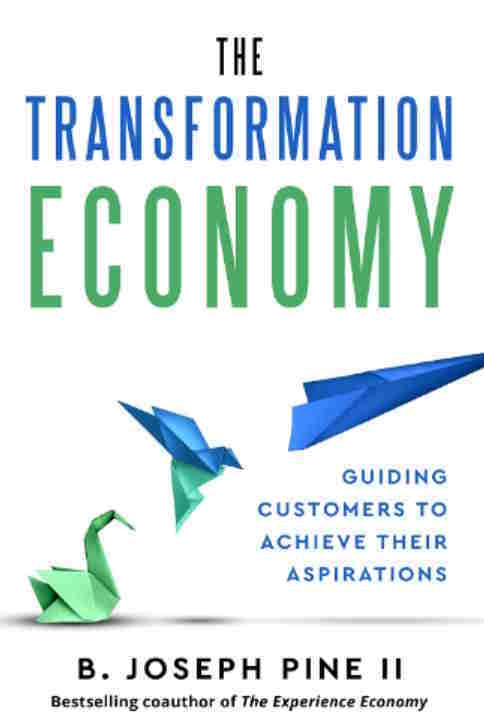
This episode features Joe Pine (author of The Transformation Economy) in conversation with Darrell Mann, Mike Conroy, and Sharna Finnegan. The Transformation Economy Pine argues that economic value progresses through five stages, commodity, product, service, experience, and transformation, and that we're now at a tipping point where consumers want more than memorable experiences; they want meaningful and ultimately transformative ones. His new book, 25 years in the making, makes the case that this shift is now unmistakable. Key Concepts Guiding vs. delivering: You can't force transformation, you create the conditions for it. The economic function is to guide transformations, not manufacture them. The Hero's Journey: Pine uses this as a framework for transformation, replacing "ordeal" with crucible, a moment where change hangs in the balance. Encapsulation: Wrapping experiences with preparation, reflection, and integration. Pine considers this the single most accessible entry point for businesses, do this one thing and you'll automatically become more transformative. Human flourishing: The deeper purpose running through everything, health/wellbeing, wealth/prosperity, knowledge/wisdom, and purpose/meaning. Pine argues this, not profit, should be capitalism's raison d'être. Broader Themes "Customer experience" and "digital transformation" are bastardisations of deeper ideas, the former is really just good service; the latter often just means cutting headcount. Pine worries less about AI as Terminator and more about AI as Wall-E, eliminating struggle and therefore purpose. Meaning may be the defining consumer sensibility of the transformation economy, just as authenticity was for the experience economy. The conversation closes with strong alignment between Pine's framework and the themes in Darrell and Sharna's own book The 1%ers, particularly around human flourishing as a north star for doing new things.

S3 Ep 12S3E12 The System Decides
In this episode, DangerMouth drifts closer to something interesting. The place where things almost fall apart but don't. Where a system holds itself right at the edge of tipping over, and that turns out to be exactly where it works best. There's a name for this. Self-organized criticality. It sounds technical but the idea is simple. Some systems don't need anyone to tune them. They tune themselves. They keep moving toward a point where they're just unstable enough to stay alive, just ordered enough not to collapse. Think of a sandpile. You keep adding grains, one at a time. Small slides happen. Occasionally a big one. Nobody decides when. The pile finds its own balance between holding together and letting go. That balance point sits at what people call the edge of chaos. Not chaos itself, but the narrow band right next to it. A place where order and disorder are in constant conversation. Where things are stable enough to have shape but loose enough to change. Ask yourself, if systems tune themselves toward this edge, what does that mean for the ones we think we're controlling? That feels like where DangerMouth is heading, at least for now. Type 2 fun when you look at it through the right lens. Not comfortable in the moment. Better in the telling.

S3 Ep 11S311 Wiles of the Devil: The 48 Laws of Power
In this episode of DangerMouth, hosts Darrell, Mike, and Sharna join author John Julius Reel to dissect the provocative strategies of Robert Greene’s 48 Laws of Power. The conversation traverses the thin line between tactical mastery and moral bankruptcy, comparing Greene’s "win-lose" Machiavellian world to the "win-win" principles of systematic innovation and Spiral Dynamics. Through raw personal anecdotes—ranging from high-stakes corporate turnarounds to heated outbursts in Spanish banks—the group explores whether these laws are a necessary toolkit for survival in "Orange" value systems or a "formula for unhappiness" that ignores the fundamental complexity of human nature.

S3 Ep 10S3E10 The FEP A Tool for Understanding and Modelling Complex Systems with Daniel Friedman
In this episode we welcome special guest Daniel Friedman the President Active Inference Institute. Shana and Darrell smoothly switch up several intellectual gears as they engage with Daniel to explore the physics of transformation. Later on Mikey tries to illustrate the basics of the notoriously complex and nuanced FEP, using vague outlines while Daniels fills in the colours. Focused concentration is highly recommended. This conversation operates on multiple levels. https://www.activeinference.institute/ The Free Energy Principle Explained: Karl Friston’s Theory of How the Brain Works Daniel Friedman – Active Inference Institute | What is Active Inference?

Ep 33S3E09: Humour At Work? You can't be serious!
In these turbulent times, humor may be the only glue strong enough to hold people together. It’s no joke. Mike and Darrell welcome Barbara Plester from the University of Auckland Business School, who has an eye for the unserious. Essential listening for trainee jesters.

Ep 32S3E08 The Great Management Training Experiment with Steve Thomas
Back in the heyday of British Prime Minister Margaret Thatcher, a very interesting experiment in management training took place. Darrell and I were among the guinea pigs. The lessons learned lasted a lifetime. A few years later, our guest today, Steve Thomas (http://www.grassroutes.co.uk/), a very wise, principled, and incredibly brave, visionary educator, resurrected this protocol and added the guardrails that were so gratuitously missing from the first instantiation. Three stories, complete with wisdom from Shana the Oracle.
S3 Ep 7S3E07 Graceful Home Schooling with Anthony Lopez-Vito
Our guest is Anthony Lopez-Vito has kindly taken time out from running the Matrix to hang out with the gang! What Joy! You might find this fun as well: https://tinbin.com/

S3 Ep 6S3E06 Cathedral Culture : Designing Self‑Healing Organisations with Frank Devine
The team chat with Frank, its a classic. Frank Devine’s Cathedral Culture System turns leaders into architects of shared purpose—not bricklayers chasing quarterly targets. Discover how it operationalises Rapid Mass Engagement (RME) to create employee-owned high-performance cultures that fix themselves. We map its pillars—higher purpose, recognition, coaching, and feedback—against complexity principles like requisite variety and POSIWID. Does it deliver genuine autonomy, or just prettier top-down control? Perfect for leaders tired of engagement gimmicks THE BOOK THE WEBBY AUDIO SUMMARY

S3 Ep 5S3E05 How New Things Get Done
Darrell and Shana have written a book. Have a listen and see if it's your cup of tea. Mikey is playing Steve Barlett and interviewing the authours - Saints preserve us! Buy it On Amazon Find Out More

Ep 31S3E04 Meaning as a System
In this Danger Mouth episode, the team dissects "Meaning" via the ABCM model (Autonomy, Belonging, Competence, Meaning). Darrell defines meaning as the coherence between purpose, pattern, and participation. Personal drivers range from legacy and human connection to the joy of play. They analyze societal S-curves, arguing that crises require "Yellow" systemic thinkers to guide "Orange" executors. Ultimately, solving ethical contradictions and honoring human complexity are vital for navigating today’s global shifts.