CrowdScience
512 episodes — Page 10 of 11

Why Does My Dog Love Me?
Dogs have been living and working with humans for thousands of years. But they’re much more than just pets. As any dog owner will tell you, the bond we have with our canine friends is often so strong that they feel more like family. So how is it that dogs have come to fit so seamlessly into human life? That’s what CrowdScience listener Peter Jagger in the UK wants to know, and Marnie Chesterton is off to sniff out some answers. She starts by revisiting a previous episode of CrowdScience based in Sweden, where she saw the dog-human bond come alive during a moose hunt. She then heads to the Dog Cognition Centre in Portsmouth to discover how a unique and often unconscious communication system helps our dogs to understand us. Finally, Marnie finds out about the fate of dogs that are no longer wanted by their humans. After thousands of years of domestication, can they ever live without us?Presenter: Marnie Chesterton Producer: Anna Lacey(Photo: Image of young girl with her dog, alaskan malamute. Credit: Getty Images)
Could our faces replace passports as ID?
Crowdscience revisits the evidence on the best forms of biometric identification. Earlier in the year we explored digital fingerprints, gait (walking style) recognition and iris scanners. Today presenter Anand Jagatia looks at systems which use your face and your voice to identify you. One airline is currently testing facial recognition in airports as a means of replacing your passport. Meanwhile, Anand tries to fool a speech recognition system that measures over a thousand characteristics of your voice in order to protect your identity. But will it be able to cope if you have a cold?Presented by Anand Jagatia Produced by Marijke Peters.Picture: Facial Recognition Credit: Getty Images
Rudolph castrated: what you didn’t hear this year
Reindeer castration, plants get chatty and more quirky science revealed in this Christmas special of CrowdScience where we will also be hearing from the people that make this series possible. That’s you – our listeners. CrowdScience has been on air for just over a year which means we’ve had over 60 adventures. Every time we put a show together there’s a heart-breaking process where amazing facts we wanted to share end up on the cutting-room floor. To celebrate the holidays we’ve gone scavenging for the best untold stories, edgy science facts and incidents from behind the scene. Presenter: Marnie Chesterton Producer: Louisa FieldPicture: Reindeer in Snow Credit: Getty Images
What is dust?
It lurks behind sofas and collects in corners, apparently appearing from nowhere. But what is household dust? And should we bother sweeping it away? That’s what Australian listener Moshe wants to know and what Marnie Chesterton is off to find out for this week’s CrowdScience. She embarks on a mission to discover not only what dust is made of, but whether it poses any health risks. Although most people sweep it away without a thought, dust contains all sorts of secrets about our habits and everyday lives. Marnie finds out how dust can reveal the pets you keep, the chemicals in your surroundings, the location of your house and how fecal bacteria can uncover whether more men or women live in your home.Presenter: Marnie Chesterton Producer: Anna Lacey(Image: Woman Vacuuming Up Dust. Credit: Getty Images)
From Oldest to Strongest Living Thing
Trees are old – they transcend human generations – but are they the oldest living things on Earth? This story began in June 2017 when we explored a question sent in from CrowdScience listener William. Many of you got in touch after the programme with questions of your own. So we’re revisiting our trees programme but also exploring another question from listener James, who wants to know what, pound for pound or gram for gram, is the strongest animal alive on Earth today? Marnie Chesterton wrestles with one of them and – spoiler alert – it’s not a gorilla. Presenter: Marnie Chesterton Producers: Jen Whyntie(Photo: Kumbuka, a 15-year-old western lowland gorilla. Credit: Oli Scarff/Getty Images)
Can We Revive Extinct Species Like the Dodo?
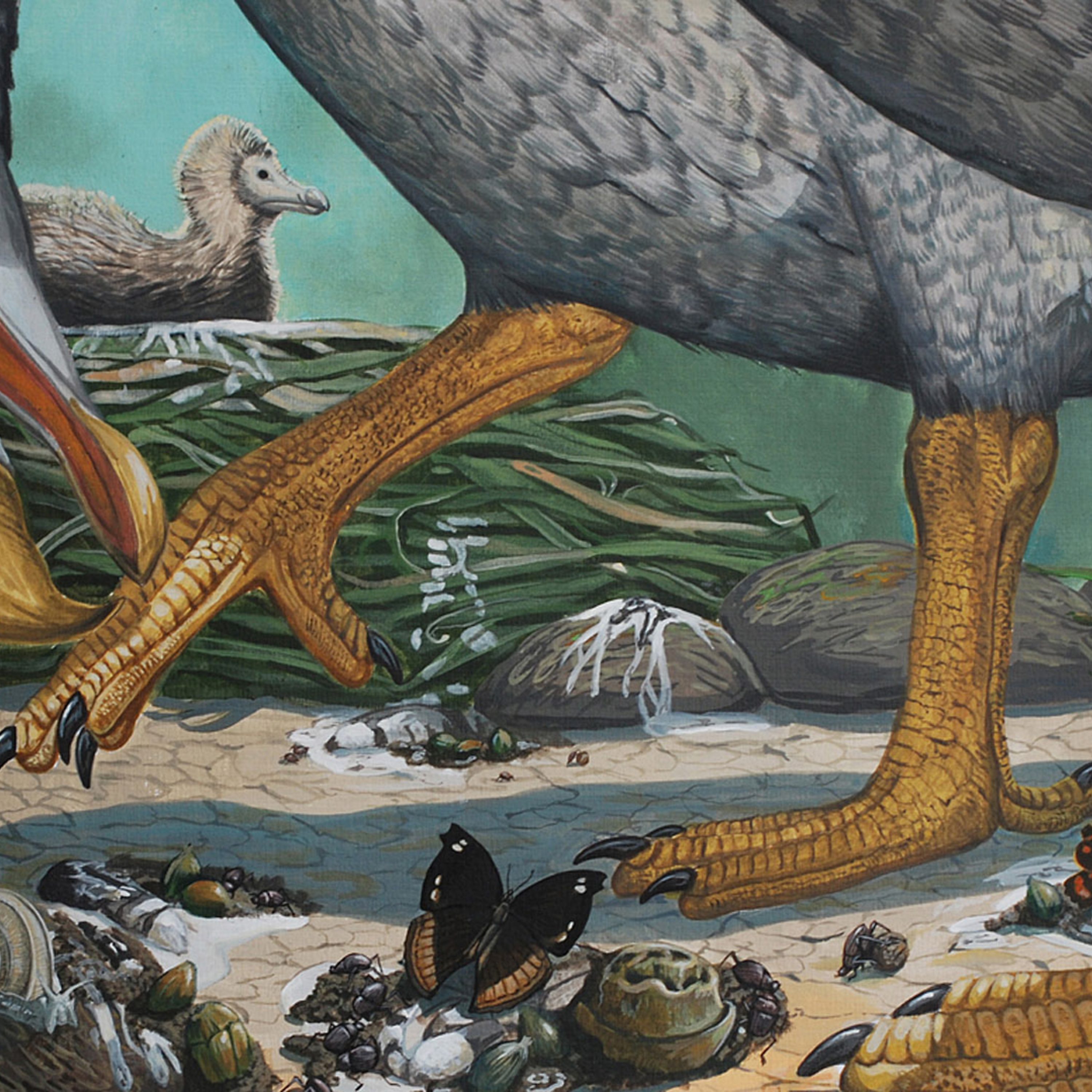
Dodos are dead, but are they gone forever? Reviving extinct species is a trope of science fiction, but real-life scientists are working on every stage of the problem today. Meeting scientists focused on uncovering ancient animal genomes, or reviving individual cells to conserve species still around, Marnie Chesterton seeks out whether new technologies might, just possibly, bring back the iconic dodo. But what would it take to bring back that most iconic of extinct species? Following listener Rachel’s question, CrowdScience gets to grips with the dodo’s past, and finds out what’s left of this iconic bird, meeting the scientists inadvertently piecing it back together.Presenter: Marnie Chesterton Producer: Rory Galloway Picture: An accurate reconstruction of nesting Dodos Photo Credit: Dr Julian Hume
Does Technology Change How we Fall in Love?
How does technology affect how we fall in love? Crowdscience travels to India to answer listener Erin’s questions about the impact of the internet on our search for soulmates. We meet the traditional matchmaker who says her service provides security in an era of digital fraud. And ask whether computer algorithms are the best way to help people make permanent romantic connections?Presenter: Chhavi Sachdev Producer: Marijke Peters(Photo: A couple kiss while taking a selfie. Credit: Getty Images)
Why are There Morning People and Night People?
Some of us want to be up with the larks, while others are more like night owls. But is our preference down to our genes, or more to do with habits and surroundings? We set out to find the answers, inspired by a question from Kira, a night owl CrowdScience listener in Philadelphia, USA.Our daily, or circadian, body clocks are a hot topic of discussion at the moment - this year’s Nobel Prize for Medicine went to three scientists who discovered the gene that makes these clocks tick. To answer our listener’s question, we need to know why different clocks tick at different rates, so we visit a specialist sleep centre to see how having a slow-ticking clock makes it hard for you to leap out of bed in the morning.And the morning sun helps all of us regulate our daily rhythm, so what happens when it doesn’t rise at all? We travel to Tromsø, in the far north of Norway, to see how morning and evening types fare during the long polar nights - and meet the reindeer who seem to be able to switch off their daily clocks altogether. Meanwhile down near the equator, we hear about the hunter-gatherer community in Tanzania where there’s nearly always someone awake.Sami song, the joik of Ráikku-Ánte, is performed by Ken Even BergDo you have a question we can turn into a programme? Email us at [email protected]: Anand Jagatia Producer: Cathy Edwards(Image: L - Women smiling on a run R - Women DJ. Credit: Getty Images)
How Can I Remember More?
Sometimes our memory fails us and we wish facts would just stick better. Listener Mothibi is a student and has spent three years trying to remember as much as possible for his exams. He wants to know how he can train his brain to better to remember things – and does the brain have a limit on how much stuff we can cram into it? To find the answers presenter Marnie Chesterton seeks help from memory magician, Simon, at the European Memory Championship. Using the loci technique she accomplishes a memory feat she didn’t think possible. Thought to have been developed by the Greeks, the loci method is a technique that enables the brain to remember extraordinary amounts of information. It turns out, we all have the right wiring to remember more and better, but we need to train our brains.Also, CrowdScience heads to Cambridge University where Marnie Chesterton lands herself in a study. The scientists scan her brain while she exercises her memory muscles and we discover why sometimes memories get muddled up. Do you have a question we can turn into a programme? Email us at [email protected]: Marnie Chesterton Producer: Louisa Field(Image: Woman scratching head, thinking brain melting into lines. Credit: Getty Images)
How Did Life Get onto Land?
People often talk about being descended from apes. But go back a bit further and we have a more unlikely ancestor – fish. Improbable as it may sound, the creature that gave rise to every bird, reptile and mammal on Earth today lived a fully aquatic life. So how did it switch to life on land? And how hard was it to swap swimming for walking and breathing fresh air? That’s what CrowdScience listener Pierre in France wants to know, and what Marnie Chesterton is in Scotland to find out. She goes fossil hunting with members of the TW:eed Project team, as they try to uncover remains of creatures that are crucial in helping solve the puzzle of terrestrial life. She also discovers the landscape these early ancestors walked into – an alien and relatively empty world completely different to what we see today - where grass and flowers were yet to evolve. But not everything in this story is preserved in rock. Marnie goes to see a living relic of this period of evolution, and finds out what it can tell us about possibly the most important event in the history of our species.Do you have a question we can turn into a programme? Email us at [email protected]: Marnie Chesterton Producer: Anna Lacey(Image: Artists impression of underwater environment of Carboniferous swamp depicting a rhizodont; a large predatory fish. Credit: Mark Witton)
How Can We Fight Unwanted Noise?
Unpleasant man-made noise is something that disturbs many of us and even damages our health. But as millions more people move into crowded cities around the world, it's a cacophony that we almost unavoidably create ourselves. CrowdScience listener Diana from New York City in the USA got in touch to ask how we can temper the din and live a more peaceful life. Presenter Anand Jagatia heads to an acoustics lab at the University of Salford in Manchester, UK, to meet the researchers and engineers investigating the best ways to make cities more pleasant for our ears whilst still maintaining the ‘buzz’ of city life. And reporter Chhavi Sachdev takes us to Mumbai in India, where we discover how sound mapping is being deployed on the city’s streets as the first step to improve the life and health of its citizens.Do you have a question we can turn into a programme? Email us at [email protected]: Anand Jagatia Producer: Jen Whyntie(Image: Children cover their ears as the truck convoy front passes. Credit: Getty Images)
Is There Proof of Life After Death?
Is there any scientific proof of an afterlife? Six months ago, CrowdScience tackled a question from a listener who wanted to know whether there was life after death. But following more listener emails, presenter Marnie Chesterton returns to the subject to investigate the world of ghosts, souls and parapsychology. She meets Professor Susan Blackmore, who studies out-of-body experiences and has spent decades hunting for scientific proof of life after death. And she visits the woman who, despite dying in the 1950s, is alive and thriving on a cellular level and helping scientists find cures for cancer, Parkinson’s and other diseases, in laboratories across the world…Do you have a question we can turn into a programme? Email us at [email protected] and Presented by Marnie Chesterton
Can We Worm Our Way Into Better Health?
We test the science behind parasitic therapy to answer listener Michael’s question about whether intestinal worms can help us stay healthy, and visit a deworming programme in a rural Ugandan village.Do you have a question we can turn into a programme? Email us at [email protected]: Marnie Chesterton Producer: Marijke Peters(Picture: Tapeworm in human intestine, Credit: selvanegra/Getty Images)
Is Carbon Dioxide Higher Than Ever?
Carbon dioxide levels in our atmosphere today are higher than at any point in human existence. But going back further into Earth’s history, when do we find concentrations as high as they are now - and what was the planet like back then?CrowdScience sets out to answer our listener Thomas’s question, travelling back through time with the help of Antarctic ice cores, ancient plant fossils, and microscopic popcorn-shaped organisms called foraminifera, all of which hold clues to past climates.Enlisting the help of chemists, botanists and palaeontologists, we find out about the huge swings in atmospheric carbon dioxide from prehistoric times to the present day, and ask the all-important question: can this help us understand what's happening to our climate now?Do you have a question we can turn into a programme? Email us at [email protected]: Marnie Chesterton Producer: Cathy Edwards(Image: Polar bear on an ice floe. Credit: Getty Images)
Can We Make Artificial Organs?
Human Organs are in short supply. But what if you could grow new ones in the lab? And if you donate your body parts to help others, where might they end up? That's what Sarah Gray wanted to know after making the difficult decision to donate the body of her son, Thomas, to medical science after he died from an incurable disease shortly after being born. Sarah then contacted the scientists whose research has been made possible by Thomas’ donation and discovered just how he is contributing to research which, may one day mean that organ donation is no longer necessary. Presenter Bobbie Lakhera talks to Sarah about her decision and meets some of the scientists working to create biological artificial lab-grown organs, tissues and even bones. Do you have a question we can turn into a programme? Email us at [email protected]: Bobbie Lakhera Producer: Louisa Field(Image: A doctor taking or delivering a bag containing a human organ for transplant. Credit: Getty Images)
Should We Kill One Species to Save Another?
Is it fair to kill invasive species which humans have introduced? When people move around the world, many of their favourite – and not so favourite - animals tag along for the ride. From cane toads through to rats, cats and crayfish, so-called ‘invasive species’ can destroy ecosystems and kill off native wildlife. CrowdScience listener Jude Kirkham wants to know if eradicating these invaders is justified.One country determined to do something about invasive species is New Zealand, where rats, stoats and possums are causing irreparable damage to the country’s unique bird life. If nothing is done, the iconic Kiwi could be extinct within 50 years. The government and volunteer groups across the country have responded with a plan to eradicate predatory mammals from New Zealand by 2050. But is all the time, energy and money needed to do this really justified? And is it morally right to kill off an animal species that humans introduced in the first place?Do you have a question we can turn into a programme? Email us at [email protected]: Marnie Chesterton Producer: Anna Lacey(Image: Headshot of a Possum Credit: Getty Images)
Could All Cars Be Electric?
Just one per cent of vehicles are powered by electricity, but CrowdScience listener Randall from Lac du Bonnet in Canada wants to know how quickly that might change, and whether one day all cars could be electric. Marnie Chesterton begins her journey in an electric car, stuck in traffic on a Los Angeles freeway. It was in California where the modern electric car revival began in the late 1990s with the EV1 – popular with Hollywood celebrities like Mel Gibson and Danny DeVito. More than two decades on, several countries have pledged to go all-electric in future. The latest is China, who currently lead the world in the number of electric vehicles on the road. But is the planet’s power infrastructure even capable of supporting this global electric dream? Marnie talks to experts about the practicalities of power supply and charging, takes a ride in an electric prototype with enough acceleration to impress even the most cynical petrol head and discovers an extraordinary vision for the future of personalised urban transport.Do you have a question we can turn into a programme? Email us at [email protected]: Marnie Chesterton Producer: Jennifer Whyntie(Image: Electric power cord plugged in and recharging the electric vehicle Credit: Getty Images)
How Could Humanity Become Extinct?
Nuclear weapons and mega asteroids: what would the aftermath look like? CrowdScience explores past extinction events and future dystopias. In a past episode, CrowdScience headed to Denmark to find out whether humans could go the way of the dinosaurs – mass extinction triggered by a large asteroid impact 66 million years ago. Although no killer rocks are on route to Earth any time soon, we do not have to look far for other dystopias. “Do we have enough nuclear weapons to destroy the world?”, listener Ronald from Uganda asks CrowdScience. It turns out there is a web app which can help answer this question. Together with its maker nuclear historian Alex Wellerstein, presenter Anand Jagatia tests hypothetical nuclear disaster scenarios and uncovers the nature of nuclear destruction in interviewees with climate scientist Alan Robock.Do you have a question we can turn into a programme? Email us at [email protected]: Anand Jagatia Producer: Louisa Field(Image: Explosion of a nuclear bomb Credit: Getty Images)
Spider Silk and Super Fly Senses
CrowdScience is uncovering the super-powers of spiders, flies and the most irritating mosquitos. Anand Jagatia meets spider specialist Jamie Mitchells at London Zoo to find out how spiders create such vast webs and speaks to researchers in Sweden about how they are trying and succeeding in recreating spider’s silk. Rory Galloway heads to Cambridge University’s Fly Lab to find out how their tiny brains process the world up to four times faster than humans. And Bobbie Lakhera is at the London School of Hygiene and Tropical Medicine to find out how attractive she is to mosquitos and how they use their super-senses to home-in on our blood. Do you have a question we can turn into a programme? Email us at [email protected]: Anand Jagatia Producer: Laura Hyde(Image: Close-up of a Jumping Spider. Credit: Getty Images
Trees v Air Pollution - the Rematch
CrowdScience dives back into a debate about trees and their ability to tackle air pollution. Growing trees take in carbon dioxide and emit oxygen, but their leaves also attract tiny particles, which can get into our lungs and brains. So how good are they at cleaning our clogged up skies? Following on from our original programme, CrowdScience was contacted by a team of researchers in the UK who claim tress may be as much as 50 times better than previously thought at mopping up particles, and learn that hedges may help us stay healthy on roads. Also in the programme, we discover what pollutants are doing to our brains and reveal research which shows that keeping house plants can significantly reduce pollution inside the home.Do you have a question we can turn into a programme? Email us at [email protected]: Marnie Chesterton Producer: Marijke Peters
Sydney Science Festival, Australia
CrowdScience heads to the Sydney Science Festival in Australia where, from a special event at The Powerhouse Museum, we reveal answers to questions listeners have been sending in such as: What living thing has the most toxic venom? What is déjà vu? And why do our fingers wrinkle in the bath? To tackle our listeners’ questions about life, Earth and the universe, presenter Marnie Chesterton is joined by four special guests who will bring the good, weird and bemusing from the world of science to the stage.Prof Shari Forbes, Professor in Forensic Science at the University of Technology Sydney,aims to help police and forensic teams establish a more precise time of death in missing person and homicide cases.Dr Katie Mack is an astrophysicist at the University of Melbourne. Her work focuses on finding new ways to learn about the early universe and fundamental physics using astronomical observations.Dr Jonathan Webb runs the science unit at ABC RN. He is also a former neuroscientist and a former science reporter for BBC News in London.Dr Alice Williamson is a chemistry lecturer and researcher at The University of Sydney. She hosts a weekly science segment, Up and Atom on FBi Radio in Sydney, co-hosts RN’s Dear Science, and is a regular guest on Dr Karl's Shirtloads of Science podcast.Do you have a question we can turn into a programme? Email us at [email protected]: Marnie Chesterton Producer: Marijke Peter and Jen Whyntie(Image: Koala in tree Credit: Getty Images)
Lightning Strikes Again
Is it possible to get power from lightning? This was the first CrowdScience question posed by listener John Emochu in Kampala, Uganda, in November 2016. We revisit John’s story as presenter Marnie Chesterton goes hunting for answers at a lightning lab in Cardiff, Wales, where she discovers just what lightning lab is, and how to make a tiny – but very loud – lightning bolt. And we tackle the best of the many questions that came into our inbox about thunderstorms after the original broadcast – from how many types of lightning exist to whether antennae in the clouds could gather electricity. Finally, we head to Kampala to meet listener John to hear just what he thought of the programme and what life is really like in one of the lightning capitals of the world. Do you have a question we can turn into a programme? Email us at [email protected]: Marnie Chesterton Producer: Jen Whyntie(Image: Artist impression of lightning inside a conical flask. Credit: Getty Images)
Can Animals Commit Murder?
** Contains some upsetting scenes **As a species, we humans can be uniquely horrible to our own kind. But are we the only animal to commit murder? Listener Michelle’s question sends CrowdScience trekking – and getting lost - in the Budongo rainforest in Uganda in search of one of Man’s closest relatives, the chimpanzee. We hear from the scientists, who only days before the team’s arrival at the camp, witnessed a gang of chimps brutally killing another adult. But does chimpanzee lethal aggression pass muster as murder? We head to the capital Kampala for some legal advice and take a look at the grim history of putting animals on trial.Do you have a question we can turn into a programme? Email us at [email protected]: Geoff Marsh Producer: Louisa Field(Image: Closeup of angry chimpanzee Credit: Getty Images)
What Do Our Accents Say About Us?
How do we end up speaking the way we do? What's happening in our brains and mouths to make us sound so different from each other - even when we’re speaking the same language? This week on CrowdScience we return to our listener Amanda’s question of why there are so many accents, and discover more about what our accents say about us.We visit Glasgow in Scotland, home to one of the most distinctive dialects of English, to see how social status and age affect the way we speak; and investigate another of our listeners’ questions: is there really such a thing as a ‘political accent’?But how do babies pick up accents in the first place – and is it impossible to learn new sounds later in life? Presenter Nastaran Tavakoli-Far discovers something unexpected about her own accent, visits a voice coach to try and sound Texan, and uses ultrasound to try and get her tongue round new sounds.And you can find out how much of an accent expert you are, by taking part in our online quiz.Do you have a question we can turn into a programme? Email us at [email protected] Presenter: Nastaran Tavakoli-Far Producer: Cathy Edwards(Image: Woman holds hand near ear and listens carefully alphabet letters flying in. Credit: Getty Images)
Could a Computer Judge My Crime?
People said they’d never catch on. Mobile phones, the internet and even robot assembly lines all once seemed like niche technologies. But today they are at the heart of the modern world.But just how far can technology go? Could machines start to compete with humans in making complex and life-changing decisions, like those made by lawyers and judges? That’s what CrowdScience listener Zackery Snaidman from Orlando in the US wants to know and presenter Marnie Chesterton has set out to find answers. She starts at a hackathon in London, where she witnesses the birth and design of the UK’s new online court. And in Uganda, she hears how technology and social media is filling a crucial gap left by a shortage of human lawyers. Marnie is also surprised to discover a simple algorithm that regularly out-performs human judges in making bail decisions. But could technology bring as many problems as it solves? Could seemingly ‘unbiased’ computers hide the prejudices of their makers? And more fundamentally: With our future liberty at stake, is the world ready to leave their fate in the hands of machines?Do you have a question we can turn into a programme? Email us at [email protected]: Marnie Chesterton Producer: Anna Lacey(Image: Digitized Lady Justice. Credit: Getty Images)
Why is it so Hard to Quit Smoking?
A billion people across the world smoke cigarettes, and many would agree it’s the hardest habit to quit. One such smoker, listener Sharif, emailed CrowdScience from Uzbekistan to ask if we could find out why giving up is so difficult. Marnie Chesterton travels to San Francisco to meet addiction experts and discovers how nicotine tricks smokers into thinking tobacco’s good for them. And we meet ex-smokers at a weekly therapy session aimed at retraining the brain.Do you have a question we can turn into a programme? Email us at [email protected]: Marnie Chesterton Producer: Marijke Peters(Image: Lit cigarette. Credit: Getty Images)
Does Time really Exist?
Earlier this year Crowdscience explored the question of time. Back then we were on a mission to uncover what the real time is and how we're able to measure time to ever greater degrees of accuracy. But as ever, the programme uncovered more questions than answers so presenter Anand Jagatia is back to try and find out where time comes from, why it runs forwards and not backwards, what happens to time in a black hole and does time even exist beyond our experience of it? We speak to Claudia Hammond, author of a book that reveals the mysteries of time perception and the man who defined time for the online Encyclopaedia Britannica, tells us if time really exists or not. Do you have a question we can turn into a programme? Email us at [email protected]: Anand Jagatia Producer: Rami Tzabar(Image: Abstract clock image. Credit: Getty Images)
Do We Think in Words?
We're always up for a challenge on CrowdScience but this week’s question, which comes from an artist, tests our limits as we investigate the nature of thought itself – something that has puzzled scientists and philosophers since ancient times. Undeterred, presenter Nastaran Tavakoli-Far heads off to the Spanish island of Ibiza to visit listener Romanie in her painting studio and attempt to peer into the workings of her mind. As we explore the relationship between thought and language, why not join in with our experiments to discover if you’re thinking visually or verbally? We find out how language can affect thinking in surprising ways – why German speakers might see a bridge differently from Spanish speakers, how being bilingual can make you a better driver and even why some languages give their speakers a remarkable sense of direction.Do you have a question we can turn into a programme? Email us at [email protected] Presenter: Nastaran Tavakoli-Far Producer: Cathy Edwards(Image: The Thinker a bronze sculpture by Auguste Rodin. Credit: Getty Images)
Can plants talk?
David in Bogota might have raised a few eyebrows in the CrowdScience office with his questions – can plants talk? And can they hear us talking to them? But actually scientists now know that plants do have the ability to communicate with the world around them to a much greater extent than previously thought. Some scientists even talk about plants being able to “hear” a hungry caterpillar or the sound of running water, while others argue that we should not anthropomorphise plants. One underground communication network, affectionately dubbed the Wood Wide Web by scientists, is made of fungi that grow off the roots of plants. The network lets plants forge alliances, friendships and business partners. But as we learn nothing is free in nature. In return for their haulage services, the fungi which make up the network siphons off some of the sugar produced during photosynthesis by the plants. Presenter Anand Jagatia goes foraging for answers in the woods together with fungal ecologists. Do you have a question we can turn into a programme? Email us at [email protected]: Anand Jagatia Producer: Louisa Field(Image: Misty path running through woodland. Credit: Getty Images)
Can Your Lifestyle Be Passed on to Future Generations?
Back when Charles Darwin presented his theory of evolution by natural selection, French biologist Jean-Baptiste Lamarck suggested something different - that the changes you are exposed to during your lifetime can be passed on to future generations. By this theory, giraffes have long necks because, over generations, they have stretched them, reaching for leaves. This theory became laughable when genes were discovered as the means of heredity. Lifestyle choices cannot be passed down in your DNA, or so we thought….But recently this idea has returned and a new field of biology has emerged called epigenetics – which looks at how the genes we inherit from our parents are controlled and modified by their life experience and the choices they made. Marnie Chesterton meets the survivors of the Dutch Famine of World War Two, whose grandchildren show health effects from that event despite being born three generations after the starvation of 1944. As the new field of epigenetics develops, does this mean Lamarck was right all along? Can your lifestyle be passed on to future generations and does this mean we need to rethink our traditional view of evolution?Do you have a question we can turn into a programme? Email us at [email protected] and Produced by Marnie Chesterton(Image: Grandmother, Mother and Daughter in a kitchen. Credit: Getty Images)
Why Does It Always Rain on Me?
Listener Ros Allen wondered why it always seems to rain on her village but not the one a mile away. It’s all down to microclimates. CrowdScience explores the impact of microclimates on our lives, discovers how more rain can help an English tea plantation and reveals the deadly effect of the urban heat island. Marnie Chesterton also talks to a local project in New York City, the Cool Roofs Program, that aims to reduce the urban heat effect, helping to mitigate the impacts of climate change. But just how much of a difference can measures like this really make?Do you have a question we can turn into a programme? Email us at [email protected]: Marnie Chesterton Producer: Marijke Peters(Image: Women standing on the edge of a forest with an umbrella. Credit: Getty Images)
What’s the Oldest Living Thing?
Trees transcend human generations – but are they the oldest living things on Earth? CrowdScience listener William from London, UK, got in touch to ask what the oldest tree or other organism on our planet is. Presenter Marnie Chesterton heads out to meet one of our older arboreal cousins to see how we can work out its age - without cutting it down to count the rings. But whilst certain individual trees can live for thousands of years, some that live in colonies can survive for much longer – perhaps up to 80,000 years old. Along the way, Marnie asks what other organisms contend for this title, what the word ‘oldest’ really means, and even ponders whether some creatures could actually be immortal. Do you have a question we can turn into a programme? Email us at [email protected]: Marnie Chesterton Producer: Jen Whyntie(Image: Ancient Bristlecone Pine Forest. Credit: Getty Images)
Why do Human Faces Look so Different?
You don’t have to be a “super-recogniser” to know that human facial features are extremely varied. Just look around you. Yet look at a most other animals and you’d find it hard to tell individuals apart. So why are human faces so diverse?We’ll also be finding out why salt tastes salty (warning: lots of spitting and gargling ahead) and one listener wants to know what would happen if one of the key ocean current systems, the North Atlantic Conveyer, slowed down or stopped altogether. Presenter Marnie Chesterton heads to the beaches on the West Coast of Scotland in search of answer. Do you have a question we can turn into a programme? Email us at [email protected] Presenters: Marnie Chesterton and Geoff Marsh Producers: Laura Hyde and Jennifer Whyntie
Why is Childbirth Painful?
Childbirth is different for everyone. Depending on who you ask, it’s one of life’s greatest and worst experiences - and can be anything from traumatic and excruciating to life-affirming and spiritual. But what pretty much every mother will agree on is that it hurts. But why is such a fundamental aspect of life so painful? And why do some women find it worse than others? Presenter Gareth Barlow – who doesn’t expect to be giving birth ever – goes on a quest to understand the experience of female labour pain and why evolution hasn’t given women an easier ride. He discovers the latest research into the nature and experience of pain and whether the idea of male/female pain thresholds, is a real thing. We also hear from CrowdScience listeners about their own experiences, and find out if having a supportive birth partner can help bringing new life into the world that little bit easier.Do you have a question we can turn into a programme? Email us at [email protected]: Gareth Barlow Producer: Anna Lacey(Image: New born baby with mother. Credit: Getty Images)
Where’s my Ejector Seat?
Even if you spent your entire life on a plane, the chances are you’d never crash – commercial air travel is remarkably safe. But after hearing about a recent air tragedy, two brothers in Kampala wondered if commercial airplanes could ever have ejector seats – like fighter jets do - to give passengers a last option for escape.We meet 98-year-old John Oliver “Jo” Lancaster, one of the first people ever to eject out of a plane, and discover the seemingly insurmountable barriers to fitting ejector seats into passenger jets. And we find out that an awful lot of work goes into making flying as safe as it is, as we visit an air accident investigation lab, practise an emergency exit from a passenger cabin and deal with a multiple engine failure …in a plane simulator. But are any safety ideas as radical as ejector seats on the horizon? We assess a controversial design that would parachute the entire passenger cabin down to earth should the worst happen.Do you have a question we can turn into a programme? Email us at [email protected]: Marnie Chesterton Producer: Cathy Edwards(Image: Person blasting out of a plane cockpit on an ejection seat Credit: Martin-Baker Aircraft Company Ltd)
Why Do We Have Males and Females?
Sex is responsible for the large variety of life on earth. Without the two sexes there is no sexual reproduction which means no shuffling of the genetic make-up – and no survival in a changing environment. But why do we have two sexes in the first place and does nature determine your sex? It’s with these questions and more that listener Du from Singapore persuaded the CrowdScience team to investigate the weird and wonderful world of sex. You might think that Nature would have standardised something as important as ensuring the continuation of the species. Far from it – species do sex in many different ways – some stranger than others. Presenter Marnie Chesterton unpicks the zoological oddities of sex and along the way learns about her own sex chromosomes. We also meet an unlikely bird keeper, who is the proud owner of a female duck that is morphing into a male. Will her boyfriend, a male mandarin duck, mind the change?Do you have a question we can turn into a programme? Email us at [email protected]: Marnie Chesterton Producer: Louisa Field(Image: Male and female mandarin ducks. Credit: Getty Images)
Are Fingerprints the Best Form of ID?
Biometrics are being used everywhere to recognise us. On this edition of CrowdScience we try out the tech that tells us apart. We find out just how unique our irises are and meet a man who can pick people out from a crowd of thousands just by analysing the way they walk. Do you have a question we can turn into a programme? Email us at [email protected]: Anand Jagatia Producer: Marijke Peters(Image: Fingerprints being looked at under a magnifying glass. Credit: Getty Images)
How Many People Can Earth Support?
Our planet is getting rather cosy. In just over 200 years, the global population has grown from 1 billion to almost 7.5 billion – and the best estimates suggest it’s going to keep on increasing. But just how far can it go? When will we reach ‘peak human’? That’s what CrowdScience listeners Alan Donaldson and Francoise Brindle want to know: what’s the latest estimate for how many people the Earth can support? It’s a question that’s been bothering some of the world’s greatest thinkers for hundreds of years, and now presenter Marnie Chesterton goes on her own quest for answers. Her journey takes her through the technology and innovation that keeps our growing population alive, and she looks to Dhaka, Bangladesh, to find out what a more densely populated world might feel like. But are there signs that things are already levelling off? And could improving photosynthesis allow populations to grow without destroying the environment?Do you have a question we can turn into a programme? Email us at [email protected]: Marnie Chesterton Producer: Anna Lacey(Image: People on busy street. Credit: Getty Images)
Space Mining
Mining asteroids, moons or even other planets has remained firmly within the realm of science fiction. But as certain elements become increasingly scarce on Earth, private companies and even nation states are looking to make extra-terrestrial mining a reality. Presenter Marnie Chesterton heads to an Earth-based mine in Scotland to see just how tricky space mining could be, and what possibilities it holds. On the way she discovers what laws govern this new far frontier, and hears from a space prospector who already has designs on key sites for exploration. Could our solar system's asteroids really become self-fuelling gas stations for spaceships?Do you have a question we can turn into a programme? Email us at [email protected]: Marnie Chesterton Producer: Jen Whyntie(Image: Double the Rubble Artist Concept. Credit: NASA)
Should we eat Insects?
For most people the idea of chewing on a caterpillar or tucking into a tarantula is pretty unpalatable. Yet according to the United Nations, some two billion people around the world consume insects regularly. This prompted World Service listener Saman from Pakistan to ask the BBC CrowdScience team “are insects a serious food source?”To tackle this question, we head to Burkina Faso in West Africa where shea caterpillars are an important part of the local diet in a place where food security is low and malnutrition is high.Here we follow scientist Charlotte Payne as she tries to crack the tricky science behind the caterpillar’s life cycle and see how local entrepreneur Kahitouo Hien is trying to change lives and reduce malnutrition with edible caterpillars.Do you have a question we can turn into a programme? Email us at [email protected]: Anand Jagatia Producer: Louisa Field(Image: Bowl of cooked Caterpillars. Credit: BBC/Anand Jagatia)
Why Do We Have So Many Accents?
Why do we have so many accents - even when we’re speaking the same language? What's happening in our brains and mouths to make us sound so different from each other? This week’s question from listener Amanda takes CrowdScience to Glasgow in Scotland: home to one of the most studied - and distinctive - accents of English. Along the way we visit a voice coach to try and learn a Texan accent, use ultrasound to see what different sounds look like inside our mouths and find out how a brand new dialect was formed when many accents collided in New Zealand.Do you have a question we can turn into a programme? Email us at [email protected]: Nastaran Tavakoli-Far Producer: Cathy EdwardsNew Zealand Mobile Unit recordings courtesy of Ngā Taonga Sound & Vision(Image: A mouth screaming white letters. Credit: Thinkstock)
Does Weather Affect our Health?
Do your joints ache when it's raining? Are you blighted with headaches when the wind picks up? If the answer’s yes then you're definitely not alone. People have been linking their heath to the weather since the time of the Ancient Greeks - but is the effect real?CrowdScience heads for the hills and gets closer to the clouds to have a go at answering this 2,500 year old question. People who believe they’re sensitive to the weather aren’t always taken seriously. But presenter Datshiane Navanayagam hears about the latest ground-breaking experiments that show there's a lot more to it than folklore. And if you've ever wondered why you're particularly prone to aches and pains in the winter, the answer could all be in your genes.Do you have a question we can turn into a programme? Email us at [email protected]: Datshiane Navanayagam Producer: Anna Lacey(Image: Man looking up to grey clouds. Credit: Thinkstock)
Science at the Movies
Can we really live on Mars? Or exist in a virtual world? And why does movie science sometimes have us shouting at the screen? Our panel of scientists and sci-fi experts reveal all in this special edition of CrowdScience recorded live at the South by Southwest Conference & Festivals in Austin, Texas, USA. To tackle all of our listeners’ questions about science in film, presenter Marnie Chesterton is joined by a team of specialists. Prof Polina Anikeeva is an MIT materials scientist and engineer whose research focuses on developing devices that work directly with the human nervous system. A sci-fi fan, Prof Anikeeva knows just how realistic brain-computer interface movies such as Avatar and The Matrix are. Former NASA astronaut Dr Mae Jemison is a medical doctor, engineer, educator and entrepreneur, and the first African-American woman to go into space aboard the shuttle Endeavour in 1992. She is leading the 100 Year Starship Project, which aims to take humans beyond our solar system by 2112. Prof Clifford Johnson is a theoretical physicist at USC whose work leads him to think about space-time, black holes, and extra dimensions, making him a regular contributor to documentaries about science and sci-fi films. Rick Loverd is Program Director of The Science & Entertainment Exchange at the National Academy of Sciences, which inspires better science in Hollywood by introducing entertainment professionals to scientists and engineers. The Exchange has consulted on movies including Star Trek: Into Darkness, Iron Man 2 and Thor. Do you have a question we can turn into a programme? Email us at [email protected]: Marnie Chesterton Producer: Jen WhyntieAudio clip from Gravity Warner Bros. Pictures Director: Alfonso CuarónAudio clip from Interstellar Warner Bros. Pictures and Paramount Pictures Director: Christopher Nolan(Image: Matt Damon in The Martian. Credit: Getty Images) (Image: Zoe Saldana in Avatar. Credit: Getty Images) (Image: Matthew McConaughey in Gravity. Getty Images)
Is Being Fat a Choice?
The human race is getting fatter. But is it our fault? There are a whole host of factors influencing our weight - how many of them can we control?CrowdScience discovers how factors like our environment and our genes can tip the scales in the wrong direction.We visit an apartment complex originally designed for Olympic athletes, to see if people can get fitter just by living there. And from a brand new menu plan for overweight Mumbai police, to hormone injections that stop you getting hungry, CrowdScience asks the experts what we can do if we’ve been dealt a bad hand when it comes to our weight.Do you have a question we can turn into a programme? Email us at [email protected]: Marnie Chesterton Producer: Cathy Edwards(Image: Women and a Man standing next to each other holding hands. Credit: ThinkStock.)
Can Trees Help us Fight Air Pollution?
Trees take in carbon dioxide but they also convert some of the toxic gases in our air. How much help can trees give us in fighting air pollution and could where we plant them make an even bigger difference? Crowdscience reports from the side of some busy roads on how canopy coverage may be part of the answer. At a lab in Louisiana one scientist is putting oak leaves through their paces to find out how effective they are at cleaning our air.Do you have a question we can turn into a programme? Email us at [email protected]: Marnie Chesterton Producer: Marijke Peters(Image: Trees in a forest Credit: Julian Stratenschulte/Getty Images)
Could a Robot be your Doctor?
Our listener Joseph’s question might sound more sci-fi than science show. But as Marnie Chesterton discovers, robots have already entered the realm of medicine and are likely to become more important in the future. A visit to the operating theatre at the University College Hospital in London together with surgeon Caroline Moore reveals that robots take the scalpels out of surgery by letting surgeons treat patients with prostate cancer without having to make a single cut. And chatting to Molly the robot alongside Dr. Praminda Caleb-Sully at Bristol Robotics Laboratory, Marnie discovers that robots could be the helping hand we need to look after a growing elderly population. Machines win when it comes to data-processing. But what about empathy and intuition? Such characteristics would require machines to reach a level of artificial intelligence (AI) which critics say is decades away. The sceptics insist humans will always play a key role in healthcare. But others suggest that not only will AI change everything – but technology will one day eliminate the need for us to go to the doctor ever again. Do you have a question we can turn into a programme? Email us at [email protected](Image: Three Robots on Display at the Science Museum in London. Credit: Carl Court/Getty Images)Presenter: Marnie Chesterton Producer: Louisa Field
Why are Cats Loners?
A few weeks ago, CrowdScience asked if it pays to be nice. We found that the answer is yes – if you’re a human. But if being social is so great, why aren’t all animals doing it? That’s what our US listener Tony wants to know. After listening to ‘Does it Pay to be Nice?’ he rightly pointed out that cats lead mostly solitary lives - but don’t seem any worse off for it. So why have they taken this path? And are they any less advanced than a social species as a result?Presenter and naturalist Tim Cockerill heads to the rainforests of Madagascar in search of answers. After lots of trekking through the undergrowth, he finds out why so many animals choose group living and what’s different about cats to make them go it alone. But does it matter which way of life an animal takes? Tim discovers that for humans at least, being social has given us much more than we imagine.Do you have a question we can turn into a programme? Email us at [email protected]: Tim Cockerill Producer: Anna Lacey(Photo: Cat lying on floor. Credit: Getty Images)
Is There Life After Death?
Death is one of life’s few certainties – or is it? To answer listener Pratibha’s question from New Delhi, India, presenter Marnie Chesterton asks medical and scientific experts if there is any evidence that humans could somehow come back into existence after their demise. We start at the end, by asking just what death is – and it turns out to be perhaps surprisingly complicated, especially if cold temperatures are involved. As another listener, Camilla, from Washington DC, USA points out, there are some animals that can become totally frozen over winter and return to life in spring. How does this happen, and could it have implications for the idea of deep-freezing humans – known as cryogenic preservation? Alternatively, if entire bodies might prove difficult to save, could we download our brains’ contents for later reboot instead? It sounds like science fiction, but a global network of scientists are pursuing the goal of cybernetic immortality: uploading our minds to an artificial brain in a robot avatar. Marnie heads to a brain-computer interface lab where she gets wired up to control a computer game by thinking, and discovers just how difficult it is to export thought, and how much we still have to learn about our brains. Could the way to cheat death ever be digital?Do you have a question we can turn into a programme? Email us at [email protected]: Marnie Chesterton Producer: Jen Whyntie
Should we Use Ships to Transport Fresh Water?
Earth’s surface may be 70 percent water but many places are struggling to access it. We look at a range of water supply options including delivering it by tanker. In Malta we meet a man trying to solve its water problems, with a clever contraption to recycle sewage.Do you have a question we can turn into a programme? Email us at [email protected]: Marnie Chesterton Produders: Cathy Edwards and Marijke Peters(Image: Tanker ship. Credit: Getty)
What is the Real Time?
It sounds like a simple question – what is the time? But look closer and you realise time is a slippery concept that scientists still do not fully understand. Even though we now have atomic clocks that can keep time to one second in 15 billion years, this astonishing level of accuracy may not be enough. The complexity of computer-controlled systems, such as high-frequency financial trading or self-driving cars which rely on the pinpoint accuracy of GPS, could in future require clocks that are even more accurate to ensure everything runs ‘on time’. But what does that even mean? As Anand Jagatia discovers, time is a very strange thing. He visits the origins of modern time-keeping at the Royal Observatory in Greenwich and meets scientists at the National Physical Laboratory who have been counting and labelling every second since the 1950s. He meets Demetrios Matsakis, the man who defined time and visits the real-life ‘Time Lords’, at the International Bureau of Weights and Measures (BIPM) in Paris to find out how they co-ordinate the world’s time and why the leap second is ‘dangerous’.Do you have a question we can turn into a programme? Email us at [email protected]