Beyond the Garden Basics Podcast
196 episodes — Page 3 of 4

When Should You Fertilize Your Plants?
Before we delve into the soil, fertilizer in hand, a quick review of what was on the Garden Basics with Farmer Fred podcast this past week;Tuesday, May 28, Ep. 338: Zucchini Sex! Which cherries are best for cooking?Questions tackled on this episode include answering questions about squash that is slow to produce healthy looking fruit (it’s due to the lousy sex life of male and female squash flowers this time of year: “it’s too hot!”, “it’s too cold!” “I’m hungry!” “I’m too full!” (See? Plants are just like us. Except they don’t get headaches.) And, some kind words about growing tart/sour cherry trees. They’re great in pies!Takeaways from Ep. 338• Squash, melons, and cucumbers have male and female flowers on the same plant, and successful pollination requires synchronized flowering.• Pollinators like bees play a crucial role in transferring pollen between male and female flowers.• When fertilizing plants, it's important to consider the temperature and nutrient concentration, especially with synthetic fertilizers.• Organic fertilizers tend to have lower nutrient concentrations and are less likely to cause burning or osmotic problems.• Cherry trees, particularly tart cherries, require good drainage to prevent root rot.Friday, May 31 - Ep. 339 How to Water Clay Soil (and more tips for gardening in clay!)In this episode of Garden Basics with Farmer Fred, the focus is on how to water clay soil and other tips for gardening in clay. Debbie Flower, America’s Favorite Retired College Horticultural Professor, shares valuable insights on the topic. The episode covers the characteristics of clay soil, the importance of organic matter, watering techniques, mulching, and the use of cover crops. The conversation also delves into the impact of soil structure on crop production and the benefits of no-till and cover cropping practices.Takeaways From Ep. 339• Understanding the characteristics of clay soil and the importance of organic matter in improving its quality.• Learning effective watering techniques for clay soil, including surge irrigation and the use of moisture meters.• Recognizing the benefits of mulching and the use of cover crops to enhance soil structure and promote healthy plant growth.When Should You Fertilize Your Plants?From the garden e-mail bag, Danny has been thinking about fertilizing, probably a little bit harder than most of us gardeners: “I am wondering if at a particular temperature, plants can’t feed themselves. Do they just need water if it’s too hot? What time of day is best for feeding the plants: during the day, or at night? Or do they need the sun to eat?”Those were good questions, which we took up on the Garden Basics podcast. You can hear that segment in today’s newsletter podcast post.According to retired college horticulture professor Debbie Flower, Danny is on to a very important aspect of correct fertilization techniques in the garden: plants can’t absorb fertilizer, if it’s too hot.“Research shows that above 86 degrees Fahrenheit, plants don't use fertilizer, don't absorb nutrients,” explains Flower. “They're just pumping water through their system to keep themselves cool, much like a human would sweat in a very hot situation. He asks if they need sun to eat. Plants do need sun to make food. Plants are autotrophs, meaning they feed themselves. ‘Auto’ means self. And they use nutrients which are gathered primarily through the roots and some from the air through the stoma on the leaves to make their own food. And that food would only happen when the plant can collect the energy from the sun or other light source.”Flower also explains that when we fertilize, that food is being processed and absorbed primarily underground, by the plant roots. “When we fertilize, we are just putting nutrients into the growing media. That growing media, in most cases, is the soil outdoors. It can also be the soilless mix in a container you have for a houseplant. Whatever the roots are growing in, that is the media I'm talking about. And that's where the nutrients need to be, that the plant will then absorb. We can apply those nutrients at pretty much any time of day or night. But we really want to apply the nutrients when it's cooler. All we're doing is loading the root zone with the nutrients that the plant then will collect when it's ready to make its own food. The one caveat is it's recommended we not fertilize at very high temperatures, above 86 degrees. If we get any fertilizer on the leaves of the plant, we might cause burning, especially if we applied too much fertilizer at any one time. We can cause burning, because the plant only has a limited ability to choose what it absorbs. If the growing media is just completely full of nutrients, and it's above 86 degrees and the plant is trying to just pump water through itself, it may not be able to get just water if there's too much of the nutrients in the root zone or too much when applying it. Those are the reasons we don't apply when temperatures are very h
Composting Kitchen Scraps, Both Indoors and in the Garden. Is That a Good Idea?
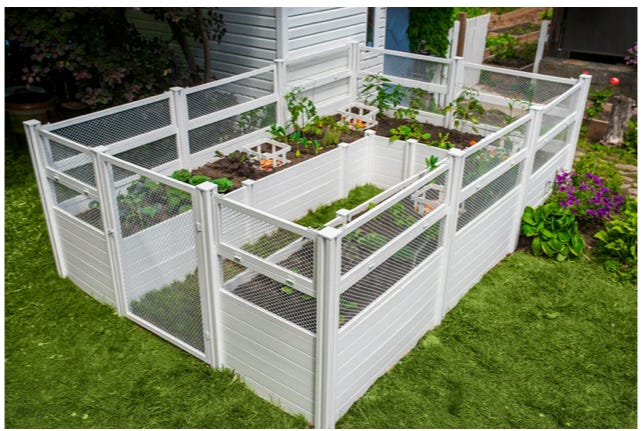
Composting, Indoors and OutToday’s newsletter podcast deals with options for indoor food scrap composting equipment, specifically kitchen composters (originally aired in Episode 196 of the Garden Basics with Farmer Fred podcast in May of 2022. In our conversation with America’s Favorite Retired College Horticulture Professor, Debbie Flower, she took a scenic bypass to talk about her outdoor garden kitchen scrap composter device, the Green Cone Composter. More information about that is below. But before we get to that, let’s recap what you may have missed on this week’s two Garden Basics podcast, which includes another deep dive into the “kitchen scraps in the garden” debate:Tuesday, May 21: Episode 336 - Q&A Kitchen Scraps in the Garden? When Should You Plant a Flowering Magnolia Tree, Spring or Fall? Takeaways• Burying kitchen scraps in the garden can attract scavengers like rats, gophers, voles, and ants, and may affect the quality of the soil microbiology.• Composting kitchen scraps first or using alternative methods like African keyhole-style gardens or the Green Cone composter are recommended.• The best time to plant a flowering tree like the Magnolia Genie is in the fall, but it can also be planted in the spring with extra care and regular watering.• Keeping a tree in a container over the summer requires frequent watering and protection from heat damage.• Using Smart Pots can help maintain cooler soil temperatures and reduce evaporation in container gardening.Friday, May 24: Garden Basics Podcast, Episode 337 - How to Choose Nursery Plants. Tips for Starting a School GardenTakeawaysChoosing Nursery Plants:• Read the signs and make sure the plant will fit in your garden and take the conditions you have in mind.• Check the plant for health, including good color, no holes or spots on the leaves, and no stickiness or mushiness.• Inspect the media the plant is growing in, looking for weeds, the height of the media, and the presence of roots.• Consider direct seeding certain vegetables like cucumbers and squash, as transplanting them when they have too many leaves can hinder their growth.• Pot up plants in larger containers if you're not immediately planting them in the ground, especially for tomatoes, peppers, and other summer vegetables.Tips for Starting a School Garden:• School gardens can be a valuable educational tool and a source of community involvement.• Getting the school on board and finding funding can be challenges, but reaching out to the principal and parent groups can help.• Students play an active role in maintaining the garden and learn valuable gardening skills.• The garden provides opportunities for hands-on learning, including lessons on composting, integrated pest management, and plant care.• The garden also serves as a gathering place for the community, hosting farmers markets and lunch pop-ups.Burying Kitchen Scraps in the Garden: Is That a Good Idea?Recently, we received a question wondering about the pros and cons of burying kitchen scraps to feed the garden soil.From the garden e-mail bag, Alice confesses: “I am a lazy composter. What we do is bury our kitchen scraps in different holes, all throughout our raised beds, all winter long. And it ends up making truly beautiful soil over the years. And there's lots of earthworms and other microorganisms I can't even see. Anyway, I'm wondering if there would be any problems with that. We do have raccoons, skunks, and possums because we live in the country. But they don't visit the garden. Apparently, they have resources elsewhere. And except for them, I don't see that there's an issue because the soil looks very nice. But you never mention burying garbage in your columns or podcasts. So, I'm wondering if there's some problem that I'm not aware of.”Alice, other possible scavengers of kitchen scraps buried in the garden might include rats, gophers, voles and ants. Especially ants, which could create tunnels throughout your raised bed which could siphon the irrigation water away from plant roots and out the bottom of the bed, or wherever their tunnels might lead. However, whatever you're doing seems to be working.But beware, there are a lot of variables. You want to bury it deep, certainly deeper than 12 inches to keep the four-legged varmints, including the household dogs, away from it. You don’t want to bury meat scraps. Also, avoid any foods soaked in oils, salts or sugars, which can attract smaller pests and possibly effect the quality of your soil.For even more opinions, and they are just that - opinions - the National Gardening Association has a thread at their website (garden.org) entitled, “Kitchen Waste Buried in Garden Soil?” Many people have weighed in on their experience doing that very thing, and it appears to be evenly divided as to whether they like it or not.Some of the comments and opinions:From Florida: “My mother in law (who lived to be 97 years old) had wonderful vegetable and flower gardens and she'd always take kitchen

Roly Polys, Sowbugs, Earwigs - Which One Is Guilty of Garden Destruction?
In today’s newsletter podcast, our America’s Favorite Retired College Horticulture Professor, Debbie Flower, talks about earwigs, a garden scavenger that probably does more damage than you might want a “neutral” garden critter to do. Probably the most famous “neutral” garden insect is the non-selective praying mantis, who doesn’t mind chowing down on your aphids for dinner, with a ladybug for dessert. The big takeaway from that earwig chat? “Don't wear loose clothing in an earwig infested garden.” We also touch on (in a manner of speaking) roly polys (aka, pillbugs).This Week on the Garden Basics PodcastBefore we delve into the answer to that question posed in the headline, here is what is going on in the Garden Basics with Farmer Fred podcast this week:Tuesday, May 14: Episode 334 Q&A Rhubarb for Hot Climates? Lights for Seedlings? In this episode, we answer garden questions from listeners. The first question is about growing rhubarb in hot weather. Master Gardeners Ruth Ostroff and Kathy Morrison (of the Sacramento Digs Gardening newsletter) discuss their experiences with growing rhubarb in Sacramento, which is challenging in a hot climate. (Ruth also names the rhubarb variety she has had success with in the hot Sacramento Valley.) Kathy shares a rhubarb recipe, made as an upside-down cake. The second question is about grow lights for starting tomato and pepper seeds indoors. Debbie Flower and I explain the importance of using a light system that is big enough to cover all the seedlings equally, as well as mixing different bulb spectrum colors. Of course, Debbie also emphasizes the need for air circulation and movement for young plants. We’re old, so we recommend using fluorescent lights, but we discuss the different options available in the market.Friday, May 17: Ep. 335 Roof Rat Control Tips. Asparagus-Lemon Recipes In this episode of the Garden Basics with Farmer Fred podcast, the main topic of discussion with retired UC Cooperative Extension Farm Advisor Rachael Long is roof rats and their impact on gardens and orchards. The conversation covers the behavior and habits of roof rats, their diet, nesting habits, and the damage they can cause to fruit trees. The episode also includes tips for controlling roof rats, such as trapping and using bait stations. Additionally, the episode features a segment on recipes using garden fresh asparagus and lemons, with Master Food Preserver Myrna Undajon-Haskell.Takeaways:• Roof rats are nocturnal creatures that can cause significant damage to fruit trees and orchards.• They have a preference for heights and are known to nest in attics and burrow underground.• Roof rats can be controlled through trapping and the use of bait stations.• Recipes using garden fresh asparagus and lemons are provided.• Preserving lemons and dehydrating citrus are also discussed.So, Who is Eating Your Seedlings? Controlling Sowbugs, Pillbugs and Earwigs in the Garden…and IndoorsFrom the garden e-mail bag, Jessica wants to know: “I have a crazy amount of roly-polys and pincher bugs this year. And the pincher bugs keep making their way into my house, too. Help! Is there anything I can do to drive them away other than bug spray? And can the roly-polys cause damage to my plants? I normally don't have a green thumb but my plants are doing great this year and I'm finally feeling like a good ‘plant mom’ so I don't want anything to mess them up.”Jessica, generally roly-polys (pillbugs) and sowbugs cause few issues with thriving plants. They prefer the dead organic matter on the ground. But if their favorite foods aren’t around, they will go after your plants.According to the creepy, crawly experts at the UC Integrated Pest Management Department, sowbugs and pillbugs feed primarily on decaying plant material and are important decomposers of organic matter. However, they occasionally feed on seedlings, new roots, lower leaves, and fruits or vegetables touching the soil. They sometimes come indoors, which can be nuisance.If pillbugs or sowbugs are a problem, reduce the amount of decaying organic matter on the soil and minimize the wetness of the soil surface. Irrigate early in the day so surfaces are drier by evening. Keep compost and mulch back from plants and building foundations to keep them outdoors. Using raised beds or planting boxes and drip or furrow irrigation instead of sprinklers usually keeps pillbugs and sowbugs from becoming serious problems.Pincher bugs (earwigs) are also a mixed blessing. They will munch on garden plants, but they also eat aphids!Despite their ferocious appearance, earwigs generally don’t attack humans, although they are capable of biting if trapped in clothing or sat upon.Should you be concerned about earwigs in your garden? Yes, and no. If your yard is primarily lawn, trees, woody ornamentals or native plants, let the earwigs do their job, going after aphids.However, if you are growing vegetables, herbaceous flowering plants, sweet corn or plants with soft fruits such
Thin Crowded Fruit Now, For a Lot of Good Reasons
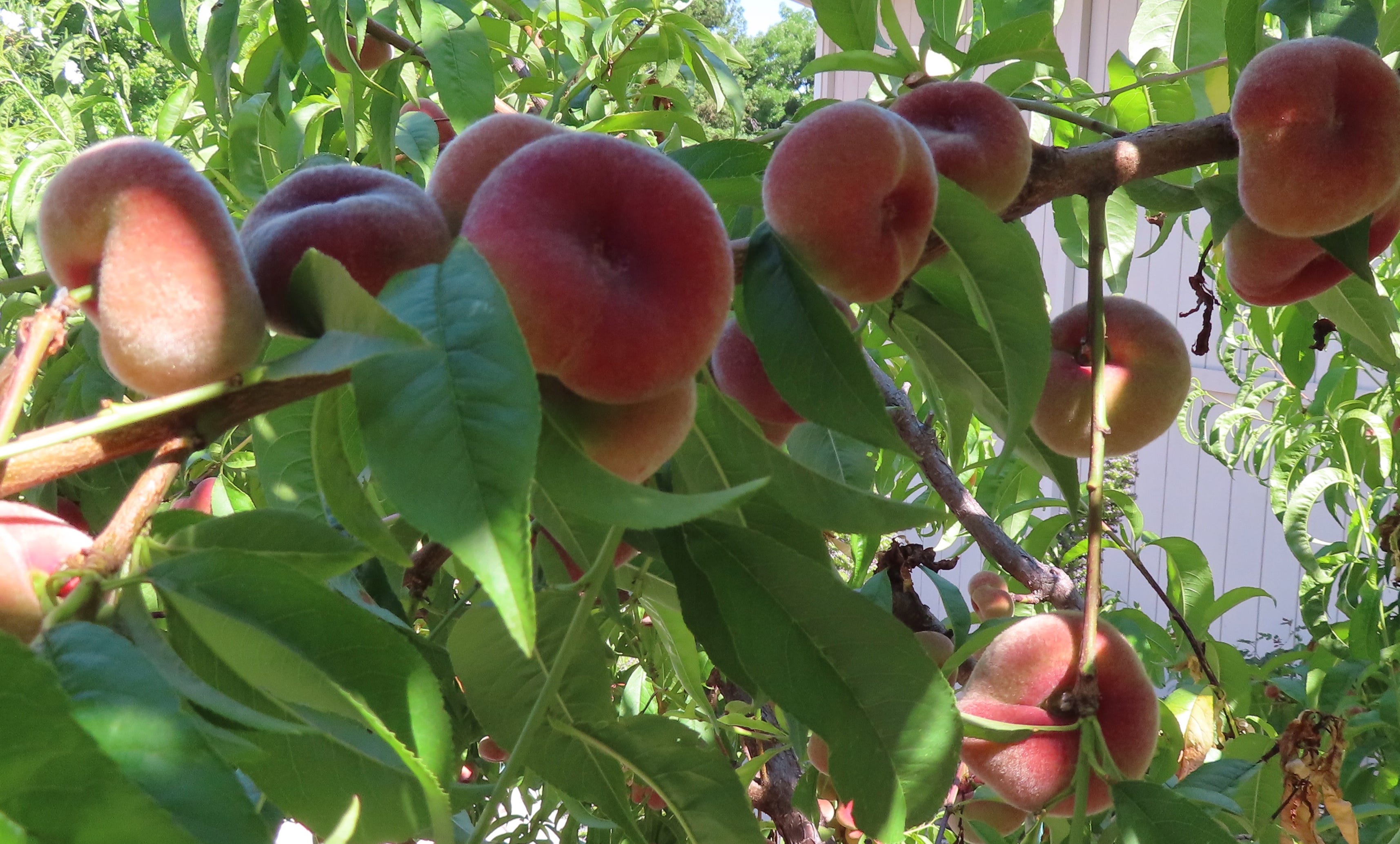
If you’re looking to harvest bigger pieces of fruit from your trees and vines this summer, now's the time to get out your hand pruners and thin off the overcrowded fruit. Other good reasons for thinning lots of little fruit from trees now can also thwart bigger problems later this year, such as undersized fruit, excessive fruit drop, and broken fruit tree branches.Here are some tips for thinning from the fruit tree experts at UCANR:• For apples, European and Asian pears, apricots, peaches, nectarines, plums, pluots, kiwifruits, and persimmons: Remove some of the fruit. Space fruit evenly along each branch, with perhaps six inches between each piece of fruit. More importantly, be sure to leave the largest sized fruits on the tree or vine. Although the trees might appreciate a light feeding now, the best time to fertilize these crops is in July and August, when the trees are setting their fruit buds for the following year. An exception would be peach and nectarine trees attempting to recover from peach leaf curl. For those varieties, thinning and fertilizing now can help redirect the tree’s energy into producing more leaves to replace the fallen ones.• For table grapes, remove grape bunches so that there is at least six inches of space between each remaining bunch of table grapes. Cut off the "tails" from the remaining bunches at that same time. This is the lower one-quarter to one third of the bunch, where it begins to taper down in size. This will send more energy to the remaining grapes on the bunch. The book, "The California Master Gardener Handbook" advises that fertilizer can be applied for each grapevine when the berries are about a quarter-inch big, usually in May. The same book advises gardeners to apply about 50 gallons of water per week per vine, during the hottest months (June through August) here in the Central Valley. Apply less (about 35 gallons a week) during May and September. Adding a few inches of mulch to the top of the soil beneath the vines will help preserve soil moisture.• Because of their small size, cherries are not usually thinned from backyard trees. In addition, nut crops, such as almonds and walnuts, are not thinned.• What about blueberries? The amount of thinning will depend upon the blueberry variety and fruit load relative to the vegetative area of the plant. Larger plants and branches that are more vigorous can support a heavier fruit load.• Citrus trees tend to thin themselves, a phenomenon called “June Drop.” However, citrus fruit thinning now can help a tree drop fewer fruit in late spring.Certain citrus types such as Valencia oranges or some mandarins have tendencies towards alternate bearing. That’s a year with heavy fruit production followed by a year with sparse production. You can reduce the potential of a tree to alternate bear by reducing the fruit load in a heavy fruit set year by thinning out some of the fruit. Pruning the tree will also help to offset alternate bearing. Also, fertilize less in light years and more in heavy years so that the trees needs are met according to the demands of the fruit load. Despite using these strategies, some varieties will just alternate bear.• Do not allow the old citrus fruit to stay on the tree longer than necessary. This may contribute to a smaller crop and perhaps, more fruit drop, for the next crop. And, as you may have noticed, those oranges and mandarins that usually produce ripe fruit in the winter but still have some left on the branches may taste dry, with little or no flavor. Cleaning up fall fruit now beneath citrus trees can help cut down on future pest and disease issues, as well.The University of California’s “California Backyard Orchard” website goes into the science of the benefits of thinning deciduous fruits:Removal of flowers or young, immature fruits early in the spring can lead to increases in fruit size by limiting the number of fruits that continue growing to harvest. It increases the leaf-to-fruit ratio and removes smaller fruit that would never reach optimum size or quality. Apples, European and Asian pears, apricots, peaches, plums, kiwifruits, and persimmons are almost always thinned until the leaf to fruit ratio is favorable for supporting growth of adequately sized fruits. Typically, nut crops and cherries are not thinned.Large fruit come from strong flower buds that grew in full sunlight, and on trees that have a favorable leaf to fruit ratio; not too many fruit per branch. In order to manipulate the tree into having just the right amount of crop that will size well and develop adequate flower buds for next year’s crop the fruits are hand thinned, removed in the dormant pruning process, or both. Apples, European and Asian pears, apricots, peaches, plums, kiwifruits, and persimmons are almost always thinned. Fruits on non-thinned trees are still edible, just smaller.The earlier that fruits are thinned and the leaf to fruit ratio is increased, the larger the fruits will be at harvest and the greater th

Meet the Garden Beneficials, Pt. 2 (and Barn Owls!)
The podcast included with this newsletter features an interview with Rachael Long, University of California Cooperative Extension Farm Advisor Emeritus, and one of the nation’s best sources of information on the benefits of having barn owls prowling over your property to control rodents. Rachael mentions the UC Publication, “Songbird, Bat and Owl Boxes” which is a paid publication. Here’s a link for more information on barn owl boxes; and, another link with specific barn owl box building instructions. This chat originally aired in Episode 40 of the Garden Basics podcast in August of 2020.Before we continue with our beneficial insect hit parade, here’s what has happened this week on the Garden Basics with Farmer Fred podcast:Tuesday, April 30: Ep. 330 - Q&A Controlling Bermudagrass; What about using black plastic in the garden?Gail from California wants to start a vegetable and flower garden in her backyard, which is currently covered in Bermuda grass. Fred and Debbie suggest waiting a year and using soil solarization to kill off the Bermuda grass. They also recommend starting small with container gardening. They discuss the challenges of dealing with Bermuda grass and the benefits of solarization. They also touch on the use of black plastic mulch in the garden.Friday, May 3: Ep. 331 Cucumber Starting and Training TipsIn this episode, Fred and Debbie Flower discuss cucumber planting advice, including starting cucumbers from seed or nursery transplants, training cucumber growth, and choosing the right cucumber plants. They also cover topics such as soil temperature, soil type, watering, trellising, pollination, and harvesting cucumbers. They provide tips for preventing cucumber diseases and pests, as well as suggestions for different cucumber varieties to try.Meet the Garden Beneficials, Part 2Last week, we discussed three of the best beneficial insects to have in your garden: lacewings, ladybugs, and hoverflies. Today, we cover several more garden good guys worth putting to work in your yard to subdue the pests, and the “Welcome Mat” plants they need for extra food and shelter.Soldier Beetles (leather-winged beetles)Like many of the beneficials, it is the larval stage of soldier beetles that do most of the munching on the bad bugs. Whereas the adult soldier beetles feed mostly on the pollen and nectar of flowers - as well as the occasional aphid, insect eggs and larvae - young soldier beetles can be found under the bark of the plant or in soil or litter. There, they feed primarily on the eggs and larvae of beetles, butterflies, moths and other insects.Plants That Attract Soldier Beetles* Celosia Cockscomb* Coreopsis* Daucus carota Queen Anne’s Lace* Echinacea purpurea Purple Coneflower* Pycnanthemum Mountain Mint* Rosa Roses* Solidago GoldenrodParasitic Mini-WaspsMini-wasps are parasites of a variety of insects. They do not sting! The stingers have been adapted to allow the females to lay their eggs in the bodies of insect pests. The eggs then hatch, and the young feed on the pests from the inside, killing them. After they have killed the pests, they leave hollow “mummies.” Among the parasitic mini-wasps:Braconid WaspsBraconid wasps feed on moth, beetle and fly larvae, moth eggs, various insect pupae and adults. If you see lots of white capsules on the backs of a caterpillar, these are the braconid cocoons. Leave the dying caterpillar alone!Ichneumonid wasps control moth, butterfly, beetle and fly larvae and pupae. Trichogramma wasps lay their own eggs in moth eggs (hungry caterpillars-to-be), killing them and turning them black.Plants that attract parasitic mini-wasps:•Achillea filipendulina Fern-leaf yarrow•Achillea millefolium Common yarrow•Allium tanguticum Lavender globe lily•Anethum graveolens Dill•Anthemis tinctoria Golden marguerite•Astrantia major Masterwort•Callirhoe involucrata Purple poppy mallow•Carum carvi Caraway•Coriandrum sativum Coriander•Cosmos bipinnatus Cosmos white sensation•Daucus carota Queen Anne’s lace•Foeniculum vulgare Fennel•Limonium latifolium Statice•Linaria vulgaris Butter and eggs•Lobelia erinus Edging lobelia•Lobularia maritima Sweet alyssum - white•Melissa officinalis Lemon balm•Mentha pulegium Pennyroyal•Petroselinum crispum Parsley•Potentilla recta ‘warrenii’ Sulfur cinquefoil•Potentilla villosa Alpine cinquefoil•Sedum kamtschaticum Orange stonecrop•Sweet alyssum - white•Tagetes tenuifolia Marigold ‘lemon gem’•Tanacetum vulgare Tansy•Thymus serpylum coccineus Crimson thyme•Zinnia elegans Zinnia - 'liliput'TACHINID FLIESParasites of caterpillars (corn earworm, imported cabbage worm, cabbage loopers, cutworms, armyworms), stink bugs, squash bug nymphs, beetle and fly larvae, some true bugs, and beetles. Adults are 1/3 to 1/2 inch long. White eggs are deposited on foliage or on the body of the host. Larvae are internal parasites, feeding within the body of the host, sucking its body fluids to the point that the pest dies. Plants that attract tachinid flies:•Anthemis tinctoria Golden

Meet the Garden Beneficials (and Bats, Too!)
The podcast included with this newsletter features an interview with Rachael Long, University of California Cooperative Extension Farm Advisor Emeritus, and one of the nation’s best sources of information on the benefits of having bats, which are flying mammals (not rodents), in your neighborhood. Originally aired in Episode 180 of the Garden Basics podcast in March of 2022.Before we begin bug hunting, here’s what has happened this week on the Garden Basics with Farmer Fred podcast:Ep. 328 Q&A - Should you add fertilizer to a compost pile? Can planting late-ripening peaches thwart peach leaf curl disease?In this episode of the Garden Basics Podcast, Fred Hoffman and Master Gardener Susan Muckey discuss composting and answer a listener's question about adding nitrogen to a compost pile. They explain that adding nitrogen is not necessary for most compost piles and discuss the ideal carbon-nitrogen ratio. They also provide tips for turning a compost pile and maintaining the right temperature. In the second part of the episode, Quentyn Young, Master Gardener and orchard specialist, joins the conversation to discuss strategies for dealing with peach leaf curl, including planting late ripening peach varieties.• Adding nitrogen to a compost pile is not necessary for most composting methods.• The ideal carbon-nitrogen ratio for a compost pile is 30 parts carbon to one part nitrogen.• Turning a compost pile helps to introduce air and maintain the right temperature.• Late ripening peach varieties can be a good strategy for preventing peach leaf curl.=======================================================Ep. 329 How to WaterIn this conversation, Farmer Fred and America’s Favorite Retired College Horticulture Professor (and former nurseryperson), Debbie Flower, discuss various methods of watering plants, including watering seeds, young plants in containers, mature plants in containers, and lawns. They also touch on the use of sprinklers versus drip irrigation, the benefits of rainwater, and the ancient practice of using Oyas for irrigation. The conversation emphasizes the importance of finding a watering system that works best for each individual and regularly checking plants for signs of distress.• Watering seeds requires keeping the seed bed evenly moist, and watering from the bottom can be an effective method.• When watering young plants in containers, it's important to water each container individually and ensure that the entire column of soil is wet.• For mature plants in containers, using a watering wand with a fine breaker can provide a gentle and effective watering method.• Lawns can be watered using sprinklers or more efficient methods like MP Rotators, and it's important to turn off the water when runoff occurs.• Drip irrigation is a cost-effective method for irrigating crops, but it requires monitoring for breaks and securing the drip tape to the ground.• Oyas, an ancient irrigation method, can be used to slowly release water to plants, but their effectiveness depends on soil type and plant needs.• Regularly checking plants for signs of distress and maintaining irrigation systems is crucial for healthy plant growth.===============================================================Meet the Garden Good Guys and GalsNature wants to make your job as a gardener as easy as possible; but you have to help.We've talked about putting in plants that attract insects whose primary job is to pollinate your garden, helping to insure a bountiful harvest of food and flowers. But what about attracting those other "good bugs", the crawling and flying creatures whose diet includes pests that are ravaging your garden plants? These beneficial predatory insects do not live on aphid steaks alone. They need other natural sources of food and shelter for their entire life cycle before they call your backyard a permanent home. What are these "Welcome Mat" plants and the beneficial insects they attract? Here is a list of three of those good bugs and some of the plants that they like to visit for shelter and as another source of food for their diet and their children. Next week, we’ll have even more beneficials and plants. For best results, group these plants nearby or along the garden border to attract the garden beneficials. P.S. Readers with a long memory will recall much of this information from an earlier post here in May 2022.LADYBUGS (Ladybeetles)Easily recognized when they are adults by most gardeners. However, the young larvae, black with orange markings, eat more pests than the adults, and they can’t fly. Yellowish eggs are laid in clusters usually on the undersides of leaves.Plants that attract ladybugs:•Achillea millefolium Common yarrow•Ajuga reptans Carpet bugleweed•Alyssum saxatilis Basket of Gold•Anethum graveolens Dill•Anthemis tinctoria Golden marguerite•Asclepias tuberosa Butterfly weed•Atriplex canescens Four-wing saltbush•Coriandrum sativum Coriander•Daucus carota Queen Anne’s lace•Eriogonum fasciculatum CA Buckwheat•Foeni
2024 Tomato Preview
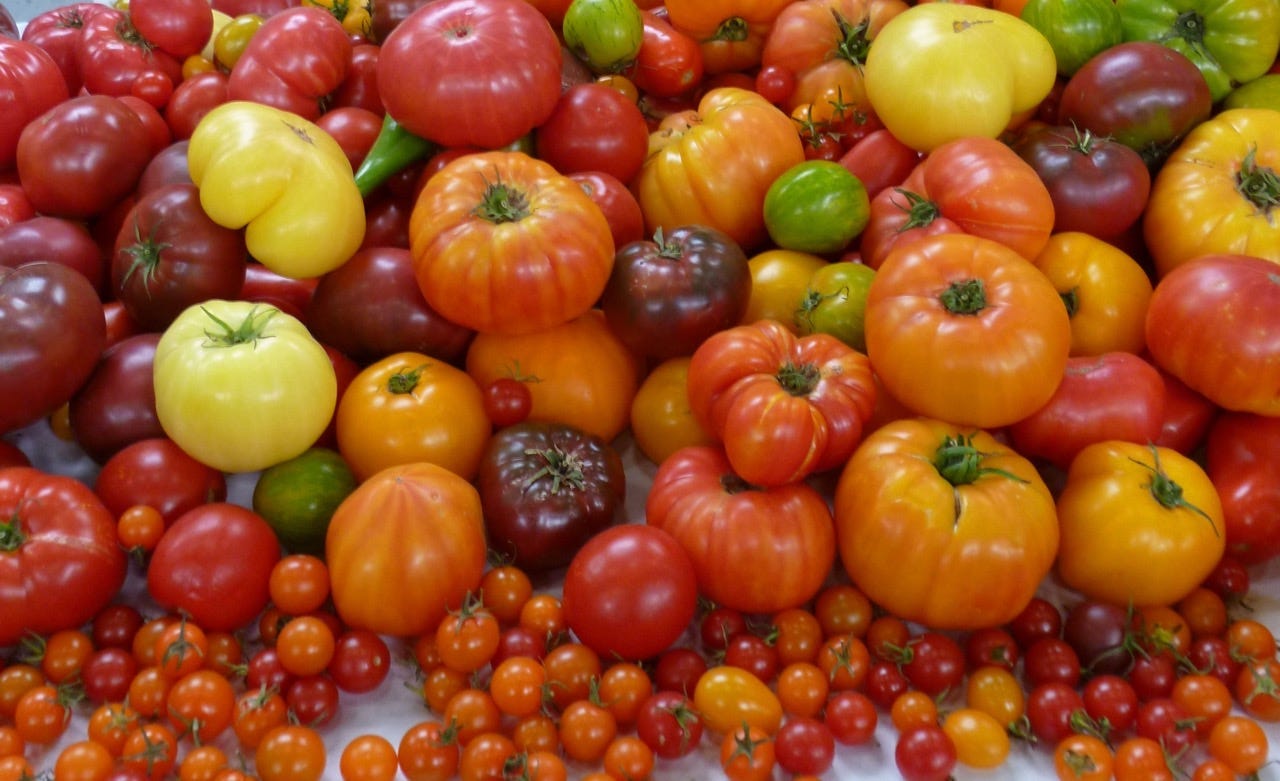
Our cohort in all things tomato, Don Shor of Redwood Barn Nursery in Davis, got into a lot of helpful information for tomato gardeners besides just talking about tomato varieties in Episode 317 of the Garden Basics podcast, The 2024 Tomato Preview Show. The mini-podcast (above) highlights four tips we discussed that can make you a more successful gardening tomato-head. Among Don’s tips:• The first thing you should do when you when bring that tomato plant home from the nursery. • And, if you are growing tomato plants from seed, what you need to do before you plant it outdoors.• How to save tomato seeds from open pollinated varieties for next year.• How to save your tomatoes when it gets really, really hot.• How to improve the flavor and texture of supermarket tomatoes.• Plus, I threw in an extra tip on growing fruit trees in containers for a longer fruit production life in tight quarters.The Tomatoes of the 2024 Tomato Preview Show (with links for more info)RugbyChef’s Choice OrangeJulietBodaciousNew GirlTough BoyBlue RibbonPineappleChampionPurple BoyBush Early GirlItz a KeeperSuper FantasticJet StarPrincipe BorgheseRiesetomate tomatoSungoldBarry’s Crazy CherrySweet Carneros PinkPork ChopMichael PollanGardener’s DelightBig Beef4th of JulySweet MillionSuper SauceOrange WellingtonDr. Wyche’s YellowPurple Tomato (a GMO variety)A sampling of our comments of each of those tomato varieties (listen to the full episode for even more tomatoey details)Fred: the big winner last year for me was Rugby, based on your endorsement of that tomato over the last couple of years. And Rugby is just a wonderful tomato. Don: it grows very, very well and a very good producer here. So yes, you and I definitely agree on Rugby. =======================Don: I still highly recommend the Chef's Choice series and I strongly recommend Chef's Choice Orange based on previous years. That's still in my top ten. Fred: Several of the Chef's Choice tomatoes have been All-America Selections winners, as well.======================Don: I have to say every year I have one plant that just grows incredibly robust compared to all the others. It's never the same one, of course, and it produces really, really heavily. And in 2023 for me, that was Juliet. Now I recommend Juliet very highly for a lot of reasons. I did a quick count, just trying to figure out how many fruit my Juliet plant produced. It was something close to 400.====================Fred: One that you have recommended over the years. And I finally broke down and tried it and it was actually it was successful the second year I tried it. And that's another Don Shor rule about planting tomatoes. Give them three years, plant them for three years and see if you still like it. And Bodacious did quite well for me in 2023. It was the the last plant to give up, and I harvested the remaining green ones in November and I finally finished the green ones as they ripen slowly in the garage. I finished those off in late February. Don: Yeah, it's been a very good performer. If you're looking for something in what we sometimes call the beefsteak category, a large slicing tomato with good connective tissue that you could use in a sandwich, Bodacious is probably your best bet here in the Sacramento Valley. Bodacious has great flavor all as well, has taken heat very well for me. Continues to be a good performer for me. ======================Fred: Another one of your perennial favorites - and I've been planting it now for like three or four years - well, I finally ran out of the seed. I'm going have to get some fresh seed. The New Girl tomato.Don: Yes, New Girl has been out yielding Early Girl for me for the last two years.============================Don: There's another one out there called Tough Boy. Some people are doing that one and have had very good results. Tough Boy is another one where they're trying for that same 4 to 6 ounce fruit size, nice round red tomato, good flavor, a good all-purpose tomato. That's another good one.=============================Don: There's one that I've been recommending and it's going to be a hard one to find unless the nursery start it themselves. It’s Blue Ribbon. It doesn't crack, it doesn't split. It didn't get blossom and rot. The fruit is always 12 ounces or so, a good size all the way up to a pound. Sometimes it didn't get sunburned. It just performs really well. It's not just attractive. I mean, the Blue Ribbon refers to the fact it's a very, very good looking tomato. It also has really good flavor, and holds well on the vine. =========================Don: So here's my big surprise from last year. Every year there's one variety that surprises me. Pineapple. The name refers to the rather tangy flavor. This year I got 14 very large fruit on the one plant, each of them about one and a half to two pounds.Fred: An oldie but a goodie.Don: I don't usually tell people heirlooms are going to be your highest yield, but the Pineapple really, really surprised me how much it produced

Small Trees for Small Yards. Medium-Sized Trees for Suburban Lots. Avoid a Tree Disaster in a Storm.
Today’s newsletter podcast (recorded in January 2021) features an arborist discussing ways you can spot when your trees may be in danger of falling, especially in a wet, windy winter.More information about what was discussed in the podcast can be found at the University of California Ag and Natural Resources publication, “Inspect Your Landscape Trees for Hazards”.Small Trees for Small YardsIn this era of "Big House, Small Yard", choosing the right size tree can not only enhance the beauty of your backyard, it can forestall serious and expensive pavement problems that might force you to crack open your wallet in five to ten years. Planting a tree with a future height and spread of more than 40 feet in a small backyard will eventually make you recall that old TV show title, "Dark Shadows". Even spookier will be the repair bills when the extensive root systems of these larger trees start heaving and cracking your concrete patio, driveway, sidewalk and foundation.The Sacramento Tree Foundation recommends planting large trees at least 15 feet away from any hardscaping or construction. If the site you've picked out for a new tree can't be situated that far away from any concrete, electrical systems or sewer pipes, here are some good, small trees that need only six feet of planting distance from building foundations, walks and driveways.Most of these trees will get no taller than 25 feet: Amur maple, Japanese maple, eastern redbud, flowering dogwood, Washington hawthorn, crape myrtle, saucer magnolia and Bechtel crabapple.Needing only 10 feet of "growing room" from tree to concrete are these medium-sized (25-40 feet) ornamental plants: trident maple, hedge maple, Japanese white birch, goldenrain tree, capital pear and chanticleer pear.Before your shovel hits the ground, here is an easier way to plant your tree or shrub: instead of digging deep, dig wide. Then, refill that crater with the native soil. Current research from the University of California has shown that digging a hole an inch or two less than the depth of the tree's root ball (the portion in the container) is more beneficial than digging a deeper, narrow planting hole.The trick to a successful planting also includes loosening the surrounding soil at the planting site. Loosen up the soil (again, to the depth of the root ball) in an area at least twice as wide as the container (for young trees and shrubs) or the entire diameter of the tree canopy. Even better, rototill out to six feet from the location of the tree trunk. A tree that can easily send out its lateral root system will have better access to water and nutrients.Check the tree for girdled roots before planting. If the roots are encircling the rootball, slice through the length of the root ball on four sides about an inch deep. This will help the roots to spread down and out, not round and round.Plant the tree so that the top of the root ball rests on solid soil, one to two inches higher that the surrounding soil; this allows for settling and helps avoid crown rot. Avoid soil amendments; by refilling the hole with the original soil, the tree more quickly adapts to the native environment where it will have to reach out in order to be successful.Staking should only be done if the tree can't stand on its own. And by all means, remove the single stake that comes with the tree from the nursery. Use two stakes, one on either side of the root ball. Tie the tree to the stakes using old nylons or another flat, wide, ribbon-like article. Tie loosely at the lowest point on the trunk where the tree will stand upright. Remove the stakes as soon as the tree will stand on its own, usually not more than one year.Beyond The Garden Basics is a reader-supported publication. To receive complete new posts, have access to past newsletter issues, and support my work, consider becoming a paid subscriber.Lower Your Tree Size Expectations.Freakish high gusts of wind are becoming more commonplace throughout Northern and Central California, especially with the change of the seasons. Last weekend, a Red Flag warning was posted by the National Weather Service for the danger posed by the combination of high winds and dry landscapes that might ignite wildfires. Sure enough, the high winds swept into several sections of our state. The Bay Area office of the National Weather Service reported high winds exceeding 50 and 60 miles per hour in several coastal areas. In Southern California, wind gusts of 50 miles per hour buffeted high profile vehicle traffic on Interstate 5, north of Los Angeles. And a wildfire broke out in Riverside County, which, at press time, was still only 20% controlled. A bit closer to home, we nervously look at our neighbors’ huge conifers shedding small branches on windy days throughout the year.That’s a not so gentle reminder of last January, when one of their 60-foot-tall Atlas cedar giants fell into our yard during a windstorm here in suburbia, a fallen tree that was so large that it caused damage in thr
How to Stake a New Tree
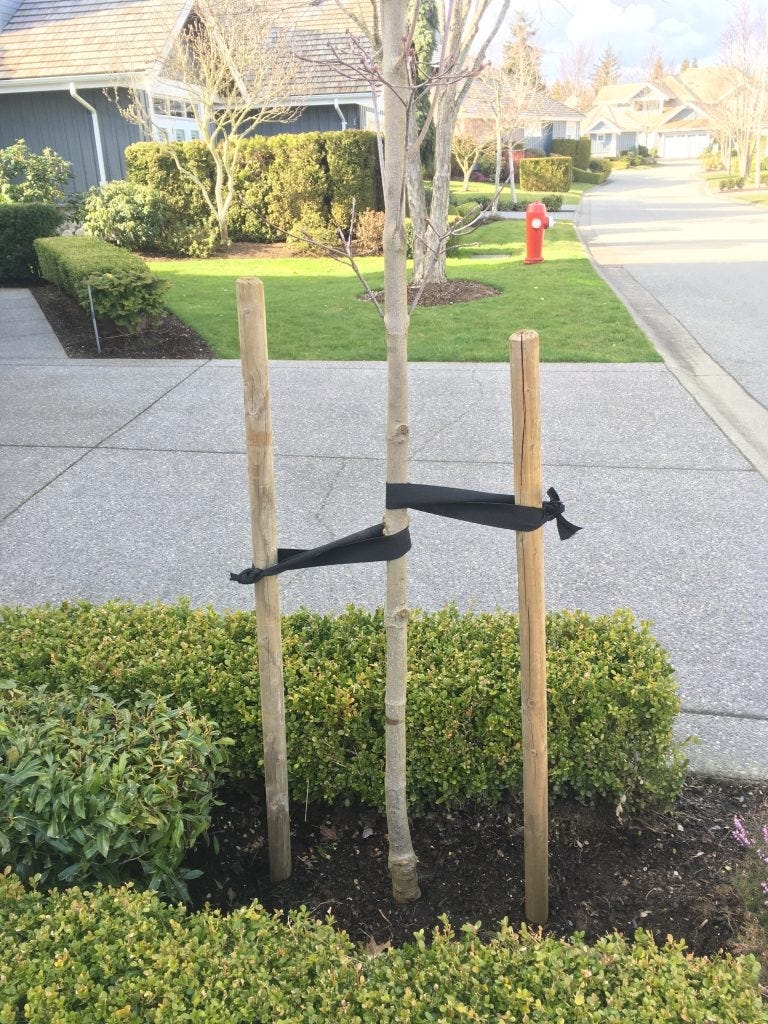
Simple instructions from the Placer County (CA) Master Gardeners on proper tree staking:Q: I just planted a new tree and want to know the best way to stake it.A: It’s important to know that not all newly planted trees need to be staked. In fact, improper staking can harm rather than help. The more freely a tree can move, the stronger its trunk will become and the more likely it will be to withstand storms.There are three situations in which staking is necessary: to protect against damage from equipment, vehicles or animals; to anchor trees whose roots cannot support the tree upright in the wind; and to support trunks unable to stand upright by themselves.Protective stakes only need to be tall enough to be seen and avoided by equipment operators. Three stakes are generally enough and they should not be attached to the tree. Netting or wire fencing can be attached to the stakes to exclude animals.Anchor stakes should be firmly set in the surrounding soil outside the root ball. Short stakes used for protection can do double duty as anchoring stakes by attaching the lower part of the tree to them with broad, flexible ties. The idea is to restrict root ball movement, while allowing the top of the tree to move in the wind.Trees trained properly at the nursery should not need support staking. Most reputable tree growers no longer remove lower branches to create top-heavy, “lollipop” trees. They know that leaving these “nurse branches” on the young tree will help it develop a thicker trunk with healthy taper.To determine if your newly purchased tree requires support staking, remove the stake that came with the tree from the nursery. If the tree stands upright on its own, you should not stake it.However if the trunk flops over, place two stakes in the ground outside the root ball on opposite sides of the tree so that prevailing winds will blow through the stakes. Starting about 2 feet above the ground, use two fingers, one on either side, to support the trunk. Move your fingers slowly up the trunk until the tree stands upright. Flexible ties that allow movement should go 6 inches above this point. Cut the stakes 2 to 3 inches above the ties so that the trunk and upper branches will not be damaged by blowing into or rubbing on the stakes. Check the ties regularly to make sure they are not constricting the trunk.Remove stakes and ties as soon as they are no longer needed.Thanks for reading Beyond Basics: The Garden Basics with Farmer Fred Newsletter! Subscribe for free to receive new posts and support my work.Thank you for also listening to the Garden Basics with Farmer Fred podcast! It’s available wherever you get your podcasts. Please share it with your garden friends.Fred Hoffman is also a University of California Cooperative Extension Master Gardener in Sacramento County. And he likes to ride his bike(s). This is a public episode. If you'd like to discuss this with other subscribers or get access to bonus episodes, visit gardenbasics.substack.com/subscribe

The Benefits of Lingering in the Garden
In today’s newsletter podcast, Debbie Flower, America’s Favorite Retired College Horticultural Professor, extols the benefits of spending time in the garden, and closely observing your plants. And, I talk about how those who took up gardening during the Covid epidemic found out that gardening is good for the gardener, too, in a myriad of ways.Do some gardeners have a natural green thumb? Although there can be a lot said for patience and perseverance when it comes to landscaping tasks, perhaps there are some habits that seasoned gardeners have in common. Such a list was published by the Santa Clara and San Joaquin County Master Gardeners here in California a few years ago entitled, “The Top 10 Habits of Happy and Successful Gardeners.”It is a list that is worth reviewing from time to time, to see which habits you’ve made a normal part of the garden day, along with those habits that might need a bit of refreshing.For those of you that like the quick list, the Top 10 included: “Feed the Soil”, “Learn Before Lopping”, “Embrace Failure”, “Shop Carefully”, “Put the Right Plant in the Right Place”, “Water Intentionally with Both Hands”, “Control Snails and Slugs”, “Never Let a Weed Go to Seed,” “Attract Beneficial Insects”, and “Linger in the Garden”.Successful Habits of Happy Gardeners, by Louise Christy, Santa Clara Co MG (Summer 2018, San Joaquin MG Garden Notes) (Habits 1-5)Habit Number 1: FEED THE SOILHappy and successful gardeners know that taking care of the soil (and learning to love our clay soil) is the first priority.Soil has three main parts. The first is the mineral component, which soil scientists divide into sand, silt, and clay based on particle size. The important thing to know about sand, slit, and clay is that the clay particles are the smallest, and they are really small. The super-small size of the particles makes clay soils highly nutritious for plants.The second component of soil is the organic matter. Good, healthy soil is teeming with life, from big earthworms and pill bugs, to billions of living micro-organisms, fungi, and bacteria. Healthy soil also contains a lot of organic mat- ter, for example decomposing leaves or grass clippings. It is the job of the living organisms in the soil to breakdown the organic matter and return its nutrients, especially nitrogen, to the soil.The third component of soil is the space in-between the mineral and organic particles. This pore space is filled with water and air which are both essential to healthy soil. Plant roots need oxygen in addition to water and all those worms and beetles and protozoa and bacteria that are busy breaking down organic matter need water and air to stay alive."Feeding the soil" means replacing the water and organic matter and preserving the air by not overwatering or compacting the soil. Happy and successful gardeners follow this maxim for improving soil: compost, compost, compost, mulch, mulch, mulch.Compost improves the structure of the soil and makes it crumbly and easier to work. Spread compost all over the soil a couple times per year. If the soil has not been gardened recently, you may want to dig the compost into the soil several inches down. The other key to feeding your soil and increasing the organic matter is to use organic mulch. The most popular mulches seem to be wood chips or bark, but you can also use grass clippings, leaves, straw, or once again, compost.When working with clay soil, avoid overwatering, and let it dry until it is moist and crumbly before you dig. Do not add sand to clay soil. Sand plus clay equals concrete.Great garden soil with lots of clay, organic matter, and microorganisms will be dark brown and crumbly and will smell earthy. It can be dug easily with a trowel, and it will have worms. Be patient and persistent. Building great soil can take years, but with careful treatment and feeding, “impossible clay” can become lovely garden soil.Habit Number 2: LEARN BEFORE LOPPINGHappy and successful gardeners know pruning is a good thing and fun to do, but it can be complicated, so they make a point to learn before lopping.Many gardeners have pruners with them constantly for clipping and trimming their plants. There are many good reasons to prune and clip plants including training young plants, grooming for appearance, to control the shape and size of a plant, to influence flowering and fruiting, to invigorate stagnant growth, and to remove damaged or infested growth. However, improper pruning can ruin or destroy plants.Not all plants respond to pruning in the same way. Happy and successful gardeners are careful to research and learn how their plants will respond to pruning before they prune. This is especially important when talking about a large and valuable tree. Badly pruned large trees may drop branches or die, resulting in hazardous situations and expensive removal costs.Habit Number 3: Embrace FailureGardening is a learned skill. Compare it to medicine. Just like no one is born knowing how to pe
How Was Your Tomato Crop This Year?
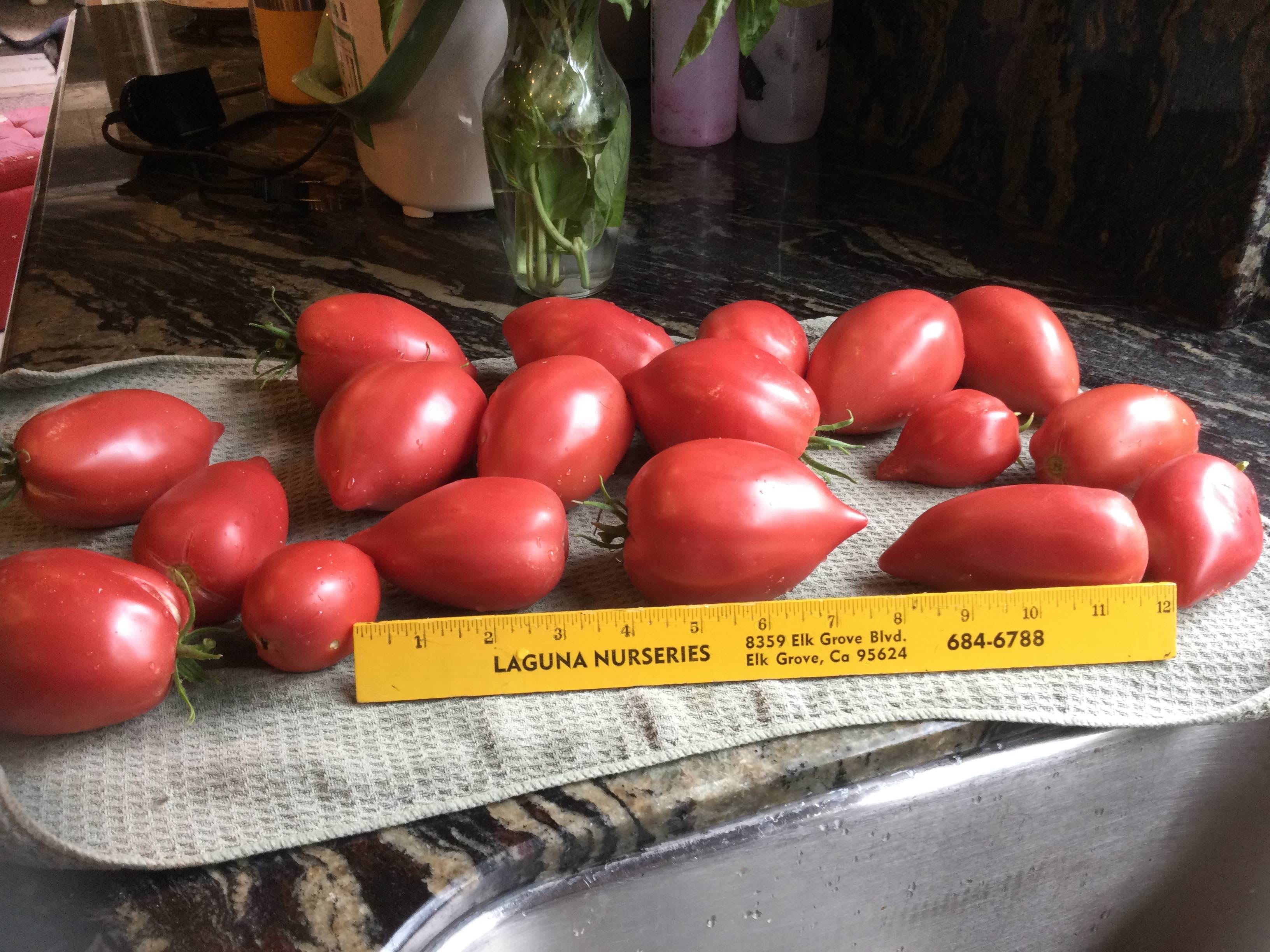
In today’s newsletter podcast, nursery owner Don Shor and I share success and failure stories from our 2023 tomato gardens. We both agree that one of the best tomatoes this year that we grew from seed was Rugby F1, a sauce/paste tomato that is large, meaty, and tasty. In our own yard, Rugby was the overall winner for us. Although it is described in several seed catalogs as a Roma-type tomato, don’t be fooled. Rugby is much larger than other Roma canning tomatoes, about seven ounces each. Pink-red in color, Rugby has meaty flesh that is good for canning. But unlike smaller Roma tomatoes such as San Marzano or Roma VF, Rugby takes well to slicing and can be served on a sandwich or in a salad. Rugby is an indeterminate tomato, and did produce throughout the growing season, with great foliage cover to protect fruits from too much sun. There were few – if any – weather related issues with cracking or sunburn. Rugby is also resistant to diseases such as tomato mosaic virus, leaf mold, fusarium and verticillium wilt, crown and root rots, as well as bacterial speck. We will be planting Rugby again in 2024.My tomato failure this year was the industry’s fault: a victim of a seed mixup. Here is the purchased, mismarked, packet.Gardener’s Delight, is an indeterminate German heirloom small tomato, a favorite for years in our garden, with a long growing season and a grape-like shape, a bit larger than a cherry tomato. Oddly enough, although the name on the “Gardener’s Delight” tomato seed package (above) is wrong, the picture was EXACTLY correct. The tomatoes that these seeds produced resembled a run-of-the-mill, red, cherry tomato. That should have been a red flag to me. Whatever variety of cherry tomato that came from the packet of seeds was certainly not one that was a keeper: very little production that ended mid-summer.This is what a Gardener’s Delight tomato is supposed to look like: a bit larger than a cherry tomato, nor perfectly round, as it tapers a bit on the blossom end. Nor does it grow in tight clusters, as some cherry varieties do. Chalk it up to another victim of “Jalapeno-gate”, a country-wide (if not world-wide) seed mixup issue that was initially noted by many pepper aficianados - as well as retail and wholesale nurseries this past summer. Read about it here.However, we enjoy Gardener’s Delight so much, that my plan for 2024 will be to purchase seed of that variety from two different seed catalogs and plant a few from each. I’ll be avoiding the seed catalog source of this year’s Gardener’s Delight failure.More 2023 Tomato Winners and LosersWhich varieties were successful for you this year? Which tomatoes were a bust? Let me know how yours did.Meanwhile, over at the Fair Oaks Horticulture Center, the Sacramento County Master Gardeners conducted their own tomato trials this year. They grew three very popular varieties: Big Beef, Lemon Boy, and Celebrity. And for comparison, they grew the newer, alleged improvements of those three: Big Beef Plus, Lemon Boy Plus, and Celebrity Plus. Were the newer varieties really an improvement? The results were mixed.During a 30-day period of harvesting in July and August, the original Big Beef tomato plant produced 84 tomatoes with an average weight of 15 ounces. Big Beef Plus, however, only produced 75 tomatoes with an average weight of 8 ounces. Still, the taste testers among the Master Gardeners preferred the taste and texture of the Big Beef Plus, 75% to 25%.Both Lemon Boy and Lemon Boy Plus tomatoes that were harvested in that same time frame, and produced about the same number (132 to 111) and size (6.8 ounces to 7.5 ounces), although the Lemon Boy Plus had a few larger tomatoes that were beset with cracking. Lemon Boy was preferred by the taste testers to Lemon Boy Plus, by about a three to two ratio.Celebrity Plus (50 pounds) outproduced the Celebrity tomato (40 pounds), with both varieties having about the same size of tomatoes. The judges were divided on the taste and texture, with 71% preferring the flavor of Celebrity Plus. For texture, Celebrity was favored by 75%. The big difference was the size of the plant: Celebrity stayed fairly compact, about three to four feet tall, while the Celebrity Plus climbed up to the top and over the five-foot cage.“In our limited demonstration, all plants grew well and had no disease issues,” says the Master Gardener’s final report on the tomato trial. “We will probably keep all of the cultivars on our list to grow again.”Thanks for reading Beyond Basics: The Garden Basics with Farmer Fred Newsletter! Subscribe for free to receive new posts and support my work.Thank you for also listening to the Garden Basics with Farmer Fred podcast! It’s available wherever you get your podcasts. Please share it with your garden friends.Fred Hoffman is also a University of California Cooperative Extension Master Gardener in Sacramento County. And he likes to ride his bike(s). This is a public episode. If you'd like to discuss this with othe
Planting Wildflowers or Cover Crops: Wait for Rain? Or Do It Now?
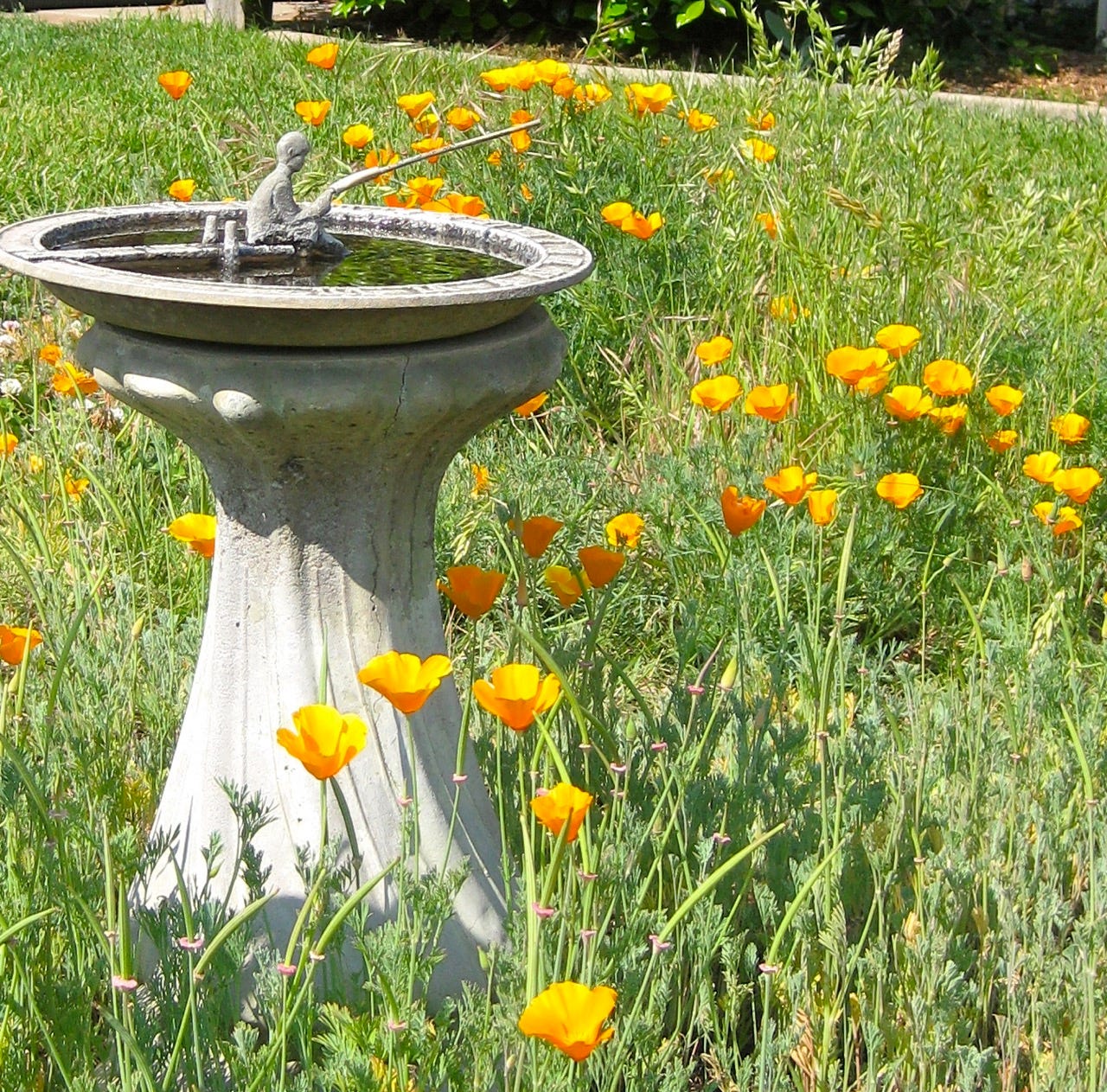
In today’s newsletter podcast (above), we get tips on starting a wildflower garden from Marina LaForgia, of the Gremer Lab at UC Davis. LaForgia, a 2019 PhD graduate of Davis, is now doing research on seed dispersal and persistence. If you live in an area of the country where you can plant wildflowers or cover crops in the fall, especially in a drought-prone area, you’ll want to listen. Thinking about planting cover crops this fall? The range of cover crop success in the U.S. is rather wide: USDA Zones 10 down to 6B. According to a cover crop study conducted by the Natural Resources Conservation Service in Pullman, Washington (USDA Zone 6B), it really depended on how cold it gets in a particular winter. Peaceful Valley Farm Supply has a cover crop solutions chart that lists many varieties that are reported to take the cold down to 25 degrees.A very informative video from Peaceful Valley Farm Supply about planting wildflower seeds can be found here. (Note: Peaceful Valley is not an advertiser here. They just know their stuff. That’s good enough for me.)What’s Your USDA Zone?Want more zone details? Here’s a link to an eye-numbingly detailed USDA Zone Map from Wikipedia.Fall is for Sowing Cover Crops and Wildflowers. But Should You Wait for the Rain?Early fall - October through mid-November - is usually the time for planting a wildflower garden or sowing cover crop seeds on your bare garden beds here in USDA Zone 9, including most of California. “Usually” being the operative word; “rain” being the wild card. You can increase the chances of germination if the soil bed is prepared by thoroughly moistening it to depth of a few inches. Follow that up with weekly, thorough irrigations until the seeds sprout. However, the shorter, cooler days of October sometimes can fool a gardener into not watering enough, thinking that the rains will soon be coming.Some native plant experts, such as LaForgia, say to wait for the rains before planting wildflower seeds. That event seems to be a long way off, especially with temperatures lately reaching the 90’s. In that wildflower video from Peaceful Valley, Trish recommends waiting until after the first hard frost in her area, which, because of the hilly terrain of Nevada City, could be anywhere from USDA Zones 9B to 7B. This will help the seeds achieve winter dormancy, and then come alive in the following Spring.Meteorologists seem divided on what the next three or four months will bring to much of the U.S., especially for Northern California: no rain until heavy storms begin in late December (according to Weather West meteorologist Daniel Swain); a typical amount of rain, over the next 90 days (the National Weather Service’s Climate Prediction Center); or, we don’t know: “Quite a bit of uncertainty exists during the upcoming 4-months due to widely varying oceanic-atmospheric teleconnection patterns that should create highly changeable weather patterns.”(National Interagency Fire Center).Again, you can try to plant seeds of some wildflowers and cover crops now... Just keep the soil bed moist (not soggy) until germination. And if no rain has begun by that time, irrigate weekly.Peaceful Valley Farm Supply in Nevada City, who are the cover crop experts in the Sierra foothills, urges their customers to plant cover crops at the correct time, rain, or no rain: “Do not delay planting to wait for the rain. It is better to have the seed in the ground waiting for the rain than to plant after fall rains begin. If possible, irrigation should be applied immediately after planting. The irrigation should be long enough to at least wet the soil to one to two inches below the seeding depth, with two or three subsequent irrigations to supplement the early growth if rains don’t happen in the Fall. The more growth these cover crops make in the Fall, the better.”In the University of California publication, “Cover Cropping in Home Vegetable Gardens”, Sacramento County Master Gardener Gail Pothour explains that a cover crop is planted for the purpose of improving soil quality and nutrition as well as attracting beneficial insects. Cover crops add nitrogen to the soil, improve water penetration (due to long roots), suppresses weeds, and adds organic matter to the soil. Drawbacks to cover crops may be obvious, some not so obvious. Although you are taking a portion of the garden out of production of cool season vegetables and flowers, you are improving the soil. The not-so-obvious drawback: cover crops can be a bit of work in late winter and early spring. For maximum benefits, cover crops need to be cut back as flowering begins to keep that nitrogen in the soil. Then, the entire plants need to be chopped into little pieces and worked into the soil for maximum benefits three to six weeks before planting your spring vegetables or flowers.In addition to clover, Pothour suggests using bell or fava beans as a cover crop. “For an upright cool season cover crop that is easy to cut down in the spring, use bell be

Potato Planting Tips
In today’s newsletter podcast, retired college horticulture professor Debbie Flower and Master Gardener Gail Pothour offer tips for growing potatoes. We also talk about the best months of the year to plant potatoes. That answer? It depends where you are. Give it a listen (above).More Potato Planting TipsFrom the garden e-mail bag, Alan asks: “What varieties of potatoes are best to grow here in California?”There are dozens of varieties a potato gardener in California can choose. Among the favorites of the University of California potato experts are Norgold Russet, Red la Soda, Kennebec, and White Rose. One of my favorites is Yukon Gold. Local nurseries and California-based garden catalogs, such as Renee’s Garden, will be getting in and shipping out seed potato varieties such as Colorado Rose, Heirloom Russet Burbank, Purple Majesty, French Fingerling, and Heirloom German Butterball in the winter.One of the keys to homegrown potato success is planting at the right time, to avoid frost damage to young plants. We just passed the summer potato planting season of August and September. However, winter or early spring planting of potatoes is good, January through March in milder areas of California. A general rule of thumb: plant potato pieces about three to four weeks before the final frost. At California’s lower elevations, frost season is usually December and January. Planting in March, though, is good insurance against a wayward frost.Throughout the United States, planting seed potato pieces three to four weeks before the final frost is a good rule of thumb. Find your average first and last frost dates here.Your local nursery is a good barometer for the top potato varieties to grow in your area. Seed catalogs, as well, offer a wide variety of tasty and unusual potatoes that can do well in many climates.Is there a difference between 'eating potatoes' and 'seed potatoes'?Why plant “seed potatoes”? These are certified disease-free varieties, available from nurseries and catalogs. Using grocery store potatoes for planting have two drawbacks: they may have been treated with a sprout inhibitor to increase their shelf life; and, although the potato may be safe to eat, it may still transmit a disease to your soil.Which brings us to another query from the garden e-mail bag. Bill asks: "What's wrong with using some of the potatoes from our earlier harvest to plant a new crop? Is there a difference between 'eating potatoes' and 'seed potatoes'?"Each potato-growing state has tests to certify seed potatoes. These tests include field and storage inspections as well as demanding potato criteria. The seed potatoes are certified to be free of some diseases that can ravage an entire garden, including early blight, late blight, damping off, verticillium wilt and nematodes.Diseases can spread easily, via the wind, plants, soil, and tools. As a precaution, you shouldn't plant potatoes and tomatoes in the same soil within three years of each other. To avoid this issue entirely, heirloom potato growers can plant in large containers, at least 15 gallons in size, using bagged soil.Whether you grow in the ground or in containers, here are some potato planting tips:• Cut seed potatoes into pieces weighing from one and a half to two ounces, each having one or two eyes.• Store cut pieces at room temperature and preferably in a humid place for one or two days before planting to allow the cut surface to form a callus. This decreases the chances of rotting.• In the garden, prepare a planting furrow about four inches deep. Drop seed pieces into the furrows, and cover with two inches of soil.• Leave the furrow this way for 4 to 6 weeks. When the sprouts are a couple of inches high, add 2 more inches of soil so that the seed pieces will be covered at the original ground level.• If planting in containers, start with a couple of inches of soil in the bottom, lay the seed potato pieces on the top, and cover with two inches of soil. As the sprouts grow, repeat that process until you are within a couple of inches of the container top.• With either method, if a frost threatens the sprouts, cover with a permeable frost cloth. Most of the potato crop can be harvested when the vines die, or the skin of the tubers is firm, not flaky. Thanks for reading Beyond Basics: The Garden Basics with Farmer Fred Newsletter! Subscribe for free to receive new posts and support my work.Thank you for also listening to the Garden Basics with Farmer Fred podcast! It’s available wherever you get your podcasts. Please share it with your garden friends.Fred Hoffman is also a University of California Cooperative Extension Master Gardener in Sacramento County. And he likes to ride his bike(s). This is a public episode. If you'd like to discuss this with other subscribers or get access to bonus episodes, visit gardenbasics.substack.com/subscribe

The "Fast Food" Garden: Microgreens & Baby Greens
I’ve often heard from dietitians and health food aficionados that consuming microgreens and baby greens provide more nutrition than their full grown counterparts. Is that true? In a 2021 published study of two greens - spinach and roselle - researchers discovered that these plants - when harvested within 20 days of sowing - have some critical nutritional benefits greater than the full grown plant, according to the National Library of Medicine:“Compared to field grown mature foliage, greenhouse-grown micro/baby-greens were lower in digestible carbohydrates and CA (calcium) but higher in digestible protein, P (phosphorus), K (potassium), Mg (magnesium), Fe (iron), Mn (manganese), and Zn (zinc).”From the National Library of Medicine (Nov. 2021): Nutrient Content of Micro/Baby-Green and Field-Grown Mature Foliage of Tropical Spinach (Amaranthus sp.) and Roselle (Hibiscus sabdariffa L.)So, for certain nutritive boosts, nature’s “fast food” (greens harvested at microgreen or baby green stage) is the way to go. Better yet, it’s quick from the garden to the plate, reaching cutting stage in 10 to 20 days after sowing in optimum conditions and temperatures.In today’s “Beyond the Garden Basics” newsletter podcast (above), Master Gardener Gail Pothour discusses how to grow and harvest microgreens, and how they can be used in various dishes.Below, Renee Shepherd shares her secrets for growing and harvesting baby greens, perfect for the freshest salad and other recipes. This is a transcript of a conversation we had with Renee, back in Episode 282 of the Garden Basics with Farmer Fred podcast.THE CUT AND COME AGAIN FOOD GARDENFarmer FredOne of the healthiest garden plants that you can grow our greens. But if you live in a hot climate, maybe you're limited to only growing greens during the cool season. Or if you live in a cold climate, it's your summer crop. But because greens are so healthy, you should be able to grow them year round. And, you know something? You can, with the advice of our guest today. It’s Renee Shepherd, the founder of Reneesgarden.com. She is widely regarded as a pioneering innovator in introducing international vegetables, flowers, and herbs to home gardeners and gourmet restaurants. She founded the Shepherd's Garden Seeds back in 1985. And she sold the company later on, and then established Renee's Garden to do what she likes best: searching out the very best seeds from around the world, testing them in her own garden, cooking and developing recipes around their unique characteristics, and sharing them with other gardeners. I've been a Renee's customer for years and years. I love her choices and introductions, especially the Sunset Mix sweet pepper. Renee is the one who gave me a tip a few years ago when I was bemoaning the lack of cilantro to make salsa in the summertime. Cilantro, here in USDA zone nine, is basically a cool season crop. But you'd like to have some cilantro when you're making salsa in the summer, when the tomatoes and garlic and peppers and onions are ready. She said all you got to do is cut and come again with cilantro. Just grow it from seed in a shady spot. Then, when it gets a couple inches tall, you cut it and use it. Isn't that right, Renee?Renee Shepherd That's the cut and come again method. It gives you a way to get several harvests of a lot of things that really wouldn't be able to take the heat.Farmer Fred Actually, I think it's perfect for anybody who wants to garden. With a cut and come garden of greens, all you probably need, if you're starting it now, is a shady spot to grow it in, a large container, or if you have the room, a garden bed. But I would imagine, too, in a sunny window inside you could grow this.Renee Shepherd Well, I'm not 100% sure that you would have great results on a windowsill, because it needs so much more light. You might get one cutting out of it. I suggest you grow it outside for the best result.Farmer Fred How about indoors with grow lights?Renee Shepherd Indoors with grow lights? That's certainly a possibility.Farmer Fred All right, we've just sold some more equipment there. But there's a lot of greens that take well to the cut and come again method. You have a YouTube video at Reneesgarden.com that explains how you do that. So go ahead and explain it for our podcast audience. How exactly do you grow leafy greens that will come back after you cut them?Renee Shepherd We think the cut and come again method is the way to grow the most greens in the smallest space in the shortest time. So it works for all lettuce mixes. And it works for spinach, chard and kale, Asian greens, a lot of different things. It's not just for hot weather, it's really a way to get a lot of results from a small space and it's a different way of growing things. So either in a bed or in a large container. You prepare the soil. You get a seed mix and you pour out the seed in your hand. And then you shake the seeds through your fingers so it kind of goes into the bed like gras

Fall Worm Bin Care and Feeding
One of the best soil amendments to add for happy plants are worm castings, also known as worm poop. However, the price of a bag of worm castings approaches twenty dollars, so you may want to tack on a new “to-do” item for the soil in your garden: vermicomposting, which is raising worms, usually in a worm bin. Those worms will feast on many of your kitchen scraps, giving you back a soil amendment teeming with microbial activity, perfect for plant roots to enjoy. And you don’t have to worry about the worms if you go on a three-week vacation. Give them some extra food before you leave and re-dampen the bedding. They won’t complain.Worms do best at temperatures slightly less than room temperature. Putting them in a cool indoor room or basement is an excellent idea. If you maintain the right balance of food, the bins won’t smell, either.Here are tips from the Sacramento County Master Gardeners on starting and maintaining a worm composting bin:• All you need to create worm castings is a worm box, bedding material, red wriggler worms (not earth worms) and food scraps.• Bins can be purchased or homemade. Use a solid color (not clear) plastic storage box or a sturdy wooden box with a tight-fitting lid to keep out pests and protect your worms. If making your own bin, be sure to drill ¼-inch holes in the bottom to allow for drainage.• Worms will not escape; they dislike light and will migrate toward the center of the box.• A commercial vermicomposting system that feature stackable bins take up a house-friendly smaller footprint, perhaps 24 by 24 inches.• Moistened, shredded newspaper or corrugated cardboard, shredded leaves, purchased pine shavings, or coconut fiber (coir) bedding provides worms with a balanced diet as well as a damp, aerated place to live.• Always keep the bedding as moist as a wrung-out sponge.• Place the worm bin in the shade or indoors. The worms will tolerate a wide range of temperatures, but the best temperatures are between 55° and 75°F. However, today’s newsletter podcast guest, Sacramento County Master Gardener Susan Muckey, prefers to be more of a “tough love” worm parent. She lets her worms deal with temperatures that range from 40 to 80 degrees. Listen to what she has to say in the podcast at the top of the page.• Worms love most fruits and vegetables, used tea bags, used coffee grounds and filters. Do not feed them animal products, dairy, onions, or processed foods. Limit citrus peels to less than 20% of the food. Some worm parents say that the total citrus contribution to the worm bin should be closer to zero percent.• Chopping the food into small pieces, one inch or less in size, will speed up the composting process.• To avoid fruit flies and odors, cover the food with at least one inch of bedding.• Use red wigglers or red worms. They can be purchased at some nurseries, worm farms, and fishing supply stores.• The castings are ready when they are dark and fine in texture. Separate the worms from the castings. Place the worm castings in your garden bed before planting. Work the castings lightly into the soil with a rake. Cover with mulch or compost. If you soil could talk, it would thank you!Thanks for reading Beyond Basics: The Garden Basics with Farmer Fred Newsletter! Subscribe for free to receive new posts and support my work.Thank you for also listening to the Garden Basics with Farmer Fred podcast! It’s available wherever you get your podcasts. Please share it with your garden friends.Fred Hoffman is also a University of California Cooperative Extension Master Gardener in Sacramento County. And he likes to ride his bike(s). This is a public episode. If you'd like to discuss this with other subscribers or get access to bonus episodes, visit gardenbasics.substack.com/subscribe
What is Organic Gardening?
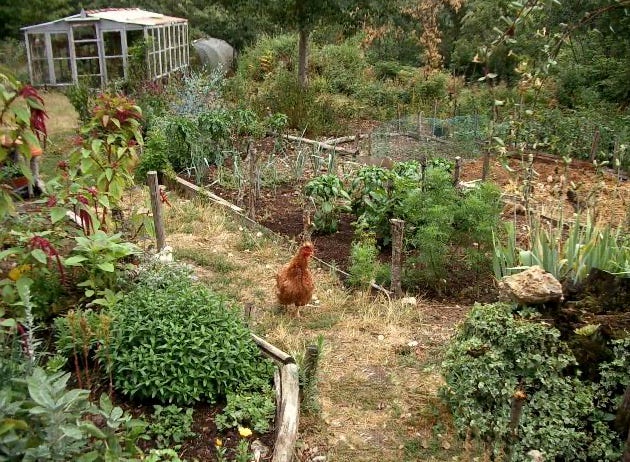
If I was to ask you, “What is organic gardening?” You might squint a little, and say something along the lines of, “Well, organic gardeners don’t use chemicals in the garden”. That wouldn't be correct. After all, water is a chemical, and all gardeners probably use water. And, there are chemicals used in organic gardening, including manufactured fertilizers that are OMRI certified as organic. OMRI - the Organic Materials Review Institute - is a nonprofit organization that provides an independent review of products, such as fertilizers, pest controls, livestock health care products, and numerous other inputs that are intended for use in certified organic production and processing.Pondering the question, “What is Organic Gardening?”, is interesting. If you go online and search for a definition of organic gardening, it runs the gamut.The University of Massachusetts, for one, says even among those claiming to be organic gardeners, it differs as to exactly what constitutes organic gardening.“In general, organic gardening differs from traditional gardening in two important ways, use of agricultural chemicals and use of artificial or processed fertilizers.”However, they don't say exactly what “agricultural chemicals” are.Then, UC Davis’ Sustainable Agriculture Research and Education Program states, “Organic agriculture is the practice of growing, raising, or processing goods using methods that avoid the use of most synthetic pesticides and fertilizers, as well as bioengineering, ionizing radiation, and sewage sludge.”Alright, now we're starting to narrow down the definition of “organic gardening”.The University of Georgia says that a generally accepted definition of organic gardening is: “The use of cultural practices to improve soil and plant health in order to reduce plant problems without the use of synthetic fertilizers and pesticides.”This is becoming very interesting.So we turn to the Royal Horticultural Society in jolly old England, and they say: “Organic gardening is commonly used to describe cultivation systems which make minimal use of manufactured chemical substances. These are practical elements of a broader philosophy which takes a holistic view of gardening, emphasizing the interdependence of life forms.” That “broader philosophy” may include the tenets of permaculture.And then we have the thoughts of a man we had as a guest about a month ago. IHeart was there discussing phosphorus, a soil macronutrient, and some of the possible dangers or cautions one should employ if using phosphorus fertilizers.It was garden book author, Robert Kourik. And I wondered about the manufacturing of phosphorus.I asked him, “Is the process that makes phosphorus fertilizers, in your estimation, not organic, even though phosphorus fertilizer is considered organic?”And he said, “I like to think of it as considering a cradle-to-grave review of organics.”Well, that needed some expansion.So back for his expansion time is Robert Kourik, author of the book, Sustainable Food Gardens as well as many other garden books.“The way I define organic gardening is what I call a full-cycle ecosystem,” says Kourik. “In other words, using as few external inputs as possible, while harvesting as much as possible. If you have an organic garden and you truck everything in from five miles away, and you buy bone meal, and you buy blood meal, and you buy phosphate fertilizers and more, you have a tremendous amount of inputs coming from near or far. That doesn’t reflect what would naturally happen if you weren't bringing in that nutrition and those other products. I’m trying to keep it as a closed loop as much as possible. So when I talk about ‘cradle to grave”, let's look at what it costs to produce these inputs, how they’re produced, what it takes to truck them around, as well as what do you get out of it, and what are the alternatives that you could use in your own garden, instead.”Listen to the podcast (above) about how you can transition to a more self-sustaining organic garden. Perhaps it won’t be a fully self-sufficient ecosystem, but you will have lessened your carbon footprint, if you’re a big-picture kind of person. Perhaps closer to your own reality, you will have saved some money, one cover crop or mulch pile, at a time.Thanks for reading Beyond Basics: The Garden Basics with Farmer Fred Newsletter! Subscribe for free to receive new posts and support my work.Thank you for also listening to the Garden Basics with Farmer Fred podcast! It’s available wherever you get your podcasts. Please share it with your garden friends.Fred Hoffman is also a University of California Cooperative Extension Master Gardener in Sacramento County. And he likes to ride his bike(s). This is a public episode. If you'd like to discuss this with other subscribers or get access to bonus episodes, visit gardenbasics.substack.com/subscribe
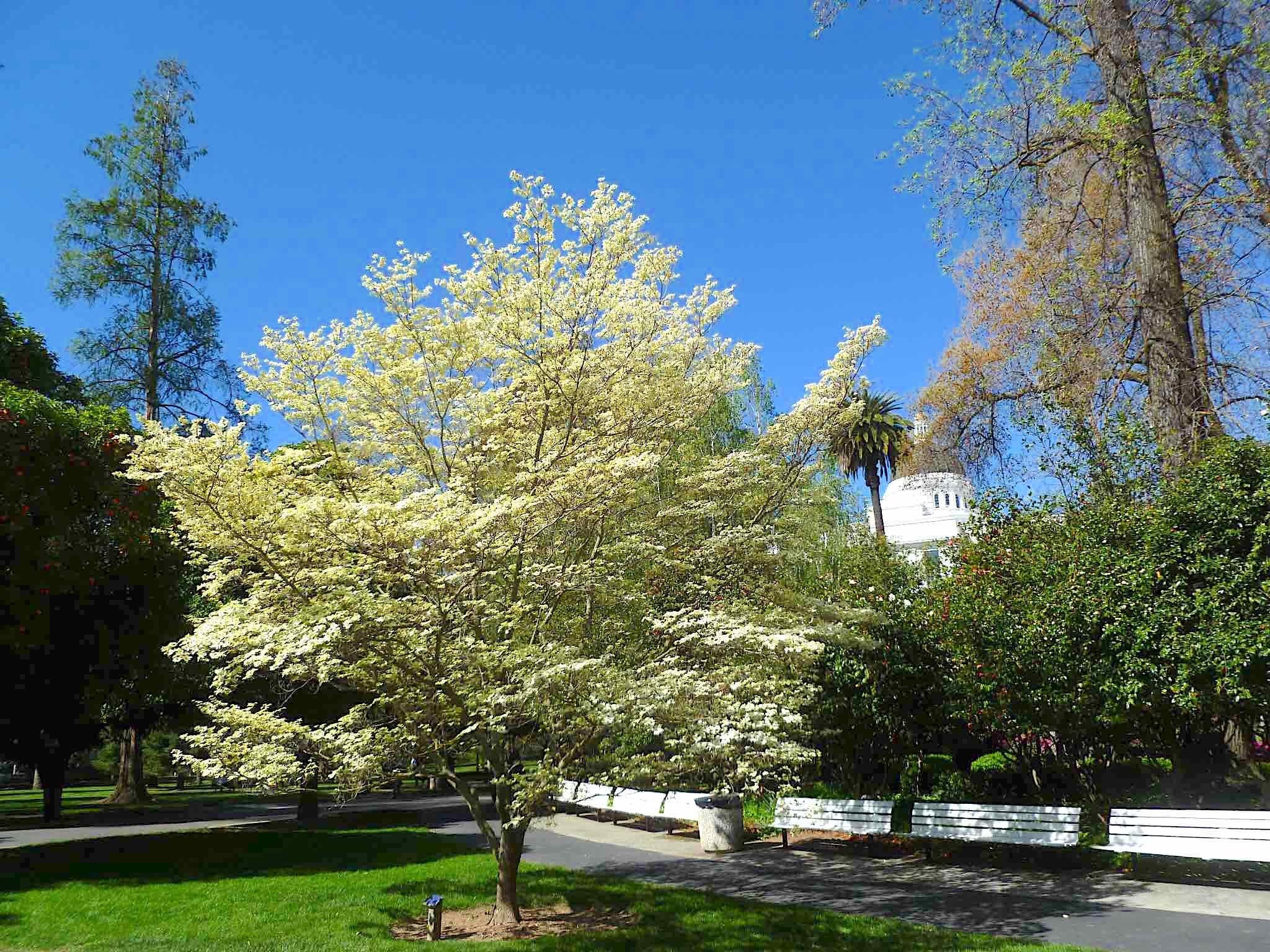
What's Stressing Your Dogwood Tree? It Could Be You.
A dogwood tree is easy to love: flowers in the spring, beautiful orange/pink/red fall leaf color; a small to medium height tree, perfect for a patio area.The University of Florida lists the dogwood tree’s strengths and weaknesses:“The state tree of Virginia, the flowering dogwood grows 20 to 30 feet tall and spreads 25 to 30 feet. It can be trained with one central trunk or as a picturesque multi-trunked tree. The flowers consist of four bracts which subtend the small head of yellow flowers. The bracts may be pink or red depending on cultivar but the species color is white. The fall color depends on site and seed source but on most sun grown plants will be red to maroon. The bright red fruits are often eaten by birds. Fall color is more vivid in USDA hardiness zones 5 to 8a. Branches on the lower half of the crown grow horizontally, those in the upper half are more upright. In time, this can lend a strikingly horizontal impact to the landscape, particularly if some branches are thinned to open up the crown. Lower branches left on the trunk will droop to the ground, creating a wonderful landscape feature.“The tree is not suited for parking lot planting but can be grown in a wide street median, if provided with less than full-day sun and irrigation. Dogwood is a standard tree in many gardens where it is used by the patio for light shade, in the shrub border to add spring and fall color or as a specimen in the lawn or groundcover bed. It can be grown in sun or shade but shaded trees will be less dense, grow more quickly and taller, have poor fall color, and less flowers. Trees prefer part shade (preferably in the afternoon) in the southern end of its range. Many nurseries grow the trees in full sun, but they are irrigated regularly. Flowering dogwood prefers a deep, rich, well-drained, sandy, or clay soil and has a moderately long life. It is not recommended in the New Orleans area and other heavy, wet soils unless it is grown on a raised bed to keep roots on the dry side. The roots will rot in soils without adequate drainage.Several of the cultivars listed are not readily available. Pink-flowering cultivars grow poorly in USDA hardiness zones 8 and 9. 'Apple Blossom'—pink bracts; 'Cherokee Chief'—red bracts; 'Cherokee Princess'—white bracts; 'Cloud 9'—white bracts, many blooms, flowers at early age; 'Fastigiata'—upright growth while young, spreading with age; 'First Lady'—leaves variegated with yellow turning red and maroon in the fall; 'Gigantea'—bracts 6-inches from tip of one bract to tip of opposite bract; 'Magnifica'—bracts rounded, 4-inch diameter pairs of bracts; 'Multibracteata'—double flowers; 'New Hampshire'—flower buds cold hardy; 'Pendula'—weeping or drooping branches; 'Plena'—double flowers; var. rubra—pink bracts; 'Spring Song'—bracts rose red; 'Springtime'—bracts white, large, blooms at an early age; 'Sunset'—supposedly resistant to anthracnose; 'Sweetwater Red'—bracts red; 'Weaver's White'—large white flowers, adapted to the south; 'Welchii'—leaves variegated with yellow and red; 'White Cloud'—flowers more numerous, bracts white; 'Xanthocarpa'—fruit yellow.“Aphids may be controlled by spraying them with a strong stream of water from the garden hose.Several borers will attack dogwood. Try to keep the trees healthy with regular fertilization, and irrigation during dry weather. Indications of borer problems are holes in the trunk, leaves smaller than normal, and dieback of the crown.Dogwood club gall midge causes galls at the branch tips. The leaves on affected branch tips may be distorted and the branch may fail to form a flower bud. Prune out the galls as soon as they are seen.Leaf miners cause brown blister-like mines on the undersides of leaves. The adult leaf miner skeletonizes the leaves.Scales can build up to large numbers before being detected. Horticultural oil will help control overwintering stages.Twig girdlers prune the tips of small branches. They are more of an annoyance than a serious problem unless you are a nursery operator.“Dogwood anthracnose may be the biggest concern with growing flowering dogwood. Infection is favored by cool, wet spring or fall weather. Drought and stressed trees appear to be most affected, as are those at higher elevations. Trees on the coastal plain may be much less likely to become affected. Consecutive years of infection can kill trees. Keep the tree healthy with regular irrigation in dry weather but avoid overhead irrigation. Plant the tree in an area which allows the leaves to stay as dry as possible. Consult a local pathologist for the latest in control measures. Cornus kousa is thought to be resistant to anthracnose and it can be planted in areas where anthracnose is a problem. It is a very beautiful tree.Early symptoms of dogwood canker are smaller and paler leaves than normal. Leaves on infected branches are red earlier in the fall. At first the symptoms appear only on the infected side of the tree but become more general as the canker enlarges. T
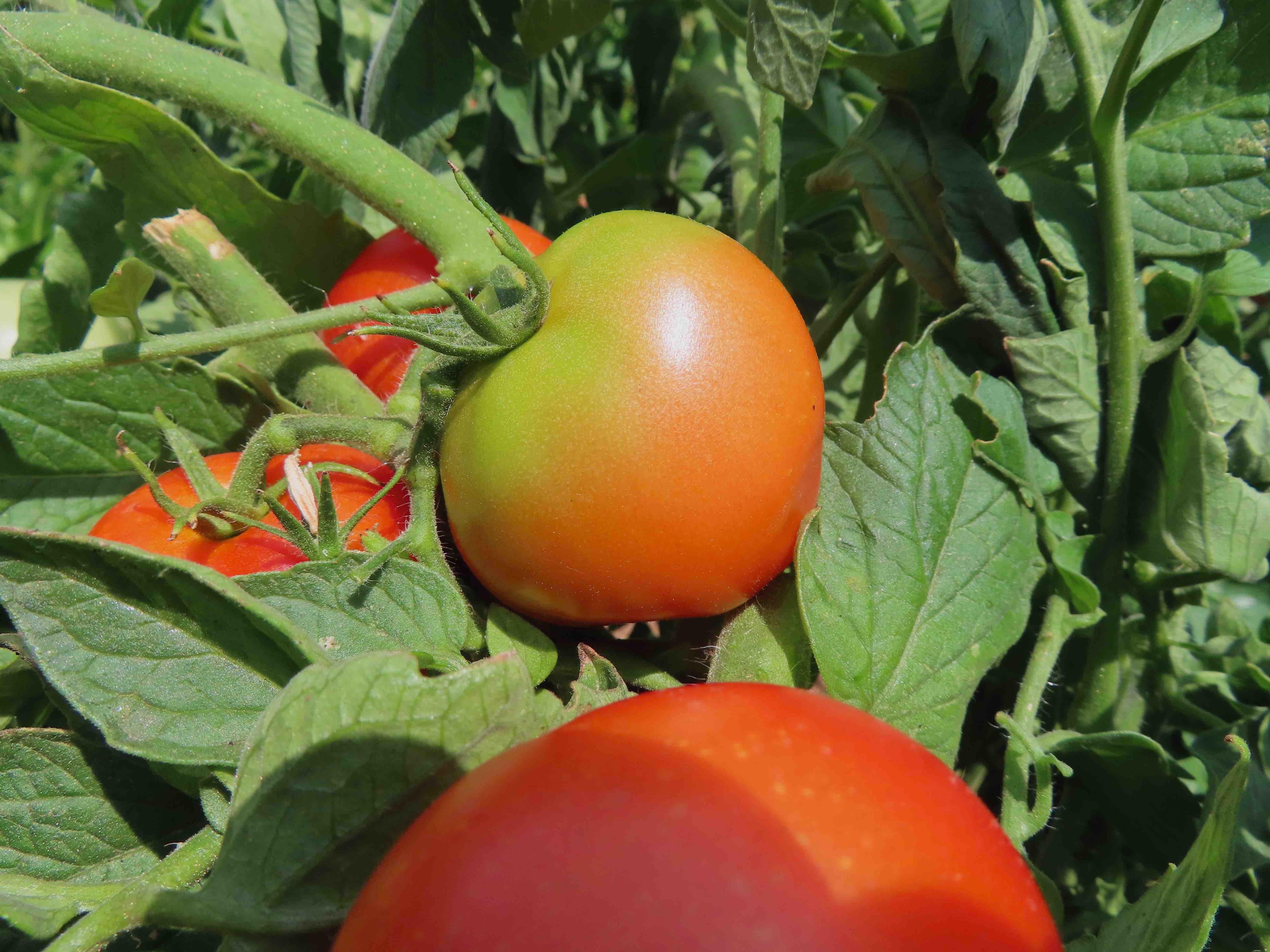
Tomatoes Not Ripening? Blame the Heat.
Back in July, we discussed “Six Common Tomato Problems.” Among those maladies were abiotic disorders (problems that are caused by factors such as weather, soils, chemicals, mechanical injuries, or cultural practices; and, not caused by insects or disease). Tomato abiotic disorders include blossom end rot, fruit cracking, leaf rolling, solar yellowing, sunburn, and tomato flower drop…all related to weather or watering issues. In that column, I mentioned we would tackle an annual tomato-related issue, tomato worms, in a future edition. Well, here it is, in the podcast, above. America’s Favorite Retired College Horticulture Professor, Debbie Flower, waxes rhapsodic about the three “worms” (caterpillars, really) that can damage your tomato plants: Tomato/Tobacco hornworm, tomato fruit worm, and tomato pinworm, along with the moths that laid those eggs. She reassures us that nature has supplied us with plenty of “good guys” to help control these munchers and burrowers. Links that are listed in the notes for that podcast include: descriptions of tomato hornworm, fruit worm, and pinworm; and two posts from the Farmer Fred Rant blog, “Plants that Attract Beneficial Insects”; and, “The Good Bug Hotel”.Today’s Beyond the Garden Basics newsletter tackles another abiotic disorder: tomatoes that are slow to ripen because of heat spikes this summer. And who hasn’t suffered through that this year? (Put your hand down, San Francisco.)Why Are My Tomatoes Slow to Ripen?From the garden e-mail bag, Vinnie asks: “My tomatoes are very slow to turn from orange to red, and several have yellowing as my bushes are not as leafy as I would like. They also are rather firm, though the plants have done well up to this point, with a decent amount of fruit as well as setting new tomatoes higher up on the plant. My “Sweet Million” cherry tomatoes also are having difficulty turning red, the same with the “Early Girl” and “Champion” full-size tomatoes. I planted the tomatoes in mid-April. They only get about six to eight hours of direct sun, depending on the season. But it seems I’ve had tomatoes for weeks at the same state of not turning fully red in color, so I was a little curious and disappointed in that. The plants are healthy, but not very bushy.”You are not alone, Vinnie. Many area gardeners are wondering about the lack of color of their tomatoes now, in late summer. Blame the triple-digit heat spikes that have occurred coast to coast for the slowdown this summer.Researchers from across the country have studied the effect of excess heat on ripening tomatoes. Their consensus: don’t worry, be happy. Those tomatoes will still be edible. And if you want to speed up the ripening process, harvest those tomatoes that are beginning to show color before the next forecast triple digit heatwave hits. Let them ripen indoors, in a dark place on the kitchen counter.However, too much shade or lack of foliage on outdoor plants can also impede ripening tomatoes.The University of California’s Contra Costa County Master Gardeners Newsletter says: “A key resource that tomatoes need for ripening is plenty of leaf surface for photosynthesis. Often by late summer, some of the leaves on the tomato have started to dry up and wither and are no longer helping to nourish the plant. The plant is less vigorous than it was earlier in the season, so it takes longer for the green tomatoes to ripen. If you've run out of patience with slow ripening tomatoes, one thing you can do to speed up ripening is to remove some of the green tomatoes. Then the tomato plant can put all its energy into ripening the tomatoes that remain on the plant.“Soil temperatures are also important. For optimal growth, tomatoes need soil temperatures that are less than 80 degrees. Hot air temperatures raise the soil temperature. Containers may be particularly vulnerable to soil temperature rise if they sit in the hot afternoon sun. Mulching can help keep soil temperatures lower. Also, if your tomatoes are hit by afternoon sunshine, you might consider erecting some shade barriers to keep the sun off the containers.“If you've run out of patience with slow ripening tomatoes, one thing you can do to speed up ripening is to remove some of the green tomatoes. Then the tomato plant can put all its energy into ripening the tomatoes that remain on the plant. You can ripen the green tomatoes you remove on your kitchen counter. They won't be as yummy as the ones that ripen on the vine, but they're still better than store bought tomatoes.”As a final caution, don't be tempted to fertilize the tomato plant thinking it will speed up production. Fertilizing now will probably just cause the tomato to go into a vegetative growth mode that is too late in the season to be helpful.”Kansas State University chimes in: “Tomato color can also be affected by heat. When temperatures rise above 95 degrees, red pigments don’t form properly, though the orange and yellow pigments do. This results in orange fruit. It doesn’t af
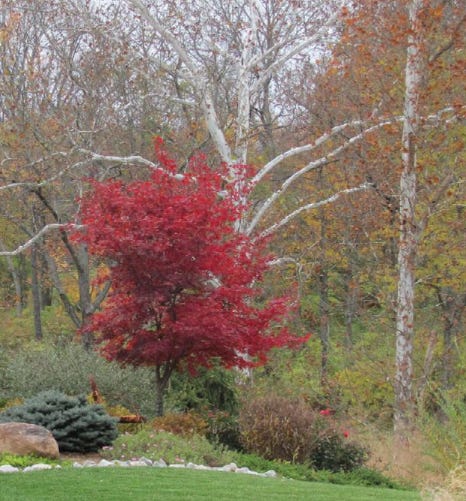
Japanese Maples vs. the Heat of Summer
If you own a Japanese maple tree, or pass by one on your daily strolls, check the leaves. Are they getting a little brown around the edges? Are the leaves beginning to fall off? Welcome to late August and early September, where the quadruple whammy of triple digit temperatures, hot dry winds, reflected heat from a nearby wall/concrete surface, or irregular watering can make many Japanese maples start to suffer. Note the location of those Japanese maple trees. Are they in full sun more than six or eight hours a day? Is it facing a direction where winds are common in the hot afternoon? Around here, it is primarily west and southwest winds.Although most Japanese maples prefer morning sun and afternoon shade, there are several varieties that can take the full sun.Chris Aycock of El Dorado Nursery and Gardens in Shingle Springs, CA has his favorite Japanese maples for sun or partial sun. “An old standard is the ‘Bloodgood’ Japanese maple,” says Aycock. “It gets about 20 feet tall and wide. If you want something smaller, ‘Fireglow’ is a nice 12 to 15 foot, upright growing variety. If you're looking for a lace-leaf Japanese maple, ‘Orangeola’ is one of my favorites. It's a very fast growing, cascading lace-leaf-style Japanese maple, with orange-red foliage. It’s very tough and very vigorous.” Hear more of Aycock’s comments and tips about Japanese maple trees in today’s newsletter podcast (above).Scott Paris of High Hand Nursery in Loomis, CA says he has found three Japanese maples for sunny areas in Northern California: ‘Seiryu’, ‘Pine Bark’, and ‘Tobiosho’.“The ‘Seiryu’ is amazing,” says Paris. “It is the only upright growing lace-leaf variety. With its beautiful red fall color, it is a showstopper. When stressed in the heat, it is very rare that it flags. Instead, it gets a cinnamon hue.”Paris is also high on the ‘Pine Bark’ Japanese maple. “This has cool-looking leaves, and the bark resembles a pine tree, with stunning red fall color.”One of Paris’ most consistent performers among Japanese maple trees is the ‘Tobiosho’. “It’s a basic green maple in the summer,” Paris explains. “People usually cruise by it and yawn. But no, this maple is a consistent grower with outstanding fall color.”That’s good information if planting a Japanese maple is on your fall to-do list. But for those with suffering Japanese maples right now, here are some do’s and don’ts.• If the leaves on the Japanese maple tree are browning, fight the urge to pull them off. Those browning leaves, while hanging on the tree, can help the tree avoid sunburn to the branches and trunks.• Be careful with watering. Check the soil moisture at a depth of eight or 10 inches before you irrigate. Japanese maples need regular watering, but too much standing water can lead to soil-borne diseases in the root area.• Remove any lawn beneath the tree that is competing for the water. Because turf roots are shallower, they will get first dibs on any water from sprinklers or drip irrigation systems.• Add mulch beneath the tree to help preserve a more consistent soil moisture level. Arborist Anne Fenkner of Davey Tree Company suggests the “4-4-4” rule for mulching beneath trees: “Place wood chips that are four inches deep, starting four inches away from the trunk of the tree, and extend that mulch four feet out all around the tree.”• Aycock seconds that mulching motion, with an added tip: “Mulching is very critical, it helps keep the roots cool. Although we will recommend full sun for quite a few of the varieties, we will tell you to plant it away from the house so there's no reflective heat. You're better to have it out in the open rather than up against a hot wall.”• Don’t fertilize a suffering Japanese maple in the heat of the summer. The best season for a single application of fertilizer for Japanese maples, according to Paris, is spring. “Japanese maple trees are not greedy,” says Paris. “But maples resent quick-release ammonium sources of fertilizer. Apply in early spring and not more than once a year.” All-purpose, slow-release organic fertilizers, usually with nitrogen, phosphorus, and potassium content in the single digits, are widely available. Remember, too, that as the mulch layer around your Japanese maple tree breaks down, it is feeding the soil, too.Thanks for reading Beyond Basics: The Garden Basics with Farmer Fred Newsletter! Subscribe for free to receive new posts and support my work.Thank you for also listening to the Garden Basics with Farmer Fred podcast! It’s available wherever you get your podcasts, including our home page, GardenBasics.net . Please share it with your gardening friends.Fred Hoffman is also a University of California Cooperative Extension Master Gardener in Sacramento County. And he likes to ride his bike(s). This is a public episode. If you'd like to discuss this with other subscribers or get access to bonus episodes, visit gardenbasics.substack.com/subscribe
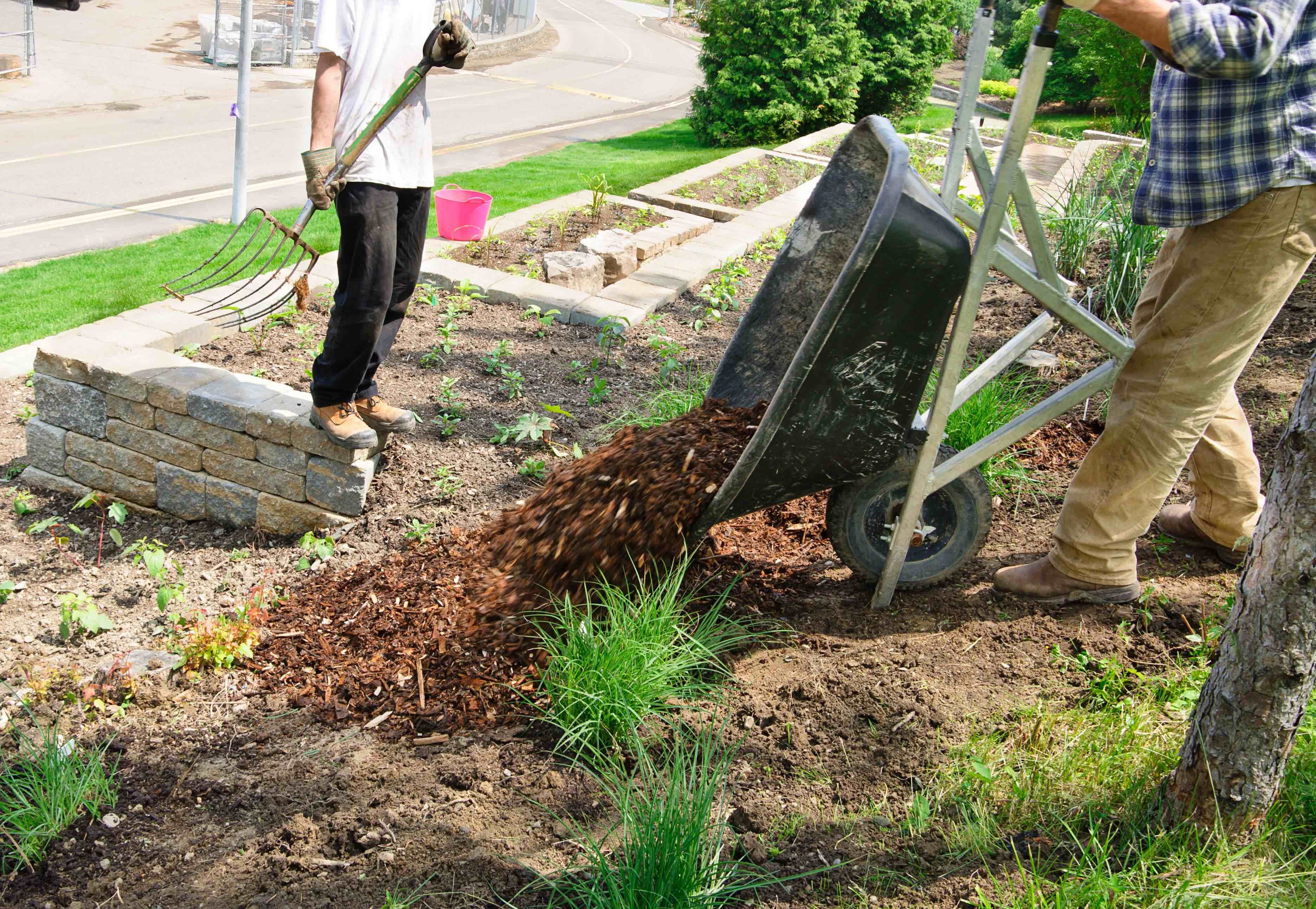
More Hot Weather Garden Tips
In today’s Beyond the Garden Basics Newsletter podcast (above), Debbie Flower and I tackle a question from Liz, who asks: “I just purchased from the local nursery, a lavender plant and also a sage. I'm sorry, I don't know the exact name. But they're common. The plants were in pots. Each plant is about one foot tall. I already planted them in the yard early yesterday morning. They were fine all day yesterday. Everything was moist, the soil was prepped. Today is 100 degree weather. They are not looking like they're happy campers. So I'm wondering about these drought tolerant plants. I don't want to overwater them. Is this wilting natural, or should I be doing something else?”We have tips for Liz. Tip #1:Heat Protection for Your PlantsBursts of triple-digit temperatures are occurring across the United States this summer, lasting anywhere from a couple of days in a row, to weeks on end (hello, Phoenix!). However, even for short periods, the combination of too much bright sun, too much heat and not enough water are enough to vex the garden as well as the most experienced gardeners when they encounter sickly-looking plants this time of year.First of all, take care of yourself in the heat. Work early in the morning in the sunny areas, work in the shade in late mornings, then wrap things up for the day (if possible). Wear sun protection and take plenty of water breaks. According to the garden experts at the University of California’s Agriculture and Natural Resources Division, here are four quick and easy ways to help make sure your perennials, shrubs and trees not only survive, but also thrive in the summer heat.• Add mulch, mulch, and more mulch. When temperatures get extreme, having a good layer of mulch prevents soil from heating up excessively and losing water to evaporation. Apply four inches of a medium shredded bark mulch to insulate the soil. This protects the fine roots that plants use to feed from the surrounding soil. Mulch also helps maintain healthy soil ecology with earthworms and other de-composers that promote nutrients and oxygen in soil. Mulch will pay for itself by maintaining more consistent soil moisture so you can water less and have better success with your plants. Be sure to maintain the depth of your mulch to ensure you can benefit from all the services it provides.• Don't fertilize permanent plants during hot summer months. When a fertilizer is applied, especially one that is high in nitrogen, a plant is triggered to produce more green growth. An increase in growth means an increase in water and nutrient needs. During hot spells, it is especially hard to keep up with plant water and nutrient needs as soils dry out quickly and water may not be readily available. Save your plants from stress by stopping fertilizer application when triple digit temperatures are forecast. However, warm season annuals should continue to be fertilized.• Water trees deeply and less frequently. “When watering trees you want to consider the roots below the tree and you want to encourage a network of deep roots. If you are only watering for short periods at a higher frequency, the roots will remain shallow since that is where the tree finds its water supply,” said Janet Hartin, UC ANR environmental horticulture advisor. “Deep roots mean a healthier tree that is less susceptible to disease.”In general, young plants or new transplants require more water than older, more established plants. Clay soils absorb water slowly so watering can take longer but is typically done less frequently. This is a contrast to sandy soils that moisten and drain quickly. Typically, watering sandy soils is done more frequently.• Wait to introduce new shrubs or trees until the fall when the weather is cooler. Because root systems on new plants are smaller and need time to develop, these plants require more water, more frequently. New plants introduced into a landscape during hot summer months have a significantly higher rate of failure. On the other hand, plants will take root more easily when air temperatures are in the 70’s, yet soil temperatures are still warm. Container Plants vs Heat? Smart Pots is a WinnerAnother tip (self-serving, but true, based on personal experience): Keep the soil from overheating in container plants located in full sun by growing them in Smart Pots, whose porous, yet sturdy fabric structure allows the soil to remain as much as 30 degrees cooler than plants grown in plastic pots; 10-15 degrees cooler than plants grown in fiber or terracotta pots.This is why we like say, “Fall is for gardening!”For more hot weather gardening tips, check out the July 21st edition of this newsletter.Thank you for also listening to the Garden Basics with Farmer Fred podcast! It’s available wherever you get your podcasts. Please share it with your garden friends.Fred Hoffman is also a University of California Cooperative Extension Master Gardener in Sacramento County. And he likes to ride his bike(s). This is a public episode. If you
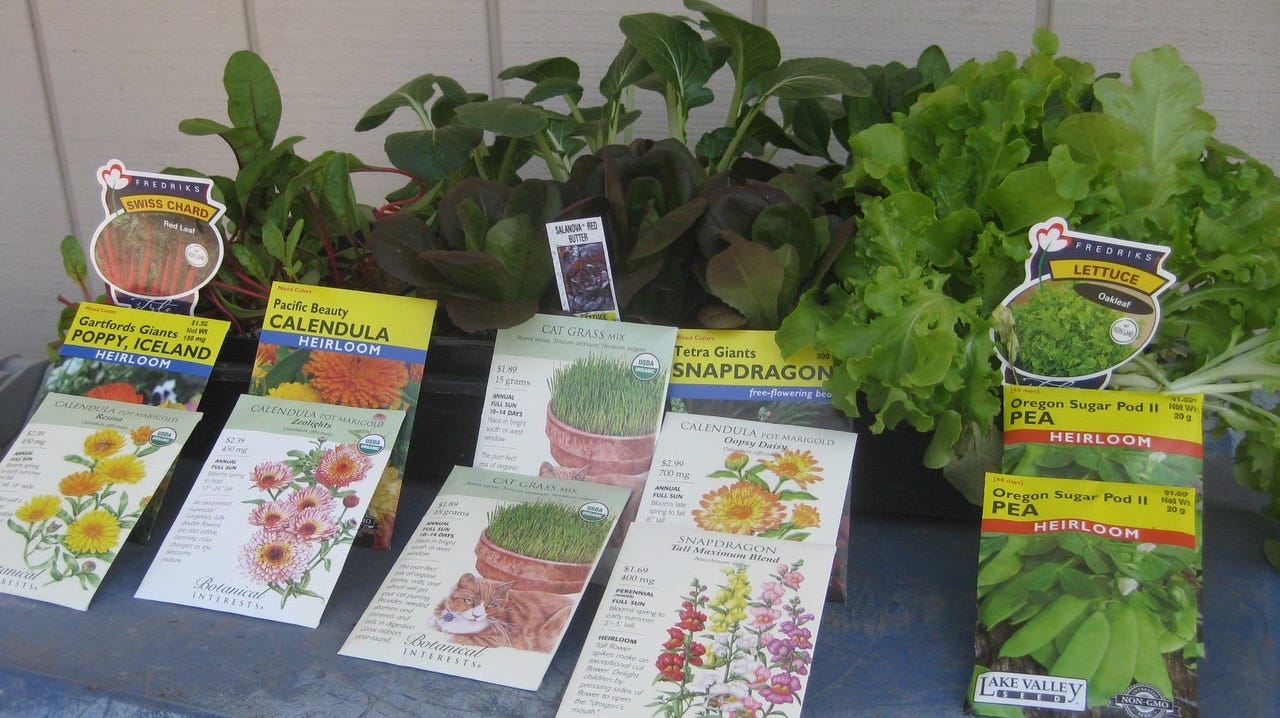
Late Summer is the Time to Start the Fall Vegetable Garden
In today’s newsletter podcast (above), Don Shor of Redwood Barn Nursery in Davis explains why now is the best time to be planting your vegetables for autumn and winter (in milder areas of the country). For those of you who live in the West, the South, parts of the Midwest and mid-Atlantic states, (USDA Zones 7, 8, and 9) we get down to specifics in this audio episode on the best varieties of vegetables to grow during the cooler months of fall and winter: lettuce, spinach, Swiss chard, cabbage, Chinese cabbage, cilantro, broccoli, cauliflower, beets, snow peas, fava beans, carrots, celery, onions, garlic, parsnips, shallots and turnips.We’ll tell you about some tasty, easy to grow varieties that maybe you’ve never eaten, such as pak choi, black seeded simpson lettuce, Danvers half long carrots, and Romanesco broccoli. What’s that? Give a listen. Fall Vegetable Gardening BasicsDo you want your family to eat healthy year-round? The healthiest, freshest foods are the fruits and vegetables you grow yourself. And in many areas of the West and South, the 365-day vegetable garden is easy to achieve. And now, late summer (August and September), is the time to be planting the seeds and transplants for the vegetables your family will enjoy throughout the fall, winter and following spring.Although we are still in mid-summer, this is the time to start your winter vegetable garden here in Northern California, as well as other mild-winter areas around the state and the nation. Most of this planting can be done during the milder months of September and October (along with mid-August for some winter crops). For specific crop planting times for the various areas of California, refer to the UC Master Gardening Vegetable Planting webpage.Designing Your Cool Season Garden BedThe winter garden bed should have many of the same characteristics as the summer garden: a sunny and level location close to the house;a convenient water source; and, soil that drains easily. Because of possible heavy rains in winter, raised beds can solve that drainage problem for homeowners living with clay soil. Mix in other soil amendments, such as compost and manure, to improve crop production in the foggy, wet, cold days that await. For foothill gardeners, a raised bed with wooden sides has an added benefit. Those structures can support a hinged, translucent top, such as glass, polyethelene or fiberglass…an instant cold frame to protect winter vegetables from low temperatures or heavy wind and rain. Starting vegetables in the heat of the summer, especially from seed, requires a consistently moist seedbed until the plants are up and growing. An automatic garden watering system, such as a battery operated timer that attaches to a faucet, can ease that process. Cool Season Vegetable Varieties Here are some of the winter vegetable varieties that do well in Northern California, how much room to leave between the plants in each row, and how much to plant for a family of four (with moderate appetites):Artichokes: A bit of a challenge in the interior valleys. Easy to grow in coastal areas. Plant from roots, not seed. Green Globe; 4 feet apart; 5-10 plants.Broccoli: Green Goliath, Green Duke, Waltham 29; 10 inches apart; 20 foot row.Brussels sprouts: Jade Cross Hybrid; 24 inches apart; 20 foot row.Cabbage: Earliana, Copenhagen Market, Savoy King, Burpee Hybrid; 24 inches apart;15 plants. Cauliflower: Snowcrown, Snowball Y, Purple Head; 24 inches apart; 15 plants.Carrots: Nantes or Danvers half long, Short n' Sweet; 2 inches apart; 25 footrow.Chinese cabbage: Michili, Pak Choi; 6 inches apart; 10 foot row.Garlic: California Late, California Early, Elephant Garlic; 6 inches apart; 20 foot row.Kale: Dwarf Blue Curled Vates, Dwarf Curled Scotch; 10 inches apart; 12 plants.Kohlrabi: Early White Vienna, Sweet Vienna; 3 inches apart; 10 foot row.Loose leaf lettuce: Ruby, Bibb, Salad Bowl, Green Ice; 6 inches apart; 15 foot row.Peas: Mammoth Melting Sugar, Sugar Ann, Sugar Snap. 2 inches apart; 5 foot row.Onions: Stockton Red, Stockton Yellow, Walla Walla, Texas White; 4 inches apart; 20 foot row.Radish: Champion, Watermelon, Crimson Giant, Cherry Belle; 5 inches apart; 20 foot row.Rutabaga: Victoria, Valentine, Strawberry; 3 inches apart; 15 foot row.Spinach: Melody Hybrid, America, Bloomsdale Long Standing; 6 inches apart; 15 foot row.Turnips: Purple Top White Globe, Shogoin (greens); 2 inches apart; 10 foot row.Perennial Vegetables that need a lot of room:Asparagus: Mary Washington, UC72, UC157, 500w; 12 inches apart; 20 foot row.Rhubarb: Victoria, German Wine, Crimson Cherry; 2 feet apart ; 20 foot row.“It’s the Best Garden Event in Northern California!” (I said that)Harvest Day at the Fair Oaks Horticulture Center Saturday, August 5, 8am-2pm. Free!Debbie Flower and I will be talking about “Garden Tips to Save Time, Money and Water” at Harvest Day at 830 am. The Fair Oaks Horticulture Center is located at 11549 Fair Oaks Blvd, in Fair Oaks Park, Sacramento County,
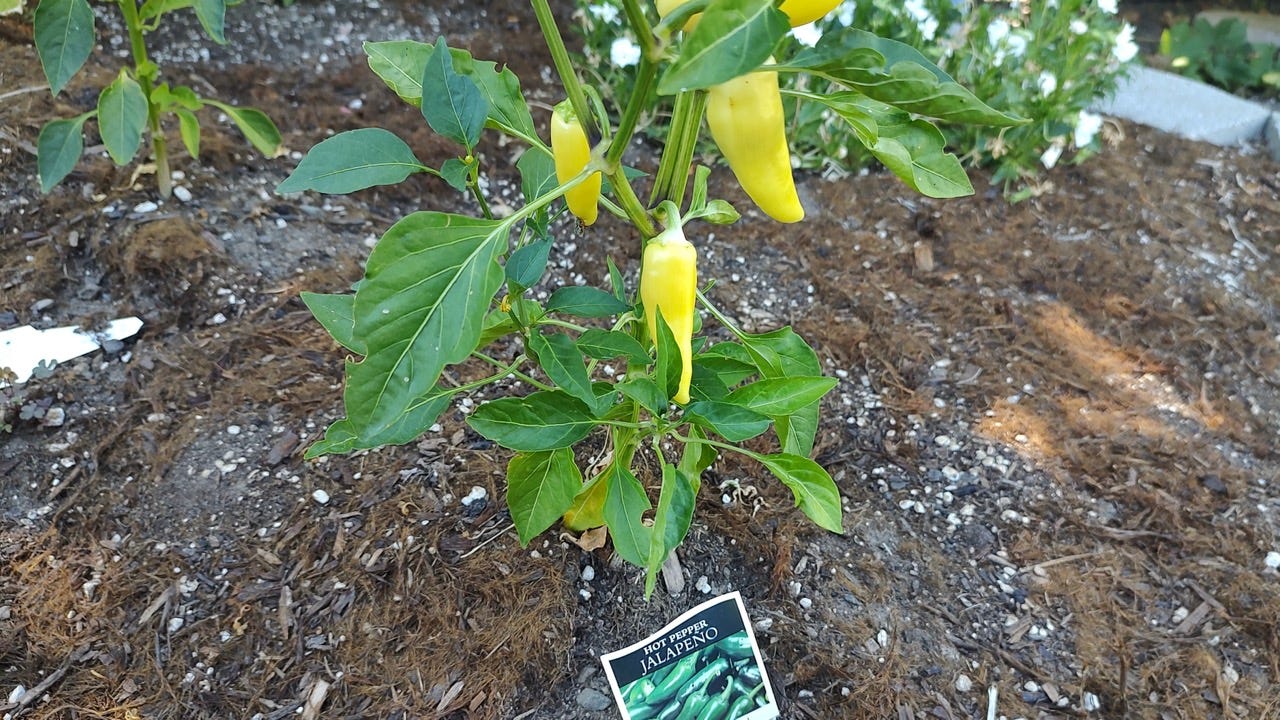
Jalapenogate
In today’s newsletter podcast, Debbie Arrington of the publication, “Sacramento Digs Gardening”, discusses why jalapeño pepper as well as other pepper seeds and plants may have been mismarked this year. Read her original story on the topic here.Did you ever grow a plant that wasn’t what you thought it would be, due to a mismarked tag or a seed packet that was incorrectly packed? It happens every year, with varieties of annual or perennial ornamentals that do not produce the exact color flower that was promised, or a vegetable variety that looks and tastes slightly different. Or, it could be the home gardener who saves seeds and grows them out in the following years. In that case, “home operator error” could be to blame, due to a mixup while sorting personal collections of harvested seeds, or attempting to save certain hybrid seeds that have a high probability of producing something different in the subsequent growing seasons. Or, it could have resulted from a surprise in the mail after placing a seed order, especially in a marketplace such as Amazon, Etsy or another vendor that you know very little about.A few years ago, I was on the hunt for a particular gaillardia, also known as blanketflower. The particular variety I was searching for was “Arizona Apricot”. This red-yellow colorful perennial (or annual, in colder climates) puts on its best show of daisy-like flowers in the summer.I finally found a source for this particular seed via Amazon. Imagine my surprise when the seed arrived, in a nondescript small plastic bag, labeled “Gaillardia seed from Qatar.” Qatar? What the heck, let’s try it. When it blossomed the next summer, it was not “Arizona Apricot.” Oh well, an inexpensive mistake on my part, shopping in a lightly regulated, on-line marketplace.But imagine this scenario playing out on a much larger scale: an American seed distributor who purchases seeds overseas for their clients here, which include home gardeners, wholesale and retail nurseries, as well as farmers growing particular varieties for restaurants and canneries. That is the current situation in the world of Jalapeño peppers - as well as a myriad of other vegetable and ornamental seeds - where seeds grown overseas (in this case, some suspect China) were mixed up before shipment. And it’s only after the plants grown from those seeds started fruiting that the alarm bells went off.Right now, there appears to be five mislabeled pepper plants - hot as well as sweet - that have ticked off home gardeners in 14 states (or more, by now) and sent larger shockwaves among those in the business of buying, selling and growing those pepper seeds. John Porter is a University of Nebraska Cooperative Extension Urban Agriculture specialist who wrote about this brouhaha from a Midwest perspective for the Garden Professors website. His research brought out this information:Getting a sweet banana pepper instead of a Jalapeño ‘Tam’, for the home gardener, is a disappointment. But for the home gardener growing sweet bell peppers, to have a “Purple Beauty” pepper turn out to be a Hungarian Hot Wax pepper could instigate a mad dash to the kitchen for a glass of burn-soothing whole milk (Pro tip: whole milk or ice cream douses the heat after eating a too-hot pepper; drinking water spreads the heat). But, then again, a gardener with any sort of wariness to hot peppers should not be taste-testing an elongated yellow pepper when they were expecting a blocky purple bell pepper.For your future reference at pepper tasting parties:It’s a Small World, After AllAs you might imagine, American growers are concerned about the future for seed mixups. Was this a one-off event, or will we see more of this in the years ahead? Michael Fiore of Smith’s Gardentown nursery in Wichita Falls, Texas is worried, and has some practical advice: save your own seed. Seed Security: It’s a Real Problem in ChinaThe Wall Street Journal, in a July 24, 2023 story, brought up an interesting angle to JalapeñoGate, without mentioning it: Corruption in the Chinese Seed Trading Business. The article states:“(Chinese) Officials say the goal is to stop the proliferation of fake and substandard seeds that could jeopardize food production and safety, while punishing officials, merchants and farmers who siphon agricultural subsidies and peddle low-grade seeds.The Farmers’ Daily newspaper cited a case where a seed company paid more than 80 local officials to sell substandard seeds across nearly 30 villages in the southwestern province of Sichuan, causing ‘severe losses for farmers’ who found that the seeds germinated at a rate far below state benchmarks.”Bottom Line: Learn the basics about seed saving.“It’s the Best Garden Event in Northern California!” (I said that)Harvest Day at the Fair Oaks Horticulture Center Saturday, August 5, 8am-2pm. Free!Debbie Flower and I will be talking about “Garden Tips to Save Time, Money and Water” at Harvest Day at 830 am. The Fair Oaks Horticulture Center is located at 1154
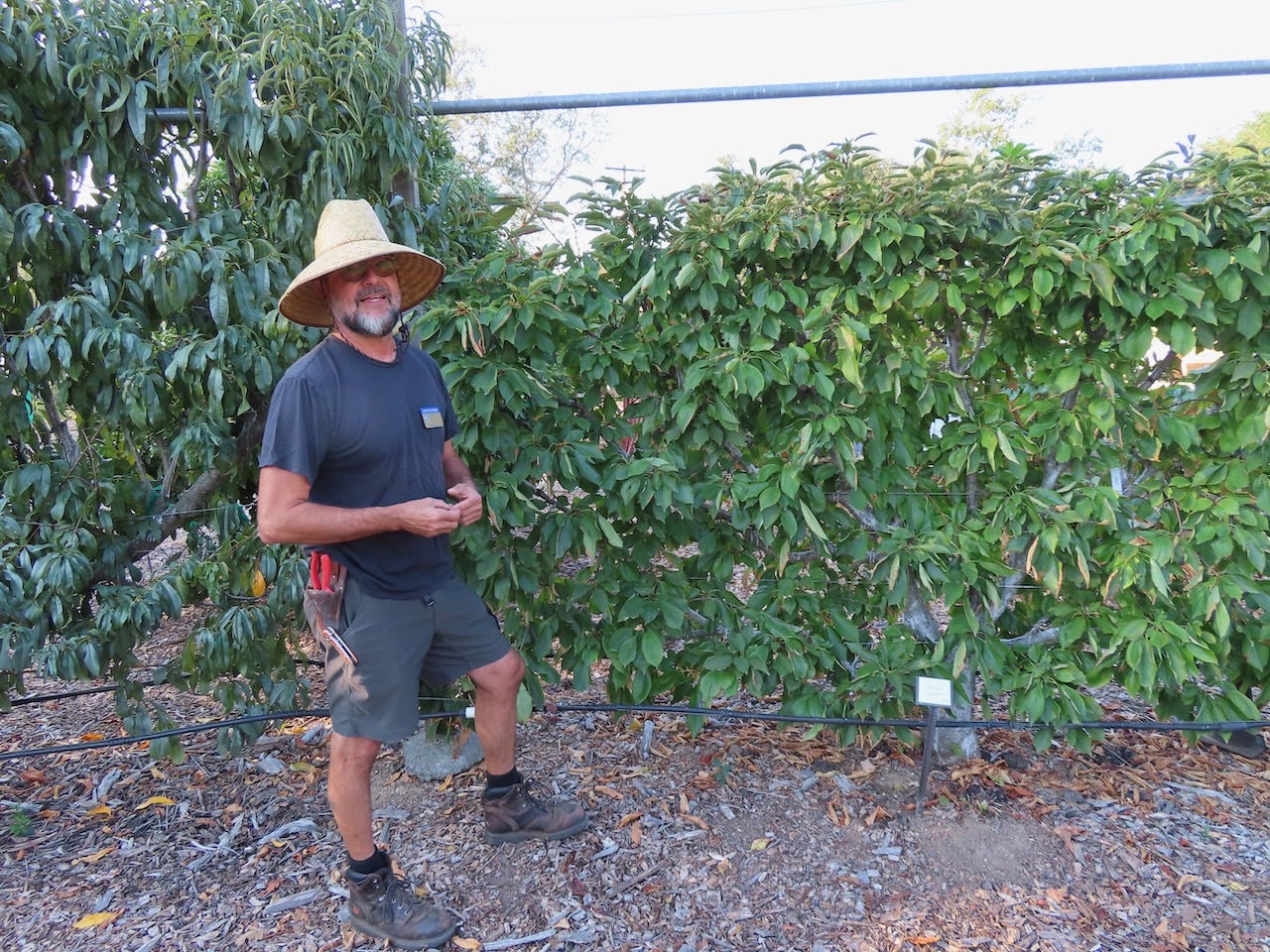
Drooping Leaves vs Heatwaves
Record-breaking heat waves have pummeled the world, especially during the last two years. What’s a gardener to do?In today’s newsletter podcast (above), Master Gardener Quentyn Young walks us through the fruit tree orchard at the Fair Oaks Horticulture Center, discussing how a record heat wave adversely effected the trees and the fruit. Plus, he has tips for dealing with extended heat waves in the home orchard.Heatwaves vs. Drooping LeavesHere we go again. Another multi-day bout of triple digit temperatures hit us last weekend and beyond. I’m just guessing that SOMEWHERE in the northern hemisphere of planet Earth, this will be the case for the balance of the summer, possibly into early Fall. What should a gardener do if the plants in your outdoor vegetable and flower gardens start showing droopy leaves when the temperature tops 100 degrees? Or, as the National Weather Service warned, 110 degrees? There are two schools of thought about what you should do. One school says plants naturally conserve moisture on a hot afternoon by allowing their leaves to sag; wait until the morning before determining if the plant needs water. According to the University of Maryland: “Sometimes a plant wilts on a hot day because moisture is evaporating from the leaves faster than the roots can take it up. If there is ample soil moisture, the plant will absorb water in the evening to restore turgor to the stems and leaves.” They also point out that hot, drying winds can also cause temporary wilting even when soil moisture is adequate.The other school says: Don't believe that first school. "Large, thin leaves, common in many ornamental, annual and vegetable species, do not conserve water," writes Washington State University Horticulture Professor Linda Chalker-Scott. "Tomatoes, zucchini and black-eyed Susans...are not water conservers. Chronic wilting of these and others can eventually cause leaf tip and margin necrosis (or tissue death). It also reduces growth, so that your yield of tomatoes, zucchini and black-eyed Susan flowers will be decreased." She advises applying a layer of mulch around those plants to help conserve water.However, be forewarned: drooping leaves can also indicate a lack of oxygen in the soil due to too much standing water. Using a moisture meter, plunge it into the soil to a depth of eight to 12 inches. That can help determine whether the suffering plant might benefit from a drink of water or that there is too much water present in the soil. Check the moisture in the root zone before your usual watering, as well. Improper watering is the number one cause of plant failure.The U.C. Master Gardeners of Marin County offer some tips to relieve heat stress on plants during extreme weather events:• Water thoroughly in the morning on days when high temperatures are expected, to help plants cope with excess heat. If discovered in time during a heat wave, a drooping, wilted plant can often be revived with additional water. • Watch for radiant heat - Pay special attention to plants next to walkways, patios, and other structures that radiate heat. They may be the first to show signs of heat stress and the need for extra water.• Add mulch - Apply two to four inches of organic mulch over the root areas around garden plants, trees, and shrubs. This will lower soil temperature and diminish moisture loss.• Provide shade - Use shade cloth to provide direct sun protection and reduce the air temperature around sun and heat-exposed plants. • Avoid applying fertilizers during extreme heat as they stimulate growth and add to plant stress. Fertilizers also absorb moisture from the root zone.• Harvest ripening fruit to give plants a break during hot spells. Fruiting plants will drop flowers during periods of extreme heat to conserve energy. And a few more pieces of advice from the University of Maryland:• Severe heat and water stress when a plant is in bloom may cause scorching or browning of flower buds and blossoms.• Locate garden close to a water source. Be prepared to water all vegetable plants deeply at least once each week during hot, dry weather. • Conversely, vegetable plant roots growing in poorly drained soils can quickly become deprived of needed oxygen leading to wilting and yellowing and browning of leaves and stems. This will be most noticeable on tight, clayey soils during prolonged rainy periods and can lead to severe disease problems. Avoid poorly drained soils. Plant in raised beds if necessary. “It’s the Best Garden Event in Northern California!” (I said that)Harvest Day at the Fair Oaks Horticulture Center Saturday, August 5, 8am-2pm. Free!Debbie Flower and I will be talking about “Garden Tips to Save Time, Money and Water” at Harvest Day at 830 am. The Fair Oaks Horticulture Center is located at 11549 Fair Oaks Blvd, in Fair Oaks Park, Sacramento County, California. Hope to see you there! More details here. Presented by the U.C. Master Gardeners of Sacramento County.Thank you for also listening to the Garden Ba
Is Your Fertilizer Radioactive?
Phosphorus, in the world of plant fertilizers, is considered a macronutrient, an important element used by plants. Phosphorus is used to promote root and tuber growth, as well as the production of flowers and seeds. But, do you really need to add it every time you fertilize? And why have 13 states - as well as several municipalities - placed restrictions on the use of phosphorus?Phosphorus is the “P” in “N-P-K”, the percentage of macronutrients found listed on the front of a container of fertilizer. But how much phosphorus do your plants need for sufficient growth?Apparently, not as much as Calcium or Magnesium, according to this chart presented as evidence by the University of Wisconsin. Should phosphorus be getting as much credit as Nitrogen or Potassium, every time you look at a bag of fertilizer? Garden author Robert Kourik (“Sustainable Food Gardens”) points out that not only is Phosphorus over applied by gardeners, it may not be organic, and it is certainly detrimental to the health of aquatic life when it is allowed to runoff into local streams. And speaking of detrimental, in today’s newsletter podcast (above), Kourik talks about the time he took a bag of phosphorus fertilizer to the local radiation analyst. Things started clicking! He has video, too:According to the Chicago Botanic Garden, when too much phosphorus is applied or is applied at the wrong time—such as right before it rains—most of it is washed away and ends up in the local waterways. This type of pollution is called nonpoint source pollution. It causes eutrophication (a reduction of dissolved oxygen in water bodies caused by an increase of minerals and organic nutrients) of rivers and lakes. This reduced level of oxygen in water ends up suffocating fish. Several municipalities have banned the use of phosphorus-containing fertilizers for turf or lawn areas. These laws are designed to protect local water quality in lakes, streams, and ponds. According to several experts, in most cases, phosphorus is not needed to maintain a healthy lawn. Retailers near towns that have enacted a ban are required to alert customers about the prohibition of phosphorus in fertilizers for lawn and turf by posting a sign where fertilizers are sold.At least 11 states ban phosphorus fertilizer use or sale: Illinois, Maine, Maryland, Michigan, Minnesota, New Jersey, New York, Vermont, Virginia, Washington, and Wisconsin.More are joining that group, including Pennsylvania and Florida, as well as several cities and counties, especially those that border large bodies of water. But it isn’t just lawns. Phosphorus, as well as nitrogen, are facing restrictions in all fertilizers offered for sale there.Consider these controversial restrictions that are in Brevard County Florida:“Spring is a popular time to fertilize the lawn, but did you know there are wrong ways to fertilize plants? Are you aware that a fertilizer ban goes into effect on June 1?Follow these fertilizer ordinances throughout Brevard County which state:* No nitrogen or phosphorus can be applied to any plants between June 1 and Sept. 30.* When applying a fertilizer with nitrogen, it must contain a minimum of 50% slow-release nitrogen and must be applied at a maximum rate of 1 pound of nitrogen per 1,000 square feet per application.* Phosphorus can only be applied if a soil test indicates it is needed.* When applying phosphorus, a maximum of .25 pounds per 1,000 square feet can be applied at one time, with a maximum of .5 pounds per 1,000 square feet applied yearly.* Do not fertilize if heavy rain is forecast.* A 10-foot fertilizer-free zone next to water bodies must be maintained in Cape Canaveral, Cocoa, Indian Harbor Beach, Malabar, Palm Bay and Satellite Beach. Residents living in unincorporated Brevard County, Melbourne, and Melbourne Beach must maintain a 15-foot fertilizer-free zone along water bodies. The City of Rockledge has a fertilizer-free zone east of Rockledge Drive. All other municipalities not mentioned have a 25-foot fertilizer-free zone along the IRL, Banana River and any other water body.* Keep fertilizer and grass clippings on the lawn and off sidewalks, driveways, roads and out of storm drains and water bodies.”Is Phosphorus Radioactive?According to the EPA, The United States mines and consumes about 23 million tons of phosphate rock per year, most of it (95%) for wet-process phosphoric acid or super phosphoric acid intended for fertilizers, with the balance used to produce phosphorus compounds for industrial applications, primarily glyphosate herbicide.The most important use of phosphate rock is in the production of phosphate fertilizers. Due to its chemical properties, phosphate rock may contain significant quantities of naturally occurring radioactive materials (NORM):* Uranium* Thorium* Radium* Their decay productsUranium concentrations in phosphate ores found in the U.S. range from 20 - 300 parts per million (ppm). Thorium occurs at essentially background levels, between 1 - 5 ppm
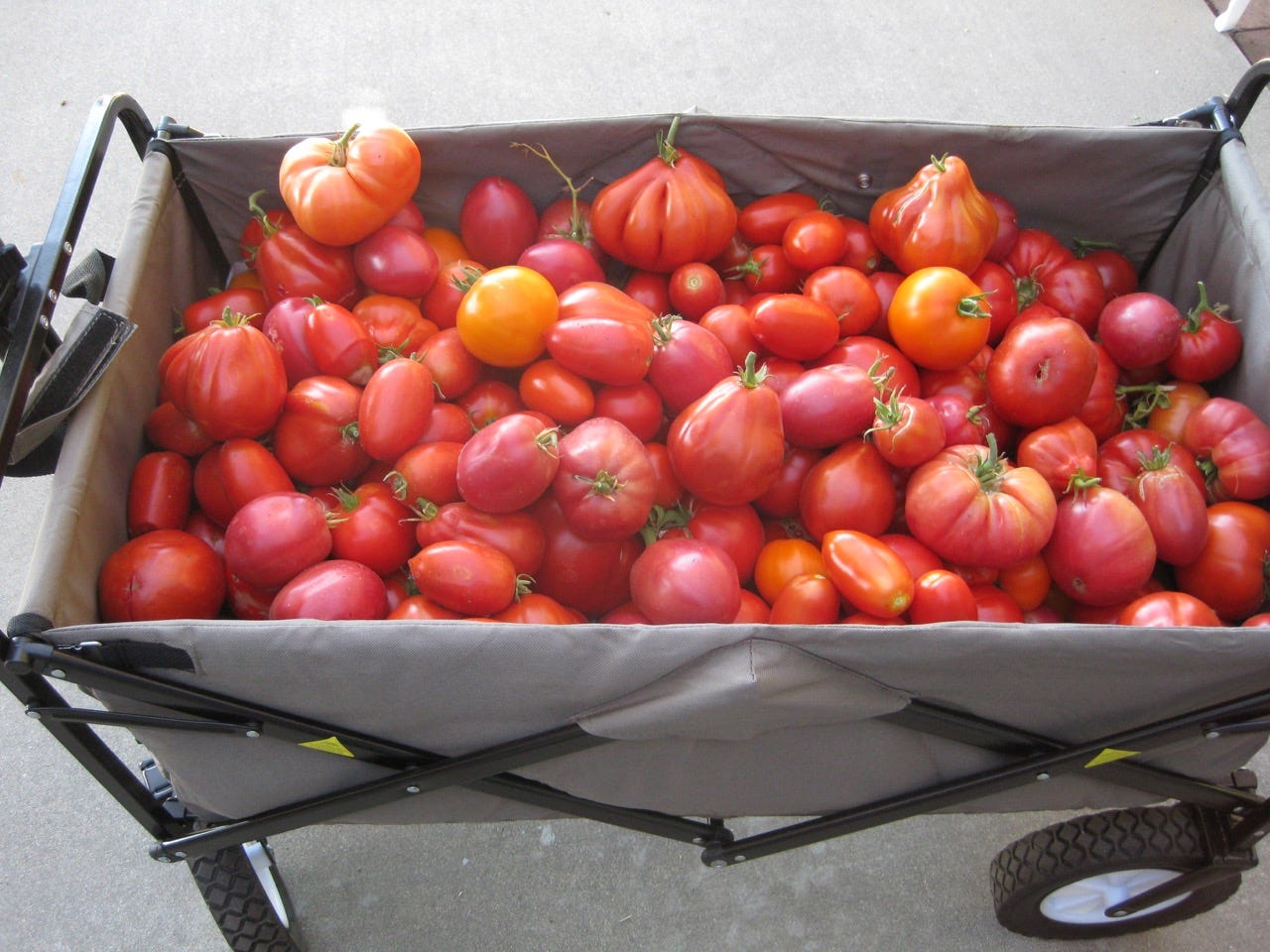
Six Common Tomato Problems
For those of you who did not receive last Friday’s Beyond the Garden Basics newsletter, here it is. My apologies. I will send the gremlins to bed without dinner.In today’s newsletter podcast (above), we chat with Don Shor of Redwood Barn Nursery in Davis, CA. Don is a big fan of growing tomatoes, and it helps that his nursery is located in a county that just so happens to be one of the top tomato producing regions in the entire world. In this conversation about tomato troubles (originally aired in June of 2020 on the Garden Basics with Farmer Fred podcast), Don talks about many of the tomato travails we discuss in today’s newsletter, along with a few more. Alas, we did not get into many tomato issues (especially diseases) that might be daily occurrences in more humid climates, nor did we discuss everybody’s summertime garden pal, the tomato hornworm. We’re saving that for a future newsletter.The tomato, according to the National Gardening Association, is America’s favorite backyard vegetable. 86% of American gardens contain at least one tomato plant. Nothing beats the flavor and aroma of a homegrown tomato in the summer. However, with that pleasure, comes a bit of pain. Now is the time when several tomato problems can crop up, leaving gardeners fretting about the future of their plants.“Why are the tomato blossoms falling off?”Tomato growers’ primary concern during the plant’s young growing stage is centered around, “Why are the tomato blossoms falling off?”According to the tomato experts at UC Davis, blossom drop is usually weather related. Nighttime temperatures below 55 or daytime temperatures above 90 degrees can cause premature blossom failure on tomato plants. Planting tomatoes too early in the spring is stressful for the plants. Late April through early June is good for planting most tomato varieties here.Other causes of tomato blossom failure and fruit drop include planting tomatoes where there is too much shade or using too much nitrogen fertilizer. Be sure to read and follow all label directions on a fertilizer intended for tomatoes and vegetables.Thinking of using a tomato hormone spray to help the plant maintain its blossoms? The tomato experts at UC Davis say that won’t work when temperatures are forecast to be in the 90’s or above.Abiotic Disorders of Tomato PlantsAccording to the University of California Statewide Master Gardener Program, five of the most common tomato maladies are abiotic disorders. “Abiotic” does not refer to pests or diseases, but to environmental issues, such as unfavorable soil conditions, temperature extremes, physical or chemical injuries, and watering issues – either too much or too little, and, of course, “operator error.” The abiotic problems of tomatoes include:• Sunburn Sunburn or sun scald is recognizable by a light brown or leathery-looking area on the sides of tomatoes that are getting hit by direct sun. Too much sunlight on tomatoes can be controlled by not pruning away leaf cover; maintaining plant vigor to produce adequate leaf cover; or, providing partial shade with a light-colored shade cloth or row cover during the hours of most intense sunlight.• Blossom End Rot This looks like sunburn, except it's the bottom of the tomato that becomes brown. Generally, it is a calcium deficiency brought on by fluctuating soil moisture or soils with too much salt. Maintain even soil moisture; amend the planting area with compost to improve water retention; avoid heavy applications of high-nitrogen fertilizer; and, if a soil test determines the area is lacking calcium, adding gypsum to the soil at the end of the season.• Fruit Cracks (Catfacing) Cat Facing refers to the circular concentric cracks around the stem end. Cracks that radiate outward from the stem, or malformation and cracking at the blossom end is also called fruit cracking. This happens when blossoming and fruit formation begins during hot weather as well as high soil moisture levels. Most gardeners just live with these conditions, knowing they can just cut away the damaged looking area and still have a tasty tomato. To help limit future outbreaks, keep the soil evenly moist; maintain leaf cover; give the plants some partial shade during hours of most intense sunlight; and add mulch, about three to seven inches high, around the plant, to maintain soil moisture and moderate temperature swings.• Solar Yellowing and Green Shoulders Noticeable by a yellow or yellow-orange color. Also, the upper portions of the tomato remain green even though the lower portion looks red and ripe. Caused by high temperatures and high light intensity, the solution - once again – is to maintain adequate plant vigor to encourage more leaf cover, avoid over-pruning, and provide partial shade during the hours of the most intense sunlight.• Leaf RollThe older tomato leaves may roll upward and inward suddenly and become stiff to the touch, brittle and leathery. Caused by high light intensity and high soil moisture, particularly when the t
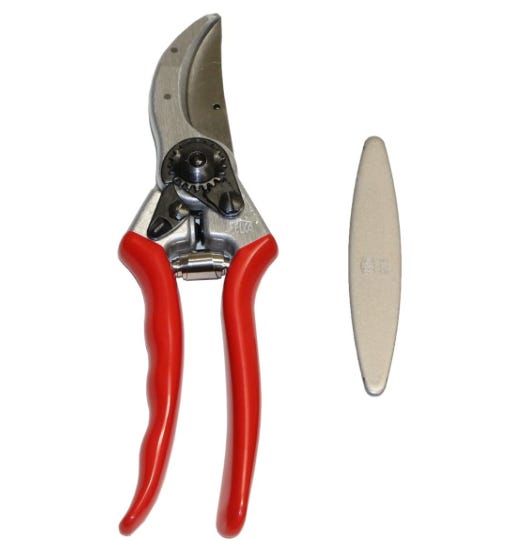
Selecting and Caring For Garden Hand Tools
Trying to decipher the basics on how to sharp garden hand tools can be a bit daunting to understand in an audio format. Here’s Sacramento County Master Gardener Bill Black, with his YouTube video about garden tool sharpening. Every picture tells a story, don’t it?How to Care and Store Your Garden Hand ToolsAs the weather heats up, don’t ignore your garden tools after a hard day in the yard. A good habit to get into is to clean and store your garden tools correctly before you go indoors for the afternoon.We know that cleaning the mud and dirt off shovels, trowels and other digging tools can help prevent rust. Did you know that how you store your garden tools might also lead to rust? On the Garden Basics podcast (Episode 165, “Garden Tool Care”), retired college horticulture professor Debbie Flower explained how that could happen.“On a garage surface, for example, moisture can move up through a concrete floor, if it's just a pad on the ground,” Flower said. “And that can cause the tips of a shovel to rust.”The cure for that? Hang the tools or store them upside down, she says.“Use wall hooks to hang the tools,” says Flower. “Or you can make tool storage dividers in which the tool sits on the ground, but it's the handle that touches the ground, not the metal blade.”And the wise gardener can help ensure that their garden tools can last a lifetime by first purchasing well-made tools. San Joaquin County Master Gardeners Lee Miller and Victor Rosasco advise you: instead of purchasing several inexpensive tools, pick the one tool that you will use the most, and then buy the highest quality one you can find.In a previous edition of the San Joaquin County Master Gardener’s newsletter, “Garden Notes,” the pair write that good tools can last a lifetime and you get what you pay for. An example would be a spading fork with heavy forged tines, such as one from English toolmaker Clarington Forge. It might cost about three times more than a cheaper spading fork. They point out that the cheaper spading fork might have inexpensive tines that will bend after a few plunges into heavy clay soil. Whenever possible, purchase tools that are forged from one piece of metal. They are stronger and less likely to be compromised. A spading fork usually has four flat, wide tines that make it much easier than a shovel for penetrating tough soil, turning raw compost, transplanting, or weeding.The duo also points out that shovel heads made of sheet metal, wrapped around the handle, are less expensive…but not as strong and durable as ones forged with a socket for the shovel handle. “When you step into the soil on a shovel and the blade feels like it is moving sideways, you know you have a cheap shovel,” they advise. “Good shovels also have blunt tops or pads so when you step on the shovel, it is more comfortable.”The Master Gardeners point out that tool sharpening is a required skill to keep shovels and pruners in good working order, so you don’t have to work as hard. Miller and Rosasco say that surprisingly, many cutting and digging tools are not sharp upon initial purchase: “Right off, it is important to sharpen them. After this initial sharpening, tool edges can be maintained with a sharpening stone or a mill file. Files sharpen only on the forward stroke. So, it is ‘stroke, lift, return, and stroke again’. For pruners, loppers, or any fine cutting tool, never use a grinder. If the edge is nicked, as sometimes happens when we accidentally cut wire or another hard surface, a file is best for removing the nicks. If it’s just dull, a small sharpening stone, file or diamond sharpener can be used.”The pair agree that maintenance is key for protecting your investment in quality garden tools. Store your tools indoors. Moreover, don’t forget to give them a bit of care: “Keep tools, especially shovels, clean and shiny,” they say. “Dirt left on the tool creates a rusty surface to which more dirt will stick. Use a wire brush or whatever is at hand to remove dirt after using. Spraying with a vegetable oil or a commercial penetrating oil and water-displacing spray (such as WD-40) will help keep rust away while stored.”In an earlier edition of this newsletter, we asked the experts about the pros and cons of choosing bypass vs. anvil pruners. You can check out that edition from February 2022 here.“It’s the Best Garden Event in Northern California!” (I said that)Harvest Day at the Fair Oaks Horticulture Center Saturday, August 5, 8am-2pm. Free!Debbie Flower and I will be talking about “Garden Tips to Save Time, Money and Water” at Harvest Day at 830 am. The Fair Oaks Horticulture Center is located at 11549 Fair Oaks Blvd, in Fair Oaks Park, Sacramento County, California. Hope to see you there! More details here. Presented by the U.C. Master Gardeners of Sacramento County.Thank you for also listening to the Garden Basics with Farmer Fred podcast! It’s available wherever you get your podcasts. Please share it with your garden friends.Fred Hoffman is also a Un

Summer Cucumber Issues
Today’s newsletter podcast (above) features Master Gardener/Vegetable Expert Gail Pothour, discussing her favorite cucumber varieties, as well as tips and tricks for their success. Originally featured in Episode 263 of the Garden Basics with Farmer Fred podcast, in which we talked about the Top 5 favorite homegrown vegetables, according to the National Gardening Association. According to the NGA, cucumbers are the second most popular crop for home gardeners. Number One? Tomatoes, of course. A transcript of our conversation with Gail about cucumbers can be found towards the bottom of this newsletter. Meanwhile…Tackling Summer Cucumber IssuesLast week we tackled the topic of poor pollination of summer squash plants. The lack of late spring zucchini fruit production is usually due to uncooperative weather, a lack of bee activity, or erratic coordination of the development of the male and female flowers of those vines. This week, we turn our attention to a close relative of summer squash, cucumbers. Cucumbers are the second most popular homegrown vegetable (after tomatoes), according to the National Gardening Association. And sure enough, many gardeners are fretting now about these summertime princes of the pickling world.We asked our favorite retired college horticulture professor, Sacramento-based Debbie Flower, about the primary needs for growing cucumbers successfully. She says freshness, warmth and water are at the top of the list.“The soil needs to be moist, not wet, but moist, all the time,” explains Flower. “Cucumbers are a warm season plant, a warm season annual. They need soil temperatures to be quite warm when you seed them. And you typically want to direct seed them, not start them from transplants ahead of time. They get root bound while in a container, it dwarfs them. They will never grow very big. If you do that once in your gardening life, you’ll remember it. It's such a disappointment.“I just tried my second time planting my cucumber seeds. I had planted some old seeds a few weeks ago and that might have been my problem. In general, you don't want to keep cucumber seeds more than two years. And these were two-year-old seeds. Even though I stored them correctly, in the refrigerator over those two years, they just didn't germinate. So yesterday I planted fresh seed. I would advise starting with fresh seed, plant them directly into the garden when your night temperatures have settled at 50 to 55 degrees Fahrenheit or greater. They need six to eight hours of sun, that's considered full sun. They need well drained, fertile soil and regular moisture.”Cucumbers are natural climbers and are less prone to rot issues and diseases when grown vertically. Training them up one or two heavy-duty, 6-gauge metal livestock panels to support the cucumbers eases harvesting chores.Cucumbers can also be grown in large containers, 18-24” deep. According to the Santa Clara County Master Gardeners: 18" to 24" deep containers (such as half-barrels or livestock watering troughs) can be used for deep-rooted vegetables such as tomatoes, potatoes, zucchini, winter squashes, beans, corn, cucumbers.Solving Cucumber BitternessA very bitter gardener wrote to us recently: “I have never managed to grow vigorous cucumber vines, and the cucumbers themselves are often bitter. I've heard many explanations for this, including lack of water, weather that is too hot and weather that is too cold. What is the truth?”We solicited the advice of three University of California cucumber experts about controlling bitterness. All had similar answers.• Select the newer hybrid varieties, which have been bred to reduce the cause of the bitterness. That’s according to Dennis Pettinger, longtime UC Cooperative Extension Environmental Horticulturist. He adds, “If the cucumbers express bitterness, it can usually be eliminated by peeling away the skin and outer flesh and removing the stem end.”• According to the Contra Costa County Master Gardeners, the newer cucumber varieties that have been bred to be less bitter include Diva, Sweet Success, Cool Breeze, Summer Dance, Improved Long Green, Eversweet, Ashley, Sunnybrook, Saticoy Hybrid, and Lemon.• Plant cucumbers in full sun and adjust your watering with the weather to reduce plant stress. El Dorado County Master Gardener Kathy Ruiz writes, “Cool temperatures and shady sites seem to trigger bitterness in cucumbers. Research notes that temperature variations of more than 20 degrees, moisture stress and storage on the vine too long or near other ripening vegetables also can cause bitterness.”• Again, moisture consistency is key. UC Master Gardener Chantal Guillemin of Contra Costa County writes: “Since cucumbers require ample and regular irrigation during their growing period, add mulches, composted green waste or manure to the soil to increase the soil’s water-holding capacity and supply nutrients to the plants.” Compost or well-aged manures should be mixed into the soil well before planting. Then, top
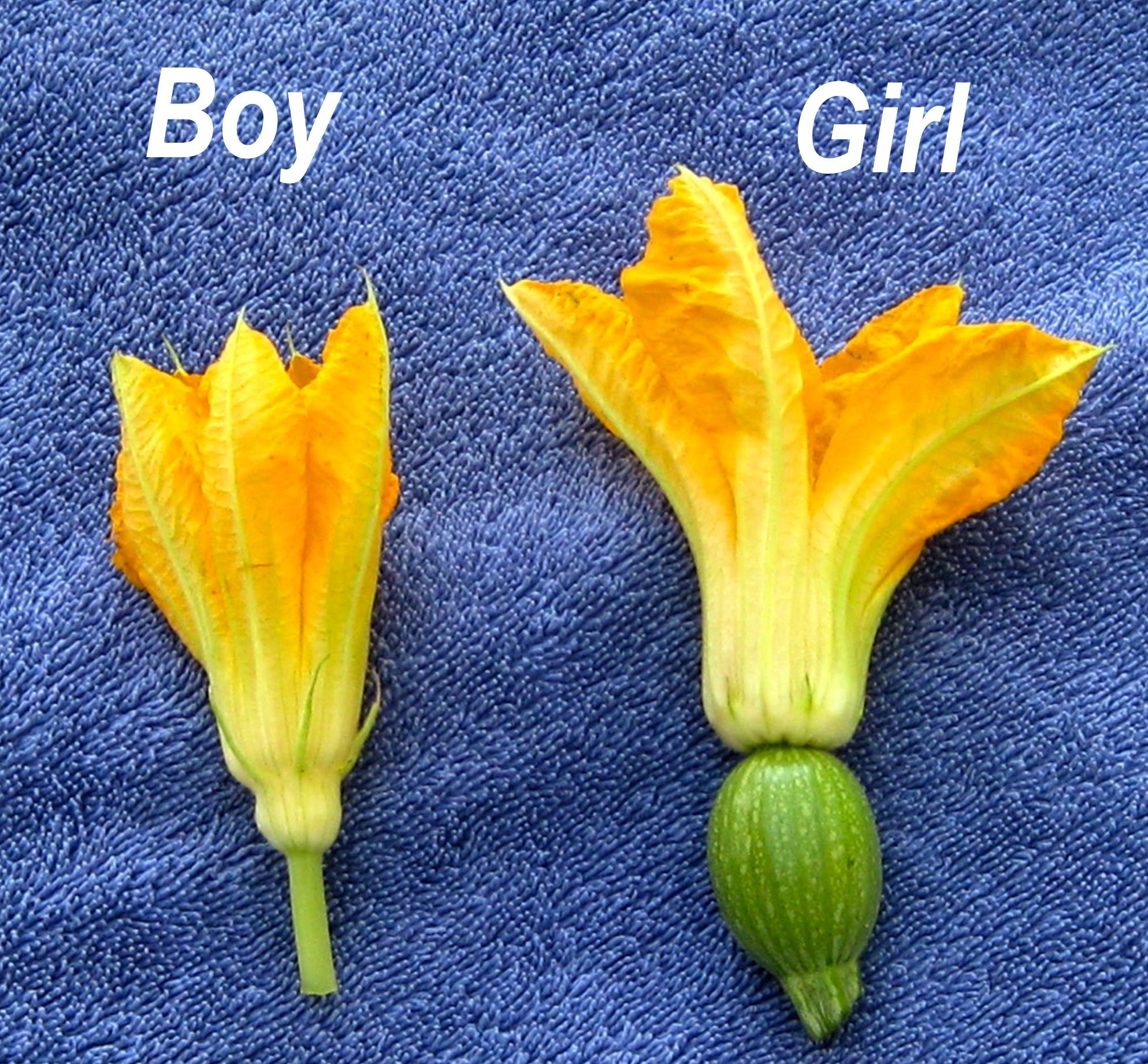
Where's the Zucchini?
Where is the zucchini? That question is a popular one in the garden e-mail bag lately. Gardeners are fretting over a total lack of summer squash flowers. Other problems include zucchini flowers that drop off, or young fruit that dies back.A lot of it has to do with timing. Many gardeners tend to plant zucchini seeds at the same time as tomato and pepper plants, usually in April. That’s a bit too early. The heat-loving summer squash varieties get off to a better start when planted in May or June.However, there are more variables.Squash needs daytime temperatures in the 80’s and 90’s for best results. Usually, it’s too much heat - temperatures at or above 100 degrees – that slow zucchini production here. Lately, daytime highs have been in the 70’s, a bit below what those squash plants require for quicker results. In addition, if that yellow squash is an older, heirloom variety, it may not grow as vigorously as a newer hybrid variety. Another limiting factor can be too much shade. Make sure all squash plants receive as much sun as possible.Zucchini and other members of the summer squash family typically have a hard time producing fruit in late spring and early summer, due to incomplete pollination. This problem should straighten itself out if bees are in the area and the weather cooperates. Most years, these issues sort themselves out by July. And before you know it, you’ve got more zucchini than you need or desire.However, you can help that struggling squash plant, according to Hunter Johnson, Jr., a retired University of California Cooperative Extension Vegetable Specialist.According to Johnson, gardeners often become concerned when many squash flowers appear early, but fruits fail to set. The reason for this: all the early flowers produced are males, in heirloom squash varieties. Female flowers develop somewhat later. In newer, hybrid varieties of summer squash, the first flowers to appear are usually females, and these will fail to develop unless there are male squash flowers, and bees, in the nearby area.Squash and other members of the cucurbit family have this flowering habit, which is unique among vegetable crops. They bear two kinds of flowers, male and female, both on the same plant. For fruit set to occur, pollen from the male flower must be transferred to the female flower. The pollen is sticky; so, wind-blown pollination does not occur. Honeybees are the principal means by which pollen is transferred from the male to the female flower. When bees are absent, fruit set on garden plants in the cucurbit family is very poor and often non-existent. If only a few bees are present in the area, partial pollination may occur, resulting in misshapen fruit as well as low yield.When no bees are present in the garden or the bee population is too low, the dedicated gardener can stand in for the bee by pollinating by hand. Hand pollination is a tedious chore, but it is the only means of obtaining fruit set in the absence of bees. The pollen is yellow in color and produced on the structure in the center of the male flower. You can use a small artist's paint brush to transfer pollen, or you can break off a male flower, remove its petals to expose the pollen-bearing structure, and roll the pollen onto the stigma in the center of the female flower.When hand pollinating, it is important to use only freshly opened flowers, early in the day. Flowers open in the morning and are receptive for only one day.The female flower in cucurbits can be recognized easily by the presence of a miniature fruit (ovary) at the base of the flower. The female squash flower is borne on a very short stem, with that bulge at the base. The male squash flower can be identified by its long, slender stem.As far as all that extra zucchini you’ll get later in the summer? Consider donating it to a food bank, food pantry, or food closet in your area. Find the one nearest to you at ampleharvest.org.Thank you for also listening to the Garden Basics with Farmer Fred podcast! It’s available wherever you get your podcasts. Please share it with your garden friends.Fred Hoffman is also a University of California Cooperative Extension Master Gardener in Sacramento County. And he likes to ride his bike. This is a public episode. If you'd like to discuss this with other subscribers or get access to bonus episodes, visit gardenbasics.substack.com/subscribe
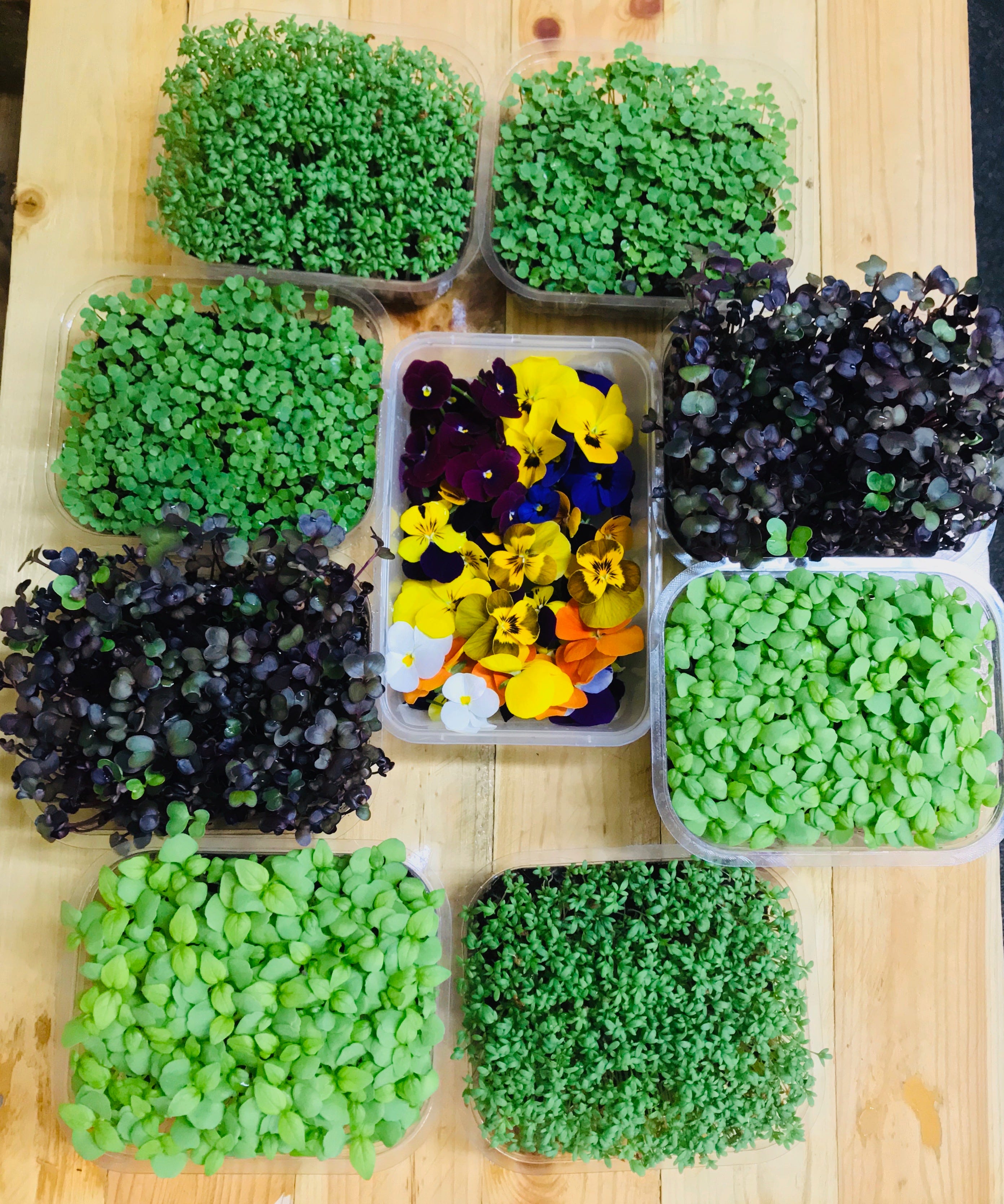
Growing Healthy Greens Year Round
If you listened to this week’s Garden Basics with Farmer Fred podcast (Ep. 269: “Growing Your Brain Food Garden”), you heard Dr. Laura Varich of FreshPhysician.com tout the cholesterol-fighting qualities of many home grown vegetables. Lowering cholesterol levels is widely known as a key factor in reducing heart disease. According to Varich, you’re not only doing your heart a favor, but also your brain. High cholesterol levels can also lead to blockages in the brain which can lead to a stroke. And recent evidence has shown that the same narrowing of those brain vessels is also associated with Alzheimer's disease. It seems that plaques and tangles that develop in Alzheimer's disease are likely not to cause the disease, but are instead the brain's response to the damage to that poor blood flow. Examination of the brains of Alzheimer's patients have found significant blockages in the arteries that bring blood to the critical memory centers of the brain. In other words, it's very similar to heart disease and stroke. High blood cholesterol is a major risk factor for the development of Alzheimer's disease.Among the garden crops that are some of the best for reversing high cholesterol levels (in conjunction with a reduction in consumption of ultra processed food and getting regular exercise) are greens, whole grains and cruciferous vegetables such as broccoli, cauliflower, kale and cabbage. She is especially fond of growing microgreens. Here’s Dr. Varich’s list of the nine best food groups for brain health:If you live in a hot summer climate, however, growing many of the greens and cruciferous vegetables is seemingly near impossible before they bolt and turn bitter. Those crops definitely prefer a cool climate (where summer temperatures seldom get into the upper 90’s), or the mid-to-late fall, winter, and early spring climate of USDA Zones 9 and 10.So can a hot climate gardener, who wants to eat healthier homegrown vegetables year-round, thwart this summertime stop sign? Yes.In today’s Beyond the Garden Basics newsletter podcast (above) we present three ways to eat healthy, homegrown greens year round:* Growing Microgreens with Master Gardener Gail Pothour (at 00:00 of the newsletter podcast)* How to Grow Cilantro in a Hot Summer Climate with Renee Shepherd of Renee’s Garden seed catalog (22:37)* Growing the Cheapskate Salad Bowl, with Brad Gates of Wild Boar Farms (25:24)Lettuce Varieties to Grow in Hot Summer ClimatesAn especially vexing garden issue for greens lovers in USDA Zones 8, 9 and 10: How do you grow lettuce in the summertime? We discussed this in Episode 264 of the Garden Basics podcast with vegetable expert and Master Gardener Gail Pothour. A transcript of that conversation follows:Farmer Fred: All right, now we come to number nine on the list of the 10 most popular garden vegetables and it's a cool season crop in California. If you live in a very mild climate, or the Bay area of California, you can certainly grow all the lettuce varieties you want. And I can I can see why people grow lettuce and I hope that you try something different than Iceberg. Iceberg, to me, is the least nutritious, colorless, tasteless, lettuce that has fallen into mass marketing. There's a lot of leaf lettuce varieties that are so much tastier and also can withstand heat better than Iceberg.Gail Pothour: Yeah, I was gonna say Iceberg doesn't do that well in the Sacramento area. We're too hot. And so we generally recommend gardeners to try looseleaf or romaine or one of the butterhead types. But if you need to have an Iceberg, pick that up at the store, don't try growing it. It won't do that well here.Farmer Fred: Yeah, it's a waste of space. As a matter of fact, I have been on a lifelong garden search for a lettuce variety, a loose leaf lettuce variety, that can take the heat. Some are better than others as far as getting through July, perhaps. But it seems like when July turns into August, they all start bolting.Gail Pothour: Right. And actually, several years ago, we did an experiment two years in a row at the Fair Oaks Horticulture Center. Because we get this question a lot, “Why can't I grow lettuce in the summer?”. So we thought okay, let's find some varieties, and grow them through the heat of summer and see how they do. First off, you need to start with some varieties that are heat resistant, like Jericho that was bred in Israel, so it's a little more heat resistant. And we tried half dozen or so different varieties we monitored when we planted them, how many weeks it was before they started bolting. Some did better than others. Some did pretty well. But what we found is you need to mulch heavily to keep the moisture in, to keep them well watered, provide shade during their entire lifespan in the summer, and then be prepared as soon as one starts to bolt, take it out and then replant with another transplant. So kind of a succession planting. It is possible but it's a lot of work. It takes a lot of water and shading and
11 Garden Tips for Success
Recorded last week in front of a live audience at a meeting of the Sun City/Lincoln Hills (CA) garden club. Included a Power Point presentation, which I mistakenly referred to as “slides”. And yes, I still have a slide projector in a closet somewhere, along with a box of slides of my cross-country bicycle trip in 1988. It’s probably next to the Betamax VCR and the Sony 630-D reel-to-reel stereo recorder (sweet!). But, at least I know what a “podcast” is!1. ALL GARDENING IS LOCAL. In your own yard, there are microclimates where certain plants will have a better chance for success. For example, monitor the morning low temperatures in various areas of your yard to find the warmest home for citrus trees. Just moved to a new home and wondering what grows well there? Take a walk through your neighborhood. Mimic the garden successes that you see.2. KNOW YOUR SOIL. A complete soil test will let you know what nutritional elements your soil is missing, including nitrogen, phosphorus and potassium; and, micronutrients such as calcium, magnesium, boron, iron zinc, sulfur and others. University of Massachusetts/Amherst, Colorado State University, and Texas A&M offer a complete soil test at very reasonable rates. For the do-it-yourselfer, there are variety of test kits available for testing pH (Rapitest), and LaMotte kits for pH as well as Nitrogen, Phosphorus and Potassium. All plants are adapted to a certain pH range of soil acidity or alkalinity. Monitor your soil moisture with a soil probe, moisture meter, trowel or screwdriver.3. RIGHT PLANT, RIGHT PLACE. In our area, roses won’t bloom in full shade and many tomato varieties won’t produce fruit. On the other hand, winter daphne, impatiens and hydrangeas will croak in full sun. Know the sunlight requirements for your plants in your location. The Sunset Western Garden book is a good source for finding out how much sun or shade your plants need where you live.4. MULCH, MULCH, MULCH. Benefits of mulch: Retains moisture. Keeps soil temperature constant, reducing plant stress. Suppresses weeds. Gradually increases soil organic matter, feeding the soil. Attracts beneficial organisms that improve soil fertility and porosity. Mulch encourages healthier plants, reducing the needs for pesticides and fertilizers. Protects roots and plants from mechanical injury. On hillsides and around rural homes, it suppresses the spread of brush fires.5. MOTHER NATURE BATS LAST. When you apply broad-spectrum synthetic insecticides, the bad bugs will eventually find a way to overcome that issue, usually developing a resistance to that chemical. The same is true of weeds, treated repeatedly with herbicides. To battle the bad bugs, lend Mother Nature a helping hand. Limit the use of insecticides and provide the right plants for food and shelter for beneficial insects. Build it and they will come.6. WHAT’S OLD IS NEW AGAIN. Growing heirloom fruit and vegetables is not a passing fad. A University of Texas study showed that older varieties of vegetables are more nutritious than their newer, hybrid counterparts. Beneficials are attracted to the fragrance of older flower varieties. In the Sierra Foothills, the Felix Gillet Institute is rescuing Gold Rush-era fruit and nut trees. These abandoned specimens, uncared for since the 1800’s but still thriving, may hold the key for future drought tolerant plants as well as a gene pool for adding pest and disease resistance to new varieties.7. EVERYTHING YOU KNOW IS WRONG. In the 1940’s & 50’s, DDT was available to home gardeners as a pesticide. Turns out, it caused cancer and killed birds. In the 1960’s-70’s, the Modesto Ash was considered the “perfect shade tree” for the Central Valley of California. Turns out, it is susceptible to anthracnose, mistletoe and is no longer recommended. In the first decade of the 21st century, the pesticides Diazinon and Dursban were taken off store shelves for health reasons. Proven ineffective, despite claims to the contrary: Vitamin B-1 for transplant shock, store-bought ladybugs, and tomato calcium spray to cure blossom end rot.8. IF IT WORKS FOR YOU, FINE; BUT KEEP AN OPEN MIND. If you're using safe gardening techniques that others frown upon - and those techniques are working…well, who are we to tell you to stop? Still, new research, techniques or equipment may make your chores a heck of a lot easier and satisfying. Today’s solution could become tomorrow’s problem. Be open to change.9. READ AND FOLLOW ALL LABEL DIRECTIONS. The instruction label on all pesticides is the law. Don’t assume that an insecticide or herbicide will kill a bad bug or weed if it is not listed on the label. Follow the instructions for when and how to apply the product.10. LIFE IS TOO SHORT TO PUT UP WITH A PROBLEM PLANT. Become familiar with the euphemism, “Shovel-Prune.”11. BERMUDA GRASS IS FOREVER. Runners on top of the soil, rhizomes beneath the soil, prolific seed heads, roots that can live for decades, just waiting for a bit of light. Instead
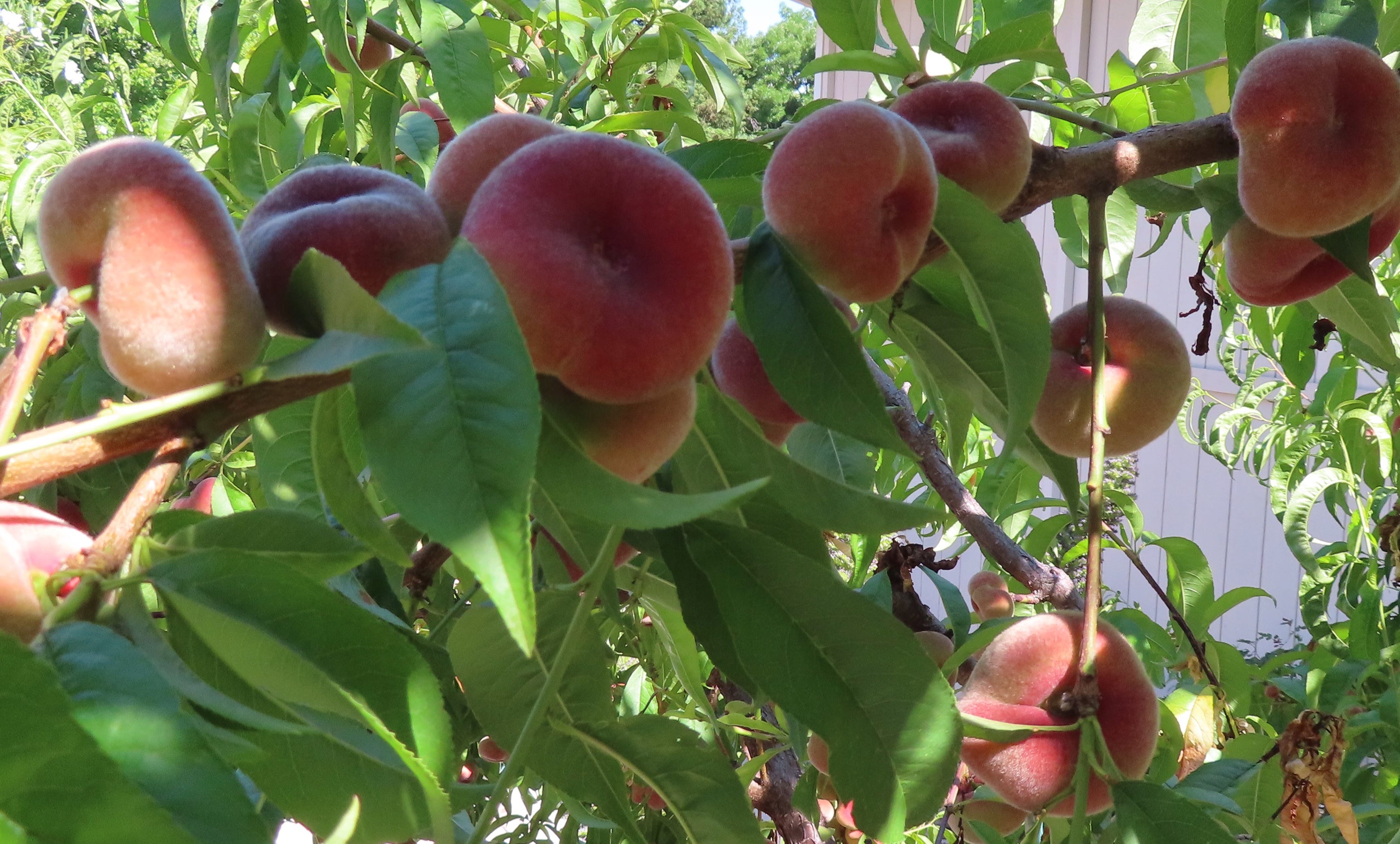
Thin Your Fruits and Vegs, Now!
Thinning Crowded Fruit on Fruit Trees, Shrubs and VinesA prolifically producing peach tree next to an often-used walkway in our narrow side yard serves as a not so-subtle reminder this time of year: thin the fruit before trouble begins. And if a glance up into the canopy of your peach, pear, nectarine, apple, kiwifruit, persimmon, apricot, or other deciduous fruit trees and vines (including table grapes) shows crowded young fruit, take action. Rubbing or tightly packed little fruit in a tree now can lead to big problems in the summer, such as undersized fruit, injured or diseased fruit, excessive fruit drop, and broken fruit tree branches.Some tips:• Remove some of the fruit. Space fruit evenly along each branch, with perhaps five inches between each piece of fruit. More importantly, be sure to leave the largest sized fruits on the tree or vine.• For table grapes, remove grape bunches so that there is at least six inches of space between each remaining bunch of table grapes. Cut off the "tails" from the remaining bunches at that same time. This is the lower one-quarter to one third of the bunch, where it begins to taper down in size. This will send more energy to the remaining grapes on the bunch.• Because of their small size, cherries are not usually thinned from backyard trees. In addition, nut crops, such as almonds and walnuts, are not thinned.• For shrub-like fruit bushes, such as blueberries, pruning may not be necessary on older shrubs with thicker branches that can support the weight of the fruit. Younger plants may need thinning if you see the branches bending precariously. And, as you may have noticed, the local bird population may be helping you thin the blueberries. That’s a definite sign that those blueberries are close to being ripe. If the robin population seems to be spending most of their time around your berries, cover the plants with bird nettingThe UCANR informational sheet, “Fruit Trees: Thinning Young Fruit” has more deciduous spring fruit thinning advice.• Citrus trees tend to thin themselves, a phenomenon called “June Drop.” However, citrus fruit thinning now can help that tree produce next fall and winter.Certain citrus types, such as Valencia oranges and some mandarins, produce heavily one year followed by a year with sparse production. This is called alternate bearing. You can reduce the potential of a tree to alternate bear by reducing the fruit load in a heavy fruit set year by thinning out some of the fruit.Also, fertilize less in light years and more in heavy fruit production years so that the trees needs are met according to the demands of the fruit load. Despite using these strategies, some varieties will just alternate bear. Do not allow the old citrus fruit to stay on the tree longer than necessary. This may contribute to a smaller crop and perhaps, more fruit drop, for next year’s crop.More Fruit Thinning Tips• Here’s a valuable tip from the experts at Louisiana State University: when thinning fruit, keep looking at the tree; don't look at the ground. Seeing all that fallen fruit may dissuade you from the primary task. Cut off the excess fruit. Pick it up when finished pruning. Don’t try to juggle the chores of pruning and catching the fruit in a bucket. You may need both hands free for gently moving one piece of fruit out of the way to prune out the unwanted fruit.• Snip off, don’t pull off, the fruit. Pulling can damage the branch, inhibiting future production. The best tool to use for thinning is a pair of needle-nose pruners. The long, thin blades can easily get into tight spaces to snip the fruit along its stem.VEGETABLE THINNINGPlanting easy-to-grow vegetables that can get out of hand quickly is a time-honored gardening tradition in the spring. Carrots, corn, cucumbers, eggplant, radishes, summer squash and winter squash all emerge with little effort, but can take over a garden by summer. The problem is: because the emerging plants are small, many gardeners don’t have the heart to thin them out to their proper spacing.The result is an undersized crop, greater incidence of pests and diseases, or, too much of a good thing. The popular summer squash, zucchini, is a perfect example of the latter. Here are the planting and thinning instructions for zucchini seeds from the Burpee Seeds website:“Sow one to two seeds about 36 inches apart. Cover with one inch of fine soil. Firm lightly and keep evenly moist. Zucchini seedlings emerge in 10-14 days. Thin to one plant when seedlings have two sets of leaves.” That seems reasonable. And thrifty. And certainly clearer than these instructions on the back of a packet of Ferry-Morse zucchini seeds:Not sure how you leave three seedlings on one 2’x2’ hill, and yet space the plants four feet apart.Because they have calloused hands but soft hearts, many backyard gardeners will ignore rational spacing instructions, let alone keeping only one plant. And what happens? Overwhelmed gardeners go on midnight runs in August, surreptitiously pl

The Best Roses For Cut Flowers
(From a 2022 interview with Master Rosarian Debbie Arrington. Originally aired on May 20, 2022, Garden Basics podcast)Farmer FredWhat is America's favorite flower? Well, of course, it's the rose. Something like 85% of all Americans say their favorite flower is the rose. How do you grow them? Well, we've talked about that on this show. You can go back and look for various episodes of the Garden Basics podcast where we talked about planting roses and pruning roses. We've even talked about fragrant roses. However, our next guest we've had on several times talking about roses, including the most edible roses. It's Debbie Arrington, Master Rosarian, the typist behind the Sacramento Digs gardening blog, a daily effort that has all sorts of good gardening tips including tips on roses. And Debbie, I am so into cutting roses now for display indoors. Is this what happens when you get old? You just descend into a cut flower garden mode. And that seems to be what I'm doing. And all of a sudden, I love going out to the yard every day, and picking off some rose branches and bringing them inside for display. And from my perspective, what I'm looking for in a rose as a cut flower is something that maintains its beauty for several days, if not longer. Something that, when I'm picking it, chances are I won't get stuck by a prickle. I mean little prickles are okay, but I don't want anything too thorny if you will, please. Maybe something that doesn't shed a lot while it's on display. Things like that. Everybody has their own criteria, as you might discover. And I imagine, Debbie Arrington, in the world of Master Rosarians, this might be a topic of great discussion, shall we say?Debbie Arrington Yes, it is. Because there are literally tens of thousands of different rose varieties that you could choose from, and everybody has their own opinion of what is “the best”. But the qualities that you describe is a rose that has a long stem, a presence in the room and in the vase, has few prickles, so you aren't getting thorns in your finger every time you admire it. Those are all qualities that people that grow roses professionally want in a rose. And those are also good things to have in your own garden roses. So we have several favorites that we can share with you today. I should add that I'm President of the Sacramento Rose Society, and we just had our 74th annual show. And it was our first show in three years due to COVID regulations. So we had a lot of pent up energy. And our roses seem to, as well, because we had well over 1000 blooms in the room.Farmer Fred Wow. And who won?Debbie Arrington Oh, the the top prize went to Marilyn Monroe, not mine this time. But one that was grown by Charlotte Owendyk. Marilyn is an outstanding show rose. She's one of the best exhibition roses ever introduced. But I don't necessarily recommend Marilyn for everybody's garden because she has some of the most vicious thorns you will ever see on a rose plant. It's only because she is so beautiful she ever made it to the market.Farmer Fred Okay, I'll cross that off my list.Debbie Arrington The roses that were sitting next to her up on the top shelf are both really good garden roses, as well as exhibition roses that fit all the qualities that you want in a cut flower with a lot less pain. And those are Ring of Fire, which is a hybrid tea that is a dark orange bordering on red. And it just sort of flows. And it's a really large, but the buds measure about two and a half up to three inches long. Then when the flower opens fully, you know, it's about five, six inches across is a big rose the color. It has a sort of inner burning orangey color beneath the red. So it just sort of glows in the vase, so very eye catching rows and excellent dark green foliage. So it just really sets it off nice. And it puts out very long stems easily 24-30 inches, this great big rose on the top. So they're very handsome. And the other one that was the Princess of our show was was the aptly named Hot Princess. And Hot Princess is a wonderful rose, both in the garden and in the vase, because it has beautiful form to it, a beautiful point that slowly opens, it has that sort of rolling pedals. That's a dark dark pink, and another one that has this almost fluorescent color to it. And so both of those make them very eye catching. And when you're competing against 1000 other roses, you have to have something that is going to draw the eye to it other than than the other flowers next to it, and it does it in the garden and also does it in the vase, both those roses. One of the reasons they're so outstanding for exhibition is because they put out good long stems. The key to growing long stems is when you cut a rose, is to cut a lot of stem with it. And that includes deadheading to the plant. Right now people have a lot of roses, they've gone through their first flush of bloom. And there's a lot of dead roses on the plant that have spent flowers. Most people will just snip them off with ma
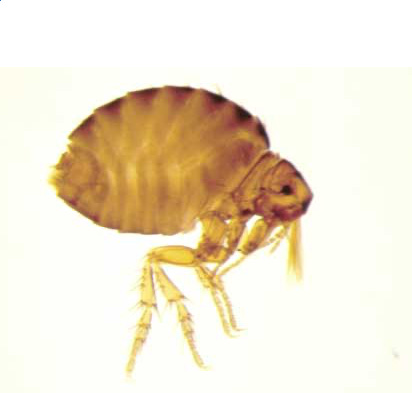
Flea and Tick Control Tips
As the weather warms, so do outbreaks of fleas and ticks. Today’s newsletter podcast features an interview with retired veterinarian and Master Gardener Heidi Napier, who talks about these pests, along with a scenic bypass about controlling slugs and snails using less toxic products that won’t harm your kids or dogs.Flea Control TipsThis pest can live indoors and out, as well as on your pets. However, a combination of remedies can reduce a flea population. The trick, though, is to attack the problem simultaneously on three fronts: indoors, outdoors and on your pets. Here are a few flea control suggestions from the UC Integrated Pest Management Program.Inside the Home:• Wash throw rugs and the pet’s bedding in hot, soapy water once a week.• Vacuum daily or every other day to remove flea eggs, larvae, and adults. Include upholstered furniture, cushions as well as in cracks and crevices of furniture.• Vacuum carpets, especially beneath furniture and in areas frequented by pets. Recent studies suggest that destroying the vacuum bags isn’t necessary.• Use a hand sprayer to treat all carpets with an insecticide that contains an insect growth regulator. The most effective spray products contain the Insect Growth Regulator methoprene or pyriproxyfen. Aerosol foggers don’t provide the coverage and long-term effectiveness of direct sprays.• Hand spray pet sleeping areas, areas beneath furniture, baseboards, and windowsills.On the Pet:• If you administer oral or topical products early in the year before flea populations begin to build, the products can prevent fleas from establishing themselves in your home. Contact your veterinarian for advice in selecting the best flea-control product for your situation.• Use a spot-on or oral treatment, which can be purchased in pet stores or from vets, or a systemic oral treatment, which is available from vets only. Active ingredients suggested by UC that are available over the counter include Fipronil and Imidacloprid. Prescription products include those with the active ingredients Dinotefuran, Lufenuron, Nitenpyram, Pyriprole, Selamectin and Spinosad.• University of California research has shown that neither Vitamin B1 supplements nor brewer's yeast prevents fleas from feeding. In addition, herbal collars and ultrasonic devices are not effective flea repellents.• In our home, we spend quality time with our cat and dogs when we bring out the flea comb. This fine-toothed comb manages to pick off at least a couple of fleas from the cat each week, as well as letting us know when there is a major flea outbreak.Outside the Home:• If you treat your pets with spot-on or oral treatments, you’ll rarely need to spray outdoors.• Sprays are only necessary outdoors if you detect lots of fleas, usually in shady areas or places where pets rest. To locate heavy infestations, walk around pet resting areas wearing knee-high white socks. If fleas are present, they will jump onto the socks and be readily visible.Tick control tips from UCANR:* Ticks can spread several diseases to humans and pets, but Lyme disease is the most common. In California, Lyme disease is carried by the western blacklegged tick which occurs throughout the state.* Lyme disease has been reported in most California counties, but some areas pose higher risks than others.* You can protect yourself from ticks and the diseases they transmit by wearing long pants and long-sleeved shirts outdoors, using an EPA registered repellent with 20-30% DEET, or applying permethrin to clothing. * Check yourself often after being outside in areas that are prone to ticks (forests, woodlands, and grasslands).* Shower within 2 hours of exposure to ticks and place clothing in a hot dryer for an hour to kill any ticks that may be on them.* Safely remove ticks with tweezers by grabbing the tick as close to the skin as possible and slowly pulling it out.* The California Department of Public Health (CDPH) says to control ticks around your home, remove leaf and grass litter from your yard and create a 3-foot barrier of mulch or gravel between your lawn and unmanaged or forested areas.From the University of Massachusetts/Amherst Hort Notes, May 2023:Q. I have been receiving offers and seeing advertisements for services to spray for ticks and mosquitoes. Is this something to consider and is it safe?A. Perimeter yard sprays are recommended as part of a three phase plan: Protect Yourself, Protect Your Pet and Protect Your Yard. I tell people not to depend on a yard spray as their only effort. Wearing permethrin treated clothing/footwear should be a front-burner tactic; a yard spray is a way to further reduce exposure risk.As far as yard spraying, this is something you can easily do yourself with a hose-end sprayer available at any garden center. Check out our video on yard spraying, as well as other resources about ticks, at capecod.gov/ticks(link is external). When contracting a service, there are key questions to ask about what, where and when to spray.* Wh
Can Human Food Also Be Plant Food?
Interview with Robert Pavlis of GardenMyths.com:Can Human Food also be Plant Food? (It depends how you apply it.)(originally aired in Episode 126 of the Garden Basics Podcast)Farmer Fred: What do you give plants to drink besides water and plant food? This question actually has been asked on many social media outlets, and in many gardening groups. And you might be surprised at the number of household kitchen products that are given to plants. Are they worth it? There is one gentleman who actually tackles a lot of garden myths. He's even written a book on the subject. It's Robert Pavlis. He's a well known speaker-educator, with over 40 years of gardening experience. He's the author of several books including "Building Natural Ponds", "Soil Science for Gardeners", and "Garden Myths". And he publishes the popular gardening blog, gardenmyths.com as well as garden fundamentals.com . He gardens in Ontario, Canada, and Robert Pavlis, it's a pleasure to have you on the program. Tell us, for those of us who aren't familiar with gardening conditions in Ontario, Canada, exactly what your seasons are.Robert Pavlis: Well, we have a USDA Zone five garden, so we have a fairly long winter. Around here we don't get great snow cover but we do have snow and then we have hail and sleet and everything in between. And then it gets warm and then it gets cold. So even though our winters aren't that cold, the problem here is that we have this freeze-thaw problem. Then spring comes, the summers are quite humid, quite hot. So today is 29 degrees centigrade (84 F). And fall comes pretty quick. And you know, by middle September, while things are finished in the garden by October, we could have frost.Farmer Fred: So if you're going to grow a summer vegetable garden there, you start around Mother's Day and wrap it up by, I guess, the end of September.Robert Pavlis: Yeah, well, our traditional last frost date is May 24. That's moved back now to around May 10. So a lot of gardeners up here will try to extend that season. So we use things like rowcovers, or we gamble, what I call gambling in the garden. And I plant things two or three weeks early and hope it doesn't freeze. But that doesn't always work. And we try various other ways to keep things a little warmer. But yeah, early May. Tomatoes and warm season crops, they probably won't go out until late, middle-late May, depending on the year.Farmer Fred: All right. So a bit shorter than here in California, to say the least.Robert Pavlis: Just a little bit. Right.Farmer Fred: All right. Well, I love your GardenMyths.com column that you post, and people can subscribe to it. It's free, and you get email notifications when they are released. And awhile back, you had one on feeding plants from the kitchen, discussing which products actually work. And for those of you who are short of time, the quick answer is, "not many". But I am amazed, though, at what food scraps people are feeding to plants that they think will work. I guess we should start off with discussing exactly how plants absorb nutrients.Robert Pavlis: Plant roots only absorb certain things. And they have to be what I call small molecules. So nitrogen, potassium, phosphate, these are all small molecules. But what you have in most plants is large molecules, proteins, carbohydrates, and so on. And you can put all that you want on a plant, it can't use it until it decomposes. That's why that composting process is so important. We're taking large molecules, converting them to these small little nutrients that plants can use. And until that happens, plants get no benefit. And they need a certain amount of those, they need a fair amount of nitrogen. They use a fair amount of potassium and phosphate, and then they use about a half a dozen other minor nutrients like calcium, magnesium, manganese, and sulfur. And they need all of those. So one of the things I look at when we're talking about the stuff we're putting on our plants, the first question you really need to ask is, what nutrients are in there? And by the way, the one nutrient that most soil is missing is nitrogen. And I won't get into why, just accept the fact that most of the other nutrients are probably there in the soil. But nitrogen can go away very quickly. It doesn't stick to soil, it runs away. So in most cases, growth is controlled by the amount of nitrogen you give your plants. Now, if you are deficient in one of those other things, you also need to add that one, but nitrogen is a key one. So the key question is how much nitrogen is in what I called food scraps, adding to my plants, and if it's very minor, then it's really not going to do much for your plants.Farmer Fred: And besides, it has to be converted by the soil biology into a form that the plant can use.Robert Pavlis: That's right, and nitrogen is used mostly as nitrates and some as urea. But plants pretty much use nitrates. So if I take a big protein molecule, which has lots of nitrogen in it, and I give it to my p

Happy Tomato Planting Day! But Which Varieties?
For years (decades, really), I’ve been promoting April 28 as Official Tomato Planting Day* for our area here in Northern California (Southern Sacramento and Northern San Joaquin Valleys, low foothills, and East Bay). And this time around in 2023, the weather has been very cooperative to make this year’s April 28th celebration an excellent time to start planting tomatoes.Wherever you are in the country, you have your own Official Tomato Planting Day. And it may change from year to year. The factors you are looking for include that the warmth of spring has settled in. Daytime highs will be in the 80’s (and above) for the foreseeable future. Early morning low air temperatures are steadily above 50 degrees. Soil temperatures are near 60 degrees. With those conditions, newly planted tomatoes will get off to a quick start. Just add water and fertilizer.Now, the question is…which tomato varieties to plant?We’ve talked in the past about the tried-and-true performers for our area, tomato varieties that will be in stock at area nurseries and garden centers now. If you are new to tomato gardening, start with three winners: The Sungold cherry tomato, the Early Girl tomato as your main season crop, and Big Beef for a large, slicing tomato. Other sure bets include Whopper, Champion, Ace, and Sweet 100.All the ones mentioned so far are hybrid tomatoes. Hybrid varieties are bred for desirable traits such as early productivity, adaptability to the local climate, vigor, and disease resistance, helping to guarantee success for the new tomato gardener. According to the UC Davis Vegetable Research and Information Center, Fusarium and Verticillium wilt are common diseases that can destroy a whole tomato crop. Many hybrid tomato varieties are resistant to these two diseases. Look for the letters, “VF”, after the cultivar name, indicating resistance to the wilts. “VFN” means the plants are resistant to verticillium, fusarium, and nematodes; “VFNT” adds tobacco mosaic virus to the resistance list.However, perhaps you want to stretch your tomato growing horizons this year by planting heirloom tomato varieties, which are noted for their flavor, aroma, and beauty. The downside to heirloom tomatoes? Production variability and a lack of disease resistance. Sacramento County Master Gardener Cathy Coulter explains the traits of an heirloom tomato. “An heirloom tomato is an open-pollinated variety that has been passed down at least 50 years through several generations in a family, ethnic, religious, or tribal group, or was commercially introduced before 1940,” says Coulter. “Some tomatoes now marketed as ‘heirloom’ are actually a cross between two different heirlooms (crossed on purpose or by nature) or are a cross between an heirloom and a hybrid tomato. The cross is then stabilized over several generations, so they become open-pollinated.”In other words, there is no agreed-upon standard for what makes a tomato variety an “heirloom.”One Northern California tomato plant breeder, Brad Gates of Wild Boar Farms, specializes in developing those modern heirlooms. “The most common definition of an heirloom tomato that I can come up with is that it's 50 years or older,” says Gates. “That seems to be the loose definition of an heirloom, because the definition of a heirloom is something that's been passed down from generation to generation. So somewhere along the line, somebody threw out the 50-year mark, and it seems to be the most popular. So some of my varieties are maybe working on 20 years old now. So they'll just have a little bit of a wait. But I think when most people think they want an heirloom, they want a tomato that's something other than round, red and tasteless.” Listen to the podcast (above) to find out more about Brad Gates’ tips and techniques for starting tomatoes from seed, as well as what it takes to breed a “modern heirloom” tomato. Originally aired in Episode 75 of the Garden Basics podcast.Sacramento County Master Gardener Gail Pothour is a fan of Wild Boar Farms’ “Brad’s Atomic Grape” tomato, a variety that is definitely neither red, round nor tasteless. “It is a kind of a grape tomato, which is the size of a cherry tomato, but it's elongated, kind of egg shaped,” says Pothour. “It's multicolored, with shades of purples and greens and red stripes and streaks all through it. And it's very tasty. It's got a good hang time, too. You don't have to pick it right now. It'll hang on the plant. I've been growing ‘Brad’s Atomic Grape’ for several years and it's become one of my favorites.”Davis, CA-based nursery owner Don Shor has his favorite heirloom tomatoes that he grows repeatedly for their beauty, productivity, and their flavor. “Most years, ‘Mortgage Lifter’ does reasonably well for me,” says Shor. “Another one that has done extremely well is ‘Cherokee Purple’. It was my top producer in 2021 of all my tomatoes. It's a good one for the valley and good one for hot climates.”In our garden, the heirloom tomato varieties that I ten
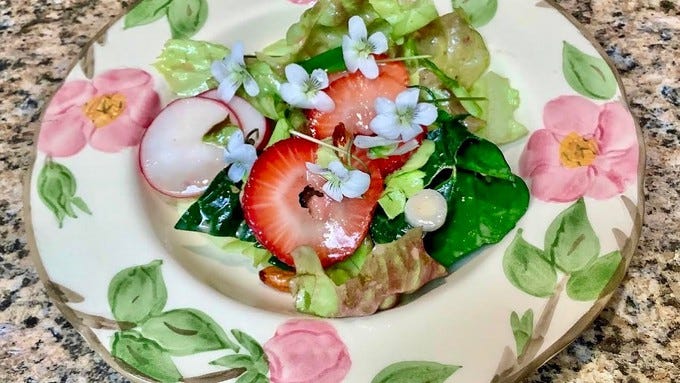
You Grew It. Now Eat It!
The healthiest food you can eat is the food you grow yourself. It doesn’t get any fresher than that. In today’s newsletter podcast, we talk with two Master Gardener/chefs: Kathy Morrison of the daily “Sacramento Digs Gardening” newsletter, and Master Gardener and Chef/instructor Andi MacDonald. Kathy has several recipes using ingredients that just might be maturing in your garden right now. And that’s the thrust of what is published in each Sunday’s edition of the Sacramento Digs Gardening Newsletter: If it’s ripening in your yard, she has a recipe for it. We have many of the recipes she mentioned in our chat here; for more, check out her Sunday posts, or the springtime recipes that Kathy and Co-content producer Debbie Arrington have compiled in their first recipe e-book, which is available for free at SacramentoDigsGardening.com. And their newsletter is free, as well, with little or no advertising (they will be going to heaven, I am sure). Even though their newsletter has a definite Sacramento slant about gardening activities here in Northern California, there’s a lot of good information provided in their daily posts that inspire gardeners everywhere. Go ahead. Subscribe.Here’s the recipe for the Strawberry Salad with Violets (courtesy of Sacramento Digs Gardening):Spring strawberry salad with fresh violetsMakes 2 to 4 servingsIngredients:4 to 6 strawberries, hulled and sliced crosswise2 radishes, sliced1 scallion, chopped2 tablespoons slivered almonds2 cups lettuce, roughly cut or torn into pieces1 cup baby spinach leaves, roughly cut or torn into pieces Dressing:3 tablespoons extra virgin olive oil1 tablespoon red wine vinegar1 teaspoon Dijon mustard½ teaspoon sugar¼ teaspoon seasoning salt Garnish:2 to 3 tablespoons fresh violets or violas (optional) Instructions: In a large bowl, put sliced strawberries, radishes, scallions, lettuce and spinach. Toss lightly. In a jar, combine olive oil, vinegar, Dijon mustard, sugar and seasoning salt. Cover jar and shake to combine. Pour dressing over salad and toss lightly again. Divide salad onto plates. Garnish with violets or violas. Serve immediately.Another recipe from the Sac Digs Gardening e-cookbook that Kathy raved about in today’s newsletter podcast: Baked Asparagus ala Sacramento:Baked asparagus a la SacramentoAdapted from Sunset magazineServes 4Ingredients:1 pound fresh asparagus, washed3 hard-boiled eggs1 tablespoon butter1 tablespoon flour1 cup milk1 cup soft bread crumbsSalt and pepper to taste½ cup dried buttered crumbs¼ cup grated Parmesan cheeseInstructions:Preheat oven to 375 degrees F. Break or cut the asparagus into 1-inch pieces. Steam until tender. Cook, cool and shell the eggs. Slice. Make a cream sauce with the butter, flour and milk. (Melt the butter in a saucepan, stir in flour until bubbly, then gradually add milk. Cook until sauce starts to thicken.) Add the soft bread crumbs and seasoning.In a buttered casserole dish, spread a thin layer of sauce on the bottom, then a layer of the cooked asparagus, then a layer of the sliced hard-cooked eggs. Repeat until the dish is filled. Sprinkle the top with the dried buttered crumbs and the grated cheese. Cover and bake in a moderate oven (375 degrees) for 30 minutes, removing the lid the last 10 minutes to allow the top to brown lightly. Serve warm.And, I would be remiss if I didn’t include Kathy’s recipe for Cherry Salsa!Cherry salsa Makes 2 cups Ingredients:2 cups fresh sweet cherries, any variety or a mix, de-stemmed and pitted Zest and juice of 1 lime 1/4 cup chopped red onion 1/2 cup chopped fresh cilantro 1 jalapeño pepper, seeds removed (keep them if you like more kick in your salsa), minced 1 fresh garlic clove, minced Salt and freshly ground pepper Instructions :Halve the pitted cherries and then chop them. Place in a bowl, then stir in the lime zest and lime juice. Add the red onion, cilantro, minced jalapeño and garlic clove. Add salt and pepper to taste.Cover the bowl and let the salsa chill in the refrigerator 45 minutes for the flavors to meld. When ready to serve, taste and adjust seasonings. Serve over grilled chicken breasts or grilled pork tenderloin, or with tortilla chips. Variations : This salsa also is delicious with any of these mix-ins: 1 chopped ripe but firm avocado; 1 chopped white nectarine; 1 chopped ripe mango.And, I did come across one recipe at the Sacramento Digs Gardening Spring e-cookbook that piqued my interest, just because I have beets ripening, as well as blood oranges: Roasted Beets and Citrus Salad. Check it out!Master Gardener/Chef Instructor Andi MacDonald is the “camp cook” for all the Master Gardeners who volunteer their services on Open Garden Days at the Fair Oaks Horticulture Center. Each month, the aroma wafting from the gazebo is so enticing, Master Gardeners keep checking their watch, asking: “Is it Lunchtime yet?”This month’s treat: Moroccan Lentil SoupAndi writes: “Lentil soup makes a simple, hearty, and inexpensive meal. This one is low in fat
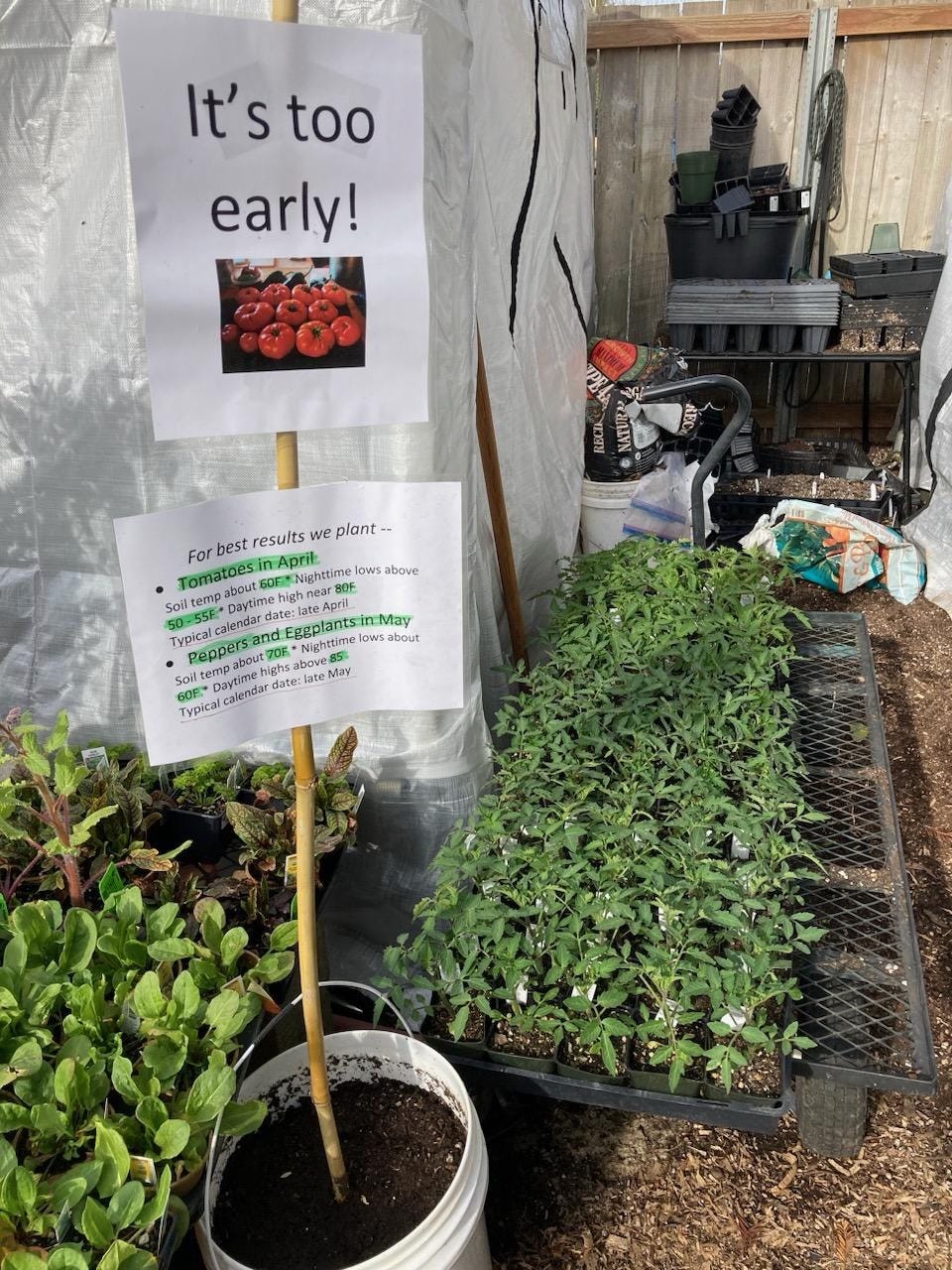
Tomato Growing Tips For 2023
For the best tomato growing season ever, we have tips. Just a few tips.Today’s newsletter podcast features excerpts from two episodes of the Garden Basics podcast, Episode 93 with America’s Favorite Retired College Horticulture Professor, Debbie Flower, and Episode 259 with Don Shor, proprietor of Redwood Barn Nursery in Davis, CA. two tomato chats with these scenic bypasses for tomato success. As the sign posted at Don Shor’s Redwood Barn Nursery proclaims: IT’S TOO EARLY.Wherever you live, wait until nighttime temperatures are steadily above 50 degrees and the soil temperature where you’ll be planting is approaching 60 degrees. Less stress on the tomato plant means earlier, better growth. Note to tomato growers in the desert southwest: how were the tomatoes this past winter?If you have never “moved up” your young tomato plants into larger pots, start that habit about a month or three weeks before you put them in the ground. Those tomato plants in their original three or four inch nursery containers (or HEAVEN FORBID! in a six-pack) may already be root bound. By the way, why would you want to plant six Early Girl or Better Boy or Sungold tomatoes, all of which would ripen at the same time? As Don Shor is fond of saying about your tomato garden: “Diversify your portfolio!”Another tomato choosing task: if those tomato plants have been sitting in the nursery for more than a few weeks, or look like there about to tumble off the shelf, always turn over a tomato plant container at the nursery and make sure the roots aren’t coming out the bottom. Ditto for those tomato plants on your back patio, waiting to be planted. Watch for protruding roots! Root stress can set a tomato plant back. Sure, it will recover after it’s finally been planted in the ground, but it will take awhile. Meanwhile, tomatoes that have been repotted into larger pots can stretch their legs for a few weeks, putting on height and vigor to give you a “ready-to-grow” tomato plant once it is in the ground. Athletes warm up before an event. So should your tomato plants.Even though the calendar says “April”, your soil is just beginning to wake up from winter. Early April is a great time to go shopping for tomato plants. Late April, and continuing through June, is the time to plant tomatoes into the garden. By the end of this month, the weather will be more conducive to rapid tomato plant growth because of more sun, warmer nights (steadily above 50 degrees) and warmer soil (60 degrees and above). But be prepared for sticker shock when shopping.Checking out the garden center shelves of tomato plants recently at a big box store, tiny tomato plants in four-inch pots were selling for nearly six dollars; six-packs of tomato plants, which were even smaller, were approaching seven dollars.“Yes, the prices have definitely gone up,” explains Don Shor, owner of Redwood Barn Nursery in Davis. “And there are a couple of reasons for that, besides the increasing cost of labor. One is the cost of heating greenhouses. You don't get tomato seedlings available in March and early April if you don't have a heated greenhouse. If you do it at home, you've got to start them indoors, move the young seedlings outdoors during the day, and then move them back in during the evening. They're not doing that in big commercial wholesale nurseries. They're using propane or natural gas to heat those greenhouses. Plus, greenhouses aren’t very effective when it's cloudy. And we've had a lot of cloudy days.”Shor emphasizes a few rules for beginning tomato gardeners: don’t buy too many tomato plants, and “diversify your portfolio”. For the first time gardener, start with perhaps one plant per family member, maybe a total of five tomato plants. And those tomato varieties should be easy to grow hybrids (not necessarily heirlooms) of varying sizes, including a cherry tomato, a paste tomato, an early ripening full size tomato, a reliable main season tomato, and a variety that strikes your fancy, which could be an alluring heirloom variety.“There's a whole group of red tomatoes that are classic and reliable,” says Shor. “Better Boy, Champion, Red Delicious, and Whopper. Those are four that I find very similar in their performance. The most consistent, year to year, has been Champion, which has an easy to remember name. But all those are good. Better Boy has been very consistent over the years.”The key is: plant several different sized tomatoes that vary in ripening times as insurance in case of wild weather swings. Gardeners may remember last September, when the first nine days of the month sizzled with temperatures above 100, including three days above 110, with high temperature records falling by the wayside. For many tomato growers, including myself, most of the medium to large tomatoes shut down production for the year after that September heatwave. That was highly unusual for our area, where serving homegrown tomatoes on Thanksgiving is not uncommon. The ones that made it through that he
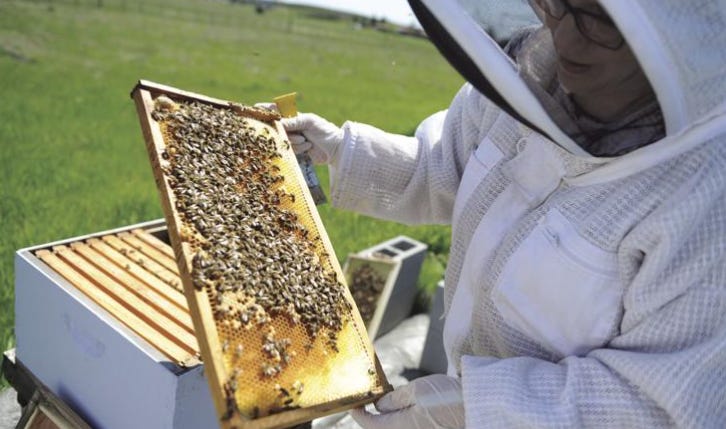
Backyard Beekeeping Advice
If the idea of raising backyard chickens appeals to you, you just might be mulling over the thought, “Well, why not raise backyard bees, too?”You may have listened to Episode 260 of the Garden Basics with Farmer Fred podcast, featuring urban chicken consultant Cherie Sintes-Glover discuss beginning a backyard chicken raising hobby. Cherie, besides being an urban chicken consultant, is also an apprentice Master Beekeeper. In today’s Beyond the Garden Basics newsletter podcast (above), she talks about how to get started raising bees. Her suggestions include:• Although bees are available now (April-May), they are best ordered in the winter months, due to demand.• Strive for ordering bees from local sources. Bees that are adapted to your climate have the highest success rate.• Take local beekeeping classes in the winter, before you get bees. Learn about the equipment you will need, as well as learning about bee temperament. Check with your local bee supply company for class information in your area.Cherie, a resident of San Joaquin County in Central California, is part of the Big Valley Beekeepers Guild, which is online at bigvalleybeekeepersguild.org. They also maintain an active page on Facebook. There, you can get a feeling for what’s involved with your new hobby!Bees are one of the best pollinators to have flying around your food and flower gardens. It’s been said that bees are responsible for one out of every three bites of food you eat. Today, we take attracting bees to your garden one step further: how about raising your own hive of honeybees? Besides a honeybee conversation with Cherie Sintes-Glover, we talk on today’s newsletter podcast with one of the world’s foremost bee authorities, Dr. Norman Gary, on how you can become a successful honeybee hobbyist. That just so happens to also be the title of his book, “The Honeybee Hobbyist”.The book contains:* Detailed, practical instructions for hobby beekeeping* Bee anatomy, behavior, and reproduction* How to safely open a hive and use a bee smoker* How to monitor hive conditions, prevent swarming, and deal with bee diseases* Sting prevention and effective strategies for safe handling* Fun uses for your beekeeping hobby, including entertainment and education* Urban beekeeping, with updated information on beekeeping on rooftops and in city environments.According to the University of California Agriculture and Natural Resources on-line publication, Bug Squad:Gary, known internationally as "The Bee Man," holds a doctorate in entomology (apiculture) from Cornell University and served on the UC Davis entomology faculty from 1962 to 1994. A beekeeper for seven decades and the author of Honey Bee Hobbyist: The Care and Keeping of Bees, he has written more than 100 publications, including scientific papers, book chapters and popular articles in beekeeping trade journals. He drew widespread acclaim for wearing a head-to-toe suit of clustered bees while "Buzzin' with His Bee-Flat Clarinet." (As a professional musician, he performs in area bands, but sans the bees.)"The Bee Man" holds the Guinness World record for keeping 109 bees inside his closed mouth for 10 seconds. You may have seen him and/or the bees he trained in action scenes in movies, television shows and commercials. His credits over the last 35 years include 18 films, including Fried Green Tomatoes; more than 70 television shows, including the Johnny Carson and Jay Leno shows; six commercials; and hundreds of live Thriller Bee Shows in the Western states.Your Harvest to Better Health Begins at Dave Wilson Nursery!Thank you for also listening to the Garden Basics with Farmer Fred podcast! It’s available wherever you get your podcasts. Please share it with your garden friends.Fred Hoffman is also a University of California Cooperative Extension Master Gardener in Sacramento County. And he likes to ride his bike. This is a public episode. If you'd like to discuss this with other subscribers or get access to bonus episodes, visit gardenbasics.substack.com/subscribe
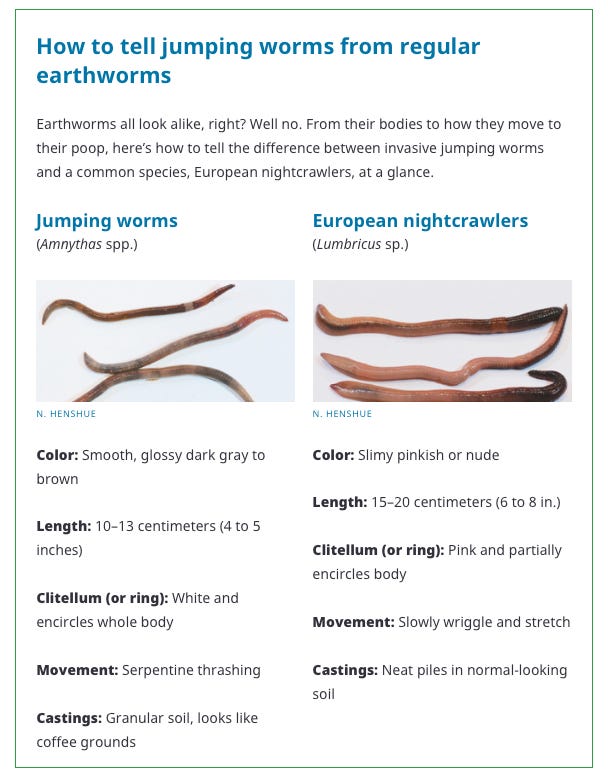
Jumping Worms: An Update, Again
Jumping worms, and the publicity about them, are spreading. Debbie Flower (America’s Favorite Retired College Horticulture Professor) and I talked about this in August of 2021 in Episode 126 of the Garden Basics with Farmer Fred podcast. We provided an update on Episode 217 in August of 2022 (listen to that chat in today’s newsletter podcast). Jumping worms have been in the United States for more than a half century. And they’re moving around the country, with our unknowing help. As Debbie pointed out in the podcast (above), one of the biggest threats is their poop. Because they tend to reside near the surface and move horizontally through the mulch layer, their poop is more highly mineralized and not incorporated deeper into the soil. Plus, that poop tends to be hydrophobic: it repels water. As a result, the soil fungi and bacteria that would be incorporating typical castings into forms of nutrients for plant availability isn’t happening. The biggest threat is to emerging native plants that would use the nutrients and moisture normally in the soil to germinate, either as understory plants in the forest, or freestanding wildflowers in pastures or prairies.Verified, effective controls at this point, are still being studied. From Cornell University, come this: “Research is currently being conducted on invasive worms at the University of Wisconsin and several practices do show some promise of control. Abrasive materials such as biochar (ground up charcoal) and diatomaceous earth (fossilized diatoms) may show some promise in killing adult jumping worms. Incorporate one of these products into the infested soil to a depth where the worms are located; worms that come in contact with the materials will be adversely affected.”Again, that is ongoing research. Debbie and I, in the newsletter podcast, suggest other possible control measures, including using mustard to bring them to the surface, identify them as jumping worms, and discard them (the recipe is in the podcast). Oh, you don’t want to listen? OK, here’s the transcript, which can also be found in Episode 217 of the Garden Basics podcast:Sarah in Sacramento Hi, Fred and Debbie. This is Sarah from Sacramento. My question is about jumping worms. I've heard they're very destructive. And unfortunately, I recently found three in my yard. So I'd like to know a little more about them. My question has three parts. First, how much of a concern are these worms for the home gardener? And second, is there anything I could or should be doing about the jumping worms? Should I kill the worms when I find them, or just leave them be? And third, I keep reading that their castings deplete the soil? I'm wondering if that's actually true. And if so, why are these worms so different from other types of worms which are generally good for the soil? I have heard the jumping worms eat organic matter really quickly. So could I offset this by simply adding a lot more mulch? Any other advice for me? Thank you so much.Farmer Fred Jumping worms. Yes, indeed. We've tackled this topic before here on the garden basics podcast, but the jumping worms are jumping all over the place. Debbie Flower is here, America's favorite retired college horticultural professor, and golly now we have them in our own backyard, Debbie.Debbie Flower Yeah, that's unfortunate. Right.Farmer Fred And one of the primary ways they spread is through fishing bait. If you go to a bait shop, you may see see worms intended for fishing, and they go by a variety of names, like jumping worm or Asian jumping worm or crazy worms or Alabama jumpers, or snake worms. Don't buy them. And if you do buy them and you have bait left over at the end of your little trip, get rid of them, put them in the trash. Yes, jumping worms, as the caller said, they kind of destroy organic matter because they have a rather big mouthpiece.Debbie Flower And super, super, super fast. And that's the problem. Regular earthworms that we're used to and maybe keep in our house to consume our kitchen waste also consume organic matter, but they do it much more slowly. And when the jumping worms consume all the organic matter on the surface of the soil, especially in forests or places around lakes or natural areas, then the there is no organic matter on the surface of the soil that allows other plants, typically their native plants, in those situations, to establish and grow. And so it's causing fast destruction of the mulch layer and is causing destruction of the native plants.Farmer Fred And they live very shallowly. Unlike earthworms that tend to go vertically, the jumping worms tend to live horizontally.Debbie Flower yes, just below the mulch layer and on top of the soil, that's one way to identify them. If you find a worm there, along with their, their poop, their feces, their black and crumbled, it looks like coffee almost, then that's probably a jumping worm. They're also recognizable because they do jump. And they have a white collar that goes all the wa
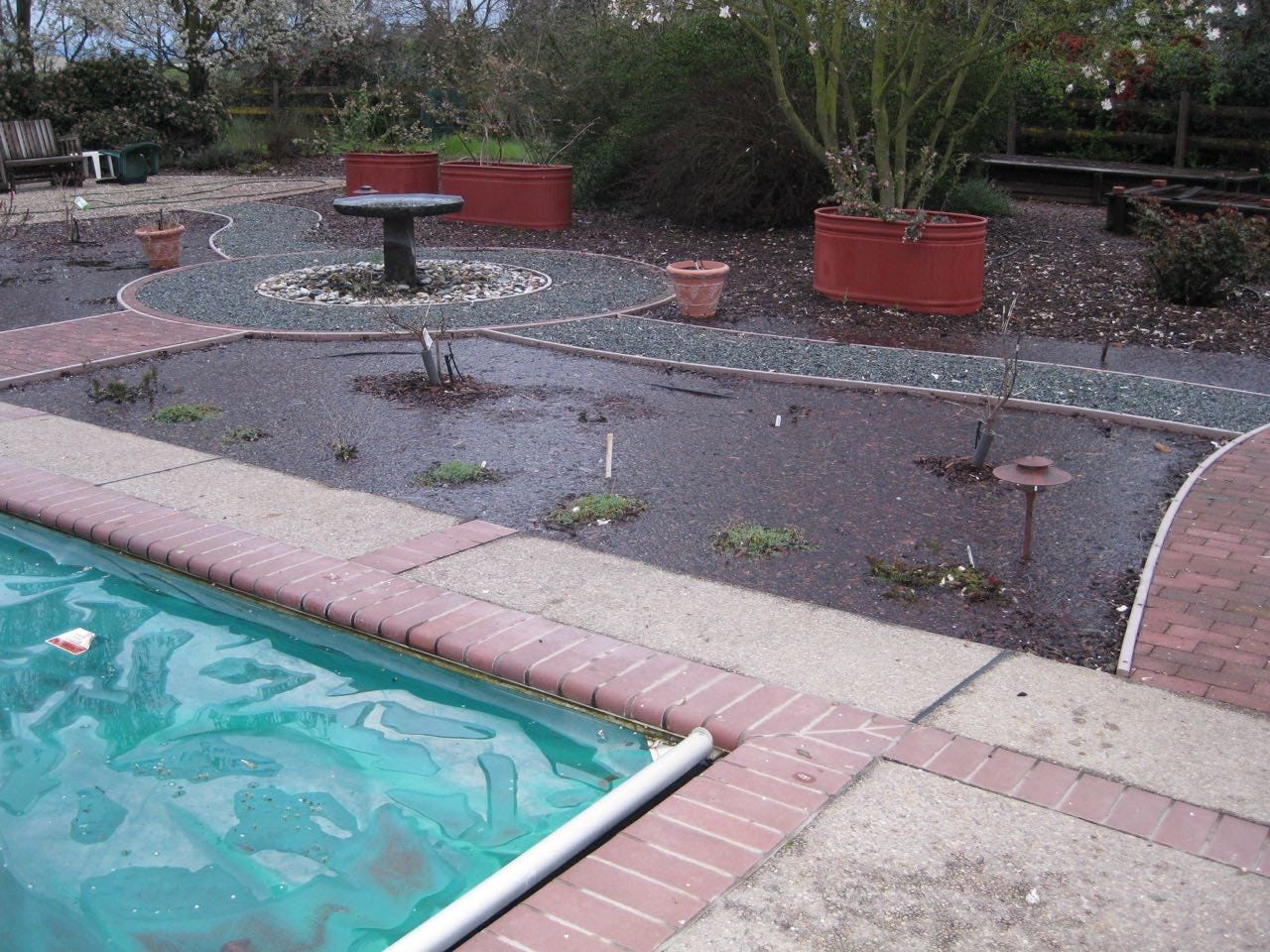
If You Can’t Dig Down, Grow Up! Raised Bed & Container Planting Tips
In today’s “Beyond the Garden Basics” newsletter/podcast, we revisit a chat we had three years ago with Linda Chalker-Scott, Washington State University Horticulture Professor, author of several outstanding garden books, and one of the forces behind the Facebook group page, “The Garden Professors”. Here, Linda discusses why loading up the bottom of planting containers with pot shards, gravel, styrofoam or other soil displacing items is not a good idea. It’s not even a bad idea. It’s a terrible idea! She explains why.Meanwhile, looking out the window….Tired of the rain yet, California? At our place, the monthly rainfall has exceeded the normal amount for the first three months of 2023, and March isn’t even over yet! Your garden soil may also be struggling trying to absorb all that rain, resulting in perennially muddy locations. Most plants don’t like wet feet. For your garden areas, especially those yards with heavy clay soil, there are a couple of options.When we get two dry days in a row, take a walk through the garden on Day Number Three (before it starts raining again). If the ground is still wet or feels squishy, mark that area with a post or grape stake. That way, you’ll remember when we finally get to the return of dry weather exactly where the ground is probably saturated, unsuitable for most in-ground plants to develop healthy roots.The permanent answer for dealing with too-wet clay soil is to install an in-ground drainage system, provided you can locate the end drain in an area that won’t impact your neighbors’ yard and garden. If it will impact them, consult with a landscape irrigation or drainage specialist who may be able to advise you on how you could place the end of the drain in a sump (a hole in the ground on your property) and then pump the water out to a gutter, if local codes allow that.Can’t Dig Down? Build Up.The other solution? If you can’t dig down, build up. Construct raised beds or use large containers filled with an easy-draining, commercial potting mix.A word of caution if building a raised bed on an existing lawn area: remove the turf below the raised bed area first. Dig out a few inches of the turf area, down to at least the turf root zone. If you leave the grass in place, that layer of turf could impede the drainage of water from the raised bed. The same is true if using weed cloth beneath a raised bed or a layer of gravel or small rock in a large container. That could also slow the rate of water movement, leading to ongoing soggy soil in the raised bed or containers. If building raised beds, first loosen the existing soil in the area with a spading fork after removing the turf. Then, mix in an inch or two of the soil mix for your raised bed with the existing soil in that area to improve drainage. If gophers are a problem in your area, putting down sheets of quarter-inch mesh hardware cloth below and partially up the inside walls of the raised bed can help protect future plants.A persistent garden myth is that using a coarse material, especially rocks or gravel in the bottom of a container or raised bed, will improve drainage. Linda Chalker-Scott, Horticulture professor at Washington State University, writes about the topic in her excellent books, “The Informed Gardener” and “The Informed Gardener Blooms Again”.“This is just one of those myths that refuses to die, regardless of solid scientific evidence to the contrary,” explains Chalker-Scott. “Nearly every book or web site on container gardening recommends placing coarse material at the bottom of containers for drainage. The materials most often recommended for this misguided practice are sand, gravel, pebbles, and pot shards.Nearly 100 years ago, soil scientists demonstrated that water does not move easily from layers of finer textured materials to layers of more coarse texture. Since then, similar studies have produced the same results. Gravitational water will not move from a finely soil texture into a coarser material until the finer soil is saturated. Since the stated goal for using coarse material in the bottoms of containers is to ‘keep soil from getting water-logged,’ it is ironic that adding this material will induce the very state it is intended to prevent. Alleged ‘drainage material’ added to containers will only hinder water movement.” For a container planting, all you need are drain holes and a good quality potting mix.Thank you for also listening to the Garden Basics with Farmer Fred podcast! It’s available wherever you get your podcasts. Please share it with your garden friends.Fred Hoffman is also a University of California Cooperative Extension Master Gardener in Sacramento County. And he likes to ride his bike. This is a public episode. If you'd like to discuss this with other subscribers or get access to bonus episodes, visit gardenbasics.substack.com/subscribe
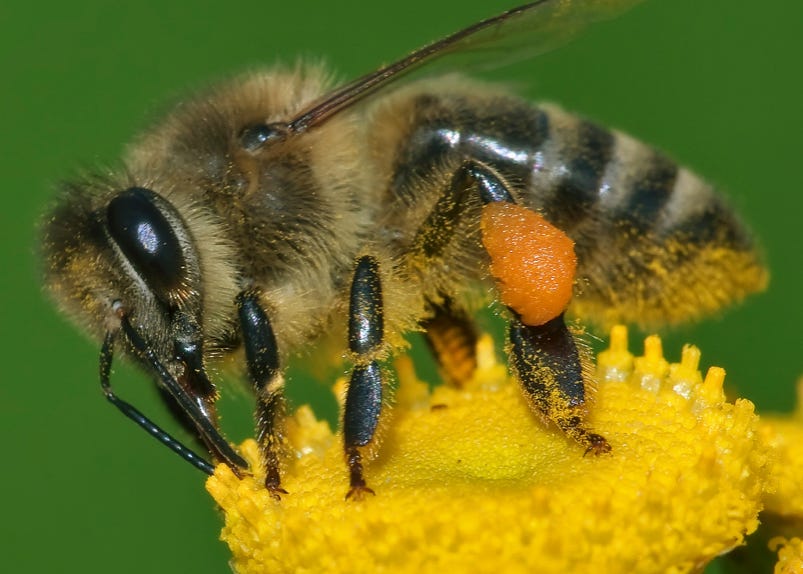
How Honeybees Say, "Come and Get It!"
One in every three bites of food you take comes courtesy of a bee. Without their pollination efforts, our diet and our gardens would be, to say the least, boring. In today’s “Beyond the Garden Basics” newsletter/podcast, we talk with Dr. James Nieh, of the School of Biological Sciences at UC San Diego. He and his team have been studying how honeybees communicate with each other, and how their elaborate dance moves are interpreted by the other honeybees in the hive. Basically, if you know where all the good pollen is, shake your booty, and do the Waggle Dance!Dr. Nieh’s original study can be found in the March 2023 issue of the Journal of Science. A more gardener-friendly version can be read at ModernFarmer.com. Or, listen to the podcast (above) or read the transcript!TRANSCRIPT - How Honeybees Say, “Come and Get It!”Farmer Fred 0:00 Have you heard about the Waggle Dance? No, it's not an obscure Chubby Checker record from the 1960s. Nor is it the follow up to the Soupy Sales song, “Do the Mouse”. The Waggle Dance is something bees do. And it's how they communicate to their hive mates, the other bees, telling them where the good stuff is, where the pollen is, and how to get there. iI’s a very elaborate dance. If you're like me, if you're a gardener, and you spend a lot of time in the garden, sometimes you'll just sit down and watch the bees, and wonder: “How the heck did they find these plants?” What is going on in their communication? We're talking to a gentleman who has studied this for a living. He and fellow scientists have an article published in the Journal of Science, and it's all about the Waggle Dance and how they discovered it. We're talking with Dr. James Nieh. He's the Associate Dean School of Biological Sciences at the University of California, San Diego. He's a professor in the Department of Ecology, Behavior, and Evolution. And I always like talking to university bee specialists, because they seem to have a fun job. And it sounds like you have a very interesting job. I don't know how you get the bees to slow down long enough to study their dance. Dr. James Nieh 1:14 Thank you, Fred. It's a pleasure to talk to you. We actually don't have them stand still. We watch them as they're in motion. But you're right, it sometimes can be a challenge to move with the bees, as they're dancing. Farmer FredSo let's talk about the whole thrust of your paper. And if people want to read more about it, there's a very good explanation that you wrote for the March 2023 edition of Modern Farmer magazine and website. It’s called “Unlocking Secrets of the Honeybee Dance Language.” What was your impetus for studying this? Dr. James Nieh 1:45 One of the things we wanted to learn is, why is it that some animals, like human beings, songbirds, and naked mole-rats, why do they have to learn language? We know that other animals, many of them are actually born with the ability to have a perfect animal communication system or animal language without the need for learning. That is what actually motivated us to look at honey bees, because honey bees have a very sophisticated animal language. And we suspect because it is so complicated, that learning might be involved. Farmer Fred 2:18 And we have known for a few decades that bees do communicate by movement, haven't we? Dr. James Nieh 2:24 Yes, that's right. In fact, it was something that Aristotle even suspected thousands of years ago. Although if you look at the translation, there's a little bit of uncertainty if he knew about the Waggle Dance. But some historians of science say that he did. And it really is a Waggle Dance, it is a shake your booty. But what is amazing is the amount of information that is communicated via a bee to the fellow bees about where the pollen is, and how to get there. It's truly remarkable. And it's the most complex example of animal language that communicates something like location that we know of. Farmer Fred 3:01 And also according to your paper, the movement also reveals the quality of a pollen resource. Dr. James Nieh 3:06 That's right. When bees are repeating this figure-eight motion multiple times, the more times they repeat it, the higher the quality of the resource. And there are two motions, there's the waggle phase, if you imagine the bee as a little arrow, she's running forward with her head pointed forward, and her abdomen is waggling. So that's called the waggle run because she's running while waggling. And then there's something called the return phase where she's returning back in a semicircle. And that creates one half of the figure eight. And that return phase is faster, the more excited she is about the food. So it's almost as if she's more eager to come back and do more Waggles. Farmer Fred 3:45 And is this just happening at the hive? Anybody who's sat for a while and watched bees at work, they'll sometimes think, “oh my goodness, I'm going to be stung. Look at that bee as it's going after that pollen. It’s shaking its behind at m

Pepper Seeds Slow to Germinate? Some Speedy Tips.
In today’s Newsletter podcast, we revisit some advice given to us by America’s Favorite Retired College Horticulture Professor, Debbie Flower, on how to get your pepper seeds to germinate more quickly, which can take up to three weeks before you see green leaves popping up above the soil surface. We were talking to the Elk Grove Garden Club last month, a wide-ranging conversation, which included how to tell if those old vegetable or flower seeds you have tucked away in a drawer will germinate or not. You can hear the entire chat in Episode 253 of the Garden Basics with Farmer Fred podcast.Home gardeners who grow their tomatoes from seed usually get fairly quick results after sowing the seeds indoors. Given the right germinating conditions - a soilless planting mix, good drainage, plenty of light, plenty of warmth - tomato seeds can pop up in 8-10 days.Pepper seeds are a different story. Why is it some peppers can take weeks to germinate?"The important thing in getting your (pepper) seeds to germinate is to keep them warm – the soil temperature should be in the 80's", says Renee Shepherd of Renee's Garden, a popular seed catalog based in Felton, California. "Germination is very much related to even moisture and warm temperatures. You should see germination within 2 to 3 weeks if it's warm enough. I strongly suggest using bottom heat to achieve the warmth the seeds need – most good nurseries carry good little electric seed starting mats which will keep your seeds at the right temperature to sprout. One online order source is Peaceful Valley Farm Supply."For those who want to comparison shop, another source for heating mats for your pepper seeds: Amazon.Another trick that some gardeners employ is soaking the pepper seed for a few hours before sowing to soften the seed coat. The value of that is open to debate."I have never heard of soaking pepper seed overnight and have never done it in 20 years of running a trial garden," says Shepherd.On the other hand, Professor Debbie Flower, formerly of the American River College Horticulture Department, sees the benefits of some "immersion therapy" for pepper seeds. "We soaked our pepper seeds in hydrogen peroxide for 10 minutes," explains Flower. "That's not enough time to scarify (soften or break the seed coat), or even get them soaked, but enough to kill exterior diseases."Many sweet pepper varieties will show their initial leaves about two weeks after planting the seeds. But some varieties of peppers take longer to pop up than others. "The hot pepper varieties take longer to germinate, some to three weeks," says Flower.But if you are experimenting with the really hot pepper varieties, such as the Bhut Jolokia (Ghost Pepper), it could take up to four months, says the Trade Winds Fruit website:"Chinense species (e.g. Habanero's) generally take longer to germinate than most common peppers. Keep soil warm to very warm (75-90F) for better germination. Do not use acidic soil. Some Chinense peppers, in particular Bhut Jolokia, Naga Morich and related peppers are very slow to germinate, averaging 1-4 months germination time."By the way, if you are growing the Bhut Jolokia...you're playing with fire. The Ghost Pepper is rated at 850,000 Scoville units of heat. For comparison, the habanero rates 200,000; the Jalapeno is 5,000; the Anaheim equals 1,000. And sweet bell peppers? 0.Another factor that can determine the rate of germination of pepper seeds: the pH of your seed starting mix. One of the most common ingredients in most seed starting mixes is peat moss, which is highly acidic, with a pH around 4.0. Pepper heads, including the Horticulture students at American River College, have found quicker germination when Coir (coconut fiber) is substituted for peat moss. Coir has a closer-to-neutral pH: around 6.5. The tests at American River College bear this out after trying Coir in their pepper seed soil mix. "We had the best germination of peppers ever!" says Flower.And don't be in a rush to set them out in their permanent garden home. "Pepper seedlings need to be grown out until they have at least several sets of true leaves, and it is at least 55° at night before you plant them out," explains Renee Shepherd. "And they will need a little time to get used to being outdoors, as well." In USDA Zone 9, that would be around mid-May. Be patient. After originally talking about this speedy pepper germination technique, other gardeners chimed in with their favorite tricks. One method that was seconded by many: germinate your pepper seeds in between two moist paper towels in a room that is between 70 and 80 degrees. For many, that room might be the kitchen or bathroom. When the "tails" appear after about 6 or 7 days (the tails, by the way, are the emerging roots), gently transplant them into a moist, seed starting mix, preferably one that uses the more neutral coir instead of the lower pH peat moss. Or, make your own. My preferred home mix consists of equal parts coir, perlite and fine
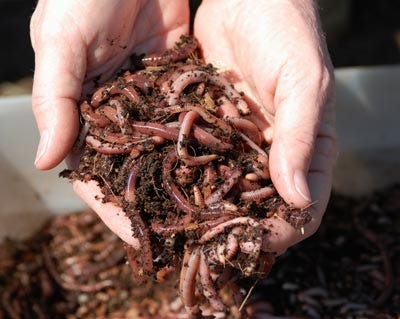
The Scoop on Worm Poop
In today’s newsletter podcast, we delve into the world of earthworms and red wrigglers with garden writer Amy Stewart, who authored the 2005 book, “The Earth Moved: On the Remarkable Achievements of Earthworms”. We recorded our chat back when the book was released, at her home (then) in Eureka, in northwest California. But we’re not here on the printed page to praise earthworms (although they are highly deserving of it), but to discuss their close relatives, the red wigglers, an excellent worm for composting. And now for something NOT completely different:From the Garden Basics e-mail bag, Don writes: “I discovered your podcast last week. Very interesting and cool stuff! I just retired at the end of last year and one of the items on my list of four, ‘To-Do’ items in retirement, is to create and maintain a backyard wildlife refuge with a focus on pollinators. On another note, my wife and I love sweet tea. We brew at least one pot per day, maybe two in the summer. What can we do with all the used tea bags?”Don, as usual, I’ll get to the answer for your question in a roundabout way. To have a successful garden to attract pollinators, you need successful soil. One of the best soil amendments to add for happy plants are worm castings, also known as worm poop, or, more euphemistically, vermicompost. According to Alameda County (CA) Master Gardener Judy Matthew: “Worm castings add beneficial bacteria to the compost which when spread around the garden, stimulates plant growth and can help protect plants against some diseases. The worm castings also help the compost-amended soil retain water.” You want more science about worm castings? Here you go.However, better soil doesn’t come cheap when using bagged worm castings. The price of a one cubic foot bag of worm castings is approaching twenty dollars here in California. You may want to tack on a new “to-do” item for your pollinator garden, Don: vermicomposting. Raising worms, who feast on many kitchen scraps and paper goods will return the favor, giving you a soil amendment teeming with microbial activity, perfect for plant roots to enjoy. One of those kitchen scraps they enjoy just happens to be tea bags.And don’t worry about the worms if you go on a three-week vacation. Give them some extra food before you leave and re-dampen the bedding. They won’t complain.Worms do best at temperatures slightly less than room temperature. Putting them in a cool indoor room or basement is an excellent idea. Some enthusiasts keep a worm bin at work, near their desk or in the break room. If you maintain the right balance of food, the bins won’t smell, either.Here are tips from the Sacramento County (CA) Master Gardeners here and here on starting and maintaining a worm composting bin. Some of those tips include:• All you need to create worm castings is a worm box, bedding material, red wriggler worms (not earth worms) and food scraps.• Bins can be purchased or homemade. Use a solid color (not clear) plastic storage box or a sturdy wooden box with a tight-fitting lid to keep out pests and protect your worms. If making your own bin, be sure to drill ¼-inch holes in the bottom to allow for drainage.• Worms will not escape; they dislike light and will migrate toward the center of the box.• A commercial vermicomposting system that features stackable bins take up a house-friendly smaller footprint, perhaps 24 by 24 inches.• Moistened, shredded newspaper or corrugated cardboard, shredded leaves, purchased pine shavings, or coconut fiber (coir) bedding provides worms with a balanced diet as well as a damp, aerated place to live.• Always keep the bedding as moist as a wrung-out sponge.• Place the worm bin in the shade or indoors. The best temperature range for thriving worms is between 55° and 75°F.• Worms love most fruits and vegetables, used tea bags, used coffee grounds and filters. Do not feed them animal products, dairy, onions, or processed foods. Limit citrus peels to less than 20% of the food. You’ll soon figure out what they’ll eat and what they’ll ignore.• Chopping the food into small pieces, one inch or less in size, will speed up the composting process.• To avoid fruit flies and odors, cover the food with at least one inch of bedding.• Use red wigglers or red worms, NOT earthworms or certain “fishing worms” such as Alabama jumping worms. Red wigglers can be purchased at some better nurseries, worm farms, and fishing supply stores.• The castings are ready when they are dark and fine in texture. Separate the worms from the castings. Place the worm castings in your garden bed before planting. Work the castings lightly into the soil with a rake. Cover with mulch or compost.The Sacramento County Master Gardeners have a great vermicomposting display area at the Fair Oaks Horticulture Center, which is open one day per month to the public. The next Open Garden Day will be on Saturday, March 11, from 9 am to noon.Thank you for listening to the Garden Basics with Farmer Fred podcast! It’s av

Vegan Split Pea Soup
Here is Andi MacDonald’s “More Than Basic Split Pea Soup” vegan recipe. It serves 6-8 people. She explains its origins:“My Aunt Carol lived on the Central Coast of California. When we visited, my father took us to Pea Soup Andersen’s restaurant in Buellton, where we dined on endless bowls of pea soup. Ten-year-old me thought that this was the height of culinary genius. I went back a few years ago and concluded that the soup was okay, bit it needed more oomph. That’s what this version is: basic comfort, but with a bit more to it.Directions are for an Instant Pot. To make this on the stovetop, follow the basic directions, but cook it for a couple of hours, stirring frequently to prevent scorching.”Ingredients:* 1 lb dried split peas* 1 Tbs olive oil* 1 medium onion, diced small* 2 medium carrots, diced small* 2 stalks of celery, diced small* 6 cloves of garlic, minced* 2 medium russet potatoes, peeled and diced small* 1 Tbs fresh thyme leaves (or 1 tsp dried)* 1 Tbs fresh oregano, (or 1 tsp dried)* 1-2 bay leaves* 1/2 tsp black pepper* 8 cups vegetable stock (low sodium preferred)* 1 Tbs soy sauce* 1 Tbs liquid smoke* Salt to tasteSet the Instant Pot to sauté. Cook the onions, carrots, and celery in olive oil until the onions soften. Stir in the garlic and cook for about one minute. Add the thyme, oregano, bay leaves, and pepper. Add the vegetable stock, soy sauce, and liquid smoke. Add the potatoes and the split peas.Put the lid on the Instant Pot and seal. On manual mode, set the time for 20 minutes. When the timer goes off, let the pot release naturally for 30-40 minutes.Release the valve, and stir the soup vigorously for a minute or so to break down the split peas. Taste, and add salt if needed.This soup will thicken as it sits. If made ahead (and refrigerated), you will need to thin it with water or stock before reheating.For more cooking tips, check out Andy’s Magic Apron on Facebook.I have questions, I have thoughts:What is in Wright’s Liquid Smoke? (Answer: not much)The Bay LaurelYou can grow just about every ingredient in this split pea soup recipe in your home garden. However, one ingredient in the recipe caught my fancy, because it is one of my favorite plants to grow, the bay laurel, also known as Sweet Bay or Grecian Laurel (Laurus nobilis).If I may quote the American Horticultural Society book, “The Encyclopedia of Garden Plants”:The Bay Laurel is “an evergreen, broadly conical tree, about 40 feet tall and 30 feet wide. For USDA Zones 8-10. Narrow oval, leathery, glossy, dark green leaves are very aromatic and used in cooking. Small, star-shaped, pale yellow flowers are borne in spring and are followed by globose to ovoid, green, then black fruits.”The bay tree is frost hardy, but foliage may be scorched by extremely cold weather or strong, cold winds. Needs a sheltered position in sun or semi-shade and fertile, well-drained soil. In tubs, may be grown well as standards, which should be trimmed during the summer. Propagate by semi-ripe cuttings in summer or by seed in autumn.”My thoughts on this plant: WINNER, WINNER, WINNER! In Northern California, it is easy to care for and not fussy about watering. Prune or don’t prune. It’s up to you. Bay laurel is a great, evergreen privacy screen that isn’t overly messy (because of the weight of the leaves, fallen ones tend to stay nearby the plant). We had a row of these at the old radio ranch in Herald, CA next to a swimming pool, and never had to skim out any bay laurel leaves. And, it was a great privacy screen located 15 feet away from the hot tub. p.s. The official Town Motto for Herald: “Where’s Herald?”.Because it is a broadleaf evergreen tree, the small birds - finches and wrens especially - love it for perching and nesting. The happy bird chatter from our row of bay laurels in the early evening was a delight. They were probably describing their day to others, hunting for garden pests. Did they pick off leaves of desirable garden plants? Yes. So, you plant enough for everyone to enjoy! Birds are always welcome in my garden.If you listened to Episode 254 of the Garden Basics podcast (the Feb. 24, 2023 edition), you heard aromatherapist Amy Anthony rave about the bay laurel, as well. The scent, she says, can help you build courage. Sounds like a plant every cold-call salesperson should own.The bay laurel is slow to grow, especially from cuttings. But once it takes off, it shoots up to 20 feet or more in less than ten years. (“Ten years?!? I don’t want to wait no ten years!”). Trust me, it’s worth the wait.Thank you for listening to the Garden Basics with Farmer Fred podcast! It’s available wherever you get your podcasts. Please share it with your garden friends.As an Amazon Associate, I earn from qualifying purchases from some of the underlined links in the newsletter. This is how I am trying to keep this a free newsletter. And as long as you buy whatever you want from Amazon using any of those links to get into the Amazon site, I get a few pennies.
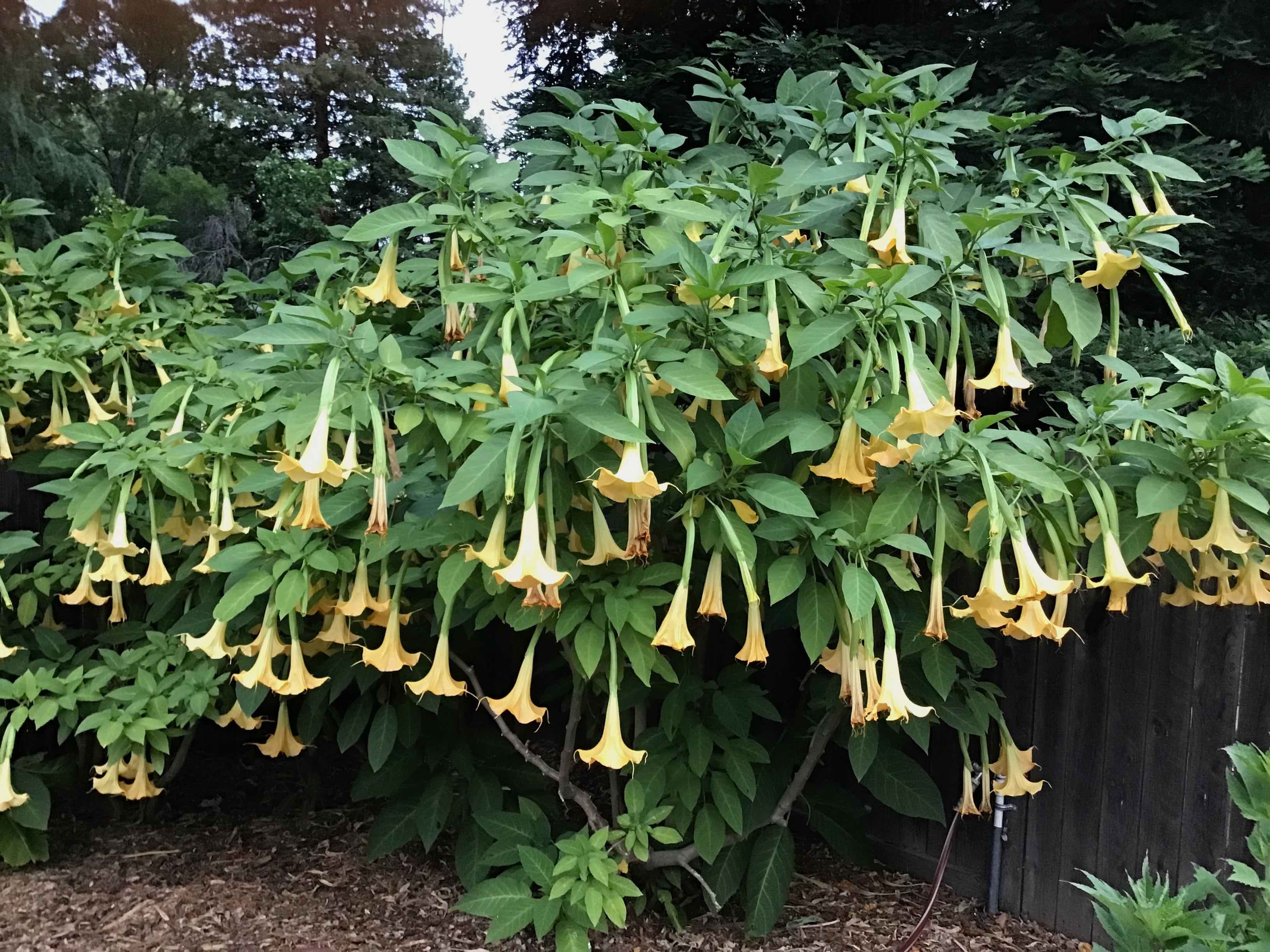
Freeze Damaged Plants? Embrace the Ugly.
Newsletter podcast excerpted from Episode 253 of the Garden Basics with Farmer Fred podcast. Recorded live, at the Elk Grove, CA Garden Club.Please note that the words below originated as a recent garden column in the Lodi (CA) News-Sentinel. Those of you in Michigan, Minnesota, Maine and other states where there are hardware stores that stock snowblowers year round can quit snickering at our plant panic when temperatures dip into the 20’s. Still, the advice holds true for wherever you live: give freeze-damaged plants a chance to recover.Our area has had quite the one-two punch of weather events so far in 2023. In January, it was record rains, near hurricane force winds, a tornado, flooding, and falling trees. Then, at the end of January, a hard freeze descended on many areas around us, where temperatures fell to the mid-twenties on January 31. That was followed by two consecutive February mornings with temperatures at or below 32 degrees. It was a triple punch that many of our more tender plants couldn’t take.How’s your garden looking these days, after all that weather? Your results may vary because all gardening is local. Many plants that we thought could shrug off the cold mornings are not looking good right now. Here, the salvias are dying back. Dependable, late winter blooming nasturtiums look like mush. That popular summer blooming low growing shrub, the lantana, has lost all its leaves.As gardeners, we like to put in plants that strike our fancy but are better suited to areas of California that get fewer frosts and freezes. We got away with very mild winters for a long stretch here in the Central Valley, encouraging our semi-tropical plant growing fantasies.And that’s especially true for those who planted tender perennials and shrubs. That list includes avocados and citrus trees. Wise gardeners here may have planted them in areas where they may be getting protection from wind as well as reflected heat from south-facing walls and patios in the early morning hours. And because cold air tends to flow downwards, planting semi-tropical plants in the higher sections of your property may give them a few degrees of protection from a freeze.Chuck Had a Tough Time RecentlyI feel bad for our ten-foot tall brugmansia shrub, also known as Angel’s Trumpet. Brugmansias, especially the variety ‘Charles Grimaldi’, are prized for their large, yellow or pink, aromatic, bell-shaped flowers, spring through fall. And, if the weather cooperates, it will flower through much of the winter, as well. Chuck – as I affectionately refer to Mr. Grimaldi - had thrived here for the last seven years, even blooming in the winter, in the lowest part of the yard (oops). Until now.So, what should a shivering gardener do, weeks after a hard freeze, when temperatures were at or below freezing for several consecutive hours?Number one: don’t prune away the dead portions now. If plants in your garden look blackened and wilted now, new growth may emanate from the base of the plant when the weather warms over the next couple of months. Pruning away the dead portions now would expose buds that may still be alive; another frosty morning could wipe out those survivors. Keep the shears in the garage and let the dead portions of the plants protect the understory.It may take until mid-Spring before you see new growth. Patience is key before you pick up the pruners. In the meantime, tolerate the ugly, and look for new growth, especially near the base of the plant.Water Can Help Your Plants Get Through a Freeze. But Not SucculentsNumber two: If it doesn’t rain, keep your tender plants well-watered, especially container plants. Make sure your garden and potted plants remain moist. Water gives off heat at night, and damp soil can protect plants from freezing, especially avocados and borderline citrus trees, such as lemons and limes. Moist soil retains heat better than dry soil, protecting roots and warming the air surrounding the soil. Too much water in the soil, however, can suffocate the roots of plants.Succulents, such as cactus, are the exception, however. According to the Arizona-based Desert Botanical Garden, most succulents survive freezing temperatures best if the soil around them is dry. Oh, and keep your frost protection gear handy...just in case we get another late winter surprise. Don’t let the latest string of sunny February days fool you. Historically, we can get freezing mornings through early spring.P.S. Chuck is already showing green growth near the base.Thank you for listening to the Garden Basics with Farmer Fred podcast! It’s available wherever you get your podcasts. Please share it with your garden friends.As an Amazon Associate, I earn from qualifying purchases from some of the underlined links in the newsletter. This is how I am trying to keep this a free newsletter. And as long as you buy whatever you want from Amazon using any of those links to get into the Amazon site, I get a few pennies. Thank you.Thanks for Subscribing and Sp
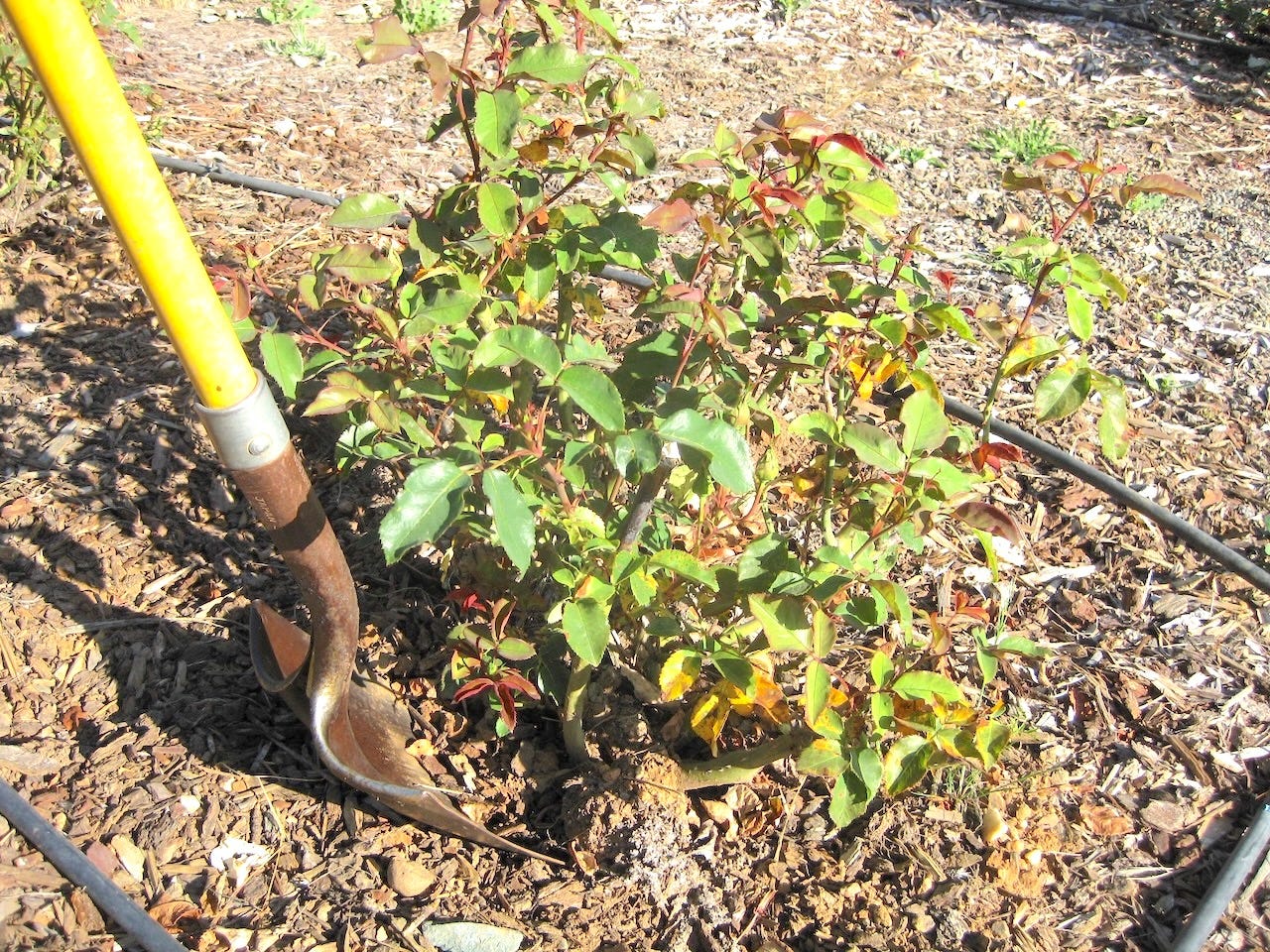
Winter is Rose Pruning Time
Rose Pruning Time is Here Mid to late winter is rose pruning time, wherever you can grow roses. Here in California and in other USDA Zone 9 areas, mid-December through Super Bowl Sunday (usually the second week in February) is ideal. For colder rose-growing climates, late February through the early rounds of the NCAA Basketball Tournament (mid to late March) is pruning time. Former sportswriter and current Master Rosarian Debbie Arrington supplied those dates. Listen to the above podcast for what she has to say about choosing the right equipment, especially clothing, when pruning roses.Here then, are some "California (and USDA Zone 9) Rules" for pruning hybrid tea, floribundas, grandifloras and miniature roses this winter. Instructions on how to prune climbing roses would exceed my word limit here, But Debbie Arrington has tips for climbers in the podcast, and here’s a link for more info on pruning climbing roses.By the way, ask 100 rosarians how to prune roses, and you may get many varied answers. Hell, rosarians don't agree on much when it comes to roses. Which goes to show you: ROSES ARE THE MOST FORGIVING PLANT IN NATURE. Give them the basics (sun, water, decent soil), and they can pretty much take whatever you throw at them, and come back blooming. Roses, especially the repeat bloomers, would appreciate a monthly fertilization during the growing season...if you remember.Rose Pruning Tools:• A pair of hand bypass pruners (I prefer the Felco #2 or Felco #7).• Long Handled loppers (My Corona loppers have lasted for years).• One or two pruning saws (a small hand-held and/or a larger bow-style pruning saw). • For a large rose garden, a rechargeable, battery operated hand-held chain saw is the choice of many rosarians, especially when getting a rose ready for “shovel-pruning”.• Thorn resistant, long sleeved rose pruning gloves.Pruning Roses for USDA Zone 9:• Prune out all dead, aged and weak growth. • Gnarly stems and gnarly thorns indicate "aged".• Remove any borer-infested branches, as well. A hollow or blackened center of a stem may indicate the presence of borers. Keep cutting until you see a solid, creamy colored interior. That is the sign of a healthy branch.• Make no cuts on hybrid tea rose bushes or grandifloras below your knee, unless you're removing the cane completely.• Leave as many primary canes as the plant can handle. Many cold climate rosarians might advise you to leave only three canes per hybrid tea rose bush. Here in USDA Zone 9, a vigorously growing hybrid tea or grandiflora rose might have as many as nine healthy canes. Keep most, if not all of those canes, for even more roses during spring through fall.• Try to make all cuts without extreme angles. Nothing exceeding 45 degree cuts; 90 degree cuts (or as close to that as possible) is fine. This is especially true of thick canes. The low part of a 45 degree cut on these would extend past, ultimately damaging, weakening or killing the eye (new bud) you are trying to cut above. • All cuts should be made one-quarter inch above a dormant eye or intersection of two branches.• Do not use glue, tree seal or paint on pruning cuts. A clean cut will heal much more quickly when left alone.• When you are finished, strip all remaining leaves from your roses, then blow or rake all the leaves out of the beds and send them to the dump, not the compost pile. Since all the fungus spores and insect eggs are there from the last growing season, removing these from your yard now reduces next year's problems. Thank you for listening to the Garden Basics with Farmer Fred podcast! It’s available wherever you get your podcasts. Please share it with your garden friends.As an Amazon Associate, I earn from qualifying purchases from some of the underlined links in the newsletter. This is how I am trying to keep this a free newsletter. And as long as you buy whatever you want from Amazon using any of those links to get into the Amazon site, I get a few pennies. Thank you.Thanks for Subscribing and Spreading the Word About the Beyond the Basics: The Garden Basics with Farmer Fred newsletter, I appreciate your support. Fred Hoffman is also a University of California Cooperative Extension Master Gardener in Sacramento County. This is a public episode. If you'd like to discuss this with other subscribers or get access to bonus episodes, visit gardenbasics.substack.com/subscribe
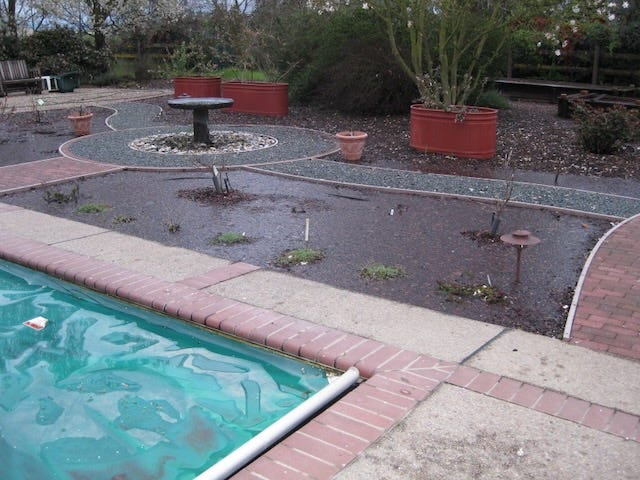
Drain That Rain!
“Where does the water go?” That’s a question I frequently ask myself while bicycling throughout the region, staring at rain-soaked suburban yards. This is also a question homeowners should ask themselves before, during, and after the rainy season.One of the best pieces of advice I can offer any new homeowner: before you spend any time and money on landscaping projects or a garden, live with the existing property for a year. This allows you to take monthly pictures of the area where you want a future garden, perennials, shrubs and trees.When we moved to our new home seven years ago, that’s what we did before we embarked on a totally redesigned landscape. Taking a series of pictures on a regular basis on sunny days, especially at different times of the day (9am, 1pm, 5pm), will remind you how much shade your future plants will be dealing with, and you can plant accordingly.A plant labeled for “full sun” will need at least six hours (preferably eight hours) of direct sun a day. “Part Sun/Part Shade” plants, 4-6 hours of sun per day. “Shade” should be reserved for those plants that get little direct sun (less than four hours) and preferably dappled sun, such as protection from an overhanging deciduous tree.However, the more important reason to live with that new yard for a year before embarking on outdoor landscaping projects: figure out where water goes, both after regular irrigation and after rainstorms. In our case, we discovered that few of the yard sprinklers worked fully or accurately, and that a heavy downpour of rain ends up in the garage. And the basement would flood.As a result, the price of our landscape rehab zoomed upward, to include a complete drip irrigation system for both the front yard and backyard, as well as an underground hard pipe drain system to move roof gutter water away from the house and garage to another part of the yard. You can hear more about how to do that in the podcast above, with landscape designer Michael Glassman.Home and Garden Pests That Sing in the RainThe other problem with wet weather: some home and garden pests love it when it’s wet; and others will seek refuge in drier quarters, such as in your home.The authors of the University of California Ag and Natural Resources publication, “Pests in the Urban Landscape,” offer some “Wet Weather Do’s and Don’ts” to ward off problems:• Check for snails and slugs. They like it moist and will sing in the rain. Unfortunately, their singing sounds a lot like, “chomp, chomp, chomp.” These garden leaf and flower munchers don’t like it too wet. They may be easily found headed for dry land – sidewalks and driveways – during a deluge. Find them under loose boards, as well. That’s the time for hand-picking or stomping them. Chemical controls for these mollusk family members are ineffective in the rain.• Remove weeds and unwanted plants. When the ground is wet, pulling them out goes much more quickly. Among the winter weeds spreading here right now are oxalis, nutsedge and groundsel. You may have other cool season weedy invaders in your yard.• Dump standing water. This wet winter is already favoring a big mosquito season ahead. Deprive breeding mosquitoes of water-nesting sites such as flowerpot saucers, wheelbarrows, buckets, clogged storm drains, and roof gutters.• Check for ants, cockroaches, and earwigs. These pests may invite themselves into your home when flooding or heavy rains make the outdoors unappealing to them. Seal any cracks or openings in your home. Outdoors, check the perimeter of your home as well as around doors and windows for insect entryways. Weather stripping, door sweeps, and traps placed beneath eave-protected walkways can help keep them outside. Indoors, keep food tightly sealed and the counters clean, especially near electrical outlets that might provide an entryway.• Remove yard mushrooms. Mild temperatures and wet soil are a combination that mushrooms and other fruiting bodies of fungi love. The good news is they are not harmful to your lawn and garden. The bad news? They can be poisonous to children and pets, when consumed. Rake them up.• Don’t apply outdoor fertilizer or pesticides now. Both are easily susceptible to being washed off the soil or plants and into our waterways. Wait for several days of dry weather before applying any sprays, dusts, liquids, or granules.• Avoid pruning plants unless it is to remove broken or damaged branches. Rainfall and open wounds in the winter on plants is a recipe for spreading diseases. Apricots, cherries, and olives should never be pruned during cool, wet, conditions, advises UCANR.• A common site on sidewalks after a rainstorm are worms, struggling to get out of the wet soil and onto dry land. If you have easy draining soil, you may see their mounds in lawns and gardens as they come up temporarily for air. Those mounds are a great fertilizer: worm castings. Just knock them down with your foot or a rake to feed the soil.• Tread lightly through the garden during or just afte
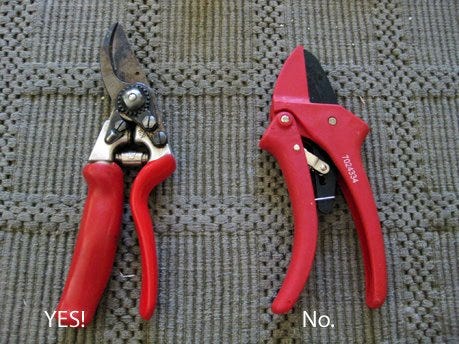
Bypass or Anvil Pruners? We Ask the Experts.
In today’s newsletter podcast (above): America’s Favorite Retired College Horticulture Professor, Debbie Flower, discusses the pros and cons of bypass and anvil pruners; and the best tool for sharpening pruners.This time of year, stroll down the tool aisle of any garden center and you'll find a vast array of cutting instruments, all designed with the backyard gardener in mind. Blade heads of short-handled pruners and long-handled loppers usually come in two different styles: bypass and anvil. Bypass loppers or pruners have a stainless steel curved blade that uses a scissors action to pass next to, not on top of, the lower surface, sometimes called the hook, designed to catch and hold the branch while the cutting blade comes down. Bypass pruners offer a cleaner cut, as the blade slices all the way through the stem. The cutting blade of anvil-style pruners comes down onto the center of a soft metal or hard plastic lower surface, called the anvil or table. Anvil pruners tend to crush the soft tissue of the stem, stopping the flow of nutrients, prolonging the healing time for the cut surface. Despite the bypass pruner's benefits, garden centers still offer a nearly equal number of anvil-style pruners and loppers, a never-ending source of confusion for the gardener hunting for cutting tools. We asked local garden experts their pruning preference: bypass or anvil? The late Sacramento County Farm Advisor, Chuck Ingels, preferred bypass pruners. "I never use anvil pruners because you often can't cut close enough to the branch collar without leaving somewhat of a stub," said Ingels. "When they begin to wear, they often don't cut all the way through. Also, they crush the bark, which bypass pruners can do also, but you can turn the shears so the blade is closer to the collar and make a clean cut." "I don't use and usually do not recommend anvil pruners," says Luanne Leineke, formerly the Community Shade Coordinator for the Sacramento Tree Foundation. "I tend to see too many wounded branches, particularly when the bark is soft. I suggest using bypass pruners for up to three quarters of an inch-thick branches, loppers for up to one inch thickness and a hand saw for anything larger." Pete Strasser is a former plant pathologist with a former Sacramento nursery, Capital Nursery. Pete has only one use for anvil pruners. "Anvils are for deadheading annuals, and that's about it." Loren Oki, Landscape Horticulture Specialist with UC Cooperative Extension in Davis, also has limited use for anvils: "I was taught that bypass pruners were used on live material, whereas the anvil types were better for dead wood. The bypass type cuts cleaner through the softer material without causing much damage." Steve Zien, owner of the Citrus Heights-based organic landscape consulting business, Living Resources, leaves no doubt to his preference: "I would never use anvil pruners! Never ever, unless something needed to be pruned right then and there, and it was the only tool I had beside my teeth."Bottom line: Bypass pruners are much more versatile than anvil pruners. Every gardener should own a pair of bypass pruners. But a word of warning: don't force cut a branch with bypass pruners that were not meant to cut a larger branch. Using too much force to work the blade through the wood could damage the entire unit. If those bypass pruners are advertised as cutting through one-inch branches, don't exceed that limit. Move up to a larger cutting tool for those bigger branches, such as bypass loppers, a small branch saw (my favorite), a bow saw, or when you finally realize that "Life is too short to put up with a problem plant", a good quality chain saw.Perhaps have a pair of small bypass snippers for the cut flower garden. And larger anvil ratchet loppers for removing dead wood. Finally, whatever you purchase, buy quality. Look for pruning tools that have replaceable parts (blades, springs,etc) that can easily be disassembled for cleaning, sharpening, oiling, and maintenance.The 3-Cut Pruning Method for Large BranchesIllustration provided by Texas A&M Forest ServiceThank you for listening to the Garden Basics with Farmer Fred podcast! It’s available wherever you get your podcasts. Please share it with your garden friends.As an Amazon Associate, I earn from qualifying purchases from some of the underlined links in the newsletter. This is how I am trying to keep this a free newsletter. And as long as you buy whatever you want from Amazon using any of those links to get into the Amazon site, I get a few pennies. Thank you.Fred Hoffman is also a University of California Cooperative Extension Master Gardener in Sacramento County. This is a public episode. If you'd like to discuss this with other subscribers or get access to bonus episodes, visit gardenbasics.substack.com/subscribe
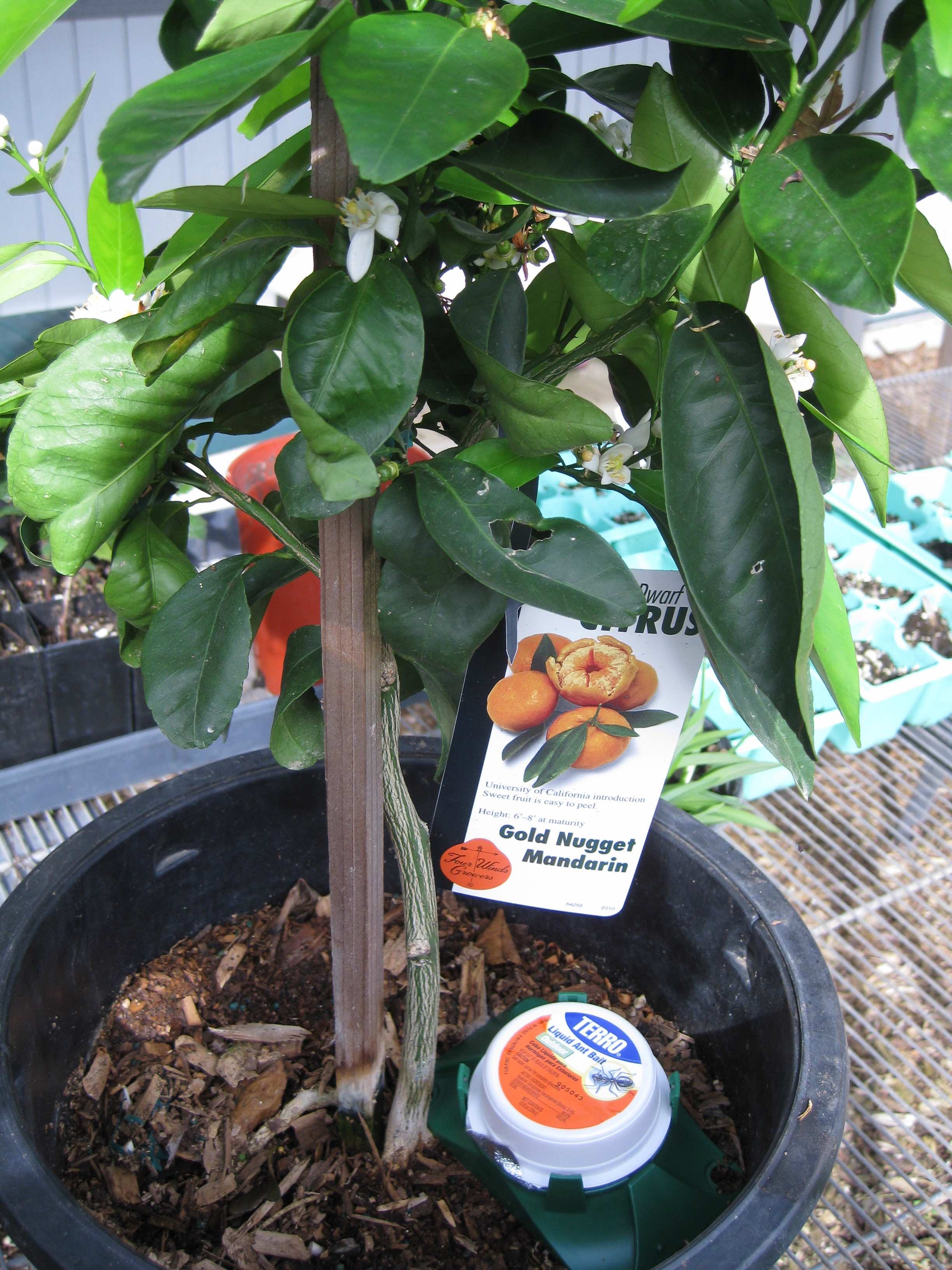
Ant Control
The recent bout of colder, wetter weather means ants have begun their march towards the warmth and comfort of your house, greenhouse or outbuildings. In today’s newsletter podcast, America’s Favorite Retired College Horticulture Professor, Debbie Flower, lists many ways to control ant populations, both indoors and outdoors, including her home recipe for lethal outdoor ant bait:1 part boric acid (1 teaspoon, e.g.) - available at most garden centers9 or 10 parts sugar (9 or 10 teaspoons sugar)Add enough water to make a slurry.Put slurry in a small container, tuna can size.Add 2 or 3 cotton balls and rotate them until they are completely covered in the slurry.Put a lid on the container. Lid must have holes big enough for ants to crawl through (about 1/8”).Bury in soil so lid is at soil level.Leave it alone. You won't see dead ants. They visit, take the bait back to the colony, and kill the entire colony.Commercial boric-acid ant baits are available, as well, for placing near outdoor plants where you see ants climbing up and down, herding aphids or gathering nectar.A word of praise for ants. Ants are a beneficial part of any successful garden. According to “Ants Are Ecologically Beneficial”, a publication of Iowa State University: “It is hard to imagine any other insect or animal that has a more important and positive impact on the terrestrial environment that sustains us. Ants are among the leading predators of other insects, helping to keep pest populations low. Ants move approximately the same amount of soil as earthworms, loosening the soil in the process and increasing air and water movement into the ground. They keep the ecosystem clean of dead insect carcasses and aid in the destruction and decomposition of plant and animal matter. By carrying bits of plants and animal remains into their nests, the soil is fertilized, and nutrients recycled through the world’s ecosystems. They carry seeds and help plants disperse into new areas.”However, as any gardener will swear, there are a couple of double-edged swords in that statement. Ant tunnels beneath the surface of a garden bed could move water too quickly to lower levels, making it unavailable to plant roots, especially in sandier soils. The solution for that: mix in compost on a regular basis. And those plant seeds that ants can disperse into new areas? There might be weed seeds in that mix. Yet another reason to own a long-handled hoe.It’s when ants start invading your house that homeowners need to act.Homeowners might reach for the spray can to douse those little scavengers. Many of those spray pesticides are only effective with direct contact on the ants. In addition, the stronger sprays, with residual action to thwart the next wave of ants, are potentially harmful to you, your children, and your pets.Here are some more modern, family-friendly indoor ant control methods from the University of California Ag and Natural Resources’ “Home, Garden, Turf, and Landscape Pests” publication, “Ants”:• Find where the ants are entering the house, then caulk any cracks and crevices both indoors and out.• Wipe up ant trails with soapy water when you see them.• Store food that is attractive to ants in closed containers.• Ant-proof kitchen garbage pails with sticky barriers like petroleum jelly.• Clean up grease and spills, pet food, and other possible food sources for ants.• Place pet food dishes in a moat of water with a drop of dishwashing liquid. The soap will keep the ants from floating.• If you decide to use a pesticide, choose prepackaged or refillable bait stations instead of sprays. Place them near ant trails and nest openings. Ant bait stations take time to work. It can take five to 10 days before you start seeing fewer ants. In the meantime, keep washing away the ant trails.In my experience, weak liquid boric acid combined with water in specially designed, refillable ant bait stations have proven effective, if given time. Boric acid powders and outdoor refillable ant bait stations are also available for outdoor ant control, especially if they have taken up residence in a long-neglected mulch pile of chipped/shredded tree parts. You’ll discover them in your first shovel full when you finally get around to using that mulch. Put down the shovel and pick up the powdered boric acid. Sprinkle it on the mulch pile and turn it into the middle of the pile. The ants will find it. But give them a couple of weeks before you return to that mulching task. Around the outer foundation of the house, the UC Integrated Pest Management team reports that several refillable bait stations are recommended, including the Ant Café, Antopia, Ant-No-More, and KM AntPro.A slow, but effective way to control Argentine ant populations is with a diluted, liquid boric acid product in a reusable ant bait station. Place the station outdoors near foundations where you see ants on the march.Thank you, also, for listening to the Garden Basics with Farmer Fred podcast! It’s available wherever you ge

Poinsettia Pointers
In today’s newsletter podcast: Back in November of 2020, we chatted about poinsettia plant basics, with Bill Eisley, a wholesale grower of poinsettia plants in Auburn, CA. Searching for that last minute Christmas gift? Many stores, including supermarkets, are now offering red and ivory-colored poinsettias, tropical plants native to Mexico, that are showstoppers this time of year for any dining room table. Even more colorful varieties are available at area nurseries and garden centers.Don’t grab and run with the first poinsettia plant you see. Take a few minutes to closely examine the plant.• Avoid buying poinsettias from exterior store displays. Poinsettias (Euphorbia pulcherrima) are tropical plants. They will be stressed in temperatures below 60 degrees. Choose a poinsettia from a well-lit indoor display.• The eye-catching red color (or white, cream, salmon or pink) on the poinsettia plants is not the flower; those are the modified leaves, known as bracts. The true flowers of a poinsettia are the small yellow berries, the cyathia, in the center of the bracts. Choose poinsettias that have tightly budded cyathias, not ones that are fully open.• Make sure that the smaller bracts surrounding the cyathia are fully colored. If these secondary bracts are not fully colored, the plants will quickly fade and lose color. • Examine the plant's soil before purchasing. It is best to avoid waterlogged soil, particularly if the plant appears wilted. Such a condition could signify irreversible root rot.Here are a few ideas to keep poinsettia plants looking good for another couple of months indoors:• Place your plant in indirect sunlight for at least six hours per day. If direct sun can't be avoided, diffuse the light with a shade or sheer curtain. • Provide room temperature between 68 - 70 F. If you are comfortable, so is your poinsettia. • Do not place plants near cold drafts or sources of heat. Avoid placing plants near appliances, wood stoves or ventilating ducts. • Water your plant when the soil feels dry to the touch. Avoid overwatering your plant. Don’t let it sit in standing water. • Always remove decorative foil from the outside of a container before watering. Allow the water to drain completely. Afterwards, return the decorative foil to the container, if desired.• It is not necessary to fertilize your plant when it is in bloom.If you want to try to get that poinsettia to rebloom for Christmas 2023 – and you have a lot of patience and perseverance – try these tactics:• In late March or early April, cut back the plant so that two buds remain, about six inches from the base. The plant may still look elegant before you start this radical surgery, but the pruning is necessary to help it look great for next December. • In April, place the plant - pot and all- outside in a mostly sunny, warm area; against a south wall beneath the overhang of your house or apartment would be ideal. Keep the poinsettia watered, pruning back the branches by a couple of inches in June and August to keep the plant from getting leggy. When the red color begins to show, start feeding the plant with a fertilizer that has a bit more nitrogen in it than phosphorus and potassium. Follow label directions.• In late October, before the first frost, bring the plant back into the house and keep it in a dark closet or room for at least fourteen hours a day. The plant will bloom only when it has had these long "nights." By next Christmas, you'll again be able to enjoy the striking beauty of that same poinsettia plant. If all this sounds like a lot of work, it is. Moreover, the result may not be as spectacular as the original plant's bloom. The good news: there will always be more colorful poinsettias for sale next holiday season. So, when you’re done enjoying that poinsettia plant this winter, you can always add it to your compost bin.More tips on poinsettia care from the National Garden Bureau.Thank you for listening to the Garden Basics with Farmer Fred podcast! It’s available wherever you get your podcasts. Please share it with your garden friends.As an Amazon Associate, I earn from qualifying purchases from some of the underlined links in the newsletter. This is how I am trying to keep this a free newsletter. And as long as you buy whatever you want from Amazon using any of those links to get into the Amazon site, I get a few pennies. Thank you.Thanks for Subscribing and Spreading the Word About the Beyond the Basics: The Garden Basics with Farmer Fred newsletter, I appreciate your support. Fred Hoffman is also a University of California Cooperative Extension Master Gardener in Sacramento County. This is a public episode. If you'd like to discuss this with other subscribers or get access to bonus episodes, visit gardenbasics.substack.com/subscribe