
BeachCast.TV: Bible Exploration, Apologetics and Church History with Dr. Chase A. Thompson:
775 episodes — Page 16 of 16

S2 Ep 12Episode 12: What is Blasphemy of the Spirit, the Unforgivable sin? Reading: Genesis 13, Nehemiah 2, Matthew 12 and Acts 12.
Today's Bible reading for January 12 is Genesis 13, Nehemiah 2, Matthew 12 and Acts 12. Our focus passage will be Matthew 12, and we are asking a big Bible question today: What is the Blasphemy of the Spirit, the unforgivable sin? SHOUT OUT TO THE PEOPLE WHO HAVE COMMENTED AND LEFT REVIEWS!!! On Apple Podcasts: Monte O, Kerri P, Cortney and Angel. And also people who have commented on the blog that they were listening: Angie from Knoxville, Og from Salinas, Cortney J. from Birmingham and Ms. Judy Bloom from parts unknown. THANK YOU! So - let's read our first chapter, and then get into our discussion. What is the Unforgivable sin?? It's a terrifying reality: Jesus warned His disciples and the Pharisees that there was a sin that could be committed that was unpardonable – unforgivable for all eternity. People have speculated and worried about this teaching of Jesus for hundreds of years. What precisely is the unpardonable sin? How can we know whether or not we've done it? Let's dive in! The Didache First century – RIGHT after the NT: Now concerning the apostles and prophets, deal with them as follows in accordance with the rule of the gospel. (4) Let every apostle who comes to you be welcomed as if he were the Lord. (5) But he is not to stay for more than one day, unless there is need, in which case he may stay another. But if he stays three days, he is a false prophet. (6) And when the apostle leaves, he is to take nothing except bread until he finds his next night's lodging. But if he asks for money, he is a false prophet. (7) Also, do not test or evaluate any prophet who speaks in the spirit, for every sin will be forgiven, but this sin will not be forgiven.35 Michael William Holmes, The Apostolic Fathers: Greek Texts and English Translations, Updated ed. (Grand Rapids, MI: Baker Books, 1999), 263–265. ANDREAS Andreas of Caesarea (Greek: Ἀνδρέας Καισαρείας; 563 – 637) : It is the sin of heresy, or of blasphemy against the Holy Spirit, which leads to death. If one man sins against another, pray for him. But if he sins against God, who is there who can pray on his behalf? And if even after all this, our opponents are still unwilling to learn and still unable to understand, they should at least stop speaking evil. They should not divide the Trinity lest they be divided from life.82 They should not classify the Holy Spirit with the creatures, lest, like the Pharisees of old who ascribed the works of the Spirit to Beelzebul,83 they too, on account of equal audacity, incur along with them the punishment which is unpardonable both now and in the future. Athanasius Works on the Spirit: Athanasius's Letters to Serapion on the Holy Spirit, Grave-robbing, or the opening of graves, is divided into two kinds too, like theft, according to the present Canon, to wit, into pardonable and into unpardonable grave-robbing. For if the fellow opening the grave does not denude the dead person's body, thus refraining from dishonoring (for that is what is meant by the expression "sparing devoutness") the dead, but only takes the stones found in the grave, in order to use them in the building of any other work that is preferable and more beneficial to the community, though this too is by no means anything to be praised, yet custom has made it pardonable.2 St. Nicodemus of the Holy Mountain – 1700s, Greek Orthodox church. Swearing is a dreadful and harmful thing; it is a destructive drug, a bane and a danger, a hidden wound, a sore unseen, an obscure ulcer spreading its poison in the soul; it is an arrow of Satan, a flaming javelin, a two-edged sword, a sharp-honed scimitar, an unpardonable sin, an indefensible transgression, a deep gulf, a precipitous crag, a strong trap, a taut-stretched net, a fetter that cannot be broken, a noose from which no one escapes. 19. Are these enough, and do you believe that swearing is a dreadful thing and the most harmful of all sins? Believe me, I beg you, believe me! But if someone does not believe me, I now offer proof. This sin has what no other sin possesses. If we do not violate the other commandments, we escape punishment; on the other hand, in the matter of oaths, we are punished just the same both when we guard against transgressing and when we transgress. St. John Chrysostom, 300s AD St. John Chrysostom: Baptismal Instructions, Hilary of Poitiers actually points us in a more biblical direction, in discussing the unpardonable sin: Every sin and blasphemy will be forgiven to men, but blasphemy of the Spirit will not be forgiven.67 With a very grave qualification, he condemns the view of the Pharisees and the perversion of those who also think like them. He promises pardon of all sins but refuses pardon for blasphemy of the Spirit. While other words and deeds are treated with a generous pardon, there is no mercy if it is denied that God is in Christ. 68 And in whatever way one sins without pardon, he is gracious to us and reminds us again that sins of every kind can be completely forgiven, thou

S2 Ep 11Episode 11: How Do I Deal With Doubts? (Grief over Death)+ Summary of Ezra.
Let's celebrate! We've made it through 10 episodes, and have FINISHED OUR FIRST BOOK TOGETHER. Great! Today we are reading Genesis 12, Nehemiah 1, Matthew 11, and Acts 11 together. We will start with Matthew 11, because something very significant and almost unsettling happens in that passage. The focus is on John the Baptist, a cousin of Jesus who has risen to incredible prominence in Israel as a preacher of revival. God had given John a tremendous ministry and a huge impact on his country, preparing for the public ministry of Jesus. John was a man of uncompromising righteousness and passionate pursuit of God. Whether he was asked about it, or not - we don't know - but at some point, John proclaimed his view - solidly grounded in Scripture - that Herod the Tetrarch (essentially the president/political figurehead in Israel) was sinning by having intimate relations with his brother Phillip's wife. This infuriated Herod, and he wanted to kill John, but he didn't have the courage to do that, so he simply had John arrested and jailed instead. And that is where we pick up our reading today. Before we get back to John the Baptist and doubts, one thing that I think will be helpful for us is to do a very brief summary of every book that we finish. So here is a brief summary: Ezra was a scribe, priest, and zealous expert in the law. The time period covered by the book is right around 450 B.C. and records the return of the Jewish people to Jerusalem after a 70 year exile in the Babylonian area. Chapters 1-6 of Ezra are about the return of a small advance group of Jewish people that are sent to secure Jerusalem and prepare for the building of the temple. Unfortunately, the enemies of Jerusalem mount a campaign to prevent the rebirth of that city, and there is quite a bit of back and forth between them, the advanced Jewish preparation team, and the government of King Darius and King Artaxerxes. Ultimately, the Persian government sides with the Jewish people and orders the work on the temple and the walls to continue. Interestingly, Ezra is not actually one of the advance scouts, and does not appear in his own book until chapter 7, when he is introduced to us by way of a brief genealogy. Ezra leads a team returning to Jerusalem with literally thousands and thousands of pounds of treasure (and no military guard!) and praises God upon his safe arrival. Later, Ezra discovers that many of the people of God have disobeyed His commands and married foreign wives; a situation that Ezra resolves by calling for the sending away of all of those foreign wives. And that is Ezra - an interesting guy with a passion for God and great faith who solves a thorny problem in quite a controversial way. Back to Matthew 11 and John the Baptist. John is in jail, and apparently feels like he has misunderstood God's plan, or that something has gone wrong. So he sends his followers to go ask Jesus what's up. John is going through what appears to be a significant crisis of doubt - and who can blame him? He is in a dank and dark dungeon and basically just awaiting his execution, which will come fairly soon. It is worth remember here that Jesus called John the Baptist the greatest human being ever born in history (or, at least, in a tie for first place with that title according to Luke 7:28, "I tell you, among those born of women there is no one greater than John. " And here we see the GREATEST ever struck by a massive wave of doubt. Which brings us to a question that lots of Christians have, but rarely voice. And that question is this: Am I the only Christian that wrestles with doubt? And the answer is - OF COURSE YOU AREN'T! Here is John the Baptist, conceived in a miraculous way, the one who heard God's voice and saw the heavenly dove descend on Jesus at His baptism - the greatest human ever....and he is struggling with doubt. And sometimes I do too. And if you are being honest - I'll bet you get hit by waves of doubt too! How do we handle them? I love this letter from one of my writing heroes C.S. Lewis, because it is so honest and transparent: Dear Sister Madeleva Thank you for your most kind letter. I will direct Fabers to send you a copy of the little book, but it may shock your pupils. It is 'A Grief Observed' from day to day in all its rawness and sinful reactions and follies. It ends with faith but raises all the blackest doubts en route. Since my wife's death I have been very ill myself and last July I was, while unconscious given extreme unction. It would. have been such an easy death that one almost regrets having had the door shut in one's face—but nella sua voluntade è nostra pace (In His will is our peace) I am now retired from my work and live as an invalid, but am quite contented and cheerful. I am afraid laziness has more to do with this than sanctity! All blessings. Yours most sincerely C. S. Lewis C. S. Lewis, The Collected Letters of C. S. Lewis, ed. Walter Hooper, vol. 3 (New York: HarperCollins e-books; HarperSanFrancisco, 2004

S2 Ep 10Episode 10: Does the Bible Forbid Interracial Marriage? Reading: Genesis 10-11, Ezra 10, Matthew 10 and Acts 10
Today's big Bible question comes from a biblical situation that our British friends might call a 'sticky wicket,' which means a difficult situation. The scribe and priest Ezra has discovered that some of the Israelite men have disobeyed God's command and intermarried with Canaanite women, and he is very disappointed, ultimately calling on those men to send their foreign wives away. Which brings up our big question: Is interracial marriage unbiblical? Does mixed-race marriage displease God now and did it ever displease God? (By the way, if this discussion interests you, you might want to read my book The Bible and Racism, what the Bible REALLY says about racism.) Today's Bible reading on the podcast will seek to correct a mistake I made yesterday. If this is your first time here, then this is our plan: To promote DAILY Bible reading. We are doing that by reading through the Robert Murray M'Cheyne Bible reading plan. His goal was to lead his congregation to read the entire Bible through in one year, and his plan allows that to happen when followed daily with the added bonus that you'll read the Psalms and New Testament twice. I'd love for you to read the entire Bible through in a year with us, but that is not the goal of this podcast (or the Bible 2020 initiative at our church.) Again, my goal is to help lead you in DAILY Bible reading. That means that you can pick up this goal in early January, or the middle of Summer, or late October, or whenever...and be successful! If you miss a day's reading only go back and do it if you have the time and if it won't compromise your Bible reading for today. The goal is DAILY BIBLE READING. For the church I'm pastoring, I'd love for us all to be reading the same passage on the same day - if we miss a day...no big deal! We'll make it up...or not - the goal is to forge ahead and develop a daily Bible reading habit. That said, yesterday I made a mistake, and left out Genesis 10, which we were supposed to read. I'll read it today for the sake of completeness. But first, let's read Ezra 10.... So, Ezra the scribe discovered in chapter 9 (yesterday's reading) that the Israelites had disobeyed God's commands and intermarried with the Canaanites. This upset him so much that he tore his clothing and pulled out his hair AND pulled out his beard hair. As the possessor of a beard, I can tell you that pulling out your beard hair hurts like crazy. What was the problem? Well, the problem was that God had forbidden the Israelites from marrying the woman of Canaan. (Note: Not ALL foreign women) Here's the passage: 3 You must not intermarry with them, and you must not give your daughters to their sons or take their daughters for your sons, 4 because they will turn your sons away from me to worship other gods. Then the Lord's anger will burn against you, and he will swiftly destroy you. Deuteronomy 7:3-4 SO - you see the point here, I hope? The children of Israel could not marry the people of the promised land area (Identified in vs 2 as, " Hethites, Girgashites, Amorites, Canaanites, Perizzites, Hivites and Jebusites, seven nations more numerous and powerful than you " because they would turn the hearts of the Yahweh following Israelites towards other Gods. This was NOT a race issue. I note here that the Israelites were NOT white and the Amorites, Canaanites, Perizzites, etc. black. I guess in modern parlance, they would all be brown, or whatever, but these are people all from the same part of the world, and they are all directly descended from Noah's sons. I'll say again: This was NOT a race issue, or a skin color issue. All of these people would almost certainly have looked the same and have been of very nearly the same race. Keep in mind that Abraham, the father of the Israelites, was himself from Ur of the Chaldeans/Tell el-Muqayyar which is in modern day IRAQ. So - the children of Israel are basically ethnic Iraqi people. So -some rapid fire questions: Are Christians still forbidden from marrying people from Canaan? Answer - In the New Testament, Paul commands Christians to not be "unequally yoked." in 2nd Corinthians 6. Based on the full context of the verse ("Do not be bound together with unbelievers; for what partnership have righteousness and lawlessness, or what fellowship has light with darkness?" 2 Corinthians 6:14) Christians have long taken that as a prohibition on a Christian marrying an unbeliever, and I agree with that interpretation. This does NOT forbid interracial marriage, but interfaith marriage. Is interracial marriage wrong, according to the Bible? ABSOLUTELY NOT - NOT IN ANY WAY, SHAPE, OR FORM. The Bible does NOT speak out against interracial marriage - only interfaith marriage. Moses, the most prominent leader of the Israelites, was married to an African/Cushite woman that was almost certainly black-skinned. Were you aware of this? Were you further aware that Miriam, Moses' sister, criticized him for this marriage? Well, let's take a look at Numbers 12: 12 Miriam

S2 Ep 9Episode #9: How did Saul Become Paul? (Answer: He Didn't!) (Also - Why You Wouldn't Be Able to Find Jesus in 1st Century Jerusalem even with a working time machine)
If you've grown up in church - and maybe even if you haven't - you've probably heard of the conversion of Paul the apostle. Initially, as the story goes, Saul was an enemy of Christians and had them arrested. He was even at the murder/martyrdom of the deacon Stephen, and was apparently the government official there that signed off on his impromptu (and likely illegal) execution. So far, so good - all accurate. Then, later on the Damascus Road, as Acts 9 tells it, Saul meets Jesus, and becomes a Christian. For the rest of his life after meeting Jesus, Saul is now known as Paul because Jesus has not only changed his heart, but changed his name! Great story, bro, but... is that what really happened? Actually, it isn't. But - before we discuss Saul/Paul and biblical names, let's read Acts 9 together! Fantastic testimony! Saul is such a notorious enemy of Christians that when God directly tells the prophet Ananias to go pray for him, Ananias has the temerity (or perhaps, the foolishness) to try and tell God that He was mistaken about sending Ananias to go and pray healing for Saul. God convinces Him that He's right, and Ananias is wrong - duh - and then Saul is healed and delivered. And then, Ananias gives him his new name - right? Actually, no. Saul is still Saul. In fact, in Acts 9:19-20, we see that Saul has become an evangelistic dynamo: "Saul was with the disciples in Damascus for some time. 20 Immediately he began proclaiming Jesus in the synagogues: "He is the Son of God." But...his name is still Saul! Later, Saul goes to Jerusalem to try and join the church there, but they are still afraid of him, so he decides to change his name to something more Jewish sounding, right? Actually, no - he remains Saul...and Saul is a Hebrew name! Then we take a Saul break for a couple of chapters to let Peter eat some goats and pigs and such. At the end of chapter 11, the focus turns back to Saul, who has been sort of exiled to his hometown of Tarsus partially because Christians are afraid of him, but mostly because people that aren't Christians are after him. But - praise God! - good old Barnabas, the son of encouragement, comes along, and takes Saul (that's still his name) to the church in Antioch, which is a Greek/Gentile city that would be in modern day Turkey. At Antioch, Saul becomes a valued member of the church AND IS STILL CALLED SAUL. Finally, we get to Acts 13. The Gentile church at Antioch is flourishing, and filled with seasoned prophets and teachers from many different nations, including at least two Africans: Lucius of Cyrene and a guy named Simeon the Black (which is a pretty cool name, if you ask me). The Holy Spirit sets apart two of those prophet/teachers for an evangelism mission, and calls them out by name: Barnabas and SAUL. Yes, God Himself calls him Saul years after His conversion. And then we get to the changeover - blink and you miss it! 9 But Saul—also called Paul—filled with the Holy Spirit Acts 13:9 And after that its Paul, the whole Paul and nothing but the Paul. Following that verse, the only time we hear the name "Saul" in the Bible is when Paul is recounting His testimony on the Damascus road. In every other instance, he is simply called 'Paul.' So - our big question: Why did Saul become Paul? And the answer is - HE DIDN'T! Saul is both a Roman citizen and a Hebrew citizen, and as such, he would have two names - a very common practice in the first century. I have a good friend with Mexican origins who is called Johnny by most people here in Salinas, California, but his real name is Juan. Something very similar is happening here with Saul/Paul. (Read more about dual names here) Some dual names came about because a person had an encounter with God, and God changes their name. Abram becomes Abraham, and Jacob the deceiver becomes Israel the overcomer. But in Saul's case - Saul was his Hebrew name, and Paul his Greek/Gentile name, and that is what he went by once God called him to take the good news of Jesus to the Gentiles. I have no doubt that if one of Paul's old Hebrew friends had seen him, that he would have hailed him as 'Saul.' and Paul/Saul would have answered without batting an eye. One last little rabbit trail about names. Let's say that you and I encounter a certain dashing British fellow (or lady, as is the case at the moment) who is a Doctor, but not the medical kind. And this Doctor has a an interesting blue police box that is larger on the inside than on the outside and - HOLY COW! it can go back in time. If our Doctor friend asks me where to go - I'd immediately ask to go back to first century Jerusalem - I want to see Jesus! Here's the sort of interesting thing. If I could speak Aramaic - which was the dominant Jewish spoken language at the time - I would have a very hard time finding Jesus, no matter how many people I asked. They would probably look at me like I was crazy, and tell me they had never heard of a 'Jesus!' What if I asked for Saul, or Paul or Luke, or Matthew, o

S2 Ep 8Episode 8: Does God Actually Care About Animals? Will there be Animals in Heaven? + Learning from Noah how to face hardships like a (possible) coming war.
Today's reading is fairly meaty - big, important and theologically rich passages in Genesis 8, Ezra 8, Matthew 8 and Acts 8. However, because the last two episodes of the Bible Reading podcast went long, today's big Bible question is an important one that will be fairly short. Does God care about animals? I suppose a subset to that question - one that we will cover in depth at a later date - is a very common biblical question: Will there be animals in Heaven? Before we dive into that, however, let's read our passage for today - Genesis 8. John Owen was an interesting fellow. A nonconformist pastor, theologian and writer in the 1600s in England, he was also an MP and an Oxford Academic. He was a bright mind and a lover of Jesus and had an interesting take on today's Genesis passage, and how we might apply it to our lives in 2020. As I write this, it looks possible that the U.S. - my home country - might be about to go to war with Iran. Australia is on fire, and other things have people in a very disquieted, alert and heavy state of mind. Owen asks and answers a question about how Christians should live and trust God when going through such dark and difficult times. Listen to his answer: What is our duty with respect to dark and difficult dispensations of God's providence in the world? The fourth and last peculiar duty which I shall mention is, to hide ourselves. And how shall we do that? The storm is coming; get an ark, as Noah did when the flood was coming upon the world: which is stated for a precedent of all judgments in future times. There are two things required to provide an ark,—fear and faith:— (1.) Fear: "By faith Noah, being moved with fear, prepared an ark." If he had not been moved with the fear of God's judgments, he would never have provided an ark. It is a real complaint; we are not moved enough with the fear of God's judgments. We talk of dreadful things that can befall human nature, and expect them every day; but yet we are not moved with fear. "Yet were they not afraid," said Jeremiah, "nor tore their garments." Nor do we do so. Habakkuk, upon the view of God's judgments, was in another frame, chap. 3:16, "When I heard," saith he, "my belly trembled; my lips quivered at the voice: rottenness entered into my bones, and I trembled in myself, that I might rest in the day of trouble." This is the way to find rest in the day of God's judgments.... (2.) FAITH We cannot well provide an ark for ourselves, unless we be guided by faith, as well as moved by fear. "By faith, Noah prepared an ark." How many things have you heard of that encourage faith;—the name of God, the properties of God, and the accomplishment of the promise of God. By virtue of all those properties, encourage faith in providing an ark. But you will say, "We are yet at a loss what this providing of an ark and hiding of ourselves is. 'A prudent man foresees the evil, and hides himself.' God calls us to enter into the chamber of providence, and hide ourselves till the indignation be over and done. If we knew what this was, we should apply ourselves unto it. I will tell you what I think in one instance:—give no quiet to your minds, until, by some renewed act of faith, you have a strong and clear impression of the promises of God upon your hearts, and of your interest in them. If it be but one promise, it will prove an ark. If, under all these seasons, moved with fear, acted by faith, we can but get a renewed sense and pledge of our interest in any one promise of God, we have an ark over us that will endure, whatever the storm be. Think of it, and if nothing else occur to you, apply your minds to it, that you may not wander up and down at uncertainties; but endeavor to have a renewed pledge of your interest in some special promise of God, that it belongs unto you, and it will be an ark in every time of trouble that shall befall you. (slightly modernized) John Owen, The Works of John Owen, ed. William H. Goold, vol. 9 (Edinburgh: T&T Clark, n.d.), 397–398. You probably caught the verse that triggered today's Bible question, because it was the first verse we read: "God remembered Noah, as well as all the wildlife and all the livestock that were with him in the ark." (Genesis 8:1) So - God was thinking about Noah AND the wildlife and the livestock in the Ark. There are several indications in Scripture of God's love for animals: 9 Then God asked Jonah, "Is it right for you to be angry about the plant?""Yes, it's right!" he replied. "I'm angry enough to die!"10 So the Lord said, "You cared about the plant, which you did not labor over and did not grow. It appeared in a night and perished in a night. 11 But may I not care about the great city of Nineveh, which has more than a hundred and twenty thousand people who cannot distinguish between their right and their left, as well as many animals?" Jonah 4:9-11 Your righteousness is like the highest mountains, your judgments like the deepest sea. Lord, you preserve people and animals. Psalm 36:6

S2 Ep 7Episode 7: "Judge not!" Are Christians Completely Forbidden from Judging by Jesus? Reading Genesis 7, Ezra 7, Matthew 7 and Acts 7.
When I was a kid growing up, the most well known Bible verse was probably John 3:16. Even people who didn't go to church knew about that verse, and would probably see it quoted on TV, or held up on a sign at some point every year. I think that has changed in the last few years - the most well known Bible verse today, at least to people that would not identify as Christian, is likely Matthew 7:1, "Do not judge, so that you won't be judged." Our main question of the day is: "must Christians never judge? Let's read the chapter together, and then discuss what Jesus is teaching here. In a 2013 message when David Platt, former head of the Southern Baptist IMB, was pastor at the Church at Brookhills in Birmingham, he tackled the issue of church discipline - something that is commanded in Scripture. The thorny question for many in the church is how can church discipline happen when we are told not to judge each other? It's a great question, and Platt gives a great answer: "What about Matthew 7:1," people ask. Well, keep going to Matthew 7:5. Yes, Jesus gives us warnings about judgment in Matthew 7:1, but when you keep reading, you hear Jesus say, "Why do you see the speck [of sin] that is in your brother's eye, but do not notice the log [of sin] that is in your own eye?… first, take the log out of your own eye, and then …" Follow this! "… you will see clearly to take the speck out of your brother's eye." (Matthew 7:3, 5). The whole implication is that you need to look inward first and humbly examine your own purity, so that you can help a brother or sister become pure. People say, "Well, it's not my place to judge you, and it's not your place to judge me." But we just read in 1 Corinthians 5, church, that it is our place to judge. Look at 1 Corinthians 5:12. "Is it not those inside the church whom you are to judge?" (1 Corinthians 5:12) The question is, how? We're going to talk about how in a moment, but suffice to say at this moment that we don't hide behind phrases like, "It's not my place to judge," or, "He who is without sin, let him cast the first stone. So since I still sin, I can't say anything." Brother or sister, if you see me walking into sin, caught in sin, being pulled into sin, please don't use super-spiritual jargon like that. Pull me back. And let God use the whole deal to sanctify you in the process, too! That's what Matthew 7:1–5 is all about; it's what 1 Corinthians 5 is all about. David Platt, "The Cross and Christian Discipline—Part 1," in David Platt Sermon Archive (Birmingham, AL: David Platt, 2013), 3919–3920. David Platt's teaching here reminds me of Galatians 6:1, " Brothers and sisters, if someone is overtaken in any wrongdoing, you who are spiritual, restore such a person with a gentle spirit, watching out for yourselves so that you also won't be tempted." This does show us that sometimes Christians are called to help restore and lead other Christians to repentance when they sin - but it MUST be done with a gentle and humble spirit. There is never any room in the people of God for what people call judgmentalism or pharisaical attitudes. Jesus gives us an incredible picture of what that is in Luke 18: 9 He also told this parable to some who trusted in themselves that they were righteous and looked down on everyone else: 10 "Two men went up to the temple to pray, one a Pharisee and the other a tax collector.11 The Pharisee was standing and praying like this about himself: 'God, I thank you that I'm not like other people—greedy, unrighteous, adulterers, or even like this tax collector. 12 I fast twice a week; I give a tenth of everything I get.'13 "But the tax collector, standing far off, would not even raise his eyes to heaven but kept striking his chest and saying, 'God, have mercy on me, a sinner!' 14 I tell you, this one went down to his house justified rather than the other; because everyone who exalts himself will be humbled, but the one who humbles himself will be exalted." Luke 18:9-14 The self-righteous attitude of the Pharisee here is always wrong and always at odds with Jesus' commands about judging. However, as Platt has pointed out - there IS a time to make judgments among the people of God. And those judgments can and should happen in only one particular area: INSIDE the church in terms of church discipline. Before we discuss that, I do need to say a word about what is NOT being forbidden by Jesus here. When the Bible is very clear about a certain practice, lifestyle, behavior, attitude of mind, or action being sinful and against God, it is NOT even remotely judgmental to teach and practice biblical truth. MOST of society considers people in the church to be judgmental when they proclaim certain truths in the Bible and call people to repent of their sins. While there is CERTAINLY a way to do this in a pharisaical, extremely arrogant and self-righteous way, that does NOT necessarily mean the person is judgmental. John the Baptist, for instance, was beheaded for calling out the s

S2 Ep 6Episode 6: Who were the Nephilim in Genesis 6? Were they the Offspring of Angels and Humans? Reading: Genesis 6, Ezra 6, Matthew 6 and Acts 6.
Today's reading is Genesis 6, Ezra 6, Matthew 6, and Acts 6. It may be that our focus reading for the day should continue in Matthew 6, because Jesus' teaching there is so majestic and beautiful that no passage should really overshadow it. If you will indulge me a bit, we will return to Matthew tomorrow for our focus, but today - we are going to discuss the Genesis passage. Genesis 6 has long been one of my favorite passages in the Bible. It is fascinating, scary, and very, very mysterious. I wrote a book last year called Angels, Ghosts and other Bible Mysteries (on Amazon) that is very focused on many of the mysteries that are brought up in this passage. If you like this discussion, you will probably enjoy that book. If not, then skip the book! Before we get to the question and answer section, however, let's mine some spiritual gold from this passage. Here is a powerful and encouraging word from our friend and mentor, Charles Spurgeon: My brethren, how displeased the great God has been with men. He said that it repented him that he had made men upon the earth. That was a striking expression which is used in Genesis 6:6: "It grieved him at his heart." He seemed to grow so weary of man's wanton wickedness that he was sorry that he ever made beings capable of so much evil. Yet he is so well content with his beloved Son, who has assumed our nature, that we read of him, "The Lord is well pleased for his righteousness' sake: he will magnify the law, and make it honourable." (Is. 42:21). The Lord looks down upon those who are in Christ with an intense affection, and loves them even as he loves the Son, for that is the meaning of this word, "In whom I am well pleased." All who are in Christ Jesus are pleasing to God; yea, God in Christ looks with divine satisfaction upon all those who trust his Son: he is not only pleased, but well pleased. If you are pleased with Jesus, God is pleased with you: if you are in the Son, then you are in the Father's good pleasure C. H. Spurgeon, "The Voice from the Cloud and the Voice of the Beloved," in The Metropolitan Tabernacle Pulpit Sermons, vol. 29 (London: Passmore & Alabaster, 1883), 355–356. I would say that Genesis 6 presents us with one of the top five mysteries in the Bible - especially if you read it in the King James Version! Check this out: And it came to pass, when men began to multiply on the face of the earth, and daughters were born unto them,That the sons of God saw the daughters of men that they were fair; and they took them wives of all which they chose.And the Lord said, My spirit shall not always strive with man, for that he also is flesh: yet his days shall be an hundred and twenty years.There were giants in the earth in those days; and also after that, when the sons of God came in unto the daughters of men, and they bare children to them, the same became mighty men which were of old, men of renown. Genesis 6;1-4, King James Version SO MANY QUESTIONS! What is going on here? Are angelic beings having relations with human women (apparently...) were the offspring of those unions giants (maybe...but that's not the best translation.) did God send the flood because heavenly beings and earthly beings were having relationships?! These are all tough questions and likely too big for our short little podcast to cover, but I'll try to at least give a short answer to some of them. (maybe we'll do a special episode on this chapter at some point) Question #1: Are heavenly beings in Genesis 6 actually having children with human females? The answer to this question depends on who, exactly, the "sons of God" are in Genesis 6. There are three main theories. The first is that they are powerful men and leaders that were human - maybe significantly above average humans. Think body-builders, great/tall athletes, charismatic politicians, etc. Theory #2 is that these 'sons of God' are descendants of Seth, thus making the 'daughters of men,' primarily descendants of Cain. This theory is the one I have heard most at seminary and in academic circles. Theory #3 is that 'sons of God' are some type of heavenly creature - an angel, or something like an angel. I personally see no grammatical or historical evidence of theory #1. All of the sudden these guys realized that human females were beautiful (vs. 2)? This theory doesn't seem to fit the context of the verse very well, and theory #2 even less so. There is literally NOWHERE in Scripture that suggests that the daughters of men were of the line of Cain and the sons of God were of the line of Seth. Seth is mentioned ten times in the Bible, and only twice after Genesis 5. (Once in a genealogy in Luke and in 1st Chronicles) Cain is mentioned only 3 times after Genesis 5, and all three times are in the New Testament, and do not discuss his descendants at all, but only his murder and his wrong-offering. Genesis six mentions neither Cain nor Abel, so this theory - and it is a popular one - simply has no biblical support whatsoever that I can fi

S2 Ep 5Episode 5: What Does it Mean to Be Meek and Why are the Meek Blessed?! (Reading Genesis 5, Ezra 5, Matthew 5 and Acts 5)
Today our Bible readings in the Robert Murray M'Cheyne plan are Genesis 5, Ezra 5, Matthew 5 and Acts 5. Our focus passage is Matthew 5, and how could it not be? In this passage, we see the beginning of the most famous and well known sermon ever taught by anybody, the Sermon on the Mount. Jesus here lays down His ethic, His commands, His way of life and His motivations. When we think about the Great Commission of Matthew 28, we should remember that a large part of it - almost half! - is that we teach the world to observe and obey the teachings of Jesus. A good place to start with that (co)mission is here, in Matthew 5. Our question of the day concerns what might be the most famous verse from the most famous sermon ever, verse 5. Even those who haven't been to church in years are familiar with this verse where we are told that the meek (or gentle, in some translations) are blessed. What an interesting and almost counter-intuitive message! This teaching raises a couple of compelling question: what does it mean to be meek; and how, exactly, are the meek blessed? The Greek word that is used here is praotēs, and the good news for us is that it is used so frequently in the Bible that we can get a very good idea of what it means. First, Matthew 21:5 Tell Daughter Zion, "Look, your King is coming to you, gentle, and mounted on a donkey, even on a colt, the foal of a beast of burden." So meekness refers to the kind of King who would ride on a donkey. It has an element of humility to it. Colossians 3:12 " 12 Therefore, God's chosen ones, holy and loved, put on heartfelt compassion, kindness, humility, gentleness, and patience, " Here we see that meekness also has an element of gentleness to it - the kind of gentleness that fits in perfectly with compassion, kindness, humility and patience. Titus 3:1-2 helps us understand meekness also, " Remind them to be submissive to rulers and authorities, to obey, to be ready for every good work, 2 to slander no one, to avoid fighting, and to be kind, always showing gentleness to all people. " So meekness here is represented by a person who avoids arguments, quarrels and talking bad about other people. Sounds lovely, right! Gotquestions helps us here too, "Meekness models the humility of Jesus Christ. As Philippians 2:6–8 says, "[Jesus], being in very nature God, did not consider equality with God something to be used to his own advantage; rather, he made himself nothing by taking the very nature of a servant, being made in human likeness. And being found in appearance as a man, he humbled himself by becoming obedient to death—even death on a cross!" Being "in the very nature God," Jesus had the right to do whatever He wanted, but, for our sake, He submitted to "death on a cross." That is the ultimate in meekness. " Here's some powerful wisdom from John Piper on meekness: Now let's stand back and see if we can see the portrait whole. Meekness begins when we put our trust in God. Then, because we trust him, we commit our way to him. We roll onto him our anxieties, or frustrations, our plans, our relationships, our jobs, our health. And then we wait patiently for the Lord. We trust his timing and his power and his grace to work things out in the best way for his glory and for our good. The result of trusting God and the rolling of our anxieties onto God and waiting patiently for God is that we don't give way to quick and fretful anger. But instead, like Moses we give place to wrath and hand our cause over to God and let him vindicate us if he chooses. And then, as James says, in this quiet confidence we are slow to speak and quick to listen. We become reasonable and open to correction. Meekness loves to learn. And it counts the blows of a friend as precious. And when it must say a critical word to a person caught in sin or error, it speaks from the deep conviction of its own fallibility and its own susceptibility to sin and its utter dependence on the grace of God.... What effect does Jesus want this promise to have on the disciples? I think the answer is that he wants the promise to give them strength to continue in their meekness. This is the way the promise works in verse 12: "Rejoice and be glad, for your reward is great in heaven, for so men persecuted the prophets who were before you." In other words, the promise of great reward gives the disciples strength to endure persecution with joy. So I think the promise that the meek shall inherit the earth is intended by the Lord to give us the strength to endure in meekness when the natural inclination would be to defend ourselves or retaliate or give way to fretful anger....If you are a disciple of Jesus Christ, sitting at his feet on the mount this morning, that is, if you trust him and commit your way to him and wait patiently for him, God has already begun to help you and will help you more. And the primary way that he will help you is to assure your heart that you are a fellow heir of Jesus Christ and that the world and everyth

S2 Ep 4Episode 4: Why did God reject Cain's Offering and Accept Abel's? (Reading: Genesis 4, Ezra 4, Matthew 4 and Acts 4)
A most curious incident happens in Genesis, chapter 4. Adam and Eve have been banished from the Garden of Eden, and they begin a family. Cain is the firstborn, and he grows up to become a farmer. Abel is the second child, and he becomes a shepherd. Here is the story of Cain and Abel from Genesis 4: The man was intimate with his wife Eve, and she conceived and gave birth to Cain. She said, "I have had a male child with the Lord's help." 2 She also gave birth to his brother Abel. Now Abel became a shepherd of flocks, but Cain worked the ground. 3 In the course of time Cain presented some of the land's produce as an offering to the Lord. 4 And Abel also presented an offering—some of the firstborn of his flock and their fat portions. The Lord had regard for Abel and his offering, 5 but he did not have regard for Cain and his offering. Cain was furious, and he looked despondent.6 Then the Lord said to Cain, "Why are you furious? And why do you look despondent? 7 If you do what is right, won't you be accepted? But if you do not do what is right, sin is crouching at the door. Its desire is for you, but you must rule over it."8 Cain said to his brother Abel, "Let's go out to the field." And while they were in the field, Cain attacked his brother Abel and killed him.9 Then the Lord said to Cain, "Where is your brother Abel?""I don't know," he replied. "Am I my brother's guardian?"10 Then he said, "What have you done? Your brother's blood cries out to me from the ground! 11 So now you are cursed, alienated from the ground that opened its mouth to receive your brother's blood you have shed.12 If you work the ground, it will never again give you its yield. You will be a restless wanderer on the earth." - Genesis 4:1-12 If you've ever felt like a failure as a parent - I have, many times - then consider Adam and Eve, the first parents. Their eldest literally killed their second born - what a horrific thing to endure for a father and mother! Adam and Eve lived in perfection and paradise, and within a very short time, the world went from sinless beauty to horrifyingly dark. Sin is that way, isn't it? It can start out small and seem somewhat innocuous, but sin always leads to worse and worse consequences. James describes the slippery slope of sin this way: "Then when lust has conceived, it gives birth to sin; and when sin is accomplished, it brings forth death. " - James 1:15 God saw what was coming, and warned Cain to turn away from his jealousy and lust for anger, but Cain ignored the warning, and killed his brother in cold blood. Most of us that read this passage can see why Cain did what he did - it is not justifiable in the least, but we have all been upset when one person is commended, and we are not. A more mysterious question is this: Why did God reject Cain's offering, and not Abel's? Sadly, the Bible doesn't say directly, but there are some very solid clues that point us in the right direction. Hebrews 11:4, for instance, tells us this, " By faith Abel offered to God a better sacrifice than Cain did. By faith he was approved as a righteous man, because God approved his gifts, and even though he is dead, he still speaks through his faith. " At least part of the answer is that Abel's sacrifice was by faith, and Cain's was not. Another clue might be found in the letter of Jude in the New Testament. In that letter, the church is warned about a group of false teachers who have turned away from the ways of God, and have, "have traveled in the way of Cain." Again, the specific error of Cain is not identified, but in the context of Jude it does seem to have to do with false teaching/false practice/false worship. Our final major clue, and the one that I believe is the most important, comes to us in Leviticus chapter 17:11, " For the life of a creature is in the blood, and I have appointed it to you to make atonement on the altar for your lives, since it is the lifeblood that makes atonement." In the eyes of God, the only way for sin to be atoned for - (atone means to make amends or reparation, to make things right) - is for there to be the shedding of blood. Because the life of an animal or human is in its blood, the only way to cover sin - to pay for sin - to make things right - is for there to be the spilling of blood. Abel's sacrifice recognized this truth and adhered with it, but Cain's sacrifice did not. I believe that this simple fact explains why Cain's sacrifice was rejected. Not because God loves shepherds more than farmers, but because only blood can cover sin - nothing else...not vegetables, not offerings, not money, not power, not fame, nor possessions. This is why Jesus had to come and die - why His perfect blood had to be poured out. Because only blood can cover sins. Imperfect blood - the blood of normal animals and humans is limited in its effect, but the blood of a perfect and sinless human is infinite in its covering effect. Therefore the writer of Hebrews tells us: 22 So Jesus has also become the guarant

S2 Ep 3Episode 3: What is the Protoevangelium? (Reading: Genesis 3, Ezra 3, Matthew 3 and Acts 3)
Today's Bible Readings in the RMM Bible Reading Plan are from Genesis 3, Ezra 3, Matthew 3 and Acts 3. Our focus passage is Genesis 3, which is all about the Fall of Man in the Garden of Eden. Encouraging Quote of the Day from Tim Keller, " In the beginning of history, it was a disaster. Adam and Eve, garden of Eden … What happens? Sin, Serpent … you know the story. Everything is horrible. Death, destruction, evil. Everything is horrible, except there's a glimmer of hope. Do you know what it is? It's a promise. In Genesis 3:15, God says, "I promise that one descendant of Eve is someday going to bruise the head of the Serpent and destroy evil. I promise." Scroll forward to centuries later. God starts talking to Abraham. He says, "I'm going to save the world through your descendants." One night Abraham says, "But how can I be sure?" In Genesis 15, God shocks Abraham (and anybody who understands what he's doing in Genesis 15) when he appears and passes between the pieces of a dead animal and says, "I will save the world through one of your descendants, even if it means I have to die." A second promise. Then, years and years later, Jesus Christ comes into the world, and he's a man of complete integrity. He always means what he says, always says what he means. Absolute integrity. At the very end, in the ultimate act of integrity, he sets his face like a flint to go to Jerusalem, and he goes to the cross. Why? He's fulfilling his promise. He's fulfilling the promise of God, and everything is before him. Everything comes down. Everything opposes him. Hell itself comes down, and he says, "No, I've made a promise," and he goes to the cross and dies for us. You've been saved by the integrity of Jesus. You've been saved by the promise keeping of Jesus Christ. That should humble us away from ever using truth against people, but, on the other hand, it convinces us there is a truth. We can't be relativists at all. It destroys our fear of telling the truth. Therefore, O friends, look at the integrity of Jesus. Look at what he did for you on the cross, and become people of integrity." Timothy J. Keller, The Timothy Keller Sermon Archive (New York City: Redeemer Presbyterian Church, 2013). Question of the day: What is the Protoevangelium (A.K.A. Protoevangelion/Protoeuangelion? The word protoevangelium (or protevangelion) simply means "first good news," or "first gospel." Genesis 3 is the worst news in the Bible, really. Up until the Fall in the Garden, things were going pretty great. There was no sickness, death, depression, strife, anxiety, body image issues, or anything like that. Adam and Eve were naked and unashamed - which means they had a level of transparency with each other that went far beyond whether or not they wore clothing. Everything changed, however, when Eve was tempted by the serpent Satan, and Adam stood idly by doing nothing. They both disobeyed God and sin, death, anxiety, fear, and more entered the world. Prior to this, God walked in the garden face to face with humans, but after this, there was a large gulf of separation between God and man. Bad, bad news - almost the entire chapter...except for one tiny glimmer of hope. We see it in Genesis 3:15: I will put hostility between you and the woman, and between your offspring and her offspring. He will strike your head, and you will strike his heel. - Genesis 3:15, CSB In that one little passage, where God is pronouncing divine punishment on the serpent Satan, there is a promise: Somebody is coming to crush the head of the enemy. Who was the offspring of the woman Eve? Ultimately, this passage is looking forward to the coming of Jesus, the savior. Why did Jesus come? 1 John 3:8 tells us that Jesus came to "destroy the work of the devil." How did he accomplish this? The answer is in Hebrews 2 (and many other places in the Bible): " Now since the children have flesh and blood in common, Jesus also shared in these, so that through his death he might destroy the one holding the power of death—that is, the devil— 15 and free those who were held in slavery all their lives by the fear of death. " The sinless Jesus - Himself innocent, but dying on the cross to pay the price of sin, crushed the head of Satan - the devil - by this act of self-sacrifice. He utterly defeated Satan - the one holding the power of death- by His resurrection, which was a tremendous triumph. Because of Jesus' victory here - all who look to Him in wholehearted believing faith will be saved and set free from all fear of death, because death and Satan no longer have any hold on them. The is the Protoevangelion - the first good news.

S2 Ep 2Episode 2: What was Pentecost?
Today's Bible reading for January 2 is in Genesis 2, Ezra 2, Matthew 2 and Acts 2. These include some incredibly significant passages! Matthew 2 details the visit of the Wise Men/Magi with Jesus when He was extremely young, as well as Herod's attempts to snuff out His life by killing all male Bethlehem children who were 2 years of age and younger. In response to the threats against them, Joseph leads Mary and Jesus into exile in Egypt, where they stay for no more than 2 years. (We know this because Herod died around 4 B.C. and Jesus was likely born sometime between 6 B.C. and 4 B.C., so it is possible that Jesus and His family only sojourned in Egypt for a few weeks/months. To understand how it was that Jesus was born 4-6 B.C., scroll down to the bottom) The Genesis 2 passage is a detailed description of the creation of man and woman, and God's first verbal interactions with them, which comes in the form of a command - they may eat from ANY tree in the Garden of Eden EXCEPT the Tree of the Knowledge of Good and Evil. (Interestingly, the Tree of Knowledge of Good and Evil was NOT the only named tree in the Garden of Eden - there was also the Tree of Life, which Adam and Eve could freely partake of.) "In the beginning, "the man and his wife were both naked, and they felt no shame." The sexual arena stands to the fore, of course; yet there is a symbol-laden depth to the pronouncement. It is a way of saying that there was no guilt; there was nothing to be ashamed of. This happy innocence meant openness, utter candor. There was nothing to hide, whether from God or from each other. How different after the Fall. The man and the woman hide from God, and blame others. The candor has gone, the innocence has dissipated, the openness has closed. These are the immediate effects of the first sin." D. A. Carson, For the Love of God: A Daily Companion for Discovering the Riches of God's Word., vol. 1 (Wheaton, IL: Crossway Books, 1998), 25. Ezra two is one of the more difficult reads in the Bible - especially out-loud! because it is an extremely long list of names, and many of them are hard to pronounce. I'm going to enjoy reading that passage on today's podcast. Acts chapter 2 sees the disciples of Jesus - men and women - gathered together in prayer, and seeking to be clothed with power from on high. On the Day of Pentecost, the Holy Spirit comes on them in a powerful and obvious way, and they speak in other languages, or tongues, and proclaim the good news of Jesus to thousands of Jewish people and foreigners. 3,000 of those respond to the message, and the church is birthed on the Day of Pentecost. This is our featured passage of the day. "Rich were the blessings of this day if all of us were filled with the Holy Ghost. The consequences of this sacred filling of the soul it would be impossible to overestimate. Life, comfort, light, purity, power, peace; and many other precious blessings are inseparable from the Spirit's benign presence. As sacred oil, he anoints the head of the believer, sets him apart to the priesthood of saints, and gives him grace to execute his office aright. As the only truly purifying water he cleanses us from the power of sin and sanctifies us unto holiness, working in us to will and to do of the Lord's good pleasure. As the light, he manifested to us at first our lost estate, and now he reveals the Lord Jesus to us and in us, and guides us in the way of righteousness. Enlightened by his pure celestial ray, we are no more darkness but light in the Lord. As fire, he both purges us from dross, and sets our consecrated nature on a blaze. He is the sacrificial flame by which we are enabled to offer our whole souls as a living sacrifice unto God. As heavenly dew, he removes our barrenness and fertilizes our lives. O that he would drop from above upon us at this early hour! Such morning dew would be a sweet commencement for the day. As the dove, with wings of peaceful love he broods over his Church and over the souls of believers, and as a Comforter he dispels the cares and doubts which mar the peace of his beloved. He descends upon the chosen as upon the Lord in Jordan, and bears witness to their sonship by working in them a filial spirit by which they cry Abba, Father." Source: C. H. Spurgeon, Morning and Evening: Daily Readings (London: Passmore & Alabaster, 1896). What was Pentecost? Pentecost is the Greek name of a Hebrew festival (Shavuot) that was instituted by God all the way back in the book of Exodus. The focus of the Feast of Weeks, also known as the Feast of the Harvest, was to celebrate God's provision of wheat, and other early harvested food-crops, to His people. Deuteronomy 16 gives some details: 9 "You are to count seven weeks, counting the weeks from the time the sickle is first put to the standing grain. 10 You are to celebrate the Festival of Weeks to the Lord your God with a freewill offering that you give in proportion to how the Lord your God has blessed you. 11 Rejoice before the
S2 Ep 1Episode 1: Who Was Ezra?+ Tips for Bible Reading Plans.
JANUARY 1 readings in Robert Murray M'Cheyne Bible Reading Plan: Today's Scriptures are Genesis 1, Ezra 1, Matthew 1 and Acts 1. Here is how the show is going to go, at least at first. Each day, we will start out reading a chapter from one of the day's selections. Then we will ask and answer a question about that passage, and throw in some biblical encouragement also. After that - you can be done with the episode...but for those who want to LISTEN to the entire selection for the day, the other three chapters will be read after the first one. There is no practical spiritual difference between hearing the Word of God and reading the Word of God. Both are equally profitable, so it is not at all 'cheating' to listen to the Word rather than read it - provided your mind doesn't wander. Consider Romans 10:17 So faith comes from hearing, and hearing through the word of Christ. All about Ezra (from Theopedia) Nehemiah 8:1-6 "When the seventh month came and the Israelites had settled in their towns, all the people gathered together at the square in front of the Water Gate. They asked the scribe Ezra to bring the book of the law of Moses that the Lord had given Israel. 2 On the first day of the seventh month, the priest Ezra brought the law before the assembly of men, women, and all who could listen with understanding. 3 While he was facing the square in front of the Water Gate, he read out of it from daybreak until noon before the men, the women, and those who could understand. All the people listened attentively to the book of the law....vs 6 6 Ezra blessed the Lord, the great God, and with their hands uplifted all the people said, "Amen, Amen!" Then they knelt low and worshiped the Lord with their faces to the ground." "BABYLON had overthrown Judah, and now in its turn it was vanquished by Cyrus: this was greatly for the good of the Jews, for the Persian king became their friend and patron, according to ancient prophecies. Thus the Lord's purposes were fulfilled. When his time is come, all things work together to accomplish his designs...These vessels were the lawful spoil of Cyrus when he captured the city of Babylon and its temples: a generous spirit prompted him to restore them to their ancient use. God knows how to provide for his own temple; Cyrus restored the vessels, but the Lord's hand was in the matter." Source: C. H. Spurgeon, The Interpreter: Spurgeon's Devotional Bible (Grand Rapids, MI: Baker Book House, 1964), 456.

The Bible Mystery Podcast is Now The Bible Reading Podcast!
trailerA note on the new direction of the Bible Mystery Podcast. For 2020, we are now the Bible Reading Podcast - focused on daily encouragement from God's Word with devotional thoughts from spiritual giants, question and answer + more!
S1 Ep 11Episode #11: Has The Shroud Been Debunked? John Calvin vs. The Shroud
Episode 4: Busting Shroud Myths, Part 2: In one statement, John Walsh (His book The Shroud) observed: "The Shroud of Turin is either the most awesome and instructive relic of Jesus Christ in existence ... or it is one of the most ingenious, most unbelievably clever, products of the human mind and hand on record. It is one or the other; there is no middle ground." I did a recent - July, 2019 - survey of Baptist Pastors on The Shroud of Turin. Of those that responded to the poll - only 3.5 percent believed that the Shroud was the genuine burial cloth of Jesus. Half of them were agnostic - it was an interesting historical artifact that could not be verified, and just slightly under half 41 percent - believed the Shroud to be a forgery. I did a much larger poll in The Astonishing Legends facebook group - a group of people that are quite open and interested in paranormal things. In that survey, 132 out of 350 - 38 percent - believed the Shroud to be a hoax, which is very similar to the Baptist pastor's percentage. However, there were more true believers in the paranormal group, with 37 out of 350 - 11 percent - believing that the Shroud was the genuine burial cloth of Jesus. Shroud agnostics - believing the Shroud to be interesting, but unverifiable - represented 181 out of 350 respondents, just over half at 52 percent. Therefore, based on my informal surveys of a little over 400 people - roughly half of those respondents are just like me - uncertain about the Shroud. Over the next few episodes of this podcast, we are going to cover the history of the Shroud of Turin, and the most modern research and findings. Maybe by the time we are done, we'll all still be Shroud agnostics, but maybe - just maybe - we will together unearth enough information to change our minds and develop a clearer and more definitive view of one of the most controversial and noteworthy artifacts of church history. Today, we are continuing to bust some myths about the Shroud. Next episode we will present 10-25 arguments in favor of the authenticity of the Shroud, some arguments against it, and likely conclude this series. Myth: The Shroud has always been owned by the Catholic Church, and they have officially endorsed it. In fact, it appears that the Catholic Church did not have official possession of The Shroud until 1983 when the royal House of Savoy conveyed ownership of The Shroud to The Holy See. If you remember your AP Modern European History, you might remember that the Savoys began as a small ruling family in the Alps northwest of Italy proper, and grew to become the dominant royal family in Italy, reigning over the country from 1861-1946, and also briefly ruled Spain in the 1800s. Although the Catholic church does not have an official position on The Shroud, several Popes and other church officials have commented favorably about it, including: Cardinal Ratzenberger/Pope Benedict, who called The Shroud, "A truly mysterious image, which no human artistry was capable of producing. In some inexplicable way, it appeared imprinted upon cloth and claimed to show the true face of Christ, the crucified and risen Lord"." (This was said when Ratzenberger was a Cardinal, and was not said officially/Ex Cathedra, so it was not considered an official endorsement of the whole church. Pius 11, 1936, "These are not pictures of the Blessed Virgin, it is true, but pictures that remind us of her as no other can. Since they are pictures of her Divine Son, and so, we can truly say, the most moving, loveliest, dearest ones that we can imagine." What a strange quote - am I wrong that it seems to be suggesting that pictures of Mary, mother of Jesus, would be more remarkable than pictures of Jesus, the son of God? When any theology places more attention, emphasis and weight on Mary than they do on Jesus, this is where I have a massive difference with them. Source of quote "The Shroud, a Guide" by Gino Morreto. (I note here that I can't find this quote by Pius 11 elsewhere) Pope John Paul II "Since it is not a matter of faith, the church has no specific competence to pronounce on these questions," the late Pope John Paul II said in 1998. ALSO: "The Holy Shroud is the most splendid relic of the Passion and Resurrection [of Our Lord Jesus Christ]. We become what we contemplate... Why don't we contemplate the Icon of Icons: The Holy Face of Jesus!" Instead of icons made by man, let us venerate the greatest icon of all: The Holy Face of Jesus!" and also, "The Shroud is an image of God's love as well as of human sin ... The imprint left by the tortured body of the Crucified One, which attests to the tremendous human capacity for causing pain and death to one's fellow man, stands as an icon of the suffering of the innocent in every age." Most recently, Pope Francis commented on The Shroud during his first Easter address: Dear Brothers and Sisters, I join all of you gathered before the Holy Shroud, and I thank the Lord for offering us this opportunity, thanks also to

S1 Ep 10Busting Shroud Myths: Did Carbon 14 dating prove that The Shroud of Turin was a fake?
Jessica Spitz, writing recently for NBCNews.com, basically asserts that science has proven - again and again - that The Shroud of Turin is conclusively a fake. The centerpiece of her argument is the carbon dating of The Shroud. She writes: Forensic scientists have once again concluded that the Shroud of Turin, supposedly the burial cloth Jesus was wrapped in after his crucifixion, was artificially created. The Shroud, which is kept in the Cathedral of St. John the Baptist in Turin, Italy, has long been a subject of controversy within the Catholic community. Believers say its stains are the blood of Jesus, while others have questioned whether the stains are even blood at all. The new research is in line with numerous previous studies that have concluded that the Shroud is not authentic. Earlier carbon dating work has determined that it dates to 1260 to 1390; Jesus is generally believed to have died in the year 33. And a blue ribbon panel called the Turin Commission concluded in 1979 that stains on the garment are likely pigments, not blood, while textiles experts and art historians have suggested that the materials and images are not from the right era. SOURCE Reading the article, it sounds very, very definitive. Science has CERTAINLY concluded in many ways that The Shroud is a fake, and this new study just adds more evidence. So - let's take a look at some of these definite proofs and consider whether or not they can convince us that The Shroud is a forgery. Spitz summarizes how this particular 2018 scientific inquiry 'proved' the Shroud of Turin false in this way: In the most recent study, forensic scientists used blood pattern analysis to investigate the arm and body position necessary to yield the pattern seen on the Shroud. Using a living volunteer and a mannequin to model several positions, researchers determined that the patterns were consistent with multiple poses, which contradicts with the theory that Jesus was buried in the cloth lying down. In other words, reading between the lines, the researchers concluded that the blood splatter pattern on The Shroud conclusively could NOT have come from a victim that was lying still, but one that was moved about some. Think about it for a moment. Does the fact that the figure on The Shroud shows evidence of being moved AFTER being wrapped in the burial cloth indicate that The Shroud itself must be a forgery? I'm not sure how one could come to that conclusion - especially considering the Biblical testimony that the followers of Jesus took steps to prepare the body of Jesus for permanent burial. As well, we see clear evidence in Matthew that the body of Jesus was wrapped in linen AND THEN MOVED into the tomb. Surely such a thing could account for "multiple poses." Consider: So Joseph took the body, wrapped it in clean, fine linen, 60 and placed it in his new tomb, which he had cut into the rock. He left after rolling a great stone against the entrance of the tomb. 61 Mary Magdalene and the other Mary were seated there, facing the tomb. (Matthew 27:59-61) So - does the fact that the Shroud Figure had "multiple poses" conclusively prove that The Shroud is a fake? Of course not - Scripture is clear the body of Jesus was moved, which could certainly account for those multiple poses. But don't take my word for it. Victor Weedn, chairman of forensic sciences as George Washington University in Washington, D.C., said in an interview that while the experimental approach seemed to make sense, he was "skeptical of this analysis," saying there was no reason to believe that the body could not have been moved while being transported. "We're not dealing with things we really know about," Weedn said. "We just don't know if this cloth was laid on someone who just laid there or was wrapped around the body or moved some before being put in a particular place." Weedn is an Ivy League professor with a Juris doctorate and a Medical doctorate - a brilliant man. I think we can consider this particular scientific study conclusively debunked. As a side note, I believe these passages about the burial of Jesus and the preparation of His body in particular are quite interesting relative to the resurrection of Jesus, and I've written about it fairly extensively in my book on the resurrection Easter: Fact or Fiction. We often assume the ancient followers of Jesus were quite gullible and not at all sophisticated - that they would have glibly accepted the idea of a person coming back to life because they would not have understood it to be scientifically impossible. However, biblical evidence clearly contradicts this - the disciples of Jesus DID NOT expect Him to return. They hid out and mourned. An expensive linen cloth was used to wrap the body of Jesus - strange behavior if one expected him to return in a few short days - why waste the cloth? The female followers of Jesus DID NOT expect Him to rise from the dead - they came to prepare His body for permanent entombment. Even Mary Magdalene, u
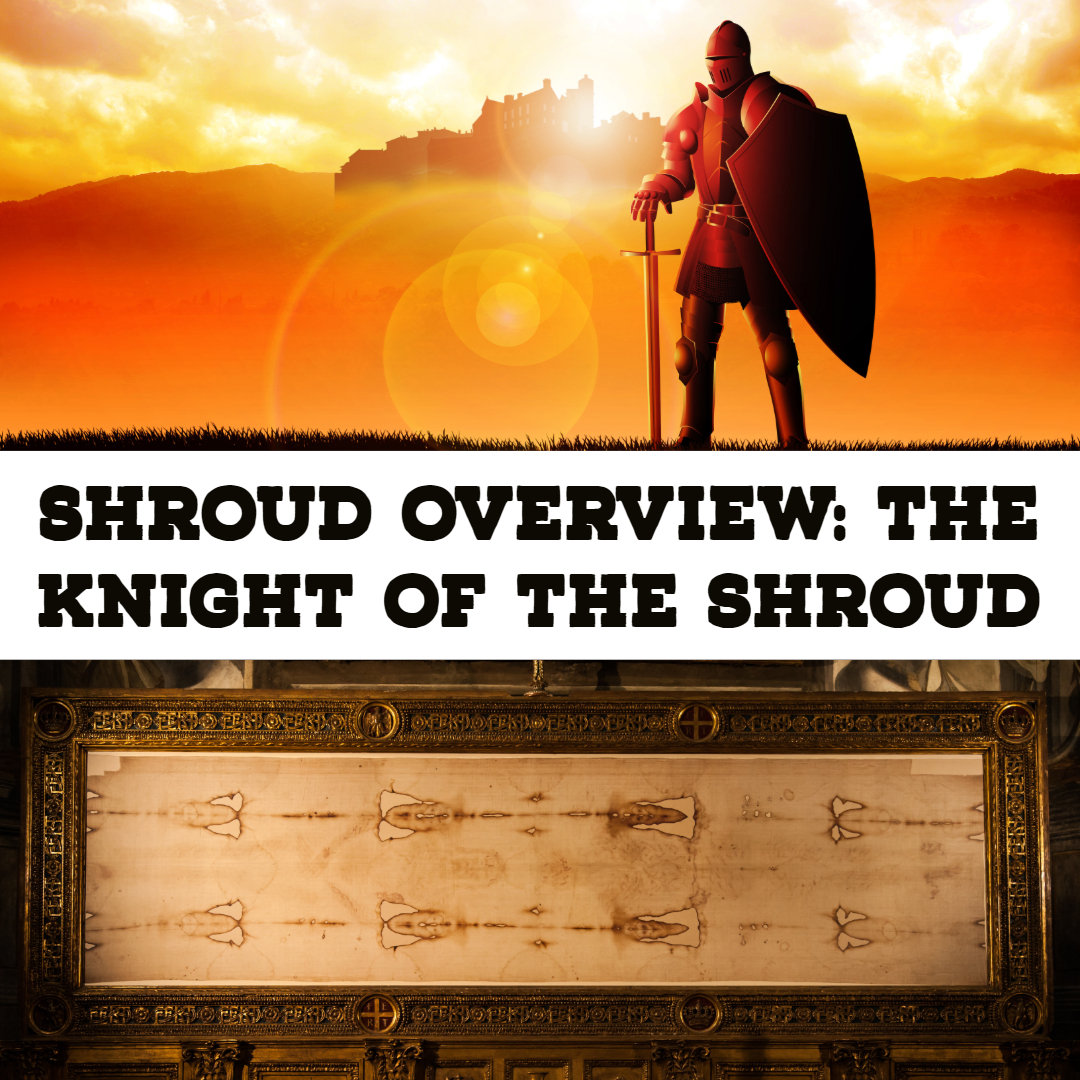
Ep 9Shroud of Turin Overview: The Knight of The Shroud (Shroud mini-series, episode 2)
Today, I think it would be helpful to have an episode that takes a broad and wide view of The Shroud - that covers all of the basics, so that we're all on the same page. That's the focus of this episode - let's call it an overview of The Shroud of Turin, but the material we cover won't all be introductory level. As I mentioned in the first episode, I first heard about The Shroud way back in the very early 80s from In Search of. PLAY CLIP Hearing Mr. Spock - Leonard Nimoy - talking about The Shroud was fascinating to my young mind, and understanding that their might - just might - be a possible artifact from the time of Jesus - that Jesus actually touched - that could actually have a real picture of Jesus - inarguably the most famous person that ever lived - was mind-blowing. So, I read up on The Shroud as I grew older. Most of my Presbyterian church leaders didn't believe in The Shroud - dismissing it as a Catholic hoax, but I wasn't fully convinced. The fact is - once you see pictures of it, then you begin to take it at least a little bit seriously. If The Shroud is a fake - it is an amazing one, and the deeper you dig into it, the more remarkable it becomes. Some Terms You Should Know: Icon: An icon is a religious work of art, usually a painting. Sometimes icons are statues or carvings, or other artistic renderings. Most of the time those pictured in icons are Jesus, Mary, or other saints in the Bible. Some Christians, including many Reformed Christians, consider paintings of Jesus to be violations of the second commandment of the Bible - "Thou shalt not make unto thee any graven image" The oldest surviving icon of Jesus - dating from the 500s - is copied below. Let's answer 4 big questions today in our overview: What exactly is The Shroud? The Shroud of Turin is a linen cloth that is 14.5 feet long and 3 feet, 7 inches wide and has the somewhat faded negative image of a man on it. Essentially think of the image like a photo-negative - the areas of dark and light are reversed. The darkest areas of the imprint of the man in The Shroud appear light, and vice-versa. The weave of The Shroud is a fine herringbone twill weave. I'm not an expert on textiles, but most experts that I've read seem to think that such a weave would have been possible and used in 1st century middle eastern areas. Like all things related to The Shroud, that is debatable. The burial cloth of Jesus is indeed listed in the Scriptures, so we know that the body of Jesus was actually wrapped in a linen cloth. There is not enough of a description of that cloth to know whether or not The Shroud is similar. As many have pointed out, there is no Scripture whatsoever that seems to indicate some kind of miraculous imprint of Jesus was left on the burial cloths. To be fair, there is no Scripture to indicate that the disciples examined the cloths, only that they saw them. Considering that there is very little information in Scripture about what happened directly after the resurrection of Jesus, and that the Bible writers focused on The Great Commission there, I don't think it is a very strong argument from silence to say that because the Bible doesn't mention something miraculous regarding the burial cloths of Jesus, therefore it did not happen. John 19: 38 After this, Joseph of Arimathea, who was a disciple of Jesus—but secretly because of his fear of the Jews—asked Pilate that he might remove Jesus' body. Pilate gave him permission, so he came and took His body away. 39 Nicodemus (who had previously come to Him at night) also came, bringing a mixture of about 75 pounds of myrrh and aloes. 40 Then they took Jesus' body and wrapped it in linen cloths with the aromatic spices, according to the burial custom of the Jews. 41 There was a garden in the place where He was crucified. A new tomb was in the garden; no one had yet been placed in it. John 20: 20 On the first day of the week Mary Magdalene came to the tomb early, while it was still dark. She saw that the stone had been removed from the tomb. 2 So she ran to Simon Peter and to the other disciple, the one Jesus loved, and said to them, "They have taken the Lord out of the tomb, and we don't know where they have put Him!" 3 At that, Peter and the other disciple went out, heading for the tomb. 4 The two were running together, but the other disciple outran Peter and got to the tomb first. 5 Stooping down, he saw the linen cloths lying there, yet he did not go in. 6 Then, following him, Simon Peter came also. He entered the tomb and saw the linen cloths lying there. 7 The wrapping that had been on His head was not lying with the linen cloths but was folded up in a separate place by itself. 8 The other disciple, who had reached the tomb first, then entered the tomb, saw, and believed. 9 For they still did not understand the Scripture that He must rise from the dead. The figure on The Shroud is interesting. He is tall - significantly taller than the average Jewish man of the first century, which was, a

S1 Ep 8Episode 8: The Shroud of Turin Introduction
Today's episode is a beginning. It does not YET represent rigorous research, but only a skimming. My opinion at the beginning of this journey is a middle opinion. Call me a Shroud agnostic, at least for now. There are Shroud atheists out there that quickly and completely dismiss the Shroud. They may be right, but I'm not sure they've thoroughly researched their conclusions. Likewise, many faithful Shroud believers seemingly assume its real and don't really interact with some legitimate reasons for debunking. The fact is that there is pretty solid evidence on both sides, which probably explains why The Shroud still has its believers and detractors. This is not a religious issue for me - I am firmly convinced that Jesus rose from the dead with or without The Shroud, and even wrote a book about the resurrection of Jesus. (Easter: Fact or Fiction.) Why should I - a Baptist preacher who doesn't believe at all in the Roman Catholic concept of relics or icons, do a long series on the Shroud of Turin? Protestants have taken two positions on the Shroud over the years. I can neatly frame those two positions by quoting from two of my heroes, Charles Spurgeon and C.S. Lewis: On the negative, anti-Shroud side, we have Charles Spurgeon: Spurgeon on the Shroud: Do you not think, too, that some seekers miss comfort because they forget that Jesus Christ is alive? The Christ of the Church of Rome is always seen in one of two positions—either as a babe in his mother's arms, or else as dead. That is Rome's Christ, but our Christ is alive. Jesus who rose has "left the dead no more to die." I was requested in Turin to join with others in asking to see the shroud in which the Saviour was buried. I must confess that I had not faith enough to believe in the shroud, nor had I curiosity enough to wish to look at the fictitious linen. I would not care a penny for the article, even if I knew it to be genuine. Our Lord has left his shroud and sepulchre, and lives in heaven. To-night he so lives that a sigh of yours will reach him, a tear will find him, a desire in your heart will bring him to you. Only seek him as a loving, living Saviour, and put your trust in him as risen from the dead no more to die, and comfort will, I trust, come into your spirit. C. H. Spurgeon, "A Gospel Sermon to Outsiders," in The Metropolitan Tabernacle Pulpit Sermons, vol. 23 (London: Passmore & Alabaster, 1877), 701–702. On the more open side and curious side, we have C.S. Lewis: Dear Sister Penelope I am ashamed of having grumbled. And your act was not that of a brute—in operation it was more like that of an angel, for (as I said) you started me on a quite new realisation of what is meant by being 'in Christ', and immediately after that 'the power which erring men call chance' put into my hands Mascall's two books in the Signpost series which continued the process.102 So I lived for a week end (at Aberystwyth) in one of those delightful vernal periods when doctrines that have hitherto been only buried seeds begin actually to come up—like snowdrops or crocuses. I won't deny they've met a touch of frost since (if only things would last, or rather if only we would!) but I'm still very much, and gladly, in your debt. The only real evil of having read your scripts when I was tired is that it was hardly fair to them and not v. useful to you. I enclose the MS. of Screwtape. If it is not a trouble I shd. like you to keep it safe until the book is printed (in case the one the publisher has got blitzed)—after that it can be made into spills or used to stuff dolls or anything. Thank you very much for the photo of the Shroud. It raises a whole question on which I shall have to straighten out my thought one of these days. yours sincerely Clive Lewis C. S. Lewis, The Collected Letters of C. S. Lewis, ed. Walter Hooper, vol. 2 (New York: HarperCollins e-books; HarperSanFrancisco, 2004–2007), 493–494. I note here that Lewis had the picture of the head of the Shroud of Turin framed, and it hung on the wall of his bedroom for the rest of his life. On this particular issue, count me with C.S. Lewis - at least for now. While I believe Spurgeon is correct in condemning Shroudish idolatry, or the worship of The Shroud, I think he was too hasty in his conclusion that The Shroud was an absolute fake. It certainly may be, but it would appear that Spurgeon's theological prejudice against the Roman Catholic church led him to dismiss the Shroud's genuineness as a possibility, rather than some scientific, theological or historical reason. Top Ten Facts about the Shroud of Turin: 1 Coins in eyes. Perhaps the most compelling 'fact' about The Shroud is not a fact in everybody's eyes. I've erased and retyped that sentence now twice, because it was a legit, "no pun intended." line. Be that as it may, researchers have apparently discovered what may be coins in the place of the eye-sockets on the image of the man in The Shroud. (Because the image is so small, there is heavy debate about this
S1 Ep 7Episode 7: What does John 3:16 Really Mean?
Today's Question: What does John 3:16 REALLY MEAN? Are we wrong about the most famous verse in the Bible?. John 3:16 16 For God so loved the world, that he gave his only begotten Son, that whosoever believeth in him should not perish, but have everlasting life.- for most of my life it has been the most famous verse in the Bible. It's only rival today is 'Judge not that ye not be judged'. More on that soon. Spurgeon: OF all the stars in the sky the pole-star is the most useful to the mariner. This text is a pole-star, for it has guided more souls to salvation than any other Scripture. It is among promises what the Great Bear is among constellations. C. H. Spurgeon, The Cheque Book of the Bank of Faith John 3:16 Guy: Rollen Fredrick Stewart (born February 23, 1944), also known as Rock'n Rollen and Rainbow Man, is a man who was a fixture in American sports culture best known for wearing a rainbow-colored afro-style wig and, later, holding up signs reading "John 3:16" at stadium sporting events around the United States and overseas in the 1970s and 1980s.[1] He is serving three life sentences in a California prison after being convicted of multiple kidnapping charges after a 1992 incident. Stewart was arrested in 1992 after a standoff in a California hotel during which he entered a vacant room with two men whom he tried to recruit for a job, who later fled the scene after he attempted to kidnap a surprised maid who then locked herself in the bathroom. Reportedly, Stewart believed that the Rapture was due to arrive in six days.[8] During the standoff, he threatened to shoot at airplanes taking off from nearby Los Angeles International Airport, and covered the hotel room windows with "John 3:16" placards. Stewart was married four times, most notably to Margaret Hockridge. The two met at a church in Virginia in 1984. They began traveling across the country together in 1985. While on the road, they married in St. Louis in 1986. During the 1986 World Series, Hockridge said that Stewart tried to choke her for standing in the wrong spot with a John 3:16 sign. Mental Illness. So - what does John 3:16 mean?? Most people would say that it has to do with the AMOUNT of Love God has for us. That He loves us SOOOOOOO much, that He sent His son. Now - that is a TRUE Statement. The Love of God was indeed SOOO deep for people, that He sent His son, but, shocker of shockers...That is NOT what John 3:16 is talking about. Now, I realize I sound like one of those Fedora wearing, neck-bearded internet guys that go around correcting everybody - WELL, ACSHUALLY… But, two things: One, I don't own a fedora and 2- I actually do shave my neck. Let's go to the expert: Bill MOUNCE, AKA Captain Biblical Greek, : The problem, if you are unaware, is that when the KJV says "For God so loved the world," everyone I have ever asked what "so" meant responded "so much." If you check BDAG, you will see that this is a rare and not possible meaning of οὕτως in this context. But you'd better be careful if you change people's favorite Bible verse. Here are BDAG's first three definitions of HOUTOS οὕτως. 1. "referring to what precedes, in this manner, thus, so." 2. "pert. to what follows in discourse material, in this way, as follows" (which is where BDAG places John 3:16) BDAG - Bauer's Lexicon. Bauer's Lexicon is among the most highly respected dictionaries of Biblical Greek. Bauer–Arndt–Gingrich–Danker HOUTOS οὕτως in John 3:16 clearly has the meaning conveyed by the NLT ("For this is how God loved the world: He gave his one and only Son"), the CSB ("For God loved the world in this way: He gave his one and only Son"), and the NET ("For this is the way God loved the world: He gave his one and only Son,"). I am playing with this as an option: "For God loved the world so he gave." What do you think? Holman/CSB: 16 For God loved the world in this way: He gave his one and only Son, so that everyone who believes in him will not perish but have eternal life. Did the King James Version Get it wrong? I don't think so - the fact is that the particle 'So' in the English language is very flexible, and it is proper English, when explaining how somebody expressed their love, to say, "They so loved so and so, that they did this." However, that language is imprecise, and open to misinterpretation in a way that the Greek original text of John 3:16 is not. That text, quite clearly, is speaking of the MANNER in which God loves His people, not the MAGNITUDE of how MUCH He loves His people. This is a Scripture about the specific WAY God loves us - not the MEASURE of His love. We don't lose anything here, though, because we have dozens, if not hundreds, of Scriptures on the vastness of God's Love: 1 John 3:1 See what great love the Father has lavished on us, that we should be called children of God! And that is what we are! The reason the world does not know us is that it did not know him. Ephesians 2:4-5 4 But because of his great love for us, God, who is rich in mercy, 5

S1 Ep 6Episode 6: Bible Myths and Factoids
Shownotes below are unrefined, unedited and unattributed. I'll eventually fix that. Today we're talking about the Bible itself - the longest verses, books, chapters, etc. Chapters and verses are NOT found in the original autographs, or writings of the Books of the Bible. These books were written like letters and books, and did not have chapter divisions or verses, or even punctuation like modern books. Prior to the 800s, the Bible was divided up in various ways, but it wasn't until the 800s that some kind of chapter divisions that were similar to modern chapters came into view. Chapter divisions, with titles, the 9th century Tours manuscript the so-called Bible of Rorigo. Archbishop Stephen Langton and Cardinal Hugo de Sancto Caro developed different schemas for systematic division of the Bible in the early 13th century. It is the system of Archbishop Langton on which the modern chapter divisions are based The first person to divide New Testament chapters into verses was Italian Dominican biblical scholar Santi Pagnini (1470–1541), but his system was never widely adopted. His verse divisions in the New Testament were far longer than those known today. Robert Estienne created an alternate numbering in his 1551 edition of the Greek New Testament which was also used in his 1553 publication of the Bible in French. Estienne's system of division was widely adopted, and it is this system which is found in almost all modern Bibles. Estienne produced a 1555 Vulgate that is the first Bible to include the verse numbers integrated into the text. Before this work, they were printed in the margin What is the shortest verse in the New Testament? Did Most would say, Jesus Wept, but in the ORIGINAL Language of the Bible, that's not the shortest verse. It is, in many English translations. , "Jesus wept" (John 11:35) is the shortest verse in English. In English it is 9 letters long. But in Greek it is 16 letters long (Ἐδάκρυσεν ὁ Ἰησοῦς). There is a shorter verse in the original Greek: That is 1 Thessalonians 5:16, "rejoice always," which is only 14 letters in Greek (Πάντοτε χαίρετε). But even that passage isn't the shortest verse in the original...the absolute shorters is Luke 20:30 "and the second," which in Greek has only 12 letters (καὶ ὁ δεύτερος). This ridiculously short verse is found in the section where Jesus is being verbally challenged by the Sadducees (Luke 20:29-32): "Now there were seven brothers; and the first took a wife and died childless; 30and the second 31and the third married her; and in the same way all seven died, leaving no children. 32 Finally the woman died also." The shortest verse in the Greek New Testament is Luke 20:30 ("και ο δευτερος", "And the second") with twelve letters, according to the Westcott and Hort text. In the Textus Receptus, the shortest verse is 1 Thessalonians 5:16("παντοτε χαιρετε", "Rejoice always") with fourteen letters, So "Jesus wept" comes in third. "And the second" comes in first. Esther 8:9 is the longest verse 78 Words. in the Masoretic Text. The discovery of several manuscripts at Qumran (in the Dead Sea Scrolls) has reopened what is considered the most original text of 1 Samuel 11; if one believes that those manuscripts better preserve the text, several verses in 1 Samuel 11 surpass Esther 8:9 in length. "It is better to trust in the Lord than to put confidence in man." -Psalm 118:8 The King James Version has an even number of verses (31,102), with the two middle verses being Psalm 103:1–2 My soul, praise Yahweh, and all that is within me, praise His holy name. 2 My soul, praise the Lord, and do not forget all His benefits. Here are the five shortest books of the Bible, beginning with the very shortest. These measurements are by words in the original languages. Each of these books is only one chapter long, and would take you a few minutes to read, tops: Third John (219 words) Second John (245 words) Philemon (335 words) Obadiah (440 words) Jude (461 words) Bible Statistics: Chapters: 1,189 Commands: 6,468 Fulfilled prophecy: 3,268 verses Letters: 3,566,480 Words: 783,137 Longest book: Psalms (150 chapters) Longest chapter: Psalm 119 (176 verses) Longest name: Mahershalalhashbaz (Isaiah 8:1) Middle books: Micah and Nahum Middle chapter: Psalm 117 Number of books in the Bible: 66 Number of different authors: 40 Number of languages the Bible has been translated into: over 1,200 Number of promises given in the Bible: 1,260 Number of questions: 3,294 Number of times the word "God" appears: 3,358 Number of times the word "Lord" appears: 7,736 Shortest chapter (by number of words): Psalm 117 Longest chapter: Psalm 119. Verses: 31,101 So, we've had a little Bible Trivia today, but, make no mistake: THE BIBLE IS NOT TRIVIAL. Hebrews 4: 12 For the word of God is living and effective and sharper than any double-edged sword, penetrating as far as the separation of soul and spirit, joints and marrow. It is able to judge the ideas and thoughts of the heart. 13 No creature is hidden

S1 Ep 5Episode #5 What is Gossip, and why is it so Delicious to our Ears?
The church has been talking about gossip for a very, very long time! Clement of Rome, who likely knew Peter and John (and died in 99AD) Wrote this about gossip: Since, then, we are a holy portion, we should do everything that makes for holiness. We should flee from slandering, vile and impure embraces, drunkenness, rioting, filthy lusts, detestable adultery and disgusting arrogance. "For God," says Scripture, "resists the arrogant but gives grace to the humble." We should attach ourselves to those to whom God's grace has been given. We should clothe ourselves with concord, being humble, self-controlled, far removed from all gossiping and slandering, and justified by our deeds, not by words. Spurgeon: GOSSIPS of both genders, give up the shameful trade of tale-bearing; don't be the devil's bellows any longer to blow up the fire of strife. Leave off setting people by the ears. If you do not cut a bit off your tongues, at least season them with the salt of grace. Praise God more and blame neighbours less. Any goose can cackle, any fly can find out a sore place, any empty barrel can give forth sound, any brier can tear a man's flesh. No flies will go down your throat if you keep your mouth shut, and no evil-speaking will come up. Think much, but say little: be quick at work and slow at talk; and above all, ask the great Lord to set a watch over your lips. C. H. Spurgeon, Flashes of Thought (London: Passmore & Alabaster, 1874), 184. What, exactly, is gossip? I find that several times over the past year, I have wondered about that, and even been asked about it more than once. Gossip is mentioned less than 10 times in the Bible, 8 times in the NIV and 4 times in the ESV. In the NIV, 6 of those 8 times are in the OT, and all six are in Proverbs. In the ESV, 3 of those 4 times are in the NT, and the one OT reference is in Ezekiel. What does that tell us? I think it tells us that our best Bible scholars don't really have a great grip on what gossip is either! That should give us pause - particularly when we decide to point the finger at somebody and identify their actions as gossip. I've seen and received more than one accusation of gossip that did not seem to line up with what Scripture identifies as gossip. It's just not terribly clear what, precisely, gossip designates. But we are going to try our level best to help clear that up today. While it is true that the Bible never precisely defines what is meant by gossip, what is far more clear, is how we should act towards other people, and what is allowed and what isn't allowed in our conversations with each other and about each other, according to the Bible. Here's a shocking truth that should be the fact of the podcast: When it comes to the Bible, God's Word, pummelling people with your words is JUST AS BAD as pummelling them with your fists. Let me reiterate, because most people who engage in the activities of criticism, gossip, slander, cut-downs, etc probably aren't physical bullies. It's easy for them to say dank words about people, but they probably wouldn't take a swing at those people if they bumped into them at Walmart. When it comes to the Bible, there's no difference between the wounds we inflict with our fists and knives and swords, than with the wounds we inflict with our words. Witness these two warnings: James 3:8 8 but no man can tame the tongue. It is a restless evil, full of deadly poison. Proverbs 12:18 ESV / 13 helpful votes Helpful Not Helpful There is one whose rash words are like sword thrusts, but the tongue of the wise brings healing. Paul gives a general rule in Romans 14:19, "Let us therefore make every effort to do what leads to peace and to mutual edification." Here's a good place to start - we are to make every effort to do what leads to peace and to mutual upbuilding or edification. Our words and actions must be delivered with a heart of blessing, peace and building up. Encouragement, not criticism - upbuilding, not tearing down. Conversations that are not intended to edify - or build somebody up - or work towards their ultimate good, therefore are not allowed for Christians. Ephesians 4:29 says it pretty clearly: No foul language is to come from your mouth, but only what is good for building up someone in need, so that it gives grace to those who hear. 30 And don't grieve God's Holy Spirit. Gossip does not build people up. In the NIV, we are told in Proverbs 11:13 and 16:28 that a gossip separates close friends, and in 26:20 that gossip causes a quarrel to continue. In Proverbs 18:8 and 20:19, we learn that gossips betray confidences and that the words they share are choice morsels - so interesting that people want to hear them - words of gossip are delicious to our ears, so to speak. In Romans 1, Paul gives a long description of, well, people. He doesn't go into much detail about who he is referring to, and it appears that he is just generally describing people (or wicked people.) One of their characteristics of wickedness, along with

S1 Ep 4Episode #4 Aliens and the Bible
Note: The Shownotes and Transcript below are a bit of a trainwork editing wise. I'll polish them up soon! C.S. Lewis from His essay The Seeing Eye, found in Christian Reflections: 1963, 6 years before the Moon Landing. (Discussing Space travel) a more practical issue will arise when, if ever, we discover rational creatures on other planets. I think myself, this is a very remote contingency. The balance of probability is against life on any other planet of the solar system. We shall hardly find it nearer than the stars. And even if we reach the Moon we shall be no nearer to stellar travel than the first man who paddled across a river was to crossing the Pacific.This thought is welcome to me because, to be frank, I have no pleasure in looking forward to a meeting between humanity and any alien rational species. I observe how the white man has hitherto treated the black, and how, even among civilized men, the stronger have treated the weaker. If we encounter in the depth of space a race, however innocent and amiable, which is technologically weaker than ourselves, I do not doubt that the same revolting story will be repeated. We shall enslave, deceive, exploit or exterminate; at the very least we shall corrupt it with our vices and infect it with our diseases. We are not fit yet to visit other worlds. We have filled our own with massacre, torture, syphilis, famine, dust bowls and with all that is hideous to ear or eye. Must we go on to infect new realms? It was in part these reflections that first moved me to make my own small contributions to science fiction. In those days writers in that genre almost automatically represented the inhabitants of other worlds as monsters and the terrestrial invaders as good. Since then the opposite set-up has become fairly common. If I could believe that I had in any degree contributed to this change, I should be a proud man.1 The same problem, by the way, is beginning to threaten us as regards the dolphins. I don't think it has yet been proved that they are rational. But if they are, we have no more right to enslave them than to enslave our fellow-men. And some of us will continue to say this, but we shall be mocked. C. S. Lewis, Christian Reflections, ed. Walter Hooper, EPub Edition. (HarperOne, 2014), 173–174. This science (astronomy) ought to be the special delight of ministers of the gospel, for surely it brings us into closer connection with God than almost any other science does. It has been said that an undevout astronomer is mad. I should say that an undevout man of any sort is mad,—with the worst form of madness; but, certainly, he who has become acquainted with the stars in the heavens, and who yet has not found out the great Father of lights, the Lord who made them all, must be stricken with a dire madness. Kepler, the great mathematical astronomer, who has so well explained many of the laws which govern the universe, closes one of his books, his Harmonics, with this reverent and devout expression of his feelings:—"I give thee thanks, Lord and Creator, that thou hast given me joy through thy creation; for I have been ravished with the work of thy hands. I have revealed unto mankind the glory of thy works, as far as my limited spirit could conceive their infinitude. Should I have brought forward anything that is unworthy of thee, or should I have sought my own fame, be graciously pleased to forgive me." And you know how the mighty Newton, a very prince among the sons of men, was continually driven to his knees as he looked upwards to the skies, and discovered fresh wonders in the starry heavens. Therefore, the science which tends to bring men to bow in humility before the Lord should always be a favourite study with us whose business it is to inculcate reverence for God in all who come under our influence. C. H. Spurgeon, Lectures to My Students: The Art of Illustration; Addresses Delivered to the Students of the Pastors' College, Metropolitan Tabernacle, vol. 3 (London: Passmore & Alabaster, 1905), 145. Today's Question: At the very beginning of this podcast, I promised you that we would sometimes delve into wild and wacky areas of the Bible, and today is the day we begin that journey! Most of the time, we will play it straight, but the fact is that there are many interesting/mysterious and downright strange parts of the Bible, and I don't think we should ignore them, nor explain them away with a handwave. Let's embrace the weird! And, by the way, if this topic is interesting to you at all, then please check out my book Monsters in the Bible. It's my bestselling book of this year, which is funny, and from time to time, it ranks in Amazon's top ten for Occult Satanism...which is strange, to say the least, for a southern Baptist pastor. (I did NOT choose that category!) Vanderbilt astronomer David Weintraub reports that 55 percent of atheists believe in alien life, but only 32 percent of Christians. Weintraub wrote, "Most evangelical and fundamentalist Christian lead

S1 Ep 3Episode #3 The Unpardonable Sin (Blasphemy of the Spirit/Unforgivable sin)
Episode 4: What is the Unforgivable sin?? It's a terrifying reality: Jesus warned His disciples and the Pharisees that there was a sin that could be committed that was unpardonable - unforgivable for all eternity. People have speculated and worried about this teaching of Jesus for hundreds of years. What precisely is the unpardonable sin? How can we know whether or not we've done it? Let's dive in! The Didache First century - RIGHT after the NT: Now concerning the apostles and prophets, deal with them as follows in accordance with the rule of the gospel. (4) Let every apostle who comes to you be welcomed as if he were the Lord. (5) But he is not to stay for more than one day, unless there is need, in which case he may stay another. But if he stays three days, he is a false prophet. (6) And when the apostle leaves, he is to take nothing except bread until he finds his next night's lodging. But if he asks for money, he is a false prophet. (7) Also, do not test or evaluate any prophet who speaks in the spirit, for every sin will be forgiven, but this sin will not be forgiven.35 Michael William Holmes, The Apostolic Fathers: Greek Texts and English Translations, Updated ed. (Grand Rapids, MI: Baker Books, 1999), 263–265. ANDREAS Andreas of Caesarea (Greek: Ἀνδρέας Καισαρείας; 563 – 637) : It is the sin of heresy, or of blasphemy against the Holy Spirit, which leads to death. If one man sins against another, pray for him. But if he sins against God, who is there who can pray on his behalf? And if even after all this, our opponents are still unwilling to learn and still unable to understand, they should at least stop speaking evil. They should not divide the Trinity lest they be divided from life.82 They should not classify the Holy Spirit with the creatures, lest, like the Pharisees of old who ascribed the works of the Spirit to Beelzebul,83 they too, on account of equal audacity, incur along with them the punishment which is unpardonable both now and in the future. Athanasius Works on the Spirit: Athanasius's Letters to Serapion on the Holy Spirit, Grave-robbing, or the opening of graves, is divided into two kinds too, like theft, according to the present Canon, to wit, into pardonable and into unpardonable grave-robbing. For if the fellow opening the grave does not denude the dead person's body, thus refraining from dishonoring (for that is what is meant by the expression "sparing devoutness") the dead, but only takes the stones found in the grave, in order to use them in the building of any other work that is preferable and more beneficial to the community, though this too is by no means anything to be praised, yet custom has made it pardonable.2 St. Nicodemus of the Holy Mountain - 1700s, Greek Orthodox church. Swearing is a dreadful and harmful thing; it is a destructive drug, a bane and a danger, a hidden wound, a sore unseen, an obscure ulcer spreading its poison in the soul; it is an arrow of Satan, a flaming javelin, a two-edged sword, a sharp-honed scimitar, an unpardonable sin, an indefensible transgression, a deep gulf, a precipitous crag, a strong trap, a taut-stretched net, a fetter that cannot be broken, a noose from which no one escapes. 19. Are these enough, and do you believe that swearing is a dreadful thing and the most harmful of all sins? Believe me, I beg you, believe me! But if someone does not believe me, I now offer proof. This sin has what no other sin possesses. If we do not violate the other commandments, we escape punishment; on the other hand, in the matter of oaths, we are punished just the same both when we guard against transgressing and when we transgress. St. John Chrysostom, 300s AD St. John Chrysostom: Baptismal Instructions, Hilary of Poitiers actually points us in a more biblical direction, in discussing the unpardonable sin: Every sin and blasphemy will be forgiven to men, but blasphemy of the Spirit will not be forgiven.67 With a very grave qualification, he condemns the view of the Pharisees and the perversion of those who also think like them. He promises pardon of all sins but refuses pardon for blasphemy of the Spirit. While other words and deeds are treated with a generous pardon, there is no mercy if it is denied that God is in Christ. 68 And in whatever way one sins without pardon, he is gracious to us and reminds us again that sins of every kind can be completely forgiven, though blasphemy against the Holy Spirit cannot be forgiven. For who is so completely beyond pardon as one who denies that Christ is of God, or repudiates that the substance of the Spirit of the Father resides in him Hilary of Poitiers, Commentary on Matthew, ed. Spurgeon - Nobody knows what that sin is. I believe that even God's Word does not tell us, and it is very proper that it does not. As I have often said, it is like the notice we sometimes see put up, "Man-traps and spring gun set here." We do not know whereabouts the traps and guns are, but we have no business over the hedge at all. So

S1 Ep 2Episode #2 Unicorns? In the Bible!?
Interested in this topic? You might enjoy my book: Monsters in the Bible Our focus on this show is on the Bible, and how interesting it is. Sometimes the show will be straight up Bible Q and A - down to earth topics with answers solidly grounded in the biblical text. Sometimes the show topics will be a little more - out there, shall we say. Like today. Today's topic is Unicorns, and it is dedicated to my daughter, Phoebe - who is a huge unicorn fan. You might be wondering what Unicorns have to do with the Bible, but if you are a King James only kind of person, you probably already know that the word 'Unicorns' appears in the KJV version of the Bible 9 times in the 1611 KJV and 9 times in the updated 1769 Standard version. At some point in the show, we will probably do a podcast solely focused on the 1611 KJV and King James Version only people. It's an interesting topic for me in particular, because most people in the KJV Only camp would reject the more Catholic associated apocryphal books of the Bible, and yet the 1611 KJV contains 14 apocryphal books, in addition to the OT and the NT. But I digress. One day soon, I think we will cover both the 1611 KJV AND the Apocrypha, but today is not that day. Today is the day, however, that we cover unicorns. You might not know that unicorns are actually in the Bible - but they are. Sort of. In the Bible. Let's take a look: Psalm 22: 19 But be not thou farre from mee, O Lord; O my strength, hast thee to helpe me. 20Deliuer my soule from the sword: my darling from the power of the dogge. 21Saue me from the lyons mouth: for thou hast heard me from the hornes of the vnicornes. 1611 So - let me say this. As I mentioned in the trailer for the show, I believe that the Bible is faithful and true - inerrant in its original language and absolutely trustworthy. Therefore, I believe that the Bible is speaking of a real animal here and is not putting forward some sort of myth, or what have you. Does that mean unicorns are/were real creatures? Not necessarily. Believing in the trustworthiness of the Bible, we have two options here for our KJV Unicorns. #1 - Unicorns actually existed, but they are probably extinct now. #2 - The KJV translators of the Bible did not properly or exactly translate the Hebrew word for 'unicorn.' We will take a long look at both options, but first, let's take a look at the Hebrew word itself. Re'em, Reh·ām' Reh-Aim from the Verb rä·am' (Rah-Am), which means to 'Raise up.' All 9 times Reh-Aim appears in the Old Testament, the 1611 and 1769 translators of the KJV used the word 'unicorn.' Here are all of the appearances of the word in the Bible. Let's pay attention to any physical descriptions to determine if the word Reh-Aim actually refers to the equine/horselike creature of fantasy and legend, or perhaps some other creature: Numbers 23:22 God brought them out of Egypt; he hath as it were the strength of an unicorn. Isaiah 34: And the Unicornes shall come downe with them, and the bullockes with the bulles, and their land shall be soaked with blood, and their dust made fat with fatnesse.8 For it is the day of the Lords vengeance, and the yeere of recompences for the controuersie of Zion. KJV 1611 Deuteronomy 33:17 His glory is like the firstling of his bullock, and his horns are like the horns of unicorns: with them he shall push the people together to the ends of the earth: and they are the ten thousands of Ephraim, and they are the thousands of Manasseh. Job 39:9 Will the unicorn be willing to serve thee, or abide by thy crib? Job 39:10 Canst thou bind the unicorn with his band in the furrow? or will he harrow the valleys after thee? Psalms 22:21 Already read. Psalms 29:6 He maketh them also to skip like a calf; Lebanon and Sirion like a young unicorn. Psalms 92:10 But my horn shalt thou exalt like the horn of an unicorn: I shall be anointed with fresh oil. Isaiah 34:7 And the unicorns shall come down with them, and the bullocks with the bulls; and their land shall be soaked with blood, and their dust made fat with fatness. So some interesting passages, to be sure. The KJV Bible seems to indicate that God has the strength of a unicorn, That his horns are like the horns of the unicorns, and that God is coming with unicorns and bulls on the day of judgment. So, wow - what in the world is going on here? Here's what we learn from these passages, remembering that the actual Hebrew word in question is reh-Aim . Reh-Aims are powerful, they are difficult to control or tame, they have at least one horn (more on that later) and they are quite wild and untamable, Unfortunately, that description fits many wild animals, and doesn't really tell us exactly what creature the authors of the OT were referring to, though we can safely remove three toed sloths, dung beetles, and platypodes from consideration. The Bible's mention of unicorns was not lost on the leaders of the early church, who also puzzled over these passages. Origen, an early church father living in the 200
S1 Ep 1Episode #1: The Greatest Mystery - Did Jesus FACTUALLY Rise from the Dead?
The notes for this episode aren't exactly show notes. For more reasons to believe, please check out my book Easter: Fact or Fiction, 20 Reasons to Believe that Jesus Rose from the Dead (click here) OR: Check this post out on my writing blog: Top Ten Reasons to Believe Jesus Rose from the Dead. Recap: 1 Corinthians 15: 12 Now if Christ is proclaimed as raised from the dead, how can some of you say, "There is no resurrection of the dead"? 13 But if there is no resurrection of the dead, then Christ has not been raised; 14 and if Christ has not been raised, then our proclamation is without foundation, and so is your faith. But, as Paul goes on to tell us in 1 Corinthians 15, the Resurrection of Jesus DID, in FACT, Happen! 1 Corinthians 15:20-22 20 But now Christ has been raised from the dead, the firstfruits of those who have fallen asleep. 21 For since death came through a man, the resurrection of the dead also comes through a man. 22 For as in Adam all die, so also in Christ all will be made alive. Let's look at another passage on RAMIFICATIONS OF THE RESURRECTION. RAMIFICATIONS - ONE OF MY FAVORITE WORDS. It means - a consequence of an action or event Romans 6:3 Are you unaware that all of us who were baptized into Christ Jesus were baptized into His death? 4 Therefore we were buried with Him by baptism into death, in order that, just as Christ was raised from the dead by the glory of the Father, so we too may walk in a new way of life.5 For if we have been joined with Him in the likeness of His death, we will certainly also be in the likeness of His resurrection. 6 For we know that our old self was crucified with Him in order that sin's dominion over the body may be abolished, so that we may no longer be enslaved to sin, 7 since a person who has died is freed from sin's claims. 8 Now if we died with Christ, we believe that we will also live with Him, 9 because we know that Christ, having been raised from the dead, will not die again. Death no longer rules over Him. Reasons to Believe: Apologetics is one of my favorite fields of Theology. When I first heard the term, I assumed Apologetics had something to do with apologizing for our faith - like, being all nice about it. "I'm sorry to have to tell you this, but apart from Jesus, you will die and go to hell….I'm sorry if that sounds harsh, and I'm sorry if that offends you." I also thought that Silicon Valley, when I was a teenager, was a valley with a lot of sand in it. I sort of new that silicon could be refined out of sand, so I assumed Silicon Valley was the place where they got the sand to make the computer chips and all of the computer companies just built up around that sandy valley. I was pretty good at assuming when I was younger. However, apologetics does not have anything to do with apologizing, and everybody with half a brain knows that Silicon is not merely sand, but a tetravalent metalloid used in the production of silicon, and that Silicon Valley is more of a euphemism than an actual place valley filled with sand. SO - what is Apologetics? We get that word from 1 Peter 3:15 Always be ready to give a defense to anyone who asks you for a reason for the hope that is in you. 16 However, do this with gentleness and respect, keeping your conscience clear, so that when you are accused, those who denounce your Christian life will be put to shame. The Greek there for the word 'defense' is: Apologian, and it means to defend OR to Answer. Literally it means to Answer from Words, or answer with Words. What Peter is saying is that we Christians MUST - it is a command - Be Ready to DEFEND/ANSWER our Beliefs with Words. (Eat that, Francis of Assisi...who never actually said "Preach the Gospel, if Necessary, use words.") Apologetics is the field of Christian Endeavor that is focused on following the Biblical Command in 1 Peter 3:15 - HOW DO WE GIVE AN ANSWER FOR BELIEVING THE GOSPEL - and the CENTRAL CLAIM OF THE GOSPEL, THE RESURRECTION. Think of it this way - Apologetics is like the crowbar that opens the door, and The Gospel is like the Grenade that you toss in. The Gospel is the thing with the POWER OF GOD IN IT. (Romans 1:16 "16 For I am not ashamed of the gospel, because it is God's power for salvation to everyone who believes") I thought of that illustration this week, and was immediately kind of excited, almost proud of it, but then I realized, it is kind of violent and boyish. Let me try again: Apologetics is like the wind that blows away the fog, so you can see an incredible view. The view is the powerful, breathtaking thing, but the wind helps to open eyes to the view. Apologetics - Answering/Defending our faith - is like the flavoring and sweetness in the medicine. The flavoring/sweetness doesn't actually heal you, but it does make people more willing/eager to open their mouths and take in the medicine. A spoonful of apologetics makes the Gospel go down? Not quite - It is the Spirit that makes the heart receptive to the Gospel - but Apologetics has

Ep 1Trailer- All About the Bible Mystery Podcast
Welcome to episode ZERO of the Bible Mystery Podcast - this is the trailer. In this episode, pastor, author and professor Chase A. Thompson discusses the motivations for the Bible Mystery Podcast and future topics for the show, including: How can we know that Jesus FACTUALLY rose from the dead? What are demons - are they fallen angels? What happens when we die? Did Angels actually mate with humans in Genesis 6? What sort of sea creature swallowed Jonah (or was that story a myth)? How can people know the Bible is reliable, or is Dan Brown correct that the Bible was changed many times by early Christians? Is the Shroud of Turin the real, miraculous burial cloth of Jesus, or was it a medieval forgery? And many, many more - Please subscribe today!