
BeachCast.TV: Bible Exploration, Apologetics and Church History with Dr. Chase A. Thompson:
775 episodes — Page 15 of 16

S2 Ep 62What Does the Bible Teach About Money? Top Ten Bible Verses on Money and Wealth. #62
Today's Bible passages include Exodus 13 (the aftermath of the Passover), Job 31 (a fascinating and powerful meditation on holiness for worshippers of Yahweh), 2nd Corinthians 1 (the comfort of Christ to those who are suffering.) and Luke 16 - our focus passage of the day. In this passage, Jesus is focused on issues related to money and possessions, and perhaps the most difficult to understand parable of Jesus is present -the Parable of the Dishonest Manager. Is Jesus praising a manager who behaves dishonestly and unethically in this passage? It's very confusing, and caused some raised eyebrows at our family devotional reading for tonight. Here is Dr. Darrell Bock's take on this particular parable: Luke 16:1–8 contains probably the most difficult parable in Luke. It clearly teaches about the use of money and the responsibility attached to its presence, but how precisely is that point made? Two options stand out. The manager was dishonest in reducing the bills of the master's creditors but was thinking ahead; so Jesus commends his crafty, forward-looking use of resources. The manager may have been dishonest earlier, but in reducing the bills, he is simply cutting out some of his own hefty commission in hope of goodwill later. If so, Jesus commends him for his creative use of foresight that provides for his care later. The choice between the options is one of those cases where the interpretive decision is difficult. Either option can be correct. Jesus may be using a negative example of an unethical action to make the point about the use of resources in a negative way. But I prefer the option that argues the manager acted with foresight in this situation by cutting himself out of the bill short term, so that people he knows will have compassion on him later. Thus Jesus' point is not built on an example of dishonesty. It illustrates precisely Jesus' point, namely, to use the resources God gives us wisely and generously. Darrell L. Bock, Luke, The NIV Application Commentary (Grand Rapids, MI: Zondervan Publishing House, 1996), 418–419. Dr. Bock may well be correct here, but I believe the major point that Jesus is making is not - you should be dishonest like the dishonest manager. Rather, it would appear that the major point He is making is that you should use your money for something other than buying super-nice things and constantly treating yourself, etc - but instead use your money on things that can make an eternal difference - like making friends, building relationships and taking care of people. That sort of an investment is an ETERNAL investment, because it will pay dividends, so to speak, in the eternal Kingdom of Heaven but buying mansions, expensive cars and the most elite designer clothing will not make a jot of difference in the Kingdom of Heaven. This seems to comport with another powerful teaching of Jesus: 19 "Don't store up for yourselves treasures on earth, where moth and rust destroy and where thieves break in and steal. 20 But store up for yourselves treasures in heaven, where neither moth nor rust destroys, and where thieves don't break in and steal. 21 For where your treasure is, there your heart will be also. Matthew 6:19-20 So - let's talk about money. This is one of those areas where people have strong opinions, and they hold tightly to their opinions. I'll go ahead and say it again - I believe that followers of Jesus are under the authority of the Word of God. One of the two or three most fundamental questions of Christianity is this: Must you obey what God says to you through His Word? If the answer to that question is yes - absolutely - we obey all that the Word of God commands us to do, then I believe that to be one of the distinguishing marks of being a disciple - a saved follower of Jesus. If your answer to the question is something other than an unequivocal yes, then it is likely that you aren't following Jesus as Lord, but you merely regard Him as a good teacher, or something like that. When we pick and choose our theology - rejecting some of the New Testament commands of the Bible as dated, or not applicable to us, then WE are Lord. We decide what we want to follow or not. The trouble with US being Lord is that we can't save ourselves. So - how we obey the New Testament commands about money - and how we handle the New Testament teachings about money - says a lot about WHO our Lord is. I say all of that because what the Bible teaches about money is usually not compatible with the 'American Dream.' The Bible is consistently against the pursuit of wealth when that wealth is to be spent on oneself. The Bible consistently warns against the heart-changing dangers of wealth also. It is not a sin to be rich, and I praise God and am eternally grateful for the Kingdom-minded, giving-focused people I know who have skill at earning money, but yet pursue the Kingdom of God. Indeed, being well-off isn't a sin (see 1 Timothy 6:17-19, +Joseph of Arimathea, Zaccheus, etc) but it is a sin to be se

S2 Ep 61Why Did God Save the Israelites and Not the Egyptians on Passover Night? (Do We Earn Salvation By Our Goodness, or by Unearned Favor?) #61
Happy Lord's Day, friends! As has become our habit today's pod will be short and sweet. Lot's of Scripture, not much commentary. Our Bible passages for the day include Job 30, Luke 15, 1 Corinthians 16 and our focus passage Exodus 12, which is the Passover passage. Notice the most important passages: 7 They must take some of the blood and put it on the two doorposts and the lintel of the houses where they eat them... 13 The blood on the houses where you are staying will be a distinguishing mark for you; when I see the blood, I will pass over you. No plague will be among you to destroy you when I strike the land of Egypt... 21 Then Moses summoned all the elders of Israel and said to them, "Go, select an animal from the flock according to your families, and slaughter the Passover animal. 22 Take a cluster of hyssop, dip it in the blood that is in the basin, and brush the lintel and the two doorposts with some of the blood in the basin. None of you may go out the door of his house until morning. 23 When the Lord passes through to strike Egypt and sees the blood on the lintel and the two doorposts, he will pass over the door and not let the destroyer enter your houses to strike you. Excerpts from Exodus 12 As a reminder, God had sent Moses and Aaron to Pharaoh, the king of Egypt, to tell him to let the Israelites go from their slavery. Pharaoh, refused again and again - even in the face of terrible supernatural plagues that God was sending His way. So God finally sends the final plague, which would cause the death of the firstborn in every house in the country of Egypt - EXCEPT for the houses with blood on their doors. Let's read the Exodus passage, and come back for a discussion. Shared by my friend Manny Acosta on Facebook. The meme/graphic above makes the entire point of this passage in such a powerful way: God's Angel of Destruction didn't spare the houses where good people lived - nor the houses where the Israelites lived- he spared ONLY the houses where there was blood painted over the doorposts. This was not a salvation by merit, nor a salvation by ethnicity, but a salvation by blood - which points us to the blood of Jesus. Allow me to quote from two Spurgeon sermons on this very topic: MY own sight of the precious blood is for my comfort; but it is the Lord's sight of it which secures my safety. Even when I am unable to behold it, the Lord looks at it, and passes over me because of it. If I am not so much at ease as I ought to be, because my faith is dim, yet I am equally safe, because the Lord's eye is not dim, and he sees the blood of the great Sacrifice with steady gaze. What a joy is this! The Lord sees the deep inner meaning, the infinite fulness of all that is meant by the death of his dear Son. He sees it with restful memory of justice satisfied, and all his matchless attributes glorified. He beheld creation in its progress, and said, "It is very good"; but what does he say of redemption in its completeness? What does he say of the obedience even unto death of his Well-beloved Son? None can tell his delight in Jesus, his rest in the sweet savour which Jesus presented when he offered himself without spot unto God. Now rest we in calm security. We have God's Sacrifice and God's Word to create in us a sense of perfect security. He will, he must, pass over us, because he spared not our glorious Substitute. Justice joins hands with love to provide everlasting salvation for all the blood-besprinkled ones. C. H. Spurgeon, The Cheque Book of the Bank of Faith: Being Precious Promises Arranged for Daily Use with Brief Comments (New York: American Tract Society, 1893), 36. "And the blood shall be to you for a token upon the houses where ye are: and when I see the blood, I will pass over you, and the plague shall not be upon you to destroy you, when I smite the land of Egypt " Exodus 12:13, King James Version There are some, as we have said, who desire a token/good luck charm of their safety from man, a poor thing when they get it, and not worth asking for; and there are others who desire it from God in the form of a sign or a wonder, or else they will not believe... but God says to all those who desire a token for good, "The blood shall be to you for a token." What more can we desire? All the squadrons of the angelic host could not better assure us if each one brought a message from heaven. The best of all evidences of divine love is the cross. The strongest of all assurances of safety, the surest of all pledges of favour, the best token of grace that a man can possibly behold is the sprinkled blood, by which he is cleansed from sin. "The blood shall be to you for a token." Before we dive into this subject, let us notice that the blood which was a token to God's people was not merely that which had been shed by the sacrifice of an unblemished lamb, but blood which had been caught in a basin, had been taken by the person at the head of the household in his own hand, and recognised as poured out for him. The

S2 Ep 60Are There Reasons Beyond Faith to Believe That Jesus Rose From the Dead? #60 + Did Roman Historians Write About Jesus During the First Century?
Happy Leap Year, Friends! Today is the rarest day in our calendar, with the one exception being the legendary February 30th that sometimes shows up on milk carton expiration dates. Because the Robert Murray M'Cheyne Bible Reading Plan that we are following does not include February 29th (or February 30th, for that matter) we could have had a free day today, but that wouldn't be seemly. The pod must go on! Today's Scripture is 1 Corinthians 15 - the resurrection chapter. Let's read it and then come back and discuss some reasons to believe in the resurrection and some reasons to believe in the reliability of the Bible. For more reasons to believe: Easter Fact or Fiction - 20 Reasons to Believe Jesus Factually Rose From the Dead Book Jesus Defeated Death - How Can We Know For Sure?! (Episode 44) What Was The Central Event of Christianity? (Episode 17) http://chaseathompson.com/2017/05/17/1-20-reasons-believe-jesus-factually-rose-dead-1-empty-tomb/ http://chaseathompson.com/2017/05/17/2-20-reasons-believe-jesus-factually-rose-dead-2-hysterical-women/ "So if you were going to make up a story about the resurrected Jesus Christ, you would never make up a story like this. You might have some luminescent, radiant Jesus bursting through the doors and everyone shielding their eyes, but instead what do you have? Would you, if you were making up a story do this? He just appears in their midst and says, "Do you have anything to eat?" Look how magnificent. Look what a faith-building experience. "And they gave him a piece of broiled fish, and he ate it." Seriously, if you were making up a story about the resurrected Jesus, you just wouldn't say things like this. Why would this be there? How mundane. How odd. How completely uninspiring. Why would that be there? The only right answer is, if you're reading literature, it must have happened. Why else would you put it in? Legends are not like this." Pastor Tim Keller - Sermon, Redeemer New York. One of the oddest things about the resurrection accounts in all four gospels is their obvious lack of drama and embellishment. As Dr. Keller points out, Jesus just kind of appears in the midst of the disciples. They do cower, thinking he is a ghost, but after getting their courage back, Jesus quite anticlimactically asks for some boiled fish. If Hollywood had scripted the resurrection, Jesus would have come back in a blaze of glory, surrounded by a fiery glow. Thomas, upon expressing doubts, would have either been divinely smited down, or, Jesus would have answered his doubts with such a perfect put-down, that the disciples would have spent the rest of their lives reminding him how he'd been put in his place by the master. After Jesus met with the disciples, He would have flown off and utterly wiped the floor with Pilate and Herod…maybe even Caesar over in Rome. It would have been a blaze of glory and revenge, and every bad guy would have learned their lesson the hard way. When all was said and done, Jesus would have rocketed back up to Heaven with an amazing display of light and sound. Jesus is back…and this time, it's personal. That's what would have happened if the resurrection of Jesus had been mythically embellished or fabricated, or exaggerated or invented. There would have been more drama – more comeuppance for the bad guys, and more adoration for Jesus. Instead, He ate some fish. He had a discussion with Peter about John. He broke bread with Cleopas and another guy walking on the Emmaus road. Other than the coming back from the dead part…it just seems kind of mundane, doesn't it? Even the ascension into Heaven is downplayed in the Gospels and Acts. Think about it: JESUS FLOATED UP INTO HEAVEN! How amazing that must have been to see, and yet Luke (who describes the ascension in the greatest detail) merely writes this, "51 And while He was blessing them, He left them and was carried up into heaven. 52 After worshiping Him, they returned to Jerusalem with great joy." (Luke 24:51-52) Matthew and John don't even write about the ascension, and when Luke revisits it in Acts, all he adds is a small little detail about the disciples view of Jesus being blocked by a cloud, and the appearance of two guys (angels?) in white clothes who chide the disciples for looking up at the sky. Any writer – even a mediocre one – could have made that scene sound AMAZING, and could have done so without embellishing or exaggerating even a little bit! And yet, they didn't…the drama was kept to an absolute minimum. I propose that this is a signifier of real historical testimony, and the trustworthiness and sobriety of the Gospel writers. They didn't have to add to the story. They didn't have to stir up drama. They just told it like it happened, and even seemingly downplayed some of the more amazing things. Upon His return, Jesus appeared to the women first, and His brother and Peter and 500 other believers. None of them seem to be particularly important! Why not Herod? Why not Pilate? Why didn't Jesus seek r
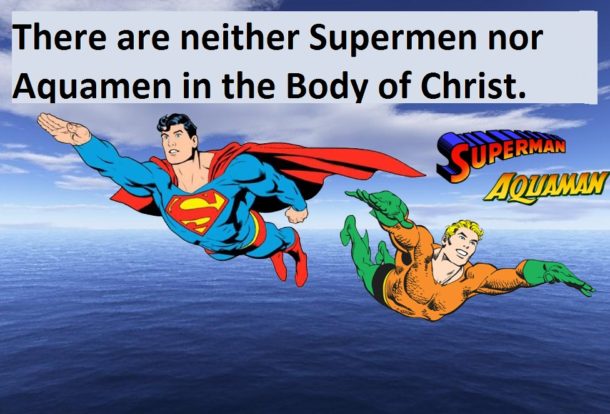
S2 Ep 59How do Superman and Aquaman Illustrate an Important Truth about Spiritual Gifts and How God Has Designed His Church?#59
Hooray - we made it to Friday! Today we are only reading three chapters. Why? Because Robert Murray M'Cheyne's original Bible reading plan was designed for a non leap year, so we have some freedom here to be creative. We'll read Exodus 11 today (the tenth plague death of the firstborn) plus Job 29 and Luke 14. Rather than continue on in reading 1st Corinthians, we will continue on in discussing 1st Corinthians 14 from yesterday. Tomorrow, on the 29th, we will only read 1st Corinthians 15 - the resurrection chapter, and we will be focused on the resurrection. Today is the day we finish up our discussion of spiritual gifts. Every saved Christian in the church is important, necessary, and dependent on the others. We cannot live without each other! The pastor cannot say to the evangelist, "we don't need you, our members can just invite other people and we can grow that way!" Likewise, the teacher cannot say to the faith-gifted person, "We don't need your faith, we just need to teach the Word of God more!" I've illustrated this truth before with a strange saying: There are no Supermen in the Body of Christ – And no Aquamen either. You see, when I was a kid, the one cartoon that everybody watched was the Super Friends, that lovely cartoon about Superman, Wonder Woman, Batman and Robin, Apache Chief, Samurai, Zan and Jayna, Black Vulcan and even good old El Dorado: El Dorado could not talk to fish. In saying that there are no Supermen in the Body of Christ, I mean that nobody has all of the gifts in one package, and nobody is like Superman in that he/she is a one man army – fast, strong, invulnerable, and not needing of anybody else. The list of powers given to Superman in the comic books are absolutely ridiculous. Super-strength. Super speed. Super breath. Heat vision. Time travel. Faster than light-speed flight, Extended life-span. Healing Factor. Eidetic Memory. Superhuman hearing AND smell. X-Ray Vision. Mind control. Invulnerability. RAINBOW BEAMS FROM HIS HANDS. Superman's only real weakness is that he got sick around one particular meteorite from a world light-years away (that didn't exist anymore.) I don't know about you, but I have very rarely encountered meteorites in my day to day life, and if that was my only weakness, I could go years and years without encountering it. There's nobody in the Body of Christ like Superman – all the powers and no weaknesses, and no real need for other teammates. I once had a book by a fairly well known church leader that had words to this effect on the back, "Dr. XXXXX is a Prophet-Apostle who functions as a pastor and evangelist in the Body of Christ. He has been a teacher for xx years" Honestly – I'm not so sure that is all true! That sounds like several major equipping gifts functioning in the same person. Such a gifted person could very well be a one man show that could do all of the major work of ministry while everybody else merely watched. The problem with that scenario is that the church is not meant to be an elite collection of professionals who do the work of ministry, and every one else just simply watches and cleans up after the service. I do NOT believe that this is what Paul means in his description of the function of spiritual gifts in 1 Corinthians 12 and 14. All gifts are needed, all roles are needed, and nobody has been called to be the one-man-army of ministry that does all the visible work. There are no Supermen in the Body of Christ. Likewise, there are no Aquamen in the Body of Christ either. By that, I mean that nobody has a lame, useless gift that doesn't strengthen the church. Now, don't hear me throwing a lot of shade in Aquaman's direction. Other than Superman, Aquaman was actually my favorite of the Super Friends. In fact, due to my love of swimming and snorkeling as a teenager, several of my friends actually dubbed me "Aquaman." That said, Aquaman has been parodied many times as having powers that aren't particularly conducive to fighting crime. Despite the fact that most of our planet is covered by water, the vast majority of crime and super-villainary actually takes place on land. Being able to communicate with sea life is rarely useful on land, a fact famously lampooned by the Cartoon Network years ago in a commercial where Wonder Woman and Aquaman are captured by the Legion of Doom. As they are being lowered into a boiling cauldron of acid, Aquaman attempts to use his powers to free them, and then very soberly tells Wonder Woman that his "ability to talk to fish isn't helping!" Wonder Woman just rolls her eyes, as the audience gets the unspoken joke: Aquaman is mostly useless as a Super Friend. NOT so in the church. As Paul explains, even gifts that aren't obvious or prominent are actually essential to the Body of Christ. Indeed those giftings (and the people who have them) might even be due "greater honor" than those with more prominent gifts. Everybody in the Body of Christ is needed and absolutely essential to the successful and joyful

S2 Ep 58Is the Modern Church Too Pastor-Centered? Spiritual Gifts #2 #58
Happy Thursday, Friends! SHARE/REVIEW. Today's Bible passages kick off with two terrible plagues in Exodus 10: Locusts and Darkness. Pharaoh's grip is certainly loosening on the Israelites! Job 28 is an interesting passage, and serves as a meditation on wisdom - probably written/spoken by Job. It ends with this incredible paragraph, and it is worth reading it twice today: Where then does wisdom come from, and where is understanding located? 21 It is hidden from the eyes of every living thing and concealed from the birds of the sky. 22 Abaddon and Death say, "We have heard news of it with our ears." 23 But God understands the way to wisdom, and he knows its location. 24 For he looks to the ends of the earth and sees everything under the heavens. 25 When God fixed the weight of the wind and distributed the water by measure, 26 when he established a limit for the rain and a path for the lightning, 27 he considered wisdom and evaluated it; he established it and examined it. 28 He said to mankind, "The fear of the Lord—that is wisdom. And to turn from evil is understanding." Job 28:20-28 In Luke 13 Jesus answers a very modern question about those who are victims of 'natural disasters' and other calamities. Do they generally happen to people because they are more sinful? I tell you no, says the Master, but unless we repent, we will also perish. We continue our mini-series on spiritual gifts today, based on our focus passage of 1st Corinthians 14. Our big question of the day is about whether the modern Western church is too pastor-centered or not. We will also be discussing several basic and biblical truths about spiritual gifts. Before we dive into that, I'd like to share a story, then our 1st Corinthians passage. This story is a throwback to an earlier discussion we had on this show when reading about Joseph: Does God still speak in Dreams and Visions? Today I had the privilege of having lunch with a pastor friend from Mexico, who currently helps leader our ministry network here in the Central Coast of California area. My brother is a Southern Baptist, and has been for decades. He told me about a pair of visits he made to Saudi Arabia while working for a job with a large logistics company when he was a bi-vocational pastor. While in Saudi-Arabia, he would read Christian books in the lunch room, and some of the Saudi workers at his company would come and talk to him about Jesus, and he would share the gospel with them. (Not realizing that such activity is illegal in Saudi Arabia.) One of the workers in the factory heard the gospel and had a dream later that week in which Jesus came to him in a white robe. That man was gloriously saved that week, and told my pastor friend about it. My friend went home, but was almost immediately summoned back to Saudi Arabia within a day or two. Upon returning, one of the head bosses pulls him into a conversation about the worker that got saved. My friend thought he was in trouble, but it turns out that this boss had also had a dream about Jesus in a pure white robe, and he wanted to know more about Jesus and the gospel. He too believed and was gloriously saved, and those two are seeing other people in the company become saved as well. So - does God still speak in dreams and visions? According to my Southern Baptist brother...yes He does! Let's read 1 Corinthians 14 together. Ten Important Truths About Gifts of the Spirit (Continued from yesterday) 4. We are commanded in Scripture to eagerly/earnestly desire spiritual gifts, both as a group, and individually. This is especially true of the gift of prophecy: 1 Cor. 12:31-29 Are all apostles? Are all prophets? Are all teachers? Do all work miracles? 30 Do all have gifts of healing? Do all speak in tongues? Do all interpret? 31 But eagerly desire the greater gifts. AND: 1 Cor 14:1 1 Follow the way of love and eagerly desire spiritual gifts, especially the gift of prophecy. AND: 1 Corinthians 14:39,"Therefore, my brothers, be eager to prophesy, and do not forbid speaking in other languages." 5. We are ALL supposed to USE our Spiritual gifts – they aren't supposed to lie dormant. 1 Peter 4:10 "Each one should use whatever gift he has received to serve others, faithfully administering God's grace in its various forms." AND ROMANS 12:6 "Having gifts that differ according to the grace given to us, let us use them: if prophecy, in proportion to our faith." I note here that this command applies to ALL believers, at the very least, all believers who actually know what gift they have been given. This would seem to mean that one MUST use whatever gift they have regardless of opportunity or role in a fellowship. This is a tricky concept. In most churches, only about twenty percent (or less) of the people are actually actively serving in areas that line up well with their spiritual gifts. Often this is the fault of the leadership – the pastors, elders, deacons, etc. The buck must stop with them. When I read 1 Corinthians 12-14, and Romans 12, an

S2 Ep 57What are Spiritual Gifts, and Why Are They Important? #57
Our readings start with Exodus 9 which features a continuance of the struggle between Pharaoh and his magicians in the blue corner, weighing in at a combined weight of 550 pounds, and Moses and Aaron in the near corner, weighing in at around a hair under 300 pounds. Yes, it's a handicap match, but it is Pharaoh and his boys that are ultimately on the underpowered side. Job 27 sees Job continue his painful discourse and Luke 12 contains many powerful teachings of Jesus, including His cure for anxiety. Today we begin a three part series on spiritual gifts. Because this podcast follows the Robert Murray M'Cheyne plan, which was designed during a non-leap year, we will have an extra day in February to work with. Thus for the next three days, we will focus on 1st Corinthians 12-14, and on the 29th, we will discuss 1 Corinthians 15 - the resurrection chapter of the Bible. The next time we go through 1st Corinthians, our focus will be much more on the love chapter - 1st Corinthians 13. But, as a nod to the extreme importance of 1 Corinthians 13, and as a foretaste of our future discussion on the passage, I'd like to turn to our friend Pastor Charles Spurgeon to help us frame our discussion of spiritual gifts in their proper context: Two things are in the text [of 1st Corinthians 12-13]. There is, first, a good way. And, second, there is "an even better way." First, the good way is for each individual Christian to "desire the greater gifts." Paul was referring to spiritual gifts—gifts we ask God for, gifts we may expect the Spirit of God to bestow on us, gifts that can be used in the church of Christ, gifts we desire to possess that we may use them to the glory of God. A certain way may be good, but another way may be even better. Gifts are good, but love is better. We should desire spiritual gifts, but above all we should seek love—the best love, the noblest love, the greatest love—that is, love to God, love to fellow believers, and love to the church of God. This is "an even better way." We should seek this love, first, because we need it. I do not know if we need all the gifts, but I am sure we need this love. Next, we should seek this love because we can have it. There is no limit to God's love. Perhaps even though we covet earnestly the greater gifts, there may be some gifts we will never receive. But all can have love. We need to get more love, also, because we will then be more useful. I am not sure any of us would be more useful if we had more gifts. Not every gift makes a person useful, but I am sure divine love makes us useful. A gift is often barren, but love is always fruitful. We need to get more love so we will glorify God. How little glory God often gets out of great gifts! Gifts may be prostituted to the vilest purposes, but love always brings glory to God's holy name. Remember, also, that though we are to desire great gifts, we will lose them one day. But if we have this love, we will keep it, and it will keep us. This divine love gives us the foretaste and pledge of glory. The person who is full of the majestic grace of divine love truly is blessed. Spurgeon, The Spurgeon Study Bible: Notes (Nashville, TN: Holman Bible Publishers, 2017), 1551. The Bible never gives us a direct and inspired definition of what a spiritual gift is exactly, but there are enough teachings in the Bible on the topic that we can come up with a pretty good definition ourselves, based on what the Bible teaches. I'll list a few, and then give you mine: [Spiritual gifts] are gifts of grace granted by the Holy Spirit which are designed for the edification of the church. Thomas Schreiner from his book: Spiritual Gifts, What They are and why They Matter. A spiritual gift is a God-given ability, distributed to individual Christians by the Holy Spirit that allows him/or her to work through their lives to help the church execute its mission on earth. Dr. Roger Barrier https://www.crosswalk.com/faith/spiritual-life/how-to-identify-and-effectively-use-your-spiritual-gifts.html A spiritual gift is an expression of the Holy Spirit in the life of believers which empowers them to serve the body of Christ, the church. Lifeway's Gene Wilks: https://www.marinerschurch.org/wp-content/uploads/2019/04/DOC-Spiritual-Gifts-List-LW.pdf "[Spiritual] gifts are abilities God gives us to meet the needs of others in Christ's name." Pastor Tim Keller Spiritual gifts [are] the abilities given by the Spirit which express our faith and aim to strengthen the faith of others; they are abilities by which we receive the grace of God and disburse that grace to others. Pastor John Piper: https://www.desiringgod.org/messages/spiritual-gifts I completely agree with all five definitions above - they are all solid, and each one captures a slightly different nuance of the Bible's teaching on gifts of the Spirit. Note how the focus is on who the giver is - the Holy Spirit - and the focus is on what the purpose of the gifts are - the building up of the followers of Je

S2 Ep 56How Did Pharaoh's Magicians Perform Miracles? Demon Power? Sleight of Hand? Do Demons Actually Have Power? #56
Our passages today are Job 25 and 26, and for once, one of Job's friends actually makes some sense, or at least just doesn't spew out garbage, so that is an improvement. (Keeping in mind that God Himself rebukes Job's friends at the end of the book of Job.) Luke 11 has two powerful teachings on prayer: The Model Prayer/Lord's Prayer and Jesus' exhortation to ask and keep on asking, knock and keep on knocking and seek and keep on seeking. (That is the actual verb tense that is in the Greek of Luke 11 - indicating a continuous and ongoing action of persevering asking, seeking and knocking.) 1 Corinthians 12 Begins the longest extended teaching in the Bible on Spiritual Gifts, and will be the focus of our next two episodes, but today we are in Exodus 8. God has sent Moses and Aaron to tell Pharaoh to let the Israelites free, and has given them some miraculous signs to show Pharaoh that God is powerful and means business. We saw this yesterday in Exodus 7: 10 So Moses and Aaron went in to Pharaoh and did just as the Lord had commanded. Aaron threw down his staff before Pharaoh and his officials, and it became a serpent. 11 But then Pharaoh called the wise men and sorcerers—the magicians of Egypt, and they also did the same thing by their occult practices. 12 Each one threw down his staff, and it became a serpent. But Aaron's staff swallowed their staffs. 13 However, Pharaoh's heart was hard, and he did not listen to them, as the Lord had said. 20 Moses and Aaron did just as the Lord had commanded; in the sight of Pharaoh and his officials, he raised the staff and struck the water in the Nile, and all the water in the Nile was turned to blood. 21 The fish in the Nile died, and the river smelled so bad the Egyptians could not drink water from it. There was blood throughout the land of Egypt. 22 But the magicians of Egypt did the same thing by their occult practices. Exodus 7 A very similar dynamic will happen today in chapter 8 - so let's read it and come back and discuss what is going on. 5 The Lord then said to Moses, "Tell Aaron: Stretch out your hand with your staff over the rivers, canals, and ponds, and cause the frogs to come up onto the land of Egypt." 6 When Aaron stretched out his hand over the waters of Egypt, the frogs came up and covered the land of Egypt. 7 But the magicians did the same thing by their occult practices and brought frogs up onto the land of Egypt. Exodus 8:5-7 I believe the Bible is absolutely inspired and inerrant - all that it affirms is true and factual. This account quite clearly shows that the magicians of Egypt were able to do some incredible things: Turn their staffs into snakes, turn water into blood and produce a plague of frogs. How is this possible? We have two major possibilities: #1 The Egyptian magicians pulled some sort of trickery and sleight of hand - akin to a modern Criss Angel/David Copperfield type. #2 The Egyptian magicians tapped into a different power source other than God. Gotquestions.org tends to favor the first option: The second option, and the more probable, is that the magicians simply created illusions. Through sleight-of-hand and conjurer's tricks, they deceived their audience into believing that they were performing the same miracles as Moses and Aaron. The first illusion, that of turning the staffs into snakes, may have been performed by snake charming, which was widely practiced in ancient Egypt (and even some today). There was a way in which snake charmers could cause a snake to stiffen like a staff and relax on command. Since the magicians were summoned after Aaron threw down his own staff, they would have had time to prepare the trick in advance. As for turning the Nile to blood, only dye is needed to make water run red. The frogs may be a more complicated illusion, but, just as modern illusionists can pull rabbits out of hats, Pharaoh's magicians could have summoned frogs. https://www.gotquestions.org/Pharaohs-magicians-miracles.html I will definitely admit that this is a possibility, but as near as I can tell, the text of each of these passages does not seem to lend itself to trickery. Each time, the Word of God says that the Egyptian magicians "did the same thing by their occult practices/enchantments." I heavily favor option #2 as the most compatible with the biblical text. Somehow, someway, spiritual beings/demons/elohims/Satan himself empowered these magicians. Is such a thing possible? I believe the Bible indicates the answer is yes - Satan does have power, and he can empower people, from time to time. Consider these passages: The coming of the lawless one will be in accordance with how Satan works. He will use all sorts of displays of power through signs and wonders that serve the lie, The coming of the lawless one is according to the working of Satan, with all power, signs, and lying wonders, 2 Thessalonians 2:9 NIV, then KJV I do note here that some versions use the phrase 'false' signs and wonders, and that is within the range of mean

S2 Ep 55Is Taking Communion/The Lord's Supper Dangerous? #Eucharist #ICantDrive55
Happy Monday, friends. May the Lord bless you and carry you through this sometimes grim day. Today's Bible readings include Exodus 7, wherein Pharaoh's magicians perform some amazing feats, a topic that we will tackle in episode #56 tomorrow. Job 24 continues Job's epic speech? Rant? Lament? I'm not sure how to classify his third speech. It's something, though - wow! In Luke 10 Jesus sends out not 12, but 72 disciples and also tells us the amazing Parable of the Good Samaritan, one of the most well-known stories in all of human history. Our focus question comes from 1 Corinthians 11. This is an interesting and fairly controversial chapter. The first part concerns head coverings, and the second contains instructions, exhortations and warnings about The Lord's Supper/Communion/Eucharist/Breaking of the Bread. (These four phrases all refer to the same ordinance in the Christian church. Eucharist comes from the Greek word for 'Thanksgiving' and it is found in 1 Corinthians 11:34) We will probably cover head coverings later this year when we go through 1st Corinthians again, but today we are going to zero in on Paul's mysterious and terrifying warning about the dangers of taking Communion in an unworthy manner. Let's read the text and pay special attention to the warning, then we will come back and discuss it. Just in case you missed it, here is the text that we are discussing today: 27 So then, whoever eats the bread or drinks the cup of the Lord in an unworthy manner will be guilty of sin against the body and blood of the Lord. 28 Let a person examine himself; in this way let him eat the bread and drink from the cup. 29 For whoever eats and drinks without recognizing the body, eats and drinks judgment on himself. 30 This is why many are sick and ill among you, and many have fallen asleep. 31 If we were properly judging ourselves, we would not be judged, 32 but when we are judged by the Lord, we are disciplined, so that we may not be condemned with the world. 1 Corinthians 11:27-32 When you understand that 'fallen asleep' is a biblical metaphor used to indicate death, then you understand how serious Paul is being here. He is saying that some in the Corinthian church have become weak, sick and some have even died because of the way they handled the communion. Pause and let that sink in for just a moment. The New Testament is telling us here that, if we partake of communion in an improper way on Sunday morning, then we are running the risk of weakness, sickness or death. When I first read that in the Bible many years ago, I was quite shocked - especially so because I don't recall having ever been warned about such a thing in the churches I grew up in. It might surprise you to hear that communion is such a serious matter, but we should know that it was at the very center of Christian practice in the first few centuries of the church. I believe the modern church takes the practice of communion far too lightly, and probably far too infrequently. It was a dispute over the meaning of communion in England in the 1500s that caused Bloody Mary, the Catholic Queen of England, to order the deaths of almost 300 Protestants who had a different view of communion than did the Catholics. This number included 55 women, 4 children and more than two dozen church leaders and pastors. What was the exact nature of the dispute? Here's British Bishop J.C. Ryle on the answer to that question: The doctrine in question was the real presence of the body and blood of Christ in the consecrated elements of bread and wine in the Lord's Supper. Did they, or did they not believe that the body and blood of Christ were really, that is corporally, literally, locally, and materially, present under the forms of bread and wine after the words of consecration were pronounced? Did they or did they not believe that the real body of Christ, which was born of the Virgin Mary, was present on the so-called altar so soon as the mystical words had passed the lips of the priest? Did they or did they not? That was the simple question. If they did not believe and admit it, they were burned. John Charles Ryle, Light from Old Times (Moscow, Idaho: Charles Nolan Publishers, 2000, first published 1890) Thankfully, Catholics don't kill Protestants over communion disagreements anymore, but the above struggle does demonstrate that communion is not merely a quarterly snack of crackers and juice that the church sometimes does. Rather, it is a life-giving, Gospel-proclaiming, faith-building, thankful heart-producing, Christ-focusing act that causes us to remember and proclaim that central truth of Christianity - that the body of Jesus was broken (instead of ours!) for sin; and the blood of Jesus was violently spilled out (instead of ours!) for our sin. When we eat and drink the bread and fruit of the vine, we proclaim the Lord's death and resurrection and return together. How can such an act be dangerous? I believe the answer to that question lies in the very importance of

S2 Ep 54How is Jesus Our Lawyer, and Why is that Good News? #54
Happy Lord's Day, everybody! Today's pod will be short, and hopefully sweet as we discuss the powerful truth that Jesus is our advocate. We will be reading Exodus 6, Job 23, Luke 9 and 1 Corinthians 10 today. I'd like to give a shoutout to Lamar, who gave a remarkably encouraging review on iTunes: Neither bland nor monotonous☆☆☆☆☆Three things going on here: first it's a Bible reading podcast just as titled, the readings are pleasant and joined with interesting and often very practical discussion. If you're looking for a reading plan, Chase follows one that will take you thru the Bible in a year also repeating important books. If you're like me and have repeatedly fallen off yearly reading plans but still feel compelled to read, pick a chapter out of the day's reading plan (notably the focus passage from the notes) and read it before listening and then you're cracking a book as well as getting your volume of Scripture input daily. Primarily, this is a daily reading podcast. You typically don't have to backtrack to benefit as there are few discussions that continue day-to-day and most critical scripture passages will get repeated tho I suspect the discussion will remain fresh. Chase attempts and pleasantly achieves a dramatic and fun reading of scripture and models a good way to read scripture to your children and yet does not offend this listener's sense of maturity. There is good topical discussion surrounding daily focus passages that is approached with solid biblical theology but is not a theology podcast that wanders into the weeds. It's a good listen to go along with a great read. LaMaR925 via Apple Podcasts ·United States of America ·02/19/2020 Thank you, Lamar! Today's focus question comes from our Job passage, specifically verses 1-7 where Job wishes that he could face God in a courtroom, and expresses the hope that he might be found innocent, if only a fully righteous advocate/lawyer could be found to plead with God on Job's behalf. As a reminder, an advocate is a person who speaks or writes in support or defense of a person. Then an upright man could reason with him, and I would escape from my Judge forever. Job 23:7 This echos Job's earlier cry for a lawyer/advocate who might intercede with God on Job's behalf from Job 16: Earth, do not cover my blood; may my cry for help find no resting place. 19 Even now my witness is in heaven, and my advocate is in the heights! 20 My friends scoff at me as I weep before God. 21 I wish that someone might argue for a man with God just as anyone would for a friend. Job 16:19-21 Job realizes that having some sort of upright/righteous/holy lawyer that had access to Heaven would be an incredible help to him - perhaps such an advocate could speak to God on Job's behalf and intercede for him. The wonderful news for us in the New Covenant era is that Jesus has become the very advocate that Job wished for - even far beyond his wildest dreams. Check out this beautiful truth from 1 John 2: My little children, I am writing you these things so that you may not sin. But if anyone does sin, we have an advocate with the Father—Jesus Christ the righteous one. 2 He himself is the atoning sacrifice for our sins, and not only for ours, but also for those of the whole world. 1 John 2:1-2 Our great trouble is that our lives have missed God's mark of perfection - we have fallen short of His holiness in every way possible, and our sins have earned us judgment, and the penalty is death. This is terrifying because the Bible teaches us in multiple places that at the end of our lives and at the end of the world all humans will face judgment in God's courtroom. We already know our plea: guilty. The just Judge has all of the evidence needed to convict us and sentence us to death. However, the Judge is also merciful, and He has provided an advocate for us. That advocate is Jesus, and not only does Jesus 'represent' those who are His in the Father's courtroom, He is also the one who pays the penalty for their sin - IN FULL! - to the court's satisfaction. No wonder the Bible calls this the 'Good News!' I'll close this short reflection with some fantastic and encouraging words from our friend Charles Spurgeon about the joyful news of Jesus our Advocate: "If any man sin, we have an advocate." Yes, though we sin, we have him still. John does not say, "If any man sin, he has forfeited his advocate," but "we have an advocate," sinners though we are. All the sin that a believer ever did, or can be allowed to commit, cannot destroy his interest in the Lord Jesus Christ, as his advocate. The name here given to our Lord is suggestive. "Jesus." (Jesus means Yahweh saves) Ah! then he is an advocate such as we need, for Jesus is the name of one whose business and delight it is to save. "They shall call his name Jesus, for he shall save his people from their sins." His sweetest name implies his success. Next, it is "Jesus Christ"—Christos, the anointed one. This shows his authority to plead. The Christ has
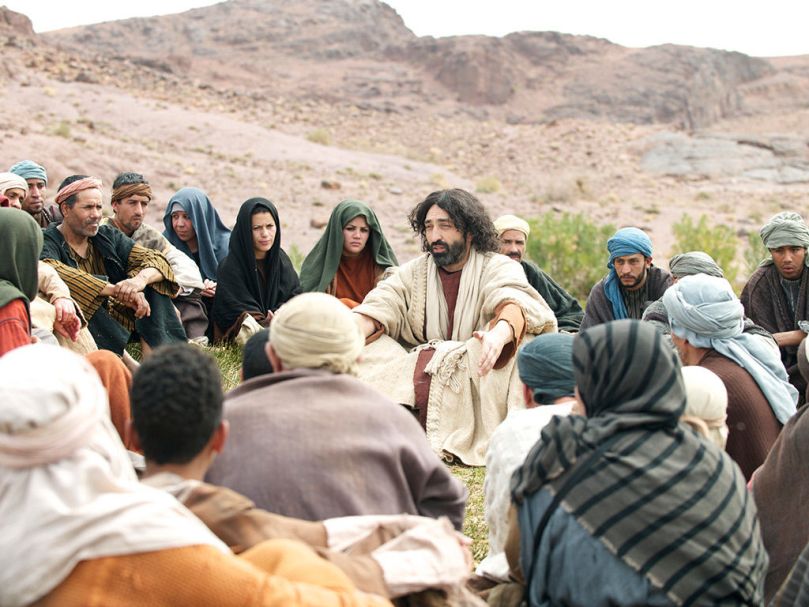
S2 Ep 53Were Women Part of Jesus' Ministry Team? #53
Today's Bible readings feature some high drama as Moses and Pharaoh have their first showdown in Exodus 5. If we are being fair, I think we have to give Pharaoh the win for round 1, but this struggle will go on for several rounds, so stay tuned. Job 22 features some comforting and wise words from Job's awesome friends. Actually, no - that was sarcasm. Job's dumb friend Eliphaz actually asks Job this gem of a question: Isn't your wickedness abundant and aren't your iniquities endless? Job 22:5 What a horrible question to ask somebody who is going through terrible tragedy, heartbreak and depression. Once again, #DontBeLikeJobsFriends! Finally, in 1 Corinthians 9, Paul opens up and talks about his role as a minister of the Gospel and an apostle. Our focus passage for today is Luke 8, and our big Bible question comes right out of the first few verses, so let's read that chapter first, and then come back and discuss the women who took care of Jesus. If you ask most church people the question, "who all traveled with Jesus?" I suspect the most common answer would be something that included Jesus and His 12 disciples, and pretty much nobody else. Interestingly, that doesn't appear to be the correct answer to the question, at least not all of the time, because we find this fascinating paragraph leading off Luke 8: Afterward he was traveling from one town and village to another, preaching and telling the good news of the kingdom of God. The Twelve were with him, 2 and also some women who had been healed of evil spirits and sicknesses: Mary, called Magdalene (seven demons had come out of her); 3 Joanna the wife of Chuza, Herod's steward; Susanna; and many others who were supporting them from their possessions. Luke 8:1-3 By and large, the twelve disciples get all of the press (well, except for Jude/Thaddeus, Nathaniel, Simon the Zealot, the second James (James, son of Alpheus) and Philip the disciple) but Luke reveals to us something incredibly important: The practical and financial needs of Jesus and His twelve disciples were met by this large group of women that traveled with them. We don't know for sure that these women were always with Jesus, but they obviously were for the long village to village stretch described by Luke here, and it is probably not a stretch to believe that they accompanied Jesus and the disciples on many missions. I have been a pastor for a very long time, and I can tell you that the people who voluntarily give of their resources to meet the physical and financial needs of ministry are hugely important in the life of every ministry and every church. No, the Kingdom of God is NOT built on money, but there are many needs that need to be met, and the way that God has ordained those needs be met is through the sacrificial giving of the people of God, and (at least according to Luke) the primary financial support of the Jesus team was this group of ladies. I know of no other passage that indicates other people funded the ministry of Jesus, though I'm sure some did. What this means is that women were crucial to the first century ministry of Jesus and they are crucial to the twentieth century ministry of Jesus. Theologically, I am what's known as a complementarian, which is a discussion we will be having in some upcoming passages of Scripture, but I will say this: any man or person who doesn't realize the massive contribution and importance of women in the Body of Christ is a dull and silly person. In honor of such, I'd like to briefly highlight five important, but lesser-known women in the New Testament. I think it is fair to say that most of them are unsung heroes of the Word of God. Fortunately for all of you, I have not written a song about any of them, so they will remain unsung, at least by me, but I do want to point them out and recognize their contributions to the Great Commission and the mission of Jesus: Phoebe, Romans 16. Phoebe was a diakonos of the church in Cenchreae, and since that word can be translated as 'minister,' or 'servant,' or 'deacon,' there has been a long debate through the years over whether or not Phoebe was a deacon. We won't enter that debate today - one day - but she is obviously remarkably important to the Body of Christ. She is the first one that Paul 'shouts out' at the end of Romans, and he orders the Roman church to assist her and take care of her. Paul also points out that Phoebe has supported many in the ministry, Paul included. My wife and I named our fifth child Phoebe in honor of this Phoebe. To my knowledge, Phoebe is the youngest listener to this podcast, and the most faithful Thompson listener, so a shout out to you, young Phoebe - daddy loves you very much! I commend to you our sister Phoebe, who is a servant of the church in Cenchreae. 2 So you should welcome her in the Lord in a manner worthy of the saints and assist her in whatever matter she may require your help. For indeed she has been a benefactor of many—and of me also. Romans 16:1-3 2. Chloe - 1

S2 Ep 52Why did God Seek to KILL Moses Right After He Sent Him on a Mission to Rescue the Children of Israel? #52 #yesitreallyhappened
Rejoice, everybody! It is Friday, and if you live in sunny central California, you get to enjoy temps in the 70s today with sunshine and no humidity. If you're in the area, come visit us at Valley Baptist Church in Salinas! If you're not, then I am sorry to brag on our weather - your's probably isn't as nice. After 1.5 years as a native Californian, I've learned that the four most California things possible are: #1 Mentioning how great the weather is #2 Eating Avocados #3 Skateboarding #4 Buying bags at the grocery store because I am literally incapable of remembering to get them out of my trunk and bring them into the store. Enough nonsense - Today's Bible passages include Job 21, where we see Job at his best: a man of sorrows that maintains an excellent sense of dark sarcasm in answering his mean friends: Pay close attention to my words; let this be the consolation you offer. 3 Bear with me while I speak; then after I have spoken, you may continue mocking. Job 21:2-3 In Luke 7, we see the remarkable example of the Roman Centurion's faith, and Jesus' compassion and power on full display as He resurrects the only son of the Widow of Nain. 1 Corinthians chapter 8 is focused on eating food sacrificed to idols - not a big deal in much of the West - but also discusses how to NOT be a stumbling block to people when we use our freedom to eat and drink. It also contains this powerful nugget of wisdom, " Knowledge puffs up, but love builds up " (1 Corinthians 8:1) Our focus passage remains in Exodus today, and our Bible question concerns what might be one of the most mysterious (and totally unexplained!) events in all of the Bible. Let's read the whole of Exodus 4, and be on the lookout for the mysterious happening. Notice how there is not pretext or postscript that explains our event in question. Did you catch it?! There, right at the end of Exodus 4, almost IMMEDIATELY after God has called and pushed Moses into leading the Exodus out of Egypt, God goes to Moses to KILL HIM! Yes - I said kill him, because that's exactly what the Bible says! WHAT IN THE WORLD?! Here's the text again, in case you missed it: On the trip, at an overnight campsite, it happened that the Lord confronted him and intended to put him to death. 25 So Zipporah took a flint, cut off her son's foreskin, threw it at Moses's feet, and said, "You are a bridegroom of blood to me!" 26 So he let him alone. At that time she said, "You are a bridegroom of blood," referring to the circumcision. Exodus 4:24-26 SO MANY QUESTIONS! The foremost question is: WHY does God seek to kill Moses, but there are other questions too: HOW was God going to kill him? WHY did Moses' wife circumcise her son, and throw the tip at the FEET of Moses? WHY did that appease God? And finally, what in the world did she mean by, "surely you are a bridegroom of blood to me?" Let me begin our answers with a strong caution: I think we can offer an extremely plausible explanation for much of what is happening here, and we can offer an explanation that is sound in a biblical sense. However, our explanations will AT BEST be CONJECTURE. (conjecture is an opinion or conclusion that comes from incomplete or missing information.) Biblical conjecture is ok - I think - as long as we say right up front that we are speculating - making educated guesses at best. Putting all of the pieces of the puzzle together, it would appear that God was going to bring the most severe discipline possible to Moses, because Moses was willfully refusing to obey God's commands and have his son circumcised. Let's turn to our French friend John Calvin for a good speculation/conjecture about what is going on here: The expression, "the Lord met him," is here used in a bad sense, for an adverse meeting, or hostile encounter; as though Moses should say that the hand of the Lord was against him to interrupt his journey. In what form He appeared we don't know, except that the words pretty plainly imply that Moses was assured of His anger, so as to be aware that his death was near... The cause is not [directly] expressed for which he perceived that God was so angry with him; except that we may gather it from what follows. For why should Zipporah have taken a sharp stone or knife and circumcised her son, had she not known that God was offended at his uncircumcision? It is sufficient for us to know that he was terrified by the approach of certain destruction, and that, at the same time, the cause of his affliction was shown to him, so that he hastened to seek for a remedy. It would never have otherwise occurred to himself or his wife to circumcise the child to appease God's wrath; and it will appear a little further on, that God's anger was satisfied by this offering, since he withdrew his hand, and took away the signs of his wrath. I therefore unhesitatingly conclude, that vengeance was declared against Moses for his negligence, which was connected with still heavier sins; for he had not omitted his son's circumcision from

S2 Ep 51What is God's Real Name? (Yes! He does have an actual name.) #51
Today's Bible readings include Job 20 in which Zophar, Job's friend, will erroneously tell us that the wicked are always punished while on earth, and their plans never succeed in the long run. Luke 6 contains Luke's shortened version of the Beatitudes as well as Jesus' challenge to the Scribes and Pharisees about the Sabbath. 1 Corinthians 7 is a bit of a confusing passage (in places) that has lots of advice on marriage, including: 1. You don't have to get married, but you certainly can if you want to and you must if you are burning with sexual desire. 2. Husbands and wives have authority over each other's bodies. The husband has authority over his wife's body AND the wife has authority over her husband's body. One implication of this principle is that neither party is allowed to withhold regular sex from the other, with the ONLY exception being a mutually agreed upon break in order to more intentionally seek the Lord for a short season. Our focus passage is in Exodus 3 - the famous Burning Bush passage where God calls Moses and sends him to rescue the Hebrews. In this passage, God reveals His name and His nature to Moses in a deeper way than we have seen before, and our big question today is what is God's name, and what does His name mean? Let's read Exodus 3 and then discuss it. 13 Then Moses asked God, "If I go to the Israelites and say to them, 'The God of your fathers has sent me to you,' and they ask me, 'What is his name?' what should I tell them?"14 God replied to Moses, "I AM WHO I AM. This is what you are to say to the Israelites: I AM has sent me to you." 15 God also said to Moses, "Say this to the Israelites: The LORD, the God of your fathers, the God of Abraham, the God of Isaac, and the God of Jacob, has sent me to you. This is my name forever; this is how I am to be remembered in every generation. Exodus 3:13-15 CSB 14 God replied to Moses, "I AM WHO I AM. This is what you are to say to the Israelites: I AM has sent me to you." 15 God also said to Moses, "Say this to the Israelites: Yahweh, the God of your fathers, the God of Abraham, the God of Isaac, and the God of Jacob, has sent me to you. This is My name forever; this is how I am to be remembered in every generation. 16 "Go and assemble the elders of Israel and say to them: Yahweh, the God of your fathers, the God of Abraham, Isaac, and Jacob, has appeared to me and said: I have paid close attention to you and to what has been done to you in Egypt. 17 And I have promised you that I will bring you up from the misery of Egyptto the land of the Canaanites, Hittites, Amorites, Perizzites, Hivites, and Jebusites—a land flowing with milk and honey. 18 They will listen to what you say. Then you, along with the elders of Israel, must go to the king of Egypt and say to him: Yahweh, the God of the Hebrews, has met with us. Now please let us go on a three-day trip into the wilderness so that we may sacrifice to Yahweh our God. Exodus 3:14-18 Holman Christian Standard Bible YHWH First and foremost, I need to point out what appears to be a discrepancy, but actually isn't. The Christian Standard Bible, the translation we are reading through, uses LORD in vs 15 and following of Exodus 3. The Holman Christian Standard Bible, my favorite translation, uses 'Yahweh' in vs. 15 and following. What gives? The answer is that God gives Moses His name - His personal name! - in Exodus 3:14, and that name is Yahweh, in the Hebrew. His name means, "I am that I am," or "I am Because I am." Most modern Bible translations, the King James Bible included, translates 'Yahweh' to LORD with all capitals to indicate that God's name is being used. Why would they do this? There are a few reasons. For one, most modern Bibles are translations, and therefore they seek to translate every word from one language into another. Occasionally that is difficult when faced with Hapax Legomena (as mentioned in episode 47 ) and when faced with difficult or disputed words like Nephilim, discussed in episode #6. In those cases, translators sometimes resort to transliterations, which is an attempt to take the sound of a word in the source language (such as Biblical Hebrew or Greek) and represent it in the target language (such as English.) This obscures the MEANING of the word, but preserves the SOUND of the word. The trouble with doing this with Yahweh is that our original Hebrew Bibles don't have vowel sounds, only consonants. Because the early Hebrews refused to say God's name out loud, we don't know exactly how the name should be pronounced, because we only have the four Hebrew consonants. Let's tag in Gotquestions.org to help us understand this dynamic better: In the original Hebrew, God's name transliterates to YHWH (sometimes written in the older style as YHVH). This is known as the tetragrammaton (meaning "four letters"). Because of the lack of vowels, Bible scholars debate how the tetragrammaton YHWH was pronounced.The tetragrammaton consists of four Hebrew letters: yodh, he, waw, an

S2 Ep 50What Are Some Helpful Things To Say To People Who are Suffering or in Grief? #50
All of the pundits said it couldn't be done. The odds were 3720-1 against, but we have made it to episode #50 of the Daily Bible Reading Podcast. If you've been here from the beginning, pat yourself on the back, but don't get too carried away, because we have some Bible reading and Bible talking to do. Today's passages include: Exodus 2, which introduces us to Moses, one of the most important people in the entire Bible. We will also read Luke 5, in which Jesus calls His twelve disciples and 1 Corinthians 6, in which Paul gives an incredibly strong warning to Christians about sexual immorality. Our focus remains on comforting well those who are suffering, and that means our focus passage for the day is in Job 19, and the very first verses show us how difficult we can make it on our friends who are suffering if we say and do the wrong things (like Job's friends did!) How long will you torment me and crush me with words? 3 You have humiliated me ten times now, and you mistreat me without shame. Job 19:2-3 We DO NOT want to be like Job's friends - we want to help those we love who are going through trials, so today we are going to discuss some ways that we can actually comfort the grieving. Let's read our passage in Job first, and then consider how we can walk with the hurting in a helpful way. For whatever reason, when we are suffering, we often feel alone - even if people are trying to reach us and express love to us. Something about going through acute suffering, grief, depression and pain alienates us from those who aren't going through the same thing. We can see Job expressing the pain from this dynamic in this chapter: He has removed my brothers from me; my acquaintances have abandoned me. 14 My relatives stop coming by, and my close friends have forgotten me. Job 19:13-14 Because those who suffer often feel alienated and isolated, we who love them must try extra hard, and persist in trying for a long time, to communicate our love for our friends. With that in mind, here are: Three thoughts on what TO say to those who are mourning, grieving or hurting: Sometimes you don't have to SAY anything. We all stumble for words when we are interacting with somebody in extreme grief. They are hurting, and we have a natural - and wholesome - instinct to try and comfort them and soothe their pain. I suspect that this dynamic is the main reason why we say so many stupid and inaccurate things to people who are mourning. We want to help, and words are failing us…so we just say something. However, it is far better to say nothing than it is to say something harmful. Remember the example above about the slightly awkward and tall lady at my friend's sister's funeral? That lady had no words, so she just mourned with a mourning mother - in a genuine and quiet way. Shared suffering is powerful - often far more powerful than even the best clichés. "Remember the prisoners, as though you were in prison with them, and the mistreated, as though you yourselves were suffering bodily." Hebrews 13:3 The WORD of God is comforting. While I think it is wise to avoid merely quoting a Bible verse to somebody who is suffering (The Word of God is LIVING and ACTIVE and POWERFUL; but treating it like a mere Band-Aid cheapens it somehow) I believe it is powerful to share Scripture with those who are suffering. Not in a drive-by way - but in the context of demonstrating love through time and your presence. In the midst of that - a powerful Scripture like Revelation 21 (quoted below) is indeed comforting and helpful. The truth that one day, God will wipe away every tear is a precious truth. The truth that some people will be crying right up until the point of Jesus' Second Coming and triumphant victory is a sobering reality. "He will wipe away every tear from their eyes. Death will no longer exist; grief, crying, and pain will exist no longer, because the previous things have passed away." Revelation 21:4 Persist and remember those who have suffered loss, even after a lot of time has passed. Grief is a very, very lonely process, and a very lonely emotion. When you are suffering the grief of the death of a loved one, it often feels like nobody else in the entire world has suffered quite like you are suffering. And that grief lasts a very, very long time. Most friends of people who are mourning will, after a certain amount of time, attempt to bring their relationship with the mourner back to a more normal place. This, in and of itself, is not necessarily a bad thing. As Christians, we DO grieve, but not as those who have no hope. We grieve WITH hope - knowing that God will one day wipe every tear from our eye. That said - we still grieve, and we still remember those whom we have lost. As the friend of somebody in mourning, do them the kindness of remembering their loved one, and remembering that they are probably still in pain. It might be easier to never bring up the departed loved one - perhaps to spare the feelings of your suffering friend - but a

S2 Ep 49How Do We Comfort the Suffering? Part 2: What NOT to Say to Those Who are Grieving! #49
Welcome to the Bible Reading Podcast! (Encourage Sharing on SM/Reviews, etc) Today's readings include Exodus Chapter 1 - which means we have completed the entire book of Genesis together - Go team! Sadly for the Israelites (in the short term!), Exodus opens with this ominous bit of foreshadowing in chapter 1, vs. 8, " A new king, who did not know about Joseph, came to power in Egypt." In Luke 4, we will see how Jesus overcomes the attacks of Satan in the desert by the expert use of the Sword of the Word of God. 1 Corinthians 5 is all about church discipline, a biblical practice that is sadly neglected in many of our churches. Our focus remains in Job today, and we will be reading chapters 17 and 18, and asking the question how can we help and encourage the hurting and suffering. As I mentioned yesterday, part of what I'm sharing below is from my first book, Unshackled: Facing Suffering With the Real Jesus (and Not the Shack, or Pop-Culture Christianity,) which holds the Guinness book of World records for longest book by an unknown author. I have been in pastoral ministry for over twenty-five years, and in that time have ministered to dozens of families who are mourning the death of those nearest to them. Some of the deaths are more…bearable (?) than others, if death can be in any way bearable at all. I've done the funeral for a lovely World War 2 veteran of D-Day who had been married to his wife for roughly 70 years. That was hard, and I am sure it still is for his surviving wife - I cannot imagine being separated from my wife of 20 years - how much more difficult must it be to be separated from a spouse of 70?! This funeral was sad - with much tears and grieving, but also was celebratory - rejoicing in a faithful marriage of almost 70 years, and celebrating the life of a remarkable man who had lived a long and amazing life. Some of the funerals I have done are nothing but grieving, mourning, tears, tragedy and incredible sadness. Many years ago, while still a young, greenhorn youth minister, I was summoned to the hospital one night due to a wreck involving one of our youth. I will never forget that night - sitting next to this young man's mom and dad, as we awaited news in the waiting room. When the surgeon walked in, he had a grim look on his face, and very coldly and callously told this young man's parents that he had died on the operating table. Though that night was twenty years ago, I can still clearly hear the gut-shredding wail of his mom in my mind, and the look on her face as she mourned the death of her only child. Heartbreaking. Words failed that night. And the surgeon's communication and lack of compassion only added to the misery. (Though I am quite sure he tried his best!) Another funeral involved a family that I did not know at all - but our church had helped them with food previously, and thus they asked our church to provide a pastor for the funeral. In this particular tragedy, a very young married couple had a lovely baby that was killed one night when the husband got either drunk or stoned (or both) and inadvertently rolled over on the baby that they were co-sleeping with, and smothered him. Both the husband and the wife were at the funeral, as was their family - and they wanted me to share words of comfort and hope into what seemed for all the world like a hopeless situation. What do we say in situations like these? Maybe you've never faced a scenario like the above, and maybe you aren't in ministry….but I guarantee that you will, multiple times in your life, be the friend or family member of somebody who has lost a loved one to death…and they will look to you for support, love, help and comfort. How do you handle that? What can you say to make things better? Well - here's the thing to remember that is very important: IT IS LIKELY THAT YOU DO NOT HAVE THE POWER IN THAT MOMENT TO MAKE THINGS BETTER. And when we try to make things better, we end up saying things that are factually untrue, or are meaninglessly cliche and in doing so, it is possible that we can make things worse! Let's read our Job passages, and then come back and discuss what we should not say to those who are suffering. Here are five things that I have heard people actually say to those who are grieving, and a brief word on why to NEVER say these things: Top Five Worst Things to Say to Those Who Have Lost a Loved One "God Needed a new angel in Heaven!" UGH!! Please don't say this - ever, to anybody. First of all, how in the world can this expression, as false as it is, ever be comforting to somebody that has lost a child, or a family member? "God was running short on something, so He - the God of everything who has everything - actually took a child or loved one from me?!" This is a cruel statement, and it is not comforting at all - not in the least. Secondly - it is not even remotely true. The Bible does NOT teach that people become angels when they die…in fact, when Christians die, they become like Jesus - with a body l

S2 Ep 48Episode 48: How Can We Best Comfort the Suffering and Brokenhearted? (Part 1) #DontBeAMiserableComforter
Happy Monday, friends! I want to open with a shoutout to Willem Dykstra of Minnesota, who left an encouraging iTunes review, "Excellent podcast and edifying for anyone that seeks to be in God's Word daily. Also entertaining Chase could be an actor in movie or stage or at least a voice actor" Thank you, Mr. Dykstra! Today's Bible readings include Genesis 50, a chapter that spans a long chronological period and sees the burial of Jacob, Joseph forgiving his brothers who sold him into slavery, and the death of Joseph himself. Luke 3 is all about John The Baptist's ministry, his baptism of Jesus, and his ultimate arrest for daring to call out a political leader for sinful behavior. In 1 Corinthians 4, the apostle Paul discusses humility, and delivers this powerful line, "The Kingdom of God is not a matter of talk, but of power." Our focus passage today is in Job 16. and is based on Job's deeply painful lamentation that his friends are 'miserable comforters,' rather than encouragers: You are all miserable comforters. 3 Is there no end to your empty words? What provokes you that you continue testifying? 4 If you were in my place I could also talk like you. I could string words together against you and shake my head at you. 5 Instead, I would encourage you with my mouth, and the consolation from my lips would bring relief. Job 16:2-5 "Grief is a very lonely experience. You know, even if all your friends are there for you in the best way possible — your spouse is there for you, all of those things — the essence of grief is a deep, pervasive loneliness. And it means so much for people around us to overcome the awkwardness — and maybe even the desire and fears that I'll say the wrong thing — to say something. Honestly, the most painful thing is when you've had a loss and someone around you—because of the awkwardness — never acknowledges it. That's what hurts the most. Because what it says to you is that person you love who died doesn't even really merit a mention. And that's devastating….But for many of us, when you're carrying this huge load of sorrow and you look up, and you see someone who is shedding tears — that they are so identifying with your loss that they are in a sense carrying some of the load of sorrow for you — that's an incredible gift to give to someone who's grieving." https://www.desiringgod.org/articles/what-do-we-say-to-grieving-people "What Do We Say to Grieving People?" Poor Job! Our question of the day is all about how we can help, encourage and comfort those who are going through difficult times. Part of what I'm sharing below is from my first book, Unshackled: Facing Suffering With the Real Jesus (and Not the Shack, or Pop-Culture Christianity.) Yes, that is the real title of the book, and yes it is way too long of a title. Like I said, it was my first book, but William Shakespeare said it was the best book ever written in the English language. Or maybe he didn't, I've heard it both ways. Suffering is difficult to go through. I imagine I've just blown your mind with that profound statement. But it might be good for us to acknowledge how hard suffering is - especially suffering that stretches on for days and weeks and months. When we suffer, we long to feel better. When our friends suffer, we want to help them, and that is a good thing, obviously, if that desire to help our friends comes from a loving concern for their well-being. Far too often, I have seen Christians make a bad situation worse by poorly chosen words or empty "greeting card" style sentiments. The fact is that when our friends and family suffers, we suffer...and we don't want to suffer, so sometimes - selfishly - we want our friends and family to stop suffering so that WE will feel better. And that leads us to say dumb things like, 'cheer up,' or 'wipe that frown off your face,' or, 'God needed a new angel in Heaven,' or some dreck like that. Sometimes we fail to be good comforters because we simply want those suffering around us to stop suffering, because they are harshing our mellow. Other times, we are like Job's friends, and we fail to properly comfort people because we make false assumptions, make arrogant statements, or just plain say dumb and inaccurate things. Let's read Job 16 now, and see how our friends can be impacted when we are 'miserable comforters,' instead of healing helpers. Romans 12:15 is one of the most powerful, profound and short verses in the Bible on real friendship and ministry to people in general. Rejoice with those who rejoice; weep with those who weep. Romans 12:15 I was recently in a position of suffering, and was profoundly helped by friends and brothers and sisters in Christ. As I mentioned a few days ago, I spent a night in the hospital last week. I thought it was a big deal, but it ended up being tachycardia brought on by some medication I take to treat my relatively mild asthma. At one point, however, I thought I was having a heart attack. (I wasn't!) and my wife was visiting friends and fami

S2 Ep 47Episode #47 - Was Jesus Rejected by an Innkeeper and Actually Born in a Stable?
Merry Christmas, everybody! Today's readings begin with Genesis 49, which largely consists of Jacob/Israel's blessing over his boys (and Joseph's two sons, Ephraim and Manasseh.) As we might expect from one such as Jacob/Israel, the blessing is very, very strange and unique in many ways, including where he calls out his eldest son for sleeping with his concubine/wife. #awkwardfamilymoments Job 15 features some more inaccurate drivel from Job's wrong (according to God) 'friend' Eliphaz, who fat-shames the wicked with this passage: Though his face is covered with fat and his waistline bulges with it, 28 he will dwell in ruined cities, in abandoned houses destined to become piles of rubble. 29 He will no longer be rich; his wealth will not endure. His possessions will not increase in the land. Job 15:27-29 Not cool, Eliphaz. In 1 Corinthians 3, Paul again addresses the issue of unity in the church, pointing out that picking certain people and following them (instead of Christ!) is a sure and dangerous sign of spiritual immaturity. Our focus passage for today is Luke, chapter 2: and so today we are celebrating Christmas in February. It's a tale as old as time, true as it can be. Everybody knows that Joseph and Mary, after a long and trying donkey ride, tried to stay at an Inn in Bethlehem and ended up staying in an animal stable because there was no room for them in the inn, right? Not so fast, my friend. It may just be that our understanding of the birth of Jesus might need a few tweaks. Let's read the Word and then come back and consider it. Notice the CSB translation of Luke 2:7 Then she gave birth to her firstborn son, and she wrapped him tightly in cloth and laid him in a manger, because there was no guest room available for them. Luke 2:7 Is this accurate? What we have here is evidence that New Testament scholars have realized something important about the birth of Jesus - there may not have been an inn involved at all. Hol' up, I hear some of you saying: Are we implying that the Bible is wrong? Absolutely, positively not! Others are saying, the King James Version says "Inn," and that was good enough for Moses, and it was good enough for Paul, and it is good enough for me! And she brought forth her firstborn son, and wrapped him in swaddling clothes, and laid him in a manger; because there was no room for them in the inn Luke 2:7 King James Version Our issue here is an extremely minor one, but a terribly interesting one too. The only place in the Bible that discusses WHERE Jesus was born is in Luke 2, and there is VERY little information about where (and when!) He was born. Our question of the day revolves around the Greek word, " καταλύματι/katalumati" and what we have here is a translation issue. Does καταλύματι/katalumati mean 'Inn,' or does it mean something else? Generally speaking the best way to answer such a question in the Bible is to consider other uses of the Word in other Bible passages - especially those by the same author. Where Bible scholars have trouble pinning down the exact concept or thing meant by a particular biblical author when he uses a particular word is when the word is rarely - or never - used in other Scripture. There is a phrase that describes a word in the Bible that is only used in one place, and it is 'hapax legomena' The New Testament has just under 700 hapax legomena, and the Old Testament has around 1500. This is about what you would expect in a body of works of that size, considering that Homer's Iliad has a little over 1000. One of the most mysterious, and difficult to translate words in the entire Bible is found in Jesus' prayer in both Matthew 6:11 and Luke 11:3. "Give us this day our daily/ἐπιούσιος bread." Most modern scholars translate ἐπιούσιος as 'daily,' meaning that Jesus is teaching us to ask for daily provision. Many, if not most, ancient translators and early church fathers translated ἐπιούσιος as something along the lines of 'supernatural,' or 'super-substantial.' Because the word is used in the exact same context in both passages, neither use helps us understand what the Word means, and there is NO OTHER occurrence of the word in all of the rest of Greek literature. (Except for the Didache, which quotes the verse exactly from the Bible.) Fortunately, our word καταλύματι/katalumati is NOT a hapax legomena, but it is only found in two other places in the New Testament. Happily, one of those places is later in the Gospel of Luke, so that gives us a really good idea how Luke himself uses the word. "Listen," he said to them, "when you've entered the city, a man carrying a water jug will meet you. Follow him into the house he enters. 11 Tell the owner of the house, 'The Teacher asks you, "Where is the guest room where I can eat the Passover with my disciples?"' 12 Then he will show you a large, furnished room upstairs. Make the preparations there." Luke 22:10-12 Our word in question in this passage is translated as 'guest room,' and Jesus even describes it for

S2 Ep 46Episode 46: What is a Spiritual Privilege and Power that Most Christians Today Neglect, but Those in the Bible Treasured? #Achoo!
Today's passages include this encouraging little ditty from our depressed friend Job, "Anyone born of woman is short of days and full of trouble." (Job 14:1), and it only gets worse from there. This chapter is all depressing and absolutely hopeless. Fortunately, it's wrong. God tells Job this at the end of Job, and Job confesses that he spoke out of ignorance. Job wasn't sinfully wrong - he was ignorantly wrong in his assertions and claims. In the second half of Luke (from vs. 38 on) we see Mary's beautiful song of praise and Zechariah's stirring prophecy. 1 Corinthians 2 sees Paul contrasting the power of speech with a different (and higher) kind of power. Our focus passage in Genesis 48 for today, and it is all about blessing...and it's high time we talked about blessing on this podcast. Let's read and then discuss this neglected command, calling and privilege that Christians have today. A few days ago when we read Romans 12 together, we heard this COMMAND from Paul. (all caps!) in verse 14, "Bless those who persecute you; bless and do not curse. " Dozens of times in Scripture, the people of God are called to bless people. Unfortunately, In current times, when I say the word blessing, the first two things that most people think of is #1 prayer before a meal, and #2 something you give to people when they sneeze so that demons don't fly up their nose in a vulnerable moment. Neither thing is remotely related to the biblical idea of a blessing. Before we go deeper in blessing, I do want to rabbit trail on sneezing for a moment. Sneezing is a very interesting human phenomenon that religious people have made a big deal about over the centuries. In Islam the prophet Muhammad instructed Muslims who sneeze to say " "Thanks to Allah", and whoever hears them say that should reply "may Allah have mercy on you", and the person who sneezed should reply "May Allah Guide you to the right path and calm your mind", and for repeated sneezes, they keep replying the same reply for a maximum of three times, by then the reply is changed to meaning "May Allah heal you" and the replies stop. According to the Hadiths, the Islamic god likes sneezing, but yawns are from the satan. Lest you think I am making fun of Islamic people, Christians have also had peculiar ideas about sneezing. The early church father Augustine wrote of a number of superstitions he was familiar with: Some people are often so superstitious that they even dare to strike a dog that has run between them, but not without paying the penalty. Sometimes the dog sends his smiter quickly away from a ridiculous practice to a real physician. Other practices like this are: to tread upon the sill when you cross in front of your house; to go back to bed if you sneeze while putting on your shoes; to return home if you stumble on your way to a certain place; to be more disturbed by the premonition of a future calamity than concerned about the present damage if mice gnaw at your clothing. Augustine of Hippo, Christian Instruction; Admonition and Grace; The Christian Combat; Faith, Hope and Charity, ed. Roy Joseph Deferrari, trans. John J. Gavigan et al., Second Edition., vol. 2, The Fathers of the Church (Washington, DC: The Catholic University of America Press, 1950), 89. Our friend Augustine also had some pretty interesting rules that he laid down to Christians about sneezing: At banquets, we should not be forever spitting or violently coughing or blowing our nose. We must consider the feelings of our companions at table, and avoid disgusting or nauseating them by our crude conduct, testifying to our own lack of self-control. Not even cattle or asses relieve nature at their feeding troughs, yet many people blow their nose and keep spitting while engaged at table. Again, if a sneeze take us by surprise, or, even more so, a belch, we need not deafen our neighbor with the noise and in so doing exhibit our lack of manners. A belch should be released silently, as we exhale, with our mouths shut, not wide open and gaping like the masks of the tragedy. The irritation that causes a sneeze may be relieved by quietly holding the breath; therefore, we should suppress the accumulated force of the breath politely by controlling our exhaling, so as to try to pass unnoticed if some of the excessive air, under pressure, escapes. It is a sign of boorishness and of lack of discipline to want to add to the noises, rather than lessen them. And those who scrape their teeth so much that they draw blood from their gums, besides injuring themselves, also annoy their companions. And beyond a doubt, scratching the ear and irritations to prompt sneezing are gestures proper to swine, suggestive of the search for immoral pleasures. Clement of Alexandria, Christ the Educator, trans. P. Simon Wood, vol. 23, The Fathers of the Church (Washington, DC: The Catholic University of America Press, 1954), 145. I hope you learned something about sneezing from that - but this pod is NOT about sneezing, it is about

S2 Ep 45Episode 45: What Are You Championing and Promoting With Your Life? What is Your Life Message?
Still recovering a bit from my hospital stay today, but rejoicing at the grace of Jesus and His people as I went through that small ordeal. Today's readings begin with Genesis 47, where we see Joseph initiate a 20% tax on the Egyptians output, which seems like a pretty fair number if that is the sum total of taxes paid by the Egyptian people. Sounds like something of a flat tax proposal - but I note that Pharaoh keeps the land...so most Americans wouldn't go for that. Job 13 features our broken-hearted hero offering up many heart-wrenching lamentations to God. We begin a new book today - The Gospel According to Luke, and the whole first chapter is devoted to the preparation for the birth of Jesus. Thanks to Robert Murray M'Cheyne's reading plan, we are only reading the first 38 verses of Luke today. Zechariah's prophecy is fantastic, and underrated, as far as I'm concerned. Our focus passage is also from a new book, 1 Corinthians, and we are zeroing in on what is the essential core of the Christian message in this passage. Let's read it together, and then wrestle with the questions it raises. Allow me to open with a question: What cause or what person are you a Champion for? I have an online "friend" who claims to be a Christian and a minister. I'm in a group she is in, and 90+ percent of her posts are about the importance of biblical feminism - her words, not mine. She is a champion for biblical feminism - that seems to be the most important thing to her. I have other friends, who, at various times are evangelists for essential oils, various wrapping things - that actually work, if I'm being informed correctly, different nutritional beverages and shakeologies, something called "Crossfit" which I'm not sure is a Christian thing or not, but apparently makes you look quite svelte, various other nutritional things, and such. They are champions for those products and ideals. Myself? I post about this podcast an awful lot, and about what our church is doing. - I'm also trying to become a writer, and therefore I can tend to post about my books and articles a good bit, especially when I have just written one. I suppose that makes me a champion for ….myself? That sounds quite embarrassingly narcissistic, so lets move on, shall we? What about you? What are YOU a champion for? Is it Home-schooling? (I agree - I'm a huge fan) Is it organic foods? Breast feeding? Natural birth? Fantasy football? A particular politician? Enmity against a particular politician? Cereal? A third party candidate? A football team? Vaccinations - or non vaccinations? What is YOUR thing that you are eager to talk about - eager to persuade people on. YOUR soapbox issue? I would ask you to consider that you are a champion for that thing. Let me ask it in a more pointed way: What are you an EVANGELIST for. Mom and Dad - your kids need Jesus. You can discipline them, and you should. You can teach them, and you should. You can train them, and you should. You can educate them, and you should. YOU CANNOT CHANGE THEM. YOU CANNOT SAVE THEM. They need Jesus. Are you, in their eyes, primarily a champion of Jesus? ARE YOU, IN THEIR EYES, PRIMARILY AN EVANGELIST TO THEM OF JESUS?! Day in, day out they need Jesus. As toddlers, as tweens, as teens and as adults - they need to be constantly seeing you point them to Jesus. CONSIDER THIS A PARENTING PASSAGE, A PREACHING PASSAGE, A TEACHING PASSAGE, or a LEADING PASSAGE: 1 Corinthians 1:20 Where is the philosopher? Where is the scholar? Where is the debater of this age? Hasn't God made the world's wisdom foolish? 21 For since, in God's wisdom, the world did not know God through wisdom, God was pleased to save those who believe through the foolishness of the message preached. 22 For the Jews ask for signs and the Greeks seek wisdom, 23 but we preach Christ crucified, a stumbling block to the Jews and foolishness to the Gentiles. Spurgeon: "The motto of all true servants of God must be, 'We preach Christ; and him crucified.' A sermon without Christ in it is like a loaf of bread without any flour in it. No Christ in your sermon, sir? Then go home, and never preach again until you have something worth preaching." A sermon without Christ as its beginning, middle, and end is a mistake in conception and a crime in execution. However grand the language it will be merely much-ado-about-nothing if Christ be not there. And I mean by Christ not merely his example and the ethical precepts of his teaching, but his atoning blood, his wondrous satisfaction made for human sin, and the grand doctrine of look to Him in faith and live" No Christ in your parenting, ma'am? Sir? No Christ in your marriage? No Christ in your pastoring? No Christ in your leading? Then scrap it all and start over again - with Christ as the keystone and the foundation. Parenting without Jesus in its beginning, middle and end is a mistake in conception and a crime in execution...it is much ado about nothing. Hebrews 12:1-2 WE MUST BE EVANGELISTS WHO TEACH

S2 Ep 44Episode 44: Jesus Defeated Death, But How Can We KNOW it REALLY Happened? + Book Giveaway. (Better Late than Never Edition)
Hello everybody, and I'm sorry for being late on this edition of the podcast. I have a decent excuse, I think. Yesterday (Wednesday) at 4pm, I went out and jogged a few miles. Got home, showered and ate in preparation to go teach at our church, Valley Baptist Church, which you should visit if you are in Salinas/Monterey. Unfortunately, my heart started racing and wouldn't stop, and so I had my eldest daughter drive me to the emergency room. They admitted me and ran more tests on me than I took in fifth grade, and drew more blood out of me than a hefty vampire eats in a decade. I know, I know - fat shaming vampires is wrong. I am sorry, Drac. Anyway...they finally let me out around 6pm and said that everything with my heart was good, and thank you for all of the blood. So - here I am. Drained, but unwilling to miss a day on our podcast venture. Today's readings are in Genesis 46, which sees Israel leave and settle in Egypt. Job 12, which sees Job fire an awesome snarky snap-back at Zophar, and Romans 16 in which Paul commends the mysterious Phoebe. One episode soon, we will discuss whether or not Phoebe was a deacon, but today's focus is on the resurrection, and how we can know Jesus overcame death. Because I lost a day to my involuntary blood-donation drive, I am going to read a chapter out of my book Easter, Fact or Fiction, which discusses an interesting - maybe absurd - reason to believe Jesus rose from the dead. Yes, I know that is slightly lame. To counterbalance it, I'll send a free copy of that book - paperback form - to anybody who leaves an iTunes review this week. Just screenshot it and send it to my email address. That might be lame too, but cut me some slack, as I am bloodless. (Look for a future upcoming episode on the so-called longer ending Mark - is it legit?)

S2 Ep 43Episode 43 - What Should Separate Christians? #Unity, part 2 (+The Pope Who Exhumed His Predecessor, Tried, Found Him Guilty, and Cut His Fingers Off!)
In Genesis 45, which we are reading today, something profoundly important happens that will determine the next 400+ years in the lives of God's people, the descendants of Abraham. Joseph reveals himself to his brothers, and tells them to go get their father Israel (Jacob) and bring him to Egypt. Unbeknownst to all of them, the family of Israel would stay in Egypt for hundreds of years, and bloom into a great nation - a nation of slaves - who will be rescued by God through a murderer with a speech impediment named Moses. Job chapter 11 introduces us to a new friend of Job, Zophar, and he is a bit of an idiot from the start. That may sound unkind, but Zophar's first words (to a man who has just lost his entire family -other than his mean wife - and all his possessions) are insults (calling Job a babbler and ridiculer) and false accusations. Zophar accuses Job of declaring himself pure in God's sight, and then urges Job to repent. The only problem is that, according to God, Job hadn't sinned, and had nothing to repent of. There are a lot of Zophars in Christendom - they sound very spiritual, and they say some good things, but there is venom on their tongue and they often accuse the innocent. Let's not be Zophars! Mark 15 is focused on the crucifixion of Jesus, the most unjust occurrence in all of human history - in our favor. In Mark 15, we see something interesting about Jesus' followers. Generally most people focus on the male disciples, but it is clear from the New Testament that Jesus also had female followers that were absolute crucial to His ministry: 40 There were also women watching from a distance. Among them were Mary Magdalene, Mary the mother of James the younger and of Joses, and Salome. 41 In Galilee these women followed him and took care of him. Many other women had come up with him to Jerusalem. Mark 15:40-41 These women "took care" of Jesus - they ministered to the chief minister! That's pretty amazing. Our focus passage today is Romans 15, and we will continue our discussion on unity from yesterday. As we read it, pay close attention to verses 5 and 6: 5 Now may the God who gives endurance and encouragement grant you to live in harmony with one another, according to Christ Jesus, 6 so that you may glorify the God and Father of our Lord Jesus Christ with one mind and one voice. Romans 15:5-6 By God's grace and nothing else, I have been able to serve in various pastoral ministries for the last 25 years. At some point in those early days of ministry, I encountered Jesus prayer in John 17 that we discussed a good bit on yesterday's episode #42. His plea to God the Father that His followers be in complete unity struck me to the depths of my being - it resonated with me as something very, very crucial. The first two churches that I served in had conflict issues among the senior staff and overall leaders of the church. I was part of the junior staff at both of those churches, and didn't have much say in the direction of the church, so I missed out on most of the direct conflicts, but caught little hints along the way. One day over 20 years ago, I found a little note written from one pastor to another pastor that suggested that I had somehow "chosen sides" in an ongoing church conflict, and I was quite astonished at this, as I didn't really understand the nature of the conflict, nor was a I aware that there were sides to it, and I certainly wasn't aware that I had chosen a side. Heartbroken, I resigned from that ministry to focus on finishing up my college degree. There were no hard feelings at all, as I remained with that church for years after, and respected all of the men in leadership. I just didn't understand the conflict. At the next church I served in, there was also conflict among the leaders - conflict which eventually led to the senior pastor converting to Roman Catholicism (!), and a meeting that threatened to split the church. I am pretty sure, in my young immaturity and zeal, that I contributed to that conflict in ungodly ways, so I quietly resigned from that church as well after three years of ministry with an incredible group of kids. Somewhere in the midst of all of that, I began to be strongly impressed by the Bible's teaching on unity, and resolved to the best of my ability to work towards unity in the church. If Jesus prayed for it to happen, it must be important, right?! The problem is that unity does not come easily. You have your opinions, I have mine, and other people have theirs. We are all sinners with an inborn flaw that causes us to walk in pride and not realize that we are doing so. Unity has to be fought for, and I am one of the chief enemies of unity, so my sinful nature, my pride, and my desire to be right has to be crucified. It is NOT an accident that Paul calls us to make EVERY EFFORT to be at peace with each other: 2 with all humility and gentleness, with patience, bearing with one another in love, 3 making every effort to keep the unity of the Spirit through the bo

S2 Ep 42Episode 42: Why Do Christians Argue So Much? What Can We Do About It?! #Unity, Part 1.
Greetings to all of the peace-loving and unity-seeking listeners to the Bible Reading Podcast - you guys are the best! And if you are are the kind who likes nothing better than a good argument with other Christians - who takes joy out of showing simpletons how wrong they are, and can't push away from the keyboard when you find somebody wrong on the internet, well then maybe this episode is for you. Cheers! Today's Bible readings begin with Genesis 44, where Joseph initiates his reunion with his treacherous brothers by implicating the youngest in a theft. Job 10 continues Job's gut-wrenching speech from yesterday, containing some of the most honest and most unfiltered commentary in the entire Bible. For those who do not believe a follower of God can be depressed, then Job has something to say about that. (As does Elijah, Moses, David, and many, many other heroes of the faith): "Why did you bring me out of the womb? I should have died and never been seen. 19 I wish I had never existed but had been carried from the womb to the grave. 20 Are my days not few? Stop it! Leave me alone, so that I can smile a little 21 before I go to a land of darkness and gloom, never to return. 22 It is a land of blackness like the deepest darkness, gloomy and chaotic, where even the light is like the darkness." Job 10:18-22 Mark 14 sees Jesus leading the Last Supper, and experiencing painful betrayal, followed by his arrest at the behest of the Sanhedrin. It also has Mark's retelling of the adoration and worship of Mary of Bethany, which was the subject of episode 26 of this podcast. Our focus passages for today and tomorrow will be Romans 14 and 15, and they are all about unity, agreement and a sincere call to avoid arguments and conflict among followers of Christ. Let's read! Worth remembering that the biblical commands about unity also apply to husbands and wives! Christians are known by many to be argumentative and divisive, which is heartbreaking considering Jesus' prayer for oneness in John 17: 20 "I pray not only for these, but also for those who believe in me through their word. 21 May they all be one, as you, Father, are in me and I am in you. May they also be in us, so that the world may believe you sent me. 22 I have given them the glory you have given me, so that they may be one as we are one. 23 I am in them and you are in me, so that they may be made completely one, that the world may know you have sent me and have loved them as you have loved me. John 17:20-23 When Jesus' followers are not in the unity that He prayed for, then we are muffling the communication of the good news to the world and are missing out on an opportunity to let the world know that Jesus was sent by the Father. I believe this hinders our evangelism massively in the U.S. and other parts of the Western world where nonbelievers look around and see hundreds, if not thousands, of denominations and scoff at Christians. Christian unity is essential to Gospel fruitfulness, according to the prayer of Jesus. I love Romans 14 because it gives Christians practical and powerful commands and advice on finding unity. Consider these verses: 1. Accept anyone who is weak in faith, but don't argue about disputed matters. 4. Who are you to judge another's household servant? Before his own Lord he stands or falls. 10. But you, why do you judge your brother or sister? Or you, why do you despise your brother or sister? For we will all stand before the judgment seat of God. 13. Therefore, let us no longer judge one another. 13. Instead decide never to put a stumbling block or pitfall in the way of your brother or sister. 19. So then, let us pursue what promotes peace and what builds up one another. 21. It is a good thing not to eat meat, or drink wine, or do anything that makes your brother or sister stumble. 21. Whatever you believe about these things, keep between yourself and God. Romans 14 Consider what it would be like if Christians followed just the above commands in Romans 14! No arguments about disputed matters. No judging. Pursuing what promotes peace. No stumbling blocks or pitfalls. Keeping your opinion to yourself on issues that the Bible is not clear on. Consider these awesome words from Pastor Richard Baxter, an English Puritan from the 1600s: Lastly, observe how we sin against the sad experience of the church in all ages, by laying our religion or unity upon these smaller or unnecessary things. What hath distracted the church so much as contendings about their ceremonies and orders, and precedency and superiority! The Practical Works of the Reverend Richard Baxter What wisdom! How many Christians, churches and denominations have divided over SMALL or UNNECESSARY things?! How many Christians and churches have been distracted by arguments over church service orders and other Christian ceremonies? How many Christian groups have splintered over biblically unclear issues like eschatology/last days, the issue of alcohol, the issue of dress, raising hands in

S2 Ep 41Episode 41: Does God STILL Give Dreams and Visions (part 3) + the Edifying Purpose of Spiritual Gifts.
Welcome in to the show that my middle daughter says is a little bit too long, but C.S. Lewis has called the finest podcast he's ever listened to. Today's Scriptures feature the emotional reuniting of Joseph with his brothers and Benjamin in Genesis 43. We also find out the interesting tidbit that Egyptians consider it disgusting to eat at the same table as Hebrews for some odd reason. Sadly, the sin and stain of racism finds a foothold in almost every culture and people. In Job 9 we see Job answering the charges of his 'friend' Bildad, who has suggested that Job's children were killed because of their sins and he has urged Job to turn to God and be healed and refreshed, but Job says that he is too afraid of God to seek Him. Mark 13 is a much shorter version of the Olivet Discourse from Matthew 24, and it is centered on the end-times teaching of Jesus. Romans 13 urges Christians to submit to governing authorities, to be good citizens and to put on the person and ways of the Lord Jesus Christ, instead of the ways of the world. Today we will conclude (or, rather pause) our discussion of dreams, visions and the more supernatural gifts of the Spirit. It is a subject we will return to in earnest at the end of February when we read 1 Corinthians 12-14, which represents the longest extended teaching in the Bible on the gifts of the Spirit. We received an anonymous bit of feedback on the the website today, and also heard from quite a few people on social media, most of whom seemed to indicate that they had an experience or two with God communicating to them via dreams. I have dreamed a true dream. I will not give the details, because it does not reflect well upon the dreamer nor those dreamt of. But it happened on a Saturday night, and it came to pass, with some metaphorical license, the following morning. From this dream I learned that the praise and worship of the Living God is of infinitely more importance than our individual strife. In considering whether or not spiritual gifts like tongues, prophecy and the like have ceased, and the very related question of whether God still speaks to His people via dreams and visions, it should be noted that the Bible does not make an obvious separation between what most would call 'supernatural' gifts and the more mundane gifts. For instance, consider our passage from yesterday in Romans 12, and then read the short list in 1 Corinthians 12: 6 According to the grace given to us, we have different gifts: If prophecy, use it according to the proportion of one's faith; 7 if service, use it in service; if teaching, in teaching; 8 if exhorting, in exhortation; giving, with generosity; leading, with diligence; showing mercy, with cheerfulness. Romans 12:6-8 28 And God has appointed these in the church: first apostles, second prophets, third teachers, next miracles, then gifts of healing, helping, administrating, various kinds of tongues. 29 Are all apostles? Are all prophets? Are all teachers? Do all do miracles? 30 Do all have gifts of healing? Do all speak in other tongues? Do all interpret? 31 But desire the greater gifts. 1 Corinthians 12:28 In these two lists, we see that there seems to be no delineation between gifts like healing, tongues and prophecy and gifts like teaching, helping, administrating, giving and service. If the Bible somehow taught that SOME of those gifts (that we are twice commanded to desire) will cease very soon after the compilation of the New Testament, then one would think that the New Testament writers would clearly categorize the gifts between temporary and permanent, but the very opposite is true. They are all mixed together in spiritual gift lists in a way that seems to argue against some of them being temporary and some permanent. Sam Storms, writing for the Gospel Coalition (which is a group of Christians that are devoted to Jesus and His Word - and includes BOTH cessationists like Thomas Schreiner and continuationists like Storms) makes the case that there does not seem to be any Scripture that indicates that some of the listed gifts will cease at some point. (With the exception of 1 Corinthians 13:8, discussed yesterday) Furthermore, beginning with Pentecost and continuing throughout the book of Acts, whenever the Spirit is poured out on new believers they experience his charismata. There is nothing to indicate these phenomena were restricted to them and then. Such appear to be both widespread and common in the NT church. Christians in Rome (Rom. 12), Corinth (1 Cor. 12-14), Samaria (Acts 8), Caesarea (Acts 10), Antioch (Acts 13), Ephesus (Acts 19), Thessalonica (1 Thess. 5), and Galatia (Gal. 3) experience the miraculous and revelatory gifts. It's difficult to imagine how the NT authors could have spoken any more clearly about what new covenant Christianity is supposed to look like. In other words, the burden of proof rests with the cessationist. If certain gifts of a special class have ceased, the responsibility is his or hers to prove it. We m

S2 Ep 40Episode 40: Does God Still Speak in Dreams and Visions? Spiritual Gifts + Cessationism vs. Continuationism. (Part 2)
Today's passages include Job 8, which introduces us to Bildad the Shuhite, who is a better friend to Job at the beginning of his speech than Eliphaz. Mark 12 features Jesus' in-your-face to the Pharisees and Scribes parable about a vineyard owner who's violent tenants won't listen to Him. And we will close with Romans 12, which is one of my favorite passages in the Bible. First Paul challenges us to not conform to the world around us, but rather to be transformed into a new creature with a renewed mind. Paul also discusses the gifts of the Spirit in this passage, which is a big part of our focus today. In Romans 12, we learn that Christians actually belong to each other. This is quite a challenging thought in individualistic Western countries, but it fits perfectly with Paul's use of the "body" metaphor to describe the church. We further learn that God has given each Christian different/various gifts of the Spirit, and whatever your gift is, you "MUST" use it! The use of and operation in spiritual gifts is NOT an option for Christians (see also 1 Peter 4:10-11). This is a command – Christians who are gifted in exhortation MUST exhort; those gifted in showing mercy MUST do so cheerfully; and those gifted in teaching MUST teach! These gifts are a privilege and a joy – but they are not optional. Far too often churches have turned into a theater like atmosphere where people go to watch the performers and entertainers on stage - this is not the pattern of the Bible. In the past, something similar happened - churchgoers went and watched the priest/pastor/reverend/bishop/officiant/rector/whatever preach and perform the sacraments, but they barely joined in. The church is not to be a place where we go and watch, but a people that gather together and minister to each other in the power of the Spirit! Shout out to Margaret Agnew of Northern Ireland who has left a very encouraging and kind review on iTunes. She writes, "I am listening to these daily Bible readings in Northern Ireland and Christ has given me a great number of blessings from hearing the Bible passages every day. I originally found Chase through a much earlier podcast he did called The Gospel friends. Would highly recommend this podcast to anyone who wants daily sound bite readings to study and think about. Peace in Christ to you Chase. Margaret Agnew." Thank you, dear Margaret. What a delight and encouragement it is to get a nice review like that, and especially one from Northern Ireland - a place I want to visit with my whole heart! Look up Mark's Mess podcast with Mark Adams, when you have a chance. It is delightful and features a fellow Northern Ireland International Liver (along with his daughters.) If you liked Gospel Friends, I'm sure you'd love that pod. Today we continue our discussion of dreams and visions with Joseph - a mighty man of God who interpreted dreams and received messages from God in dreams. As we read through Genesis 42, ponder with me whether or not God has ceased interacting with His people in this way. Today's question - does God still speak in dreams and visions - is a subset of a much, much bigger question, and that question is this: Does God still empower and interact with people the way He did during the New Testament, or are we in a post-New Testament era? Does God still empower people with miraculous gifts like healing, tongues, prophecy and words of knowledge, or have those gifts ceased? Does God still speak by prophecy, dreams and visions, or does He now ONLY and EXCLUSIVELY speak by the Bible? These are BIG questions, and we will return to them again and again over the year as we read through the Bible. To give a very basic and high level overview, there are two major ways to answer the questions above, and many nuances of position between those two ways. The cessationist view believes that the answer to most or all of the above questions would be in the negative. No, God does not speak through dreams, visions or prophecy today, but only through His Word. No, God does not give the gifts of tongues, healing, prophecy, miracles, etc, today because those gifts were exclusively given to authenticate the Bible as the Word of God, and we no longer need those gifts today. On the the other end of the spectrum are the charismatics and Pentecostals, which believe the answer to all of the questions asked are a resounding yes - God still does give those gifts, and in some cases, certain groups believe that God goes BEYOND what is seen in the New Testament in terms of empowering such gifts. In between those two poles are views like soft-cessationism, which believes that most (but possibly not all) miraculous gifts have ceased under most circumstances, but this view allows that God is sovereign and might sometimes, in some places, still empower such gifts and still send messages via prophecy, dreams or visions. The continuationist viewpoint is more cautious than most charismatic and Pentecostal viewpoints, and seeks to balance a resp

S2 Ep 39Episode 39: Does God Still Speak in Dreams and Visions? (Part 1)
In our Bible readings for today as we follow the Robert Murray M'Cheyne plan, we will begin with Job 7. In this passage, Job is crying out in anguish and the deep bitterness of a crushed and wounded spirit. It is honest and powerful and bracing and nearly hopeless. One of Job's complaints is that when he tries to escape his pain by sleeping or napping, God sends him haunting dreams and visions. More on that in a moment. In Mark 11, we see Jesus coming into Jerusalem to give His life as a ransom for many. Before the crucifixion, however, He cleanses the temple of money changers and befuddles the chief priests, scribes and elders of Jerusalem. Romans 11 contains the implications of the rejection of Jesus that we are about to read in Mark. At the time of Romans 11, Jesus has been rejected by the leaders of Israel, crucified, resurrected, and ascended into heaven for several years. Paul is writing in light of that rejection of the savior, and giving hope for the future, including a tantalizing (and highly debated!) promise in Romans 11:26, "All Israel will be saved." As promised yesterday, our focus today is on dreams and visions, and our focus passage is Genesis 41, which features Joseph interpreting dreams for Pharaoh and being elevated to a high place in his kingdom. Dreams in general are a frequently addressed phenomenon in the Bible, both in the Old Testament and the New Testament, and the word appears just shy of 100 times in the Bible. After we read Genesis 41 together, we will have a brief discussion on the nature of dreams in the Bible, and whether or not God still speaks that way. The first clear time that God speaks to somebody in a dream in the Bible occurs in Genesis 20, when God has a conversation with King Abimelech. Jacob and Laban also have dreams with great spiritual significance, and it could be argued that some of Abraham's encounter with God in Genesis 15 occurred during a dream. Dreams would be a prominent feature in the life of Joseph, son of Jacob. He had multiple prophetic dreams in his youth, and interpreted multiple prophetic dreams in his adulthood. His brother's even (sarcastically) referred to him as a dreamer, or even an expert dreamer. They said to one another, "Oh, look, here comes that dream expert! Genesis 37:19 In Numbers, God tells the leaders of Israel that He himself speaks to prophets via dreams and visions (but with Moses, He spoke face to face.) 5 Then the Lord descended in a pillar of cloud, stood at the entrance to the tent, and summoned Aaron and Miriam. When the two of them came forward, 6 he said: "Listen to what I say: If there is a prophet among you from the Lord, I make myself known to him in a vision; I speak with him in a dream. Numbers 12:5-7 So, God confirms that He speaks to His people here in dreams and visions - at least during the Old Testament/Old Covenant times. There is also a cautionary warning given in Deuteronomy 13, however, that there can and will be false prophets and false dreamers: "If a prophet or someone who has dreams arises among you and proclaims a sign or wonder to you, 2 and that sign or wonder he has promised you comes about, but he says, 'Let us follow other gods,' which you have not known, 'and let us worship them,' 3 do not listen to that prophet's words or to that dreamer. Deuteronomy 13:1-3 Jeremiah 23 contains a very similar warning from God - this one even more stark: 24 Can a person hide in secret places where I cannot see him?" —the Lord's declaration. "Do I not fill the heavens and the earth?" —the Lord's declaration.25 "I have heard what the prophets who prophesy a lie in my name have said: 'I had a dream! I had a dream!' 26 How long will this continue in the minds of the prophets prophesying lies, prophets of the deceit of their own minds?...I am against those who prophesy false dreams"—the Lord's declaration—"telling them and leading my people astray with their reckless lies. It was not I who sent or commanded them, and they are of no benefit at all to these people"—this is the Lord's declaration. Jeremiah 23:24-26+verse 32 By the day of King Saul, it is apparent that one of God's obvious ways of guiding His people was through dreams. We can see this in 1 Samuel 28, when Saul is flummoxed (and ultimately goes down a bad path) because God won't speak to him in dreams: He inquired of the Lord, but the Lord did not answer him in dreams or by the Urim or by the prophets. 1 Samuel 28:6 After the exile of Israel, we encounter a young man named Daniel, one of the few people in the entire Bible that there is nothing negative said about their life and no sinfulness is recorded. (this does not mean that Daniel was sinless, but it probably does mean that he led an unusually righteous life.) I note here that the two most prominent dreamers in the Bible (Joseph and Daniel) both led lives of exemplary righteousness and Godliness. Jacob, another prominent biblical dreamer, did not, however, so we can't make too many conclusions about a c

S2 Ep 38Episode #38 Why did Jesus Spit on a Blind Man?!
Today's passages features a Genesis episode (chapter 40) where Joseph gets out of jail because of his ability to interpret dreams. I ALMOST did that as the focus passage for the day in order to ask the question: Does God STILL speak to His people in dreams and visions? However, since Joseph interprets some more dreams in tomorrow's Genesis passage, we will wait one more day to have that discussion. I erroneously told you yesterday that today's Job 6 passage featured more of Eliphaz's blather, but I was factually incorrect - it actually has Job's reply, which is much more solid. In Romans 10, we are reading about the incredibly glorious truth of righteousness by faith alone, and Mark 10 sees Jesus teaching about marriage and divorce, as well as challenging the Rich Young Ruler to give it all away. We do have a submitted question to cover today, and it actually came from two listeners! As mentioned yesterday, my old friend Cortney Johnson from Birmingham wrote in and said: "I would love for you to expand, if possible, on Mark 8 :22-26. Verse 24 has always captured my attention. There are no mistakes by Jesus, or accidents. I would love your insights on what this means and why it is in the Bible. My wife Susan and I love this podcast!" Cortney and Sudan were the parents of some wonderful teenagers in a youth-group I pastored in the 90s. Not my first ministry job, but my first real ministry job as an adult. They were some of the best parents, counselors and leaders I have every worked with - church people like them are worth their weight in inkjet ink, or platinum, or palladium, or plutonium, or whatever material is worth at least 100 times the value of gold. They have seen extreme suffering in this life - the kind of pain that nobody should ever had to walk through. I know it has crushed them many times over, but they have stayed faithful, and hundreds of people have seen that and rejoiced and been strengthened by their testimony. I look forward to the day that Jesus returns and wipes every tear from their eyes. Maranatha! One of the hardest things in ministry is leaving one church (and the amazing people there) and moving to another. God has blessed my family to give us incredible people in every church that we've served in, but leaving behind those incredible people to move onto the next assignment, or the next state, can be heart-rending. I'm glad we have eternity to look forward to in order to see those relationships reconnected and deepened. Interestingly, our 8 year old daughter asked me the same exact question that Cortney did on the way home from cheer-leading tonight, so I am delighted to take a stab at an answer here. It is important for me to note that 'a stab at an answer,' is about as good as we can do here, because the Bible does not explain this unique situation to us at all. To review, here is the passage: 22 They came to Bethsaida. They brought a blind man to him and begged him to touch him. 23 He took the blind man by the hand and brought him out of the village. Spitting on his eyes and laying his hands on him, he asked him, "Do you see anything?"24 He looked up and said, "I see people—they look like trees walking."25 Again Jesus placed his hands on the man's eyes. The man looked intently and his sight was restored and he saw everything clearly. 26 Then he sent him home, saying, "Don't even go into the village." Mark 8:22-26 The MOST curious thing to me is that Jesus SPIT in the man's eyes! Nobody's asked about that one, but the best answer I have heard for why Jesus would do this came from John Calvin, who suggested that Jesus healed people in a variety of ways in order to show that the power for healing was not from a specific METHOD but from Himself and His Father. The question Cortney asked, and the question that Phoebe asked, however boils down to this: Why did it take TWO times to heal this man's eyes? It is an excellent question, because this is the only two-stage healing by Jesus in the entire Bible. There are two primary theories that seek to answer this question, and I favor the second one over the first. Theory #1, put forward by pastor Ray Pritchard, and many others, is that the blind man needed two touches to demonstrate how important spiritual vision is, and how it takes some time (not instantly!) to attain it. Pritchard connects this episode to the episode above it in Mark 8 where the disciples believe that Jesus has warned them about the yeast/leaven of the pharisees because they forgot bread. If you will remember, Jesus is frustrated with the disciples' lack of understanding and says to them, "having eyes, do you not see?!" Pritchard believes the two-stage healing is a demonstration of the way that spiritual vision develops in us. Click the link below for the whole article, but the gist is this: It's possible to have eyes and not see very clearly. And that's precisely what Jesus was saying to his disciples. "Do you have eyes and yet not see what I am saying?" "Do you have eye

S2 Ep 37Episode 37: Why Couldn't The Disciples Cast out a Demon (But Jesus Could!) #Exorcism
A shout out to my old friend Cortney Johnson of Alabama who has asked an excellent question about healing based on yesterday's Mark 8 passage. Lord willing, I plan on grappling with that question during tomorrow's episode #38. Unfortunately, it's a pretty hard question, so I might have to phone a friend. I hope Dr. Wayne Grudem is not still sore at me for rolling his yard a few years ago. ;) Today's passages are, with one exception, thick and meaty in the sense that they are absolutely loaded with important doctrines, edifying biblical truths, and fantastic passages. Unfortunately, Eliphaz' advice in Job 5 is an absolute clunker, and we have to read it again tomorrow. The value of Job 3-5 is not in the fact that it is proclaiming truth to us (according to God at the end of Job, Eliphaz was wrong, wrong, wrong!) but the value is that it is a clear demonstration of how NOT to 'help' somebody when they are suffering. Pro tip #1 - Don't tell people they are suffering because of their sinfulness - that is not your business, and it was most especially not Eliphaz' business in these three chapters. Genesis 39 sees Joseph put into an incredibly awkward place through no fault of his own, and demonstrates how God's sovereign hand invisibly guides our lives into the precise place that He wants us to be. Romans 9 is beautiful and difficult at the same time. This section of Romans is dealing with a very biblical and very controversial doctrine called 'predestination,' or the "P" word, as I and other ministry colleagues have sometimes referred to it as. A church that I was pastoring at many years ago lost three families after one Wednesday night Bible study in which I, who was the pastor and leading the Bible study that night, read the 'P word' as I read through Ephesians 1. Two lovely gentlemen that were present at the Bible study spoke up eloquently and appropriately during the discussion time and made a pretty convincing case theologically for predestination. I stayed quite neutral, as it was my first year pastoring this particular church. Maybe that was cowardly, and yet three families, who were offended that the word was even mentioned in a positive light, left the church after that. This is a true story, but I am happy to say that I have seen this sort of behavior very rarely in churches over 25 years of ministry. But - it raises an interesting question that I have not fully decided yet. Should this podcast tackle deep and thorny theological issues? I don't mind the controversy, because we are going to hit controversy in almost every Bible passage out there. The real question is how deep are we going to go into biblical theology? I don't have an answer yet, but I'm sure one will come soon. Stay tuned! As powerful, deep, and amazing as Romans 9 is, our focus passage for today is in Mark chapter 9, and our specific question concerns exorcism. How is it that Jesus was able to cast the demon out of the young man in Mark 9 and His disciples couldn't? This is no mere academic question! Jesus is quite clearly disappointed and dismayed at His disciples' inability to cast this demon out and bring relief to this boy. We don't see Jesus display this level of frustration with His followers very much, so I think it is significant, and that we need to learn from it, so let's read the passage and dig in. So - why could the disciples not drive this demon out? The answer that Jesus gives is that this demon can only come out by prayer. (I note here that some textual variants read, "prayer and fasting.") This answer gives us two problems. Problem #1 is that Jesus does not obviously pray during this episode, so if the demon can only come out by prayer, and Jesus doesn't obviously pray, then how was the demon cast out? Problem #2 is that Matthew also tells us this exact story, and in that passage, Jesus says something different. Or, does He?! When they reached the crowd, a man approached and knelt down before him. 15 "Lord," he said, "have mercy on my son, because he has seizures and suffers terribly. He often falls into the fire and often into the water. 16 I brought him to your disciples, but they couldn't heal him."17 Jesus replied, "You unbelieving and perverse generation, how long will I be with you? How long must I put up with you? Bring him here to me." 18 Then Jesus rebuked the demon, and it came out of him, and from that moment the boy was healed.19 Then the disciples approached Jesus privately and said, "Why couldn't we drive it out?"20 "Because of your little faith," he told them. "For truly I tell you, if you have faith the size of a mustard seed, you will tell this mountain, 'Move from here to there,' and it will move. Nothing will be impossible for you." Matthew 17:14-20 On the surface, we seem to have a contradiction here. Matthew and Mark are both telling us about the same exact situation, and yet Jesus gives one key in the Matthew passage and a different key in the Mark passage. What gives? And the answer is that Jesus

S2 Ep 36Episode 36: Why Do Bad Things Happen to Good People, Part 3. (+The hypocrisy of Judah and the Cunning Scheme of Tamar) Rated PG-13+
Today we are continuing in our discussion of suffering and are concluding our brief and barely more than shallow answer of the question: Why do bad things happen to comparatively good people. We will be reading Job 4, and enduring the dumb and wrong-headed advice of one of Job's well-meaning (but misguided!) friends. We will also read Mark 8, where Jesus miraculously feeds the 4,000 AND teaches His disciples to avoid the leaven of the Pharisees (which is hypocrisy!) And conclude with Romans 8, which will begin to shine light on one of the most important (and controversial) theological concepts of the Bible, predestination and will give us one of the most powerful and comforting single passages in all of Scripture - a passage which is incredibly fitting for our discussion today: We know that all things work together for the good of those who love God, who are called according to his purpose. Romans 8:28 As we read the tragic story of Judah and Tamar, we need to be reminded that not all of what Old Testament saints do is correct and God-pleasing. Judah is an extreme hypocrite in this passage, and wonderfully illustrates Jesus' warning in Mark 8 to avoid hypocrisy. Tamar's way of holding her father in law to his promise is also less than ideal. The subject of Onan and his death probably deserves its own separate episode, but my kids listen to this podcast, including my 8 year old, and I am not keen to explain this situation to her in depth just yet. I am, however, planning on compiling these episodes into a series of Bible questions books which will be released on Amazon over the year of this podcast. I'll very likely cover the Onan situation in there, and will let you know when that book is available. (Hopefully early Spring.) I am quite sure you will be waiting with bated breath. ;) So - let's go read our Genesis and Job passages, then discuss suffering, and finally conclude with Mark 8 and Romans 8. Why Does Suffering Happen? I don't understand suffering. I don't understand the periods in my life where the suffering level is high...but it is illogical and ignorant to lose faith because of suffering. Think of it this way. If I promise to give you $20 every Sunday for a year...and I DO, wouldn't that make me reliable?? The Bible promises suffering and a lot of it. The Bible promises that good people will suffer. The Bible promises that people - lovely people...even children... will die unexpectedly. The Bible is honest. God is honest. We LIVE IN A FALLEN WORLD ruled by death and the Devil. The Bible promises resurrection and redemption and eternal life. It does not promise an EASY life characterized by no suffering. Philosophers call Epicurus' question that we called yesterday 'THE PROBLEM OF EVIL.' I see no problem whatsoever. What we see in the world - all the tragedy and heartache - is what we should expect given what the Bible tells us. If, 200 years from now we've solved all of the world's sickness and inequalities and are living in a utopia, then we will have a problem - THE PROBLEM OF COMFORT. Because that will actually contradict the nature of life that the Bible promises. The existing and impact of evil and suffering do not contradict the Bible but actually REINFORCE it. If you have wondered about suffering. Join the club. EVERYtime I suffer, I shake my head and wonder WHY? (even though the Bible says...don't be surprised, I always am.) I am not saying that suffering is not a problem - it is a problem, absolutely. I am saying that nobody should use suffering and evil in the World in a way that somehow invalidates the Bible as a reliable book - the amount of evil and suffering in the world is exactly what we would expect given the teaching of the Bible. For the last two episodes, we've laid some biblical groundwork to develop a pretty good overview of suffering according to the Bible. Therefore with a basic Biblical theology of suffering under our belts...let's move on to the specific major question. Why do bad things happen to seemingly good people?? Here are some answers: Bad things sometimes happen to good people for God's ultimate glory. John 9: 1 As He was passing by, He saw a man blind from birth. 2 His disciples questioned Him: "Rabbi, who sinned, this man or his parents, that he was born blind?"3 "Neither this man nor his parents sinned," Jesus answered. "This came about so that God's works might be displayed in him. Sometimes bad things happen to comparatively good people for the purpose of discipline: Hebrews 12 "7 Endure suffering as discipline: God is dealing with you as sons." That discipline is not meant to destroy, but to shape you and build character. It can be a sign that you are God's child. Sometimes bad things happen to good people for growth/perseverance/hope Romans 5"3 And not only that, but we also rejoice in our afflictions, because we know that affliction produces endurance, 4 endurance produces proven character, and proven character produces hope." Sometimes bad things happen

S2 Ep 35Episode 35: Why Do Bad Things Happen to Good People (Part 2) (+ Paul Bear Bryant and the 'Junction Boys' and Wisdom from Spurgeon)
Our reading passages for today are Genesis 36 and 37, Job 3, Mark 7 and Romans 7. In Genesis we get to read a very long list of Esau's relatives, which isn't the most inspiring chapter in the Bible, but we also meet Joseph in Genesis 37, a man of God who will become one of the more inspiring characters in the Bible. Job 3 sees Job finally talking after a week of silence (and the scraping of his boils with broken pottery shards.), and he is as depressed and undone as we would expect him to be after Satan put him through the ringer. In Mark 7, Jesus is going to blister the scribes and pharisees for overvaluing and overemphasizing their silly (and legalistic!) human traditions, and undervaluing the actual commands and instructions of God. Romans 7, our final read of the day, Paul uses death in marriage to illustrate how those who have died with Christ are free from the Old Testament law. We don't have a focus passage today, but we will read Job 3 first, because we are continuing our discussion from yesterday's big question: Why do bad things happen to comparatively good people? And, FYI, its such a big discussion that it looks like it will spill over into tomorrow as well. Let me say this from the beginning, before we read Job. For literally thousands of years, people have sought to disprove the possibility of an all-mighty and all-loving God by pointing to the presence and reality of suffering, especially the kind of suffering that we would deem 'unfair.' A thorough reading of the Bible - even a surface reading, really - is enough to disabuse one of the notion that good people will not suffer. Today we meet Joseph - possessing the finest character among all his brothers, and yet he will probably suffer the most out of all of them and the vast majority of his suffering is extremely unfair. (Spurgeon said of Joseph, "Joseph was Jacob's best loved and most tried son. Whom the Lord loveth he chasteneth.") John the Baptist and Job also illustrate this issue, but there is an even more obvious illustration that the best in the Bible sometimes suffer the most. The central character and focus of the Bible is Jesus Christ, the son of God. The most unfair thing that ever happened in history was His torture, crucifixion, and death on the cross bearing our sins. The central message of the Bible demonstrates beyond question that bad things will happen to the best of people, and therefore nobody should be surprised when it happens to us. Good people suffering does not disprove biblical truth, it demonstrates and confirms biblical truth. If good people almost never suffered, then we might have reason to doubt the reliability of the Bible in some way or, at least, its relatability, because good people suffer all throughout the Bible. And, as we will see when we read Job 3, that suffering is not minimal or surface suffering, but deep and relatable agony. After this, Job began to speak and cursed the day he was born. 2 He said: 3 May the day I was born perish, and the night that said, "A boy is conceived." 4 If only that day had turned to darkness! May God above not care about it, or light shine on it. 5 May darkness and gloom reclaim it, and a cloud settle over it. May what darkens the day terrify it. 6 If only darkness had taken that night away! May it not appear among the days of the year or be listed in the calendar. 7 Yes, may that night be barren; may no joyful shout be heard in it. 8 Let those who curse days condemn it, those who are ready to rouse Leviathan. 9 May its morning stars grow dark. May it wait for daylight but have none; may it not see the breaking of dawn. 10 For that night did not shut the doors of my mother's womb, and hide sorrow from my eyes. 11 Why was I not stillborn; why didn't I die as I came from the womb? 12 Why did the knees receive me, and why were there breasts for me to nurse? 13 Now I would certainly be lying down in peace; I would be asleep. Then I would be at rest Job 3:1-13 Just listening to that is hard, and even though Job lived thousands of years ago, I imagine that many of us can relate to what Job is going through. He sounds absolutely and utterly depressed and crushed and even suicidal. And why wouldn't he be? He's lost everything but his wife, and she keeps telling him to curse God and die. 5 Biblical Teachings on Suffering: Suffering is universal and unavoidable. Jesus promises it in John 16:33. Peter says don't be surprised when it comes, as if something odd was happening. 1 Peter 4:12-13 "12 Dear friends, don't be surprised when the fiery ordeal comes among you to test you as if something unusual were happening to you.13 Instead, rejoice as you share in the sufferings of the Messiah, so that you may also rejoice with great joy at the revelation of His glory." Suffering, in many ways, is a good thing in the long run. . " 10 My goal is to know Him and the power of His resurrection and the fellowship of His sufferings, being conformed to His death," Phil 3:10 "24 Now I rejoice in my

S2 Ep 34Episode 34: Why do Bad Things Happen to Good People? (Part 1)
Today and tomorrow, for the first time in the long and storied 34 day history of this podcast, we are going to do a two-part episode. The reason for this is that we are going to grapple together with a big question that has vexed the hearts of humans for thousands of years: Why does suffering happen? This question is quite apropos for today's Bible readings (and for tomorrow's reading also), so it should fit in well. Today we read Genesis 35, Job 2, Mark 6 and Romans 6. In the Genesis passage, Jacob decides to follow Yahweh, the God of Israel, wholeheartedly, and to put away the other idols and gods from among his entourage. Romans 6 features a beautiful theological passage from Paul about becoming slaves to God and leaving behind our slavery to sin. In our two focus passages for today, Job 2 and Mark 6, we see two incredibly righteous and GOOD people (Job and John the Baptist) suffer horribly. What's worse, although both men exemplary lives that stand out even among the other saints of the Bible, neither man knows why they are going through the extreme suffering they are going through. John the Baptist is beheaded and dies alone in prison, not really understanding his situation at all, and Job is afflicted with the loss of his family, his wealth, his possessions and his health, and is at a complete loss to explain why. Both of these situations raise our big question of the day: Why does God allow bad things to happen to good people? Let's read Mark and Job together, and then discuss the situation. In order to get at an answer to this big question, we should consider how we do Bible theology, or more specifically, how do go to the Word of God to answer life's biggest questions? Here are three things to remember in seeking answers to our questions from the Bible: Rather than just focusing on one single verse, we must consider the whole counsel of God. Put another way, to answer the question of what happens when we die, we must attempt to survey all that the Bible has to say about this question, and not just one verse. The reason for this is that while every passage in the Bible is true - not every passage in the Bible is the COMPLETE truth. For instance, in 1 Corinthians 13, the apostle Paul describes love, and we learn that it is patient, kind, and not at all jealous. All of these are true statements about love, but they aren't the ONLY true statements about love in the Bible. In order to find out the complete teaching of the Bible about love, we have to go to other passages. In doing so, we find out in the Song of Solomon 8 that not only is love patient, kind and longsuffering...but it is also POWERFUL - as powerful as death. (Song of Solomon 8:6) Therefore, in order to have a complete understanding of love from the Bible's perspective, we need the truths in 1 Corinthians 13 AND Song of Solomon 8, among many other passages also. Similarly, to gain a biblical understanding of suffering, and why it happens, we have to survey the whole Word. That is the process of developing a biblical theology - it involves finding out all of what the Bible teaches and reveals about a particular topic. Our second task is to account for the difference between Old Covenant passages and New Covenant passages. The New Testament must take precedence over the Old Testament, and it must interpret it. Consider Hebrews 7 and 8, and note how the New Testament/New Covenant has surpassed the Old. Hebrews 7:18-19, "So the previous command is annulled because it was weak and unprofitable 19 (for the law perfected nothing), but a better hope is introduced, through which we draw near to God." Hebrews 8:7 For if that first covenant had been faultless, there would have been no occasion for a second one...13 By saying a new covenant, he has declared that the first is obsolete. And what is obsolete and growing old is about to pass away. This does not mean that the Old Testament is not the Word of God, or that we don't need it, but we are no longer living in Old Testament/Old Covenant times, now we are living in the age of the New Testament. Finally, With humility, prayer, and the leadership of the Spirit, we must keep returning to the Word of God so that our theology and understanding does not drift from truth. We should hold our theology with a degree of humility and repeatedly keep returning to the Scriptures to test and confirm that we are walking in the truth. Like an unmoored ship, we humans have a tendency to drift away from truth, and we must discipline ourselves to return - over and over again - to the authority of the Word of God. So, with that understanding in mind, back to our question: Why do BAD things happen to GOOD people? This question has been asked in various forms for literally thousands of years. Epicurus was a Greek philosopher that lived 300 years before Jesus, and for him, the purpose of philosophy was to attain the happy, tranquil life, characterized by peace, freedom from fear—and aponia—the absence of pain. Supposedly
S2 Ep 33Episode 33: Who Were the Sons of God, and Why Did Satan Come With Them To God's Throne in Job? (+Jacob's Sons Avenge The Rape of Their Sister) Rated Pg-13
Today's episode is rated pg-13, and that is a first for us. Of course, I am being a little tongue in cheek by using such a rating, but what I am trying to communicate is that the subject matter isn't necessarily for children - not my discussion, but the passage that we are reading. For our readings today, we are in Genesis 34, a very upsetting passage in which Dinah, daughter of Jacob is raped. Though it doesn't make it better, the revenge on those who raped her is every bit as satisfying as any revenge-themed movie you've ever seen. We continue in Mark, which sees the fascinating incident with Jesus and the legion of demons that he drives into a herd of pigs, an episode which we will no doubt cover later on in the podcast run. Romans 5 will then continue our beautiful view of the good news of Jesus, proclaiming the powerful truth of death in the first Adam, and life everlasting available in the second Adam, Jesus. Also today we begin a new book - Job (pronounced JOBE, not JOHB) which is one of the literary masterpieces of the Bible, and a book which will flex many of your theological convictions. The primary theme of Job is suffering, sovereignty and the character of God. A fascinating thing happens in Job 1 and 2 - we are given a peak into the throne room of God, where we will get a glimpse at what is probably God's Divine Council as well as a conversation between God and The Satan. That will be our focus passage today, as we consider who the 'Sons of God' were, and why the Devil came with them (twice) to a meeting in God's throne room. Let's read it - prepare to be surprised if you've never read Job before! 6 One day the sons of God came to present themselves before the Lord, and Satan also came with them. 7 The Lord asked Satan, "Where have you come from?" Job 1:6-7 Job doesn't give us a lot of subtext or explanation here - all of the sudden, we are taken to a scene in the throne room of God, and these beings called 'Sons of God' are presenting themselves before THE King of Kings - God Most High, and Satan is strolling in there with them. So many questions! Who in the world were the 'Sons of God?' Isn't Jesus the ONLY Son of God? Was the Satan somehow a 'son of God?' To at least try to answer these questions, lets first look at the text of the Bible: Genesis 6:1, "The sons of God saw that the daughters of mankind were beautiful, and they took any they chose as wives for themselves." Genesis 6:4, "The Nephilim were on the earth both in those days and afterward, when the sons of God came to the daughters of mankind, who bore children to them. They were the powerful men of old, the famous men." Job 1:6, " One day the sons of God came to present themselves before the Lord, and Satan also came with them." Job 2:1, "One day the sons of God came again to present themselves before the Lord, and Satan also came with them to present himself before the Lord." Job 38:7, "Where were you when I established the earth? Tell me, if you have understanding. 5 Who fixed its dimensions? Certainly you know! Who stretched a measuring line across it? 6 What supports its foundations? Or who laid its cornerstone 7 while the morning stars sang together and all the sons of God shouted for joy? " This is every exact occurrence of the Hebrew phrase " בְּנֵי הָאֱלֹהִים " (Bene-Elohim/sons of God) in the Old Testament. From this very limited sampling, we can conclude with a fairly high degree of grammatical certainty that, in at least some instances, the 'sons of God' in the Hebrew Old Testament were NOT human. (How could they be since God Himself says in Job 38 that they were present at the creation of the world and were shouting for joy then?) Some confidently postulate that the 'sons of God' are the human offspring of Seth, but that simply does not fit the context of the Job passages or really the Genesis passage either. As mentioned in our episode on the Nephilim, episode 6, I further believe that the grammatical and contextual uses of the Hebrew phrase here indicate that the 'sons of God' in Genesis 6 and Job were NOT human, but were some sort of Heavenly being. Most assume that they are angels, but that doesn't appear to be the case either, as angels tend to serve as messengers (that is what the Hebrew for their name means) and these beings do not appear to be messengers. So - what are they? Sadly, the Bible never tells us exactly, but I believe it is likely that what we are seeing in Job 1 and Job 2 is what is described in a bit fuller detail in Psalm 82: The Divine Council of Yahweh, referred to earlier this week: God stands in the divine assembly; he pronounces judgment among the gods: Psalm 82:1-4 Here is another picture of what might well be the divine council: Then Micaiah said, "Therefore, hear the word of the Lord: I saw the Lord sitting on his throne, and the whole heavenly army was standing by him at his right hand and at his left hand. 20 And the Lord said, 'Who will entice Ahab to march up and fall at Ramoth-gilead?'

S2 Ep 32Episode 32 Why is the Parable of the Sower the Key to All Other Parables (+ Are books like Jesus Calling and apps like 'A Sprinkle of Jesus' Dangerous?)
Happy February! Today we are reading Genesis 33 - Jacob finally meets Esau face to face. Will there be blood? We are also reading Esther 9-10, though chapter 10 is one of the shorter chapters in the Bible. Romans 4 discusses the beautiful truth of justification by faith (and not works!), and normally that would almost certainly be our focus passage, but Mark 4 contains what I believe is the most important parable Jesus taught - the Parable of the Sower. Shoutouts: Dr. Og Keep: It was odd that Episode 28 was so controversial. The only part of it that left me confused was the part about Jesus bringing us concrete. Keith Heltsey: At the Life-truth.com Podcasting network. Joy in the Word: Consider whether you find yourself in this story: "She took her children to the park to break the monotony of summer days, and instead she broke her own heart. She watched her children run to the playground as another car drove into the parking lot. The car ground to a quick stop, and a young, vibrant woman with a beaming smile leaped out of the driver's seat and virtually skipped to a secluded table near an adjoining lake. The imagination of the mother watching began to race. Who could this young woman be meeting in such a secluded spot with so much enthusiasm. Was this a long awaited and carefully planned rendez-vous with an over-busy husband? A lunch date with a best friend, or a tryst between secret lovers? The mother determined to stay on the lookout for whoever got out of the next car. No one else came immediately, and the mother soon grew busy watching her children, breaking up fights, cleaning up skinned knees and such. When she finally did glance up again at the secluded woman, what the woman saw made her heart skip a beat. The woman was reading a Bible and praying. The person she had leapt from the car to meet with such enthusiasm was her Lord. The mother recognized with pain that penetrated her spirit that she no longer had that same enthusiasm. Once the excitement of her own relationship with God had overwhelmed her. Once the joy of her salvation had burned warm and bright, but now the fervor was gone. Faith had become a dreary duty; God had become a detached, frowning bystander. Something had happened over the years of her walk with the Lord. She didn't know exactly what it was, but she did know that she would not now skip to meet Him. She had lost something wonderful and she wept there in the park for her loss. Bryan Chapell: Holiness by Grace: Delighting in the Joy That Is Our Strength I think most Christians under-appreciate, undervalue, and underestimate the power of the Word of God, myself included. One of the reasons why I'm doing a daily Word-focused podcast, and post about it most days on social media, is because I think that there is great power in God's Word. It's not like dynamite in that you can just casually toss it around, people hear it, and BOOM - they are transformed into mature followers of Jesus over night the Word of God is much more organic than that. One of the main ways that Jesus taught about the power and impact of the Word is by comparing it to a seed. A seed is small and not terribly dynamic at first impression, but it can grow into a tremendous organic living thing. When Jesus taught the disciples about the power and impact of the Word in His Parable of the Sower, they didn't get it at first, which prompted Him to say, " 13 Then he said to them: "Don't you understand this parable? How then will you understand all of the parables? " That one line says to me that the Parable of the Sower has within it a key to unlock all of the other parables. Let's read it! I heard the testimony of a preacher I admired at one time, and he said that he came to Jesus while smoking pot and listening to a person saved for a mere 2 weeks preach to him. He said he read in the King James Version for a little while after that, and notes that he didn't hardly understand any of it, but he underlined a bunch of passages because he knew they were the words of eternal life. He followed Jesus by faith, even though his mind was hazy from the pot and his understanding was low; nevertheless, he was radically saved. The writer Donald Whitney tells the story of a man in KC that had just got saved and was hungry to know God in a deeper way. Shortly after salvation, he was severely injured in an explosion, whereby his face was disfigured, and he lost both hands. He was so discouraged that he couldn't read the Bible anymore. Then he heard of a woman in England who read braille with her lips. He tried it, but his lips were too dead. On an off chance, his tongue happened to brush the braille, and he found he could read with his tongue. As of the writing of the book, the man had read the entire Bible through 4 times! That's passion. That's understanding the power of the Word. Since this podcast is an ongoing concern, and since we will encounter the Parable of the Sower SIX times over the next year, and since this parable in part

S2 Ep 31Episode #31: Did Jacob REALLY Defeat God in a Wrestling Match?! (+ Is there only ONE God according to the Bible?)
Welcome to episode #31 of the Bible Reading Podcast. Today's passages are Esther 8, in which Esther and Mordecai save the Jews from Haman's edict; Mark 3 and the calling together of Jesus' 12 disciples and Romans 3, in which we learn that absolutely nobody is able to achieve God's standards in and of themselves. Our focus passage for the day shifts back to Genesis and our old friend Jacob "The Goatman" BenIsaac, which I believe would be a pretty good wrestling name for Jacob. Genesis 32 sees God literally get a hold of Jacob, and Jacob getting a hold of God, and things get better for our 'hero' from there. Wrestling was my jam when I was a kid, and I was privileged to grow up in the era of Hulkamania. You'd better believe I said my prayers and took my vitamins. Other than Hogan, my two favorites growing up were Ricky 'The Dragon' Steamboat and Billy Jack Haynes. I myself was a wrestler of some renown, basically a professional really, having won the 5th and 6th grade wrestling titles at my school for my weight class. My specialty move was the full nelson, which I know is illegal in real wrestling, but it was the only move I knew, which explains why I had to retire early, and never became a collegiate wrestling legend. Think of the greatest wrestling matches in history: Hulk Hogan vs. Andre the Giant, Randy 'Macho Man' Savage vs. Ricky The Dragon Steamboat. The Rock vs. Mankind, Stone Cold Steve Austin vs. Triple H and even the best real wrestling match of my lifetime, which saw Rulon Gardner defeat Alexander Karelin, a giant of a man who hadn't lost a wrestling match in 13 years. Go look that match up when the pod is over! But none of those matches even compare with the wrestling match we are going to read about today, because, at one point in history, a man wrestled with a Heavenly being and prevailed. Let's read about it! Jacob Wrestles... So - here's the big question. Did Jacob actually defeat God in a wrestling match? Our answer, unfortunately, is a little complicated, because this one big question raises three other questions. #1 - Does the verb used in Genesis 32:28 "Prevailed in the CSB) indicate that Jacob WON the match? #2 Was Jacob actually wrestling God - as in YHVH the God of the Israelites and the Most High God? #3 - Did this being allow Jacob to win in order to bless him? So - let's tackle the three questions in order: #1 - Does the text here indicate that Jacob 'won' the match in the same way that, say, Rulon Gardner won against Karelin, or the Patriots beat the Rams in last year's Super Bowl? To answer that question, we need to consider the Hebrew word "yakol " This is a verb that occurs nearly 200 times in the Bible. Of those times, approximately 15 percent of the time, it is translated as 'prevail,' or something very similar to prevail. (As a refresher, 'prevail' means, " prove more powerful than opposing forces; be victorious ") 15 percent is not a very high number, so this is not the normal meaning of the word. About 90 times - 40 percent of the occurrences, or so - the word is translated as "could" or "able," both of which are far more neutral verbs that don't necessarily indicate victory, but do indicate perseverance. Unfortunately, that is about as far as we can go. Most of the time when this Hebrew word appears, it doesn't seem to indicate outright victory, but there are many times that it does. Unfortunately, context and grammar does not help us to definitely, beyond a doubt, establish whether or not Jacob actually wrestled God and won. The text could merely be saying that Jacob wrestled and did not give up, or he wrestled and persevered. Even if it is the less victorious meaning of the verb, it should still be acknowledged that this is something of a tremendous accomplishment - one that caused Jacob to be tremendously blessed, and changed the entire naming of the people of God. You might say that the name change to Israel proves that Jacob 'won' the match, but I don't think so - Israel means to strive with God or contend with God - a meaning that doesn't indicate victory. #2 - Was Jacob actually wrestling with God? This is an interesting question that has an extremely long and not satisfyingly clear answer, and it will begin a discussion for us that won't end today. The heading of my Bible on this section of Genesis 32 says "Jacob Wrestles with God," so that settles it, correct? Well - not yet, actually. The headings in our Bibles were not inerrantly inspired by the Holy Spirit, because they were not part of the original text of the Bible. Clearly, Jacob believes that he has wrestled with God - because He names the place "Penuel" which is the Hebrew word for "face" and the Hebrew word for 'god,' put together. And indeed, Jacob is correct - the Hebrew of this passage and the Hebrew of a passage like Hosea 12 (which refers back to this passage) both tell us that Jacob has wrestled with an Elohim: In the womb he grasped his brother's heel, and as an adult he wrestled with God. Hosea 12

S2 Ep 30Episode #30 - Is My Hypocrisy Causing Non-Christians to Blaspheme God!? (+ Was Haman Impaled or Hanged?)
Today's Bible passages feature the incredible absurdities of Jacob (and his sneaky wife Rachel!) in Genesis 31, some very satisfying comeuppance for the antisemite Haman in Esther 7, and Jesus healing, forgiving, and calling a seemingly ignoble tax-collector to His team of disciples in Mark 2. Romans 2 is our focus passage of the day, and it is all about hypocrisy and its dangers. Even though the word 'hypocrite' is not found in the chapter at all, Romans 2 contains one of the most detailed - almost poetic - descriptions of hypocrisy in the Bible. Today we will change our format up ever so slightly by first reading Romans 2, and discussing how hypocrisy can blaspheme God's name, then we will read Esther 7, and cover the one big (and grisly) Bible mystery in that passage. Shout-out to my friend and Valley Baptist church-goer Dan Blair who suggested the topic for today's podcast (because he was reading ahead into Romans) and also shout out to the people that attacked one of our church Facebook posts this week for being an excellent demonstration that hypocrisy is not just something that Christians do, but that anybody can engage in hypocrisy! Let's jump right into Romans 2, and come back for a deep discussion of hypocrisy! Hypocrisy is a big, big deal. If you Google the word to come up with a concise and easy to understand definition (as I did), you will find this gem presented to you from the Oxford dictionary, "[hypocrisy is] the practice of claiming to have moral standards or beliefs to which one's own behavior does not conform; pretense." Of all the definitions I read, and there are many, I believe that this one correlates most closely to the behavior that Jesus seeks to challenge and condemn so many times. Interestingly, Google also serves up a picture to go along with hypocrisy, and it is a challenge to those of us, like myself, who are pro-life. Hypocrisy is dangerous. In most modern versions of the Bible, the word 'hypocrite' and its cognates appear about 30 or so times in most translations of the Bible. Of those appearances, about 75 percent of them are referenced by Jesus, and it is clear that this is an issue that is exceedingly important to Him. Consider just these four passages to get an idea of how Jesus feels about hypocrisy: (I note here that passage #1 gives a crystal clear definition of hypocrisy by Jesus.) 27 "Woe to you, scribes and Pharisees, hypocrites! You are like whitewashed tombs, which appear beautiful on the outside, but inside are full of the bones of the dead and every kind of impurity. 28 In the same way, on the outside you seem righteous to people, but inside you are full of hypocrisy and lawlessness. Matthew 23:27-28 5 "Whenever you pray, you must not be like the hypocrites, because they love to pray standing in the synagogues and on the street corners to be seen by people. Truly I tell you, they have their reward. 6 But when you pray, go into your private room, shut your door, and pray to your Father who is in secret. And your Father who sees in secret will reward you. Matthew 6:5-6' He answered them, "Isaiah prophesied correctly about you hypocrites, as it is written: This people honors me with their lips, but their heart is far from me. Mark 7:6 Or how can you say to your brother, 'Brother, let me take out the splinter that is in your eye,' when you yourself don't see the beam of wood in your eye? Hypocrite! First take the beam of wood out of your eye, and then you will see clearly to take out the splinter in your brother's eye. Luke 6:42 So, according to Jesus, hypocrisy is appearing to be religious on the outside, but being dead and wicked on the inside/in secret. Hypocrisy is doing gaudy religious behavior so that you appear to be righteous. Hypocrisy is honoring God with our words (and social media posts) but being distant from Him in our hearts, and hypocrisy is judging other people for minor sins when we ourselves are engaging in major sins. In case you can't tell from what Jesus and Paul said, this behavior is incredibly dangerous to our own souls. It is also remarkably confusing to people who are NOT Christians. And, as Paul has shown us, this leads to them blaspheming (aggressively insulting and speaking against) the name of God. When we Christians claim to believe the truths of the Bible, and strongly expound them on social media, and yet don't live up to the words of our mouths and the words of our posts, we are engaging in hypocrisy and increasing the level of blaspheme against the name of God. When we Christians claim to believe the teachings of the Bible, and then lionize and support people who live in opposite ways to the Word of God, then we are confusing non-believers, and engaging in the kind of hypocrisy that increases the level of blasphemy of God's name in the world. When we Christians come out against the immoral behavior of non-Christians and condemn that behavior, and then are later caught doing that same thing - or worse!- then we are engaging in th

S2 Ep 29Episode #29: Dear Bible Reading Podcast: Should I marry Two Sisters? Signed, Jacob. (+Is EVERYthing in the Bible true?!) RATED PG!
So I got an interesting letter this week from a friend of the podcast, and boy oh boy, is he in a mess! Let me read it to you, and see if you might have any ideas how to help my friend: Dear random podcast host, My name is Yacov Ben Yiṣḥāq, and I have a problem I'm hoping that you can help me with. It is fairly complicated, but it all started when I stole the blessing of the firstborn from my mean-tempered, smelly, hairy and unreasonable brother Hesau. He would have wasted it anyway, but when he found out, that lunk-head decided to kill me. Fortunately, I ran away from home and went far away to my uncle's compound, where I promptly fell in love with my cousin, Ra-hel. Yeah, I know you Americans kind of find that icky, but it was mostly ok where I come from and Ra-hel is so hot that I literally cried the first time I saw her. No, I'm not emo. Anyway, so, I asked my uncle if I could marry Ra-hel, and he said yes, and we had a marriage and everything, and it was great. Maybe I celebrated a little too hard, if you get my drift, but it was my wedding, and most people only get one of those. So anyway, after the big wedding, me and the wife went to the tent for the woo-hoo (let the reader understand) and in the morning I woke up not to Ra-hel but to her way less hot sister Leah!! SO, as any nephew would do in this situation, I went to my uncle and demanded an explanation. He said that I shouldn't worry, that he would give me Ra-hel AND Leah, and that all I had to do was work for him FOURTEEN years. FOURTEEN! That is a long time. But, you know - Ra-hel being so beautiful she made me cry and all, I agreed to it. Well, fast forward a few years. And, believe it or not, being married to a couple of sisters (and their servants...don't ask, long story!) is complicated. I've had a bunch of kids by Ra-hel, and Leah, and their servants, and now my wives all fight over me, and over getting pregnant, and everything, and one of them appears to be a thief, and honestly, I sometimes think maybe it would have been easier if I had just let Hesau knock my block off. What do I do?! Signed, Harassed and Hopeless in Haran Well, Harassed and Hopeless, never having married sisters before, and never having married a first cousin before, and never having married any concubines or servants of my wife before, I am honestly at a loss for how to help you. Let me think about that for a minute as we read Genesis 30, our first Bible passage of the day. So - Jacob is in a mess, and SPOILER ALERT - things are going to get messier before they get better. Before we get back to answering the letter from our friend seeking advice, let's take a look at one interesting detail here: The whole spotted/speckled goat thing. What in the world is going on here?! Honestly, your guess is as good as mine. There are two main theories here, and both of them could be true with a high view of the Bible. Jacob's Speckled Sheep Theory #1 - Jacob's putting peeled branches in the watering troughs of the sheep was silly superstition and had absolutely NOTHING to do with the health of those sheep and how they multiplied. Jacob thought he was doing something clever, but what he was doing was the equivalent of ancient hocus-pocus (old wives' tales) and it was actually God who supernaturally increased Jacob's flocks. This theory is put forward quite well by Gotquestions.org: The biblical answer to the mystery of how Jacob's peeled poles resulted in speckled sheep is found in the next chapter: Jacob says to Rachel, "I've worked for your father with all my strength, yet your father has cheated me by changing my wages ten times. However, God has not allowed him to harm me. . . . So God has taken away your father's livestock and has given them to me. In breeding season I once had a dream in which I looked up and saw that the male goats mating with the flock were streaked, speckled or spotted. The angel of God said to me in the dream, . . . 'Look up and see that all the male goats mating with the flock are streaked, speckled or spotted, for I have seen all that Laban has been doing to you'" (Genesis 31:6–12). The Bible does not teach the validity of visual, prenatal influence over genetics. Whatever superstitious, nonsensical ideas were behind Jacob's placement of the branches in the troughs, it was God who caused the increase in the speckled sheep and goats. All of Jacob's work had been for naught. Peeling the branches and setting them out in front of the flocks was really a lack of faith on his part. Jacob's schemes to increase his flock were unnecessary, because God had already determined to enrich him. God graciously worked, not because of Jacob's streaked branches, but in spite of them. https://www.gotquestions.org/Jacob-speckled-spotted.html Theory #2, Suggested by Answers in Genesis, is that Jacob's putting of these peeled branches in the water troughs was, among other things, actually giving these flocks some vitamins and minerals and helpful things that caused them to be
S2 Ep 28Episode 28: How did Jesus Destroy Death and Bring us Concrete and Rational Hope? + Have you ever been hit so hard by love at first sight that you CRIED?!
Welcome into episode 28 - we are now four weeks into doing a daily Bible podcast. Thank you to those who have been here since the beginning all those many days ago and welcome aboard to any newcomers. As a reminder - our goal is to be in God's Word daily and encourage others to do the same. No need to go back and read yesterday's readings, unless you just have the time to do that and want to. Please share the show with friends and family! My son recently asked me what my favorite episodes were so far, and I thought that was a good question. Here are five I particularly enjoyed reading about, writing about, and recording the episode (not in a particular order): Sunday's Episode about the devotion of Mary of Bethany and how she exemplifies the first and greatest commandment is a recent favorite. The Nephilim episode, number 6, was a favorite because is a fun topic to discuss and research. For awhile it was the most popular episode in terms of downloads. Are Christians bound to follow the Old Testament AND the New Testament is a very important question that most Christians don't think about enough from a scriptural perspective. Last week's episode on the Last Days/End Times emphasizes that the WHEN is not the most important thing, but our readiness for the return of Jesus the King. Finally, Judging is a very misunderstood teaching in the Bible. Some people judge others way too much, while others believe the Bible forbids every type of judgment. The biblical answer is somewhere between those two extremes. Today's episode is focused on what I believe is the central event of Christianity and our great hope - the resurrection, AKA the victory of Jesus over death. Interestingly, the Bible speaks of death as an enemy, and anybody who has lost a loved one can testify that death does indeed come like an enemy and causes tremendous heartache and pain. 25 For He must reign until He puts all His enemies under His feet. 26 The last enemy to be abolished is death. 1 Corinthians 15:25-26 Three days after His grisly death on the cross (See yesterday's episode on the crucifixion...), Jesus walked out of the tomb alive again, having handed death its first permanent defeat. Often, when I talk about the resurrection, I seek to give people reasons to believe that the resurrection of Jesus was a REAL historical event that factually happened. The second book I wrote, Easter: Fact or Fiction, has twenty of those reasons to believe in the resurrection, and it is probably my favorite book of those I've written. If you interested in apologetics, it might be worth checking out. Rather than take an apologetics/reasons to believe approach today, I would rather simply focus on the HOPE that comes from the factual and historical resurrection of Jesus. Paul talks twice about that hope in the famous resurrection chapter (1 Corinthians 15): If I fought wild animals in Ephesus with only human hope,what good did that do me? If the dead are not raised, Let us eat and drink, for tomorrow we die. 1 Corinthians 15: 32 16 For if the dead are not raised, Christ has not been raised. 17 And if Christ has not been raised, your faith is worthless; you are still in your sins. 18 Therefore, those who have fallen asleep in Christ have also perished. 19 If we have put our hope in Christ for this life only, we should be pitied more than anyone. 1 Corinthians 15:16-19 In the first quote above, Paul talks about some of his harrowing adventures sharing the gospel in and around Ephesus, and is saying how worthless those brushes with death would have been if Paul and his team only had human hopes - if there is no resurrection, he is saying, go live a life of partying and pleasure, because you're just going to die suddenly one day. In the second passage, Paul is saying that there is no hope for Christians, and Christianity is the most pitiful religion and philosophy in the world if the resurrection isn't real and factual. BUT IT IS REAL AND FACTUAL. Jesus has overcame death, and therefore He will overcome death in us: 20 But now Christ has been raised from the dead, the firstfruits of those who have fallen asleep. 21 For since death came through a man, the resurrection of the dead also comes through a man. 22 For as in Adam all die, so also in Christ all will be made alive. 1 Corinthians 15:20-22 Because of this - we have hope, and I want to close with a meditation on hope I wrote a short while ago: "Be strong and courageous, all you who put your hope in the Lord." Psalm 31:24 A Meditation on Resurrection Hope: Hope is one of my favorite things in all of the world, and I spend a lot of my time hoping for things. Often I hope for very rational things. I hope that my kids will be healthy this month. I hope that my wife and I will be good parents, good spouses, and good friends. I hope that our monthly income will be enough to cover our monthly outflow...that sort of thing. Other times, my hopes can be a little more colorful, which is a polite way to say extremely unre

S2 Ep 27Episode #27: What did Jesus Suffer on the Cross Beyond the nails, the suffocation and physical torture?
Today's passages are quite heavy in many ways. In Genesis 28, Jacob is sent away from his family (and his elder brother who, understandably, wants to kill him) to go find a wife and raise a family. Esther 4 sees Queen Esther contemplating risking her life by approaching the King and asking for him to somehow stop the slaughter of the Jews that he has already sanctioned. In Acts 27, Paul is bound for Rome as a prisoner aboard a sturdy ship with almost 300 other people. That ship is beset by a terrible storm that ends up grounding the ship and causing its destruction. And, darkest and heaviest of all, Matthew 27 is focused on the terrible suffering of Jesus on the cross at Golgotha. It's Monday - not normally most people's favorite day of the week. And our topic for the day is heavy. But, let me assure you and encourage you: When you fully understand the depth of the pain and suffering of the crucifixion, I think your final emotion will be relief, rather than heaviness. Relief that you were spared (or could be spared) from such a fate by the eternal love of the Father and His Son. Let's read Matthew 27 and then dig in! If you will recall, before Jesus was arrested, He was praying in the Garden, anticipating what was coming, and asking God to deliver Him with great drops of bloody sweat coming off of Him. The prayer of Jesus here was intense beyond any sort of level that most of us can understand, and He almost was overcome just in the act of praying. Consider what Tim Keller says: "If the anticipation of these sufferings, if the very taste of these sufferings sent the Son of God into shock, what must it have been to drink them to the bottom?" Timothy J. Keller, The Timothy Keller Sermon Archive (New York City: Redeemer Presbyterian Church, 2013). The Scourging - metal balls that injure the organs. Pieces of metal that sink in and rip the flesh 3rd century - EUSABIOUS "their bodies were frightfully lacerated - their veins were laid bare, and the inner muscles, sinews, even entrails, were exposed." By His stripes we were healed. Not mainly about physical healing - but about the deeper healing of a person from their sins. The Crossbar - Chest contusion onto marble - 100 pounds drove his chest into the ground. Crucifixion - We get the word "excruciating" from there. The Roman statesman Cicero called it "the most cruel and disgusting penalty" The Jewish historian Josephus, "the most wretched of deaths." The Sponge - Roman toilet paper. Got sick, learned to dip it in Gall/Vinegar to clean it. The Spear: Pierce me in the side and heart, blood will come out. Blood and water for Jesus because either his heart was literally torn from the crossbar, or hypovolemic shock from the scourging. Despite all of what you just heard about the sufferings of Jesus - the depth of the sufferings of Jesus for us and the love that is shown can only be seen in His taking on of the wrath of God for us. In the Garden - take this cup from me. What cup? Five times in the Bible - the cup of God's Wrath. Jesus drank the cup of wrath in our place - every spanking that we deserved..every discipline...NOT HIS PHYSICAL SUFFERINGS. Ponder this - an infinite God can suffer infinitely. Yes He died in our place, but more than that, He suffered wrath for us. The punishment that was due to be paid for our sins was instead poured out on the perfect Jesus. Yet He Himself bore our sicknesses, and He carried our pains; but we in turn regarded Him stricken, struck down by God, and afflicted. 5 But He was pierced because of our transgressions, crushed because of our iniquities; punishment for our peace was on Him, and we are healed by His wounds. 6 We all went astray like sheep; we all have turned to our own way; and the Lord has punished Him for the iniquity of us all. Isaiah 53:4-6 "Some have inquired, what was the occasion of that distress and agony [in the Garden of Gethsemane], and there have been many speculations about it, but the account which the Scripture itself gives us is sufficiently full in this matter, and does not leave room for speculation or doubt. The thing that Christ's mind was so full of at that time was, without doubt, the same with that which his mouth was so full of: it was the dread which his feeble human nature had of that dreadful cup, which was vastly more terrible than Nebuchadnezzar's fiery furnace. He had then a near view of that furnace of wrath, into which he was to be cast; he was brought to the mouth of the furnace that he might look into it, and stand and view its raging flames, and see the glowings of its heat, that he might know where he was going and what he was about to suffer. This was the thing that filled his soul with sorrow and darkness, this terrible sight as it were overwhelmed him. For what was that human nature of Christ to such mighty wrath as this? Jonathan Edwards, The Works of Jonathan Edwards, vol. 2 (Banner of Truth Trust, 1974), 867–868. Slightly modernized God's Wrath is real - It is mentioned around

S2 Ep 26Episode 26: Who in the Bible Best Modeled Jesus' First and Greatest Commandment? (Hint: She was: M__y o_ B_t__n_!) Can you Guess?
Welcome to episode #26 of the Bible Reading podcast! We've made it through 25 episodes, which I think is a bit of a milestone. I hope this pod is an encouragement to you, and that it helps to drive you towards daily Bible reading. One of my motivations for continuing to do the show is your comments, reviews on iTunes, emails, and when you share the show on social media. As a podcaster, that is very exciting and it kind of propels you forward - and that's true for any podcast, but especially true for a daily podcast. Another motivation for continuing is the very interesting fact that a few of my kids regularly listen to the podcast, because our whole family is going through the Bible together this year. (I think I'm safe to mention this today, because we have church tomorrow/Sunday, when this episode comes out, and they will probably be too busy to listen on Sunday. Anyway, its a big encouragement, and that it seems to sometimes spur them on towards wanting to be in the Word of God more and understand it. And that is our goal on this show - to urge people on in God's Word - deeper in reading it, deeper in understanding it, and deeper in following it. Onward and upward! Our focus today is an unsung woman in the Bible who is one of my heroes, and her name is Mary of Bethany. We learn about Mary in all four Gospels, and every time we see her, she manages to be at the feet of Jesus. A few episodes ago, we read through Matthew 22 together, and we heard the best question I think anybody ever asked Jesus: What is the first/greatest (i.e. MOST IMPORTANT) commandment? And His answer was that the greatest and most important commandment in life was to love God with all of our heart, mind, soul and strength. I believe that Mary of Bethany, whom we encounter today in Matthew 26, is perhaps the best example of a first commandment life in the entire Bible. Let's read about her! Mary of Bethany anoints the feet of Jesus with incredibly expensive perfume. Now the Matthew passage we read doesn't identify the woman who did this incredible act of worship, but John 12 does: Six days before the Passover, Jesus came to Bethany where Lazarus was, the one Jesus had raised from the dead. 2 So they gave a dinner for Him there; Martha was serving them, and Lazarus was one of those reclining at the table with Him. 3 Then Mary took a pound of fragrant oil—pure and expensive nard—anointed Jesus' feet, and wiped His feet with her hair. So the house was filled with the fragrance of the oil.4 Then one of His disciples, Judas Iscariot (who was about to betray Him), said, 5 "Why wasn't this fragrant oil sold for 300 denarii and given to the poor?" 6 He didn't say this because he cared about the poor but because he was a thief. He was in charge of the money-bag and would steal part of what was put in it.7 Jesus answered, "Leave her alone; she has kept it for the day of My burial. 8 For you always have the poor with you, but you do not always have Me." John 12:1-8 If the Lord enables it, I plan on doing this daily podcast all year - not missing a single day. If that happens, we will encounter Mary of Bethany in our reading several times, and each time I hope to point to her as a great example of somebody who "gets it" - the most important commandment! Hope you don't mind me talking about her too much! You see, one of the great dangers of our Christian walk is that we will overemphasize the trivial and under-emphasize the critically important. Indeed, Satan himself often works to keep Christians from focusing on the greatest commandment, and tries very hard to deceive us into spending all of our time and energy on comparatively minor activities: I am afraid, lest as the serpent [Satan] deceived Eve by his craftiness, your minds should be led astray from the simplicity and purity of devotion to Christ. 2 Corinthians 11:3 The enemy's attack is designed to lead us away from pure, sincere, simple devotion to Jesus. Spiritual Warfare. Is it succeeding? When we first encounter Mary, we see her in Luke 10:39: "Mary, who sat at the Lord's feet and listened to his teaching. 40 But Martha was distracted with much serving. And she went up to him and said, "Lord, do you not care that my sister has left me to serve alone? Tell her then to help me." 41 But the Lord answered her, "Martha, Martha, you are anxious and troubled about many things, 42 but one thing is necessary. Mary has chosen the good portion, which will not be taken away from her." Martha was distracted with much serving. Scripture calls us to serve much and to help to meet humanitarian needs in a practical way BUT NOT FIRST. Distracted: (Greek word: Perispao) - Drawn away, busy.. With what? Much Serving the word there means Deaconing/Ministry. It is possible to be distracted by overmuch serving, and under sitting at the feet of Jesus in worship and the intake of His Word. J Jesus Himself here tells Martha that Mary made the best choice possible - she chose the good thing in sitting at the feet o

S2 Ep 25Episode 25: Is Social Justice Biblical? Should Christians Feed the Hungry and Take Care of the Least of These? ( + Why You Should NOT Tell People Your Wife is Your Sister!)
Hello everybody! We now have a FACEBOOK PAGE! Please 'Like' and 'Share' it, so that I can make millions of dollars podcasting, and become a dark Jedi quadrillionaire, or something like that. Today's reading is in Genesis 26 (Isaac and Rebekah), Esther 2 (Esther becomes the Persian Queen), Acts 25 (Paul, still on trial, appeals to Caesar), and Matthew 25 - Jesus' call to the least of these. I believe one of the most important parts of being a father is to help your kids avoid your biggest mistakes. For instance, when I was 8, I picked up an electric cable lying across the road (in the rain) and it nearly electrocuted me. Shout out to my friend Beau Armistead, who actually saved my life that day - by kicking me until I let go of the wire. My kids know that story backwards and forwards. Why? A. Because I repeat my stories too much and B. Because I DON'T want them to grab a live electric cable! The hospital said I should have died. I don't want to judge Abraham too much on this podcast, but I can't help it today. I feel like he should have sat Isaac down a few dozen times and told him: NEVER TELL PEOPLE YOUR WIFE IS YOUR SISTER!! I guess things were different back in Abraham's day. My family moved from Alabama to California in 2018 to pastor Valley Baptist Church in Salinas. I feel like God has blessed me with a beautiful wife, and I love her very much. That said, I never once thought that I'd better tell the men of Salinas that she was my sister in order to avoid their killing of me. Maybe I'm just naive and somebody will come along pretty soon and kill me and take my wife, or maybe there is a better way to handle things when you think your wife is super-hot. Maybe learn martial arts or something, I don't know. Since the last two podcasts ran long, and since our goal is to keep each podcast in the 30 minute range (give or take a few minutes), today's episode is not going to represent a deep dive into what is a critically important question. Instead, we are going to (mostly) let the Word of God do the talking, and instead just dip our feet in the water of this discussion, knowing that throughout the year, we will keep returning to this important question. Is Social justice biblical? That is our big question today, and the answer is...yes and no. I suspect roughly zero of you are satisfied with such an answer, but before we unpack it too much, let's go ahead and read Matthew 25 So, I hope the impact of Jesus' words there has shaken you. It should. Here He is saying, quite clearly and unmistakably, that those who DO NOT TAKE CARE OF THE LEAST OF THESE WILL BE BANISHED TO HELL. And those who DO take care of the least of these will inherit the eternal Kingdom of God. "What about the gospel?" I hear you saying?! "We aren't saved by works," I hear you shouting! And you are absolutely right. Those who hear the gospel and follow Jesus in wholehearted faith will be saved, and that salvation will be by grace, and not by works. Remember Ephesians 2:8-9: For you are saved by grace through faith, and this is not from yourselves; it is God's gift— 9 not from works, so that no one can boast. Ephesians 2:8-9 So - how can Matthew 25 AND Ephesians 2:8-9 BOTH be true? And the answer is that if you are truly saved by grace through wholehearted faith in Jesus, you WILL minister to Him by taking care of the least of these, because God will give you a new heart. This ministry is INDISPENSABLE to a Christian. Taking the Words of Jesus here seriously and literally (as we should), all Christians must be engaged in the ministry of seeing to the needs of the least. No exceptions. So, that probably means that I believe that social justice is biblical, right? And the answer is, of course, that it depends on what you mean by 'social justice.' If you mean by that phrase that Christians and the church should take care of the needs of the least of these, then you and I are in wholehearted agreement. We take care of them by feeding them, clothing them, showing hospitality to them and serving them with the same love and respect that we would show to Jesus the King of Kings Himself, because, according to Him, when we are ministering to the least of these, we are ministering to Him. It should be noted, however, that the term 'social justice,' is quite loaded, and means different things to different people. It is NOT a term found in the Bible. It is a fairly new term in the English language, and has become quite the buzz word in the past few decades. I can find one use of the term dating back to the 1700s, and a smattering of usage in the 1800s, but the concept of social justice didn't really begin to take shape until the 1900s. If by 'social justice,' it is meant that the church and Christians should accept and celebrate behavior that is clearly unbiblical, then the answer is then that social justice is NOT biblical. The Bible is absolutely opposed to any form of racism, and especially racism against races in a particular society that might be cons

S2 Ep 24Episode 24: When Will Jesus Come Back? (All about the Last Days!) + Summary of Nehemiah
Good news! Today's episode has no discussion of dung or thighs, or anything at all untoward. Bad news! Today's topic - Eschatology/The End Times/The Last Days might just be more controversial! Our focus passage today is Matthew 24, and I consider this to be the longest and clearest teaching in the Bible on eschatology and the return of Jesus. Most people want to begin with Revelation when discussing the last days, but Revelation is tricky and difficult for a variety of reasons. Don't get me wrong - Revelation is one of my favorite books, and I love it, but it is anything but crystal clear and basic. Matthew 24, on the other hand, is quite a bit more clear, even though there is still great debate about many aspects of the chapter. Probably the most important debate concerns timing. Is Jesus talking about a far distant future in Matthew 24, or is He discussing something that will happen in the lifespan of His disciples? We will also be reading Genesis 25, which tells us about Abraham's second wife, and also the birth of his grandchildren Jacob and Esau. Acts 24 has Paul standing trial before governor Felix, proclaiming his belief in the resurrection of the dead. And that gets us to Esther - a brand new book, which means we have finished our second book together, and we have begun a tradition on this podcast that when we finish a book, we summarize it, so here is a summary of Nehemiah: Chronologically, the book of Nehemiah is the last historical book of the Old Testament - though Esther occurs in most Bibles after Nehemiah, the events of Esther happened prior to the events of Nehemiah (Somewhere roughly in the neighborhood of the timeline of Ezra 6-7.) Nehemiah was a contemporary of the prophet Malachi, the titular character of the last book of the Old Testament. Nehemiah, a descendant of Jewish people, was the cup-bearer to King Artaxerxes, the Persian King. Upon hearing about distressing conditions in his homeland, Nehemiah appeals to the king for permission to come back, which is granted. Nehemiah returns to Jerusalem, and finds the city defenseless and under scrutiny by several nearby enemies and critics. Nehemiah organizes both the rebuilding and defense of Jerusalem, and also reinstates the biblical festival of booths/tabernacles, which is a joyful celebration. Nehemiah was a mighty man of prayer (see Nehemiah 1 and 9) and was uncompromising in his call to holiness, physically attacking some Jewish men who disobeyed God's laws. Nehemiah successfully completed the walls around Jerusalem and enabled that city and its people to begin to reclaim their identity and some measurement of prosperity. Shoutouts today to Michelle Haffner, from Florida who left an encouraging comment on Biblereadingpodcast.com and also Bible Scholar Og Keep, who had an interesting observation on yesterday's pod about Abraham's servant, "An interesting point about this mission… if this trusted servant were Eleazar of Damascus (Genesis 15) then seeking a wife for Abraham's son is an action against self-interest. It shows that his love for Abraham exceeded his own ambitions. " We also have some reader feedback. This is from Mr. Tubberville in Auburn, Alabama. "Dear sir: We object to the use of the word 'titular' yesterday in your podcast when talking about Nehemiah. Surely a better (and more understandable) word could have been chosen?!" Well, Tommy, you make a great point! I think "eponymous" would have been a much better choice. My apologies. And now, let's read Matthew 24 together! In discussing Matthew 24, let me draw your attention to one very frustrating aspect of this chapter. The disciple's question was so imprecise, that it has left many scholars confused and debating for hundreds of years. "Tell us, when will these things happen? And what is the sign of your coming and of the end of the age?" (Matthew 24:3) With hindsight, we can see that these are two totally different questions. Question #1 asks when the temple will be destroyed. We now know that 70 AD is the historical answer. Question #2 is the more significant one for us: What is the sign of the return of Jesus and the end of the age? I am way of over-simplifying, but there are 5 main viewpoints that attempt to answer this question, and dozens of sub-viewpoints that fall under these. (The graphic below only captures 4 of those viewpoints.) Christian Millennial Views (Somewhat incomplete) Here is a summary of the Five Major Viewpoints on the Return of Jesus and the End Times: 1. Historic Premillennialism/Post-Tribulational Premillennialism. This view believes that Jesus will return to the earth prior to the "Millennial Reign," or "Millennium," (a 1000 year reign of Jesus on the earth in the Heavenly City called 'New Jerusalem') and AFTER a 7 year period of great wrath, judgment, trouble and punishment called 'The Great Tribulation." Some historic premillennialists believe in a rapture, which is a 'catching up' of God's people into the air with a returning Jesus. In this v

S2 Ep 23Episode #23: Important (and overlooked!) Key to Prayer (+What is the deal with putting your hand under somebody's thigh to swear an oath?!) (Rated PG)
Today we are reading through Genesis 24, Nehemiah 13, Matthew 23 and Acts 23. Yesterday's discussion topic included dung, and today's discussion topic is also a little questionable, but the prayer part is going to have some great encouragements from lots of people, including our old friend Charles Spurgeon, so stick around for that. Maybe tomorrow's reading won't have anything in it that would make my wife blush. You just never know about Genesis, though - there is always something interesting going on in Genesis! Speaking of...in today's Genesis chapter, we see Abraham preparing to die, and sending his servant out to find a wife for Isaac. Interestingly, Abraham makes his servant swear an oath in a most unusual (to us!) way. Then Nehemiah 13 sees our titular character go WWE style crazy on some of his fellow Israelites who have disobeyed God's commands. He beats them, curses them, and pulls out some of their hair. This is an interesting form of pastoral discipline that is rarely practiced today in most places. At least, I rarely practice it. (Though one time I picked up another pastor and threatened to power bomb him, but I think he deserved it. Or maybe not - it was all in good fun.) Matthew 23 shows Jesus as an emotional and passionate powerhouse, displaying all of the energy and vigor of Nehemiah, but doing it in a tender and broken-hearted way as He confronts the Scribes and Pharisees. Finally, Acts 23 sees Paul before the Sanhedrin - the Jewish ruling council - charged with disregarding the law of Moses and bringing a non Jewish person into the Temple. There is not a single chapter in the Bible that is not God's Word, nor devoid of application to the Believer, but these four chapters are even more full than normal - today is a day of rich Scriptures to meditate on and ponder throughout the day! Shoutouts to Todd Hitt from Arkansas for leaving an encouraging comment on the website, www.Biblereadingpodcast.com and to Pastor Brian Branam in Georgia for leaving a very kind review on iTunes! Thank you both so much. When you are doing a daily podcast, It is a great encouragement to hear from people, and I am very grateful for you. On to Genesis. So - question number 1: WHY did Abraham require his servant to swear an oath in such an unusual way? It is worth remembering here that modern Americans, at least, often swear an oath with uplifted hand, or a hand on the Bible, or a hand on our heart. It is also worth remembering that New Testament Christians are to be people of such absolute integrity that we don't swear oaths at all. When we give our word on something, it is as if we have sworn an oath - there is to be no flippant lack of integrity in followers of Christ! 12 Above all, my brothers and sisters, do not swear, either by heaven or by earth or with any other oath. But let your "yes" mean "yes," and your "no" mean "no," so that you won't fall under judgment. James 5:12 It was different in Abraham's time - they were under the Old Covenant, and Abraham wasn't sinning by requiring this oath from his servant, nor was Jacob sinning when he required a similar oath - in the exact same 'hand under thigh' manner - with his son Joseph. So -what gives here? Well, the first thing you should know here (and this is mildly PG) is that it is very possible -perhaps even likely, that the word 'thigh' here is a euphemism for the reproductive organs. Consider this claim from Drs. Freeman and Chadwick: The word thigh—Hebrew, yarek—is a euphemism; that is, a mild or indirect word that is substituted for one that is considered too harsh, blunt, or offensive. Without question, the servant's hand was placed beneath Abraham's procreative organs (these words are also euphemisms). Whether the placement of the hand had to do with the act of circumcision instituted by God, and thus gave a covenant solemnity to the oath, is not known. It has been said by some that it had reference to the long-range effects that the servant's mission would have upon Abraham's descendants, or that it symbolized that even his yet unborn children would avenge any violation of the act. But neither of these explanations seem to fit Israel's request to his son Joseph to take his body out of Egypt and bury it where his fathers are buried, when the same manner of swearing an oath was used (see Genesis 47:29). James M. Freeman and Harold J. Chadwick, Manners & Customs of the Bible (North Brunswick, NJ: Bridge-Logos Publishers, 1998), page 34 In elaborating on this viewpoint, the excellent website Gotquestions.org explains things a little further: "The thigh was considered the source of posterity in the ancient world. Or, more properly, the "loins" or the testicles. The phrase "under the thigh" could be a euphemism for "on the loins." There are two reasons why someone would take an oath in this manner: 1) Abraham had been promised a "seed" by God, and this covenantal blessing was passed on to his son and grandson. Abraham made his trusted servant swear "on the s

S2 Ep 22Episode #22: Cavemen and Best Bible Verses About 'Dung' + Why Does God Throw Somebody Out of His Wedding Feast?
If this podcast were written and recorded by my precious wife, it would be vastly different - more sober-minded, serious, and a good bit shorter. It would have the same Scripture passages, but you would never have an episode about cavemen and dung. However, this podcast is not by my wife, so today's episode is on cavemen and dung. I suppose it is a bit silly headed of me to attempt to tackle three questions in today's episode, but they are all interesting, and all worthy of an answer, so hopefully it will work out for us. As a bonus, we have special guest Charles Spurgeon with us to answer the best and most important question, so that will be a big help, I'm sure. Today's passages are Genesis 23, which is about the death of Abraham's precious wife Sarah, and his attempts to find her a burial place. Nehemiah 12, which mentions the Dung Gate and also has about a thousand Hebrew names for me to stumble over. Matthew 22 which features Jesus' awesome (and unsettling!) Parable of the Wedding Banquet, and finally, Acts 22, which gives us the story of Paul's salvation on the Damascus Road from Paul's own perspective. Let's start with Genesis 23, then Matthew 22, then some commentary, then the rest of the passages. Slightly different order on the podcast today. I got a question a couple of weeks ago from podcast listener Sherry, who asked where cavemen fit into the biblical timeline, and whether or not most humans lived in caves at one point in time. Great question! I think many of us picture there being an era of history (or prehistory) on the earth where the majority of humans lived in caves, and were thus cavemen (or cavepeople, if we are being inclusive.) With an understanding that I am a history major, but not an archaeologist or anthropologist, let's tackle this question with a few facts about humans and cave-dwelling: Yes! Humans have, over the years, lived in caves. However, there was never a time when the majority of humans on the planet lived in caves for the following three major reasons: 1. There just aren't that many caves around! Some regions are blessed with a plethora of caves , but most areas of the earth lack caves, or only have a few. 2. Caves are dark and dank, and not usually ideal places to live because humans need sunlight and they need LIGHT to see, and even very large caves only have a small amount of livable space that has light. I was a spelunker for a long time, and I can tell you that caves are DARK - like darker than you can possibly imagine. 3. Caves tend to attract non-human dwellers like snakes, bears, hyenas, wolves and Captain Cavemen, all of which are a threat to humans. So - while humans did use caves, and bury their dead there, and camp there from time to time and draw art there, most humans of a given society did NOT live in caves. (Though some did, certainly.) 2. There are some modern people who still live in caves, or houses built into caves. I would love this! Google "Amboise Troglodyte" home, and you can find an Airbnb for a Cave house that you can RENT for only $89 a night the next time you are in France's Loire Valley. 3. There were people in the Bible who lived in caves! Job mentions them (see Job 30:6) and suggests that desperate people and outlaws lived in such caves. I, for one, am tired of stereotyping cave-dwellers. Get with the times, Job, you Boomer - it's 2020! The Dung Gate in Jerusalem Before it Was Enlarged. Question #2 - One of my all time favorite middle school jokes is appropriate for today: What's brown and sounds like a bell? DUNG! More importantly, what was the Dung Gate of Jerusalem? And the answer is that, at least in Nehemiah's time, it was about what you'd imagine it to be - an entrance/exit from Jerusalem where trash, refuse and human and animal waste were taken outside of the city. Sha'ar Ashpoth is the Hebrew name of used in Nehemiah, and it means 'Gate of Garbage.' During the days of the First temple in Jerusalem (before Ezra and Nehemiah), most of the refuse and ash and leftovers from sacrifices were taken out through this gate to a nearby dump-like area. Today's Dung Gate in Jerusalem is likely in a far different place than the original was, and serves as one of the main entryways into the oldtown area. And here's the top four verses about dung in the Bible. (Yes, there's more than just these 4!) Don't you know that ever since antiquity, from the time a human was placed on earth, 5 the joy of the wicked has been brief and the happiness of the godless has lasted only a moment? 6 Though his arrogance reaches heaven, and his head touches the clouds, 7 he will vanish forever like his own dung. Job 20:4-7 Zophar the Naamathite Because of all this, I am about to bring disaster on the house of Jeroboam:I will wipe out all of Jeroboam's males, both slave and free, in Israel; I will sweep away the house of Jeroboam as one sweeps away dung until it is all gone! 1 Kings 14:10 24 Some time later, King Ben-hadad of Aram brought all his military units togeth

S2 Ep 21Episode #21 Why did God Command Abraham to SACRIFICE His Son Isaac?!
Today marks three straight weeks of doing DAILY episodes of the Bible Reading Podcast. I've literally been podcasting off and on since early 2005, and have never tackled a daily podcast. It is an interesting experience, to be sure. Each episode takes around 2.5 hours from start to finish. This includes: 1. Reading over the day's Scriptures earlier in the day, and considering which chapter should be the focus chapter, and what Bible question should we tackle. 2. Actually writing the episode out in manuscript form (as a blog post) and doing some research in commentaries and in books of Godly teachers and writers. I primarily use Logos for this step, because I've heavily invested in it over the years, and can quickly find relevant to the passage information from people like Charles Spurgeon, John Piper, David Platt, Jonathan Edwards, C.S. Lewis, Hudson Taylor, George Muller, Martyn Lloyd Jones and hundreds of others. Logos is incredibly helpful for this type of research! 3. Using the unpublished blog post as a rough draft, I record the show on Audacity - a free, powerful and somewhat complicated audio editor and recorder. 4. After recording the show, I go through the recording and edit it. I need to remove every cough and sniffle and loud intake of breath - every time I pause to take a drink, or my chair creeks to loudly AND, worst of all, every time I misspeak or get something out of order and have to restart. That means I get to look at 25-40 minutes worth of audio waveforms, as depicted in the screenshot below: 5. After editing the show in Audacity, I export it as a large .Wav file, and then upload it to Auphonic, which is an audio editor. Auphonic polishes up the audio and makes it sound a little better. That process usually takes about 20 minutes. After that, I download the completed audio file as a 96KBPS .mp3 file and go to the final step. 6. The final step is to upload the completed mp3 to this Wordpress site, and insert it into my blog post via a plugin made by my podcast host Libsyn. I have to manually fill in all of the details by hand (name of the show, subtitle, show number, show season, description, etc., and also insert a picture for the artwork. When this process is complete, I then press the publish button, and choose what time I want the episode to go live. (I usually post it at 3:30 AM Pacific Standard time so that those on the East coast can have it in their podcast app by 6:30 AM. And that is, more or less, how you make a podcast! WAKE UP! It's time to get to the meat of the show, and here is our main Bible question of the day: Why did God ask Abraham to sacrifice his only son?! As the beginning of an answer to this difficult question, I'd like to start in the New Testament - at the very end of the Gospel of Luke. In that passage, Jesus has been crucified and has risen from the dead, but most of His disciples and followers aren't aware. Two of them, Cleopas and an another unnamed man are walking down the Emmaus road when Jesus encounters them, and asks them what they are debating about. I'll pick up in Luke 24 for the rest of the story: So they said to him, "The things concerning Jesus of Nazareth, who was a prophet powerful in action and speech before God and all the people, 20 and how our chief priests and leaders handed him over to be sentenced to death, and they crucified him. 21 But we were hoping that he was the one who was about to redeem Israel. Besides all this, it's the third day since these things happened. 22 Moreover, some women from our group astounded us. They arrived early at the tomb, 23 and when they didn't find his body, they came and reported that they had seen a vision of angels who said he was alive. 24 Some of those who were with us went to the tomb and found it just as the women had said, but they didn't see him."25 He said to them, "How foolish you are, and how slow to believe all that the prophets have spoken!26 Wasn't it necessary for the Messiah to suffer these things and enter into his glory?" 27 Then beginning with Moses and all the Prophets, he interpreted for them the things concerning himself in all the Scriptures. Luke 24:19-27 So - this is our big clue #1 - That the Old Testament Scriptures point to Jesus. This passage in particular is a foreshadowing of the ministry of Jesus. Consider all of the parallels between Isaac's almost sacrifice and Jesus' actual sacrifice (Courtesy of Gotquestions.org): The Old Testament story of Abraham is the basis of the New Testament teaching of the atonement, the sacrificial offering of the Lord Jesus on the cross for the sin of mankind. Jesus said, many centuries later, "Your father Abraham rejoiced at the thought of seeing my day; he saw it and was glad" (John 8:56). The following are some of the parallels between the two biblical accounts: • "Take your son, your only son, Isaac" (v. 2); "For God so loved the world that he gave his one and only Son…" (John 3:16). • "Go to the region of Moriah. Sacrifice him there…" (v. 2

S2 Ep 20Episode 20: What is the startling (and offensive!) Key to Greatness According to Jesus?
Today we are reading Genesis 21, Nehemiah 10, Matthew 20 and Acts 20. Way before my time, there was a TV show called, "I Love Lucy," which I occasionally watched in my childhood on syndication. If you aren't familiar with the show, it followed the crazy antics of Lucy Ricardo. Lucy was an extremely impulsive and creative woman, to put it mildly, and she was always getting into trouble in one way or the other. Lucy's husband Ricky, the far more sensible one in the marriage, would often ask her for an explanation of her disasters, saying things like, "Lucy, 'Splain!" (Interestingly, he never said the catchphrase often contributed to him, "Lucy, you have some 'splaining to do!" Nor was 'Beam me up, Scotty" every heard on Star Trek nor "Just the facts, ma'am, on Dragnet, and Mr. T. Never actually said, "I pity the fool" on the A-Team." but I digress.) Sometimes as our family reads through Genesis, I feel like our kids come to me with the equivalent of, "Dad - you've got some 'splaining to do!" about this or that happening in Genesis. Why did Lot try to give his daughters to a band of bloodthirsty rapers? Why did Abram try to pass off his wife as his sister - so much so that another man married her?! Why did Lot's daughters...ok, you get the point. The fact of the matter is that Genesis is not the story of God's best saints, nor the story of upright and mighty heroes, but rather the story of weak-willed, foolish and sinful people who do not deserve sainthood and who are not moral exemplars. In fact, I was thinking about Genesis in the shower last week, and especially thinking about what a jerk Lot was, and how strange it was that God chose to save him. In the midst of those thoughts, another voice broke into my mind and said, "Lot didn't deserve to be saved!" And, as I considered those words, my first thought was, "He sure didn't - it's ridiculous! Lot didn't deserve to be....oh....yeah...I get it." That's really the whole point of Lot and the other sinners in the Bible. They don't deserve to be saved. WE don't deserve to be saved - that's what grace is! Grace is UNEARNED, UNMERITED, UNDESERVED favor. We are Lot. 6 For while we were still helpless, at the right time, Christ died for the ungodly. 7 For rarely will someone die for a just person—though for a good person perhaps someone might even dare to die. 8 But God proves his own love for us in that while we were still sinners, Christ died for us. Romans 5:6-8 THIS IS THE GOSPEL - THE GOOD NEWS OF JESUS. Today's focus passage is found in the teachings of Jesus from Matthew 20. It is one of the shorter, and more offensive teachings of Jesus; it is also one of His most profound teachings, and a truth we MUST grasp! 25 Jesus called them over and said, "You know that the rulers of the Gentiles lord it over them, and those in high positions act as tyrants over them. 26 It must not be like that among you. On the contrary, whoever wants to become great among you must be your servant, 27 and whoever wants to be first among you must be your slave; 28 just as the Son of Man did not come to be served, but to serve, and to give his life as a ransom for many." Matthew 20:25-28 The fact of the matter is that we consider servants and slaves to be a position that is so low that it is actually offensive. Yes, there is slavery in the Bible. The kind of slavery in the Bible is more akin to what we would call indentured servitude than what most Western people think when they hear the word, 'slavery.' The kind of slavery practiced by America and other Western countries up until the 20th century is an abomination, a horror, and an indefensible moral outrage. The kind of slavery practiced in the Bible is different, in many ways, but still not good. It needs to be said that the people of God in Israel were enslaved by the Egyptians for 400 years, and there were many other instances of slavery in the Bible, and, quite clearly, nobody particularly enjoyed being a slave, or aspired to continue being in slavery. And yet here we have Jesus saying this horribly offense (and beautifully profound) statement: If anybody wants to be great in MY Kingdom - they must be a servant and a slave to all! And here is the sobering truth: The thing we consider to be one of the lowest practices of humanity - 'serving' somebody, is in the eyes of Jesus, one of the highest practices of humanity. Servant Greatness is one of the key themes of the Bible. I have said it before - when I see a gifted person serving, I always think to myself, "Ah-hah - That person understands the key to greatness." When I see a gifted person operating in his or her gifts and intentionally NOT serving, or even seeking to BE served themselves - I wonder if they've understood the call of Jesus rightly. The greatest pastors, leaders, apostles among us must always serve. Thinking about Karl Marx's charge against religion: First, I don't grant that Christianity is religion. Religion is all about working to please God and earn salvation.

S2 Ep 19Episode 19: Casting Out Demons With the Name of Jesus. (And failing?)
Happy Lord's Day to you, friends and family! Today is episode 19, and we are reading about Sarah's rescue from Abimelech in Genesis 20 (because Abraham lied again!); The great prayer of confession from Nehemiah 9 (that makes TWO amazing prayers in this book!); The Rich Young Ruler in Matthew 19, and a botched exorcism in Acts 19 that leaves the would be exorcists naked, bleeding and profoundly embarrassed. Those people who say the Bible is boring have most likely only skimmed the surface - so let's dig into the depths! Today's featured passage is Acts 19, and the main topic we are focusing in on is the attempt by the foolish sons of Sceva to exorcise a demon. It's a very funny story in many ways: 13 Now some of the itinerant Jewish exorcists also attempted to pronounce the name of the Lord Jesus over those who had evil spirits, saying, "I command you by the Jesus that Paul preaches!" 14 Seven sons of Sceva, a Jewish high priest, were doing this. 15 The evil spirit answered them, "I know Jesus, and I recognize Paul—but who are you?" 16 Then the man who had the evil spirit jumped on them, overpowered them all, and prevailed against them, so that they ran out of that house naked and wounded. 17 When this became known to everyone who lived in Ephesus, both Jews and Greeks, they became afraid, and the name of the Lord Jesus was held in high esteem. Acts 19:13-17 I've been in few fights in my day, and I've seen a few more, but I have never in my life seen somebody beaten so badly that they run from the fight NAKED. When I was a kid, one of my earliest memories was of a dream that happened over and over and over again for several years. I lost track of how many times it happened because of the fog of age, but I recall this dream haunting me for an inordinate amount of time. In the dream, I would be in my bed, and Satan would come up into my room - usually through my closet, because we all know how scary closets can be! He would come through my closet, pick me up, and start to take me away. The whole time, I KNEW WHAT I HAD TO DO. If I could only utter the name 'Jesus,' I know I would be rescued! But, each time, Satan would take me down my non-existent closet stairs into Hell, and my voice would absolutely fail me. No matter how hard I tried - in my dream - I could not say the name 'Jesus.' I still get a shiver of terror thinking about that dream. In Acts 19, we have a real life version of a demonic encounter where these impostering sons of Sceva vainly try to imitate Jesus and Paul the apostle. They encounter a demon possessed man, and try to...control the man? Cast the demons out? It's not very clear in the text, but they try to challenge the wickedness with the name of Jesus...and presumably, they are able to pronounce the name just fine. BUT THE MERE SAYING OF THE NAME OF JESUS DOES NOT HELP! What gives? And the answer is this: The name of Jesus is not magical, in and of itself. I still remember the shock I had as a child when I pulled out a Jesus Alou baseball card from a Topps wrapper, and thinking how horrid that a family had named their child Jesus, when there should be one and only Jesus! Of course, it turns out that the name Jesus is actually quite common in Latin America, and the name Jesus (Hebrew Yehshua) was extremely common in the first century in Israel - there were literally hundreds of people in Israel named 'Jesus' during the ministry of Jesus Christ, son of Joseph and Mary. And thus we see here why the mere mention of a name that is quite common did not have the power to control a demonic entity...because it is not the NAME of Jesus (i.e. the word 'Jesus') that is powerful, but it is the PERSON of Jesus that is powerful. Yes! At the NAME OF JESUS, every knee will bow, and every tongue confess, but read that whole passage in Philippians 2: For this reason God highly exalted him and gave him the name that is above every name, 10 so that at the name of Jesus every knee will bow— in heaven and on earth and under the earth— 11 and every tongue will confess that Jesus Christ is Lord, to the glory of God the Father. Philippians 2:9-11 See how in verse 11 - the reference is to a PARTICULAR Jesus. Consider Acts 4 - a person is miraculously healed in the NAME of Jesus: 8 Then Peter was filled with the Holy Spirit and said to them, "Rulers of the people and elders: 9 If we are being examined today about a good deed done to a disabled man, by what means he was healed, 10 let it be known to all of you and to all the people of Israel, that by the name of Jesus Christ of Nazareth, whom you crucified and whom God raised from the dead—by him this man is standing here before you healthy. 11 This Jesus is the stone rejected by you builders, which has become the cornerstone.12 There is salvation in no one else, for there is no other name under heaven given to people by which we must be saved." Acts 4:8-12 What is the difference? The sons of Sceva knew the name Jesus, but Peter KNEW JESUS. Not just the name, but the

S2 Ep 18Episode #18 Does Celebration, Partying and Unbridled Joy Please the Lord, or should we always be serious-minded? (Warning! Genesis 19 is rated PG-13)
Genesis 19, Nehemiah 8, Matthew 18 and Acts 18 One thing I'm learning as we venture through reading four chapters of the Bible together every day - there will always be something important to talk about - way too many important things to talk about, given that this podcast tries to stay under 40 minutes per episode. Because we will be reading the New Testament together twice in 2020, I'm generally preferring Old Testament passages at this point in the year. That means we will miss out (for now) on deep discussions about servanthood being the key to greatness, Jesus' method for conflict avoidance and peacemaking, the absolute necessity of total forgiveness and the first appearance of Apollos. No worries, we will hit all of those topics at some point this year! Today's topic is a surprising one and unexpected topic - at least, I hope it is. Many people consider Christians to be stoic, staid, stern, stodgy, and stolid. (I pretty much exhausted my 'st' adjectives there) There is most assuredly a call for Christians to have a sober and aware mindset, as Peter tells us: Be sober-minded, be alert. Your adversary the devil is prowling around like a roaring lion, looking for anyone he can devour. 1 Peter 5:8 But our reading in Nehemiah also show us that sometimes, God's prescription is unmitigated joy and celebration. "This day is holy to the Lord your God. Do not mourn or weep." For all the people were weeping as they heard the words of the law. 10 Then he said to them, "Go and eat what is rich, drink what is sweet, and send portions to those who have nothing prepared, since today is holy to our Lord. Do not grieve, because the joy of the Lord is your strength." 11 And the Levites quieted all the people, saying, "Be still, since today is holy. Don't grieve." 12 Then all the people began to eat and drink, send portions, and have a great celebration, because they had understood the words that were explained to them. Nehemiah 8:9-12 You might have the impression that Jesus was a kind of dour guy. I remember my first exposure to seeing Jesus portrayed outside the Bible was a movie made in the 70s called "Jesus of Nazareth." I don't remember hardly anything about that movie, except that Jesus had long hair (which He almost certainly didn't have in real life) and He was incredibly somber. While it is absolutely true that Jesus was a man of sorrows (Isaiah 53:3), I believe that was not a description of Jesus' entire life, but rather a description of His death on the cross (read the passage in context.) In His ministry, we see much evidence that Jesus was a man of joy, kindness and love. I don't believe a sour and somber person would be the type to tell the disciples (multiple times) to allow the children to come and see Him up close! This is one reason why I am such a huge fan of the word for word from the Bible Matthew videos, produced in the 90s. That portrayal of Jesus showed joy and warmth, which is precisely what I see in the biblical portrayal of Jesus. SO - are to party all the time, and ALWAYS be overflowing with joy, so that no grief is ever seen on our faces - as the people were commanded in Nehemiah 8? And the answer is - of course not! Jesus Himself wept - which means we will weep. If you think the Christian life is to be free from suffering and weeping, then you have probably bought into the kind of fake Christianity that is pedaled by some popular Word-Faith preachers on T.V. Jesus promises His followers that they WILL HAVE tribulation in this world. (John 16:33 - note also His assurance that He has overcome the world!) We are also told that God will wipe the tears away from every believer when Jesus returns for the second time - a comforting truth which indicates that some of us will be crying up until the Second Coming. As the book of wisdom Ecclesiastes teaches us, our lives will sometimes contain weeping and mourning, and sometimes be filled with dancing and laughing. Embrace both! a time to weep and a time to laugh; a time to mourn and a time to dance; Ecclesiastes 3:4 I love the wisdom that Paul gives us in Romans 12, and that is a good place to conclude this discussion (for now!) Rejoice with those who rejoice; weep with those who weep. 16 Live in harmony with one another. Romans 12:15 We are called to be people of HARMONY. This means that we will sometimes be weeping, sometimes rejoicing, but - in the Body of Christ and filled with the Spirit of Christ - NEVER alone!

S2 Ep 17Episode 17: What is the Central Event of Christianity? + Top 20 Quotes on The Resurrection. (And a Word on Discernment Bloggers)
Today's Bible reading is Genesis 18, Nehemiah 7, Matthew 17 and Acts 17. Once again, we are faced with several thick and significant scriptural passages: Genesis 18 features three 'men' visiting Abraham and Sarah, one of whom is God Himself. It also features an incredible intercessory conversation between God and Abraham about the fate of Sodom. In Matthew 17, we see The Transfiguration of Jesus and His meeting with Moses and Elijah high atop a mountain. And in Nehemiah, well - we have an incredibly long list of Hebrew names, and I'm sure I'll butcher several of them, but especially Nephishesim and Pochereth-hazzebaim. Our featured chapter today is going to be Acts 17, because it is strongly focused on the resurrection, and I think the resurrection is the central event of our faith, and there's literally nothing I enjoy more than talking about the resurrection and rational reasons to believe that the resurrection of Jesus was a literal, historical event. If that interests you too, then you might check out my book, Easter Fact or Fiction: 20 Reasons to Believe that Jesus Factually Rose from the Dead. (CLICK HERE) And yes, this podcast is absolutely my secret method for becoming the next Bill Gates 99 cents at a time by luring you into buying my books on Amazon! Great passage, Acts 17 - so many wonderful episodes here. I would be remiss not to mention the Bereans, who eagerly received God's Word through Paul AND searched the Word of God to confirm the teachings of Paul. For this response, Paul commends them as 'of more noble character" than the Thessalonians. Many online ministries, often called 'discernment ministries,' have sought to emulate these Noble Bereans by evaluating the teaching of many Bible teachers, and judging whether or not that teaching lines up with the Bible. That's great, to a degree. As a pastor, I want the people in our church to search the Scriptures, know the Scriptures, follow the Scriptures, and measure my teaching against the Scriptures. Discernment is wonderful and biblical. But - the Bereans EAGERLY heard the Word. They did not have the posture of professional critics. They weren't hanging on Paul's words to judge them and then go and post on their blog all the errors they perceived. They eagerly listened and then confirmed the truth of Paul's preaching with the Word. Not as professional critics, but as eager listeners who valued the Word of God. The Body of Christ does not need people who's sole purpose is to attack and tear down other ministries. People who spend all their time criticizing may not realize it, but they will slowly become monsters worse than those they criticize. When you set yourself up as the judge and arbiter of all that is biblically orthodox, you are assuming a position for yourself that is not really available in Christianity. So - yes! Call people passionately to biblical truth, but take care that you do not yourself violate God's commands on HOW to do so, and take care that you do not become a professional or hobbyist criticizer. Rather, be an encourager and an exhorter. The world is already overpopulated with critics. We need faithful biblical truth holders who walk in uncompromising doctrinal truth AND uncompromising humility and gentle love. /Soap box In Acts 17, we see Paul bring up the resurrection of Jesus 3 times in three different circumstances: To the people of Thessalonica, the to the men of Athens, and during his message at the Aeropagus. In all three instances, we see how crucial and central the message of the resurrection is: 2 As usual, Paul went into the synagogue, and on three Sabbath days reasoned with them from the Scriptures, 3 explaining and proving that it was necessary for the Messiah to suffer and rise from the dead: "This Jesus I am proclaiming to you is the Messiah. Acts 17:2-3 17 So he reasoned in the synagogue with the Jews and with those who worshiped God, as well as in the marketplace every day with those who happened to be there. 18 Some of the Epicurean and Stoic philosophers also debated with him. Some said, "What is this ignorant show-off trying to say?" Others replied, "He seems to be a preacher of foreign deities"—because he was telling the good news about Jesus and the resurrection. Acts 17:17-18 29 Since we are God's offspring then, we shouldn't think that the divine nature is like gold or silver or stone, an image fashioned by human art and imagination. 30 "Therefore, having overlooked the times of ignorance, God now commands all people everywhere to repent, 31 because he has set a day when he is going to judge the world in righteousness by the man he has appointed. He has provided proof of this to everyone by raising him from the dead." Acts 17:29-31 Very little of what Paul proclaims is mentioned, but in every case, he keeps pointing back to this one central and massive truth: Jesus Christ died and was raised from the dead. This is the very center of the Christian faith - the central truth and the primary claim that

S2 Ep 16Episode 16: What is Circumcision? WHY is Circumcision? Should I circumcise my son? (Warning: Rated P.G.!)
After our question yesterday about the Old Testament and the Jerusalem Council in Acts 15, a promise was made that we would cover circumcision in a future episode. Well, your long time of waiting has come to an end. Today is the day we tackle the painful issue of circumcision. I'll go ahead and let you know also that this is not the last time we will discuss this issue, as it will come up again and again in both the Old and New Testament. Allow me to begin, and sum up this and every discussion we have about circumcision with a fairly amusing little ditty that you should remember, "Circumcision of the heart is the heart of the matter in circumcision." Shout out to my friend and VBC church member Dan Blair, who has often discoursed with me on the subject of the Covenant with Abram, and on the circumcision of the heart. One of my favorite Bible preachers in the 90's told the story of Joshua 5 one time in a sermon. If you don't remember what went down in that passage, let me summarize. Joshua and the military men of Israel have crossed over the Jordan River into the Promised land and are preparing to battle many different tribes and nations for that land. Before any blow is delivered, God tells Joshua to circumcise all of the fighting men of Israel. The way this British preacher tells the story is both poignant and humorous, envisioning Joshua's telling of all of the soldiers that they would have to be circumcised, and the groans and questions that must have ensued from those thousands of FULLY GROWN AND DEVELOPED MEN. One bloke in particular asks Joshua, "What does God want with me foreskin?!" Now, I'm quite aware that the Israelites don't have British accents, but every time I think about circumcision, I think of that poor British-Israelite soldier asking that question. Now, I need to pause and remind you that this episode is slightly P.G. Parental guidance suggested. Mainly because I have to use the 'p' word...but only one time. Some of you don't really know what circumcision is, and therefore the story from Joshua 5 is not all that funny or painful to you. So...what is circumcision, exactly? I'm glad you asked! Not really, actually. I'm kind of embarrassed to talk about it. But - here it is. I think I'll read a definition from Medicine Net: Circumcision: Surgery that removes the foreskin (the loose tissue) covering the rounded part at the end of the penis. Circumcision may be performed for religious, cultural or health reasons. Newborn circumcision diminishes the risk for cancer in that area and lowers the risk for cancer of the cervix in sexual partners. It also decreases the risk of urinary tract infections and lowers the risk of sexually transmitted diseases, especially HIV. The Latin "circum-" means around (or about). Circumcision is, literally, a cutting around. Circumcision dates back to prehistoric times. It is one of the oldest surgical operations known to have been performed by ancient people. https://www.medicinenet.com/script/main/art.asp?articlekey=2739 Now - me reading that might get the anti-circumcision crowd after me. Please don't - Medicinenet may be right or wrong about the benefits of that practice, but that's not what we're talking about today, so if you have a beef with them, take it up with them. :) Now that we know the 'what' of circumcision, we get to the two most important questions: 1. WHY did God command circumcision, and 2. Should baby boys still be circumcised? Let's start with question #1 WHY in the world did command THIS strange surgery as the SIGN of the covenant? That is a phenomenally good question. Logos scholar Micheal Heiser has the best (and most succinct) answer to this question that I've ever read, so I'm just going to quote him here: When God told Abraham to be circumcised, he was past the age of bearing children and his wife, Sarah, was incapable of having children (Gen 18:11). Nevertheless, it would be through Sarah's womb (Gen 17:21; 18:14) that God would fulfill his promise of innumerable offspring to Abraham (Gen 12:1–3). God's covenant with Abraham could only be realized by miraculous intervention. The miraculous nature of Isaac's birth is the key to understanding circumcision as the sign of the covenant. After God made His promise to Abraham, every male member of Abraham's household was required to be circumcised (Gen 17:15–27). Every male—and every woman, since the males were all incapacitated for a time—knew that circumcision was connected to God's promise. It probably didn't make any sense, though, until Sarah became pregnant. Everyone in Abraham's household witnessed the miracle of Isaac's birth. From that point on, every male understood why they had been circumcised: Their entire race—their very existence—began with a miraculous act of God. Every woman was reminded of this when she had sexual relations with her Israelite husband and when her sons were circumcised. Circumcision was a visible, continuous reminder that Israel owed its existence to Yahweh, wh

S2 Ep 15Episode 15: Must Christians Obey the OLD Testament? Reading: Genesis 16, Nehemiah 5, Matthew 15 and Acts 15.
There are so many interesting themes in today's four chapters in our daily Bible reading! The way this podcast works, for those that are new, is that I try and choose one big Bible question to discuss for each daily episode, and then one spiritually encouraging passage from a spiritual giant. My own personal goal is to try and make MOST of the shows under 30 minutes, though on deep topics that doesn't always happen. We are 15 episodes into the podcast, and I can tell you honestly that there has never been a day where I have had to really dig deep to find a topic worth talking about. In fact, almost every day, the opposite is true. There are a dozen great things to talk about in each day's reading, and I can only choose one. Today, more so than almost any day prior to this, we have many great topics and themes to choose from. Should we talk about the rich and powerful abusing the families and poor people in Nehemiah? Should we talk about how honorable Nehemiah was, in that he did not take advantage of all of the luxuries offered to him because he was mindful of the plight of his people? Should we talk about Sarai's shameful mistreatment of her servant Hagar, and how the Angel of the Lord intervened and saved the life of Ishmael, the ancestral father of the Islamic people? (Could this early mistreatment explain some of the enmity between the Jewish and Arabic peoples?!) Should we instead talk about how the Pharisees amplified their own human traditions, and presented them as of more importance than the actual commands of God? (I almost went with this one, because the church today still has this problem in a large measure.) All of the above would be excellent topics to consider; ultimately, however, I believe the big question we should discuss today is the same one the early church met about during the first churchwide council in Acts 15 - How much of the Old Testament are Gentiles like me and most of you bound to follow? Before we dive into our main question today, let me say this one MASSIVE caveat: My view on this question could be very wrong. I have been in ministry for well over 25 years. I have been a student of the Bible for a long time. I have wrestled with this particular question for over a decade, and it makes me tremble. I believe that the answer I'm going to give is the proper answer biblically, but there are many, many mighty men of God whom I respect and admire tremendously that do not agree with me. Do NOT take my word on this issue as authoritative. The majority of you listeners don't know me personally, and even if you do - this is a question that you should be wrestling with in the Scripture and in prayer. All that said - and I hope it wasn't virtue signalling, but rather a warning to do your own scriptural due diligence - I believe that Christians are NOT under the Old Testament/Old Covenant commands, but are rather under the New Testament/New Covenant commands. By this I mean that I believe that the council of the apostles in Acts 15 decided this very issue and concluded that all Gentile Christians (followers of Jesus not born into ethnic Israeli families) are under New Testament commands AND the following four commands: Do not consume food that you know was offered to idols before or during its preparation. Do not consume blood. Do not eat anything that was strangled to death Do not engage in sexual immorality as defined in the Bible. Items 1-3 all seem to be quite connected to separating Christians from the pagan practices of food preparation throughout the Roman empire. Commenting on those passages, Ben Witherington says: "Also relevant to our discussion is the evidence that the choking of the sacrifice, strangling it, and drinking or tasting of blood transpired in pagan temples. In regard to the former, we have evidence from the magical papyri of the attempt to choke the sacrifice and in essence transfer its life breath or spiritual vitality into the idol, and in regard to the latter R. M. Oglivie points to the practice, mentioned occasionally in the literature, of the priest tasting the blood of the sacrifice. The singular reference to blood at the end of the decree would be superfluous after the reference to abstaining from things strangled or choked if the meaning was to avoid meat with the blood still in it. It is more likely that each item in the decree should be taken separately and all be seen as referring to four different activities that were known or believed to transpire in pagan temples." Ben Witherington III, The Acts of the Apostles: A Socio-Rhetorical Commentary (Grand Rapids, MI: Wm. B. Eerdmans Publishing Co., 1998), 464. So - I believe these commands are still binding on Christians today. We must not knowingly eat food that was prepared according to pagan practices (though see Paul's discussions of this in Romans 14 and 1 Corinthians) and we must abstain from sexual immorality. Beyond that, we are no longer under the commands of the Old Testament, but the commands of

S2 Ep 14Episode 14: God's mysterious (and bloody!) Covenant with Abram + Faith vs. Works + Encouragement to NOT give up from Charles Spurgeon.
Today we have a fascinating situation in Genesis 15 whereby God and Abram make a covenant, some deep encouragement from Acts 14, Builders rebuilding the walls in Nehemiah with a sword in one hand and a trowel in the other (shout out to Charles Spurgeon!) and two of Jesus' most well known miracles: the feeding of the five thousand and His walking on water. Our Bible question of the day is: Why does Abram cut animals in half to make a covenant with God? Genesis 15 is monumental in both the Old Testament and the New Testament. This is the beginning of the story of God's people - the Israelites. It is the beginning of His promise to bless the descendants of Abram and cause them to flourish. No less than three books in the New Testament refer directly back to verse 6, where it says that Abram believed God and it was counted or credited to him as righteousness. This is one of the absolute pillar and foundational verses of New Testament faith. Religion in almost every other sector of the world has always been about earning your way to God. God is on the mountain, so to speak, and religion serves as a series of rules that are designed to please the deity, and elevate our status with whatever god we might be seeking to please. Religion is about DOING ACTIONS. Do these actions and God will be happy with you - Do NOT do these actions, or God will be angry with you. To be clear there are commands and warnings in Christianity too...but the CORE of Christianity is BELIEF not WORKS. Abram believed God, and such a belief was added to his account to make him righteous in the eyes of God. What did Abram do here in this massively important covenant episode? HE FELL ASLEEP! He didn't DO anything - God alone walked through the severed animals, but, even though Abram did no action, it was still credited as righteousness to him, because he had faith in God's promise. Paul discusses this in depth in Romans 4: What then will we say that Abraham, our forefather according to the flesh, has found? 2 If Abraham was justified by works, he has something to boast about—but not before God. 3 For what does the Scripture say? Abraham believed God, and it was credited to him for righteousness.4 Now to the one who works, pay is not credited as a gift, but as something owed. 5 But to the one who does not work, but believes on him who declares the ungodly to be righteous, his faith is credited for righteousness. Romans 4:1-4 Amazing! Christianity is not about WORKING to make God happy with us, or DOING things to make God save us and give us life eternal in Heaven - it is about BELIEVING what has already been done for us by Jesus. And therefore, Abram/Abraham is our father - not merely because he was in the line and genealogy of Jesus, but primarily because he was apparently the FIRST to explicitly believe God in a way that it was credited to him as righteousness. Paul continues: 19 He (Abraham) did not weaken in faith when he considered his own body to be already dead (since he was about a hundred years old) and also the deadness of Sarah's womb. 20 He did not waver in unbelief at God's promise but was strengthened in his faith and gave glory to God, 21 because he was fully convinced that what God had promised, he was also able to do. 22 Therefore, it was credited to him for righteousness.23 Now it was credited to him was not written for Abraham alone, 24 but also for us. It will be credited to us who believe in him who raised Jesus our Lord from the dead. 25 He was delivered up for our trespasses and raised for our justification. Romans 4:19-25 This here, my friends, is the absolute CORE of the Christian faith - Heaven is for perfect people with absolutely impeccable righteousness. All humans have sinned, somehow, some way, and have therefore fallen short of being able to get into Heaven on our own merits. BUT, thanks be to God, if we believe in God and His resurrection of Jesus - that He was crucified for our sins and raised to make us right with God - then we will have that perfect righteousness credited to our account - by faith - that opens the doors to Heaven and eternal life. That is the core of Christianity. It is not what you DO to be saved, but your faith in what Jesus has done for you! So, Abram believed God's promise, and then God went a step further, and made a covenant - as solemn a promise as there can be - with Abram. The way this is done is fascinating - Animals are cut in two and Abram waits for God, falling into a deep sleep. Suddenly, God Himself comes down (in some sort of terrifying darkness) and walks between the cut part of the animals while Abram sleeps. What is this all about? Before we offer an answer, I want to encourage you to picture this incredible scene in your minds: God comes to Abram and makes a promise to him. We must keep in mind here that Abram did NOT come from a family of Yahweh (the God of Israel and the Bible) followers. He came from a family of polytheists who worshiped many gods! (see Joshua 24:2, "Jos

S2 Ep 13Episode 13: Was the Mysterious Melchizedek in the Old Testament actually Jesus?
Today we are reading Genesis 14, Nehemiah 3, Matthew 13 and Acts 13, following the Robert Murray M'Cheyne Bible reading plan. Our big Bible question of the day is all about Melchizedek, one of the most interesting and mysterious figures in the Old Testament. As of today, we are 3 chapters into Nehemiah, and we've barely talked about him! I hope to rectify that in an upcoming episode of the podcast. For now, we begin with Genesis 14, which is an action packed passage, to be sure! When I was a kid, I thought the Bible was boring, but I don't actually remember why. I also thought Lord of the Rings was boring and inscrutable when I tried to read it in 4th or 5th grade, and honestly both of those opinions are childish rubbish. The Lord of the Rings is one of the best works of fiction ever written, and the Bible is chock full of fascinating and interesting things, and this passage is a great example of that. Military strategists and historians should study this passage because it is honestly one of the first incidents in all of recorded history that features advanced war tactics and what we now call guerrilla warfare. Considering that military tactics were much more conventional even during the times of the Revolutionary War and the Civil War, I find it fairly interesting Abram was thousands of years ahead of his time in terms of strategy. Think about it: he divided his forces against the far superior forces of King Chedorlaomer and attacked them by night - Abram had military wisdom! Using the clever tactic of a night attack with his army split into two groups, he succeeded in rescuing Lot and recovering all the plunder (all the goods) seized by the partnership of the five kings. And then, on the way back from this stunning victory, Abram encounters a mysterious figure, who brings him some bread and wine and blesses him. This person is Melchizedek, and Abram gives him a tithe/tenth of all the spoils of the battle. For thousands of years since then, people have speculated about who, exactly this guy Melchizedek was. "King and priest. None other of the house of David save our Lord Jesus Christ could claim the union of these two offices. In Christ we have a King and a priest, as also with Melchisedech of old, a great type of Jesus." C. H. Spurgeon, "Seeing Jesus," in The Metropolitan Tabernacle Pulpit Sermons, vol. 61 (London: Passmore & Alabaster, 1915), 47. "Clearly, from a passage in Hebrews there is something v. special about Melchisedech, but I don't know what it is. There's lots to find out, here and hereafter, isn't there?" Letter to Mrs. Johnson, C. S. Lewis, The Collected Letters of C. S. Lewis, ed. Walter Hooper, vol. 3 (New York: HarperCollins e-books; HarperSanFrancisco, 2004–2007), 608. "WE will not enlarge upon the story of Melchisedec, nor discuss the question as to who he was. It is near enough for us to believe that he was one who worshipped God after the primitive fashion, a believer in God such as Job was in the land of Uz, one of the world's grey fathers who had kept faithful to the Most High God. He combined in his own person the kingship and the priesthood; a conjunction by no means unusual in the first ages. Of this man we know very little; and it is partly because we know so little of him that he is all the better type of our Lord, of whom we may enquire, "Who shall declare his generation?" The very mystery which hangs about Melchisedec serves to set forth the mystery of the person of our divine Lord. "Without father, without mother, without descent, having neither beginning of days, nor end of life; but made like unto the Son of God; he abideth a priest continually. Now consider how great this man was, unto whom even the patriarch Abraham gave the tenth of the spoils." C. H. Spurgeon, "First King of Righteousness, and after That King of Peace," in The Metropolitan Tabernacle Pulpit Sermons, vol. 30 (London: Passmore & Alabaster, 1884), 121. 7 Reasons I believe that Melchizedek was actually a Christophany - an Old Testament manifestation/appearance of Jesus: His name: King of Righteousness and King of Salem/Shalom. This is not persuasive, just evidential. Melchizedek was a priest AND a king. This was specifically forbidden by God, and King Uzziah - who tried to be both king and priest - was struck by leprosy for doing so. There are two king-priests in the Bible: Jesus and Melchizedek. Melchizedek served wine and bread to Abraham. This seems a bit on the nose, doesn't it? It doesn't have to be a nod towards Jesus serving wine and bread to the disciples - the New Testament never draws that connection - but it certainly seems significant to me. As mentioned in Psalms and Hebrews, Jesus was priest in the order of Melchizedek, not the order of Aaron, as every other priest of the Jewish people were. Consider this: why in the world would Jesus - God's son and God Himself - be of the order of ANY human priesthood? That seems rather absurd, doesn't it? The writer of Hebrews, in discussing Melchizedek