
Barbell Shrugged
1,328 episodes — Page 24 of 27
Julie Foucher Interview - Reigning Supreme w/ CTP
The Keys to Becoming a Successful Weightlifter Part 1 of 3
EThe 3 Reasons Most People Struggle w/ The Snatch, Clean & Jerk Part 2 of 3
EWhat Your Weightlifting Program Should (& Shouldn't) Look Like Part 3 of 3
E
162- Barbell Shrugged Interviews Tim Ferriss on Creating New Habits, Self Experimentation & Much More!
E
161- Qualities of GREAT Coaching: What You Should Be Looking For
E
160- What The Hell is So Cool About Obstacle Racing
E
159- The 3 Things Most People Don't Know About Muscle
E
158- The 1 Thing That Will Make You Better at Everything
E
157- New Year's Resolutions: Do's and Don'ts
E
156- 5 Key Habits Christmas Abbott Wants You To Form
E
155- Part 3- Coaching is More Than Coaching
EPart 3 of 3
155- Part 2- What Goes Into Making The Worlds Finest Barbell
EPart 2 of 3
155- Part 1 - Why The Waffle Plays a Role In Your Strength Gains
EPart 1 of 3

154- How to Workout and Eat Healhty While Traveling
E153- How to Increase Physical Activity, Nutrition & Overall Wellness w/ Spartan Race Founder Joe De Sena
E
152- CrossFitter Falls Off Cliff Into Fire and Lives to Tell About It
E
151- How to Comeback from a Devastating Injury w/ CrossFit Games Athlete Lindy Barber
E
150 - How We (and Diane Fu) Define Progress in the Gym
E149- How to Run Faster, Farther and Injury Free for Life w/ Dr. Nicholas Romanov
EThe most powerful experiences in sport are when you find common ground with someone from another world. These insights enable a much deeper, richer understanding of your own craft.One of the best examples I can think of features our guest this week, Dr. Nicholas Romanov, the developer of the Pose Method of running. He was participating in a little back and forth Crossfit Journal interview with Greg Glassman and Louie Simmons of Westside Barbell fame.Without a doubt, the entire series is worth a watch. Knowledge bombs abounds, friends. It’s refreshing to see such disparate figures agree on so much, especially when it comes to training. One of the more relevant points for most athletes and coaches is speed, or as Louie would call it, “Perfect speed.”Dr. Romanov’s take was that strength work was not enough on its own, not for the athlete. If you were a high jumper, for example, grinding away to increase the squat wouldn’t necessarily help you jump higher, not unless there was a concurrent effort to improve your rate of force development.Strength on its own won’t do you any good. You need it right on time, as close to instantaneous as you can get. That’s when you perform at your best. You need to develop your maximal AND explosive strength. It’s not enough to just complete the reps on your work sets. Regardless of whether the load is heavy or fairly light, move that barbell as quickly as you can possibly manage. This will keep your nervous system fine tuned and ready for maximal effort all year round. You’ll make the most out of your training.What was Louie’s idea of perfect speed? Well, when you lift you must try to get from the start to lockout as quickly as possible. Until the rep becomes instantaneous you have to keep fighting for more speed. Always faster, faster, if you work at this you too can become incredibly strong. You can jump higher, and run better.Read more of Chris Moore's show notes here: http://daily.barbellshrugged.com/776/
148- Proper Strength Progression
Ethis week on barbell shrugged we’re going old school. It’s just me, Mike and Doug talking training. We sort of geek-out on the topic of strength progressions. It’s a discussion that you need to hear if you want to become strong. “What program do you guys think I should do? No matter what I try, I can’t gain muscle. I’m lifting 6 days a week, but still, my lifts are going nowhere!” It happens all the time. This week marks the 148th episode of Barbell Shrugged. That’s a lot, but I can promise you that I’ve been asked this same programming question at least 150 times this year. The cycle repeats. People get very excited and motivated early on when it comes to training. I know the habits because I have been there before. You use three different colors of dry erase marker to graffiti the training goals across your whiteboard. Also, we cannot forget the name-brand gear, the crispy clean weightlifting shoes, or the finest lululemmon board shorts that money can buy. It all seems important enough, right? All of that stuff is great, I guess, right up until you go window shopping for the actual training program. That’s how it usually goes, right? You click around on the internet, or ask around at your box, “What program are you guys doing right now?” You end up doing whatever seems cool and exciting at the time. Forget reason, evidence and personal experience, this is more random chance silliness. How could you be surprised with a random or negligible training result? You cannot. You have a certain amount of years to pursue the development of your training career. It’s like any other career path you would take. It comes in phases. For a few years you pay your dues and put in your work. Before long you’ll do well, but you always have to be learning and hustling to build your skills and keep your edge. That process doesn’t ever stop, not if you want to keep making progress throughout the progressively harder years ahead. You will climb and climb, with clear markers of progress all along the way. But then one day you’ll know things are getting a little too hard. You won’t be able to keep up that relentless edge. Retirement or a brand new challenge become what you need most. Do you know what program hoping really is? It’s quitting a job 3-6 months in because the retirement benefits aren’t coming fast enough. Or, how about this? Would you ever consider working 2-3 jobs at a time? Probably not, but have you ever done more than one training program at once? Right, this sort of mixing and matching can be done with some experience, but you have to be really careful. Most athletes are reckless in practice. What everyone needs to understand is that strength is the result of intense, persistent and cumulative effort. Your $30 eBook or weekend long training seminar is worth little more than a pamphlet at the local job fair. You’ve still got to commit to something and do some real focused work if you want a real reward. Strength is rooted in the fundamentals. Before you think about switching programs, make sure you’re sleeping 8-9 hours a night. Eat more real food. Make sure you utilize basic recovery methods, including sauna and message. It really does make all the difference. And when it comes to training, just try being there for a while at first. Find a gym that has some strong members…And then be there, 4-5 times a week, every week for a year or so. You’ll always have a better understanding of training if you do that first. You can search for the secret sauce later on. When you are ready to pick a training program, start with your needs and nothing else. What do you what to get really good at? What must improve? That will take the focus of your programming, along with a series of very similar assistance movements that will bring up your lifting skills quickly. It’s only then that the brand of progression becomes a critical thing. To get really strong, you have to add weight to the barbell. At first you will do it weekly, or just about every time you come to the gym. Be patient, 5 pounds a week adds up. This is simple and linear, but you’ll be a lot stronger than you are now with zero fuss. It’s an amazing way to train. To skip this phase is foolish. If you do that, you’ll never reach your full potential. The only time you ever mess around with your progression is when the progress train stops. In that case, you rest for a while, eat some fattening food, and you come back at it. If you ever find yourself failing and failing again, then you know you’ve graduated. You now need to consider spreading out the loading to every other week, two weeks, etc. These styles of programs look more like undulating waves if you graph them out. The most ideal, in my view, is when you ramp up your work to a tough record attempt on week 3, then unload. That works so well it’s silly. I would only recommend one other approach. It’s something I arrived at in my powerlifting training after years and years of trial and error. My wave was still 4 weeks.
147- Shutting Up The Voice In Your Head & Living Life With Purpose w/ Tony The Fridge
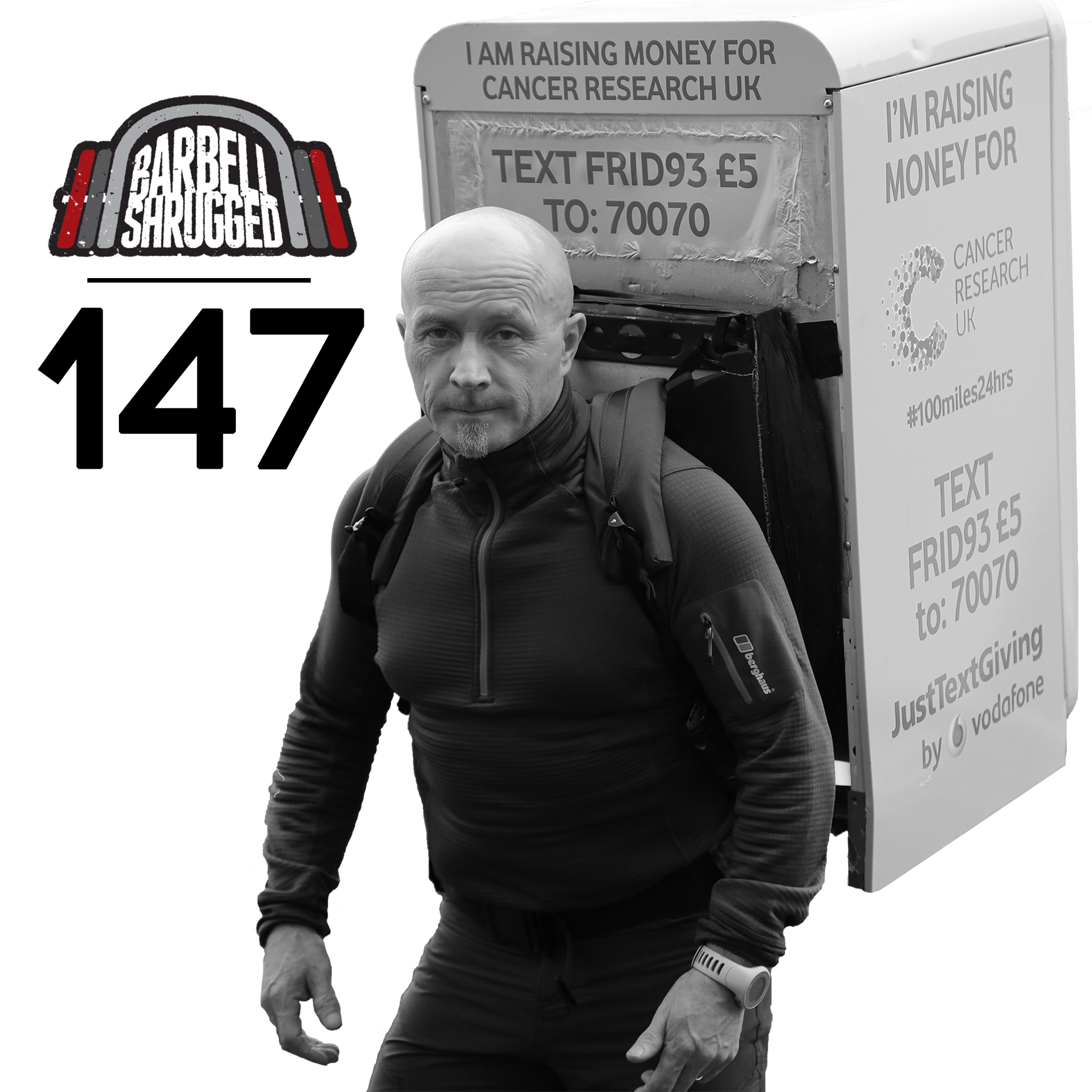
EThis 52-yr-old man strapped a 93 pound fridge on his back and traveled across the UK. He's about to do it again in the United States. You won't believe why.
146- How Community Supported Agriculture Will Save Our Lives w/ Farmer Joe Pimentel
EPittsfield, Vermont is a small town of just about 400 people. You don’t notice much when you first pass through, apart from the beauty and unspoiled quality of the place. It’s a perfect spot for mountain hikes and star-gazing. The town itself is just a two-lane road dotted with farm houses and picture perfect Inn’s, hugged tight on either side by lush green mountains. One of the only stops is The Spartan General Store (at least that’s my unofficial name for the place). There's a small gift shop and grocery inside, but this is mostly a refueling spot. Breakfast plates come piled high with giant farm fresh eggs and thick slices of local bacon. Tall glasses of fresh pressed green juice act as the perfect recovery tonic for legs left for dead by 5 a.m. obstacle course climbs. By now you know this is no average town. This is the home of Spartan Race. The punishing early morning burpee sessions and mountain runs come courtesy of Joe De Sena, the highly driven founder and leader of the Spartan movement. The lovely eggs and green juice are made possible by the daily grind and passion of Joe Pumentei, or Farmer Joe as we know him. He is just the sort of guy you need to feed a growing Spartan army. He’s also having an amazing impact on local towns all over through Community Supported Agriculture (CSA). A farmer's job might not seem very impactful at first, but like most things it’s not what you do it’s how you do it. When it comes to farming, Joe brings a bright Boston edge. He and his wife were lured to Pittsfield by that other Joe and his Spartan crew. It was a chance to run their very own farm, according to their rules, and up to their very high standards. It’s clear that Sweet Georgia P’s is an amazing place. The food is great, but that’s not the only reason for Joe’s impact. It’s got much more to do with that edge. He’s up at dawn with his family every day. He drives endless miles to spread his CSA and product to every town in his 200 square mile territory. And most importantly, he never turns down an opportunity to bark loudly about the big problem here - Most people don’t know what real food is, and it’s slowly killing them. “Real” is a funny word in this context. Judging by the regulations that Joe is subject to, you would think he was harboring toxic waste, but no, in this case it’s just milk. Raw goat’s milk to be specific. Joe’s milk is alive. It’s teeming with all sorts of cultures and enzymes. The protein is super-duper high quality. The fat is full and rich, just what your nervous system needs. You’d be hard pressed to find a higher quality recovery and muscle building beverage. But the legal reality is that Joe must keep a warning sign posted prominently on his Sweet Georgia P’s property. “WARNING! Unpasteurized, raw milk can be hazardous to your health.” In just that one paragraph there were three references to baby or fetal damage/death, not unlike cigarette package warnings. Sneak that stuff over state lines and you’d be committing a felony, despite the fact that raw milk has been found to be a low risk food. The same thing goes for many local farmers and all they produce. Getting real food to market now-a-day’s is all uphill. It requires the fight. You could use some edge. Maybe that’s the right mindset. Most people know that they should be eating better quality food, especially when it comes to vegetables and common animal products. But that’s not always the decision that gets made. So, why not try a new motive? Why not call this a fight?There’s a mighty industrial machine out there pumping out bleached milk, flavorless veggies, runny eggs from sick chickens, the list of sins is long. The machine is fed by our dollars. It exists precisely because our decisions haven’t been the best. But that doesn’t mean we can’t take action now. We have to start putting our money where it matters most - Back into real food. To those who would say local organic food is too expensive, Joe’s bright edge bites back, “Have you priced out cancer lately? It’s not cheap.” People need to understand the value of real food. They need to learn. They need access to great farm fresh products, so Joe’s work continues. He keeps up his grind and passion every day. He continues making his impact. If you want to improve the health of your communities, support local farmers and CSA programs when you are able. Seek them out. No, a few farmers will not make much of a difference. But if a few hook-up every few hundred miles or so they can build a supply network that really could make cheap, super nutritious food readily available to more people. That kind of movement could make a real difference in public health. Demand better quality in your food. Put your money where it matters most. The value will come right back to you in the form of better health and improved performance, just see for yourself. Joe, I had a blast. Keep up the good fight.Cheers, Chris Moore
145- Strength Training for Runners & Run Training for Strength Athletes w/ Nate Helming
EOn this week’s show, we take on a fresh new topic, at least for us - Running. That’s right, heel striking, to Pose or not to Pose, the importance of strength training for endurance athletes, we get into a little bit of everything. As you might guess, heavy barbells are no less beneficial to road warriors, even ultra-marathon wacko’s! We recently got a chance to chat with Nate Helming in between talks at the National Endurance Sports Summit in Princeton, New Jersey. Nate coaches out of San Francisco Crossfit, right alongside some of the best coaches on the fitness scene today. That list includes Kelly Starrett, Diane Fu, and Carl Paoli. He also shares his expertise on The Run Experience, a cool online training resource for runners. Maybe the guy’s just a little unassuming at first, but before our conversation I had no idea he was so skilled and polished as a coach and thinker. More to the point, his talks and running workshops at the Summit were interesting, well-paced and high-value for the audience. You have to take note of folk’s like this when you meet them, because that kind of pace and polish doesn't come cheap. These are skills you have to earn the hard way, over many years and endless repetitions. Nate’s central thesis is that a strong runner is a better runner, which is, of course, right up our alley. But it’s not a straight forward idea, at least not as much as you would guess. If asked, Nate will tell you that he doesn’t exactly know what it means to “run strong.” He just knows that more runners have to start acknowledging the health and performance benefits of heavy barbell training. You cannot push strength so hard that it becomes a competing training focus that’s clear. But you have to train with the intent of lifting more and more weight. You have to squat, pull, and push because it’s inherent functional. It teaches you just how you should produce force…quickly, efficiently. That translates to reduced injury risk and improved performance out on the road. Right, so that much is clear. If you want to improve your running, make sure you are constantly working on your mechanics under progressively heavy barbells. But the line is hard to draw. How much strength is enough? Well, it’s hard to say. There is a line, but something tell’s me that Nate has only begun experimenting with his methods. He will continue to surprise I’m sure as more of his data ripens, and he accumulates more coaching experience. So much for runners making their way towards the barbell, but what about the other way around? What do/should strength, and power athletes learn from the running world. Which of Nate’s methods might apply to you? Again, it’s hard to say. He does have one clear bit of advice for the strong amongst us who want to improve their running skills. “Be patient. Have some respect.” Anyone who has suffered for a decade or more in pursuit of barbell glory know’s that the skill of strength takes years and years to cultivate. Your body must be built up over time to serve that function. Think of endless little waves of construction work, new bundles of muscle proteins piled high and turned over constantly, year after year. Consider your adapted structure, your fascia and skeleton. Be in awe of what your fine-tuned and lightening quick, nervous system can do. The same is true of amazing runners and their earned form and adaptations. You don't know the work that's been put in. Consider optimal pose, the adapted foot and endless bands and chains of road forged connective tissue. These legs are likely slow and of the slow-twitch variety, but never kid yourself. To run at the highest levels is to suffer, immensely, daily. Don’t underestimate that strength. And more importantly still, don’t underestimate the benefits that would come to you if you would only work on your running, modestly at first and with respect. I must say, none of this is news to me. Nate is preaching to the choir. I've learned an endurance lesson before. Some twelve years ago I made my first visit to Columbus, Ohio to train with Louie Simmons of Westside Barbell. I had no business making the trip. At the time, I only had about $200 bucks in my checking account, just enough to pay for a week’s rent at the shittiest local motel you ever saw. But that was fine by me. One, there was a Waffle House located conveniently between my slum and the gym. The waffles and egg’s were cheap, the coffee and syrup, plentiful. But that was just my problem. I was a complete fat ass! I don’t mind saying so. I had built a life around this culture. “To be as strong as possible, do what is necessary. Grind you bones, stuff your face!” By the time, I made it to Westside I was over 350 pounds in bodyweight. Louie told me exactly what Nate would say today, had I been in similar form. We didn’t talk about advanced programming ideas, not at the start at least. And no, we didn’t talk about the latest tricks Louie was working on with his chain and band resistance methods. It was no

144- 61 Years of Training and STILL Learning w/ Dr. Fred Bisci
E
143- How to Maximize Sport and Life Performance with Freestyle Movement w/ Carl Paoli
EThis week on Barbell Shrugged we are excited to welcome Carl Paoli back to the show. In case you missed our chat from last year, make sure to go back and check out Episode 84 of the podcast. Carl is always a pleasure to be around. He’s also an inspiring and well-grounded coach that is changing the way that we think about movement. He certainly changed the way I view gymnastics, elevating it from a Crossfit programming curiosity to a training element that I now consider essential to balanced, sustainable strength development. I’ve spent the majority of the past year doing handstand holds as frequently as possible. I have to thank Carl for that amazing insight. But there’s also one other giant insight that comes to mind when I look back on our conversations - Above everything else, Carl excels at occupying the common ground. That starts with a few realizations. First, the most important thing is to realize that no one has all of the answers, and no matter how confident a coach might be in their opinion, no one has a flawless approach. The very best accept that fact and use it as a fuel to drive their daily education and a continual refinement in their methods. To that point, Carl’s view serves as a balancing force. Christopher Sommer’s view of the competitive fitness world is that there’s only one way to do Gymnastics properly…His way (check out Episode 114). That’s fine, because strong voices serve to push the discussion forward. But still, we need to be careful with balance here. To Carl’s point, not every elite method is suitable for all athletes, especially those just embarking on this journey. The second realization has to do with how the coaching itself is dished out. There’s a bias right now in the fitness community towards programming. A ton of value is assigned to the way things are done, and that is very important. However, it’s not the only thing. Far from it. What matters just as much, if not more, is why things are done. Specifically, the very best coaches aren’t necessarily the savviest or most complicated. Rather, they are the ones that can get their clients to understand why it is they’re doing what they’re doing. With that, you can accomplish anything you want in the gym. There’s no need in feeling certain. Carl, it’s always a pleasure, friend. Cheers, Chris Moore For more You can scoop up Carl’s excellent book, “Free+style”, on Amazon right now. Do it! It’s great. Make sure to follow Carl on Instagram, Facebook, and Twitter. Interested in improving your mobility? Check out Maximum Mobility. Progression is the key to gymnastics development, but also strength. Check out the Underground Strength Progression Seminar to take your barbell training to the next level.
SPECIAL: Barbell Shredded Podcast (All the Details of our the Program)
SPECIAL: Barbell Bikini Podcast (All the Details of our the Program)
E
142- Training to Get Strong & Athletic (and Look Good Naked) w/ Jackie Perez
EThis week on Barbell Shrugged we welcome Jackie Perez back to the show. I don’t think you need to be reminded about Jackie, she’s hard to ignore for a number of reasons. But just in case, make sure you go back and check out Episode 124 of the podcast. Trust me, it’s a must see. We learned a lot about Jackie the first time around, but maybe the most surprising thing was that, despite the glossy, well tanned appearance and strong social media presence, this girl works very hard for what she has. Jackie might seek out her fair share of recreation, but most of her time is spent training and coaching clients. There are quite a few online critics that seem to believe that what they see on Instagram is no more than a lucky roll of the genetic dice. But that’s not all that accurate. As Jackie will tell you, “Those people don’t notice the amount work I have to put in to look this way. You’re damn right I’m going to wear my bikini when I get the chance!” Again, it’s hard not to love Jackie for her fun bite and flair, but she has a damn good point here. Genetically she’s doing just fine, believe me, but there’s a plan at work. Her training is well-thought out, progressive and performance based. Her diet is designed to appropriately fuel her training and her body. She doesn’t punish herself with long, grueling “fat burning” sessions on the treadmill. She doesn’t deprive herself of calories and food selection. Maybe most importantly, she understands that a few cocktails here and there go a long way towards relieving stress and improving recovery. Hater’s are going to hate, as they say, but that doesn’t change the fact that you still have to have a great plan in place if you want a result in the gym. Sometimes great bodies are born, that’s true, but more often than that they are built and earned. We can’t forget that. If you want to get as lean, you can’t turn to tricks, hacks and shortcuts. You plan for it. You take steps towards your goal daily, weekly, and monthly, just like you would if you wanted to increase your squatting strength or drop your Fran time. But that right there is a whole other issue amongst the critics. “Should someone that’s interested in improving functional fitness and performance even care about looks? Isn’t that a shallow, cosmetic goal for an athlete?” No, not at all. It’s true that looks where the focus for far too long, at the expense of function. But a big swing in the other direction is just as silly. In reality, these goals are intimately linked. Both are important. If you train hard, with a long-term plan, and you eat to perform, then you will feel damn good about the result. You will also start looking better and better, of course, which will likely make you feel damn good. That will really show in the gym when it comes to performance. Jackie, it was a blast hanging out with you again. Keep up that grind, Darling. Cheers, Chris Moore For more Make sure to follow Jackie on Instagram, Facebook and Twitter. Interested in getting lean and staying strong while you do it? Our new programs, BarbellBikini.com for the ladies and BarbellShredded.com for the men, could be just what you need. Want to learn just what you should eat to perform better and get leaner? Check out the Faction Foods Nutrition Course.
141- How to Become a World Champion Weightlifter w/ Travis Mash
ETravis Mash

140- From Miss United States to Mixed Martial Arts w/ Whitney Miller
This week on Barbell Shrugged we have the pleasure of chatting with Whitney Miller, “Miss United States” beauty pageant contestant turned MMA Fighter. That’s quite a transition, but then again it’s pretty obvious that Whitney is a highly motivated individual. She decided to give Brazilian Jiu Jitsu and boxing a try simply because it was, “The hardest thing I could do.” That’s an extraordinary, uncommon attitude for sure. If nothing else, Whitney understands better than most that progress comes for those who are willing to push past their current limits and perceived boundaries. You have to get well outside of your comfort zone in order to really improve, even if that means training and sparring against men. You can check out this pic of her applying a rear-naked choke to Joe Rogan. She also tossed an arm triangle on Michael Bledsoe during the filming of this episode, which might have been the first time he’s been choked since his BJJ blue belt ceremony back in 2008. No, this is not a lady you want to mess with. She will make you go unconscious! Whitney does a lot of training in order to pick up all of these new grappling skills, but she also spends plenty of time in the gym. Barbells have always been in the rotation, even during her pageant days. She preferred feeling powerful and strong. In her words, “I’m never going to be tiny and skinny with big boob’s. So, I’m just going to go out there and be completely who I am.” It’s hard to argue with that strategy for any competition. Whitney also has fun with alternative, functional training methods such asIndian Clubs and steel maces, mostly because these implements are incredibly effective at training the grip. All aspiring fighters should take note. The stronger the grip, the more likely you are to win a fight, any fight. Raise heavy barbells, and swing big clubs. You’ll be very glad you did. Whitney is doing exactly what she wants to do, which is awesome. That’s a message that sounds familiar.Travis Mash would be proud. But that said, living a life where you do what you want…what you value…is tough. When Whitney told her friends and family that she’d rather fight than compete in pageants, she received a surprisingly large amount of resistance in return. Her Mom couldn’t stop crying, and she said her Father would hardly speak to her. For them the proper, sensible thing to do would be to get a routine 9 to 5 job, or maybe take advantage of the good looks and land a gig in front of a camera at the local news station. Anything but getting punched in the face, right? For most that’s enough, but for Whitney being happy and feeling fulfilled means going out and doing the unexpected, painful, scary, awkward thing, the most difficult thing. As she says, “This is where you feel most alive. Far, far outside of your comfort zone.” I guess we can all do a better job of challenging ourselves, eh? Maybe we could stand to be uncomfortable a little more often. You can check out more from Whitney on YouTube, including an awesome little feature on her transition from pageants to fighting. Also, make sure to follow her on Instagram and Facebook. I don’t think you’ll be disappointed. Whitney, best of luck with your training. We look forward to seeing you make your debut in the ring soon. Cheers, Chris Moore
139- Positivity, Coaching, Comedy & CrossFit w/ Kenny Kane
E
138- Neuroscientist & Masters Athlete Steve Platek
EThis week on the Barbell Shrugged podcast we welcome Dr. Steven Platek, Neuroscience Professor, Crossfitter and gym owner, contributor to Power Athlete Radio, and current member of the NPGL’s Miami Surge. Yeah, he’s a busy guy. Those are impressive credentials, but I actually didn’t know any of it at the start of our interview. I just knew that Steven was a really sharp guy, and yes, he was strong as hell. Earlier that day at the Las Vegas NPGL Combine he absolutely destroyed the deadlift ladder, lifting close to 4,500 pounds in total in less than 60 seconds, and finishing with a lift of 585 pounds. Not bad for a Master’s level Crossfitter, right? Really, it’s amazing. It was no surprise that Miami took him when they had the chance. There’s a clear niche for Master’s level competitors within this new sport of Grid. No, Steven and most Master’s level athletes simply cannot get away with the super-high training volume that some of his teammates and competitors require in order to make progress. A huge priority has to be placed on recovery, any older competitor who wants to stay in the game and remain strong has to accept that. However, Steven’s vast experience translates to a very high level of skill, especially in strength movements like the deadlift. Other teams in the NPGL should take note, you should have a Master beast on your bench just in case things get really heavy. Loads of people struggle to make progress in the gym, especially as they age and become more experienced. They have a plan, they work as hard as they can, but at times nothing improves. It’s frustrating, but the answer might be as simple as training less and spending more time on recovery. Just like Steven, back off and consider leveraging your valuable experience instead. Train smarter and more optimally, and you’ll get a superior result. The same thing goes for the manner and mindset with which you lift the barbell. Many lifters assume that you have to be very intense to be very strong. I myself assumed that Steven’s coach had to have been screaming and pushing him from the sidelines during that aforementioned 585 pound deadlift, but actually the opposite was true. His coach’s function was actually to keep Steve more calm and focused as the barbell got heavier and heavier, maintaining an optimal balance between arousal and performance. As Steve explained, this was a classic real world example of theYerkes-Dodson law, which basically states that arousal is a great thing for performance, until there’s too much of it. If you are an athlete that’s interested in performing optimally, you need to know just how much arousal is necessary for you. Will a little do, or are you a 7-cup of coffee type of person? The very best athletes know just how far to push it, and just how to modulate their sympathetic nervous system response to stress. The result is more fight than flight, you could say. If you find yourself getting far too excited and anxious ahead of training or competition, take note. You are more than likely out of balance. If you can do a better job of controlling that sympathetic response - if you can settle your mind a bit - you’ll perform much better. If you find that you’re still a little sleepy and groggy after a few cups of coffee, well, maybe you’re Jon North! That guy really loves his stimulants. He also believes 100% in himself, and what he’s capable of lifting, and his purpose. As Steven will also tell you, the mind is unfathomably mysterious and powerful. Your very first step towards success, regardless of what you're training and living for, is to believe in what you’re doing. Call it the placebo effect, call it magic, it doesn’t matter at all. If you can believe 100% in what you’re doing then magical things will happen. Thanks for the reminder, Steve. You can see hear more from Steven over at Power Athlete Radio. You can also follow him on Instagram, Twitter, and Facebook. Cheers, Chris
137- Tips for Getting Strong as S#*T w/ John Welbourn of CrossFit Football
ESeveral months back the entire Barbell Shrugged crew called into the 50th episode of Power Athlete Radio. We had a blast chatting and bullshitting with the entire Crossfit Football crew, so I knew this interview with John Welbourn was going to be great. But I’ll be honest. I did forget just how big he is. At 6 ft 5 in and 310 lbs, this man is not your average Crossfit Coach. John reminds me of Tony Robbins’ larger, more athletic, Warrior/Mercenary brother. To borrow a phrase from the fantastic movie Shallow Hal, shaking that mitt of a hand really was like grabbing a bunch of bananas. Don’t get me wrong, there are some amazing people in the sport of fitness. Athlete’s are getting fitter by the day, while also getting strong enough to compete nationally as competitive lifters. That’s extraordinary. But that said, the world of the NFL is a few level’s up, to say the least. Just check out this video of John and his former colleagues warming up before a “WOD.” Your Fran time is awesome, dude, but I don’t think it’s going to be much help if you find yourself on the other side of the line from one of these real-life juggernauts. John was an incredible Football player, but he’s an even more impressive competitor. Did you know that he competed in the 2008 Crossfit Games? It’s True! You can see an old video on John WODing right here. That’s a super-duper impressive feat for a guy that large. “Why didn’t he lose some weight so that he could be more competitive,” you might ask. The answer is that he wasn’t done playing professional football yet! That’s right. He went off to training camp just a few weeks after the Games, which for lack of a better phrase, really takes balls. I really enjoyed talking with John. It brought back so many memories of my own career, which had many up’s and down’s, but was an amazing time in my life. Just in case you were wondering, no, I was no John Welbourn. Not even close. But I did alright, and I did it with a bitchin’ haircut. But I also wanted to thank him for showcasing the most important strength lesson in his Crossfit Football programming. That’s this, listen closely - If you want to get really strong and maximize your result, you have to train appropriately. I know, I know, the strongest people you can name train Westside, Smolov, Sheiko, whatever, so why not you? Why not do as the strong do? Well, because you have only been training a few years, not a decade or two. You don’t have the skill, the foundation, the muscle mass, or the recovery potential to take on such programming, so the only thing you’re going to get is frustrated, tired and hurt. The key to long lasting and enduring strength is to progress up to the intermediate and advanced levels ONLY WHEN IT IS REQUIRED! To be more specific, you should do the simplest possible thing until it stops working for you. Only then should you make things fancier and more complicated. That fundamental approach is baked right into John’s programming. If you are in need of some strength and power, but you also don’t want to give up an inch of your overall athleticism, you really can’t beat Crossfit Football. Give it a try, just be honest with yourself. Are you an Amateur, Collegiate, or Professional level athlete? You’ll truly know by the results you get. Be honest. For more information on Crossfit Football, make sure to check out their website for ton’s of cool training information and a full list of upcoming seminars. You can also follow all the latest from the Crossfit Football team on Instagram, Twitter and Facebook. Cheers, Chris

136 - Common Training Myths Busted w/ Dr. Andy Galpin
EThis week on Barbell Shrugged we are busting training myths with our old college buddy Dr. Andy Galpin, Professor and Researcher at California State University, Fullerton. This is Andy’s third appearance on the show. We first got together to chat about muscle physiology way back on episode 19. Most recently, he helped us break down the science of mixed martial arts with the one and only Bas Rutten on episode 91 (this is also the show where Mike get’s kicked in the balls by Bas, a classic moment indeed). Those were both awesome shows, but this latest discussion was probably our best so far. Maybe we have the combination of Glenlivet and the bright California sunshine to thank for that. After a bit of catching up we got right into some training myths, starting with a common misconception in the fighting community. These athletes are a lot like Crossfitters, in that they are very driven. They train very hard, and they generally do everything they can to improve performance. Effort isn’t the problem. The real issue is that they don’t really plan for a rest properly, and they don’t understand fatigue and cumulative stress. For them, more is just better. There is one speed - Train as hard as possible no matter what, “or else you’re a pussy!” Of course this isn’t true at all. Andy’s currently working closely with MMA athletes to educate, as well as help them to train more effectively and recover more quickly so that they can maximize fight performance and reduce their risk of injury. A fairly simple scientific tool that Andy has utilized with these fighters is the force plate. In a highly objective way, Andy can point out the data when an athlete produces force at a less than optimal rate. In other words, he can show the athlete exactly when they are moving, “slower than a middle school girl.” Sure, many of these folks are really strong. They are tough, bulletproof with big lungs, but they are slow and it’s killing their performance. If you only did one thing in the gym, you would try and get faster. Speed kills, in just about every sport. All lifters and competitive fitness athletes should take note of Andy’s advice for fixing this problem. “If you’re getting tired during your speed work, then you’re doing it wrong.” Cut the reps and start performing every repetition with the explicit goal of moving absolutely as fast as you can. In many cases this coaching point was good for a 20% improvement in force production, which amounts to a significantly more damaging strike. Write this little pearl down, friends. Before you do anything else, consider doing less, going faster, and training more often. Sure, “More is better” and “tired is good” are common misconceptions amongst fighters, but the actual myth busting on this show didn’t really start until we began out chat about nutritional supplements. On the top of that list, as always, is Creatine. Despite huge volumes of research supporting its use, many people still have the wrong idea about it, which is frustrating. First thing’s first, you can think of creatine as if it were the fifth macronutrient right next to carbohydrate, fat, protein and alcohol. Having an abundance of this energy substrate in the muscle does significantly improve performance, there is no doubt about it. Creatine also manages to do that without any known side effects, including the classic fretting over water retention (Myth!). The simple truth is that you will be a more powerful athlete, for longer, if you take creatine. Also, this is currently one of the most heavily researched supplements for improving overall mental acuity and long term mental health. Just consider the work being done on Parkinson’s disease, which is extraordinary. If you aren’t taking it, you probably should be. Once you start, you probably should;t stop, as cycling on and off is completely unnecessary. Remember, it’s better to think of creatine as a nutrient, not a drug. Nutrients aren’t the sorts of things you cycle off of. Another classic training myth is the function of lactic acid in muscular fatigue. Andy brought us up to speed with the truth. As it turns out, this particular myth is rooted in a 120 year old hunting journal, where elevated lactate levels were observed in killed, bagged deer stags. The easy observation to make was that these increased levels had to be associated with fatigue. That sounds reasonable, but as Andy will tell you, it’s complete fiction. The truth is that lactate is possibly the single most-preferred fuel source in the human body. It also actively works to hydrate tissue and reduce acidity by capturing and shuttling hydrogen ions down the metabolic pipeline. That’s a very big deal. No, lactic acid is not your problem. That much Andy is sure of. Now, when it comes to explaining what does actually cause fatigue? Science has some ideas, but the truth is that we still don’t know. I guess Andy still has some work to do to keep him busy around the laboratory. One of the final, big myths we take on

135- Transitioning from CrossFit to Weightlifting w/ Aja Barto
EThis week on Barbell Shrugged we have the pleasure of welcoming the big man, Aja Barto back to the show. In case you missed it, make sure to go back and check out his last appearance on Episode 76. It’s always a great conversation. We caught up with Aja at the 2014 USA Weightlifting Nationals in Salt Lake City, Utah. Our chat came before his turn on the platform, but I knew he was going to put up some large numbers. Just look at his recent training. At 6 foot 5 inches and 220 pounds of bodyweight, Aja has put up a 250 pound strict press, a 520 pound back squat, a400 pound squat jerk, just for starters. That’s very impressive. I wasn’t surprised to hear that he later snatched 310 pounds and clean and jerked 352 at the meet. Hey, not too shabby for a Crossfitter, right? It actually might be more accurate to call Aja a Weightlifter, at least for the time being. He made news earlier this year when he decided to sit out the 2014 Crossfit season in favor of pursuing Weightlifting full-time. His reasoning was simple, “I just decided I wanted to see what I could do if I completely dedicated myself to it, without having the interference of burpees and box jumps.” Interference might actually be too strong of a word. The truth is that Aja has made a really strong run in competitive fitness for several years in a row now, ascending from Crossfit rookie to three-time Games athlete in relatively short order. But despite that success, he ran into the same problem that just about every other athlete comes across eventually - Progress started getting really tough. The easiest gains were long gone. As Aja saw it he had two choices. First, he could spend another year beating himself up with tough METCONS in hopes of moving up a spot or two at the Games, but he’s the first to admit that it probably wouldn’t have made that much of a difference. The alternative was to switch gears. Instead of another year of the same old thing, Aja decided to commit himself to getting really strong, to refining his technique, to seeing just what he’s capable of on the platform. It’s a wise move. He’s definitely stronger, and will probably end up being much fitter in the long-run, should he return to competitive WODs. Between you and I, I do hope he does make a return. He’s just too much of a beast not to. But the return might come in some other sport all-together. Sure, he could do proper Crossfit again, but I was thinking he should try something a little different this time. Something a little more powerful, shorter in duration, and befitting a behemoth of his size. Yeah, I was thinking he should actually give the NPGL a try. I guess we’ll see, right? For more from Aja, make sure to check out Behemoth Crossfit. You can also follow the man and his monster lifts on Instagram, Twitter, and YoutTube. Aja, it was great to see you dude. Take your time with the Weightlifting. I don’t think we’ve seen your strongest work yet. Cheers, Chris

134- Kevin Ogar: Life After The Injury
EThis week on Barbell Shrugged we are honored to be joined by Kevin Ogar. Just in case you aren’t aware, Kevin became well-known after fracturing his spine at a competition in January 2014. It’s only been six months since that devastating, notorious injury, but Kevin seems remarkably recovered, at least spiritually and emotionally. You should have seen him smile wide when he was telling us about the bright white Stacie Tovar shorts he was wearing underneath his pants. “Yeah, I’m actually wearing them underneath here. I heard she was going to be over at the Barbells for Boobs tent…I thought I would challenge her to a booty-shortshowdown.” That group has been so supportive and caring for Kevin and his family these past few months, causing a bit of a stir at their Crossfit Games tent would be the least he could do in return. Also, it would just be a good time. That’s one of the lesson’s that Kevin has taken away from the injury. “Now that I’m in a wheelchair I really like to push the limits of what I can get away with.” It’s hard not to love that attitude. I must admit, I’m not sure I could keep that perspective, especially after such a freak accident. That’s really all it was, a freak thing on an otherwise routine set of snatches. An off catch with a modest load. A dumped repetition that changed a life forever. The question has been begged over and over by now, “Is Crossfit dangerous?” But Kevin flatly denies that. It was more about the angle, the odd timing, the one in a million shot that did the breaking. In truth, he’s one of the rarest of patients. Most injuries of this sort are attributed to skiing accidents, vehicle crashes, and other sorts of routine activities where the risk is more widely known and accepted. But this is different. In fact, it’s hard to identify another case like Kevin’s at all. The injury was anything but an inevitability. Our conversation started to turn visceral and raw when Kevin began to describe how the injury felt. At the moment of fracture his nervous system went into extreme shock and alarm. His whole body burned with pain and sharp electricity. I just sat there as he spoke, quivering a bit, growing more and more queasy by the second. I couldn’t imagine the feeling, and I couldn't respect the guy more for what he has endured. Eight Dilaudid fueled, motionless days followed the injury. At first the doctors didn’t want to lose Kevin to shock and blood loss. Next up was the intense spinal surgery that would place his back into alignment. The approach was from the side. The ribs were split and dislocated. His organs had to be removed and his entire core reassembled. “That surgery has a 35% survival rate.” That only made the weight of this injury all the more heavy. I could hardly stand the thought. Despite the dangers and risks, Kevin couldn’t have had a better surgical outcome. Still, he know’s he has a battle ahead. “They say the chances of me walking again all on my own are less than 1%, but I’m the king of small percentages. I'm 3% of the world's population as a Ginger 3%. I have blue eyes, which means I’m 1% of that population…So, I like small numbers.” Kevin began his rehab by facing his first big physical challenge, getting upright in a wheel-chair. “I know it sounds easy, but it’s so hard. It feels like you’re sitting on top of a balance ball, only imagine if your leg’s didn’t work.” Still, he did it, and he’s still at work. What remains of his core musculature has begun to adapt. His nervous system is reinervating and adjusting in astonishing ways. Hell, the guy still manages to have a six-pack, despite the damage. No, there are no guarantee’s here for the recovery effort, but there’s cause for optimism. Who know’s what technology will come in the coming years. For paraplegics and spinal cord patients who are able to keep their bodies strong and fit, anything could be possible. If you can remain resilient, tough, and hard to kill, then you should feel optimistic. Kevin’s got that written all over his face. His happiness and positive outlook are true. Kevin is training as hard now as he ever has, but the goals and outlook have obviously changed immensely. It’s no longer about maximizing strength and fitness, it’s more about not sucking so bad at life in general. It’s about attacking weaknesses, which now include showering, going to the bathroom, and getting back up into his chair after a fall. Sled pulling, prowler pushing, dumbbell work, gymnastic drills, it all has a place in his regimen. That’s where the biggest lesson of Kevin’s story shines through, I think. Progress on the small things is incredibly rewarding. Consider going back and working on the basics. It might be your posture, your foot position, your timing, whatever. Remastering it will be one of the most rewarding things you can do. If you get injured, do not stop. There’s always something you can still do. So do it! Something is better than nothing, always. And who know’s, this enforced change might just be

133- CrossFit & NPGL Athletes Sam Dancer and Danny Nichols
E
132- Dmitry Klokov Training Advice
E
131- Talking Strength w/ Chad Smith of Juggernaut Training Systems
E130- Kendrick Farris: Learn From My Mistakes, "Be Better Than Me"
EThis week on Barbell Shrugged we are joined once again by the one and only Kendrick Farris, two-time Olympian for USA Weightlifting, tattoo aficionado, part-time comedian and all around amazing dude. Just in case you missed Kendrick’s first two appearances on the show, make sure you go back and check outepisode 55, as well as episode 76. Trust me, you never want to miss out on what he has to say. Kendrick always gets us fired up when he speaks, but it’s quite another to actually see Kendrick lift. Imagine, a man his size easily tossing almost 500 pounds overhead, or easily squatting 550 pounds rep after rep. It’s incredible. On the world stage this guy is as strong as any lifter his size, period. The Olympics are always a really tough competition for the United States, sure, but I for one can’t wait to see Kendrick on the Rio platform in 2016. The Barbell Shrugged crew will be right there in the stands, sipping Caipirinha’s and cheering him on as loud as we possibly can. To get that damn good, you would think Kendrick has sacrificed everything for the sport of weightlifting. It wouldn’t surprise you if he came off as obsessed, hyper-competitive and all that. But the truth is that he lives a remarkably balanced life. Kendrick’s Instagram feed is not just a showcase for his lifting prowess. It’s mostly pictures of friends, family, and more than a few tattoo sessions. He’s the type of guy who loves and shares openly. He wants you to be better than him one day, which is probably exactly why he’s such an amazing lifter. Attitude is everything. Kendrick doesn’t compete to impress anyone, especially not himself. He’s just interested in learning what works best for weightlifting. Sure, dominating the platform is the ultimate goal, but only because it creates a platform for Kendrick to inspire, teach, and share his remarkable point of view on lifting and living. It also gives him the opportunity to meet the best coaches in the world, to mix and share ideas, and to push the community forward. Between Kendrick and the lovely Diane Fu there’s never been a better time to learn the sport of weightlifting. They both have such an amazing, open attitude to coaching and sharing information. Their seminars really are some of the best coaching experiences you could hope to have, really. You can check out dates for Kendrick’s Bless the Gym Tour here. Also, if you want some Diane Fu in your life, check out her event schedule. You’d be silly not to go, especially when they coach together. Do it! If you want a summary of Kendrick’s wisdom look no further than his attitude towards weight and diet. Lifters often obsess about cutting weight before a big competition. The rationale is clear enough. If you can cut hard, then regain weight after weigh-ins you will have a clear competitive advantage over the other folks in your weight class. And that’s true, but more often than not the cut leaves you feeling like shit. This is what happens when you spend more time thinking about the competition, forgetting what it is that’s best for you. Likewise, diet is cool and all, but there’s no sense in obsessing over it. The details, demands, and strict food limitations aren’t necessary. That’s time and effort that could otherwise be spent with the barbell, which is a far better way to become a great lifter. Does Kendrick eat Paleo? Does he have a personal chef or catering services provide him meals? Hardly. He seems to spend most of his time crushing bags of trail mix in between training sessions. It’s not ideal, but he seems to love it. Maybe that’s the only dietary detail that matters. Get with a great coach, or two, or three. Move efficiently, but find out works best for you. There are no hard rules. Do your thing. Refine it. Put together a long-term plan and be patient. Train hard, and with a community of great lifters. Eat what you need to eat. Weigh what you’re going to weigh. Be the strongest possible version of yourself. If you want more Kendrick in your life, make sure to follow him on Instagram. You don’t want to miss any of his pancake sessions or heavy squat workouts, trust me. You can also follow him on Facebook and Twitter. Bless the gym! Cheers, Chris Moore

[Road To Regionals]
EInfo on our Road To Regionals programming.
[6 Month Muscle Gain Challenge]
EInfo on our upcoming 6 Month Muscle Gain Challenge.

129- Do What You Want. How To Live a Strong Life w/ Travis Mash
EThis week on Barbell Shrugged we are joined by the incomparable Travis Mash, high level strength coach, world champion powerlifter, and to be honest, one of our absolute favorite human beings in the entire world. If Travis’ name sounds familiar it’s for a good reason. This is his second appearance on the show. The first time around on episode 97 we got the chance to talk about the barbell and all of the life lessons it has taught us. As good as that show was, I think that round two is even better. Really, this might be our best strength discussion to date. For me it’s easy to see what makes Travis such an incredible coach. First, he is incredibly kind and empathetic. Right when you meet him you feel like you’ve known him all along. And when you see his work you realize just how important it is for a coach to build strong relationships with their athletes. That connection makes extraordinary strength possible. He’s kind, but he’s also been around for a really long-time (it’s OK, we’re all getting older together). He’s performed at a very high level in both weightlifting and powerlifting for many years, has even made a run at national level bobsledding. More impressive still, he’s been coaching athletes and directly applying that hard-earned wisdom for over fifteen years. So, when Travis makes a recommendation on how you can get stronger, you listen. This show was running over with but nuggets and pearls, but a few super useful lessons jump right out at me. First, competitive fitness athletes still have a lot they could learn from powerlifters and bodybuilders. One of the best examples is the row. Above any other assistance movement, this is what the average Crossfitter needs most of all. Barbell rows, chest supported rows, one-arm pulls with a super-duper heavy kettlebell, any kind will do. It hardly matters, as long as they are done often. Forget what you’ve heard, there’s nothing more functional than adding pulling power. Lessons, lessons, how about the importance of patience? If there’s one key mistake that’s keeping a lot of people weak it’s this - They don’t give the adaptations time to set in! They start out on a mission to get strong, because that’s what they need most of all. But they freak out when results don’t come immediately, or when their WOD times fall off a little bit. This is all by design. Real strength takes time. As Travis will tell you it’s a lot like working a blue collar job, like a construction gig. At first the work is just too much. You’ll hate it, no doubt. Recovery will be a struggle. You will feel like shit while everyone around you runs around like the work is no big deal. That’s when you need to hold on and be patient. The secret to getting really, super-duper strong is allowing that adaptation to take hold. You have to fight for it. The training should be really hard, but just like a bulletproof and sun-hardened construction worker, you need time to get used to it. Be patient! Find great programming and stick with it, don’t jump around. You will get faster, more efficient, and strong as hell as soon as you earn it. You just can’t be afraid of walking through hell first. Take your ass-beatings first, that’s the only way this critical and enduring adaptation can take hold. The final lesson for those looking to get really strong is this - you have to conquer the fear of lifting really heavy weights. You have to have the courage to put weight on that barbell. That’s why having a great coach like Travis is so important. You need someone, as he would say, “…To call you out when you’re being pussy.” You also need to surround yourself with great training partners who are much stronger than you, just to change your standards. If there’s a secret to training at a place like Westside Barbell it’s just that. Programming matters. You need certain tools and ideas. But never underestimate the power of a brutal training environment. These place are less like gym and more like iron forges. The whole point is to raise the expectations under pressure. That’s also the whole idea behind Travis’ top secret chain squatting program. There’s actually no secret to it. It works because it breaks down the fear. You start to get used to the way really heavy weight feels, and in time you start to believe that you can actually lift it. Once that belief starts you begin to train harder and without artificial limitations. And once that happens, watch out. There’s no telling what you might be able to lift. For more from Travis Mash and the coaching services he offers make sure to check out his website atMashElite.com, You can also find him on YouTube, Twitter and Instagram for some awesome strength videos and training tips. Travis, we’re lucky to know you, dude. When can we go for round 3? Cheers, Chris Moore

128- Beyond Training: Mastering Endurance, Health, and Life w/ Ben Greenfield
This week on Barbell Shrugged we chat with Ben Greenfield, former tennis player, water polo athlete, and bodybuilder turned biohacking ironman, endurance coach, author, blogger, and podcaster. That’s quite the resume, right? Ben’s got plenty of interesting things to say, which is no surprise given his experience and wide-ranging creative pursuits. He can certainly talk training and human performance with the very best, but it was his perspective on general health that grabbed my attention initially. Ben is the author of the excellent book Beyond Training: Mastering Endurance, Health, & Life, which is amusing, because as he will tell you devoting huge chunks of time to sitting in front of a keyboard and writing extensively about health is one of the absolute unhealthiest things you can do. Extended promotional book tours and frequent promotional travel are certainly no better. That’s bad, but did you know that intense exercise can be worse in many ways? As Ben will tell you, competitive athlete’s and WOD junkies don’t typically worry about metabolic dysfunction or obesity risk, but they are often chronically inflamed, their hormonal levels are usually disturbed, and their markers of immune system strength and circulatory function are typically far more out of whack than those of the “out-of-shape” general population. This is not meant to discourage anyone. It’s just a warning. If you’re willing to do the work that it takes to be an amazing athlete, then do it! There’s no question that it’s worth it. Just take the lesson from an awesome coach who’s seen it all. More is not better. If you want to both perform better and enjoy a high quality of life and health, then be willing to go above and beyond. Get your data. Monitor all key biomarkers very closely so that you can keep that high performance, meat powered hot-rod of yours tuned-up and running on all cylinders. Get as much information as you can, find your problems early, then act long-before your body begins to show those inevitable signs of wear and tear. As cool as performance might be we don’t want to sacrifice out health and well being for it. We don’t want the wear and tear. But luckily there are some pretty quick and easy fixes, starting with making your living conditions as natural as possible. Work and writing are great, but you really should be standing as often as possible. Move more. Stop what you’re doing for just a few minutes and go find something heavy to lift. Even a quick break for a few fast repetitions can work wonders. When it’s time to train, train very hard, but do not beat yourself up with exercise. Go for the minimum effective dose that’s required for you to make progress. Afterward, get the rest and recovery you require, and for crissakes, eat plenty of real, nutrient dense food. If you’re into supplements, Ben’s list is a pretty damn good one. For those pushing the endurance limits, d-ribose can be great for supporting ATP production. An essential amino acids supplement, MCT and caffeine right from a proper cup of coffee also go a long way towards supporting optimal performance. If you’re feeling sore and knotted up after you put the barbell down, then invest in some soft-tissue massage, or at the very least, make time to roll around on a foam roller hard a few times per week. Your beat-up and agitated muscle fascia and on edge nervous system will reward you generously with improved function and recovery. You might also consider monitoring your Heart Rate Variability (HRV), which as we learned withJoel Jamison on episode 120 of the podcast, is a tremendous way to keep tabs on your accumulating stress levels and choose the optimal time to train. Yeah, training can be tough. But we can still push the limits and live awesome, pain free, healthy lives. It just takes some additional work, that’s all. A bit thanks to Ben for sharing his perspective. For more great information from Ben Greenfield, make sure you check out his website atBenGreenfieldFitness.com. You can also find more great content and training tips on his YouTube channel, as well as on Twitter and Facebook. Cheers,Chris Moore
127- Lindsey Valenzuela: CrossFit Games Athlete and NPGL Athlete
EThis week on Barbell Shrugged we have the pleasure of welcoming Lindsey Valenzuela to the show, professional fitness athlete and current member of the Los Angeles Reign. Lindsey is in an incredible position. First, she’s one of the very first women ever to sign onto a professional fitness team. Better yet, the Reign, and all other founding members of the National Professional Grid League, are actually coed. That’s right. For the first time there is a mainstream professional sports league featuring women and men competing together on the very same field, or in this case, the very same “Grid.” In competitive fitness, right from the start, men and women have both received equal spotlight and attention. The same can’t said for any other professional sports league, or quite frankly, our culture as a whole. Despite our progress, most playing fields are anything but level. The truth is that women and men are equally capable when it comes to moving heavy barbells, crushing races, and entertaining an arena full of cheering fitness fans. Also, as Lindsey herself pointed out, those incredibly fit, powerful and beautiful ladies - the coed angle - might just be the NPGL’s secret weapon when it comes to breaking into brand new markets. That’s really the most exciting part of this entire movement. Consider the classic sports fan with their weekend fantasy leagues and pick-up games, or maybe the aspiring young athlete who might not fit in or dig traditional sports like Football, Baseball or Basketball. Think of the influence an athlete like Lindsey could have on the average young girl who’s seeing a strong, successful woman slam barbells in front of a packed arena for the very first time. That’s a damn incredible thing, indeed. In all fairness it’s too early to know. There are no guarantees that the Grid thing will catch on. But it just might, and that could mean an incredible future where Eleiko barbells start arriving under Christmas trees during the holidays, right alongside shiny new bicycles and video game consoles (one can hope!). It could also mean waves of brand new, inspired clients pouring into local gyms and boxes, which is great for absolutely everyone. That’s really the main point now. There’s no room in this movement for a scarcity point of view. It’s time that we stop trying to compare Crossfit and the NPGL, because really, they are fundamentally different things. As Lindsey points out, “Crossfit is about finding the fittest men and women in the world, period. The NPGL is all about putting on a show. It’s spectator friendly. It’s fast moving. It’s entertainment, like the NBA or NHL.” She nails the point, concluding, “The Crossfit Games are basically like the Olympics. There are players who play in both - The NBA and the Olympics, for example - But nothing can replace the Olympics.” We agree. In our point of view the emergence of professional fitness can only create more great opportunities for athletes, coaches and business owners. That’s really all that matters. To learn more about the NPGL make sure to check out our interview with league founder and CEO, Tony Budding. We also had a great chat with NPGL President Jim Kean, where we talk all about the technology and future of this brand new sport. For more Lyndsey, make sure to check out her website at B3LV.com. You can also follow her on Instagram,Twitter, and Facebook at @LiftLikeLindsey. Lindsey, please keep inspiring folks and kicking ass! We look forward to seeing it all unfold. Cheers, Chris Moore
126- Supplements, Unconventional Training Tools, and Spirituality w/ CEO of Onnit Aubrey Marcus
EAubrey Marcus might have the most interesting title of any Barbell Shrugged guest to date. You can call him a spiritual experimentalist, human optimizer, unconventional fitness junkie, and warrior poet. He’s also CEO of Onnit, a unique human performance company which sells performance and health supplements, as well as some novel training tools. They also make some pretty righteous YouTube videos, including this jewel with Joe Rogan. Watch that video right now if you’re in need of a motivational kick in the ass! Aubrey’s interest in human optimization began during his basketball career. With the help of his step-mother, a naturopathic doctor, he was able to experiment with all manner of supplements and develop a regimen to aide his performance on the court. That’s really a huge advantage, especially when you consider that most young athletes are 100% uninformed on the topic. They are completely subject to marketing spin and are left to experiment on themselves, which is obviously less than ideal. First things first, before you invest and consume any supplements, make sure you do your research. Read all you can on the topic. Visit websites such as examine.com, which can help you quickly sort through the available scientific evidence (Do that!). And sure, if you happen to have a qualified Naturopath in the family, please ask them what’s what before you go snorting bee pollen or powdered deer antler during your next heavy deadlift session. As you understand more and more, please do experiment with supplements and pay close attention to how they affect your performance. Read the available research. Add them in one at a time. Take careful notes. Track your training numbers. Hey, you might be surprised. The addition of nootropics or some cordyceps sinensis mushroom’smight make a real difference. There’s only one way to find out. All of these unique supplements are really interesting and potentially beneficial, but the coolest thing Aubrey has to share is the importance of unconventional fitness tools. You probably know all about barbells, dumbbells, and even kettlebells, but I would bet that you’re much more unfamiliar with things like steel clubs, maces, and maybe even battle ropes. It would be easy to label this stuff as little more than functional training gimmicks, but before you make any conclusions consider the history. Tools like heavy clubs have been around for the better part of a millennia, making people strong, and preparing them for the dangers and rigors of war. That’s really the foundation of human performance training. It’s not sport, really. We began training to become bigger, stronger, faster, and more mobile or stable in key joints because we wanted to decrease our odds of getting chopped up into ground beef on the battlefield. Imagine, how much harder would you train if that was your reality? If that was the training goal? We don’t face much in the way of real danger outside of the gym today, but it’s fair to say that almost none of us train as hard as we could, or should. That’s the first consideration, before programming, before supplements, before judging your tools. What is it that you are training for, and be honest, how hard are you prepared to work? If you want to see just what unconventional fitness looks like, pop over to the 19:00 minute mark in the episode and see Aubrey rough up the entire Barbell Shrugged crew in the Onnit gym. Laugh all you want, but those clubs and maces are no joke! For more human optimization info make sure to check out the Onnit podcast, especially Aubrey’s chat with Chris and Mike on episode #28. You’re sure to enjoy it. Also, if you want to learn more about those unconventional fitness moves, go visit the Onnit Academy on YouTube. Just be careful with those clubs, they are much harder to handle then you think. Cheers,Chris Moore
125- Why Andrea Ager Smiles So Much
EThis week on the Barbell Shrugged podcast we are joined by Andrea Ager, former collegiate track & field athlete turned high-level Crossfit competitor. If that name rings a bell it’s for a very good reason. Andrea is one of the most well-known and recognizable athletes on the scene, which is actually a very interesting topic of discussion all in itself. “You may know Andrea from her Instagram feed, where she can’t stop smiling.” I figured this topic would come up at some point during the podcast, I just didn’t realize it would be the very first thing out of Mike’s mouth. “In fact, Chris Moore has described you as, ‘Smiling too much.’” The obvious downside of being well-known is that there will always be haters and trolls, that’s for sure. They are going to comment about you, your style, your choices, your beliefs, your mistakes and short-comings, and yes, even your smile. I was ready to take all that on at the start, I just didn’t expect being called one myself! Mike was smiling just as wide as Andrea ever has, so it was obvious he had this move planned. I was left squirming with nothing to slide underneath or behind, so I tried to back away slowly to higher ground, without much success I might add. “Now, hold on, I was simply saying that, Wow, Andrea smiles a lot. Let me say, having met you, I get it. I think I’m smiling more often now myself.” Even a bit of kind editing leaves me sounding guilty. Mike easily blocked the shot. “That’s not how I remember the conversation.” He was right to pin me down. I had done a bit of hating, at least in his view. In truth I think I was just envious, maybe a little aggravated. I might have even been more motivated by Andrea than I would have liked to admit. That’s because, if nothing else, she is a reminder that the clock is ticking. If there’s something you really love in this life, like training and sharing your fitness story for example, then you should probably spend more of your precious time doing it. Sure, why not smile more often and just as wildly? After chatting with Andrea it became clear that she was more than just a really happy Crossfit chick with a popular social media feed. She’s an experienced, high level regional competitor who has been part of some really tough competitions. She’s learned some valuable lessons the hard way, like the importance of setting better, more intrinsically focused goals and spending far less time comparing yourself to others. That last bit might be the most important lesson of the show. You just cannot make the most out of your training, your situation, and your uniqueness if you’re worried about what others are doing, what they are capable of. Andrea’s also surprisingly open minded and receptive to new training ideas and styles, which is something aspiring athletes should really pay close attention to. She waste’s no time, surrounding herself with the very best training partners and coaches she can find. That might mean flying into San Francisco to drill weightlifting with the magnificent Diane Fu, or maybe it’s committing to a wild and novel three-month training sabbatical with THE powerlifting master, Louie Simmons. It’s clear to us now why Andrea is so well known. It’s not luck. It’s not the smile and looks alone, although this certainly does help, who are we kidding. But no, the bulk of Andrea’s success still comes from where you would expect. She has devoted her life to becoming a better athlete and coach. She works incredibly hard, takes on the risks, makes all the necessary sacrifices, and delay’s gratification today in exchange for better performancetomorrow. Let me say, I’m glad I got the change to know her better. She’s the real deal. To learn more about Andrea, or to book her for a seminar, make sure to visit TheAndreaAger.com. You can also check out her YouTube page for some cool training videos. Who know’s, you too might find yourself looking past the smile. Cheers, Chris Moore P.S. Make sure you to check out this weeks TechniqueWOD during the break. Doug will teach you all you need to know about the front squat. Who know’s, maybe you’ll learn how to grow a killer pair of Ager Bomb style quadriceps!

124- Workout, Party, Repeat w/ CrossFit Regionals Athlete Jackie Perez
This week on a very special bonus episode of the Barbell Shrugged podcast we are joined by Jackie Perez, competitive Crossfit athlete and one of the lead trainers at Crossfit CSA in Dublin, California. If you haven’t heard about Jackie then you’re in for a treat. She’s one of the most entertaining and unfiltered guests we’ve ever had on the show. If you do know her, well, you can guess what happens next. Let’s just say you’re in for a treat. I’ll be honest, we spent the first half of the show talking about partying, the sensual pleasures of almond champagne, and how she really doesn’t take her training all that seriously. You won’t find too many pearls and nuggets at the start, but you’re very likely to laugh out loud a few times. Enjoy the banter, but understand that this party side of Jackie is really just a ploy, a facade, a clever bit of misdirection. As we learned during the second half of the show, there’s actually way more to Jackie than first meets the eye. Here’s what you need to understand - When it comes to performance there are no exceptions, short-cuts, or free lunches. Physical gifts will only get you so far. If you want to be an extraordinary coach or athlete, then you’re going to have to work very hard, just about all the time. You also have to make tough choices and sacrifices in your personal life. There needs to be plenty of room made for all that effort and output. “Coach or athlete”, that’s really the choice. Jackie fills her days from dawn to dusk by working with clients. She cares, she grinds away at the craft, and she’s just as animated and salty in her classes as she is on this particular podcast. In short, she’s made her choice and understands that it comes with a cost. There’s just not much room or energy left over for pushing her body to the limit. Jackie gets results in her training because she accepts her personal limits. She prioritizes, doing more with less. Most importantly, she understands that making a serious run at winning the Crossfit Games as an individual athlete is just not a realistic expectation. That would mean spending a lot less time coaching. It would mean passing on that second glass of champagne, which is something that she would rather not do. For her, the balance is more important. That’s a lesson worth keeping. If you want to be the absolute best at what you do then go all in. Make the full commitment. Be willing to cut and make room for the effort. If not, fine, just do not pretend. Don’t make excuses. Don’t beat yourself up when things don’t go as planned. Instead, pop a fresh bottle of bubbly and learn to enjoy yourself. For more Jackie check out her YouTube channel. See for yourself that she’s no barbell lightweight. You can also find her on Instagram, just in case you’re curious about that almond champagne lifestyle. Cheers, Chris Moore
123- Building an Unbeatable Mind w/ Mark Divine of SealFit
EThis week on Barbell Shrugged we are honored to chat with Mark Divine, retired Navy SEAL Commander and founder of SEALFIT and U.S. Crossfit. Surprise, surprise, this show will leave you reconsidering your training, the true effort you’re applying in the gym, and the direction you’re heading. In short, its just what you need to hear. For those who don’t know, SEALFIT is somewhat like Crossfit, only it’s more…Way more. Quite literally, this is what your whiteboard should say if the goal of the day is to prepare Navy SEALS for the rigors and chaos of military conflict. It’s also the sort of thing we should all experience from time to time if we want to be fully prepared for the rigors of civilian life. These lessons, to one degree or another, are for special forces bad asses and civilian warriors alike. Mark’s training philosophy centers around the so-called “5 Mountains” of personal development. First, there’s the stuff any crossfitter, strength athlete or serious fitness enthusiast would recognize. The mountain of physical preparation includes strength, stamina, endurance, work capacity and durability. For the most part this is exactly what most expect out of a good strength and conditioning program. On the flip-side, this is usually all most would expect. Four mountains remain largely unchartered. Full personal development and the realization of one’s true potential is impossible, until there’s awareness and an acknowledgment of what remains to be explored and cultivated. Incidentally, this act of discovery is also the first of the remaining mountains. The others are emotional control, intuition, and last but most important, Kokoro, which is the warrior’s unconquerable spirit. Consider what your training might be lacking. Right now, be honest. When was the last time you ventured outside of the gym and trained in an intentionally hostile and challenging environment? Something like isolated woods, or perhaps rocky and bone chilling surf? Do you practice spiritually renewing activities like Yoga on a regular basis? Do you put the same amount of effort and intent into into breathing and meditation exercises as you do your snatch or back squat? If not, you should. After all, what good is a strong body if the seat of emotional and physical control is undisciplined and prone to failure? What exactly are you capable of if quitting is simply not an option? If there’s really nothing out there to fear? We all need the barbell. We need to train with proven methods in order to develop ourselves physically. But those remaining mountains must be explored. These methods – as new and foreign and painful as they might be – must be included in the DAILY training plan. The warrior is strong, spiritually healthy, and as we also learned duringepisode 116 with Joe De Sena, has experienced, embraced, and disarmed suffering. Indeed, that’s what turns the common athlete into a true warrior. To learn more about Mark Divine and his methods, make sure to check out 8 Weeks to SEALFIT, Unbeatable Mind and The Way of the Seal. They are simply amazing books. Also, if you are interested in becoming fully aware and experiencing the SEALFIT experience for yourself, you should definitely check out some of Mark’s live training events. Just know ahead of time that this will most likely be the most difficult challenge of your life, but hell, you’re after the profound personal transformation and empowerment, right? …Right, so you know there’s a cost. You’re capable of paying that price. Go ahead, do it, just start with the 20X Challenge, which is a one-day course designed to take your training and leadership skills to the next level. From there you can consider the SEALFIT Kokoro Camp, which is an intense fifty-hour experience modeled after US Navy SEAL Hell Week. And if you’re still hungry for more, there’s always the SEALFIT Immersion Academy, a highly formidable and extremely comprehensive 3-week course designed to install the core skills and traits of elite Navy SEALS. Go on, what are you waiting for? Get up the mountain. Go find out just what you’re really capable of. Cheers,Chris Moore P.S. During the break make sure to check out the latest episode of TechniqueWOD on squat fundamentals. After all, we want to be tough as SEAL warriors, but we still want huge squats, right?