American English Pronunciation Podcast
200 episodes — Page 3 of 4
117: Suffixes with /ʧ/ (ch sound)
The -tion, -tial, -ure, and -al suffix and how they relate to the ch sound. Full episode transcripts at www.pronuncian.com/podcast.
116: Using ’ain’t’
When is--and when isn'--'ain't' appropriate? Full episode transcripts at www.pronuncian.com/podcast.
115: Sound combinations: sp-, st-, sk-, sc-
What happens to unvoiced stops after the s sound? Full episode transcripts at www.pronuncian.com/podcast.
114: ’Puff’ (aspiration) details of stop sounds
Stops are /b/, /p/, /k/, /g/, /d/, nd /t/, and the amount of "puff" we give to them matters. Full episode transcripts at www.pronuncian.com/podcast.

113: The /h/, like a chameleon
No sound can become more like surrounding sounds than the h sound. Full episode transcripts at www.pronuncian.com/podcast.
112: Dropping the /d/
Here is a little-discussed rule about omitting the d sound in certain consonant clusters. Full episode transcripts at www.pronuncian.com/podcast.
111: Linking /v/ and /f/
Practicing a few simple techniques can make it much easier to transition to and from the v sound and f sound. Full episode transcripts at www.pronuncian.com/podcast.
110: Troublesome /v/ and /f/
Be careful with the /b/, /p/ and /w/ when working with the /f/ and /v/. Full episode transcripts at www.pronuncian.com/podcast.

109: /s/, /z/, /ʃ/, /ʒ/ (s, z, sh, and zh sounds) compare and contrast
Four sounds that are quite similar, but different in a few very important ways. Full episode transcripts at www.pronuncian.com/podcast.
108: In the US, it is ’learned’ and ’spelled,’ while the British kept ’learnt’ and ’spelt’
The English past tense became regular; the British kept the irregular spelling. Full episode transcripts at www.pronuncian.com/podcast.
107: ’ck’ after short vowels (as in back), ’k’ after all the others (as in ’bake)
Learning intricate English phonetic patterns can give you confidence in vowel pronunciation. Full episode transcripts at www.pronuncian.com/podcast.
106: ’long u’ stressed and reduced; /yu/ or /yə/?
The long u can be difficult to recognize in multi-syllable words, especially when it's reduced. Full episode transcripts at www.pronuncian.com/podcast.
105: Pronouncing ’though,’ ’thought,’ ’through,’ and ’thorough’
These four o-u-g-h words can be so similar, yet different in very important ways. Full episode transcripts at www.pronuncian.com/podcast.
104: Pronouncing ’pronounce’ and ’pronunciation’
Many patterns of pronunciation can be found through a quick study of these two words. Full episode transcripts at www.pronuncian.com/podcast.
102: Russian/Ukrainian Special Episode
Learn the most common difficulties Russian and Ukrainian speakers face when speaking English with an American English accent. Full episode transcripts at www.pronuncian.com/podcast.
101: Subtle oddities of the word ’subtle’
A silent /b/, an altered /t/, and a strange history make the word 'subtle' interesting to learn about! Full episode transcripts at www.pronuncian.com/podcast.
100: A Hundred/One Hundred
Why is saying 'a hundred' more common than saying 'one hundred' in American English? Full episode transcripts at www.pronuncian.com/podcast.

99: Three-word informal contractions
'How did you' can be reduced to 'howdja;' 'where did you' to 'wheredja;' and 'what did you' to 'whadja,' but those reductions can cost listener comprehension. Full episode transcripts at www.pronuncian.com/podcast.
97: The transition from ’used to’ to ’useta’
Informal contractions are born when speakers find easier ways to pronounce words. Full episode transcripts at www.pronuncian.com/podcast.
96: How ’women’ could have been ’wimmen’
Noah Webster did his best to make spelling easier, but his ideas weren't always accepted. Full episode transcripts at www.pronuncian.com/podcast.
94: /t/+/y/=/ʧ/, /d/+/y/=/ʤ/, surprising ’ch’ and ’j’ sounds.
Assimilation: two adjacent sounds can cause changes to pronunciation. Full episode transcripts at www.pronuncian.com/podcast.
93: Do you accidentally make your /l/ into /w/?
Don't round those lips! Especially at the end of the word, the l sound can cause some surprising problems. Full episode transcripts at www.pronuncian.com/podcast.
91: iPad/iPod, the world’s newest /æ,ɑ/ (short a/short o) minimal pair
Even some native speakers of English are worried about the similar pronunciation of the newest Apple product. Comparing pronunciation of the iPad to the older iPod. Full episode transcripts at www.pronuncian.com/podcast.
90: The j sound, spelled j, dge, ge, and g(i)
The 'dge' and 'j' spelling are both usually pronounced with the 'j sound.' And don't forget, a 'j sound' is simply a voiced 'ch sound'! Full episode transcripts at www.pronuncian.com/podcast.
88: Why is ’tch’ (as in ’watch’) easier to pronounce than ’ch’ (as in which)?
The 'tch' and 'ch' spelling should BOTH be pronounced as /ʧ/ (the ch sound, yet 'tch' often seems easier for non-native English speakers. Full episode transcripts at www.pronuncian.com/podcast.

85: Why is the ’Ch’ in ’Christmas’ pronounced as /k/?
It's all Greek to me! Knowing a little bit of history behind a word can go a long way when it comes to pronouncing the 'ch' spelling. Full episode transcripts at www.pronuncian.com/podcast.
84: ’Who,’ ’what,’ ’when,’ and ’where’: How do you pronouce words that begin with wh-?
Do you pronounce /h/ in the wh- spelling? Not usually. Full episode transcripts at www.pronuncian.com/podcast.
82: Thanksgiving holiday th sounds /ð, θ/ review
Happy Thanksgiving everyone! Have fun reviewing the 'th sounds' with this extra practice podcast. Full episode transcripts at www.pronuncian.com/podcast.
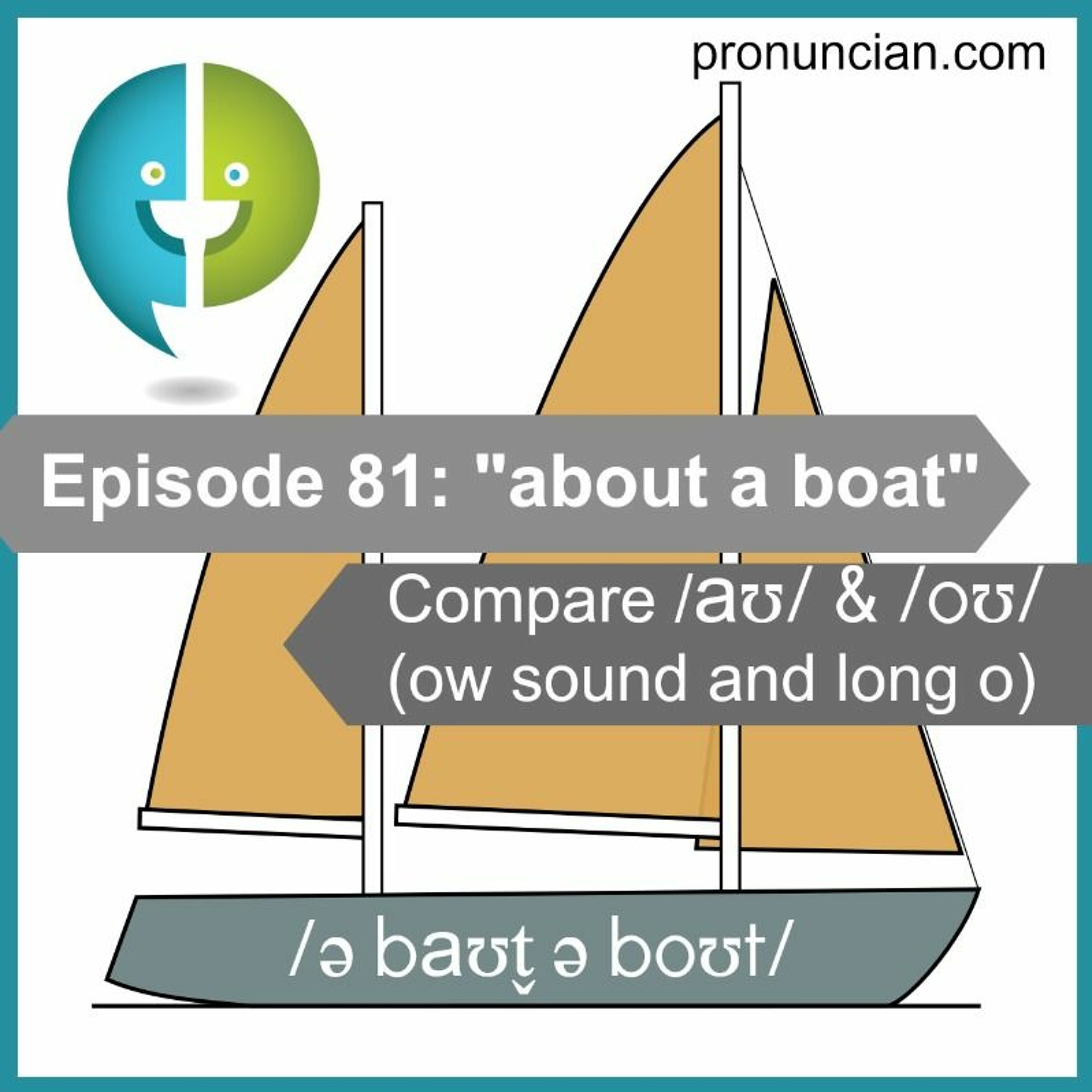
81: ”About a boat,” comparing /oʊ/ and /aʊ/
These two-sound vowels (the long o and ow--as in 'no' and 'now') both end in the w sound, and both can be spelled 'ow.' Full episode transcripts at www.pronuncian.com/podcast.
79: Comparing /eɪ/, /i/, /ɑɪ/ (long a, long i, and long e)
Understanding how the vowel sounds in 'bake,' 'bike' and 'beak' are related to /y/. Full episode transcripts at www.pronuncian.com/podcast.
78: Comparing /æ/, /ɑ/, /ɔ/ (short a, short o, and aw)
Understanding a sequence of low vowel sounds (as in 'stack,' 'stock,' and 'stalk') Full episode transcripts at www.pronuncian.com/podcast.
77: Comparing /i/, /ɪ/, /ɛ/, and /ʌ/ (long e, short i, short e, and short u)
Understanding a sequence of very similar sounds (as in 'bead,' 'bid,' 'bed,' and 'bud') Full episode transcripts at www.pronuncian.com/podcast.
75: ’can’ and ’can’t,’ how are they different? Not how you expect!
Change in vowel sounds, sentence stress, and a glottal stop: lots of details make the pronunciation of these words different. Full episode transcripts at www.pronuncian.com/podcast.
74: Are ’for’ and ’four’ pronounced the same or differently?
for/four: When do the words for and four sound the same, and when are they different? Full episode transcripts at www.pronuncian.com/podcast.
73: Reducing the word ’of’ to /ə/
When the word 'of' links into a consonant, the /v/ is often dropped. Full episode transcripts at www.pronuncian.com/podcast.
72: Using /n/ instead of /ŋ/ (the ’ng’ sound) in -ing ending
-ing: substituting the n sound for the ng sound. Full episode transcripts at www.pronuncian.com/podcast.
71: When and why do some words (like ’interesting’) lose a syllable?
Linguistic concepts of 'syncope' and 'compression' make big words into smaller words. Luckily, there is a pattern. Full episode transcripts at www.pronuncian.com/podcast.
69: Numbers: Teens versus Tens (as in 19 vs. 90)
Syllable stress and alternative 't sounds' are used to differentiate these sounds more than the /n/ at the end of teens! Full episode transcripts at www.pronuncian.com/podcast.

68: Voiced and Unvoiced ’th’ /ð,θ/ review
Yes, dear listeners, keep your tongue in your mouth! Don't put it between your teeth. Full episode transcripts at www.pronuncian.com/podcast.
66: Syllabic n’s and nasal plosions (as in the words ’sudden’ and ’couldn’t’)
No vowels allowed! Join /d/ and /n/ to sound more fluent. Full episode transcripts at www.pronuncian.com/podcast.
65: Uh-oh! The glottal stop in place of /t/
What is a glottal stop and when do Americans use it? Full episode transcripts at www.pronuncian.com/podcast.
63: When Americans drop the /t/ (with audio from The Incredibles)
When do Americans omit the /t/? This audio from the movie "The Incredibles" will help you understand. Full episode transcripts at www.pronuncian.com/podcast.
61: The American /t/ as a quick /d/
Why does 'water' sound like 'wadder'? Full episode transcripts at www.pronuncian.com/podcast.
#60 Tag questions aren’t really questions, are they?
Pitch boundaries are the clue to knowing what someone is really asking when they ask a tag question. Full episode transcripts at www.pronuncian.com/podcast.
59: Falling pitch boundaries on yes/no questions
When to use a falling pitch instead of a rising pitch on a yes/no question. Full episode transcripts at www.pronuncian.com/podcast.
58: Pitch Boundaries, Rising and Falling
Pitch boundaries organize conversations, and give important emotional clues about the speaker. Full episode transcripts at www.pronuncian.com/podcast.
57: Comparing extra-high and rising pitch words
Learn the difference between contrasting and defensively correcting your listener. Full episode transcripts at www.pronuncian.com/podcast.
56: Extra-high pitch words for extra intensity
Add drama, correct someone, and try to not sound angry with these pitch words. Full episode transcripts at www.pronuncian.com/podcast.
55: Intonation and high pitch words, an introduction
An introduction to English intonation and high pitch words in yes/no questions. Full episode transcripts at www.pronuncian.com/podcast.
53: Phrasal verb sentence stress
Typical sentence stress changes when phrasal verbs are involved: stress the preposition, not the verb. Full episode transcripts at www.pronuncian.com/podcast.