
Worth Following – Podcast by Adrian Stanek
Real leadership conversations on building teams, products, and a mission worth following.
Adrian Stanek
Show overview
Worth Following – Podcast by Adrian Stanek has been publishing since 2023, and across the 3 years since has built a catalogue of 83 episodes. That works out to roughly 35 hours of audio in total. Releases follow a fortnightly cadence.
Episodes typically run under ten minutes — most land between 6 min and 19 min — with run-times ranging widely across the catalogue. None of the episodes are flagged explicit by the publisher. It is catalogued as a EN-language Education show.
The show is actively publishing — the most recent episode landed 3 weeks ago, with 16 episodes already out so far this year. The busiest year was 2024, with 32 episodes published. Published by Adrian Stanek.
From the publisher
Honest conversations on leadership, building teams, shipping real products, and creating a mission worth following. blog.adrianstanek.dev
Latest Episodes
View all 83 episodesYou Are Not Lazy. You Are Avoiding Something | S02E06
Identity Shapes Character (Disciplina) | S02E05
Stop Living on Everyone Else’s Agenda | S02E04
Name It Before It Owns You | S2E02
Volunatry Discomfort – Prepare yourself for the day | S2E03
The Waste of Being Right
The Discipline of Defocus
Why Do I Keep Quitting?
Know Yourself, or You Become the Problem
Clarity Is a Practice, Not a Feeling
Maybe Your Potential Did Not Disappear

Monday Is Coming – Why Tech Professionals Dread Mondays
Journaling for Self-Reflection: Separate Reality From Your Subconscious StoriesThe script argues that journaling is the best tool for self-reflection, manifesting, and understanding thoughts and emotions. It explains how journaling helps identify the “lower self” as not the controlling self and emphasizes that you can take action once you see things clearly. The episode recommends using paper or a smartphone to create a two-column table: one column for the week’s realities and actual challenges, and a second column for the stories and projections likely coming from the subconscious. It concludes that you must first gather data and analyze your thoughts before you can accept them, adapt, or act on them.00:00 Why Journaling Works: Self-Reflection, Emotions & Manifestation01:05 The Simple Two-Column Journal Setup01:10 Column 1: Write the Week’s Reality & Real Challenges01:20 Column 2: Spot the Stories Your Subconscious Projects01:31 Collect the Data First, Then Analyze and Take Action01:34 Conclusion: Accept, Adapt, and Act on What You Find This is a public episode. If you'd like to discuss this with other subscribers or get access to bonus episodes, visit blog.adrianstanek.dev/subscribe
Stop Letting Deadlines Hijack Your Nervous System
Stoicism, Discipline, and Burnout: A Tough Week ReflectionThe speaker reflects on a stressful, poorly planned week with shifting appointments and sudden obligations, using a practical, personal approach to stoicism to stay calm and functional. They explain the stoic idea of separating what you can control, influence, and cannot control, and argue that real challenge should hurt because discomfort is what drives change.Their goal is to do everything possible to sway outcomes on commitments, so they can live without regret, even if results or timing don’t work out. As a tech leader and mentor, they criticize deadline culture in the tech space, calling many deadlines fictional milestones that push people into a no-control zone and lead to burnout, especially when marketing or investors force schedules before a product is ready.They define discipline as self-driven commitment (“I will do that”) rather than obedience to an external agenda (“I must do that”), and emphasize committing to getting work done rather than committing to specific dates. The speaker describes coping strategies like daily exercise, including jogging with weights to test limits, and contrasts their current resilience with past habits like retreating into games, junk food, soda, or alcohol (which they no longer drink).They end by reaffirming that pushing through hard weeks builds self-worth and self-confidence, and they continue their uphill run with a 10 kg pack.00:00 — Challenge Must Hurt: Why Discomfort Drives Real Change01:16 — Stoic Week Reflection: Stress, Planning Chaos, and When to Intervene02:32 — Control vs Influence vs No Control: The 3 Circles to Stay Sane04:15 — Pushing Through Without Regret (Even When You’re Exhausted)05:50 — Training as Therapy: Weighted Jogging, Limits, and Self-Knowledge06:42 — Commitment Over Deadlines: Why Most Timelines Are Fiction09:25 — Discipline Isn’t Obedience: Avoiding Burnout and External Agendas11:13 — Proving It to Yourself: Self-Confidence Built in Hard Weeks12:34 — Wrap-Up: Keep Moving, Uphill Finish, and Goodbye This is a public episode. If you'd like to discuss this with other subscribers or get access to bonus episodes, visit blog.adrianstanek.dev/subscribe
Dilemmas Are a Leadership Smell
The Power of Decision Making: A Stoic ApproachIn this insightful episode, we explore the art of decision-making and reflect on how to learn and grow from our choices. By examining the consequences of our actions, embracing our emotions, and adapting our strategies, we can develop better decision-making patterns over time. This approach helps us distinguish between significant and trivial decisions while emphasizing the importance of early feedback and personal control. Tune in to understand how a stoic perspective can enhance your decision-making process and lead to more informed and quicker decisions in the future.00:00 Introduction: The Power of Choice00:17 Learning from Decisions00:24 Emotional Consequences and Acceptance00:37 Reflection and Adaptation00:50 Understanding the Impact of Decisions01:20 Stoic Perspective on Control This is a public episode. If you'd like to discuss this with other subscribers or get access to bonus episodes, visit blog.adrianstanek.dev/subscribe
AI & Coaching, Why technology will change how we learn, and how we grow
AI as the New Coach: Integrating Technology Into MentorshipIn this spontaneous stream, the speaker dives deep into the evolving role of AI in the coaching and mentorship industry. As we enter a new year, they reflect on how AI has progressed from a hyped technology to an integral part of daily life. They highlight the unique challenges and opportunities AI brings to software development and coaching. Key discussion points include the importance of discipline, the role of AI as a reflecting partner for daily self-improvement, and the critical need for guardrails in AI coaching. They emphasize that while AI can serve as a useful tool for reflection and learning, it should not replace human judgment and emotional intelligence. The session wraps up by encouraging individuals to integrate AI thoughtfully into their personal and professional development routines.00:00 Introduction and Greetings00:08 Reflecting on Last Year's Doubts01:57 AI's Role in Coaching and Mentoring06:33 AI as a Daily Companion19:04 The Importance of Discipline and Daily Reflection24:05 Guardrails and Trust in AI30:26 Understanding AI's Limitations31:08 The Role of Emotional Intelligence in Leadership31:43 The Importance of Accountability in Decision Making32:42 Using AI to Fill Knowledge Gaps33:36 Frameworks Over Prompts37:50 Privacy and Honest Reflection42:18 AI Amplifying Substance, Not Credibility46:21 The True Value of Coaching50:07 Personal Growth and Self-Leadership52:18 Final Thoughts and Reflections This is a public episode. If you'd like to discuss this with other subscribers or get access to bonus episodes, visit blog.adrianstanek.dev/subscribe

Focus + Feedback Loops
Hello, fellow.Two things are extremely important if you wanna become a good professional, in any field. (That includes yours as well, so read on! 😀) 1 – The first thing is focus. 2 – The second thing is the ability to stay in a feedback loop. And this comes to my mind every time when I’m on an archery field, or in this case, a 3D Parcours.You heard of those if you are on social media, but do you actually “focus” on focusing on a daily basis? Are you running a constant feedback loop for yourself? Anyway, it makes sense to read on:Why I Like Archery as a SportThe reason I like it as a sport is exactly that. It’s a sport, and since I’m mostly a software development entrepreneur, I don’t do much sport while I’m at work. Still, I need to, because there is no other activity I can personally do that offers that level of precision in focus.Archery forces you to be precise about what you do, when you aim, when you release, when you plan your shot, and what you’re doing with your body. And then of course you get the outcome.Nothing is more frustrating than when you mess up a shot, lose your arrow in the forest, and realize it was because your mind was off and not on point. Regret .. Reflect .. Accept .. Adapt … Let’s get into that stuff:The Loop: Commit, Execute, AdaptYou commit to a shot, you plan something, you execute, then you realize what actually happened, and then you adapt. If I mess up, I think about what I have done wrong at this position, from that angle, with that arrow type, at that distance. Was my finger not in the correct position? Was the anchor off? Did I rush? Then I adapt for the next shot as long as it works.This is what makes you better every time you release an arrow, because you’re doing two things at once:* Correct what you’ve done wrong (fast, practical, no drama)* Remember what you’ve done right (so you can repeat it on purpose)That’s also why, when I miss a shot, I take a follow-up shot, and I take a follow-up shot again, and then it’s over. But when I hit, I memorize that and go for the next target. There are enough targets. I want my brain to remember what works and what doesn’t, and that is simply a practice.In both failure and success, I remember intentionally what worked and what did not.Bragging and RegrettingA lot of archers do this; I’ve adopted it and use it in real life, too. I call it bragging and regretting.* Regret is short-term. I regret what I just did wrong right now because I can do it better.* Then regret is over. I accept it, adapt, correct, execute again, and see what happens.* Bragging is pattern storage. When I hit, I say: This is done right, remember that one.Important: Don’t brag or regret any longer; that is necessary. That’s to handle your short-term feelings, which are connected to yours. It’s a part of my stoic practice to let these emotions come up and instantly control them. NEVER drive home and tell yourself:* “I messed up so many shots, what a bad, I hate my life” (That’s nonsense)* “Tell everybody how great of an archer you are” (Which you aren’t in relation to others)It’s only about yourself, your progress, and your learning.Why Traditional Gear MattersA personal point: But after years on the range at 30+ years of coding, 18+years of entrepreneurship, I concluded:It helps that this is a traditional bow. No optics, no helping devices. If you want to do something, you need to do it all by yourself. You have a very basic rest with a little bit of fur on it, and that’s it. This is what I really like. It’s also why I never bought a compound bow or an Olympic bow. I wanted it that way.Because it puts you into situations that are a little bit like the entrepreneurial situation, it’s not standardized. It’s not a specific range, a specific angle, a specific weather condition.Probably that’s why I like being in the more chaotic startup space than in corporate. 😀Real Conditions, Real AdaptationIt is very cold right now, around minus five degrees. It’s very slippery. My fingers are getting chilly, and at some point you need to adapt to those things. That is not how you shoot indoors, or how you shoot in an indoor competition.Even my nocks flew off today. In summer, it works very well with those, now they all flew off while I was shooting. Some I wasn’t able to find again, so I had to shoot with other arrows. I have two types of arrows with me right now, and the entire range I’m shooting with two arrows that are not meant to be shot with that bow. A similar kind of bow, but not the same, different draw weight. That means I need to adapt again.So I’m doing the entire processing in real time:* Use what I know from the past* Apply it to different arrows, different bow behavior* Under colder conditions than usual* On a field, I’m not very often on* Heavy, steep terrain; before most shots, I was climbing an icy hill.All these things together make you a better shooter over time because you need to constantly reflect, adapt to what you have just done, and stay in focus.The

Do you have Clarity in your Life?
We often discuss the importance of clarity — clarity in communication, clarity in vision, and clarity in life. However, when you examine it closely, clarity is one of the most misunderstood things we pursue.Because it’s easy to say, “I want to have clarity.” It’s much harder, actually, to keep it.You might have moments where everything feels aligned, where you know exactly what to do next, and then, just a few days later, the fog returns.Let’s talk about that kind of clarity: the clarity of direction in life.And to make it simple, let’s use a metaphor.The Driving MetaphorImagine you’re driving a car. To drive, you need three things: acceleration and braking, steering, and navigation. These three things serve as metaphors for how we navigate life.1. Acceleration & Braking → Your Physical HealthYour body is your engine. It gives you the energy to move forward, to build momentum, to slow down when needed. If your physical energy is off, if you’re tired, stressed, or unwell, you can’t accelerate toward anything meaningful. This is a public episode. If you'd like to discuss this with other subscribers or get access to bonus episodes, visit blog.adrianstanek.dev/subscribe
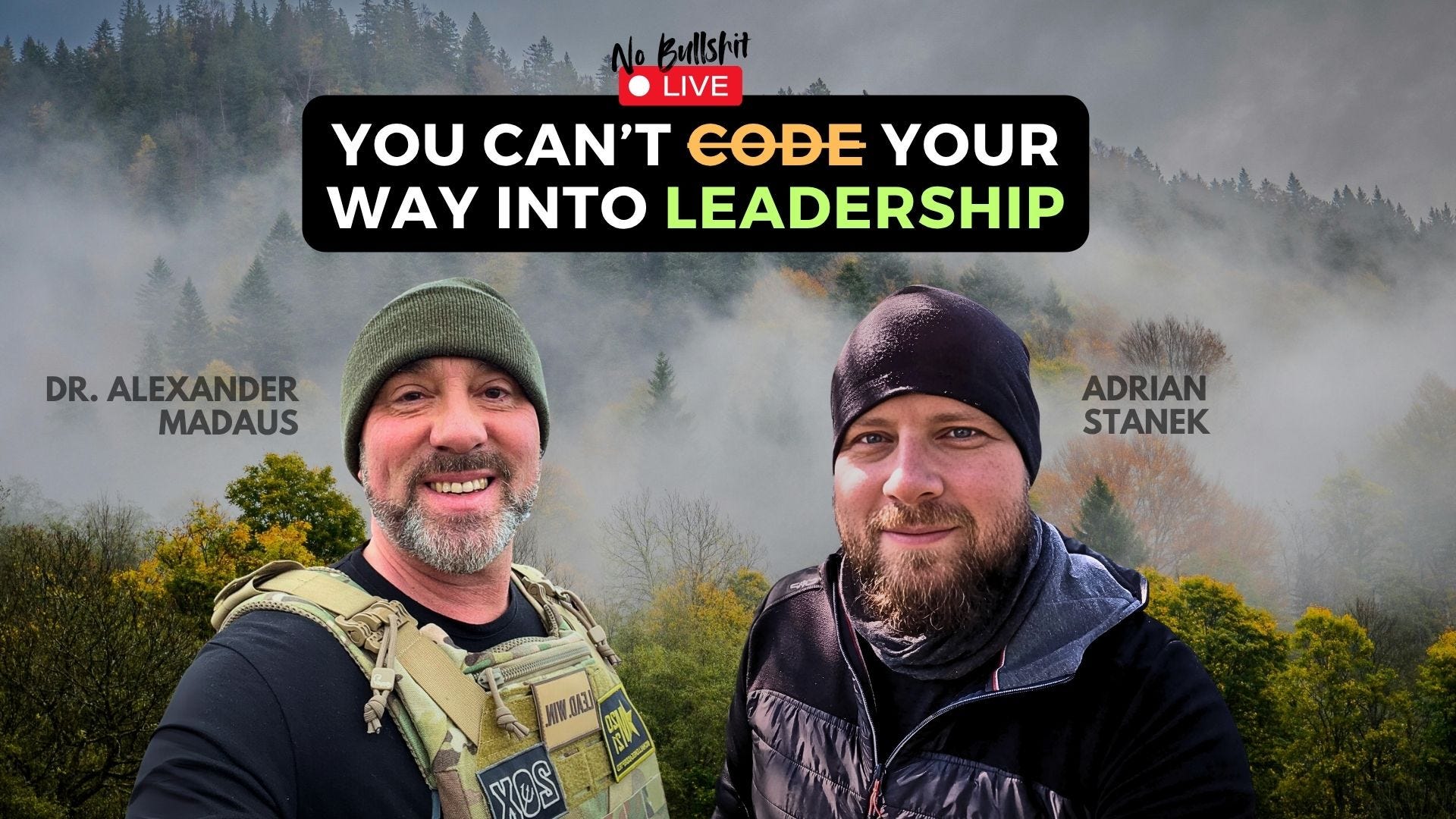
Discipline Is Not Optional – It’s the Foundation of Real Leadership
Most leaders obsess over tools, tactics, frameworks, KPIs, everything except the one thing that actually determines whether their team wins or loses: themselves.This episode goes straight into the uncomfortable truth: if you don’t lead yourself with discipline, integrity, and clarity, you have absolutely no business leading others. That’s not motivational fluff, that’s reality. And it’s the message Dr. Alexander Madaus has spent decades fighting for.Who Is Dr. Alexander Madaus?Dr. Alexander Madaus isn’t your typical leadership trainer. He’s a former German military team leader, an entrepreneur, a medical doctor specializing in intensive care and emergency medicine, and — famously — the only German who has ever trained with U.S. Navy SEALs.His journey began immediately after school, when he joined the German military while simultaneously establishing his first business in Munich. Later, he paid his way through med school, became an MD, and spent a decade making life-and-death decisions in chaotic environments where leadership and clarity weren’t optional.Today, through the Rising King Academy, he coaches entrepreneurs and business owners on character-based leadership, rooted in discipline, candor, trust, and building high-performance A-player cultures — not management theater.00:00 wF-AlexanderMadaus00100:49 REEL02:15 START This is a public episode. If you'd like to discuss this with other subscribers or get access to bonus episodes, visit blog.adrianstanek.dev/subscribe

Self-Control is Leadership
Mastering Self-Control: The Key to Effective LeadershipIn this episode, explore the importance of self-control for effective leadership. Learn how managing emotions like sadness, anger, and grief can help you serve others better and maintain your credibility as a leader. Understand why self-discipline and reflecting on your emotions are crucial for handling daily challenges. Discover the four pillars of leadership—credibility, being a role model, having a vision and mission, and challenging oneself and others. By cultivating the right mindset, you can become a strong, emotionally stable leader. Tune in for practical tips and insights into mastering self-control and leading with confidence.00:00 Understanding Emotional Overwhelm00:38 The Importance of Self-Control in Leadership01:44 Reacting vs. Acting on Emotions02:31 Accepting and Reflecting on Emotions03:02 The Four Pillars of Leadership04:17 The Role of Mindset in Leadership04:46 Final Thoughts and Encouragement This is a public episode. If you'd like to discuss this with other subscribers or get access to bonus episodes, visit blog.adrianstanek.dev/subscribe

Somewhere along the way, we lost the ability to dream
Somewhere along the way, something changed. We stopped dreaming the way we once did. When we were children, the world felt open and full of possibilities. We could see our potential so clearly. Becoming a firefighter, a doctor, or an astronaut felt within reach. Not because those paths were easy, but because they felt possible. We believed in our future selves without hesitation. Failure didn’t scare us. When we fell off the bike, we got back up. We were frustrated, yes, but we tried again. We didn’t question whether we were worthy of learning how to ride. We simply believed it was a matter of time.As adults, something shifted. We became smarter, more practical, and more careful. We learned to navigate opinions, expectations, and social pressure. Slowly, almost invisibly, our dreams began to shrink. They started to fit neatly inside the boxes that other people drew for us. Potential didn’t disappear. It simply faded into the background. It became quieter. It turned into a gentle pull toward something bigger, something we could become if resistance didn’t hold us back.Resistance is real.It shows up as doubt. It shows up as fear of judgment. It shows up as subtle pressure to play small. And for many people, this resistance becomes stronger than their vision. It is what keeps us from starting, from risking, from stepping forward. We tell ourselves stories about why now is not the right time, why others are more capable, or why the dream is unrealistic. But none of that is about our actual potential. It is the voice of resistance doing its job.Vision & LeadershipThis is exactly where leadership comes in. Vision and mission are not just fancy words used in corporate meetings. They are the foundation of real leadership. They are about projecting a future version of yourself or your team that does not exist yet and believing in it deeply enough to make it real. That is what children do naturally when they dream. Leaders need to relearn that skill. Because leadership, at its core, is not about control. It is about seeing something that others cannot see yet and choosing to walk toward it anyway.Great leaders do not lose their ability to dream. They protect it. They nurture it. They hold a vision even when nobody else believes in it. They give shape to potential, first within themselves, then for the people around them. They turn something invisible into something tangible. And that is why reconnecting with your potential is not a nice-to-have. It is a leadership discipline. You cannot lead anyone toward a future you cannot imagine yourself.If you want to lead, you need to dream again, not with the naive certainty of a child, but with the clarity and courage of someone who understands resistance and chooses to act anyway. Vision is the spark. Mission is the path. Leadership begins when you dare to reclaim the part of yourself that still believes something bigger is possible. Because if you cannot imagine it, no one will follow you there.— Adrian This is a public episode. If you'd like to discuss this with other subscribers or get access to bonus episodes, visit blog.adrianstanek.dev/subscribe