Why Should We Care About the Indo-Pacific?
169 episodes — Page 4 of 4
Ep 19Why Should We Care About China's Criminal Gaming Syndicates?
Philippine Senator Risa Hontiveros has been leading an extraordinary investigation into Philippine Offshore Gaming Operations (POGOs) and their malign social, economic and political implications. In this special, in-person interview with co-host Ray Powell, she explains the history and origins of POGOs, their rapid spread under former President Rodrigo Duterte, and their ties to Chinese criminal syndicates. She explains the remarkable case of Alice Guo, a small city mayor who was implicated following a federal raid on a local POGO. Her extraordinary wealth and evidently false documentation of her Philippine birth raise questions of whether she was planted into the political system, by whom and for what purpose. The conversation then turns to regional tensions with China--especially in the West Philippine Sea--and the importance of protecting Philippine national interests in the face of foreign interference. It also discusses the role of the United States and the need for international support in addressing these issues.
Ep 18Why Should We Care About America's Lost Indo-Pacific Decade?
Retired Ambassador Bob Blackwill and Richard Fontaine talk to Jim and Ray about how America failed to complete its "pivot to Asia" during the past decade and across successive administrations. The authors of the recent bestseller, 'The Lost Decade: The US Pivot to Asia and the Rise of Chinese Power', argue that America's much-celebrated geostrategic rebalance has never fully materialized, resulting in a weaker US position in the face of a rapid rise in Chinese power and aggression. They emphasize the increasing importance of the Indo-Pacific, the area of greatest geopolitical competition and compounding threats to the global order. They call for a belated but properly executed pivot that includes economic, military and diplomatic components. The conversation also touches on the challenges of getting the American people and political class behind a pivot to Asia, the need for increased defense spending and the importance of deterrence in dealing with China.
Ep 17Why Should We Care About China's Wolf Warrior Diplomats?
Former Japanese Ambassador to Australia Shingo Yamagami discusses the rise of China's "wolf-warrior" diplomacy, including what motivates their aggressive approach to their diplomatic roles. He explains how China's growing economic and military power has led to a shift in their approach to international relations, with a focus on regaining national prestige at the expense of China's neighbors. Ambassador Yamagami emphasizes the need for countries to speak out against these aggressive tactics and not acquiesce to their demands. He also discusses the importance of the AUKUS and the Quad, Japan's recent rapprochement with South Korea, and the important role of Japan's new national security policy in countering China's influence.In this week's edition of "There I was ...", Ray tells his experience with a Chinese military diplomat who had a list of things he had to say.
Ep 16Why Should We Care if India Becomes the World's Third Largest Economy?
"If you don't have an India play, you're not recognizing the realities of growth over the next 30 or 40 years on our planet."U.S.-India Business Council President Ambassador Atul Keshap spotlights the shared values and democratic principles between India and the United States, emphasizing that India's rise to become the world's third largest economy will be a net benefit for the American people. The conversation also covers India's economic growth, the challenges of attracting foreign direct investment, the need for job creation, and the complexities of doing business in India. Additionally, the discussion touches on India's geopolitical relationships, including its border disputes with China, its involvement in the Quad alliance, and its pragmatic approach to foreign policy.
Ep 15Why Should We Care About China's Foreign Influence Operations?
Member of Parliament Peter Khalil joins Jim and Ray to talk about how Australia has dealt with foreign interference operations--with an emphasis on Beijing's sophisticated influence machine--through national legislation and other security policies and framework documents. This response has been comprehensive, including strengthening Australia's defense, cyber security and intelligence efforts, as well as building security partnerships with like-minded democracies. Universities have been a particular target of foreign interference operations, and Peter discusses how Australia has tried to curb China's corrupting influences in academia while maintaining academic freedom. Another critical challenge has been to build in this national resilience while avoiding xenophobic policies and rhetoric that negatively impacts Australia's important ethnic Chinese communities. Peter ends by emphasizing how a successful the Indo-Pacific future must be built on a middle-power fulcrum, where like-minded countries work together to uphold the crucial rules-based order and deter conflict.
Ep 14Why Should We Care About Taiwan's "Davidson Window"?
Admiral Phil Davidson, the former commander of the U.S. Indo-Pacific Command from 2018-2021, discusses the so-called "Davidson window"--the period beginning in 2027 which many believe is when the threat of war over Taiwan will be at its greatest. He explains how his name became associated with this term. The then emphasizes the need for a strong conventional deterrent, the importance of deepening alliance relationships, and how showing commitment in other regions is crucial to averting war over Taiwan. He explains how China's growing bellicosity is perceived by other countries, and how Beijing is executing a pressure campaign to achieve its objectives short of war using asymmetric means.Admiral Davidson also discusses the need for devoting resources Indo-Pacific defense and where those could come from, for addressing U.S. and allied force structure deficiencies and for assuring the region that the U.S. remains an effective and reliable security partner. He concludes by emphasizing Taiwan's importance to key U.S. allies--especially Japan.To close, Jim tells the story of when he was accused of being a CIA spy for being "too nice".
Ep 13Why Should We Care What Singapore Thinks?
Jim and Ray discuss the remarkable Southeast Asian nation of Singapore with Nydia Ngiow, Managing Director of BowerGroupAsia's Singapore office. They explore why how this small city-state emerged to play a leading role in Indo-Pacific business and geopolitical affairs--even hosting major international events like the Asia Tech Summit and the Shangri-La Dialogue. Nydia talks about how Singapore came to be, and how it navigates its complex relationships with the US and China and practices a "consistent, principled and pragmatic" foreign policy. They also touch on Singapore's external security threats, its internal politics and its approach to balancing political stability against civil liberties. Finally, she explains how Beijing's crackdown in Hong Kong and political changes in the U.S. have impacted Singapore.In this week's edition of "There I was ...", Jim tells Ray his experience with a Singapore COVID quarantine.
Ep 12Why Should We Care About the Pacific Island Countries?
Ray and Jim examine why we should care about the seemingly insignificant islands scattered across the Pacific region with former U.S. Ambassador to Palau John Hennessey-Niland. They highlight the strategic importance of these islands in terms of their supply routes and military access. John explains the Compacts of Free Association by which the U.S. guarantees the security of three Micronesian countries in exchange for exclusive access. They also discuss the rapidly expanding role of China in these island countries and the challenges of "elite capture" and corruption. The conversation emphasizes the need for the United States and its allies to avoid the temptation to ignore these countries and allow them to slip into China's orbit through benign neglect.Finally, in the latest edition of "There I was...", Ray recounts how he and Jim were able to navigate a tricky international dilemma in Australia with the help of a very good military lawyer.
Ep 11Why Should We Care About America's Defense Priorities?
Ray and Jim talk to Elbridge Colby, author and former U.S. Deputy Assistant Secretary of Defense for Strategy and Force Development, about his provocative views concerning America's need to urgently address the China threat by prioritizing the Indo-Pacific theater. They discuss and debate the interaction between sharp honesty and assurance when dealing with America's allies, their concerns about U.S. staying power, and whether accepting risks in other theaters might actually undermine deterrence with respect to Taiwan and East Asia. The wide-ranging conversation covers a range of topics related to U.S. foreign policy and defense strategy, including China's gray-zone coercion and America's defense industrial base.
Ep 10Why Should We Care About the Outlaw Ocean?
Ray and Jim talk to Ian Urbina, Director of the Outlaw Ocean Project about the vast, lawless areas of the sea where dark, extra-legal, often destructive and inhumane activities take place. Ian highlights the ethical concern for the well-being of the 50 million people who work at sea, the environmental impact of the oceans as the earth's climate stabilizer and source of biodiversity, and the fascinating stories that unfold in this hidden world. He also delves into the issues of overfishing--especially China's immense distant-water fishing fleet--and human rights abuses in the fishing industry.
Ep 9Why Should We Care About Myanmar's Civil War?
Ray & Jim talk about an Asian civil war and human rights disaster that many have never heard of with former U.S. Ambassador to Myanmar, Scot Marciel.Myanmar is a southeast Asian country of 55 million people strategically located between Thailand, China, India, and Bangladesh, which experienced a military coup in 2021. The ruling junta has been responsible for massive human rights violations and a humanitarian crisis, while a growing resistance has recently gained significant ground.China has strategic interests in Myanmar, and has supported both the military and some ethnic armed groups. The Association of Southeast Asian Nations (ASEAN) has struggled to address the crisis. The best hope for Myanmar's is for the resistance to prevail and negotiate a new federal system, but there are risks of balkanization among the ethnic groups.At the end, special guest Biak Tha Hlawn--now a student at Stanford University--shares her personal experience as a member of the persecuted Chin ethnic group, and the losses her family has suffered due to the conflict. Those who wish to support her relief efforts can contact Hlawn at [email protected].
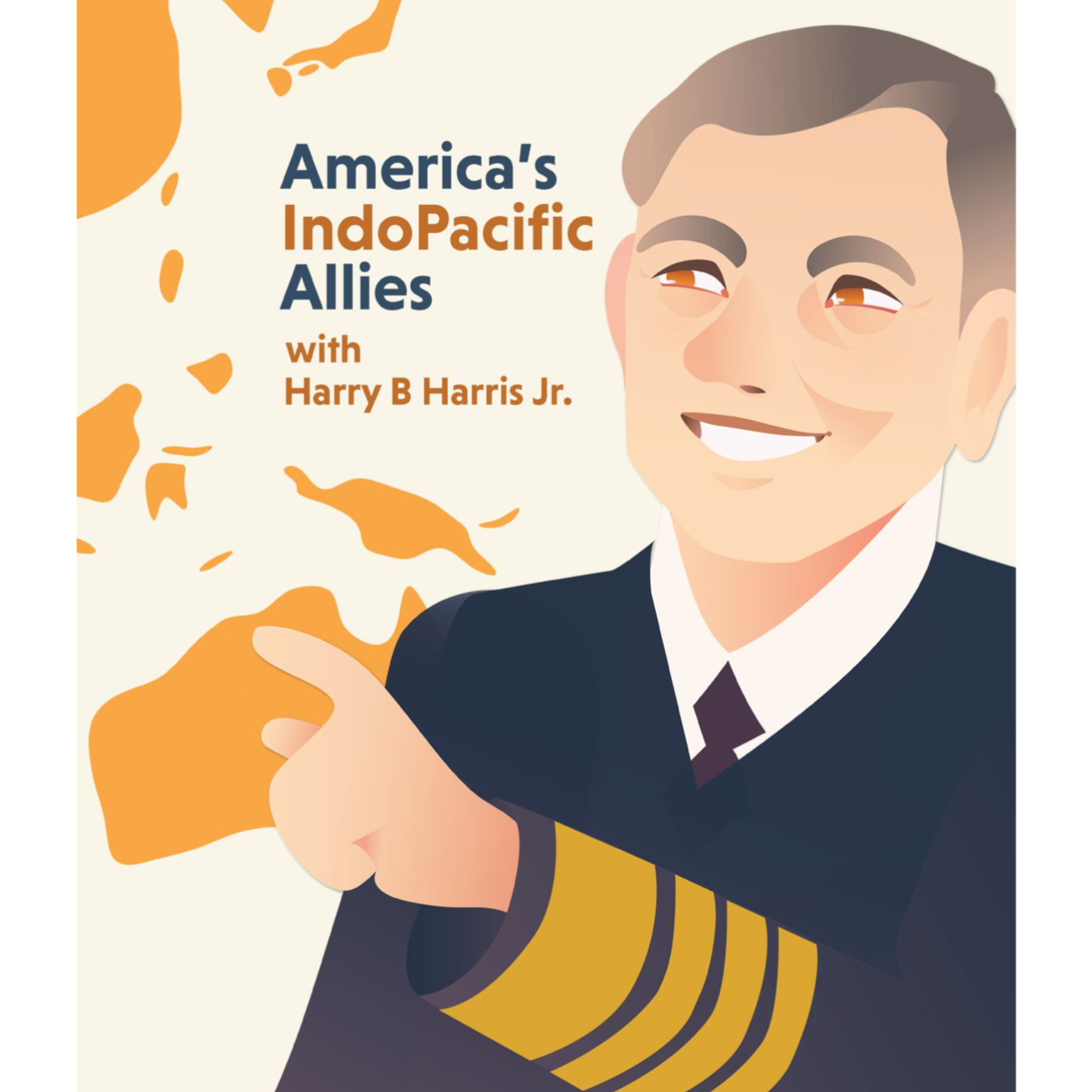
Ep 8Why Should We Care About America's Indo-Pacific Allies?
Ray and Jim welcome retired Admiral Harry B. Harris, Jr., former commander of U.S. Indo-Pacific Command and former Ambassador to South Korea, to discuss how alliances are crucial to U.S. national security. They touch on each of the five Indo-Pacific treaty alliances--Japan, South Korea, Australia, the Philippines, and Thailand--and discuss why some are coming together in a new "latticework", replacing the "hub-and-spoke" model of the past. Admiral Harris explains why he has come to advocate for replacing the decades-long U.S. policy of "strategic ambiguity" toward Taiwan and replacing it with one of "strategic clarity". He also discusses the roles of several new Indo-Pacific groupings such as the Quad--U.S., Japan, Australia and India.
Ep 7Why Should We Care About the Defense of Taiwan?
Jim and Ray welcome retired Major General Mick Ryan, Royal Australian Army and retired Rear Admiral Mike Studeman, U.S. Navy to discuss the importance of defending Taiwan. They highlight the profound consequences of a Chinese takeover of Taiwan and its implications for the United States, Australia and the region. They emphasize the need to communicate the significance of Taiwan to the public, and to strengthen deterrence against China's aggression. The conversation explores the challenges of deterrence in the modern age and the need for a comprehensive approach that goes beyond military capabilities. Mick discusses his recent book about a hypothetical war over Taiwan and the importance of land operations in the defense of Taiwan.
Ep 6Why Should We Care About Southeast Asian Economies?
Jim & Ray interview former U.S.Ambassador Ted Osius--now the President and CEO of the US-ASEAN Business Council--about the importance of Southeast Asia's rapidly growing economies, especially as companies seek to de-risk away from China's deteriorating business environment. They discuss the growth and potential of Southeast Asia, the opportunities for US investment in the region, and the continuing challenges faced by American companies who want to operate there. They also touch on America's failed involvement with the Trans-Pacific Partnership, and how that has negatively affected its economic opportunities and strategic position in Asia. They further discuss ASEAN's role in regional politics--what it can and can't do in the economic, diplomatic and security arenas.In this episode's "There I was..." segment, Jim recalls how as diplomats in Jakarta he and Ted would meet regularly with a wealthy Indonesian businessman who often had an axe to grind.
Ep 5Why Should We Care if China is Harassing Philippine Ships?
Jim and Ray interview the Philippine Coast Guard's spokesperson for the West Philippine Sea, Commodore Jay Tarriela, about China's continuing harassment of Philippine ships at a time when the mist of the previous day's water-cannoning near Scarborough Shoal was still dissipating. They discuss the importance of countering Chinese aggression and protecting the international rules-based order. They ask Jay to weigh the benefits of the Philippines' transparency campaign against its risks, and to comment on ASEAN's reluctance to publicly back Manila in its maritime struggles and its inability to produce a South China Sea Code of Conduct.They also laugh and lament over the accusations by Beijing's propagandists about Ray's supposed manipulation of Jay and the Philippine government.Finally in "There I was...", Ray tells the story of the eruption of Mount Pinatubo in 1991, when he and his new bride were evacuated from the Philippines.
Ep 4Why Should We Care About Beijing's Cyber Aggression?
Ray and Jim are joined by retired Lieutenant General Lori Reynolds, former U.S. Marine Corps Deputy Commandant for Information, who provides insights into China's recently uncovered "Volt Typhoon" cyber operation and its implications for national security, both within the U.S. and across the free world. They discuss Beijing's shift from simple snatch-and-grab intellectual property theft to now conducting high-level cyber espionage and embedding its operatives within a nation's critical infrastructure. They also talk about the data security and cognitive threats posed by TikTok and the need for free countries to become more resilient, and to leverage their own asymmetric advantages by exposing the Chinese Communist Party's cyber aggressions.00:00 Introduction and Background05:12 China's Shifting Cyber Strategy: From Intellectual Property Theft to Critical Infrastructure Embedding11:58 The Threat of TikTok: Data Access and Manipulation22:23 The Threat of TikTok and the Need for Divestment28:04 Leveraging Asymmetric Advantage: The Power of Truth and Strategic Narratives32:44 Contesting Chinese Influence: Exposing and Countering Manipulation in Various Industries
Ep 3Why Should We Care if China has the World's Biggest Navy?
Ray and Jim are joined by Brent Sadler, author of "U.S. Naval Power in the 21st Century", to talk about China's rapidly growing naval power, including its ability to exercise power globally, coerce other countries and undermine Western influence. They discuss whether China's numerical superiority equates to superior capability and the growing vulnerability of surface vessels. They examine the situation in the South China Sea and examine how counterinsurgency tactics may be necessary to deal with China's paramilitary coast guard and maritime militia. The conversation then moves on to the US presence in the region and the need to develop maritime statecraft. They discuss the severe challenges facing US shipbuilding, including the lack of public shipyards and the shortage of shipyard workers and naval architects. The conversation concludes with the potential of the AUKUS alliance and the importance of Australia's investment in naval shipbuilding.At the end, Ray and Jim introduce their new "There I was..." segment, in which they trade stories from their military and foreign service careers. Ray goes first by sharing his first crisis after arriving in Australia, when he realized he had no idea how to get the Secretary of Defense on the phone.
Ep 2Why Should We Care About the U.S.-Japan-Philippines Trilateral Summit?
Ray and Jim discuss the upcoming 11 April 2024 Trilateral Leaders' Summit between the Philippines, Japan and the United States with their guests Chris Johnstone, Japan Chair at the Center for Strategic and International Studies in Washington DC, and Victor "Dindo" Manhit, Founder and Managing Director of the Stratbase Group in Manila. They highlight the importance of this meeting in demonstrating a united front against China's assertiveness in the region. They also discuss the potential for increased military cooperation between the Philippines and Japan and the need for economic incentives to strengthen the relationship. The conversation ends by taking on the question of whether these efforts are sufficient to deter China's aggression. Overall, the conversation emphasizes the importance of collective action and cooperation in addressing regional security challenges.
Ep 1Why Should We Care About the Indo-Pacific? (Pilot)
The pilot episode of 'Why Should We Care About the Indo-Pacific?' explores why people should pay attention to current developments in this vast, dynamic and increasingly turbulent region. Hosts Ray Powell and Jim Carouso draw from their decades of military and diplomatic experience in Asia and the Pacific as they discuss the region's geographic scope, expanding population and economic dynamism. They also delve into the growing military concerns, particularly the U.S. competition with China and the potential for armed conflict. The conversation delves into the importance of alliances and partnerships, the role of ASEAN and other new groupings like AUKUS and the Quad, and the need for ensuring free and open commerce.