
Weight and Healthcare
308 episodes — Page 7 of 7
New Guidelines for Weight Loss Surgery?
This is the Weight and Healthcare newsletter! If you appreciate the content here, please consider supporting the newsletter by subscribing and/or sharing!In October, “Guidelines on Indications for Metabolic and Bariatric Surgery” were put out. While I don’t think that these surgeries meet the requirement for ethical, evidence-based medicine, in looking at these guidelines specifically, here are some things that I think it’s important to know.The guidelines were put out by The American Society for Metabolic and Bariatric Surgery (ASMBS) which is “the largest group of bariatric surgeons and integrated health professionals in the United States” and the International Federation for the Surgery of Ob*sity and Metabolic Disorders (IFSO) which “represents 72 national associations and societies throughout the world.” These are both organizations that primarily represent those who profit from these surgeries.They were published in two journals. Surgery for Ob*sity and Related Diseases (SOARD) a medical journal “medical journal covering the use of surgery to treat obesity and related medical conditions” and Ob*sity Surgery which is a journal dedicated to bariatric surgery which is “the official journal of the International Federation for the Surgery of Obesity and Metabolic Disorders.” Note that it is the official journal of the organization that created the guidelines, that represents people who profit from the surgeries. I also think that this is an example of the ways in which (what passes for) science around “ob*sity *medicine” can end up putting profits first.In this case, two organizations that represent those who profit from weight loss surgery have published in two journals dedicated to supporting these surgeries, in order to create new guidelines which would vastly increase their market share because those who belong to these organizations can use the guidelines to justify performing these surgeries on many more patients.Fox, meet henhouse.The guidelines gain ground on two of the industry’s constant focuses – lowering the BMI threshold for these procedures, and lowering the age of the patients they are allowed to perform these procedures on.To do this, they rely on several tried-and-true questionable ideas:Pathologizing higher-weight bodiesThis is the result of a long game that they (and the entire weight loss industry) have been playing to pathologize bodies based on size (and regardless of actual metabolic health.) Making up the concept of “ob*sity” (based on a height/weight ratio) and then transitioning that to a standalone “disease” allows them to make every fat person their market. In this case, the old guidelines were a adults with “BMI of at least 40 or a BMI of 35 or more and at least one obesity-related condition” the new guidelines are adults and “appropriately selected children and adolescents” with a BMI of 35 or more “regardless of presence, absence, or severity of obesity-related conditions,” a “BMI of 30-34.9 and metabolic disease” and in “Asian individuals beginning at BMI 27.5.” If you’re playing the home game, these new guidelines increase the market for these surgeries by creating a 5-point BMI drop for the weight at which, no matter what the patient’s metabolic health, they want to give them a surgery that risks their life and quality of life, a 5 point BMI decrease for patients for whom they are recommending these dangerous surgeries based on the fact that they are fat and have a health issue that thin people also get, and a special category for Asian peopleThere is a lot to unpack here. First of all, the idea that people at a higher BMI should have the surgery regardless of metabolic health, but that those with a lower BMI must have a “metabolic condition” (more on this in a moment) means that they are predicating the significant risks of this surgery purely on body size. They are medically defining higher-weight people’s lives as more riskable, which is pure weight stigma. Beyond that, the concept of metabolic conditions being “ob*sity related” is questionable at best, and is based on extremely dubious research (much of which was funded and/or conducted by the weight loss industry) that uncritically links being higher weight to health issues using (well, abusing, really) correlation and ignoring confounding variables in ways that wouldn’t get past a freshman research professor but that keep getting past peer review. In one of the ways that we see racism and weight stigma intersect (and please read Sabrina Strings: Fearing the Black Body – the Racial Origins of Fat Phobia and Da’Shaun Harrison: Belly of the Beast: The Politics of Anti-Fatness as Anti-Blackness to learn more about this,) the industry is very interested in the idea that the standard BMI chart doesn’t necessarily apply to Asian populations, because it allows them to lower BMI threshhold and therefor perform more surgeris. On the other hand, it has shown no interest in the fact that a standard based on cis-white European me
Advocating for Blood Pressure Cuffs and Gowns in the ER
This is the Weight and Healthcare newsletter! If you appreciate the content here, please consider supporting the newsletter by subscribing and/or sharing!Note: I have explicit permission to share this story. I wanted to share it to help those who work within healthcare to see ways that they can make change, and those who do not work in healthcare to see how they might advocate.A call came in late at night. It was a dear friend of mine and she was in the emergency room. Luckily it looked like a false alarm, but she was really upset. She had been in this same hospital for other procedures and had always been accommodated, but for some reason in the ER, things were different this time. They didn’t have a blood pressure cuff that fit her (a serious issue at any point, but even more serious since blood pressure was part of the concern that had led her call the ambulance in the first place,) and they didn’t have a gown that fit her. She is a fierce activist in her own right, but just didn’t want to risk retaliation at a time when she needed care. She asked if I would please reach out to the hospital after she was back home and see if I could get them to fix the lack of accommodation. I discussed this in my piece about creating size-inclusive healthcare spaces, but if you are someone who works in a healthcare facility, this could be a great opportunity to ask yourself “are there ways that fat patients in our facility are treated differently/less well than thin patients.?” Examples would include if a blood pressure cuff for thin patients is available in every room, but a cuff for fat patients either doesn’t exist or has to be found, and if thin patients have gowns that fit them but fat patients are either given a sheet or asked to try to wear two gowns.I started on the website for the facility and couldn’t find anything on the website about patient services, so I started by calling the main line.“I’m calling about a negative experience in your ER, I just wanted to see if I could talk to someone to see if we can fix it for the next patient.”I chose my wording carefully here because I didn’t want to get into the fact that I wasn’t the patient until I was talking to the right person.The woman who answered immediately said “Yes! Let me transfer you to someone who can help”She transferred me to risk management and, while I didn’t think that was ultimately who I needed to talk to, I left a voicemail as requested, deciding to give it 24 hours before trying again.Later that day I got a voicemail – “this is Amber from patient services returning your call.”I immediately called Amber back and she picked up. I explained that I was calling as an advocate for one of their patients who had recently had a negative experience in the ER, and that I was hoping to talk to someone who could help make changes.This was our first stumbling block and Amber immediately said that she couldn’t talk to me if I wasn’t the patient due to HIPPA. I explained that I wasn’t asking her for any information about the patient – that, in fact, I was calling so that the patient could remain anonymous, so it wasn’t a HIPPA violation.She then said that even if it wasn’t a HIPPA violation she had to speak to the patient directly. I said I understood why she would rather speak to the patient, but that the patient had specifically asked me to call as their advocate because they wished to be anonymous, and that the issue I wanted to discuss with her applied to many of their patients, not just this one.She relented and asked what had happened. I explained the situation.She immediately said “Can’t she just wear two gowns?”I asked her if she had ever tried to wear two gowns and she said no. I asked her to imagine trying to put on a shirt that was too small, and then trying to then cover herself by putting on another shirt that was too small, but with the second one on backwards. I explained that it’s uncomfortable and restricts movement. Then I said “besides being able to move freely, do you think it would make larger patients more comfortable if they were able to have the same experience as thin patients and get a gown that fits them properly?” She said that she understood and that she would speak to the department that orders the gowns.I then said “Thank you so much. Just one more thing. What can be done about getting, ideally, conical cuffs, or at least thigh cuffs for larger patients in the ER?” She mentioned that larger cuffs were available elsewhere in the hospital. I said “Oh, so the emergency room just doesn’t have blood pressure cuffs, it just borrows from other areas of the hospital?” She immediately said “Oh no, of course they have them - taking blood pressure is critical to patient care in the ER!” I wanted to suggest that, by its nature, the emergency room probably needed quick access to a blood pressure cuff for a larger patient, rather than waiting for someone to either run to another part of the hospital to get one or wait for someone to run one do
Weight Watchers Long-Term Research
This is the Weight and Healthcare newsletter! If you appreciate the content here, please consider supporting the newsletter by subscribing and/or sharing!In the last newsletter, I gave a general overview of Weight Watchers (aka WW) and all the tricks they use to sell a program that doesn’t work. Today I’m going to dig into the research. I started at Weight Watcher’s own “Science Center.” They pointed to two studies to back up their claim that “WW is one of the few programs that fulfills all of the criteria that expert panels deem necessary in order for behavioral lifestyle weight-loss interventions to be effective”First of all, that’s…a lot of words. I’m going to move beyond some questions like - what criteria, and panels of what kind of experts? Instead, I’ll point out that they seem to be taking great care with this phrasing to avoid saying that their program is actually effective. I think that a review of the research will help clarify that choice.At any rate, the first study they cite is Extended and standard duration weight-loss programme referrals for adults in primary care (WRAP): a randomised controlled trialThis 2017 study compared three groups of people who were all 18 or older with a BMI of 28 or higher. They looked at three interventions:1. Brief advice and self-help materials2. 12 weeks of Weight Watchers3. 52 weeks of Weight WatchersThey checked in with participants at one and two years. (Of course, most people gain their weight back within five years but we’ll get to that in a moment.)They started with 1,269 participants, 823 completed the one-year survey, and 856 completed the two-year survey.At year oneBrief intervention: average loss of 7.19lbs (3.26kg)12-weeks of Weight Watchers: average loss of 10.47lbs (4.75kg)52-weeks of Weight Watchers: average loss of 14.9lbs (6.76kg)So, on average, people in Weight Watchers for 12 weeks lost 3.3 more pounds in a year than the people who didn’t participate in Weight Watchers at all, and the people in the year-long program lost 7.7 pounds more in a year than those who didn’t participate in Weight Watchers and 4.4 pounds more in a year than people who were on the program for 40 fewer weeks than they were.Ok, before we go further, I feel compelled to remind you that I didn’t cherry-pick this study to make fun of it, it’s literally the first study that WW points to as proof of their efficacy.Year twoThe study says “Differences between groups were still significant at 2 years” which seemed oddly nonspecific. Luckily, they included a graph to elucidate:The graph makes it clear that, in actuality, differences among the groups had collapsed by year two, and everyone was on track to regain all of their weight (a reminder that if a variable is going straight up, the most basic research methods require that we not assume that it will level off the moment we stop tracking it.) And, of course, while everyone is gaining their weight back, Weight Watchers doesn’t refund money spent on program fees, cookbooks, WW-branded food and merchandise etc. How did the study authors “interpret” these results?The “interpretation” section says “For adults with overw*ight* or ob*sity, referral to this open-group behavioural weight-loss programme for at least 12 weeks is more effective than brief advice and self-help materials. A 52-week programme produces greater weight loss and other clinical benefits than a 12-week programme and, although it costs more, modelling suggests that the 52-week programme is cost-effective in the longer term.”I scarcely know where to begin. They should probably specify that they were “more effective” by just a few pounds. And what do they mean by cost-effective in the longer term? By year two these people were already regaining their weight, with about a hundred years of data to suggest that by year five they will have gained all of it back.To understand this interpretation, I think it’s helpful to look at the background section which explains that in the UK, where this study is conducted, the standard referral to Weight Watcher is for 12 weeks. This study is trying to make a case that the standard referral should be for 52 weeks. For 40 weeks more program fees, the average participant could lose an extra 4.4 pounds, and whether people did 12 weeks, 52 weeks, or no weeks, they are all well on their way back to their starting weight at year two. So it seems that the only real benefit of a longer intervention would be to Weight Watchers’ bottom line, certainly not to those being referred to the program, since they are highly unlikely to actually lose weight and highly likely to end up weight cycling, which is independently linked to harm.It may not surprise you to find that this study received funding from Weight Watchers.So that’s the first study they cite, the second is: 2013 AHA/ACC/TOS Guideline for the Management of Overw*ight and Ob*sity in AdultsThis isn’t actually a study, it’s guidelines put together based on studies (and “interpretations” of t
Weight Watchers - Up To Their Old Tricks
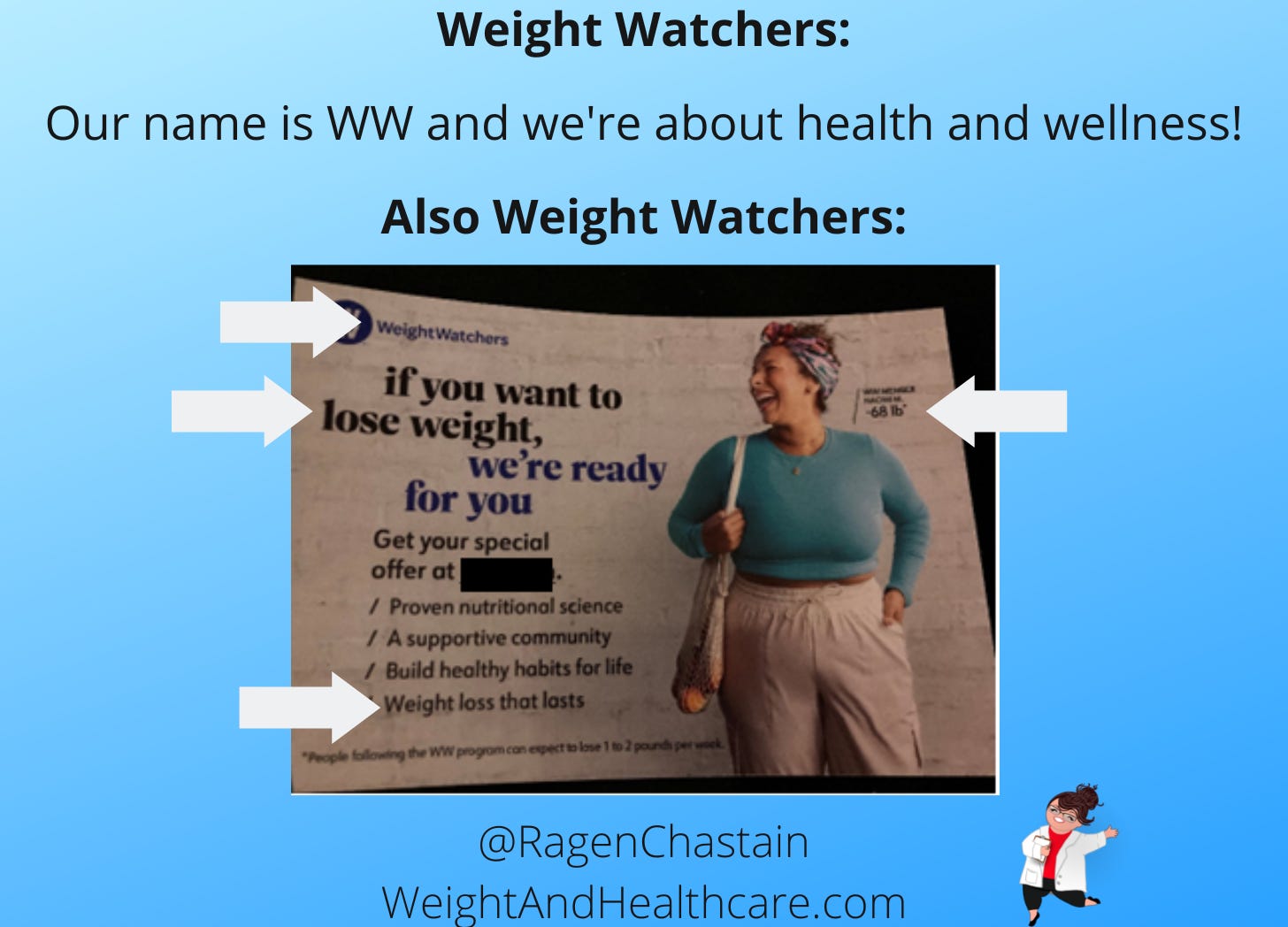
This is the Weight and Healthcare newsletter! If you appreciate the content here, please consider supporting the newsletter by subscribing and/or sharing!In 2018, Weight Watchers changed its name to “WW” added the tagline “wellness that works” and started using language about “health” and “wellness” and “beyond the scale.” Per a Fast Company article this happened because “In this new era of body image acceptance and feel-good wellness communities, Weight Watchers learned that the term “diet” was rife with negative connotations.” Another way to put this is that weight-neutral health and fat acceptance advocates had made tremendous headway in pointing out that, even according to Weight Watchers’ own research, their program almost never creates significant long-term weight loss. Thus, this seemed to be a fairly transparent attempt to co-opt the work of weight-neutral advocates and fat acceptance activists in order to keep selling a program that almost never works. The thing that they seem to have going for them is an uncanny ability to convince their clients (and everyone else) to credit Weight Watchers for short-term weight loss (the first part of the biological response to restriction) and then get their clients (and everyone else) to blame themselves for the weight regain that almost everyone experiences (the second part of the biological response to restriction.) In this way, they convince people to keep coming back for multiple rounds, which forms the nucleus of their repeat business model.According to an article by Traci Mann called “Oprah’s Investment in Weight Watchers Was Smart Because the Program Doesn’t Work”:“[Weight Watchers] brags about this to its shareholders. According to Weight Watchers’ business plan from 2001 (which I viewed in hard-copy form at a library), its members have “demonstrated a consistent pattern of repeat enrollment over a number of years,” signing up for an average of four separate program cycles. And in an interview for the documentary The Men Who Made Us Thin, former CFO Richard Samber explained that the reason the business was successful was because the majority of customers regained the weight they lost, or as he put it: “That’s where your business comes from.”Their rebrand to wellness builds on this scam. Which brings us to the postcard I received in the mail recently.Image Description: A postcard with a gray backgroundText: At the top left is the WW logo next to the words WeightWatchersIf you want to lose weight, we’re ready for youGet your special offer at [redacted]· Proven nutritional science· A supportive community· Build healthy habits for life· Weight loss that lastsImage:A smiling woman in a blue long-sleeve crop top and beige drawstring pants carrying a canvas bag with a scarf in her hair smiles with an open mouth. Beside her it says “New Member Naomi M -68 lb*” The * says “People following the WW program can expect to lose 1 to 2 pounds per week.Here we see their old and new tricks on display:Old tricks* Showing someone with a relatively large amount of weight loss with an asterisk that goes to a disclaimer.* The disclaimer is completely unclear. It makes it sounds like the average Weight Watchers participant will have the same results as the model within 34-68 weeks, but the research absolutely does NOT support that* They claim “weight loss that lasts” even though their own research (and a century of data) say that it is a straight-up lieNew tricks:They market publicly about “health” and “wellness” to avoid the negative connotations of diets, but when it comes time to really sell, they bring out the weight loss talk:* It says “Weight Watchers” right there at the top (even though they “officially changed their name” to WW)* The model has their weight loss listed, but absolutely no information about their health* “If you want to lose weight” is at the top, in the largest font* “Build healthy habits for life” only rates as a small font third bulletWeight Watchers, or WW, whatever they call themselves, they are not about health. They’ve never been about health, because they’ve been very clear that their profit model is built on weight cycling which is independently linked to harm. If they actually cared about people’s health, they would have either moved to a weight-neutral model or, preferably (at least to me,) just shut the whole mess down. I’d bet all the money in my pockets that this whole switch to marketing about “health” is about finding a way to co-opt the work of weight-neutral advocates and fat liberation activists, gloss over Weight Watchers’ utter failure at creating long-term weight loss, and trying to get people to stay on their program even though they are gaining the weight back, all while continuing to convince their customers to blame themselves for having the outcome that about 95% of people have.Essentially, Weight Watchers is a highly profitable scam. The fact that they have wheedled their way into corporate wellness programs and health insuran
Are Medicare and Medicaid Patients Required to Weigh-In?
This is the Weight and Healthcare newsletter! If you appreciate the content here, please consider supporting the newsletter by subscribing and/or sharing!I hear from a lot of people who are on Medicare and Medicaid that they have been told that they are required to weigh in at their appointments or the services won’t be covered. This is a misconception. Medicare and Medicaid's Merit-based Incentive Payment System (MIPS) (Content note – link contains anti-fat language), does require physicians to document a discussion, treatment plan, and follow-up for each patient with a BMI over 24.9 at least once per "performance period" (though it is not considered a “High Priority Measure.)This is part of a doctor's "quality score," which is closely tied to the reimbursement they receive. Basically, doctors can get a lower quality score and then be paid less for the services they did provide if they don't push weight loss.This is problematic on any number of levels (not the least of which is that it is encouraging doctors to give advice that is not ethical, evidence-based, or likely to work, and may well end up harming their patients. Regardless, your doctor receiving less compensation does not waive your right to informed consent/refusal. So even if it means your doctor gets paid less, they still have an ethical obligation to allow you to refuse routine weigh-in. But there’s good news, in researching this, I found that if a patient opts out of weigh-in, that patient is removed from both the numerator and the denominator for the doctor’s MIPS calculation. I wanted to double-check this, so I reached out to Kelley Aurand, DO, family physician and Informaticist who said:“Basically, if the patient declines weight or there is an underlying medical reason not to weigh, then the patient can be excluded from the denominator.”Dr Aurand also provided a link to an explainer document. While I do want to point out that it is deeply rooted in the weight loss paradigm, it may be something you can share with your healthcare provider (in particular, check out the “denominator exceptions” section.) Aurand does point out that there may be some tricky technical issues for your provider to navigate: “One would need to document this [weigh-in denial/medical reason for not weighing in] discretely in the electronic health record (EHR) so it can be automatically excluded from the reporting tools that are used for MIPS. I doubt most EHRs have this built in. We use one of the major EHRs and I'm not aware of a mechanism to document this information so the patient would be removed from the measure.” Still, you get to center your needs and experiences as a patient and, just like lowered compensation, technical difficulties faced by your provider do not negate your right to informed consent/refusal of the weigh-in as a Medicare/Medicaid patient. If you’re looking for options to decline the weigh-in, I have a piece about that here.Shelby Gordon and I also cover this in our video workshop: Navigating Weight Stigma at the Doctor’s Office (there is a pay-what-you-can-afford option so that money isn’t a barrier.) Did you find this newsletter helpful? You can subscribe for free to get future newsletters delivered direct to your inbox, or choose a paid subscription to support the newsletter and get special benefits! Click the Subscribe button for details:Like this piece? Share this piece:More ResearchFor a full bank of research, check out https://haeshealthsheets.com/resources/*Note on language: I use “fat” as a neutral descriptor as used by the fat activist community, I use “ob*se” and “overw*ight” to acknowledge that these are terms that were created to medicalize and pathologize fat bodies, with roots in racism and specifically anti-Blackness. Please read Sabrina Strings: Fearing the Black Body – the Racial Origins of Fat Phobia and Da’Shaun Harrison: Belly of the Beast: The Politics of Anti-Fatness as Anti-Blackness for more on this. Get full access to Weight and Healthcare at weightandhealthcare.substack.com/subscribe
Does This Study Really Show How To Maintain Weight Loss?
This is the Weight and Healthcare newsletter! If you appreciate the content here, please consider supporting the newsletter by subscribing and/or sharing!Reader Barbara sent me an article with the headline “How to Maintain Weight Loss, According to People Who Succeeded.” The article was about a study called “In their own words: Topic analysis of the motivations and strategies of over 6,000 long-term weight-loss maintainers” by Phelan et. al. (as always, I don’t link to research or articles that include fatphobic content.)The premise:This is a study, funded by a grant for Weight Watchers (aka WW) that analyzes 6,139 subjects’ responses to six open-ended questions. Two of the study authors are current employees and shareholders in Weight Watchers.I think it’s important to put this in context. They have 6,139 people who participated, out of a total of 7,419 who are part of Weight Watcher’s “success registry” (more on this later). Weight Watchers (aka WW) had 4.5 million subscribers at the end of 2020 alone (which was down 4.3% year over year). The subjects here represent just 0.14% of that, the total membership of their “success registry” is just 0.16% of their 2020 enrollment alone. So, like the NWCR before it, it is highly likely that this study is simply finding commonalities among outliers.Inclusion Criteria:In order to be included in the study, participants had to lose greater than or equal to 20.0621lbs (9.1 kg) and they only had to maintain it for one year. The average maintenance period was 3.4 years.About a century of research shows that people who lose weight tend to regain it within five years so the fact that they’ve used inclusion criteria less than that is questionable.It should also be noted that at the time of the study the “maintainers” had gained an average of thirteen pounds from their lowest weight, suggesting that the study authors and I have a different interpretation of the word “maintain.”Also, 67.3 percent of the “maintainers” were still categorized as “overw*ight” or “ob*se” Now, those are nonsense categories, made up to pathologize bodies based on size, and drive profit to the weight loss industry (and creating a lot of harm to those who are labeled as such.) But I point this out because these are categories that are used by this industry to drive profit. I think it’s important to know that two-thirds of this sample would still be targeted by Weight Watchers as potential customers, even though, here, they are considering them to be successes.IntroductionThe first half of their first sentence says “Modest weight loss can reduce long-term risk of cardiometabolic disease”There is no citation for this, and I assume that because it’s not a statement of fact. We’ve explored this myth before, and also that research shows that weight-neutral interventions provide greater benefits with fewer risks (for example, Gaesser and Angadi found that increases in cardiorespiratory fitness and physical activity are consistently associated with greater reductions in mortality risk than is intentional weight loss.)Back to the Weight Watchers study, the second half of their first introductory sentence /[admits that weight gain affects most individuals.Points for honesty there.Then they claim “Nevertheless, about 20% of individuals who have lost weight in the US population are able to keep it off long-term”Aaaand, I take the points back. They cite three studies to support this claim. The first defines long-term weight loss as “at least one year,” ignoring that most people regain to baseline or above in years 2-5. The second has a conclusion that literally states “most women who lost a clinically significant amount of weight regained most of it,” and the third only looks at a year of data, and used a sample group who were 10% below their starting weight the year before they were studied (without looking at whether they were already regaining) and found that 33.5% had regained weight, and while they claim that 58.9% had maintained their weight, they defined maintaining has having regained less than 5% of weight, so people could regain weight, but still be considered maintainers.This is a good example of how terrible research begets terrible research, all supporting diet industry profits. Every researcher in every one of these studies should know better, and citing them uncritically is inexcusable.This credibility is not helped by the fact that they uncritically cite the National Weight Control Registry with its questionable science.Results:In terms of extrapolatability, I want to point out that 91.9% identified as female; 94.3% identified as white.Subjects were asked six open-ended questions and only 12.9% of the subjects completed all of them. Subjects only had to complete one question to be included in the study.* What prompted you to start your weight-loss attempt? Please describe. (n = 6,092; 82.1%)* What currently motivates you to manage your weight? (n = 5,710; 77.0%)* What is one piece of advice that y

Reader Question – What’s the Deal with Lark Health?
This is the Weight and Healthcare newsletter! If you appreciate the content here, please consider supporting the newsletter by subscribing and/or sharing!I have had several readers ask about the Lark program. In each case, it was being actively marketed to them, without their consent, by their insurance company and/or employer.Lark is, predominantly, a weight loss program that also bills itself as a “diabetes prevention” program and “mind body” health coaching all offered by an Artificial Intelligence powered app. (Note that while it has various health programs, the big font headline at the top of the website says “Lose weight and be your healthiest self with Lark.”) It is covered by some insurance, and people can “earn” things like a scale and a fitbit by meeting “minimum program engagement requirements, such as weighing in, completing missions with your digital coach, and logging activity or meals.”The graphic on their website that they are calling “clinically proven results” says:5.3% average weight loss in year one (1)40% achieving greater than or equal to 5% weight loss in year one (1)9.6lbs average weight loss by Lark members beyond 2 months in the program (2)(1) Based on Lark program data for members meeting CDC qualification criteria(2) For those with available weight dataThese results are from the study Weight Loss in a Digital App-Based Diabetes Prevention Program Powered by Artificial Intelligence, Graham SA, Pitter V, Hori JH, Stein N, Branch OH. Accepted, Digital Health, vol 8. 2022. DOI:10.1177/20552076221130619 (as always, I don’t link to studies that pathologize higher-weight bodies, but I provide enough information for those who are interested to find them on Google.)The study’s lead author is Sara Graham who, according to LinkedIn is the “Clinical Research Manager at Lark Health”, in fact, per the conflict of interest statement, every single study author is employed by Lark.Let’s dig in, shall we?Let’s start with the study’s stated conclusion: [Lark] facilitated weight loss and maintenance commensurate with outcomes of other digital and in-person programs not powered by AI. Beyond CDC lesson completion, engaging with AI coaching and frequent weighing increased the likelihood of achieving ≥5% weight loss. An AI-powered program is an effective method to deliver the DPP in a scalable, resource-efficient manner to keep pace with the prediabetes epidemic.When they say “commensurate with outcomes of other digital and in-person programs” what I think you’ll find they mean is – people didn’t lose much weight, just like with every other program as we have seen in research for the last hundred years.And when they say it’s an effective way to deliver the DPP [Diabetes Prevention Program] it’s important to know that they did not, in any way, measure blood sugar, or anything other than weight and weight loss.But let’s really dig into the numbers:The one-year study started with 3,933 Lark Members, but at its 12 month conclusion only 414 members had provided beginning and ending weights.Those 414 were divided into two groups for comparison:Group 1: CDC qualifiers: Completed ≥4 educational lessons over 9 months (n = 191)Group 2: CDC non-qualifiers: did not complete the required CDC lessons but provided weigh-ins at 12 months (n = 223)So, did you catch that? They started with 3,933 members and only 191 actually managed to stay with the program for a year. (The other 223 “group 2” didn’t complete the program but did provide their weight at the beginning and at 12 months.) My first question is: Do the results matter if fewer than 5% of people even make it to a year on this program? I think the answer is…not really, but let’s go ahead with the analysis.What they actually found is that the 191 people in group 1 lost, on average 5.3% of their body weight, while the 223 in group 2 lost, on average, 3.3% of their body weight. So those who completed the program lost, on average, 2% more weight over the course of a year.To put some numbers on this, a 200-pound person who completed the coaching would expect to lose, on average 10.6 pounds in a year, while a 200-pound person who didn’t complete the coaching would lose 6.6 pounds. So this shows that a 200-pound person who completes the 12 month program can expect to lose 4 pounds more than someone who didn’t complete the program.Four pounds. In a year.Think of what the phrase “clinically proven results” would lead you to believe about a weight loss program. Then consider that they are using the phrase “clinically proven results” to characterize 4.8% of study participants losing, on average, 2% more weight than 5.6% who did not complete the program but at least provided a 12-month weigh-in, a conclusion which doesn’t include any data for 89.6% of the study participants.If you’re currently asking yourself something like: “Wait, doesn’t this kind of prove that their program is useless? And why, like, in the world, would anybody brag about these results?” then welcome to

Is Being Fat Really a Chronic, Lifelong Health Condition?
I got this question recently:“I’ve been seeing articles that say that being fat* is considered a “chronic lifelong condition.” Can you explain what’s going on to me?” Get full access to Weight and Healthcare at weightandhealthcare.substack.com/subscribe