
Weight and Healthcare
295 episodes — Page 6 of 6

Dubious Justifications Behind Request to WHO to Declare Diet Drugs "Essential" Part 2
This is the Weight and Healthcare newsletter! If you like what you are reading, please consider subscribing and/or sharing!In part 1 we talked about a request that has been submitted for the World Health Organization (WHO) to add diet drugs to their list of “essential medicines.” We discussed who was making this request and the justification that they were using. Today we’re going to take a deeper dive into the research that they used to try to support this request, and in part three will look at the research around harm and “efficacy,” as well as “cost effectiveness.” (I was originally going to write this in two parts, but I realized that it was just ridiculously long, and there is time before the WHO meets about this, so I’ve decided to break it into three parts.)Just a reminder that I don’t hyperlink to studies or articles that come from a place of weight stigma, though I do provide enough information that someone could google them.In their ”Summary statement of the proposal for inclusion” they say“The use of GLP-1 RAs in the treatment of ob*sity has been well studied and meta-analyses of various GLP-1 RAs have demonstrated that this class of medications can lead to clinically significant weight loss. Compared to control groups, GLP-1 RAs were found to lead to more significant weight loss with a mean difference of approximately 7.1 kg as well as an improvement in glycemic control, with low concern for hypoglycemia[3].”The single paper they cite to back this up (Iqbal et al. Effect of glucagon-like peptide-1 receptor agonists on body weight in adults with ob*sity without diabetes mellitus-a systematic review and meta-analysis of randomized control trials, 2022) looked at weight loss on these drugs among “ob*se” adults without type 2 diabetes (so hypoglycemia would have been unlikely anyway.) It included 12 trials with a total of 11,459 participants. 80% of the participants were white, 10% were Black or African Americans and 5% were Asians. It is concerning that they are making a global recommendation based on a study population that is overwhelmingly white. There is also the issue of follow-up. Some of the trials were as short as 14 weeks and the longest trial included was only 3 years. The average weight loss was 15.6 lbs more in the group taking the drugs than in control, but some subjects on the drugs lost as little as 5.5 lbs. Those on the drugs also experienced vomiting, nausea, dyspepsia (indigestion,) diarrhea, constipation and abdominal pain as common side effects. There is no way to know how much of this (short-term) weight loss is due to experiencing these common side effects. These drugs also have significant (possibly life-threatening) side effects and the short-term follow-up included here is not likely long enough to capture those. Also, remember that the recommendation is for people to take these drugs for the rest of their lives (since, if they don’t, their weight shoots right back up and they lose cardiometabolic benefits,) and they are making that recommendation (globally) on just 14 weeks to 3 years of data.The authors of this study cite no conflicts of interest. Per LinkedIn, someone with the same name as the lead author is a product specialist at Novo Nordisk but I imagine that must be a coincidence or surely it would have been listed as a COI. The article was published in “Ob*sity Reviews” which is an official journal of the “World Ob*sity Federation” (WOF). The WOF took over $5.3 Million dollars from Novo Nordisk (whose weight loss drugs are covered by this recommendation) over three years. Their “members” include the Ob*sity Action Coalition (whose chief funder is Novo Nordisk.) Their current President has taken money to speak on behalf of Novo Nordisk and their past president is John Wilding who was implicated in the recent Novo Nordisk scandal for not disclosing his financial ties to Novo Nordisk while praising their weight loss drugs in the media.There are more issues with this meta-analysis but I’ll just stop there and say that I don’t think there is any way that 14 weeks to 3 years of data on 11,459 people who are mostly white justifies a global recommendation of these drugs as “essential.”Under “Treatment details (requirements for diagnosis, treatment and monitoring)”Here again they say “Ob*sity, a preventable disease” but offer no citation or support for this narrative that has been largely architected and marketed by the weight loss industry. They continue:“When used in supplement to life style modifications, including a decrease in caloric intake and an increase in exercise, liraglutide is indicated for adults with ob*sity (BMI >30.00) or overweight (BMI >27.00) with a weight-related comorbidity”I just want to note here that this indication (which wasn’t created by those who wrote the recommendation to the WHO) predicates risk on body size and simple correlation. These drugs have very unpleasant common side effects and other, possibly life-threatening, side effects. So the
A First Step to Solving Weight Stigma in Healthcare Interactions
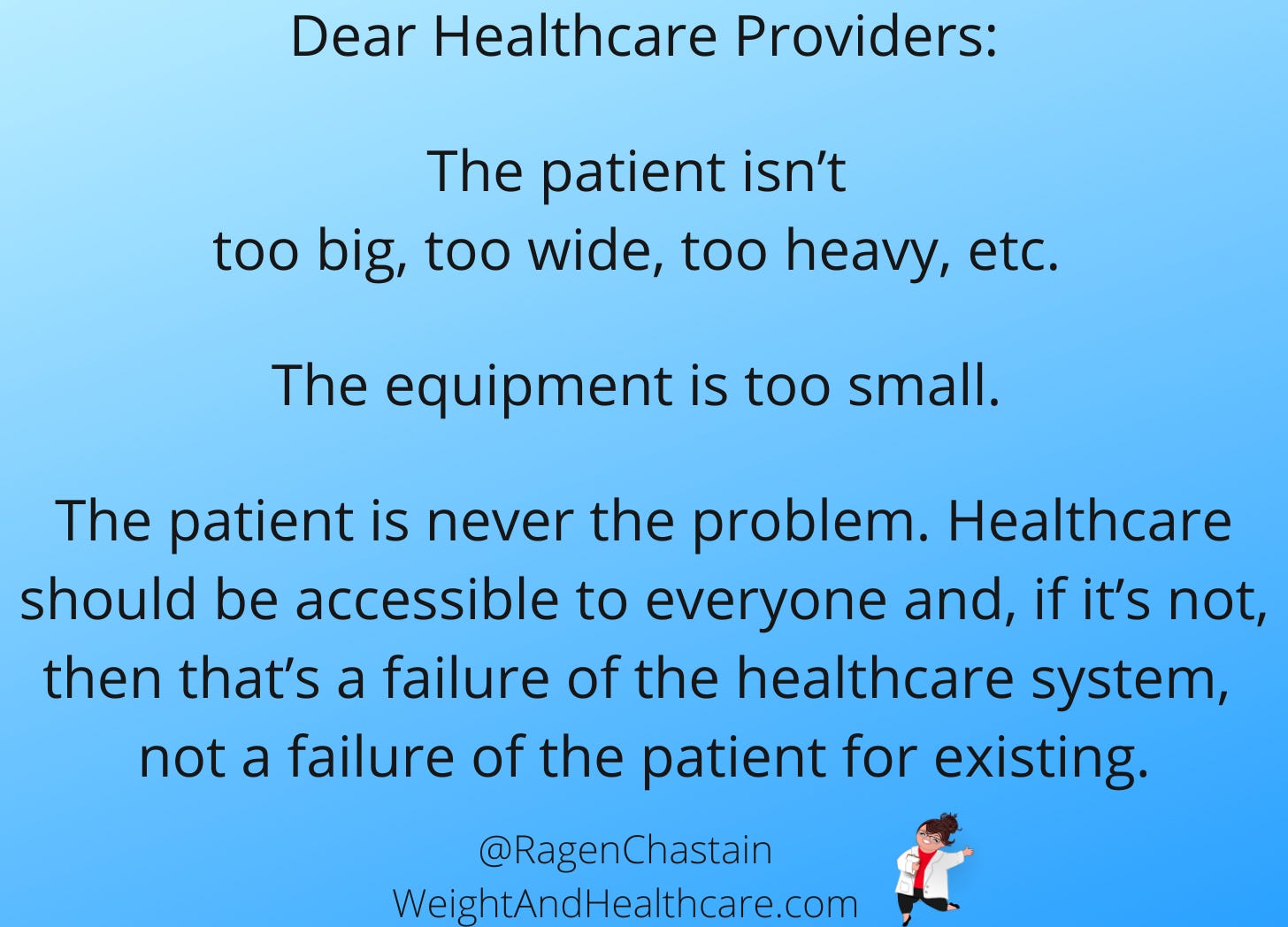
This is the Weight and Healthcare newsletter! If you like what you are reading, please consider subscribing and/or sharing!There are a number of different ways that bias can impact the healthcare that higher-weight patients receive. This includes provider bias and structural bias (when the healthcare system is created for thin bodies and/or to the specific exclusion of fat bodies.) Today I want to talk about what happens when these two types of bias intersect. It’s a perfect storm that both supports and increases this bias. It doesn’t have to be this way, and there is a simple first step (though it’s certainly not the only step,) that healthcare providers can take to interrupt it. Let’s look at some real-world examples (shared anonymously with permission):A fat patient arrives for a mammogram. They receive a gown but it doesn’t fit, they ask for a larger gown and the tech says “If you’re too big for that one I can give you a second one and you can wear both.”A fat patient needs an MRI. They get on the table, and it begins to move. But the patient’s hips catch on the sides. The tech stops the table, and says “Your hips are too wide for the MRI, we wont’ be able to do the scan.”A patient goes to the pharmacist to get Plan B for pregnancy prevention. The pharmacist asks the patient’s weight and then says “Your weight is too high for this pill to be effective.”A fat patient calls 911 because they have symptoms of a stroke. The paramedics arrive and say “you are too wide to fit on our gurney, we’re calling a special ambulance to transport you.”A fat patient gets a report back on a CT scan and it says that conclusions could not be drawn because of the “patient’s body habitus.”A fat, pregnant patient arrives at an Ob/Gyn practice for their first pre-natal visit. The receptionist says “You are too heavy for our tables so we can’t accept you as a patient.”A fat patient points out to the receptionist that all of the chairs in the waiting room are too small for them, the receptionist says “I’m so sorry but if you don’t fit in the chairs you’ll need to stand.”A fat patient is at the doctor for their annual pap smear. The gynecologist says “I’m sorry but you are too heavy for our largest speculum, if you want to make another appointment and bring your own, we can proceed.”A fat patient has injured their knee and sought care in the ER. The doctor says that “there is nothing he can do to help, you’ll need to get an MRI and see an orthopedist and you should keep the knee immobilized and not put any weight on it or you could cause catastrophic injury. Unfortunately, your knee is too big for the immobilization braces we have, and your weight is too high for the crutches. We can let you use a wheelchair to get to your car but then you’re on your own.”A fat patient has come to the ER for chest pains. An EKG has shown arrhythmias and blood tests show elevated troponin. The nurse explains that the patient is being admitted but says “I apologize but you are too heavy for our ER beds, we are waiting on a bariatric bed to be brought down.”Again, these are all true stories that have happened to higher-weight patients and there are a LOT of things wrong here that negatively impact patient care. But did you notice the one thing that all of these scenarios had in common? The one thing that, had providers done it differently, could have immediately reduced the weight stigma being experienced by the patient (even though many other steps are necessary to actually solve the problem)?Feel free to take a minute to think about it, or read on for the answer.The one thing that each of these scenarios have in common is that healthcare providers blamed the patient’s body for the lack of accommodation. This is a common way that we see both implicit and explicit bias surface and intersect with structural weight stigma. The patient is already experiencing structural weight stigma that is impacting their care, the added stigma of being blamed for the healthcare systems’ failure to accommodate them adds insult to injury and adds harm.Solving weight stigma can be difficult and involve a lot of action from a lot of different people, but this one can be solved by each individual provider at the point of care. The patient isn’t “too big,” “too wide,” “too heavy,” etc. The equipment is too small. The patient is never the problem. Healthcare should be accessible to everyone and, if it’s not, then that’s a failure of healthcare, not a failure of the patient for existing in a body with needs that were completely predictable.One way to think about this is “Did the decisionmaker here not know that fat patients existed, or did they just not care if fat patients got the same care as thinner ones?” Either way it’s an absolute failure of the healthcare system, not the patient.It’s entirely possible that the lack of accommodation is not the fault of the provider who is currently working with the patient, but they can still be the one to apologize and make it clear t

Novo Nordisk Gets Caught In Shady Marketing Practices - Part 2
This is the Weight and Healthcare newsletter! If you like what you are reading, please consider subscribing and/or sharing!In Part 1 we talked about how Novo Nordisk got suspended from The Association of the British Pharmaceutical Industry for their shady marketing practices. Today, we’re going to talk about an investigation by The Observer that found what so many of us have been saying for a looooong time - that Novo Nordisk had paid millions to prominent ob*sity “charities,” NHS trusts, universities and other bodies as well healthcare professionals who publicly praised the drug (typically without disclosure of their funding) and who advised NICE (The National Institute for Health and Care Excellence) on their reviewing of Novo’s weight loss drug to decide whether or not it should be made available.The Observer article by Shanti Das and Jon Ungoes-Thomas “‘Orchestrated PR campaign’: how skinny jab drug firm sought to shape ob*sity debate” (Note: per my policy I’m not linking to it because it still comes from a place of weight stigma) found that in three years, Novo Nordisk had shelled out £21,700,000 (about $26,415,301.50 USD) over 3,500 transactions which were separate from their research and development spending.The Observer found:“The payments include donations, event sponsorship, grants and other fees to prominent ob*sity charities, NHS trusts, royal colleges, GP surgeries, healthcare education providers and universities - on top of £28m spent by the company on research and development. A further £4m in payments such as consulting and lecture fees went to health professionals, including experts on ob*sity. The business has also provided financial support for the running of the all-party parliamentary group on ob*sity - a cross party group of MPs and members of the Lords that lobbies the government on health policy.”I’ve written before about how major papers like the New York Times are writing articles that are, essentially, lobbying for Novo Nordisk’s priorities where every expert quoted is on Novo’s payroll with no disclosure. One question I get asked a lot is “how is that legal?” First I’ll point out that legal and ethical are two different things. Beyond that, there is a tendency to believe that doctors and academics are somehow immune to industry influence (or to the ways that their promotion of the weight loss paradigm will support their careers) such that reporters and others (including those on the pharma industry’s payroll) claim that disclosing these conflicts of interest isn’t important.An excellent example of the ways in which those who are seen as “impartial” experts in academia are, in fact, on the payroll of these companies and actively shilling for them is Professor John Wilding. Professor Wilding is at Liverpool University, where he leads clinical research on “ob*sity.” He also serves as president of the “World Ob*sity Federation” (an astroturf organization similar to the Ob*sity Action Coalition) which took more than £4.3M over three years, per The Observer. Somehow, this did not make its way onto his conflicts of interest statement. Meanwhile, he was quoted extensively in the media recommending Novo’s drug Wegovy. Jason Halford, who is the Head of the School of Psychology at the University of Leeds, told an audience of millions on BBC that Wegovy is “one of the most powerful pharmaceutical tools” for treating “ob*sity.” He did not disclose that he is also the president of the European Association for the Study of Ob*sity (EASO), another astroturf organization (which is to say, an organization that claims to advocate for marginalized people but, in reality, is predominantly funded by and acting as a lobbying arm of, the pharmaceutical/weight loss surgery industry.) The Observer found that the EASO received more than three-quarters of its income (more than £3.65m) from Novo Nordisk. He was also a previous member of Novo Nordisk’s UK advisory board.I’m glad Novo Nordisk’s lack of ethics are getting wider coverage (though, as I pointed out in part 1, people in fat liberation and weight-neutral health advocates like Mikey Mercedes, Louise Adams, Asher Larmie, myself and others have been talking about this for some time,) but I don’t expect it to stop them until we can put enough pressure on them to force them to stop. This is a company that orchestrated aggressive price gouging on insulin, proving beyond a doubt that they will kill people for money. And as pressure in the US is forcing Novo to lower the price of insulin, they seem to have a lot of eggs in the Wegovy basket. Prior to launch, they promised their shareholders the “fastest ever” post FDA-approval launch and that they would double their “ob*sity” sales by 2025. In fact, The Observer found that Novo Nordisk’s sales on their new “ob*sity treatments” rose 84% in 2022 to $2.4B – a figure Novo projects will “grow significantly” in 2023.And what will they do to grow this figure significantly this year? I think their behavior makes it

Novo Nordisk (Finally) Faces Some Consequences for Their Deceptive Marketing Tactics - Part 1
This is the Weight and Healthcare newsletter! If you like what you are reading, please consider subscribing and/or sharing!If you have read this newsletter for any period of time, you’ve read my accounts of how pharmaceutical company Novo Nordisk has been using extremely shady marketing practices (many taken from the playbook that Purdue Pharma used to push oxycontin) to promote their drugs for weight loss. Things likePutting doctors on their payroll to promote their drugs to the media without disclosing their ties to the NovoCreating astroturf organizations that claim to be advocacy groups for higher-weight people but are, in fact, funded by Novo and other pharma and weight loss surgery groups.Marketing their drug through Grand Rounds presentationsCreating PSAs and Sponsored Content using people who (you can’t make this stuff up) play doctors on TVCo-opting the concept and language of anti-weight-stigma activists in order to sell their weight loss drugsAnd I’m far from the only person talking about this.Mikey Mercedes has publicly called this out. Louise Adams from Untrapped has been all over it (I had the chance to join Louise Adams and Fiona Willer on Louise’s Podcast All Fired Up to talk about this)Asher Larmie, The Fat Doctor, has also been talking about thisAnd there are plenty of others.Part of the issue is that in the United States pharma companies are allowed to market direct-to-consumers , and the rules and regulations that exist are often loosely enforced. That’s why I was thrilled to learn that The Association of the British Pharmaceutical Industry (ABPI,) a trade association that works in England, Scotland, Wales, and Northern Ireland in partnership with the government and the NHS on behalf of their members, had suspended Novo Nordisk for being in breach of the ABPI code of practice.Interestingly, just a month ago, the president of ABPI was Novo Nordisk UK General Manager and Corporate Vice-President Pinder Sahota. Sahota stepped down from the board in February “to avoid an ongoing process around a Novo Nordisk ABPI Code of Practice breach becoming a distraction from the vital work of the ABPI.”The complaint was made to The Prescription Medicines Code of Practice Authority (PMCPA) which is “the self-regulatory body which administers the Association of the British Pharmaceutical Industry (ABPI) Code of Practice for the Pharmaceutical Industry, independently of the ABPI. It was established by the ABPI on 1 January 1993.”The complaint centers around a LinkedIn post offering practitioners a free “weight management” course. The only “weight management” treatment covered in the course was GLP1-RA drugs. Novo Nordisk was, at the time, the only company selling these drugs. The course was “sponsored” (paid for) by Novo Nordisk, but that was not clear in the LinkedIn Ad.Not only did this “course” offer information, but they also offered a free Patient Group Direction (PGD). Per the NHS a PGD is “a written instruction for the sale, supply and/or administration of medicines to groups of patients who may or may not be individually identified before presentation for treatment. May or may not be identified means an individual can either be known to the service/have an appointment (e.g. a baby immunisation clinic) or not be known in advance of presenting at a service (e.g. a walk in centre).PGDs are not a form of prescribing. PGDs allow health care professionals specified within the legislation to supply and/or administer a medicine directly to a patient with an identified clinical condition without the need for a prescription or an instruction from a prescriber. The health care professional working within the PGD is responsible for assessing that the patient fits the criteria set out in the PGD.”The complainant pointed out that the PGD was part of what was being offered to individual health professionals by Novo Nordisk, that it had a value, and that it was being given to individuals for their own personal benefit to run private clinics. The complainant suggested that this amounted to bribing health professionals with “an inducement to prescribe.”The complainant noted that on the website the course had been run several times, so it was likely that a large number of health professionals had received this offer.The ABPI review panel found that the training was provided by a third party, but attendees and PGDs were sponsored by Novo Nordisk. The training mentioned three drugs, the first two (orlistat and naltrexone/bupropion) were presented as having significant side effects and contraindications, while the third drug, Novo’s Saxenda, did not include side effect information (though they are significant) and the training noted that Saxenda could be provided by an appropriate health professional with a valid PGD (which was provided by the course.)The training included 21 slides about Saxenda, but no such detail on the other two drugs.Sponsorship of third party trainings by drug companies are permissible by APBI “o
Reader Question - Sleep Apnea and Weight
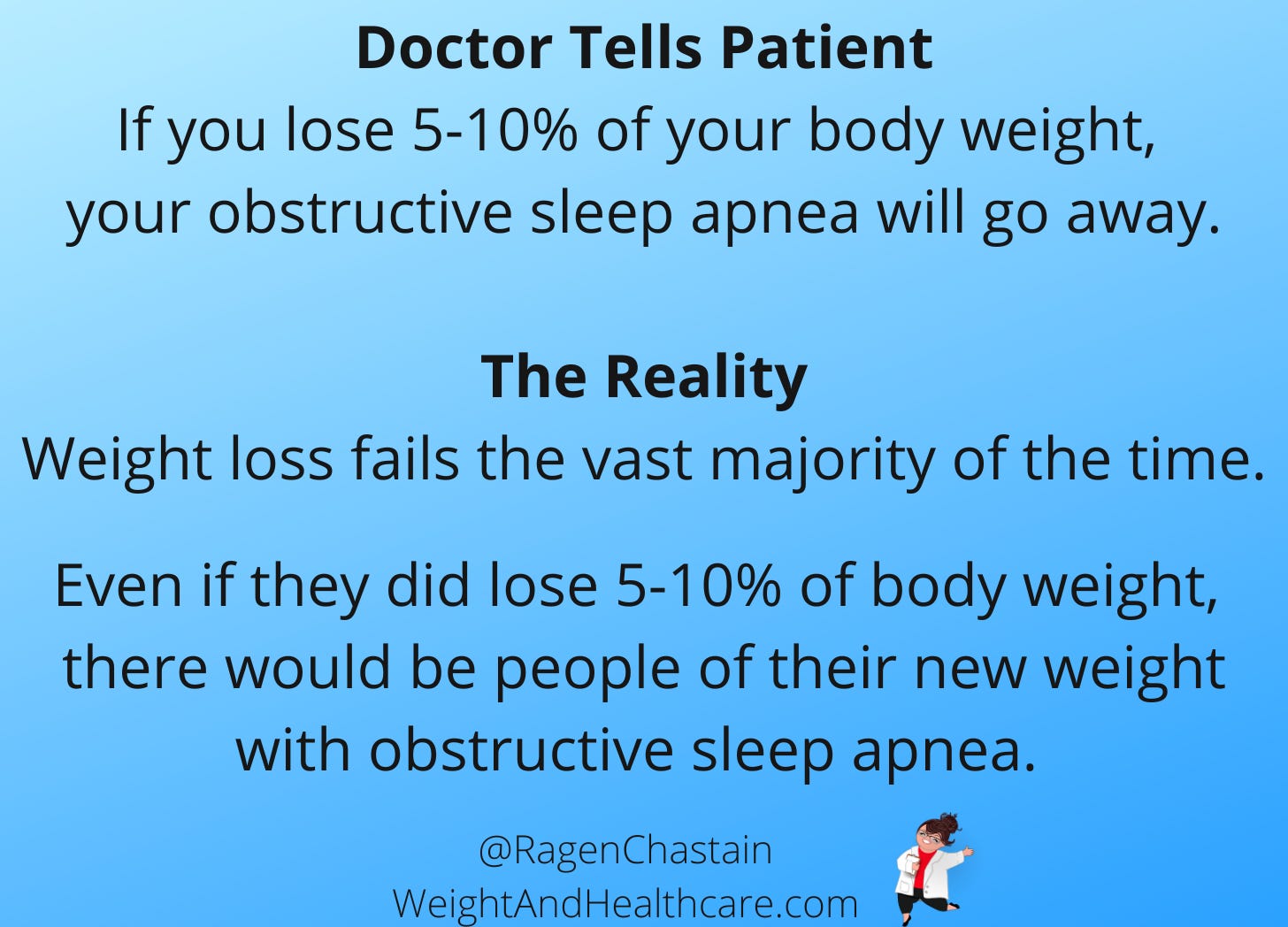
Transcript This is the Weight and Healthcare newsletter! If you like what you are reading, please consider subscribing and/or sharing!Reader Marcel sent me the following question:I just got diagnosed with sleep apnea. My doctor told me that if I could just lose 5-10% of my body weight, it would go away. I’ve yo-yo dieted all my life and sometimes got to 5% lost before it came back, but never even got to 10% and most times I ended up heavier than when I started. I’m nervous to try again, but sleep apnea is really scary.There are a lot of things that can contribute to obstructive sleep apnea (OSA,) including everything from enlarged tonsils to hereditary structural issues, to heart issues and more. It’s possible that someone’s size and/or the way that their adipose tissue is distributed could contribute to OSA. But it’s complicated, in part because sleep apnea is known to induce weight gain so when they say x percent of people who have sleep apnea are fat, we don’t know to what extent it may be a chicken and egg situation.It can also simply be a function of the number of fat people who exist. For example (and I’m using made-up numbers for this,) the statistic might say “being fat is a risk factor because 60% of people with sleep apnea in the US are fat.” However, if 70% of people in the US are fat and only 60% of people with sleep apnea are fat, then fat people are actually underrepresented. (Incidentally, I’ve seen a lot of this mistake happening with COVID numbers.) It may also be a function of testing bias – if fat people are tested much more often for sleep apnea than thinner people, then it would not be surprising if fat people had a higher incidence.It’s also important to understand that even if someone’s sleep apnea is caused by weight/adipose tissue distribution or body size in general (for example, body builders have also been shown to be at higher risk with associations to their BMI and also to their neck circumference,) that still doesn’t mean that weight loss is an appropriate treatment. For that to be true, weight loss would have to meet the requirements of an ethical, evidence-based intervention. Given that it fails the vast majority of the time, and has the opposite of the intended effect up to 66% of the time, it doesn’t qualify.While there is some short-term research that shows a decrease in OSA symptoms/severity with weight loss, those studies don’t capture the likely weight regain, nor do they separate the impact of the behavior changes that people make from the impact of weight loss (in research around other health issues, it’s been found that it’s likely the behavior changes, not the weight loss that create the health impacts.) There are other studies that find that, for example, “physical activity has been found to have a 32% reduction in the AHI (a reduction of 6.27 events/h) and a 28% reduction in daytime sleepiness, as well as a 5.8% increase in sleep efficiency and a 17.65% increase in VO2peak, having found no significant reduction in the BMI. (The role of physical exercise in obstructive sleep apnea, de Andrade 2016.) This is consistent with other research about movement and health. Of course, this isn’t a deep dive into the research, I just want to make the point that when people claim that the research shows that weight causes OSA and weight loss solves it they are not stating anything resembling a proven fact.Moving on to Marcel’s doctor’s claim that losing 5-10% of body weight will make the sleep apnea go away. There are people of all weights with (and without,) sleep apnea, so suggesting that losing a specific amount of weight will help is based on some questionable logic and math. For example,A 300-pound person has sleep apnea and is told that losing just 5%-10% (thus weighing 270-285 pounds) will make it go away.But if someone who weighs 270-285 pounds has sleep apnea, they are told that…losing 5-10% of their weight will make it go away.Then, a 200-pound person who has sleep apnea, even though they are 100 pounds lighter than the first person, will be told that…losing just 5-10% of their weight will make it go away.Also, remember that up to 66% of the time, weight loss ultimately ends up in regain. So if a 300-pound person has sleep apnea and tries to lose 5-10% of their body weight, but then regains to 315-320, they would be told that they should lose 5-10% of their body weight to make their sleep apnea go away…which would put them right back at 300 pounds.This is not scientific. Essentially, whatever weight/BMI a healthcare practitioner says someone should achieve in order to help their apnea, there are already plenty of people at that weight/BMI who have sleep apnea (and that’s before we point out that significant, long-term weight loss fails for the vast majority of people and that weight loss isn’t an ethical, evidence-based treatment for anything.)If you are dealing with OSA, there is a HAES Health Sheet here with weight-neutral options.Did you find this post helpful? Y
Study Shows Lack of Link Between High BMI and COVID Deaths
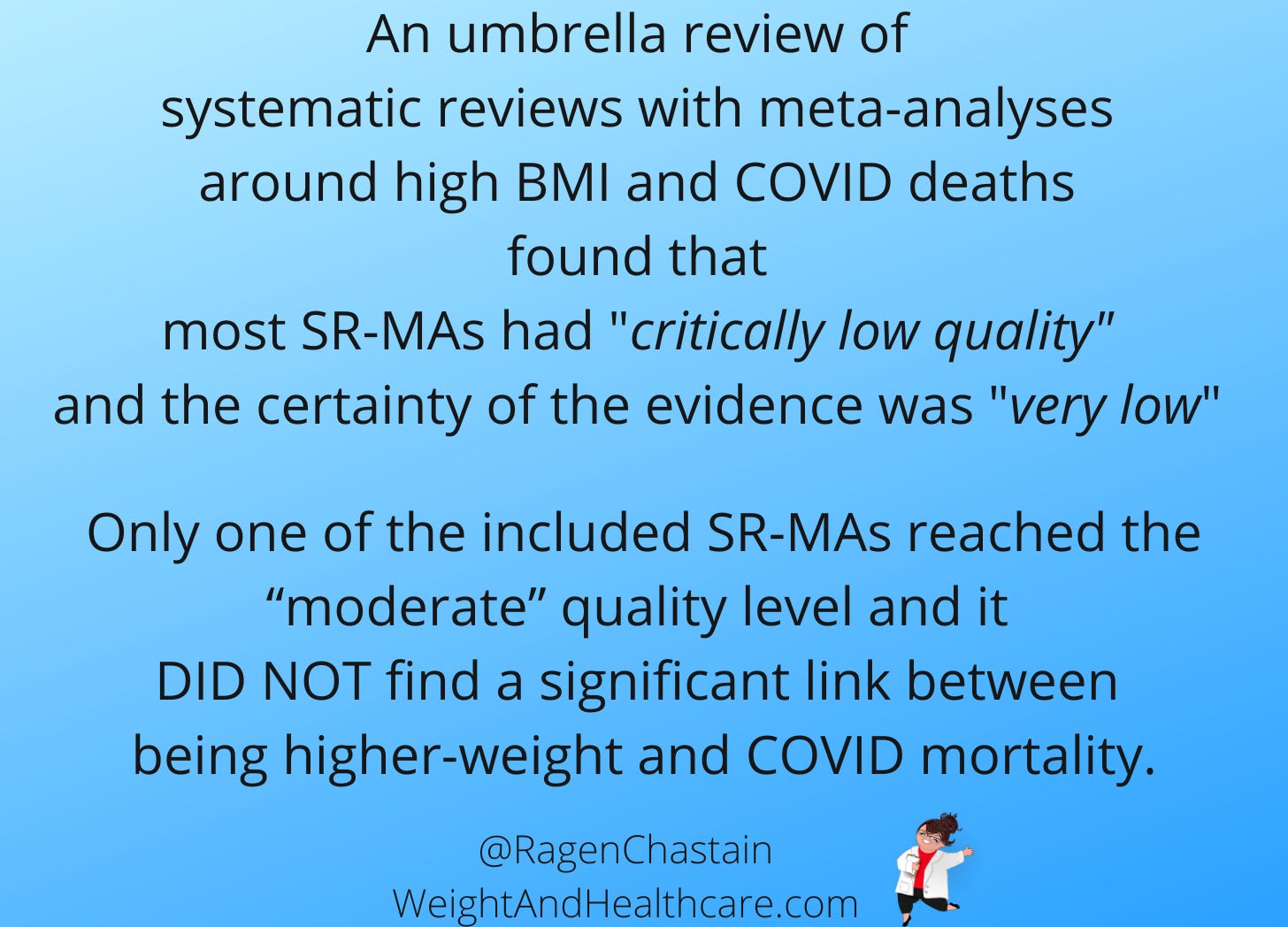
This is the Weight and Healthcare newsletter! If you like what you are reading, please consider subscribing and/or sharing!In the early days of the pandemic studies were rushed out and highlighted in the media claiming that higher-weight people were at higher risk of COVID death. I wrote about the issues with this in my previous blog, as did Christy Harrison, Paul Campos and others.Now an umbrella review has been published. This is a review of existing systematic reviews and metanalyses.Quick background. A systematic review (SR) starts with a research question, creates inclusion criteria for evidence, and then attempts to gather and summarize all of the available empirical evidence that fits the inclusion criteria. A meta-analysis (MA) is the application of statistical methods to the results of the studies collected by the systematic review. An umbrella review (UR) synthesizes all of the available systematic reviews and meta-analyses about a broad research question, typically taking into account not just the findings of the SRs and MAs, but also the quality of evidence within them. This is important because if the SR/MAs include poor quality studies, then they risk poor quality summary/analysis/conclusions.So, this study “Risk of bias and certainty of evidence on the association between ob*sity and mortality in patients with SARS-COV-2: An umbrella review of meta-analyses” by Silva et al, 2023 looked at systemic reviews with meta-analyses (SR-MAs) “to evaluate the risk of bias and the certainty of the evidence of SR-MAs on the association between ob*sity and mortality in patients with SARS-CoV-2.”They begin that:“Poorly conducted SR-MAs can lead to inaccurate illustrations of evidence and misleading conclusions, leading to limited applicability.”Then point out that:“There are concerns that in the panic to provide answers to help administer the COVID-19 pandemic, SR-MAs are being conducted without many of the keystones of robust methods”They sought to answer two questions with their UR: 1. What is the quality and certainty of evidence on the association between ob*sity and mortality in patients with SARS-CoV-2?2. What is the magnitude of the association between ob*sity and mortality in patients with SARS-CoV-2 demonstrated by SR-MAsThey reviewed 24 SR-MAs from multiple countries. Ultimately they found that, while most SR-MAs did show an association between being higher weight and COVID mortality, there were serious questions as to the quality of the research that led to those conclusions.They found that “most SR-MAs had critically low quality, and…the certainty of the evidence was very low.” In fact, in terms of certainty of evidence, 21 of the 24 SR-MAs were classified as “very low.” In terms of quality, 66.7% of the SR-MAs were “critically low quality,” and 29.2% were “low” quality. Only one of the included SR-MAs reached the “moderate” quality level and it DID NOT find a significant link between being higher-weight and COVID mortality.The UR author’s explanation for this is that the pandemic created the need for fast information (which is, of course accurate) but that in the rush to get data “many of the keystones of robust methods are being forgotten.” I would add that, as we often talk about in research reviews here, when it comes to weight science, the keystones of robust methods are often thrown out the window regardless of how much time the authors have to conduct their research (Lucy Aphramor has an excellent piece about this.) For example, this has happened before. During the 2009 H1N1 outbreak, fat people had poorer health outcomes (and researchers and media were quick to jump on the bandwagon of assuming that fat bodies were the cause the and trying to figure out what about fat bodies caused this.) It turns out the actual issue was that fat people were systematically treated later with antiviral medication than thin people. Per a study on the subject (Sun et. al. 2016) “After adjustment for early antiviral treatment, relationship between ob*sity and poor outcomes disappeared.”The findings of this UR are, of course, a far cry from all the headlines claiming that being higher-weight created higher risk and from the subsequent programs and suggestions that fat people have an obligation to become thin (despite no evidence that that is even possible) as part of COVID mortality prevention. Unfortunately, when it comes to research, the media, and public health policy anti-fatness is often published, often enacted, and rarely questioned.Frustratingly, even the UR authors in their introduction section uncritically buy in to the pathologization of body size, and the blaming of health issues/deaths on higher-weight bodies rather than, at the very least, acknowledging the confounding variables of weight stigma, weight cycling, and healthcare inequalities. Still, perhaps there is some clarity in the fact that these findings come from researchers who seem to be fully invested in the anti-fat paradigm.Finally,
Providing X-Rays, MRIs and CT Scans to Higher-Weight Patients
This is the Weight and Healthcare newsletter! If you like what you are reading, please consider subscribing and/or sharing!EDIT 7/4/25: I’m excited to say that a project I’ve been working on is now live. The In Our Image Database from the Fat Legal Advocacy, Rights, and Education (FLARE!) Project is a listing of imaging sites that accommodate higher-weight patients. You can search the database, add to it, and/or volunteer to help expand the project! Finding out that you need an x-ray, MRI, CT or other scan can be scary for people of all sizes, but fat* people can face a lot of additional and, unfortunately, well-founded fears about the experience. Here are some tips and tricks for people who offer these scans to make the experience better for higher-weight patients.I know that many people won’t be able to do all of these things, what I’m asking is that you use any power/privilege/leverage you have to do what you can (and know that anything you can do WILL make a difference) and then consider finding allies who you can work with to push for larger changes.1. Know what you are working withKnow everything you can about the equipment and facility. What is the weight-rating of the table/bed/chair? What is the bore size of the scanner? Are there any other size/weight limitations? If you don’t have the most accommodating equipment that exists, proactively create a list of who does so that you can refer patients. Make sure all of that information is easy to access for everyone who might be patient-facing.2. Know the people you are working withBe aware of all the patients you may work with. Sometimes when it comes to inclusion, identities can become siloed. So even if there are protocols for higher-weight patients and protocols for wheelchair users who need to transfer, there may not be protocols for higher-weight patients who are wheelchair users who need to transfer. Sometimes a lot of focus is put toward accommodating patients physically, but less focus is put on making sure patients, including neurodivergent patients, are psychologically comfortable. Consider bringing in educators and/or consultants to help you think through all the patients you might work with and proactively create protocols so that every patient will have a positive, seamless experience.3. Communicate what you are working with to the people you are working withGive as much information as you can – including the weight ratings and bore sizes of your equipment, any accommodations you offer (for size, disability, neurodivergence etc.) be honest about who you can’t accommodate (and offer referrals to places that can). Don’t wait for patients to ask and don’t make assumptions about who needs to know. Provide this information to every potential patient early, often, and through as many delivery methods as possible – on your website, when patients call, on their MyChart or other online patient record, in appointment reminder texts, literally in every possible way.Communicating about accessibility and accommodations helps people who need the access and accommodations AND it educates people who may currently have privilege that puts them in a situation where they don’t know what they don’t know. It can help them stop taking their access for granted, help them to be more educated for the people in their lives who may not typically be accommodated, and help them in the event that their needs change.4. Create an accessible experience start-to-finishIt’s not just about the equipment. Do you have armless chairs in your waiting room and in any treatment rooms? Do you have the largest possible gowns? If you take blood pressure do you have cuffs that work for all arm sizes? Don’t take the patient’s weight for no reason (ie: “routine weigh-in.”) If you truly need to get the patient’s weight (for example, if you’re using weight-based contrast medium dosing) instead of just asking their weight (which might be jarring/upsetting to them) explain it to the patient in a non-judgmental way. For example “The contrast is dosed by weight. We don’t care about your weight except to get the dose right!” There is a size-inclusive healthcare office audit here.5. Center the patient’s experienceStory time! (Shared with permission, of course.) I was recently acting as an advocate at an orthopedic appointment that included an x-ray. Ortho appointments can be some of the most fraught for fat patients so the patient was nervous and I was on high alert. We had talked through scenarios and worked out a signal they would use if they wanted me to jump in (in a nod to The West Wing, they would tug their ear lobe.)Things had gone very well so far - great chair options in the waiting area, no fat-shaming, a positive response to declining weigh-in, and the tech knew exactly what the weight-rating of the x-ray table was (650lbs). The patient had limited mobility and was moving slowly (because they had a knee injury, which is why they were at the orthopedist!) They explained that they could
Weight Watchers Expands Their Harmful Model - Adding Prescription Drugs
Transcript:This is the Weight and Healthcare newsletter! If you like what you are reading, please consider subscribing and/or sharing!I’ve been getting a lot of requests to write about Weight Watchers’ acquisition of Sequence, so here we go. One note that, in order to keep this from becoming Tolstoy-esque in length, there are a lot of links so that you can dig in more where you want!I’ve been writing about Weight Watchers (aka WW) for more than a decade and I’ve noticed that one thing you can always count on Weight Watchers to do is…anything it takes to keep their stock prices up.Using celebrities to create body shameAdvertising to people with eating disordersCreating an entire campaign to gaslight us into believing that they are solving weight stigma rather than creating itMarketing a dangerous weight loss app to childrenChanging their name to try to co-opt the work of anti-weight stigma activists to claim they are about “health,” not weight (while selling the same old fatphobia-driven weight loss) Keeping that going publicly while moving back to their old weight-focused messaging (and name!) in individual communicationsFunding research that grossly and purposefully misrepresents the data that shows their abject failure to create significant, long-term weight lossAnd now…taking advantage of proposed legislation to increase access to telehealth, and piggybacking on Novo Nordisk’s massive marketing campaign for their dangerous new weight loss drug, by purchasing a telehealth company whose focus is prescribing dangerous weight loss drugs.What is this company they are acquiring? Sequence is one of the scavenger companies that have popped up to capitalize on the massive marketing campaign around the new GLP-1 agonist class of weight loss drugs. Essentially the company employs a group of doctors and practitioners who prescribe weight loss drugs (including the new drugs as well as older drugs) with dangerous side effects and no long-term efficacy data, as well as a diet and exercise plan to people who pay a monthly subscription of $99 (which may or may not include their drugs.)Their marketing gives us the same old thing – big print that claims that people lose 15% of their body weight on average, small print that points out that this is for a people who have been on the program for at least 26 weeks, conveniently capturing the period when weight loss is expected (about the first year,) and not capturing the 2-5 years after when research shows that about 95% regain all of the weight that they lost, without any link to the actual study to see if they are ignoring drop out rates or using other sketchy research practices. And even that claim is contradicted on their “FAQ’s page” which says “Sequence members lose 5% of their body weight within 3 months, and 10% of their body weight within 6 months.” They, of course, leave out the fact that the research does not support the idea that 5-10% of body weight loss creates health changes. (In fact, they don’t discuss actual health at all, only body size changes, taking advantage of the common myth that weight loss automatically improves health.) And, again, all of this ignores the fact that almost everyone will regain all of this weight based on all the research that exists.They claim that medications “jumpstart” sustainable weight loss when there is absolutely no research to back that claim (and, in fact, the research says the opposite.) And if you dig into the website they are more honest that “The effects [of the “GLP Medications”] stop immediately if you stop taking the medication, and it is likely in most cases that some weight regain will occur.” (In fact, it is likely that people will regain all of the weight they lost and very likely more. Novo stopped the research after a year when people had gained back 2/3 of the weight that they lost in 68 weeks, but the trajectory was still going straight up.) What they don’t show is that there isn’t any data to suggest that the weight loss is sustainable at all. They have a “research” page, but there is literally no research there about their actual program available there, though there are a bunch of diet articles that look like they were copy/pasted from 1987 and one obligatory article on developing a “positive body image” among a sea of articles that pathologize fat bodies and encourage people to risk their health, lives, and quality of life trying to change those bodies.On almost every page they have their 15% weight loss claim with an asterisk that directs the reader to the claim “*Based on 5,377 members who have been on the Sequence program for at least 26 weeks. Average reported body weight lost was 15.17% and the top quartile lost an average of 19.90% of body weight.” I cannot find a published study with these numbers so for all I know they were produced via…rectal pull. What I do know is that, per Forbes and the Washington Post, they were founded in 2021, had 24,000 members at the end of February 2023 and annual revenu

Study Looks At Ways To Protect Ourselves from Weight Stigma
Transcript:This is the Weight and Healthcare newsletter! If you like what you are reading, please consider subscribing and/or sharing!I write and talk a lot about weight stigma and its negative impacts on health. Today I want to talk about a study that looks at how we can protect ourselves. In September of 2022, Angela Meadows and Suzanne Higgs published “Challenging oppression: A social identity model of stigma resistance in higher-weight individuals.” Big thanks to Dr. Meadows who read a draft of this piece and offered commentary which is quoted below.This study was the first to attempt to identify what factors predict whether a fat* person does or does not internalize weight stigma. They begin by explaining that, while higher-weight people make up about two-thirds of the population in western countries, weight stigma is still ubiquitous in every area of life including education, healthcare, employment, interpersonal interactions, and in the media. They also point out that being immersed in a culture of weight stigma leads many fat people to internalize that stigma, leading them to devalue themselves.They explain that “the most fundamental component of weight-related stigma directed at oneself remains the endorsement of negative stereotypes attributed to higher-weight individuals, applying those stereotypes to oneself, and exhibiting reduced self-worth as a result of one’s higher weight status.”The next piece of this is the fact that internalized weight stigma had been linked to “a wide range of negative health and behavioural outcomes in both treatment-seeking and community sample.”Given this, the ability to avoid internalizing weight stigma is “generally associated with superior psychological and physiological outcomes compared with stigma internalisation or inaction.”In order to identify predictors of weight stigma resistance, they examined factors including the alignment with the group “Fat.” They start from social identity theory, which is, as Meadows explains“A theory of intergroup behaviour that was developed in the 60s and 70s. Evidence from many types of marginalised groups suggest that where people can leave a devalued group, that is usually the strategy they pursue. This is what we knew from experience, but it hadn’t previously been applied to the idea that weight controllability beliefs constitute that permeable/impermeable group boundary, so should predict activism or alternative behaviours.”In the context of that framework, the assumption was that those who think weight is changeable are likely to be working to leave the “Fat” group to enter the “Not Fat” group, whereas those who have come to the conclusion that long-term significant weight loss is improbable (including through their own experience of weight-cycling) may come to view themselves as permanent members of the “Fat” group. For those members of the “Fat” group, the next determinant of stigma resistance becomes if they believe that they deserve lower status, or if they think that lower status is being unfairly foisted on them.The study authors created an online survey to measure perceived stigma, level of identification as an “overw*ight*/fat” person, perceived legitimacy of anti-fat discrimination, group permeability, stigma resistance, internalized weight stigma, and global self-esteem. Based on their answers, subjects were sorted into three groups: about a third were “Internalisers” who “tended to agree with statements relating to internalised weight stigma beliefs.” About 17% of the subjects were classified as “Indifferent” - they “tended to disagree or had no strong opinion about statements relating to either weight stigma internalisation or weight stigma resistance.” Finally, 50% were “Resisters,” those who “tended to disagree with or have no strong opinions about internalisation statements and tended to agree with statements about weight stigma resistance.”In the subsequent analysis, “perceived legitimacy of weight stigma” was the most important predictor of internalized stigma. Meadows explains“I think it’s easier to understand conceptually if you think of it as a kind of continuum (even though it’s not fully linear with internalisers at one end and resisters at the other). The point here is that legitimacy beliefs were the best predictor of whether people tended to be internalisers or resisters – internalisers had higher perceived legitimacy beliefs (although still not ‘high’) whereas resisters were waaaay down at the bottom of the measurement scale.”Investment in the “fat” group also predicted resistance, but people were able to reach “Resistor” status even if they didn’t invest in the “fat” group. Meadows says:To me, this is the most exciting and important piece. Group identity is usually considered the major determinant of activism/resistance. That resisters existed who weren’t identified with the group was super interesting – you could use an allyship angle. Everyone needs to fight stigma, whatever their own body looks
The Harm of Weight Stigma
This is the Weight and Healthcare newsletter! If you like what you are reading, please consider subscribing and/or sharing!I’ve written before about weight stigma in healthcare practice, and I’m currently co-authoring a study with Dr. Lesleigh Owen about the harm weight stigma does to the highest-weight patients. Today I’m going to dig into the research that already exists that explores the harm done to fat* patients by weight stigma.As we get into the research, a few reminders:First, weight stigma is rooted in and inextricable from racism and anti-Blackness, and continues to do disproportionate harm to those communities today. I urge you to read Sabrina Strings’ Fearing the Black Body – the Racial Origins of Fat Phobia and Da’Shaun Harrison’s Belly of the Beast: The Politics of Anti-Fatness as Anti-Blackness to understand more about this.Second, typically research over-represents privileged people and under-represents (or fails to represent at all) marginalized people, and thus the harm done to them is also under- or un-represented.Third, I wrote here about how weight stigma research is often still rooted in anti-fatness. I recommend reading this to contextualize a lot of the research and researchers I will talk about here.Many of the studies that will be discussed in this article look at perceived weight bias/weight status. In this way, weight stigma can harm people of many different sizes, so just a reminder that weight stigma, in particular structural weight stigma, always does the most harm to those at the highest weights and/or those with multiple marginalized identities.I also want to point out how often the things that are correlated with both weight stigma and body size are blamed on body size itself without any discussion of weight stigma as a strongly researched possible confounding variable (this is also common with weight cycling and healthcare inequalities.)In this piece I’ll be looking at studies that show harm to physical and/or mental health, including iatrogenic harm, which means harm that is done by the healthcare system/healthcare practitioners. Weight stigma does much, much more harm in all aspects of the lives of higher-weight people that won’t be examined here. Also, this provides brief overviews of the studies included and is far from an exhaustive list. Please feel free to add other examples in the comments.Finally, just a reminder that my policy is that when I refer to studies that perpetuate anti-fatness and harm, I will provide enough information to Google them, but I won’t link to them directly. Last last thing before we dig in: studies refer to this variously as weight stigma, weight bias, sizeism, and other less common (sometimes more stigmatizing!) terms, I’m combining those for the purpose of this article.Content note: This section will discuss physical and psychological harm that can result from weight stigma, including bias and self-harm, and may be harmful/triggering to higher-weight people, so please take care of yourselfI think therefore I am: Perceived ideal weight as a determinant of health, Muennig et al., 2008This study looked at whether stress related to negative body image perception and the desire to lose weight could impact health, and found that the difference between actual and desired body weight was a stronger predictor of physical and mental health than actual body mass index (BMI) in cis women. “[cis] Women who say they feel they are too heavy suffer more mental and physical illness than women who say they feel fine about their size - no matter what they weigh.”The body politic: the relationship between stigma and ob*sity-associated disease, Muenniug, 2008This work examines the relationship between weight stigma and health issues, and finds that weight stigma may drive health issues that are typically blamed on body size.“Stigma and prejudice are intensely stressful. Over time, such chronic stress can lead to high blood pressure and diabetes.”The Weight of Stigma: Cortisol reactivity to manipulated weight stigma, Himmelstein et. al:Young women who were told in an experiment that their weights “weren’t ideal” experienced higher levels of the stress hormone cortisol, regardless of their actual size.“Experiencing weight stigma was stressful for participants who perceived themselves as heavy, regardless of their BMI. These results are important because stress and cortisol are linked to deleterious health outcomes...”Associations between perceived weight discrimination and the prevalence of psychiatric disorders in the general population, Hatzenbuehler, 2009* Perceived weight discrimination is associated with substantial psychiatric morbidity and comorbidity.* The results remained significant after adjusting for perceived stress (a possible confounding variable)* Social support did not buffer against the adverse effects of perceived weight discrimination on mental health.* Controlling for BMI did not diminish the associations, indicating that perceived weight d
The Truth About The Obesity Action Coalition
Transcript:This is the Weight and Healthcare newsletter! If you like what you are reading, please consider subscribing and/or sharing!The Ob*sity* Action Coalition (OAC) claims to be a non-profit advocacy group for higher-weight people. The truth from my perspective is that they are anything but.I wrote about the OAC in 2014 when their priority had been lobbying the AMA to declare that “ob*sity” is a disease. Today their priority is the “Treat and Reduce Ob*sity Act” the goal of which is to expand Medicare coverage for weight loss interventions, including specifically expanding coverage for weight loss drugs.These priorities make a lot more sense when you realize that the OAC is not an advocacy group for higher-weight people, but rather an organization that is predominantly funded by, and lobbies for the priorities of, the weight loss industry.When I first wrote about the OAC the “Platinum” level of their Chairman’s Council (a distinction for those providing funding of $100,000 or more annually) included:· Allergan – Manufacturers of the lap band· American Society for Metabolic and Bariatric [weight loss] Surgery· Covidien – “committed to better patient outcomes through bariatric surgery“· Eisai – manufactures of the weight loss drug Belviq (now pulled from the market)· Vivus – manufacturers of the weight loss drug QysmiaAll of these organizations stood to profit from the AMA’s declaration of being higher-weight as a disease (and the lobbying was successful, not only did the AMA declare living in a larger body to be a disease, but they blatantly ignored the findings of their own Committee on Science and Public Health which had studied the matter for a year and recommended against it in order to do the weight loss industry’s bidding.)Having simply existing in a larger body re-branded into a disease was a major step forward, but not the only step. The next big step for Big Pharma is insurance coverage for dangerous, expensive (and almost certain to fail) weight loss “treatments.”And now the OACs “Platinum” level is down to one company – Novo Nordisk. A company that, having made a literal fortune price gouging on insulin, has promised their shareholders that their new weight loss drug, Wegovy, will make them billions. The rest of the sponsorship levels are still chock full of weight loss companies. They’ve also separated their Chairman’s Council from what they are calling “Corporate Partners”. Here Novo is again the top funder at “more than $500,000 annually” with Eli Lilly kicking in “more than $100,000” and the list goes on. I’ve included the lists below.There is something else in common between the OAC of 2014 and today. At both times, they were involved in parallel campaigns that claimed to be about ending weight stigma, but were in fact about selling more weight loss interventions.We’ve seen this before. It was a tactic used by Purdue Pharma and other pharma and medical device companies to sell opioids – they created non-profits like the American Pain Foundation that were billed as advocacy groups for pain patients (a legitimate group of patients who deserve advocacy and treatment,) but were, in fact, funded by and acting in the interest of the pharmaceutical industry. The work of these non-profits influenced legitimate government and healthcare organizations to do the pharma companies’ bidding, including influencing the behavior of doctors and other healthcare providers with their patients, creating an explosion in pain diagnoses and opioid prescriptions.This is exactly what Novo Nordisk and other weight loss companies want to do, so it’s not surprising that they are taking a page or two from the Purdue Pharma Oxycontin playbook.Fool us once, a lot of people are harmed and killed in the service of pharma industry profits. Fool us twice, even more lives are irreparably harmed and lost. That is why it is critical that we not allow the OAC to get away with this - that we not allow them and their spokespeople to claim to be fighting weight stigma when they are really shilling for the weight loss industry.When you see “Ob*sity Action Coalition” you should think “Novo Nordisk and their weight loss industry buddies” and treat them accordingly, with extreme suspicion.Current “Corporate Partners”Note: the date represents how long they’ve been an “OAC Partner”Platinum (contributing more than $500,000 annually)Novo Nordisk (2013)Gold (more than $100,000 annually)Eli Lilly (2020)Silver (more than $50,000 annually)Boehringer Ingelheim (2010)Ethicon (2012)Medtronic (2010)Bronze (more than $25,000 annually)American Society for Metabolic and Bariatric Surgery (2005)Currax pharmaceuticals (2020)Fujifilm (2018)Patron(more than $10,000 annually)Bariatric Advantage Nutritional Products (2008)Intuitive (2021)Rhythm (2018)The Ob*sity Society (2012)Wondr Health (2017)Weight Watchers aka WW (2015)Source: https://www.obesityaction.org/corporate-partnersCurrent chairman’s council funders:Platinum (donates more than 100k annually
Reader Question: Why do they say that "obesity" is a chronic disease like asthma and type 2 diabetes?
Transcript:This is the Weight and Healthcare newsletter! If you like what you are reading, please consider subscribing and/or sharing!Reader Eliah sent me the following email:I’ve seen you write about how the idea of “ob*sity”* as a disease is problematic which is I think why I started noticing that in all the articles about these new diet drugs it seems like it says at least once that “ob*sity is a disease like asthma or type 2 diabetes” I thought you might have some insight into the concept in general and why this specific phrasing is being used.This is a great question. This specific phrase “ob*sity is a chronic disease like asthma or type 2 diabetes” is indeed making the rounds. I’ll start by talking about the veracity of the claim, and then answer the question as to why people are saying it.Before I dig in, I want to be clear that there is absolutely no shame in having a disease or diagnosis of any kind, this is about the intentional misapplication of the concept and the damage it does.First let’s answer the basic question: Is “ob*sity” a chronic disease like asthma or type 2 diabetes? In order to get to the bottom of this, let’s examine each diagnosis in turn.In order to be diagnosed with asthma, there has to be documentation of signs or symptoms of airflow obstruction, reversibility of obstruction (that the signs or symptoms decrease with asthma therapy,) and no clinical suspicion of an alternative diagnosis.In order to be diagnosed with type 2 diabetes one of the following thresholds must be met (typically with at least one repetition): an A1C of greater than or equal to 6.5%, fasting blood glucose of greater than or equal to 126 mg/dl, a two-hour blood glucose of greater than or equal to 200 mg/dl on an Oral Glucose Tolerance Test, or blood glucose of greater than or equal to 200 mg/dl on a Random Plasma Glucose Test.In order to be “diagnosed” as “ob*se” one’s weight in pounds times 703 divided by their height in inches squared has to be 30.0 or higher. There is no shared symptomology among this group of people, it includes people with various health diagnoses, people without any health diagnoses, and with widely varying cardiometabolic health, body composition, etc. Literally, the only thing this group has in common is a similar ratio of weight and height (and being “diagnosed” using a deeply problematic math equation.)When you take into account the “class” system (ie: class 1, class 2, and class 3 ob*sity) the folly of this becomes even more apparent. Consider that, for class 1 ob*sity, 1 pound, or 1 inch in height canbe the only difference between someone who is “diagnosed” with “ob*sity” and someone who is not, again with no shared symptomology or cardiometabolic profile. Even more ridiculous, while class 1 and 2 each encompass a 4.9 point BMI spread, class 3 is defined as a BMI of 40 to…infinity. That does not have the ring of sound science.Then there is the issue of treatment. For both asthma and type 2 diabetes, treatments focus on managing the common symptomology. With “ob*sity” the “treatment” is focused on making the patient look different by changing their size. Setting aside that the “treatment” almost never works and has considerable risks, no matter what size someone ends up at, there will be people of that size who have the same (and different) actual health issues.So the answer to the question of whether ob*sity is a disease like asthma and type 2 diabetes is: No, it absolutely is not.This is pretty clear cut, so why are people (including doctors) still spouting this nonsense? In a word (or four): the weight loss industry. The classification of simply existing in a higher-weight body as a “disease” is the holy grail for them. It increases their market to every fat person for the entire time that they are alive. They’ve been pushing this (both blatantly and surreptitiously,) pouring money into the effort for many years. I’ve been writing and speaking about this since 2009, and there are many people who have been doing it far longer (including since before I was born.) It’s actually one of the first things I wrote about when I launched this newsletter. So we’ve heard them try to claim that being fat is a “chronic lifelong health condition.” The addition of this comparison to type 2 diabetes and asthma seems to be specifically in the service of selling diet drugs like Wegovy.Novo Nordisk’s research has shown repeatedly that, while people lose weight short-term on their drug (though even in their 68-week trial weight loss had leveled off by the end) as soon as people go off the drug the rapid weight regain begins. Participants regained 2/3 of the weight they had lost, and lost 2/3 of the cardiometabolic health benefits in just the first year off the drug. So Novo Nordisk’s (wildly profitable, completely untested) “solution” is just to suggest that people stay on the drug for the rest of their lives.So the use of this phrase is them trying to take advantage of people’s understanding that

A New HAES™ Friendly Disordered Eating, Exercise and Body Image Screening Tool
Transcript:This is the Weight and Healthcare newsletter! If you like what you are reading, please consider subscribing and/or sharing at WeightAndHealthcare.com!Sam Sessamen is someone I’ve had the opportunity to work with multiple times over the last three years and her work is something that I’ve truly appreciated. Recently she told me about a new screening tool that she had created, and I wanted to share it here in case it’s helpful. Here is some background from Sam followed by a link to the screening tool.Tell us a bit about you and your backgroundI’m a therapist in NY that specializes in trauma and Eating Disorders. I am passionate about providing trauma informed and weight neutral care as a result of my own experiences with weight stigma and disordered eating. What made you decide to create this screening?Many people struggle with disordered eating, body image issues, disordered exercise and the impacts of weight stigma. If you rely solely on standardized diagnostic screening tools and the DSM criteria, you risk missing huge populations that could benefit from working on the above-mentioned issues.Can you share the screening tool development process with us?I wanted this screening to be as comprehensive as possible so anyone struggling in the following areas could be flagged as needing support: Attitude & Thoughts Towards Food, Unhealthy Food Behaviors, Unhealthy Exercise Patterns, Body Image Struggles & Common Medical Complications because of Disordered Eating. The screening questions in each category include DSM criteria, criteria for Orthorexia and reoccurring issues that I see in my own practice that aren’t typically included in a diagnostic tool (e.g. Do you feel like you are waiting to be happy until you can “lose the weight?”).Once I was happy with the questions and format, I put a call out on IG for the assessment to be reviewed. I had 5 HAES-aligned providers, including folks in larger bodies, review the assessment and give me feedback.Were there difficulties and barriers that you faced in putting the tool together?The most difficult part was trying to keep this assessment concise, specifically in the body image and attitudes toward food sections. Since weight stigma and diet culture have catastrophic effects, it would have been easy to continue adding examples of how diet culture and weight stigma show up in folks’ thoughts and behaviors.How do you hope that the tool will be used?First, it’s a screening tool to help mental health professionals identify folks that need help with anything that falls under the disordered eating umbrella. I specifically hope this will circulate to professionals that don’t specialize in Eating Disorders. Many disordered thoughts and behaviors go unflagged by those not trained in Eating Disorders because they are deemed ‘healthy’ by diet culture.Second, I hope it can be a trailhead for professionals and their clients to explore how diet culture and weight stigma impact many areas of clients' lives.You can find the screening tool here! Please note that it was created for individual patient care only and is not a standardized diagnostic tool. Please seek written permission from Samantha Sessamen, LMHC ([email protected]) if you wish to use this in any other context (educational purposes, trainings, etc).Did you find this post helpful? You can subscribe for free to get future posts delivered direct to your inbox, or choose a paid subscription to support the newsletter and get special benefits! Click the Subscribe button below for details:Liked this piece? Share this piece:More research and resources:https://haeshealthsheets.com/resources/*Note on language: I use “fat” as a neutral descriptor as used by the fat activist community, I use “ob*se” and “overw*ight” to acknowledge that these are terms that were created to medicalize and pathologize fat bodies, with roots in racism and specifically anti-Blackness. Please read Sabrina Strings Fearing the Black Body – the Racial Origins of Fat Phobia and Da’Shaun Harrison Belly of the Beast: The Politics of Anti-Fatness as Anti-Blackness for more on this. Get full access to Weight and Healthcare at weightandhealthcare.substack.com/subscribe

Fighting BMI-Based Denials Part 3 - Patient Experience
This is the Weight and Healthcare newsletter! If you like what you are reading, please consider subscribing and/or sharing!In part one of this series we looked at the phenomenon of BMI-based treatment denials. In part two, we looked at resources to fight these denials. Today we have a first-person patient experience. Beckie Hill is someone who had to battle to have the surgeries she needed, and it’s a battle she won, twice. So I asked her to share her story for the newsletter and she graciously agreed! The rest of this piece is in her words: I injured both my knees on 08/17/2019 while working. I had x-rays done, followed by a round of physical therapy, massage, medication, activity limitation, taping, and injections. It did not improve my range of motion, activity tolerance, and/or pain. At that time, my physiatrist and primary care physician referred me to an orthopedic surgeon. I saw him on February 3, 2020. He recommended surgery right away, for both knees, and requested authorization for the surgeries through my worker’s compensation insurance.On 02/19/2020, the utilization review (UR) company for the worker’s compensation insurance provided the following decision: “Recommend denial. Failed to meet the criteria for TKA since her BMI is ##, and the Medical Treatment Guidelines (MTGs) require the BMI to be less than ##”.The UR makes a recommendation to the worker’s compensation insurance and they can then agree or disagree with the UR’s recommendations. Worker’s compensation chose to deny surgery.I began the search of scholarly articles supporting knee surgery in larger-bodied patients. [Editor’s note – you can find a collection of those here.] I reached out to professionals within the weight-neutral community for articles, ideas and suggestions. My surgeon also provided documentation to worker’s compensation. He also had phone calls with the medical director. On 04/20/20, my surgeon informed the medical director that I would be in a wheelchair within 6 months.Worker’s compensation still denied the surgery.Worker’s compensation directed me to lose weight or undergo intentional weight loss surgery. The suggestions and denial of medically necessary surgery re-activated a pre-existing eating disorder of atypical anorexia and bulimia. I lost weight, but I was also very sick. I met with an intentional weight loss surgeon during this time, told them about the need for knee surgery, direction to lose weight, and my eating disorder. This surgeon emphatically indicated that weight loss was contraindicated for me from a nutritional, medicinal, and surgical basis. ***Please note, I would NOT have undergone surgery and have been offered weight loss medications many times and refuse to take them.Worker’s compensation was provided with documentation from the intentional weight loss surgeon and still denied the surgery.I ultimately retained an attorney to help me navigate this system given the stress and toll the process had taken on me.I was ultimately provided with a cane, walker, an electric scooter, and a disabled parking permit. I lost the job that I was injured at because they were not able/willing to accommodate my work restrictions. Commuting to my place of employment after that became very difficult, and that employer was not able to continue to accommodate my work-from-home status as they had during much of the pandemic. My third job wanted me to work more hours than I was released to do, even though I did try.My lawyer, worker’s compensation, and the attorney general had months of discussion and both knee surgeries were ultimately authorized. I had my right knee surgery on 12/29/2021, 680 days after the orthopedic surgeon’s recommendation. In June of 2022, my surgeon provided surgery information for the left knee surgery and worker’s compensation denied that surgery, again due to BMI. It was ultimately authorized and occurred on 08/10/2022, 904 days after the initial surgery recommendation.Did I ever get close to the BMI that the MTGs “required”? No, in fact, based upon the UR reports I have seen, it went up. It was far more important for me to nourish my body so that I could try to navigate life and recover from surgery if it was/were ever authorized.Not only has the denial of the surgery for each knee been physically traumatic, but it has also been professionally, mentally, emotionally, and financially devasting. I am an “N” of 1. I am not a BMI number. I am a human with a body that is different than every other body on this planet.I am doing okay with the knee recovery. Both surgeries went well and I have almost full ROM in my right knee, and I am about 5 weeks out from the left and doing more movement than the first surgery. There were no complications during or post-op, no issues with wound healing, and while I still have some pain, my surgeon did not anticipate being at maximum medical improvement for one year post-op.I had a surgeon willing and able to do the surgery. And yet, an archaic system and hum
Options to Deal With BMI-Based Healthcare Denials - Part 2
Transcript:In part one we talked about the issues with BMI-based denials. Today we’ll talk about your options if you are facing a BMI-based healthcare denial. Part three will be the story of someone who successfully fought these denials.First of all, if your healthcare is being held hostage unless/until you reach a certain BMI (or lose a specific amount of weight etc.), please know that this is not your fault, even though it’s becoming your problem. Your options include finding different circumstances, fighting the denial, or trying to reach the BMI requirement. We’ll talk about each of these in turn. Note that, while the advice here may be helpful in other places, it is predominantly focused on the US experience and that it is generalized options and, as everything in this newsletter, is not medical advice.And remember, unfortunately you are not in control of the situation, so if you are not successful, that’s not because you did anything wrong, it’s because the system is rooted in weight stigma and really messed up.The basicsThe first place to start is by finding out as much as you can about the denial. If possible, you want to get this information in writing (for example, by sending emails or utilizing a patient portal like MyChart,) or recorded (you can try saying something like “I’m afraid I won’t be able to remember everything from the appointment, do you mind if I record it?”) You can also bring someone along to take accurate notes.Collecting as much information as you can upfront can make future steps easier. Just as a reminder, this situation should not happen. It is absolutely unfair that fat people should have to fight for the treatment that thin people get. Even if this is becoming your problem, it is not your fault. Here are some questions to start with:Where is the denial coming from?* It is typically the surgeon, anesthesiologist, facility, or insuranceWhat are they claiming is the reason for the denial?* Is it anesthesia risk? Risk of complications with the surgery? Concerns about recovery time/complications? Concerns about outcomes not being as good as a thinner person’s outcomes?* Rather than offering up these explanations, you can ask more circumspectly - “what concern is at the root of the denial?” Again, try to get this answer down verbatim.What are they hoping that weight loss will do?* This is typically tied to the answer to the question above. Getting the answer to this can be very helpful if you decide to fight the denial.Ok, let’s look at the three main options to handle these denials. Before I start I do want to be clear that aspects of privilege, socioeconomic status, and intersectional oppression pervade all of these options and have the greatest impact on those of the highest weights and/or who are multiply marginalized.Option 1: Finding different circumstancesStart with the information you gathered about the source of the denial. Here the fact that these limits are often applied utterly inconsistently can be helpful.If it’s the surgeon, you can try to find another practitioner. A place to start is Mary Lambert’s Weight Neutral Provider list.If it’s the anesthesiologist, you can see what the options are to get another anesthesiologist. One option is to ask if they offer weight loss surgery in the facility and, if so, if one of those anesthesiologists can do the anesthesia for your surgery. (This can be particularly helpful in situations where someone has been denied a surgery that they actually need/want because of anesthesia risk, and has then been referred to weight loss surgery.)If it’s the facility, you can see if the surgeon you want to work with has privileges at other facilities that might have different BMI limits, or you can try to find a surgeon who operates at a different facility.If it’s your insurance, then you could look at options to switch insurance coverage. Of course this can be difficult or impossible, especially if it’s your employer’s workers compensation plan. In this case you can also look at options for cash paying if that’s accessible to you.Option 2: Fight the denialStart with where the denial is coming from and look into the official process to challenge the decision. This may be found on the website of the facility or insurance company, or through a facility customer service representative, or ombudsman.Some denials are easier to fight than others. For example, if the denial is coming from a specific surgeon or facility, you may have more options since these are often arbitrary. On the other hand, if you are being denied a transplant, there is more of a standardized denial not that standardization makes this any less wrong, but it can make it more difficult to fight.If your surgeon is on board but the facility and/or insurance is not, then you may be able to enlist the surgeon to help you fight.Before we get into the counterarguments, I want to note that these are not necessarily based in social justice, but rather in a harm reduction model of findin
BMI Limits - Healthcare Held Hostage For A Weight Loss Ransom - Part 1
One of the ways that weight stigma harms fat people is through Body Mass Index BMI (and other weight-based) limits. BMI is a ratio of weight and height, and its use is deeply problematic in multiple ways. BMI and weight-based healthcare denials occur when people above a certain BMI or weight are refused medical procedures unless or until they meet the BMI or weight requirement. In part 1 of this three-part series, I’ll offer a general discussion of these limits, in part two I’ll provide some options and resources to help fight them, in part three I’ll share the story of someone who successfully fought BMI-based denial of surgery. I previously published specific resources to fight joint surgery denials and moving forward I will be compiling resources for other common types of denials as well. If you have a specific request, please feel free to share in the comments or email me directly. I do want to note that, while this information can be helpful to people outside of the US, these posts will focus on the US healthcare system.BMI limits are typically “justified” based on the idea that there are higher risks of complications during or after procedures for people above a certain BMI vs people below that BMI, or that higher-weight people’s outcomes won’t be as good as thinner people’s outcomes.The first thing I want to point out is that this is blanket discrimination based on a simple height/weight ratio. The people whose care is being denied can and do vary wildly in everything from body composition to metabolic health and more. The use of BMI also codifies racism and anti-Blackness into the process and I urge you to read Sabrina Strings’: Fearing the Black Body – the Racial Origins of Fat Phobia and Da’Shaun Harrison’s: Belly of the Beast: The Politics of Anti-Fatness as Anti-Blackness to learn more.BMI limits are based on, and further perpetuate, weight stigma. In our current healthcare system, research, tools, best practices, education, and training are very often developed based on thin bodies (and to the exclusion of fat bodies,) so even if someone believes that higher-weight people have more complications and/or worse outcomes, that wouldn’t be surprising due to the ways that weight stigma impacts every level of their care. What BMI-based denials do is take this weight stigma further by deciding that instead of getting better at providing care to fat people, or at least allowing them to consent to take possibly greater risks in order to get care that can improve their health, quality of life, or potentially save their lives, higher-weight people will simply be denied care unless or until they become thinner.There are other issues with BMI limits as well:The research that is used to justify these denials can be questionable (at best,) and/or contradicted by other evidence which is not taken into account.Often patients are denied needed surgeries, but are then referred to weight loss surgery. This is particularly ridiculous when the risk cited in the former surgery is anesthesia (as if weight loss surgeries don’t also use anesthesia,) and/or the risks of the weight loss surgery far exceed those of the surgery the patient actually needs. When a doctor denies a needed surgery and refers the patient to weight loss surgery it’s important to understand that the doctor is mitigating their risk (of having a patient with complications/poorer outcomes) by recommending that the patient take much greater risk with their life and quality of life.On the flip side, patients who have had their healthcare team push weight loss surgery on them for years can find themselves denied a surgery that they actually need/want when the time comes.Sometimes a needed surgery is denied until either the person becomes thin, or until the situation becomes dire enough to be considered an emergency surgery, causing far greater risk since the person can’t plan for their procedure, and the surgery is performed by whatever surgeon and anesthesiologist are available. Sometimes those in power decide that what would be an emergency for a thin person does not warrant the needed treatment for a fat patient. This can and does lead to the death of fat patients.On the other hand, fat people in the emergency room have been offered surgeries (for example, gallbladder removal,) but after weathering the acute attack have said that they would prefer to have the surgery in a way that was more planned, only to then to have the procedure denied due to BMI limits.These limits can vary between surgeons, anesthesiologists, facilities, and insurance companies (including, and sometimes especially, workers compensation companies) who can have a financial incentive to deny them. That means that whether or not someone can get the procedures can be essentially arbitrary – if they happen to find the right practitioners, or facilities, or insurance company they will get the care they need. If not, they will be denied care and left to suffer.Sometimes these denials are
The Validation and Frustration of Stunkard et al.
This is the Weight and Healthcare newsletter! If you like what you are reading, please consider subscribing and/or sharing!Stunkard et al.’s 1959 study “The Results of Treatment for Ob*sity: A Review of the Literature and Report of a Series” is one of the earliest studies that really sought to determine the success of weight loss interventions. As someone who works full-time pointing out that weight loss interventions almost never succeed at creating significant, long-term weight loss and often do harm, every time I read this study it is a combination of validating and incredibly frustrating.Content note: this post will include discussion of calories and weight loss so please make sure to take care of yourself. Let’s dig in:They begin by saying: “The current widespread concern with weight reduction rests on at least two assumptions: first, that weight-reduction programs are effective, second, that they are harmless.”They continue “Recent studies indicate that such programs may be far from harmless. This report documents their ineffectiveness.”Again, it’s validating to see that they were explaining this in 1952, but incredibly frustrating that the only thing that has changed since then is that the weight loss industry profits have grown exponentially, and the interventions have become more dangerous and more expensive.The study looks at weight loss success/failure in two ways. First, a review of the weight loss literature for the previous 30 years, and second, an examination of the outcomes of the treatment of 100 consecutive higher-weight patients at New York Hospital’s Nutrition Clinic.Literature ReviewHere they use a phrase that I say or write some version of pretty much daily. “Hundreds of papers on treatment for ob*sity* have been published in the past 30 years. Most, however, do not give figures on the outcome of treatment, and of those that do, most report them in such a way as to obscure the outcome of treatment in individual patients.” They point out the following issues:* Reporting the number of patients and total pounds lost without specifying how much/the average that each patient lost* Short-duration studies* Reporting as a percentage rather than a number of pounds* The exclusion of those who dropped out or were “uncooperative” who the authors explain likely represent intervention failure and comprise an “impressive part” of the study samplesThey point out that “if papers with these shortcomings are omitted, the vast literature on treatment for ob*sity shrinks to just eight reports.”I’ll point out that these are still incredibly common occurrences in weight loss research. That, to me, indicates that those doing the research aren’t interested in creating good research, but are interested in creating research to prop up the failed weight-loss paradigm. Anyway, back to Stunkard et al.The eight studies had subject groups ranging from 48-314. Of the eight studies, interventions ranged from “self-selected diet,” to starvation diets (from 600 to 1,000 calories per day), to amphetamines.Four of the studies had more people lose less than 10 pounds than those who lost 10 or more pounds. Only one had a majority lose more than 20 pounds. Overall, only 25% of people were able to lose 20lbs and only 5% where able to lose 40lb short-term (and remember that research since 1959 has repeatedly shown that about 95% of this small group will regain all of the weight within five years.)Study of 100 patientsMoving on to their study of 100 patients. Here they point out that the health of “most subjects” was good, suggesting that they were referred for “treatment” solely to manipulate their body size. They were prescribed diets of 800 to 1,500 calories (all below, and some far below, the caloric intake for the Minnesota Starvation Experiment.)They characterize the results of these 100 people as “even poorer than those reported in the literature.” Of the 100 patients, 39 dropped out after the first visit, 28 never returned to any clinic in the hospital (suggesting that the intervention lowered their overall healthcare engagement, which the authors refer to as “a rupture of at least two therapeutic relationships” since patients only come to the Nutrition Clinic by referral from another clinic in the hospital.) Only 12 managed to lose more than 20lbs and only one of those was able to lose more than 40lbs.In terms of maintenance of weight loss, they found that, of the 12 who lost at least 20 pounds only 6 had maintained at least a 20 pound loss a year later, a number that dwindled to 2 people after two years. Moreover, 4 had already regained all of the weight they lost at two years, the others had already regained significant amounts of weight. Of the two “successes,” at two years the man who had the greatest weight change (-51lbs) reported that the diet had been “associated with mounting tension which culminated in what was diagnosed as an acute schizophrenic reaction” requiring a four-month hospitalization and treatment w

When Doctors' Education Is The Best That Pharma Money Can Buy- Part 2
In part 1 I talked about information that was brought to me by two senior residents who wanted people to know that they are being invited to “educational summits” that are actually being run by doctors with massive undisclosed ties to the pharmaceutical companies that make the drugs that are recommended in the summits. I did some digging around the company that is behind this to try to get some information about what’s going on.The company that created both of these summits is PCMG, Primary Care Metabolic Group. Their tagline is “Serving to Educate Primary Care Clinicians on Metabolic Issues.” The words “Evidence Based Medicine” appear prominently in the banner at the top of each page. Their homepage states:The Primary Care Metabolic Group (PCMG) is a national educational initiative providing comprehensive metabolic disease resources. PCMG’s mission is to provide an easily accessible repository of metabolic disease information for primary care clinicians that includes disease management and raising standards of patient care through the dissemination of best practices and educational information.Their ”services” include· Monthly metabolic disease news articles from our partners· Opportunities for FREE CME· Member discounts for upcoming CME conferences and summitsAs a quick aside, CME stands for Continuing Medical Education. Doctors must obtain a certain number of CMEs in order to maintain their state licensure. The number of CME hours and requirements as to topics varies by state. Full disclosure, many of the workshops/talks I give for physicians provide CMEs. None, as far as I know, has ever been sponsored by a pharmaceutical company and I don’t receive any money from the pharmaceutical industry.Back to PCMG. The word “partners” struck me in the first bullet point. What do they mean by “partners?” As I scrolled down the page I see that they are welcoming a new “collaborator” – the Ob*sity Action Coalition. It says “This national nonprofit coalition is fighting to eliminate weight bias and discrimination, elevating the conversation of weight and its impacts on health, and offering a community of support to people affected. OAC also offers resources for clinicians, as well as a database of clinicians who treat patients with ob*sity.”It doesn’t say that this “national nonprofit coalition” has Novo Nordisk (manufacturer of the weight loss drug Wegovy and one of the leading pharma companies price gouging on insulin) as its main funder, with the vast majority of its funding coming from pharmaceutical companies and weight loss surgery interests. It doesn’t say that their plan to “eliminate weight bias” is focused on pushing for insurance coverage of their dangerous drugs and surgeries, or that they are trying to sell the “we don’t want to stigmatize fat people, we just want to make as much money as we can trying to eradicate them from the earth” line that is not, in any way, an anti-stigma approach.After reading the entire website, I called PCMG to ask what they meant by “partners” as well as who was funding the free and discounted CME training.I spoke with Nora Williams. I opened by explaining that I was writing an article about CME trainings and I had a couple quick questions about how their trainings were structured. She interrupted me to say that she was “suspicious” because she didn’t know who I was, or what outlet I was writing for, or what my story was about (in my defense, she hadn’t let me get that far.) She told me that if I sent her an email she would “consider it.” For me, this has the ring of a company that knows they are involved in things that they would rather not have brought to light, but of course, that’s just my gut feeling. I emailed her after our call in the afternoon of 1/7/23 and am still awaiting a response.However, the email that she gave me led me to PCEConsortium.orgIn searching, I had already found Primary Care Respiratory Group – US (PCRG) which has a website that is almost an exact copy of PCMG, except replacing metabolic with respiratory. The Consortium site has a long list of free CME workshops.I wanted to look into their materials, so I started by downloading their free CME “Common Questions on Continuous Glucose Monitoring (CGM) in Primary Care” I am not an expert in CGM, but I do a lot of work around weight-neutral blood sugar management and so it’s an area where I felt confident that I had enough knowledge to understand the paper.The author is Eden Miller, DO (who you may recognize as having been a speaker at both the free summits and having taken $1,429,227.40 in industry payments.) Miller is the co-founder and CEO of Diabetes Nation - Diabetes and Ob*sity Care, and in this publication disclosed that she serves on the advisory board and speakers bureau for Abbott Diabetes, Boehringer Ingelheim, Eli Lilly, and Novo Nordisk; on the advisory board for AstraZeneca, Merck, Plenity, and Sanofi Aventis; and does research for Abbott Diabetes and Pendulum Pharmaceuticals.Here are some
When Doctors' Education Is Really Pharmaceutical Industry Marketing - Part 1
In discussing weight stigma and diet culture in medicine in general and, recently, the new AAP guidelines that recommend “intensive” weight loss attempts to toddlers, a common question I get is - How did we get here? How did doctors get so totally invested in this paradigm that they can’t see past it? I think that a huge part of this is how enmeshed the weight loss industry is in every aspect of the healthcare system, including (and perhaps especially) provider education.Recently I was contacted by Dr. Clarissa O’Conor and Dr. Will Ward, both family medicine residents who wanted to let me know about something that has been happening in their program regarding the education they are being offered.Just for starters, some background about the process of becoming a doctor in the US - it is both intense and hierarchical. After four years of medical school, newly minted doctors enter their residency. This stage of their training is specific to their chosen specialty (for example, internal medicine, ob/gyn, family medicine etc.) At this point, they are medical doctors practicing under supervision. In their first year, residents are known as “interns,” in their second year they become “residents.” In later years (residency can last from 3-7 years depending on specialty) they become senior residents, overseeing the work of newer residents. Some senior residents will become a Chief Resident. Chief Residents lead a group of residents both clinically and administratively. Those who choose additional training in a subspecialty fellowship are known as “Fellows.” The doctors who contacted me are senior residents. They had been invited to a “Chiefs Resident Summit on Ob*sity” and a “Family Medicine Chiefs Resident Summit on Diabetes.” Both were free (to the attendees) and were billed as “evidence-based” educational conferences.One of the residents did some research and found that the seven speakers at the “Ob*sity” summit had collectively accepted $2,651,160 from pharma companies that market weight loss since 2015 (when data collection started). Five of the physicians accepted money from Novo Nordisk in 2021, with an average payment of $18,000. (As a reminder, Novo Nordisk sells the weight loss drug Wegovy which they promised their shareholders would be massively profitable.)The Summit on Diabetes was headlined by five doctors (some of whom also spoke at the ob*sity summit.) Collectively these doctors had taken $7,106,460 from pharmaceutical companies that sell diabetes medications and supplies.Note that these numbers only include direct payments. These doctors have also collectively received millions more in research payments and associated research funding. It also only includes data up to 2021 and we know that Novo Nordisk has been absolutely pouring money into their Wegovy campaign in order to make good on their promise to shareholders of doubling their ob*sity sales by 2025.You can see the resident’s full research spreadsheet here.In the “ob*sity summit lineup, in addition to taking a ton of money from industries whose products the summit promotes, the speakers who are physicians have all pinned their careers to the “body size as disease” framework, including several who own weight loss clinics. One speaker was the President of the “Ob*sity Action Coalition.” This is an astroturf organization that purports to be an advocacy group for higher-weight people but is, in fact, funded by and acting as a lobbying arm for the diet industry. Novo Nordisk is their chief funder. Let’s be crystal clear about what is happening. As part of their training, these doctors are being invited to “evidence-based, educational” summits, but what they are actually attending are, essentially, pharmaceutical company seminars. They are being indoctrinated with pharmaceutical/diet industry talking points without consent (or knowledge unless they do their own research (which it’s pretty difficult to find the time to do when you are training to be a doctor,) and under the guise of unbiased, expert tutelage. This is not ok. This is a big part of how another generation of doctors are proselytized into a weight loss paradigm that has been actively failing patients for at least a hundred years.In part two we’ll learn about the company behind this, and take a closer look at what they are passing off as “evidence-based medicine.” For now, another example can be found in Novo Nordisk’s horrifying nursing grand grounds, which I wrote about before. Did you find this post helpful? You can subscribe for free to get future posts delivered direct to your inbox, or choose a paid subscription to support the newsletter and get special benefits! Click the Subscribe button below for details:Liked this piece? Share this piece:More research and resources:https://haeshealthsheets.com/resources/*Note on language: I use “fat” as a neutral descriptor as used by the fat activist community, I use “ob*se” and “overw*ight” to acknowledge that these are terms that were created
Asking for Accommodations as a Higher-Weight Person - Part 2
In Part 1 we talked about some general information about asking for accommodations as a higher-weight person. To get more insight into the legalities of this, I reached out to the brilliant folks at The Fat Legal Advocacy, Rights, and Education (FLARE) Project to write this guest column. The rest of this newsletter is their wise words.FLARE’s approach to health care access: Fat people deserve access to health care. Due to high rates of anti-fat attitudes, lack of universal design in medical equipment, and the failure to train medical personnel in how to work with higher-weight patients, it is very common for fat people to have to advocate vigorously for themselves in medical settings. When advocating, it’s helpful to know if you are in one of the few locations that specifically prohibit weight discrimination. In other locations, higher-weight people may be protected under disability laws even if no “fat laws” exist there. Here are some tips from the FLARE Project that may help:In most locations (where weight discrimination laws have not yet been passed) the following questions or statements might apply:* What tests or treatments would I be receiving if I was not higher weight?* What, if any, are the reasons I cannot receive those same tests or treatments?* If the reason for denial is an objective reason (such as a weight limit for a piece of equipment or a test that does not work on higher-weight bodies):* “If I cannot receive a particular test or treatment due to weight, what are the alternative tests or treatments that will result in similar findings or improvements?”* If the reason for denial is policy-based, rather than an objective reason like a weight limit for a piece of equipment or a test that does not work on higher-weight bodies:* “I am requesting a reasonable accommodation so that I can receive equitable, nondiscriminatory treatment. Making a policy exception is a type of reasonable accommodation. If you are not authorized to make a policy exception, please let me talk to your supervisor or someone who is authorized.” * “How can we partner together to ensure that I get the health care that I need, just like I would if I was thin?”In locations where there is a specific law or court decision (State of Washington) prohibiting weight discrimination:* What tests or treatments would I be receiving if I was not higher weight?* What, if any, are the reasons I cannot receive those same tests or treatments?* If I cannot receive a particular test or treatment due to weight, what are the alternative tests or treatments that will result in similar findings or improvements?* If the reason for denial is an objective reason (such as a weight limit for a piece of equipment or a test that does not work on higher-weight bodies):* “The law requires equitable treatment for people of all sizes. If I cannot receive a particular test or treatment due to weight, what are the alternative tests or treatments that will result in similar findings or improvements?” * If they cannot think of any alternatives try asking:* “Before this (test or piece of diagnostic equipment) was invented, what approaches were used for diagnosis (or treatment).”* If the reason for denial is policy-based, rather than an objective reason (such as a weight limit for a piece of equipment or a test that does not work on higher weight bodies):* “In our location weight-related discrimination is unlawful. Let’s work together to be sure I receive fair, lawful treatment and receive the same quality of care as a thin person would here.” * “Reasonable accommodations are required by law. I am requesting a reasonable accommodation so that I can receive equitable, nondiscriminatory treatment. Making a policy exception is a type of reasonable accommodation. If you are not authorized to make a policy exception, please let me talk to your supervisor or someone who is authorized.” * If no other reasonable accommodation is available at this location, it may be reasonable for you to ask for their help in finding a location:* “Since you are not able to accommodate me here, I will need your assistance in locating a facility that can accommodate me. Please do some research and let me know where I can be treated, and let’s call together to confirm the arrangements and details.”Always remember: * Take notes, including the name, date, time and exact quotations (which you can indicate by using quotation marks) to the extent possible. Notes may be on paper, on your phone, or otherwise.* Record: If you are in a state where recording is legal without the consent of both parties, consider recording if you can do so without violating anyone’s right to privacy.* Have a witness/advocate: Bring an advocate or a witness who can listen and possibly also take notes for you. If COVID or other protocols limit the ability to have an advocate, you may still be legally entitled to having a support person with you if needed for equal access to healthcare as a nondisabled person would have.

Asking for Accommodations as a Higher-Weight Person Part 1
While places that serve the public (from transportation, to food service, to entertainment and especially healthcare) should be set up to accommodate everyone in the public, unfortunately, that is not always the case. This can create a situation where we may want/need to ask for access/accommodations. This can happen to people for any number of reasons - size, disability, neurodivergence and more. For those with multiple marginalized identities, this can occur more often and asking can be more difficult. For this piece, I’ll be focusing on accommodations for fat people, though these techniques can be helpful in any situation. I also want to acknowledge that, while the size at which someone may need to ask for accommodations can vary, lack of accommodation does the most harm to those at the highest weights and/or multiply marginalized fat people.Asking for accommodations can bring up a lot of emotions – stress, embarrassment, shame, fear, anger, guilt. I think that one massive problem is that we’ve been told that asking for accommodations is asking for some kind of favor or special treatment above and beyond what everyone else gets. This stems from weight stigma. Unfortunately there are people who believe that fat people don’t deserve healthcare and, thus, that if a lack of accommodation is due to fatness, then inequality is acceptable. It can also stem from capitalism. If you can make the people you haven’t accommodated blame themselves (and/or get others to blame them) for the lack of accommodation, then you don’t have to invest resources to fix it.In truth, there is plenty of evidence to show that people are a variety of sizes for a variety of reasons which are not necessarily within their control and that we have no proven method to change size over the long term. More importantly, it doesn’t matter why someone is fat or even if it was possible to be thin. We have every right to exist in our bodies as they are, and we deserve to be accommodated, including in healthcare. Fat people exist and they deserve to be accommodated in the bodies they have now, not at some hypothetical future date when they might look different.Another issue with accommodation for fat people is some people believe , and we are often actually told, that we should simply get thin so that we don’t need the accommodations. Perhaps the most cruel version of this is when people suggest that we use someone else’s failure to accommodate us as “motivation” to change ourselves. Even if this was appropriate - and it’s not - and even if it was likely to work – and it’s not – it doesn’t help someone who needs to fit into an MRI and get the scan they need right now, nor does it help someone fit into a too-small chair with arms for the office meeting they’re required to attend, or into the too-small theater seat to watch their kid’s performance or the Broadway show they spent a ton of money on.Also, asking a healthcare facility, business etc. for accommodation is not asking for special treatment, it’s asking for what everyone else is already getting. When the hospital opened to provide healthcare to the community they were aware that the community includes fat people; so they should have ordered armless chairs, large blood pressure cuffs, gowns, larger beds etc. so that all patients could have access to the same experience, and if they failed to do it when they opened, they should have done it at some point, and if they failed to do it at some point, they should do it now. Regardless, fat people who want a properly-sized blood pressure cuff (or a seat that accommodates them on a plane for a single fare, or a seat they can sit in to go with their expensive theater ticket) aren’t asking for something special, they are just asking for what thin people are already getting.So what can you do about a failure to accommodate? First, realize that you shouldn’t have to ask for them and that if you do you aren’t doing anything wrong or asking for anything special, you’re doing the facility/business a favor by alerting them to a situation that they should have already been aware of and solved. They should be embarrassed, not you. Second, you get to decide how and if you want to ask, and that may vary depending on how you feel on any given day. That said, this can be a great chance to use any power/privilege/leverage you have. For some people, it can be helpful to think about it not as asking for accommodations just for yourself, but for the next fat person who may not be in a position to ask. This can also vary depending on who you are talking to.Finally, remember that you can’t control the outcome of your request. The only thing you can do is make the request, if the person chooses to respond with fatphobia that sucks, and it can do real harm to you, but it’s not your fault.Let’s look at some options for how to ask:When to Ask It may be a situation where you (or someone who is advocating for you) can ask ahead of time. So, when you schedule your procedure a
Things to Stop Saying/Doing To Fat Patients At The Start Of Their Appointments
This is the Weight and Healthcare newsletter! If you like what you are reading, please consider subscribing and/or sharing!Higher-weight patients can face tremendous weight stigma, including intrinsic, extrinsic, and structural stigma, within the healthcare system, with those at the highest weights and those who are multiply marginalized being the most impacted. Some of that isn’t something that can be solved by individual providers, but some of it is.The part of the appointment from the time we enter the office to the time when we see the healthcare provider has the potential for a lot of occurrences of weight stigma. Here are some things the healthcare workers who see patients during this time can do (or stop doing) right now to improve fat* patients’ experiences. I do want to point out that many of these things are done by healthcare workers who are under pressure from those who are higher up the hierarchy and/or the facility. It can be difficult to push back. I would suggest that you do whatever you possibly can with any power/privilege/leverage that you have, and then work to create allies so that you can work together to push for larger change.Just as a note, if you find that you are doing some/all of the things mentioned here, know that you aren’t alone and that you can use any guilt/shame/embarrassment/defensiveness you might feel as a catalyst to do things differently moving forward, to share this information with others, and to advocate for change. In situations that are a structural failure to accommodate the fat patient, I definitely recommend apologizing. Even if it’s not your fault, acknowledging that this patient’s healthcare is being compromised – that they aren’t receiving the same experience that a thinner person would – and apologizing for that can help the patient not to blame themselves for systemic failure and to feel cared for, which can be the difference between them coming back or disengaging in care. You are too big for…If a fat patient is not accommodated by a chair, a blood pressure cuff, an MRI machine or anything else, it’s not that the patient is too big, it’s that the equipment is too small. When you tell a fat patient that they are too big for something, you add insult to the (very real) injury of not being accommodated in a healthcare setting, with all the harm that can stem from that.Just wear two gownsIt’s bad enough to find that a facility hasn’t bothered to purchase gowns that fit you, but this is often followed by a suggestion that you wear two gowns. If you aren’t sure why this isn’t a good idea, go find two shirts that are too small and try to wear them both at once. It can be uncomfortable, othering, embarrassing, and it’s pretty unlikely to cover you effectively. The best solution would obviously be to order gowns in all sizes, including the largest possible, proactively. Failing that, can the patient wear their own clothes? I’ve had them bring in the big paper sheet which is definitely a subpar experience but, at least for me, better than trying to wrestle my way into two too-small gowns.You should cut down on the snacks…Many fat patients, myself included, have found ourselves on the receiving end of unsolicited food and/or movement advice from the person who was in charge of taking our vitals prior to our appointment. This is not appropriate and it can often be harmful. Typically, this advice is based on stereotypes and the person doling it out has little to no information about the patient’s possible history of disordered eating, request for weight-neutral care etc. let alone specialized training to back up their recommendations. Weight loss advice is never an ethical, evidence-based treatment option, but it’s even worse when it’s not just unsolicited, but unexpectedly coming from someone who the patient has a reasonable understanding is tasked with taking their vitals, not providing medical advice. Let me tell you about my diet…While we’re on the subject, if you are pursuing intentional weight loss or if you have internalized fatphobia, don’t share that with your patients. In fact, don’t engage in diet or weight loss talk within earshot of patients. You don’t know if you will be triggering disordered eating/eating disorders or creating unnecessary stress for patients (not to mention co-workers! Imagine being a fat(ter) person who is subjected all day to the diet talk of coworkers who are explaining how desperate they are not to look like you.) People are allowed to do what they want with their bodies, including attempting weight loss (regardless of the risks and how unlikely it is to succeed,) but those choices don’t happen in a vacuum and conversations about it are not appropriate for every situation. You are required to submit to routine weigh-inThis one just isn’t true. Besides the fact that the patient’s right to informed consent and refusal is absolute, there is no reason to require a routine weigh-in. If the weigh-in is literally medically necessary (for
Testing The Claim That Pediatric Weight Management Interventions Decrease Eating Disorders
This is the Weight and Healthcare newsletter! If you like what you are reading, please consider subscribing and/or sharing!I think that one of the more dangerous and disingenuous parts of the new American Academy of Pediatrics guidelines is their claims about eating disorders. These are claims that I am hearing echoed in other spaces as well, so I wanted to write about them in depth. In terms of the guidelines themselves, I wrote a deep dive about their three main recommendations around “Intensive Health Behavior and Lifestyle Treatment (IHBLT), weight loss drugs, and weight loss surgeries here. I also looked into undisclosed conflicts of interest here.When it comes to eating disorders they claim (in bold, title case) that “Evidence-based Pediatric Ob*sity* Treatment Reduces Risks for Disordered Eating.” Is this remotely true? Let’s get into it.They begin by saying “concerns have been raised as to whether diagnosis and treatment of ob*sity [in the case of these guidelines starting at the age of two] may inadvertently place excess attention on eating habits, body shape, and body size and lead to disordered eating patterns as children grow into adulthood.”Well, let’s examine the situation. They are “diagnosing” kids as having a “disease” based solely on their body size and shape, and then recommending “Intensive” interventions and dangerous drugs and surgeries that put significant focus on food and food restriction with the goal of changing the child’s body size and shape. There is nothing inadvertent about this, it’s about as advertent as it can get.They go on to claim “Cardel et al refer to multiple studies that have demonstrated that, although ob*sity and self-guided dieting consistently place children at high risk for weight fluctuation and disordered eating patterns, participation in structured, supervised weight management programs decreases current and future eating disorder symptoms (including bulimic symptoms, emotional eating, binge eating, and drive for thinness) up to 6 years after treatment. “I’ll get to the research they cite in a minute, but I want to point out that in their list of current and future eating disorder symptoms, they left a few out including (from the AAP’s OWN 2016 paper on eating disorders prevention in adolescents):“Severe dietary restriction, skipping of meals, prolonged periods of starvation, or the use of self-induced vomiting, diet pills, or laxatives”Let’s remember that even if their “intensive” behavioral therapy recommendations don’t devolve into disordered eating and eating disorders (and they certainly could,) their recommendations around pharmacotherapy and weight loss surgery literally induce all of these symptoms, sometimes for the rest of the child’s life.It’s pretty difficult to reduce eating disorders symptoms when you’ve created 100 pages of guidelines to literally recommend them. This reminds me of something the brilliant Deb Burgard says, which is that we prescribe to fat people what we diagnose and treat in thin people, and in this case the people are children.Now, I don’t know if those symptoms are left out accidentally because the authors are so ignorant about eating disorders and higher-weight kids that they assume higher-weight kids aren’t susceptible to these (potentially fatal) symptoms, or if they left them out on purpose because they know that being honest about this renders their claims of their “treatments” decreasing eating disorder symptoms not just false, but patently ridiculous. Either way, the fact that they don’t even mention these symptoms means that, at best, they don’t have the expertise necessary to even talk about this, let alone create guidelines.Ok, so let’s look at the research they cite to back up their claims that ob*sity “treatment” reduces risks for disordered eating.Forkey H, Szilagyi M, Kelly ET, Duffee J; Council on Foster Care, Adoption, and Kinship Care; Council on Community Pediatrics; Council on Child Abuse and Neglect; Committee on Psychosocial Aspects of Child and Family Health. Trauma-informed care. Pediatrics. 2021;148(2):e2021052580Given that this clinical report doesn’t mention supervised weight management programs, eating disorders, or eating disorder symptoms, I would suggest that it does not support their claims.Something interesting that it does talk about is that higher-weight children are “more likely to experience discrimination, both overt and as a series of microaggressions (small slights, insults, or indignities either intentional or unintentional) that accumulate over time” and that “the lifelong effects of toxic stress are statistically related to many adult illnesses, particularly those related to chronic inflammation, and causes for early mortality.”This is important because the authors of the AAP guidelines are ignoring it in order to uncritically assume that if higher-weight kids have these health issues then it is because of their weight without mentioning that (as explained in a study they, themselve
The Problem With Weight Stigma Research
This is the Weight and Healthcare newsletter! If you like what you are reading, please consider subscribing and/or sharing!I spend a massive amount of time digging into weight stigma research and much of it is incredibly frustrating because of how often research around weight stigma still takes (and supports) views that are, in and of themselves, rooted in weight stigma.The overarching problem is that much of this research is still predicated on the idea that fatness* is bad and should be eradicated. (I don’t think it’s a coincidence that much of this research is funded and/or conducted by people with a profit interest in selling weight loss, and that people who are working from a weight-neutral perspective can have a much more difficult time getting prestige and funding.) Commonly these studies use stigmatizing terms (like ob*se*, overw*ight, and associated person-first language) or describe fat people’s bodies using terms like “excess weight,” and describe fat people simply existing in the world as an “epidemic.”One way weight stigma shows up in weight stigma research is the idea that weight stigma is bad because it may cause weight gain or make people less likely to participate in and “comply with” weight loss interventions which, again, bases so-called “anti-stigma” work firmly in anti-fatness.Another is the suggestion that weight loss is a weight stigma intervention. Each fat person is of course allowed to make personal decisions about how they will deal with weight stigma. That said, it’s important to be clear that, regardless of what one believes about fat and health, suggesting that the solution to oppression is for oppressed people to change themselves to suit their oppressors is absolutely wrong. And while no two oppressions are completely comparable, as someone who is both fat and queer I definitely see the parallels between the message I get as a fat person that losing weight would solve weight stigma, and the messages I have received as a queer person that the best way to deal with homophobia is to become straight.The message becomes “we don’t want to stigmatize fat people, but we do think they should be eradicated from the Earth and future fat people should be prevented from ever existing.” (Often with the fact that the organization generating the research is profiting from these anti-fat views left unspoken.) You cannot promote the idea that it would be better if current fat people were eliminated and future fat people were prevented from existing and also end weight stigma, these are mutually exclusive goals even though the weight loss industry has been working overtime to convince us otherwise.For me one of the most frustrating examples of weight stigma in research is the ignoring/erasure of the experience of those at the highest weights. While weight stigma can harm people of all sizes, as people’s weights become higher, their experience of bias and structural stigma (including lack of accommodation) increase. (Again, this also becomes more pronounced for those with multiple marginalized identities.)Within fat activism communities, the varying sizes are often defined as small fat, mid fat, large fat, super fat and infinifat. (There is an in-depth article about this here.) Within the medical community, categories are overw*ight, Class 1, Class 2, and Class 3 ob*sity. From a scientific/medical perspective this is questionable. For example, per the NIH calculator, at 5 foot 3 inches tall, I would be “Overw*ight” from 140.5-169lbs (Range: 28.5lbs)“Class 1” from 169.5 to 197lbs (Range: 27.5lbs)“Class 2” From 197.5-225.5lbs (Range: 28lbs)“Class 3” Anything over 226lbs (Range: Infinite)Dividing people into classifications based on Body Mass index (a dubious concept in and of itself) and then just lumping everyone BMI of 40 or more in the same category does not have the ring of sound science, whether the research is about a pharmaceutical intervention, an anesthesia technique, or the experience of weight stigma.Erasing the experiences of those at the highest weights in weight stigma research can be done implicitly by simply making a single category out of all higher-weight people and not making any distinction between the experiences of, for example, someone who weighs 180 pounds vs someone who weighs 580 pounds. In other research it is done explicitly when, for example, only “class 1” people are included, or when “class 2” and “class 3” people are compressed into a single category further diluting the experiences of those at the highest weights.By not specifically capturing the experiences of the highest weight people, the research also erases experiences of those for whom treatment risk is predicated on weight, or treatment itself is denied. For example, a commonly referenced paper about utilizing dangerous weight loss surgeries as a “treatment” for Type 2 Diabetes suggests that the surgery be “considered” for those who are “class 1” who have “inadequate” glycemic control, but suggests that the
Serious Issues With the American Academy of Pediatrics Guidelines For Higher-Weight Children and Adolescents
This is the Weight and Healthcare newsletter! If you like what you are reading, please consider subscribing and/or sharing!The American Academy of Pediatrics has put out a new Clinical Guideline for the care of higher-weight children. This document is 100 pages long including references and there are so many things that are concerning and dangerous in it that I had trouble deciding how to divide it up to write about it. I began on Thursday with a piece about the undisclosed conflicts of interest. Ultimately for today, I decided to focus on what I think will do the most harm in the guidelines, which is the recommendations for body size manipulation of toddlers, children, and adolescents through intensive behavioral interventions, drugs, and surgeries.A few things before we dive in. First, this piece is long. Really long. I thought about breaking it up to make it easier to parse, but I also know that people are (rightly) very concerned about these guidelines and I didn’t want to trickle information/commentary out over days and weeks in case it might be helpful to someone now. Also, know that this may be emotionally difficult to read, in particular for those who have been harmed by weight loss interventions foisted on them as children. That will likely be exacerbated by the gaslighting these guidelines do to erase the lived experience of harm and trauma from the “interventions” they are recommending, and from their co-option of anti-weight-stigma language to promote weight loss. So please take care of yourself, you can always take a break and come back. Per my usual policy I will not link to studies that are based in weight bias and the weight loss paradigm, but will provide enough information for you to Google if you want to read them. I’ll also use an asterisk in “ob*sity” for the reasons I explain in the post footer. Ok, big breath and let’s get into this.In later newsletters, I’ll address other issues in depth, but for now here are some quick thoughts and links about overarching issues before I dig into the actual recommendation:The claim that “ob*sity is a chronic disease—similar to asthma and diabetes”No, it’s really not. And it’s this faulty premise (that having a body of a certain size is the same thing as having a health condition with actual identifiable symptomology) that underlies everything in these guidelines. The diagnosis of asthma requires documentation of signs or symptoms of airflow obstruction, reversibility of obstruction (improvement in these signs or symptoms with asthma therapy) and no clinical suspicion of an alternative diagnosis. The diagnosis of diabetes requires a glycated hemoglobin (A1C) level of 6.5% or higher. But to diagnose “ob*sity” you just need a scale and a measuring tape. A group of people with this “diagnosis” don’t have to share any symptoms at all, they simply have to exist in their bodies. That is not the same as asthma or diabetes, though the weight loss industry (in particular pharmaceutical companies and weight loss surgery interests) have absolutely poured money into campaigns to try to convince us that it is. (Note that the argument that ob*sity is correlated with other health conditions and thus is a disease actually proves the fallacy since some kids/people who are “diagnosed” with “ob*sity” don’t have any of those health conditions and some kids/people who are thin do have them. It’s especially disingenuous as it ignores the confounding variables of weight stigma and, in particular, weight cycling both of which these guidelines, if adopted, are very likely to increase.) I wrote about this in-depth here.The myth of “non-stigmatizing ob*sity care” Like so much of these guidelines, this idea and much of the verbiage around it mirrors that of the weight loss industry. In this case, it’s attempt to co-opt the language of anti-weight-stigma in order to promote (and profit from) weight loss (there’s a guide to telling the difference between true anti-stigma work and diet industry propaganda here.) In truth, there is no such thing as non-stigmatizing care for ob*sity, because the concept of ob*sity is rooted in size and the treatment is changing size (the word was made up to pathologize larger bodies, based on a latin root that literally means to eat until fat so…less science than stereotype there.) There is no shame in having a disease, it’s just that existing while fat isn’t one. The concept of “ob*sity” as a “disease” pathologizes someone’s body size. The concept of ob*sity says that your body itself is wrong, and requires intensive therapy and/or risky drugs and surgeries so that it can be/look right. There is no way to say that without engaging in weight stigma.If someone claims that the treatment is actually about health and not size, then it’s not “ob*sity” treatment since both the criteria for the “disease” and the measure of successful “treatment” of ob*sity are based on body size. If the treatment is about health and not size, then the treatment and measure

Special Edition: Dangerous New American Academy of Pediatrics Guidelines for Higher-Weight Children
This is the Weight and Healthcare newsletter! If you like what you are reading, please consider subscribing and/or sharing!At their base, the guidelines recommend intentional weight loss for higher-weight children via “Intensive Health Behavior and Lifestyle Training” starting as early as age two (2) with drugs as young as twelve (12) and surgeries starting as early as age thirteen (13).There is a lot to unpack here, and this will be a multi-part series but I have had a flood of requests to write about them since they came out, and I had to get very familiar with them because I presented Grand Rounds at Children’s Minnesota this morning, so I thought I would get started with this first ever special edition of the newsletter so that I could get this info to you sooner and keep Saturday’s newsletter from becoming a novel! I’m going to start with conflicts of interest because I believe these form the rickety scaffolding upon which the rest of these recommendations rest.When I think about conflicts of interest, I generally feel that having a conflict of interest is not proof of bias, but is certainly a red flag indicating the need for taking a deeper look. Failing to freely and openly disclose a conflict of interest, on the other hand, seems more to me like a red flag doused in gasoline and set on fire. There’s a lot of the latter type of red flags in these guidelines.To address conflicts of interest, the guidelines themselves state:FINANCIAL/CONFLICT OF INTEREST DISCLOSURES: An Independent review for bias was completed by the American Academy of Pediatrics. Dr Barlow has disclosed a financial relationship with the Eunice Kennedy Shriver National Institute of Child Health and Human Development as a co-investigator.That’s it. That is the only conflict of interest information provided. The same language is provided at the top of the guidelines and under the section “competing interests.” I cannot find any link to the actual review that they performed (if I missed it/you have it, please feel free to leave it in the comments!) I have to tell you that Dr. Barlow’s disclosed relationship is pretty much the least of my concerns here.For example, based on their disclosure language you might not guess that, of the 14 authors who are medical doctors, at least 7 have taken money from companies that are developing or sell weight loss products that either directly benefit, or may benefit from these recommendations either through the development of a new drug, or approval of an existing drug for adolescents. The amount ranged from less than $20 for food and beverage (amounts like this typically indicate that the doctor had attended one or more “educational” seminars by these companies and have been found to influence behavior,) to one author who took more than $50,000 primarily for consulting and speaking engagements on behalf of these companies.One of the companies that many took money from was Novo Nordisk, the pharmaceutical company that is aggressively marketing the drugs that are discussed in the guidelines (with an acknowledgment that they were included in the guidelines even though the research for them was published after the evidence review had already been completed.) Also, these numbers are only for 2015-2021 and where data is available. We know that Novo Nordisk has been pouring money into their effort to promote Wegovy and make good on their promise to shareholders that they would use the drug to double their “ob*sity* sales” by 2025, so it’s possible that quite a bit more money has changed hands than is represented here. Regardless, as you can see, none of these payments are mentioned in the conflict of interest statement.Based on the American Academy of Pediatrics’ conflict of interest statement, you also might not guess that, in fact, Novo Nordisk is a “Patron” of the American Academy of Pediatrics itself- donating somewhere between $25,000 and $49,999 to the organization.Other “patrons” of the AAP include:GlaxoSmithKline, maker of the weight loss drug alliGenentech, which sells the weight loss drug XenicalProlacta, which manufactures human milk-based nutritional products that they claim lowers the risk of ob*sityOf course, none of this is proof that they manipulated the guidelines to benefit these companies, but absolutely none of this is disclosed in the conflict of interest statement which, again…big red flag for me. Considering all of this, I am unconvinced that the American Academy of Pediatrics was in a position to conduct an “Independent review for bias” of guidelines that are incredibly favorable for their “patrons” and the companies from which the authors received money, and the authors themselves. You may also be surprised to learn that disclosure rules don’t even require that they acknowledge that almost every author has a career that is based in the “higher-weight as lifelong chronic illness” model that these guidelines embrace and perpetuate. There are authors who run pediatric weight loss clinic
Study Finds Doctors’ Weight Loss Advice Is Rarely Effective
This is the Weight and Healthcare newsletter! If you like what you are reading, please consider subscribing and/or sharing!In findings that will likely not surprise anyone who has been on the receiving end of it, a recent study (What advice do general practitioners give to people living with ob*sity to lose weight? A qualitative content analysis of recorded interactions) found that doctor’s weight loss advice is rarely effectiveExamples of unhelpful general advice included· Eat less and do more (which I wrote about in-depth here)· Look at your diet· Be careful what you eat· Follow proper dietary adviceSome more specific advice included:"I think, yeah, just try and reduce your carbohydrates next," and “reach for a banana instead of a Mars bar” (and I would be all the money in my pockets that the doctor had no knowledge of whether the patient ever ate Mars bars, or was allergic to bananas.) There was also “change your lifestyle a bit" and “make your own bread using gluten-free flour” which is…oddly specific for weight loss advice (as opposed to, for example, celiac disease.)That’s where the study starts to break down. The study authors understand that this advice is ineffective, but seem to think that there is effective weight loss advice that could be given. They provide no evidence to suggest that any advice would lead to significant long-term weight loss (which is an issue as nearly one hundred years of research shows that it won’t.)At any rate, I think it’s important to point out that much of this is not the fault of doctors, they get precious little education about food (or movement) and they are trained to make assumptions about fat patients behaviors based on how they look, and misinformed that becoming thin is a something that is achievable for everyone.While some doctors are certainly operating out of extrinsic weight bias and fatphobia, in my experience most doctors who are doling out this advice either actually believe it is helpful, or know that it isn’t but feel immense pressure to provide “weight loss counseling” and don’t know what else to say.Doctors can receive less than twenty hours of nutrition education in four years of medical school (compared to, for example, registered dietitians who have 4-5 years of school at a minimum, then a 1,200 hour internship, and a board certification exam), and doctor’s continuing education options are deeply impacted by the ways in which their Continuing Medical Education is heavily influenced by the weight loss industry. Doctors are set up to fail here, which is unfair to them and, worse, dangerous to their patients’ lives and quality of life.There is an easy solution. Doctors should just get out of the weight loss advice business altogether.This can be accomplished by moving to a weight-neutral paradigm. When we stop considering body size manipulation to be a healthcare intervention, then doctors will not feel obligated to provide weight loss/nutrition/movement advice that is completely out of their area of expertise and almost always doomed to fail. Removing a focus on patients’ weight from doctors’ plates could clear space for them to be able to focus on the actual health of their patients.This could help doctor-patient interactions in a number of ways. It would end the delays in care that happen because fat people avoid going to the doctor because they fear they will just get body shaming and a “prescription” to lose weight. It would end the delays in care that happen when fat patients are body shamed and sent away with a “prescription” to lose weight. It would help end practitioner weight distraction, during which they become so fixated on the patient’s size and their desire to manipulate it that they fail to listen to or treat the patient for their presenting complaint(s). It would increase trust of other practitioner recommendations among patients who are aware that their doctor’s weight loss advice is neither evidence-based nor effective. It would remove the pressure for doctors to give weight loss advice that is not evidence-based and would allow doctors the opportunity to refer to practitioners for whom food and movement are areas of expertise.Asking doctors to dole out weight loss advice is unfair to doctors and harmful to patients, let’s move on from this failed paradigm and into a paradigm that focuses on health instead of body size.Did you find this post helpful? You can subscribe for free to get future posts delivered direct to your inbox, or choose a paid subscription to support the newsletter and get special benefits! Click the Subscribe button below for details:Liked this piece? Share this piece:More research and resources:https://haeshealthsheets.com/resources/*Note on language: I use “fat” as a neutral descriptor as used by the fat activist community, I use “ob*se” and “overw*ight” to acknowledge that these are terms that were created to medicalize and pathologize fat bodies, with roots in racism and specifically anti-Blackness. Please re
Novo Nordisk Marketing Diet Drug to Adolescents
This is the Weight and Healthcare newsletter! If you like what you are reading, please consider subscribing and/or sharing!Novo Nordisk (the same company that made a literal fortune by price gouging with insulin,) has taken another step to follow through with their promise to shareholders to generate massive profit from their new weight loss drug Wegovy by getting FDA approval to market the drug to adolescents ages 12 and up.This approval is based on a 68-week trial. They started with 210 participants who were randomized 2 to 1 to get the drug or a placebo, with 180 completing the full 68 weeks.At week 68, a total of 95 of 131 participants (73%) in the semaglutide (Wegovy) group had weight loss of 5% or more. The youth subjects had greater incidences of gallbladder problems including gallstones, low blood pressure, rash, and itching compared to adults treated. The most frequently reported adverse reactions were nausea, vomiting, diarrhea, headache, and abdominal pain.There are some obvious things here.First, according to disclosures, every single researcher on the trial takes money from Novo Nordisk. That’s not proof of impropriety, but it’s certainly something to know (You can find a quick guide to evaluating weight science research here.)Second, it shouldn’t be shocking that a drug that causes nausea, vomiting, diarrhea, and abdominal pain will also lead to, at least short-term, weight loss. In other studies of similar GLP-1 agonists we have seen that higher amounts of weight loss are predicted by longer onset of gastrointestinal symptoms so there is some question as to how much of the weight loss is the action of the drug on hormones and slowed digestive motility, and how much is just about giving people flu-like symptoms.Third, at 68 weeks this is a relatively short-term study. In a follow-up to the 68 week adult study of the same drug (Weight regain and cardiometabolic effects after withdrawal of semaglutide: The STEP 1 trial extension,) one year after they had stopped the drug, participants had regained two‐thirds of the weight loss they lost, and lost about two-thirds of their cardiometabolic improvements. This is in line with the significant data showing that almost every weight loss attempt ends in full weight regain within 2-5 years, and it means that, in addition to the side effects of the drug, it may also be exposing those who use it to the risks of weight cycling.Their follow up from weeks 68 (when the adolescents stopped the medication) until week 75 shows a similar pattern. Novo Nordisk’s (incredibly profitable for them) answer to the fact that people regain weight after going off the drug, is that they should just stay on the drug, forever. This is a problematic recommendation at best for adults, especially considering it’s only based on a 68-week trial during which participants experienced serious side effects including pancreatitis, gallstones, kidney failure, increased heart rate and depression or thoughts of suicide and a risk of tumors that earned Wegovy a boxed warning – the FDAs strongest warning.When it comes to children, I think it’s likely far worse. Remember that this is a drug for Type-2 diabetes that was repurposed by Novo Nordisk when they found that weight loss was a side effect and that the market for weight loss drugs was significant. It also allowed them to capitalize on their long-game efforts of having simply existing in a higher-weight body considered a “chronic lifelong health condition” (regardless of actual metabolic health) for which “lifelong treatment” is, they claim, appropriate.So what happens when you put a 12-year-old (who is far from being done growing) on a large dose of a type 2 diabetes medication with the goal of interfering with their hormones and slowing their digestive system and a risk of serious side effects, and then keep them on it indefinitely?For Novo Nordisk – massive profits. The sticker price for Wegovy for is $1,350 per month and their behavior around insulin has proven that they are very willing to prioritize profit over human life.For the patients? Nobody knows. The kids who are prescribed this medication are going to be the ones to find out – very possibly the hard way.Update: The two-year study of Wegovy gives more insight into the dangers of these drugs. In this study, they break the adverse events into “events per 100 patient years” In terms of total adverse events, the total is 532.3 per 100 patient years. For serious adverse events, it’s 6 per 100 patient years. For adverse events that lead to discontinuation it’s 4 per 100 patient years.This may not seem like a lot until you think about the fact that when these drugs are prescribed to a 12 year old, even if we assume a life expectancy of just 70 years, someone who starts the drug at 12 could individually have 58 patient-years with an average of 308 total adverse events, 3.48 serious adverse events, and 2.32 events that lead to product discontinuation. (And remember that “produce disc

Ghosts of Diet Culture Yet to Come
This is the Weight and Healthcare newsletter! If you like what you are reading, please consider subscribing and/or sharing!This is the third part of a three-part series looking at diet culture past, present, and future. In this week’s subscriber discussion we talked about what we wanted to see and do in the coming year to continue to move away from diet culture and weight stigma. I think that one of the most important things that we can do right now is to push back against the diet industry’s work to position being higher-weight as a “chronic, life-long health condition” and co-option of anti-weight stigma work to sell diets.The first is an issue that I talked about in one of my very first pieces here. This has been a long game played by the diet industry. If they can make body size the diagnosis, then they vastly increase their market, their potential for insurance coverage, and they don’t have to prove that their products actually improve health. This, combined with the fact that studies showing short-term weight loss are considered enough (despite all the evidence about almost everyone regaining the weight, and the negative side effects) is a recipe for weight loss industry profits. Unfortunately, it’s also a recipe for doing massive harm to higher-weight people, with the most harm being done to those of the highest weights, and those with multiple marginalized identities. As patients and consumers we can, in many cases, refuse to participate in this, and we can be public about our refusal, including sharing information within our communities. We also need healthcare providers and others in the healthcare industry to push back in any way they can.The co-option of anti-weight stigma language to sell diets is absolutely insidious. Whether it’s Weight Watchers (which, according to the postcard they sent me, they are calling themselves again,) claiming that they are about body positivity, or shills for weight loss drugs and surgeries claiming that the real bias is that some people can’t access dangerous and expensive interventions, or finally being honest that intentional weight loss fails the vast majority of the time (after decades of fat activists and weight-neutral health activists pointing this out,) but only in the service of trying to sell more dangerous, more expensive drugs and surgeries that risk fat people’s lives and quality of life, there is no low the diet industry won’t sink to.On an individual level as patients/consumers we can call this out when we see it and, here again, we need people within the healthcare establishment who have power, privilege, and leverage to use that to push back in any way that they can.The weight loss industry will never stop, they will have to be stopped. As I look to diet culture yet to come, I’m grateful to all of the people who have been working to create a culture shift (many before I was born and/or with far less privilege than I have) and I’m grateful to be part of a vibrant community of people who are continuing that work. Did you find this post helpful? You can subscribe for free to get future posts delivered direct to your inbox, or choose a paid subscription to support the newsletter and get special benefits! Click the Subscribe button below for details:Liked this piece? Share this piece:More research and resources:https://haeshealthsheets.com/resources/*Note on language: I use “fat” as a neutral descriptor as used by the fat activist community, I use “ob*se” and “overw*ight” to acknowledge that these are terms that were created to medicalize and pathologize fat bodies, with roots in racism and specifically anti-Blackness. Please read Sabrina Strings Fearing the Black Body – the Racial Origins of Fat Phobia and Da’Shaun Harrison Belly of the Beast: The Politics of Anti-Fatness as Anti-Blackness for more on this. Get full access to Weight and Healthcare at weightandhealthcare.substack.com/subscribe

Ghosts of Diet Culture Present
This is the Weight and Healthcare newsletter! If you like what you are reading, please consider subscribing and/or sharing!In part one we talked about the Ghosts of Diet Culture Past, today we’re going to talk about, well, today.Diet culture is working overtime right now because this time of year contains two of its triumvirate of evil marketing seasons (the holidays are coming, News Years Resolution season, and swimsuit season).The diet industry made $72.6 Billion in 2021, and they use a lot of that money to hire some of the best marketers in the world to convince as many people as possible to take one more ride on the diet roller coaster.If you’re considering hopping on, I am here to tell you that there is almost no chance that it ends with significant long-term weight loss. And it’s not just me saying that. It’s about a century of data showing us that the most common outcome of intentional weight loss attempts is short-term weight loss (up to about one year), followed by long-term weight gain (in years 2-5,) with up to a 66% chance of regaining more than you lost. Now, there’s nothing wrong with being fat or getting fatter, but there is something seriously wrong with a so-called healthcare intervention that has the opposite of the intended effect up to 66% of the time.The tricky thing here is that weight stigma is real, it’s not in our heads, and no matter how much we like/love/appreciate our bodies, we are still impacted by it (with those at the highest weights and/or with multiple marginalized identities experiencing the greatest impact.) Also many people, including healthcare practitioners sincerely believe (despite significant evidence to the contrary) that weight loss is a path to greater health. Neither of those things makes intentional weight loss any more likely to work. For me, I chose a long time ago to stop fighting my body on behalf of weight stigma and, instead, to fight weight stigma on behalf of my body. I have never regretted that decision. If you’re still thinking about giving weight loss one last try, remember that the diet industry made $72.6 Billion in 2021. That’s up from $60 billion in 2012. To put this into perspective, if you made $100 per day and never spent any of it, it would take you 27,397.26 years to have 1 billion. The diet industry increased its bottom line by 12.6 billion in just 9 years. They could not possibly have had that kind of growth if their product worked (they would run out of clients!) The industry is based on a repeat business model, in which they take credit for the first part of the biological response to attempted weight loss (where people lose a little weight short-term) and then they get us to blame ourselves (and get everyone else to blame us) for the second part of the biological response (where we gain the weight back, often plus more.) This isn’t an accident, it’s how they’ve created a $72.6 Billion dollar industry with a product that almost never works. And let’s remember that when weight loss fails us, that is not benign. We are not healthier for every attempt, regardless of how it ends. In fact, weight cycling is independently linked to many negative health impacts, including increased overall mortality, and it is, by far, the most likely outcome of any intentional weight loss attempt.Bottom line: every day the diet industry rakes in about $198,904,109.58. Almost 200 million dollars…every single day, and today not a dime of that has to be ours.Did you find this post helpful? You can subscribe for free to get future posts delivered direct to your inbox, or choose a paid subscription to support the newsletter and get special benefits! Click the Subscribe button below for details:Liked this piece? Share this piece:More research and resources:https://haeshealthsheets.com/resources/*Note on language: I use “fat” as a neutral descriptor as used by the fat activist community, I use “ob*se” and “overw*ight” to acknowledge that these are terms that were created to medicalize and pathologize fat bodies, with roots in racism and specifically anti-Blackness. Please read Sabrina Strings Fearing the Black Body – the Racial Origins of Fat Phobia and Da’Shaun Harrison Belly of the Beast: The Politics of Anti-Fatness as Anti-Blackness for more on this.Weight and Healthcare is a reader-supported publication. To receive new posts and support my work, consider becoming a free or paid subscriber. Get full access to Weight and Healthcare at weightandhealthcare.substack.com/subscribe

Ghosts of Diet Culture Past
This is the Weight and Healthcare newsletter! If you appreciate the content here, please consider supporting the newsletter by subscribing and/or sharing!This is part of a three-part end of the year series that will discuss the past, present, and future of diet culture. A common refrain is that being higher-weight is “linked” to health issues. We have discussed before how, even if higher-weight people do experience health issues(s) more frequently, that doesn’t mean that being higher-weight causes the health issues, nor does it indicate that weight loss would decrease the risk. Another variable or variables could be what is causing the health issues, including weight cycling, weight stigma, and healthcare inequalities. Mistaking correlation between weight and health issues for causation is part of what creates a harmful (sometimes fatal) cycle wherein the healthcare system creates weight cycling, weight stigma, and inequalities, then blames fat bodies for the negative outcomes causes by them, then uses those negative outcomes to justify more weight cycling, weight stigma, and access inequalities.But there are more layers to this. The focus of the healthcare profession is often on fat people’s current habits (the experience of having not just our weight, but any health problems we have blamed on (what they assume are) our behaviors and told to “eat less and exercise more” by a doctor who didn’t have any information about what we ate or how much we exercise.) Today I want to talk about specific experiences that have been foisted onto fat people in the past that my impact our current health and for which our bodies will typically be blamed.Low-fat dietingThe concept of low fat dieting has been around since the 1940’s and is still recommended/followed by some people (including healthcare practitioners) today, but it had its heyday starting in the 1980’s. This trend suggests that eating low or no-fat foods would lead to weight loss. It saw a significant rise in low and no-fat versions of foods, everything from fat-free sour cream to the ubiquitous “Snackwells” products. There is not a single study suggesting that low-fat dieting actually leads to long-term, significant weight loss. My question here is about the harm. In addition to the harm of weight cycling, this seems like a way of eating that is custom created to trigger and/or exacerbate blood sugar issues for a couple of reasons. First, because the low and no-fat products often had more sugar, and second because fat helps to mitigate blood sugar spikes. While there is nothing wrong with sugar, in someone with a predisposition to developing blood sugar disregulation, eating more sugar or carbohydrates with less fat can exacerbate blood sugar issues.Lack of insurance coveragePrior to the Affordable Care Act (Obamacare,) health insurance companies in the US were, in many circumstances, allowed to refuse to cover “pre-existing conditions.” One of those “conditions” was a high Body Mass Index. This meant that insurance companies could simply refuse to offer insurance to higher-weight people. Of course, there are many people who still can’t access health insurance in the states (which is inexcusable) but when it comes to fat people, we have to wonder how many health issues came from a lack of access to care.Delayed careDelays of care can cause missed diagnoses, and worsened health issues and outcomes. This is exacerbated when outcomes between thin people and fat people are compared directly, without taking into account that the thin people received ethical evidence-based treatments immediately while fat people’s care was delayed. Then when fat people come back with more advanced health issues or negative outcomes, those are blamed on fat bodies rather than on the delay of care.Delay of care can happen in several ways:A fat patient goes to the doctor to discuss specific symptoms/concerns and the healthcare practitioner hijacks the appointment to talk about weight and weight loss.A fat patient is told that before they start medication or other treatment protocols (that thin people would be given immediately) they must try to lose weight, delaying their care for an indeterminate amount of time, possibly forever.A fat person is denied a procedure due to BMI limits (a subject that I’m working on an in-depth series about.)After a long history of having their health issues denied in lieu of suggestions of weight loss and body shaming, fat people delay going to the doctor when new symptoms emerge because they’ve learned that there is no point.The So-Called Ob*sity “Epidemic”We know that the most common outcome of intentional weight loss is total weight regain. Research, including Mann and Tomiyama 2007, finds that up to two-thirds of those who regain to baseline go on to gain back more weight than they temporarily lost.Now, there’s nothing wrong with being fat or getting fatter. The issue is that weight loss has been recommended to fat people for decades, progressively e

How To Solve The So-Called "Obesity Epidemic" Today
This is the Weight and Healthcare newsletter! If you appreciate the content here, please consider supporting the newsletter by subscribing and/or sharing!Every day I see something about how this diet, or that activity, or this federally funded program will help “solve the ob*sity* epidemic.” In truth, this “epidemic” could be solved today.Just stop talking about the “ob*sity epidemic”. There, problem solved. But perhaps in our current society this bears some explanation – here’s why we should banish the whole concept.Before we get too far into this, the term “ob*sity” (and overw*ight, while we’re at it) was made up to pathologize fat bodies. This pathologization is rooted in, and inextricable from, racism and anti-Blackness and continues to disproportionately harm Black people and other folks of color. I urge you to read Sabrina Strings’ Fearing the Black Body: The Racial Origins of Fatphobia and Da’Shaun Harrison’s Belly of the Beast: The Politics of Anti-Fatness as Anti-Blackness to learn more about this. So let’s break this down. First of all, fat people existing doesn’t meet the definition of an epidemic. The CDC’s official definition of an epidemic is: “The occurrence of more cases of disease than expected in a given area or among a specific group of people over a particular period of time.”While there is certainly no shame in having a disease, being fat simply does not qualify. (Even the American Medical Association’s expert council on Science and Public Health agrees.) “Ob*sity,” as defined by the CDC, is simply a ratio of weight and height. So, even if you believe that there are more fat people who exist than would be expected, that still wouldn’t qualify as an epidemic, it’s just a bunch of people whose weight in pounds time 703 divided by their height in inches squared is over 30. Not only is the ob*sity epidemic not a real thing, it’s also dangerous in the following ways:It is used to harm fat people in the interest of weight loss industry profits. The idea of conceptualizing simply existing in a higher-weight body as a disease has largely been architected and pushed by the weight loss industry. By pathologizing body size, they don’t have to demonstrate that their products actually improve health in any way. They can claim that simply by producing (very small amounts of short-term) weight loss, they are a “healthcare intervention.” This has been wildly successful for their revenue, and companies like Novo Nordisk are banking on this strategy to make fortunes from selling dangerous weight loss interventions. (Novo made a literal fortune price gouging insulin, so they are no strangers to harming people for money.)It encourages appearance-based stigma, because fat people are perceived as being part of a dangerous epidemic. And here we have an intersection between healthism, ableism, and sizeism. There should be no shame attached to body size, health, or disability – the “ob*sity epidemic” propaganda encourages all three.It causes people to be viewed, and encourages them to view themselves and the bodies that they inhabit 100% of the time, as a problem – and a problem that needs the attention of the public. This leads to a world where fat people face shame, stigma, bullying and oppression everywhere – homes, schools, workplaces, doctor’s offices, churches, sidewalks – anywhere that they are visible. This is especially significant since the experience of weight stigma is correlated to many of the same health issues to which existing in a fat body is correlated.Its use in public health messaging is an impediment to actual public health. Health is not an obligation, barometer of worthiness, entirely within our control or guaranteed under any circumstances. How people prioritize their health and the behaviors they choose are nobody else’s business. For those who are interested in talking about or participating in health supporting behaviors, the stigma associated with a fat body based on the “ob*sity epidemic” idea, and the bullying and harassment that come along with it, become barriers to fat people participating. Further, the focus (including monetarily) on trying to get individuals to lose weight means that we aren’t putting resources toward reducing barriers and increasing access to health for people of all sizes. The assertion that the only “good” outcome of engaging in health-supporting behaviors is a thin body – or, said another way, that if someone isn’t thin then they obviously aren’t doing the “right” behaviors – means that fat people are misinformed that behaviors can’t support their health unless the behaviors make them thin, which is not supported by the research.The verbiage around “solving the ob*sity epidemic” encourages the public to stereotype fat people based on appearance, and to make negative judgments which impacts things like hiring and healthcare. It also confuses the idea of public health promotion with making fat people’s bodies the public’s business, which in turn makes the wo
Does this Study Really Say You Can't Be Fat and Fit?
This is the Weight and Healthcare newsletter! If you appreciate the content here, please consider supporting the newsletter by subscribing and/or sharing!This study came out almost two years ago, but it came up in a talk I gave this week, so I thought I’d post about it. CNN ran a headline that said “Fat but fit’ is a myth when it comes to heart health, new study shows.” The study is Joint Association of Physical Activity and Body Mass Index with Cardiovascular Risk: A Nationwide Population-Based Cross-Sectional Study. In the CNN article Alejandro Lucia who is a professor of exercise physiology and the lead author of the study, was quoted as saying “One cannot be ‘fat but healthy.’ This was the first nationwide analysis to show that being regularly active is not likely to eliminate the detrimental health effects of excess body fat.“Except that’s not remotely what his study showed, and not just because it was in no way designed to draw that kind of conclusion.Let’s start with what the study actually did. It looked at self-reported activity data from 527,662 adults from Spain. They grouped the subjects based on BMI (and we already know the use of BMI reflects a lack of scientific rigor but we’ll move past that for now.) Then they classified the activity level into three groups. No activity was considered “inactive,” less than 150 minutes of moderate or 75 minutes of vigorous activity per week was labeled “insufficiently active,” (and since words matter, I would suggest that this label is unnecessarily judgmental and ableist,) and finally, 150 minutes of moderate or 75 minutes of vigorous activity per week or more was labeled “regularly active.”The study’s goal was to look at the impact of exercise on risk factors for cardiovascular issues, including diabetes, high blood pressure, and high cholesterol. Note that they didn’t look at actual cardiac incidents (like heart attacks or strokes,) they just looked at factors that may raise the risk for such incidents.So what did they find? Well, to quote their own paperIn summary, increasing PA [physical activity] levels appear to provide benefits in an overall dose-response manner (regularly active > insufficiently active > inactive for the risk of hypertension or diabetes) across BMI categories and should be a priority of health policiesWait…what? You read that correctly – What they found was that activity provided health benefits to people of all sizes (which is consistent with the findings of (not that these links contain language that pathologizes higher weight bodies varying degrees of weight stigma) and Gaesser and Angadi, Wei et. al. and Matheson et. al, and Barry et. al. which found “Therefore, fit individuals who are overw*ight or obe*e are not automatically at a higher risk for all-cause mortality.” (And as always, a reminder that health is an amorphous concept, is not an obligation, barometer of worthiness, or entirely within our control)So why are they claiming that you can’t be fat and fit? Well, because they found that fatter people’s risk factors were not mitigated to an equal level with thin people’s risk factors. Their (unsolicited) recommendation? “weight loss per se should remain a primary target for health policies aimed at reducing CVD risk in people with overw*ight/ob*sity.” (With a reminder that those are terms that were literally invented to medicalize and pathologize fat bodies and that person first language for fat people is a terrible idea and also excuse me while I bang my head on my desk for a couple minutes.)This is where we see perhaps the most common mistake that is made in this type of research. They assume that if fat people have higher risk, then it must be due to their body size, and that making fat people look like thin people is the solution. This is the kind of mistake that would get you failed in freshman research methods class, but it consistently makes it past peer review in articles around weight and health.In order to avoid making a correlation vs causation error (one of the most basic concepts in research methods) we have to, at the very least, ask ourselves if there are other things that could cause these different outcomes in fat people. And, as it turns out, there are. Peter Muennig’s research found that the stress of constant weight stigma is associated with risk factors, and Bacon and Aphramor found that weight cycling (aka yo-yo dieting which is, by far, the most common outcome of weight loss attempts) is also associated with risk factors.That means that when the study authors (whose language, especially in their intro paragraph, suggests that they are coming from a deeply fatphobic place) claim that exercise can’t fully mitigate the risk of being fat, what they very well could have actually found is that exercise can’t fully mitigate the risk of being constantly stigmatized and/or encouraged to diet repeatedly.That makes their recommendation that “weight loss per se should remain a primary target for health policies”

How to Tell If A "Weight Bias" Training Is Diet Culture in Disguise
This is the Weight and Healthcare newsletter! If you appreciate the content here, please consider supporting the newsletter by subscribing and/or sharing!As the diet industry works hard to co-opt the language of weight-neutral health and fat liberation and misuse it to sell weight loss interventions, I’m seeing more and more “anti-weight bias” trainings that are actually just diet industry marketing in disguise.Sometimes the trainers are very aware of what they are doing, sometimes they are actually well-meaning but simply duped by diet culture. Regardless, this is especially dangerous since the attendees leave thinking that they’ve learned how to reduce or eliminate weight stigma, when in fact what they’ve learned is how to be uncompensated, unwitting marketers for the diet industry, increasing weight stigma in the process.Here are some common red flagsThe trainer is one or more of the following:* Involved in “ob*sity medicine” * Paid to sell/prescribe/provide weight loss interventions* Taking payments from the weight loss industry* Represents an astroturf organization like the Ob*sity Action Coalition, Ob*sity Society etc.Taking the position that “I don’t want to stigmatize fat people, but I want to dedicate my career to eradicating them and making sure that no more ever exist” is not an anti-weight stigma stance.You cannot be invested (ideologically or monetarily) in anti-fatness (aka anti-ob*sity) and be anti-weight stigma, they are mutually exclusive positions.The training uses pathologizing/person first languageThe words “ob*se” and “overw*ight” were literally made up to pathologize and medicalize higher-weight bodies. “Overw*ight” is inherently shaming (as it indicates that a body is “over” whatever is being considered a “correct” weight,) and “ob*se” comes from a Latin word that means “to eat until fat,” so much more stereotype than science there. Person-first language (saying person with ob*sity, person affected by ob*sity, person with overw*ight etc.) does NOT come from weight-neutral health community or fat liberation community. It was co-opted from disability community (where it is controversial) by the weight loss industry in the service of their goal of declaring that simply existing in a higher-weight body (regardless of any measure or concept of health) is a “chronic lifelong health condition” (that requires their profit-driving interventions.) This is not about reducing stigma, it’s about increasing the bottom line of the weight loss industry.The training suggests that weight loss is a solution for weight stigmaIf they list bullying, lack of accommodation, or other types of weight stigma as a reason that people need access to weight loss interventions (including and especially drugs and surgeries) then they are inciting bias, not reducing it. While weight stigma is real and does real harm, and fat people are allowed to make whatever choices they want in dealing with it, in an anti-bias training it is wildly inappropriate to teach that oppressed people should have to change themselves (including risking their lives and quality of life with dangerous and/or expensive weight loss interventions,) to escape oppression. Teaching that oppressed people should change themselves to suit their oppressors is not an anti-stigma position. Even if someone believes that fat people are less healthy, healthism does not justify weight stigma.If the curriculum is not focused on creating a world that fully affirms and accommodates fat people, then it’s likely diet industry propaganda.They suggest that the “real” injustice is a lack of access to weight loss interventionsI’m seeing this more and more from people who work for/take payments from the weight loss industry. They try to claim that the true injustice and stigma is that some people don’t have access to their dangerous and expensive interventions. This has, actually, nothing to do with reducing weight stigma and, instead, is part of the weight loss industry’s long game to get their procedures covered by insurance, which will vastly increase profits.Playing the Rename GameThere is definitely a place in anti-bias training for discussing language. However, if, instead of working to dismantle stigmatizing diet culture concepts, they are just renaming them (ie: instead of “willpower” use “commitment,” instead of “ideal weight” use “goal weight” etc.) then they are just repackaging diet culture.Reducing bias isn’t about using different words for the same harmful concepts and practices, it’s about dismantling the biased paradigm and using words that create a new paradigm (instead of “ob*se” use fat/higher-weight, stop conceptualizing weight as ideal, healthy, a goal etc.)They claim that the problem is that there isn’t enough anti-fat educationIf they are claiming that healthcare practitioners and others should receive more education about pathologizing fat people and prescribing/recommending weight loss interventions, this is a weight loss marketing seminar, not

Let's Talk About Noom
This is the Weight and Healthcare newsletter! If you appreciate the content here, please consider supporting the newsletter by subscribing and/or sharing!Noom has become ubiquitous in the diet space. But do their claims stand up to scrutiny? I originally wrote about them in 2020. One of the first things I noticed was that their commercials are chock full of diet advice that is as old as the hills and has no research to back it as actually creating sustained weight loss. (“Eat grapes instead of raisins, drink wine instead of beer, drink a glass of water if you’re hungry, blah blah blah) a lot of the marketing seems to be based on the old “eat watery, high fiber, bulky food so you’ll feel fuller” advice that doesn’t work because your body is a more sophisticated machine than, say a lawnmower. 1987 called, and they want their crappy diet advice back.The very first thing I noticed though, was that they were claiming to be a brand new way to lose weight while also claiming that they can help you keep weight off for good. These two statements are mutually exclusive. Either you are brand new, or you have data proving long-term efficacy. It can’t be both.Remember that almost any diet can show short-term weight loss, but about a century of data shows that almost everyone regains their weight within five years, so short-term results mean, essentially, nothing. Given that, let’s examine Noom’s claims. Their original claim of “weight loss for life” was based on a study showing that 78% of users in 2016 had “sustained” weight loss… over 9 months. It should be noted that the graph that accompanies the claim only shows 4 months, making me think that people started to regain at the four-month mark and that they are borrowing from Weight Watchers trick of saying “participants regained weight but remained below their starting weight” in order to call this “sustained” weight loss. Of course, the graph they created also doesn’t have any information about how much weight was lost, which does not engender confidence. The graph shows Noom comparing favorably to something they are calling “restrictive diet” but they don’t offer any information as to what that would be. I looked up the actual study and found that what the study (Successful weight reduction and maintenance by using a smartphone application in those with overw*ight and ob*sity) actually says is that “77.9% reported a decrease in body weight while they were using the app (median 267 days; interquartile range = 182).” I’m not sure that “decrease in body weight” is the same thing as “sustained weight loss” but, regardless, we’re still only talking about nine months.I would imagine the reason they are still touting less than 80% of people managing to lose weight for 9 months in 2016 (rather than, say having followed people until now,) is that almost all of those people are having the exact same experience of almost every other dieter – losing weight in the first year, and then gaining it back in years 2-5. But, again, I wrote about that two years ago, surely they have longer-term follow-up now. Right? Not so much.One of the “longest” studies they cite (Self-Reported Nutritional Factors Are Associated with Weight Loss at 18 Months in a Self-Managed Commercial Program with Food Categorization System: Observational Study) looks at outcomes at 4 and 18 months. There are many issues with the study design and methods that are beyond the scope of this article, but the participant numbers are pretty telling. They started with 9,261 participants who met the basic criteria * signed up for the Noom “Healthy Weight” program in June 2019* located in the United States* Body mass index (BMI) of 25 or higher* Still on the program at 4 monthsOf the 9,261, only 2,887 had managed to lose 5% or more of their body weight in four months (and I’ll note that they are falling into the mistake of calling 5% “clinically significant.”) There were 374 participants who were still within 1% of their starting weight, and they were used as a control group. So that’s 3,261 involved in the study. (The 6,000 who had lost between 1% and 5% of their starting weight were excluded.)At the 18-month mark, the 3,261 people had dwindled down to only 803 who were still on Noom. The study says “Retention through the study was low but comparable to the low range for other weight loss interventions.” Said another way, Noom fails in the same way that other weight loss interventions fail.Did I mention that the authors of this study are “employees of Noom Inc. and have received salary and stock options for their employment”? That does not distinguish this study from most of Noom’s research.As I’ve written about previously, anything less than five years of follow-up for an intentional weight loss method is essentially useless. Noom isn’t even close to that.Noom has marketed hard to try to claim that they are something different, but the truth is that they are just more of the same - short-term studies by company employees

Quick Guide: Will Weight Loss Improve/Cure This Health Condition?
This is the Weight and Healthcare newsletter! If you appreciate the content here, please consider supporting the newsletter by subscribing and/or sharing!Often, after giving a talk about weight science, weight stigma, and healthcare, when the Q&A starts I’m greeted with multiple questions like “but doesn’t the research show that weight loss will improve [hypertension, fatty liver, type 2 diabetes, knee pain, etc.]It’s not surprising that people (including healthcare providers) think this, and there certainly are studies whose conclusions suggest this, but given the myriad issues with weight science research and the weight loss industry’s use of it for profit, it’s critical to dig into that research. I’ve written about this before in various ways, and I’ll link to some of that writing, but today I thought I would create a quick guide of questions that someone can ask themselves (or that you can ask someone who is asking these questions.)In truth the question is basically moot since intentional weight loss fails the vast majority of the time, even if someone believes that weight loss would solve the issue, there’s still the pesky fact that most weight loss attempts end in total regain, with up to 66% of people regaining more than they lost. Still, in examining this research, here are three quick questions to consider:Does the research separate the impact of weight loss from behavior change?Often what happens is that people make behavior changes, and then they experience health changes and some weight loss (typically a small amount of weight loss that is gained back within 2-5 years.) Even though the weight loss is small and simultaneous to the behavior changes, our weigh-obsessed culture credits the weight loss for the health changes, rather than crediting the behavior changes. (This is also despite the research that links health-supporting behaviors to health impacts, regardless of weight.) If someone is asking about what the research says, this limitation to the research is key to answering their question.Read more about this here.Does unintentional weight loss, or weight loss through other means result in this same health outcome?If people lose weight unintentionally (without an increase in health-supporting behaviors,) or through liposuction etc., do they experience the same outcome? For example, in the study “Absence of an effect of liposuction on insulin action and risk factors for coronary heart disease,” Klein et al. found that “Abdominal liposuction does not significantly improve ob*sity*-associated metabolic abnormalities.” This is even though people are experiencing fat loss through these procedures. This, again, points to the idea that it’s not weight loss that is creating the health benefits. Do thin people get this health issue?If thin people get a health issue, then becoming thinner can neither be a sure preventative nor a sure cure. Moreover, if thin people get this health issue, then there are treatments that exist beyond trying to lose weight (especially using weight loss drugs and surgeries that risk fat people’s lives and quality of life.) You can always check out the HAES Health Sheets for both diagnosis-specific, weight-neutral care guides and a resource and research bank.Did you find this newsletter helpful? You can subscribe for free to get future newsletters delivered direct to your inbox, or choose a paid subscription to support the newsletter and get special benefits! Click the Subscribe button for details:Like this piece? Share this piece:More ResearchFor a full bank of research, check out https://haeshealthsheets.com/resources/*Note on language: I use “fat” as a neutral descriptor as used by the fat activist community, I use “ob*se” and “overw*ight” to acknowledge that these are terms that were created to medicalize and pathologize fat bodies, with roots in racism and specifically anti-Blackness. Please read Sabrina Strings: Fearing the Black Body – the Racial Origins of Fat Phobia and Da’Shaun Harrison: Belly of the Beast: The Politics of Anti-Fatness as Anti-Blackness for more on this. Get full access to Weight and Healthcare at weightandhealthcare.substack.com/subscribe

Reader Question - What Do You Think Of Obesity Medicine?
This is the Weight and Healthcare newsletter. If you like what you are reading, please consider subscribing and/or sharing using the button that looks like an arrow at the top and bottom of the piece!Reader Arlie reached out to ask what I think about the field of “ob*sity* medicine” (OM). This, for many, is a life-or-death question, so I’m going to give my thoughts on this as not just someone who is an expert in the field, but also as a fat patient (albeit one with plenty of privilege.)First of all, some facts about this certification.The American Board of Ob*sity Medicine, which doles out the certification (it currently costs $1,500 to take the test) is not an official licensing body and is not recognized by the American Board of Medical Specialties (ABMS).One of the ways they are working to get accreditation is through creating “fellowship programs.” One of the ways they suggest people fund these programs is through support from businesses that “have an interest in…ob*sity treatment” which sounds to me like code for taking money from the weight loss industry.One of the paths to recertification is to read journal articles. However, the articles must be approved by their “Journal Article Review Advisory Panel” suggesting that this field is an echo chamber, which may be why they are still peddling weight loss methods that have been shown to be ineffective for about a century.Their board is a veritable who’s who of people who have pinned their careers to the weight loss paradigm. To be clear, I don’t believe that every doctor who is board certified in OM is out to harm patients. I think many if not most may believe that they are helping people. But as an expert, advocate and patient, my focus has to be on keeping the fat patients safe and not on the doctors’ feelings or intentions. So when a doctor tells me that they are “board certified in OM” I have to assume a worst-case scenario, meaning that there are three assumptions I need to make in order to keep myself safe as a fat patient:Assumption One:From the moment I walk into their office as a higher-weight patient, they are trained (and certified!) to see my body as a problem to be solved, often by any means they deem necessary.The word “ob*sity” was literally made up to pathologize higher-weight people (and is from a Latin root that means “to eat until fat,” so not so much science as stereotype.) With a doctor who has chosen to buy into the idea of “ob*sity medicine,” it’s very possible that they won’t be able to see past their beliefs about higher-weight people (including their tendency to blame nearly anything on my size) to give me care for any health issue I may actually be having. By extension they may, without notifying me, suggest treatment options, not because they have the greatest efficacy in dealing with my actual health issue, but rather because the doctor hopes that they might result in weight loss, or prevent weight gain. Similarly, they might withhold viable treatment options because they have a possible side effect of weight gain. In my experience, as well as individuals I have worked with, I have found these doctors to be the most egregious offenders when it comes to ethical informed consent conversations.Assumption Two:They are willing to risk my life and quality of life to make me thin.They have willingly joined a branch of medicine which centers around the idea that it is completely acceptable (and often recommended) to risk a fat patient’s life and quality of life for the smallest chance that we might get a bit thinner. Again, there is no guarantee that they will feel obligated to be clear about the risks because of the paternalistic nature of their specialty. When I have asked about the risks of diet drugs and surgeries after having them recommended, I (and people I work with) have often been dismissed with phrases like “every drug has side effects” or “every surgery has risks” which is a far cry from appropriate informed consent.Assumption Three:Their relationship to the research is tenuous at best.They are willing to base their career on shockingly shoddy research. Research that is highly influenced by the diet industry, research that makes basic correlation vs causation errors. They are also perfectly happy to dole out treatments like surgeries that will have lifelong impacts, even though they don’t have long-term outcome data. As their potential patient, this doesn’t bode well for me in terms of their ability to practice ethical, evidence-based medicine.So when a doctor tells me that they are board-certified in OM I have every reason to believe that I am sitting across from someone who doesn’t have a full grasp of the research and who truly believes that it’s worth risking my life to make me thin, and doesn’t think it matters whether or not I agree. I have to continuously remind myself that everything they say to me is through that filter, which includes the belief that my life is less valuable and more risk-able than a thin person
New Guidelines for Weight Loss Surgery?
This is the Weight and Healthcare newsletter! If you appreciate the content here, please consider supporting the newsletter by subscribing and/or sharing!In October, “Guidelines on Indications for Metabolic and Bariatric Surgery” were put out. While I don’t think that these surgeries meet the requirement for ethical, evidence-based medicine, in looking at these guidelines specifically, here are some things that I think it’s important to know.The guidelines were put out by The American Society for Metabolic and Bariatric Surgery (ASMBS) which is “the largest group of bariatric surgeons and integrated health professionals in the United States” and the International Federation for the Surgery of Ob*sity and Metabolic Disorders (IFSO) which “represents 72 national associations and societies throughout the world.” These are both organizations that primarily represent those who profit from these surgeries.They were published in two journals. Surgery for Ob*sity and Related Diseases (SOARD) a medical journal “medical journal covering the use of surgery to treat obesity and related medical conditions” and Ob*sity Surgery which is a journal dedicated to bariatric surgery which is “the official journal of the International Federation for the Surgery of Obesity and Metabolic Disorders.” Note that it is the official journal of the organization that created the guidelines, that represents people who profit from the surgeries. I also think that this is an example of the ways in which (what passes for) science around “ob*sity *medicine” can end up putting profits first.In this case, two organizations that represent those who profit from weight loss surgery have published in two journals dedicated to supporting these surgeries, in order to create new guidelines which would vastly increase their market share because those who belong to these organizations can use the guidelines to justify performing these surgeries on many more patients.Fox, meet henhouse.The guidelines gain ground on two of the industry’s constant focuses – lowering the BMI threshold for these procedures, and lowering the age of the patients they are allowed to perform these procedures on.To do this, they rely on several tried-and-true questionable ideas:Pathologizing higher-weight bodiesThis is the result of a long game that they (and the entire weight loss industry) have been playing to pathologize bodies based on size (and regardless of actual metabolic health.) Making up the concept of “ob*sity” (based on a height/weight ratio) and then transitioning that to a standalone “disease” allows them to make every fat person their market. In this case, the old guidelines were a adults with “BMI of at least 40 or a BMI of 35 or more and at least one obesity-related condition” the new guidelines are adults and “appropriately selected children and adolescents” with a BMI of 35 or more “regardless of presence, absence, or severity of obesity-related conditions,” a “BMI of 30-34.9 and metabolic disease” and in “Asian individuals beginning at BMI 27.5.” If you’re playing the home game, these new guidelines increase the market for these surgeries by creating a 5-point BMI drop for the weight at which, no matter what the patient’s metabolic health, they want to give them a surgery that risks their life and quality of life, a 5 point BMI decrease for patients for whom they are recommending these dangerous surgeries based on the fact that they are fat and have a health issue that thin people also get, and a special category for Asian peopleThere is a lot to unpack here. First of all, the idea that people at a higher BMI should have the surgery regardless of metabolic health, but that those with a lower BMI must have a “metabolic condition” (more on this in a moment) means that they are predicating the significant risks of this surgery purely on body size. They are medically defining higher-weight people’s lives as more riskable, which is pure weight stigma. Beyond that, the concept of metabolic conditions being “ob*sity related” is questionable at best, and is based on extremely dubious research (much of which was funded and/or conducted by the weight loss industry) that uncritically links being higher weight to health issues using (well, abusing, really) correlation and ignoring confounding variables in ways that wouldn’t get past a freshman research professor but that keep getting past peer review. In one of the ways that we see racism and weight stigma intersect (and please read Sabrina Strings: Fearing the Black Body – the Racial Origins of Fat Phobia and Da’Shaun Harrison: Belly of the Beast: The Politics of Anti-Fatness as Anti-Blackness to learn more about this,) the industry is very interested in the idea that the standard BMI chart doesn’t necessarily apply to Asian populations, because it allows them to lower BMI threshhold and therefor perform more surgeris. On the other hand, it has shown no interest in the fact that a standard based on cis-white European me
Advocating for Blood Pressure Cuffs and Gowns in the ER
This is the Weight and Healthcare newsletter! If you appreciate the content here, please consider supporting the newsletter by subscribing and/or sharing!Note: I have explicit permission to share this story. I wanted to share it to help those who work within healthcare to see ways that they can make change, and those who do not work in healthcare to see how they might advocate.A call came in late at night. It was a dear friend of mine and she was in the emergency room. Luckily it looked like a false alarm, but she was really upset. She had been in this same hospital for other procedures and had always been accommodated, but for some reason in the ER, things were different this time. They didn’t have a blood pressure cuff that fit her (a serious issue at any point, but even more serious since blood pressure was part of the concern that had led her call the ambulance in the first place,) and they didn’t have a gown that fit her. She is a fierce activist in her own right, but just didn’t want to risk retaliation at a time when she needed care. She asked if I would please reach out to the hospital after she was back home and see if I could get them to fix the lack of accommodation. I discussed this in my piece about creating size-inclusive healthcare spaces, but if you are someone who works in a healthcare facility, this could be a great opportunity to ask yourself “are there ways that fat patients in our facility are treated differently/less well than thin patients.?” Examples would include if a blood pressure cuff for thin patients is available in every room, but a cuff for fat patients either doesn’t exist or has to be found, and if thin patients have gowns that fit them but fat patients are either given a sheet or asked to try to wear two gowns.I started on the website for the facility and couldn’t find anything on the website about patient services, so I started by calling the main line.“I’m calling about a negative experience in your ER, I just wanted to see if I could talk to someone to see if we can fix it for the next patient.”I chose my wording carefully here because I didn’t want to get into the fact that I wasn’t the patient until I was talking to the right person.The woman who answered immediately said “Yes! Let me transfer you to someone who can help”She transferred me to risk management and, while I didn’t think that was ultimately who I needed to talk to, I left a voicemail as requested, deciding to give it 24 hours before trying again.Later that day I got a voicemail – “this is Amber from patient services returning your call.”I immediately called Amber back and she picked up. I explained that I was calling as an advocate for one of their patients who had recently had a negative experience in the ER, and that I was hoping to talk to someone who could help make changes.This was our first stumbling block and Amber immediately said that she couldn’t talk to me if I wasn’t the patient due to HIPPA. I explained that I wasn’t asking her for any information about the patient – that, in fact, I was calling so that the patient could remain anonymous, so it wasn’t a HIPPA violation.She then said that even if it wasn’t a HIPPA violation she had to speak to the patient directly. I said I understood why she would rather speak to the patient, but that the patient had specifically asked me to call as their advocate because they wished to be anonymous, and that the issue I wanted to discuss with her applied to many of their patients, not just this one.She relented and asked what had happened. I explained the situation.She immediately said “Can’t she just wear two gowns?”I asked her if she had ever tried to wear two gowns and she said no. I asked her to imagine trying to put on a shirt that was too small, and then trying to then cover herself by putting on another shirt that was too small, but with the second one on backwards. I explained that it’s uncomfortable and restricts movement. Then I said “besides being able to move freely, do you think it would make larger patients more comfortable if they were able to have the same experience as thin patients and get a gown that fits them properly?” She said that she understood and that she would speak to the department that orders the gowns.I then said “Thank you so much. Just one more thing. What can be done about getting, ideally, conical cuffs, or at least thigh cuffs for larger patients in the ER?” She mentioned that larger cuffs were available elsewhere in the hospital. I said “Oh, so the emergency room just doesn’t have blood pressure cuffs, it just borrows from other areas of the hospital?” She immediately said “Oh no, of course they have them - taking blood pressure is critical to patient care in the ER!” I wanted to suggest that, by its nature, the emergency room probably needed quick access to a blood pressure cuff for a larger patient, rather than waiting for someone to either run to another part of the hospital to get one or wait for someone to run one do
Weight Watchers Long-Term Research
This is the Weight and Healthcare newsletter! If you appreciate the content here, please consider supporting the newsletter by subscribing and/or sharing!In the last newsletter, I gave a general overview of Weight Watchers (aka WW) and all the tricks they use to sell a program that doesn’t work. Today I’m going to dig into the research. I started at Weight Watcher’s own “Science Center.” They pointed to two studies to back up their claim that “WW is one of the few programs that fulfills all of the criteria that expert panels deem necessary in order for behavioral lifestyle weight-loss interventions to be effective”First of all, that’s…a lot of words. I’m going to move beyond some questions like - what criteria, and panels of what kind of experts? Instead, I’ll point out that they seem to be taking great care with this phrasing to avoid saying that their program is actually effective. I think that a review of the research will help clarify that choice.At any rate, the first study they cite is Extended and standard duration weight-loss programme referrals for adults in primary care (WRAP): a randomised controlled trialThis 2017 study compared three groups of people who were all 18 or older with a BMI of 28 or higher. They looked at three interventions:1. Brief advice and self-help materials2. 12 weeks of Weight Watchers3. 52 weeks of Weight WatchersThey checked in with participants at one and two years. (Of course, most people gain their weight back within five years but we’ll get to that in a moment.)They started with 1,269 participants, 823 completed the one-year survey, and 856 completed the two-year survey.At year oneBrief intervention: average loss of 7.19lbs (3.26kg)12-weeks of Weight Watchers: average loss of 10.47lbs (4.75kg)52-weeks of Weight Watchers: average loss of 14.9lbs (6.76kg)So, on average, people in Weight Watchers for 12 weeks lost 3.3 more pounds in a year than the people who didn’t participate in Weight Watchers at all, and the people in the year-long program lost 7.7 pounds more in a year than those who didn’t participate in Weight Watchers and 4.4 pounds more in a year than people who were on the program for 40 fewer weeks than they were.Ok, before we go further, I feel compelled to remind you that I didn’t cherry-pick this study to make fun of it, it’s literally the first study that WW points to as proof of their efficacy.Year twoThe study says “Differences between groups were still significant at 2 years” which seemed oddly nonspecific. Luckily, they included a graph to elucidate:The graph makes it clear that, in actuality, differences among the groups had collapsed by year two, and everyone was on track to regain all of their weight (a reminder that if a variable is going straight up, the most basic research methods require that we not assume that it will level off the moment we stop tracking it.) And, of course, while everyone is gaining their weight back, Weight Watchers doesn’t refund money spent on program fees, cookbooks, WW-branded food and merchandise etc. How did the study authors “interpret” these results?The “interpretation” section says “For adults with overw*ight* or ob*sity, referral to this open-group behavioural weight-loss programme for at least 12 weeks is more effective than brief advice and self-help materials. A 52-week programme produces greater weight loss and other clinical benefits than a 12-week programme and, although it costs more, modelling suggests that the 52-week programme is cost-effective in the longer term.”I scarcely know where to begin. They should probably specify that they were “more effective” by just a few pounds. And what do they mean by cost-effective in the longer term? By year two these people were already regaining their weight, with about a hundred years of data to suggest that by year five they will have gained all of it back.To understand this interpretation, I think it’s helpful to look at the background section which explains that in the UK, where this study is conducted, the standard referral to Weight Watcher is for 12 weeks. This study is trying to make a case that the standard referral should be for 52 weeks. For 40 weeks more program fees, the average participant could lose an extra 4.4 pounds, and whether people did 12 weeks, 52 weeks, or no weeks, they are all well on their way back to their starting weight at year two. So it seems that the only real benefit of a longer intervention would be to Weight Watchers’ bottom line, certainly not to those being referred to the program, since they are highly unlikely to actually lose weight and highly likely to end up weight cycling, which is independently linked to harm.It may not surprise you to find that this study received funding from Weight Watchers.So that’s the first study they cite, the second is: 2013 AHA/ACC/TOS Guideline for the Management of Overw*ight and Ob*sity in AdultsThis isn’t actually a study, it’s guidelines put together based on studies (and “interpretations” of t
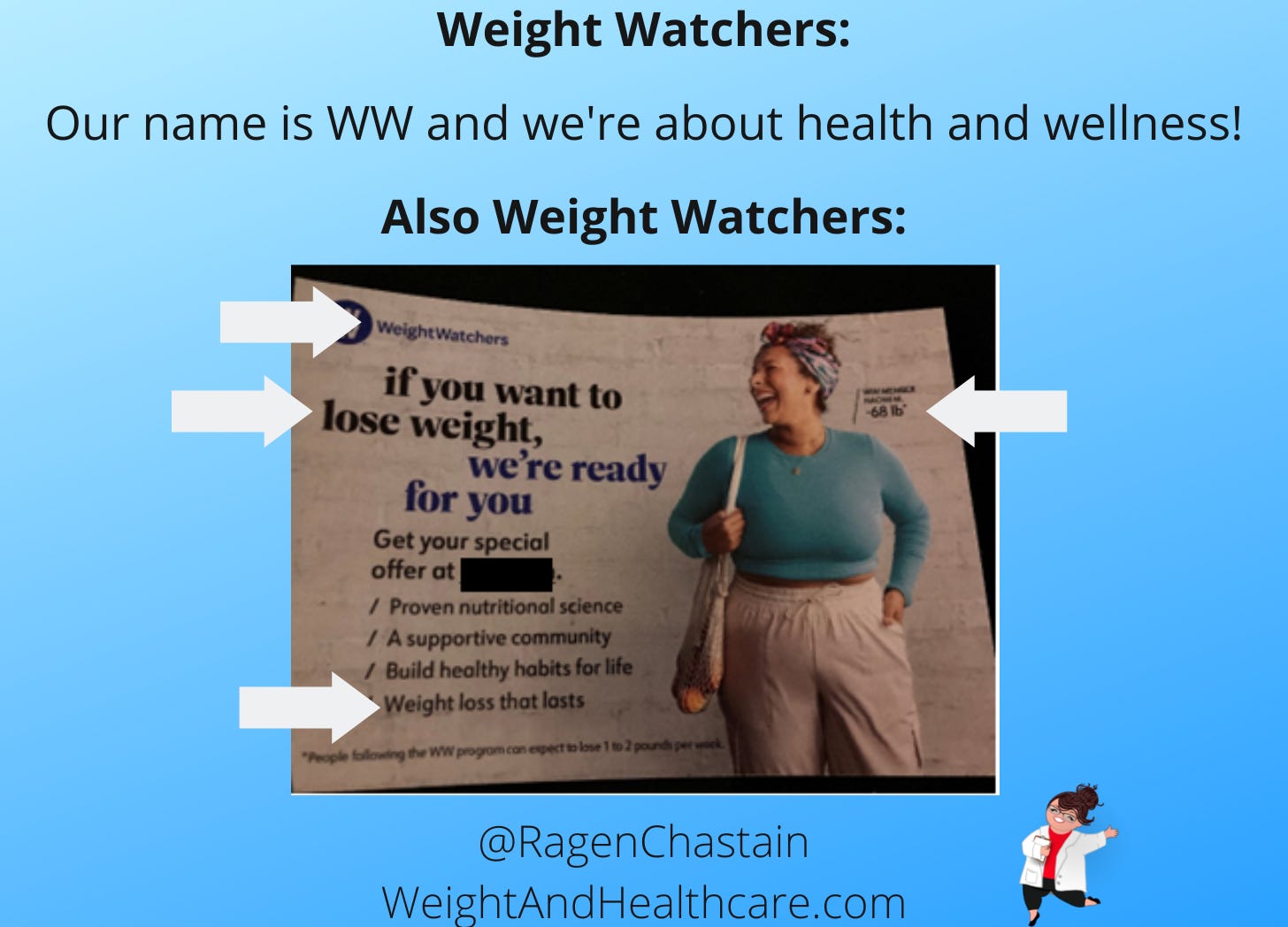
Weight Watchers - Up To Their Old Tricks
This is the Weight and Healthcare newsletter! If you appreciate the content here, please consider supporting the newsletter by subscribing and/or sharing!In 2018, Weight Watchers changed its name to “WW” added the tagline “wellness that works” and started using language about “health” and “wellness” and “beyond the scale.” Per a Fast Company article this happened because “In this new era of body image acceptance and feel-good wellness communities, Weight Watchers learned that the term “diet” was rife with negative connotations.” Another way to put this is that weight-neutral health and fat acceptance advocates had made tremendous headway in pointing out that, even according to Weight Watchers’ own research, their program almost never creates significant long-term weight loss. Thus, this seemed to be a fairly transparent attempt to co-opt the work of weight-neutral advocates and fat acceptance activists in order to keep selling a program that almost never works. The thing that they seem to have going for them is an uncanny ability to convince their clients (and everyone else) to credit Weight Watchers for short-term weight loss (the first part of the biological response to restriction) and then get their clients (and everyone else) to blame themselves for the weight regain that almost everyone experiences (the second part of the biological response to restriction.) In this way, they convince people to keep coming back for multiple rounds, which forms the nucleus of their repeat business model.According to an article by Traci Mann called “Oprah’s Investment in Weight Watchers Was Smart Because the Program Doesn’t Work”:“[Weight Watchers] brags about this to its shareholders. According to Weight Watchers’ business plan from 2001 (which I viewed in hard-copy form at a library), its members have “demonstrated a consistent pattern of repeat enrollment over a number of years,” signing up for an average of four separate program cycles. And in an interview for the documentary The Men Who Made Us Thin, former CFO Richard Samber explained that the reason the business was successful was because the majority of customers regained the weight they lost, or as he put it: “That’s where your business comes from.”Their rebrand to wellness builds on this scam. Which brings us to the postcard I received in the mail recently.Image Description: A postcard with a gray backgroundText: At the top left is the WW logo next to the words WeightWatchersIf you want to lose weight, we’re ready for youGet your special offer at [redacted]· Proven nutritional science· A supportive community· Build healthy habits for life· Weight loss that lastsImage:A smiling woman in a blue long-sleeve crop top and beige drawstring pants carrying a canvas bag with a scarf in her hair smiles with an open mouth. Beside her it says “New Member Naomi M -68 lb*” The * says “People following the WW program can expect to lose 1 to 2 pounds per week.Here we see their old and new tricks on display:Old tricks* Showing someone with a relatively large amount of weight loss with an asterisk that goes to a disclaimer.* The disclaimer is completely unclear. It makes it sounds like the average Weight Watchers participant will have the same results as the model within 34-68 weeks, but the research absolutely does NOT support that* They claim “weight loss that lasts” even though their own research (and a century of data) say that it is a straight-up lieNew tricks:They market publicly about “health” and “wellness” to avoid the negative connotations of diets, but when it comes time to really sell, they bring out the weight loss talk:* It says “Weight Watchers” right there at the top (even though they “officially changed their name” to WW)* The model has their weight loss listed, but absolutely no information about their health* “If you want to lose weight” is at the top, in the largest font* “Build healthy habits for life” only rates as a small font third bulletWeight Watchers, or WW, whatever they call themselves, they are not about health. They’ve never been about health, because they’ve been very clear that their profit model is built on weight cycling which is independently linked to harm. If they actually cared about people’s health, they would have either moved to a weight-neutral model or, preferably (at least to me,) just shut the whole mess down. I’d bet all the money in my pockets that this whole switch to marketing about “health” is about finding a way to co-opt the work of weight-neutral advocates and fat liberation activists, gloss over Weight Watchers’ utter failure at creating long-term weight loss, and trying to get people to stay on their program even though they are gaining the weight back, all while continuing to convince their customers to blame themselves for having the outcome that about 95% of people have.Essentially, Weight Watchers is a highly profitable scam. The fact that they have wheedled their way into corporate wellness programs and health insuran
Are Medicare and Medicaid Patients Required to Weigh-In?
This is the Weight and Healthcare newsletter! If you appreciate the content here, please consider supporting the newsletter by subscribing and/or sharing!I hear from a lot of people who are on Medicare and Medicaid that they have been told that they are required to weigh in at their appointments or the services won’t be covered. This is a misconception. Medicare and Medicaid's Merit-based Incentive Payment System (MIPS) (Content note – link contains anti-fat language), does require physicians to document a discussion, treatment plan, and follow-up for each patient with a BMI over 24.9 at least once per "performance period" (though it is not considered a “High Priority Measure.)This is part of a doctor's "quality score," which is closely tied to the reimbursement they receive. Basically, doctors can get a lower quality score and then be paid less for the services they did provide if they don't push weight loss.This is problematic on any number of levels (not the least of which is that it is encouraging doctors to give advice that is not ethical, evidence-based, or likely to work, and may well end up harming their patients. Regardless, your doctor receiving less compensation does not waive your right to informed consent/refusal. So even if it means your doctor gets paid less, they still have an ethical obligation to allow you to refuse routine weigh-in. But there’s good news, in researching this, I found that if a patient opts out of weigh-in, that patient is removed from both the numerator and the denominator for the doctor’s MIPS calculation. I wanted to double-check this, so I reached out to Kelley Aurand, DO, family physician and Informaticist who said:“Basically, if the patient declines weight or there is an underlying medical reason not to weigh, then the patient can be excluded from the denominator.”Dr Aurand also provided a link to an explainer document. While I do want to point out that it is deeply rooted in the weight loss paradigm, it may be something you can share with your healthcare provider (in particular, check out the “denominator exceptions” section.) Aurand does point out that there may be some tricky technical issues for your provider to navigate: “One would need to document this [weigh-in denial/medical reason for not weighing in] discretely in the electronic health record (EHR) so it can be automatically excluded from the reporting tools that are used for MIPS. I doubt most EHRs have this built in. We use one of the major EHRs and I'm not aware of a mechanism to document this information so the patient would be removed from the measure.” Still, you get to center your needs and experiences as a patient and, just like lowered compensation, technical difficulties faced by your provider do not negate your right to informed consent/refusal of the weigh-in as a Medicare/Medicaid patient. If you’re looking for options to decline the weigh-in, I have a piece about that here.Shelby Gordon and I also cover this in our video workshop: Navigating Weight Stigma at the Doctor’s Office (there is a pay-what-you-can-afford option so that money isn’t a barrier.) Did you find this newsletter helpful? You can subscribe for free to get future newsletters delivered direct to your inbox, or choose a paid subscription to support the newsletter and get special benefits! Click the Subscribe button for details:Like this piece? Share this piece:More ResearchFor a full bank of research, check out https://haeshealthsheets.com/resources/*Note on language: I use “fat” as a neutral descriptor as used by the fat activist community, I use “ob*se” and “overw*ight” to acknowledge that these are terms that were created to medicalize and pathologize fat bodies, with roots in racism and specifically anti-Blackness. Please read Sabrina Strings: Fearing the Black Body – the Racial Origins of Fat Phobia and Da’Shaun Harrison: Belly of the Beast: The Politics of Anti-Fatness as Anti-Blackness for more on this. Get full access to Weight and Healthcare at weightandhealthcare.substack.com/subscribe
Does This Study Really Show How To Maintain Weight Loss?
This is the Weight and Healthcare newsletter! If you appreciate the content here, please consider supporting the newsletter by subscribing and/or sharing!Reader Barbara sent me an article with the headline “How to Maintain Weight Loss, According to People Who Succeeded.” The article was about a study called “In their own words: Topic analysis of the motivations and strategies of over 6,000 long-term weight-loss maintainers” by Phelan et. al. (as always, I don’t link to research or articles that include fatphobic content.)The premise:This is a study, funded by a grant for Weight Watchers (aka WW) that analyzes 6,139 subjects’ responses to six open-ended questions. Two of the study authors are current employees and shareholders in Weight Watchers.I think it’s important to put this in context. They have 6,139 people who participated, out of a total of 7,419 who are part of Weight Watcher’s “success registry” (more on this later). Weight Watchers (aka WW) had 4.5 million subscribers at the end of 2020 alone (which was down 4.3% year over year). The subjects here represent just 0.14% of that, the total membership of their “success registry” is just 0.16% of their 2020 enrollment alone. So, like the NWCR before it, it is highly likely that this study is simply finding commonalities among outliers.Inclusion Criteria:In order to be included in the study, participants had to lose greater than or equal to 20.0621lbs (9.1 kg) and they only had to maintain it for one year. The average maintenance period was 3.4 years.About a century of research shows that people who lose weight tend to regain it within five years so the fact that they’ve used inclusion criteria less than that is questionable.It should also be noted that at the time of the study the “maintainers” had gained an average of thirteen pounds from their lowest weight, suggesting that the study authors and I have a different interpretation of the word “maintain.”Also, 67.3 percent of the “maintainers” were still categorized as “overw*ight” or “ob*se” Now, those are nonsense categories, made up to pathologize bodies based on size, and drive profit to the weight loss industry (and creating a lot of harm to those who are labeled as such.) But I point this out because these are categories that are used by this industry to drive profit. I think it’s important to know that two-thirds of this sample would still be targeted by Weight Watchers as potential customers, even though, here, they are considering them to be successes.IntroductionThe first half of their first sentence says “Modest weight loss can reduce long-term risk of cardiometabolic disease”There is no citation for this, and I assume that because it’s not a statement of fact. We’ve explored this myth before, and also that research shows that weight-neutral interventions provide greater benefits with fewer risks (for example, Gaesser and Angadi found that increases in cardiorespiratory fitness and physical activity are consistently associated with greater reductions in mortality risk than is intentional weight loss.)Back to the Weight Watchers study, the second half of their first introductory sentence /[admits that weight gain affects most individuals.Points for honesty there.Then they claim “Nevertheless, about 20% of individuals who have lost weight in the US population are able to keep it off long-term”Aaaand, I take the points back. They cite three studies to support this claim. The first defines long-term weight loss as “at least one year,” ignoring that most people regain to baseline or above in years 2-5. The second has a conclusion that literally states “most women who lost a clinically significant amount of weight regained most of it,” and the third only looks at a year of data, and used a sample group who were 10% below their starting weight the year before they were studied (without looking at whether they were already regaining) and found that 33.5% had regained weight, and while they claim that 58.9% had maintained their weight, they defined maintaining has having regained less than 5% of weight, so people could regain weight, but still be considered maintainers.This is a good example of how terrible research begets terrible research, all supporting diet industry profits. Every researcher in every one of these studies should know better, and citing them uncritically is inexcusable.This credibility is not helped by the fact that they uncritically cite the National Weight Control Registry with its questionable science.Results:In terms of extrapolatability, I want to point out that 91.9% identified as female; 94.3% identified as white.Subjects were asked six open-ended questions and only 12.9% of the subjects completed all of them. Subjects only had to complete one question to be included in the study.* What prompted you to start your weight-loss attempt? Please describe. (n = 6,092; 82.1%)* What currently motivates you to manage your weight? (n = 5,710; 77.0%)* What is one piece of advice that y

Reader Question – What’s the Deal with Lark Health?
This is the Weight and Healthcare newsletter! If you appreciate the content here, please consider supporting the newsletter by subscribing and/or sharing!I have had several readers ask about the Lark program. In each case, it was being actively marketed to them, without their consent, by their insurance company and/or employer.Lark is, predominantly, a weight loss program that also bills itself as a “diabetes prevention” program and “mind body” health coaching all offered by an Artificial Intelligence powered app. (Note that while it has various health programs, the big font headline at the top of the website says “Lose weight and be your healthiest self with Lark.”) It is covered by some insurance, and people can “earn” things like a scale and a fitbit by meeting “minimum program engagement requirements, such as weighing in, completing missions with your digital coach, and logging activity or meals.”The graphic on their website that they are calling “clinically proven results” says:5.3% average weight loss in year one (1)40% achieving greater than or equal to 5% weight loss in year one (1)9.6lbs average weight loss by Lark members beyond 2 months in the program (2)(1) Based on Lark program data for members meeting CDC qualification criteria(2) For those with available weight dataThese results are from the study Weight Loss in a Digital App-Based Diabetes Prevention Program Powered by Artificial Intelligence, Graham SA, Pitter V, Hori JH, Stein N, Branch OH. Accepted, Digital Health, vol 8. 2022. DOI:10.1177/20552076221130619 (as always, I don’t link to studies that pathologize higher-weight bodies, but I provide enough information for those who are interested to find them on Google.)The study’s lead author is Sara Graham who, according to LinkedIn is the “Clinical Research Manager at Lark Health”, in fact, per the conflict of interest statement, every single study author is employed by Lark.Let’s dig in, shall we?Let’s start with the study’s stated conclusion: [Lark] facilitated weight loss and maintenance commensurate with outcomes of other digital and in-person programs not powered by AI. Beyond CDC lesson completion, engaging with AI coaching and frequent weighing increased the likelihood of achieving ≥5% weight loss. An AI-powered program is an effective method to deliver the DPP in a scalable, resource-efficient manner to keep pace with the prediabetes epidemic.When they say “commensurate with outcomes of other digital and in-person programs” what I think you’ll find they mean is – people didn’t lose much weight, just like with every other program as we have seen in research for the last hundred years.And when they say it’s an effective way to deliver the DPP [Diabetes Prevention Program] it’s important to know that they did not, in any way, measure blood sugar, or anything other than weight and weight loss.But let’s really dig into the numbers:The one-year study started with 3,933 Lark Members, but at its 12 month conclusion only 414 members had provided beginning and ending weights.Those 414 were divided into two groups for comparison:Group 1: CDC qualifiers: Completed ≥4 educational lessons over 9 months (n = 191)Group 2: CDC non-qualifiers: did not complete the required CDC lessons but provided weigh-ins at 12 months (n = 223)So, did you catch that? They started with 3,933 members and only 191 actually managed to stay with the program for a year. (The other 223 “group 2” didn’t complete the program but did provide their weight at the beginning and at 12 months.) My first question is: Do the results matter if fewer than 5% of people even make it to a year on this program? I think the answer is…not really, but let’s go ahead with the analysis.What they actually found is that the 191 people in group 1 lost, on average 5.3% of their body weight, while the 223 in group 2 lost, on average, 3.3% of their body weight. So those who completed the program lost, on average, 2% more weight over the course of a year.To put some numbers on this, a 200-pound person who completed the coaching would expect to lose, on average 10.6 pounds in a year, while a 200-pound person who didn’t complete the coaching would lose 6.6 pounds. So this shows that a 200-pound person who completes the 12 month program can expect to lose 4 pounds more than someone who didn’t complete the program.Four pounds. In a year.Think of what the phrase “clinically proven results” would lead you to believe about a weight loss program. Then consider that they are using the phrase “clinically proven results” to characterize 4.8% of study participants losing, on average, 2% more weight than 5.6% who did not complete the program but at least provided a 12-month weigh-in, a conclusion which doesn’t include any data for 89.6% of the study participants.If you’re currently asking yourself something like: “Wait, doesn’t this kind of prove that their program is useless? And why, like, in the world, would anybody brag about these results?” then welcome to

Is Being Fat Really a Chronic, Lifelong Health Condition?
I got this question recently:“I’ve been seeing articles that say that being fat* is considered a “chronic lifelong condition.” Can you explain what’s going on to me?” Get full access to Weight and Healthcare at weightandhealthcare.substack.com/subscribe