Warriors In Their Own Words | First Person War Stories
512 episodes — Page 7 of 11
S2 Ep 82CUCM Johnny McCully: The Battle of Dong Xoai
CUCM McCully served in a construction battalion, more commonly known as the Seabees, during Vietnam. The Naval Construction Battalions, which quickly became known as the Seabees due to their abbreviation, were formed at the beginning of American involvement in World War II. They were created as an amphibious force to construct advanced bases in combat zones, and quickly became well respected because they were composed of only experienced men. Johnny McCully was inspired by the bravery of family members he saw volunteer to fight in World War II, and enlisted in the Navy at 17, right after the war ended. He was assigned to a Seabee unit, and helped rebuild infrastructure in countries around the world following the war. Two decades later, McCully deployed to Vietnam. A day after he was sent to Dong Xoai, the VietCong launched a surprise attack on his base. McCully was on watch when the first mortar hit, and played a significant role in defending the base during the first stages of the attack. He was hit with shrapnel, but continued to fight despite his injuries. McCully was then separated from his battalion during a fight with a VC soldier who had a flamethrower. McCully’s battalion thought he had been burned alive, but he escaped, and spent over 48 hours on the run, hiding from VC forces without any food, water, or ammo. Eventually he found an American helicopter that was landing, and was airlifted to safety. Upon reaching a hospital, the doctors told McCully he’d permanently lost 75% of the strength of his right arm. After physical therapy, he regained almost all his strength. Click here to learn more about the Battle of Dong Xai Photo Credits: NAVFAC and the U.S. Navy Seabees Museum Learn more about your ad choices. Visit megaphone.fm/adchoices
CUCM Johnny McCully: The Battle of Dong Xoai
CCM Jerry Markham: D-Day from a Seabee’s Perspective
S2 Ep 81CCM Jerry Markham: D-Day from a Seabee’s Perspective
Chief Machinist Mate Jerry Markham served as a Navy Seabee during World War II and was tasked with destroying German obstacles that could have prevented a successful beach landing on D-Day. The Naval Construction Battalions, which quickly became known as the Seabees due to their abbreviation, were formed at the beginning of American involvement in World War II. They were created as an amphibious force to construct advanced bases in combat zones, and quickly became well respected because they were composed of only experienced men. CMM Jerry Markham was a Seabee assigned to a Naval Combat Demolition Unit. On D-Day, their job was to clear German mines and obstacles that were placed in the water at Omaha. Without them, troops would never have reached the shore. Markham was in close proximity to multiple explosions during the invasion, and began to pass blood. On the third day, he went to a hospital ship, and wasn’t permitted to return to the battle due to his injuries. Learn more about your ad choices. Visit megaphone.fm/adchoices
Capt. James Peninger: Glider Pilot on D-Day
S2 Ep 80Capt. James Peninger: Glider Pilot on D-Day
Captain James Peninger served in World War Two as a glider pilot. He fought in the Invasion of Normandy, and was the first glider to cross the Rhine River. During WWII, glider planes were used to carry ground troops, and sometimes a jeep, into enemy territory. Regular planes dragged these gliders via a rope, which was cut over enemy territory at the release point. The glider kept flying, to hopefully find a clear landing zone behind enemy lines. Since the gliders were flimsy, designed for a single flight, and always sent into enemy territory, flying them was a notoriously dangerous job. To learn more about glider pilots during World War Two, visit ww2gp.org. Learn more about your ad choices. Visit megaphone.fm/adchoices
PFC Walter Stitt: Tank Gunner in WWII
S2 Ep 79PFC Walter Stitt: Tank Gunner in WWII
Private First Class Walter Stitt talks about what it was like serving inside a tank during World War II. He served as both a loader and gunner, and survived the destruction of three different tanks he was manning. To hear more from Stitt, check out his interview with the Clark County Historical Society. Learn more about your ad choices. Visit megaphone.fm/adchoices
A1C Larry Sutherland Part II: The Attack on Phan Rang

S2 Ep 78A1C Larry Sutherland Part II: The Attack on Phan Rang
Airman First Class Larry Sutherland joined the Airforce at 17, and signed up for the Security Police training program. In Vietnam, many Air Force bases were completely surrounded by guerrilla forces, so the USAF Security Police were specially trained to protect them from direct attacks and sabotage. During his training in North Dakota, Sutherland and some fellow soldiers wanted to “get even” with some missile security personnel that they took issue with. To do so, they broke into missile silo, but they were caught. Two members of the group went to prison, but Sutherland was found innocent of sabotage, and avoided being court martialed. Sutherland was then given a choice: Stay in North Dakota, or train at Schofield Barracks in Hawaii, and then head to Vietnam. At that time there was a rumor that 75% casualties were expected in the unit he would join in Vietnam, but Sutherland wanted to get out of North Dakota so badly that he didn’t care. So, he went to Schofield. According to Sutherland, the Security Police training at Schofield was worse than Vietnam. He said the instructors were “the most sadistic, mean bastards I've ever seen in my life or since. I could not believe that anybody could be so mean and hateful, in all ranks, from two stripers up to the officers. They just hated us. They treated us with such contempt...And when you fell out, and guys did, because guys were dying of heart attacks, they went over and pissed on them. That's the kind of people they were. They were pissing on dying people. I saw it with my eyes. I can see it till the day I die.” After completing his training, he was sent to Vietnam, where, due to the high casualty rate, he was sure he was going to die. He was stationed first at Pleiku Air Base, and then Phan Rang Air Base. Both bases were surrounded by guerilla forces. One Sunday night at Phan Rang, the Viet Cong launched a surprise attack. Alcoholism was a serious issue in his unit, so many of the Security Policemen at Phan Rang Air Base were intoxicated when the attack began. A few of these intoxicated men were in a bunker with Sutherland during the attack, and no matter how much he kicked and screamed, they wouldn’t get up to fight. They just rolled over and went back to sleep. Upon returning to the states, Sutherland was tasked with monitoring protests in New Jersey. Learn more about your ad choices. Visit megaphone.fm/adchoices
A1C Larry Sutherland Part I: USAF Security Police in Vietnam

S2 Ep 77A1C Larry Sutherland Part I: USAF Security Police in Vietnam
Airman First Class Larry Sutherland joined the Air Force at 17, and signed up for the Security Police training program. In Vietnam, many Air Force bases were completely surrounded by guerrilla forces, so the USAF Security Police were specially trained to protect them from direct attacks and sabotage. During his training in North Dakota, Sutherland and some fellow soldiers wanted to “get even” with some missile security personnel that they took issue with. To do so, they broke into missile silo, but they were caught. Two members of the group went to prison, but Sutherland was found innocent of sabotage, and avoided being court martialed. Sutherland was then given a choice: Stay in North Dakota, or train at Schofield Barracks in Hawaii, and then head to Vietnam. At that time there was a rumor that 75% casualties were expected in the unit he would join in Vietnam, but Sutherland wanted to get out of North Dakota so badly that he didn’t care. So, he went to Schofield. According to Sutherland, the Security Police training at Schofield was worse than Vietnam. He said the instructors were “the most sadistic, mean bastards I've ever seen in my life or since. I could not believe that anybody could be so mean and hateful, in all ranks, from two stripers up to the officers. They just hated us. They treated us with such contempt...And when you fell out, and guys did, because guys were dying of heart attacks, they went over and pissed on them. That's the kind of people they were. They were pissing on dying people. I saw it with my eyes. I can see it till the day I die.” After completing his training, he was sent to Vietnam, where, due to the high casualty rate, he was sure he was going to die. He was stationed first at Pleiku Air Base, and then Phan Rang Air Base. Both bases were surrounded by guerrilla forces. One Sunday night at Phan Rang, the Viet Cong launched a surprise attack. Alcoholism was a serious issue in his unit, so many of the Security Policemen at Phan Rang Air Base were intoxicated when the attack began. A few of these intoxicated men were in a bunker with Sutherland during the attack, and no matter how much he kicked and screamed, they wouldn’t get up to fight. They just rolled over and went back to sleep. Upon returning to the states, Sutherland was tasked with monitoring protests in New Jersey. Learn more about your ad choices. Visit megaphone.fm/adchoices
SF3 James Wire Part II: The Invasion of Iwo Jima and the Battle of Okinawa
S2 Ep 76SF3 James Wire Part II: The Invasion of Iwo Jima and the Battle of Okinawa
Shipfitter 3rd Class James Wire served on the USS Missouri during the invasion of Iwo Jima and the Battle of Okinawa. It was his job to put out fires and do damage control on the ship. If you missed it, make sure to check out the first part of his interview, where he talks about serving on the USS Tennessee during the attack on Pearl Harbor and the Battle of Tarawa. To hear more from SF3 Wire, check out this video of him presenting to a college class. Learn more about your ad choices. Visit megaphone.fm/adchoices
SF3 James Wire Part I: Pearl Harbor and the Battle of Tarawa
S2 Ep 75SF3 James Wire Part I: Pearl Harbor and the Battle of Tarawa
Shipfitter 3rd Class James Wire served on the USS Tennessee during the attack on Pearl Harbor and the Battle of Tarawa. It was his job to put out fires and do damage control on the ship. In this episode, he describes the chaos and destruction he witnessed. Next time on Warriors In Their Own Words, Wire talks about serving on the USS Missouri during the Invasion of Iwo Jima and the Battle of Okinawa. To hear more from SF3 Wire, check out this video of him presenting to a college class. Learn more about your ad choices. Visit megaphone.fm/adchoices
QM2 Brett Jones: Life inside the Navy SEALs and the CIA
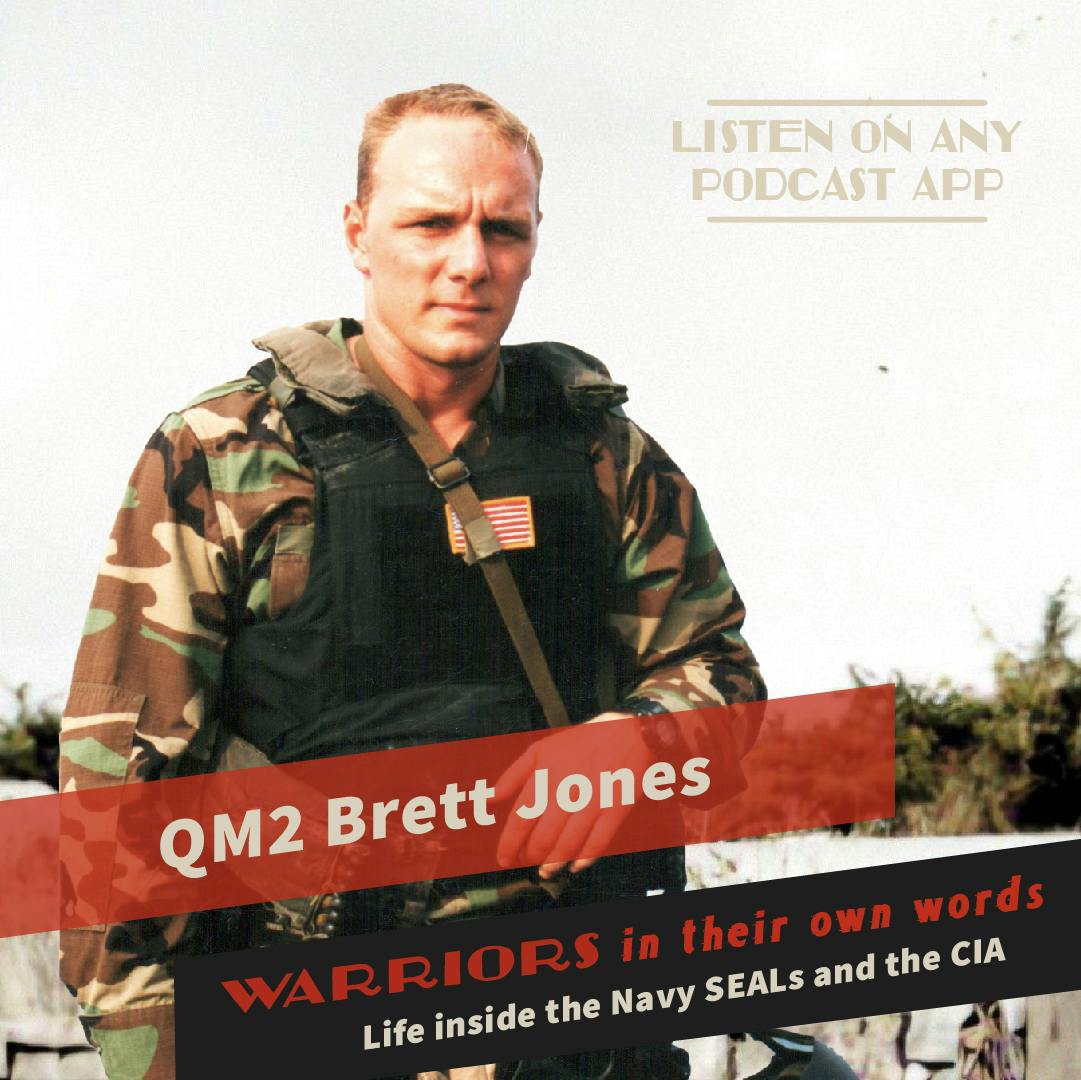
S22 Ep 74QM2 Brett Jones: Life inside the Navy SEALs and the CIA
QM2 Brett Jones joined the Navy in 1993 with the goal of becoming a Navy SEAL. Jones says he “wasn’t ready” the first time he went through SEAL training, and he did not complete the course. He came back and successfully completed the training on his second attempt. Jones joined SEAL Team 8, the most active of all the SEAL teams, where he served abroad. Due to the covert nature of SEAL operations, Jones wasn’t able to share all the details of his engagements, but he does talk about missions in Iraq, and the pain of losing friends in combat. After almost being kicked out of the SEALs, Jones decided to leave voluntarily. He continued to serve as a member of the CIA, deploying to Iraq again and protecting high value individuals in “high threat environments”. Jones is now a part time police officer in Alabama. Learn more about your ad choices. Visit megaphone.fm/adchoices
2nd LT Harry Loftis: Gliding Over the Beaches of Normandy
S2 Ep 742nd LT Harry Loftis: Gliding Over the Beaches of Normandy
2nd LT Loftis was a glider pilot during WW2, and participated in the D-Day invasion. During WW2, glider planes were used to carry ground troops, and sometimes a jeep, into enemy territory. Regular planes dragged these gliders via a rope, which was cut over enemy territory at the release point. The glider kept flying, to hopefully find a clear landing zone behind enemy lines. Since the gliders were flimsy, designed for a single flight, and always sent into enemy territory, flying them was a notoriously dangerous job. 2nd Lieutenant Harry Loftis was one of these brave pilots. He flew many missions, and fought in the Normandy Invasion, Operation Market Garden, and Operation Plunder. To learn more about glider pilots during World War Two, visit ww2gp.org. Learn more about your ad choices. Visit megaphone.fm/adchoices

S2 Ep 72S/Sgt. Joe Longo: Combat Cameraman
Staff Sergeant Joe Longo served in the Army Air Force during WWII and the Korean War as a combat cameraman on bombing missions. It was his job to document the missions of the 13th Air Force, and his footage was used for both intelligence and newsreels. He later founded the International Camera Association. Learn more about your ad choices. Visit megaphone.fm/adchoices
S/Sgt. Joe Longo: Combat Cameraman
Lt Col R.K. Montgomery: The St. Nazaire Raid

S2 Ep 71Lt Col R.K. Montgomery: The St. Nazaire Raid
In 1939, R.K. Montgomery attended the Royal Military Academy to become a Royal Engineer Officer in the British Army. He graduated right before World War II. His interest in explosives prompted him to pursue additional special training to become a demolitions expert in the Commandos. The Commandos (or British Commandos) were an elite group that gained fame for their rigorous training and distinctive green berets. In 1942, the Commandos launched Operation Chariot, a.k.a. the St. Nazaire Raid, to take out a dry dock that was crucial to the Germans. ‘Dry docks’ were docks that could be drained of water via a caisson in order to repair the hulls of ships. In order to destroy this dock, the Commandos traveled on the HMS Campbeltown, a ship that was made to look like a Möwe class German torpedo destroyer. LtCol Montgomery’s demolition teams packed the Campbeltown full of explosives, snuck it into the dock (only semi-successfully) and blew it up, taking the cassion with it. During the Raid, Lieutenant Colonel R.K. Montgomery was injured by an explosion, and then caught by German forces. He spent three years as a POW in Germany, and was released at the end of the war. Learn more about your ad choices. Visit megaphone.fm/adchoices
COL Gail S. Halvorsen: The Candy Bomber

S2 Ep 70COL Gail S. Halvorsen: The Candy Bomber
After World War Two, Germany was split up and occupied by the United States, France, Britain and the Soviet Union. In June of 1948, the U.S., France, and Britain announced they were creating a unified West German currency. Joseph Stalin opposed this unification, and cut off land routes from Berlin to West Germany. In order to bypass the land routes, bombers transported supplies (primarily food) and delivered them to West Berlin in what was called Operation Vittles. Colonel Gail S. Halvorsen was one of several pilots recruited to fly these missions. One day, after sneaking out and flying to Berlin for some R&R, COL Halvorsen met some local children who were survivors of the war. Talking with them changed his life, and he decided he wanted to do something to help them. He returned to base, gathered as much candy and gum as he could, fashioned parachutes with handkerchiefs, and put all the goodies inside. The next day, he flew over West Berlin and dropped the parachutes full of candy out of his bomb bay. The children were delighted. COL Halvorsen did this several more times, and gained international acclaim for his actions. To learn more about COL Halvorsen, check out his book, The Berlin Candy Bomber. Learn more about your ad choices. Visit megaphone.fm/adchoices
MOMM3 Norman Jensen: Combat Cameraman in a Submarine Part II
S2 Ep 69MOMM3 Norman Jensen: Combat Cameraman in a Submarine Part II
MOMM3 Norman Jensen served on submarines as a combat cameraman during WW2. After attending diesel and submarine school, he served on the USS Proteus, which was stationed in Guam. Then, Jensen transferred to the USS Queenfish where he first started taking pictures. His photos grabbed the attention of some officers, and he was transferred to the USS Cod. There, he was a motor Machinist, but his unofficial duty was to serve as a combat photographer. The Cod became famous after it rescued Dutch sailors aboard the O-19 which had gottens stuck in coral in the Ladd Reef. The Cod attempted to pull the O-19 free, but eventually the decision as made to welcome the Dutch sailors aboard the Cod and sink the O-19 to prevent it from being captured by the Japanese. Jensen documented the entire rescue. Jensen continued to document on the Cod during several attacks, and once was nearly shot by a machine before he dove into the hatch to safety. Learn more about your ad choices. Visit megaphone.fm/adchoices
MOMM3 Norman Jensen: Combat Cameraman in a Submarine Part I
S2 Ep 67MOMM3 Norman Jensen: Combat Cameraman in a Submarine Part I
Motor Machinist’s Mate 3rd Class Norman Jensen served on submarines as an unofficial combat cameraman during WW2. – After attending diesel and submarine school, Norman Jensen served on the USS Proteus, which was stationed in Guam. Then, Jensen transferred to the USS Queenfish where he first started taking pictures. His photos grabbed the attention of some officers, and he was transferred to the USS Cod. There, he was a motor Machinist, but his unofficial duty was to serve as a combat photographer. The Cod became famous after it rescued Dutch sailors aboard the O-19 which had gottens stuck in coral in the Ladd Reef. The Cod attempted to pull the O-19 free, but eventually the decision was made to welcome the Dutch sailors aboard the Cod and sink the O-19 to prevent it from being captured by the Japanese. Jensen documented the entire rescue. Jensen continued to document on the Cod during several attacks, and once was nearly shot by a machine gun before he dove into the hatch to safety. Learn more about your ad choices. Visit megaphone.fm/adchoices
Medal of Honor Podcast: Eddie Rickenbacker – Ace fighter pilot

S2 Ep 67Medal of Honor Podcast: Eddie Rickenbacker – Ace fighter pilot
bonusToday, we're sharing an episode from our other show, the Medal of Honor Podcast, as a bonus episode. Episodes of the Medal of Honor Podcast are short – just a few minutes each, and every week, Ken highlights a different service member who has distinguished themself through an act of bravery, earning our nations highest award for valor. The Medal of Honor Podcast is a great companion to Warriors in their Own Words. Follow The Medal of Honor Podcast wherever you get your shows. This episode is about Captain Eddie Rickenbacker. Rickenbacker served as a pilot in WWI, and was awarded the Medal of Honor for destroying two enemy aircraft in a one-versus-seven dogfight behind enemy lines. He also was awarded eight Distinguished Service Crosses for his other aerial victories. Learn more about your ad choices. Visit megaphone.fm/adchoices

S2 Ep 66CMSGT Doug Morrell Part II: “The Legend” in Vietnam
CMSGT Morrell rode along on bomber missions over Europe as a combat cameraman in order to document them. He was called upon several times to replace gunners after they had been killed, and was shot down three times during his service. – Doug Morrell joined the Army Air Corps two years before World War Two as a combat cameraman. He completed glider pilot training, and was sent to the University of Southern California for a year to study film and photography. Once the war started, Morrell accompanied crews on various missions all over Europe and Africa. It was his job to document the mission with film or photos so that the operation’s execution could be evaluated afterwards. He almost exclusively flew on bomber missions, and was called upon several times to replace gunners mid-fight after they had been killed. As a result, he was provided with the gunner’s wings despite never going to gunnery school. On one mission, Morrell’s aircraft was shot down over the “Iron Gates” of Romania. As a navigator was bailing Morrell and a gunner out, he made a mistake that sent them miles away from where the rest of the crew landed. The two of them spent twenty-six days evading capture and walking across the mountains of modern day Kosovo and northern Albania. Eventually they reached the Adriatic Sea, where they paid a fisherman to take them to Italy where they could meet up with allied forces. Morrell was later shot down in Romania again, but this time he was captured by German forces. He was kept in a prison camp for four and a half months before being rescued by the Russians. After that, he was sent back to the States. These two incredible stories earned him the nickname “The Legend,”, but his adventures were far from over. He was redeployed to Europe during the Cold War, spent five years in Panama documenting civic actions, and served in Korea and Vietnam. In Vietnam, Morrell would be shot down for a third and final time, where he shattered a bone in his ankle on landfall. He landed in hostile territory, and radioed for help. Nine hours and one firefight later, Morrell was air evaced to safety. You can learn more about this story here. After being shot down over enemy lines for the third time and escaping, Chief Master Sergeant Doug Morrell truly cemented himself as “The Legend. He was later awarded the Combat Camera Lifetime Achievement Award and the AIr Force Outstanding Civilian Career Service Award. Learn more about your ad choices. Visit megaphone.fm/adchoices
CMSGT Doug Morrell Part II: “The Legend” in Vietnam

S2 Ep 65CMSGT Doug Morrell Part I: “The Legend” in WWII
CMSGT Morrell rode along on bomber missions over Europe during WWII as a combat cameraman. He was called upon several times to replace gunners after they had been killed, and was shot down three times during his service. – Doug Morrell joined the Army Air Corps two years before World War Two as a combat cameraman. He completed glider pilot training, and was sent to the University of Southern California for a year to study film and photography. Once the war started, Morrell accompanied crews on various missions all over Europe and Africa. It was his job to document the mission with film or photos so that the operation’s execution could be evaluated afterwards. He almost exclusively flew on bomber missions, and was called upon several times to replace gunners after they had been killed. As a result, he was provided with gunner’s wings despite never going to gunnery school. On one mission, Morrell’s aircraft was shot down over the “Iron Gates” of Romania. As a navigator was bailing Morrell and a gunner out, he made a mistake that sent them miles away from where the rest of the crew landed. The two of them spent twenty-six days evading capture and walking across the mountains of modern day Kosovo and northern Albania. Eventually they reached the Adriatic Sea, where they paid a fisherman to take them to Italy where they could meet up with allied forces. Morrell was later shot down in Romania again, but this time he was captured by German forces. He was kept in a prison camp for four and a half months before being rescued by the Russians. After that, he was sent back to the States. These two incredible stories earned him the nickname “The Legend,” but his adventures were far from over. He was redeployed to Europe during the Cold War, spent five years in Panama documenting civic actions, and served in Korea and Vietnam. In Vietnam, Morrell would be shot down for a third and final time, where he shattered a bone in his ankle on landfall. He landed in hostile territory, and radioed for help. Nine hours and one firefight later, Morrell was air evaced to safety. You can learn more about this story here. After being shot down over enemy lines for the third time and escaping, Chief Master Sergeant Doug Morrell truly cemented himself as “The Legend. He was later awarded the Combat Camera Lifetime Achievement Award and the AIr Force Outstanding Civilian Career Service Award. Learn more about your ad choices. Visit megaphone.fm/adchoices
CMSGT Doug Morrell Part I: “The Legend” in WWII
CPT Shad Meshad: Psychiatric Teams in Vietnam Part II

S2 Ep 64CPT Shad Meshad: Psychiatric Teams in Vietnam Part II
EAfter earning his masters in psychiatric social work and completing basic training, Shad Meshad worked at Fort Leavenworth Military Prison as a mental health officer. Most of the prisoners were Vietnam veterans, and he provided them with treatment and a means to reintegrate into society. After hearing the stories of veterans at Fort Leavenworth, Meshad decided he had to serve himself. He volunteered to serve in a KO team, which were the first psychiatric teams in American warfare. For five years, Captain Meshad was flown all around Vietnam to help evaluate and assist soldiers dealing with mental health issues. When he returned home, Meshad founded and directed the Vietnam Veterans Re-Socialization Unit at the VA Hospital in Los Angeles, California. It was his job to reshape the VA in a way that better served Vietnam vets. It was during this time that CPT Meshad would become one of the first people to study the disorder now known as PTSD (Post-Traumatic Stress Disorder). In 1979, Meshad founded the Vet Center Outreach Program, which created satellite centers that provide social and psychological services to any Veteran in order to help them transition back into civilian life. Now, Meshad is the president of the National Veterans Foundation, which he founded in 1985. The NVF helps veterans that are unable to reach a Vet Center with financial problems, mental health issues, VA benefits, employment, housing, and more. To learn more about Captain Shad Meshad, check out his memoir, Captain for Dark Mornings. You can also watch a short documentary about his work after Vietnam titled The Mad Man. Learn more about your ad choices. Visit megaphone.fm/adchoices
CPT Shad Meshad: Psychiatric Teams in Vietnam Part I

S2 Ep 63CPT Shad Meshad: Psychiatric Teams in Vietnam Part I
Warning, this episode mentions violence, racism, sex, and self-harm. Listener discretion is advised. After earning his masters in psychiatric social work and completing basic training, Shad Meshad worked at Fort Leavenworth Military Prison as a mental health officer. Most of the prisoners were Vietnam veterans, and he provided them with treatment and a means to reintegrate into society. Meshad heard countless stories of Vietnam from the vets there, and decided he had to serve himself. He volunteered to serve in a KO team, which were the first psychiatric teams in American warfare. For five years, Captain Meshad was flown all around Vietnam to help evaluate and assist soldiers dealing with mental health issues. When he returned home, Meshad founded and directed the Vietnam Veterans Re-Socialization Unit at the VA Hospital in Los Angeles, California. It was his job to reshape the VA in a way that better served Vietnam vets. It was during this time that CPT Meshad would become one of the first people to study the disorder now known as PTSD (Post-Traumatic Stress Disorder). In 1979, Meshad founded the Vet Center Outreach Program, which created satellite centers that provide social and psychological services to any Veteran in order to help them transition back into civilian life. Now, Meshad is the president of the National Veterans Foundation, which he founded in 1985. The NVF helps veterans that are unable to reach a Vet Center with financial problems, mental health issues, VA benefits, employment, housing, and more. To learn more about Captain Shad Meshad, check out his memoir, Captain for Dark Mornings. You can also watch a short documentary about his work after Vietnam titled The Mad Man. Learn more about your ad choices. Visit megaphone.fm/adchoices
Maj James Dunning Part II: The Dieppe Raid

S2 Ep 62Maj James Dunning Part II: The Dieppe Raid
In this episode, Maj James Dunning describes the infamous Dieppe Raid and becoming an instructor at Achnacarry Castle. At 20 years old, James Dunning volunteered for the new special force that would become the Commandos (or British Commandos). The Commandos quickly became famous for their rigorous training, elite status, and their green berets. Dunning fought with the Commandos during World War Two, most notably during the Dieppe Raid. Known as Operation Jubilee, the Dieppe Raid was an amphibious landing on the shores of Dieppe, France on August 19th, 1942. It was considered a failure due to the loss of almost 75% of their troops, but it gave the British valuable knowledge and experience that would contribute to the success of the D-Day Invasion. After Dieppe, Dunning trained to become an officer. He was sent to Achnacarry Castle in the Scottish Highlands, which served as a training ground primarily for the Commandos. He went on to become an instructor there. Dunning later published a book about his experiences called The Fighting Fourth. Learn more about your ad choices. Visit megaphone.fm/adchoices
Happy Holidays!
Hi, I’m Ken Harbaugh, host of Warriors In Their Own Words. I just wanted to let you know that the team and I are taking some time off during the holidays. We’ll return to our normal release schedule on January 12th. In the meantime, we’ll be sharing an episode of our other show, the Medal of Honor podcast, here on this feed. Think of it as our holiday gift to you as thanks for your support. Happy holidays, and have a great new year! Learn more about your ad choices. Visit megaphone.fm/adchoices
Happy Holidays!

S1 Ep 59Maj James Dunning Part I: British Commando in WW2
At 20 years old, James Dunning volunteered for the new special force that would become the Commandos (or British Commandos). The Commandos quickly became famous for their rigorous training, elite status, and their green berets. Dunning fought with the Commandos during World War Two, most notably during the Dieppe Raid. Known as Operation Jubilee, the Dieppe Raid was an amphibious landing on the shores of Dieppe, France on August 19th, 1942. It was considered a failure due to the loss of almost 75% of their troops, but it gave the British valuable knowledge and experience that would contribute to the success of the D-Day Invasion. After Dieppe, Dunning trained to become an officer. He was sent to Achnacarry Castle in the Scottish Highlands, which served as a training ground primarily for the Commandos. He went on to become an instructor there. Dunning later published a book about his experiences called The Fighting Fourth. Learn more about your ad choices. Visit megaphone.fm/adchoices
Maj James Dunning Part I: British Commando in WW2
COL Douglas C. Dillard: Paratrooper in the Battle of the Bulge

S2 Ep 59COL Douglas C. Dillard: Paratrooper in the Battle of the Bulge
COL Douglas C. Dillard describes fighting in WWII as an Army parachute regiment sergeant during the Battle of the Bulge. He also discusses the cold, harsh environment they faced, and how he almost lost both of his legs because of it. During the interview, Dillard describes an encounter he had with a captured German soldier: “We caught a German there in that field. And we were all really infuriated and I looked at the guy and he had a breast full of ribbons on this tunic. And I don't know why I did it and I still have them today, but I reached up and grabbed those ribbons and just ripped them off his uniform and stuck them in my pocket. And why I did it, I still don't know. But there was never any thought in my mind of shooting him. It's the furthest thought because we weren't raised that way. But in a rage of passion, in a firefight, then you would do it.” Dillard would later serve Korea and Vietnam, and retire in 1977 after earning the Distinguished Flying Cross, Legion of Merit (2 Oak Leaf Clusters), Meritorious Service Medal, Joint Service Commendation Medal, Bronze Star Medal (1 Oak Leaf Cluster), Air Medal (4 Oak Leaf Clusters), and the Army Commendation Medal (2 Oak Leaf Clusters). He was inducted into the Military Intelligence hall of fame in 1990. He also wrote two books about his experiences, Operation Aviary, and Tiger Hunters. You can learn more about COL Dillard here. Learn more about your ad choices. Visit megaphone.fm/adchoices

S1 Ep 57Sgt. J. Edward ‘Swede’ Pearsall: The Surrender of Wake Island
On this day (December 8th) in 1941, Japanese forces attacked Wake Island. After the Americans surrendered, Sgt. Pearsall and his fellow Marines were taken as prisoners of war, and spent 3 ½ years at a prison camp in China during WWII. Sergeant John Edward ‘Swede’ Pearsall served in the Marines as a part of the 1st Defense Battalion, D Battery on Wake Island in 1941. Wake Island is located 2,458 miles west of Hawaii in the Pacific Ocean. The U.S. knew a Japanese attack was coming, so men were stationed on the island to protect it. On December 8th, 1941, the day after the attack on Pearl Harbor, the Japanese attacked Wake Island. The Battle of Wake Island lasted for a little over two weeks until American forces surrendered in order to protect civilian lives. After the surrender, Sgt. Pearsall and his fellow Marines were almost executed before the Japanese decided to take them as prisoners. They would eventually be taken on a prison ship to Yokohama Harbor, and then transported to Wusong China, where they would spend three and a half years in a prison camp. At the camp, conditions were brutal. They had little water to drink or bathe with, were beaten often, were not adequately fed, and were forced to do physical labor. During the interview, Pearsall had this to say about the camps: “Starvation, I found, was the toughest thing. The beatings you took. Almost daily, you took beatings from the Japanese, but you kind of became punch-drunk, so to speak. You expected them and you lived with them. But starvation you don't live with. When you're hungry, you're hungry 24 hours a day. You go to sleep hungry. You wake up during the night hungry, and you're hungry all day. Starvation is one of the toughest things we found to face. The work and labor that they made us do was tough, but the food was totally inadequate for the work and to sustain life. Myself, I went from a 200 pound Marine. When the war ended, I weighed somewhere around 85 pounds, so that when the war finally came to end, there wasn't much left of us. We couldn't have sustained life, under the food we were getting, much longer.” Finally on Easter Sunday, 1945, American forces arrived and liberated the camp, saving Sgt. Pearsall and his fellow prisoners. Upon arriving home, Pearsall was awarded the Purple Heart. To learn more about J. Edward Pearsall and the Battle of Wake Island, check out Son of Wake Island. It's written by J. Edward Pearsall's son, David Pearsall, with the help of his father and the other surviving defenders of Wake island. Learn more about your ad choices. Visit megaphone.fm/adchoices