
Walkabout the Galaxy
Joshua Colwell, Adrienne Dove, and James Cooney · Joshua Colwell
Show overview
Walkabout the Galaxy has been publishing since 2015, and across the 11 years since has built a catalogue of 378 episodes. That works out to roughly 280 hours of audio in total. Releases follow a fortnightly cadence, with the show now in its 7th season.
Episodes typically run thirty-five to sixty minutes — most land between 41 min and 49 min — and the run-time is fairly consistent across the catalogue. It is catalogued as a EN-language Science show.
The show is actively publishing — the most recent episode landed 2 weeks ago, with 22 episodes already out so far this year. The busiest year was 2021, with 45 episodes published. Published by Joshua Colwell.
From the publisher
An irreverent and informative tour of the latest, greatest, and most interesting discoveries in astronomy.
Latest Episodes
View all 378 episodesA New Dwarf Planet and a Glimpse of the Zeptoverse
Adventures on the Moon and Mars with a Rover Record and a New Crater
The Oldest Radio Burst and Chariklo's Rapidly Changing Rings
Backwards Exoplanet and Shrinking Mercury
Have We Detected Dark Matter?
Mapping a Galaxy's Dark Matter and a Game-Changing Space Telescope
Black Hole Stars and Solar Instabilities
Dyson Spheres and Interstellar Colonization
Black Holes Come Back for Seconds and a Rocky Exoplanet with an Atmosphere
Distant Quasars and Earth's Quasi-Moon
I See a Big Moon Rising and a Bright Radio Sky
Europa's Disappearing Plumes
Second Generation Black Hole Mergers and Solar System Chaos
Whacky Black Hole Collisions and Strange Uranian Rings
Little Plutino Has An Atmosphere and Making Sense of Saturn
Superkilonova and Artemis II Recap

Ep 422A Whisper of a Hint of Primordial Black Holes plus Earth BLOBs
Gravitational Wave observatory LIGO has seen a signature that looks like the merger of primordial (pre-stellar, big bang (not big band!) era) black holes. If confirmed with future observations, this would tell us a lot about the early universe and potentially shed light on dark matter. Finally! Plus, closer to home, the BLOBs in the Earth's mantle help us untangle the complicated past of our magnetic field.
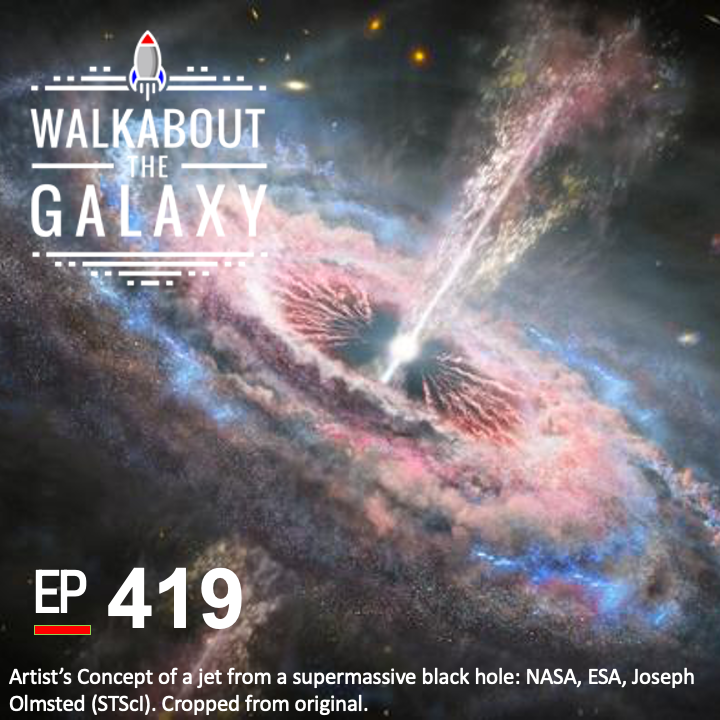
Ep 419Supermassive Black Holes Supersoaking Other Galaxies
Supermassive black holes can be terrible neighbors. New research shows that their powerful jets of charged particles can shut down star formation in neighboring galaxies within the galaxy cluster, which is just plain rude. Closer to home, our own Down Quark Audrey Martin is part of a study shedding new light (with the James Webb Space Telescope) on the mysterious L type asteroids, that formed at very high temperatures early in our solar system's history.

Ep 418Snowball Earth was Cold and Scary and the Milky Way Magnetic Field is a Mess
The Earth spent some crazy amounts of time (tens of millions of years) completely frozen over. And not, in the grand scheme of things, all that long ago. New research shows the ocean was salty and super-cold. How did life survive? New techniques using radio observations reveal a complicated and twisty galactic magnetic field. Join us for an icy, winter olympics themed episode to find out all this and more.
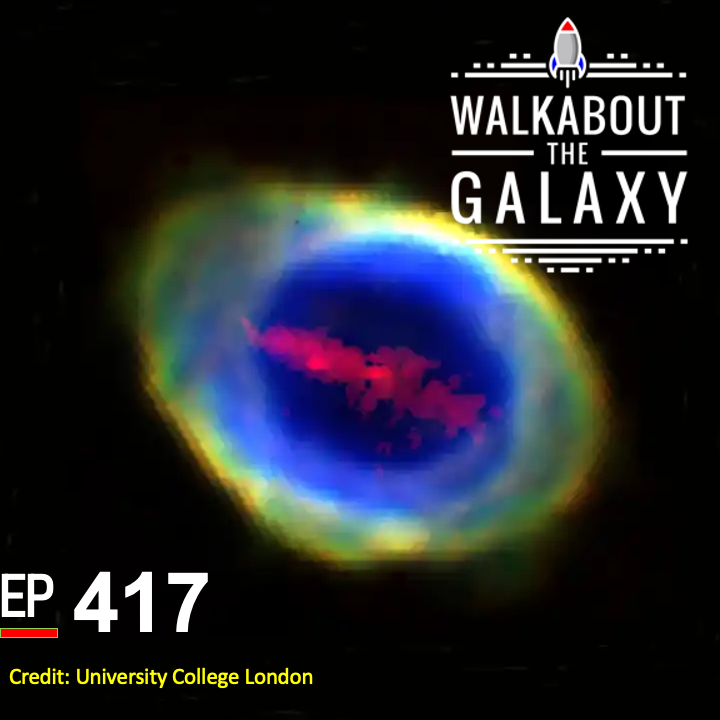
Ep 417Planetary Nebulae and Active Asteroids Get a Closer Look
There's always been a fuzzy line between asteroids and comets, and new observations of asteroids in the vicinity of Jupiter provide a hint to the origin of the mysterious active asteroids that look like asteroids but act like comets. Elsewhere in the galaxy, the famous ring nebula gets a new spectral image that shows the presence of band of iron. Could it be the remnants of a planet like Earth or Mercury that was vaporized when the nebular formed? Tune in for our take on this, space news, trivia and much more.