Venture Unlocked: The playbook for venture capital managers
162 episodes — Page 3 of 4
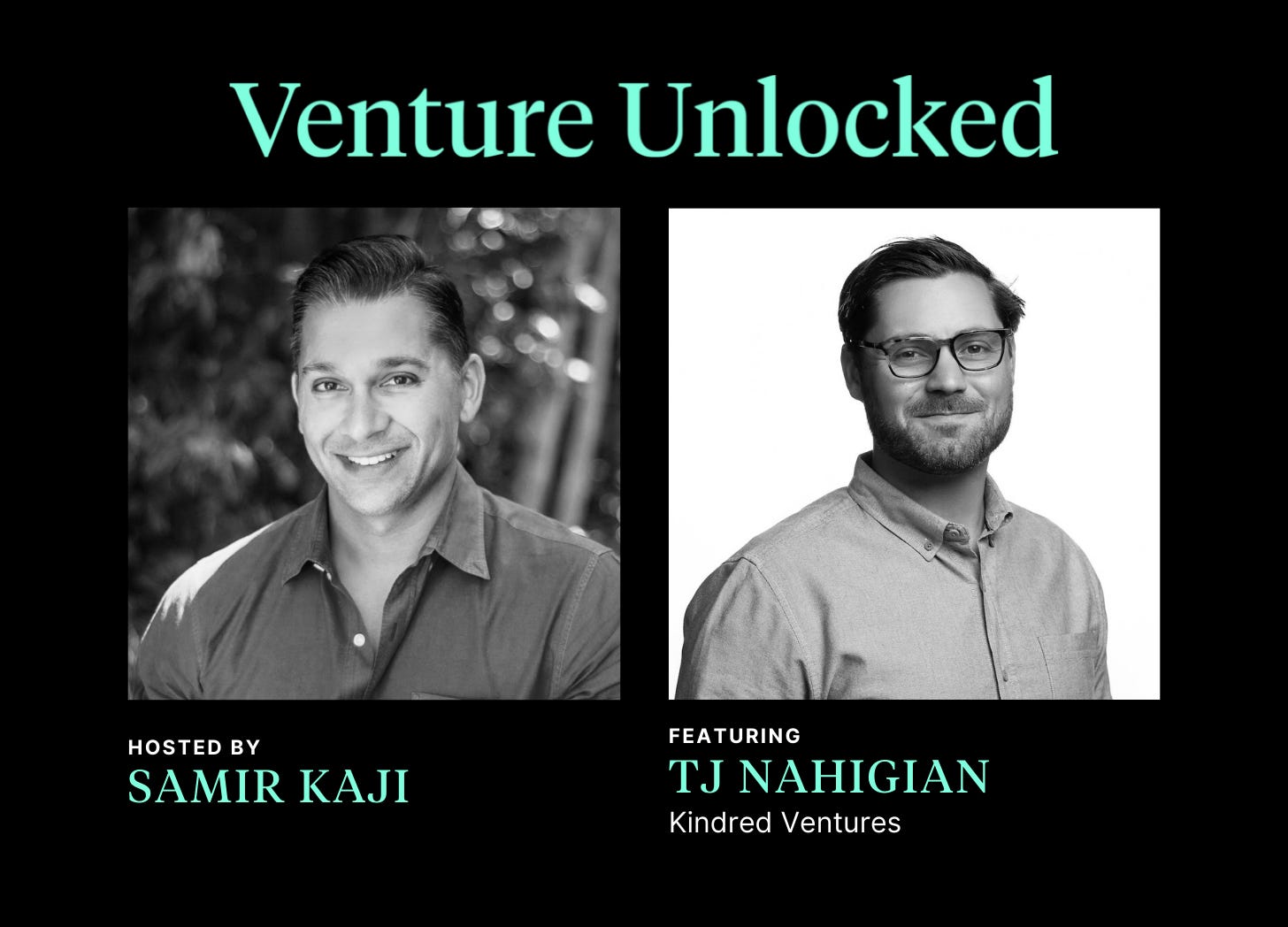
Base10's TJ Nahigian on using automation and research within the firm as a competitive advantage, ways to optimize outcomes in the current investing climate, and thoughts on crossover investing.
Follow me @samirkaji for my thoughts on the venture market, with a focus on the continued evolution of the VC landscape.Our guest today is TJ Nahigian, co-founder and managing partner of Base10 Partners, a SF based early stage firm focusing on investing in companies that help automate the real economy. They currently manage over $600MM in AUM and have invested in companies such as Figma, Notion, Brex, and Plaid.Prior to Base10, TJ was the founder and CEO of Jobr, which he led to a successful acquisition by Monster in 2016. Before that, he worked in investment roles at Accel, Summit Partners, and Coatue, where helped launch the private investing efforts of the firm. A word from our sponsor:Invest in innovation. Allocate allows investors to access top-tier private funds and co-investment opportunities within the technology sector.Despite the enormous growth of the private markets and the rapid increase of retail demand for private alternatives, investing in the highest quality private assets within the innovation sector still remains limited to institutions and ultra-connected high net worth individuals.With Allocate, wealth advisors, banks, family offices, and other qualified investors can have a streamlined way to responsibly invest with confidence.Go to allocate.co to find out more and please sign up to the waitlist to learn more and get early access to the platform.In this episode we discuss:01:17 TJ’s path to VC03:16 How past experiences at Accel, Coatue, and Jobr contributed to his view on the type of firm he wanted Base10 to be. 06:47 An inside view on the early conversations he and his partner Ade had to chart a common vision. 10:07 The decision to start a new firm for the first time rather than joining another well-established firm. 11:28 What they got right and what went wrong with their first fundraise15:22 The benefits and potential risks of having large anchor LP funds as early investors18:10 The ingredients an emerging manager needs to thrive in today’s market22:37 How the firm leverages research and automation to source and win deals. 25:31 How their research helps them find non-obvious deals in lesser trafficked geographies. 29:54 Why purpose and diversity is central to Base10’s investment thesis37:47 How the long time to liquidity has changed the investing market41:46 Reflecting back when he helped start Coatue’s private investments focus43:17 The biggest myth about investing 44:11 The investor that’s had the biggest impact on his career46:07 The experience that helped define him as an investorMentioned in this episode:Base10 PartnersI’d love to know what you took away from this conversation with TJ. Follow me @SamirKaji and give me your insights and questions with the hashtag #ventureunlocked. If you’d like to be considered as a guest or have someone you’d like to hear from (GP or LP), drop me a direct message on Twitter.Transcript:Samir Kaji:Hi, I'm Samir Kaji. And welcome back to another episode of Venture Unlocked, the podcast that takes you behind the scenes of the business of venture capital. Our guest today is TJ Nahigian, co-founder of Base10 Partners, a San Francisco based early stage firm focused on investing in companies that help automate the real economy. The firm currently has over 600 million in assets under management, and has invested in companies such as Figma, Notion, Brex, and Plaid.Samir Kaji:Prior to starting Base10, with his partner, Ade, TJ was the founder and CEO of Jobr. And prior to that he worked in investment roles at Accel, and Summit Partners, as well as Coatue where he helped launch the private investing efforts of the firm. Having known TJ since the early days of Base10, it was so fun to go back in time to hear the origin story of the firm, how they've evolved using automation to drive better outcomes, and how they think about navigating the current markets to drive alpha for their investors. Without further ado, let's get into the episode to hear all of that and more. TJ, it's so great to have you on the show. Thanks for being on.TJ Nahigian:Thanks so much for having me, Samir.Samir Kaji:There's so many threads I'm going to pull on during this entirety of this conversation. But let's actually start from the beginning. You've worked at a number of firms, including some iconic ones like Coatue and Summit, and others, but how did you first get into investing?TJ Nahigian:I grew up in an entrepreneurial family, which is what got me into business in the first place, and then graduated with a finance degree in the middle of the financial crisis, which many would say it was just awful timing. But it ended up being probably the luckiest thing that's ever happened to me because it actually brought me out to Summit Partners in the Bay Area in early 2009 just as the world was starting to emerge from that financial crisis, and venture led on a significant change starting then. In '09 there were 20 to 30 different venture firms all cobbled around Sand Hill Road and Palo Al

Glasswing Ventures Rudina Seseri on frontier tech, the KPI's Glasswing uses to measure their value-add to founders, and why diversity is central to their investing ethos
Follow me @samirkaji for my thoughts on the venture market, with a focus on the continued evolution of the VC landscape.Today, we have the great pleasure of chatting with Rudina Seseri, Founder of Glasswing Ventures, an early-stage venture capital firm investing in AI-powered software companies. With over 17 years of investing and related experience, Rudina has led investments in companies such as Celtra, Crowdtwist, ChaosSearch, Plannuh, Reprise, Inrupt, and Zylotech (recently acquired by Terminus).Prior to moving into venture capital, Rudina was a Senior Manager in the Corporate Development Group at Microsoft Corporation and started her career as an investment banker at Credit Suisse. Rudina was appointed by the Dean of the Harvard Business School (HBS) for four consecutive years to serve as Entrepreneur-In-Residence for the Business School and has most recently been named to the HBS inaugural group of Rock Venture Capital Partners.A word from our sponsor:Invest in innovation. Allocate allows investors to access top-tier private funds and co-investment opportunities within the technology sector. Despite the enormous growth of the private markets and the rapid increase of retail demand for private alternatives, investing in the highest quality private assets within the innovation sector still remains limited to institutions and ultra-connected high net worth individuals. With Allocate, wealth advisors, banks, family offices, and other qualified investors can have a streamlined way to responsibly invest with confidence. Go to allocate.co to find out more, and if you are a investor in funds of any kind, please sign up to the waitlist. In this episode we discuss:01:01 What inspired Rudina to become a full-time investor and what was her early investing philosophy03:06 The firm’s structure and methodology05:42 Learnings from the first fundraise08:35 Frontier tech investing12:13 What type of frontier tech companies the firm looks for14:11 How Glasswing specifically evaluates companies 21:01 How they thoughtfully built the team at Glasswing to drive unique support to their founders25:03 Preserving ownership in companies during the current market conditions without having to substantially increase fund size28:36 Deciding on when to make an exception on valuation or ownership30:44 How the firm deals with unconscious bias and group think when evaluating investments34:50 Using diversity of thought to drive better decision making38:55 The most counterintuitive lesson Rudina has learned as a VC40:52 The investing miss that taught her a lesson42:13 The investor she most admiresMentioned in this episode:Glasswing VenturesI’d love to know what you took away from this conversation with Rudina. Follow me @SamirKaji and give me your insights and questions with the hashtag #ventureunlocked. If you’d like to be considered as a guest or have someone you’d like to hear from (GP or LP), drop me a direct message on Twitter.Transcript:Samir Kaji:Hi, I'm Samir Kaji, welcome to another episode of Venture Unlocked, the podcast that takes you behind the scenes of the business of venture capital. Today, we have the great pleasure of chatting with Rudina Seseri, founder of Glasswing Ventures, an early stage venture firm investing in AI power technology companies. With over 17 years of investing in transactional experience, Rudina has led investments in companies such as Celtra, CrowdTwist, Talla, and Zylotech. During our discussion, we talked about her view of what frontier tech means to them, the KPIs that Glasswing uses when measuring value add services to founders, and why diversity is so central to their investing ethos. Now, let's get into the episode to hear all of them and more. Rudina, it's great to see you and thanks for being on the show.Rudina Seseri:Hello, Samir, happy summer and thank you for having me.Samir Kaji:Now, let's get into your start into venture capital. You had a myriad of other roles before you became a full-time investor. What inspired you to be a full-time investor? What was the opportunity you saw and what type of investment philosophy did you have?Rudina Seseri:I had been in investment banking as a little low analyst. Remember those? 120-hour weeks. And I was in tech investment banking. So I joke that after three years of investment banking, I was done with the banking hours, but I had permanently caught the tech bug. So and this was the early 2000s, both the bubble and the burr. So both sides of that equation, but really became hooked and was excited by the innovation and the transformation and that passion. So, I knew I wanted to do tech of some sort and VC sounded very, very sexy. Have you met an MBA that doesn't love VC? So, I went to HBS to get my MBA and there I met Rick Grinnell, who was already a VC, and not coincidentally today my co-founder and partner at Glasswing Ventures.Rudina Seseri:We launched the firm together, but Rick was already a VC. And as a student, I actually did a few projects with h
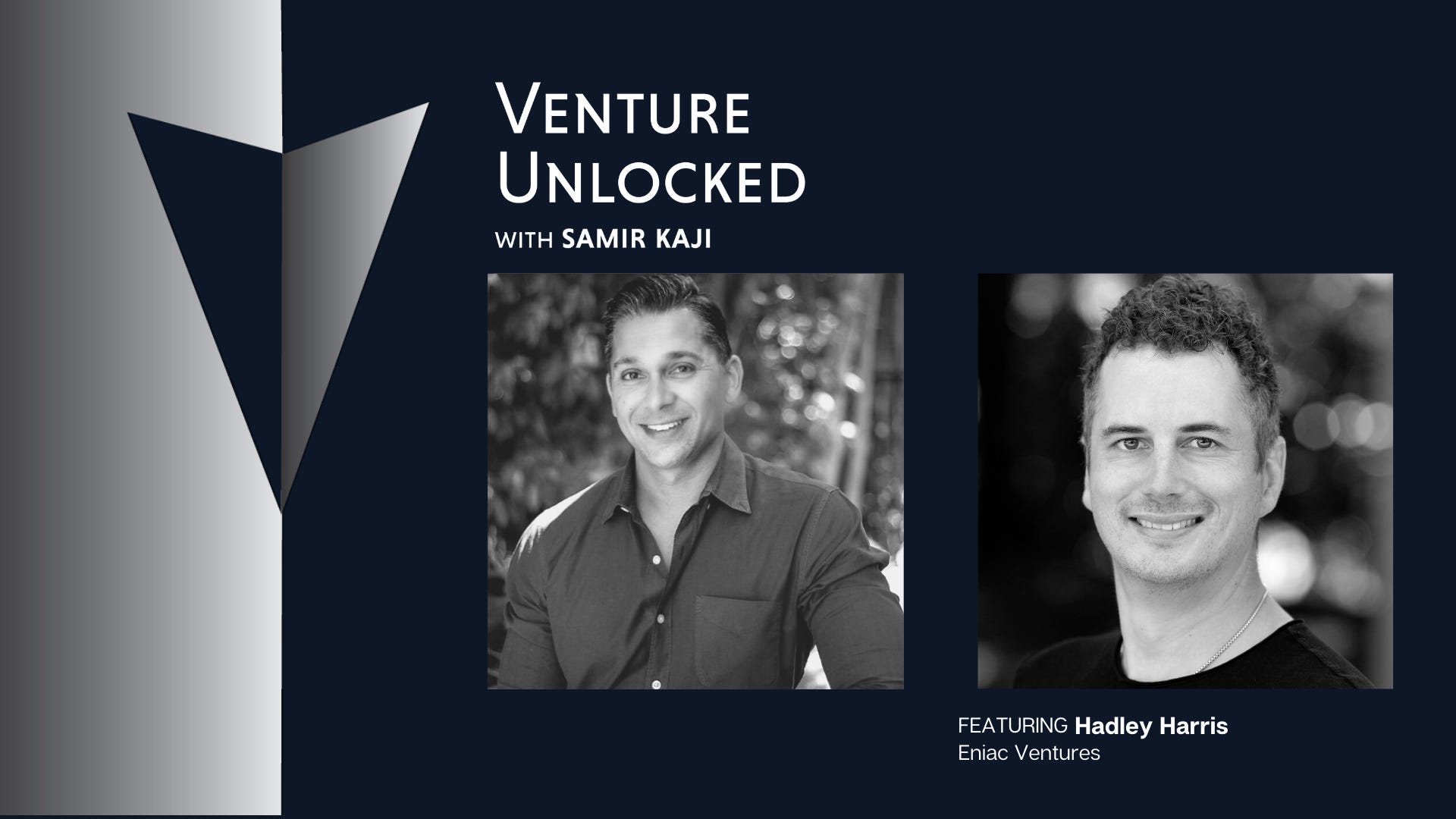
Eniac Ventures Hadley Harris on portfolio construction fundamentals, partnership durability, and views on the shifting seed market
Follow me @samirkaji for my thoughts on the venture market, with a focus on the continued evolution of the VC landscape.I’m thrilled to bring you my conversation with Hadley Harris, one of the founding partners of seed stage investor Eniac Ventures. Over their history, Eniac has invested many amazing companies including AirBnB, Cameo, Hinge, and Soundcloud. After starting with an initial $1.6M Fund I 11 years ago, they currently grown and expanded to now managing over $300MM in AUM. It was fun chatting with him on the origin story of the original partnership and how they’ve evolved over the years together, and with the introduction of new team members. Also in our conversation we spoke about portfolio construction, which I personally find fascinating given the different approaches that exist. For those that haven’t seen it, check out Hadley’s post on portfolio construction (“Seed Portfolio Construction for Dummies”) as it’s a great post. Prior to Eniac, Hadley held various operational roles including head of Business Market Strategy at Vlingo, which was acquired for $225M by Nuance Communications. He did his undergrad and MBA at the University of Pennsylvania.A word from our sponsor:Vouch Insurance is a new kind of insurance platform for startups. Built by founders for founders, Vouch’s fully digital coverage takes minutes to activate. Vouch is trusted by the biggest names in the startup economy — such as Y Combinator and Silicon Valley Bank — who partner with Vouch because everything from onboarding to claims is designed for startups by experienced founders. Because Vouch is an insurance platform, and not a broker, it works with its clients to manage, mitigate, and avoid risks. http://www.vouch.us/ventureunlockedIn this episode we discuss:01:48 What led Hadley and his partners to start Eniac Ventures03:43 Considerations they thought through when starting a firm together after being friends for so long. 04:47 How they think about conflict resolution 07:00 The KPI’s they needed to meet before raising larger funds 08:49 Experiences as operators and investors that helped Hadley and his co-founders shape Eniac10:24 Drivers that led to institutional LP backing12:16 How Hadley thinks about fund sizing and how they arrived at their last fund size15:26 How the current market has shaped Hadley’s thoughts on portfolio construction and deployment18:08 How they balance optimizing for speed while maintaining integrity of due diligence processes. 22:01 How to build a strong succession plan to ensure firm durability24:13 What Eniac looks for when hiring and onboarding25:32 Breaking down his “Seed Portfolio Construction for Dummies” blog post34:34 Why more portfolio companies is often a better bet for smaller funds37:41 His market predictions40:06 The most counter-intuitive lesson he’s learned as an investor40:42 The thing he got most wrong about investing41:53 Who is an investor he really respects and why?Mentioned in this episode:Eniac VenturesSeed Fund Portfolio Construction For DummiesI’d love to know what you took away from this conversation with Hadley. Follow me @SamirKaji and give me your insights and questions with the hashtag #ventureunlocked. If you’d like to be considered as a guest or have someone you’d like to hear from (GP or LP), drop me a direct message on Twitter.Transcript:Samir Kaji:Hadley, it's so great to have you on the show.Hadley Harris:Thanks, Samir. I appreciate you having me on.Samir Kaji:Maybe where we could start is the beginning of Eniac back in 2010. And what I'm really curious to hear is the backstory of what brought you all together, the four of you, and what was that shared vision that you seized the opportunity that really led to starting the firm together.Hadley Harris:So, my three partners and I, Nihal, Vic, Tim and I all went to undergrad together. We're all engineering students at Penn. So, we actually graduated way back in '99. So, now have known each other for 25 years or so, which is crazy, makes you feel really old. The seed of Eniac started about 2007 timeframe. Vic and I, he was working at RRE Ventures, I spent a short period of time at Charles River Ventures before joining a seed stage company that they invested in and we were talking about, eventually, getting into venture. And honestly, the catalyst of why we wanted to start our own firm was, mainly, we just couldn't see ourselves, especially at that time, spending 10, 12 years kissing a bunch of guys asses to become a real GP. And it seemed like an easier path, which is probably not correct, to start our own firm.Hadley Harris:We recruited Tim who had a background in venture law as well as had been a founder and the three of us started planning together. And one of the most successful founders I knew was Nihal who was a close friend, also, from school. I reached out asking for some intros to folks who could fund us, some angels and he replied that he was in, meaning he wanted to join. So, we, after a couple of conversations

LP Roundtable with Chris Douvos (Ahoy Capital), Beezer Clarkson (Sapphire Partners), Guy Perelmuter (GRIDS Capital) on opportunity funds, red flags they watch for, and the state of the market.
Follow me @samirkaji for my thoughts on the venture market, with a focus on the continued evolution of the VC landscape.As we move towards the end of 2021, we wanted to record an episode that focused on the LP perspective on current capital and ventures. To that end, this week we are joined by joined by Chris Douvos, founder of Ahoy Capital, Elizabeth “Beezer” Clarkson, Managing Director of Sapphire Partners, and Guy Perelmuter, founder of GRIDS Capital.The three of them have spent decades investing in venture funds and companies across multiple cycles. While we didn’t come into the discussion with any set agenda, we ended up covering everything from emerging manager views to global capital trends. This was a fun one to record, so hope you enjoy. A word from our sponsor:Vouch Insurance is a new kind of insurance platform for startups. Built by founders for founders, Vouch’s fully digital coverage takes minutes to activate. Vouch is trusted by the biggest names in the startup economy — such as Y Combinator and Silicon Valley Bank — who partner with Vouch because everything from onboarding to claims is designed for startups by experienced founders. Because Vouch is an insurance platform, and not a broker, it works with its clients to manage, mitigate, and avoid risks. http://www.vouch.us/ventureunlockedIn this episode we discuss:02:22 Complete this sentence: Venture today is "[Blank]04:51 How are they as LPs navigating the seed and early-stage market for manager selection15:39 View of the late stage boom and potential for returns24:40 Perspective of Opportunity Funds and whether they represent a good product for LPs34:29 Returns Beezer is writing to on a multiple cash on cash basis on different types of managers40:05 Things they look for beyond track record in emerging managers44:41 Common mistakes and red flags for emerging managers that can scare off LPs47:15 Tangible characteristics that they look for in emerging managers53:15 How non-traditional and non-mainstream managers can attract institutional LPs56:08 What emerging managers should lead with when they don’t have a track record beyond the last few years60:22 The investment category each are most excited aboutMentioned in this episode:Episode 013 Chris DouvosEpisode 021 Beezer Clarkson(Guy’s episode will drop in early 2022)I’d love to know what you took away from this conversation with Chris, Beezer, and Guy. Follow me @SamirKaji and give me your insights and questions with the hashtag #ventureunlocked. If you’d like to be considered as a guest or have someone you’d like to hear from (GP or LP), drop me a direct message on Twitter.Transcript:Samir Kaji:All right. So I'm super excited about bringing the first LP roundtable to Venture Unlocked, where we dive into a number of different topics that relate to venture. And we'll look to dive deep. This will be an unscripted conversation, so we'll let it go where it goes. I want to first introduce three of the best LPs in the business, Chris Douvos from Ahoy Capital, Beezer Clarkson from Sapphire Ventures and Guy Perelmuter from GRIDS Capital. One of the things we were talking about before this podcast started was how fascinating a time we live in right now. And within venture, it certainly seems A Tale of Two Cities where it's the best of times, and it's the worst of times. And we'll get into that during the scope of this discussion over the next hour or so. But let me first start with an icebreaker for the group here. If you were to complete this sentence, how would you complete it? Venture today is X. Chris, why don't you start? What is X today?Chris Douvos:To get hype for this is discussion I watched some TikTok so I'm feeling like I've been around a long enough time that I got to stay current and stay youthful to be relevant in venture. So if I had one word based on what I've been hearing from the kiddos it's "lit," this market is lit. And that's both a good thing and a bad thing. I mean, we can go into that, but hey, for the moment, we're lit.Samir Kaji:All right, Gee, are you going to top that? What's your description of the market today?Guy Perelmuter:Top Douvos? Never, sir. That's impossible. I will say that, for me, the current venture market is extraordinary. And I mean it literally, right. I mean, it's beyond ordinary. We're now a few standard deviations from everything we've seen before. And again, as Chris said, this could be good and could be bad. So for me, in one word, it's extraordinary.Samir Kaji:That's a great word. Beezer?Beezer Clarkson:I think I'm going to go with "spicy," "spicy."Chris Douvos:Oh, caliente.Samir Kaji:I like it.Beezer Clarkson:Caliente.Samir Kaji:I like this.Beezer Clarkson:I was going to say fuego, but I'll say "spicy."Samir Kaji:So between spicy, lit and extraordinary, it's very clear that all of you think this is a very heated marker with a ton of momentum. And I would agree with that. And I was looking at the Q1, Q2 numbers and roughly $300 billion went into venture-

Human Ventures' Heather Hartnett on studio models, developing their business creation platform to add value to founders, and their fundraising learnings from raising their first significant fund
Follow me @samirkaji for my thoughts on the venture market, with a focus on the continued evolution of the VC landscape.My guest today is Heather Hartnett, CEO and founder of Human Ventures, an NYC-based venture firm founded in 2015 that leverages a very unique model that combines traditional fund investing with business creation and startup studio model in order to back and assist exceptional founders. Human Ventures has over $50M AUM, and has four exits including Reserve, Girlboss, and Clark.Prior to founding Human Ventures, Heather’s career spanned across roles at firms including CityLight Capital, and Claremont Creek Venture, and the David Lynch Foundation, where she worked with some of the country's largest family offices and investment institutions. Heather is a member of the Kauffman Fellows program and a frequent contributor to Forbes on the topic of venture capital. A word from our sponsor:Vouch Insurance is a new kind of insurance platform for startups. Built by founders for founders, Vouch’s fully digital coverage takes minutes to activate. Vouch is trusted by the biggest names in the startup economy — such as Y Combinator and Silicon Valley Bank — who partner with Vouch because everything from onboarding to claims is designed for startups by experienced founders. Because Vouch is an insurance platform, and not a broker, it works with its clients to manage, mitigate, and avoid risks. http://www.vouch.us/ventureunlockedIn this episode we discuss:01:31 The hypothesis behind Human Ventures04:20 Why it was so important for Heather to build a larger platform to provide value to founders06:35 The challenge of raising capital with an unconventional fund09:22 How did they narrate the vision to LPs to be able to close a $50M fund in 2019?12:42 The power of conviction when fundraising14:33 How Human Venture uses a venture studio model in unique ways to fund and create companies18:21 The process of co-creating companies in their incubator and why it’s been successful24:25 How their three pillars—the venture studio, “humans in the wild”, and the fund franchise—work together26:46 The KPIs Human Ventures uses to measure success28:22 How the pandemic validated their human needs economy investment thesis31:26 The advice she would give to emerging managers33:51 How Heather views the Seed Market currently38:02 Heather’s most counterintuitive lesson as an investor39:08 The lesson she took from her biggest investment miss41:05 The Investors that inspire herMentioned in this episode:Human VenturesGive and Take by Adam GrantI’d love to know what you took away from this conversation with Heather. Follow me @SamirKaji and give me your insights and questions with the hashtag #ventureunlocked. If you’d like to be considered as a guest or have someone you’d like to hear from (GP or LP), drop me a direct message on Twitter.Transcript:Samir Kaji:Hi, I'm Samir Kaji and welcome back to another episode of Venture Unlocked, the podcast that takes behind the scenes of the business of venture capital. On this week's show I'm excited to bring you my conversation with Heather Hartnett, CEO and Founder of Human Ventures, a New York based venture firm that leverages a really unique startup model that combines traditional fund investing, any business creation platform in order to back exceptional founders. Before starting Human Ventures in 2015 Heather's career spanned across roles and firms including City Light Capital, Claremont Creek Ventures and time at the David Lynch Foundation where she worked with some of the country's largest family offices and institutions. Heather was also a member of the prestigious Kauffman Fellows program in class of 21 and is a frequent writer about VC on Forbes.Samir Kaji:We had a really fun conversation covering topics like creating a successful studio model, navigating in today's early stage of market where capital is a commodity and her experience in raising for a firm that has so many non-conventional parts. Now, let's get into the episode to hear all of that in more. Heather, it's so great to have you on the show. Thanks for joining us.Heather Hartnett:Thanks for having me.Samir Kaji:Usually, when I start these conversations, it's going back into history of what catalyzed somebody's journey into investing, but your model is so unique. I actually want to jump ahead to 2015 when you started Human Ventures, what was the hypothesis that you had and what exactly does Human Ventures do?Heather Hartnett:Human Ventures is an early stage venture firm, and we are focusing on pre-seed to Series A investing in primarily consumer tech and product in areas that we call the human needs economy. And we can unpack that a little bit too, but largely in the areas of health and wellness, future of work and innovating technology that supports those human needs. Large part of what makes a successful startup ecosystem is the concentration of founders building together and helping one another and I met my partner who I fo
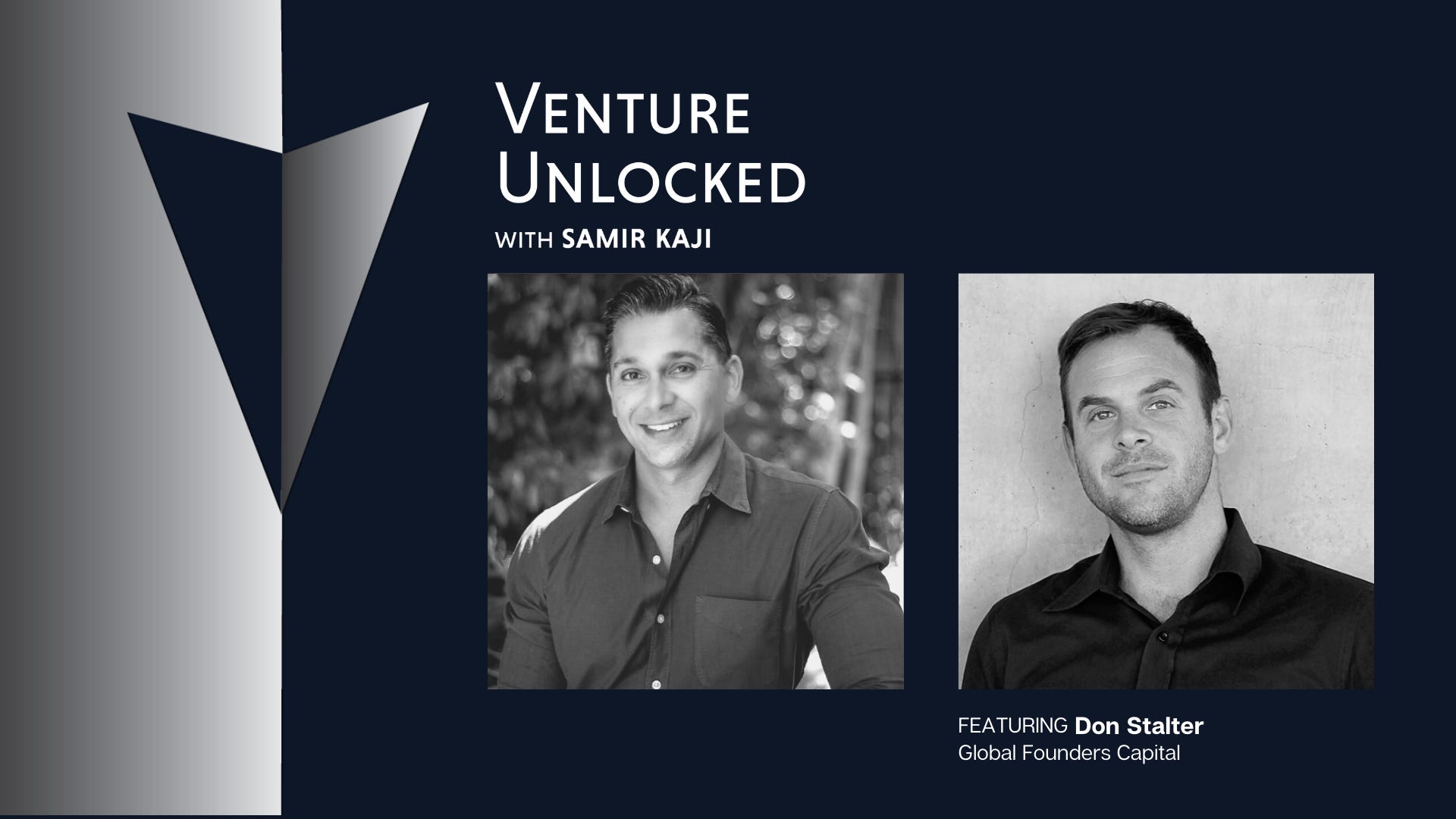
Global Founders Capital’s Don Stalter on their belief in larger portfolios, managing a global investment firm, and building systems and processes to deliver value at scale
Follow me @samirkaji for my thoughts on the venture market, with a focus on the continued evolution of the VC landscape.On this week’s Venture Unlocked episode, we had the pleasure of hosting Donald Stalter, Partner at Global Founders Capital, a global multi-stage venture firm that has raised $1.6B across two funds and has backed companies such as Kalshi (led by Don), Deel, Headway, Slack, Away, Hellofresh, and Brex. The firm has a very unique model that employs capital across geographies, stages, and industry sectors, and Don provided insight on how the firm executes on this strategy so effectively. Previously Donald co-founded CityDeal, which he later sold to Groupon where he built Groupon's international offices in Europe and Asia. He subsequently led BD at Airbnb global. A word from our sponsor:Vouch Insurance is a new kind of insurance platform for startups. Built by founders for founders, Vouch’s fully digital coverage takes minutes to activate. Vouch is trusted by the biggest names in the startup economy — such as Y Combinator and Silicon Valley Bank — who partner with Vouch because everything from onboarding to claims is designed for startups by experienced founders. Because Vouch is an insurance platform, and not a broker, it works with its clients to manage, mitigate, and avoid risks. http://www.vouch.us/ventureunlockedIn this episode we discuss:01:36 Don’s journey into Venture Capital03:18 How being an operator influenced Don’s path as an investor06:30 What is Global Founders Capital mission and focus?09:08 The fund construction model for Global Founders Capital10:27 How they balance growth vs. early stage and how location factors into their investments12:50 How Don and his team add value at scale across his portfolio14:45 How their operations team and investments team work together17:20 The risk/return Global Founders Capital underwrites to and their return targets20:32 How the frothiness of the market in growth-stage investments affects how they approach growth investing. 22:52 The non-obvious opportunities for global investments25:03 How the firm manages global investing out of a single fund26:20 The benefit of bringing a strong operations background to global investing28:30 Global Founders Capital’s pitch to LP30:13 Differences between US LPs and international LPs31:28 Recapping the recent market conditions and what the future looks like33:38 What is the most counterintuitive lesson he’s learned as an investor34:37 The investor he admires35:32 The firm he feels is the best in the worldMentioned in this episode:Global Founders CapitalFelicis VenturesI’d love to know what you took away from this conversation with Donald. Follow me @SamirKaji and give me your insights and questions with the hashtag #ventureunlocked. If you’d like to be considered as a guest or have someone you’d like to hear from (GP or LP), drop me a direct message on Twitter.Podcast Production support provided by Agent Bee Agency This is a public episode. If you would like to discuss this with other subscribers or get access to bonus episodes, visit ventureunlocked.substack.com
Founders Fund Delian Asparouhov on Miami as a major tech hub, what he thinks as the drivers for innovation now, and the pros of incubating companies like Varda within firms
Follow me @samirkaji for my thoughts on the venture market, with a focus on the continued evolution of the VC landscape.Today we’re thrilled to bring you my conversation with Delian Asparouhov of Founders Fund, a Silicon Valley and now Miami based firm that has long been known for backing some of the most category defining companies in the world including SpaceX, Palantir, Facebook, AirBnB, and Stripe. While at Founders Fund, Delian also co-founded Varda Space Industries, and previously worked at Khosla Ventures.A message from our sponsor:Pacific Western Bank is a full service commercial bank with over $34 billion in assets. The venture banking team specializes in financial products and services for startups, venture-backed businesses, and their venture capital and private equity investors.The experienced team is committed to the space and dedicated to delivering high-touch, tailored solutions, helping innovators take their business to the next level.In the first half of the year, the venture banking team has booked over $800 million in new loan commitments to help support the community. No matter the size or stage of your business, you can expect guidance, resources and flexibility, making them the perfect team to support your evolving needs.Turn your vision into reality with PWB. For more information, visit www.pacwest.com/lending-solutions, or follow us on LinkedIn and Twitter.*Equal Housing Lender & FDIC insured*Total assets & loans booked are as of June 30, 2021.In this episode we discuss:01:43 Delian’s journey to becoming an investor05:24 Why he felt VC was a better path for him than operating roles 11:52 Why he chose to go from Khosla Ventures (& now Founders Fund) instead of starting his own firm14:24 The decision to co-found Varda while being a full time investor17:38 How Delian attracted co-founders for Varda.21:31 Why there are a relative lack of investment dollars into areas like space. 25:22 How Founders Fund looks at the risk in investing in areas such as space.28:07 The catalyzing events in tech that will help drive exponential innovation. 31:27 Ingredients Miami has that will help it build a significant presence in tech, and why is talent going there?38:47 The most counterintuitive lesson Delian has learned as an investor40:56 Delian’s prediction for the venture market for the next few years43:47 The legendary investor that has most inspired himMentioned in this episode:Founders FundVarda Space IndustriesKhosla VenturesI’d love to know what you took away from this conversation with Delian. Follow me @SamirKaji and give me your insights and questions with the hashtag #ventureunlocked. If you’d like to be considered as a guest or have someone you’d like to hear from (GP or LP), drop me a direct message on Twitter.Transcript:Samir Kaji:Hi, I'm Samir Kaji, host of Venture Unlocked, the podcast that takes you behind the scenes of the business of venture capital. Today, I'm thrilled to bring you my conversation with Delian Asparouhov who's a Principal at Founders Fund. Based in Miami and Silicon Valley, the firm has long been known for backing some of the most category-defining companies in the world, including SpaceX, Palantir, Facebook, Airbnb, and Stripe. While at Founders Fund, Delian also co-founded Varda Space Industries and then previously worked at Khosla Ventures. I had a lot of fun in this week's show as we talked about a number of things, including incubations within larger firms, the arc of where he sees technology, and what's going to drive innovation in the coming years, and why regional hubs like Miami will be major forces and drivers of innovation. Now let's get into the episode to hear all of that and more.Samir Kaji:Today's episode is sponsored by Pacific Western Bank, a full service commercial bank with over 34 billion in assets. The venture banking team of PacWest specializes in financial products and services for both startups and the venture and private equity funds that back them. I've worked with many of their team members over the last few decades, and I can attest with their commitment to bringing a high touch and personalized experience for every startup and fund manager client they have. So whether you're a founder or a fund manager at any stage of development, and you want to find out more, check them out at www.pacwest.com.Samir Kaji:Delian, great to see you, and thanks for joining us.Delian Asparouhov:Thanks so much for having me. Excited to be on today.Samir Kaji:Well, this is going to be a really fun conversation given how multifaceted your background is. And actually going from a waffle boy to becoming an entrepreneur and getting into tech, to now being a full-time investor at Founders Fund. Tell us how you got interested in tech in the first place and what led you to investing.Delian Asparouhov:Yeah, I had always been a computer scientist. My dad studied computer science and statistics and was a software engineer for basically his entire career. And so I think my
Banana Capital's Turner Novak on his unconventional path in breaking into VC, being a successful stage agnostic investor, and leveraging social platforms to build advantages
Follow me @samirkaji for my thoughts on the venture market, with a focus on the continued evolution of the VC landscape.We’re thrilled to bring you my conversation with Turner Novak, founder of Banana Capital. While fairly new to venture, Turner continually brings some of the most interesting perspectives about technology, and is one of best venture follows on social media. Turner has an incredible backstory on how he broke into VC, and ultimately within a few years was able to found Banana Capital in January 2021, with $9.99M in commitments, including several institutional investors. Prior to having his own fund, he was General Partner at Gelt VC and also interned at a pre-seed firm Afore Capital. We talked with Turner about the value of social media in VC, how he thinks that successful investing can be stage agnostic, and his views on where the public and private markets are today, and where they may go in the future. A message from our sponsor:Pacific Western Bank is a full service commercial bank with over $34 billion in assets. The venture banking team specializes in financial products and services for startups, venture-backed businesses, and their venture capital and private equity investors.The experienced team is committed to the space and dedicated to delivering high-touch, tailored solutions, helping innovators take their business to the next level.In the first half of the year, the venture banking team has booked over $800 million in new loan commitments to help support the community. No matter the size or stage of your business, you can expect guidance, resources and flexibility, making them the perfect team to support your evolving needs.Turn your vision into reality with PWB. For more information, visit www.pacwest.com/lending-solutions, or follow us on LinkedIn and Twitter.*Equal Housing Lender & FDIC insured*Total assets & loans booked are as of June 30, 2021.In this episode we discuss:02:00 Turner’s journey into Venture Capital03:21 Getting his first internship in VC at Afore Capital07:43 The early days as an investor and his first investments11:25 How he built a strong deal flow channel despite being so new. 13:37 Choosing to raise his fund without a 506c provision and going the traditional way despite a huge social following. 15:42 The impetus behind raising $9.99M18:55 Turner’s scaling plan22:04 The role of speed in the capital environments today25:26 Using social media to amplify his strategy and brand30:51 How he strikes the right balance on social media to ensure he’s productively adding to the brand, but while staying authentic. 34:28 Turner’s investment criteria and how he evaluates deals and companies38:06 What he believes the markets will look like in the next 2-3 years43:18 The most counterintuitive thing he’s learned as an investor45:10 The lesson he’s learned from an investing miss46:51 The investor that most inspires himMentioned in this episodeBanana CapitalGelt VCAfore CapitalI’d love to know what you took away from this conversation with Turner. Follow me @SamirKaji and give me your insights and questions with the hashtag #ventureunlocked. If you’d like to be considered as a guest or have someone you’d like to hear from (GP or LP), drop me a direct message on Twitter.Transcript:Samir Kaji:Hi, I'm Samir Kaji, host of Venture Unlocked, the podcast that takes you behind the scenes of the business of venture capital. Today, we're thrilled to bring you my conversation with Turner Novak, Founder of Banana Capital. While fairly new at venture, Turner continually brings some of the most interesting perspectives about technology and venture and also happens to be one of the best follows in social media.Samir Kaji:He's also got a great backstory on how he broke into this sea and ultimately within a few years was able to found Banana Capital in January 2021 with 9.99 million amendments, including several institutions participating. Before starting his own fund, he was a general partner at Gelt VC and also had interned at pre-seed from Afore Capital.Samir Kaji:We covered a lot of ground at this podcast, including the value of social media in VC, how he thinks being stage agnostic can be a successful strategy and his views on the public and private markets and where we're headed. Now, let's get into the episode to hear all of that and more.Samir Kaji:Today's episode is sponsored by Pacific Western Bank, a full-service commercial bank with over 34 billion in assets. The venture banking team at PacWest specializes in financial products and services for both startups and the venture and private equity funds that back them. I've worked with many of their team members over the last few decades. And I can attest to their commitment to bringing a high touch and personalized experience for every startup and fund manager client they have.Samir Kaji:So, whether you're a founder or a fund manager at any stage of development, and you want to find out more, check them out at www.pacwest.com.Samir Ka
Primary Venture Partners Jason Shuman on integrating partners into an established partnership, KPI's on measuring value to founders, and views on portfolio construction.
Follow me @samirkaji for my thoughts on the venture market, with a focus on the continued evolution of the VC landscape.Today, I’m excited to bring you my conversation with Jason Shuman, a partner at NY based Primary Venture Partners. The firm leads seed rounds for companies in NY and has previously invested in companies such as Jet, Mirror, and Latch. The firm recently raised two funds totaling $200MM. Prior to joining Primary, he spent time as Chief Of Staff for GLG founder Mark Gerson, was an associate at Corigin Venture, and founded and ran a company called Category Five from 2011-2015. We chatted with Jason about the importance of culture in building lasting teams, KPI’s for delivering founder success from their internal portfolio services team, and how he views both NY and the entire venture market today. A message from our sponsor:Pacific Western Bank is a full service commercial bank with over $34 billion in assets. The venture banking team specializes in financial products and services for startups, venture-backed businesses, and their venture capital and private equity investors.The experienced team is committed to the space and dedicated to delivering high-touch, tailored solutions, helping innovators take their business to the next level.In the first half of the year, the venture banking team has booked over $800 million in new loan commitments to help support the community. No matter the size or stage of your business, you can expect guidance, resources and flexibility, making them the perfect team to support your evolving needs.Turn your vision into reality with PWB. For more information, visit www.pacwest.com/lending-solutions, or follow us on LinkedIn and Twitter.*Equal Housing Lender & FDIC insured*Total assets & loans booked are as of June 30, 2021.In this episode we discuss:01:44 Jason’s journey into the startup world04:37 What he learned in working with GLG founder Mark Gerson07:05 The decision to join Primary versus starting his own firm11:42 How Primary was able to seamlessly integrate him into the partnership14:37 Jason’s advice to someone who is joining a successful venture firm17:42 Why being selective and keeping a smaller portfolio is important to Primary21:23 Primary’s philosophy on building a team 24:31 The KPIs Primary uses to assess whether they are delivering value to founders27:21 Why Primary has decided to remain geo-focused on New York instead of expand 29:41 How Jason views speed versus diligence when investing in today’s marketplace33:41 Thoughts on the seed market in 202137:15 The most counterintuitive lesson he’s learned as an investor38:03 The investment miss that he’s learned from39:54 The investor that inspires himMentioned in this episodePrimary PartnersI’d love to know what you took away from this conversation with Jason. Follow me @SamirKaji and give me your insights and questions with the hashtag #ventureunlocked. If you’d like to be considered as a guest or have someone you’d like to hear from (GP or LP), drop me a direct message on Twitter.Transcript:Samir Kaji:I am Samir Kaji, your host of Venture Unlocked, the podcast that takes a behind the scenes of the business of venture capital. On this week's episode, I'm thrilled to bring you my conversation with Jason Shuman, a Partner with New York based Primary Venture Partners. The firm leads seed rounds for companies in New York, and previously invested in companies such as Jet, Mirror and Latch. Earlier this year, the company raised two funds totaling $200 million. Before joining Primary in 2018, he spent time as Chief of Staff for GLG founder Mark Gerson, was an Associate at Corigin Ventures and founded and ran a company called Category Five from 2011 to 2015. I found Jason to be really thoughtful and we had a great conversation on things like finding alignment when you join a firm, the tangible KPIs they use to measure success and what type of value they're providing founders and his view of New York and the market as a whole. Now let's get into the episode to hear all of that and more.Samir Kaji:Jason, it's so great to have you on the show and thanks for joining us.Jason Shuman:Thanks for having me, man. Appreciate it.Samir Kaji:Let's go back a little bit. I know you're now investing out of fund three, but what led you into becoming a venture investor and getting interested in startups?Jason Shuman:Yeah, so I'm from Boston originally and I grew up in a family of entrepreneurs. My dad was running his own company, my aunts and uncles, my cousins, it felt like everybody was running their own thing. So I became obsessed with startups when I was pretty young, like literally in middle school, I was writing business plans for mobile payments on flip phones. And in high school I went to work at this identity theft protection company that was run by my aunt and uncle. And they had a former VC from SoftBank working over there at the time and I just learned a ton from them about A/B testing and customer acquisition and
Broadhaven Ventures' Michael Sidgmore on democratization of venture capital, why Alts are the future of private portfolios, and the role of wealth management firms.
Follow me @samirkaji for my thoughts on the venture market, with a focus on the continued evolution of the VC landscape.Today we’re thrilled to bring you a very unique conversation with Michael Sidgmore, Co-Founder of Broadhaven Ventures and host of the Alt Goes mainstream podcast. Broadhaven Ventures is fintech focused and has invested in several platforms that make alternatives more accessible including, Republic, Party Round, iCapital, Alt, and of course our startup Allocate. Additionally, Michael was an early employee at iCapital (currently valued at $4B), which enabled private wealth managers to offer top alternatives to their clients. Michael is also a Venture Partner at Goodwater Capital, one of the top global consumer focused venture capital platforms in the world with over $2 Billion of assets under management. We covered the broad topics of retail influence within alternatives, the future democratization of venture capital, and why a larger supply of LPs is coming. A message from our sponsor:Pacific Western Bank is a full service commercial bank with over $34 billion in assets. The venture banking team specializes in financial products and services for startups, venture-backed businesses, and their venture capital and private equity investors.The experienced team is committed to the space and dedicated to delivering high-touch, tailored solutions, helping innovators take their business to the next level.In the first half of the year, the venture banking team has booked over $800 million in new loan commitments to help support the community. No matter the size or stage of your business, you can expect guidance, resources and flexibility, making them the perfect team to support your evolving needs.Turn your vision into reality with PWB. For more information, visit www.pacwest.com/lending-solutions, or follow us on LinkedIn and Twitter.*Equal Housing Lender & FDIC insured*Total assets & loans booked are as of June 30, 2021.In this episode we discuss:01:06 Why Michael got into investing08:02 The world of alternatives12:55 How the demand for alternatives assets has changed over the years18:31 Navigating the challenges for people to access alternatives24:19 The long term progression of alternative investments29:29 Important thematic trends in the next generation of investors34:09 What adding value to investments means to Broadhaven37:52 Balancing the relationship between founders and VCs41:43 Successfully scaling for valueMentioned in this episodeBroadhaven VenturesI’d love to know what you took away from this conversation with Michael. Follow me @SamirKaji and give me your insights and questions with the hashtag #ventureunlocked. If you’d like to be considered as a guest or have someone you’d like to hear from (GP or LP), drop me a direct message on Twitter.Podcast Production support provided by Agent Bee Agency This is a public episode. If you would like to discuss this with other subscribers or get access to bonus episodes, visit ventureunlocked.substack.com
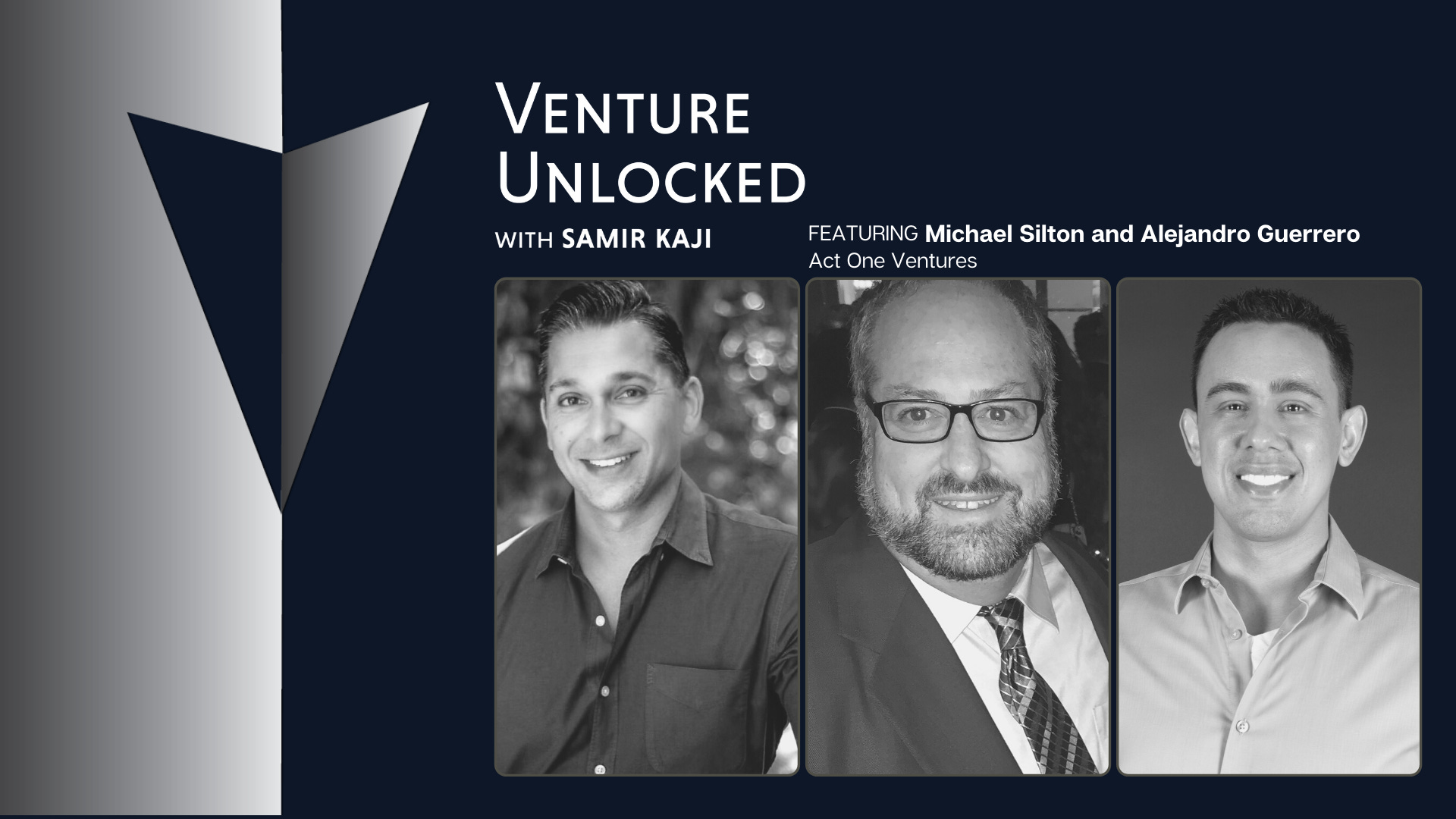
Act One Ventures Silton and Guerrero on the Diversity Rider initiative, building meaningful partnerships, and operating experience has been key to their model
Follow me @samirkaji for my thoughts on the venture market, with a focus on the continued evolution of the VC landscape.Today’s episode is with Michael Silton and Alejandro Guerrero of Act One Ventures, a Los-Angeles based firm that invests in pre-seed and seed-stage .Before becoming Managing Director of Act One, Michael was Executive Director of the UCLA VC Fund for three and half years. He was also CEO & Founder of RainMaker Systems(to which he took public) and co-founder of UniDirect Corp. Prior to being General Partner at Act One, Alejandro was Volunteer Associate at UCLA Ventures from 2013-2016, Co-Founder & CEO of Uniq Apps and Co-Founder & President of the Live Entertainment Network.We chatted with them about their unique partnership, how they tangibly drive real diversity into cap tables, and how they navigate in today’s white-hot market. A message from our sponsorAnduin is revolutionizing fund management with streamlined fund operations, digitized fund subscriptions, and real-time status updates. Traditional, paper-based subscriptions are costly, tedious and error-prone, with up to 80% of submitted documents being incorrect and considered not in good order.Fund managers lack real-time visibility, facing manual processes, endless back-and-forth and a mountain of emails, documents and spreadsheets.Anduin’s investor onboarding workflow improves the investor experience, bringing clarity, guidance, and efficiency to fund subscriptions which drastically reduces error rates.The Anduin platform allows GPs to perform fund operations simply and efficiently with improved data accuracy, freeing up time so they can focus on what they do best... investing.For more information, or to arrange a demo, visit fundsub.io/ventureunlockedIn this episode we discuss:02:15 How the team got into investing05:22 Why Michael started an independent firm, after so many years as an operator13:10 Key lessons learned from raising their first fund15:11 Staying positive when fundraising is going slow22:53 The Act One Ventures investment model26:34 Why learning from failures is a superpower29:18 How their unique differences as a partnership drive value to founders38:35 The Diversity Rider; What it means and why is it critical for the future of underrepresented GPs and founders. Mentioned in this episodeAct One VenturesI’d love to know what you took away from this conversation with Michael and Alejandro. Follow me @SamirKaji and give me your insights and questions with the hashtag #ventureunlocked. If you’d like to be considered as a guest or have someone you’d like to hear from (GP or LP), drop me a direct message on Twitter.Podcast Production support provided by Agent Bee Agency This is a public episode. If you would like to discuss this with other subscribers or get access to bonus episodes, visit ventureunlocked.substack.com
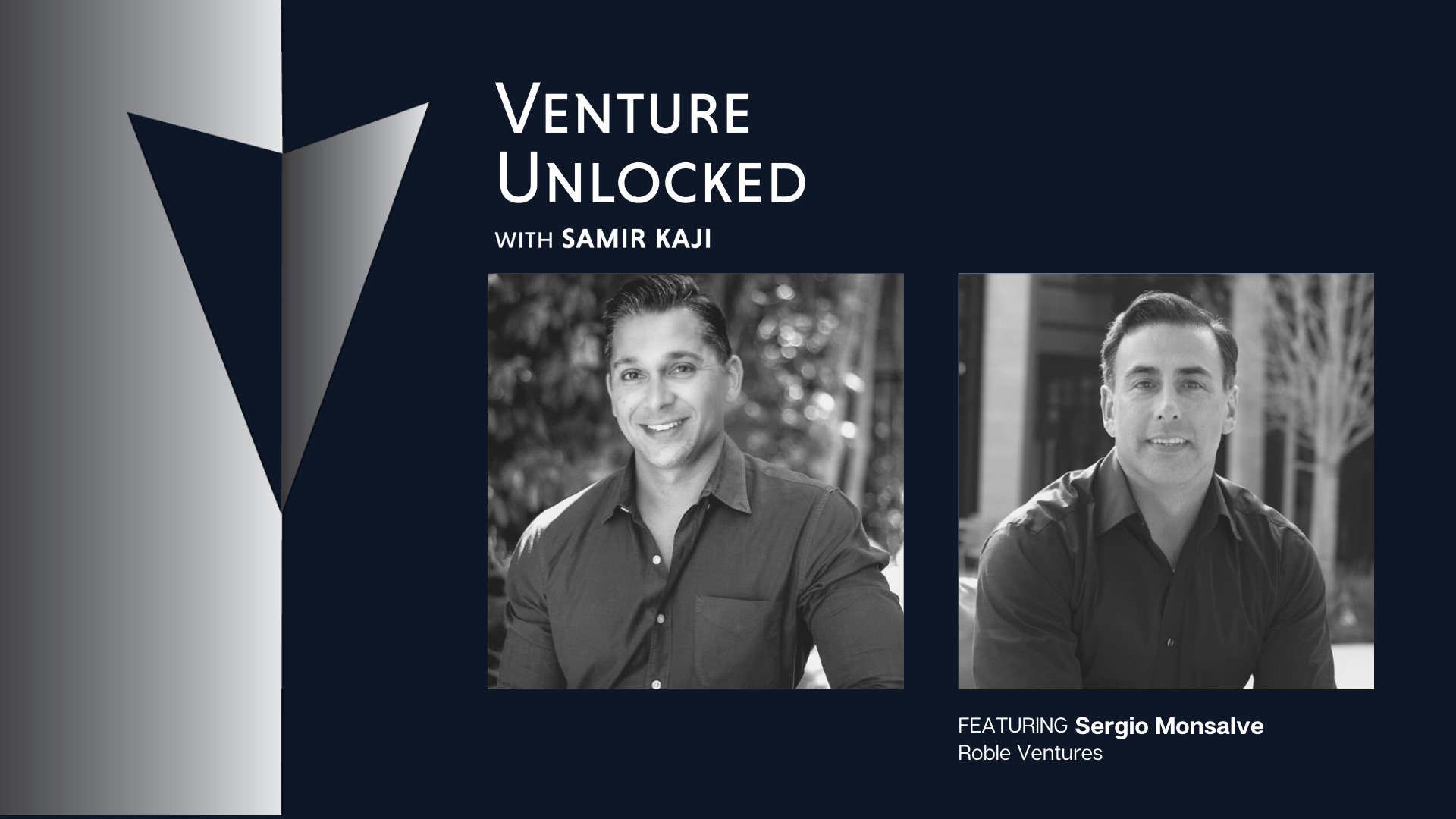
From Norwest to starting Roble Ventures, Sergio Monsalve on equity and diversity in tech, adapting from large VC to a small, solo-GP, and investing in heated markets.
Follow me @samirkaji for my thoughts on the venture market, with a focus on the continued evolution of the VC landscape.Today’s episode is with Sergio Monsalve, founding partner of Roble Ventures, a seed firm based in Silicon Valley that invests in solutions that help human progress. Their portfolio includes Kahoot, Mosaic, and Dragonboat, among others. Prior to Roble, Sergio spent 14 years at one of the longest standing VC firms in the world, Norwest Venture Partners, where he led investments in companies such as Udemy and Adaptive Insights. Before he started his investing career, he held various roles in high-growth technology companies like eBay and Portal Software. He currently teaches at his alma mater, Stanford, on education and entrepreneurship. We chatted with Sergio about equity and diversity in the VC world, adapting to a smaller GP model after so much time at a large partnership, and how he thinks about investing in human enablement technologies. A message from our sponsorAnduin is revolutionizing fund management with streamlined fund operations, digitized fund subscriptions, and real-time status updates. Traditional, paper-based subscriptions are costly, tedious and error-prone, with up to 80% of submitted documents being incorrect and considered not in good order.Fund managers lack real-time visibility, facing manual processes, endless back-and-forth and a mountain of emails, documents and spreadsheets.Anduin’s investor onboarding workflow improves the investor experience, bringing clarity, guidance, and efficiency to fund subscriptions which drastically reduces error rates.The Anduin platform allows GPs to perform fund operations simply and efficiently with improved data accuracy, freeing up time so they can focus on what they do best... investing.For more information, or to arrange a demo, visit fundsub.io/ventureunlockedIn this episode we discuss:02:19 Why Sergio decided to get into venture and the unique challenges he faced 04:47 Sergio’s departure from a large shop in Norwest to starting Roble07:45 Transitioning from a partnership-driven ethos to being a single operator10:23 The meaning of ‘human-enablement’ investing13:27 Post-pandemic predictions16:46 Why you must bring diversity on a team20:31 Diversifying the decision making process and identifying implicit bias24:44 Investing in highly competitive markets with discipline 28:19 Sergio’s parameters for investing32:01 Capitalizing founders in the appropriate way in today’s market36:19 What did Roble Ventures look to accomplish in the early days39:58 The most counterintuitive thing Sergio ever learnt41:27 Dominant trends coming up in venture43:22 Investors he is inspired byMentioned in this episodeRoble VenturesI’d love to know what you took away from this conversation with Sergio. Follow me @SamirKaji and give me your insights and questions with the hashtag #ventureunlocked. If you’d like to be considered as a guest or have someone you’d like to hear from (GP or LP), drop me a direct message on Twitter.Podcast Production support provided by Agent Bee Agency This is a public episode. If you would like to discuss this with other subscribers or get access to bonus episodes, visit ventureunlocked.substack.com
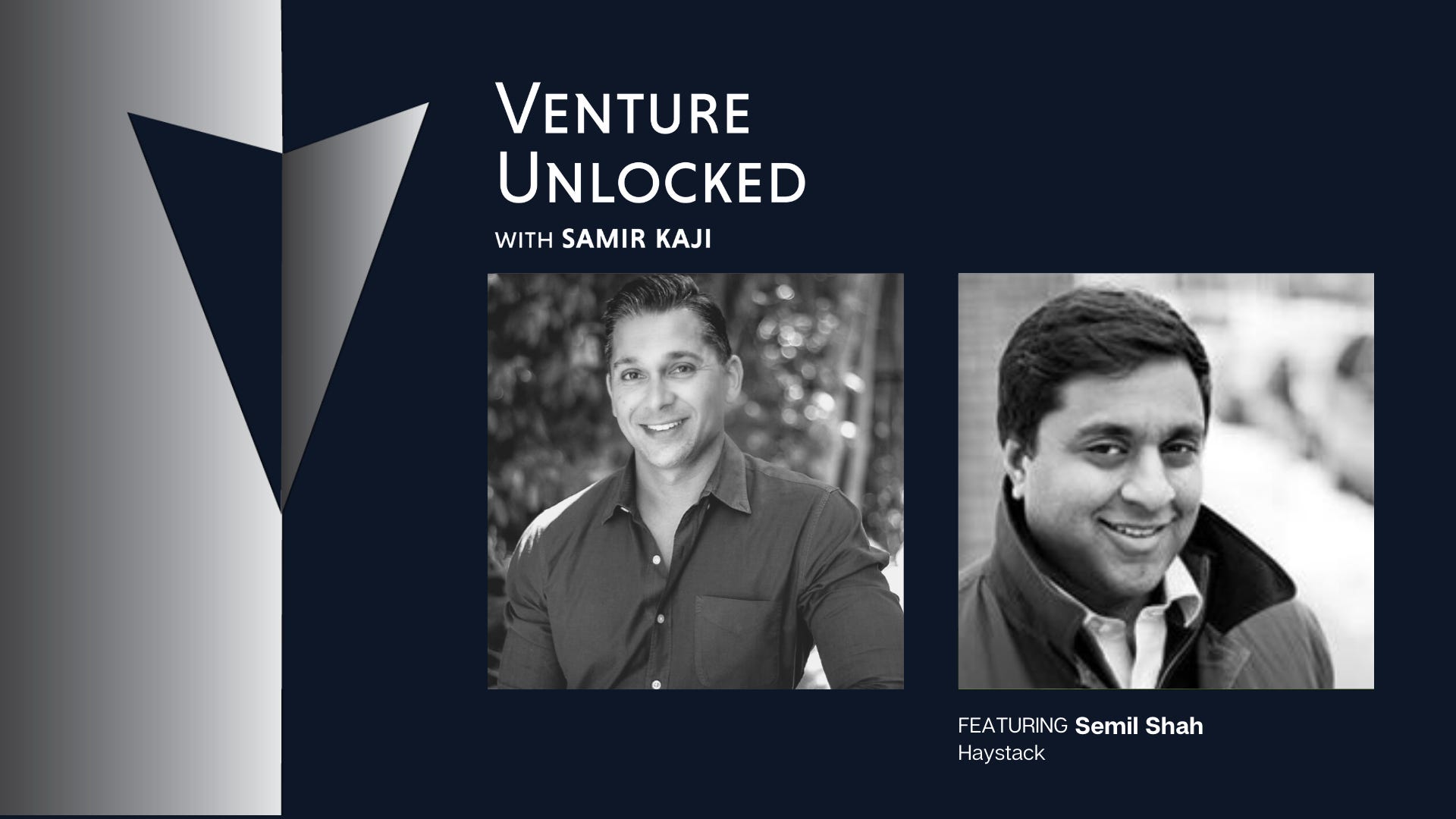
Haystack's Semil Shah on building the firm from the ground up, portfolio models, and the state of VC today
Follow me @samirkaji for my thoughts on the venture market, with a focus on the continued evolution of the VC landscape.Today’s episode is with Semil Shah, founder and general partner at Haystack, a pre-seed and seed-stage supporting outlier founders. Haystack’s portfolio includes DoorDash, Instacart, HashiCorp, Figma, Applied Intuition and many more.Semil is also Venture Partner at Lightspeed Venture Partners, and in 2017, was selected to the Midas Brink List. He previously was a venture partner at both GGV Capital and Bullpen Capital.We covered topics like the challenges Semil faced when trying to get into VC, how he’s evolved his approach over the years and his current and future view of the industry. A message from our sponsorAnduin is revolutionizing fund management with streamlined fund operations, digitized fund subscriptions, and real-time status updates. Traditional, paper-based subscriptions are costly, tedious and error-prone, with up to 80% of submitted documents being incorrect and considered not in good order.Fund managers lack real-time visibility, facing manual processes, endless back-and-forth and a mountain of emails, documents and spreadsheets.Anduin’s investor onboarding workflow improves the investor experience, bringing clarity, guidance, and efficiency to fund subscriptions which drastically reduces error rates.The Anduin platform allows GPs to perform fund operations simply and efficiently with improved data accuracy, freeing up time so they can focus on what they do best... investing.For more information, or to arrange a demo, visit fundsub.io/ventureunlockedIn this episode we discuss:02:26 Semil’s path into VC and some of the challenges06:00 Initiating relationships with LPs12:54 Scaling as a venture firm16:15 Semil’s portfolio construction methodology20:30 Were there any transferable elements from LSVP and GGV to running a seed fund?23:21 Semil’s take on differentiation31:06 Do LPs push venture firms to be too big?33:25 Redefining venture scale outcomes40:08 What it means to be disciplined41:15 Semil’s view of the venture landscape today43:50 The most counterintuitive lesson he’s learned being a VC46:07 Underrated characteristics of successful VCsMentioned in this episodeHaystack VenturesI’d love to know what you took away from this conversation with Semil. Follow me @SamirKaji and give me your insights and questions with the hashtag #ventureunlocked. If you’d like to be considered as a guest or have someone you’d like to hear from (GP or LP), drop me a direct message on Twitter.Podcast Production support provided by Agent Bee Agency This is a public episode. If you would like to discuss this with other subscribers or get access to bonus episodes, visit ventureunlocked.substack.com
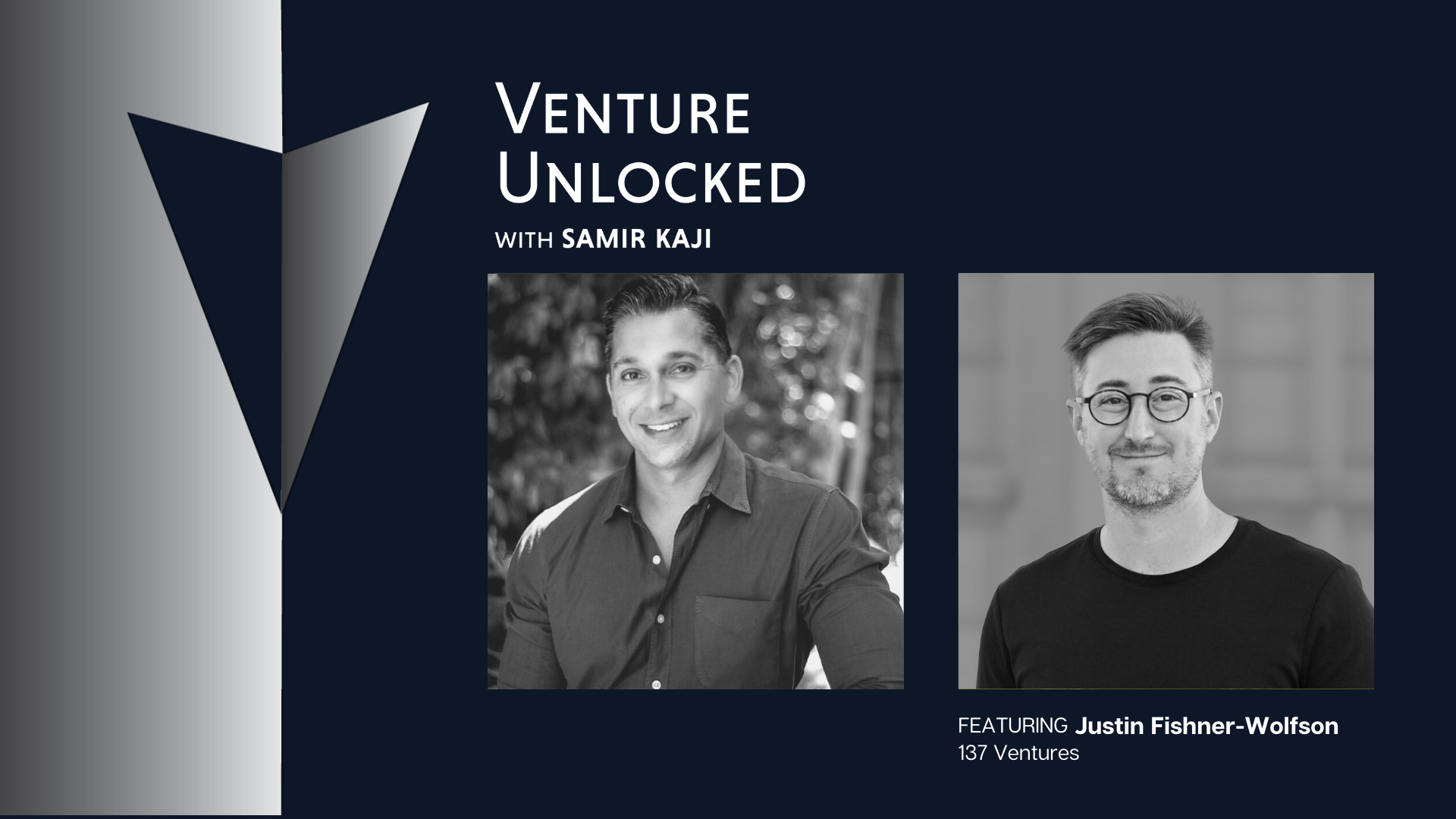
137 Ventures Justin Fishner-Wolfson on why ownership is an overvalued heuristic, building lasting teams, and the current state of secondary markets.
Follow me @samirkaji for my thoughts on the venture market, with a focus on the continued evolution of the VC landscape.Today we’re thrilled to bring you my conversation with Justin Fishner-Wolfson, co-founder and managing partner of 137 Ventures, a growth-stage venture firm that provides customized liquidity solutions to founders, investors, and early employees of high-growth private technology companies. With a total AUM of $1.5B, 137 Ventures has backed some of the most impactful companies of the past decade, including Wish, Flexport, SpaceX, Uber, and Airbnb. Prior to launching 137 ventures in 2010, Justin worked on the investment team at Founders Fund. A message from our sponsorAnduin is revolutionizing fund management with streamlined fund operations, digitized fund subscriptions, and real-time status updates. Traditional, paper-based subscriptions are costly, tedious and error-prone, with up to 80% of submitted documents being incorrect and considered not in good order.Fund managers lack real-time visibility, facing manual processes, endless back-and-forth and a mountain of emails, documents and spreadsheets.Anduin’s investor onboarding workflow improves the investor experience, bringing clarity, guidance, and efficiency to fund subscriptions which drastically reduces error rates.The Anduin platform allows GPs to perform fund operations simply and efficiently with improved data accuracy, freeing up time so they can focus on what they do best... investing.For more information, or to arrange a demo, visit fundsub.io/ventureunlockedIn this episode we discuss:02:10 Justin’s journey into venture capital03:36 Learnings from Founders Fund05:52 Differentiating yourself in tangible ways07:45 How Justin thinks about the sales process10:34 Fund sizing14:59 Liquidity solutions for the future17:42 How efficient are the secondary markets right now?20:40 Justin’s philosophy on risk26:00 The considerations of check size and ownership requirements28:53 What are the toughest things to get right in building a firm?31:01 Avoiding talent atrophy and ensuring generational succession32:56 The hardest lesson learned in building a firm39:47 The most counterintuitive lesson Justin learned in investing42:19 Learnings from misses43:47 Justin’s inspirationsMentioned in this episode137 VenturesI’d love to know what you took away from this conversation with Justin. Follow me @SamirKaji and give me your insights and questions with the hashtag #ventureunlocked. If you’d like to be considered as a guest or have someone you’d like to hear from (GP or LP), drop me a direct message on Twitter.Podcast Production support provided by Agent Bee Agency This is a public episode. If you would like to discuss this with other subscribers or get access to bonus episodes, visit ventureunlocked.substack.com
Jeff Morris, Jr. on finding your own fund/market fit, having like Lightspeed and Sequoia as LPs, and the ever-changing dynamic between entrepreneurs and VCs
Follow me @samirkaji for my thoughts on the venture market, with a focus on the continued evolution of the VC landscape.Today’s episode is with Jeff Morris, Jr., founder of Chapter One Ventures, an early stage product fund that has invested in Cameo, Pipe, Alt, and Roam. After a significant track record as an angel investor (including investing in Lyft) he started Chapter One in 2019 that featured tier one investors such as Lightspeed and Sequoia as LPs. Jeff was previously the VP of Product at Tinder, spearheading popular features like Boost and Tinder Gold. He graduated with an MBA from UCLA’s School of Management and is a frequent speaker on monetization, product, and growth.We chat about finding your product market fit as an investor; thinking about scaling yourself, and the ever-changing relationship between entrepreneurs and VCs. A message from our sponsorAnduin is revolutionizing fund management with streamlined fund operations, digitized fund subscriptions, and real-time status updates. Traditional, paper-based subscriptions are costly, tedious and error-prone, with up to 80% of submitted documents being incorrect and considered not in good order.Fund managers lack real-time visibility, facing manual processes, endless back-and-forth and a mountain of emails, documents and spreadsheets.Anduin’s investor onboarding workflow improves the investor experience, bringing clarity, guidance, and efficiency to fund subscriptions which drastically reduces error rates.The Anduin platform allows GPs to perform fund operations simply and efficiently with improved data accuracy, freeing up time so they can focus on what they do best... investing.For more information, or to arrange a demo, visit fundsub.io/ventureunlockedIn this episode we discuss:02:11 Jeff’s journey into investing05:43 Jeff’s learnings as an angel investor to being a scout to starting a firm08:38 The main differences between being an angel investor and a full-time venture capitalist11:13 Adjusting to doing venture full time13:51 How Jeff evolved along each step of the way in his investing career16:22 How he constructed his LP base, and him taking on capital from Tier 1 VC’s17:58 How Jeff thought about fund sizing and what he learnt from his first fundraising22:14 Why bring a Chief of Staff onto a VC firm24:47 The debate between optimizing for # of companies vs. ownership27:27 Learnings from Sequoia about investing and entrepreneurship30:23 Jeff’s decision-making model34:39 The future of the VC 37:17 The pros and cons of having a brand on Twitter/ social media39:52 The most counterintuitive lesson Jeff has learned41:20 Lessons learned from companies that he missed43:26 Inspirations in the VC worldMentioned in this episode:Chapter One VenturesI’d love to know what you took away from this conversation with Jeff. Follow me @SamirKaji and give me your insights and questions with the hashtag #ventureunlocked. If you’d like to be considered as a guest or have someone you’d like to hear from (GP or LP), drop me a direct message on Twitter.Podcast Production support provided by Agent Bee Agency This is a public episode. If you would like to discuss this with other subscribers or get access to bonus episodes, visit ventureunlocked.substack.com

Miriam Rivera on going from angel to running a firm, driving real change in diversity in tech, and how traditional heuristics should be challenged in VC.
Follow me @samirkaji for my thoughts on the venture market, with a focus on the continued evolution of the VC landscape. Our guest today is Miriam Rivera, managing director and CEO of Ulu Ventures, an early seed stage venture fund in Silicon Valley focused on IT startups. Currently Ulu Ventures has an AUM of >$200MM and the team has invested in companies such as Palantir, BetterUp, SoFi, Guild, and Span [For full disclosure, Ulu Ventures is also an investor in my startup, Allocate).Prior to Ulu, Miriam was deputy general counsel at Google, which she joined in 2001 as the second attorney. She graduated from Stanford University, where she earned the AB, AM and JD/MBA degrees. Miriam is the co-founder, former co-president and on the board of Stanford Angels & Entrepreneurs, an open source network of Stanford alumni investors and entrepreneurs.Listen to our conversation to hear Miriam’s thoughts on moving from angel investing to starting a firm, being a husband and wife team, the reasons behind Ulu’s large portfolio strategy, and why diversity is so important to her. A message from our sponsorStandish is the largest provider of fund administration services to Venture Capital funds globally. Currently, we serve approximately 750 Venture Capital funds and have more than $150 billion in committed capital under administration. Standish has been designed by experienced Chief Financial Officers with a deep understanding of the service needs of both finance departments and General Partners at every stage of the product life cycle. Standish can handle all of the needs of finance department so General Partners can focus on investing.Standish is an employee owned company.https://www.standishmanagement.com/In this episode we discuss:02:05 Miriam’s journey into the investment side03:23 Why they started Ulu and raised outside capital05:22 The challenges of starting a fund as a wife-husband duo 08:14 Navigating their working relationship 11:33 Their unique view on what portfolio construction should be14:06 What the stats say on returns16:53 Trade-offs between size of portfolio and ownership20:20 Strategies for venture investing at the seed-stage23:14 Ulu’s unique decision making framework29:15 Benefits of investing in diverse teams31:58 Changes that can be made in the LP/VC ecosystem35:06 LPs with diverse managers38:18 The social vs. financial impetus in making investments in diverse managers/ partners40:39 Miriam’s most counterintuitive learning as an investor42:00 Companies Ulu missed out on43:36 Inspirations in the VC worldMentioned in this episodeUlu VenturesI’d love to know what you took away from this conversation with Miriam. Follow me @SamirKaji and give me your insights and questions with the hashtag #ventureunlocked. If you’d like to be considered as a guest or have someone you’d like to hear from (GP or LP), drop me a direct message on Twitter.Podcast Production support provided by Agent Bee Agency This is a public episode. If you would like to discuss this with other subscribers or get access to bonus episodes, visit ventureunlocked.substack.com
Ben Casnocha on his learnings from working with Reid Hoffman, building network incentives, and the art of portfolio construction.
Follow me @samirkaji for my (usually) daily thoughts on the world of venture capital. We’re pleased to provide this week’s episode with Ben Casnocha, founding partner of Village Global.Prior to Village, Ben was an entrepreneur and also acted as Chief of Staff at LinkedIn and Greylock working directly with Reid Hoffman. Ben has also co-authored two New York Times bestselling management books, The Alliance: Managing Talent in the Networked Age (with LinkedIn chairman Reid Hoffman and entrepreneur Chris Yeh). and The Start-Up of You: Adapt to the Future, Invest in Yourself, and Transform Your Career (with Reid Hoffman). Village ventures has $250M AUM and was co-founded with Erik Torenberg, Founder and current chairman of On Deck, and Product Hunt’s first employee. Together, they’ve invested in over 200 companies, and use a very unique community driven approach to serve their founders. The firm is based in Silicon Valley and backed by some of the world’s most successful entrepreneurs in Mark Zuckerberg, Jeff Bezos, Bill Gates, Reid Hoffman, and Sara Blakely.We chat with Ben about the importance of curating networks, how they use an unique incentive model within the Village community, how they performed their portfolio construction model, and what venture trends are here to stay.A message from our sponsorStandish is the largest provider of fund administration services to Venture Capital funds globally. Currently, we serve approximately 750 Venture Capital funds and have more than $150 billion in committed capital under administration. Standish has been designed by experienced Chief Financial Officers with a deep understanding of the service needs of both finance departments and General Partners at every stage of the product life cycle. Standish can handle all of the needs of finance department so General Partners can focus on investing.Standish is an employee owned company.https://www.standishmanagement.com/In this episode we discuss:02:10 Why Ben doubled down on venture capital04:43 Ben’s learnings from working with Reid 08:08 How the fund leverages its relationships with luminary LPs11:27 Curating networks for scale14:30 Monetary and access incentives for collaborators in the VC community18:08 What characterizes a great founder/ learnings from luminaries21:55 The firm’s feedback framework25:08 How Ben and team constructed their portfolio29:49 Village’s acquisition and exit models32:39 How does Ben think about flexibility and rules when it comes to ownership34:50 Trends driving the current venture ecosystem 38:26 Relationship between institutions and seed funds40:45 Looking into the future: What does Fund 5 look like for Village42:22 What Ben has learned so far43:18 How his thinking has changed over his career45:44 Ben’s biggest inspirationsMentioned in this episode* Village Global VC* Ben’s blog* Ben’s booksDisclaimer: This presentation does not constitute an offer to sell or the solicitation of an offer to buy any security. No representation is being made that any investor or portfolio will, or is likely to, achieve profits or losses similar to those discussed. Targets discussed have been established based on several assumptions that may vary depending on the type of investment. There is no guarantee that the conditions on which such assumptions are based will materialize as anticipated and will be applicable to Village Global’s portfolio investments.I’d love to know what you took away from this conversation with Ben. Follow me @SamirKaji and give me your insights and questions with the hashtag #ventureunlocked. If you’d like to be considered as a guest or have someone you’d like to hear from (GP or LP), drop me a direct message on Twitter.Podcast Production support provided by Agent Bee Agency This is a public episode. If you would like to discuss this with other subscribers or get access to bonus episodes, visit ventureunlocked.substack.com

Lan Xuezhao of Basis Set Ventures on using data science along with human psychology to assess deals, finding LP/GP fit, founder super powers measurement, and conviction based investing.
Today’s episode is with Lan Xuezhao, founding partner of Basis Set Ventures which has raised $301M across two funds. Lan has extensively studied AI, data science, and human psychology, and with Basis Set, she has combined those elements to bring a very unique approach to investing. Lan’s background in corporate development at Dropbox and management at McKinsey has contributed to her data driven approach to sourcing and investing. She has a PhD in Psychology from the University of Michigan. We chat about Lan’s unique investment philosophy, how she found GP/LP fit for Fund 1 and then Fund 2, how her firm has many shared characteristics of a portfolio company, and what makes for a founder super power. A message from our sponsorStandish is the largest provider of fund administration services to Venture Capital funds globally. Currently, we serve approximately 750 Venture Capital funds and have more than $150 billion in committed capital under administration. Standish has been designed by experienced Chief Financial Officers with a deep understanding of the service needs of both finance departments and General Partners at every stage of the product life cycle. Standish can handle all of the needs of finance department so General Partners can focus on investing.Standish is an employee owned company.https://www.standishmanagement.com/In this episode we discuss:02:18 Lan’s journey into venture capital 07:40 How did she go unconventional on fund size10:06 Lan’s learning about GP/LP fit13:57 Constructing a different LP base in Fund 2 vs. Fund 117:18 The structure of the fund’s tech and investment team21:01 Eliminating bias 22:56 Founder psychology + super power thesis26:00 Top two key traits of the best founders28:31 How Lan sees BSV’s place in the market today31:25 Future of firms in her size range34:14 Her Anti-Portfolio36:09 Inspirations from the investment worldMentioned in this Episode* Basis Set Ventures* Thesis on What Makes a Successful FounderI’d love to know what you took away from this conversation with Lan. Follow me @SamirKaji and give me your insights and questions with the hashtag #ventureunlocked. If you’d like to be considered as a guest or have someone you’d like to hear from (GP or LP), drop me a direct message on Twitter.Podcast Production support provided by Agent Bee Agency This is a public episode. If you would like to discuss this with other subscribers or get access to bonus episodes, visit ventureunlocked.substack.com
Meet the Expert: Braughm Ricke of Aduro Advisors on working with over 300 Emerging Firms, his time as the first CFO at True Ventures, traits of successful managers
Follow me @samirkaji for my thoughts on the venture market, with a focus on the continued evolution of the VC landscape. In today’s show, we have the pleasure of speaking to Braughm Ricke, who has worked closely with emerging managers throughout his career, first serving as CFO of True Ventures, and then starting Aduro Advisors, which started in 2012 originally to focus on the new era of VC. He was also a early Advisor and Investor in Carta and has been an active investor. Thanks to working with over 350 venture fund clients, Braughm has unique insights on effective fundraising, what makes for a institutional back-office, and broad venture trends. In this episode we discuss:01:01 What Braughm saw in 2012 when he started Aduro Advisors to focus on Emerging VC’s 05:49 How the emerging manager space has grown and evolved06:42 What is different today from the early days08:49 The fundraising landscape for emerging managers11:49 Tactics for breaking into family offices13:51 What managers often need to do between rounds 16:19 The workload for solo GPs18:12 The support systems GPs need so they can spend more time on core activities22:56 Common traits amongst successful managers25:22 The most common mistakes he sees managers make26:45 What the future holds for venture29:55 The speed of new firm creationMentioned in this episode:* Aduro AdvisorsWe’d love to know what you took away from this conversation with Braughm! Follow @SamirKaji and give your insight and questions using the hashtag #ventureunlocked. If you’d like to be considered as a guest or have someone you’d like to hear from (GP or LP), drop a direct message on Twitter.Podcast Production support provided by Agent Bee Agency This is a public episode. If you would like to discuss this with other subscribers or get access to bonus episodes, visit ventureunlocked.substack.com

Monique Woodard of Cake Ventures on the 3 layers of the Cake that comprise her thesis, what she learned at Lightspeed and 500 startups, fundraising during a pandemic, and diversity in the seed.
Follow me @samirkaji for my thoughts on the venture market, with a focus on the continued evolution of the VC landscape. We’re so pleased to bring you my discussion with Monique Woodard of Cake Ventures, a seed-stage firm investing in demographic change. To date, Monique has invested in startups such as Blavity, Court Buddy, Mented Cosmetics, and Silvernest. Cake Ventures invests in a thesis that is based on a “three-layer” philosophy that the future of technology is being driven by certain major shifts:* The aging Baby Boomer population* The shift of minorities driving culture* The increased spending power of women.Monique herself has a diverse background in government, venture capital and inclusive entrepreneurship. She was previously venture partner at 500 Startups, an investment scout for Lightspeed Ventures, and she is also the co-founder of Black Founders. We chat about a wide-range of topics, from her work in Sub-Saharan Africa, why she chose to start her own fund vs joining a large fund, raising capital, and the importance of building community in venture.A message from our sponsorStandish is the largest provider of fund administration services to Venture Capital funds globally. Currently, we serve approximately 750 Venture Capital funds and have more than $150 billion in committed capital under administration. Standish has been designed by experienced Chief Financial Officers with a deep understanding of the service needs of both finance departments and General Partners at every stage of the product life cycle. Standish can handle all of the needs of finance department so General Partners can focus on investing.Standish is an employee owned company.https://www.standishmanagement.com/In this episode we discuss:01:56 Monique’s journey into venture capital04:26 Why she joined 500 Startups06:51 Key insights on the globalization of startups from her time at 500 Startups08:57 Transitioning from 500 Startups to Cake Ventures11:10 The three layers of the Cake that form her thesis13:39 Early days of Cake Ventures17:30 Raising capital in a virtual environment20:32 Institutionalizing yourself and your portfolio22:52 Why Monique decided on being a solo GP28:46 When you should think about bringing on additional partners31:13 The future of diversity in the seed ecosystem35:08 Monique’s biggest learning as an investor37:00 Some missed opportunities38:23 Inspirations in the investment communityMentioned in this Episode* Cake Ventures* Gray New World - 2020 Report on Aging* 500 StartupsI’d love to know what you took away from this conversation with Monique. Follow me @SamirKaji and give me your insights and questions with the hashtag #ventureunlocked. If you’d like to be considered as a guest or have someone you’d like to hear from (GP or LP), drop me a direct message on Twitter.Podcast Production support provided by Agent Bee Agency This is a public episode. If you would like to discuss this with other subscribers or get access to bonus episodes, visit ventureunlocked.substack.com
Shauntel Garvey of Reach Capital on EdTech, raising a sector focused fund, and the importance of being an active seed investor beyond the A round
Follow me @samirkaji for my thoughts on the venture market, with a focus on the continued evolution of the VC landscape. Our guest today is Shauntel Garvey, co-founder and general partner of education tech focused Reach Capital. She has a long history investing in ed-tech companies stemming back from her time at NewSchools Venture Fund. What I love about the Reach team is how thoughtfully they’ve constructed their firm and partnership which by far is one of the most diverse in all of venture. Currently Reach has $300 AUM and has invested in companies such as Mystery Science (acq by Discovery Education), Nearpod, Outschool, ClassDojo, and Epic.Shauntel did her undergrad at MIT, and got a MA in Education and MBA from Stanford.Listen to our conversation to learn more about how she’s seen the EdTech market evolve over the last few years and particularly since the pandemic, why they are active with portfolio companies after typical seed funds are, and how she thinks about investing thesis. A message from our sponsorFrank, Rimerman + Co.’s history is closely intertwined with that of Silicon Valley. With humble beginnings similar to so many start-ups, Frank, Rimerman was formed with a desire to serve the entrepreneurial and venture communities of the Valley and the determination to think outside-the-box.When it comes to venture funds, we work with almost 500 VC groups from over 20 states across the USA. We have worked with over 350 fund groups throughout their first year, making us one of the leading providers in the country to emerging managers.No one wants to be bored at work. That’s why we chose to work with some of the most innovative and creative people – people who are changing the world around us every day. Their excitement fuels our passion and determination to grow and serve this special community.Frank, Rimerman + Co, Passion Works Here.www.frankrimerman.comIn this episode we discuss:01:29 Shauntel’s journey into VC03:12 The decision to start Reach from NewSchools04:39 Why they decided to go with a larger partnership in Fund 107:14 The challenges of raising a sector specific fund for a sector not well understood at the time09:50 Pitching impact focused LPs vs return focused LPs11:51 How sector-specific managers answer the question about being too narrow16:18 Why despite being as seed fund, Reach stays with their companies throughout their lifecycle20:06 How they think about hiring at Reach21:51 How Reach looks at talent development as a part of its legacy23:41 Things firms can do early to build a generational legacy25:51 Developing and evolving an investment thesis28:24 Creating systems to allow for proactive outreach and investment30:03 Building strong a back office and operations32:50 Shauntel’s greatest learning as an investor33:55 What she’s learned from her misses36:42 The investor she aspires to be more likeMentioned in this episode:* Reach CapitalWe’d love to know what you took away from this conversation with Shauntel! Follow @SamirKaji and give your insight and questions using the hashtag #ventureunlocked. If you’d like to be considered as a guest or have someone you’d like to hear from (GP or LP), drop a direct message on Twitter.Podcast Production support provided by Agent Bee Agency This is a public episode. If you would like to discuss this with other subscribers or get access to bonus episodes, visit ventureunlocked.substack.com
Mark Suster of Upfront Ventures on Generational Firm Evolution, Why Fundraising is Like Enterprise Sales, & The State of Venture today
Follow me @samirkaji for my thoughts on the venture market, with a focus on the continued evolution of the VC landscape. Today we’re excited to bring you my recent conversation with Mark Suster, managing partner at Upfront Ventures, a firm that was founded 25 years ago, originally as GRP partners. Mark joined the firm in 2007 and became managing partner in 2011 and helped architect the new era of the firm while also actively evangelizing the now robust LA tech ecosystem. Upfront currently has $1.9B AUM and has invested in companies such as Overture, Maker Studios, and Ring.Prior to joining Upfront, Mark was a two-time operator, including selling the latter to Salesforce.com. He did his BA at UCSD, and got his MBA at the University of Chicago.This was a fun one and we talked a lot about how they’ve rebranded and evolved as a firm, how raising funds is no different than enterprise sales, and the interesting paradox that faces every VC today.A message from our sponsorFrank, Rimerman + Co.’s history is closely intertwined with that of Silicon Valley. With humble beginnings similar to so many start-ups, Frank, Rimerman was formed with a desire to serve the entrepreneurial and venture communities of the Valley and the determination to think outside-the-box.When it comes to venture funds, we work with almost 500 VC groups from over 20 states across the USA. We have worked with over 350 fund groups throughout their first year, making us one of the leading providers in the country to emerging managers.No one wants to be bored at work. That’s why we chose to work with some of the most innovative and creative people – people who are changing the world around us every day. Their excitement fuels our passion and determination to grow and serve this special community.Frank, Rimerman + Co, Passion Works Here.www.frankrimerman.comIn this episode we discuss:01:43 Mark’s journey into VC04:16 Why he thought GRP was a good fit for him08:22 How the firm transformed its investment focus12:55 The process around the rebranding to Upfront Ventures18:23 Human psychology of decisions23:41 Why you need to be careful on when to share data rooms27:41 How fundraising is like sales33:05 Why creating scarcity is important34:57 Talent retention and acquisition42:26 The current state of the venture market Mentioned in this episode:* The Righteous Mind: Why Good People Are Divided by Politics and Religion* Why You Should Never Have A Data RoomWe’d love to know what you took away from this conversation with Mark! Follow @SamirKaji and give your insight and questions using the hashtag #ventureunlocked. If you’d like to be considered as a guest or have someone you’d like to hear from (GP or LP), drop a direct message on Twitter.Podcast Production support provided by Agent Bee Agency This is a public episode. If you would like to discuss this with other subscribers or get access to bonus episodes, visit ventureunlocked.substack.com
Satya Patel of Homebrew on how they were able to raise their first fund in 100 days, creating enduring partnerships, and the art of fund sizing.
On this week’s show, we’re excited to bring you Satya Patel, co-founder of Homebrew, who he started with his partner Hunter Walk in 2013. Today, the firm is widely considered one of the top seed firms in the industry, counting companies such as Chime, Cruise, Eero, and Gusto as portfolio companies. Satya brings a unique product background to the table as he worked on AdSense in the early days at Google, and later in various product roles at Twitter. He also spent time as an investor at Battery Ventures. Satya and Hunter are incredibly thoughtful and detailed when they think about firm building, and during our conversation Satya and I discuss the hard conversations that potential partners need to have before starting a partnership, the unconventional way they raised their first fund, how Homebrew thinks about consistency with founder relationships, and fund sizing.A message from our sponsorFrank, Rimerman + Co.’s history is closely intertwined with that of Silicon Valley. With humble beginnings similar to so many start-ups, Frank, Rimerman was formed with a desire to serve the entrepreneurial and venture communities of the Valley and the determination to think outside-the-box.Frank Rimerman works with almost 500 VC groups from over 20 states across the USA with 350 fund groups during their first year of existence, making them one of the leading providers in the country to emerging managers.Frank, Rimerman + Co, Passion Works Here.www.frankrimerman.comIn this episode we discuss the following topics:01:13 How he and Hunter became friends and decided to work together again03:12 Personal factors in deciding to start his own firm when there were so many other options for them. 06:50 How he and Hunter sorted through their strengths and weaknesses 09:07 How were able to raise their first fund in 100 days by targeting institutional investors instead of relying on family offices like most Fund 1’s. 12:40 How they used scarcity and a hard close date to drive the process19:11 The thought process behind moving up weight classes in investing21:28 Different stages of investment require different skills 24:10 Number of investments vs. bigger ownership in a smaller portfolio26:38 Interview questions for new hires + how they compensate the team31:04 Homebrew to announce an effort to systematically further diversify VC34:45 The best lesson he’s learned37:08 Best advice for someone starting out in VC38:29 The investors that has been most helpful to his careerMentioned In This Episode:* Homebrew* All RaiseWe’d love to know what you took away from this conversation with Satya! Follow @SamirKaji and give your insight and questions using the hashtag #ventureunlocked. If you’d like to be considered as a guest or have someone you’d like to hear from (GP or LP), drop a direct message on Twitter.Podcast Production support provided by Agent Bee Agency This is a public episode. If you would like to discuss this with other subscribers or get access to bonus episodes, visit ventureunlocked.substack.com
Jeff Clavier of Uncork Capital on being one of the earliest seed stage VC's, lessons in fundraising during a downturn, and building a multi-generational firm
We’re thrilled to bring you my recent talk with Jeff Clavier of Uncork Capital, one of the early trailblazers of the emerging manager community. Jeff started investing in seed full time all the way back in 2004 well before the Micro-VC moniker was even conceived (back then we called them Super Angels). Today the firm is one of the most active seed funds in the market with over $500MM in AUM and having invested in companies such as Poshmark, Fitbit, Eventbrite, and Molekule.In this episode is a broad conversation covering the history of VC, raising in a downturn, his thoughts on the hardest things about building the firm, and trends that are influencing the future of venture.A message from our sponsorFrank, Rimerman + Co.’s history is closely intertwined with that of Silicon Valley. With humble beginnings similar to so many start-ups, Frank, Rimerman was formed with a desire to serve the entrepreneurial and venture communities of the Valley and the determination to think outside-the-box.Frank Rimerman works with almost 500 VC groups from over 20 states across the USA with 350 fund groups during their first year of existence, making them one of the leading providers in the country to emerging managers.Frank, Rimerman + Co, Passion Works Here.www.frankrimerman.comIn this episode we discuss the following topics:01:54 Jeff’s start as an investor with $250k of his own capital, and his first investment03:01 The decision to start a fund with third party capital06:10 Fundraising in the global financial crisis of 200809:01 The strategy shift in fund III and the questions it raised from LPs12:10 Why Uncork has kept funds smaller thus far16:45 Thoughts on the service provider model VC’s need to embrace19:16 Building a multi-generational firm with brand recognition 21:36 How to attract high-quality talent23:46 The day-to-day challenges of running a firm25:56 Maintaining culture with remote work30:56 The future of VC after the pandemic34:48 The amount of firms and innovation in the market today and what it means39:24 How the future is so hard to predict40:38 The best advice he’s gotten as a VC42:51 His biggest miss and the lesson he learned from it46:19 The advice he would give to a new managerMentioned In This Episode:* Uncork CapitalWe’d love to know what you took away from this conversation with Jeff! Follow @SamirKaji and give your insight and questions using the hashtag #ventureunlocked. If you’d like to be considered as a guest or have someone you’d like to hear from (GP or LP), drop a direct message on Twitter.Podcast Production support provided by Agent Bee Agency This is a public episode. If you would like to discuss this with other subscribers or get access to bonus episodes, visit ventureunlocked.substack.com
Nnamdi Okike of 645 Ventures on thoughtfully growing funds, data driven sourcing in venture to reduce bias, and building one of the largest BIPOC led venture firms.
Using data to make better investment decisions is a common theme these days, but Nnamdi Okike, co-founder and managing partner of 645 Ventures, a firm that uses unique, data driven methodologies to improve sourcing while helping to eliminate the biases that often present themselves when assessing new opportunities. Using public data that to accompany their own automated systems, they’ve found an interesting way to consistently find undiscovered founders. After leaving Insight Ventures, Nnamdi co-founded 645 Ventures in 2013 with Aaron Holiday, starting with a $8MM proof of concept fund. Since then, they raised a $40MM Fund 2, and most recently closed Fund III at $160M making them one of the largest underrepresented led managers in the United States. The fund focuses primarily on seed and series A and has a portfolio that includes companies such as Iterable, Goldbelly, Eden Health and Squire.Prior to starting his career, Nnamdi got his bachelor’s, JD, and MBA from Harvard. Our wide ranging conversation covers: considerations when growing fund sizes dramatically, the power of using data driven approach to sourcing, and his lessons as a venture investor over the last decade.In this episode we discuss the following topics:01:12 Nnamdi’s journey into venture capital03:37 The opportunity he saw to start 64509:20 How and why they raised $8M for their first fund12:27 Methodology around data that they use to decide on investing16:32 How 645 Ventures weeds out bias in their methodology20:58 The evolution of and growth of 64526:27 Deciding to jumping up weight class in the ecosystem; the value they add30:31 Using their connected network as a strategic advantage32:48 The future of data in VC34:06 His best advice to emerging managers36:22 His biggest portfolio miss40:31 What emerging managers should think about as they are startingMentioned In This Episode:* 645 Ventures* Insight VenturesWe’d love to know what you took away from this conversation with Nnamdi. Follow @SamirKaji and give your insight and questions using the hashtag #ventureunlocked. If you’d like to be considered as a guest or have someone you’d like to hear from (GP or LP), drop a direct message on Twitter.Podcast Production support provided by Agent Bee Agency This is a public episode. If you would like to discuss this with other subscribers or get access to bonus episodes, visit ventureunlocked.substack.com
Stephen DeBerry of Bronze VC on social impact investing, GP commits, & the next-gen of underrepresented managers
I’m extremely excited to bring you this week’s episode of Stephen DeBerry from Bronze investments. In addition to being an experienced investor at previous stops at Kapor Capital, Omidyar, The California Endowment, Stephen also developed the “Eastside” thesis which spoke to the inequities that are often present in eastern communities. He presented this thesis in a now viral TED Talk and was a factor in why Stephen decided to invest in change through Venture Capital at Bronze VC.Stephen did his undergrad at UCLA and his masters work at Oxford. He is a British Marshall Scholar and Henry Crown Fellow at the Aspen Institute. He was on the Board of the Dalai Lama Foundation and Ebony Magazine and The Root/Washington Post named one of the 100 most powerful African-Americans in the United States.We had a great conversation on social impact investing, GP commits, and why he feels strongly about helping the next generation of under represented managers.In this episode we discuss the following topics:01:25 Stephen’s journey into VC06:25 How the Eastside thesis came to be13:00 Why venture capital can solve certain social inequities17:35 The difficulty he faced in his first fundraise21:43 Advice to other non-traditional venture managers29:02 How investing in non-traditional companies affects portfolio construction33:00 Addressing the structural problems with the VC system38:15 The problem with anchoring on GP commit as a measure of alignmentMentioned In This Episode:* Stephen’s TED TalkWe’d love to know what you took away from this conversation with Stephen! Follow @SamirKaji and give your insight and questions using the hashtag #ventureunlocked. If you’d like to be considered as a guest or have someone you’d like to hear from (GP or LP), drop a direct message on Twitter.Podcast Production support provided by Agent Bee Agency This is a public episode. If you would like to discuss this with other subscribers or get access to bonus episodes, visit ventureunlocked.substack.com
Sunil Dhaliwal from Amplify Partners on finding overlooked investment opportunities, deal competition, and the future of venture capital
Amplify Partners has quickly become one of the true breakouts from the early emerging manager movement. Led by Sunil Dhaliwal, who started Amplify nearly a decade ago after a 14 year tenure at Battery Ventures, the firm has over $750MM in AUM and has invested in companies such as Datadog and Fastly. This was a fun wide ranging discussion about the current state of VC and where we think the industry is headed now that there are so many new emerging managers and potential LPS.Prior to Amplify, Sunil invested in early-stage IT infrastructure companies at Battery and was named to the Forbes Midas List for 2011, which ranks the top 100 venture capitalists around the world. He was also named to the AlwaysOn Top 100 list of VCs and Business Insider’s 15 Most Powerful Venture Capitalists on the East Coast.In this episode we discuss:1:37 What he learned at Battery and why start a new firm06:54 Decisions around Amplify’s fund one raise10:59 How fund stages and sizes changes competition for deals16:29 Moving between weight classes and the challenges around that19:08 Competing at seed stage against large firms 21:26 How both Samir and Sunil underestimated the size of the venture market22:19 Market forces disrupting early stage venture in 202124:24 Why certain things may never go back to the way they were 30:01 How fear will change the VC market35:45 The luck of timing; downturns are difficult yet provide opportunities37:19 How LPs look at emerging managers and how to differentiate40:22 Institutions and retail players bringing new money into early stage fundingMentioned In This Episode:* Amplify Partners* Battery VenturesWe’d love to know what you took away from this conversation with Sunil! Follow @SamirKaji and give your insight and questions using the hashtag #ventureunlocked. If you’d like to be considered as a guest or have someone you’d like to hear from (GP or LP), drop a direct message on Twitter.Podcast Production support provided by Agent Bee Agency This is a public episode. If you would like to discuss this with other subscribers or get access to bonus episodes, visit ventureunlocked.substack.com
Pete Flint from NFX on network effects, VC as a platform, and how they think about fund sizes.
Follow me @samirkaji for my ongoing thoughts on the private fund markets. Over the last decade, we’ve seen a surge of VC firms formed by those that spent their entire lives as entrepreneurs. NFX is one of those firms, and in 2016, ex-Trulia founder Pete Flint joined the firm as fourth partner bringing the experience of starting a company, taking it public, before ultimately being acquired by Zillow for $2.5B. This was a fun conversation, not only because of Pete’s insights and interesting background, but because of unique NFX is as a firm in the way they have built their firm, using operational experience, a community driven ethos, team composition, and software to help founders. The fund’s portfolio companies include Lyft, AngelList, and Doordash and has nearly $500MM in AUM. In this episode we discuss the following topics:01:29 Pete’s journey into venture capital04:04 Why he chose to go with NFX instead of a more established firm06:58 Execution vs. Ideas10:38 The origin of NFX Guild13:10 How NFX views venture fund differentiation15:53 The way NFX uses software to help their firm and their portfolio companies20:02 Scalingvalue as AUM and number of portfolio companies increase22:24 Portfolio construction and founder engagement24:32 What drove their increase in fund size27:33 Where NFX fits in the ecosystem28:13 Biotechnology and blockchain as a new areas of investment30:58 The importance of ethos and culture at NFX32:42 The biggest counter intuitive fact he’s learned as an investor33:21 His biggest miss an investor34:35 The main characteristic of a successful investorMentioned In This Episode:* NFX Fund* NFX GuildWe’d love to know what you took away from this conversation with Pete! Follow @SamirKaji and give your insight and questions using the hashtag #ventureunlocked. If you’d like to be considered as a guest or have someone you’d like to hear from (GP or LP), drop a direct message on Twitter.Podcast Production support provided by Agent Bee Agency This is a public episode. If you would like to discuss this with other subscribers or get access to bonus episodes, visit ventureunlocked.substack.com
Jamie Rhode of Family Office Verdis Investment Management on using decision science to drive fund allocation strategy, their view on large portfolio sizes, and biggest trends they see in VC.
Limited partners come in a few different varieties, one of the largest, but also most opaque groups is that of the Family Offices, and today’s guest Jamie Rhode, CFA, Vice President at Verdis Investment Management, gives us a glimpse into the large family office world. Verdis uses a unique data-driven approach to fund allocating that allows them to optimize on their portfolio and ensure they find the outliers. Prior to Verdis, Jamie was at Bloomberg serving in roles roles in both equity research and credit analysis where she created, managed and leveraged an extensive library of financial and market data for buy and sell-side clients. In this episode we discuss the following topics:01:46 Jamie’s journey to Verdis and VC03:08 How family offices are different from other LPs04:14 The use of data and decision science and why they invest in seed stage07:08 Finding the outlier startups and funds using data08:44 How Jamie ensures diversity of investments12:32 Life Sciences as an investment sector focus16:29 Targeting networks that provide consistent outlier production18:52 Qualitative measures for managers21:54 Thoughts on reserve ratios, and why she prefers lower reserves. 24:43 The emergence of solo GPs27:27 The importance brand and of long term goals when talking with LPs30:39 Making sure their managers hit their minimum viable fund size at first close33:26 Trends in seed over the next five years37:08 Biggest learning as an LP40:10 The common theme amongst successful fundsWe’d love to know what you took away from this conversation with Jamie! Follow @SamirKaji and give your insight and questions using the hashtag #ventureunlocked. If you’d like to be considered as a guest or have someone you’d like to hear from (GP or LP), drop a direct message on Twitter.Podcast Production support provided by Agent Bee Agency This is a public episode. If you would like to discuss this with other subscribers or get access to bonus episodes, visit ventureunlocked.substack.com
Paul Martino from Bullpen Capital on being an early pioneer in post-seed, conviction to back non-consensus startups + another way to think about the SPAC movement
Contrarian based investing requires extreme conviction, and the ability to consistently invest in founders and businesses that don’t always have mainstream acceptance. Bullpen Capital has long been known as a firm that will not shy away from the overlooked companies, but instead seeks out the undiscovered gems to drive alpha for their investors and founders. This week’s guest Paul Martino, one of the confounders of 2010 founded Bullpen Capital is one of favorite people to talk to given his unique insights and radical transparency. Bullpen was founded in 2010 with Duncan Davidson and Richard Melmon, and was a pioneer in post-seed round funding—the gap between seed and A round. The fund has $383 AUM and invested in several success stories including Life360, FanDuel, and Ipsy, among many others.Prior to Bullpen, Paul was an operator that founded eight companies and he holds over a dozen patents. He was an angel investor in companies like Zynga, TubeMogul, and uDemy. Paul is also a recognized expert on sports betting and gaming, appearing on CNBC and Fox Business regularly.In this episode we discuss the following topics:01:09 Paul’s journey from the operators side to venture03:11 Seeing the post-seed gap in the market05:06 Why fundraising for fund 3 was so tough08:00 Being the only firm “dumb enough” to pursue post-seed09:48 Looking for unloved and undiscovered companies12:52 Getting LPs comfortable with their investing thesis13:24 Why he loves backing underdog founders and why it’s been a successful strategy14:25 How strong conviction gets deals done at Bullpen16:33 Bullpen’s team approach in servicing companies18:24 Keep a culture of contrarianism 20:21 The gap between boutique and larger funds21:55 How Bullpen’s reserve model has evolved over time23:42 SPACs have a certain parallel 27:29 Thoughts on emerging managers that will become institutional 29:57 The best advice he’s gotten as a VC30:55 Paul’s anti portfolio32:43 The investor he admires the mostMentioned In This Episode:* Bullpen Capital* FanDuelWe’d love to know what you took away from this conversation with Paul! Follow @SamirKaji and give your insight and questions using the hashtag #ventureunlocked. If you’d like to be considered as a guest or have someone you’d like to hear from (GP or LP), drop a direct message on Twitter.Podcast Production support provided by Agent Bee Agency This is a public episode. If you would like to discuss this with other subscribers or get access to bonus episodes, visit ventureunlocked.substack.com

Ashmeet Sidana on moving from a partnership with Foundation Capital to being a Solo GP, investing in technical teams, and the upside and downside of data.
On this week’s show, we are joined by Ashmeet Sidana, founder and chief engineer at Engineering Capital, a seed stage firm with $139.5M AUM. Prior to founding Engineering Capital in 2015, Ashmeet spend nearly 10 years at Foundation Capital which he joined after various technical roles at companies such as VMware and Silicon Graphics. His investments include Azure (NYSE: AZRE), Netsil (acquired by Nutanix), Palerra (acquired by Oracle), Freewheel (acquired by Comcast), InQuira (acquired by Oracle), Altor (acquired by Juniper), Appurify (acquired by Google), PrivateCore (acquired by Facebook) and StackStorm (acquired by Brocade).Ashmeet received an MBA from Wharton, MS in Computer Science from Stanford University and a BS in Computer Science summa cum laude from USC. I’ve long considered Ashmeet to one of the most versatile and thoughtful GP’s in the market and his comments on this week’s show illustrate that. In this episode we discuss the following topics:01:14 Ashmeet’s accidental journey into VC02:16 Learnings from the late-great Kathryn Gould when he was thinking about starting his own firm.05:37 The goals he set forth to the type of firm he wanted to build 07:22 Choosing to be a solo GP versus another partnership11:53 Managing time effectively as a solo GP14:26 What he believes to be the trigger point to adding a partner17:56 How fund size relates to strategy20:11 Why Ashmeet chose to grow his fund size over time21:22 Technical risk and how it relates to capital needs24:01 What the rush of capital means to both founder and investors27:03 Competition between specialist seed firms and multi-stage large firms29:55 Trends coming out of the pandemic34:04 Why data is the new oil, but also has asbestos type of properties 35:52 His biggest learning as a VC36:54 Ashmeet’s biggest miss38:24 The people he has learned from the mostMentioned in this episode:* Engineering Capital* Foundation Capital* Kathryn GouldI’d love to know what you took away from this conversation with Ashmeet. Follow me @SamirKaji and give me your insights and questions with the hashtag #ventureunlocked. If you’d like to be considered as a guest or have someone you’d like to hear from (GP or LP), drop me a direct message on Twitter.Podcast Production support provided by Agent Bee Agency This is a public episode. If you would like to discuss this with other subscribers or get access to bonus episodes, visit ventureunlocked.substack.com
Katie Jacobs Stanton on moving from angel investing to starting Moxxie, experiences with LP's "ghosting", and why she went the solo GP route
Non-traditional paths into venture have been a common theme among many emerging managers, and our guest this week, Katie Jacobs Stanton, founder of Moxxie Ventures, is no exception. Katie started her career as a Banker at JP Morgan, but subsequently worked within the Obama White house as special advisor to the office of innovation, and she had operator roles at Twitter, Google, Yahoo, and Color Genomics. She was also named by Forbes as the #56 on the most powerful women in the world. Prior to Moxxie, Katie also co-founded the #Angels investment collective along with other former Twitter executives, and invested in 40 early-stage companies including Airtable, Cameo, Carta, Coinbase, Literati, Modern Fertility, Shape Security and Threads. Katie started her career as a Banker at JP Morgan and she had operator roles at Twitter, Google, Yahoo, and Color. In addition to her startup career, Katie worked in the Obama White House and State Department. She is also on the board of Vivendi.In this episode we discuss the following topics:01:24 Katie’s journey into investing05:38 The decision to start her own fund rather than joining an established firm07:49 Why she went the solo GP route09:51 Adaptation process of not having a team around her11:39 How she optimized her fundraising process14:08 Learning to deal with LPs who ghost and how “no’s” can be helpful15:54 Patterns she noticed in LPs the believed in her18:04 The types of questions LPs ask off sheet contacts during their reference checks19:39 Thinking about future fund sizes when raising your fund I22:15 How Katie works to diversify her deal sourcing25:35 The edge she believes Moxxie has in the marketplace28:28 The need to keep evolving to maintain competitive edge29:49 Breaking down the time commitments needed to run a fund31:21 The advice she would give to a new manager32:32 The big miss of her career34:00 The experience that prepared her the most for being a manager Mentioned In This Episode:* Moxxie Ventures* #AngelsI’d love to know what you took away from this conversation with Katie. Follow me @SamirKaji and give me your insights and questions with the hashtag #ventureunlocked. If you’d like to be considered as a guest or have someone you’d like to hear from (GP or LP), drop me a direct message on Twitter.Podcast Production support provided by Agent Bee Agency This is a public episode. If you would like to discuss this with other subscribers or get access to bonus episodes, visit ventureunlocked.substack.com
Daniel Leff of Waverley Capital on media tech, how he's crafted a successful VC career by being contrarian, and the role of strategic LPs as differentiators
In venture, many people speak about being contrarian, but very few investors truly are comfortable with consistently thinking outside of mainstream consensus. One exception is Daniel Leff, co-founder of Waverley Capital. Waverley was founded in 2019 with Edgar Bronfmann, Jr. and is focused on investing in media start-ups.Prior to Waverley, Daniel founded Luminari Capital, a top-performing media fund. During his career Daniel invested in companies such as Roku, FuboTV The Athletic, Headspace, and Matterport. As he’s built his firms, he’s taken a very unique approach in portfolio construction and LP composition, both of which have been very successful. Prior to founding Luminari, Daniel was a Partner with Globespan Capital Partners. Earlier in his career, Daniel worked for Sevin Rosen Funds and Redpoint Ventures. He also previously held engineering, marketing and strategic investment positions with Intel Corporation. Daniel earned a B.S. Chemistry from The University of California, Berkeley and a Ph.D. in Physical Chemistry from the University of California, Los Angeles. Daniel also earned an MBA from The UCLA Anderson Graduate School of Management, where he was an Anderson Venture Fellow and where he currently serves on the Board of Visitors.Today's Venture Unlocked is brought to you by Aduro Advisors.Aduro Advisors is the premier fund administrator for venture capital and private equity firms. Led by a team of industry veterans and powered by proprietary software, FundPanel.io, Aduro pairs best-in-class service with the robust and flexible technology that the industry demands.From emerging managers just starting out to seasoned firms looking to supplement an internal team, Aduro’s back-office solution rises to the challenge of supporting your firm’s specific needs.Listeners of Venture Unlocked receive the first quarter of management company services free with promo code UNLOCKED.To redeem, email [email protected] this episode we discuss the following topics:02:03 The opportunity Daniel saw when he started Luminari05:57 Why media tech is such a hard thing for mainstream investors to understand09:19 The inherent edge of a strategic LP base11:51 How Daniel activates his LPs systematically and strategically15:40 The decision to partner with Edgar Bronfmann, Jr. versus someone that was already deeply working within the startup or venture world. 21:10 Why media startups have trouble accessing capital, and how this can be mitigated. 27:16 His thoughts on reserves. 27:24 How relationships with strategic & high net worth investors has helped their portfolio companies raise rounds30:33 How Daniel’s venture career helped him develop conviction in his investments 35:51 Advice for emerging managers36:48 Daniel’s anti-portfolio39:33 The investors he admires the most Mentioned In This Episode:* Waverley Capital* Luminari CapitalI’d love to know what you took away from this conversation with Daniel. Follow me @SamirKaji and give me your insights and questions with the hashtag #ventureunlocked. If you’d like to be considered as a guest or have someone you’d like to hear from (GP or LP), drop me a direct message on Twitter.Podcast Production support provided by Agent Bee Agency This is a public episode. If you would like to discuss this with other subscribers or get access to bonus episodes, visit ventureunlocked.substack.com
Brian Garrett of Crosscut Ventures on building a regionally based seed firm outside of SV, the rise of LA, raising during a recession, and how Crosscut has evolved over the last 13 years.
Today, we’re seeing major startup hubs emerge across the US (and globally). Up until fairly recently, LA was not considered a major US technology and venture hub. My guest on this week’s episode, Brian Garrett, has been in the LA venture ecosystem for two decades now. He also co-founded Crosscut Ventures, one of the very first seed funds in LA (if not the first). Today LA has claims companies such as Snap, TrueCar, Maker, Honey, Dollar Shave Club, Honest Company as examples of companies that reached scale in the now rapidly growing ecosystem. Crosscut began as a very small vehicle of $6MM, but now has over 120 investments and is one of the largest seed fund platforms in LA with $300MM+ AUM. In our episode we discussed everything from the rise of LA and non SV tech hubs to fundraising during a recession to the importance of self-discovery and mental wellness. Today's Venture Unlocked is brought to you by Aduro Advisors.Aduro Advisors is the premier fund administrator for venture capital and private equity firms. Led by a team of industry veterans and powered by proprietary software, FundPanel.io, Aduro pairs best-in-class service with the robust and flexible technology that the industry demands.From emerging managers just starting out to seasoned firms looking to supplement an internal team, Aduro’s back-office solution rises to the challenge of supporting your firm’s specific needs.Listeners of Venture Unlocked receive the first quarter of management company services free with promo code UNLOCKED.To redeem, email [email protected] this episode we discuss the following topics:01:54 Brian’s journey into venture03:48 Why they started Crosscut in 2008, initially as a part time project06:31 Crosscut’s conviction on why LA would become a strong startup ecosystem08:28 The strategy for Crosscut’s early funds11:55 How they scaled to a true institutional sized fund in Fund III; did anything change?14:30 Mental model for investing based around ownership 15:13 Why Fund IV is the best indication of Crosscut and what is happening in LA17:22 Why big companies can be built outside SV20:00 Thoughts on sector focused funds22:36 Being local as an advantage29:22 Brian’s journey into wellness32:02 How being centered has made him a better VC, and how it’s shaped Crosscut’s culture34:02 The best piece of career advice he’s received35:53 His anti-portfolio37:50 The investor he admires the mostMentioned In This Episode:* Crosscut I’d love to know what you took away from this conversation with Brian. Follow me @SamirKaji and give me your insights and questions with the hashtag #ventureunlocked. If you’d like to be considered as a guest or have someone you’d like to hear from (GP or LP), drop me a direct message on Twitter.Podcast Production support provided by Agent Bee Agency This is a public episode. If you would like to discuss this with other subscribers or get access to bonus episodes, visit ventureunlocked.substack.com
Kelsey Chase of Aumni on using data to become institutional quicker, and what LPs now expect from emerging managers - Venture Unlocked 027
The use of data is playing a bigger and bigger role in our everyday lives. Venture is no exception, but most of data use in VC is related to sourcing, picking, and helping founders. My guest today, Kelsey Chase, co-founded a company called Aumni that uses granular level data contained in deal docs to help managers have a much better understanding of their portfolio positions and offer accurate, robust reporting for LPs. It was interesting to hear his perspectives on the problems that lie in reporting, and the rising bar LPs are expecting of emerging managers. The company has raised $13MM to date, with their most recent round led by SVB. Prior to Aumni, Kelsey was a venture lawyer at Wilson Sonsini and more recently DLA Piper.In this episode we discuss the following topics:02:55 What was the main problem they saw in deal reporting04:53 New age of expectations for emerging managers07:04 How data that can be used to drive all aspects of investing and fund management. 08:55 The rise of secondary markets, and the important of data. 11:18 Analytics for LPs13:18 How role of automation in GP/LP relationships15:31 The use of software to help managers focus on investing vs. other admin. 17:40 How managers need to think about accuracy of ownership position?Mentioned in this episode:* AumniI’d love to know what you took away from this conversation with Kelsey. Follow me @SamirKaji and give me your insights and questions with the hashtag #ventureunlocked. If you’d like to be considered as a guest or have someone you’d like to hear from (GP or LP), drop me a direct message on Twitter.Podcast Production support provided by Agent Bee Agency This is a public episode. If you would like to discuss this with other subscribers or get access to bonus episodes, visit ventureunlocked.substack.com

Clara Brenner of Urban Innovation Fund - Venture Unlocked 026
On this week’s show, we’re lucky to have on Clara Brenner, co-founder of the Urban Innovation Fund which provides seed capital and regulatory support to entrepreneurs shaping the future of our cities. Along with her co-founder Julie Lein, their story is very compelling, from how they raised their first fund (from primarily strategic investors and special interest investors) to how they help founders unlock large businesses by helping them navigate regulatory hurdles. Prior to starting Urban Innovation Fund, Clara was the co-founder and CEO of TUMML, an accelerator and startup hub focused on urban technology which invested in Chariot which was acquired by Ford and Hitch, which was acquired by Lyft. In 2014, Forbes listed Clara as one of its “30 Under 30” for Social Entrepreneurship and her urban entrepreneurship work has been featured on MSNBC and TechCrunch. She serves on the Board of Tumml, as well as the Local Initiatives Support Corporation (LISC) Bay Area Local Advisory Committee. Clara earned her MBA from MIT Sloan and BA from NYU.Today's Venture Unlocked is brought to you by Aduro Advisors.Aduro Advisors is the premier fund administrator for venture capital and private equity firms. Led by a team of industry veterans and powered by proprietary software, FundPanel.io, Aduro pairs best-in-class service with the robust and flexible technology that the industry demands.From emerging managers just starting out to seasoned firms looking to supplement an internal team, Aduro’s back-office solution rises to the challenge of supporting your firm’s specific needs.Listeners of Venture Unlocked receive the first quarter of management company services free with promo code UNLOCKED.To redeem, email [email protected] this episode we discuss the following topics:01:53 Clara’s journey into venture05:15 On their thesis, and thoughts on impact funds07:01 Why their first fundraise was so different than most first time managers09:15 Finding “impact curious” aligned LPs who typically don’t target first funds10:00 Building a great institutional foundation early 12:11 Ways to stay in front of LPs between raises. 14:22 The value they drive in helping founders navigate regulatory hurdles 18:17 Staying close and adding value, regardless of investment size. 20:20 Why keeping things simple on portfolio construction and terms are the right way to go. 22:17 LPACs and best practices24:24 How the Urban Outcomes report has helped them evangelize their story25:01 Providing peer networking opportunities for their LPs via their LPAC27:26 How Julie and Clara’s unique talents complement each other 30:19 Best career advice she’s received32:10 Biggest pre-seed deal they missed and later invested in after a lot of work34:08 The investor that has inspired her the mostMentioned In This Episode:* Urban Innovation Fund* TUMMLI’d love to know what you took away from this conversation with Clara. Follow me @SamirKaji and give me your insights and questions with the hashtag #ventureunlocked. If you’d like to be considered as a guest or have someone you’d like to hear from (GP or LP), drop me a direct message on Twitter.Podcast Production support provided by Agent Bee Agency This is a public episode. If you would like to discuss this with other subscribers or get access to bonus episodes, visit ventureunlocked.substack.com
Lindsay Lee of Authentic Ventures on operationalizing networks & creating an edge through diversity rich networks- Venture Unlocked 025
Our guest today is Lindsay Lee, managing member of Authentic Ventures. Lindsay has over 20 years of investing experience in technology. Prior to starting Authentic, he served as CIO for an investment management firm to which he helped grow to almost $1B in assets and also managed a family office where he focused on seed and early-stage investments. He brings a unique combination of operating experience, public market investing experience, and early stage investing experience. Authentic Ventures was founded in 2015 and focuses on Seed and Early-stage companies. One of their core differentiators is the “Authentic Network” which is a managed community of like-minded entrepreneurs, founders, investors and growth hackers. Indexed heavily toward diversity, the network is operationalized and focused on helping portfolio companies solve the most meaningful issues. Today's Venture Unlocked is brought to you by Aduro Advisors.Aduro Advisors is the premier fund administrator for venture capital and private equity firms. Led by a team of industry veterans and powered by proprietary software, FundPanel.io, Aduro pairs best-in-class service with the robust and flexible technology that the industry demands.From emerging managers just starting out to seasoned firms looking to supplement an internal team, Aduro’s back-office solution rises to the challenge of supporting your firm’s specific needs.Listeners of Venture Unlocked receive the first quarter of management company services free with promo code UNLOCKED.To redeem, email [email protected] this episode we discuss the following topics:02:09 After so many different experiences, why focus on seed investing?03:23 How public market investing skills can translate to privates06:50 The inspiration behind Authentic11:57 What the Authentic Network, and how to operationalize it.16:39 Their focus on indexing their network heavily toward women and People of Color. 18:14 Portfolio construction methodology27:03 Differences between investing at various stages of investments30:37 The markers LPs look for between fund I and fund II33:46 Lindsay’s biggest career mistake35:20 The investors he admires37:00 His best piece of advice to new managersMentioned In This Episode:Authentic VenturesI’d love to know what you took away from this conversation with Lindsay. Follow me @SamirKaji and give me your insights and questions with the hashtag #ventureunlocked. If you’d like to be considered as a guest or have someone you’d like to hear from (GP or LP), drop me a direct message on Twitter.Podcast Production support provided by Agent Bee Agency This is a public episode. If you would like to discuss this with other subscribers or get access to bonus episodes, visit ventureunlocked.substack.com
Ryan Hoover of Weekend Fund on collaborative based investing, building founder NPS, and considerations around scaling funds - Venture Unlocked Ep. 24
One of the key benefits of the shift in the venture landscape has been the ushering in of more diverse funding sources to entrepreneurs. In this week’s Venture Unlocked episode (available both on Spotify and Itunes) I’m excited to bring you Ryan Hoover, founding partner of Weekend Fund. Ryan grew up in Oregon and worked in the gaming industry prior to launching technology product discovery platform Product Hunt in 2013. Backed by some incredible angel and institutional investors, the company built the largest platform for new products, and ultimately was acquired by AngelList a few years ago. Ryan continued to act as CEO post acquisition and just recently stepped down to focus on Weekend Fund, which he manages with Vedika Jain. At Weekend they focus on co-investing in pre-seed and seed companies. Weekend Fund’s LPs includes Marc Andreessen, Chris Dixon, Jana Messerschmidt, Chris and Crystal Sacca, Hunter Walk, Kevin Rose, and Garry Tan.Today's Venture Unlocked is brought to you by Aumni.Truly stand out to Institutional LPs with Aumni. Before your next fundraise, get Aumni’s best-in-class fund analytics and reporting platform powered by our team of venture experts and AI. LPs are demanding better reporting which can be a significant challenge for smaller firms. Aumni can automate fund analytics to quickly answer the toughest questions from current and prospective investors.In this episode we discuss the following topics:01:49 Ryan’s journey into tech03:49 The launch of Product Hunt and the sale to AngelList07:48 Weekend Fund’s origin story11:04 What growing from $3M in Fund I to $10M in Fund II has meant 14:40 How Weekend differentiates itself from other funds19:30 Maintaining NPS for portfolio companies22:10 Competitive landscape amongst funds creating experimentation in venture24:01 Systemizing the fund’s deal flow operations 28:35 Tactical considerations for raising Fund III 31:38 LP composition and building relationships with Institutional investors34:26 Ryan’s anti-portfolio37:48 The best piece of investing advice he’s gotten39:30 The investor that inspires him the mostMentioned In This Episode:* Product Hunt* AngelList* Weekend FundI’d love to know what you took away from this conversation with Ryan. Follow me @SamirKaji and give me your insights and questions with the hashtag #ventureunlocked.If you’d like to be considered as a guest or have someone you’d like to hear from (GP or LP), drop me a direct message on Twitter.Podcast Production support provided by Agent Bee Agency This is a public episode. If you would like to discuss this with other subscribers or get access to bonus episodes, visit ventureunlocked.substack.com
Renata Quintini & Roseanne Wincek of Renegade Partners on the Supercritical Stage and running a fund like a startup; Venture Unlocked #023
If you enjoy the show, please subscribe at Itunes or Spotify or if you already have, leave a rating or review, as it really helps us out!!I’m excited to bring you another duo interview, this time with Renata Quintini and Roseanne Wincek, co-founders and managing partners of Renegade Partners. They are without a doubt two of my favorite people in the industry as despite their incredible backgrounds, they remain humble and committed to staying scrappy to help founders through what they consider the “super critical” stage of development. Just prior founding to co-founding Renegade with Roseanne, Renata was a Partner at Emerging Science and Deep tech inclined Lux Capital. Prior to joining Lux in 2017, Renata was a General Partner at Felicis Ventures, which as many know is one of the most successful seed entrants in venture history. Before becoming a venture capitalist, Renata was an investment manager (LP) at Stanford University’s endowment. Roseanne has deep roots in VC; she got her start at Canaan Partners and then became a Partner at historic late stage firm IVP. At IVP, she invested across enterprise and consumer in companies such as Glossier, Compass, MasterClass, TransferWise, Looker (Acquired by GOOG), and KeepTruckin. Roseanne holds an MBA from Stanford University, as well as a MA in Biophysics and a BS in Chemistry from the University of California, Berkeley. Today's Venture Unlocked is brought to you by Aumni.Aumni has helped well over 100 venture firms of all sizes unlock the truth of their portfolio holding. Using a combination of a team of expert lawyers and AI, Aumni’s platform extracts the key granular level detail contained in deal documents to give managers absolute visibility into their portfolio holdings.As a manager using Aumni, you’ll be able to make portfolio management decisions quickly, accurately, and with more confidence.In this episode we discuss the following topics:01:58 Renata’s journey into venture05:24 Roseanne’s journey into venture10:59 What’s in the name Renegade?13:03 The opportunity to disrupt venture itself by using the startup incentive model18:16 What they did to navigate and foster the right partnership dynamics21:08 Thinking like a startup when building a venture team24:08 Scaling portfolio companies with the right team29:40 What venture outcomes need to be today31:42 Renegade’s focus on the “supercritical stage”. What does it mean and why this was a thesis. 34:20 Can investment thesis act as a moat?38:37 Successfully fundraising during COVID by finding your believers + investors who understand the long-term nature of venture42:32 Building lasting relationships with your LPsMentioned In This Episode:* Renegade PartnersI’d love to know what you took away from this conversation with Renata and Roseanne. Follow me @SamirKaji and give me your insights and questions with the hashtag #ventureunlocked. If you’d like to be considered as a guest or have someone you’d like to hear from (GP or LP), drop me a direct message on Twitter.Podcast Production support provided by Agent Bee Agency This is a public episode. If you would like to discuss this with other subscribers or get access to bonus episodes, visit ventureunlocked.substack.com
Welly Sculley & Winter Mead of Oper8r on building the “YC for fund managers” and tips for launching a firm - Venture Unlocked 022
As the Emerging Manager world continues to grow, so does the importance of providing these managers with key education, resources, and community. Enter Oper8r, founded by Welly Sculley and Winter Mead, which is looking to become the “Y-Combinator for venture fund managers”.Prior to launching Oper8r in 2020, Winter worked as a fund-of-funds manager at both Sapphire Capital and Hall Capital Partners, While Welly most recently worked at venture backed fintech Ripple. Oper8r selects seasoned mentors to advise the cohorts and provides them with the knowledge, networks, and tools necessary for launching (or growing) a venture firm. They completed their first cohort in the fall (to which I had the pleasure of speaking at).Listen in to hear their observations and tips for emerging funding managers!Today's Venture Unlocked is brought to you by Aumni.Aumni has helped well over 100 venture firms of all sizes unlock the truth of their portfolio holding. Using a combination of a team of expert lawyers and AI, Aumni’s platform extracts the key granular level detail contained in deal documents to give managers absolute visibility into their portfolio holdings.As a manager using Aumni, you’ll be able to make portfolio management decisions quickly, accurately, and with more confidence.In this episode we discuss the following topics:02:07 What inspired creating “a YC for fund managers”03:33 How the program works05:30 The profile of emerging managers Oper8r is looking to attract12:05 The criteria for successful first-time fund managers16:42 How different types of LPs evaluate emerging managers24:43 Ways to jump start a first fundraise. 31:47 Should you start with focusing on an anchor investor?34:25 What’s Minimal Viable Fund size and what percentage you can first close on41:42 Viable tactics for getting to a first close43:43 LP communication and courtship processMentioned in this episode:* Oper8r* Y CombinatorI’d love to know what you took away from this conversation with Welly and Winter. Follow me @SamirKaji and give me your insights and questions with the hashtag #ventureunlocked. If you’d like to be considered as a guest or have someone you’d like to hear from (GP or LP), drop me a direct message on Twitter.Podcast Production support provided by Agent Bee Agency This is a public episode. If you would like to discuss this with other subscribers or get access to bonus episodes, visit ventureunlocked.substack.com
Beezer Clarkson of Sapphire Partners on the #OpenLP effort, How to Pitch LP’s, & what she sees in the venture ecosystem - Venture Unlocked 021
On today’s show we have Beezer Clarkson, Managing Director of Sapphire Partners, the LP arm of Sapphire Ventures. Not only does Beezer have tremendous depth and insight into the world of VC, but she catalyzed the #OpenLP movement, which looks to bring transparency within the LP world. She’s someone I’ve known for nearly a decade and one of the smartest minds in the LP world. Beezer began her career in financial services over 20 years ago at Morgan Stanley in its global infrastructure group. Since, she has held various direct and indirect venture investment roles, as well as operational roles in software business development at Hewlett Packard. Prior to joining Sapphire in 2012, Beezer managed the day-to-day operations of the Draper Fisher Jurvetson Global Network.Additionally, she is a judge for 100&Change, a MacArthur Foundation competition that provides funding to solve critical challenges of our time. In 2014, she was named to the Forty Over 40 list of women to watch.Today's Venture Unlocked is brought to you by Aumni. Aumni has helped well over 100 venture firms of all sizes unlock the truth of their portfolio holding. Using a combination of a team of expert lawyers and AI, Aumni’s platform extracts the key granular level detail contained in deal documents to give managers absolute visibility into their portfolio holdings. As a manager using Aumni, you’ll be able to make portfolio management decisions quickly, accurately, and with more confidence. In this episode we discuss the following topics:01:51 Beezer’s journey into VC03:50 Launch of Sapphire Partners as a fund for predominantly Series A funds05:46 What’s changed (or not changed) in Venture over the last 15 years?06:56 What “value-add” means in today’s marketplace11:27 How she evaluates managers and performance. 14:40 Does past performance really act as an indicator for future fund success?17:25 Her thought process in bringing on a new manager (or not following on an existing manager)21:22 How to get Sapphire’s attention to invest24:41 What is Minimum Viable Fund size and when to do a first close27:33 Giving away economics to get early LP’s; the pros and cons33:29 What is the diversity audit and OpenLP35:35 Diversity in emerging manager firms vs. established. 39:03 Best career advice she heard as an LP. 40:45 Her biggest missed fund opportunity42:15 The best advice for GPs pitching her for the first timeMentioned in this episode:Sapphire PartnersI’d love to know what you took away from this conversation with Beezer. Follow me @SamirKaji and give me your insights and questions with the hashtag #ventureunlocked. If you’d like to be considered as a guest or have someone you’d like to hear from (GP or LP), drop me a direct message on Twitter.Podcast Production support provided by Agent Bee Agency This is a public episode. If you would like to discuss this with other subscribers or get access to bonus episodes, visit ventureunlocked.substack.com
Mac Conwell of RareBreed Ventures & Roy Bahat of Bloomberg Beta on the state of Emerging VC - Venture Unlocked 020
This episode was particularly a fun one to record in that we moved a bit away from our traditional interview format to more of a water-cooler format with Mac Conwell of RareBreed Ventures and Roy Bahat of Bloomberg Beta for a wide-ranging chat about the state of emerging venture capital. As many may now, Mac is using the seldom used 506C provision of Reg D to publicly solicit capital for his new fund (RareBreed VC). While many rolling fund managers use the 506C provision, Mac is not conducting his raise on the AngelList platform. Previously to starting RareBreed, Mac was an investor at the Maryland Technology Development Corporation’s Minority Business Pre-seed Fund, a partnership between TEDCO and Harbor Bank Community Development Corporation to address the needs of minority entrepreneurs in Maryland, who often lack access to Friends and Family rounds. He also has operating experience from his time as co-founder and CEO at Redberry Mobile and of Given. Roy Bahat is the head of Bloomberg Beta, which invests in the main category of the future of work and has a portfolio that includes Slack, Kaggle (acq. By Google), and MasterClass. They occasionally also invest directly into emerging managers to help drive financial performance. Prior to his life as a VC, Bahat founded start-ups, served as a corporate executive at News Corp., and worked in government in the office of New York City mayor Michael Bloomberg. In this episode we discuss the following topics:01:18 The unique structure of RareBreed Ventures03:09 How a Twitter following and new venture software made it possible for Rarebreed to launch a 506(c) structured fund07:00 Roy’s view on investing 16:18 Raising a fund versus raising capital for a company. Is it different?18:45 How the fundraising process helped Mac find his own unique brand. 22:01 Using LP feedback to your advantage23:32 Searching not selling when looking for LPs25:25 Is LP capital really scarce? 26:48 Questions LPs often ask to first time managers29:22 What makes an exceptional GP33:45 Giving up economics to early investors36:40 Is the notion of a GP commit outdated when assessing GP-LP alignment? 42:08 What post-COVID VC will look likeMentioned in this episode:* RareBreed.vc* Bloomberg Beta* Charles Hudson Interview* Elizabeth Yin interview* How LPs should really think about GP commits in Emerging ManagersI’d love to know what you took away from this conversation with Mac and Roy. Follow me @SamirKaji and give me your insights and questions with the hashtag #ventureunlocked. If you’d like to be considered as a guest or have someone you’d like to hear from (GP or LP), drop me a direct message on Twitter.Podcast Production support provided by Agent Bee Agency This is a public episode. If you would like to discuss this with other subscribers or get access to bonus episodes, visit ventureunlocked.substack.com

Mike Maples of Floodgate on investing models, how he thinks about exceptional companies, and building a lasting firm - Venture Unlocked Episode 019
We have a special treat of an episode this week with one of the top first generation seed investors in Mike Maples, Jr. of Floodgate. After leading two successful startups, Mike started Floodgate (formerly Maples Investment) in 2006, and has since invested on companies such as Twitter, Lyft, Twitch, and Okta. As is always the case when I speak to Mike, he provided many nuggets of investing, firm building, and went deep into his early days of Floodgate. In this episode we discuss the following topics:04:54 How Mike raised his first fund from Austin Ventures07:27 Explaining seed investing to LPs in the early days13:58 Why he decided to bring on Ann Miura-Ko as a partner early on 20:25 His view on what a “Thunder Lizard” is23:45 Defining the mental models Floodgate uses for Seed Investing24:40 Why great entrepreneurs are like time-travelers 31:18 How thinking about “Thunder Lizards” helps inform his portfolio construction. 37:38 How he’s changed his portfolio construction over time. 48:00 The lessons he learned from missing out on companies such as AirBnB. 52:15 Who Mike admires most in the VC worldMentioned in this episode:* Floodgate* Austin VenturesI’d love to know what you took away from my conversations with Mike Maples, Jr. Follow me @SamirKaji and give me your insights and questions with the hashtag #ventureunlocked. If you’d like to be considered as a guest or have someone you’d like to hear from (GP or LP), drop me a direct message on Twitter.Podcast Production support provided by Agent Bee Agency This is a public episode. If you would like to discuss this with other subscribers or get access to bonus episodes, visit ventureunlocked.substack.com
Apurva Mehta of Summit Peak Investments on discovering the next-gen of top venture investors, Venture Unlocked Episode 018
Remember to subscribe here on substack, Spotify, or Itunes to get notified as soon as new pods are released. Also follow me @samirkaji on Twitter to get my ongoing thoughts on venture. Welcome back to another episode of Venture Unlocked. This week we have Apurva Mehta, Managing Partner at Summit Peak Investments. Apurva and his partner Patrick O’Connor founded Summit Peak in 2018 to invest both in emerging venture funds, and alongside them through direct co-investing. As you’ll hear on the interview, they are very comfortable and excited about backing solo-GP funds. Summit Peak has backed such solo emerging managers such as Josh Buckley, Raymond Tonsing, and Lachy Groom while making direct investments in Airtable, Virta Health, and Sourcegraph. Prior to starting Summit Peak, Apurva and Patrick led venture investments for the Cook’s Children Health System. In this episode we discuss the following topics: 03:36 Why Summit Peak was created to investing in funds05:52 What it’s like trying to raise a fund of funds. 07:04 Why they though investing in next-gen managers was the right approach. 09:01 The big risk they took at the start of their fund.10:29 The framework they use to evaluate GPs to invest in.14:07 Why they believe network can be a killer competitive edge. 16:41 What they view as the intangible factors GPs must have and how try and measure it. 19:20 How they think about founder reference calls. 22:42 The importance of speed in their diligence process.24:34 How a podcast interview and LinkedIn led to one of their best deals.29:08 Thoughts on the solo GP model.34:07 What is an LPAC, and what does it do?37:54 The pace of new emerging managers entering the market.44:02 His biggest piece of advice for newer managers. Mentioned in this episode:Cook’s ChildrenI’d love to know what you took away from my conversations with Apurva Mehta. Follow me @SamirKaji and give me your insights and questions with the hashtag #ventureunlocked. If you’d like to be considered as a guest or have someone you’d like to hear from (GP or LP), drop me a direct message on Twitter.Podcast Production support provided by Agent Bee Agency This is a public episode. If you would like to discuss this with other subscribers or get access to bonus episodes, visit ventureunlocked.substack.com

Jaclyn Freeman Hester of Foundry Group on investing in emerging manager funds, venture trends, and mistakes fund managers can avoid when raising - Venture Unlocked Episode 017
We’re excited to release our newest episode with another great guest, Jaclyn Freeman Hester, Partner at the Foundry Group. Founded in 2007 by Brad Feld, Jason Mendelson, Ryan McIntyre, and Seth Levine The Foundry Group has $2.4B under management and has invested in startups such as FitBit, SendGrid, Beeswax, and Notion. Several years ago the firm, led by Jaclyn and Lindel Eakman, started investing in interesting emerging manager firms, and have acted as LP’s in firms such as Forerunner, K9 Ventures, Founder Collective, IA Ventures, Homebrew, and Ludlow. Jaclyn got her MBA/JD from the University of Colorado and practiced corporate law advising startups and private equity firms as well as buyers and sellers in M&A transactions. She also worked closely with her husband and his family on their SaaS startup, FareHarbor, from the earliest stages through acquisition.In this episode we discuss the following topics:04:59 The catalyst for Foundry starting to invest in Emerging Managers 08:54 Her view on emerging manager trends and opportunities11:42 What she looks for when evaluating new managers 20:59 Do competitive moats in venture exist?24:51 What type of characteristics she’s sees a critical for successful VC’s and teams31:06 How they evaluate managers that are going from proof of concept to raising the first institutional fund. 35:37 Common mistakes emerging managers make pitching38:45 The best questions that GPs have asked her41:08 Jaclyn’s biggest career mistake43:26 Her best advice to new managersMentioned in this episode:* Foundry Group* TechStars* MuckerI’d love to know what you took away from my conversation with Jaclyn Freeman Hester. Follow me @SamirKaji and give me your insights and questions with the hashtag #ventureunlocked. If you’d like to be considered as a guest or have someone you’d like to hear from (GP or LP), drop me a direct message on Twitter.Podcast Production support provided by Agent Bee Agency This is a public episode. If you would like to discuss this with other subscribers or get access to bonus episodes, visit ventureunlocked.substack.com
Avidan Ross of Root VC on investing in deep tech, taking an heavy approach on reserves, and building LP relationships - Venture Unlocked 016
Happy New Year! I’m thrilled to announce that Avidan Ross is our first guest of 2021 Avidan is the Founder and managing partner of Root Ventures and one of the most thoughtful newer seed stage managers in the market. Like many that have appeared on the show, Avidan took a non-traditional path into venture. After graduating from Columbia, Avidan spent time in various engineering roles before becoming CTO at CIM Group, L.P., a private equity firm currently with $30B under management. After nearly 7 years at CIM, Avidan moved on to become a host a Food Network pilot and also co-write a book on the best coffee in the U.S. In 2013 Avidan founded Root Ventures. Today, he and his partners Chrissy Meyer, Kane Hseih, and Lee Edwards each bring strong engineering backgrounds and a passion for taking a very hands-on roles with their portfolio companies which incline toward very technical in nature. In this episode we discuss the following topics:00:35 Avidan’s journey into venture capital04:15 Getting comfortable with investing in early-stage deep tech companies out of a small fund09:01 What is the most important thing they look to bring to founders11:38 Portfolio construction and why they reserve more than most seed funds16:44 Portfolio sizing18:54 His thoughts on generalist funds vs. specialists21:32 How they think about value-add. 25:54 The hiring model Root uses 30:06 The difference fundraising Fund I and Fund II, and building relationships with LP’s. 39:46 Avidan’s biggest career mistake.41:02 His biggest investing miss.42:30 The people in the industry he’s inspired by. Mentioned in this episode:* Root VenturesI’d love to know what you took away from my conversations with Avidan Ross. Follow me @SamirKaji and give me your insights and questions with the hashtag #ventureunlocked. If you’d like to be considered as a guest or have someone you’d like to hear from (GP or LP), drop me a direct message on Twitter.Podcast Production support provided by Agent Bee Agency This is a public episode. If you would like to discuss this with other subscribers or get access to bonus episodes, visit ventureunlocked.substack.com
Marlon Nichols of MaC Ventures on VC firm mergers, funding diversity, and his relationship with LP's - Venture Unlocked 015
As we wrap up what’s been perhaps the most interesting and difficult year in modern history, the holidays still remain a time to to spend with family and reflect on the things we all still do have. I’m incredibly grateful for what I do have, and am looking forward to brighter days ahead for all of us as we move to 2021. On our final episode of the year, I’m thrilled to share my conversation with Marlon Nichols, Managing General Partner at MaC Ventures. After graduating from Northeastern University, Marlon spend several years in various consultant and operational roles before joining Intel Capital in 2011.After five years at Intel, Marlon co-founded Cross Culture Ventures along with Troy Carter, a successful media manager that managed the careers of artists such as Lady Gaga and John Legend, and made investments in startups such as Uber and Spotify. Given the shared vision of Marlon and Troy, Cross Culture Ventures made a name for themselves with their cultural investing thesis that focused on companies centered in the convergence of global popular culture and technology.In 2019, Cross Culture merged with M Ventures to create MaC Ventures, one of the few venture partnership “mergers” we’ve seen, where he and the team invest in “ technology companies that create infectious products that benefit from shifts in cultural trends and behaviors in an increasingly diverse global marketplace”. In this episode, Marlon and I discuss the following topics:00:54 - Marlon’s winding journey into venture05:23 - The opportunity he saw to invest in diversity07:40 - How he prepared to launch Cross Culture 8:07 - His unique point of view and value proposition in the venture industry10:12 - What led to Marlon’s decision to merge Cross Culture with M Ventures16:29 - How did his LPs react to the merger of the firms? 17:52 - What are the primary things he sees LPs care about the most?23:02 - The MaC view toward adding values to portfolio founders. 28:11 - How to drive value to LP’s outside of just returns. 30:05 - Why firms struggle to invest in diversity37:20- Marlon’s biggest career mistake in ventureMentioned in this episode:* Mac Ventures* The tangible benefits of diversity in venture* Study on women in leadership rolesI’d love to know what you took away from my conversations with Marlon Nichols. Follow me @SamirKaji and give me your insights and questions with the hashtag #ventureunlocked. If you’d like to be considered as a guest or have someone you’d like to hear from (GP or LP), drop me a direct message on Twitter.Podcast Production support provided by Agent Bee Agency This is a public episode. If you would like to discuss this with other subscribers or get access to bonus episodes, visit ventureunlocked.substack.com

Deena Shakir of Lux Capital on firm culture, solving the diversity issue, and how portfolio management is a team sport - Venture Unlocked 014
Deena Shakir is a General Partner at Lux Capital, a firm founded in 2000 and has since raised $2.5 billion. Lux invests in emerging science and deep technology startups such as Auris Health, Cerulean, Zoox, and Bright Machines. Deena graduated from Harvard undergrad and began her career as a presidential management fellow at the US Department of State, where she built partnerships with tech companies and helped launch President Obama’s global entrepreneurship summit in 2010. She then joined Google, where she led business development and strategic partnerships for their global civic innovation portfolio before shifting to the investment side at Google Ventures (GV). In 2019 Deena joined Lux Capital and focuses on companies that are seeking to provide solutions to improve human & environmental health, and productivity.We covered several topics on the show, including: 01:12- Deena’s background as the daughter of Iraqi immigrants in California and her early career in journalism and government08:17 - What prompted her move to GV to Lux12:35 - What is the behavior trait that drives Lux as a firm16:39 - How Lux makes decisions as a partnership 18:30 - Why portfolio management is a team sport at Lux. 22:12 - Establishing a company culture and hiring employees that will fit within it.25:46 - What growth in fund size means in dictating strategy and mindset. 31:12 - Data on diversity in venture is the first step in overcoming unconscious bias 37:03 - Deena’s biggest career mistake and what she learned about it. 38:38 - Her advice for starting your own fund40:29: Why Maha Ibrahim of Canaan Ventures is one of Deena’s role modelsMentioned in this episode:* Lux Capital* Deena’s article in Forbes, Unlocking a Post-COVID Start-Up “She-Covery”I’d love to know what you took away from my conversation with Deena Shakir. Follow me @SamirKaji and give me your insights and questions with the hashtag #ventureunlocked. If you’d like to be considered as a guest or have someone you’d like to hear from (GP or LP), drop me a direct message on Twitter.Podcast Production support provided by Agent Bee Agency This is a public episode. If you would like to discuss this with other subscribers or get access to bonus episodes, visit ventureunlocked.substack.com
Chris Douvos of Ahoy Capital on the art of investing in Emerging VC funds, Venture Unlocked 013
For daily thoughts on the venture landscape, follow me @samirkaji on Twitter. Chris Douvos is the Founder of Ahoy Capital, a boutique Fund of Funds that focuses primarily on allocating into early-stage venture capital funds, while selectively co-investing directly into companies. Chris started his career at Morgan Stanley while still at Yale earning his MBA. From there he worked at Princeton University’s endowment fund where he got his start in venture before moving onto The Investment Fund for Foundations (TIFF). At TIFF he decided that the right strategy was to make “heroic investments” and invest in very early stage, and often unproven managers. This method paid off as Chris was one of the first institutional Limited Partners to back First Round Capital (and remains so). Chris then went on to Venture Investment Associates (VIA) prior to spinning out to start Ahoy Capital in 2018. Ever engaging, Chris covers a whole host of emerging VC topics and he and I discuss the following:6:20 Why Chris started a fund that invests in emerging managers and how he’s arbitraging people’s inattention to get to true outsized returns.9:00 The process for raising a FoF, and what his LP’s are looking for. 10:59 Ahoy’s portfolio model on managers, and why he thinks concentration is the right avenue for them. 11:54 Why looking at past performance shouldn’t always be the leading indicator in evaluating firms, and why he looks at other specific factors. 13:35 His thoughts on GP/Thesis fit 16:51 How he was introduced to Josh Kopelman of First Round Capital 22:13 Why you need to be able to articulate a sustainable competitive advantage; funds that are good examples of this25:21 Why Chris looks to invest in Venture business builders, not option seekers28:18 The “return the fund” mental model managers should use. 33:00 Why there’s currently a need for liquidity in the ecosystem and why SPACs and direct listings are helpful37:25 Why he’s excited about the diversity, equity, and inclusion GP investments 39:25 Thoughts on Rolling Funds42:18 Chris’ missed investment opportunities43:11 How to pitch Chris (and Fund of Funds in general). Mentioned in this episode:* Ahoy Capital* David Swenson’s Pioneering Portfolio Management* Chris’ blog post: “All About the Benjamins”* Micro VC - Smaller is better, but the math is hard. I’d love to know what you took away from my conversations with Chris Douvos; Follow me @SamirKaji and give me your insights and questions with the hashtag #ventureunlocked. If you’d like to be considered as a guest.Podcast Production support provided by Agent Bee Agency This is a public episode. If you would like to discuss this with other subscribers or get access to bonus episodes, visit ventureunlocked.substack.com
Nate Williams of UNION Labs on the studio model & investing in deep tech, Venture Unlocked 012
In this episode, we speak with Nate Williams, Co-founder and Managing Partner at UNION Labs. Nate Co-founded UNION Labs in 2018 with his partner, Chris Kim while an Entrepreneur in Residence (EIR) at Kleiner Perkins.Nate is a seasoned Operator and angel investor including August Home, where he served as Chief Revenue Officer and Head of Business. Following their acquisition in 2017, he went on to join KPCB as EIR where he spent time helping entrepreneurs and sourcing investments including Proxy. While EIR, Nate formed a thesis on the opportunity in verticalized IoT which he published in TechCrunch and began to see a lane for a new type of fund.UNION Labs is an early stage firm that both backs and builds companies. They deploy venture investments, as well as manage a structured EIR co-creation program to incubate companies. The core firm focus is on the commercial application of deep technology in artificial intelligence, machine learning, and robotics, that solve real-world problems in smart cities, intelligent homes, or connected transportation. Since its inception, UNION has made five investments, been the lead on three deals, and averages 11% ownership across its current investments.In this episode, Nate and I discuss the following:03:04 - What it was like being an EIR at Kleiner Perkins, and what he learned.06:51 - The dramatic changes in the venture capital industry over the past decade.13:16 - The venture studio concept and when and why it makes sense for a seed firm like theirs to co-create a company.16:47 - Why growth in new corporate venture capital funds may signal a lack of alignment between Fortune 500 companies and Sand Hill Road.17:47 - Nate’s three-pronged approach to raising funds, aka “The Sandwich Strategy.”23:51 - Why transparency is so important both for both Limited Partners and General Partners26:11 - A key observation UNION made early in fundraising from LPs.33:18 - The structural advantages of being a small and specialized fund35:40 - Why deep tech doesn’t automatically mean capital intensive and doesn’t have to include hardwareMentioned in this episode:· UNION Labs· Nate’s thesis on the opportunity on verticalized IoT in TechCrunch· Elizabeth Yin on Venture Unlocked· OpenLP· Charles Hudson’s podcast· Laurence Toney’s post on Quora, “What Is An Entrepreneur in Residence? What Do They Do? How Does It Work?Podcast Production support provided by Agent Bee Agency This is a public episode. If you would like to discuss this with other subscribers or get access to bonus episodes, visit ventureunlocked.substack.com