Venture Unlocked: The playbook for venture capital managers
162 episodes — Page 2 of 4

Tomasz Tunguz of Theory Ventures on strategically raising a fund in a downturn, Why Firms Need a Business Model, and different views on portfolio construction
Follow me @samirkaji for my thoughts on the venture market, with a focus on the continued evolution of the VC landscape.On this week’s show we’re excited to have Tomasz Tunguz, Founder of newly formed Theory Ventures. Tomasz spent nearly 15 years at Redpoint Ventures, before recently spinning out to start Theory Ventures. Earlier this year, Theory closed a $230MM fund to back early stage entrepreneurs. Those who have followed Tomasz’s writing, know that he is incredibly analytical and thoughtful in his approach to business. This conversation was no different as we went deep into topics such as portfolio construction theory, business models in VC, and how to be strategic in raising a VC fund. About Tomas Tunguz:Tomasz Tunguz is a Founder and Managing Director at Theory Ventures. He is an active blogger at tomtunguz.com and is co-author of Winning with Data which explores the cultural changes big data brings to business and shows you how to adapt your organization to leverage data to maximum effect.Before founding Theory, Tomasz was Managing Director at Redpoint Ventures, where he backed many early-stage SaaS, data, and infrastructure founders in his 14-year tenure. He began his career as the product manager for Google’s AdSense social-media products and AdSense internationalization.Tomasz attended Dartmouth College and graduated with a BA in mechanical engineering, a BE in machine learning, and a master’s degree in engineering management.In this episode we discuss:(01:42) Why Tomasz joined Redpoint(03:01) The decision to start Theory Ventures (06:32) Raising his first fund during one of the most difficult raise environments in recent history(07:45) What his plan was with the raise(10:47) How Tomasz created and sustained momentum during his raise(16:12) Common objections from LPs and how he overcame them(19:49) What it means for a venture firm to have a business model(23:00) How Theory’s thesis addresses the problem of multiples in the venture market(24:59) Winning deals without paying premiums(26:13) Why the 3x net returns on venture needs to increase to be competitive(27:40) Getting comfortable with a smaller portfolio(31:29) Tomasz’s mental model of picking and diligence with a smaller portfolio(34:30) Qualitative signs he looks for in founders and companies(38:19) Why Tomasz embraces the emerging manager label(39:30) What the next decade of venture looks like(42:07) The best career advice he’s receivedI’d love to know what you took away from this conversation with Tomasz. Follow me @SamirKaji and give me your insights and questions with the hashtag #ventureunlocked. If you’d like to be considered as a guest or have someone you’d like to hear from (GP or LP), drop me a direct message on Twitter.Podcast Production support provided by Agent Bee This is a public episode. If you would like to discuss this with other subscribers or get access to bonus episodes, visit ventureunlocked.substack.com
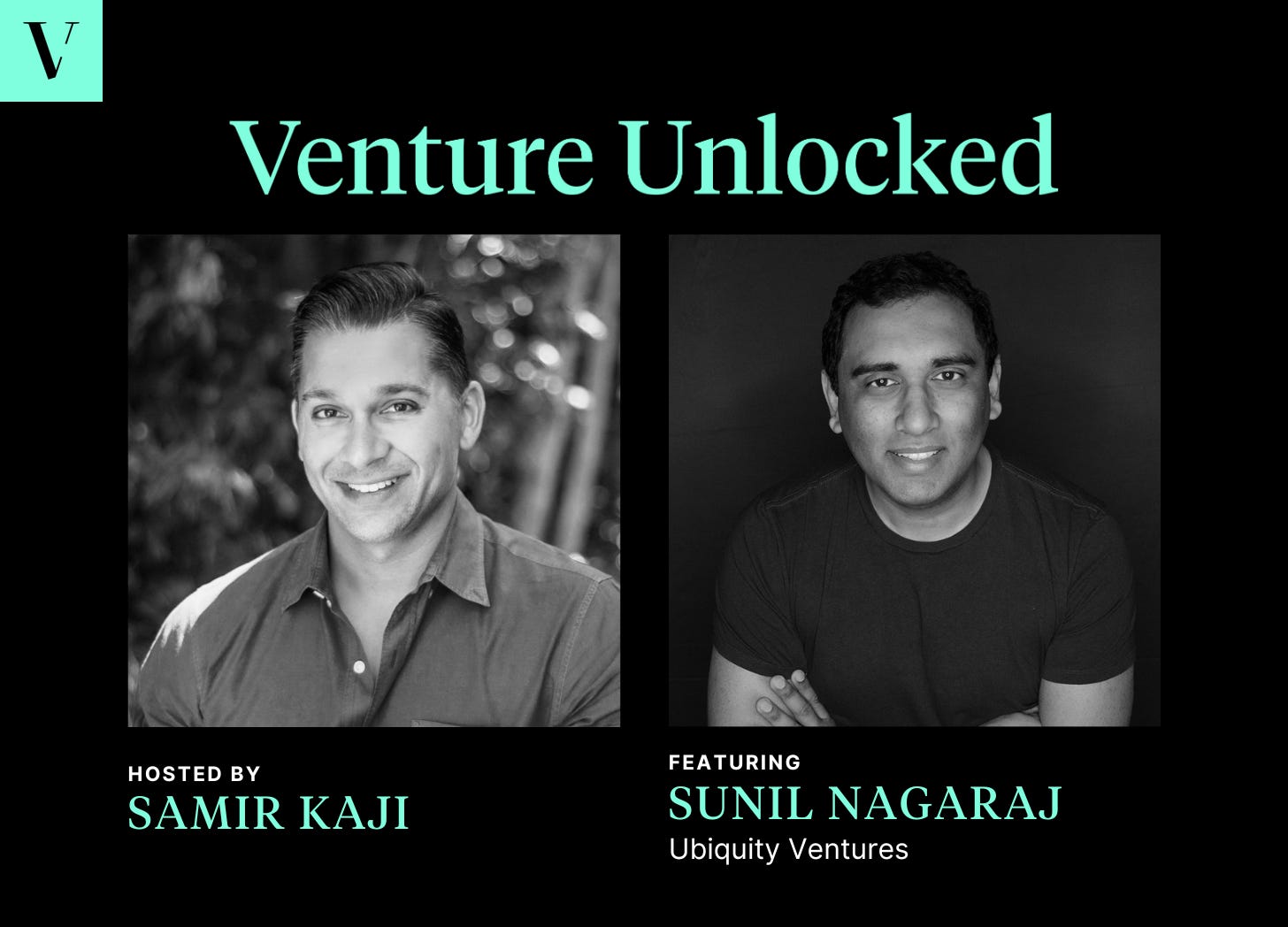
Sunil Nagaraj of Ubiquity Ventures on the journey of a solo-GP, The Importance of Authenticity, and Navigating Hype Cycles
Follow me @samirkaji for my thoughts on the venture market, with a focus on the continued evolution of the VC landscape.On this week’s show, I’m thrilled to be joined by Sunil Nagaraj, Founder of Ubiquity Ventures. Sunil started Ubiquity in 2017 to focus on backing technical founders at the pre-seed and seed stages around a thesis he calls “nerdy and early.” Before starting Ubiquity, Sunil spent just over 6 years at Bessemer Venture Partners, and began his career as a founder of a startup. With so many solo-GP firms emerging, Sunil took us through us his lens of a solo-GP, and how he has built and grown ubiquity over the last 7 years.This was a very insightful conversation and I hope you’ll enjoy it. About Sunil Nagaraj:Sunil Nagaraj is the Founder and Managing Partner of Ubiquity Ventures, a seed-stage institutional venture capital firm with over $150 million under management and a focus on "software beyond the screen"® startups. This includes B2B technology companies that utilize smart hardware or machine learning to solve business problems outside the reach of computers and smartphones.Prior to founding Ubiquity Ventures, Sunil spent the better part of a decade with Bessemer Venture Partners where his work included leading the seed rounds of Auth0 (acquired by Okta for $6.5 billion) and Zapier as well as investments in Rocket Lab (NASDAQ: RKLB), Spire (NASDAQ: SPIR), Velo3D (NYSE: VLD), Tile (acquired by Life360), and Twitch (acquired by Amazon for $1 billion). Before investing, Sunil was Founder and CEO of Triangulate, a VC-backed online dating startup using machine learning and behavioral data to improve matching accuracy. He has also worked at Bain & Company, Cisco, and Microsoft.Sunil holds an MBA from Harvard Business School and a BS in Computer Science from the University of North Carolina at Chapel Hill.In this episode we discuss:(01:45) Sunil’s journey into tech and investing(04:33) The decision to become a solo GP after spending his career in partnerships and team(09:56) How the first raise for Ubiquity went(13:23) LP segments(19:28) The types of founders that Sunil likes to back(22:25) Biggest lessons learned during his time in VC(24:54) Lessons from his anti-portfolio(28:37) Sizing your fund to be both small and nimble and large enough to write meaningful checks(31:33) The potential for AI(36:25) Navigating the hype cycles in VC(38:43) When to make exceptions in terms of ownership or check size(41:20) What the current VC market is like and how it might evolve(44:28) The advice he would give himself at the start of his careerI’d love to know what you took away from this conversation with Sunil. Follow me @SamirKaji and give me your insights and questions with the hashtag #ventureunlocked. If you’d like to be considered as a guest or have someone you’d like to hear from (GP or LP), drop me a direct message on Twitter.Podcast Production support provided by Agent Bee This is a public episode. If you would like to discuss this with other subscribers or get access to bonus episodes, visit ventureunlocked.substack.com
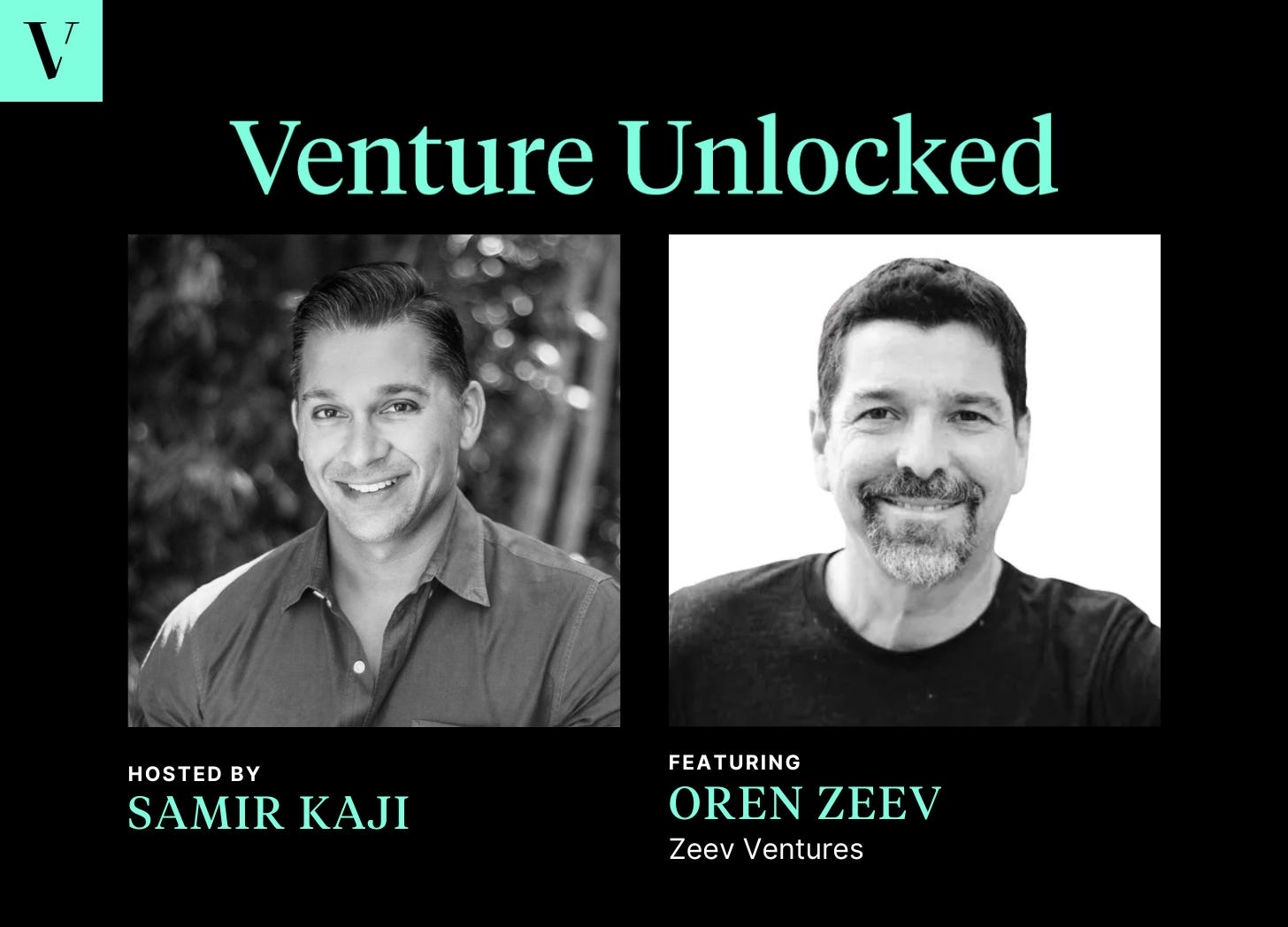
Oren Zeev on scaling to $2B+ in AUM as a solo-GP, contrarian investing, and high founder NPS
Follow me @samirkaji for my thoughts on the venture market, with a focus on the continued evolution of the VC landscape.We’re pleased to welcome Oren Zeev, Founding Partner at Zeev Ventures. Without a doubt, Oren is one of the titans in venture investing with nearly 30 years of experience and one of the most unique. Unlike traditional firms that have achieved scale, Oren remains a solo-GP, and has an authentic and refreshing view on venture investing. Today, he manages over $2B in Assets under management and has backed companies such as Houzz, Audible, Chegg, TripActions, and Tipalti, among many others.About Oren Zeev: Oren calls himself a “One Man Venture Capitalist,” and TechCrunch says he is a hybrid between an Angel Investor and a traditional VC. Prior to founding Zeev Ventures, Oren was a part of the founding team of Apax Israel in 1995. In 2002 moved to the US and co-headed, and later headed, the Technology Practice of Apax and the Silicon Valley office.He began his career at IBM and got his Bachelors from the Israel Institute of Technology and his MBA from INSEAD.In this episode we discuss:(02:21) The original thesis behind Zeev Ventures(09:44) Why Oren has avoided growing beyond a solo-GP(15:05) How Oren pushes himself to prevent biases and evolve his thinking over time(18:50) Why fund vintage doesn’t matter(21:24) The reason why Oren can be aggressive with follow-ons(23:59) What type of support can founders expect(27:50) Being relevant to founders as a VC(30:26) Working with other VCs on board(32:47) Advice to companies that had 2021 valuations that may need to raise soon(37:03) Thoughts on this downturn(41:47) Why Venture is still a good long-term investmentI’d love to know what you took away from this conversation with Oren. Follow me @SamirKaji and give me your insights and questions with the hashtag #ventureunlocked. If you’d like to be considered as a guest or have someone you’d like to hear from (GP or LP), drop me a direct message on Twitter.Podcast Production support provided by Agent Bee This is a public episode. If you would like to discuss this with other subscribers or get access to bonus episodes, visit ventureunlocked.substack.com

Stephanie Palmeri and Melody Koh of NextView Ventures on incentives within venture partnerships, the changes in seed financing, and operating remotely
Follow me @samirkaji for my thoughts on the venture market, with a focus on the continued evolution of the VC landscape.We’re joined by Stephanie Palmeri and Melody Koh, Partners at NextView Ventures. Nextview was founded in 2010 and recently raised $200MM for their new set of funds. Located in SF, NY, and Boston, the firm invests all across the US and has invested in over 170 companies at the seed-stage since its founding, including Devoted Health, Thread up, and Attentive. We had a great conversation about how NextView thinks about firm partnerships, what seed and pre-seed investing look like today, and what they believe it means to successfully work with founders. About Stephanie Palmeri:Stephanie is a Partner at NextView Ventures and is based in San Francisco. She focuses on the power of technology to positively transform how we live, work, learn, play, and care for our planet and each other. Her investments in the “Everyday Economy” have spanned many industries, including social commerce, circular retail, education, digital health, marketplaces, transportation, and finance. Previously, Stephanie was a partner at Uncork Capital, where she spent a decade investing in dozens of seed stage companies, including Poshmark ($POSH), Clever (aqu. by Kahoot!), Chariot (acq. by Ford), ClassDojo, Carrot Fertility, Hallow, Panorama Education, Phil, Wrapbook, and Wonderschool. Before venture investing, Stephanie worked as a technology consultant and marketer at Accenture, Estee Lauder, and several startups.Stephanie holds an MBA from Columbia Business School and a BS in Marketing and Management Information Systems, magna cum laude, from Villanova University.About Melody Koh:Melody is a Partner at NextView Ventures, based in its New York office. Prior to joining NextView, Melody was Head of Product at Blue Apron (NYSE: APRN). Melody joined Blue Apron as the first product hire when the company was 18 months old with 20 HQ employees. She helped scale the business through hyper-growth (25x in 3.5 years) and to its IPO.Previously, Melody was a Product Manager at Fab.com leading marketing & analytics products and the founder/CEO of a seed-funded wine subscription e-commerce service. Melody was also a venture investor at Time Warner’s strategic VC group and was one of six inaugural members of First Round Capital’s Product Co-op initiative. Melody began her career as a tech/media M&A investment banking analyst at Evercore Partners.Melody holds an MBA from the Harvard Business School and the University of Virginia.In this episode. we discuss:(01:54) Why NextView strives to not be a pack of lone wolves(03:35) How the carry economics of the firm drives a deeper partnership(06:57) Building firm culture with so many locations(11:21) How NextView uses strategic in-person time to remain connected(13:42) The benefits to founders by being more strategic in their investments(16:33) How the NextView model performed in the different market conditions over the last few years(21:04) What the moving goalposts of the market has meant to founders and investors(25:27) The advice they are giving founders to get through this difficult funding cycle(29:18) Why NextView sees themselves as invited guests and why that translates to happy founders(34:31) How they think about the growth and evolution of NextViewI’d love to know what you took away from this conversation with Stephanie and Melody. Follow me @SamirKaji and give me your insights and questions with the hashtag #ventureunlocked. If you’d like to be considered as a guest or have someone you’d like to hear from (GP or LP), drop me a direct message on Twitter.Podcast Production support provided by Agent Bee This is a public episode. If you would like to discuss this with other subscribers or get access to bonus episodes, visit ventureunlocked.substack.com
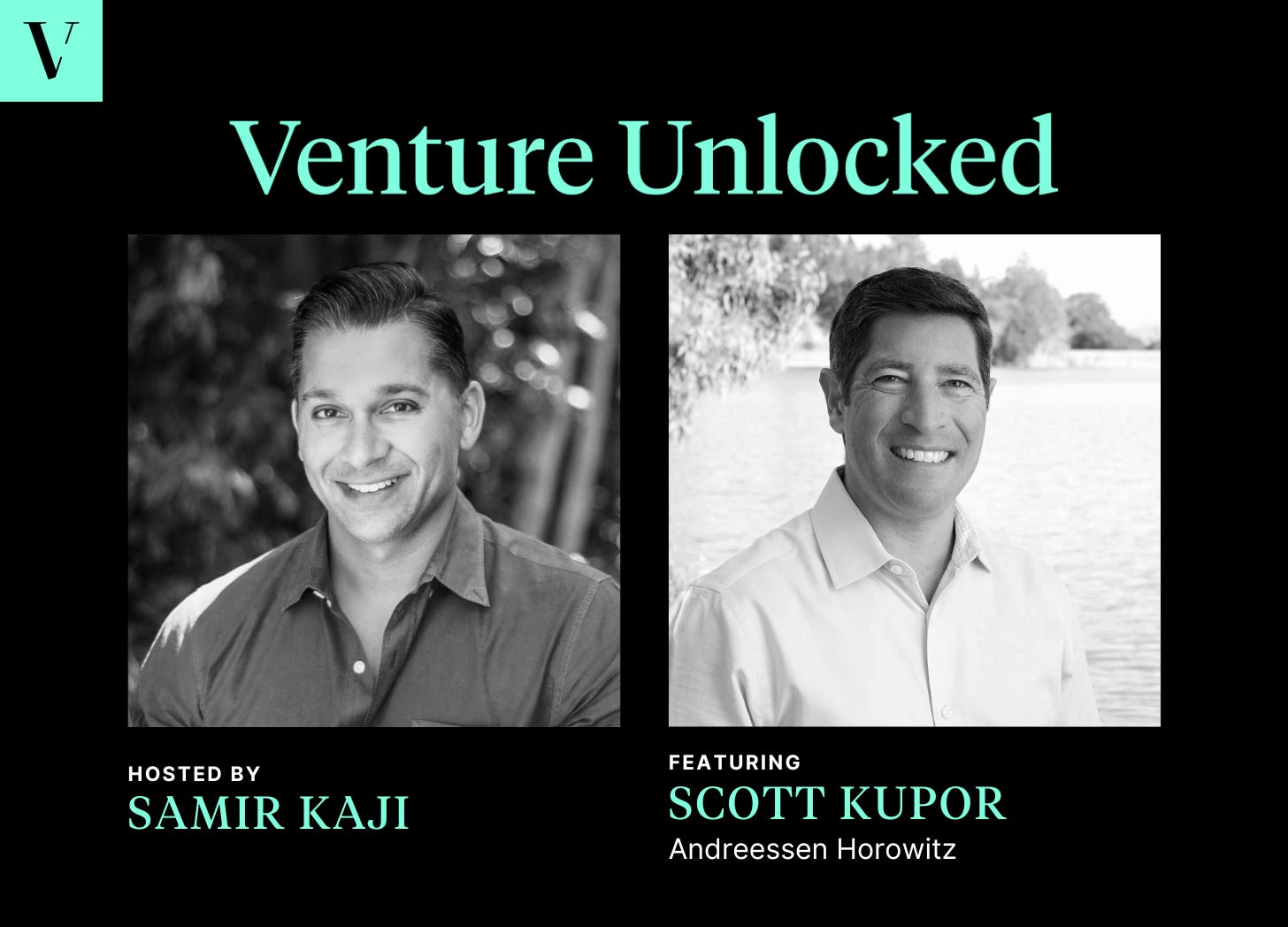
Scott Kupor, Managing Partner of a16z on Building a lasting Venture Franchise
Follow me @samirkaji for my thoughts on the venture market, with a focus on the continued evolution of the VC landscape.This week we’re joined by Scott Kupor, Managing Partner at Andreessen Horowitz. Scott was the first employee of the firm alongside Marc Andreessen and Ben Horowitz. He has been instrumental in the firm’s growth to now having north of $35B in AUM. Scott also authored a Wall Street Journal bestselling book called Secrets of Sand Hill Road: Venture Capital and How to Get It, and previously also served as chairman of the board of the NVCA. Scott goes through the history of a16z and the learnings along the way in building the multi-product investment company it is today.Frank, Rimerman + Co.’s history is closely intertwined with that of Silicon Valley. With humble beginnings similar to so many start-ups, Frank, Rimerman was formed with a desire to serve the entrepreneurial and venture communities of the Valley and the determination to think outside-the-box.When it comes to venture funds, we work with almost 500 VC groups from over 20 states across the USA. We have worked with over 400 fund groups during their first year of operations, making us one of the leading providers in the country to emerging managers.No one wants to be bored at work. That’s why we chose to work with some of the most innovative and creative people – people who are changing the world around us every day. Their excitement fuels our passion and determination to grow and serve this special community.Frank, Rimerman + Co, Passion Works Here.www.frankrimerman.comAbout Scott Kupor:Scott Kupor is Managing Partner at Andreessen Horowitz, focused on growth-stage companies building in the bio and healthcare industries, manages the firm's investor relations team, and is responsible for the firm's growth initiatives. Scott was the first employee at Andreessen Horowitz and managed the firm's growth from $300 million in AUM to more than $30 billion. Prior to joining the firm, Scott worked Hewlett Packard, Opsware, and represented startups through M&A processes. Scott is the author of the Wall Street Journal bestselling book, Secrets of Sand Hill Road: Venture Capital and How to Get It, and serves on the boards of Cedar, Headway, Foursquare, Labster, Ultima, and SnapLogic. He also served as chairman of the board for the National Venture Capital Association.Scott earned a bachelor’s degree and a JD from Stanford University.In this episode, we discuss:(02:24) Scott’s journey to a16z(04:52) Lessons from the dotcom bubble (08:29) Why the original thesis for a16z was so different(12:33) How Mike Ovitz and CAA inspired them(16:44) Early days building the firm and recruiting the team(20:26) Running the firm like a startup(25:58) Challenges of building and maintaining a culture(30:01) Building cohesion with a global workforce and work from home(33:18) What “founder-friendly” means at a16z(36:34) Advice for new managers(40:49) Where we are in the current market cycle(44:59) The advice Scott would give e himself as a new graduate.I’d love to know what you took away from this conversation with Scott. Follow me @SamirKaji and give me your insights and questions with the hashtag #ventureunlocked. If you’d like to be considered as a guest or have someone you’d like to hear from (GP or LP), drop me a direct message on Twitter.Podcast Production support provided by Agent Bee This is a public episode. If you would like to discuss this with other subscribers or get access to bonus episodes, visit ventureunlocked.substack.com
Fundraising best practices for managers, strategic LP management, and LPACs with Meghan Reynolds of Altimeter
Follow me @samirkaji for my thoughts on the venture market, with a focus on the continued evolution of the VC landscape.This week on the show we’re joined by Meghan Reynolds, partner and head of capital formation at Altimeter. Founded by Brad Gerstner in 2008, Altimeter has backed companies such as Snowflake, Unity, Gusto, and Modern Treasury. Prior to joining Altimer, Meghan worked in a variety of investor relations roles including TPG, Goldman Sachs, and JAZZ Ventures partners.She’s also quite prolific on Twitter with her insights on the LP world. This conversation was great as she went through the system she uses to form and maintain relationships with world-class LPs.A word from our sponsor:Venture capital firms and their investors have realized that a fund administrator without best-in-class technology is no longer acceptable. But experienced firms also know that when it’s crunch time and that capital call needs to go out now, no technology can replace the need for an expert, highly responsive fund accountant working with you. It’s time you talk with Juniper Square: the first technology-driven fund admin built for sophisticated venture capital firms. Learn more and request a call todayAbout Meghan Reynolds:Meghan is the Head of VC Capital Formation and Fundraising for Altimeter, a lifecycle technology investment firm. Prior to joining Altimeter, Meghan was Managing Partner and Co-head of Fundraising at TPG. She began her career and spent nearly a decade in the Investment Management Division of Goldman Sachs. ShMeghan is also currently a Venture Partner with JAZZ Venture Partners, an early stage Venture firm focused on the intersection of technology and human performance.Meghan graduated from the University of Notre Dame.In this episode we discuss:(02:42) Meghan’s career path that led her to Altimeter(05:40) How Meghan defines capital formation(10:33) Making decisions that allow the investment team to thrive while balancing LP interests(14:03) Building the right frameworks with LPs who may ultimately become long-term partners(17:03) Ways managers can differentiate outside of returns(19:44) Other factors that go into LP relationship management(23:16) The importance of transparency with your LPs(26:01) How LPs are reacting to current market trends(29:17) Using an LP Advisory Committee strategically(35:00) International sources of institutional capital(40:14) Fundraising advice for solo GPs(43:32) What to look for when hiring for a capital formation role(47:16) Predicting the market over the next 5 to 10 yearsI’d love to know what you took away from this conversation with Meghan. Follow me @SamirKaji and give me your insights and questions with the hashtag #ventureunlocked. If you’d like to be considered as a guest or have someone you’d like to hear from (GP or LP), drop me a direct message on Twitter.Podcast Production support provided by Agent Bee This is a public episode. If you would like to discuss this with other subscribers or get access to bonus episodes, visit ventureunlocked.substack.com

Satya Patel and Hunter Walk on learnings from building Homebrew, moving to an evergreen model, and launching Screendoor VC to back underrepresented fund managers
Follow me @samirkaji for my thoughts on the venture market, with a focus on the continued evolution of the VC landscape.On this week’s show we’re fortunate to be joined by Hunter Walk and Satya Patel, founders of Homebrew, a seed-stage firm founded over a decade ago that’s backed companies such as Chime, AngelList, and Gusto. Just over a year ago, Homebrew announced that it was moving away from a seed-focused traditional LP-backed fund to an open-ended evergreen structure that is funded from the proceeds of prior investments.Additionally, they are also leading up efforts of Screendoor, a fund of funds focused on supporting underrepresented fund managers by offering capital and counsel. Satya is coming back on the show for the second time, and it was fun to have Hunter on with him this time, as we dove deep into their learnings from building homebrew, what they look for when back fund managers, and their view on what makes a great partner for founders. This was a fun one, and we think you’ll really enjoy hearing their thoughts. Let’s now get right into it!A word from our sponsor:Privately owned and headquartered in New York City, Grasshopper Bank is built to serve the business and innovation economy. As a client-first digital bank, Grasshopper combines the best of banking technology and years of industry expertise to deliver best-in-class experiences with trusted security and unparalleled support. Grasshopper's digital solutions are tailored for venture capital and private equity firms, startups and small businesses, fintech-focused Banking-as-a-Service (BaaS) and commercial API banking platforms, and more. Serving clients globally, Grasshopper provides flexible, firm-focused lending solutions, as well as a dedicated Relationship Manager committed to meeting the unique needs and strategic focus of your firm across all entities, including funds, general partner and management companies. Grasshopper is a member of the FDIC and an Equal Housing Lender.For more information, visit the bank's website at www.grasshopper.bank or follow on LinkedIn and Twitter.About Satya Patel:Satya Patel is a Founding Partner of Homebrew and Co-Founder of Screendoor. Prior to Homebrew, he was VP Product at Twitter, building and leading the Product Management and User Services teams. Before Twitter, he was a Partner at Battery Ventures, where he co-led the seed and early-stage investing practices. He joined Google in 2003 and was responsible for AdSense product management and partnerships.Before heading to Silicon Valley for Google, he worked for DoubleClick, in venture capital, and as a strategy consultant.He has a BS in Finance and a BS in Psychology from The University of Pennsylvania.About Hunter Walk:Hunter Walk is a Founding Partner of Homebrew and Co-Founder of Screendoor. Prior to Homebrew, Hunter led consumer product management at YouTube, starting when it was acquired by Google. He originally joined Google in 2003, managing product and sales efforts for AdSense, Google‘s contextual advertising business.His first job in Silicon Valley was as the founding product and marketing guy at Linden Lab.Before graduate school, he was a management consultant and also spent a year at Late Night with Conan O‘Brien. He has a BA in History from Vassar and MBA from Stanford University.In this episode we discuss:(03:32) The decision to move to an evergreen fund structure with Homebrew(07:32) The biggest constraints when early-stage fund sizes balloon(17:34) How to survive a down market and become a force multiplier on a cap table(24:58) The inspiration to start Screendoor(33:33) The type of managers they are looking to back at Screendoor(37:54) Patterns they’ve seen in great investors(42:13) The most important question they ask GPs(44:42) The biggest lessons from their time as investorsI’d love to know what you took away from this conversation with Satya and Hunter. Follow me @SamirKaji and give me your insights and questions with the hashtag #ventureunlocked. If you’d like to be considered as a guest or have someone you’d like to hear from (GP or LP), drop me a direct message on Twitter.Podcast Production support provided by Agent Bee This is a public episode. If you would like to discuss this with other subscribers or get access to bonus episodes, visit ventureunlocked.substack.com
Portfolio construction trends and best practices with CEO Anubhav Srivastava of Tactyc
Follow me @samirkaji for my thoughts on the venture market, with a focus on the continued evolution of the VC landscape. I started Venture Unlocked to bring more transparency to firm building by bringing on guests whose unique insights and experts could help venture fund managers, limited partners, and founders with their journeys. This week, we have a special guest in Anubhav Srivastava, Founder and CEO of Tactyc, who saw the pain point managers were having in portfolio construction. Prior to Tactyc, managers often used excel spreadsheets and other methods for forecasting models. Tactyc is a dynamic software dashboard that makes ongoing portfolio modeling easy. Anyone who has listened to this show knows that portfolio construction is one of my favorite things to talk about, and Anubhav provided his data-driven insights on what he’s seeing on how emerging managers are modeling portfolios around number of companies, reserves, recycling, and follow-ons.Here is a completed dashboard that shows the Tactyc platform in action. You can also schedule a 1-on-1 demo with Anubhav, Tactyc's founder directly here. We hope you enjoy my conversation with Anubhav.A word from our sponsor:Privately owned and headquartered in New York City, Grasshopper Bank is built to serve the business and innovation economy. As a client-first digital bank, Grasshopper combines the best of banking technology and years of industry expertise to deliver best-in-class experiences with trusted security and unparalleled support. Grasshopper's digital solutions are tailored for venture capital and private equity firms, startups and small businesses, fintech-focused Banking-as-a-Service (BaaS) and commercial API banking platforms, and more. Serving clients globally, Grasshopper provides flexible, firm-focused lending solutions, as well as a dedicated Relationship Manager committed to meeting the unique needs and strategic focus of your firm across all entities, including funds, general partner and management companies. Grasshopper is a member of the FDIC and an Equal Housing Lender.For more information, visit the bank's website at www.grasshopper.bank or follow on LinkedIn and Twitter.About Anubhav Srivastava:Anubhav Srivastava is the Founder and CEO of Tactyc. He is a former bulge-bracket investment banker with extensive experience in M&A and financing transactions. Having spent more time than is healthy with Excel models, the idea for Tactyc was born out of his observations of how he saw people using (and misusing) Excel-based models.Prior to Tactyc, Anubhav was a Vice President at Evolution Media Capital and started his investment banking career at Deutsche Bank.Anubhav has an MBA in Finance from the Wharton School of Business and a B.S. in Electrical Engineering from Georgia Institute of Technology.In this episode we discuss:(02:26) Why Anubhav started Tactyc and what it does(05:10) The reason why using Excel becomes a pain point over time(08:10) How deeper portfolio analysis can give LPs peace of mind(10:55) Who has been more successful in raising over the last year(14:09) Trends of portfolio models in terms of initial valuation at the pre-seed, seed level today versus 2021(16:04) Changes in check sizes and dilution in recent months(18:04) How reserves and follow-ons have changed(19:36) The most important metric for a sub-$50 million fund(21:32) Portfolio strategies for nano-funds(23:32) How successful managers take emotions out of the equation in follow-on investments(26:46) What managers are seeing with follow-on MOIC hurdles(28:59) Why some managers are over-reporting to LPs to navigate this downturn(31:22) The biggest mistakes managers make in portfolio construction reporting(34:57) Understanding the difference between a management fee recycling and exit proceed recycling(36:53) Example of management fee recycling(39:08) What success for Tactyc looks like over the next 5-10 yearsI’d love to know what you took away from this conversation with Anubhav. Follow me @SamirKaji and give me your insights and questions with the hashtag #ventureunlocked. If you’d like to be considered as a guest or have someone you’d like to hear from (GP or LP), drop me a direct message on Twitter.Podcast Production support provided by Agent Bee This is a public episode. If you would like to discuss this with other subscribers or get access to bonus episodes, visit ventureunlocked.substack.com
Dana Settle on starting and building Greycroft, Maintaining culture and speed with scale, and thoughts on VC moving forward
Follow me @samirkaji for my thoughts on the venture market, with a focus on the continued evolution of the VC landscape.This week on the show we’re joined by Dana Settle, Co-Founder of Greycroft. Founded in 2006, Greycroft began with a mission to invest in areas outside of Silicon Valley and specifically in NY and LA. The firm currently has over $2B in Assets Under Management, over 60 employees, and has invested in companies such as Bumble, Scopely, Plated, and Maker Studios among many others. This was a special episode where we unpacked all of the components of firm-building including team development, fundraising, investment decision-making, and evolving to market dynamics. We hope you enjoy my conversation with Dana.Program note: This was recorded prior to the issues arising in the banking sector.A word from our sponsor:Privately owned and headquartered in New York City, Grasshopper Bank is built to serve the business and innovation economy. As a client-first digital bank, Grasshopper combines the best of banking technology and years of industry expertise to deliver best-in-class experiences with trusted security and unparalleled support. Grasshopper's digital solutions are tailored for venture capital and private equity firms, startups and small businesses, fintech-focused Banking-as-a-Service (BaaS) and commercial API banking platforms, and more. Serving clients globally, Grasshopper provides flexible, firm-focused lending solutions, as well as a dedicated Relationship Manager committed to meeting the unique needs and strategic focus of your firm across all entities, including funds, general partner and management companies. Grasshopper is a member of the FDIC and an Equal Housing Lender.For more information, visit the bank's website at www.grasshopper.bank or follow on LinkedIn and Twitter.About Dana Settle:Dana Settle is a Co-Founder and Managing Partner at Greycroft. Dana’s active investments include Acorns, Anine Bing, Avaline, Bird, Citizen, Cloud Paper, data.ai, Goop, HamsaPay, Happiest Baby, Merit Beauty, Mountain Digital, Pacaso, Seed Health, Tapcart, Thrive Market and Versed. Her notable exits include Bumble (IPO), Maker Studios (acquired by Disney), Pulse (acquired by LinkedIn), The RealReal (IPO), Trunk Club (acquired by Nordstrom), and WideOrbit (interest sold to company management).Prior to Greycroft, Dana spent several years as a venture capitalist and advisor to startups in the Bay Area, including six years at Mayfield, and investment banking at Lehman Brothers.Dana holds a BA in Finance and International Studies from the University of Washington and an MBA from Harvard Business School.In this episode we discuss:(02:03) What led to the creation of Greycroft(06:46) How they found believers in their hypothesis and got their first fundraise completed(08:19) Advice for managers and entrepreneurs raising in the current market(11:34) Building a distributed and remote-first culture outside of Silicon Valley(15:33) The role of diversity when building strong partnerships(19:00) Traits Dana values when she is hiring for the firm(21:09) Why curiosity is so important and how she uncovers that in candidates(23:55) The importance of creating a safe space for new voices to be heard in a firm(27:59) Why Dana hated the internal politics of old Silicon Valley and wanted to remove that from Greycroft(30:54) The decision to follow-on invest in their portfolio companies(33:11) How Greycroft manages conflicts within the partnership(35:01) The philosophy around team-building within the firm and how that benefits their portfolio companies(37:19) How Greycroft remains nimble with such a large organization(39:26) The bull case for Venture Capital moving forward(42:09) What Greycroft got the most correct and the most wrong in its historyI’d love to know what you took away from this conversation with Dana. Follow me @SamirKaji and give me your insights and questions with the hashtag #ventureunlocked. If you’d like to be considered as a guest or have someone you’d like to hear from (GP or LP), drop me a direct message on Twitter.Podcast Production support provided by Agent Bee This is a public episode. If you would like to discuss this with other subscribers or get access to bonus episodes, visit ventureunlocked.substack.com
Shuly Galili of UpWest on building lasting partnerships and how they bridged the gap between Israeli founders and the US Market
Follow me @samirkaji for my thoughts on the venture market, with a focus on the continued evolution of the VC landscape.This week we are joined by Shuly Galili, Founding Partner of UpWest, an early-stage firm founded in 2012 with her partner Gil Ben-Artzy to invest in seed-stage founders from Israel that are seeking to expand into the US market. UpWest has 4 funds under management and has invested in nearly 100 companies at the early stage that today have a collective market cap of over $20B. A word from our sponsor:Privately owned and headquartered in New York City, Grasshopper Bank is built to serve the business and innovation economy. As a client-first digital bank, Grasshopper combines the best of banking technology and years of industry expertise to deliver best-in-class experiences with trusted security and unparalleled support. Grasshopper's digital solutions are tailored for venture capital and private equity firms, startups and small businesses, fintech-focused Banking-as-a-Service (BaaS) and commercial API banking platforms, and more. Serving clients globally, Grasshopper provides flexible, firm-focused lending solutions, as well as a dedicated Relationship Manager committed to meeting the unique needs and strategic focus of your firm across all entities, including funds, general partner and management companies. Grasshopper is a member of the FDIC and an Equal Housing Lender.For more information, visit the bank's website at www.grasshopper.bank or follow on LinkedIn and Twitter.About Shuly Galili:Shuly is a Founding Partner at UpWest, a Silicon Valley seed fund investing in startups at the Israel-US technology junction. UpWest portfolio crossed $2B in VC funding and includes companies such as SentinelOne, HoneyBook, Stampli, CyCognito, Imubit, and more.She helped found the California Israel Chamber of Commerce (CICC), a business platform for ongoing tech exchange serving a network of over 10,000 companies. Under Shuly’s leadership as Executive Director, CICC had a significant impact on its members’ success in securing millions in venture capital, establishing US/Israel offices and R&D Centers and branding Israel’s emerging tech industry in Silicon Valley.In this episode we discuss:(02:23) What gap they saw they wanted to fill in 2012(08:45) How the go to market strategy is different in the US vs. Israel(10:51) What their first fundraise was like with a new strategy(14:03) The strategic support UpWest received from its early LPs(15:39) The realization that they needed to grow to realize their vision(18:10) How Fund II changed their investing strategy and approach(21:50) When do you know it’s time to raise your fund size?(25:42) What early-stage investors should optimize for(30:32) Defining a healthy venture GP partnership(33:57) UpWest’s decision-making process(35:20) How Shuly and Gil maintain their partnership(38:14) Advice to her younger selfI’d love to know what you took away from this conversation with Shuly. Follow me @SamirKaji and give me your insights and questions with the hashtag #ventureunlocked. If you’d like to be considered as a guest or have someone you’d like to hear from (GP or LP), drop me a direct message on Twitter.Podcast Production support provided by Agent Bee Agency This is a public episode. If you would like to discuss this with other subscribers or get access to bonus episodes, visit ventureunlocked.substack.com

Ryan Hoover of Weekend Fund and Jordan Gonen of Compound on the rise of private and retail investors into venture capital and alternatives
Follow me @samirkaji for my thoughts on the venture market, with a focus on the continued evolution of the VC landscape.This week we are re-joined by friend of the pod Ryan Hoover who is the Managing Partner of Weekend Fund and Jordan Gonen, Co-Founder and CEO of Compound, a fintech platform that provides wealth management and advisory services to founders and employees of startups. This was a special episode covering the growing intersection of the private wealth sector and venture capital investing, and what trends we are all seeing. We hope you enjoy my conversation with Ryan and Jordan.Frank, Rimerman + Co.’s history is closely intertwined with that of Silicon Valley. With humble beginnings similar to so many start-ups, Frank, Rimerman was formed with a desire to serve the entrepreneurial and venture communities of the Valley and the determination to think outside-the-box.When it comes to venture funds, we work with almost 500 VC groups from over 20 states across the USA. We have worked with over 400 fund groups during their first year of operations, making us one of the leading providers in the country to emerging managers.No one wants to be bored at work. That’s why we chose to work with some of the most innovative and creative people – people who are changing the world around us every day. Their excitement fuels our passion and determination to grow and serve this special community.Frank, Rimerman + Co, Passion Works Here.www.frankrimerman.comAbout Ryan Hoover:Ryan is the founder of Weekend Fund. He started his professional career as a product manager in the gaming industry. His fascination with technology and behavioral psychology led him to help write Hooked: How to Build Habit-Forming Products.In 2013 he founded Product Hunt, inspired by his curiosity and a desire to support early-stage makers and founders. The company raised capital from Y Combinator, Andreessen Horowitz, and others before joining AngelList. About Jordan Gonen:Jordan Gonen is the Co-Founder and CEO of Compound. Prior to that, he was at Scaphold (YC W17) and Pluot (YC W16). He also had stints at Inside, RealtyShares, Cultivation Capital, and more.Jordan’s writing has been featured in Forbes, Fortune Magazine, Startup Grind, Entrepreneur, Business Insider, Inc., Time, Mashable, Elite Daily, the Huffington Post, and others. Jordan studied at Washington University in St. Louis.In this episode we discuss:(02:20) Why Jordan started Compound(05:06) Why High Net-Worth Individuals seek out Alternative Investments(08:31) Motivations for becoming an LP(12:08) Advice for those new to Venture Investing as an LP(16:46) How you should evaluate a fund manager(23:04) Building deal flow as an emerging manager(27:22) Red flags when evaluating an investment(32:31) What the markets will hold in 2023I’d love to know what you took away from this conversation with Ryan and Jordan. Follow me @SamirKaji and give me your insights and questions with the hashtag #ventureunlocked. If you’d like to be considered as a guest or have someone you’d like to hear from (GP or LP), drop me a direct message on Twitter.Podcast Production support provided by Agent Bee Agency This is a public episode. If you would like to discuss this with other subscribers or get access to bonus episodes, visit ventureunlocked.substack.com
Eddy Chan of Intudo Ventures on building a hyper-local venture strategy for Indonesia
Follow me @samirkaji for my thoughts on the venture market, with a focus on the continued evolution of the VC landscape.This week we are joined by Eddy Chan, founding partner of Intudo Ventures, which employs a hyper-local strategy by backing entrepreneurs in Indonesia. With over $230M in AUM, the firm has become one of the largest Indonesia-only based firms.Eddy and I had a fun conversation on the reasons why hyper-local strategies can work, what these regions need to scale, and some of the interesting ways they leverage their LP base to help with portfolio building. Frank, Rimerman + Co.’s history is closely intertwined with that of Silicon Valley. With humble beginnings similar to so many start-ups, Frank, Rimerman was formed with a desire to serve the entrepreneurial and venture communities of the Valley and the determination to think outside-the-box.When it comes to venture funds, we work with almost 500 VC groups from over 20 states across the USA. We have worked with over 400 fund groups during their first year of operations, making us one of the leading providers in the country to emerging managers.No one wants to be bored at work. That’s why we chose to work with some of the most innovative and creative people – people who are changing the world around us every day. Their excitement fuels our passion and determination to grow and serve this special community.Frank, Rimerman + Co, Passion Works Here.www.frankrimerman.comAbout Eddy Chan:Eddy Chan is a founding partner of “Indonesia-only” Independent venture capital firm Intudo Ventures with over US$230 million in committed capital, that acts as the Indonesia beachhead strategy for dozens of leading institutions, funds, and family offices from around the world. Intudo portfolio companies include Xendit, Pintu, Pinhome, Halodoc, TaniHub, Kargo, PasarPolis, BeliMobilGue (acquired by OLX), Nalagenetics, Populix, and more.Prior to co-founding Intudo Ventures, Eddy worked on venture investments in startups since the late 1990s, including PayPal, Palantir, and Affirm, founded and operated venture-backed technology companies with operations in Silicon Valley and Asia, practiced corporate/M&A law and worked as an investment banker.Eddy holds a J.D. from Georgetown University and a B.S. in Business Administration from UC Berkeley.In this episode we discuss:(01:32) Why Eddy founded Intudo in 2016(05:47) The reasons Eddy thought Indonesia was ready for a hyper-local fund(09:52) Capital availability for companies that are in Indonesia(16:01) Navigating hyper-local challenges of getting companies far enough so that they can attract that Series A and how its different from Silicon Valley(22:55) How the first fundraise went and why LPs are more comfortable now(28:41) Why independence is a core value to Eddy and why no single LP can be more than 10% of the entire fund(31:16) How Intudo’s portfolio becomes a beachhead into Indonesia and the larger Asian market for its LPs(37:01) Intudo’s concentrated portfolio construction(41:09) Balancing due diligence and the speed of the marketI’d love to know what you took away from this conversation with Eddy. Follow me @SamirKaji and give me your insights and questions with the hashtag #ventureunlocked. If you’d like to be considered as a guest or have someone you’d like to hear from (GP or LP), drop me a direct message on Twitter.Podcast Production support provided by Agent Bee Agency This is a public episode. If you would like to discuss this with other subscribers or get access to bonus episodes, visit ventureunlocked.substack.com

Better Tomorrow Ventures, Jake and Sheel on Investing in FinTech, fund construction, and fundraising lessons
Follow me @samirkaji for my thoughts on the venture market, with a focus on the continued evolution of the VC landscape.We are officially 100 episodes in! For our 100th episode, we are joined by the founders of Better Tomorrow Ventures, also known as BTV, Jake Gibson and Sheel Mohnot. BTV is based in San Francisco and was founded in 2019. BTV focuses on early investing in FinTech companies, and has $300M+ in AUM. Jake and Sheel initially met at 500 startups, where Sheel worked. They are both seasoned fintech founders and angel investors: Sheel built and sold two fintech companies before starting the 500 Fintech accelerator, and Jake co-founded NerdWallet (now publicly traded).About Jake Gibson:Jake Gibson is a founding partner of Better Tomorrow Ventures. He has been involved in FinTech for over a decade — he started his journey as one of the co-founders of NerdWallet before becoming an angel investor. Today, he is a Founding Partner at Better Tomorrow Ventures (BTV). Prior to NerdWallet, Jake studied math and quantitative finance at MIT and traded interest rate derivatives at JPMorgan.About Sheel Mohnot:Sheel Mohnot is a founding partner of Better Tomorrow Ventures. Before BTV, Sheel was a Partner at 500 Startups, running the 500 FinTech Fund and the FinTech track within the San Francisco Accelerator program. His recent startup experience includes 2 successful FinTech exits – a payments company and a high-stakes auction company. He also created and hosted a podcast called The Pitch.He formerly worked as a financial services consultant at BCG and did Microfinance work at the non-profit Kiva. Sheel holds an MBA from the University of Michigan and a BS from Carnegie Mellon. In this episode we discuss:(02:24) BTV’s origin story (06:27) Handling their first raise at the beginning of the pandemic(11:28) How their fund construction remained the same despite market conditions(17:27) Surprises during their first fundraise(19:29) How Sheel and Jake view fund construction and ownership targets(24:18) The shift in the market from rewarding Beta to rewarding Alpha(27:55) How founders are reacting to market conditions(29:28) What they are seeing in the Series A markets today(32:19) How VC’s dry powder will actually get deployed(34:53) Making sense of the market segments in 2023(37:53) Why FinTech is still in the early-stages even though it has been heavily invested in(42:15) Non-obvious things that it takes to run a successful firm(45:17) Things they would have done differently at the start of their firmI’d love to know what you took away from this conversation with Jake and Sheel. Follow me @SamirKaji and give me your insights and questions with the hashtag #ventureunlocked. If you’d like to be considered as a guest or have someone you’d like to hear from (GP or LP), drop me a direct message on Twitter.Podcast Production support provided by Agent Bee Agency This is a public episode. If you would like to discuss this with other subscribers or get access to bonus episodes, visit ventureunlocked.substack.com

Jonathan Abrams, 8-Bit Capital: Learnings from founding and running Friendster, Defining "Founder Friendly", going from Angel to full-time VC
Follow me @samirkaji for my thoughts on the venture market, with a focus on the continued evolution of the VC landscape.We are joined by Jonathan Abrams, Co-Founder and General Partner at 8-Bit Capital. Jonathan previously was an angel investor and entrepreneur founding both Nuzzel and Friendster, the latter of which he helped grow to over 100MM users and where he met his current partner at 8-Bit, Kent Lindstrom. Jonathan also co-founded Founders Den with Zack Bogue of DCVC in 2011, which quickly became one of San Francisco’s earliest and most popular startup work and event spaces.We think you’ll really enjoy Jonathan’s story, and how he thinks about all aspects of seed-stage investing.A word from our sponsor:Tactyc is the first software solution for venture capital portfolio forecasting and planning. The platform is rapidly increasing efficiency and data-driven decision-making for GP’s and works with over 150 funds globally.Tactyc makes it easy for managers to build (and maintain) their portfolio models without dealing with complicated spreadsheets. It enables portfolio construction in minutes and for managers to share their intended fund strategy with potential investors. Post-launch, Tactyc also offers advanced analytics for GPs to optimize reserves, analyze probabilistic outcomes for their investments and extract insights for future capital deployment.Check them out at tactyc.io.About Jonathan Abrams:Jonathan is a co-founder and General Partner of 8-Bit Capital, an early-stage investing firm. He is also a co-founder and Managing Partner of Founders Den, San Francisco’s favorite workspace and community for startups and investors.Previously Jonathan was the founder of the professional news discovery service Nuzzel and the pioneering social networking service Friendster, and a software engineer at Netscape and Nortel. Jonathan is an investor in over 50 startups, including AngelList, ClearTax, CoinList, Docker, Front, HelloSign, Instacart, Mixmax, Pachyderm, Republic, SafeGraph, Sense, Shortcut, Slideshare, Stream, and Zeplin. Jonathan received an Honors B.Sc. in Computer Science from McMaster University in Canada.In this episode we discuss:01:57 Jonathan’s journey to creating 8-Bit Capital with Kent04:08 The opportunity they saw when founding 8-Bit06:07 How his experiences at Nuzzel and Friendster shaped his view as an investor08:20 What being founder friendly truly means11:37 Shifting from an active angel investor to a fund manager14:41 The hardest lessons leveling up from an angel investor18:14 Dealing with the deal flow noise as a team of two21:20 How to deal with conscious and unconscious bias when advising founders23:28 Jonathan and Kent’s decision-making process25:02 Thoughts on scaling 8-Bit28:11 Competing against larger, later-stage funds getting into seed-stage investing31:23 Deciding on follow-on investing33:35 How they came to decide on 50-50 fund construction for follow-on35:41 Keeping and increasing their pro-rata in competitive later rounds38:19 Biggest lessons from Friendster39:49 The advice he would give himself at the start of 8-BitI’d love to know what you took away from this conversation with Jonathan. Follow me @SamirKaji and give me your insights and questions with the hashtag #ventureunlocked. If you’d like to be considered as a guest or have someone you’d like to hear from (GP or LP), drop me a direct message on Twitter.Podcast Production support provided by Agent Bee Agency This is a public episode. If you would like to discuss this with other subscribers or get access to bonus episodes, visit ventureunlocked.substack.com
Gautam Gupta from TCV (Velocity) on the trend of large funds going early, the art of pro-rata investing, and what he is seeing in this market cycle
Follow me @samirkaji for my thoughts on the venture market, with a focus on the continued evolution of the VC landscape.This week we are joined by Gautam Gupta, who is the co-lead of TCV’s new expansion stage strategy called TCV Velocity. TCV was founded over 25 years ago with over $15B invested in over 350 companies. Prior to launching TCV Velocity, Gautam spent time as an investor at General Catalyst and M13, and in between those shops he was Founder and CEO of Naturebox. Gautam brought such an interesting point of view to our conversation, and we covered a lot of ground spanning from early to late-stage investing. Hope you enjoy this episode!Aumni is an investment analytics company dedicated to improving private capital markets. Aumni’s technology digitizes hard to track unstructured data from private transaction agreements and organizes it in a structured database through an intuitive dashboard. For investors across the board, the insights provided by this data improve the managers ability to build strategy and make better decisions. Today, Aumni tracks data from over 250 thousand private market transactions to provide anonymous, aggregated market benchmarks.As someone that works deeply in the private fund space, I’m incredibly excited that Aumni’s solution helps fund managers provide more insightful accurate reporting to their investors. Check them out at Aumni.fund.Subscribers of Venture Unlocked can sign up for 20% off when you mention Venture UnlockedAbout Gautam Gupta:Gautam is General Partner at TCV where he focuses on investments in the consumer technology space including commerce, consumer-facing healthcare, education, software, and financial services businesses. Before TCV, Gautam was a Partner at M13 Ventures, an early-stage venture capital firm focused on consumer technology, where he led investments in marketplace, consumer subscription, and B2B2C models.Gautam started his career at General Catalyst in 2004. He was initially an intern while in college and later became a member of the investment team. He left to launch NatureBox and, as CEO, helped build the company into a nationally recognized brand with millions of customers. He did his undergrad at Babson College.In this episode we discuss:02:13 Gautam’s career journey as an investor and founder04:52 How being a founder has shaped him as an investor07:50 Identifying whether a company truly is a venture backable company10:27 Why TCV setup the Velocity Fund to do earlier stage and smaller investments11:33 What is an expansion phase investment?14:35 Pros and Cons of traditionally later stage firms investing earlier17:19 Creating a unique brand in a larger firm19:24 How today’s market is compared to past down markets in 2008 and the dotcom bust23:07 Changes in deals and the market in the last year26:11 Competing in today’s market as an investor29:01 How Power Law is skewing the markets31:05 Looking back on deal memos of the past to see how short-sighted they were33:48 Why TCV Velocity is sticking with their investment thesis36:17 Why investors get pro-rata decisions wrong so often38:48 Advice he would give himself in 200741:08 Common traits of successful foundersI’d love to know what you took away from this conversation with Gautam. Follow me @SamirKaji and give me your insights and questions with the hashtag #ventureunlocked. If you’d like to be considered as a guest or have someone you’d like to hear from (GP or LP), drop me a direct message on Twitter.Podcast Production support provided by Agent Bee Agency This is a public episode. If you would like to discuss this with other subscribers or get access to bonus episodes, visit ventureunlocked.substack.com

Patrick Chun at Juxtapose: How company creation models and studios work in VC, the squint and wedge framework of investing, and raising from blue-chip institutions
Follow me @samirkaji for my thoughts on the venture market, with a focus on the continued evolution of the VC landscape.This week we are joined by Patrick Chun, Founder and Managing Partner of Juxtapose. Based out of New York, Juxtapose can best be described as a creation-oriented investment firm that leverages expertise to launch and invest in companies. The firm currently has over $500M in AUM across its funds. I had so much fun recording this episode as Patrick was able to offer great insights from his extensive experience in creation-oriented investment models, including leading builds at Accretive and Thrive, as well as, working at top venture and growth equity firms like Bain Capital Ventures and Francisco Partners.Aumni is an investment analytics company dedicated to improving private capital markets. Aumni’s technology digitizes hard to track unstructured data from private transaction agreements and organizes it in a structured database through an intuitive dashboard. For investors across the board, the insights provided by this data improve the managers ability to build strategy and make better decisions. Today, Aumni tracks data from over 250 thousand private market transactions to provide anonymous, aggregated market benchmarks.As someone that works deeply in the private fund space, I’m incredibly excited that Aumni’s solution helps fund managers provide more insightful accurate reporting to their investors. Check them out at Aumni.fund.Subscribers of Venture Unlocked can sign up for 20% off when you mention Venture UnlockedAbout Patrick Chun:Patrick is a co-founder and managing partner at Juxtapose where he helps to manage the team across strategies and works closely with the firm’s leaders across the business, including concept development and talent identification. Patrick also participates meaningfully with the portfolio and its CEOs, including involvement at the board level.Prior to founding Juxtapose, Patrick spent a significant portion of his career building and investing businesses at the earliest stages, including senior and partner-level experience at early-stage and at firms oriented towards company creation, such as Thrive Capital, Accretive, and Bain Capital Ventures.He started his career at McKinsey & Company. Patrick has a BA from Harvard College, an MA from the Harvard Graduate School of Arts and Sciences, and an MBA from Harvard Business School.In This Episode We Discuss:02:04 Patrick’s journey and inspiration to co-found Juxtapose 11:21 The art and science of company creations models 16:10 Defining a firm that is part private equity, part venture capital in profile 19:42 The squint and wedge frameworks that Juxtapose uses to evaluate companies and ideas22:49 How they score ideas internally and decision making frameworks25:24 Fund construction methodologies29:09 How Patrick keeps interests aligned with founders in the co-creation model32:01 Finding the right CEO for their businesses37:50 How they raised capital from LPs, and what worked for them with institutions42:45 Communication cadence with their LPs46:16 Patrick’s overall view of the market and what innovations we’ll see in the coming yearsI’d love to know what you took away from this conversation with Andrew. Follow me @SamirKaji and give me your insights and questions with the hashtag #ventureunlocked. If you’d like to be considered as a guest or have someone you’d like to hear from (GP or LP), drop me a direct message on Twitter.Podcast Production support provided by Agent Bee Agency This is a public episode. If you would like to discuss this with other subscribers or get access to bonus episodes, visit ventureunlocked.substack.com
Valar Ventures Andrew McCormack on running concentrated portfolios with higher ownership vs. larger portfolios, learnings from working with Peter Thiel, and thoughts on valuations today
Follow me @samirkaji for my thoughts on the venture market, with a focus on the continued evolution of the VC landscape.This week we are joined by Andrew McCormack, one of the founding partners at Fintech-focused Valar, which was founded in 2010 and has raised north of $2B. Before starting Valar, Andrew worked closely with Peter Thiel at Clarium Capital, Thiel Capital, and Paypal.Aumni is an investment analytics company dedicated to improving private capital markets. Aumni’s technology digitizes hard to track unstructured data from private transaction agreements and organizes it in a structured database through an intuitive dashboard. For investors across the board, the insights provided by this data improve the managers ability to build strategy and make better decisions. Today, Aumni tracks data from over 250 thousand private market transactions to provide anonymous, aggregated market benchmarks.As someone that works deeply in the private fund space, I’m incredibly excited that Aumni’s solution helps fund managers provide more insightful accurate reporting to their investors. Check them out at Aumni.fund.Subscribers of Venture Unlocked can sign up for 20% off when you mention Venture UnlockedAbout Andrew McCormack:Andrew is a founding Partner at Valar Ventures. Andrew’s career in technology has included business and corporate development roles at eCount (acquired by Citicorp) and Yahoo!. He joined PayPal in 2001, where he worked closely with Peter. After PayPal’s sale to eBay, Andrew helped launch Clarium Capital and later founded a restaurant group in San Francisco.In 2008, Andrew rejoined Peter at Thiel Capital, where he led various international initiatives for Thiel Capital and Peter personally. Andrew received his B.A. in Political Science from the University of Pennsylvania.In this episode we discuss:01:47 Andrew’s journey into the technology world and working a Clarium11:38 Valar’s early investment thesis18:49 Valar’s fundraising journey21:15 Benefits of smaller portfolios with more ownership 25:42 Career prolonging investing vs return maximation investing31:09 How Valar’s model has worked in the down market of 202234:30 What was wrong with the 2021 valuations37:26 The strategies that Andrew thinks will be successful in the Venture market moving forward41:39 Lessons from some of Andrew’s misses46:35 The career lesson he learned while he was operating a restaurant groupI’d love to know what you took away from this conversation with Andrew. Follow me @SamirKaji and give me your insights and questions with the hashtag #ventureunlocked. If you’d like to be considered as a guest or have someone you’d like to hear from (GP or LP), drop me a direct message on Twitter.Podcast Production support provided by Agent Bee Agency This is a public episode. If you would like to discuss this with other subscribers or get access to bonus episodes, visit ventureunlocked.substack.com
Mapping out a new partnership, why the RAISE GP/LP summit was such an important effort, and the art of fundraising by Joanna Drake of Magnify Ventures
Follow me @samirkaji for my thoughts on the venture market, with a focus on the continued evolution of the VC landscape.This week we are joined by Joanna Drake, co-founder of Magnify Ventures, which just completed an oversubscribed $52MM Fund I. Prior to Magnify, Joanna invested through her firm Core Ventures Group, and as part of the Broadway Angels group. Joanna is also the co-founder of RAISE Global, the leading emerging manager summit whose mission is to accelerate the next generation of fund entrepreneurs by both connecting them to LPs and providing the necessary education around building a firm.I’ve been part of its summit since it began in 2015, and I’m thrilled to see the impact and growth it’s created.Given Joanna’s background as a two-time fund entrepreneur and RAISE co-founder, we went deep into raising a fund and building partnerships. For anyone starting a firm, this is a must-listen, and I Hope you enjoy this conversation with Joanna.Aumni is an investment analytics company dedicated to improving private capital markets. Aumni’s technology digitizes hard to track unstructured data from private transaction agreements and organizes it in a structured database through an intuitive dashboard. For investors across the board, the insights provided by this data improve the managers ability to build strategy and make better decisions. Today, Aumni tracks data from over 250 thousand private market transactions to provide anonymous, aggregated market benchmarks.As someone that works deeply in the private fund space, I’m incredibly excited that Aumni’s solution helps fund managers provide more insightful accurate reporting to their investors. Check them out at Aumni.fund.Subscribers of Venture Unlocked can sign up for 20% off when you mention Venture UnlockedAbout Joanna Drake:Joanna Drake is the Co-Founder and Managing Partner of Magnify Ventures. For the last decade she has advised and invested in high-caliber founders solving important problems with technology, as General Partner of Core Ventures Group and a member of Broadway Angels, a world-class all-female investor collective. She is also the Co-Founder of RAISE Global.Prior to venture investing, Joanna was a serial entrepreneur and company builder, including serving as COO for the Western operations of DeNA, and founding executive of Current TV, the Emmy and Peabody-award-winning cable network known for its early innovations in interactive television and social media. Other executive roles were with market pioneers Moxi Digital (precursor to Apple TV) and ReacTV (personalized video newscasts). She began her career as a strategy consultant with Booz Allen, working with the world's leading media and technology conglomerates.In this episode we discuss:03:09 Joanna’s journey to become a venture capitalist04:34 Characteristics and traits that Joanna was looking for in a partner08:23 What healthy partnerships look like and commonalities of partnerships that haven't worked well12:02 Steps you can take to ensure a healthy partnership14:37 The origins of RAISE Global19:17 What she learned from organizing the conference and how it helped with her recent raise for Magnify26:14 Advice to emerging managers that may not hit their initial targets on how to adapt and adjust29:00 How afraid of negative signals should managers be?31:12 Other levers managers can use with LPs to get a quicker close35:23 How managers without deep networks of LPs can start a raise38:40 Joanna’s personal experience of fundraising43:10 The difference between generalist funds vs. sector-specific in their ability to win deals46:06 Ensuring portfolio companies can get downstream funding in a tougher marketI’d love to know what you took away from this conversation with Joanna. Follow me @SamirKaji and give me your insights and questions with the hashtag #ventureunlocked. If you’d like to be considered as a guest or have someone you’d like to hear from (GP or LP), drop me a direct message on Twitter.Podcast Production support provided by Agent Bee Agency This is a public episode. If you would like to discuss this with other subscribers or get access to bonus episodes, visit ventureunlocked.substack.com
Aydin Senkut of Felicis Ventures on angel to 9 time Midas list investor, inception to scale at Felicis, and winning in today's crowded market
Follow me @samirkaji for my thoughts on the venture market, with a focus on the continued evolution of the VC landscape.This week we are excited to have Aydin Senkut of Felicis Ventures, which since its founding in 2005 has become of the most successful early-stage funds in the world, having invested in companies such as Shopify, Canva, Opendoor, Guild, Flexport, Notion, and Plaid, The Felicis portfolio has 45 Unicorns since it started in 2006 and Aydin is a 9-time Forbes Midas list investor. Outside of the outstanding track record, Aydin brings such an interesting point of view on venture investing. We went deep on the history of Felicis, his investment philosophy, and his overall perspectives on running a venture firm.A word from our sponsor:Aumni is an investment analytics company dedicated to improving private capital markets. Aumni’s technology digitizes hard to track unstructured data from private transaction agreements and organizes it in a structured database through an intuitive dashboard. For investors across the board, the insights provided by this data improve the managers ability to build strategy and make better decisions. Today, Aumni tracks data from over 250 thousand private market transactions to provide anonymous, aggregated market benchmarks.As someone that works deeply in the private fund space, I’m incredibly excited that Aumni’s solution helps fund managers provide more insightful accurate reporting to their investors. Check them out at Aumni.fund.Subscribers of Venture Unlocked can sign up for 20% off when you mention Venture Unlocked.About Aydin Senkut:Aydin Senkut is the Founder and Managing Partner of Felicis. An original super angel turned multi-stage investor, he has been named on the Forbes Midas List for the past nine years (2014-2022) as well as the New York Times Top 20 Venture Capitalists list for four consecutive years (2016-2019). His recent focus areas include infrastructure, security, and future of health.He is well-known as an early backer of a number of iconic companies including Adyen, Credit Karma (Acquired by Intuit), Fitbit, Guardant Health, Guideline, Notion, Opendoor, Pluralsight, Rovio, Shopify, and Soundhound.Prior to starting Felicis, Aydin joined Google in 1999 as its first Product Manager to launch Google’s first 10 international sites, its first online search licensing products, and its first Safe Search. He then became the first International Sales Manager at Google, responsible for worldwide licensing deals. Before joining Google, Aydin was the Product Manager for Data Visualization and Data Mining software MineSet at SGI.He received a bachelor’s degree in Business Administration with Honors from Boston University. He also earned an MBA in Marketing from the Wharton School and a master’s degree in International Studies from the University of Pennsylvania.In this episode we discuss:02:12 What led to starting Felicis05:52 Why he decided to start something new instead of staying with Google08:40 Moving from angel to “super angel”12:19 The first fund raise16:10 Takeaways from early rejections and how he kept refining his pitch20:09 What was Aydin’s initial vision and how it has evolved over the years24:59 Teambuilding and early hires at Felicis29:02 How Felicis wins competitive deals through strategy35:11 When to bend a rule when it comes to unorthodox investments39:13 Commonalities of founders who create outlier opportunities42:24 How to be anti-fragile as an investor46:40 Trends in today’s market that gets Aydin excited50:16 The advice he would have given himself in 2005I’d love to know what you took away from this conversation with Aydin. Follow me @SamirKaji and give me your insights and questions with the hashtag #ventureunlocked. If you’d like to be considered as a guest or have someone you’d like to hear from (GP or LP), drop me a direct message on Twitter.Podcast Production support provided by Agent Bee Agency This is a public episode. If you would like to discuss this with other subscribers or get access to bonus episodes, visit ventureunlocked.substack.com
Quid's Josh Berman on providing financings against private stock, "trapped liquidity" at funds, and his learnings from co-founding Myspace.
Follow me @samirkaji for my thoughts on the venture market, with a focus on the continued evolution of the VC landscape.This week we are joined by Josh Berman, Co-Founder and Managing Partner of private lending firm Quid, an active funding platform that provides liquidity to shareholders of top private companies. Quid has raised $420M across two funds.Josh has been in technology for over two decades, co-founding MySpace in 2003, after which he went on to start BeachMint before moving to the investing side and starting both Troy Capital Partners in 2016 and private sharing financing company Quid in 2018.During the show, we talked about the difference between secondary selling and borrowing, the issue of trapped liquidity at funds, and the learning he took away from his Myspace experience. First, a word from our sponsor:Allocate is the digital operating system for investors looking to build and manage world-class private portfolios within venture capital and other technology-focused private assets.Despite the enormous growth of the private markets and the rapid increase of retail demand for private alternatives, investing in the highest quality private assets within the innovation sector remains inaccessible and opaque.Go to allocate.co to apply to be an early-access member and join 500+ active Allocate users.About Josh Berman:Josh Berman is an operator and investor based in Los Angeles. Most recently he Co-Founded and is Managing Partner of Quid and is General Partner at Troy Capital Partners. Previously he was the Co-Founder and CEO of BeachMint, a next-generation eCommerce company based in Santa Monica, CA. He was the President of Slingshot Labs, a division of News Corporation, a web incubator dedicated to building new Internet companies.Josh is also a co-founder and was the chief operating officer of MySpace.com.He also co-founded and managed successful Internet companies, ResponseBase Marketing, and Xdrive Technologies. Prior to his startup life, Berman was a management consultant with PricewaterhouseCoopers. He received his MBA from the University of Southern California, his BA from UC Santa Barbara, and is a CPA in the State of California.In this episode we discuss:01:16 Josh’s journey into startups06:01 The private stock problem that he saw in the market that Quid addresses10:58 Tax advantages of Quid’s approach to providing liquidity15:47 How stock financing actually works20:16 Affects of 2021 valuations on Quid’s lending model24:45 Employee retention strategies when strike prices may be lower than current valuation27:59 Other uses for Quid’s liquidity strategy30:00 Will traditional lenders get into this space?32:21 How the market today compares to the market in 1999/200035:26 Should investors slow down today or stay the course37:53 The biggest lesson from his time at MyspaceI’d love to know what you took away from this conversation with Josh. Follow me @SamirKaji and give me your insights and questions with the hashtag #ventureunlocked. If you’d like to be considered as a guest or have someone you’d like to hear from (GP or LP), drop me a direct message on Twitter.Podcast Production support provided by Agent Bee Agency This is a public episode. If you would like to discuss this with other subscribers or get access to bonus episodes, visit ventureunlocked.substack.com

Discovering talent before it's obvious, the challenges of raising a fund I without a traditional pedigree, and startup fund culture with Eric Tarczynski of Contrary
Follow me @samirkaji for my thoughts on the venture market, with a focus on the continued evolution of the VC landscape.This week we are joined by Eric Tarczynski, Founder and Managing Partner of Contrary, a firm backed by founders of Tesla, Reddit, Facebook, Airbnb, and many more iconic companies. The firm acts as a full stack platform to identify and support entrepreneurs often before they are starting a company. Contrary has raised nearly $100MM across funds. In our discussion Eric and I covered their thesis on talent, how he was able to raise a first fund without the normal background LPs often look for, and how they use culture to attract top talent. First, a word from our sponsor:Allocate is the digital operating system for investors looking to build and manage world-class private portfolios within venture capital and other technology-focused private assets.Despite the enormous growth of the private markets and the rapid increase of retail demand for private alternatives, investing in the highest quality private assets within the innovation sector remains inaccessible and opaque.Go to allocate.co to apply to be an early-access member and join 500+ active Allocate users.About Eric Tarczynski:Eric Tarcynski is the Founder and Managing Partner of Contrary, a venture fund that identifies and invests in the world’s top talent. He took on $50,000 in debt to get Contrary off the ground, sleeping in the back seat of a rental car or on friends' couches. Prior to Contrary, Eric was a co-founder and operator at numerous startups. He got his undergrad degree at Northeastern.In this episode we discuss:01:11 Eric’s journey to tech and startups04:42 How Eric’s non-traditional background affected his first fundraise08:27 What happened in the two years between Fund I and Fund II that got his from a sub-$10MM fund to a $75MM fund11:09 Concrete factors that LPs weighed when investing in Contrary14:01 Why Contrary avoided “logo hunting”16:11 Contrary’s unique thesis and why their model is the endgame for going earlier in the investing process19:00 Why Contrary has such a high NPS21:09 How Contrary invests in individuals “pre-company”24:10 The software platform that Contrary is building to help identify founders26:44 Building a platform without a lot of carry28:46 What Eric’s schedule looks like as an emerging manager30:57 Aspects of VC that Eric underestimated34:04 The advice he would give himself five years ago35:36 Would he have done anything differently?36:36 Why you do need some name brand consensus investments37:35 The best advice he gives to emerging managers39:48 The importance of persistence as a competitive advantageI’d love to know what you took away from this conversation with Eric. Follow me @SamirKaji and give me your insights and questions with the hashtag #ventureunlocked. If you’d like to be considered as a guest or have someone you’d like to hear from (GP or LP), drop me a direct message on Twitter.Podcast Production support provided by Agent Bee Agency This is a public episode. If you would like to discuss this with other subscribers or get access to bonus episodes, visit ventureunlocked.substack.com

Evaluating Crypto today, investing in crypto funds, the role of governance in the space featuring Rabia Iqbal and Jehan Chu of Nural Capital
Follow me @samirkaji for my thoughts on the venture market, with a focus on the continued evolution of the VC landscape.This week we are joined by Rabia Iqbal and Jehan Chu of Nural Capital, which is a crypto-focused hybrid firm that invests in both crypto funds and companies. Before starting Nural, Rabia spent time at Coatue and Mubadala, while Jehan is also a partner at blockchain-focused Kenetic Capital and has been one of the early pioneers within the crypto space.Given the dynamic and evolving world of crypto, we had a great conversation on unpacking all angles on crypto including the current winter we are in, the role of governance, and insights on where crypto may go from here.First, a word from our sponsor:Allocate is the digital operating system for investors looking to build and manage world-class private portfolios within venture capital and other technology-focused private assets.Despite the enormous growth of the private markets and the rapid increase of retail demand for private alternatives, investing in the highest quality private assets within the innovation sector remains inaccessible and opaque.Go to allocate.co to apply to be an early-access member and join 500+ active Allocate users.About Rabia Iqbal:Rabia Iqbal is the Co-Founder and Managing Partner of Nural Capital. She started her career at Morgan Stanley, she had a stop at Coatue Management before joining Mubadala, a sovereign wealth fund. She co-founded Nural in 2021. Rabia got her bachelor’s degree from Cornell.About Jehan Chu:Jehan Chu is the Co-Founder of Nural Capital. He also is the Co-Founder and Managing Partner of Kenetic, a Blockchain platform focused on technology, advisory, asset management, and community. Jehan has been active in the Blockchain community since 2014, when he founded the Hong Kong Blockchain Meetup and the Bitcoin Association of Hong Kong. His experience prior to that was in the art world on the auction-side at Sotheby’s and the acquisition side at Vermillion Art Collections.In this episode we discuss:01:20 How and why Nural Capital was formed05:30 Jehan’s background in Crypto08:58 How this current Crypto Winter is similar and different to ones in the past13:00 Will Crypto be a correlated or non-correlated asset moving forward15:42 Lessons we can take from the high-profile problems in Crypto20:04 How governance and regulation is evolving in Crypto and what is needed25:12 Areas where web3 excels over web 2.028:20 Differences between the early web and where Crypto is today33:23 Who is currently investing in the Crypto space37:46 What does it truly mean to be differentiated in the Crypto market42:20 Areas in the Crypto space where Nural is most bullishI’d love to know what you took away from this conversation with Rabia and Jehan. Follow me @SamirKaji and give me your insights and questions with the hashtag #ventureunlocked. If you’d like to be considered as a guest or have someone you’d like to hear from (GP or LP), drop me a direct message on Twitter.Podcast Production support provided by Agent Bee Agency This is a public episode. If you would like to discuss this with other subscribers or get access to bonus episodes, visit ventureunlocked.substack.com
Mark Mullen of Bonfire Ventures on going from a solo capitalist to joining forces with Jim Andelman, the state of seed markets, and his view on what makes fund managers differentiated
Follow me @samirkaji for my thoughts on the venture market, with a focus on the continued evolution of the VC landscape.This week brings us Mark Mullen, Co-Founding partner of LA-based seed firm Bonfire Ventures.Bonfire is based in Santa Monica and manages three Venture Capital funds with over $400MM in AUM. Mark spent 20 years as an I-banker before focusing on startup investing in 2012 with Double M capital. Mark has also been an active LP, investing in over 20 managers over the years. On the show, we talked about how he and Jim Andelman (formerly Rincon) decided to join forces to start Bonfire after each running their own VC firms. We also spoke about things like what he looks for in a great manager, his view on the seed market today, and what helped him gain so much early success as a fund manager when he was just getting started.First, a word from our sponsor:Allocate is the digital operating system for investors looking to build and manage world-class private portfolios within venture capital and other technology-focused private assets.Despite the enormous growth of the private markets and the rapid increase of retail demand for private alternatives, investing in the highest quality private assets within the innovation sector remains inaccessible and opaque.Go to allocate.co to apply to be an early-access member and join 500+ active Allocate users.About Mark MullenMark is Co-Founder and Managing Director of Bonfire Ventures. He is also the Founder of the early-stage firm Double M Partners.Prior to his investing career, Mark spent the first 20 years of his career as a telco, cable, and tech M&A investment banker working for Bill Daniels, often referred to as the father of cable TV in the US. He also served as COO of the City of Los Angeles and Senior Advisor to then-Mayor Antonio Villaraigosa.In this episode we discuss:01:12 Mark’s journey to starting Bonfire Ventures and partnering with Jim09:33 How Mark found early success getting into competitive deals12:12 The power of effective scouts17:28 His view on investing in emerging managers23:01 Balancing the Firm’s brand and the individual brands when it comes to building a reputation27:00 Why Mark and Jim decided to partner up and form Bonfire31:30 Why mergers of VC firms are challenging and why raising Fund II will be a huge challenge for emerging managers35:01 How were their conversations with LPs when raising Bonfire when he and Jim decided to join forces?38:40 The health of the seed market in 202242:43 The lesson Mark has taken as his true north in investingI’d love to know what you took away from this conversation with Mark. Follow me @SamirKaji and give me your insights and questions with the hashtag #ventureunlocked. If you’d like to be considered as a guest or have someone you’d like to hear from (GP or LP), drop me a direct message on Twitter.Podcast Production support provided by Agent Bee Agency This is a public episode. If you would like to discuss this with other subscribers or get access to bonus episodes, visit ventureunlocked.substack.com
Ravi Viswanathan of New View Capital on the secondary and growth markets, and raising a unique $1B+ (modified) GP led secondary fund I
Follow me @samirkaji for my thoughts on the venture market, with a focus on the continued evolution of the VC landscape.This week we are joined by Ravi Viswanathan, Founder and Managing Partner of NewView Capital, a growth and secondaries focused fund founded in 2018 with over $2.2 billion under management. NVC invests in technology companies through both direct investments and curated portfolio acquisitions, pairing funding with significant operational support. Focusing primarily on growth-stage companies, the NVC portfolio includes Plaid, Duolingo, Forter, Hims & Hers, MessageBird, and Scopely.Ravi brings a wealth of experience around growth and secondary markets to the conversation, and it was really fun to discuss both of those areas in detail, particularly in light of the change in the markets over the last year. First, a word from our sponsor:Allocate is the digital operating system for investors looking to build and manage world class private portfolios within venture capital and other technology focused private assets. Despite the enormous growth of the private markets and the rapid increase of retail demand for private alternatives, investing in the highest quality private assets within the innovation sector remains inaccessible and opaque.Go to allocate.co to apply to be a member and join 400+ active Allocate users. About Ravi Viswanathan:Ravi is an experienced company builder and dedicated partner to entrepreneurs and investors. In 2018, Ravi raised $1.35B to architect an innovative portfolio acquisition of 31 companies from NEA to found NewView Capital (NVC).Prior to founding NVC, Ravi was a General Partner at NEA, where he oversaw investment in enterprise software and fintech companies and co-led the firm’s Technology Venture Growth Equity effort. His investments of note include Braintree (acquired by PayPal), MuleSoft (acquired by Salesforce), GlobalLogic (acquired by Apax Partners), TeleAtlas (Euronext: TA, acquired by TomTom), Cyence (acquired by Guidewire), Acquia (acquired by Vista Equity Partners), Scout (acquired by Workday), Plaid, and Forter. Ravi spent several years at Goldman Sachs in the Private Equity Technology Practice before joining NEA. He began his career in consulting at McKinsey & Co and as a scientist at Raychem Corporation.Ravi holds an MBA from Wharton, a PhD in Chemical Engineering from University of California Santa Barbara, and a BS in Bioengineering from the University of Pennsylvania. He is also the Chair of the Wharton Entrepreneurship Advisory Board.In this episode we discuss:01:29 How the 2022 downturn compares to 2000 and 200803:20 The effect of market conditions on growth investing06:51 Why VCs keep making the same mistakes in bull markets and factors that lead to the most recent one09:22 What led to the launch of NVC in 201813:24 How Ravi sold the unique structure of NVC to founders and LPs15:55 Team building through the transition into NVC18:51 How Ravi managed communication around his conviction to close20:45 Navigating different LP considerations when putting together NVC23:38 What the next 6-12 months will look like in the venture markets28:06 State of the secondary markets in 202232:15 The stigma of selling positions early as managers and LPs35:50 The types of firms that are well-positioned for success in the current marketI’d love to know what you took away from this conversation with Ravi. Follow me @SamirKaji and give me your insights and questions with the hashtag #ventureunlocked. If you’d like to be considered as a guest or have someone you’d like to hear from (GP or LP), drop me a direct message on Twitter.Podcast Production support provided by Agent Bee Agency This is a public episode. If you would like to discuss this with other subscribers or get access to bonus episodes, visit ventureunlocked.substack.com
The art of pre-seed investing, mitigating investment risk at this stage, and building processes to build a true venture platform with a lean team
Follow me @samirkaji for my thoughts on the venture market, with a focus on the continued evolution of the VC landscape.On this week’s show, we are excited to be joined by Gaurav Jain, Co-Founder of Afore Capital, one of the largest pre-seed funds in the US with nearly $300MM in AUM across 3 funds. Afore says that no investment is "too early,” and very often investing in companies that are pre-product. We had a great conversation covering pre-seed investing, whether the current market should affect portfolio construction, and how they are able to execute on so many initiatives without the benefit of a large team. About Gaurav Jain:Before co-founding Afore in 2016 with Anamitra Banerji (formerly at Foundation Capital), Gaurav was a principal at one of the top-seed firms in the world in Founder Collective and prior to his investing career, he was an early Product Manager for Android Google and was a co-founder of Polar Mobile.In this episode we discuss:00:58 The inspiration for starting Afore 04:05 What is the difference between pre-seed and seed stage investments06:32 How Afore underwrites risk at the earliest stages of development10:19 The type of founders that Afore is most excited about13:03 Why storytelling is so important at the early stages of companies17:38 Why the market conditions haven’t changed Afore’s portfolio construction23:18 How they think about follow-ons and insider bridges26:58 How Afore has productized its offer with Afore Alpha31:40 How the Afore platform and community works36:48 What Gaurav’s day-to-day schedule looks like42:50 The lessons Gaurav has learned from his anti-portfolioI’d love to know what you took away from this conversation with Gaurav. Follow me @SamirKaji and give me your insights and questions with the hashtag #ventureunlocked. If you’d like to be considered as a guest or have someone you’d like to hear from (GP or LP), drop me a direct message on Twitter.Podcast Production support provided by Agent Bee Agency This is a public episode. If you would like to discuss this with other subscribers or get access to bonus episodes, visit ventureunlocked.substack.com
Parade Ventures Shawn Merani on building LP relationships, not focusing on "hot" deals, and his mindset with founders
Follow me @samirkaji for my thoughts on the venture market, with a focus on the continued evolution of the VC landscape.On today’s show, we have Shawn Merani, Founder and Managing Partner at seed-stage focused Parade Ventures which recently closed a $40MM+ oversubscribed Fund II. In this episode, we talk about the basics of LP relationship building, founder support during tough times, and his view on larger VC’s invested in seed.About Shawn Merani:Shawn Merani is the Founder and Managing Partner of Parade Ventures, a pre-seed & seed stage-focused venture capital firm.Previously, Shawn was a co-founder and partner at Flight Ventures, investing in early-stage software, internet, and mobile companies across a variety of sectors. Shawn’s investments include Dollar Shave Club (acquired by Unilever), Sapho (acquired by Citrix), Moveworks, Trusted Health, Clubhouse, Side, Plastiq, Jumpcloud, amongst others.As an operator, Shawn was a founding partner of Liquidnet’s Private Shares marketplace, which enabled over 750 of the world’s leading asset managers to invest in high-growth, pre-IPO companies. He grew the marketplace to $150MM+ GMV in the first two years. Prior to Liquidnet, Shawn was Senior Director of Business Development at ReachLocal. Shawn has a BA in Economics and a BS in Business Administration from the University of California at Berkeley, as well as an MBA from UCLA Anderson School of Management.In this episode we discuss:01:04 Why Shawn decided to found Parade rather than joining an established firm07:09 What are red flags and signals of alignment when looking at early-stage founders10:10 How Shawn rises above FOMO when looking at deals12:44 The lessons he learned between Fund I and Fund II and why he was able to raise so much more16:10 How Shawn partners with LPs to build trust and relationships18:24 How Shawn sourced his LPs20:44 How Shawn approaches investing in this market22:25 Is there any difference in leading rounds in 2022 vs. 202124:59 When is it right for a company to press the gas in a downturn27:40 What the next few years look like in venture capital31:20 How large, later-stage firms getting into seed will affect the market33:35 Shawn’s biggest contrarian view about investing35:11 The biggest career lesson he’s learned36:46 The biggest misconception of seed investingI’d love to know what you took away from this conversation with Shawn. Follow me @SamirKaji and give me your insights and questions with the hashtag #ventureunlocked. If you’d like to be considered as a guest or have someone you’d like to hear from (GP or LP), drop me a direct message on Twitter.Podcast Production support provided by Agent Bee Agency This is a public episode. If you would like to discuss this with other subscribers or get access to bonus episodes, visit ventureunlocked.substack.com
Tusk Venture Partners Jordan Nof: Evolving to an early stage firm, navigating regulatory hurdles for startups, and what the future holds for crypto.
Follow me @samirkaji for my thoughts on the venture market, with a focus on the continued evolution of the VC landscape.On this week’s episode, we were thrilled to b joined by Jordan Nof, co-founder and managing partner of Tusk Venture Partners.Jordan co-founded the firm in 2015 along with Bradley Tusk to help founders build companies in areas that require regulatory navigation and expertise. The firm recently closed a $140MM Fund III, and it has previously invested in companies including Coinbase, MainStreet, Lemonade, and FanDuel. Jordan and I went deep into the evolution of Tusk, including moving from a multi-stage firm to an early-stage firm, how they’ve constructed their investment mentality, and his overall views on regulation, including within the Crypto Markets.About Jordan Nof:Jordan Nof is a Co-founder and Managing Partner at Tusk Venture Partners L.P. and is a member of the firm’s Investment Committee. He has led many of the firm’s investments including Lemonade, Bird, Coinbase, Alma, Sunday, and Wheel. He currently serves on the board of directors of Alma, Sunday, and Wheel.Prior to Tusk Venture Partners, Jordan spent six years as a Director at Blackstone, where he focused on the development of the firm’s corporate venture capital portfolio. During that time, Jordan focused on investing in early-stage technology companies that could accelerate operations across Blackstone and the firm’s underlying portfolio companies.Before joining Blackstone, Jordan spent four years in the institutional investment management division at Alliance Bernstein. During that time, he worked with many of the firm’s largest global institutional sub-advisory relationships.Jordan received an M.B.A. from Rollins Graduate School of Business and graduated from Florida State University where he received a B.S. in Finance. He is based out of the firm’s New York office.In this episode we discuss:01:09 Why Jordan and Bradley decided to start Tusk Venture Partners05:36 How Tusk supports founders through complex regulatory environments09:10 Transitioning from a multi-stage thesis to an early-stage thesis11:23 Why they decided to lead rounds and how they built conviction with founders16:09 How the current market landscape has affected Tusk’s investing strategy21:01 Tusk’s reserve strategy and advice they are giving to portfolio companies to combat the changed capital environment25:41 How Jordan spends his time between fundraising, working with existing portfolio companies, and finding new ones30:38 Where Crypto/Web3 is today and where regulation fits into its future36:16 How regulation is a validation of a market position39:18 The biggest career lesson he’s learnedI’d love to know what you took away from this conversation with Jordan. Follow me @SamirKaji and give me your insights and questions with the hashtag #ventureunlocked. If you’d like to be considered as a guest or have someone you’d like to hear from (GP or LP), drop me a direct message on Twitter.For full disclosure, Tusk is also an investor in the company I co-founded, Allocate.Podcast Production support provided by Agent Bee Agency This is a public episode. If you would like to discuss this with other subscribers or get access to bonus episodes, visit ventureunlocked.substack.com

FPV's Wes Chan on the path to backing 20 unicorns and 5 decacorns, raising a $450MM Fund 1, working closely with Sergey and Larry and Google, and what Bill Campbell taught him about helping founders
Follow me @samirkaji for my thoughts on the venture market, with a focus on the continued evolution of the VC landscape.I’m excited to bring my conversation with Wesley Chan, founder and managing partner of his new fund FPV Ventures, which recently closed an oversubscribed $450M Fund 1. Wes brings a very unique lens to investing as he closely worked with the founders of Google (where founded Google Voice and Google Analytics), and went on to co-found GV before he joined Felicis Ventures. During his 13 year venture career, he has backed 20 unicorns and 5 decacorns, including Canva, Flexport, Guild Education, RobinHood, AngelList, Plaid, and Ring.During our discussion, we spoke about how he’s been able to have such a hit rate in his investing career, what being founder-friendly really means, and his time working with people like Sergey and Larry at Google as well as what he learned from Bill Campell. I really hope you enjoy our chat.About Wesley Chan:Wesley Chan is the Co-Founder and Managing Partner at FPV Ventures, a $450M early-stage fund that backs and serves mission-driven founders. He is an investor in five $10B+ "decacorns," his most notable being Canva where he is a member of the board of directors, led the Series A and C rounds, and is worth north of $40B. He founded Google Analytics and Google Voice and holds 17 US patents for his work in creating Google AdWords.Among Wesley's 20+ unicorn investments, he wrote the first or very early check into fintech API decacorn Plaid, logistics powerhouse Flexport, SMB payroll leader Gusto, enterprise software unicorn Lucid, and stock trading platform RobinHood (NASDAQ: HOOD)—and led investments in Canva, AngelList, Carta, Guild Education, Sourcegraph, Dialpad, RocketLawyer, Orca Bio, Checkr, CultureAmp, HyperScience, Zipline, Astranis, TrialSpark, and Ring (exit to AMZN). Business Insider named Wesley to their Top 100 Seed Investors list for two consecutive years in 2022 & 2021.He was formerly a Managing Director at Felicis Ventures and one of the first General Partners at GV (Google Ventures). He holds a Bachelor’s degree in Computer Science and Electrical Engineering from MIT and completed his Master’s degree at the MIT Media Lab.In this episode we discuss:01:22 Wesley’s path to becoming a VC05:03 The start of GV, and the early days05:59 How we got to current market conditions06:57 Why Wesley doesn’t have a thesis driven approach09:12 What he saw in the founders of Canva to give him conviction even when other investors would not invest12:46 How FOMO and being incremental are so detrimental in being a VC17:01 What is it about Wesley’s mindset that allows him to consistently be non-consensus20:48 Why $450M was the right fund size for FPV23:26 The ethos for FPV and how Wesley and his partner in FPV, Pegah Ebrahimi, decided to work together26:40 Why you don’t always need to be on a board to be helpful27:28 What founders really need from investors28:43 How FPV thinks about differentiating itself from bigger firms31:40 The impact of Bill Campbell on Google and also how he impacted Wesley’s style as an investor34:36 Where the market is right now and what the next few years look like I’d love to know what you took away from this conversation with Wesley. Follow me @SamirKaji and give me your insights and questions with the hashtag #ventureunlocked. If you’d like to be considered as a guest or have someone you’d like to hear from (GP or LP), drop me a direct message on Twitter.Podcast Production support provided by Agent Bee Agency This is a public episode. If you would like to discuss this with other subscribers or get access to bonus episodes, visit ventureunlocked.substack.com

Jessica Peltz-Zatulove and Kate Beardsley on closing an oversubscribed $52MM Fund I, the difference between family offices and institutions, secondaries as a foundation of portfolio management
Follow me @samirkaji for my thoughts on the venture market, with a focus on the continued evolution of the VC landscape.Today we’re thrilled to bring you our conversation with Jessica Peltz-Zatulove and Kate Beardsley, co-founders of Hannah Grey VC. Backed by firms such as Twitter, JP Morgan, Screendoor, Insight Partners, etc. the firm recently announced it’s oversubscribed $52MM seed fund and (13 investments made to date). Jessica and Kate have backgrounds in entrepreneurship, branding, and strategy, and bring their wealth of experiences to this week’s episode.About Jessica Peltz-Zatulove:Jessica Peltz-Zatulove is a Founding Partner at Hannah Grey.Prior to founding Hannah Grey, Jessica was Senior Managing Partner at MDC Ventures, leading investments in companies including Netomi, Gradient.io (acquired by Criteo), Veritonic, Indicative (acquired by mParticle), Catch & Release, Perksy, and Mezzobit (acquired by OpenX). Before she was a VC, Jessica specialized in connecting marketers with tech at innovation consultancy Evol8tion and at Zenith Media.Jessica also leads a NYC’s Women in VC group and created the Global directory for Women in VC, which now includes 3,800+ women investors spanning 2,400+ venture funds across 200+ cities and 60+ countries.About Kate Beardsley:Kate started her career as director of special projects for Martha Stewart Living, reporting directly to Martha Stewart. She went on to become Chief of Staff to Ken Lerer at the Huffington Post, and joined him to co-found Lerer Hippeau, a NYC-based fund focused on early-stage companies.In 2014, Kate joined Upslope Ventures as Managing Partner which took her from NYC to Denver. She is active with the Rocky Mountain Venture Capital Association and the Rockies Venture Club.Episode Summary:01:26 Why did they start Hannah Grey, and what were the key components they knew were necessary for them?08:21 What exactly is their product outside of capital? 13:36 Thinking through LP discovery and composition20:11 Learnings from raising a fund, including the difference between raising from institutional investors and non-institutional investors30:51 What internal KPI’s they track for the firm 35:26 The future of service-oriented venture38:44 The ‘Hannah Grey’ Experience when supporting founders. 43:25 Recommendations for emerging managers46:46 Cultivating a community of female investorsMentioned in this episodeHannah GreyI’d love to know what you took away from this conversation with Jessica and Kate. Follow me @SamirKaji and give me your insights and questions with the hashtag #ventureunlocked. If you’d like to be considered as a guest or have someone you’d like to hear from (GP or LP), drop me a direct message on Twitter.Podcast Production support provided by Agent Bee Agency This is a public episode. If you would like to discuss this with other subscribers or get access to bonus episodes, visit ventureunlocked.substack.com
GGV's Jeff Richards on making sense of the market today, growing a $9B+ firm, and whether geo-political tensions may affect international venture investing
Follow me @samirkaji for my thoughts on the venture market, with a focus on the continued evolution of the VC landscape.We have a great conversation on top this week with Jeff Richards, Managing Partner at GGV Capital. Founded in 2000, GGV manages nearly $10B in AUM and invests across stages in both the US and Asia, and has invested in companies such as AirBnB, Wish, Opendoor, and Grab. This was a great conversation as Jeff has been both on the founder and investor side, and has spent the last 14 years at GGV where he’s had a front-row seat to the incredible evolution of the firm to what it is today. He provided us with some great thoughts on the markets today, the challenges of growing a firm, and how the current geopolitical tensions may affect international investing. About Jeff Richards:Jeff focuses on enterprise/cloud and marketplace investments, and led GGV’s investments in Appirio (acq by Wipro), Belong, BigCommerce (NASDAQ: BIGC), BlueKai (acq by Oracle), Boxed, Brightwheel, Buddy Media (acq by Salesforce), Coinbase (NASDAQ: COIN), Electric.ai, Evolv OnDemand (acq by Cornerstone), Gladly, Handshake, HotelTonight (acq by Airbnb), Lambda School, Mindee, Namely, People.ai, PlushCare/Accolade (NASDAQ: ACCD), Slice, Tala, Tile, Vic.ai, Workboard, and Zylo.Prior to joining GGV, Jeff founded two software companies: R4, a supply chain SaaS business acquired by VeriSign (NASDAQ: VRSN), and QuantumShift, a telecom software business backed by Texas Pacific Group (TPG). Earlier in his career, Jeff worked in Asia and Latin America with PriceWaterhouseCoopers. He graduated from Dartmouth College.Our sponsor:At Brex, we build financial software and services to help startups scale faster. We understand that founders need to focus on building, not banking. So we’ve reimagined traditional financial systems to enable greater speed and productivity — no matter where founders and their teams are working.We offer a smart corporate card, business account, and mobile app that are easy to use from day one. No manuals needed here. Within minutes, you can deposit funds, send free wires and ACH worldwide, separate investor funds from operating expenses, earn great rewards, automate expenses, and more. Everything we do at Brex is to help founders spend less time managing expenses and reporting on your runway — and more time building your business.Get started at brex.com/ventureIn this episode we discuss:02:06 Jeff’s journey into venture capital08:30 What it took to scale GGV to what it is today14:32 How they had to shift internal mindset as they scaled fund sizes20:55 How the current market compares to previous cycles27:33 The health of the current venture market and areas where Jeff sees growth potential33:46 Advice to investors looking to create a venture portfolio39:30 How the geopolitical climate is affecting investing both in the US and globally46:26 Why emerging markets are still a strong place to look for alpha in the current market48:11 The best piece of career advice he’s receivedI’d love to know what you took away from this conversation with Jeff. Follow me @SamirKaji and give me your insights and questions with the hashtag #ventureunlocked. If you’d like to be considered as a guest or have someone you’d like to hear from (GP or LP), drop me a direct message on Twitter.Podcast Production support provided by Agent Bee Agency This is a public episode. If you would like to discuss this with other subscribers or get access to bonus episodes, visit ventureunlocked.substack.com

Viola Ventures' Danny Cohen on the Israel's exponential growth as a tech hub, building decision frameworks for picking, and managing a firm in a rapidly changing market
Follow me @samirkaji for my thoughts on the venture market, with a focus on the continued evolution of the VC landscape.This week we have Venture Unlocked’s first international manager with Danny Cohen from Israel-based Viola Ventures. Originally founded under the name Carmel Ventures in 2000, Viola currently has over $4B in total assets under management. It’s focused on early-stage companies in the fields of enterprise infrastructure and applications, frontier and deep technologies (automotive, IOT, AR/VR, drones), software, software as a service, financial technology, Internet, media, communications, semiconductors, and consumer electronics.Danny joined the firm as a GP in 2013 after 11 years at Gemini Ventures.It was great to have an insider’s perspective given how much growth we’ve seen in the Israeli ecosystem over the last five years—which includes a 6X growth in funding of startups!About Daniel Cohen:Daniel Cohen is a General Partner at Viola Ventures. He has been at the fund since 2013 and invested in everything B2C, including Consumer Internet, e-Commerce, DTC, Games, and Digital Media.He currently serves on the board of EX.CO, Puls, Splacer, Deep, Lightricks, Maapilim, and Ruti He was also on the board of Tapingo (acquired by Grubhub for $150M) and Origami Logic (acquired by Intuit).In the past 15+ years worked closely with many of the best Israeli startups and personally lead investments in companies like Playbuzz, Puls, Lightricks, Tapingo, Adap.tv, Outbrain, Watchdox, Eyeview, Minute Media, and others.Prior to Viola, Daniel was GP at Gemini Israel Ventures. He did his undergrad at Tel Aviv University and got his MBA from INSEAD.Our sponsors:At Brex, we build financial software and services to help startups scale faster. We understand that founders need to focus on building, not banking. So we’ve reimagined traditional financial systems to enable greater speed and productivity — no matter where founders and their teams are working.We offer a smart corporate card, business account, and mobile app that are easy to use from day one. No manuals needed here. Within minutes, you can deposit funds, send free wires and ACH worldwide, separate investor funds from operating expenses, earn great rewards, automate expenses, and more. Everything we do at Brex is to help founders spend less time managing expenses and reporting on your runway — and more time building your business.Get started at brex.com/ventureSydecar is on a mission to enable anyone to be a capital allocator by creating tools built specifically for today’s venture investor. Their powerful software removes the headache of organizing private investments — so that you can focus on making deals, not spreadsheets.Whether you’re syndicating your first or fiftieth deal, Sydecar acts as your silent operating partner, handling all back office functions in a single place. Sydecar always has your back, so that you never have to worry about chasing subscription docs, lost wires, or late K-1s.Visit our website to learn more and join the waitlist for Sydecar’s limited beta. In this episode we discuss:03:14 Danny's journey to becoming a full-time investor06:11 What is driving the growth in Israeli startups?10:44 Why Danny spends his time focusing on early-stage investments and how he finds edge in getting deals12:27 The Viola advantage in helping founders16:18 What Viola does to maintain synergy through their many distinct fund products17:44 Challenges around branching out into different sectors and stages21:22 Inflection points in Viola’s growth23:52 How Viola has handled generational change and fostered a growth culture25:29 The importance of transparency within the partnership28:38 What makes a good Venture Capital firm?31:13 The importance of power law in returns and what makes a great team and a great market33:11 Why picking companies has the edge over deal sourcing and winning when building a firm35:31 The most impactful career advice he’s receivedI’d love to know what you took away from this conversation with Danny. Follow me @SamirKaji and give me your insights and questions with the hashtag #ventureunlocked. If you’d like to be considered as a guest or have someone you’d like to hear from (GP or LP), drop me a direct message on Twitter.Podcast Production support provided by Agent Bee Agency This is a public episode. If you would like to discuss this with other subscribers or get access to bonus episodes, visit ventureunlocked.substack.com
776's Alexis Ohanian on the new era of VC, using technology in a firm, and things he's most excited about today.
Follow me @samirkaji for my thoughts on the venture market, with a focus on the continued evolution of the VC landscape.Today I’m thrilled to bring you my conversation with Alexis Ohanian, founder of stage-agnostic firm Seven Seven Six, which was founded in 2020 and has over $750MM in AUM today. Many know Alexis from his experience as co-founding both Reddit and later Initialized Capital. There are so many interesting components of the firm’s model, including their Cerebro platform, which is the in-house technology they use to drive values to founders and limited partners. They are also exploring the intersection of VC and social media, launching their Titan Program to help those with strong platforms become investors.Alexis and Seven Seven Six have also been at the forefront of investing in underrepresented entrepreneurs and communities with their Seven Seven Six Foundation and other initiatives.About Alexis Ohanian:Alexis is an investor and founder. He has invested in ten decacorns and 25 unicorns, including Coinbase, Gusto, Hubspot, Patreon, and Deel. He was a member of the initial cohort at YC with his startup Reddit, and he co-founded Initialized Capital with Garry Tan. He’s the founder of the Seven Seven Six Foundation and is a proud father.Our sponsors:At Brex, we build financial software and services to help startups scale faster. We understand that founders need to focus on building, not banking. So we’ve reimagined traditional financial systems to enable greater speed and productivity — no matter where founders and their teams are working.We offer a smart corporate card, business account, and mobile app that are easy to use from day one. No manuals needed here. Within minutes, you can deposit funds, send free wires and ACH worldwide, separate investor funds from operating expenses, earn great rewards, automate expenses, and more. Everything we do at Brex is to help founders spend less time managing expenses and reporting on your runway — and more time building your business.Get started at brex.com/ventureSydecar is on a mission to enable anyone to be a capital allocator by creating tools built specifically for today’s venture investor. Their powerful software removes the headache of organizing private investments — so that you can focus on making deals, not spreadsheets.Whether you’re syndicating your first or fiftieth deal, Sydecar acts as your silent operating partner, handling all back office functions in a single place. Sydecar always has your back, so that you never have to worry about chasing subscription docs, lost wires, or late K-1s.Visit our website to learn more and join the waitlist for Sydecar’s limited beta. In this episode we discuss:03:36 Why Alexis still lists being a waiter at Pizza Hut on his LinkedIn07:52 Why being customer-focused and EQ is so important in business09:28 Lessons Alexis has learned as a VC and why he decided to start Seven Seven Six16:52 How technology works as an edge to Seven Seven Six’s investing26:13 What founders really want from VC’s today, and why the venture landscape has complete shifted30:42 What the early focus has been at Seven Seven Six33:52 Their focus on being intentional on the type of LPs they admit40:47 How Seven Seven Six’s Titan Program is an alternative to scouts, and represents the new era of investing48:41 The power of ownership and investors having a voice and following on Social Media51:35 The best advice he’s ever received in his careerI’d love to know what you took away from this conversation with Alexis. Follow me @SamirKaji and give me your insights and questions with the hashtag #ventureunlocked. If you’d like to be considered as a guest or have someone you’d like to hear from (GP or LP), drop me a direct message on Twitter.Podcast Production support provided by Agent Bee Agency This is a public episode. If you would like to discuss this with other subscribers or get access to bonus episodes, visit ventureunlocked.substack.com
8VC's Drew Oetting on their decision-making culture, building talent at firms, and his most critical learnings as an investor
Follow me @samirkaji for my thoughts on the venture market, with a focus on the continued evolution of the VC landscape.This week I’m happy to bring you my conversation with Drew Oetting, founding partner of 8VC, an Austin/SF/NY-based firm that he co-founded in 2015. Today the firm has >$3B in AUM, and has invested in companies such as Blend Labs, Addepar, Flexport, Oscar, and Hims. About Drew Oetting:Drew is a founding partner of 8VC. He focuses on investments across various stages and sectors including vertical software, health delivery, and biomanufacturing.He is also a founding Board Director of Affinity Technologies, an early-stage enterprise software company. Previously he was a partner at Formation 8. Drew also served as chief of staff to Joe Lonsdale prior to starting his investing career.Drew serves on the Competitiveness Council for Cerberus Capital Management. He is also a Trustee to LivingOnOne, a non-profit impact production studio; WeAreThorn, an NGO which leverages technology to eliminate child trafficking; and the Claremont McKenna College Center for Innovation and Entrepreneurship.Our sponsors:At Brex, we build financial software and services to help startups scale faster. We understand that founders need to focus on building, not banking. So we’ve reimagined traditional financial systems to enable greater speed and productivity — no matter where founders and their teams are working.We offer a smart corporate card, business account, and mobile app that are easy to use from day one. No manuals needed here. Within minutes, you can deposit funds, send free wires and ACH worldwide, separate investor funds from operating expenses, earn great rewards, automate expenses, and more. Everything we do at Brex is to help founders spend less time managing expenses and reporting on your runway — and more time building your business.Get started at brex.com/ventureSydecar is on a mission to enable anyone to be a capital allocator by creating tools built specifically for today’s venture investor. Their powerful software removes the headache of organizing private investments — so that you can focus on making deals, not spreadsheets.Whether you’re syndicating your first or fiftieth deal, Sydecar acts as your silent operating partner, handling all back office functions in a single place. Sydecar always has your back, so that you never have to worry about chasing subscription docs, lost wires, or late K-1s.Visit our website to learn more and join the waitlist for Sydecar’s limited beta. In this episode we discuss:03:06 Drew’s journey to becoming an investor and joining 8VC 07:49 Early days at Formation 8 Partners11:13 Why 8VC split off to focus on early-stage investing17:23 Creating a true partnership where everyone has an authentic voice21:54 How 8VC builds a team first culture28:11 Acquiring and retaining talent - What firms need do.33:05 The difficulty of competing today39:04 Ingredients necessary for firms to have to consistently win deals in 202243:51 The most impactful piece of investing advice he’s receivedI’d love to know what you took away from this conversation with Drew. Follow me @SamirKaji and give me your insights and questions with the hashtag #ventureunlocked. If you’d like to be considered as a guest or have someone you’d like to hear from (GP or LP), drop me a direct message on Twitter.Podcast Production support provided by Agent Bee Agency This is a public episode. If you would like to discuss this with other subscribers or get access to bonus episodes, visit ventureunlocked.substack.com
Bedrock Capital's Geoff Lewis on Vibe capital, the power of narrative violations, and winning in today's market
Follow me @samirkaji for my thoughts on the venture market, with a focus on the continued evolution of the VC landscape.This week we are joined by Geoff Lewis, Co-Founder and Managing partner of Bedrock Capital. Many in the industry know Geoff and Bedrock for their investing in non-consensus companies and founders, and in particular, for popularizing the notion of investing in narrative violations.Founded in 2018 with Eric Stromberg, Bedrock has $1B+ in AUM. Their portfolio companies include Cameo, Plaid, Flock Safety, among others.About Geoff Lewis:Geoff was named as one of the Top 100 Venture Capitalists in the world by CB Insights and The New York Times.Before Bedrock, Geoff was a Partner at Founders Fund for over five years. He was amongst the first to lead sizable early-stage venture rounds in companies including Lyft (NASDAQ: LYFT), Wish, Privateer Holdings (NASDAQ: TLRY), Nubank, and RigUp. Geoff was also an operator as Co-Founder and CEO of Topguest, a loyalty software platform that counted United Airlines, Hilton Worldwide, and Virgin America as clients. Geoff received his Bachelor of Commerce degree from Queen’s University at Kingston, Canada.Our sponsors:At Brex, we build financial software and services to help startups scale faster. We understand that founders need to focus on building, not banking. So we’ve reimagined traditional financial systems to enable greater speed and productivity — no matter where founders and their teams are working.We offer a smart corporate card, business account, and mobile app that are easy to use from day one. No manuals needed here. Within minutes, you can deposit funds, send free wires and ACH worldwide, separate investor funds from operating expenses, earn great rewards, automate expenses, and more. Everything we do at Brex is to help founders spend less time managing expenses and reporting on your runway — and more time building your business.Get started at brex.com/ventureSydecar is on a mission to enable anyone to be a capital allocator by creating tools built specifically for today’s venture investor. Their powerful software removes the headache of organizing private investments — so that you can focus on making deals, not spreadsheets.Whether you’re syndicating your first or fiftieth deal, Sydecar acts as your silent operating partner, handling all back office functions in a single place. Sydecar always has your back, so that you never have to worry about chasing subscription docs, lost wires, or late K-1s.Visit our website to learn more and join the waitlist for Sydecar’s limited beta. In this episode we discuss:03:29 What Geoff and Eric wanted to build when they founded Bedrock06:51 How they decided on working together09:17 How Geoff defines a narrative violation when investing in early-stage startups13:53 How to find companies that are narrative violations?17:10 How investment decisions are made internally at Bedrock21:36 How Geoff views LPs (Clients) and why an interpersonal fit is more important to him than other funds. 25:32 The factors that go into consistently winning deals as a firm29:02 How large players entering the earlier investment stages is affecting Bedrock and the market in general31:52 How healthy is the market right now?34:18 Advice to anyone looking to invest in VC funds today37:13 How the Bedrock playbook has evolved over the years39:26 Can overthinking deals create issues for firms?42:22 What Geoff has learned about firm building45:53 The most impactful piece of career advice he’s received46:35 The most under-estimated quality of a good VC47:47 The people that have inspired him in his careerI’d love to know what you took away from this conversation with Geoff. Follow me @SamirKaji and give me your insights and questions with the hashtag #ventureunlocked. If you’d like to be considered as a guest or have someone you’d like to hear from (GP or LP), drop me a direct message on Twitter.Podcast Production support provided by Agent Bee Agency This is a public episode. If you would like to discuss this with other subscribers or get access to bonus episodes, visit ventureunlocked.substack.com
David Cohen on founding Techstars, patterns of successful founders, and the math behind large portfolios
Follow me @samirkaji for my thoughts on the venture market, with a focus on the continued evolution of the VC landscape.This week I’m happy to share my conversation with David Cohen, Co-Founder and Chairman of Techstars, which along with YC has paved the path early-stage capital formation through the accelerator model. Since its founding in 2006, TechStars has had 2600 companies graduate its programs and those companies have raised $16.5B in investments across all stages. In 2021 David stepped back from day-to-day operations to become Chairman.About David Cohen:David has been an entrepreneur and investor for his entire life. He has founded several companies and has invested in hundreds of startups such as Uber, Twilio, SendGrid, DigitalOcean, Pillpack, Classpass, Zipline, Scopely, Outreach, Remitly, SalesLoft, and DataRobot. In total, these investments have gone on to create more than $210B in value.Prior to Techstars, David was a co-founder of Pinpoint Technologies which was acquired by ZOLL Medical Corporation in 1999. He was also the founder and CEO of earFeeder, a music service that sold to SonicSwap. David is the co-author (with Brad Feld) of Do More Faster; Techstars Lessons to Accelerate Your Startup.Our sponsors:At Brex, we build financial software and services to help startups scale faster. We understand that founders need to focus on building, not banking. So we’ve reimagined traditional financial systems to enable greater speed and productivity — no matter where founders and their teams are working.We offer a smart corporate card, business account, and mobile app that are easy to use from day one. No manuals needed here. Within minutes, you can deposit funds, send free wires and ACH worldwide, separate investor funds from operating expenses, earn great rewards, automate expenses, and more. Everything we do at Brex is to help founders spend less time managing expenses and reporting on your runway — and more time building your business.Get started at brex.com/ventureSydecar is on a mission to enable anyone to be a capital allocator by creating tools built specifically for today’s venture investor. Their powerful software removes the headache of organizing private investments — so that you can focus on making deals, not spreadsheets.Whether you’re syndicating your first or fiftieth deal, Sydecar acts as your silent operating partner, handling all back office functions in a single place. Sydecar always has your back, so that you never have to worry about chasing subscription docs, lost wires, or late K-1s.Visit our website to learn more and join the waitlist for Sydecar’s limited beta. In this episode we discuss:03:08 What led David to founding TechStars04:47 The 15-minute meeting that sparked TechStars and its initial vision06:05 The first cohort of TechStars and how it was funded07:57 How the first fundraise went and the journey of moving from high net-worth individuals to institutional LPs12:15 Portfolio construction advantages of larger portfolios 18:23 How TechStars was able to launch across geographies 21:48 Common characteristics of successful founders30:05 What type of people they key on for hires33:02 How TechStars has maintained its culture as it has scaled35:29 Advice for people looking to start their own fund39:34 How portfolio companies are emerging from the TechStars programs41:56 The view on VC today43:35 How startups should approach their raises today46:33 The advice David gives to the GPs he’s invested with49:54 The TechStars Foundation and who it servesI’d love to know what you took away from this conversation with David. Follow me @SamirKaji and give me your insights and questions with the hashtag #ventureunlocked. If you’d like to be considered as a guest or have someone you’d like to hear from (GP or LP), drop me a direct message on Twitter.Podcast Production support provided by Agent Bee Agency This is a public episode. If you would like to discuss this with other subscribers or get access to bonus episodes, visit ventureunlocked.substack.com
Playground Global's Peter Barrett on investing in deep tech, what makes a good deep tech founder, and the difference between the improbable and impossible
Follow me @samirkaji for my thoughts on the venture market, with a focus on the continued evolution of the VC landscape.This week I’m excited to bring you my conversation with Peter Barrett, Co-Founder and General Partner of Playground Global, a firm that has raised over $800MM to invest in deeply technical and transformative technologies. Founded in 2015, the firm has invested in companies like eero, Canvas Technologies, and Owl Labs, among many others.This week’s show was a bit of a departure from our normal episodes that are more focused on firm and fund management, as I was really excited to talk to Peter about new technologies and investing in these types of hard science companies. About Peter Barrett:Peter has been writing code since he was a teenager, and at 19, his first security program caught the attention of the NSA. He went on to create the first widely used video codec in the early-90s, he built the world’s most popular IPTV platform at Microsoft, worked on cloud intelligence for automotive at CloudCar, and now is pioneering quantum and optical computing, robotics, and artificial intelligence at Playground. He holds over 100 patents.Our sponsors:At Brex, we build financial software and services to help startups scale faster. We understand that founders need to focus on building, not banking. So we’ve reimagined traditional financial systems to enable greater speed and productivity — no matter where founders and their teams are working.We offer a smart corporate card, business account, and mobile app that are easy to use from day one. No manuals needed here. Within minutes, you can deposit funds, send free wires and ACH worldwide, separate investor funds from operating expenses, earn great rewards, automate expenses, and more. Everything we do at Brex is to help founders spend less time managing expenses and reporting on your runway — and more time building your business.Get started at brex.com/ventureSydecar is on a mission to enable anyone to be a capital allocator by creating tools built specifically for today’s venture investor. Their powerful software removes the headache of organizing private investments — so that you can focus on making deals, not spreadsheets.Whether you’re syndicating your first or fiftieth deal, Sydecar acts as your silent operating partner, handling all back-office functions in a single place. Sydecar always has your back, so that you never have to worry about chasing subscription docs, lost wires, or late K-1s.Visit our website to learn more and join the waitlist for Sydecar’s limited beta. In this episode we discuss:02:57 He Peter got his start and what lead him to become an investor03:52 Gaps he saw in the venture model that he wanted to address with his own firm05:48 How Peter thinks about mitigating risk when investing in hard science and deep tech startups09:02 How the pandemic has changed his due diligence process11:36 Initial check size versus follow-on in the deep tech space14:07 The difference between improbable and impossible and what makes a great company for Playground Global17:19 Common traits amongst successful deep tech founders19:37 How Peter uses his deep technical knowledge as an asset for his founders22:20 The argument that the computing revolution and the industrial revolutions still haven’t happened25:37 Limiters that are inhibiting true science innovation in startups28:24 Area to invest in where capital will be most transformational31:44 The definition of meaningful AI35:58 Finding and working with LPs that are comfortable investing in the deep tech space37:54 How Covid changed his deal-flow and why more investors are looking for meaningful transformation in technology40:03 The most transformative career advice Peter has receivedI’d love to know what you took away from this conversation with Peter. Follow me @SamirKaji and give me your insights and questions with the hashtag #ventureunlocked. If you’d like to be considered as a guest or have someone you’d like to hear from (GP or LP), drop me a direct message on Twitter.Podcast Production support provided by Agent Bee Agency This is a public episode. If you would like to discuss this with other subscribers or get access to bonus episodes, visit ventureunlocked.substack.com

Forerunner Ventures Eurie Kim on scaling the Forerunner franchise, thesis based investing, and advice for emerging managers
Follow me @samirkaji for my thoughts on the venture market, with a focus on the continued evolution of the VC landscape.This week I’m excited to bring you my conversation with Eurie Kim of Forerunner Ventures, which without a doubt is one of the world's top VC firms formed over the last decade. Forerunner invests in entrepreneurs who are redefining culture and consumer experiences in today’s digital world and has invested in companies such as Jet, Birchbox, Warby Parker, and Curology. It currently has over $2B in AUM, and they recently closed a $1B fund. This was such a treat for me as I’ve known the Forerunner team since their launch of Fund 1, and it was fun to go back in time to relive the evolution of Forerunner. About Eurie Kim:Eurie joined Forerunner Ventures in 2012 and has invested in a wide array of lifestyle and health-focused companies. She sits on the Boards of Oura, The Farmer’s Dog, Curology, Attabotics, Eclipse, and Juni, among others, and was featured on the Forbes Midas Brink List in 2020. Eurie is also a founding member of the female mentorship collective, All Raise, and champions women in the technology industry.Prior to joining Forerunner, Eurie founded MAVN, a luxury accessories brand, and worked with Bain & Company. She got her MBA at Wharton and her undergrad at Berkeley.Our sponsors:At Brex, we build financial software and services to help startups scale faster. We understand that founders need to focus on building, not banking. So we’ve reimagined traditional financial systems to enable greater speed and productivity — no matter where founders and their teams are working.We offer a smart corporate card, business account, and mobile app that are easy to use from day one. No manuals needed here. Within minutes, you can deposit funds, send free wires and ACH worldwide, separate investor funds from operating expenses, earn great rewards, automate expenses, and more. Everything we do at Brex is to help founders spend less time managing expenses and reporting on your runway — and more time building your business.Get started at brex.com/ventureWhy does signing up for Robinhood take 2 minutes but investing in private funds takes hours? Meet Passthrough. The subscription document process is a nightmare. Investors receive 100-200 question questionnaires, answer the wrong questions, miss ones they're supposed to answer, and spend hours on revisions.How can you effectively manage your raise when you don't know where your investors stand?Passthrough takes any subscription document and builds a custom workflow so that your investors only see the questions that matter to them, shrinking the time to completion to minutes instead of hours. 80% of investors don't even require revisions. Plus, you can see where your investors are and coordinate them, your law firm, and fund admin to close capital quicker.At Allocate, we have used Passthrough for our various funds, which has significantly increased the efficiency of our closings while providing our investors with a delightful user experience.Go to passthrough.com/samir to learn more about how to simplify fund closing.In this episode we discuss:03:01 The creation of Forerunner and why she jumped into venture capital full-time06:45 How she saw the obvious opportunity in dommerce when most investors were still skeptical 11:04 Overcoming early objections from LPs when raising early funds21:32 Hiring the initial team and firm building28:48 The most effective tactic for building a cohesive culture of success33:51 Why deal attribution can be a hindrance to firm growth37:22 Looking back at the inflection points that changed Forerunner42:03 How the last few years have changed the market47:46 Advice for smaller fund managers competing at early stages50:55 Why having a strong, but nimble point of view is so important in investing 52:48 The most impactful career advice she’s receivedI’d love to know what you took away from this conversation with Eurie. Follow me @SamirKaji and give me your insights and questions with the hashtag #ventureunlocked. If you’d like to be considered as a guest or have someone you’d like to hear from (GP or LP), drop me a direct message on Twitter.Podcast Production support provided by Agent Bee Agency This is a public episode. If you would like to discuss this with other subscribers or get access to bonus episodes, visit ventureunlocked.substack.com
Not Boring's Packy McCormick on VC's building brand through content creation, tech trends he's most excited about, and how writing has helped him with investing.
Follow me @samirkaji for my thoughts on the venture market, with a focus on the continued evolution of the VC landscape.This week I’m delighted to bring you my conversation with Packy McCormick, founder of Not Boring, a biweekly newsletter that now has over 100K subscribers and covers tech, strategy, finance, economics, and everything in between. In July 2021, Packy launched the Not Boring Capital which closed at just under $10MM and has invested in over 50 companies. Packy also started the Not Boring Club, a social and “extracurricular” community for like-minded individuals, and he also serves as a Web3 advisor for Andreessen Horowitz.About Packy McCormickPacky McCormick started his career in Investment Banking at Bank of America/Merrill Lynch, which lead him to Breather, an on-demand network of over 80 beautiful meeting spaces in New York City. In April of 2020, he started writing Not Boring, and his analysis, insight, and wit quickly grew to be one of the most-read newsletters in the startup and web3 space. He has been a big proponent in DAOs and has recently been helping to raise awareness and orchestrate how crypto investors can help the Ukrainian cause. Packy did his undergrad at Duke University.Our sponsors:At Brex, we build financial software and services to help startups scale faster. We understand that founders need to focus on building, not banking. So we’ve reimagined traditional financial systems to enable greater speed and productivity — no matter where founders and their teams are working.We offer a smart corporate card, business account, and mobile app that are easy to use from day one. No manuals needed here. Within minutes, you can deposit funds, send free wires and ACH worldwide, separate investor funds from operating expenses, earn great rewards, automate expenses, and more. Everything we do at Brex is to help founders spend less time managing expenses and reporting on your runway — and more time building your business.Get started at brex.com/ventureWhy does signing up for Robinhood take 2 minutes but investing in private funds takes hours? Meet Passthrough. The subscription document process is a nightmare. Investors receive 100-200 question questionnaires, answer the wrong questions, miss ones they're supposed to answer, and spend hours on revisions.How can you effectively manage your raise when you don't know where your investors stand?Passthrough takes any subscription document and builds a custom workflow so that your investors only see the questions that matter to them, shrinking the time to completion to minutes instead of hours. 80% of investors don't even require revisions. Plus, you can see where your investors are and coordinate them, your law firm, and fund admin to close capital quicker.At Allocate, we have used Passthrough for our various funds, which has significantly increased the efficiency of our closings while providing our investors with a delightful user experience.Go to passthrough.com/samir to learn more about how to simplify fund closing.In this episode we discuss:02:44 Why Packy started the Not Boring newsletter07:17 Is investing a side hustle or a full-time commitment for smaller solo-GPs?09;13 How writing helps his investing12:28 Why it’s hard to understand and underwrite to exponential growth14:34 How he creates personal scale to be able to help 50+ portfolio companies17:11 Managing top of the funnel deal-flow20:02 The non-obvious trends that get him excited in web322:17 How can firms should think about de-commoditizing themselves27:27 Sizing your firm correctly and narrowing your focus29:33 Deciding when you need to change swim lanes as an investor31:11 Not Boring’s portfolio construction theory34:03 How the market continues to evolve so dynamically, and the opportunities for solo-capitalists36:45 Why do later-stage investing as a solo capitalist41:05 The speed of growth in modern startups43:58 Packy’s view on LPs50:38 The best piece of career advice he’s receivedI’d love to know what you took away from this conversation with Packy. Follow me @SamirKaji and give me your insights and questions with the hashtag #ventureunlocked. If you’d like to be considered as a guest or have someone you’d like to hear from (GP or LP), drop me a direct message on Twitter.Podcast Production support provided by Agent Bee Agency This is a public episode. If you would like to discuss this with other subscribers or get access to bonus episodes, visit ventureunlocked.substack.com
Limited Partner and direct invest Guy Perelmuter (Grids Capital) on deep tech, bull and bear views on the market, and adding value as an LP
Follow me @samirkaji for my thoughts on the venture market, with a focus on the continued evolution of the VC landscape.This week, we have friend-of-the-pod Guy Perelmuter, founder of GRIDS Capital, a firm based in Sao Paulo, Brazil that invests in deep tech focused venture funds and startups. GRIDS, whose tagline is “Science is our Business. Business is our Science” has invested in funds such as Lux Capital and Root Ventures as well as directs into Desktop Metal, Recursion Pharmaceuticals, Instrumental, Matterport, Esper, and Momentus Space.About Guy Perelmuter:Guy began his career in Banking as Chief Risk Officer at Banco Pactual (acquired by UBS), one of the largest banks in Latin America. He went to Vinci Partners, an investing platform for alternative investments in 2009 as Chief Risk Officer. He and his partner, Isabelle, Co-Founded GRIDS Capital in 2016.Guy made a memorable appearance on Venture Unlocked with the LP round table discussion and he is the author of the acclaimed book "Present Future: Business, Science and the Deep Tech Revolution.” Guy got a BS in Computer Engineering and an MS in AI from Pontifícia Universidade Católica do Rio de Janeiro.A word from our sponsor:Why does signing up for Robinhood take 2 minutes but investing in private funds takes hours? Meet Passthrough. The subscription document process is a nightmare. Investors receive 100-200 question questionnaires, answer the wrong questions, miss ones they're supposed to answer, and spend hours on revisions.How can you effectively manage your raise when you don't know where your investors stand?Passthrough takes any subscription document and builds a custom workflow so that your investors only see the questions that matter to them, shrinking the time to completion to minutes instead of hours. 80% of investors don't even require revisions. Plus, you can see where your investors are and coordinate them, your law firm, and fund admin to close capital quicker.At Allocate, we have used Passthrough for our various funds, which has significantly increased the efficiency of our closings while providing our investors with a delightful user experience.Go to passthrough.com/samir to learn more about how to simplify fund closing.In this episode we discuss:02:25 Guy’s path into investing in Deep Tech08:39 What is Deep Tech and why other investors have historically avoided investing in it12:12 Risk mitigation strategies Guy uses to help decide to invest into early Deep Tech startups17:53 What makes a fund manager a good Deep Tech investor?20:30 How GRIDS thinks about competitive moats and winning deals24:46 What’s more important in a fund manager, track record or technical chops?30:00 How Guy is focusing on growing as an LP and how he adds value to his GPs36:56 Why today’s market is “extraordinary” and his case for both a bull and bear view44:10 How new investors in the venture capital market can mitigate risk and capture upside in today’s market50:37 The best career advice he’s ever receivedI’d love to know what you took away from this conversation with Guy. Follow me @SamirKaji and give me your insights and questions with the hashtag #ventureunlocked. If you’d like to be considered as a guest or have someone you’d like to hear from (GP or LP), drop me a direct message on Twitter.Podcast Production support provided byAgent Bee Agency This is a public episode. If you would like to discuss this with other subscribers or get access to bonus episodes, visit ventureunlocked.substack.com

Scribble Ventures Elizabeth Weil on the many roles of an emerging venture fund manager, building partnerships, and why network strength is a key differentiator
Follow me @samirkaji for my thoughts on the venture market, with a focus on the continued evolution of the VC landscape.This week I’m excited to bring you my conversation with Elizabeth Weil of seed-focused Scribble Ventures.Elizabeth and her Scribble VC partners, Annie and Kevin, raised an oversubscribed $50M Fund I, all during the COVID Pandemic. Before starting the firm, she previously invested as an angel into companies such as Postmates, SpaceX, Mainstreet, Clubhouse, and Figma.About Elizabeth WeilElizabeth is a relationship-driven fund manager and technology investor, startup advisor, and entrepreneur. She has built a reputation for accelerating growth by tirelessly helping her investments with introductions and advice around company culture and employee experience.Previously she was a Managing Director at 137 Ventures, a Partner at Andreessen Horowitz, and an executive at Twitter during a period of hypergrowth as it scaled from 50 to 3000 people. Elizabeth has invested in more than 60 technology companies across all stages, including Slack, Whatnot, SpaceX, Coinbase, Clubhouse, Gusto, Digits, Envoy, Grab, Daily.co, Hipcamp, Titan, and Calm.Elizabeth graduated from Stanford University with a BA in Economics and a Masters in Engineering. She is also an entrepreneur having started Paperwheel (paperwheel.com), a design and letterpress company.A word from our sponsor:Why does signing up for Robinhood take 2 minutes but investing in private funds takes hours? Meet Passthrough. The subscription document process is a nightmare. Investors receive 100-200 question questionnaires, answer the wrong questions, miss ones they're supposed to answer, and spend hours on revisions.How can you effectively manage your raise when you don't know where your investors stand?Passthrough takes any subscription document and builds a custom workflow so that your investors only see the questions that matter to them, shrinking the time to completion to minutes instead of hours. 80% of investors don't even require revisions. Plus, you can see where your investors are and coordinate them, your law firm, and fund admin to close capital quicker.At Allocate, we have used Passthrough for our various funds, which has significantly increased the efficiency of our closings while providing our investors with a delightful user experience.Go to passthrough.com/samir to learn more about how to simplify fund closing.In this episode we discuss:01:48 What launched Elizabeth into the world of venture capital04:21 The lessons from being an operator and early investing that led to Scribble10:50 Why Elizabeth views herself as a hybrid between a super-angel and an institutional investor14:07 How Scribble scales internally to help its founders16:37 Working with founders in sprints on specific needs18:41 How Scribble gets into competitive deals22:04 Strategies around consensus versus non-consensus investment decision making24:48 Best practices around conviction based investing29:01 Building a healthy culture of effective risk-taking 31:36 How her first fundraise went and lessons learned36:59 The difference between pitching institutional investors versus high net-worth individuals40:01 The most impactful investing advice she has receivedI’d love to know what you took away from this conversation with Elizabeth. Follow me @SamirKaji and give me your insights and questions with the hashtag #ventureunlocked. If you’d like to be considered as a guest or have someone you’d like to hear from (GP or LP), drop me a direct message on Twitter.Podcast Production support provided by Agent Bee Agency This is a public episode. If you would like to discuss this with other subscribers or get access to bonus episodes, visit ventureunlocked.substack.com

Union Square Ventures' Rebecca Kaden on their theme based investing approach, fund sizing for USV, and navigating hot markets
Follow me @samirkaji for my thoughts on the venture market, with a focus on the continued evolution of the VC landscape.This week we have Rebecca Kaden, General Partner at Union Square Ventures, who are with a doubt one of the very best venture firms in the world having backed companies such as Stripe, Twitter, Etsy, LendingClub, and Coinbase.The firm is also very thesis and mission-driven, including investing in the future by addressing issues like the climate crisis. It was founded in 2003 by Fred Wilson and Brad Burnham and currently has $1.9B in AUM.About Rebecca Kaden:Rebecca Kaden is a managing partner at Union Square Ventures. She began her career as a journalist and prior to USV was a General Partner at Maveron, a consumer-focused early-stage fund. She studied English and American Literature at Harvard and received her MBA from Stanford.A word from our sponsor:Invest in innovation. Allocate is a digital platform that enables investors of all types to invest and manage private alternatives within the technology sector.Despite the enormous growth of the private markets and the rapid increase of retail demand for private alternatives, investing in the highest quality private assets within the innovation sector remains inaccessible and opaque.With Allocate, wealth advisors, banks, family offices, and other qualified investors can have a streamlined way to responsibly invest in the highest quality technology centered private alternatives.Go to allocate.co to find out more and please sign up to the waitlist to learn more and get early access to the platform.In this episode we discuss:01:13 Rebecca’s journey to becoming a full-time investor from journalism04:15 The skillsets that most translated from journalism to VC06:08 The things she was most looking for when joining a VC firm. 08:45 Construction a true venture investment thesis12:45 What thesis-driven investing means in practice, and the application for it when evaluating companies. 15:12 The primary benefits of having a defined thesis (but also why it must evolve)18:55 How USV thinks about fund size in today’s market22:09 Why adjusting fund size significantly upward was something they decided against25:47 Why USV has decided to avoid the run faster, chase more mentality in today’s market27:49 Why risk management is a critical, but underrated part of VC. 30:03 The adjustments that USV has made in response to the market climate in the last few years33:19 What she thinks has made USV such a great firm over the last two decades36:07 How Rebecca thinks about generational succession, and how to get it right39:02 How USV avoids a deferential culture and how new partners find their voices42:17 the most transformational career advice Rebecca has receivedI’d love to know what you took away from this conversation with Rebecca. Follow me @SamirKaji and give me your insights and questions with the hashtag #ventureunlocked. If you’d like to be considered as a guest or have someone you’d like to hear from (GP or LP), drop me a direct message on Twitter.Podcast Production support provided by Agent Bee Agency This is a public episode. If you would like to discuss this with other subscribers or get access to bonus episodes, visit ventureunlocked.substack.com
Worklife Ventures' Brianne Kimmel on finding the right LPs, the big differences between angel investing and being a solo fund manager, and the main thing she looks for in founding teams
Follow me @samirkaji for my thoughts on the venture market, with a focus on the continued evolution of the VC landscape.This week I’m thrilled to bring you my conversation with Brianne Kimmel, founder and managing partner of Worklife Ventures, a San Francisco-based firm that invests in seed-stage companies focused on the future of work. Worklife started in 2019 with a $5M fund (which included 7 unicorns), and is now investing out of Fund II. One interesting point about the fund is that she intentionally was very strategic about building an LP base and has LPs that include Marc Andreessen, Chris Dixon, Matt Mazzeo, Alexis Ohanian, Garry Tan, and others.About Brianne Kimmel:Business Insider recently named Brianne a top angel investor that every startup should know alongside Ellen Pao and Cyan Bannister.She previously worked on the go-to-market team at Zendesk focused on self-serve growth, technology integrations and built Zendesk for Startups.Started with SaaS when she was Head of Social Media at Expedia leading paid acquisition, customer support, and community.Brianne runs an invite-only program called SaaS School for startup founders to learn from the fastest-growing companies like Airtable, Drift, Dropbox, Slack, and more. A word from our sponsor:Invest in innovation. Allocate is a digital platform that enables investors of all types to invest and manage private alternatives within the technology sector.Despite the enormous growth of the private markets and the rapid increase of retail demand for private alternatives, investing in the highest quality private assets within the innovation sector remains inaccessible and opaque.With Allocate, wealth advisors, banks, family offices, and other qualified investors can have a streamlined way to responsibly invest in the highest quality technology centered private alternatives.Go to allocate.co to find out more and please sign up to the waitlist to learn more and get early access to the platform.In this episode we discuss:01:09 Brianne’s life prior to investing and what led her to become a full-time investor03:39 Her motivation for becoming an investor rather than staying an operator08:51 Experiences that led to Brianne’s investing thesis12:39 How she spends her time as a solo GP17:40 What she’s found to be the most valuable use of her time as a solo GP21:14 The difference between investing in Fund I and Fund II28:16 The importance of building community within her LP base and learning by investing alongside other investors32:55 Non-negotiables she looks for in founders and founding teams37:40 The importance of founder/investor fit and personality traits she thinks attracts top-talent41:41 How culture is conveyed through remote work44:14 The best piece of career advice Brianne has receivedI’d love to know what you took away from this conversation with Brianne. Follow me @SamirKaji and give me your insights and questions with the hashtag #ventureunlocked. If you’d like to be considered as a guest or have someone you’d like to hear from (GP or LP), drop me a direct message on Twitter.Podcast Production support provided by Agent Bee Agency This is a public episode. If you would like to discuss this with other subscribers or get access to bonus episodes, visit ventureunlocked.substack.com
QED Investors' Frank Rotman in breaking down the venture market today, determining how to compete today, and how QED makes decisions.
Follow me @samirkaji for my thoughts on the venture market, with a focus on the continued evolution of the VC landscape.This week I’m absolutely thrilled to bring you my conversation with Frank Rotman, Founding Partner of QED Partners, one of the top Fintech firms in the world. Founded in 2007 alongside Nigel Morris, QED has invested early in companies such as Credit Karma, Klarna, SoFi, and Nubank. They currently have $3B in AUM.As many of you that follow Frank on twitter, and if you don’t you should right away, you’ll know he’s one of the most insightful thinkers in the industry. As such, I wanted to take this opportunity to have a more global dialogue about the state of the venture market today, including a close evaluation from both a risk and return perspective.About Frank Rotman:Frank was one of the earliest analysts hired into Capital One and spent almost 13 years there helping build many of the company’s business units and operational areas. With two decades in consumer & small business finance, Frank is widely known in the industry as a Credit Risk and Portfolio Management Expert.His responsibilities have included turning around underperforming business units, building new businesses from concept to market leadership positions, overseeing the credit performance of Capital One as a whole, and creating a Student Lending company after leaving Capital One in December 2005. Frank graduated from the University of Virginia with degrees that included Applied Mathematics (BS) and Systems Engineering (MS).A word from our sponsor:Invest in innovation. Allocate is a digital platform that enables investors of all types to invest and manage private alternatives within the technology sector.Despite the enormous growth of the private markets and the rapid increase of retail demand for private alternatives, investing in the highest quality private assets within the innovation sector remains inaccessible and opaque.With Allocate, wealth advisors, banks, family offices, and other qualified investors can have a streamlined way to responsibly invest in the highest quality technology centered private alternatives.Go to allocate.co to find out more and please sign up to the waitlist to learn more and get early access to the platform.In this episode we discuss:01:45 Frank’s journey from banker to investor05:23 What the current investing market looks like from QED’s perspective09:10 How should investors be underwriting to future exits?13:50 Assessing how liquidity has fueled the market, and what it means for startups. 18:28 Predicting narrative violations and who the winners will be in the next 10 years22:58 The maturation of financial markets for technology 32:32 How the QED model has adapted to respond to higher pricing and faster decisions39:20 Signals Frank looks for when evaluating a new investment44:56 The problems entrepreneurs face when raising at a higher valuation48:41 Risks that VCs can help entrepreneurs mitigate against54:38What would Frank do if he was the CIO of an endowment? How would he build his VC portfolio?I’d love to know what you took away from this conversation with Frank. Follow me @SamirKaji and give me your insights and questions with the hashtag #ventureunlocked. If you’d like to be considered as a guest or have someone you’d like to hear from (GP or LP), drop me a direct message on Twitter.Podcast Production support provided byAgent Bee Agency This is a public episode. If you would like to discuss this with other subscribers or get access to bonus episodes, visit ventureunlocked.substack.com
Ripple Ventures Matt Cohen on individual VC personal brands, Hedge funds in tech, portfolio math and front weighting in seed, and investing in Canada
Follow me @samirkaji for my thoughts on the venture market, with a focus on the continued evolution of the VC landscape.This week I’m thrilled to bring you my conversation with Matt Cohen, Founder of Ripple Ventures, a seed stage firm based out of Toronto.As someone who's Canadian myself, I’ve been closely following the Canadian VC ecosystem and have been thrilled to see how it’s grown over the years. Matt is someone whose story I’ve followed since he started Ripple. He’s an ultimate student of the game, and to help drive thought leadership and to enhance his own learning, he also runs a podcast called Tank Talks which is a great listen for anyone in VC or tech. Like he is on his podcast, Matt was thoughtful and candid about how he views investing and running a firm.About Matt Cohen:Matt is an entrepreneur and venture capitalist focused on early-stage technology. He started his career in Banking at RBC and National Bank of Canada and did his undergrad at Dalhousie University.A word from our sponsor:Invest in innovation. Allocate is a digital platform than enables investors of all types to invest and manage private alternatives within the technology sector.Despite the enormous growth of the private markets and the rapid increase of retail demand for private alternatives, investing in the highest quality private assets within the innovation sector remains inaccessible and opaque.With Allocate, wealth advisors, banks, family offices, and other qualified investors can have a streamlined way to responsibly invest in the highest quality technology centered private alternatives.Go to allocate.co to find out more and please sign up to the waitlist to learn more and get early access to the platform.In this episode we discuss:01:04 Matt’s journey into venture capital03:57 The impact of hedge funds on the venture market now and moving forward06:48 Will anything reverse the trend of the continued growth of crossover investors? 09:08 How rising valuations have impacted Ripple 12:41 His thoughts on portfolio construction17:01 Thinking through the pros and cons between a higher portion of the front for initial checks vs. a higher reserve ratio. 22:06 Making portfolio investment exceptions as it relates to ownership and check size. Why make them, and what do you look for?25:52 Why Matt went with smaller funds and higher GP commits with his early funds28:04 When Matt started engaging with institutional funds30:22 How personal branding has become so important in the VC world. 33:15 How being a solo GP has impacted his life and what new managers should think about as they embark on the venture journey35:29 The advice he gives to people just starting their career37:38 The character qualities that help drive resiliency in venture39:53 The advice that helped change his careerMentioned in this episode:Ripple VenturesMegaCycles in Tech & CryptoI’d love to know what you took away from this conversation with Matt. Follow me @SamirKaji and give me your insights and questions with the hashtag #ventureunlocked. If you’d like to be considered as a guest or have someone you’d like to hear from (GP or LP), drop me a direct message on Twitter.Podcast Production support provided byAgent Bee Agency This is a public episode. If you would like to discuss this with other subscribers or get access to bonus episodes, visit ventureunlocked.substack.com
M13's Carter Reum on building an operational services team (Propulsion platform), navigating from operator to angel investor to building a firm for the long haul.
Follow me @samirkaji for my thoughts on the venture market, with a focus on the continued evolution of the VC landscape.Our guest today is Carter Reum, Co-Founder of M13, a unique venture capital firm that combines a traditional fund, a services platform, and a studio model to support high potential early-stage companies. M13 has AUM of over $650MM and the team has invested in companies Ring, Daily Harvest, Tonal, Thrive Market, Pinterest and many others.Prior to M13, Carter and his brother Courtney founded VEEV Spirits which became one of the fastest-growing independent brands in the country before being acquired in 2016. Carter holds a B.A. from Columbia University and is an alumnus of Harvard Business School. Carter and his brother are the authors of the national bestseller Shortcut Your Startup (Simon & Schuster) that shares business insights to empower the next generation of entrepreneurs.A word from our sponsor:Invest in innovation. Allocate is a digital platform that enables investors of all types to invest and manage private alternatives within the technology sector.Despite the enormous growth of the private markets and the rapid increase of retail demand for private alternatives, investing in the highest quality private assets within the innovation sector remains inaccessible and opaque.With Allocate, wealth advisors, banks, family offices, and other qualified investors can have a streamlined way to responsibly invest in the highest quality technology-centered private alternatives.Go to allocate.co to find out more and please sign up to the waitlist to learn more and get early access to the platform.In this episode we discuss:01:27 Why he and his brother decided to start M13 as a full time endeavor after being entrepreneurs their entire lives. 06:38 The era of value add has changed, and how they’ve thought about systematizing this. 11:34 How capital is commoditized so much today, and what VC firms need to think about to compete. 14:39 How M13 mitigates risks through their propulsion platform18:19 The data behind M13’s high Net Promoter Score and what they found their founders cared about most21:20 What are the non-negotiable traits they look for when recruiting26:06 Developing a pattern and ethos around diversity of though. 31:06 What are the things they had to unlearn when moving from angel investors to a firm32:37 Early mistakes as a VC and what they learned from them37:13 How they set up rules for follow-on investments and when they break those rules43:43 The most non-consensus view he holds as an investor44:19 The person who has been most impactful on his career as an investor45:01 The entrepreneur that has helped form him the mostMentioned in this episode:M13I’d love to know what you took away from this conversation with Carter. Follow me @SamirKaji and give me your insights and questions with the hashtag #ventureunlocked. If you’d like to be considered as a guest or have someone you’d like to hear from (GP or LP), drop me a direct message on Twitter.Podcast Production support provided by Agent Bee Agency This is a public episode. If you would like to discuss this with other subscribers or get access to bonus episodes, visit ventureunlocked.substack.com

Harbinger Ventures Megan Bent on their concentrated portfolio approach, specific traits they look for in founding teams, and consumer behavior post-pandemic
Follow me @samirkaji for my thoughts on the venture market, with a focus on the continued evolution of the VC landscape.Today, we’re excited to host Megan Bent, founder and managing partner of Harbinger Ventures, a Boulder, CO-based firm that invests in earlier stage CPG companies that feature female or diverse founding teams. Prior to founding Harbinger in 2016, Megan served as Managing Director of Revelry Brands. She began her career in private equity and consumer brands at the Parthenon Group, and she holds a bachelor’s degree from Georgetown University.We spoke about CPG investing, consumer behavior post-pandemic, and also we dove into the benefits and challenges they face with having a portfolio size of 5-8 companies per fund. Tune in!A word from our sponsor:Invest in innovation. Allocate is a digital platform than enables investors of all types to invest and manage private alternatives within the technology sector.Despite the enormous growth of the private markets and the rapid increase of retail demand for private alternatives, investing in the highest quality private assets within the innovation sector remains inaccessible and opaque. With Allocate, wealth advisors, banks, family offices, and other qualified investors can have a streamlined way to responsibly invest in the highest quality technology centered private alternatives. Go to allocate.co to find out more and please sign up to the waitlist to learn more and get early access to the platform.In this episode we discuss:00:59 Megan’s journey to becoming a full-time investor02:44 The insights that led her to form Harbinger05:46 Why Megan thinks early stage growth-equity is at the series A and not the series B08:09 How Harbinger thinks about risk and return with their concentrated portfolio construction13:41 Most common traits of successful founders within CPG companies17:17 The process of reaching conviction within the firm and how they manage their decision-making processes 20:52 How they have adjusted to today’s market where speed is paramount for many deals24:15 Deciding on the best number of companies in a portfolio and where they can absorb risk27:55 How has consumer behavior changed permann because of the pandemic and what will happen when things go back to “normal”32:47 How will changes in consumer behavior impact on Harbinger’s investments36:00 Some of the investment aspects Megan considers negotiable38:42 How Megan thinks of ownership and amount money invested41:16 The most counterintuitive lesson she’s learned as an investor42:49 The most challenging aspect of running a firm44:22 The investor that she aspires towardMentioned in this episode:Harbinger VenturesI’d love to know what you took away from this conversation with Megan. Follow me @SamirKaji and give me your insights and questions with the hashtag #ventureunlocked. If you’d like to be considered as a guest or have someone you’d like to hear from (GP or LP), drop me a direct message on Twitter.Podcast Production support provided by Agent Bee Agency This is a public episode. If you would like to discuss this with other subscribers or get access to bonus episodes, visit ventureunlocked.substack.com

Boldstart ventures Ed Sim on starting his career during the dot-com bubble, the opportunity as being a true day one investor, and views on today's VC market compared to past eras
Follow me @samirkaji for my thoughts on the venture market, with a focus on the continued evolution of the VC landscape.Our guest today is Ed Sim, founder and general partner of boldstart ventures, an NYC-based firm started in 2010 with the focus on being a day-one partner for founders. Boldstart had a modest beginning, with only a $1M fund in 2010. It has since grown to just under $500M in AUM. Some of his first check investments include Snyk, Kustomer, BigID, and Superhuman.Ed previously co-founded and was a managing partner at Dawntreader Ventures in 1998. Dawntreader grew to $290 AUM and invested in seed and early-stage software, Internet, and digital media companies.He began his career at JP Morgan, and early on in his career learned how to code. Ed did his undergrad at Harvard College and was a four-year letterman on the men’s lacrosse team. Ever insightful and candid, Ed provided so many great nuggets around building a firm, navigating markets, and tell us why exactly he’s decided to stay true to the original thesis of backing entrepreneurs at early formation. A word from our sponsor:Invest in innovation. Allocate allows investors to access top-tier private funds and co-investment opportunities within the technology sector.Despite the enormous growth of the private markets and the rapid increase of retail demand for private alternatives, investing in the highest quality private assets within the innovation sector still remains limited to institutions and ultra-connected high net worth individuals.With Allocate, wealth advisors, banks, family offices, and other qualified investors can have a streamlined way to responsibly invest with confidence.Go to allocate.co to find out more and please sign up to the waitlist to learn more and get early access to the platform.In this episode we discuss:01:22 Ed’s decision to become a fulltime investor03:06 Why Ed turned down a Harvard MBA to start his first fund04:54 The investment thesis behind boldstart and how it was informed by his time at Dawntreader.08:21 How early days of running a new firm will test resiliency 09:57 What was their major inflection point?13:18 How Ed gets comfortable with being the first check in, often pre-product, and ways to mitigate risk. 16:14 Patterns Ed has seen when looking at his successful investments20:03 How he spots “non-obvious” founders and deals27:27 How they underwrite to what can be a “fund returner”31:35 How boldstart thinks about generating alpha in such a competitive seed market36:08 Where he believes we are in the market cycle today, and what the years ahead may look like43:52 The non-obvious things a venture investor needs to think about to maintain durability over the long term47:28 What emerging managers need to think about when evaluating when to join a firm versus starting their own. 50:38 The most counterintuitive lesson Ed has learned about being a venture capitalist53:28 The founder that helped define Ed as an investor57:28 The investor that has been most influential to his careerMentioned in this episode:boldstart venturesI’d love to know what you took away from this conversation with Ed. Follow me @SamirKaji and give me your insights and questions with the hashtag #ventureunlocked. If you’d like to be considered as a guest or have someone you’d like to hear from (GP or LP), drop me a direct message on Twitter.Podcast Production support provided by Agent Bee Agency This is a public episode. If you would like to discuss this with other subscribers or get access to bonus episodes, visit ventureunlocked.substack.com

Lux Capital's co-founder Peter Hebert on the firm's 20 year journey, creating multi-generational success, and the changing dynamics in VC (including their use of SPAC's)
Follow me @samirkaji for my thoughts on the venture market, with a focus on the continued evolution of the VC landscape.This week we have the treat of hosting Peter Hébert, co-founder and managing partner of Lux Capital, a 21-year-old firm that is a pioneer of deep-tech investing. The firm has nearly $4B in AUM and has led investments in Desktop Metal, Latch, Matterport, and Auris Health which was acquired by J&J in a $6 billion transaction.Prior to Lux, Peter began his career at Lehman Brothers, where he worked in the firm’s Equity Research group. He did his undergrad at Syracuse University and was the Founding President of its first venture organization, Future Business Leaders and Entrepreneurs.I’ve known Peter for nearly a decade and have found the Lux story to be so enjoyable to follow. This episode was a real treat as Peter spoke about the 20+ year “overnight success” story of Lux, which included many difficult times in the early days. Over the years, they had many inflection points and in our episode we talk through those inflection points, how they’ve managed a bi-coastal firm, and Peter’s general thoughts on the market. A word from our sponsor:Invest in innovation. Allocate allows investors to access top-tier private funds and co-investment opportunities within the technology sector.Despite the enormous growth of the private markets and the rapid increase of retail demand for private alternatives, investing in the highest quality private assets within the innovation sector still remains limited to institutions and ultra-connected high net worth individuals.With Allocate, wealth advisors, banks, family offices, and other qualified investors can have a streamlined way to responsibly invest with confidence.Go to allocate.co to find out more and please sign up to the waitlist to learn more and get early access to the platform.In this episode we discuss:01:33 Why Peter and his co-founders started Lux towards the end of the Dot Com bubble and what they saw as the opportunity03:14 The challenge of raising under what was an esoteric thesis 06:17 The early signals that acted as signals that pointed toward success09:03 The biggest inflection points of Lux Capital’s first ten years16:00 Peter’s relationship with his co-founder and co-managing partner Josh Wolfe and how it’s evolved over time18:46 How the partnership works on a day-to-day basis to ensure firm cohesiveness 23:33 Characteristics of new partners they look for and how they integrate new members on the team 29:21 How Lux enables an ownership mentality within the firm33:37 How they became a bi-coastal firm nearly a decade ago, and managing the firm with remote partners39:05 How follow-on for deep tech was more difficult and how they managed their own portfolio construction to account for this. 44:55 Where SPACs fit in as tools for founders and investors53:18 The most transformative piece of career advice he’s ever received55:24 The photo Peter has on his office wall, and it’s meaning 58:59 The piece of advice he would give to emerging managersMentioned in this episode:Lux CapitalI’d love to know what you took away from this conversation with Peter. Follow me @SamirKaji and give me your insights and questions with the hashtag #ventureunlocked. If you’d like to be considered as a guest or have someone you’d like to hear from (GP or LP), drop me a direct message on Twitter.Podcast Production support provided by Agent Bee Agency This is a public episode. If you would like to discuss this with other subscribers or get access to bonus episodes, visit ventureunlocked.substack.com

Initialized Capital's Alda Leu Dennis on building the proper culture for decision making, finding ways to win in today's market, and her concerns with the drop in diverse founder funding.
Follow me @samirkaji for my thoughts on the venture market, with a focus on the continued evolution of the VC landscape.This week we have Alda Leu Dennis, General Partner at Initialized Capital. Founded in 2011, the firm has been an early backer of companies such as Coinbase and Instacart and describes itself as the “Honey Badger” of venture capital. Founded in 2012 with a sub $10MM fund I, they currently ~$1B in AUM. Prior to joining Initialized, Alda was a managing partner at 137 Ventures (a firm co-founded by past VU guest Justin Fishner-Wolfson). At 137, she led investments in Planet Labs, Wish, Coupang, CourseHero, and Work Market. Alda also has held various operational roles including COO at Airtime, and General Counsel at Founders Fund, and at Clarium Capital. She did her undergrad at Stanford and received her Law Degree at UCLA.A word from our sponsor:Invest in innovation. Allocate allows investors to access top-tier private funds and co-investment opportunities within the technology sector.Despite the enormous growth of the private markets and the rapid increase of retail demand for private alternatives, investing in the highest quality private assets within the innovation sector still remains limited to institutions and ultra-connected high net worth individuals.With Allocate, wealth advisors, banks, family offices, and other qualified investors can have a streamlined way to responsibly invest with confidence.Go to allocate.co to find out more and please sign up to the waitlist to learn more and get early access to the platform.In this episode we discuss:01:35 Alda’s journey from being a lawyer into becoming a full-time investor03:17 Why she decided that investing was a better fit for her04:44 Why the Initialized ethos was so compelling to her06:45 Winning today as a generalist early stage investor09:00 How they have adjusted to the current market framework13:13 Most common traits she sees of successful founders14:58 How Initialized gets to ‘Yes’ on complicated and non-obvious companies16:31 Portfolio construction and follow-on decision making17:54 Why Initialized decided to move reduce portfolio size for their more recent funds19:33 Despite the growth of dollars going into VC, the disturbing trend of decreasing funding of female-led companies in 202021:00 How Alda wants to increase investments companies lead by women and underrepresented founders24:42 Navigating embedded biases in the investing community27:43 How the diversity movement is specifically changing the investing community today29:22 Alda’s experience of joining Intialized many years after it was founded and how other firms can learn from her experience of integrating new partners31:29 How a deal meeting at Initialized typically works34:09 The way Initialized promotes independent thought and decision making within the firm 34:53 The most counterintuitive things she’s learned as an investor36:31 The most challenging thing about building a durable firm37:23 The investor that has made the biggest impact on herMentioned in this episode:Initialized CapitalI’d love to know what you took away from this conversation with Alda. Follow me @SamirKaji and give me your insights and questions with the hashtag #ventureunlocked. If you’d like to be considered as a guest or have someone you’d like to hear from (GP or LP), drop me a direct message on Twitter.Podcast Production support provided by Agent Bee Agency This is a public episode. If you would like to discuss this with other subscribers or get access to bonus episodes, visit ventureunlocked.substack.com
Kindred Ventures Kanyi Maqubela on large firms entering seed, the challenges of rising valuations, and the nuances of portfolio construction
Follow me @samirkaji for my thoughts on the venture market, with a focus on the continued evolution of the VC landscape.This week’s guest is Kanyi Maqubela, managing partner of seed-stage firm Kindred Ventures. Kindred has $156 AUM, and the team has previously invested in companies such as Coinbase, Blue Bottle Coffee, and Postmates. Prior to Kindred, Kanyi served as a Partner at Collaborative Fund, where he was an early advisor to Tala and Walker & Co., and a board member at Buffer, Camino Financial, Spruce, and True Link. Kanyi was also a co-founder at Heartbeat Health, and previously ran growth at One Block Off the Grid (acquired by $NRG). Kanyi has also served as a Lecturer and Adjunct at New York University Tisch School of the Arts, a curriculum adapted from his time as a student at Stanford University.A word from our sponsor:Invest in innovation. Allocate allows investors to access top-tier private funds and co-investment opportunities within the technology sector.Despite the enormous growth of the private markets and the rapid increase of retail demand for private alternatives, investing in the highest quality private assets within the innovation sector still remains limited to institutions and ultra-connected high net worth individuals.With Allocate, wealth advisors, banks, family offices, and other qualified investors can have a streamlined way to responsibly invest with confidence.Go to allocate.co to find out more and please sign up to the waitlist to learn more and get early access to the platform.In this episode we discuss:01:54 Kanyi’s view to later stage mega-firms like Sequoia, Andreesen, and Greylock getting into seed financing05:20 Vulnerabilities and issues new players should think about when entering the seed marketplace09:13 Who needs to adapt most to today’s seed environment15:55 How they underwriting ownership and target exit outcomes19:15 How Kindred mitigates risk pre-investment 23:56 The mental model for picking successful founders at seed 29:09 How Kindred is able to maintain diligence integrity with the speed of market.33:58 What exactly is value-add? 36:06 How Kanyi looks at winning in competitive situations44:52 The model of Kindred’s future growth and how they will remain competitive48:48 Non-obvious investing as key differentiator in early stage investing50:27 The most impactful advice he’s received as an investorMentioned in this episode:Kindred VenturesI’d love to know what you took away from this conversation with Kanyi. Follow me @SamirKaji and give me your insights and questions with the hashtag #ventureunlocked. If you’d like to be considered as a guest or have someone you’d like to hear from (GP or LP), drop me a direct message on Twitter.Podcast Production support provided by Agent Bee Agency This is a public episode. If you would like to discuss this with other subscribers or get access to bonus episodes, visit ventureunlocked.substack.com