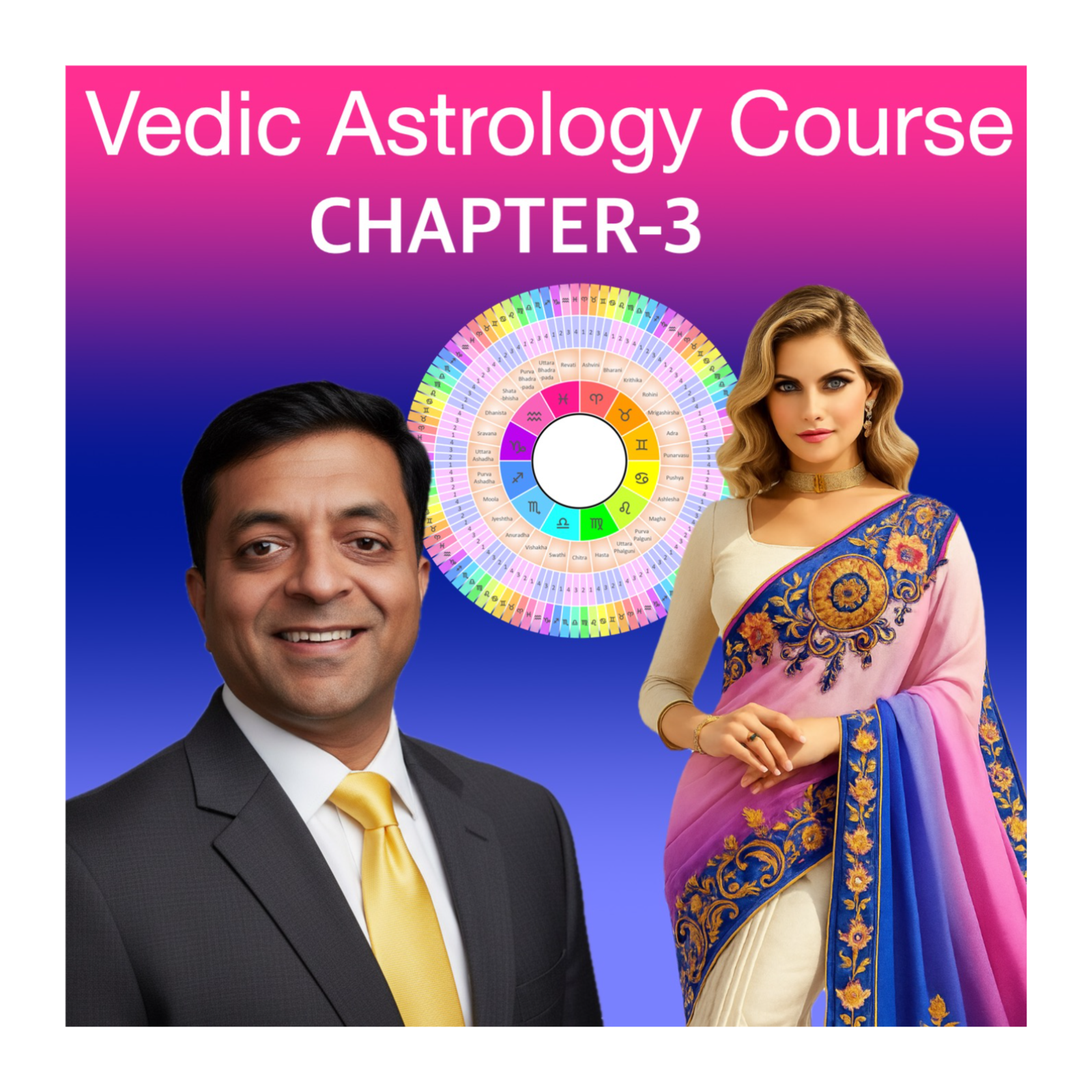
Essential Astronomy for Vedic Astrology | Sidereal Zodiac, Ayanamsha, Planetary Motion
Vedic Astrology : Ancient Wisdom for Modern Human · Arun
Audio is streamed directly from the publisher (content.rss.com) as published in their RSS feed. Play Podcasts does not host this file. Rights-holders can request removal through the copyright & takedown page.
Show Notes
If you want to practice Vedic Astrology (Jyotish) seriously, you must begin with something most students skip: essential astronomy.
Because Jyotish is not built on vague symbolism.
It rests on measurable sky mechanics — degrees, horizons, planetary motion, and a precise zodiac framework.
In this video, I walk you through the true foundation: the zodiac as the skeletal structure of Jyotish.
✅ 1) The Zodiac: the 360° Framework of Jyotish
The zodiac is a 360° belt along the ecliptic — the apparent path of the Sun, Moon, and planets from Earth.
It is divided into 12 equal signs of 30° each (Aries to Pisces).
But here’s the key difference:
Western Astrology uses the tropical zodiac (Sayana) aligned to seasons and the spring equinox.
Vedic Astrology uses the sidereal zodiac (Nirayana) aligned to fixed stars.
This isn’t a minor detail.
This choice changes how charts are calculated, interpreted, and transmitted across traditions.
✅ 2) Signs vs Constellations (Rāśi vs Nakshatra)
One subtle truth you must master early:
Zodiac signs (Rāśis) are equal 30° geometric segments.
Constellations (Nakshatras) are star-based divisions with their own sacred energies and deities.
So when someone says “Mars is in Leo,” they mean a 30° segment of longitude — not a literal lion-shaped constellation.
This clarity prevents confusion and makes your astrology precise.
✅ 3) Precession & the Ayanamsha: The Bridge You Must Understand
Earth’s axis slowly wobbles over time — a phenomenon called precession of the equinoxes.
This causes the tropical zodiac to drift relative to the stars (roughly 1° every ~72 years).
That gap is called Ayanamsha — the numerical offset between tropical and sidereal positions.
So in practical terms, when casting a sidereal chart, you typically subtract the ayanamsha from tropical longitudes to get Nirayana (sidereal) positions.
And here’s the real-world practitioner rule:
Your interpretation is only as accurate as the ayanamsha standard you use — and your consistency with it.
✅ 4) Ayanamsha Systems: Why “A Few Degrees” Changes Everything
Different traditions adopt different ayanamsha reference points, and that can shift planets into different signs or nakshatras.
Lahiri Ayanamsha (most widely used in India; also official standard in many contexts)
Raman (linked to B.V. Raman’s research tradition)
Krishnamurti (KP) (used inside the KP predictive framework)
Fagan-Bradley (common in Western sidereal astrology)
Yukteswar (more metaphysical/cosmological orientation)
This is not about arguing which is “right.”
It’s about knowing what system you are using — because it changes the chart’s coordinate reality.
✅ 5) Planetary Motion: What Jyotish Is Actually Translating
Jyotish reads meaning from real motion:
Diurnal motion (daily rising/setting caused by Earth’s rotation) → vital for Lagna (Ascendant)
Proper motion (planet’s movement through the zodiac along the ecliptic) → signs, nakshatras, transits
Vakra / Retrograde (apparent backward motion) → karmic emphasis, revision, intensification
Retrograde isn’t “a mystical idea.”
It’s an observable sky phenomenon — and Jyotish translates it into psychological and karmic implications.
#VedicAstrology
#Jyotish
#SiderealZodiac
#Ayanamsha
#Nirayana
#Nakshatra
#VedicAstronomy
#AstrologyBasics
#LagnaAscendant
#RetrogradePlanets