Urgent Futures with Jesse Damiani
106 episodes — Page 1 of 3
AI’s Climate Footprint: New Report Argues We’ve Been Dramatically Underestimating the Energy & Emissions Toll - Erald Kolasi | Rapid Response #31
The Future of Free Speech & Censorship - Karen Attiah | Rapid Response #30
On 'Withnessing': Storytelling, Spirituality, & Healing Toward Freedom - Maytha Alhassen | Rapid Response #29
The Geopolitical Crisis Hasn’t Even Started Yet - Adames Global (Juanita Adames & Michelle Sucameli) | Rapid Response #28
How to Live Fully in the Face of Collapse - Sarah Wilson | Rapid Response #27
Decoding Systems of Power & Meaning: Military AI, Epstein, Necropolitics...& Backrooms - Cy Canterel | Rapid Response #26
Apocalypse Early Warning System? Track the Oligarchs. Creative Tech as Crisis Intervention - Kyle McDonald | Rapid Response #25
How Storytelling & Comedy Expose Corruption & Depict Climate Collapse - Adam McKay | #73
From Palantir Employee to Digital Rights Advocacy: Starting a People’s Movement Against AI Risks - Juan Sebastián Pinto | Rapid Response #24
The Most Consequential Story in Earth's History - Peter Brannen | #72
Extreme Heat: What City-Dwellers Need to Understand - Vivek Shandas | #71
Prepper Camp, But Make it Fun & Community-Focused - Sam Bloch (DoomsDaddy) | #70
Orbán’s Loss is a Big Deal. Explaining the Future of Hungary, the EU, & Geopolitics - Eric Czuleger | Rapid Response #23
How Solar Power Could Change Everything - Lee Buck | #69
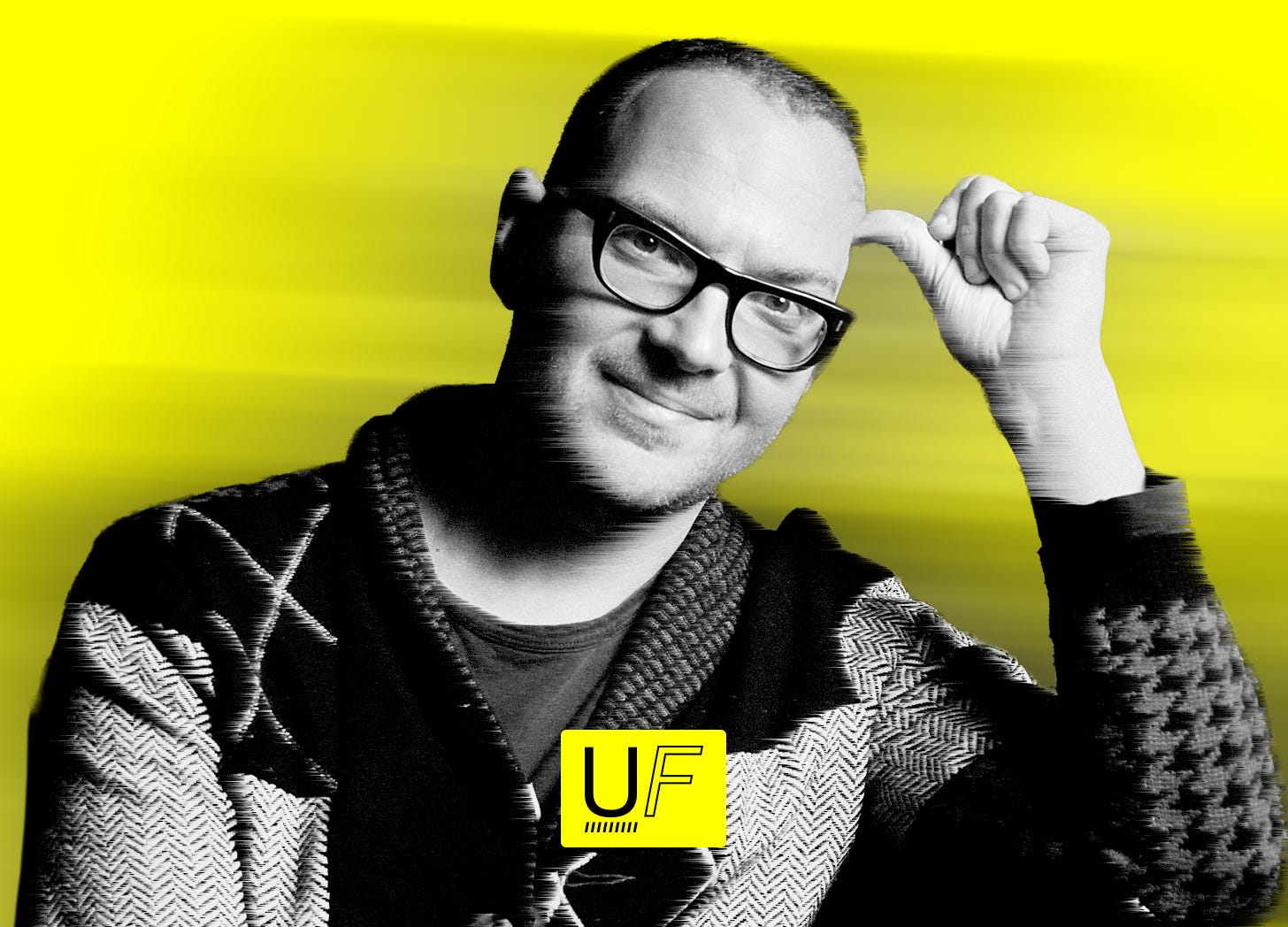
Enshittification: The Rot at the Heart of Big Tech - Cory Doctorow | #68
Remember when the Internet was a fun place, not where you were hypersurveilled while doomscrolling?Enshittification. It’s a word that captures what's happened to the Internet—and critically, why. It has taken the world by storm, dubbed the 2023 Word of the Year by the American Dialect Society and the 2024 Word of the Year by the Macquarie Dictionary. It’s a delicious word—playfully naughty and piercingly descriptive.Grab your copy of Enshittification: Why Everything Suddenly Got Worse and What to Do About It here!Support the show by checking out: ProtonVPN (gold-standard VPN—fast and safe. Click the link to get 55% off VPN Plus: $4.49/mo). ZBiotics (Decrease impact of hangovers. Code: JESSEDAMIANI for 10% off), MUD\WTR (43% off starter kits), 1Password (simplify your life and increase digital safety), Mission Farms CBD (healthy, effective CBD for relief, sleep, and wellbeing—25% off with email).Today’s guest is the man behind the word, and he’s something of an expert in crystallizing complex ideas with memorable turns of phrase. What started as a blog post a few years back has become a full-blown book (and a great one, at that, so pick your copy now!). The concept describes the process by which tech products degrade over time—specifically through economic and political pressures and incentive structures—and the book breaks this down in page-turning detail, with case studies that make your stomach turn. If you’ve interacted with tech products at all over the past couple decades, everything about this book will ring painfully true to you.But all hope is not lost; Cory also outlines how we fight against these enshittificatory processes. It’s truly a must-read, and in the meantime, I hope this conversation is an invitation into this vital body of ideas. So without further ado, please enjoy this illuminating conversation with Cory Doctorow.BIO: Cory Doctorow is a blogger, journalist, and activist. For more than twenty years, he has worked with the Electronic Frontier Foundation on campaigns to safeguard and further our human rights online. He was coeditor of the weblog Boing Boing for nineteen years and now maintains a daily(ish) newsletter at Pluralistic.net. He has written more than thirty books, including nonfiction books, many science fiction novels, collections of short stories and essays, young adult novels, graphic novels, and even a picture book. Born in Toronto, he now lives in Burbank, California. He was awarded an honorary doctorate in laws by York University and an honorary doctorate in computer science by the Open University. He has been inducted into the Canadian Science Fiction and Fantasy Association Hall of Fame and was awarded the Sir Arthur C. Clarke Award for Imagination in Service to Society. He holds visiting professorship and research appointments at MIT, the University of North Carolina, Cornell University, and the Open University.CREDITS: This podcast is produced & edited by Adam Labrie & me, Jesse Damiani. Adam Labrie also edited the video version, which is available on YouTube.Find more episodes of Urgent Futures at: youtube.com/@UrgentFutures. Get full access to Reality Studies at www.realitystudies.co/subscribe
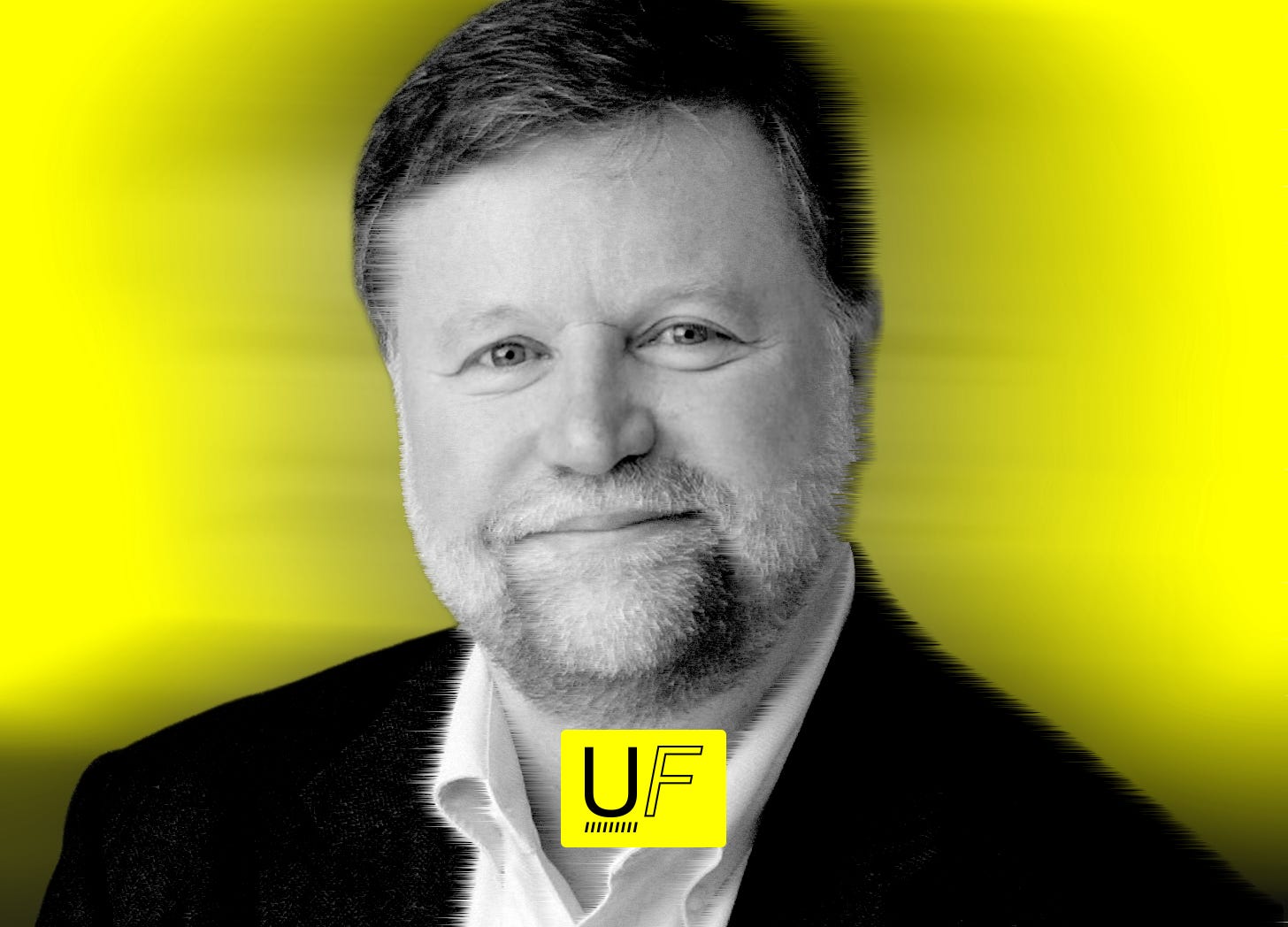
Quantum Computing 101 - Dr. Bob Sutor | #67
Over the years, you’ve probably heard many references to quantum computing. In geopolitics and tech matters, it’s considered an area of extreme interest, and yet it remains a subject that many don’t fully understand (even within the tech commentariat). What is it, how does it work, and what are the implications of a world suffused with this technology?Today's guest, Dr. Bob Sutor, breaks it down.Support the show by checking out: ProtonVPN (gold-standard VPN—fast and safe. Click the link to get 55% off VPN Plus: $4.49/mo). ZBiotics (Decrease impact of hangovers. Code: JESSEDAMIANI for 10% off), MUD\WTR (43% off starter kits), 1Password (simplify your life and increase digital safety), Mission Farms CBD (healthy, effective CBD for relief, sleep, and wellbeing—25% off with email).BIO: Dr. Bob Sutor has been a technical leader and executive in the computer and DeepTech industry for over 40 years. He is a theoretical mathematician by training, with a Ph.D. from Princeton University and an undergraduate degree from Harvard College.During his career, Dr. Sutor has spoken to and briefed government legislators and policymakers around the world, such as his 2022 testimony before the United States Senate Committee on Commerce, Science, and Transportation on “Securing U.S. Leadership in Emerging Compute Technologies.” He was a co-author of the 2024 Quantum Economy Blueprint from the World Economic Forum.Dr. Sutor is the CEO and Founder of Sutor Group Intelligence and Advisory. He helps clients and investors understand sophisticated technologies such as quantum computing and use them effectively to succeed in their organizations and industries. Bob is a member of the Board of Directors of Nu Quantum and an advisor to the Forma Prime venture capital firm. He is also an Adjunct Professor in the Department of Computer Science and Engineering at the University of Buffalo, New York, and spent over two decades at the IBM Thomas J. Watson Research Center. Dr. Sutor is the author of the bestselling 2019 quantum computing book Dancing with Qubits.CREDITS: This podcast is produced & edited by Adam Labrie & me, Jesse Damiani. Adam Labrie also edited the video version, which is available on YouTube.Find more episodes of Urgent Futures at: youtube.com/@UrgentFutures. Get full access to Reality Studies at www.realitystudies.co/subscribe
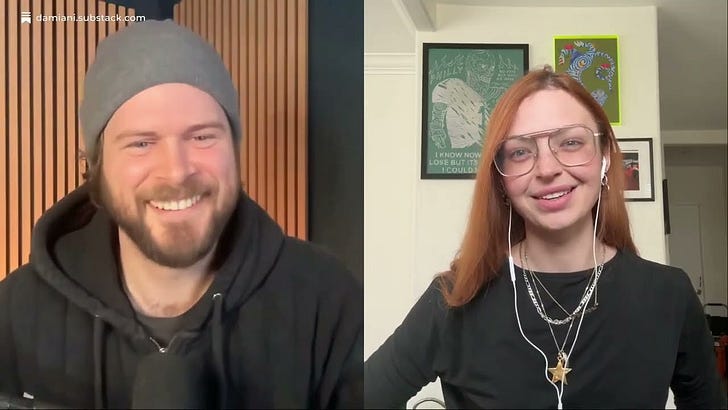
Attacks on Section 230 & ‘Age Verification’ Laws Are Critical Threats to Internet Privacy & Security - Noelle Perdue | Rapid Response #22
This marks Noelle’s—count it!—fourth time on Urgent Futures, and I continue to be grateful to have her as a dialogue partner on all things Internet freedoms. This conversation most directly builds on our Aug. 2025 episode, which focused foremost on the threats to privacy and security smuggled in with ‘age verification’ laws. That conversation is as timely and relevant today, so if you want to learn more, be sure to check that episode out as well.Support the show by checking out: ProtonVPN (gold-standard VPN—fast and safe. Click the link to get 55% off VPN Plus: $4.49/mo). ZBiotics (Decrease impact of hangovers. Code: JESSEDAMIANI for 10% off), MUD\WTR (43% off starter kits), 1Password (simplify your life and increase digital safety), Mission Farms CBD (healthy, effective CBD for relief, sleep, and wellbeing—25% off with email).In today’s episode, we jump off from her recent founding of the Anti-Censorship Coalition with Taylor Lorenz. They’ve both been doing great work explaining the stakes, particularly involving a possible repeal of Section 230, part of the 1996 Communications Decency Act, which protects online platforms (websites, apps, ISPs) from liability for content generated by users on said platforms.I recognize this might feel too tech-centric or legalistic for some folks, but I feel obligated to encourage you to think otherwise; our ability to communicate freely on the Internet is a baseline need for intervening in the polycrisis, and moreover, pushing against the ongoing surveillance creep occurring in much of the “modern” world.BIO: Noelle Perdue is a writer, producer, and Internet porn historian with nearly ten years of experience working platform-side for multiple mainstream and independent adult companies. Having written everything from Food Network porn parodies to legally binding terms and conditions, much of her current work explores obscenity law and how pornography’s history can influence our digital and political futures. Noelle’s writing work has been published on Wired, Washington Post, Pornhub, Slate, Brazzers, Input, etc., she’s also been featured as an industry expert on multiple programs including the BBC, CBC, The Guardian, Rolling Stone, and on Netflix’s 2023 documentary Money Shot. Find more episodes of Urgent Futures at: youtube.com/@UrgentFutures. Get full access to Reality Studies at www.realitystudies.co/subscribe
The Most Dangerous Technology in the World? - Wim Carton | #66
Geoengineering might sound nice in theory, but the consequences could be disastrous. Today's guest, Wim Carton, co-wrote The Long Heat with Andreas Malm, which helps paint the full picture.Grab your copy of The Long Heat here!Support the show by checking out: ProtonVPN (gold-standard VPN—fast and safe. Click the link to get 55% off VPN Plus: $4.49/mo). ZBiotics (Decrease impact of hangovers. Code: JESSEDAMIANI for 10% off), MUD\WTR (43% off starter kits), 1Password (simplify your life and increase digital safety), Mission Farms CBD (healthy, effective CBD for relief, sleep, and wellbeing—25% off with email).BIO: Wim Carton is Associate Professor of Sustainability Science at Lund University, Sweden. He’s the author of over 20 academic articles and book chapters on climate politics. His work has appeared in top journals such as Nature Climate Change, WIRES Climate Change and Antipode. He co-wrote both Overshoot: How the World Surrendered to Climate Breakdown and The Long Heat: Climate Politics When It’s Too Late with Andreas Malm.It is a loud, chaotic time. There are so many worrying developments that demand our immediate attention, action, and solidarity. I know that we all have limits to how much depressing information we can withstand. The not-so-awesome followup here is that there are things unfolding in the background that are also worthy of your attention, but they get virtually zero airplay because they’re not immediate disasters. If you’ve followed my channel for a while, you’re already familiar with a bunch of these, so I won’t belabor this point.One of the most critical ones you need to be aware of is solar geoengineering, an umbrella term for speculative technologies designed to temporarily cool the Earth by reflecting sunlight back into space, typically through dispersing large quantities of sulfates in the atmosphere. At first blush, this may not sound like the worst idea. We know from researching the aftermath of volcanic eruptions that the cooling effect is real, not hypothetical, and especially given the unprecedented heat of the past three years, finding a seemingly straightforward way to cool the planet down might seem like a no-brainer. Unfortunately, it’s too good to be true, which is what today’s guest Wim Carton—along with his co-author Andreas Malm—go to great lengths to demonstrate in their absolute must-read book, The Long Heat. This book is something of a sequel to their likewise superb Overshoot (and for an invitation into that book, be sure to check out my earlier episode with the two of them).Grab your copy of Overshoot here!Having learned from folks like Wim, I think this issue is one of the single most important topics we need to be discussing right now, before it spirals out of control. Because make no mistake: even though we aren’t yet witnessing much geoengineering—and therefore not seeing its knock-on effects—interest is increasing. Israeli-US startup Stardust Solutions announced it had raised $60 million last year, claiming they would begin with experiments in April 2026. And of course, as the impacts of climate change and extreme weather become more pronounced—and we emit ever more greenhouse gases into the atmosphere—desperate times might cause many to turn to desperate measures.After reading The Long Heat, I could spend all day explaining all the ways this go wrong, but instead, I’m going to let you hear it from the author himself. Please enjoy this vital conversation with Wim Carton.CREDITS: This podcast is produced & edited by Adam Labrie & me, Jesse Damiani. Adam Labrie also edited the video version, which is available on YouTube.Find more episodes of Urgent Futures at: youtube.com/@UrgentFutures. Get full access to Reality Studies at www.realitystudies.co/subscribe
The Next Civil War, Mark Carney's Davos Speech, & Canada's View of the US - Stephen Marche | RR #21
My guest this week is Stephen Marche. Stephen is the author of The Next Civil War and On Writing and Failure. He frequently experiments with literary AI.Support the show by checking out: ProtonVPN (gold-standard VPN—fast and safe. Click the link to get 55% off VPN Plus: $4.49/mo). ZBiotics (Decrease impact of hangovers. Code: JESSEDAMIANI for 10% off), MUD\WTR (43% off starter kits), 1Password (simplify your life and increase digital safety), Mission Farms CBD (healthy, effective CBD for relief, sleep, and wellbeing—25% off with email).That modest bio doesn’t do justice to Stephen’s extensive writing and public intellectualism across culture, politics, and technology. We’ve been connected for a few years because of his early experiments with AI in writing—and as you’ll hear in the episode, he actually holds a number of historical firsts in this regard. In 2022, he published The Next Civil War, a book that is exactly what it sounds like: speculative scenarios rooted in rigorous research—including roughly 200 interviews with subject matter experts—about how the next American Civil War might transpire. It’s a bracing read, and unfortunately, much of what he put in that book is coming true.Grab your copy of The Next Civil War here!So it might also come as a surprise to discover that Stephen is Canadian, though he lived in the US for many years. This insider-outsider perspective is critical for discussing such a fraught topic. And his Canadian-ness is also what led me to host this rapid response episode—I’d been meaning to invite him on the show for a while to discuss the aforementioned, but then Canadian Prime Minister Mark Carney gave his address at the World Economic Forum. Fans of the channel will know that I have closely tracked the prospect of the “rules based” international order’s collapse, and Carney pretty baldly named this.If you haven’t watched the address or read about it, I encourage you to do so now. Suffice to say, it felt critical to foreground Stephen’s analysis. And then, toward the end of the episode, we also discuss his literary AI experiments, his take on the current state of affairs, and much more.CREDITS: This podcast is produced & edited by Adam Labrie & me, Jesse Damiani. Adam Labrie also edited the video version, which is available on YouTube.Find more episodes of Urgent Futures at: youtube.com/@UrgentFutures. Get full access to Reality Studies at www.realitystudies.co/subscribe
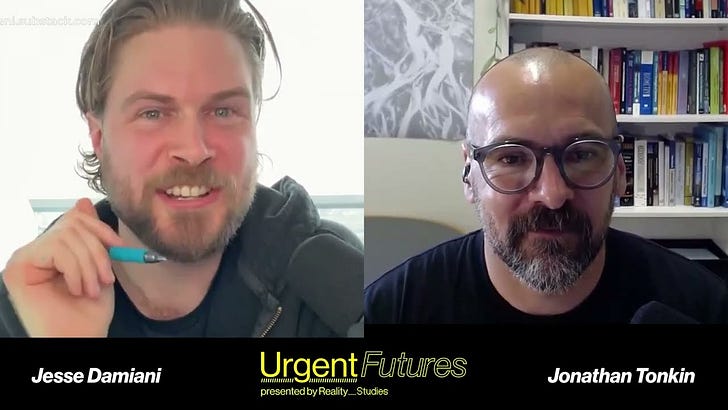
Biodiversity on the Brink: Ecological Rhythms & Human Urgency - Jonathan Tonkin | Rapid Response #20
For as much as I bemoan the attention fracture that occurs on social media, there are times I’m so grateful for it; I discovered the work of Jonathan Tonkin through a Substack Note about ecosystem services—the financial value that the natural world provides, which is vast and yet is barely ever accounted for under capitalist economics (on that note: please be sure to bookmark my conversation with Alyssa Battistoni on the ‘free gifts’ of nature).While we’re at it, please subscribe to his incredible newsletter, Predirections, right now: https://predirections.substack.com/Fast forward and I was lucky that he agreed to join me for a discussion on biodiversity, and in particular his research on freshwater biodiversity. This is one of those subjects that is massively important (to put it mildly!), yet doesn’t get quite as much airtime as more “charismatic” crises like climate change. As Jono explains: it's the "foundation for our very existence."Support the show by checking out: ProtonVPN (gold-standard VPN—fast and safe. Click the link to get 55% off VPN Plus: $4.49/mo). ZBiotics (Decrease impact of hangovers. Code: JESSEDAMIANI for 10% off), MUD\WTR (43% off starter kits), 1Password (simplify your life and increase digital safety), Mission Farms CBD (healthy, effective CBD for relief, sleep, and wellbeing—25% off with email).There’s a lot here, including a discussion about the wonder of braided rivers and broader questions around how we balance “human urgency” and “ecological rhythms,” advocating for what he calls “patient urgency.” We also get into his journey on Substack, and how he balances the differing demands of being an academic and a public communicator. Also he just got a new dog! All to say: if you’re like me, you’ll leave this conversation feeling both inspired and ready to take action in your own life to protect what is precious on this planet.BIO: I love that Professor Tonkin shares his bio in the first person, so I’m copying that here for you:I’m Jonathan Tonkin (Jono for short) — an ecologist and biodiversity scientist at the University of Canterbury in New Zealand, where I’m a Professor and Rutherford Discovery Fellow.My research has spanned continents and ecosystems, but I’ve always returned to one core question: How do we predict and adapt to environmental change in a way that supports life — all life?I’ve spent much of my career documenting biodiversity loss, especially in freshwater ecosystems. Now, I’m pivoting toward solutions: redirecting effort, exploring policy levers, and amplifying the science that can help us adapt. After publishing 100 peer-reviewed papers — including in Nature and Science — I want to share what I’ve learned beyond academia: translating the latest science into plain language, before it even reaches the headlines, to inform, inspire, and equip a wider community.I’m also a parent of two young kids. That perspective shapes everything I write.You can learn more about my research and lab at tonkinlab.org — we focus on biodiversity science for a changing world.🏆 Recently, I was honoured with the New Zealand Prime Minister’s MacDiarmid Emerging Scientist Prize.Find more episodes of Urgent Futures at: youtube.com/@UrgentFutures. Get full access to Reality Studies at www.realitystudies.co/subscribe
When, How, & Why Complex Societies Collapse - Joseph Tainter | #65
Having researched the topic of collapse for more than half a decade, I can say with some confidence that interest in it has increased over the past few years. And it makes sense—wherever you look, be it politics, climate change, the economy, tech accelerationism, or otherwise, we’re getting a lot of scary signals. But collapse is a slippery word—what exactly does it mean? And what exactly qualifies a particular breakdown as collapse?Support the show by checking out: ProtonVPN (gold-standard VPN—fast and safe. Click the link to get 55% off VPN Plus: $4.49/mo). ZBiotics (Decrease impact of hangovers. Code: JESSEDAMIANI for 10% off), MUD\WTR (43% off starter kits), 1Password (simplify your life and increase digital safety), Mission Farms CBD (healthy, effective CBD for relief, sleep, and wellbeing—25% off with email).To get granular, I’m happy to share this conversation with collapsology legend, Joseph Tainter, who was researching collapse long before it was en vogue, notably authoring The Collapse of Complex Societies nearly forty years ago. Perhaps his most notable argument from this work is that collapse occurs when a civilization reaches a point of diminishing returns on complexity—that is, when increasing amounts of capital, energy, and resources are required just to sustain the system, until the cost of maintaining it outweighs the benefits.It’s a provocative argument, and folks like existential risk researcher Luke Kemp, who I had on the show late last year, have proposed alternative viewpoints—but which nevertheless build on Professor Tainter’s remarkable scholarly legacy. This argument is especially worth considering when we look at the current strain on the “rules-based” international order that the United States has (otherwise) maintained since the end of WWII.There’s so much in this conversation, drawing together his collapsology research with his contributions to energy and sustainability research—and much more, examining how it all fits together in today’s global context.BIO: Joseph Tainter is an anthropologist and retired professor, formerly at Utah State University. He is the author of The Collapse of Complex Societies, and co-author with Timothy F. H. Allen and Thomas W. Hoekstra of Supply-Side Sustainability. With Roderick and Susan McIntosh he edited The Way the Wind Blows: Climate, History, and Human Action. With Tadeusz Patzek he wrote Drilling Down: The Gulf Oil Debacle and Our Energy Dilemma. Dr. Tainter’s research has been used in over 50 countries and his books have been issued in 10 languages. His work has been consulted in the United Nations Environment Programme, UNESCO, the World Bank, the Rand Corporation, the International Institute for Applied Systems Analysis, the Beijer Institute of Ecological Economics, the Earth Policy Institute, Technology Transfer Institute/Vanguard, and the Highlands Forum. His research has been applied in economic development and energy.CREDITS: This podcast is produced & edited by Adam Labrie & me, Jesse Damiani. Adam Labrie also edited the video version, which is available on YouTube.Find more episodes of Urgent Futures at: youtube.com/@UrgentFutures. Get full access to Reality Studies at www.realitystudies.co/subscribe
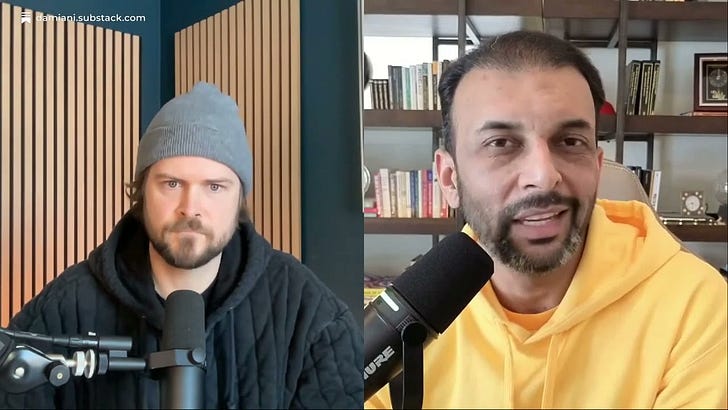
Criticizing the Democratic Party, Resisting ICE & Fascism, Lessons from Minneapolis, the 'Wrong Kind of Muslim' & More - Qasim Rashid | Rapid Response #19
Is it okay for folks on the left to criticize the Democratic Party? Qasim Rashid lost thousands of followers because he did. What are our responsibilities as Americans who believe in democracy and resisting fascism? What strategies can we use? Support the show by checking out: ProtonVPN (gold-standard VPN—fast and safe. Click the link to get 55% off VPN Plus: $4.49/mo). ZBiotics (Decrease impact of hangovers. Code: JESSEDAMIANI for 10% off), MUD\WTR (43% off starter kits), 1Password (simplify your life and increase digital safety), Mission Farms CBD (healthy, effective CBD for relief, sleep, and wellbeing—25% off with email).In this conversation, we discuss what informed, ethical resistance looks like as authoritarianism continues its march into American politics—and why it's okay to demand better of "your side" if they're not advancing justice. We also get into Minneapolis, corporate media's complicity in authoritarianism, Qasim's reading club around his book The Wrong Kind of Muslim, including a touching moment where Qasim shares more about his relationship with his father and faith journey.BIO: Qasim Rashid, Esq. is a human rights lawyer, author, and former nominee for U.S. Congress. He received his BSc from the University of Illinois at Chicago, his JD from Richmond Law, and served as a visiting fellow at Harvard University.Qasim’s human rights work includes supporting survivors of domestic and sexual violence, representing asylum seekers, and serving as a first responder to global disasters. He has published numerous books, academic law reviews, and articles across the media spectrum in TIME, New York Times, Washington Post, NPR, and USA Today.Qasim is the Founder and President of Just Win, a creator representation firm focused on social justice and human rights. He runs a popular human rights Substack with more than 165,000 subscribers titled “Let’s Address This with Qasim Rashid,” and has more than 2.25 million social media followers. You can find him across platforms @QasimRashid.Find more episodes of Urgent Futures at: youtube.com/@UrgentFutures. Get full access to Reality Studies at www.realitystudies.co/subscribe
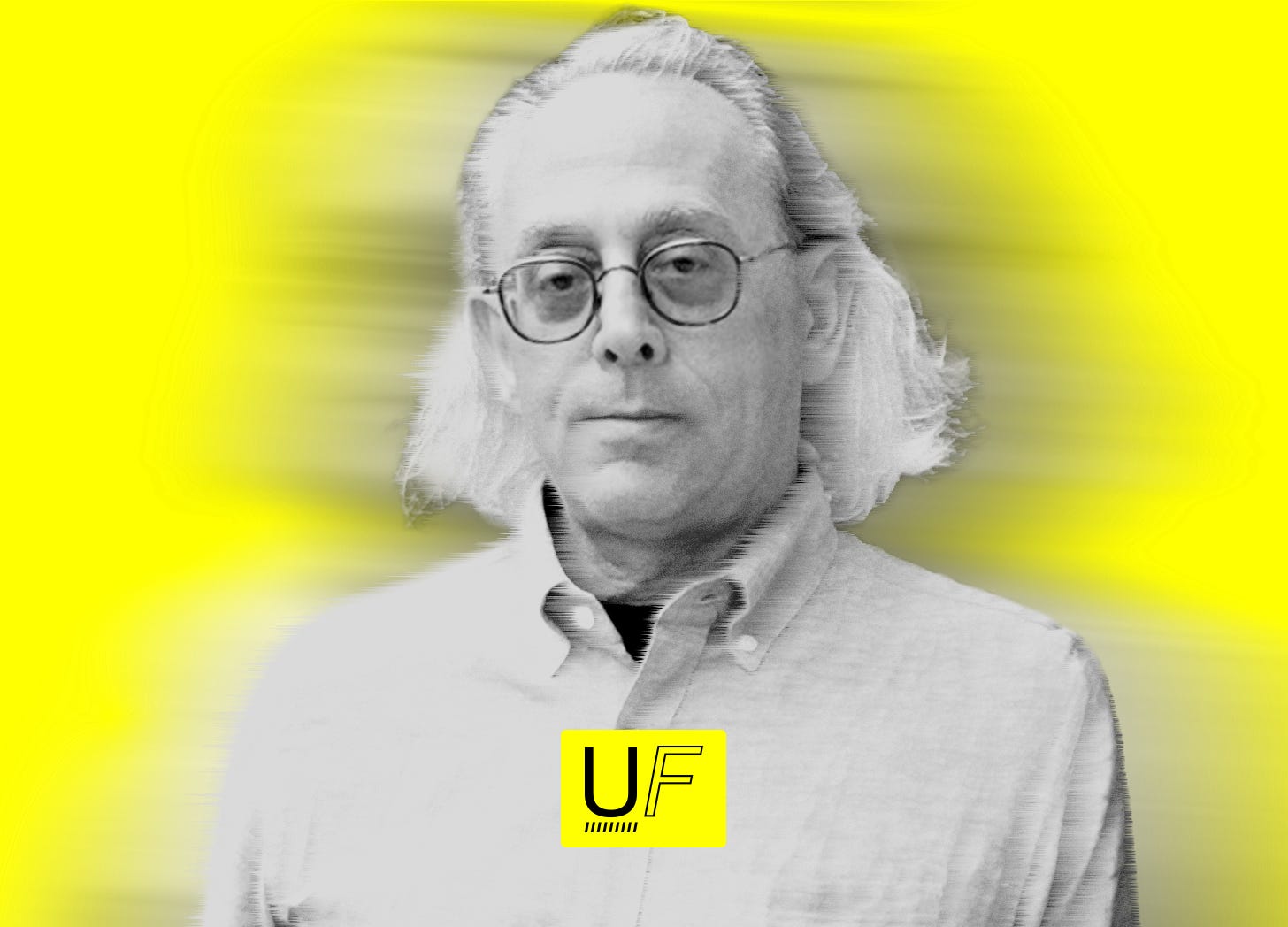
"We All Know What We're Fighting Against, but There's a Deafening Silence Every Time we Ask What We're Fighting for"—On Hannah Arendt & Loving the World in Dark Times - Roger Berkowitz | #64
If you’re looking for historical thinkers who can help you navigate authoritarianism, fascism, totalitarianism, and questions of human rights, you’d do worse than to start with Hannah Arendt, one of the most influential political theorists of the 20th century. I’ve found myself returning to her words repeatedly over the past few years for exactly this reason. You’re perhaps already familiar with the phrase “the banality of evil.” This is one of her most famous contributions to thought, and emerged from her analysis of the trial of Adolf Eichmann, one of the key Nazi figures in organizing the Holocaust in the book Eichmann in Jerusalem.Support the show by checking out: ProtonVPN (gold-standard VPN—fast and safe. Click the link to get 55% off VPN Plus: $4.49/mo). ZBiotics (Decrease impact of hangovers. Code: JESSEDAMIANI for 10% off), MUD\WTR (43% off starter kits), 1Password (simplify your life and increase digital safety), Mission Farms CBD (healthy, effective CBD for relief, sleep, and wellbeing—25% off with email).Bard College is home to the Hannah Arendt Center for Politics and Humanities, whose mission is to “create and nurture an institutional space for bold, risky and provocative thinking about our political world in the spirit of Hannah Arendt,” and to “to empower a plural people to at once (re)discover their unique opinions and political agency and also find common ground to build together a shared world through thinking, listening, and talking with one another.”Today’s guest is the founder and academic director of the Center, and as you’d guess, we have a wide-ranging conversation linking the aforementioned topics to today’s political environment, with a special eye on the US. We also discuss the 2025 edition of the Center’s annual conference, themed “Joy: Loving the World in Dark Times,” which feels especially pertinent as America continues to tilt toward authoritarianism—an evolution I’ve called quantum fascism. Notably, Roger disagrees that we Americans are currently living under a fascist regime, though understands why people are inclined to think we are. Whether or not you agree, his argument is compelling and based in close analysis.What I so appreciate about this conversation is that Roger is committed to his political and personal ethics, and in some cases this means he gets a little controversial relative to more mainstream liberal or leftist positions. The result is a bracing, edifying conversation. We get into so much, in fact, that we held off on diving deep on his forthcoming book, A World We Share: Hannah Arendt and the Power of Friendship in a Broken World. The good news is Roger has agreed to come back on the show in the fall to go deep on it with me. Until then, please enjoy this powerful conversation with Roger Berkowitz.BIO: Roger Berkowitz is Founder and Academic Director of the Hannah Arendt Center for Politics and Humanities and Professor of Politics, Philosophy, and Human Rights at Bard College.He is author of The Gift of Science: Leibniz and the Modern Legal Tradition (Harvard, 2005, Fordham, 2010; Chinese Law Press 2011) and his new book A World We Share: Hannah Arendt and the Power of Friendship in a Broken World will appear in 2026 from Yale University Press.Berkowitz is the host of the podcast, Reading Hannah Arendt with Roger Berkowitz. He is also a regular panelist on The Roundtable, a daily news show for WAMC, the NPR affiliate in Albany, NY, and hosts For the Love of the World on Radio Kingston. Berkowitz wrote the Introduction for On Civil Disobedience: Henry David Thoreau and Hannah Arendt (Library of America, 2024), and he has edited Tribalism and Cosmopolitanism (DeGruyter, 2025) and Perils of Invention: Lying, Technology and the Human Condition (Blackrose Books, 2022). He is co-editor of Thinking in Dark Times: Hannah Arendt on Ethics and Politics (2009), The Intellectual Origins of the Global Financial Crisis (2012) and Artifacts of Thinking: Reading Hannah Arendt’s Denktagebuch (2017). His writing has appeared in The New York Times, The American Interest, Bookforum, The Paris Review Online, Democracy: A Journal of Ideas, and many other publications. He is a co-editor of the book series “Thinking With Arendt” published by DeGruyter and past editor of Just Ideas, a book series published by Fordham University Press.CREDITS: This podcast is produced & edited by Adam Labrie & me, Jesse Damiani. Kyriaki (Claire) Lampidou shot & produced this episode, & Adam Labrie edited the video version, which is available on YouTube. Find more episodes of Urgent Futures at: youtube.com/@UrgentFutures. Get full access to Reality Studies at www.realitystudies.co/subscribe
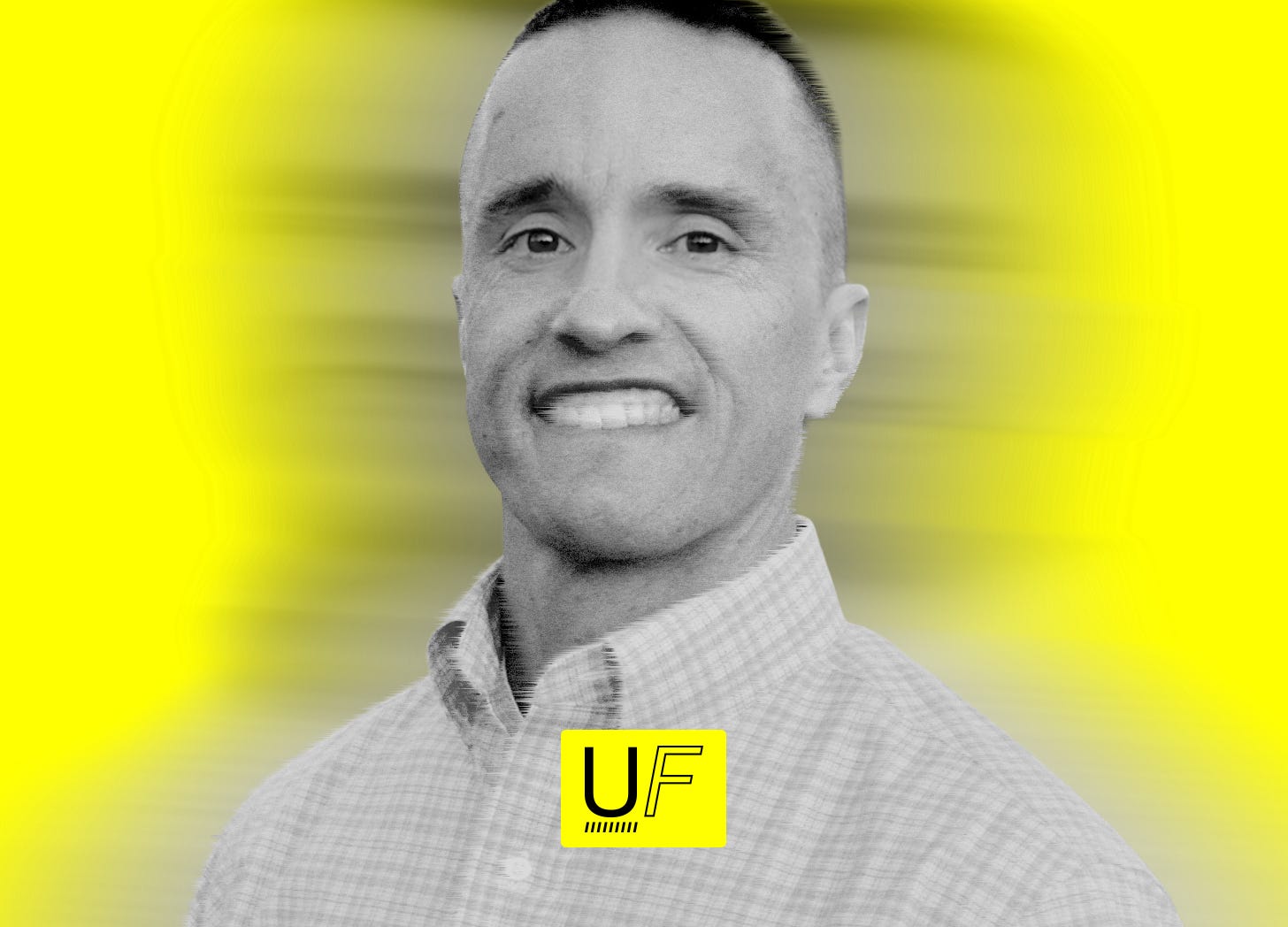
From 'Prepper' to 'Resilient Citizen' - Chris Ellis | #63
Folks who have followed the channel will know that the subject of preparedness—what you colloquially hear referred to as “prepping”—is a subject of great importance to me. For a while now, I’ve felt like it was necessary for us to reclaim, normalize, and broaden the notion of prepping away from the stranglehold that the lone survivalist has on the prepper stereotype.The world that is fast emerging is what US military experts have referred to as VUCA—volatile, uncertain, chaotic, and ambiguous. As we learned during the Covid-19 pandemic, there are some disasters that the government just cannot—or will not—save you from, or even help you recover from. Why not instead weather disasters by embracing the radical potential of our wits, creativity, perseverance, and communities?Support the show by checking out: ProtonVPN (gold-standard VPN—fast and safe. Click the link to get 55% off VPN Plus: $4.49/mo). ZBiotics (Decrease impact of hangovers. Code: JESSEDAMIANI for 10% off), MUD\WTR (43% off starter kits), 1Password (simplify your life and increase digital safety), Mission Farms CBD (healthy, effective CBD for relief, sleep, and wellbeing—25% off with email).After I released an episode sharing these thoughts, Kate Parsons, a friend of mine from the new media art scene, and who it turns out has a vested interest in the subject, introduced me to today’s guest, Dr. Chris Ellis. He had a soon-to-be-released book called Resilient Citizens—a book that I’d later get to read in advance of this conversation.Buy Resilient Citizens here: https://amzn.to/3NHVnfzThis book is an absolute must-read, breaking down the “people, perils, and politics of modern preparedness.” This is a jam-packed episode—we dive into his definition of a resilient citizen, the history of prepping and prepper stereotype, the five types of resilient citizens, why it’s vital to remember that resilience is a mindset, and how to integrate it into your life. This form of preparedness might evoke a very particular stereotype, but in practice it’s a way of developing self-reliance, new skills, and strong, vibrant communities. I think that’s something we can all get behind.BIO: Dr. Chris Ellis is a career Army officer, disaster readiness expert, and lifelong student of how people, communities, and nations prepare for the worst. With over twenty-six years of military service—including time in combat zones and collaborative work across five continents—Chris has seen firsthand what resilience looks like under pressure.Chris holds a Ph.D. in Government from Cornell University, along with four other advanced degrees covering public policy, military strategy, and international security. His work blends academic insight with boots-on-the-ground experience, tackling big-picture threats like civil unrest, nuclear catastrophe, economic collapse, and even the end of the world.Find more episodes of Urgent Futures at: youtube.com/@UrgentFutures. Get full access to Reality Studies at www.realitystudies.co/subscribe

We Must Decarbonize...but How? On Methods, Challenges, & the 'Physics of Capitalism' - Erald Kolasi | Rapid Response #18
We all know that we have to end our addiction to fossil fuels, but how do we actually do that in practice?Today's guest, Erald Kolasi, breaks it down.Support the show by checking out: ProtonVPN (gold-standard VPN—fast and safe. Click the link to get 55% off VPN Plus: $4.49/mo). ZBiotics (Decrease impact of hangovers. Code: JESSEDAMIANI for 10% off), MUD\WTR (43% off starter kits), 1Password (simplify your life and increase digital safety), Mission Farms CBD (healthy, effective CBD for relief, sleep, and wellbeing—25% off with email).BIO: Erald Kolasi is a writer and independent researcher focusing on the nexus between energy, technology, economics, complex systems, and ecological dynamics. His first book, The Physics of Capitalism, came out from the Monthly Review Press in February 2025. He received his PhD in Physics from George Mason University in 2016.Find more episodes of Urgent Futures at: youtube.com/@UrgentFutures. Get full access to Reality Studies at www.realitystudies.co/subscribe
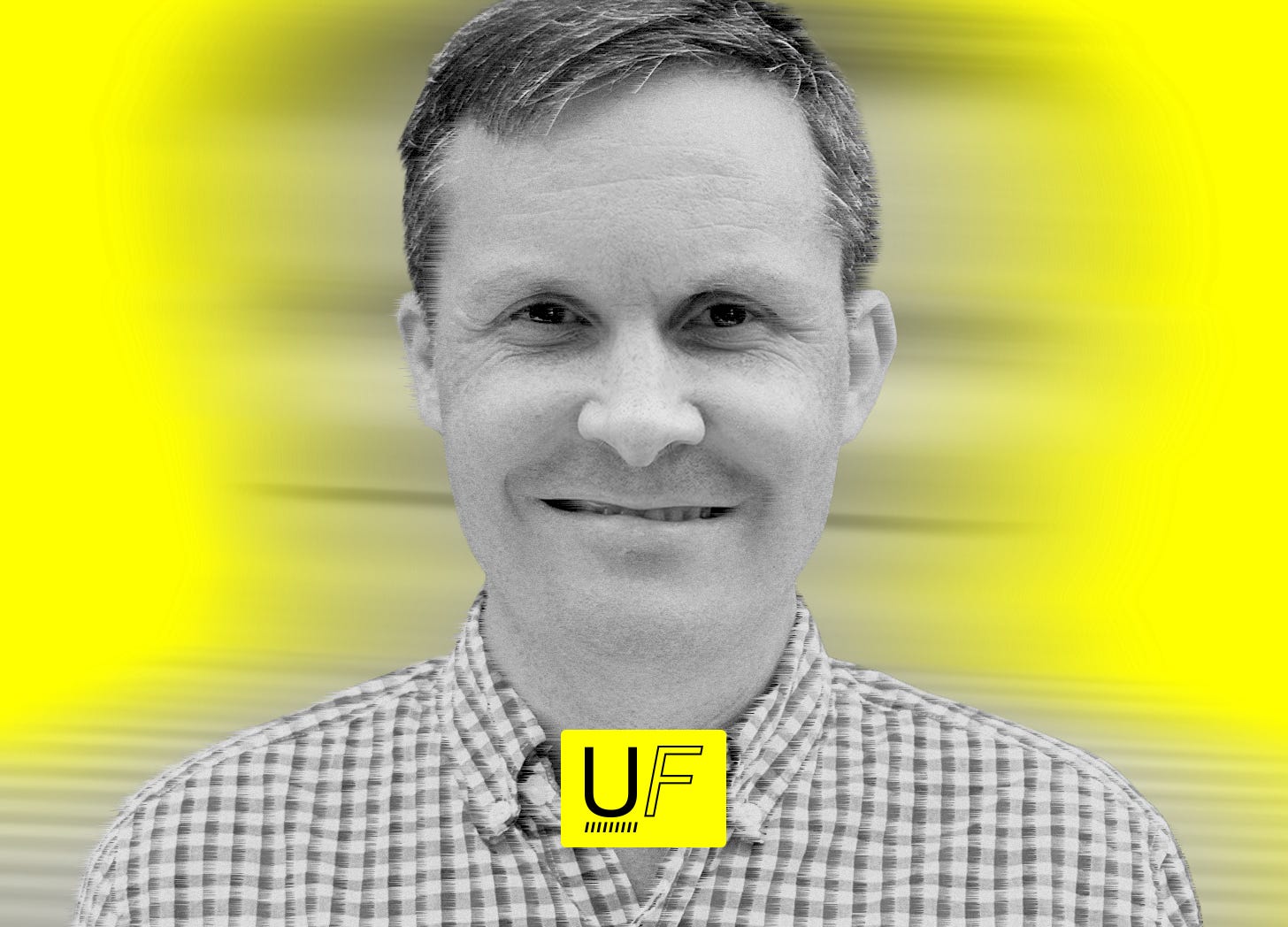
How Does AI Actually Work, & How is it Changing Our World? On 'Understanding AI' - Timothy B. Lee | #62
If there are two letters in the English language you’ve been unable to escape over the past four years, it’s A and I.Artificial intelligence has emerged as the buzziest tech category since the metaverse and NFTs, but unlike those, AI has managed to reach a level of market dominance that almost defies imagination—so whether you like it or not, it's in your best interest to understand how it actually works. Today's guest, Timothy B. Lee, helps you do just that.Support the show by checking out: ProtonVPN (gold-standard VPN—fast and safe. Click the link to get 55% off VPN Plus: $4.49/mo). ZBiotics (Decrease impact of hangovers. Code: JESSEDAMIANI for 10% off), MUD\WTR (43% off starter kits), 1Password (simplify your life and increase digital safety), Mission Farms CBD (healthy, effective CBD for relief, sleep, and wellbeing—25% off with email).BIO: Timothy B. Lee is a reporter who has written about technology, economics, and public policy for more than a decade. Before he launched Understanding AI in 2023, he wrote for the Washington Post, Vox.com, and Ars Technica. He has a master’s degree in computer science from Princeton.Find more episodes of Urgent Futures at: youtube.com/@UrgentFutures. Get full access to Reality Studies at www.realitystudies.co/subscribe
Capitalism Doesn't Value Nature Because It Can't—Understanding 'Free Gifts' - Alyssa Battistoni | #61
Why is capitalism incapable of valuing the more-than-human world?This question might sound obvious, but it's at the heart of the polycrisis. If our dominant economic system literally cannot place value on nature, we're destined to live out of alignment with it.This is the subject of Alyssa Battistoni's superb new book, Free Gifts: Capitalism and the Politics of Nature. We dive into it in today's conversation! In the meantime, grab your copy of Free Gifts here!Support the show by checking out: ProtonVPN (gold-standard VPN—fast and safe. Click the link to get 55% off VPN Plus: $4.49/mo). ZBiotics (Decrease impact of hangovers. Code: JESSEDAMIANI for 10% off), MUD\WTR (43% off starter kits), 1Password (simplify your life and increase digital safety), Mission Farms CBD (healthy, effective CBD for relief, sleep, and wellbeing—25% off with email).BIO: Alyssa Battistoni is assistant professor of political science at Barnard College. She is the coauthor of A Planet to Win: Why We Need a Green New Deal. Her writing has appeared in The Nation, The Guardian, Boston Review, n+1, Dissent, The New Statesman, Jacobin, and New Left Review.Free Gifts is a searing, imminently readable breakdown of how and why capitalism is incapable of “valuing” nature, treating it instead as a “free gift.” I’ve had folks on the show before talking about ecosystem services—check out my conversations with Paul R. Ehrlich, Gerardo Ceballos, and Rodolfo Dirzo as starting points!—and while Free Gifts addresses those ideas too, it goes much deeper.It’s not merely that what we call nature provides countless services that never get factored into the economy, it’s that the incentives of capitalism are fundamentally antithetical to human beings living sustainably on this planet. In the book, she conducts Marxist feminist analysis on how we got here, what it means for us, and ultimately drives us toward the necessary changes we must make if we want to survive. She reveals how, by treating nature as “free,” capitalism ultimately diminishes human freedom; it bars us from making truly ethical choices in how we value and relate to the more-than-human world.A quick reminder: all the messy politics you’re witnessing right now—such as rising authoritarianism—is downstream of our economic system, which determines the shape of what is possible. Alyssa’s work reveals how entangled our economic systems are in everything from social systems to individual choices, and it’s an absolutely critical time to contend with that.Find more episodes of Urgent Futures at: youtube.com/@UrgentFutures. Get full access to Reality Studies at www.realitystudies.co/subscribe
Rewiring the Global Economy, AI, the Cringiness of Big Tech Oligarchs, MMT, Stablecoins, & 'Releisure' - Brett Scott | Rapid Response #17
Capitalism is a problem. How exactly do we address it? First we have to cut through the noise.Today's guest, Brett Scott, is one of those special transdisciplinary thinkers—rooted in deep understandings of economics and finance—that I absolutely love to host conversations with. In this case, it was prompted by a shared frustration with how transhumanists believe about life-extension and immortality (typified by the actions of Bryan Johnson, of “Don’t Die” fame).Support the show by checking out: ProtonVPN (gold-standard VPN—fast and safe. Click the link to get 55% off VPN Plus: $4.49/mo). ZBiotics (Decrease impact of hangovers. Code: JESSEDAMIANI for 10% off), MUD\WTR (43% off starter kits), 1Password (simplify your life and increase digital safety), Mission Farms CBD (healthy, effective CBD for relief, sleep, and wellbeing—25% off with email).As expected, this conversation gets into so much more than I even expected, including crypto, central bank digital currencies, degrowth/post-growth, and more. We have to remember that so much of the (geo)political nonsense we’re experiencing is ultimately downstream of the economy—and Brett is somebody who’s illuminating the problems, paradoxes, and responses in accessible language. Make sure to give him a follow and subscribe to asomo.co.BIO: Brett Scott has spent over a decade exploring the architecture of global money and big finance, and is constantly on the search for ways to rewire our economic system. In 2013 he published The Heretic’s Guide to Global Finance: Hacking the Future of Money (Pluto Press), and in 2022 I published Cloudmoney: Cash, Cards, Crypto and the War for our Wallets (Penguin / Harper Collins). He has written for some of the world’s biggest publications, has appeared on major channels, and has spoken at over 300 events in over 30 countries.People call him many things – financial activist, economic hacker – but deep down he says he’s also an artist, and in Altered States of Monetary Consciousness he’ll take you on creative journey to bring our economic system to life using visual imagery and metaphor.Find more episodes of Urgent Futures at: youtube.com/@UrgentFutures. Get full access to Reality Studies at www.realitystudies.co/subscribe
Empathy is Hard Work—But It Can Save Us - Katie Bogen & Hani Chaabo (Super Humanizer) | #60
How do we bridge divides that seem impossible? It sounds so simple, but the basic answer is empathy. Of course, genuine empathy is no small feat. On the Super Humanizer podcast, today's guests hosts conversations about some of the thorniest topics related to Gaza and Zionism, so I brought them onto Urgent Futures to explain their perspectives and what they've learned through their work on the show. What results is (unsurprisingly!) a powerful, evocative conversation—I can't wait for you to hear from them.Support the show by checking out: ProtonVPN (gold-standard VPN—fast and safe. Click the link to get 55% off VPN Plus: $4.49/mo). ZBiotics (Decrease impact of hangovers. Code: JESSEDAMIANI for 10% off), MUD\WTR (43% off starter kits), 1Password (simplify your life and increase digital safety), Mission Farms CBD (healthy, effective CBD for relief, sleep, and wellbeing—25% off with email).BIOS:Katherine Wela Bogen is a clinical psychology PhD student and reconstructionist Jewish woman dedicated to empowering sexual abuse survivors. Her research on interpersonal violence and human sexuality has been published in numerous peer-reviewed journals.Beyond academia, she organizes international feminist psychology conferences, speaks at national political campaigns, and shares her stories and social commentary with millions on Instagram and TikTok. Raised in an American Jewish family by the son of a Holocaust survivor, Katie interrogated her inherited understanding of Zionism at a college level, and fostered relationships with anti-carceral human rights activists globally.With degrees in Political Science and Clinical Psychology, her diverse experiences inform her commitment to direct action for social change. Integrating anti-carceral, anti-racist, and anti-colonial feminist principles into her work, Katie passionately advocates for the full political enfranchisement of both Palestinians and Jews.Dr. Hani Chaabo is board-certified in Family, Integrative & Addiction Medicine. He completed training in Family Medicine at West Virginia University, a fellowship in Integrative Medicine at the University of Arizona, and the Primary Care Psychiatry, Addiction Medicine, and Child & Adolescent Psychiatry fellowship certification programs at the University of California in Irvine.He has worked with middle eastern refugees, marginalized LGBTQ communities, and steered national scale public health projects.He is currently Chief Clinical & Wellness Officer at El-Dorado Community Health Center in California. During his time as medical director of Well-being at Ridgecrest Regional Hospital, he was awarded by the American Medical Association’s Joy in Medicine Healthcare System recognition program. He established Ridgecrest’s first Addiction Medicine and Integrative Medicine programs.Find more episodes of Urgent Futures at: youtube.com/@UrgentFutures. Get full access to Reality Studies at www.realitystudies.co/subscribe
"Democracy is No Longer Expanding Agency"—Reimagining Governance, the Human, & Intelligence in the Machine Age - Indy Johar | #59
I talk a lot about transdisciplinarity on this channel because I think it’s one of the most vital approaches to perceiving, asking, and knowing. It’s something that I believe is not only important but necessary for making our way through these—ahem—urgent futures.As you’ll instantly find here, today's guest, Indy Johar, is a truly transdisciplinary mind. It makes sense to me that he’s trained as an architect, itself a collision of multiple different fields. But as a public intellectual today, it’s much more likely you’ll know Indy from his truly vast and entangled thinking about humanity, consciousness, intelligence, democracy, and all things planetary. In this conversation, we spend extra time on the idea of resisting perfectionism, another call that feels especially important as we leave the absolute monster of 2025 and head into what’s looking to be another doozy of a year.Support the show by checking out: ProtonVPN (gold-standard VPN—fast and safe. Click the link to get 55% off VPN Plus: $4.49/mo). ZBiotics (Decrease impact of hangovers. Code: JESSEDAMIANI for 10% off), MUD\WTR (43% off starter kits), 1Password (simplify your life and increase digital safety), Mission Farms CBD (healthy, effective CBD for relief, sleep, and wellbeing—25% off with email).BIO: Indy Johar is co-founder of Dark Matter Labs and of the RIBA award winning architecture and urban practice Architecture00. He is also a founding director of Open Systems Lab, seeded WikiHouse (open source housing) and Open Desk (open source furniture company).He is on the advisory board for the Future Observatory and is part of the committee for the London Festival of Architecture. He is also a fellow of the London Interdisciplinary School. Indy was a non-executive international Director of the BloxHub, the Nordic Hub for sustainable urbanization.Indy was 2016-17 Graham Willis Visiting Professorship at Sheffield University. He was Studio Master at the Architectural Association - 2019-2020, UNDP Innovation Facility Advisory Board Member 2016-20 and RIBA Trustee 2017-20.He has taught & lectured at various institutions from the University of Bath, TU-Berlin; University College London, Princeton, Harvard, MIT and New School. He is currently a professor at RMIT University.He was awarded the London Design Medal for Innovation in 2022 and an MBE for Services to Architecture in 2023.Find more episodes of Urgent Futures at: youtube.com/@UrgentFutures. Get full access to Reality Studies at www.realitystudies.co/subscribe

Rewilding Reality in the Age of Deepfakes, AI, & Epistemic Collapse - Michael Garfield | Rapid Response #16
How can we think differently about what AI means?Today's guest, Michael Garfield, is somebody I’ve learned a lot from over the years—primarily through his tireless work with the podcast formerly known as Future Fossils—now Humans On The Loop—but also through his own writings on life, the universe, and everything. One thing we bonded over early on was media ecology, specifically how reality was being shaped by fast-evolving digital tools like AI and XR. He identified key zones of concern, and mapped possible responses, for example, to the ongoing development of deepfakes and other synthetic media.Support the show by checking out: ProtonVPN (gold-standard VPN—fast and safe. Click the link to get 55% off VPN Plus: $4.49/mo). ZBiotics (Decrease impact of hangovers. Code: JESSEDAMIANI for 10% off), MUD\WTR (43% off starter kits), 1Password (simplify your life and increase digital safety), Mission Farms CBD (healthy, effective CBD for relief, sleep, and wellbeing—25% off with email).We’ve stayed in intermittent dialogue about all this over the past few years, and with the advent of OpenAI’s Atlas browser—which I’m still horrified by—it seemed like the right time for us to properly chop up on the pod, and I was lucky to turn the proverbial tables on him and put him in the guest seat.BIO: Artist, author, and philosopher Michael Garfield lives to foster the imagination we need in our age of exponential weirdness—and inspire the curiosity and play required to thrive in it. Drawing on over twenty years of independent scholarship and volcanic creativity, he wields a singular perspective on the past and future, a renowned capacity for synthesis, and a global network of top-tier collaborators.Michael is the Founder of Humans On The Loop (an award-winning transdisciplinary series exploring wisdom in the age of exponential technologies) and the Communications Director for The AI Capabilities and Alignment Consensus Project (an international partnership to foster sane AI discourse between academia and the tech sector supported by The Survival and Flourishing Fund). His nonlinear career has woven through years of research, creative, and community development at The Santa Fe Institute, The Mozilla Internet Ecosystem program, The Long Now Foundation, and The Integral Institute, and secured grants and fellowships from Cosmos Institute, O’Shaughnessy Ventures, and the ASU Center for Science and The Imagination. An internationally-charting science communicator and experimental musician, a prolific artist and writer, and a public speaker who has inspired audiences everywhere from The Commonwealth Bank of Australia Innovation Lab and Cynefin to The Chapel of Sacred Mirrors and Boom Festival, his work threads insights from complex systems science with years of experience at the frothy edge of creative technology and consciousness research. As a teacher and essayist, he has been featured at Aeon Magazine, HPlus Magazine, Reality Sandwich, Mutations, Weirdosphere, and The School of Wise Innovation.Find more episodes of Urgent Futures at: youtube.com/@UrgentFutures. Get full access to Reality Studies at www.realitystudies.co/subscribe
"Almost Everybody's Incompetent"—Why Fossil Fuels & Fascism Dominate - David Roberts | #58
I thought this was going to be a conversation about solar energy, decarbonization, ClimateTech, grid infrastructure—I wasn't quite prepared for an in-depth analysis of Pete Hegseth's psychology. Hopefully that gives you a quick sense of what you're in for in this episode!Support the show by checking out: ProtonVPN (gold-standard VPN—fast and safe. Click the link to get 55% off VPN Plus: $4.49/mo). ZBiotics (Decrease impact of hangovers. Code: JESSEDAMIANI for 10% off), MUD\WTR (43% off starter kits), 1Password (simplify your life and increase digital safety), Mission Farms CBD (healthy, effective CBD for relief, sleep, and wellbeing—25% off with email).BIO: David Roberts runs the Volts newsletter & podcast and lives in Seattle.Don’t let that brief bio fool you: David Roberts is a man of many talents and interests. Volts is a leading outlet for all things decarbonization—from science and tech to politics to policy. If climate change matters to you, Volts is one of the key places you can go to get a sense of what’s happening, the stakes, and who’s trying to meaningfully create change. Do yourself a favor and go subscribe right now.Understandably, I was excited to bring David on to talk about electrification—and going in I thought we were going to have a wonky conversation about grid infrastructure, batteries, and all that fun stuff. And we do get into that to a good extent—but what really stands out to me about this interview is David’s impassioned approach to progressive politics. I knew this about him going in; the questions I asked to that effect weren’t afterthoughts—but I was pleasantly surprised at the places this conversation took us, going deep on pressing topics in sociopolitics, from some armchair psychology of leaders in the MAGA movement to the role that radical centrism plays in determining the American political spectrum. David’s longtime tenure as a podcaster shines through—his delivery is on a par with the best comedians, and as you’ll see, there are moments where I cannot make myself stop laughing.So strap in for this wide-ranging and rollicking conversation with David Roberts.Find more episodes of Urgent Futures at: youtube.com/@UrgentFutures. Get full access to Reality Studies at www.realitystudies.co/subscribe

Unpacking ‘Fascist Fitness’ & Reclaiming Gym Culture from the Far Right - Colin Davis | Rapid Response #15
In many ways, the big story in the aftermath of the 2024 election in the U.S. was: young men. Mainstream media was aflurry in conversations about how the Dems lost boys, how the manosphere and male-centric podcasters swung the election in favor of Donald Trump. Correlated to this phenomenon was the fact that gym culture, weightlifting in particular, because an online vector through which young men developed communities within the right-wing ecosystem. Ideas about power and “being a man” became key talking points in these groups.Support the show by checking out: ProtonVPN (gold-standard VPN—fast and safe. Click the link to get 55% off VPN Plus: $4.49/mo). ZBiotics (Decrease impact of hangovers. Code: JESSEDAMIANI for 10% off), MUD\WTR (43% off starter kits), 1Password (simplify your life and increase digital safety), Mission Farms CBD (healthy, effective CBD for relief, sleep, and wellbeing—25% off with email).Note: I’m sorry for my blown-out audio. Substack, it seems, did me dirty in how it processed my audio during this live conversation. I’ve never had this problem in the past, but I’m trying to get to the bottom of it for future Live episodes. Fortunately Colin does most of the talking.But it didn’t—and doesn’t—have to be this way. I’m reminded of country music’s deep roots in working class struggles, and how genre has drifted rightward over the past few decades. We may take for granted that weightlifting will breed toxic masculinity, but this is not a given. Today’s guest, Colin Davis, a fitness coach based in North Carolina, is testament to this. I found his work through some banger short-form videos where he thoughtfully (and punchily) shows how strength and masculinity might be unapologetically otherwise. And there’s an appetite for it too—over the past few months his Instagram account exploded from a few hundred followers to over 50,000. In this, I saw (and continue to see!) a major opportunity for leftists to build bridges, leading boys and men away from harmful, outdated ideas toward liberatory ones.So I had him on the show to get into all of it.BIO: Colin Davis is a fitness coach and content creator from North Carolina. Colin has been a coach for 6 years and makes content focused on gym culture and its connection to politics. Colin’s work centers around creating a voice for left leaning individuals in the fitness community and combatting gym bro stereotypes.Find more episodes of Urgent Futures at: youtube.com/@UrgentFutures. Get full access to Reality Studies at www.realitystudies.co/subscribe
Can Media Depict Reality in the Age of AI? Did It Ever, Really? Discussing the Interplay of Fact & Fiction in ‘Reality Frictions’ - Steve Anderson | #57
A couple plot twists to note with this episode!First: instead of my usual intro, you’ll notice we’re showing a clip from Steve’s new feature-length video essay/doc Reality Frictions. So I’d strongly recommend that you watch at least the first few minutes on Substack or YouTube. My hope is that doing it this way gives you the best context for what he and I dive into in our conversation. Moreover, I hope it whets your appetite to go see the film—it’s a nourishing and thought-provoking journey (the combination of Steve’s voice, cadence, ideas, and editing chops have a sort of ASMR-delight effect for my brain, and I’m sure I won’t be the only one).Second: you’ll notice that this episode was filmed in my former Los Angeles location. We’ve actually been holding onto this episode a little longer than usual in order to time it to the LA premiere and—drum roll—that day is on the calendar! December 12. So for my dear Los Angeles audience, here’s the information:UCLA Film & Television Archive and Los Angeles Filmforum present:December 12 at the UCLA Film & TV Archive Billy Wilder Theater, the Hammer MuseumIn person: Q&A with Steve F. Anderson, filmmaker and Associate Dean of Academic Affairs, UCLA School of the Arts and Architecture, moderated by Los Angeles Filmforum programmer Diego Robles.More info at UCLA Film & Television Archive or Los Angeles Filmforum.Support the show by checking out: ProtonVPN (gold-standard VPN—fast and safe. Click the link to get 55% off VPN Plus: $4.49/mo). ZBiotics (Decrease impact of hangovers. Code: JESSEDAMIANI for 10% off), MUD\WTR (43% off starter kits), 1Password (simplify your life and increase digital safety), Mission Farms CBD (healthy, effective CBD for relief, sleep, and wellbeing—25% off with email).As filmmaker Thom Andersen demonstrates in the iconic video essay/documentary Los Angeles Plays Itself—and in fact, as you’ll hear in the conversation, Steve worked with Andersen!—locals can easily be pulled out of a movie’s car chase when the on-screen geography doesn’t match the actual layout of the city. Inspired by this blend of authenticity and illusion, Anderson examines the “intersection of fact and fiction on Hollywood’s screens,” which gives way to a broader analysis of this interplay. How do screen representations shape reality? Likewise, what happens when reality intrudes on screened depictions?Of course, this is a conversation that cannot not look at the emerging wave of AI-generated imagery and video. Mind you, we recorded this episode before Google’s Veo 3 and OpenAI’s Sora 2 were launched, and still, Steve’s sense of things is spot-on, grounded in a long view of how media has always been a means of constructing rather than merely depicting reality. Thus, the question of “Capital-T Truth” in film, while perhaps a rich intellectual discussion, is in many ways a misguided one, or misses what’s really at work.We also touch on the importance of digital commons, drawing from Steve’s work with Critical Commons, as well as ideas drawn from his various prior books: Technologies of Vision, Technologies of History, and Reclaiming Popular Documentary. In a moment when the subject of visual representations of reality has never held more societal import, I’m sure you’re going to appreciate this rich, wide-ranging conversation, so get to it!BIO: Steve F. Anderson is a scholar-practitioner working at the intersection of media, history, technology and culture. He is currently a Professor of Digital Media at the UCLA School of Theater, Film and Television and Associate Dean for Academic Affairs in the UCLA School of the Arts and Architecture. He is the author of Technologies of Vision: The War Between Data and Images (MIT 2017) and Technologies of History: Visual Media and the Eccentricity of the Past (Dartmouth 2011) and co-editor of the anthology Reclaiming Popular Documentary (Indiana 2021). Anderson is also the founder of the appropriation-friendly public media archive Critical Commons and co-PI on the electronic authoring platform Scalar. His recent creative work includes the mixed reality installation Live-VR Corridor (2021), which won the award for Best Mixed Reality at the New Media Film Festival and premiered internationally at the Beijing International Film Festival. His feature-length video essay Reality Frictions premiered at the Madrid International Film Festival in 2024. He received a Ph.D. in Film, Literature and Culture from USC and an M.F.A. in Film and Video from CalArts.Find more episodes of Urgent Futures at: youtube.com/@UrgentFutures. Get full access to Reality Studies at www.realitystudies.co/subscribe
Understanding Wet-Bulb Temperature, Climate Extremes, & Systemic Risk—& How We Build Resilience - Colin Raymond | #56
The unfortunate reality is that, in a warming world, we're going to be learning about 'wet-bulb temperature' (WBT) the hard way more and more. These are temperatures at which it is hot enough to cause the human body heat stress and humid enough to prevent it from cooling off through sweat. So today's guest, Colin Raymond, joins me to dig into what they are & what we can do to stay safe & build resilience.As many of you know by now, I’m currently working on a book manuscript called How to Survive the 21st Century. Modest, I know. It’s a journalistic effort, in which I draw from the insights of experts in various fields to sketch the major crises we face today and what more effective responses to them might be. I’ve been fortunate to speak with many experts whose ideas I’ve already included in the book, but as I set out to work on my “Heat, Humidity, and Fire” chapter, I realized I’d never actually had a guest on who could speak to the issue of WBTsSupport the show by checking out: ProtonVPN (gold-standard VPN—fast and safe. Click the link to get 55% off VPN Plus: $4.49/mo). ZBiotics (Decrease impact of hangovers. Code: JESSEDAMIANI for 10% off), MUD\WTR (43% off starter kits), 1Password (simplify your life and increase digital safety), Mission Farms CBD (healthy, effective CBD for relief, sleep, and wellbeing—25% off with email).Without getting into spoiler territory, a wet-bulb event plays a key role in Kim Stanley Robinson’s superb Ministry for the Future—by the way, if you haven’t read that book yet, take this as your sign to jump it to the top of your list.Given how much of a threat wet-bulb temperatures already pose—and the fact that their likelihood is unfortunately going to intensify, alongside degradation of the infrastructure that would mitigate the harms they produce—I knew I needed to address this immediately. Which is why I was so excited to discover Colin’s work.Not only is he deeply knowledgeable about the topic of wet-bulb temperatures, and guides us through the risks they pose to us—but he also has expertise in the broader arena of climate extremes. Here are some titles of recent papers he’s authored and co-authored: “Do summertime atmospheric rivers meaningfully promote humid heat?” “How might extreme climate events be connected, and why does it matter?” and “How are key compound risks changing in a warming and moistening world?” He’s also facilitated workshops that seek to surface collective insights about these existential risks.Many scientists are content to stay in their narrow line—and there’s nothing wrong with that—but it takes a really special mind to take this transdisciplinary approach to their work. And that comes through in this conversation—so I’m going to get out of your way and let you hear it directly from Dr. Colin Raymond.BIO: Dr. Colin Raymond is a research scientist at the University of California, Los Angeles. His work centers on understanding the intricate interactions of weather, geography, and human systems that drive extreme humid heat and its impacts, now and in the future. He draws upon a variety of approaches, from direct observations and climate models to storyline development, in the service of producing and communicating accessible and actionable climate information.Find more episodes of Urgent Futures at: youtube.com/@UrgentFutures. Get full access to Reality Studies at www.realitystudies.co/subscribe
How AI Futures, Authoritarianism, & Behavioral Science Fit Together - Jacob Ward | #55
Where to begin with this conversation? First I’ll say, it’s an absolute pleasure to speak with polymaths. I try to do it as much as I can on the show, and Jake is an exemplar, able to dance across topics with depth and nuance. As such, you’ll notice that we move from questions about the futures of AI in society to contemporary politics to that conversation between Ezra Klein and Ta-Nehisi Coates.What I especially love is how his ongoing research into behavioral and cognitive science has informed his approach to AI, a topic that has become inescapable, and such, is often crowded with noise and takes that are aggressively mid at best. But Jake has been consistently early and right about this stuff—even “calling” the Trump election in the PBS docu-series Hacking Your Mind. Meanwhile, he published The Loop: How AI is Creating a World without Choices and How to Fight Back, mere months before Midjourney and ChatGPT took off in 2022, effectively sketching the key threats that would make themselves undeniable over the following years. These are the early jump-off points in our conversation, but it swerves delightfully from there, and I couldn’t be happier with how it turned out. So I’ll get out of the way and let you enjoy this rich conversation with Jacob Ward.Buy The Loop: How AI is Creating a World without Choices and How to Fight Back here.Support the show by checking out: ProtonVPN (gold-standard VPN—fast and safe. Click the link to get 55% off VPN Plus: $4.49/mo). ZBiotics (Decrease impact of hangovers. Code: JESSEDAMIANI for 10% off), MUD\WTR (43% off starter kits), 1Password (simplify your life and increase digital safety), Mission Farms CBD (healthy, effective CBD for relief, sleep, and wellbeing—25% off with email).BIO: Jacob Ward is a veteran journalist covering the intersection of technology, human behavior, and social change. He’s currently reporter-in-residence at The Omidyar Network, writing about cutting-edge innovation and pioneering forms of restraint, and a strategic advisor on the deployment of A.I. for companies large and small. From 2018 to 2024 he was technology correspondent for NBC News, reporting for Nightly News, The TODAY Show, and MSNBC. He is the former editor-in-chief of Popular Science magazine, and was Al Jazeera’s science and technology correspondent from 2013 to 2018. Ward is a lecturer at the Stanford d.school, and was a 2018-2019 Berggruen Fellow at Stanford University’s Center for Advanced Study in the Behavioral Sciences, where he began writing The Loop: How AI is Creating a World without Choices and How to Fight Back, out now from Hachette Book Group. The book explores how artificial intelligence and other decision-shaping technologies will amplify good and bad human instincts, and predicted the AI psychosis in which society is currently mired. Ward has written for The New Yorker, The New York Times Magazine, Wired, and many other publications. In addition to hosting documentaries for Nat Geo and Discovery, he’s the host and co-writer of the landmark four-hour PBS television series, “Hacking Your Mind,” about human decision-making, behavioral economics, and political manipulation. His weekly podcast The Rip Current covers the big, hidden forces at work in our lives, and he speaks to an audience of more than 250,000 viewers on TikTok, on podcast appearances, and on This Week in Tech, where he’s a regular co-host.Find more episodes of Urgent Futures at: youtube.com/@UrgentFutures. Get full access to Reality Studies at www.realitystudies.co/subscribe
Protecting Your Mental Health & Emotional Wellbeing Amid Polycrisis, Responding to ICE, 'Bullying Bari Weiss,' & The Futures of Journalism - Anya Kamenetz | Rapid Response #14
If you’re paying attention at all, everything feels topsy-turvy at best, more likely outright depressing. Unidentified masked ICE agents are still brutalizing and snatching people off the street, free speech protections are being violated with abandon, the government shutdown continues to wreak havoc, most visible with recent news that SNAP benefits, relied on by 40 million Americans, are set to expire on Nov. 1. Then there’s the $300 million ballroom being built in the site formerly known as the East Wing of the White House, the fact that Donald Trump is suing his own Justice Department to the tune of $230 million, the cumulative $40 billion that’s been sent to bail out Argentina…and I’m literally just writing the stuff that comes to the top of my head as I sit here.Support the show by checking out: ProtonVPN (gold-standard VPN—fast and safe. Click the link to get 55% off VPN Plus: $4.49/mo). ZBiotics (Decrease impact of hangovers. Code: JESSEDAMIANI for 10% off), MUD\WTR (43% off starter kits), 1Password (simplify your life and increase digital safety), Mission Farms CBD (healthy, effective CBD for relief, sleep, and wellbeing—25% off with email).Of course, all of that pales in comparison to what has actually been keeping me up at night the past few months: this report, which asserts that without dramatic change we’re headed for a 3°C+ world by 2050—less than 25 years from this moment. This doesn’t just mean life but a little bit hotter; it means the unraveling of the biosphere. For most of the life on this planet, us included, 3°C+ is a death sentence.Our brains and hearts weren’t designed for this onslaught of news. That’s not a way of saying that we should bury our heads in the sand—we don’t have that luxury—but it does mean that all of us could use some guidance on how to sustain our mental health and emotional wellbeing while we commit ourselves to the work of adaptation and more liberatory futures.This is the vital work Anya is conducting for her forthcoming book, and (though it sounds weird to put it this way after what I just wrote!) why I was excited to speak with her. What are the ways we should be thinking about mental and emotional resilience, what are practices we should consider for ourselves, and what are the dimensions we need to understand about how this is impacting young people? We discuss all of that and a whole lot more—including the lingering effects of the Covid-19 pandemic on young people and an anecdote involving Bari Weiss, now the Editor-in-Chief of CBS News.BIO: Anya Kamenetz speaks, writes, and thinks about thriving and caring for others on a rapidly changing planet. Her newsletter on these topics is The Golden Hour. She covered education for many years including for NPR, where she co-created the podcast Life Kit: Parenting. Her last book was The Stolen Year: How Covid Changed Children’s Lives, And Where We Go Now. Kamenetz is currently an advisor to the Aspen Institute and the Climate Mental Health Network, working on new initiatives at the intersection of children, well-being, education, and climate change. Her next book, forthcoming from Bloomsbury, is about how to cope with the world right now.Find more episodes of Urgent Futures at: youtube.com/@UrgentFutures. Get full access to Reality Studies at www.realitystudies.co/subscribe

U.S. Information Warfare, AI, Censorship, & Why Disinformation is Still—Still!—A Major Issue - Nina Jankowicz | Rapid Response #13
You may have noticed that the quality of your digital life has been on the decline—in tandem with the ongoing attacks on (whatever’s left of) democratic function in the United States. It’s important to remember that this is not something that has simply happened, like the weather. These are systems that have been designed, albeit by many different people across many different industries (and with varying degrees of awareness). Key to all of it is the unholy marriage between algorithmic social media and those who exploit its features to foster division and consensus breakdown.This is why disinformation remains a vital topic in 2025, even though the term itself doesn’t capture public attention the same way it did back in the late 2010s and early 2020s. Paradoxically, it’s actually far more pervasive in our lives now than it was before—especially given that these playbooks are now in the hands of state and private actors all around the world. And of course, now we have to account for the role generative AI plays as a force multiplier.Thus, it felt like an important moment to stop back in with Nina to recap some key aspects of her past work and turn our eyes toward the present and future. What’s happening and what can we do about it? Watch/listen on!Support the show by checking out: ProtonVPN (gold-standard VPN—fast and safe. Click the link to get 55% off VPN Plus: $4.49/mo). ZBiotics (Decrease impact of hangovers. Code: JESSEDAMIANI for 10% off), MUD\WTR (43% off starter kits), 1Password (simplify your life and increase digital safety), Mission Farms CBD (healthy, effective CBD for relief, sleep, and wellbeing—25% off with email).BIO: Nina Jankowicz is an internationally-recognized expert on disinformation and democratization and one of TIME Magazine’s 100 most influential people in artificial intelligence.Her debut book, How to Lose the Information War (Bloomsbury 2020), was named a New Statesman 2020 book of the year; The New Yorker called it “a persuasive new book on disinformation as a geopolitical strategy.” Her second book, How to Be A Woman Online (Bloomsbury 2022), an examination of online abuse and disinformation and tips for fighting back, was deemed “essential” by Publisher’s Weekly. She was recognized for her Distinguished Professional Contributions to Media Psychology and Technology in 2024 by Division 46 of the American Psychological Association.Buy 'How to Lose the Information War' here.Buy 'How to Be a Woman Online: Surviving Abuse and Harassment, and How to Fight Back' here.Jankowicz’s expertise spans the public, private, and academic sectors. She is the co-founder and CEO of the American Sunlight Project, a bipartisan group increasing the cost of lies that undermine democracy. She has advised governments, international organizations, and tech companies; testified before the United States Congress and the UK, Canadian, and European Parliaments; and led accessible, actionable research about the effects of disinformation on women, minorities, democratic activists, and freedom of expression around the world.Find more episodes of Urgent Futures at: youtube.com/@UrgentFutures. Get full access to Reality Studies at www.realitystudies.co/subscribe
Grace Byron: 'Herculine,' Haunting, & Being Trans in America | Riffs & Speculations #2
Imagine this: an all-trans girl commune in the middle of the woods in the midwest. Also imagine that people can be literally haunted by demons, who prey on trauma. Imagine that those two ideas live in the same world, and are woven into a broader story that also manages to hold within it star-crossed romance; biting analysis of the contemporary creative scene in New York City; revealing moments of friendship, community, sex; and ultimately a portrait of what it means to be a trans woman in present-day America—all in about 250 pages.Hopefully your mind is already spinning with possibility—and I’m delighted to inform you that all this and more is what you’ll find in today's guest Grace Byron’s superb debut novel, Herculine. It should go without saying but I’m gonna say it: go buy this book! Link here but it’s available wherever you get books.Support the show by checking out: ProtonVPN (gold-standard VPN—fast and safe. Click the link to get 55% off VPN Plus: $4.49/mo). ZBiotics (Decrease impact of hangovers. Code: JESSEDAMIANI for 10% off), MUD\WTR (43% off starter kits), 1Password (simplify your life and increase digital safety), Mission Farms CBD (healthy, effective CBD for relief, sleep, and wellbeing—25% off with email).As a lover of language and narrative, I was excited to dive into all of the above with Grace, and she has lots of great things to say—but of course our conversation extends beyond the craft of writing. We get into a broader examination of the aforementioned topics, further drawing from her work as a critic, especially given the systems of oppression that trans people face, spanning scales local to societal. The best speculative fiction is that which uses the mechanisms of imagination and storytelling to reflect and refract what’s in contemporary society, to help us see messy truths in more nuanced, complex ways. Herculine manages this tremendously, a testament to Grace’s insight and ability to synthesize and translate ideas across forms. These abilities are on full display on our chat.Never fear: this whole conversation is spoiler-free. But as a bonus for paid subscribers, I’ve recorded a whole separate part of the conversation that gest into the nitty gritty, unpacking the book in a way that I believe will be immensely enriching for folks who have already read the book. Note: TONS of spoilers in that conversation. If you want to hear it, be sure to subscribe at realitystudies.co.BIO: Grace Byron is a writer from the Midwest based in Queens whose writing has appeared in The New Yorker, Vogue, The Nation, New York Magazine, The Paris Review, and elsewhere. Herculine is her debut novel.Find more episodes of Urgent Futures at: youtube.com/@UrgentFutures. Get full access to Reality Studies at www.realitystudies.co/subscribe
How to Tell Strategic Stories that Clarify Climate Crisis - Megan Mayhew-Bergman | Rapid Response #12
Climate change is an issue that already impacts everyone, and is poised to disrupt everything about life as we understand it. And yet it still so often manages to be presented as a niche issue. What gives? Why can’t we get it together?Support the show by checking out: ProtonVPN (gold-standard VPN—fast and safe. Click the link to get 55% off VPN Plus: $4.49/mo). ZBiotics (Decrease impact of hangovers. Code: JESSEDAMIANI for 10% off), MUD\WTR (43% off starter kits), 1Password (simplify your life and increase digital safety), Mission Farms CBD (healthy, effective CBD for relief, sleep, and wellbeing—25% off with email).Insert all requisite frustrations about capitalism and billionaires, but glossing the issue that way doesn’t address the broader dynamic in which people—whether as individuals or in communities—are not approaching the scale of the disaster with appropriate urgency and care. Climate change, among other things, is a coordination and communications problem. If we can start to address the underlying assumptions, narratives, and ideas that are perpetuating status quo, I think we’d be surprised how much of a difference that would make in building solidarity and cooperation, to encourage everyday folks to fight for a livable planet in whatever way makes sense given their circumstances.I can spout off about this all day, but Megan is deep in the work—which expresses itself in many forms. She documents and analyzes climate-related events and phenomena as a journalist, writes deft climate fiction that digs into the messiness and nuance of living in a changing planet, advises organizations on telling strategic climate stories through her agency, GreenStory, and creates space for other writers to approach all the above as both a professor and in running the Bread Loaf Environmental Writers’ Conference. Understandably, I was keen to get into it with her, to find out how she’s thinking through these wicked problems, responses to them, and the role that artists and writers can play. As you’ll hear me say in the conversation, I came in with high expectations, and this conversation blew past them. Megan’s insights are absolutely must-listen—especially for creative folks looking to better understand how think about these issues and what they can do.BIO: Megan Mayhew-Bergman is the author of three books, most recently How Strange a Season. Her essays and journalism have been featured in The Guardian, The New Yorker, The New York Times, and the Atlantic. She is the Director of Creative Writing at Middlebury College and the Director of the Bread Loaf Environmental Writers’ Conference. She serves on the board of The Thoreau Prize and Conservation Law Foundation, and co-founded GreenStory, a narrative consulting firm for clean energy organizations and NGOs.Find more episodes of Urgent Futures at: youtube.com/@UrgentFutures. Get full access to Reality Studies at www.realitystudies.co/subscribe
Goliath's Curse: How & Why Societies Collapse, & What We Can Do About It - Luke Kemp | #54
“Collapse” is one of those words that’s bandied about a lot—especially with conversations about the future of the United States and U.S. hegemony—and is therefore prone to debate, misconceptions, and a variety of uses. Today's guest, Luke Kemp is the author of the spectacular and necessary new book, Goliath's Curse. In it, he cuts through the noise to make the case that collapse isn’t just a sensationalist concept or a fringe worry—it’s a recurring feature of history in human societies, a cocktail of human evolutionary psychology and the power of symbolic communication, which allows us to craft stories and ideologies that, among other things, grant particular people the ability to cast themselves as more deserving of finite resources and form dominance hierarchies.Support the show by checking out: ProtonVPN (gold-standard VPN—fast and safe. Click the link to get 55% off VPN Plus: $4.49/mo). ZBiotics (Decrease impact of hangovers. Code: JESSEDAMIANI for 10% off), MUD\WTR (43% off starter kits), 1Password (simplify your life and increase digital safety), Mission Farms CBD (healthy, effective CBD for relief, sleep, and wellbeing—25% off with email).Combining empirical research, historical case studies, and contemporary global trends, Luke shows how what he calls goliath fuel—stuff like lootable resources and new technologies—allows for the formation of “goliaths,” a word he uses to sidestep the colonialist implications of “civilization,” going to pains to demonstrate how many of the empires we glamorize today were ruthless and brutal engines of domination. He also shows how these same features, which manifest broadly as systemic inequality, sow the seeds for the fall of these goliaths.I’ll be frank. If you’re looking to understand collapse from a systemic point-of-view, with the most contemporary research available, you have to start with Goliath’s Curse.Grab your copy of Goliath's Curse here!Bio: Luke researches the end of the world. He is a Research Affiliate at the Centre for the Study of Existential Risk (CSER) at the University of Cambridge. He has advised and led foresight studies for multiple international organisations, including the WHO and Convention on Biological Diversity. His work has been covered by media outlets such as the BBC, the New York Times, and the New Yorker. He is the author of the bestselling book Goliath’s Curse: The History and Future of Societal Collapse.CREDITS: This podcast is edited and produced by Adam Labrie and me, Jesse Damiani. Adam Labrie also edited the video version of the podcast, which is available on YouTube. The podcast is presented by Reality Studies. If you appreciate the work I’m doing, please subscribe and share it with someone you think would enjoy it.Find more episodes of Urgent Futures at: youtube.com/@UrgentFutures. Get full access to Reality Studies at www.realitystudies.co/subscribe
Andy Hines: How to Imagine 'After Capitalism'—and Why We Must | #53
The subjects of degrowth and post-growth are near-and-dear to my heart. I view these overlapping topics as absolutely critical for our continued survival on this planet; it is imperative that we humans bring our species back into alignment with the planet. No doubt that this is going to be difficult and costly, but far less so than continuing on as usual, which will entail ever more extreme measures the longer we put it off—both in terms of paying for disaster responses and implementing mitigation and adaptation measures as the biosphere deteriorates.Which is why I was delighted to see a fellow futurist, today’s guest, Dr. Andy Hines, taking up the topic of changing our relationship to the economy in the form of Imagining After Capitalism. Through his pathbreaking work, Andy has been conducting extensive research in these arenas for more than a decade, and applying the unique capabilities of foresight research to craft scenarios that sketch visions of possibility—in both scary and hopeful directions.Grab your copy of Imagining After Capitalism here!Support the show by checking out: ProtonVPN (gold-standard VPN—fast and safe. Click the link to get 55% off VPN Plus: $4.49/mo). ZBiotics (Decrease impact of hangovers. Code: JESSEDAMIANI for 10% off), MUD\WTR (43% off starter kits), 1Password (simplify your life and increase digital safety), Mission Farms CBD (healthy, effective CBD for relief, sleep, and wellbeing—25% off with email).Bio: Dr. Andy Hines is Associate Professor and Program Coordinator for the University of Houston’s Graduate Program in Foresight and is also speaking, workshopping, and consulting through his firm Hinesight. His 30+ years of professional futurist experience includes a decade’s experience working inside first the Kellogg Company and later Dow Chemical, and consulting work with Coates & Jarratt, Inc. and Social Technologies/Innovaro. His most recent book (just released) is Imagining After Capitalism. Other books are The Knowledge Base of Futures Studies 2020, Thinking about the Future (2nd edition), Teaching about the Future, ConsumerShift: How Changing Values Are Reshaping the Consumer Landscape, and 2025: Science and Technology Reshapes US and Global Society. His dissertation was “The Role of an Organizational Futurist in Integrating Foresight into Organizations.” He was Founding Chair of the Association of Professional Futurists.CREDITS: This podcast is edited and produced by Adam Labrie and me, Jesse Damiani. Adam Labrie also edited the video version of the podcast, which is available on YouTube. The podcast is presented by Reality Studies. If you appreciate the work I’m doing, please subscribe and share it with someone you think would enjoy it.Find more episodes of Urgent Futures at: youtube.com/@UrgentFutures. Get full access to Reality Studies at www.realitystudies.co/subscribe
Danny Snelson: The Little Database vs. Large AI Models | #52
I’ve talked about AI a good deal in past episodes—and I continue to believe it’s a subject of critical discourse, even (and perhaps especially) as it’s ever more riddled with outstated hype. That’s why you’ll notice I’ve framed today’s conversation in the title as a contrast between large AI models and the little database, a term coined by today’s guest, Danny Snelson—but this conversation is so much more than that. In fact, he wrote a whole book about the subject—and it’s superb.This notion of the little database draws on the lineage of the “little magazine,” a type of publication popular in the second half of the 20th century for cheaply and rapidly distributing written works, especially experimental literature that didn’t quite fit in with existing literary norms. The little database is an archive that similarly embodies this DIY spirit—a curated (though not always too heavy-handedly) digital archive. Just as material realities fostered the possibilities and framed the constraints of little magazines in, say, the 1970s, so too do the material realities of digital media in little databases. The analysis Danny conducts in The Little Database doubles as an examination of how the rise of the web fostered and constrained the media that could circulate—and how and why.A whole lot more in this episode, including games, social justice, the poetics of search, and more!Support the show by checking out: ZBiotics (Decrease impact of hangovers. Code: JESSEDAMIANI for 10% off), MUD\WTR (43% off starter kits), 1Password (simplify your life and increase digital safety), Mission Farms CBD (healthy, effective CBD for relief, sleep, and wellbeing—25% off with email), NordVPN (the simplest way to protect yourself online, 74% off 2-year plans).Daniel Scott Snelson is a writer, editor, and archivist working as an Associate Professor in the Departments of English and Design Media Arts at UCLA, where he serves as faculty for the Digital Humanities, the Laboratory for Environmental Narrative Strategies, and the UCLA Game Lab. His online editorial work can be found at PennSound, Eclipse, UbuWeb, Jacket2, and the EPC. Published books include Elden Poem (Hysterically Real, 2022), Full Bleed: A Mourning Letter for the Printed Page (Sync, 2019), Apocalypse Reliquary: 1984-2000 (Monoskop, 2018), Radios (Make Now, 2016), EXE TXT (Gauss PDF, 2015), Epic Lyric Poem (Troll Thread, 2014), and Inventory Arousal with James Hoff (Bedford Press/Architectural Association, 2011). With Mashinka Firunts Hakopian and Avi Alpert, he performs as one-third of the academic performance group Research Service. His recently published book, The Little Database: A Poetics of Media Formats (University of Minnesota Press, 2025), examines the networked afterlives of media-reflexive works of art and letters in search of contingent methods for reading ordinary digital collections.CREDITS: This podcast is edited and produced by Adam Labrie and me, Jesse Damiani. Adam Labrie also edited the video version of the podcast, which is available on YouTube. The podcast is presented by Reality Studies. If you appreciate the work I’m doing, please subscribe and share it with someone you think would enjoy it.Find more episodes of Urgent Futures at: youtube.com/@UrgentFutures. Get full access to Reality Studies at www.realitystudies.co/subscribe
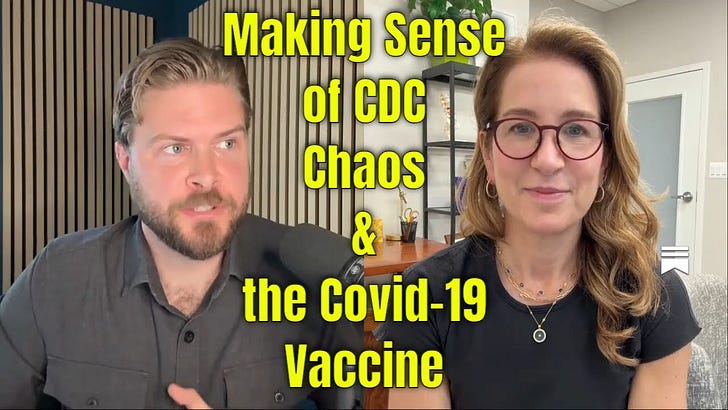
CDC Chaos & Covid-19 Vaccines with Dr. Lucy McBride | Rapid Response #11
Welcome to the Urgent Futures podcast, the show that finds {signals} in the noise. Each week, I sit down with leading thinkers whose research, concepts, and questions clarify the chaos, from culture to the cosmos.Amid CDC upheaval under Robert F. Kennedy, Jr., there's a lot of medical mis- and disinformation flying around—especially about the Covid-19 vaccines. It felt critical to have a conversation with an actual subject matter expert to get to the bottom of it, and Dr. Lucy McBride graciously agreed to join me for this Rapid Response episode on Substack Live.If you want to participate in future Lives, please subscribe to https://www.realitystudies.co/ to stay in the loop.Audio versions of this Rapid Response can be found here on Substack, Apple Podcasts, and Spotify. If you prefer video, check out the episode on YouTube.Support the show by checking out: ZBiotics (Decrease impact of hangovers. Code: JESSEDAMIANI for 10% off), MUD\WTR (43% off starter kits), 1Password (simplify your life and increase digital safety), Mission Farms CBD (healthy, effective CBD for relief, sleep, and wellbeing—25% off with email), NordVPN (the simplest way to protect yourself online, 74% off 2-year plans).Dr. Lucy McBride is a practicing internal medicine physician in DC who has been seeing patients for over 20 years. During the pandemic, she became a nationally recognized voice on the importance of addressing mental and physical health. She is the author of the popular medical newsletter, Are You Okay?, now reaching over 36,000 people a week and is the author of a forthcoming book about whole-person health with Simon & Schuster. She hosts a top-rated podcast called Beyond the Prescription where she interviews guests like she does her patients, pulling the curtain back on what it means to be healthy. She has been published in The Atlantic, the Washington Post, USA Today, and has appeared on NPR, CNN, MSNBC, and PBS NewsHour, providing evidence-based medical advice, advocating for a holistic approach to health care, and helping redefine health as more than our cholesterol and weight. Health, she argues, is not an outcome; it's a process. It's not fixed; it's dynamic. It's about awareness of our medical facts, acceptance of the things we cannot control, and agency over what we can change. You can find her on Substack at: https://lucymcbride.substack.com Get full access to Reality Studies at www.realitystudies.co/subscribe
Morgan Phillips & Manda Scott: How We Make it 'Thru'—Transformative Adaptation & Thrutopian Flourishing | #51
It is well-documented that the polycrisis is intensifying across scales. It’s also well-documented that humanity is not doing nearly enough to preserve the habitability of our planet. It will be demanded of us to engage in extensive mitigation in order to rise to the stakes of this crisis, but mitigation alone isn’t enough. We also have to adapt—in ways across the scales of micro to macro, from a renewed meaning of what we mean when we talk about “the good life” for ourselves, to an overhaul in our collective practices and policies.Earlier this year, today’s guests, Morgan Phillips and Manda Scott—along with former Urgent Futures guest Rupert Read—published an incredible book called Transformative Adaptation: Another world is still just possible, a quick read faces this reality head on. It is a clear guide to the array of transformations that we humans necessarily must undertake if we’re going to make it.The book has been wisely picked up for distribution in the US by Penguin Random House, and is out with all US booksellers now, so these two graciously agreed to sit down for a sort of companion episode to Rupert’s. Given the subject, there’s inevitably some overlap in the conversations, but by and large I see them as complementary, foregrounding Manda’s and Morgan’s respective viewpoints and experiences, for a conversation that gets into everything from relocalization and regenerative agriculture to how folks who get the gravity of the crisis can meaningfully engage with their own confusion, grief, and rage toward healing ends.Support the show by checking out: ZBiotics (Decrease impact of hangovers. Code: JESSEDAMIANI for 10% off), MUD\WTR (43% off starter kits), 1Password (simplify your life and increase digital safety), Mission Farms CBD (healthy, effective CBD for relief, sleep, and wellbeing—25% off with email), NordVPN (the simplest way to protect yourself online, 74% off 2-year plans).CREDITS: This podcast is edited and produced by Adam Labrie and me, Jesse Damiani. Adam Labrie also edited the video version of the podcast, which is available on YouTube. The podcast is presented by Reality Studies. If you appreciate the work I’m doing, please subscribe and share it with someone you think would enjoy it.Find more episodes of Urgent Futures at: youtube.com/@UrgentFutures. Get full access to Reality Studies at www.realitystudies.co/subscribe
The (Department of) War on American Cities, Ukraine, Gaza, and the Imperial Boomerang | Rapid Response #10
Over the weekend, I published a post outlining how Trump’s rebranding of the Department of Defense to the Department of War ties in with a phenomenon known as the "Imperial Boomerang." This is the podcast episode version. If you’d prefer to read the piece, find that here. If you'd prefer to watch, check out the video on YouTube (and subscribe while you're at it! Your support is vital in helping this channel grow).Support the show by checking out: ZBiotics (Decrease impact of hangovers. Code: JESSEDAMIANI for 10% off), MUD\WTR (43% off starter kits), 1Password (simplify your life and increase digital safety), Mission Farms CBD (healthy, effective CBD for relief, sleep, and wellbeing—25% off with email), NordVPN (the simplest way to protect yourself online, 74% off 2-year plans). Get full access to Reality Studies at www.realitystudies.co/subscribe
Liam Young: A Texas-Sized City for 10 Billion People? Rewilding the Globe with 'Planet City' | #50
Today’s guest has ideas that are going to be a jolt for many of you. An easy example? His ongoing worldbuilding project, Planet City, which proposes that one response to climate change and biodiversity loss would be to compress the entire future global population of 10 billion people into a contiguous “planet city” roughly the size of the state of Texas—thereby letting the rest of the world rewild. Another? The idea that controversial and likely problematic geoengineering and carbon capture technologies are going to be vital in preserving habitability of life on Earth—at least the life that exists today, including us. As they say, “desperate times call for desperate measures.”Amid cascading crises, art & storytelling must provoke new ways of thinking about the human enterprise. Across his work as an artist, filmmaker, architect, & educator, Liam Young embodies this spirit.Support the show by checking out: ZBiotics (Decrease impact of hangovers. Code: JESSEDAMIANI for 10% off), MUD\WTR (43% off starter kits), 1Password (simplify your life and increase digital safety), Mission Farms CBD (healthy, effective CBD for relief, sleep, and wellbeing—25% off with email), NordVPN (the simplest way to protect yourself online, 74% off 2-year plans).BIO: Liam Young is a designer, director and BAFTA nominated producer who operates in the spaces between design, fiction and futures. Described by the BBC as "the man designing our futures," his visionary films and speculative worlds are both extraordinary images of tomorrow and urgent examinations of the environmental questions facing us today. As a worldbuilder he visualizes the cities, spaces and props of our imaginary futures for the film and television industry and with his own films he has premiered with platforms ranging from Channel 4, Tribeca, Venice Biennale, the BBC and the Guardian and they have been collected by institutions such as MoMA, Smithsonian, Art Institute of Chicago, SF MoMA, the Victoria & Albert Museum and the National Gallery of Victoria amongst many others. In parallel to his work in entertainment he is in demand as one of the worlds foremost futurists consulting on next generation technologies and designs for clients such as Nike, BMW, Google, Sony, Mitsubishi, Wired, Showtime, Microsoft, Ford, NASA JPL, L’Oreal, the Dubai Government, DHL and numerous others. His work is informed by his academic research and has held guest professorships at Princeton University, MIT, and Cambridge and now runs the groundbreaking Masters in Fiction and Entertainment at SCI Arc in Los Angeles. He has published several books including the recent Machine Landscapes: Architectures of the Post Anthropocene and Planet City, a story of a fictional city for the entire population of the earth.CREDITS: This podcast is edited and produced by Adam Labrie and me, Jesse Damiani. Adam Labrie also edited the video version of the podcast, which is available on YouTube. The podcast is presented by Reality Studies. If you appreciate the work I’m doing, please subscribe and share it with someone you think would enjoy it.Find more episodes of Urgent Futures at: youtube.com/@UrgentFutures. Get full access to Reality Studies at www.realitystudies.co/subscribe
Age Verification Laws: Surveillance in Disguise? - Noelle Perdue | Rapid Response #9
Welcome to the Urgent Futures podcast, the show that finds {signals} in the noise. Each week, I sit down with leading thinkers whose research, concepts, and questions clarify the chaos, from culture to the cosmos.Thank you to everyone who tuned into my live video! I’m happy to share the video here, as it continues to (unfortunately!) be a subject of critical importance for Internet freedoms. But if you want to participate in the Lives, ask questions of the guests I bring on, etc., do us both a favor and subscribe now and make sure Reality Studies isn’t getting filtered in your inbox. That way you can join me for my next live video in the app:Audio versions of this Rapid Response can be found here on Substack, Apple Podcasts, and Spotify. If you prefer video, check out the episode on YouTube.Support the show by checking out: ZBiotics (Decrease impact of hangovers. Code: JESSEDAMIANI for 10% off), MUD\WTR (43% off starter kits), 1Password (simplify your life and increase digital safety), Mission Farms CBD (healthy, effective CBD for relief, sleep, and wellbeing—25% off with email), NordVPN (the simplest way to protect yourself online, 74% off 2-year plans).My guest today is Noelle Perdue.Noelle Perdue is a writer, producer, and Internet porn historian with nearly ten years of experience working platform-side for multiple mainstream and independent adult companies. Having written everything from Food Network porn parodies to legally binding terms and conditions, much of her current work explores obscenity law and how pornography’s history can influence our digital and political futures. Noelle’s writing work has been published on Wired, Washington Post, Pornhub, Slate, Brazzers, Input, etc., she’s also been featured as an industry expert on multiple programs including the BBC, CBC, The Guardian, Rolling Stone, and on Netflix's 2023 documentary Money Shot.Perhaps most impressively, Noelle is the first-ever third-timer on the Urgent Futures Podcast! She also runs the excellent Porn World with Noelle Perdue newsletter—so pop over there and subscribe for smart takes on spicy topics! This essay is a great companion piece to the episode, charting what makes age verification laws so fraught:In this Rapid Response episode, we got into all things age verification laws—a wave of legislation spreading across the U.S., Europe, and beyond. These laws, often framed as protecting children online, require platforms to verify a user’s age before allowing access to adult content. But the implementation varies widely: from Louisiana’s driver’s license–based verification to the UK’s repeated attempts at a national age-check system, to France’s ongoing court battles over platform compliance.Supporters see them as necessary guardrails in an age of ubiquitous digital media, especially with regard to “protecting minors” from “harmful” content. Critics (like Noelle and myself) argue these measures threaten user privacy, create massive data-collection risks, and risk handing governments or private companies unprecedented power over what people can see online.While this might seem like an isolated issue in the adult industry, it’s anything but; age verification have become a frontline issue in the larger fight over Internet freedoms, online anonymity, and the future of digital rights. Get full access to Reality Studies at www.realitystudies.co/subscribe
Nora N. Khan: Language for Technology | #49
What language should we use for our experience of the technological? There’s so much chatter about AI, and yet so often it’s framed by a language inherited from science and technology. Given technology’s cultural and societal implications, we need thoughtful folks in the arts and humanities creating linguistic interventions and modes of understandingWhich is why I was so delighted to host Nora—a writer, critic, curator, and educator whose work moves fluidly across fields to make sense of how technology reshapes culture, thought, and possibility. She’s one of the sharpest interpreters of algorithmic systems and the ways they mediate reality, but what makes her writing distinct is that it’s also deeply imaginative, poetic, and alive to the weird, the magical, the un- and not-yet-articulated.So, after a long summer hiatus, I'm thrilled to bring Urgent Futures roaring back with this illuminating conversation with Nora Khan.Support the show by checking out: ZBiotics (Decrease impact of hangovers. Code: JESSEDAMIANI for 10% off), MUD\WTR (43% off starter kits), 1Password (simplify your life and increase digital safety), Mission Farms CBD (healthy, effective CBD for relief, sleep, and wellbeing—25% off with email), NordVPN (the simplest way to protect yourself online, 74% off 2-year plans).BIO: Nora N. Khan is an independent critic, essayist, curator, and educator based in Los Angeles, where last year she served as Arts Council Professor at UCLA in Design Media Arts. Her writing on philosophy of AI and emerging technologies is referenced heavily across fields. Formally, this work attempts to theorize the limits of algorithmic knowledge and locate computation’s influence on critical language. Her books are AI Art and the Stakes for Art Criticism (2025), Seeing, Naming, Knowing (2019) and Fear Indexing the X-Files (2017), with Steven Warwick. She is a member of the Curatorial Ensemble of the 2026 edition of Counterpublic, one of the nation’s largest public civic exhibitions, focused next on ‘Near Futures’. She was the Co-Curator with Andrea Bellini of the Biennale de L’Image en Mouvement 2024, A Cosmic Movie Camera, hosted by Centre d'Art Contemporain Genève, and also curated Manual Override at The Shed (2020).CREDITS: This podcast is edited and produced by Adam Labrie and me, Jesse Damiani. Adam Labrie also edited the video version of the podcast, which is available on YouTube. The podcast is presented by Reality Studies. If you appreciate the work I’m doing, please subscribe and share it with someone you think would enjoy it.Find more episodes of Urgent Futures at: youtube.com/@UrgentFutures. Get full access to Reality Studies at www.realitystudies.co/subscribe

Why I'm Reclaiming Prepping & You Should Too | Rapid Response #8
I’ve been called a prepper more times over the past few weeks than I have in my entire life. In this Rapid Response episode, I want to explain why. And moreover, I want to explain why I believe we should appropriate, normalize, and broaden the notion of prepping.Support the show by checking out: ZBiotics (Decrease impact of hangovers. Code: JESSEDAMIANI for 10% off), MUD\WTR (43% off starter kits), 1Password (simplify your life and increase digital safety), Mission Farms CBD (healthy, effective CBD for relief, sleep, and wellbeing—25% off with email), NordVPN (the simplest way to protect yourself online, 74% off 2-year plans).Relevant links from the show:- https://www.realitystudies.co/p/resilience-faq- https://www.realitystudies.co/p/what-is-resilience-climate-resilience-explained- https://www.realitystudies.co/p/psychological-resilience-explained-counseling-cbt-narrative-therapy-emdr- https://www.realitystudies.co/p/climate-resilience-guideFind video versions of Urgent Futures episodes at: youtube.com/@UrgentFutures. Get full access to Reality Studies at www.realitystudies.co/subscribe