UnTextbooked | A history podcast for the future
73 episodes — Page 1 of 2
S4 Ep 18Bonus Episode: How Does a Chicana Activist Find Her Place in History?
In honor of Women’s History Month, we are sharing a special bonus episode featuring Chicana activist and artist Irma Lerma Barbosa. Her legacy will be preserved for years to come in the Smithsonian’s National Museum of American History Collections. Irma attended college at a time when the Chicano movement was just gaining momentum – and she jumped right into fighting for her community. Picture this – a legacy that includes being welcomed into Cesar Chavez's family home through her time in the United Farm Workers Movement, leadership with the Brown Berets, spearheading a free breakfast program to help her community, and eventually founding her own woman-led arts collective. Listen to our first episode with Irma Lerma Barbosa and Smithsonian Curator Veronica Mendez here. Follow the show on Spotify, Apple Podcasts, Amazon Music or wherever you listen. That way you never miss an episode. Love the show? Consider writing us a review on your podcast app or telling a friend about the show. This really helps us spread the word. Visit UnTextbooked.com for learning resources including a glossary of terms. Show Notes: (00:00) - Introduction to Irma Lerma Barbosa, Chicano Movement, and Royal Chicano Air Force (3:42) - Being a Woman in Male-dominated Spaces (5:45) - Irma’s Place in History (7:04) - RCAF Women’s Mural named “Women Hold Up Half the Sky” (9:18) - Art as a Tool for Activism (10:47) - Co-Madres Artistas (13:30) - Standing Up Against Sexual Harassment (15:13) - Feeling Freedom with Art (15:58) - Closing Thoughts
S4 Ep 17Encore: History fails when it ignores the BIPOC women who made it
In honor of Black History Month, Untextbooked is sharing a favorite episode from our archive. Women of color have been at the forefront of many movements, yet are often neglected, demonized, or ignored. Your history class probably didn’t teach you about Josephine Baker, who was not only a famous Black dancer and entertainer, but also a spy aiding in the French Resistance. You likely didn’t learn about Claudette Colvin either. She was the Black, pregnant fifteen year old whose civil disobedience kicked off the Montgomery Bus Boycott. We live in a world of whitewashed feminism, so there’s a lot to unlearn before our social movements are truly inclusive. Amazons, Abolitionists, and Activists by Mikki Kendall shares the stories of notable women of color whose stories have been left behind. Listen to new episodes every Thursday. Follow the show on Spotify, Apple Podcasts, Amazon Music or wherever you listen. That way you never miss an episode. Love the show? Consider writing us a review on your podcast app or telling a friend about the show. This really helps us spread the word. Visit UnTextbooked.com for learning resources including a glossary of terms.
S4 Ep 16Encore: How did Black Americans forge a cultural identity?
In honor of Black History Month, UnTextbooked is sharing a favorite episode from our archive. UnTextbooked producer Sydne Clarke thinks that African American history is often oversimplified or overlooked. Often that history is taught as things that happened to African Americans. We don’t often hear about the ways in which African Americans fought for and took care of themselves. Dr. Leslie Alexander studies Black resistance movements, particularly in America. In her research Dr. Alexander has discovered communities and people who were vital to Black activism, but are often forgotten in re-telling African American history. On this episode of UnTextbooked, Sydne interviews Dr. Alexander about her book African or American? Black Identity and Political Activism in New York City, 1784-1861. They talk about the creation of Black-led organizations for mutual aid, and about how African heritage influenced Black activism then and now. Listen to new episodes every Thursday. Follow the show on Spotify, Apple Podcasts, Amazon Music or wherever you listen. That way you never miss an episode. Love the show? Consider writing us a review on your podcast app or telling a friend about the show. This really helps us spread the word. Visit UnTextbooked.com for learning resources including a glossary of terms.
S4 Ep 15What Can Anonymous & Hacker Collectives Teach Us About Internet Activism?
In 2008, Anonymous posted a video declaring war against Scientology. Some people flocked to join the hacker collective while corporations started re-evaluating their security protocols. This week on Untextbooked, producer Caroline Somers dives into the history of the hacker collective and asks what can we learn about internet activism. Gabriella Coleman is the author of “Hacker, Hoaxer, Whistleblower, Spy: The Many Faces of Anonymous”. She is a full professor in the Department of Anthropology at Harvard University. She is the founder and editor of Hack_Curio, a video portal into the cultures of hacking. In 2022, she hosted the BBC4 radio and podcast series, The Hackers. Listen to new episodes every Thursday. Follow the show on Spotify, Apple Podcasts, Amazon Music or wherever you listen. That way you never miss an episode. Love the show? Consider writing us a review on your podcast app or telling a friend about the show. This really helps us spread the word. Visit UnTextbooked.com for learning resources including a glossary of terms. Show Notes: (00:00) - Anonymous’s First Video (1:42) - Introduction to Anthropologist Gabriella Coleman (3:18) - The Origins of Anonymous (4:25) - How did Anonymous Organize Hacks? (7:39) - Why did People Get Involved with Anonymous? (9:11) - Pseudonymous Names & Illegal Activity (12:02) - Trolling Culture & Chat Logs (14:56) - Anonymous Hacks & Leaks (19:35) - Phineas Fisher and Guayacama (21:59) - Reflections & Takeaways
S4 Ep 14What’s the Complicated Legacy of Betty Friedan?
In 1963, Betty Friedan’s book The Feminine Mystique was a galvanizing force for the Feminist movement. Now, nearly six decades later, feminist discourse has gone through several evolutions, Betty Friedan is no longer a household name, and her radical ideas don’t sound so radical anymore. This week, Producer Gavin Scott sits down with Rachel Shteir, author of “Betty Friedan: Magnificent Disrupter”, to talk about the legacy and controversy around Betty Friedan, including how she coined the term ‘Lavender Menace.’ Listen to new episodes every Thursday. Follow the show on Spotify, Apple Podcasts, Amazon Music, or wherever you listen. That way you never miss an episode. Love the show? Consider writing us a review on your podcast app or telling a friend about the show. This really helps us spread the word. Visit UnTextbooked.com for learning resources including a glossary of terms. Show Notes: (00:00) - Who is Betty Friedan? (1:35) - Why did the Feminine Mystique resonate? (4:51) - Critiques of the Feminine Mystique (6:25) - Creating the National Organization of Women (NOW) (7:26) - Betty Friedan’s Early Life (9:12) - Betty Friedan’s Perspective on Women’s Rights (10:45) - The “Lavender Menace” (12:18) - Marriage and Domestic Abuse (15:25) - Legacy & Impact (16:45) - Gavin’s closing thoughts
S4 Ep 13How does Disneyland Reflect the American Dream?
What does it mean to belong in the American imagination? That’s one question we explore on this week’s episode of UnTextbooked. In another installment of “UnTextbooking the Museum Collections”, we dive into the Smithsonian's National Museum of American History exhibit named “Mirror Mirror: Disney theme parks and American stories”. Producer Victor Ye speaks with original Disney Imagineer Bob Gurr about working with Walt Disney, designing original Disney rides, and queer identity. Smithsonian Curator Bethanee Bemis shares how Walt Disneyland is a microcosm of the American dream. Listen to new episodes every Thursday. Follow the show on Spotify, Apple Podcasts, Amazon Music or wherever you listen. That way you never miss an episode. Love the show? Consider writing us a review on your podcast app or telling a friend about the show. This really helps us spread the word. Visit UnTextbooked.com for learning resources including a glossary of terms. Show Notes: (00:00) - Mirror, Mirror: Disney Theme Parks and American Stories (4:29) - Bob Gurr, Original Disney Imagineer (9:29) - Bob Gurr on Designing the Monorail (14:44) - Bethanee Bemis on Disneyland and American Values (18:25) - Splash Mountain & Song of the South (21:07) - “Gay Days” at Disney Parks (25:33) - Being Gay as an Early Disney Employee (27:00) - Bob Gurr on the Disney Omnibus for Pride (31:17) - Iconic Disney Ears (34:34) - Reflections & Legacy
S4 Ep 12What Can We Learn From Historic Youth Movements?
UnTextbooked is back with a new episode in our series, “UnTextbooking the Museum Collections.” We're sharing the untold story of Irma Lerma Barbosa, a Chicana activist and artist whose work will be preserved for years to come in the National Museum of American History's Collections. Curator Veronica Mendez tells us how this acquisition came to be and why it’s historically significant in telling the long history of the Latina/o Civil Rights Movement Irma attended college at a time when the Chicano movement was just gaining momentum – and she jumped right into fighting for her community. Picture this – a legacy that includes being welcomed into Cesar Chavez's family home through her time in the United Farm Workers Movement, leadership with the Brown Berets, spearheading a free breakfast program to help her community, and eventually founding her own woman-led arts collective. Listen to new episodes every Thursday. Follow the show on Spotify, Apple Podcasts, Amazon Music or wherever you listen. That way you never miss an episode. Love the show? Consider writing us a review on your podcast app or telling a friend about the show. This really helps us spread the word. Visit UnTextbooked.com for learning resources including a glossary of terms. Show Notes: (00:00) - Introduction to Irma Lerma Barbosa (3:06) - Veronica Mendez, Smithsonian Curator (4:25) - Irma’s early life & joining Brown Berets (8:14) - What is the Chicano Movement? (10:41) - Connection to the Black Panthers (13:04) - Smithsonian Acquisition (15:01) - Brown Berets Flag (20:15) - Royal Chicano Air Force (24:38) - Irma’s Place in History & Gender (30:49) - What Sustains Political Movements? (34:13) - What’s Special About Youth Activism? (38:53) - Outro
S4 Ep 11Wait, SYPHILIS Is the Reason Why We Have the Field of Dermatology?
In this new miniseries we’re calling “UnTextbooking the Museum Collections,” we dive into the vast collections of the Smithsonian, the world’s largest museum complex, made up of 21 museums and the National Zoological Park, as well as research facilities. This week, producer Jenny Fan talks with curator Katherine Ott, PhD, about curating medical history at the National Museum of American History. They talk about skin – the cultural lens we view medical diagnoses, the evolution of studying skin, and why early dermatologists were obsessed with syphilis. Plus, why does the Smithsonian have 150-year-old feces in its collection? Listen to new episodes every Thursday. Follow the show on Spotify, Apple Podcasts, Amazon Music or wherever you listen. That way you never miss an episode. Love the show? Consider writing us a review on your podcast app or telling a friend about the show. This really helps us spread the word. Visit UnTextbooked.com for learning resources including a glossary of terms. Show Notes: 00:00 - Introducing the “Untextbooking the Museum Collections” 2:18 - What does Dr. Katherine Ott research? 5:47 - History of skin and field of dermatology 9:57 - Early skin treatments & Syphilis 11:11 - Jean-Louis-Marc Alibert 16:36 - Dr. Albert Kligman & Prison Experiments 20:51 - How does a Smithsonian curator select what’s in an exhibit? 27:05 - Takeaways & Reflections
S4 Ep 10Encore: How do democracies die?
bonusThis week, we are revisiting an important question: Is our democracy in danger? In the years after Trump’s presidency, it’s tempting to say “not anymore,” but nowadays threats to democracy are no longer as obvious as a military coup or revolution. Instead, a democracy in danger manifests in much more subtle ways including: the steady decline of longstanding political norms and weakening of essential institutions such as the United States press and its courts system, both of which are already in jeopardy. On this episode of UnTextbooked, producer Jessica Chiriboga interviews New York Times best-selling author, Professor Daniel Ziblatt to discuss how to spot the signs of a dying democracy and how American democracy might be salvaged. Listen to new episodes every Thursday. Follow the show on Spotify, Apple Podcasts, Amazon Music or wherever you listen. That way you never miss an episode. Love the show? Consider writing us a review on your podcast app or telling a friend about the show. This really helps us spread the word. Visit UnTextbooked.com for learning resources including a glossary of terms.
S4 Ep 9What Was the Black Panther Party Fighting For?
In 1968, Martin Luther King Jr. was assassinated, police killed unarmed 17-year-old Bobby Hutton, and Aaron Dixon decided it was time to join the Black Panther Party. Aaron Dixon was co-founder and Captain of the Seattle chapter of the Black Panther Party. As a college student at the University of Washington, Dixon played a key role in the formation of the Black Student Union (BSU) and the Seattle Chapter of the Student Nonviolent Coordinating Committee (SNCC). In the spring of 1968, at the funeral of Bobby Hutton in Oakland, California, Dixon met Bobby Seale and later was appointed Captain of Seattle’s Black Panther Party, the first chapter outside of Oakland. He was 19 years old. Dixon led the chapter through its first four years, then moved to Party national headquarters in Oakland in 1972. There he worked with Huey P. Newton, Bobby Seale, and served for a time as bodyguard to Elaine Brown. Aaron Dixon’s autobiography is titled “My People Are Rising: Memoir of a Black Panther Party Captain” (2012). Listen to new episodes every Thursday. Follow the show on Spotify, Apple Podcasts, Amazon Music or wherever you listen. That way you never miss an episode. Love the show? Consider writing us a review on your podcast app or telling a friend about the show. This really helps us spread the word. Visit UnTextbooked.com for learning resources including a glossary of terms. Show Notes: 00:00 - Who Were the Black Panthers? 1:39 - Why did Aaron Dixon Join the Black Panthers? 4:27 - Assassination of Martin Luther King, Jr. 6:06 - Little Bobby Hutton’s Death and Funeral 8:21 - Starting the Seattle Chapter 12:12 - Black Liberation & Rainbow Coalition 14:45 - COINTELPRO & “Enemy Number One” 16:32 - Assassination Attempts on Aaron Dixon’s Life 20:38 - Chicago Leader Fred Hampton’s Assassination 24:46 - Aaron Dixon’s Revolutionary Legacy 28:00 - Reflections
S4 Ep 8How Does The Legacy of Settler Expansion & Industrialization Destroy Indigenous Livelihood?
Thousands of protestors joined Indigenous activists at Standing Rock to fight for clean drinking water. At its core, this fight echoes the legacy of broken treaties and settler industrialization. Producer Lily Sones talks with Dina Gilio-Whitaker (Colville Confederated Tribes) about how industrialization halted traditional indigenous food ways and how extractive industries cause health effects across today’s indigenous communities. Dina Gilio-Whitaker is an award-winning journalist and columnist. She is a lecturer of American Indian Studies at California State University San Marcos, and independent consultant and educator on environmental justice and other Indigenous policy-related issues. She is the author of "As Long As Grass Grows: The Indigenous Fight for Environmental Justice from Colonization to Standing Rock" and co-author with Roxanne Dunbar-Ortiz of "'All the Real Indians Died Off' and 20 Other Myths About Native Americans." She lives in San Clemente, California. Listen to new episodes every Thursday. Follow the show on Spotify, Apple Podcasts, Amazon Music or wherever you listen. That way you never miss an episode. Love the show? Consider writing us a review on your podcast app or telling a friend about the show. This really helps us spread the word. Visit UnTextbooked.com for learning resources including a glossary of terms. Show Notes: (00:00) - Standing Rock Protests (2:47) - Legacy of Broken Treaties (6:06) - Settler Agricultural Complex & Eradication of Buffalo (7:55) - Consequences of Industrialization (12:14) - European vs Indigenous Ideas of Wilderness (14:48) - The Modern Environmental Movement & Indigenous Activism (16:52) - Uranium Mining on Indigenous Lands (21:22) - Women of All Red Nations (23:51) - ‘Green Colonialism,’ Lithium Production, And What’s Changed Since Standing Rock? (26:19) - Extractive Industry & Future of Society (28:11) - Outro
S4 Ep 7What Do Our Clothes Reveal About History, Economics, and Gender?
The clothes we wear say a lot about how we express ourselves. But an investigation into how these clothes ended up in our closets reveals a complex history dating back 400 years ago at the dawn of the Industrial Revolution. Producer Ashley Kim sits down with Sofi Thanhauser, the author of “Worn: A People’s History of Clothing” to learn how clothing can teach us about economics, gender and imperialism. Sofi Thanhauser teaches in the writing department at Pratt Institute. She has received fellowships from the Fulbright Program, MacDowell, and Ucross Foundation. Her writing has appeared in Vox, Essay Daily, and The Establishment, among other publications. Listen to new episodes every Thursday. Follow the show on Spotify, Apple Podcasts, Amazon Music or wherever you listen. That way you never miss an episode. Love the show? Consider writing us a review on your podcast app or telling a friend about the show. This really helps us spread the word. Visit UnTextbooked.com for learning resources including a glossary of terms. Show Notes: (00:00) - What History Can You Find in a Thrift Store? (01:54) - The History of Clothing is Intertwined with Economics (04:40) - How the Clothing Industry Became Global (06:16) - Gender and Clothing Manufacturing (14:05) - Safety on the Factory Floor (17:31) - Being an Ethical Consumer (21:02) - Will Clothes Ever be Local Again? (22:29) - Outro
S4 Ep 6Why is Spoken Word Poetry Not Seen as ‘Real’ Literature? With Dr. Joshua Bennett
Spoken word poetry is an oral tradition dating back centuries. So why is this form of poetry not always taken seriously? Producer Sydne Clarke sits down with Dr. Joshua Bennett, the author of "Spoken Word: A Cultural History". His nonfiction debut is a personal investigation into the history of spoken word, specifically the Nuyorican Poets Cafe. This is a cultural hub that started in the Lower East Side living room of Miguel Algarin. Bennett has authored several books of poetry, including The Sobbing School, which was a National Poetry Series selection and a finalist for an NAACP Image Award. He has received fellowships and awards from the Guggenheim Foundation, the Whiting Foundation, the National Endowment for the Arts, and the Society of Fellows at Harvard University. He is a Professor of Literature and Distinguished Chair of the Humanities at MIT. Listen to new episodes every Thursday. Follow the show on Spotify, Apple Podcasts, Amazon Music or wherever you listen. That way you never miss an episode. Love the show? Consider writing us a review on your podcast app or telling a friend about the show. This really helps us spread the word. Visit UnTextbooked.com for learning resources including a glossary of terms. Show Notes: (00:00) - What is Spoken Word Poetry? (2:14) - Nuyorican Poetry (6:41) - Saul Williams (10:24) - Inspiration and Representation (14:36) - Is Slam Poetry the “Death of Art?” (21:49) - Advice to Young Poets (23:47) - Outro
S4 Ep 5PTSD, Poetry and Brotherhood in World War One
In World War One, millions of soldiers saw industrial warfare unlike anything they’ve seen before: artillery shells, flame throwers, poison gas. Those who saw the war on the frontlines came home with psychological wounds the world had never quite seen before. At one military hospital in Scotland named Craiglockhart, early psychiatrists treat PTSD and soldiers turn to poetry and brotherhood to heal. UnTextbooked producer Faith Stanley sits down to talk with journalist and author Charles Glass. His recent book “Soldiers Don't Go Mad” is a comprehensive history of the Craiglockhart Military Hospital and the now famous poets to have come through its doors. Glass has also written “Americans in Paris”, “Tribes with Flags”, and “The Northern Front: An Iraq War Diary”, among other books. He divides his time among the south of France, Tuscany, London, and the Middle East. Listen to new episodes every Thursday. Follow the show on Spotify, Apple podcasts, Amazon Music or wherever you listen. That way you never miss an episode. Love the show? Consider writing us a review on your podcast app or telling a friend about the show. This really helps us spread the word. Visit UnTextbooked.com for learning resources including a glossary of terms. Show Notes: (00:00) - World War One & Psychological Toll (02:57) - Craiglockhart Military Psychiatric Hospital (3:35) - Dr. William Halse Rivers and Dr. Arthur Brock (6:25) - Literary Journal “The Hydra” and Poet Wilfred Owen (9:25) - War Poet Siegfried Sassoon (13:13) - The Role of Psychiatrists in War (15:18) - Brotherhood and Poetry (18:31) - Outro
S4 Ep 4What IS Venture Capital? Does it really run the tech world?
Entrepreneurs like Elon Musk and products like Chat GPT have been fueled by Venture Capital. In fact, some argue that Venture Capital has shaped our modern technology more than any other entity. But what is Venture Capital and what makes it unique? This week, UnTextbooked producer and college student Oliver Wang talks to author Sebastian Mallaby to learn about the shadow history of venture capital. What once started as a way to liberate eight scientists from a difficult boss now is a medium to inspire innovation across the world. Sebastian Mallaby is the author of “The Power Law: Venture Capital and the Making of the New Future”. He is a Senior Fellow at the Council on Foreign Relations. Listen to new episodes every Thursday. Follow the show on Spotify, Apple podcasts, Amazon Music, or wherever you listen. That way you never miss an episode. Love the show? Consider writing us a review on your podcast app or telling a friend about the show. This really helps us spread the word. Learn more about the podcast at UnTextbooked.com. Show notes: (0:00) - What is Venture Capital? (4:13) - Arthur Rock and the Origins of Fairchild Semiconductor (9:36) - What makes Venture Capital Unique (12:24) - The Power Law and Risks in Venture Capital (16:23) - Flaws in Venture Capital, Bubbles, and Disruption (20:19) - Venture Capital Investments in China (24:16) - Outro
S4 Ep 3The Many Contradictions of Longtime FBI Director J. Edgar Hoover
J. Edgar Hoover was a man of contradictions. As the Director of the FBI from 1924 to 1972, he spearheaded homophobic, racist, and anti-communist policies – which arguably shaped half a century of the United States. But he also had an intimate personal relationship with a man and he believed in the role of government to support social conservatism. Beverly Gage is the author of “G-Man: J. Edgar Hoover and the Making of the American Century”, which won a Pulitzer Prize in Biography. She is a 20th-century American historian at Yale. She also wrote “The Day Wall Street Exploded” which examined the history of terrorism in the late 19th and early 20th centuries. Listen to new episodes every Thursday. Follow the show on Spotify, Apple podcasts, Amazon Music or wherever you listen. That way you never miss an episode. Love the show? Consider writing us a review on your podcast app or telling a friend about the show. This really helps us spread the word. Visit UnTextbooked.com for learning resources including a glossary of terms. Show notes: (0:00) - Who is J. Edgar Hoover? (1:54) - Intimate Relationship with Clyde Tolson (3:17) - The Lavender Scare and Government (6:16) - Early Years and Racist Fraternity (8:04) - FBI surveilling Civil Rights Movement Leaders (10:58) - Impact of Anti Communism and McCarthyism (14:30) - Social Conservatism and Big Government (16:50) - Process of Writing Biography (20:39) - An “Incredibly Honest” Paper Trail (22:31) - Legacy and Impact (23:55) - Reflection
S4 Ep 2The ‘Stunt Work’ That Launched Women Into Investigative Journalism
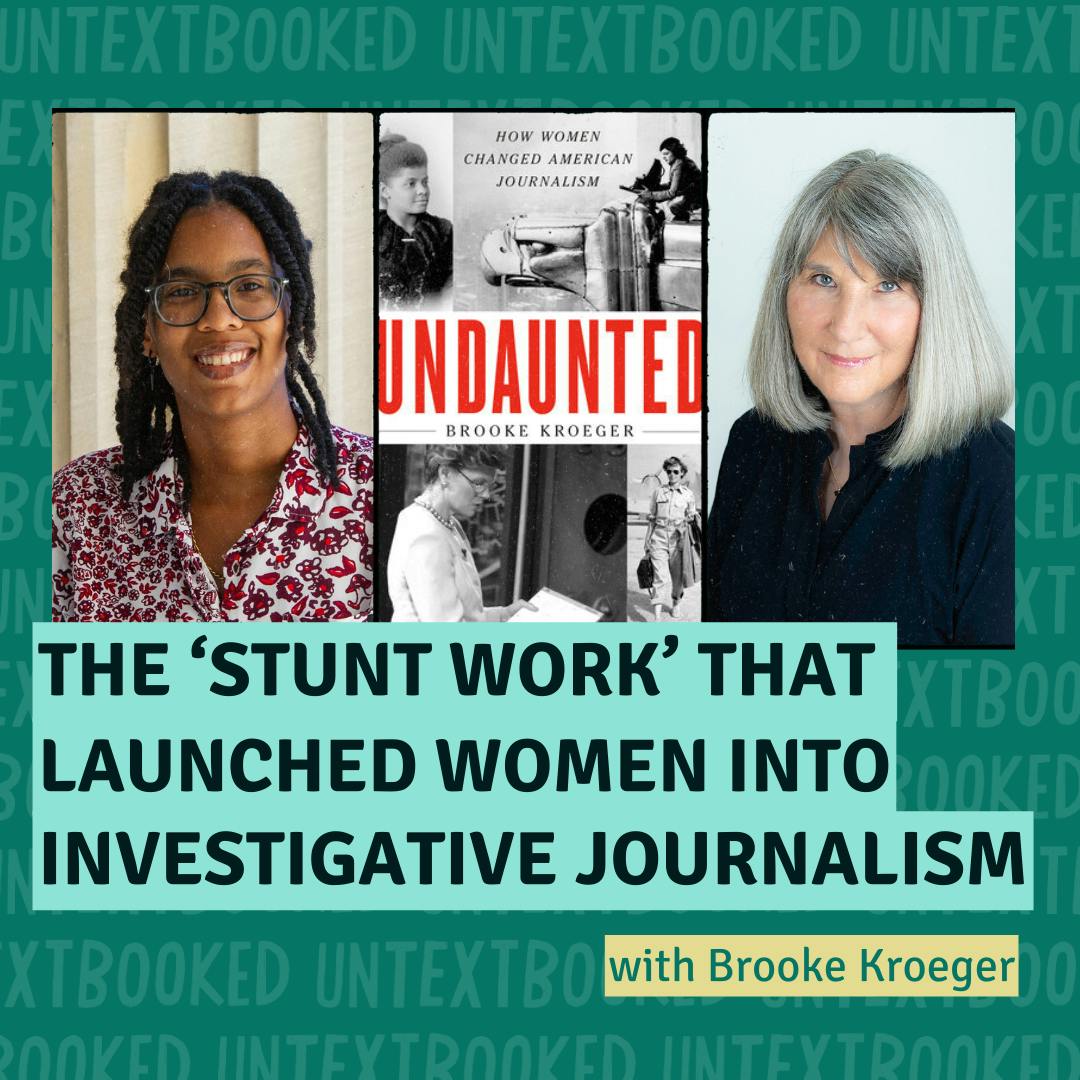
Women including Ida B. Wells and Nellie Bly were on the front edge of investigative journalism in the 1800s. But even with these historical trailblazers, why were women excluded from reporting hard news until recent history? Producer Jordan Pettiford sits down with author, journalist and professor Brooke Kroeger to find out. Brooke has authored six books and her most recent book is “Undaunted: How Women Changed American Journalism”. Listen to new episodes every Thursday. Follow the show on Spotify, Apple podcasts, Amazon Music, or wherever you listen. That way you never miss an episode. Love the show? Consider writing us a review on your podcast app or telling a friend about the show. This really helps us spread the word. Learn more about the podcast at UnTextbooked.com. Show Notes: (00:00) - Introduction (1:08) - Who is Ida B. Wells? (2:08) - Journalist Nellie Bly and the Insane Asylum (6:04) - Women Journalists & ‘Stunt Work’ (8:03) - Ida B. Wells’ Entry Into Journalism (10:05) - Ida B. Wells & Lynching Investigations (11:24) - ‘Sob Sisters’ and ‘Front Page Girls’ of the 1920s (12:48) - Women as War Correspondents (14:43) - Impact of The Civil Rights Act of 1964 (18:18) - Scrutiny Women Face in Broadcast Journalism (20:46) - Female Executive Editors at Top News Organizations (23:13) - Brooke Kroeger’s Advice for Young Journalists (26:27) - Reflections
S4 Ep 1Is Freedom of Speech Around the World Backsliding?
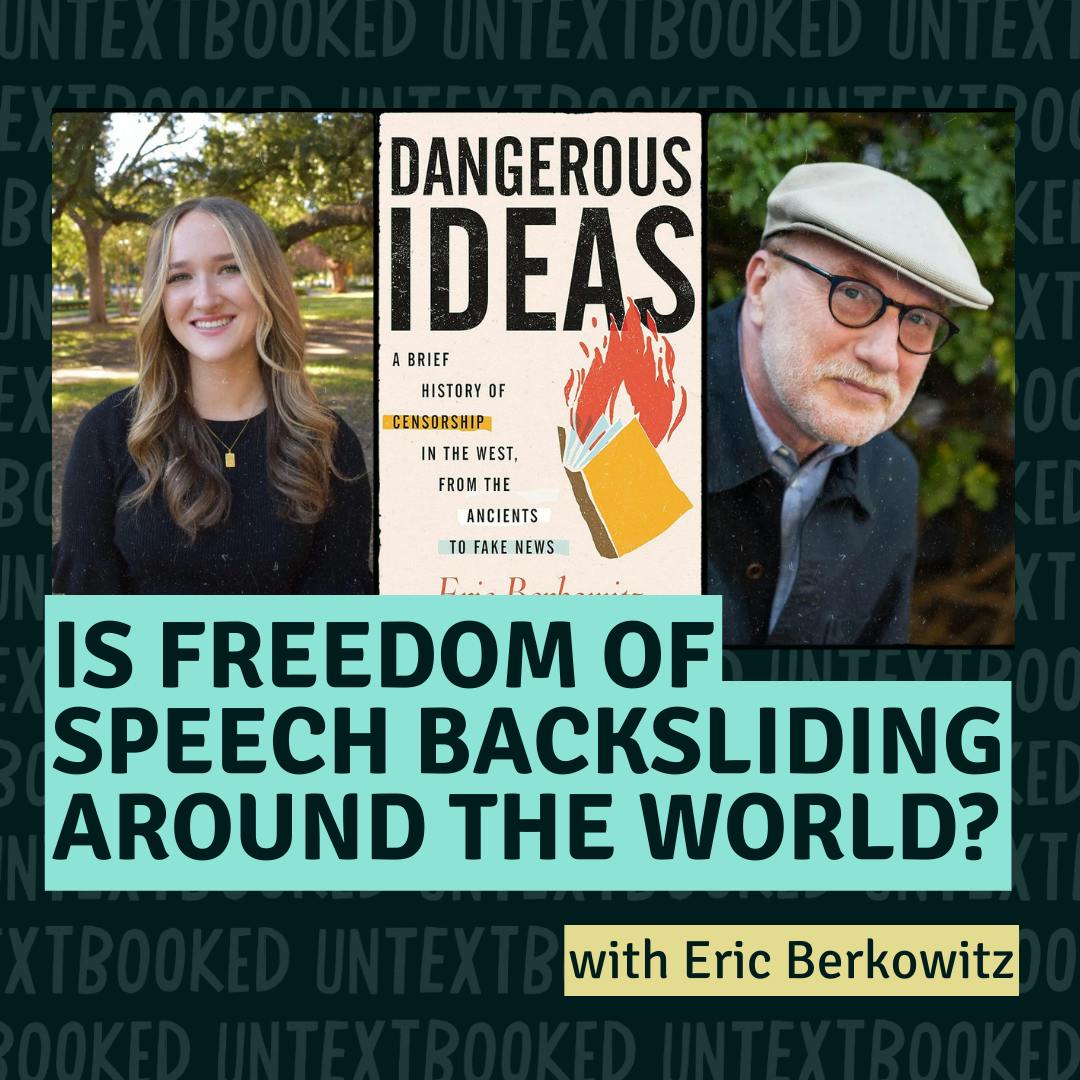
From banned books to freedom of speech in academic settings, censorship is a topic that affects the everyday lives of young people. This week, UnTextbooked producer and college student Karly Shepherd talks to Eric Berkowitz, human rights lawyer, journalist and author. His latest book “Dangerous Ideas: A Brief History of Censorship from the Ancients to Fake News” covers about 2,000 years of censorship history. Censorship has existed since the dawn of language, consistently targeting themes like sex, religion and politics. But why does censorship exist? And does censorship even work? Listen to new episodes every Thursday. Follow the show on Spotify, Apple podcasts, Amazon Music, or wherever you listen. That way you never miss an episode. Love the show? Consider writing us a review on your podcast app or telling a friend about the show. This really helps us spread the word. Learn more about the podcast at UnTextbooked.com. Show notes: (00:00) - What can London Drill Music have to do with Censorship? (02:00) - China’s first emperor Qin Shi Huang (07:11) - Limits of Free Speech in Athens and Ancient Greece (13:58) - The Comstock Act and Censorship (15:34) - Social Media, The Supreme Court and Freedom of Speech Today (24:06) - Why Censorship Never Works
UnTextbooked is back with Season Four!
trailerThis season, we talk to an original member of the Black Panther Party. We explore the extremely contradictory life of longtime FBI director J. Edgar Hoover. We talk to Smithsonian curators about the historical connection of Disneyland to American identity. Plus, we cover topics including censorship, fast fashion, women in journalism, PTSD, Internet hackers, and more. History is full of gems to discover and pitfalls to avoid. But you wouldn’t know it when sitting in a high school history class. That’s why we created UnTextbooked, a history podcast for the future. We’re a group of high school and college students from across the country. We're here to show young people that history is more than just what we learn in schools. It's exciting, scary, creative, nuanced and surprising. Listen to new episodes every Thursday. Follow the show on Spotify, Apple podcasts, or wherever you listen. That way you never miss an episode. Love the show? Consider writing us a review on your podcast app or telling a friend about the show. This really helps us spread the word. Learn more about the podcast at UnTextbooked.com.

UnTextbooked Out of the Studio: Reimagining a New Vision for Education at the ASU+GSV Summit
bonusUnTextbooked heads to sunny San Diego, California, for the ASU+GSV Summit and we brought our microphones with us! Host Gabe Hostin and founding producer Victor Ye talked to innovative EdTech leaders, teachers and social entrepreneurs to discuss how we can collaboratively write a new chapter in the history of education. Plus, they ask the question, what else do we need to unlearn? This week’s guests: Steven Hernandez, ESQ, Executive Director for the Connecticut Commission on Women, Children and Seniors. Esther Wojcicki, Teacher, Author, and Founder of Palo Alto High School’s Media Arts Program David Adams, CEO of The Urban Assembly Gregg Behr, Founder & Co-chair of Remake Learning and Executive Director of The Grable Foundation Kim Smith, Innovator, Serial Social Entrepreneur and Founding Team Member of Teach For America UnTextbooked is a history podcast for the future. Listen to new episodes every Thursday starting October 19th. Follow the show on Spotify, Apple Podcasts, or wherever you listen. That way you never miss an episode. Love the show? Write us a review on your podcast app or tell a friend about the show. This really helps us spread the word. Learn more about the podcast at UnTextbooked.com.
Introducing: History Detective
bonusBonus Episode in Partnership with History Detective: On this episode of History Detective, host Kelly Chase introduces us to Tarenorerer, the Tasmanian First Nations female warrior who led her tribe against the British colonists. About History Detective: History Detective is a podcast for teachers, students and lovers of history. It delves into stories from the past that don’t always get told in the textbooks. Every episode will include an original song that compliments the topic. This is a classroom friendly resource that aligns with history curriculums. Visit Amped Up Learning for accompanying teaching resources for every episode.
Introducing: Getting Smart
bonusBonus Episode in Partnership with Getting Smart: On this episode of the Getting Smart Podcast Nate McClennen is joined by three incredible students who recently competed in the Regeneron Science Talent Search, an event co-hosted with Society for Science. Check out our podcast episode with Maya Ajmera to hear more about Society for Science. The students are Christine Ye, a student at Eastlake High School Aseel Rawashdeh, a student at Anderson High School, and Elijah Burks, a student at Caddo Parish Magnet High School. Let’s listen in as they discuss their science projects, what project-based learning has done for them as learners, agency, and much more. About Getting Smart: This podcast highlights developing trends in K-12 education, postsecondary and lifelong learning. Each week, Getting Smart team members interview students, leading authors, experts and practitioners in research, tech, entrepreneurship and leadership to bring listeners innovative and actionable strategies in education leadership. This podcast is most frequently hosted by Tom Vander Ark, CEO of Getting Smart. Be sure to check out the Getting Smart Newsletter and Twitter Feed to stay on the cutting edge of innovations in learning.
Introducing: Changing Course
bonusBonus Episode in Partnership with Changing Course: Host Jonathan Santos Silva speaks with leaders and educators from The Center for Black Educator Development in Philadelphia, PA, about how to create safe spaces that value and invest in young Black leaders. The Center is the first teaching academy in Philadelphia dedicated to investing in the next generation of Black teachers, starting as early as high school. Guided by the lens that excellent education is a political act, Sharif El-Mekki and his team at the Center demonstrate how restoring education to disenfranchised students is the purest form of activism. Changing Course is a podcast from Teach For America's One Day Studio. About Teach For America: Teach For America is a diverse network of leaders who work to confront the injustice of educational inequity through teaching, and at every sector of society. Learn how we are driving impact across the country to achieve our vision that one day, all children in this nation will have an opportunity to attain an excellent education. UnTextbooked is not affiliated with Teach For America.
S3 Ep 15Best of Season 3
We’re wrapping up this incredible third season of UnTextbooked by looking back at the great work of our team of young producers. They covered topics and questions that really matter, including the rise of authoritarianism, mass incarceration, unprecedented changes in the Supreme Court, and much more! Each topic highlights how history isn’t just in the past, but also present in all of our lives. In this episode, our host Gabe Hostin and our Youth Program Coordinator CeCe Payne discuss excerpts from episodes we couldn’t stop thinking about this season: Did the American Civil War ever truly end? Is the U.S. government spying on its own citizens? How do Democracies Die? MUSIC: Silas Bohen and Coleman Hamilton PRODUCTION: Pod People - Hannah Pedersen, Danielle Roth, Shaneez Tyndall, and Michael Aquino. Want to be a part of our team for season 4? Apply Here. Episodes featured in this compilation: Episode 312 - Arya Barkesseh (producer) and Dr. Jeremi Suri (guest and author of Civil War By Other Means: America’s Long & Unfinished Fight For Democracy) Episode 308 - Victor Ye (producer) and Professor Robert Scheer (guest and author of They Know Everything About You: How Data-Collecting Corporations and Snooping Government Agencies are Destroying Democracy) Episode 313 - Jessica Chiriboga (producer) and Professor Daniel Ziblatt (guest and author of How Democracies Die)
S3 Ep 14Is the current Supreme Court a threat to justice?
In 2020, the Supreme Court was on the verge of transformation. Seismic events like the death of former Court Justice Ruth Bader Ginsburg, the appointment of conservative justice Amy Coney Barrett, and a polarizing presidential election laid the groundwork for major changes in decision-making seen today. On this episode of UnTextbooked, producer Karly Shepherd interviews Pulitzer Prize-winning New York Times journalist Linda Greenhouse to discuss the Supreme Court’s increasing politicization and domination by the religious right. With a supermajority of conservative Justices, how should we perceive the Supreme Court today and the effects of it’s political changes on the United States’ democracy? BOOK: Justice on the Brink: A Requiem for the Supreme Court GUEST: Linda Greenhouse PRODUCER: Karly Shepherd MUSIC: Silas Bohen and Coleman Hamilton PRODUCTION: Pod People - Hannah Pedersen, Danielle Roth, Shaneez Tyndall, and Michael Aquino. SHOW NOTES: Link to Linda Greenhouse’s work
S3 Ep 13How do democracies die?
Is our democracy in danger? In the years after Trump’s presidency, it’s tempting to say “not anymore,” but nowadays threats to democracy are no longer as obvious as a military coup or revolution. Instead, a democracy in danger manifests in much more subtle ways including: the steady decline of longstanding political norms and weakening of essential institutions such as the United States press and its courts system, both of which are already in jeopardy. On this episode of UnTextbooked, producer Jessica Chiriboga interviews New York Times best-selling author, Professor Daniel Ziblatt to discuss how to spot the signs of a dying democracy and how American democracy might be salvaged. BOOK: How Democracies Die GUEST: Professor Daniel Ziblatt PRODUCER: Jessica Chiriboga MUSIC: Silas Bohen and Coleman Hamilton PRODUCTION: Pod People - Hannah Pedersen, Danielle Roth, Shaneez Tyndall, and Michael Aquino. SHOW NOTES: Link to Daniel Ziblatt’s work
S3 Ep 12Did the American Civil War ever truly end?
Although the American Civil War ended many years ago, the fight for “a more perfect union” never quite did. A few months after the union army’s victory, confederate-style, white supremacist resistance emerged even stronger than before. On this episode of UnTextbooked, producer Arya Barkesseh interviews Dr. Jeremi Suri, who argues that opposition to the union army’s victory started almost immediately after the war ended, preventing Lincoln’s vision of a genuinely united country from actually taking root. Today, these deep wounds of division remain fresh as citizens of the United States continue to wrestle with competing visions of democracy, race, and freedom over 150 years later. BOOK: Civil War By Other Means: America’s Long & Unfinished Fight For Democracy GUEST: Dr. Jeremi Suri PRODUCER: Arya Barkesseh MUSIC: Silas Bohen and Coleman Hamilton PRODUCTION: Pod People - Hannah Pedersen, Danielle Roth, Shaneez Tyndall, and Michael Aquino. SHOW NOTES: Link to Dr. Jeremi Suri’s work This is Democracy - podcast
S3 Ep 11How did citizen protests help end the Cold War?
The Cold War was marked by a bitter rivalry between the United States and the Soviet Union. Although former WWII NATO allies, what emerged was an atmosphere of constant fear for national security and a dangerous nuclear arms race. On this episode of UnTextbooked, producer Lap Nguyen and Professor Susan Colbourn unpack the power of citizen protest and the crucial factors that eventually brought the contentious war to a peaceful end. BOOK: Euromissiles: The Nuclear Weapons that Nearly Destroyed NATO GUEST: Professor Susan Colbourn PRODUCER: Lap Nguyen MUSIC: Silas Bohen and Coleman Hamilton PRODUCTION: Pod People - Hannah Pedersen, Danielle Roth, Shaneez Tyndall, and Michael Aquino. SHOW NOTES: Link to Susan Colbourn’s work
S3 Ep 10How does naval domination control who runs the world?
In the 1930s, six naval powers roamed the world’s oceans: Great Britain, the United States, France, Italy, Germany, and Japan. Each nation was subject to the Washington Naval Treaty, which granted 60% of the world’s battleships to the Royal and US Navy, 20% to Japan, and 20% to France and Italy. However by 1945, the United States Navy had expanded to a fleet larger than that of all the great powers. What exactly did that mean in the wake of WWII? On this episode of UnTextbooked, producer Will Bourell interviews Professor Paul Kennedy, who argues that the expansion of the U.S. Navy during WWII cemented them at the top of a new international world order. BOOK: Victory at Sea: Naval Power and the Transformation of the Global Order in World War II GUEST: Paul Kennedy PRODUCER: Will Bourell MUSIC: Silas Bohen and Coleman Hamilton PRODUCTION: Pod People - Hannah Pedersen, Danielle Roth, Shaneez Tyndall, and Michael Aquino. SHOW NOTES: Link to Paul Kennedy’s work
S3 Ep 9Was the fall of the USSR inevitable?
By 1945, the Soviet Union was a founding member of the United Nations and a global superpower controlling half of Europe. By 1991, with five thousand nuclear missiles at its disposal and an army four million strong, the USSR was a formidable rival for the United States. But by the end of the year, the union would meet its untimely demise. Most historians have argued that the fall of the USSR was inevitable, but Vlad Zubok author of Collapse: The Fall of the Soviet Union sees things differently. In his book, Zubok offers a major reinterpretation of the last years of this seismic event revealing how nationalist separatism and the misguided reforms of former Russian president Mikhail Gorbachev ultimately destroyed the Soviet Union. On this episode of UnTextbooked, producer Ismail Assafi and Professor Vlad Zubok revisit those final years of the USSR exploring whether it could’ve been saved, and what precedents its fall set for modern day geopolitical climates. BOOK: Collapse: The Fall of the Soviet Union GUEST: Vladislav Zubok PRODUCER: Ismail Assafi MUSIC: Silas Bohen and Coleman Hamilton PRODUCTION: Pod People - Hannah Pedersen, Danielle Roth, Shaneez Tyndall, and Michael Aquino. SHOW NOTES: Link to Vlad Zubok’s work
S3 Ep 8Is the U.S. government spying on its own citizens?
As human beings, our privacy is one of our most basic needs and most sacred rights. However, in the modern information age, these rights are constantly under attack. How does the American federal government collect our data and what happens when the institutions meant to protect our privacy opts to instead use that information for their gain? On this episode of UnTextbooked, producer Victor Ye interviews Robert Scheer to discuss how we can best protect ourselves in an era where the U.S. government has abandoned Constitutional privacy protections in favor of 24/7 citizen surveillance. BOOK: They Know Everything About You: How Data-Collecting Corporations and Snooping Government Agencies are Destroying Democracy GUEST: Robert Scheer PRODUCER: Victor Ye MUSIC: Silas Bohen and Coleman Hamilton PRODUCTION: Pod People - Hannah Pedersen, Danielle Roth, Shaneez Tyndall, and Michael Aquino. SHOW NOTES: Link to Robert Scheer’s work
S3 Ep 7What does history teach us about the future of technology?
Technology plays a vital role in our society day-to-day, but what exactly is our role when it comes to managing our tech? How do our internal biases impact the products we create? Can technological advances actually be “neutral” as a product of human imagination? These are all questions to consider as we take a look at how human and computational infrastructures overlap. On this episode of UnTextbooked, producer Caroline Somers interviews Professor Thomas S. Mullaney to discuss the impact of technology– good and bad–on modern society and our role in responsibly using it. If every advance is linked to a social issue from our past, what might history teach us about our technological future? BOOK: Your Computer is on Fire GUEST: Thomas S. Mullaney PRODUCER: Caroline Somers MUSIC: Silas Bohen and Coleman Hamilton PRODUCTION: Pod People - Hannah Pedersen, Danielle Roth, Shaneez Tyndall, and Michael Aquino. SHOW NOTES: Link to Thomas S. Mullaney’s work
S3 Ep 6What was the gay bar and how did it shape gay identity?
The gay bar has long since been a locale of sexual expression, community, and most importantly, identity. If the gay bar was what Atherton Lin describes as, “a place where we hoped we could find ourselves,” what does it mean for queer identity when the spaces that once shaped and defined it are steadily vanishing in urban centers world-wide? In his wistful personal and cultural memoir, Gay Bar: Why We Went Out (named one of the best books of 2021 by the New York Times, NPR, and Vogue), essayist Jeremy Atherton Lin speaks to the impact of the gay bar on his own identity development and how the gathering space created a generation of chance encounters that shaped his life. On this episode of UnTextbooked, producer Jenny Fan interviews Atherton Lin taking a closer look at what recent shutdowns of such spaces have meant for those who came of age in them and the new generations now seeking to define their queer identity. BOOK: Gay Bar: Why We Went Out GUEST: Jeremy Atherton Lin PRODUCER: Jenny Fan MUSIC: Silas Bohen and Coleman Hamilton PRODUCTION: Pod People - Hannah Pedersen, Danielle Roth, Shaneez Tyndall, and Michael Aquino. SHOW NOTES: Jeremy Atherton Lin’s playlists and sound essays can be heard on NTS Radio and Mixcloud, or by visiting his website.
S3 Ep 5Is mass incarceration doing more harm than good?
More American residents are behind bars than any other nation. While the U.S. Criminal Justice System was established to regulate peace and order, it has since become the catalyst for criminalizing of people of color. Fueled by initiatives like Nixon’s “War on Drugs” campaign, which unfairly targeted communities of color, mass incarceration has steadily been on the rise. Despite the staggering amount of people behind bars, the crime rates haven’t exactly been on the decline, raising the question: do prisons actually keep us safe? On this episode of UnTextbooked, producer Sydne Clarke interviews Victoria Law whose groundbreaking book investigates the brutal history of mass incarceration in the United States, showing how dismantling mass incarceration starts with unpacking the myths surrounding it. BOOK: Prisons Make Us Safer: And 20 Other Myths about Mass Incarceration GUEST: Victoria Law PRODUCER: Sydne Clarke MUSIC: Silas Bohen and Coleman Hamilton PRODUCTION: Pod People - Hannah Pedersen, Danielle Roth, Shaneez Tyndall, and Michael Aquino. SHOW NOTES: Link to Victoria Law’s work
S3 Ep 4How did guns divide the United States?
The Second Amendment to the U.S. Constitution has roots in strong firearm regulation and gun safety policy, but over the years, it’s become a mantra for gun rights advocates. On this episode of UnTextbooked, producer Ellie Carver-Horner interviews Professor Adam Winkler about how over time, the Second Amendment to the U.S. Constitution (the right to bear arms) historically caused a major divide in the United States and the impact of that extreme split today. BOOK: Gunfight: The Battle Over the Right to Bear Arms in America GUEST: Professor Adam Winkler, J.D. PRODUCER: Ellie Carver-Horner MUSIC: Silas Bohen and Coleman Hamilton PRODUCTION: Pod People - Hannah Pedersen, Danielle Roth, Shaneez Tyndall, and Michael Aquino. SHOW NOTES: Link to Professor Adam Winkler’s work
S3 Ep 3What is religious racism and how has it progressed from past to present?
The first amendment to the United States Constitution guarantees that everyone has the right to practice his or her own religion or no religion at all. A similar guarantee exists in Canada under its Charter of Rights and Freedoms. However, this right to religious freedom hasn’t necessarily been assured for practitioners of traditional African religions throughout history in North America and beyond. On this episode of UnTextbooked, producer Jordan Pettiford interviews Dr. Danielle Boaz to discuss the impact of religious racism and how it’s been consistently used, from colonial times to modern day, to oppress practitioners of African diaspora religions. BOOK: Banning Black Gods: Laws and Religions of the African Diaspora GUEST: Dr. Danielle N. Boaz PRODUCER: Jordan Pettiford MUSIC: Silas Bohen and Coleman Hamilton PRODUCTION: Pod People - Hannah Pedersen, Danielle Roth, Shaneez Tyndall, and Michael Aquino. SHOW NOTES: Link to Dr. Boaz’s work
S3 Ep 2Are we telling U.S. Indigenous history wrong?
There are more than five hundred federally recognized Indigenous nations in the United States today, nearly three million people, but their stories have largely been omitted from the nation’s history. On this episode of UnTextbooked, producer Gavin Scott interviews acclaimed historian and activist, Professor Roxanne Dunbar-Ortiz and takes a look at U.S. History through the lens of Indigenous Peoples and unpacks what we’ve been missing as a nation without their perspective. BOOK: An Indigenous People's History of the United States GUEST: Professor Roxanne Dunbar-Ortiz PRODUCER: Gavin Scott MUSIC: Silas Bohen and Coleman Hamilton PRODUCTION: Pod People - Hannah Pedersen, Danielle Roth, Shaneez Tyndall, and Michael Aquino. SHOW NOTES: Link to Professor Roxanne Dunbar-Ortiz’s work
Season Three: New Questions, New Answers
trailerUntextbooked is a movement of curious students from around the world -- and we are BACK with new episodes and new questions. What perspectives do we miss in history class? What historical forces shape our lives today? We study up on topics that interest us -- indigenous history, the status of democracy, future of technology -- and then reach out to scholars to have a conversation for the podcast. Listen every Thursday wherever you listen to podcasts. Hit the follow button on Spotify or the little plus sign on Apple podcasts. That way you never miss an episode. Hear the stories that we want everyone to know more about so we can understand the world we are living in. These are the histories we want to uncover as we take history out of the textbook. Learn more about the podcast at UnTextbooked.com.
S3 Ep 1What is causing the global fall of democracy?
Throughout the world, democratic progress has not only halted, but receded over the past few years and the United States has been one of the main perpetrators. On this episode of UnTextbooked, producer Oliver Wang interviews Former Deputy National Security Advisor of the United States (Obama Administration), Ben Rhodes to discover who is to blame for the global fall of democracy and how we might return to a truly democratic identity. BOOK: After the Fall: The Rise of Authoritarianism in the World We've Made GUEST: Ben Rhodes PRODUCER: Oliver Wang MUSIC: Silas Bohen and Coleman Hamilton PRODUCTION: Pod People - Hannah Pedersen, Danielle Roth, Shaneez Tyndall, and Michael Aquino. SHOW NOTES: Link to Ben Rhodes’ work

Best of Season 2
We’ve completed our second season of UnTextbooked! Our team of young producers have done phenomenal work exploring topics and questions that really matter, including episodes about the War on Terror, Native American boarding schools, population control, and much more. In this episode our editor Bethany Denton shares excerpts from four of her favorite Season 2 episodes: Is every presidency doomed to fail? Can the War on Terror ever truly end? Does population control work? Why were Native American kids required to attend boarding schools? Want to be part of our team for season 3? Apply here. Music: Silas Bohen and Coleman Hamilton Editors: Bethany Denton and Jeff Emtman

S2 Ep 15Did anyone win the Cold War?
The Cold War was a decades-long military conflict that dominated geopolitics in the latter half of the 20th century. And as Americans, we often see it framed as a binary conflict between the United States and the Soviet Union; one that ended around the time the Berlin Wall came down in 1989. But historian Odd Arne Westad, author of The Global Cold War, thinks that version of the story is incomplete. The US and USSR never engaged in direct combat with one another, so the Cold War was fought indirectly via proxy wars and embargoes, and many Third World countries are still dealing with the effects. On this episode of UnTextbooked, producer Anya Dua interviews Dr. Westad about the global impacts of the Cold War, more than thirty years after it ended. Book: The Global Cold War Guest: Dr. Odd Arne Westad, Professor of history at Yale University Producer: Anya Dua Music: Silas Bohen and Coleman Hamilton Editors: Bethany Denton and Jeff Emtman

S2 Ep 14Did segregation in America ever really end?
The United States is still reckoning with its history of racism. For a century after slavery ended, US businesses, banks, schools, and neighborhoods were segregated by race. It took a series of Supreme Court cases and acts of Congress to legally ban discrimination based on race, but discrimination isn’t just a switch that can be turned from “on” to “off.” The legacy of these unfair laws still affect Black Americans today. One example of this is is a method of housing discrimination called “redlining”. It refers to the practice of banks and federal agencies denying loans for homes in neighborhoods deemed too “high risk”, which was often code for “not white.” This made it harder for Black Americans to buy homes, which made it harder to accrue generational wealth. As a result, Black Americans are more likely to live in neighborhoods with lower property values. And in a country where public schools are funded by property taxes, this is a difficult cycle to break. In effect, the United States is still segregated, but unofficially. Richard Rothstein has been studying this disparity for a long time. He wrote about it in his book The Color of Law. On this episode of UnTextbooked, producer Jonathan Dabel interviews Mr. Rothstein about the lasting effects of redlining on Black Americans. Book: The Color of Law: A Forgotten History of How Our Government Segregated America Guest: Richard Rothstein, PhD, Distinguished Fellow of the Economic Policy Institute and a Senior Fellow (emeritus) at the Thurgood Marshall Institute of the NAACP Legal Defense Fund. Producer: Jonathan Dabel Music: Silas Bohen and Coleman Hamilton Editors: Bethany Denton and Jeff Emtman

S2 Ep 13When will Asian Americans stop being seen as "perpetual foreigners"?
There is a fundamental duality in how Asian Americans are perceived in our country. They’ve at times been held up as the “model minority”, affirming this idea that the American Dream is alive and well if only immigrants could work harder. At other times they’ve been regarded as threatening and perpetually foreign. A recent example of this is the dramatic rise in anti-Asian violence in the wake of the covid-19 pandemic. On this episode of UnTextbooked, producer Victor Ye interviews Dr. Erika Lee, author of The Making of Asian America: A History. They discuss the history of Asians in America and why stereotypes from hundreds of years ago still persist today. Book: The Making of Asian America: A History Guest: Erika Lee, PhD, History Professor at the University of Minnesota Producer: Victor Ye Music: Silas Bohen and Coleman Hamilton Editors: Bethany Denton and Jeff Emtman

S2 Ep 12What does American cuisine tell us about the United States?
American food is unlike anything else in the world. And it goes a lot deeper than hamburgers and pizza. The thing that makes American food special is the stunning variety of options and how accessible it is to the average consumer. Also some regional American dishes that are impossible to find anywhere else on the planet Dr. Paul Freedman is a historian who thinks that all of these factors--standardization, variety, and regionality--can tell us a lot about American culture and identity. On this episode of UnTextbooked, producer Grace Davis interviews Dr. Freedman about his book American Cuisine: and How it Got This Way. Book: American Cuisine: and How it Got This Way Guest: Dr. Paul Freedman, Professor of History at Yale University Producer: Grace Davis Music: Silas Bohen and Coleman Hamilton Editors: Bethany Denton and Jeff Emtman

S2 Ep 11Why do Brazilian cars run on sugar?
It’s no secret that society will eventually have to transition away from fossil fuels. Some governments and businesses think the answer is biofuels,like ethanol. Ethanol is a type of alcohol—the same type of alcohol that humans have been producing for millenia. And so, in much of the world, the techniques to produce ethanol are already known and exploited. All it takes is the fermentation of sugary crop, like potatoes, corn, or sugarcane. The result is a clear liquid fuel that can power engines, similar to gasoline. Brazil has long been the world’s leading producer of sugarcane. In the 1970’s, Brazil started switching more and more of its fuel supply over to ethanol. What started as an effort to combat the trade embargoes turned into a large-scale experiment on alternative fuels. But the story of Brazilian ethanol is complicated—It’s a worldwide industry predicated on exploitative labor and has significant environmental problems of its own. On this episode of UnTextbooked, producer Jessica Chiriboga interviews Jennifer Eaglin, about the history of Brazil’s ethanol industry. They discuss the conditions that primed Brazil to make the transition, and the lessons learned along the way. Book: Sweet Fuel: A Political and Environmental History of Brazilian Ethanol Guest: Jennifer Eaglin, PhD, Assistant Professor of Environmental History and Sustainability at Ohio State University Producer: Jessica Chiriboga Music: Silas Bohen and Coleman Hamilton Editors: Bethany Denton and Jeff Emtman

S2 Ep 10What does resilience look like for Iranian women?
For centuries, Iran had a strict social hierarchy that prevented women—particularly upper class women—from participating in public life. This started to change in the early 20th century when Iranians became disillusioned with the ruling class and had a constitutional revolution. This new constitution established a parliament, public schools, and also opened the door for women to start asserting their own rights to education and employment. Following the constitutional revolution was a period of rapid modernization in Iran. Girls were allowed to go to school, and women were encouraged to stop veiling to look more like their European counterparts. Over the course of a few decades, women’s role in society changed dramatically. In 1979, their roles changed again. Islamic fundamentalists were frustrated by Western influence on Iran’s culture and economy, and ushered in another revolution. Almost overnight, women were once again restricted from participating in public life. This history fascinates UnTextbooked producer Arya Barkesseh. He’s Iranian American, and after witnessing a White Wednesday protest while on a family trip to Tehran, he wanted to know more about the evolution of women’s rights in Iran. On this episode of UnTextbooked, Arya interviews Dr. Janet Afary, author of the book Sexual Politics in Modern Iran. They discuss the cultural context for both the constitutional and Islamic revolutions, and the ways in which Persian women have asserted agency in big and small ways throughout history. Book: Sexual Politics in Modern Iran Guest: Janet Afary, PhD, professor of religious studies at the University of California, Santa Barbara Producer: Arya Barkesseh Music: Silas Bohen and Coleman Hamilton Editors: Bethany Denton and Jeff Emtman

S2 Ep 9How did tolerance become an American value?
There’s a lot of evidence that America is more divided than ever. Our politics, media, and ideologies are so polarized that it puts a stress on our unity as a country. But Dr. Denis Lacorne says that, in spite of that tension, America’s strength comes from our nation’s commitment to tolerance. The trick is figuring out the balance of tolerating the intolerant. On this episode of UnTextbooked, producer Karly Shepherd interviews Dr. Lacorne about his book The Limits of Tolerance. They explore the origins of the concept, and its impact on American culture. Book: The Limits of Tolerance. Enlightenment Values and Religious Fanaticism Guest: Dr. Denis Lacorne, senior research fellow at the Paris Institute of Political Studies Producer: Karly Shepherd Music: Silas Bohen and Coleman Hamilton Editors: Bethany Denton and Jeff Emtman

S2 Ep 8Is every presidency doomed to fail?
The Founders of the United States envisioned the presidency as an office that would be minimal in reach. They didn’t want the USA to be a monarchy. But incrementally, the executive branch has expanded. And now, scholars like Dr. Jeremi Suri argue that the modern presidency is crushed by its own power and unable to be fully wielded by the President, leading to decades of broken promises and deep disillusionment amongst citizens. On this episode, UnTextbooked producer Lap Nguyen interviews Professor Suri about the shifting nature of the presidency and why FDR is such a hard act to follow. Book: The Impossible Presidency: The Rise and Fall of America's Highest Office Guest: Dr. Jeremi Suri, Professor of Public Affairs and History at University of Texas, Austin Producer: Lap Nguyen Music: Silas Bohen and Coleman Hamilton Editors: Bethany Denton and Jeff Emtman

S2 Ep 7How did Black Americans forge a cultural identity?
UnTextbooked producer Sydne Clarke thinks that African American history is often oversimplified or overlooked. Often that history is taught as things that happened to African Americans. We don’t often hear about the ways in which African Americans fought for and took care of themselves. Dr. Leslie Alexander studies Black resistance movements, particularly in America. In her research Dr. Alexander has discovered communities and people who were vital to Black activism, but are often forgotten in re-telling African American history. On this episode of UnTextbooked, Sydne interviews Dr. Alexander about her book African or American? Black Identity and Political Activism in New York City, 1784-1861. They talk about the creation of Black-led organizations for mutual aid, and about how African heritage influenced Black activism then and now. Book: African or American? Black Identity and Political Activism in New York City, 1784-1861 Guest: Dr. Leslie Alexander, associate professor of history and African American studies at Arizona State University Producer: Sydne Clarke Music: Silas Bohen and Coleman Hamilton Editors: Bethany Denton and Jeff Emtman

S2 Ep 5Were history’s greatest leaders generalists or specialists?
The Greek poet Archilochus said “a fox knows many things, a hedgehog knows one big thing.” This phrase inspired a famous essay by a 20th century philosopher named Isaiah Berlin, who said that pretty much all people can be categorized as either “foxes” or “hedgehogs”. Foxes tend to be agile and perceptive, whereas hedgehogs tend to be resolute and hyper-focused on their end goal. Historian John Lewis Gaddis took Berlin’s framework one step further. In his book On Grand Strategy, Dr. Gaddis categorizes great political leaders as landing somewhere on the fox-hedgehog spectrum: Xerxes I, Philip II, Ronald Reagan are all classic hedgehogs. Elizabeth I, Shakespeare, and Hillary Clinton are all examples of foxes. And Gaddis says if you’re lucky, you’ll sometimes have a leader who embodies both, as was the case with Abraham Lincoln and Franklin D. Roosevelt. On this episode of UnTextbooked, producer Will Bourell interviews Dr. Gaddis about the traits that make for effective and ineffective leaders. Book: On Grand Strategy Guest: John Lewis Gaddis, Professor of history at Yale University Producer: Will Bourell Music: Silas Bohen and Coleman Hamilton Editors: Bethany Denton and Jeff Emtman