UnTextbooked | A history podcast for the future
73 episodes — Page 2 of 2

S2 Ep 5Is there an American Empire?
With a name like “The United States of America”, it can be easy to forget that this country’s borders extend well beyond the fifty states of the union. In fact, millions of American citizens live on US territory well outside those borders. It’s not just Guam, Puerto Rico, American Samoa, the US Virgin Islands, and the North Mariana Islands, but the many military bases we occupy across the globe too. “Empire” might not always be a word associated with the USA, but some historians think the label fits. Dr. Daniel Immerwahr is one of them, and he thinks that the country’s trajectory in capturing new territory bears a striking resemblance to the British Empire—the same one that the country’s architects were so often critical of. Book: How to Hide an Empire: a History of the Greater United States Guest: Dr. Daniel Immerwahr, Professor of history at Northwestern University Producer: Elliot Smith Music: Silas Bohen and Coleman Hamilton Editors: Bethany Denton and Jeff Emtman

S2 Ep 4Does population control work?
A hundred years ago, there were roughly 2 billion people in the world. Today, there are almost 8 billion. This rapid quadrupling of the world’s population has people asking, is the planet overpopulated? Some say, yes. Others say that it’s not so simple. This isn’t a new question. Researchers in the 19th and 20th centuries warned that unfettered population growth would lead to famine, poverty, and climate destruction. Some governments and aid agencies took those warnings to heart, and implemented programs to try and lower fertility rates. These programs were sometimes coercive, often incentivizing poor people to be sterilized or have abortions they didn’t want. Some societies are still living with unintended consequences of these efforts to control population. Still, the question of whether the earth is overpopulated is still contested UnTextbooked producer Oliver Wang had always been curious about population control. He’s Chinese American, and his family had been shaped by the One-Child policy. So he read the book Fatal Misconception by Dr. Matthew Connelly to learn more. On this episode of UnTextbooked, Oliver and Dr. Connelly explore the origin and impact of population control efforts. Book: Fatal Misconception: The Struggle to Control World Population Guest: Dr. Matthew Connelly Producer: Oliver Wang Music: Silas Bohen and Coleman Hamilton Editors: Bethany Denton and Jeff Emtman

S2 Ep 3Why were Native American kids required to attend boarding schools?
In the spring of 2021, UnTextbooked producer Gavin Scott read a headline that made his heart sink. The remains of 215 indigenous children were discovered buried in a mass grave near the Kamloops Indian Residential School in Kamloops, British Columbia. Over the next few months, more mass graves were found outside of other Canadian residential schools. Before they died, these children had been part of a program of forced assimilation. For more than a century, thousands of indigenous children in Canada were required to attend residential schools. The purpose of these schools was to teach them English and encourage them to behave more like white settlers. Survivors of the residential school system say the environment was often harsh. Lots of kids ran away, and some didn’t survive their time at school. Producer Gavin Scott is Native American, and even though he didn’t have a personal connection to the Canadian residential schools, he knew that the United States had also operated boarding schools with similar intentions. But Gavin didn’t really learn much about this history when he was in school. He wanted to know how these schools operated and how they affected the lives of students that attended them. In this episode of UnTextbooked, Gavin interviews Dr. Brenda Child. Dr. Child is a scholar of American Indian studies, and she wrote the book Boarding School Seasons: American Indian Families 1900-1940 after reading hundreds of letters written by students, families, and administrators at the Flandreau Indian School and the Haskell Institute. Gavin also interviews his Great Aunt, Babe, about her experiences attending Haskell and the Concho Indian School as a child. Book: Boarding School Seasons: American Indian Families 1900-1940 Guest: Dr. Brenda Child, Professor of American Studies and American Indian Studies at the University of Minnesota Producer: Gavin Scott Music: Silas Bohen and Coleman Hamilton Editors: Bethany Denton and Jeff Emtman

S2 Ep 2Can protests save lives? How ACT UP helped tame the AIDS crisis.
One morning in 1991, Senator Jesse Helms’ house was covered with a giant fake condom in an act of protest. Helms had been a vocal opponent of funding AIDS research and he had introduced an infamous and popular bill amendment that prevented federal money from being spent on AIDS research. There were few treatments available at the time, and with no help from the government, HIV was actively spreading across the country. In 1991 alone, nearly 30,000 American died of AIDS, and the numbers would keep rising until the late nineties. The condom on Helms’ house was courtesy of the protest group ACT UP, which led a number of high profile direct actions meant to call attention to the AIDS crisis and get people angry. UnTextbooked’s Jordan Pettiford was curious about queer history. She came out to her family around the same time the Covid-19 pandemic began. While the context of Covid felt different, she noticed some strange similarities between the present day and the history of AIDS—especially the way in which viruses become political. In this episode, Jordan interviews David France, author of How to Survive a Plague. David France was a first-hand witness to the AIDS epidemic in New York City. He covered the unique actions of the protest movement that called out the government’s inaction and discrimination. Book: How to Survive a Plague: The Inside Story of How Citizens and Science Tamed Aids Guest: David France, writer and filmmaker Producer: Jordan Pettiford Music: Silas Bohen and Coleman Hamilton Editors: Bethany Denton and Jeff Emtman

S2 Ep 1Can the War on Terror ever truly end?
The War On Terror is the longest foreign war the United States has ever fought. So long that many of the soldiers fighting weren’t even alive when it started. But the WoT seems unusual for another reason—it’s not a war on a nation, or even an organization—it’s a war against a concept. September 11, 2001 was the alleged start date of this conflict, after the Twin Towers fell. President George W. Bush stood before congress announcing, “Our war on terror begins with al Qaeda, but it does not end there. It will not end until every terrorist group of global reach has been found, stopped and defeated.” For many young people, the WoT is all they’ve ever known, and it can be hard to imagine a time before the United States fought this kind of war. But Dr. Alex Lubin counters this idea in his book: Never-Ending War on Terror. He argues that the United States often prefers this kind of conceptual warfare, and those examples can be seen in the American Indian Wars and the response to movements such as the Black Panthers. In this episode of UnTextbooked, producer Ruba Memon talks to Dr. Lubin about living with the casual Islamophobia that’s permeated her entire life, the true meaning of the word “terrorist,” and the story of Malik Jalal, a Pakistani villager who petitioned to have his name removed from the United States’ drone-strike kill-list. Book: Never-Ending War on Terror Guest: Dr. Alex Lubin, Professor of African American Studies at Penn State Producer: Ruba Memon Music: Silas Bohen and Coleman Hamilton Editors: Bethany Denton and Jeff Emtman

Season 2 is coming soon!
Season 2 of UnTextbooked is near! New episodes starting Monday, Octoberr 18th, 2021. Join us for 15 more interviews where young people ask historians the questions that matter most. Watch the video trailer: https://www.youtube.com/watch?v=nB46hxDFQ58 And come to our launch party: https://us02web.zoom.us/meeting/register/tZEkcO6vqTkiGdRvraFhbERExj8gxGWbW2DR

Best of Season 1
We’ve wrapped our first season of UnTextbooked! Our producers have explored race, food, piracy, gender, medicine and so much more. In this episode, UnTextbooked editor Bethany Denton shares five of her favorite moments from the season: How a Black teenager and his young lawyer changed America's criminal justice system. Most Americans eat like kings without realizing it. Damnation to the governor and confusion to the colony. Germany addressed its racist past. Can America do the same? History fails when it ignores the BIPOC women who made it. Would you like to be on UnTextbooked Season 2? https://www.untextbooked.org/apply Music: Silas Bohen and Coleman Hamilton Editors: Bethany Denton and Jeff Emtman

S1 Ep 15Why did American Jews march for Black equality?
Throughout this series, we’ve heard historians say that the way Americans think about race is changing, as evidenced by the unprecedented numbers of Americans marching after George Floyd’s death. And along with this surge in action are critical conversations about what it means to be an ally, and what it means to “perform” allyship. UnTextbooked producer Daniel Ardity noticed what he thought to be a lot of empty support for the Black Lives Matter movement in the summer of 2020--particularly when his Instagram feed was full of black squares one day in June. It made him wonder how he and other non-Black allies could meaningfully contribute to the movement without just adding to the noise. These questions reminded him of a lecture he’d heard about the Black-Jewish alliance during the Civil Rights Movement. Daniel is Jewish himself, and was inspired by the activism of Rabbi Abraham Joshua Heschel and his contemporaries. For many American Jews, supporting Black liberation was an expression of tikkun olam, Hebrew for “heal the world”. According to historian Cheryl Greenberg, author of Troubling the Waters: Black-Jewish Relations in the American Century, support for the Civil Rights Movement was integral to the American Jewish identity. She says this was, at least in part, because both groups are vulnerable to white supremacist violence. On this episode of UnTextbooked, Daniel interviews Cheryl Greenberg about how the Black-Jewish alliance evolved, and how it was effective even when it was not perfectly harmonious. Guest: Dr. Cheryl Lynn Greenberg Book: Troubling the Waters: Black-Jewish Relations in the American Century Producer: Daniel Ardity Music: Silas Bohen and Coleman Hamilton Editors: Bethany Denton and Jeff Emtman

S1 Ep 14Why do so many Westerners fear the veil?
People in the West have many harmful perceptions about Muslim women being submissive or oppressed. In fact, a study conducted by the Pew Research Center found that only 19% of Americans believed that Islam is respectful of women. These beliefs have been reinforced for centuries through media portrayals and stereotypes. One of those persistent stereotypes is that Muslim women are forced against their will to wear hijab, and as a result the veil has come to symbolize women’s oppression. These misconceptions have led to some countries to ban or restrict hijab. UnTextbooked producer Jana Amin grew up in Egypt, and never thought much about women around her wearing veils. It wasn’t until she moved to the United States that she started hearing about what Americans believed about Muslims wearing hijab. It wasn’t her experience that women in Egypt were forced to veil, and she wanted to understand why so many non-Muslims had such strong opinions about Muslim women’s expression of faith and identity. Jana found the work of historian Leila Ahmed, author of A Quiet Revolution: The Veil’s Resurgence, from the Middle East to America. The book explores not only the evolution of the veil’s popularity throughout history, but also contends that Western misconceptions of the veil’s symbolism are a vestige of British colonialism. And from that perspective, donning the veil could be understood as an act of resistance. Book: A Quiet Revolution: The Veil’s Resurgence, from the Middle East to America Guest: Dr. Leila Ahmed Producer: Jana Amin Music: Silas Bohen and Coleman Hamilton Editors: Bethany Denton and Jeff Emtman

S1 Ep 13Most Americans eat like kings without realizing it.
It’s undeniable that the way people eat has changed drastically in the last century. It took thousands of years for human societies to transition from hunter-gatherers to farmers. By contrast, it’s only been in the last hundred years or so that people have moved away from growing their own crops and raising their own livestock to getting most of their food from a restaurant or store. Food historian Rachel Laudan thinks that this recent and rapid transition is ultimately a good thing. She takes issue with the conventional wisdom that industrialized food is a blight. In her book Cuisine and Empire, she details the rise of “middling cuisine”—the food of the middle class. On this episode of UnTextbooked, producer Grace Davis interviews Rachel Laudan about how greater access to a wide variety of food is a marker of social equality. Book: Cuisine and Empire: Cooking in World History and “A Plea for Culinary Modernism” Guest: Dr. Rachel Laudan Producer: Grace Davis Music: Silas Bohen and Coleman Hamilton Editors: Bethany Denton and Jeff Emtman

S1 Ep 12Why do we forget the cruelty of the British Empire?
On April 13, 1919, thousands of Indians gathered in Amritsar, Punjab to celebrate Baisakhi - a religious holiday. Such gatherings had been banned by the British colonial government, but the people gathered anyway to celebrate and to protest British imperialism. What followed was the Jallianwala Bagh Massacre; British General Reginald Dyer ordered his troops to open fire without warning on the crowd of unarmed protesters. They fired until they ran out of ammunition, killing 379 and wounding more than a thousand people (though the final death toll has been disputed over the years.) The massacre is considered a turning point that sparked anti-British resistance for many Indians, including Gandhi. It was one of the deadliest acts of colonial aggression in Britain’s history, but for many historians, it exemplifies the kind of violence Britain relied on to maintain its colonial power. UnTextbooked producer Hassan Javed grew up hearing stories from his grandparents about what it was like growing up in British India. They told him about how humiliation and degradation were a part of daily life for many Indians in British India. But when Hassan learned about British imperialism in school, he was shocked that his curriculum portrayed Britain as a “modernizing” force for good. He wanted more context, and his research brought him to The Blood Never Dried: A People’s History of the British Empire by historian John Newsinger. The book contends that all empires are inherently criminal, and that Britain’s was one of the worst. Book: The Blood Never Dried: A People’s History of the British Empire Guest: John Newsinger Producer: Hassan Javed Music: Silas Bohen and Coleman Hamilton Editors: Bethany Denton and Jeff Emtman
S1 Ep 11How America’s fear of communism paved the way for a Chilean dictator.
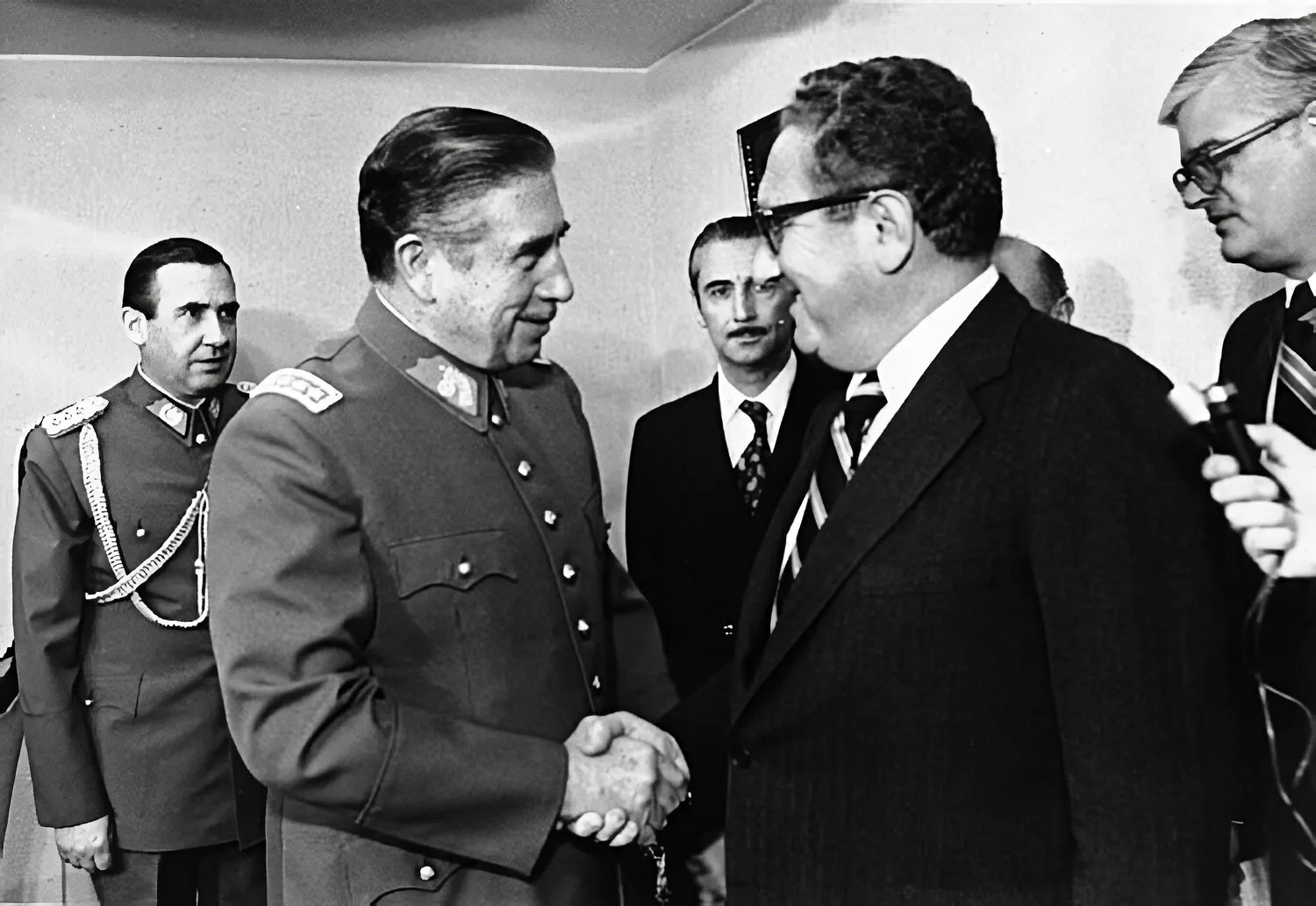
During the Cold War, the United States feared the rise of Communism across the world. But in Latin America, the United States took action. In 1970, Salvador Allende won the Chilean presidency with just a third of the vote. He was a socialist who started shaking things up across the country. Within just a couple years, a military coup removed him from power, and Augusto Pinochet, the American-backed strongman, replaced him. The ensuing Pinochet regime left thousands of Chileans dead and missing. The government actively persecuted alleged dissonants both domestically and abroad, leading to the eventual assassinations of Orlando Letelier and Ronni Karpen Moffitt, who were killed with a car bomb in Washington D.C. The story of the United States’ involvement in South American upheaval is still unfolding. But declassified documents show that then National Security Advisor Henry Kissenger was fairly un-bothered about the upheaval of South American democracy, so long as the Communists lost influence. Historian Alan McPherson says that the United States’ relation with democracies in Latin America is incredibly complex and nuanced. In this episode of UnTextbooked, producer Jessica Chiriboga asks why stories about foreign intervention are never simple. Book: Intimate Ties, Bitter Struggles: the United States and Latin America since 1945 Guest: Alan McPherson Producer: Jessica Chiriboga Music: Silas Bohen and Coleman Hamilton Editors: Bethany Denton and Jeff Emtman

S1 Ep 10Damnation to the governor and confusion to the colony.
Pop culture misremembers the Golden Age of piracy, and usually portrays pirates as apolitical agents of chaos. But historians now believe that many pirates followed a democratic and egalitarian structure that put them directly at odds with the world’s biggest governments. In the 1700’s, life as a European sailor left a lot to be desired. Wages were low, conditions were dangerous, and captains could be cruel. A lot of sailors wanted out. Pirates, on the other hand, were recruiting disenchanted sailors from captured ships and escaped slaves, offering them better living conditions. Life under the Jolly Roger was still rough though, and as such, pirate codes of conduct emerged, like the one issued by Captain Bartholomew Roberts, which stated that each pirate should receive equal shares of loot, that gambling shouldn’t take place on the ship, that pirates should receive compensation for injuries sustained in battle, that arguments should be settled by duels, but only on land, and more (see page 231). “A merry life and a short one, shall be my motto,” said Captain Roberts. This sounds a lot like a more modern phrase: “I’m here for a good time, not a long time”, which wound up in music by Trooper, George Strait and Drake. Historian Marcus Rediker thinks it’s no surprise that these ideals still persist. Despite the eventual decline of piracy in the Atlantic, Rediker believes that pirates may have won the longer war of influence; most of us can name pirates, but few remember the names of those who hanged them. On this episode of UnTextbooked, producer Ming-Wei Cyprien Fasquelle interviews Marcus Rediker on what the pirates of the Atlantic can teach us about resisting corrupt authority. Book: Villains of All Nations: Atlantic Pirates in The Golden Age Guest: Marcus Rediker Producer: Ming-Wei Cyprien Fasquelle Music: Silas Bohen and Coleman Hamilton Editors: Bethany Denton and Jeff Emtman

S1 Ep 9How much influence does America still have?
In 1987, the historian Paul Kennedy published a massive, nearly 700 page book called The Rise and Fall of the Great Powers. In normal circumstances, the book might have been lumped in with the rest of academic writing that’s seen only by scholars…if it weren’t for the book’s conclusion, which flew in the face of American exceptionalism and certainly upset some people. In that final section of the book, Kennedy suggests that the United States had begun a period of relative decline that began in the 1960’s. Kennedy focussed on two major elements in his claim of the US’s decline: military strength and economic power. The United States’ military was (and still is) largely unmatched. Kennedy worried about overreach though, having observed the United States’ dramatic and failed attempt to fight communism in Vietnam. And economically, Kennedy saw the United States weakening due to domestic policy and the rising economies in nations like India and China. At the time of the book’s publishing, he received criticism from the political scientist Joseph Nye, who argued that Kennedy had undervalued the significance of so-called “soft power.” Nye coined this phrase. He uses “soft power” to describe the forms of persuasion that countries hold, ie. all the ways to coerce on the world stage that don’t involve guns or dollars. Soft powers include social values like culture, charisma, values, politics, NGOs, reputation, etc. This all provides an avenue for countries to maintain relevance even when their “hard powers” (military and economics) decline. Kennedy recognized Nye’s criticism and now sees his conclusion with more nuance. On this episode of UnTextbooked, producer Will Bourell interviews Paul Kennedy on the recent erosions in the United States’ soft power and the ways in which the country can manage its relative decline and reverse its most harmful effects. Book: The Rise and Fall of the Great Powers Guest: Paul Kennedy Producer: Will Bourell Music: Silas Bohen and Coleman Hamilton Editors: Bethany Denton and Jeff Emtman

S1 Ep 8The forgotten mothers of American gynecology.
James Marion Sims has a complicated legacy. He was a surgeon in the 19th century who, for decades, was heralded as the ‘Father of American Gynecology’ for his contributions to the field, including inventing the speculum. But those innovations came at the expense of the poor and enslaved women that he performed experimental surgeries on. Not much is known about the Black enslaved women and poor Irish immigrants he experimented on, but without their contributions, gynecology would not be what it is today. On this episode of UnTextbooked, producer Ruba Memon interviews Deirdre Cooper Owens, author of the book Medical Bondage: Race, Gender, and the Origins of American Gynecology. They talk about how America’s history of slavery and racism continues to influence medicine in ways that harm Black people at disproportionate rates. Book: Medical Bondage: Race, Gender, and the Origins of American Gynecology Guest: Deirdre Cooper Owens Producer: Ruba Memon Music: Silas Bohen and Coleman Hamilton Editors: Bethany Denton and Jeff Emtman

S1 Ep 7When did Americans become so dependent on processed foods?
For decades, experts have warned that the average American diet is potentially harmful. Americans tend to eat food that is laden with too much sodium, fat, and added sugars, and it's making people sick. What’s insidious about this is that a lot of Americans don’t even know that the food they’re eating is unhealthy. A lot of foods are deceptively sweeter, saliter, and fattier than one would assume. And those added ingredients make processed foods addictive. UnTextbooked producer and host, Gabe Hostin, wanted to understand how the American food industry got this way. He found the work of journalist Michael Moss, who’s the author of Salt, Sugar, Fat: How the Food Giants Hooked Us. In it, Michael Moss writes about “food giants”, enormous companies that produce the vast majority of processed food products in America. He contends that these companies became so powerful because they figured out how to make their products irresistible, and that these innovations coincided with other societal shifts that were changing American eating habits. Book: Salt, Sugar, Fat: How the Food Giants Hooked Us Guest: Michael Moss Producer: Gabe Hostin Music: Silas Bohen and Coleman Hamilton Editors: Bethany Denton and Jeff Emtman

S1 Ep 6A historical argument against the gender binary.
As a kid, UnTextbooked producer Gavin Scott loved listening to his grandfather tell stories about their people. He used to like to imagine what his home was like back before white settlers came. As much as Gavin enjoyed learning about his culture, he sometimes felt out of place as the only gay person he knew of in his small hometown. So when he had the opportunity to work on this podcast, he decided to research LGBT Native Americans to learn more about people who were like him. He learned about “Two Spirit”, a term that was adopted in 1990 at a gathering of gay and lesbian Native Americans. “Two Spirit” is an umbrella term that encompasses many understandings of queer and gender variant identities for Native Americans. The term alludes to traditional third and fourth gender people; as in, people who were both/neither male and/or female. Many Native American cultures accepted and celebrated these people before white settlers forced assimilation. Gavin’s research eventually brought him to an unlikely source: Sabine Lang, a German anthropologist who has studied Native American cultures for decades. In her book Men as Women, Women as Men, Sabine Lang writes about the traditional roles of “men-women” and “women-men”, as she calls them. She uses those terms in order to avoid using “Two Spirit”, a contemporary term, when discussing historical identities. Guest: Sabine Lang Book: Men as Women, Women as Men: Changing Gender in Native American Cultures Producer: Gavin Scott Music: Silas Bohen and Coleman Hamilton Editors: Bethany Denton and Jeff Emtman

S1 Ep 5How a Black teenager and his young lawyer changed America’s criminal justice system.
Picture this: You’re nineteen years old, it’s a summer afternoon, and you’re driving around your hometown. You notice a group of other teenagers on the side of the road. As you get closer you realize that two of them are your cousin and nephew. You can tell by body language that things are getting heated, tempers are flaring. So you pull over. You get out of your car. You step in between your family and the other teenagers that are trying to fight them, and in the process you put your hand on the other kid’s arm. One more thing: you are Black, and the kid who just touched on the arm is white. Also, it’s 1966 and you live in Louisiana. So you get arrested and charged with simple battery, a misdemeanor. In 1960’s Louisiana, it means you won’t get a jury trial, you won’t get that chance to tell your side of the story to a jury of your peers. Instead, your case is going to be decided by just one man. And that man just happens to be Leander Perez, one of the most virulent white supremacists in the American South. For the crime of simple battery you could go to prison for two years. This is the story of Gary Duncan. Instead of accepting his fate, Gary found a lawyer named Richard Sobol and they appealed. The case made its way to the Supreme Court in Duncan v. Louisiana. Matthew Van Meter, author of Deep Delta Justice, explains how Gary Duncan’s case changed the criminal justice system. While most Americans assume that criminal cases are decided by a jury, Louisiana and many other states did not require a jury. This is because even though the Constitution guaranteed citizens the right to a jury trial, that only applied to federal crimes at the time. This essentially gave judges, who were predominantly white and beholden to racist laws, the ability to decide the future of people like Gary Duncan. According to Matthew Van Meter, this is just one example of how the criminal justice system has been used to uphold white supremacy. Thanks to Gary Duncan’s case, the Supreme Court ruled that jury trials are fundamental to American justice, and that all states were obligated to provide them. Despite this victory, jury trials have all but disappeared in the United States. Guest: Matthew Van Meter Book: Deep Delta Justice: A Black Teen, His Lawyer, and Their Groundbreaking Battle for Civil Rights in the South Producer: Elliot Smith Music: Silas Bohen and Coleman Hamilton Editors: Bethany Denton and Jeff Emtman

S1 Ep 4The false mythology of good leadership.
There’s a certain mythos around the founders of the United States. George Washington gets this treatment to the extreme. He’s painted riding brilliant white horses, standing up in boats, and puffing out his chest as he presides over the signing of the Constitution. He’s essentially an American folk hero. What’s odd is that this mythical understanding of a real person conceals the truth of what real leadership looks like. At least, that’s the perspective of General Stanley McChrystal, who rose through the ranks of the military and had to learn a lot about leadership along the way. General McChrystal thinks that too many people view our leaders as if they’re cut from a different cloth, when in fact, leaders are fallible, and reliant on the people around them to succeed. He co-wrote the book Leaders: Myth and Reality, wherein he profiles many influential leaders, both moral and corrupt. The book is loosely structured on Plutarch’s Parallel Lives biographies. In the book, he profiles the leadership strategies of Martin Luther, Coco Chanel, Walt Disney, William “Boss” Tweed and others. He also gives one chapter to Abu Musab al-Zarqawi, an Al Qaeda leader that he fought for years. General McChrystal is quick to separate his respect for a leader’s style from that leader’s actions. While that’s certainly true of Abu Musab al-Zarqawi, McChrystal also attempts to clarify his complicated relationship with General Robert E Lee, a man who he grew up nearly worshipping as a leader. In his years since childhood, McChrystal’s tried to balance his respect for Lee’s leadership with a moral obligation to fight bigotry and symbols of hate. After his military career ended, General McChrystal became the Board Chair of the Service Year Alliance, which helps youth to do a paid year of civil service. Guest: General Stanley McChrystal Book: Leaders: Myth and Reality Producer: Victor Ye Music: Silas Bohen and Coleman Hamilton Editors: Bethany Denton and Jeff Emtman

S1 Ep 3Does America live up to its own ideals?
Democracy: a small word and a big concept foundational to the United States. Ideally, we’re a country of pluralism and self determination, but the reality is often different. Many dark chapters exist in our history: Slavery and the extermination of Native Americans, Disenfranchisement and voter suppression. Japanese internment and white supremacy. And yet, many of the ideals that surround the founding of our country do slowly bend us towards justice. So how is it that one nation could be founded on principles of equality while also oppressing so many people throughout its history? UnTextbooked producer Anya Dua wanted to better understand these contradictions. Anya is herself an amalgamation of many different American experiences: Her mom’s side of the family were European settlers who came to the United States before it was even a country. Her dad is Indian and immigrated to America by way of Australia. Both of these are fundamentally American experiences, and gave Anya very different perspectives on American history. In her research, Anya found the work of historian Jill Lepore, and read her book These Truths: A History of the United States. The “truths” in the book’s title—political equality, natural rights, and the sovereignty of the people—are gleaned from the Declaration of Independence. In her introduction, Jill Lepore asks one question essential to a better understanding of our nation: “Does American history prove these truths, or does it belie them?” Guest: Jill Lepore Book: These Truths: A History of the Uniited States Producer: Anya Dua Music: Silas Bohen and Coleman Hamilton Editors: Bethany Denton and Jeff Emtman

S1 Ep 2History fails when it ignores the BIPOC women who made it.
Women of color have been at the forefront of many movements, yet are often neglected, demonized, or ignored. Your history class probably didn’t teach you about Josephine Baker, who was not only a famous Black dancer and entertainer, but also a spy aiding in the French Resistance. You likely didn’t learn about Claudette Colvin either. She was the Black, pregnant fifteen year old whose civil disobedience kicked off the Montgomery Bus Boycott. We live in a world of whitewashed feminism, so there’s a lot to unlearn before our social movements are truly inclusive. Amazons, Abolitionists, and Activists by Mikki Kendall shares the stories of notable women of color whose stories have been left behind. Guest: Mikki Kendall Book: Amazons, Abolitionists, and Activists: A Graphic History of Women's Fight for Their Rights Producer: Sophia Andrews Music: Silas Bohen and Coleman Hamilton Editors: Bethany Denton and Jeff Emtman

S1 Ep 1Germany addressed its racist past. Can America do the same?
As the ashes of the Third Reich settled, a divided Germany struggled to come to terms with what just occurred. Generations of German philosophers, politicians, academics, and common citizens slowly and collectively decided to confront the horrific actions of the Nazis. They called this process “Vergangenheitsaufarbeitung”, or “working off the past”, though it has several names. Step by step, through a feeling of collective guilt and moral responsibility, they were able to make amends with the world and build legal and societal safeguards against hatred and extremism. Compared to the Germans, the United States has only barely confronted our legacy of slavery and Jim Crow. Throughout the South, the “Lost Cause Narrative” is still common. Confederate generals are still hailed as heroes and the banner of the defeated flies proudly at our halls of power. Like an infected wound that festers, the refusal to face the past and address wrongs have led to voter suppression, police brutality, wealth inequality, systemic racism and a million other things. Unlike Germany, the U.S. has weak legal and societal safeguards against bigotry and racism. And with the resurgence of Black Lives Matter demonstrations following the murder of George Floyd, it is clear that the United States must finally step up to the challenge and confront our legacy of slavery and racism. Untextbooked producer Lap Ngyuen became fascinated with America’s response to slavery, the Civil War, and the era of Jim Crow that followed. Lap immigrated to the U.S. as a kid, and has spent years trying to understand its complicated history. His curiosity led him to the work of philosopher and historian Susan Neiman. In her book Learning from the Germans, Susan Neiman discusses the importance of an American “Vergangenheitsaufarbeitung”. She believes that reparations, education reform, and destroying all vestiges of a glorified Confederacy are just a few ways to allow societal healing to take place.She is hopeful, since young Americans are poised to be the beacon of reconciliation like the German youth were in the 1960s. Guest: Susan Neiman Book: Learning from the Germans: Race and the Memory of Evil Producer: Lap Nguyen Music: Silas Bohen and Coleman Hamilton Editor: Bethany Denton and Jeff Emtman

Introducing UnTextbooked: a history podcast for the future.
UnTextbooked is a history podcast for the future. Brought to you by teen changemakers who are looking for answers to big questions. We interview famous historians who have some of the answers. These intergenerational conversations bring the full power of history to you with the depth and vividness that most textbooks lack. Real history, to help you find answers to your big questions. UnTextbooked makes history unboring forever. Full episodes coming Fall 2020. Subscribe now in your favorite podcast app.