Unexpected Elements
345 episodes — Page 7 of 7
Record high temperatures – in the Arctic
A record summer temperature in Siberia is an indication of major changes in the Arctic climate. Changing weather patterns there have a knock on effect for other parts of the planet says Climatologist Steve VavrusChile appeared to get Covid-19 under control, but in reality the virus was spreading uncontrollably through poor areas, As we hear from our correspondent in Santiago Jane Chambers, the lockdown has tightened but cases continue to rise.And could mass testing using new saliva tests help control or even end the epidemic? Epidemiologist Julian Peto tells us about his plan which is designed to contain the virus within individual households and stop community spread. Experiments to investigate dark matter have produced some tantalising results, Physicist Laura Manenti says it’s not confirmation of detection, but potentially close. If you put one person’s blood into another person , sometimes it’s fine and sometimes it’s a death sentence. French physician Jean-Baptiste Denis discovered this when he performed the first blood transfusion back in 1667. He put the blood of a lamb into a 15-year boy. The teenager survived but Denis’s third attempt killed the patient and led to a murder charge.In 1900, Austrian doctor Karl Landsteiner discovered the reason for this lottery – blood types. The red blood cells in our bodies are decorated with different marker molecules called antigens. These define us as A, B, AB or O blood type. And this is just one of 38 different systems for classifying our blood. CrowdScience listeners have discovered that we aren’t the only animal with blood types and want to know more. Dogs have 12 different blood groups, so how do they cope when they need a transfusion? CrowdScience meets some very good dogs who donate a pint to the pet blood bank in return for a toy and a treat. Each pint saving up to 4 other dogs’ lives. We also hear how examining our blood types can tell us more about our links to our ape-like cousins and how the human species spread around the world. And what about the future of blood types – can we use science, and animal blood to get around the problems of transfusions?(Image: Rural Scene in Verkhoyansk. Credit: Dean Conger/Corbis via Getty Images)
Covid -19 hope for severe cases
A multi arm trial testing a range of drugs has shown that readily available steroids can be lifesaving for people severely ill with Covid-19. Max Parmar, head of the UK Medical Research Council’s clinical trials unit says the trial design, where many potential drugs can be tested against the same controls, is key to producing results quickly. As it spreads around the world SARS-CoV-2 is mutating. But what does this mean? These mutations are part of a natural process and some researchers are finding they make no real difference to patient outcomes so far, but others are concerned the virus may become more dangerous. Neville Sanjana from New York University has been running lab tests on the mutant virus.Measles mutated from an animal virus, developing the ability to jump from cattle to human around 2,500 years ago. Sebastien Calvignac-Spencer from Germany’s Robert Koch Institute tracked its origins using preserved lung samples from centuries old measles victims. Covid -19 has become a magnet for conspiracy theorists. A common unfounded claim is that the virus was deliberately manufactured. During the boredom of lockdown such ideas have taken off online, with conspiracy videos receiving millions of views. We speak to scientists who have been targeted, and become the subject of this online misinformation. Also What exactly it means to be conscious has long been a question of profound debate amongst philosophers, and more recently, scientists. There are no easy answers, and it gets even trickier when you start asking whether animals are conscious: how can you find out about their subjective experience when they can’t tell you about it?Never afraid to tackle the impossible, CrowdScience is looking for answers after listener Natalie got in touch. She has lived with her cat for years and has a strong sense that he has thoughts and feelings: he has his own personality, acts in complex ways, and even has ‘grumpy days’. But is this consciousness? Is there any way of scientifically testing for it? How different from our own inner world is that of a cat, an octopus, or a bumblebee? And if we can find any answers to these puzzling questions, how does that affect the way we treat animals - not just our pets, but all the animals we share our planet with?We meet Natalie and her cat, and discover how scientists have explored the minds of pigs, cows and cuttlefish. Helping us ponder the elusive question of animal consciousness are philosopher Peter Godfrey-Smith, neuroscientist Anil Seth, animal welfare expert Donald Broom, ethicist Jessica Pierce, and comparative psychologist Alex Schnell.Featuring David Seddon as the voice of Chicco the Cat.(Image: Doctor examines Covid-19 virus patient. Credit: Getty Images)
Food security, locusts and Covid -19
Despite the Covid-19 pandemic efforts to counter massive swarms of locusts across East Africa have continued. In many places this has been very effective, killing up to 90% of locusts. However, the threat of repeated waves of locusts remains says Cyril Ferrand, who leads the UN Food and Agriculture Organisation's Resilience Team in East Africa.Conversely West Africa is unaffected by locusts and with a block on imports local producers have seen demand grow for their produce, an unusual positive effect from the pandemic according to Sandrine Dury from the French agricultural research agency CIRAD.We examine the potential for a second wave of coronavirus as many countries relax lockdown measures, businesses reopen and mass protests take to the streets. Epidemiologist Carl Bergstrom is interested in working out which of these movements is likely to have the most impact.And from South Africa, how radio telescope engineers there have turned their hands to developing new ventilators appropriate for regional needs.And we were bowled over by a question from one CrowdScience listener in Australia wants to know how likely it is that the atoms in his body have been used in someone else’s body? We all like to think we are unique; no one is quite like us. But is that really true?Presenter Marnie Chesterton tackles Moshe’s question with help from every area of science. From geologists helping us work out how many atoms are on the Earth’s surface to biologists helping us work out how many atoms each body uses. Perhaps we are much less special than we think.
The medical complexity of Covid -19
Autopsies show Covid 19 can affect the brain and other organs. Pathologist Mary Fowkes from the Icahn School of Medicine at Mount Sinai found the signs of stroke - unusually in young people, as well as a disruption of the immune system throughout the body.And studies of heart stem cells show these can be killed by the virus. Cell Biologist Stefanie Dimmeler from the University of Frankfurt says this finding could prove useful in providing treatment and preventative medicine.A massive research project in China has identified over 700 different types of coronavirus carried by bats, some of these obscure virus sequences are thought to have already jumped from bats to human and animals such as pigs. In a similar way to SARS-CoV-2 they present a potential threat as a source of future pandemics says Peter Daszak from the EcoHeath Alliance which conducted the research in collaboration with Chinese scientists. And is there racism in the way people with Covid -19 infections are categorised? It’s an issue which concerns toxicologist Winston Morgan from the University of East London. He says as race is a social construct it’s an inappropriate measure to use when trying to work out who is vulnerable to the virus.And, Have you ever broken up a fight? Or pushed someone out the way of an oncoming vehicle, only to be hit by it yourself? Most of us probably haven’t taken as many risks as listener Alix, who has put herself in peril to save strangers on several occasions, and she wants Crowdscience to investigate why? At a time when medical professionals have to weigh up the personal dangers of working on the frontline of the Coronavirus crisis, it’s a particularly timely question. Marnie Chesterton finds out why it’s a good thing that children push the boundaries of what’s safe during playtime, because it makes them less anxious adults. And she questions the existence of the so-called bystander effect, discovering how evolution has ensured we’re a much braver species than we sometimes give ourselves credit for. But she hears from some social scientists who say there’s no such thing as a ‘hero’ however likely they are to intervene to help others
Brazil’s Covid chaos
The number of cases of Covid -19 infections in Brazil and deaths related to the pandemic may be much higher than official figures show. Testing of the living is not widespread and there are few resources for analysing the potential role of the virus as a cause of death. Virologist Fernando Spiliki gives us his bleak assessment.A remarkable study from South Africa shows just how easily the virus can spread around a hospital, with a single infected person infecting many. However the route of infection is not necessarily direct person to person transmission says investigator Richard Lessells from the University of KwaZulu Natal. And from London a study in a hospital with many Covid patients at the height of the pandemic supports the South African findings; Researchers found viral particles on surfaces and in the air says Professor Wendy Barclay from Imperial College. An early warning system for outbreaks of the virus or second waves may come from analysis of sewage, Jordan Peccia from Yale University analysed waste from his local sewage treatment works and found peaks in concentrations of the virus in the sludge occurred a few days before increases in hospital admissions.(Image: Supporters of Brazilian President Jair Bolsonaro wear face masks as they demonstrate against quarantine and social distancing measures imposed by governors and mayors to combat the new coronavirus outbreak and demand military intervention. Also this week, The kids take over. Our younger listeners are as curious as their parents, it seems, so presenter Marnie Chesterton seeks out the finest minds and attempts to answer a raft of their science questions, including why can’t you tickle yourself? Why don’t our eyebrows grow as long as the hair on our heads? Not content with humankind, these whizz kids have been pondering deeply about other animals. Ava, 9, from the UK wants to know if any other animals kill for fun, like some humans do.Not limited by planet Earth, these little thinkers have been contemplating even weightier questions. Joshua, 13, from Kenya wonders if our Solar System rotates around anything. And Seattle-based Michael, 10, puzzles over what would happen if a black hole collided with a wormhole.These and other mysteries are uncovered by Marnie and her experts.Credit: SERGIO LIMA/AFP via Getty Images)
Loosening lockdown
How is Covid -19 spread? Who is most at risk and what are the circumstances under which it is most likely to be transmitted? These questions need answers for the implementation of effective and safe strategies to end lockdown. We look at what research is showing. And if you have to go back to work what’s the best way to protect yourself, how should we be using face coverings for example? There are lessons from research on fluid dynamics.Also key is reducing the rate of infection, the R number, Italy relaxed lockdown a few weeks ago we look at early findings on the impact.It’s clear more widespread and effective testing will be needed to reduce transmission, A new test which should be quicker has been developed using synthetic biology and gene editing techniques. Also despite being a universal need, talking about our toilet use and the infrastructure that aids us remains somewhat taboo. Whilst sectors like telecommunications and computing have undergone rapid transformations over the past century, the flush toilet and wastewater system have mostly remained unchanged. CrowdScience listeners Linda and Allison wonder if flush toilets – and the clean water used to wash waste away - make economic or environmental sense. So CrowdScience presenter Marnie Chesterton looks under the toilet lid, to probe (in a sanitary fashion) whether our sewerage systems and plumbed toilets are fit for purpose. In a future where population growth and climate change are likely to affect water demands, can we continue to use clean water to dispose of our waste and should the developing world be emulating this model?Around 2 billion people don’t have access to proper toilets or latrines, risking serious health consequences. Marnie investigates how countries without comprehensive sewerage infrastructure deal with human waste and how science is providing novel ways to dispose of - and use – human waste. Marnie speaks to a Kenyan scientist using poo-eating fly larvae to process faeces and a North American scientist who is developing a smart-toilet she hopes will monitor our health through sampling our daily movements. Are we ready to break taboos to innovate our toilet habits?(Image: Commuters wear masks whilst travelling on a London Underground train. Credit: Tolga Akmen/Getty Images)
Covid -19 new hope from blood tests
Research from New York examining the blood of people who have recovered from Covid – 19 shows the majority have produced antibodies against the disease, The researchers hope to soon be able to establish whether this confers long term immunity as with more common viral infections. And Research in Berlin and London has identified biomarkers, minute signs of the disease which may help clinicians identify who is likely to develop severe symptoms and what kind of treatment they might need.Mutations have been much in the headlines, these are a natural processes of evolution and not just in viruses, but the term is misunderstood, two studies focusing on different aspects shed some light on what mutation in SARS-CoV-2 really means. Also What is the smallest particle of matter? How does radiation affect our bodies? And, how is particle physics useful in our everyday lives?We take on particle physics questions from listeners all over the world. Marnie Chesterton and Anand Jagatia get help from particle physicists from the Large Hadron Collider at CERN and medical physicist Heather Williams.(Image: People wear face masks as they cross a street in Times Square in New York City. Credit: Kena Betancur/AFP via Getty Images)
Ebola drug offers hope for Covid-19
Remdesivir a drug eventually rejected as a treatment for Ebola seems to have aided recovery in a trial with more than a thousand Covid -19 patients. Researchers are cautious but hopeful; a leading health official in the US has made comparisons with the impact of game changing drugs used to treat HIV. In contrast an organisation researching the mechanisms by which bat coronaviruses infect humans has had its funding cut following criticism from President Trump.A scheme to help manufacture ventilators and protective equipment worldwide has seen some success with a simple ventilator they developed, now in use in hospitals.And we look at climate change –with this year set for extreme weatherWhat’s the importance of zero, and how was it discovered? How do scientists calculate Pi’s infinite digits? Why do so many people find maths difficult – and what’s the most difficult thing in maths?CrowdScience takes on a whole bunch of questions sent in by high school students in Spain. Like many children all over the world, their school is currently closed due to the coronavirus lockdown, but lessons continue at home. So how are their studies going, and can CrowdScience help out?We attempt to answer some of their trickiest maths questions with the help of mathematics whizz Katie Steckles, Pi aficionado Matt Parker, and mathematical biologist Kit Yates.Image Credit: Getty Images
Presidents and pandemics
President Trump has repeated unfounded claims that scientists created Covid-19 in a lab. Rigorous scrutiny of the genetics of the virus reveals no evidence for such a claim. And Brazil’s President Bolsonaro is at odds with his own health advisors – splitting public opinion and action over lockdown measures needed to control the virus. We also look at why Covid -19 seems to be associated with so many different symptoms, from diarrheal infections to complicating kidney disease, to heart attacks And some potentially good news from HIV research, a new target to stop that virus in its tracks, which might also be useful in the fight against other viruses.If you're an exercise fan, you'll know that sweating is how our bodies keep us cool, but how much water we lose and which bits of us get wettest depend on a whole host of factors. Jamaican listener Andre wants to know why he sweats in a heart-shape when he hits the gym, and we find out how everything from the clothes he wears to the moves he's doing explain his unusual perspiration patterns. In Kenya we meet a woman whose permanently clammy hands cause her to drop her mobile phone, and sweaty feet start to stink when she spends too long in shoes. Hyperhidrosis is a condition affecting millions of people worldwide but an expert explains some of the treatments for this mysterious condition.Image: President Trump (rhs) with Brazilian President Bolsonaro (lhs). (Photo by Alex Wong / Getty Images)
Italy, getting Covid 19 under control
Italy is beginning its first tentative steps towards ending its lockdown. These are small steps, opening a few shops in areas where virus transmission has seen big falls. Part of the reason for this controlled strategy is that there are real concerns over a potential resurgence of the virus, Around the world there are now hundreds of trials on drug treatments for Covid 19. Results so far are mixed, with antivirals developed for Ebola and HIV showing positive signs, but antimalarial drugs, championed by President Trump in particular have been shown to have dangerous potentially life threatening side effects.A warning from history, more than 500 years ago suggests the western US in particular is entering an extreme drought, a ‘Megadrought’. When this last happened it led to war, depopulation and the spread of disease.And its 10 years since the Deepwater Horizon oil spill in the Gulf of Mexico. Studies of fish in the region suggest they are still affected by oil from that spill and more recent lesser known pollution events.If you have ever watched a spider as it works to build a web, spiralling inwards with a thread of silk, that intersects each glistening spoke with a precise touch of the foot, you will know that it is a remarkably complex behaviour. In this episode, presenter Geoff Marsh dives into the minds of spider-constructors as they build their webs. CrowdScience listener Daan asked us to find out how spiders can build webs without ever being taught how to do it. Are they just little robots controlled entirely by their genetic instructions? Spider silk expert Dr Beth Mortimer, describes the process of building a web in detail, while Professor Iain Couzin explains the simple modular behaviours that build up, in sequence, to create apparently complex instincts, like the huge locust swarms that are sweeping across vast areas of Africa and Arabia. Taking us deep under the exoskeletons of invertebrates, Professor Gene Robinson reveals an animal's behaviours can be altered by their genes, and the root similarity between learning and instincts. Spiders, despite their tiny size, have fascinating behaviours. Some jumping spiders can work out the best way out of a maze, and one arachnologist reveals how some social spiders can cooperate to build communal webs and capture moths that are many times their size. Geoff searches for the science that can reveal how instinct can create complex behaviour by setting up interviews at the homes of spider experts from around the world.(Image: Italy, shops begin to open. Credit: European Photopress Agency)
The impossibility of social distancing and even handwashing in crowded refugee camps
Massively over crowded Moria refugee camp on the Greek island of Lesbos has seen numbers grow from 5 to 20 thousand in a matter of months. Hundreds of people share taps and toilets, there is little chance to implement measures designed to stop the spread of covid 19. So far the camp has not been hit by the epidemic, but aid agencies fear for the most vulnerable in the camp. Covid 19 jumped from bats to humans, possibly via another wild animal. A study of zoonotic diseases has identified many other viruses that could do the same. The skies are clearer, levels of pollution from traffic have dropped by up to 50 percent but how long will cleaner air remain?And Comet Borisov makes a spectacular exit.Listener Keith from Lincolnshire wants to know how to reduce stress as he is under extreme pressure as a firefighter. Not only does he have to cope with the stress of responding to emergency situations but he has to do it while wearing challenging breathing equipment. We all experience times of stress, especially given the current situation, our chest starts to feel tight and our breathing becomes shallow. Claudia Hammond – presenter of BBC World Service programme Health Check – explains steps we can take to protect our mental health during this pandemic. How should we alter our breathing to manage stress? Presenter Anand Jagatia speaks to breathing experts to find techniques to help listener Keith, and everyone else.(Image: Moria refugee camp, Lesvos, Greece. Credit: Getty Images)
Covid 19 – The fightback in Africa begins
Nigeria has seen a small number of Covid -19 cases, largely spread amongst the most affluent, people who travel abroad, However there is concern about the potential of the virus to spread to overcrowded slum areas. In such conditions social distancing measures would be difficult to enforce. What are the alternatives? The US now has the majority of cases of the virus, New York has been heavily hit, medics have developed an app to help understand the spread of Covid 19 in the community. The availability of test kits is an issue worldwide, we look at a novel idea, adapting a device made from paper that could help to see whether the virus is present in wastewater.The WHO has launched international drug trials to tackle covid 19, but none of the drugs involved were developed specifically to target this virus we look at why they might just work. In medicine, it’s long been recognised that a placebo, a sham medicine or treatment, can have a powerful positive effect on a patient’s health. Part of that effect relies on a person’s belief that an inactive substance or treatment (for example, a sugar pill) is in fact an active drug. Placebos come in many forms and the scientific study of placebo is an active area of research. With this in mind, CrowdScience listener Nigel got in touch to ask if can placebos be used to improve sports performance? As an amateur sports enthusiast, he’s been reading up on his sports psychology to try and improve his game but he wonders if any coaches or psychologists use placebos to improve performance? Always ready to take up a challenge, presenter Anand Jagatia explores the world of endurance sport to find out how a placebo might used to improve athletes’ performances as well as his own and look at how advances in brain science are helping us understand the unusual neurobiology of placebo. And what of the amateur golfer or rugby or table tennis player - can placebo help? On an individual level, so called ‘verbal placebo’ is a technique that can help players with anxiety, confidence and concentration, and ultimately make them win more. And what about team sports – when, say, a new manager takes over at an ailing football club, and sparks a massive reversal in poor results, is that placebo effect in action? The CrowdScience team investigates.(Image: Getty Images)
The science of social distancing
The strong social distancing policies introduced by China seem to have been successful in stopping the spread of Covid 19. Without any effective drug treatments, reducing our number of contacts is the most effective way to prevent viral transmission.We also look at the similarities been policies in Russia and the US on how best to deal with the virus. In both cases there are contradictions and disagreements between medical professionals and politicians.And a warning from Polio, how vaccines may create problems when immunisation campaigns do not reach everyone.And If you've ever felt the urge to shop till you drop, then you may already know about some of the clever ways retailers convince us to consume. From flash sales to so-called unbelievable offers, there are a whole range of techniques aimed at encouraging us to flash the cash. Listener Mo works in marketing, so knows more than most about the tricks of the trade - but he wants CrowdScience to investigate how neuroscience is being used to measure our behaviour and predict what we’ll buy. Marnie Chesterton finds out how brain scans are being used to discover which specific aspect of an advertisement a person is responding to, and then she hears how this information is being used by companies who want to sell us more stuff. But there's also evidence to suggest we have less control over these decisions than we think, and that computers are getting closer to detecting our intention before we're even aware of it ourselves. And this could have huge implications for the way we shop.(Image: Getty Images)
Covid -19, are you carrying the virus?
In Italy the entire population of a small town was tested for Covid 19. Of those infected, one in three people with no symptoms had the virus. And from China researchers found many people carried the virus – even before authorities there began tracking its spread. The findings suggest vulnerable people may contract the virus from those without symptoms.And we’ve news of a breakthrough - new tests looking at Covid 19 antibodies, These should help provide a picture of developing immunity to the virus.However as growing numbers of people fall ill there are concerns over a potential shortage of hospital ventilators globally, These are needed to treat the most severe cases. However a crowdsourcing project has been set up to try and kick start the manufacturing of a variety of different types of ventilator that could be built around the world. If you have knowledge of ventilators or their use and would like to get involved more information is available here. http://bit.ly/frontiertech4COVIDactionMany of us are fascinated by our ancestry: knowing where our families came from can give us a sense of identity and roots. Tracing your family tree is a time-honoured tradition, but several companies now sell DNA tests that offer you insights into your heritage: so you might find out you’re 70% Nigerian, 39% Italian, or 11% South Asian, for example.There’s no doubt that genes contain clues about your family history, but how reliable are these commercial tests? That’s what CrowdScience listener Karen wondered after an update of her test results showed her going from 39% Scandinavian to 2% Norwegian. How confident can she be in her results now? And what does it actually mean to be 2% Norwegian, in terms of your family tree?Presenter Alex Lathbridge delves into his own African and European ancestry, talks to some of the companies offering these tests, and unpicks the complex relationship between genetic science and family trees. We meet a woman who found her long-lost uncle with a combination of a DNA test and old-fashioned archive research; and look to the Americas to ask whether genetic testing can restore ancestral ties erased by the inhumanity of the transatlantic slave trade.(Image: AFP/Getty Images)
Covid -19 how infectious is it really?
Covid- 19 cases seem to be multiplying daily and there is now a growing body of scientific evidence both on its spread and the effectiveness of measures to try and control it. We look at what’s working, what’s not and why. And we look to the potential for coronavirus drug treatments, why despite the hype there really isn’t anything round the corner.Australia’s recent fire season was intense; a new study looks back over 500 years of the weather pattern partly responsible, the Indian Ocean Dipole. The findings show the most extreme years occurred recently – under the influence of man-made climate change. And we look at life deep below the sea floor, microbes which multiply slowly over centuries and eat their neighbours. Since the outbreak of a new strain of coronavirus late last year, health workers and governments have been rushing to limit transmission by deploying containment tactics and anti-contamination campaigns. But, as the virus spreads around the world, what are scientists doing to help our bodies fight off or resist this new infectious disease?Viruses that cause human disease can be notoriously tricky to tackle. They don’t respond to antibiotics, can spread rapidly between human hosts, and even evolve improved ways of working as they multiply. Presenter Marnie Chesterton heads to the University of Oxford’s Nuffield Department of Medicine to meet the researchers who are urgently searching for solutions. Professor Tao Dong is Director of Chinese Academy of Medical Sciences Oxford Institute, collaborating with colleagues on the ground in China to see how Chinese patients’ immune systems are responding to the virus, which could inform vaccine design. Professor Sarah Gilbert leads the Jenner Institute’s influenza vaccine and emerging pathogens programme. She’s been developing a vaccine against another strain of coronavirus that caused the Middle East Respiratory Syndrome (MERS) outbreak, and is using the same technology to generate a new vaccine against the 2019 coronavirus. And, whilst that’s being developed, there is a possibility that some existing antiviral drugs may even help infected patients – Professor Peter Horby is working with colleagues in China on clinical trials to see what might work. CrowdScience goes into the laboratories using cutting edge science to combat coronavirus. (Image: Coronavirus test. Credit: iStock / Getty Images Plus)
Australia’s fires - fuelled by climate change
Attributing Australia's bush fires, a major study says man-made climate change was a big driver – making the fires at least 30% worse than they would have been if natural processes were the only factors.We look at preparations for coronavirus in Africa. Although cases there are currently lower than in much of the rest of the world a major training initiative is taking place to spread awareness amongst medics across the continent.We ask why Horseshoe bats in particular carry coronaviruses, and find a novel idea for distributing vaccines in places without refrigeration.And why are we obsessed with crime? Kay from Hamburg, Germany asks as every Sunday evening Germans pile into their local pubs to watch Tatort, a hugely successful crime drama which has been running for 50 years.Presenter Marnie Chesterton starts with the science and speaks with psychologists to get to the bottom of where this obsession might come from. Have we evolved to have an innate obsession with danger or are we addicted to feeling fear?Or perhaps the dramatisation of crime fuels our obsession. Producer Caroline Steel visits the film set of BBC crime drama, Line of Duty. Producer Jed Mercurio explains what draws us to crime narratives and the techniques he uses to keep his audience captivated. But does the way we chose to represent crime in media match up with reality? And what is the impact of this on society and policy?(Image: Australian bushfires. Credit: Getty images/AFP)
Tracking coronavirus spread
The appearance of Covid -19 in Italy and Iran surprised many this week. As the virus continues to spread we look at ways to contain it.Australia’s fires have burnt around 20 percent of the countries woodlands, what are the implications for the recovery of those ecosystems?And what is the link between the world’s super rich and deforestation? Unsurprisingly it’s money.And we hear about the unexpected cooling effects of hydroelectric dams.Weather: wet, dry, cold, hot, sunny, windy or downright weird - there’s nothing quite like it as a conversation starter, from Austin to Jakarta. And judging from the large volume of emails about all things meteorological in the CrowdScience inbox, there’s plenty to talk about. What’s the weirdest weather on Earth, and how big a chance is there of it happening? Why does it always seem to rain on the days when we’re not working? And – conversely – is there any way we could make it rain when and where we need it to? Presenter Anand Jagatia finds out the answers to these questions and more by bringing together a panel of experts under the CrowdScience umbrella: Prof Liz Bentley, Royal Meteorological Society; Dr Anthony Rea, World Meteorological Organization, and Dr Rebecca Buccholz, National Centre for Atmospheric Research.(Image: Tourists wearing masks tour outside the Coliseum in Rome. Credit: Getty Images)
Monitoring Covid-19, harvests and space junk
Roland Pease reports from the American Association for the Advancement of Science’s annual meeting in Seattle. At the UK Research and Innovation’s stand in the exhibition hall, he’s joined by three scientists to discuss monitoring the Coronavirus outbreak, the locusts devastating crops in East Africa and the ever increasing amount of space junk orbiting the Earth. Professor Jeffrey Shaman of the Mailman School of Public Health at Columbia University talks about how he is modelling the movement of Covid-19 around China and beyond. Dr Catherine Nakalembe, of the University of Maryland and East Africa Lead for NASA Harvest explains how she uses data collected by satellites to find out where crops are thriving and where they are not. She also talks about how this technology can alert countries to approaching locust swarms.And Professor Moriba Jah of University of Texas at Austin, tells Roland why he’s concerned about the amount of space junk that’s orbiting the earth and why so little is being done about controlling satellite launch and disposal. A lovely day out in the countryside can be blighted when swarms of midges or mosquitos invite themselves to the party. A CrowdScience listener in New Zealand has noticed that, when sand-flies come a-biting, she and her daughter are targeted, while her husband and other daughter escape unharmed. She wants to know why some, but not all of her family become bait for insect bites. CrowdScience delves into a world of smells, called semiochemistry, which explores the aromas one animal uses to attract or repel another. Does our attractiveness as a blood meal to insects come down to what we wear, what we’ve eaten or is it all in our genes? Host Marnie Chesterton discards the DEET and bravely offers herself up as a meal for mozzies, in a quest for answers.(Image: Artist response to NASA Harvest discussion at AAAS Credit: Lorenzo Palloni)
CoVid-19: Mapping the outbreak
Researchers at the London School of Hygiene and Tropical medicine have developed an online map which presents the latest information on the spread of CoVid-19 and allows anyone to follow the outbreak and compare this data with the spread of Ebola and SARS. See the weblink from this page to try it for yourself.And the coming together of microbiology and big data science has led to the development of a portable device able to spot antibiotic resistant bacteria. This should help with more precise drug targeting and potentially save lives.We also look at how social science is helping to improve the health of people reliant on woodstoves for cooking, and we unearth a huge impact crater hidden in plain sight. Cancer is the second leading cause of death in the world. Many of us will at some point in our lives be confronted with the disease – either by falling ill ourselves or through a family member or friend. For CrowdScience presenter Marnie Chesterton, the diagnosis would change her life. The range of cancer symptoms and mortality rates vary considerably. Not all cancers are fatal and in some cases, cancer ends up more like a chronic debilitating disease, resulting in patients eventually dying from some other condition. This has got listener Gill in Scotland wondering – why do we call all cancers, cancer? And when did doctors first realise that all cancers are part of the same problem? First described by the Egyptians thousands of years ago and later coined by the Greek physician Hippocrates as “karninos”, the Greek word for “crab”, cancer is ominously absent from medical literature until the late 19th century. Throughout history it has puzzled, infuriated and enticed doctors and scientists to push medical science to its breaking point. Archaeologists have recently discovered that the ancient Egyptians had a term for cancer and that remedies they used then contain compounds that are found in modern chemotherapy. As we uncover the science and history of cancer, presenter Marnie Chesterton takes us on a journey through her own experience of living with and beyond the diagnosis and we examine the promise of future treatments. (Image:Getty Images)
Coronavirus, prospects for treatment?
Doctors in the US have treated a coronavirus patient with a drug developed for Ebola. That drug had never been tested on people so its use here seems an extreme move. We look at why this kind of drug developed for one virus might work on another. It’s all down to the genetic material at the centre of the virus. That raises safety concerns as human cells contain similar material.East Africa is experiencing a plague of locusts and bizarrely it’s linked to the Australian wildfires. A weather pattern across the Indian Ocean, made more extreme by climate change, links the rains in Africa with the heatwave in Australia.New features of The Northern Lights have been discovered thanks to an analysis of photos on Facebook by physicists in Finland. Amateur sky watchers pictures reveal previously unnoticed forms in the light display.And we look at the search for properties of sub atomic particles, why a small device might be better than the enormous ones used so far.Today, once-fatal diseases like the plague, sepsis, or cholera can be treated simply and quickly with a pill. These tiny tablets hold compounds that can fix illnesses, and most people don’t think twice about taking an asparin for a headache. Modern medicine looks nothing like the plants that many of them are derived from. But there must have been a moment, when the first humans decided that a particular plant, fungus, or mineral might cure them of an upset stomach, or infected wound. Right? That’s what listener Andrew Chen wondered, so he emailed CrowdScience to find answers.Presenter Anand Jagatia speaks with an archaeologist, a botanist, an ethno-pharmacologist, a zoologist and a historian to uncover the story of early human experimentation with ‘drugs’ from plants, fungi, animals and minerals. The history of humans is full of illness and poor health, and it seems we’ve always tried to fix this. Anand discovers the connection between food and medicine while making tonic water from scratch with Kim Walker at the Royal Botanic Gardens of Kew, and tastes the daisy-like Chinese herb that was first used thousands of years ago, and then – once tested - became one of the best modern drugs for treating the world’s most deadly infectious disease. Listener Andrew’s inspiration came from a previous episode of CrowdScience ‘Who were the first farmers?’ and so we return to expert anthropologist Cheryl Makerewicz who tells us about the ecological knowledge of hunter-gatherers and pastoralist communities. With Jaap de Roode, Anand discovers that conscious thought isn’t a pre-requisite of medical discovery, and historian Vivienne Lo explains how written word helped to standardise generations of medical knowledge in East Asia. Previously medical knowledge had been irrevocably linked with shamanism, magic and spirituality, but with modern medicine this changed – but today there is still much we can learn from ancient forms of knowledge, Christophe Wiart explains how his science focuses of discovering what plants tribal people in east Asia have used for centuries to cure their ailments. These early methods may help us combat new diseases today. (Image: Scientists are at work as they try to find an effective treatment against the new SARS-like coronavirus, Credit: AFP/Getty Images)
Understanding the Wuhan coronavirus
Parts of China are on lockdown, a small number of cases have been reported in other countries and the past week has brought widely conflicting views on the potential danger presented by the new virus. We look at the scientific facts, analyse why it’s so difficult to predict the spread of the virus, look at the nature of virus infection and discuss why treatments such as vaccines are not available. We look at why some viruses can jump from animals to humans and examine hi-tech solutions designed to speed up the process of drug development.And CrowdScience heads to Freetown, Sierra Leone for a panel debate in front of a live audience to answer listener questions about how artificial intelligence is helping tackle some of the world’s most pressing issues. Anand Jagatia is joined by regional science experts to explore how robots, drones and big data are transforming sectors such as agriculture, health and governance. Could clever machines help eradicate invasive species? Will block chain IDs eventually replace physical documents? And while this technology is heralded as a force for change we’ll ask whether fears of an AI takeover are unfounded?(Image: Medical staff member helps a couple at a hospital in Wuhan. Credit: Feature China/Barcroft Media via Getty Images)
Wuhan Coronavirus
The way in which a new virus has emerged in China is reminiscent of SARS, a highly infectious virus that spread rapidly. It’s so similar that Health officials demanded action as soon as its existence became known. And the Chinese authorities and global medical community have acted to try and stop the spread. Events were still developing, even as we were in the studio making this programme, new reports of suspected cases were coming in. The WHO was yet to give its view on the severity of the outbreak. This week’s edition is very much a snapshot of what we know or knew about this virus on the afternoon of Thursday January 23rd 2020.Super-sized volcanic eruptions and giant asteroids crashing in from outer space are the stuff of disaster movies. They have listener Santosh from South Africa slightly concerned. He’d like to know what’s being done in real life to prepare for this kind of event. Although the chance of these events occurring is low, Santosh isn’t entirely wrong to be worried: Earth has a much longer history than humans do, and there’s evidence that several past extinction events millions of years ago wiped out the dominant species on the planet at the time, as we’ve heard before on CrowdScience. The kind of extraordinary geological and extra-terrestrial hazards thought to be responsible for the death of millions of lives do still exist. So is there really any way that humans could survive where the dinosaurs – and plenty of other species – have failed? Presenter Marnie Chesterton finds out by meeting experts who are already preparing for the remote but real possibility of the biggest disaster we could face. It turns out that in real life most things we can think of which could cause an extinction event are being watched closely by scientists and governmental agencies. How worried we should really be by the possibility of a sudden super-volcanic eruption at Yellowstone in the USA, or one of the other enormous volcanoes dotting our planet’s surface? Marnie heads into an underground bunker near the remote Scottish coast to find out if hiding out is a viable survival option. Now a museum, Scotland’s Secret Bunker, formerly RAF Troywood, is one of a network of nuclear shelters built by nation states during the Cold War. And she hears about one of the combined space agencies most ambitious projects yet: NASA and ESA’s Asteroid Impact and Deflection Assessment mission to crash an impactor into an asteroid’s moon to find out whether we could knock any potentially problematic collisions off-course well before Earth impact.(Image: Wuhan Residents wear masks to buy vegetables in the market. Credit: Getty Images)
Mount Taal volcano
An experimental satellite called Aeolus, named after a Greek god of wind, which takes daily global measurements of the wind patterns throughout the depth of atmosphere has improved weather forecasts. ESA’s Anne-Greta Straume explains how it works. The dramatic eruption of the island volcano Taal in the Philippines was a spectacular picture of the plume of ejecta punching a hole in overlying cloud cover. Nearby towns have been blanketed with dust, fissures have appeared in the ground and there has been dramatic lightning. Geologist Yannick Withoos at Leicester University is studying historic eruptions of Taal and current events have brought the purpose of her research into sharp relief.Philipp Heck of the Field Museum in Chicago explains how he has found the oldest dust grains on earth inside a Murchison meteorite. They are millions of years older than the solar system. And Roland Pease talks to Brian Rauch of Washington University, St ouis, who is currently in Antarctica flying detectors on balloons around the South Pole searching for cosmic rays produced in the death of stars. Tracking climate change in the Himalaya – not up at the snow capped peaks, clearly visible from afar, but in the extensive rocky hinterland further down you occasionally see in documentaries about attempts on Everest – is difficult. Ecologist and hydrologist Karen Anderson, of Exeter University, has used satellite data to measure the changes in the vegetation in this remote area. Is there something bigger than infinity? Does quantum mechanics affect how I think? And why can I suddenly do algebra? As ever, we’re not afraid to tackle the big questions.After a previous episode about the relationship between mathematics and reality, we received a flood of profound and difficult questions, so we dive back into the world of maths, physics and philosophy to try and answer them.A panel of experts help us puzzle out whether some infinities are bigger than others - and why that matters, as well as what quantum mechanics can teach us about the workings of the brain. And we seek answers for one of our listeners who surprised himself by being able to figure out mathematics equations he previously found unfathomable.With philosopher of physics Dr Eleanor Knox, mathematician Dr Katie Steckles, and Dr Aldo Faisal, an expert in neurotechnology.(Image: Taal Volcano, Philippines. Credit: EPA)
Australia’s extreme fire season
2019 was Australia’s hottest year on record, a major factor behind the bush fires which have been far worse than usual. We look at the patterns of extreme weather that have contributed to the fires but are also linked to floods in Africa. And the way in which thunderstorms have helped to spread the fires.The armpit of Orion is changing. The star Betelgeuse is dimming some claim this is readying it for a major explosion others are more sceptical, we weight up the arguments.And an Iron Age brain may hold some clues to modern neurodegenerative disease. Protein fragments have been extracted from the brain tissue found inside a 2,500 year old human skull.Reducing climate change and global warming is one of the biggest and most urgent challenges for everyone as we enter a new decade. The CrowdScience team have been trying to figure out how to play our part in reducing our carbon footprint. So what’s the best way forward?Presenter Marnie Chesterton starts to find out by pitting three of her colleagues against each other for the first phase of our challenge. Anand Jagatia, Geoff Marsh and Melanie Brown have all been tasked with answering a listener’s question in the lowest-carbon way possible. Along the way, they must monitor and account for every emission – from their travel methods to their choice of sustenance whilst working. It turns out that the challenge is not only in acknowledging all the types of activity that produce emissions, but in working out the volume of greenhouse gases produced. Marnie judges her colleagues’ efforts, determines a winner, and dispatches the losing challenger to look further into carbon calculation, and to find out about the possibilities of legitimately offsetting the overall footprint. And we start our on-going experiment using a broadcast industry carbon calculator to find out the most carbon-efficient and sustainable ways to keep answering everyone’s questions and sharing more cutting-edge global science. (Image: Australia fires. Credit: Getty Images)
Adapting California
Roland Pease is joined by California based science Journalist Molly Bentley as we examine the impact of earthquakes and fires. California has experienced both in the last year - What’s it like to live with a constant threat from these extreme events? We also take a look at NASA’s plans for a new mission to Mars – to look for signs on life. What is empathy? This week’s question comes from Maria in Amsterdam who has noticed that when one of her friends is in pain, she feels their pain too, literally. Maria wants to know - is she experiencing a type of ‘super’ empathy? To help find the answer, Marnie Chesterton visits the Netherlands Institute for Neuroscience and gets into an MRI scanner to discover what is happening in her brain when she empathises. She talks with a pro-social psychopath to find out how psychopaths experience empathy differently and how they navigate social situations.And Marnie meets with a mediator specialising in The Israeli–Palestinian conflict, to learn the value of empathy when the stakes are at their highest. Picture: Roland Pease with science journalist Molly Bentley, Credit: BBC
Gaming climate change
The latest round of climate negotiations, COP25 have ended without agreement on many fundamental issues. We join researchers from Perdue University in the US who have developed a role playing game to encourage climate negotiators and others to take a long term view. Key to this research project is the concept of tipping points, where an environment changes irreversibly from one state to another. This is accompanied by the loss of ecosystems, for example the widespread melting of arctic sea ice, rainforest burning or coral bleaching. The idea is that such tipping points provide a more meaning full focus for the implication of climate change than abstract concepts like temperature rise.Two years ago reporter Anand Jagatia travelled up beyond the Arctic Circle to meet Norwegian researchers in order to answer a question from US listener Kira on why some people function best in the mornings whilst others only come alive at night. In this episode we revisit the topic with the help of science writer and Parentland podcast presenter Linda Geddes, author of Chasing the Sun, a book which explores the science behind the Sun’s effects on our bodies and our minds.The morning sun helps to kick-start our day and our body’s biological cycle – so what happens when it barely rises above the horizon or we live for prolonged periods in artificial environments where the sun never shines? Research has suggested that some communities in northern latitudes are better protected against the mental and physical effects of reduced exposure to sunlight in the winter which might have implications for those suffering the winter blues.(Image: Polar Bear in the Arctic Sea, Credit: Coldimages/Getty)
Understanding the Anak Krakatau eruption
We have the latest from a year long investigation into the causes of the December 2018 Indonesian Tsunami. And we get a look at the first pictures from the Mayotte undersea volcano, which emerged earlier this year off the coast of East Africa. As CrowdScience celebrates its third birthday, the team takes time to revisit some of our early episodes, and catch up with listeners to discover if the answers we uncovered changed the course of their lives? We hear from Zach, who has learned to let go of a possibly lost memory and Erin, who discovered technology could hold the key to finding the man of her dreams. And two years after he emailed to ask why he couldn’t kick his habit, we ash Sharif whether he has finally managed to stop smoking?(Anak Krakatau volcano. Credit: AFP/Getty Images)
White Island volcano eruption
From the American Geophysical Union in San Francisco, Roland Pease talks with Diana Roman of the Carnegie Institution for Science in Washington DC about the tragic White Island volcanic eruption in which at least eight tourists died.Aurora Elmore of National Geographic and Arbindra Khadka of Tribhuvan University in Kathmandu Nepal discuss the state of Himalayan glaciers and climate change.Robert Hazen of the Carnegie Institution for Science in Washington DC tells Roland about the research area called geobiochemistry and Hilairy Hartnett of Arizona State University explains why it may not be easy to find life on extra solar planets. Buzzing insects that sting and fall into your food can be annoying. But perhaps we should think twice before taking aim with the fly swatter because bug populations around the world are in rapid decline. This worries CrowdScience listener Daria; she wants to know what will happen to our food production without the help from our tiny friends – the pollinators? And what can she do, as a city-dweller, to help the bugs?The dollar value of agricultural services that insects supply – for free – is estimated to be 350 billion dollars worldwide. For scientists, a major challenge is the lack of long-term studies of insects on a global scale – in fact – entomologists worry that species are dying out faster than we can document their existence. The culprits, they believe, are climate change, invasive species, land-use and pesticides. CrowdScience speaks to the scientists who want to save the bugs; one project capitalises on the chemical signals that attract certain species of pollinators while others are building ‘bee hotels’ to encourage native bees back into our cities. (Image: Smoke from the volcanic eruption of Whakaari, also known as White Island. Credit: Reuters)
CRISPR babies scandal – more details
Extracts from unpublished papers on the methods used by a Chinese scientist to genetically modify the embryos of two girls reveal a series of potentially dangerous problems with the procedure and ethical shortcomings.We look at the mechanism behind the formation of our facial features and how this is linked to our evolution, scrutinise the impact of current emissions on global climates and see why lithium, used in batteries and medicines, is now a potentially widespread pollutant.66 million years ago, a huge asteroid hit the earth, wiping out most of the dinosaurs that roamed the land. It would still be tens of millions of years before the first humans appeared - but what if those dinosaurs hadn’t died out? Would we ever have evolved?CrowdScience listener Sunil was struck by this thought as he passed a Jurassic fossil site: if dinosaurs were still around, would I be here now? We dive back into the past to see how our distant mammal ancestors managed to live alongside huge, fierce dinosaurs; and why the disappearance of those dinosaurs was great news for mammals. They invaded the spaces left behind, biodiversity flourished, and that led – eventually – to humans evolving. It looks like our existence depends on that big dinosaur extinction.But we explore a big ‘what if?’: if the asteroid hadn’t hit, could our primate ancestors still have found a niche – somewhere, somehow - to evolve into humans? Or would evolution have taken a radically different path: would dinosaurs have developed human levels of intelligence? Is highly intelligent life inevitable, if you give it long enough to develop? We look to modern day birds - descendants of certain small dinosaurs who survived the asteroid strike - to glean some clues.(Photo: He Jiankui, Chinese scientist and professor at Southern University of Science and Technology in Shenzhen. Credit:Reuters)
New Malaria target
Molecular scale investigations have identified the mechanism which confers resistance to antimalarial drugs. Researchers hope work to turn off this mechanism could mean cheaper well known antimalarials can become effective once again. We look at the threat to weather forecasting from 5G networks, discuss the origins of much of the technology in our mobile phones and ask what food we’ll be eating in the future and how the past can inform this.Science fiction is full of people settling on distant planets. But even the closest stars would take millennia to reach with current speeds of travel, by the time any passengers reached an extra solar planet, they would be long dead.So CrowdScience listener Balaji asked us to find out whether humans could hibernate for interstellar travel?To uncover the science fact behind this idea, Anand Jagatia holds a tiny hibernating dormouse at the Wildwood Trust in Kent, and meets Dr Samuel Tisherman who puts his patients into suspended animation for a couple of hours, to save their lives after traumatic injuries that cause cardiac arrest. We ask if Dr Tisherman’s research could be extended to put healthy individuals to sleep for much longer periods of time?It’s a question that neuroscientist, Professor Kelly Drew is studying, in Alaska Fairbanks. She uses Ground Squirrels as a model to understand internal thermostats, and how hibernating mammals manage to reduce their core temperatures to -3 degrees Celsius.Anand speculates wildly with science fiction authors Adrian Tchaikovsky and Temi Oh whose characters in their books ‘Children of Time’ and ‘Do You Dream of Terra Two?’ traverse enormous distances between habitable planets.But is human stasis something that would actually be useful? John Bradford is the director of SpaceWorks, this company works with NASA to try to investigate human hibernation for space travel. He’s trying to make space-based human hibernation a reality, and it seems that may be closer than you’d think.Image: Mosquito. Science Photo Library
Politics and Amazonia’s fires
This year’s Amazon fires have been worse than since 2010, scientists blame a government attitude which they say has encouraged deforestation. Government funded scientists have contributed anonymously to the finding – fearing for their jobs.Food crops and fungus are not normally seen as compatible, but a mutually beneficial relationship between these organisms may help reduce the need for chemical fertilisers and combat climate change.Hayabusa 2, the Japanese space mission is returning to earth after its mission to blast a crater in a distant asteroid.And how the chemistry of protein analysis is helping psychiatrists and emergency medics deal with the effects of the street drug spice.(Image: A Brazilian Institute for the Environment and Renewable Natural Resources (IBAMA) fire brigade member is seen as he attempts to control hot points during a fire. Credit: Reuters/Bruno Kelly)
Australia burning
Australia’s annual wild fires have started early this year, drought is a factor but to what extent is ‘Bush fire weather’ influenced by climate change?A two million year old fossil tooth reveals some biological answers to who its owner was.Why Climate change may have killed off the world’s first superpower And a hologram produced from sound waves.Can machines read our minds? We go in search of the latest efforts to connect brains to computers. We learn how researchers are combining brain scans with machine learning to generate large amounts of information. We explore how this technology might be used to help people with serious medical conditions like locked-in syndrome. And discover there are many hurdles to overcome along the way – for example how can scientist develop implants that can access the brain without causing long-term damage? Our listener Daniel wants to know whether we might finally be on the cusp of enabling machines to meld with our minds.(Image: Firefighters tackle a bushfire to save a home in Taree, Australia. Credit Peter Parks/AFP via Getty Images)
Climate in crisis
Pledges to reduce greenhouse gas emissions are largely unachievable says a major audit of commitments to the Paris Climate Accord. Air pollution in Delhi is so bad, breathing the toxic particles has been likened to smoking. Can a scientific assessment of the multiple causes help provide a way forward? We examine a new way of making new plastic – from old plastic. And why sending some stem cells to the international space station might help astronauts travel further. We’re all familiar with the sensation of sleepiness – heavy eye-lid, that warm, fuzzy feeling. But, one listener wants to know, what’s actually going on in our body and brain when tiredness takes over?We investigate how our psycho-motor skills are affected by fatigue in a driving simulator. And we ask how does sleepiness change with age? Why, when tired, do adults crave a nap but children become ever more excitable? And what the hell’s going on with teenagers? We have some answers.(Image: Tourists wearing masks to protect themselves from smog in New Delhi, India. Credit: Sushil Kumar/Hindustan Times via Getty Images)
Wildfires and winds in California
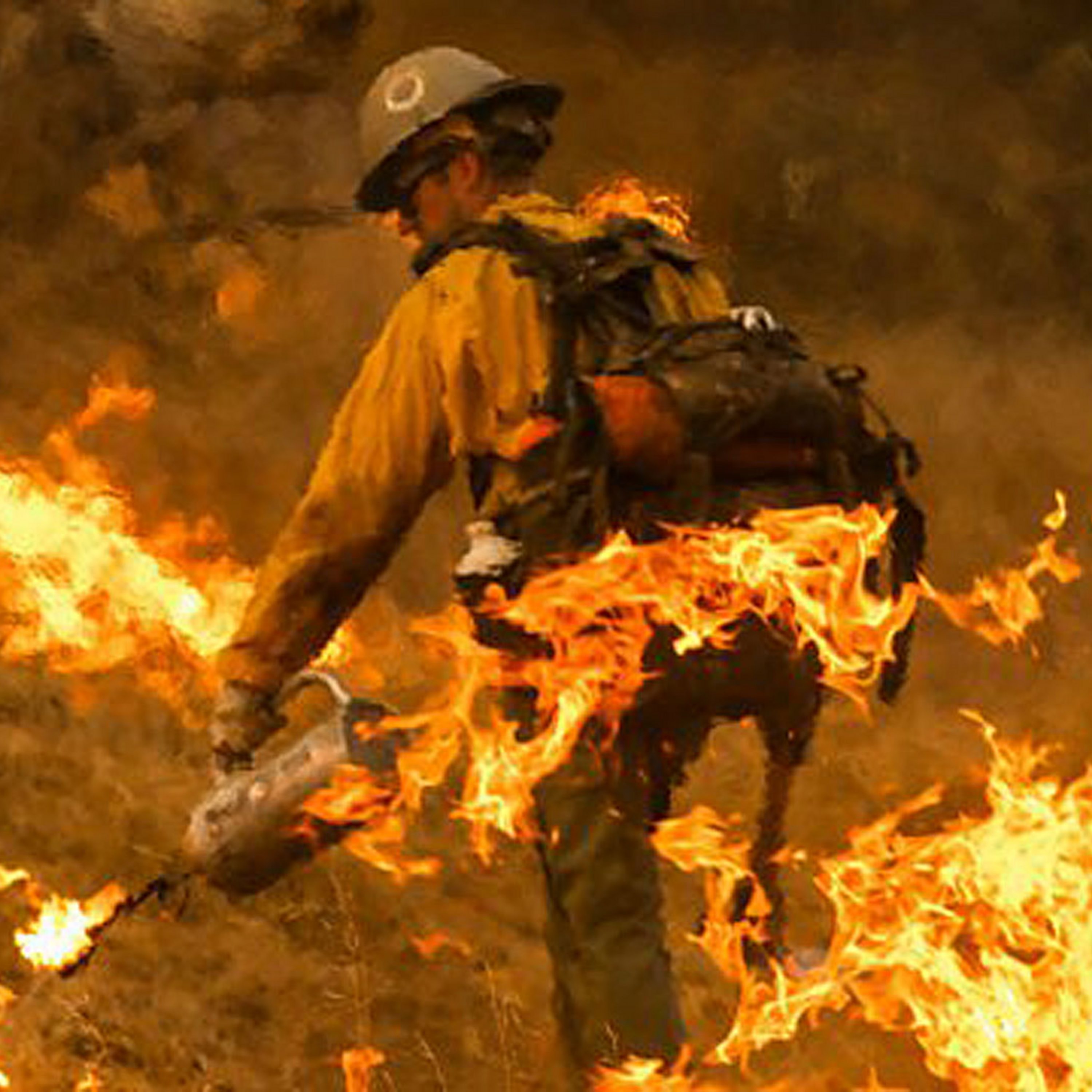
The Santa Ana in the south, and the Diablo in the north, are winds that are fuelling the terrible fires raging in California this week. They’re also blamed for bringing down power lines that sometimes start the fires. Roland Pease talks to Janice Coen of the National Center for Atmospheric Research NCAR who has been developing a highly detailed model to forecast how wind, mountains, and flames interact during a wildfire. The glaring gaps in human genetics are in Africa – much overlooked because the companies and universities sequencing DNA are mostly based in Europe, the US and other advanced economies. A ten-year attempt to fill in some of those gaps came to fruition this week, with the release of a study covering thousands of individuals from rural Uganda. Deepti Gurdasani, of Queen Mary University London, explains the data reveal both new medical stories, and the scale of past migration within Africa. There are also gaps in the climate record from Africa. Knowing past climates could help massively in understanding the prospects for climate change in coming years on the continent. Journalist Linda Nordling has just published an article in Nature that shows that the records exist – old weather data collected since the 19th Century. It’s just they’re scattered, unexamined, in vaults and collections across Africa. Most of us take the ability to speak fluently for granted but for listener Breeda it has been a lifelong struggle. She has asked us to investigate whether there is a cure for stuttering and if not, what is the best way to live with it is. Breeda is not alone as stammering is a neurological condition that affects 70 million people worldwide. (Image: A firefighter sets a back fire along a hillside during firefighting operations to battle the Kincade Fire in Healdsburg, California. Credit: Philip Pacheco/ /AFP via Getty Images)
Is quantum supremacy ‘garbage’?
A quantum computer has performed a calculation considered impossible for conventional computers, but how meaningful is the result? As our guest reveals, this quantum state can be hugely significant and garbage – at the same time. Also we look at a new method of gene editing, which avoids cutting up DNA, get to grips with where the worlds worms live and watch elements being created in distant solar collisions.Listeners Michael and Ricky have been walking a tributary of the River Thames in London, UK. They’ve noticed that there are loads of fish, which have only returned in recent years thanks to clean water initiatives. But what about salmon, they wonder? Could they one day return too? If they popped some salmon eggs in the river, would they return to spawn later on in their lives?We head to Norway to find out whether it’s possible. There, we follow the life cycle of salmon, from birth to death and travels to the salmon’s spawning grounds, before following their path out to sea and beyond. We explore the science behind ‘natal homing’ - returning to the place of your birth in order to reproduce. It isn’t just confined to salmon. But how does it work? (Photo: A quantum circuit from Google's Sycamore computer. Credit: Google)
Malaria, origins and a potential new treatment
A variety of malarial parasites have existed amongst the great apes for millennia, we look at how one of them jumped species and why humans became its preferred host. And from Antarctica we hear about a potential new treatment for malaria found in a deep sea sponge. We also look at why improved monitoring is changing our perceptions of earthquakes and follow the story of an endangered Polynesian snail.What exactly is the relationship between mathematics and reality? That’s the impossibly difficult question we have been set this week by our listener Sergio in Peru. It’s one that’s been pondered by humans for millennia: the Greek philosopher Pythagoras believed “All is number”.Is maths a human construct to help us make sense of reality - a tool, a model, a language? Does maths create its own reality? Or is it reality itself?(Photo: A young gorilla. Credit: Hermes Images/AGF/Universal Images Group via Getty Images)
From batteries to distant worlds
Nobel prizes this week went to a range of discoveries that you might be familiar with, in fact you might be using one of them right now – the lithium ion battery. The scientists credited with its Invention got the chemistry prize. And the tantalising prospect of life on other planets plays into the physics prize win.We see what salamanders have to offer in the treatment of arthritis.Human life expectancy has been increasing for decades. In many developed countries, we can now expect to live into our 80s, and it isn’t uncommon to live to 90 or even 100 years old. But eventually our bodies fail, old age is undoubtedly a clear indicator of approaching death. This fact annoyed 79 year old listener Bill, who emailed in to set us the task of seeking out the secrets to a longer, healthier life. Bill has a personal target to live to 200 years old, so can he do it?
Global climate inaction
This week’s IPCC report on the state of the world’s climate looks very much like their earlier reports on the subject. The document cautiously expresses a picture of a future with greater climate extremes. Activists are frustrated by the lack of action. We look at why the scientific message is often hampered by politics. Fish could provide micronutrients to the world poor, but as we’ll hear this would need a major shift in commercial fishing practices globally.Baby bottles from thousands of years ago suggest Neolithic people gave animal milk to their children.And when did the Sahara develop? New findings in deposits from volcanic islands provides some evidence.The number of vegans is on the rise in many parts of the world, with many people swearing by the health benefits of a plant-based lifestyle. But is a vegan diet really better for your health? Is there any evidence to show that vegans are likely to live longer? And what about the new, highly processed meat analogues becoming increasingly available in supermarkets and restaurants menus? They look, feel and taste just like meat products but what affect are they having on our health? To find out more, we talk to the experts and join listener Samantha in following a vegan diet.(Image: Greta Thunberg. Credit: AFP/Getty Image)
South East Asia choking - again
Staying indoors might seem a good way to avoid air pollution, but scientists studying the fires in Indonesia have found there is little difference between the air quality in their hotel room and the atmosphere outside. Both levels are high enough to be considered dangerous for human health. To add to the problem, fires continue to burn underground in the peaty soil long after they were started. In the Arctic ice melt this summer has been particularly severe, however the picture in complicated by climatic conditions. A new mission to the region involving trapping a ship in ice over winter hopes to provide answers.Nearly 500 million of year ago the earth’s sky was darkened by a massive asteroid explosion, blotting out the sun. New data on this event may provide an insight into contemporary climate change.Sir Arthur Conan Doyle’s famous fictional detective is renowned for his feats of memory, his observational capacity, tireless energy and an almost supernatural ability to solve the most perplexing crimes from seemingly unconnected facts. But what does science have to say about the matter? We pit fact against fiction with a leading forensic expert, a sleep scientist, and we discover that most humans are able to train their brain to rival the memory capacity of Sherlock Holmes. And who wouldn’t want that?(Image: Researcher Mark Grovener from Kings College London, measures air quality in Indonesia. Credit Marlin Wooster KCL)
Embryoids from stem cells
Scientists know very little about the first few days of the life of a human embryo, once it's been implanted in the womb. Yet this is when the majority of pregnancies fail. Professor Magdalena Zernika-Goetz at Cambridge University is a leader in the field of making 'model embryos' in both mice and humans. Model embryos until now have been grown in the lab from donated fertilised eggs, but these are hard to come by and governed by strict laws and ethical guidelines. Now researchers in the University of Michigan have used human pluripotent stem cell lines (originally isolated from embryos, but kept and nurtured as clumps of dividing cells in petri-dishes for many years) to make a model embryo that has shown signs of development and organisation in the crucial 7-10 day window. We discuss how helpful these will be to understanding crucial early stage pregnancies and as a tool to test drugs, treatments and disease processes. The ethical side of growing human embryos from stem cells is addressed by Stanford University ethicist Professor Hank Greely. Astronomers have detected water vapour in the atmosphere of a planet called K2-18b orbiting within the habitable zone of a distant star. The lead scientist, Professor Giovanna Tinetti of University College London, talks about the discovery and what she hopes to explore when a satellite telescope called ARIEL is launched by ESA in around a decade. The World Health Organization ranks migraines as the second most disabling neurological disorder in the world and in people under the age of 50, it is the single most disabling medical condition. With stats like that, it’s no wonder that so many listeners have got in touch wanting help with their headaches. Peter from Germany askes what happens in his brain when he’s got a migraine, whilst Nika from Germany has found that changing lifestyle has dramatically reduced hers but she’s not sure why. What’s the link between diet, exercise and migraines, Nika wonders? Meanwhile, Judy from USA wants to know if there’s a cure, as her son gets chronic migraines and she wants to know what the future looks like for him. We investigate some of the latest research in headache and migraine research to find some answers.(Photo: A set of five embryo-like structures in a microfluidic device developed in the lab of Jianping Fu. Image credit: Fu Lab, Michigan Engineering)
New evidence of nuclear reactor explosion
An isotopic fingerprint is reported of a nuclear explosion in Russia last month. Researchers ask people living in the area or nearby to send them samples of dust or soil before the radioactive clues therein decay beyond recognition. Also, a near miss between an ESA satellite and a SpaceX Starlink module in crowded near space strengthens the case for some sort of international Space Traffic Management treaty, whilst in the arctic circle, melting permafrost is disinterring the graves of long-dead whalers.Sociable, lively, outgoing people are highly valued in certain cultures - think of the stereotype of the hyper-confident American. And there’s even evidence that extroverts all over the world tend to be happier. But are the positive qualities that quieter types can bring to society being ignored or under-appreciated? And couldn’t introverts be just as happy as extroverts, if only they lived in a more accepting culture? We probe the links between happiness, personality and culture, and find out what makes introverts happy.(Photo:Tell-tale radioactive isotopes could still be in dust on cars near the site of the blast. Credit: Humonia/iStock / Getty Images Plus)
Nanotube computer says hello
A computer processor made of carbon nanotubes is unveiled to the world. Also, the continuing quest for nuclear fusion energy, and the stats on crocodile attacks since the 1960s.Satellites have transformed our lives, giving us digital communications, navigation and observations of Earth, and even an artificial place to live above the atmosphere: The International Space Station. But, would more of these satellites and stations help us get back to the Moon, as well as further into the solar system? What else would astronauts need for living beyond Earth? We ask the engineers working on the possibilities – from communications satellites that could transform lunar missions to a brand new moon-orbiting space station: The Lunar Gateway. These technologies could help humans get back to the Moon, and perhaps one day to Mars, for hopefully reduced costs – but funding missions beyond our planet still isn’t going to be cheap. Why might we need deep space-based infrastructure, and how could it help humanity back here on Earth? (Photo: The world's first 16 bit microprocessor made of carbon nanotubes. Credit: Max Shulaker)
Amazonian fires likely to worsen
As fires across the amazon basin continue to burn, we speak to the researchers watching from space and from the ground. Also, new pictures back from the surface of asteroid Ryugu thanks to Germany’s MASCOT lander, part of the Japanese Hyabusa2 mission, give insights into the clay from which the solar system was originally formed, and Greenland’s top geologist gives his valuation of his native island for prospective purchasers. Many of us struggle to motivate ourselves to carry out certain tasks, from hanging out the washing to writing a job application. How can we best motivate ourselves? And how can we avoid procrastination? Listener Moses in Uganda wants to find out. Anand Jagatia puts science to the test as he trains and participates in an open water swimming race which Marnie Chesterton has kindly volunteered him for.(Photo: Wildfires in Amazon rainforest. Credit: REUTERS/Ueslei Marcelino)
Cracking the case of the Krakatoa volcano collapse
Scientists this week are on expedition around the volcano Anak Krakatoa, which erupted and collapsed in 2018 leading to the loss of some 400 lives on the island of Java. The scientists, including David Tappin and Michael Cassidy, are hoping that their survey of the seafloor and tsunami debris will allow them to piece together the sequence of events, and maybe find signs to look out for in the future.Wyoming Dinosaur trove The BBC got a secret visit to a newly discovered fossil site somewhere in the US which scientists reckon could keep them busy for many years. Jon Amos got to have a tour and even found out a tasty technique to tell a fossil from a rock.Bioflourescent Aliens Researchers at Cornell University’s Carla Sagan Institute report their work thinking about detecting alien life on distant planets orbiting other stars. Around 75% of stars are of a type that emits far more dangerous UV than our own sun. What, they argue, would a type of life that could survive that look like to us? Well, just maybe it would act like some of our own terrestrial corals, who can protect their symbiotic algae from UV, and in doing so, emit visible light. Could such an emission be detectable, in sync with dangerous emergent UV flares around distant suns? The next generation of large telescopes maybe could…Exopants Jinsoo Kim and David Perry of Harvard University tell reporter Giulia Barbareschi about their new design for a soft exosuit that helps users to walk and, crucially also to run. They suggest the metabolic savings the suit could offer have numerous future applications for work and play.Listeners Mark and Jess have been watching TV series, The Handmaid’s Tale. It's an adaptation of a book by Margaret Atwood and depicts a dystopian future where many have become infertile. The remaining few fertile women, known as Handmaids, are forced into child-bearing servitude. Why so many have become infertile isn’t clear but the series hints at several possible causes, from radiation to environmental pollutants.All of which got Mark and Jess wondering… What could cause mass infertility? Would we descend into a political landscape akin to Gilead? Award-winning author Margaret Atwood has left a paper trail for us to follow in the pages of her novel. There’s a ream of possible causes, and so Marnie Chesterton investigates which ring true.(Photo: Volcano Anak Krakatoa. Credit: Drone Pilot, Muhammad Edo Marshal, ITB university in Bandung, Indonesia)
The birth of a new volcano
A new undersea volcano has appeared off the coast of East Africa. The sea floor between Madagascar and Mozambique has become increasingly seismically active in the last year. As well as the appearance of this active volcano, local islands are now experiencing frequent earthquakes. The causes of Indonesia’s Palu Bay tsunami last year are being examined thanks to social media. Videos taken as the tsunami hit have been analysed to determine wave heights and speeds and suggest possible causes. Scientists at a massive underground physics research facility in Italy are to stand trial over safety risks. The facility uses poisonous chemicals. There are concerns these could leak into drinking water supplies in the event of an earthquake. As scientists keep finding ever more fascinating facts about the invisible housemates that share our homes, we investigate what might be lurking in quiet household corners or under our beds. We head out on a microbial safari with expert tour guide Dr Jamie Lorimer from the University of Oxford to find out what kind of creatures are living in our kitchens, bathrooms and gardens - from bacteria normally found in undersea vents popping up in a kettle, to microbes quietly producing tiny nuggets of gold. For so long this hidden world has been one that we’ve routinely exterminated - but should we be exploring it too?(Image: Multibeam sonar waves, reflecting off the sea floor near the French island of Mayotte, reveal the outline of an 800-meter-tall volcano (red) and a rising gas-rich plume. Credit: MAYOBS team (CNRS / IPGP -Université de Paris / Ifremer / BRGM)